Intelligent Identification of Micro-NPR Bolt Shear Deformation Based on Modular Convolutional Neural Network

 , ,
, ,  , and
, and
Abstract
1. Introduction
- (1)
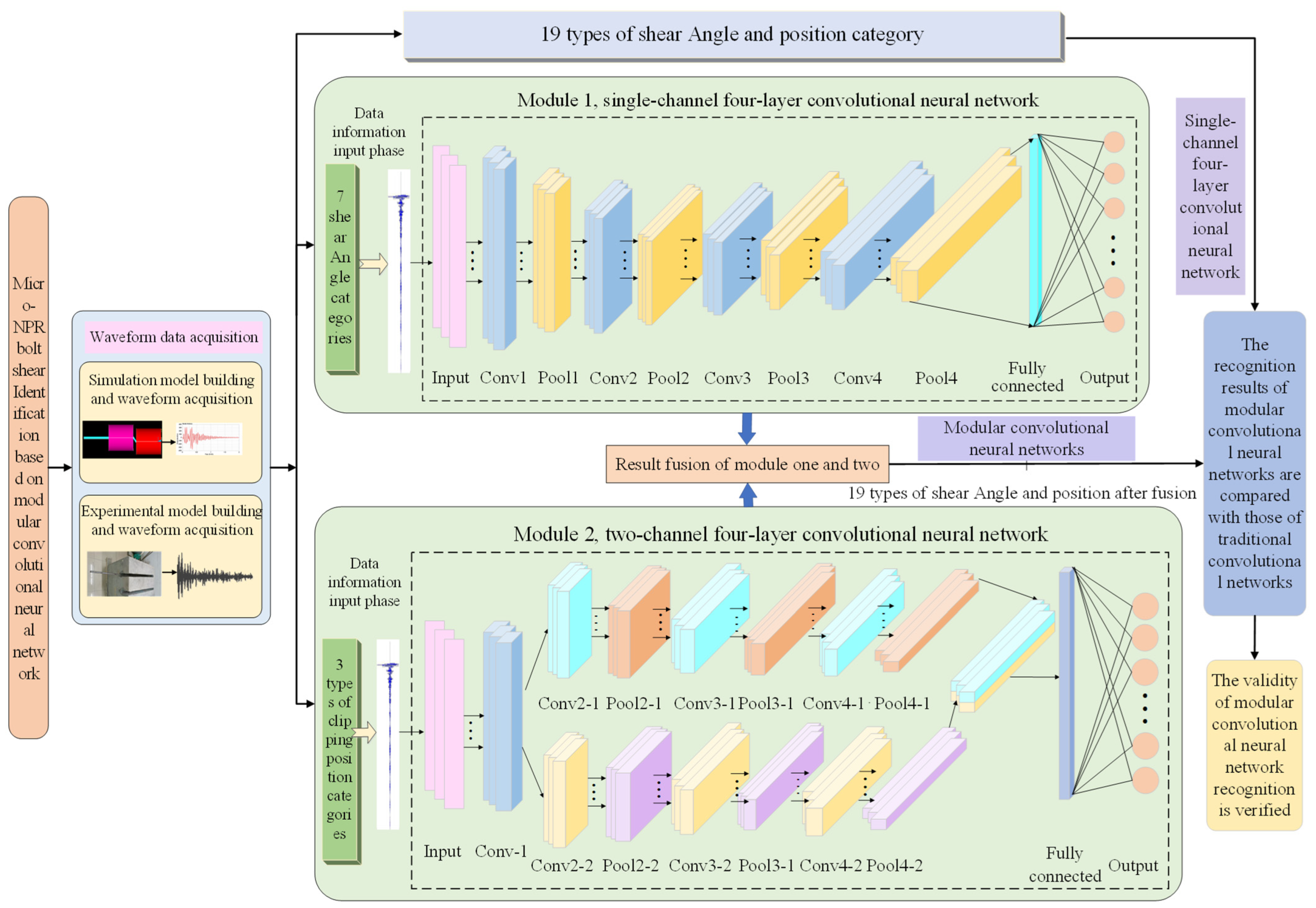
- This paper proposes for the first time an intelligent identification framework that combines stress wave time-domain waveform acquisition with a dual-module convolutional neural network. The proposed method directly utilizes time-domain signal features without requiring prior feature extraction from acquired signals, enabling convenient and rapid identification and detection.
- (2)
- This method can directly perform identification and detection based on time-domain signal waveforms, eliminating the need for preliminary feature extraction from the acquired signals, thereby enabling a convenient and efficient identification process.
2. Related Works
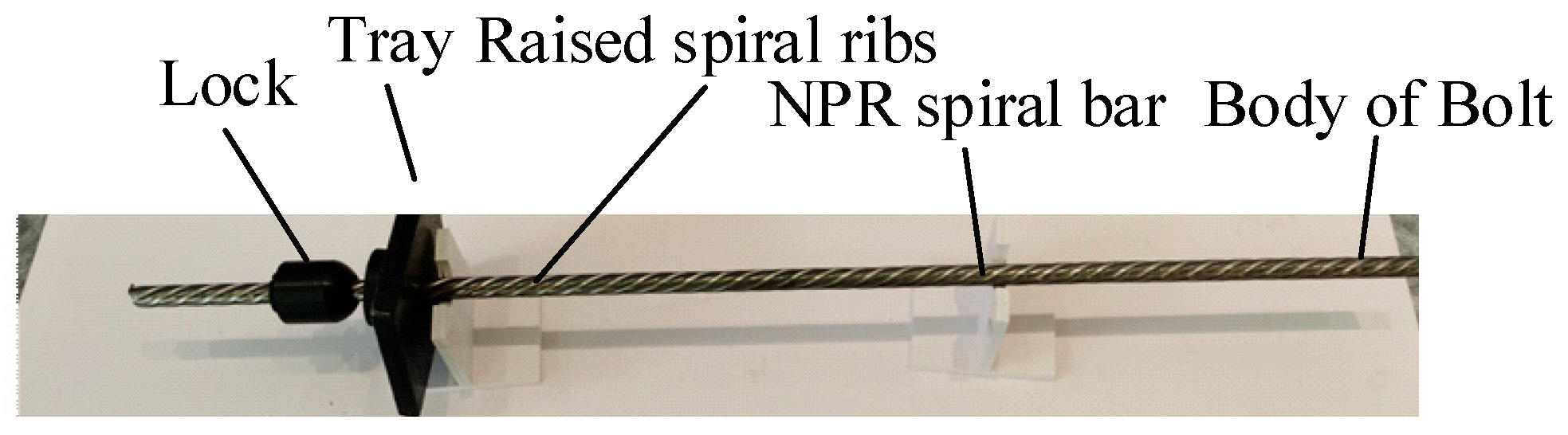
3. Modeling of Micro-NPR Bolt Anchoring System
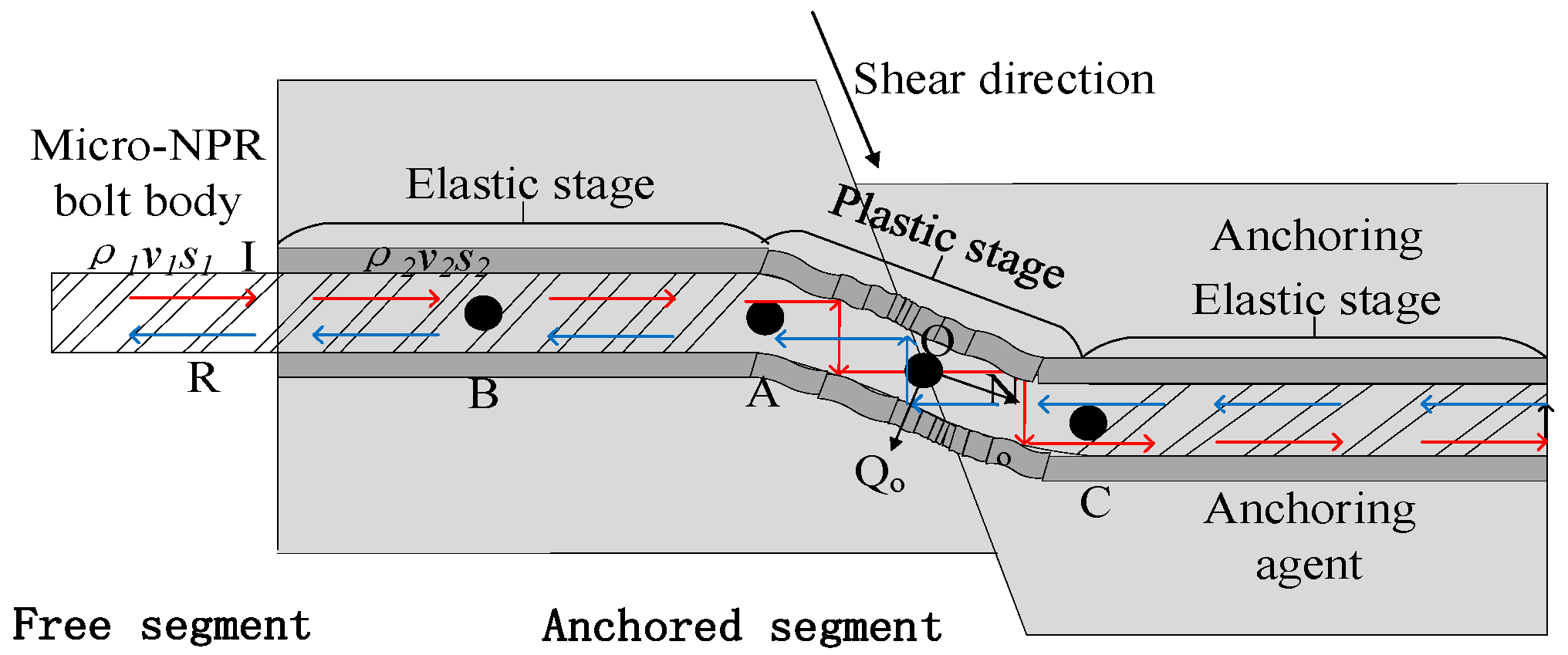
3.1. Development of a Shear Model for the Micro-NPR Bolt Anchoring System
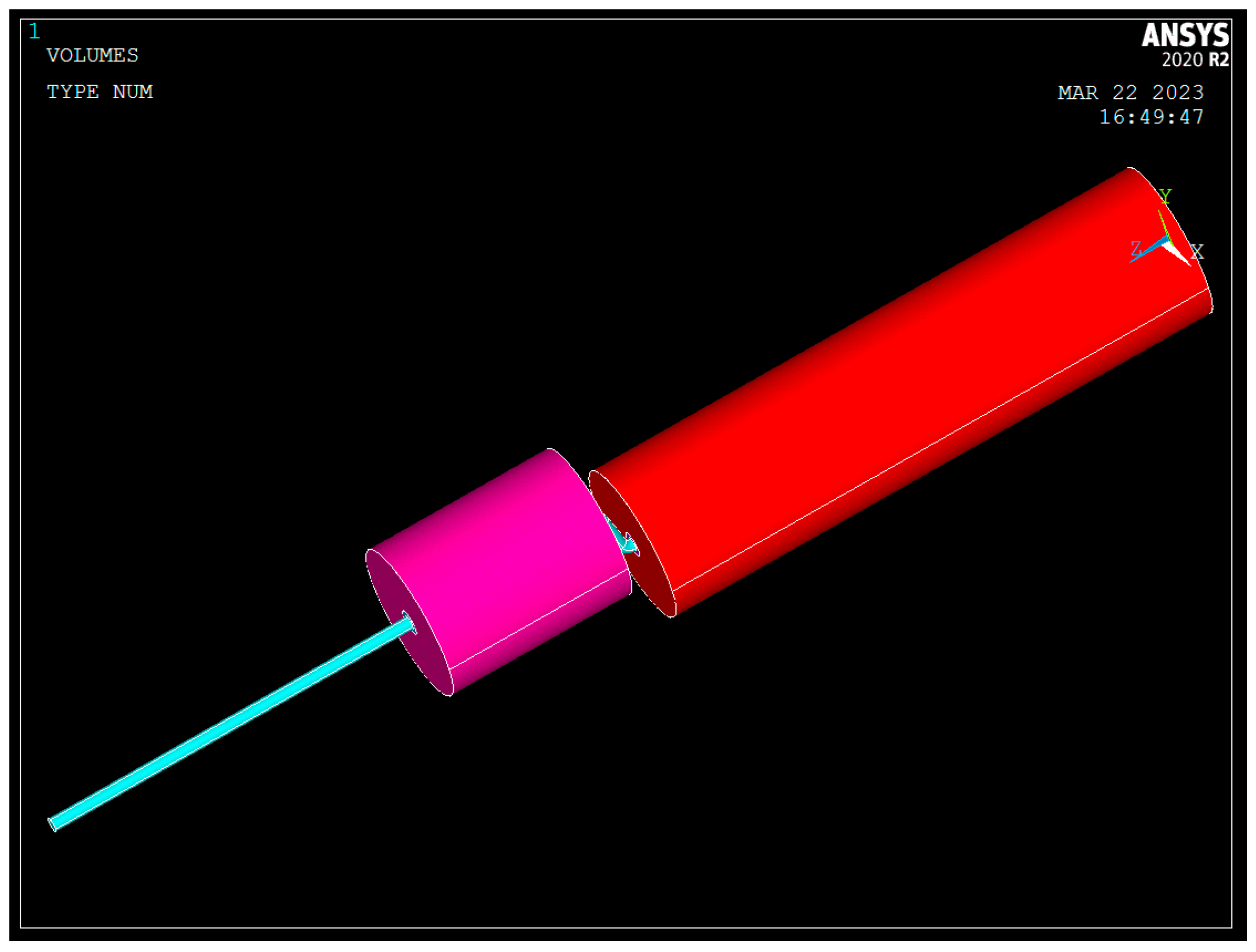
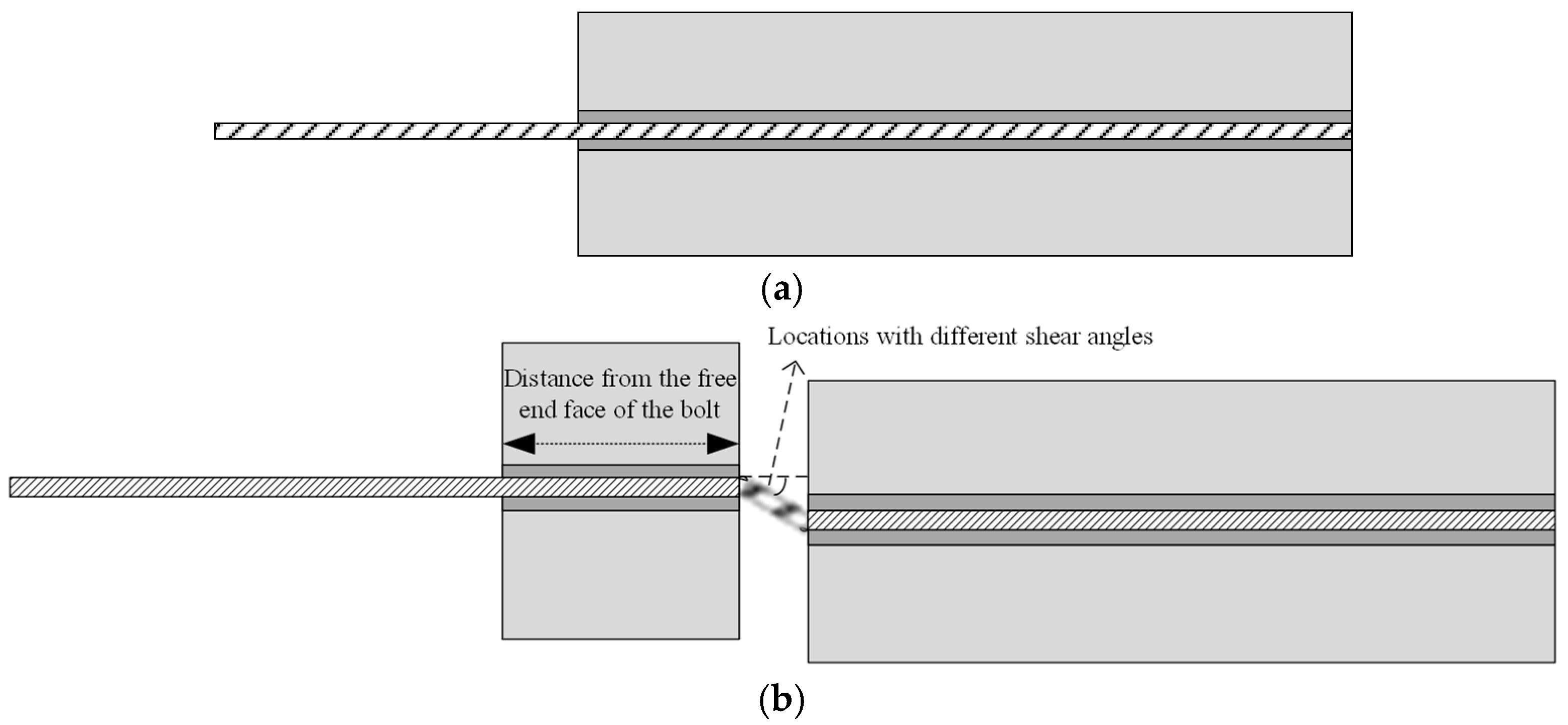
3.2. Simulation Modeling of the Micro-NPR Bolt Anchoring System
3.3. Experimental Study on Intelligent Identification of Shear Deformation in Micro-NPR Bolts
4. Design of a Modular Convolutional Neural Network Model
- (1)
- Output size of the convolution layer
- (2)
- Image output size of the pooling layer
- (3)
- Output size of the full connection layer
- (4)
- Number of convolutional layer parameters
- (5)
- Number of parameters of the fully connected layer (connected to the last 1 convolution layer)
5. Identification of Shear Deformation Types in Micro-NPR Bolt Anchoring System
5.1. Validation and Analysis of Simulation Results for Modular Convolutional Neural Networks
5.2. Validation and Analysis of Experimental Results for Modular Convolutional Neural Networks
6. Conclusions
Author Contributions
Funding
Institutional Review Board Statement
Informed Consent Statement
Data Availability Statement
Conflicts of Interest
Abbreviations
| Micro-NPR | Micro Negative Poisson Ratio |
| CREA | Constant Resistance Energy Absorption |
| CNN | Convolutional Neural Network |
| SVM | Support Vector Machine |
| FNN | Feedforward Neural Network |
| KNN | K-Nearest Neighbors |
References
- Tao, Z.; Ren, S.; He, M.; Xia, M. Static tensile and bolting shear mechanical properties of micro-NPR bolt steel in underground engineering. J. China Coal Soc. 2022, 47, 683–694. [Google Scholar] [CrossRef]
- He, M.; Han, X.; Zhang, B.; Tao, Z. Real-time remote monitoring and forecasting technology for landslide disasters based on sliding force variation and its engineering application. J. Heilongjiang Inst. Sci. Technol. 2012, 22, 337–342. [Google Scholar]
- Tao, Z.; Yang, W.; Liu, W.; Jiang, C.; Chen, Y. Anchor Cable of High Constant Resistance for Landslide Monitoring: Static Tensile Test and Engineering Application. J. Yangtze River Sci. Res. Inst. 2018, 35, 128–134. [Google Scholar]
- Tao, Z.; Zhang, H.; Chen, Y.; Jiang, C. Support principles of NPR bolt/cable and control techniques of large-deformation disasters. Int. J. Miningence Technol. 2016, 26, 967–973. [Google Scholar] [CrossRef]
- He, M.; Ren, S.; Xu, H.; Luo, S.; Tao, Z.; Zhu, C. Experimental study on the shear performance of quasi-NPR steel bolted rock joints. J. Rock Mech. Geotech. Eng. 2023, 15, 350–362. [Google Scholar] [CrossRef]
- Wu, X.; Zheng, H.; Jiang, Y. Influence of joint roughness on the shear properties of energy-absorbing bolt. Int. J. Rock Mech. Min. Sci. 2023, 163, 105322. [Google Scholar] [CrossRef]
- Yin, Z.; Feng, D.; He, Y. Restoring force model of end-plate bolted shear links in eccentrically braced frames. J. Constr. Steel Res. 2022, 199, 107623. [Google Scholar] [CrossRef]
- Wu, W.; Zhu, L.; Wang, Y. Study on mode repulsion of ultrasonic-guided waves in pipe bends. J. Press. Vessel Technol. 2020, 142, 031402. [Google Scholar] [CrossRef]
- Rasgado-Moreno, C.O.; Rist, M.; Land, R.; Ratassepp, M. Acoustic Forward Model for Guided Wave Propagation and Scattering in a Pipe Bend. Sensors 2022, 22, 486. [Google Scholar] [CrossRef]
- Narayanan, M.M.; Arjun, V.; Kumar, A. Influence of thermal expansion bend and tubesheet geometry on guided wave inspection of steam generator tubes of a fast breeder reactor. Struct. Health Monit. 2021, 20, 3288–3308. [Google Scholar] [CrossRef]
- Xu, J.; Wang, W.; Han, Q.; Liu, X. Damage pattern recognition and damage evolution analysis of unidirectional CFRP tendons under tensile loading using acoustic emission technology. Compos. Struct. 2020, 238, 111948. [Google Scholar] [CrossRef]
- Lin, Y.F.; Ye, J.W.; Lo, C.M. Application of impact-echo method for rock bolt length detection. Constr. Build. Mater. 2022, 316, 125904. [Google Scholar] [CrossRef]
- Saleem, M. Assessing the load carrying capacity of concrete anchor bolts using non-destructive tests and artificial multilayer neural network. J. Build. Eng. 2020, 30, 101260. [Google Scholar] [CrossRef]
- Yuan, M.; Wang, S.; Yan, D.; Liu, Y.; Huang, L. Research on Damage Prediction of Concrete Bridges Based on Acoustic Emission and Convolutional Neural Networks. J. China Foreign Highw. 2022, 42, 69–75. [Google Scholar] [CrossRef]
- Yang, S.; Xu, Q.; Wang, Z. Research Progress Structural Damage Detection Based on Convolutional Neural Networks. J. Archit. Civ. Eng. 2022, 39, 38–57. [Google Scholar] [CrossRef]
- Sun, H.; Peng, L.; Wang, S.; Huang, S.; Qu, K. Development of frequency-mixed point-focusing shear horizontal guided-wave EMAT for defect inspection using deep neural network. IEEE Trans. Instrum. Meas. 2020, 70, 1–14. [Google Scholar] [CrossRef]
- Hu, C.; Xu, J.; Li, Y. Slight looseness detection of reinforcing bar’s threaded sleeve connections using convolutional neural network trained by magnetostrictive guided wave signals. J. Nondestruct. Eval. 2021, 40, 26. [Google Scholar] [CrossRef]
- Zhang, W.T.; Cui, D.; Lou, S.T. Training images generation for CNN based automatic modulation classification. IEEE Access 2021, 9, 62916–62925. [Google Scholar] [CrossRef]
- Wang, K.; Yang, S.; Zhou, J.; Cao, Q. Evaluation Method of Bolt Anchorage Quality Based on Convolutional Neural Network. Tunn. Constr. 2020, 40, 202–208. [Google Scholar]
- Liu, M.; Yue, X. Analysis of bolt’s anchoring quality based on wavelet neural network. Chin. J. Rock Mech. Eng. 2006, 25, 83–87. [Google Scholar]
- Pellet, F.; Egger, P. Analytical model for the mechanical behaviour of bolted rock joints subjected to shearing. Rock Mech. Rock Eng. 1996, 29, 73–97. [Google Scholar] [CrossRef]



| Bolt Anchoring Type | Free Segment /m | Cut at 0.75 m | Cut at 1.0 m | Cut at 1.25 m | ||||||
|---|---|---|---|---|---|---|---|---|---|---|
| Anchored Segment I/m | Elbow/m | Anchored Segment II/m | Anchored Segment I/m | Elbow/m | Anchored Segment II/m | Anchored Segment I/m | Elbow /m | Anchorage Section II/m | ||
| 0° | 0.5 | 1.0 | ||||||||
| 15° | 0.5 | 0.25 | 0.1 | 0.75 | 0.5 | 0.1 | 0.5 | 0.75 | 0.1 | 0.25 |
| 30° | 0.5 | 0.25 | 0.1 | 0.75 | 0.5 | 0.1 | 0.5 | 0.75 | 0.1 | 0.25 |
| 45° | 0.5 | 0.25 | 0.1 | 0.75 | 0.5 | 0.1 | 0.5 | 0.75 | 0.1 | 0.25 |
| 60° | 0.5 | 0.25 | 0.1 | 0.75 | 0.5 | 0.1 | 0.5 | 0.75 | 0.1 | 0.25 |
| 75° | 0.5 | 0.25 | 0.1 | 0.75 | 0.5 | 0.1 | 0.5 | 0.75 | 0.1 | 0.25 |
| 90° | 0.5 | 0.25 | 0.1 | 0.75 | 0.5 | 0.1 | 0.5 | 0.75 | 0.1 | 0.25 |
| Type | Length/m | Diameter/mm | Poisson Ratio | Modulus of Elasticity/GPa | Density kg/m3 |
|---|---|---|---|---|---|
| Micro-NPR bolt | 1.5 | 18 | 0.01 | 200 | 7930 |
| Grout | 1.0 | 32 | 0.30 | 210 | 7800 |
| Surrounding rock | 1.0 | 200 | 0.20 | 33 | 2001 |
| Type of Bolt | Bending Location Distance from Free End/m | Bolt Bending Angle |
|---|---|---|
| 0 | - | 0° |
| 45F | 0.75 | 45° |
| 45B | 0.75 | 45° |
| 90F | 1.25 | 90° |
| 90B | 1.25 | 90° |
| Modular Convolutional Neural Network Pipeline |
|---|
| Input: Input dataset W, number of iterations M |
| Output: Label data y 1. Use the normalization function f(x), w = f(W) 2. Initialize the parameters of the 1D-CNN network for the shear angleidentification submodule 3. for m = 1 … M do |
| 4. Input the samples for the m-th batch |
| 5. Forward propagation outputs predicted values |
| 6. Calculation error loss |
| 7. Update network weights and biases |
| 8. end |
| 9. Output the prediction result y1 from the shear angle identification sub-module |
| 10. Initialize the parameters of the 1D-CNN for the shear location identification sub-module |
| 11. for m = 1 … M do |
| 12. Input the samples for the m-th batch |
| 13. Forward propagation outputs predicted values |
| 14. Calculation error loss |
| 15. Update network weights and biases |
| 16. end |
| 17. Output the prediction result y2 from the shear location identification sub-module |
| 18. Fuse y1 and y2 to obtain y |
| Module | Identification Result Quantity | Training Set | Test Set |
|---|---|---|---|
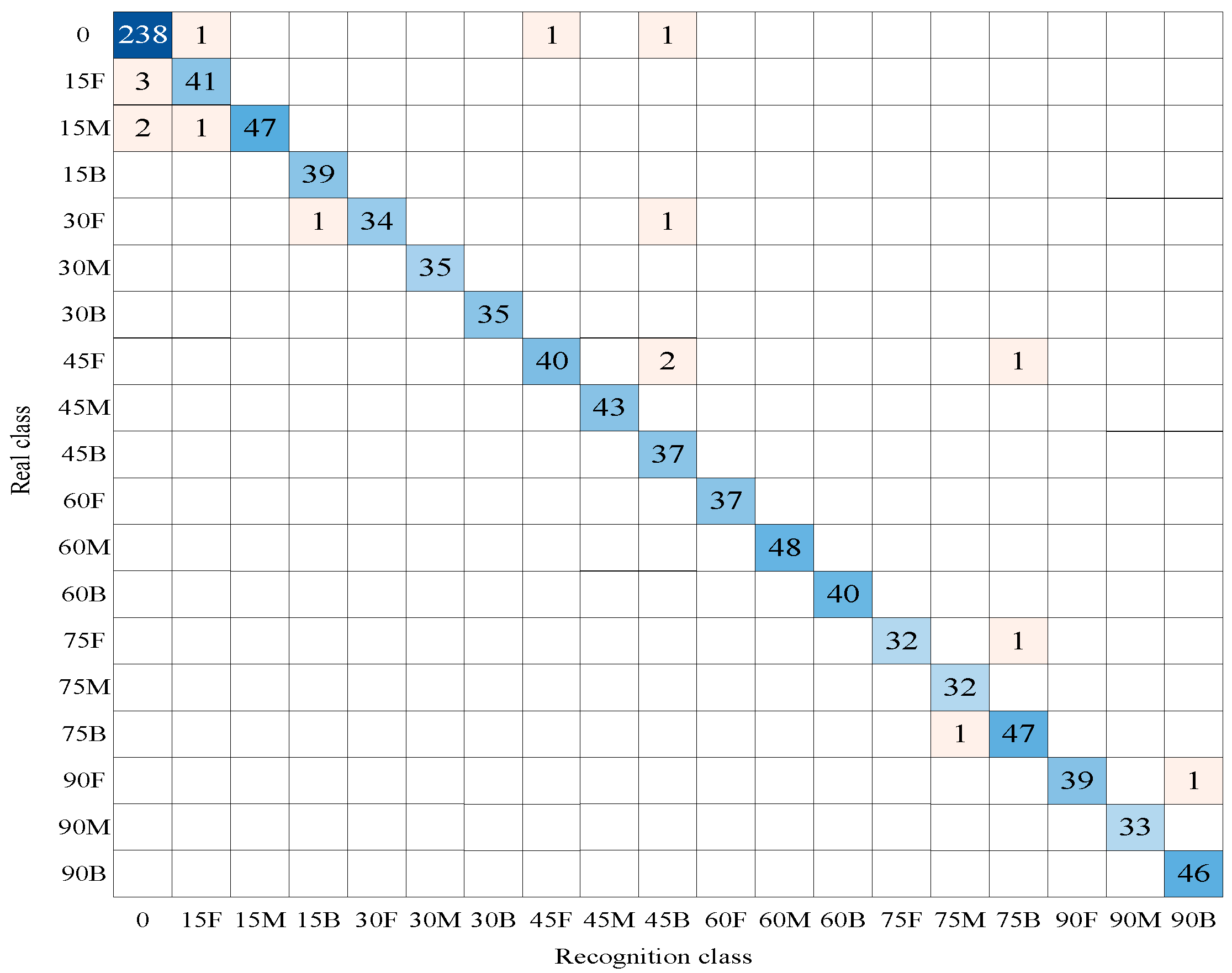
| Shear Angle identification submodule | Loss indicates the loss function | 0.004 | 0.025 |
| Identification accuracy | 100% | 99.479% | |
| Confusion matrix | - | There are 5 misclassified waveforms | |
| Cut the location identification submodule | Loss indicates the loss function | 0.008 | 0.042 |
| Identification accuracy | 100% | 98.438% | |
| Confusion matrix | - | There are 15 misclassified waveforms | |
| Fusion of identification results | Identification accuracy | 100% | 98.229% |
| Method | Accuracy/% | Mean Squared Error |
|---|---|---|
| SVM | 68.57 | 3.293 |
| FNN | 88.45 | 0.694 |
| KNN | 89.72 | 0.568 |
| Traditional CNN | 91.04 | 0.262 |
| Modular CNN | 98.23 | 0.043 |
| Training Set | Test Set | |
|---|---|---|
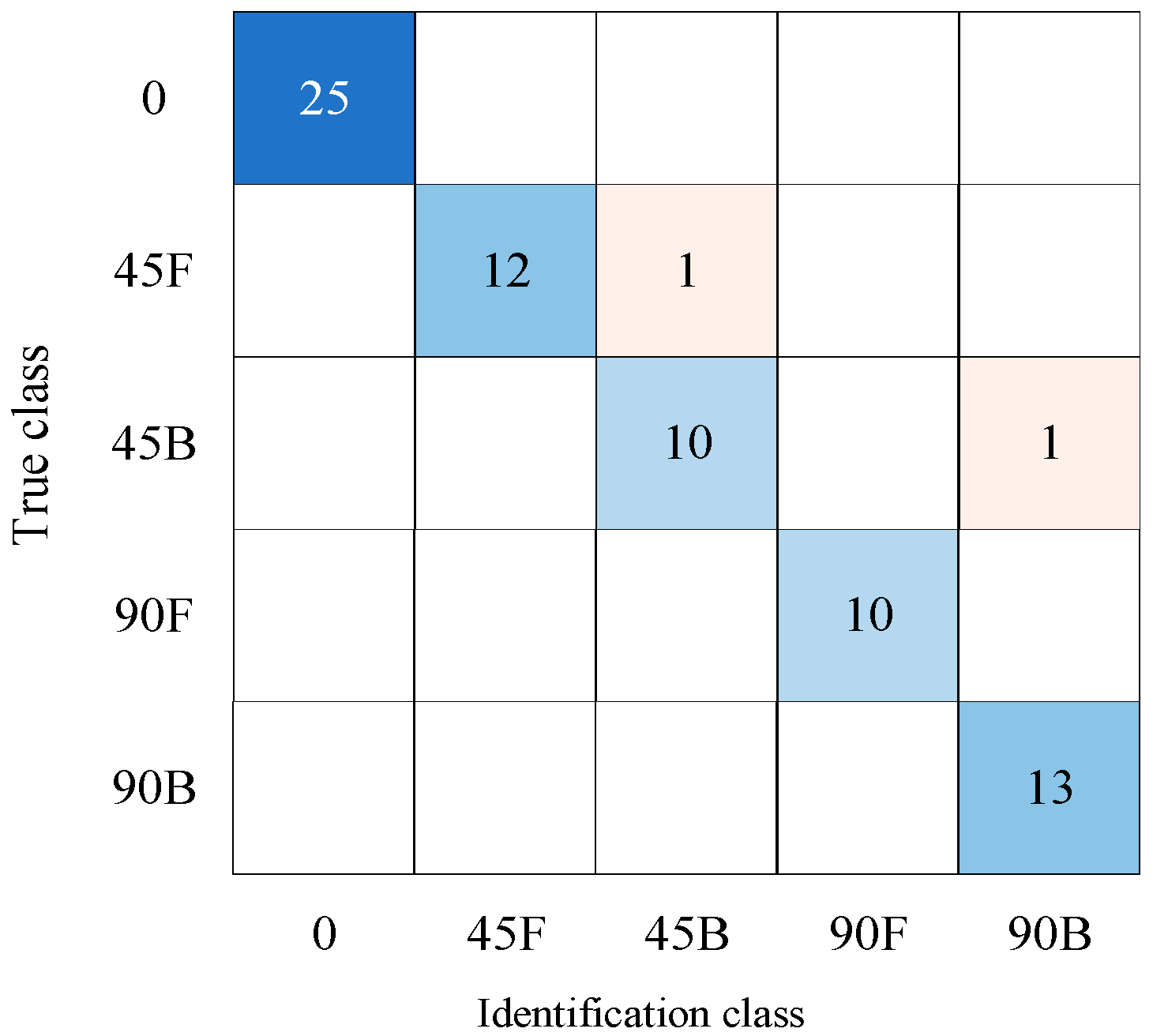
| Loss indicates the loss function | 0.0314 | 0.143 |
| Identification accuracy | 97.22% | 100% |
| Confusion matrix | - | Two waveforms were misclassified. |
| Module | Identification Result Quantity | Training Set | Test Set |
|---|---|---|---|
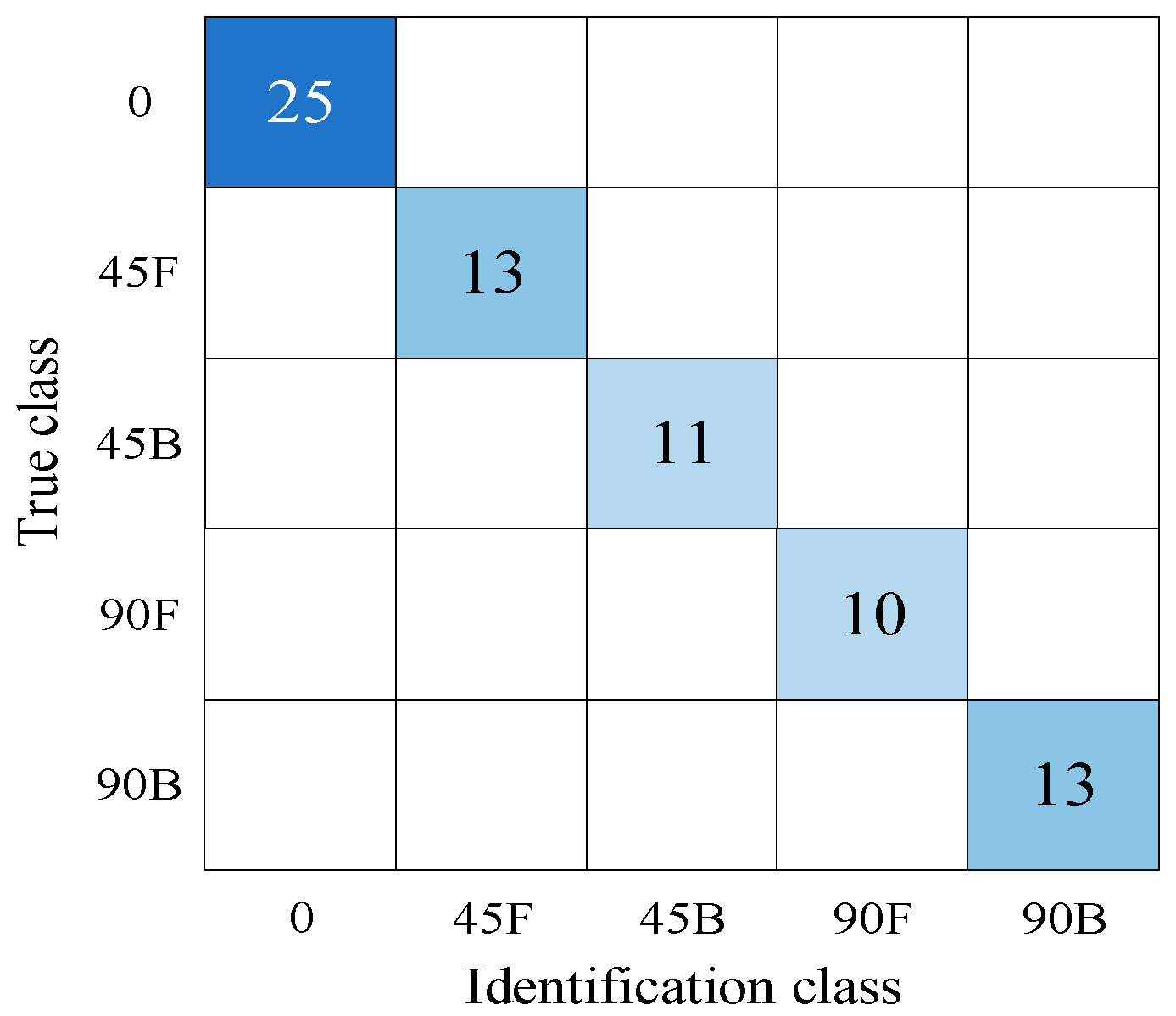
| Shear angle identification submodule | Loss indicates the loss function | 0.0429 | 0.0373 |
| Identification accuracy | 100% | 100% | |
| Confusion matrix | - | All correct | |
| Cut position identification submodule | Loss indicates the loss function | 0.0192 | 0.0542 |
| Identification accuracy | 100% | 100% | |
| Confusion matrix | - | All correct | |
| Fusion of identification results | Identification accuracy | 100% | 100% |
Disclaimer/Publisher’s Note: The statements, opinions and data contained in all publications are solely those of the individual author(s) and contributor(s) and not of MDPI and/or the editor(s). MDPI and/or the editor(s) disclaim responsibility for any injury to people or property resulting from any ideas, methods, instructions or products referred to in the content. |
© 2025 by the authors. Licensee MDPI, Basel, Switzerland. This article is an open access article distributed under the terms and conditions of the Creative Commons Attribution (CC BY) license.
Share and Cite
Han, G.; Shang, C.; Tao, Z.; Yang, X.; Du, B.; Sun, X.; Geng, L. Intelligent Identification of Micro-NPR Bolt Shear Deformation Based on Modular Convolutional Neural Network. Sensors 2026, 26, 184. https://doi.org/10.3390/s26010184
Han G, Shang C, Tao Z, Yang X, Du B, Sun X, Geng L. Intelligent Identification of Micro-NPR Bolt Shear Deformation Based on Modular Convolutional Neural Network. Sensors. 2026; 26(1):184. https://doi.org/10.3390/s26010184
Chicago/Turabian StyleHan, Guang, Chen Shang, Zhigang Tao, Xu Yang, Bowen Du, Xiaoyun Sun, and Liang Geng. 2026. "Intelligent Identification of Micro-NPR Bolt Shear Deformation Based on Modular Convolutional Neural Network" Sensors 26, no. 1: 184. https://doi.org/10.3390/s26010184
APA StyleHan, G., Shang, C., Tao, Z., Yang, X., Du, B., Sun, X., & Geng, L. (2026). Intelligent Identification of Micro-NPR Bolt Shear Deformation Based on Modular Convolutional Neural Network. Sensors, 26(1), 184. https://doi.org/10.3390/s26010184