High-Accuracy Indoor Positioning and Smart Home Technologies for Assessing and Monitoring Frailty in Older Adults

 , , , , , , , , , and
Highlights
- The high-accuracy home-monitoring system demonstrated very strong concurrent validity with the Fried’s Frailty Phenotype criteria and strong associations with the Clinical and Edmonton Frailty Scales.
- The system effectively integrated ultra-wideband indoor positioning, off-the-Shelf-Internet of Things enabled devices, and smart sensors to capture all five frailty components with high spatial and temporal precision in a home-like clinical environment.
- High-accuracy sensor integration enables objective, continuous, and automated frailty assessment, reducing reliance on self-reported or clinic-based evaluations.
- These results show a potential for off-the-Shelf-Internet of Things-based smart home technologies to support data-driven frailty assessment and monitoring, early risk detection, and personalized intervention for aging-in-place applications.
Abstract
1. Introduction
2. Materials and Methods
2.1. Study Design, Participants, and Setting
- (a)
- For inpatients or outpatients, participants were 65 years of age or older, receiving Specialized Geriatric Rehabilitation at the Glenrose Rehabilitation Hospital; for visitors or members of the hospital or academic community, participants were 18 years of age or older.
- (b)
- All participants were able to walk independently for at least 15 m, with or without the use of a walking aid.
- (c)
- Participants had sufficient cognitive, upper extremity, visual, and auditory function (with or without assistive devices) to interact with the smart furniture and sensors, including those living with and without cognitive impairment.
- (a)
- had unstable cardiac conditions;
- (b)
- were taking dopaminergic agents, cholinesterase inhibitors, anticholinergics, antipsychotics, antiepileptics, benzodiazepines and opioids that could confound frailty symptoms;
- (c)
- had movement disorders likely to interfere with sensor data (e.g., tremors or severe spasms);
- (d)
- had a recent viral illness (e.g., COVID-19 or influenza);
- (e)
- required supplemental oxygen;
- (f)
- were unable to tolerate at least one hour of moderate activity; or
- (g)
- had insufficient English comprehension or communication ability to follow task instructions.
2.2. Setting
2.3. Description of the System
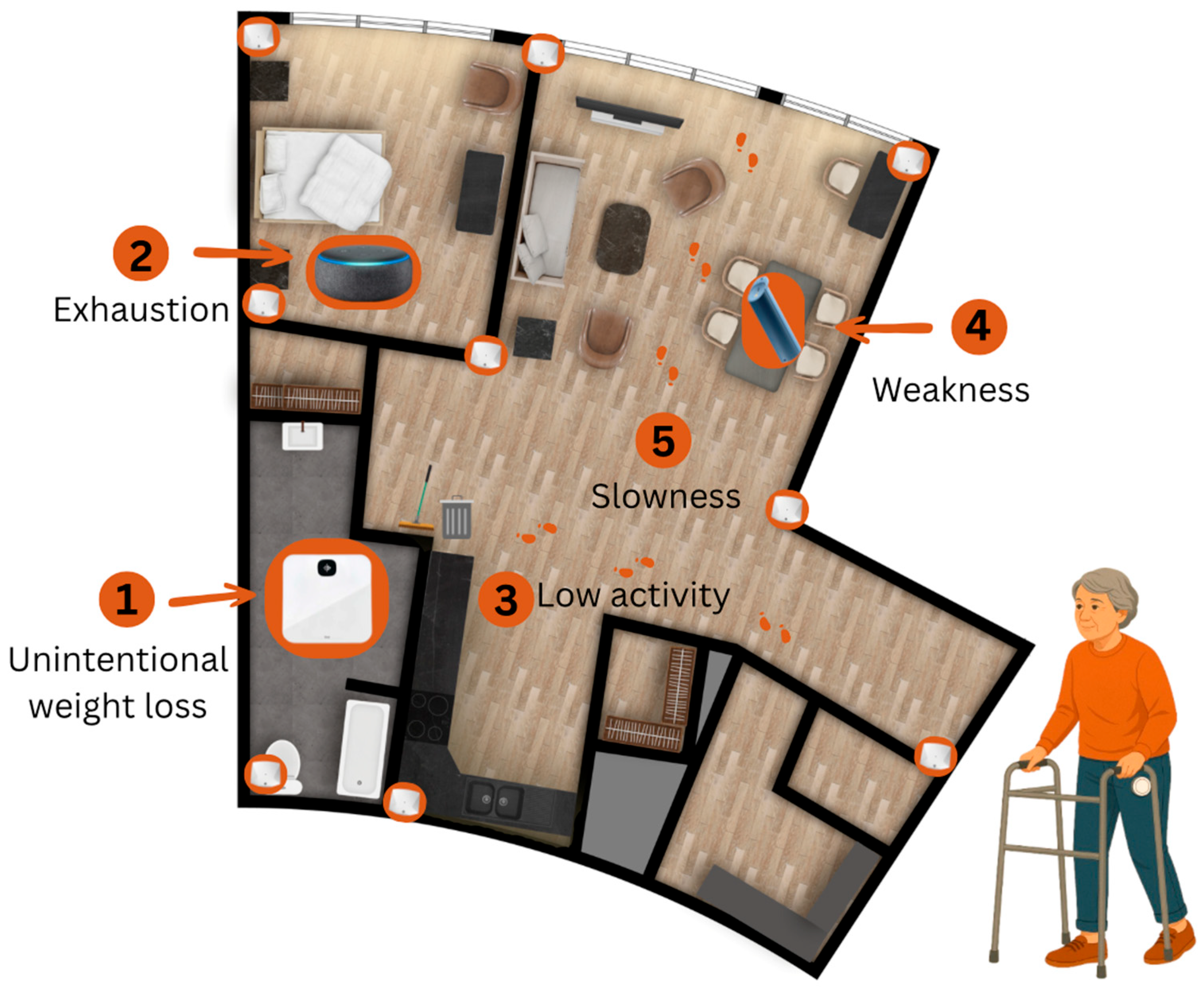
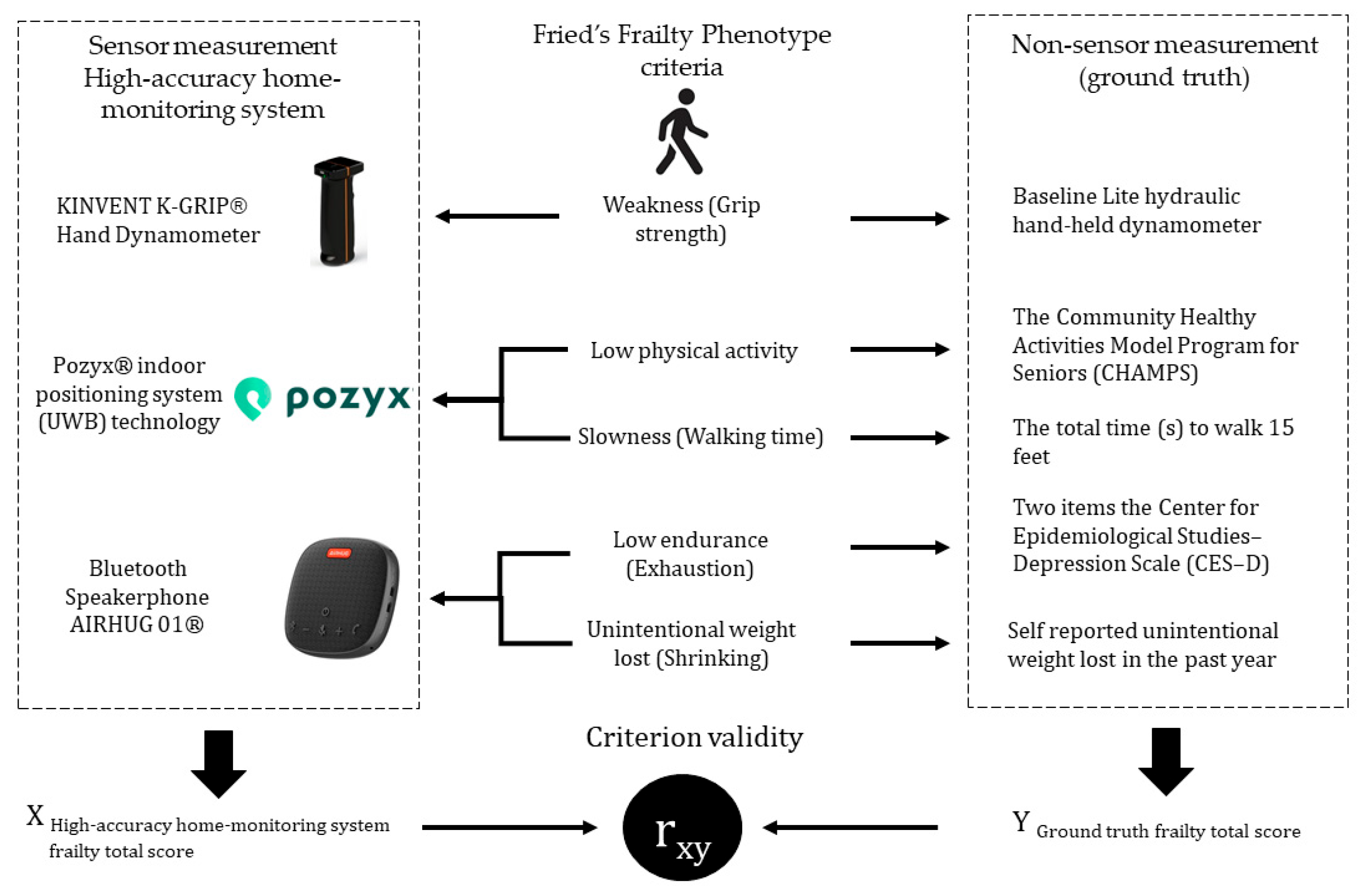
- A Pozyx® indoor positioning system (Pozyx, Belgium, Ghent [23]) equipped with ultra-wideband (UWB) technology to monitor low physical activity and slowness (walking time) variables of Fried’s Frailty Phenotype criteria. It involves the installation of nine UWB anchors placed in the corners of each room of the Independent Living Suite. The user dons a wearable tag that communicates with the anchors and the system transmits (when more than 3 anchors are used) [24] its position to provide furniture-level resolution on activities in the Independent Living Suite. This high-resolution tracking (up to 10 cm indoor positioning accuracy) allowed for meaningful continuous indoor monitoring, as well as identifying the areas of the Independent Living Suite that the participant occupies with corresponding durations. A detailed description of the sensor data format and specifications has been fully published elsewhere [25].
- A K-Grip® device, an Internet of Things connected dynamometer to measure weakness (grip strength) of Fried’s Frailty Phenotype criteria [26].
- A Bluetooth Speakerphone AIRHUG 01® (100 Hz–24 kHz) to collect the self-report exhaustion of Fried’s Frailty Phenotype criteria [27]. This device is equipped with an upgraded full-duplex digital microphone, which can pick up voice within a 6 m radius.
- A Fitbit Aria Air™, a smart weight scale for tracking shrinking (Unintentional weight lost) of the Fried’s Frailty Phenotype criteria [28]. This is an easy-to-use smart scale that displays the participant’s weight and syncs it to the Fitbit app.
2.4. Variables, Standard Measures, and Sensors
2.4.1. Unintentional Weight Loss
2.4.2. Exhaustion
- “Are you available to answer questions at the moment?” If the user answered “yes”, then, the system proceeded to question 2.
- “Do you feel that everything you did was an effort, or you could not get going in the last week?” Answer with yes or no.
- Third question: “How often in the last week did you feel this way?”. Answer options “1–2 days” or “2 or more days.”
- A chatbot was programmed with a fallback plan to repeat questions if the first attempt was not successful.
2.4.3. Physical Activity
2.4.4. Weakness
2.4.5. Slowness
2.4.6. Frailty Total Score
2.4.7. Sociodemographic, Cognitive, and Functional Measures
2.5. Ethics
2.6. Data Collection Procedures
2.6.1. Stage 1: Frailty and Baseline Assessment
2.6.2. Stage 2: Sensor-Based Tasks
- Participants weighed themselves using the Fitbit Aria Air™ scale in the Independent Living Suite bathroom.
- In the bedroom, participants responded to questions delivered by the Bluetooth Speakerphone AIRHUG 01® regarding unintentional weight loss and exhaustion.
- In the kitchen, participants completed two PASS tasks: taking out the garbage and sweeping.
- In the dining room, participants squeezed the K-Grip® device while seated at the dining table.
- Participants then walked 15 feet in a straight trajectory through the clear space between the dining and living rooms (see Figure 1).
2.7. Statistical Methods
3. Results
3.1. Participants’ Description
3.2. System Validation
4. Discussion
Limitations
5. Conclusions
Supplementary Materials
Author Contributions
Funding
Institutional Review Board Statement
Informed Consent Statement
Data Availability Statement
Acknowledgments
Conflicts of Interest
Abbreviations
| UWB | Ultra-Wideband |
| IoT | Internet of Things |
| PEAR | Product Evaluation and Application Research |
| PASS | Performance Assessment of Self-Care Skills |
| CES-D | Center for Epidemiological Studies–Depression |
| CHAMPS | Community Healthy Activities Model Program for Seniors |
| MET | Metabolic Equivalent of Task |
| BMI | Body Mass Index |
| SLUMS | Saint Louis University Mental Status |
| CFS | Clinical Frailty Scale |
| EFS | Edmonton Frailty Scale |
| SPSS | Statistical Package for the Social Sciences |
| ICC | Intraclass Correlation Coefficient |
| SD | Standard Deviation |
| df | Degrees of Freedom |
References
- United Nations Department of Economic and Social Affairs. World Population Ageing 2019; United Nations Department of Economic and Social Affairs: New York, NY, USA, 2020. [Google Scholar] [CrossRef]
- Clegg, A.; Young, J.; Iliffe, S.; Rikkert, M.O.; Rockwood, K. Frailty in Elderly People. Lancet 2013, 381, 752–762. [Google Scholar] [CrossRef]
- Kojima, G.; Liljas, A.E.M.; Iliffe, S. Frailty Syndrome: Implications and Challenges for Health Care Policy. Risk Manag. Healthc. Policy 2019, 12, 23–30. [Google Scholar] [CrossRef]
- Gilmour, H.; Ramage-Morin, P.L. Association of Frailty and Pre-Frailty with Increased Risk of Mortality among Older Canadians. Health Rep. 2021, 32, 13–26. [Google Scholar] [CrossRef]
- Xue, Q.L. The Frailty Syndrome: Definition and Natural History. Clin. Geriatr. Med. 2011, 27, 1–15. [Google Scholar] [CrossRef]
- Vavasour, G.; Giggins, O.M.; Doyle, J.; Kelly, D. How Wearable Sensors Have Been Utilised to Evaluate Frailty in Older Adults: A Systematic Review. J. Neuroeng. Rehabil. 2021, 18, 112. [Google Scholar] [CrossRef]
- Read, E.A.; Gagnon, D.A.; Donelle, L.; Ledoux, K.; Warner, G.; Hiebert, B.; Sharma, R. Stakeholder Perspectives on In-Home Passive Remote Monitoring to Support Aging in Place in the Province of New Brunswick, Canada: Rapid Qualitative Investigation. JMIR Aging 2022, 5, e31486. [Google Scholar] [CrossRef] [PubMed]
- Vrančić, A.; Zadravec, H.; Orehovački, T. The Role of Smart Homes in Providing Care for Older Adults: A Systematic Literature Review from 2010 to 2023. Smart Cities 2024, 7, 1502–1550. [Google Scholar] [CrossRef]
- Bian, C.; Ye, B.; Mihailidis, A. The Development and Concurrent Validity of a Multi-Sensor-Based Frailty Toolkit for In-Home Frailty Assessment. Sensors 2022, 22, 3532. [Google Scholar] [CrossRef]
- Liu, L.; Stroulia, E.; Nikolaidis, I.; Miguel-Cruz, A.; Rios Rincon, A. Smart Homes and Home Health Monitoring Technologies for Older Adults: A Systematic Review. Int. J. Med. Inform. 2016, 91, 44–59. [Google Scholar] [CrossRef]
- Cruz, A.M.; Monsalve, L.; Ladurner, A.M.; Jaime, L.F.; Wang, D.; Quiroga, D.A. Information and Communication Technologies for Managing Frailty: A Systematic Literature Review. Aging Dis. 2021, 12, 914–933. [Google Scholar] [CrossRef] [PubMed]
- Leghissa, M.; Carrera, Á.; Iglesias, C.A. Machine Learning Approaches for Frailty Detection, Prediction and Classification in Elderly People: A Systematic Review. Int. J. Med. Inform. 2023, 178, 105172. [Google Scholar] [CrossRef] [PubMed]
- Mohebbi, P.; Stroulia, E.; Nikolaidis, I. Indoor Localization: A Cost-Effectiveness vs. Accuracy Study. In Proceedings of the 2017 IEEE 30th International Symposium on Computer-Based Medical Systems (CBMS), Thessaloniki, Greece, 22–24 June 2017; pp. 552–557. [Google Scholar] [CrossRef]
- Fried, L.P.; Tangen, C.M.; Walston, J.; Newman, A.B.; Hirsch, C.; Gottdiener, J.; Seeman, T.; Tracy, R.; Kop, W.J.; Burke, G.; et al. Frailty in Older Adults: Evidence for a Phenotype. J. Gerontol. A Biol. Sci. Med. Sci. 2001, 56, M146–M157. [Google Scholar] [CrossRef] [PubMed]
- Rolfson, D.B.; Majumdar, S.R.; Tsuyuki, R.T.; Tahir, A.; Rockwood, K. Validity and Reliability of the Edmonton Frail Scale. Age Ageing 2006, 35, 526–529. [Google Scholar] [CrossRef]
- Rockwood, K.; Song, X.; MacKnight, C.; Bergman, H.; Hogan, D.B.; McDowell, I.; Mitnitski, A. A Global Clinical Measure of Fitness and Frailty in Elderly People. CMAJ 2005, 173, 489–495. [Google Scholar] [CrossRef]
- Alberta Health Services. Glenrose Rehabilitation Hospital Independent Living Suite. Available online: https://www.albertahealthservices.ca/grh/Page14503.aspx (accessed on 20 October 2025).
- Product Evaluation and Application Research (PEAR) Lab. Available online: https://sites.google.com/ualberta.ca/pearlab/home (accessed on 20 October 2025).
- Alberta Health Services. Glenrose Rehabilitation Hospital Research & Innovation. Available online: https://www.albertahealthservices.ca/grh/Page14207.aspx (accessed on 20 October 2025).
- Rincón, A.R.; Chan, A.; Figeys, M.; Koubasi, F.; Ahmed, Y.; Gregson, G.; Miguel-Cruz, A. Co-designing a high-accuracy home monitoring system for managing frailty in older adults. Innov. Aging 2023, 7, 1005–1006. [Google Scholar] [CrossRef]
- Mankins, J.C. Approaches to Strategic Research and Technology (R&T) Analysis and Road Mapping. Acta Astronaut. 2002, 51, 3–21. [Google Scholar] [CrossRef]
- U.S. Department of Energy Technology Readiness Assessment Guide. Available online: https://www.directives.doe.gov/directives-documents/400-series/0413.3-EGuide-04 (accessed on 20 October 2025).
- Pozyx | Industrial Location Tracking Solutions. Available online: https://www.pozyx.io/ (accessed on 20 October 2025).
- Al-Okby, M.; Junginger, S.; Roddelkopf, T.; Thurow, K. UWB-Based Real-Time Indoor Positioning Systems: A Comprehensive Review. Appl. Sci. 2024, 14, 11005. [Google Scholar] [CrossRef]
- Narkhede, A.; Gowing, H.; Vandenberg, T.; Phan, S.; Wong, J.; Chan, A. Automated Detection of In-Home Activities with Ultra-Wideband Sensors. Sensors 2024, 24, 4706. [Google Scholar] [CrossRef]
- K-Grip-Kinvent%. Available online: https://k-invent.com/produit/kgrip/ (accessed on 20 October 2025).
- AIRHUG. AIRHUG-01 Speakerphone for Home Office. Available online: https://www.amazon.ca/USB-Speakerphone-Bluetooth-Conference-Microphone/dp/B09WQZSW4F/ref=asc_df_B09WQZSW4F?mcid=6bd2d773ef8037ea9ab1b86551e9c468&tag=googleshopc0c-20&linkCode=df0&hvadid=706724917092&hvpos=&hvnetw=g&hvrand=7179388774405383343&hvpone=&hvptwo=&hvqmt=&hvdev=c&hvdvcmdl=&hvlocint=&hvlocphy=9001385&hvtargid=pla-2321493920284&psc=1&hvocijid=7179388774405383343-B09WQZSW4F-&hvexpln=0&gad_source=1 (accessed on 20 October 2025).
- Fitbit Aria Air Smart Scales. Available online: https://store.google.com/us/product/fitbit_aria_air?hl=en-US&utm_source=fitbit_redirect&utm_medium=google_ooo&utm_campaign=category&pli=1 (accessed on 20 October 2025).
- Ngrok. Available online: https://ngrok.com/our-product (accessed on 20 October 2025).
- Grafana Labs. Grafana: The Open and Composable Observability Platform. Available online: https://grafana.com/ (accessed on 20 October 2025).
- Alibhai, S.M.H.; Greenwood, C.; Payette, H. An Approach to the Management of Unintentional Weight Loss in Elderly People. CMAJ 2005, 172, 773–780. [Google Scholar] [CrossRef] [PubMed]
- Crow, R.S.; Petersen, C.L.; Cook, S.B.; Stevens, C.J.; Titus, A.J.; Mackenzie, T.A.; Batsis, J.A. Reported Weight Change in Older Adults and Presence of Frailty. J. Frailty Aging 2020, 9, 74–81. [Google Scholar] [CrossRef]
- Radloff, L.S. The CES-D Scale: A self-report depression scale for research in the general population. Appl. Psychol. Meas. 1977, 1, 385–401. [Google Scholar] [CrossRef]
- Jiang, L.; Wang, Y.; Zhang, Y.; Li, R.; Wu, H.; Li, C.; Wu, Y.; Tao, Q. The Reliability and Validity of the Center for Epidemiologic Studies Depression Scale (CES-D) for Chinese University Students. Front. Psychiatry 2019, 10, 456760. [Google Scholar] [CrossRef]
- Lohman, M.; Dumenci, L.; Mezuk, B. Depression and Frailty in Late Life: Evidence for a Common Vulnerability. J. Gerontol. Ser. B 2016, 71, 630–640. [Google Scholar] [CrossRef] [PubMed]
- Mulasso, A.; Roppolo, M.; Giannotta, F.; Rabaglietti, E. Associations of Frailty and Psychosocial Factors with Autonomy in Daily Activities: A Cross-Sectional Study in Italian Community-Dwelling Older Adults. Clin. Interv. Aging 2016, 11, 37–45. [Google Scholar] [CrossRef]
- Brown, P.J.; Roose, S.P.; Fieo, R.; Liu, X.; Rantanen, T.; Sneed, J.R.; Rutherford, B.R.; Devanand, D.P.; Avlund, K. Frailty and Depression in Older Adults: A High-Risk Clinical Population. Am. J. Geriatr. Psychiatry 2014, 22, 1083–1095. [Google Scholar] [CrossRef]
- Shin, J.H.; Kang, G.A.; Kim, S.Y.; Won, W.C.; Yoon, J.Y. Bidirectional Relationship Between Depression and Frailty in Older Adults Aged 70-84 Years Using Random Intercepts Cross-Lagged Panel Analysis. Res. Community Public Health Nurs. 2024, 35, 1–9. [Google Scholar] [CrossRef]
- Strojnik, V.; Gabrovec, B. Management of Frailty at Individual Level: Narrative Review of Physical Activity from the European Perspective of Joint Action on Frailty—JA Advantage. Slov. J. Public Health 2019, 58, 84. [Google Scholar] [CrossRef]
- da Silva, L.P.; Moreira, N.B.; Grando, R.Z.; Bento, P.C.B.; Rodacki, A.L.F. Clinical-Functional Vulnerability, Functional Capacity, and Falls in Octogenarians with Different Physical Activity Levels—A Cross-Sectional Study. Int. J. Environ. Res. Public Health 2022, 19, 11909. [Google Scholar] [CrossRef] [PubMed]
- Stewart, A.L.; Mills, K.M.; King, A.C.; Haskell, W.L.; Gillis, D.; Ritter, P.L. CHAMPS Physical Activity Questionnaire for Older Adults: Outcomes for Interventions. Med. Sci. Sports Exerc. 2001, 33, 1126–1141. [Google Scholar] [CrossRef] [PubMed]
- Stewart, A.L.; Verboncoeur, C.J.; McLellan, B.Y.; Gillis, D.E.; Rush, S.; Mills, K.M.; King, A.C.; Ritter, P.; Brown, J.; Bortz, W.M. Physical Activity Outcomes of CHAMPS II: A Physical Activity Promotion Program for Older Adults. J. Gerontol. A Biol. Sci. Med. Sci. 2001, 56, M465–M470. [Google Scholar] [CrossRef]
- Ainsworth, B.E.; Haskell, W.L.; Whitt, M.C.; Irwin, M.L.; Swartz, A.M.; Strath, S.J.; O’Brien, W.L.; Bassett, J.; Schmitz, K.H.; Emplaincourt, P.O.; et al. Compendium of Physical Activities: An Update of Activity Codes and MET Intensities. Med. Sci. Sports Exerc. 2000, 32, S498–S504. [Google Scholar] [CrossRef]
- Rogers, J.C.; Holm, M.B.; Chisholm, T.H. Performance Assessment of Self-Care Skills (PASS) Manual, 4th ed.; University of Pittsburgh, School of Health and Rehabilitation Sciences: Pittsburgh, PA, USA, 2016. [Google Scholar]
- Chisholm, D.; Toto, P.; Raina, K.; Holm, M.; Rogers, J. Evaluating Capacity to Live Independently and Safely in the Community: Performance Assessment of Self-Care Skills. Br. J. Occup. Ther. 2014, 77, 59–63. [Google Scholar] [CrossRef]
- Ríos Rincón, A.M.; Guptill, C.; Liubaoerjijin, Y.; Figeys, M.; Koubasi, F.; Gregson, G.; Miguel Cruz, A. Effectiveness of a New Device for Hand, Wrist, and Forearm Rehabilitation: Feasibility Randomized Controlled Trial. JMIR Rehabil. Assist. Technol. 2025, 12, e62809. [Google Scholar] [CrossRef] [PubMed]
- Coletta, G.; Phillips, S.M. An Elusive Consensus Definition of Sarcopenia Impedes Research and Clinical Treatment: A Narrative Review. Ageing Res. Rev. 2023, 86, 101883. [Google Scholar] [CrossRef] [PubMed]
- Soysal, P.; Hurst, C.; Demurtas, J.; Firth, J.; Howden, R.; Yang, L.; Tully, M.A.; Koyanagi, A.; Ilie, P.C.; López-Sánchez, G.F.; et al. Handgrip Strength and Health Outcomes: Umbrella Review of Systematic Reviews with Meta-Analyses of Observational Studies. J. Sport. Health Sci. 2021, 10, 290–295. [Google Scholar] [CrossRef]
- de Souza, A.F.; de Oliveira, D.C.; Ramírez, P.C.; de Oliveira Máximo, R.; Luiz, M.M.; Delinocente, M.L.B.; Steptoe, A.; de Oliveira, C.; da Silva Alexandre, T. Low Gait Speed Is Better than Frailty and Sarcopenia at Identifying the Risk of Disability in Older Adults. Age Ageing 2025, 54, afaf104. [Google Scholar] [CrossRef]
- Abellan Van Kan, G.; Rolland, Y.; Andrieu, S.; Bauer, J.; Beauchet, O.; Bonnefoy, M.; Cesari, M.; Donini, L.M.; Gillette-Guyonnet, S.; Inzitari, M.; et al. Gait Speed at Usual Pace as a Predictor of Adverse Outcomes in Community-Dwelling Older People an International Academy on Nutrition and Aging (IANA) Task Force. J. Nutr. Health Aging 2009, 13, 881–889. [Google Scholar] [CrossRef] [PubMed]
- Kim, H.; Park, I.; joo Lee, H.; Lee, O. The Reliability and Validity of Gait Speed with Different Walking Pace and Distances against General Health, Physical Function, and Chronic Disease in Aged Adults. J. Exerc. Nutr. Biochem. 2016, 20, 46–50. [Google Scholar] [CrossRef]
- PubMed. Functional Evaluation: The Barthel Index. Available online: https://pubmed.ncbi.nlm.nih.gov/14258950/ (accessed on 20 October 2025).
- Tariq, S.H.; Tumosa, N.; Chibnall, J.T.; Perry, M.H.; Morley, J.E. Comparison of the Saint Louis University Mental Status Examination and the Mini-Mental State Examination for Detecting Dementia and Mild Neurocognitive Disorder—A Pilot Study. Am. J. Geriatr. Psychiatry 2006, 14, 900–910. [Google Scholar] [CrossRef]
- Newton, R.R.; Rudestam, K.E. Your Statistical Consultant: Answers to Your Data Analysis Questions; SAGE Publications, Ltd.: London, UK, 2013; ISBN 9781412997591. [Google Scholar]
- Huang, J.; Zhou, S.; Xie, Q.; Yu, J.; Zhao, Y.; Feng, H. Digital Biomarkers for Real-Life, Home-Based Monitoring of Frailty: A Systematic Review and Meta-Analysis. Age Ageing 2025, 54, afaf108. [Google Scholar] [CrossRef]
- Park, C.; Mishra, R.; Golledge, J.; Najafi, B. Digital Biomarkers of Physical Frailty and Frailty Phenotypes Using Sensor-Based Physical Activity and Machine Learning. Sensors 2021, 21, 5289. [Google Scholar] [CrossRef]
- Zarulli, V.; Salinari, G. Gender Differences in Survival across the Ages of Life: An Introduction. Genus 2024, 80, 10. [Google Scholar] [CrossRef]
- Paterna, V.C.; Augé, A.C.; Aspas, J.P.; Bullones, M.A.P. A Bluetooth Low Energy Indoor Positioning System with Channel Diversity, Weighted Trilateration and Kalman Filtering. Sensors 2017, 17, 2927. [Google Scholar] [CrossRef] [PubMed]
- Qian, L.; Chan, A.; Cai, J.; Lewicke, J.; Gregson, G.; Lipsett, M.; Rios Rincón, A. Evaluation of the Accuracy of a UWB Tracker for In-Home Positioning for Older Adults. Med. Eng. Phys. 2024, 126, 104155. [Google Scholar] [CrossRef] [PubMed]
- Arnold, A.; Kolody, S.; Comeau, A.; Miguel Cruz, A. What Does the Literature Say about the Use of Personal Voice Assistants in Older Adults? A Scoping Review. Disabil. Rehabil. Assist. Technol. 2024, 19, 100–111. [Google Scholar] [CrossRef]
- Yixiao, C.; Hui, S.; Quhong, S.; Xiaoxi, Z.; Jirong, Y. A Review of Utility of Wearable Sensor Technologies for Older Person Frailty Assessment. Exp. Gerontol. 2025, 200, 112668. [Google Scholar] [CrossRef]
- Hanlon, P.; Nicholl, B.I.; Jani, B.D.; Lee, D.; McQueenie, R.; Mair, F.S. Frailty and Pre-Frailty in Middle-Aged and Older Adults and Its Association with Multimorbidity and Mortality: A Prospective Analysis of 493 737 UK Biobank Participants. Lancet Public Health 2018, 3, e323–e332. [Google Scholar] [CrossRef] [PubMed]



| Sex | BMI ≤ 24 | BMI 24.1–26 | BMI 26.1–28 | BMI > 28 |
|---|---|---|---|---|
| Male | ≤29 kg | ≤30 kg | ≤31 kg | ≤32 kg |
| Female | ≤17 kg | ≤17.3 kg | ≤18 kg | ≤21 kg |
| Variables | Biological Sex | ||
|---|---|---|---|
| Overall (n = 21) | Male (n = 11) | Female (n = 10) | |
| Mean (SD) | |||
| Age (Min = 21, Max = 90) | 51.86 (26.48) | 43.45 (25.41) | 61.10 (25.68) |
| Sex | n (%) | ||
| Male | 11 (52.4) | 11 (52.4) | 0 |
| Female | 10 (47.6) | 0 | 10 (47.6) |
| Body Composition | Mean (SD) | ||
| Weight (Kgs) (Min = 52.90, Max = 131.00) | 78.26 (19.69) | 79.21 (16.40) | 77.21 (23.67) |
| Height (cm) (Min = 153.00, Max = 194.50) | 170.74 (10.72) | 176.18 (9.59) | 164.76 (8.78) |
| BMI (Min = 18.49, Max = 48.28) | 27.21 (7.10) | 26.24 (5.42) | 28.26 (8.78) |
| Age group | n (%) | ||
| ≤60 | 10 (47.6) | 7 (63.6) | 3 (30.0) |
| 61–74 | 6 (28.6) | 3 (27.3) | 3 (30.0) |
| 75–84 | 3 (14.3) | 0 | 3 (30.0) |
| 85–94 | 2 (9.5) | 1 (9.1) | 1 (10.0) |
| Education | n (%) | ||
| High school | 6 (28.6) | 3 (27.3) | 3 (30.0) |
| Trade school | 3 (14.3) | 1 (9.1) | 2 (20.0) |
| Bachelor’s | 7 (33.3) | 4 (36.4) | 3 (30.0) |
| Master’s | 4 (19.0) | 2 (18.2) | 2 (20.0) |
| Doctorate or above | 1 (4.8) | 1 (9.1) | 0 |
| English as First Language | n (%) | ||
| Yes | 19 (90.5) | 9 (81.8) | 10 (100) |
| No | 2 (9.5) | 2 (18.2) | 0 |
| Residential Status | n (%) | ||
| Community alone | 5 (23.8) | 2 (18.2) | 3 (30.0) |
| Community with others | 14 (66.7) | 9 (81.8) | 5 (50.0) |
| Retirement home or assisting living | 2 (9.5) | 0 | 2 (20.0) |
| Handedness | n (%) | ||
| Left | 1 (4.8) | 1 (9.1) | 0 |
| Right | 20 (95.2) | 10 (90.9) | 10 (100) |
| Polypharmacy | n (%) | ||
| Yes | 10 (52.4) | 3 (27.3) | 7 (70.0) |
| No | 11 (47.6) | 8 (72.7) | 3 (30.0) |
| Inpatient Status | n (%) | ||
| Yes | 9 (42.9) | 2 (18.2) | 7 (70.0) |
| No | 12 (57.1) | 9 (81.8) | 3 (30.0) |
| Baseline Assessments | Mean (SD) | ||
| SLUMS (Min = 21, Max = 30) | 27.81 (3.01) | 28.82 (2.23) | 26.70 (3.46) |
| Barthel Index (Min = 15, Max = 20) | 18.95 (1.59) | 19.45 (1.51) | 18.40 (1.58) |
| CES-D Scale total score (Min = 2, Max = 16) | 6.29 (3.52) | 6.64 (4.20) | 5.90 (2.77) |
| Maximum Grip Strength (Kg) | Mean (SD) | ||
| Dominant hand (Min = 20, Max = 49.09) | 34.37 (9.90) | 38.87 (8.91) | 27.04 (6.73) |
| Non-dominant hand (Min = 10.00 Max = 51.81) | 31.04 (11.98) | 37.60 (9.46) | 22.02 (8.97) |
| Descriptive Statistics | Reliability | Criterion Validity | ||||
|---|---|---|---|---|---|---|
| Fried Frailty Phenotype Criterion | Ground Truth | High-Accuracy home-Monitoring System | Cohen’s Kappa | p | Spearman ρ (df) | p |
| Unintentional weight lost (Shrinking) | Self-Report Yes [n = 6, 28.6%] No [n = 15, 71.4%] | Self-Report using smart speaker (Bluetooth Speakerphone AIRHUG 01®) Yes [n = 6, 28.6%] No [n = 15, 71.4%] | 1.000 | Not applicable | 1.000 (19) | Not applicable |
| Low physical activity | CHAMPS Not Limited, or Little Limited [n = 18, 85.7%] Limited A Lot [n = 3, 14.3%] | UWB Monitoring (Pozyx®) of PASS Items (Time) Not Limited, or Little Limited [n = 16, 76.2%] Limited A Lot [n = 5, 23.8%] | 0.391 | 0.06 | 0.411 (19) | 0.064 |
| Low endurance (Exhaustion) | CES-D Questionnaire 0–2 Days [n = 16, 76.2%] 3–7 Days [n = 5, 23.8%] | Smart speaker (Bluetooth Speakerphone AIRHUG 01®) CES-D 0–2 Days [n = 18, 85.7%] 3–7 days [n = 3, 14.3%] | 0.087 | 0.676 | 0.091 (19) | 0.694 |
| Weakness (Grip strength) | Manual Dynamometer <20% Weaker [n = 15, 71.4%] >20% Weaker [n = 4, 19.0%] Missing data [n = 2, 1%] | K-Grip® device Dynamometer <20% Weaker [n = 14, 66.7%] >20% Weaker [n = 7, 33.3%] | 0.855 | <0.001 | 0.864 (19) | <0.001 |
| Slowness (Walking time) | 15 feet walk time—Timer Normal [n = 15, 71.4%] Slower [n = 6, 28.6%] | 15 feet walk time—UWB (Pozyx®) Normal [n = 9, 42.9%] Slower [n = 12, 57.1%] | 0.462 | 0.012 | 0.548 (19) | 0.010 |
| Reliability (Parallel-Forms): Fried’s Frailty Phenotype criteria—High-accuracy home-monitoring system Classification (Dichotomized) | ||||||
| Frailty Classification (Dichotomized) | Not Frail (Robust, Pre-Frail) Fried Phenotype: n = 18, 85.7% Frail (Frail, Very frail) Fried Phenotype: n = 3, 14.3% | Not Frail (Robust, Pre-Frail) High-accuracy home-monitoring system: n = 16, 76.2% Frail (Frail, Very frail) High-accuracy home-monitoring system: n = 5, 23.8% | 0.696 | <0.001 | 0.730 (19) | <0.001 |
| Reliability (Parallel-Forms): Fried’s Frailty Phenotype criteria—High-accuracy home-monitoring system Classification (Original total score) | ||||||
| Frailty Classification (Original total score) | Robust (Frailty score = 0) n = 7, 33.3% Pre-Frail (Frailty score = 1–2) n = 11, 52.4% Frail (Frailty score = 3–4) n = 3, 14.3% | Robust (Frailty score = 0) n = 7, 33.3% Pre-Frail(Frailty score = 1–2) n = 9, 42.9% Frail (Frailty score = 3–4) n = 5, 23.8% | 0.547 | <0.001 | 0.715 (19) | <0.010 |
| Frailty Assessment | Statistic | 1 | 2 | 3 | 4 |
|---|---|---|---|---|---|
| 1. High-accuracy home-monitoring system | Spearman ρ | -- | |||
| p-value | . | ||||
| 2. Fried’s Frailty Phenotype | Spearman ρ | 0.843 | -- | ||
| p-value | <0.001 | . | |||
| 3. Clinical Frailty Scale | Spearman ρ | 0.662 | 0.620 | -- | |
| p-value | <0.001 | 0.003 | . | ||
| 4. Edmonton Frailty Scale | Spearman ρ | 0.599 | 0.531 | 0.826 | -- |
| p-value | 0.004 | 0.013 | <0.001 | . |
Disclaimer/Publisher’s Note: The statements, opinions and data contained in all publications are solely those of the individual author(s) and contributor(s) and not of MDPI and/or the editor(s). MDPI and/or the editor(s) disclaim responsibility for any injury to people or property resulting from any ideas, methods, instructions or products referred to in the content. |
© 2025 by the authors. Licensee MDPI, Basel, Switzerland. This article is an open access article distributed under the terms and conditions of the Creative Commons Attribution (CC BY) license.
Share and Cite
Miguel Cruz, A.; Figeys, M.; Ahmed, Y.; Koubasi, F.; Alsubaie, M.; Alshammari, S.; Narkhede, A.; Gregson, G.; Chan, A.; Liu, L.; et al. High-Accuracy Indoor Positioning and Smart Home Technologies for Assessing and Monitoring Frailty in Older Adults. Sensors 2026, 26, 113. https://doi.org/10.3390/s26010113
Miguel Cruz A, Figeys M, Ahmed Y, Koubasi F, Alsubaie M, Alshammari S, Narkhede A, Gregson G, Chan A, Liu L, et al. High-Accuracy Indoor Positioning and Smart Home Technologies for Assessing and Monitoring Frailty in Older Adults. Sensors. 2026; 26(1):113. https://doi.org/10.3390/s26010113
Chicago/Turabian StyleMiguel Cruz, Antonio, Mathieu Figeys, Yusuf Ahmed, Farnaz Koubasi, Munirah Alsubaie, Salamah Alshammari, Arsh Narkhede, Geoffrey Gregson, Andrew Chan, Lili Liu, and et al. 2026. "High-Accuracy Indoor Positioning and Smart Home Technologies for Assessing and Monitoring Frailty in Older Adults" Sensors 26, no. 1: 113. https://doi.org/10.3390/s26010113
APA StyleMiguel Cruz, A., Figeys, M., Ahmed, Y., Koubasi, F., Alsubaie, M., Alshammari, S., Narkhede, A., Gregson, G., Chan, A., Liu, L., & Ríos Rincón, A. (2026). High-Accuracy Indoor Positioning and Smart Home Technologies for Assessing and Monitoring Frailty in Older Adults. Sensors, 26(1), 113. https://doi.org/10.3390/s26010113