Machine Learning-Enhanced NDIR Methane Sensing Solution for Robust Outdoor Continuous Monitoring Applications


Abstract
1. Introduction
2. Methodology of the Integrated Sensing Instrument
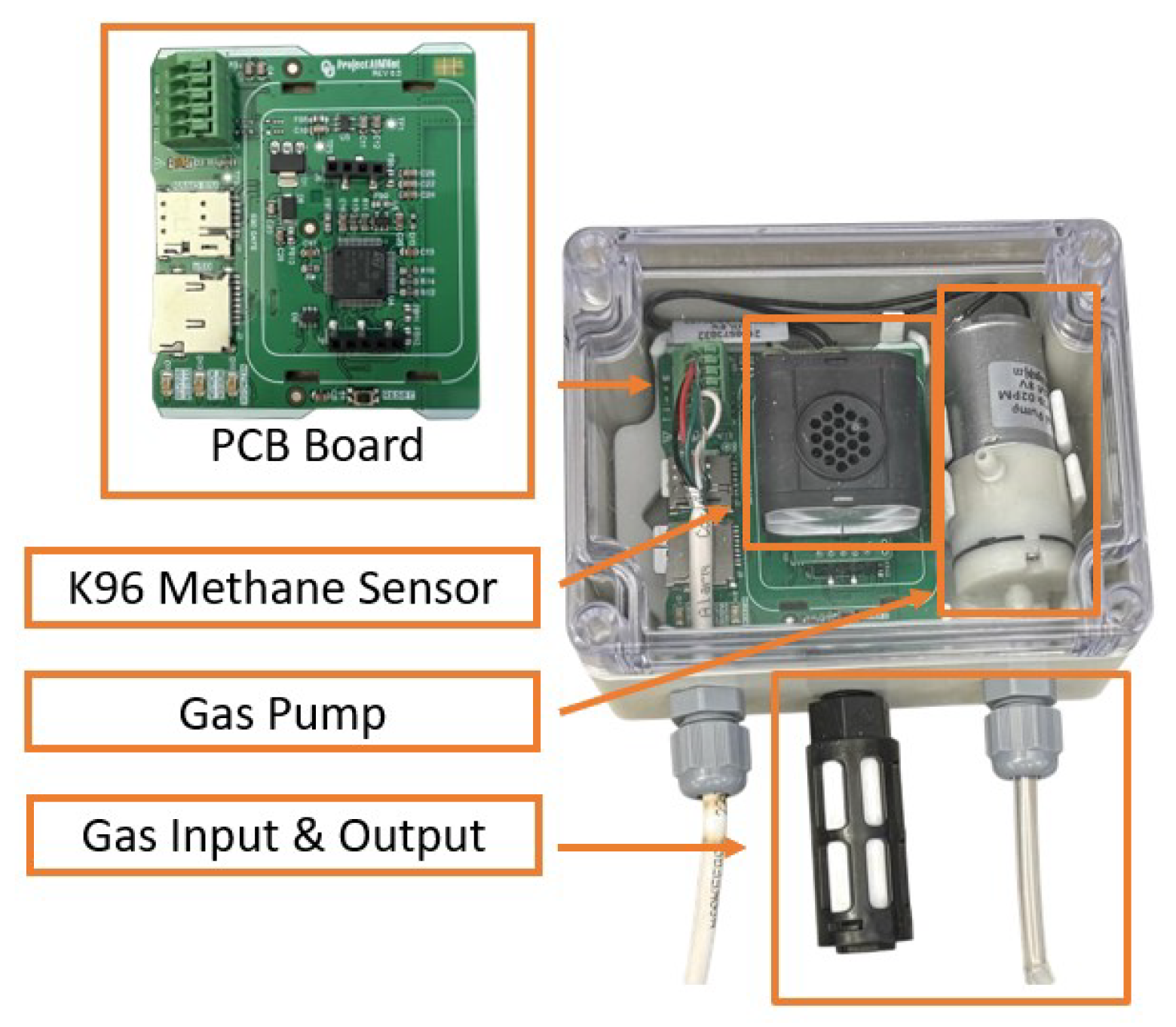
2.1. AIMNet NDIR Gas Sensing Hardware
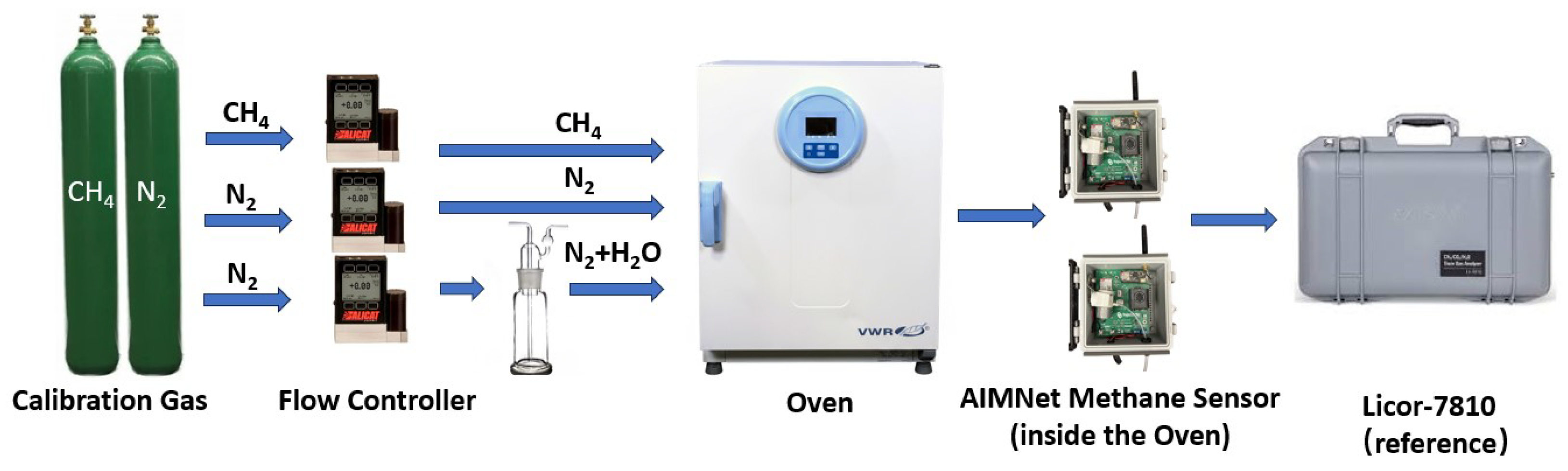
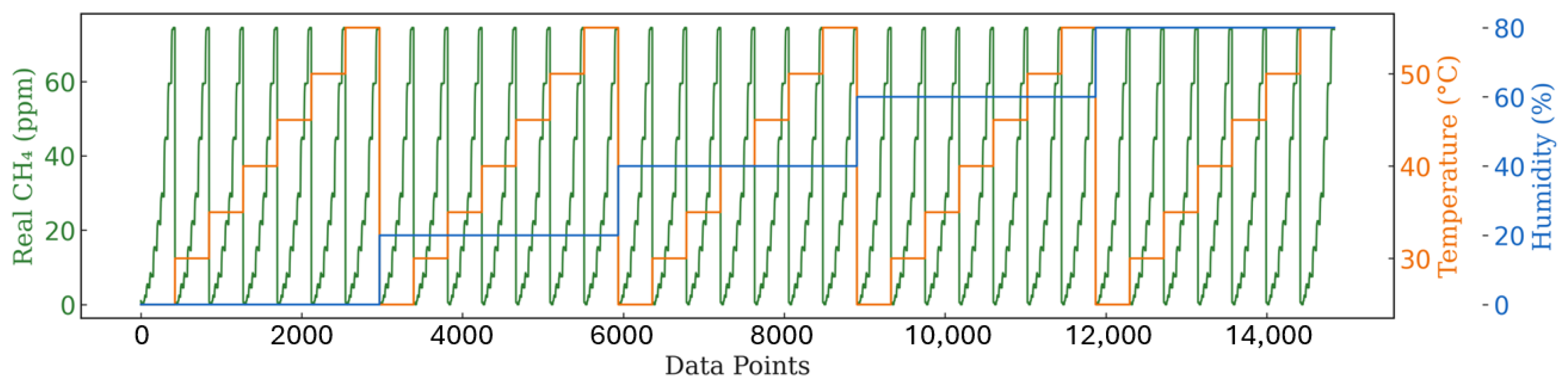
2.2. Data Calibration
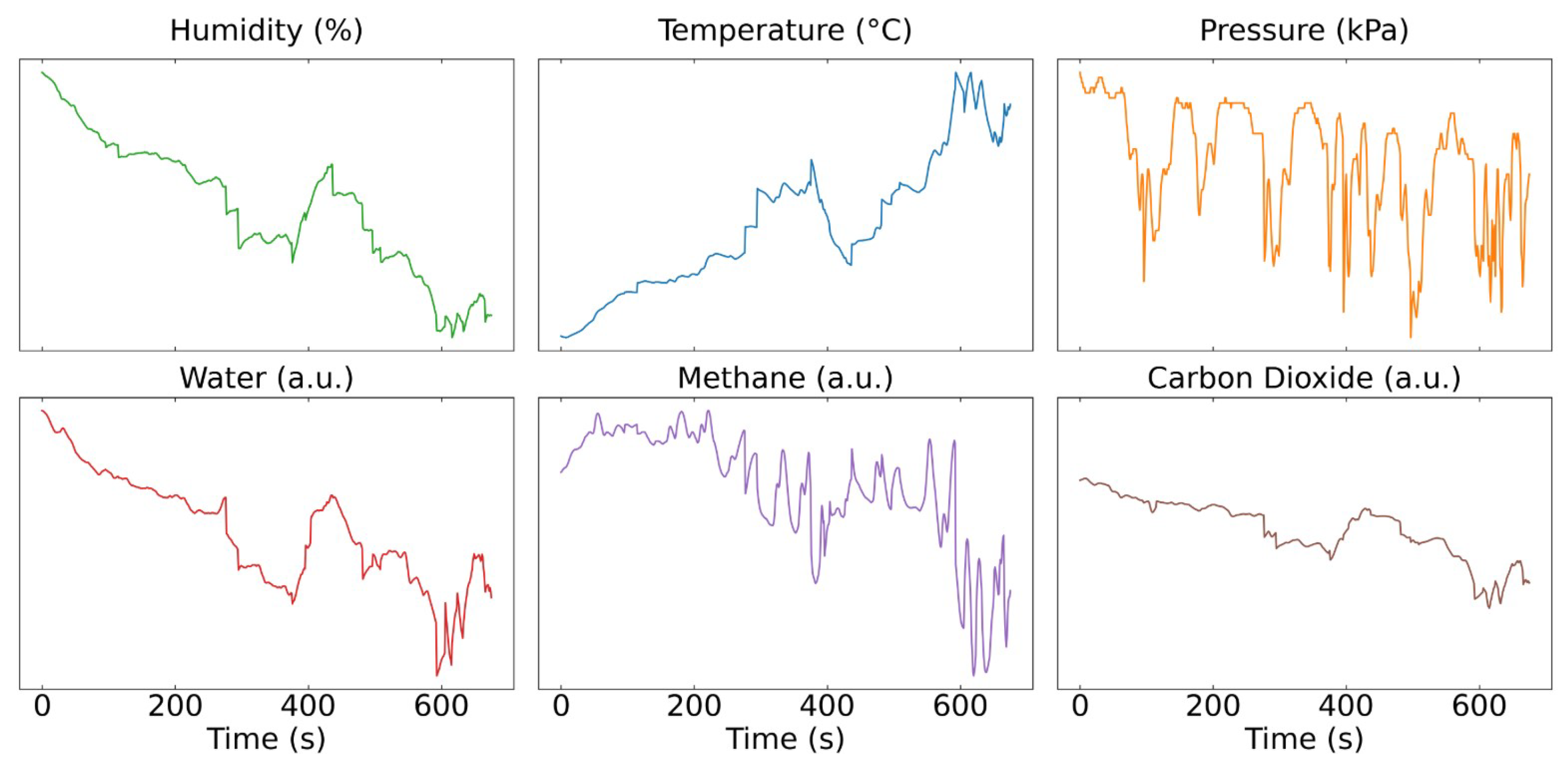
2.3. Data Preprocessing and Split
2.4. Performance Evaluation
2.5. Machine Learning Algorithm
2.5.1. Multiple Linear Regression
2.5.2. Elastic Net Regression
2.5.3. Support Vector Regression
2.5.4. CatBoost Regression
2.5.5. Random Forest Regression
2.5.6. Multilayer Perceptron Regression
3. Results and Discussion
3.1. Training and Validation
3.2. Outdoor Validation Result
3.3. Driving Test Result
4. Conclusions
Author Contributions
Funding
Institutional Review Board Statement
Informed Consent Statement
Data Availability Statement
Acknowledgments
Conflicts of Interest
References
- Forster, P.; Storelvmo, T.; Armour, K.; Collins, W.; Dufresne, J.-L.; Frame, D.; Lunt, D.J.; Mauritsen, T.; Palmer, M.D.; Watanabe, M.; et al. The Earth’s Energy Budget, Climate Feedbacks and Climate Sensitivity. In Climate Change 2021: The Physical Science Basis. Contribution of Working Group I to the Sixth Assessment Report of the Intergovernmental Panel on Climate Change; Masson-Delmotte, V., Zhai, P., Pirani, A., Connors, S.L., Péan, C., Berger, S., Caud, N., Chen, Y., Goldfarb, L., Gomis, M.I., et al., Eds.; Cambridge University Press: Cambridge, UK; New York, NY, USA, 2021; pp. 923–1054. [Google Scholar] [CrossRef]
- Etminan, M.; Myhre, G.; Highwood, E.J.; Shine, K.P. Radiative forcing of carbon dioxide, methane, and nitrous oxide: A significant revision of the methane radiative forcing. Geophys. Res. Lett. 2016, 43, 12614–12623. [Google Scholar] [CrossRef]
- Shindell, D.T.; Faluvegi, G.; Koch, D.M.; Schmidt, G.A.; Unger, N.; Bauer, S.E. Improved attribution of climate forcing to emissions. Science 2009, 326, 716–718. [Google Scholar] [CrossRef]
- Nisbet, E.G.; Fisher, R.E.; Lowry, D.; France, J.L.; Allen, G.; Bakkaloglu, S.; Broderick, T.J.; Cain, M.; Coleman, M.; Fernandez, J.; et al. Methane mitigation: Methods to reduce emissions, on the path to the Paris agreement. Rev. Geo. 2020, 58, e2019RG000675. [Google Scholar] [CrossRef]
- Brandt, A.R.; Heath, G.A.; Cooley, D. Methane leaks from natural gas systems follow extreme distributions. Environ. Sci. Technol. 2016, 50, 12512–12520. [Google Scholar] [CrossRef] [PubMed]
- Dlugokencky, E.J.; Nisbet, E.G.; Fisher, R.; Lowry, D. Global atmospheric methane: Budget, changes and dangers. Philos. Trans. R. Soc. A 2011, 369, 2058–2072. [Google Scholar] [CrossRef] [PubMed]
- Alvarez, R.A.; Zavala-Araiza, D.; Lyon, D.R.; Allen, D.T.; Barkley, Z.R.; Brandt, A.R.; Davis, K.J.; Herndon, S.C.; Jacob, D.J.; Karion, A.; et al. Assessment of methane emissions from the US oil and gas supply chain. Science 2018, 361, 186–188. [Google Scholar] [CrossRef]
- Schwietzke, S.; Pétron, G.; Conley, S.; Pickering, C.; Mielke-Maday, I.; Dlugokencky, E.J.; Tans, P.P.; Vaughn, T.; Bell, C.; Zimmerle, D.; et al. Improved mechanistic understanding of natural gas methane emissions from spatially resolved aircraft measurements. Environ. Sci. Technol. 2017, 51, 7286–7294. [Google Scholar] [CrossRef] [PubMed]
- Veefkind, J.P.; Aben, I.; McMullan, K.; Förster, H.; De Vries, J.; Otter, G.; Claas, J.; Eskes, H.J.; De Haan, J.F.; Kleipool, Q.; et al. TROPOMI on the ESA Sentinel-5 Precursor: A GMES mission for global observations of the atmospheric composition for climate, air quality and ozone layer applications. Remote Sens. Environ. 2012, 120, 70–83. [Google Scholar] [CrossRef]
- Jacob, D.J.; Turner, A.J.; Maasakkers, J.D.; Sheng, J.; Sun, K.; Liu, X.; Chance, K.; Aben, I.; McKeever, J.; Frankenberg, C. Satellite observations of atmospheric methane and their value for quantifying methane emissions. Atmos. Chem. Phys. 2016, 16, 14371–14396. [Google Scholar] [CrossRef]
- Saunois, M.; Stavert, A.R.; Poulter, B.; Bousquet, P.; Canadell, J.G.; Jackson, R.B.; Raymond, P.A.; Dlugokencky, E.J.; Houweling, S.; Patra, P.K.; et al. The global methane budget 2000–2017. Earth Syst. Sci. Data 2020, 12, 1561–1623. [Google Scholar] [CrossRef]
- Irakulis-Loitxate, I.; Guanter, L.; Liu, Y.N.; Varon, D.J.; Maasakkers, J.D.; Zhang, Y.; Chulakadabba, A.; Wofsy, S.C.; Thorpe, A.K.; Duren, R.M.; et al. Satellite-based survey of extreme methane emissions in the Permian basin. Sci. Adv. 2021, 7, eabf4507. [Google Scholar] [CrossRef]
- Thorpe, A.K.; Frankenberg, C.; Roberts, D.A. Retrieval techniques for airborne imaging of methane concentrations using high spatial and moderate spectral resolution: Application to AVIRIS. Atmos. Meas. Tech. 2014, 7, 491–506. [Google Scholar] [CrossRef]
- Frankenberg, C.; Thorpe, A.K.; Thompson, D.R.; Hulley, G.; Kort, E.A.; Vance, N.; Borchardt, J.; Krings, T.; Gerilowski, K.; Sweeney, C.; et al. Airborne methane remote measurements reveal heavy-tail flux distribution in Four Corners region. Proc. Natl. Acad. Sci. USA 2016, 113, 9734–9739. [Google Scholar] [CrossRef]
- Allen, D.T.; Torres, V.M.; Thomas, J.; Sullivan, D.W.; Harrison, M.; Hendler, A.; Herndon, S.C.; Kolb, C.E.; Fraser, M.P.; Hill, A.D.; et al. Measurements of methane emissions at natural gas production sites in the United States. Proc. Natl. Acad. Sci. USA 2013, 110, 17768–17773. [Google Scholar] [CrossRef]
- Zimmerle, D.J.; Williams, L.L.; Vaughn, T.L.; Quinn, C.; Subramanian, R.; Duggan, G.P.; Willson, B.; Opsomer, J.D.; Marchese, A.J.; Martinez, D.M.; et al. Methane emissions from the natural gas transmission and storage system in the United States. Environ. Sci. Technol. 2015, 49, 9374–9383. [Google Scholar] [CrossRef] [PubMed]
- McKain, K.; Down, A.; Raciti, S.M.; Budney, J.; Hutyra, L.R.; Floerchinger, C.; Herndon, S.C.; Nehrkorn, T.; Zahniser, M.S.; Jackson, R.B.; et al. Methane emissions from natural gas infrastructure and use in the urban region of Boston, Massachusetts. Proc. Natl. Acad. Sci. USA 2015, 112, 1941–1946. [Google Scholar] [CrossRef]
- Brandt, A.R.; Heath, G.A.; Kort, E.A.; O’Sullivan, F.; Pétron, G.; Jordaan, S.M.; Tans, P.; Wilcox, J.; Gopstein, A.M.; Arent, D.; et al. Methane leaks from North American natural gas systems. Science 2014, 343, 733–735. [Google Scholar] [CrossRef]
- Rella, C.W.; Tsai, T.R.; Botkin, C.G.; Crosson, E.R.; Steele, D. Measuring emissions from oil and natural gas well pads using the mobile flux plane technique. Environ. Sci. Technol. 2015, 49, 4742–4748. [Google Scholar] [CrossRef]
- Aldhafeeri, T.; Tran, M.K.; Vrolyk, R.; Pope, M.; Fowler, M. A review of methane gas detection sensors: Recent developments and future perspectives. Inventions 2020, 5, 28. [Google Scholar] [CrossRef]
- Gardner, E.L.W.; Gardner, J.W.; Udrea, F. Micromachined thermal gas sensors—A review. Sensors 2023, 23, 681. [Google Scholar] [CrossRef] [PubMed]
- Hodgkinson, J.; Tatam, R.P. Optical gas sensing: A review. Meas. Sci. Technol. 2012, 24, 012004. [Google Scholar] [CrossRef]
- Dinh, T.V.; Choi, I.Y.; Son, Y.S.; Kim, J.C. A review on non-dispersive infrared gas sensors: Improvement of sensor detection limit and interference correction. Sens. Actuators B 2016, 231, 529–538. [Google Scholar] [CrossRef]
- Ye, W.; Tu, Z.; Xiao, X.; Simeone, A.; Yan, J.; Wu, T.; Wu, F.; Zheng, C.; Tittel, F.K. A NDIR mid-infrared methane sensor with a compact pentahedron gas-cell. Sensors 2020, 20, 5461. [Google Scholar] [CrossRef]
- Xia, L.; Liu, Y.; Chen, R.T.; Weng, B.; Zou, Y. Advancements in miniaturized infrared spectroscopic-based volatile organic compound sensors: A systematic review. Appl. Phys. Rev. 2024, 11, 031306. [Google Scholar] [CrossRef]
- Weng, B. The road to climate change mitigation via methane emissions monitoring. Nat. Rev. Electr. Eng. 2024, 1, 69–70. [Google Scholar] [CrossRef]
- Zhou, Z.; Wang, X.; Yan, Y.; Mijiddorj, L.; Ding, Y.; Beringer, T.; Masnadi Khiabani, P.; Jentner, W.G.; Hu, X.-M.; Wang, C.; et al. AIMNET: An IoT-Empowered Digital Twin for Continuous Gas Emission Monitoring and Early Hazard Detection. arXiv 2025, arXiv:2512.06148. [Google Scholar]
- Yan, Y. Development of a Machine-Learning Enhanced High Performance Methane Sensing Instrument for Field Applications. Master’s Thesis, University of Oklahoma, Graduate College, Norman, OK, USA, 2025. [Google Scholar]
- Swinehart, D.F. The Beer-Lambert law. J. Chem. Edu. 1962, 39, 333. [Google Scholar] [CrossRef]
- Rothman, L.S.; Gordon, I.E.; Babikov, Y.; Barbe, A.; Benner, D.C.; Bernath, P.F.; Birk, M.; Bizzocchi, L.; Boudon, V.; Brown, L.R.; et al. The HITRAN2012 molecular spectroscopic database. J. Qual. Spec. Rad. Trans. 2013, 130, 4–50. [Google Scholar] [CrossRef]
- Furuta, D.; Sayahi, T.; Li, J.; Wilson, B.; Presto, A.A.; Li, J. Characterization of inexpensive metal oxide sensor performance for trace methane detection. Atmos. Meas. Tech. 2022, 15, 5117–5128. [Google Scholar] [CrossRef]
- Andrews, B.; Chakrabarti, A.; Dauphin, M.; Speck, A. Application of machine learning for calibrating gas sensors for methane emissions monitoring. Sensors 2023, 23, 9898. [Google Scholar] [CrossRef]
- Dubey, R.; Telles, A.; Nikkel, J.; Cao, C.; Gewirtzman, J.; Raymond, P.A.; Lee, X. Low-cost CO2 NDIR sensors: Performance evaluation and calibration using machine learning techniques. Sensors 2024, 24, 5675. [Google Scholar] [CrossRef]
- US EPA. Performance Testing Protocols, Metrics, and Target Values for Fine Particulate Matter Air Sensors: Use in Ambient, Outdoor, Fixed Site, Non-Regulatory Supplemental and Informational Monitoring Applications. Technical Report, U.S. Environmental Protection Agency, Office of Research and Development, 2021. Available online: https://cfpub.epa.gov/si/si_public_record_Report.cfm?dirEntryId=350785&Lab=CEMM (accessed on 17 December 2021).
- Montgomery, D.C.; Peck, E.A.; Vining, G.G. Introduction to Linear Regression Analysis, 6th ed.; John Wiley & Sons: Hoboken, NJ, USA, 2021. [Google Scholar]
- Hastie, T.; Tibshirani, R.; Friedman, J. The Elements of Statistical Learning: Data Mining, Inference, and Prediction, 2nd ed.; Springer Series in Statistics; Springer: New York, NY, USA, 2009. [Google Scholar] [CrossRef]
- Han, P.; Mei, H.; Liu, D.; Zeng, N.; Tang, X.; Wang, Y.; Pan, Y. Calibrations of low-cost air pollution monitoring sensors for CO, NO2, O3, and SO2. Sensors 2021, 21, 256. [Google Scholar] [CrossRef] [PubMed]
- Zou, H.; Hastie, T. Regularization and variable selection via the elastic net. J. Royal Stat. Soc. 2005, 67, 301–320. [Google Scholar] [CrossRef]
- Cortes, C.; Vapnik, V. Support-vector networks. Mach. Learn. 1995, 20, 273–297. [Google Scholar] [CrossRef]
- Smola, A.J.; Schölkopf, B. A tutorial on support vector regression. Stat. Comput. 2004, 14, 199–222. [Google Scholar] [CrossRef]
- Prokhorenkova, L.; Gusev, G.; Vorobev, A.; Dorogush, A.V.; Gulin, A. CatBoost: Unbiased Boosting with Categorical Features. In Proceedings of the Advances in Neural Information Processing Systems, Montréal, QC, Canada, 3–8 December 2018; Volume 31. [Google Scholar]
- Chen, T.; Guestrin, C. XGBoost: A scalable tree boosting system. In Proceedings of the 22nd ACM SIGKDD International Conference on Knowledge Discovery and Data Mining, San Francisco, CA, USA, 13–17 August 2016; ACM: New York, NY, USA, 2016; pp. 785–794. [Google Scholar] [CrossRef]
- Breiman, L. Random forests. Mach. Learn. 2001, 45, 5–32. [Google Scholar] [CrossRef]
- Rumelhart, D.E.; Hinton, G.E.; Williams, R.J. Learning representations by back-propagating errors. Nature 1986, 323, 533–536. [Google Scholar] [CrossRef]
- Goodfellow, I.; Bengio, Y.; Courville, A. Deep Learning; MIT Press: Cambridge, MA, USA, 2016; Available online: http://www.deeplearningbook.org (accessed on 10 December 2025).
- Hu, X.-M.; Ding, Y.; Yan, Y.; Wang, C.; Weng, B.; Hardeman, S.; Xue, M. Multi-Sensor and Multi-Model Investigation of Methane Plumes from a Wastewater Treatment Plant to Improve Emission Inversion during the Morning Boundary Layer Transition. In Proceedings of the 106th AMS Annual Meeting, Houston, TX, USA, 25–29 January 2026; American Meteorological Society: Houston, TX, USA, 2026. Available online: https://ams.confex.com/ams/106ANNUAL/meetingapp.cgi/Paper/473678 (accessed on 11 December 2025).
- Hu, X.-M.; Honeycutt, W.T.; Wang, C.; Weng, B.; Zhou, B.; Xue, M. Observation and simulation of methane plumes during the morning boundary layer transition. J. Geophys. Res. Atmos. 2025, 130, e2024JD042317. [Google Scholar] [CrossRef]



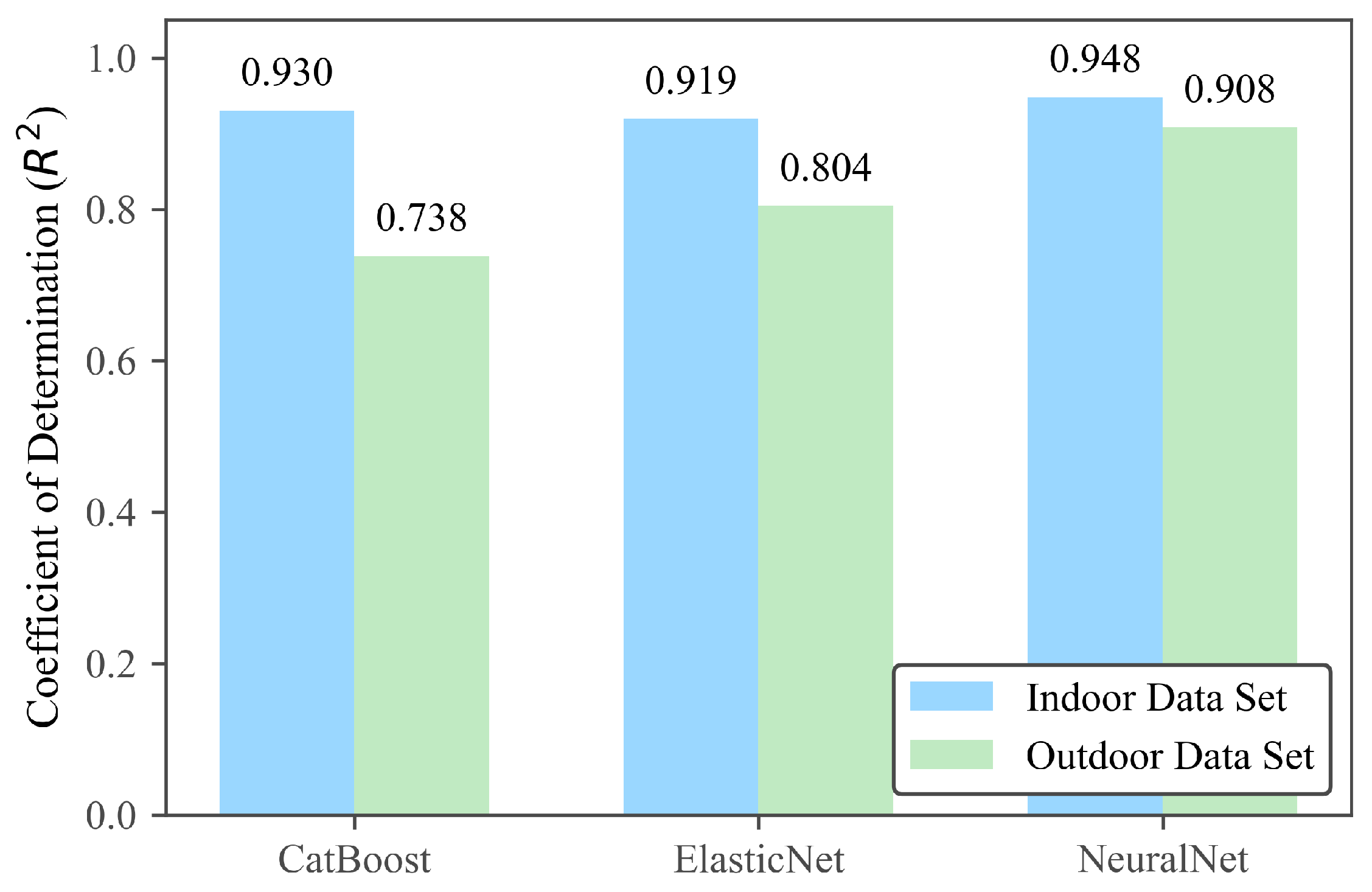
| Model | Data-Val () | () |
|---|---|---|
| Multiple Linear Regression (MLR) | 0.912 | 0.805 |
| Elastic Net Regression (ENR) | 0.921 | 0.919 |
| Support Vector Regression (SVR) | 0.935 | 0.887 |
| Random Forest Regression (RFR) | 0.948 | 0.942 |
| CatBoost Regression (CBR) | 0.954 | 0.930 |
| Multilayer Perceptron (MLP) | 0.957 | 0.948 |
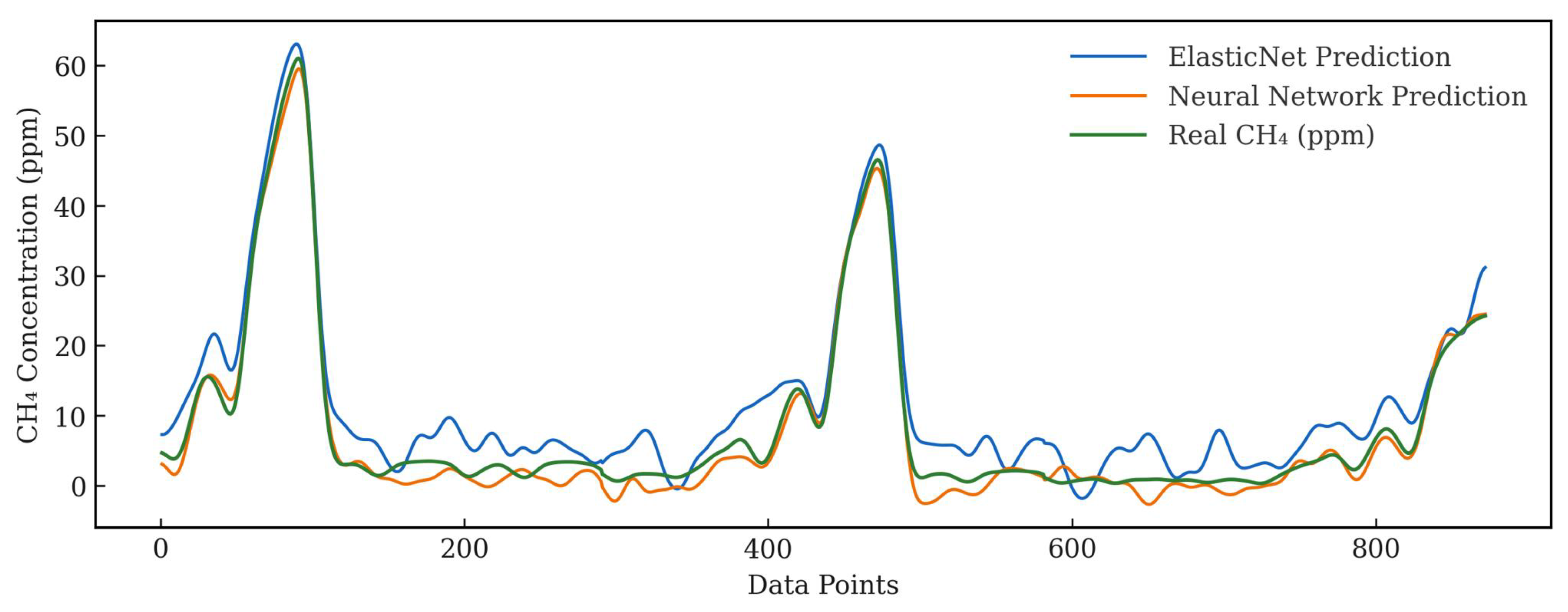
| Situation | Elastic Net (RSME) | Multilayer Perceptron (RMSE) |
|---|---|---|
| Sunny Day (noon) | 1.24 ppm | 0.92 ppm |
| Night | 1.44 ppm | 1.57 ppm |
| Raining Day | 2.73 ppm | 1.17 ppm |
| Thunderstorm | 3.91 ppm | 1.55 ppm |
Disclaimer/Publisher’s Note: The statements, opinions and data contained in all publications are solely those of the individual author(s) and contributor(s) and not of MDPI and/or the editor(s). MDPI and/or the editor(s) disclaim responsibility for any injury to people or property resulting from any ideas, methods, instructions or products referred to in the content. |
© 2025 by the authors. Licensee MDPI, Basel, Switzerland. This article is an open access article distributed under the terms and conditions of the Creative Commons Attribution (CC BY) license (https://creativecommons.org/licenses/by/4.0/).
Share and Cite
Yan, Y.; Mijiddorj, L.; Beringer, T.; Mijiddorj, B.; Ho, A.; Weng, B. Machine Learning-Enhanced NDIR Methane Sensing Solution for Robust Outdoor Continuous Monitoring Applications. Sensors 2025, 25, 7691. https://doi.org/10.3390/s25247691
Yan Y, Mijiddorj L, Beringer T, Mijiddorj B, Ho A, Weng B. Machine Learning-Enhanced NDIR Methane Sensing Solution for Robust Outdoor Continuous Monitoring Applications. Sensors. 2025; 25(24):7691. https://doi.org/10.3390/s25247691
Chicago/Turabian StyleYan, Yang, Lkhanaajav Mijiddorj, Tyler Beringer, Bilguunzaya Mijiddorj, Alex Ho, and Binbin Weng. 2025. "Machine Learning-Enhanced NDIR Methane Sensing Solution for Robust Outdoor Continuous Monitoring Applications" Sensors 25, no. 24: 7691. https://doi.org/10.3390/s25247691
APA StyleYan, Y., Mijiddorj, L., Beringer, T., Mijiddorj, B., Ho, A., & Weng, B. (2025). Machine Learning-Enhanced NDIR Methane Sensing Solution for Robust Outdoor Continuous Monitoring Applications. Sensors, 25(24), 7691. https://doi.org/10.3390/s25247691