Smart and Sustainable: A Global Review of Smart Textiles, IoT Integration, and Human-Centric Design


Abstract
1. Introduction
1.1. Historical Evolution of Smart Textiles
1.2. Pervasive Impact: Applications of Smart Textiles Across Industries
- Healthcare: Textile-based ECG electrodes, respiration monitors, and thermistors support continuous monitoring of vital signs, remote patient care, and rehabilitation. Smart bandages equipped with sensors can track wound healing and deliver controlled therapy, advancing personalized and preventive medicine [2,3].
- Sports & Fitness: Garments integrating sensors capture muscle activity, gait patterns, and joint load, providing real-time performance feedback and personalized training while reducing the risk of injuries [8].
- Defense & Security: Military uniforms with integrated physiological sensors, situational awareness systems, and adaptive camouflage technologies support soldier safety and operational efficiency. These systems reduce the burden of carrying separate devices by embedding functionality directly into fabrics [1,4,5].
1.3. Literature Search and Selection Methodology
- (“Smart Textiles” OR “E-textiles” OR “Wearable Electronics”)
- AND (“Sensing Technologies” OR “Pressure Sensor” OR “Strain Sensor”)
- AND (“IoT Integration” OR “Communication Protocols” OR “Wireless”)
- AND (“Sustainability” OR “Green Manufacturing” OR “E-waste” OR “Recyclability”)
- Inclusion: Priority was given to peer-reviewed journal articles and high-impact review papers that explicitly covered the convergence of smart textile materials/sensing and IoT integration, alongside detailed discussions of human-centric design or sustainability challenges.
- Exclusion: Papers that were outside the defined timeframe, restricted to applications irrelevant to textiles (e.g., rigid electronic devices only), or conference abstracts without full paper publication were generally excluded.
2. IoT Integration in Smart Textiles: Communication and Data Flow
2.1. Overview: Architecting Connectivity in Wearable Systems
2.2. Common Communication Protocols for Smart Textile IoT
2.3. Challenges in Textile-Based Communication Networks
3. Sensor Integration into Textiles: Technologies and Considerations
3.1. Types of Textile-Based Sensors
3.1.1. Fiber-Based Sensors
3.1.2. Yarns-Based Sensors
3.1.3. Woven-Based Sensors
3.1.4. Knitted-Based Sensors
3.1.5. Embroidery-Based Sensors
3.1.6. Modification of Textile Substrates
3.2. Overview of Types of Sensors and Their Working Mechanism
3.2.1. Pressure Sensors

| Sensing Principle | Representative Sensitivity | Typical Working Range | Response Time |
|---|---|---|---|
| Piezoresistive | High (e.g., up to ) | Wide, from subtle to high pressure (0 to 200 kPa) [81] | Fast (e.g., 159 ms [81]) |
| Capacitive | Excellent (adjustable by dielectric layer geometry) | Typically low-to-medium pressure (e.g., <10 kPa) [91] | Fast (e.g., tens of ms) |
| Piezoelectric | Good (Enhanced by CNTs/nanofillers [95]) | Dynamic measurement of transient forces (e.g., impact monitoring) | Extremely fast (e.g., 61 ms [92]) |
3.2.2. Strain Sensors
3.2.3. Temperature Sensors
3.2.4. Electrochemical Sensors
4. Sustainability, Environmental Impact and Technical Challenges of Smart-Textiles
4.1. Impact of Materials
4.2. Consumption of Energy
4.3. E-Waste Generation
5. Approaches to Sustainability in Smart Textiles
5.1. Eco-Friendly Raw Materials
5.2. Renewable and Biodegradable Fibers
5.3. Biodegradable Plant-Based Polymers for Coatings
5.4. Green Manufacturing
5.5. Electronic Waste Recovery and Treatment
6. Future Directions
6.1. AI-Integrated Textiles and the Vision of “Textile Brains”
6.2. Self-Healing and Durable Fabrics
6.3. Modular and Reconfigurable Architectures
6.4. Bio-Integrated and Living Textiles
6.5. Advanced Haptics and Active Feedback
6.6. Standardization, Safety, and Ethics
7. Conclusions
- Safety and Reliability: Ensuring robust operation under mechanical stress, repeated washing, and diverse environmental conditions, supported by standardized testing protocols.
- Sustainability and Circularity: Developing recyclable, biodegradable, and modular material systems to minimize environmental impact and promote circular business models.
- Ethical Considerations: Prioritizing data privacy, informed consent, and equitable access, ensuring that smart textiles respect human rights and societal values.
- Globally Inclusive Innovation: Promoting collaboration across regions to address diverse needs, avoid technological disparities, and ensure that benefits extend to communities worldwide.
Funding
Institutional Review Board Statement
Informed Consent Statement
Data Availability Statement
Conflicts of Interest
References
- Stoppa, M.; Chiolerio, A. Wearable electronics and smart textiles: A critical review. Sensors 2014, 14, 11957–11992. [Google Scholar] [CrossRef] [PubMed]
- Wang, C.; Fu, L.; Ametefe, D.S.; Wang, S.; John, D. E-textiles in healthcare: A systematic literature review of wearable technologies for monitoring and enhancing human health. Neural Comput. Appl. 2025, 37, 2089–2111. [Google Scholar] [CrossRef]
- Shi, J.; Liu, S.; Zhang, L.; Yang, B.; Shu, L.; Yang, Y.; Ren, M.; Wang, Y.; Chen, J.; Chen, W.; et al. Smart textile-integrated microelectronic systems for wearable applications. Adv. Mater. 2020, 32, 1901958. [Google Scholar] [CrossRef]
- Mattmann, C.; Clemens, F.; Tröster, G. Sensor for Measuring Strain in Textile. Sensors 2008, 8, 3719–3732. [Google Scholar] [CrossRef]
- Paradiso, R.; Loriga, G.; Taccini, N. A wearable health care system based on knitted integrated sensors. IEEE Trans. Inf. Technol. Biomed. 2005, 9, 337–344. [Google Scholar] [CrossRef] [PubMed]
- Fu, X.; Cheng, W.; Wan, G.; Yang, Z.; Tee, B.C. Toward an AI era: Advances in electronic skins. Chem. Rev. 2024, 124, 9899–9948. [Google Scholar] [CrossRef]
- Post, E.R.; Orth, M.; Russo, P.R.; Gershenfeld, N. E-broidery: Design and fabrication of textile-based computing. Ibm Syst. J. 2000, 39, 840–860. [Google Scholar] [CrossRef]
- Wang, J.; Lu, C.; Zhang, K. Textile-based strain sensor for human motion detection. Energy Environ. Mater. 2020, 3, 80–100. [Google Scholar] [CrossRef]
- Seymour, S. Fashionable Technology: The Intersection of Design, Fashion, Science, and Technology; Springer: Berlin/Heidelberg, Germany, 2008. [Google Scholar]
- Berzowska, J. Electronic textiles: Wearable computers, reactive fashion, and soft computation. Textile 2005, 3, 58–75. [Google Scholar] [CrossRef]
- Ozlem, K.; Atalay, A.T.; Atalay, O.; Ince, G. Fogetex: Fog computing framework for electronic textile applications. IEEE Internet Things J. 2025, 14, 6856–6874. [Google Scholar] [CrossRef]
- Monares, Á.; Ochoa, S.F.; Santos, R.; Orozco, J.; Meseguer, R. Modeling IoT-based solutions using human-centric wireless sensor networks. Sensors 2014, 14, 15687–15713. [Google Scholar] [CrossRef] [PubMed]
- Zada, M.; Iman, U.R.; Basir, A.; Yoo, H. Battery-free digitally embroidered smart textile energy harvester for wearable healthcare IoTs. IEEE Trans. Ind. Electron. 2023, 71, 9865–9874. [Google Scholar] [CrossRef]
- Qi, A.; Ma, M.; Luo, Y.; Fernandes, G.; Shi, G.; Fan, J.; Qi, Y.; Ma, J. Wise: Wireless intelligent sensing for human-centric applications. IEEE Wirel. Commun. 2022, 30, 106–113. [Google Scholar] [CrossRef]
- Mihovska, A.; Sarkar, M. Cooperative human-centric sensing connectivity. In Internet of Things-Technology, Applications and Standardization; IntechOpen: London, UK, 2018. [Google Scholar]
- Hasan, M.M.; Hossain, M.M. Nanomaterials-patterned flexible electrodes for wearable health monitoring: A review. J. Mater. Sci. 2021, 56, 14900–14942. [Google Scholar] [CrossRef]
- Nigusse, A.B.; Mengistie, D.A.; Malengier, B.; Tseghai, G.B.; Langenhove, L.V. Wearable smart textiles for long-term electrocardiography monitoring—A review. Sensors 2021, 21, 4174. [Google Scholar] [CrossRef]
- Ahmed, A.; Adak, B.; Mukhopadhyay, S. Smart Textile-Based interactive, stretchable and wearable sensors for healthcare. In Nanosensors for Futuristic Smart and Intelligent Healthcare Systems; CRC Press: Boca Raton, FL, USA, 2022; pp. 112–132. [Google Scholar]
- Blachowicz, T.; Ehrmann, G.; Ehrmann, A. Textile-based sensors for biosignal detection and monitoring. Sensors 2021, 21, 6042. [Google Scholar] [CrossRef] [PubMed]
- Coccia, A.; Amitrano, F.; Donisi, L.; Cesarelli, G.; Pagano, G.; Cesarelli, M.; D’Addio, G. Design and validation of an e-textile-based wearable system for remote health monitoring. Acta Imeko 2021, 10, 220–229. [Google Scholar] [CrossRef]
- Zhang, Y.; Lin, Z.; Huang, X.; You, X.; Ye, J.; Wu, H. A Large-Area, Stretchable, Textile-Based Tactile Sensor. Adv. Mater. Technol. 2020, 5, 1901060. [Google Scholar] [CrossRef]
- Niu, B.; Hua, T.; Hu, H.; Xu, B.; Tian, X.; Chan, K.; Chen, S. A highly durable textile-based sensor as a human-worn material interface for long-term multiple mechanical deformation sensing. J. Mater. Chem. C 2019, 7, 14651–14663. [Google Scholar] [CrossRef]
- Heo, J.S.; Hossain, M.F.; Kim, I. Challenges in design and fabrication of flexible/stretchable carbon-and textile-based wearable sensors for health monitoring: A critical review. Sensors 2020, 20, 3927. [Google Scholar] [CrossRef]
- Ouyang, Z.; Xu, D.; Yu, H.Y.; Li, S.; Song, Y.; Tam, K.C. Novel ultrasonic-coating technology to design robust, highly sensitive and wearable textile sensors with conductive nanocelluloses. Chem. Eng. J. 2022, 428, 131289. [Google Scholar] [CrossRef]
- Li, M.; Chen, J.; Zhong, W.; Luo, M.; Wang, W.; Qing, X.; Lu, Y.; Liu, Q.; Liu, K.; Wang, Y.; et al. Large-area, wearable, self-powered pressure–temperature sensor based on 3D thermoelectric spacer fabric. ACS Sensors 2020, 5, 2545–2554. [Google Scholar] [CrossRef] [PubMed]
- Kim, H.; Shaqeel, A.; Han, S.; Kang, J.; Yun, J.; Lee, M.; Lee, S.; Kim, J.; Noh, S.; Choi, M.; et al. In situ formation of Ag nanoparticles for fiber strain sensors: Toward textile-based wearable applications. ACS Appl. Mater. Interfaces 2021, 13, 39868–39879. [Google Scholar] [CrossRef] [PubMed]
- Zhao, X.; Zhou, Y.; Xu, J.; Chen, G.; Fang, Y.; Tat, T.; Xiao, X.; Song, Y.; Li, S.; Chen, J. Soft fibers with magnetoelasticity for wearable electronics. Nat. Commun. 2021, 12, 6755. [Google Scholar] [CrossRef] [PubMed]
- Liu, Q.; Zhang, Y.; Sun, X.; Liang, C.; Han, Y.; Wu, X.; Wang, Z. All textile-based robust pressure sensors for smart garments. Chem. Eng. J. 2023, 454, 140302. [Google Scholar] [CrossRef]
- Lim, S.J.; Bae, J.H.; Han, J.H.; Jang, S.J.; Oh, H.J.; Lee, W.; Kim, S.H.; Ko, J.H. Foldable and washable fully textile-based pressure sensor. Smart Mater. Struct. 2020, 29, 055010. [Google Scholar] [CrossRef]
- Zhou, Z.; Padgett, S.; Cai, Z.; Conta, G.; Wu, Y.; He, Q.; Zhang, S.; Sun, C.; Liu, J.; Fan, E.; et al. Single-layered ultra-soft washable smart textiles for all-around ballistocardiograph, respiration, and posture monitoring during sleep. Biosens. Bioelectron. 2020, 155, 112064. [Google Scholar] [CrossRef]
- Kim, S.; Truong, T.; Jang, J.; Kim, J. The programmable design of large-area piezoresistive textile sensors using manufacturing by jacquard processing. Polymers 2022, 15, 78. [Google Scholar] [CrossRef]
- Wang, Z.; Zhao, X.; Yan, K.; Zhang, P.; Zhang, S.; Fan, H. Smart textiles for chronic disease management: Advancements, applications, and future prospects. Mater. Sci. Eng. Rep. 2025, 164, 100987. [Google Scholar] [CrossRef]
- Carey, T.; Maughan, J.; Doolan, L.; Caffrey, E.; Garcia, J.; Liu, S.; Kaur, H.; Ilhan, C.; Seyedin, S.; Coleman, J.N. Knot architecture for biocompatible and semiconducting 2D electronic fiber transistors. Small Methods 2024, 8, 2301654. [Google Scholar] [CrossRef]
- Rahimi, R.; Ochoa, M.; Yu, W.; Ziaie, B. Highly stretchable and sensitive unidirectional strain sensor via laser carbonization. ACS Appl. Mater. Interfaces 2015, 7, 4463–4470. [Google Scholar] [CrossRef]
- Park, C.; Choi, M.; Lee, S.; Kim, H.; Lee, T.; Billah, M.M.; Jung, B.; Jang, J. Highly sensitive, stretchable pressure sensor using blue laser annealed CNTs. Nanomaterials 2022, 12, 2127. [Google Scholar] [CrossRef]
- Jia, Y.; Shen, L.; Liu, J.; Zhou, W.; Du, Y.; Xu, J.; Liu, C.; Zhang, G.; Zhang, Z.; Jiang, F. An efficient PEDOT-coated textile for wearable thermoelectric generators and strain sensors. J. Mater. Chem. C 2019, 7, 3496–3502. [Google Scholar] [CrossRef]
- Liu, N.; Ma, W.; Tao, J.; Zhang, X.; Su, J.; Li, L.; Yang, C.; Gao, Y.; Golberg, D.; Bando, Y. Cable-type supercapacitors of three-dimensional cotton thread based multi-grade nanostructures for wearable energy storage. Adv. Mater. 2013, 25, 4925–4931. [Google Scholar] [CrossRef]
- Reddy K, R.; Gandla, S.; Gupta, D. Highly sensitive, rugged, and wearable fabric strain sensor based on graphene clad polyester knitted elastic band for human motion monitoring. Adv. Mater. Interfaces 2019, 6, 1900409. [Google Scholar] [CrossRef]
- Jiang, K.; Li, Q.; Fan, S. Spinning continuous carbon nanotube yarns. Nature 2002, 419, 801. [Google Scholar] [CrossRef]
- Lee, J.A.; Shin, M.K.; Kim, S.H.; Cho, H.U.; Spinks, G.M.; Wallace, G.G.; Lima, M.D.; Lepró, X.; Kozlov, M.E.; Baughman, R.H.; et al. Ultrafast charge and discharge biscrolled yarn supercapacitors for textiles and microdevices. Nat. Commun. 2013, 4, 1970. [Google Scholar] [CrossRef]
- Lin, J.H.; Huang, Y.T.; Li, T.T.; Lin, C.M.; Lou, C.W. Bamboo charcoal/phase change material/stainless steel ring-spun complex yarn and its far-infrared/anion-releasing elastic warp-knitted fabric: Fabrication and functional evaluation. J. Ind. Text. 2016, 46, 624–642. [Google Scholar] [CrossRef]
- Lotus, A.; Bhargava, S.; Bender, E.; Evans, E.; Ramsier, R.; Reneker, D.H.; Chase, G.G. Electrospinning route for the fabrication of pn junction using nanofiber yarns. J. Appl. Phys. 2009, 106, 014303. [Google Scholar] [CrossRef]
- Li, S.; Gu, Y.; Wu, G.; Dong, K.; Jia, M.; Zhang, D.; Xiao, X. A flexible piezoresistive sensor with highly elastic weave pattern for motion detection. Smart Mater. Struct. 2019, 28, 035020. [Google Scholar] [CrossRef]
- Chen, J.; Zhang, J.; Hu, J.; Luo, N.; Sun, F.; Venkatesan, H.; Zhao, N.; Zhang, Y. Ultrafast-response/recovery flexible piezoresistive sensors with DNA-like double helix yarns for epidermal pulse monitoring. Adv. Mater. 2022, 34, 2104313. [Google Scholar] [CrossRef]
- Lin, X.; Seet, B.C. A linear wide-range textile pressure sensor integrally embedded in regular fabric. IEEE Sens. J. 2015, 15, 5384–5385. [Google Scholar] [CrossRef]
- Jiang, M.; Hu, H.; Jin, C.; Lv, R.; Guo, J.; Jiang, S.; Bai, Z. Three-directional spacer-knitted piezoresistant strain and pressure sensor for electronic integration and on-body applications. ACS Appl. Mater. Interfaces 2023, 15, 55009–55021. [Google Scholar] [CrossRef] [PubMed]
- Luo, N.; Zhang, J.; Ding, X.; Zhou, Z.; Zhang, Q.; Zhang, Y.T.; Chen, S.C.; Hu, J.L.; Zhao, N. Textile-enabled highly reproducible flexible pressure sensors for cardiovascular monitoring. Adv. Mater. Technol. 2018, 3, 1700222. [Google Scholar] [CrossRef]
- Parzer, P.; Perteneder, F.; Probst, K.; Rendl, C.; Leong, J.; Schuetz, S.; Vogl, A.; Schwoediauer, R.; Kaltenbrunner, M.; Bauer, S.; et al. Resi: A highly flexible, pressure-sensitive, imperceptible textile interface based on resistive yarns. In Proceedings of the 31st Annual ACM Symposium on User Interface Software and Technology, Berlin, Germany, 14–17 October 2018; pp. 745–756. [Google Scholar]
- Wu, T.Y.; Xu, Z.; Yang, X.D.; Hodges, S.; Seyed, T. Project tasca: Enabling touch and contextual interactions with a pocket-based textile sensor. In Proceedings of the 2021 CHI Conference on Human Factors in Computing Systems, Yokohama, Japan, 8–13 May 2021; pp. 1–13. [Google Scholar]
- Wang, Q.; Zeng, Y.; Zhang, R.; Ye, N.; Zhu, L.; Sun, X.; Han, T. EmTex: Prototyping Textile-Based Interfaces through An Embroidered Construction Kit. In Proceedings of the 36th Annual ACM Symposium on User Interface Software and Technology, San Francisco, CA, USA, 29 October–1 November 2023; pp. 1–17. [Google Scholar]
- Zhao, M.; Xu, H.; Zhong, W.; Ming, X.; Li, M.; Hu, X.; Jia, K.; Wang, D. Robust and breathable all-textile gait analysis platform based on LeNet convolutional neural networks and embroidery technique. Sens. Actuators Phys. 2023, 360, 114549. [Google Scholar] [CrossRef]
- Tan, S.; Afroj, S.; Li, D.; Islam, M.R.; Wu, J.; Cai, G.; Karim, N.; Zhao, Z. Highly sensitive and extremely durable wearable e-textiles of graphene/carbon nanotube hybrid for cardiorespiratory monitoring. Iscience 2023, 26, 106403. [Google Scholar] [CrossRef]
- Zheng, Y.; Yin, R.; Zhao, Y.; Liu, H.; Zhang, D.; Shi, X.; Zhang, B.; Liu, C.; Shen, C. Conductive MXene/cotton fabric based pressure sensor with both high sensitivity and wide sensing range for human motion detection and E-skin. Chem. Eng. J. 2021, 420, 127720. [Google Scholar] [CrossRef]
- Yu, Q.; Su, C.; Bi, S.; Huang, Y.; Li, J.; Shao, H.; Jiang, J.; Chen, N. Ti3C2T x@ nonwoven fabric composite: Promising MXene-coated fabric for wearable piezoresistive pressure sensors. ACS Appl. Mater. Interfaces 2022, 14, 9632–9643. [Google Scholar] [CrossRef] [PubMed]
- Pan, H.; Chen, G.; Chen, Y.; Di Carlo, A.; Mayer, M.A.; Shen, S.; Chen, C.; Li, W.; Subramaniam, S.; Huang, H.; et al. Biodegradable cotton fiber-based piezoresistive textiles for wearable biomonitoring. Biosens. Bioelectron. 2023, 222, 114999. [Google Scholar] [CrossRef]
- Kim, D.; Lee, D.K.; Yoon, J.; Hahm, D.; Lee, B.; Oh, E.; Kim, G.; Seo, J.; Kim, H.; Hong, Y. Electronic skin based on a cellulose/carbon nanotube fiber network for large-area 3D touch and real-time 3D surface scanning. ACS Appl. Mater. Interfaces 2021, 13, 53111–53119. [Google Scholar] [CrossRef]
- Pang, Y.; Xu, X.; Chen, S.; Fang, Y.; Shi, X.; Deng, Y.; Wang, Z.L.; Cao, C. Skin-inspired textile-based tactile sensors enable multifunctional sensing of wearables and soft robots. Nano Energy 2022, 96, 107137. [Google Scholar] [CrossRef]
- Zhang, R.; Ye, S.; Suzuki, R.; Xie, C.; Wang, J.; Huang, W.; Zou, Z. Carbon nanotube modified cellulose nonwovens: Superhydrophobic, breathable, and sensitive for drowning alarm and motion monitoring. Cellulose 2024, 31, 3143–3161. [Google Scholar] [CrossRef]
- Chen, F.; Liu, H.; Xu, M.; Ye, J.; Li, Z.; Qin, L.; Zhang, T. Fast-response piezoresistive pressure sensor based on polyaniline cotton fabric for human motion monitoring. Cellulose 2022, 29, 6983–6995. [Google Scholar] [CrossRef]
- Lan, L.; Zhao, F.; Yao, Y.; Ping, J.; Ying, Y. One-step and spontaneous in situ growth of popcorn-like nanostructures on stretchable double-twisted fiber for ultrasensitive textile pressure sensor. ACS Appl. Mater. Interfaces 2020, 12, 10689–10696. [Google Scholar] [CrossRef]
- Du, W.; Li, Z.; Zhao, Y.; Zhang, X.; Pang, L.; Wang, W.; Jiang, T.; Yu, A.; Zhai, J. Biocompatible and breathable all-fiber-based piezoresistive sensor with high sensitivity for human physiological movements monitoring. Chem. Eng. J. 2022, 446, 137268. [Google Scholar] [CrossRef]
- Guo, X.; Hong, W.; Zhao, Y.; Zhu, T.; Li, H.; Zheng, G.; Wang, J.; Tang, G.; Cao, J.; Wang, Y.; et al. Bioinspired sandwich-structured pressure sensors based on graphene oxide/hydroxyl functionalized carbon nanotubes/bovine serum albumin nanocomposites for wearable textile electronics. Compos. Part Appl. Sci. Manuf. 2022, 163, 107240. [Google Scholar] [CrossRef]
- Clevenger, M.; Kim, H.; Song, H.W.; No, K.; Lee, S. Binder-free printed PEDOT wearable sensors on everyday fabrics using oxidative chemical vapor deposition. Sci. Adv. 2021, 7, eabj8958. [Google Scholar] [CrossRef]
- Tian, G.; Shi, Y.; Deng, J.; Yu, W.; Yang, L.; Lu, Y.; Zhao, Y.; Jin, X.; Ke, Q.; Huang, C. Low-cost, scalable fabrication of all-fabric piezoresistive sensors via binder-free, in-situ welding of carbon nanotubes on bicomponent nonwovens. Adv. Fiber Mater. 2024, 6, 120–132. [Google Scholar] [CrossRef]
- Doshi, S.M.; Thostenson, E.T. Thin and flexible carbon nanotube-based pressure sensors with ultrawide sensing range. ACS Sensors 2018, 3, 1276–1282. [Google Scholar] [CrossRef] [PubMed]
- Chen, T.; Zhang, X.; Hu, X.; Wu, Z.; Cao, F.; Wang, X.A.; Wu, B.; Fang, X.; Xie, Y. Sensitive piezoresistive sensors using ink-modified plant fiber sponges. Chem. Eng. J. 2020, 401, 126029. [Google Scholar] [CrossRef]
- Devi, M.; Wang, H.; Moon, S.; Sharma, S.; Strauss, V. Laser-Carbonization–A powerful tool for micro-fabrication of patterned electronic carbons. Adv. Mater. 2023, 35, 2211054. [Google Scholar] [CrossRef] [PubMed]
- Wang, H.; Wang, H.; Wang, Y.; Su, X.; Wang, C.; Zhang, M.; Jian, M.; Xia, K.; Liang, X.; Lu, H.; et al. Laser writing of janus graphene/kevlar textile for intelligent protective clothing. ACS Nano 2020, 14, 3219–3226. [Google Scholar] [CrossRef]
- Xia, S.Y.; Long, Y.; Huang, Z.; Zi, Y.; Tao, L.Q.; Li, C.H.; Sun, H.; Li, J. Laser-induced graphene (LIG)-based pressure sensor and triboelectric nanogenerator towards high-performance self-powered measurement-control combined system. Nano Energy 2022, 96, 107099. [Google Scholar] [CrossRef]
- Parmeggiani, M.; Stassi, S.; Fontana, M.; Bianco, S.; Catania, F.; Scaltrito, L.; Lamberti, A. Laser-induced graphenization of textile yarn for wearable electronics application. Smart Mater. Struct. 2021, 30, 105007. [Google Scholar] [CrossRef]
- van Langenhove, L. Advances in Smart Medical Textiles: Treatments and Health Monitoring; Elsevier: Amsterdam, The Netherlands, 2015. [Google Scholar]
- Promphet, N.; Rattanawaleedirojn, P.; Siralertmukul, K.; Soatthiyanon, N.; Potiyaraj, P.; Thanawattano, C.; Hinestroza, J.P.; Rodthongkum, N. Non-invasive textile based colorimetric sensor for the simultaneous detection of sweat pH and lactate. Talanta 2019, 192, 424–430. [Google Scholar] [CrossRef] [PubMed]
- Liu, X.; Lillehoj, P.B. Embroidered electrochemical sensors for biomolecular detection. Lab Chip 2016, 16, 2093–2098. [Google Scholar] [CrossRef] [PubMed]
- Lian, Y.; Yu, H.; Wang, M.; Yang, X.; Zhang, H. Ultrasensitive wearable pressure sensors based on silver nanowire-coated fabrics. Nanoscale Res. Lett. 2020, 15, 70. [Google Scholar] [CrossRef]
- Chen, L.; Lu, M.; Yang, H.; Salas Avila, J.R.; Shi, B.; Ren, L.; Wei, G.; Liu, X.; Yin, W. Textile-based capacitive sensor for physical rehabilitation via surface topological modification. ACS Nano 2020, 14, 8191–8201. [Google Scholar] [CrossRef]
- Mokhtari, F.; Spinks, G.M.; Fay, C.; Cheng, Z.; Raad, R.; Xi, J.; Foroughi, J. Wearable electronic textiles from nanostructured piezoelectric fibers. Adv. Mater. Technol. 2020, 5, 1900900. [Google Scholar] [CrossRef]
- Libanori, A.; Chen, G.; Zhao, X.; Zhou, Y.; Chen, J. Smart textiles for personalized healthcare. Nat. Electron. 2022, 5, 142–156. [Google Scholar] [CrossRef]
- Moghaddam, M.K.; Moezzi, M.; Torabi, T.; Barez, F. Flexible capacitive pressure sensor based on warp knitted spacer fabric. Sens. Actuators Phys. 2024, 376, 115602. [Google Scholar] [CrossRef]
- Ajo-Franklin, J.B.; Dou, S.; Lindsey, N.J.; Monga, I.; Tracy, C.; Robertson, M.; Rodriguez Tribaldos, V.; Ulrich, C.; Freifeld, B.; Daley, T.; et al. Distributed acoustic sensing using dark fiber for near-surface characterization and broadband seismic event detection. Sci. Rep. 2019, 9, 1328. [Google Scholar] [CrossRef]
- Ray, T.; Choi, J.; Reeder, J.; Lee, S.P.; Aranyosi, A.J.; Ghaffari, R.; Rogers, J.A. Soft, skin-interfaced wearable systems for sports science and analytics. Curr. Opin. Biomed. Eng. 2019, 9, 47–56. [Google Scholar] [CrossRef]
- Zhang, L.; Li, H.; Lai, X.; Gao, T.; Yang, J.; Zeng, X. Thiolated graphene@ polyester fabric-based multilayer piezoresistive pressure sensors for detecting human motion. ACS Appl. Mater. Interfaces 2018, 10, 41784–41792. [Google Scholar] [CrossRef] [PubMed]
- Lin, X.; Gao, S.; Fei, T.; Liu, S.; Zhao, H.; Zhang, T. Study on a paper-based piezoresistive sensor applied to monitoring human physiological signals. Sens. Actuators Phys. 2019, 292, 66–70. [Google Scholar] [CrossRef]
- Tian, M.; Lu, Y.; Qu, L.; Zhu, S.; Zhang, X.; Chen, S. A pillow-shaped 3D hierarchical piezoresistive pressure sensor based on conductive silver components-coated fabric and random fibers assembly. Ind. Eng. Chem. Res. 2019, 58, 5737–5742. [Google Scholar] [CrossRef]
- Choudhry, N.A.; Rasheed, A.; Ahmad, S.; Arnold, L.; Wang, L. Design, development and characterization of textile stitch-based piezoresistive sensors for wearable monitoring. IEEE Sens. J. 2020, 20, 10485–10494. [Google Scholar] [CrossRef]
- Tang, J.; Wu, Y.; Ma, S.; Zhang, Y.; Yan, T.; Pan, Z. Three-directional knitted fabric sensor made of elastic carbon-based nanofiber yarn with excellent tensile and pressure sensing performance. Nano Energy 2024, 128, 109801. [Google Scholar] [CrossRef]
- Wu, E.; Zhang, J.; Qiao, M.; Cao, Y.; Wang, Q.; Ren, X.; Zuo, Y. A new fiber sensor based on graphene coating technique for wearable equipment. In Proceedings of the Fourth Seminar on Novel Optoelectronic Detection Technology and Application, Nanjing, China, 24–26 October 2017; pp. 1124–1129. [Google Scholar]
- Lou, C.; Wang, S.; Liang, T.; Pang, C.; Huang, L.; Run, M.; Liu, X. A graphene-based flexible pressure sensor with applications to plantar pressure measurement and gait analysis. Materials 2017, 10, 1068. [Google Scholar] [CrossRef]
- Zhang, J.W.; Zhang, Y.; Li, Y.Y.; Wang, P. Textile-based flexible pressure sensors: A review. Polym. Rev. 2022, 62, 65–94. [Google Scholar] [CrossRef]
- Lee, J.; Kim, S.; Kim, J. Carbon Nanotube-Based Capacitive and Resistive Hybrid Pressure Textile Sensor for High Sensitivity. Fibers Polym. 2025, 26, 1039–1048. [Google Scholar] [CrossRef]
- Lee, J.; Kwon, H.; Seo, J.; Shin, S.; Koo, J.H.; Pang, C.; Son, S.; Kim, J.H.; Jang, Y.H.; Kim, D.E.; et al. Conductive fiber-based ultrasensitive textile pressure sensor for wearable electronics. Adv. Mater. 2015, 27, 2433–2439. [Google Scholar] [CrossRef]
- Chhetry, A.; Yoon, H.; Park, J.Y. A flexible and highly sensitive capacitive pressure sensor based on conductive fibers with a microporous dielectric for wearable electronics. J. Mater. Chem. C 2017, 5, 10068–10076. [Google Scholar] [CrossRef]
- Yang, Y.; Pan, H.; Xie, G.; Jiang, Y.; Chen, C.; Su, Y.; Wang, Y.; Tai, H. Flexible piezoelectric pressure sensor based on polydopamine-modified BaTiO3/PVDF composite film for human motion monitoring. Sens. Actuators Phys. 2020, 301, 111789. [Google Scholar] [CrossRef]
- Zhu, M.; Chng, S.S.; Cai, W.; Liu, C.; Du, Z. Piezoelectric polymer nanofibers for pressure sensors and their applications in human activity monitoring. Rsc Adv. 2020, 10, 21887–21894. [Google Scholar] [CrossRef]
- Wang, T.W.; Lin, S.F. Wearable piezoelectric-based system for continuous beat-to-beat blood pressure measurement. Sensors 2020, 20, 851. [Google Scholar] [CrossRef] [PubMed]
- Kim, H.; Kim, Y. High performance flexible piezoelectric pressure sensor based on CNTs-doped 0–3 ceramic-epoxy nanocomposites. Mater. Des. 2018, 151, 133–140. [Google Scholar] [CrossRef]
- Liu, S.; Zhang, W.; He, J.; Lu, Y.; Wu, Q.; Xing, M. Fabrication techniques and sensing mechanisms of textile-based strain sensors: From spatial 1D and 2D perspectives. Adv. Fiber Mater. 2024, 6, 36–67. [Google Scholar]
- Liza, L.; Kabir, M.H.; Jiang, L.; Jerrams, S.; Chen, S. The technology of wearable flexible textile-based strain sensors for monitoring multiple human motions: Construction, patterning and performance. Sens. Diagn. 2023, 2, 1414–1436. [Google Scholar]
- Medagedara, M.H.; Ranasinghe, A.; Lalitharatne, T.D.; Gopura, R.; Nandasiri, G.K. Advancements in Textile-Based sEMG Sensors for Muscle Fatigue Detection: A Journey from Material Evolution to Technological Integration. ACS Sensors 2024, 9, 4380–4401. [Google Scholar]
- Romano, C.; Lo Presti, D.; Silvestri, S.; Schena, E.; Massaroni, C. Flexible Textile Sensors-Based Smart T-Shirt for Respiratory Monitoring: Design, Development, and Preliminary Validation. Sensors 2024, 24, 2018. [Google Scholar] [CrossRef]
- Wu, L.; Wang, Y.; Du, X.; Yu, R.; Bai, X.; Yang, Z.; Qiu, J.; Pan, S.; Zhu, M. Interlocking integration of elastic strain sensor yarn enables smart and distributed sensing in healthcare clothing. Sci. China Mater. 2025, 2025, 1–10. [Google Scholar] [CrossRef]
- Kong, M.; Yang, M.; Li, R.; Long, Y.Z.; Zhang, J.; Huang, X.; Cui, X.; Zhang, Y.; Said, Z.; Li, C. Graphene-based flexible wearable sensors: Mechanisms, challenges, and future directions. Int. J. Adv. Manuf. Technol. 2024, 131, 3205–3237. [Google Scholar] [CrossRef]
- Zhao, S.; Liu, D.; Yan, F. Wearable Resistive-Type Stretchable Strain Sensors: Materials and Applications. Adv. Mater. 2025, 37, 2413929. [Google Scholar] [CrossRef] [PubMed]
- Aliyana, A.K.; Yang, D.; Tangsirinaruenart, O.; Stylios, G.K. A garment-integrated textile stitch-based strain sensor device, IoT-Enabled for enhanced wearable sportswear applications. Results Eng. 2024, 23, 102794. [Google Scholar] [CrossRef]
- Fang, L.; Zhou, Y.; Huang, Q. Ionic Conductive Textiles for Wearable Technology. Adv. Mater. 2025, 2025, 2502140. [Google Scholar] [CrossRef]
- Nie, F.; Gu, Y.L.; Zhao, L.; Li, L.T.; Shen, F.X.; Song, J.; Liu, J.; Zhang, G.D.; Gao, J.F.; Song, P.; et al. Construction of conductive polymer coatings onto flexible PDMS foam composites with exceptional mechanical robustness for sensitive strain sensing applications. Adv. Sens. Res. 2024, 3, 2300140. [Google Scholar] [CrossRef]
- Han, P.; Liang, S.; Zou, H.; Wang, X. Structure, principle and performance of flexible conductive polymer strain sensors: A review. J. Mater. Sci. Mater. Electron. 2024, 35, 775. [Google Scholar] [CrossRef]
- Li, X.; Koh, K.H.; Farhan, M.; Lai, K.W.C. An ultraflexible polyurethane yarn-based wearable strain sensor with a polydimethylsiloxane infiltrated multilayer sheath for smart textiles. Nanoscale 2020, 12, 4110–4118. [Google Scholar] [CrossRef]
- Luo, C.; Tian, B.; Liu, Q.; Feng, Y.; Wu, W. One-step-printed, highly sensitive, textile-based, tunable performance strain sensors for human motion detection. Adv. Mater. Technol. 2020, 5, 1900925. [Google Scholar] [CrossRef]
- Atalay, O.; Kennon, W.R.; Demirok, E. Weft-knitted strain sensor for monitoring respiratory rate and its electro-mechanical modeling. IEEE Sens. J. 2014, 15, 110–122. [Google Scholar] [CrossRef]
- Wu, J.; Huang, W.; Liang, Y.; Wu, Z.; Zhong, B.; Zhou, Z.; Ye, J.; Tao, K.; Zhou, Y.; Xie, X. Self-calibrated, sensitive, and flexible temperature sensor based on 3D chemically modified graphene hydrogel. Adv. Electron. Mater. 2021, 7, 2001084. [Google Scholar] [CrossRef]
- Lu, D.; Yan, Y.; Avila, R.; Kandela, I.; Stepien, I.; Seo, M.H.; Bai, W.; Yang, Q.; Li, C.; Haney, C.R.; et al. Bioresorbable, wireless, passive sensors as temporary implants for monitoring regional body temperature. Adv. Healthc. Mater. 2020, 9, 2000942. [Google Scholar] [CrossRef]
- Kuzubasoglu, B.A.; Bahadir, S.K. Flexible temperature sensors: A review. Sens. Actuators Phys. 2020, 315, 112282. [Google Scholar] [CrossRef]
- Lee, J.W.; Han, D.C.; Shin, H.J.; Yeom, S.H.; Ju, B.K.; Lee, W. PEDOT: PSS-based temperature-detection thread for wearable devices. Sensors 2018, 18, 2996. [Google Scholar] [CrossRef]
- Zhang, Y.; Cui, Y. Development of flexible and wearable temperature sensors based on PEDOT: PSS. IEEE Trans. Electron Devices 2019, 66, 3129–3133. [Google Scholar] [CrossRef]
- Lugoda, P.; Hughes-Riley, T.; Oliveira, C.; Morris, R.; Dias, T. Developing novel temperature sensing garments for health monitoring applications. Fibers 2018, 6, 46. [Google Scholar] [CrossRef]
- Drăgulinescu, A.; Drăgulinescu, A.M.; Zincă, G.; Bucur, D.; Feieș, V.; Neagu, D.M. Smart socks and in-shoe systems: State-of-the-art for two popular technologies for foot motion analysis, sports, and medical applications. Sensors 2020, 20, 4316. [Google Scholar] [CrossRef] [PubMed]
- Yang, Q.; Wang, X.; Ding, X.; Li, Q. Fabrication and characterization of wrapped metal yarns-based fabric temperature sensors. Polymers 2019, 11, 1549. [Google Scholar] [CrossRef] [PubMed]
- Jung, M.; Jeon, S.; Bae, J. Scalable and facile synthesis of stretchable thermoelectric fabric for wearable self-powered temperature sensors. Rsc Adv. 2018, 8, 39992–39999. [Google Scholar] [CrossRef] [PubMed]
- Li, Q.; Chen, H.; Ran, Z.Y.; Zhang, L.N.; Xiang, R.F.; Wang, X.; Tao, X.M.; Ding, X. Full fabric sensing network with large deformation for continuous detection of skin temperature. Smart Mater. Struct. 2018, 27, 105017. [Google Scholar] [CrossRef]
- Zhou, G.; Byun, J.H.; Oh, Y.; Jung, B.M.; Cha, H.J.; Seong, D.G.; Um, M.K.; Hyun, S.; Chou, T.W. Highly sensitive wearable textile-based humidity sensor made of high-strength, single-walled carbon nanotube/poly (vinyl alcohol) filaments. ACS Appl. Mater. Interfaces 2017, 9, 4788–4797. [Google Scholar] [CrossRef] [PubMed]
- Su, P.G.; Chang, C.F. Fabrication and electrical and humidity-sensing properties of a flexible and stretchable textile humidity sensor. J. Taiwan Inst. Chem. Eng. 2018, 87, 36–43. [Google Scholar] [CrossRef]
- Zhou, J.; Xiao, X.; Cheng, X.F.; Gao, B.J.; He, J.H.; Xu, Q.F.; Li, H.; Li, N.J.; Chen, D.Y.; Lu, J.M. Surface modification of polysquaraines to sense humidity within a second for breath monitoring. Sens. Actuators Chem. 2018, 271, 137–146. [Google Scholar] [CrossRef]
- Ma, L.; Wu, R.; Patil, A.; Zhu, S.; Meng, Z.; Meng, H.; Hou, C.; Zhang, Y.; Liu, Q.; Yu, R.; et al. Full-textile wireless flexible humidity sensor for human physiological monitoring. Adv. Funct. Mater. 2019, 29, 1904549. [Google Scholar] [CrossRef]
- Morris, H.; Murray, R. Medical textiles. Text. Prog. 2020, 52, 1–127. [Google Scholar] [CrossRef]
- Zamora, M.L.; Domínguez, J.M.; Trujillo, R.M.; Goy, C.B.; Sanchez, M.A.; Madrid, R.E. Potentiometric textile-based pH sensor. Sens. Actuators Chem. 2018, 260, 601–608. [Google Scholar] [CrossRef]
- Manjakkal, L.; Dang, W.; Yogeswaran, N.; Dahiya, R. Textile-based potentiometric electrochemical pH sensor for wearable applications. Biosensors 2019, 9, 14. [Google Scholar]
- He, W.; Wang, C.; Wang, H.; Jian, M.; Lu, W.; Liang, X.; Zhang, X.; Yang, F.; Zhang, Y. Integrated textile sensor patch for real-time and multiplex sweat analysis. Sci. Adv. 2019, 5, eaax0649. [Google Scholar] [CrossRef]
- Coyle, S.; Lau, K.T.; Moyna, N.; O’Gorman, D.; Diamond, D.; Di Francesco, F.; Costanzo, D.; Salvo, P.; Trivella, M.G.; De Rossi, D.E.; et al. BIOTEX—Biosensing textiles for personalised healthcare management. IEEE Trans. Inf. Technol. Biomed. 2010, 14, 364–370. [Google Scholar] [CrossRef] [PubMed]
- Cherenack, K.; Van Pieterson, L. Smart textiles: Challenges and opportunities. J. Appl. Phys. 2012, 112, 9. [Google Scholar] [CrossRef]
- Textile Exchange. Materials Market Report 2025. Available online: https://textileexchange.org/knowledge-center/reports/materials-market-report-2025/ (accessed on 18 November 2025).
- Textile Exchange. Market Report Shows Climate Progress Despite Industry Growth. Available online: https://textileexchange.org/news/market-report-shows-climate-progress-despite-industry-growth/ (accessed on 18 November 2025).
- OECD. Towards More Environmentally Sustainable Supply Chains: Textile Industry Emissions Analysis. OECD Report, May 2025. Available online: https://www.oecd.org/content/dam/oecd/en/publications/reports/2025/05/towards-more-environmentally-sustainable-supply-chains_5da27d7e/8bf5cb62-en.pdf (accessed on 18 November 2025).
- Hossain, M.T.; Shahid, M.A.; Ali, M.Y.; Saha, S.; Jamal, M.S.I.; Habib, A. Fabrications, classifications, and environmental impact of PCM-incorporated textiles: Current state and future outlook. ACS Omega 2023, 8, 45164–45176. [Google Scholar] [CrossRef]
- Niu, Z.; Yuan, W. Smart nanocomposite nonwoven wearable fabrics embedding phase change materials for highly efficient energy conversion–storage and use as a stretchable conductor. ACS Appl. Mater. Interfaces 2021, 13, 4508–4518. [Google Scholar] [CrossRef] [PubMed]
- Zhai, S.; Jiang, W.; Wei, L.; Karahan, H.E.; Yuan, Y.; Ng, A.K.; Chen, Y. All-carbon solid-state yarn supercapacitors from activated carbon and carbon fibers for smart textiles. Mater. Horizons 2015, 2, 598–605. [Google Scholar] [CrossRef]
- Hasanbeigi, A.; Price, L. A technical review of emerging technologies for energy and water efficiency and pollution reduction in the textile industry. J. Clean. Prod. 2015, 95, 30–44. [Google Scholar] [CrossRef]
- Eppinger, E.; Slomkowski, A.; Behrendt, T.; Rotzler, S.; Marwede, M. Design for recycling of e-textiles: Current issues of recycling of products combining electronics and textiles and implications for a circular design approach. In Recycling Strategy and Challenges Associated with Waste Management Towards Sustaining the World; Saleh, H.M., Hassan, A.I., Eds.; IntechOpen: London, UK, 2022. [Google Scholar]
- Dulal, M.; Afroj, S.; Ahn, J.; Cho, Y.; Carr, C.; Kim, I.D.; Karim, N. Toward sustainable wearable electronic textiles. ACS Nano 2022, 16, 19755–19788. [Google Scholar] [CrossRef]
- Koehler, A.R. End-of-Life Implications of Electronic Textiles—Assessment of a Converging Technology. Available online: https://core.ac.uk/download/pdf/289935327.pdf (accessed on 11 September 2025).
- Browne, M.A.; Crump, P.; Niven, S.J.; Teuten, E.; Tonkin, A.; Galloway, T.; Thompson, R. Accumulation of microplastic on shorelines woldwide: Sources and sinks. Environ. Sci. Technol. 2011, 45, 9175–9179. [Google Scholar] [CrossRef]
- Wäger, P.; Eugster, M.; Hilty, L.; Som, C. Smart labels in municipal solid waste—A case for the Precautionary Principle? Environ. Impact Assess. Rev. 2005, 25, 567–586. [Google Scholar] [CrossRef]
- EPA. Sustainable Materials Management (SMM) Electronics Challenge. Available online: https://www.epa.gov/smm-electronics/sustainable-materials-management-smm-electronics-challenge (accessed on 26 December 2024).
- Ogunseitan, O.A.; Schoenung, J.M.; Saphores, J.D.M.; Shapiro, A.A. The electronics revolution: From e-wonderland to e-wasteland. Science 2009, 326, 670–671. [Google Scholar] [CrossRef]
- Bovea, M.D.; Ibáñez-Forés, V.; Pérez-Belis, V.; Quemades-Beltrán, P. Potential reuse of small household waste electrical and electronic equipment: Methodology and case study. Waste Manag. 2016, 53, 204–217. [Google Scholar] [CrossRef]
- Köhler, A.R.; Hilty, L.M.; Bakker, C. Prospective impacts of electronic textiles on recycling and disposal. J. Ind. Ecol. 2011, 15, 496–511. [Google Scholar] [CrossRef]
- Ossevoort, S.H.W. Improving the sustainability of smart textiles. In Multidisciplinary Know-How for Smart-Textiles Developers; Elsevier: Amsterdam, The Netherlands, 2013; pp. 399–419. [Google Scholar] [CrossRef]
- Provin, A.P.; de Aguiar Dutra, A.R.; Machado, M.M.; Vieira Cubas, A.L. New materials for clothing: Rethinking possibilities through a sustainability approach—A review. J. Clean. Prod. 2021, 282, 124444. [Google Scholar] [CrossRef]
- Abitbol, T.; Rivkin, A.; Cao, Y.; Nevo, Y.; Abraham, E.; Ben-Shalom, T.; Lapidot, S.; Shoseyov, O. Nanocellulose, a tiny fiber with huge applications. Curr. Opin. Biotechnol. 2016, 39, 76–88. [Google Scholar] [CrossRef] [PubMed]
- Liu, K.; Liu, W.; Li, W.; Duan, Y.; Zhou, K.; Zhang, S.; Ni, S.; Xu, T.; Du, H.; Si, C. Strong and highly conductive cellulose nanofibril/silver nanowires nanopaper for high performance electromagnetic interference shielding. Adv. Compos. Hybrid Mater. 2022, 5, 1078–1089. [Google Scholar] [CrossRef]
- Vasquez, E.S.L.; Vega, K. Myco-accessories: Sustainable Wearables with Biodegradable Materials. In Proceedings of the 2019 ACM International Symposium on Wearable Computers, London, UK, 9–13 September 2019; pp. 306–311. [Google Scholar] [CrossRef]
- Teng, M.; Luo, X.; Qin, R.; Feng, J.; Zhang, P.; Wang, P.; Zhang, X.; Wang, X. Biocompatible and biodegradable 3D graphene/collagen fiber hybrids for high-performance conductive networks and sensors. ACS Appl. Mater. Interfaces 2024, 16, 34213–34228. [Google Scholar] [CrossRef]
- Naser, A.Z.; Deiab, I.; Darras, B.M. Poly (lactic acid)(PLA) and polyhydroxyalkanoates (PHAs), green alternatives to petroleum-based plastics: A review. Rsc Adv. 2021, 11, 17151–17196. [Google Scholar] [CrossRef] [PubMed]
- Zhang, L.H.; Duan, X.P.; Yan, X.; Yu, M.; Ning, X.; Zhao, Y.; Long, Y.Z. Recent advances in melt electrospinning. Rsc Adv. 2016, 6, 53400–53414. [Google Scholar] [CrossRef]
- Komolafe, A.; Zaghari, B.; Torah, R.; Weddell, A.S.; Khanbareh, H.; Tsikriteas, Z.M.; Vousden, M.; Wagih, M.; Jurado, U.T.; Shi, J.; et al. E-textile technology review–from materials to application. IEEE Access 2021, 9, 97152–97179. [Google Scholar] [CrossRef]
- Williams, E. Environmental effects of information and communications technologies. Nature 2011, 479, 354–358. [Google Scholar] [CrossRef]
- Böni, H.; Schluep, M.; Widmer, R. Recycling of ICT equipment in industrialized and developing countries. In ICT Innovations for Sustainability; Springer: Berlin/Heidelberg, Germany, 2014; pp. 223–241. [Google Scholar]
- Kahhat, R.; Williams, E. Materials flow analysis of e-waste: Domestic flows and exports of used computers from the United States. Resour. Conserv. Recycl. 2012, 67, 67–74. [Google Scholar] [CrossRef]
- Washington State University. Researchers Develop First Fully Recyclable Circuit Boards. Available online: https://phys.org/news/2012-06-recyclable-circuit-boards.html (accessed on 16 May 2024).
- Roy, R. Sustainable product-service systems. Futures 2000, 32, 289–299. [Google Scholar] [CrossRef]
- Gurova, O.; Merritt, T.R.; Papachristos, E.; Vaajakari, J. Sustainable solutions for wearable technologies: Mapping the product development life cycle. Sustainability 2020, 12, 8444. [Google Scholar] [CrossRef]
- Tian, Y.; Zhang, L.; Zhang, C.; Bao, B.; Li, Q.; Wang, L.; Song, Z.; Li, D. Deep-learning enabled smart insole system aiming for multifunctional foot-healthcare applications. Exploration 2024, 4, 20230109. [Google Scholar] [CrossRef] [PubMed]
- Ye, C.; Zhang, H.; Yang, Y.; Shan, Y.; Fu, J.; Gao, W.; Ren, J.; Cao, L.; Ling, S. Sustainable silk fibroin ionic touch screens for flexible biodegradable electronics with integrated AI and IoT functionality. Adv. Mater. 2025, 37, 2412972. [Google Scholar] [CrossRef]
- Rožanec, J.M.; Novalija, I.; Zajec, P.; Kenda, K.; Tavakoli Ghinani, H.; Suh, S.; Veliou, E.; Papamartzivanos, D.; Giannetsos, T.; Menesidou, S.A.; et al. Human-centric artificial intelligence architecture for industry 5.0 applications. Int. J. Prod. Res. 2023, 61, 6847–6872. [Google Scholar] [CrossRef]


| Industry Sector | Example Smart Textile Application | Key Benefits | Sustainability Considerations | Challenges |
|---|---|---|---|---|
| Healthcare | Textile-based ECG electrodes, smart bandages for wound tracking and drug delivery. | Continuous monitoring, remote patient care, personalized medicine. | Biocompatibility, sterile disposal, energy efficiency. | Durability against washing/sterilization, high regulatory hurdles, data security. |
| Sports & Fitness | Garments capturing muscle activity and gait patterns. | Real-time feedback, personalized training, injury risk reduction. | End-of-life recycling (electronics/fibers), sustainable sourcing. | Sensor accuracy during activity, washability, component durability. |
| Defense & Security | Uniforms with physiological sensors, adaptive camouflage. | Enhanced soldier safety, operational efficiency, reduced equipment burden. | Ethical use, secure disposal, non-toxic materials. | Extreme environmental durability, reliability in isolation, power management. |
| Fashion & Wearables | Interactive fabrics (color/light), integrated wellness tracking clothing. | Functionality with aesthetics, enhanced user experience, comfort. | Design for disassembly (DfD), repairability, utilizing recycled/natural fibers. | Balancing trends with integration, achieving aesthetics with electronics, high production cost. |
| Other Emerging Sectors | Smart car seat fabrics, responsive furnishings, soft tactile skins for robotics. | Enhanced safety (e.g., driver fatigue), improved comfort, natural human-robot interaction. | Longevity and maintenance, efficient energy usage, reducing material waste. | Integration into existing systems, long-term reliability against factors (e.g., UV), scaling production. |
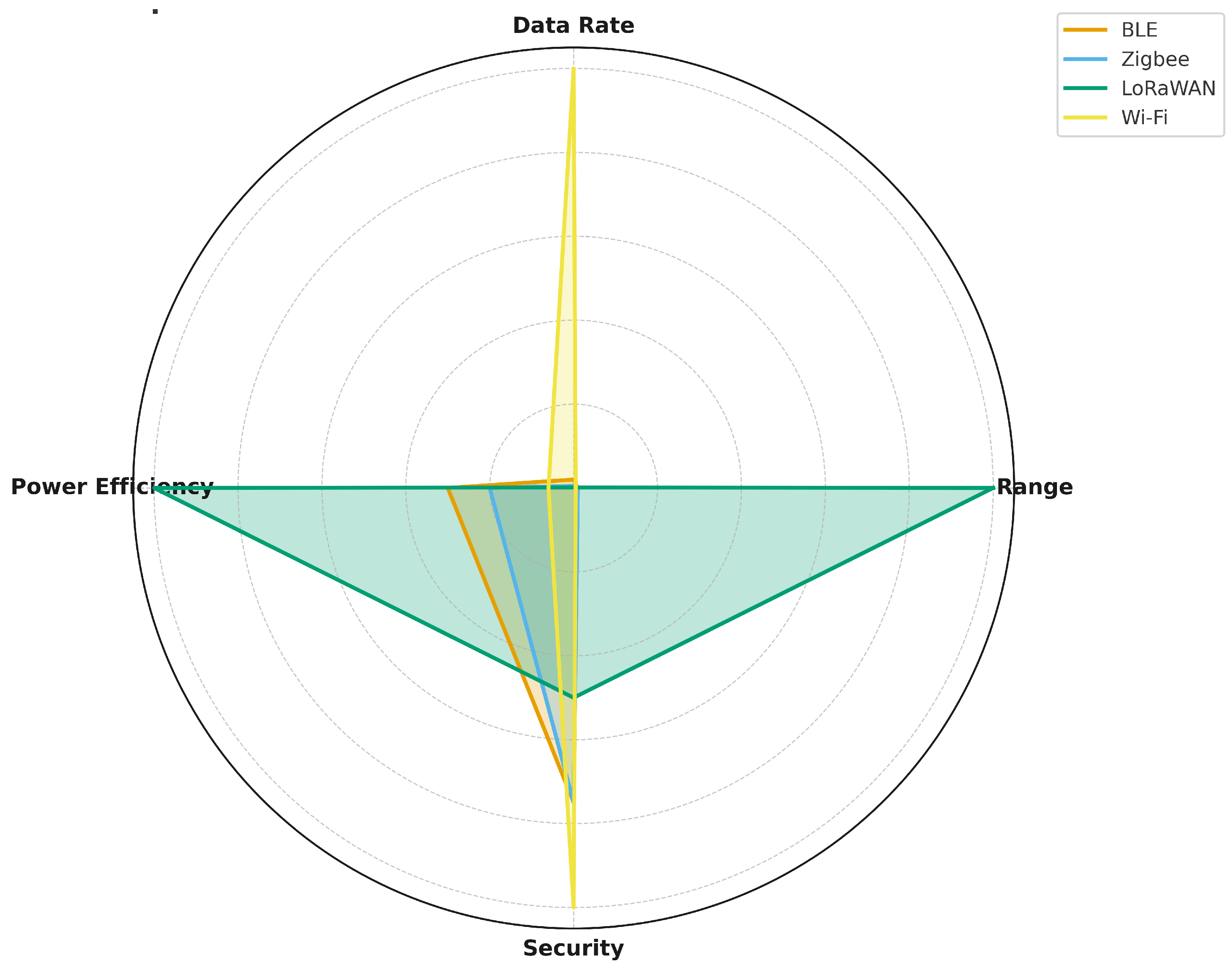
| Protocol | Range | Data Rate | Power Consumption | Security Features | Typical Applications |
|---|---|---|---|---|---|
| BLE | Short (up to 50 m) | Moderate (up to 2 Mbps) | Very Low | AES 128-bit encryption, connection key management. | Personal fitness tracking, real-time vital sign monitoring to a phone/hub. |
| Zigbee | Moderate (10–100 m) | Low (up to 250 kbps) | Low | AES 128-bit encryption, focus on network reliability. | Team sports monitoring, industrial worker health systems, home automation. |
| LoRaWAN | Long (km scale) | Very Low (0.3–50 kbps) | Ultra-Low | AES 128-bit for network and application layers. | Remote patient care, agricultural monitoring, asset tracking (low bandwidth). |
| Wi-Fi | Moderate (up to 100 m) | High (Mbps to Gbps) | High | WPA2/WPA3 encryption, direct IP connectivity. | Applications requiring high data throughput (e.g., video streaming) or direct internet access. |
| NFC | Very Short (cm scale) | Low (up to 424 kbps) | Very Low (Passive) | Secure element for authentication, proximity-based security. | Secure access control, textile authentication, quick data transfer on contact. |
| Sensor Type | Material/Method | Key Performance Metric | Advantages | Limitations |
|---|---|---|---|---|
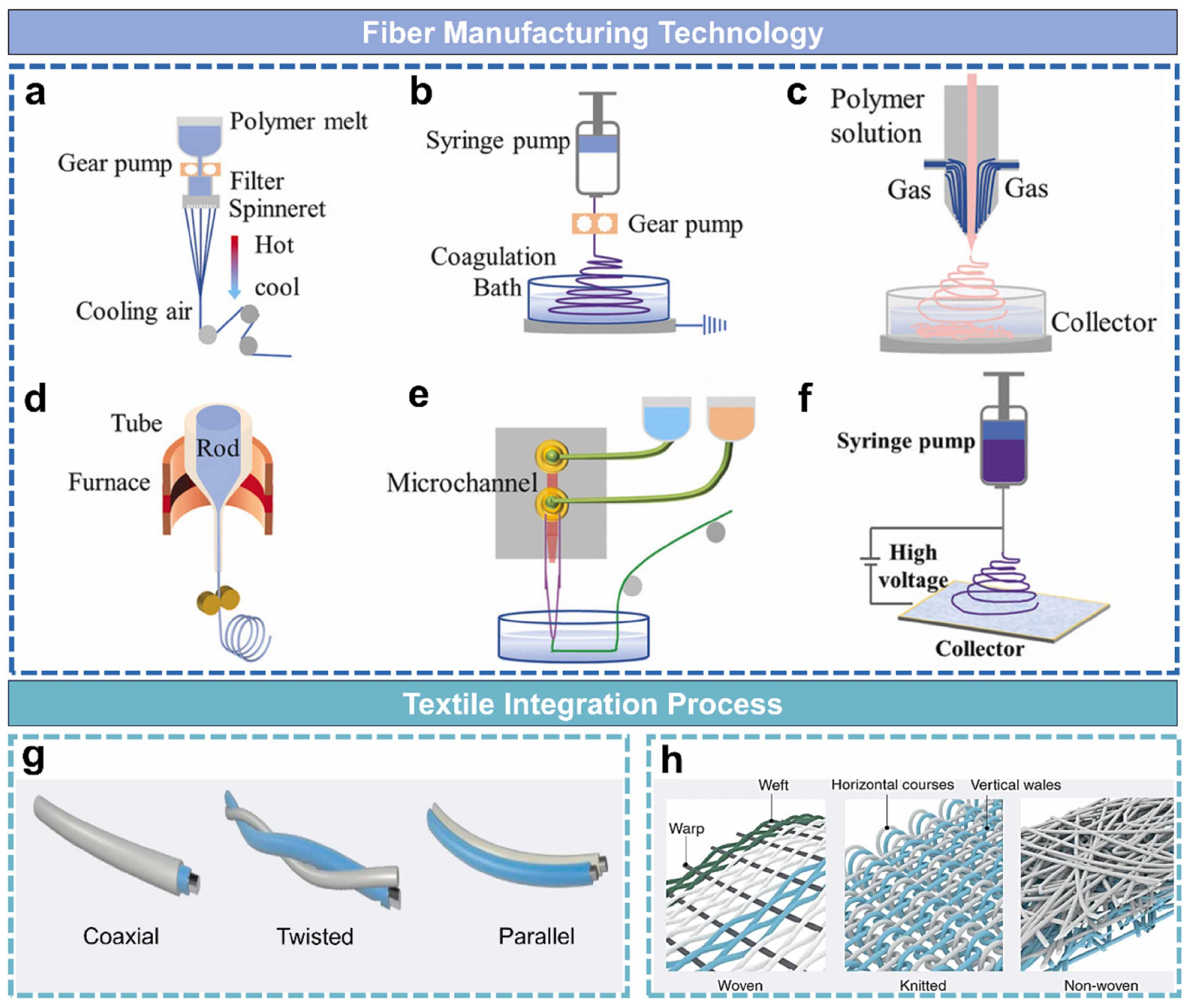
| Fiber-based | Conductive Polymers, Metal Nanowires, Coating/Spinning methods. | Flexibility, Gauge Factor (Strain), Sensitivity (Pressure). | Seamless integration, unrestricted movement, real-time monitoring. | Durability, washability, complex fabrication of functional fibers. |
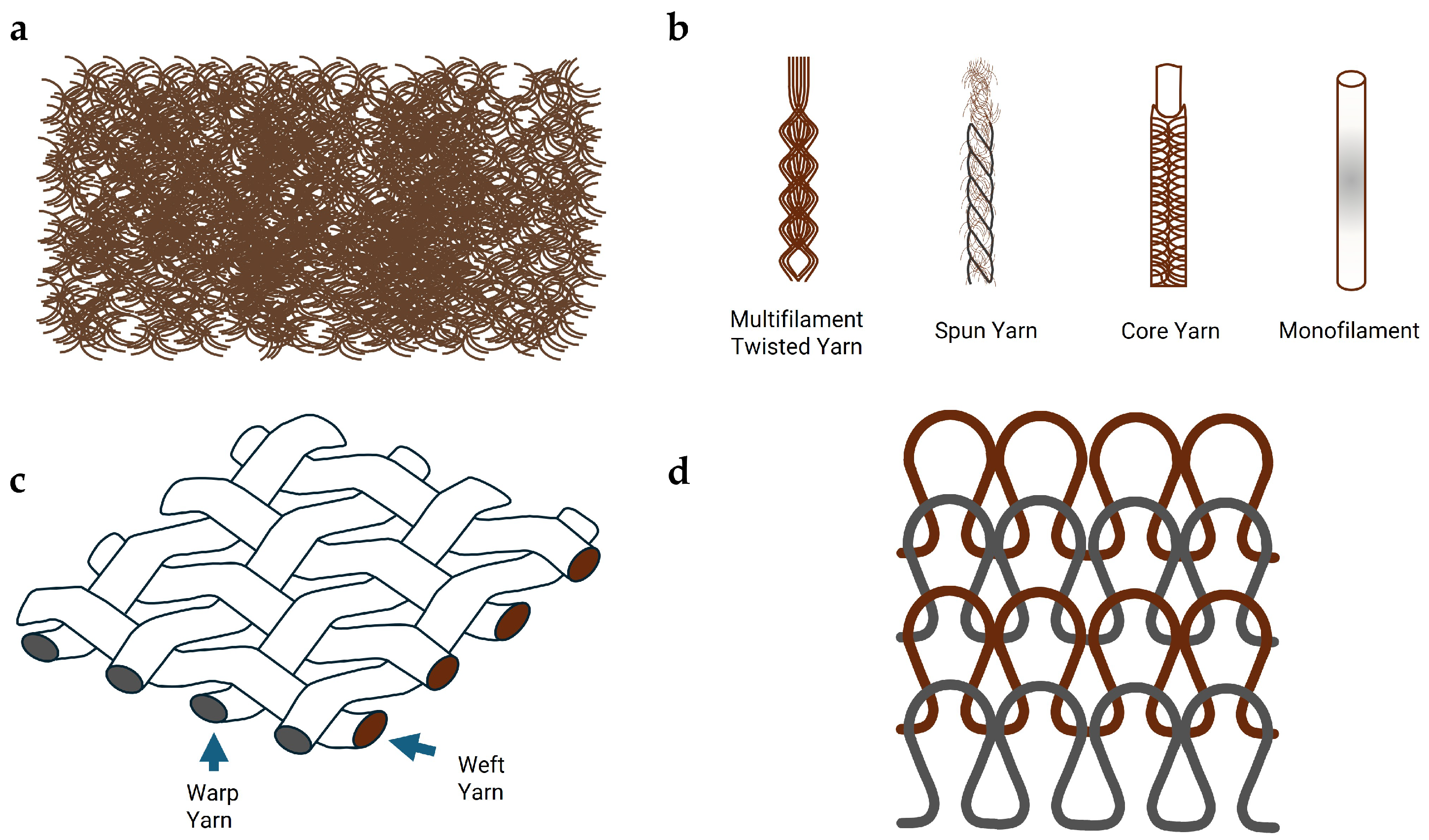
| Yarns-Based | Composite yarns (e.g., BC/PCM/SS), Twisting, Ring Spinning. | Stability, Photoelectric Properties, Rectified Behavior. | Cost-effective manufacturing, maintains constituent functions, simplifies integration. | Requires specific yarn manufacturing (melt/solution spinning), limited sensor density. |
| Woven-based | Functional fabric, conductive yarns (e.g., Ag-plated Nylon), varied weaving patterns. | Mechanical Stability, Sensitivity Range, Interwoven unit combinations. | High mechanical stability, diverse pattern creation, adjustable sensor characteristics. | Sensitivity highly dependent on parameters (density, float length), insulation complexity. |
| Knitted-based | Conductive yarns (e.g., Ag-plated), 2D/3D Knitting, Intarsia technique. | Stretchability, Low Hysteresis, Linearity (Pressure). | High flexibility and stretchability, seamless large-scale integration, customizable 3D structures. | Loose structure can cause friction/hysteresis, requires optimization of knitting parameters. |
| Embroidery-based | Piezoresistive yarns, conductive thread on textile substrate, automated stitching. | Design Flexibility, Precision, Reproducibility. | High design flexibility and aesthetic appeal, cost-effective automation, customized placement. | Relies on substrate stability, potential wear at stitch points, limited to 2D patterns. |
| Substrate Modification | Coating (MXene, CNTs), LIG (Laser-Induced Graphitization), Deposition methods (CVD, Electrophoretic). | Coating Adhesion, Conductivity (Ω/sq), Sensing Stability. | Cost-effective for large areas, high conductivity potential, binder-free LIG methods. | Poor washability/durability, non-uniform coating on porous fabrics, energy-intensive processes (thermal carbonization). |
Disclaimer/Publisher’s Note: The statements, opinions and data contained in all publications are solely those of the individual author(s) and contributor(s) and not of MDPI and/or the editor(s). MDPI and/or the editor(s) disclaim responsibility for any injury to people or property resulting from any ideas, methods, instructions or products referred to in the content. |
© 2025 by the authors. Licensee MDPI, Basel, Switzerland. This article is an open access article distributed under the terms and conditions of the Creative Commons Attribution (CC BY) license (https://creativecommons.org/licenses/by/4.0/).
Share and Cite
Ahmed, A.; Hasan, E.u.; Hasseni, S.-E.-I. Smart and Sustainable: A Global Review of Smart Textiles, IoT Integration, and Human-Centric Design. Sensors 2025, 25, 7267. https://doi.org/10.3390/s25237267
Ahmed A, Hasan Eu, Hasseni S-E-I. Smart and Sustainable: A Global Review of Smart Textiles, IoT Integration, and Human-Centric Design. Sensors. 2025; 25(23):7267. https://doi.org/10.3390/s25237267
Chicago/Turabian StyleAhmed, Aftab, Ehtisham ul Hasan, and Seif-El-Islam Hasseni. 2025. "Smart and Sustainable: A Global Review of Smart Textiles, IoT Integration, and Human-Centric Design" Sensors 25, no. 23: 7267. https://doi.org/10.3390/s25237267
APA StyleAhmed, A., Hasan, E. u., & Hasseni, S.-E.-I. (2025). Smart and Sustainable: A Global Review of Smart Textiles, IoT Integration, and Human-Centric Design. Sensors, 25(23), 7267. https://doi.org/10.3390/s25237267