



BEC Defender: QR Code-Based Methodology for Prevention of Business Email Compromise (BEC) Attacks

 , and
, and
Abstract
1. Introduction
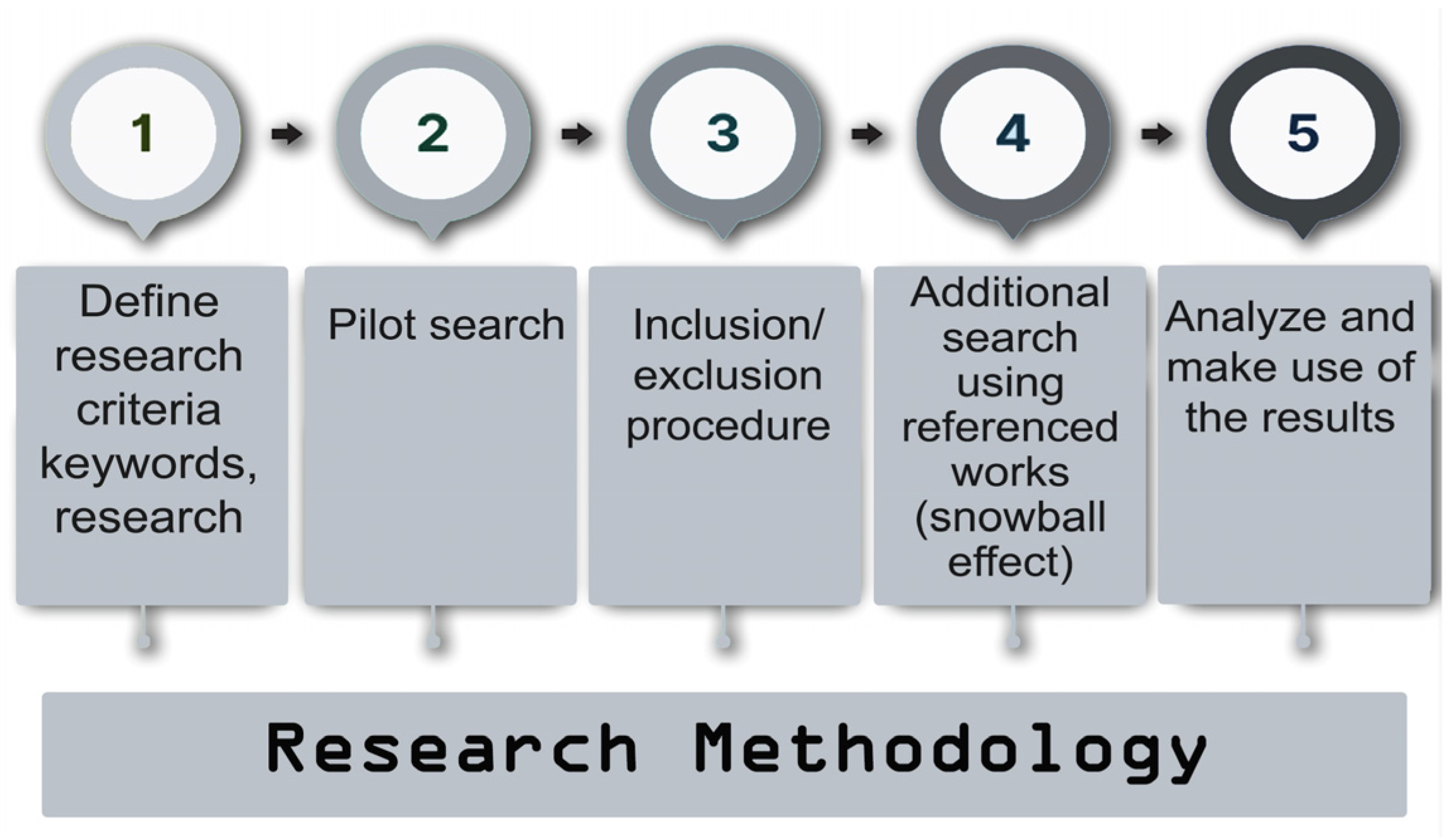
2. Literature Review Methodology
3. Related Work
3.1. QR Codes in Hard Copies for Document Authentication
3.2. QR Codes for Digital Authentication
3.3. Literature Related to Defense against BEC Attacks
3.3.1. Technical Methods
- (1)
- DMARC: The DMARC (Domain-Based Message Authentication, Reporting, and Conformance) email authentication protocol enhances security and prevents email spoofing and phishing attacks. DMARC works in correlation with the SPF (Sender Policy Framework) and DKIM (DomainKeys Identified Mail). The SPF is an email authentication method that allows the domain owner to specify which email servers are authorized to send emails on behalf of their domain. It creates a list of authorized sending IP addresses in the domain’s DNS records. When an email is received, the recipient’s email server can check the SPF record to verify whether the sending server is authorized to send emails for that domain. DKIM is another email authentication method that adds a digital signature to outgoing emails. The domain owner generates a unique private key and publishes the corresponding public key in the DNS records. The private key is used to generate a digital signature that is attached to the email header. When the recipient’s email server receives the email, it can retrieve the public key from the DNS records and use it to verify the digital signature. This ensures the sender’s domain authenticity. DMARC builds upon the SPF and DKIM to provide a more comprehensive email authentication framework. It enables the domain owner to define a policy for how the receiving email server should handle emails that fail the SPF or DKIM checks. The DMARC policy can instruct the recipient’s server to either quarantine or reject emails that fail authentication. Additionally, DMARC offers reporting mechanisms that grant domain owners the ability to monitor the usage of their domains for email authentication purposes. It generates comprehensive reports containing details about the emails sent on behalf of the domain, including the outcomes of the SPF and DKIM authentication (whether they passed or failed). These reports play a crucial role in assisting domain owners in detecting any unauthorized utilization of their domains, resolving authentication problems, and obtaining valuable insights into potential phishing attempts [21,22]. In conclusion, DMARC offers protection against domain-spoofing emails, preventing them from reaching users’ inboxes. Through DMARC, it is possible to block, quarantine, and monitor any malicious emails sent from the controlled domain. Numerous email providers, including Google’s Gmail-hosted mailboxes and Microsoft’s Office365, offer support for DMARC policies [23]. Typically, mail-filtering techniques like DMARC are specifically crafted to operate based on the header information within emails. The email-filtering policy is formulated to examine both incoming and outgoing emails, aiming to prevent any suspicious messages originating from deceptive domains. However, this approach exhibits vulnerabilities when it comes to impersonation attacks, wherein emails may originate from domains that fall outside the scope of the filter. Furthermore, the limitation of mail-filtering techniques lies in their exclusive focus on the email header. Consequently, they prove ineffective at safeguarding the email system against certain types of attacks, particularly those rooted in content manipulation. For instance, schemes involving fraudulent invoices, in which the email content itself is manipulated, pose a significant challenge, as the current mail-filtering approach does not extend its protective measures to this aspect of the email composition [24]. As Särökaari [25] also mentions in his thesis, deploying the SPF and DMARC is not enough to prevent sophisticated and targeted phishing attacks. Furthermore, if an attacker is able to gain access to an employee’s email account, having these countermeasures will not provide any protection, as the attacker is in a position to impersonate the compromised user by having access to their email inbox. Moreover, as Särökaari states, the adoption of these technical security control measures has been largely voluntary, with little penalty for noncompliance;
- (2)
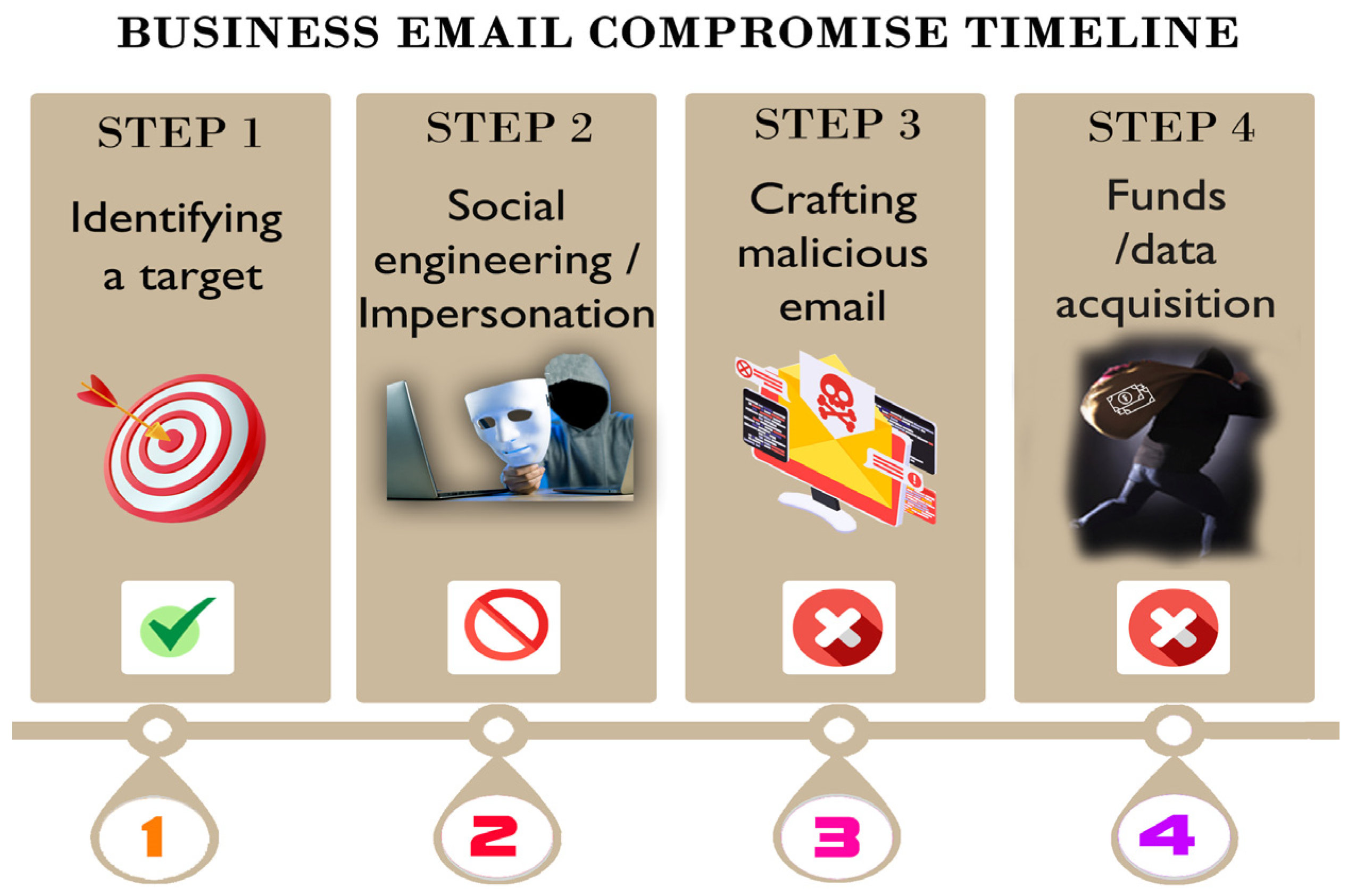
- Antivirus–antimalware software: BEC attacks rely on careful and sophisticated planning, involving OSINT investigations to gather critical information about the target. The purpose is to establish psychological leverage and gain valuable insights that can be utilized in future fraudulent emails. However, apart from such meticulous approaches, attackers can employ more direct and intrusive techniques, such as utilizing viruses or malware to compromise the victim’s system and extract sensitive data. Key loggers [26] are an example of such malware, recording the victim’s keystrokes and thereby capturing sensitive information, like login credentials, usernames, and passwords. Another example is remote-access tools (RATs) [27], which aim at obtaining unauthorized system access for further exploitation. Moreover, BEC attackers often resort to social engineering tactics, such as sending initial emails containing malicious URLs. These deceptive links mislead the unsuspecting victims into installing the malicious software into their systems or entering fraudulent websites that mimic legitimate platforms, like e-banking sites. Once on these fake websites, victims may unknowingly disclose their confidential information, allowing the attackers to perpetrate identity theft or financial fraud or gain unauthorized access to systems. Given the evolving sophistication of BEC attacks and other forms of cyber threats, antivirus and antimalware software has become an indispensable tool for organizations and individuals to protect themselves from potential harm. These security measures aid in detecting and mitigating various forms of malicious software and deceptive tactics employed by cybercriminals, thereby reducing the risk of falling victim to BEC schemes and similar cybercrimes [28];
- (3)
- Machine learning algorithms: Machine learning is a field of study within artificial intelligence that focuses on developing algorithms and models capable of learning from data and making predictions or decisions. When it comes to business email compromise (BEC) attacks, machine learning can be a valuable tool in detecting and preventing such threats. Machine learning can help combat BEC attacks in several ways [29]. Firstly, it can be used to analyze historical email data and identify patterns associated with known BEC attacks. By training machine learning models on such data, they can learn to recognize common characteristics, such as suspicious email addresses, language patterns, or anomalies in email headers. Additionally, machine learning algorithms can be employed to analyze email content and attachments in real time. These algorithms can learn from a variety of features, such as the email’s structure, sender’s reputation, language used, and contextual information. By leveraging these features, the models can identify suspicious emails that exhibit characteristics commonly associated with BEC attacks, such as unexpected changes in account details or urgent requests for funds. Furthermore, machine learning can assist in identifying compromised accounts or unauthorized access attempts. By monitoring the user behavior and detecting deviations from normal patterns, machine learning models can flag potential unauthorized activities, such as login attempts from unfamiliar locations or unusual timeframes. A. Cidon et al. [30] presented BEC-Guard, a detector employed at Barracuda Networks that uses supervised learning to stop business email compromise threats in real time. BEC-Guard detects attacks by using supervised learning algorithms that are trained on an email database that contains millions of emails. These algorithms analyze the header of the email and search for suspicious phrases and links in the email body. Furthermore, BEC-Guard makes use of the public APIs provided by cloud email providers to automatically acquire knowledge about the past communication patterns of each organization. It also employs these APIs to promptly isolate and quarantine emails in real time. According to the writers, BEC-Guard was evaluated using a commercial dataset comprising over 4000 attacks, achieving a precision of 98.2% and a false-positive rate of less than one in five million emails. A drawback of this methodology is the need to continuously train the algorithm due to the continuous evolution of BEC schemes.Furthermore, Cohen et al. [31] present a technique for identifying malicious emails through the utilization of machine learning methodologies. By extracting features from complete emails, including the header, body, and attachments, and employing a Random Forest classifier, the approach asserts an impressive accuracy level of 92.9%, with true-positive and false-positive rates standing at 94.7% and 3%, respectively. The dataset used in the performance evaluation was a collection of 33,142 emails (20,307 benign and 12,835 malicious emails) collected between 2013 and 2016. The malicious emails were labeled as such by at least five different antivirus engines using VirusTotal;
- (4)
- Encryption: Encryption serves as an effective measure to prevent data breaches by necessitating a pair of cryptographic keys for both the sender and receiver [32]. For example, in identity-based encryption (IBE), the user’s email address functions as the public key, and a centralized entity referred to as the Private Key Generator (PKG) is responsible for generating private keys. Following a preliminary authentication process, the private keys are securely transmitted from the PKG to end users through a secure channel. It is worth noting that identity-based encryption (IBE) schemes are susceptible to the key theft problem, enabling the PKG to decrypt any message [32].Emails can also be safeguarded through various plugins [33]. Mailvelope [34] employs manual key management, requiring users to distribute and handle keys manually, which impacts the usability, especially for novice users. Plugins such as Jumble Mail and Secure Gmail [35] rely on PGP and encrypt messages using their managed keys, requiring end users to trust the provider. Routi et al. [36] conducted a study on PGP with the Mailvelope plugin. Despite considerable enhancements in Mailvelope security, its usability remains low and proves challenging for common users lacking knowledge of public-key cryptography. Other solutions, like Private Webmail, Virtu, and Xmail, generate and distribute encryption keys on their servers while concealing the key management process. However, these solutions are paid, and the unavailability of source codes raises trust concerns for end users;
- (5)
- (6)
- Trusted Third Parties (TTPs): Ensuring the secure distribution of public keys to the correct parties can pose significant challenges. The trust placed in the public-key infrastructure (PKI) is of the utmost importance. A trusted third party is often needed to facilitate the provision of public- and private-key pairs. The entire security of the system relies on this trusted entity. Any compromise, whether from external attacks (like server code modification) or internal vulnerabilities, has the potential to undermine the security of the entire system. Consequently, organizations may harbor doubts regarding the trustworthiness of the third party responsible for issuing keys or credentials. Concerns may arise regarding the security practices of the provider, their adherence to regulatory compliance, and their ability to withstand external pressures that could jeopardize the integrity of the key management process. Organizations may hesitate to place their trust in a third-party key management center that fails to demonstrate adherence to relevant standards and best practices. Additionally, concerns may arise regarding the location of the key management center and its compliance with data sovereignty requirements. Certain regulations mandate that specific data must remain within defined geographical boundaries, and relying on a third-party provider may raise questions about data jurisdiction. The utilization of PKI methods usually requires that organizations entrust an external entity for building secure communication between users, thereby relinquishing a certain degree of control over the cryptographic keys. Some organizations may be reluctant to surrender this control, particularly when dealing with highly sensitive information. Depending solely on a specific key management provider may result in vendor lock-in, making it difficult and costly to switch to an alternative provider. Organizations may have reservations about relying solely on a single provider for a crucial security function. Additionally, the costs associated with utilizing a key management center can be a determining factor, and organizations require assurance that they can conduct audits and verify the key management processes to ensure compliance and security. The lack of transparency from the key management center can pose a significant obstacle in establishing trust. This involvement of TTPs underscores their significance in fostering secure, fair, and trustworthy email interactions, making them valuable components in the architecture of communication systems. According to Kupcu [39], due to the fact that numerous systems depend on trusted third parties (TTPs) for assurances in fairness, security, and efficiency, there is a critical necessity to decentralize the trust placed in these central entities. Moreover, Paulin et al. [40] state that current service providers offer limited solutions dependent on a trusted third party, hindering their applicability across borders, especially in transnational unions such as the EU. The authors introduce a functional certified email system that achieves the fair non-repudiation of receipt without relying on a trusted third party. The proposed protocol involves encrypting a message and splitting it into a chain of parts, with the recipient gradually acquiring each part and generating proofs-of-receipt for the individual segments. This protocol cryptographically prevents the addressee from obtaining the message in case they terminate the protocol prematurely. The universality of the presented system makes it feasible for unobtrusive operation using existing user agents and email providers. Sabir et al. [33] mention that, in contrast to other applications, like social media, email accounts inherently contain more sensitive data, making a hacked email account a potential source of personal information leakage and unauthorized access to various online services. Moreover, despite users relying on service providers for email privacy, this trust is often exploited for targeted advertisements. Additionally, the risk of attackers targeting and compromising numerous email accounts underscores the vulnerability of email systems, especially when considering the danger of an attack on the internal server itself. For the abovementioned reasons, the authors devised a solution using a PKI (public-key infrastructure) similar to that of Proton Mail [41] with the following objectives. Firstly, the system aims to ensure complete end-to-end privacy. Secondly, it strives for significant usability aligned with the Saltzer acceptability principle, aiming to enable users without technical expertise to navigate the system effortlessly, including aspects such as obtaining, distributing, and utilizing cryptographic keys. Thirdly, portability is emphasized, allowing users to switch between public computers without reliance on a specific device. Fourthly, users are not required to install additional hardware or software configurations to use the system. Lastly, the trustworthiness of the application code is highlighted, emphasizing a transparent, cryptographic key-sharing mechanism to instill user confidence.An interesting work is that of AlSabah et al. [42], which presents a secure end-to-end email communication approach. By employing their innovative certificate-less (CL) key agreement protocol, the method enables users to update their public keys without requiring interaction with the certificate authority (CA).Moreover, Brown et al. [43] introduced a proxy-based architecture. Proxy-based methods utilize their servers for encrypting and decrypting messages, making them not genuinely end-to-end secure. Jammalamadaka et al. [44] proposed a proxy-based design that necessitates additional hardware (a mobile phone) to execute secure email operations. Another Windows-based system, Opaque-Mail, communicates with mail clients and requires local installation on all users’ devices. Additionally, proxy re-encryption, by design, has an insignificant impact on email privacy. Moreover, user trust could be manipulated by introducing backdoors through application source codes.Finally, Secure/Multipurpose Internet Mail Extensions (S/MIMEs) serve as an encryption standard akin to PGP, ensuring the security of email content. Built on public-key cryptography, S/MIMEs mandate the involvement of certificate authorities (CAs) in issuing certificates for both the sender and receiver. This approach necessitates mutual trust in the CA. Despite some companies opting for self-issued certificates, these are often perceived as untrustworthy, potentially introducing security vulnerabilities. Additionally, S/MIMEs fall short in safeguarding users against Vendor Email Compromise (VEC) attacks, particularly when utilizing servers that store users’ private keys on the servers. It is crucial to acknowledge that no single method can offer comprehensive protection against fraudulent schemes. While S/MIMEs provide the confidentiality and integrity of contents, they are considered weak against VEC attacks. Consequently, it is advisable to employ a combination of security measures, including TLS, S/MIMEs, and the suggested method, to fortify a company’s defense against such attacks [24];
- (7)
- Digital signatures: Digital signatures in email communication are instrumental in fortifying the security and reliability of electronic exchanges. These signatures, generated through cryptographic algorithms, assure the authenticity of the sender and the integrity of the message content. This form of security prevents unauthorized access and tampering during transmission, offering a vital defense against cyber threats. Moreover, digital signatures provide a crucial element of non-repudiation, making it challenging for senders to deny their involvement in a specific message. This not only enhances accountability but also minimizes the risk of disputes over message origins. In an environment where sensitive information is regularly shared, the adoption of digital signatures instills confidence, establishing a secure foundation for electronic communication [45,46]. Digital signatures, while offering significant advantages, are not without their drawbacks. A notable vulnerability is the issue of “unobservability” in electronic documents. This means that, in certain cases, the content of a digitally signed document may be concealed or difficult to discern. According to Lax et al. [47], unlike traditional documents that can be interpreted by humans through direct observation, digital documents rely on machine-level interpretation and require complex instruments such as computers for viewing and signing. This inherent complexity introduces vulnerabilities, particularly in ensuring the consistency and reliability of these instruments. The unobservability of digital documents poses a challenge to the direct link between the signature and the information’s integrity, making it inherently weaker compared to handwritten signatures. Despite technical measures addressing bit-level modifications, concerns persist regarding the reliability of the instruments used for viewing and signing documents, rendering digital signatures inherently weak. The paper highlights various vulnerabilities resulting from this unobservability and explores potential solutions, emphasizing the balance between security and usability in the context of digital signatures. Malicious actors can exploit disadvantages like the abovementioned to their advantage, compromising the transparency and verifiability that digital signatures aim to provide. To address this, there is a critical need for secure and efficient verification methods. Advanced algorithms can play a pivotal role in enhancing the verification process, ensuring that the integrity and authenticity of digitally signed documents are upheld [48]. Implementing sophisticated algorithms can mitigate the risks associated with unobservability, making it more challenging for malicious actors to manipulate or conceal electronic content.
3.3.2. Non-Technical Methods
- Employee training: Ongoing employee training is vital to empower staff in identifying, reporting, and handling BEC attacks effectively. It is especially crucial to provide regular training to sensitive sectors, like the financial department, focusing on social engineering techniques and BEC schemes. Employees should also exercise caution when dealing with hyperlinks, attachments, name misspellings, sudden wire transfer requests, or altered account details. Encouraging the verification of vendor information is equally essential and strongly recommended. It is important to recognize that social engineering and BEC schemes are continuously evolving, underscoring the necessity for continuous and up-to-date training sessions. By remaining vigilant and well informed, employees can play a crucial role in safeguarding the organization against threats like BEC attacks [49,50];
- Social engineering departments: Creating a dedicated social engineering department is essential when it comes to large companies. This department should consist of employees who have undergone specialized training in social engineering and open-source intelligence (OSINT) investigations. Leveraging OSINT tools, they can conduct thorough investigations of high-profile targets within the company to identify potential data breaches and leaks. Utilizing free online services like Have I Been Pwned [51] and DeHashed [52], they can assess vulnerabilities and gather crucial information to safeguard against BEC attempts. Recognizing that the information gathered could be exploited by malicious attackers in order to make the profile of a target, understanding the existing gaps and potential compromises in the company’s profile becomes crucial. By proactively identifying and addressing these weaknesses, the organization can effectively prevent and detect future BEC attacks, fortifying its cybersecurity defenses [53];
- Defining policies: To bolster security measures, the implementation of a set of comprehensive policies and internal guidelines that prioritize safeguarding information sharing and financial transactions is needed. By defining and adhering to these policies, the organization can significantly mitigate the risks associated with BEC attacks and enhance their overall cybersecurity. Characteristic examples of these policies are as follows:
- Prohibition of the use of email requests for fund transfers and, instead, mandating the presence of multiple individuals or at least a vocal confirmation for financial transactions;
- Strong communication protocols for phone-based interactions by enforcing identity verification questions to prevent unauthorized data disclosure;
- Encouragement of the swift reporting of any security incidents to enable quicker action and resolution;
- Endorsement of strong password policies.
4. Proposed Methodology
4.1. Background
4.1.1. Message Authentication Code (MAC)
4.1.2. Quick-Response (QR) Codes
4.2. Implementation
Initialization Phase
- SHA2 MAC address;
- Hostname (hostnames are typically configured by users for their devices, particularly in the case of desktops and laptops).
- Generate the Hash Code for the MAC Address using the SHA2 algorithm and store it in SHA2MAC.
- If SHA2MAC Address exists in Database, then
- Write “Already Exists”
- Returns “Failure”
- else
- Store SHA2MAC and hostname and new record generated in the database
- Write “Record Saved”
- Returns “Success”
- end if
- Stop.
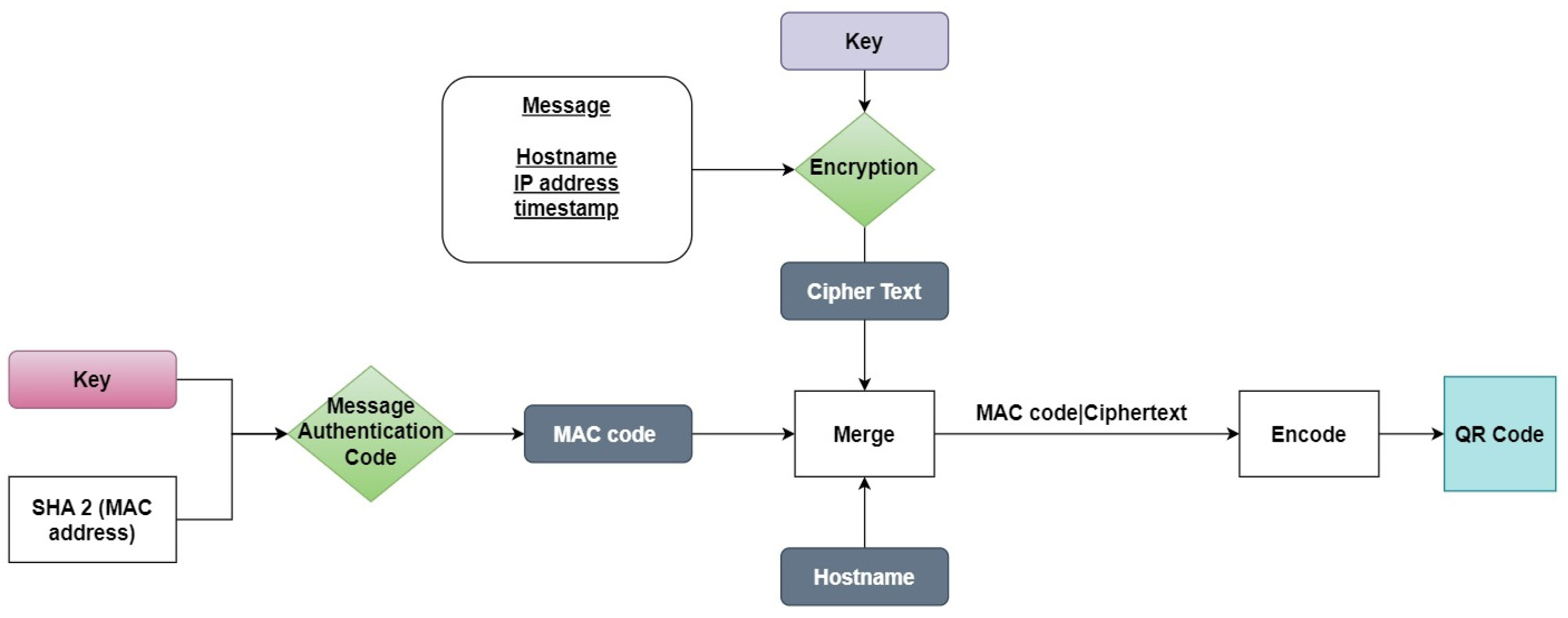
- MAC address collection and the hashing of the MAC address: The algorithm encodes the sender’s MAC address using a keyed-hash message authentication code (HMAC). We utilize the SHA2 hash function to generate the message authentication code, employing a shared symmetric key;
- Cipher text creation and encryption: Next, the algorithm encrypts the information of the IP address, hostname, and timestamp. The message is encrypted using a 32-byte key, resulting in a ciphertext. More specifically, Fernet encryption is employed with the help of the equivalent library in Python;
- Cipher text and MAC code integration: The cipher text and message authentication code are merged into a new message structure. This process is facilitated by the use of the “|” character, which serves as a delimiter;
- QR code generation: In the final step of the process, the MAC code, along with the cipher text, are encoded into a QR code. This QR code can be conveniently included in the sender’s email, making it a convenient and secure method for transmitting the data.
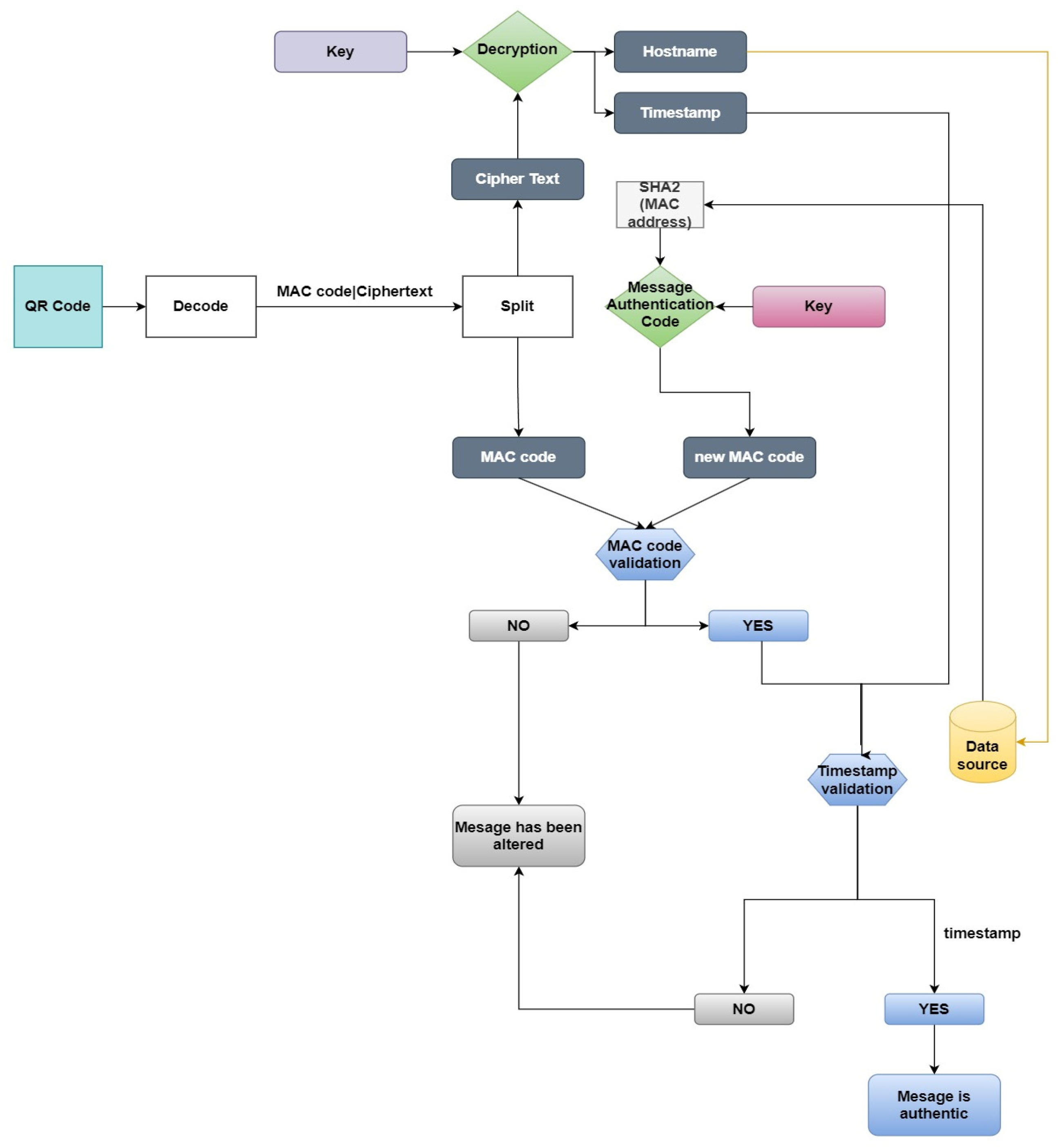
- First, it decodes the QR code and, with the use of the “|” character, extracts the cipher text and the message authentication code;
- Next, the algorithm commences the decryption of the cipher text using the encryption key in order to extract the hostname and the timestamp;
- In the initial validation process, the receiver reconstructs the message authentication code (MAC) using the authentication key and the stored hashed value of the MAC address of the data source linked to the corresponding hostname. This reconstructed MAC code is then compared with the received MAC code. If the two MAC codes match, the algorithm proceeds to the next validation step. However, if the MAC codes do not match, the algorithm generates the message “Message has been altered”;
- Finally, the next validation requirement involves assessing the decrypted timestamp. By comparing the sender’s timestamp with the receiver’s timestamp (the blue line in Figure 3), the algorithm ensures that the timeframe between the QR code’s creation and receipt is within three hours. If this condition is met, the algorithm confirms the third validation requirement and prints the message “Message is authentic”. However, if the timeframe exceeds three hours, indicating a potential replay attack or unauthorized delay, the algorithm identifies it as a red flag.
5. Performance Evaluation
6. Discussion
6.1. Advantages–Limitations
6.2. Conclusion–Future Work
Author Contributions
Funding
Institutional Review Board Statement
Informed Consent Statement
Data Availability Statement
Conflicts of Interest
Appendix A

| Permitted MAC Addresses |
|---|
| 02-F2-74-7F-8F-5A |
| 00-05-54-05-63-14 |
| 18-97-FF-0B-42-FB |
| 50-F0-D3-3B-A8-B8 |
| 8C-7C-92-51-42-E6 |
| 34-A7-09-D2-12-96 |
| 00-11-0A-7E-5A-AC |
| 00-15-2A-CF-6D-67 |
| 00-05-08-A5-E3-C7 |
| 18-14-20-6E-30-E1 |
| Non-Permitted MAC Addresses | |
|---|---|
| 02-70-B0-A7-24-A2 | 00-07-A9-FA-63-A0 |
| 02-3D-08-AB-95-56 | 00-25-B9-6D-80-DE |
| 02-BD-D1-75-55-D1 | 00-30-AC-DB-7C-24 |
| 02-1A-2C-E6-D4-9B | 24-93-CA-D6-85-5F |
| 02-02-A7-57-B4-A8 | 44-6D-57-D8-51-73 |
| 02-00-85-4E-FD-EA | 00-19-49-FA-02-0A |
| 02-01-C6-9D-2D-AD | 00-04-27-DC-BC-1C |
| 02-0E-F0-92-A5-1D | 54-4A-00-05-3B-CC |
| 02-68-95-E8-13-13 | 00-0E-D0-EB-D0-68 |
| 00-20-74-35-4D-29 | 00-18-FA-C6-0A-3E |
| 00-C0-AD-10-23-13 | 00-1A-6A-10-57-AD |
| 02-1E-43-C7-B8-FD | 00-16-03-24-7C-DD |
| 00-25-16-7B-9F-FC | 00-A0-B5-46-26-55 |
| 00-11-D8-6A-C8-18 | C0-5E-6F-43-14-B0 |
| 00-0D-C1-08-EC-26 | 00-0A-DF-41-FC-4B |
| 00-1A-94-82-42-D1 | 00-25-D8-E0-ED-54 |
| 00-0A-06-96-27-E4 | 94-8B-03-7B-84-1D |
| 00-90-78-3C-78-86 | F4-15-63-C8-63-11 |
| 00-01-42-F2-C5-7B | 00-1F-75-66-3D-9A |
| 00-30-71-87-34-1D | 64-9A-BE-47-97-8F |
References
- Oberlo. Available online: https://www.oberlo.com/statistics/how-many-emails-are-sent-per-day (accessed on 1 November 2023).
- Pastor-Galindo, J.; Nespoli, P.; Mármol, F.G.; Pérez, G.M. The not yet exploited goldmine of OSINT: Opportunities, open challenges and future trends. IEEE Access 2020, 8, 10282–10304. [Google Scholar] [CrossRef]
- Al-Musib, N.S.; Al-Serhani, F.M.; Humayun, M.; Jhanjhi, N.Z. Business email compromise (BEC) attacks. Mater. Today Proc. 2021, 81, 497–503. [Google Scholar] [CrossRef]
- Cross, C.; Gillett, R. Exploiting trust for financial gain: An overview of business email compromise (BEC) fraud. J. Financ. Crime 2020, 27, 871–884. [Google Scholar] [CrossRef]
- FBI. Internet Crime Report. 2022. Available online: https://www.ic3.gov/Media/PDF/AnnualReport/2022IC3Report.pdf (accessed on 25 April 2023).
- González-Granadillo, G.; González-Zarzosa, S.; Diaz, R. Security Information and Event Management (SIEM): Analysis, Trends, and Usage in Critical Infrastructures. Sensors 2021, 21, 4759. [Google Scholar] [CrossRef] [PubMed]
- Singhal, A.; Pavithr, R.S. Degree certificate authentication using QR code and smartphone. Int. J. Comput. Appl. 2015, 120, 38–43. [Google Scholar] [CrossRef]
- Aini, Q.; Rahardja, U.; Tangkaw, M.R.; Santoso, N.P.L.; Khoirunisa, A. Embedding a blockchain technology pattern into the QR code for an authentication certificate. J. Online Inform. 2020, 5, 239–244. [Google Scholar] [CrossRef]
- Kuacharoen, P.; Warasart, M. Paper-based document authentication using digital signature and qr code. In Proceedings of the International Conference on Computer Engineering and Technology, Bangkok, Thailand, 12–13 May 2012; Volume 40, pp. 1–5. [Google Scholar]
- Tkachenko, I.; Puech, W.; Destruel, C.; Strauss, O.; Gaudin, J.M.; Guichard, C. Two-level QR code for private message sharing and document authentication. IEEE Trans. Inf. Forensics Secur. 2015, 11, 571–583. [Google Scholar] [CrossRef]
- Kapoor, V.; Abraham, V.S.; Singh, R. Elliptic curve cryptography. Ubiquity 2008, 9, 1–8. [Google Scholar] [CrossRef]
- Kazmirchuk, S.; Ilyenko, A.; Ilyenko, S. Digital Signature Authentication Scheme with Message Recovery Based on the Use of Elliptic Curves. In Advances in Computer Science for Engineering and Education II; Hu, Z., Petoukhov, S., Dychka, I., He, M., Eds.; Springer: Berlin/Heidelberg, Germany, 2020; pp. 279–288. [Google Scholar] [CrossRef]
- Lu, J.; Yang, Z.; Li, L.; Yuan, W.; Li, L.; Chang, C.C. Multiple schemes for mobile payment authentication using QR code and visual cryptography. Mob. Inf. Syst. 2017, 2017, 4356038. [Google Scholar] [CrossRef]
- Liao, K.C.; Lee, W.H. A novel user authentication scheme based on QR-code. J. Netw. 2010, 5, 937–941. [Google Scholar] [CrossRef]
- Oh, D.S.; Kim, B.H.; Lee, J.K. A Study on Authentication System Using QR Code for Mobile Cloud Computing Environment. In Future Information Technology. Communications in Computer and Information Science; Park, J.J., Yang, L.T., Lee, C., Eds.; Springer: Berlin/Heidelberg, Germany, 2011; Volume 184. [Google Scholar] [CrossRef]
- Choi, K.; Lee, C.; Jeon, W.; Lee, K.; Won, D. A mobile based anti-phishing authentication scheme using QR code. In Proceedings of the International Conference on Mobile IT Convergence IEEE, Gumi, Republic of Korea, 26–28 September 2011; pp. 109–113. [Google Scholar]
- Bairwa, A.K.; Joshi, S. Mutual authentication of nodes using session token with fingerprint and MAC address validation. Egypt. Inform. J. 2021, 22, 479–491. [Google Scholar] [CrossRef]
- Kumar, M.; Mishra, R. An overview of MANET: History, challenges and applications. Indian J. Comput. Sci. Eng. 2012, 3, 121–125. [Google Scholar]
- Chen, C. QR Code Authentication with Embedded Message Authentication Code. Mob. Netw. Appl. 2017, 22, 383–394. [Google Scholar] [CrossRef]
- Papathanasiou, A.; Liontos, G.; Liagkou, V.; Glavas, E. Business Email Compromise (BEC) Attacks: Threats, Vulnerabilities and Countermeasures-A Perspective on the Greek Landscape. J. Cybersecur. Priv. 2023, 3, 610–637. [Google Scholar] [CrossRef]
- Kucherawy, Μ.; Elizabeth, Z.; Domain-Based Message Authentication, Reporting, and Conformance (DMARC). RFC. 2015. Available online: https://www.rfc-editor.org/rfc/rfc7489 (accessed on 10 November 2023).
- Nightingale, J.S. Email Authentication Mechanisms: DMARC, SPF and DKIM; US Department of Commerce, National Institute of Standards and Technology: Gaithersburg, MD, USA, 2017. [Google Scholar]
- Derouet, E. Fighting phishing and securing data with email authentication. Comput. Fraud Secur. 2016, 2016, 5–8. [Google Scholar] [CrossRef]
- Teerakanok, S.; Yasuki, H.; Uehara, T. A Practical Solution against Business Email Compromise (BEC) Attack using Invoice Checksum. In Proceedings of the 2020 IEEE 20th International Conference on Software Quality, Reliability and Security Companion (QRS-C), Macau, China, 11–14 December 2020; pp. 160–167. [Google Scholar]
- Särökaari, N. Phishing Attacks and Mitigation Tactics. Master’s Thesis, University of Jyväskylä, Jyväskylä, Finland, 2020. Available online: https://jyx.jyu.fi/bitstream/handle/123456789/72569/1/URN%3ANBN%3Afi%3Ajyu-202011116604.pdf (accessed on 19 November 2023).
- Sagiroglu, S.; Canbek, G. Keyloggers: Increasing threats to computer security and privacy. IEEE Technol. Soc. Mag. 2009, 28, 10–17. [Google Scholar] [CrossRef]
- Boyd, I.M. The Fundamentals of Computer Hacking; SANS Institute: Rockville, MD, USA, 2021. [Google Scholar]
- Nisha, T.N.; Bakari, D.; Shukla, C. Business E-mail Compromise—Techniques and Countermeasures. In Proceedings of the International Conference on Advance Computing and Innovative Technologies in Engineering (ICACITE) IEEE, Noida, India, 4–5 March 2021; pp. 217–222. [Google Scholar]
- Atlam, H.F.; Oluwatimilehin, O. Business Email Compromise Phishing Detection Based on Machine Learning: A Systematic Literature Review. Electronics 2023, 12, 42. [Google Scholar] [CrossRef]
- Cidon, A.; Gavish, L.; Bleier, I.; Korshun, N.; Schweighauser, M.; Tsitkin, A. High Precision Detection of Business Email Compromise. In Proceedings of the 28th USENIX Security Symposium (USENIX Security 19), Santa Clara, CA, USA, 14–16 August 2019; pp. 1291–1307. [Google Scholar]
- Cohen, A.; Nissim, N.; Elovici, Y. Novel Set of General Descriptive Features For Enhanced Detection of Malicious Emails Using Machine Learning Methods. Expert Syst. Appl. 2018, 110, 143–169. [Google Scholar] [CrossRef]
- Shamir, A.; Identity-Based Cryptosystems and Signature Schemes. In Ibn Al-Haitham Journal for Pure and Applied Sciences (IHJPAS) Special Issue; 2021; Volume 2021, pp. 82–95. Available online: https://api.semanticscholar.org/CorpusID:1402295 (accessed on 27 November 2023).
- Sabir, M.; Yousaf, M. Design and Implementation of an End-to-End Web based Trusted Email System. Procedia Comput. Sci. 2018, 141, 231–238. [Google Scholar] [CrossRef]
- Mailvelope Inc. Available online: https://www.mailvelope.com/en (accessed on 27 November 2023).
- Secure Gmail Plugin. Available online: https://www.securegroup.com/encryption/ (accessed on 29 November 2023).
- Ruoti, S.; Andersen, J.; Zappala, D.; Seamons, K. Why Johnny still, still can’t encrypt: Evaluating the usability of a modern PGP client. arXiv. 2015, arXiv:1510.08555. Available online: https://api.semanticscholar.org/CorpusID:5189682 (accessed on 29 October 2023).
- Ometov, A.; Bezzateev, S.; Mäkitalo, N.; Andreev, S.; Mikkonen, T.; Koucheryavy, Y. Multi-Factor Authentication: A Survey. Cryptography 2018, 2, 1. [Google Scholar] [CrossRef]
- Papathanasaki, M.; Maglaras, L.; Ayres, N. Modern Authentication Methods: A Comprehensive Survey. In AI, Computer Science and Robotics Technology; IntechOpen: London, UK, 2022. [Google Scholar] [CrossRef]
- Küpçü, A. Distributing trusted third parties. SIGACT News 2013, 44, 92–112. [Google Scholar] [CrossRef]
- Paulin, A.; Welzer, T. A universal system for fair non-repudiable certified e-mail without a trusted third party. Comput. Secur. 2013, 32, 207–218. [Google Scholar] [CrossRef]
- ProtonMail, Proton Technologies AG Plugin. Available online: https://protonmail.com/ (accessed on 28 November 2023).
- AlSabah, M.; Tomescu, A.; Lebedev, I.; Serpanos, D.; Devadas, S. PriviPK: Certificate-less and secure email communication. Comput. Secur. 2017, 70, 1–15. [Google Scholar] [CrossRef]
- Brown, I.; Snow, C. A proxy approach to e-mail security. Softw.-Pract. Exp. 1999, 29, 1049–1060. [Google Scholar] [CrossRef]
- Jammalamadaka, R.; Horst, T.; Mehrotra, S.; Seamons, K.; Venkatasubramanian, N. Delegate: A Proxy Based Architecture for Secure Website Access from an Untrusted Machine. In Proceedings of the 22nd Annual Computer Security Applications Conference (ACSAC), Miami Beach, FL, USA, 11–15 December 2006. [Google Scholar]
- Nurhaida, I.; Ramayanti, D.; Riesaputra, R. Digital signature & encryption implementation for increasing authentication, integrity, security and data non-repudiation. Int. Res. J. Comput. Sci. 2017, 4, 4–14. [Google Scholar]
- Rai, A.K.; Singh, M.; Sudheendramouli, H.C.; Panwar, V.; Balaji, N.A.; Kukreti, R. Digital Signature for Content Authentication. In Proceedings of the International Conference on Advances in Computing, Communication and Applied Informatics (ACCAI), Chennai, India, 25–26 May 2023; pp. 1–6. [Google Scholar]
- Lax, G.; Buccafurri, F.; Caminiti, G. Digital Document Signing: Vulnerabilities and Solutions. Inf. Secur. J. A Glob. Perspect. 2015, 24, 1–14. [Google Scholar] [CrossRef]
- Kasodhan, R.; Gupta, N. A New Approach of Digital Signature Verification based on BioGamal Algorithm. In Proceedings of the 3rd International Conference on Computing Methodologies and Communication (ICCMC), Erode, India, 27–29 March 2019; pp. 10–15. [Google Scholar] [CrossRef]
- Jensen, M.L.; Dinger, M.; Wright, R.T.; Thatcher, J.B. Training to mitigate phishing attacks using mindfulness techniques. J. Manag. Inf. Syst. 2017, 34, 597–626. [Google Scholar] [CrossRef]
- Burgess, A.; Jackson, T.; Edwards, J. Email training significantly reduces email defects. Int. J. Inf. Manag. 2005, 25, 71–83. [Google Scholar] [CrossRef]
- HaveIBeenPwned (HIBP). Available online: https://haveibeenpwned.com (accessed on 2 November 2023).
- DeHashed. Available online: https://www.dehashed.com (accessed on 20 October 2023).
- Bazzell, M. Open Source Intelligence Techniques: Resources for Searching and Analyzing Online Information, 3rd ed.; CreateSpace Independent Publishing Platform: Scotts Valley, CA, USA, 2016; pp. 154–166. [Google Scholar]
- Preneel, B.; Van Oorschot, P.C. On the security of iterated message authentication codes. IEEE Trans. Inf. Theory 1999, 45, 188–199. [Google Scholar] [CrossRef]
- Kaur, R.; Sangal, A.L.; Kumar, K. Mac based multicast source authentication: A survey. Int. J. Comput. Appl. 2012, 37, 42–50. [Google Scholar] [CrossRef]
- Ohta, K.; Matsui, M. Differential attack on message authentication codes. In Proceedings of the Advances in Cryptology—CRYPTO ’93: 13th Annual International Cryptology Conference, Santa Barbara, CA, USA, 22–26 August 1993. [Google Scholar]
- Pandya, K.H.; Galiyawala, H.J. A Survey on QR Codes: In context of Research and Application. Int. J. Emerg. Technol. Adv. Eng. 2014, 4, 258–262. [Google Scholar]
| Journal | Summary |
|---|---|
| Authentication of university degree with the use of QR code. |
| Authentication of university degree with the use of QR code. |
| Document verification with the use of QR code. |
| Document verification with the use of QR code. |
| This paper describes the Elliptic Curve Cryptography algorithm and its suitability for smart cards. |
| This paper proposes a methodology for mobile payment authentication that combines visual cryptography (VCS) and aesthetic QR codes. |
| This paper proposes a QR code-based, one-time-password authentication protocol, which the author claims eliminates the usage of the password verification table in an improved, cost-effective way. |
| This paper proposes an authentication system that optimizes network traffic usage in mobile cloud environments by implementing QR codes. |
| This paper proposes a QR-based, anti-phishing authentication scheme that is secure against phishing attacks. |
| This paper proposes an algorithm for message and data transfer using an authentication token containing six-digit random numbers with the SHA-hash parts of the sender’s and receiver’s MAC addresses. |
| This paper proposes an algorithm especially for Mobile Ad Hoc Networks (MANETs). |
| This paper proposes a QR code authentication method that includes hidden authentication elements like message authentication codes and cryptographic signatures. |
| MAC Address | MAC Code Validation | MAC Address Validation Status | QR Creation Date/Time | QR Validation Date/Time | Timestamp Validation Status |
|---|---|---|---|---|---|
| 02-F2-74-7F-8F-5A | Valid | Valid | 10 July 2023 | 10 July 2023 | Valid |
| 11:05:23 | 12:19:23 | ||||
| 02-3D-08-AB-95-56 | Invalid | Invalid | 11 July 2023 | 11 July 2023 | Valid |
| 09:14:18 | 11:22:06 | ||||
| 18-97-FF-0B-42-FB | Valid | Valid | 14 July 2023 | 14 July 2023 | Invalid |
| 14:08:44 | 17:10:59 | ||||
| 00-20-74-35-4D-29 | Invalid | Invalid | 14 July 2023 | 14 July 2023 | Valid |
| 18:23:39 | 19:05:12 | ||||
| 00-25-16-7B-9F-FC | Invalid | Invalid | 22 July 2023 | 22 July 2023 | Invalid |
| 08:42:17 | 14:01:28 | ||||
| 00-11-0A-7E-5A-AC | Valid | Valid | 29 July 2023 | 29 July 2023 | Invalid |
| 18:52:24 | 22:06:42 | ||||
| 54-4A-00-05-3B-CC | Invalid | Invalid | 4 August 2023 | 4 August 2023 | Valid |
| 10:08:36 | 10:54:49 | ||||
| 00-05-08-A5-E3-C7 | Valid | Valid | 8 August 2023 | 8 August 2023 | Valid |
| 09:00:23 | 11:59:04 | ||||
| 18-14-20-6E-30-E1 | Valid | Valid | 8 August 2023 | 8 August 2023 | Invalid |
| 09:26:11 | 15:29:57 | ||||
| F4-15-63-C8-63-11 | Invalid | Invalid | 11 August 2023 | 11 August 2023 | Valid |
| 12:27:18 | 14:04:36 |
Disclaimer/Publisher’s Note: The statements, opinions and data contained in all publications are solely those of the individual author(s) and contributor(s) and not of MDPI and/or the editor(s). MDPI and/or the editor(s) disclaim responsibility for any injury to people or property resulting from any ideas, methods, instructions or products referred to in the content. |
© 2024 by the authors. Licensee MDPI, Basel, Switzerland. This article is an open access article distributed under the terms and conditions of the Creative Commons Attribution (CC BY) license (https://creativecommons.org/licenses/by/4.0/).
Share and Cite
Papathanasiou, A.; Liontos, G.; Paparis, G.; Liagkou, V.; Glavas, E. BEC Defender: QR Code-Based Methodology for Prevention of Business Email Compromise (BEC) Attacks. Sensors 2024, 24, 1676. https://doi.org/10.3390/s24051676
Papathanasiou A, Liontos G, Paparis G, Liagkou V, Glavas E. BEC Defender: QR Code-Based Methodology for Prevention of Business Email Compromise (BEC) Attacks. Sensors. 2024; 24(5):1676. https://doi.org/10.3390/s24051676
Chicago/Turabian StylePapathanasiou, Anastasios, George Liontos, Georgios Paparis, Vasiliki Liagkou, and Euripides Glavas. 2024. "BEC Defender: QR Code-Based Methodology for Prevention of Business Email Compromise (BEC) Attacks" Sensors 24, no. 5: 1676. https://doi.org/10.3390/s24051676
APA StylePapathanasiou, A., Liontos, G., Paparis, G., Liagkou, V., & Glavas, E. (2024). BEC Defender: QR Code-Based Methodology for Prevention of Business Email Compromise (BEC) Attacks. Sensors, 24(5), 1676. https://doi.org/10.3390/s24051676


