You are currently viewing a new version of our website. To view the old version click .
Sensors
  • Article
  • Open Access

14 February 2024

An Accurate Anchor-Free Contextual Received Signal Strength Approach Localization in a Wireless Sensor Network

,
and
Telebec Underground Communications Research Laboratory, University of Quebec at Abitibi-Temiscamingue, 675, 1e Avenue, Val-d’Or, QC J9P 1Y3, Canada
*
Author to whom correspondence should be addressed.
This article belongs to the Special Issue Sensors and Techniques for Indoor Positioning and Localization

Abstract

Sensor localization remains a crucial function within the context of wireless sensor networks (WSNs) and is a delicate concern that has attracted many researchers’ attention. Undoubtedly, a good distance estimation between different wireless sensors allows us to estimate their accurate locations in the network well. In this article, we present a simple but very effective anchor-free localization scheme for wireless sensor networks called the contextual received signal strength approach (CRSSA) localization scheme. We use the received signal strength (RSS) values and the contextual network connectivity within an anchor-free WSN. We present and thoroughly analyze a novel joint estimation methodology for determining the range, path loss exponent (PLE), and inter-node distances in a composite fading model that addresses small-scale multipath fading and large-scale path loss shadowing effects. We formulate analytical expressions for key parameters, the node’s communication range and the PLE value, as functions of the sensor’s number, the network’s connectivity, and the network density. Once these parameters are estimated, we estimate the inter-node distances and the positions of nodes, with relatively high accuracy, based on the assumed propagation model in a two-dimensional anchor-free WSN. The effectiveness of the CRSSA is evaluated through extensive simulations assuring its estimation accuracy in anchor-free localization.

1. Introduction

Wireless sensor networks (WSNs) are a fundamental component in a wide range of applications, including environmental monitoring, object tracking, logistics management, and industrial operations [1]. These networks consist of small, cost-effective sensor nodes that communicate wirelessly, and the precise localization of these nodes within the network is essential for their effective operation. These networks, comprising small, cost-effective sensor nodes, may require precise localization for effective operation. A review published in [2] exposed location-aware schemes, as well as parameters affecting the performance of localization during the past few years. Within the realm of WSN localization, techniques are broadly categorized into two main types: anchor-based and anchor-free methods. Anchor-based methods rely on nodes with known positions to assist in the localization process, offering high accuracy but often at the cost of reduced flexibility and increased operational expenses. In contrast, anchor-free methods, which do not depend on predefined anchor positions, offer greater flexibility and scalability, making them increasingly popular in dynamic and large-scale deployment scenarios [3,4,5].
Traditionally, localization has often relied on anchor nodes with known positions. Although these algorithms have high localization accuracy, anchors introduce limitations in deployment flexibility and incur higher operational costs. Consequently, there is a growing interest in developing and refining anchor-free algorithms, which promise a flexible structure and reduced cost. Our research directly addresses the challenges and opportunities in anchor-free localization within WSNs [6,7]. In our endeavor, we introduce the “contextual received signal strength approach” (CRSSA), an innovative method leveraging the widely utilized received signal strength (RSS) metric, compatible with a broad range of commercially available sensors. This universality is a key strength, enabling diverse sensors to efficiently process RSS data extracted from standard received communication packets. Although RSS-based localization is celebrated for its simplicity and widespread applicability, it grapples with accuracy challenges stemming from the complexities and unpredictability of signal propagation, especially in industrial environments. Our previous work in developing CRSSA for one-dimensional (1D) environments showed promising results [8]; however, the problem was confined to a basic linear context or string topology. In this article, the primary research question that we address is whether extending CRSSA to two-dimensional (2D) WSNs maintains its precision and avoids divergence. Moving beyond the linear limitations of the 1D context, we aim to explore the capabilities of CRSSA in the more complex and spatially diverse 2D environments, ensuring that the transition to a higher dimensional space does not compromise the method’s accuracy or lead to algorithmic instability. By thoroughly investigating signal behavior complexities, including multipath effects and environmental interference, we strive to affirm the robustness and reliability of the CRSSA for diverse and demanding conditions in industrial WSN applications [6,7].
Our research encompasses a comprehensive simulation evaluation, designed to rigorously evaluate the CRSSA in a 2D setting. We compare the performance of the 2D-extended CRSSA against established anchor-free algorithms, with a focus on determining whether the shift to 2D preserves the accuracy and stability observed in 1D environments. Special emphasis is placed on evaluating the precision of inter-node distance estimation, a critical factor in assessing the effectiveness of any localization method. The forthcoming sections will thoroughly explore the theoretical underpinnings of the 2D CRSSA, delve into the intricate signal propagation challenges in 2D environments, and present detailed results from simulations. These insights will culminate in a discussion on the practical implications of the findings, particularly how the 2D CRSSA could be implemented in real-world wireless sensor networks, addressing the unique challenges that they present.

3. Contextual Received Signal Strength Approach

3.1. Assumptions

In developing the CRSSA for WSNs, our methodology is predicated on a set of foundational assumptions. These assumptions are designed to mirror realistic deployment scenarios and signal propagation behavior in WSN environments, ensuring that our approach is both practically relevant and scientifically rigorous. Key among these assumptions are:
i.
Random 2D Deployment with Unknown Initial Positions: All sensors, unaware of their own positions initially, are randomly deployed across a two-dimensional plane, mirroring diverse real-world deployment scenarios. After deployment, they are assumed to remain stationary. This static nature simplifies the analysis by eliminating the variable of sensor movement, focusing our study on the efficacy of localization under stable conditions.
ii.
Adoption of Nakagami–Lognormal Model for Real-World Scenarios: The adoption of the composite Nakagami–lognormal (NL) distribution model is pivotal in accurately representing the signal fading and shadowing effects in various environments. By utilizing this model, the CRSSA effectively adapts to realistic signal propagation scenarios, enhancing the robustness and reliability of the localization process in diverse WSN settings. The composite NL distribution is employed to model the mixture of small-scale fading and shadowing.
iii.
Varied and Dynamic Communication Range Based on Propagation Model: While each sensor operates within a communication range R, this range is influenced by the specific propagation model in use, particularly the composite NL distribution. This approach acknowledges the variability in signal strength and range due to environmental factors, ensuring a more accurate representation of real-world WSN conditions.
iv.
Dynamic Communication Ranges: Given the reliance on the composite NL propagation model, the communication ranges between sensors are dynamic, reflecting the variability in signal propagation. This dynamic range adds realism to our model, acknowledging the fluctuating nature of signal strength in different environmental conditions.
v.
Ensuring Comprehensive Network Connectivity: In our model, we assume that the network is fully connected without any disconnected sub-networks, which is crucial for the effective functioning of the CRSSA method. This complete connectivity is essential for preventing information isolation and ensuring that data can flow seamlessly throughout the entire network. To ascertain and maintain this level of network integrity, we utilize Dijkstra’s theorem in our simulations. This helps in identifying the most efficient paths and avoiding scenarios where parts of the network become isolated, thereby safeguarding the reliability and effectiveness of the localization process across the entire network.
These assumptions form the backbone of our approach, allowing us to develop and evaluate the CRSSA in a controlled yet realistic manner, simulating conditions representative of typical WSN applications.

3.2. Propagation Model

The communication between two sensors is hence assumed to be affected by both shadowing and small-scale fading resulting from obstructions and multi-path propagation, respectively [28]. In function of the transmitting power, P t , the received power at distance d is well known [29] and expressed as
P r ( d ) [ d B m ] = P t [ d B m ] P L ( d ) [ d B ] .
Antenna gains are included in P L ( d ) , the path loss at distance d, defined as follows:
P L ( d ) = P L ( d 0 ) + 10 γ ( d d 0 ) + X ,
where P L ( d 0 ) is the free space path loss calculated at d 0 , the close-in reference distance, γ is the path loss exponent, ( 2 γ 6 ) , and X is the composite when fading and shadowing affect the signal simultaneously, known as Nakagami–lognormal fading. Using the properties and theories in [30,31,32], the pdf of the Nakagami–lognormal (NLN) power u is defined by Equation ( 4.76 ) in [24], as
f N L N ( u ) = 0 m m u m 1 z m Γ ( m ) e x p ( m u z ) ( 10 / l o g e ( 10 ) ) ( 2 π σ 2 z 2 ) e x p [ ( 10 l o g 10 z μ ) 2 2 σ 2 ] d z ,
where m is the shape parameter ( m 1 / 2 ) , Γ ( m ) is the gamma function, z is the average power, and f ( z ) is treated to be lognormal with mean μ and variance σ 2 .

3.3. Network Model and Overview

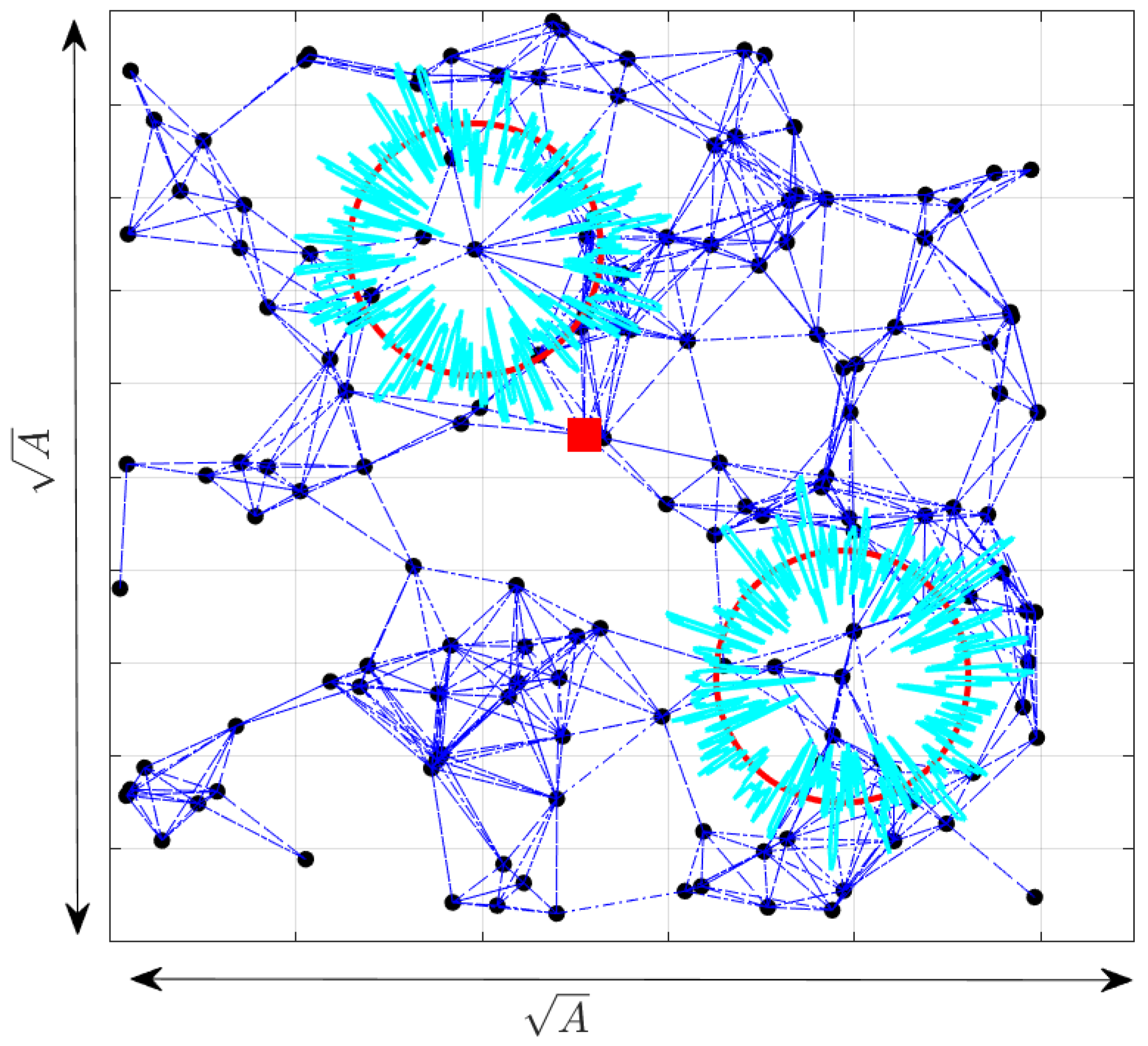
N nodes are randomly uniformly deployed in a 2D square area A such that A > > π R 2 , where R is the communication range of each node. We assume a fully connected network, i.e., no node is isolated. Figure 1 illustrates an example of a sensor network where N nodes are randomly deployed in a 2D square area. The regular nodes, depicted as blue dots, and a sink node depicted as red square. Unknown nodes are interconnected by dashed lines representing direct or ’one-hop’ connections between two neighboring nodes at a particular instant, underscoring the localized structure of the network at that precise moment. This figure challenges traditional models that typically portray coverage areas as well-defined circles with a fixed radius. Instead, it adopts a more realistic approach by acknowledging the variability and irregularities in signal propagation pertinent to sensor networks. This approach more accurately captures the real-world environmental and spatial challenges faced by sensor networks. As a result, the figure not only depicts standard coverage areas but also those under disturbance, shown in cyan, illustrating the complexities and nuances of data transmission and signal propagation in specific sensor network scenarios.
Figure 1. Network Model.

Connectivity

Two nodes (i and j) are neighbors at one hop if they are connected; hence, C i j is a random variable presenting the connectivity context information defined as
C i j = 1 , if P r ( d ) P t h r e s h o l d 0 , otherwise ,
where i = { 1 , , N } , j = { 1 , , N } , and j i . P t h r e s h o l d is the power detection threshold, and d is the distance separating i and j. The global connectivity context information matrix CI is then defined as
CI = [ C i j ] N × N .

3.4. CRSS Approach

3.4.1. Analysis from Spatial Data

A complete spatial randomness (csr) is synonymous with a homogeneous Poisson process in R d . (“This process has the property that, conditional on N ( A ) . The number of events in a bounded region A R d , the events of the process are independently and uniformly distributed over A. That is, given N ( A ) = n , the ordered n tuple of events ( s 1 , , s n ) in A n satisfies P r o b ( s 1 B 1 , , s n B n ) = i = 1 n ( | B i | / | A | ) , B 1 , , B n A “) [33] (p. 586). Distances may be measured between sample and nearest events. For a completely spatial process, i.e., a homogeneous Poisson process, the distribution theory for nearest neighbor distances is well known [34], where the density of the positive random variable W in R 2 is
g ( W ) = 2 π λ w e ( π λ w 2 ) .
Theoretical calculations show that, under csr in R 2 , the probability G ( r ) that the distance from a chosen event to its nearest event is less than or equal to r can be expressed by
G ( r ) = 1 e ( λ π r 2 ) ,
where λ is the intensity of the homogeneous point process. For the homogeneous Poisson process, the probability that there are no events within distance x for an arbitrary point is e ( λ π x 2 ) . Hence, the distribution function of the point to the nearest event distance is 1 e ( λ π x 2 ) , x > 0 .

3.4.2. From Spatial Data to WSN

Applying this analysis from spatial data, in a sensor network, the random point is the random node (sensor) [35]. Thus, the pdf of the distance, β > 0 , of a node to its nearest neighbor is
f ( β ) = 2 π λ β e ( λ π β 2 ) .
Moreover, the probability that this distance is less than or equal to the communication range R is then expressed as
P ( β R ) = β = 0 R f ( β ) d β = 1 e ( λ π R 2 ) .
(i)
In a one-dimensional case
N nodes are randomly uniformly deployed on a distance d m a x = [ 0 , x m a x ] . Let v be the number of nodes located in an interval [ x 1 , x 2 ] with a probability p = x 2 x 1 d m a x [35]. Let ξ be a random variable denoting the number of nodes in a defined interval. Therefore, the probability that v of N are placed with [ x 1 , x 2 ] is
P ( ξ = v ) = N v p v ( 1 p ) N v ,
for N > > 1 and ( x 2 x 1 ) d m a x < < 1 , this solution can be approximated with a Poisson distribution, with p = x 2 x 1 d m a x , and keeping the density λ = N d m a x constant:
P ( ξ = v ) = ( N p ) v v ! e N p = ( N ( x 2 x 1 ) d m a x v ! ) v e N ( x 2 x 1 ) d m a x = ( λ ( x 2 x 1 ) v ! ) v e λ ( x 2 x 1 )
Thus, the probability that a node has v neighbors within its communication range R, is the same as the probability in Equation (11), but the distance interval is on 2 R such as
P ( ξ = v ) = ( λ 2 R v ! ) v e λ 2 R .
(ii)
In two-dimensional deployment
N nodes are deployed randomly on surface A, providing a realistic representation of random node placement in practical scenarios. Under this assumption, the average number of nodes per unit area is denoted by λ = N / A . This allows us to compute the probability P ( ξ = v ) that any subset of v nodes from the total N nodes falls within a specific sub-area A 0 of the system plane A, delimited by the communication range R of a node, with A 0 = π R 2 ; hence, analogously to (11), P ( ξ = v ) is obtained as
P ( ξ = v ) = ( A 0 A N ) v v ! e A 0 A N = ( λ A 0 v ! ) v e λ A 0 = ( λ π R 2 v ! ) v e λ π R 2 .

3.4.3. Probabilistic Approach in Interpreting RSS

In our examination of the network’s connectivity, we consider R ¯ to represent the average effective communication radius, assuming a homogeneous propagation environment. This radius is crucial for estimating the area A ¯ within which a typical sensor node can communicate, calculated as the area of a circle, A ¯ = π R ¯ 2 . This average range is pivotal in our probabilistic approach for interpreting the RSS values. The expected average number of neighbors falling within a radius R around a given node is described as
E ( ξ ) = λ π R 2 .
Acknowledging R ¯ as an average range allows us to probabilistically interpret the RSS data from sensors, providing a basis for inferring the likelihood of node connectivity within this range. This average range, and the area that it defines, become key in localizing nodes and optimizing the performance of the CRSSA method in a WSN setting to find the number of adjacent or one-hop neighbors for each node, which is pivotal for deducing its communication range.
This calculation represents the expected count of adjacent neighbors for any given node i, providing an assessment of the network’s connectivity. On the other hand, the number of connected neighbors, n i , to node i = 1 , , N , can be obtained from the connectivity context data as
n i = i = 1 N C i j .
Further, the average number of adjacent neighbors per node is derived by the connectivity matrix considering the individual communication ranges, which may vary due to environmental dynamics but are averaged out across the network:
n ¯ = 1 N i = 1 N n i = 1 N i = 1 N j = 1 N C i j .
By leveraging the connectivity matrix, we can accurately determine the average number of connected neighbors for each node, thereby enabling a detailed analysis of network density and communication coverage. This level of specificity is crucial for the effective implementation of the CRSSA method as it directly impacts the localization accuracy within the WSN.
  • Range Estimation, R ¯ ^
    The values in Equations (14) and (16) are equivalent; hence, based on these equations, the average range R ¯ is estimated as
    R ¯ ^ = i = 1 N R i ^ N = i = 1 N j = 1 N C i j λ π N .
  • PLE Estimation
    Theoretical and measured-based propagation models indicate that average received signal power decreases logarithmically with distance [29]. Hence, based on the log-distance path loss model, and assuming the estimated average communication range obtained in Equation (17) as the maximal distance reached by a transmitted signal when the received power measured at this node is equal to the power detection threshold P t h r e s h o l d , the PLE, γ ¯ ^ , can be estimated as
    γ ¯ ^ = P t h r e s h o l d + P L ( d 0 ) 10 l o g 10 ( R ¯ ^ ) .
  • Inter-node distance estimation
    Our proposed approach is an anchor-free solution; thus, it estimates the relative positions with respect to a coordinate system established by a reference group of nodes. Relative positioning information is sufficient for some applications, such as location-aided routing or direction-based routing algorithm [36]. Moreover, the recovery of the network’s key propagation characteristics and its geometry can be addressed by relative positioning mainly from the connectivity information.
    In relative localization, nodes are localized with respect to each other; thus, we estimate the distance separating them. In this work, we will focus on estimating the distance separating two neighbors nodes at one hop. Since the objective is to prove the efficiency of the proposed CRSSA, distances between nodes at more than one hop are beyond the scope of this work and will be addressed in future publications.
    Based on the log-distance path loss model, the value of the estimated PLE in Equation (18), and the received power value obtained at neighbor node k, P r i k is the received power at node k, and each node i = 1 , , N , estimates its distances separating its connected neighbor nodes, k i κ = { i 1 , , n ¯ i } , as
    d ^ i k = 10 P L ( d 0 ) P r d i k 10 γ ¯ ^ .
  • Localization of nodes
    To estimate the positions of nodes, we exploit estimated inter-node distances, RSS values, and the sink position. Our approach employs a gradient-based optimization method with weighted residuals, utilizing the RSS values as a key factor in the objective function. Subsequently, we assess the accuracy of the estimated positions through the calculation of the NRMSE.

3.5. Flowchart and Algorithm

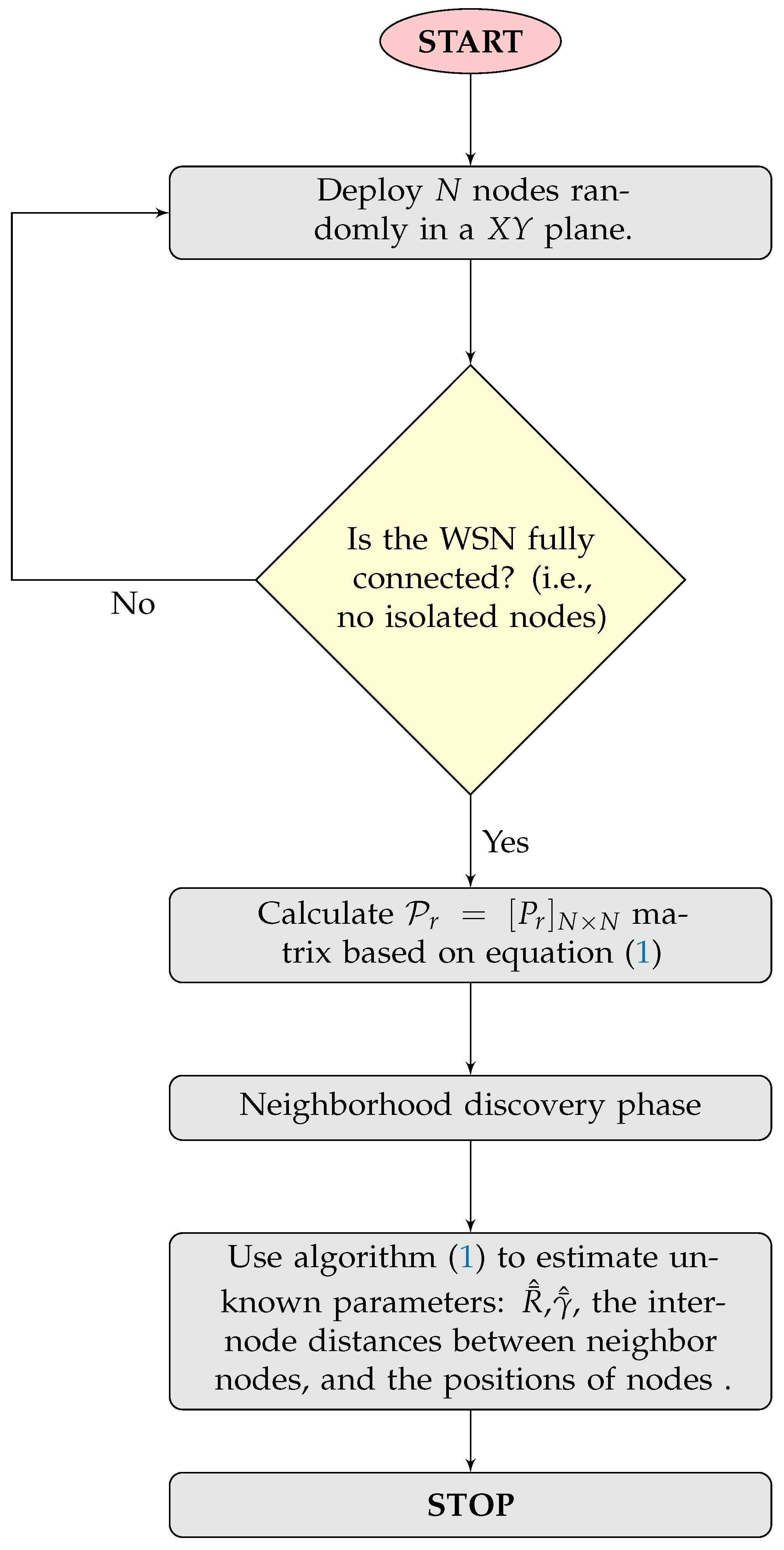
To summarize the previous discussion, the flowchart in Figure 2, and the neighbor discovery phase, as well as Algorithm 1, to jointly estimate the PLE value, the inter-node distances are presented below.
Algorithm 1: Contextual Received Signal Strength Approach
Input: 
N: Unknown nodes, λ : Network density, A: Deployment area
Output: 
R ¯ ^ : Estimated mean range, γ ¯ ^ : Estimated mean path loss exponent, d ^ i k : Estimated inter-node distance, node position ( x i ^ , y i ^ )
Data:  
P r ( d ) : Received power at distance d
1 
for i = 1 to N do
Sensors 24 01210 i001
5 
end
6 
for i = 1 to N do
Sensors 24 01210 i002
8 
end
9 
Derive the average number of adjacent neighbors n ¯ ← using (16)
10 
Estimate the mean range R ¯ ^ using (17) for i = 1 to N do
Sensors 24 01210 i003
12 
end
13 
Estimate the positions of nodes ( x i ^ , y i ^ ) using gradient-based optimization method with weighted residuals.
Figure 2. CRSSA flowchart.

Neighbor Discovery Phase

To build the neighbor connectivity context matrix, each node i ( i = 1 , , N ) has to discover its neighbors by sending through the network a HELLO message containing its identity, a single-bit variable receivedhello equal to 1 if a full HELLO has been received from the neighbor, and a neighbor Set (NeighS), which is updated when a HELLO packet is received from the neighbor. The neighbor connectivity context matrix C i j assigns a value of 0 or 1 for each pair of nodes depending on the neighborhood information. We assume a non-symmetric connectivity context matrix. The value of the matrix is set as follows for each pair of sensors i and j, where ( i = 1 , , N ) , j = ( 1 , , N ) and j i .
1.
If receivedhello is 1 for both sensors i and j, C i j = C j i = 1 .
2.
If receivedhello is 1 for sensor i and 0 for sensor j, C i j = 1 and C j i = 0 .
3.
If receivedhello is 0 for both sensors i and j, C i j = C j i = 0 .
Once the packet is successfully received by a node, the NeighS is updated by adding the identity of the node transmitting the HELLO packet. At this step, each node is aware of its neighbors and their numbers. The information concerning each node connectivity context matrix is sent to the sink node in charge of computational operations. After a successful exchange of HELLO packets, nodes can automatically establish adjacency and can start to send and route data between them. After the neighbor discovery phase, the information on global connectivity is used by the sink node to estimate the channel parameters and the inter-node distances.

4. Performance Evaluation

4.1. Evaluation Metric

In order to prove the effectiveness of our proposed approach, we calculate the normalized root mean square error (NRMSE) of the estimated inter-node distances as
e = 1 N i = 1 N 1 C ( κ i ) k κ i ( d ^ i k d i k ) 2 R ¯ ,
where d ^ i k is the estimated inter-node distance, d i k is its real value, and C ( κ i ) is the cardinal of κ i , the set of node-i’s neighbors. The normalization is performed with respect to the the average communication range R ¯ . Other normalization metrics go far beyond the scope of this work. Also, we assess the localization NRMSE as
e position = 1 N u i = 1 N u ( x i x i ^ ) 2 + ( y i y i ^ ) 2 R ¯ ,
where N u is the number of localized sensors.

4.2. Simulation Setup

Extensive simulations for evaluating the performance of our CRSSA are conducted by using Matlab (R2022b) [37]. In order to prove the stability and the efficiency of our approach, we test it in different propagation parameters, as well as different numbers of nodes. The general simulation setup is listed in Table 2.
Table 2. WSN simulation parameter setup.
A random deployment of N static nodes inside a square region of length A in each run is considered. We execute 100 runs, and we make sure that the network is fully connected at each run. Random received power values for each link are generated, following relations explained in Section 3.2. Parameters’ values used for simulation such as γ , σ , and m are listed in each subsection below. The path loss exponent, the communication range, and the inter-node distances are then estimated using the generated noisy received power. The CRSS approach is studied by fixing two variables and varying the third one.
In order to test the impact of varying the Nakagami parameter, γ and σ values are fixed and m is changed. At each variation of the m value, the approach is tested for 100 runs, and the results are reported in Section 4.2.1. Similarly, to assess the impact of the PLE value on the accuracy and the reliability of the CRSS approach, σ and m values are fixed, and the γ value is changed; Section 4.2.2 details obtained results. Analogously, Section 4.2.3 elucidates the consequence of varying the shadowing standard deviation on the CRSS approach.

4.2.1. m-Nakagami Parameter Variable

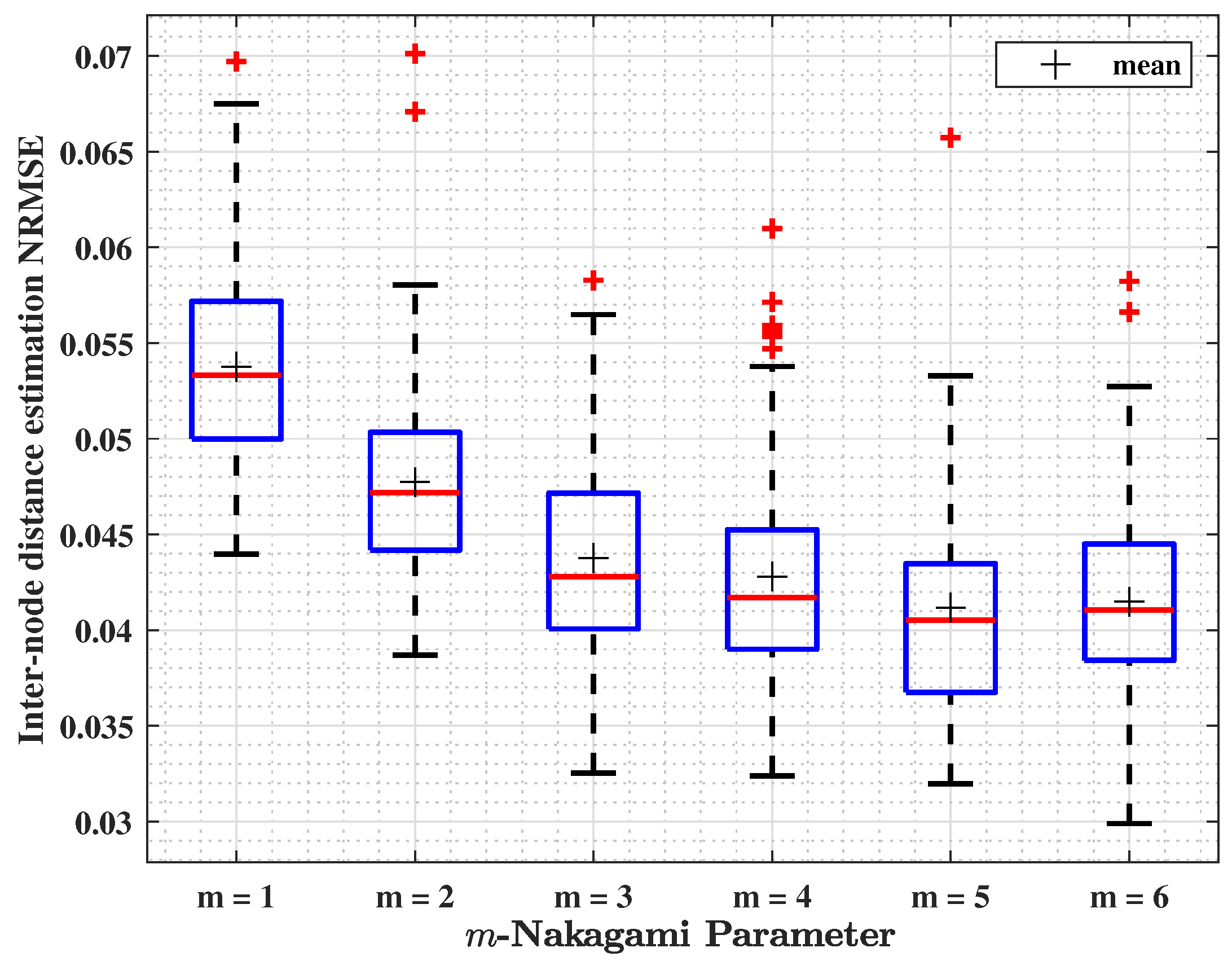
The results presented in Figure 3 show the inter-node distance estimation NRMSE by varying the value of the m-Nakagami parameter while γ = 3 and σ = 4 d B . NRMSE is calculated based on Equation (20). The blue boxplots show the results of 100 runs conducted using the parameters listed in Table 3. They show how the data error is extended, and red lines show the median of the error. A significant relationship is identified, as shown in Figure 3, between the Nakagami shape parameter m and the localization error. Notably, the results showed that as m increases from 1 to 5, the median localization error progressively decreases from 5.5% to 4% of the range. This improvement aligns with the theory that a higher m indicates a signal less prone to fading, resulting in greater accuracy. However, a key observation is that the most significant changes occur at m = 1 , where the model exhibits the most multipath fading. Beyond m = 5 , improvements become marginal, with the error slightly increasing to 4.01 % for m = 6 . This indicates a plateau in performance gains, influenced by other limiting factors such as the path loss exponent or shadowing. Additionally, it is important to note that, for m = 1 , the error increases by 1.5% from its ideal level observed at m = 5 .
Figure 3. Inter-node distance estimation NRMSE for variable m -Nakagami parameter.
Table 3. Variable parameter setup 1.

4.2.2. γ : PLE Parameter Variable

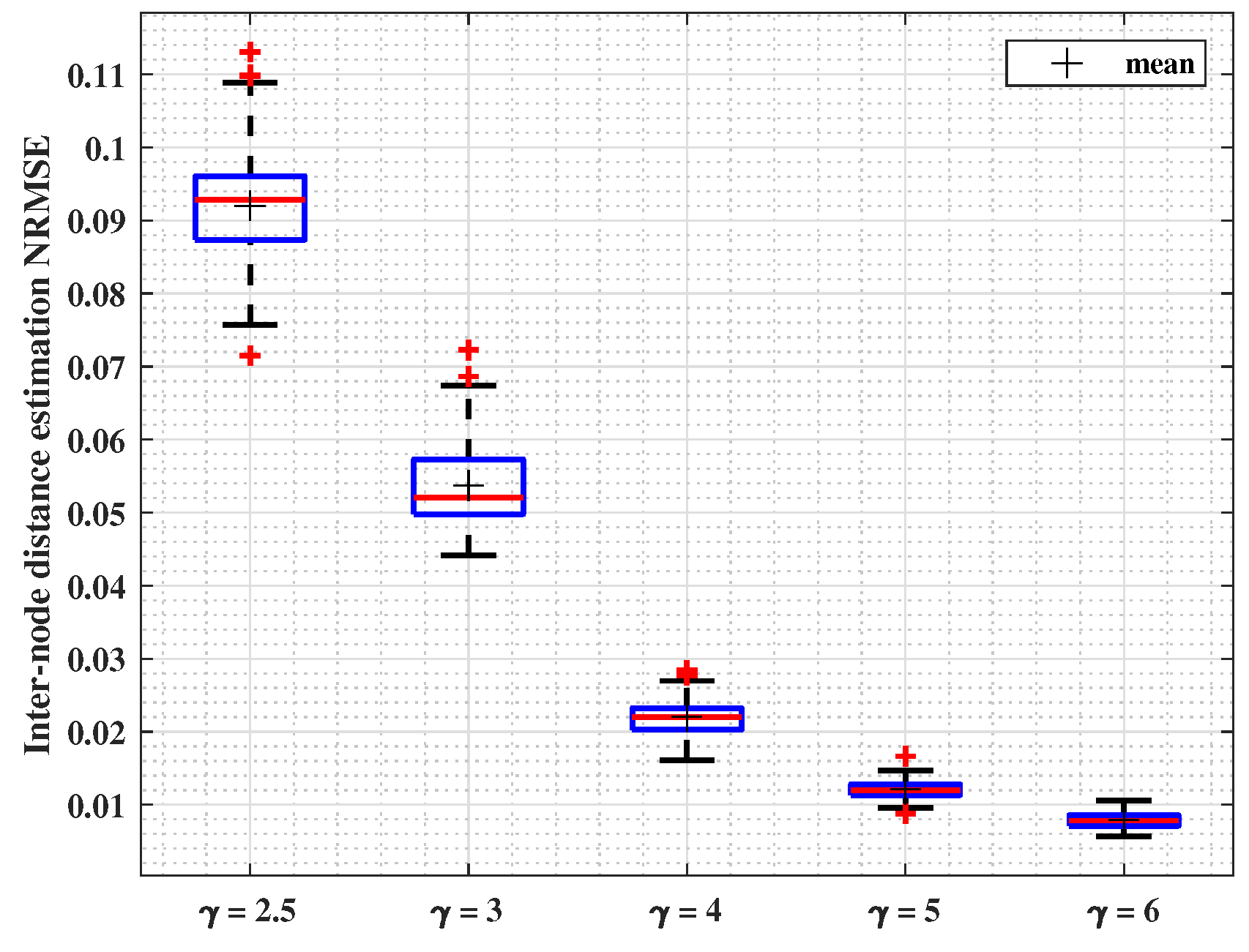
In this subsection, the results presented in Figure 4 show the estimation NRMSE by varying the value of γ while m = 4 and σ = 4 d B . Similarly, boxplots show the results of 100 runs conducted using the parameters listed in Table 4. They show how the data error is extended, and red lines show the median of the error. Low errors show the approach stability. The interval of NRMSE values ranges between 0.01 and 0.11 .
Figure 4. Inter-node distance estimation NRMSE for variable PLE values.
Table 4. Variable parameter setup 2.
Another relationship is identified in this case between the PLE value γ and the localization error. Remarkably, the results showed that as γ increases from 2.5 to 6, the median localization error progressively decreases from 9 % to 1 % of the range. This enhancement is explained by the fact that smaller PLE values translate into higher average-range values. Thus, the number of neighbors within range, yet at more than a single-hop distance, gets increasingly larger, thus biasing more seriously the estimate in (17).

4.2.3. σ : Lognormal Shadowing Standard Deviation Variable

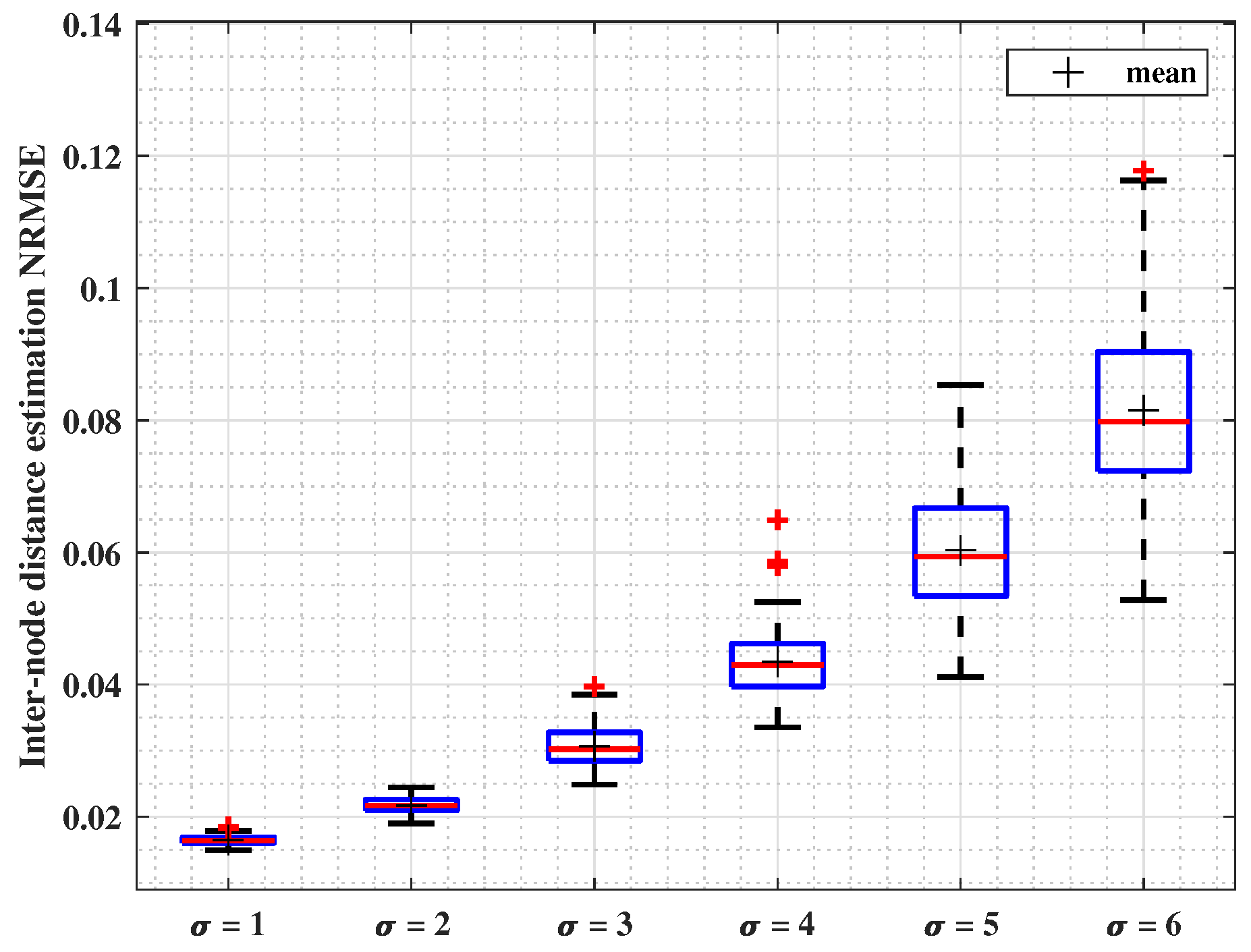
In this subsection, the impact of varying σ is studied. Simulations parameters are listed in Table 5. Figure 5 presents boxplots illustrating the results of 100 runs. They show how the data error is extended, and red lines show the median of the error. It can be observed that NRMSE values increase with the σ value, without exceeding 0.12 when σ = 6 dB. Correspondingly to intuitive expectations, where σ introduces randomness in the received signal power, the median localization error progressively increases from 2 % to 8 % of the range.
Table 5. Variable parameter setup 3.
Figure 5. Inter-node distance estimation NRMSE for variable σ , lognormal shadowing standard deviation.

4.2.4. Node’s Number Impact

This approach relies on the network contextual information. The node’s number impact study is crucial as it affects the network density, λ . In fact, this latter is a key parameter studied in different WSN applications. Bulusu [38] proposed Equation (22) to calculate λ as
λ = N π R 2 A ,
where N is the number of nodes in area A, and R is the nominal range of each node. However, the authors in [39] propose a more precise equation as
λ = l i m | A | 0 N ( A ) | A |
where density is measured in nodes per m 2 .
A higher node density introduces less distance between nodes; thus, the impact of this network parameter is crucial in this study since it affects the number of neighbor nodes within a communication range.
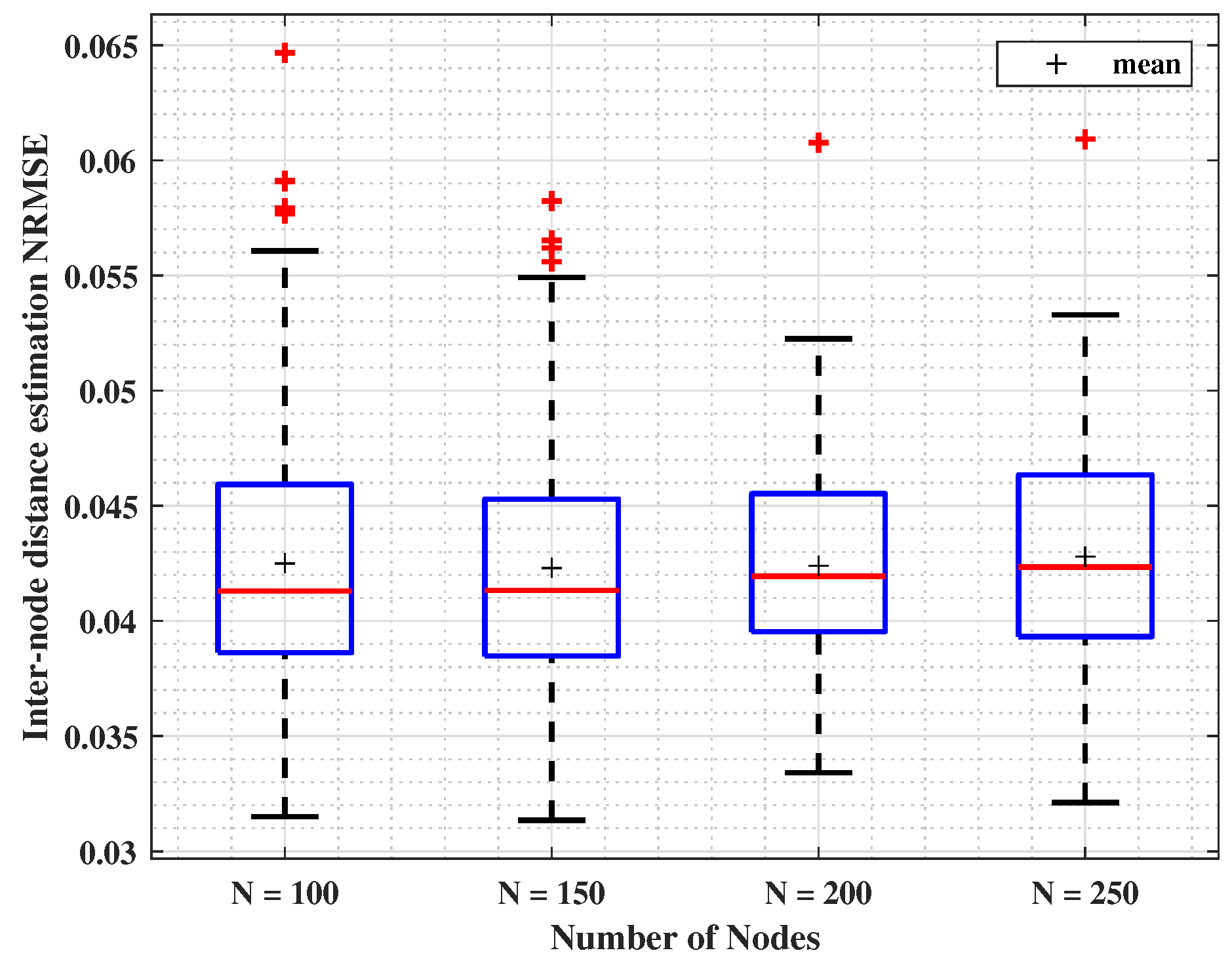
The CRSSA is tested with a different number of nodes without changing the deployment area. Boxplots in Figure 6 show the simulation results for different N, by illustrating how errors are extended. Simulation parameters are listed in Table 3. As observed, the maximal NRMSE value does not exceed 0.065 for N = 100 . An important observation is drawn from Figure 6: the median localization error denoted by red lines remains stable when varying N, where it changes from 4.1 % to 4.2 % of the range. Once more, the results indicate a plateau in performance gains and validate the effectiveness of the approach.
Figure 6. Inter-node distance estimation NRMSE for different number of nodes, N, with ( γ = 3 , σ = 4 , m = 4 ).

4.2.5. Results Comparison

After proving the competence of the CRSSA in different and varying channel parameters and numbers of nodes, we evaluate its performance by comparing the NRMSE against state-of-the-art anchor-free localization techniques proposed in recent studies, namely, Shah et al. [21], SFO [17], and EAFLA [13]. Shah et al. employed a time division multiple access (TDMA) scheduling algorithm, where each node broadcasts a beacon message containing its unique node ID. RSS measurements are then utilized to estimate distances between nodes, and the centroid and average distance are computed for localization.
The SFO technique applied in [17] involves an approach using the DV-Hop algorithm. This technique leverages the principles of SFO to optimize node positions based on hop distances obtained from the DV-Hop algorithm.
The EAFLA proposed in [13] begins by electing cluster heads and forming clusters according to the low-energy adaptive cluster hierarchical (LEACH) protocol. Distances between nodes are then estimated using a combination of the RSS signal transmission model and the Kleinrock and Sylvester model [14].
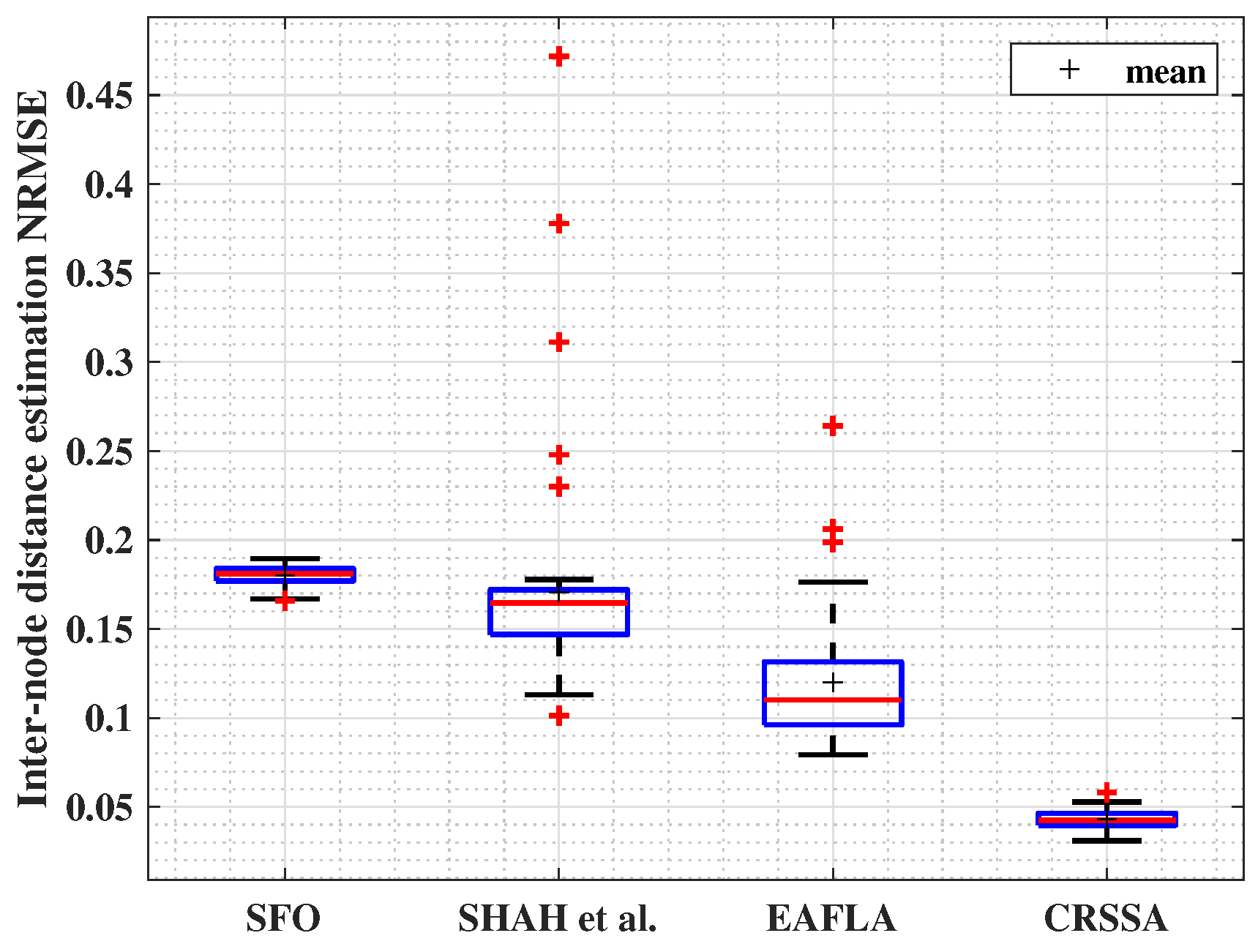
In Figure 7, we evaluate the NRMSE under specific parameter settings ( γ = 3 , σ = 4 , and m = 4 ). We present results in blue boxplots. Our proposed approach consistently outperforms existing benchmark methods found in the literature. The NRMSE achieved by our approach falls within an impressive range of [ 0.03 , 0.058 ] . In comparison, errors obtained using the SFO method vary between 0.16 and 0.189 , Shah et al.’s approach yields errors within [ 0.45 , 0.1 ] , and errors with the EAFLA range from 0.07 to 0.26 . This demonstrates the superior accuracy and precision of our proposed method, consistently achieving lower NRMSE values across the specified parameter configurations when compared to existing state-of-the-art approaches.
Figure 7. Inter-node estimation NRMSE comparison ( γ = 3 , σ = 4 , and m = 4 ).

4.2.6. Node Localization

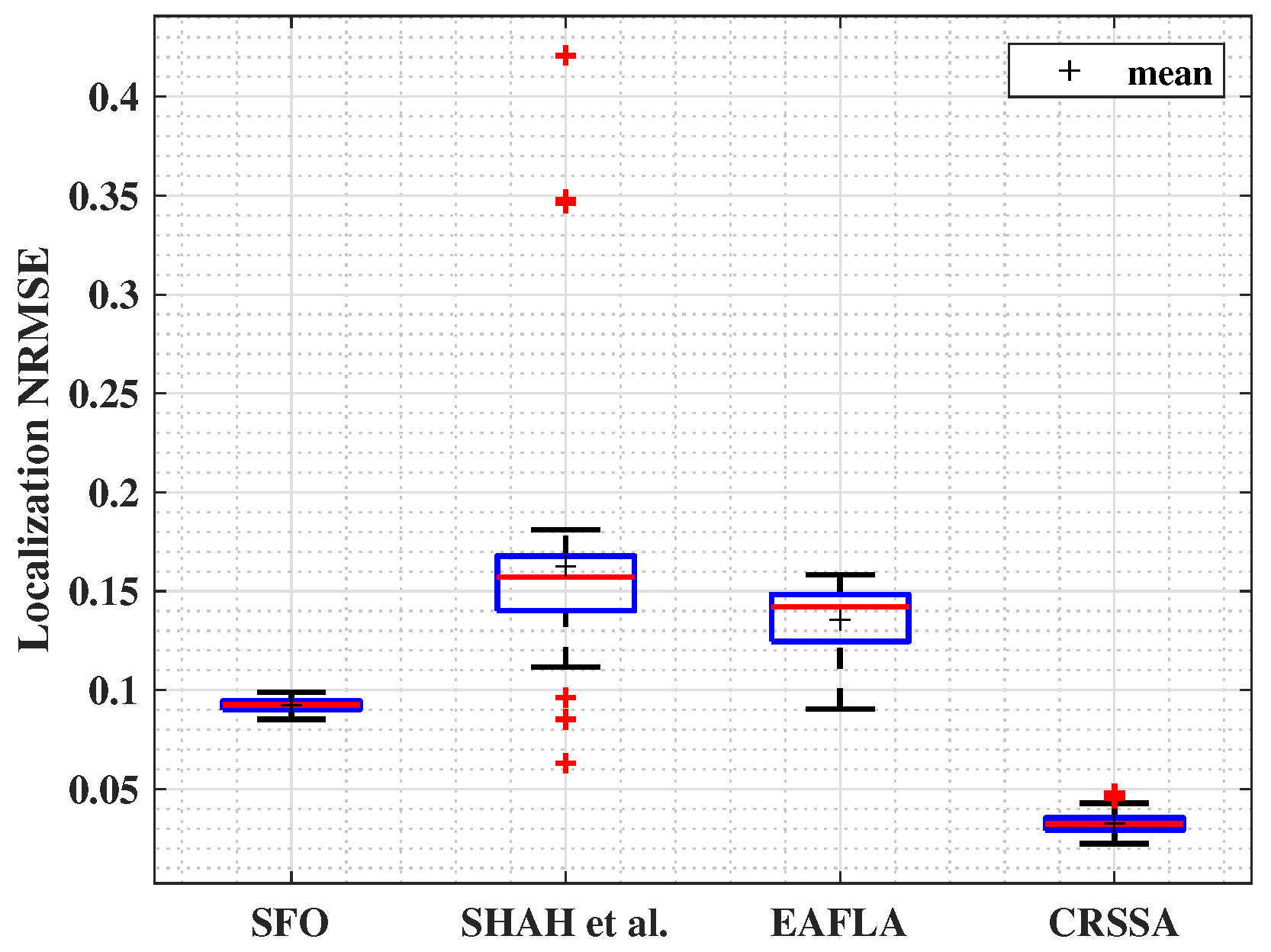
In order to localize sensors, we adopt a gradient-based optimization method with weighted residuals, utilizing the RSS values as a key factor in the objective function. Neighbors at one hop of each node are positioned using the estimated inter-node distances. The sink’s neighbors are localized based on the known position of the sink, and then the rest of the sensors are positioned. Figure 8 shows that our proposed methodology consistently surpasses other anchor-free localization techniques found in the literature. The NRMSE achieved by our approach falls within a range of [ 0.02 ,   0.045 ] . In contrast, errors obtained using the SFO method vary between 0.089 and 0.16 , Shah et al.’s approach yields errors within [ 0.12 ,   0.18 ] , and errors with the EAFLA range from 0.09 to 0.16 . This highlights the superior accuracy and precision of our proposed method, consistently attaining lower NRMSE values.
Figure 8. Localization NRMSE ( γ = 3 , σ = 4 , and m = 4 ).

4.2.7. Discussion

As presented above, we aim through extensive simulations to show the efficiency of our approach by achieving low errors in estimating inter-node distances in a WSN, as well as its stability when varying different propagation parameters in conditions simulating a realistic model. Moreover, our technique outperforms the benchmark anchor-free approach in the same propagation models and same assumptions.
Hence, our anchor-free technique relies on using the contextual network information consisting of connectivity, network density, and node number to overcome any variation in the WSN deployment environment. In other words, our technique adjusts and adapts the estimation of the main unknown parameters, R ¯ ^ and γ ¯ ^ , by using derived equation functions of propagation model parameters as well as deployed network parameters. After that, R ¯ ^ and γ ¯ ^ are used in estimating the inter-node distance based on the received power model, allowing us to accurately find the relation between distance and received power without using any extra device or known nodes. Then, the nodes are localized based on the estimated inter-node distances. This will drastically decrease the cost of the WSN since no anchor nodes are needed and the aim is to achieve a relative positioning in some WSN applications.

5. Conclusions and Future Work

In this paper, we present an anchor-free localization technique in 2 D WSN. Analytical expressions for the average communication range, PLE value, and inter-node distances are derived. The introduction of the CRSSA in this article marks a substantial advancement in wireless sensor networks (WSNs), showcasing a novel anchor-free localization technique that leverages RSS and contextual connectivity. This approach sets a new standard in localization accuracy within WSNs, highlighting the study’s innovative edge and technical proficiency. The study’s robust theoretical framework and comprehensive simulative evaluations are particularly noteworthy, demonstrating the method’s effectiveness and superiority in precision compared to existing localization methods like EAFLA. Additionally, the anchor-free nature of the CRSSA emerges as a pivotal development, offering enhanced flexibility and cost-effectiveness in sensor network deployments, which are crucial in the evolving realm of wireless communications.
The potential of the CRSSA in the field of WSNs is underscored by its adaptability and economic efficiency. Future research avenues, such as addressing real-time computational efficiency and undertaking experimental validations in diverse real-world settings, will further cement its practicality and application scope. Integrating the CRSSA with emerging technologies and considering dynamic environments where node mobility is a factor will expand its utility and relevance.
This study, therefore, not only provides a significant contribution to WSN localization techniques but also opens up exciting possibilities for future innovation and practical applications, setting a new benchmark in the field.

Author Contributions

Conceptualization, N.Z. and N.H.; formal analysis, N.Z.; funding acquisition, N.K.; investigation, N.Z.; methodology, N.Z.; software, N.Z.; supervision, N.H. and N.K.; validation, N.H. and N.K.; visualization, N.Z.; writing—original draft, N.Z.; writing—review and editing, N.Z., N.H. and N.K. All authors have read and agreed to the published version of the manuscript.

Funding

This research received no external funding.

Institutional Review Board Statement

Not applicable.

Data Availability Statement

Data is contained within the article.

Acknowledgments

The authors extend their sincere gratitude to the anonymous reviewers whose invaluable insights and constructive feedback significantly contributed to the enhancement of this manuscript. The authors appreciate the time and commitment invested by the reviewers in the peer review process, which has undeniably enriched the overall quality of this contribution.

Conflicts of Interest

The authors declare no conflict of interest.

Abbreviations

The following abbreviations are used in this manuscript:
RSSReceived Signal Strength
WSNsWireless Sensor Networks
PLEPath Loss Exponent
CRSSContextual Received Signal Strength
NRMSENormalized Root Mean Square Error

References

  1. Zhang, Y.; Cai, W. The Key Technology of Wireless Sensor Network and Its Application in the Internet of Things. J. Sens. 2022, 2022, 1–11. [Google Scholar] [CrossRef]
  2. Khan, M.A.; Saboor, A.; Kim, H.c.; Park, H. A Systematic Review of Location Aware Schemes in the Internet of Things. Sensors 2021, 21, 3228. [Google Scholar] [CrossRef] [PubMed]
  3. Hayward, S.J.; van Lopik, K.; Hinde, C.; West, A.A. A Survey of Indoor Location Technologies, Techniques and Applications in Industry. Internet Things 2022, 20, 100608. [Google Scholar] [CrossRef]
  4. Mehannaoui, R.; Mouss, K.N. A Study with Simulation of Range Free Localization Techniques in Wireless Sensors Networks. In Proceedings of the 2019 International Conference on Advanced Electrical Engineering (ICAEE), Algiers, Algeria, 19–21 November 2019; pp. 1–4. [Google Scholar] [CrossRef]
  5. Zaarour, N.; Hakem, N.; Kandil, N. Localization Context-Aware Models for Wireless Sensor Network. In Emerging Trends in Wireless Sensor Networks; IntechOpen: Rijeka, Croatia, 2022. [Google Scholar] [CrossRef]
  6. Du, T.; Qu, S.; Guo, Q.; Zhu, L. A Simple Efficient Anchor-Free Node Localization Algorithm for Wireless Sensor Networks. Int. J. Distrib. Sens. Netw. 2017, 13. [Google Scholar] [CrossRef]
  7. He, W.; Cheng, R.; Mao, K.; Yan, K.; Wei, J.; Xu, Y. A Novel Anchorless Node Positioning Method for Wireless Sensor Network. J. Sensors 2022, 2022, 1–10. [Google Scholar] [CrossRef]
  8. Zaarour, N.; Affes, S.; Kandil, N.; Hakem, N. Connectivity-Based Joint Parameter Estimation in One-Dimensional Wireless Sensor Networks. In Proceedings of the 2020 International Wireless Communications and Mobile Computing (IWCMC), Limassol, Cyprus, 15–19 June 2020; pp. 358–364. [Google Scholar] [CrossRef]
  9. Youssef, A.; Agrawala, A.; Younis, M. Accurate Anchor-Free Node Localization in Wireless Sensor Networks. In Proceedings of the 24th IEEE International Performance, Computing, and Communications Conference, Phoenix, AZ, USA, 7–9 April 2005; pp. 465–470. [Google Scholar] [CrossRef]
  10. Arbula, D. Distributed Algorithm for Anchor-Free Network localization Using Angle of Arrival. In Proceedings of the 2008 IEEE International Symposium on Industrial Electronics, Cambridge, UK, 30 June–2 July 2008; pp. 792–797. [Google Scholar] [CrossRef]
  11. Xingfu, W.; Renzhi, C.; Qiuyuan, H.; Zineng, K.; Zhiqiang, L. A Novel Anchor-Free Position Algorithm Based on Cluster Technique. In Proceedings of the 2nd International Conference on Software Technology and Engineering, San Juan, PR, USA, 3–5 October 2010; pp. V2-158–V2-163. [Google Scholar] [CrossRef]
  12. Ming, W. Distributed Node Location Algorithm Using Non-Anchor Node Clustering. In Proceedings of the 2016 11th International Conference on Computer Science & Education (ICCSE), Nagoya, Japan, 23–25 August 2016; pp. 505–511. [Google Scholar] [CrossRef]
  13. Aka, A.C.; Atta, A.F.; Keupondjo, S.G.A.; Oumtanaga, S. An Efficient Anchor-Free Localization Algorithm for all Cluster Topologies in a Wireless Sensor Network. Int. J. Comput. Commun. Control. 2023, 18. [Google Scholar] [CrossRef]
  14. Kleinrock, L.; Silvester, J. Optimum Transmission Radii for Packet Radio Networks or Why Six is a Magic Number. In Proceedings of the National Telecommunications Conference, Birmingham, AL, USA, 3–6 December 1978; Volume 1, pp. 4.3.1–4.3.5. [Google Scholar]
  15. Sau, B.; Mukhopadhyaya, K. Length-Based Anchor-Free Localization in a Fully Covered Sensor Network. In Proceedings of the First International Communication Systems and Networks and Workshops, Bangalore, India, 5–10 January 2009; pp. 1–10. [Google Scholar] [CrossRef]
  16. Qu, Z.; Shu, M.; Yang, M.; Zhang, C.; Wei, N.; Guo, Q.; Du, T. An Energy Efficient Anchor-Free Localization Algorithm for No-Identity Wireless Sensor Networks. Int. J. Distrib. Sens. Netw. 2015, 11, 595246. [Google Scholar] [CrossRef][Green Version]
  17. Rayavarapu, V.C.S.R.; Mahapatro, A. A Novel Range-Free Anchor-Free Localization In WSN Using Sun Flower Optimization Algorithm. In Proceedings of the 2021 Advanced Communication Technologies and Signal Processing (ACTS), Rourkela, India, 15–17 December 2021; pp. 1–6. [Google Scholar] [CrossRef]
  18. Kang, S.; Kim, T.; Chung, W. Target Localization with Unknown Transmit Power and Path-Loss Exponent Using a Kalman Filter in WSNs. Sensors 2020, 20, 6582. [Google Scholar] [CrossRef] [PubMed]
  19. Alanezi, M.A.; Bouchekara, H.R.E.H.; Javaid, M.S. Range-Based Localization of a Wireless Sensor Network for Internet of Things Using Received Signal Strength Indicator and the Most Valuable Player Algorithm. Technologies 2021, 9, 42. [Google Scholar] [CrossRef]
  20. Jondhale, S.R.; Mohan, V.; Sharma, B.B.; Lloret, J.; Athawale, S.V. Support Vector Regression for Mobile Target Localization in Indoor Environments. Sensors 2022, 22, 358. [Google Scholar] [CrossRef] [PubMed]
  21. Shah, I.; Dohare, Y.; Yadav, D. A Modified Anchor Free Localization Technique for Wireless Sensor Network. EAI Endorsed Trans. Cloud Syst. 2020, 6, 166553. [Google Scholar] [CrossRef]
  22. Stusek, M.; Moltchanov, D.; Masek, P.; Mikhaylov, K.; Zeman, O.; Roubicek, M.; Koucheryavy, Y.; Hosek, J. Accuracy Assessment and Cross-Validation of LPWAN Propagation Models in Urban Scenarios. IEEE Access 2020, 8, 154625–154636. [Google Scholar] [CrossRef]
  23. Leite, D.L.; Alsina, P.J.; de Medeiros Campos, M.M.; de Sousa, V.A.; de Medeiros, A.A.M. Unmanned Aerial Vehicle Propagation Channel over Vegetation and Lake Areas: First- and Second-Order Statistical Analysis. Sensors 2022, 22, 65. [Google Scholar] [CrossRef] [PubMed]
  24. Shankar, P.M. Fading and Shadowing in Wireless Systems, 2nd ed.; Springer: New York, NY, USA, 2017. [Google Scholar]
  25. Abdi, A.; Kaveh, M. K distribution: An Appropriate Substitute for Rayleigh-Lognormal Distribution in Fading-Shadowing Wireless Channels. Electron. Lett. 1998, 34, 851–852. [Google Scholar] [CrossRef]
  26. Ho, M.J.; Stuber, G. Co-channel interference of microcellular systems on shadowed Nakagami fading channels. In Proceedings of the IEEE 43rd Vehicular Technology Conference, Secaucus, NJ, USA, 18–20 May 1993; pp. 568–571. [Google Scholar] [CrossRef]
  27. Li, C.; Wang, H.; Yao, J.; Du, S. Success Probability of Millimeter Wave Cellular Networks under the Nakagami-lognormal Fading Channel. In Proceedings of the International Conference on Information and Communication Technology Convergence (ICTC), Jeju, Republic of Korea, 16–18 October 2019; pp. 189–192. [Google Scholar] [CrossRef]
  28. Rehman, A.; Di Marco, P.; Valentini, R.; Santucci, F. Analytical Modeling of Multiple Access Interference in C-V2X Sidelink Communications. In Proceedings of the IEEE International Mediterranean Conference on Communications and Networking (MeditCom), Athens, Greece, 5–8 September 2022; pp. 215–220. [Google Scholar] [CrossRef]
  29. Rappaport, T.S. Wireless Communications: Principles and Practice, 2nd ed.; Prentice Hall: Upper Saddle River, NJ, USA, 2001. [Google Scholar]
  30. Suzuki, H. A Statistical Model for Urban Radio Propogation. IEEE Trans. Commun. 1977, 25, 673–680. [Google Scholar] [CrossRef]
  31. Hansen, F.; Meno, F. Mobile fading—Rayleigh and Lognormal Superimposed. IEEE Trans. Veh. Technol. 1977, 26, 332–335. [Google Scholar] [CrossRef]
  32. Simon, M.K.; Alouini, M.S. Digital Communication over Fading Channels, 2nd ed.; Wiley series in telecommunications and signal processing; Wiley-Interscience: Hoboken, NJ, USA, 2005. [Google Scholar]
  33. Cressie, N.A.C. Statistics for Spatial Data, 1st ed.; Wiley Series in Probability and Statistics; Wiley: Hoboken, NJ, USA, 1993. [Google Scholar] [CrossRef]
  34. Stoyan, D. Spatial Data Analysis bei Example. Volume 1: Point Pattern and Quantitative Data. Biom. J. 1986, 28, 664. [Google Scholar] [CrossRef]
  35. Bettstetter, C. On the Minimum Node Degree and Connectivity of a Wireless Multihop Network. In Proceedings of the 3rd ACM International Symposium on Mobile Ad Hoc Networking &Computing, Lausanne, Switzerland, 9–11 June 2002; pp. 80–91. [Google Scholar] [CrossRef]
  36. Shakshuki, E.; Elkhail, A.A.; Nemer, I.; Adam, M.; Sheltami, T. Comparative Study on Range Free Localization Algorithms. Procedia Comput. Sci. 2019, 151, 501–510. [Google Scholar] [CrossRef]
  37. MATLAB and Statistics Toolbox Version: 913.0 (R2022b), Version: 913.0 (R2022b); MathWorks, Inc.: Natick, MA, USA, 2022.
  38. Nirupama, B.; Deborah, E.; Lewis, G.; John, H. Scalable Coordination for Wireless Sensor Networks: Self-Configuring Localization Systems. In Proceedings of the the Sixth International Symposium on Communication Theory and Applications (ISCTA 2001), Ambleside, UK, 13–18 July 2001; pp. 1–6. [Google Scholar]
  39. Toumpis, S. Mother Nature Knows Best: A Survey of Recent Results on Wireless Networks Based on Analogies with Physics. Comput. Netw. 2008, 52, 360–383. [Google Scholar] [CrossRef]
Disclaimer/Publisher’s Note: The statements, opinions and data contained in all publications are solely those of the individual author(s) and contributor(s) and not of MDPI and/or the editor(s). MDPI and/or the editor(s) disclaim responsibility for any injury to people or property resulting from any ideas, methods, instructions or products referred to in the content.

Article Metrics

Citations

Article Access Statistics

Multiple requests from the same IP address are counted as one view.