1. Introduction
The development of cities and villages, driven by the steady increase in population, results in an increased volume of wastewater flowing into the central sanitary sewer infrastructure. While the construction of new residential areas is associated with the simultaneous construction of sanitary sewers of appropriately adjusted capacity, in some urban areas, there is no physical or economic possibility to expand the existing, often open, channels that currently frequently operate at the limit of their capacity.
Improving the monitoring system of sanitary networks is currently a significant branch of the industry, enabling the assessment of their hydraulic efficiency. The main problem faced by water and sewerage companies concerns the systematic collection of data, including the volume and velocity of wastewater flow in open channels and the thickness of the sewer sediment in man-entry collectors. A lack of supervision over the proper functioning of the sewage discharge system can lead to system overflows or leaks, posing a potential threat to the life and health of the region’s residents and causing environmental contamination. Access to current operational parameters of the system allows for the estimation of the load in specific areas and the detection of undesirable phenomena, such as surges and backups in the channel or exceeding maximum fill levels.
One area of current scientific research involves constructing simulation models of sanitary systems, which can be used to predict network behavior under various working conditions. The values of the operational parameters of the sewage system, which are recorded in real time, constitute a significant and necessary element in the process of calibration and validation of mathematical models. The phenomenon of fluid flow in sewer channels has been described to some extent in the literature. Equations and mathematical models characterizing flow through channels of different shapes, such as trapezoid, rectangle, or cylinder, have been identified [
1,
2,
3,
4,
5]. However, sewage systems, especially in large agglomerations, are diverse, composed of channels of various sizes and shapes with numerous intersection points.
Currently, many water and sewerage companies still do not have metering systems for sewage or stormwater infrastructure. Measuring the linear velocity of flow in successive sections of the network remains a technological challenge and a significant aspect of the development of existing sewer infrastructure. The issue arises from the necessity of installing measurement devices, usually in highly contaminated channels, in a possibly non-invasive manner that does not disrupt the proper flow of sewage. Moreover, measuring the actual amount of wastewater discharged can result in significant savings for plants that use water in their technological processes. Presently, in manufacturing plants, sewage is accounted for based on the amount of water drawn or on a flat-rate basis. In reality, for industrial installations, the amount of wastewater discharged into the sewerage may differ, e.g., due to water losses in production processes or due to losses in the exploited installation. This is an important reason why it is worthwhile to expand existing systems with additional monitoring devices. Although there are currently several solutions on the market that allow for the measurement of flow velocity in open channels, these options tend to be relatively expensive, and their measurement accuracy, along with the need for calibration, indicates a continued need for the development of new methods and devices with minimized construction and operational costs.
The innovative use of ultrasonic signals to measure fluid velocity represents a significant leap forward in the accuracy and reliability of flow measurement in contaminated environments. By employing the cross-correlation method for signal delay analysis, this research not only enhances the precision of flow rate determinations but also provides a viable solution for environments that present unique challenges, such as high levels of turbulence and contamination. Our work not only contributes to the field of environmental monitoring but also supports broader goals of sustainability and public health by enabling more effective wastewater management strategies.
Later in the article, in
Section 2, we provide a comprehensive literature review of current advancements in ultrasonography for flow measurement across various industrial sectors, highlighting its diverse applications and emerging trends. In
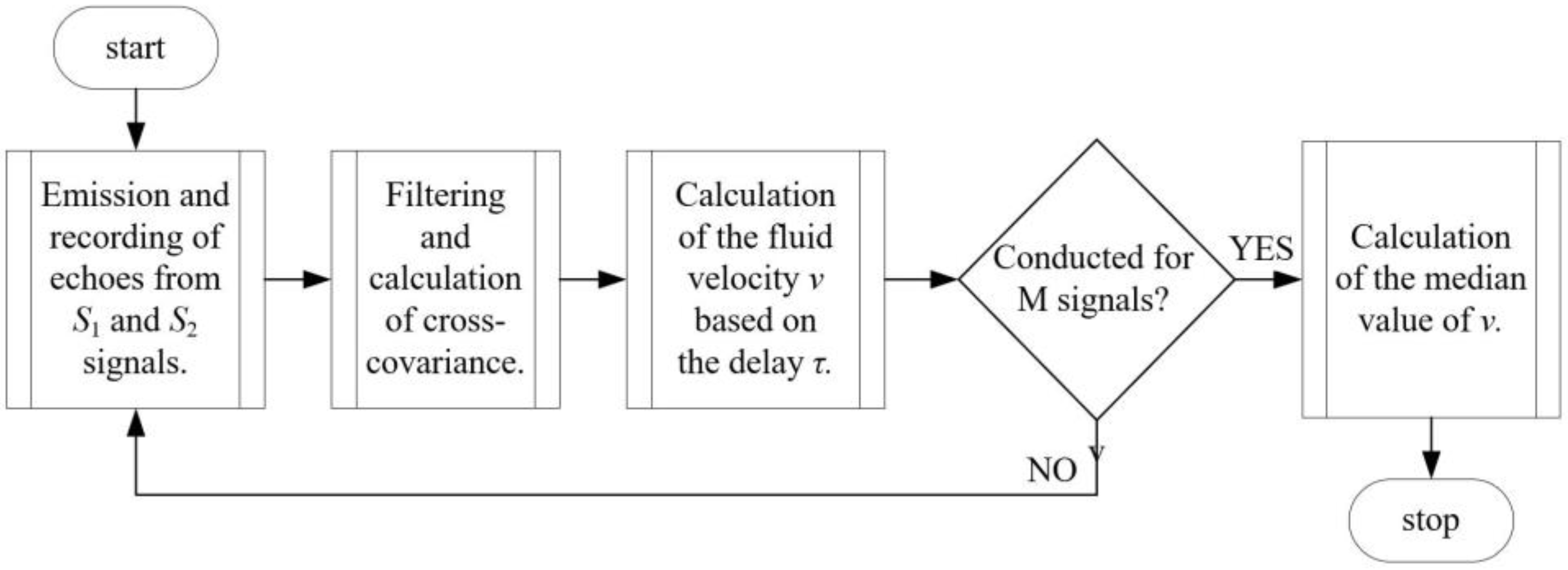
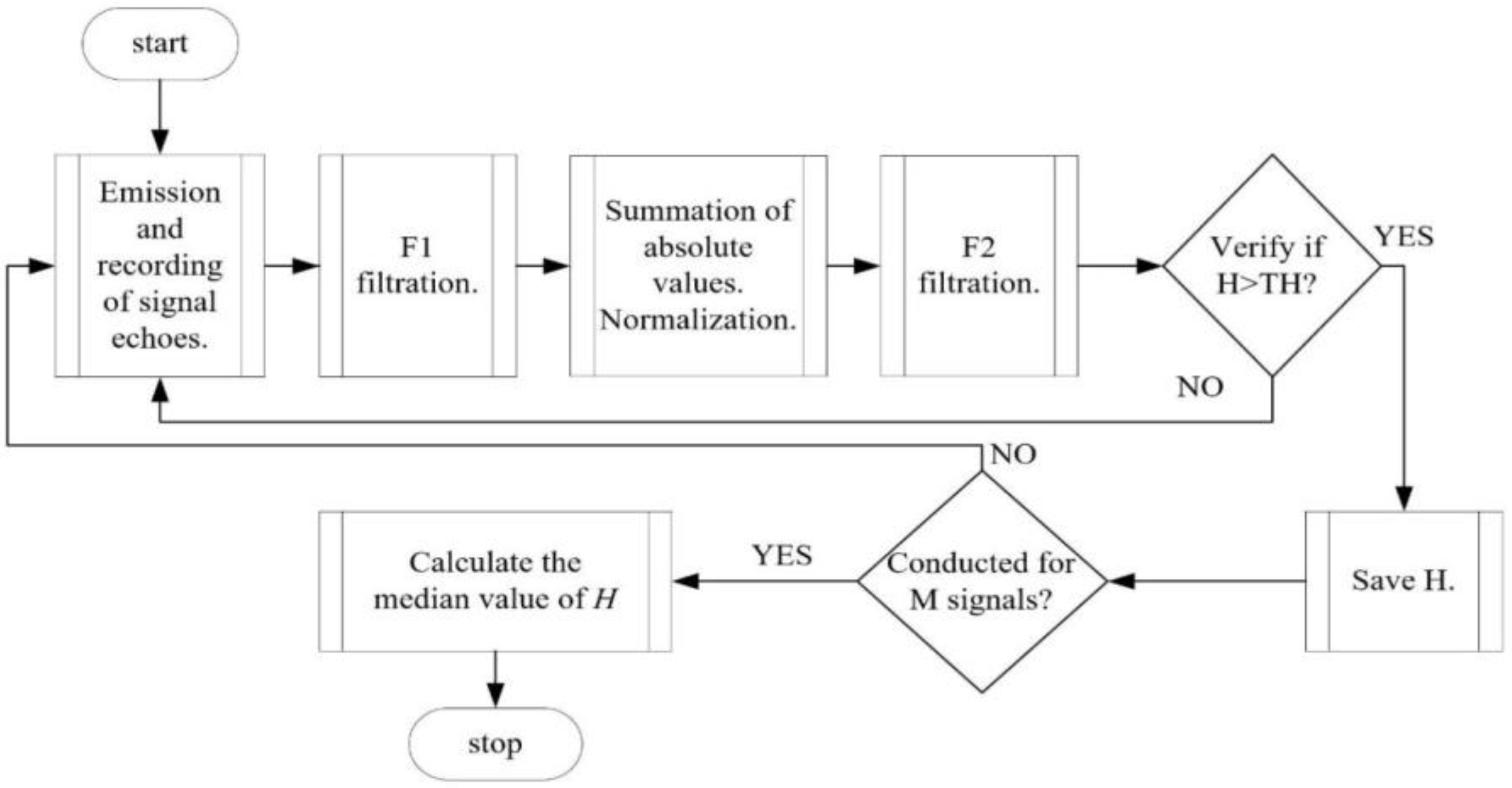
Section 3, we focus on the cross-correlation method, which is crucial in flow rate measurements, and we present the detailed process of designing and constructing a specialized low-cost device aimed at measuring wastewater flow rate in open channels, highlighting the challenges and innovative solutions involved in its development.
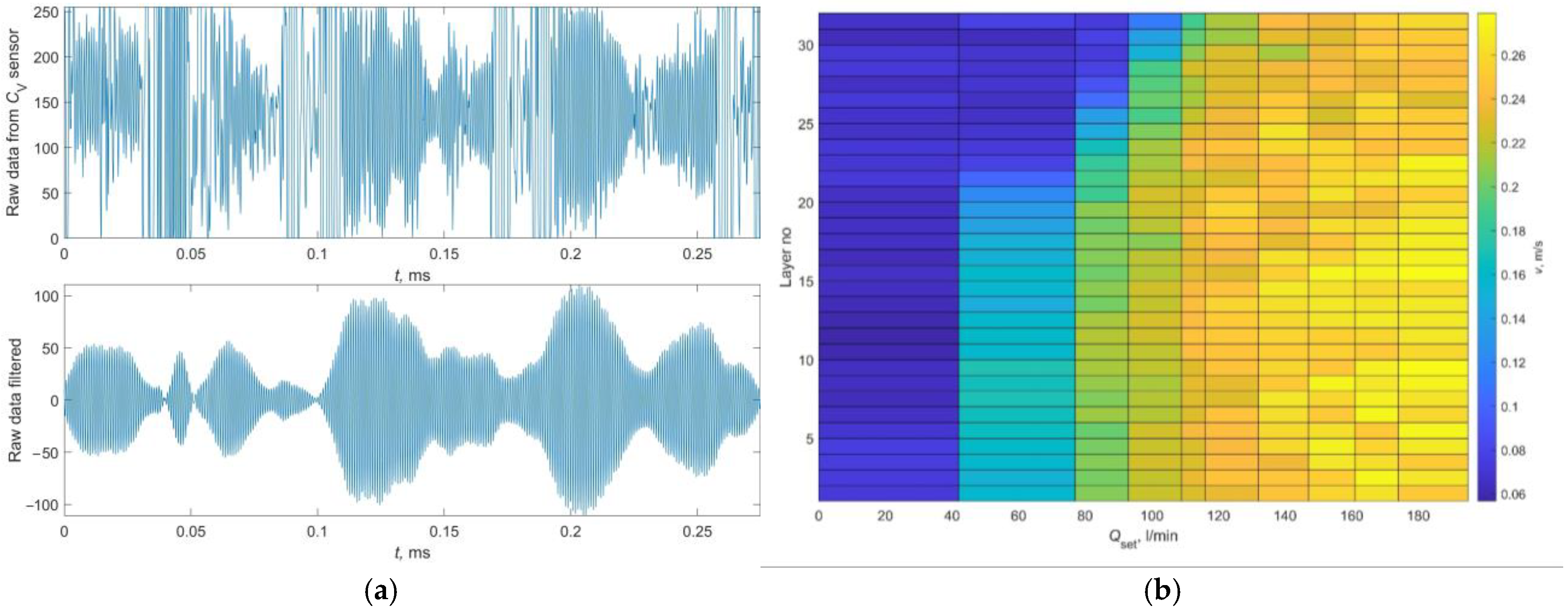
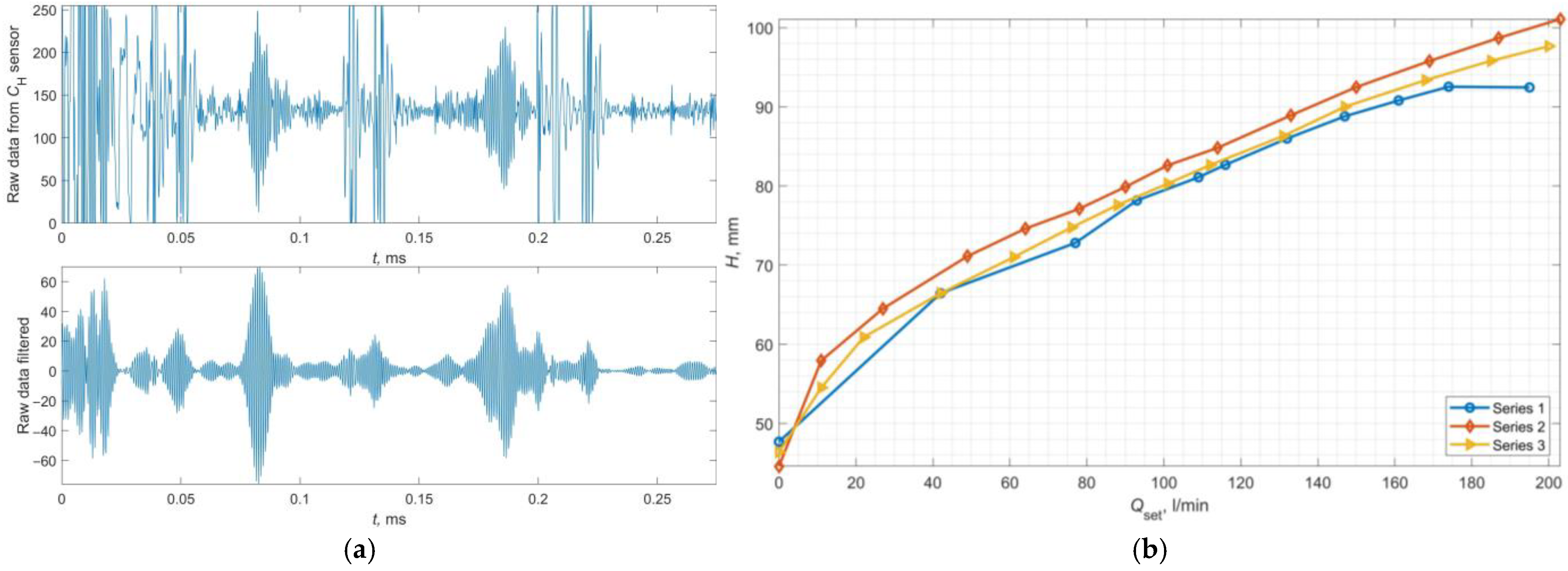
Section 4 describes example measurement results of data from the velocity and level sensors and validation of the device’s performance under laboratory conditions.
Section 5 presents a discussion of the results achieved, while
Section 6 concludes the paper.
2. A Review of Ultrasonography in Industrial Flow Measurement: Applications and Current Trends
Ultrasonics have found widespread application in various industrial areas, such as ultrasonic distance measurements [
6], ultrasonic non-destructive testing [
7], and ultrasonic flow meters [
8], due to their good properties, including high penetration and information transfer capability [
9]. The fundamental advantages of the ultrasonography technique include the non-invasiveness of the flow and a high dynamic range [
10]. Currently, there are many industrial applications where various methods of liquid flow measurement are used. This includes systems for sludge transport, water supply for irrigation systems, and river flow control [
11], where accurate measurements are crucial for safe operation, including proper flow distribution and control. In open channels, the flow is usually difficult to measure directly. Most methods rely on calculating flow rate based on measurements of other variables that can be directly measured. These variables include channel width, depth, slope, and flow velocity. The most commonly used methods for measuring flow in open channels include the following [
12]: time-gravimetric method, tracer-dilution method, area-velocity method, hydraulic radius slope method using the Manning’s equation (Gauckler–Manning–Strickler formula), and methods using hydraulic structures, such as weirs or flumes.
The time-gravimetric method is limited to flow rates less than 100 L/min and is not suitable for calculating continuous flows. The tracer-dilution method involves adding a certain amount of concentrated dye directly to the liquid. To determine the degree of dilution of the evenly mixed concentrate at a certain distance from the point of discharge, chemical analyses are used. A constant, known flow rate is a condition for obtaining reliable results. The advantage of this method is that measurements of the channel geometry in which the flow is being studied are not required. Markers can be diluted with dye or salt, where the former is suitable for measuring both small and large flows (due to the relatively low cost of the dye), and the latter is dedicated to turbulent streams, where other flow measurement methods are not practically applicable.
In the hydraulic radius slope method, Manning’s equation is used as a model of flow resistance. This method is used to measure uniform flows in open channels. For flow control purposes, the hydraulic radius slope method is not recommended due to a large measurement error in the range of 25–30%. This is caused by uncertainty in determining the correct friction parameter, i.e., the Manning roughness coefficient, which characterizes the flow. Another commonly used method involves the use of features of hydraulic structures, such as weirs and flumes, which introduce restrictions in the direction of flow, leading to changes in the values of velocity and depth of the liquid in the channel. The measurement of flow intensity in the case of a channel or weir is based on measuring the depth of flow established by the applied structure. Although, within laboratory observations, measurements for flumes and weirs show high accuracy, with errors of about 2–6%, the inaccuracy of online (field) measurements still falls within the range of ±10% [
13]. This is due to the uncertainty of level measurement, as well as the difficulty in obtaining the correct discharge coefficient for the correction of losses in the theoretical depth–flow relationship. Efforts are underway to improve this method.
In the area-velocity method, measurements of average flow velocity, V, through a known cross-sectional area, A, are used. In this method, a pressure transducer and a Doppler ultrasonic sensor are used to measure depth and velocity, respectively. These instruments are sensitive to flow disturbances, which results in a measurement error of approximately ±10% [
12]. In this area, two methods of measuring fluid velocity are used: the Doppler method and the correlation method [
14], which will be described later in the paper. The ultrasonic velocity profiler (UVP) method was introduced by Takeda for determining blood velocity profiles for medical applications [
15]. This technique allows for the acquisition of information about the spatial distribution of flow. Takeda found that the accuracy of the measurement and the spatial and temporal resolution are closely dependent on the frequency of the ultrasonic signal, the structure (shape) of the pulse, and the parameters of the electronic equipment used in the studies. The described method is limited by physical phenomena associated with the attenuation of ultrasonic signals; hence the propagation occurs only to a certain depth.
In the UVP method, it is assumed that the fluid contains a certain number of particles that reflect the signal but can also disturb its flow or change its fundamental parameters [
15]. In the work [
16], the application of different flow measurement methods was considered. In particular, the cross-correlation method, an advanced technique of ultrasonic Doppler (USD), was presented for measuring velocity and flow rate in liquids and gases. To determine the flow rate in sewage, continuous-mode acoustic sources and independent measuring sensors were used. To improve measurement accuracy, the pulse Doppler (PD) technique was applied. This technique allows for determining the velocity profile with a spatial resolution of several decimeters and is suitable for measurements in large areas, such as oceanography. According to the authors, the cross-correlation technique has significantly greater accuracy in determining velocity, as well as spatial resolution, resulting in an accurate estimation of the flow profile. This method can also be used for dimensions with a spatial resolution of 1–2 cm. In larger objects, the coded pulse method, also known as chirping, can be applied. This coding method is also used, for example, for modulating signals in modern 4G and 5G data transmission technologies. For this reason, the chirping technique is applied when high accuracy of flow measurement in an open channel is required [
16].
In [
17], the authors compare acoustic Doppler velocimetry (ADV) and particle image velocimetry (PIV) in measuring open channel flow. They find notable differences in their performances, particularly in measuring time-averaged velocity, turbulence, and other parameters. ADV’s effectiveness is limited to a small “sweet point” within its profiling range, beyond which it struggles to accurately quantify turbulent parameters. It highlighted the need for careful evaluation of ADV measurements to accurately describe turbulence in open channel flows.
In [
18], the characteristics of a developing narrow open-channel flow were analyzed using ADV and laser Doppler anemometry (LDA). The study aimed to (1) characterize flow using LDA; (2) assess the intrusion effect of ADV sensor immersion; and (3) compare ADV and LDA measurements. Findings included high turbulence in outer flow regions and flow profile changes due to ADV sensor intrusion, varying with the Froude number. ADV was noted to underestimate flow and turbulence compared to LDA, which was attributed to its lower sampling rate and potential intrinsic noise. The practical implications of these findings were also discussed.
In the work [
19], a single resonant frequency UVP method was described, which was developed to measure the instantaneous velocity profile in two-phase flow of liquid and air bubbles. A single-channel resonant frequency transducer, single-channel pulser-receiver, and microprocessor for data processing were used. A modified Doppler frequency decomposition (DFD) technique was applied, which allowed for classifying the Doppler frequencies of particles (liquid phase) and bubbles (gas phase). This enabled the authors to determine the velocity profile for both the liquid and the bubbles. The experiment was conducted in a vertical pipe flow system. The measurement technique described in [
19] works in clean water with air bubbles, but when the fluid contains many particles of different sizes and shapes, the described method is not applicable, as the signals reflected from individual particles overlap in time. The UVP system for studying flow characteristics in a spatio-temporal form was also presented in article [
20]. UVP is currently used in a wide range of flow configurations, not only in limited geometries such as flow in pipes or channels [
21,
22,
23] but also in naturally occurring open channels, such as rivers or lakes [
24]. In article [
24], issues specific to independent ultrasonic instrumentation dedicated to sewage systems were considered, allowing for online monitoring of water height, velocity profile, and granulometric size class distribution of the suspension. The instrument described in the cited article enabled flow measurement with a 5% inaccuracy in open channels with diameters from 0.3 to 1 m and velocities up to 3 m/s, as well as measurement of suspension concentration with granulometric estimation. It is also applicable to opaque liquids, such as liquid metals [
25] or chemical agents [
26]. In article [
27], a non-Newtonian fluid was tested in two different complex geometries using the UVP method. Velocity profiles were measured at three different positions in the center of a specially produced diaphragm valve with a 50% open space. The complex coordinates of the geometry and the magnitude of the velocities were analyzed and compared with the volumetric flow measured using an electromagnetic flow meter. The difference between the calculated and measured flow ranged from 15% to 25%. It was found that the most important issue for increasing measurement accuracy is the estimation of the location of wall connections, resulting from the close field of view of the ultrasonic transducer. This problem can be eliminated by introducing a next-generation transducer with improved parameters.
Simultaneous measurements of liquid velocity and contact profiles for layered smooth and wavy flows in a horizontal channel was performed in the work [
28] using a UVP meter. The influence of ultrasonic pulse reflection on the gas-liquid interface and the bottom of the channel was reduced by applying an absorbent for ultrasonic pulses on the bottom wall and optimizing the level of the liquid and the time interval between pulses. For comparative purposes, rotational velocity measurement was performed using the particle-tracking velocimetry (PTV) method by taking video images simultaneously with UVP measurements. Polystyrene balls were used as reflectors and markers for both UVP and PTV measurements. The velocity profiles measured for wavy flow with periodically generated interfacial waves were consistent with the theoretical prediction for solitary waves. The turbulent component appeared in the velocity profiles for both smooth and wavy flows.
One of the key techniques in ultrasonographic applications is the measurement of the time of flight (TOF) of the ultrasonic signal from the transmitter to the receiver. The accuracy of determining the TOF values is currently being intensively explored in a number of scientific works [
9]. For example, in article [
6], a system is presented that performs accurate, non-contact measurements of the distance traversed by ultrasonic waves in air using a simple system design. The authors of work [
29] consider issues related to determining the distance between the transmitter and receiver using ultrasound. They presented a combination of two distance-measuring principles, namely TOF and phase shift (PS). The properties of sinusoidal signals were used to determine the phase shift (PS) between the transmitted and received signals with relatively high accuracy. The problem of correctly estimating the total number of wavelengths, due to the uncertainty of the TOF method, was minimized by combining information from the TOF and PS parameters. It was confirmed that the combination of both methods significantly improves the accuracy and precision of distance calculations.
The authors of paper [
30] analyzed the characteristics of the ultrasonic echo to find the appropriate characteristic point for calculating the propagation time of the ultrasonic wave. The characteristic point is necessary to maintain stability at the same gas flow intensity and changes with the propagation time of the ultrasonic wave, which may reflect the pattern of propagation time variability with gas flow intensity. Based on the similarity characteristics of the normalized ultrasonic echo signal, the authors proposed a signal processing method based on a variable threshold ratio and zero detection to eliminate problems arising from changes in the amplitude of the ultrasonic echo signal and to increase the anti-interference capability of the threshold method. Their method was implemented in a device for real-time digital signal processing, consisting of an FPGA system and a DSP processor.
Calibration experiments on gas flow were conducted to verify the effectiveness of the proposed method and the proper operation of the developed device [
30]. Digital processing techniques for ultrasonic signals to determine the distance between the transmitter and receiver are also considered by the authors of paper [
31]. The low transmission bandwidth of ultrasonic transducers for range measurements in air causes the generation of waves with relatively long rise and fall times. This causes errors in situations where echoes are detected using simple techniques, such as threshold-crossing. In article [
32], signal processing methods used in an ultrasonic gas flowmeter with high variability using TOL were presented. A method of emitting a sequence of pulses and an autocorrelation method was used. Accurate estimation of TOF values is a challenging issue in the field of ultrasonic flow measurement. High temporal resolution is required, especially in a measurement environment with a small internal diameter and a short sound path, as the speed of sound in a liquid is quite high, and the order of magnitude is in nanoseconds.
A newer method of obtaining differential time of flight is the spline-based algorithm, proposed in work [
33]. The computational accuracy of this algorithm is higher than that of the cross-correlation algorithm, which is why the authors of work [
33] proposed an improved spline-based algorithm to reduce computational costs while maintaining accuracy. Additionally, the mounting location of the transducers is one of the most important factors affecting the accuracy of the ultrasonic flowmeter measurement. The authors of paper [
33] also analyzed the sensitivity of the separation distance between transducers. The result of the experiments showed that the improved algorithm is effective, and the separation distance has a significant impact on the result.
In recent years, there has been a rapid increase in the use of ultrasonic arrays for non-destructive evaluation (NDE). Article [
7] presents a review of work on such arrays for applications in NDE. It also describes work related to their use in medicine and sonars. Summarizing the review of scientific publications, the authors concluded that although there are many common foundations, the use of arrays in NDE poses clearly different challenges for individual applications. An ultrasonic array consists of a single transducer containing a series of individually connected elements. Arrays offer great potential in improving the quality of measurements and shortening their execution times. Their main advantage over traditional single-element transducers is increased flexibility, meaning that one array can be used to perform many different examinations. Another significant advantage is the ability to instantly create images of the examined structure. These advantages have led to the rapid adoption of arrays by industry, as evidenced by a wide range of published research describing new piezoelectric materials, array geometries, modeling methods, and testing approaches [
7].
In metrology, measurement uncertainty is a crucial issue. The accuracy of flow measurement stems from the fact that flowmeters are usually calibrated under ideal conditions, such as a completely defined velocity profile and high stability of the tested liquid. On the other hand, actual flow conditions are usually very different from the ideal. The flow profile is generally not fully developed but is often distorted or swirling. The temperature and pressure of the liquid can fluctuate significantly, and most conventional flowmeters are strongly dependent on these factors. This means that the accuracy of a flowmeter calibrated under ideal conditions is not guaranteed under actual conditions [
34]. Article [
34] describes the results of an analysis of the uncertainty of flow rate measurement in a pipe using the ultrasonic Doppler method and an assessment of the estimated uncertainty through actual flow calibration. The uncertainty was estimated for internal factors from the UVP measurement devices and external factors dependent on on-site measurements, such as the angle of inclination of the ultrasonic transducer. The relative uncertainty caused by internal factors was estimated to be 0.34%. The external relative uncertainty, considering external factors, was estimated to be between 0.42% and 2.13% depending on the angle of inclination of the transducer. The results of the actual flow calibration under the same conditions as the uncertainty analysis fall within the range of uncertainty considering internal factors.
This issue was also considered in article [
35], where the measurement uncertainty of the ultrasonic beam emitted by immersion transducers in non-destructive testing applications was evaluated. The authors of [
36] introduce an algorithm to enhance flow rate measurement accuracy in open channels, addressing challenges due to varying fluid properties and flow conditions. The algorithm adjusts flow rate models by comparing actual fluid depth with simulations based on the Saint Venant equations. Significant improvements in accuracy are reported, notably a reduction in error from ±2.3% to ±0.8% using the Venturi flume method. The approach also shows promise for accurately computing flow rates in unsteady-state flows across a broad range of conditions. The uncertainty of the ultrasonic beam parameters from immersion probes for non-destructive testing was assessed using Monte Carlo simulations and the Guide to the Expression of Uncertainty in Measurement (GUM). Calculated parameters, such as distance, focal length, focal width, and beam divergence, were determined according to EN 12668 2 [
37]. Monte Carlo simulations were conducted using another program that generates pseudo-random samples for the distributions of the quantities under study. In all cases, significant statistical differences were found between the Monte Carlo and GUM methods [
35].
In work [
38], the impact of the content of water dissolved in crude oil was evaluated, and measurement uncertainty was investigated using ultrasonic flowmeters, considering that the total uncertainty of the measurement system should not exceed 0.3%. Work [
39] aimed to improve the method of calculating velocity in liquids with a low level of acoustic scattering by applying a technique to solve the problem by seeding the flow with hydrogen microbubbles generated through electrolysis. In particular, the impact of the density of gas bubbles on the quality of velocity profiles based on the Doppler method in open-channel flow was examined. Bubbles were generated during the electrolysis of water using various electric current values. In all measurement techniques, the goal is to increase accuracy and precision. In Doppler ultrasonic telemetry, these features largely depend on the Doppler signal-to-noise ratio and the operation of the velocity estimator.
The most commonly used estimation method in coherent UDV is the pair of pulses method. Its success stems from the computational efficiency of the applied algorithm. However, for a wide range of experimental flows, pair pulse estimation is less efficient, especially when the liquid is pure water or concentrated sludge, where the signal-to-noise ratio can be very low, or in highly turbulent flows, where the Doppler signal has a wide spectrum [
40]. The method presented by the authors of paper [
40] is based on processing Doppler spectral information. It utilizes parametric identification inspired by theoretical models and experimental observations. The authors of the cited work developed a fast velocity estimation algorithm that surpasses the accuracy of the pair of pulses method. The effectiveness of the method was assessed by adding different levels of Gaussian white noise to the experimental Doppler signal.
In [
41], the authors evaluate the accuracy of Parshall flumes used for measuring wastewater flow in Minneapolis. The study combines numerical studies using large-eddy simulation (LES) and level-set methods for turbulent, two-phase flow with field measurements using dye dilution and on-site tools. The research aims to determine the error margin of these flumes and water surface fluctuations, with LES and level-set methods providing insights into water surface variations and flow rate measurement uncertainties. Paper [
42] focuses on enhancing river velocity and discharge measurement techniques. The study introduces a sub-pixel correction technique within a convolutional neural network (CNN) framework, marking a novel application of CNNs in image-based velocity measurement. Benchmarks include various flow models with synthetic noise interference. CNN outperforms DCC, particularly under noisy conditions, showing lower error rates. Real-world testing in a flume demonstrates CNN’s superior performance and potential for field application in water resource management.
Another area of focus for research groups worldwide is the development of new devices for flow measurement. Ultrasonic flowmeters are considered one of the fastest-growing techniques in the general group of devices for monitoring, measuring, and controlling processes [
8,
10,
43]. They are a key element of ultrasonic technology. Ultrasonic flowmeters are used for liquids, gases, and multiphase mixtures, albeit not without limitations. No single technique or type of interaction within a given technique can be suitable for all types of liquids, problems, and situations. The choice of ultrasonic flowmeter type depends on several factors, including whether the flow is single-phase or multiphase, ease of use, type of flow (laminar, transitional, or turbulent), type of mounting (invasiveness), accuracy class, response speed, and reliability independent of temperature conditions, price, and maintenance and operation costs.
The topic of Coriolis flowmeters was considered by the authors of paper [
44]. Measurements made using them depend on a constant velocity distribution within their interior, as certain features of the liquid’s vibration field are not uniform inside the measurement tube. This dependence is confirmed by the results of simulations of two simple tube configurations: one operating in beam mode and the other in shell mode. Further work on flow measurement in open channels, including non-stationary ones, is discussed in paper [
45]. In article [
46], an attempt was made to estimate the flow rate of drilling mud using a Venturi flow channel model. The study showed that the required tuning parameter of the model depends on the fluid’s properties due to its non-Newtonian behavior [
47]. In work [
48], an ultrasonic velocity profile measurement system was presented that is capable of measuring velocities for very slow flows. This system utilizes a new phase difference method, allowing for application in low-speed ranges, which poses limitations for conventional signal processing algorithms in the Doppler method.
Based on the combination of ultrasonic and Coriolis flow meters, article [
49] proposed a method for measuring individual, mass two-phase gas-liquid flow with low liquid loading. In work [
50], a flow meter was described for use in the Inolivent-4 total ventilator prototype for measuring unstable flows. The study [
51] presented a constricted-type flow meter with an optimized flow profile for accurate measurements of liquid hydrogen flow. This work employed numerical simulation and multidimensional, multi-objective optimization to minimize the flow meter’s loss coefficient and the required length of installation. The article [
52] reported experimental work on developing a clamp-on flow meter for measuring small fluid flows in pipes of small diameter.