Abstract
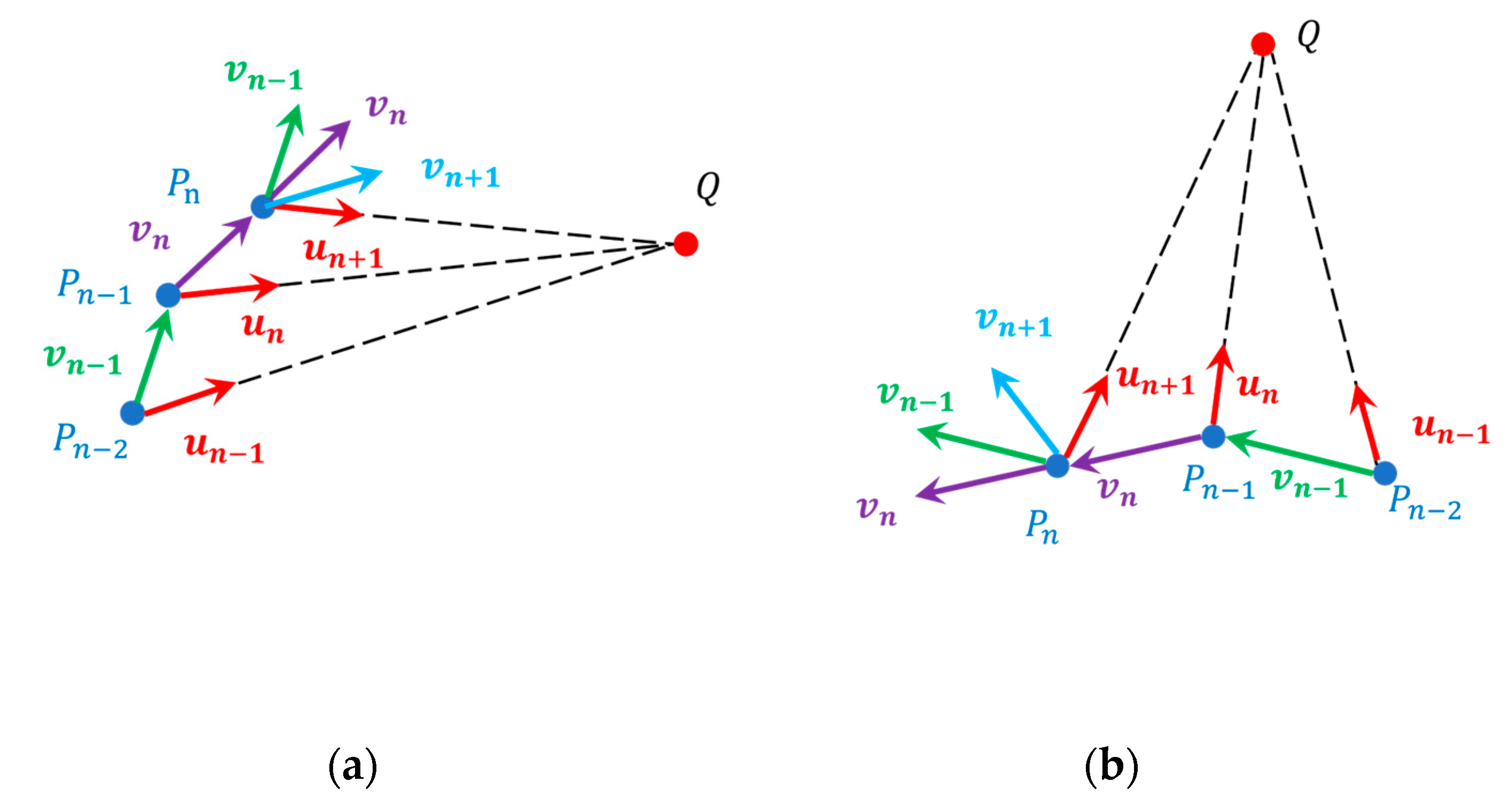
For geomagnetic navigation technology, taking inspiration from nature and leveraging the principle of animals’ utilization of the geomagnetic field for long-distance navigation, and employing biomimetic technology to develop higher-precision geomagnetic sensors and more advanced navigation strategies, has emerged as a new trend. Based on the two widely acknowledged biological magnetic induction mechanisms, we have designed a bioinspired weak magnetic vector (BWMV) sensor and integrated it with neural networks to achieve geomagnetic matching navigation. In this paper, we assess the performance of the BWMV sensor through finite element model simulation. The result validates its high measurement accuracy and outstanding adaptability to installation errors with the assistance of specially trained neural networks. Furthermore, we have enhanced the bioinspired geomagnetic navigation algorithm and proposed a more advanced search strategy to adapt to navigation under the condition of no prior geomagnetic map. A simulated geomagnetic navigation platform was constructed based on the finite element model to simulate the navigation of the BWMV sensor in geomagnetic environments. The simulated navigation experiment verified that the proposed search strategy applied to the BWMV sensor can achieve high-precision navigation. This study proposes a novel approach for the research of bioinspired geomagnetic navigation technology, which holds great development prospects.
1. Introduction
In the field of geomagnetic navigation technology, the accurate measurement of geomagnetic fields serves as the foundation for achieving autonomous navigation in geomagnetic environments [1,2]. The ongoing advancement of fundamental physics research and modern electronic technology is driving the continuous development of magnetic field detection technology, enhancing geomagnetic measurements towards higher precision [3,4]. Simultaneously, concomitant with the advancement of biomimetic technology, research on obtaining inspiration from biological systems and applying them to geomagnetic navigation is constantly evolving, including the development of bioinspired geomagnetic sensors [5,6]. Bioinspired geomagnetic sensors draw inspiration from the magnetic sensing mechanism of animals and offer a novel approach to enhancing the performance of geomagnetic sensors by imitating the utilization of geomagnetic field in animal navigation process.
The two main magnetic sensing mechanisms currently include the magnetic particle mechanism and the free radical pairs mechanism. The magnetic particle mechanism refers to the fact that magnetic particles in animal bodies trigger neural signals under external magnetic fields, thus achieving perception of the magnetic field [7,8]. The free radical pair mechanism refers to the magnetic sensing mechanism based on chemical magnetic receptors. This mechanism relies on the free radicals induced by photoreceptors to form intermediates [9]. The earliest discovered intermediate of free radicals is cryptochrome (Cry), which has been increasingly demonstrated to be involved in the mechanism by which migratory songbirds sense the direction of the geomagnetic field [10,11].
A further crucial area of investigation within the field of bioinspired geomagnetic navigation is the analysis and emulation of navigation strategies employed by living organisms. Inspired by animals such as pigeons and turtles to utilize geomagnetic information for long-distance migration and homing, current research is increasingly focused on achieving navigation without prior geomagnetic maps. In this context, the pivotal challenge pertains to the effective utilization of magnetic field data in the process of path planning and correction. In recent years, researchers have studied various algorithms to address these issues [12,13,14], including the probability evolution strategy [15], the model predictive control algorithm [16], and the differential evolution algorithm [17].
In the study of the magnetic sensing mechanism in birds, our research team found that there may be some coupling between the magnetic particle mechanism and the free radical mechanism in the magnetic sensing process of birds [18]. Based on the coupling magnetic sensing mechanism, we designed a bioinspired weak magnetic vector (BWMV) sensor which consists of a magnetic rod and a sensor plane, simulating two different magnetic sensing mechanisms. Geomagnetic navigation experiments were conducted under a simulated geomagnetic navigation device based on three-dimensional Helmholtz coils, verifying the effectiveness of the sensor in geomagnetic matching navigation [19]. For the BWMV sensor, further studies are required regarding its robustness and adaptability to installation errors. Additionally, researching bioinspired geomagnetic navigation strategies suitable for this sensor to achieve geomagnetic navigation without prior geomagnetic maps is also a direction worthy of exploration.
As mathematical modeling and simulation serve as complementary means for investigating geomagnetic navigation [20], the finite element simulation was applied to simulate the measurement of the sensor in a magnetic field environment. Additionally, neural networks were used to convert the values measured directly by the BWMV sensor into the measurement results of external magnetic field parameters. By comparing the measurement results of the BWMV sensor under different noise environments, the robustness of the sensor was studied, and the impact of installation errors on the sensor was discussed.
On this basis, we propose a navigation algorithm without prior geomagnetic maps and construct a simulated geomagnetic navigation platform based on a finite element simulation model to verify the geomagnetic navigation performance of the algorithm applied to the BWMV sensor. The results demonstrate that the BWMV sensor with high-precision magnetic measurement performance combined with this navigation algorithm has excellent adaptability in simulating geomagnetic environments and can accurately complete navigation according to the set accuracy.
2. The Design and Simulation of the BWMV Sensor
2.1. The Basic Principles of the BWMV Sensor
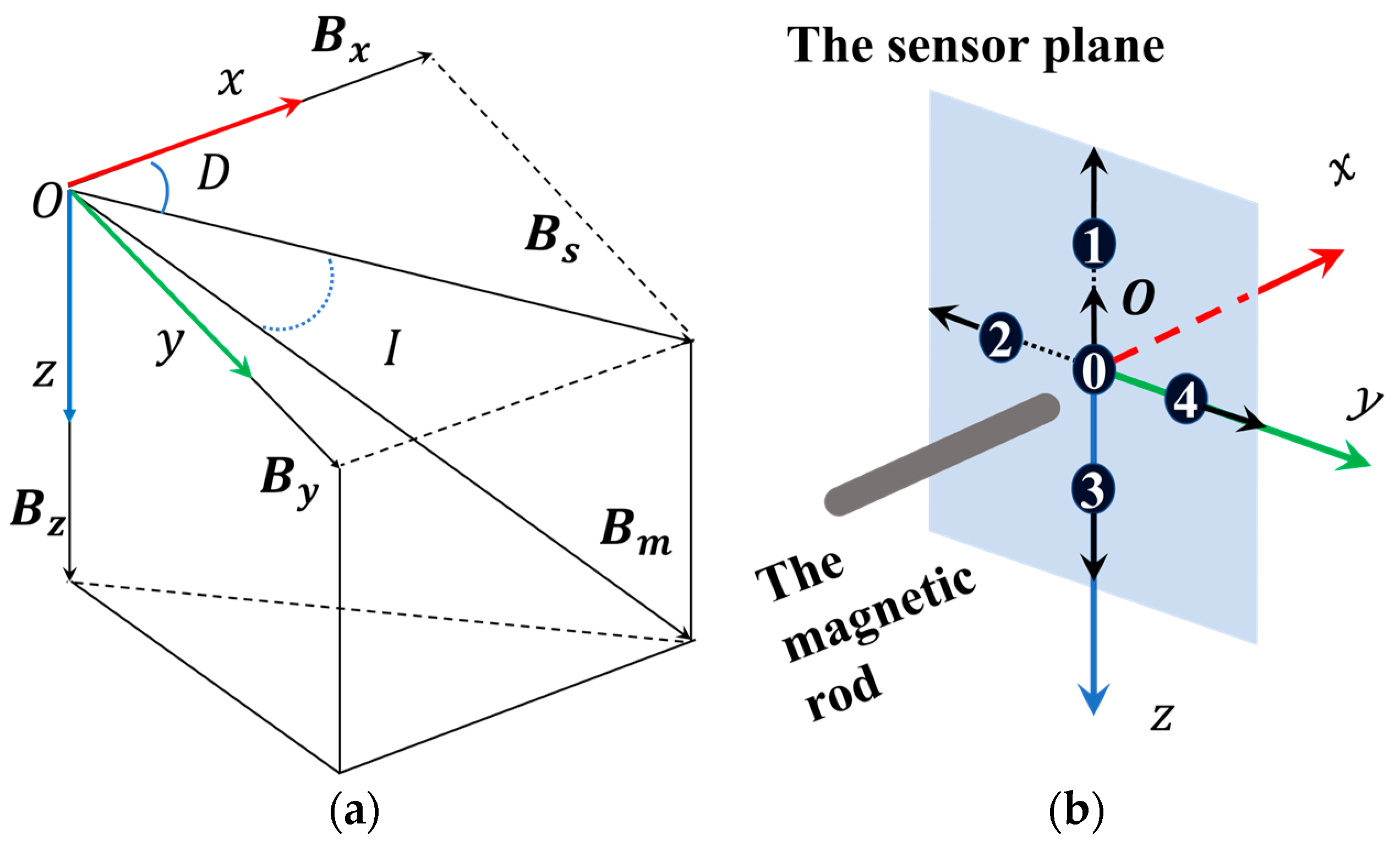
To discuss the BWMV sensor, it is necessary to define the basic concepts of the geomagnetic field. For any position on the Earth, there exists a geomagnetic field vector, which can be defined as , as shown in Figure 1a. We establish a Cartesian coordinate system that coincides with the geographic coordinate system to analyze the geomagnetic field vector, where the positive directions of the x-axis, y-axis, and z-axis correspond to geographic north, geographic east, and perpendicular downward, respectively. Therefore, , , and are the projections of on the three coordinate axes, respectively. In addition, the projection of on the horizontal plane is defined as , and the mutual relationship between geomagnetic components can also be represented by angles. The angle between and is defined as the magnetic declination , which is positive in a clockwise direction. The angle between and is defined as the magnetic inclination , which is positive when oriented downward along the horizontal plane.

Figure 1.
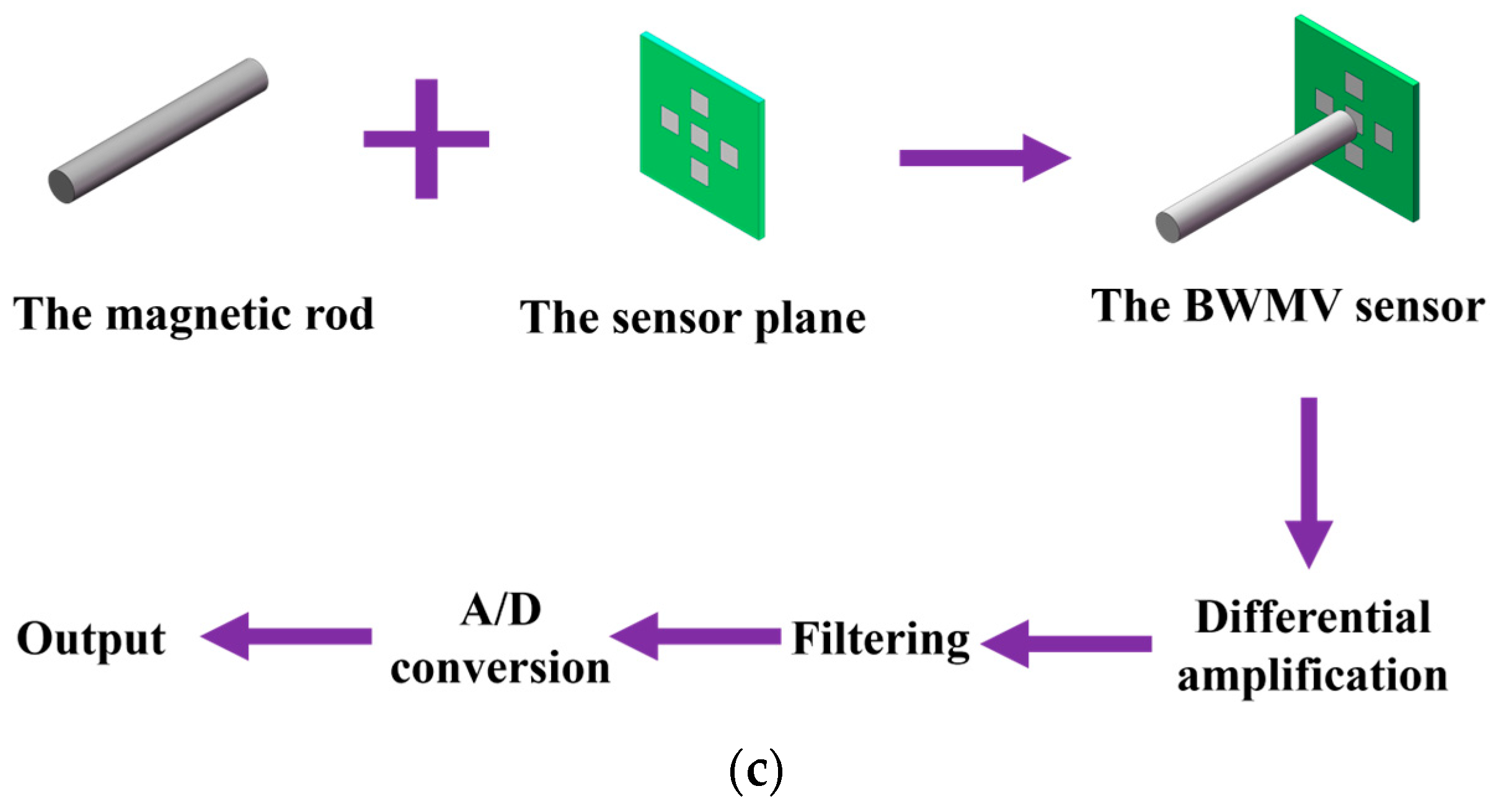
(a) Schematic diagram of the geomagnetic field vector and elements; (b) structure diagram of the BMWV sensor; (c) principle of the BMWV sensor.
In accordance with the established definition of a geomagnetic field, complete geomagnetic information can typically be represented by two sets of scalars, , , and , , . The relationship between these variables can be expressed as follows:
In the actual process of measuring the geomagnetic field, the geomagnetic field measured by the sensor is related to the attitude of the sensor. This involves the conversion and calculation of the coordinate system between the sensor and the geomagnetic field. In this paper, to simplify the problem, the two coordinate systems are set to be consistent.
The structure and principle of the BWMV sensor are illustrated in Figure 1b and Figure 1c, respectively. The BMWV sensor is composed of two principal elements: a magnetic rod and a sensor plane. The magnetic rod emulates the mechanism of magnetic particles, changing the distribution of the surrounding magnetic field in a magnetic field environment. This enables the detection of magnetic field information in a plane. The sensor plane emulates the mechanism of free radical pairs. In this mechanism, the proportion and distribution of singlet and triplet states of free radical pair products are influenced by the external magnetic field angles. Therefore, by detecting the distribution of magnetic field on the plane under the influence of the magnetic rod, the perception of magnetic field information can be realized. The combined action of the magnetic rod and sensor plane allows the BWMV sensor to simulate the joint magnetic sensing mechanism of magnetic particles and free radicals. The signal generated by the sensor under a magnetic field is subjected to differential amplification, filtering, A/D conversion, and finally output.
The finite element method is a numerical analysis method for solving partial differential equations and simulating physical systems. The method discretizes the continuous solution domain into finite elements with simple shapes such as triangles or quadrilaterals. By approximating unknown functions on each element, it generates element equations and combines them into an algebraic equation system, obtaining the approximate solutions.
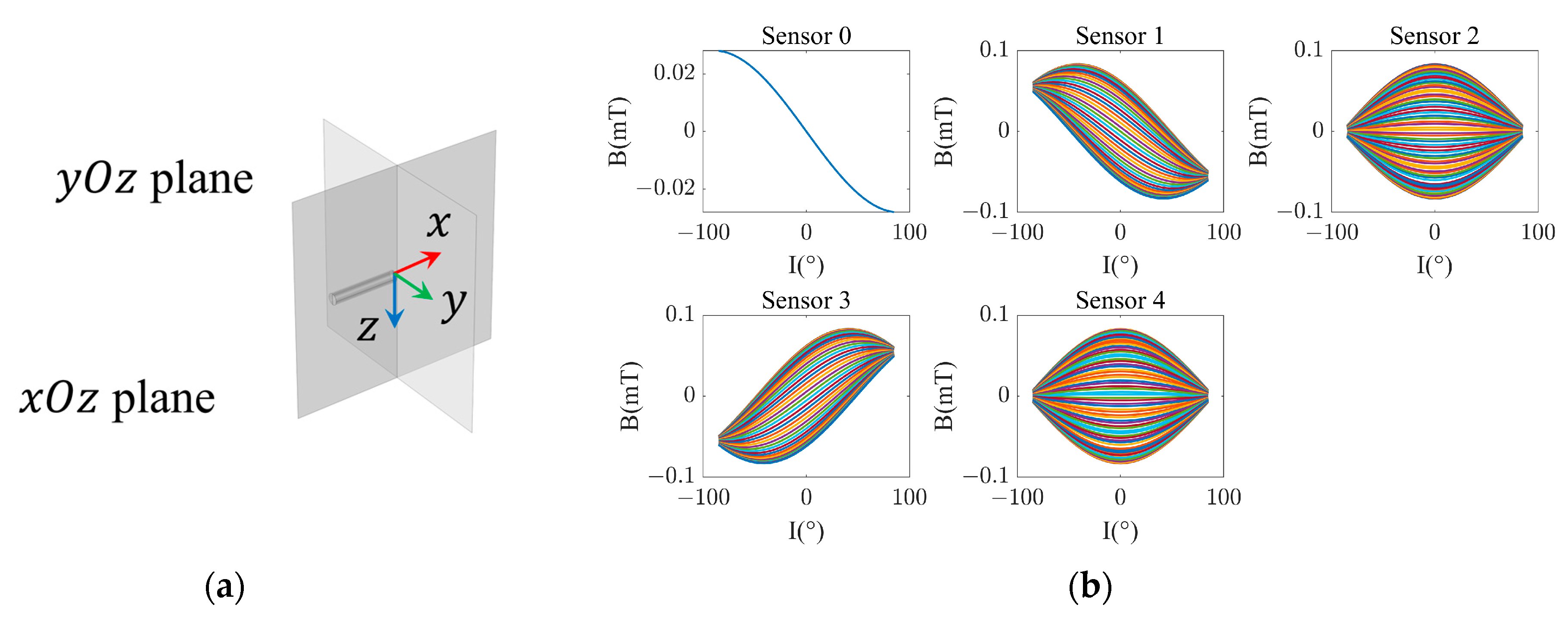
In this paper, a general simulation software based on advanced numerical methods (COMSOL Multiphysics, COMSOL Inc., Stockholm, Sweden) is employed as a finite element tool for the investigation of the BWMV sensor. As illustrated in Figure 2a, a small cylinder simulates a magnetic rod in COMSOL Multiphysics, which is in a cube measuring 500 × 500 × 500 mm. The center of the cube coincides with the coordinate origin, and the coordinate axis passes through the center of each face. The cube simulates the air around the magnetic rod, and its boundary conditions are set to external magnetic flux density. The sensor plane is located on the plane, and the distance between the end of the cylinder and the plane is set to 1.5 mm. The relative magnetic permeability of the cylinder is 2000 with a radius of 2.5 mm and a length of 30 mm.
Figure 2.
(a) The relative position between the magnetic rod and the planes; (b) the simulated measured values of sensors with fixed magnetic flux density.
With a fixed total magnetic flux density of = 0.05 mT, parameterized scans were performed on the finite element model by changing the magnetic declination and magnetic inclination , where = (−180, 180°), = (−90, 90°), and the step sizes are 5°. The results are shown in Figure 2b, in which each curve represents the variation in the magnetic flux density of the sensor with the magnetic inclination while maintaining the magnetic declination constant. For sensor 0, all curves are identical, indicating that the measured value of the sensor is independent of . However, the simulated measured values of sensors 1 to 4 vary with and , indicating that the simulated magnetic field measurements at these points can effectively reflect the changes in the magnetic field angle.
2.2. The Accuracy and Robustness of the BWMV Sensor
As the directly measured values of the BWMV sensor are the magnetic flux densities of five sensors, it is still necessary to convert these directly measured values of the sensors into the measurement results of the corresponding magnetic field parameters , , and . The artificial neural networks are used as a tool to implement this process. Artificial neural networks, as a mathematical model derived from the cognitive functions of living organisms, have a wide range of applications in fields such as signal and image processing due to their powerful data analysis capabilities [21,22]. With the emergence of big data and artificial intelligence, neural networks have been widely utilized in geomagnetic navigation technology due to their universality in solving practical problems and good intelligent characteristics [23,24].
In this paper, we continue to employ the three-layer BP neural network that was utilized in our previous work [19]. In a three-layer neural network, the number of input nodes and output nodes must be determined based on the specific problems and the task requirements. For the input layer, the number of nodes needs to be set in a way that fully expresses the feature information of the input data. As for the output layer, the number of nodes should be configured so that the output results are easy to understand and interpret, providing valuable information for decision making. The number of nodes in the hidden layer, which directly affects the accuracy of neural networks, needs to be set according to the training data and the actual situation of the neural network [25,26,27]. In this paper, we compare the performance of corresponding validation sets for different numbers of hidden layer nodes to select the most appropriate number of nodes.
When using neural networks to calculate magnetic field parameters, it is considered that the relationship between the magnetic inclination angle and the magnetic induction intensity in a single direction may include an arctangent function, which increases the scale of the artificial neural network and reduces the calculation accuracy. Accordingly, the magnetic field components in three directions , and are employed as output values for calculation, and subsequently converted to obtain , , and . According to Equation (1), the conversion formula can be expressed as follows:
The objective of the neural network is to convert the magnetic flux densities of five points into corresponding magnetic field parameters; that is, the nodes of the input layer represent the magnetic flux densities of the five points, and the nodes of the output layer correspond to the magnetic field parameters , and . Therefore, the number of nodes in the input layer and output layer is 5 and 3, respectively.
Furthermore, the root mean squared error (RMSE) is employed to evaluate the accuracy of the neural network model in calculating the geomagnetic parameters measured by the sensor. The calculation formula for RMSE is as follows:
where is the data length, and and represent the -th corresponding values of the two datasets, which represent the set magnetic field parameters and the calculated magnetic field parameters, respectively.
The input values and corresponding output values are randomly partitioned in a ratio of 0.7:0.15:0.15 for the training set, validation set, and test set with respective quantities of 1739, 373, and 373, respectively. The training process of neural networks involves the initialization of the neural network and the application of learning algorithms to train ordinary parameters on the training set with the objective of minimizing the model’s error on the training set. Subsequently, the generalization ability of the network must be validated using the validation set, and the hyperparameters can be adjusted based on model performance. These two steps should be repeated until the network achieves a lower generalization error on the validation set, at which point the entire training process will have concluded. After adjusting various hyperparameters such as transfer functions and the number of hidden layer nodes to train the neural network, the network is evaluated using the test set, and the network with the smallest RMSEs is selected. The number of nodes in the hidden layer is 20. The transfer function between the input layer and the hidden layer is “purelin”, and the transfer function between the hidden layer and the output layer is “satlins”. The RMSEs of , , and were 4.11 × 10⁻⁵ μT, 0.10″ and 0.23″, respectively.
The robustness of the current scheme was studied using Gaussian white noise. Before calculating the magnetic field parameters, different proportions of Gaussian white noise were added to the magnetic fields at five locations. The RMSEs between the set and calculated values of the magnetic field parameters after adding noise are presented in Table 1 for comparison. The inversion accuracy of magnetic induction intensity is high with low external magnetic field noise, while the error also significantly increases as the noise power increases.
Table 1.
Comparison of RMSE values for solving geomagnetic parameters using signals with noise.
2.3. The Adaptability of the BWMV Sensor to Installation Errors
It is possible that there may be certain deviations in the relative positions and angles of each sensor on the plane, which could also affect the accuracy of inversion. In the case of positional errors, a deviation of 1% of δ (0.04 mm) is assumed. For angular errors, a rotation angle of ±1° is considered with a positive value indicating a clockwise direction. The research method is to deviate the position or angle of a single point at a time while maintaining the ideal positions of the remaining points. The RMSE of the magnetic field parameters is then calculated in comparison compared to the set values.
Firstly, the impact of installation errors of the center position sensor, i.e., sensor 0, on the calculation results is discussed. The calculation results of magnetic field parameters caused by different errors are presented in Table 2. The offset of sensor 0 on the y-axis has the least impact on the RMSEs of the magnetic field parameters. However, the deviation of RMSEs caused by the offset on the x-axis and the rotation of the angle is relatively large, indicating that the neural network trained using magnetic field parameters at ideal positions is susceptible to the installation errors of sensor 0.
Table 2.
The influence of position error of sensor 0.
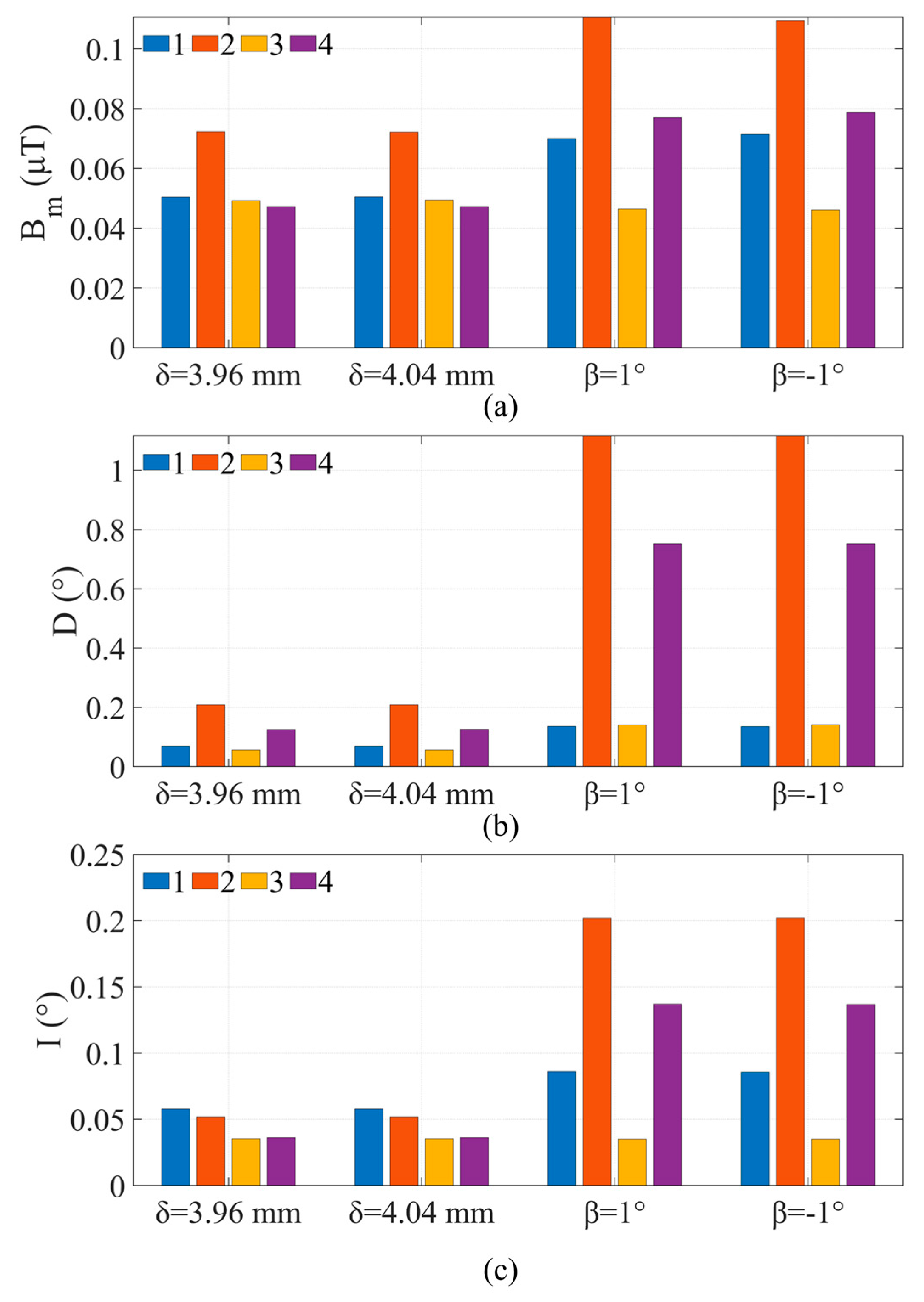
Regarding the remaining four sensors, the research method entails alternating the movement of a single point while maintaining the optimal positioning of the remaining points. The result is illustrated in Figure 3. The influence of installation errors on the total magnetic induction intensity is relatively minimal. For the magnetic declination , the RMSEs resulting from installation errors of sensors 1 and 3 are within 0.2°, while the impact of angular rotation of sensors 2 and 4 is significant. In the case of = ±1°, the RMSE can exceed 1°, which is far higher than the impact of sensors 1 and 3 under the same conditions. For magnetic inclination , the RMSEs caused by sensor installation errors are within 0.25°. In addition, due to the larger RMSEs of the magnetic field parameters caused by the position and angle errors of sensor 2 compared to other sensors, it is speculated that there may be a higher correlation weight for sensor 2 in the neural network, which makes the inversion results of sensor 2 more sensitive to its errors.
Figure 3.
RMSEs of (a) , (b) and (c) affected by non-ideal relative position of sensors.
Due to the high flexibility and universality of neural networks in computing data, the installation errors can be addressed by retraining the actual measured values to obtain a new network and apply it, which is like making a correction based on installation errors. To verify its feasibility, we simulated the directly measured values of the BWMV sensor corresponding to the installation errors by simulation and used them to train new neural networks. For the 22 sets of data with installation errors, the neural networks were retrained by adopting the same method as that used for the data of the ideal position. The new neural networks were utilized to invert the data with installation errors to obtain the RMSEs. Table 3 shows the maximum values of RMSE of , , and corresponding to different installation errors of each sensor, which are less than 0.02 nT, 0.2″ and 0.1″, respectively. It indicates that for the BMWV sensor with possible installation errors, the accurate conversion of magnetic field parameters from sensor measurements can also be accomplished by training a suitable neural network.
Table 3.
Maximum values of RMSEs of data with installation errors: solved by retrained new networks.
5. Conclusions
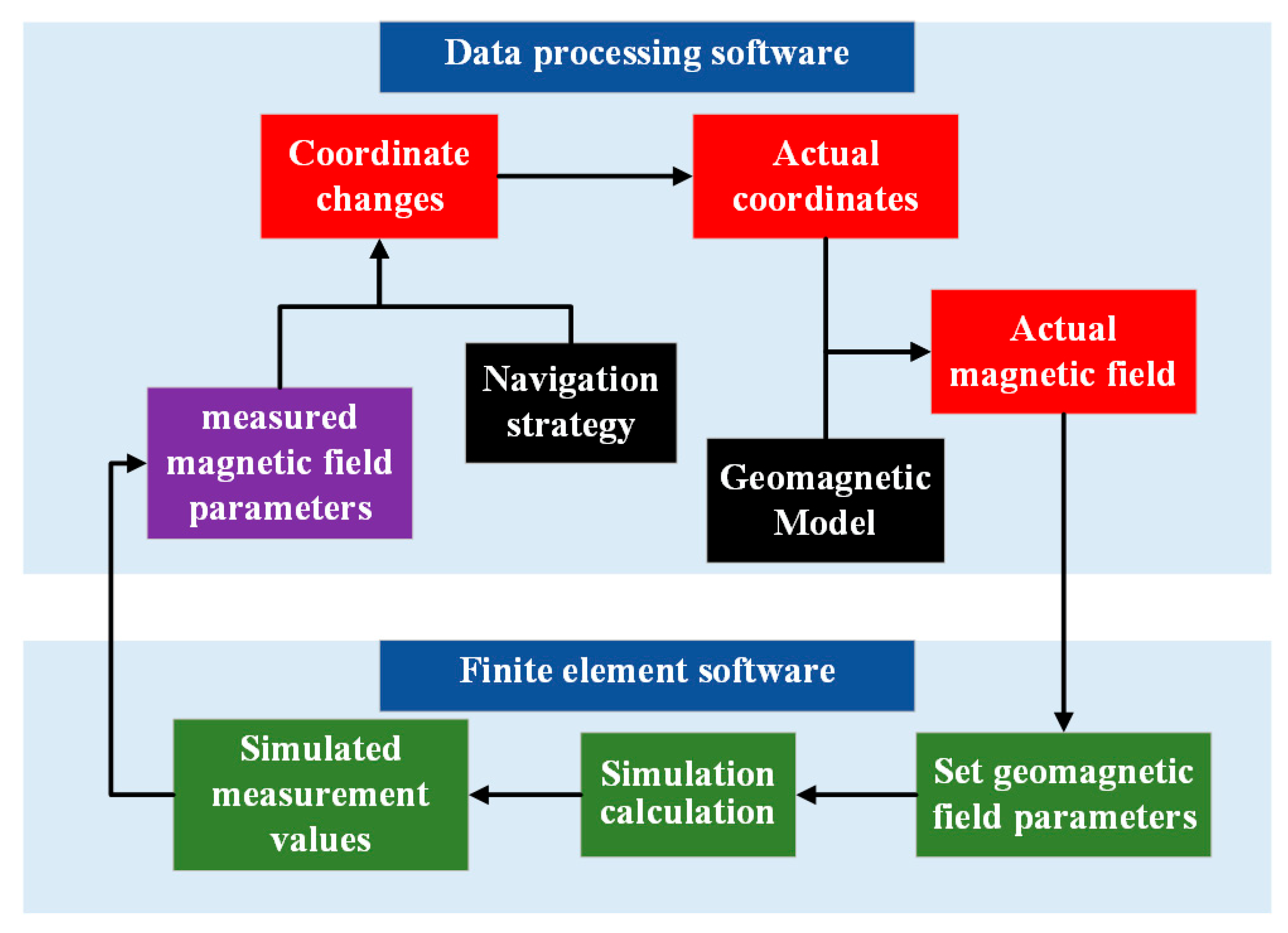
This research primarily hinges on the BWMV sensor based on the joint magnetic induction mechanism, and it further investigates and verifies the performance of the sensor through finite element analysis. A pathfinding algorithm without prior geomagnetic maps is designed and combined with a simulated navigation platform constructed based on finite element software to verify the navigation performance of the sensor in geomagnetic environments, achieving meaningful results.
By employing a finite element model, the BWMV sensor measures and analyzes geomagnetic field parameters via five magnetic field values on the sensor plane. During this process, a neural network is employed to achieve high-precision mapping from the measured values to the magnetic field parameters. The RMSE values of , , and calculated are less than 10−4 μT, 0.2″, and 0.3″, respectively, demonstrating extremely high measurement accuracy.
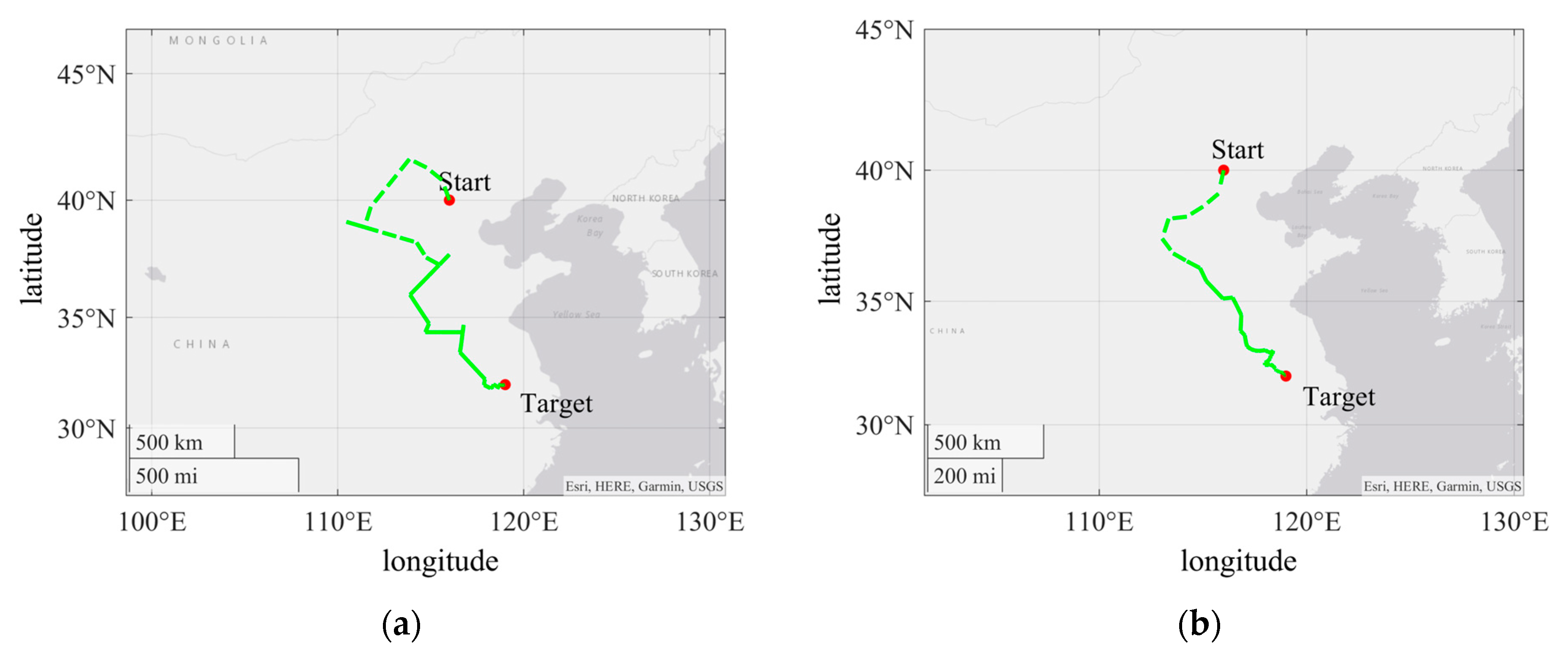
Furthermore, we examined the navigation performance of the BWMV sensor using a simulated geomagnetic navigation platform based on finite element software. The results indicated that the BWMV sensor can conduct high-precision navigation without prior geomagnetic maps. The ratio of the distance between the endpoint and the target point to the starting distance is less than 0.1%. Even with interference from random angles, high accuracy has been achieved. This indicates that the algorithm has good robustness and promising application prospects.
Currently, the BWMV sensor in this paper is merely at the simulation level. Hence, to demonstrate the measurement accuracy and navigation performance of the sensor more effectively is the next step of research. We will upgrade the platform to include discussions on issues such as carrier attitude and sensor error interference to further approach the actual environment. In addition, we will also extend the sensor and navigation experiments to the laboratory and even practical environments, furnishing more valuable experiences for the research of geomagnetic navigation technology.
In summary, this study has made significant contributions to the field of sensor technology. The BWMV sensor has a positive influence on the development of geomagnetic navigation. However, further efforts are needed to fully unlock its potential and facilitate further progress in this crucial research field.
Author Contributions
Conceptualization, H.S. and Q.W.; methodology, H.S. and R.T.; software, H.S.; validation, H.S., R.T. and T.S.; formal analysis, R.T.; investigation, Q.W.; resources, H.S.; data curation, H.S.; writing—original draft preparation, H.S.; writing—review and editing, T.S.; visualization, H.S.; supervision, R.T.; project administration, T.S.; funding acquisition, T.S. All authors have read and agreed to the published version of the manuscript.
Funding
This research was funded by the National Natural Science Foundation of China, grant number 51937011.
Institutional Review Board Statement
Not applicable.
Informed Consent Statement
Not applicable.
Data Availability Statement
The data presented in this study are available on request from the corresponding author.
Conflicts of Interest
The authors declare no conflicts of interest.
References
- Zhao, H.; Zhang, N.; Xu, L.; Lin, P.; Liu, Y.; Li, X. Summary of Research on Geomagnetic Navigation Technology. IOP Conf. Ser. Earth Environ. Sci. 2021, 769, 032031. [Google Scholar] [CrossRef]
- Zhang, X.; Zhao, Y. Analysis of key technologies in geomagnetic navigation. In Proceedings of the International Symposium on Instrumentation and Control Technology, Beijing, China, 10–13 October 2008; p. 71282J. [Google Scholar]
- Li, W.; Wang, J.L. Magnetic Sensors for Navigation Applications: An Overview. J. Navig. 2014, 67, 263–275. [Google Scholar] [CrossRef]
- Khan, M.A.; Sun, J.; Li, B.; Przybysz, A.; Kosel, J. Magnetic sensors—A review and recent technologies. Eng. Res. Express 2021, 3, 022005. [Google Scholar] [CrossRef]
- Cheng, Q.; Sun, J.; Ge, Y.; Xue, L.; Mao, H.; Zhou, L.; Zhao, J. Bionic Magnetic Sensor Based on the MagR/Cry4 Complex-Configured Graphene Transistor with an Integrated On-Chip Gate. ACS Sens. 2023, 8, 793–802. [Google Scholar] [CrossRef]
- Cheng, Q.; Ge, Y.; Lin, B.; Zhou, L.; Mao, H.; Zhao, J. Capacitive Bionic Magnetic Sensors Based on One-Step Biointerface Preparation. ACS Appl. Mater. Interfaces 2024, 16, 6789–6798. [Google Scholar] [CrossRef]
- Winklhofer, M. The Physics of Geomagnetic-Field Transduction in Animals. IEEE Trans. Magn. 2009, 45, 5259–5265. [Google Scholar] [CrossRef]
- Kirschvink, J.L.; Gould, J.L. Biogenic Magnetite as a Basis for Magnetic-Field Detection in Animals. BioSystems 1981, 13, 181–201. [Google Scholar] [CrossRef]
- Hore, P.J.; Mouritsen, H. The Radical-Pair Mechanism of Magnetoreception. Ann. Rev. Biophys. 2016, 45, 299–344. [Google Scholar] [CrossRef]
- Zoltowski, B.D.; Chelliah, Y.; Wickramaratne, A.; Jarocha, L.; Karki, N.; Xu, W.; Mouritsen, H.; Hore, P.J.; Hibbs, R.E.; Green, C.B.; et al. Chemical and structural analysis of a photoactive vertebrate cryptochrome from pigeon. Proc. Natl. Acad. Sci. USA 2019, 116, 19449–19457. [Google Scholar] [CrossRef]
- Hochstoeger, T.; Al Said, T.; Maestre, D.; Walter, F.; Vilceanu, A.; Pedron, M.; Cushion, T.D.; Snider, W.; Nimpf, S.; Nordmann, G.C.; et al. The biophysical, molecular, and anatomical landscape of pigeon CRY4: A candidate light-based quantal magnetosensor. Sci. Adv. 2020, 6, eabb9110. [Google Scholar] [CrossRef]
- Li, H.; Liu, M.; Liu, K.; Zhang, F. A Study on the Model of Detecting the Variation of Geomagnetic Intensity Based on an Adapted Motion Strategy. Sensors 2018, 18, 39. [Google Scholar] [CrossRef] [PubMed]
- Jun, Z.; Qiong, W.; Cheng, C. Geomagnetic gradient bionic navigation based on the parallel approaching method. Proc. Inst. Mech. Eng. Part G-J. Aerosp. Eng. 2019, 233, 3131–3140. [Google Scholar] [CrossRef]
- Liu, M.Y.; Liu, K.; Peng, X.G.; Li, H. Bio-inspired navigation based on geomagnetic for the autonomous underwater vehicle. In Proceedings of the OCEANS 2014, Taipei, Taiwan, 7–10 April 2014. [Google Scholar]
- Guo, J.J.; Liu, M.Y.; Wang, M.F.; Zhou, X.X.; Yang, Y. Bio-inspired Geomagnetic Navigation Algorithm Based on Segmented Search for AUV. In Proceedings of the 2018 IEEE International Conference on Robotics and Biomimetics (ROBIO), Kuala Lumpur, Malaysia, 12–15 December 2018; pp. 100–105. [Google Scholar] [CrossRef]
- Zhang, Y.; Liu, X.; Luo, M.; Yang, C. Bio-Inspired Approach for Long-Range Underwater Navigation Using Model Predictive Control. IEEE Trans. Cybern. 2021, 51, 4286–4297. [Google Scholar] [CrossRef] [PubMed]
- Zhou, Y.Q.; Niu, Y.; Liu, M.Y. Bionic Geomagnetic Navigation Method for AUV Based on Differential Evolution Algorithm. In Proceedings of the 2022 Ocean. Hampton Roads, Virtual, 17–20 October 2022. [Google Scholar] [CrossRef]
- Lü, Y.; Song, T. Avian magnetoreception model realized by coupling a magnetite-based mechanism with a radical-pair-based mechanism. Chin. Phys. B 2013, 22, 048701. [Google Scholar] [CrossRef]
- Shi, H.; Tang, R.; Wang, Q.; Song, T. Application of bioinspired geomagnetic sensor measurements and geomagnetic map modeling based on neural networks in simulated navigation. Meas. Sci. Technol. 2024, 35, 045127. [Google Scholar] [CrossRef]
- Gill, J.P.; Taylor, B.K. Navigation by magnetic signatures in a realistic model of Earth’s magnetic field. Bioinspiration Biomim. 2024, 19, 036006. [Google Scholar] [CrossRef]
- Hinton, G.; Deng, L.; Yu, D.; Dahl, G.E.; Kingsbury, B. Deep Neural Networks for Acoustic Modeling in Speech Recognition: The Shared Views of Four Research Groups. ISPM 2012, 29, 82–97. [Google Scholar] [CrossRef]
- Krizhevsky, A.; Sutskever, I.; Hinton, G. ImageNet Classification with Deep Convolutional Neural Networks. Adv. Neural Inf. Process. Syst. 2012, 25, 84–90. [Google Scholar] [CrossRef]
- Chen, Z.; Liu, K.; Zhang, Q.; Liu, Z.; Chen, D.; Pan, M.; Hu, J.; Xu, Y. Geomagnetic Vector Pattern Recognition Navigation Method Based on Probabilistic Neural Network. IEEE Trans Geosci Remote Sens 2023, 61, 1–8. [Google Scholar] [CrossRef]
- Ma, X.; Zhang, J.; Li, T. Geomagnetic reference map super-resolution using convolutional neural network. Meas. Sci. Technol. 2024, 35, 015014. [Google Scholar] [CrossRef]
- Haykin, S. Neural Networks: A Comprehensive Foundation; Prentice Hall PTR: Upper Saddle River, NJ, USA, 1994. [Google Scholar]
- Rumelhart, D.E.; Hinton, G.E.; Williams, R.J. Learning representations by back-propagating errors. Nature 1986, 323, 533–536. [Google Scholar] [CrossRef]
- Hinton, G.E.; Osindero, S.; Teh, Y. A Fast Learning Algorithm for Deep Belief Nets. Neural Comput. 2006, 18, 1527–1554. [Google Scholar] [CrossRef] [PubMed]
- Alken, P.; Erwan, T.; Beggan, C.D.; Amit, H.; Aubert, J.; Baerenzung, J.; Bondar, T.N.; Brown, W.; Califf, S.; Chambout, A.; et al. International Geomagnetic Reference Field: The thirteenth generation. Earth Planets Space 2020, 73, 49. [Google Scholar] [CrossRef]
Disclaimer/Publisher’s Note: The statements, opinions and data contained in all publications are solely those of the individual author(s) and contributor(s) and not of MDPI and/or the editor(s). MDPI and/or the editor(s) disclaim responsibility for any injury to people or property resulting from any ideas, methods, instructions or products referred to in the content. |
© 2024 by the authors. Licensee MDPI, Basel, Switzerland. This article is an open access article distributed under the terms and conditions of the Creative Commons Attribution (CC BY) license (https://creativecommons.org/licenses/by/4.0/).