


Abstract
In this paper, we explore the physical propagation environment of radio waves by describing it in terms of distant scattering clusters. Each cluster consists of numerous scattering objects that may exhibit certain statistical properties. By utilizing geometry-based methods, we can study the channel second-order statistics (CSOS), where each distant scattering cluster corresponds to a CSOS, contributes a portion to the Doppler spectrum, and is associated with a state-space multiple-input and multiple-output (MIMO) radio channel model. Consequently, the physical propagation environment of radio waves can be modeled by summing multiple state-space MIMO radio channel models. This approach offers three key advantages: simplicity, the ability to construct the entire Doppler power spectrum from multiple uncorrelated distant scattering clusters, and the capability to obtain the channels contributed by these clusters by summing the individual channels. This methodology enables the reconstruction of the radio wave propagation environment in a simulated manner and is crucial for developing massive MIMO channel models.
1. Introduction
In the field of radio communications, there has been a remarkable evolution from traditional voice telephony to today’s diverse range of communication methods, including multimedia, augmented reality (AR), virtual reality (VR), mixed reality (MR), and the Internet of Everything (IoE) [1,2,3]. This historical process has highlighted a consistent trend: the growing need for higher data transfer rates, which is the fundamental driver for advances in communication technologies and methods.
One of the major challenges in radio communications is the accurate modeling of the radio channel. The radio channel consists of the effects of the electromagnetic (EM) wave propagation medium on the signal as it travels from the transmitter to the receiver. Understanding and modeling these effects is critical to the design of efficient communication systems, as they affect signal quality, data transfer rate, and overall system performance. Effective channel modeling requires consideration of various factors such as path loss, multi-path fading, shadowing, and Doppler shift, all of which can significantly alter the received signal [4,5,6].
Figure 1 depicts a typical terrestrial radio propagation environment. The basic characteristic of radio channels is fading, large-scale and small-scale fading (This refers to the concept of distance described in terms of wavelengths), which can be classified as path loss, multi-path fading, shadowing and Doppler shift on the move. Among them, multi-path fading is known as small-scale fading, and its characteristics vary with time and change over frequency and space. That is, due to the multi-path propagation of EM waves, power-limited transmitted signals will be distorted at a receiver over time, frequency, and space simultaneously [4,5,6].
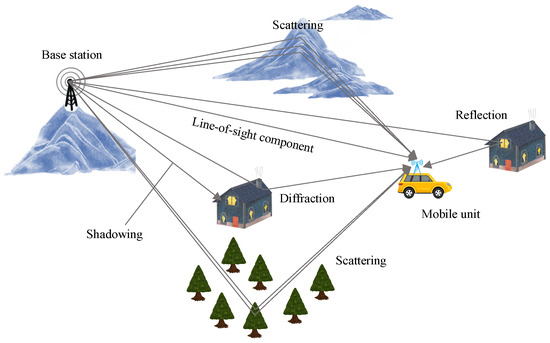
Figure 1.
A typical mobile radio scenario for multi-path propagation in a terrestrial radio propagation environment.
To better understand the mechanisms underlying the distortion, it is essential to study this physical phenomenon in depth. In this paper, we explore the physical propagation environment of radio waves by describing it in terms of distant scattering clusters. Each cluster consists of numerous scattering objects that may exhibit certain statistical properties. By utilizing the geometry-based approach introduced in the literature [7,8,9,10], we can study the CSOS, where each distant scattering cluster corresponds to a CSOS that partially contributes to the Doppler spectrum and is associated with a state-space MIMO radio channel model. Consequently, the physical propagation environment of radio waves can be modeled by summing multiple state-space MIMO radio channel models.
The concept behind the geometry-based stochastic modeling approach involves mapping the spatial locations of scatterers within a cluster to an angular power distribution through the trigonometric relationships among the scatterers, the cluster center, and the receiver or transmitter. When the cluster follows a specific probability distribution, this angular power distribution exhibits particular statistical properties. Therefore, this method is intuitively simple and straightforward.
A distant scattering cluster leads to small variations in the angle of departure (AOD) and angle of arrival (AOA), resulting in a narrow-band Doppler spectrum at both the base station (BS) and mobile station (MS). This characteristic allows for the calculation of the CSOS using a small angular approach. This method is well-suited for decomposing the Doppler power spectrum into small, uncorrelated portions.
Figure 2 illustrates the AOA and AOD, a scattering object within a cluster, a MIMO antenna array, and the relationships among the transmitter, scatterer, and receiver, in which the BS is equipped with antenna sensors and the MS with antenna sensors. The BS remains stationary, while the MS is in motion. This diagram helps visualize the interactions and dependencies between these components in the context of radio wave propagation.
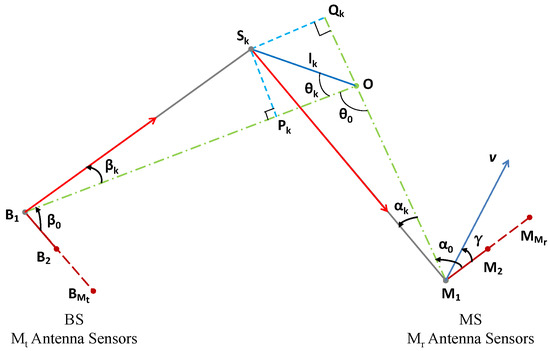
Figure 2.
A distant cluster with an MIMO antenna array, is the distance between the scattering object and the cluster center O.
Thus, the spatial–temporal–spectral correlation function (STSCF) of a MIMO-OFDM (orthogonal frequency division multiplexing) channel can be expressed as [11,12]:
where is the Doppler frequency, is the time separation, and represents the MS displacement. Angles and signify the AOD and AOA, respectively, with means denoted by and . The angle is between the moving direction and the antenna array, as illustrated in Figure 2. At the BS, denotes antenna spacing, where and is the spacing between two adjacent antenna sensors, and at the MS, represents the antenna spacing, where , and is the spacing between two adjacent antenna sensors. The frequency separation , with sub-carrier frequencies defined as , in which , and is the carrier frequency. In the case of , it signifies a single-carrier modulation system, a MIMO system. The joint angular-delay power distribution function is denoted as , where represents the time delay.
Assuming independence among , , and , the joint angular-delay power distribution function can be factorized as . Here, represents the angular power distribution function (APDF) of the AOA, denotes the APDF of the AOD, and is the delay power distribution function (DPDF) corresponding to the time of arrival (TOA).
This assumption is justified as radio signals typically pass through multiple scatterers within a cluster when propagating from a transmitter to a receiver, implying independence between and . Obviously, is inherently independent of both and .
Using Taylor expansion for small angles, Equation (1) is simplified to:
with special cases for the channel temporal dynamic function :
and the spatial–temporal correlation function (STCF) :
Radio wave measurements indicate that the power azimuth spectrum typically exhibits sharp, narrow peaks over a small range of angles [9,10,13,14]. Each has been modeled as a Laplace angular distribution [9,10,15,16,17]. Some measurements display smooth peaks [13,18], which could be modeled by other distributions.
In this paper, the sharp peaks in the angular spectrum are modeled as Cauchy APDF and the smooth peaks are modeled as Gaussian APDF. These distributions allow for integrable expressions of the STCF, Equation (4). Other distributions can be approximated as weighted sums of Gaussian APDFs or the combination of Gaussian and Cauchy APDFs [19].
Although the Cauchy probability density function (PDF) exhibits heavier tails in comparison to the Laplace PDF, as shown in Figure 3a,b, it is still a viable option if the majority of power (e.g., or more) is concentrated within a narrower angular range. In a geometric context, this can be conceptualized as the main scattering objects being situated near the center of a cluster, while the remaining objects contribute a significantly lesser amount of power to the antennas and are therefore worth ignoring. This concept is equally applicable to truncated Gaussian PDFs.
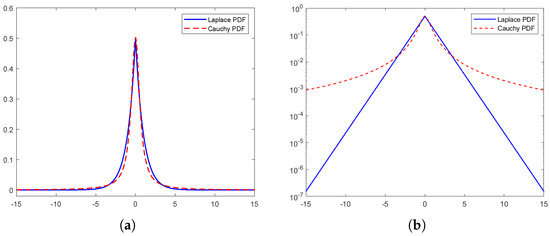
Figure 3.
Laplace PDF and Cauchy PDF, special case of parametrization. (a) Laplace PDF . (b) Cauchy PDF , where .
It has been identified that, for a Cauchy APDF, the corresponding clusters have the following property: the distance between the cluster center and the scattering objects obeys the Cauchy–Rayleigh distribution [20], and for a Gaussian APDF, the corresponding clusters have the property that the distance between the cluster center and the scatterers follows the Rayleigh distribution [21]. They are named the Cauchy–Rayleigh cluster and Rayleigh cluster, respectively, and their properties can be used for MIMO channel characterization.
Based on the trigonometric relationships between the transmitter, scatterers, and receiver, the APDFs of these two types of scattering clusters can be derived. Additionally, the spatial–temporal correlation function is integrable according to the obtained APDF. The analytical solution, or closed-form solution, will be associated with a distant scattering cluster, meaning that the solution will depend on the characteristics of a given geometrical cluster.
Furthermore, to characterize the MIMO channel using a state-space representation, the correlation function needs to be separated into two disjoint parts: a temporal term that accounts for the movement and a spatial term that covers the antenna configuration. This separation facilitates a more accurate and manageable representation of the channel dynamics, capturing the essential features of the spatial and temporal variations in the propagation environment.
However, the analytical solution based on the Cauchy APDF involves an absolute sum of terms in the exponent associated with antenna spacing and movement. It requires removing the sign from the absolute value. Conversely, the solution based on the Gaussian APDF introduces a cross-term related to antenna spacing and motion. This cross-term does not fall distinctly into the categories of channel temporal dynamics or spatial correlation [20,21].
Unlike work found in the literature [20,21] where antenna spacing and movement are separated, in this paper, to effectively separate antenna spacing and movement, we propose a linear transformation, termed the phase-shift method. This method avoids unnecessary approximations and provides a clean separation, making the CSOS expression integrable.
The elegance of this approach is that it makes the CSOS expression integrable. The analytical solution can be decomposed into two disjoint parts: the temporal dynamics and spatial correlation of the channel. The temporal dynamics can be modeled using autoregressive models, while the spatial correlation is characterized using the Kronecker matrix.
Depending on the cluster type, the temporal dynamics can be appropriately modeled as a first-order autoregressive model (AR(1)) or an AR(3) model. The AR(2) model can also be used if the approximation requirements are considered acceptable. Thus, this approach is useful for constructing state-space models of MIMO/massive MIMO channels [22,23,24], as well as multi-cluster state-space MIMO-OFDM channel models [25].
This paper explores a cluster-based propagation environment and validates the theoretical model through simulations. This approach consists of four main steps:
- Derivation of the mathematical representation of the phase-shift CSOSWe derive the mathematical expression for the phase-shift CSOS, which captures the channel properties within a different system in the presence of scattering clusters.
- Development of MIMO radio channel models in state-space formWe develop MIMO radio channel models using state-space representations. This involves formulating the system dynamics and observation equations to model the radio channel behavior.
- Reconstruction of the physical propagation environmentWe reconstruct the physical propagation environment of radio waves by applying multiple MIMO-OFDM channel models. This step integrates the contributions from various clusters to simulate a realistic propagation scenario.
- SimulationsFinally, we validate the theoretical model through extensive simulations. This step involves generating synthetic data based on our model and calculating the CSOS. We then compare the calculated CSOS values with the theoretical predictions to ensure the accuracy and reliability of the model.
Although the results presented in this paper are based on two dimensions, this is the first step in our radio channel modeling. By introducing another dimension, as described in the literature [26], this approach can be more easily extended to three dimensions.
2. Theoretical Framework
In this section, we outline the basic concepts and theoretical models that underpin our simulations. We first derive a mathematical representation of the phase-shift CSOS, which plays a key role in channel modeling. This is followed by a geometric-based approach to obtain an analytical solution of the CSOS by mapping scattering objects within a cluster into the designed AOA/AOD from a spatial perspective. Finally, we will delve into the multi-cluster MIMO-OFDM channel model. The model is particularly well suited to capture the intricacies of wireless communications in multi-cluster scenarios. Together, these elements offer a comprehensive theoretical foundation for simulating a radio wave propagation environment.
2.1. Linear Transformation
From a mathematical standpoint, our approach involves transforming the current Cartesian coordinate system into an alternative one. In this new system, antenna spacing and movement components are separated into disjoint, error-free parts, allowing for the modeling of channel characteristics through a state-space representation. An inverse linear mapping is then applied to revert the channel properties to their original form within the original coordinate system.
Equation (4) approximates the correlation related to MS antenna sensors by considering the AOA near zero degrees around the angles and . This approximation, illustrated in Figure 4, decomposes the movement and antenna spacing into a phase change on OA and a damping change on AW, with OA and AW orthogonal.
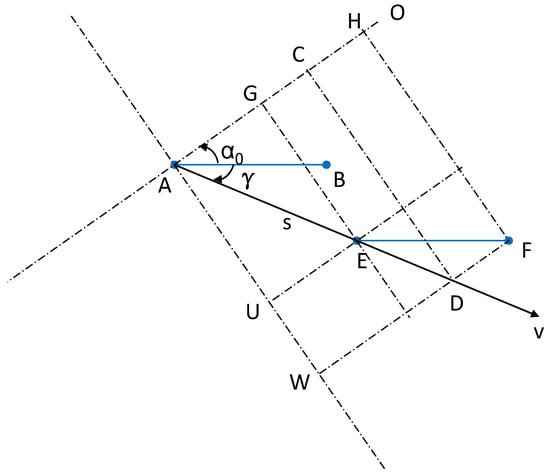
Figure 4.
The motion vector is decomposed into a phase change on OA and a damping change on AW, where AB and EF denote the antenna arrays, and A, B, E, and F are antenna sensors.
Given , , and , we obtain:
Geometrically, these equations interpret the meaning of the approximation in Equation (4).
Alternatively, AW can be viewed as the projection of AD, with . Using the right triangle relationship, we obtain the following:
This implies that while antenna sensor A moves to D, its actual position is at E, determining the changed phase with the following:
Notably, or , as the transformation in Equation (6) would otherwise be meaningless.
In the new system, Equation (6), the antenna spacing becomes part of the motion. Assuming , Equation (6) becomes as follows:
From a delay perspective, as shown in Equation (8), the time difference between these systems implies that antenna spacing becomes a time delay in channel dynamics, linking the new system to the original system.
In this new system, the spatial correlation of MS-associated channels is depicted through a phase rotation, effectively separating movement and antenna spacing into distinct entities. This phase rotation remains independent of the BS antenna, allowing for the use of the Kronecker product to construct state-space MIMO channels [27].
The phase-shift method offers an alternative perspective on the problem. By changing variables, a straightforward, error-free method emerges for separating movement and antenna spacing. The channel STCF can thus be conceptualized as the outcome of the phase rotation multiplied by the channel’s temporal dynamics, offset by a specific value along the direction of motion.
2.2. Geometry Based Approach
Research on a geometry-based MIMO radio channel modeling has garnered significant attention [7,8,9,10,28]. This approach involves mapping the spatial locations of scatterers within a cluster to an angular power distribution using trigonometric relationships among the scatterers, the cluster center, and the receiver or transmitter. Additionally, the angular power distribution exhibits specific statistical properties when the cluster follows a defined probability distribution [7,8]. This method is both simple and intuitive.
In this subsection, we will derive the analytical solutions for the CSOS in the new coordinate system, providing insights into the spatial correlation and channel characteristics of MIMO systems in various propagation environments.
2.2.1. Cauchy–Rayleigh Cluster
For a distant Cauchy–Rayleigh cluster, the Cauchy APDFs can be derived from the geometric relations, as shown in Figure 2 [25]:
where indicates that the APDF is obtained in terms of the Cauchy–Rayleigh cluster, the parameters and , and are used to control the angular width of these two distributions, respectively. is the dispersion of the Cauchy–Rayleigh distribution.
Obviously, both and in Equation (10) are defined on , which means that they are not proper Cauchy angular power density functions because the Cauchy probability density function is defined over the infinite interval. To integrate these functions effectively, we extend the integral from to , as described in detail in the book [25].
Therefore, the STCF can be given by the following:
The channel dynamic function is as follows:
According to Equation (11), we can assign a specific expression to each element of in [29,30]:
where replaces the notation in [29], and the notation also replaces . Similarly, all elements of in [29] will have the following specific expression:
This shows that the spatial correlation between MS channels depends only on antenna spacing but not on the cluster type, maintaining the notation .
2.2.2. Rayleigh Cluster
Similarly, for a distant Rayleigh cluster, we obtain the following approximate Gaussian APDFs [25]:
where indicates that the APDF is obtained from the Rayleigh cluster, , , and is from the Rayleigh distribution.
These truncated Gaussian APDFs can be extended from to infinity, and the analytical solution of the CSOS is obtained by substituting Equation (15) into Equation (9):
Thus, the channel temporal dynamic function is as follows:
each element of can be given by the following:
and all elements of are also given by Equation (14).
2.3. Multi-Cluster MIMO-OFDM Channel Model
In this subsection, we will examine channel characterization in a multi-cluster environment. The typical physical propagation environment of radio waves is illustrated in Figure 1 and can be modeled as depicted in Figure 5.
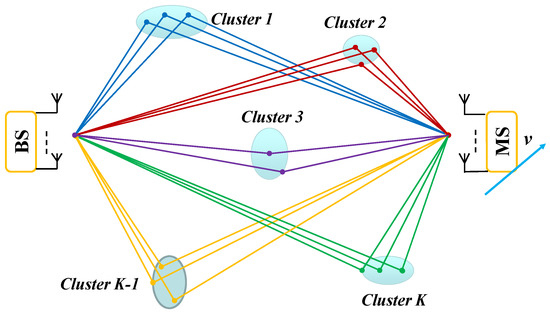
Figure 5.
K distant scattering clusters, cluster no. 1 to cluster no. K, in a radio wave propagation environment, each of which is broken down into many resolvable multi-path components.
Consider a radio wave propagation scenario characterized by K distant scattering clusters, as shown in Figure 5. These clusters are modeled using a combination of Cauchy–Rayleigh and Rayleigh distributions. The BS remains stationary while the MS moves at a speed v. There is no line-of-sight (NLOS) between the BS and the MS, and all transmitted and received signals occur through these K uncorrelated scattering clusters. Each cluster is decomposed into a number of resolvable multi-path components [25], and the trigonometric relationships among the BS, scatterers, and MS within a cluster are illustrated in Figure 2.
In this model, the radio waves from different clusters can be summed to account for the contributions from all clusters. The power emitted from each cluster is apportioned to the Doppler power spectrum, making the combination of radio waves resemble the sum of individual power contributions. This yields a K-cluster MIMO channel model. Furthermore, when the delay factor is considered, these contributions lead to a K-cluster MIMO-OFDM channel model.
2.3.1. Multi-Cluster Angular-Delay Spectrum
The joint angular-delay spectrum associated with K scattering clusters can be expressed as follows:
where denotes the power contributed from the kth cluster. Summing over the angles, the marginal distribution represents the power delay profile (PDP), , of the clusters. Summing over the delays yields the angular power distribution, , of the clusters [25].
Next, we will introduce the step-by-step construction of a multi-cluster MIMO-OFDM channel model starting from the AR(p) model.
2.3.2. AR(p) Model
As presented in Section 2.2, a channel STCF is obtained based on the distant scattering clusters, as shown in Equation (11) or Equation (16). Here, its dynamic part will be modeled using the following AR(p) model [31],
where () are complex coefficients (weights), and the innovation noise is a complex Gaussian sequence . That is, the stochastic variable is defined as a linear combination of its previous p values of the series plus an innovation noise.
The channel dynamics associated with the Cauchy–Rayleigh clusters are modeled as an AR(1) model [19,20], while the channel dynamics associated with the Rayleigh clusters can be approximated as an AR(3) model [21]. The coefficients for these models can be estimated using the least-squares (LS) method [32] or computed using the spectral-equivalent (SE) method [21].
Thus, a single peak on the Doppler spectrum corresponding to the contribution from a distant scattering cluster is modeled by an AR(p) model. The advantage of using an AR(p) model is that it can be directly parameterized by the properties of the cluster and allows changing the angles in the simulation, which corresponds to changing the directions of the mobile receiver.
2.3.3. SISO Channel Model
An AR(p) model is described by the block diagram shown in Figure 6 and can be implemented in the controlled canonical representation to form a state-space single-input and single-output (SISO) channel model [33]:
where is a vector, is a vector, the output is a scalar, the channel, and
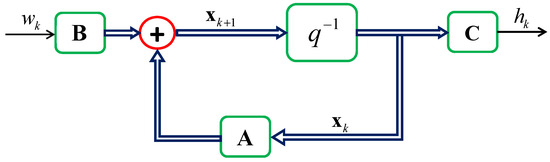
Figure 6.
Block diagram of the AR(p)-based state-space SISO channel model.
Other assumptions include: , where , and the initial state is uncorrelated to the scalar complex Gaussian noise .
The input vector is redefined so that the noise input will be scaled by . This adjustment ensures that the variance of is unity, i.e., . It is logical to have unit variance before and allow to scale the contribution from a cluster, incorporating path loss to [25].
It is important to note that, in practice, the matrices and will exhibit time-varying characteristics. This time variation stems from the angle-related elements inherent in these two matrices. The angle is used to describe the direction of dynamic motion towards the center of the cluster, which changes continuously throughout the motion.
In this paper, an assumption is made that these matrices remain time-invariant due to the insignificance of the movements compared to the distance between the MS and the center of a scattering cluster. Essentially, within certain time slots, all matrices can be considered approximately constant. This assumption implies constant angles towards clusters, constant speed during movement, and thus a time-invariant environment is achieved. This assumption is related to the stationarity of and sequences as well.
2.3.4. MIMO Channel Model
Based on the SISO channel model block depicted in Figure 6, a state-space SIMO channel model is constructed by connecting multiple SISO channel model blocks in parallel. A correlated innovation process is employed to adjust the spatial correlation between these SISO channel blocks. The number of SISO channel model blocks required for the SIMO channel model depends on the number of receiving antenna elements . An example of constructing a SIMO channel model is provided in [20].
Similarly, by connecting multiple SIMO channel blocks in parallel, a state-space MIMO channel model is constructed, as shown in Figure 7. Here, denotes the coloring matrix. The number of SIMO channel blocks needed for the MIMO channel model depends on the number of transmitting antennas .
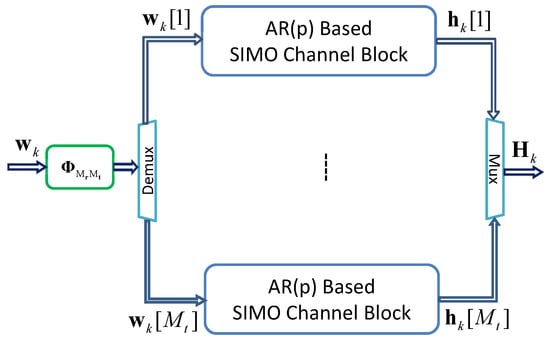
Figure 7.
Block diagram of the AR(p)-based state space MIMO channel model, where , m denotes channel index.
Mathematically, this block diagram can be implemented as the following state-space representation [25]:
where , and , here
The matrices , and are defined by the following:
where denotes the identity matrix of size , ⊗ denotes the Kronecker operator, and , employed to control the number of correlated driving noises, is defined as a lower triangular matrix:
A straightforward computation leads to the following equation:
The Cholesky decomposition method can be used to solve Equation (27) numerically. However, for a small size matrix , like a MIMO channel model, an analytical solution of a lower triangular matrix is obtained [21].
2.3.5. MIMO-OFDM Channel Model
The MIMO channel model described in Section 2.3.4 is applicable to narrow-band and single-carrier frequency scenarios. In this section, we propose a viable approach to address the issue of frequency-selective fading channels. Specifically, we introduce a wide-band MIMO channel model, known as the MIMO-OFDM channel model, which integrates MIMO and OFDM techniques.
To achieve this, we incorporate a parameter called the delay factor to account for the delay spread resulting from two-dimensional (2D) scattering clusters. This modification aims to highlight the spatial–temporal–spectral correlation of the channel, taking into account not only the spatial–temporal correlation but also the spectral characteristics.
Utilizing the MIMO channel model framework illustrated in Figure 7, we construct a MIMO-OFDM channel model as outlined in Figure 8. In this scenario, we introduce a colored input noise vector for the MIMO-OFDM channels. This noise vector is generated using the spectral correlation matrix , defined as follows [25]:
where each element is calculated by
which is denoted the discrete form by . Clearly, the diagonal element .
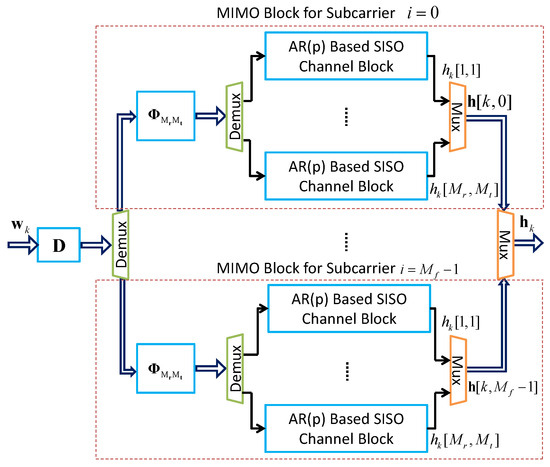
Figure 8.
Block diagram of the MIMO-OFDM channel model, where , m and n denote channel index.
Next, we will first show how to compute in Equation (29) and then present the construction of a state-space MIMO-OFDM channel model.
Given the Cauchy–Rayleigh clusters, the corresponding Cauchy delay power distribution function of the TOA is as follows [25]:
where denotes the average time delay:
denotes the speed of light, is the angle between the two edges and , as illustrated in Figure 2. In Section 2.2.1, we obtained . Hence, the following is obtained:
Given a distant Rayleigh cluster, the approximate Gaussian delay power distribution function of the TOA is obtained [25]:
where
and , are defined in Equation (31). Therefore, for Gaussian distributed TOA, we have
The vector is used to represent all of the MIMO-OFDM channels. This formulation results in the channels being characterized by a STSCF. This STSCF captures the dependencies and variations in the channel across time, space, and frequency, providing a comprehensive model of the MIMO-OFDM channels.
In Figure 8, represents a discrete version of the continuous-time channel vector . Each dotted box corresponds to a MIMO channel model that includes state-space SISO channel blocks, a spatial correlation matrix , and a single carrier frequency. This setup creates frequency-selective channels in parallel. Additionally, the square matrix of order in the block diagram is derived from the spectral correlation matrix as shown in Equation (28). This matrix is used to adjust the spectral correlation properties among the MIMO channel blocks.
Mathematically, this MIMO-OFDM channel model can be represented by [25]
where is denoted by , , , is a complex square matrix of order , is a complex matrix, is a by real matrix. The matrices , and are given by
where p is the order of the AR model, , and are given by Equation (25), and is defined as a lower triangular matrix that satisfies the following:
Similarly, the Cholesky decomposition method can be used to determine all elements of the lower triangular matrix . However, when working with two carrier frequencies, a closed-form solution can be derived through straightforward algebraic operations, as outlined in the following:
Thus, an AR(p)-based state-space MIMO-OFDM channel model is developed using this method. It is important to highlight that this approach is specifically designed for a single scattering cluster. The following section will describe the methodology for constructing a multi-cluster MIMO-OFDM channel model.
2.3.6. Multi-Cluster MIMO-OFDM Channel Model
By connecting multiple MIMO-OFDM channel model blocks in parallel, a multi-cluster MIMO-OFDM channel model is assembled, as illustrated in Figure 9. The number of blocks required depends on the value of K.
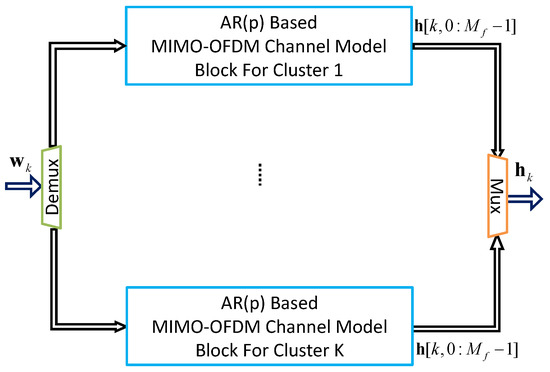
Figure 9.
Block diagram of a K-cluster MIMO-OFDM channel model, where the input noise vector , the output channel vector means that there are sub-carriers from to .
3. Simulations
In this section, we will select a MIMO channel and a pair of carrier frequencies from the MIMO-OFDM channel model presented in Section 2. Through simulations, we will evaluate the performance of the selected MIMO-OFDM channel model within a multi-cluster environment.
Assume , indicating five scattering clusters in the radio wave propagation environment, as illustrated in Figure 5. Among these, two clusters are Cauchy–Rayleigh clusters (clusters No. 3 and No. 4), while the remaining three are Rayleigh clusters (clusters No. 1, No. 2, and No. 5).
In Figure 5, let the origin be at the BS, with the BS positioned at (0, 0) and the MS at (3000, 0) along the x-axis. The Cartesian coordinate system is thus defined, with cluster centers located at (800, 700), (2400, 450), (1500, −350), (900, −1300), and (2700, −900). Here, denotes the center of cluster No. i. Table 1 provides the data used to determine the parameters for generating each cluster, with distances measured in meters.

Table 1.
The parameters used to generate distant scattering clusters.
For all scattering clusters, let , the equation derived from the Rayleigh scattering clusters, the corresponding values are and [25]. Consequently, the dispersion parameters of the clusters and can be computed using the formulas provided in Equations (10) and (15), respectively. Table 2 presents the parameters necessary for plotting the angular delay spectrum for these five clusters, with average time delay measured in microseconds.
Table 2.
The parameters used to draw the graphs.
Figure 10a,b illustrate the characteristics of these five clusters. Specifically, Figure 10a presents the angular-delay spectrum of these clusters, showing how signal components are spread in both angle and delay. Meanwhile, Figure 10b depicts the corresponding power azimuth spectrum, highlighting the distribution of signal power over various azimuth angles for these clusters.
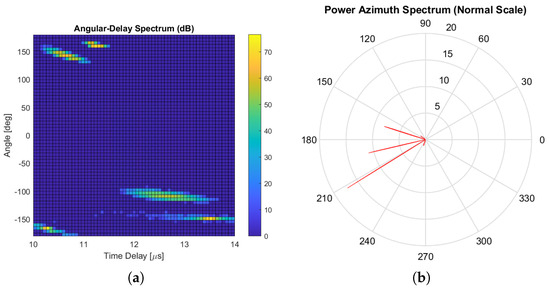
Figure 10.
Angular-delay spectrum and power azimuth spectrum of the clusters. (a) Angular-delay spectrum of the clusters. (b) Power azimuth spectrum of the clusters.
Figure 11a shows the power delay profile of the clusters. The histogram, representing this profile, is computed from scatterers. Similarly, Figure 11b depicts the power of the AOA for these clusters, where the histogram is also calculated based on scatterers.
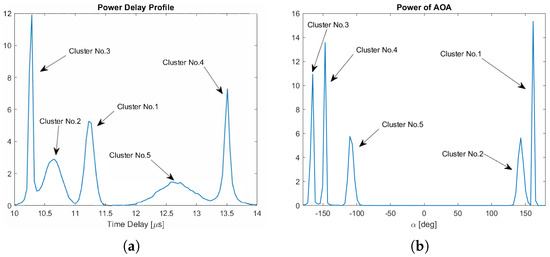
Figure 11.
The power of AOA and power delay profile of the clusters. (a) The PDP of the clusters, where , , , , . (b) The power of AOA of the clusters, where , , , , .
In the simulation, two distant Cauchy–Rayleigh clusters and three distant Rayleigh clusters are assumed. Table 3 lists all the parameters required to construct a five-cluster MIMO-OFDM channel model.
Table 3.
The parameters used to build the five-cluster MIMO-OFDM channel model.
Additionally, let °, and MHz, then this five-cluster MIMO-OFDM channel model can be represented by Equation (41), where is defined in Equation (40) with elements derived either from Equation (33) or Equation (36). The matrices are all matrices of the AR(3) model, while are both matrices of the AR(1) model. The same applies to the matrices and . Finally, the output corresponding to each cluster is a vector containing eight channels.
The following expressions
represent the STSCFs of the channel. The channel STCFs, and , are given by [25], which describe the contributions of a single Cauchy–Rayleigh cluster and a Rayleigh cluster to the channel, respectively.
In simulation, using Equation (43) and combining the contributions of all the individual clusters, we obtain the channel correlation characteristics described by this five-cluster environment, referred to as the analytical model.
Correspondingly, the following are the STSCFs of the channel in the phase-shift expressions for a single Cauchy–Rayleigh cluster and a Rayleigh cluster:
where and are from Equations (11) and (16), respectively.
In simulation, using Equation (44) and combining the contributions from each AR(p)-based state-space MIMO-OFDM channel model, we can construct state-space MIMO-OFDM channels with multiple clusters.
Figure 12, Figure 13, Figure 14, Figure 15 and Figure 16 display the real parts of the STCFs and STSCFs for individual clusters along with their corresponding state-space model estimations. For each cluster, 400,000 channel samples were generated to estimate the correlation properties. These figures demonstrate that the estimation closely matches the channel correlation function within the distance of interest. Therefore, an AR(p)-based state-space MIMO-OFDM channel model can effectively be used to describe the channel correlation properties for each cluster.
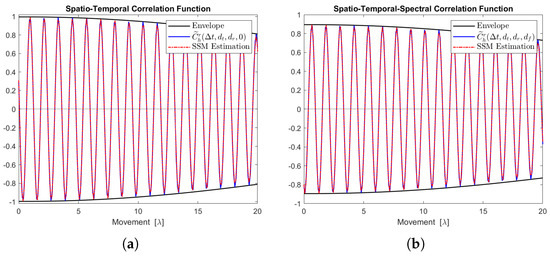
Figure 12.
Channel correlation estimation of cluster No. 1, characterized as a Rayleigh cluster. The sequence is generated from the state-space MIMO-OFDM channel model. (a) The real part of the STCF, where . (b) The real part of the STSCF, where , MHz.
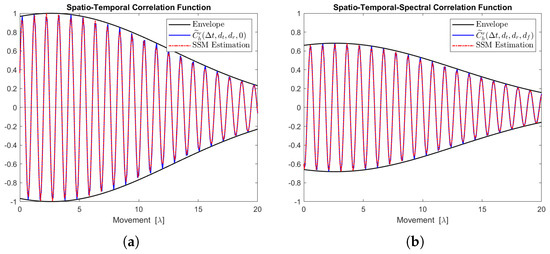
Figure 13.
Channel correlation estimation of cluster No. 2, characterized as a Rayleigh cluster. The sequence is generated from the state-space MIMO-OFDM channel model. (a) The real part of the STCF, where . (b) The real part of the STSCF, where , MHz.
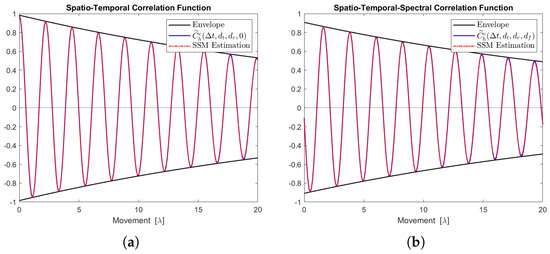
Figure 14.
Channel correlation estimation of cluster No. 3, characterized as a Cauchy–Rayleigh cluster. The sequence is generated from the state-space MIMO-OFDM channel model. (a) The real part of the STCF, where . (b) The real part of the STSCF, where , MHz.
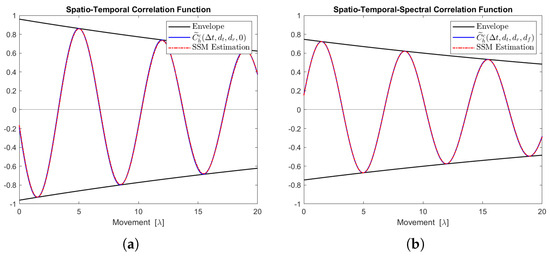
Figure 15.
Channel correlation estimation of cluster No. 4, characterized as a Cauchy–Rayleigh cluster. The sequence is generated from the state-space MIMO-OFDM channel model. (a) The real part of the STCF, where . (b) The real part of the STSCF, where , MHz.
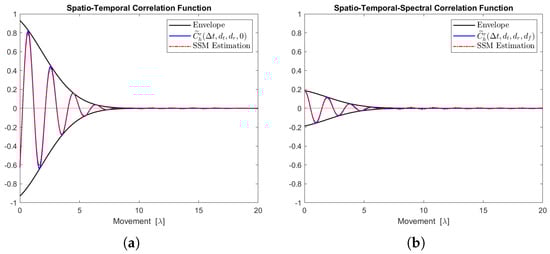
Figure 16.
Channel correlation estimation of cluster No. 5, characterized as a Rayleigh cluster. The sequence is generated from the state-space MIMO-OFDM channel model. (a) The real part of the STCF, where . (b) The real part of the STSCF, where , MHz.
Figure 17a illustrates a segment of the real part of the SISO channel sequence generated by this five-cluster state-space MIMO-OFDM channel model. This sequence is utilized to estimate the SISO channel correlation function shown in Figure 17b.
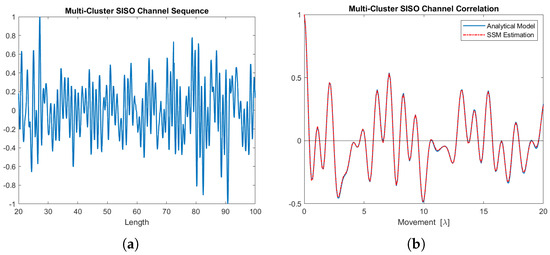
Figure 17.
SISO channel sequence with its corresponding correlation function. (a) The SISO channel sequence (real part) generated by this 5-cluster state-space MIMO-OFDM channel model. (b) The SISO channel correlation function (real part), estimation is from this 5-cluster state-space MIMO-OFDM channel model.
Figure 18a,b display the real part of the SIMO and MISO channel correlation functions for the five scattering clusters, respectively. The estimations align closely with the analytical models.
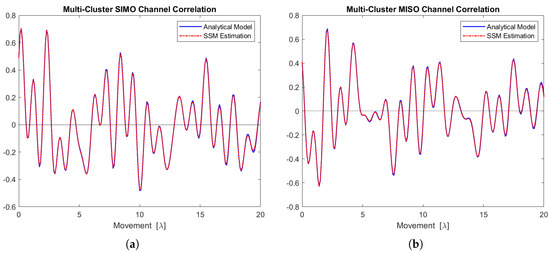
Figure 18.
Channel correlation estimation based on the sequence generated from this 5-cluster state-space MIMO-OFDM channel model. (a) The SIMO channel correlation function (real part). (b) The MISO channel correlation function (real part).
Figure 19a,b depict the real part of the MIMO and MIMO-OFDM channel correlation functions for the five scattering clusters. The estimated curves follow the analytical models very well.
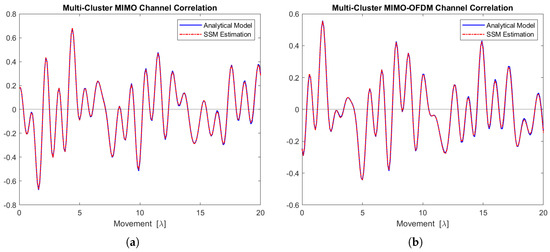
Figure 19.
Channel correlation estimation based on the sequence generated from this 5-cluster state-space MIMO-OFDM channel model. (a) The MIMO channel correlation function (real part). (b) The MIMO-OFDM channel correlation function (real part).
Thus, the AR(p)-based state-space MIMO-OFDM channel model can effectively be employed to describe a multi-cluster radio wave propagation environment.
It is important to note that the phase-shift method is used to construct the state-space MIMO-OFDM channel model for each scattering cluster. Consequently, each state-space channel model has its own initial value of movement. When sampling the moving distances of interest, a phase difference may occur between the channels generated by these state-space channel models, leading to errors when combining these channels. However, if a smaller sampling period is chosen, this error becomes negligible.
4. Conclusions
This paper presents a multi-cluster approach to radio sensor array channel modeling and simulations, which is crucial for integrating the contributions from multiple clusters, enabling the use of an AR(p) model to characterize channel dynamics. Subsequently, an AR(p)-based state-space model is developed for the radio channel, facilitating the creation of a multi-cluster MIMO-OFDM channel model.
The key benefit of this proposed phase-shift method is its ability to modify the variables to prevent decomposition errors that arise from excessive approximations, thereby avoiding errors in the radio channel model derived from channel correlation functions.
By incorporating antenna spacing into the motion component, this approach allows us to deal with channel correlation properties in the transformed system and then map them back to the original system using an inverse linear transformation. Simulations confirm that this phase-shifting technique effectively resolves the decomposition problem and validates that classifying the physical propagation environment of radio waves into scattering clusters is a suitable approach for radio channel modeling. Additionally, simulations demonstrate that the spatial–temporal correlation characteristics of the channel are accurately captured in a multi-cluster environment.
Furthermore, the paper addresses the limitations associated with analyzing CSOS using small angle ranges. It explores the extension of the critical angle from to , without compromising the essential characteristics of the CSOS.
The modular construction of radio channels results in a state-space-based MIMO-OFDM channel model. Each distant scattering cluster contributing to an antenna at a mobile receiver is modeled using AR(1) or AR(3) state-space SISO channel blocks. The advantage of the state-space representation is that it enables the construction of a MIMO-OFDM channel model from multiple SISO channel blocks. Additionally, a correlated innovation process is employed to adjust the spatial correlation within each MIMO block and the spectral correlation between MIMO blocks. This framework can be extended to multi-cluster scenarios using the same methodology.
Therefore, this approach is both valid and applicable to any multi-cluster MIMO-OFDM channel model and can also be used for constructing massive MIMO channels. It effectively enables the simulation of physical radio wave propagation environments.
Although the current work focuses on multi-cluster MIMO-OFDM channel modeling, there are several avenues for further research and extensions:
- Massive MIMO and Beyond 5G Applications:The proposed model is applicable to massive MIMO configurations beyond 5G and 6G networks, where the number of antennas and channel complexity increase significantly. Future work could explore the scalability of the phase-shift approach in these larger and more complex systems.
- Hybrid Beamforming Integration:With the rise of hybrid beamforming in MIMO systems, this model can be used to analyze and optimize beamforming strategies in a multi-cluster environment. This extension is particularly important in mmWave and THz communications.
- Machine Learning Integration:By integrating machine learning techniques, this model can be used to dynamically optimize parameters or predict channel characteristics based on historical data, which will make this radio channel model more adaptable and intelligent, especially in environments with complex or rapidly changing conditions.
Author Contributions
Conceptualization, methodology, validation, writing-original draft preparation, writing-review and editing, X.L.; supervision, T.E.; resources, project administration, funding acquisition, K.Y. All authors have read and agreed to the published version of the manuscript.
Funding
This work was supported by National Natural Science Foundation of China Under the Grant No. 62341127 and Zhoushan Science and Technology R&D Project Under the Grant No. 2024C03007.
Institutional Review Board Statement
Not applicable.
Informed Consent Statement
Not applicable.
Data Availability Statement
Data are contained within the article.
Acknowledgments
The authors would like to thank all those who contributed to this work.
Conflicts of Interest
The authors declare no conflicts of interest.
References
- Chang, C.; Kuo, H.; Du, Z. The Role of Digital Literacy in Augmented, Virtual, and Mixed Reality in Popular Science Education: A review study and an educational framework development. Virtual Real. 2023, 27, 2461–2479. [Google Scholar] [CrossRef]
- Goel, R.; Baral, S.K.; Mishra, T.; Jain, V. Augmented and Virtual Reality in Industry 5.0; De Gruyter: Berlin, Germany, 2023. [Google Scholar] [CrossRef]
- Akan, O.B.; Dinc, E.; Kuscu, M.; Cetinkaya, O.; Bilgin, B.A. Internet of Everything (IoE)—From Molecules to the Universe. IEEE Commun. Mag. 2023, 61, 122–128. [Google Scholar] [CrossRef]
- Rappaport, T.S. Wireless Communications: Principles and Practice, 2nd ed.; Pearson Education, Inc.: Upper Saddle River, NJ, USA, 2002. [Google Scholar]
- Goldsmith, A. Wireless Communications; Cambridge University Press: Cambridge, UK, 2005. [Google Scholar] [CrossRef]
- Tse, D.; Viswanath, P. Fundamentals of Wireless Communication; Cambridge University Press: Cambridge, UK, 2004. [Google Scholar] [CrossRef]
- Ertel, R.B.; Reed, J.H. Angle and Time of Arrival Statistics for Circular and Elliptical Scattering Models. IEEE J. Sel. Areas Commun. 1999, 17, 1829–1840. [Google Scholar] [CrossRef]
- Janaswamy, R. Angle and Time of Arrival Statistics for the Gaussian Scatter Density Model. IEEE Trans. Wirel. Commun. 2002, 1, 488–497. [Google Scholar] [CrossRef]
- Pedersen, K.I.; Mogensen, P.E.; Fleury, B.H. Power Azimuth Spectrum in Outdoor Environments. IEEE Trans. Wirel. Commun. 1997, 33, 1583–1584. [Google Scholar] [CrossRef]
- Martin, U. Spatio-temporal Radio Channel Characteristics in Urban Macrocells. IEE Proc. Radar Sonar Navig. 1998, 145, 42–49. [Google Scholar] [CrossRef]
- Kunnari, E.; Linatti, J. Stochastic Modeling of Rice Fading Channels with Temporal, Spatial and Spectral Correlation. IET Commun. 2007, 1, 215–224. [Google Scholar] [CrossRef]
- Lamahewa, T.A.; Abhayapala, T.D.; Iqbal, R.; Athaudage, C. A Framework to Calculate Space-Frequency Correlation in Multi-Carrier Systems. IEEE Trans. Wirel. Commun. 2010, 9, 1825–1831. [Google Scholar] [CrossRef]
- Chong, C.; Tan, C.; Laurenson, D.I.; McLaughlin, S.; Beach, M.A.; Nix, A.R. A New Statistical Wideband Spatio-Temporal Channel Model for 5-GHz Band WLAN Systems. IEEE J. Sel. Areas Commun. 2003, 21, 139–150. [Google Scholar] [CrossRef]
- Spencer, Q.H.; Jeffs, B.D.; Jensen, M.A.; Swindlehurst, A.L. Modeling the Statistical Time and Angle of Arrival Characteristics of an Indoor Multipath Channel. IEEE J. Sel. Areas Commun. 2000, 18, 347–360. [Google Scholar] [CrossRef]
- Buehrer, R.M. The Impact of Angular Energy Distribution on Spatial Correlation. In Proceedings of the IEEE 56th Vehicular Technology Conference, Vancouver, BC, Canada, 24–28 September 2002. [Google Scholar] [CrossRef]
- Dong, L.; Ma, J.; Zhou, J.; Kikuchi, H. Performance of MIMO with UCA and Laplacian Angular Distribution Using Correlation Matrix. In Proceedings of the 2007 International Conference on Wireless Communications, Networking and Mobile Computing, Shanghai, China, 21–25 September 2007. [Google Scholar] [CrossRef]
- Forenza, A.; Love, D.J.; Heath, R.W. Simplified Spatial Correlation Models for Clustered MIMO Channels with Different Array Configurations. IEEE Trans. Veh. Technol. 2007, 56, 1924–1934. [Google Scholar] [CrossRef]
- Kalliola, K.; Sulonen, K.; Laitinen, H.; Kivekäs, O.; Krogerus, J.; Vainikainen, P. Angular Power Distribution and Mean Effective Gain of Mobile Antenna in Different Propagation Environments. IEEE Trans. Veh. Technol. 2002, 51, 823–838. [Google Scholar] [CrossRef]
- Ekman, T. Prediction of Mobile Radio Channels. Ph.D. Thesis, Uppsala University, Uppsala, Sweden, 2002. [Google Scholar]
- Li, X.; Ekman, T. Cauchy Angular Distribution for Clustered Radio Propagation SIMO Channel Model. In Proceedings of the IEEE the 71st Vehicular Technology Conference (VTC) 2010 Spring, Taipei, Taiwan, 16–19 May 2010. [Google Scholar] [CrossRef]
- Li, X.; Ekman, T. Gaussian Angular Distributed MIMO Channel Model. In Proceedings of the IEEE the 74th Vehicular Technology Conference (VTC) 2011 Fall, San Francisco, CA, USA, 5–8 September 2011. [Google Scholar] [CrossRef]
- Hu, Y.; Chen, C.; Fang, T.; Qiao, M. A multi-cluster geometry-based stochastic model for 5G massive MIMO channels in NLOS environment. In Proceedings of the 2017 Sixth Asia-Pacific Conference on Antennas and Propagation (APCAP), Xi’an, China, 16–19 October 2017. [Google Scholar] [CrossRef]
- Zhang, Y.; Li, X.; Pang, L.; He, Y.; Ren, G.; Li, J. A 2-D Geometry-Based Stochastic Channel Model for 5G Massive MIMO Communications in Real Propagation Environments. IEEE Syst. J. 2021, 15, 307–318. [Google Scholar] [CrossRef]
- Yuan, Y.; He, R.; Ai, B.; Ma, Z.; Miao, Y.; Niu, Y.; Zhang, J.; Chen, R.; Zhong, Z. A 3D Geometry-Based THz Channel Model for 6G Ultra Massive MIMO Systems. IEEE Trans. Veh. Technol. 2022, 71, 2251–2266. [Google Scholar] [CrossRef]
- Kishk, A.A.; Chen, X. MIMO Communications—Fundamental Theory, Propagation Channels, and Antenna Systems; IntechOpen: London, UK, 2023. [Google Scholar] [CrossRef]
- Aulin, T. A Modified Model for the Fading Signal at a Mobile Radio Channel. IEEE Trans. Veh. Technol. 1979, 28, 182–203. [Google Scholar] [CrossRef]
- Oestges, C. Validity of the Kronecker Model for MIMO Correlated Channels. In Proceedings of the 2006 IEEE 63rd Vehicular Technology Conference, Melbourne, VIC, Australia, 7–10 May 2006; Volume 6. No. 3. [Google Scholar] [CrossRef]
- Almers, P.; Bonek, E.; Burr, A.; Czink, N.; Debbah, M.; Degli-Esposti, V.; Hofstetter, H.; Kyösti, P.; Laurenson, D.; Matz, G.; et al. Survey of Channel and Radio Propagation Models for Wireless MIMO Systems. Eurasip J. Wirel. Commun. Netw. 2007. [Google Scholar] [CrossRef]
- Kermoal, J.P.; Schumacher, L.; Pedersen, K.I.; Mogensen, P.E.; Frederiksen, F. A Stochastic MIMO Radio Channel Model with Experimental Validation. IEEE J. Sel. Areas Commun. 2002, 20, 1211–1226. [Google Scholar] [CrossRef]
- Costa, N.; Haykin, S. Multiple-Input Multiple-Output Channel Models Theory and Practice; John Wiley & Sons, Inc.: Hoboken, NJ, USA, 2010. [Google Scholar] [CrossRef]
- Shumway, R.H.; Stoffer, D.S. Time Series Analysis and Its Applications, 2nd ed.; Springer: New York, NY, USA, 2006. [Google Scholar] [CrossRef]
- Stoica, P. Introduction to Spectral Analysis; Prentice Hall: Upper Saddle River, NJ, USA, 2005. [Google Scholar]
- Ogata, K. Modern Control Engineering, 3rd ed.; Prentice-Hall Inc.: Upper Saddle River, NJ, USA, 1996. [Google Scholar]
Disclaimer/Publisher’s Note: The statements, opinions and data contained in all publications are solely those of the individual author(s) and contributor(s) and not of MDPI and/or the editor(s). MDPI and/or the editor(s) disclaim responsibility for any injury to people or property resulting from any ideas, methods, instructions or products referred to in the content. |
© 2024 by the authors. Licensee MDPI, Basel, Switzerland. This article is an open access article distributed under the terms and conditions of the Creative Commons Attribution (CC BY) license (https://creativecommons.org/licenses/by/4.0/).