Abstract
Vehicle ad hoc networks (VANETs) are special wireless networks which help vehicles to obtain continuous and stable communication. Pseudonym revocation, as a vital security mechanism, is able to protect legal vehicles in VANETs. However, existing pseudonym-revocation schemes suffer from the issues of low certificate revocation list (CRL) generation and update efficiency, along with high CRL storage and transmission costs. In order to solve the above issues, this paper proposes an improved Morton-filter-based pseudonym-revocation scheme for VANETs (IMF-PR). IMF-PR establishes a new distributed CRL management mechanism to maintain a low CRL distribution transmission delay. In addition, IMF-PR improves the Morton filter to optimize the CRL management mechanism so as to improve CRL generation and update efficiency and reduce the CRL storage overhead. Moreover, CRLs in IMF-PR store illegal vehicle information based on an improved Morton filter data structure to improve the compress ratio and the query efficiency. Performance analysis and simulation experiments showed that IMF-PR can effectively reduce storage by increasing the compression gain and reducing transmission delay. In addition, IMF-PR can also greatly improve the lookup and update throughput on CRLs.
1. Introduction
The intelligent transportation system (ITS) integrates a variety of advanced equipment and technologies and has gradually become an important part of the next generation of urban transportation, providing convenience for drivers and passengers [1]. Vehicular ad hoc networks (VANETs), as the key parts of ITSs, adopt dedicated short-range communication technology (DSRC) and enable rapid interconnection between vehicle-to-vehicle (V2V) and vehicle-to-roadside infrastructure (V2I) to ensure that drivers and passengers have access to continuous and reliable services and applications [2]. In order to preserve vehicle identity privacy, VANETs mandates that vehicles utilize pseudonyms instead of real identities to anonymize identities and regularly change pseudonyms to prevent tracking from adversaries [3]. However, when vehicles are attacked, an effective pseudonym-revocation scheme should be developed to quickly remove illegal vehicles from VANETs [4]. The following two mechanisms are typically adopted in pseudonym-revocation schemes.
- (1)
- An automatic revocation mechanism [5,6,7]. If an illegal vehicle is identified, the authority only stops issuing new pseudonyms. When the old pseudonym expires, the illegal vehicle will be automatically revoked. An expired automatic revocation mechanism can help the authority to drop the maintenance cost effectively. However, since the legal vehicles are unable to receive the revocation notice timely, the illegal vehicle can continue to misbehave before the old pseudonym expires.
- (2)
- A certificate revocation list (CRL)-based pseudonym revocation mechanism [8]. By distributing CRLs containing illegal vehicles’ identities, the authority is able to remove illegal vehicles from VANETs in time. According to [9], the CRL is typically distributed under the following three conditions.
- Key compromise. The vehicle’s private key or certificate is disclosed or damaged.
- Association change. The information of the vehicle is modified or becomes invalid.
- Service termination. The usage scenario of the certificate or private key is terminated.
However, the traditional CRL-based pseudonym-revocation schemes still face the following issues [10,11,12,13].
- (1)
- Low transmission efficiency. Since all pseudonyms and expiration dates of revoked vehicles are stored in CRLs, it is difficult to rapidly disseminate CRLs to vehicles when driving at high speeds.
- (2)
- Long update period. In order to guarantee communication security, the authority needs to update CRLs regularly. In a CRL-update period, the authority needs to remove the expired illegal vehicles and add new illegal vehicles. According to IEEE Std 1609.2 [8], all illegal vehicles’ information is stored in the entries of CRLs in a linear manner. As a result, when it comes to removing expired pseudonyms, the authority has to go through all the entries. If there are many illegal vehicles in VANETs, the CRL update efficiency will be severely influenced.
- (3)
- Low query efficiency. Before communicating with other surrounding vehicles , the legal vehicle first checks whether the pseudonym and expiration date of are recorded in CRLs. Due to the linear storage structure of CRLs, needs to traverse all entries. In VANETs, such an inefficient query leads to high authentication and communication delay.
- (4)
- High storage overhead. Since authority must store all records of CRLs, CRLs issued over numerous publishing periods may contain a huge quantity of information about the same illegal vehicle, resulting in the waste of storage. Furthermore, since there is a limited number of vehicles interacting during a CRL life cycle, legal vehicles need to store a great amount of redundant illegal-vehicle information, which causes excessive storage overhead.
In order to solve the above problems, the authors of [14] separated and distributed CRLs to vehicles in the form of data streams to reduce communication costs and CRL distribution delay. However, [14] only focused on CRL distribution efficiency and ignored the optimization of CRL’s data structure. Taking advantage of the low computational cost and high verification efficiency of HMAC, [7,15] replaced the CRL’s linear data structure with a hash table. By regularly updating the hash chain, the authority ensures that legal vehicles can obtain relevant information of illegal vehicles in a timely manner. However, the above two schemes are not able to solve high storage and transmission overhead issues caused by the CRL growth. Ref. [16] adopts a Merkle hash tree (MHT) to optimize CRL data structure. However, the MHT-based cannot support the deletion operation. Moreover, pseudonym validity was verified by obtaining proofs from Roadside Units (RSUs), which imposes huge computational and communication overheads on RSUs. Refs. [17,18] adopted the Bloom filter (BF) to optimize the CRL’s data structure. Likely, the BF-based schemes cannot support the deletion operation as the MHT-based scheme. As a result, the authority must rebuild the CRL before distribution, which leads to low CRL update efficiency. Ref. [19] proposed a pseudonym-revocation scheme based on Cuckoo filter. The scheme supports CRL data-deletion operations with a minimal storage overhead and provides higher data query performance by optimizing the CRL data structure. However, this scheme ignores the maintenance cost of the historical CRLs by authority. As historical CRLs continue to multiply, the storage cost of the authority will increase linearly.
Unlike the Bloom filter (BF), which only supports lookups and insertions but not deletions in its simplest form, the Morton filter (MF) supports lookups, insertions, and deletions. In VANETs, it is necessary to delete expired pseudonyms in CRLs in time to avoid huge overheads caused by CRLs storage and transmission. In addition, MF adopts a compressed block format that permits storing a logically sparse filter compactly in memory. Compared to the stock Cuckoo filter (CF), MFs particularly excel for workloads that use large filters. Due to the large number of vehicles in VANETs, a large number of pseudonyms need to be revoked; therefore, compared with BF and CF, MF is more suitable for VANETs. Moreover, to improve the update efficiency, an improved Morton-filter-based pseudonym-revocation scheme for VANETs (IMF-PR) is proposed in this paper. IMF-PR optimizes the Morton filter to improve the efficiency of CRL generation and query. Meanwhile, in order to reduce the CRL storage overhead and improve CRL distribution efficiency, IMF-PR improves the CRL data structure and implements the distributed CRL management mechanism. To be specific, the main contributions are described as follows.
- (1)
- Based on the previous research [20], IMF-PR establishes a distributed CRL management mechanism, in which authority is responsible for maintaining CRLs, including long-term pseudonyms of illegal vehicles, and the base station maintains CRLs containing multiple illegal vehicles’ temporary pseudonyms that are valid within the scope of base-station management, so as to reduce the computational overhead of authority on CRLs and the communication overhead of distributing CRLs.
- (2)
- IMF-PR improved the Morton filter to optimize the CRL management mechanism. Temporary storage space is used to support the dynamic management of illegal vehicles’ information, so as to keep CRL generation and update efficiency and reduce the CRL storage overhead.
- (3)
- CRLs in IMF-PR store illegal vehicles’ information based on the improved Morton filter’s data structure rather than sequential structure to improve the compression ratio of CRLs and lower the transmission cost of CRLs. Furthermore, the entities owning CRLs can determine whether the surrounding vehicles are legitimate by calculating the fingerprint, which improves the query efficiency.
- (4)
- The compression gain and transmission delay results demonstrate that, compared with CRL [17] and CRL [19], CRLs in IMF-PR can be more quickly transmitted to the whole VANETs than them. Moreover, the simulation showed that IMF-PR’s query throughput and update throughput are superior to those of CRL [17] and CRL [19] in most cases.
2. Preliminaries
2.1. VANETs
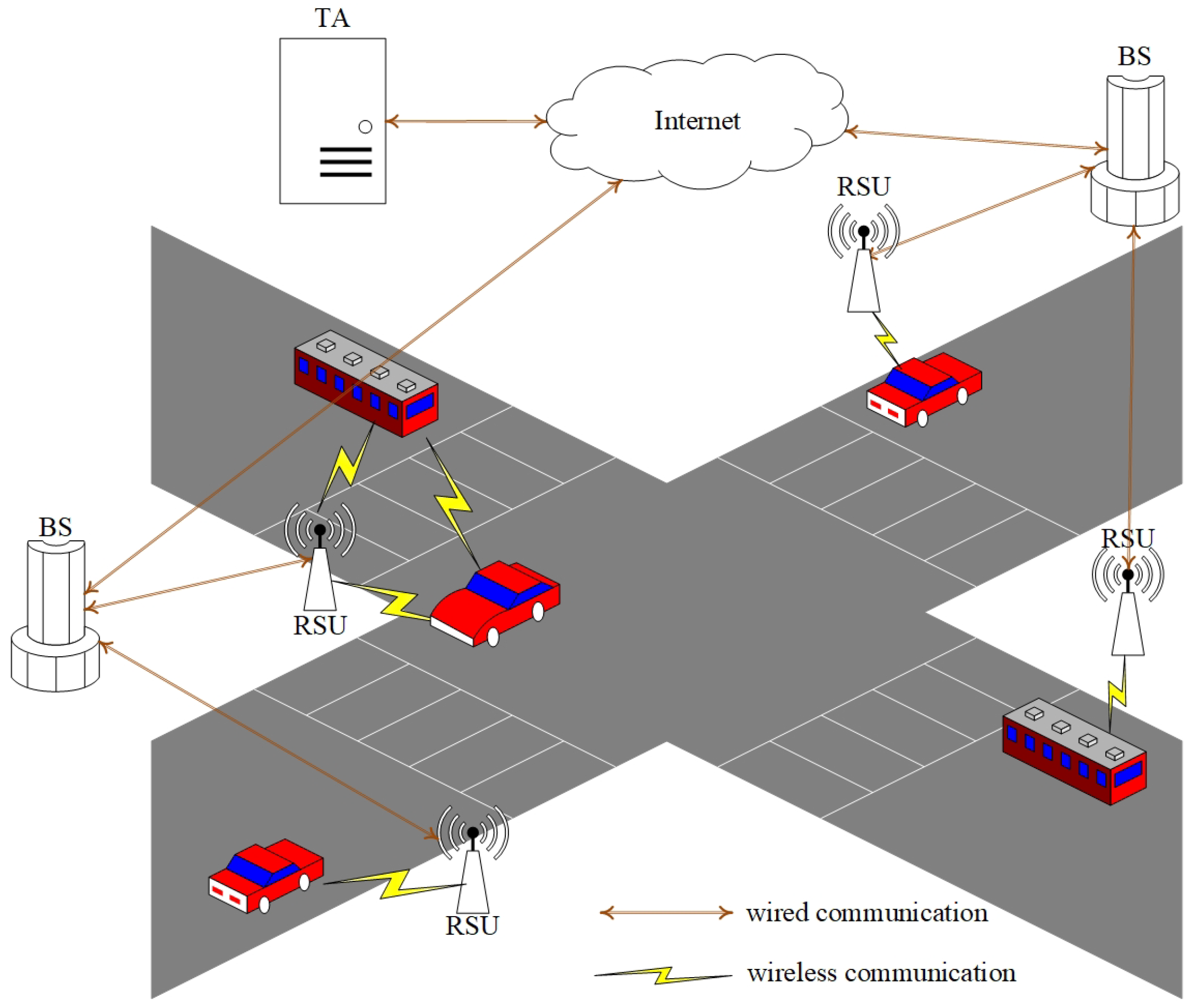
VANETs, as essential parts of ITSs, are able to support the connection between vehicles and infrastructures. In VANETs, a broad range of mobile communication technologies are integrated into roadside units (RSUs) and vehicles to relieve traffic congestion and improve driving safety. As shown in Figure 1, vehicles with onboard units (OBUs) adopt dedicated short range communication (DSRC) to communicate with RSUs or other OBUs and obtain required services [8]. RSUs provide safety-related services, efficiency-related services, entertainment-related services, and so forth, for surrounding vehicles. For example, to guarantee traffic efficiency and safety, RSUs provide road-congestion management and collision alerts for surrounding vehicles [21]. A road-congestion application can provide the best routes for vehicles, and communication occurs among the vehicles and from vehicles to RSUs. This application’s goal is to decrease congestion and improve traffic efficiency. In order to prevent malicious vehicles from obtaining services, it is necessary to verify the validity of pseudonyms of vehicles applying for services. The collision alert’s goal is to avoid and decrease the number of accidents. This is an application category sensitive to the delay. To reduce the delay, road conditions use vehicle-to-vehicle communication. Moreover, the pseudonym’s validation must be as fast as possible to avoid the illegal user from broadcasting a bogus message. Therefore, in both examples, it is necessary to design a pseudonym-revocation scheme with a low distribution delay and an efficient query. The base station (BS) can communicate with the external network and provide network communication services for vehicles. In addition, a BS can assist authorities in providing CRL generation and distribution services for vehicles. In VANETs, two different types of communication are used to support applications and services: (1) vehicle-to-infrastructure (V2I) communication. V2I refers to the communication between vehicles and infrastructures (e.g., RSUs). When entering the signal coverage range of an RSU, vehicles are able to adopt DSRC technology to request an RSU to obtain the required services. An RSU has external network communication capabilities through interconnection with the surrounding BS and provides necessary services for surrounding vehicles. (2) Vehicle-to-vehicle (V2V) communication. V2V refers to the communication between vehicles, which is completed by vehicles independently without the participation of RSUs. Depending on V2V communication, vehicles can obtain the driving status of surrounding vehicles in time to ensure driving safety and improve traffic flow.
Figure 1.
VANET architecture.
2.2. Morton Filter
The Morton filter (MF) [22] is a data structure to support data storage and queries with low spatial complexity and high efficiency. The MF enhances the efficiency of data insertion, querying, and deletion by optimizing a cuckoo filter (CF) [23] and improves space complexity through sparse matrix compression. As shown in Figure 2, the MF takes a block as the basic data unit to store the compressed data. Each block consists of the following three parts.
- Fingerprint storage array (FSA). FSA is made up of a bucket array. Each bucket contains multiple entries, and each entry stores the n-bit value (called fingerprint) generated from the hash value of each element.
- Full counter array (FCA). Each slot in FCA is encoded to record the logical structure of the bucket in FSA and tracks the number of fingerprints occupied. FCA facilitates in situ reading and writing of serialized buckets in FSA without materializing the whole logical perspective of related blocks. As a result, FSA does not need to store the empty space in the logical structure.
- Overflow tracking array (OTA). OTA is composed of a bit vector, which tracks the fingerprint overflow status in the block by setting a bit. The fingerprint can be located by querying the value recorded in OTA.
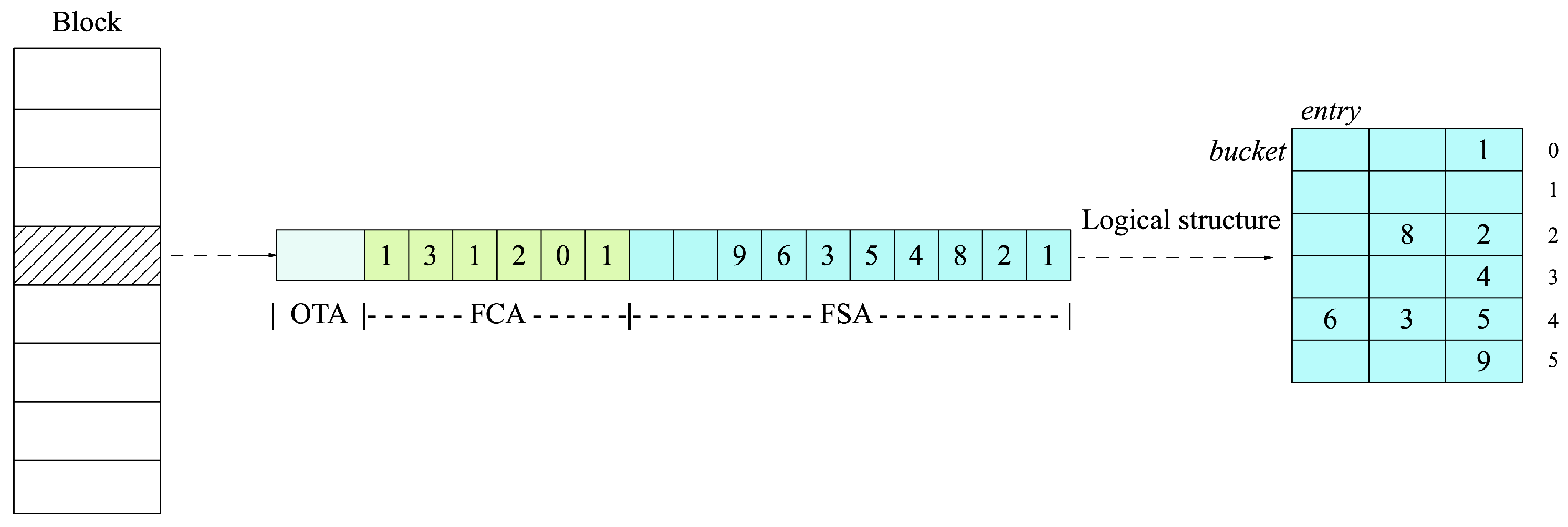
Figure 2.
Morton filter.
There are three core algorithms in the MF.
- (1)
- Lookup:Given a key K and a , we first compute the fingerprint of K. Then, we compute to determine the bucket index for its bucket and divide x by the buckets per block B to yield the block index b. Next, we calculate to get the bucket index. We use to check for the presence of K in the bucket. If not, we recompute and then continue with the rest of the operation.
- (2)
- Insert: Given a key K and a , we first compute the fingerprint of K. Then, we compute to determine the bucket index for its bucket and divide x by the buckets per block B to yield the block index b. Next, we calculate to get the bucket index. We use to store K in the bucket. If successful, we insert F. Else, we recompute , and then continue with the rest of the operation.
- (3)
- Delete: Similarly to lookup, given a key K and a , we first compute the fingerprint of K. Then, we compute to determine the bucket index for its bucket and divide x by the buckets per block B to yield the block index b. Next, we calculate to get the bucket index. We use to check for the presence of K in the bucket. If successful, we delete F. Otherwise, we recompute and then continue with the rest of the operation.
3. System Overview
In this section, the IMF-PR system architecture, the improved Morton filter (IMF) data structure, and the IMF-PR-based CRL (IMF-CRL) are elaborated.
3.1. IMF-PR System Architecture
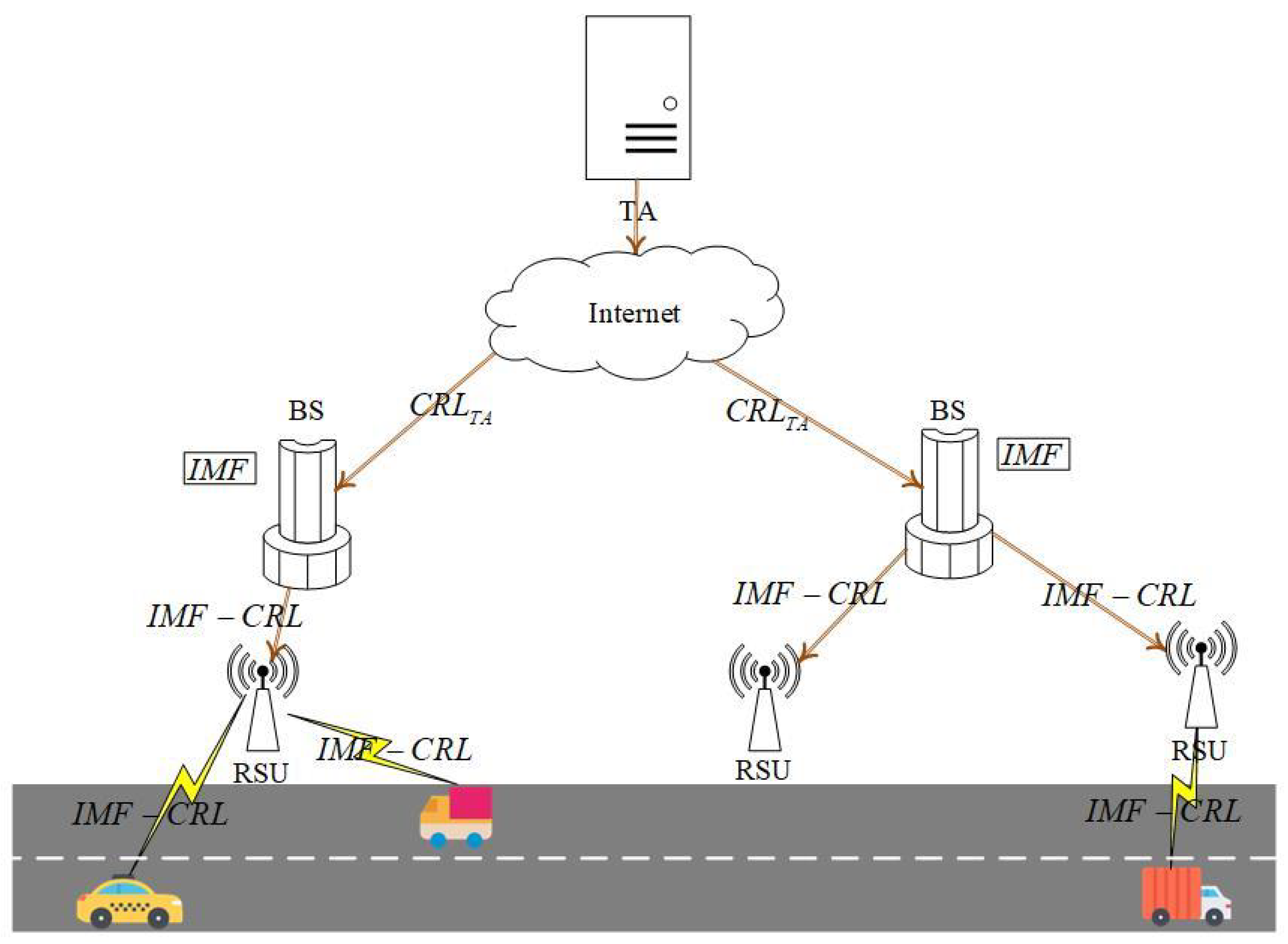
As shown in Figure 3, the IMF-PR system architecture includes four types of entities: TA, BS, RSU, and vehicle.
Figure 3.
IMF-PR system architecture.
TA. According to the illegal vehicle’s long-term pseudonym , TA is able to query the real identity of the vehicle and the related long-term pseudonym set , encapsulate and in , and distribute to the BS.
BS. When receiving from TA, the BS verifies whether ’s signature is legal. If is legal, the BS queries the temporary pseudonym set issued by the BS according to the long-term pseudonym . The BS integrates all long-term pseudonyms, temporary pseudonyms, and expiration dates of all illegal vehicles to generate and distribute to all RSUs within the managed range.
RSU. When receiving from the BS, RSU verifies the legitimacy of ’s signature. If is legal, RSU refuses to communicate with the illegal vehicles contained in , then distributes the to all legal vehicles within the communication range;
Vehicle. After receiving from RSU, the legal vehicle verifies . Once the verification is successful, the vehicle refuses to communicate with the illegal vehicles recorded in .
3.2. Improved Morton Filter
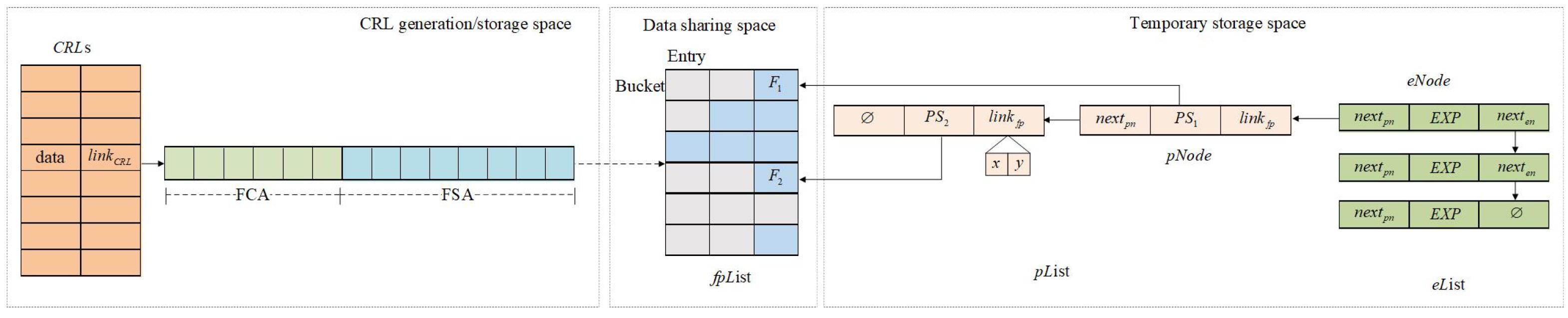
The improved Morton filter (IMF) data structure that stores the identity information of illegal vehicles in the BS is shown in Figure 4. Three partitions make up the storage space based on the IMF data structure: CRL generation/storage space, data-sharing space, and temporary storage space. If there are new pseudonyms with expiration dates, they are added to the and the in the temporary storage space. Then, add the corresponding fingerprints to the in the data-sharing space. Finally, update the , and in the CRL generation/storage space, which means that the entire IMF-CRL construction process is complete.
- (1)
- CRL generation/storage space stores all history and current . Differently from the traditional MF, CRL generation/storage space uses a sequential linked list rather than blocks to record all historical and current CRLs. Each item of CRL is composed of two tuples and , where stores the time when is created and saves the address of the sequence lists composed of FCA and FSA. FCA encodes the logical structure of each bucket in to store the number of fingerprints (F) in . FSA saves the fingerprints contained in . When the number of entries in a bucket is zero, FSA traverses the entries in the next bucket until all fingerprints stored in are recorded.
- (2)
- The data-sharing space is responsible for dynamically storing the fingerprints of illegal vehicles that need to be revoked in the newest . Given the pseudonym and expiration date of the illegal vehicle, the fingerprint F in the () can be determined by computing .
- (a)
- When there are n fingerprints in , store the fingerprint F of pseudonym and expiration date in the th slot of in the sequence;
- (b)
- When there is no remaining slot in , execute to determine the bucket candidate position, and continue to execute (a) or (c);
- (c)
- When the bucket corresponding to is full, expand the bucket storage space, re-execute , and store fingerprint F in the .
- (3)
- Temporary storage space is composed of two linked lists: and , which are responsible for maintaining the information of the illegal vehicles corresponding to the latest issued. Each node in is composed of three triples: , and , where stores the address of the pseudonym linked list , is responsible for storing and maintaining the expiration date of illegal vehicles pseudonyms, and points to the next in the . Each is stored in in the order of increment. is composed of three triples: and , where points to the next with the same , is the pseudonym of the illegal vehicle, stores the address of fingerprint F stored in the in the data-sharing space.
Figure 4.
Improved Morton filter.
3.3. IMF-CRL
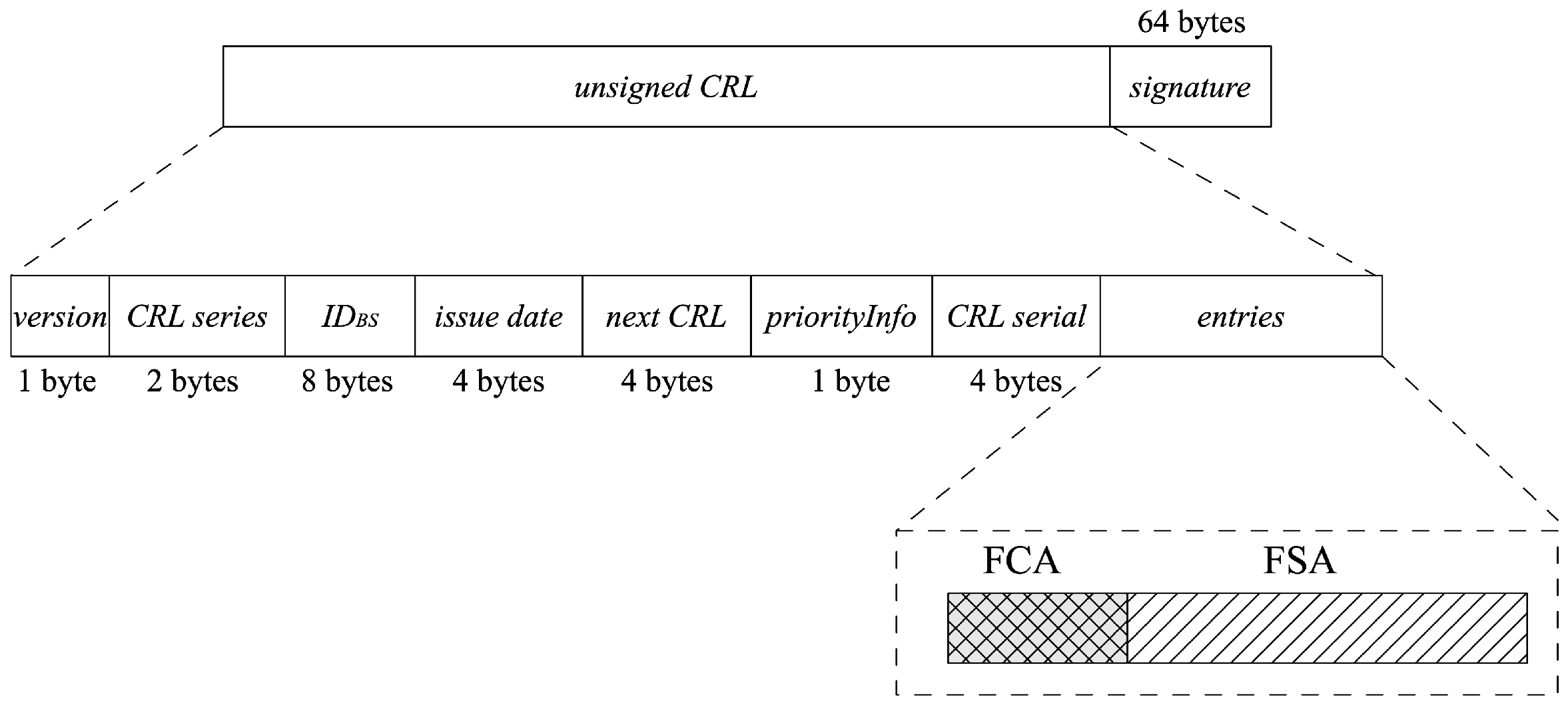
Figure 5 shows the data structure. substitutes , identifying the TA’s identity in CRL based on 1609 with and stores the fingerprints of the illegal vehicles based on IMF data structure instead of the sequence list. The notation and explanations for the are shown in Table 1.
Figure 5.
IMF-CRL.
Table 1.
Notation and explanations for the IMF-CRL.
4. The Proposed Scheme
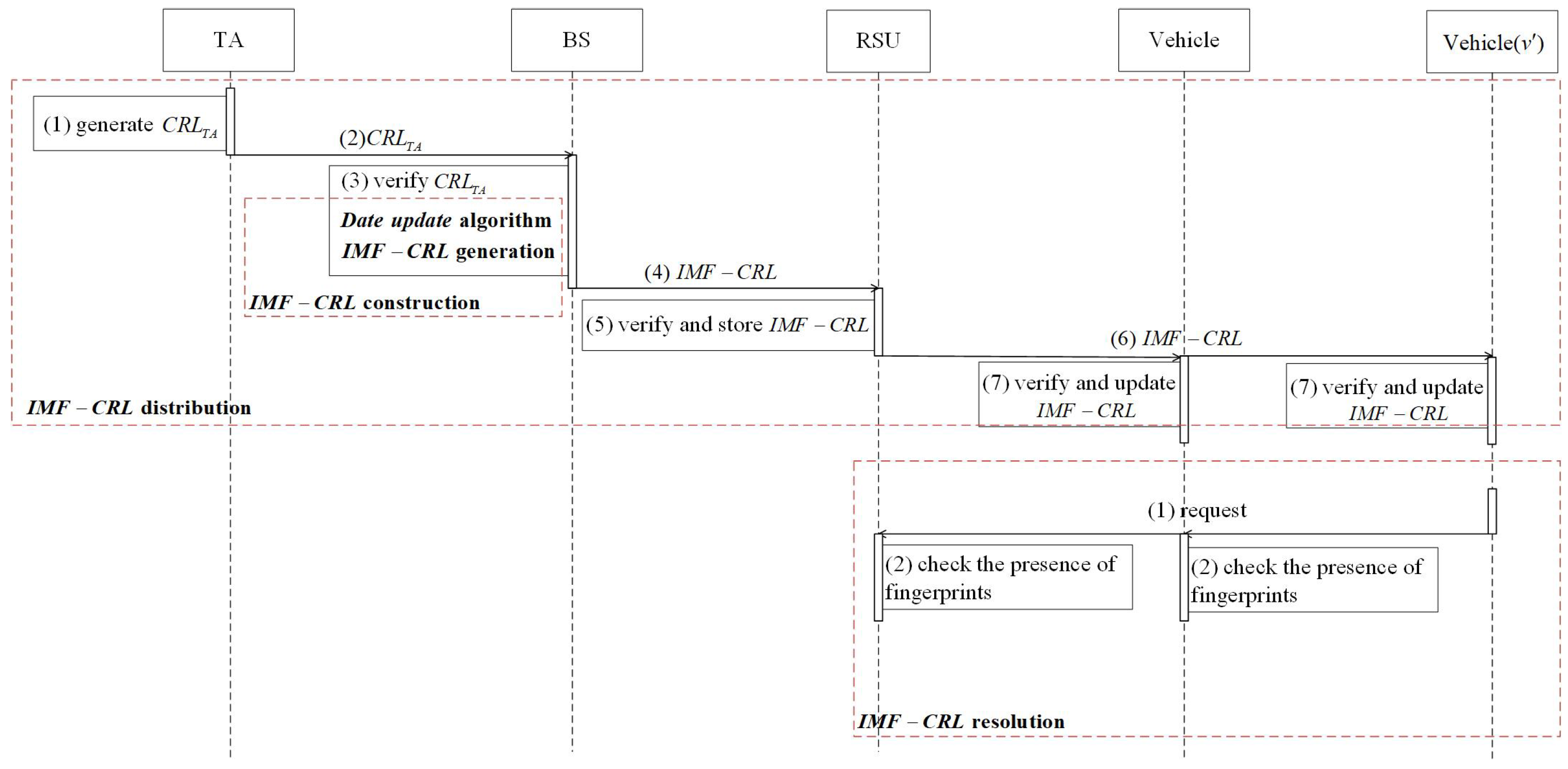
The flow diagram of the proposed scheme is shown in Figure 6. The proposed scheme includes IMF-CRL construction, IMF-CRL distribution, and IMF-CRL resolution. In addition, the IMF-CRL construction includes a data-update algorithm and IMF-CRL generation.
Figure 6.
The flow diagram of the proposed scheme.
4.1. IMF-CRL Construction
In the CRL generation period, TA follows the WAVE-CRL construction algorithm to load the long-term pseudonyms and expiration date of illegal vehicles into , and then sends to all BSs in VANETs via the secure channel.
When receiving , the BS first queries the temporary pseudonyms and expiration date issued by the BS in accordance with the entries contained in . The BS updates and in the temporary storage space and in the data-sharing space based on the above illegal-vehicle information. Then, given the storage list and current date , the BS updates CRL generation/storage space and generates . Finally, the BS generates the based on the updated .
4.1.1. Data-Update Algorithm
The data-update algorithm consists of the REPF algorithm (remove the expired pseudonym and fingerprint algorithm) and the INPF algorithm (insert a new pseudonym and fingerprint algorithm).
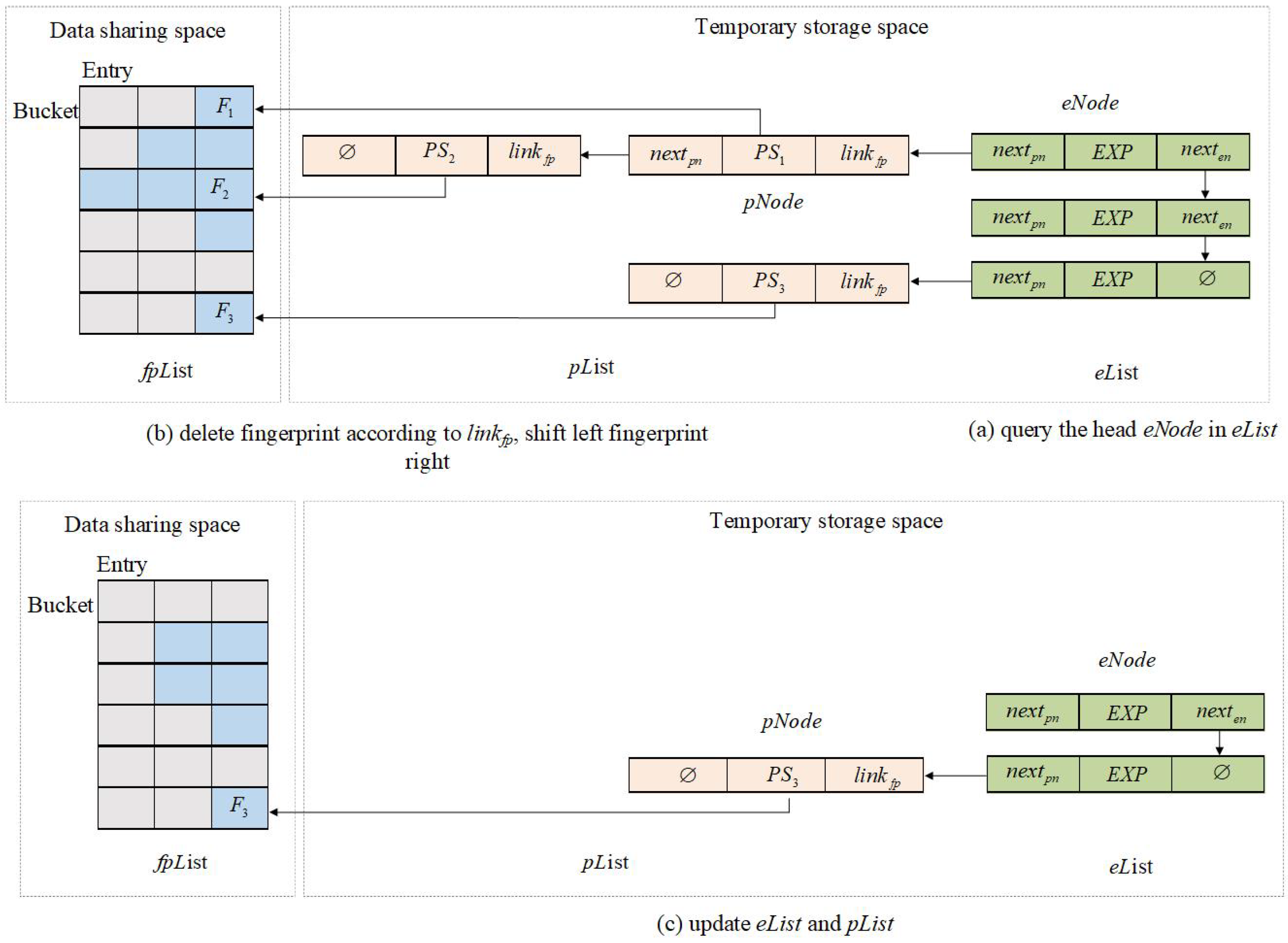
Algorithm 1 is in charge of deleting the old pseudonyms, expiration dates, and fingerprints of illegal vehicles stored in IMF. As shown in Figure 7, the details of the REPF algorithm follow.
- (1)
- Query the head node () in . If the stored in is expired, then determine the pointed to by . For the stored by each in the , record the address of the fingerprint F in the .
- (2)
- Delete the fingerprint F mapped in according to , move all fingerprints in the same bucket on the left side of F to the right, and set the leftmost slot to .
- (3)
- Update and by deleting the head node and all linked to by .
Figure 7.
Remove the expired pseudonym and fingerprint algorithm.
| Algorithm 1 REPF algorithm. |
| Input: , , , Output: , ,
end function |
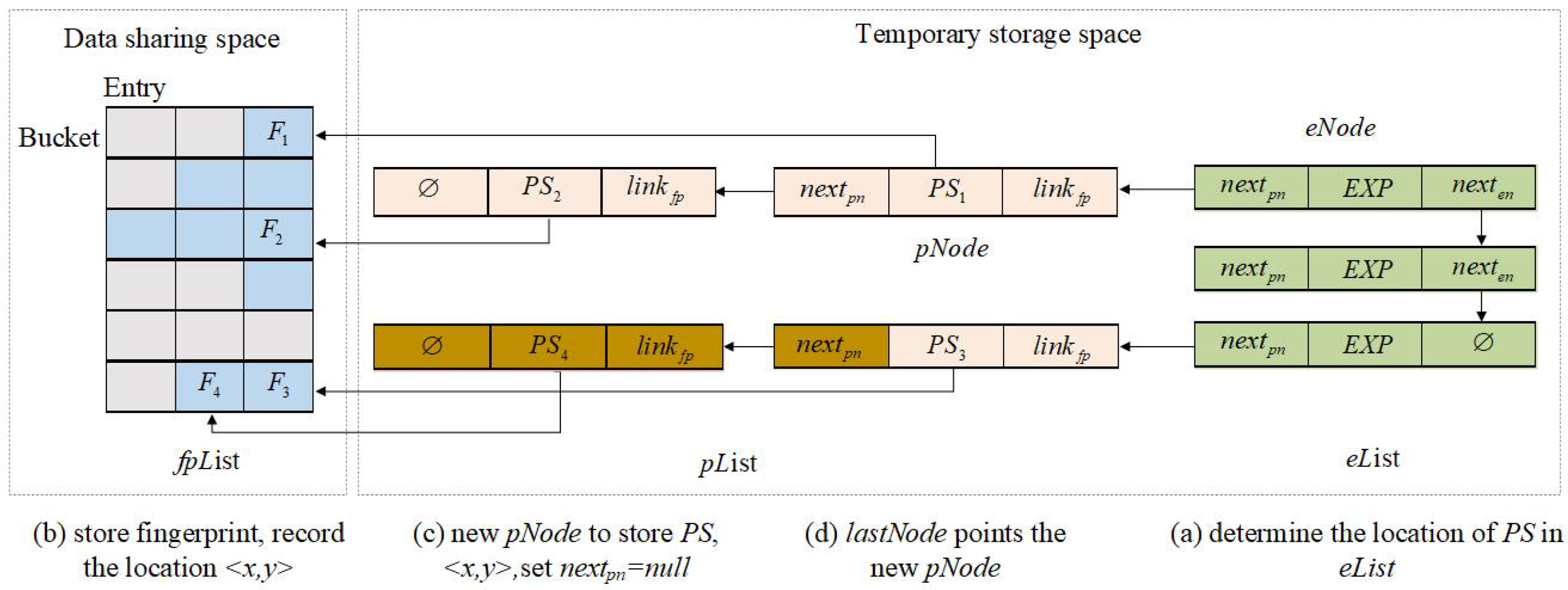
Algorithm 2 is in charge of storing new illegal vehicles’ pseudonyms, expiration dates, and fingerprints in IMF. As shown in Figure 8, given a new pseudonym and expiration date , the BS needs to execute the following operations.
Figure 8.
Insert the new pseudonym and fingerprint algorithm.
- (1)
- Determine the of the new pseudonym by traversing the :
- (a)
- When there exist with in the , record the of the last in the pointed to by the in as ;
- (b)
- When the is empty, create a new , add to , set and to null, and points to the new . Finally, record the in the as .
- (c)
- When there is no with in , create a new , add to the , and set to . Add the in incremental order ( of the previous node of the points to the node, and the of the points to the next node) and record the in the as .
- (2)
- Calculate the fingerprints of and : and the address (or ). Store F in the first slot of the remaining space (e.g., ) in the .
- (3)
- Create a new , add in the , store in the , and set = (as shown in Algorithm 3 InsertFP algorithm).
- (4)
- The stores the address of the new .
| Algorithm 2 INPF algorithm. |
| Input: , , , , Output: , ,
end function |
| Algorithm 3 InsertFP algorithm. |
| Input: , , , Output: ,
end function |
4.1.2. IMF-CRL Generation
Given the fingerprint storage list and current date , the BS generates as the Morton filter does:
- (1)
- Create a two-tuple , where the size of is the number of in and the size of is equal to the number of fingerprints in ;
- (2)
- Traverse and store the fingerprints in in the logical order saved in ;
- (3)
- Record the number of fingerprints stored in each bucket in the and store the value in the corresponding slot in ;
- (4)
- Package into .
4.2. IMF-CRL Distribution
Based on the generation protocol, TA generates and transmits to all BSs, which contains the long-term pseudonym set, corresponding to the expiration date set of illegal vehicles, and the . After receiving the , the BS first uses the TA’s public key to verify . If is regarded as legal, the BS queries all temporary pseudonym sets issued by the BS according to the pseudonyms and expiration date stored in . Then, the BS generates the certificate revocation list through the IMF-CRL construction algorithm and transmits the to RSUs. Next, the RSU verifies . If is legal, the RSU stores locally and sends to surrounding legal vehicles. Finally, the legal vehicle that has received verifies . If the verification is successful, the vehicle updates the local .
4.3. IMF-CRL Resolution
When legal vehicle v and the RSU receive the request from surrounding vehicles (e.g., ), vehicle v and the RSU checks whether the fingerprint of vehicle is recorded in . Given , and the pseudonym and expiration date of , the process of IMF-CRL resolution is as follows:
- (1)
- Calculate the fingerprint of and : ;
- (2)
- Compute the index of and in : ;
- (3)
- By summing the values recorded in to , the offset of F in is derived: ;
- (4)
- Query whether there existing a fingerprint F from to :
- (a)
- If F exists, it proves that is an illegal vehicle; thus, v and RSU refuse to communicate with vehicle ;
- (b)
- If there is no fingerprint F, calculate , and continue to execute (3) and (4):
- ∗
- When the query is successful, it proves that vehicle is an illegal vehicle. Vehicle v and RSU refuse to communicate with vehicle ;
- ∗
- When the query fails, this proves that the fingerprint of the vehicle is not recorded in the ; vehicle v and RSU execute the V2V and V2I mutual authentication protocols to verify the validity of vehicle .
5. Performance Analysis
In this section, IMF-PR, CRL [17], and CRL [19] are compared and analyzed in terms of compression gain and transmission delay. Additionally, the simulation framework Veins was adopted to demonstrate the CRL query throughput and CRL-update throughput.
CRL [17] designed a lightweight online certificate status protocol (TinyOCSP) to save on energy. Then, the CRL integrates CRL compression using Bloom filters with TinyOCSP to further reduce the certificate validation overhead. CRL [19] proposed an improved pseudonym certificate revocation scheme, using a Cuckoo filter for compression. In order to optimize deletion efficiency, CRL [19] designed the concept of the Certificate Expiration List (CEL), which can be implemented with a priority queue. The scheme greatly improves the lookup performance on CRLs and reduces the revocation operation costs through deletion.
5.1. Compression Gain
Compression gain is defined as the ratio of the size of WAVE-CRL to the size of the CRL in IMF-PR, CRL, and CRL. With the same number of illegal vehicles, the larger the , the lower the space complexity, and the shorter the CRL length.
According to [8], WAVE-CRL consists of three parts: unsigned CRL ( = 24 bytes), entries comprising pseudonym and expiration date (14 bytes for each entry), and signature ( = 64 bytes).
In the CRL scheme based on the Bloom filter, given the array length m of the Bloom Filter, the length of CRL is bytes. Given the number of entries is n, the average length of each entry in the Bloom filter is bytes. According to [24], is defined by the false-positive rate as bits. As a result,
In the CRL scheme based on the Cuckoo filter, assume there are m buckets in the Cuckoo filter, each bucket is able to hold up to b entries, each entry’s fingerprint length is f, and the number of entries is n. The length of CRL is bytes; each entry is on average bytes. According to [25], given a loading factor , is expressed by false-positive rate as bits. Consequently,
In IMF-PR, suppose that there are m buckets in the IMF, each bucket holds at most b entries, the fingerprint length of each entry is f, and the number of entries is n. The total length of IMF-PR is bytes; each entry is on average bytes. According to [22], defines the false-positive rate as bits. Thus,
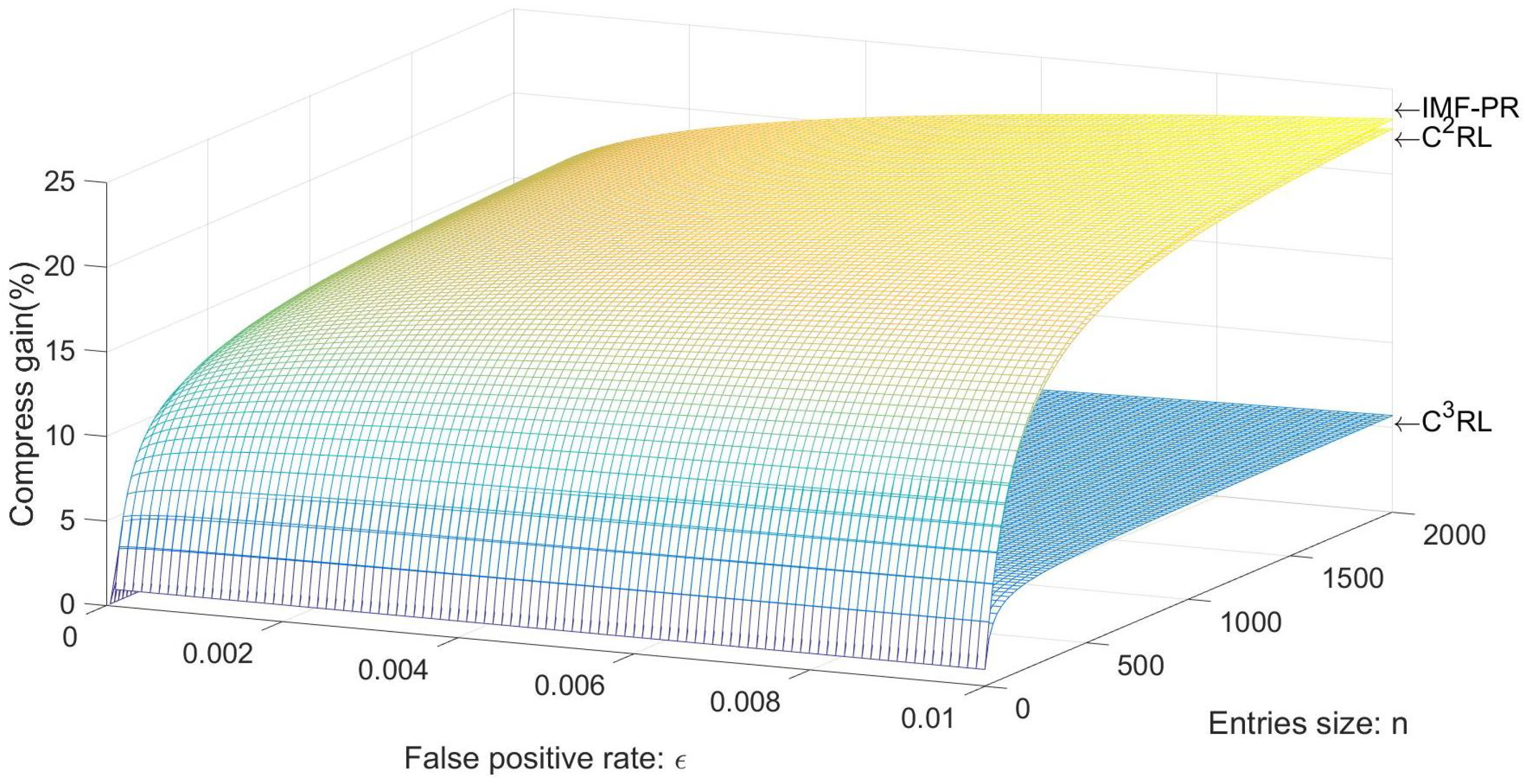
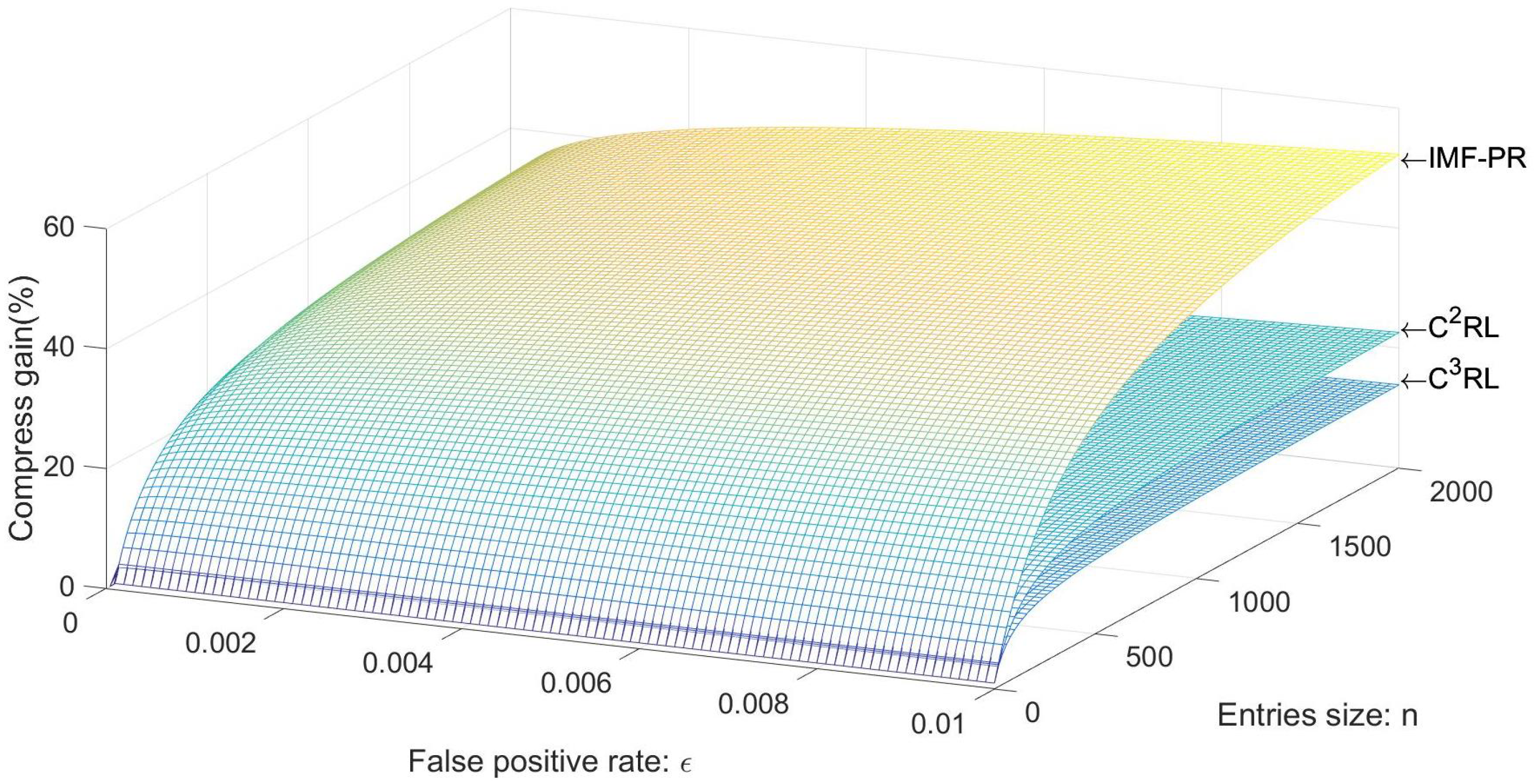
The compression gains of IMF-PR, CRL, and CRL at the same load factor = 0.5 are shown in Figure 9. When the number of pseudonyms revoked remains constant, the compression gain rises in tandem with the false-positive rate. As a result, in order to achieve a low false-positive rate, a larger storage capacity needs to be required. Simultaneously, as the false-positive rate increases, the compression gains of CRL and IMF-PR rise quickly, and the growth rate gradually becomes flat with the false-positive rates of to . Meanwhile, the overall growth rate of CRL is modest. With the same false-positive rate, IMF-PR guarantees the maximum compression gain. In addition, as the number of entries stored in the CRL grows, the compression gains of the three schemes starts to increase dramatically and level off when the number of entries reaches 400 to 800. Meanwhile, the compression gain of CRL increases the slowest and the growth rate of IMF-PR is the highest. When storing the same amount of entries, IMF-PR can provide higher compression gains and shorter the length of the CRL. When the number of entries is 2000 and the false-positive rate is 0.01, the compression gains of CRL and CRL are and lower than those of IMF-PR, respectively.
Figure 9.
Compression gain ( = 0.5).
Figure 10 shows the compression gains of IMF-PR, CRL, and CRL at the same load factor: = 0.8. Compared with Figure 9, the compression gain of the IMF-PR is significantly increased, and the high compression gain of CRL can be guaranteed while keeping the false-positive rate low. Since the storage space in CRL has nothing to do with the load factor, the results in Figure 9 and Figure 10 are consistent, whereas the compression gain of CRL shows a rather smooth increase. In comparison to Figure 9, IMF-PR and CR achieved higher compression gain with the same storage entry and load factor, while the compression gain of IMF-PR was significantly accelerated and the compression gain of CRL was relatively slow. When the number of entries was 400 to 800, the compression gain of the three schemes flattened out. When the number of entries was 2000 and the false-positive rate was 0.01, the compression gains of CRL and CRL were and lower than that of IMF-PR, respectively.
Figure 10.
Compression gain ( = 0.8).
5.2. Transmission Delay
The transmission delay (TD) is defined as the time from a CRL being distributed to when it is received [26]. In the CRL distribution protocol, the transmission is relatively stable and the delay is small due to the wired transmission among the authority, BSs, and RSUs. This section only discusses the transmission delay from RSU distributing CRL to the vehicle receiving CRL. The TD is defined as
where denotes the data packet size of CRL defined by the WAVE standard. The RSU that receives the CRL needs to layer the data via WSMP, LLC, MAC, and PHY. The RSU then transmits the WAVE-packets to surrounding vehicles via the physical layer. According to the 1069.2 standard [8], given the length of the CRL , the length of the WAVE-packet is = bytes.
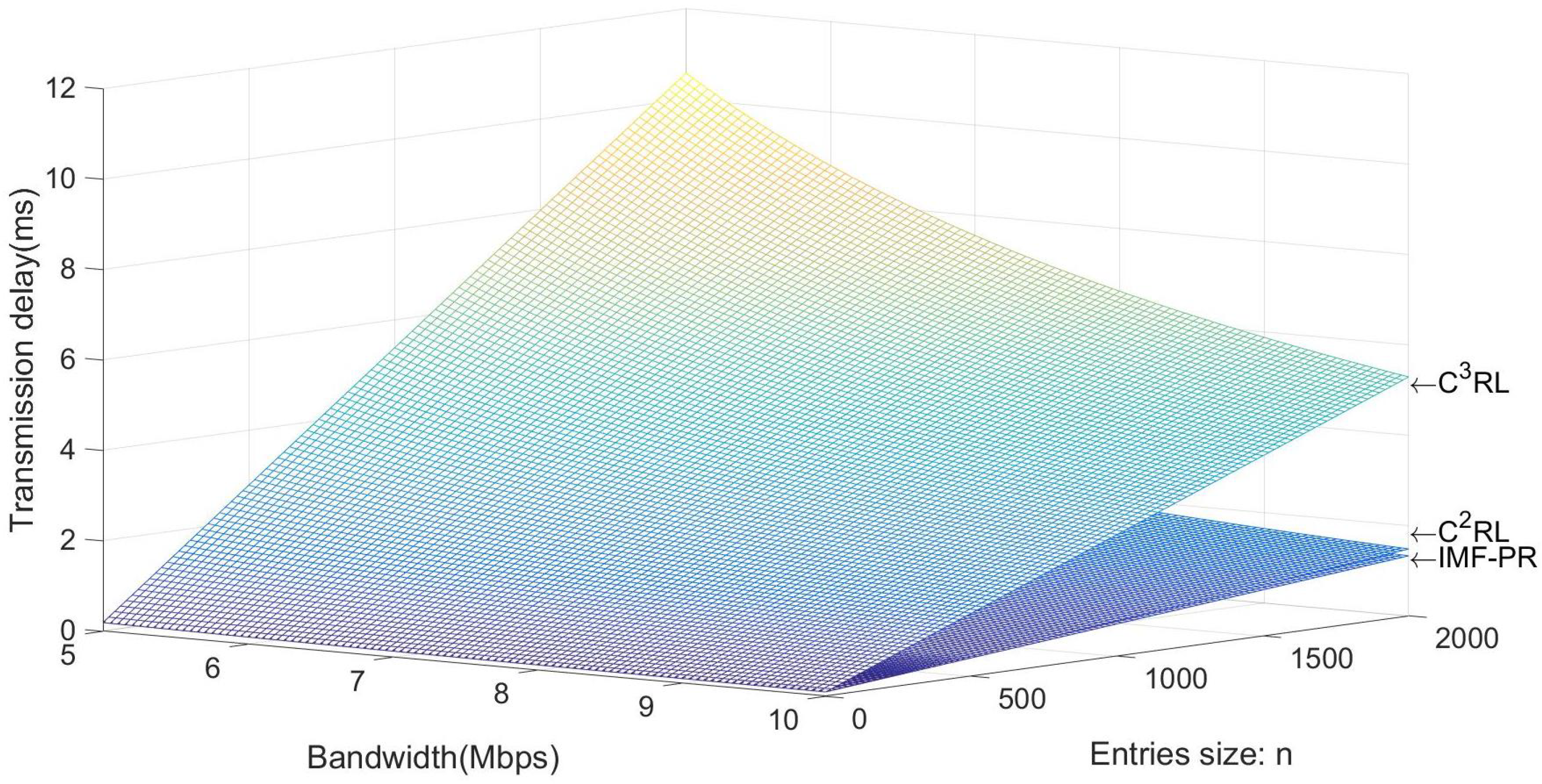
Figure 11 shows the transmission delays of IMF-PR, CRL, and CRL for various bandwidths and entries sizes when = 0.5, . The transmission delays of the three schemes all show a decreasing trend as bandwidth increases. Since the CRL compression gain of the IMF-PR is the highest when storing the same items, it assures that the VANETs can complete the CRL distribution with the lowest communication cost. Therefore, IMF-PR can complete the distribution of the CRL with lower transmission delay than CRL and CRL. When the number of illegal vehicles included in the CRL is 0, the CRLs of the three schemes only contain 121 bytes, so the three schemes can finish the CRL distribution with extremely little transmission delay. As the entries of illegal vehicle stored in the CRL grow, the transmission delays of the three schemes showed an upward trend. CRL had the most obvious upward trend due to having the lowest compression rate. By owning the highest compression rate, IMF-PR distributes the CRL with the least transmission delay and the slowest rise rate. When the number of entries is 2000 and the bandwidth is 10 Mbps, the transmission delay of IMF-PR is and lower than those of CRL and CRL, respectively.
Figure 11.
Transmission delay ( = 0.5, ).
5.3. Simulation
Based on the Veins framework, we conducted simulation experiments on IMF-PR, CRL, and CRL in terms of CRL query throughput, where the traffic map of Tianhe District in Guangzhou was embedded as the simulation scenario (2000 × 2000 m). The simulation tool we used is the open-source framework Vehicles in Network Simulation (Veins) [27]. Veins implements the IEEE 802.11p protocol in the physical and MAC layers and manages the data transmission between OMNET++ and SUMO through TraCI [28]. The data-transmission rate and transmission power are defined as the default values of 6 Mbps and 20 mW, respectively. Then, we define the simulation time and number of cars as 500 s and 20–200, respectively [3,29]. We adopted the open-source MF-library at Github and the main configuration from the Morton filter proposal paper [22], which means a 3-slot bucket with 8-bit fingerprints. The parameters of the simulation are shown in Table 2.
Table 2.
Simulation parameters.
5.3.1. Query Throughput
Query throughput is defined as the number of CRL query operations completed by RSU and vehicle per unit time [30]. The higher the query throughput and the faster the query speed, the quicker the RSU, and the vehicle can determine whether the surrounding vehicle is legal or not.
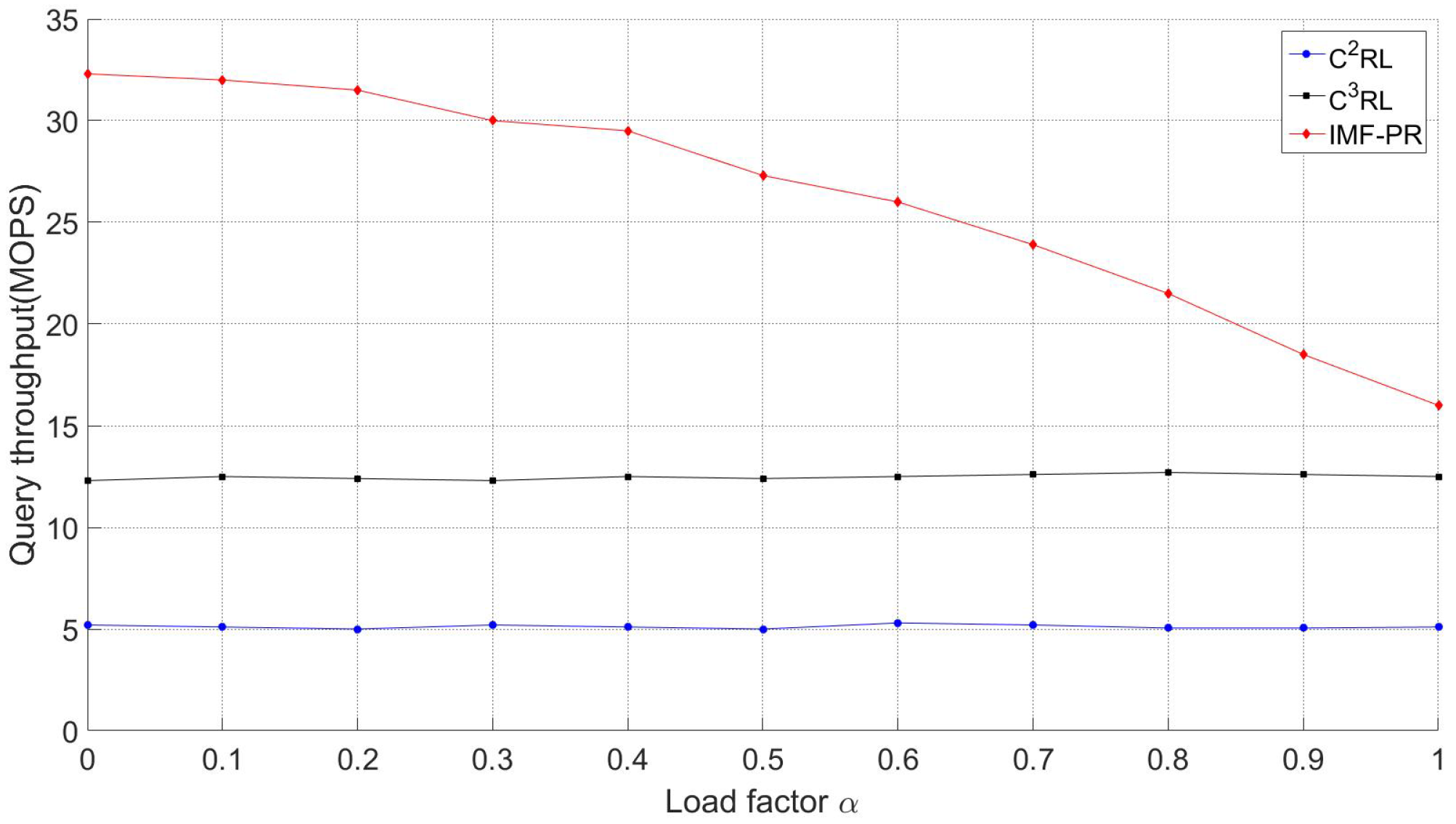
Figure 12 demonstrates the CRL query throughput of IMF-PR, CRL, and CRL under different load factors, . Both the number of vehicles in the simulation and the running time of the simulation affect the load factor. As the number of vehicles in the simulation and the simulation time increased, the load factor also increased gradually. As the load factor increased, the throughputs of CRL and CRL remained relatively stable. However, IMF-PR showed a considerable downward trend, while still maintaining a high query throughput. Furthermore, when the load factor is low, IMF-PR can complete query operations faster than CRL and CRL. As can be seen in the figure, when the load factor ranges from zero to one, the query-throughput advantage of IMF-PR over CRL gradually decreases from to , and compared with CRL, the query-throughput advantage of IMF-PR decreases from to . Moreover, when the load factor is increased from 0 to 0.5, the load factor of IMF-PR decreases by , and when the load factor is increased from 0.5 to 1, the load factor of IMF-PR decreases by . As a result, in order to achieve a high query throughput, more storage capacity is required to achieve a lower load factor.
Figure 12.
Query throughput.
5.3.2. Update Throughput
Update throughput is defined as the number of CRL update operations performed by an authority per unit of time [30]. The higher the update throughput, the faster the authority can update the CRL. The updating of the CRL includes deleting illegal vehicles with expired pseudonyms or falsely reported vehicle information in the old CRL and inserting new illegal-vehicle information. CRL does not support deletion operations, instead verifying the update throughput by insert operations.
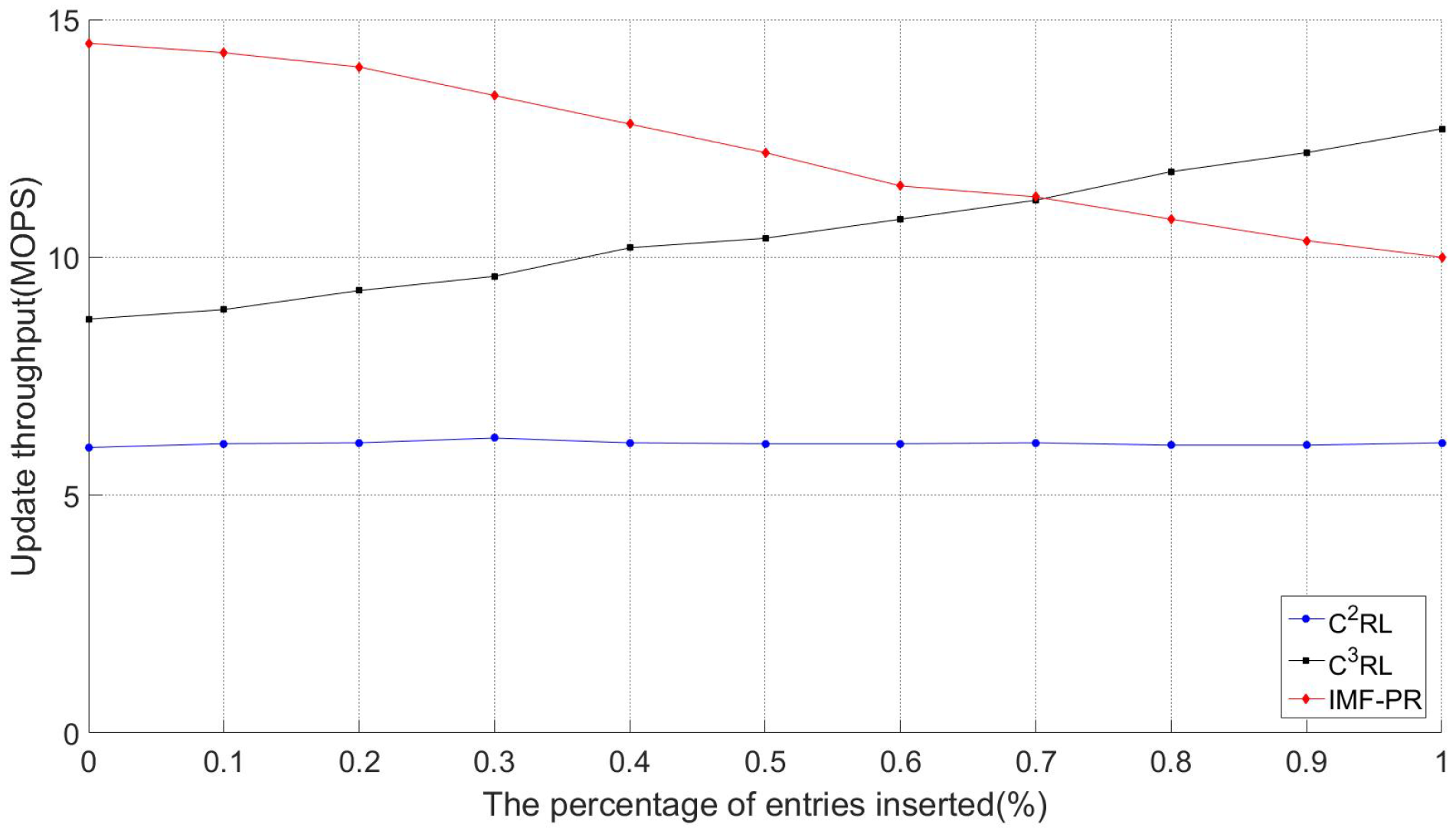
Figure 13 shows the CRL-update throughputs for IMF-PR, CRL, and CRL with a load factor of 0.5. Both the number of vehicles in the simulation and the running time of the simulation affect the number of entries that are inserted and deleted. As the number of vehicles in the simulation and the simulation time increase, the number of entries inserted and deleted also increases gradually. However, the percentage of entries inserted does not increase with the number of vehicles and simulation time. It can be seen in the figure that the throughput of CRL is not affected by the percentage of entries inserted. As the proportion of inserted entries continues to increase, the proportion of deleted entries decreases and the throughput of CRL continues to increase, which means when the pseudonyms used by vehicles in VANETs have a long validity period—that is, CRL does not need to delete expired pseudonyms frequently—so the throughput of CRL is more advantageous. However, in order to protect the privacy of the vehicle, the validity periods of the pseudonyms in VANETs cannot be too long. In IMF-PR, since eList in the temporary storage space needs to be updated during inserting entries, the throughput continues to drop. This is because in IMF-PR, entry insertions can only be done one at a time and entry deletions can be done in batches, so throughput decreases as the proportion of entries inserted increases; in contrast, throughput increases as the percentage of entries deleted increases. As can be seen in Figure 13, IMF-PR’s throughput is lower than CRL’s when the percentage of entries inserted is higher than . When the insertion percentage is zero, the update throughput of IMF-PR is and higher than those of CRL and CRL, respectively. When the insertion percentage is one, the update throughput of CRL is higher than that of IMF-PR, and the update throughput of IMF-PR is higher than that of CRL.
Figure 13.
Update throughput. ( = 0.5).
6. Conclusions
In this paper, an improved Morton-filter-based pseudonym-revocation scheme for VANETs (IMF-PR) was proposed to address the issues of high CRL maintenance, distribution, and query costs. By improving the Morton filter, IMF-PR enhances the efficiency of generating and updating CRL, lowers the CRL’s storage cost, and enables legal vehicles to quickly query and verify the surrounding vehicles. Moreover, IMF-PR supports the decentralized CRL management mechanism, which not only reduces the CRL maintenance cost of TA, but also improves CRL distribution efficiency. The performance analysis and simulation results showed that the compression ratio of IMF-PR is better than those of CRL and CRL, and the transmission delay of IMF-PR is and lower than those of CRL and CRL, respectively. In addition, in the worst case, the query throughput of IMF-PR is and higher than those of CRL and CRL, respectively. Moreover, IMF-PR’s update throughput is better than those of the other two schemes when the percentage of entries inserted is less than . In the future, we will explore a novel anonymous authentication scheme to support secure V2I and V2V communication.
Author Contributions
Conceptualization, C.Z. and T.G.; Methodology, C.Z., T.G. and X.D.; Software, X.D.; Validation, J.Q.; Formal analysis, C.Z. and X.D.; Writing—original draft, C.Z.; Writing—review & editing, J.Q. and T.G.; Visualization, J.Q.; Funding acquisition, T.G. All authors have read and agreed to the published version of the manuscript.
Funding
This work was supported by National Natural Science Foundation of China grant number 52130403 and the Fundamental Research Funds for the Central Universities grant number N2017003.
Informed Consent Statement
Not applicable.
Data Availability Statement
Not applicable.
Conflicts of Interest
The authors declare no conflict of interest.
References
- Zhu, F.; Lv, Y.; Chen, Y.; Wang, X.; Xiong, G.; Wang, F. Parallel Transportation Systems: Toward IoT-Enabled Smart Urban Traffic Control and Management. IEEE Trans. Intell. Transp. Syst. 2020, 21, 4063–4071. [Google Scholar] [CrossRef]
- AlMarshoud, M.S.; Al-Bayatti, A.H.; Kiraz, M.S. Location privacy in VANETs: Provably secure anonymous key exchange protocol based on self-blindable signatures. Veh. Commun. 2022, 36, 100490. [Google Scholar] [CrossRef]
- Boualouache, A.; Senouci, S.; Moussaoui, S. PRIVANET: An Efficient Pseudonym Changing and Management Framework for Vehicular Ad-Hoc Networks. IEEE Trans. Intell. Transp. Syst. 2020, 21, 3209–3218. [Google Scholar] [CrossRef]
- Rabieh, K.; Pan, M.; Han, Z.; Ford, V. SRPV: A Scalable Revocation Scheme for Pseudonyms-Based Vehicular Ad Hoc Networks. In Proceedings of the 2018 IEEE International Conference on Communications, ICC 2018, Kansas City, MO, USA, 20–24 May 2018; pp. 1–6. [Google Scholar]
- Singh, P.K.; Gowtham, S.N.; S, T.; Nandi, S. CPESP: Cooperative Pseudonym Exchange and Scheme Permutation to preserve location privacy in VANETs. Veh. Commun. 2019, 20, 100183. [Google Scholar] [CrossRef]
- Benarous, L.; Kadri, B.; Boudjit, S. Alloyed Pseudonym Change Strategy for Location Privacy in VANETs. In Proceedings of the IEEE 17th Annual Consumer Communications & Networking Conference, CCNC 2020, Las Vegas, NV, USA, 10–13 January 2020; pp. 1–6. [Google Scholar]
- Zhu, X.; Jiang, S.; Wang, L.; Li, H. Efficient Privacy-Preserving Authentication for Vehicular Ad Hoc Networks. IEEE Trans. Veh. Technol. 2014, 63, 907–919. [Google Scholar] [CrossRef]
- IEEE Std 1609.2-2016 (Revision of IEEE Std 1609.2-2013); IEEE Standard for Wireless Access in Vehicular Environments–Security Services for Applications and Management Messages. IEEE: Piscataway, NJ, USA, 2016; pp. 1–240. [CrossRef]
- Hasrouny, H.; Samhat, A.E.; Bassil, C.; Laouiti, A. Misbehavior detection and efficient revocation within VANET. J. Inf. Secur. Appl. 2019, 46, 193–209. [Google Scholar] [CrossRef]
- Simplicio, M.A., Jr.; Cominetti, E.L.; Patil, H.K.; Ricardini, J.E.; Ferraz, L.T.D.; Silva, M.V.M. Privacy-Preserving Certificate Linkage/Revocation in VANETs Without Linkage Authorities. IEEE Trans. Intell. Transp. Syst. 2021, 22, 3326–3336. [Google Scholar] [CrossRef]
- Tesei, A.; Lattuca, D.; Pagano, P.; Luise, M.; Ferreira, J.; Bartolomeu, P.C. A Transparent Distributed Ledger-based Certificate Revocation Scheme for VANETs. arXiv 2020, arXiv:2010.13555. [Google Scholar]
- Elloh, Y.A.; Hammi, B.; Serhrouchni, A.; Zeadally, S. A blockchain-based certificate revocation management and status verification system. Comput. Secur. 2021, 104, 102209. [Google Scholar] [CrossRef]
- Vijayalakshmi, V.; Sathya, M.; Saranya, S.; Selvaroopini, C. Survey on various mechanisms for secure and efficient VANET communication. In Proceedings of the International Conference on Information Communication & Embedded Systems, Chennai, India, 27–28 February 2014; pp. 1–5. [Google Scholar]
- Papadimitratos, P.; Mezzour, G.; Hubaux, J. Certificate revocation list distribution in vehicular communication systems. In Proceedings of the Fifth International Workshop on Vehicular Ad Hoc Networks, VANET 2008, San Francisco, CA, USA, 15 September 2008; pp. 86–87. [Google Scholar]
- Wasef, A.; Shen, X. EMAP: Expedite Message Authentication Protocol for Vehicular Ad Hoc Networks. IEEE Trans. Mob. Comput. 2013, 12, 78–89. [Google Scholar] [CrossRef]
- Gañán, C.; Muñoz, J.L.; Esparza, O.; Mata-Díaz, J.; Alins, J. EPA: An efficient and privacy-aware revocation mechanism for vehicular ad hoc networks. Pervasive Mob. Comput. 2015, 21, 75–91. [Google Scholar] [CrossRef]
- Höglund, J.; Furuhed, M.; Raza, S. Lightweight certificate revocation for low-power IoT with end-to-end security. J. Inf. Secur. Appl. 2023, 73, 103424. [Google Scholar] [CrossRef]
- Dharmapurikar, S.; Krishnamurthy, P.; Sproull, T.; Lockwood, J. Deep packet inspection using parallel Bloom filters. In Proceedings of the 11th Symposium on High Performance Interconnects, Stanford, CA, USA, 20–22 August 2003; pp. 44–51. [Google Scholar] [CrossRef]
- Zhang, H.; Zhang, D.; Chen, H.; Xu, J. Improving Efficiency of Pseudonym Revocation in VANET Using Cuckoo Filter. In Proceedings of the 2020 IEEE 20th International Conference on Communication Technology (ICCT), Nanning, China, 28–31 October 2020. [Google Scholar]
- Deng, X.; Gao, T.; Guo, N.; Qi, J.; Zhao, C. PAS: Privacy-Preserving Authentication Scheme Based on SDN for VANETs. Appl. Sci. 2022, 12, 4791. [Google Scholar] [CrossRef]
- Cunha, F.; Villas, L.; Boukerche, A.; Maia, G.; Viana, A.; Mini, R.; Loureiro, A. Data communication in VANETs: Protocols, applications and challenges. Ad Hoc Netw. 2016, 44, 90–103. [Google Scholar] [CrossRef]
- Breslow, A.D.; Jayasena, N. Morton filters: Fast, compressed sparse cuckoo filters. VLDB J. 2020, 29, 731–754. [Google Scholar] [CrossRef]
- Bonomi, F.; Mitzenmacher, M.; Panigrahy, R.; Singh, S.; Varghese, G. An Improved Construction for Counting Bloom Filters. In Proceedings of the Algorithms—ESA 2006, 14th Annual European Symposium, Zurich, Switzerland, 11–13 September 2006; pp. 684–695. [Google Scholar]
- Pagh, A.; Pagh, R.; Rao, S.S. An optimal Bloom filter replacement. In Proceedings of the Sixteenth Annual ACM-SIAM Symposium on Discrete Algorithms, SODA 2005, Vancouver, BC, Canada, 23–25 January 2005; pp. 823–829. [Google Scholar]
- Fan, B.; Andersen, D.G.; Kaminsky, M.; Mitzenmacher, M. Cuckoo Filter: Practically Better Than Bloom. In Proceedings of the 10th ACM International on Conference on Emerging Networking Experiments and Technologies, CoNEXT 2014, Sydney, Australia, 2–5 December 2014; pp. 75–88. [Google Scholar]
- Al Falasi, H.; Barka, E. Revocation in VANETs: A survey. In Proceedings of the 2011 International Conference on Innovations in Information Technology, Abu Dhabi, United Arab Emirates, 25–27 April 2011; pp. 214–219. [Google Scholar]
- Sommer, C.; German, R.; Dressler, F. Bidirectionally Coupled Network and Road Traffic Simulation for Improved IVC Analysis. IEEE Trans. Mob. Comput. 2011, 10, 3–15. [Google Scholar] [CrossRef]
- Wegener, A.; Piorkowski, M.; Raya, M.; Hellbrück, H.; Hubaux, J.P. TraCI: An Interface for Coupling Road Traffic and Network Simulators. In Proceedings of the 11th Communications and Networking Simulation Symposium, Ottawa, ON, Canada, 14–17 April 2018. [Google Scholar]
- Rong, Y.; Kang, J.; Huang, X.; Xie, S.; Gjessing, S. MixGroup: Accumulative Pseudonym Exchanging for Location Privacy Enhancement in Vehicular Social Networks. IEEE Trans. Dependable Secur. Comput. 2016, 13, 93–105. [Google Scholar]
- Rahman, S.; Kim, G.; Cho, Y.Z.; Khan, A. Positioning of UAVs for throughput maximization in software-defined disaster area UAV communication networks. J. Commun. Netw. 2018, 20, 452–463. [Google Scholar] [CrossRef]
Disclaimer/Publisher’s Note: The statements, opinions and data contained in all publications are solely those of the individual author(s) and contributor(s) and not of MDPI and/or the editor(s). MDPI and/or the editor(s) disclaim responsibility for any injury to people or property resulting from any ideas, methods, instructions or products referred to in the content. |
© 2023 by the authors. Licensee MDPI, Basel, Switzerland. This article is an open access article distributed under the terms and conditions of the Creative Commons Attribution (CC BY) license (https://creativecommons.org/licenses/by/4.0/).