Evaluation of the Impact of the Sustainable Development Goals on an Activity Recognition Platform for Healthcare Systems




Abstract
1. Introduction
- Our research presents the ACTIVA platform, which is an intelligent activity recognition system designed to monitor aging populations. Its main objective is to improve the quality of life of elderly people who have a certain degree of physical or cognitive dependency. The system can be extrapolated to multiple environments or sectors such as assisted living environments for young people with cognitive limitations.
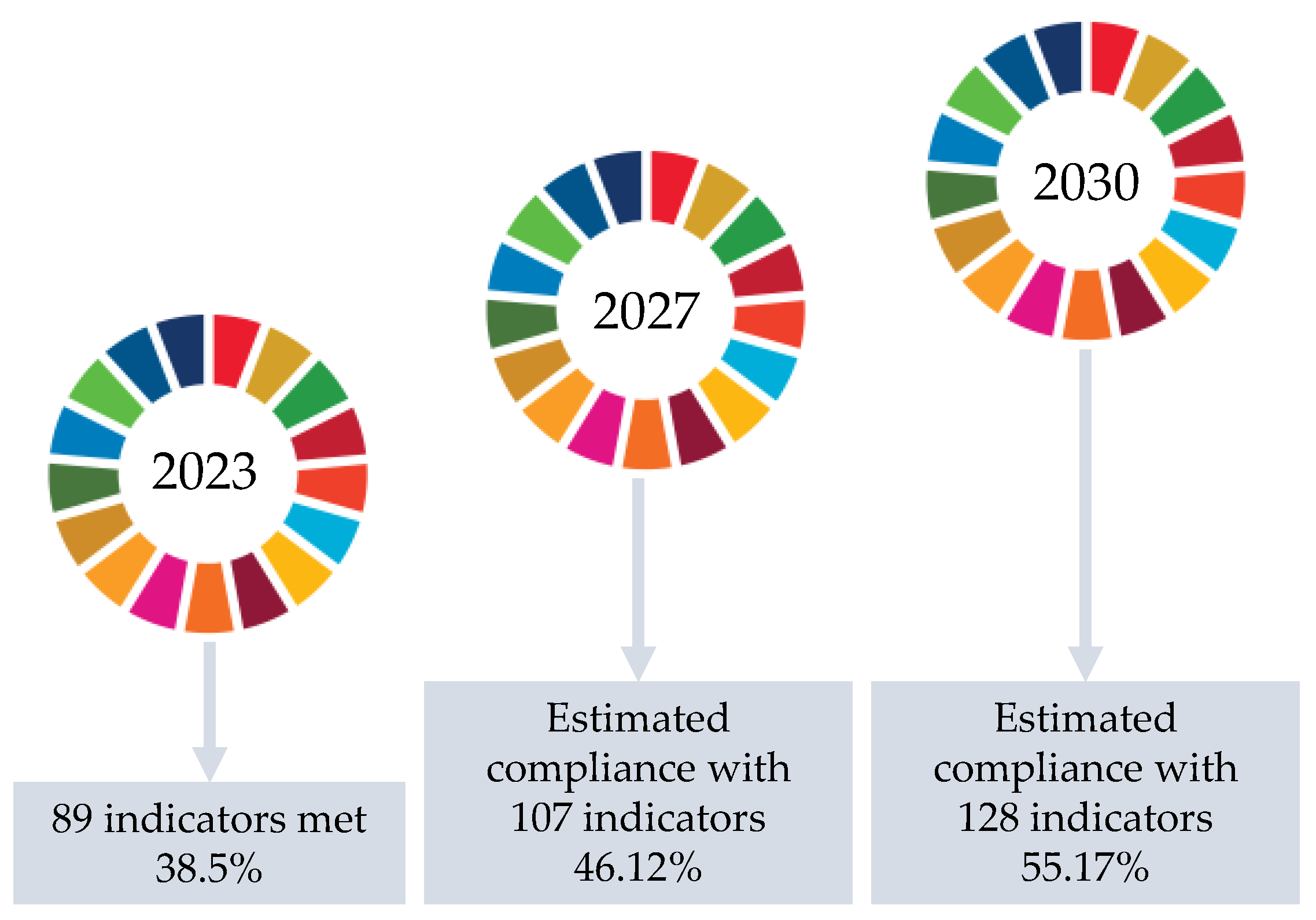
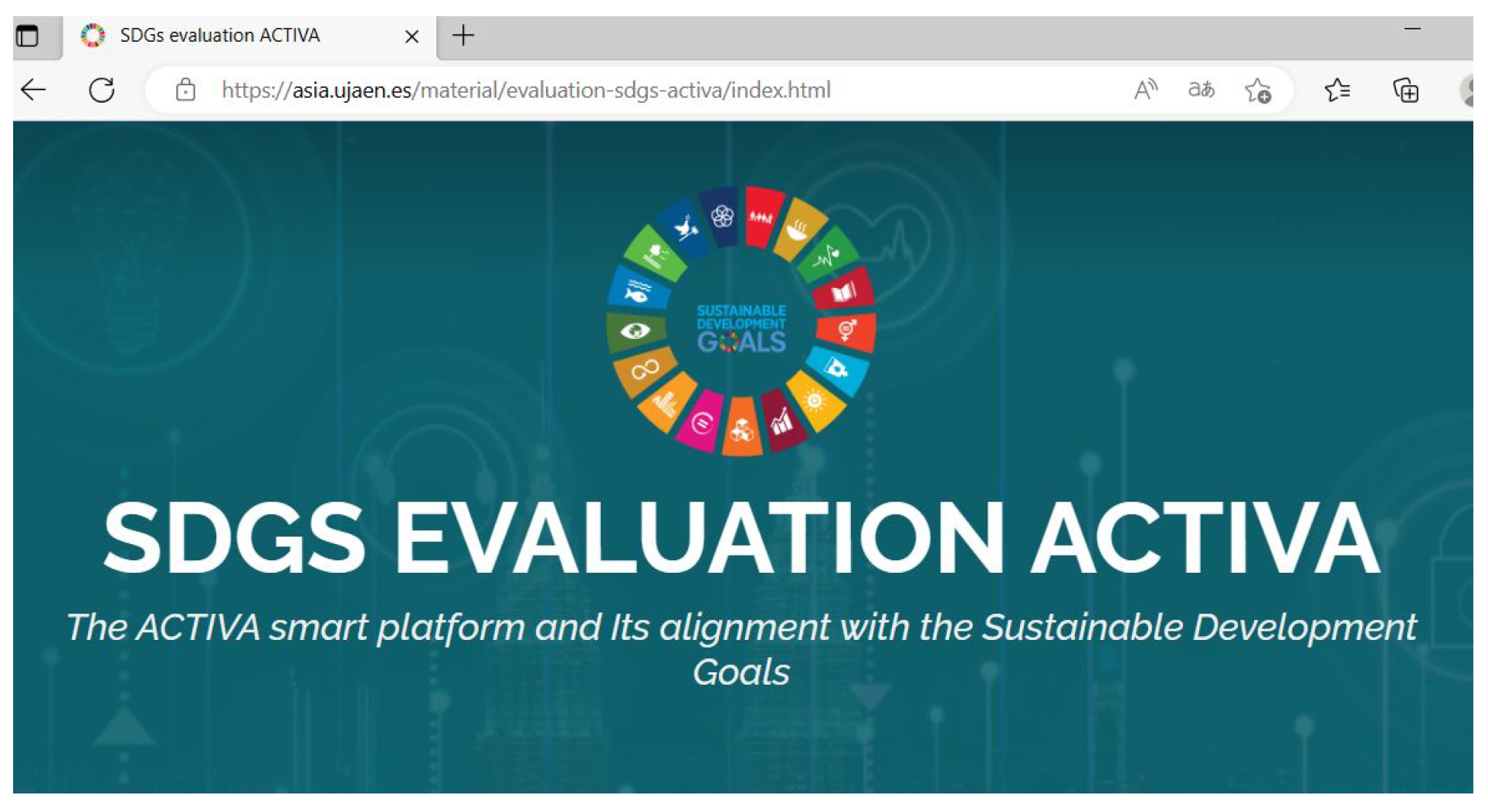
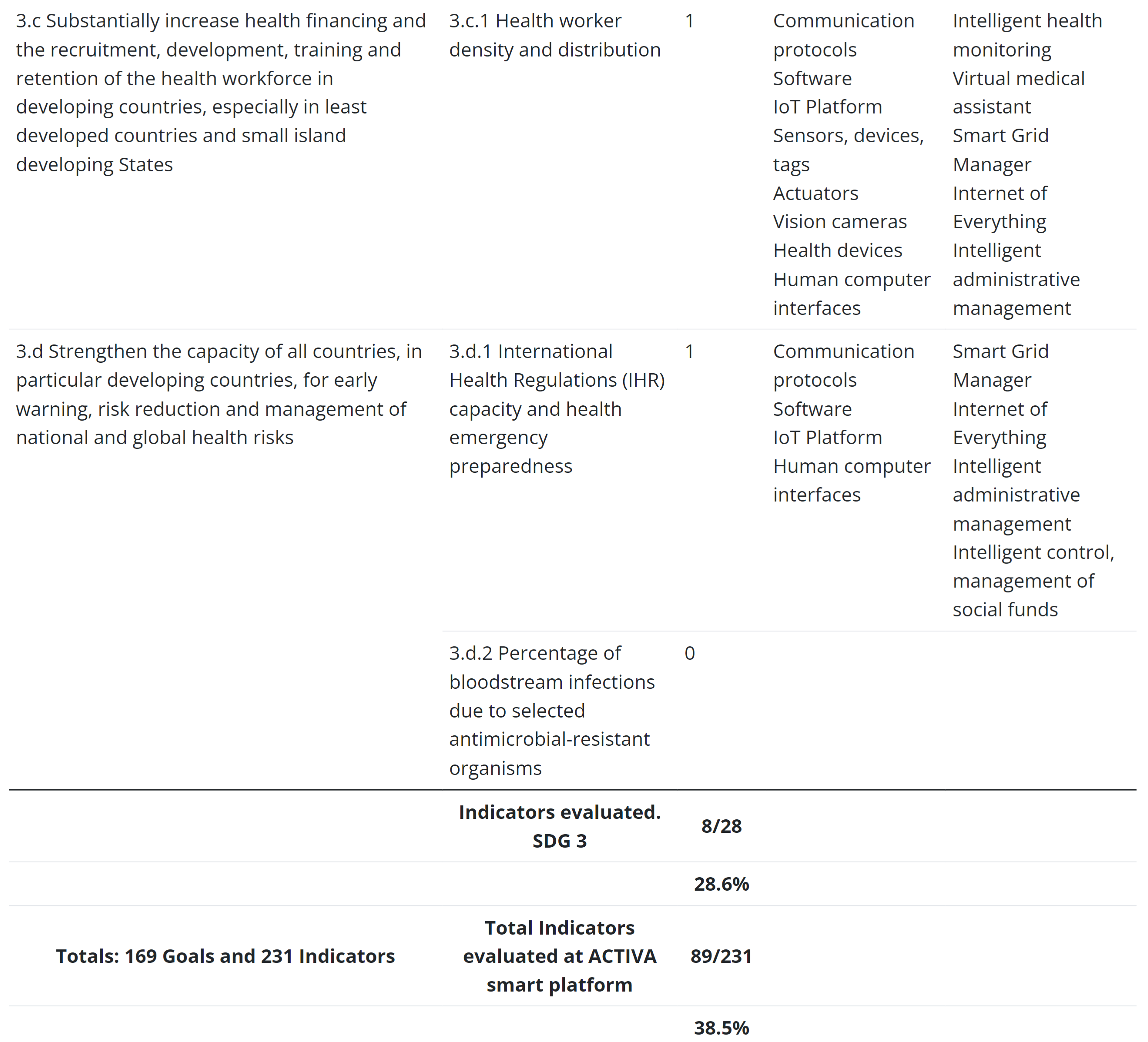
- A quantitative analysis of the ACTIVA platform is performed based on the SDGs. We present a global assessment of all sustainable development goals and a detailed specific assessment of SDG 7. Furthermore, a website is presented, where all SDGs are assessed with the same level of detail as SDG 7, including an overall evaluation for each objective. Finally, a roadmap for increasing compliance with the SDGs in the future is proposed.
2. Review of the Sustainable Development Goals
- Education, gender and inequality.
- Health, wellness and demographics.
- Energy decarbonization/sustainable industry.
- Sustainable food, land, water and oceans.
- Sustainable cities and communities.
- Digital revolution for sustainable development.
3. ACTIVA Platform
3.1. Domain: Elderly Care Home
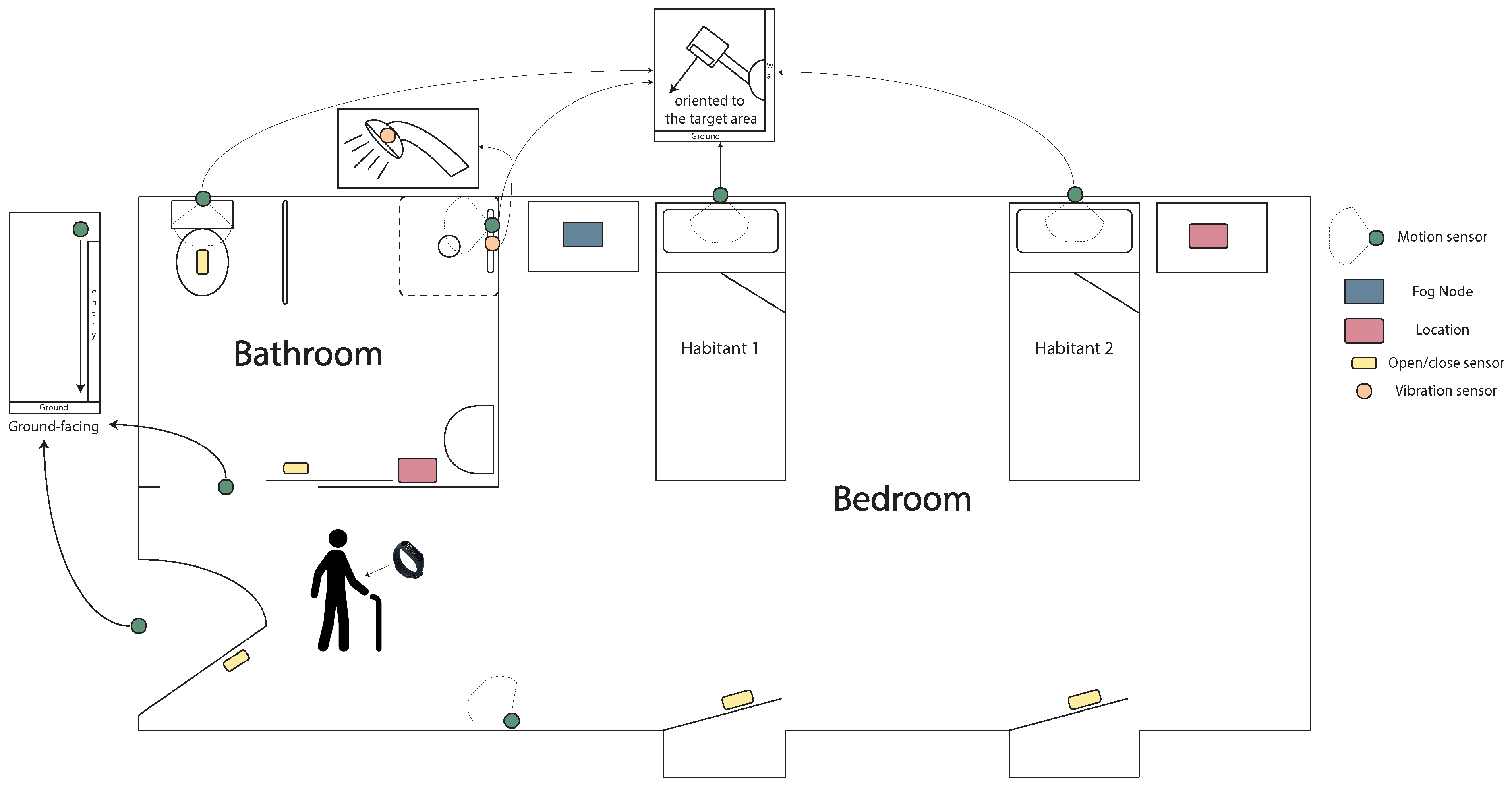
- In the bathroom: use the toilet and take a shower;
- In the bedroom: dress and sleep;
- Exit bedroom.
3.2. Sensor Devices and Data Acquisition
- Activity wristband. This wristband is a Xiaomi Mi Band 3 that is equipped with Bluetooth Low Energy 4.2 (BLE v4.2), and from which we obtain a Received Signal Strength Indicator (RSSI) at all times. Although this device is used for location, its battery level and the steps taken by the inhabitant are also obtained.
- Location anchor [46]. Small computing unit that also has BLE connection. Its purpose is to scan its assigned target beacons to obtain their RSSI value.
- Motion sensor. Binary device that indicates whether or not movement is occurring within its range.
- Open/close sensor. Binary device usually placed on doors or drawers to indicate closed or open status.
- Vibration sensor. A device (located on an object) which indicates the occurrence of a vibration caused by movement of the object with which it is associated.
3.3. HAR Methodology and Mobile App
- New samples sent by the local node are received. RSSI, sensor updates, and step counts are introduced in a temporary cache for the last minute samples, and data that have exceeded that time limit are deleted.
- Location recognition. A time window of 10 s is applied with the maximum operator to the received RSSI data, based on a proposal found in the literature [8,13,48]. The value resulting from applying the aggregation function is used as input data for our previously trained machine learning model, thus generating the location.
- Activity recognition. After the location has been inferred, a set of fuzzy rules [49] that take into account the sensor data is applied to determine the activity. This inference must be checked against the location. If the location with which the activity is associated does not match, it is determined that the inhabitant is not performing the activity.
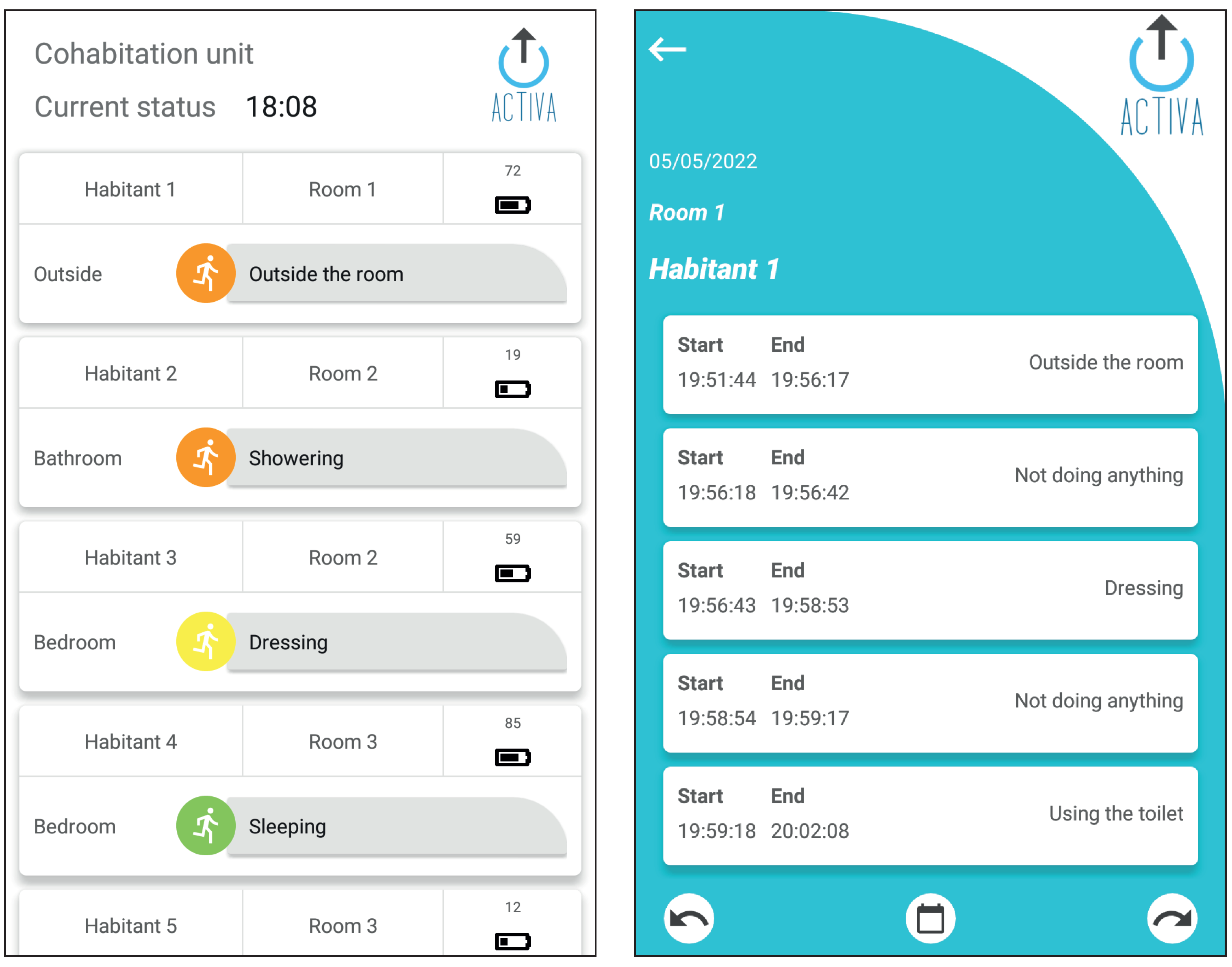
- Inhabitant list view. A list of inhabitants is displayed when starting the application (illustrated in Figure 4). For each inhabitant, the last detected location and activity, their room, and the battery level of their activity wristband are displayed. All this information is updated in real time. The name of the elderly person and their room are displayed anonymously, so that only the caregivers know who each inhabitant is.
- Inhabitant activities view. A list of activities detected for each inhabitant is displayed in chronological order (illustrated in Figure 4). It only shows the activities on a specific day (by default, the current date of the mobile device). The caregiver can access the activities from other days through the calendar, or go to previous or subsequent days by using the arrows.
- Notifications. The caregiver is notified of any changes in the inhabitant’s activity, using different colors to distinguish between activities according to the associated danger level. It should be noted that notifications are customizable from the dashboard.
- -
- High danger. The risk of unexpected situations, such as falling in the shower, is high.
- -
- Moderate danger. The risk is moderate or very improbable; for example, the person has been up at night and has not gone back to bed for more than 10 min.
- -
- Low danger. The risk is very low or there is no danger at all.
4. Analysis of the ACTIVA Platform with SDGs
4.1. Detailed Assessment of SDG 7
4.2. Website for Assessment of all SDGs
4.3. Global Analysis and Roadmap
5. Conclusions
Supplementary Materials
Author Contributions
Funding
Institutional Review Board Statement
Informed Consent Statement
Data Availability Statement
Conflicts of Interest
References
- World Health Organization. Baseline Report for the Decade of Healthy Ageing 2021–2030. Available online: https://www.who.int/publications/i/item/9789240017900 (accessed on 28 January 2023).
- Ding, X.; Clifton, D.; Ji, N.; Lovell, N.H.; Bonato, P.; Chen, W.; Yu, X.; Xue, Z.; Xiang, T.; Long, X.; et al. Wearable Sensing and Telehealth Technology with Potential Applications in the Coronavirus Pandemic. IEEE Rev. Biomed. Eng. 2021, 14, 48–70. [Google Scholar] [CrossRef] [Scilit] [PubMed]
- Liu, Y.; Wang, J.; Li, J.; Niu, S.; Song, H. Machine Learning for the Detection and Identification of Internet of Things Devices: A Survey. IEEE Internet Things J. 2022, 9, 298–320. [Google Scholar] [CrossRef] [Scilit]
- Albín-Rodríguez, A.P.; De-La-Fuente-Robles, Y.M.; López-Ruiz, J.L.; Verdejo-Espinosa, Á.; Estévez, M.E. UJAmI Location: A Fuzzy Indoor Location System for the Elderly. Int. J. Environ. Res. Public Health 2021, 18, 8326. [Google Scholar] [CrossRef] [Scilit]
- Qi, L.; Hu, C.; Zhang, X.; Khosravi, M.R.; Sharma, S.; Pang, S.; Wang, T. Privacy-Aware Data Fusion and Prediction With Spatial-Temporal Context for Smart City Industrial Environment. IEEE Trans. Ind. Inform. 2021, 17, 4159–4167. [Google Scholar] [CrossRef] [Scilit]
- Dhiman, C.; Vishwakarma, D.K. A review of state-of-the-art techniques for abnormal human activity recognition. Eng. Appl. Artif. Intell. 2019, 77, 21–45. [Google Scholar] [CrossRef] [Scilit]
- Javed, A.R.; Faheem, R.; Asim, M.; Baker, T.; Beg, M.O. A smartphone sensors-based personalized human activity recognition system for sustainable smart cities. Sustain. Cities Soc. 2021, 71, 102970. [Google Scholar] [CrossRef] [Scilit]
- Medina, M.Á.L.; Espinilla, M.; Paggeti, C.; Quero, J.M. Activity Recognition for IoT Devices Using Fuzzy Spatio-Temporal Features as Environmental Sensor Fusion. Sensors 2019, 19, 3512. [Google Scholar] [CrossRef] [Scilit] [PubMed]
- Romeo, L.; Marani, R.; D’Orazio, T.; Cicirelli, G. Video Based Mobility Monitoring of Elderly People Using Deep Learning Models. IEEE Access 2023, 11, 2804–2819. [Google Scholar] [CrossRef] [Scilit]
- Zhang, S.; Poon, S.K.; Vuong, K.; Sneddon, A.; Loy, C.T. A deep learning-based approach for gait analysis in Huntington disease. In MEDINFO 2019: Health and Wellbeing e-Networks for All; IOS Press: Amsterdam, The Netherlands, 2019; pp. 477–481. [Google Scholar]
- Lupión, M.; Medina-Quero, J.; Sanjuan, J.F.; Ortigosa, P.M. DOLARS, a Distributed On-Line Activity Recognition System by Means of Heterogeneous Sensors in Real-Life Deployments—A Case Study in the Smart Lab of The University of Almería. Sensors 2021, 21, 405. [Google Scholar] [CrossRef] [Scilit]
- Coelho, Y.L.; de Assis Souza dos Santos, F.; Frizera-Neto, A.; Bastos-Filho, T.F. A Lightweight Framework for Human Activity Recognition on Wearable Devices. IEEE Sens. J. 2021, 21, 24471–24481. [Google Scholar] [CrossRef] [Scilit]
- López-Medina, M.; Espinilla, M.; Cleland, I.; Nugent, C.; Medina, J. Fuzzy cloud-fog computing approach application for human activity recognition in smart homes. J. Intell. Fuzzy Syst. 2020, 38, 709–721. [Google Scholar] [CrossRef] [Scilit]
- Sudhir, G.; Anjali, S.; Swati, S.; Bhatlawande, S. Assisted Living System: A Review of 25 Years of Research. Int. J. Eng. Trends Technol. 2022, 70, 317–330. [Google Scholar]
- Secundo, G.; Ndou, V.; Del Vecchio, P.; De Pascale, G. Sustainable development, intellectual capital and technology policies: A structured literature review and future research agenda. Technol. Forecast. Soc. Chang. 2020, 153, 119917. [Google Scholar] [CrossRef] [Scilit]
- Razdan, S.; Sharma, S. Internet of medical things (IoMT): Overview, emerging technologies, and case studies. IETE Tech. Rev. 2022, 39, 775–788. [Google Scholar] [CrossRef] [Scilit]
- Wang, C.; Gu, J.; Martínez, O.S.; Crespo, R.G. Economic and environmental impacts of energy efficiency over smart cities and regulatory measures using a smart technological solution. Sustain. Energy Technol. Assess. 2021, 47, 101422. [Google Scholar] [CrossRef] [Scilit]
- Khamis, A.; Li, H.; Prestes, E.; Haidegger, T. AI: A Key Enabler for Sustainable Development Goals: Part 2 [Industry Activities]. IEEE Robot. Autom. Mag. 2019, 26, 122–127. [Google Scholar] [CrossRef]
- Wu, J.; Guo, S.; Huang, H.; Liu, W.; Xiang, Y. Information and Communications Technologies for Sustainable Development Goals: State-of-the-Art, Needs and Perspectives. IEEE Commun. Surv. Tutor. 2018, 20, 2389–2406. [Google Scholar] [CrossRef] [Scilit]
- Anderson, A.; Loomba, P.; Orajaka, I.; Numfor, J.; Saha, S.; Janko, S.; Johnson, N.; Podmore, R.; Larsen, R. Empowering Smart Communities: Electrification, Education, and Sustainable Entrepreneurship in IEEE Smart Village Initiatives. IEEE Electrif. Mag. 2017, 5, 6–16. [Google Scholar] [CrossRef] [Scilit]
- Espinosa, Á.V.; Ruiz, J.L.L.; Mata, F.M.; Estevez, M.E. Application of IoT in Healthcare: Keys to Implementation of the Sustainable Development Goals. Sensors 2021, 21, 2330. [Google Scholar] [CrossRef] [Scilit]
- Espinilla, M.; Medina, J.; Verdejo, M.A.; Ruiz, J.L.; Salguero, A.G. ACTIVA. Available online: https://www.safecreative.org/work/2111159810407 (accessed on 28 January 2023).
- Zhou, X.; Liang, W.; Wang, K.I.K.; Wang, H.; Yang, L.T.; Jin, Q. Deep-Learning-Enhanced Human Activity Recognition for Internet of Healthcare Things. IEEE Internet Things J. 2020, 7, 6429–6438. [Google Scholar] [CrossRef] [Scilit]
- Gochoo, M.; Tan, T.H.; Liu, S.H.; Jean, F.R.; Alnajjar, F.; Huang, S.C. Unobtrusive Activity Recognition of Elderly People Living Alone Using Anonymous Binary Sensors and DCNN. IEEE J. Biomed. Health Inform. 2018, 23, 693–702. [Google Scholar] [CrossRef] [Scilit] [PubMed]
- Nižetić, S.; Šolić, P.; de-Ipiña González-de Artaza, D.L.; Patrono, L. Internet of Things (IoT): Opportunities, issues and challenges towards a smart and sustainable future. J. Clean. Prod. 2020, 274, 122877. [Google Scholar] [CrossRef] [Scilit] [PubMed]
- Hsiao, Y.C.; Wu, M.H.; Li, S.C. Elevated Performance of the Smart City—A Case Study of the IoT by Innovation Mode. IEEE Trans. Eng. Manag. 2021, 68, 1461–1475. [Google Scholar] [CrossRef] [Scilit]
- Riekki, J.; Mammela, A. Research and Education Towards Smart and Sustainable World. IEEE Access 2021, 9, 53156–53177. [Google Scholar] [CrossRef] [Scilit]
- ONU. Transforming our World: The 2030 Agenda for Sustainable Development. Available online: https://www.unfpa.org/resources/transforming-our-world-2030-agenda-sustainable-development (accessed on 28 January 2023).
- Sachs, J.D.; Schmidt-Traub, G.; Mazzucato, M.; Messner, D.; Nakicenovic, N.; Rockström, J. Six Transformations to achieve the Sustainable Development Goals. Nat. Sustain. 2019, 2, 805–814. [Google Scholar] [CrossRef] [Scilit]
- Portier, C.; Gomme, J.; Whelan, N. SDG Compass. Available online: https://sdgcompass.org/ (accessed on 28 January 2023).
- SDSN Northern Europe. The SDG Impact Assessment Tool. Available online: https://www.unsdsn-ne.org/our-actions/initiatives/sdg-impact-tool/ (accessed on 28 January 2023).
- Global Impact Investing Network. IRIS + System. Available online: https://iris.thegiin.org/about/ (accessed on 28 January 2023).
- United Nations Development Programme. Sustainable Development Goals. Available online: https://www.undp.org/sustainable-development-goals (accessed on 28 January 2023).
- KTH Royal Institute of Technology. Toolbox Learning for Sustainable Development. Available online: https://www.kth.se/en/om/miljo-hallbar-utveckling/utbildning-miljo-hallbar-utveckling/verktygslada/verktygsladan-larande-for-hallbar-utveckling-1.507316 (accessed on 28 January 2023).
- Global Taskforce of Local and Regional Governments, United Nations Human Settlements and Development Programme. Local 2030 Localizing the SDGs. Available online: https://www.local2030.org/discover-tools (accessed on 28 January 2023).
- European Environmental Bureau. SDG Toolkit; to Engage European NGOs at National and European Level on the Sustainable Development Goals. Available online: https://sdgtoolkit.org (accessed on 28 January 2023).
- Economic and Social Commission for Asia and the Pacific. SDG Help Desk. Available online: https://sdghelpdesk.unescap.org (accessed on 28 January 2023).
- Group and Expert Technical European Union. Taxonomy: Final Report. Available online: https://knowledge4policy.ec.europa.eu/publication/sustainable-finance-teg-final-report-eu-taxonomy_en (accessed on 28 January 2023).
- Verdejo, Á.; Espinilla, M.; López, J.L.; Melguizo, F.J. Assessment of sustainable development objectives in Smart Labs: Technology and sustainability at the service of society. Sustain. Cities Soc. 2022, 77, 103559. [Google Scholar] [CrossRef] [Scilit]
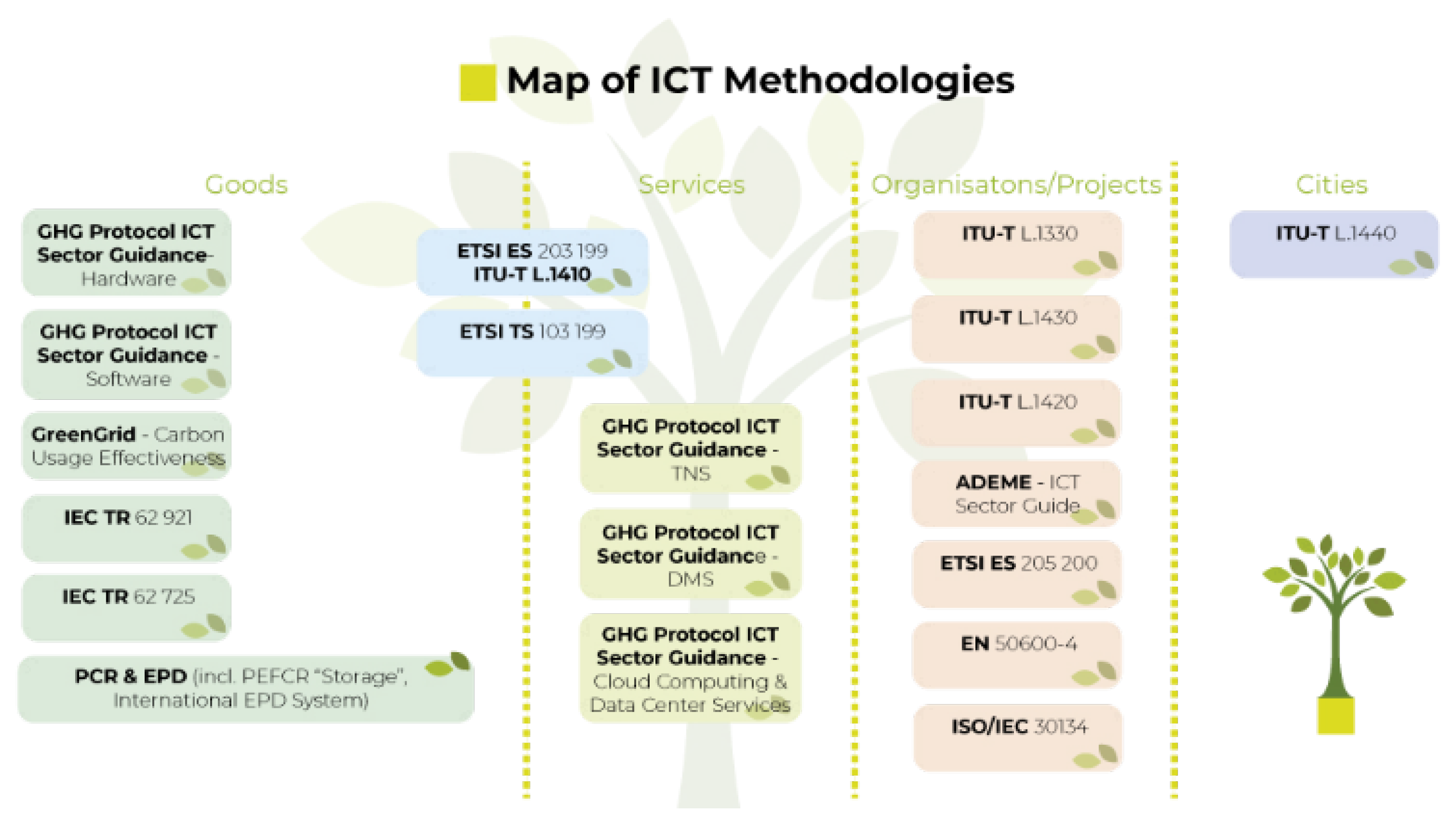
- European Commission. Map of ICT Methodologies. Available online: https://ictfootprint.eu/en/ict-methodologies/map-ict-methodologies (accessed on 28 January 2023).
- Pereira, R.; Couto, M.; Ribeiro, F.; Rua, R.; Cunha, J.; Fernandes, J.P.; Saraiva, J. Energy efficiency across programming languages: How do energy, time, and memory relate? In Proceedings of the 10th ACM SIGPLAN International Conference on Software Language Engineering, Vancouver, BC, Canada, 23–24 October 2017. [Google Scholar] [CrossRef] [Scilit]
- Mora-Sanchez, O.B.; Lopez-Neri, E.; Cedillo-Elias, E.J.; Aceves-Martinez, E.; Larios, V.M. Validation of IoT Infrastructure for the Construction of Smart Cities Solutions on Living Lab Platform. IEEE Trans. Eng. Manag. 2021, 68, 899–908. [Google Scholar] [CrossRef] [Scilit]
- Habibzadeh, H.; Dinesh, K.; Shishvan, O.R.; Boggio-Dandry, A.; Sharma, G.; Soyata, T. A Survey of Healthcare Internet of Things (HIoT): A Clinical Perspective. IEEE Internet Things J. 2020, 7, 53–71. [Google Scholar] [CrossRef] [Scilit]
- Li, H.; Shrestha, A.; Heidari, H.; Kernec, J.L.; Fioranelli, F. Bi-LSTM Network for Multimodal Continuous Human Activity Recognition and Fall Detection. IEEE Sens. J. 2020, 20, 1191–1201. [Google Scholar] [CrossRef] [Scilit]
- Verdejo-Espinosa, Á.; Espinilla-Estévez, M.; Mata, F.M. Smart Grids and Their Role in Transforming Human Activities—A Systematic Literature Review. Sustainability 2020, 12, 8662. [Google Scholar] [CrossRef] [Scilit]
- Raspberry Pi Foundation. Raspberry Pi 4 Specifications. Available online: https://www.raspberrypi.com/products/raspberry-pi-4-model-b/specifications/ (accessed on 28 January 2023).
- Aqara. Sensor Devices. Available online: https://www.aqara.com/us/home.html (accessed on 28 January 2023).
- Albín-Rodríguez, A.P.; Ricoy-Cano, A.J.; de-la Fuente-Robles, Y.M.; Espinilla-Estévez, M. Fuzzy Protoform for Hyperactive Behaviour Detection Based on Commercial Devices. Int. J. Environ. Res. Public Health 2020, 17, 6752. [Google Scholar] [CrossRef] [Scilit] [PubMed]
- Zahra, S.R.; Chishti, M.A. A generic and lightweight security mechanism for detecting malicious behavior in the uncertain Internet of Things using fuzzy logic- and fog-based approach. Neural Comput. Appl. 2022, 34, 6927–6952. [Google Scholar] [CrossRef] [Scilit]
- Sartori, F.; Melen, R. Design and Implementation of a Platform for Wearable/Mobile Smart Environments. IEEE Trans. Eng. Manag. 2021, 70, 755–769. [Google Scholar] [CrossRef] [Scilit]


| Tool | Description | Reference |
|---|---|---|
| SDG Compass | Management strategy for the achievement of the SDGs | [30] |
| SDSN Northern Europe | United Nations Sustainable Development Solutions Network (SDSN) Northern Europe | [31] |
| IRIRS + | Analysis and evaluation tool using taxonomies for measuring environmental impacts | [32] |
| PNUD | United Nations Development Programme (UNDP) | [33] |
| KTH’s Toolbox | KTH’s Toolbox for Learning for Sustainable Development offers tips and examples for the integration of sustainable development into teaching | [34] |
| Local 2030 | Local 2030: localizing the SDGs, is an online platform. Stakeholders and partners share tools, experiences, new solutions and guides to support SDG localization | [35] |
| SDG Toolkit | SDG Toolkit is part of a European project to involve European NGOs at national and European level in the SDGs. | [36] |
| SDG Helpdesk | SDG Helpdesk provides access to models, methodologies and guidance to support policy makers in the implementation of the SDGs | [37] |
| EU taxonomy | The EU taxonomy is a classification system which establishes a list of environmentally sustainable economic activities | [38] |
| SDG Smart Labs | Assessment of SDGs in Smart Labs | [39] |
| Global Indicator Framework for the Sustainable Development Goals and Targets of the 2030 Agenda for Sustainable Development | Evaluation of SDGs in the ACTIVA SMART PLATFORM | |||
|---|---|---|---|---|
 | Goal 7. Ensure Access to Affordable, Reliable, Sustainable, and Modern Energy for all | |||
| Goals and Targets | Indicators | Existing | Installed Devices/Systems | Field/Area of Action |
| 7.1 By 2030, ensure universal access to affordable, reliable, and modern energy. | 7.1.1 Proportion of population with access to electricity. | 1 | Communication protocols. Software. IoT Platform. Sensors, devices, and tags. Actuators. Human computer interfaces. | Social assistance. Smart Grid Manager. Energy control. Renewable energy. Internet of Energy. Economic and environmental sustainability. Intelligent administrative management. Intelligent control, management of social funds. Safety. |
| 7.1.2 Proportion of population with primary reliance on clean fuels and technology. | 1 | |||
| 7.2 By 2030, increase substantially the share of renewable energy in the global energy mix. | 7.2.1 Renewable energy share in the total final energy consumption. | 1 | ||
| 7.3 By 2030, double the global rate of improvement in energy efficiency. | 7.3.1 Energy intensity measured in terms of primary energy and GDP. | 1 | ||
| 7.a By 2030, enhance international cooperation to facilitate access to clean energy research and technology, including renewable energy, energy efficiency and advanced and cleaner fossil-fuel technology, and promote investment in energy infrastructure and clean energy technology. | 7.a.1 International financial flows to developing countries in support of clean energy research and development and renewable energy production, including in hybrid systems. | 1 | Communication protocols. Software. IoT Platform. Human computer interfaces. Renewable energy. Internet of Energy. Economic. | Environmental sustainability. Intelligent administrative management. Intelligent control, management of social funds. |
| Indicators evaluated. SDG 7 | 6/6 | |||
| 100% | ||||
| SDG | Existing | % | |
|---|---|---|---|
| 1 | End poverty in all its forms everywhere | 5 | 38.5 |
| 2 | End hunger, achieve food security, and improved nutrition and promote sustainable agriculture | 3 | 21.4 |
| 3 | Ensure healthy lives and promote well-being for all at all ages | 8 | 28.6 |
| 4 | Ensure inclusive and equitable quality education and promote lifelong learning opportunities for all | 6 | 50.0 |
| 5 | Achieve gender equality and empower all women and girls | 8 | 57.1 |
| 6 | Ensure availability and sustainable management of water and sanitation for all | 6 | 54.5 |
| 7 | Ensure access to affordable, reliable, sustainable, and modern energy for all | 6 | 100.0 |
| 8 | Promote sustained, inclusive, and sustainable economic growth, full and productive employment and decent work for all | 3 | 18.8 |
| 9 | Build resilient infrastructure, promote inclusive and sustainable industrialization and foster innovation | 7 | 58.3 |
| 10 | Reduce inequality within and among countries | 2 | 14.3 |
| 11 | Make cities and human settlements inclusive, safe, resilient, and sustainable | 9 | 60.0 |
| 12 | Ensure sustainable consumption and production patterns | 2 | 15.4 |
| 13 | Take urgent action to combat climate change and its impacts | 3 | 37.5 |
| 14 | Conserve and sustainably use the oceans, seas, and marine resources for sustainable development | 0 | 0.0 |
| 15 | Protect, restore and promote sustainable use of terrestrial ecosystems, sustainably manage forests, combat desertification, and halt and reverse land degradation and halt biodiversity loss | 1 | 7.1 |
| 16 | Promote peaceful and inclusive societies for sustainable development, provide access to justice for all, and build effective, accountable and inclusive institutions at all levels | 7 | 29.2 |
| 17 | Strengthen the means of implementation and revitalize the global partnership for sustainable development | 13 | 54.2 |
| Total | 89 | 38.5 |
Disclaimer/Publisher’s Note: The statements, opinions and data contained in all publications are solely those of the individual author(s) and contributor(s) and not of MDPI and/or the editor(s). MDPI and/or the editor(s) disclaim responsibility for any injury to people or property resulting from any ideas, methods, instructions or products referred to in the content. |
© 2023 by the authors. Licensee MDPI, Basel, Switzerland. This article is an open access article distributed under the terms and conditions of the Creative Commons Attribution (CC BY) license (https://creativecommons.org/licenses/by/4.0/).
Share and Cite
López, J.L.; Espinilla, M.; Verdejo, Á. Evaluation of the Impact of the Sustainable Development Goals on an Activity Recognition Platform for Healthcare Systems. Sensors 2023, 23, 3563. https://doi.org/10.3390/s23073563
López JL, Espinilla M, Verdejo Á. Evaluation of the Impact of the Sustainable Development Goals on an Activity Recognition Platform for Healthcare Systems. Sensors. 2023; 23(7):3563. https://doi.org/10.3390/s23073563
Chicago/Turabian StyleLópez, José L., Macarena Espinilla, and Ángeles Verdejo. 2023. "Evaluation of the Impact of the Sustainable Development Goals on an Activity Recognition Platform for Healthcare Systems" Sensors 23, no. 7: 3563. https://doi.org/10.3390/s23073563
APA StyleLópez, J. L., Espinilla, M., & Verdejo, Á. (2023). Evaluation of the Impact of the Sustainable Development Goals on an Activity Recognition Platform for Healthcare Systems. Sensors, 23(7), 3563. https://doi.org/10.3390/s23073563