


Abstract
As urban areas continue to expand, traffic congestion has emerged as a significant challenge impacting urban governance and economic development. Frequent regional traffic congestion has become a primary factor hindering urban economic growth and social activities, necessitating improved regional traffic management. Addressing regional traffic optimization and control methods based on the characteristics of regional congestion has become a crucial and complex issue in the field of traffic management and control research. This paper focuses on the macroscopic fundamental diagram (MFD) and aims to tackle the control problem without relying on traffic determination information. To address this, we introduce the Q-learning (QL) algorithm in reinforcement learning and the Deep Deterministic Policy Gradient (DDPG) algorithm in deep reinforcement learning. Subsequently, we propose the MFD-QL perimeter control model and the MFD-DDPG perimeter control model. We conduct numerical analysis and simulation experiments to verify the effectiveness of the MFD-QL and MFD-DDPG algorithms. The experimental results show that the algorithms converge rapidly to a stable state and achieve superior control effects in optimizing regional perimeter control.
1. Introduction
Traffic problems have always been troubling in terms of urban governance and affect the economic development of cities. The continuous development of traffic information detection technology has improved the accuracy and timeliness of collected traffic data, making it increasingly clear to describe traffic congestion phenomena. For example, according to the “2021 Traffic Analysis Report on Major Chinese Cities”, compared to 2020, 60% of China’s 50 major cities have seen an increase in peak travel delays [1].
For a long time, reducing the occurrence and alleviating the impact of traffic congestion have been topics of concern for researchers in the transportation field. Therefore, in many research fields related to traffic congestion, research progress has been made in the analysis, modeling, prediction, and control of traffic congestion phenomena, such as traffic flow theory, traffic planning, traffic control, and intelligent transportation systems. Prior studies have proposed various methods to address the perimeter control problem based on the Macro Fundamental Diagram (MFD) [2]. Among these methods, model predictive control (MPC) [3] has shown promise and is widely used. However, the success of forecasting methods heavily relies on accurate forecasting models. Although network MFD estimation has been extensively studied [4], the scarcity of empirically observed MFDs in the literature highlights the practical challenges in estimating such MFDs. MPC, as a rolling-level control scheme, may not generalize well to real-world scenarios due to its sensitivity to level parameters and modeling uncertainties [5]. Non-MPC methods for perimeter control have also been proposed and proven effective. These include proportional integral-based control [6], adaptive control [7], and linear quadratic regulators [8]. However, all of these methods are model-based (i.e., assuming prior knowledge of the traffic dynamics of the entire region) or require information about the network’s MFD, making the models susceptible to potential errors between the predictive model and the actual environment dynamics.
However, the overall traffic control still relies mainly on traditional modes at different levels of control. As the transportation system is a complex system, it is difficult to achieve the overall traffic optimization effect of the entire transportation system by only pursuing the maximum traffic benefits of a single or multiple intersections with control objectives. Therefore, it is necessary to consider higher-level traffic area control, such as perimeter control, to obtain optimal traffic control effects for the entire system.
2. Model Construction
The MFD-QL model for perimeter control is constructed by combining the Q-learning algorithm [9] in reinforcement learning. It incorporates traffic information from the macroscopic fundamental diagram (MFD) into the perimeter control model, allowing for traffic optimization through adjustments to the perimeter control. Similarly, the MFD-DDPG model for border control is constructed by combining the DDPG algorithm [10] in reinforcement learning. It also incorporates traffic information from the MFD in the border control model. The MFD-DDPG border control model mitigates the impact of the information explosion in the traffic environment obtained from the DDPG algorithm, thereby achieving traffic optimization goals.
2.1. MFD-QL Perimeter Control Model
The MFD-QL model is a perimeter control model that incorporates feedback design for the overall traffic area. It utilizes the basic traffic flow information obtained from the traffic environment and captures real-time changes in the MFD within the traffic area. The MFD serves as a valuable tool for representing the traffic area information and assessing the traffic status, providing crucial information for further research and traffic feedback control. Table 1 presents the basic traffic information available for a traffic area.

Table 1.
Traffic characteristics of traffic district.
By extracting the traffic elements from the traffic environment, we can obtain the traffic status of the traffic area. For a specific traffic area , it is associated with an internal link collection and the lengths of each link . By summing up the lengths of all links within the traffic area, we can obtain the total length , as shown in Equation (1):
Similarly, when considering the traffic volume on link , it is necessary to calculate the weighted traffic flow of the entire transportation area, as shown in Formula (2):
The traffic density of the entire traffic area can be calculated using Formula (3):
The weighted average traffic speed of the traffic area can be obtained using Formula (4):
Thus, the overall traffic information of the traffic area can be obtained, and the MFD of the traffic area can be further obtained in the traffic environment, thereby obtaining the traffic status of the traffic area.
Because the transportation system is a system that dynamically changes over time, continuous control is also required for the traffic control strategies within it to achieve significant traffic benefits.
According to Figure 1, it can be concluded that there is a high traffic income interval in the traffic status of the transportation area, and using this as the critical value, the overall traffic status can be divided into two parts: the traffic unsaturated state and the traffic saturated state.
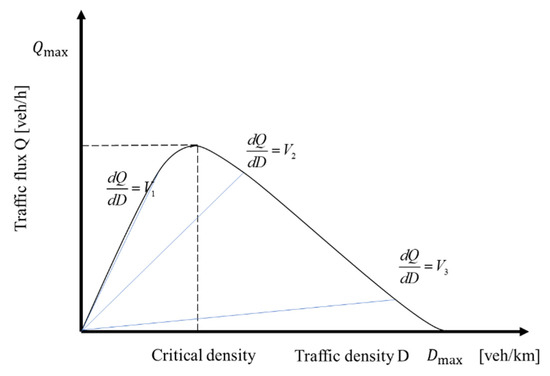
Figure 1.
Traffic income division of MFD.
Using traffic speed as a physical quantity to characterize the traffic benefits of a transportation area, the traffic benefits of the area can be obtained based on the interval of the average speed of the traffic flow within the area, as shown in Formula (5):
The value function of the Q-learning algorithm in the MFD-QL model incorporates the MFD parameters obtained from the traffic environment and modifies the traffic reward based on the traffic status of the traffic area. The modified value function can be represented as Formula (6):
The control framework diagram of MFD-QL algorithm is shown in Figure 2.
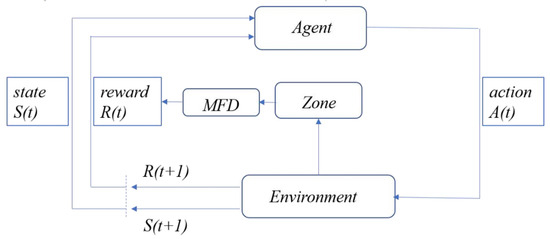
Figure 2.
MFD-QL control framework diagram.
The algorithm flow of MFD-QL is shown in Algorithm 1.
| Algorithm 1: MFD-QL algorithm |
| Input: Learning rate α, discount factor γ, number of iterations E, iteration step size T, Inititalize Q(s,a) is any value |
| for e=l,…,E do |
| Initialization status s |
| for step=0 to T do |
| Select action a in state ε-greedy based on strategy s |
| Execute action a to obtain the next state st+1 |
| Calculate reward value r through MFD theory and environmental feedback |
| Update Q: Q(s,a)←Q(s,a)+a[r+ymaxaQ(st+1,at+1)-Q(s,a)] |
| s←st+1 |
| end |
| end |
Firstly, the traffic simulation environment is initialized and the set traffic environment parameters are imported, all agents are initialized, and the initial state of the agents is obtained from the traffic environment. The learning process of whether all agents are learning the MFD-QL algorithm at this time is begun. If the agent does not need to learn, it will cross the agent. If the agent needs to learn, it will use a greedy strategy to randomly select actions in the action space. The probability of selecting actions with the maximum value is . After all agents have selected and executed actions, all agents obtain a new state, and only those who have learned receive rewards. The value and table of the intelligent agent are updated, and the learning process is complete. Then, the next learning can begin.
2.2. MFD-DDPG Perimeter Control Model
The MFD-DDPG perimeter control model is an extension of the MFD-QL model that addresses the limitations of discrete strategies in reinforcement learning for traffic signal control. It introduces a continuous control scheme to enable the fine control of the perimeter controller by choosing flexible perimeter control values.
In the MFD-DDPG algorithm, the agent interacts with the environment to gather experiences, and a distributed architecture is used for efficient data generation. The learning algorithm contains a large number of data simulation generators and a single centralized learner. Each generator has its own environment and assigns different values for the exploration strategy, which are stored in a fixed-range replay buffer according to the order in which the replay buffer is updated when it is saturated with values, which ensures that the source of experience is the most recent learning exploration strategy. The centralized learner draws experience samples from the shared replay buffer for updating the neural network of the intelligentsia in the network.
The MFD-DDPG algorithm flowchart is shown in Algorithm 2.
| Algorithm 2: MFD-DDPG algorithm |
| Input: Number of iterations E, iteration step size T, experience playback Set D, Sample size m, discount factor γ, Inititalize {Current network parameters θQ and θQ’} Inititalize {Target network parameters θu and θu’} Inititalize {Clear Experience Playback Collection D} |
| for e=l, …, E do |
| Obtain the initial state st and random noise sequence N for action selection |
| for t=l, …, T do |
| Based on the current strategy and the selection of noise, select actions and execute at = u (st|θu) to obtain the next step status st+1 |
| Store tuple (st,at,rt,st+1) to experience replay set D |
| Calculate reward value r through MFD theory and environmental feedback |
| Randomly select m samples from replay memory |
| yt=rt+ γQ’(st+1, u’(st+1|θu’)|θQ’) |
| Update current Critical network: |
| Update current Actor network: |
| Update target network: |
| θQ’←τθQ+(1-τ)θQ’ |
| θu’←τθu+(1-τ)θu’ |
| end |
| end |
3. Numerical Simulation and Result Analysis
3.1. Experimental Setup
The experimental setup involves two adjacent traffic areas, as depicted in Figure 3. The MFD is used to establish the relationship between traffic demand and the trip completion rate. The chosen MFD diagram corresponds to the one described in previous literature [11]. The basic map represents the MFD of area , while area is scaled down by a certain ratio. The critical traffic volumes for both areas to achieve maximum traffic income are determined as vehicles and vehicles.
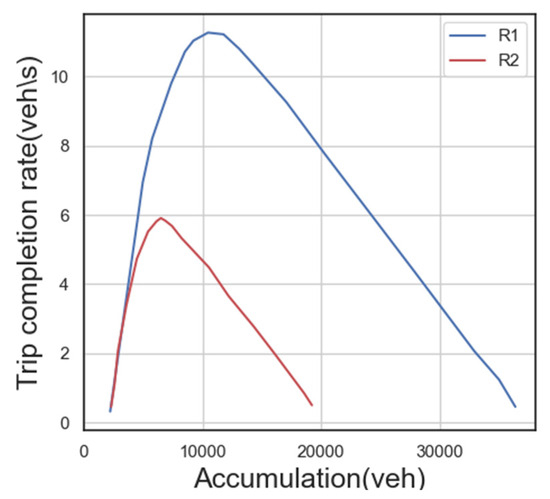
Figure 3.
Comparison of MFD models of two traffic districts.
3.2. Parameter Setting
3.2.1. QL Parameter Setting
State Space : The state space includes the real-time weighted average traffic speed of the traffic area and the remaining duration of the current traffic phase.
Action Space : The action space of the agent can be defined as Formula (7):
In Formula (7), represents the phase-switching action of going straight or turning right in the east–west direction, represents the phase-switching action of turning left in the east–west direction, represents the phase-switching action of going straight or turning right in the north–south direction, and represents the phase switching action for turning left in a specific direction.
The reward function is as Formula (8):
In Equation (9), when the traffic state of the traffic area falls into an oversaturated state, at this point, a proportional coefficient will be used to punish the road network for falling into an oversaturated state when receiving rewards :
3.2.2. DDPG Parameter Setting
State space : For each agent, the state includes four vehicle accumulations: , , , and , and four traffic demands: , , , and . These values are normalized and scaled to the interval by taking the maximum value as the reference.
Action space : For the agent, its action is determined by two values in the selectable range of the perimeter controllers and .
Reward function : The training objective of the agent is to maximize the cumulative number of vehicle trips completed. The reward is defined as , where is a constant, and the rewards are normalized to .
3.3. Result Analysis
3.3.1. Convergence Analysis
The performance curves of the No Control strategy, MFD-QL perimeter control strategy, and MFD-DDPG control strategy from the numerical simulation experiment are presented in Figure 4. The horizontal axis represents the number of iterations in the numerical simulation generator of the simulation platform, while the vertical axis represents the cumulative number of completed vehicle trips. The shaded area of the curve indicates the two extreme value intervals in each iteration, representing the inherent randomness of the agent’s learning process.
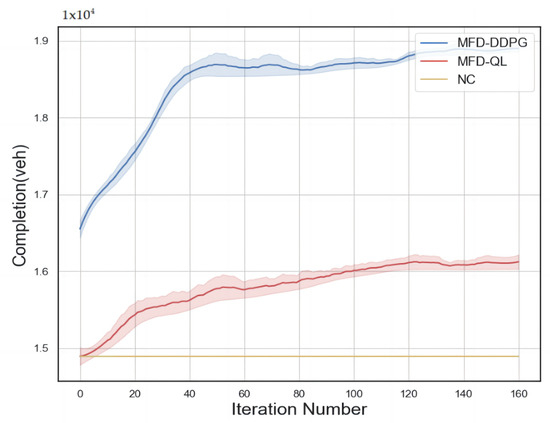
Figure 4.
Performance comparison of control strategies.
From Figure 4, it can be observed that both perimeter control models exhibit continuous learning capabilities within the numerical simulation environment and gradually converge over time. They demonstrate good convergence properties. Comparing the two models, the MFD-DDPG perimeter control model proves to be more effective in addressing the perimeter control problem based on the MFD.
3.3.2. Effectiveness Analysis
Figure 5 presents the evolution trend diagram of vehicle accumulation in the traffic state quantity. It can be observed that both the MFD-QL perimeter control model and the MFD-DDPG perimeter control model effectively prevent the traffic area, which initially starts in an unsaturated state, from falling into an oversaturated state. Additionally, these models improve the traffic income in such areas. Moreover, for the traffic area initially in an oversaturated state, the models successfully alleviate traffic congestion and maintain traffic income in an unsaturated state. These results highlight the effectiveness of the MFD-QL and MFD-DDPG perimeter control models in optimizing traffic control and managing traffic congestion.

Figure 5.
Comparison of cumulative vehicle trends.
Figure 6 compares the values of the perimeter controllers in the last iteration of the MFD-QL perimeter control model and the MFD-DDPG perimeter control model. It can be observed that the reward values of the perimeter controllers in both models exhibit similar changing trends.
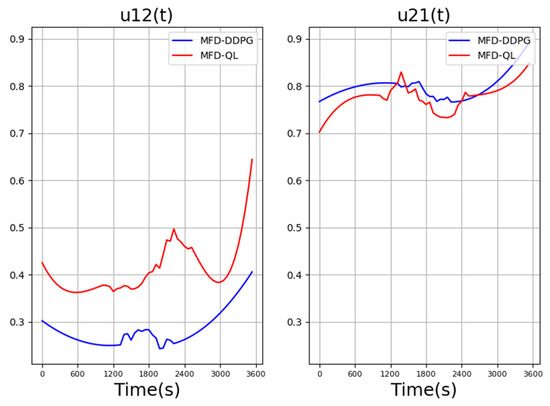
Figure 6.
Comparison of perimeter controller values in MFD-QL and MFD-DDPG perimeter control models.
However, when faced with changes in traffic demand, the range of action changes in the MFD-DDPG perimeter control model is smaller compared to the perimeter controller in the MFD-QL perimeter control model.
4. Simulation Experiment and Result Analysis
4.1. Experimental Setup
The traffic area intercepted by the traffic simulation tool SUMO is shown in Figure 7, specifically the area enclosed by Gucheng North Road, Bajiao North Road, Bajiao East Street, Shijingshan Road, and Gucheng Street. The base drawing SUMO-GUI in Figure 8 shows the road network.
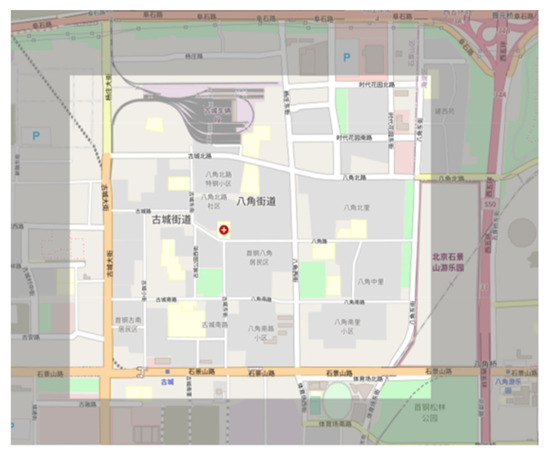
Figure 7.
Bajiao street road network map.
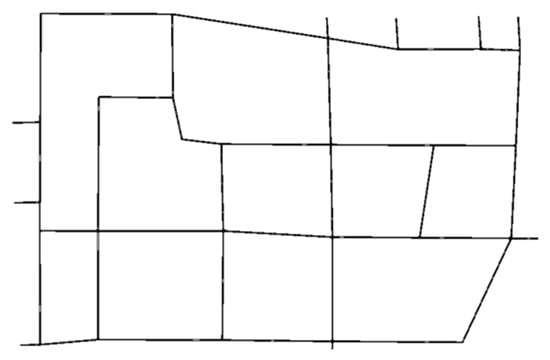
Figure 8.
SUMO simulation model of Bajiao street regional road network.
Table 2.
Basic traffic information of controlled intersections.
Table 3.
Fixed timing parameters for controlled intersections.
Table 4 shows the traffic flow of the surveyed upstream sections during peak hours (07:00–09:00, 17:00–19:00) and use this data as input for simulation data.
Table 4.
Traffic flow during peak hours.
4.2. Parameter Setting
Both perimeter control models use the above test road network, so the key element settings are the same.
4.2.1. Environmental State Design
Typically, there are two types of state data in the traffic environment: static data and dynamic data. Static data are data that can remain constant for a certain period of time within a signal cycle. Dynamic data are data that change dynamically in real time with the simulation step. By incorporating these two types of data, the control models can effectively capture and respond to the current traffic conditions, enabling informed decision making and the optimization of the signal control strategy. Formula (10) represents the environmental state:
Among them, state : the traffic state of the intersection corresponding to agent at time ; phase number : the phase number of the signal light at the intersection corresponding to agent at time ; average lane speed : lane at time average speed.
4.2.2. Action Design for the Intelligent Agent
The actions and action sets are defined in Formula (11):
Different action sets are designed for each controlled intersection, as shown in Table 5.
Table 5.
Action definition.
4.2.3. Reward Function Design
The definition of the reward is shown in Formula (12):
Among them, reward refers to the reward value of agent at time , and “traffic information ” refers to the average waiting time of vehicles in lane at time .
4.3. Result Analysis
In the simulation experiment, the MFD-QL perimeter control model, MFD-DDPG perimeter control model, and fixed timing control were used to simulate the test road network. Convergence analysis was selected as the criterion for evaluating the learning ability of the two models. By comparing the performance of the model in terms of average travel time, average loss time, and average waiting time, the effectiveness and efficiency of the MFD-QL perimeter control model and the MFD-DDPG perimeter control model can be evaluated and compared with a fixed timing control strategy.
4.3.1. Convergence Analysis
The reward value convergence curves of the MFD-QL perimeter control model and the MFD-DDPG perimeter control model are shown in Figure 9, and the shaded part of the curve is formed by the area between the filled mean and variance during each training process. Both the MFD-QL perimeter control model and the MFD-DDPG perimeter control model have continuous learning ability and good convergence ability in the actual road network simulation experiment. The MFD-DDPG perimeter control model exhibits better learning ability and convergence.
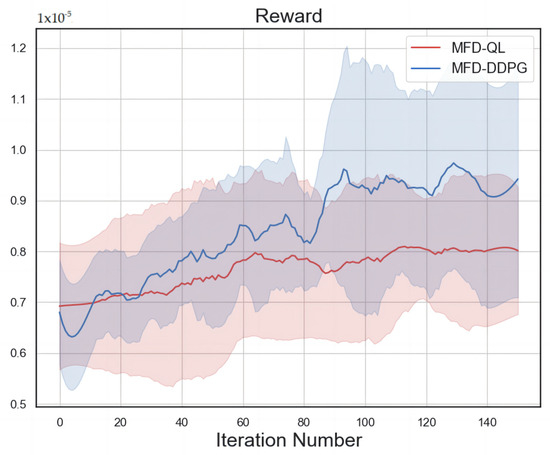
Figure 9.
Convergence trend comparison.
A comparison of the convergence curves of the two control models shows that the MFD-DDPG perimeter control model has better learning ability and convergence. In the first 20 trainings, the reward value of the MFD-DDPG perimeter control model is lower than that of the MFD-QL perimeter control model because the MFD-DDPG perimeter control model gives up some data during the training process. However, after 20 training sessions, the reward value of the MFD-DDPG perimeter control model starts to be higher than that of the MFD-QL perimeter control model, and will remain so until the convergence stabilizes. This is because the Q-learning algorithm is not capable of handling high-dimensional data in the face of complex traffic environments, and the DDPG algorithm can better deal with the dimension explosion problem, so MFD-DDPG has a stronger learning efficiency and convergence ability.
4.3.2. Effectiveness Analysis
The results of the simulation (Figure 10, Figure 11 and Figure 12) show that both the MFD-QL perimeter control model and the MFD-DDPG perimeter control model outperform the fixed timing control strategy in terms of average travel time, average loss time, and average number of waiting vehicles.
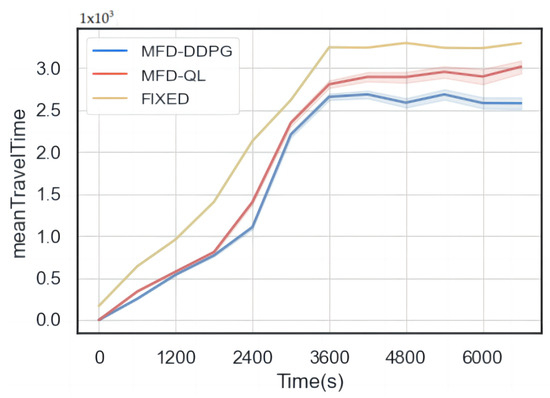
Figure 10.
Comparison of average travel time.
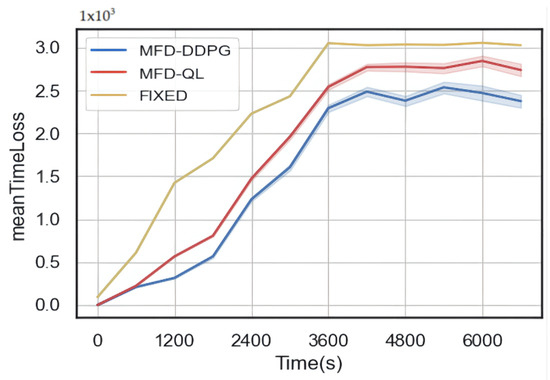
Figure 11.
Comparison of average loss time.
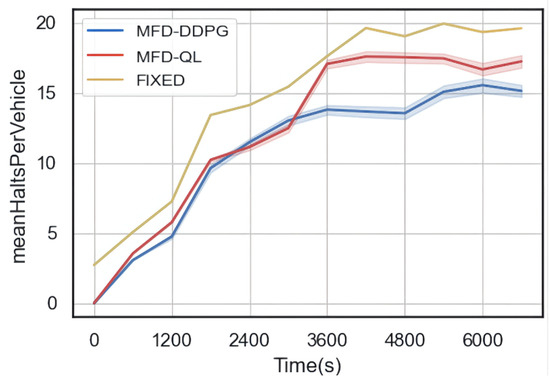
Figure 12.
Comparison of average waiting vehicles.
According to Figure 10 and Figure 11, compared to the fixed timing control, both the MFD-QL perimeter control model and the MFD-DDPG perimeter control model demonstrate the ability to reduce the average travel time and average time loss in the test road network. Additionally, according to Figure 12, they can maintain a lower average number of waiting vehicles compared to the fixed timing control strategy. Notably, the MFD-DDPG perimeter control model performs better in these respects.
In summary, both the MFD-QL perimeter control model and the MFD-DDPG perimeter control model contribute to improving the traffic revenue of the test road network. When comparing the two control models, the MFD-DDPG perimeter control model exhibits better control performance and is more effective in handling high-dimensional data.
5. Discussion and Conclusions
This article presents a study on deep reinforcement learning in urban traffic area control. Based on the MFD attributes that can characterize the traffic area, the perimeter control problem of the traffic area is proposed, and the control objectives and constraints are clearly defined.
By utilizing the good adaptability of reinforcement learning and deep reinforcement learning in dealing with traffic environments, two different perimeter control models based on deep reinforcement learning were designed according to the perimeter control objective problem, and specific reinforcement learning elements and algorithm processes were designed. Finally, an experimental platform was established to verify the rationality and effectiveness of the proposed perimeter control model.
Through numerical simulation experiments, it was verified that the MFD-QL perimeter control model and MFD-DDPG perimeter control model have good convergence and control effects in numerical simulation experiments, and the two perimeter control models under numerical simulation can also achieve the function of alleviating traffic congestion. Finally, through traffic simulation experiments on actual road networks, it was verified that the MFD-QL perimeter control model and the MFD-DDPG perimeter model can achieve better traffic returns compared to fixed timing control, and also verified that the MFD-DDPG perimeter control has the best control effect.
However, for large and complex urban transportation networks, the model mentioned in the article does not yet achieve good results in terms of applicability; for situations where the transportation network is unstable, other methods need to be found to resolve the problems. In future work, we will analyze recurrent, non-recurrent, and emergency-triggered traffic congestion types, and separately model them to validate the effectiveness of the method proposed in the article.
Ultimately, research opportunities are multifaceted, and we believe that addressing these issues is crucial in order to better address traffic congestion and ensure the greatest traffic benefits.
Author Contributions
Conceptualization, Z.Z., G.Z. and Y.L.; methodology, G.Z. and Y.L.; software, G.Z.; validation, Y.F.; formal analysis, Y.Z. All authors have read and agreed to the published version of the manuscript.
Funding
This research received no external funding.
Institutional Review Board Statement
Not applicable.
Informed Consent Statement
Not applicable.
Data Availability Statement
Not applicable.
Conflicts of Interest
The authors declare no conflict of interest.
References
- Odfrey, J.W. The mechanism of a road network. Traffic Eng. Control 1969, 11, 323–327. [Google Scholar]
- Zhang, W.H.; Chen, S.; Ding, H. Feedback gating control considering the congestion at the perimeter intersection. Control Theory Appl. 2019, 36, 241–248. [Google Scholar]
- Geroliminis, N.; Haddad, J.; Ramezani, M. Optimal Perimeter Control for Two Urban Regions With Macroscopic Fundamental Diagrams: A Model Predictive Approach. IEEE Trans. Intell. Transp. Syst. 2013, 14, 348–359. [Google Scholar] [CrossRef]
- Ambühl, L.; Menendez, M. Data fusion algorithm for macroscopic fundamental diagram estimation. Transp. Res. Part C 2016, 71, 184–197. [Google Scholar] [CrossRef]
- Prabhu, S.; George, K. Performance improvement in MPC with time-varying horizon via switching. In Proceedings of the 2014 11th IEEE International Conference on Control & Automation (ICCA), Taichung, Taiwan, 18–20 June 2014. [Google Scholar]
- Keyvan-Ekbatani, M.; Papageorgiou, M.; Knoop, V.L. Controller Design for Gating Traffic Control in Presence of Time-delay in Urban Road Networks. Transp. Res. Procedia 2015, 7, 651–668. [Google Scholar] [CrossRef][Green Version]
- Haddad, J.; Mirkin, B. Coordinated distributed adaptive perimeter control for large-scale urban road networks. Transp. Res. Part C 2017, 77, 495–515. [Google Scholar] [CrossRef]
- Aboudolas, K.; Geroliminis, N. Perimeter and boundary flow control in multi-reservoir heterogeneous networks. Transp. Res. Part B 2013, 55, 265–281. [Google Scholar] [CrossRef]
- Liu, J.; Qin, S. Intelligent Traffic Light Control by Exploring Strategies in an Optimised Space of Deep Q-Learning. IEEE Trans. Veh. Technol. 2022, 7, 5960–5970. [Google Scholar] [CrossRef]
- Wu, H.S. Control Method of Traffic Signal Lights Based On DDPG Reinforcement Learning. J. Phys. Conf. Ser. 2020, 1646, 012077. [Google Scholar] [CrossRef]
- Gao, X.S.; Gayah, V.V. An analytical framework to model uncertainty in urban network dynamics using Macroscopic Fundamental Diagrams. Transp. Res. Part B Methodol. 2017, 117, 660–675. [Google Scholar] [CrossRef]
Disclaimer/Publisher’s Note: The statements, opinions and data contained in all publications are solely those of the individual author(s) and contributor(s) and not of MDPI and/or the editor(s). MDPI and/or the editor(s) disclaim responsibility for any injury to people or property resulting from any ideas, methods, instructions or products referred to in the content. |
© 2023 by the authors. Licensee MDPI, Basel, Switzerland. This article is an open access article distributed under the terms and conditions of the Creative Commons Attribution (CC BY) license (https://creativecommons.org/licenses/by/4.0/).