


Abstract
Internet of Things (IoT) systems cooperative with unmanned aerial vehicles (UAVs) have been put into use for more than ten years, from transportation to military surveillance, and they have been shown to be worthy of inclusion in the next wireless protocols. Therefore, this paper studies user clustering and the fixed power allocation approach by placing multi-antenna UAV-mounted relays for extended coverage areas and achieving improved performance for IoT devices. In particular, the system enables UAV-mounted relays with multiple antennas together with non-orthogonal multiple access (NOMA) to provide a potential way to enhance transmission reliability. We presented two cases of multi-antenna UAVs such as maximum ratio transmission and the best selection to highlight the benefits of the antenna-selections approach with low-cost design. In addition, the base station managed its IoT devices in practical scenarios with and without direct links. For two cases, we derive closed-form expressions of outage probability (OP) and closed-form approximation ergodic capacity (EC) generated for both devices in the main scenario. The outage and ergodic capacity performances in some scenarios are compared to confirm the benefits of the considered system. The number of antennas was found to have a crucial impact on the performances. The simulation results show that the OP for both users strongly decreases when the signal-to-noise ratio (SNR), number of antennas, and fading severity factor of Nakagami-m fading increase. The proposed scheme outperforms the orthogonal multiple access (OMA) scheme in outage performance for two users. The analytical results match Monte Carlo simulations to confirm the exactness of the derived expressions.
1. Introduction
In recent years, unmanned aerial vehicles (UAVs) have been studied and recommended for possible applications in the Internet of Things (IoT) due to their prominent features related to low-cost implementation and high flexibility [1,2,3,4,5]. As one of the effective system models, a UAV-mounted relay can be easily employed, since it provides a flexible coverage area in comparison with conventional fixed relays and increases the network capacity [6]. For UAV-enabled/assisted ground communications, a UAV relay could be a wirelessly-powered device since it harvests energy from the radio signals received from a nearby base station to improve energy efficiency (EE) [7]. The authors in [7] presented the closed-form expressions to showcase two main system performance metrics such as ergodic capacity and outage behavior by enabling both amplify-and-forward (AF) and decode-and-forward (DF) relaying protocols. In [8], the authors examined the case of the UAV carrying limited energy concerning optimal power allocation. They considered the problem of flying path optimization while the UAV is allowed to fly flexibly. To enhance energy-harvesting efficiency and data collection, the communication time and the distances between the access point and ground devices are optimized.
UAVs combined with cooperative non-orthogonal multiple access (NOMA) were considered as a further version of NOMA, which enables the simultaneous transmission among multiple links using the same frequency, can increase bandwidth utilization by carefully planning the communication resource, and increases the dependability of UAV relaying systems in emergency communications [9]. In UAV-NOMA, the far user is assisted by the near user in forwarding the signal from the base station (BS), and the forwarding process occurs in cases where the transmitted signal cannot reach the far user due to obstacles or a long-distance and poor channel condition between the BS and this user [10,11,12,13]. The near user is known as a relay in cooperative non-orthogonal multiple access (C-NOMA). Thus, the C-NOMA can cover a larger area than NOMA, and its transmission reliability is also improved.
To extend the operating areas of the UAV, one can implement a relaying network [14,15,16,17,18,19]. The relays with a single antenna have been studied by many researchers in the last decade [18,19]. Although the structure of these relays is simple, their performance is lower than the relay with multiple antennas due to its low degree of freedom [20,21]. Furthermore, multiple-antenna technology can powerfully mitigate interference [22]. In [23], the authors studied a two-user C-NOMA system in which a decode-and-forward (DF) relay was equipped with multiple antennas. In [21], a NOMA system aided by multiple-antennae two-way DF relay was investigated to boost the transmission reliability of the system. The authors derived closed-form expressions for the outage probability and diversity to show the system performance. In [24], an AF/DF relay was exploited in a C-NOMA system with two users where these two users were equipped with multiple antennas. The effect of multiple antennas on the performance of the relay was examined also. In [25], a multiple-antenna downlink NOMA system for multi-user communication is considered. The transmit power and number of feedback bits were the two main optimized parameters to exploit the potential of multiple-antenna techniques. In [26], a C-NOMA system that employed multiple-antenna two-way relays is studied. Two broadcast NOMA strategies based on multiple access and time division were proposed to enhance transmission reliability. To evaluate the system performance, closed-form expressions were derived for the outage probability and diversity order corresponding with joint antenna-and-relay selection solutions in the proposed strategies. In [27,28], a combination of the C-NOMA scheme and multiple antennas is also analyzed. In [27], the AF relay is equipped with a single antenna, while the source and users are served by multiple antennas. Two antenna-relay selection schemes, namely the maximum ratio transmission (MRT) and transmit antenna selection (TAS), were considered and compared to the random selection (RS) scheme. Based on the numerical simulation results, the performance in terms of outage probability and throughput for MRT and TAS was superior to that for RS. In [29], a full-duplex (FD) multi-antenna relay was employed in a C-NOMA system to assist the communication between BS and a set of far users. The performance of the system for the multiple-antenna relay was significantly improved as compared to that for the half-duplex relay. In [30], multiple antennas at the satellite were exploited with the C-NOMA system. The authors presented an iterative penalty function-based beamforming (BF) scheme to optimize the sum rate. The authors in [31] studied the BF schemes in the multiple-antennas system to maximize the achievable secrecy-energy efficiency. In [32], a cooperative multiple-antenna relaying system was employed where a BF was considered to minimize the total transmit power. In [33], a multiple-antennas UAV network with rate-splitting multiple access was considered. The authors designed the optimization problem to maximize the sum rate of our system. In addition, Table 1 summarizes the related work.

Table 1.
Comparison of the proposed scheme with similar ideas.
Although [25,26,27,28,29,30,31,32,33] studied the benefits of the multi-antenna approach to enhancing performance at destinations of a wireless system, it is still a crucial problem for in-depth analysis to provide more guidelines in the design of effective antenna selection for UAV-aided IoT systems in practice. The main contributions of this paper are summarized as follows
- We provide two practical scenarios of the multi-antenna relay to evaluate a UAV-aided IoT system that can be implemented while the system still leverages the advantage of a multi-antenna UAV. Compared with the traditional multiple input multiple output (MIMO) techniques, we prefer the antenna selection approach to reduce the cost of design and the complexity of signal processing. While Figure 1 exhibits the way that the relay leverages Maximum Ratio Transmission for signal transmission, the antenna-selection approach in Figure 2 inherently enjoys the merits of reducing hardware complexity and cost.
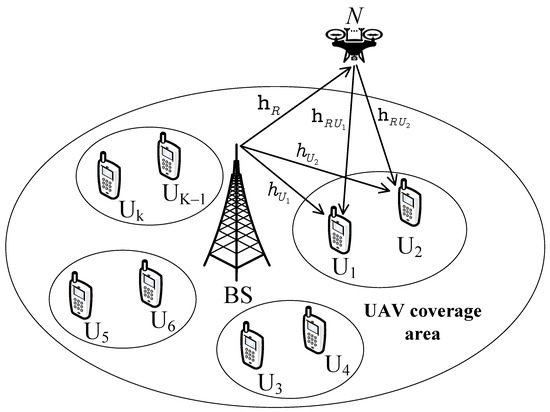 Figure 1. Multi-antenna UAV-aided IoT network.
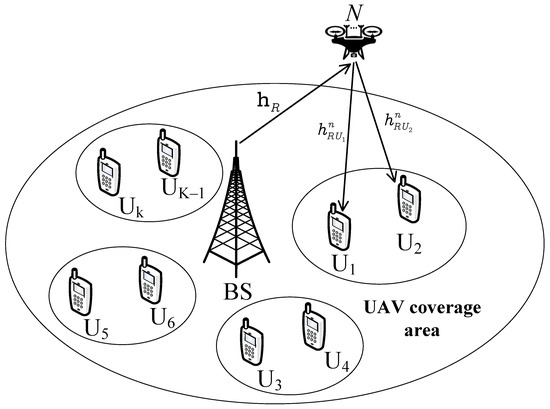 Figure 2. Separated antenna selection for UAV-aided IoT network.
 - Nakagami-m fading is suitable for characterizing a wide class of fading channel conditions for UAV links. Therefore, we focus on UAVs with the analysis of the Nakagami-m fading model rather than Rayleigh’s fading model, which was applied in lots of previous studies. In addition, the two-user scenario of NOMA needs to evaluate the performance when the fixed power allocation is adopted. To confirm the superiority of those schemes, the closed-form expressions for the outage probability and closed-form approximation of the ergodic capacity are derived.
- The outage probability for the multiple-antenna UAV is compared in cases with/ without direct links, NOMA, and OMA to evaluate the effectiveness of the UAV equipped with multiple antennas. We investigate the impacts of the transmit signal-to-noise ratio (SNR) and the number of antennas on the outage probability and ergodic capacity. From these results, one can choose a suitable number of antennas and SNR threshold to balance the demand for performance and the cost of design.
The rest of this paper is organized as follows. Section 2 institutes the system model. In Section 3 and Section 4, the closed-form outage probability is derived for Figure 1 and Figure 2, respectively. Section 5 and Section 6 show the ergiduc capacity analysis for Figure 1 and Figure 2, respectively. Section 7 shows simulation results. Finally, conclusions are drawn in Section 8.
Notation: Vectors are symbolized by bold-faced letters, e.g., x, specifies the Frobenius norm, and denote the normal and Hermitian transpose, respectively; denotes the probability operator; is the Expectation operator; is the so-called Bessel function; the probability density function (PDF) and the cumulative distribution function (CDF) of a random variable X are represented as and , respectively.
2. System Model
We consider a downlink multiple-antenna UAV-aided IoT system, as shown in Figure 1. In this scenario, a base station (BS) wants to transfer the information to K users, in which two users in the group are located in separated clusters. The user could be a strong user or a weak user (). The BS works with different frequencies assigned to these clusters following OMA. To evaluate the performance of a particular cluster, we refer to the strong user and the weak user with the help of an AF-based UAV (R), as illustrated in Figure 1. It is noted that the multiple users served by are divided into many groups, and each group contains two users. In addition, the BS and two users are equipped with a single antenna, and the UAV (relay) R is equipped with N antennas. In the IoT system, multiple-input multiple-output (MIMO) techniques can be employed to mitigate the detrimental effects of unavoidable fading when the base station uses multiple antennas for transmitting and receiving signals. Although using the MIMO technique could be a promising way to improve the capacity and system performance, the transceivers need multiple radio frequency (RF) chains leading to higher power consumption and higher hardware complexity. In this article, we design antenna selection (AS) schemes applied at the BS to reduce the number of RF chains and still maintain the advantages of MIMO systems. Perfect channels state information (CSI) is assumed to be available at the BS. In addition, we assume that the fading channels are distributed over Nakagami-m channels, which are usually characterized by channels connected to UAV.
The channel coefficients between and R are denoted by the matrix where each element with fading parameter is called independent and identically distributed (i.i.d.), and the expectation width . Likewise, the channel coefficients between R and two users , are denoted by the matrix in which each element is also i.i.d. and fulfills with fading value . Finally, the direct connection channel coefficients between BS and are given by , where is the corresponding distribution parameter and [39].
Following the NOMA principle and in order to provide more user fairness, we assume that , with and are the power allocation coefficients and [40,41]. In this article, we just focus on the analysis of two users located in a particular cluster and assume the performance at other clusters is similar. The BS transmits the superposition coding signal, which is combined by two signals and to R and two users in phase 1. The expectations of signals and are assumed that in which is called the expected operator. Hence, the transmitted signal expression at is given by
where and are the messages for and , respectively. We assume that , , denotes the additive white Gaussian noise (AWGN) with mean power .
3. The Outage Performance of Figure 1
The received signals at , and R are, respectively, given by
and
where is the transmit power and is the receive beamforming vector at the R. By employing the maximum ratio combining (MRC) scheme, each user and employs the normalized vector as in [42].
In the second phase, R transmits the signal to both and , where denotes the amplifying gain at relay, i.e.,
where denotes the transmit power of the relay. Without loss of generality, we assume that the transmit power at R is equal to the transmit power of the BS, i.e., . Therefore, the received signals at (forwarded by R) are given by [43]:
By employing the Maximum Ratio Transmission (MRT) scheme, the relay obtains the following beamforming vector to steer the signal in the direction of two users and with in [42,44].
To calculate the instantaneous signal-to-interference-plus-noise ratio (SINR) of the two phases, let us define the average transmit SNR, and the random variables (RVs) , where and represent the instantaneous of the links , and , respectively.
There are two phases of signal processing in the NOMA system. In the first phase, other signal components are treated as interference by while decoding their own message . The SINR is used to decode the signal with a direct link given by
Similarly, the instantaneous SINR at to detect is given as
After SIC, we assume the perfect SIC is at the receiver side. Therefore, the received SNR at to detect its own message is written as
In the second phase, the instantaneous SINR at relating to link is calculated by applying the same procedure as the first phase and is thus given by
Considering the link , the instantaneous SINR at to detect and the instantaneous SNR at to detect its own data are, respectively, given by
and
Based on the selection combination, the instantaneous SINRs at and could be given as [45]
Based on the quality of service of two users, their target SINRs can be determined. Each user has its own the SNR threshold, where is the target rate at to detect and is the target rate at to detect . For simplicity, we assume the SNR thresholds of and are both equal, i.e., .
3.1. Outage Probability at
According to [46,47], the cumulative distribution functions (CDF) of the RVs , Y and , respectively, are given by
and the probability density function (PDF) of the RVs , Y and , respectively, are given by
where , and are the parameters of multipath fading associated with , and , respectively.
Then, the outage probability at can be given by
where and .
Proposition 1.
The closed-form expression of the outage probability at user can be given by
where .
Proof of Proposition 1, see Appendix A.
3.2. Outage Probability at
Similarly, the outage probability at user can be computed by
Proposition 2.
The closed-form expression of the outage probability at user can be computed by
where
Proof.
Here, is calculated as
Next, is calculated as
Let , be given as
With the help of Equations (1.111), (3.471.9) [48] and after some manipulations, we have
Remark 1.
Although derivations of outage behavior are complicated, we still realize that channel parameters and the number of transmit antennas can be the main factors affecting the system performance. For example: in (18), the outage behavior relies on m, N.
4. The Outage Performance of Figure 2: Separated Antenna Selection Approach
In Figure 2, each user follows the antenna selection scheme itself. This way, the performance of each user can be maximized as expected. We will present how Figure 2 is different from Figure 1 in terms of outage performance. In addition, Figure 3 shows the block diagram of the antenna selection for Figure 2. We assume the MRC method from BS to R and the optimal antenna from R to two users by the transmit antenna selection method.
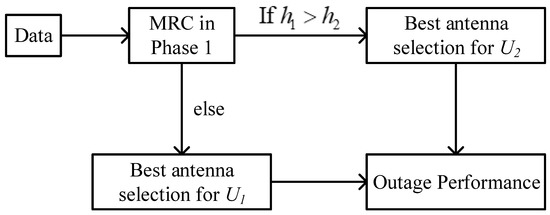
Figure 3.
The block diagram of the antenna selection for Figure 2.
By employing the antenna-selection technique for separated users, the received signal at each is first written as
4.1. Best Antenna Serving
In this case, the BS selects the ideal antenna to obtain the highest performance at . When performance is assured owing to greater normalized channel gain and the source chooses an appropriate antenna to serve , this method can maximize the system’s performance. The chosen antenna, represented by , may therefore be written as
According to (23), the equivalent instantaneous end-to-end SINR of can be written as
and
where with .
In addition, the PDF and CDF of can be re-expressed as
and
Proposition 3.
The approximated closed-form expressions of the outage probability for with Figure 2 is given by
Proof of Proposition 3, see Appendix B.
4.2. Best Antenna Serving
The source BS will select the ideal antenna in Figure 2 to get the highest performance dedicated to . When the performance is uncertain owing to high interference levels and/or unfavorable channel conditions, this method can maximize the system’s performance. The source then favors a suitable antenna to serve . The chosen antenna, represented by , may be written as
Thus, the received SINR at to detect is given by
The outage probability of for AF-NOMA is
Similarly, by solving , can be obtained as
5. Figure 1: Ergodic Capacity Analysis
We first define the EC of below
Proposition 4.
The approximated closed-form expressions of the EC for are given by
where , and .
Proof of Proposition 4, see Appendix C.
Finally, the EC of can be obtained as shown below
The CDF of Y is calculated as follows
Next, we have , which is calculated as
As such, the EC of is given in (39).
6. Figure 2: Ergodic Capacity Analysis
Ergodic Rate of : On the condition that can detect , the achievable rate of can be written as . The EC of can be obtained in the following proposition.
Proposition 5.
The closed-form expression of approximated for is given by
where .
Proof.
From (34) into , the EC of is written as
where and .
Let ; then, is calculated as
where and .
Although obtaining a closed-form formula for is challenging, we can acquire an accurate approximation for it. We may obtain (44) by using Gaussian–Chebyshev quadrature Equation (25.4.38) [49].
The proof is finished. □
Ergodic Rate of : If is capable of detecting , the EC of may be calculated as
where and .
7. Simulation Results
In this section, we set and numerically simulate some theoretical results to show the outage performance. In particular, the main parameters can be seen in Table 2. In addition, the Gaussian-Chebyshev parameter is selected as to yield a close approximation.
Table 2.
Definition of system parameters.
In Figure 4, we examined the outage probability versus SNR and the number of antennas. The figure shows that the outage probability for User 2 is lower than that for user 1. Although the outage probability for both users tends to decrease linearly and quickly, the outage probability for User 2 still keeps a value of around in the SNR range from 0 to 10 dB. In particular, when the number of antennas increases from 1 to 3, the outage probability for both users is reduced. This implies that the more antennas, the more reliable the system.
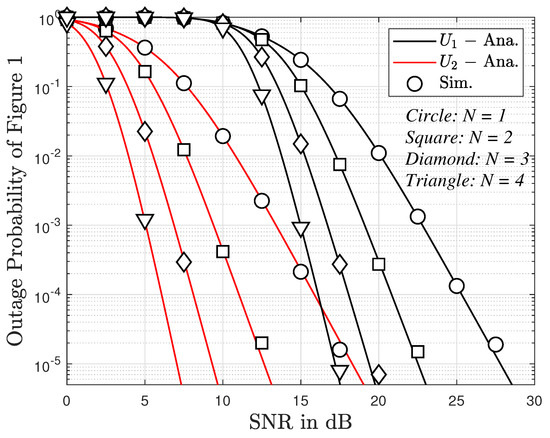
Figure 4.
Outage probability versus transmitting SNR of two users with direct link.
In Figure 5, we present the outage probability versus SNR and fading severity factor m. Similar to Figure 4, the outage probability for User 2 is also lower than that for User 1. The outage probability for both users decreases quickly as SNR increases. For impacts of m on the outage probability, it is observed from the figure that the larger the value of m, the higher the slope of the outage probability curves. This can be explained based on (15) and (17).
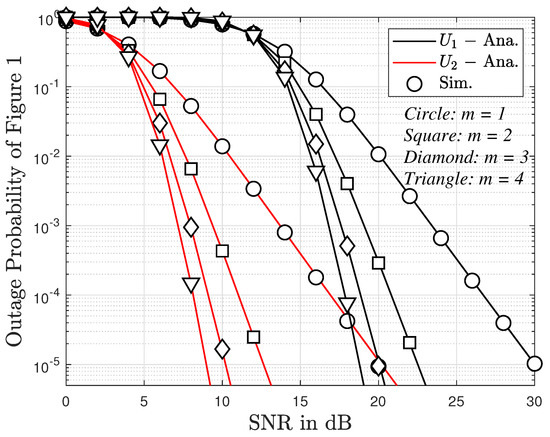
Figure 5.
The outage probability versus SNR and different values of m, with with direct link.
Figure 6 plots the outage probability versus power allocation coefficient . The figure shows that the outage probability for User 2 decreases in the case of increasing . However, this is the opposite for User 1 where the outage probability increases linearly when increases. In addition, the outage probability for two users tends to decrease since the number of antennas increases.
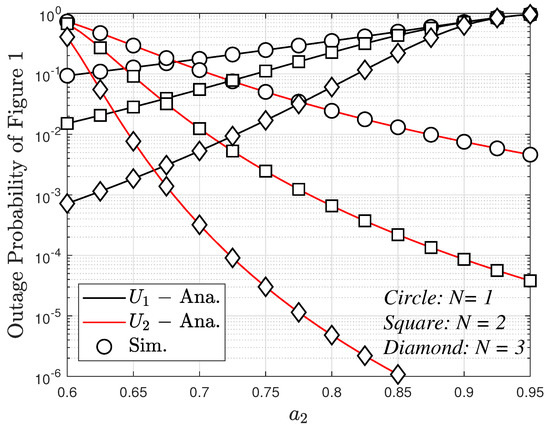
Figure 6.
The outage probability versus with (dB), and different values of N with direct link.
In Figure 7, we present the relationship between the outage probability and SNR for scenarios with and without direct links between BS and users for Figure 1. It is evident that the outage probability for User 2 consistently remains lower than that for User 1. Furthermore, when there is no direct link between BS and users, the outage probability for User 1 is higher compared to User 2. The absence of a direct link leads to a higher outage probability compared to scenarios with a direct link. Interestingly, as the value of m increases from 1 to 2, the outage probability for both users, in cases with or without direct links, consistently improves.
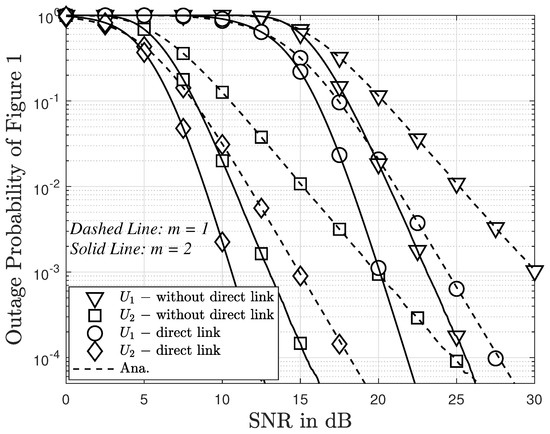
Figure 7.
The outage probability with/without direct link versus (dB) and .
Figure 8 presents the outage probability as a function of SNR in dB in cases of NOMA and OMA schemes. It is observed from the figure that the outage probability for User 2 and NOMA is lower than that for OMA in both cases where the number of antennas is 1 and 2. However, this is the opposite for User 1 where the outage probability for OMA is lower than that for NOMA. In general, the outage probability curves decrease quickly as SNR increases.
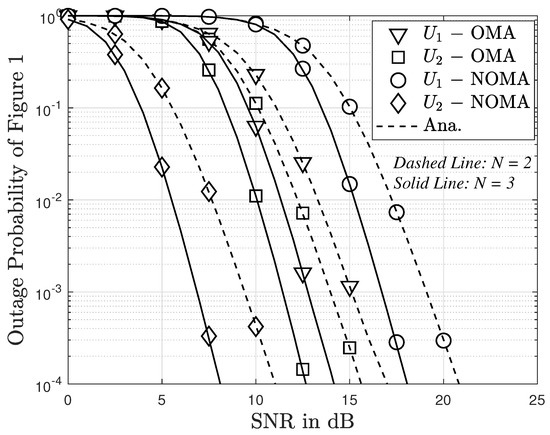
Figure 8.
Comparison of outage probability between OMA and NOMA versus SNR with with direct link.
In Figure 9, the ergodic capacity versus SNR in different cases of antennas (i.e., n = 1, 3, 5) was investigated. The figure shows that the ergodic capacity of User 2 increases gradually in the SNR range of 0 to 20 dB. However, this tends to remain constant during the SNR range of 20 to 30 dB. For User 1, the ergodic capacity increases rapidly as SNR varies from 10 to 30 dB. In addition, the number of antennas also causes a change in the ergodic capacity. Specifically, the higher the number of antennas, the larger the ergodic capacity. However, the impact of the number of antennas on the ergodic capacity for User 2 is insignificant, particularly in the SNR range of 20 to 30 dB.
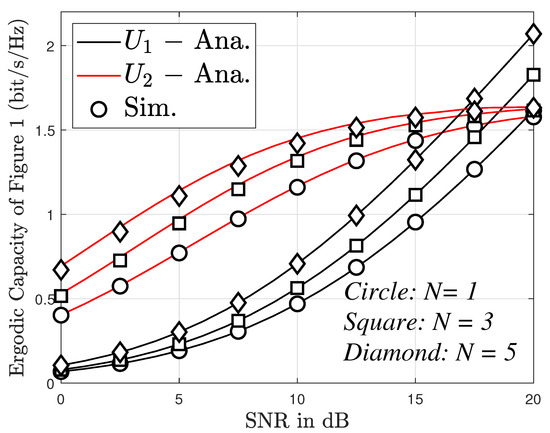
Figure 9.
The ergodic capacity versus SNR and different values of N, with with direct link.
Next, Figure 10 demonstrates that the performance of two users in Figure 1 is better than that of the users Figure 2 in terms of outage probability. The main reason is that Figure 1 still exhibits higher diversity, although Figure 1 requires a higher design cost. The demand for low-cost design for some applications of the Internet of Things would prefer the benefits of Figure 2.
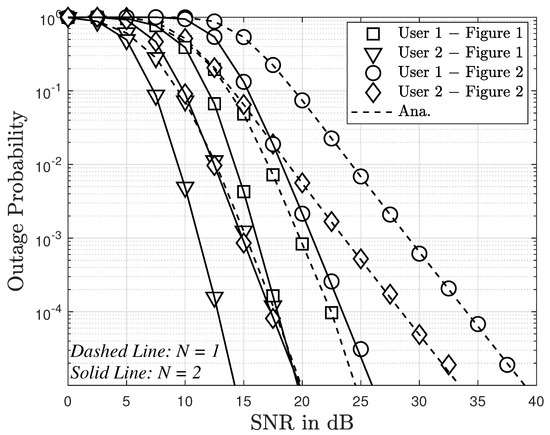
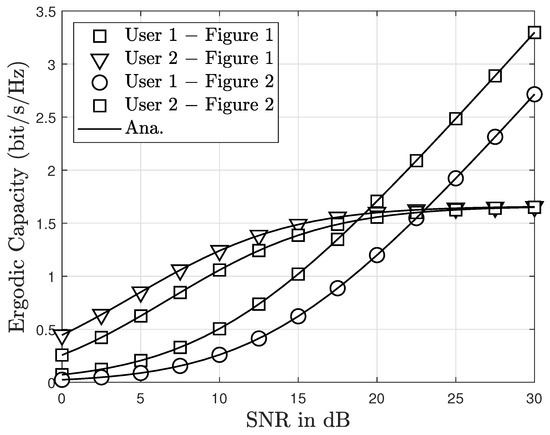
Figure 11 presents the inclusion of simulation data for comparative analysis, serving to verify the accuracy of the obtained analytical results. Additionally, a comparison is made between the ergodic capabilities of the proposed system in Figure 1 and Figure 2. Specifically, User 2 demonstrates a higher ergodic capacity in Figure 1 compared to Figure 2 within the low and moderate SNR regions. However, User 1 achieves a superior ergodic capacity over Figure 2 across a wide range of SNR values. Remarkably, in the medium and high SNR ranges, User 2’s achievable capacity converges to a constant because interferences in the instantaneous SINRs at User 2 rise as the average SNR increases. Conversely, the interferences experienced by User 1 intensify as the average SNR rises, as demonstrated in Equations (36), (39), (44) and (48). Consequently, it is evident that the ergodic capacity of User 2 in Figure 1 outperforms that of User 2 in Figure 2.
Lastly, Figure 12 illustrates the variation of the ergodic capacity as the number of antennas increases, ranging up to 10. Notably, User 1 exhibits a higher ergodic capacity compared to User 2. The ergodic capacity demonstrates a proportional relationship with the number of antennas. However, for User 2, this capacity remains nearly constant when the number of antennas exceeds 4. This observation suggests that the impact of the number of antennas on User 1 is greater than that on User 2. This can be explained based on (36) and (39).
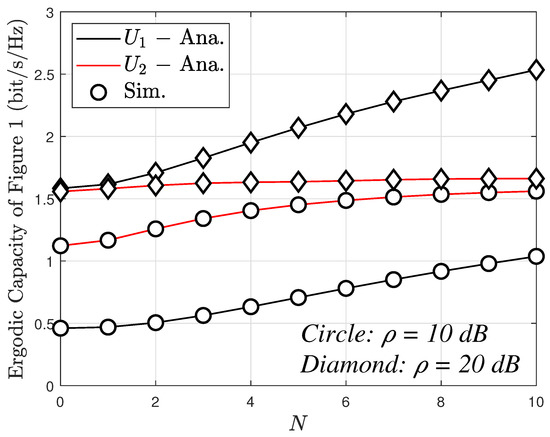
Figure 12.
The ergodic capacity versus N with with direct link.
8. Conclusions and Future Work
This paper has presented two practical schemes of multiple-antennas UAV-aided IoT systems. Closed-form expressions for the outage probability were studied to confirm Figure 1 with a higher superiority of outage performance compared with Figure 2. We also provide performance analysis for the system by deriving a closed-form approximation of the ergodic capacity in Figure 1. The numerical results show that a weak user (User 2) achieves a lower probability than a strong user (User 1). The outage probability without direct links is lower than that with direct links. The IoT relying on the NOMA scheme is superior to that using the OMA scheme. The performance of the system increases when the number of antennas increases. These findings are a basic background for investigating the performance of the NOMA system with multiple antennas. In future work, reconfigurable intelligent surface-based UAVs could be studied to improve the performance of IoT users. In the future, we will combine UAV NOMA with changeable intelligent surfaces to increase system performance metrics even more.
Author Contributions
Conceptualization, S.Q.N., C.-B.L., P.T.T. and Y.-H.K.; methodology, S.Q.N., A.-T.L. and Y.-H.K.; formal analysis, S.Q.N., P.T.T. and A.-T.L.; writing—original draft preparation, C.-B.L. and A.-T.L.; writing—review and editing, S.Q.N., A.-T.L., P.T.T. and Y.-H.K.; funding acquisition, Y.-H.K. All authors have read and agreed to the published version of the manuscript.
Funding
This work was supported in part by the National Research Foundation of Korea (NRF) grant funded by the Korea government (MSIT) (No. 2022R1F1A1074975) and in part by the Korea Institute of Energy Technology Evaluation and Planning (KETEP) and the Ministry of Trade, Industry and Energy (MOTIE) of the Republic of Korea (No. 20221A10100011).
Institutional Review Board Statement
Not applicable.
Informed Consent Statement
Not applicable.
Conflicts of Interest
We have also no conflict of interest to disclose.
Appendix A
Proof Proposition 1.
From (15), the outage probability at can be calculated by
Applying (13a), can be calculated as follows
where
Next, can be computed as
Let ; then, is given by
With the help of Equations (1.111), (3.471.9) [48] and after some manipulations, we have
Finally, by substituting (A5) and (A2) into (A1), a closed-form expression for the outage probability at can be derived as
The proof is completed. □
Appendix B
Appendix C
Proof of Proposition 4.
Ergodic Capacity of
From and , we have calculated as
It is worth noting that can be expressed in terms of the Meijer-G function as Equation (40) [51]
where Equation (9.301) [48] is the Meijer G-function, and (A15) is rewritten as
Applying Equation (7.811.5) [48], can be obtained as follows
Next, can be calculated by
Let ; then, (A18) is given by
Unfortunately, finding a closed-form expression for (A19) is a tough task, but an accurate approximation can be obtained for it. By using the Gaussian–Chebyshev quadrature shown in Equation (25.4.38) [49], it can be achieved by
where , and .
The proof is completed. □
References
- Katwe, M.; Singh, K.; Sharma, P.K.; Li, C.-P.; Ding, Z. Dynamic User Clustering and Optimal Power Allocation in UAV-Assisted Full-Duplex Hybrid NOMA System. IEEE Trans. Wirel. Commun. 2022, 21, 2573–2590. [Google Scholar] [CrossRef]
- Zhai, D.; Li, H.; Tang, X.; Zhang, R.; Cao, H. Joint position optimization, user association, and resource allocation for load balancing in UAV-assisted wireless networks. Digit. Commun. Netw. 2022, in press. [CrossRef]
- Cao, H.; Hu, Y.; Yang, L. Towards Intelligent Virtual Resource Allocation in UAVs-Assisted 5G Networks; Computer Networks; Elsevier: Amsterdam, The Netherlands, 2021; Volume 185, p. 107660. [Google Scholar]
- Cao, H.; Du, J.; Zhao, H.; Luo, D.X.; Kumar, N.; Yang, L.; Yu, F.R. Resource-ability assisted service function chain embedding and scheduling for 6G networks with virtualization. IEEE Trans. Veh. Technol. 2021, 70, 3846–3859. [Google Scholar] [CrossRef]
- Zhai, D.; Wang, C.; Zhang, R.; Cao, H.; Yu, F.R. Energy-Saving Deployment Optimization and Resource Management for UAV-Assisted Wireless Sensor Networks With NOMA. IEEE Trans. Veh. Technol. 2022, 71, 6609–6623. [Google Scholar] [CrossRef]
- Solanki, S.; Park, J.; Lee, I. On the Performance of IRS-Aided UAV Networks with NOMA. IEEE Trans. Veh. Technol. 2022, 71, 9038–9043. [Google Scholar] [CrossRef]
- Do, D.-T.; Le, A.-T.; Liu, Y.; Jamalipour, A. User Grouping and Energy Harvesting in UAV-NOMA System With AF/DF Relaying. IEEE Trans. Veh. Technol. 2021, 70, 11855–11868. [Google Scholar] [CrossRef]
- Zeng, Y.; Xu, J.; Zhang, R. Energy minimization for wireless communication with rotary-wing UAV. IEEE Trans. Wireless Commun. 2019, 18, 2329–2345. [Google Scholar] [CrossRef]
- Wang, L.; Hu, B.; Chen, S.; Cui, J. UAV-Enabled Reliable Mobile Relaying Based on Downlink NOMA. IEEE Access 2020, 8, 25237–25248. [Google Scholar] [CrossRef]
- Baidas, M.W.; AbdelGhaffar, A.M.; Alsusa, E. Network sum-rate maximization via joint power allocation and antenna selection for clustered downlink/uplink NOMA networks. Phys. Commun. 2022, 51, 101596. [Google Scholar] [CrossRef]
- Flores, A.; de Lamare, R.C. Study of Robust Adaptive Power allocation for the Downlink of Multiple-Antenna Systems. arXiv 2022, arXiv:2202.06148. [Google Scholar]
- Zeng, M.; Hao, W.; Dobre, O.A.; Ding, Z. Cooperative NOMA: State of the Art, Key Techniques, and Open Challenges. IEEE Netw. 2020, 34, 205–211. [Google Scholar] [CrossRef]
- Yuan, Y.; Xu, P.; Yang, Z.; Ding, Z.; Chen, Q. Joint robust beamforming and power-splitting ratio design in SWIPT-based cooperative NOMA systems with CSI uncertainty. IEEE Trans. Veh. Technol. 2019, 68, 2386–2400. [Google Scholar] [CrossRef]
- Li, X.; Li, J.; Liu, Y.; Ding, Z.; Nallanathan, A. Residual Transceiver Hardware Impairments on Cooperative NOMA Networks. IEEE Trans. Wirel. Commun. 2020, 19, 680–695. [Google Scholar] [CrossRef]
- Do, D.-T.; Le, A. NOMA based cognitive relaying: Transceiver hardware impairments, relay selection policies and outage performance comparison. Comput. Commun. 2019, 146, 144–154. [Google Scholar] [CrossRef]
- Do, D.-T.; Le, A.-T.; Lee, B.M. NOMA in Cooperative Underlay Cognitive Radio Networks Under Imperfect SIC. IEEE Access 2020, 8, 86180–86195. [Google Scholar] [CrossRef]
- Le, A.T.; Do, D.T.; Chang, W.T.; Vu, C.T. Cognitive IoT relaying NOMA networks with user clustering and imperfect SIC. Peer-to-Peer Netw. Appl. 2021, 14, 3170–3180. [Google Scholar] [CrossRef]
- Yang, Z.; Ding, Z.; Wu, Y.; Fan, P. Novel relay selection strategies for cooperative NOMA. IEEE Trans. Veh. Technol. 2017, 66, 10114–10123. [Google Scholar] [CrossRef]
- Xu, P.; Yang, Z.; Ding, Z.; Zhang, Z. Optimal relay selection schemes for cooperative NOMA. IEEE Trans. Veh. Technol. 2018, 67, 7851–7855. [Google Scholar] [CrossRef]
- Ashraf, M.; Shahid, A.; Jang, J.W.; Lee, K.G. Energy harvesting non-orthogonal multiple access system with multi-antenna relay and base station. IEEE Access 2017, 5, 17660–17670. [Google Scholar] [CrossRef]
- Lv, L.; Ye, Q.; Ding, Z.; Li, Z.; Al-Dhahir, N.; Chen, J. On the design of NOMA assisted multi-antenna two-way relay systems. In Proceedings of the IEEE International Conference on Communications (ICC), Dublin, Ireland, 7–11 June 2020; pp. 1–6. [Google Scholar]
- Wang, X.; Li, E.; Yang, G.; Xu, L. Performance analysis of 5G Downlink Cooperative NOMA network with multi-antenna relay. Phys. Commun. 2022, 52, 101586. [Google Scholar]
- Cao, Y.; Zhao, N.; Pan, G.; Chen, Y.; Fan, L.; Jin, M.; Alouini, M.S. Secrecy analysis for cooperative NOMA networks with multi-antenna full-duplex relay. IEEE Trans. Commun. 2019, 67, 5574–5587. [Google Scholar] [CrossRef]
- Zaghdoud, N.; Mnaouer, A.B.; Alouane, W.H.; Boujemaa, H.; Touati, F. Secrecy Performance Analysis of Multi-Antenna NOMA System with AF/DF relaying under External and Internal Eavesdropping Scenarios. In Proceedings of the 2020 International Wireless Communications and Mobile Computing (IWCMC), Limassol, Cyprus, 15–19 June 2020; pp. 1726–1732. [Google Scholar]
- Tang, Z.; Sun, L.; Cao, L.; Qi, S.; Feng, Y. Reconsidering Design of Multi-Antenna NOMA Systems With Limited Feedback. IEEE Trans. Wirel. Commun. 2020, 19, 1519–1534. [Google Scholar] [CrossRef]
- Lv, L.; Ye, Q.; Ding, Z.; Li, Z.; Al-Dhahir, N.; Chen, J. Multi-Antenna Two-Way Relay Based Cooperative NOMA. IEEE Trans. Wirel. Commun. 2020, 19, 6486–6503. [Google Scholar] [CrossRef]
- Le, T.A.; Kong, H.Y. Energy harvesting relay-antenna selection in cooperative MIMO/NOMA network over Rayleigh fading. Wirel. Netw. 2020, 26, 2075–2087. [Google Scholar] [CrossRef]
- Hakimi, A.; Mohammadi, M.; Mobini, Z. Outage Probability of Wireless-powered Multi-antenna Cooperative Spectrum Sharing Networks with Full-duplex and NOMA Transmissions. In Proceedings of the International Symposium on Telecommunications (IST), Tehran, Iran, 17–19 December 2018; pp. 127–132. [Google Scholar]
- Mobini, Z.; Mohammadi, M.; Suraweera, H.A.; Ding, Z. Full-duplex multi-antenna relay assisted cooperative non-orthogonal multiple access. In Proceedings of the IEEE Global Communications Conference, Singapore, 4–8 December 2017; pp. 1–7. [Google Scholar]
- Lin, Z.; Lin, M.; Wang, J.-B.; de Cola, T.; Wang, J. Joint Beamforming and Power Allocation for Satellite-Terrestrial Integrated Networks With Non-Orthogonal Multiple Access. IEEE J. Sel. Top. Signal Process. 2019, 13, 657–670. [Google Scholar] [CrossRef]
- Lin, Z.; Lin, M.; Champagne, B.; Zhu, W.-P.; Al-Dhahir, N. Secrecy-Energy Efficient Hybrid Beamforming for Satellite-Terrestrial Integrated Networks. IEEE Trans. Commun. 2021, 69, 6345–6360. [Google Scholar] [CrossRef]
- Lin, Z.; Niu, H.; An, K.; Wang, Y.; Zheng, G.; Chatzinotas, S.; Hu, Y. Refracting RIS-Aided Hybrid Satellite-Terrestrial Relay Networks: Joint Beamforming Design and Optimization. IEEE Trans. Aerosp. Electron. Syst. 2022, 58, 3717–3724. [Google Scholar] [CrossRef]
- Lin, Z.; Lin, M.; de Cola, T.; Wang, J.-B.; Zhu, W.-P.; Cheng, J. Supporting IoT With Rate-Splitting Multiple Access in Satellite and Aerial-Integrated Networks. IEEE Internet Things J. 2021, 8, 11123–11134. [Google Scholar] [CrossRef]
- Katwe, M.; Singh, K.; Sharma, P.K.; Li, C.-P. Energy Efficiency Maximization for UAV-Assisted Full-Duplex NOMA System: User Clustering and Resource Allocation. IEEE Trans. Green Commun. Netw. 2022, 6, 992–1008. [Google Scholar] [CrossRef]
- Zhou, S.; Cheng, Y.; Lei, X.; Peng, Q.; Wang, J.; Li, S. Resource allocation in UAV-assisted networks: A clustering-aided reinforcement learning approach. IEEE Trans. Veh. Technol. 2022, 71, 12088–12103. [Google Scholar] [CrossRef]
- Abu-Baker, A.; Shakhatreh, H.; Sawalmeh, A.; Alenezi, A.H. Efficient Data Collection in UAV-Assisted Cluster-Based Wireless Sensor Networks for 3D Environment: Optimization Study. J. Sens. 2023, 2023, 9513868. [Google Scholar] [CrossRef]
- Yao, Y.; Wu, Y.; Zhu, Z.; Qin, X.; Yue, X. Modeling and performance analysis in UAV-assisted cellular networks with clustered edge users. Electronics 2022, 11, 828. [Google Scholar] [CrossRef]
- Ghobaei, M.; Shahidinejad, A.A. A cost-efficient IoT service placement approach using whale optimization algorithm in fog computing environment. Expert Syst. Appl. 2022, 200, 117012. [Google Scholar] [CrossRef]
- Tahir, B.; Schwarz, S.; Rupp, M. Analysis of uplink IRS-assisted NOMA under Nakagami-m fading via moments matching. IEEE Wirel. Commun. Lett. 2020, 10, 624–628. [Google Scholar] [CrossRef]
- Saito, Y.; Kishiyama, Y.; Benjebbour, A.; Nakamura, T.; Li, A.; Higuchi, K. Non-orthogonal multiple access (NOMA) for cellularfuture radio access. In Proceedings of the 2013 IEEE 77th Vehicular Technology Conference (VTC Spring), Dresden, Germany, 2–5 June 2013; pp. 1–5. [Google Scholar]
- Do, T.N.; da Costa, D.B.; Duong, T.Q.; An, B. Improving the performance of cell-edge users in noma systems using cooperative relaying. IEEE Trans. Commun. 2018, 66, 1883–1901. [Google Scholar] [CrossRef]
- Zhu, G.; Zhong, C.; Suraweera, H.A.; Zhang, Z.; Yuen, C. Outage Probability of Dual-Hop Multiple Antenna AF Systems with Linear Processing in the Presence of Co-Channel Interference. IEEE Trans.Wirel. Commun. 2014, 13, 2308–2321. [Google Scholar] [CrossRef]
- Li, M.; Lin, M.; Zhu, W.-P.; Huang, Y.; Wong, K.-K.; Yu, Q. Performance analysis of dual-hop MIMO AF relaying network with multiple interferences. IEEE Trans. Veh. Technol. 2017, 66, 1891–1897. [Google Scholar] [CrossRef]
- Nguyen, N.-T.; Nguyen, H.-N.; Nguyen, N.-L.; Le, A.-T.; Do, D.-T.; Voznak, M. Enhancing Spectrum Efficiency for Multiple Users in Hybrid Satellite-Terrestrial Networks. IEEE Access 2021, 9, 50291–50300. [Google Scholar] [CrossRef]
- Lee, S.; Costa, D.B.D.; Vien, Q.-T.; Duong, T.Q.; Sousa, R.T.D. Non-orthogonal multiple access schemes with partial relay selection. IET Commun. 2017, 11, 846–854. [Google Scholar] [CrossRef]
- Wang, Q.; Ge, J.; Li, Q.; Bu, Q. Performance analysis of NOMA for multiple-antenna relaying networks with energy harvesting over Nakagami-m fading channels. In Proceedings of the 2017 IEEE/CIC International Conference on Communications in China (ICCC) 2017, Qingdao, China, 22–24 October 2017; pp. 1–5. [Google Scholar]
- Hung, C.C.; Chiang, C.T.; Lin, S.N.; Wu, R.C. Outage capacity analysis of TAS/MRC systems over arbitrary Nakagami-m fading channels. IEICE Trans. Commun. 2010, 93, 215–218. [Google Scholar] [CrossRef]
- Gradshteyn, I.S.; Ryzhik, I.M. Tables of Integrals, Series and Products, 6th ed.; Academic Press: New York, NY, USA, 2000. [Google Scholar]
- Abramowitz, M.; Stegun, I.A. Handbook of Mathematical Functions with Formulas, Graphs, and Mathematical Tables; Dover: New York, NY, USA, 1972. [Google Scholar]
- Nguyen, T.-L.; Le, C.-B.; Do, D.-T. Performance analysis of multi-user NOMA over α-κ-μ shadowed fading. Electron. Lett. 2020, 56, 771–773. [Google Scholar] [CrossRef]
- Huang, Q.; Lin, M.; An, K.; Ouyang, J.; Zhu, W. Secrecy performance of hybrid satellite-terrestrial relay networks in the presence of multiple eavesdroppers. IET Commun. 2018, 12, 26–34. [Google Scholar] [CrossRef]
Disclaimer/Publisher’s Note: The statements, opinions and data contained in all publications are solely those of the individual author(s) and contributor(s) and not of MDPI and/or the editor(s). MDPI and/or the editor(s) disclaim responsibility for any injury to people or property resulting from any ideas, methods, instructions or products referred to in the content. |
© 2023 by the authors. Licensee MDPI, Basel, Switzerland. This article is an open access article distributed under the terms and conditions of the Creative Commons Attribution (CC BY) license (https://creativecommons.org/licenses/by/4.0/).