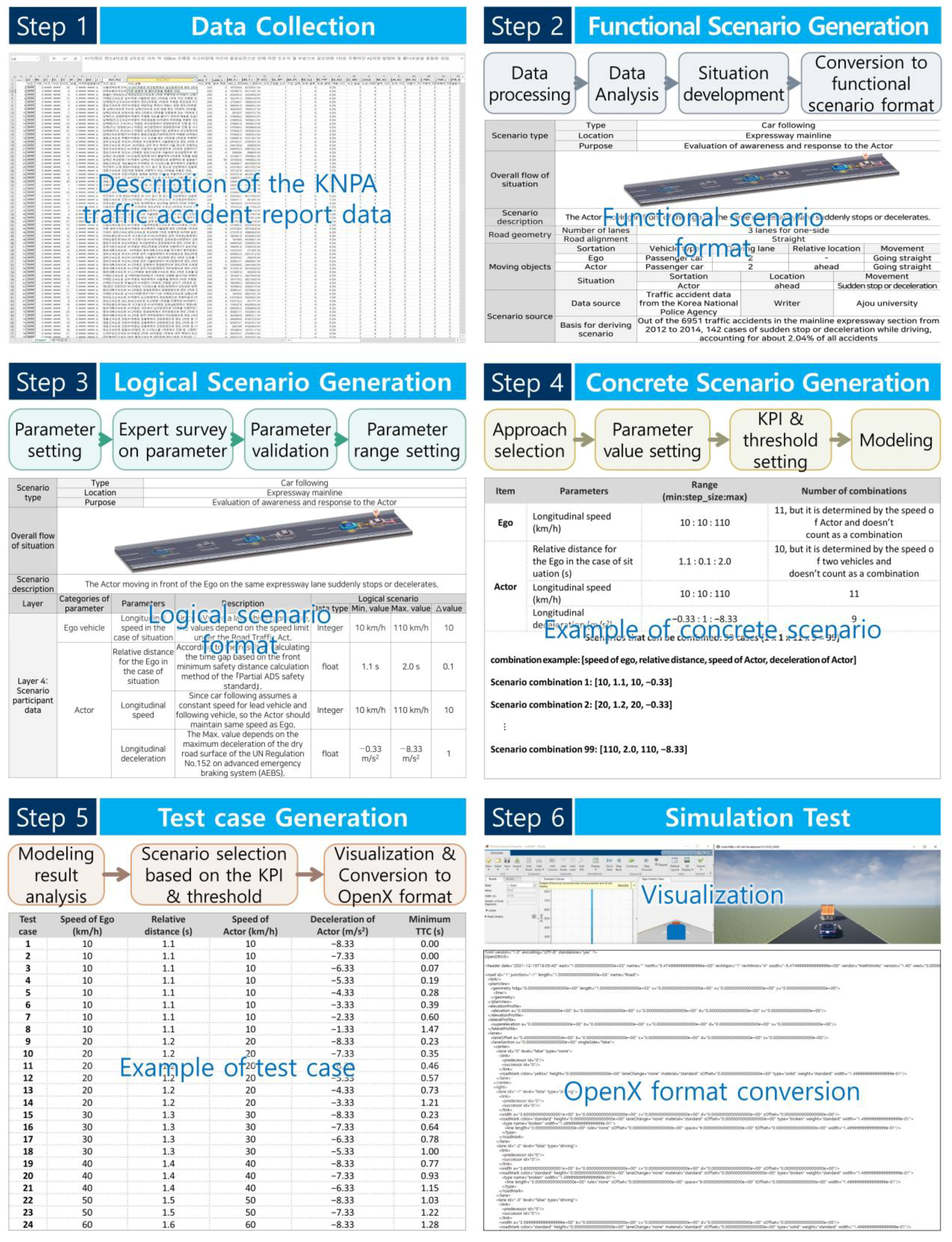
Development of a Framework for Generating Driving Safety Assessment Scenarios for Automated Vehicles

Abstract
1. Introduction
2. Literature Review
2.1. Related Research
2.2. Prior Studies
2.3. Summary
3. Scenario Generation Framework
3.1. Overview
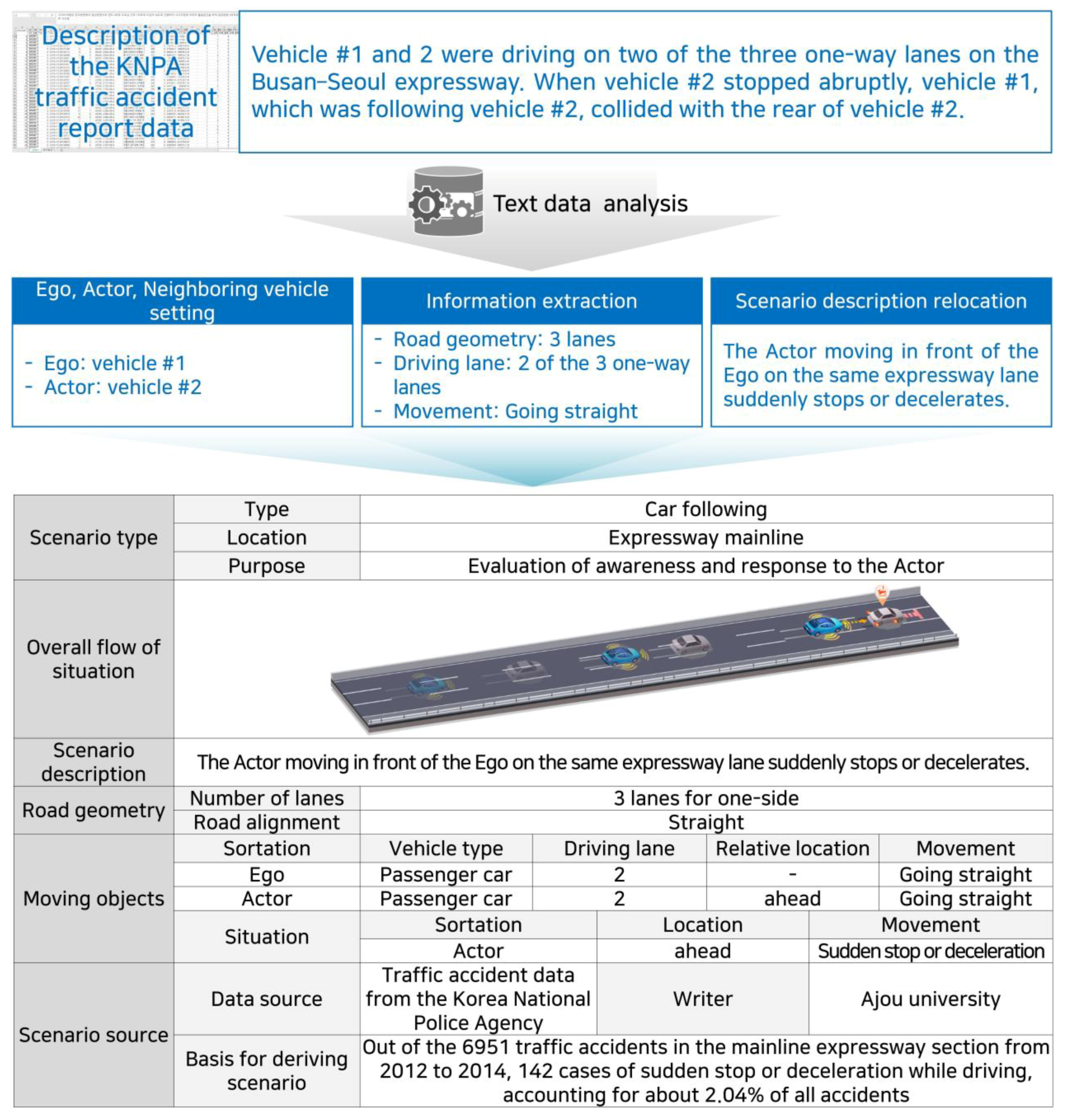
3.2. Functional Scenario Generation Framework and Form
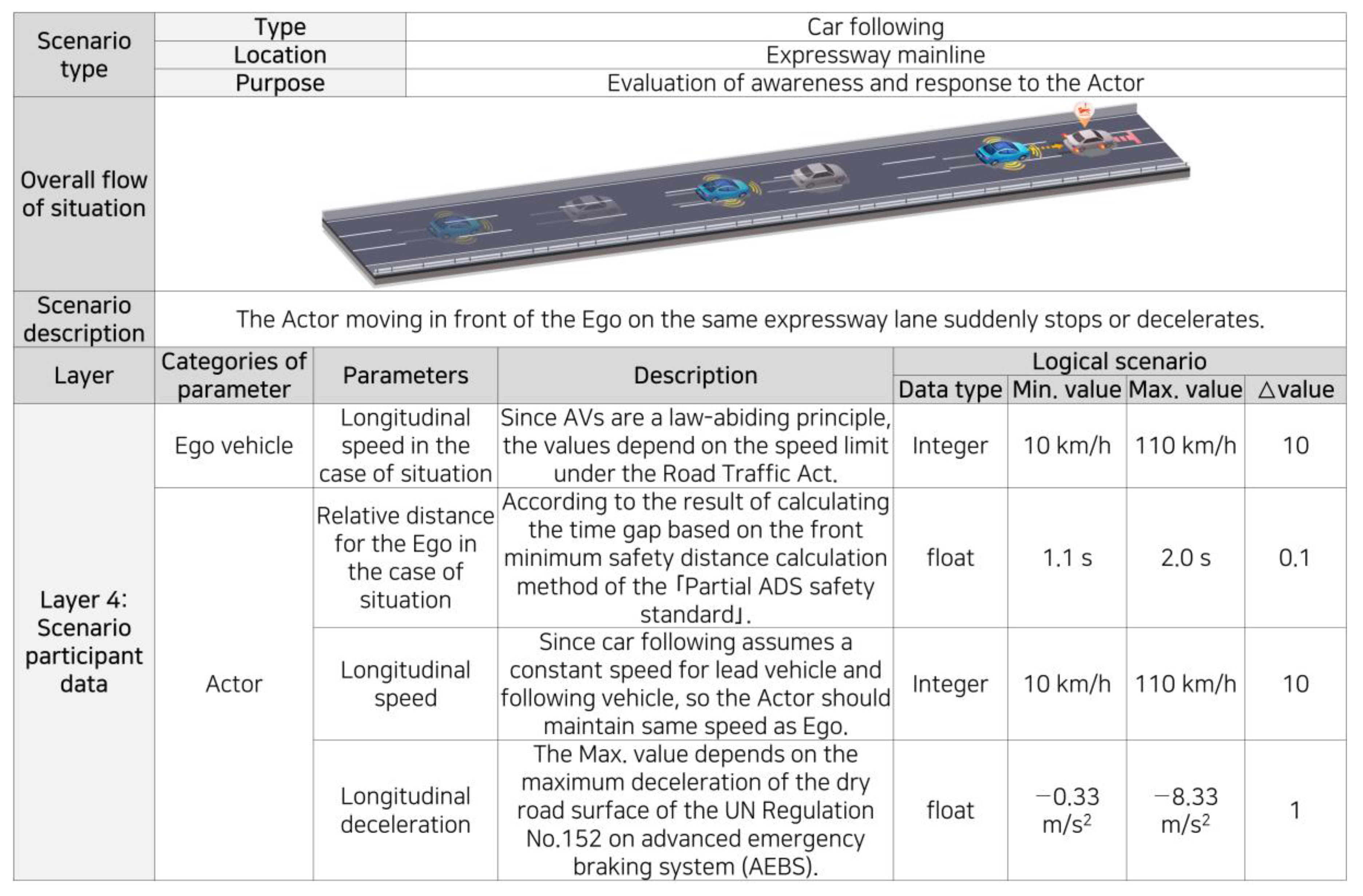
3.3. Logical Scenario Generation Framework and Form
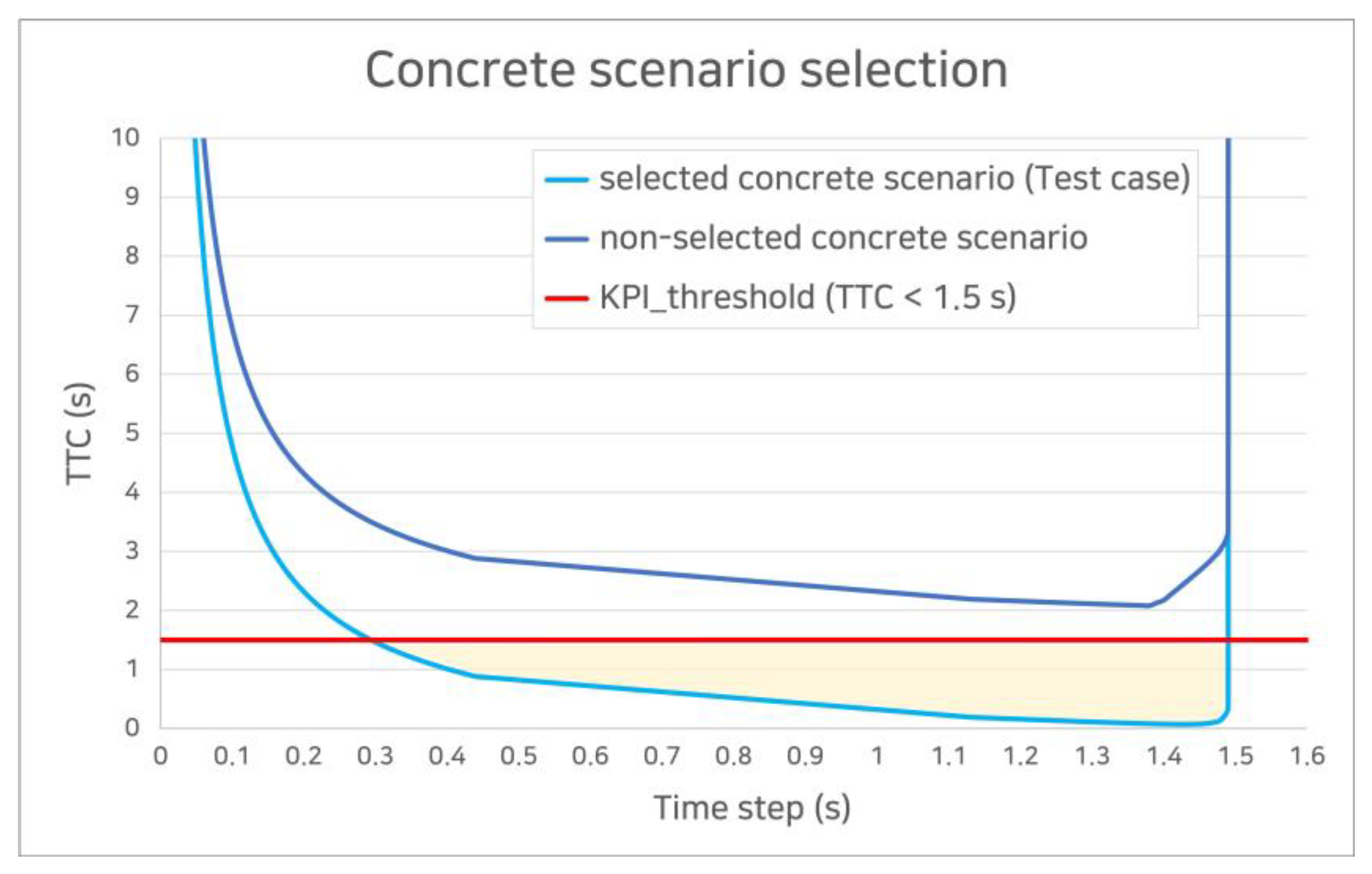
3.4. Concrete Scenario Generation Framework
3.5. Test Case Generation Framework
4. Scenario Generation Using Proposed Frameworks
4.1. Overview
4.2. Functional Scenario Generation
4.3. Logical Scenario Generation
4.4. Concrete Scenario Generation
4.5. Test Case Generation
5. Conclusions
Author Contributions
Funding
Institutional Review Board Statement
Informed Consent Statement
Data Availability Statement
Conflicts of Interest
References
- Rao, S.J.; Forkenbrock, G.J. Classification of Level 2 Driving Events Observed on Public Roads. 2021. Available online: https://rosap.ntl.bts.gov/view/dot/54484 (accessed on 4 July 2022).
- Hawkins, A.J. Waymo Gets the Green Light to Test Fully Driverless Cars in California. 2018. Available online: https://www.theverge.com/2018/10/30/18044670/waymo-fully-driverless-car-permit-california-dmv (accessed on 28 June 2022).
- Shladover, S.E.; Nowakowski, C. Regulatory challenges for road vehicle automation: Lessons from the California experience. Transp. Res. Part A Policy Pract. 2019, 122, 125–133. [Google Scholar] [CrossRef] [Scilit]
- Slovick, M. World’s First Level 3 Self-Driving Production Car Now Available in Japan. 20 March 2021. Available online: https://www.electronicdesign.com/markets/automotive/article/21158656/electronic-design-worlds-first-level-3-selfdriving-production-car-now-available-in-japan (accessed on 8 August 2022).
- Mercedes-Benz. First Internationally Valid System Approval for Conditionally Automated Driving. Available online: https://group.mercedes-benz.com/innovation/product-innovation/autonomous-driving/system-approval-for-conditionally-automated-driving.html (accessed on 28 June 2022).
- Ho, S.S. Complementary and competitive framing of driverless cars: Framing effects, attitude volatility, or attitude resistance? Int. J. Public Opin. Res. 2021, 33, 512–531. [Google Scholar] [CrossRef] [Scilit]
- Li, X. A Scenario-Based Development Framework for Autonomous Driving. arXiv 2020, arXiv:2011.01439. [Google Scholar]
- PEGASUS Project. Test Concept—General V-Model and Scope of Pegasus. 2019, pp. 1–4. Available online: https://www.pegasusprojekt.de/files/tmpl/Pegasus-Abschlussveranstaltung/16_Test_Concept.pdf (accessed on 12 June 2022).
- Zhong, Z.; Tang, Y.; Zhou, Y.; de Oliveira Neves, V.; Liu, Y.; Ray, B. A Survey on Scenario-Based Testing for Automated Driving Systems in High-Fidelity Simulation. arXiv 2021, arXiv:2112.00964. [Google Scholar]
- Menzel, T.; Bagschik, G.; Maurer, A.M. Scenarios for Development, Test and Validation of Automated Vehicles. IEEE Intell. Veh. Symp. Proc. 2018, 2018, 1821–1827. [Google Scholar] [CrossRef] [Scilit]
- PEGASUS Project. Scenario Description and Knowledge-Based Scenario Generation. 2019, pp. 1–3. Available online: https://www.pegasusprojekt.de/files/tmpl/Pegasus-Abschlussveranstaltung/05_Scenario_Description_and_Knowledge-Based_Scenario_Generation.pdf (accessed on 10 July 2022).
- PEGASUS Project. PEGASUS Method an Overview. 2019, pp. 1–34. Available online: https://www.pegasusprojekt.de/files/tmpl/pdf/PEGASUS_Abschlussbericht_Gesamtprojekt.PDF (accessed on 10 July 2022).
- ASAM. ASAM Standards. Available online: https://www.asam.net/standards/ (accessed on 12 June 2022).
- ASAM. OpenCRG Version 1.2.0 User Guide. 2020. Available online: https://www.asam.net/index.php?eID=dumpFile&t=f&f=3950&token=21a7ae456ec0eb0f9ec3aee5bae3e8c9ebaea140 (accessed on 12 June 2022).
- ASAM. OpenDRIVE Version 1.7.0 User Guide. 2021. Available online: https://www.asam.net/index.php?eID=dumpFile&t=f&f=4422&token=e590561f3c39aa2260e5442e29e93f6693d1cccd (accessed on 12 June 2022).
- ASAM. OpenSCENARIO Version 1.1.1 User Guide. 2021. Available online: https://www.asam.net/index.php?eID=dumpFile&t=f&f=4596&token=55bca7d8439f2bae072c4dffd1ee544a6d76b786 (accessed on 12 June 2022).
- ASAM. OpenSCENARIO V2.0.0 Concepts. 2020. Available online: https://releases.asam.net/OpenSCENARIO/2.0-concepts/ASAM_OpenSCENARIO_2-0_Concept_Paper.html (accessed on 27 July 2022).
- UNECE/TRANS/WP.29. New Assessment/Test Method for Automated Driving (NATM) Master Document. In Proceedings of the World Forum for Harmonization of Vehicle Regulations, Geneva, Switzerland, 22–24 June 2021; pp. 1–37. Available online: https://unece.org/sites/default/files/2021-04/ECE-TRANS-WP29-2021-61e.pdf (accessed on 12 June 2022).
- So, J.; Park, I.; Wee, J.; Park, S.; Yun, I. Generating Traffic Safety Test Scenarios for Automated Vehicles using a Big Data Technique. KSCE J. Civ. Eng. 2019, 23, 2702–2712. [Google Scholar] [CrossRef] [Scilit]
- Park, S.; Park, S.; Jeong, H.; Yun, I.; So, J. Scenario-mining for level 4 automated vehicle safety assessment from real accident situations in urban areas using a natural language process. Sensors 2021, 21, 6929. [Google Scholar] [CrossRef] [Scilit] [PubMed]
- Nalic, D.; Li, H.; Eichberger, A.; Wellershaus, C.; Pandurevic, A.; Rogic, B. Stress Testing Method for Scenario-Based Testing of Automated Driving Systems. IEEE Access 2020, 8, 224974–224984. [Google Scholar] [CrossRef] [Scilit]
- Ploeg, J.; de Gelder, E.; Slavík, M.; Querner, E.; Webster, T.; de Boer, N. Scenario-Based Safety Assessment Framework for Automated Vehicles. arXiv 2021, arXiv:2112.09366. [Google Scholar]
- Zhu, B.; Zhang, P.; Zhao, J.; Deng, W. Hazardous Scenario Enhanced Generation for Automated Vehicle Testing Based on Optimization Searching Method. IEEE Trans. Intell. Transp. Syst. 2022, 23, 7321–7331. [Google Scholar] [CrossRef] [Scilit]
- Menzel, T.; Bagschik, G.; Isensee, L.; Schomburg, A.; Maurer, M. From functional to logical scenarios: Detailing a keyword-based scenario description for execution in a simulation environment. IEEE Intell. Veh. Symp. Proc. 2019, 2019, 2383–2390. [Google Scholar] [CrossRef] [Scilit]
- Piazzoni, A.; Cherian, J.; Azhar, M.; Yap, J.Y.; Shung, J.L.W.; Vijay, R. ViSTA: A Framework for Virtual Scenario-based Testing of Autonomous Vehicles. In Proceedings of the 2021 IEEE International Conference on Artificial Intelligence Testing (AITest), Oxford, UK, 23–26 August 2021; pp. 143–150. [Google Scholar] [CrossRef] [Scilit]
- Xinxin, Z.; Fei, L.; Xiangbin, W. CSG: Critical Scenario Generation from Real Traffic Accidents. In Proceedings of the 2020 IEEE Intelligent Vehicles Symposium (IV), Las Vegas, NV, USA, 19 October–13 November 2020; pp. 1330–1336. [Google Scholar] [CrossRef] [Scilit]
- Nalic, D.; Mihalj, T.; Bäumler, M.; Lehmann, M.; Eichberger, A.; Bernsteiner, S. Scenario Based Testing of Automated Driving Systems: A Literature Survey. In Proceedings of the FISITA Web Congress 2020, Prague, Czech Republic, 14–18 September 2020. [Google Scholar] [CrossRef] [Scilit]
- Riedmaier, S.; Ponn, T.; Ludwig, D.; Schick, B.; Diermeyer, F. Survey on Scenario-Based Safety Assessment of Automated Vehicles. IEEE Access 2020, 8, 87456–87477. [Google Scholar] [CrossRef] [Scilit]
- Van der Horst, R.; Hogema, J. Time-to-collision and Collision avoidance systems. In Proceedings of the 6th ICTCT Workshop, Salzburg, Austria, 5–6 October 1993; pp. 1–12. [Google Scholar]
- Hang, J.; Yan, X.; Li, X.; Duan, K.; Yang, J.; Xue, Q. An improved automated breaking system for rear-end collisions: A study based on a driving simulator experiment. J. Saf. Res. 2022, 80, 416–427. [Google Scholar] [CrossRef] [Scilit] [PubMed]
- Mao, S.; Xiao, G.; Lee, J.; Wang, L.; Wang, Z.; Huang, H. Safety effects of work zone advisory systems under the intelligent connected vehicle environment: A microsimulation approach. J. Intell. Connect. Veh. 2021, 18, 16–27. [Google Scholar] [CrossRef] [Scilit]
- Reinolsmann, N.; Alhajyaseen, W.; Brijs, T.; Pirdavani, A.; Hussain, Q.; Brijs, K. Investigating the impact of a novel active gap metering signalization strategy on driver behavior at highway merging sections. Transp. Res. Part F Traffic Psychol. Behav. 2021, 78, 42–57. [Google Scholar] [CrossRef] [Scilit]




| Layer | Keyword | Definition |
|---|---|---|
| 1 | Plane data | All explainable plane data, such as permanent road shape, road surface, and road markings related to road geometry |
| 2 | 3D infrastructure data | All three-dimensional data, such as permanent road structures and road facilities related to transportation infrastructure |
| 3 | Variable facility and temporary facility data | Variable facility data that vary depending on the situation or time zone and temporary facility data, such as temporary road works |
| 4 | Scenario participant data | Data related to scenario participants such as object type, number of objects, and object characteristics (speed, distance). |
| 5 | Surrounding environment data | Surrounding environment data for indicating driving environment conditions, such as illuminance, weather, and visibility. |
| 6 | Digital data | Digital data, such as items and performance data related to automated vehicle (AV) sensors, vehicle-to-everything (V2X) communication, and digital maps |
| Layers | Categories of Parameter | Parameters | |||||
|---|---|---|---|---|---|---|---|
| 1 | Road Section | Type of Road Section | |||||
| Road alignment | Type of road alignment | Minimum radius of curvature | Minimum length of curvature | ||||
| Road slope | Maximum longitudinal slope | ||||||
| Lane | Number of lanes | Minimum lane width | Minimum width of the right shoulder | Minimum width of the left shoulder | |||
| Road surface marking | Lane color | Lane type | Type of road surface marking except lane | ||||
| Performance level of road surface marking | Color of the lane | Type of color lane | |||||
| Others | Road pothole presence | Maximum speed limit | |||||
| 2 | Road structure | Type of road structure | Type of median strip | Emergency refuge area Presence | |||
| Road facility | Traffic signal type | Traffic signal installation type | Regulatory sign presence | ||||
| Supplementary sign presence | Type of road lighting facility | Type of bus stop | |||||
| 3 | Variable facility | Type of variable facility | Bus-only lane operation availability | Hard shoulder lane operation availability | Variable speed limit operation availability | ||
| Temporary facility | Construction and work presence | Construction and work lane | Type of construction and work-related material | ||||
| Accident presence | Accident lane | Accident-related material | |||||
| Others | Temporary parking presence | ||||||
| 4 | Ego vehicle | Vehicle type | Initial driving lane | Initial movement | |||
| Driving lane in the event of a situation | Movement in the event of a situation | Longitudinal speed | |||||
| Actor | Number of Actors | Vehicle type in the case of Actor vehicle | Whether automated driving (AD) is possible in the case of Actor vehicle or not | ||||
| Whether vehicle-to-vehicle (V2V) communication is possible in the case of Actor vehicle | Object type in the case of Actor object | Actor color and material | |||||
| Initial driving/position lane | Initial relative location with respect to that of the Ego vehicle | Initial relative distance from the Ego vehicle | |||||
| Initial movement | Driving/position lane in the event of a situation | Relative location with respect to that of the Ego vehicle in the event of a situation | |||||
| Relative distance from the Ego vehicle in the event of a situation | Movement in the event of a situation | Longitudinal speed | |||||
| Longitudinal acceleration | Lateral lane departure speed | ||||||
| Neighboring | Number of Neighboring | Type of Neighboring | Whether AD is possible in the case of neighboring vehicle | ||||
| Whether V2V communication is possible in the case of neighboring vehicle or not | Driving/position lane | Relative location with respect to that of the Ego vehicle | |||||
| Relative distance from the Ego vehicle | Movement | Longitudinal speed | |||||
| 5 | Operational constraints | Density | |||||
| Lighting | Day and night | ||||||
| Weather | Weather type | Maximum wind speed | Road condition | ||||
| Visibility | Type of visibility-reducing substance | Density of visibility-reducing substance | |||||
| 6 | AV sensor | Type of sensor | Sensor performance | ||||
| Vehicle-to-everything (V2X) communication | Type of communication | Communication performance | |||||
| Digital map | Type of digital map | Digital map performance | |||||
| Layers | Categories of Parameter | Parameters | Description | Logical Scenario | |||
|---|---|---|---|---|---|---|---|
| Data Type | Min. Value | Max. Value | ∆Value | ||||
| Layer 1: Plane data | Road section | Road section type (Expressway mainline) | - | Categorical | [Road, Shoulder, Flank, Deceleration lane, Acceleration lane] | ||
| Road alignment | Road alignment type | - | Categorical | [Straight, Curve, Hair pin curve, Transition curve or section] | |||
| Minimum plane curve radius | Automatically determined according to the road design speed and longitudinal slope. | Integer | - | - | - | ||
| Minimum plane curve length | Automatically determined according to the road intersection angle and road design speed. | Integer | - | - | - | ||
| Road slope | Maximum longitudinal slope | - | float | −6% | 6% | 1% | |
| Lanes | Number of lanes | - | Integer | 1 | 6 | 1 | |
| Minimum lane width | - | float | 3.50 m | 3.60 m | 0.1 | ||
| Minimum right shoulder width | Rural area | float | 3.50 m | 3.60 m | 0.1 | ||
| Urban area | 3.50 m | 3.50 m | - | ||||
| Minimum left shoulder width | - | float | 1.00 m | 1.00 m | - | ||
| Road marking | Lane color | - | Categorical | [White, Yellow, Blue] | |||
| Lane type | - | Categorical | [Solid, Dotted, Double solid, Solid+dotted, Zig-zag solid, Others] | ||||
| Types of road marking other than lanes | - | Categorical | [Not applicable, Arrow, Symbol, Text, Obstacle control, Color lane, Others] | ||||
| Road marking performance level | Road marking painting night reflection performance standard is considered to be 100%, and if it exceeds the standard, input to 100%. (Installation minimum reflection standard—White 240 mcd/(m2·Lux), Yellow 150 mcd/(m2·Lux), Blue 80 mcd/(m2·Lux)) | Categorical | 0% | 100% | 10 | ||
| Color of color lane | - | Categorical | [Not applicable, Pink, Light green, Green, Blue, Orange] | ||||
| Type of color lane | - | Categorical | [Not applicable, solid, dotted] | ||||
| Others | Whether pothole | - | Categorical | [Not applicable, Presence] | |||
| Road speed limit | - | Integer | 80 km/h | 110 km/h | 10 | ||
| Layer 2: 3D data | Road structure | Type of road structure | - | Categorical | [General road, Bridge, Tunnel, Underground road, Overpass, Soundproof facility, Protective facility, Ecological passage, Green area, Emergency parking strip, Rest area, Others] | ||
| Type of median strip | - | Categorical | [Green area, Protective fence, Concrete barrier, Concrete curb, Others, None] | ||||
| Presence of emergency parking strip | - | Categorical | [Standard, Expandable, None] | ||||
| Road facility | Type of traffic light | - | Categorical | [Vehicle light, Pedestrian light, Bicycle light, Bus lane light, Variable light, None] | |||
| Traffic light installation type | - | Categorical | [Suspension, longitudinal side pole, lateral side pole, central pole, Signal bridge] | ||||
| Presence of regulator sign | - | Categorical | [Presence, None] | ||||
| Presence of supplementary sign | - | Categorical | [Presence, None] | ||||
| Type of road lighting facility | - | Categorical | [Continuous lighting, Local lighting, No lighting, Tunnel lighting, Others] | ||||
| Type of bus stop | - | Categorical | [Not applicable, Direct bus station, Parallel bus station, Bus stop, Simplified bus stop] | ||||
| Layer 3: Variable facility and temporary facility data | Variable facility | Type of variable facility | - | Categorical | [Not applicable, Bus lane, Hard shoulder running, Variable speed limit, Others] | ||
| Whether bus lane operation | - | Categorical | [Not applicable, Operation, Not operation] | ||||
| Whether hard shoulder running operation | - | Categorical | [Not applicable, Operation, Not operation] | ||||
| Whether variable speed limit operation | - | Categorical | [Not applicable, Operation, Not operation] | ||||
| Temporary facility | Presence of construction and work | - | Categorical | [Not applicable, Presence] | |||
| Lane of construction and work | - | Integer | 1 | 6 | 1 | ||
| Type of construction and work related materials | - | Categorical | [Not applicable, Work information sign, Arrow sign, Chevron alignment sign, Robot signal, Traffic cone, Safety drum, Temporary lane, Polycarbonate (PC) shield fence, Polyethylene (PE) fence, Steel rail, Others] | ||||
| Presence of accident | - | Categorical | [Not applicable, Presence] | ||||
| Accident lane | - | Integer | 1 | 6 | 1 | ||
| Type of accident related materials | - | Categorical | [Not applicable, Accident vehicle, Debris, Emergency warning triangle, Others] | ||||
| Others | Whether temporary parking | - | Categorical | [Not applicable, Presence] | |||
| Layer 4: Scenario participant data | Ego vehicle | Vehicle type | - | Categorical | [Passenger car, Van, Bus, Truck, Emergency car, Micro electric car, Motorcycle, Others] | ||
| Initial driving lane | - | Integer | 1 | 6 | 1 | ||
| Initial movement | Lateral movement | Categorical | [Going straight, Cut-in, Cut-out, Cut-through, Others] | ||||
| Longitudinal movement | Categorical | [Constant speed, Accelerating, Decelerating, Stopping, Others] | |||||
| Driving lane in the case of situation | - | Integer | 1 | 6 | 1 | ||
| Movement in the case of situation | Lateral movement | Categorical | [Going straight, Cut-in, Cut-out, Cut-through, Others] | ||||
| Longitudinal movement | Categorical | [Constant speed, Accelerating, Decelerating, Stopping, Others] | |||||
| Longitudinal speed in the case of situation | As Avs are based on law-abiding principles, the values depend on the speed limit under the Road Traffic Act. | Integer | 10 km/h | 110 km/h | 10 | ||
| Actor | Number of Actors | - | Integer | 0 | 5 | 1 | |
| Vehicle type | - | Categorical | [Not applicable, Passenger car, Van, Bus, Truck, Emergency car, Micro electric car, Motorcycle, Others] | ||||
| Whether Actor is AV | - | Categorical | [Level 0, Level 1, Level 2, Level 3, Level 4, Level 5] | ||||
| Whether Actor have V2V communication | Check whether it is possible to provide forward situation information through V2V communication. | Categorical | [Possible, Impossible] | ||||
| Object type | - | Categorical | [Not applicable, Bicycle, Stroller, Personal mobility (PM), Pedestrian, Animal, Falling object, Road object, Others] | ||||
| Color of object in case of falling objects or road objects | Elements for whether obstacle awareness | Categorical | [Not applicable, Contrast to the road surface, Similar to the road surface, Others] | ||||
| Initial driving or located lane | - | Integer | 1 | 6 | 1 | ||
| Initial relative location for the Ego | - | Categorical | [ahead, ahead-left, ahead-right, side-left, side-right, behind, behind-left, behind-right, oncoming, oncoming-left, oncoming-right] | ||||
| Initial longitudinal relative distance for the Ego | According to the [United Nations (UN) Regulation] No.157 5.2.3.3 and the result of previous research and development (R&D) studies. | Float | 1.0 s | 2.0 s | 0.1 | ||
| Initial movement | Lateral movement | Categorical | [Going straight, Cut-in, Cut-out, Cut-through, Crossing, Others] | ||||
| Longitudinal movement | Categorical | [Constant speed, Accelerating, Decelerating, Stopping, Walking, Standing, Falling, Bouncing up, Others] | |||||
| Driving or located lane in the case of situation | - | Integer | 1 | 6 | 1 | ||
| Relative location of the Ego in the case of situation | - | Categorical | [ahead, ahead-left, ahead-right, side-left, side-right, behind, behind-left, behind-right, oncoming, oncoming-left, oncoming-right] | ||||
| Relative distance from the Ego in the case of situation | According to the [UN Regulation] No.157 5.2.3.3 and the result of previous R&D studies. | Float | 1.0 s | 2.0 s | 0.1 | ||
| Movement in the case of situation | Lateral movement | Categorical | [Going straight, Cut-in, Cut-out, Cut-through, Crossing, Others] | ||||
| Longitudinal movement | Categorical | [Constant speed, Accelerating, Decelerating, Stopping, Walking, Standing, Falling, Bouncing up, Others] | |||||
| Longitudinal speed | The Max. value is based on the 99 percentile of traffic speed data by vehicle detection system (VDS) in 2021. | Integer | 0 km/h | 130 km/h | 10 | ||
| Longitudinal acceleration | The Min. value is the maximum possible deceleration result during actual experiment at the Korea Automobile Testing and Research Institute (KARTI), the Max. value is the acceleration calculation value assuming that the arrival time from 0 to 110 km/h in 2 s. | float | −11 m/s2 | 17 m/s2 | 0.1 | ||
| Lateral speed when leaving the lane | Calculation value when the lane change time is set to approximately 0.5–5 s with a lane width of 3.5 m | float | 0.7 m/s | 7 m/s | 1 | ||
| Neighboring | Number of neighboring vehicles | Neighboring is limited to the case where it is located in eight directions including front, rear, left, right, and diagonal of the Ego. | Integer | 0 | 8 | 1 | |
| Vehicle or object type | - | Categorical | [Not applicable, Passenger car, Van, Bus, Truck, Emergency car, Micro electric car, Motorcycle, Bicycle, Stroller, Personal mobility (PM), Pedestrian, Animal, Falling object, Road object, Others] | ||||
| Whether Neighboring vehicle is AV | - | Categorical | [Level 0, Level 1, Level 2, Level 3, Level 4, Level 5] | ||||
| Whether Neighboring vehicle has V2V communication | Check whether it is possible to obtain forward situation information through V2V communication. | Categorical | [Possible, Impossible] | ||||
| Driving or located lane | - | Integer | 1 | 6 | 1 | ||
| Relative location of the Ego | - | Categorical | [ahead, ahead-left, ahead-right, side-left, side-right, behind, behind-left, behind-right, oncoming, oncoming-left, oncoming-right] | ||||
| Longitudinal relative distance from the Ego | According to the [UN Regulation] No.157 5.2.3.3 and the result of previous R&D studies. | Float | 1.0 s | 2.0 s | 0.1 | ||
| Movement | Lateral movement | Categorical | [Going straight, Cut-in, Cut-out, Cut-through, Crossing, Others] | ||||
| Longitudinal movement | Categorical | [Constant speed, Accelerating, Decelerating, Stopping, Walking, Standing, Falling, Bouncing up, Others] | |||||
| Longitudinal speed | The Max. value is based on the 99 percentile of traffic speed data by VDS in 2021. | Integer | 0 km/h | 130 km/h | 10 | ||
| Layer 5: Surrounding environment data | Operational constraint | Density | The Max. value is calculated considering the jam density. | Integer | 0 passenger car per km per lane (pcpkmpl) | 271 pcpkmpl | 10 |
| Lighting | Day and night | - | Categorical | [Day, Night, Sunset, Sunrise] | |||
| Weather | Weather type | The minimum daily precipitation is 0.1 mm, the average of total precipitation in 2011–2020 based on the https://www.index.go.kr/main.do (accessed on 19 May 2022) is 1622.6 mm, and the maximum daily precipitation in 2011–2020 based on the https://data.kma.go.kr/cmmn/main.do (accessed on 19 May 2022) is 01.9 mm (2 October 2019). | Categorical | [Clear, Cloudy, Snow, Sleet, Rain, Fog, Thunder and lightning, Others] | |||
| Maximum wind speed | - | float | 0 m/s | 49 m/s | 1 | ||
| Road surface condition | - | Categorical | [Dry, Wet, Frozen, Snow on the road, Others] | ||||
| Visibility | Type of visibility reducing substances | - | Categorical | [Not applicable, Fog, Smoke, Smog, Dust and yellow dust] | |||
| Concentration of visibility reducing substances | In accordance with the comprehensive air-quality index (CAI) standard. The 0–50 section is good, the 51–100 section is normal, the 101–250 section is bad, and the 251–500 section is very bad | Integer | 0 | 500 | 1 | ||
| Layer 6: Digital data | Sensor of AV | Type of sensor | - | Categorical | [Camera, Lidar, Radar, Ultrasound, Infrared, Inertial measurement unit (IMU), global positioning system (GPS), Others] | ||
| Sensor performance related matters | - | Categorical | [Nothing special, Sensor failure, Unrecognition, Positioning error, False positives, Others] | ||||
| V2X communication | Type of communication | - | Categorical | [Vehicle-to-infrastructure (V2I), V2V, Vehicle-to-pedestrian (V2P), Vehicle-to-network (V2N), Vehicle-to-cloud (V2C), Others] | |||
| Communication performance related matters | - | Categorical | [Nothing special, Latency, Communication error, Communication security risk and hacking, Communication interference, Others] | ||||
| Digital map | Type of digital map | - | Categorical | [High-definition map, Local dynamic map, Others] | |||
| Digital map related matters | - | Categorical | [Nothing special, Positioning error, Unloadable (Faulty), Unrecognizable, Delayed update, Others] | ||||
| Categories of Parameter | Parameters | Range (min:step_size:max) | Number of Combinations |
|---|---|---|---|
| Ego | Longitudinal speed (km/h) | 10:10:110 | 11, but it is determined by the speed of Actor and does not count as a combination |
| Actor | Relative distance from the Ego in the case of situation (s) | 1.1:0.1:2.0 | 10, but it is determined by the speed of two vehicles and does not count as a combination |
| Longitudinal speed (km/h) | 10:10:110 | 11 | |
| Longitudinal deceleration (m/s2) | −0.33:1:−8.33 | 9 | |
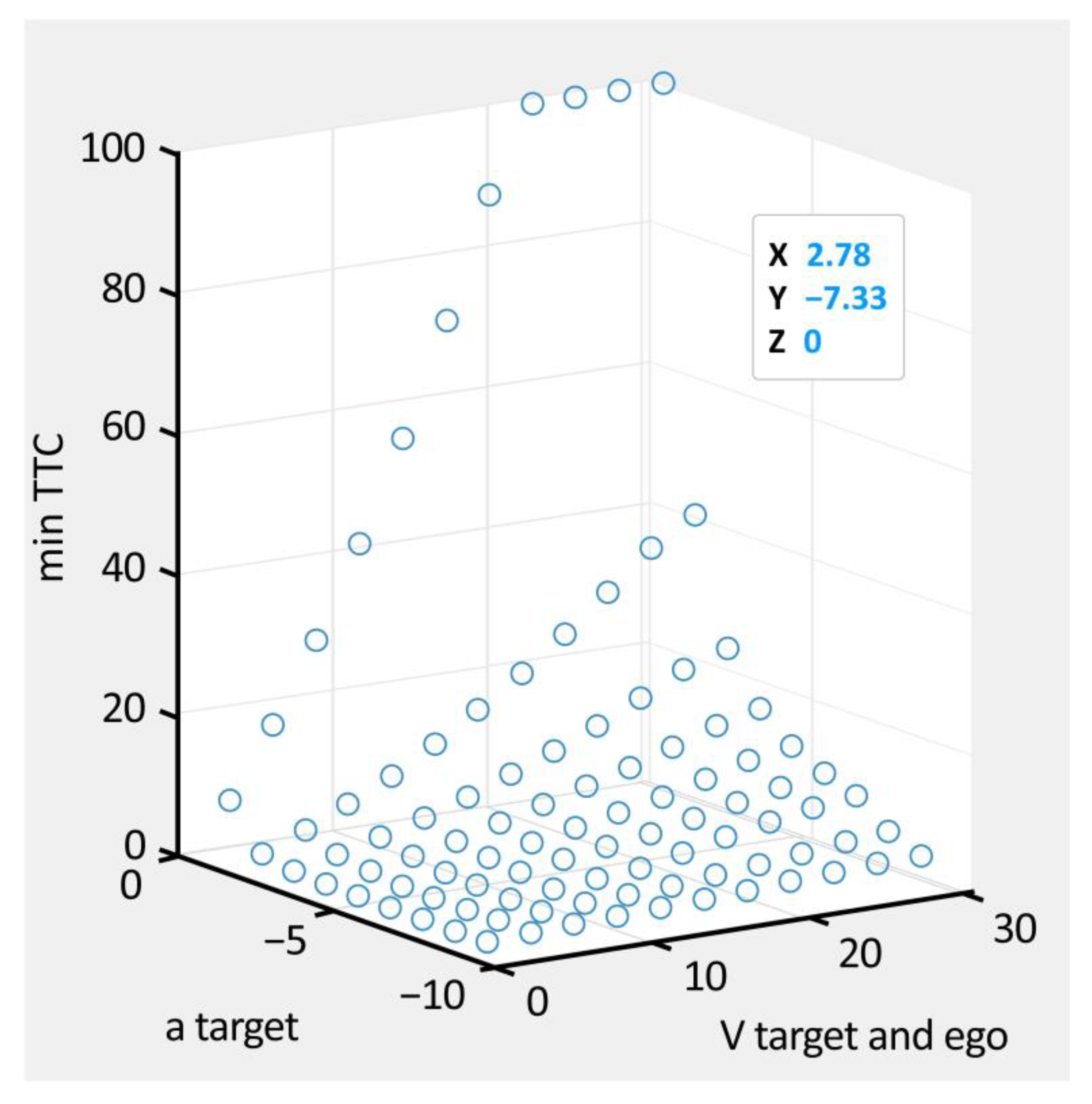
| Scenarios that can be combined: 99 cases (1 × 1 × 11 × 9 = 99) <combination example> [speed of Ego, relative distance, speed of Actor, deceleration of Actor] Scenario combination 1: [10, 1.1, 10, −0.33] Scenario combination 2: [20, 1.2, 20, −0.33] ⫶ Scenario combination 10: [100, 2.0, 100, −0.33] Scenario combination 11: [110, 2.0, 110, −0.33] Scenario combination 12: [10, 1.1, 10, −1.33] Scenario combination 13: [20, 1.2, 20, −1.33] ⫶ Scenario combination 99: [110, 2.0, 110, −8.33] | |||
| Test Case | Speed of Ego(km/h) | Relative Distance(s) | Speed of Actor (km/h) | Deceleration of Actor (m/s2) | Minimum TTC(s) |
|---|---|---|---|---|---|
| 1 | 10 | 1.1 | 10 | −8.33 | 0.00 |
| 2 | 10 | 1.1 | 10 | −7.33 | 0.00 |
| 3 | 10 | 1.1 | 10 | −6.33 | 0.07 |
| 4 | 10 | 1.1 | 10 | −5.33 | 0.19 |
| 5 | 10 | 1.1 | 10 | −4.33 | 0.28 |
| 6 | 10 | 1.1 | 10 | −3.33 | 0.39 |
| 7 | 10 | 1.1 | 10 | −2.33 | 0.60 |
| 8 | 10 | 1.1 | 10 | −1.33 | 1.47 |
| 9 | 20 | 1.2 | 20 | −8.33 | 0.23 |
| 10 | 20 | 1.2 | 20 | −7.33 | 0.35 |
| 11 | 20 | 1.2 | 20 | −6.33 | 0.46 |
| 12 | 20 | 1.2 | 20 | −5.33 | 0.57 |
| 13 | 20 | 1.2 | 20 | −4.33 | 0.73 |
| 14 | 20 | 1.2 | 20 | −3.33 | 1.21 |
| 15 | 30 | 1.3 | 30 | −8.33 | 0.23 |
| 16 | 30 | 1.3 | 30 | −7.33 | 0.64 |
| 17 | 30 | 1.3 | 30 | −6.33 | 0.78 |
| 18 | 30 | 1.3 | 30 | −5.33 | 1.00 |
| 19 | 40 | 1.4 | 40 | −8.33 | 0.77 |
| 20 | 40 | 1.4 | 40 | −7.33 | 0.93 |
| 21 | 40 | 1.4 | 40 | −6.33 | 1.15 |
| 22 | 50 | 1.5 | 50 | −8.33 | 1.03 |
| 23 | 50 | 1.5 | 50 | −7.33 | 1.22 |
| 24 | 60 | 1.6 | 60 | −8.33 | 1.28 |
Publisher’s Note: MDPI stays neutral with regard to jurisdictional claims in published maps and institutional affiliations. |
© 2022 by the authors. Licensee MDPI, Basel, Switzerland. This article is an open access article distributed under the terms and conditions of the Creative Commons Attribution (CC BY) license (https://creativecommons.org/licenses/by/4.0/).
Share and Cite
Ko, W.; Park, S.; Yun, J.; Park, S.; Yun, I. Development of a Framework for Generating Driving Safety Assessment Scenarios for Automated Vehicles. Sensors 2022, 22, 6031. https://doi.org/10.3390/s22166031
Ko W, Park S, Yun J, Park S, Yun I. Development of a Framework for Generating Driving Safety Assessment Scenarios for Automated Vehicles. Sensors. 2022; 22(16):6031. https://doi.org/10.3390/s22166031
Chicago/Turabian StyleKo, Woori, Sangmin Park, Jaewoong Yun, Sungho Park, and Ilsoo Yun. 2022. "Development of a Framework for Generating Driving Safety Assessment Scenarios for Automated Vehicles" Sensors 22, no. 16: 6031. https://doi.org/10.3390/s22166031
APA StyleKo, W., Park, S., Yun, J., Park, S., & Yun, I. (2022). Development of a Framework for Generating Driving Safety Assessment Scenarios for Automated Vehicles. Sensors, 22(16), 6031. https://doi.org/10.3390/s22166031