You are currently viewing a new version of our website. To view the old version click .
Sensors
  • Article
  • Open Access

10 June 2022

The Braking-Pressure and Driving-Direction Determination System (BDDS) Using Road Roughness and Passenger Conditions of Surrounding Vehicles
,
,
and
1
Department of Software, College of Engineering, Catholic Kwandong University, Gangneung 210-701, Korea
2
Department of Beauty Design, College of Media & Art, Catholic Kwandong University, Gangneung 210-701, Korea
*
Author to whom correspondence should be addressed.
This article belongs to the Special Issue Artificial Intelligence and Internet of Things in Autonomous Vehicles

Abstract

A fully autonomous vehicle must ensure not only fully autonomous driving but also the safety and comfort of its passengers. However, the self-driving technology that is currently completed focuses only on perfect driving and does not guarantee the safety and comfort of passengers. This paper proposes a braking-pressure and driving-direction determination system (BDDS), which computes the brake pressure and steering angle optimized for passenger safety by utilizing more diverse information than existing autonomous vehicles. The BDDS proposed in this paper consists of two modules. The road roughness classification module (RRCM) classifies the roughness of the road by using the pressure data applied to the suspension and the K-NN algorithm and computes the optimal brake pressure. The passenger recognition and sharing module (PRSM) identifies the current occupant status of the vehicle by using a body pressure sensor and CNN, shares the information with surrounding vehicles, and computes the optimal steering angle using passenger information and road information. As a result of the simulations described in this paper, the parameters of AI models were optimized. In addition, the RRCS was about 7% more accurate than the K-means clustering algorithm, and PRS was about 9% more accurate than the existing seat recognition system.

1. Introduction

Self-driving cars have made a leap in development thanks to the efforts of companies such as Google and Tesla. The typical use of autonomous vehicles for widespread use on public roads is likely to be possible in a few years, but these vehicles are already being used in “constrained” applications such as open pit mining and agriculture. Among the many technologies that enable autonomous vehicles are a combination of sensors and actuators, sophisticated algorithms, and powerful processors that run software [1]. With advances in autonomous vehicle testing from companies such as Google, Apple (in USA), Tesla (in Toronto, Brooklyn etc.), Uber, and Lyft (in USA), the first signs of a driverless future were seen [2].
Autonomous vehicles respond to various situations by using the vehicle’s electronic control unit (ECU), actuators, and various sensors. In addition, the autonomous vehicle communicates not only with the vehicle itself but also with surrounding vehicles and road-side unit (RSU) through cellular networks, Wi-Fi, etc. Through this communication, the current autonomous vehicles can detect a crisis (for example, another vehicle approaching suddenly in the vicinity, a pedestrian, icy road, etc.) and send an alert to the user. These vehicles may also be configured with mechanisms that take active steps to avoid these hazards [3].
After the completion of Level 3 autonomous driving technology, an autonomous driving technology for Levels 4 and 5 must now ensure not only the driving situation but also the comfort of the passengers. However, current autonomous driving technology cannot fully guarantee a passenger’s comfort. To ensure passenger comfort, it is necessary to use several items of data as well as visual information currently being collected (LiDAR, front camera). Therefore, this work aimed to calculate the optimal braking pressure and steering angle while driving a vehicle using the data on the seat pressure inside the vehicle and the pressure data on the suspension.
This paper proposes the braking-pressure and driving-direction determination system (BDDS). The BDDS collects pressure data from the vehicle’s suspension to classify the roughness of the road and accurately identifies the passenger status of itself and surrounding vehicles through body pressure sensors and V2V. Next, The BDDS uses road roughness, passenger conditions, driving information, and weather information to determine the optimal brake pressure strength and steering angle. The BDDS consists of the road roughness classification module (RRCM), which determines the roughness of the current road by receiving the pressure of the three axes as frequencies from the vehicle’s suspension; the passenger recognition and sharing module (PRSM) to classify the condition of passengers inside the vehicle into luggage, children, and adults by using a body pressure sensor, determine what it is, and then share the information with surrounding vehicles; and the brake pressure and direction determination module (BPDDM), which uses the output of RRCM and PRSM to determine the optimal brake pressure and steering angle.
The composition of this paper is as follows. Section 2 describes the existing studies related to the passengers and road roughness in this paper. Section 3 details the structure and operation of the BDDS. Section 4 compares it with the existing methods to analyze the performance. Section 5 discusses the conclusion of the proposed BDDS and future research directions.

3. A Design of the Braking-Pressure and Driving-Direction Determination System (BDDS)

3.1. Overview

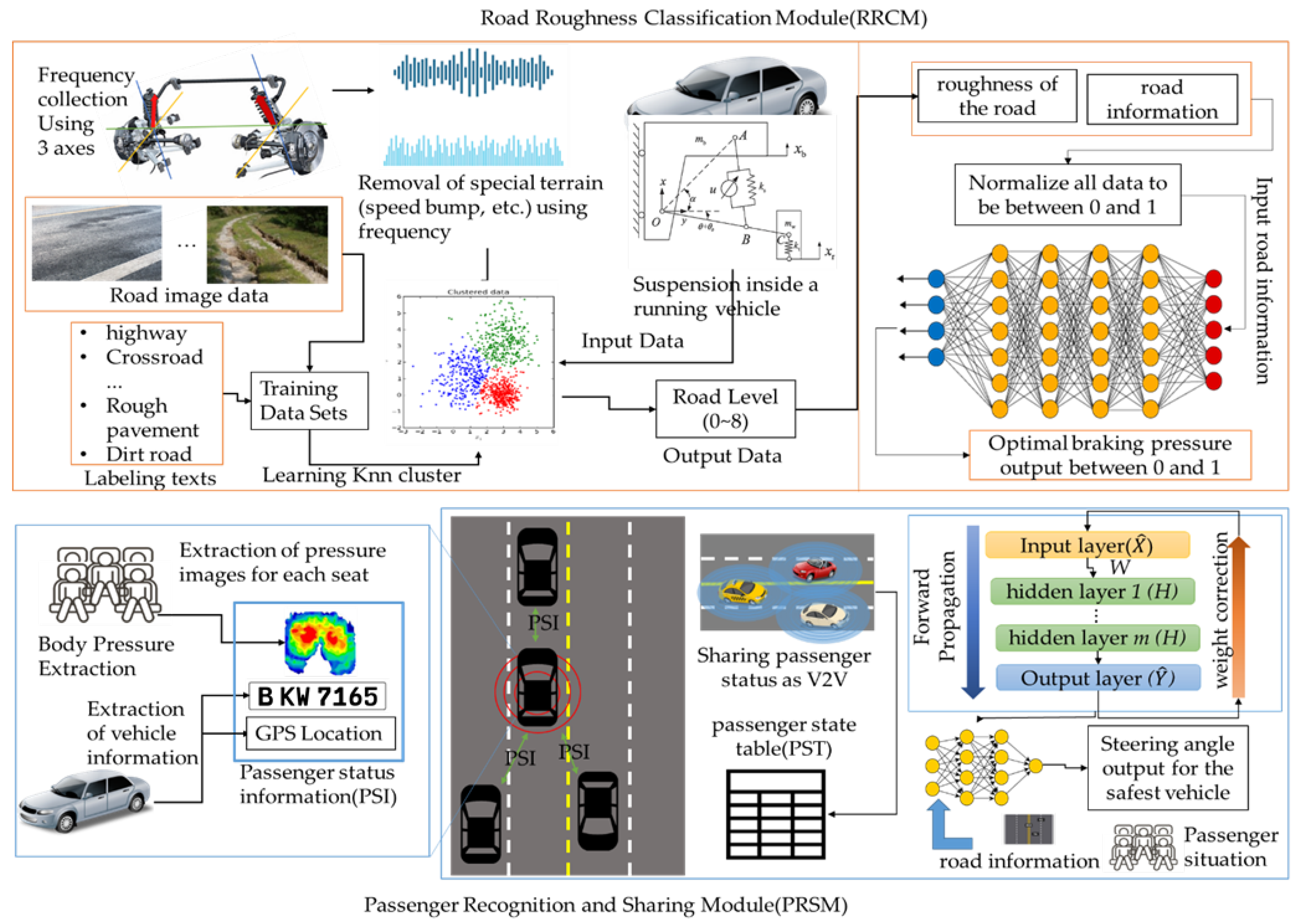
Currently, autonomous vehicles are being commercialized after testing. However, although autonomous vehicles have not yet been fully commercialized, 81 accidents have occurred; the driving method of vehicles to avoid accidents relies heavily on LiDAR. In addition, most studies to avoid them are conducting experiments using limited conditions. In order to achieve Level 4 autonomous vehicles, the environment an autonomous vehicle can perceive must be expanded, which must influence driving decisions. Therefore, this paper proposes the braking-pressure and driving-direction determination system (BDDS) using road roughness and passenger conditions of surrounding vehicles to improve the driving stability of autonomous vehicles. The BDDS accurately recognizes the roughness of the road on which the vehicle is driving, including road information and weather information, which are pieces of information collected from existing autonomous vehicles, as well as the condition of the vehicle itself, its passengers, and passengers in surrounding vehicles and determines the vehicle’s driving direction so that it can maintain optimal driving and brake pressure.
The BDDS consists of two modules, as shown in Figure 1. The road roughness classification module (RRCM) collects the pressure of the wheels while driving on the road by installing three axles on the vehicle’s suspension and classifies the roughness of the road on which the vehicle is traveling into eight levels by using the pressure. It also calculates the best brake pressure for the current road environment by using the roughness of the road and the speed of the surrounding vehicles. The passenger recognition and sharing module (PRSM) classifies the passenger status of a vehicle more accurately using a body pressure sensor. The PRSM recognizes whether an adult, child, or cargo is seated on each seat of the vehicle and stores the recognized passenger status in passenger status information (PSI) along with the vehicle’s location and vehicle number. By sharing the PSI with surrounding vehicles through V2V, the vehicle can accurately recognize the location of nearby vehicles and the status of passengers. The PRSM calculates the steering angle at which the vehicle can safely travel to its destination based on the position of the surrounding vehicles and the condition of the passengers.
Figure 1. The structure of a BDDS.

3.2. The Road Roughness Classification Module (RRCM)

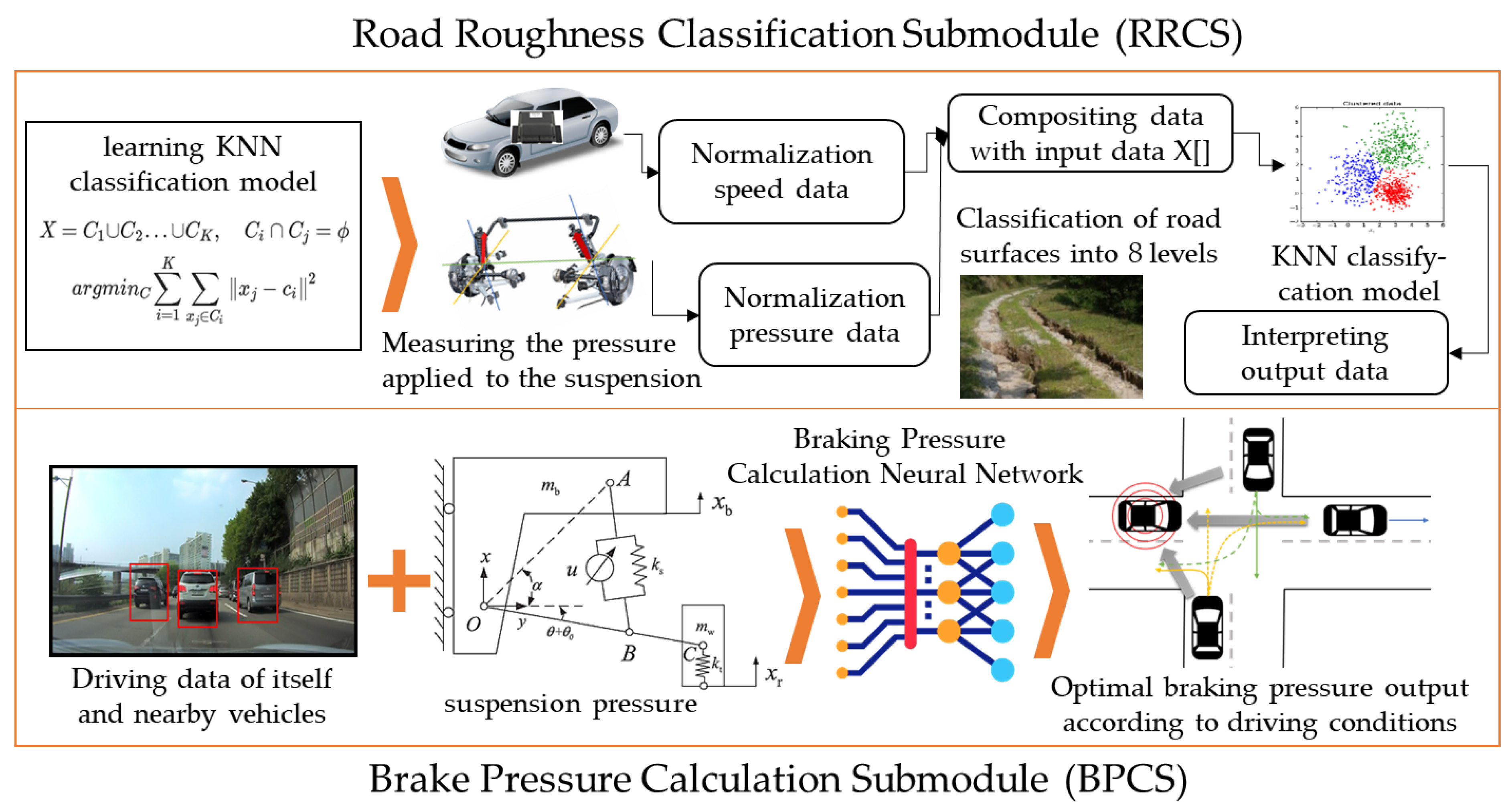
The road roughness affects various aspects of driving, such as the speed of the vehicle, the load on the suspension system, and the degree of vibration felt by passengers [25,26,27]. Knowing the condition of the road is important. Whether the road is wet or bumpy has a big impact on the vehicle’s braking distance. Especially in emergency situations, the vehicle must calculate the appropriate braking pressure according to the road conditions. Therefore, road roughness has not been considered in existing autonomous vehicles that focus on avoiding obstacles but must be considered in fully autonomous vehicles that consider both passenger condition and vehicle stability. In this work, the road roughness classification module (RRCM) was designed to calculate the optimal braking pressure in order not to lose the tire grip in various road conditions. The RRCM consists of two submodules. First, the road roughness classification submodule (RRCS) classifies the roughness of the road on which the vehicle is traveling into eight levels through K-nearest neighbor (KNN) clustering, which is one of the machine learning techniques [28,29]. Second, the brake pressure calculation submodule (BPCS) calculates the most suitable brake pressure for driving using the roughness of the road classified by the RRCS, the condition of surrounding vehicles, and the current road condition. Figure 2 shows the overall structure of the RRCM.
Figure 2. The structure of the RRCM.

3.2.1. A Design of the RRCS

The RRCS proposed in this paper accurately classifies the roughness of the road on the driving vehicle through four stages. First, the KNN algorithm is learned using the training data set scaled between 0 and 1. Because the RRCS uses eight clusters, it uses a KNN algorithm capable of supervised learning, not K-means in which the initial center point is arbitrarily set. For the KNN to be classified correctly, the normalized input data set, the labels for training, and the number of K must be determined. The RRCS scales the data between 0 and 1 using z-score normalization to remove an abnormal value among pressure data appearing on the road. However, in the case of data that are not collected numerically, such as “Is there a speed bump?”, they are converted into a Boolean variable using one hot encoding. The K number for the KNN is determined through K-fold cross validation.
x i = x i m δ ,
Equation (1) represents z-score normalization. In Equation (1), xi denotes the collected data such as in cs and a in Table 1, m denotes the average value of all data, and δ denotes the standard deviation of all data. Table 1 shows the input values of the training data and the labels of the classified clusters used for the RRCS.
Table 1. Input data set and clusters the RRCS.
Second, the RRCS calculates the pressure applied to each wheel while driving by installing four three-axes pressure sensors on the suspension for accurate road roughness analysis. Of the three axes, the vertical axis (y axis) is the same as the frequency data of the suspension collected from a general vehicle. The y axis ranges from 0.5 to 2.0 Hz and measures how much the vehicle is lifted up and down. the horizontal axis (x axis) means the left and right pressure of the vehicle. The RRCS sets the vehicle’s standstill state to 0 Hz on the x axis and measures the frequency between −2.0 and 2.0 Hz to indicate which direction the vehicle is leaning, to the left or right. The other horizontal axis (z axis) is the front and rear pressure of the vehicle. The RRCS sets the vehicle’s standstill state to 0 Hz of z axis and measures the frequency between −0.3 and 0.3 Hz to indicate which direction the vehicle is leaning, forward or backward.
Third, the curvature of the road on which the vehicle is currently driving, the speed bump section of the road, etc. are calculated to remove the pressure data irrelevant to the roughness of the road. The RRCS is applied to the KNN by determining the curvature of the driving road and speed bumps based on the braking information on the map. Fourth, the roughness of the road is classified into eight levels by using the data of Nos. 1 to 11 in Table 1 as an input data set. Nos. 12 to 19 in Table 1 indicate the eight-level labels classified by the KNN.

3.2.2. A Design of the BPCS

The BPCS proposed in this paper calculates the brake pressure optimized for driving by using the roughness of the road classified in the RRCS, the condition of surrounding vehicles, and the remaining distance to the destination. Since the BPCS only calculates brake pressure regardless of direction, real time and accuracy can be guaranteed with little input. Table 2 shows the input data sets used for the BPCS.
Table 2. Input data set of the BPCS.
Since it is difficult to generate abnormal values in the input data set during autonomous driving, and the generated abnormal values should not be ignored, the BPCS normalizes the input data to between 0 and 1 using min-max normalization. Equation (2) represents the min-max normalization.
x i = x i min x max x min x
In Equation (2), min and max mean the maximum and minimum values that the corresponding data can have, not the maximum value among each item of data. In Table 2, all input data except for the friction coefficient indicated in No. 10 were normalized through min-max normalization. The friction coefficient was determined by the current weather and the speed of the vehicle. Table 3 shows the friction coefficient used for the BPCS.
Table 3. Context-specific friction coefficient.
In Table 2, d b r a c k was calculated using the friction coefficient. Equation (3) shows that the d b r a c k value was calculated by the RPCS.
d b r a c k = v 2 2 g μ ,
In Equation (3), d b r a c k means the braking distance, v 2 means the current speed of the vehicle, g means the acceleration of the vehicle, and μ means the friction coefficient between the ground and the tire. Since the BPCS does not know the braking pressure before calculating the braking pressure, d b r a c k means the braking distance when the braking pressure is at its maximum. BPCS uses the normalized data in Table 2 as the node value of the input layer and outputs a value between 0 and 1. That is, the output layer of the BPCS uses one node. Equation (4) shows the output node of the BPCS. In the output of the BPCS, 0 means no braking required for driving and 1 means the maximum use of braking pressure.
Y = { y   |   0 y 1 } ,
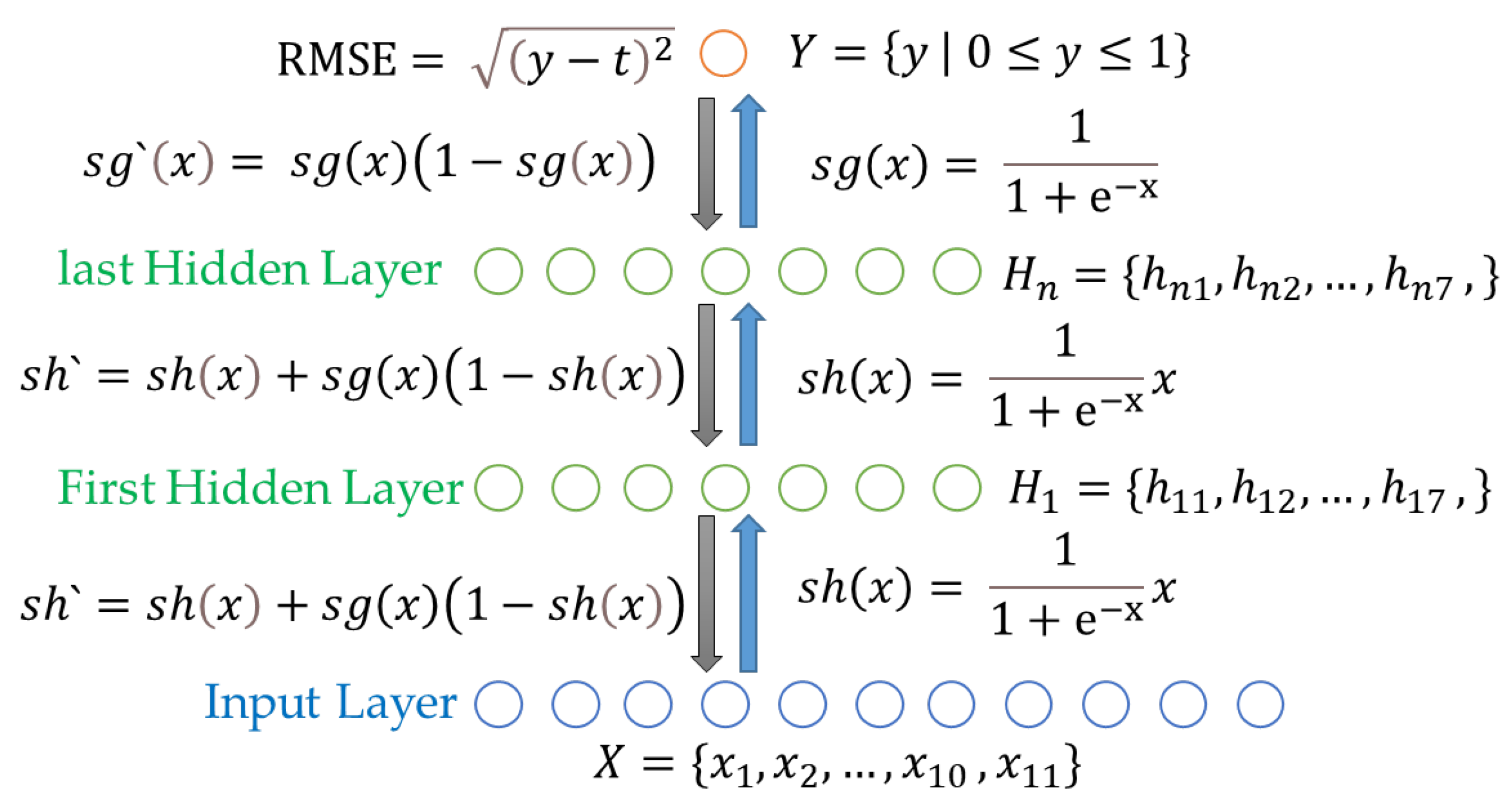
The BPCS uses the swish function and the sigmoid function designed by Google to solve the vanishing gradient problem of the existing neural network and fix the value of the output node between 0 and 1. The swish function is used to calculate the value of the node up to the input layer and the last hidden layer, and the sigmoid function is used to calculate the value of the node y of the output layer. Equation (5) represents the swish function. Equation (6) represents the sigmoid function. Equation (7) represents the differential function of the swish function for gradient descent. Equation (8) represents the sigmoid differential function.
s h x = 1 1 + e x x ,
s g x = 1 1 + e x ,
s h = s h x + s g x 1 s h x ,
s g x = s g x 1 s g x ,
The cross entropy error (CEE) has higher accuracy than the root mean squared error (RMSE) when selecting one of several output nodes as the correct answer, but the BPCS has only one output node [30]. The value of the output node is important; so, the RMSE is used as a loss function. Equation (9) shows a computation method of the RMSE.
RMSE = y t 2 ,
In the existing neural network, the RMSE computes the final error by adding the error values of all output nodes; but, since the BPCS has only one output node, the error signal can be calculated simply. The hidden layer of the BPCS consists of seven nodes. The number of hidden layers is determined through experimentation. Figure 3 shows the overall structure of the BPCS.
Figure 3. The structure of the BPCS.

3.3. The Passenger Recognition and Sharing Module (PRSM)

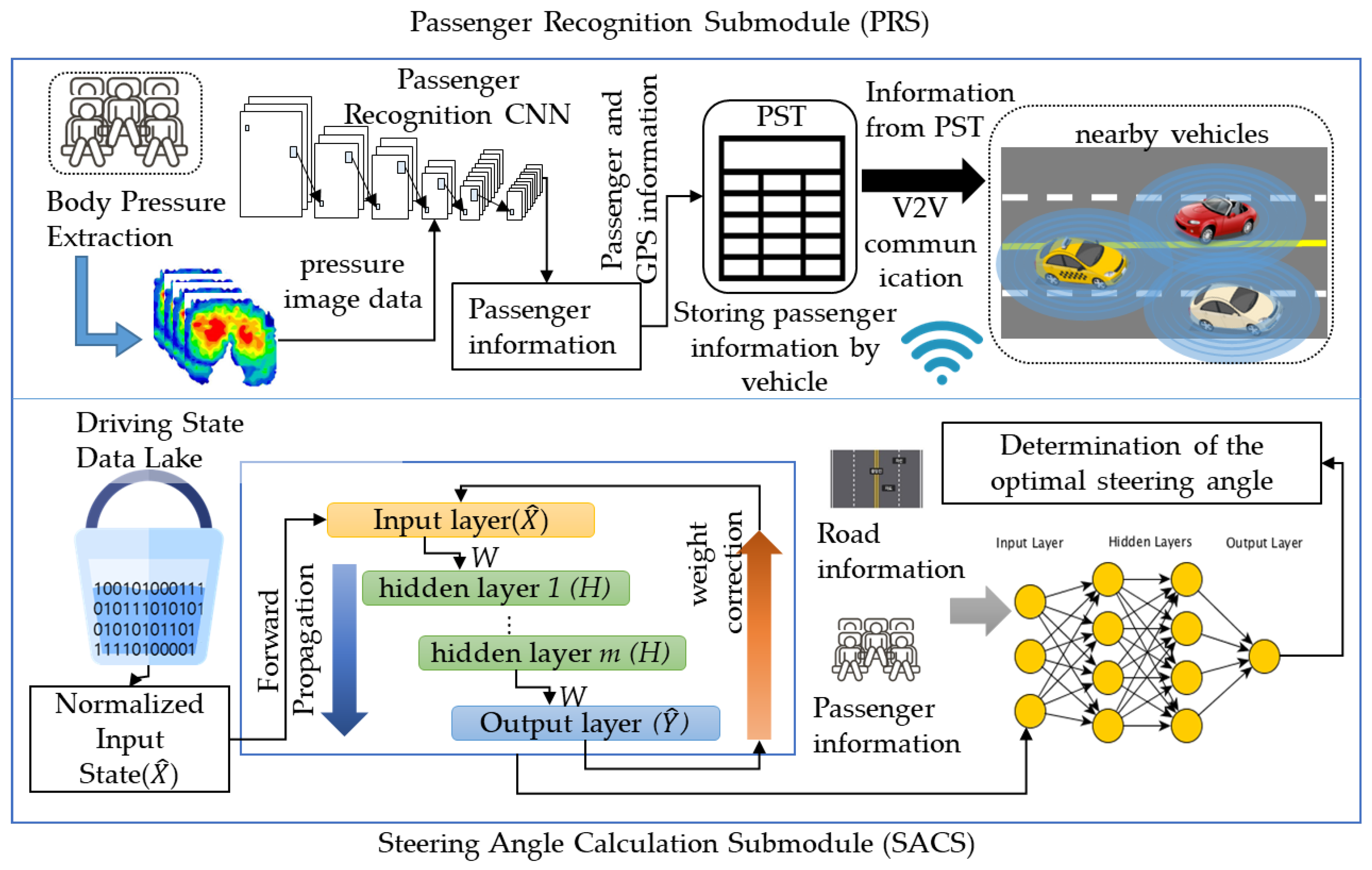
The passenger condition of the vehicle must always be considered for the safety of the vehicle. In particular, fully autonomous vehicles need to calculate optimal driving not only for normal driving but also for emergency situations. In such an emergency situation, the vehicle should set a direction to minimize human casualties; it is very important to understand the passenger status of the surrounding vehicles to minimize human casualties [31,32]. Therefore, for this paper, we designed the passenger recognition and sharing module (PRSM), which calculates the optimal steering angle that can minimize damage in emergency situations by detecting the passenger status of the driving vehicle itself and surrounding vehicles. The PRSM consists of two submodules. The passenger recognition submodule (PRS) generates a training data set using generative adversarial networks (GAN) [33] based on the data of people directly seated on the body pressure sensor and designs a passenger recognition CNN (PRCNN) to identify luggage, adults, and children. The steering angle calculation submodule (SACS) computes the optimal steering angle while driving according to the passenger status, driving route, and driving situation of surrounding vehicles. Figure 4 shows the overall concept of the PRSM.
Figure 4. The structure of the PRSM.

3.3.1. A Design of the PRS

Existing vehicles identify whether a seat is occupied based on the weight applied to the seat. The PRS proposed in this paper collects seat pressure data using a 64*64 body pressure sensor and uses CNN to classify whether existing in the seat is an adult, a child, or an object. Next, the PRS stores the seat information and the location of your vehicle and shares them with the surrounding vehicles. First, sufficient body pressure sensor data are required for PRS learning. Using 20 men and 12 women in their 20s and 30s, 7 men and 3 women in their 50s and 60s, and 7 male children aged 8 to 10, we collect the body pressure sensor data from nine boxes of 10 to 60 kg; the training data for the CNN were generated using a generative adversarial network (GAN) based on the corresponding data.
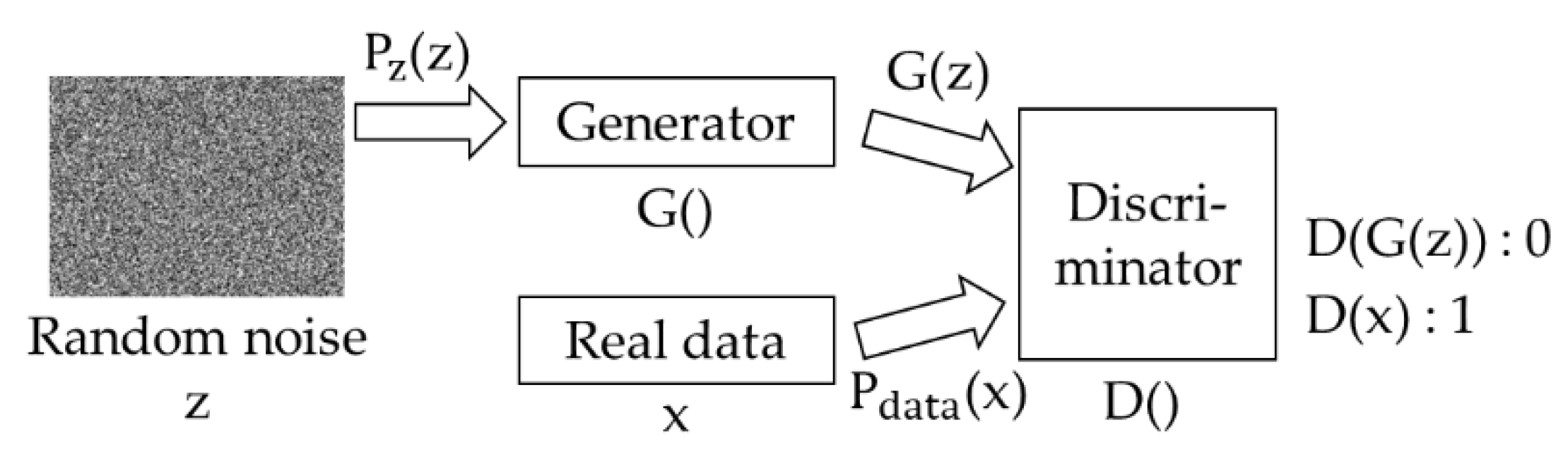
The GAN is an artificial intelligence model that uses unsupervised learning to generate image data. Figure 5 shows the simple configuration of the GAN. In Figure 5, the generator generates new image data using the samples Pz(z) and G(z) extracted from noise and delivers the generated image G(z) to the discriminator. The purpose of the discriminator is to determine that G(z) is a fake image (that is, to output 0) and determine that Pdata(x) is a real image (that is, to output 1). The generator and discriminator are each a neural network model. Since the GAN is an unsupervised learning model, it learns using the entropy-based loss function rather than the label. When training is completed, the GAN creates a new image. Equation (10) shows the loss function of the GAN.
min G   max D   V G ,   D = E X Pdata x logD x + E z p z z log 1 D G z ,
Figure 5. The simple structure of the GAN.
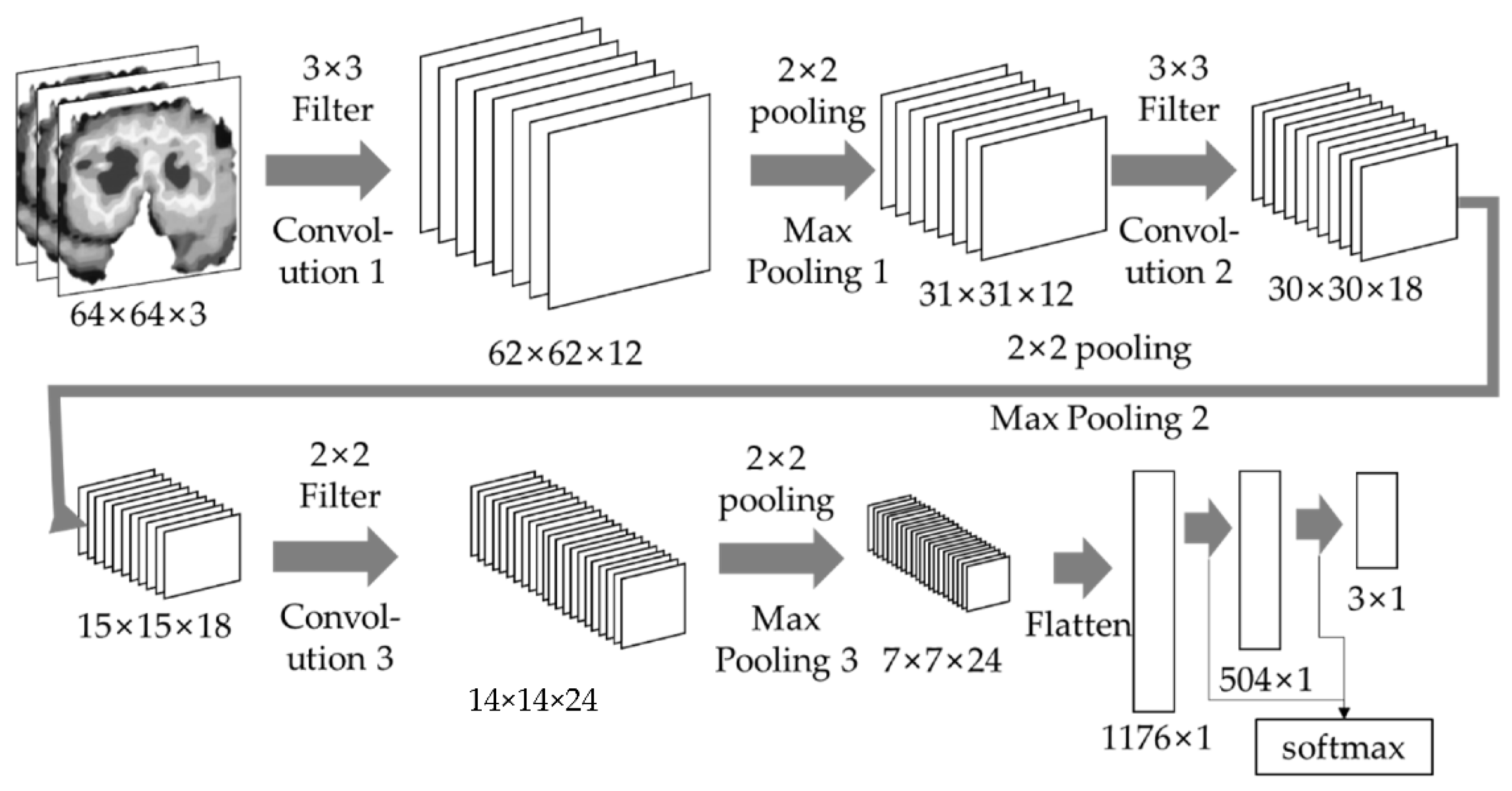
In the GAN, the learning proceeds in the direction where V G ,   D becomes the maximum while E z p z z log 1 D G z becomes the minimum. When the training of the GAN was completed, our work generated 150 images based on 58 images. At this time, the PRS trains the CNN model using these 208 images. The PRS classifies 64 × 64 images into three, R, G, and B, channels, uses 64 × 64 × 3 image data as input data, and decides whether it is an adult seat, a child seat, or cargo seat image. The PRS conducts a convolution and max pooling process three times. Since the input image is small, the stride of the PRS is explained as 1 to ensure accuracy. The PRS uses a 3 × 3 size filter in the first and second convolution processes and uses a 2 × 2 filter in the third convolution process. The first convolution process uses 12 filters, the second convolution process uses 18 filters, and the third convolution process uses 24 filters. The last layer of CNN, the fully connected layer, consists of a neural network with one hidden layer. Figure 6 shows the overall structure of the CNN used in the PRS. The PRS recognizes the current seat state through the CNN and creates a passenger state table (PST) that stores the overall seat state of the vehicle. The PRS stores the current vehicle seat status and vehicle location in the PST and transmits the PST information to the surrounding vehicles through V2V communication. The PRS represents the information of up to 15 seats in an array. Algorithm 1 shows that the PRS stores the seat information in the array and sends it to the PST.
Algorithm 1. Information stored in PST
Input: Status of each seat
Output: Data set to pass to PST
1. Initialize an empty array P[15]
2. FOR each seat i in range (length (status of seats))
  2.1. IF is it an adult to exist in seat i?
    2.1.1. P[i] = 0
  2.2. IF is it a child that exists in seat i?
    2.2.1. P[i] = 1
  2.3. IF is it a cargo to exist in seat i?
    2.3.1. P[i] = 2
  2.4. IF is it empty in seat i?
    2.4.1. P[i] = 3
3. FOR last i in range (15)
3.1 P[i] = 4
4. Pass P[15] and GPS latitude and longitude to PST
Figure 6. The structure of the PRS.
In Algorithm 1, the PRS stores adults as 0, children as 1, cargo as 2, and empty seats as 3 in P[15], and stores GPS information and P[15] in the PST by padding the remaining seats with 4. For example, if a five-seat vehicle has an adult in the driver’s seat, cargo in the passenger’s seat, and a child in the right rear seat, the array of P[15] is created as 023314444444444 and it is stored in the PST. Table 4 shows examples of information stored in the PST. In Table 4, the ‘own’ field indicates whether the car in which the information is stored is a user’s or a surrounding vehicle.
Table 4. An example of the PST.

3.3.2. A Design of the SACS

The SACS proposed in this paper computes the optimal steering angle while driving using the passenger status of the owner and the surrounding vehicles, current driving status, and direction to the destination, etc., which are recognized by the PRS. The PRS uses an input data set that is almost similar to the BPCS but, because the BPCS does not consider braking, it uses an input data set that is more focused on the direction of the vehicle than the BPCS. Table 5 shows the input data sets used for the SACS.
Table 5. Input data set of the SACS.
Unlike the BPCS, the SACS does not consider acceleration per unit time and uses the distance to the nearest left and right vehicles as input for steering accuracy. It also uses the current steering angle and the curvature of the road to prevent departure from driving due to steering angle changes. The SACS uses the same swish function as the BPCS from the input layer to the last hidden layer but uses the tanh function for the activation function between the last hidden layer and the output layer for the accuracy of result interpretation and learning. The tanh function has a value between −1 and 1, and the SACS computes −1 as right 45° and 1 as left 45° and outputs the final steering angle. Equation (11) shows the tanh function used by SACS, and Equation (12) shows the differential function of the tanh function.
tanh x = e x e x e x + e x ,
tanh   x = 1 tanh 2 x ,

4. Simulations

For this paper, four simulations were conducted to verify the efficiency of the BDDS. The simulation environment shown in Table 6 was used for this paper and all machine learning models were made in the Python language using TensorFlow. The simulation was conducted using virtual data. Berkeley DeepDrive’s data set was used to understand the vehicle’s surrounding environment and the driving conditions of the surrounding vehicles. Data not included in Berkeley DeepDrive, such as roughness of roads and distances to destinations, were generated in a virtual environment by our workstation and ECU model. The simulation of this paper was conducted in a virtual environment and was as follows.
Table 6. The hardware environment used for simulation.
  • In order to find K suitable for the RRCS, this work computed the error of the RRCS while increasing K from 1 to 31.
  • To verify the efficiency of the RRCS, the K-means clustering algorithm and the road classification accuracy of the RRCS were compared.
  • This work examined the accuracy of the test data while increasing the number of hidden layers from 1 to 30 in order to obtain the number of hidden layers suitable for the BPCS.
  • To verify the accuracy of the PRS, that of the PRS and that of the passenger recognition system of the existing vehicle were compared.
  • Data from 1204 traffic accidents in Korea were used to measure the efficiency of braking pressure and passenger detection. The speed and steering angle at the time of the vehicle accident, the output of the BDDS excluding the roughness of the road and the passenger condition, and the output of the BDDS including the roughness of the road and the passenger condition were compared.

4.1. Simulations of the RRCS

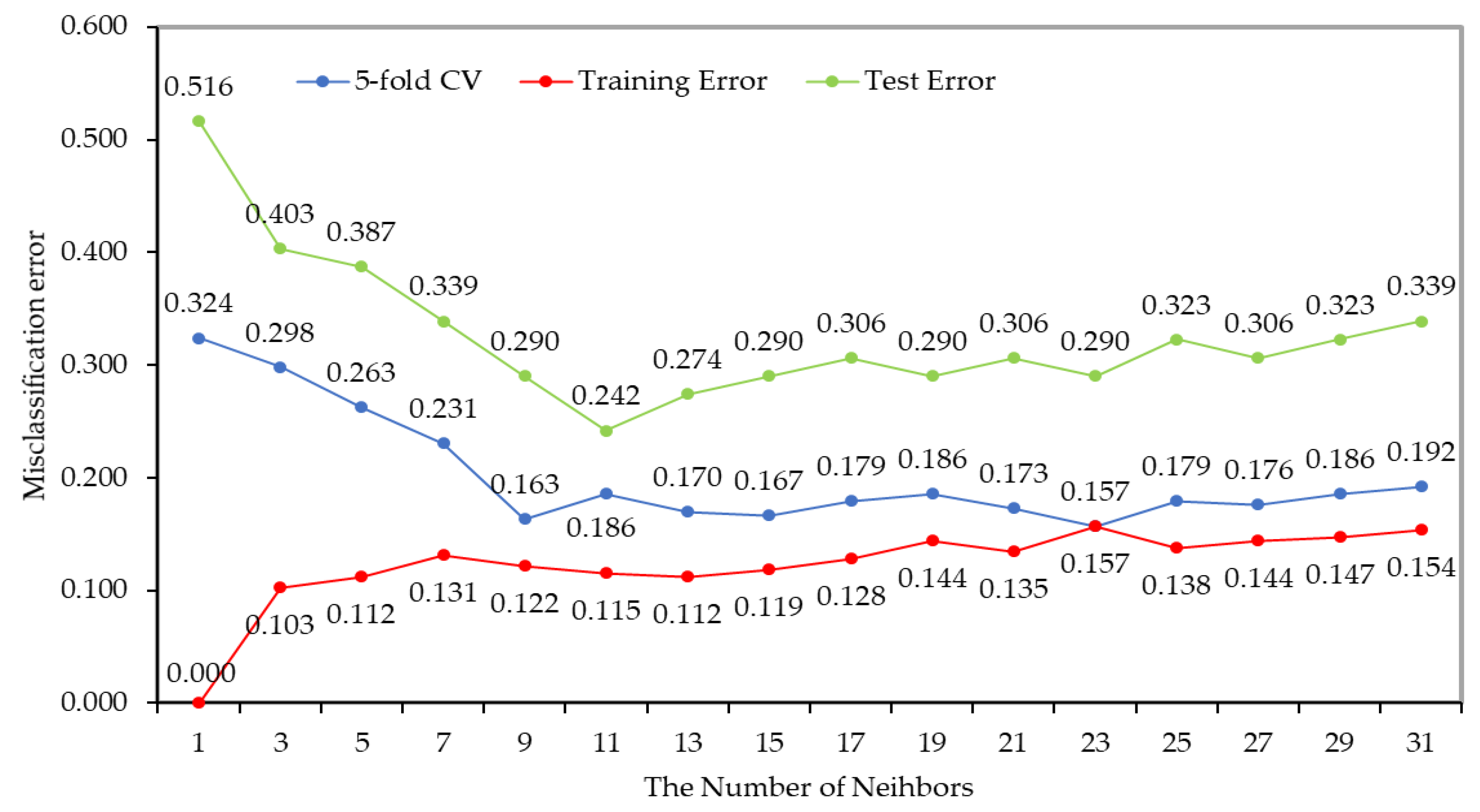
First, this work conducted a simulation to find K suitable for the RRCS. For the simulation, 312 data sets were used, of which 62 sets were used as test data sets and the remaining 250 sets were subjected to five-fold cross validation. Figure 7 shows the misclassification errors of the RRCS.
Figure 7. The misclassification errors of the RRCS.
The simulation result showed that the RRCS had the lowest classification error when the K of KNN was used as 11. Additionally, there was no significant difference in the classification error from 11 to 21, but when K was greater than 23, the classification error was increased due to overfitting. Therefore, it is most appropriate to use K as 11 for the RRCS.
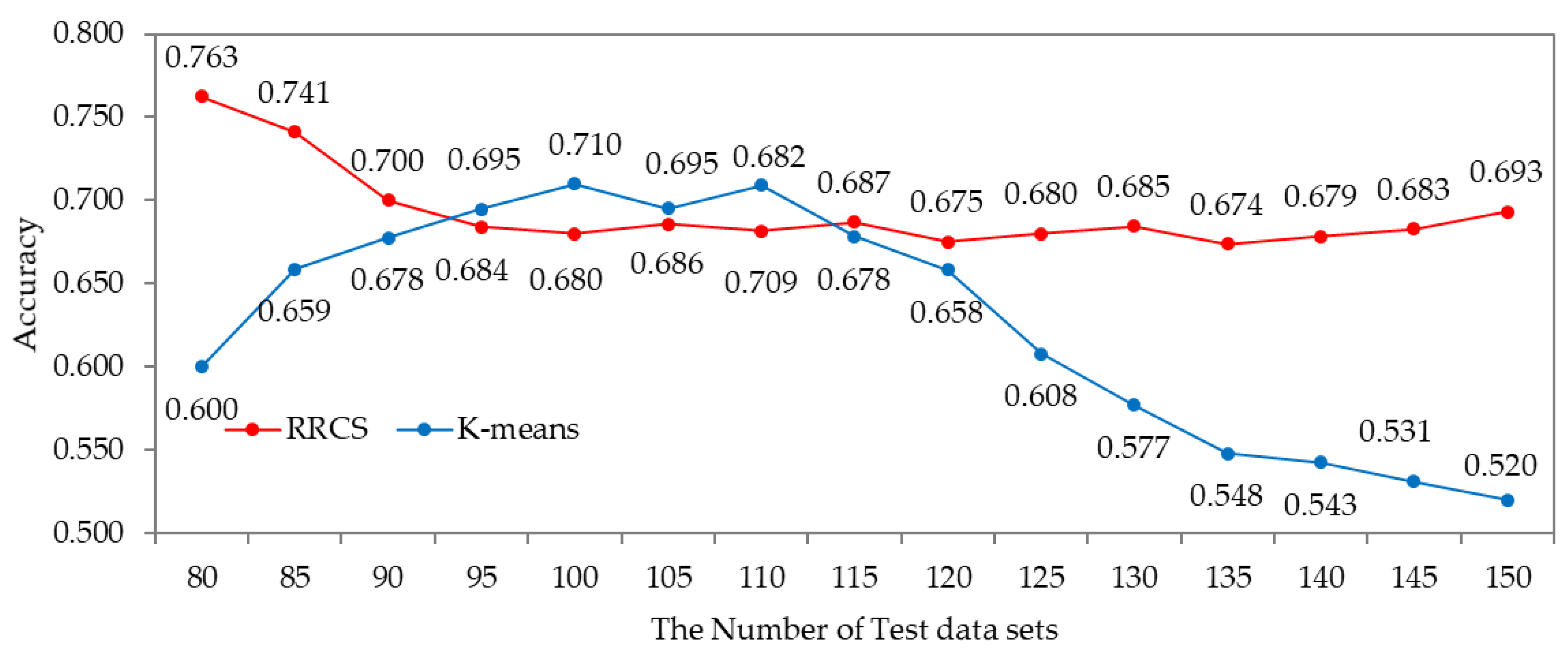
Second, to verify the accuracy of the RRCS, the accuracy of the K-means clustering algorithm trained with the same training data and that of the RRCS were compared. The RRCS was trained using 200 training data sets, and the RRCS and K-means algorithms were tested using 150 test data sets. Figure 8 shows the accuracy when the test data sets are input to the RRPS and K-means clustering algorithms. According to the result of the simulation, the average accuracy of the RRCS was 0.693 and that of the K-means algorithm was 0.627. Because the K-means algorithm classified unlabeled data into eight clusters, it showed higher accuracy than the RRCS when classifying a constant amount of data but failed to classify between clusters as the amount of data increased. Therefore, the RRCS is more suitable than K-means algorithm to classify road roughness.
Figure 8. The accuracy of the RRPS and K-means algorithms.

4.2. Simulations of the BPCS

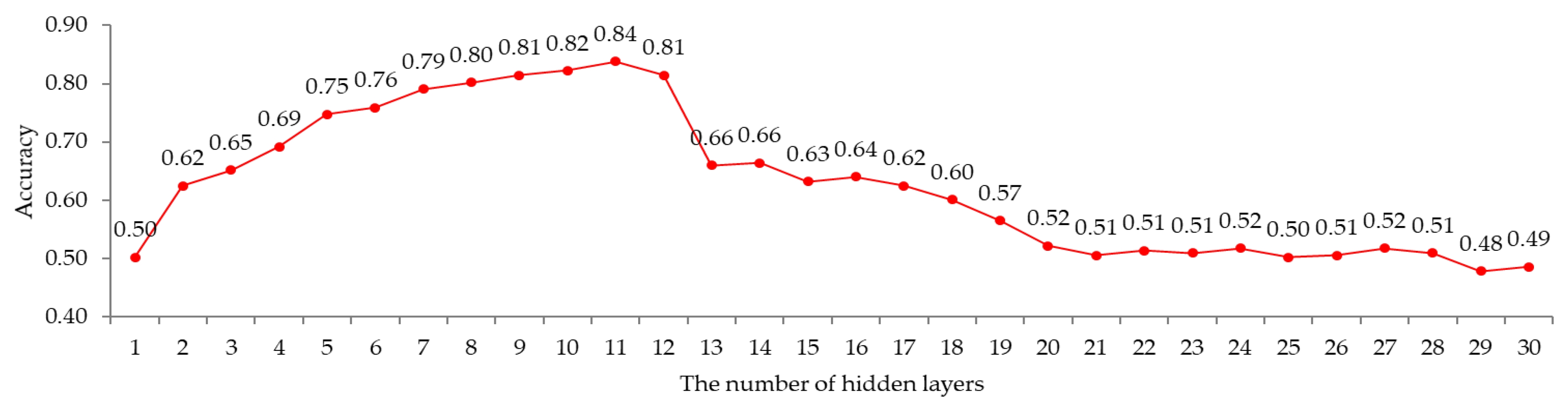
Next, this work examines the accuracy of the BPCS according to the number of hidden layers in order to obtain the number of hidden layers suitable for the BPCS. In this paper, the BPCS was trained using 253 training data sets while fixing the number of nodes of the hidden layer to seven and increasing the number of hidden layers of the BPCS from 1 to 30. Figure 9 shows the accuracy of the BPCS according to the number of hidden layers.
Figure 9. The accuracy of the RRPS and K-means.
The result of the simulation showed that, when the number of hidden layers increased to 11, the accuracy of the BPCS increased to 84%, but when the number of hidden layers was increased to 13, the accuracy decreased sharply. Therefore, it is most suitable for the BPCS to use 11 hidden layers.

4.3. Simulations of the PRS

This work compared the accuracy of the existing passenger recognition system and the PRS to verify the efficiency of the PRS. The existing passenger recognition system recognized accurately in the following cases.
  • To correctly recognize the person seated in the seat as a person, whether an adult or a child;
  • To recognize a seat loaded with cargo as an empty seat.
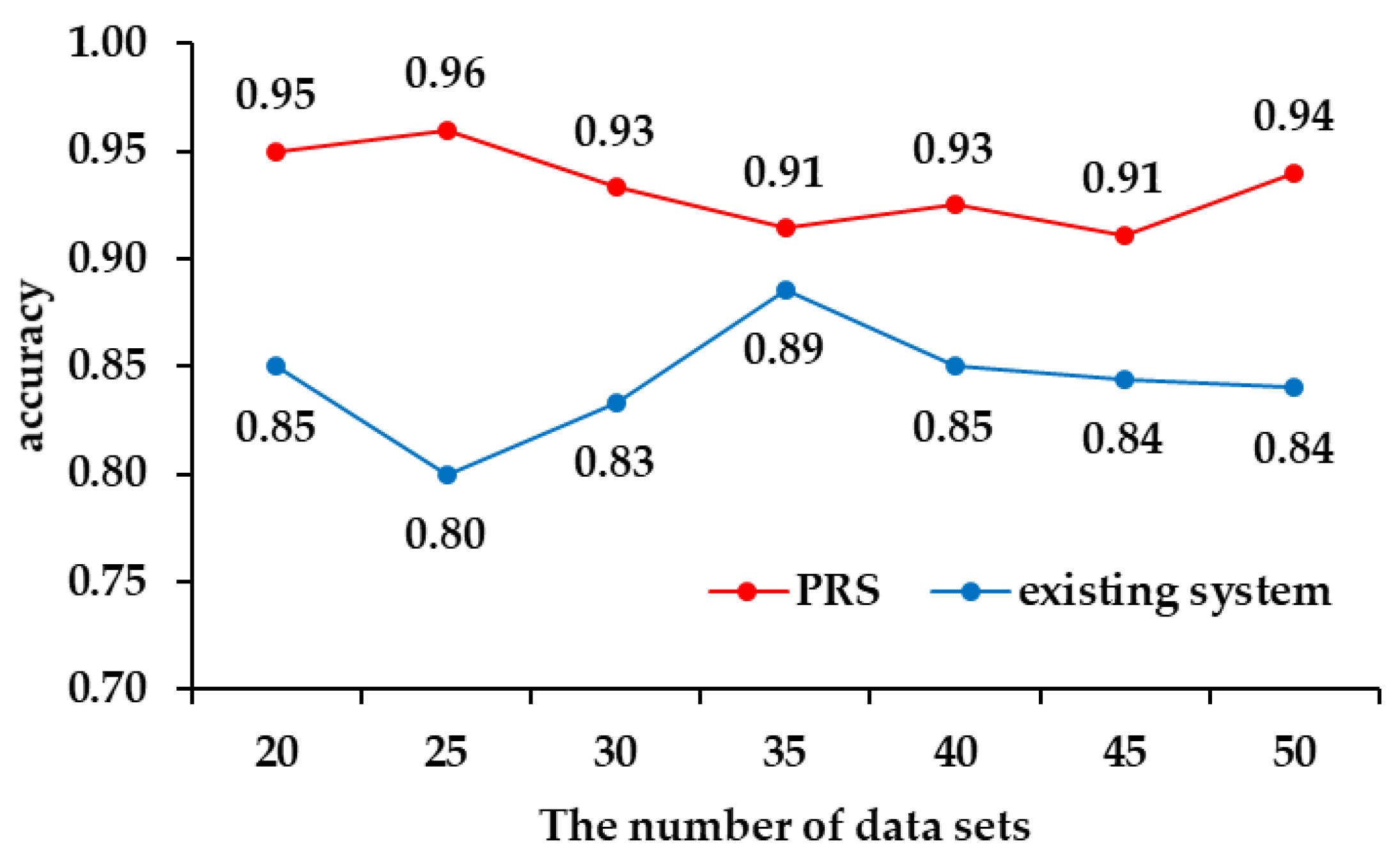
For the simulation, it was carried out by increasing the data set from 20 to 50, and the proportion of the cargo was increased each time the amount of data was increased. Table 7 shows the number of pieces of cargo included in the data set, and Figure 10 shows the accuracy of the PRS and the existing system for each data set.
Table 7. The input data set of the SACS.
Figure 10. The accuracy of the PRS and the existing recognition system.
As a result of the simulation, the PRS showed that it had about 9% higher accuracy than the passenger recognition system of the existing vehicle. The accuracy of the PRS was measured as high with a small amount of training data and simulation data, but most of the difference in accuracy occurred in the recognition of 10 kg to 30 kg cargo. Thus, the PRS can distinguish cargo better than the existing passenger recognition systems.

4.4. Simulations of the BDDS

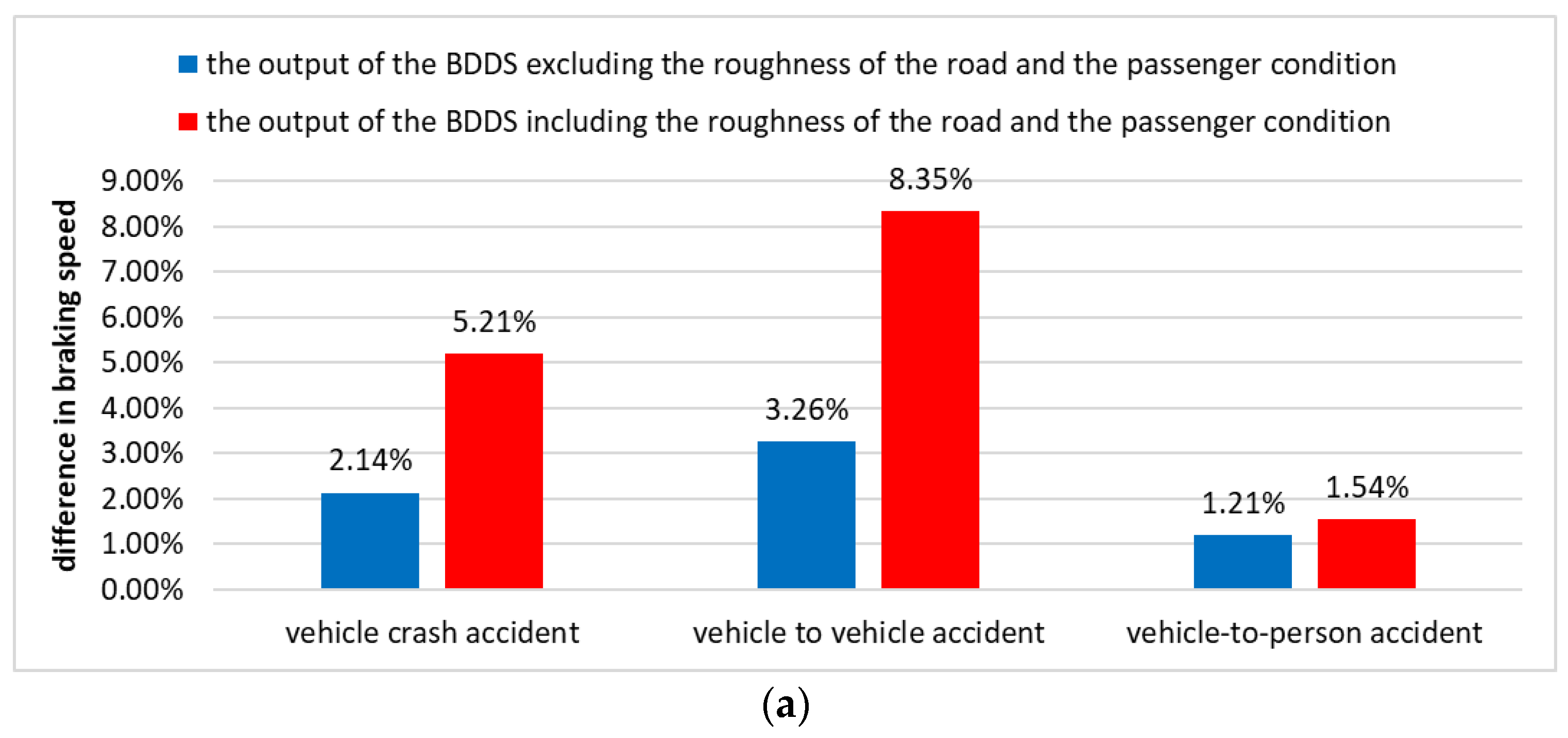
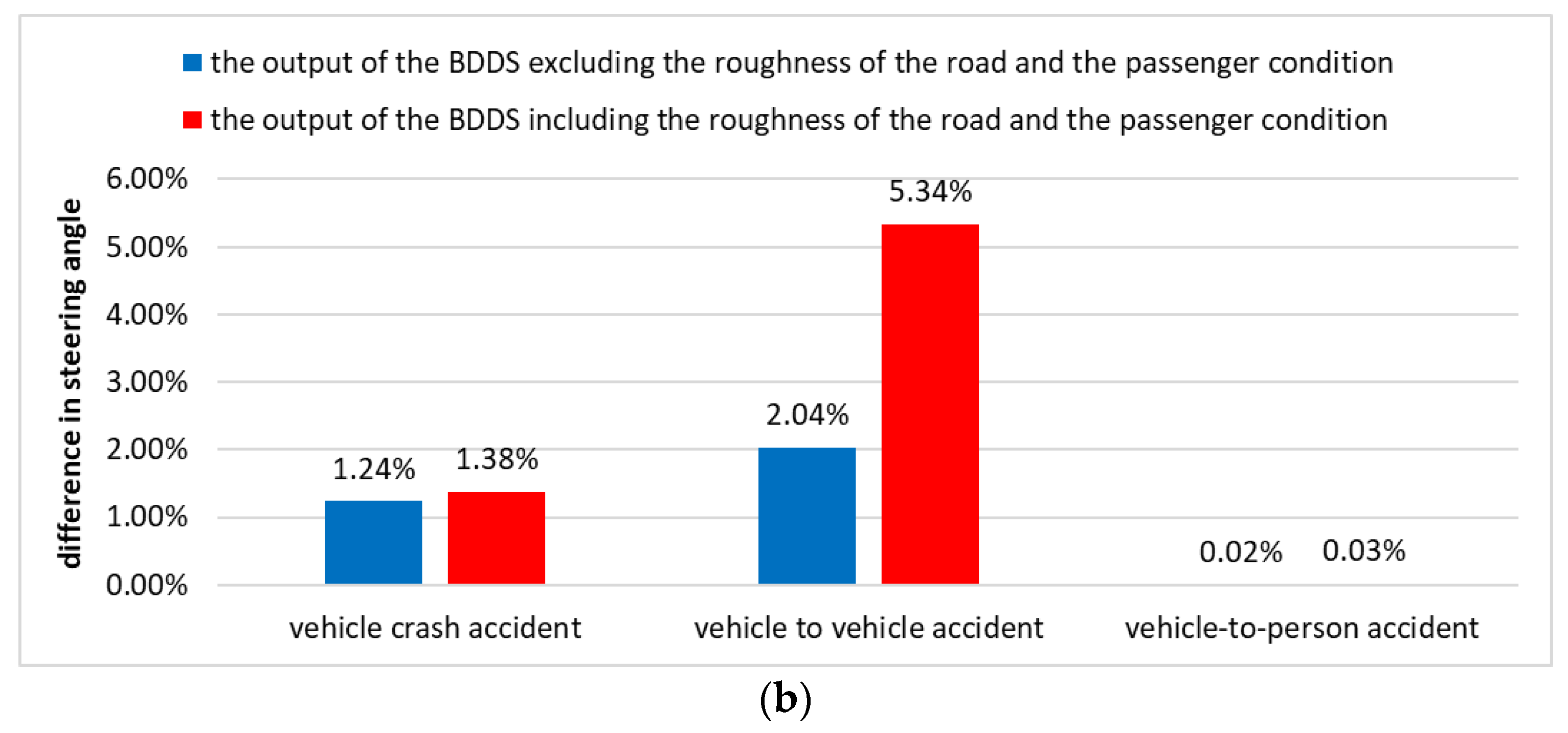
Finally, in order to verify the effectiveness of the BDDS, this work compared the actual accident data, the output of the BDDS without road roughness and passenger status, and the output of the BDDS with road roughness and passenger status. This experiment represented the average of the difference between the output of BDDS and the actual accident data in 171 vehicle–object accidents, 483 vehicle–vehicle accidents, and 550 vehicle–person accident items of data. The actual data used for the simulation contained at least one death. Figure 11a shows the difference in braking speed according to road roughness and passenger conditions, and Figure 11b shows the difference in steering angle.
Figure 11. (a) Difference between accident data and BDDS results (braking speed). (b) Difference between accident data and BDDS results (steering angle).
Figure 11 shows the difference between the driving condition of the vehicle and the output of the BDDS at the time of the accident as a percentage. As a result of the simulation, the BDDS requires much more braking when the vehicle collides with a large object (or vehicle). In addition, the BDDS showed a much greater difference in steering angle when a vehicle-to-vehicle collision occurred than in a conventional accident. Therefore, the BDDS can determine the driving method more aggressively than the existing vehicle driving method in order to increase stability in crisis situations and prevent death.

5. Conclusions

This paper proposed that a braking-pressure and driving-direction determination system (BDDS) consists of the road roughness classification module (RRCM) and passenger recognition and sharing module (PRSM). The RRCM classified road roughness based on a KNN algorithm, and the PRSM accurately recognized passengers inside the vehicle based on a CNN and shared it with surrounding vehicles. In the simulation, this work found the optimal parameters required for the AI model and proved the efficiency of each module. As a result of the simulation, the RRCS to classify the roughness of the road had about 7% higher accuracy than the K-means clustering algorithm, and the PRS to recognize passengers had 9% higher accuracy than the existing vehicle passenger recognition system. Therefore, the expected effects of the BDDS are as follows.
  • The BDDS can extend the recognition range of existing autonomous vehicles that rely heavily on visual data (from lidar, front camera, etc.).
  • Because BDDS modularized brake pressure and steering angle computations, each AI model is accurate and simple.
In this paper, limited deep learning models using about 400 data sets were trained. Future research should further train and test the BDDS by increasing the data sets. Since the seat recognition sensor of the existing vehicle cannot be simulated in a virtual environment, the comparison between the PRS and the existing vehicle was conducted with little data. Future research should implement the vehicle seat recognition system in a virtual environment and conduct simulations with more data. Additionally, if experiments with real vehicles become possible and research advances enough to determine braking and steering except for computer vision, the BDDS could also be used in the development of ADAS for special vehicles (such as forklift trucks) that are not provided with autonomous driving systems [34,35].

Author Contributions

Conceptualization, S.S. and Y.J.; methodology, S.S., Y.J. and B.L.; software, S.S.; validation, S.S. and B.L.; writing—original draft preparation, S.S.; writing—review and editing, B.L. and S.L.; visualization, S.S.; supervision, B.L. and S.L.; project administration, Y.J. and S.L. All authors have read and agreed to the published version of the manuscript.

Funding

This research received no external funding.

Institutional Review Board Statement

Not applicable.

Conflicts of Interest

The authors declare no conflict of interest.

References

  1. Schweber, B. The Autonomous Car: A Diverse Array of Sensors Drives Navigation, Driving, and Performance. Available online: https://www.mouser.com/applications/autonomous-car-sensors-drive-performance/ (accessed on 21 September 2021).
  2. Miller, D. Autonomous Vehicles: What Are the Security Risks? 2019. Available online: https://www.covisint.com/blog/autonomous-vehicles-what-are-the-security-risks/ (accessed on 12 October 2021).
  3. Black, T.G. Diagnosis and Repair for Autonomous Vehicles. 2014. Available online: http://www.freepatentsonline.com/8874305.html (accessed on 12 October 2021).
  4. Guo, Y.; Sun, Q.; Su, Y.; Guo, Y.; Wang, C. Can driving condition prompt systems improve passenger comfort of intelligent vehicles? A driving simulator study. Transp. Res. Part F Traffic Psychol. Behav. 2021, 81, 240–250. [Google Scholar] [CrossRef]
  5. Launonen, P.; Salonen, A.O.; Liimatainen, H. Icy roads and urban environments. Passenger experiences in autonomous vehicles in Finland. Transp. Res. Part F Traffic Psychol. Behav. 2021, 80, 34–48. [Google Scholar] [CrossRef]
  6. Wei, C.; Romano, R.; Hajiseyedjavadi, F.; Merat, N.; Boer, E. Driver-centred Autonomous Vehicle Motion Control within A Blended Corridor. IFAC PapersOnLine 2019, 52, 212–217. [Google Scholar] [CrossRef]
  7. Saruchi, S.; Mohammed Ariff, M.H.; Zamzuri, H.; Amer, N.H.; Wahid, N.; Hassan, N.; Kassim, K.A.A. Novel Motion Sickness Minimization Control via Fuzzy-PID Controller for Autonomous Vehicle. Appl. Sci. 2020, 10, 4769. [Google Scholar] [CrossRef]
  8. Zhao, Y.; Wang, X. A Review of Low-Frequency Active Vibration Control of Seat Suspension Systems. Appl. Sci. 2019, 9, 3326. [Google Scholar] [CrossRef]
  9. Geng, G.; Wu, Z.; Jiang, H.; Sun, L.; Duan, C. Study on Path Planning Method for Imitating the Lane-Changing Operation of Excellent Drivers. Appl. Sci. 2018, 8, 814. [Google Scholar] [CrossRef]
  10. Bakibillah, A.S.M.; Paw, Y.F.; Kamal, M.A.S.; Susilawati, S.; Tan, C.P. An Incentive Based Dynamic Ride-Sharing System for Smart Cities. Smart Cities 2021, 4, 532–547. [Google Scholar] [CrossRef]
  11. Leledakis, A.; Östh, J.; Davidsson, J.; Jakobsson, L. The influence of car passengers’ sitting postures in intersection crashes. Accid. Anal. Prev. 2021, 157, 106170. [Google Scholar] [CrossRef]
  12. Anselma, P.G. Optimization-Driven Powertrain-Oriented Adaptive Cruise Control to Improve Energy Saving and Passenger Comfort. Energies 2021, 14, 2897. [Google Scholar] [CrossRef]
  13. Kwon, J.Y.; Ju, D.Y. Spatial Components Guidelines in a Face-to-Face Seating Arrangement for Flexible Layout of Autonomous Vehicles. Electronics 2021, 10, 1178. [Google Scholar] [CrossRef]
  14. Ngwangwa, H.M.; Heyns, P.S.; Breytenbach, H.G.A.; Els, P.S. Reconstruction of road defects and road roughness classification using Artificial Neural Networks simulation and vehicle dynamic responses: Application to experimental data. J. Terramechanics 2014, 53, 1–18. [Google Scholar] [CrossRef]
  15. Misaghi, S.; Tirado, C.; Nazarian, S.; Carrasco, C. Impact of pavement roughness and suspension systems on vehicle dynamic loads on flexible pavements. Transp. Eng. 2021, 3, 100045. [Google Scholar] [CrossRef]
  16. Bidgoli, M.A.; Golroo, A.; Nadjar, H.S.; Rashidabad, A.G.; Ganji, M.R. Road roughness measurement using a cost-effective sensor-based monitoring system. Autom. Constr. 2019, 104, 140–152. [Google Scholar] [CrossRef]
  17. Georgouli, K.; Plati, C.; Loizos, A. Autonomous vehicles wheel wander: Structural impact on flexible pavements. J. Traffic Transp. Eng. 2021, 8, 388–398. [Google Scholar] [CrossRef]
  18. Floreán-Aquino, K.H.; Arias-Montiel, M.; Linares-Flores, J.; Mendoza-Larios, J.G.; Cabrera-Amado, Á. Modern Semi-Active Control Schemes for a Suspension with MR Actuator for Vibration Attenuation. Actuators 2021, 10, 22. [Google Scholar] [CrossRef]
  19. Wang, C.; Xu, S.; Yang, J. Adaboost Algorithm in Artificial Intelligence for Optimizing the IRI Prediction Accuracy of Asphalt Concrete Pavement. Sensors 2021, 21, 5682. [Google Scholar] [CrossRef]
  20. Žuraulis, V.; Sivilevičius, H.; Šabanovič, E.; Ivanov, V.; Skrickij, V. Variability of Gravel Pavement Roughness: An Analysis of the Impact on Vehicle Dynamic Response and Driving Comfort. Appl. Sci. 2021, 11, 7582. [Google Scholar] [CrossRef]
  21. Lukoševičius, V.; Makaras, R.; Dargužis, A. Assessment of Tire Features for Modeling Vehicle Stability in Case of Vertical Road Excitation. Appl. Sci. 2021, 11, 6608. [Google Scholar] [CrossRef]
  22. Čerškus, A.; Lenkutis, T.; Šešok, N.; Dzedzickis, A.; Viržonis, D.; Bučinskas, V. Identification of Road Profile Parameters from Vehicle Suspension Dynamics for Control of Damping. Symmetry 2021, 13, 1149. [Google Scholar] [CrossRef]
  23. Papaioannou, G.; Jerrelind, J.; Drugge, L. Multi-Objective Optimisation of Tyre and Suspension Parameters during Cornering for Different Road Roughness Profiles. Appl. Sci. 2021, 11, 5934. [Google Scholar] [CrossRef]
  24. Zhang, Q.; Hou, J.; Duan, Z.; Jankowski, Ł.; Hu, X. Road Roughness Estimation Based on the Vehicle Frequency Response Function. Actuators 2021, 10, 89. [Google Scholar] [CrossRef]
  25. Reza-Kashyzadeh, K.; Ostad-Ahmad-Ghorabi, M.J.; Arghavan, A. Study Effects of Vehicle Velocity on A Road Surface Roughness Simulation. Appl. Mech. Mater. 2013, 372, 650–656. [Google Scholar] [CrossRef]
  26. Hassan, R.A.; McManus, K. Assessment of interaction between road roughness and heavy vehicles. Transp. Res. Rec. 2003, 1819, A236–A243. [Google Scholar] [CrossRef]
  27. Marijonas, B.; Oleg, V. Efficiency of a braking process evaluating the roughness of road surface. Transport 2006, 21, 3–7. [Google Scholar] [CrossRef]
  28. Altman, N.S. An introduction to kernel and nearest-neighbor nonparametric regression. Am. Stat. 1992, 46, 175–185. [Google Scholar] [CrossRef]
  29. Coomans, D.; Massart, D.L. Alternative k-nearest neighbour rules in supervised pattern recognition: Part 1. k-Nearest neighbour classification by using alternative voting rules. Anal. Chim. Acta 1982, 136, 15–27. [Google Scholar] [CrossRef]
  30. Hyndman, R.J.; Koehler, A.B. Another look at measures of forecast accuracy. Int. J. Forecast. 2006, 22, 679–688. [Google Scholar] [CrossRef]
  31. Angelos, A.; Evangelos, K.; Loukas, B.; Stylianos, P.; Antonios, G. ViPED: On-road vehicle passenger detection for autonomous vehicles. Robot. Auton. Syst. 2019, 112, 282–290. [Google Scholar]
  32. Shih-Feng, K.; Huei-Yung, L. Passenger Detection, Counting, and Action Recognition for Self-Driving Public Transport Vehicles. In Proceedings of the 2021 IEEE Intelligent Vehicles Symposium (IV), Las Vegas, NV, USA, 11–17 July 2021. [Google Scholar] [CrossRef]
  33. Goodfellow, I.J.; Pouget-Abadie, J.; Mirza, M.; Xu, B.; Warde-Farley, D.; Ozair, S.; Courville, A.; Bengio, Y. Generative Adversarial Networks. In Proceedings of the International Conference on Neural Information Processing Systems, Montreal, QC, Canada, 8–13 December 2014; pp. 2672–2680. [Google Scholar]
  34. Martini, A.; Bonelli, G.P.; Rivola, A. Virtual Testing of Counterbalance Forklift Trucks: Implementation and Experimental Validation of a Numerical Multibody Model. Machines 2020, 8, 26. [Google Scholar] [CrossRef]
  35. Rebelle, J.; Mistrot, P.; Poirot, R. Development and validation of a numerical model for predicting forklift truck tip-over. Veh. Syst. Dyn. 2009, 47, 771–804. [Google Scholar] [CrossRef]
Publisher’s Note: MDPI stays neutral with regard to jurisdictional claims in published maps and institutional affiliations.

Article Metrics

Citations

Article Access Statistics

Multiple requests from the same IP address are counted as one view.