You are currently viewing a new version of our website. To view the old version click .
Sensors
  • Article
  • Open Access

28 November 2021

Cross-Cycled Uplink Resource Allocation over NB-IoT

,
and
1
Department of Computer Science and Information Engineering, National University of Kaohsiung, Kaohsiung 811, Taiwan
2
Department of Communications Engineering, National Chung Cheng University, Chiayi 621, Taiwan
*
Author to whom correspondence should be addressed.
This article belongs to the Section Internet of Things

Abstract

Before each user equipment (UE) can send data using the narrowband physical uplink shared channel (NPUSCH), each UE should periodically monitor a search space in the narrowband physical downlink control channel (NPDCCH) to decode a downlink control indicator (DCI) over narrowband Internet of Things (NB-IoT). This monitoring period, called the NPDCCH period in NB-IoT, can be flexibly adjusted for UEs with different channel qualities. However, because low-cost NB-IoT UEs operate in the half-duplex mode, they cannot monitor search spaces in NPDCCHs and transmit data in the NPUSCH simultaneously. Thus, as we observed, a percentage of uplink subframes will be wasted when UEs monitor search spaces in NPDCCHs, and the wasted percentage is higher when the monitored period is shorter. In this paper, to address this issue, we formulate the cross-cycled resource allocation problem to reduce the consumed subframes while satisfying the uplink data requirement of each UE. We then propose a cross-cycled uplink resource allocation algorithm to efficiently use the originally unusable NPUSCH subframes to increase resource utilization. Compared with the two resource allocation algorithms, the simulation results verify our motivation of using the cross-cycled radio resources to achieve massive connections over NB-IoT, especially for UEs with high channel qualities. The results also showcase the efficiency of the proposed algorithm, which can be flexibly applied for more different NPDCCH periods.

1. Introduction

The primary purpose of narrowband Internet of Things (NB-IoT), standardized by the 3rd Generation Partnership Project (3GPP), is to serve massive low-cost UEs efficiently [1]. As forecasted by Cisco, the number of IoT connections will be 14.7 billion and will account for about half of the global connections by 2023 [2]. Moreover, by 2026, NB-IoT and LTE-M technologies are expected to serve approximately 45% of all cellular IoT connections [3]. Therefore, efficiently utilizing the radio resources of NB-IoT networks is essential for achieving a large number of connections.
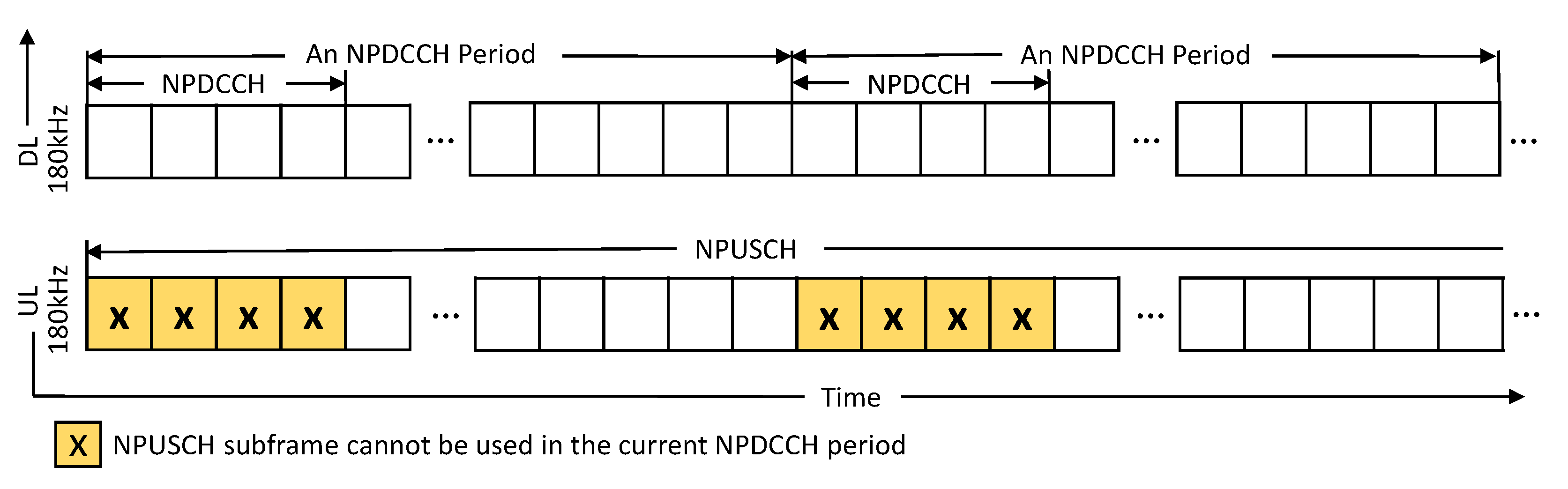
To use the radio resources in NB-IoT networks, before each user equipment (UE) can send data, each UE must periodically monitor a search space in the narrowband physical downlink control channel (NPDCCH) to decode a downlink control indicator (DCI). A DCI is used to carry the uplink parameters for a UE so that the UE can know how to use the narrowband uplink shared channel (NPUSCH) subframes for transmitting data. This period is called the NPDCCH period (NP) in NB-IoT and can be flexibly adjusted for UEs with different channel qualities. However, because low-cost NB-IoT UEs operate in the half-duplex mode, the UEs cannot simultaneously monitor search spaces in NPDCCHs of a downlink frequency (DL) and transmit data in the NPUSCH of an uplink frequency (UL). As a result, when the UEs periodically monitor the search space in the NPDCCH, we observe that a percentage of uplink subframes will be wasted, as shown in Figure 1. Furthermore, the wasted percentage is higher when the NPDCCH period length is shorter. To overcome this issue, we propose the concept of cross-cycled resource allocation to efficiently use the traditionally unusable NPUSCH subframes to increase resource utilization. Specifically, we allow UEs to stop monitoring their search spaces in the next NP while continuously transmitting data in the NPUSCH subframes from the current NP to the next NP without causing any interference. We explain the cross-cycled resource allocation in detail in Section 2.
Figure 1. Waste uplink subframes in NB-IoT.
Recently, there have been some studies exploring various uplink resource allocation issues in NB-IoT. Yu et al. [4] proposed a method that is divided into inner and outer loops. The inner loop adjusts the number of repetitions to ensure a transmission error rate and reduce resource consumption. The outer loop determines the modulation-coding schemes and the number of repetitions. However, this paper only considers a single tone. Besides, Elgarhy et al. [5] decomposed the problem into uplink scheduling and power allocation to maximize the throughput while maintaining as low latency as possible. Hsieh et al. [6] designed an algorithm to allocate NPDCCH and NPUSCH resources for multiple coverage enhancement (CE) levels. Mostafa et al. [7] studied the power and subcarriers allocation to maximize the number of service UEs and meet each UE’s needs.
Huang et al. [8] investigated the influence of scheduling parameters on the resource allocation problem and designed an algorithm to schedule a large number of UEs. Pei et al. [9] proposed an algorithm to control the number of UE connections to increase the probability of successful connections by ensuring that the UEs complete the random access and data transmission processes. Kodheli et al. [10] considered the use of low-Earth orbit satellites to provide the NB-IoT connectivity to on-ground UEs. Liang et al. [11] investigated the link adaptation problem and designed a heuristic algorithm to minimize the energy consumption. Finally, Yu et al. [12] designed a resource allocation algorithm that considers narrowband physical random access channels (NPRACHs) to minimize the consumed subframes. However, these works do not consider the cross-cycled allocation for NB-IoT and waste many subframes, especially when an NPDCCH period length is short.
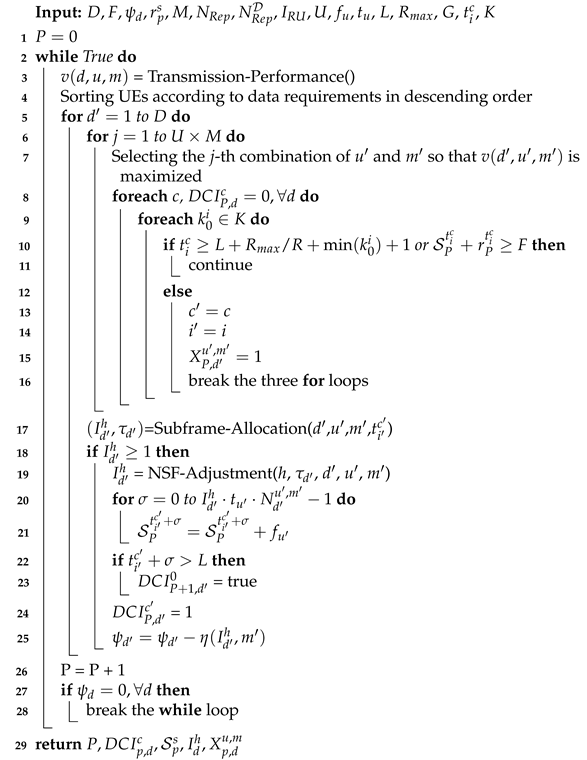
In this paper, we study the cross-cycled uplink resource allocation problem over NB-IoT networks. Our goal is to reduce the number of consumed subframes while satisfying the data request of each UE. The contributions of this paper are summarized as follows.
  • We believe this is the first paper to consider the cross-cycled resource allocation for the uplink in NB-IoT networks.
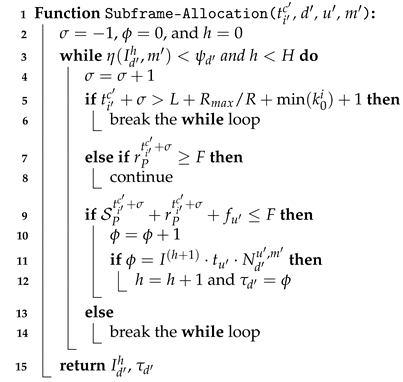
  • We propose a cross-cycled uplink resource allocation algorithm that can use the subframes of the next NP without causing interference.
  • We conducted experiments via simulations using realistic settings. Compared with the two resource allocation algorithms [11,12], the results verify our observation and demonstrate the efficiency of the proposed algorithm, which can reduce more subframes with a smaller NPDCCH period. Moreover, the proposed algorithm can be applied for more different NPDCCH periods.
The remainder of this paper is organized as follows. In Section 2, we describe the system model and the problem formulation. In Section 3, we explain the proposed algorithm and analyze its properties. Section 4 presents the simulation results. Finally, Section 5 concludes this paper.

2. System Model and Problem Formulation

2.1. System Model

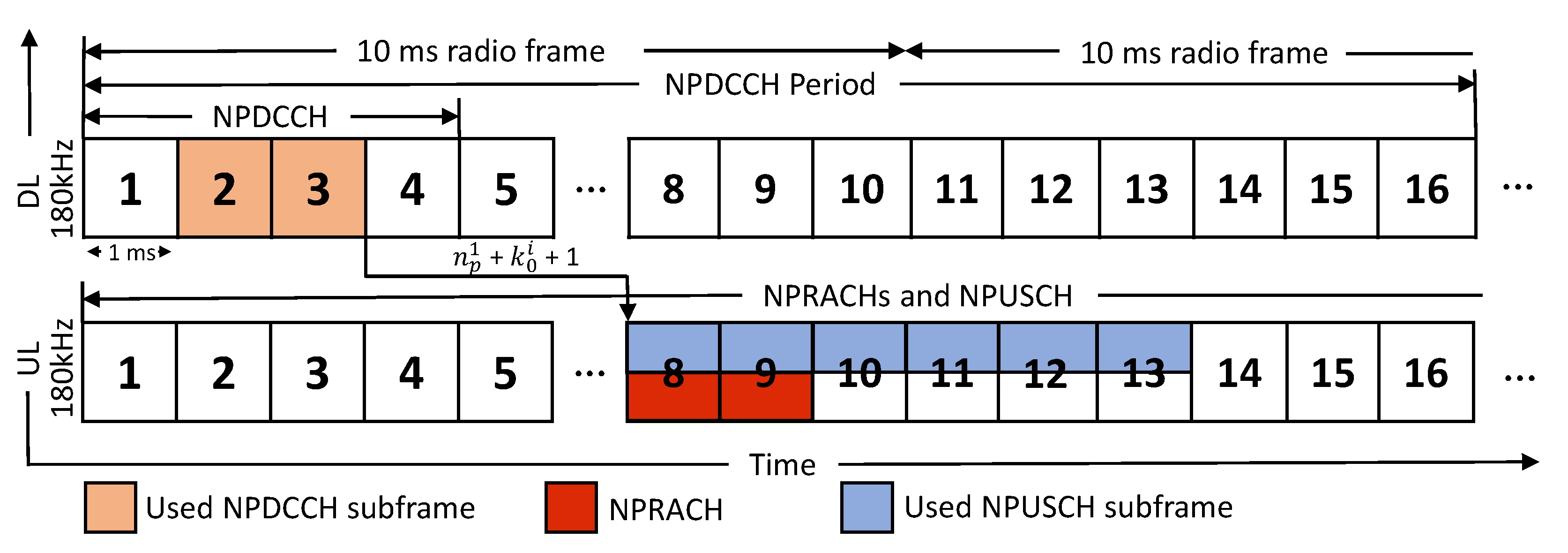
This paper considers that a cell needs to meet the uplink data requests of the NB-IoT UEs with high channel qualities, i.e., the UEs are near the cell. Figure 2 shows the NB-IoT frame structures, which adopt orthogonal frequency-division multiple access (OFDMA). The bandwidth of an uplink and a downlink channel is 180 kHz, and a radio frame is 10 ms long and contains ten subframes, each 1 ms long. In addition, an uplink subframe has 12 or 48 subcarriers, and we consider the former because it is mandatory in NB-IoT.
Figure 2. Resource allocation protocol in NB-IoT frames.
NPRACHs and NPUSCH share the same uplink radio resources in an uplink frequency, and devices should execute the random access procedure in NPRACHs, which can be repeated with the smallest period of 40 ms and up to 2560 ms. The period can be adjusted based on traffic loading. The subcarrier space of NPRACHs is 3.75 kHz, and this paper considers that NPRACHs are predetermined. NPUSCH is used for UEs to transmit data to the cell. A cell can provide four resource unit types occupying different subcarriers in the frequency domain and subframes in the time domain: 12 subcarriers (tones) with 1 ms, six subcarriers with 2 ms, three subcarriers with 4 ms, and a subcarrier with 8 ms. A resource unit is the smallest allocable unit. A cell should decide which NB-IoT UE uses one unit type to transmit its data. To avoid interference, each subcarrier can be used by only one UE or channel.
In NB-IoT systems, the data transmission of each UE must follow the control instructions, namely downlink control indicators, from the cell. The channel carrying DCIs is called the NPDCCH. Each UE should periodically monitor its NPDCCH, which is known as its search space, to decode a DCI. A UE should monitor a common search space before the random-access procedure and can monitor a specific search space after the random access procedure. This paper considers that the UEs have high channel qualities at the first CE level and monitor the same common search space. Nevertheless, this paper can also be applied directly to specific search spaces. As shown in Figure 2, the NPDCCH period of a UE consists of a series of NPDCCH subframes and a series of narrowband physical downlink share channel (NPDSCH) subframes. The number of NPDCCH subframes is determined by the parameter R m a x , and the NPDCCH period can be set by the two parameters, R m a x × G , for a UE, where G is a system parameter [1] (Readers can refer to [13] for background about the NPDCCH period, signals in the frame structures, and CE level determination). Here, we assume that the UEs’ NPDCCH period (i.e., the common search space period) has been determined.
A cell should determine four parameters for a UE to use uplink radio resources: resource unit type, modulation, and coding scheme (modulation for short), scheduling delay, and resource assignment. A DCI carries these four parameters. The used unit type, modulation, signal-to-noise ratio (SNR), and amount of transmitted data will affect the required data repetition number of a UE to achieve the required transmission reliability. Therefore, some unit type and modulation combinations are not usable for a UE if the required number of repetitions is higher than the maximum repetition number. Specifically, if a UE has a better channel quality, the cell can have more combination selections of a unit type and a modulation-coding scheme for the UE. Similarly, a cell transmitting a DCI for a UE should also apply a DCI repetition number to meet the reliability.
After determining the above two parameters, the cell should allocate the other parameters for a UE: resource assignment and scheduling delay value. The resource assignment field is the number of units that do not include the repetition number assigned to a UE. Then, the resource assignment field and the modulation-coding index used can determine the number of bits (i.e., the transport block size (TBS)) the UE can transmit. The scheduling delay determines how many subframes are needed to delay the delivery of data after a UE receives a DCI. The total delayed subframes for the uplink can be computed based on
t i c = n p c + k 0 i + 1 .
k 0 i is i-th delay value, and  n p c is the last subframe in a series of NPDCCH subframes for delivering DCI c during the p-th NP [1]. Constant 1 is the changing time from DL to UL. For ease of presentation, subframe t i c is namely NPUSCH start subframe.
Here we use Figure 2 as an example to explain how the unit type, resource assignment, and scheduling delay mechanisms work in uplink subframes of NB-IoT. We set the DCI repetition number for each UE as two such that n p 1 is 3. If the cell selects a scheduling delay k 0 1 = 4 for a UE, the UE will transmit data from the NPUSCH subframe 3 + 4 + 1 = 8 . Then, for the resource assignment, the cell allocates two resource units, six subcarriers with 2 ms, to the UE with a data repetition number of 3. As a result, six consecutive subframes are allocated to the UE. Because 24 subcarriers with 3.75 kHz in subframes 8–9 are allocated for an NPRACH, we can only select unit types with less than or equal to six subcarriers. The UE will transmit data in subframes 8–13 using six subcarriers.
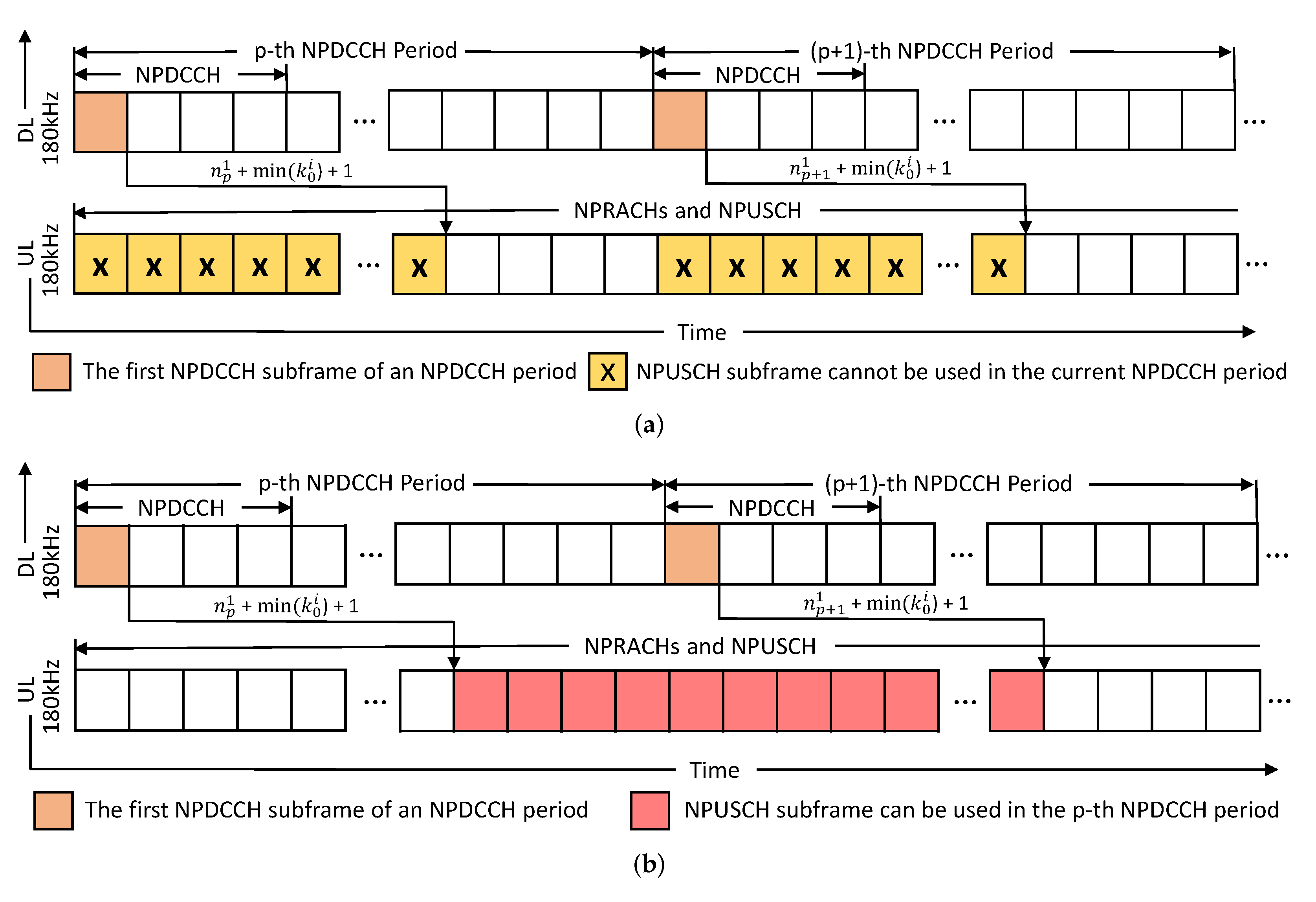
Because the uplink resource allocation should follow the NB-IoT protocol, as shown in Equation (1), we found that some subframes cannot be used by the current NP as shown in Figure 3a. Specifically, the first applicable NPUSCH subframe in an NP is n p 1 + min ( k 0 i ) + 1 , and  n p 1 + min ( k 0 i ) subframes will be wasted in an NP, where min ( k 0 i ) represents the smallest scheduling delay value. The smaller the NP length, the higher is the waste percentage in an NP. To solve this problem, we propose the concept of cross-cycled resource allocation to increase resource utilization. As shown in Figure 3b, a cell can allocate the NPUSCH subframes of the next NP, which cannot be used in the next NP, for a UE without causing wireless interference. If the cell assigns a UE to transmit data using the NPUSCH subframes of the next NP (i.e., the  ( p + 1 ) -th NP), the UE will stop monitoring its NPDCCH search space in the ( p + 1 ) -th NP. Because NB-IoT UEs operate in the half-duplex mode, they cannot simultaneously transmit and receive data.
Figure 3. Concept of cross-cycled resource allocation. (a) some subframes cannot be used by the current NP; (b) a cell can allocate the NPUSCH subframes of the next NP, which cannot be used in the next NP, for a UE without causing wireless interference.

2.2. Problem Formulation

This paper investigates the uplink resource allocation problem considering cross-cycled radio resources in NB-IoT cellular networks. This paper targets the same problem as [12], while [12] does not consider cross-cycled resource allocation. This paper attempts to minimize the consumed subframes while each UE satisfies its data requests. The system model is described as follows:
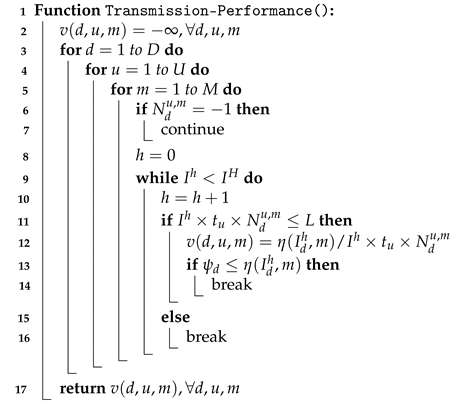
A cell must support D UEs. The number of NPs consumed to satisfy D UEs is denoted as P. In an uplink radio frequency, a subframe has F subcarriers. The frequency space of a subcarrier is W. There are r p s subcarriers occupied by NPRACHs in subframe s in the p-th NP. Device d has an uplink data requirement with data of size ψ d . The cell provides U resource unit types. Unit type u should use f u subcarriers in the frequency domain and t u subframes in the time domain, where f u + 1 > f u . The set of resource unit numbers is I R U = { I 1 , I 2 , . . , I h , . . , I H } in the resource assignment field, where H is the maximum index and I H is the maximum number of resource units. We have M modulation and coding scheme indexes, each of which can refer to a TBS index. The cell can select a data repetition number for a UE to transmit data from the set of repetition numbers N R e p . The cell should choose a repetition number meeting N d u , m N ^ d u , m , N d u , m N R e p to guarantee the predefined transmission reliability via a success probability model (This paper can be applied no matter which success probability model is considered.), where N ^ d u , m is the repetition requirement of UE d using modulation m and unit type u under an SNR value. The calculation of N ^ d u , m values can be found in [12].
When I d h units with type u using modulation m are assigned to UE d, the cell should allocate f u subcarriers during I h × t u × N d u , m continuous NPUSCH subframes to UE d using N d u , m repetitions. The UE can transmit a data size of η ( I h , m ) according to the TBS table. We use an indicator function X p , d u , m = 1 , if the cell decides UE d using unit type u and modulation m in the p-th NP.
The parameter R m a x value is the subframe number for the NPDCCH in an NP, and the parameter G value is the system parameter. The length of an NP is L = R m a x × G . Both R m a x and G values can be used to adjust the NP length for UEs and are given in this paper. This paper considers using the DCI repetition number R = R m a x / 8 to transmit one DCI for each UE. The repetition number used to transmit a DCI should also meet the reliability (i.e., R D ^ d ), where D ^ d is the required DCI repetition number of UE d. Specifically, when a UE needs a higher DCI repetition number, the cell should choose a higher R m a x value to increase the R value. Given the repetition number R, the DCI number is ξ (i.e., ξ = 2 × ( R m a x / R ) ) in an NP, because DCI format N0 occupies one control channel element in an NPDCCH subframe, each of which has two control channel elements. We define DCI p , d c = 1 when DCI c in the p-th NP is assigned for UE d and 0 otherwise.
We define S p s used to represent the subcarriers that have been assigned to UEs in subframe s of the p-th NP. K = { k 0 1 , k 0 2 , , k 0 i , } is the set of scheduling delay values. The objective of our target problem is to decrease the total consumed subframes P × L to support D UEs for the uplink as much as possible. The target problem has the following constraints:
Requirement Constraint: Each UE d should transmit data size ψ d .
p = 1 P I h I R U u = 1 U m = 1 M X p , d u , m η ( I u h , m ) ψ d , d
Bandwidth Constraint: The subcarriers used by the UEs and NPRACHs cannot surpass the total subcarriers at a subframe.
S p s + r p s F , s , p
Signaling Constraint: After UE d receives a DCI in its NPDCCH subframes, the UE can transmit data using uplink subframes.
u = 1 U m = 1 M X p , d u , m = 1 , p , d
c = 1 ξ DCI p , d c = 1 , p , d
The objective of this paper is formulated as:
minimize X p , d u , m , DCI p , d c , S p s , I d h P × L
with constraints (2)–(5). The notations are listed in Table 1.
Table 1. Notations.

4. Performance Evaluation

4.1. Simulation Setups

The simulation setups are based on 3GPP specifications [1,14]. We compare the performance of the proposed algorithm (cross-NP uplink resource allocation (CNPURA)) with two baselines. The first baseline is the link adaptation and uplink resource allocation (LAURA) algorithm [12]. The LAURA algorithm first uses a dynamic programming algorithm to determine which UEs should be allocated in an NP and decide the used unit type and modulation scheme for each chosen UE without considering NPRACHs. The dynamic programming algorithm can maximize the transmission bits in an NP. Then, LAURA considers NPRACHs to adjust the used unit type, modulation, and allocated uplink radio resources for each scheduled UE. The second baseline is energy saving (ES) [11]. The ES algorithm schedules the UE in order from having the fewest usable combinations of unit types and modulations to the most usable pairs. Then, because the algorithm considers energy efficiency, it picks the unit type with the modulation for the currently scheduled UE requiring the fewest subframes for transmitting data. Because the ES scheme does not consider uplink resource allocation, it adopts the two functions for the uplink resource allocation of the LAURA algorithm to find DCIs and delay values and to decide the resource assignment for each UE.
We use MATLAB to build our simulation. The simulation considers a cell serving UEs varying from 400 to 2000. The transmission power of the cell and each UE are set to 32 and 23 dBm, respectively [11]. The distance φ of each UE from the cell is distributed randomly between [1, 5000] meters, considering only one CE level. The demand of each UE is randomly set from 20 to 200 bytes [8]. Our channel model considers the path loss model as 120.9 + 30.76 log ( θ ) dB, where the unit of θ is kilometers [11]. The thermal noise density is −173 dBm/Hz. There are four types of resource unit. The SNR of each UE can be estimated using the path loss model, unit type, and distance φ of the UE from the cell.
The set of resource unit numbers that can be assigned to a UE in an NP is I R U = { 1 , 2 , 3 , 4 , 5 , 6 , 8 , 10 } [1]. There are 14 modulation and coding scheme indices. The uplink TBS, comprising the adopted modulation-coding scheme index and the assigned resource unit number, is shown in Table 2. The selectable R m a x values are 1, 2, 4, 8, 16, 32, 64, 128, 256, 512, 1024, and 2048. The selectable G values are 1.5, 2, 4, 8, 16, 32, 48, and 64. The DCI repetition number is set as R m a x / 8 for all the UEs. The scheduling delay values for the uplink are 8, 16, 32, and 64. The repetition number for a UE to deliver data can be chosen from: 1, 2, 4, 8, 16, 32, 64, or 128 [1]. The selected R m a x and G values should satisfy the DCI and data repetition requirements of all UEs. In the simulation, we consider three different NPRACHs configured according to [12].
Table 2. TBS table for NPUSCH, η ( I h , m ) .

4.2. Simulation Results

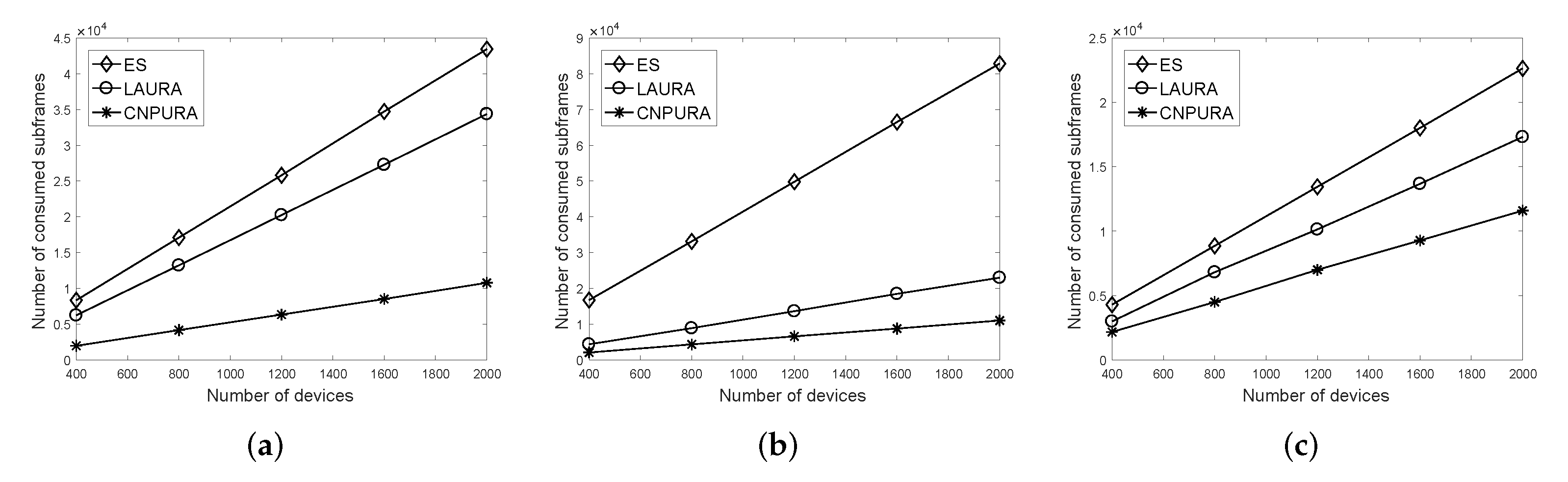
Figure 4 shows the effect of adjusting the number of UEs on the consumption of subframes under the three combinations of R m a x and G values. Because more UEs will have more data requirements, the consumption of NPUSCH subframes also increases as the number of UEs increases. Compared with the three different combinations of R m a x and G values, the performance improvement of the proposed CNPURA is more evident under R m a x = 8 and G = 2 . When the NP length is shorter, a higher percentage of subframes in an NP (i.e., R m a x R m a x × G %) cannot be used under the ES and LAURA algorithms. CNPURA can efficiently use the NPUSCH subframes of the next NP to increase the subframe utilization, especially when more NPUSCH start subframes reside in the next NP. The proposed algorithm can respectively outperform LAURA about 69%, 53%, and 32% in Figure 4a–c, in terms of the consumed subframes. Compared with ES, CNPURA can obviously reduce more subframe consumption.
Figure 4. Effect of the UE numbers on the number of consumed subframes under different R m a x and G values. (a) R m a x = 8 and G = 2 . (b) R m a x = 16 and G = 1.5 . (c) R m a x = 16 and G = 2 .
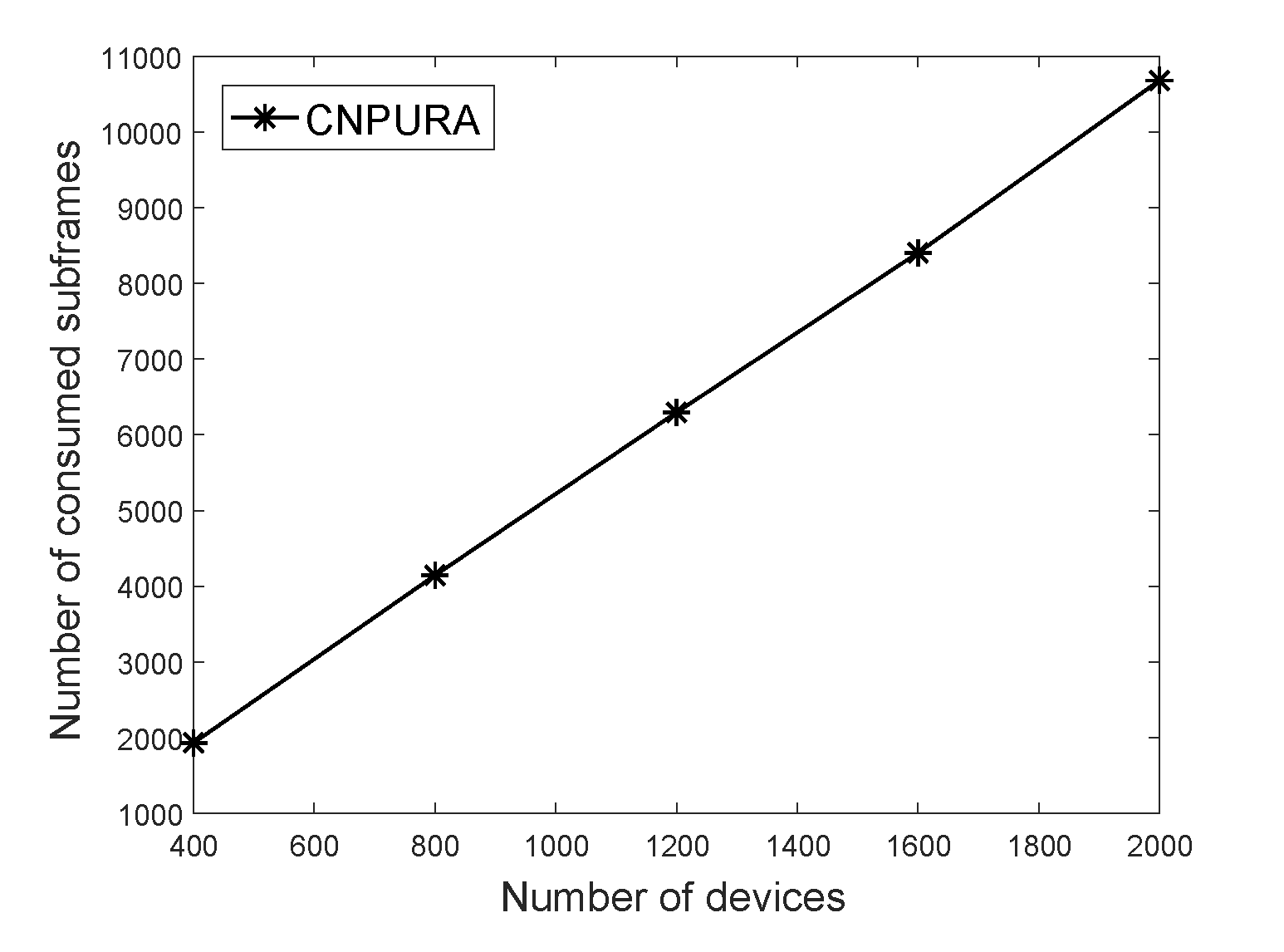
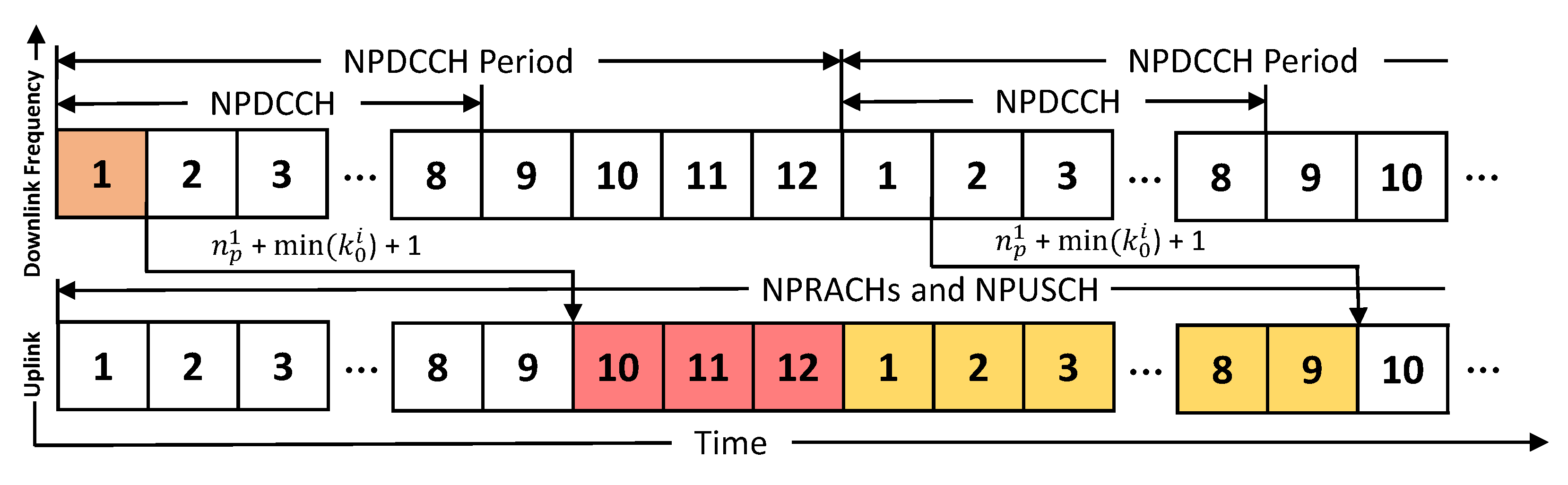
The proposed algorithm not only consumes fewer subframes but can also be adopted for more R m a x and G values. When R m a x = 8 and G = 1.5 , Figure 5 only shows our proposed CNPURA, because the ES and LAURA algorithms are not available in this case while the proposed algorithm is still workable. This is because the two baselines cannot meet the data repetition requirements of all the UEs and are explained in detail in Figure 6.
Figure 5. Effect of the UE numbers on the number of consumed subframes under R m a x = 8 and G = 1.5 .
Figure 6. An illustration for using the subframes of the next NP.
In Figure 6, because the two baselines do not consider cross-cycled resource allocation to use subframes of the next NP, they can only use three subframes (i.e., subframes 10–12 marked by red color) in an NP, which are not sufficient to satisfy the data repetition requirements of all UEs. By contrast, our proposed algorithm can utilize a total of 12 subframes marked by the red and yellow colors, where subframes 1–9 cannot be used by the next NP limited to the NB-IoT resource allocation protocol. Therefore, the proposed algorithm can be flexibly applied for more R m a x and G values, especially for smaller R m a x and G values. Resource allocation algorithms operating under smaller R m a x and G values generally can consume fewer subframes. The number of consumed subframes in Figure 5 is slightly lower than that in Figure 4a.
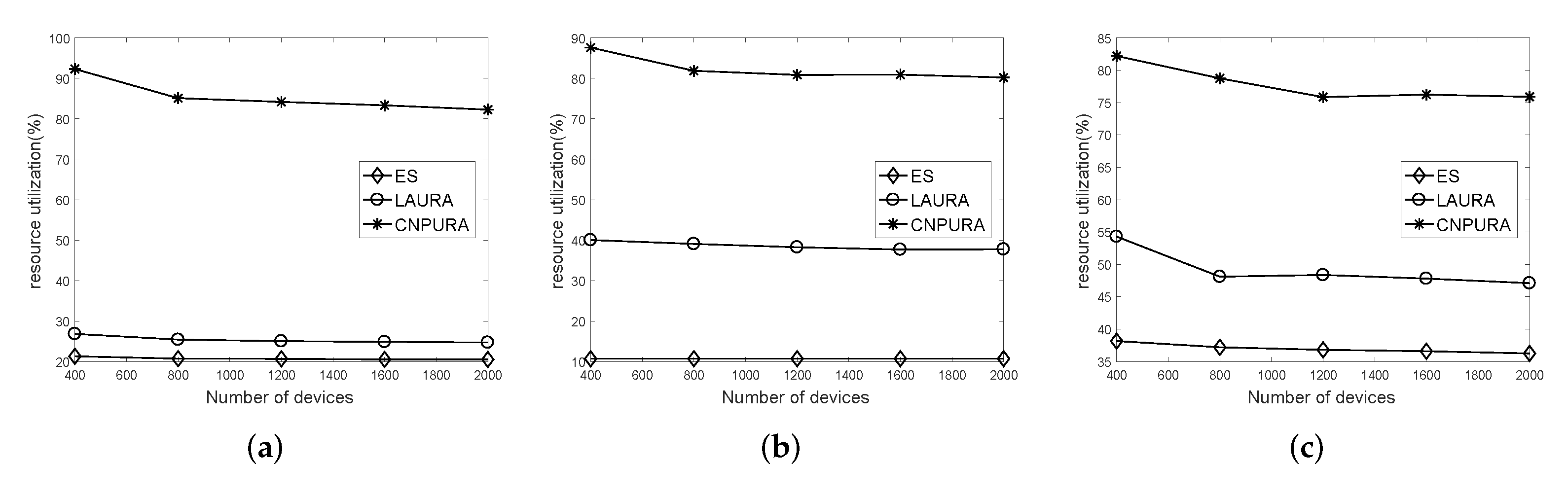
Figure 7 shows the impacts of adjusting the number of UEs on the resource utilization under different R m a x and G values. Resource utilization is defined as the number of consumed subcarriers divided by the total number of subcarriers. For the three combinations of R m a x and G values, as the number of UEs increases, the resource utilization will slightly decrease because more UEs should compete for the limited radio resources. Figure 7 demonstrates that the proposed algorithm considers cross-cycled resource allocation so that the resource utilization is always higher than 80%, while the resource utilization of the ES and LAURA algorithms is lower than 30%, 40%, and 55% in Figure 7a–c, respectively. The two baselines waste a proportion of the subframes in each NP, resulting in lower resource utilization. Moreover, the waste proportion will be higher when the NP length is shorter.
Figure 7. Effect of UE numbers on the resource utilization under different R m a x and G values. (a) R m a x = 8 and G = 2 . (b) R m a x = 16 and G = 1.5 . (c) R m a x = 16 and G = 2 .
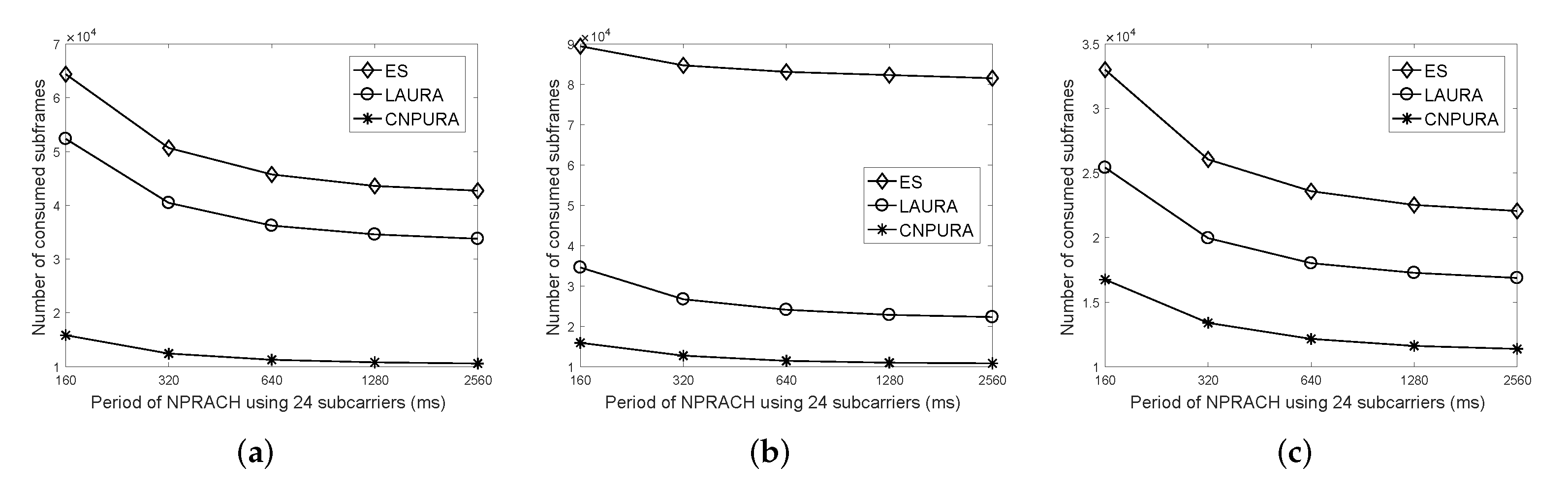
Figure 8 shows the effect of different NPRACH cycles using 24 subcarriers on the subframe consumption under different R m a x and G values with 2000 UEs. When the NPRACH cycle is longer, we have more NPUSCH subframes. Therefore, the three methods can diminish the consumed subframes further. We can observe that the change in NPRACH cycles has a lower impact on the subframe consumption under our proposed algorithm than under LAURA and ES. This is because the proposed algorithm considers NPRACHs to adjust the unit type and modulation scheme and efficiently uses the subframes of the next NP. Therefore, the proposed algorithm can have more choices of unit types and modulation schemes for each UE. By contrast, although LAURA also considers NPRACHs to select the used unit type and modulation scheme for each UE, it only considers using the subframes of the current NP, which limits the selection of unit types and modulation schemes. The simulation results justify our motivation that cross-cycled resource allocation is important for achieving massive connections and for increasing resource utilization, especially for the UEs with better channel qualities.
Figure 8. Effect of the NPRACH periods on the number of consumed subframes under different R m a x and G values with 2000 UEs. (a) R m a x = 8 and G = 2 . (b) R m a x = 16 and G = 1.5 . (c) R m a x = 16 and G = 2 .

5. Conclusions

This paper investigated the cross-cycled uplink resource allocation problem considering the use of radio resources of the next NP over NB-IoT. Our optimization problem minimizes the consumed subframes for satisfying the data requirement of each UE. To overcome this issue, we propose a cross-cycled uplink resource-allocation algorithm. The algorithm considers using the subframes that cannot be used in the next NP without causing interference for some UEs. Moreover, the proposed algorithm considers NPRACHs to adjust the modulation and unit type for each UE according to the remaining subcarriers. The simulation results justify that cross-cycled uplink resource allocation significantly increases resource utilization and is essential for NB-IoT, especially for UEs with high channel qualities. Compared with the two baselines, the proposed algorithm can not only be applied for a higher number of R m a x and G values but can also significantly decrease the consumed subframes. The performance improvement is more evident as R m a x and G values become small.

Author Contributions

Conceptualization, Y.-J.Y.; methodology, Y.-J.Y. and Y.-H.H.; software, Y.-J.Y. and Y.-H.H.; validation, Y.-J.Y., Y.-H.H., and Y.-Y.S.; formal analysis, Y.-J.Y.; investigation, Y.-J.Y. and Y.-H.H.; resources, Y.-J.Y.; data curation, Y.-H.H.; writing—original draft preparation, Y.-J.Y. and Y.-Y.S.; writing—review and editing, Y.-J.Y. and Y.-Y.S.; visualization, Y.-J.Y.; supervision, Y.-J.Y.; project administration, Y.-J.Y. and Y.-Y.S.; funding acquisition, Y.-J.Y. and Y.-Y.S. All authors have read and agreed to the published version of the manuscript.

Funding

The work of Y.-J.Y. was supported by Ministry of Science and Technology, Taiwan, under Grant 110-2221-E-390-010-MY3. The work of Y.-Y.S. was supported in part by Ministry of Science and Technology under Grants 109-2222-E-194-003-MY3, by AIM-HI of National Chung Cheng University, by MOXA, and by Qualcomm.

Institutional Review Board Statement

Not applicable.

Data Availability Statement

The data used to support the findings of this paper are available upon request.

Conflicts of Interest

The authors declare no conflict of interest.

Abbreviations

The following abbreviations are used in this manuscript:
NB-IoTNarrowband Internet of Things
NPUSCHNarrowband physical uplink shared channel
UEUser equipment
NPDCCHNarrowband physical downlink control channel
NPDSCHNarrowband physical downlink shared channel
DCIDownlink control indicator
3GPP3rd generation partnership project
NPNPDCCH period
DLDownlink frequency
ULUplink frequency
CECoverage enhancement
NPRACHNarrowband physical random access channel
OFDMAOrthogonal frequency division multiple access
SNRSignal-to-noise ratio
TBSTransport block size

References

  1. 3GPP TS 36.213 V16.0.0 Technical Specification Group Radio Access Network; Evolved Universal Terrestrial Radio Access (E-UTRA); Physical layer procedures. Available online: https://portal.3gpp.org/desktopmodules/Specifications/SpecificationDetails.aspx?specificationId=2427 (accessed on 18 November 2021).
  2. Cisco. Cisco Visual Networking Index: Global Mobile Data Traffic Forecast Update, 2018–2023. 2020. Available online: http://www.cisco.com/ (accessed on 18 November 2021).
  3. Ericsson. Ericsson Mobility Report. 2020. Available online: https://www.ericsson.com/en/mobility-report/reports (accessed on 18 November 2021).
  4. Yu, C.; Yu, L.; Wu, Y.; He, Y.; Lu, Q. Uplink Scheduling and Link Adaptation for Narrowband Internet of Things Systems. IEEE Access 2017, 5, 1724–1734. [Google Scholar] [CrossRef]
  5. Elgarhy, O.; Reggiani, L.; Malik, H.; Alam, M.M.; Imran, M.A. Rate-Latency Optimization for NB-IoT With Adaptive Resource Unit Configuration in Uplink Transmission. IEEE Syst. J. 2021, 15, 265–276. [Google Scholar] [CrossRef]
  6. Hsieh, B.Z.; Chao, Y.H.; Cheng, R.G.; Nikaein, N. Design of a UE-specific Uplink Scheduler for Narrowband Internet-of-Things (NB-IoT) Systems. In Proceedings of the IEEE International Conference on Intelligent Green Building and Smart Grid (IGBSG), Yilan, Taiwan, 22–25 April 2018; pp. 1–5. [Google Scholar]
  7. Mostafa, A.E.; Zhou, Y.; Wong, V.W. Connection Density Maximization of Narrowband IoT Systems With NOMA. IEEE Trans. Wirel. Commun. 2019, 18, 4078–4722. [Google Scholar] [CrossRef]
  8. Huang, C.W.; Tseng, S.C.; Lin, P.; Kawamoto, Y. Radio Resource Scheduling for Narrowband Internet of Things Systems: A Performance Study. IEEE Netw. 2019, 33, 108–115. [Google Scholar] [CrossRef]
  9. Pei, E.; Wang, Z.; Li, Y. An Adaptive Uplink Resource Allocation Algorithm in NB-IoT. In Proceedings of the IEEE Vehicular Technology Conference (VTC2021-Spring), Helsinki, Finland, 25–28 April 2021; pp. 1–6. [Google Scholar]
  10. Kodheli, O.; Maturo, N.; Chatzinotas, S.; Andrenacci, S.; Zimmer, F. NB-IoT via LEO Satellites: An Efficient Resource Allocation Strategy for Uplink Data Transmission. IEEE Internet Things J. 2021. [Google Scholar] [CrossRef]
  11. Liang, J.M.; Wu, K.R.; Chen, J.J.; Liu, P.Y.; Tseng, Y.C. Energy-Efficient Uplink Resource Units Scheduling for Ultra-Reliable Communications in NB-IoT Networks. Wirel. Commun. Mob. Comput. 2018, 2018, 4079017. [Google Scholar] [CrossRef] [Green Version]
  12. Yu, Y.J.; Wang, J.K. NPRACH-Aware Link Adaptation and Uplink Resource Allocation in NB-IoT Cellular Networks. IEEE Trans. Veh. Technol. 2021, 70, 4894–4906. [Google Scholar] [CrossRef]
  13. Yu, Y.J. NPDCCH Period Adaptation and Downlink Scheduling for NB-IoT Networks. IEEE Internet Things J. 2021, 8, 962–975. [Google Scholar] [CrossRef]
  14. 3GPP TS 36.331 V16.0.0 Technical Specification Group Radio Access Network; Evolved Universal Terrestrial Radio Access (E-UTRA); Radio Resource Control (RRC); Protocol specification. Available online: https://portal.3gpp.org/desktopmodules/Specifications/SpecificationDetails.aspx?specificationId=2440 (accessed on 18 November 2021).
Publisher’s Note: MDPI stays neutral with regard to jurisdictional claims in published maps and institutional affiliations.

Article Metrics

Citations

Article Access Statistics

Multiple requests from the same IP address are counted as one view.