You are currently viewing a new version of our website. To view the old version click .
Sensors
  • Article
  • Open Access

30 June 2021

Adaptive Node Clustering for Underwater Sensor Networks
,
,
and
1
Department of Computer Science, Attock Campus, COMSATS University Islamabad, Attock 43600, Pakistan
2
Department of Software, Sejong University, Seoul 05006, Korea
*
Authors to whom correspondence should be addressed.
This article belongs to the Section Physical Sensors

Abstract

Monitoring of an underwater environment and communication is essential for many applications, such as sea habitat monitoring, offshore investigation and mineral exploration, but due to underwater current, low bandwidth, high water pressure, propagation delay and error probability, underwater communication is challenging. In this paper, we proposed a sensor node clustering technique for UWSNs named as adaptive node clustering technique (ANC-UWSNs). It uses a dragonfly optimization (DFO) algorithm for selecting ideal measure of clusters needed for routing. The DFO algorithm is inspired by the swarming behavior of dragons. The proposed methodology correlates with other algorithms, for example the ant colony optimizer (ACO), comprehensive learning particle swarm optimizer (CLPSO), gray wolf optimizer (GWO) and moth flame optimizer (MFO). Grid size, transmission range and nodes density are used in a performance matrix, which varies during simulation. Results show that DFO outperform the other algorithms. It produces a higher optimized number of clusters as compared to other algorithms and hence optimizes overall routing and increases the life span of a network.

1. Introduction

A large part of Earth is covered with oceans [1]. Oceans have large populations of animals and other creatures. They are the main source of food, transport and other resources for many creatures on earth. With the progression of society and economy, increasingly individuals have begun to focus on marine conditions. Marine condition frameworks are especially presented with the impacts of human activities linked to industry and urban advancement tourism [2,3]. In the early days of oceanic exploration, human beings interests in this research were very limited due to harsh environment of oceans e.g., large areas and high water pressure, oceanic research unmanned investigation. In 20th century wireless sensor networks become very popular in research area. Initially WSNs was only used in terrestrial environments. With the passage of time, new progression in the technology of the oceanic modem made wireless sensor networks applicable in underwater environments [4]. In this environment, deployment and management of WSNs is more difficult as compared to land-based environments. Monitoring of an underwater environment and communication is essential for many applications. The scope of these applications ranges from observing climate, underwater environment, marine ecology, natural calamities, navigation, and transmission of images to remote side on land, offshore investigation, surveillance and other military applications [5,6,7,8,9].
Wireless Sensor Networks (WSNs) have been reflected as feasibly favorable alternates for observing oceanic environs due to their easy positioning, immediate monitoring, and fairly low cost. Underwater sensor networks consist of two sections, sensor nodes and data collecting stations known as sink. Sensor nodes can track and sense physical parameters and send data to a base station using wireless communication technologies [10]. Generally, radio frequency waves are most commonly used for communication in wireless sensor networks (WSN), but due to high signal attenuation and the short distance range of radio frequency waves, these are not recommended to use in underwater sensor network for communication. There is need of designing new routing protocols for underwater communication. Various approaches for underwater communication are proposed for example, underwater acoustic communication (UAC), underwater optical communication (UOC), electromagnetic and magnetic field communication. Other than UAC and UOC, all techniques are on research laboratory authentication phase. Drawback of optical communication is scattering of signals. So UAC method is most commonly used now days. Oceanic signals range is up to few kilo meters in underwater environment [11]. As compared to terrestrial environment, water environment is very complex and changeable, so ocean monitoring is very difficult. Underwater sensor network (UWSN) is Ad-Hoc network responsible for underwater communication. Underwater sensor network contain nodes with marine on board modems and limited amount of surface stations. Sensor nodes can send and receive data between source and destination. Sensor nodes perform three main tasks, monitor data, process data and receive data. These nodes are of different types to sense and monitor different physical or chemical parameters in underwater environments and send the collected data to the central location.
Early routing protocols were designed for specific layers e.g., protocols designed for network layer or transport layer. These protocols tailed layered protocol architecture. They did not use joint optimization, energy levels and due to some other causes overall performance is meager, so current research focus to design protocols which can use data received by different layers called cross layered routing protocols.
Considering the above issues, there are some other problems which make underwater communication challenging. One such issue is limited bandwidth. It directly affects the transmission rate of a network. Water current and different sources of noise result in limited bandwidth in UWSNs [11]. Propagation delay is another issue which cannot be neglected for efficient routing. Propagation delay of oceanic signals is very high and is 2 × 10⁵ time high than the propagation delay in WSNs [5]. For long distance communication in underwater sensor networks, oceanic waves are used which can travel thousands of kilometers at low frequency and high power [11]. Underwater network faces a high bit error rate and loss of connectivity due to multipath interference of oceanic channels [5]. Due to the multipath effect, noise, water temperature and Doppler spread underwater communication is unreliable. The multipath effect also fade the coming signals. Due to these problems, routing has become challenging and costly in UWSNs [12].
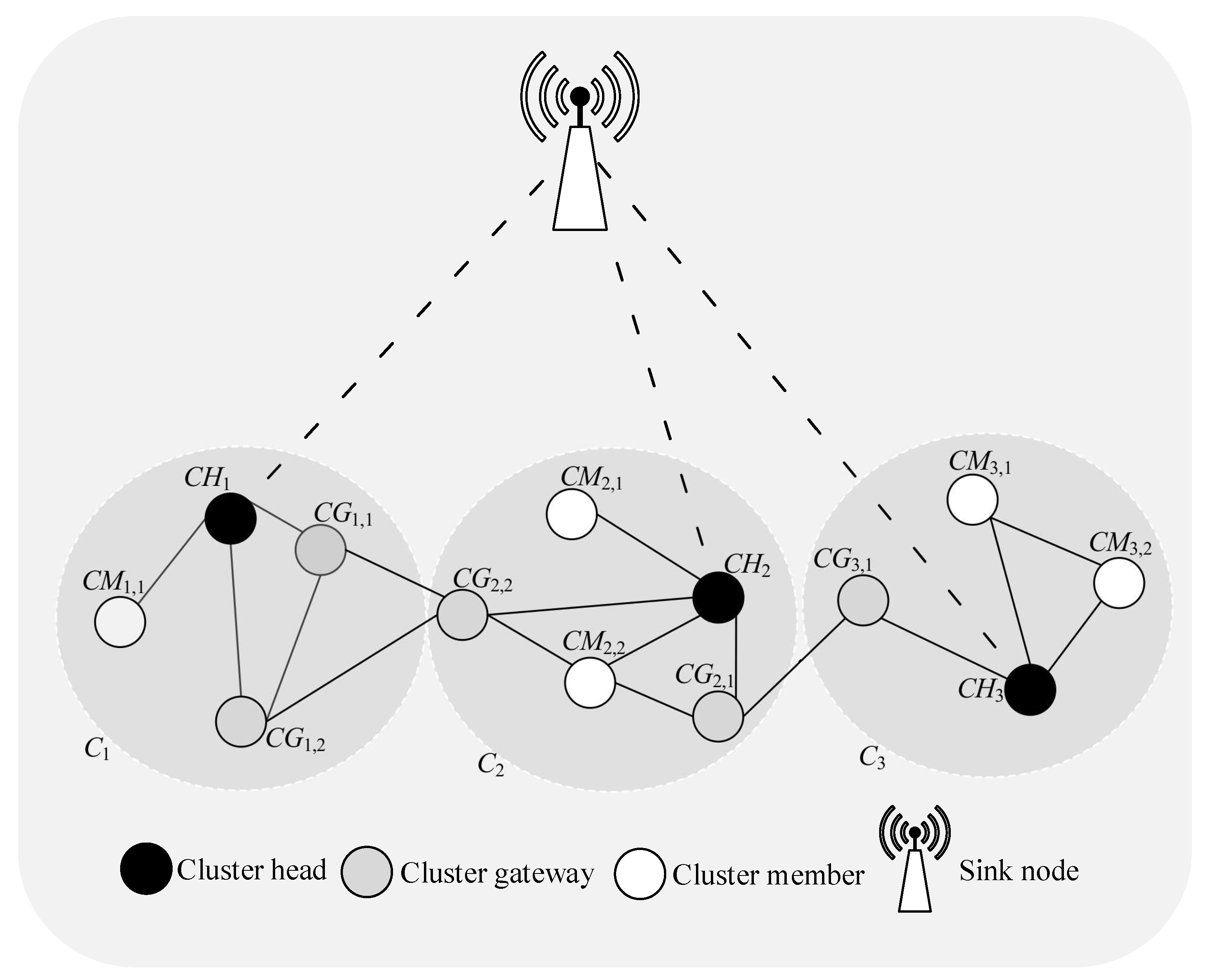
To address the above listed problems, an effective routing protocol must be created. The proposed technique will split UWSN into clusters and provide dynamic cluster head selection system in Figure 1. Clustering means, rally of sensor nodes into logical sets. These nodes sense data and send to the base station. One node is chosen as cluster head and remaining nodes in the relay are called member nodes. All inter- and intra-communication of cluster is done by cluster head. Cluster head selection will depend upon remaining energy of nodes. When cluster head energy is less than a certain value then a new CH will be selected [13]. The proposed protocol based on the dragon fly optimization algorithm (DFO). Dragon fly optimizer is an evolutionary based optimizer which creates optimized number of clusters and hence reduces the number of hops, so life span of the network increases.
Figure 1. Node clustering architecture for underwater sensor networks (UWSNs).
The main contributions of this research are as follows:
  • An evolutionary algorithm will be used for optimization of UWSN’s routing. An evolutionary algorithm is based on the social behavior of many different insects and animals. These algorithms provide optimized routing solutions. They are successfully used in MANET (mobile area network), VANET (vehicle area network) and FANET (flying area network) [14]. In This paper dragon fly optimization (DFO) technique is used for routing optimization to make UWSN more efficient.
  • The results of this paper will be equated with other evolutionary algorithms and outcomes and illustrate that proposed paper shows batter results.
The remaining paper will be divided in following segments. Segment 2 represent related work, segment 3 represent the main notions of dragon fly optimization (DFO), segment 4 discusses proposed methodology, and segment 5 has details of performance evaluation, results, and discussion.

3. Dragonfly Algorithm

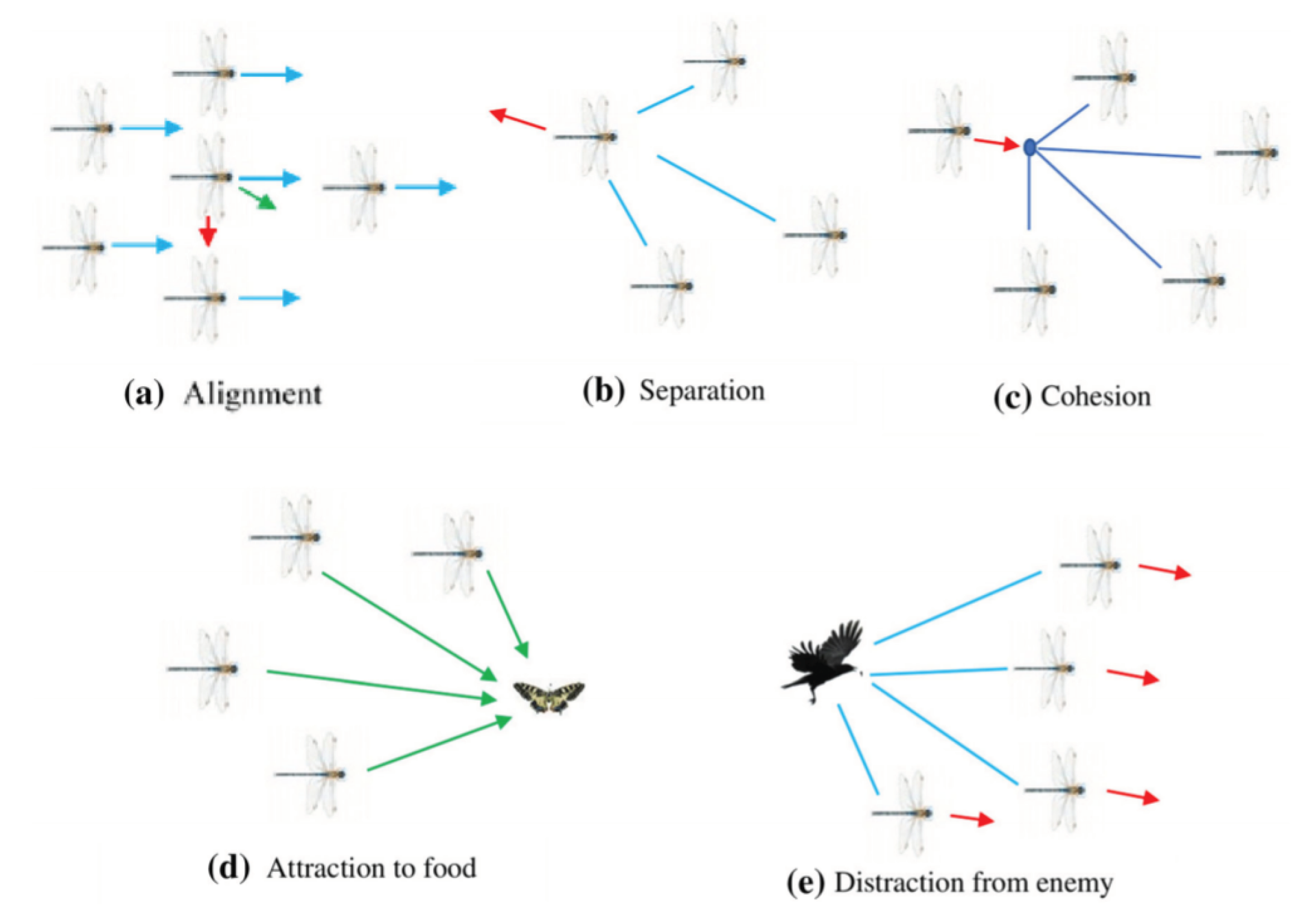
Dragonflies are elegant insects, having almost 3000 different species around the world. In the life cycle of a dragonfly, adults lay eggs in water and from eggs they become nymphs, spend most of the time of their life in this stage and then by metamorphism they become adults. Dragonflies have individual and rare swarming techniques. They have two main swarming techniques; static (feeding) and dynamic (migratory) swarm. Dragons make small clusters for food hunting in static swarm while in dynamic swarm large groups of dragons migrate over long distance [47]. This algorithm used in many optimization problems in WSNs. In [48] a protocol designed for VANET environment use DFA algorithm for optimized selection of cluster heads efficiently. Similarly in [49] also DFA algorithm used for optimization. The basic motivation of DFA starts with static and dynamic swarming behavior of dragonflies. These swarming behaviors are similar to optimization stages: exploration and exploitation [48,50]. Exploration and exploitation based on five principles as shown in Figure 2.
Figure 2. Primitive corrective patterns between dragonflies in a swarm (different steps of the artificial dragonfly algorithm).
  • Separation: individuals avoid collusion from other localities.
  • Alignment: individual’s speed correspondence with other localities.
  • Cohesion: individual’s tendency towards the central mass of neighborhoods.
  • Attraction towards source: individuals attracted towards food source.
  • Distraction from enemies: individuals distracted from enemies.
Above mentioned factors are utilized for position upgrading of individuals. Equations for these factors are given below.
S = j = 1 N ( P P j )
In Equation (1), S shows separation, P shows current individual position and P j shows jth neighboring individual position and N shows total individuals.
A = j = 1 N ( S j / N )
where S j is velocity of jth individual in Equation (2).
C = [ j = 1 N ( P j / N ) ] P
E n = P + P
F o = P + P
where P and P + are the positions of enemy and food respectively and P is position of current individual in Equations (4) and (5).
For artificial dragonflies, two main vectors will be used to update their position, step vector ( Δ P ) and position vector (P). The framework of DFO depends on PSO working and step vector works same like velocity vector in PSO. Step vector and position vector calculated by given equations respectively.
P T + 1 = P T + Δ P T + 1
Δ P T + 1 = ( s S i + a A i + c C i + e E n i + f F o i ) + w Δ P T
In Equation (7), ( S i ,   A i ,   C i ,   E n i ,   F o ( i ) ) shows separation, alignment, cohesion, distraction from enemy and attraction towards food of ith individual and ( s ,   a ,   c ,   e ,   f ) are weights respectively, w is the weight step vector at time (T), T shows the current iteration. In the enhancement process, altered exploratory and exploitative practices completed for optimization.
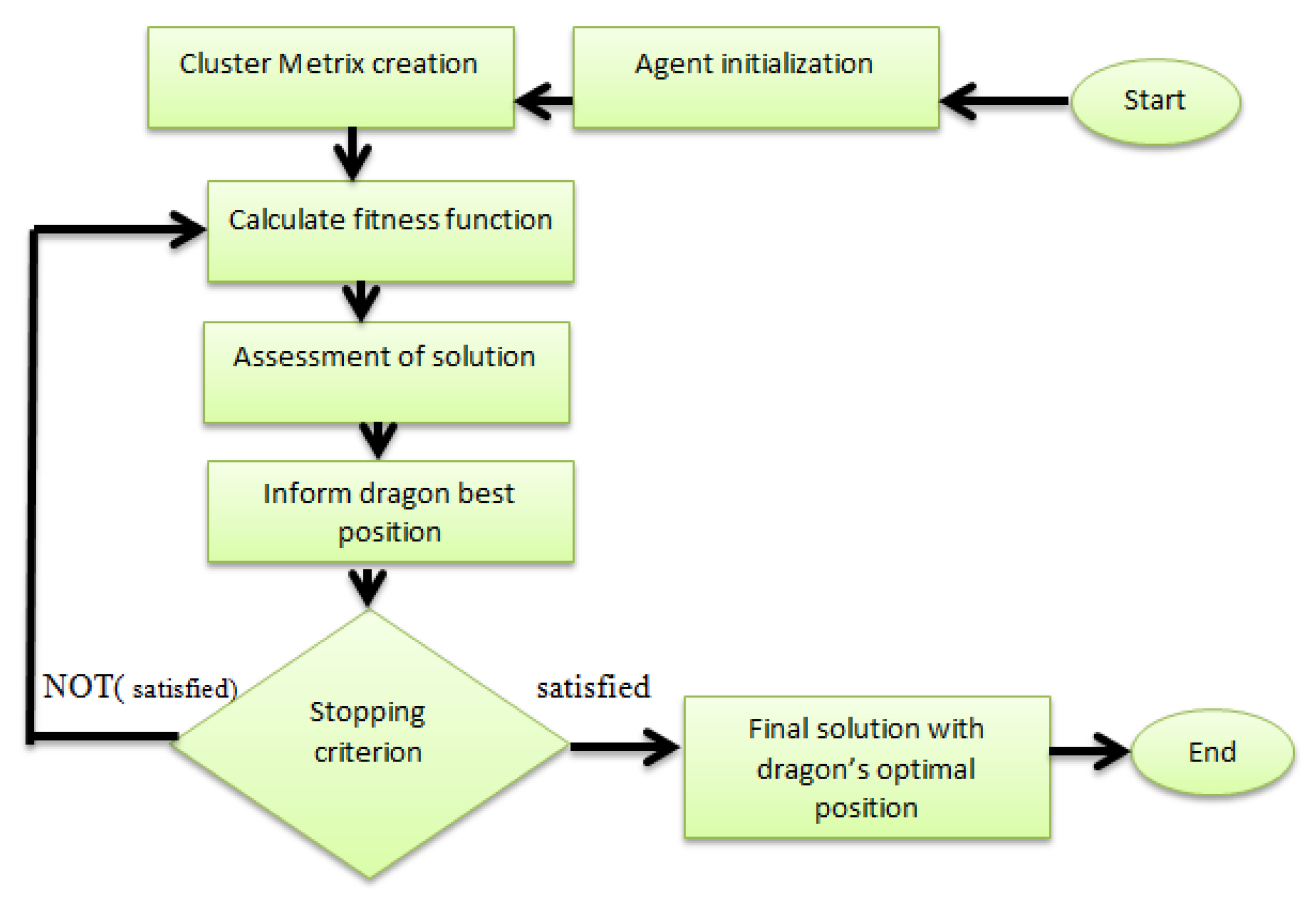
DFO is a population-based optimizer, where dragons display sensor nodes in UWSNs and with the help of dragon position, a matrix of MN can be created; M shows dragon’s number and N shows total variables. An additional array is formed to hold dragon fitness values known as dragon array. This fitness value is calculated by the fitness function for each dragon. Dragons are the agents move in the search space and in the each iteration, position vector provide best position to these dragons. In this way, a DFO algorithm provides the best optimal solution in a heuristic way.
A flow diagram of DFO is shown in Figure 3. In the initialization time, dragonflies in the MN dimensional space have an arbitrary position and fitness values of each dragonfly stored in the dragon array. Correspondingly position matrix and position array is also created. The best value of dragons is stored in the position matrix so far. The dragonflies move in the search space until the solution reaches its optimal state and then search operation is completed. At the end dragonfly’s best position is updated. A similar procedure is used repetitively, till optimum location for each dragonfly is attained.
Figure 3. Flowchart of dragonfly (DF) algorithm.

4. Proposed Methodology

In [46], a DFO algorithm is used in a clustering-based optimization technique designed for a VANET environment. In the proposed paper, we use the same algorithm for underwater sensor networks (UWSNs). Due to the evolutionary capabilities of this solution and good result in a VANET environment, we use this algorithm in UWSNs for finding optimal number of clusters. We have created M × N grid of sensors in a geographical region. In a Mesh network, all sensor nodes are provided with appropriate IDs and these sensor nodes are considered as dragons. A search space is created on the basis of these dragonflies. Distance between all nodes is calculated by euclidean distance and stored in a matrix. The search space based on dimensions, lower bond and upper bound parameters. Fitness of all dragonflies is calculated by using their positions in the search space. Fitness values of all dragonflies are stored in the fitness matrix. As this process is iterative so in each iteration calculated values of fitness stored in matrix and this matrix give dragonflies lower fitness values. By combining dragon fitness and position values, a best score is calculated and on the basis of this score, the positions of dragonflies are updated. So this converge to optimal solution by using a decreasing factor and we get optimum clusters necessary to communicate effectively depending on assumed parameters. The algorithm of proposed protocol is shown in Figure 3. After cluster formation, the next phase is CH selection. For this purpose, the following parameters are used; density of nodes, transmission range of nodes, grid size. All these parameters were assigned weights in fitness function. A fitness function is calculated to find the best possible solution from all the candidates solutions. A fitness function is very significant in the algorithm. By selecting the right cluster head will improve the life span of cluster and potentially contribute to network energy saving. In the proposed algorithm, a fitness value is calculated by the following equation.
F i t n e s s   f u n c t i o n = w 1 × a 1 + w 2 × a 2
where a 1 and a 2 depicts d e l t a d i f f e r e n c e and d i s t a n c e n e i g h b o r , respectively,
In Equation (8), d e l t a d i f f e r e n c e is the difference and d i s t a n c e n e i g h b o r is the average distance of nodes. d e l t a d i f f e r e n c e is used as criterion for load balance. w 1 is the weight allocated to d e l t a d i f f e r e n c e and w 2 is the weight allocated to d i s t a n c e n e i g h b o r . In some situations, all clusters will have equal numbers of nodes, but in a real world scenario, it is not easy due to sensor nodes position changes because of water current and some other influences. d e l t a d i f f e r e n c e is used for measuring the variance from an ideal degree to movement of a node from its neighbors. It is calculated as;
d e l t a d i f f e r e n c e = a b s ( i d e a l d e g n o d e d e g )
Recent work has shown that, due to static CH selection criteria, there is a high probability that one parameter may skew the fitness function and improper CH selection may occur, so in the proposed solution, weights are allotted to all parameters dynamically, on the basis of negative influence on fitness function, reliant on situation. In this process, the first value of each parameter isnormalized between 0 to 10 and then deviation of each parameter is calculated by the equation:
D e v ( p ) = [ m e a n p a r a m e t e r ( p ) ]
The total amount of all weights shall be approximately equal to 1. Each node’s fitness value is determined by using Equation (8), where values of parameters are used and weights assigned to each parameter in the equation.

5. Performance Evaluation, Results and Discussion

5.1. DFO Based Algorithm for UWSNs

The details for the DFO based Algorithm 1 for UWSNs and its algorithm have been discussed in Section 4.
Algorithm 1. Dragon Fly Optimization based algorithm for UWSNs
1:procedure
2:    Install all nodes in 2D net randomly
3:    Set the direction of each node randomly
4:    Set the velocity of each node
5:    Create MESH topology between all nodes
6:    Calculate the distance between nodes and associate these values to edges
7:    Create search space and initialize dragonflies
8:    Initialize C m i n and C m a x
9:    Compute fitness of early swarm
10:       for iterations = 1 to stall iteration (stall iteration is set to 10)
12:           while (Nodes! = empty)
13:             Nodes clustering = All Node
14:          end while
15:           while I ≤ iterations
16:             for 1 to Population size = 100 (Dragonflies)
17:              Standardize distances Amid Search agents
18:              Update Location of current Search Agent
19:              Bring all Agents with in Upper Bound (UB) and lower bound (LB)
20:            end for
18:             Update Best cost
19:             Iteration+1
20:           end while
21:         Best cost
22:       end for
20:end procedure

5.2. Experimental Setup

The experiment was performed using the 2018a edition of MATLAB testing performed on 7th generation, corei5 system with 16 GB RAM. Much experimentation was performed utilizing altered grid size varied from 500 m to 2000 m. Similarly, node density ranging from 20 to 200 is used in the tests and nodes transmission range also change ranging from 25 m to 200 m. Nodes are supposed to stay in fixed locations or move very slowly due to water current. DFO was contrasted with other state of the art evolutionary clustering protocols, which are ant colony optimizer (ACO), comprehensive learning particle swarm optimizer (CLPSO), gray wolf optimizer (GWO) and moth flame optimizer (MFO). All the parameters for simulation are shown in Table 1.
Table 1. Simulation parameters for algorithms.

5.3. Simulation Results and Discussions

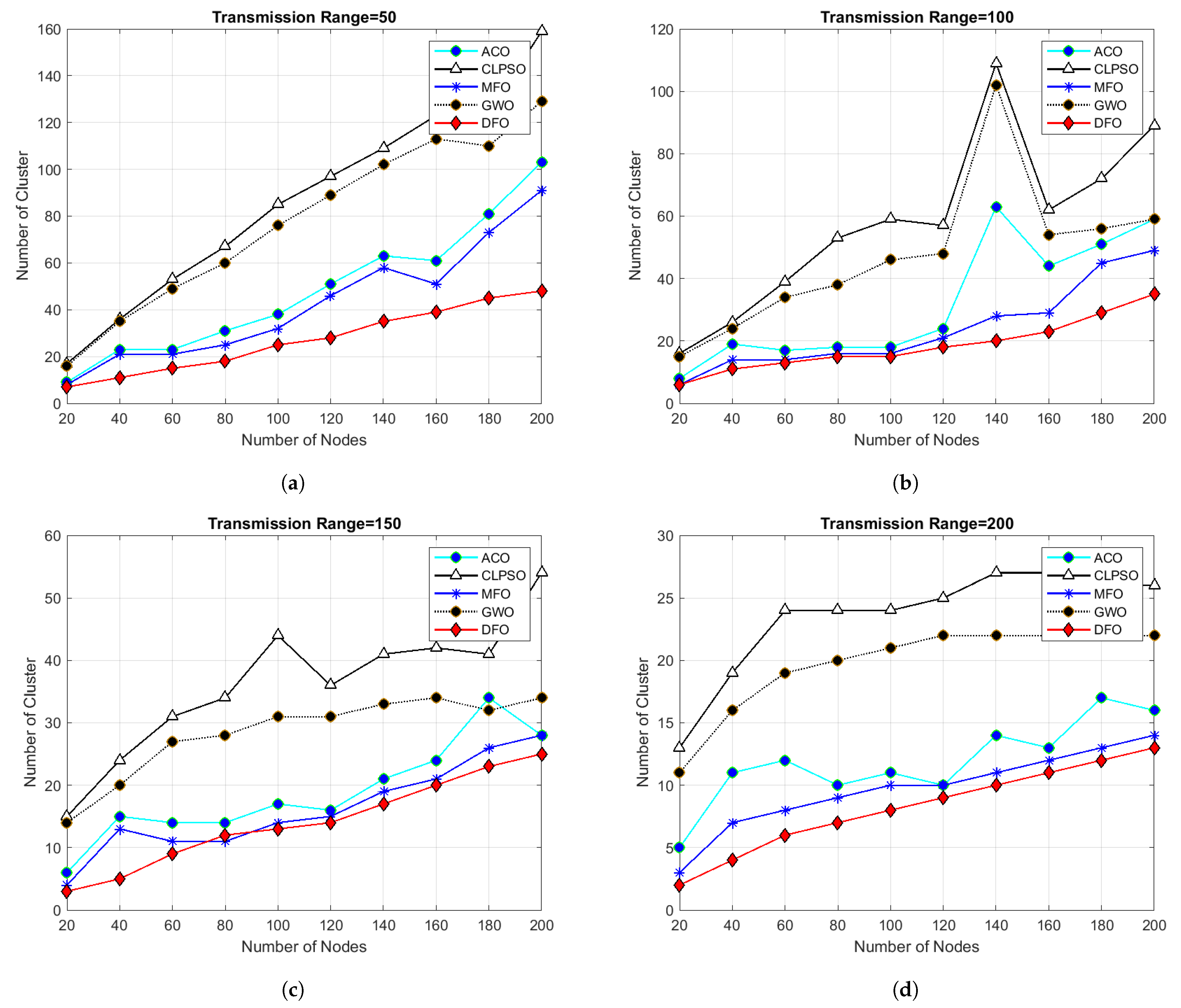
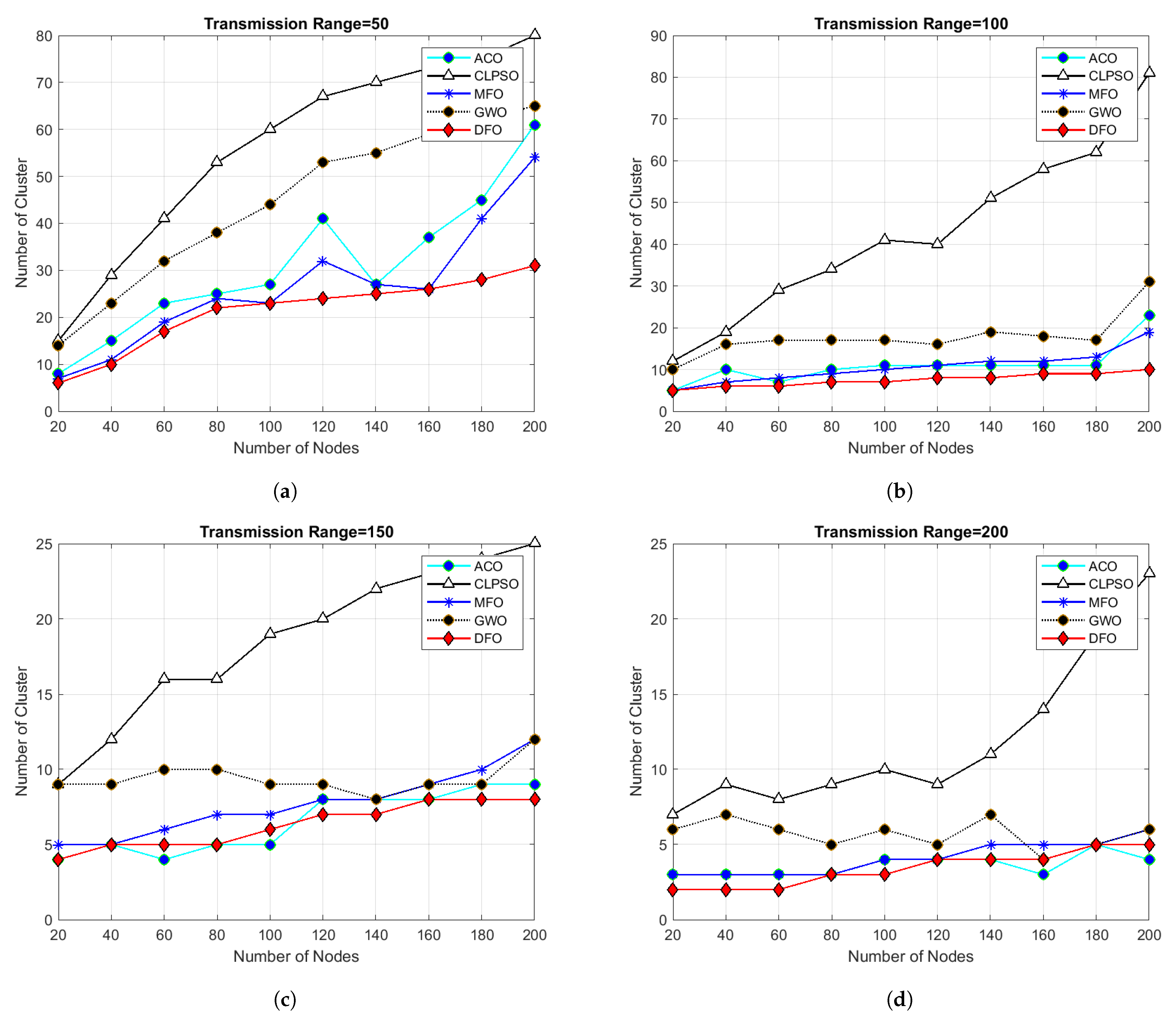
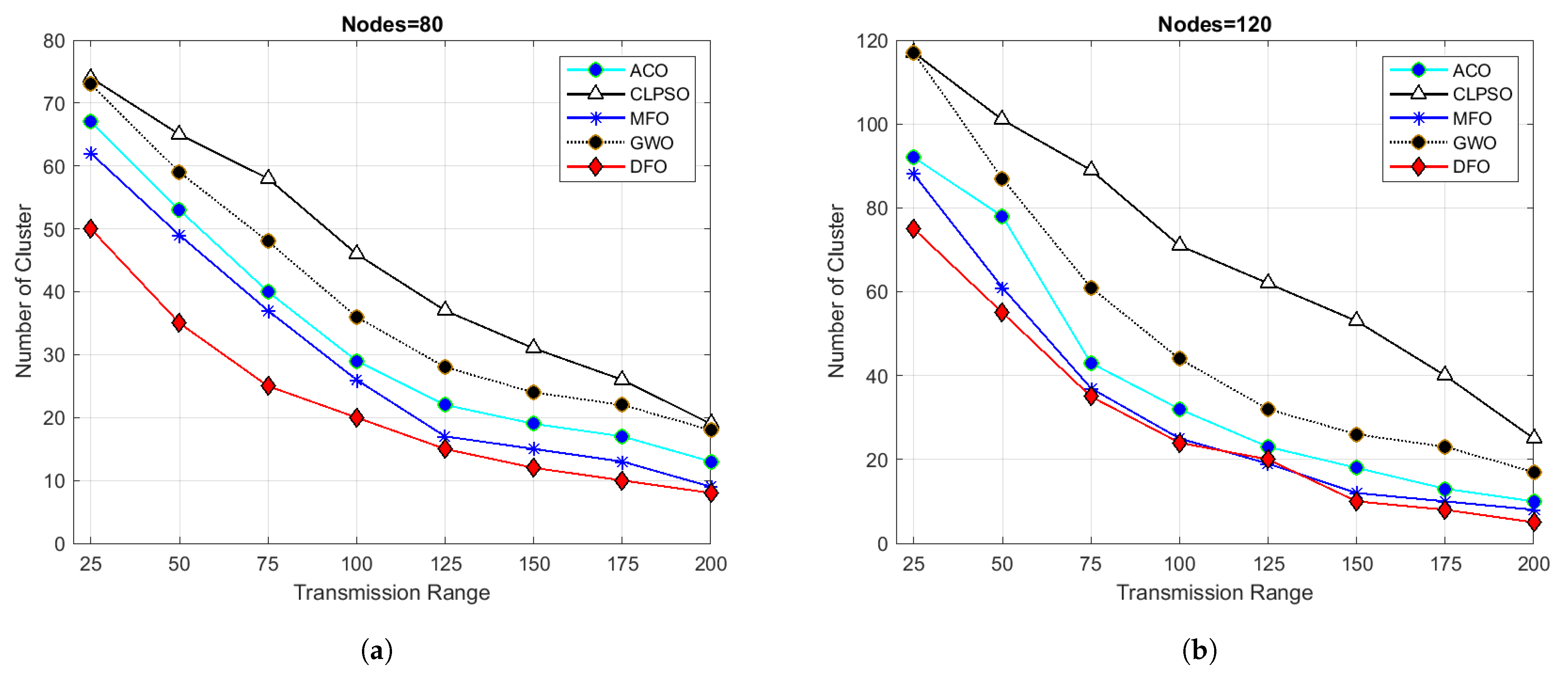
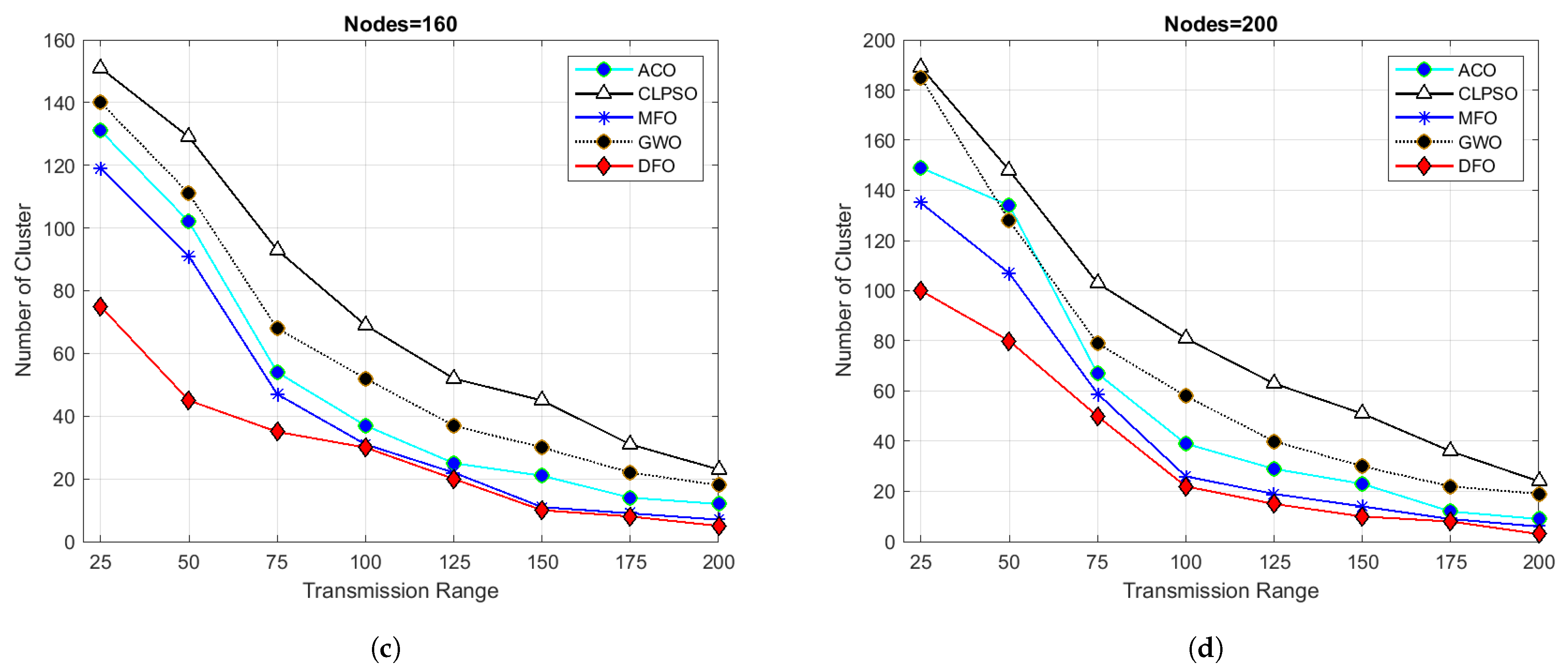
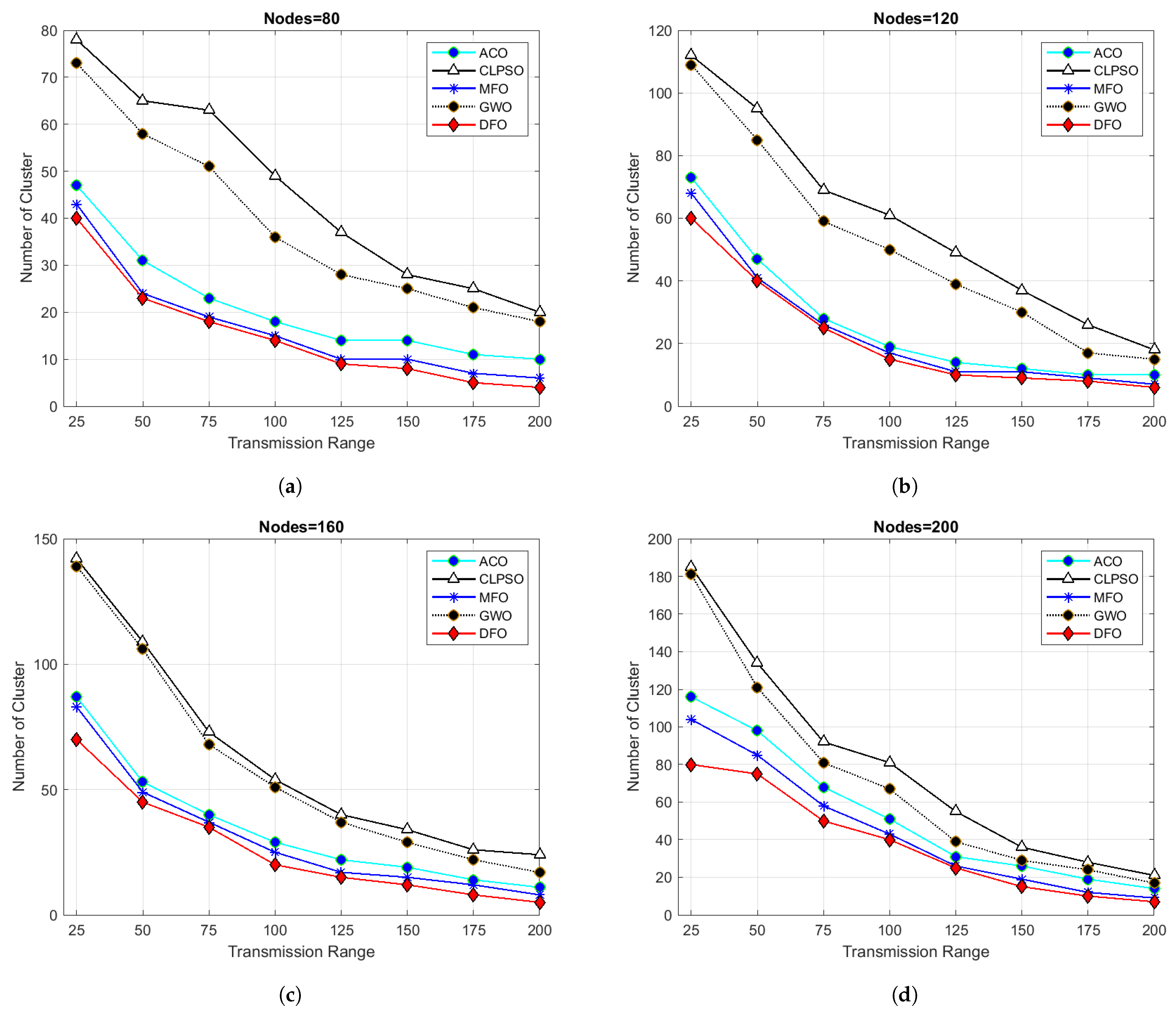
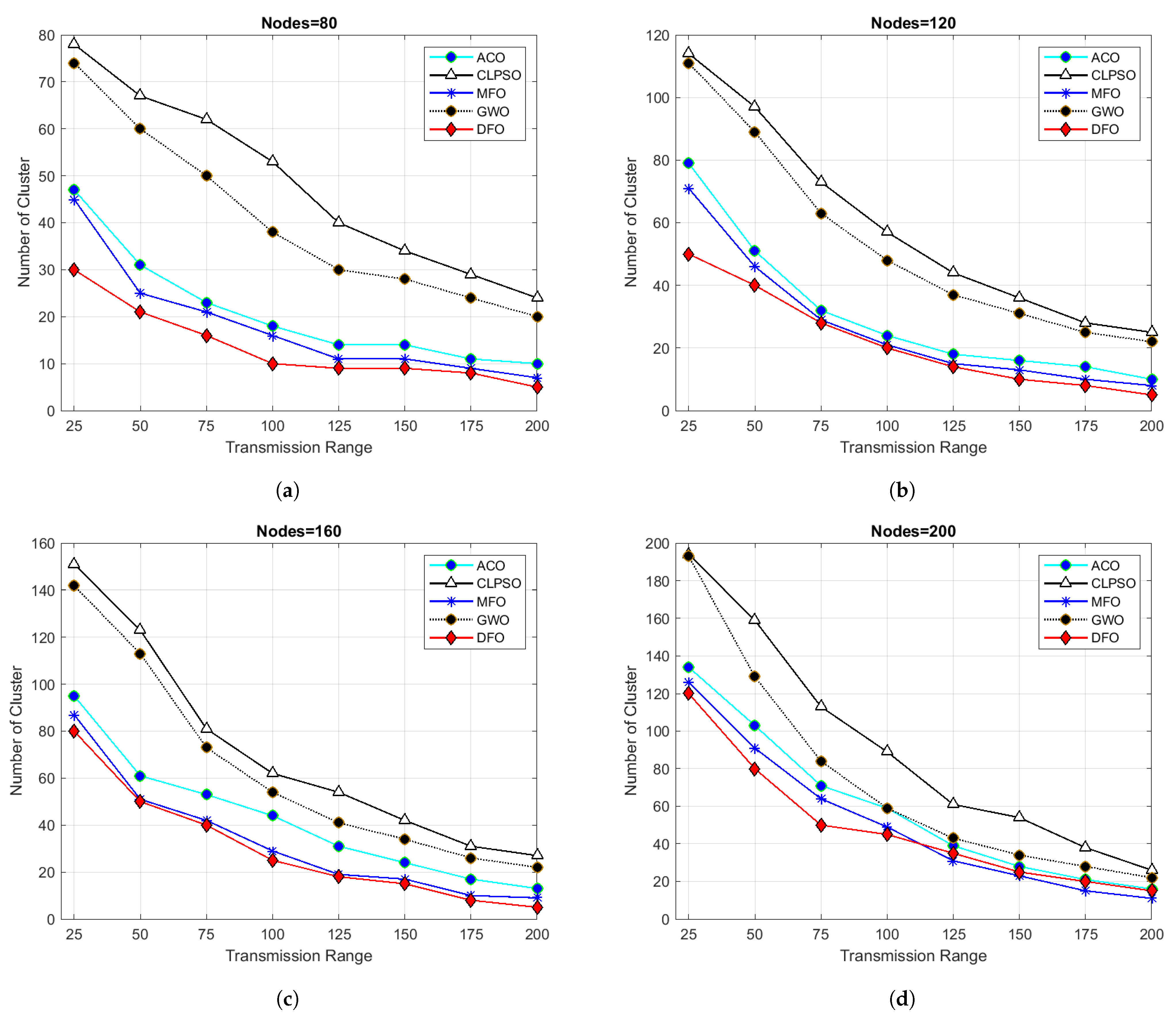
For evaluating the results of all algorithms, 100 simulations were accomplished and results delineated in Figure 4, Figure 5, Figure 6, Figure 7, Figure 8, Figure 9, Figure 10 and Figure 11. Two fundamental parameters, number of nodes and transmission range, were assessed with distinctive values for checking the adequacy of ANC-UWSNs. Consequences demonstrate the suppleness and dominance of ANC-UWSNs over other algorithms.
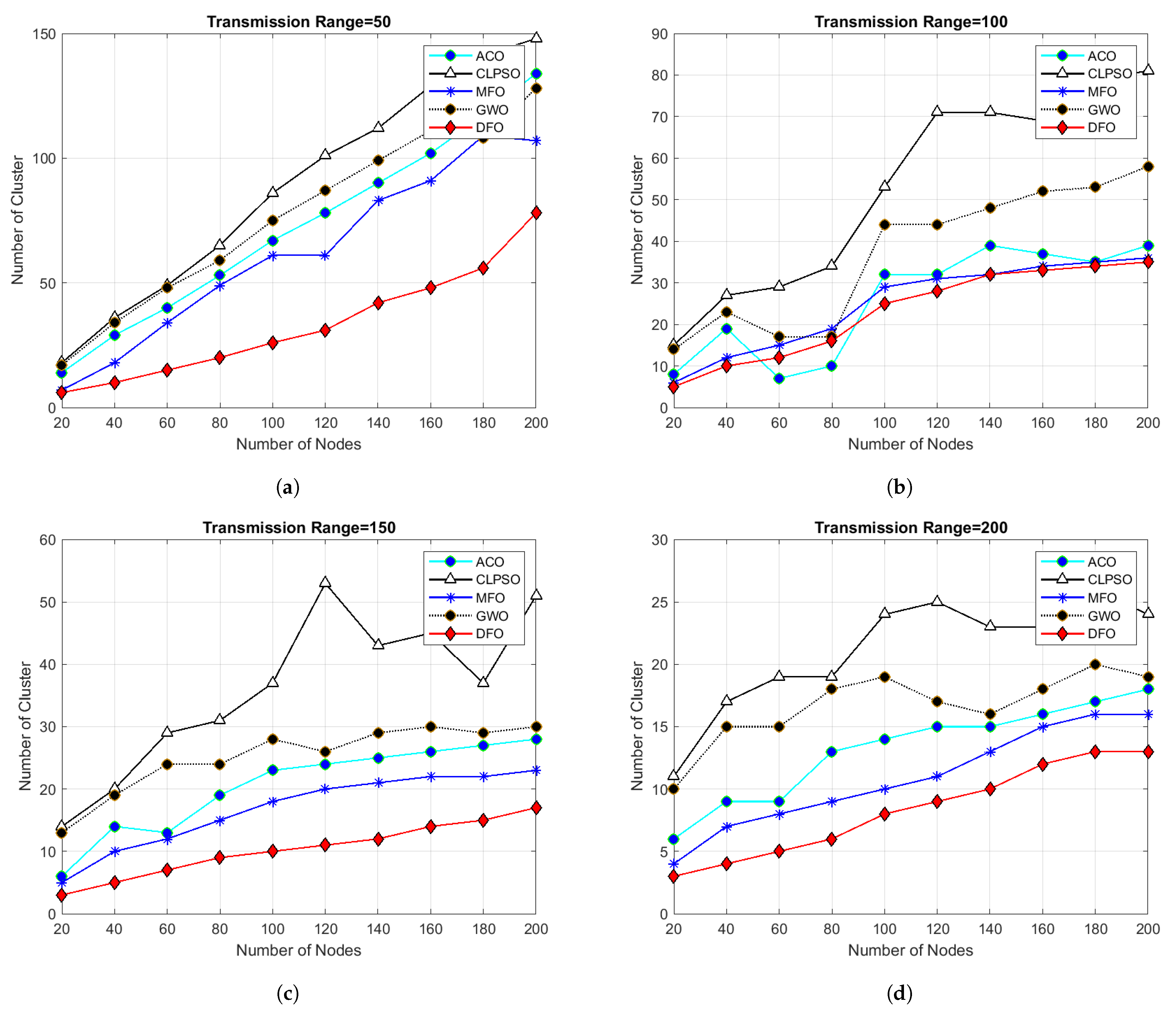
Figure 4. Grid size 500 m × 500 m and number of nodes 20 to 200.
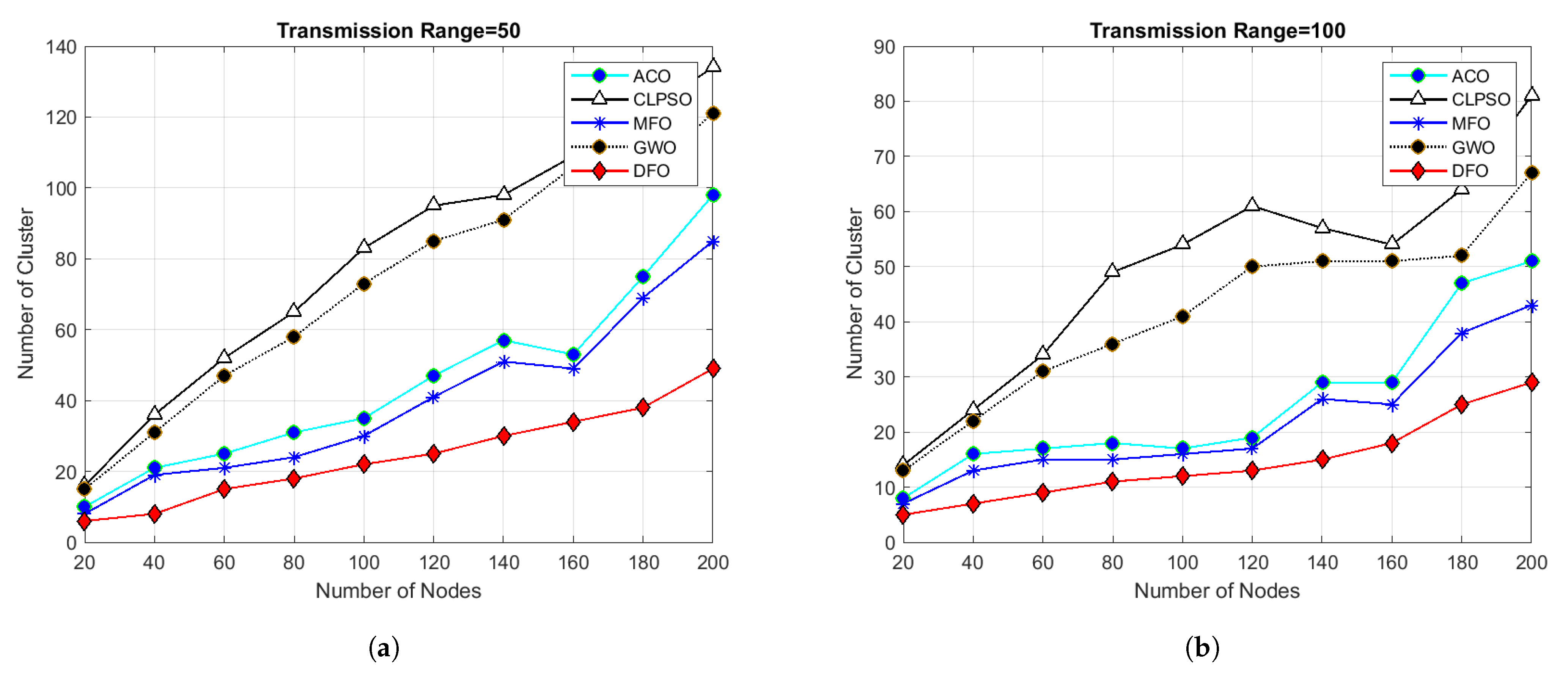
Figure 5. Grid size 1000 m × 1000 m and number of nodes 20 to 200.
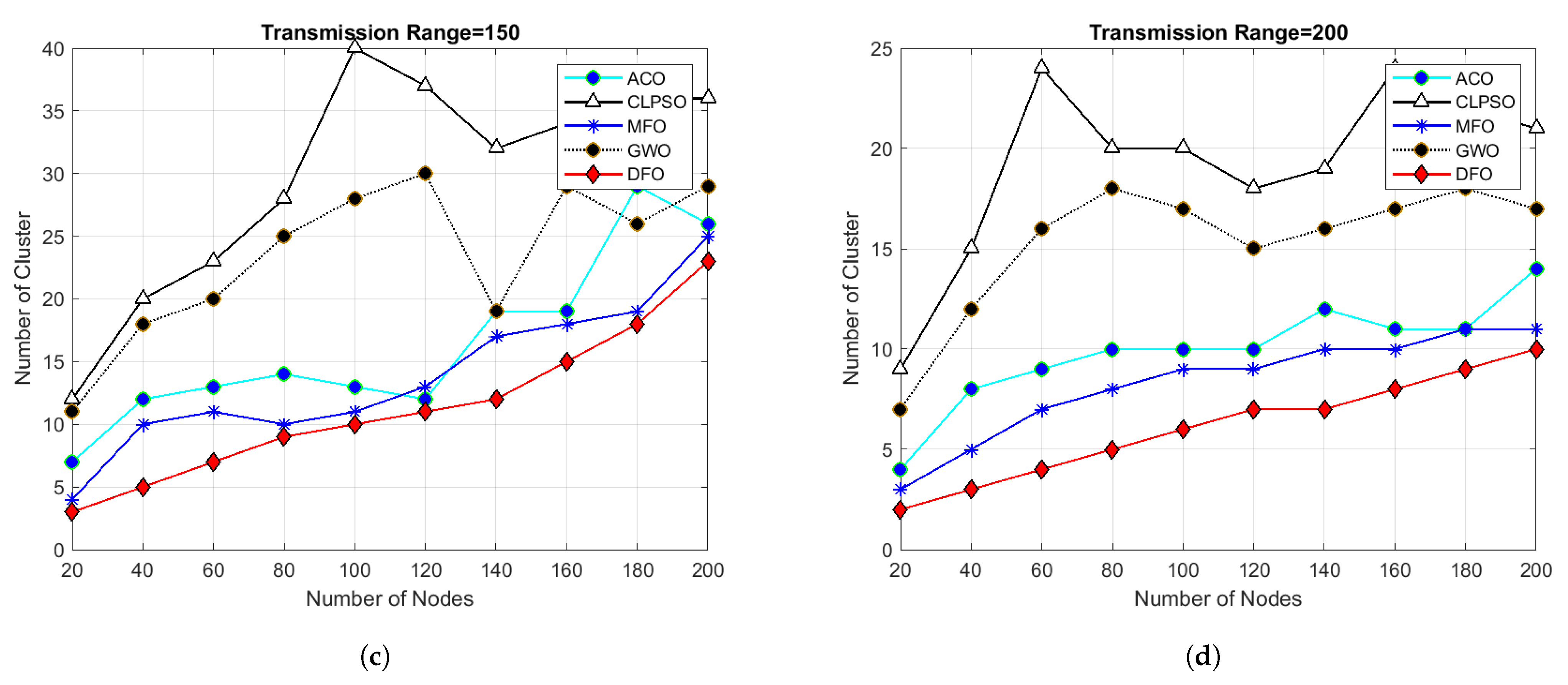
Figure 6. Grid size 1500 m × 1500 m and number of nodes 20 to 200.
Figure 7. Grid size 2000 m × 2000 m and number of nodes 20 to 200.
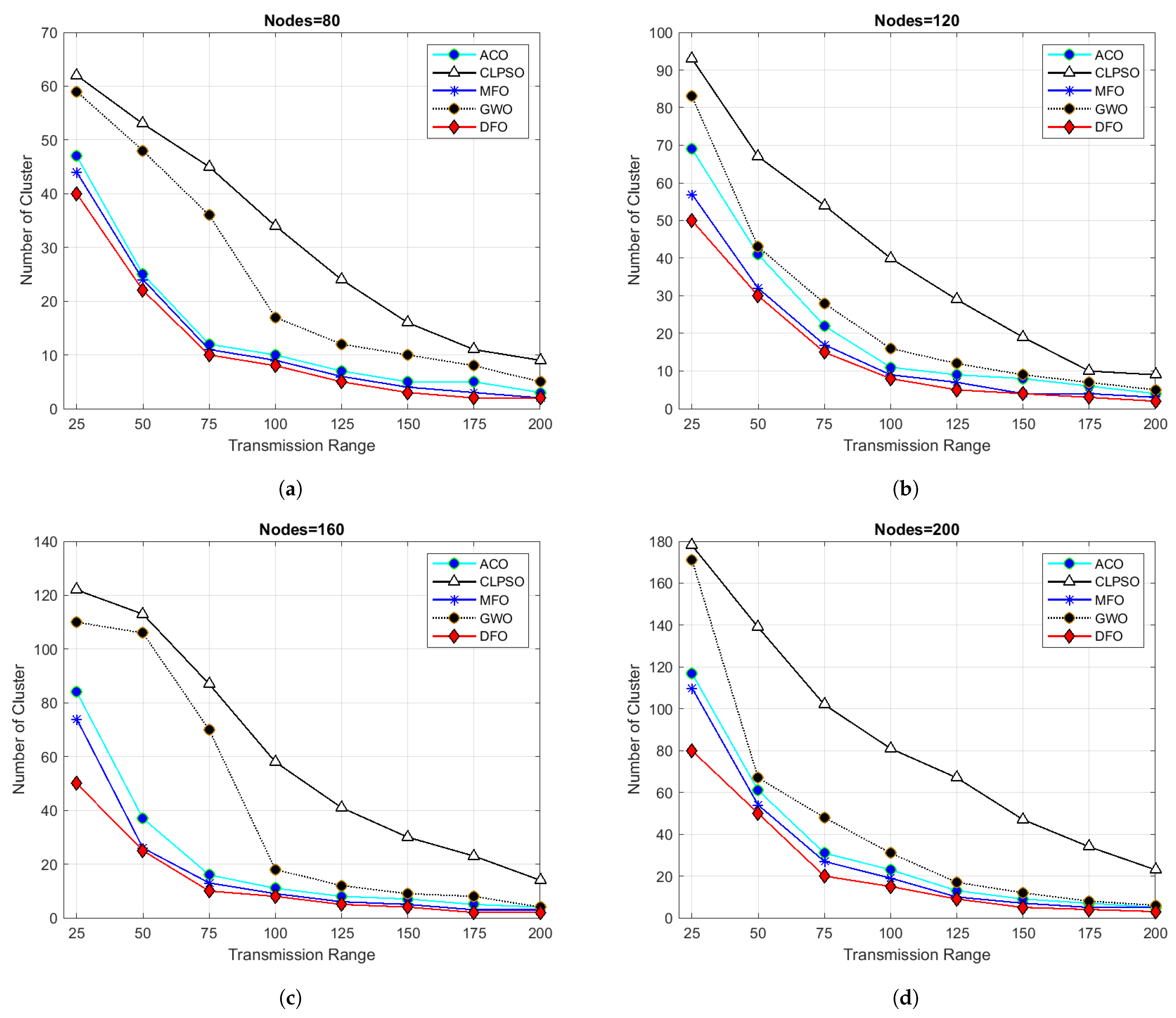
Figure 8. Grid size 500 m × 500 m and transmission range from 25 to 200.
Figure 9. Grid size 1000 m × 1000 m and transmission range from 25 to 200.
Figure 10. Grid size 1500 m × 1500 m and transmission range from 25 to 200.
Figure 11. Grid size 2000 m × 2000 m and transmission range from 25 to 200.
In Figure 4, the transmission range of nodes is set from 50 m to 200 m with a fixed grid scale (500 m × 500 m) and nodes density is set from 20 to 200 nodes. Results demonstrate that even with varying transmission range DFO give good results than all other algorithms in comparison and show continuity of batter results in all scenarios, alhough MFO shows closest results to DFO in same scenarios. In Figure 4a, when the transmission range of each node was set upto 50 m in a fixed grid size of 500 m × 500 m and total number of nodes was taken from 20 to 200, then number of clusters formed by DFO was 30, and number of clusters formed by MFO, ACO, GWO and CLPSO respectively was 55, 60, 62 and 140. In Figure 4b, when transmission range was increased from 50 m to 100 m then number of clusters formed by DFO was 10 and number of clusters made by MFO, ACO, GWO and CLPSO was 19, 23, 31 and 81. Similar kinds of results are shown by Figure 4c,d transmission range was increased to 150 m and 200 m. It is evident from the results that, at the point when we increment the transmission range of nodes, the entire clusters created by all algorithms decreased and DFO create optimized number of clusters in given scenario as compared to other algorithms. Results show that the effects of a transmission range on the amount of clusters formed, with increased transmission range less number of clusters formed resulting in optimized routing. It is obvious from simulation results that increasing the node’s transmission range ultimately reduces the number of clusters formed, and DFO outperforms in all instances.

Grid Size VS Number of Nodes VS Number of Clusters

An additional test set was granted to verify the efficiency of the provided algorithm to make problems more tangible. Node density in these experiments ranged from 80 to 200 nodes; the transmission range was set from 25 m to 200 m in a fixed grid size of 500 m × 500 m.The experimental results are revealed in Figure 8.
In Figure 8a, a node density of 80 nodes was taken with transmission range of 25 m in fixed grid size of 500 m × 500 m. DFO created 40 clusters, while MFO generated 44 clusters, ACO 47, GWO 59 and CLPSO 61. When transmission range of each node was increased to 200 m then DFO generated only 2 clusters, MFO 3, ACO 5, GWO 6 and CLPSO 9 clusters. This is reliable with well-established reading and if the nodes transmission range is bigger, minimum clusters will be made. Results shown in figure show that DFO outperforms other algorithms even if transmission range varies from 25 to 200. It is obvious by seeing the results in Figure 8a–d having number of nodes 80, 120, 160 and 200 m, respectively, DFO outperforms other algorithms and creates a lower number of clusters in a given space, which helps in optimizing routing in UWSNs.
When we increase the grid size to up to 1 km, DFO outperforms all other algorithms. Figure 9 shows the outcomes of this setting. In this scenario, when density of nodes were fixed at 80 nodes then 8 clusters were created by DFO. In comparison, MFO produced nine clusters, ACO 14, GWO 18 and CLPSO produced 19 clusters. DFO evidently provided lesser number of clusters. When a node’s density was extended from 80 to 200, DFO generated four clusters while MFO created six clusters, ACO 9, GWO 20 and CLPSO generated 23 clusters. It results that with any number of nodes dragon fly algorithm generated small number of clusters which are very helpful in routing optimization problems. It can also be seen that the transmission range influenced the number of clusters generated. This is consistent with previous findings that if transmission range is smaller, more clusters are shaped, as there tend to be fewer nodes in a cluster. The nodes will also find closer nodes when the range is extended, which results in fewer clusters.
In order to further evaluate ANC-UWSNs efficiency, the calculations were tested by changing the transmission range of nodes while the grid size and number of nodes were retained at a fixed value, i.e., transmission range one km and node density fixed to 200 nodes. As shown in Figure 5, the results suggest that in the given case, DFO was a good solution and produced optimal results. Further simulations were performed while the grid size was increased to 1500 m. Figure 10 describes the consequences of this scenario. From Figure 10a, it could be verified that with a smaller transmission range of all algorithms, excluding the DFO, yielded similar findings, while the DFO yielded best possible results, viewing the algorithm’s effectiveness. It may also be evidenced that ANC-UWSNs efficiency also enhanced with the increasing number of nodes. For example, DFO created only seven clusters with density of nodes fixed to 200 nodes, whereas MFO made nine clusters, ACO 14, GWO 18 and CLPSO generated 22 clusters. DFO was assessed more with varying transmission range of 50–200 m, as with the previously mentioned settings, and the grid size was kept at 1500 m. Outcomes are shown in Figure 6. It is important to mention that there was a significant difference in output among DFO and other methods, when transmission range was fixed at 200 m. This demonstrates that the efficiency of DFO was enhanced with a greater transmission range and it created very few cluster numbers.
Results in Figure 11 show that DFO provides good results even with grid sizes of up to 2 km. In this scenario, when the transmission range was set to 100 m and 80 nodes were taken, then results demonstrated that GWO and CLPSO show poor results by generating 39 and 52 clusters, respectively. MFO and ACO comparatively give batter results by generating 17 and 19 clusters. DFO performs superbly by creating only ten clusters in the same scenario. When the transmission range was increased to 200 m, then DFO generated only six clusters and the closest one MFO generated nine clusters. Similar results can be seen even by changing different parameters such as transmission range, grid size and node density. It is proven from the results that DFO provides an optimal number of clusters in different experimentation. Hence, a DFO-based protocol (ANC-UWSN) is better for optimal routing in UWSNs than other algorithms. This creates an optimal number of clusters. Similar outcomes were observed when the transmission range was set to 50 m, 100 m, 150 m, and 200 m, with 200 nodes and a fixed grid size of 2 km2. By Figure 7 it is obviously demonstrated that the outcome of DFO was better than all other protocols in any specified scenario. By viewing the assessments, it is evident that ANC-UWSNs has performed significantly better than other techniques. It generated the lowest number of clusters needed to function in the specified grid size.
Energy efficiency is achieved by reducing the number of clusters in the network. The lesser the number of clusters, the easier it is to manage them. By having a lower number of clusters, few CHs are responsible to communicate with sink node when required. Therefore, the life of a sink node also increases. Hence, energy efficiency is indirectly achieved in our proposed methodology.

6. Conclusions

In this article, an adaptive node clustering protocol was proposed for UWSNs. The protocol uses a dragon fly optimizer for generating an optimal number of clusters in a given space. ANC-UWSNs uses an evolutionary-based algorithm which works repeatedly over a given space and generates an optimal number of clusters for packet routing. The cost of routing packets decreases as the number of clusters decreases in a given space. In this way, the overall routing cost of the network decreases and energy conservation of nodes decreases because only cluster head nodes participate in the routing of data packets. Altered simulations were performed for checking the efficiency of offered algorithm. The algorithm was tested with the variation of two main parameters, with the variation of node density and varying transmission range of nodes. The result of simulations shows that ANC-UWSNs is an efficient solution for routing in supposed networks. ANC-UWSNs was compared with other well-known evolutionary algorithms (MFO, GWO, ACO and CLPSO) and results show the dominance of DFO.
Future work can be carried out to investigate the affects of other critical parameters like the consumed power and residual energy which are also among the main constraints of underwater sensors.

Author Contributions

Conceptualization, M.F.K.; methodology, M.F.K.; M.B.; software, M.B.; F.A.; validation, M.F.K.; F.A.; J.-W.L.; formal analysis, M.F.K.; F.A.; investigation, M.B.; M.F.K.; resources, J.-W.L.; F.A.; writing—original draft preparation, M.F.K.; M.B.; writing—review and editing, M.F.K.; F.A., J.-W.L.; supervision, F.A.; project administration, J.-W.L.; funding acquisition, J.-W.L.; All authors have read and agreed to the published version of the manuscript.

Funding

This research was supported in part by the faculty research fund of Sejong University in 2019 and in part by the MSIT (Ministry of Science and ICT), Korea, under the ITRC (Information Technology Research Center) support program (IITP-2021-2016-0-00312) supervised by the IITP (Institute for Information & Communications Technology Planning & Evaluation).

Conflicts of Interest

The authors declare no conflict of interest.

Abbreviations

The following abbreviations are used in this manuscript:
UWSNsUnderwater sensor networks
ANC-UWSNsAdaptive node clustering technique for underwater sensor networks
ACOAnt colony optimizer
GWOGray wolf optimizer
MFOMoth flame optimizer
CLPSOComprehensive learning particle swarm optimizer
DFOdragonfly optimizer
UOCUnderwater optical communication
FANETFlying ad-hoc network
CHCluster head
WSNsWireless sensor networks
UACUnderwater acoustic communication
VANETVehicular ad-hoc network

References

  1. Nayyar, A.; Puri, V.; Le, D.N. Comprehensive analysis of routing protocols surrounding underwater sensor networks (UWSNs). In Data Management, Analytics and Innovation; Springer: Berlin/Heidelberg, Germany, 2019; pp. 435–450. [Google Scholar]
  2. Albaladejo, C.; Sánchez, P.; Iborra, A.; Soto, F.; López, J.A.; Torres, R. Wireless sensor networks for oceanographic monitoring: A systematic review. Sensors 2010, 10, 6948–6968. [Google Scholar] [CrossRef] [PubMed]
  3. Di Valerio, V.; Presti, F.L.; Petrioli, C.; Picari, L.; Spaccini, D.; Basagni, S. CARMA: Channel-aware reinforcement learning-based multi-path adaptive routing for underwater wireless sensor networks. IEEE J. Sel. Areas Commun. 2019, 37, 2634–2647. [Google Scholar] [CrossRef]
  4. Ayaz, M.; Abdullah, A. Hop-by-hop dynamic addressing based (H2-DAB) routing protocol for underwater wireless sensor networks. In Proceedings of the 2009 International Conference on Information and Multimedia Technology, Jeju, Korea, 16–18 December 2009; pp. 436–441. [Google Scholar]
  5. Bouk, S.H.; Ahmed, S.H.; Kim, D. Delay tolerance in underwater wireless communications: A routing perspective. Mob. Inf. Syst. 2016, 2016, 6574697. [Google Scholar] [CrossRef]
  6. Diao, B.; Xu, Y.; An, Z.; Wang, F.; Li, C. Improving both energy and time efficiency of depth-based routing for underwater sensor networks. Int. J. Distrib. Sens. Netw. 2015, 11, 781932. [Google Scholar] [CrossRef]
  7. Jadhao, P.; Ghonge, M. Energy efficient routing protocols for underwater sensor networks-a survey. Energy 2015, 1, 1. [Google Scholar]
  8. Jain, S.; Mishra, J.P.; Talange, D. A robust control approach for magnetic levitation system based on super-twisting algorithm. In Proceedings of the 2015 10th Asian Control Conference (ASCC), Kota Kinabalu, Malaysia, 31 May–3 June 2015; pp. 1–6. [Google Scholar]
  9. Yang, G.; Dai, L.; Wei, Z. Challenges, threats, security issues and new trends of underwater wireless sensor networks. Sensors 2018, 18, 3907. [Google Scholar] [CrossRef] [PubMed]
  10. Xu, G.; Shen, W.; Wang, X. Applications of wireless sensor networks in marine environment monitoring: A survey. Sensors 2014, 14, 16932–16954. [Google Scholar] [CrossRef]
  11. Li, S.; Qu, W.; Liu, C.; Qiu, T.; Zhao, Z. Survey on high reliability wireless communication for underwater sensor networks. J. Netw. Comput. Appl. 2019, 148, 102446. [Google Scholar] [CrossRef]
  12. Yang, G.; Dai, L.; Si, G.; Wang, S.; Wang, S. Challenges and security issues in underwater wireless sensor networks. Procedia Comput. Sci. 2019, 147, 210–216. [Google Scholar] [CrossRef]
  13. Sandeep, D.; Kumar, V. Review on clustering, coverage and connectivity in underwater wireless sensor networks: A communication techniques perspective. IEEE Access 2017, 5, 11176–11199. [Google Scholar] [CrossRef]
  14. Khan, M.F.; Yau, K.L.A.; Noor, R.M.; Imran, M.A. Routing Schemes in FANETs: A Survey. Sensors 2020, 20, 38. [Google Scholar] [CrossRef] [PubMed]
  15. Ahmed, T.; Chaudhary, M.; Kaleem, M.; Nazir, S. Optimized depth-based routing protocol for underwater wireless sensor networks. In Proceedings of the 2016 International Conference on Open Source Systems & Technologies (ICOSST), Lahore, Pakistan, 15–17 December 2016; pp. 147–150. [Google Scholar]
  16. Mohammadi, R.; Javidan, R.; Jalili, A. Fuzzy depth based routing protocol for underwater acoustic wireless sensor networks. J. Telecommun. Electron. Comput. Eng. (JTEC) 2015, 7, 81–86. [Google Scholar]
  17. Khizar, M.; Wahid, A.; Pervaiz, K.; Sajid, M.; Qasim, U.; Khan, Z.A.; Javaid, N. Enhanced energy efficient depth based routing protocol for underwater WSNs. In Proceedings of the 2016 10th International Conference on Innovative Mobile and Internet Services in Ubiquitous Computing (IMIS), Fukuoka, Japan, 6–8 July 2016; pp. 70–77. [Google Scholar]
  18. Khan, T.; Ahmad, I.; Aman, W.; Azam, I.; Khan, Z.A.; Qasim, U.; Avais, S.; Javaid, N. Clustering depth based routing for underwater wireless sensor networks. In Proceedings of the 2016 IEEE 30th International Conference on Advanced Information Networking and Applications (AINA), Crans-Montana, Switzerland, 23–25 March 2016; pp. 506–515. [Google Scholar]
  19. Gul, S.; Jokhio, S.H.; Jokhio, I.A. Light-weight depth-based routing for underwater wireless sensor network. In Proceedings of the 2018 International Conference on Advancements in Computational Sciences (ICACS), Lahore, Pakistan, 19–21 February 2018; pp. 1–7. [Google Scholar]
  20. Khan, M.F.; Yau, K.L.A.; Noor, R.M.; Imran, M.A. Survey and taxonomy of clustering algorithms in 5G. J. Netw. Comput. Appl. 2020, 154, 102539. [Google Scholar] [CrossRef]
  21. Majid, A.; Azam, I.; Waheed, A.; Zain-ul Abidin, M.; Hafeez, T.; Khan, Z.A.; Qasim, U.; Javaid, N. An energy efficient and balanced energy consumption cluster based routing protocol for underwater wireless sensor networks. In Proceedings of the 2016 IEEE 30th International Conference on Advanced Information Networking and Applications (AINA), Crans-Montana, Switzerland, 23–25 March 2016; pp. 324–333. [Google Scholar]
  22. Ahmed, M.; Salleh, M.; Channa, M.I. CBE2R: Clustered-based energy efficient routing protocol for underwater wireless sensor network. Int. J. Electron. 2018, 105, 1916–1930. [Google Scholar] [CrossRef]
  23. Sahana, S.; Singh, K. Fuzzy based energy efficient underwater routing protocol. J. Discret. Math. Sci. Cryptogr. 2019, 22, 1501–1515. [Google Scholar] [CrossRef]
  24. Ahmed, M.; Soomro, M.A.; Parveen, S.; Akhtar, J.; Naeem, N. CMSE2R: Clustered-based Multipath Shortest-distance Energy Efficient Routing Protocol for Underwater Wireless Sensor Network. Indian J. Sci. Technol. 2019, 12, 8. [Google Scholar] [CrossRef]
  25. Bu, R.; Wang, S.; Wang, H. Fuzzy logic vector—Based forwarding routing protocol for underwater acoustic sensor networks. Trans. Emerg. Telecommun. Technol. 2018, 29, e3252. [Google Scholar] [CrossRef]
  26. Mazinani, S.M.; Yousefi, H.; Mirzaie, M. A vector-based routing protocol in underwater wireless sensor networks. Wirel. Pers. Commun. 2018, 100, 1569–1583. [Google Scholar] [CrossRef]
  27. Malaker, T.; Das, U.C.; Hasan, M.R. Directional Vector Forward Focused Beam Routing Protocol for Underwater Sensor Network. Ph.D. Thesis, Daffodil International University, Dhaka, Bangladesh, 2018. [Google Scholar]
  28. Braman, A.; Umapathi, G. A Comparative Study on Advances in LEACH Routing Protocol for Wireless Sensor Networks: A survey. Int. J. Adv. Res. Comput. Commun. Eng. 2014, 3, 5683–5690. [Google Scholar]
  29. Li, X.; Wang, Y.; Zhou, J. An energy-efficient clustering algorithm for underwater acoustic sensor networks. In Proceedings of the 2012 International Conference on Control Engineering and Communication Technology, Shenyang, China, 7–9 December 2012; pp. 711–714. [Google Scholar]
  30. Alhazmi, A.S.; Moustafa, A.I.; AlDosari, F.M. Energy aware approach for underwater wireless sensor networks scheduling: UMOD_LEACH. In Proceedings of the 2018 21st Saudi Computer Society National Computer Conference (NCC), Riyadh, Saudi Arabia, 25–26 April 2018; pp. 1–5. [Google Scholar]
  31. Wan, Z.; Liu, S.; Ni, W.; Xu, Z. An energy-efficient multi-level adaptive clustering routing algorithm for underwater wireless sensor networks. Clust. Comput. 2019, 22, 14651–14660. [Google Scholar] [CrossRef]
  32. Batra, P.K.; Kant, K. LEACH-MAC: A new cluster head selection algorithm for Wireless Sensor Networks. Wirel. Netw. 2016, 22, 49–60. [Google Scholar] [CrossRef]
  33. Saha, A.K.; Khan, M.S.U.; Rahman, M.M. Region based low energy adaptive clustering hierarchy (R-LEACH) protocol: Prolonging the lifetime of WSN. In Proceedings of the 6th International Conference on Networking, Systems and Security, Dhaka, Bangladesh, 17–19 December 2019; pp. 127–132. [Google Scholar]
  34. Rashid, M.M.; Al-Jamali, N.A.S. Modified W-LEACH Protocol in Wireless Sensor Network. J. Eng. 2019, 25, 68–80. [Google Scholar] [CrossRef][Green Version]
  35. Shanthi, G.; Sundarambal, M. FSO–PSO based multihop clustering in WSN for efficient medical building management system. Clust. Comput. 2019, 22, 12157–12168. [Google Scholar] [CrossRef]
  36. Yan, Z.; Goswami, P.; Mukherjee, A.; Yang, L.; Routray, S.; Palai, G. Low-energy PSO-based node positioning in optical wireless sensor networks. Optik 2019, 181, 378–382. [Google Scholar] [CrossRef]
  37. Li, N.; Martínez, J.F.; Meneses Chaus, J.M.; Eckert, M. A survey on underwater acoustic sensor network routing protocols. Sensors 2016, 16, 414. [Google Scholar] [CrossRef]
  38. Krishnaswamy, V.; Manvi, S.S. Fuzzy and PSO Based Clustering Scheme in Underwater Acoustic Sensor Networks Using Energy and Distance Parameters. Wirel. Pers. Commun. 2019, 108, 1529–1546. [Google Scholar] [CrossRef]
  39. Rajakumar, R.; Amudhavel, J.; Dhavachelvan, P.; Vengattaraman, T. GWO-LPWSN: Grey wolf optimization algorithm for node localization problem in wireless sensor networks. J. Comput. Netw. Commun. 2017, 2017, 7348141. [Google Scholar] [CrossRef]
  40. Kazmi, H.S.Z.; Javaid, N.; Imran, M.; Outay, F. Congestion control in wireless sensor networks based on support vector machine, Grey Wolf optimization and differential evolution. In Proceedings of the 2019 Wireless Days (WD), Manchester, UK, 24–26 April 2019; pp. 1–8. [Google Scholar]
  41. Al-Aboody, N.; Al-Raweshidy, H. Grey wolf optimization-based energy-efficient routing protocol for heterogeneous wireless sensor networks. In Proceedings of the 2016 4th International Symposium on Computational and Business Intelligence (ISCBI), Olten, Switzerland, 5–7 September 2016; pp. 101–107. [Google Scholar]
  42. Lipare, A.; Edla, D.R.; Cheruku, R.; Tripathi, D. GWO-GA Based Load Balanced and Energy Efficient Clustering Approach for WSN. In Smart Trends in Computing and Communications; Springer: Berlin/Heidelberg, Germany, 2020; pp. 287–295. [Google Scholar]
  43. Mittal, N. Moth flame optimization based energy efficient stable clustered routing approach for wireless sensor networks. Wirel. Pers. Commun. 2019, 104, 677–694. [Google Scholar] [CrossRef]
  44. Sharma, R.; Vashisht, V.; Singh, U. eeTMFO/GA: A secure and energy efficient cluster head selection in wireless sensor networks. Telecommun. Syst. 2020, 74, 253–268. [Google Scholar] [CrossRef]
  45. Durrani, M.Y.; Tariq, R.; Aadil, F.; Maqsood, M.; Nam, Y.; Muhammad, K. Adaptive node clustering technique for smart ocean under water sensor network (SOSNET). Sensors 2019, 19, 1145. [Google Scholar] [CrossRef]
  46. Kumari, S.; Mishra, P.K.; Anand, V. Fault resilient routing based on moth flame optimization scheme for underwater wireless sensor networks. Wirel. Netw. 2020, 26, 1417–1431. [Google Scholar] [CrossRef]
  47. Mirjalili, S. Dragonfly algorithm: A new meta-heuristic optimization technique for solving single-objective, discrete, and multi-objective problems. Neural Comput. Appl. 2016, 27, 1053–1073. [Google Scholar] [CrossRef]
  48. Elhoseny, M.; Shankar, K. Energy Efficient Optimal Routing for Communication in VANETs via Clustering Model. In Emerging Technologies for Connected Internet of Vehicles and Intelligent Transportation System Networks; Springer: Berlin/Heidelberg, Germany, 2020; pp. 1–14. [Google Scholar]
  49. Vinodhini, R.; Gomathy, C. A Hybrid Approach for Energy Efficient Routing in WSN: Using DA and GSO Algorithms. In Proceedings of the International Conference on Inventive Computation Technologies, Coimbatore, India, 29–30 August 2019; pp. 506–522. [Google Scholar]
  50. Rahman, C.M.; Rashid, T.A. Dragonfly Algorithm and Its Applications in Applied Science Survey. Comput. Intell. Neurosci. 2019, 2019, 9293617. [Google Scholar] [CrossRef] [PubMed]
  51. Aadil, F.; Bajwa, K.B.; Khan, S.; Chaudary, N.M.; Akram, A. CACONET: Ant colony optimization (ACO) based clustering algorithm for VANET. PLoS ONE 2016, 11, e0154080. [Google Scholar] [CrossRef]
  52. Khan, M.F.; Aadil, F.; Maqsood, M.; Bukhari, S.H.R.; Hussain, M.; Nam, Y. Moth flame clustering algorithm for internet of vehicle (MFCA-IoV). IEEE Access 2018, 7, 11613–11629. [Google Scholar] [CrossRef]
  53. Fahad, M.; Aadil, F.; Khan, S.; Shah, P.A.; Muhammad, K.; Lloret, J.; Wang, H.; Lee, J.W.; Mehmood, I. Grey wolf optimization based clustering algorithm for vehicular ad-hoc networks. Comput. Electr. Eng. 2018, 70, 853–870. [Google Scholar] [CrossRef]
  54. Fahad, M.; Aadil, F.; Khan, S. Optimization of vehicular node clustering process using evolutionary algorithms. In Proceedings of the 2017 IEEE SmartWorld, Ubiquitous Intelligence & Computing, Advanced & Trusted Computed, Scalable Computing & Communications, Cloud & Big Data Computing, Internet of People and Smart City Innovation (SmartWorld/SCALCOM/UIC/ATC/CBDCom/IOP/SCI), San Francisco, CA, USA, 4–8 August 2017; pp. 1–5. [Google Scholar]
Publisher’s Note: MDPI stays neutral with regard to jurisdictional claims in published maps and institutional affiliations.

Article Metrics

Citations

Article Access Statistics

Multiple requests from the same IP address are counted as one view.