1. Introduction
The inertial pedestrian navigation system has a wide range of applications in hotspots such as firefighting, indoor security, tunnel patrols, and other fields. These practical applications typically require pedestrians to repeatedly move vigorously in the same indoor environment, such as running and sprint, rather than just regular walking. The reliable navigation information can guarantee the smooth execution of tasks and the safety of personnel in these fields. Although great progress has been made in recent years, there remain various challenging problems such as unbounded accumulative heading error and the capability in dealing with the drastic motions.
The zero-velocity update (ZUPT) algorithm has been widely applied in the field of inertial pedestrian navigation because it is suitable for the foot-mounted IMU case to compensate for traveled distance error during normal walking by introducing heuristic periodic zero velocity corrections [
1]. In addition, a method fusing the navigation information of dual foot-mounted ZUPT-aided INSs was proposed [
2]. This method is based on the intuition that the distance of separation between right and left foot INSs cannot be longer than a quantity known as foot-to-foot maximum separation. Shi improved the foot-to-foot maximum separation model and advanced an ellipsoid model [
3].
This mechanism considers the separation constraints both in horizontal and vertical directions, which is more effective to correct the pedestrian height error. Since these methods require a long enough period of stationary time for the foot to recognize the stationary state, correct for velocity and attitude errors, and apply the separation constraints. During running and sprint, however, this stationary time is very short or even non-existent. Therefore, these methods cannot achieve the same positioning accuracy in running and sprint as in normal walking.
Another pedestrian inertial navigation method is the pedestrian dead reckoning method (PDR), which estimates the pedestrian’s step length and heading, and performs dead reckoning to track the pedestrian’s position. However, with the current state of the art of MEMS technology, the accuracy of accelerators and gyroscopes are not good enough for deriving step length and heading estimation over longer terms due to their large biases and scale factors.
Several mathematical models for indirect stride/step length estimation in the PDR algorithm. Compared with ZUPT, the indirect stride/step length estimation could restrain the accumulated error caused by the measurement noise of inertial devices after integration.
The inverted pendulum model is widely used to estimate step length in these PDR systems [
4]. The geometric construction among leg length, waist vertical displacement, and step length are considered. However, the basic assumption that there always at least one foot on the ground during pedestrian movement is valid in drastic movement. The more complex models are mostly based on the statistic correlation between the step length and the acceleration of the pedestrian. For instance, the linear relation of acceleration variance, step frequency, and step length [
5], and the nonlinear model between step length and maximum and minimum value of acceleration in each step [
6]. These step length estimation techniques fitted the statistic features and step length in a small range, but would cause large step length error during hybrid speed motion.
As for head estimation error correction, combining both gyroscope and magnetometer inputs has yielded some success since the two sensors have complementary error characteristics—gyroscopes give poor long-term orientation, while magnetometers are subject to short-term [
7,
8,
9]. Nevertheless, the geomagnetic field is badly disturbed by magnetic disturbances from indoor iron structures and electronic equipment. Another approach is heuristic drift reduction (HDR), assuming that many man-made walkways have straight-line features. The HDR method estimates the likelihood that the user is walking along a straight line [
10,
11]. If that likelihood is high, HDR applies a correction to the gyro output that would result in a reduction of drift if indeed the user was walking along a straight line. Although HDR doesn’t require landmarks to be known in advance, the basic assumption is too restrictive for complex irregular layout buildings.
Map matching could correct not only the heading estimation but also position estimation [
12,
13,
14]. The use of environmental knowledge imposes boundary constraints on a user’s predicted motion. By using a particle filter algorithm, sub-meter tracking accuracy was achieved. However, a significantly increased amount of information needs to be provided as prior knowledge of the system for the particle filter to be effective. Robertson proposed a new Bayesian estimation approach for simultaneous mapping and localization for pedestrians based on the odometer with foot-mounted inertial sensors, called “FootSLAM”, in which the long term inertial position error is corrected efficiently using the built map of the explored area, especially when this area is revisited over time [
15]. Based on FootSLAM, a series of simultaneous mapping and localization methods for pedestrians that combining the map with other information are developed. Such as Wi-SLAM [
16], PlaceSLAM [
17], MagSLAM [
18], and SignalSLAM [
19]. Moreover, Hardegger presented another kind of simultaneous mapping and localization algorithm for pedestrians using inertial sensors based on semantic landmark called ActionSLAM [
20]. This method is a specific instantiation of the FastSLAM framework optimized to operate with action landmarks like open/close door, reading, brushing teeth, etc. Hardegger expanded the application of this method in different ways. [
21] presented a 3D version of ActionSLAM and [
22] developed a unified Bayesian framework for ActionSLAM.
The occupancy grid map is an important representation model in the mobile robot environment mapping application, proposed by Moravec and Elfes [
23]. This model divides the environment where the robot is located into several neat grids and extracts the status of each grid to determine the environmental accessibility. In recent years, the FastSLAM method based on the occupancy grid using a laser range sensor has been widely applied in the field of robotic navigation. This method uses a laser range sensor to perceive the external environment and estimate the occupancy grid map of the environment. By utilizing the constructed map, the algorithm can effectively correct the positioning error of the robot. However, considering the size and cost of laser range sensors, it is not suitable for pedestrian positioning applications. For this reason, this paper proposes to construct a virtual range sensor using the inertial odometer information to sense the accessible area in the environment and construct the occupancy grid map to deal with the accumulated error of the inertial odometer.
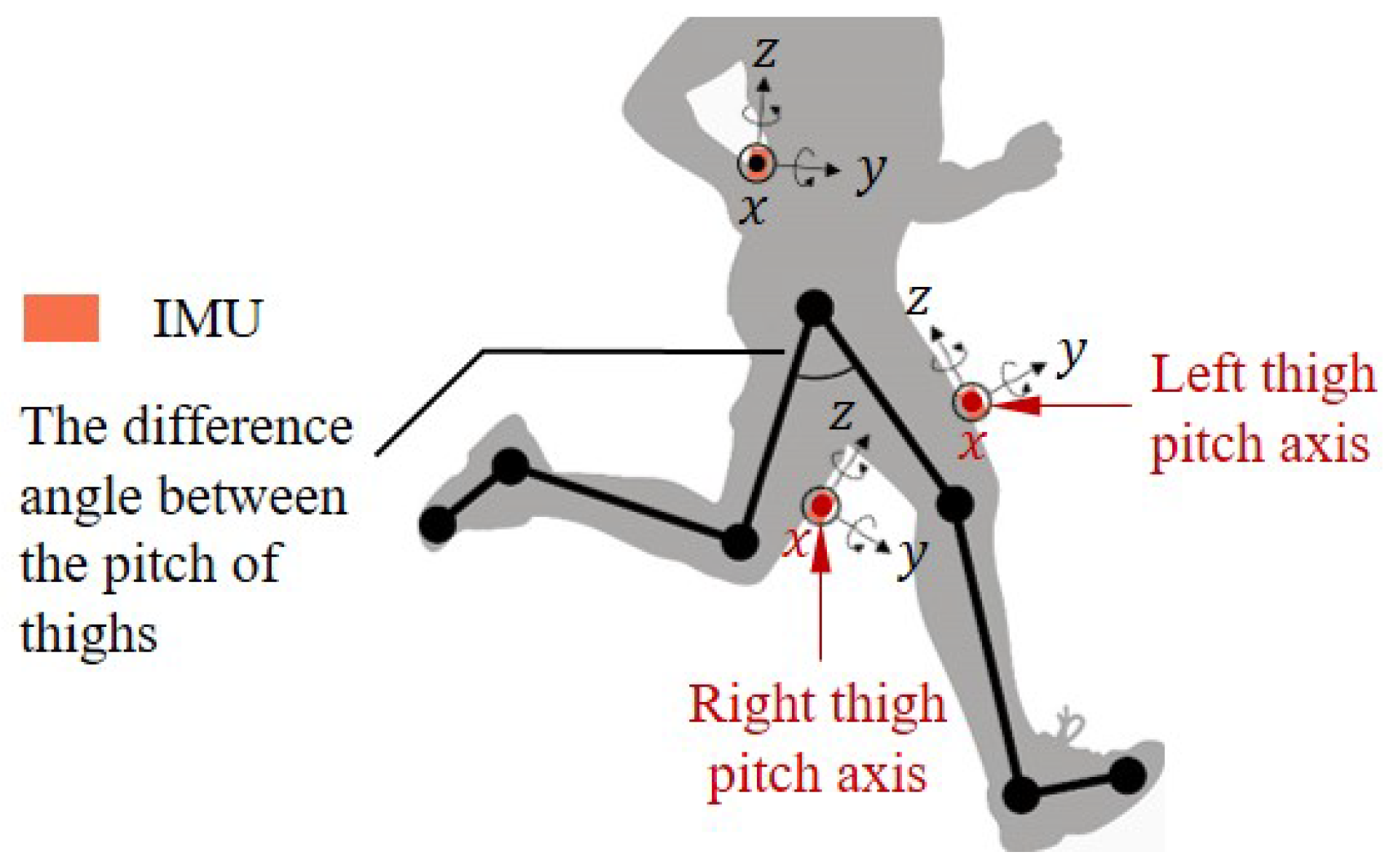
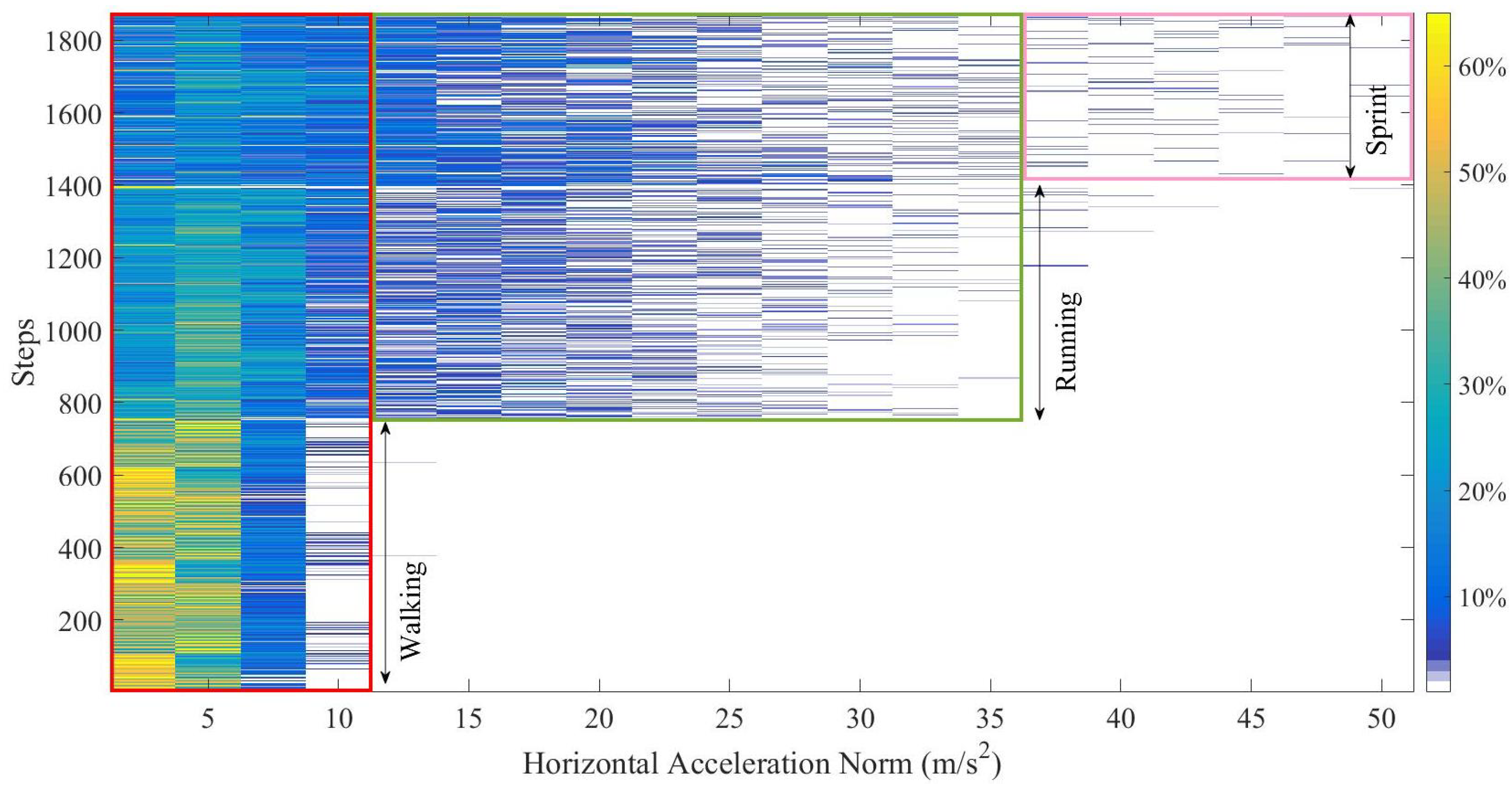
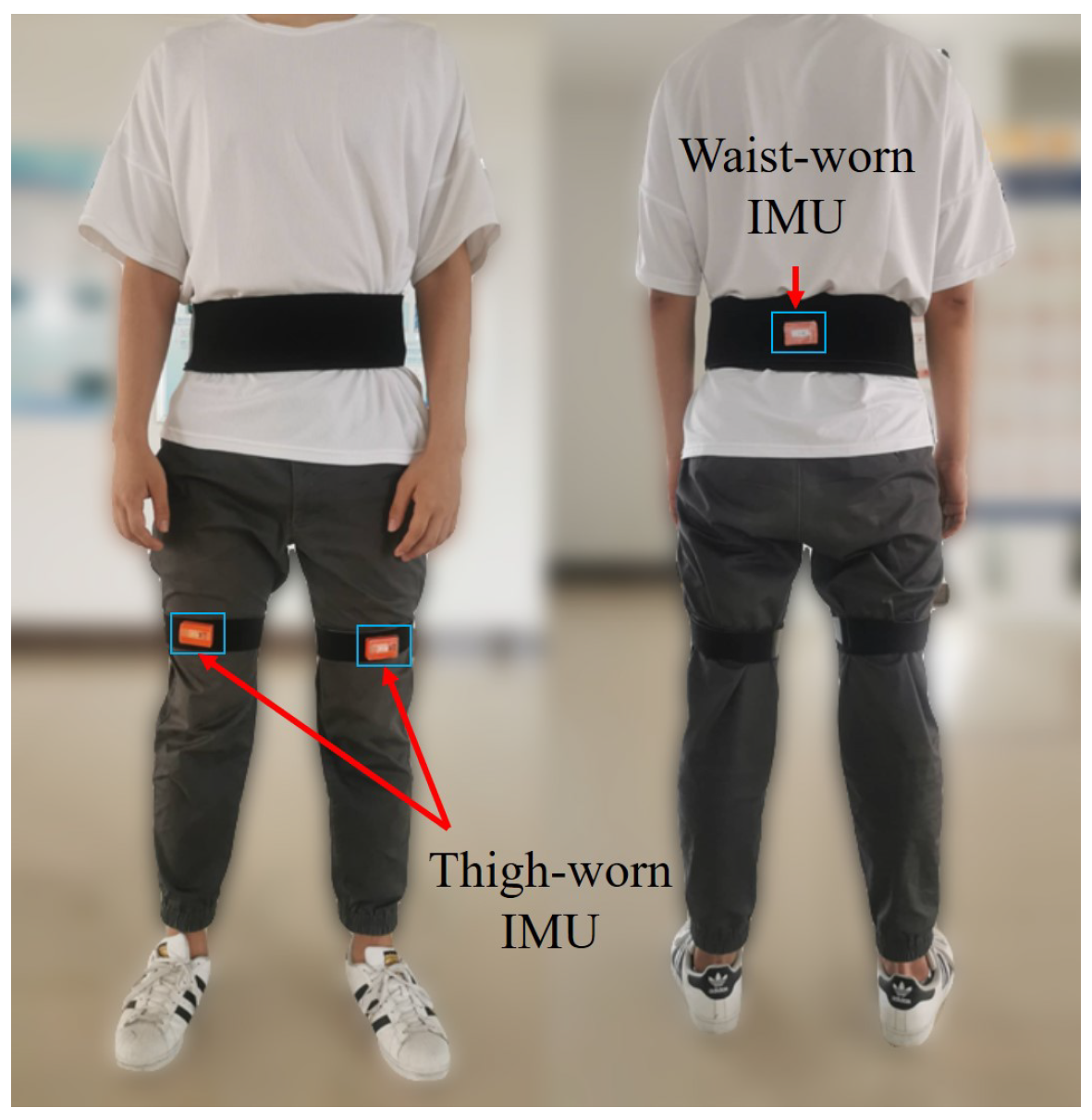
To enhance the capability of the inertial pedestrian navigation system in dealing with the drastic motions and address the unbounded accumulated positioning error, this paper proposed a triple-node IMUs pedestrian inertial navigation system with an occupancy grid-based FastSLAM algorithm. The triple-node IMUs are composed of one waist-worn IMU and two thighs-worn IMUs. The thighs-worn IMUs are utilized to detect and segment the gait. To estimate the step length accurately for drastic motions, we introduce the horizontal acceleration probability distribution function into a step length estimation process to address the issue that the statistic feature fitting method cannot deal with drastic motion with a large speed range. Furthermore, we construct a virtual range sensor to precept the external environment and introduce it into an occupancy grid-based FastSLAM algorithm to correct the long-term position error of the inertial odometer.
This paper is organized as follows: In
Section 2, the wearable trinal-IMUs pedestrian navigation system is described. The inertial simultaneous localization and occupancy grid mapping is discussed in
Section 3. Analysis of both experiments and results is given in
Section 4. Finally, the conclusions and future work are summarized in
Section 5.
3. Occupancy Grid-Based FastSLAM for Inertial Pedestrian Navigation
In general, the goal of SLAM is to estimate the pose of pedestrian s and the map of the unknown environment. We present an inertial measurement used-only SLAM method—inertial occupancy grid-based FastSLAM. Before presenting our approach, an overview of the occupancy grid-based FastSLAM algorithm is provided.
3.1. Occupancy Grids-Based FastSLAM
The FastSLAM approach attempts to estimate the full SLAM posterior:
which is the distribution that represents the trajectory of pedestrian
and the map of the environment
depend on the set of control inputs
and the observations
. The Rao–Blackwellized decomposition was used to decompose the SLAM problem into a pedestrian positioning problem and an environment map construction problem with given pedestrian position:
where
is the
i-th landmark, and
N is the number of environment features. The above decomposition shows that the a posterior probability distribution of SLAM can be decomposed into the product of the a posterior probability distribution of the pedestrian’s path and the posterior probability distribution of environment features given a known path.
The FastSLAM algorithm uses a particle filter to estimate pedestrian trajectory distribution. For each particle, the individual path-based map features are independent of each other. Therefore, in the second part of Equation (
15), the conditional probability of the remaining
N environmental map features is estimated by a bundle of binary Bayesian estimator. The conditional probability of each feature is the probability of the grid being occupied in Occupancy Grids-based FastSLAM. As a result, each particle is composed of a pedestrian pose and a map; thus, the
m-th particle at time
t is defined as
where
, is the index corresponding to the
m-th particle where
n is the total number of particles used in the particle filter,
is the pose estimate of the
m-th particle at time
t, and
is the environment maintained by the
m-th particle.
The FastSLAM algorithm consists of four basic steps: sampling new poses through the motion model, updating the environmental map, calculating the particle importance weights, and resampling based on particle weights.
3.1.1. Motion Model Update
The first step of algorithm is to generate new pose for each particle by sampling from the probabilistic motion model of the pedestrian. For the
m-th particle:
This estimate is added to a temporary set of particles, along with the path
. Under the assumption that the set of particles
is distributed according to
, the new particles drawn from Equation (
17) are distributed according to
which is referred to as the proposal distribution.
3.1.2. Occupancy Grid Update
Occupancy Grid-based FastSLAM decomposes the unknown environment into a finite set of cells where each cell holds the probability that the location in the environment enclosed by the cell is occupied by an object. A solution to estimate these probability is the binary Bayes filter. In binary filter, the posterior of grid is commonly implemented as a log odds ratio in order to avoid truncation problems that arise for probabilities close to 0 or 1. The odds of grid state is defined as the ratio of the probability of this grid being occupied is divided by the probability of its negate:
and the value of posterior of grid can be recovered from the log odds form as
Thus, according to Bayes theory, the posterior of grid being occupied at time
t can be estimated by involving an inverse measurement model
:
Here, is the prior probability of being occupied and is selected to be 0.5 typically.
3.1.3. Importance Weight Calculation
Samples drawn from the proposal distribution are distributed according to
which does not match the desired posterior
. This difference is corrected through importance sampling. For FastSLAM, the importance weight of each particle
is equal to the ratio of the SLAM posterior and the proposal distribution described previously:
where
is the probabilistic measurement model of the sensor being used by pedestrian and
is a normalizing factor—for the brevity, we simply use the normalizing factor to indicate that the weights have to be normalize to 1. The importance weight calculation procedure incorporates the sensor observations into the estimate which were not included in the pose sampling process.
3.1.4. Resampling
Once the weight of particles is calculated, a new set of samples
is drawn from the weighted particles with probabilities in proportion to the weight
. In such way, the new set of samples
are distributed according to target distribution in Equation (
14).
3.2. Inertial Pedestrian Occupancy Grid-Based FastSLAM Model
A key characteristic of the FastSLAM implementation is the sensing of the modality of the grid via an exteroceptive sensor. In order to minimize costs, decrease deployment effort, and remove the reliance on prior maps of the indoor surroundings, the basic idea of inertial pedestrian occupancy grid-based FastSLAM is constructing a virtual exteroceptive sensor, called ’visual range sensor’, using proprioceptive information, including the heading change and the step length estimation from the triple-node IMUs pedestrian navigation system, to track the pedestrian’s motion and build the layout of the environment.
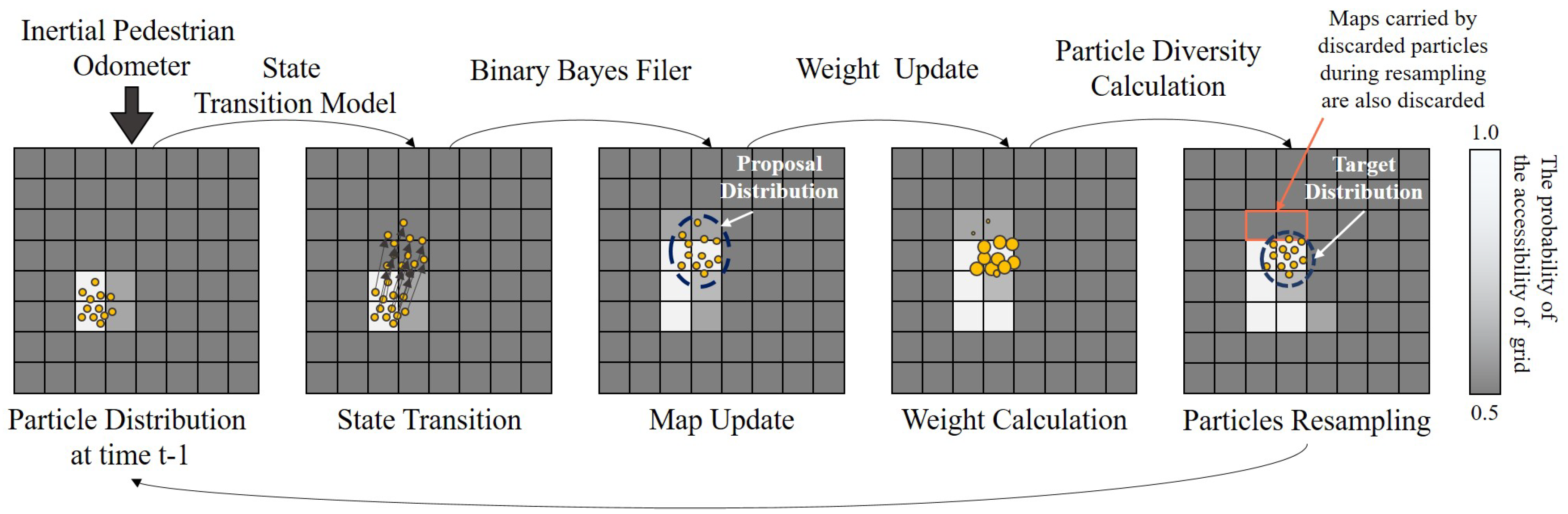
The major steps of the inertial pedestrian occupancy grid-based FastSLAM algorithm is illustrated in
Figure 5. First, the environment is divided into a set of equal size grids, and each grid holds the probability of the grid being accessible. We can sample the pedestrian’s pose at time
, as shown by the yellow circles. Since the pedestrian is more likely to be in accessible areas, a grid with more particles has a higher probability that it is accessible, i.e., the whiter grid in the figure. We use a beta distribution to describe this fact and the grid accessible probability is measured via a visual range sensor. The detail will be discussed in
Section 3.2.2.
Once the pedestrian has moved one step, a new distribution of the pedestrian’s pose, the proposal distribution, can be calculated based on the state transition model and the pose distribution at the time . Then, the probability of grid accessibility in the map is updated via binary Bayes filter. For the same reason, the grids with more particles have higher grid accessible probability, corresponding to the grids getting whiter in the figure. After the map update process, the resampling procedure proceeds, and the new particle set is the proposal distribution of the next iteration. When the pedestrian revisits the area with a built map, the particles with large error will be in the grid with smaller grid accessible probability and will be discarded after the resampling procedure. In other words, the error of the inertial odometer is corrected.
3.2.1. Inertial Pedestrian Odometer and State Transition Model
The step length and the heading variation within one step constitute the control vector
u of inertial pedestrian occupancy grid-based FastSLAM. Then, the pedestrian’s pose can be achieved recursively as follows:
for which
and
are the pedestrian’s position at time
t,
is the pedestrian’s heading at time
t. That is, a new pose could be generated based on the state transition model of pedestrian Equation (
23), from the pose of the
m-th particle at time step
, the current control input
and the characteristics of the noise on
. Here, we assume that the step length estimation noise and heading change estimation noise both obey a Gaussian distribution. The result is that the particles are distributed according to Equation (
17).
3.2.2. Virtual Range Sensor
In order to perceive the accessibility of grids in the environment, we construct a virtual range sensor using inertial information. This sensor can be seen as a laser range sensor with a very short sensing range. Meanwhile, compared to the laser sensor, which perceives the distance between the obstacle and the sensor, the virtual range sensor perceives the distance between the pedestrian and the accessible grid. The virtual distance sensor measures the distance from the grid where the pedestrian is currently located to the nearest accessible grid. Obviously, the grid which the pedestrian located is the accessible area. Thus, the sensor output is always zero.
The occupancy grid mapping algorithm requires a marginalized inverse measurement model,
, as shown in Equation (
19). This probability provides information about the environment conditioned on a measurement caused by this environment. In this paper, a simple ad hoc inverse measurement model is provided based on the assumption that the more times a grid is accessed, the more likely it is to be accessible. We use a beta distribution to characterize the uncertainty of inverse measurement model and its expectation yields:
where
is the total times of the
m-th particle goes through the
i-th grid.
is the prior parameter represents the possibility of
i-th grid being passed through and is selected as 1 typically.
is the prior parameter represents the possibility of the
i-th grid not being accessed and is selected equal to
that is,
is 0.5.
It can be seen from Equation (
24) that
increases with the increasing of the number of total times of the grid being accessed. The value of
and
determine the initial probability of the inverse measurement and the probability that the inverse measurement increases when the grid is accessed again.
3.2.3. Occupancy Grid Update
The idea of the occupancy grid map is to divide the entire environmental space into a number of discrete grids
in equal size, as shown in
Figure 6. Each grid
is assigned a probability value
, representing the number of grid occupied by the likelihood. In the proposed algorithm,
means the space of
i-th grid is accessible for pedestrian and
means the space of
i-th grid is intransitable. The size of the grid is an important parameter in the occupancy grid mapping algorithm. In the laser range sensor-based mapping method, the laser range sensor pixel size is chosen as the grid edge length which allows the measurement of obstacles to be continuous and without overlap.
In the proposed method, it is difficult to guarantee non-overlapping observations of the approachable grid due to the inconsistent step size of pedestrian movements. However, it is still possible to guarantee the continuity of the observation of the accessible grids by limiting the edge length of the grids to no less than the minimum step length. Excessively large grid edge lengths result in uncorrected errors in the position estimation of pedestrians moving within one grid. The grid edge length is therefore chosen as the maximum step length, which ensures continuity of observation of the approachable grid and allows the pedestrian positioning error to be corrected in a smaller number of steps.
As opposed to the original occupancy grid update that estimates the probability distribution of obstacle position, the inertial occupancy grid update estimated the probability distribution of accessible space, such as the corridor and rooms in the indoor environment, shown as the blue grid in
Figure 6.
The inertial pedestrian occupancy grid-based FastSLAM implements the occupancy grid map update using Equation (
21), where the first term is under beta distribution as shown in Equation (
24).
3.2.4. Weight Update and Resampling
The weight associated with each particle
m is updated using the formula for a FastSLAM weight update Equation (
22), which for the importance density function in inertial pedestrian occupancy grid-based FastSLAM resolves to:
where
is the normalize factor. Frequent resampling leads to a loss of particle diversity, making it difficult for particles to form loops. To avoid the loss of particle diversity due to frequent resampling, the degree of particle diversity is assessed before resampling:
The particle set is resampled for importance only if D is too large.
5. Discussion
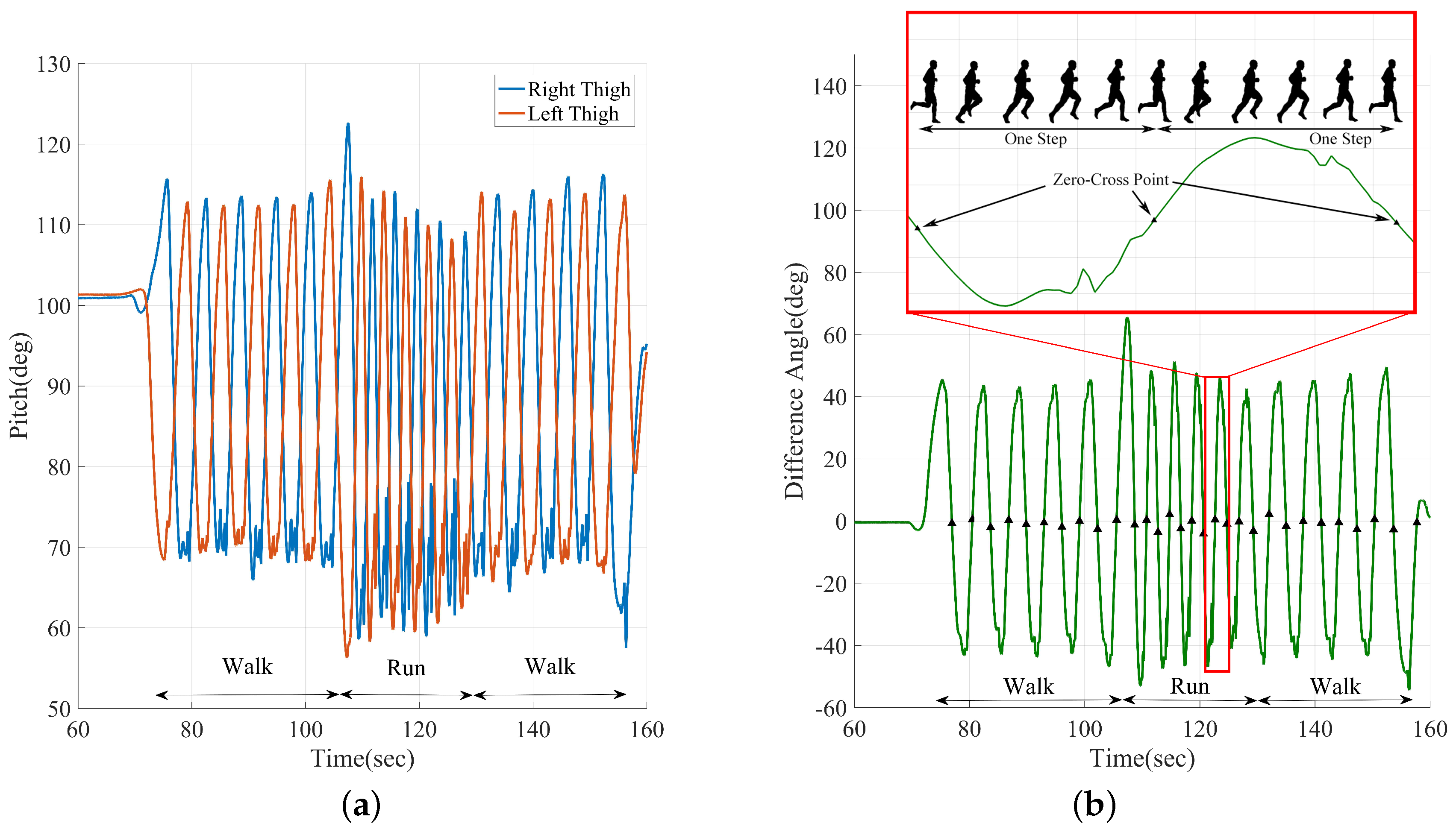
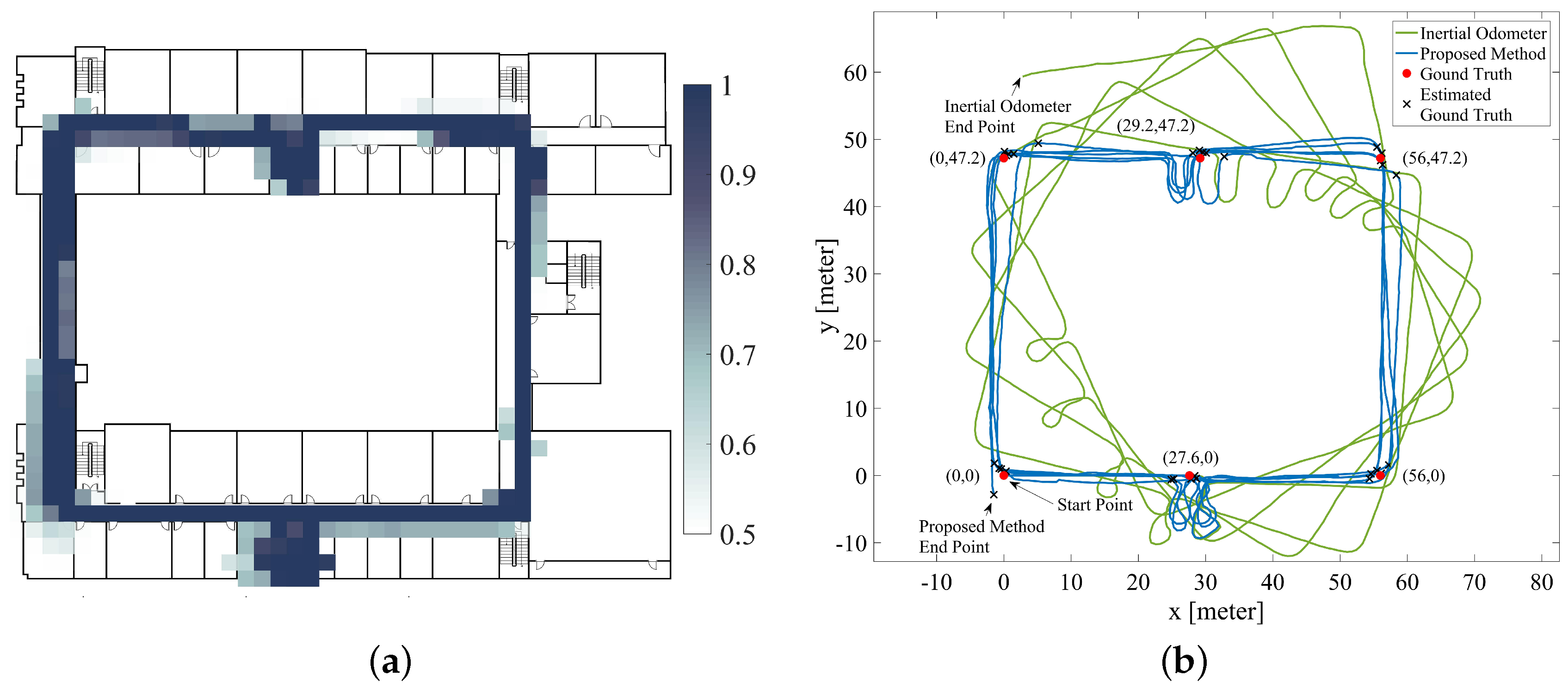
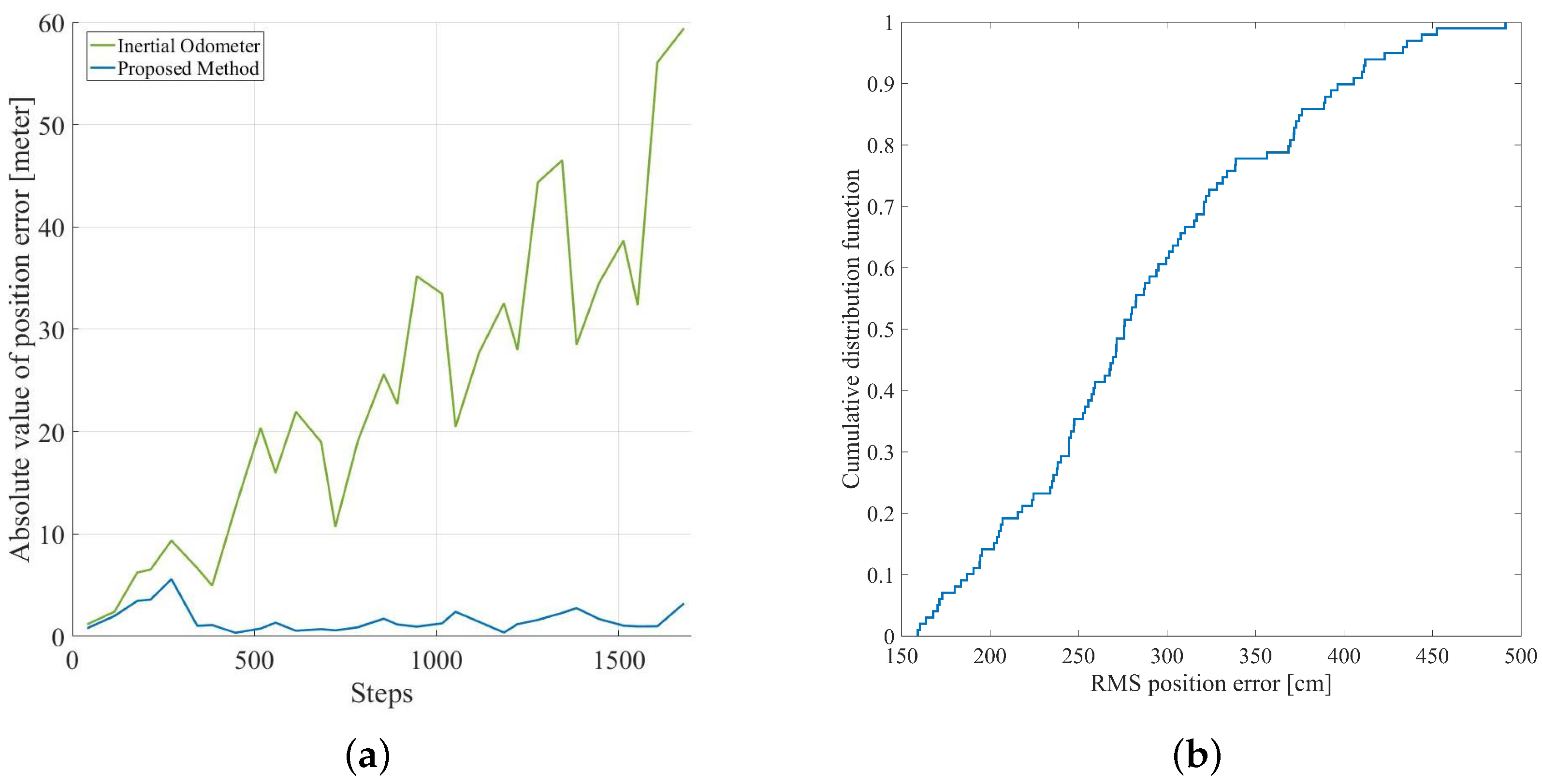
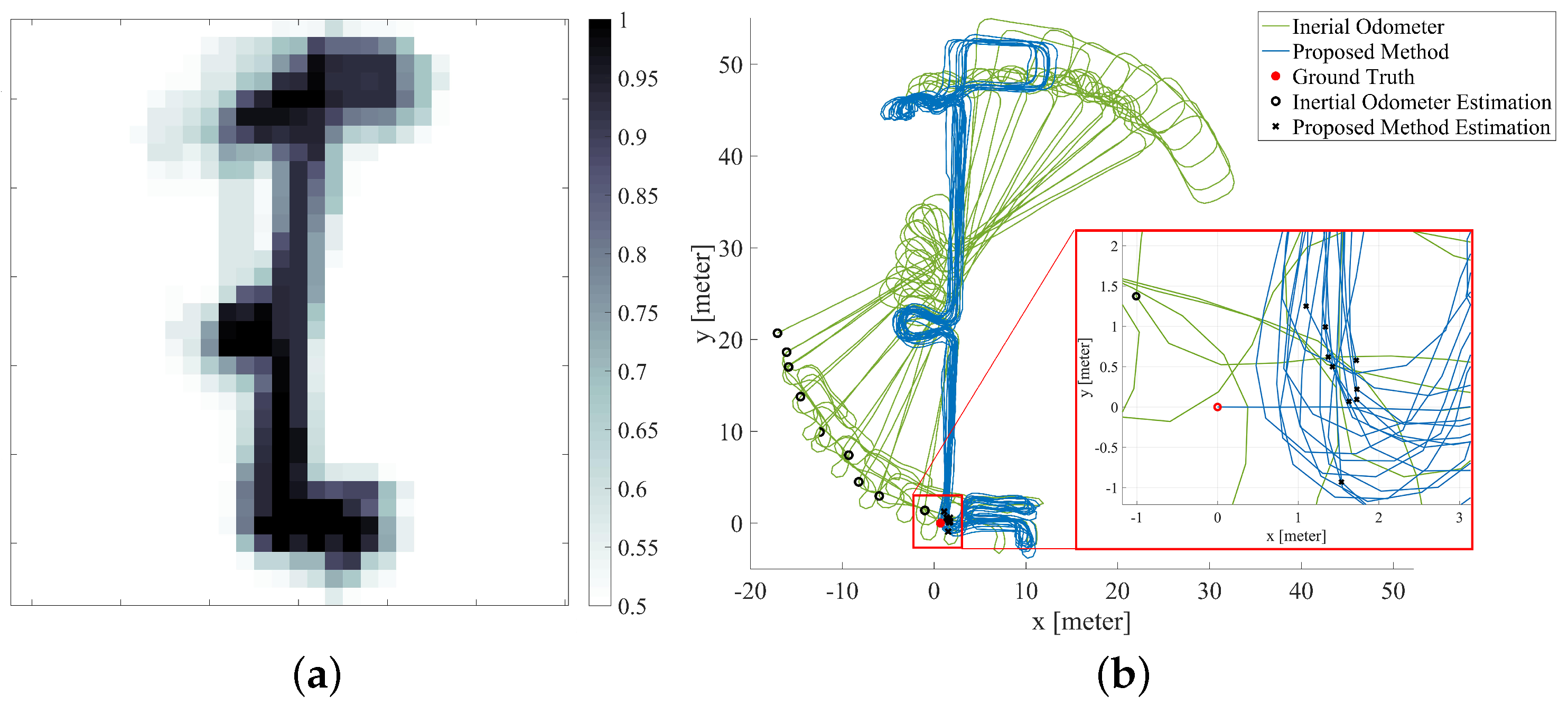
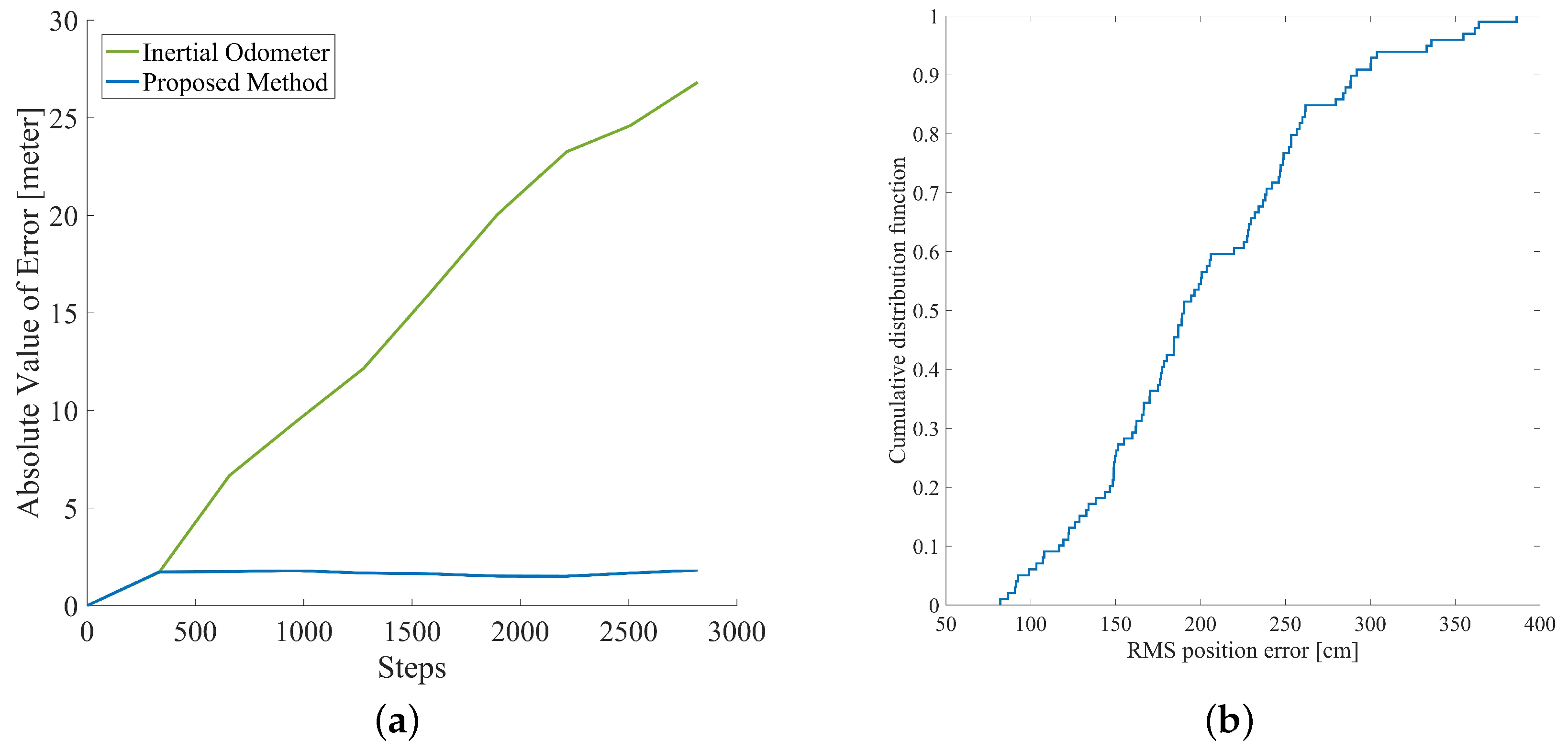
The main purpose of this study is to develop a multi-IMU inertial pedestrian odometer integrating with the occupancy grid-base FastSLAM approach to improve the performance of the inertial pedestrian navigation system on drastic motions. The traditional PDR based inertial pedestrian navigation system has advantages including no additional infrastructure needed and no radio frequency interference but has disadvantages including the inaccurate step length estimation on drastic motions such as running and sprint, and unbounded error on heading estimation. We suggested a simple step detection and segment approach by detecting the zero-crossing of the pitch of thighs. Meanwhile, a step length estimation method for drastic motion based on the pdf of the waist-worn horizontal acceleration norm is proposed. These two methods together constitute an inertial pedestrian odometer adapted to drastic motions. The experiments on different testers on different speed motions indicate that the proposed inertial pedestrian odometer can provide the step length estimation with the same precision as the slow one when the pedestrian is moving fast. Moreover, we extended the occupancy grid-based FastSLAM algorithm to the inertial navigation system. By constructing a virtual range observer, the simultaneous positioning and mapping of pedestrians can be realized by relying on inertial odometer without any additional sensors. The experiment results indicate that the proposed inertial occupancy grid-based FastSLAM can accurately construct the map of the passable area, and the system can effectively restrain the course error divergence of pedestrian inertia odometer. This method can provide long-term and high-precision pedestrian positioning information without increasing the cost, which is of great significance for the practical application of pedestrian inertial navigation.
The proposed method can improve the long-term accuracy of inertial pedestrian navigation system. However, there are still some limitations in this study. Firstly, the inertial occupancy grid-based FastSLAM utilizes the historic trajectory information to correct the positioning and heading error which means that the position and heading errors are corrected only when the pedestrian revisits the area they have already visited. Secondly, the determination of the initial position is not considered in this study. We focus on solving the issue of accumulative error rather than the initial position. Nevertheless, according to the basic principles of inertial navigation, the initial position error will be gradually coupled to the attitude estimation. On the one hand, it will lead to an increase of course estimation error; on the other hand, it will lead to inaccurate waist attitude estimation, which will affect the step length estimation, which limits the application of the system in larger areas.
For the first limitation, we can use the historical trajectory of multiple people to correct map estimation and user location estimation by studying the method of multi-pedestrian collaborative SLAM. For the second limitation, the combination of GPS and the inertial system can be used to obtain the absolute position of pedestrians through the satellite navigation system before they enter the blocked area of the satellite.