1. Introduction
With the increasing application of modular multilevel converter-based high-voltage direct current (MMC-HVDC) systems, the reliability of MMC is of major importance in ensuring power systems are safe and reliable. Topology configuration redundant strategies of fault-tolerant systems are useful methods to improve reliability, which can be achieved by using more semiconductor devices as switches in an SM [
1] or integrating redundant SMs into the arm submodule [
2]. However, it is crucial that fault detection is a precondition for fault-tolerant operation, which is required to be as fast and accurate as possible, to ensure converter continuous service. Therefore, fault detection and classification are among the challenging tasks in MMC-HVDC systems in improving its reliability and, thus, reducing potential dangers in the power systems, because there are a large number of power electronic sub-modules (SMs) in the MMC circuit, and each SM is a potential failure point [
3,
4].
The research of fault detection and classification in MMC-HVDC systems applications can be broadly categorized into three basic approaches that are mechanism-based, signal processing-based, and artificial intelligence-based [
5]. All the mechanism-based methods need many sensors monitoring the inner characteristics (circulating current, arm currents, capacitor voltages, etc.). Signal processing-based methods employ output characteristics rather than inner characteristics to detect a fault. Signal processing-based methods have been deemed reliable and fast by researchers [
6,
7,
8,
9], with the advancement of signal processing methods in recent years. However, both of them need suitable methods to obtain expected inner characteristics or threshold of certain derived features, such as zero-crossing current slope or harmonic content, which degrades the robustness of fault detection and classification. The learning methods do not need any input of mathematical models of MMC functionality and any threshold setting; yet, they can improve the accuracy of fault diagnosis due to their advantage of nonlinear representations.
Neural networks have been used by many researchers. Khomfoi and Tolbert [
10] propose a fault diagnosis and reconfiguration technique for a cascaded H-bridge multilevel inverter drive using principal component analysis (PCA) and neural network (NN). In this method, the genetic algorithm is used to select valuable principal components. Simulation and experimental results showed that the proposed method is satisfactory to detect fault type, fault location, and reconfiguration. Wang et al. [
11] propose an artificial NN-based robust DC fault protection algorithm for MMC high voltage direct current grid. In this work, the discrete wavelet transform has been used as an extractor of distinctive features at the input of the ANN. Furqan et al. [
12] present NN-based fault detection and diagnosis system for three-phase inverter using several features extracted from the Clarke transformed output as an input of NNs. Merlin et al. [
13] design thirteen artificial NNs for the voltage-source converter-HVDC systems to detect a fault condition in the whole HVDC system, based only on voltage waveforms measured at the rectifier substation.
Although the NN based methods have achieved some improvements in the diagnosis of failed converters and identification of defective switches [
14,
15], the prerequisite for the successful application of NNs is to have enough training data and long training time. Multi-class relevance vector machines (RVM) and support vector machine (SVM) replace a neural network to classify and locate the faults, because of their rapid training speed and strongly regularized characteristic [
5]. Wang et al. [
16] use a PCA and multiclass RVM approach for fault diagnosis of cascaded H-bridge multilevel inverter system. Wang et al. [
17] propose and analyze a fault-diagnosis technique to identify shorted switches based on features generated through the wavelet transform of the converter output and subsequent classification in SVMs. The multi-class SVM is trained with multiple recordings of the output of each fault condition, as well as the converter under normal operation. Jiao et al. [
18] used the three-phase AC output side voltage of MMC as the fault characteristic signal, combined with PCA data preprocessing and firefly algorithm optimized SVM (FA-SVM) for MMC fault diagnosis. Zhang and Wang [
19] propose a least-squares-based ɛ-support vector regression scheme, which captures fault features via the Hilbert–Huang transform. Fault features are used as the inputs of ɛ-support vector regression to obtain fault distance. Then, the least-squares method is utilized to optimize the parameters of the model, so that it can meet the demand on fault location for MMC–MTDC transmission lines.
To build the aforementioned artificial intelligence machine, feature extraction techniques such as Fourier analysis [
20,
21], wavelet transform [
14,
15], Clarke transform [
12] or feature subset selection techniques, such as principal component analysis (PCA) [
10,
22] and multidimensional scaling (MDS), plays an important role. Sometimes to select suitable sub-features, the genetic algorithm (GA) [
10,
22,
23] or particle swarm optimization (PSO) [
24] are employed. It is well known that feature extraction has always been a bottleneck in the field of fault diagnosis. Moreover, the feature extraction and all the following post-operations increase the computation burden.
Deep learning methods have been explored to learn the features from the data, which can be generalized to different cases. Zhu et al. [
25] proposed convolutional neural networks (CNN) for fault classification and fault location in AC transmission lines with back-to-back MMC-HVDC, in which two convolutional layers were used to extract the complex features of the voltage and the current signals of only one terminal of transmission lines. Kiranyaz et al. [
26] use 1-D CNN to detect and localize the switch open-circuit fault using four cell capacitor voltage, circulating current and load current signals. This method can achieve a detection probability of 0.989 and an average identification probability of 0.997 in less than 100 ms. Qu et al. [
27] propose CNN for MMC fault detection using each capacitor’s voltage signal. Wang et al. [
28] propose CNN for DC fault detection and classification using wavelet logarithmic energy entropy of transient current signal. In the past our research group proposed some related methods of NNs [
29,
30,
31], AE-based DNN [
32], and SoftMax classifier [
33] for bearing fault detection and classification, but not for MMC-HVDC. Moreover, to the best of our knowledge, the use of deep learning methods for MMC fault detection and classification have been very limited, and there is no comparison of two deep learning methods. Furthermore, afore-mentioned CNNs have achieved success, but their advantages have not been explored completely, e.g., the ability of feature extraction, the speed of processing, and its stability. In summary, up to now, there is still much room for further improvement of performance of the open-circuit fault diagnosis of MMCs.
To address this and achieve high fault classification accuracy with fewer sensors and reduced computational time for fault diagnosis of MMCs, we propose two deep learning methods and one stand-alone SoftMax classifier for MMCs faults detection and classification using raw data collected from current sensors to recognize automatically the open-circuit failures of IGBT in MMCs. The contributions of this paper are as follows:
Only current sensors data are used for fault diagnosis and achieved high accuracy of fault detection and classification.
Multichannel current signals are used instead of a single channel to improve reliability, because the sensors may have some faults.
Excellent accuracies of fault detection and identification without data preprocessing or post-operations are achieved;
Two deep learning methods and a stand-alone SoftMax classifier are used with raw data collected by current sensors, to achieve improved classification accuracy and reduced computation time.
Performance comparison of CNN, AE-based DNN, and SoftMax Classifier in terms of fault diagnosis accuracy, stability, and speed for MMC-HVDC fault diagnosis are provided. This paper is organized as follows.
Section 2 introduces the topology and data acquisition from MMC.
Section 3 proposes the framework of this paper and the design of CNN, AE-based DNN, and SoftMax classifier. The feasibility and performance of the proposed approaches are evaluated in
Section 4.
Section 5 compares the three deep learning methods. Conclusions are drawn in
Section 6.
2. MMC Topology and Data Acquisition
The data for this study were simulated from a two-terminal model of the MMC-HVDC transmission power system using PSCAD/EMTDC [
34]. It solves the differential equations of the entire power system and its controls.
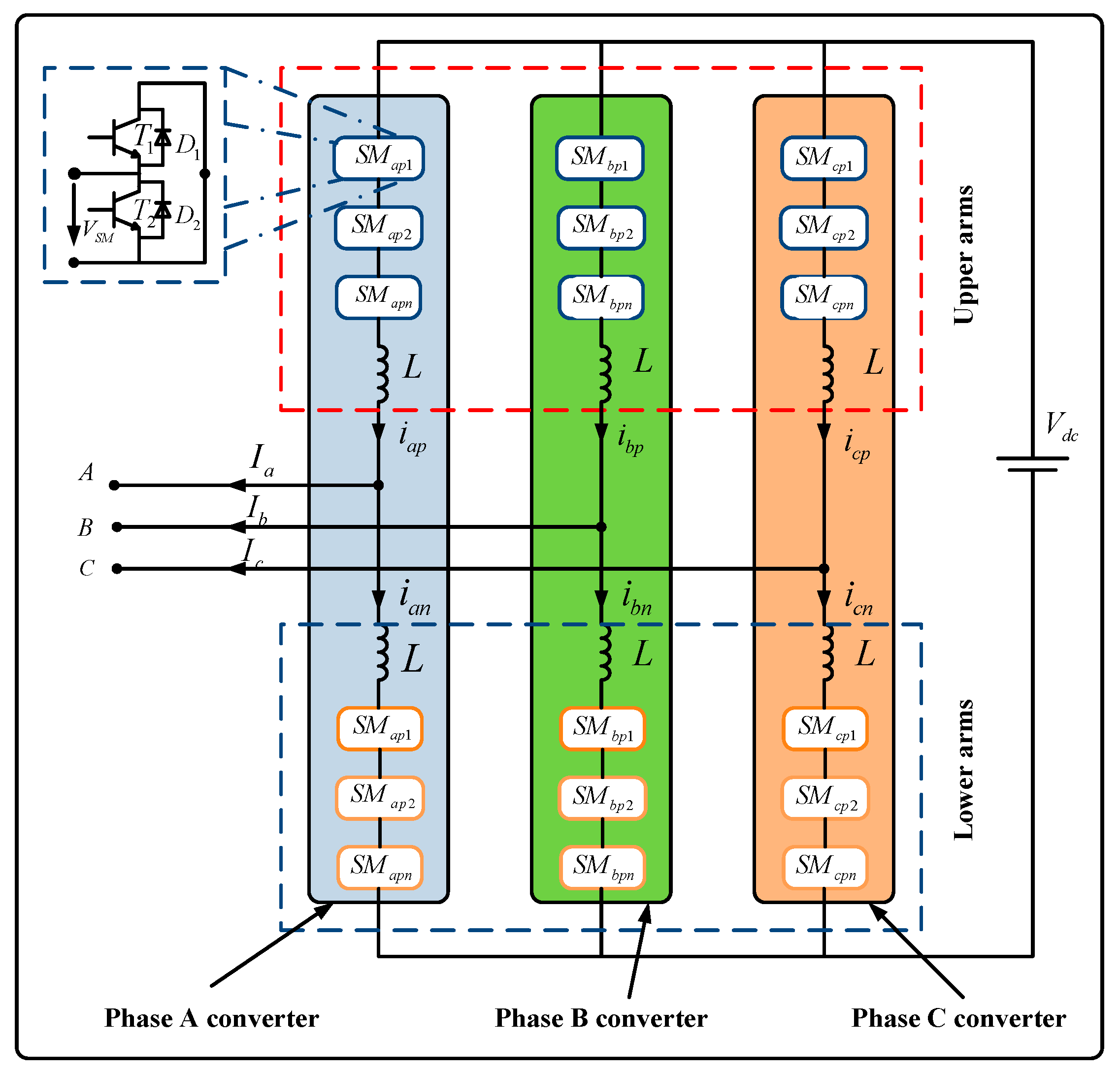
Figure 1 shows that each phase of the three-phase MMC consists of two arms (upper and lower) that are connected to two inductors L. Each arm contains a series of SMs, and each SM involves two IGBTs (i.e., T
1 and T
2), two diodes D, and a DC storage capacitor.
In our simulation (
Table 1), we recorded 9 channels of data for normal and 6 different locations of IGBT break-circuit fault manually for each bridge (namely A-phase lower SMs, A-phase upper SMs, B-phase lower SMs, B-phase upper SMs, C-phase lower SMs, and C-phase upper SMs). There are seven MMC health conditions (
Table 2) and 100 cases of IGBT break-circuit faults occurring at different IGBTs of the six bridges at different times. The power system is depicted in
Figure 2. The type of SMs is half-bridge and the direction of the flow is shown as the arrow above. Ba-A1 and Ba-A2 are two AC bus bars. Bb-A1 and Bb-A2 are two DC bus bars. E1 is an equivalent voltage source for an AC network. E2 is a wind farm.
The total time period used is 0.1 s, while the time for the IGBT open circuit fault duration is varied from 0.03 to 0.07 s. The simulation time step is 2 μs and the sampling frequency is 20 μs. The acquired data channels for fault diagnosis are AC-side three-phase current (Ia, Ib, Ic) and three-phase circulation current (Idiffa, Idiffb, Idiffc).
4. Experimental Study
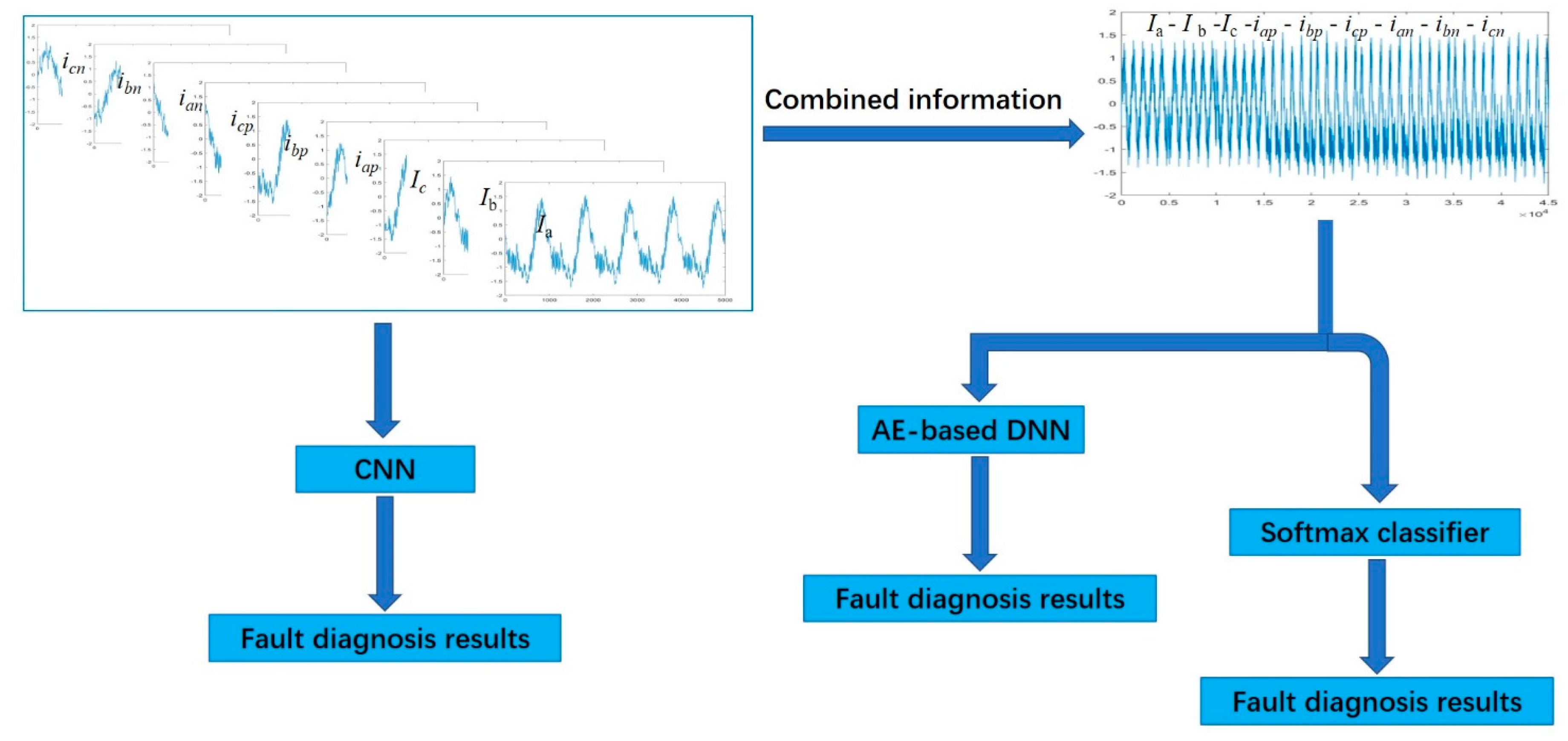
Seven conditions of MMCs status have been recorded which include normal, A-phase lower SMs, A-phase upper SMs, B-phase lower SMs, B-phase upper SMs, C-phase lower SMs, and C-phase upper SMs faults. A total of 100 examples were collected from each condition. Thus, there are a total of 700 (100 × 7) raw data files to process with. All the nine parameters, i.e., Ia, Ib, Ic, iap, ibp, icp, ian, ibn, and icn, were recorded to obtain 5001-time samples.
Experiments were conducted for testing data proportions from 0.1 to 0.9 and 20 run times for each testing data proportion. Testing data proportion is the ratio of the number of test samples to the total number of samples. We need to point out that the detection and classification results in the following paper are the average of 20 run results. In order not to be influenced by the differences in data used, it is important to ensure that these methods work with the same data at each run. The following code is pseudo-code, which can explain this scenario.
For TestingDataProportion = 0.1:0.1:0.9
For i = 1:20
[trainData testData] = split(RawData, TestingDataProportion);
CNN = trainCNN(trainData);
ResultsCNN = CNN(testData);
[trainDataCI testDataCI] = combined Information(trainData, testData);
AE-basedDNN = trainAE-basedDNN(trainDataCI);
ResultsAE = AE-basedDNN(testDataCI);
SoftMax = trainSoftMax(trainDataCI);
ResultsSoftMax = SoftMax(testDataCI)
End
End
4.1. Implementation Details and Results of CNN
4.1.1. Implementation Details of CNN
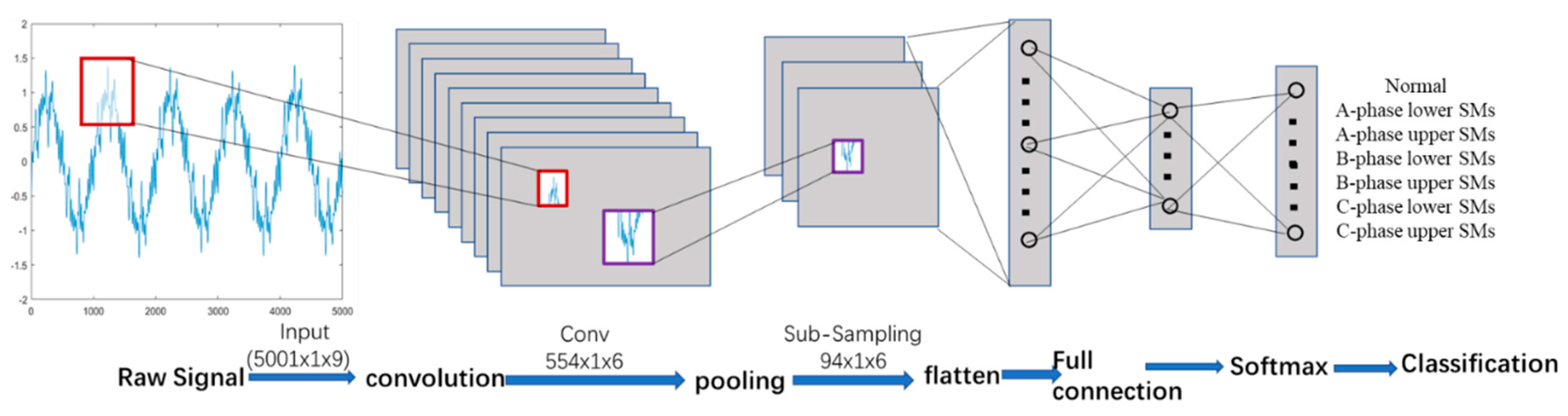
Figure 4 illustrates the architecture of CNN for fault detection and classification. The input data is the raw sensor signals. Each channel denotes one sensor, which records 5001-time samples. Therefore, the size of input current signals is [5001 × 1 × 9], where the length is 5001 and the height is 1, as the signals are one dimensional, and the depth is 9, as the signals come from 9 channels. The input is convolved with 6 filters of size 1 x 30 with stride 9 and padding 3, then applied a leaky ReLU function, in which the scalar multiplier for negative inputs is set as 0.01, resulting in a new feature map of size 554 × 1 and 6 channels. The sequence is pooling operation, which is applied to each feature map separately. Our pooling size is set 6 × 1 and stride is 6. Therefore, a convolution feature map is divided into several disjoint patches and then the average value in each patch is selected to represent the patch and transmit to the pooling layer, then the feature map is reduced to 94 × 1 by the pooling operation.
As stochastic gradient descent with momentum (SGDM) algorithm may reduce the oscillations along the path of the steepest descent towards the optimum that is sometimes caused by stochastic gradient descent algorithm [
36], we use the SGDM algorithm to update the parameters of the deep NN. The stochastic gradient descent with momentum update is
where
stands for the iteration number,
is the parameter vector,
is the learning rate,
is the gradient of the loss function, and
determines the contribution of the previous gradient step to the current iteration. Here, we set the momentum
at 0.95, the learning rate
at 0.01, and the maximum number of epochs to use for training at 30.
4.1.2. Results of CNN
The accuracy of the CNN fault detection is shown in
Table 3. For fault detection, the output network is divided into two types: fault and normal. We can see from
Table 3, when the testing proportion is 0.1~0.5 and 0.7, the detection accuracy is 100%. The minimum of the detection accuracy is 99.7% at the testing proportion of 0.9. There are 0.3% of fault cases misclassified as normal cases.
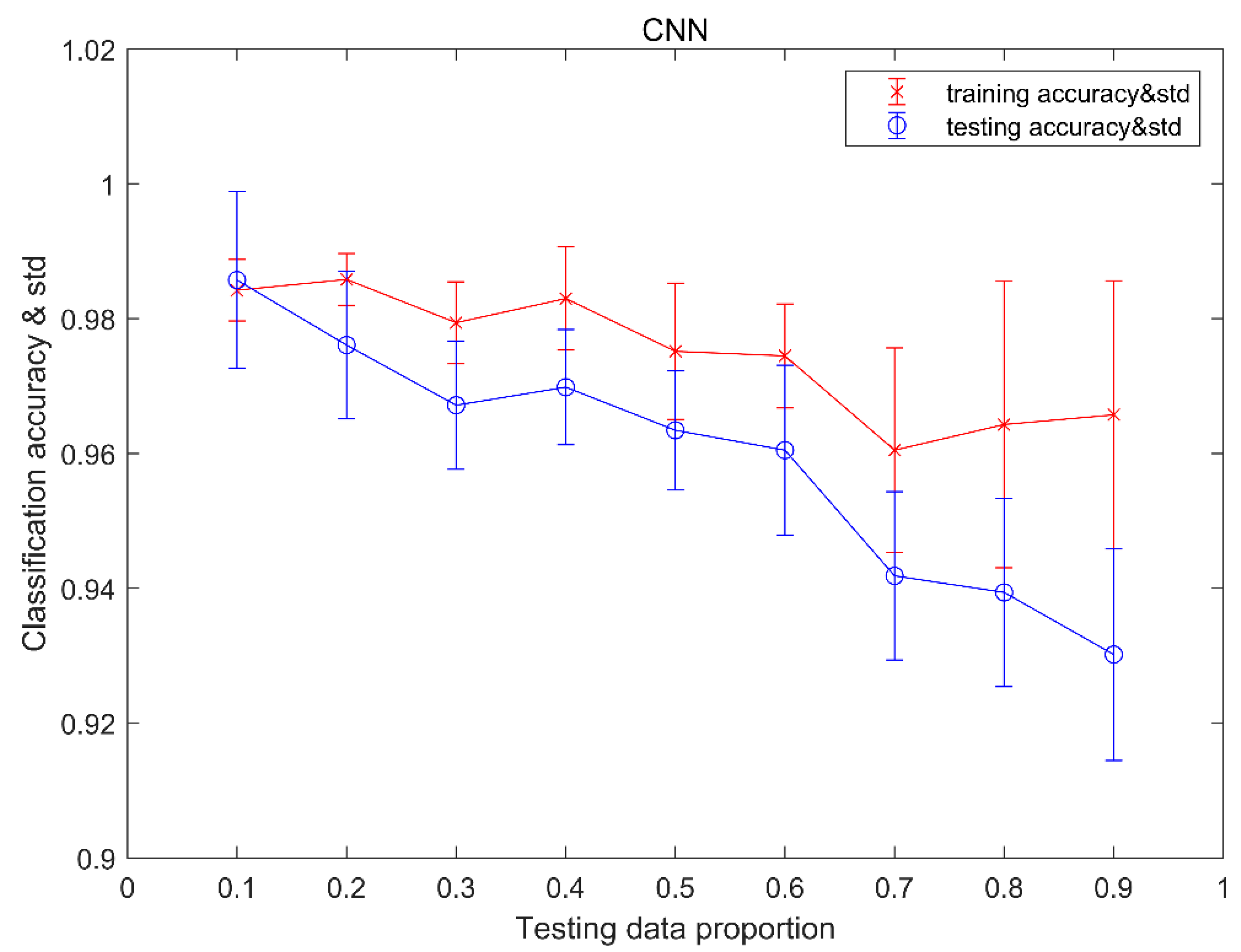
The classification results of training and testing data using convolutional NNs are shown in
Figure 6. From the viewpoint of trending, we can see that, with the testing data proportion increases, both classification accuracy for training data and testing data decline. For the training dataset, the standard deviation of classification accuracy increases with the increase of the testing data proportion. For testing data set, the maximum of mean accuracy is 98.6% with testing data proportion of 0.1 and the minimum of the average accuracy is 93.0% with testing data proportion of 0.9. The standard deviation of classification accuracy in the middle of the testing data proportion is smaller than both ends of the testing data proportion. Moreover, for each testing data proportion, the standard deviation of classification accuracy for the training data set is less than the standard deviation of classification accuracy for the testing data set.
Table 4 provides a confusion matrix of the classification results for each condition with testing data proportions of 0.2, 0.5, and 0.8. As can be seen from
Table 4, the recognition of the normal condition of the MMCs is 100%, with 0.2, 0.5, and 0.8 testing data proportions. With a 0.2 testing data proportion, our method misclassified 3.2% of testing examples of condition 4 as condition 2, and 2% of testing examples of condition 4 as condition 6. With a 0.5 testing data proportion, our method misclassified 1.6% of testing examples of condition 4 as condition 2, and 3.4% of testing examples of condition 4 as condition 6. Furthermore, with 0.8 testing data proportion, our method misclassified 0.8% of testing examples of condition 4 as condition 2, and 6.4% of testing examples of condition 4 as condition 6.
4.2. Implementation Details and Results of AE-Based DNN
4.2.1. Implementation Details of AE-Based DNN
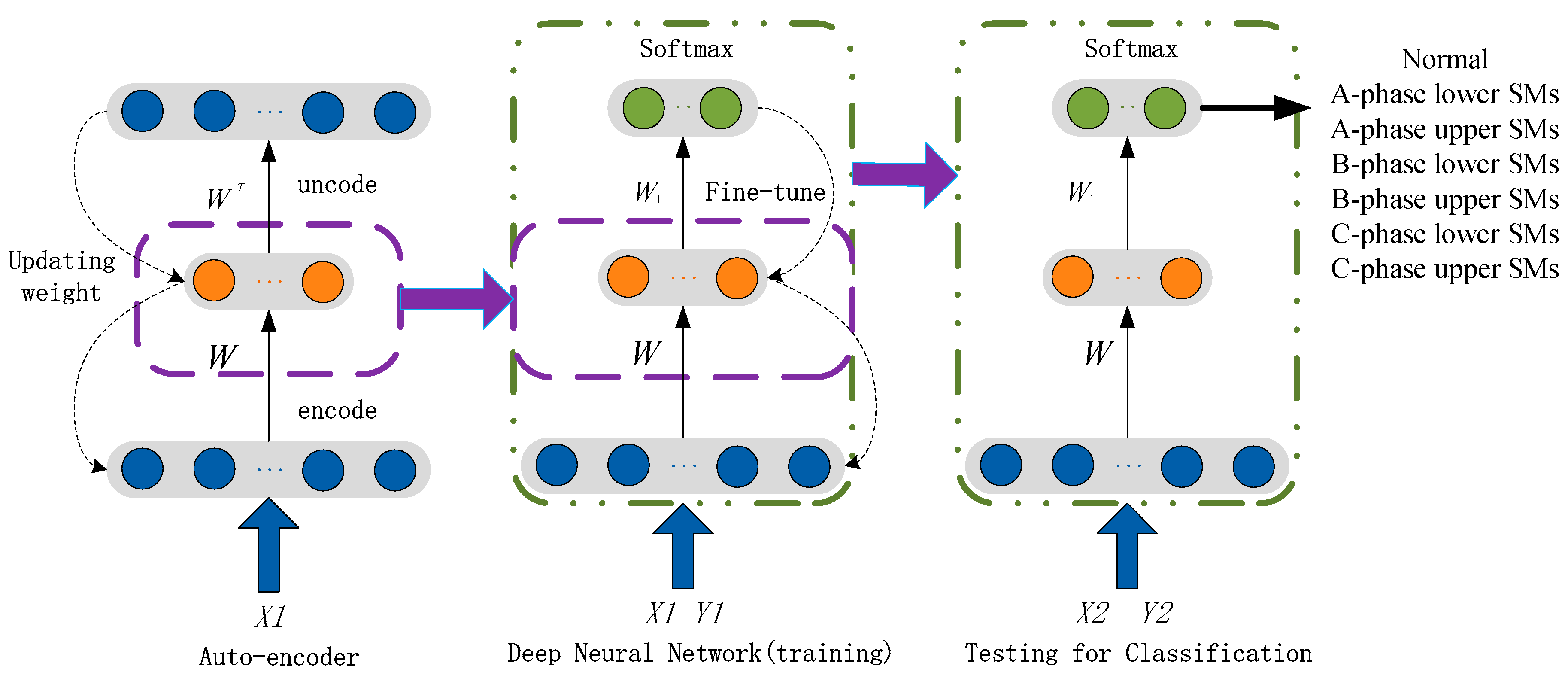
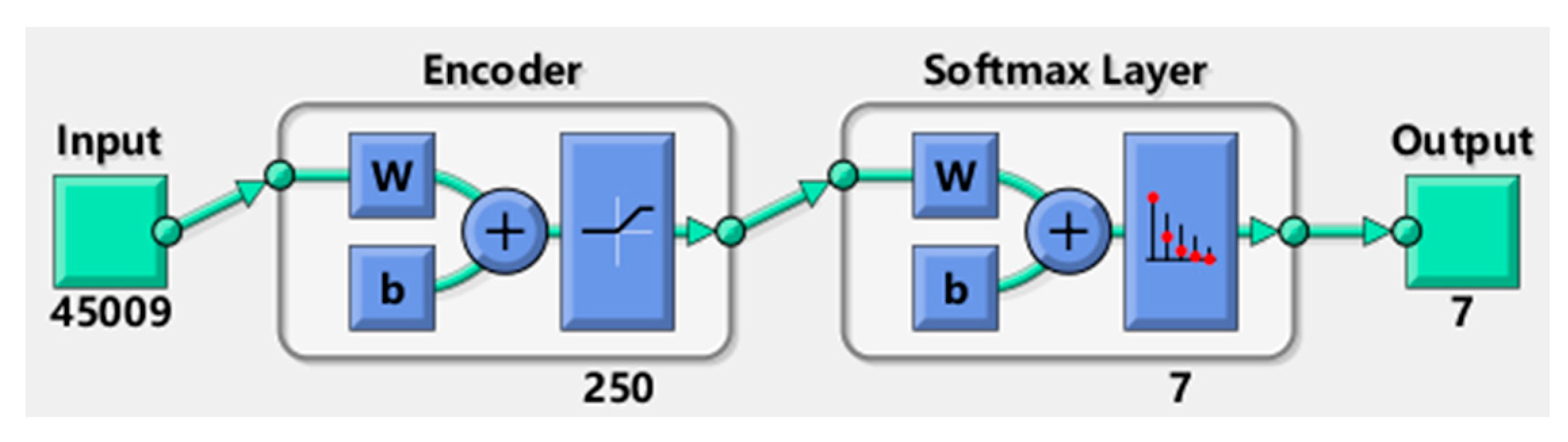
First, the measurements of nine current signals were concatenated to form a vector of samples that represent the current health condition of the MMCs. This gave a total of 45,009 (5001 × 9) samples dimension for each vector of health condition. Second, we used the AE with three layers: the input layer, hidden layer, and output layer, in which, the number of neurons in the hidden layer is set as 250, which means the sample dimension will be reduced from 45,009 to 250. An AE network consists of an encoder and a decoder. The transfer function for the encoder and the decoder is the Satlin function and the logistic sigmoid function, respectively. Satlin function is a positive saturating linear transfer function given as:
The algorithm used for training the autoencoder applied scaled conjugate gradient descent (SCGD). The maximum number of training epochs for this autoencoder is set as 10. Third, the 250 features achieved by trained AE are used as the input of the SoftMax classifier. The maximum number of training epochs for the SoftMax classifier is set as 20. Next, we stacked the trained AE and SoftMax classifier into a deep NN. Finally, we trained this deep NN using the training data. The structure of deep net is shown in the
Figure 7. The maximum number of epochs for training this deep net is set to 1000.
4.2.2. Results of AE-Based DNN
The fault detection results of the AE -based DNN are shown in
Table 5. When the testing proportion varies from 0.1 to 0.7, the detection accuracy is 100%. The lowest detection accuracy is 99.7% at the testing proportion of 0.9. There are 0.3% fault cases misclassified as normal cases. Compared with
Table 3 of CNN, AE-based DNN has better detection accuracy.
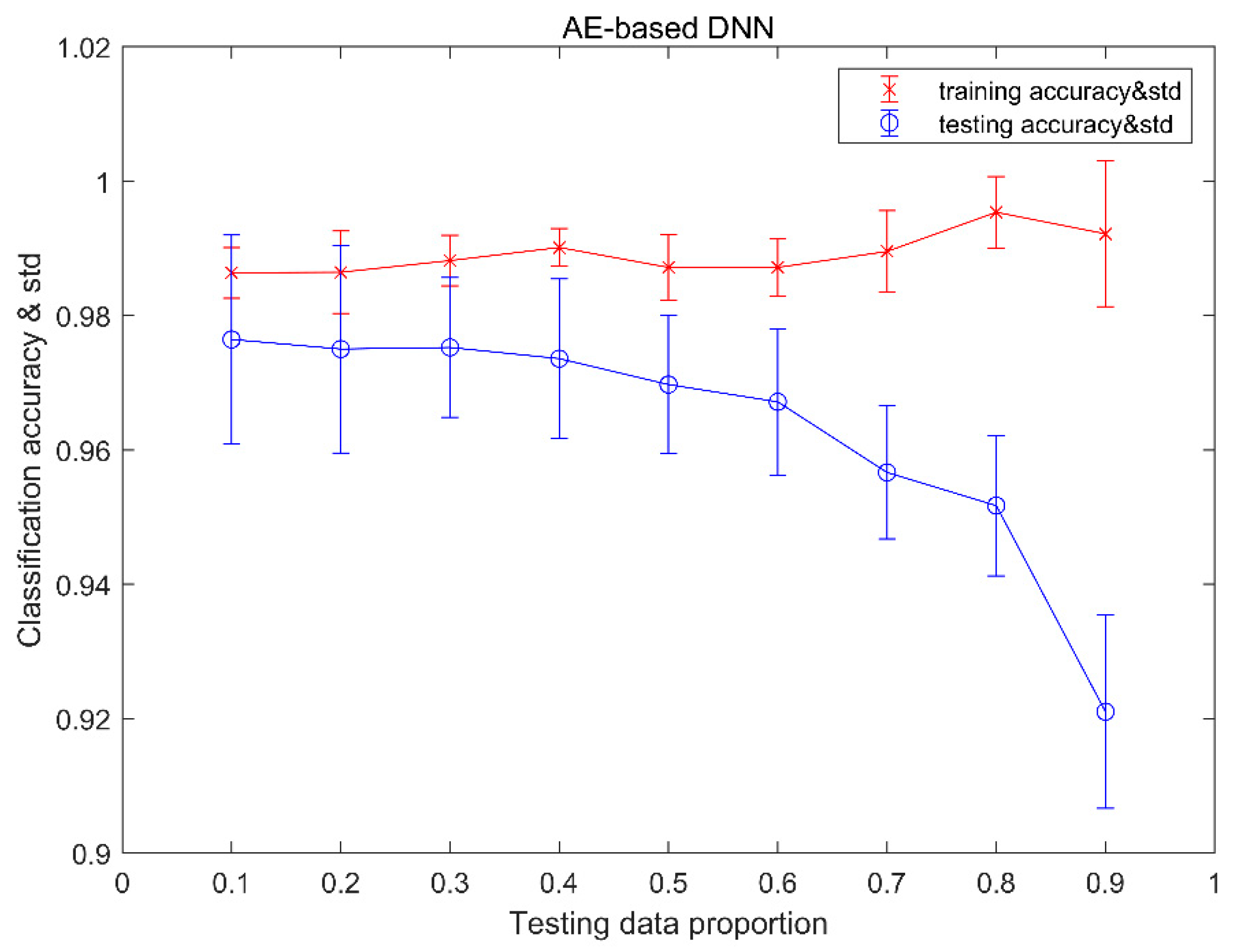
Figure 8 shows the classification results of training and testing data using AE-based DNN. From the viewpoint of trending analysis, we can see that with the testing data proportion increase, the classification mean accuracy for testing data declines, but the classification accuracy for training data increases. For the training data set, the highest average accuracy is 99.5%, with a testing data proportion of 0.8, and the lowest is 98.6%, with a testing data proportion of 0.1. The standard deviation of classification accuracy increases with the increase of the testing data proportion. For the testing data set, the max of mean accuracy is 97.6%, with the testing data proportion of 0.1, and the minimum of mean accuracy is 92.1%, with a testing data proportion of 0.9. The standard deviation of classification accuracy in the middle of the testing data proportion is smaller than both ends of the testing data proportion. We can also see that, for each testing data proportion, the standard deviation of classification accuracy for the training data set is less than the standard deviation of classification accuracy for the testing data set.
Table 6 provides a confusion matrix of the classification results for each condition with testing data proportions of 0.2, 0.5, and 0.8. As can be seen from
Table 6, the recognition of the normal condition of the MMCs is 100%, with 0.2, 0.5, and 0.8 testing data proportions. With a 0.2 testing data proportion, our method misclassified 1.5% of testing examples of condition 3 as condition 5. With a 0.5 testing data proportion, our method misclassified 1.8% of testing examples of condition 3 as condition 5, and 0.2% of testing examples of condition 3 as condition 7. With a 0.8 testing data proportion, our method misclassified 0.7% of testing examples of condition 3 as condition 4, 1.6% of testing examples of condition 3 as condition 5, 1% of testing examples of condition 3 as condition 6, and 1.9% of testing examples of condition 3 as condition 7.
4.3. Results of SoftMax Classifier
The accuracy of SoftMax classifier fault detection is shown in
Table 7. The detection accuracy is 100% at all testing proportions.
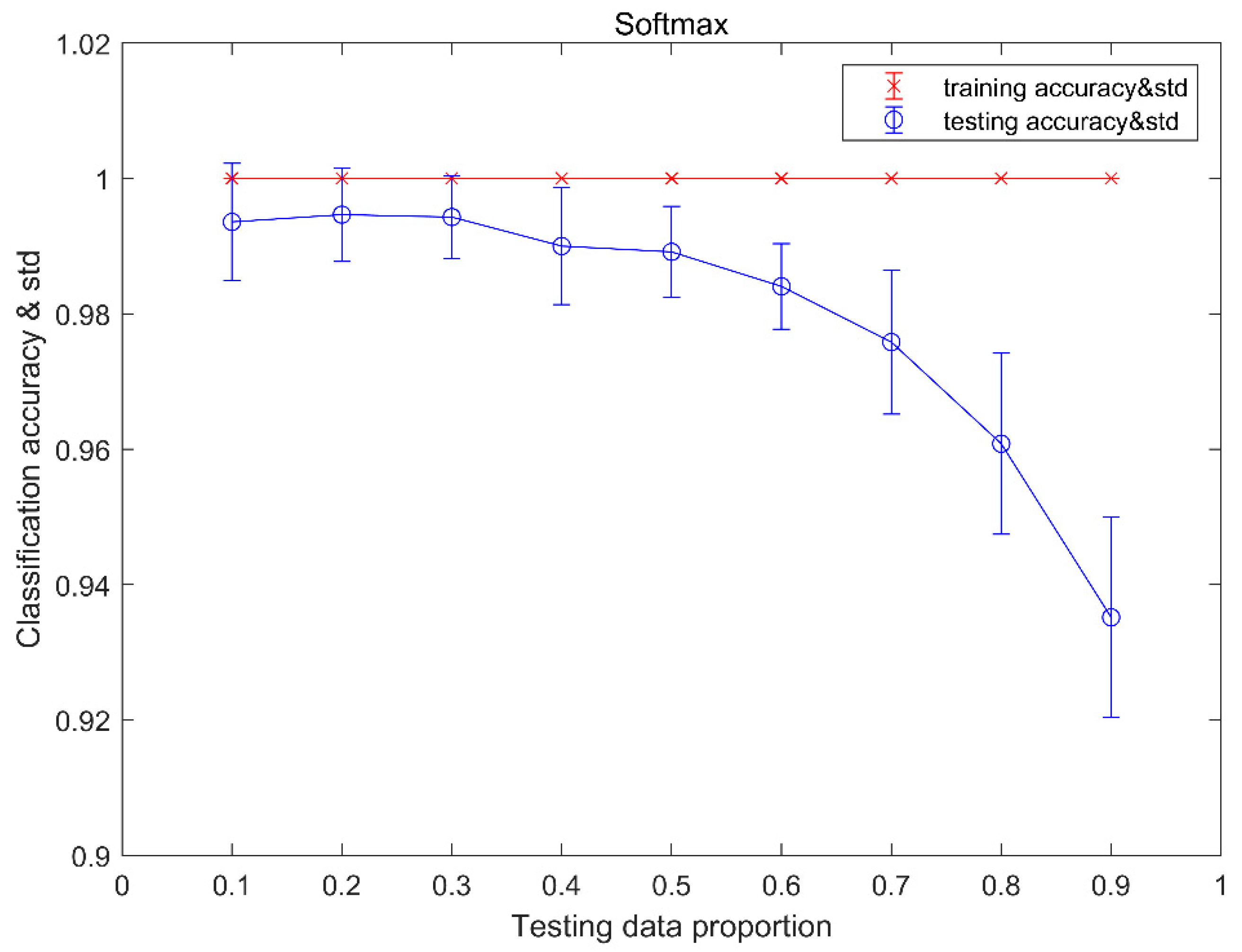
Figure 9 shows the classification results of training and testing data using the SoftMax classifier. From the trending view, we can see that, with the testing data proportion increases, the classification average accuracy for testing data declines, but the classification average accuracy for training data keeps steady at 100%. The standard deviation of classification accuracy in the middle of the testing data proportion is smaller than both the end of testing data proportion for testing data set, but the standard deviation of classification accuracy is 0. For testing data set, the highest average accuracy is 99.5%, with a testing data proportion of 0.2, and the lowest average accuracy is 93.5%, with a testing data proportion of 0.9. It is obvious to see that for each testing data proportion the standard deviation of classification accuracy for training data set is less than the standard deviation of classification accuracy for testing data set.
Table 8 provides a confusion matrix of the classification results for each condition with testing data proportions of 0.2, 0.5, and 0.8. As can be seen from
Table 8, the recognition of the normal condition of the MMCs is 100% with 0.2, 0.5, and 0.8 testing data proportions. With a 0.2 testing data proportion, our method misclassified none of the testing examples of condition 4. With a 0.5 testing data proportion, our method misclassified 0.4% of testing examples of condition 4 as condition 2. With a 0.8 testing data proportion, our method misclassified 1.5% of testing examples of condition 4 as condition 2, and 1.9% of testing examples of condition 4 as condition 6.
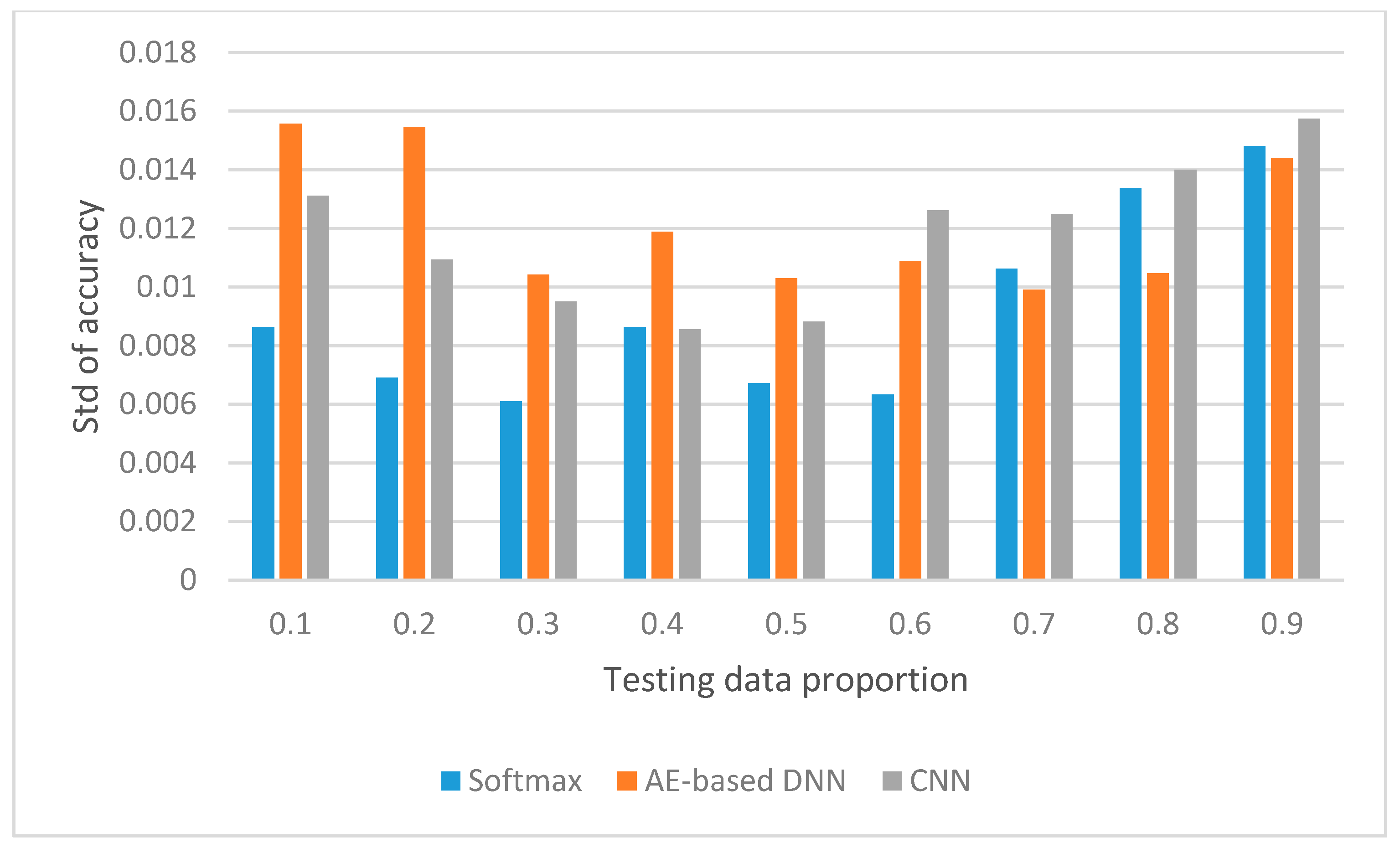
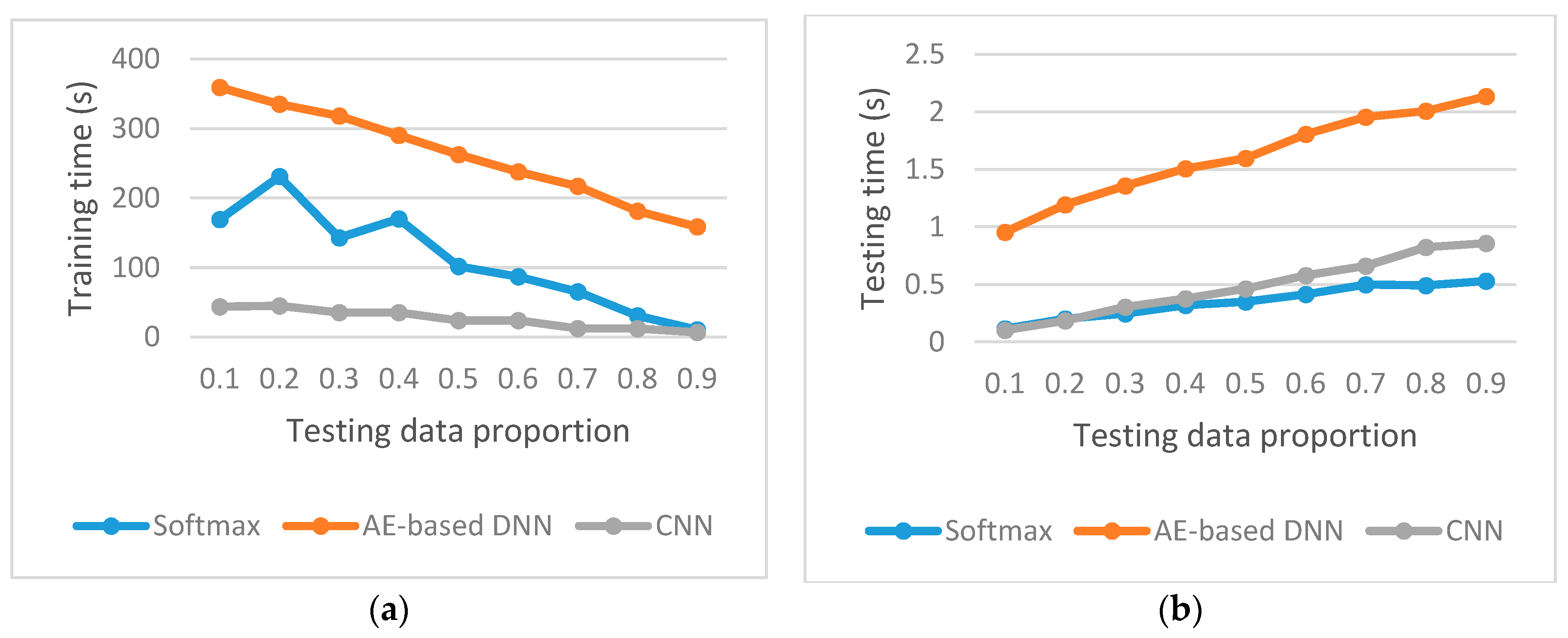
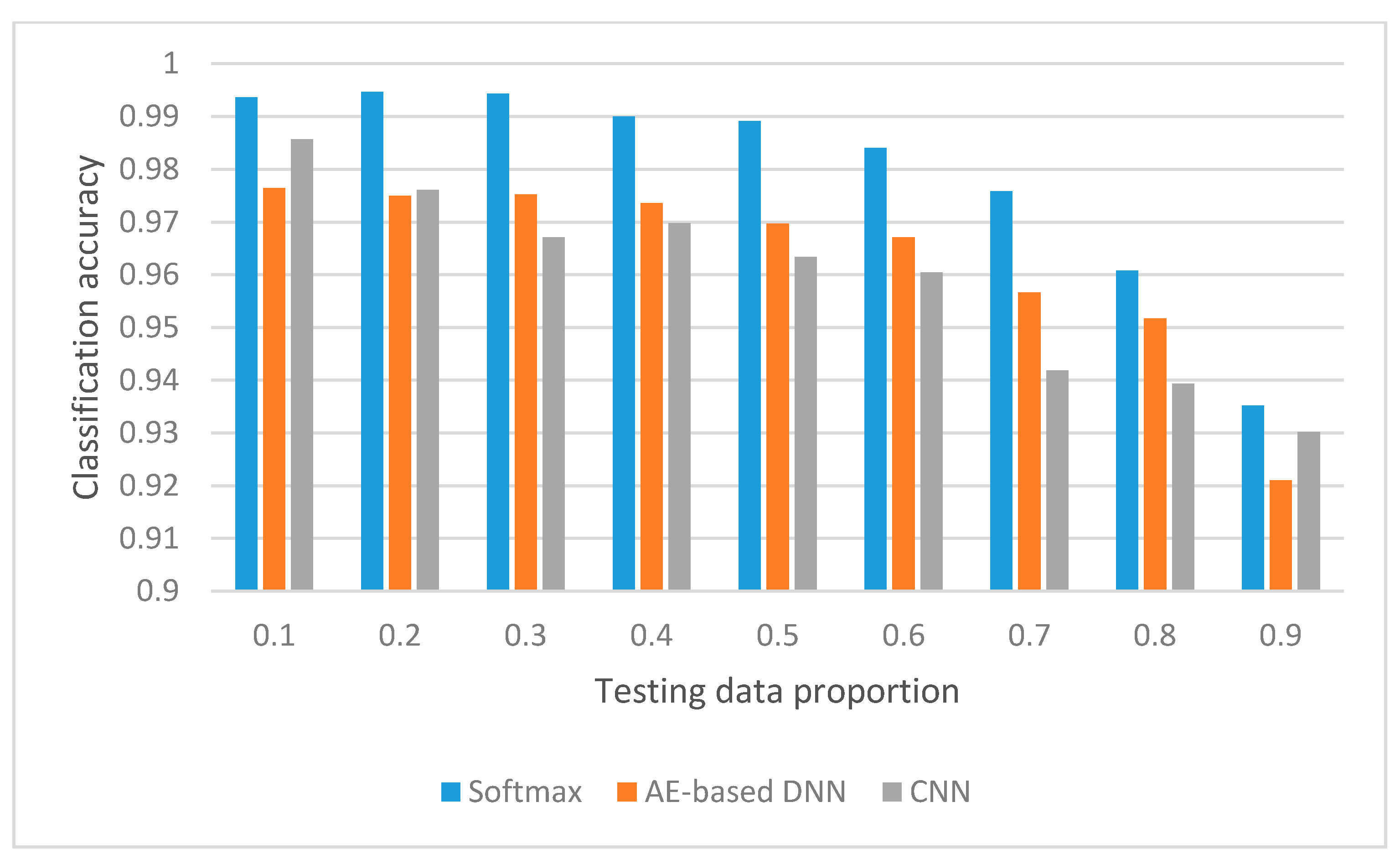
Above all, for the training data set, with the increase of testing data proportion, the average accuracy of SoftMax keeps steady which is 100% and the average accuracy of CNN decreases, but the average accuracy of AE-based increases. The standard deviation of accuracy for SoftMax keeps steady at 0, and the standard deviation of accuracy for other methods increases with the increase of the testing data proportion. For the testing data set, the average accuracy of all methods decreases, with the increase of the testing data proportion and the standard deviation of accuracy in the middle being less than both ends of the testing data proportion for all methods.