You are currently viewing a new version of our website. To view the old version click .
Sensors
  • Article
  • Open Access

26 November 2019

An IoT-Based Ship Berthing Method Using a Set of Ultrasonic Sensors †

and
1
Department of Computer Engineering, Dongseo University, 47 Jurye-ro, Sasang-gu, Busan 47011, Korea
2
Division of Information and Communication Engineering, Dongseo University, 47 Jurye-ro, Sasang-gu, Busan 47011, Korea
*
Author to whom correspondence should be addressed.
This paper is an extended version of our paper published in Kamolov, A.; Park, S.H. An IoT-Based Smart Berthing (Parking) System for Vessels and Ports. In Proceedings of the International Conference on Mobile and Wireless Technology, Hong Kong, China, 25–27 June 2018; pp.129–139.
This article belongs to the Special Issue Smart Sensors, Ambient Intelligence and Internet of Things Paradigms

Abstract

It is indisputable that a great deal of brand new technologies such as the internet of things, (IoT) big data, and cloud computing are conquering every aspect of our life. So, in the branch of marine technology, the mentioned technologies are also being applied to obtain more features and to automate marine-related operations as well as creating novel smart devices. As a result of this, traditional ports and ships are being replaced by smart ports and vessels. To achieve this transition, numerous applications need to be developed to make them smart. The purpose of this paper is to present a dedicated an IoT-based system for automating linkage procedures by searching for available locations via port-mounted sensors and planned ship notification. In the experimental system, we have used smartphone as an alternative to the client-side vessel of the system and created an Android app called “Smart Ship Berthing” instead of the charging program, for instance, NORIVIS 4, VDASH, ODYSSEY, etc. To test our proposed server-side system, we used Raspberry Pi with a combination of an ultrasonic sensor to detect the ship and modify the empty berth for anchoring. The experimental results show that the set of UR sensors have high accuracy to detect ships at the port for ship berthing and our proposed system is very amenable to implementation in the real marine environment.

1. Introduction

Embedded technologies such as big data, artificial intelligence and the internet of things, represent the adoption of Industry 4.0 technology in the maritime field. A variety of new communications technologies will dominate the next generation of communications between smart ships and smart ports, including satellite communications. It is no paradox that humans are surrounded by technologies and that is why intelligent technologies do almost all the work we do during our daily existence. Therefore, humans are trying hard to develop numerous automation areas, for instance, smart strollers, smart cars, smart watches, smart cameras, and smart umbrellas, etc. [1]. Even the places where we study [2], live, and work have become smart. In this context, all objects and elements are replaced by their smart alternatives. For instance, traditionally modeled ships and ports are evolving into smart ships and ports and this offers several premium opportunities for research in marine science. It should be mentioned that large companies from developed countries are still studying these two big projects. Thus, enormous thriving corporations in Korea, Japan, and China are proposing IoT solutions for smart ships [3,4,5,6] and developed countries in Europe (such as Germany and The Netherlands) are actively working on smart ports. In this study, we suggest a system that supports berthing by automatically locating the berth in a port based on the IoT. Upon receiving a request from a ship arriving at the port, the system automatically sends data about the location where it could dock before reaching that location. The system uses information from a range of ultrasonic sensors associated with the available space. However, everything could be done by automating ships. The new concept of smart ships focuses not only on collecting and controlling data independently, but also refers to free communication with other ports and ships. In this matter, the role of different sensors, devices, and software installed in ports and smart ships is important when performing these functions. In particular, the demand for software for smart devices is expected to increase significantly over the next few years. Each transfer requires a special automation system. In order to fully automate and personalize the entire ship and port system, the parts and process must be automatically split before the goal is achieved. At this point, we can conclude that with such a large object, it is part of the initial process automatically and the entire system turns into an intelligent or automatic monitoring system. When newly emerging technologies such as the IoT are applied to actual transportation procedures, one of the available means of transport is the port berthing process. The system currently in use has many drawbacks. In this study, we suggest a system that supports berthing by automatically locating one in the port based on the IoT. The system uses information from a range of ultrasonic sensors associated with the available vacant berths.
After going through the introduction of the system in Section 1, the rest of the paper includes the following sections: Section 2 is about the background and related works, and also gives information about the IoT in detail and brief information about smart ships, smart ports and also the role of the most recent model technologies in marine technology. Section 3 illustrates the problem of ship berthing, Section 4 describes the proposed system architecture, design, and working scenario, Section 5 is devoted to the implementation and experiments, whereas the experimental results appear in Section 6. Section 7 is for the discussion and finally, the conclusions of this work are presented in Section 8.

3. Problem Analysis in Ship Berthing

Ships are commonly considered a huge vehicle. An enormous number of hardware and software technologies are required to make them smart and undoubtedly, accomplishing those demands really needs a lot of time as it cannot be carried out within a short period of time. By considering small parts of a ship, we can create uncomplicated software gradually.
Through this research, we introduce our diminutive system that is fully applicable in the arriving and berthing port access process. We strongly expect that the proposed system will succeed in reaching ships while arriving at the port and help them find a place automatically, which has been experimentally proven. Before describing the system, it is necessary to understand the communication between ships and ports in order to comprehensively appreciate the amenities of our system.
In the shipping industry, not only is communication between ships practical but also communication between ships and ports is critical and the main proportion of this communication occurs when ships arrive at a port. Currently, ships waste too much time in berthing at the port as the task may last from two hours to several days. One reason for this problem is the presence of a crowd of ships in the port and the other trade-off is the huge amount of information exchanged between ships and ports. The data required by the port includes complete information regarding the name of the ship, the owner, the crew, the overall dimensions of the ship and its condition, as well as the expected time of arrival and departure of the ship. In these days such a vast amount of the data transfer procedure is managed with the help of portable radio transmitters. That is one of the main reasons so much time is wasted during berthing. Besides that, having exchanged the data, a responsible member of the port staff must arrange a place for the ship to moor and this procedure may cause trouble as well as inconvenience. As an example, we include in this paper a typical dialogue between a port and a ship that are exchanging data before the ship gets permission to berth. In the dialogue, we highlighted a circumstance where the captain of the ship called “TITANIC” and the person responsible for controlling the port system are having a conversation [42]. Appendix A shows this example of conversation between port and ship, illustrating how the berthing procedure adds additional time, problems and cost as well.

4. Proposed System

4.1. Architecture

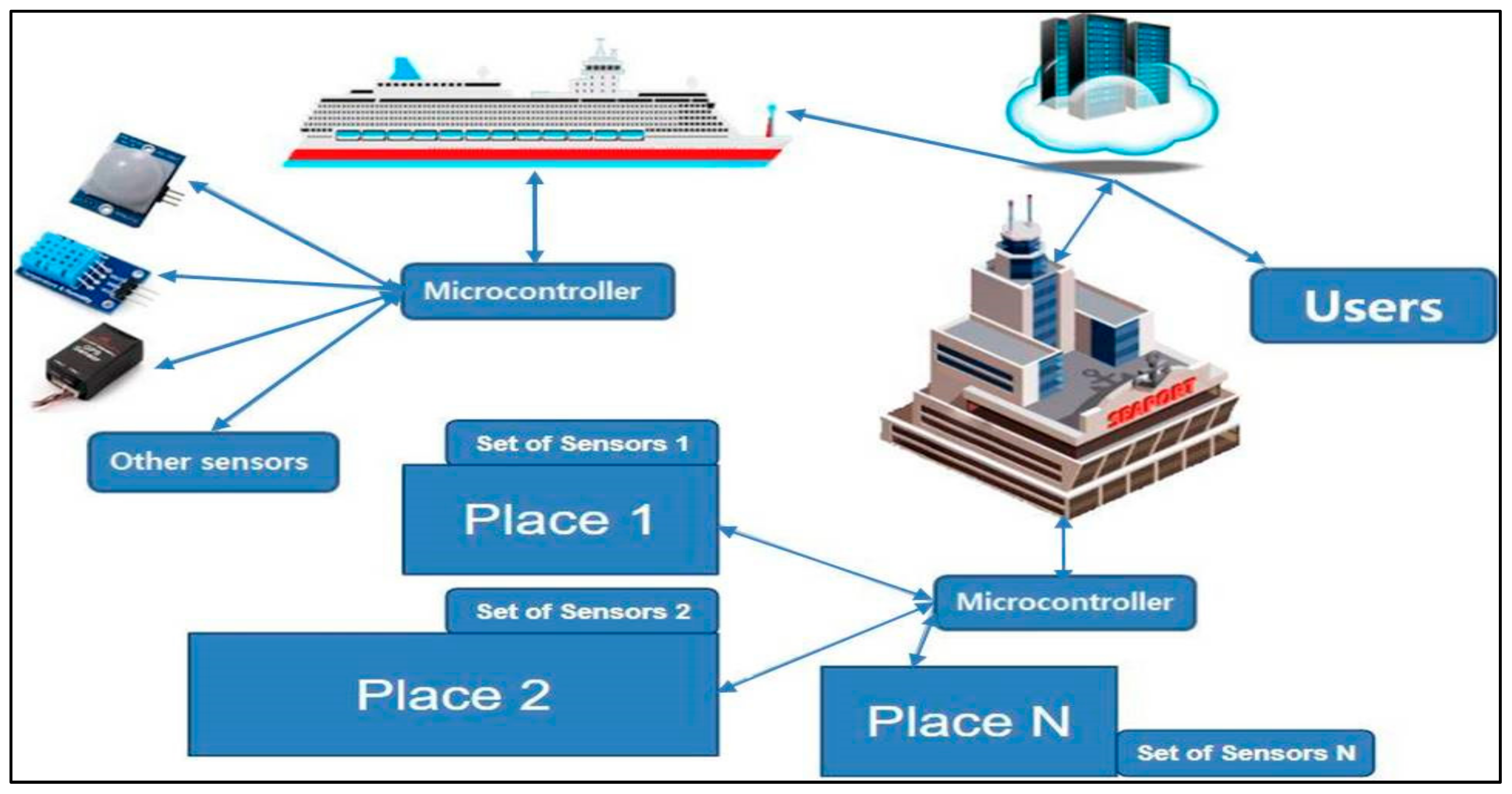
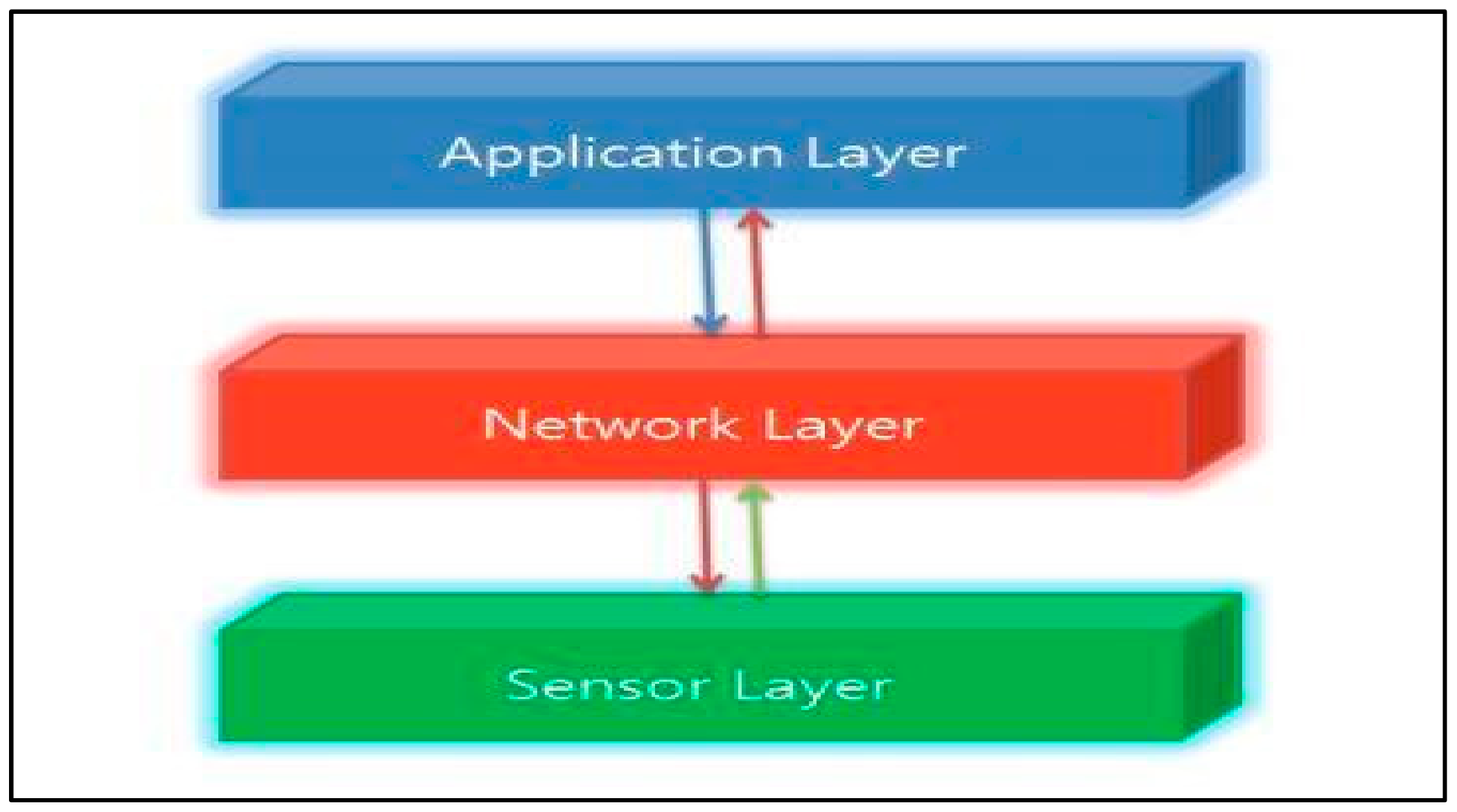
Nowadays the arrival and departure of ships at the port is getting very busy. As can be seen in the pattern given in the preceding section, ships arriving at a port often cannot find a place to berth easily and it is a really complicated situation. Our IoT-based smart berthing system can help vessels and ports in such situations. The principal purpose of the system is to help to berth vessels which have arrived at the port and help exchange data regarding their situation. The system is able to manage several tasks automatically like receiving all the data about available berths by means of a set of ultrasonic sensors affixed at the port and having obtained the data, it transfers it to the vessels looking for a place to berth. The system categorizes the online data received from the set of sensors and offers the ship an optimal place concerning location, quantity and other criteria. As many of the applications of IoT-based systems are created by means of three-layer architectures, our proposed system is also based on this architecture (see Figure 5).
Figure 5. High-level architecture of the proposed smart berthing system for ships [37,55].

4.1.1. Smart Berthing System for Ships (Application Layer)

Using the Application layer ships send a request for a place to berth to the port. The application layer consists of the software which is suitable for transmitting and receiving the data from and to the port.

4.1.2. Smart Berthing System for Ships (Network Layer)

This network layer provides a means for communications between the application layer and sensor layer that can be used in our system based on diverse technologies like Wi-Fi, WiMAX, LTE (LTE-A, LTE-M), etc.

4.1.3. Sensor Layer of the Smart Berthing System for Ships

The sensor layer of the system can be viewed as common sensors that are fixed at the port. This set of sensors works to elucidate a certain place if there is a vessel at the port or not. Then, with the help of the network layer it transfers the information to the application layer, that is, it transmits data to the vessels. Ultrasonic sensors are a superlative sensor to specify the berth status owing to their affordable cost and convenience and that is the reason why we utilized a set of ultrasonic sensors in our system. As illustrated in Figure 5, all berths have their own set of sensors. Bigger sized berths, for example Place 2 have more sensors, while smaller ones like Place 1 have less sensors.

4.2. High-Level Design

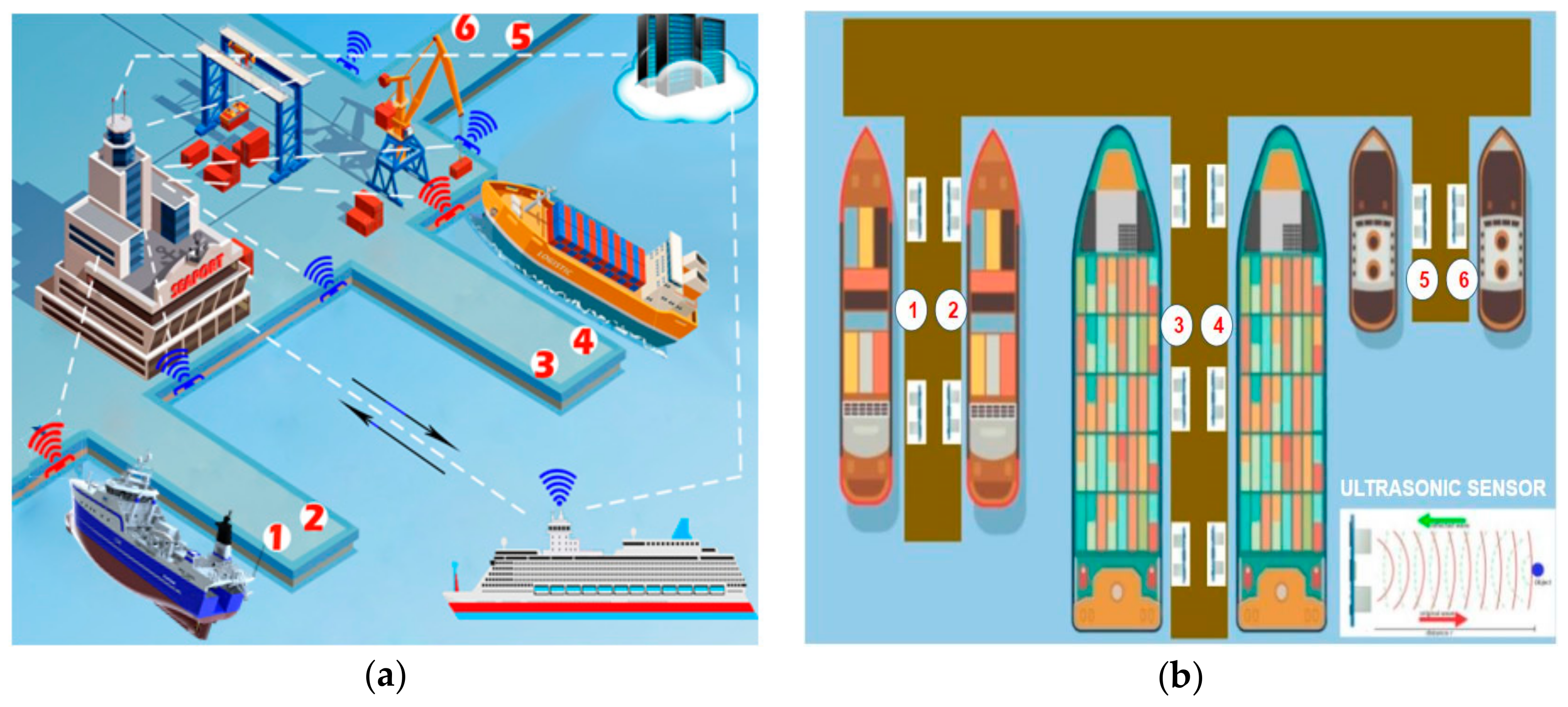
Furthermore, we set up high-level visualization for the proposed system as shown in Figure 6a,b. Figure 6a is the first proposed design we introduced in our previous study [55] and Figure 6b shows the upgraded design of the current proposed system. In the designs shown below, ships can be anchored at each berth in the port equipped with a particular set and number of sensors. Every space at the port has its own set of sensors and numbers. In Figure 6a, the red colored sensor means that the space is occupied and that the sensor provides “busy” information. The blue sensor indicates that the space is empty and that the sensor indicates “empty” information. The above scenario is the same as our first one and when a set of sensors are busy is means there is ships in the berth, and if not the place is empty.
Figure 6. (a) The first version of the design for the proposed system; (b) the updated version of the design for the proposed system [37,55].

4.3. Working Scenario

So, how does the system work? As we mentioned before, this work is an extended version of our previous work presented in [55]. That is why the proposed system is almost the same as the previous one. The main difference between them is in this current system has multiple sensors at some places (especially bigger places by size) in the port, and in the previous one, we only used one sensor for each place. Its working scenario is as follows:
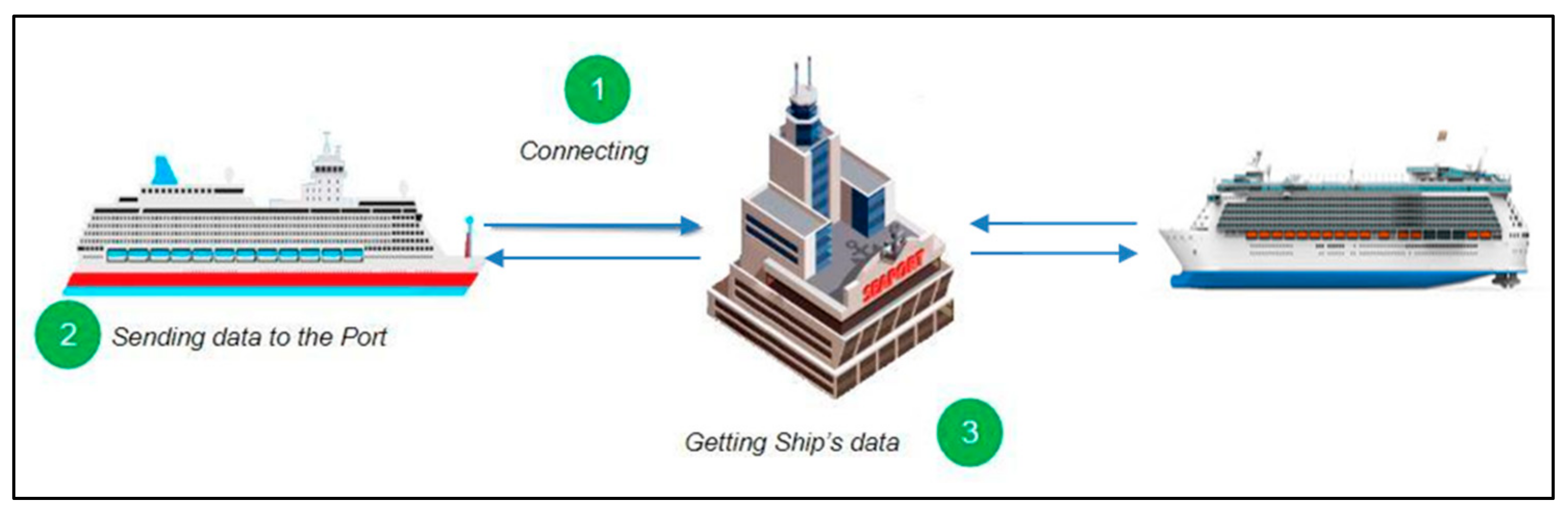
  • Step 1: hips arriving at the port access the port system through the network for instance, using 5G, LTE (LTE-M, LTE-A), Wi-Fi, or WiMAX. When the ship arrives near the port, it sends a connection request to the port.
  • Step 2: After receiving a successful response from the port, the ship can send data (information about the ship) and ask for a place to berth.
  • Step 3: The port will receive and check the data which is sent from the ship. Figure 7 shows our system scenario from Step 1 to Step 3.
    Figure 7. System scenario, steps 1 to 3 [37,55].
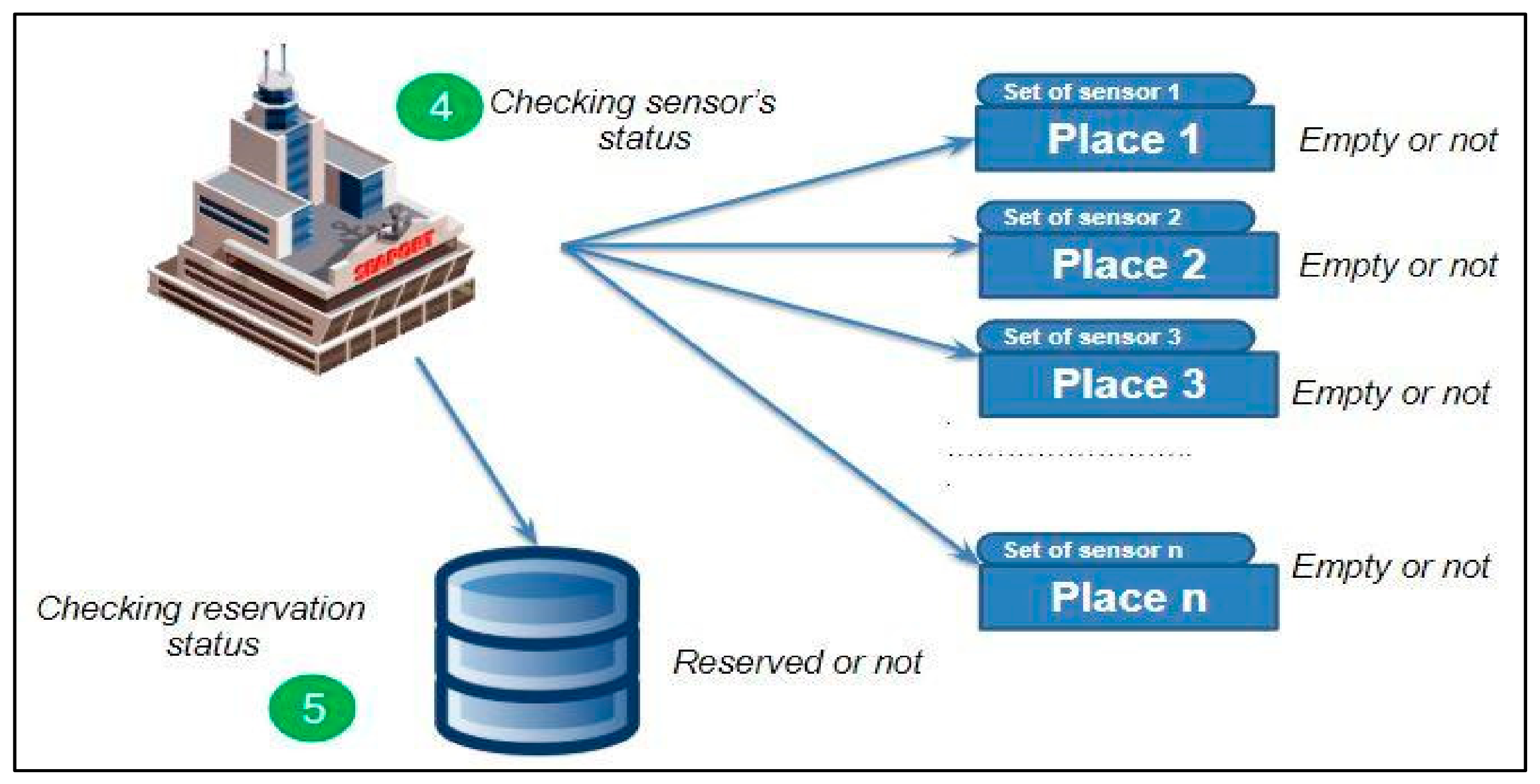
  • Step 4: After the port receives the data about the ship, the system at the port will get information about the availability of berthing places using a set of ultrasonic sensors placed in certain locations. The port system sorts places into busy places, empty places, not matched places and reserved places.
  • Step 5: After obtaining data on the available vacancies, the system takes into account the reserved places that were requested by ships that arrived at the port earlier and do not match places where the size of the ship does not match the berth. Figure 8 illustrates Step 4 to Step 5 during sorting.
    Figure 8. System scenario, steps 4 and 5 [37,55].
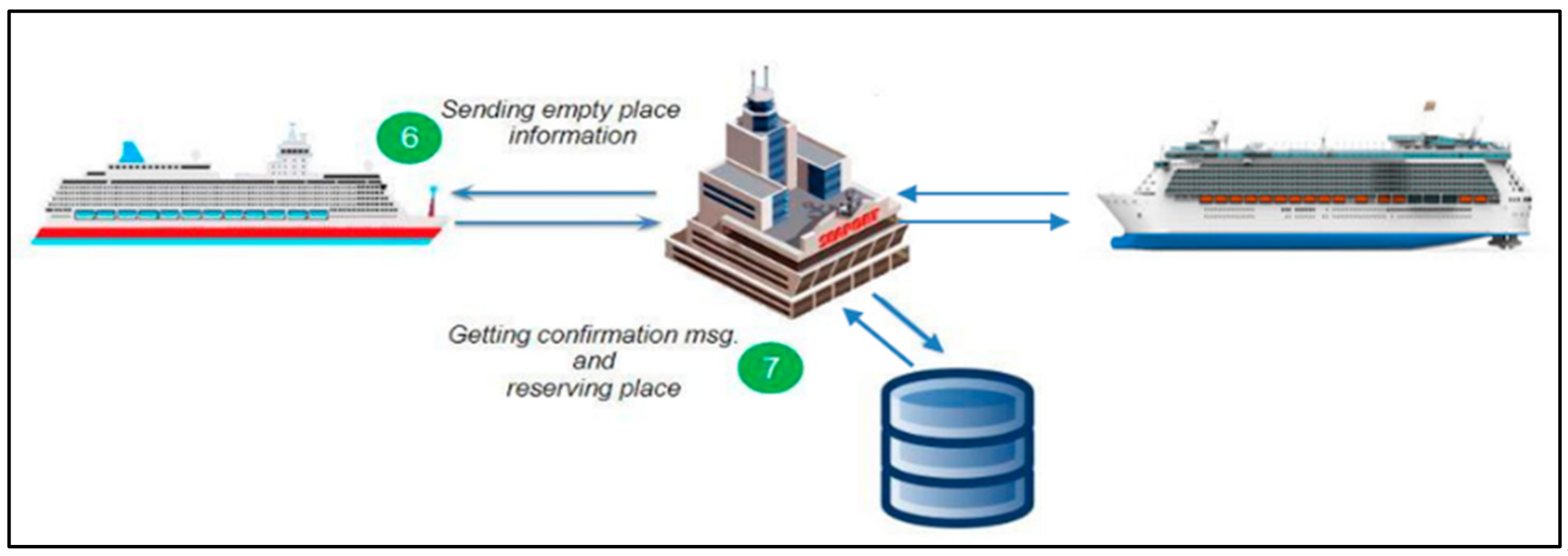
  • Step 6: All the collected data concerning the vacancies is sorted and the perfect place location is sent to the ship. The system sends all information about this optimal vacancy such as location and number on a digital map. After sending the place information system it awaits confirmation messages from the ship.
  • Step 7: The data regarding the places available for the berthing and the area shown on the port map are sent to the ship. Once a vessel has reserved a place described in the message sent from the port, it will receive a reserved place status. Figure 9 illustrates the system scenario from Step 6 to Step 7.
    Figure 9. System scenario, steps 6 and 7 [37,55].

4.3.1. Proposed System in the Ship

Some of the details of the system in the ship are listed below:
  • All static information about the ship is transferred to the system in advance and it is stored constantly (the model, type, color, length, name, owner of the ship, etc.). Moreover, the system keeps all the data about the ports and target places to berth (coordinates, maps, etc.).
  • The system receives continuous information with the help of the sensors fixed on the ship (the direction, speed, location, temperature, etc. of the ship).
  • The system offers the opportunity for the responsible person (he may be a captain) to add and save the data.

4.3.2. Proposed System at the Port

Some of the details of the system in the port are illustrated below:
  • All the static data about possible berthing places and set of sensors is inserted into the system beforehand and it is kept constantly (the measurements of the berths, type of berth, location, number, the ID which is assigned to a set of sensors, etc.).
  • The system receives data continuously via the set of ultrasonic sensors that are fixed at different places (is the place vacant or occupied and if it is occupied, it clarifies which ship has been moored there).
  • Getting the data taken from a set of sensors the system determines vacant and convenient spacea and it sends the information about the place to a certain ship (the number of the place, location, type of place, etc.).
  • The system, before sending the data about vacant places to a certain ship via sensors checks the information of the ships which have reserved the place beforehand and then those places are sorted out from the list. The system sorts berths by the size and type of the ships. Because longer vessels need longer berths and smaller ones need less space. Passenger or cargo ships need particular types of place at the port.

4.3.3. Communication Technologies

The latest 5G, 4th Generation (4G) technologies WiMAX and LTE (LTE-A, LTE-M) are good candidates for the network layer of our project because both have very high transfer rates and very long range for communication. These qualities are very important for communication between ships and ports from a distance. That is why as a network layer for our system we prefer to select one of these two technologies. Some information and a comparison about LTE and WiMAX and their evolution is given in Table 1 below [56].
Table 1. Comparison of LTE and WiMAX.
Worldwide Interoperability for Microwave Access X (WiMAX), is the fourth-generation mobile broadband technology approved by the International Telecommunication Union (ITU), which attempts to mimic the capabilities of Wi-Fi wireless internet, but over a mobile network using an open protocol (802.16 m).
LTE stands for “Long Term Evolution,” and is an ITU-approved 4G mobile broadband technology. It is a direct competitor to WiMAX.
LTE and WiMAX are IP protocols, which makes them better for burst data traffic with good VoIP support. Both use Orthogonal Frequency Division Multiple Access (OFDMA), and multiple access technology which is a form of FDM in which subcarriers are orthogonal to each other.

5. Implementation and Experiment

Making the procedure of experiment and implementation in the whole ship and at the port is quite a complicated task. Nevertheless, the experiments of the system purposed for vessels and ports could be carried out in small measure and in small systems. We have done our research as illustrated in Table 2 where the technique and technologies which are important to carry out the experiment are outlined.
Table 2. Experimental requirements.
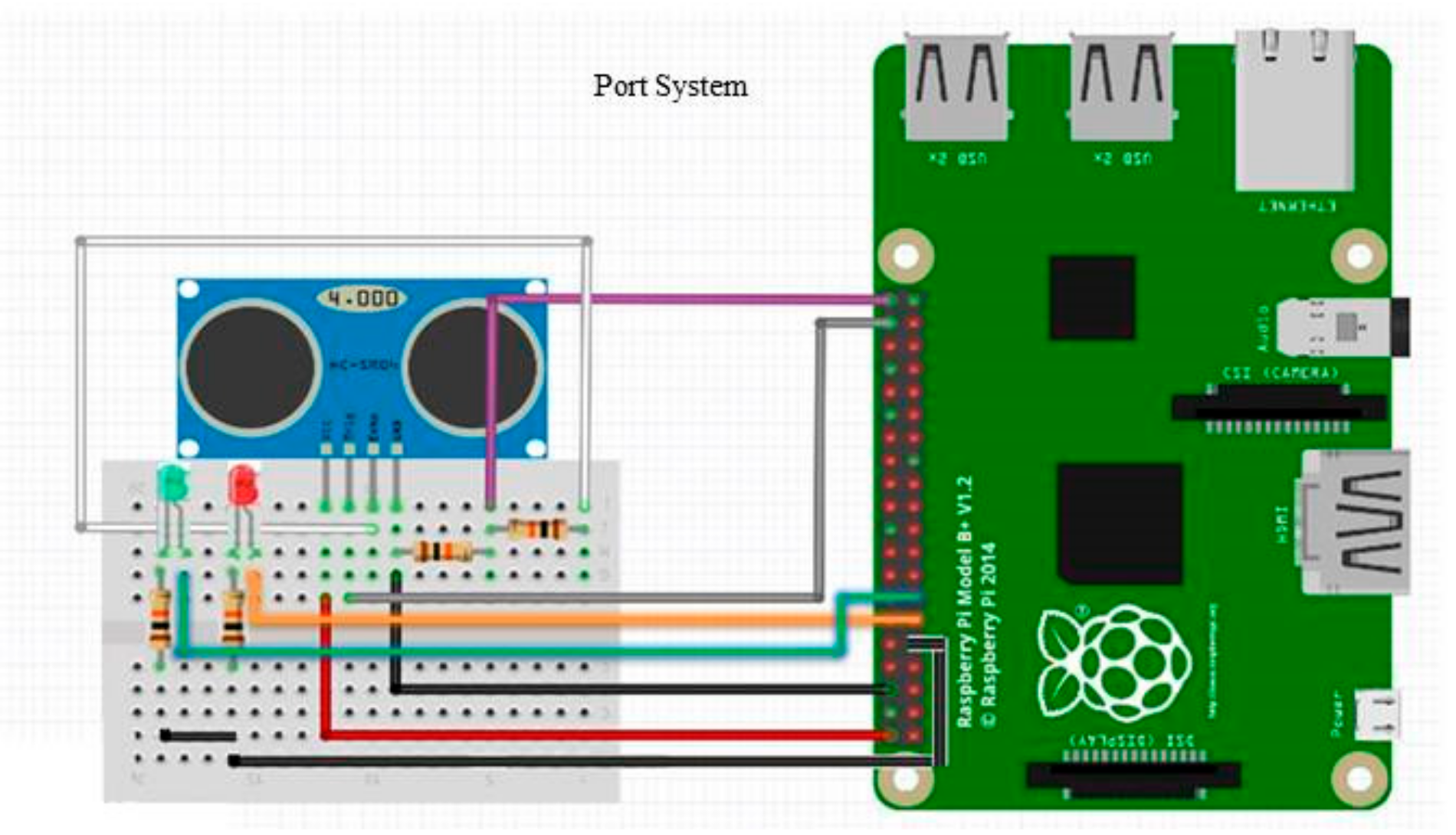
In the experimental part, a smartphone and its software that work in Android OC manage the tasks of the vessels. Raspberry Pi and the set of ultrasonic sensors connected to the Raspberry Pi are responsible for transferring data regarding the berths at the port. The system presented is based on the three-layer IoT architecture, where for the application layer we created an application that uses Android Studio via an Android OS smartphone. The dominant language for smartphone application development, Java, is also applied on this layer. In the network layer, we preferred to apply Wi-Fi technology. However, according to the IoT concept, Wi-Fi works as a means of communication between the application layer and the sensor layer. In the sensor layer, the entire intended work in the port system is performed by Raspberry Pi and also by a set of ultrasonic sensors connected to Raspberry Pi. In this part, Noobs Raspbian (Linux OS) is launched on Raspberry Pi. The system is set based on the Python programming language to accept information from the sensor. The server collects information and performs commands via the sensors attached to the Raspberry device. In Figure 10, the experimental hardware implementation for the proposed port system is illustrated. In this work, we add an extra ultrasonic sensor for the berthing places and connect it as the first sensor.
Figure 10. Hardware implementation of the proposed port system [37,55].

6. Results

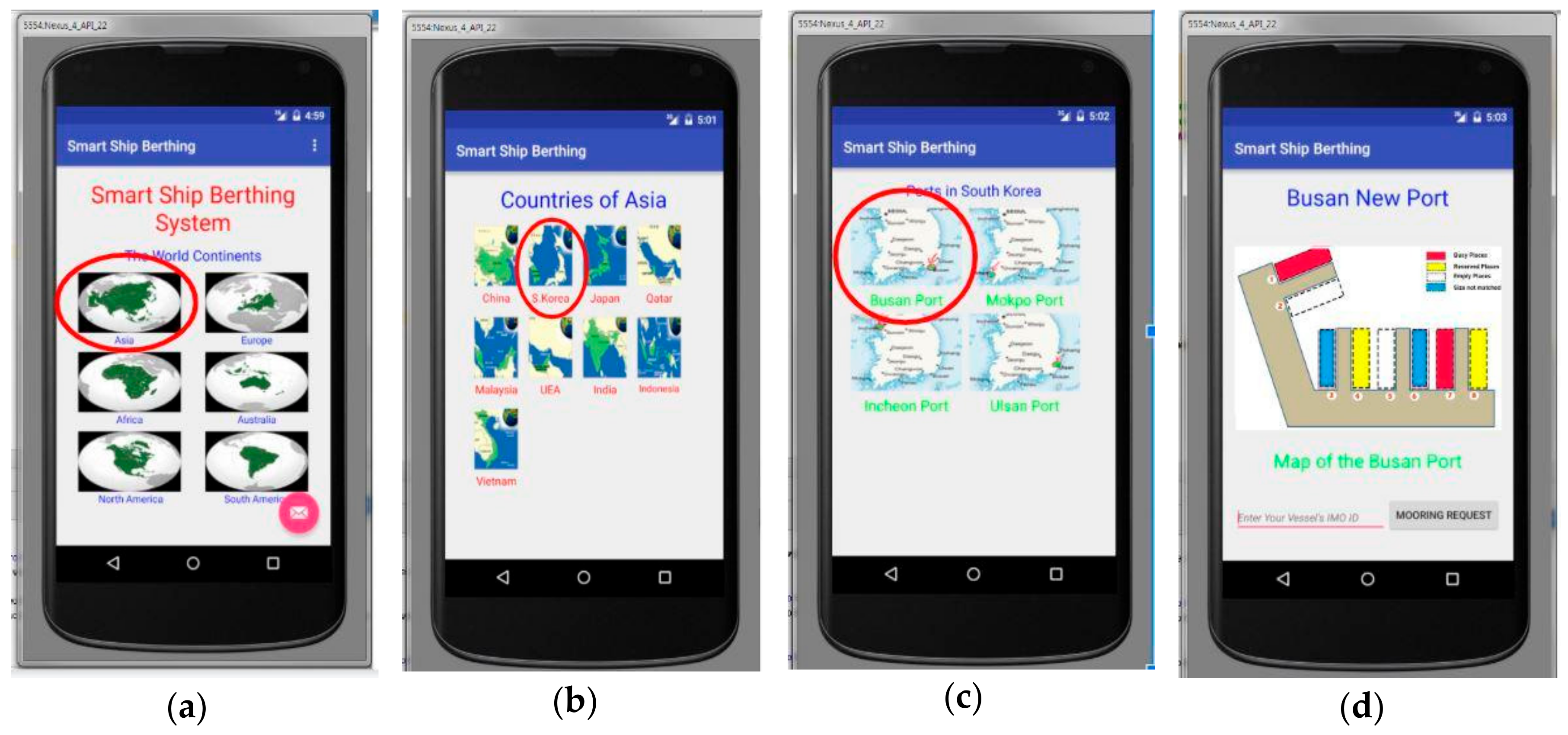
From this part, we can get an idea of the smartphone application for the proposed ship system. We have created a well-designed application running on Android OC called “Ship Berthing”. There is an underdeveloped business scenario for the application. In order to berth a ship, users need only make a connection with the port system and request a place to berth. To choose a specific port, the user must be notified of the location of the port, for instance country, city, continent, etc. The activities of the application and the scenario are as follows: Run the application, where the first activity page is “Identify the Continent” in which the user has to choose the continent where the next country and port are. We can see this activity in Figure 11a. The second activity page is “Country Selection” where the user must identify the country in which the port the vessels are arriving is located and this activity is shown in Figure 11b. The third page of the activity is the “Port Selection” in which the user must specify the port of arrival as shown in Figure 11c. Finally, “Port Activity” is the fourth main activity page from which the user can send information related to the vessel (in this case, the ship’s IMO ID number) and request a place to berth by clicking the “Request MOORING” button. In addition, users can check the status of this port to see vacancies or occupied berths by the port map on the Internet and this activity is highlighted in Figure 11d. In the online map, the red places indicate the places occupied by ships at the moment. The yellow places indicate that they are also busy, but there are no ships at the moment, which means that these places are reserved for newly arriving ships that will soon berth. Blue places indicate empty berths but not identical places by size or by type. Finally, the white places indicate the empty spaces proportional to size and type which means that the ship can berth in those places.
Figure 11. (a) Selecting Continent; (b) Selecting Country; (c) Selecting Port; (d) Port Map [37,55].
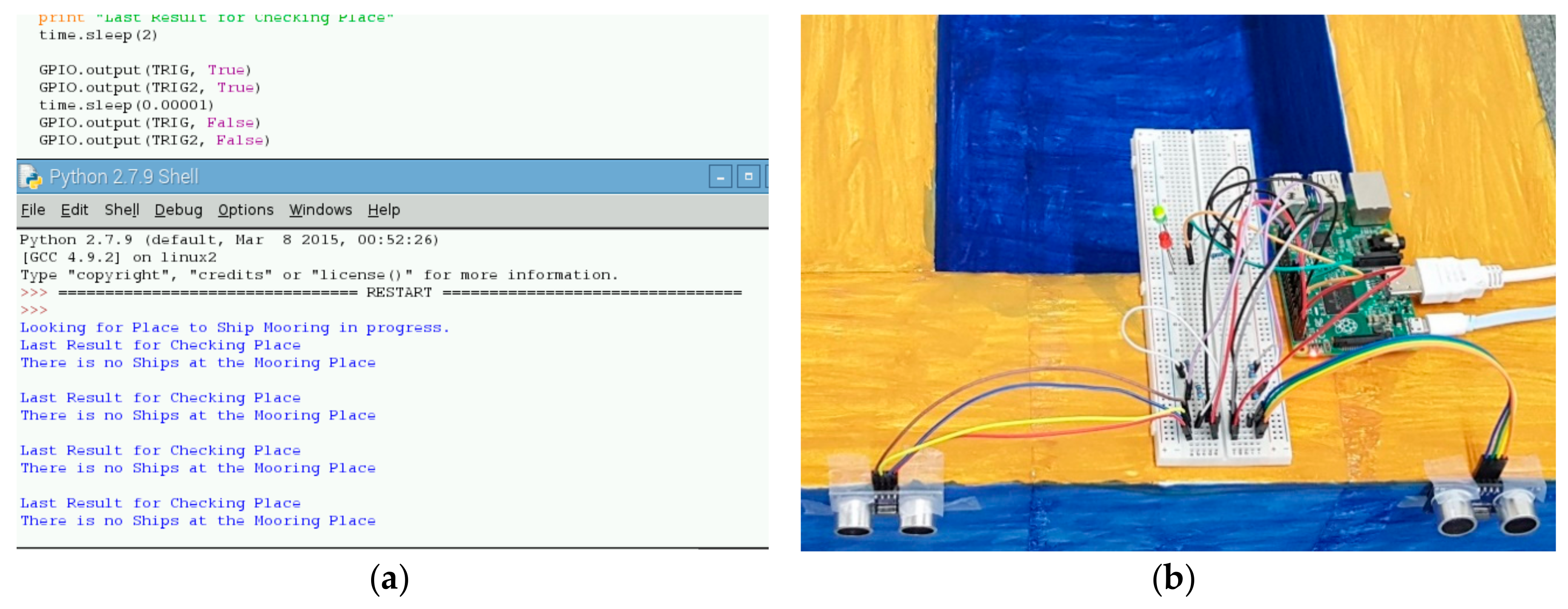
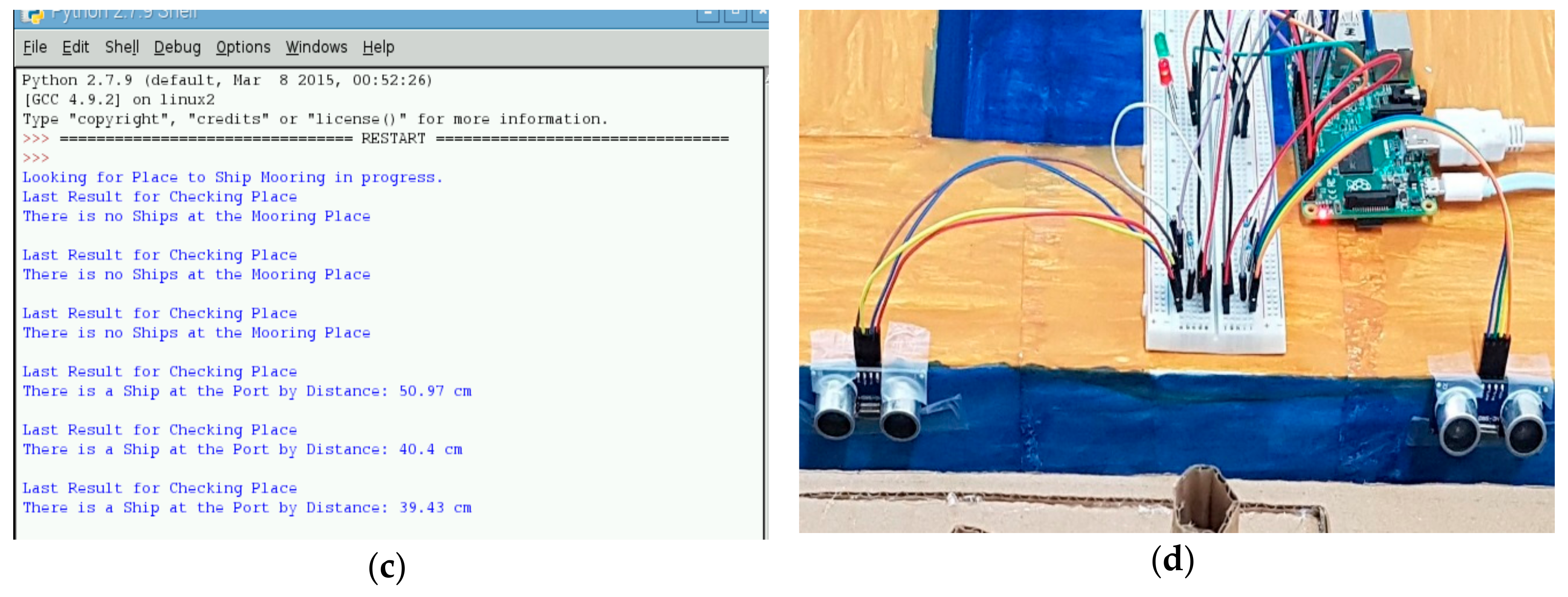
Now we can examine our experimental results for the proposed port system which is devoted to checking vacant places via a set of HC-SR04 UR sensors. This sensor is able to detect an object from approximately 4 m in front and by the detection results the system can determine if there is a ship or not. In the experiment, we used two ultrasonic sensors as a set of sensors for one berthing place to detect and check the status of that place. In order to read sensor information, we utilize Python Language on Raspberry Pi microcontroller which works on Noobs OC. Moreover, we use two, red and green LEDs to set the sensor status as “occupied” or “vacant”. A red LED indicates a sensor which is busy, that means there is a ship at the location. A green LED indicates a vacant sensor that means the place is also empty to moor. Figure 12a,b illustrate the status of the sensor when the berthing place is vacant. Here the green LED is on. Figure 12c,d illustrate the sensor status which the mooring place is occupied. Here, the green LED is on therefore, vessels have to wait to berth.
Figure 12. (a) Sensor status is empty (Msg result); (b) Sensor status is empty (LED result); (c) Sensor status is busy (Msg result); (d) Sensor status is busy (LED result).

7. Discussion

It is indisputable that a great deal of brand new technologies such as the IoT, big data, and cloud computing are nowadays influencing every aspect in our life. Moreover, in the branch of marine technology, these techniques are also being applied to access more and better services and to automate marine-related operations as well as creating novel smart devices. As a result of this, traditional ports and ships are being substituted by smart ports and vessels. Today the departure and arrival of the ships at port is getting very busy, so ships arriving at a port may not be able to find a place to berth easily which is a complicated situation. Our IoT-based smart berthing system can help vessels and ports in such a situation. This system helps berth the vessels which have arrived at the port and helps exchange data regarding their situation. In the experimental part, a smartphone and its software that works in Android OC manage the tasks of the vessels. Raspberry Pi and a set of ultrasonic sensors connected to the Raspberry Pi are responsible for transferring data regarding the status of berths at the port. The system presented is based on a three-layer IoT architecture. For the application layer we created an application that uses Android Studio via an Android OS smartphone. The dominant language for smartphone application development, Java, is also applied in this layer. In the network layer, we preferred to apply Wi-Fi technology. However, according to the IoT concept, Wi-Fi works as a means of communication between the application layer and the sensor layer. In the sensor layer, the entire intended work in the port system is performed by Raspberry Pi and also by a set of ultrasonic sensors connected to Raspberry Pi. In this part, Noobs Raspbian (Linux OS) is launched on Raspberry Pi. The system is set based on the Python programming language to accept information from the sensor. According to the results of the experiments with our proposed system, sensors and intelligent devices can be used in the marine industry. To test our proposed server-side system, we used a set of ultrasonic sensors to detect a ship and identify a suitable empty place for it to berth. The ultrasonic sensor has a range of about 4 m and a very high resolution and can detect a large object such as a vessel in front of the sensor. This proposed system will be a part of the next level of the maritime industry and will help to develop large projects such as smart ports and smart ships.

8. Conclusions

This paper is dedicated to the topic of an IoT-based ship berthing system which utilizes a set of ultrasonic sensors. The system is organized to automate the process of berthing a ship at a port. The main goal of our IoT-based system is achieved by means of a set of sensors installed in the port to automatically identify vacant berths and transfer the corresponding data to ships aiming to dock at the port. The target system is convenient to reduce the time, effort and cost during the berthing process. The purpose of this paper is to provide a dedicated an IoT-based system for automating the procedure by searching for available locations in the via port-mounted sensors and planned ship notification. In the experimental system, we have used smartphone as an alternative to the client-side vessel of the system and created an Android app called “Smart Ship Berthing” instead of a program like NORIVIS 4, VDASH, ODYSSEY, etc. To test our proposed server-side system, we used Raspberry Pi combined with an ultrasonic sensor to detect the ship and identify a vacant berth for it to anchor. The experimental results show that the set of UR sensors has high enough accuracy to detect ships at the port for ship berthing and our proposed system is very amenable to implementation in the real marine environment. In our future work, plan to expand the features of our proposed system especially with an automated ship reporting system which can be an element of our system. Furthermore, we intend to perform studies on big data, and cloud solutions for smart ships and smart ports.

Author Contributions

A.K. contributed to the main idea and the methodology of the research. A.K. designed the experiment, and wrote the original manuscript. A.K., S.P. contributed significantly in improving the technical and grammatical contents of the manuscript. S.P. reviewed the manuscript and provided valuable suggestions to further refine the manuscript.

Funding

This work was supported by Dongseo University, “Dongseo Cluster Project” Research Fund of 20190013.

Conflicts of Interest

The authors declare no conflict of interest.

Appendix A. An Example of a Current Ship and Port Reporting Conversation

Opening:
OFFICER - Busan Port Control, Busan Port Control. This is the vessel TITANIC. How do you read me? Over.
BUSAN PORT CONTROL (NPC): TITANIC. This is Busan Port Control. I read you excellent (loud and clear). Switch to channel one - two. Over.
OFFICER - Switching to Channel - 2. Over.
...after a while...
OFFICER - Busan Port Control. This is TITANIC - AGW5, on channel 1 - 2. I am spelling my name for you: «TITANIC, Tango - India - Tango –Alfa - November - India - Charlie. Call sign: Delta-Alfa - Mike- Kilo - Five. Over
Message(s):
BUSAN PORT CONTROL - TITANIC. Understood. What is your ETA Fairway Buoy?
OFFICER - Busan Port Control. This is TITANIC. My ETA Fairway Buoy is: tomorrow, May the sixth, 09.00 h local time. My maximum draught is 10.7 m and my draught forward is 9.8 m.
BUSAN PORT CONTROL - TITANIC. What is your last port of call and your next port of call, please? Over.
OFFICER - My last port of call was Hamburg, Germany. My next port of call is Amsterdam, Over.
BUSAN PORT CONTROL - What is your cargo? Over.
OFFICER - I am a fully cellular container vessel. I have general cargo in containers on board. Total number of containers is 1543. My deadweight tonnage is 28,976 tons.
BUSAN PORT CONTROL - Have you got any dangerous cargo on board?
OFFICER: I have 896 tons of dangerous cargo, IMO Class 4.2, in containers on deck,
BUSAN TORT CONTROL - Understood. Call me again when you are three miles off the Fairway buoy. Stand by on channel 1 - 2 for further instructions regarding berthing instructions.
Closing:
OFFICER - Understood. I shall call you again when three miles off the Fairway Buoy. Standing by on channel 1 - 2. Over and out.
Taking a Pilot Aboard:
OFFICER - Busan Port Control. This is TITANIC. How do you read me? Over.
BUSAN PORT CONTROL - TITANIC. This is Busan Port Control. Reading you loud and clear. What is your position? Over.
TITANIC - I am now in position: bearing 297 degrees, Four miles from the Fairway Buoy. Are there any berthing instructions for me? Over.
BUSAN PORT CONTROL – TITANIC. This is Busan Port Control. Sorry, no berthing prospects for the moment. You should reduce your speed and proceed to the anchorage east of the Fairway Buoy. Rig the pilot ladder on the port side. Stand by on channel 1 - 2 for further instructions. Over.
TITANIC - Understood. Standing by on channel 1 - 2.
After waiting for two hours at anchor the Master of TITANIC has received the information on the berthing instructions and is rising anchor, waiting for the pilot.
WATCH OFFICER - There is a pilot launch coming. Master
OFFICER - Lower the pilot ladder over the port side. Make a lee for the pilot boat.
With the pilot on board the TITANIC proceeds to her berth
PILOT - What is your heading now?
OFFICER -3 - 1 - 2, Sir
PILOT - Very well, keep that course.
OFFICER - Course 3 - 1 - 2, Sir.
PILOT - There has been a collision over there. Keep clear of that place. Wait for that big tanker to pass clear ahead of you.
OFFICER - Very well.
PILOT - The tide is failing and there is a shoal just ahead of your berth, so you have to be careful while mooring.
OFFICER - Shall we keep the present course?
PILOT - I advise you to alter course to 75° when abeam of that buoy.
OFFICER - Where shall we take the boarding officers?
PILOT - In the inner road.

References

  1. Kamolov, A.; Al-Absi, M.A.; Lee, H.J.; Park, S.H. Smart Flying Umbrella Drone on Internet of Things: AVUS. In Proceedings of the 21st International Conference on Advanced Communication Technology (ICACT), PyeongChang Kwangwoon_Do, Korea, 17–12 February 2019. [Google Scholar]
  2. Al-Absi, M.A.; Kamolov, A.; Kim, K.; Al-Absi, A.A.; Sain, M.; Lee, H.J. Labs and Classes: An Iot Design and Implementation. In Proceedings of the International Association for Convergence Science & Technology (ICAST), Shaoxing, China, 15–18 November 2018. [Google Scholar]
  3. Hyundai Heavy Industries Debuts ‘Smart Ship’ Solution. Available online: https://www.marine link.com/news/industriessolution427522 (accessed on 9 July 2019).
  4. Japan Develops Smart Ship Platform. Available online: http://www.marinemec.com/news/view,japan-develops-smart-shipplatform_44850.htm (accessed on 11 January 2019).
  5. We4Sea Approved for MRV Compliance. Available online: www.we4sea.com (accessed on 21 November 2019).
  6. Oceanstar. Available online: https://www.fugro.com/our-services/marine-asset-integrity/satellite-positioning/oceanstar (accessed on 9 July 2019).
  7. Weiser, M. The Computer for the 21st Century. Sci. Am. 1991, 265, 94–105. [Google Scholar] [CrossRef]
  8. Uckelmann, D.; Harrison, M.; Michahelles, F. An Architectural Approach Towards the Future Internet of Things. In Architecting the Internet of Things; Springer: Heidelberg, Germany, 2011; pp. 1–24. [Google Scholar]
  9. Kuyoro, S.; Osisanwo, F.; Akinsowon, O. Internet of Things (IoT): An Overview. In Proceedings of the 3rd International Conference on Advances in Engineering Sciences & Applied Mathematics, London, UK, 23–24 March 2015. [Google Scholar]
  10. Who Needs the Internet of Things? Available online: https://www.linux.com/news/who-needs-internet-things (accessed on 9 July 2019).
  11. 21 Open Source Projects for IoT. Available online: https://www.linux.com/NEWS/21-OPEN-SOURCE-PROJECTS-IOT (accessed on 9 July 2019).
  12. Internet of Thing. Available online: https://en.wikipedia.org/wiki/Internet_of_things (accessed on 9 July 2019).
  13. Popular Internet of Things Forecast of 50 Billion Devices by 2020 Is Outdated. Available online: https://spectrum.ieee.org/tech-talk/telecom/internet/popular-internet-of-things-forecast-of-50-billion-devices-by-2020-is-outdated (accessed on 9 July 2019).
  14. The Internet of Things: Sizing up the Opportunity. Available online: https://www.mckinsey.com/industries/semiconductors/our-insights/the-internet-of-things-sizing-up-the-opportunity (accessed on 9 July 2019).
  15. The Internet of Things, Gateways, and Next Generation of APIs Speaker Session at APIStrat Austin. Available online: https://dzone.com/articles/the-internet-of-things-gateways-and-next-generatio (accessed on 9 July 2019).
  16. Best Internet of Things Definition. Available online: https://www.postscapes.com/internet-of-things-definition/ (accessed on 9 July 2019).
  17. The Internet of Things. Available online: https://www.mckinsey.com/industries/high-tech/our-insights/the-internet-of-things (accessed on 9 July 2019).
  18. Mahmoud, R.; Yousuf, T.; Aloul, F.; Zualkernan, I. Internet of Things (IoT) security: Current status, challenges and prospective measures. In Proceedings of the 2015 10th International Conference for Internet Technology and Secured Transactions (ICITST), London, UK, 14–16 December 2015. [Google Scholar]
  19. Lin, J.; Yu, W.; Zhang, N.; Yang, X.; Zhang, H.; Zhao, W. A Survey on Internet of Things: Architecture, Enabling Technologies, Security and Privacy, and Applications. IEEE Internet Things J. 2017, 4, 1125–1142. [Google Scholar] [CrossRef]
  20. Tan, L.; Wang, N. Future Internet: The Internet of Things. In Proceedings of the 2010 3rd International Conference on Advanced Computer Theory and Engineering (ICACTE), Chengdu, China, 20–22 August 2010; Volume 5, pp. V5376–V5380. [Google Scholar]
  21. Wu, M.; Lu, T.J.; Ling, F.Y.; Sun, J.; Du, H.Y. Research on the architecture of Internet of Things. In Proceedings of the 3rd International Conference on Advanced Computer Theory and Engineering (ICACTE), Chengdu, China, 20–22 August 2010; Volume 5, pp. 484–487. [Google Scholar]
  22. Chuah, J.W. The Internet of Things: An Overview and New Perspectives in Systems Design. In Proceedings of the International Symposium on Integrated Circuits (ISIC), Singapore, 10–12 December 2014. [Google Scholar]
  23. Ala, A.; Mohsen, G.; Mehdi, M.; Mohammed, A.; Moussa, A. Internet of Things: A Survey on Enabling Technologies, Protocols, and Applications. IEEE Commun. Surv. Tutor. 2015, 17, 2347–2376. [Google Scholar]
  24. Koshizuka, N.; Sakamura, K. Ubiquitous ID: Standards for Ubiquitous computing and the Internet of Things. IEEE Pervasive Comput. 2010, 9, 98–101. [Google Scholar] [CrossRef]
  25. Internet of Things: Empowered by Auto-ID Technologies. Available online: https://www redbite.com/auto-id-technologies/ (accessed on 9 July 2019).
  26. Kushalnagar, N.; Montenegro, G.; Schumacher, C. IPv6 over Low-Power Wireless Personal Area Networks (6LoWPANs): Overview, Assumptions, Problem Statement, and Goals; RFC 4919; IETF: Fremont, CA, USA, 2007. [Google Scholar]
  27. Montenegro, G.; Hui, J.; Culler, D.; Kushalnagar, N. Transmission of IPv6 Packets over IEEE 802.15.4 Networks; IETF Secretariat: Fremont, CA, USA, 2007. [Google Scholar]
  28. Internet of Things (IoT) Sensors and Connectivity. Available online: https://www c-sharpcorner.com/article/internet-of-things-iot-sensors-and-connectivity/ (accessed on 9 July 2019).
  29. 11 Internet of Things (IoT) Protocols You Need to Know about. Available online: https://www rs-online.com/designspark/eleven-internet-of-things-iot-protocols-you-need-to-know-about (accessed on 9 July 2019).
  30. Communication Technologies for Iot. Available online: https://iotfuse.com/communication-technologies-for-iot/ (accessed on 1 January 2018).
  31. Al-Sarawi, S.; Anbar, M.; Alieyan, K.; Alzubaidi, M. Internet of Things (IoT) Communication Protocols: Review. In Proceedings of the 2017 8th International Conference on Information Technology (ICIT), Amman, Jordan, 17–18 May 2017; pp. 685–690. [Google Scholar]
  32. Arduino Uno Vs. BeagleBone Vs. Raspberry Pi. Available online: https://makezine.com/2013/04/15/arduino-uno-vs-beaglebone-vs-raspberry-pi/ (accessed on 9 July 2019).
  33. How Intel’s Edison Stacks Up against Arduino and Raspberry Pi. Available online: https://readwrite.com/2014/09/10/intel-edison-raspberry-pi-arduino-comparison/ (accessed on 9 July 2019).
  34. Linkit One Vs. Edison Vs. Raspberry Pi Vs. Beaglebone Black. Available online: https://www.seeedstudio.com/blog/2014/10/31/linkit-one-vs-edison-vs-raspberry-pi-vs-beaglebone-black/ (accessed on 9 July 2019).
  35. Raspberry Pi stays High in 2015 Hacker SBC Survey. Available online: http://linuxgizmos.com/raspberry-pi-stays-sky-high-in-2015-hacker-sbc-survey (accessed on 9 July 2019).
  36. Arduino TRE. Available online: https://www.arduino.cc/en/Main/ArduinoBoardTre (accessed on 9 July 2019).
  37. Kamolov, A.; Park, S.H. IoT based smart reporting and mooring system for vessels. In Proceedings of the Korean Institute of Information and Communication Sciences Conferece Chungcheongnam-do, Korea, 10 October 2017; Volume 21, pp. 0395–0398. [Google Scholar]
  38. Xiaojiang, X.; Jianli, W.; Mingdong, L. Services and Key Technologies of the Internet of Things; ZTE Communications: Shenzhen, China, 2010; Volume 2, p. 011. [Google Scholar]
  39. Gigli, M.; Koo, S. Internet of things: Services and applications categorization. Adv. Internet Things 2011, 1, 27–31. [Google Scholar] [CrossRef]
  40. The World’s First Smart Ship “I-Dolphin Unveiled”. Available online: https://www.marineinsight.com/shipping-news/the-worlds-first-smart-ship-i-dolphin-unveiled/ (accessed on 9 July 2019).
  41. World’s First Smart Ship Developed and Built in China. Available online: http://www.chinadaily.com.cn/china/2017-11/03/content_34055628.htm (accessed on 9 July 2019).
  42. Arriving at a Port. Available online: https://www.pfri.uniri.hr/bopri/documents/21-MEArrivalataport_000.pdf (accessed on 9 July 2019).
  43. SMART-Navigation. Available online: http://www.smartnav.org/html/SMARTNavigation/about_smart_navigation.php (accessed on 9 July 2019).
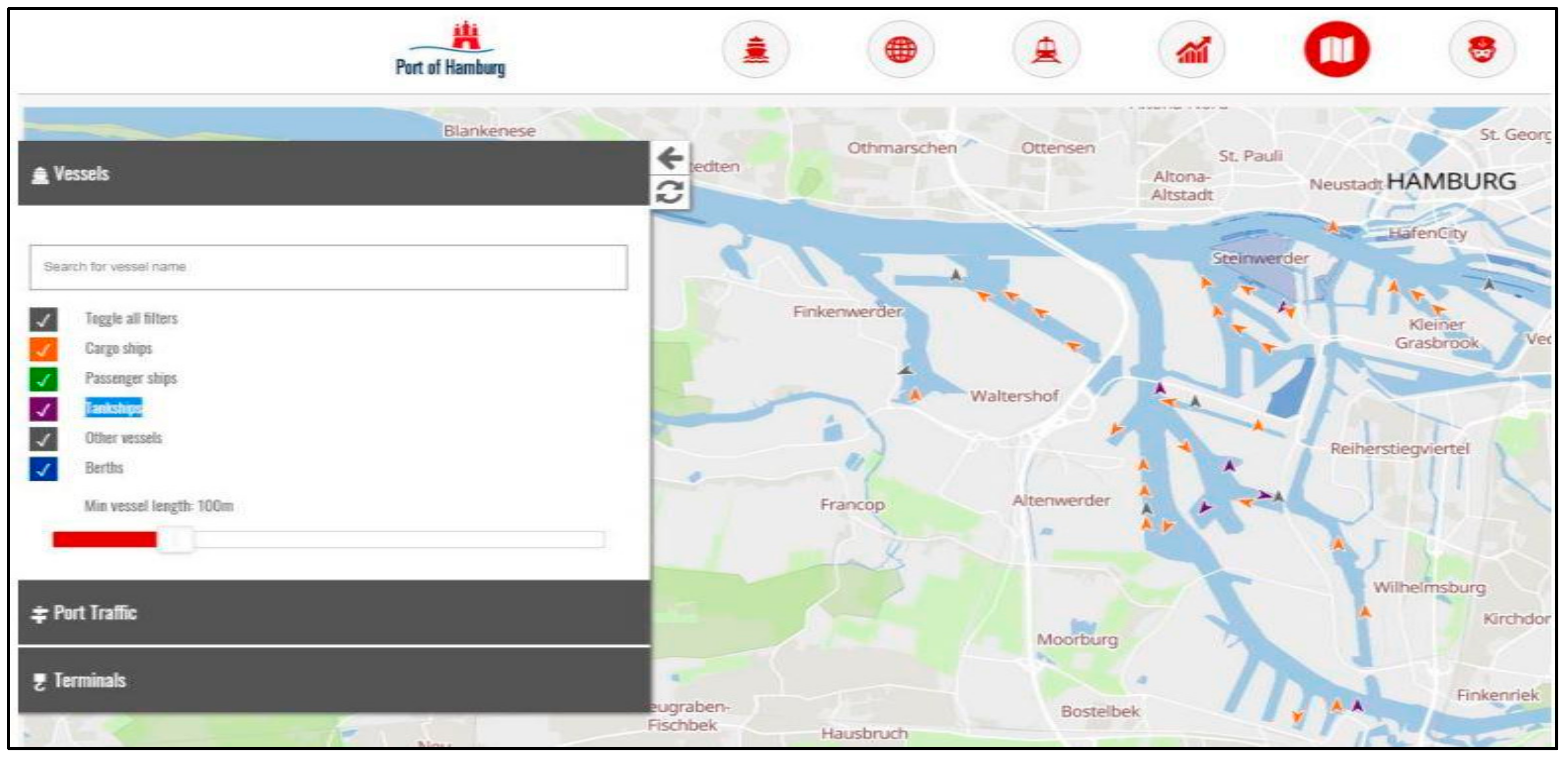
  44. Hamburg Port. Available online: https://www.hafen-hamburg.de/en/portmap (accessed on 9 July 2019).
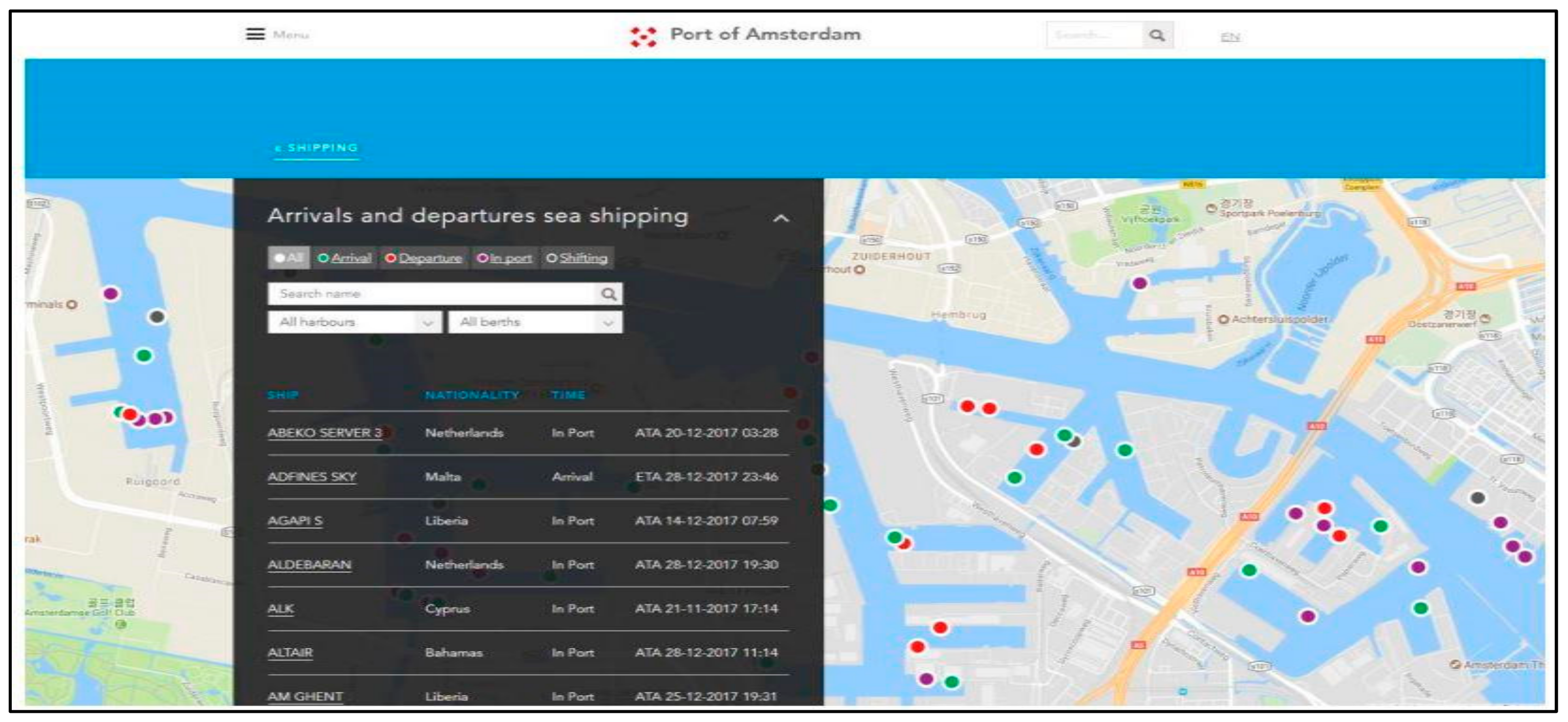
  45. Amsterdam Port. Available online: https://www.portofamsterdam.com/en/shipping/arrivals-and-departures (accessed on 9 July 2019).
  46. Al-Absi, M.A.; Al-Absi, A.A.; Kim, T.; Lee, H.J. An Environmental Channel Throughput and Radio Propagation Modeling for Vehicle-to-Vehicle Communication. Int. J. Distrib. Sens. Netw. 2018, 14, 1–10. [Google Scholar] [CrossRef]
  47. Al-Absi, M.A.; Al-Absi, A.A.; Lee, H.J. V2V communication modeling for environmental channel throughput and radio propagation. In Proceedings of the 8th IEEE International Conference on ICTC Convergence, Jeju Island, Korea, 18–20 October 2017; pp. 507–512. [Google Scholar]
  48. Al-Absi, M.A.; Al-Absi, A.A.; Kang, Y.J.; Lee, H.J. Obstacles Effects on Signal Attenuation in Line of Sight for Different Environments in V2V. In Proceedings of the 20th International Conference on Advanced Communication Technology (ICACT), Chuncheon-si Gangwon-do, Korea, 11–14 February 2018; pp. 17–20. [Google Scholar]
  49. Al-Absi, M.A.; Al-Absi, A.A.; Lee, H.J. Performance Analysis for City, Highway, and Rural Area in Vehicle-to-Vehicle Network. In Proceedings of the 8th IEEE International Conference on ICTC Convergence, Jeju Island, Korea, 17–19 October 2018. [Google Scholar]
  50. Reza, M.O.; Ismail, M.F.; Rokoni, A.A.; Sarkar, M.A.R. Smart parking system with image processing facility. Int. J. Intell. Syst. Appl. 2012, 4, 41–47. [Google Scholar] [CrossRef]
  51. Khanna, A.; Anand, R. IoT based Smart Parking System. In Proceedings of the International Conference on Internet of Things and Applications (IOTA), Pune, India, 22–24 January 2016; pp. 266–270. [Google Scholar]
  52. Idris, M.Y.I.; Tamil, E.M.; Noor, N.M.; Razak, Z.; Fong, K.W. Parking Guidance System utilizing Wireless Sensor Network and Ultrasonic Sensor. Inf. Technol. J. 2009, 8, 138–146. [Google Scholar] [CrossRef]
  53. Raghavender Rao, T. Automatic Smart Parking System using Internet of Things (IOT). Int. J. Eng. Technol. Sci. Res. 2017, 4, 225–228. [Google Scholar]
  54. Ji, Z.; Ganchev, I.; O’Droma, M.; Zhao, L.; Zhang, X. A Cloud-Based Car Parking Middleware for IoT-Based Smart Cities: Design and Implementation. Sensors 2014, 14, 22372–22393. [Google Scholar] [CrossRef] [PubMed]
  55. Kamolov, A.; Park, S.H. An IoT Based Smart Berthing (Parking) System for Vessels and Ports. In ICMWT 2018: Mobile and Wireless Technology 2018; Kim, K., Kim, H., Eds.; Lecture Notes in Electrical Engineering; Springer: Singapore, 2019; Volume 513. [Google Scholar]
  56. Mori, U.R.; Chandarana, P.M.; Gajjar, G.V.; Dasi, S. Performance Comparison of Different Modulation Schemes in Advanced Technologies WiMAX and LTE. In Proceedings of the IEEE International Advance Computing Conference (IACC), Banglore, India, 12–13 June 2015; pp. 286–289. [Google Scholar]
Article Metrics

Citations

Article Access Statistics

Multiple requests from the same IP address are counted as one view.