
Plants Traditionally Used for Making Utility Products by Forest Dwelling Gaddi and Sippi Tribes in Bhaderwah Tehsil of the Union Territory of Jammu and Kashmir, India

 , and
, and 
Abstract
1. Introduction
2. Materials and Methods
2.1. Study Area
2.2. Field Survey
2.3. Data Analysis
2.4. Statistical Analysis
3. Results
3.1. Informants
3.2. Vegetation Characteristics and Diversity of Plant-Derived Utility Products (PUPs)
3.3. Tools
3.4. Containers/Storage Products
3.5. Construction Products
3.6. Artifacts
3.7. Miscellaneous Products
3.8. Current Status of PUPs
3.9. Cultural Importance Index (CI)
3.10. Factor Informant Consensus (Fic)
3.11. Knowledge of PUPs with Respect to Gender, Age, and Educational Level
4. Discussion
4.1. Vegetation Characteristics and PUPs Diversity
4.2. Culturally Important Plant Species and PUPs
4.3. Consensus for the Usage of PUPs
4.4. Knowledge of PUPs
4.5. Current Status of PUPs in Bhaderwah
4.6. Novelty and Future Prospects
5. Conclusions
Author Contributions
Funding
Institutional Review Board Statement
Informed Consent Statement
Data Availability Statement
Acknowledgments
Conflicts of Interest
References
- Choudhary, B.L.; Katewa, S.S.; Galav, P.K. Plants in material culture of tribals and rural communities of Rajsamand district of Rajasthan. Ind. J. Trad. Knowl. 2008, 7, 11–22. [Google Scholar]
- Kumar, N.; Wani, Z.A.; Dhyani, S. Ethnobotanical study of the plants used by the local people of Gulmarg and its allied areas, Jammu & Kashmir, India. Int. J. Curr. Res. Biosci. Plant Biol. 2015, 2, 16–23. [Google Scholar]
- Sajem, A.L.; Gosai, K. Traditional use of medicinal plants by the Jaintia tribes in North Cachar Hills district of Assam, northeast India. J. Ethnobiol.Ethnomed. 2006, 2, 1–7. [Google Scholar] [CrossRef]
- Binfield, L.; Britton, T.L.; Dai, C.; Innes, J.L. Evidence on the Social, Economic, and Environmental Impact of Interventions That Facilitate Bamboo Industry Development for Sustainable Livelihoods: A Systematic Map. Forests 2025, 16, 713. [Google Scholar] [CrossRef]
- Kharwal, A.D.; Rawat, D.S. Ethnobotanical studies on timber resources of Himachal Pradesh (HP), India. Ethnobot. Leafl. 2009, 9, 7–9. [Google Scholar]
- Anand, S.; Sonar, R.M.; Jain, K. Traditional knowledge research in India: A bibliometric-based review and thematic analysis. Ind. J. Trad. Knowl. 2025, 24, 275–287. [Google Scholar]
- Maguipuinamei, M. Traditional Knowledge, Traditional Cultural Expressions and Intellectual Property Rights of Tribes in North-Eastern Region of India. Intern.Res. J. Librariansh. Inf. Sci. 2016, 6, 226–236. [Google Scholar]
- Pandey, K. Beyond Visual Culture: A Study of Material Culture of a Transhumant Gaddi Tribe of North India. Int. J. Med. Res. Prof. 2015, 1, 32–43. [Google Scholar]
- Zhang, S.C.; Lin, S.; Shen, A.; Chen, H.; Wang, F.; Huai, H.Y. Traditional knowledge on “Luchai” [Phragmites australis (Cav.) Trin. ex Steud. and Arundo donax L.] and their dynamics through urbanization in Yangzhou area, East China. Indian J. Tradit. Knowl. 2016, 15, 580–586. [Google Scholar]
- Bhattacharjee, G. A study on the traditional textile motifs of Dimasa Kacharis in the Cachar District of Assam. Indian J. Tradit. Knowl. 2025, 24, 372–383. [Google Scholar]
- Biona, T.; Keithellakpam, O.S.; Nameirakpam, B.; Sougrakpam, S.; Nahakpam, S.; Lalvenhimi, S.; Nambam, B.; Ashihe, D.; Deb, L.; Bhardwaj, P.K.; et al. Ethnobotany of traditional medicinal plants used in Senapati district of Manipur, Northeastern India. Indian J. Tradit. Knowl. 2025, 24, 112–123. [Google Scholar]
- Dagni, A.; Suharoschi, R.; Hegheș, S.-C.; Vârban, R.; Lelia Pop, O.; Vulturar, R.; Fodor, A.; Cozma, A.; Soukri, A.; El Khalfi, B. Ethnobotanical Survey on Plants Used to Manage Febrile Illnesses among Herbalists in Casablanca, Morocco. Diversity 2023, 15, 879. [Google Scholar] [CrossRef]
- Slathia, P.S.; Paul, N.; Gupta, S.K.; Sharma, B.C.; Kumar, R.; Kher, S.K. Traditional uses of under-utilized tree species in sub-tropical rainfed areas of Kathua, Jammu & Kashmir. Indian J. Tradit. Knowl. 2017, 16, 164–169. [Google Scholar]
- Bath, S.; Prasad, S. Legal protection of traditional knowledge and traditional cultural expressions under copyright laws. Indian J. Tradit. Knowl. 2025, 24, 384–394. [Google Scholar]
- Jagtap, S.D.; Deokule, S.S.; Pawar, P.K.; Harsulkar, A.M. Traditional ethnomedicinal knowledge confined to the Pawra tribe of Satpura Hills, Maharashtra, India. Ethnobot. Leafl. 2009, 1, 12. [Google Scholar]
- Ministry of Tribal Affairs, Govt. of India. Available online: https://tribal.nic.in/ST/Statistics8518.pdf (accessed on 12 July 2024).
- Sharma, P.K.; Singh, V. Ethnobotanical studies in northwest and Trans-Himalaya. V. Ethno-veterinary medicinal plants used in Jammu and Kashmir, India. J. Ethnopharmacol. 1989, 27, 63–70. [Google Scholar] [CrossRef]
- Registrar General and Census Commissioner, India, District Wise ST Population, J&K. 2011. Available online: https://dev.ihsn.org/nada//catalog/58335 (accessed on 21 July 2024).
- Chakravarty-Kaul, M. Transhumance and customary pastoral rights in Himachal Pradesh: Claiming the high pastures for Gaddis. Mt. Res. Dev. 1998, 18, 5–17. [Google Scholar] [CrossRef]
- Dutt, H.C.; Bhagat, N.; Pandita, S. Oral traditional knowledge on medicinal plants in jeopardy among Gaddi shepherds in hills of northwestern Himalaya, J&K, India. J. Ethnopharmacol. 2015, 168, 337–348. [Google Scholar]
- Habib, T.; Malik, Z.H.; Dar, M.E.; Shaheen, H. Wood utilization pattern in Kashmir region, western Himalaya. For. Prod. J. 2016, 66, 257–261. [Google Scholar] [CrossRef]
- Sharma, A.; Thakur, D.; Uniyal, S.K. Plant-derived utility products: Knowledge comparison across gender, age and education from a tribal landscape of western Himalaya. J. Ethnobiol. Ethnomed. 2019, 15, 1–14. [Google Scholar] [CrossRef]
- Salerno, G.; Guarrera, P.M.; Caneva, G. Agricultural, domestic and handicraft folk uses of plants in the Tyrrhenian sector of Basilicata (Italy). J. Ethnobiol. Ethnomed. 2005, 1, 1–8. [Google Scholar] [CrossRef]
- Das, P.K.; Nag, D. Traditional agricultural tools—A review. Ind. J. Trad. Knowl. 2006, 5, 41–46. [Google Scholar]
- Karthikeyan, C.; Veeraragavathatham, D.; Karpagam, D.; Firdouse, S.A. Traditional tools in agricultural practices. Ind. J. Trad. Knowl. 2009, 8, 212–217. [Google Scholar]
- Arya, D. Plant species used as traditional agricultural implements and tools in Garhwal region of western Himalaya. Ind. J. Scient. Res. Technol. 2014, 2, 69–72. [Google Scholar]
- Sarkar, B.; Sundaram, P.K.; Dey, A.; Kumar, U.; Sarma, K.; Bhatt, B.P. Traditional agricultural tools used by tribal farmers in Eastern India. Res. J. Agri. Sci. 2015, 6, 215–219. [Google Scholar]
- Brahma, N.; Daimary, L. The Traditional agricultural tools and technology used by the Bodos. IOSR J. Human. Soc. Sci. 2017, 22, 65–72. [Google Scholar] [CrossRef]
- Giri, U.; Paul, N.; De, D.; Giri, S.; Kundu, M.C. Indigenous traditional tools and implements used in agriculture and allied sector in Tripura. Int. J. Curr. Microbiol. App. Sci. 2020, 9, 2102–2117. [Google Scholar] [CrossRef]
- Sundaramv, P.K.; Sarkar, B.; Raghav, D.K.; Mali, S.S.; Anurag, A.P.; Kumar, U.; Bhatt, B.P. Traditional Agricultural Tools used by Tribal Farmers in Chhotanagpur Plateau. Ind. J. Hill Farm. 2020, 6, 145–151. [Google Scholar]
- Kanwar, P.; Sharma, N. Traditional storage structures prevalent in Himachali homes. Ind. J. Trad. Knowl. 2006, 5, 98–103. [Google Scholar]
- Nagnur, S.; Channal, G.; Channamma, N. Indigenous grain structures and methods of storage. Ind. J. Trad. Knowl. 2006, 5, 114–117. [Google Scholar]
- Sundaramari, M.; Ganesh, S.; Kannan, G.S.; Seethalakshmi, M.; Gopalsamy, K. Indigenous grain storage structures of South Tamil Nadu. Ind. J. Trad. Knowl. 2011, 10, 380–383. [Google Scholar]
- Mobolade, A.; Bunindro, N.; Sahoo, D.; Rajashekar, Y. Traditional methods of food grains preservation and storage in Nigeria and India. Ann. Agri. Sci. 2019, 64, 196–205. [Google Scholar] [CrossRef]
- Sujarwo, W.; Keim, A.P. Ethnobotanical study of traditional building materials from the Island of Bali, Indonesia. Econ. Bot. 2017, 71, 224–240. [Google Scholar] [CrossRef]
- Mensah, J.K.; Adei, E.; Adei, D.; Ansah, G.O. Assessment of local wood species used for the manufacture of cookware and the perception of chemical benefits and chemical hazards associated with their use in Kumasi, Ghana. J. Ethnobiol. Ethnomed. 2012, 8, 1–17. [Google Scholar] [CrossRef] [PubMed]
- Dogan, Y.; Nedelcheva, A.M.; Dragica, O.P.; Padure, I.M. Plants used in traditional handicrafts in several Balkan countries. Ind. J. Trad. Knowl. 2008, 7, 157–161. [Google Scholar]
- Nedelcheva, A.; Dogan, Y.; Obratov-Petkovic, D.; Padure, I.M. The traditional use of plants for handicrafts in southeastern Europe. Hum. Ecol. 2011, 39, 813–828. [Google Scholar] [CrossRef]
- Zambrana, N.Y.P.; Bussmann, R.W.; Hart, R.E.; Huanca, A.L.M.; Soria, G.O.; Vaca, M.O.; Alvarez, D.O.; Moran, J.S.; Moran, M.S.; Chavez, S.; et al. Traditional knowledge hiding in plain sight–twenty-first century ethnobotany of the Chácobo in Beni, Bolivia. J. Ethnobiol. Ethnomed. 2017, 1, 1–47. [Google Scholar] [CrossRef]
- Kang, J.; Kang, Y.; Feng, J.; Liu, M.; Ji, X.; Li, D.; Stawarczyk, K.; Luczaj, L. Plants as highly diverse sources of construction wood, handicrafts and fibre in the Heihe valley (Qinling Mountains, Shaanxi, China): The importance of minor forest products. J. Ethnobiol. Ethnomed. 2017, 13, 38. [Google Scholar] [CrossRef]
- Singh, H.; Saklani, A.; Lal, B. Ethnobotanical observations on some gymnosperms of Garhwal Himalaya, Uttar Pradesh, India. Econ. Bot. 1990, 44, 349–354. [Google Scholar] [CrossRef]
- Suksri, S.; Premcharoen, S.; Thawatphan, C.; Sangthongprow, S. Ethnobotany in Bung Khong Long non-hunting area, Northeast Thailand. Agric. Nat. Resour. 2005, 39, 519–533. [Google Scholar]
- Ibrar, M.; Hussain, F.; Sultan, A. Ethnobotanical studies on plant resources of Ranyal hills, District Shangla, Pakistan. Pak. J. Bot. 2007, 39, 329–337. [Google Scholar]
- Li, F.; Zhuo, J.; Liu, B.; Jarvis, D.; Long, C. Ethnobotanical study on wild plants used by Lhoba people in Milin County, Tibet. J. Ethnobiol. Ethnomed. 2015, 1, 1–11. [Google Scholar] [CrossRef] [PubMed]
- Neelo, J.; Kashe, K.; Teketay, D.; Masamba, W. Ethnobotanical survey of woody plants in Shorobe and Xobe villages, northwest region of Botswana. Ethnobot. Res. Appl. 2015, 14, 367–379. [Google Scholar] [CrossRef]
- Abrol, B.K.; Kapoor, L.D.; Chopra, I.G. Pharmacognostic study of the rhizome of Dioscorea deltoide a Wall. Planta Med. 1962, 3, 335–340. [Google Scholar] [CrossRef]
- Kachroo, P.; Nahvi, I.M. Ethnobotany of Kashmiris. In Forest Flora of Srinagar and Plants of Neighbourhood, 1st ed.; Singh, G., Kachroo, P., Eds.; Bishen Singh Mahendra Pal Singh: Dehra Dun, India, 1976; pp. 239–263. [Google Scholar]
- Srivastava, T.N. Wild edible plants of Jammu & Kashmir state–an ethno-botanical study. Anc. Sci. Life 1988, 3–4, 201–206. [Google Scholar]
- Kaul, M.K.; Sharma, P.K.; Singh, V. Ethnobotanical Studies in Northwest and Trans-Himalaya Vi. Contribution to the Ethnobotany of Basohli-Bani Region, J&K, India. Nelumbo 1989, 31, 89–94. [Google Scholar]
- Kiran, H.S.; Kapahi, B.K.; Srivastava, T.N. Non-Timber forest wealth of Jammu and Kashmir State (India). Plant J. Non-Timb. For. Prod. 1999, 6, 1–18. [Google Scholar]
- Rashid, A.; Anand, V.K.; Sarwar, J. Less known wild edible plants used by the Gujjar tribe of district Rajouri, Jammu and Kashmir State. Int. J. Bot. 2008, 4, 219–224. [Google Scholar] [CrossRef]
- Khan, M.; Kumar, S.; Hamal, I.A. Medicinal plants of Sewa river catchment area in the Northwest Himalaya and its implication for conservation. Ethnobot. Leafl. 2009, 13, 1113–1139. [Google Scholar]
- Kumar, S.; Hamal, I.A. Wild edibles of Kishtwar high altitude national park in northwest Himalaya, Jammu and Kashmir (India). Ethnobot. Leafl. 2009, 13, 195–202. [Google Scholar]
- Gairola, S.; Sharma, J.; Bedi, Y.S. A cross-cultural analysis of Jammu, Kashmir and Ladakh (India) medicinal plant use. J. Ethnopharmacol. 2014, 155, 925–986. [Google Scholar] [CrossRef]
- Bhatia, H.; Sharma, Y.P.; Manhas, R.K.; Kumar, K. Traditionally used wild edible plants of district Udhampur, J&K, India. J. Ethnobiol. Ethnomed. 2018, 14, 1–13. [Google Scholar]
- Kumar, K.; Sharma, Y.P.; Manhas, R.K.; Bhatia, H. Ethnomedicinal plants of Shankaracharya Hill, Srinagar, J&K, India. J. Ethnopharmacol. 2015, 170, 255–274. [Google Scholar] [PubMed]
- Rao, P.K.; Hasan, S.S.; Bhellum, B.L.; Manhas, R.K. Ethnomedicinal plants of Kathua district, J&K, India. J. Ethnopharmacol. 2015, 171, 12–27. [Google Scholar] [PubMed]
- Trak, T.H.; Giri, R.A. Inventory of the plants used by the tribals (Gujjar and bakarwal) of district Kishtwar, Jammu and Kashmir (India). Ind. J. Sci. Res. 2017, 13, 104–115. [Google Scholar]
- Thakur, A.; Singh, S.; Puri, S. Exploration of wild edible plants used as food by Gaddis-a tribal community of the Western Himalaya. Sci. World J. 2020, 6280153. [Google Scholar] [CrossRef] [PubMed]
- Singh, K.; Kumar, P.; Kumar, B.; Sharma, Y.P.; Gairola, S. The wild edible plants of Paddar valley, Jammu division, Jammu and Kashmir, India. Ethnobot. Res. Appl. 2021, 22, 1–21. [Google Scholar]
- Sharma, R.; Sharma, Y.P.; Hashmi, S.A.J.; Kumar, S.; Manhas, R.K. Ethnomycological study of wild edible and medicinal mushrooms in district Jammu, J&K (UT), India. J. Ethnobiol. Ethnomed. 2022, 18, 23. [Google Scholar]
- Bhagat, N.; Upadhyay, H.; Manhas, R.K.; Gupta, S.K. Wild Edible Plants of Purmandal block of District Samba, J&K (UT), India. Ethnobot. Res. Appl. 2022, 24, 1–19. [Google Scholar]
- Singh, B.P.; Devashree, Y.; Sharma, V.; Manhas, R.K. Diversity of wild edible plants and fungi consumed by seminomadic Gaddi and Sippi tribes in Doda district of Union Territory of Jammu and Kashmir. Ethnobot. Res. Appl. 2023, 25, 1–33. [Google Scholar]
- Hussain, K. An Assessment of Tourism Potential in Bhaderwah (J&K). Ind. Streams Res. J. 2013, 3, 1–5. [Google Scholar]
- Singh, B.P.; Kumar, B.; Devi, A. Traditional handloom weaving: A cultural heritage in jeopardy among Gaddi scheduled tribe of Bhaderwah (J&K), North West Himalayas. Int. J. Appl. Res. 2021, 7, 24–31. [Google Scholar]
- Kumar, R. Water Quality Characterization and Assessment of Pollution Load in Neeru Watershed Bhaderwah, J&K. Ph.D. Thesis, University of Jammu, Jammu, India, 2018. [Google Scholar]
- Polunin, O.; Stainton, A. Concise Flowers of Himalayas; Oxford University Press: New Delhi, India, 1987; ISBN-13: 978-0-19-564414-2. [Google Scholar]
- Tardio, J.; Pardo-de-Santayana, M. Cultural importance indices: A comparative analysis based on the useful wild plants of Southern Cantabria (Northern Spain). Econ. Bot. 2008, 62, 24–39. [Google Scholar] [CrossRef]
- Trotter, R.T.; Logan, M.H. Informant consensus: A new approach for identifying potentially effective medicinal plants. In Plants in Indigenous Medicine and Diet, Behavioural Approaches; Etkin, N.L., Ed.; Routledge: London, UK, 1986; pp. 91–112. ISBN 9780913178027. [Google Scholar]
- Rana, D.; Bhatt, A.; Lal, B. Ethnobotanical knowledge among the semi-pastoral Gujjar tribe in the high altitude (Adhwari’s) of Churah subdivision, district Chamba, Western Himalaya. J. Ethnobiol. Ethnomed. 2019, 15, 1–21. [Google Scholar] [CrossRef]
- Siddiqui, K.M.; Khan, J.A.; Mahmood, I. Comparison of anatomical, physical and mechanical properties of Abies pindrow, Cedrus deodara and Pinus wallichiana from dry and wet temperate forests. Pak. J. Forest. 1989, 39, 27–33. [Google Scholar]
- Singh, M.P.; Singh, B.S.; Dey, S. Plant Biodiversity and Taxonomy; Daya Publishing House: Delhi, India, 2002; ISBN 81-7035-289-4. [Google Scholar]
- Vassiliou, V.G.; Voulgaridis, E.V. Wood properties and utilisation potentials of walnut wood (Juglans regia L.) grown in Greece. Acta Hortic. 2005, 705, 535–542. [Google Scholar] [CrossRef]
- Bhat, G.M.; Mughal, A.H.; Malik, A.R.; Khan, P.A.; Shazmeen, Q. Natural regeneration status of blue pine (Pinus wallichiana) in north west Himalayas, India. Ecoscan 2015, 9, 1023–1026. [Google Scholar]
- Ashour, T.; Wu, W. The influence of natural reinforcement fibres on erosion properties of earth plastermaterials for straw bale buildings. J. Build. Appr. 2010, 5, 329–340. [Google Scholar] [CrossRef]
- Yorou, S.N.; De Kesel, A. Connaissances ethnomycologiques des peuples Nagot du centre du Bénin (Afrique de l’Ouest). Proceedings of the XVIth AETFAT Congress, Brussels 2000. Syst. Geogr. Plants 2002, 71, 627–637. [Google Scholar] [CrossRef]
- Kristensen, M.; Balslev, H. Perception, use and availability of woody plants among the Gourounsi in Burkina Faso. Biodiver. Conser. 2003, 128, 1715–1739. [Google Scholar] [CrossRef]
- Kang, Y.; Łuczaj, Ł.; Kang, J.; Zhang, S. Wild food plants and wild edible fungi in two valleys of the Qinling Mountains (Shaanxi, central China). J. Ethnobiol.Ethnomed. 2013, 9, 26. [Google Scholar] [CrossRef] [PubMed]
- Kotowski, M.A.; Pietras, M.; Łuczaj, L. Extreme levels of mycophilia documented in Mazovia, a region of Poland. J. Ethnobiol. Ethnomed. 2019, 15, 12. [Google Scholar] [CrossRef] [PubMed]
- Nesheim, I.; Dhillion, S.S.; Stølen, K. What happens to traditional knowledge and use of natural resources when people migrate? Hum. Ecol. 2006, 34, 99–131. [Google Scholar] [CrossRef]
- Araújo, F.R.; Lopes, M.A. Diversity of use and local knowledge of palms (Arecaceae) in eastern Amazonia. Biodivers. Conserv. 2011, 21, 487–501. [Google Scholar] [CrossRef]
- Turreira Garcia, N.; Theilade, I.; Meilby, H.; Sørensen, M. Wild edible plant knowledge, distribution and transmission: A case study of the Achí Mayans of Guatemala. J. Ethnobiol. Ethnomed. 2015, 11, 52. [Google Scholar] [CrossRef]
- Khakurel, D.; Upreti, Y.; Łuczaj, L.; Rajbhandary, S. Foods from the wild: Local knowledge, use pattern and distribution in Western Nepal. PLoS ONE 2021, 16, e0258905. [Google Scholar] [CrossRef]
- Uniyal, S.K.; Awasthi, A.; Rawat, G.S. Developmental processes, changing lifestyle and traditional wisdom: Analysis from western Himalaya. Environment 2003, 23, 307–312. [Google Scholar] [CrossRef]
- Kodirekkala, K.R. Internal and external factors affecting loss of traditional knowledge: Evidences from a horticultural society in South India. J. Anthropol. Res. 2017, 73, 22–42. [Google Scholar] [CrossRef]
- Atreya, K.; Pyakurel, D.; Thagunna, K.S.; Bhatta, L.D.; Uprety, Y.; Chaudhary, R.P.; Oli, B.N.; Rimal, S.K. Factors contributing to the decline of traditional practices in communities from the Gwallek–Kedar area, Kailash sacred landscape. Nepal. Environ. Mgmt. 2018, 61, 741–755. [Google Scholar] [CrossRef]
- Pardo-de-Santayana, M.; Macia, M.J. The benefits of traditional knowledge. Nature 2015, 518, 487–488. [Google Scholar] [CrossRef]
- Byg, A.; Balslev, H. Diversity and use of palms in Zahamena, eastern Madagascar. Biodivers. Conserv. 2001, 10, 951–970. [Google Scholar] [CrossRef]



| Village | Population (Census 2011) | Elevation (m amsl) | Latitude | Longitude | |
|---|---|---|---|---|---|
| Total (No. of Persons) | Gaddi and Sippi (No. of Persons) | ||||
| Dhamunda | 376 | 353 | 2044 | 33°00′22.91″ | 75°72′61.35″ |
| Manthla (Upper) | 176 | 176 | 2140 | 33°00′23.76″ | 75°74′98.24″ |
| Dandi | 535 | 405 | 2000 | 32°98′61.69″ | 75°74′36.70″ |
| Kansar | 429 | 429 | 2400 | 32°96′83.66″ | 75°74′62.30″ |
| Bharie | 304 | 304 | 2200 | 32°95′13.77″ | 75°74′25.07″ |
| Butla | 916 | 391 | 1900 | 32°94′91.57″ | 75°73′68.41″ |
| Plant Species | Accession No. | Local Name | Family | Life-Form | Native or Exotic Species |
|---|---|---|---|---|---|
| Abies pindrow (Royle ex D.Don) Royle. | HBJU 16883 | Rae | Pinaceae | T | N |
| Aesculus indica (Wall. ex Cambess.) Hook. | HBJU 16869 | Goon | Sapindaceae | T | N |
| Anaphalis margaritacea (L.) Benth and Hook. F. | HBJU 16899 | Bhujli | Asteraceae | H | N |
| Anaphalis triplinervis (Sims) C.B. Clarke | HBJU 17030 | Bhujli | Asteraceae | H | N |
| Berberis lycium Royle. | HBJU 16776 | Kishmae | Berberidaceae | S | N |
| Betula utilis D.Don. | HBJU 16778 | Bhuj | Betulaceae | T | N |
| Cannabis sativa L. | HBJU 16783 | Bhang | Cannabaceae | H | E |
| Cedrus deodara (Roxb. ex D.Don) G.Don. | HBJU 16884 | Gaid | Pinaceae | T | N |
| Celtis australis L. | HBJU 16778 | Khedak | Cannabaceae | T | E |
| Desmodium elegans DC. | HBJU 16796 | Pree | Fabaceae | T | N |
| Dioscorea deltoidea Wall. ex Griseb. | HBJU 16791 | Kins | Dioscoreacea | H | N |
| Dolomiaea macrocephala DC.ex Royle. | HBJU 16771 | Jangli Dhoop | Asteraceae | H | N |
| Fraxinus excelsior L. | HBJU 16820 | Shunu | Oleaceae | T | E |
| Girardinia diversifolia (Link) Friis. | HBJU 16878 | Moti Aen | Urticaceae | H | N |
| Hordium vulgare L. | HBJU 17031 | Jao | Poaceae | H | E |
| Impatiens glandulifera Royle. | HBJU 16775 | Hallu | Balsaminaceae | H | E |
| Indigofera heterantha Wall. ex Brandis. | HBJU 16797 | Kathu | Fabaceae | S | N |
| Isodon rugosus (Wall. ex Benth.) Codd. | HBJU 16807 | Kothal | Lamiaceae | S | N |
| Jasminum officinale L. | HBJU 16821 | Suin | Oleaceae | H | N |
| Juglans regia L. | HBJU 16902 | Akhod | Juglandaceae | T | E |
| Juniperus communis L. | HBJU 16882 | Bethal | Cupressaceae | S | E |
| Melia azedarach L. | HBJU 16903 | Dreink | Meliaceae | T | E |
| Morus alba L. | HBJU 16819 | Toot | Moraceae | T | E |
| Nardostachys jatamansi (D.Don) DC. | HBJU 16785 | Pernahni | Caprifoliaceae | H | N |
| Olea ferruginea Wall. ex Aitch. | HBJU 16882 | Kahu | Oleaceae | T | N |
| Oryza sativa L. | HBJU 16904 | Dhaan | Poaceae | H | E |
| Parrotiopsis jacquemontiana (Decne.) Rehder. | HBJU 16805 | Killar | Hamamelidaceae | T | N |
| Picea smithiana (Wall.) Boiss. | HBJU 16885 | Tos | Pinaceae | T | N |
| Pinus roxburghii Sarg. | HBJU 16886 | Drab Chil | Pinaceae | T | N |
| Pinus wallichiana A.B.Jacks. | HBJU 16887 | Chil | Pinaceae | T | N |
| Prinsepia utilis Royle. | HBJU 16854 | Jeentai | Rosaceae | S | N |
| Prunus armeniaca L. | HBJU 16855 | Cheir | Rosaceae | T | E |
| Prunus cornuta (Wall. ex Royle) Steud. | HBJU 16856 | Jamo | Rosaceae | T | N |
| Prunus persica (L.) Batsch. | HBJU 16857 | Aaroon | Rosaceae | T | E |
| Pteris biaurita L. | HBJU 16892 | Kakei | Pteridaceae | H | N |
| Pyrus pashia Buch.-Ham. ex D.Don | HBJU 16858 | Kaith | Rosaceae | T | N |
| Quercus floribunda Lindl. ex A.Camus. | HBJU 16801 | Maru | Fagaceae | T | N |
| Quercus leucotrichophora A. Camus. | HBJU 16802 | Banj | Fagaceae | T | N |
| Quercus semecarpifolia Sm. | HBJU 16803 | Kharshu | Fagaceae | T | N |
| Robinia pseudoacacia L. | HBJU 16799 | Rubeen | Fabaceae | T | E |
| Rosa brunonii Lindl. | HBJU 16859 | Kojein | Rosaceae | S | N |
| Sorbaria tomentosa (Lindl.) Rehder. | HBJU 16863 | Kirdhae | Rosaceae | S | N |
| Spiraea canescens D. Don. | HBJU 16864 | Pribri | Rosaceae | S | N |
| Taxus baccata L. | HBJU 16888 | Dunnu | Taxaceae | T | E |
| Themeda anathera (Nees ex Steud.)Hack. | HBJU 16831 | Aaloo | Poaceae | H | N |
| Toxicodendron succedaneum (L.) Kuntze. | HBJU 16750 | Ulkhar | Anacardiaceae | T | E |
| Triticum aestivum L. | HBJU 16832 | Kanak | Poaceae | H | E |
| Ulmus wallichiana Planch. | HBJU 16877 | Marali | Ulmaceae | T | N |
| Viburnum grandiflorum Wall. ex DC. | HBJU 16749 | Toondhai | Adoxaceae | S | N |
| Zanthoxylum armatum DC. | HBJU 16868 | Timru | Rutaceae | T | N |
| Zea mays L. | HBJU 16833 | Kukdi | Poaceae | H | E |
| Ziziphus oxyphylla Mill. | HBJU 16850 | Ber | Rhamnaceae | T | N |
| Number of Informants (Percentage Contribution) | ||
|---|---|---|
| Female | Male | |
| Total Informants | 91 (38.6%) | 145 (61.4%) |
| Age groups | ||
| 25–34 | 9 (9.9%) | 18 (12.4%) |
| 35–44 | 9 (9.9%) | 20 (13.8%) |
| 45–54 | 12 (13.2%) | 28 (19.3%) |
| 55–64 | 29 (31.9%) | 41 (28.3%) |
| 65–74 | 21 (23.1%) | 21 (14.5%) |
| 75–84 | 10 (11.0%) | 13 (9.0%)) |
| >85 | 1 (1.1%) | 4 (2.8%) |
| Education | ||
| Never attended a school | 70 (76.9%) | 88 (60.7%) |
| Educated for 1–5 classes | 13 (14.3%) | 24 (16.6%) |
| Educated for 6–10 classes | 6 (6.6%) | 21 (14.5%) |
| Educated for >10 classes | 2 (2.2%) | 12 (8.3%) |
| Plant Species Used | English Name of PUPs (Local Name) | Description and Uses |
|---|---|---|
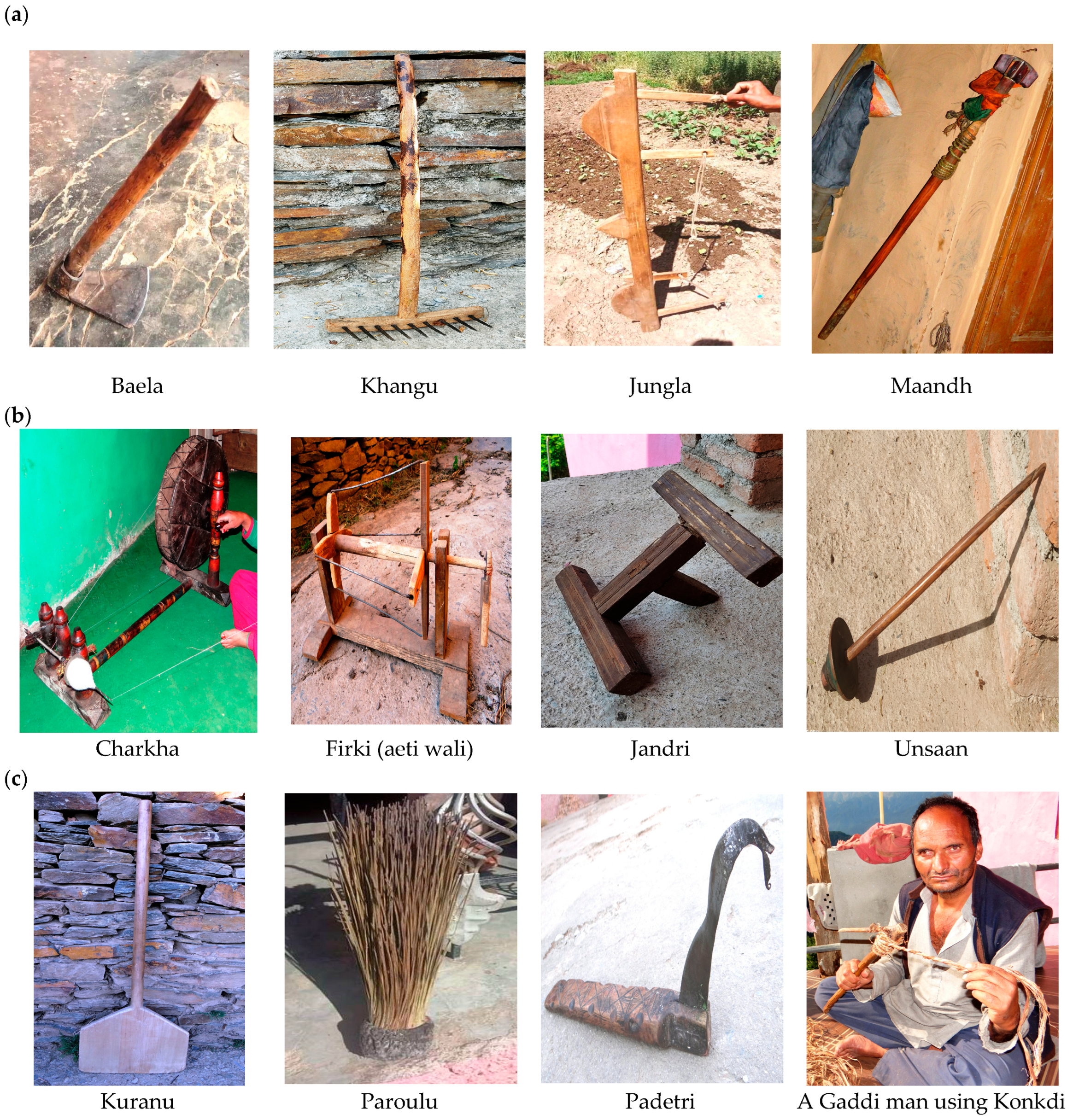
| Quercus floribunda, Olea ferruginea, Parrotiopsis jacquemontiana | Small hand hoe (Baela) | It is a small hoe-like tool with a wooden handle and a sharp iron base. It is used for shaping wood for making tools, doors, windows, etc. |
| Olea ferruginea, Quercus floribunda, Quercus semicarpifolia, Parrotiopsis jacquemontiana, Sorberia tomentosa, Robinia pseudoaccacia, Morus alba | Hoe (Bongdi) | This tool consists of a broad piece of iron (7 × 4 inches approx.) fitted with a long (3 ft.) wooden handle. It is used for varied purposes like digging soil, making shallow trenches, sowing seeds, removing weeds, etc. |
| Olea ferruginea, Quercus floribunda, Parrotiopsis jacquemontiana, | Large sickle (Chindri) | It consists of a long iron blade with a bent terminal end as a functional part attached to a wooden handle. It is used for cutting branches of fodder trees and shrubs for feeding cattle. |
| Cedrus deodara | Soil leveler (Daa) | Daa is a traditional agricultural implement, which is pulled by a pair of bulls and is used for loosening, leveling, and smoothing the soil surface by breaking soil clods after plowing. Its functional part consists of a thick rectangular wooden blade (3 ft × 1 ft approx.) connected to a long (7 ft approx.) wooden beam at the middle of its longer side. The operator rides on the blade of the Daa to put extra weight on it for effective leveling. |
| Olea ferruginea, Quercus floribunda, Parrotiopsis jacquemontiana, | Sickle (Darati) | It consists of a crescent-shaped iron blade with a small wooden handle. It is used for reaping crops and cutting grass for feeding cattle. |
| Parrotiopsis jacquemontiana, Quercus floribunda. | Mallet (Dhaleran) | It is a hammer-like tool that consists of a small wooden head attached to a wooden handle. It is used for breaking soil clods after plowing the agricultural fields. |
| Quercus floribunda, Prunus armeniaca, Fraxinus excelsior | Chopping block (Dikhra/Aeta) | It is a heavy-duty cross-section of a tree trunk, which is used as a hard surface for chopping meat as well as grass. |
| Parrotiopsis jacquemontiana, Quercus floribunda. | Maize threshing stick (Dingar) | It is a long (approx. 5 ft), slightly curved, thick wooden stick, which is used for beating the dehusked and dried maize cobs to detach grains from them. |
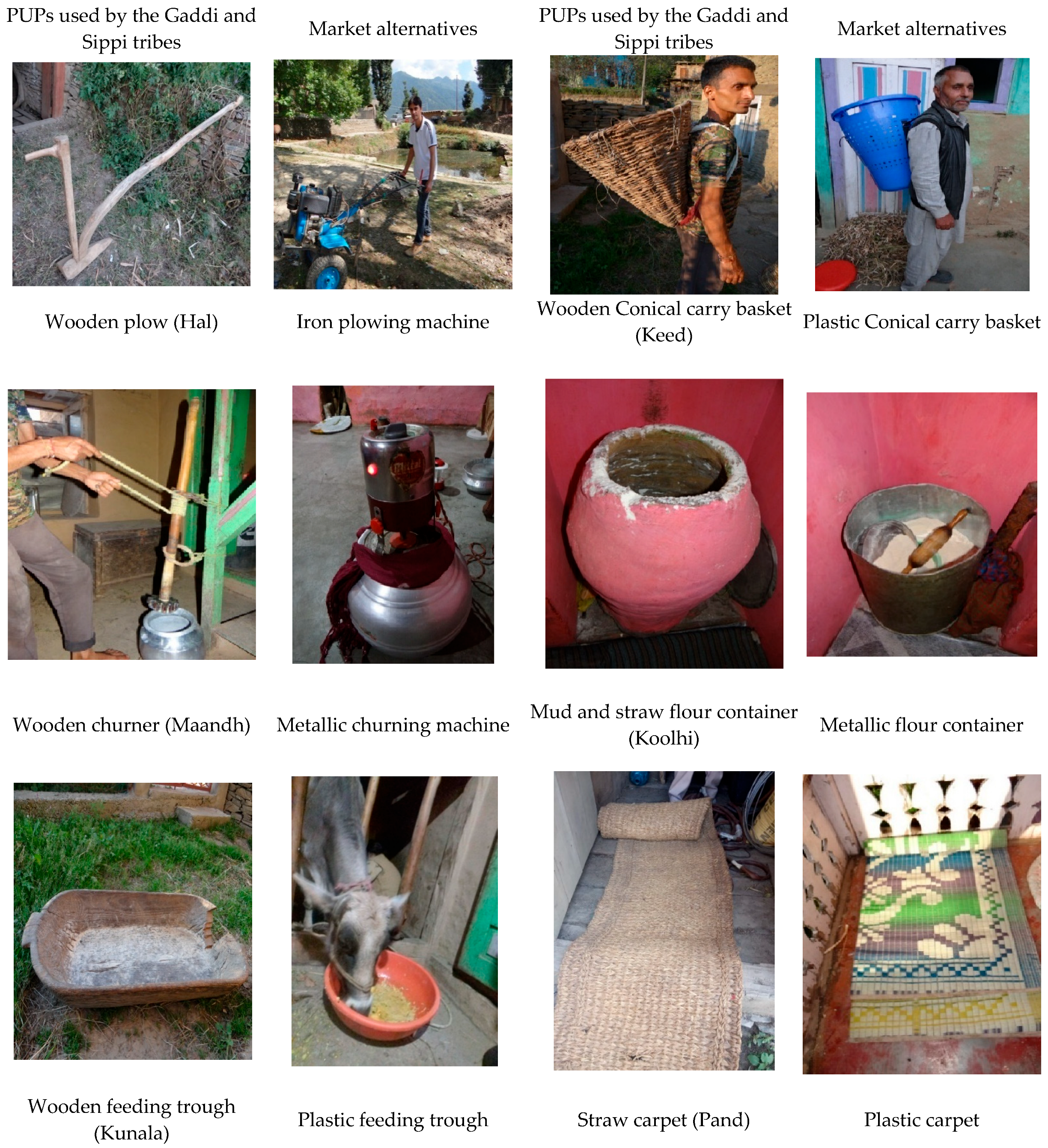
| Quercus floribunda, Quercus semicarpifolia, Quercus leucotrichophora, Betula utilis | Plow/plow beam (Hal) | The plow is an agricultural implement that is used for turning and loosening the topsoil before sowing seeds. It is drawn by a pair of bulls. The components of a plow are the beam, handle, shoe, and share. All parts of the plow except the share are made up of wood. The plow beam is a long wooden pole, which is bent at one end where it is attached to the shoe, whereas its other end connects with the yoke. |
| Quercus floribunda, Quercus semicarpifolia, Taxus baccata | Plow handle (Haladi) | It is the handle of the plow used for steering and maneuvering the plow by the plowman. |
| Quercus floribunda, Quercus semicarpifolia | Plow shoe (Halotra) | It is the basal functional part of the plow. Its tapering and pointed end penetrates into the soil and cuts the furrow. |
| Aesculus indica, Prunus cornuta. | Yoke (Jungla) | It is a wooden bar with a pair of wooden staves on either side and is placed over the necks of a pair of bulls, which together pull the plow attached to the yoke. |
| Quercus floribunda | De-husking pin (Keeli) | Maize is one of the major crops grown by the Gaddi and Sippi tribes. The maize crop is harvested, and the outer sheath of the cob is removed by manual de-husking of cobs. A small pencil-shaped wooden pin, known as keeli, is used by the Gaddi and Sippi tribes for manually stripping away the leaf sheath from the corn cob. |
| Olea ferruginea, Quercus floribunda, Parrotiopsis jacquemontiana | Rake (Khangu) | It consists of a row of 7–9 iron teeth fixed in a small wooden strip as a working part, which is attached to a long wooden handle. It is used for gathering hay, needles of Cedrus and Pinus, and spreading cattle dung in agricultural fields. |
| Olea ferruginea, Quercus floribunda, Q. semicarpifolia, Parrotiopsis jacquemontiana, Sorberia tomentosa | Axe (Kuradu) | It is a cutting tool that consists of a sharp-edged iron head as the working part attached to a long wooden handle. It is used for felling trees, cutting and splitting wood. |
| Olea ferruginea, Indigofera heterantha, Prunus persica | Farm stick (Lath) | It is a handheld stick that is made from delicate branches. It is used for controlling the movement of cattle, i.e., to make them move fast and in a desired direction while taking them out for grazing or during grazing by striking them. It is also used for making bulls to move fast during plowing by poking and striking them. |
| Parrotiopsis jacquemontiana. | Paddy threshing sticks (Latha) | These are very long (about 8 feet), fresh and flexible wooden sticks, which are used for beating harvested and dried paddy crop to separate grains from the stalks. |
| Cedrus deodara, Betula utilis, Prunus cornuta | Churner (Maandh) | It consists of a wooden rod/pole fitted at its base with a thick wooden disk with deeply dissected margins. A rope is wrapped around the rod for 5–6 turns in such a way that both its ends are free. The churner is forcibly rotated clockwise and anticlockwise alternately by pulling the two free ends of the rope alternately with hands for churning the buttermilk. |
| Pinus roxburghii, P. wallichiana, Ulmus wallichiana, Toxicodendron succedaneum, Quercus floribunda. | Harrow (Mach) | It consists of an elongated (about 3 feet) and narrow wooden piece with a series of 8–10 holes in which hard wooden sticks are fixed and is connected to a long (about 6 feet) wooden pole. It is drawn by a pair of bulls in watered paddy fields to make top topsoil smoother and finer by breaking the clods before transplanting paddy saplings. |
| Quercus floribunda, Prunus armeniaca, Zanthoxylum armatum. | De-husking pestle (Molh) | It is a thick, large wooden pestle, about 3 feet long, which is slightly narrow in the middle and is used for pounding the barley and paddy grains in a big stone mortar for removing the husk. |
| Viburnum gradiflorum, Parrotiopsis jacquemontiana, Pyrus pashia, Ulmus wallichiana, Rosa brononii. | Forked stick (Shangi) | It is a hard and strong Y-shaped forked stick. It is used for gathering cut-down bushes growing as weeds along with grass in grazing lands, which are either burnt or used for making a fence around the agricultural fields to protect crops from animals. |
| Quercus floribunda, Parrotiopsis jacquemontiana | Hand held chopper (Toka) | It is a small handy tool with a small wooden handle and a sharp chopping iron blade. It is used for chopping hay for cattle. |
| B. Tools for making woolen products | ||
| Cedrus deodara | Frame for arranging warp fiber (Aernoti) | It is a rectangular wooden frame (about 4 × 3 feet) with a series of about 10–15 wooden pegs arranged on each of the two shorter sides of a rectangular frame. It is used for arranging warp fibers before weaving. |
| Cedrus deodara | Take up roll (Belnu) | It is a part of khaddi. It is a wooden roll around which fabric is wound and collected. |
| Aesculus indica, Juglans regia, Cedrus deodara, Fraxinus excelsior | Spinning wheel (Charkha) | Spinning involves twisting wool into yarn. The charkha is a wooden device that is used for spinning thread from wool. The operator turns the drive wheel with the help of a crank with one hand, whereas the other hand draws the fiber spun off the sharp tip of the spindle shaft. |
| Cedrus deodara, Pinus wallichiana | Wheel for making yarn loops (Firki-aeti bali) | A cop (kukri) of thread formed by twisting two threads together with the help of a spinning top (unsan) is made into a thread loop (aeti) with the help of a wheel for making yarn loop (firki-aeti bali) and a frame for making double thread (jandri), which are made to work simultaneously. The iron needle of jandri bearing a cop (kukri) around it is inserted through the holes of jandri, and the thread from the cop is girdled around the wheel of firki-aeti bali by manually turning the firki wheel with the help of a crank, which results in the formation of a yarn loop. Yarn loops are then washed, colored, and used as warp threads. |
| Cedrus deodara, Pinus wallichiana | Wheel for making thread balls (Firki-dagdu bali) | The washed and colored warp thread loops are made into thread balls (dagdu) by placing the thread loop around the wheel of firki (dagdu bali), and the thread from the loop is wound by hand into thread balls as the wheel of firki rotates. |
| Juglans regia, Fraxinus excelsior | Reed/ hand beater (Hatha) | It is a large comb like part of handloom with vertical slits through which the warp threads pass and is used to press the weft against the fell (part of fabric that is not rolled yet on take up roll) during weaving. |
| Pinus wallichiana, Cedrus deodara | Frame for making double thread (Jandri) | It is a small tool that consists of two horizontal wooden pieces, each having one hole at each end, which are interconnected at their midpoint by a vertical piece of wood and supported by a slanting stand. Two long iron needles, each bearing a cone-shaped cop (kukru) of thread around it, are inserted through the holes at each side of this tool. It is used for making a ball of double thread (dagdu) by joining two threads from two cops. |
| Prunus armeniaca, Pinus roxburghii, Pinus wallichiana, Aesculus indica, Ziziphus oxyphylla. | Comb for wool (Kaanghi) | It is a small, L-shaped wooden tool used for smoothing and straightening the wool by combing it. Its functional part, bearing a series of teeth, is fixed vertically at one end of a horizontal supporting wooden strip, which rests on the ground and which is pressed under the feet while combing the wool. The wool is placed on the teeth of the comb, which is then pulled apart into two bunches with both hands. These two bunches are combined together, and the same action is repeated several times until woolen fibers are aligned almost in the same direction. Combing also separates the short fibers from long fibers and removes any unwanted matter. The fibers, which are now cleaner, stronger, finer, and lustrous, are ready for spinning. |
| Quercus floribunda, Fraxinus excelsior | Treadles/foot pedals (Khadavan) | These are wooden pedals located at the base of the handloom, which are pressed with the feet by the weaver to control the formation of warp sheds. A shed is the space between the lower and upper warp threads through which weft is made to pass during weaving. |
| Cedrus deodara | Handloom/main frame (Khaddi) | It is a traditional weaving machine operated by hand and foot. It is used for weaving different types of woolen blankets (chitru, fadki, chadar) and fabric (taani). Taani is used for making woolen clothes like coat, kurta, and pyjama (suthan). The different parts of Khaddi are the mainframe, weaver seat, harnesses, shuttle, reed, foot pedals, and take-up roll. |
| Aesculus indica, Prunus armeniaca, Fraxinus excelsior | Weaving shuttle (Naal) | It is a hollow, small, cylindrical wooden tool having one end open, whereas the other end is closed and pointed. It carries weft yarn in its cavity and is thrown forcibly by the weaver from one side to the other through the warp shed while weaving on khaddi |
| Aesculus indica, Quercus floribunda, Cedrus deodara, Juglans regia, Fraxinus excelsior | Shaft/harness (Rachh) | It is a wooden frame of khaddi used for holding warp threads. The up and down movement of the shaft with the help of treadles facilitates the passage of weft across the warp to create the desired pattern. |
| Berberis lycium, Olea ferruginea | Weft loading stick (Tarnethi) | It is a thin and long wooden stick used for loading weft fiber into the cavity of the weaving shuttle(naal) before weaving. |
| Prunus armeniaca, Melia azedarach, Fraxinus excelsior, Quercus floribunda | Hand spindle or drop spindle (Unsan) | It is a small tool that consists of a straight wooden rod or shaft, which has an attached wooden disk or conical object at its base and a notch at its top to guide the thread during spinning. It is used in hand spinning to twist and spin two threads from a ball (dagdu) of untwisted double threads into a single strong thread wound around the base of the spindle shaft to form a small cone-shaped cop (kukri) or cone-shaped ball. Unsan is allowed to drop down and be suspended in the air while the thread is spun after rotation has been started by twisting its shaft forcibly by both hands. The twisted yarn is used as a warp fiber. |
| C. Other/miscellaneous tools | ||
| Cedrus deodara | Carrying rods (Balli) | It is a long and strong wooden pole, which is used for carrying water in large urn-shaped brass vessels called baltoi from a water source, particularly during marriages or other community functions. Water-filled baltoi is hung down in the middle of balli with the help of a rope, and the balli is carried on the shoulders by two persons, one at each end. It is also used for carrying palak (Palanquin). |
| Themeda anathera | Grass broom (Boukari) | It is a common broom in every household, which is made up of grass and is used for sweeping inside the house. |
| Cedrus deodara | Roof compressing bat (Dabotan) | It is a bat-shaped, heavy wooden tool with a small handle and thick, heavy body. It is used to compress the rooftop soil of kuchha houses during rainy seasons by repeated forceful beating, which makes the soil compact and prevents water leakage into the house. |
| Cedrus deodara, Quercus floribunda, Fraxinus excelsior | Washing bat (Dabotan) | It is a bat-shaped wooden device with a rectangular frame and a short handle. It is used for washing clothes by repeatedly beating wet clothes after applying soap. |
| Cedrus deodara, Prunus armeniaca, Pyrus pashia, Fraxinus excelsior | Noodle-making tool (Jandra/Bhedu) | It is a sheep-shaped wooden structure having a wide vertical cylindrical hole with an iron sieve at the base of the hole. It is used for making a noodle-like dish (satroley) out of boiled wheat flour balls. Flour balls are placed in the hole and pressed hard against the sieve with a wooden pestle by using a long, thick, and strong wooden pole or iron-digging bar as a lever to press the pestle. |
| Quercus floribunda, Berberis lycium, Parrotoipsis jacquemontiana, Aesculus indica, Spiraea canescens | Fiber twisting hook (Konkdi) | It is a small hooked stick, which is used for twisting plant fibers together for making rope. |
| Cedrus deodara, Pinus wallichiana, Pinus roxburghii, Aesculus indica, juglans regia, Celtis australis | Snow shovel (Kuranu) | It is a shovel-like tool used for lifting and removing snow from the roof of kutcha houses, lawns, maize haycocks (kundu), etc. It consists of a broad rectangular wooden blade at its base, having a long pole-like handle. |
| Isodon rugosus, Spiraea canescens | Broom (Loath) | It is a hard broom made from the stem of the shrub. It is used for sweeping lawns and the roofs of the houses. |
| Cedrus deodara, Fraxinus excelsior | Wooden ladder (Maanj) | It is a multipurpose portable wooden ladder. Its side rails are made up of long wooden poles, whereas its rungs are made up of small wooden crossbars. |
| Cedrus deodara, Oryza sativa | Snow clearing frame (Masheen) | It is a tool used for removing snow from the roofs of kutcha houses. It has a triangular base made by joining three small wooden poles connected to a long pole-like handle. The triangular base has a network of ropes made from the hay of Oryza sativa. |
| Abies pindrow, Cedrus deodara, Pinus wallichiana | Spout (Naadu) | A naadu consists of a piece of curved bark of a tree or a small carved out wooden channel which is placed at the front of a water source (spring or a small stream) on a raised support at a certain height above ground level. The water is made to fall from the wooden channel and is used for drinking purposes. |
| Prunus armeniaca, Fraxinus excelsior | Sickle for cutting vegetables (Padetri) | Padetri is a traditional sickle with a stand used for cutting vegetables. Its front part consists of a slightly curved iron blade attached vertically to one end of a basal horizontal wooden support, which rests on the ground and which is pressed under the feet while cutting vegetables with both hands. |
| Pinus roxburghii | Tiny broom (Paroulu) | It is a tiny broom made from the needles of a chir-pine. It is used for sweeping the cooking area of the kitchen. It is swiftly moved to-and-fro repeatedly for blowing air into the burning coal in a small earthen pot, locally known as Daeru, in which incense (dhoop) is burnt during prayers (puja). |
| Juglans regia, Fraxinus excelsior | Wood shaving plane (Randa) | It is a wooden tool with a flat bottom and a sharp iron blade which is used for shaping and smoothing the wood surface for making wooden tools, doors, and windows, etc. |
| Parrotiopsis jacquemontiana, Olea ferruginea, Quercus leucotrichophora,, Morus alba | Walking stick (Sooti) | The hard straight branches are used as walking sticks, which are generally used by old-aged and infirm persons as support while walking, especially in hilly areas. |
| D. Containers/storage products | ||
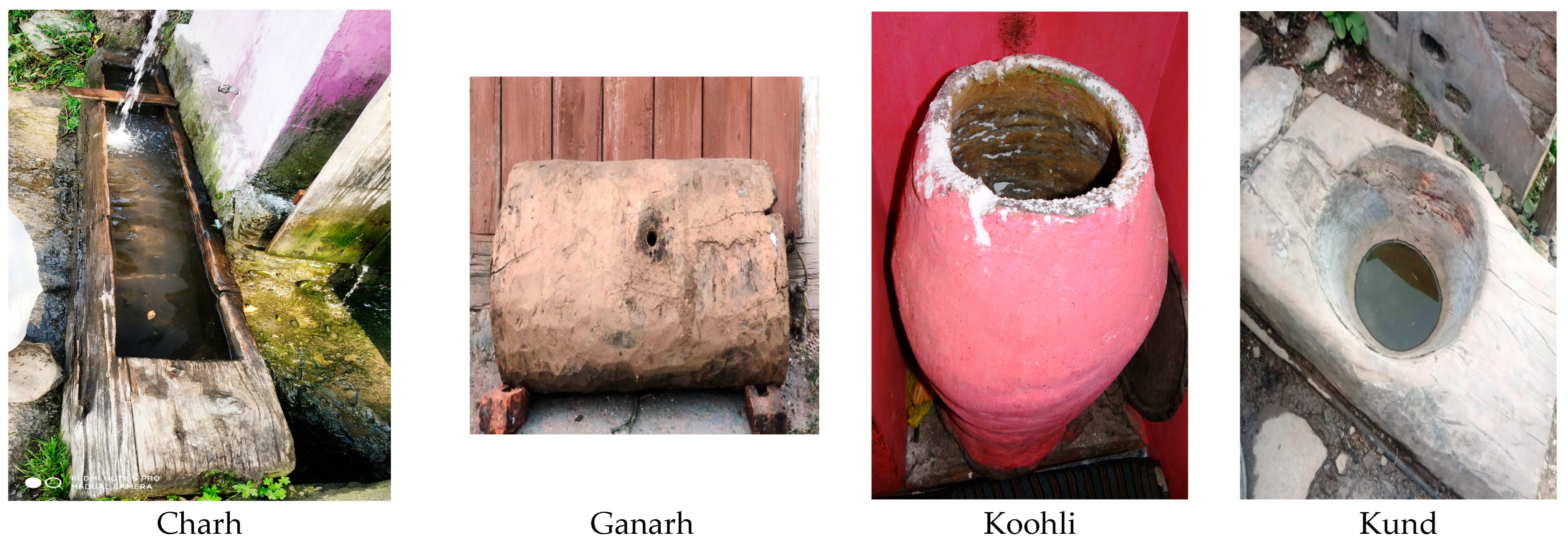
| Cedrus deodara | Trough (Charh) | It is a much longer and fixed outdoor trough made from a hollowed-out wooden log and is approximately 10 feet long, 1.25 feet wide, and 1 foot deep. It is placed near the continuous source of water from where the continuous supply of water is maintained into the charh, which keeps on overflowing all the time. It provides fresh drinking water to the cattle. |
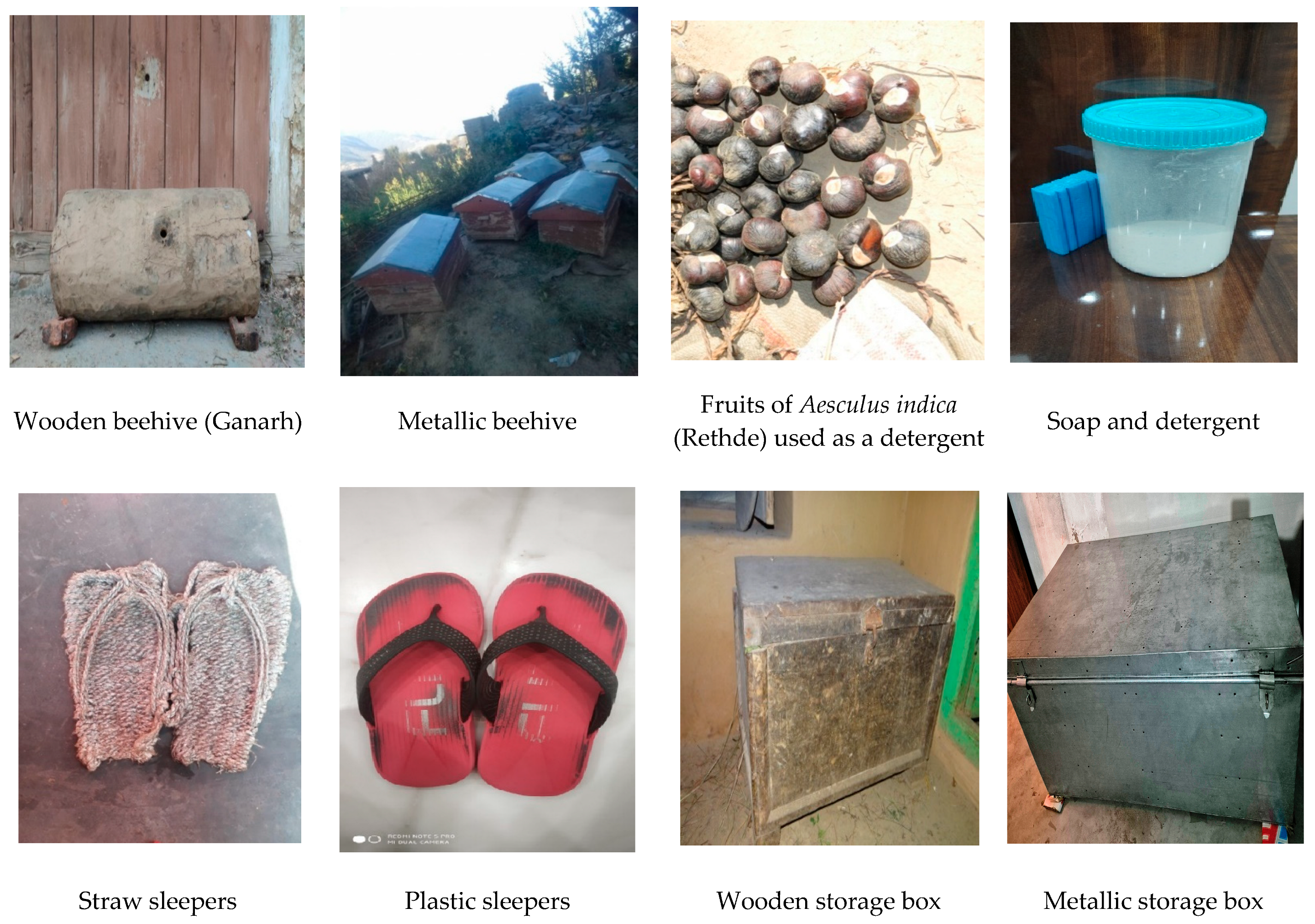
| Cedrus deodara, Toxicodendron succedaneum, Aesculus indica, Pinus wallichiana. | Honey barrels (Ganarh) | It is a wooden barrel (about 2.5 ft long and 1.25 ft in diameter) made from an old tree trunk with a decaying core. It is used for beekeeping and honey extraction. The tree trunk is hollowed out by removing the decaying core, the two open ends of the barrel are closed with wooden sheets, and a small hole is made in the center of the barrel surface for the entry and exit of honeybees. |
| Triticum aestivum, Hordeum vulgare | Flour storage bin (Koolhi) | It is a barrel-shaped fixed mud bin housed in the kitchen and used for storing corn flour. It is made from mud mixed with wheat and barley straw, locally known as kinyarhi, which prevents shrinkage cracks in it. |
| Cedrus deodara, Ulmus wallichiana, Aesculus indica | Cattle feeding trough (Kunala) | It is a long wooden trough made from a hollowed-out wooden log. It is about 3–4 feet long, 1.25 feet wide, and 8 inches deep. It is used for feeding animals. |
| Cedrus deodara | Tub (Kund) | It is an outdoor, fixed, large round tub with a sloping inner wall and narrow bottom made from a hollowed-out wooden block. It is used for washing clothes, especially woolen blankets, with feet by jumping alternately from one leg to another. |
| Cedrus deodara, Pinus wallichiana. | Grain storage fixed compartment (Kuthar) | This is a large wooden compartment, which is fixed to the wall in the room and used for storing large quantities of grains. It may be single-chambered or may consist of two or three chambers for storing different types of grains. Each chamber has an opening on its roof for pouring grains and a small outlet at the base of its front part for taking out grains. |
| Cedrus deodara, Toxicodendron succedaneum, Aesculus indica | Dog feeding container (Kutroshu) | It is a small rectangular wooden container carved out of a small wooden block used for feeding and watering dogs. |
| Cedrus deodara, Pinus wallichiana | Storage box (Sandook) | It is a wooden box for storing blankets, clothes, and other household articles. Sandook is generally gifted to the bride by their parents. |
| Cedrus deodara, Pinus wallichiana. | Grain storage moveable compartment (Toon) | It is a Kuthar-like storage structure used for storing grains. It is generally smaller than a Kuthar, single-chambered, not fixed, and can be moved within the house. |
| E. Construction products | ||
| Berberis lycium, Quercus floribunda, Cedrus deodara. | Farm fencing (Baad) | Wooden poles, dry bushes, and thorny branches are used to form a protective obstruction, known as Baad, along the borders of agricultural fields to protect crops from wild and stray animals. |
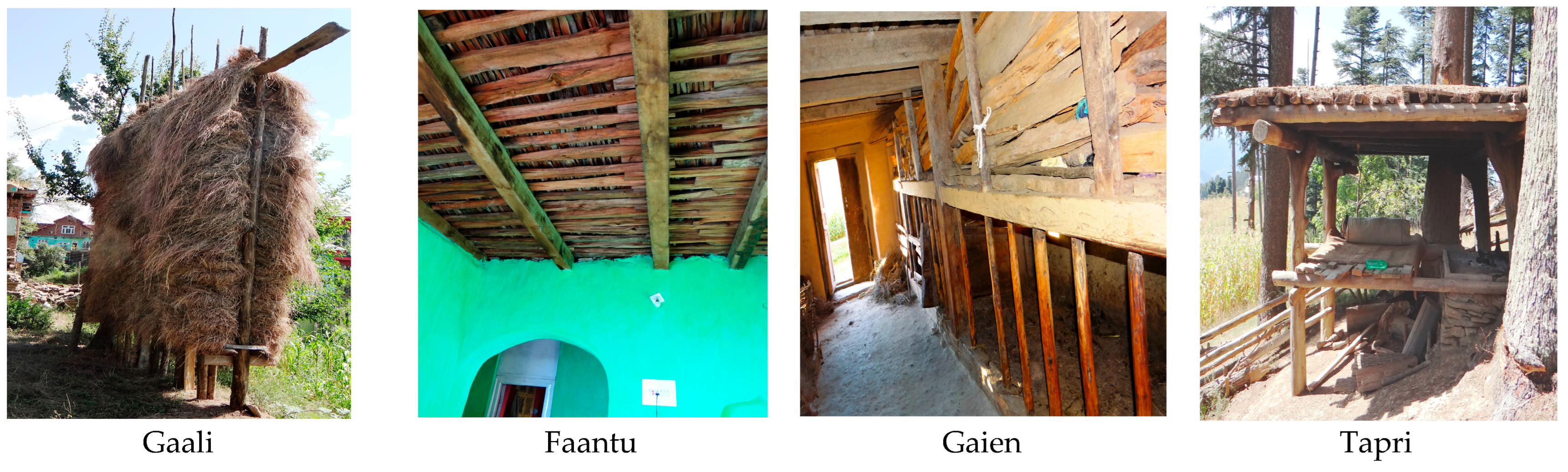
| Cedrus deodar | Roof shafts (Faantu) | These are small wooden shafts (about 5 ft long), which are obtained by longitudinally slitting the wooden logs with the help of an ax. These are closely arranged in a series on the wooden beams of the roof, and a thick layer of Pinus needles(othan) is placed on it, followed by a soil layer, which is compacted with the help of Dabotan to prevent water leakage during the rainy season. |
| Cedrus deodara | Hay rack (Gaali) | It is an outdoor structure, which consists of a series of multiple vertical racks made up of very long wooden poles (about 15 feet long) and used for holding and storing dried grass bales off the ground for feeding to cattle. |
| Cedrus deodara, Parrotiopsis jacquemontiana | Cattle compartment (Gaien) | It is a cattle compartment within the house, which consists of a series of 10–15 vertical wooden posts fixed on two horizontal wooden beams, one at each end. The vertical posts are about 4 feet in height, and the distance between two successive posts is about 1 foot. The cattle are tied to the vertical posts by means of a rope known as daan. |
| Cedrus deodara | Lamb shelter (Oda) | Oda is a small (approx. 7 × 4 ft.) temporary shelter made in the forest or agricultural fields near forests for protecting lambs from harsh weather conditions and wild animals. It consists of four walls of small height (3–4 feet) made up of stones with a roof covering made up of small, rough wooden planks with bark (Shaata) derived from the outermost layers of the trunk of large trees. Oda has a covered opening in the roof for the entry and exit of lambs. |
| Pinus wallichiana, Pteris biaurita | Roofing material (Othan) | The fallen dry needles of Pinus wallichiana and aerial parts of Pteris biaurita, collectively known as othan, are collected from the forest and are used as roofing material for making mud(kutcha) houses. A layer of othan is placed under the roof soil of a kutcha house that binds with soil particles and keeps the soil in position and thus helping in preventing trickling of rain water down the roof into the house during the rainy season. |
| Cedrus deodara | Field security shed (Tapri) | Tapri is a small and open security shed in the agricultural fields for human surveillance of wild animals to keep them away from crop fields. |
| Cedrus deodara | Log foot-bridge (Tarangdi) | It is a temporary footbridge made by placing two or three long wooden logs with a flattened upper surface close to one another across the stream. It is used by pedestrians and cattle to cross small water streams. |
| F. Artifacts | ||
| Oryza sativa, Zea mays | Circular straw rug (Chakotu) | It is a small circular (about 1.5–2 feet in diameter) grass rug made out of paddy straw (panoli) and outer sheath of maize cob (pochal) and is used for sitting of only a single person. |
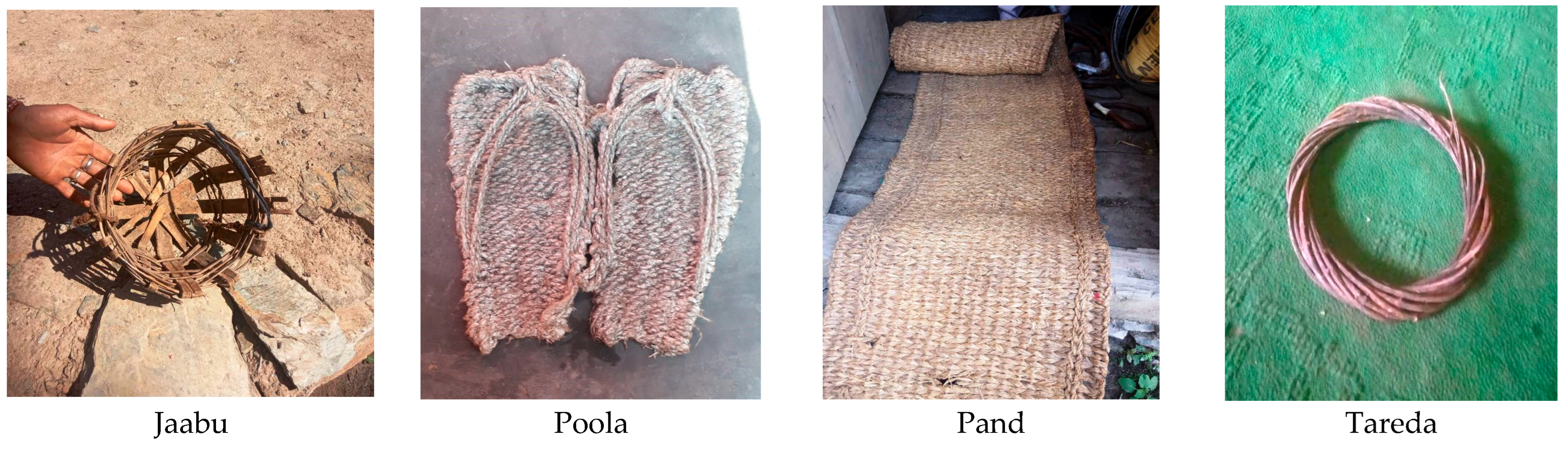
| Berberis lycium, Spiraea canescens | Cattle mouth guard or muzzle (Jaabu) | It is a cup-shaped structure used to cover the snout of bulls while plowing the field to prevent them from eating nearby standing crop or grass. It is made by splitting and shredding the delicate twigs of the plants, and the shreds are then woven. |
| Gerardina diversifolia, Cannabis sativa, Oryza sativa | Rope (Jodi) | Jodi is a rope prepared from plant fiber, locally known as shegar. The stem bundles of Gerardiana diversifolia are submerged in a water source like ponds, pools, streams, etc., by placing them under the weight of a big stone for 4–5 days for retting, which softens the bark. After retting the bark of individual stems is peeled off manually, and the plant fibers (shegar) thus obtained are twisted together with the help of a hooked stick known as Konkdi to form rope (Jodi). Jodi is also prepared from paddy straw and stem fiber of Cannabis sativa without retting. Jodi is used for collecting fuel wood and fodder, tying cattle with wooden posts in cattle sheds, making woven beds (manja), and carrying belts for the conical basket (Keed). |
| Parrotiopsis jacquemontiana, Berberis lycium. | Conical carry basket (Keed) | It is a conical basket with two sling straps, which is carried on the back of the person. It is made by weaving intact or longitudinally split shreds of branches of plants and used in day-to-day life for carrying Cedrus needles(ker), cattle dung, grasses, water pitchers, etc. |
| Pinus wallichiana, P. roxburghii, Picea smithiana, Cedrus deodara, Toxicodendron succedaneum, Fraxinus excelsior, Gerardina heterophylum | Woven bed (Manja) | It is a traditional wooden cot. It consists of a frame of strong wooden posts with an interwoven network of ropes (jodi) made from paddy straw and Gerardina heterophylum. It is used for sleeping as well as for sitting purposes. |
| Oryza sativa, Zea mays | Straw carpet (Pand) | It is a hand-knitted carpet made from paddy straw (panoli) and outer sheath of maize cob (pochal) and is used for sitting purposes in homes and for eating food during marriage and other social functions. |
| Oryza sativa | Straw slippers (Poola) | These are soft slippers made out of paddy straw that are used as footwear inside homes, particularly in kitchens. |
| Olea ferruginea, Parrotiopsis jacquemontiana, Jasminum officinale. | Round pot stand (Tareda) | It is a multipurpose ring-like structure made by intertwining delicate and tender twigs of plants. It is used for keeping cooking pots in the kitchen, like cauldrons, earthen pots, steel pots, etc., tying cattle with wooden posts in the cattle house(gaien), and holding a maandh (churner) in position while churning buttermilk. |
| G. Miscellaneous products | ||
| Indigofera heterantha, Olea ferruginea, Prunus persica, Quercus floribunda, Desmodium elegans | Tooth brush (Beedi) | Small tender twigs are chewed at one end and used as a brush for cleaning teeth. |
| Principia utilis, Rosa brunonii. | Palanquin dome (Chhonka) | The fresh, long, and delicate twigs are used for making the dome of the palanquin (palak). |
| Indigofera heterantha, Jasminum officinale. | Tying cord (Chubdi) | These are soft twigs used for tying freshly cut grass into grass bales. |
| Juniperus communis, Dolomiaea macrocephala | Incense (Jangli dhoop) | Dry roots of Dolomiaea macrocephala and dry leaves of Juniperus communis are burnt over charcoal as dhoop. |
| Aesculus indica, Fraxinus excelsior | Saddle (Kaathi) | It is a wooden seat for the rider, which is fastened on horseback. |
| Cedrus deodara, Pinus wallichiana | Cattle bedding (Ker) | The fallen dry needles of Cedrus deodar and Pinus wallichiana, locally known as ker, are gathered by women from the forest floors with the help of a Rake (Khangu)and carried to homes in a conical basket carried on the back (Keed). Ker is stored outside in the close vicinity of the house in the form of large conical heaps known as roodh and is spread on the floor of the cattle house(gaien) as bedding for the comfortable sitting of cattle. |
| Dioscorea deltoidea. | Rhizomes of Dioscorea deltoidea (Kins) | The rhizomes of Dioscorea deltoidea (kins) are rubbed on a grater to form small shreds, which are used as a soap substitute for washing clothes. Grated rhizomes are mixed with hot water in a large wooden tub (kund) in which the clothes are washed. |
| Juglans regia, Fraxinus excelsior | Palanquin (Palak) | It consists of a wooden box having a dome-shaped top covered by a maroon cloth, and is used for carrying brides. Its dome is made by bending and fixing 4–5 fresh, long, and delicate twigs (chhonka) on the box. It is carried by four persons on wooden poles (balli), which rest on their shoulders. |
| Principia utilis | Water gun (Pichkari) | The hollowed out branches of the plant are used for making pichkari, which is used by children for splashing colors on one another during the celebration of the Holi festival. |
| Pteris biaurita, Zea mays | Scrubber (Shota) | The outer sheath of the maize cob is used as a scrubber for washing utensils. The leaves of Pteris biaurita are used as a scrubber for cleaning pots used for storing milk, butter-milk, curd, and ghee because of their abrasive property due to their rough texture. |
| Aesculus indica | Fruit of A. indica (Goon) | Fruit of A. indica, locally known as goon, is used as a soap substitute for washing woolen clothes. The crushed fruit kernel is added to warm water and stirred with a rod until it lathers, and it is used for washing woolen clothes. |
| Cedrus deodara | Corpse-carrying structure (Shidh) | A small wooden ladder-like structure, which is used for carrying the body of a dead person to the cremation ground on the shoulders. |
| Nardostachys jatamansi | Insect repellent (Pernahni) | Dried roots of N. jatamansi (Pernahni) are placed in boxes containing woolen clothes and used as insect repellent to protect clothes from insects. |
| Anaphalis margaritacea, Anaphalis triplinervis | Leaves for lighting fires (Bhujli) | Dried leaves of Anaphalis margaritacea and A. triplinervis, commonly known as bhujli, are used for lighting a fire by Gaddi shepherds when they are in the forests for grazing their livestock. The bhujli are placed on a small hard white lint stone, known as shukrah, and a small iron piece known as runka is made to strike against this stone to generate a spark when the bhujli catch fire. |
| Impatiens glandulifera. | Hand dye (Hallu) | The crushed fresh leaves and tender branches of a young plant are rubbed between both hands for 5–10 min for skin decoration, and this leaves a red color on the hands. |
| Plant Species | CIAT | CIWP | CIOT | CICS | CICo | CIAr | CIMP | CI |
|---|---|---|---|---|---|---|---|---|
| Abies pindrow (Royle ex D.Don) Royle. | 0.08 | 0.08 | ||||||
| Aesculus indica (Wall. ex Cambess.) Hook. | 0.25 | 0.28 | 0.17 | 0.25 | 0.23 | 1.18 | ||
| Anaphalis margaritacea (L.) Benth and Hook. F. | 0.04 | 0.04 | ||||||
| Anaphalis triplinervis (Sims) C.B. Clarke | 0.05 | 0.05 | ||||||
| Berberis lycium Royle. | 0.19 | 0.14 | 0.10 | 0.24 | 0.67 | |||
| Betula utilis D.Don. | 0.21 | 0.21 | ||||||
| Cannabis sativa L. | 0.10 | 0.10 | ||||||
| Cedrus deodara (Roxb. ex D.Don) G.Don. | 0.33 | 1.03 | 1.11 | 1.05 | 0.98 | 0.18 | 0.24 | 4.92 |
| Celtis australis L. | 0.07 | 0.07 | ||||||
| Desmodium elegans DC. | 0.06 | 0.06 | ||||||
| Dioscorea deltoidea Wall. ex Griseb. | 0.07 | 0.07 | ||||||
| Dolomiaea macrocephala DC. ex Royle. | 0.14 | 0.14 | ||||||
| Fraxinus excelsior L. | 0.06 | 0.30 | 0.19 | 0.04 | 0.12 | 0.71 | ||
| Girardinia diversifolia (Link) Friis | 0.19 | 0.19 | ||||||
| Hordium vulgare L. | 0.18 | 0.18 | ||||||
| Impatiens glandulifera Royle. | 0.28 | 0.28 | ||||||
| Indigofera heterantha Wall ex. Brandis. | 0.08 | 0.05 | 0.13 | |||||
| Isodon rugosus (Wall. ex Benth.) Codd. | 0.17 | 0.17 | ||||||
| Jasminum officinale L. | 0.14 | 0.14 | 0.28 | |||||
| Juglans regia L. | 0.96 | 0.44 | 0.34 | 1.74 | ||||
| Juniperus communis L. | 0.15 | 0.15 | ||||||
| Melia azedarach L. | 0.06 | 0.06 | ||||||
| Morus alba L. | 0.18 | 0.14 | 0.32 | |||||
| Nardostachys jatamansi (D.Don) DC. | 0.21 | 0.21 | ||||||
| Olea ferruginea Wall. ex Aitch. | 0.31 | 0.08 | 0.06 | 0.10 | 0.08 | 0.64 | ||
| Oryza sativa L. | 0.28 | 0.48 | 0.77 | |||||
| Parrotiopsis jacquemontiana (Decne.) Reh. | 0.48 | 0.07 | 0.03 | 0.16 | 0.74 | |||
| Picea smithiana (Wall.) Boiss. | 0.26 | 0.38 | 0.64 | |||||
| Pinus roxburghii Sarg. | 0.16 | 0.20 | 0.21 | 0.16 | 0.74 | |||
| Pinus wallichiana A.B.Jacks. | 0.19 | 0.41 | 0.33 | 0.47 | 0.12 | 0.39 | 1.91 | |
| Prinsepia utilis Royle. | 0.08 | 0.08 | ||||||
| Prunus armeniaca L. | 0.24 | 0.31 | 0.12 | 0.66 | ||||
| Prunus cornuta (Wall. ex Royle) Steud. | 0.20 | 0.15 | 0.36 | |||||
| Prunus persica (L.) Batsch. | 0.03 | 0.05 | 0.08 | |||||
| Pteris biautita L. | 0.08 | 0.06 | 0.14 | |||||
| Pyrus pashia Buch.-Ham. ex D.Don | 2.00 | 0.30 | 0.31 | 0.12 | 0.12 | 2.86 | ||
| Quercus floribunda Lindl. ex A.Camus. | 0.52 | 0.42 | 0.94 | |||||
| Quercus leucotrichophora A. Camus. | 0.80 | 0.80 | ||||||
| Quercus semecarpifolia Sm. | 0.11 | 0.11 | ||||||
| Robinia pseudoacacia L. | 0.08 | 0.07 | 0.16 | |||||
| Rosa brunonii Lindl. | 0.07 | 0.07 | ||||||
| Sorbaria tomentosa (Lindl.) Rehder. | 0.06 | 0.03 | 0.09 | |||||
| Spiraea canescens D.Don. | 0.15 | 0.15 | ||||||
| Taxus baccata L. | 0.04 | 0.04 | ||||||
| Themeda anathera (Nees ex Steud.) Hack. | 0.03 | 0.03 | ||||||
| Toxicodendron succedaneum (L.) Kuntze. | 0.06 | 0.06 | 0.04 | 0.15 | ||||
| Triticum aestivum L. | 0.18 | 0.18 | ||||||
| Ulmus wallichiana Planch. | 0.09 | 0.03 | 0.12 | |||||
| Viburnum grandiflorum Wall. ex DC. | 0.11 | 0.11 | ||||||
| Zanthoxylum armatum DC. | 0.19 | 0.19 | ||||||
| Zea mays L. | 0.28 | 0.16 | 0.44 | |||||
| Ziziphus oxyphylla Mill. | 0.13 | 0.13 |
| PUP Categories | nur | nt | Fic |
|---|---|---|---|
| Tools | 3704 | 57 | 0.985 |
| Containers/storage | 524 | 7 | 0.989 |
| Construction | 327 | 6 | 0.985 |
| Artifacts | 685 | 15 | 0.980 |
| Miscellaneous products | 671 | 21 | 0.970 |
| Number of PUPs | ANOVA | |||
|---|---|---|---|---|
| Female | Male | F-Value | p-Value | |
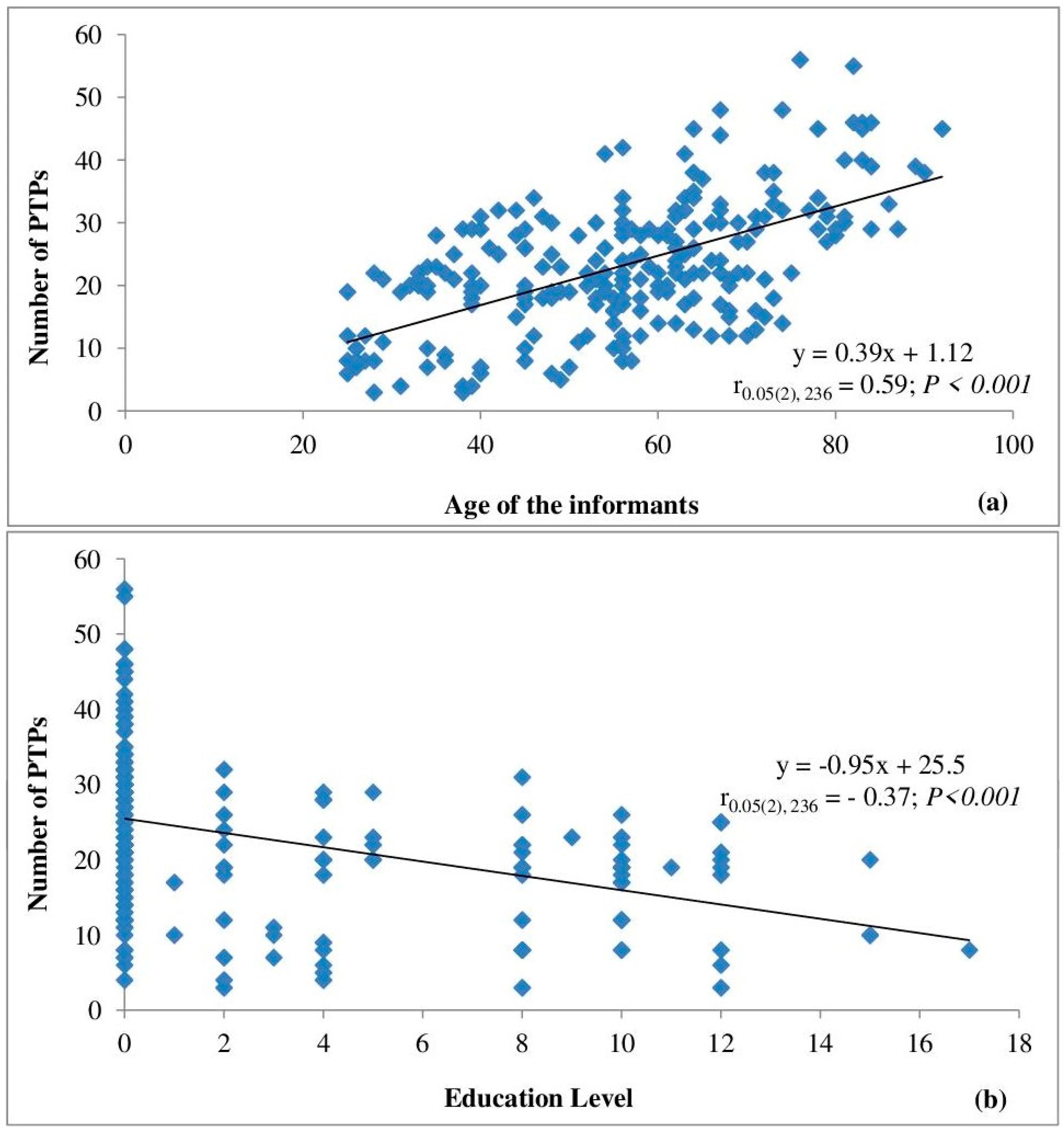
| Total informants | 18.1 | 29.4 | 91.7 | <0.001 |
| Age-group | ||||
| 25–34 | 8.9 | 18.0 | 22.4 | <0.001 |
| 35–44 | 8.6 | 26.7 | 49.0 | <0.001 |
| 45–54 | 14.5 | 25.6 | 31.5 | <0.001 |
| 55–64 | 18.9 | 29.0 | 41.7 | <0.001 |
| 65–74 | 20.4 | 34.4 | 63.0 | <0.001 |
| 75–84 | 30.8 | 44.5 | 37.4 | <0.001 |
| >85 | 35 | 39.5 | 0.4 | 0.565 ns |
| Education level | ||||
| Never attended a school | 20.7 | 34.1 | 121.9 | <0.001 |
| Educated for 1–5 classes | 10.2 | 24.3 | 70.6 | <0.001 |
| Educated for 6–10 classes | 9.8 | 21.6 | 31.3 | <0.001 |
| Educated for >10 classes | 6.5 | 18.8 | 6.9 | 0.022 |
Disclaimer/Publisher’s Note: The statements, opinions and data contained in all publications are solely those of the individual author(s) and contributor(s) and not of MDPI and/or the editor(s). MDPI and/or the editor(s) disclaim responsibility for any injury to people or property resulting from any ideas, methods, instructions or products referred to in the content. |
© 2025 by the authors. Licensee MDPI, Basel, Switzerland. This article is an open access article distributed under the terms and conditions of the Creative Commons Attribution (CC BY) license (https://creativecommons.org/licenses/by/4.0/).
Share and Cite
Singh, B.P.; Sharma, S.; Sharma, V.; Manhas, R.K.; Sivanesan, I. Plants Traditionally Used for Making Utility Products by Forest Dwelling Gaddi and Sippi Tribes in Bhaderwah Tehsil of the Union Territory of Jammu and Kashmir, India. Diversity 2025, 17, 409. https://doi.org/10.3390/d17060409
Singh BP, Sharma S, Sharma V, Manhas RK, Sivanesan I. Plants Traditionally Used for Making Utility Products by Forest Dwelling Gaddi and Sippi Tribes in Bhaderwah Tehsil of the Union Territory of Jammu and Kashmir, India. Diversity. 2025; 17(6):409. https://doi.org/10.3390/d17060409
Chicago/Turabian StyleSingh, Bhekam Pal, Shivika Sharma, Vikas Sharma, R. K. Manhas, and Iyyakkannu Sivanesan. 2025. "Plants Traditionally Used for Making Utility Products by Forest Dwelling Gaddi and Sippi Tribes in Bhaderwah Tehsil of the Union Territory of Jammu and Kashmir, India" Diversity 17, no. 6: 409. https://doi.org/10.3390/d17060409
APA StyleSingh, B. P., Sharma, S., Sharma, V., Manhas, R. K., & Sivanesan, I. (2025). Plants Traditionally Used for Making Utility Products by Forest Dwelling Gaddi and Sippi Tribes in Bhaderwah Tehsil of the Union Territory of Jammu and Kashmir, India. Diversity, 17(6), 409. https://doi.org/10.3390/d17060409