


Abstract
Accurate estimation of population size and identification of key habitat factors are fundamental for the conservation of endangered species. This study demonstrates the application of advanced methods for estimating wildlife abundance and evaluating habitat associations for the endangered Sichuan sika deer (Cervus nippon sichuanicus) in the Gansu Taohe National Nature Reserve. We deployed a systematic camera trap network across the reserve and estimated population size by integrating camera trap data with a movement simulation method, while employing a Maximum Entropy (MaxEnt) model to analyze the effects of various environmental variables on habitat utilization. Our survey estimated a population of approximately 429 individuals (95% CI: 390–446), corresponding to a density of 0.15 individuals/km2. Habitat suitability modeling revealed that precipitation of the driest month (bio14; 44.5% contribution) and vegetation cover (NDVI; 39.1% contribution) were the predominant factors governing habitat suitability, collectively accounting for over 80% of the model’s prediction, whereas anthropogenic factors like the Human Footprint Index showed negligible independent importance. This study provides the first baseline population estimate for this endangered ungulate in the Taohe Reserve. The current low population density suggests substantial potential for recovery, indicating that future conservation strategies should safeguard key water sources and enhance habitat quality and connectivity.
1. Introduction
Montane dark coniferous forests, cold-temperate and temperate ecosystems dominated by shade-tolerant Picea and Abies, represent a significant southern extension of the boreal forest (taiga), the planet’s most extensive forest biome [1]. As climax communities in high-altitude regions, these ecosystems are exceptionally widespread and diverse in China, which lies at the southern edge of the taiga’s global distribution [2]. Their distribution spans the ecologically strategic eastern margin of the Tibetan Plateau and adjacent mountain ranges, fulfilling critical roles as water reservoirs, carbon sinks, and biodiversity refuges [3]. These forests harbor rich ungulate diversity and serve as critical habitats for numerous endemic and endangered species. Common ungulates include the Red Deer (Cervus elaphus), Chinese serow (Capricornis milneedwardsii), Chinese goral (Naemorhedus griseus), and sika deer (Cervus nippon sichuanicus)—the focus of this study. These species are vital for maintaining ecosystem integrity: as primary consumers, they regulate vegetation succession and community structure; through foraging and movement, they facilitate seed dispersal and nutrient cycling; and as primary prey for large carnivores such as snow leopards (Panthera uncia), they support intact food webs [4].
However, this unique forest ecosystem faces escalating threats. Climate change, manifesting as warming and drying trends, is altering treeline positions and vegetation composition, thereby affecting water source stability. Concurrently, human activities such as road construction, grazing, and logging lead to habitat fragmentation and degradation, disrupting wildlife corridors [5]. Additionally, poaching and human–wildlife conflict exert direct pressure on local populations. Among the forest’s ungulates, the Sichuan sika deer has emerged as a critical indicator species for assessing ecosystem health due to its narrow distribution, isolated populations, and high sensitivity to habitat quality. The sika deer is listed as endangered on the IUCN Red List and is a National Grade I Protected Wild Animal in China [6]. Its populations have declined drastically due to poaching and habitat loss, with China’s historical range, once hosting six endemic subspecies, now reduced to only three remaining subspecies [7,8]. The mountainous areas along the eastern margin of the Qinghai–Tibet Plateau represent both the modern historical distribution of the Sichuan sika deer and contain its largest remaining wild population, though its distribution has now contracted into several completely isolated areas [9].
Accurate population assessment is fundamental for the conservation of such elusive and endangered wildlife, serving as a baseline for evaluating extinction risk and formulating effective strategies [10]. However, traditional survey methods (e.g., line transect) are often limited by difficulties in detection and inherent estimation errors for cryptic species like the sika deer [11]. In recent years, camera trapping has emerged as a powerful, non-invasive alternative, enabling long-term, continuous monitoring with minimal human disturbance [12,13]. To leverage camera trap data for robust density estimation, several analytical models have been developed. The Random Encounter Model (REM) provides a foundation based on principles of random animal movement [14,15]. Subsequent advancements include correction factors for rare species [16] and, more recently, a simulation-based method that incorporates individual movement parameters to significantly improve estimation accuracy [17,18].
Despite these methodological advances, critical knowledge gaps persist regarding the status of the Sichuan sika deer. The Tiebu distribution area, spanning the Sichuan Tiebu and Gansu Taohe National Nature Reserves, is a critical habitat for the subspecies. To date, research has been predominantly confined to the Sichuan Tiebu Nature Reserve [13,19,20], leaving the population status in the contiguous Taohe National Nature Reserve largely unknown. As Taohe Reserve constitutes an important habitat and is crucial for maintaining genetic diversity through population exchange, assessing its sika deer population is essential for understanding the overall status and ensuring the population integrity of the Sichuan sika deer across its entire range.
This study aims to fill this critical knowledge gap by providing the first comprehensive assessment of the Sichuan sika deer in the Taohe Nature Reserve. We integrated extensive camera trap data with an advanced movement simulation method to derive a robust estimate of population abundance. Additionally, we employed species distribution models to identify key habitat factors and map suitable habitats and distribution patterns within the reserve. Our findings will provide a scientific basis for evidence-based conservation strategies and inform adaptive management policies for this endangered subspecies and its unique ecosystem.
2. Materials and Methods
2.1. Study Area
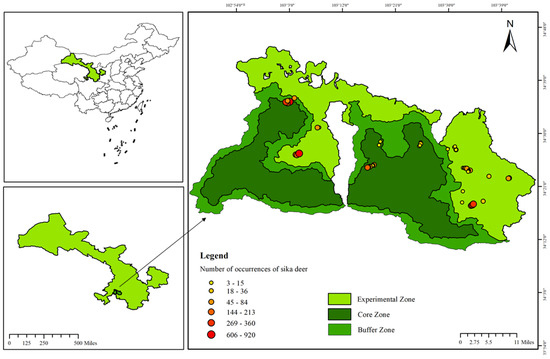
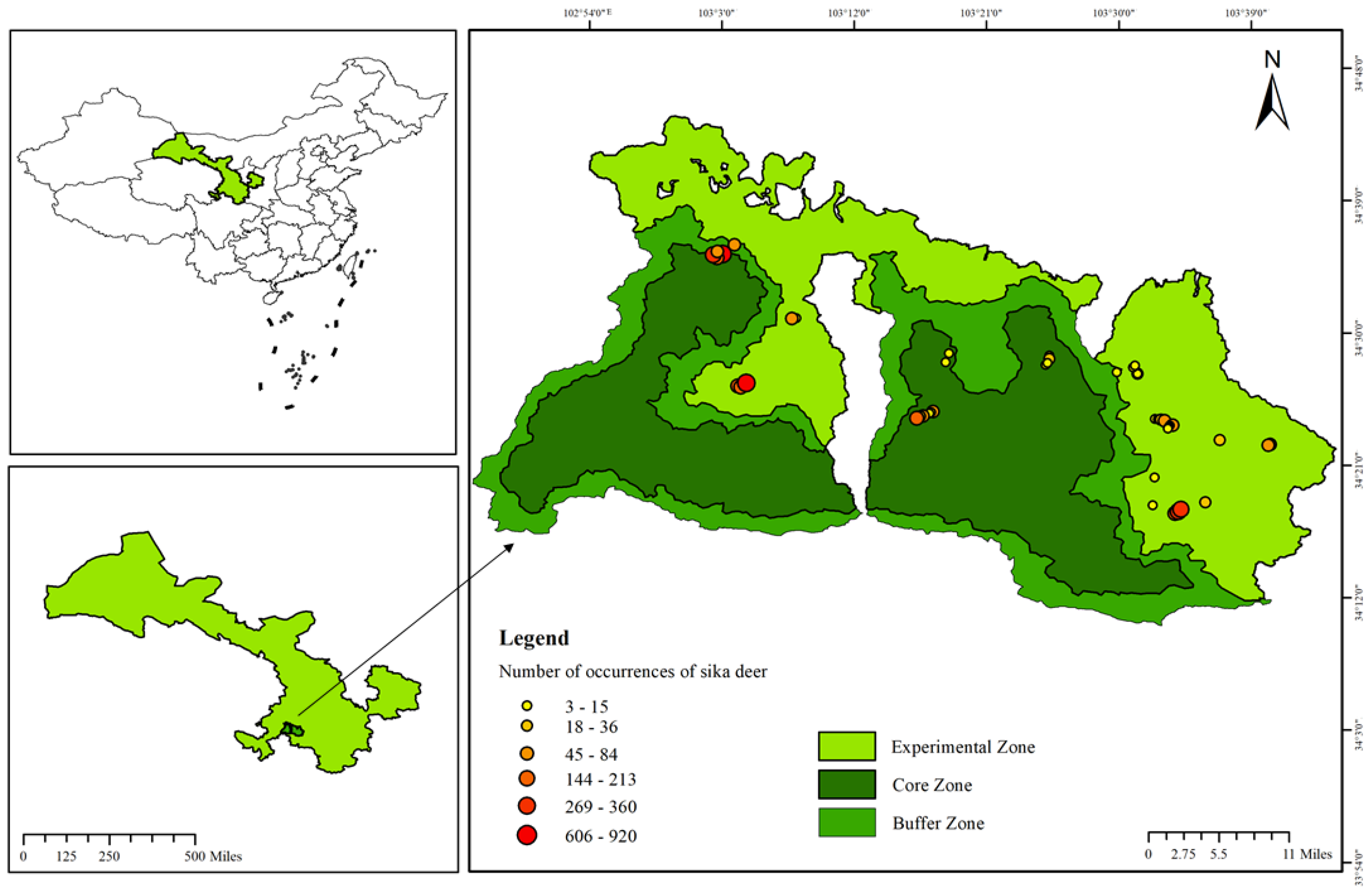
This study was conducted in the Taohe National Nature Reserve, a cold-temperate and temperate montane coniferous forest ecosystem situated at the northeastern margin of the Gannan Plateau, within the ecotone between the Qinghai–Tibet Plateau and the Loess Plateau [21]. Situated on the northern slope of the Die Mountain Range along the southern bank of the Taohe River, the reserve spans five counties in the Gannan Tibetan Autonomous Prefecture: Zhuoni, Lintan, Tewo, Luqu, and Hezuo, with geographical coordinates ranging from 102°46′02″ to 103°44′40″ E and 34°10′07″ to 34°42′05″ N (Figure 1). Initially established in 1982, it was designated as a national nature reserve in 2009. Its primary objective is to preserve the natural primitive montane cold-temperate dark coniferous forest ecosystem, along with rare and endangered wildlife species and their habitats, making it a representative forest ecosystem reserve.
Figure 1.
Camera traps sites in Taohe National Nature Reserve, Gansu Province, China. Redder circles indicate more sika deer records. The red dots indicate the number of times the camera-traps capture the deer.
Nestled within a complex terrain with elevations ranging from 1100 to 4900 m, the Taohe National Nature Reserve harbors a rich mammalian fauna of 68 species across 17 families and 6 orders. This high species richness is sustained by a mosaic of distinct habitats. The core ecosystem consists of cold-temperate dark coniferous forests dominated by Picea purpurea and Abies chensiensis. This central forest zone is complemented by temperate dense forests in the south, alpine-humid ecotones in the east, extensive meadow-steppes in the northwest, and critical wetland ecosystems along the Taohe River. The stable activity of Snow Leopard (Panthera uncia) and frequent camera-trap records of Sika deer provide clear evidence of the health and integrity of these forest ecosystems [22]. Collectively, this remarkable habitat diversity supports the area’s exceptional wildlife and underscores its high conservation value.
2.2. Sika Deer Data Collection and Pre-Processing
A total of 104 infrared cameras (model LTL-6218, Shenzhen, China) were deployed within Taohe National Nature Reserve. Data collection spanned from January 2022 to May 2024. Camera sites were spaced at approximately 500 m intervals, with placement informed by animal tracks, sign surveys, and local ecological knowledge to maximize the probability of wildlife detection [23]. Cameras were mounted at a height of 0.5–0.8 m above the forest floor, and the lens of each unit was oriented parallel to the ground, directed away from dense vegetation to minimize false triggers and obstructions. Each camera was programmed to capture three photographs and one 15 s video clip per trigger event, with a 3 s delay between consecutive triggering events. Memory cards and batteries were replaced and cameras repositioned as needed every three months to maintain functionality and optimize field of view, thereby improving species detection and survey efficiency [24].
We detected sika deer (Cervus nippon) at 44 camera traps. The Correlation tool in ENMtools (Ecological Niche Modeling Tools) [25] was used to assess spatial autocorrelation among these 44 occurrence records, resulting in the selection of 32 valid presence points. For environmental variable screening, the variance inflation factor (VIF) of 32 initial variables was calculated using the “usdm” package in R software, version 5.5.2. Variables with VIF > 10 were excluded, ultimately retaining 8 environmental predictors (Table 1) for subsequent MaxEnt analysis. All spatial analyses were performed in ArcGIS 10.7 with the WGS 1984 coordinate system, and environmental variables were standardized to a spatial resolution of 1 km × 1 km.
Table 1.
Environment variable codes and descriptions for Maxent in Taohe Reserve.
2.3. Sika Deer Data Analysis
We estimated sika deer density using the R package cameratrapR [17], in R software version 5.5.2, available from the GitHub (DOI: 10.5281/zenodo.14335558). This approach simulates animal movement within the camera grid using a correlated random walk model parameterized by species-specific movement traits, including footprint chain tortuosity and home range size. Simulations were conducted across a gradient of hypothetical population sizes (ranging from 1 to 120 individuals), representing varying population densities. To estimate the most likely population density, we compared simulated detection patterns with observed camera trap records using a machine learning algorithm, random forest. The best-fitting simulation was selected based on model accuracy, yielding an estimate of population density along with its 95% confidence interval [17].
The cameratrapR package requires species-specific movement parameters for simulation, including step length (a model parameter for movement progression, not actual step length), deflection angle between successive steps, and monthly activity levels (defined as the number of movement steps per month). As empirical movement data for sika deer were unavailable for the study area, we substituted these parameters with those from the Siberian Roe Deer (Capreolus pygargus), a model species for which these parameters are well-documented in the cameratrapR package [17]. We acknowledge this as a limitation, given the phylogenetic distance and differences in body size between roe deer (typically 20–30 kg) and the larger Sichuan sika deer (estimated 65–95 kg; Groves & Grubb, 2011) [26]. This substitution was a necessary compromise to utilize the simulation framework, justified primarily by the shared status of both species as medium-sized, forest-dwelling cervids. This proxy approach is justified by the comparable habitat use and ranging behavior between the two species, allowing for reasonable approximation in the absence of species-specific telemetry or tracking data.
This study employed a species distribution model (SDM) using the Maximum Entropy modeling approach, implemented in MaxEnt software (version 3.4.4). The MaxEnt model was selected for its robust performance in predicting species’ potential distributions based on presence-only data and environmental variables. The core principle of MaxEnt is to estimate a target probability distribution by finding the probability distribution of maximum entropy (i.e., the most spread-out or closest to uniform) subject to constraints derived from the environmental conditions at the species’ known occurrence locations.
The data processing and modeling procedure were conducted with reference to the established methodology of Xie et al. [27]. Comprising the following key steps: (1) Species Occurrence Data Preparation: Georeferenced occurrence records of the target species were compiled. To ensure model reliability and minimize sampling bias, the raw data underwent a rigorous cleaning and preprocessing protocol. This involved removing duplicate records and applying spatial filtering (spatial thinning) to reduce the effects of spatial autocorrelation. (2) Environmental Variable Processing and Selection: A suite of environmental variables, hypothesized to influence the species’ ecological niche, was initially assembled. These variables encompassed key bioclimatic, topographic, and land-cover dimensions. All raster layers were uniformly processed in a GIS environment, masked to the study area extent, and resampled to a consistent spatial resolution (1 km2). To mitigate the issue of multicollinearity, which can distort model interpretation and performance, a Pearson correlation analysis was performed. For any pair of variables with a correlation coefficient |r| > 0.8, the variable considered to have greater ecological relevance for the species was retained for subsequent modeling. The codes and descriptions of the final environmental variables used in the model are summarized in Table 1. (3) Model Execution and Validation: The processed occurrence data and environmental variable layers were imported into the MaxEnt software. The model was configured with the following settings: 75% of the occurrence records were randomly selected as the training dataset to build the model, while the remaining 25% were set aside as an independent test dataset for model validation. To enhance the robustness of the predictions, this process was replicated over 10 bootstrap runs. Model performance was evaluated using the Area Under the Receiver Operating Characteristic Curve (AUC). An AUC = 0.986 indicates the model with high predictive accuracy.
3. Results
Based on the analysis of camera trap data using the Random Forest model, we estimated a total of 107.2 (95% CI: 97.4–111.4) Sichuan sika deer groups in the study area. Assuming an average group size of 4 individuals, based on the modal group size observed in our camera trap records and supported by previous studies in the region [19,28], the total population size in the reserve was approximately 429 individuals (95% CI: 390–446).
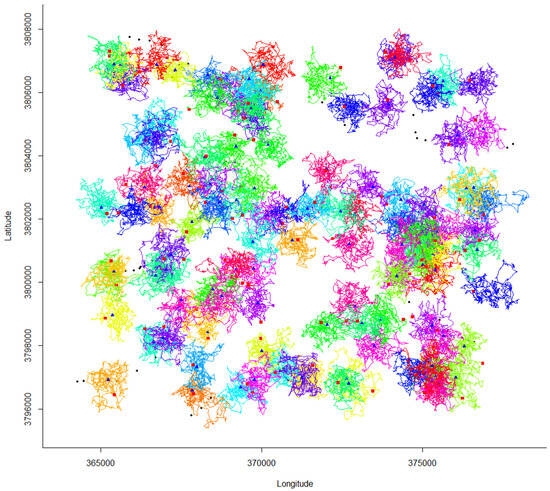
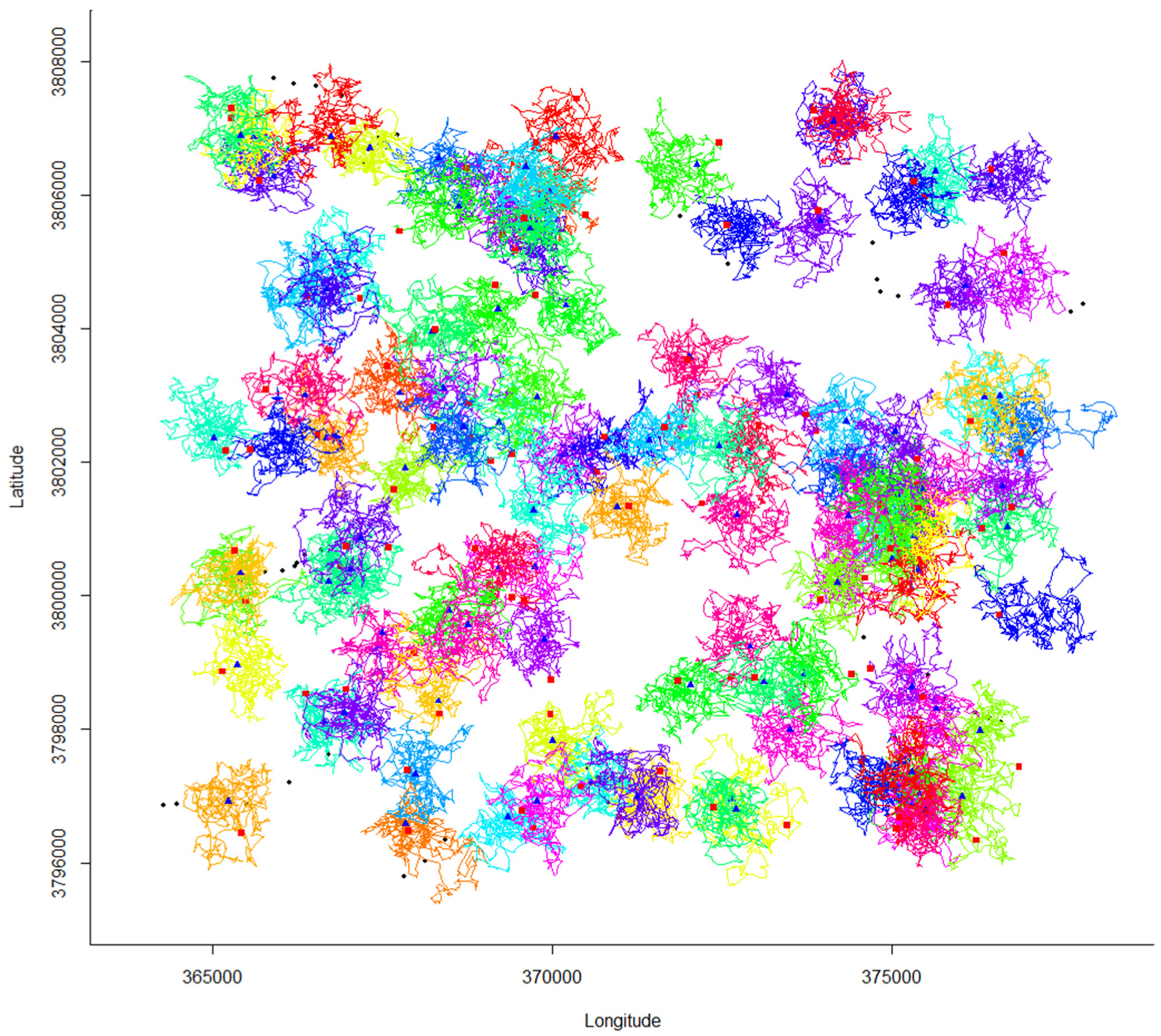
To validate this estimate and understand the spatial utilization patterns of the population, we simulated the movement trajectories of the deer groups, assuming a home range area of 3 km2 per group, using the cameratrapR package. As shown in Figure 2, a typical model run visually depicts the potential movement paths and spatial distribution of 120 sika deer groups within the reserve. These simulated trajectories reveal hotspots of population activity and indicate that the distribution of sika deer is not random but exhibits aggregated patterns associated with specific environmental factors.
Figure 2.
One simulation of movement trajectories of 100 Sika deer groups in Taohe National Nature Reserve using cameratrapR. Different colors represent different groups.
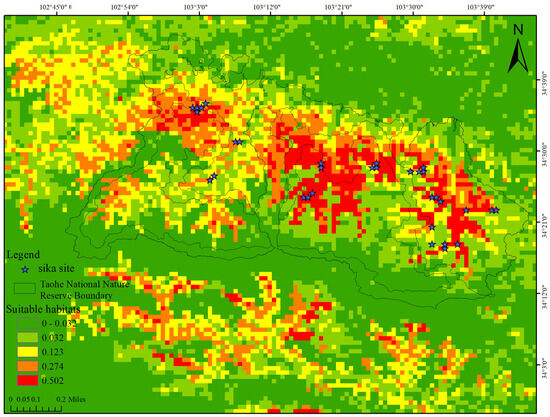
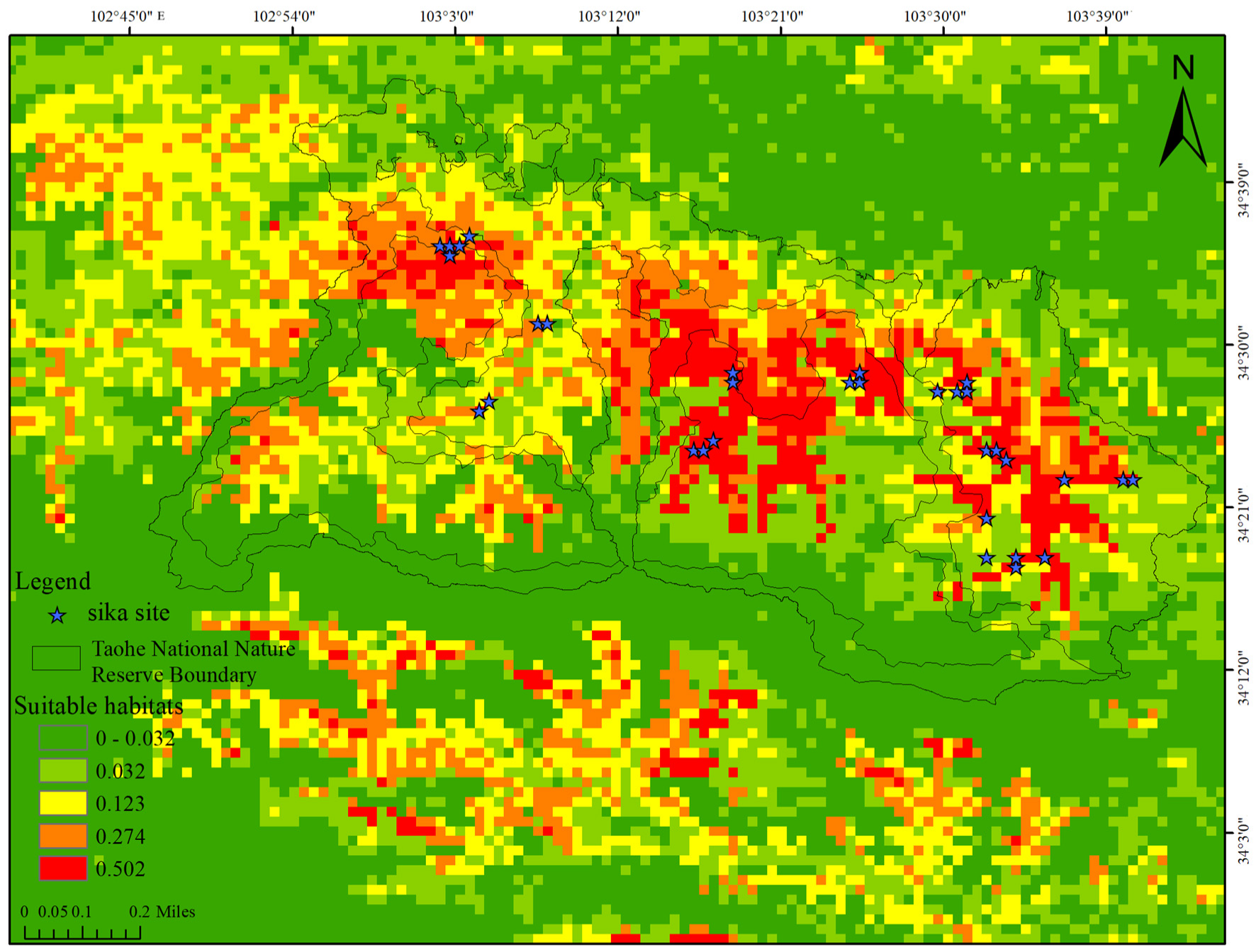
The MaxEnt species distribution model successfully predicted the potential suitable habitat for the Sichuan sika deer within the Taohe National Nature Reserve. As illustrated in Figure 3, the distribution of suitable habitat (“more intensely red areas in the figure) is highly heterogeneous and fragmented. Highly suitable areas are primarily concentrated in the core zones of the reserve and topographically complex mountainous regions. These areas form several distinct habitat patches, separated by extensive non-suitable areas (lighter areas in the figure).
Figure 3.
Distribution of suitable and non-suitable areas for Sichuan Sika deer. The black lines represent the boundary, core area, buffer zone and experimental area of the protected area, respectively.
The model results clearly demonstrated that the habitat selection of the Sichuan sika deer is almost entirely dominated by two core environmental factors: Precipitation of the Driest Month (bio_14) and Vegetation Cover (NDVI), with the influence of other factors being relatively weak.
Detailed variable contribution analysis indicated that Precipitation of the Driest Month (bio_14) was the most influential variable in the model, with a high Percent Contribution of 44.5% and a Permutation Importance of 61.1%. This was closely followed by the Normalized Difference Vegetation Index (NDVI), which had a Percent Contribution of 39.1% and a Permutation Importance of 35.3%. The contributions of the remaining variables were substantially lower. For instance, the Human Footprint Index (HFP) and Land Use Type (LUC) had Percent Contributions of 9.2% and 5.2%, respectively, but their Permutation Importance values were very low (2.0% and 1.0%, respectively), indicating their unstable predictive power in the model. The other variables (e.g., NDSI, Aspect, Distance to Water) contributed minimally.
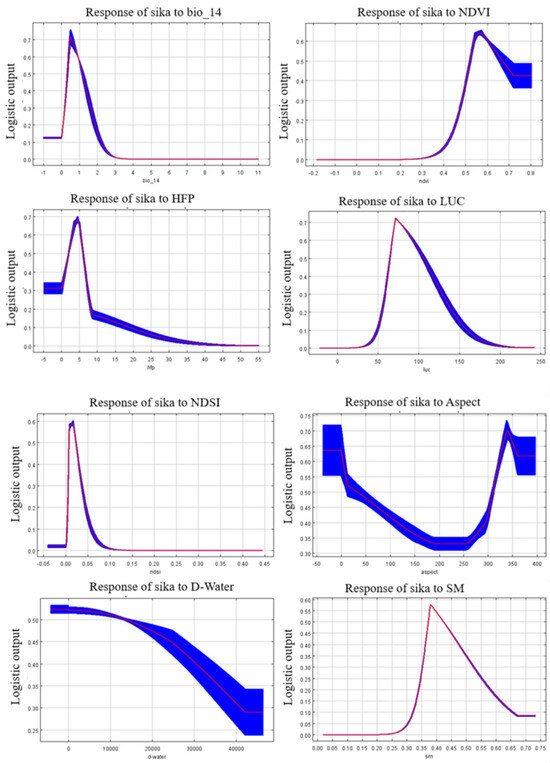
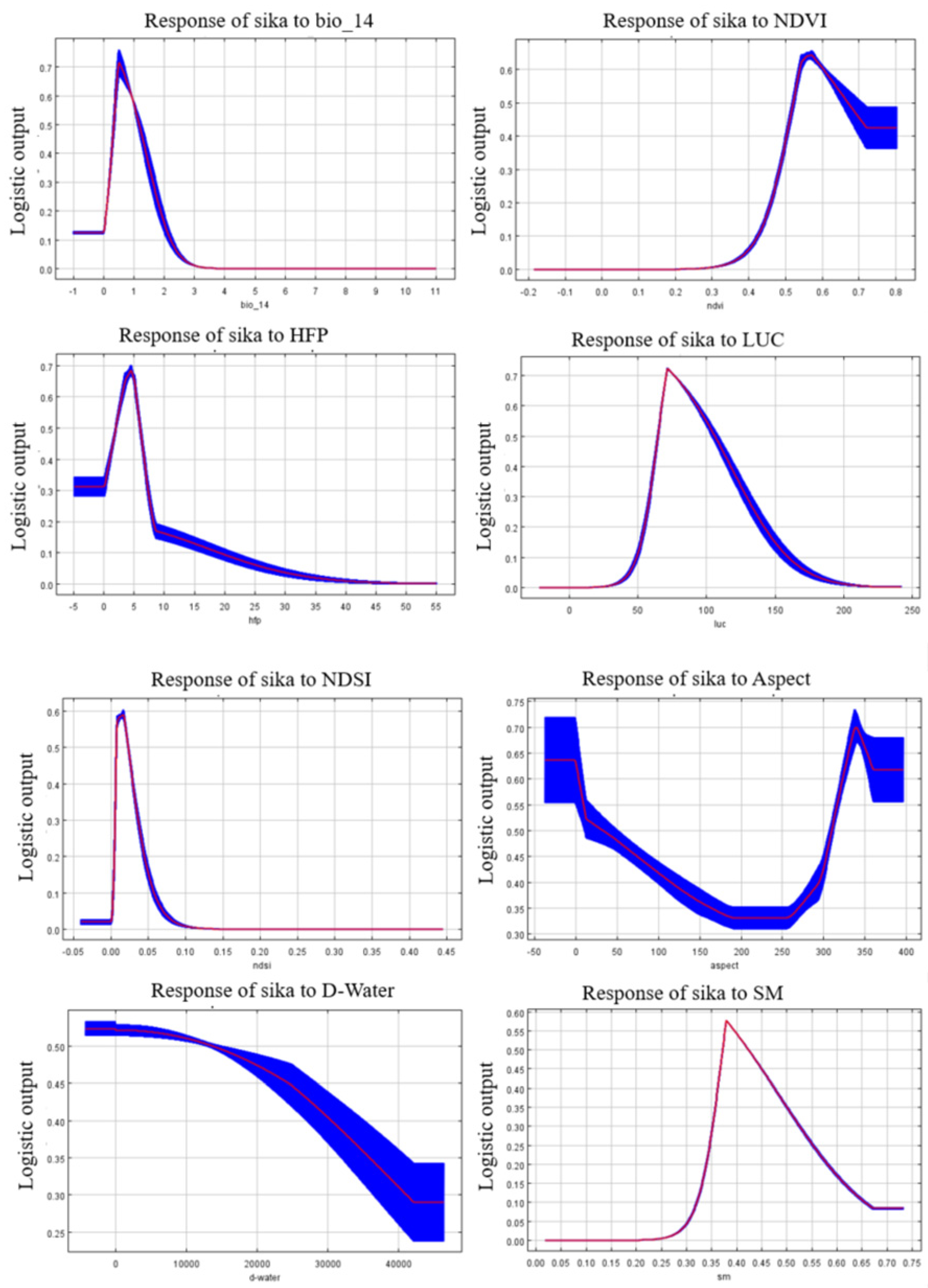
The response curves in Figure 4 further elucidate the ecological relationship between these two key factors and habitat suitability: Precipitation of the Driest Month (bio_14): Habitat suitability continuously increased with higher precipitation in the driest month. This suggests that areas receiving more ample moisture during the dry season provide superior living conditions for the sika deer. Normalized Difference Vegetation Index (NDVI): Suitability showed a positive correlation with NDVI, peaking at higher NDVI values. This directly reflects the decisive role of dense vegetation cover (likely corresponding to abundant food resources and shelter) in the habitat selection of the sika deer.
Figure 4.
Response curves for important environmental predictors in the species distribution model for Sika deer. Variables include bio_14, NDVI, HFP, LUC, NDSI, Aspect, D_water, SM, respectively.
4. Discussion
The Sichuan sika deer (Cervus nippon sichuanicus), a representative species of cold-temperate and temperate montane coniferous forests, is currently constrained to three geographically isolated regions on the Tibetan Plateau: the Tiebu distribution area, 102°46′–103°14′ E, 33°58′–34°16′ N; Baxi distribution area, 103°08′–103°35′ E, 33°33′–33°46° N; and the Baihe distribution area, 103°59′–104°10′ E, 33°05′–33°20′ N [28]. This study provides the first baseline population estimate for the Tiebu subspecies within the Taohe National Nature Reserve (TNNR), reporting an estimated 429 individuals and a density of 0.15 individuals/km2. This density is markedly lower than the 2.44 individuals/km2 recorded in the Sichuan Ruoergai Tiebu Sika Deer Provincial Nature Reserve (TRNR) [29], despite TNNR having a substantially larger forested area (1460 km2 vs. 139 km2). Such disparity underscores that habitat area alone cannot explain population density; instead, habitat quality, driven by specific ecological factors, plays the decisive role.
Our MaxEnt modeling identified precipitation of the driest month (bio14) and vegetation cover (NDVI) as the dominant predictors of suitable habitat, collectively contributing over 80% to the model. Bio14 exhibited the highest permutation importance (61.1%), highlighting dry-season water availability as the most critical limiting factor. These findings are consistent with previous studies on other large herbivores in seasonal environments; for instance, in the Niassa National Reserve, the distribution of buffalo (Syncerus caffer) during the dry season was primarily driven by the spatial arrangement of permanent rivers and residual water in seasonal tributaries [30]. Similarly, the strong contribution of NDVI (39.1% contribution), which serves as a proxy for both forage availability and cover, aligns with global patterns of habitat selection in wild ungulates where vegetation provides food and refuge from predators. In Hubei, precipitation variables were the strongest predictors of South China sika deer distribution [31], while in Northeast China, proximity to rivers and forest types were critical [32]. In Tiebu, Sichuan sika deer selected winter habitats with high vegetation cover, further underscoring the role of concealment and forage [19]. This aligns with studies on other ungulates in seasonal environments, such as wild Bactrian Camels (Camelus ferus) and Tibetan Wild Ass (Equus kiang), which also depend heavily on water sources [33,34]. NDVI (39.1% contribution) served as a proxy for both forage and cover, consistent with global patterns of habitat selection in wild ungulates where vegetation provides food and refuge from predators [35,36,37,38]. In contrast, human footprint index and land use type showed limited independent effects, suggesting human impacts are indirect, mediated through vegetation and hydrological change.
The observed density gradient across populations (TRNR: 2.44, TNNR: 0.15, Northeastern: 0.073 individuals/km2) provides strong support for the primacy of habitat quality, a pattern consistently demonstrated in habitat suitability studies. For instance, He et al. [36] found that habitat suitability for Asian elephants, modeled using Multi-source Remote Sensing products coupled with MaxEnt, was primarily determined by environmental factors like vegetation cover and climate conditions, which directly influenced their distribution and density. The high density in TRNR likely reflects its superior dry-season water availability and vegetation structure, key predictors identified by our MaxEnt model. The historically slow population growth in TRNR since the 1980s further suggests the reserve may be approaching its carrying capacity [39], a concept central to density-dependent habitat selection theory. In contrast, TNNR’s low density, combined with its vast forest area, indicates significant potential for population recovery if key habitat constraints are addressed. This scenario is analogous to situations faced by other stressed populations, where targeted interventions to improve habitat quality or facilitate demographic and genetic rescue can be crucial for recovery [40]. Therefore, the population density gradient is not merely speculative but is consistent with established ecological principles and findings from diverse taxa, underscoring the need for habitat-focused management strategies.
Conservation Implications: The model results provide a clear and parsimonious basis for conservation planning: (1) Core Strategy: Prioritize the protection of key dry-season water sources, such as forested watersheds and perennial streams, and maintain large, contiguous tracts of forest and shrubland vegetation within the current distribution range. (2) Habitat Restoration: In areas targeted for population recovery or reintroduction, focus on regions with reliable dry-season precipitation and implement active vegetation restoration to ensure adequate forage and cover. (3) Management Emphasis: Shift management focus from solely mitigating direct human disturbance toward maintaining holistic ecological function, specifically, preserving natural hydrology and vegetation structure. Protecting ecosystem integrity will inherently buffer against human footprint effects.
5. Conclusions
This study provides the first comprehensive population assessment of the endangered Sichuan sika deer in the Taohe National Nature Reserve, revealing a population size of approximately 429 individuals, which indicates a very low population density. Our analysis identified precipitation during the driest month and vegetation cover as the predominant environmental drivers, collectively governing over 80% of habitat suitability. These findings highlight the critical importance of dry-season water availability and dense vegetation for deer distribution. The current low population density indicates substantial recovery potential, suggesting that conservation strategies should shift from passive habitat protection to active management of key ecological resources. We recommend prioritizing the safeguarding of dry-season water sources and enhancing vegetation connectivity to facilitate population recovery, providing a replicable framework for conserving endangered species in similar montane ecosystems.
Several limitations of this study should be considered when interpreting the results. First, our population density estimate relies on movement parameters from a proxy species (Western roe deer) due to the lack of telemetry data for Sichuan sika deer. While both are forest-adapted cervids, differences in body size and behavior could affect movement patterns and, consequently, density estimates. Second, the assumption of a fixed mean group size, while based on field observations, may not capture the full variability in social structure. Third, the 29-month survey provides a robust multi-annual average but does not resolve seasonal or inter-annual population dynamics. Future research incorporating GPS telemetry and mark-resight methods would help validate and refine these estimates.
Author Contributions
Conceptualization, Y.S. and X.L.; methodology, X.L.; software, J.J.; investigation, Y.F. and D.Z.; data curation, Y.F. and D.Z.; writing—original draft preparation, J.J.; writing—review and editing, Z.W.; visualization, J.J.; supervision, Y.S. and Y.F.; project administration, Y.S. and X.L.; funding acquisition, Y.S. and X.L. All authors have read and agreed to the published version of the manuscript.
Funding
This research was funded by Intergovernmental International Science and Technology Innovation Cooperation Program under National Key Research and Development Plan, grant number 2024YFE0198600.
Institutional Review Board Statement
Not applicable. No ethical approval was required for the non-invasive camera trapping method.
Data Availability Statement
The original contributions presented in this study are included in the article. Further inquiries can be directed to the corresponding author.
Acknowledgments
We appreciate the Taohe National Nature Reserve Administration and their efforts in the field.
Conflicts of Interest
The authors declare no conflicts of interest.
References
- Pan, C.; Wang, X.; Liu, L.; Liu, Z.; Zhao, T.; Guo, Q.; Chu, W. China also has Tigarin. For. Man 2021, 10–35. [Google Scholar]
- Fan, F.; Zhao, L.-J.; Ma, T.-Y.; Xiong, X.-Y.; Zhang, Y.-B.; Shen, X.-L.; Li, S. Community composition and structure in a 25.2 hm2 subalpine dark coniferous forest dynamics plot in Wanglang, sichuan, China. Chin. J. Plant Ecol. 2022, 46, 1005. [Google Scholar] [CrossRef] [Scilit]
- Research Center of Eco-Environmental Sciences, Chinese Academy of Sciences. China Ecosystem Assessment and Ecological Security Pattern Database. Available online: https://www.ecosystem.csdb.cn/ecosys/ecosystem_list.jsp?func=4 (accessed on 14 October 2025).
- Zhang, C.; Ma, T.; Wu, L.; Liu, X. Temporal niche relationship between snow leopard (Panthera uncia) and its sympatric large carnivores in Qilian Mountains, Gansu Province. Acta Theriol. Sin. 2023, 43, 109. [Google Scholar] [CrossRef]
- Kuipers, K.J.J.; Hilbers, J.P.; Garcia-Ulloa, J.; Graae, B.J.; May, R.; Verones, F.; Huijbregts, M.A.J.; Schipper, A.M. Habitat fragmentation amplifies threats from habitat loss to mammal diversity across the world’s terrestrial ecoregions. One Earth 2021, 4, 1505–1513. [Google Scholar] [CrossRef] [Scilit]
- Harris, R.B. Cervus nippon. The IUCN Red List of Threatened Species 2015: E.T41788A22155877. 2015. Available online: https://www.iucnredlist.org/species/41788/22155877 (accessed on 14 October 2025).
- Milner, J.M.; Nilsen, E.B.; Andreassen, H.P. Demographic Side Effects of Selective Hunting in Ungulates and Carnivores. Conserv. Biol. 2007, 21, 36–47. [Google Scholar] [CrossRef] [Scilit] [PubMed]
- Western, D.; Russell, S.; Cuthill, I. The Status of Wildlife in Protected Areas Compared to Non-Protected Areas of Kenya. PLoS ONE 2009, 4, e6140. [Google Scholar] [CrossRef] [Scilit]
- Zhang, R. Zoogeography of China; Science Press: Beijing, China, 2011. [Google Scholar]
- Caughley, G. Directions in Conservation Biology. J. Anim. Ecol. 1994, 63, 215. [Google Scholar] [CrossRef] [Scilit]
- Morin, D.J.; Boulanger, J.; Bischof, R.; Lee, D.C.; Ngoprasert, D.; Fuller, A.K.; McLellan, B.; Steinmetz, R.; Sharma, S.; Garshelis, D.; et al. Comparison of methods for estimating density and population trends for low-density Asian bears. Glob. Ecol. Conserv. 2022, 35, e02058. [Google Scholar] [CrossRef] [Scilit]
- Bessone, M.; Kühl, H.S.; Hohmann, G.; Herbinger, I.; N’Goran, K.P.; Asanzi, P.; Da Costa, P.B.; Dérozier, V.; Fotsing, E.D.B.; Beka, B.I.; et al. Drawn out of the shadows: Surveying secretive forest species with camera trap distance sampling. J. Appl. Ecol. 2020, 57, 963–974. [Google Scholar] [CrossRef] [Scilit]
- Qi, W.; Jiang, X.; Yang, C.; Guo, Y. Reproductive behavior of Sichuan sika deer (Cervus nippon sichuanicus). Acta Ecol. Sin. 2014, 34, 6548–6559. [Google Scholar] [CrossRef] [Scilit]
- Rowcliffe, J.M.; Carbone, C.; Jansen, P.A.; Kays, R.; Kranstauber, B. Quantifying the sensitivity of camera traps: An adapted distance sampling approach. Methods Ecol. Evol. 2011, 2, 464–476. [Google Scholar] [CrossRef] [Scilit]
- Rowcliffe, J.M.; Field, J.; Turvey, S.T.; Carbone, C. Estimating animal density using camera traps without the need for individual recognition. J. Appl. Ecol. 2008, 45, 1228–1236. [Google Scholar] [CrossRef] [Scilit]
- Garrote, G.; Pérez de Ayala, R.; Álvarez, A.; Martín, J.M.; Ruiz, M.; de Lillo, S.; Simón, M.A. Improving the random encounter model method to estimate carnivore densities using data generated by conventional camera-trap design. Oryx 2021, 55, 99–104. [Google Scholar] [CrossRef] [Scilit]
- Li, X.; Tian, H.; Piao, Z.; Wang, G.; Xiao, Z.; Sun, Y.; Gao, E.; Holyoak, M. cameratrapR: An R package for estimating animal density using camera trapping data. Ecol. Inform. 2022, 69, 101597. [Google Scholar] [CrossRef] [Scilit]
- Ramírez-Alvarez, D.; Li, X. Estimating density of native carnivores in central chile landscapes using a simulated movement model, cameratrapR: Insights on their potential exotic prey dietary subsidy. PeerJ 2025, 13, e19946. [Google Scholar] [CrossRef] [Scilit]
- Zhao, C.; Shi, Q.; Yang, G.; Tan, Y.; Tan, S.; Li, J.; Rashed, M.M.A. Winter Habitat Use of Sichuan Sika Deer Cervus nippon sichuanicus in the Tiebu Sika Deer Nature Reserve. Pak. J. Zool. 2022, 55, 1–6. [Google Scholar] [CrossRef] [Scilit]
- Dhakal, T.; Jang, G.-S.; Kim, M.; Kim, J.H.; Park, J.; Lim, S.-J.; Park, Y.-C.; Lee, D.-H. Habitat utilization distribution of sika deer (Cervus nippon). Heliyon 2023, 9, e20793. [Google Scholar] [CrossRef] [Scilit]
- National Development and Reform Commission; Ministry of Natural Resources; Ministry of Water Resources; National Forestry and Grassland Bureau. The Construction Plan of Major Ecological Protection and Restoration Projects in the Ecological Barrier Area of the Qinghai-Tibet Plateau (2021–2035). 2021. Available online: https://www.ndrc.gov.cn/xxgk/zcfb/ghwb/202112/P020211221312151424398.pdf (accessed on 1 June 2025).
- Wang, H. An empirical study on the diversity investigation and protection management of forest ecosystem-A case study of Taohe National Nature Reserve in Gansu Province. Digit. Agric. Intell. Agric. Mach. 2024, 5, 56–58. [Google Scholar]
- Ahumada, J.A.; Hurtado, J.; Lizcano, D. Monitoring the status and trends of tropical forest terrestrial vertebrate communities from camera trap data: A tool for conservation. PLoS ONE 2013, 8, e73707. [Google Scholar] [CrossRef] [Scilit]
- Meek, P.D.; Ballard, G.; Claridge, A.; Kays, R.; Moseby, K.; O’Brien, T.; O’Connell, A.; Sanderson, J.; Swann, D.E.; Tobler, M.; et al. Recommended guiding principles for reporting on camera trapping research. Biodivers. Conserv. 2014, 23, 2321–2343. [Google Scholar] [CrossRef] [Scilit]
- Warren, D.L.; Glor, R.E.; Turelli, M. ENMTools: A toolbox for comparative studies of environmental niche models. Ecography 2010, 33, 607–611. [Google Scholar] [CrossRef] [Scilit]
- Groves, C.P.; Grubb, P. Sichuan sika deer. In Ungulate Taxonomy; Groves, C.P., Grubb, P., Eds.; Johns Hopkins University Press: Baltimore, MD, USA, 2011; pp. 68–95. [Google Scholar]
- Xie, W.-D.; Jia, J.; Song, K.; Bu, C.-L.; Ma, L.-M.; Wang-Jie, G.-S.; Li, Q.-L.; Yin, H.-Q.; Xu, F.-Y.; Ma, D.-F.; et al. Comparative habitat divergence and fragmentation analysis of two sympatric pheasants in the qilian mountains, China. Land 2022, 11, 2104. [Google Scholar] [CrossRef] [Scilit]
- Guo, Y. Distribution, numbers and habitat of sichuan sika deer (Cervus nippon sichuanicus). Acta Theriol. Sin. 2006, 20, 81. [Google Scholar]
- Guo, Y.; Zhang, H. Life Table and the Rate of Natural Increase in Sichuan Sika Deer. Acta Theriol. Sin. 2005, 25, 150–155. [Google Scholar]
- Prins, T.; Chamaillé, S.; Grosbois, V.; Fritz, H.; Guerbois, C.; Chardonnet, P.; Cornélis, D. Understanding the mechanisms limiting the buffalo population in Niassa National Reserve, Mozambique. In Proceedings of the African Buffalo Symposium, Paris, France, 5–6 November 2014. [Google Scholar]
- Luo, Z.; Yu, H.; Yang, S.; Long, Y.; Liu, P.; Wang, T.; Zhao, C.; Liu, Q.; Xu, A. Climate change may improve the habitat suitability and connectivity of sika deer (Cervus nippon) in the Shennongjia area of China. Ecol. Inform. 2024, 81, 102558. [Google Scholar] [CrossRef] [Scilit]
- Niu, Y. Population Status, Habitat Suitability Evaluation of Wild Sika Deer (Cervus Nippon hortulorum) in Southern Laoyeling, Heilongjiang Province. Master’s Thesis, Northeast Forestry University, Harbin, China, 2021. [Google Scholar]
- Kaczensky, P.; Adiya, Y.; Von Wehrden, H.; Mijiddorj, B.; Walzer, C.; Güthlin, D.; Enkhbileg, D.; Reading, R.P. Space and habitat use by wild bactrian camels in the transaltai gobi of southern mongolia. Biol. Conserv. 2014, 169, 311–318. [Google Scholar] [CrossRef] [Scilit]
- Xiaoming, Z.; Ying, Y.; Congran, G.; Dongdong, Y.; Aijing, L.I. Evaluation of habitat suitability and dynamic trend of Equus kiang and Procapra picticaudata in the three-river-source region. Sichuan J. Zool. 2023, 42, 371–380. [Google Scholar] [CrossRef]
- Harris, N.C.; Bhandari, A.; Doamba, B. Ungulate co-occurrence in a landscape of antagonisms. Sci. Total Environ. 2024, 912, 169552. [Google Scholar] [CrossRef] [Scilit]
- He, K.; Fan, C.; Zhong, M.; Cao, F.; Wang, G.; Cao, L. Evaluation of habitat suitability for Asian elephants in sip-songpanna under climate change by coupling multi-source remote sensing products with MaxEnt model. Remote Sens. 2023, 15, 1047. [Google Scholar] [CrossRef] [Scilit]
- Esmaeili, S.; Schoenecker, K.A.; King, S.R.B. Resource availability and heterogeneity affect space use and resource selection of a feral ungulate. Ecosphere 2024, 15, e4939. [Google Scholar] [CrossRef] [Scilit]
- Fattebert, J.; Morelle, K.; Jurkiewicz, J.; Ukalska, J.; Borkowski, J. Safety first: Seasonal and diel habitat selection patterns by red deer in a contrasted landscape. J. Zool. 2019, 308, 111–120. [Google Scholar] [CrossRef] [Scilit]
- Petchey, O.L. Maximum entropy in ecology (article series introduction). Oikos 2010, 119, 577. [Google Scholar] [CrossRef] [Scilit]
- Harrity, E.J.; Stevens, B.S.; Conway, C.J. Keeping up with the times: Mapping range-wide habitat suitability for endangered species in a changing environment. Biol. Conserv. 2020, 250, 108734. [Google Scholar] [CrossRef] [Scilit]

Disclaimer/Publisher’s Note: The statements, opinions and data contained in all publications are solely those of the individual author(s) and contributor(s) and not of MDPI and/or the editor(s). MDPI and/or the editor(s) disclaim responsibility for any injury to people or property resulting from any ideas, methods, instructions or products referred to in the content. |
© 2025 by the authors. Licensee MDPI, Basel, Switzerland. This article is an open access article distributed under the terms and conditions of the Creative Commons Attribution (CC BY) license (https://creativecommons.org/licenses/by/4.0/).