3. Results
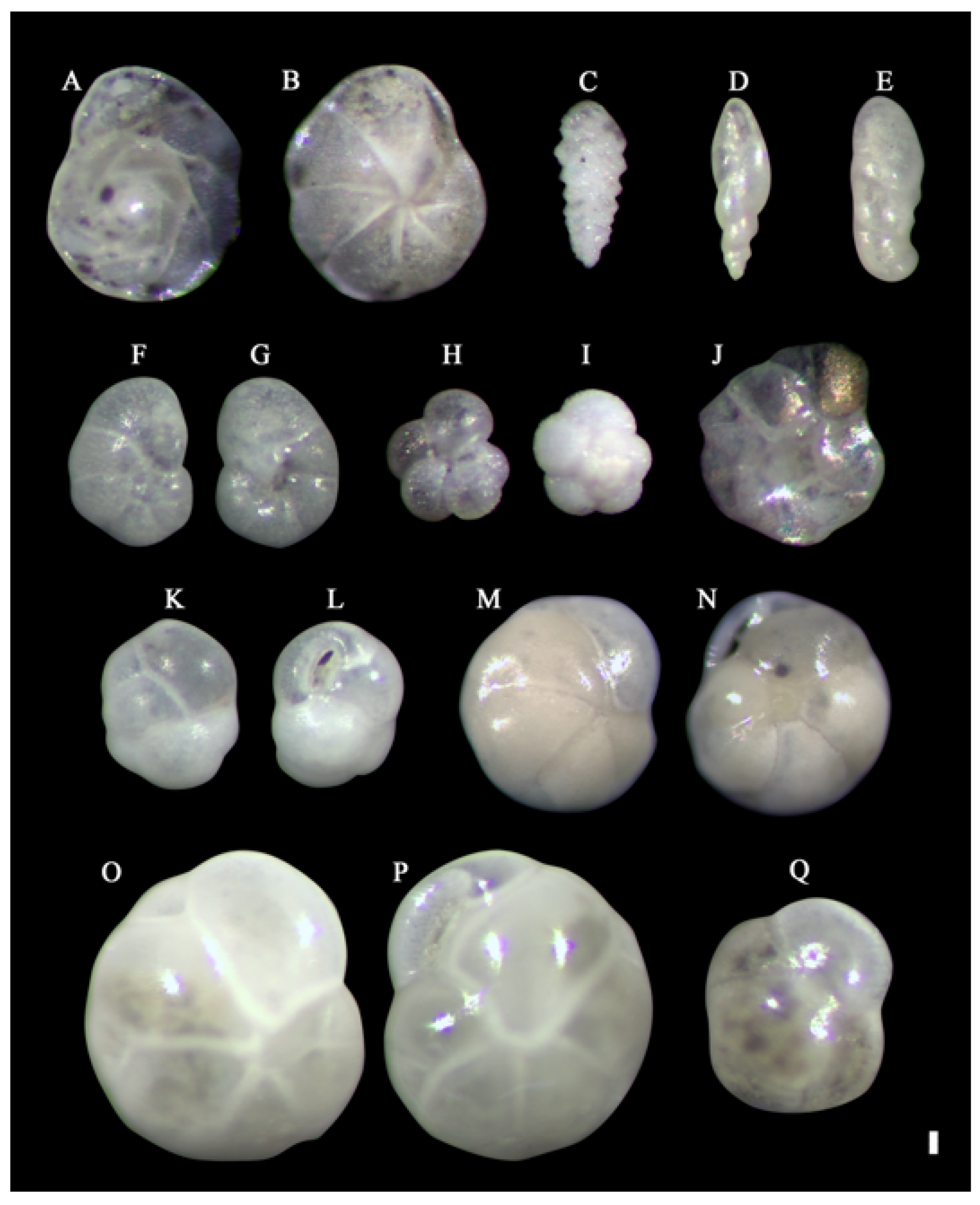
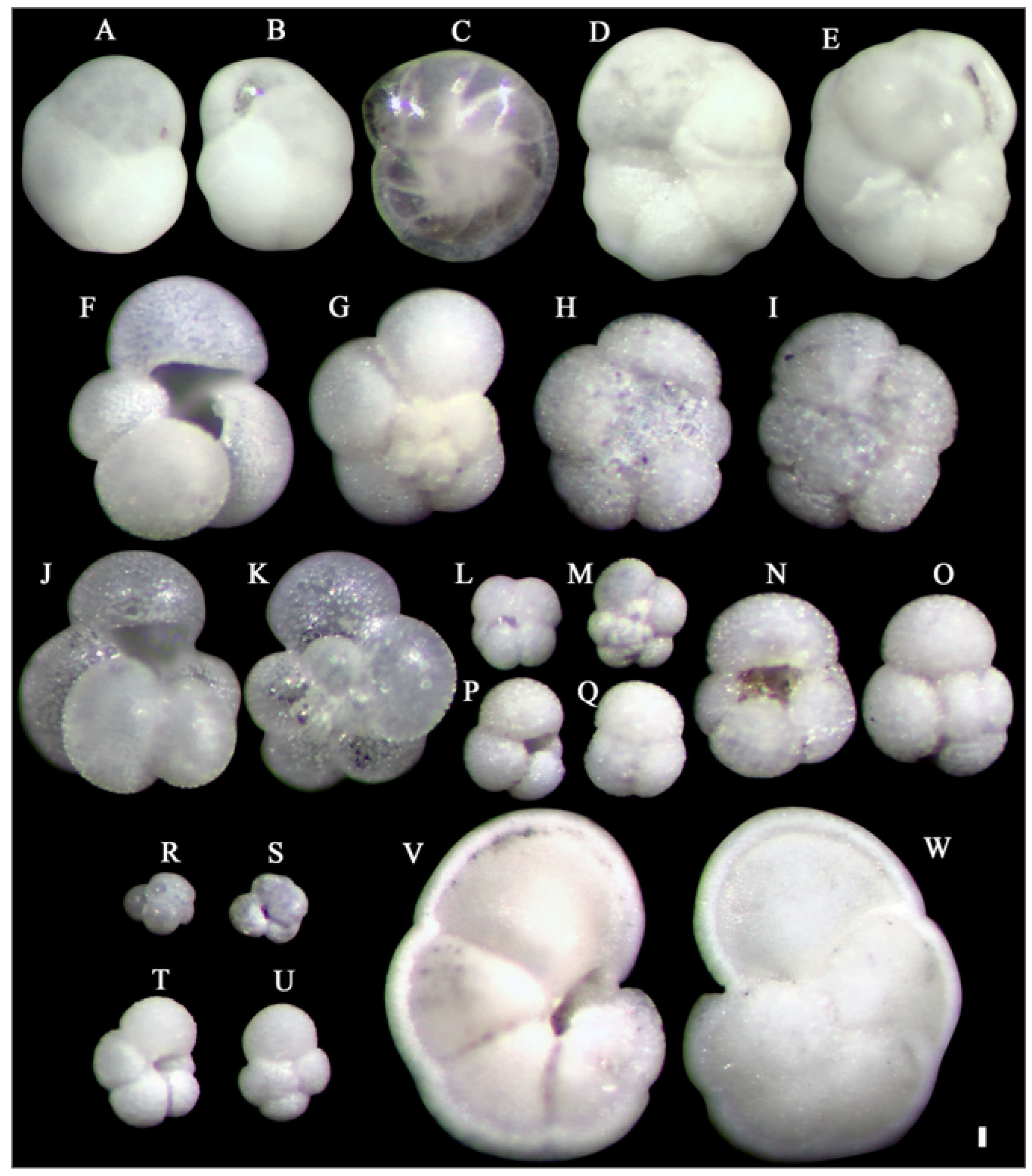
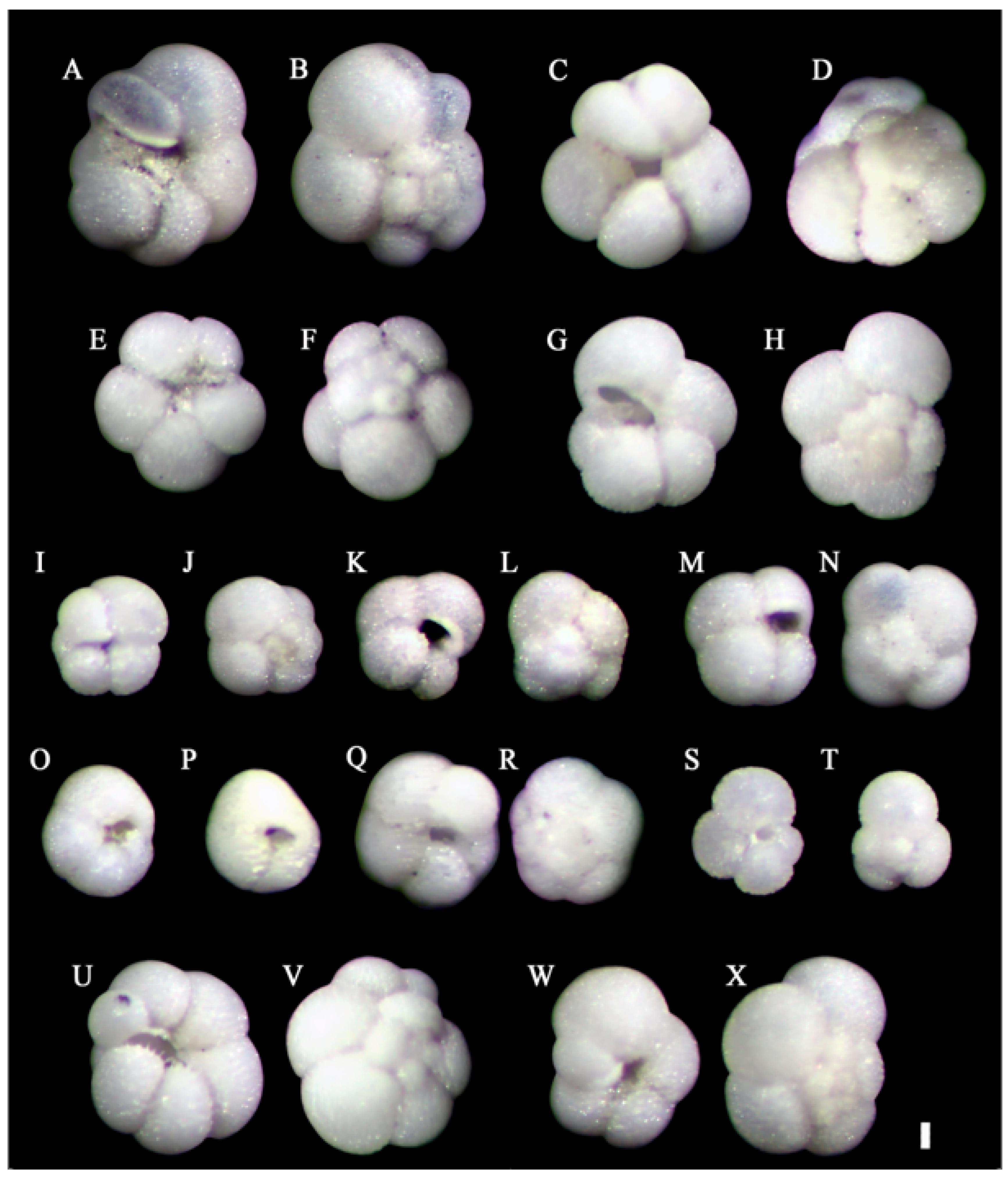
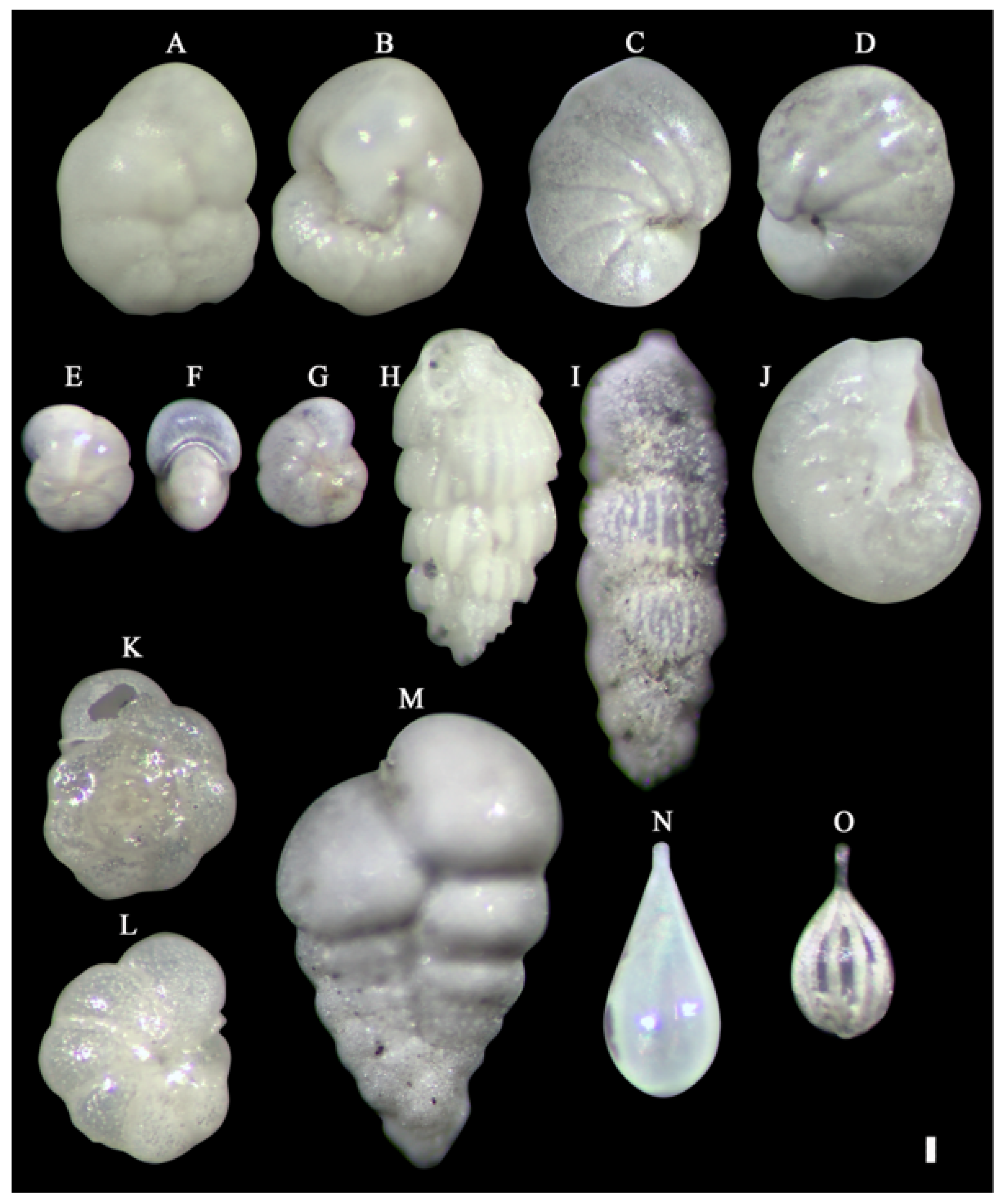
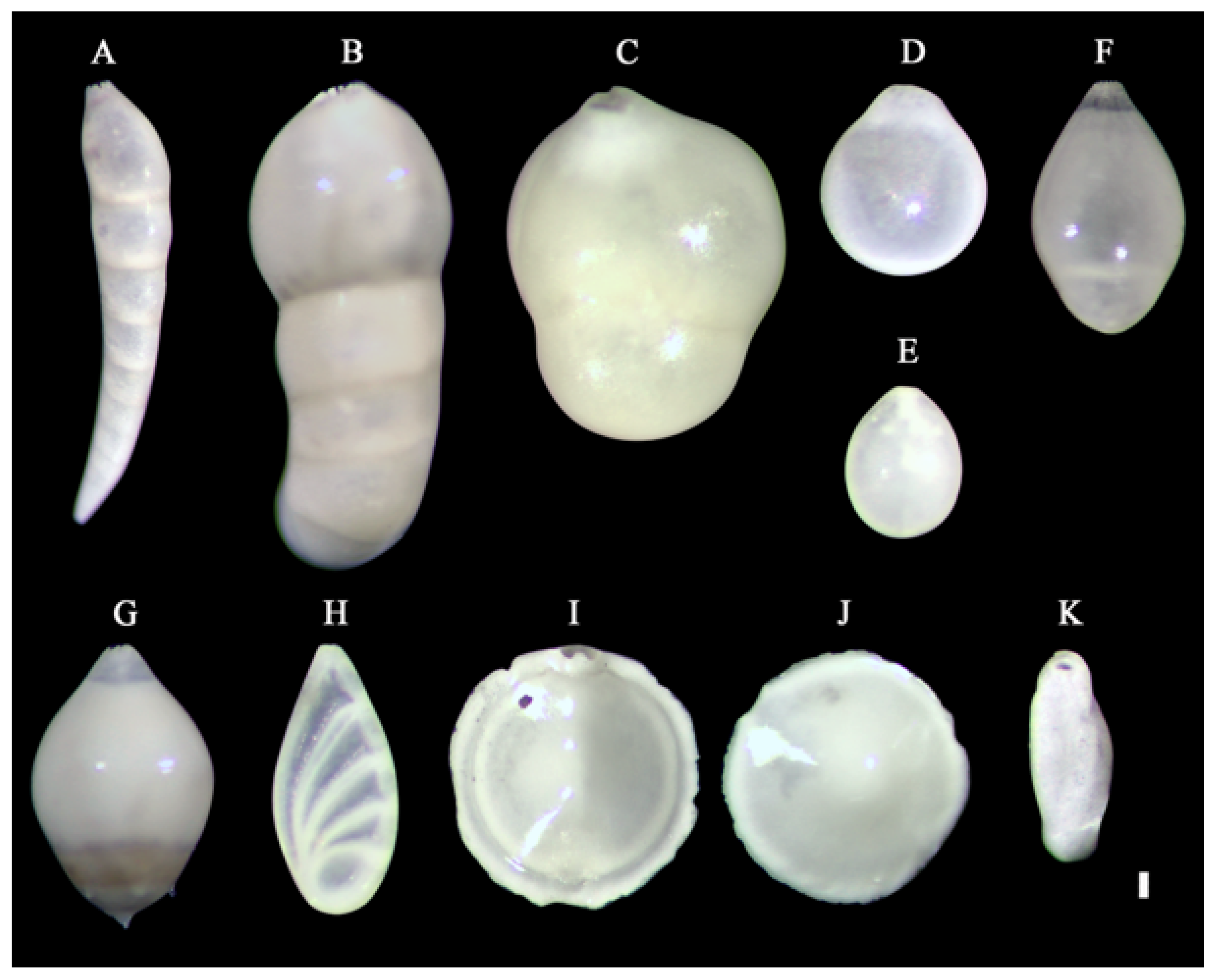
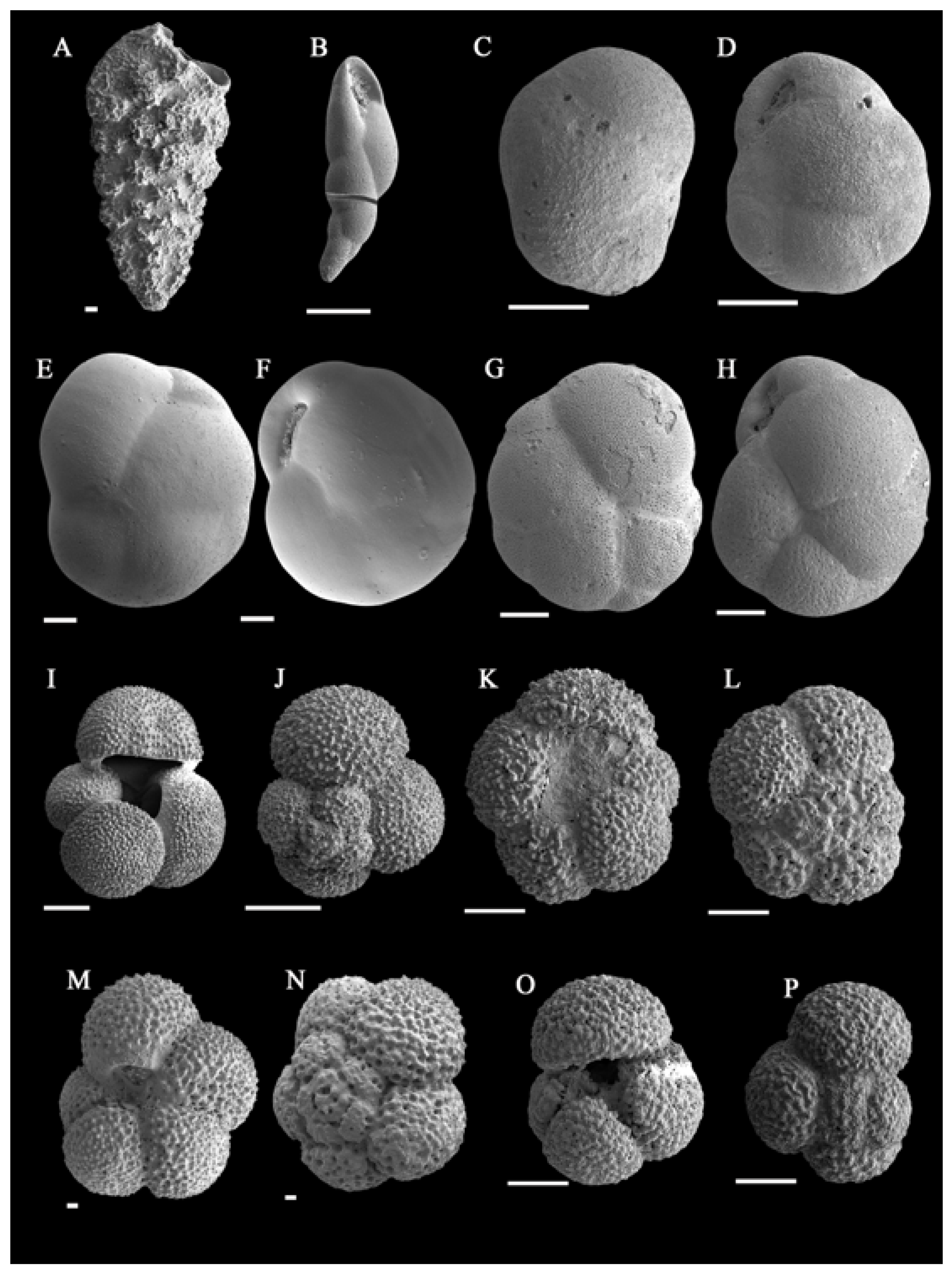
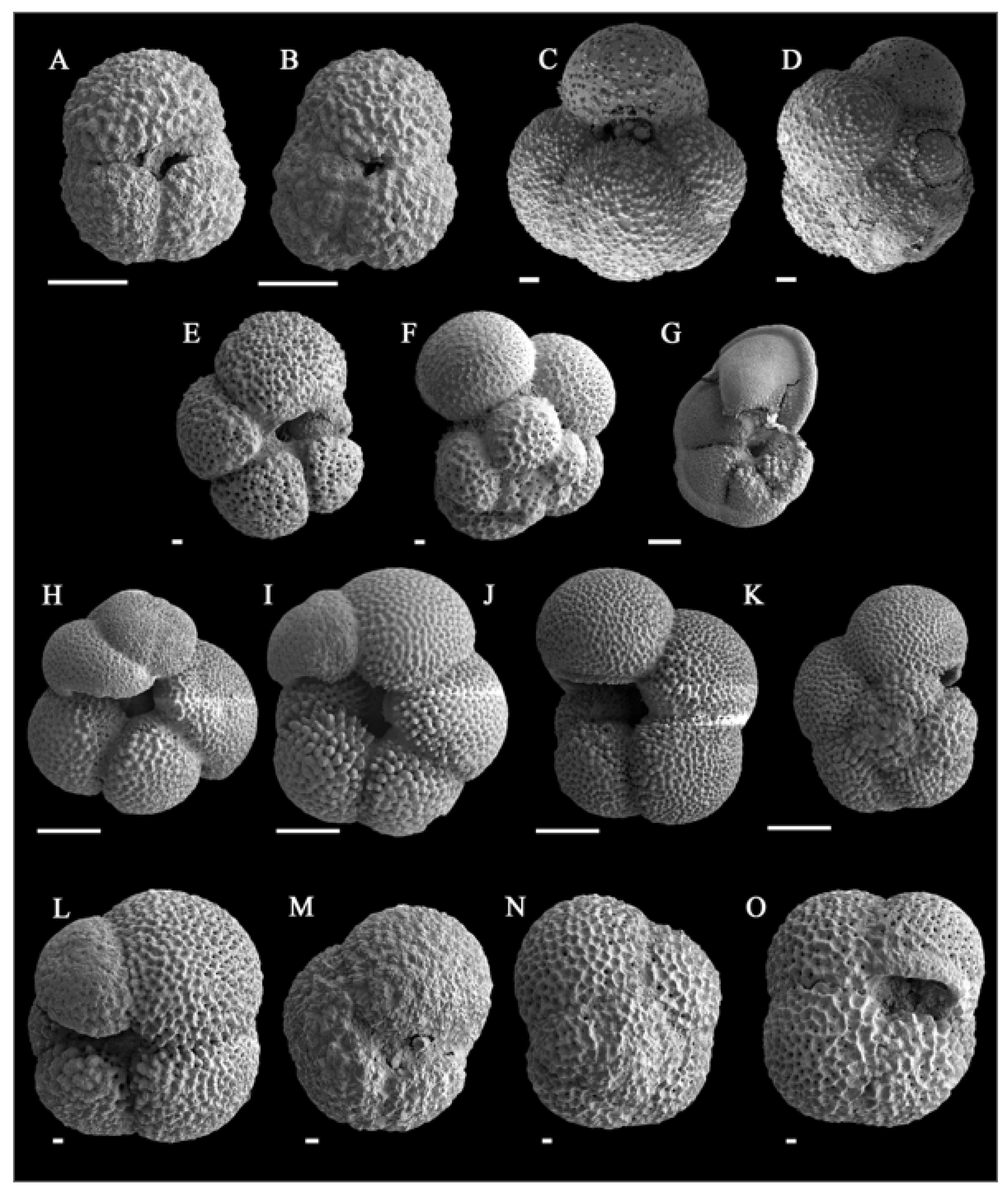
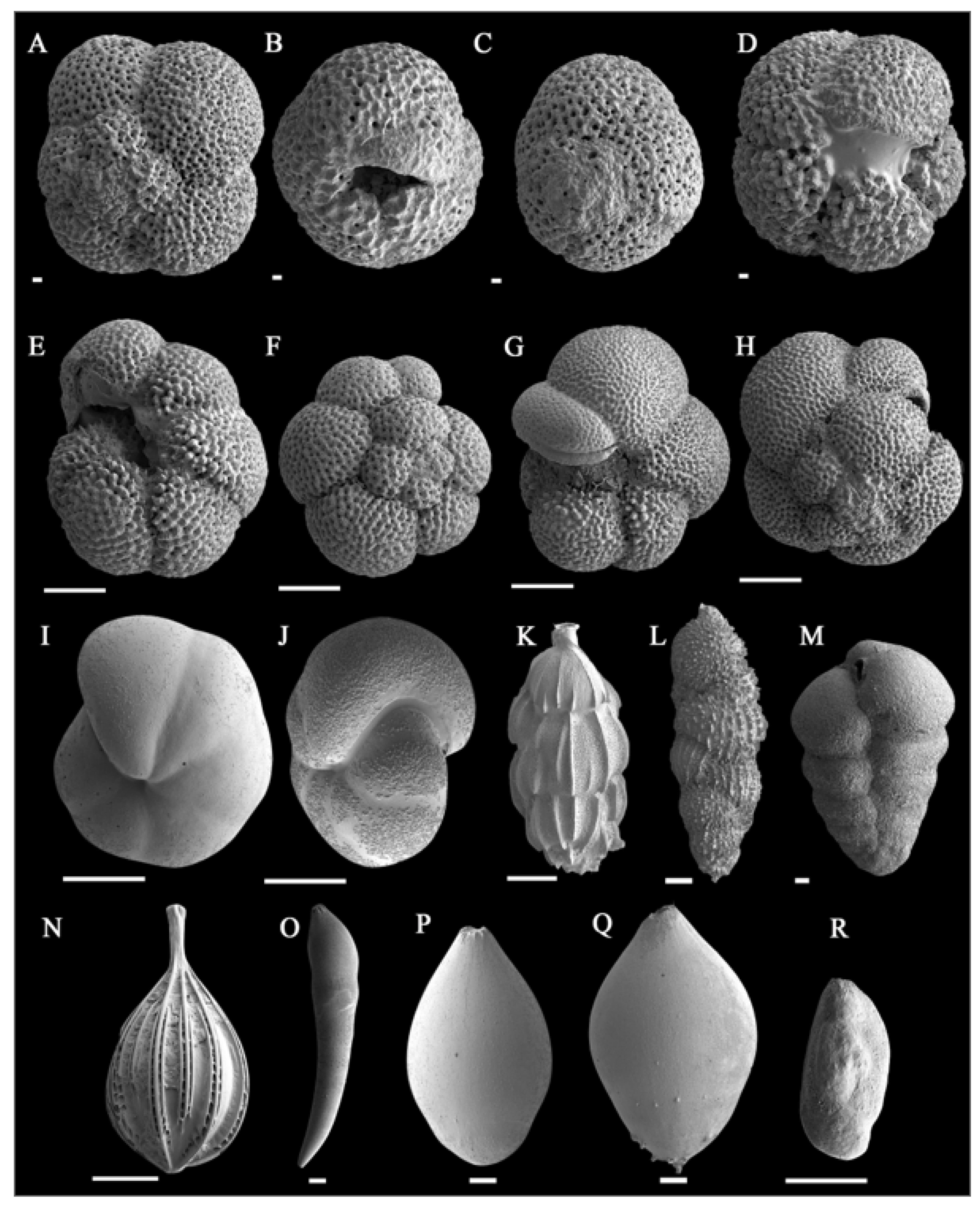
We identified 47 foraminiferal species spanning 32 genera and 20 families, comprising 15 planktic and 32 benthic taxa (higher-level classification follows Pawlowski et al., 2013). Seven species are newly recorded from Korean waters: the planktic Tenuitellita fleisheri and Neogloboquadrina atlantica subsp. praeatlantica, and the benthic Islandiella algida, Uvigerina asperula, Pseudonodosaria aequalis, Pseudonodosaria obtusissima, and Astacolus crepidula. Among planktic taxa, Neogloboquadrina pachyderma—a species commonly associated with polar waters and upwelling regimes—was observed, and all five intraspecific morphotypes were recorded. Among benthic foraminifera, Islandiella norcrossi was the most abundant taxon in our material.
Phylum Foraminifera d’Orbigny, 1826
Class Globothalamea Pawlowski, Holzmann & Tyszka, 2013
Order Robertinida Loeblich & Tappan, 1984
Family Epistominidae Wedekind, 1937
Genus Hoeglundina Brotzen, 1948
- 1.
Hoeglundina elegans (d’Orbigny, 1826)
Reference: Charrieau, et al. [
27], p. 23, Figure 3; Das, et al. [
28], p. 4, Figure 2; Tikhonova, et al. [
29], p. 14, plate. 8, p. 15, pl. 9, p. 19, pl. 12.
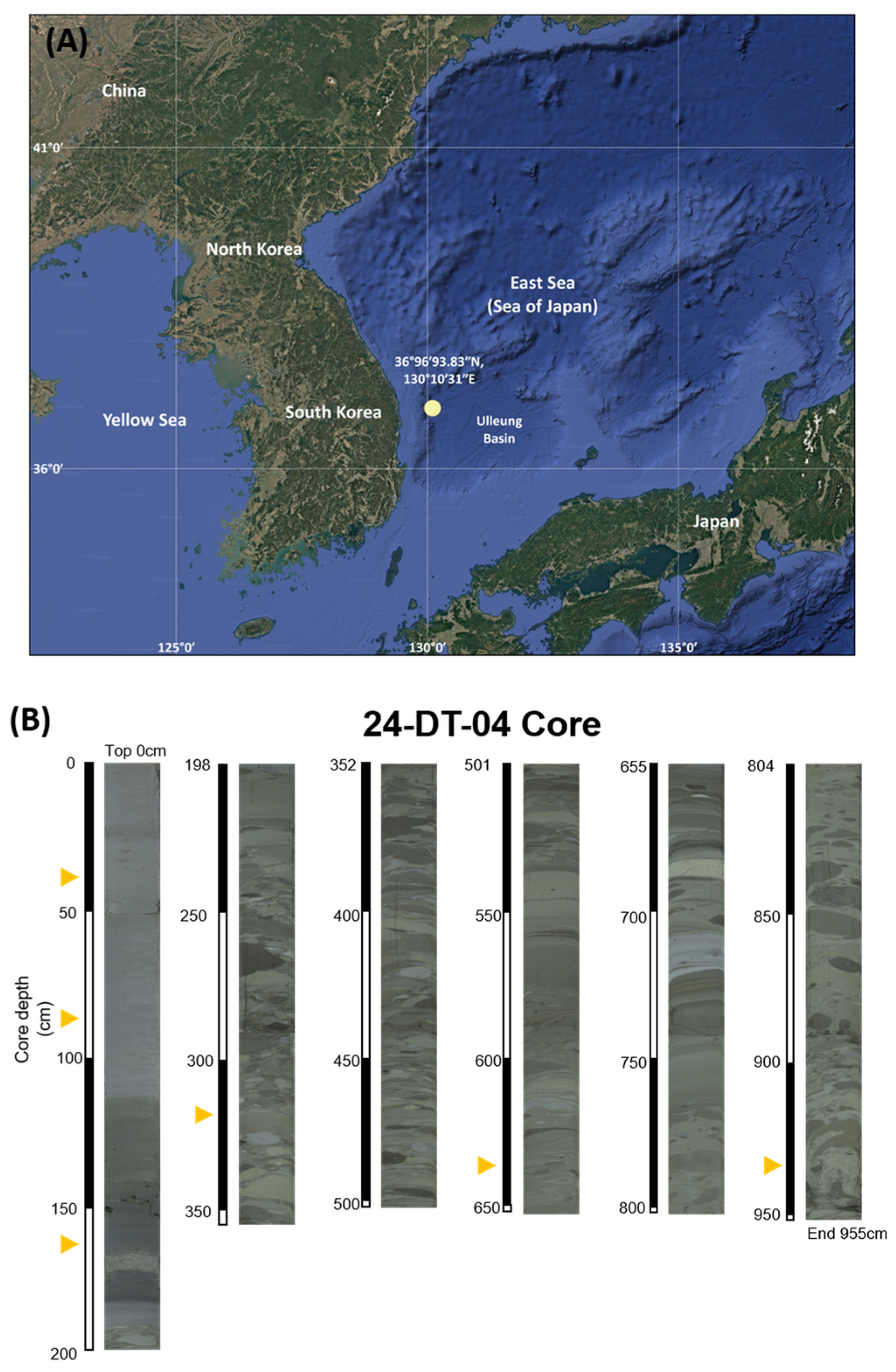
Samples: 24-DT-04.
Dimensions: 1015.3 μm long, 811.5 μm wide, with a length/width ratio of about 1.3:1.
Description: The overall outline is round and biconvex, with a flower-shaped test that is either transparent or opaque, and the surface is smooth. The last whorl contains 7–8 chambers, with the chamber size gradually increasing towards the final chamber. The spiral side is the trochospiral side, and the test’s suture lines are deeply incised. The aperture is located on the umbilical side and is small in size.
Habitat: Benthic. This species typically attaches to surfaces such as shells or rocks, or inhabits shallow layers beneath the seafloor [
30].
Korean occurrence:
Hoeglundina elegans is a species commonly found in Korean waters. It has been recorded in the Yellow Sea [
4] and the South Sea [
31].
World distribution:
Hoeglundina elegans was originally described from materials collected from Europe and South America, though the specific research areas are not explicitly mentioned, and was classified by d’Orbigny (1826).
Hoeglundina elegans is a marine species that has existed from the fossil record to the present day. It is widely distributed across the world’s oceans and occurs in high abundances [
10].
Order Rotaliida Lankester, 1885
Family Bolivinitidae Cushman, 1927
Genus Bolivina d’Orbigny, 1839
- 2.
Bolivina pseudoplicata Heron-Allen & Earland, 1930
Reference: Kireenko, et al. [
32], p. 7, 16, Figure 2 and Figure 11; Takata, et al. [
33], p. 288, Figure 6; Tikhonova, Merenkova, Matul and Korsun [
29], p. 29, pl. 20; Panchang and Nigam [
34], p. 145, pl. 23.
Samples: 24-DT-04.
Dimensions: 721.6 μm long, 274.5 μm wide, with a length/width ratio of about 2.6:1.
Description: The overall outline of the test is round and flat-triangular. The chambers are irregularly formed in a zigzag pattern from top to bottom, with the chamber size increasing towards the final chamber. It is easily distinguishable from other species.
Habitat: Benthic (epi- to infaunal). This species can survive in low-oxygen (dysoxic) environments and is found from the inner continental shelf (0–200 m) to the bathyal zone at depths of up to 2000–3000 m [
30].
Korean occurrence:
Bolivina pseudoplicata has been found in the continental shelf region of the Yellow Sea and in the southern Jeju waters of Republic of Korea [
4,
35].
World distribution:
Bolivina pseudoplicata was originally described from Plymouth, England, by Heron-Allen & Earland (1930).
Bolivina pseudoplicata is a marine species that has existed from the fossil record to recent times. It is a widely distributed species [
10]. It inhabits muddy sediments, living freely as both infaunal and epifaunal.
Genus Fursenkoina Loeblich & Tappan, 1961
- 3.
Fursenkoina complanata (Egger, 1893)
Reference: Kireenko, Tikhonova, Kozina and Matul [
32], p. 12, Figure 7; Tikhonova, Merenkova, Matul and Korsun [
29], p. 8, pl. 3; Panchang and Nigam [
34], p. 147, pl. 25.
Samples: 24-DT-04.
Dimensions: 780.4 μm long, 247.1 μm wide, with a length/width ratio of about 3.2:1.
Description: The overall outline of the test is long and narrow, oval-shaped, and shows tapering from top to bottom. It is not straight but slightly curved. The surface of the test is transparent and smooth.
Habitat: Benthic (infaunal). It is infaunal, inhabiting muddy sediments from the continental shelf to the upper bathyal zone, and is capable of surviving in low-oxygen environments [
30].
Korean occurrence:
Fursenkoina complanata has been found in the waters off Jeju, Republic of Korea [
11,
35].
World distribution:
Fursenkoina complanata was originally described from the European coastline by Heron-Allen & Egger (1893).
Fursenkoina complanata is a marine species that has existed from the fossil record to the present and is distributed worldwide. It is primarily found in polar to subpolar regions influenced by cold waters [
10].
Genus Vaginulinopsis Silvestri, 1904
- 4.
Vaginulinopsis sublegumen Parr, 1950
Reference: Hanagata and Nobuhara [
36], p. 33, Figure 12; Debenay [
37], p. 170.
Samples: 24-DT-04.
Dimensions: 798.0 μm long, 296.8 μm wide, with a length/width ratio of about 2.7:1.
Description: The angle is elongated and curved with the lower part bent upwards in a curved shape. The calcareous surface is microperforated and smooth. The dividing lines are slightly curved and horizontally separated. The aperture is located at the top and is radiate.
Habitat: Benthic.
Korean occurrence:
Vaginulinopsis sublegumen has been found in the waters off Jeju, Republic of Korea [
11,
35].
World distribution:
Vaginulinopsis sublegumen was originally described from the Antarctic continent and its surrounding waters by Parr (1950).
Vaginulinopsis sublegumen is a marine species that exists from fossil records to the present [
10]. It inhabits cold waters of subpolar regions and has been found in the North Atlantic and the Sea of Japan and the Sea of Korea in the Northern Hemisphere [
35,
36], as well as in the waters around New Zealand in the Southern Hemisphere [
10].
Family Cancrisidae Chapman, Parr & Collins, 1934
Genus Valvulineria Cushman, 1926
- 5.
Valvulineria sadonica Asano, 1951
Reference: Das, Singh, Holbourn, Farooq, Vats and Pandey [
28], p. 4, Figure 3; Vats, et al. [
38], p. 4, Figure 2.
Samples: 24-DT-04.
Dimensions: 726.1 μm long 496.1 μm wide, with a length/width ratio of about 1.5:1.
Description: The test is large, with an overall rounded, circular outline, and there are 7–8 chambers in the final whorl. The surface is smooth, perforate, and the surface structure lines are gently curved and smoothly defined. The spiral side is the trochospiral side, and the umbilical side is slightly convex. The aperture is narrow and elongated, located close to the umbilical side. The umbilical flap covers it, making it difficult to observe with the naked eye.
Habitat: Benthic.
Korean occurrence:
Valvulineria sadonica has been found in the South Sea [
31,
35] and the Yellow Sea [
4].
World distribution:
Valvulineria sadonica was originally described in Japan by Asano (1951).
Valvulineria sadonica is a marine species, and its presence in the fossil record is unknown. It has been found in subarctic marine regions of Northeast Asia, including the Sea of Japan, the Sea of Okhotsk, and the Sea of Korea [
10]. Its optimal habitat temperature remains unknown.
Family Candeinidae Cushman, 1927
Genus Tenuitellita Li, 1987
- 6.
Tenuitellita fleisheri (Li, 1987)
References: Schiebel and Hemleben [
25], p. 92, pl. 2.35; Li [
39], p. 304, pl. 4.
Samples: 24-DT-04.
Dimensions: 487.8 μm long, 534.3 μm wide, with length/width ratio of about 0.9:1.
Description: Test is small in size and shows 5–6 rounded globular chambers in the final whorl. The surface is smooth, the sutures are distinct, and pustules become more numerous towards the inside of the test than on the outside. The aperture is low-arched and oriented to the right in the umbilical side. The spiral side is flower shaped.
Habitat: Planktic.
Korean occurrence: This is the first reported occurrence in Korean waters.
World distribution: Tenuitellita fleisheri was originally described from the United States Gulf Coast by Li (1987). Subsequently, this species was regarded as marine, as it was found in both fossil records and more recently in the northern Pacific [
10]. Although its preferred habitat temperature is unknown, it has been reported in the Sea of Japan [
40].
Family Cassidulinidae d’Orbigny, 1839
Genus Cassidulina d’Orbigny, 1826
- 7.
Cassidulina teretis Tappan, 1951
Reference: Kireenko, Tikhonova, Kozina and Matul [
32], p. 18, Figure 13; Vats, Singh, Das, Holbourn, Gupta, Gallagher and Pandey [
38], p. 4, Figure 2; Tikhonova, Merenkova, Matul and Korsun [
29], p. 37, pl. 26.
Samples: 24-DT-04.
Dimensions: 878.0 μm long, 788.3 μm wide, with a length/width ratio of about 1.1:1.
Description: The test is slightly rounded and oval in shape, with 8–10 chambers in the final whorl and has a lens-shaped appearance. Each chamber appears in the form of a small triangular shape. The calcareous surface is smooth, transparent, and perforated. The surface sutures are curved and clearly defined.
Habitat: Benthic. It inhabits cold, high-latitude waters characterized by bottom temperatures of ~−1.5–3 °C, salinity ≥34.5‰, and seasonally enhanced, diatom-rich export production of organic matter [
30].
Korean occurrence:
Cassidulina teretis has been found in the southern Jeju waters of Republic of Korea [
11,
35].
World distribution:
Cassidulina teretis was originally described from Northern Alaska by Tappan (1951).
Cassidulina teretis is a marine species that has existed from the fossil record to the present day [
10]. It is found worldwide and occurs commonly [
41]. This species has been reported from the Arctic Ocean, the North Pacific Ocean, and the North Atlantic Ocean [
10].
- 8.
Cassidulina reniformis Nørvang, 1945
Reference: Kireenko, Tikhonova, Kozina and Matul [
32], p. 8, Figure 3; Takata, Irino, Katsuki, Woo, Lee, Lim, Ha and Khim [
33], p. 288, Figure 6; Tikhonova, Merenkova, Matul and Korsun [
29], p. 9, pl. 4; Dejardin, et al. [
42], p. 91, pl. 9.
Samples: 24-DT-04.
Dimensions: 729.7 μm long, 579.3 μm wide, with a length/width ratio of about 1.3:1.
Description: The test is oval, nearly spherical, with an overall broad circular outline. The surface is opaque–calcareous, smooth, and perforated, and the surface sutures are not clearly defined. The aperture is a long slit following a gentle curve along the test outline, and the area near the aperture is smooth without perforations.
Habitat: Benthic. This species prefers environments with temperatures below 1 °C and salinity levels above 34.5‰ [
30].
Korean occurrence:
Cassidulina reniformis was found on the continental shelf of the East Sea (Sea of Japan) in Republic of Korea [
11,
12].
World distribution:
Cassidulina reniformis was originally described from Iceland by Nørvang (1945).
Cassidulina reniforme is a marine species with a wide global distribution. There are no known records of this species in the fossil record. It occurs in polar and subpolar regions influenced by cold waters, including the Arctic Ocean, the North Pacific Ocean, and the North Atlantic Ocean [
10].
- 9.
Cassidulina laevigata d’Orbigny, 1826
Reference: Das, Singh, Holbourn, Farooq, Vats and Pandey [
28], p. 4, Figure 3; Tikhonova, Merenkova, Matul and Korsun [
29], p. 9, Figure 4; Hanagata and Nobuhara [
36], p. 75, Figure 23; Panchang and Nigam [
34], p. 146, plate. 26
Samples: 24-DT-04.
Dimensions: 1374.0 μm long, 1228.5 μm wide, with a length/width ratio of about 1.1:1.
Description: The test is elongated and rounded oval, with a triserial series. The calcareous-hyaline surface is thin, microperforated, and shiny. The chambers increase rapidly in size towards the final chamber, becoming larger. The surface sutures are thin and distinguished by vertical curves.
Habitat: Benthic. It is a species that predominantly occurs in deep-sea benthic environments and is mainly found in cold-water regions with abundant organic matter and nutrient supply [
43,
44,
45].
Korean occurrence:
Cassidulina laevigata was found on the continental shelf of the East Sea (Sea of Japan) in Republic of Korea [
11].
World distribution:
Cassidulina laevigata was originally described from various regions around the world by Orbigny (1826).
Cassidulina laevigata is a marine species that has existed from the fossil record to the present day [
10].
Genus Globocassidulina Voloshinova, 1960
- 10.
Globocassidulina subglobosa (Brady, 1881)
Reference: Charrieau, Kawagata, McIntosh, Tamura, Nagai and Toyofuku [
27], p. 23, Figure 4; Kireenko, Tikhonova, Kozina and Matul [
32], p. 8, Figure 3; Das, Singh, Holbourn, Farooq, Vats and Pandey [
28], p. 4, Figure 3.
Samples: 24-DT-04.
Dimensions: 729.0 μm long, 575.7 μm wide, with a length/width ratio of about 1.3:1.
Description: The test is globular with a broad circular outline and a plane with a biserial arrangement. The calcareous surface is perforated and smooth. The surface sutures are not clearly defined. The aperture is narrow and elongated, gradually increasing in size.
Habitat: Benthic (infaunal). This species is infaunal, living within muddy sediments on the continental shelf, and inhabits cold-water environments [
30,
46].
Korean occurrence:
Globocassidulina subglobosa has been found in the South Sea and Yellow Sea of Republic of Korea [
4,
31,
35].
World distribution:
Globocassidulina subglobosa was originally described from the deep-sea regions of the world by Brady (1881).
Globocassidulina subglobosa is a marine species that has existed from the fossil record to the present day [
10]. It is distributed worldwide, occurring in a variety of regions including the North Atlantic Ocean, North Pacific Ocean, the Mediterranean Sea, and the Indian Ocean [
10,
41].
- 11.
Globocassidulina crassa (d’Orbigny, 1839)
Reference; Dejardin, Kender, Allen, Leng, Swann and Peck [
42], p. 58, Figure 13; Lei and Li [
26] p. 213, Figure 8; Hanagata and Nobuhara [
36], p. 73, Figure 23.
Samples: 24-DT-04.
Dimensions: 804.3 μm length, 644.9 μm width, with a length/width ratio of about 1.2:1.
Description: The test is small, with an overall rounded and slightly oval outline. There are four chambers in the final whorl, with the chamber size increasing towards the last chamber. The length is greater than the width. The surface is smooth, perforated, and the surface sutures.
Habitat: Benthic. This species is typically found in shallow-water environments such as bays and estuaries [
46]. They are curved and distinct. The aperture is narrow and elongated, with a thin lip.
Korean occurrence:
Globocassidulina crassa has been found in the Jeju waters of the South Sea in Republic of Korea [
35].
World distribution:
Globocassidulina crassa was originally described from the waters of South America d’Orbigny (1839).
Globocassidulina crassa is a marine species that has existed from the fossil record to the present day. It is distributed worldwide, occurring in various regions such as the North Atlantic Ocean, North Pacific Ocean, the Mediterranean Sea, and the Southern Ocean [
10].
Genus Islandiella Nørvang, 1958
- 12.
Islandiella norcrossi (Cushman, 1933)
Reference: Kireenko, Tikhonova, Kozina and Matul [
32], p. 18, Figure 13; Das, Singh, Holbourn, Farooq, Vats and Pandey [
28], p. 4, Figure 3; Dejardin, Kender, Allen, Leng, Swann and Peck [
42], p. 92, pl. 10.
Samples: 24-DT-04.
Dimensions: 775.7 μm long, 866.1 μm wide, with a length/width ratio of about 0.9:1.
Description: The test is round, with 9–10 chambers in the final whorl. The surface is transparent to opaque, shiny, and smooth. The chambers are arranged around the umbilical in a lens-shaped pattern, and these chambers appear triangular in shape.
Habitat: Benthic (infaunal). It is infaunal, inhabiting muddy and silty sediments, and occurs in shallow waters with temperatures below 10 °C [
46].
Korean occurrence:
Islandiella norcrossi has been found in the Jeju waters of the South Sea in Republic of Korea [
35].
World distribution:
Islandiella norcrossi was originally described from the Arctic Ocean by Cushman (1933).
Islandiella norcrossi is a marine species distributed in the Arctic Ocean, the North Pacific Ocean, and the North Atlantic Ocean [
10]. There are no known fossil records of this species.
- 13.
Islandiella algida (Cushman, 1944)
Reference: Panchang and Nigam [
34], p. 146, pl. 24.
Samples: 24-DT-04.
Dimensions: 1287.8 μm long, 1021.1 μm wide, with a length/width ratio of about 1.3:1.
Description: The test is spherical, with an overall broad circular outline. It has a plane with a biserial arrangement. Along the final whorl, there are 5–6 chambers, with the chamber size gradually increasing. The surface is smooth, perforated, and the sutures are smoothly curved. The aperture is narrow and elongated, following the outline of the test, with a gentle curved shape.
Habitat: Benthic (infaunal). This species is infaunal, inhabiting muddy and silty sediments. It typically occurs on the continental shelf at depths shallower than 20 m, and in waters with temperatures below 10 °C.
Korean occurrence: This is the first report from Korean waters.
World distribution: Islandiella algida was originally described from the New England coast by Cushman (1944). Islandiella algida is a marine species that has existed from the fossil record to the present day. It has been found in the Arctic Ocean, the North Atlantic around Iceland, and the Sea of Japan.
Family Globigerinidae Carpenter et al., 1862
Genus Globigerina d’Orbigny, 1826
- 14.
Globigerina bulloides d’Orbigny, 1826
Reference: Gallagher, et al. [
47], p. 688, Figure 4; Schiebel and Hemleben [
25], p. 20, pl. 2.3; Hanagata and Nobuhara [
36], p. 54, Figure 18.
Samples: 24-DT-04.
Dimensions: 999.3 μm long, 849.3 μm wide, with a length/width ratio of about 1.2:1.
Description: Test is big in size and has four rounded globular chambers in the final whorl. The surface has normal perforations and spines, with prominent structural lines. The spiral side is trochospiral. The aperture on the umbilical side is large and slit-shaped, and is slightly offset from the center.
Habitat: Planktic.
Korean occurrence: Globigerina bulloides is reported to occur in the East Sea (Sea of Japan) under the influence of the cold North Korean Cold Current [
14].
World distribution: Globigerina bulloides was originally described from across Europe by Orbigny (1826).
Globigerina bulloides occurs from the fossil record to the present [
10]. This species is mainly distributed in middle to high latitudes and is abundant in cold water-influenced areas and highly productive upwelling regions [
25,
36].
- 15.
Globigerina umbilicata Orr & Zaitzeff, 1971
Reference: Gallagher, Sagawa, Henderson, Saavedra, De Vleeschouwer, Black, Itaki, Toucanne, Bassetti, Clemens, Anderson, Zarikian and Tada [
47], p. 688, Figure 4; Orr and Zaitzeff [
48], p. 18, pl. 1.
Samples: 24-DT-04.
Dimensions: 747.2 μm long, 833.0 μm wide, with a length/width ratio of about 0.9:1.
Description: The test is big in size and shows 5–6 rounded globular chambers in the final whorl. The surface has very distinct structural lines, with calcareous perforate and a thick test. The aperture on the umbilical side is large and located at the center of the umbilicus. The spiral side is low trochospiral.
Habitat: Planktic.
Korean occurrence: Globigerina umbilicata is reported to occur in the East Sea (Sea of Japan). Its distribution area is similar to that of
Globigerina bulloides, to which it is morphologically similar [
11].
World distribution: Globigerina umbilicata was originally described from California by Orr & Zaitzeff (1971).
Globigerina umbilicata occurs from the fossil record to the present [
10]. It is mainly influenced by warm waters and is distributed in regions affected by the Kuroshio Current [
47].
- 16.
Globigerina sp. Loeblich & Tappan, 1994
Samples: 24-DT-04.
Dimensions: 905.0 μm long, 800.3 μm wide, with a length/width ratio of about 1:1.
Description: Test is big in size and shows five rounded globular chambers in the final whorl. The surface has normal perforations and spines. The aperture on the umbilical side is large and located at the center. Morphologically, it is similar to G. bulloides and G. umbilicata, but it differs from these two species in terms of the number of chambers and surface characteristics.
Habitat: Planktic.
Genus Turborotalita Blow & Banner, 1962
- 17.
Turborotalita quinqueloba (Natland, 1938)
Reference: Gallagher, Sagawa, Henderson, Saavedra, De Vleeschouwer, Black, Itaki, Toucanne, Bassetti, Clemens, Anderson, Zarikian and Tada [
47], p. 688, Figure 4; Schiebel and Hemleben [
25], p. 50, pl. 2.16; Hanagata and Nobuhara [
36], p. 65, Figure 2.
Samples: 24-DT-04.
Dimensions: 415.3 μm long, 384.8 μm wide, with a length/width ratio of about 1.1:1.
Description: The test is small in size and shows 4.5–5.5 rounded globular chambers in the final whorl. The surface has normal perforate and spines, with the chamber sizes increasing towards the final chamber. The aperture on the umbilical side is centrally located and is either obscured with a low arch or has a flange or rim. The spiral side has a flat trochospiral shape.
Habitat: Planktic.
Korean occurrence: Turborotalita quinqueloba has been found in the transitional waters of the Korea Strait [
49], Republic of Korea, and the area between Jeju and the East China Sea [
49], where the Tsushima Warm Current and the North Korea Cold Current interact.
World distribution: Turborotalita quinqueloba was originally described from off the west coast of North America and from the Los Angeles Basin by Natland (1938).
Turborotalita quinqueloba occurs from the fossil record to the present. It is a globally widespread species that is sourced from the Arctic Ocean. It is predominantly found in marginal seas influenced by the cold waters of the northern Pacific and northern Atlantic Ocean [
10], where it is most abundant at depths of approximately 50–100 m, as well as in deeper layers at depths of 150–200 m [
50].
T. quinqueloba shares a similar marine habitat with
N. pachyderma, resulting in comparable variations in abundance across different depths [
51].
Genus Globigerinoides Cushman, 1927
- 18.
Globigerinoides conglobatus (Brady, 1879)
Reference: Schiebel and Hemleben [
25], p. 87, pl. 2.33; Hanagata and Nobuhara [
36], p. 54, Figure 18; Hyun, et al. [
52], p. 187, Figure 3.
Samples: 24-DT-04.
Dimensions: 730.8 μm long, 627.5 μm wide, with a length/width ratio of about 1.2:1.
Description: Globigerinoides conglobatus has 3.5–4 chambers in the final whorl, with a large, rough surface characterized by regular perforations and numerous spines. The aperture on the umbilical side is similar to that of Globigerinita glutinata, exhibiting a rectangular shape with a long, low arch. The spiral side shows a low trochospiral structure.
Habitat: Planktic.
Korean occurrence:
Globigerinoides conglobatus is a warm-water species that predominantly occurs in the southern sea of Republic of Korea, where it is influenced by the Tsushima Warm Current. It is also found in smaller numbers in the East Sea (Sea of Japan) [
53].
World distribution:
Globigerinoides conglobatus was first described by Brady (1879) based on marine sediment samples collected from various regions of the world’s oceans during the Challenger Expedition.
Globigerinoides conglobatus occurs from the fossil record to the present [
10]. It is a globally distributed species with a high degree of morphological variability. It is a warm-water species that occurs from the fossil record to the present and is distributed in tropical to subtropical regions of the ocean [
25].
Family Globigerinitidae Bermúdez, 1961
Genus Globigerinita Brönnimann, 1951
- 19.
Globigerinita glutinata (Egger, 1893)
Reference: Schiebel and Hemleben [
25], p. 87, pl. 2.33; Hanagata and Nobuhara [
36], p. 54, Figure 18; Hyun, Kimoto and Cho [
52], p. 187, Figure 3.
Samples: 24-DT-04.
Dimensions: It is 455.4 μm long and 377.6 μm wide, with a length/width ratio of about 1.2:1.
Description: Globigerinita glutinata has 3.5–4 globular chambers in the final whorl, and the surface is covered with pustules. The aperture on the umbilical side is centrally located, forming a low arch with a thin rim. There are also forms with a bulla covering the aperture. The spiral side has a medium–high trochospiral shape.
Habitat: Planktic.
Korean occurrence: Globigerinita glutinata has been found in the Korea Strait [
53] and around Jeju Island [
52], Republic of Korea, where the waters are influenced by warm currents.
World distribution: Globigerinita glutinata was originally described from Trinidad, BWI by Egger (1893).
Globigerinita glutinata occurs from the fossil record to the present. It is a globally widespread species. It is most abundant in high-latitude and subtropical regions [
54,
55], particularly in areas influenced by warm currents in the North Pacific and North Atlantic Oceans [
10].
- 20.
Globigerinita uvula (Ehrenberg, 1861)
Reference: Schiebel and Hemleben [
25], p. 89, pl. 2.32; Hanagata and Nobuhara [
36], p. 54, Figure 18.
Samples: 24-DT-04.
Dimensions: 271.8 μm long, 233.3 μm wide, with a length/width ratio of about 1.2:1.
Description: The test is triangular, cone-shaped, and rises sharply, with 3.5–4 chambers in the final whorl. It has microperforate, and the surface has slight pustules and is smooth. It is easily distinguishable from other species.
Habitat: Planktic.
Korean occurrence: Globigerinita uvula has been found in the southern waters off Jeju Island, Republic of Korea, the area between Jeju and the East China Sea [
11,
49].
World distribution: Globigerinita uvula was originally described from the Icelandic waters by Ehrenberg (1861).
Globigerinita uvula occurs from the fossil record to the present [
10]. It is widely distributed from high to low latitudes but is most commonly found in high-latitude oceans [
56], where it is particularly dominant in the North Atlantic [
10].
Genus Tenuitella Fleisher, 1974
- 21.
Tenuitella angustiumbilicata (Bolli, 1957)
Reference: Olsson, et al. [
57], p. 445, pl. 16.4.
Samples: 24-DT-04.
Dimensions: 416.4 μm long, 494.2 μm wide, with a length/width ratio of about 0.8:1.
Description: The test is small, and the final whorl has 4.5–5 chambers, with the size increasing towards the final chamber. The aperture on the umbilical side is arched and has a thin rim. The surface has microperforate, a finely pustuled texture, smooth, and distinct structural lines.
Habitat: Planktic.
Korean occurrence:
Tenuitella angustiumbilicata has been found in the southern regions of Republic of Korea, including the Korea Strait [
53] and the southern waters off Jeju Island [
49].
World distribution:
Tenuitella angustiumbilicata was originally described from Trinidad, BWI by Bolli (1957).
Tenuitella angustiumbilicata is a species found in both fossil records and modern marine environments [
10]. It has been reported from the Okinawa Trough in the Japan Sea, which is an area influenced by the Kuroshio Current [
58]. Although the optimal water temperature for its habitat is not well known, it is primarily observed in mid-latitude regions [
10,
41].
Family Globorotaliidae Cushman, 1927
Genus Globorotalia Cushman, 1927
- 22.
Globorotalia menardii (d’Orbigny in Parker, Jones & Brady, 1865)
Reference: Schiebel and Hemleben [
25], p. 74, pl. 2.26; Hyun, Kimoto and Cho [
52], p. 187, Figure 3.
Samples: 24-DT-04.
Dimensions: 1315.9 μm long, 1064.1 μm wide, length/width ratio of about 1.2:1.
Description: The test is large, flat, and disk-shaped, with 5–6 chambers in the final whorl, and the size of the chambers increases towards the final chamber. The overall surface outline is a rounded curve, and the surface is microperforated with no spines, appearing smooth. The umbilicus is narrow and located on the exterior, and the aperture has a thick lip.
Habitat: Planktic.
Korean occurrence:
Globorotalia menardii has been found in the Korea Strait [
53], the waters around Jeju Island [
52], and in the area between Jeju and the East China Sea [
49].
World distribution:
Globorotalia menardii was originally described from materials collected from Europe and South America, though the specific research areas are not explicitly mentioned, and was classified by d’Orbigny in Parker et al. (1865).
Globorotalia menardii is a marine species that exists from the fossil record to the present day [
10]. It was once widely distributed across the world oceans but is currently found only in the Pacific Ocean [
10]. This species occurs in warm, oligotrophic subtropical regions with low primary productivity [
25,
59].
Genus Neogloboquadrina Bandy, Frerichs & Vincent, 1967
- 23.
Neogloboquadrina dutertrei (d’Orbigny, 1839)
Reference: Schiebel and Hemleben [
25], p. 60, pl. 2.20; Hanagata and Nobuhara [
36], p. 50, Figure 17; Hyun, Kimoto and Cho [
52], p. 187, Figure 3.
Samples: 24-DT-04.
Dimensions: 688.0 μm long, 647.5 μm wide, with a length/width ratio of about 1.1:1.
Description: The test is globular and convex. It has 4.5–6 globular chambers in the final whorl. The surface is microperforated, with spine, and the structural lines are deeply defined. The umbilical is relatively wide, and the aperture is umbilical–extraumbilical. A tooth-plate is present. The spiral side is low and tropical.
Habitat: Planktic.
Korean occurrence:
Neogloboquadrina dutertrei has been found in the waters of the Korea Strait [
53], around Jeju Island [
52], and between the southern Jeju region and the East China Sea [
49].
World distribution:
Neogloboquadrina dutertrei was originally described in Cuba by d’Orbigny (1839).
Neogloboquadrina dutertrei is a marine species that exists from the fossil record to the present day [
10]. It is widely distributed across the world’s oceans and is primarily found in warm, subtropical regions [
25,
56]. This species tends to be more abundant in areas with surface circulation and upwelling [
25,
59], as well as in regions with high primary productivity [
25].
- 24.
Neogloboquadrina incompta (Cifelli, 1961)
Reference: Gallagher, Sagawa, Henderson, Saavedra, De Vleeschouwer, Black, Itaki, Toucanne, Bassetti, Clemens, Anderson, Zarikian and Tada [
47], p. 688, Figure 4; Schiebel and Hemleben [
25], p. 61, pl. 2.19; Hanagata and Nobuhara [
36], p. 50, Figure 17.
Samples: 24-DT-04.
Dimensions: 501.5 μm long, 508.2 μm wide, with a length/width ratio of about 1:1.
Description: The test has 4–5 chambers in the last whorl, with a somewhat low, wide, and rounded outline. It has a narrow umbilical, and the umbilical is more open than in N. pachyderma. The aperture on the umbilical side is narrow and elongated with lips. The surface has pustules, and the structural lines are distinct. The spiral side is a low trochospiral side, and the structural lines are weakly defined.
Habitat: Planktic.
Korean occurrence:
Neogloboquadrina incompta has been found in the Korea Strait [
53], in the waters between Jeju Island and the East China Sea [
49], and in the Ulleung Basin of the East Sea (Sea of Japan) [
14].
World distribution:
Neogloboquadrina incompta was originally described from the North Atlantic by Cifelli (1961).
Neogloboquadrina incompta is a marine species that exists from fossil records to the present [
10]. It is globally distributed and found in the surface waters of warm, subtropical regions [
25]. This species has been recorded in the East China Sea [
36] and in the Kuroshio Current-influenced waters south of Japan [
47].
- 25.
Neogloboquadrina pachyderma (Ehrenberg, 1861)
Reference: Gallagher, Sagawa, Henderson, Saavedra, De Vleeschouwer, Black, Itaki, Toucanne, Bassetti, Clemens, Anderson, Zarikian and Tada [
47], p. 688, Figure 4; Schiebel and Hemleben [
25], p. 63, pl. 2.21; Hanagata and Nobuhara [
36], p. 50, Figure 17.
Samples: 24-DT-04.
Dimensions: 543.2 μm long, 492.3 μm wide, with a length/width ratio of about 1.1:1.
Description: The test has 4–4.5 chambers and a low, square shape, though the overall outline is rather rounded. The final chamber may be irregular in shape. The umbilical is long and narrow, with the aperture extending from the umbilical to the extreme umbilical, being low and narrow. The surface structure lines are distinct. The spiral side is a low trochospiral side, with weakly defined structural lines.
Habitat: Planktic.
Korean occurrence:
Neogloboquadrina pachyderma is a dominant species in the East Sea (Sea of Japan) of Republic of Korea [
14], where it is influenced by cold currents. It is also found in the transitional waters of the South Sea [
53].
World distribution:
Neogloboquadrina pachyderma was originally described from the entrance of the Davis Strait and Iceland by Ehrenberg (1861).
Neogloboquadrina pachyderma is a marine species that has existed from the fossil record to the present day [
10]. It is widely distributed across the world’s oceans and is primarily found in polar to subpolar regions of the North Pacific and the North Atlantic, where it is influenced by cold polar waters [
10,
41]. It also occurs in marginal seas where cold-water upwelling and circulation are active, and it shares a broadly similar habitat preference with
Turborotalita quinqueloba [
25,
51]. Morphologically and genetically,
N. pachyderma is classified into five types: Type 1 is dominant in polar regions; Types 2, 3, and 4 are found in subpolar regions; and Type 5 is primarily observed in upwelling areas of marginal seas [
25,
60].
- 26.
Neogloboquadrina humerosa (Takayanagi & Saito, 1962)
Reference: Hanagata and Nobuhara [
36], p. 50, Figure 17; WoRMS [
10]; Mikrotax [
41].
Samples: 24-DT-04.
Dimensions: 738.4 μm long, 616.6 μm wide, with a length/width ratio of about 1.2:1.
Habitat: Planktic.
Description: The last line of the test consists of 6–7 chambers, which are globular and irregular in size. The surface is microperforated and has no spines. The umbilical is large, and the aperture is in the form of an arch from the umbilical to the extreme umbilical. The lips are thick. The spiral side is a trochospiral side.
Korean occurrence:
Neogloboquadrina humerosa has been recorded in Republic of Korea [
11]; however, its optimal habitat temperature and preferred oceanic regions are unknown.
World distribution:
Neogloboquadrina humerosa was originally described from Japan by Takayanagi & Saito (1962).
Neogloboquadrina humerosa is a species known only from the fossil record [
10]. Although its optimal habitat temperature is not well understood, it has been found in tropical to subtropical regions [
41], although its optimal temperature range is unknown.
- 27.
Neogloboquadrina atlantica subsp. praeatlantica Foresi, Iaccarino & Salvatorini, 2002
Reference: Foresi, et al. [
61], p. 330, pl. 2, Figure 11 and Figure 12; Mikrotax [
41]; WoRMS [
10]
Samples: 24-DT-04.
Dimensions: 685.8 μm long, 578.5 μm wide, with a length/width ratio of about 1.2:1.
Description: The test has four chambers in the last whorl. The chambers are generally globular, but some may also be hemispherical. The calcareous surface is perforate and non-spine. The umbilical side is large and open. The aperture on the umbilical side is covered by a hemispherical chamber with a rim and is slightly obscured, or it may have an arched shape. The spiral side is trochospiral, with distinct sutures.
Habitat: Planktic.
Korean occurrence: This is the first report from Korean waters.
World distribution:
Neogloboquadrina atlantica subsp.
praeatlantica was originally described from the Atlantic Ocean by Foresi, Iaccarino & Salvatorini (2002).
Neogloboquadrina atlantica subsp.
praeatlantica is a subspecies of
Neogloboquadrina atlantica and is known only from the fossil record [
10]. Its habitat temperature is unknown.
Family Nonionidae Schultze, 1854
Genus Nonionella Cushman, 1926
- 28.
Nonionella miocenica Cushman, 1926
Reference: Nomura [
62], p. 7, Figure 7; Panchang and Nigam [
34], p. 156, pl. 34.
Samples: 24-DT-04.
Dimensions: 1222.6 μm long, 921.6 μm wide, with a length/width ratio of about 1.3:1.
Description: The test is a rounded oval, with the length being greater than the width, and seven chambers are visible in the final whorl. The test is overall compressed, with the lower spiral side being trochospiral. The calcareous surface is microperforated, smooth, and the sutures are curved, deep, and clearly distinguished. The aperture is located on the inner side, and the umbilicus is almost covered by the final chamber.
Habitat: Benthic (infaunal). This species is infaunal and inhabits muddy sediments. It occurs from the continental shelf to deeper zones, at depths ranging from 10 to 1000 m [
30].
Korean occurrence:
Nonionella miocenica has been found in Republic of Korea [
11].
World distribution:
Nonionella miocenica was originally described from California by Cushman (1926).
Nonionella miocenica is a marine species that exists from the fossil record to the present day. It has been reported from the Sea of Japan [
10]. However, its preferred temperature range is unknown.
Genus Nonionellina Voloshinova, 1958
- 29.
Nonionellina labradorica (Dawson, 1860)
Reference: Nomura [
62], p. 7, Figure 7; Dejardin, Kender, Allen, Leng, Swann and Peck [
42], p. 102, pl. 20; Hanagata and Nobuhara [
36], p. 105, Figure 31.
Samples: 24-DT-04.
Dimensions: 1228.1 μm long, 967.4 μm wide, with a length/width ratio of about 1.3:1.
Description: The test is biconvex, with 8–9 chambers in the final whorl. The overall outline is oval but curved, with the chambers gradually increasing in size and taking on a triangular shape towards the final chamber. The calcareous surface is microperforated, and the surface sutures are clearly distinguished by smooth, curved lines. The aperture is positioned lower than the center and is arch-shaped.
Habitat: Benthic.
Korean occurrence:
Nonionellina labradorica has been found in the Jeju region of the South Sea in Republic of Korea [
35].
World distribution:
Nonionellina labradorica was originally described from Canada by Dawson (1860).
Nonionellina labradorica is a marine species that has existed from the fossil record to the present day. It is found in the North Atlantic around Greenland and Scandinavia, as well as in the North Pacific, including the Sea of Japan, the Sea of Okhotsk, and the seas surrounding Korea [
10]. This species occurs in high-latitude regions with temperatures below 1 °C [
30].
Family Pulleniidae Schwager, 1877
Genus Pullenia Parker & Jones in Carpenter et al., 1862
- 30.
Pullenia salisburyi Stewart & Stewart, 1930
Reference: Vats, Singh, Das, Holbourn, Gupta, Gallagher and Pandey [
38], p. 4, Figure 2; Tikhonova, Merenkova, Matul and Korsun [
29], p. 13, pl. 7; Lei and Li [
26], p. 295, Figure 49.
Samples: 24-DT-04.
Dimensions: 637.2 μm long, 529.5 μm wide, with a length/width ratio of about 1.2:1.
Habitat: Benthic (infaunal). This species is infaunal, inhabiting muddy sediments, and typically lives in cold waters. It is a common species found on the continental shelf [
30,
46].
Description: The test is circular, with five chambers in the final whorl, and is an involute planispiral. The size of the chambers gradually increases towards the final chamber. The calcareous surface is microperforated and smooth, with distinct, radial sutures. The aperture is narrow and in an inverted U-shape, and extends to the umbilical.
Korean occurrence:
Pullenia salisburyi has been found in the Yellow Sea, the South Sea, and the Jeju region of Republic of Korea [
4,
31,
35].
World distribution:
Pullenia salisburyi was originally described from Berlin, Germany, by Reuss (1851).
Pullenia salisburyi is a marine species that has existed from the fossil record to the present day. It is widely distributed across various oceanic regions, including the North Atlantic Ocean, North Pacific Ocean, Mediterranean Sea, and Southern Ocean [
10].
Family Uvigerinidae Haeckel, 1894
Genus Uvigerina d’Orbigny, 1826
- 31.
Uvigerina akitaensis Asano, 1950
Reference: Gallagher, Sagawa, Henderson, Saavedra, De Vleeschouwer, Black, Itaki, Toucanne, Bassetti, Clemens, Anderson, Zarikian and Tada [
47], p. 690, Figure 6; Panchang and Nigam [
34], p. 149, pl. 27.
Samples: 24-DT-04.
Dimensions: 1660.8 μm long, 761.1 μm wide, with a length/width ratio of about 2.2:1.
Description: The test is spindle-shaped, elongated, and in a triserial series. The chambers increase irregularly in size and height towards the final chamber. The calcareous surface is perforate, with distinct sutures, and each chamber has longitudinal ridges. The aperture is located at the very top, extending outward, and is round in shape, with a neck and a rounded lip.
Habitat: Benthic (infaunal). This species is infaunal, inhabiting muddy sediments, and prefers cold water environments [
30]. It is distributed from the continental shelf to deep-sea regions and thrives in oxic conditions [
63].
Korean occurrence:
Uvigerina akitaensis has been found on the continental shelf of the East Sea (Sea of Japan) in Republic of Korea, as well as in the Jeju region of the South Sea [
12,
35].
World distribution:
Uvigerina akitaensis was originally described from Japan by Asano (1950).
Uvigerina akitaensis is a marine species, with an unknown fossil record. It has been found in the Japan Sea, the Sea of Okhotsk, and in the Korean Sea [
10].
- 32.
Uvigerina asperula Cžjžek, 1848
Reference: Hanagata and Nobuhara [
36], p. 83, Figure 26; Panchang and Nigam [
34], p. 148, pl. 26.
Samples: 24-DT-04.
Dimensions: 2253.7 μm long, 694.3 μm wide, with a length/width ratio of about 3.2:1.
Description: The test is spindle-shaped, elongated, and in a triserial series. The chambers increase in size towards the final chamber. The calcareous surface is thin, covered with numerous spines, and perforated. The surface sutures are curved and distinct. The aperture is located at the top, protruding outward, and is round in shape, with a neck and a lip.
Habitat: Benthic (infaunal). This species is infaunal, inhabiting muddy sediments, and is found from the continental shelf to deep-sea environments at depths ranging from 100 to 4500 m [
30].
Korean occurrence: This is the first report from Korean waters.
World distribution:
Uvigerina asperula was originally described from the Vienna Basin by Cžjžek (1848).
Uvigerina asperula is a marine species that has existed from the fossil record to the present day. It occurs in the North Pacific, particularly around the Sea of Japan [
10].
Family Elphidiidae Galloway, 1933
Genus Hanzawaia Asano, 1944
- 33.
Hanzawaia nipponica Asano, 1944
Reference: Hiroyuki, Seok Hwi, Dong Geun, Jin-Cheul, Daekyo and Boo-Keun [
63], p. 289, Figure 7; Lei and Li [
26], p. 300, Figure 52; Hanagata and Nobuhara [
36], p. 117, Figure 34.
Samples: 24-DT-04.
Dimensions: 1191.1 μm long, 1024.0 μm wide, with a length/width ratio of about 1.2:1.
Description: The test has 10–11 chambers in the final whorl, with one side being convex and the other side being flat, resulting in an overall round and flattened shape. The calcareous surface is opaque, perforated, and features rounded, deep sutures. The umbilical is centered, and the flap is mostly covered. The aperture is located on the inner side, covered by the umbilical flap, making it difficult to observe visually. In this image, the final chamber appears damaged and broken.
Habitat: Benthic (epifaunal). This species is epifaunal and attaches to hard substrates such as rocks, gravel, and shells. It does not move on its own and obtains food through water currents [
30].
Korean occurrence:
Hanzawaia nipponica has been recorded in the Yellow Sea [
4], and in the waters around Jeju Island in Republic of Korea [
35].
World distribution:
Hanzawaia nipponica was originally described from Japan by Asano (1944).
Hanzawaia nipponica is a marine species that has existed from fossil records to the present. It occurs in the Northwest Pacific Ocean, including the Sea of Japan, the Yellow Sea, and the East China Sea [
10]. Influenced by warm waters, it is a common and dominant species on the continental shelf of the China Sea [
26].
Family Cibicididae Cushman, 1927
Genus Heterolepa Franzenau, 1884
- 34.
Heterolepa bradyi (Trauth, 1918)
Reference: Tikhonova, Merenkova, Matul and Korsun [
29], p. 33, pl. 22; Lei and Li [
26], p. 249, Figure 26.
Samples: 24-DT-04.
Dimensions: 1133.1 μm long, 953.0 μm wide, with a length/width ratio of about 1.2:1.
Description: The test is overall round, with ten chambers in the final whorl. The surface is calcareous, perforated, and the surface lines are distinct. The spiral side has three volutions, making it trochospiral. The umbilical side is convex with a radiating pattern.
Habitat: Benthic (epifaunal)—This species is epifaunal, distributed from the continental shelf to the deep sea, and influenced by cold water masses [
30,
64].
Korean occurrence:
Heterolepa bradyi has been found in the Jeju waters of Republic of Korea [
35].
World distribution:
Heterolepa bradyi was originally described from Mississippi, USA by Cushman (1922).
Heterolepa bradyi is a marine species that has existed from the fossil record to the present day. It is distributed worldwide, including in the North Atlantic, the North Pacific, and the South Atlantic [
10].
Order Textulariida Lankester, 1885
Family Textulariidae Ehrenberg, 1838
Genus Siphotextularia Finlay, 1939
- 35.
Siphotextularia concava (Karrer, 1868)
Reference: Tikhonova, Merenkova, Matul and Korsun [
29], p. 16, pl. 10; Hanagata and Nobuhara [
36], p. 15, Figure 6.
Samples: 24-DT-04.
Dimensions: 2082.2 μm long, 1232.4 μm wide, with a length/width ratio of about 1.7:1.
Description: The test is long, large, and triangular in shape, with a biserial arrangement. During the juvenile stage, it exhibits a trochospiral series. The chambers gradually increase in size toward the final chamber. The surface is a mix of calcareous and siliceous material. The aperture is located at the top of the final chamber, with a long, conical shape and a lip.
Habitat: Benthic (epi- to infaunal). It inhabits mud-silt sediments as an epifaunal organism and can survive in low-oxygen environments [
30]. It is found at depths of up to 600 m on the continental shelf [
46].
Korean occurrence:
Siphotextularia concava has been recorded in Republic of Korea [
11].
World distribution:
Siphotextularia concava was originally described from the North Pacific Ocean by Cushman (1911).
Siphotextularia concava is a marine species that has existed from fossil records to the present. It is distributed worldwide, primarily in the North Pacific Ocean around the Sea of Japan and the East China Sea, the North Atlantic Ocean around the United States and Mexico, and the South Atlantic Ocean near New Zealand [
10].
Class Nodosariata Mikhalevich, 1993 emend. Rigaud et al., 2015
Order Nodosariida Calkins, 1926
Family Lagenidae Reuss, 1862
Genus Lagena Walker & Jacob, 1798
- 36.
Lagena nebulosa Cushman, 1923
Reference: Dejardin, Kender, Allen, Leng, Swann and Peck [
42], p. 86, pl. 4; Lee, Frontalini and Lee [
15], p. 86, pl. 4; Lei and Li [
26], p. 158, Figure 13.
Samples: 24-DT-04.
Dimensions: 1160.7 μm long, 539.2 μm wide, with a length/width ratio of about 2.2:1.
Description: The test is drop-shaped with a neck that is long and oval. The surface is transparent to translucent and smooth. The aperture is located at the top, protruding outward, and is round in shape on the neck.
Habitat: Benthic. This species is found in the deeper parts of the continental shelf and the continental slope [
15].
Korean occurrence:
Lagena nebulosa has been recorded in the East Sea and the Yellow Sea of Republic of Korea [
11,
15].
World distribution:
Lagena nebulosa was originally described from the Atlantic Ocean by Cushman (1923).
Lagena nebulosa is a marine species that has existed from fossil records to the present. It has been recorded in the North Pacific Ocean around the Sea of Japan and the China Seas, in the South Atlantic near Australia and New Caledonia, and in the North Atlantic off the coast of Mexico [
10,
26]. It has been identified in the Okinawa Trough, which is an area influenced by the Kuroshio Current, and is considered rare in the Yellow Sea [
26].
- 37.
Lagena sulcata (Walker & Jacob, 1798)
Reference: Dejardin, Kender, Allen, Leng, Swann and Peck [
42], p. 86, pl. 3; Hanagata and Nobuhara [
36], p. 36, Figure 13; Panchang and Nigam [
34], p. 414, pl. 19.
Samples: 24-DT-04.
Dimensions: 888.4 μm long, 474.7 μm wide, with a length/width ratio of about 1.9:1.
Description: The test is round in shape with a long neck, and the overall outline is oval. It is unilocular, with a vertical ridge extending along its length. The aperture is located at the top of the neck.
Habitat: Benthic (epi- to infaunal). This species is both infaunal and epifaunal, and is found in surface waters to deep-sea environments, and primarily inhabits continental shelves and slopes [
10].
Korean occurrence:
Lagena sulcata has been recorded in the Sea of Korea [
11].
World distribution:
Lagena sulcata was originally described from materials collected along the European coastline, though the specific locality was not explicitly mentioned, and was classified by Walker & Jacob (1798).
Lagena sulcata is a marine species that has existed from fossil records to the present. It is distributed worldwide, occurring in the North Pacific Ocean around the seas of Korea, Japan, and China, in the North Atlantic Ocean near Mexico and the United States, in the South Pacific near New Zealand, and in the Mediterranean Sea [
10,
26]. It is a dominant species on the continental shelf of the China Seas [
26].
Family Nodosariidae Ehrenberg, 1838
Genus Laevidentalina Loeblich & Tappan, 1986
- 38.
Laevidentalina haueri (Neugeboren, 1856)
Reference: Wilson [
46], p. 166.
Samples: 24-DT-04.
Dimensions: 1693.6 μm long, 329.8 μm wide, with a length/width ratio of about 5.1:1.
Description: The test is long and thin, with both the bottom and top tapering to a point, and slightly curved. The chambers increase in size towards the final chamber, but they do not expand as significantly compared to other species. The surface is translucent and smooth, with oblique horizontal sutures. The aperture is located at the top.
Habitat: Benthic (epi- to infaunal). This species is both epifaunal and infaunal, and it inhabits the continental shelf [
46].
Korean occurrence:
Laevidentalina haueri has been recorded in the Sea of Korea [
11].
World distribution:
Laevidentalina haueri was originally described from Transylvania by Neugeboren (1856).
Laevidentalina haueri is a marine species, and fossil records for this species are not available [
10]. It has been recorded in the North Pacific Ocean, including the seas of Korea, Japan, and China, as well as in the South Pacific Ocean near New Zealand and New Caledonia, and in the Mediterranean Sea [
10].
Genus Pseudonodosaria Boomgaart, 1949
- 39.
Pseudonodosaria aequalis (Reuss, 1863)
Samples: 24-DT-04.
Dimensions: 1869.8 μm long, 773.8 μm wide, with a length/width ratio of about 2.4:1.
Description: The test is elongated and oval in shape, with the lower part curved and slightly rolled upwards. The size of the chambers increases towards the final chamber. The surface is microperforated, smooth, and glossy. The surface sutures are clearly defined horizontally. The aperture is located at the top and is radiate in shape.
Habitat: Benthic. This species is distributed throughout deep-sea environments [
10].
Korean occurrence: This is the first report from Korean waters.
World distribution: Pseudonodosaria aequalis was originally described from the Offenbach and Kreuznach regions by Reuss (1863). Pseudonodosaria aequalis is a marine species that has existed from the fossil record to the present day. It has been found in the China Sea and the North Atlantic.
- 40.
Pseudonodosaria obtusissima (Reuss, 1863)
Reference: Narayan, et al. [
65], p. 146, pl. 4, Figure 14.
Samples: 24-DT-04.
Dimensions: 1360.1 μm long, 1061.5 μm wide, with a length/width ratio of about 1.3:1.
Description: The test is short and oval in shape, and is overall spherical, with the lower part curved and slightly rolled upwards. The size of the chambers expands towards the final chamber. The surface is smooth, glossy, and has horizontal sutures. The aperture is located at the top, is large in size, and radiate in shape.
Habitat: Benthic. It is typically found in deep-sea environments, particularly on the continental slope at greater depths. This species is influenced by cold-water conditions and is commonly associated with well-oxygenated (aerobic) environments [
10].
Korean occurrence: This is the first report from Korean waters.
World distribution:
Pseudonodosaria obtusissima was originally described from the Offenbach and Kreuznach regions by Reuss (1863).
Pseudonodosaria obtusissima is a marine species known only from fossil records [
10,
64].
Order Polymorphinida Mikhalevich, 1980
Family Ellipsolagenidae A. Silvestri, 1923
Genus Fissurina Reuss, 1850
- 41.
Fissurina lucida (Williamson, 1848)
Reference: Lei and Li [
26], p. 191, Figure 32.
Samples: 24-DT-04.
Dimensions: 733.3 μm long, 635.3 μm wide, with a length/width ratio of about 1.2:1.
Description: The test is round and spherical, and is calcareous, hyaline, smooth, and opaque white, though the central part is sometimes transparent. The upper end is slightly protruding.
Habitat: Benthic.
Korean occurrence:
Fissurina lucida has been identified in the South Sea [
31] and Jeju coastal waters of Republic of Korea [
35].
World distribution: Fissurina lucida was originally described from the UK by Williamson (1848). Fissurina lucida is a marine species that has existed in the fossil record to the present. It has a worldwide distribution, occurring in the North Pacific Ocean around the China Seas, the Sea of Japan, and the Sea of Korea, in the North Atlantic Ocean near Italy and Norway, as well as in the Indian Ocean and the South Pacific Ocean. This species shows high dominance on the continental shelf, particularly in the coastal regions of the Yellow Sea and the East China Sea.
- 42.
Fissurina bispinata Ujiié, 1963
Reference: Lee, Frontalini and Lee [
15], p. 91, pl. 6; Wilson [
46], p. 145.
Samples: 24-DT-04.
Dimensions: 576.5 μm long, 447.1 μm wide, with a length/width ratio of about 1.3:1.
Description: The test is slightly oval and rounded, resembling a droplet. It is calcareous, hyaline, smooth, and microperforated with an opaque whitish color. There is a thin band around the band of the sample.
Habitat: Benthic. This species is influenced by warm-water conditions [
15].
Korean occurrence:
Fissurina bispinata has been recorded in the East Sea of Republic of Korea [
10,
15].
World distribution:
Fissurina bispinata was originally described from Japan by Ujiié (1963).
Fissurina bispinata is a marine species for which no fossil record has been reported. It has been recorded in the South Pacific Ocean near Australia and Brazil, as well as in the North Pacific Ocean, particularly in the Sea of Japan [
10].
Family Glandulinidae Reuss, 1860
Genus Glandulina d’Orbigny, 1839
- 43.
Glandulina laevigata (d’Orbigny, 1826)
Reference: Gallagher, Sagawa, Henderson, Saavedra, De Vleeschouwer, Black, Itaki, Toucanne, Bassetti, Clemens, Anderson, Zarikian and Tada [
47], p. 690, Figure 6.
Samples: 24-DT-04.
Dimensions: 966.7 μm long, 592.2 μm wide, with a length/width ratio of about 1.6:1.
Description: The test is oval, and the cross-section is spindle-shaped and circular. During the juvenile stage, it is biserial, but during the adult stage, it becomes uniserial, with the final chamber being larger and singular. The test is smooth and opaque, and the sutures are horizontally parallel. The aperture is located at the top end.
Habitat: Benthic (deep infaunal). This species is deeply infaunal within the seafloor and occurs in deep-sea environments ranging from well-oxygenated to low-oxygen (dysoxic) conditions [
47].
Korean occurrence:
Glandulina laevigata has been recorded in Republic of Korea [
11].
World distribution: Glandulina laevigata was originally described from materials collected from Europe and South America, though the specific research areas are not explicitly mentioned, and it was classified by d’Orbigny (1826).
Glandulina laevigata is a marine species that has existed from the fossil record to the present. It is distributed in the North Pacific Ocean, including the Sea of Japan and the South China Sea, in the North Atlantic Ocean near Norway and Canada, and throughout the Mediterranean Sea [
10].
- 44.
Glandulina ovula d’Orbigny, 1846
Reference: Das, Singh, Holbourn, Farooq, Vats and Pandey [
28], p. 4, Figure 3; Lei and Li [
26], p. 195, Figure 34; Hanagata and Nobuhara [
36], p. 40, Figure 14.
Samples: 24-DT-04.
Dimensions: 1076.5 μm long, 700.1 μm wide, with a length/width ratio of about 1.5:1.
Description: The test is globular and oval. It is smooth, shiny, and opaque. During the juvenile stage, it is biserial, but when in the adult stage, it becomes uniserial, with the final chamber being a single chamber. The aperture is located at the top and is exposed to the outside.
Habitat: Benthic (deep infaunal). This species inhabits deep-sea environments in temperate regions [
64].
Korean occurrence:
Glandulina ovula has been recorded in the waters around Jeju Island [
35], Republic of Korea. It is considered rare on the continental shelf of the Yellow Sea [
26].
World distribution:
Glandulina ovula was originally described from the Vienna Basin by d’Orbigny (1846).
Glandulina ovula exhibits a worldwide distribution, occurring in the North Pacific Ocean, including the seas of Korea, Japan, and China; the North Atlantic Ocean near Norway; the South Pacific Ocean around New Caledonia and New Zealand; and the Mediterranean Sea [
10].
Order Vaginulinida Mikhalevich, 1993
Family Vaginulinidae Reuss, 1860
Genus Astacolus Montfort, 1808
- 45.
Astacolus crepidula (Fichtel & Moll, 1798)
Samples: 24-DT-04.
Dimensions: 1024.1 μm long, 484.3 μm wide, with a length/width ratio of about 2.1:1.
Description: The test is leaf-shaped, with an overall oval outline. The calcareous ceramic-like surface is smooth, transparent, and vitreous. The radiate, inclined sutures are distinct.
Habitat: Benthic. This species inhabits deep-sea environments in temperate regions [
64].
Korean occurrence: This is the first report from Korean waters.
World distribution:
Astacolus crepidula was originally described from materials collected from oceans worldwide, though the specific localities were not explicitly mentioned, and was described by Fichtel & Moll (1798).
Astacolus crepidula is a marine species that has persisted from the fossil record to the present day. It has a broad, worldwide distribution, with occurrences in the North Pacific Ocean, including the China Seas and the Sea of Japan, as well as in the South Pacific Ocean around New Zealand. In the North Atlantic Ocean, it is found in the waters off the coast of the United States, and it also occurs throughout the Mediterranean Sea [
10].
Class Tubothalamea Pawlowski, Holzmann & Tyszka, 2013
Order Miliolida Delage & Hérouard, 1896
Family Hauerinidae Schwager, 1876
Genus Pyrgo Defrance, 1824
- 46.
Pyrgo murrhina (Schwager, 1866)
Reference: Kireenko, Tikhonova, Kozina and Matul [
32], p. 23, Figure 18; Tikhonova, Merenkova, Matul and Korsun [
29], p. 31, pl. 21; Dejardin, Kender, Allen, Leng, Swann and Peck [
42], p. 84, pl. 1.
Samples: 24-DT-04.
Dimensions: 1007.1 μm long, 944.0 μm wide, with a length/width ratio of about 1.1:1.
Description: The test is circular and slightly compressed. The test is surrounded by a circular band at the periphery. The surface of the test is calcareous porcelaneous, smooth, shiny, and without perforations. The central part of the test is inflated, while the edges are flat, and there is an overall curvature.
Habitat: Benthic (epi- to infaunal; also on algae/sediment). This species is either infaunal or attaches to algae or sediments. It is influenced by warm-water conditions [
30].
Korean occurrence:
Pyrgo murrhina has been recorded in the waters around Jeju Island, Republic of Korea [
35].
World distribution:
Pyrgo murrhina was originally described from Kar Nicobar by Schwager (1866).
Pyrgo murrhina is a marine species that has existed from the fossil record to the present. It is distributed in the North Pacific Ocean, including the seas of Korea, Japan, and China; in the North Atlantic Ocean near the United States; and throughout the Mediterranean Sea [
10].
Genus Quinqueloculina d’Orbigny, 1826
- 47.
Quinqueloculina pygmaea Reuss, 1850
Reference: Panchang and Nigam [
34], p. 132, pl. 10.
Samples: 24-DT-04.
Dimensions: 810.0 μm long, 317.7 μm wide, with a length/width ratio of about 2.5:1.
Description: The overall outline of the test is elongated and oval, with one side rounded and the opposite side flat. The sample is calcareous porcelaneous, with a white, opaque, and smooth surface. The surface sutures are divided vertically. The aperture is located at the top, is triangular in shape, and has teeth.
Habitat: Benthic (epifaunal/attached). This species is either epifaunal or attaches to substrates for its habitat. It inhabits transitional marine environments where both cold and warm waters coexist [
46].
Korean occurrence:
Quinqueloculina pygmaea has been recorded in the Sea of Korea, Republic of Korea [
11].
World distribution:
Quinqueloculina pygmaea was originally described from Austria by Reuss (1850).
Quinqueloculina pygmaea is a marine species, and no fossil records have been reported for it. It is distributed in the North Pacific Ocean, including the Sea of Japan; the South Pacific Ocean, near New Zealand; the North Atlantic Ocean; and throughout the Mediterranean Sea [
10].



 ,
,