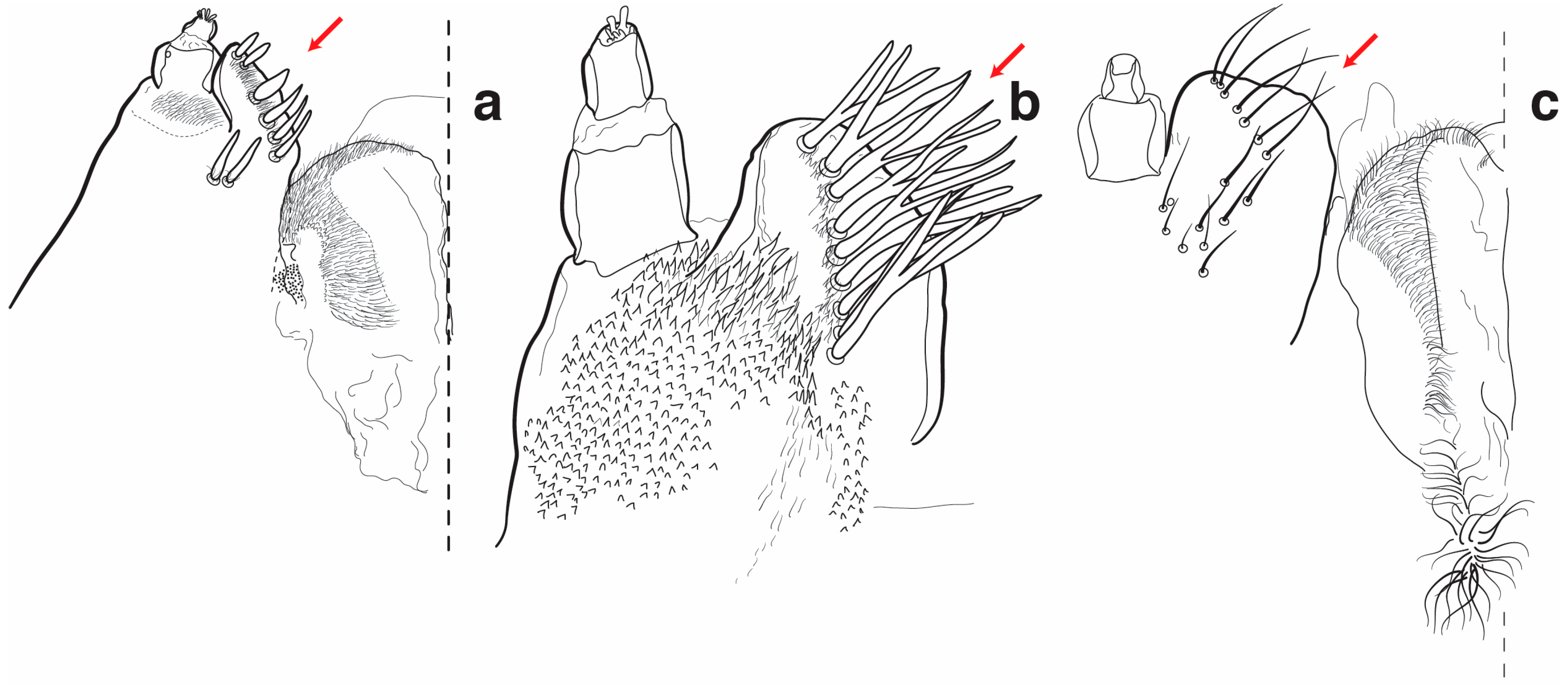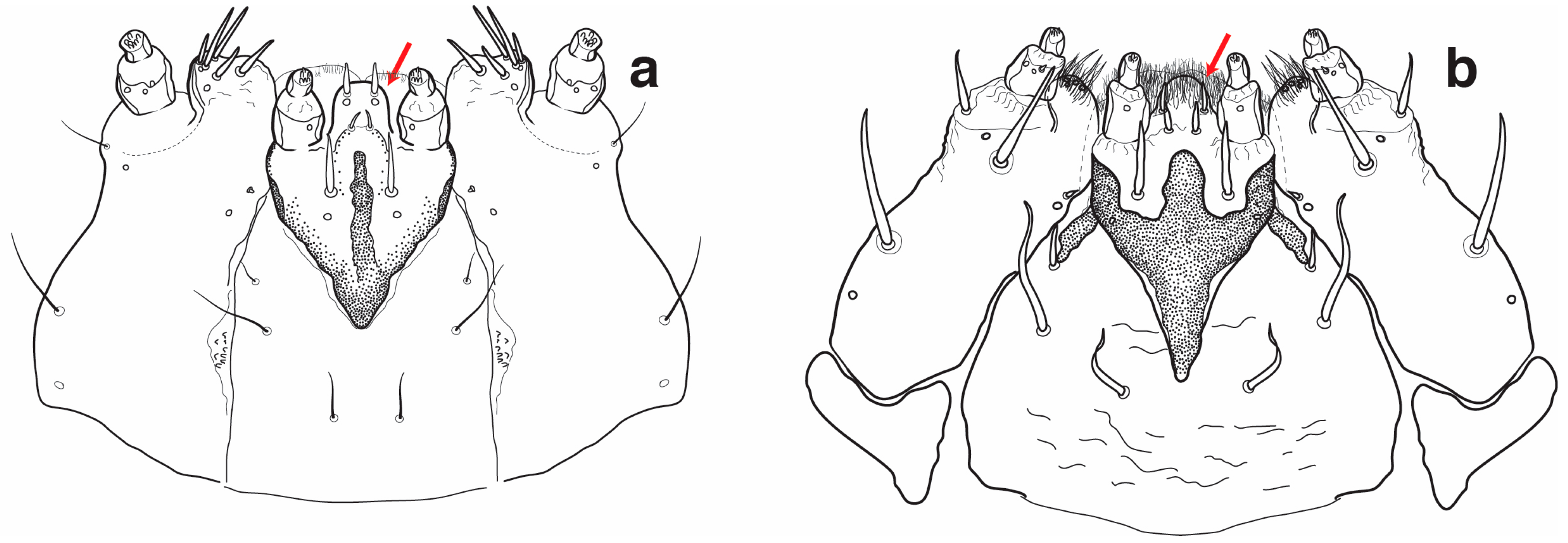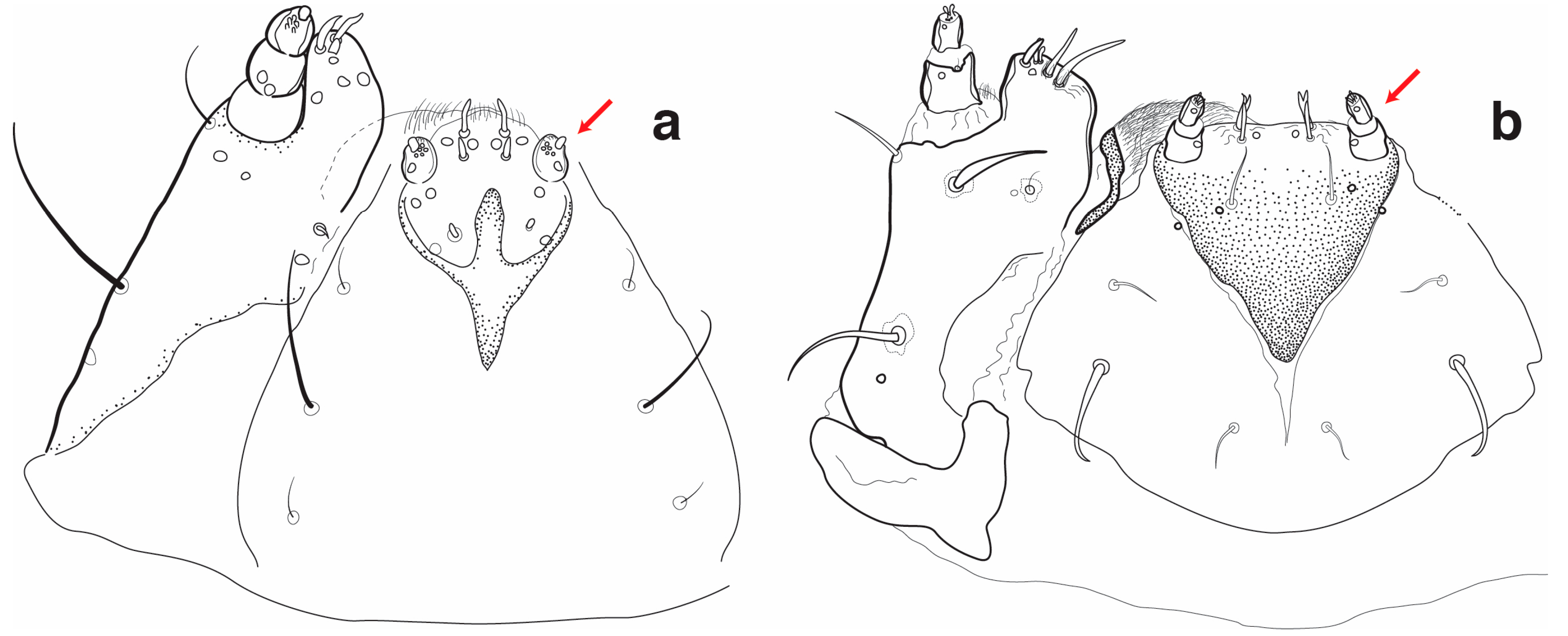
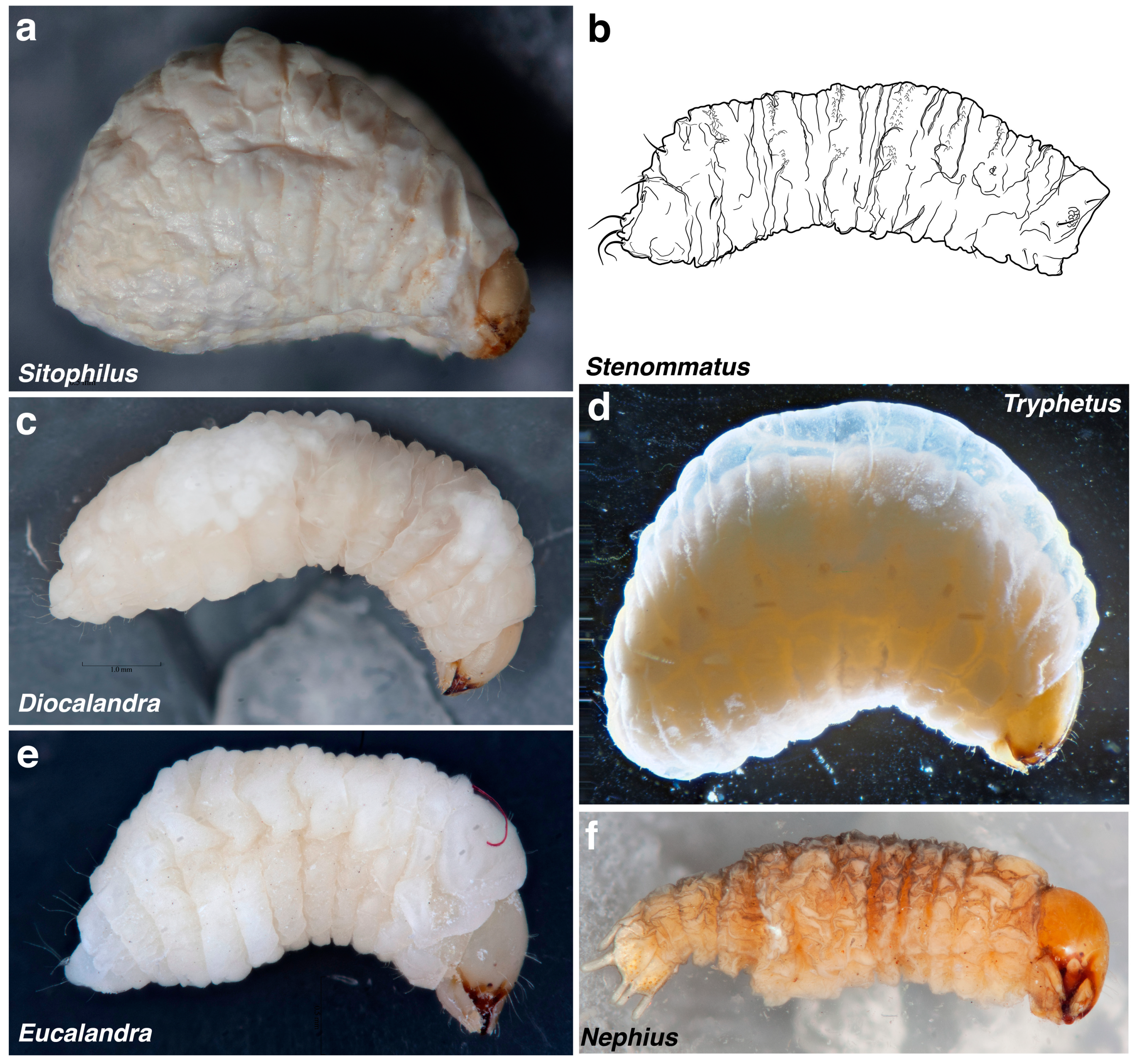
An Illustrated Synoptic Key and Comparative Morphology of the Larvae of Dryophthorinae (Coleoptera, Curculionidae) Genera with Emphasis on the Mouthparts

Abstract
1. Introduction
2. Materials and Methods
2.1. Specimens
2.2. Slides/Associations
2.3. Slide Preparation
2.4. Drawings and Imaging
2.5. Terminology
2.6. Key: Structure and User Instructions
3. Results
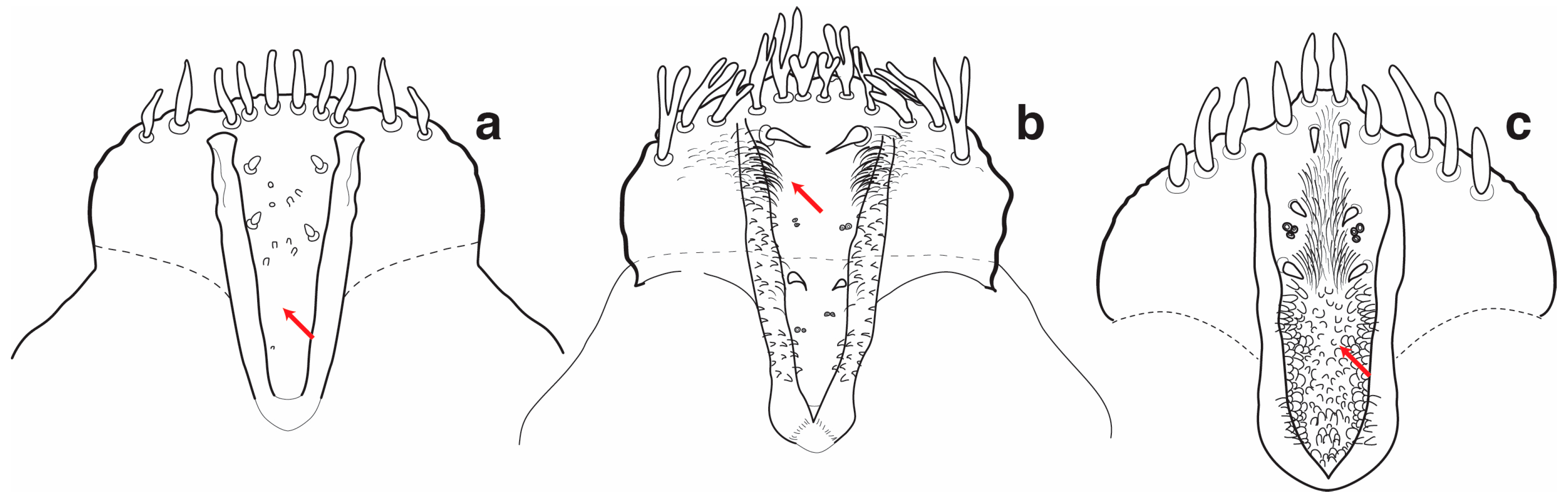
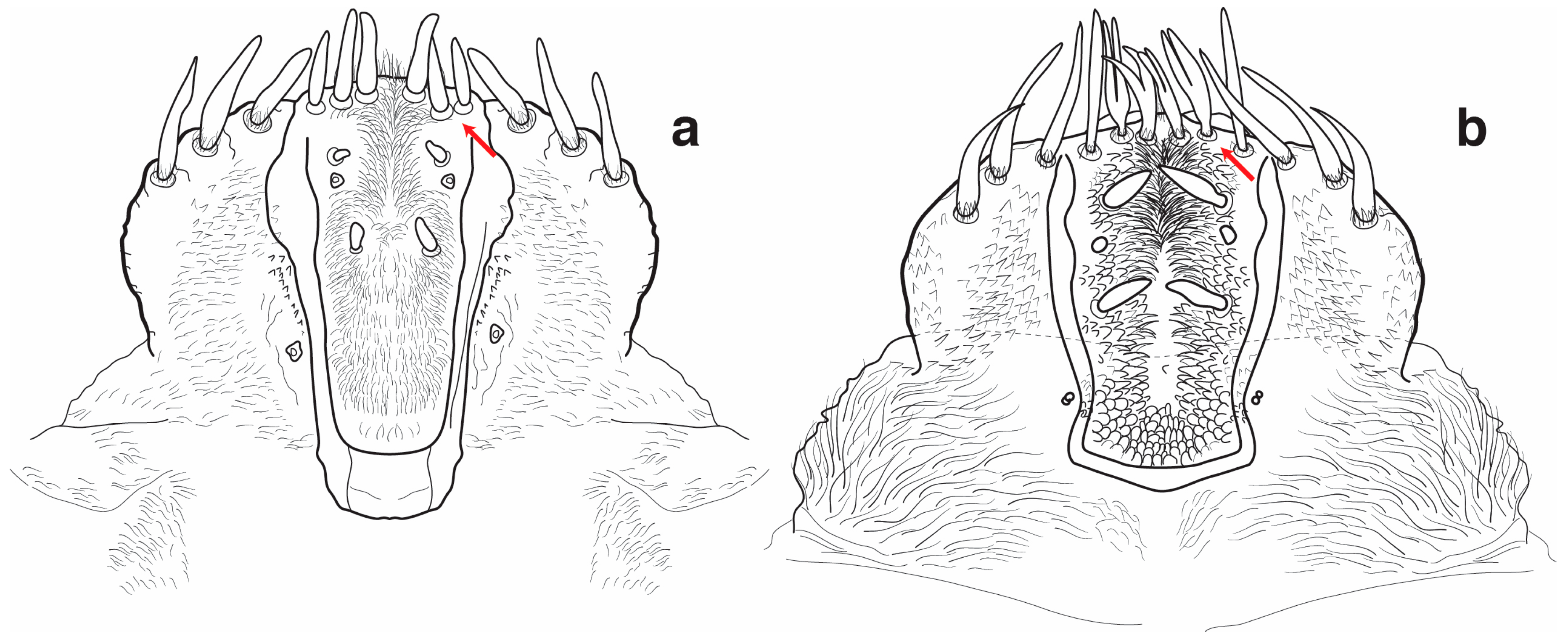
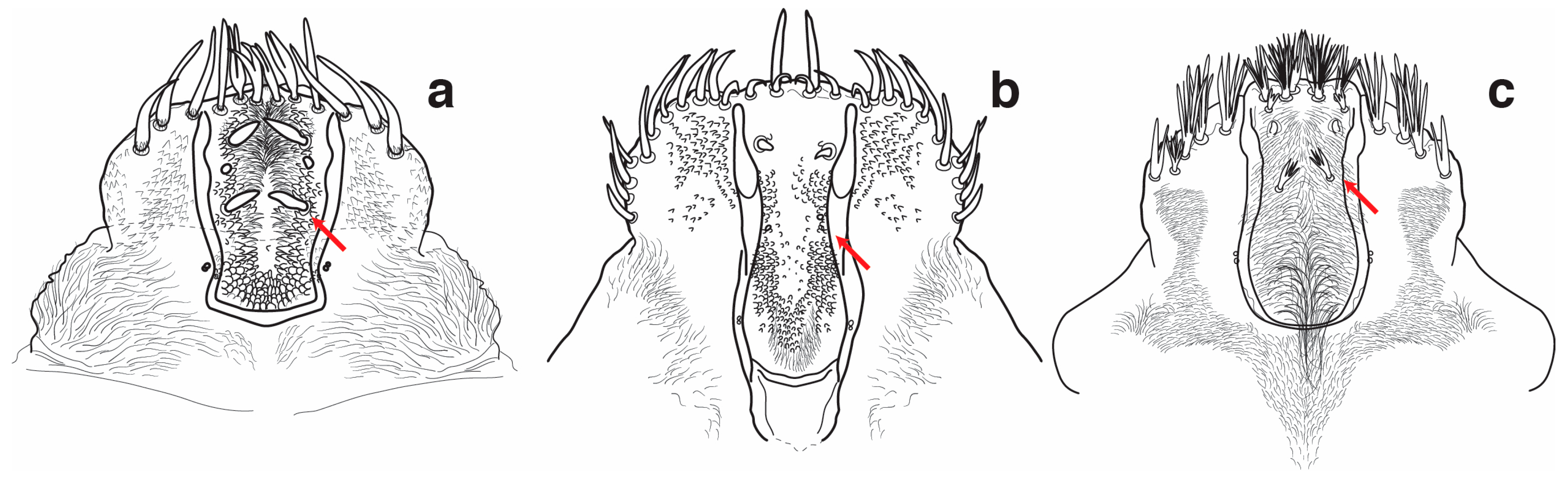
“Larva, 1. Body shape typically expanded between Abd IV and Abd V, narrowing abruptly (seed inhabiting forms such as Sitophilus Schoenherr are subspherical). 2. Abd VIII/IX together forming a depressed dorsal disk. 3. Dorso- and ventropleural abdominal areas subdivided into 2, 3, or 4 superimposed lobes. 4. Anus subterminal or ventral. 5. Head usually free, longer than wide, entire behind; postoccipital condyles obsolete. 6. Labrum rounded, rarely distinctly trilobate. 7. Tormae well developed, subparallel, or convergent, often joined by a basal bridge. 8. Maxilla with dorsal malal setae usually branched; some setae of other mouthparts may also be branched. 9. Hypopharynx often densely pubescent. 10. Hyphopharyngeal bracon clear (Sitophilus granarius and S. zeamais are exceptions). 11. Spiracles ovate-fringed with an outer skin fold narrowly pigmented, or subtriangular with unpigmented skin fold; aligned vertically with airtubes dorsal. 12. Spiracles of Abd VIII positioned on dorsal disk, caudad.”
3.1. Synoptic Key to Larval Dryophthorinae
3.1.1. Habitus
- a.
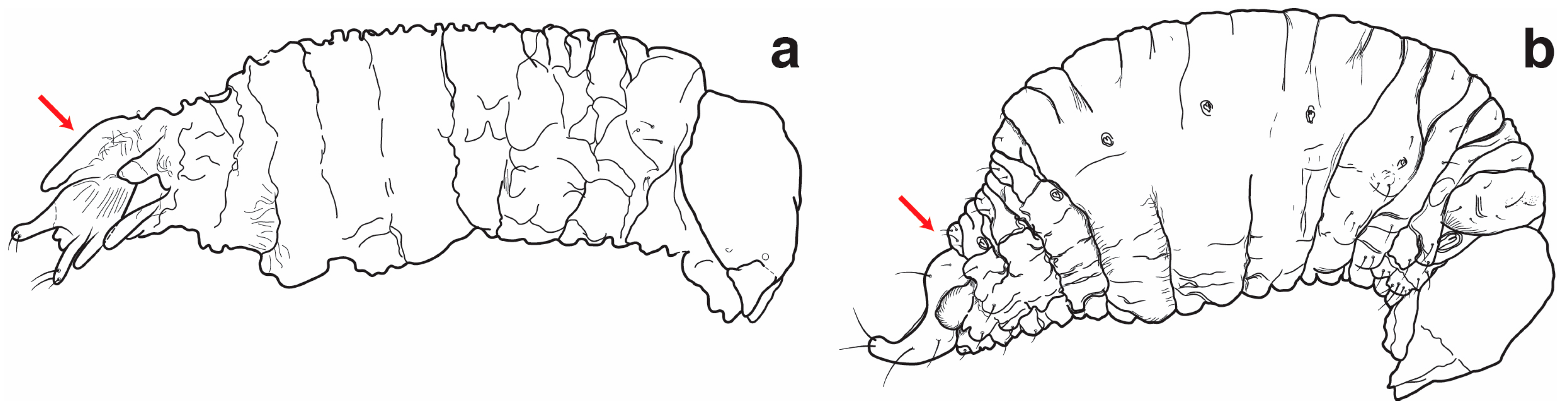
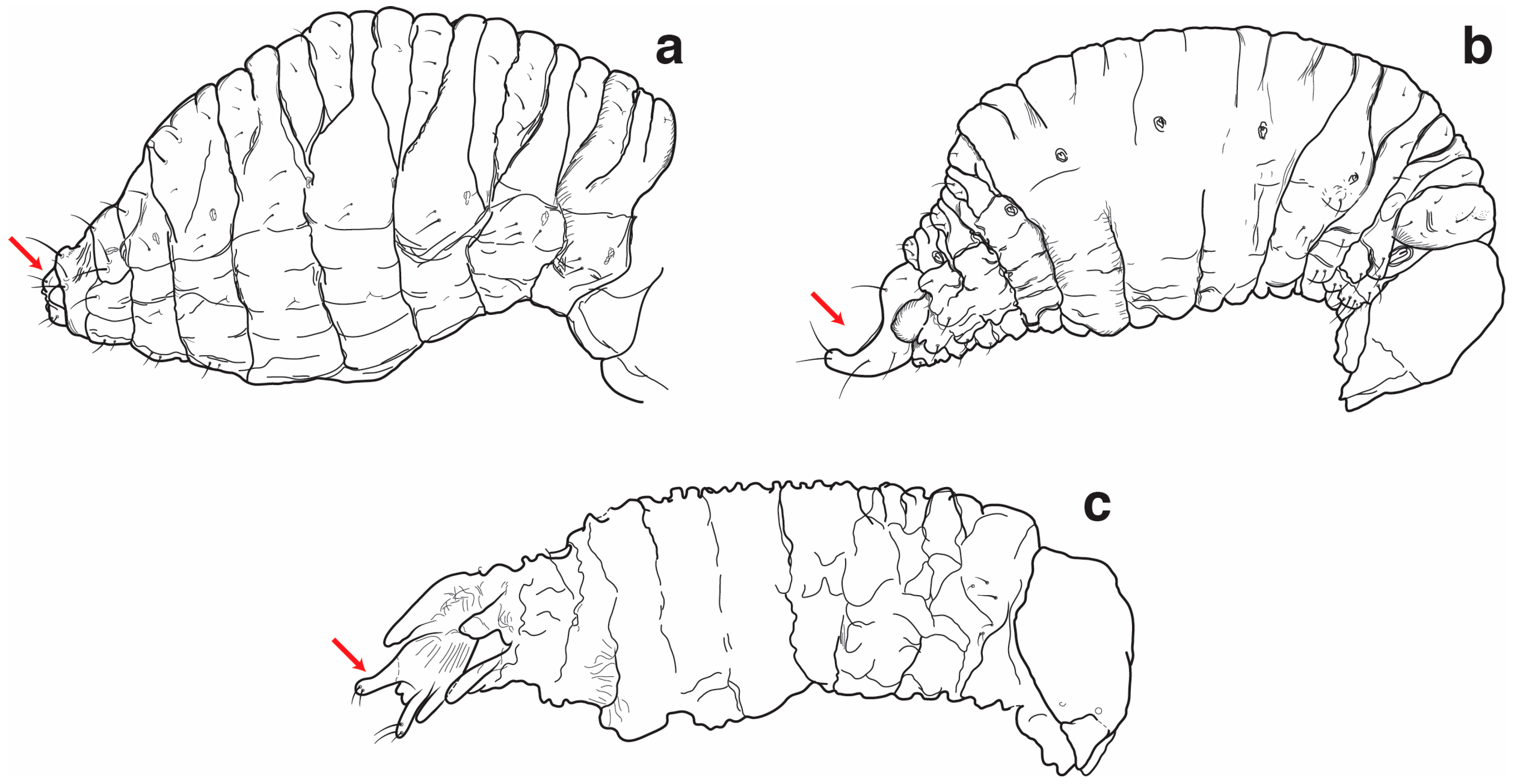
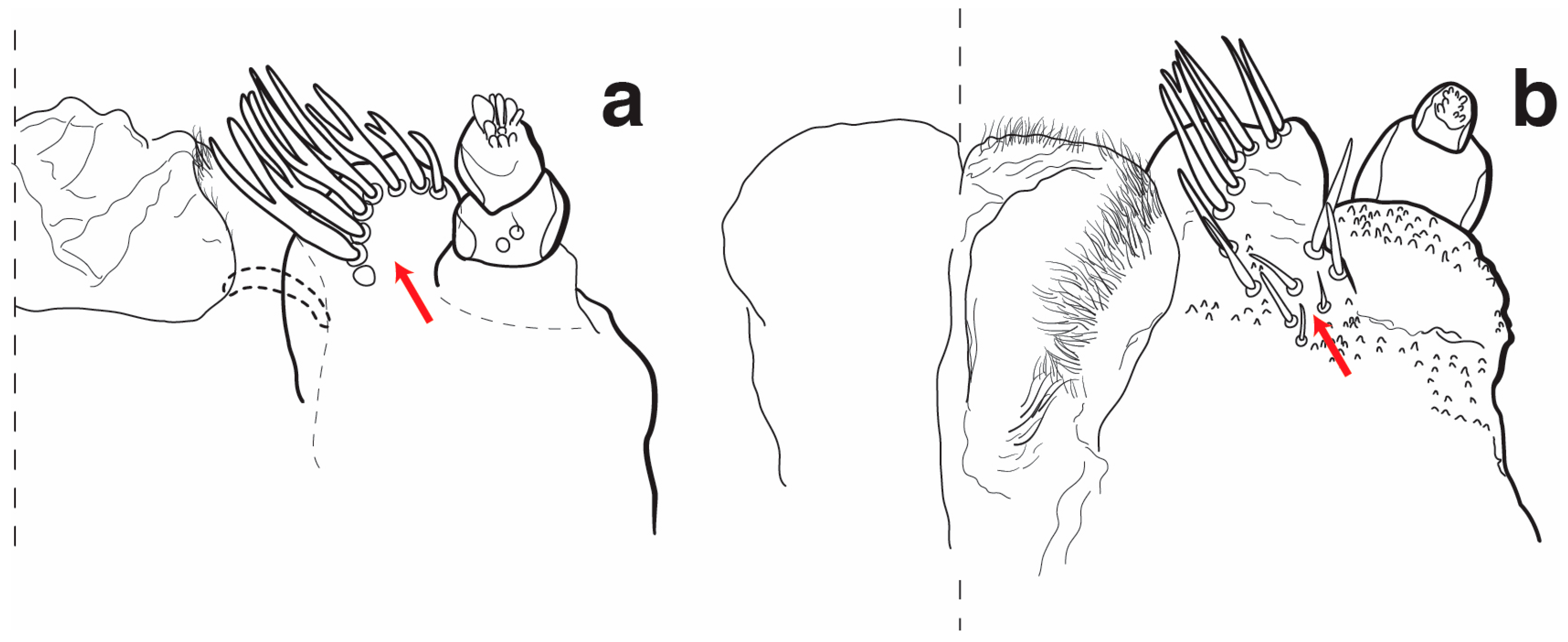
- Small (~2–8 mm) (Figure 1)Diocalandra*, Dryophthoroides, Dryophthorus, Eucalandra*, Myocalandra*, Nephius (=Anius), Polytus, Stenommatus, Tryphetus, Xerodermus
- b.
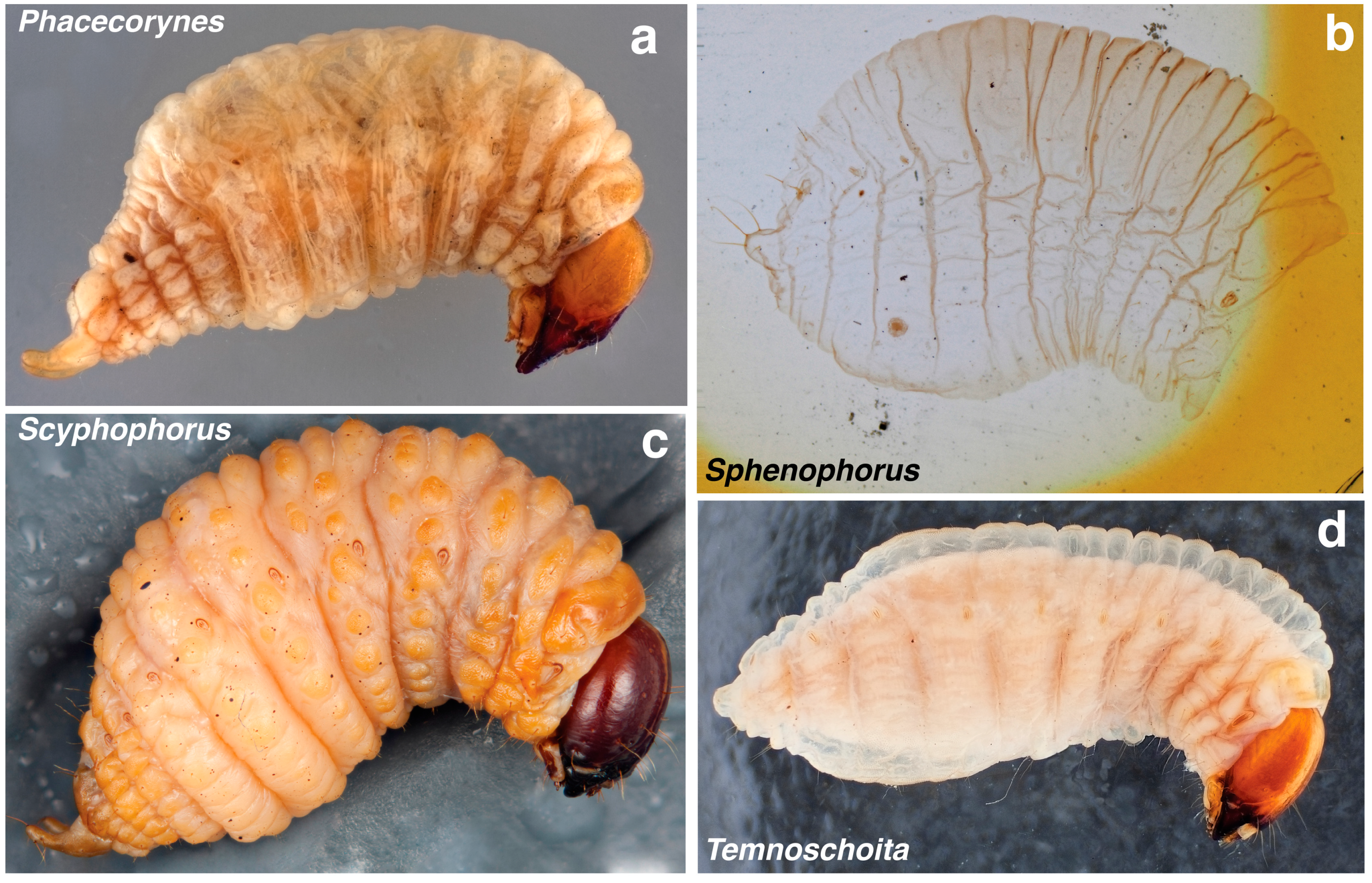
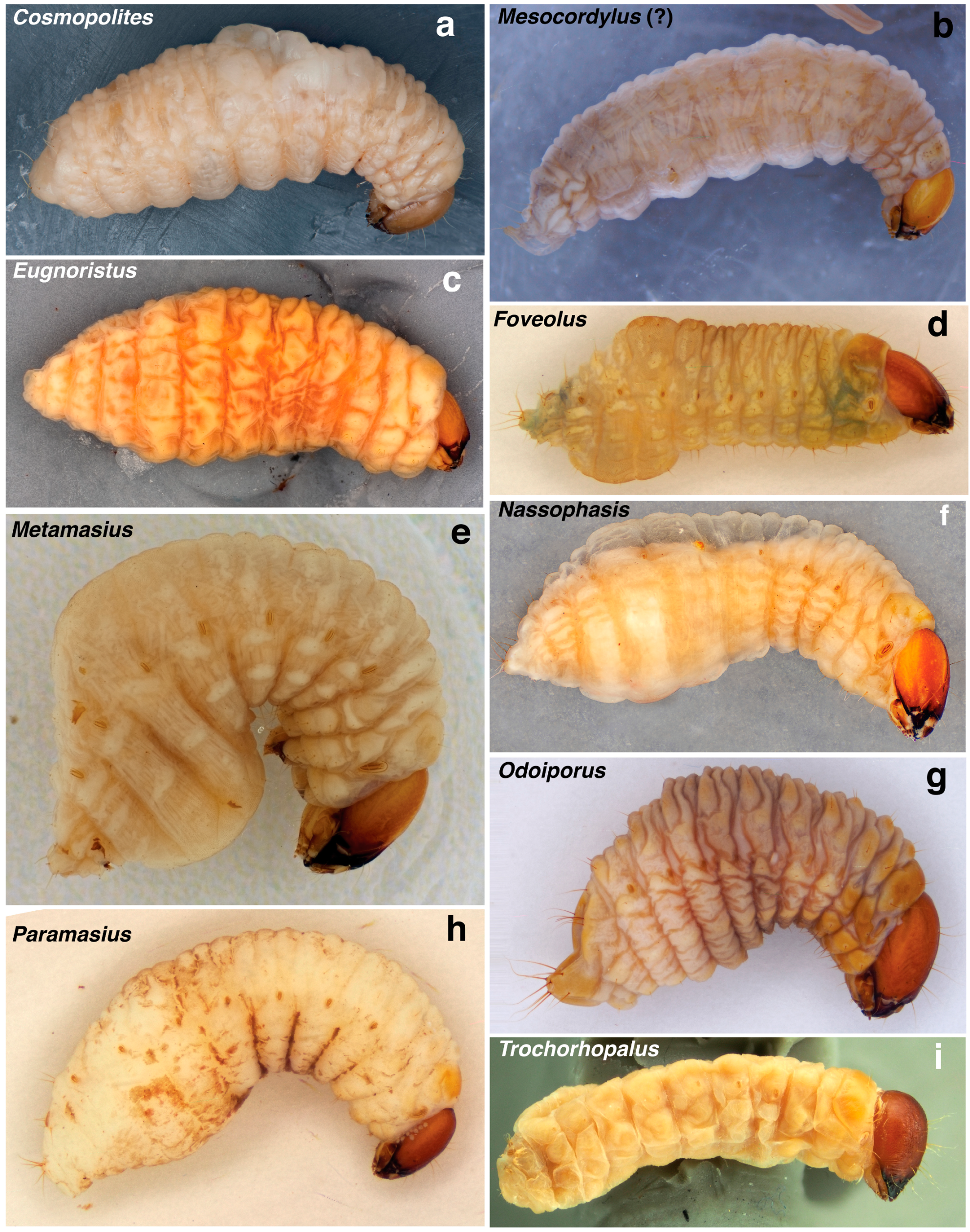
- Cactophagus, Cosmopolites, Diathetes*, Diocalandra*, Eucalandra*, Eugnoristus, Foveolus, Mesocordylus (probably), Metamasius, Myocalandra*, Nassophasis, Odoiporus, Paramasius, Phacecorynes, Poteriophorus*, Rhabdoscelus, Rhodobaenus, Scyphophorus, Sparganobasis*, Sphenophorus, Temnoschoita, Trochorhopalus
- c.
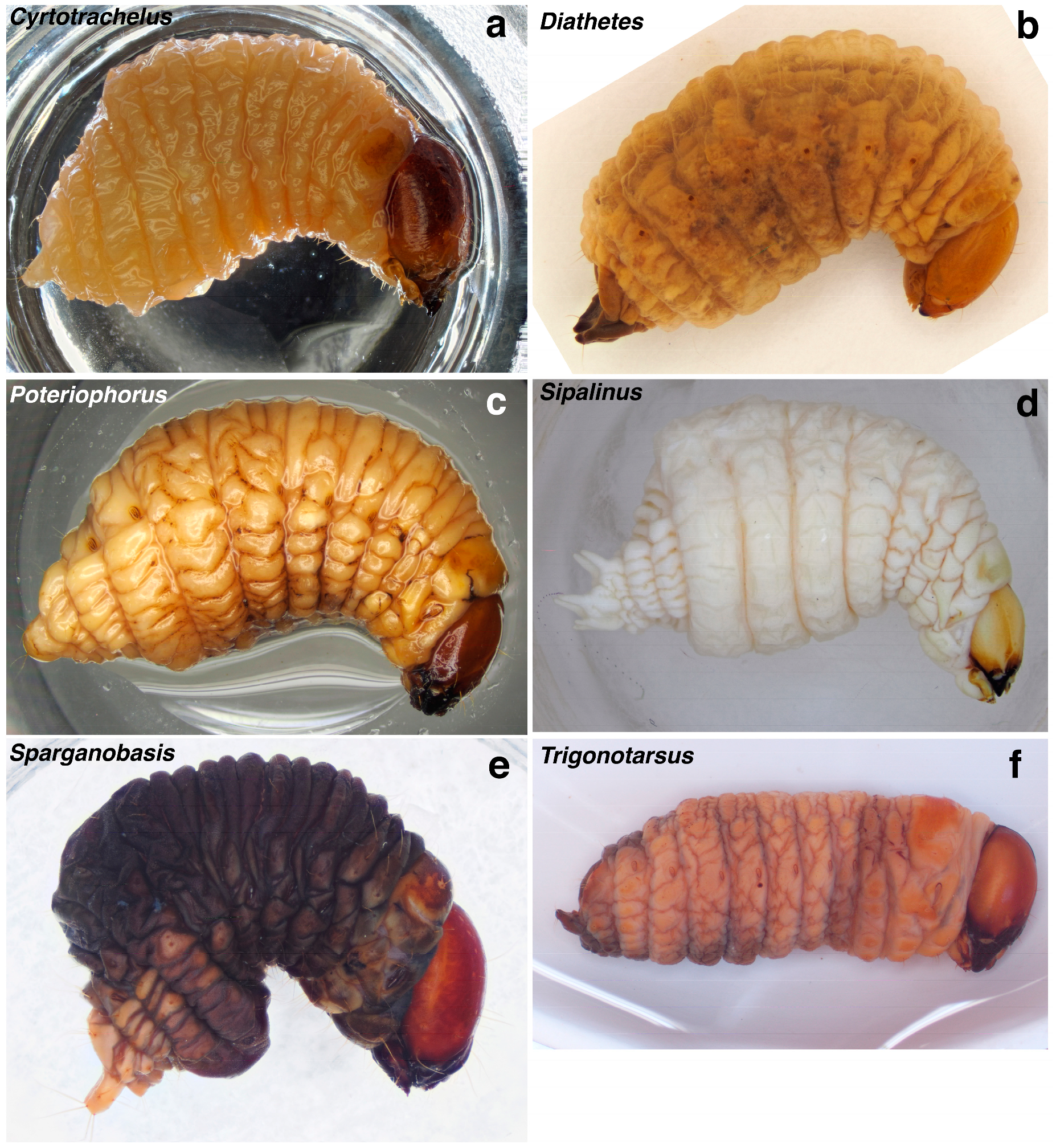
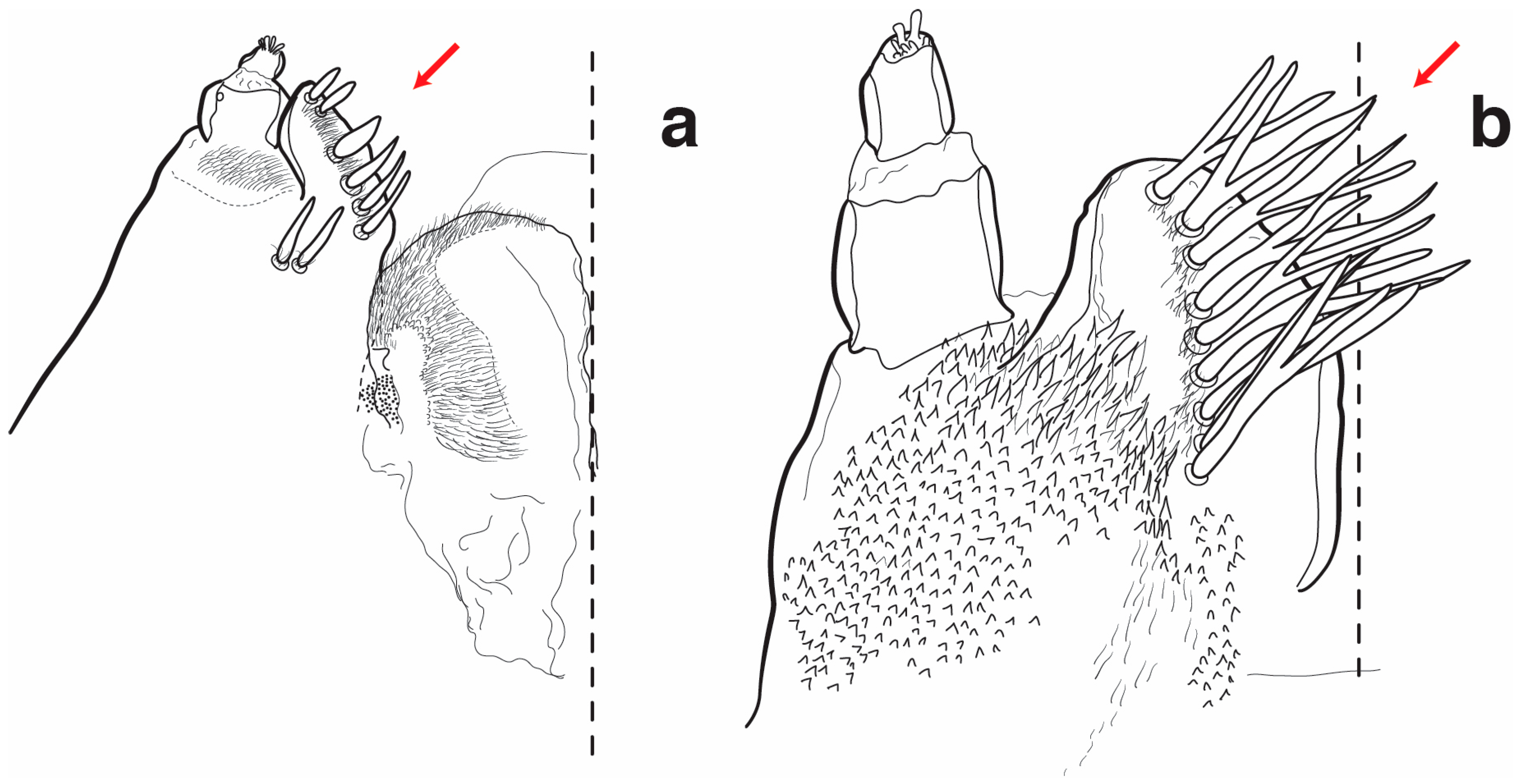
- Large (~16–40 mm) (Figure 4)Cyrtotrachelus, Diathetes*, Dynamis, Poteriophorus*, Rhinostomus, Rhynchophorus, Sipalinus, Sitophilus, Sparganobasis*, Trigonotarsus, Yuccaborus
- a.
- PresentCactophagus, Cosmopolites, Cyrtotrachelus, Diathetes, Diocalandra, Dryophthoroides [12], Dryophthorus, Dynamis [13], Eucalandra, Eugnoristus, Foveolus, Mesocordylus (probably), Metamasius, Myocalandra, Nassophasis, Nephius (=Anius), Odoiporus, Paramasius, Phacecorynes, Polytus, Poteriophorus, Rhabdoscelus, Rhodobaenus, Rhynchophorus, Scyphophorus, Sipalinus, Sparganobasis, Sphenophorus, Stenommatus, Temnoschoita, Trigonotarsus, Trochorhopalus, Xerodermus [11], Yuccaborus
- b.
- AbsentSitophilus, Tryphetus
- a.
- Ventral, subapicalCactophagus, Cosmopolites, Cyrtotrachelus, Diathetes, Diocalandra, Dryophthoroides [12], Dryophthorus, Dynamis [13], Eucalandra, Foveolus, Mesocordylus (probably), Metamasius, Myocalandra, Nassophasis, Nephius (=Anius), Odoiporus, Paramasius, Phacecorynes, Polytus, Poteriophorus, Rhabdoscelus, Rhinostomus, Rhodobaenus, Rhynchophorus, Scyphophorus, Sipalinus, Sparganobasis, Sphenophorus, Stenommatus, Temnoschoita, Trigonotarsus, Trochorhopalus, Xerodermus [11], Yuccaborus
- b.
- TerminalEugnoristus, Sitophilus, Tryphetus
3.1.2. Head
- a.
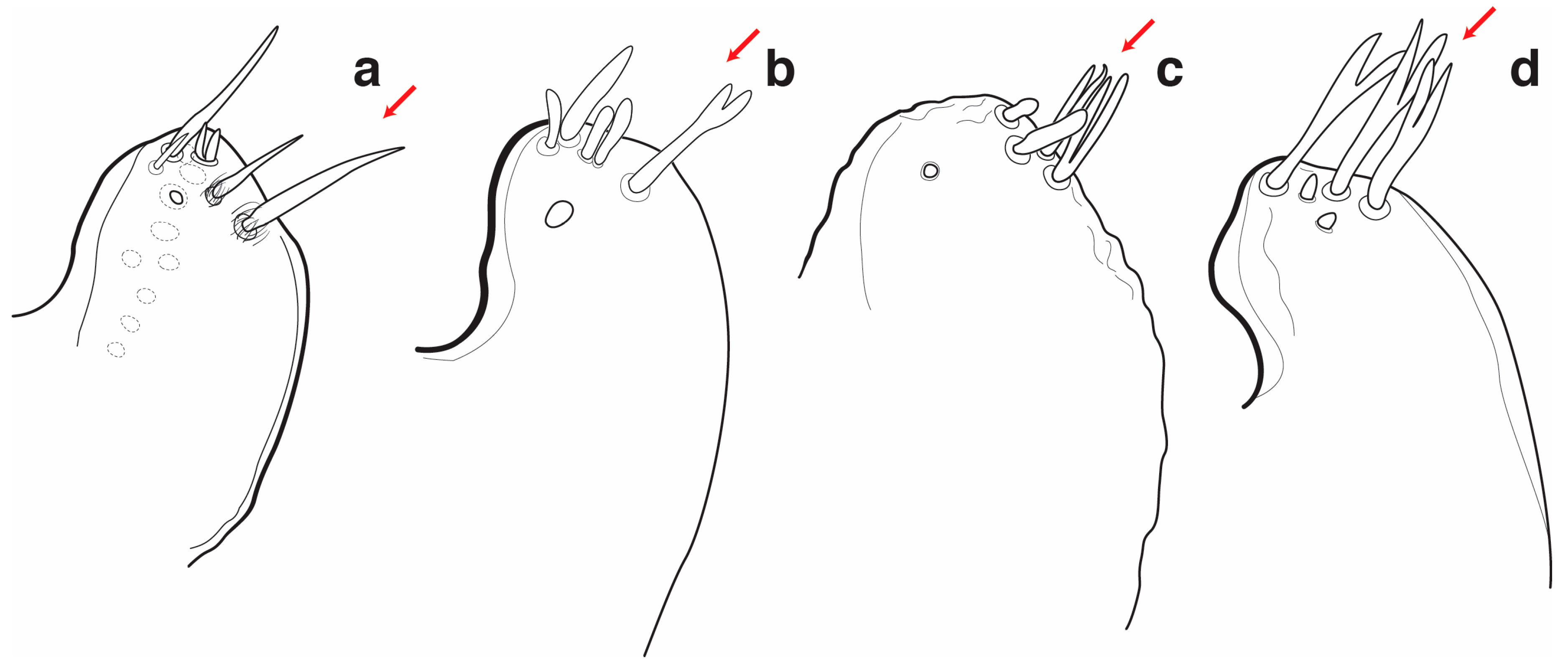
- 8 (4 pairs) (fs1 absent)Cyrtotrachelus#
- b.
- 10 (5 pairs)Cactophagus, Cosmopolites, Diathetes, Diocalandra (fs1 minute), Dynamis [13], Eucalandra, Eugnoristus, Foveolus, Mesocordylus (probably), Metamasius, Myocalandra, Nassophasis, Nephius (=Anius), Odoiporus, Paramasius, Phacecorynes, Polytus, Poteriophorus, Rhabdoscelus, Rhinostomus, Rhodobaenus, Rhynchophorus, Scyphophorus, Sipalinus, Sparganobasis, Sphenophorus, Sitophilus, Temnoschoita, Trigonotarsus, Trochorhopalus, Tryphetus, Yuccaborus
- c.
- 12 (6 pairs)Dryophthorus, StenommatusNot included: Dryophthoroides, Xerodermus
- a.
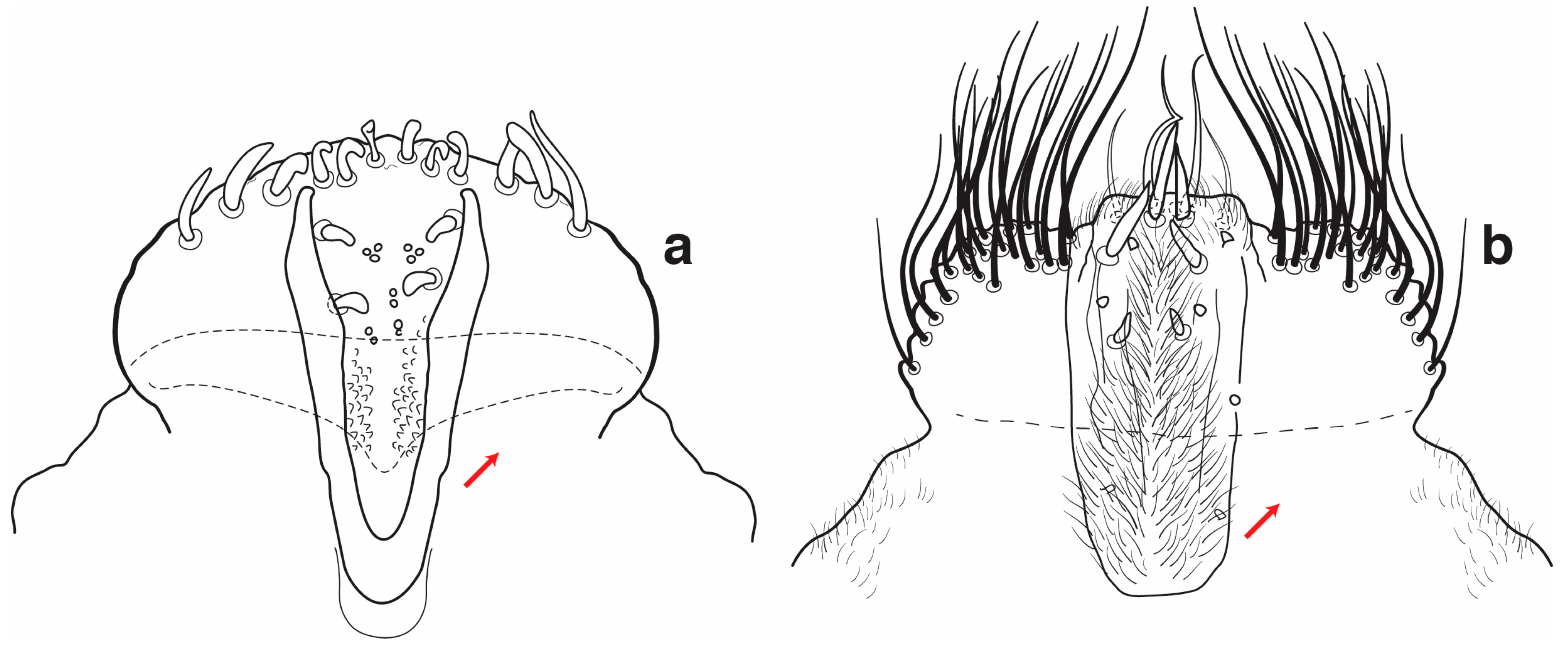
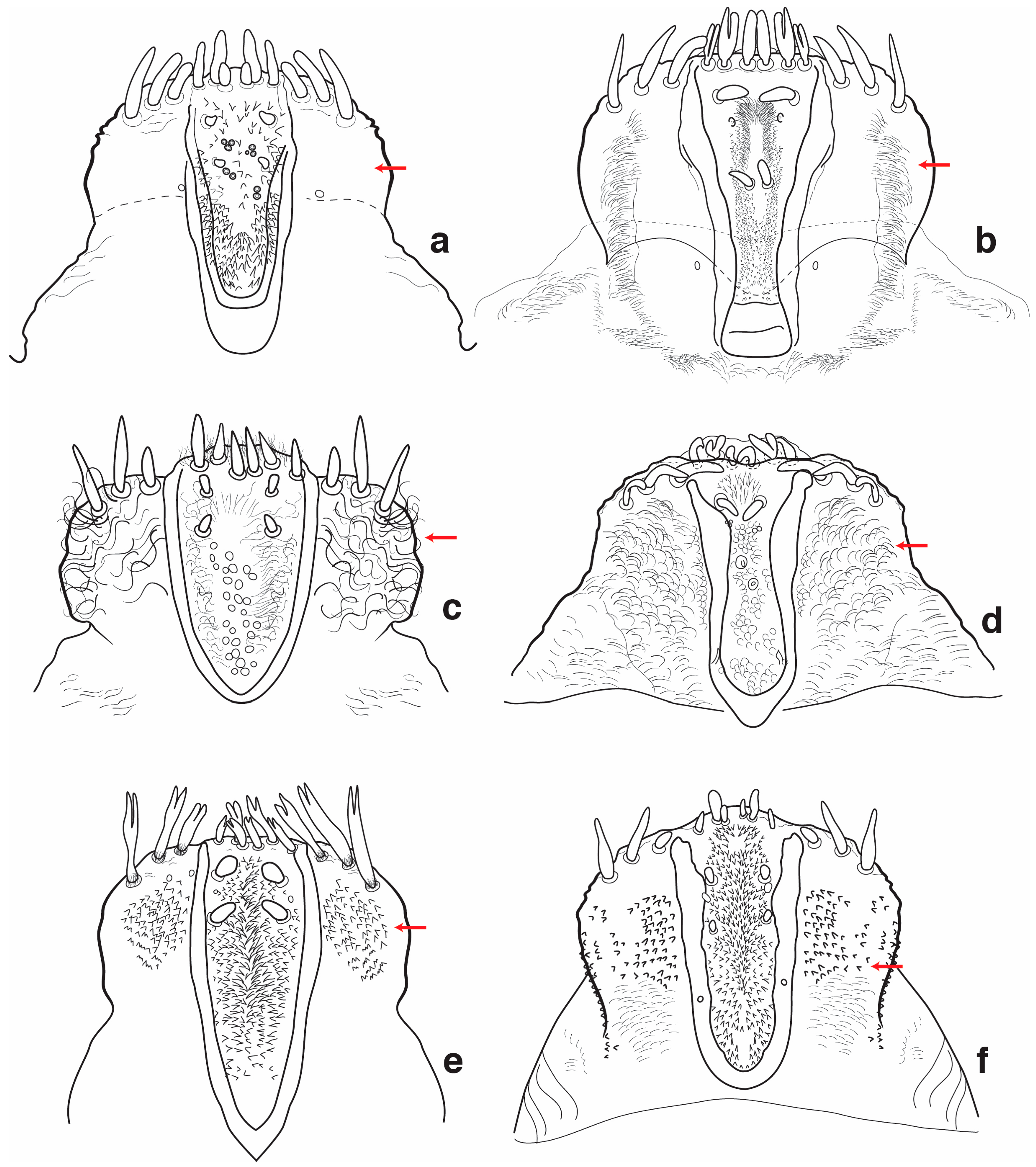
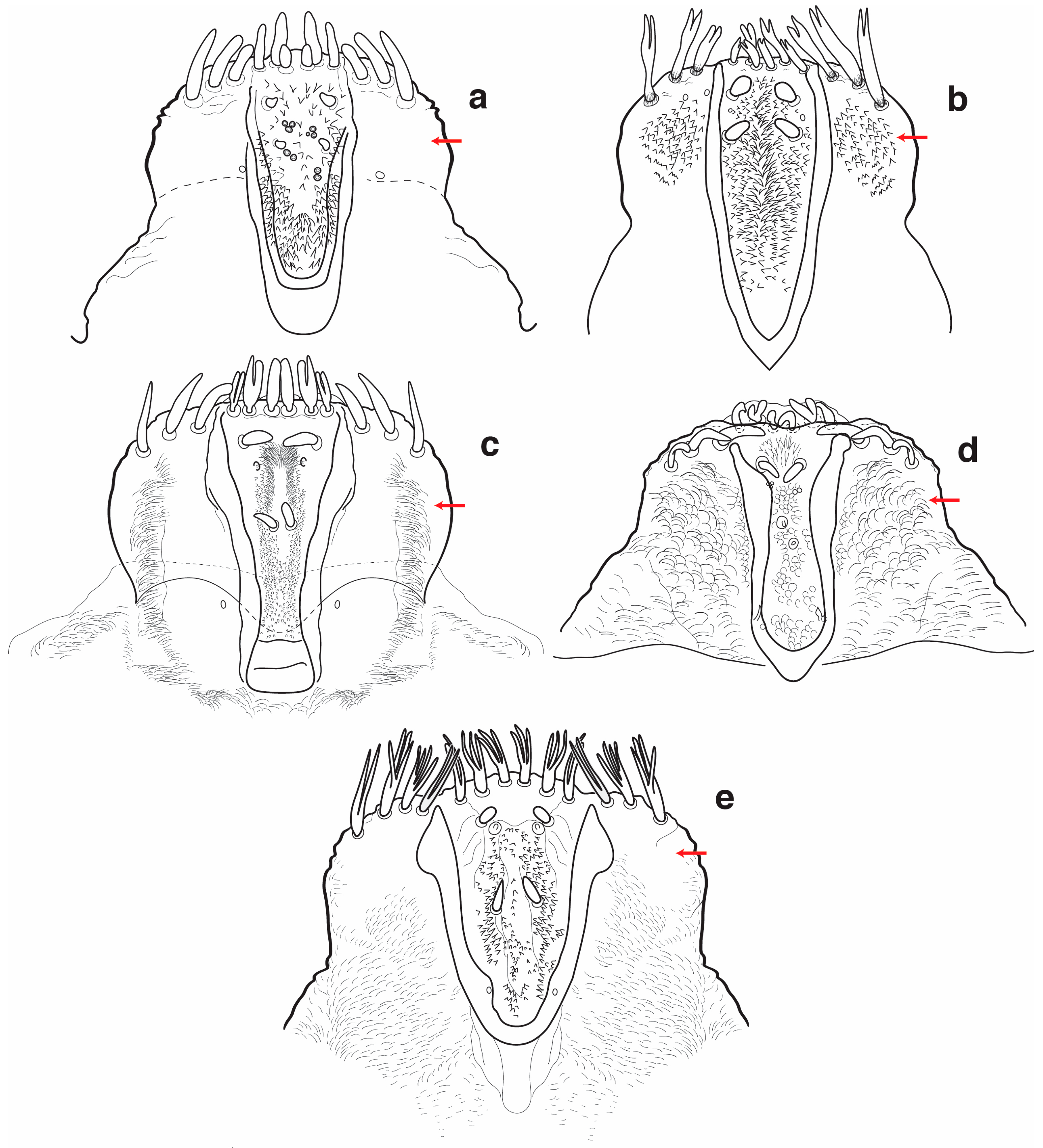
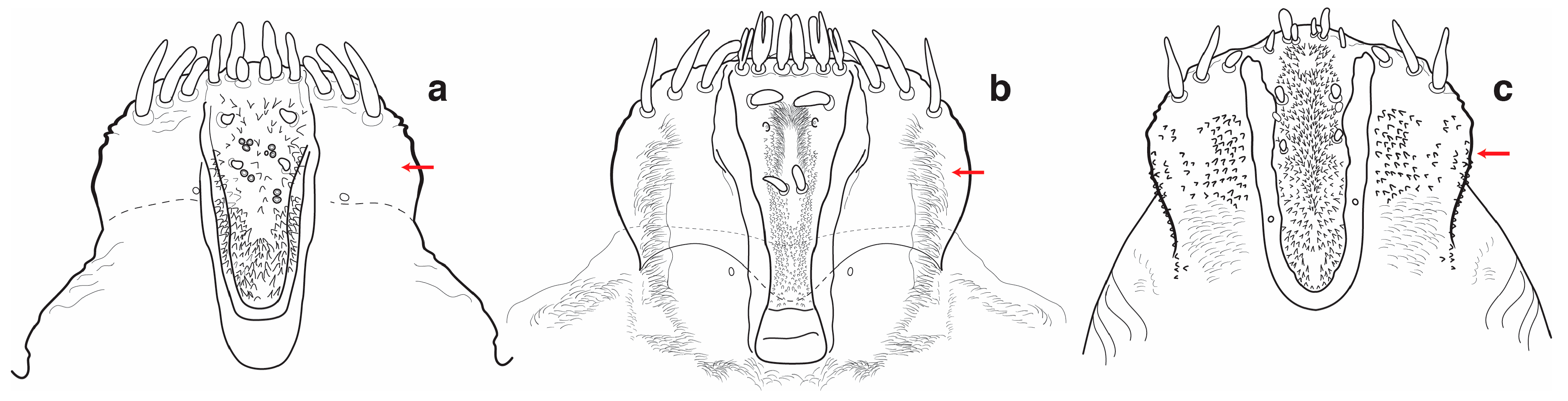
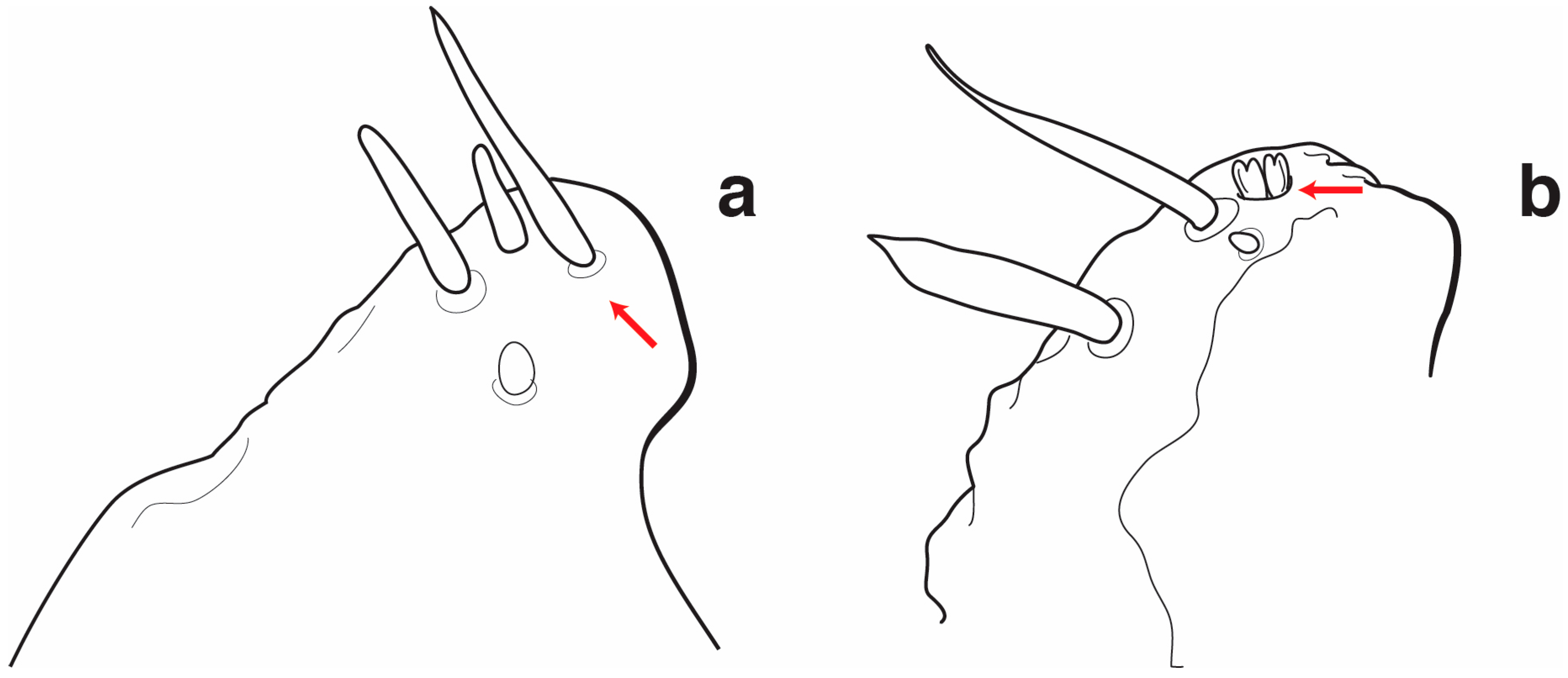
- Prominent laterally and mediallyCyrtotrachelus
- b.
- AbsentCactophagus, Cosmopolites, Diathetes, Diocalandra, Dryophthorus, Eucalandra, Eugnoristus, Foveolus, Mesocordylus (probably), Metamasius, Myocalandra, Nassophasis, Nephius (=Anius), Odoiporus, Paramasius, Phacecorynes, Polytus, Poteriophorus, Rhabdoscelus, Rhodobaenus, Rhynchophorus, Scyphophorus, Sipalinus, Sitophilus, Sparganobasis, Sphenophorus, Stenommatus, Temnoschoita, Trigonotarsus, Trochorhopalus, Tryphetus, YuccaborusNot included: Dryophthoroides, Xerodermus
- a.
- Apical, convex sensorium moderately sized in relation to cushion-like, basal segmentCactophagus, Cosmopolites, Cyrtotrachelus, Diathetes, Dynamis [13], Eucalandra, Eugnoristus, Foveolus, Mesocordylus (probably), Metamasius, Nassophasis, Odoiporus, Paramasius, Phacecorynes, Polytus#*, Poteriophorus, Rhabdoscelus, Rhodobaenus, Rhynchophorus, Scyphophorus, Sipalinus, Sparganobasis, Sphenophorus, Temnoschoita, Trigonotarsus, Trochorhopalus, Yuccaborus (seemingly 2 sensoria)
- b.
- Conical, sensorium relatively enlargedDiocalandra, Dryophthorus, Myocalandra#, Nephius (=Anius), Polytus#*, Sitophilus, Stenommatus, Xerodermus [11], TryphetusNot included: Dryophthoroides (but possibly b), Rhinostomus
3.1.3. Thorax
- a.
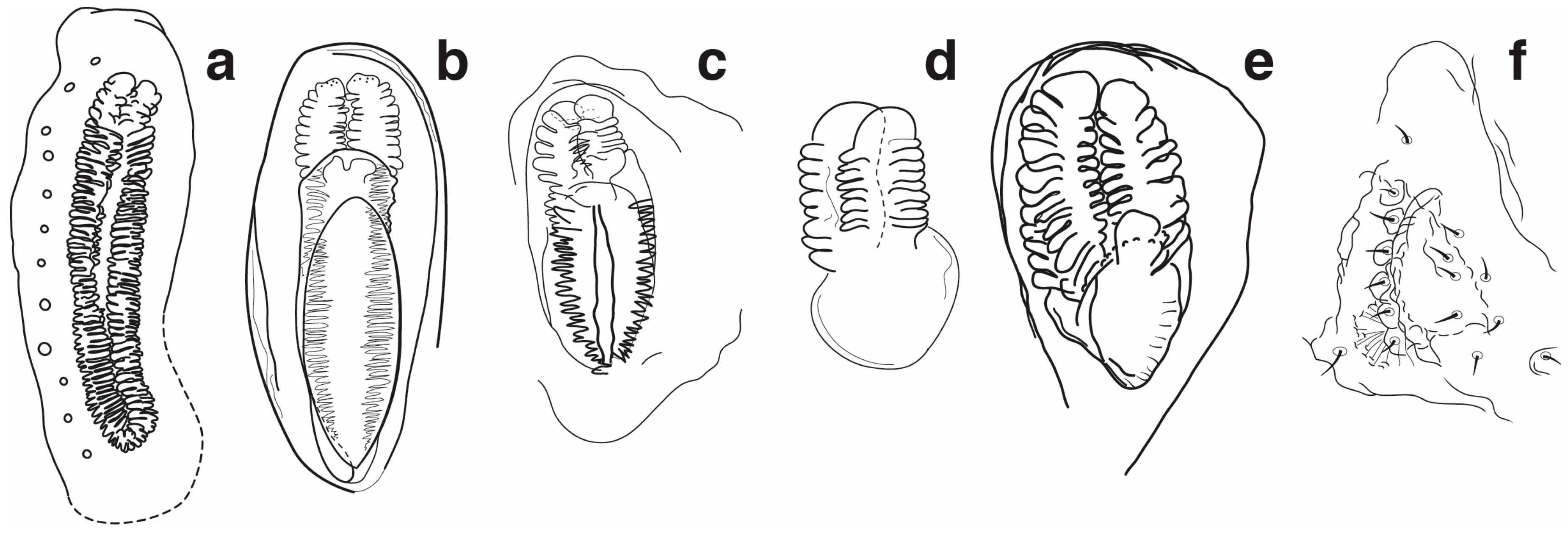
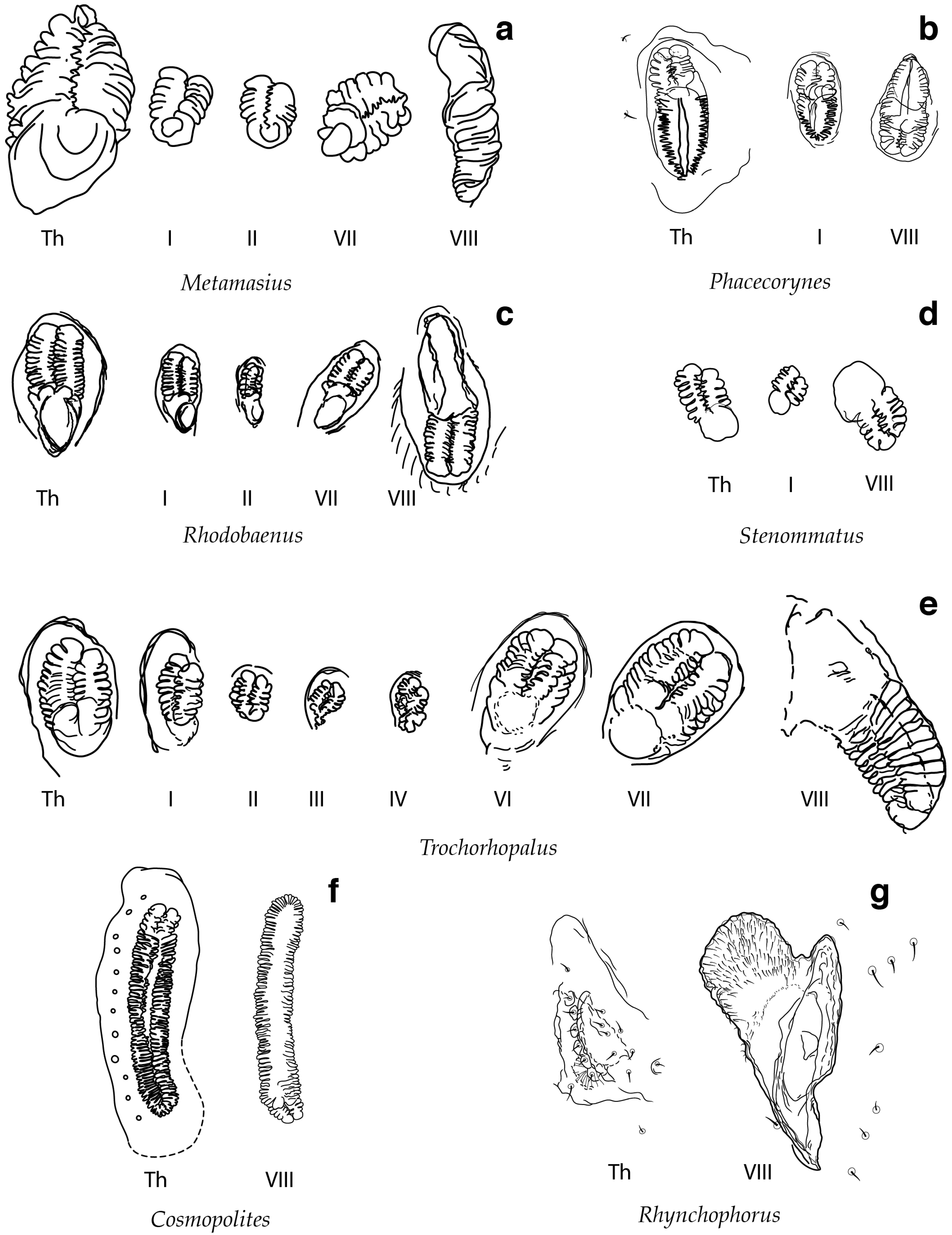
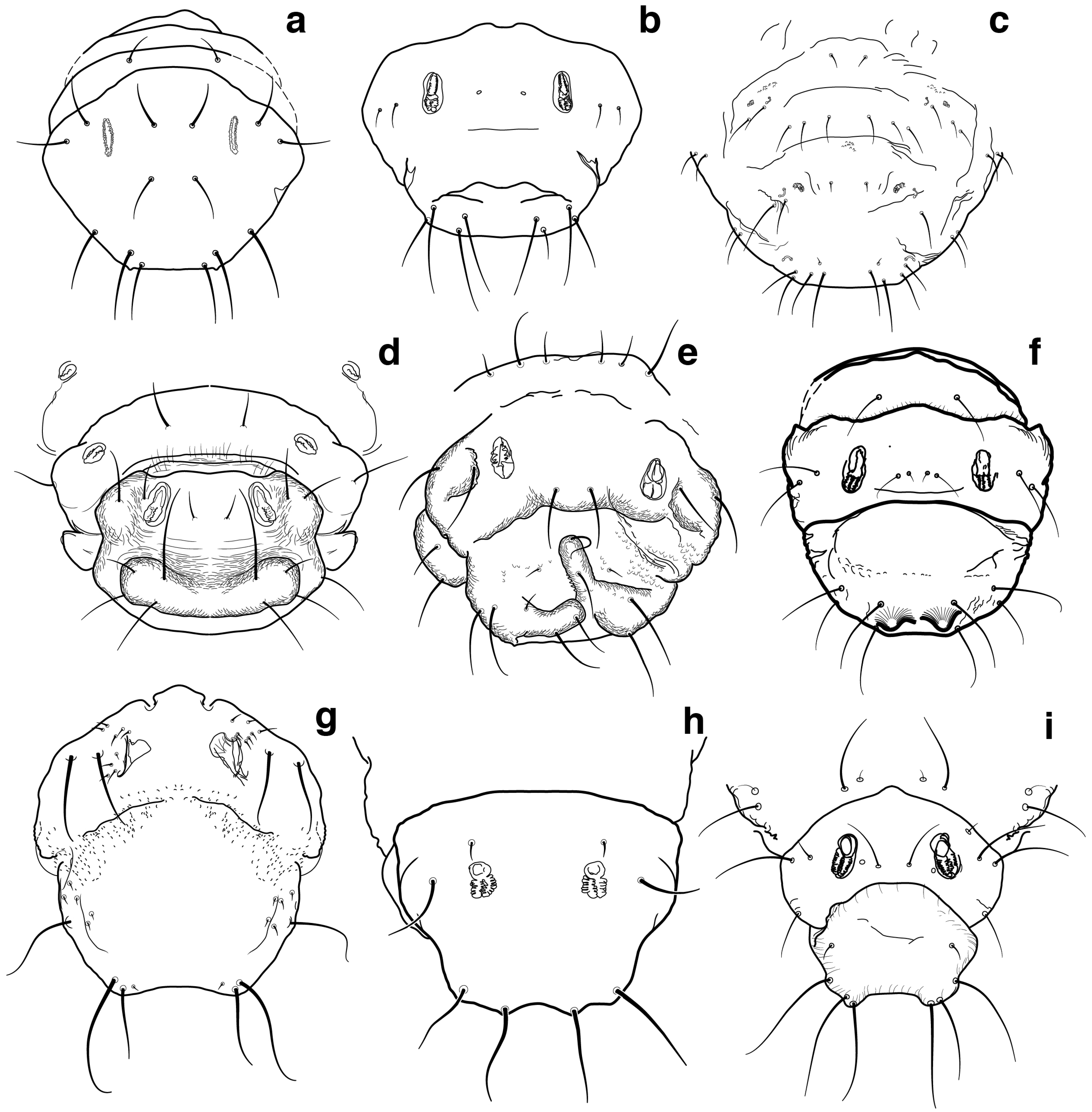
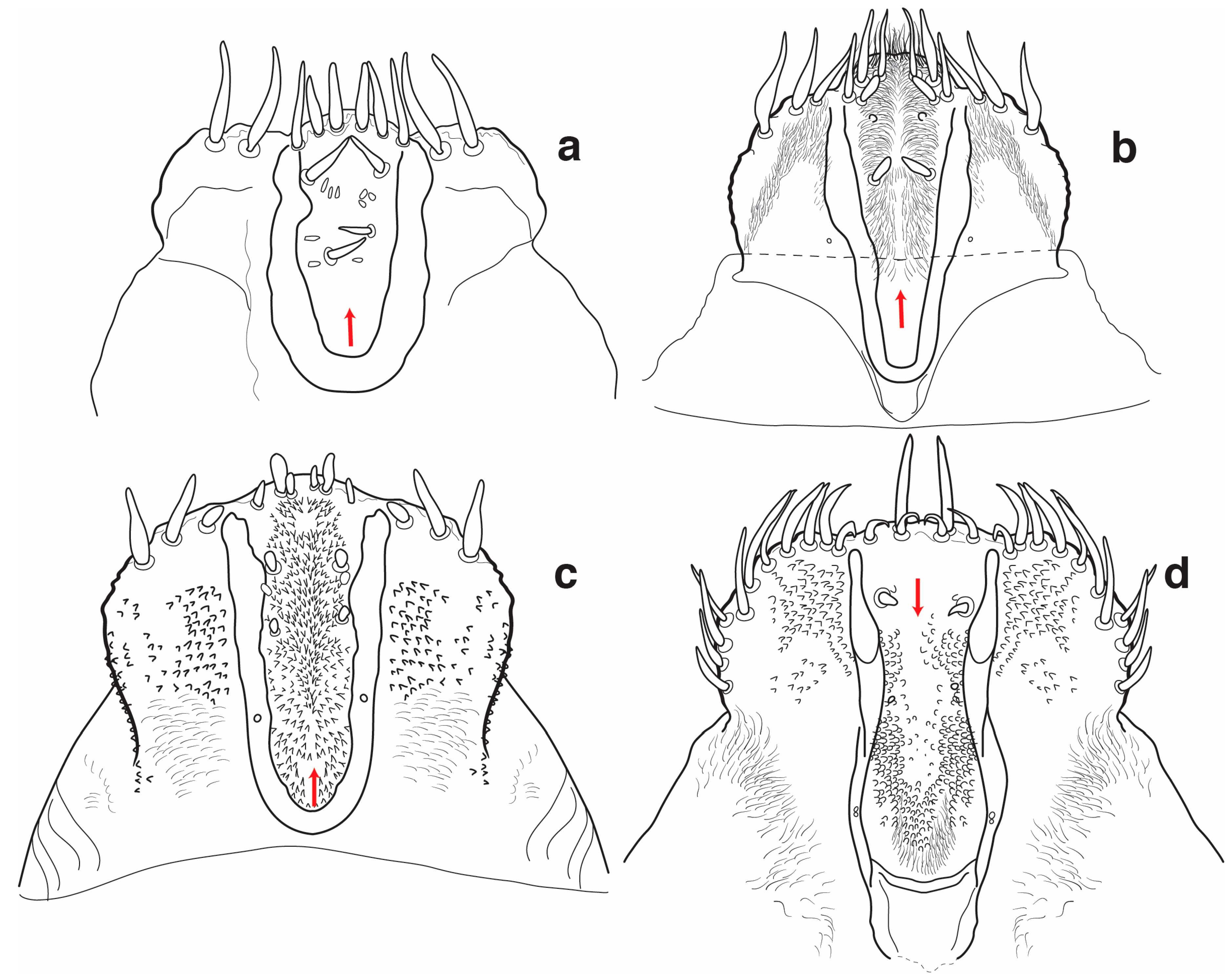
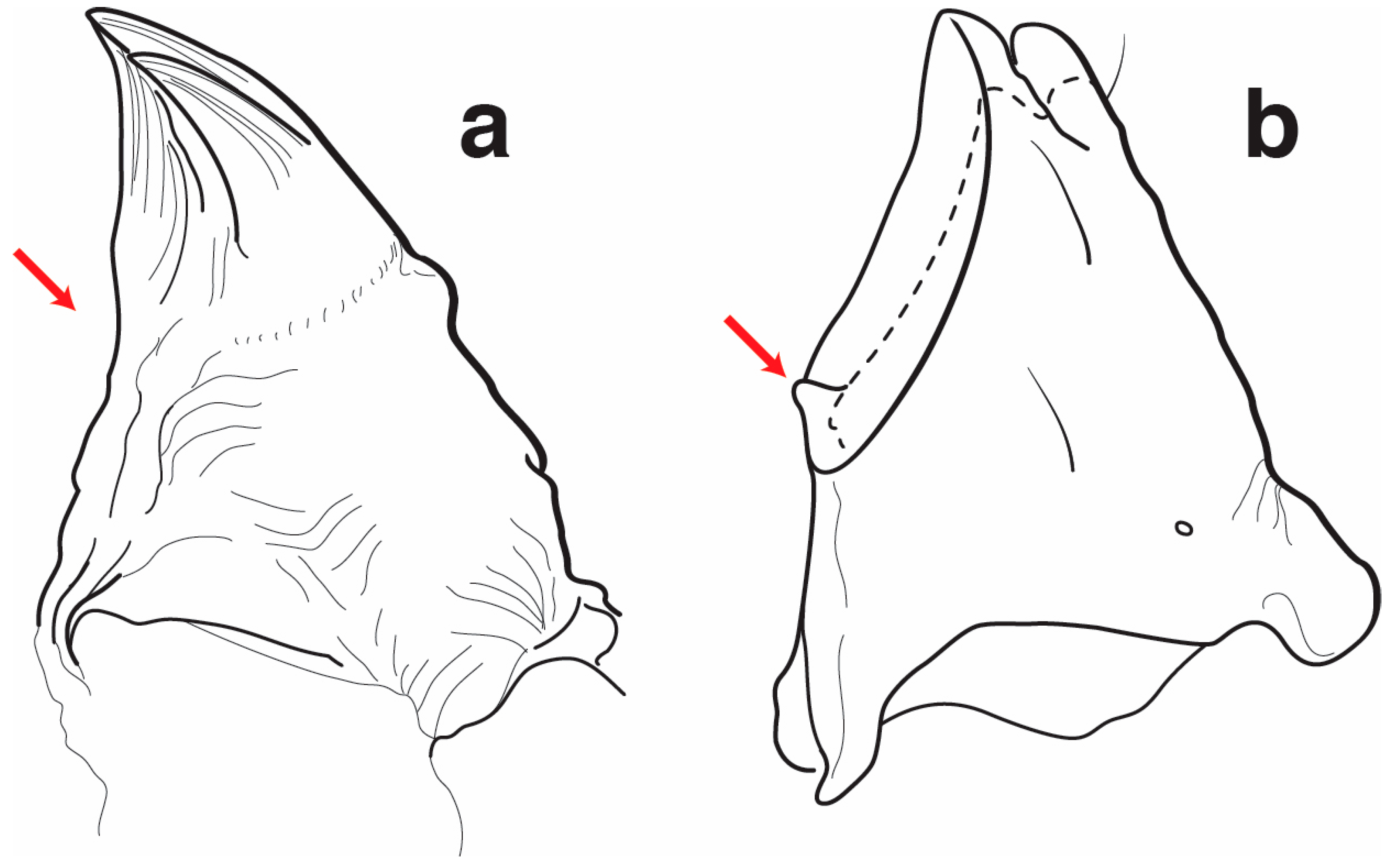
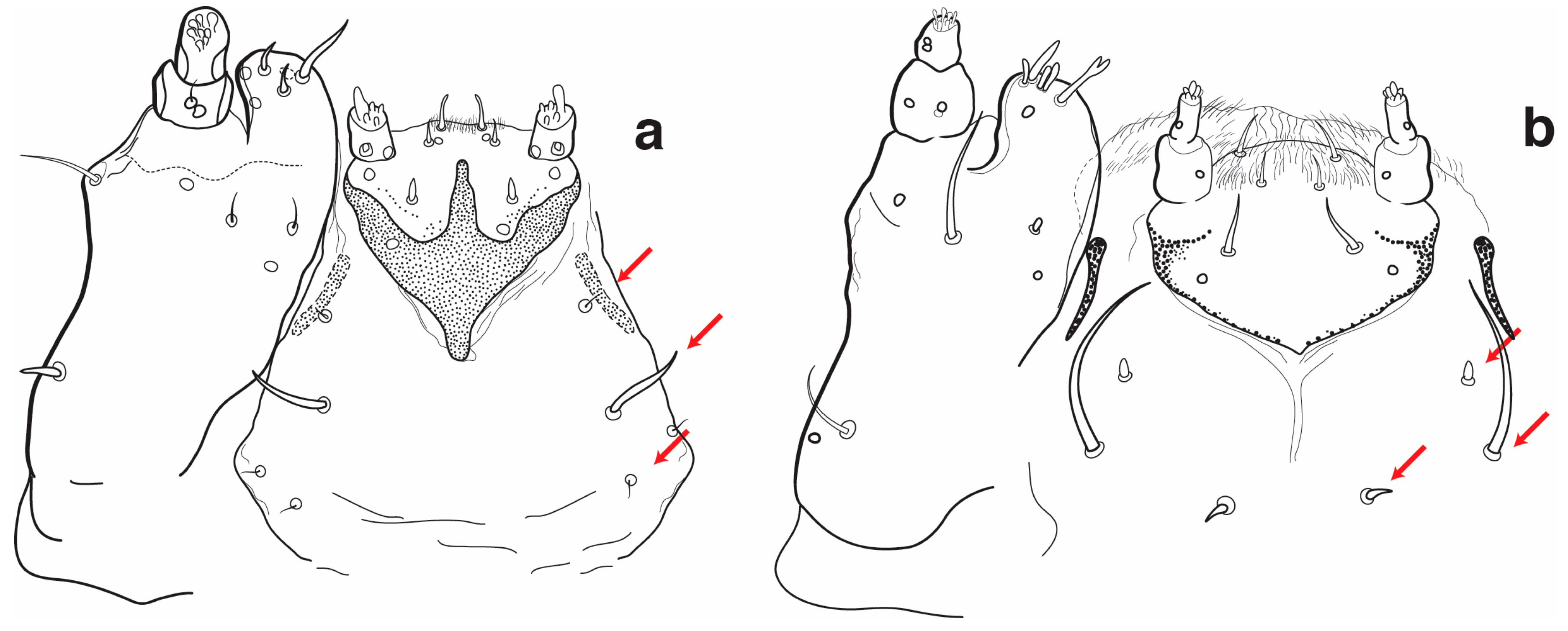
- Orifice 4 times longer than air tubeCosmopolites, Temnoschoita, Yuccaborus#*
- b.
- Orifice 3–4 times longer than air tube (elongate)Cactophagus, Metamasius ritchei*, Odoiporus, Rhabdoscelus*, Sparganobasis, Sphenophorus*, Trigonotarsus
- c.
- Orifice 2.5–2 times longer than air tube lengthDiocalandra, Eugnoristus, Foveolus, Paramasius, Phacecorynes, Rhabdoscelus*, Sitophilus granarius*, Sphenophorus pontederiae, Tryphetus
- d.
- Orifice as long as air tubeDiathetes, Nephius (=Anius), Nassophasis, Scyphophorus, Sitophilus granarius*, Sphenophorus maidis, Sphenophorus cariosus, Xerodermus [11]
- e.
- Orifice shorter than length of air tube (less than 3/4 length)Drophthorus, Metamasius ritchiei?* (USNMENT01448165), Mesocordylus#, Myocalandra, Polytus, Poteriophorus, Rhodobaenus, Stenommatus, Trochorhopalus
- f.
- Lacks air tubes
- g.
- Spiracles functionally absent, vestigialEucalandra#, Sipalinus#*Not included: Dryophthoroides, Rhinostomus
3.1.4. Abdomen
- a.
- Prominent and all sub-equal in sizeCactophagus, Diathetes, Diocalandra, Eucalandra, Eugnoristus, Foveolus, Mesocordylus (probably), Metamasius, Nassophasis, Odoiporus, Paramasius, Poteriophorus, Rhabdoscelus, Phacecorynes, Rhodobaenus, Scyphophorus, Sitophilus, Sparganobasis, Sphenophorus, Temnoschoita, Trigonotarsus, Tryphetus
- b.
- Very small
- c.
- Present only on VII
- d.
- Present only on I and VIIStenommatus
- e.
- Present, but II, III, and IV reduced in size by about halfTrochorhopalus
- f.
- None discernable, absentCyrtotrachelus, Cosmopolites*, Dryophthorus, Polytus, Dynamis, Myocalandra* (may be interpreted as being absent), Rhynchophorus, Xerodermus [12], YuccaborusNot included: Rhinostomus
- a.
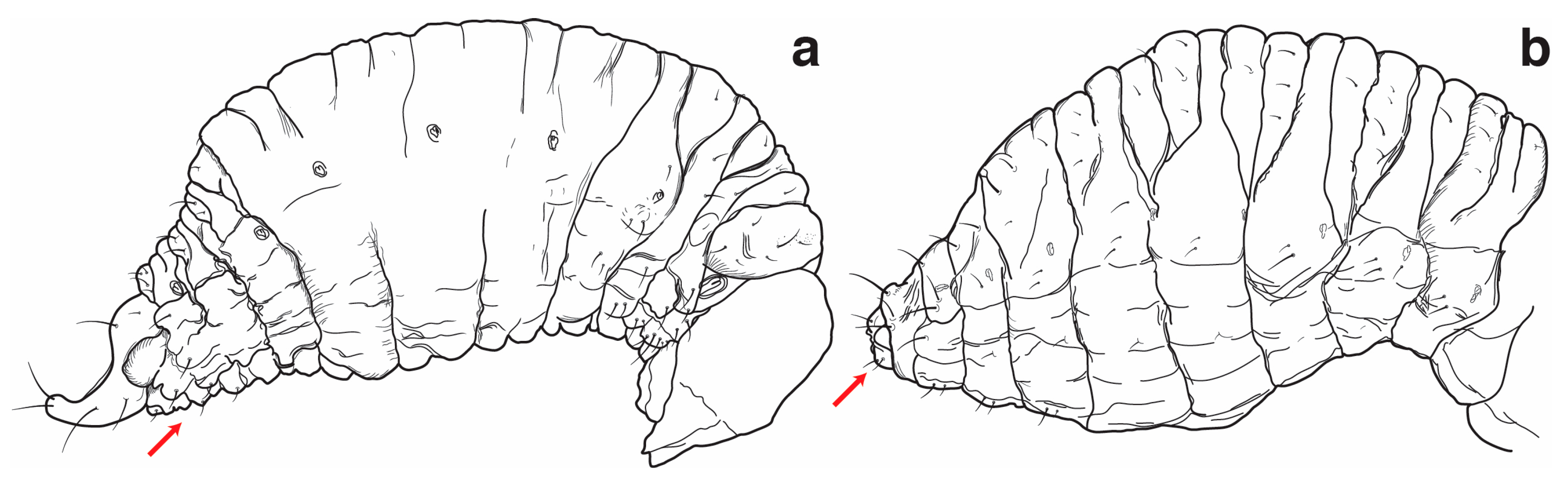
- With a pair of digitate projections
- b.
- Without a pair of digitate projectionsCactophagus, Cosmopolites, Cyrtotrachelus, Diathetes, Diocalandra, Dynamis [13], Eucalandra, Eugnoristus, Foveolus, Metamasius, Myocalandra, Nassophasis, Odoiporus, Paramasius, Phacecorynes, Polytus, Poteriophorus, Rhabdoscelus, Rhodobaenus, Rhynchophorus, Scyphophorus, Sitophilus, Sparganobasis, Sphenophorus, Stenommatus, Temnoschoita, Trigonotarsus, Trochorhopalus, TryphetusNot included: Rhinostomus
- a.
- Without a pair of projections, may be broad and truncateCactophagus, Cosmopolites, Cyrtotrachelus, Diocalandra, Eucalandra, Eugnoristus, Foveolus, Metamasius, Myocalandra, Nassophasis, Odoiporus, Paramasius, Polytus, Poteriophorus, Rhabdoscelus, Rhynchophorus, Sitophilus, Sparganobasis, Sphenophorus, Temnoschoita, Trochorhopalus, Tryphetus
- b.
- With 1 pair of digitate projections
- c.
- With 2 pairs of digitate projectionsMesocordylus (probably), Nephius (=Anius), SipalinusNot included: Dynamis, Rhinostomus
- a.
- Not applicableCactophagus, Cosmopolites, Cyrtotrachelus, Diathetes* (may be misinterpreted as this), Diocalandra, Eucalandra, Eugnoristus, Foveolus, Metamasius, Myocalandra, Nassophasis, Odoiporus, Paramasius, Polytus, Poteriophorus, Rhabdoscelus, Rhynchophorus, Sitophilus, Sparganobasis, Sphenophorus, Temnoschoita, Trochorhopalus, Tryphetus
- b.
- Short and bluntly conicalDiathetes*, Rhodobaenus, Trigonotarsus
- c.
- 1.5 to 2× longer than wide (long and broad; reference widest section)Dryophthorus, Dryophthoroides [12], Mesocordylus (probably), Nephius (=Anius), Phacecorynes, Scyphophorus, Sipalinus, Stenommatus, Xerodermus [11,12], YuccaborusNot included: Dynamis, Rhinostomus
3.1.5. Labrum/Eipharynx
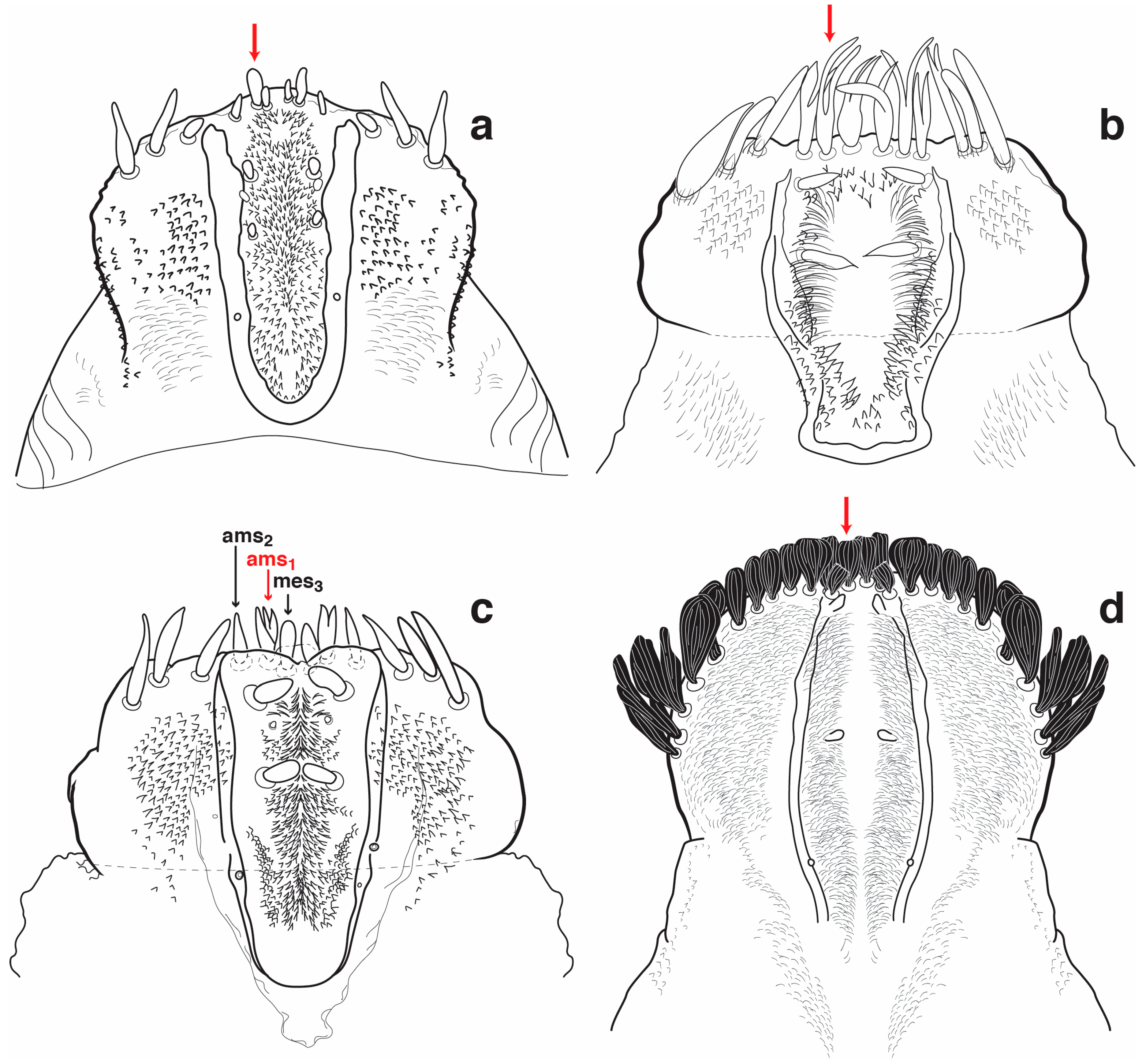
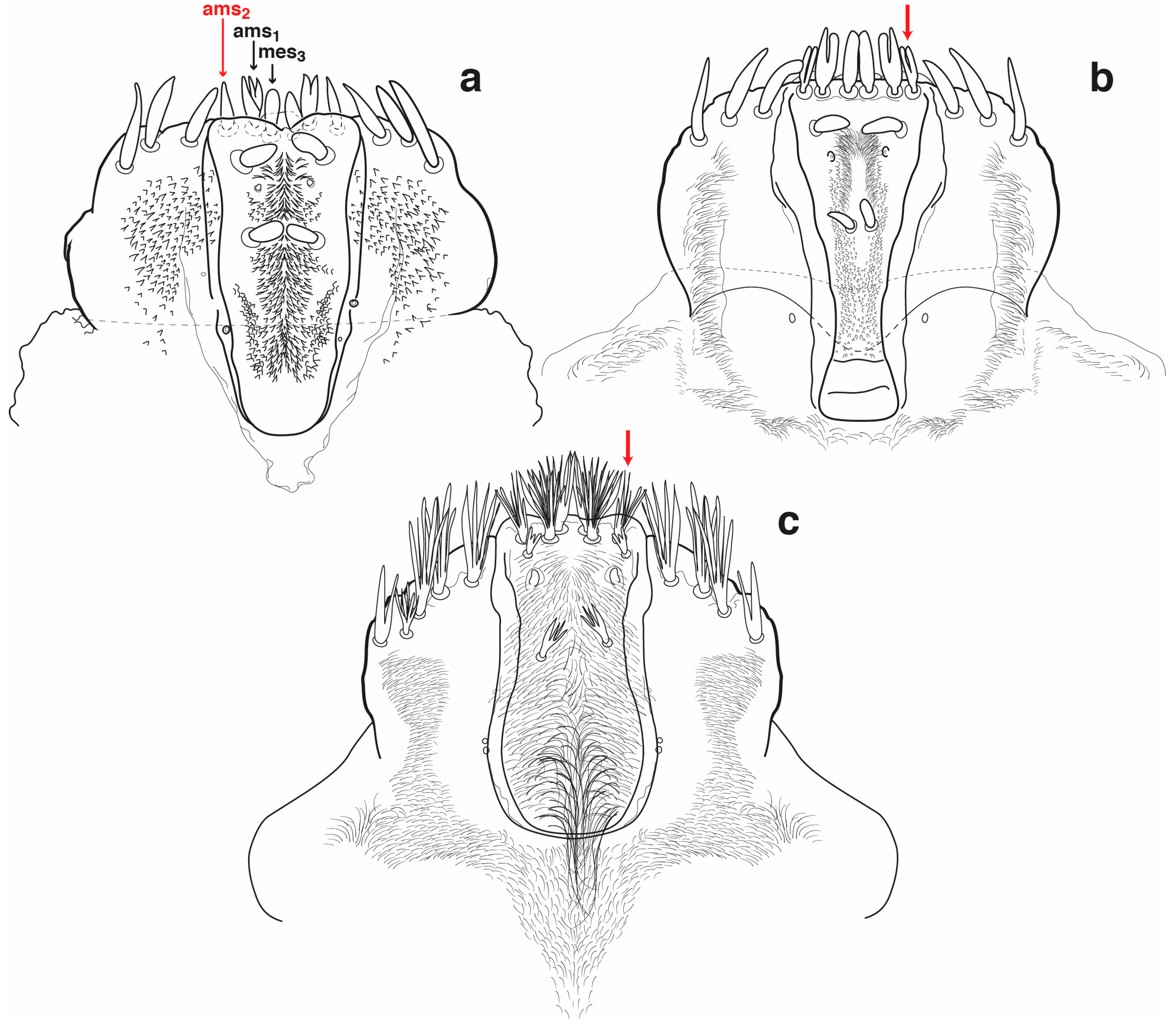
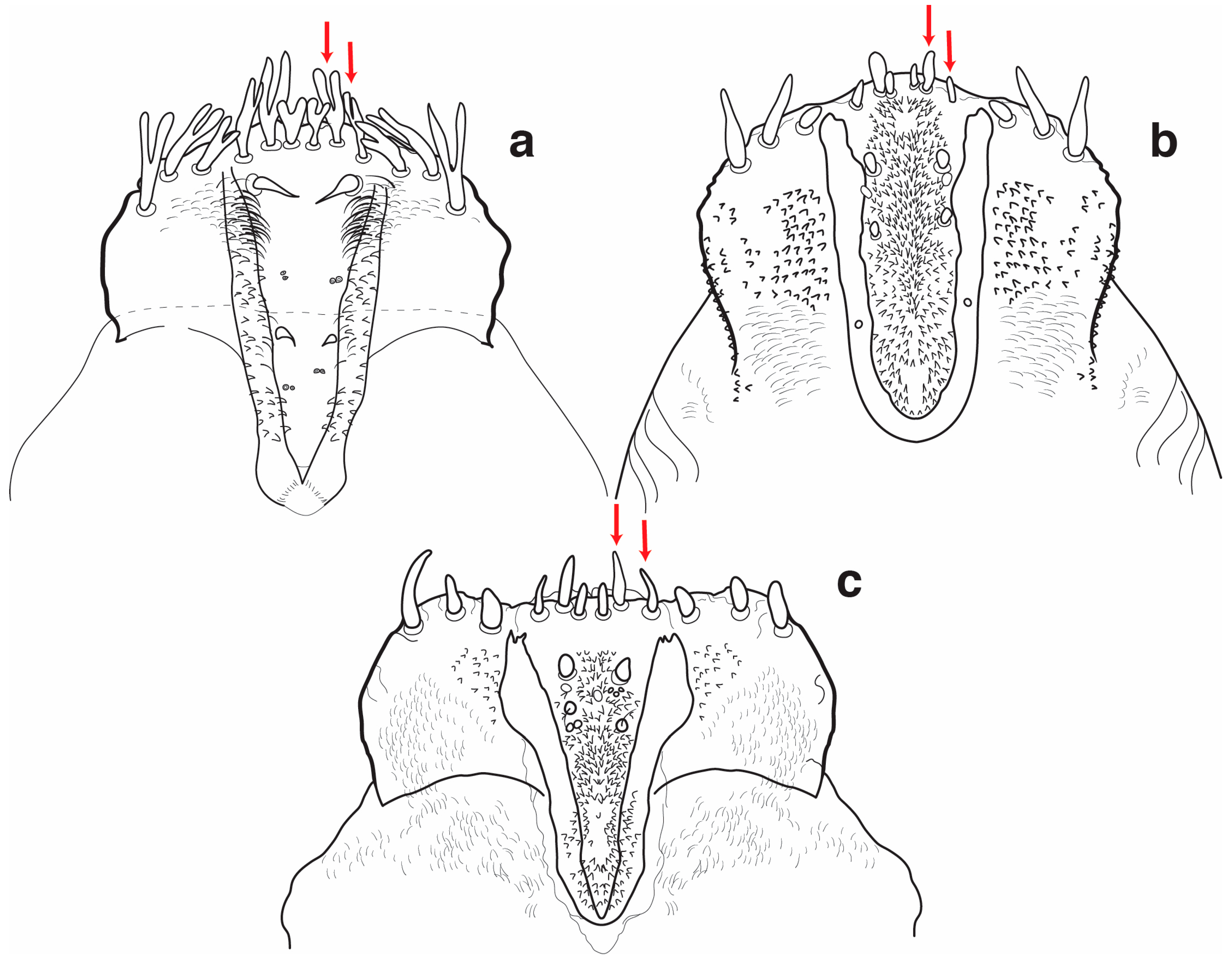
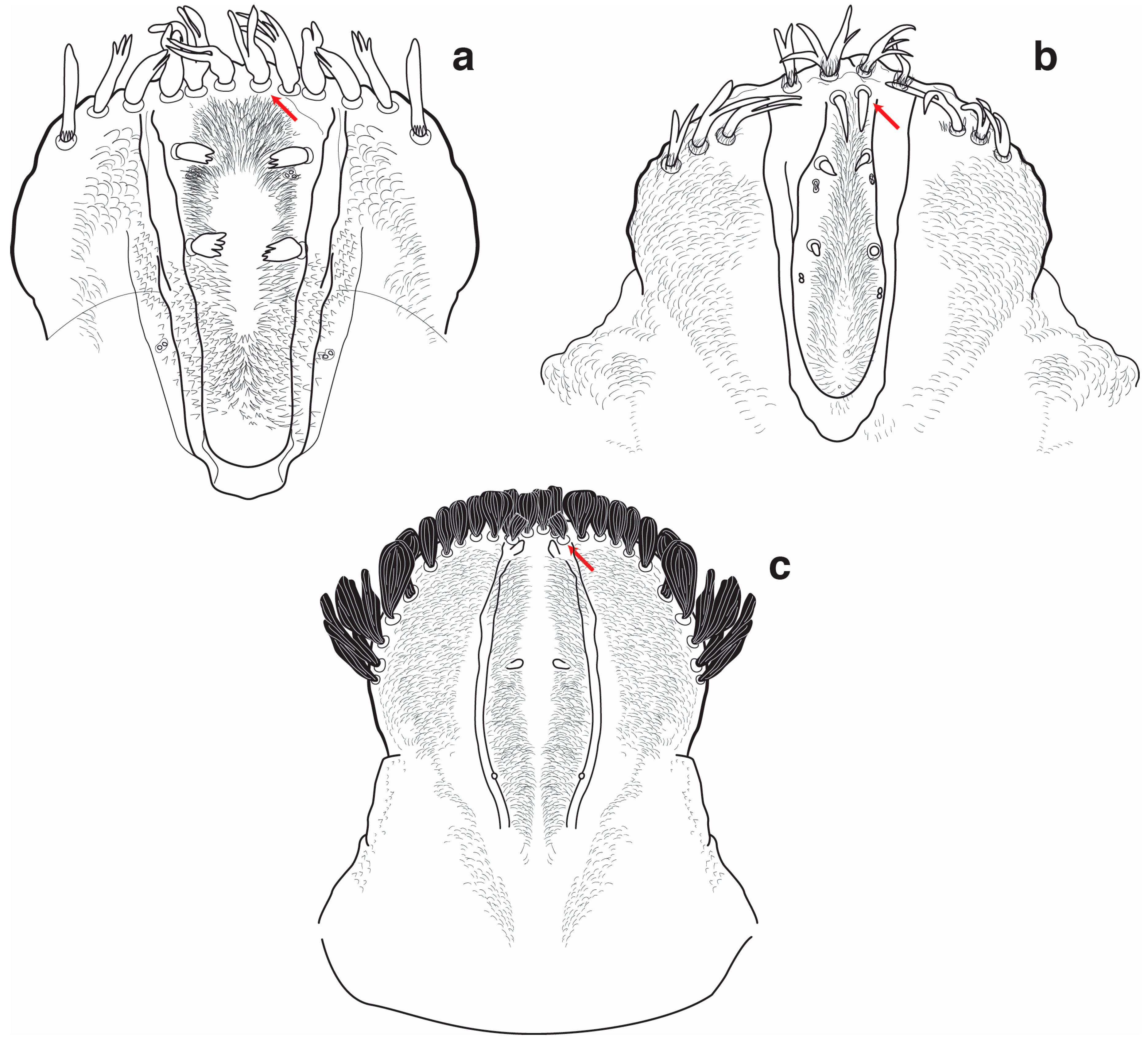
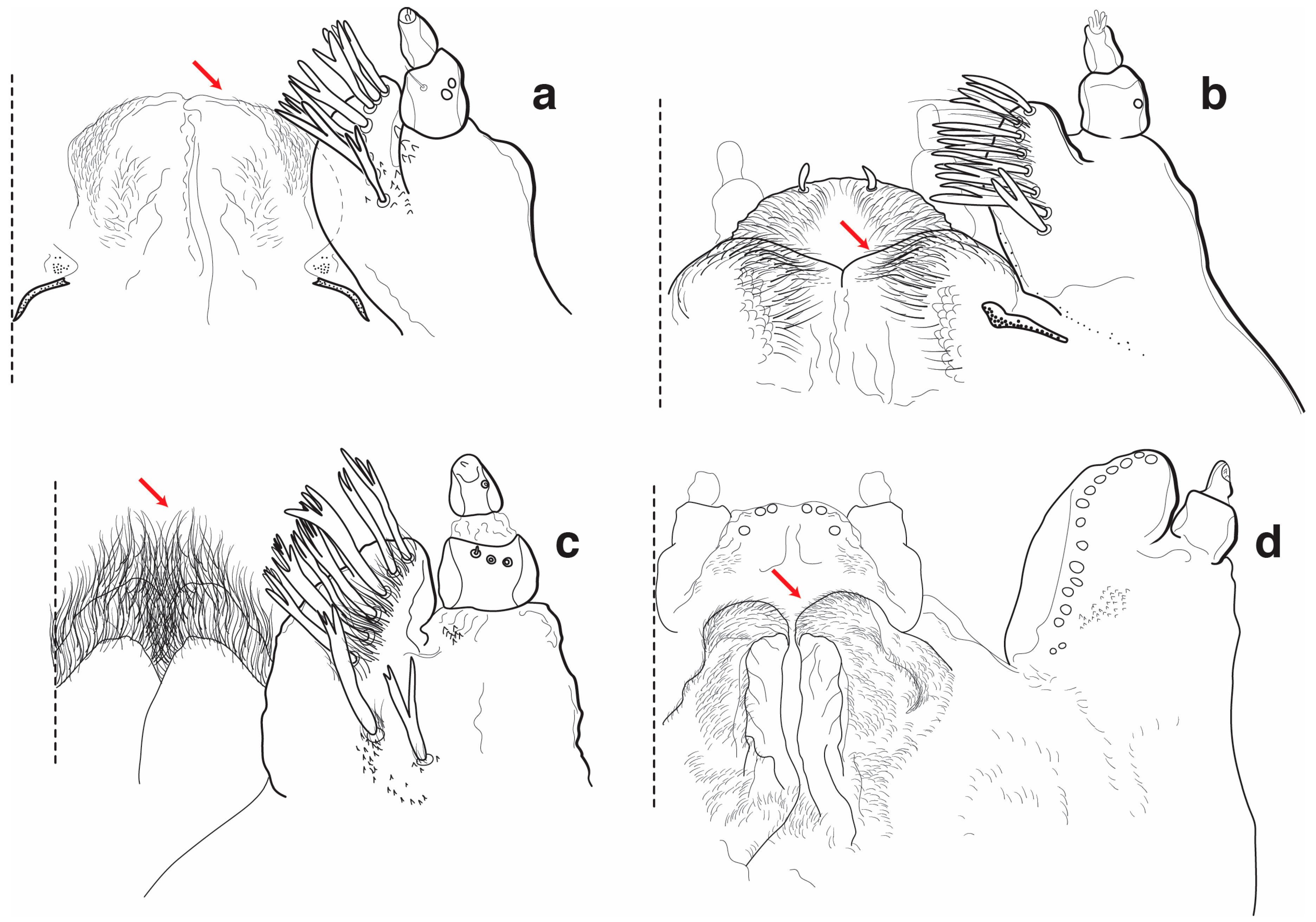
- a.
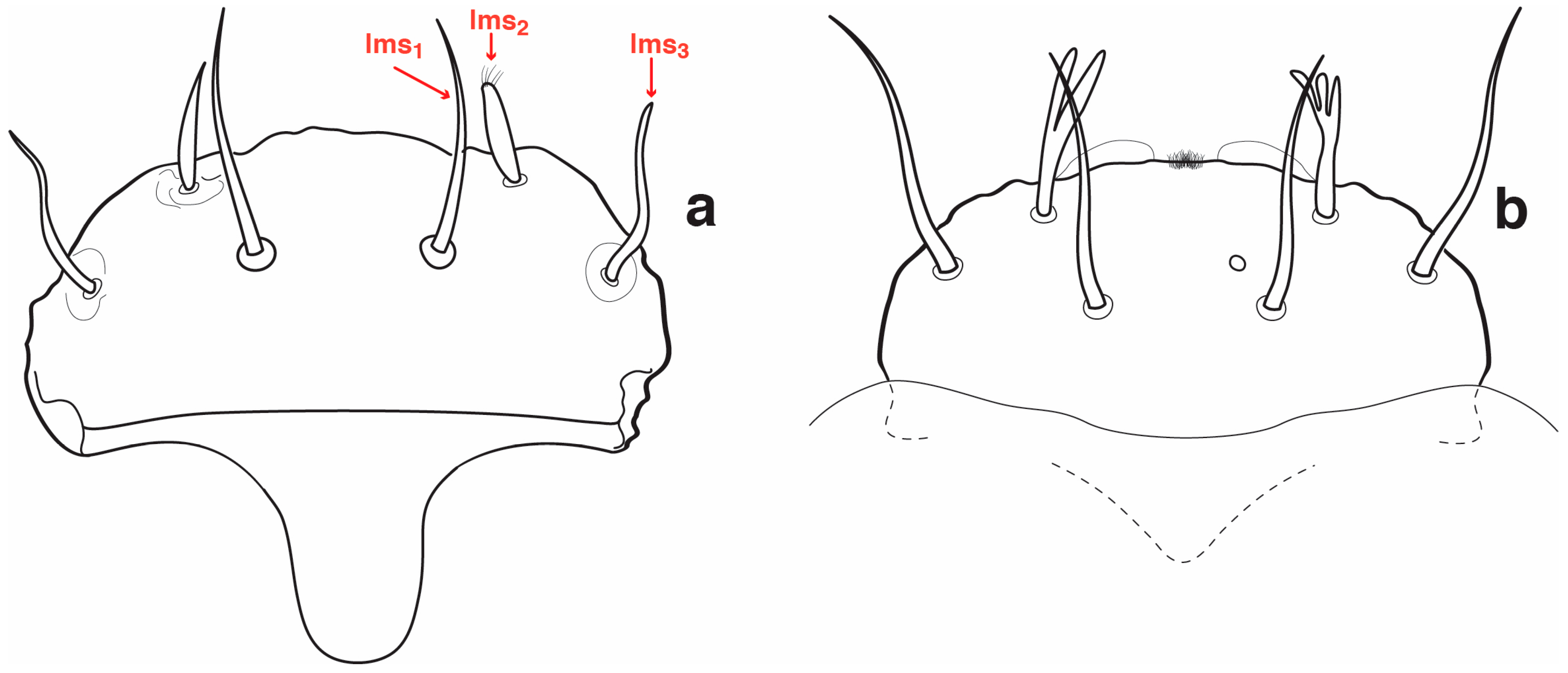
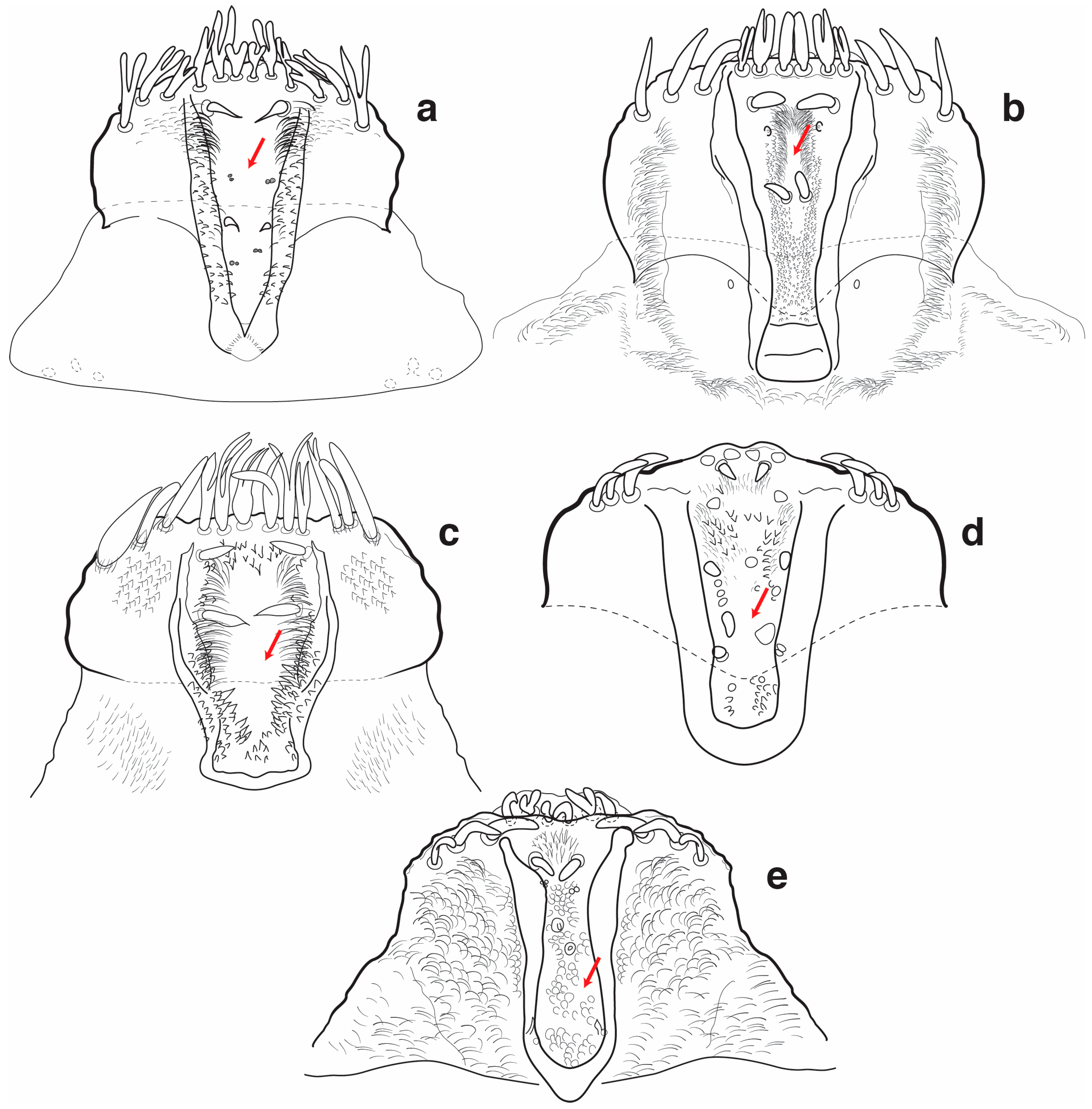
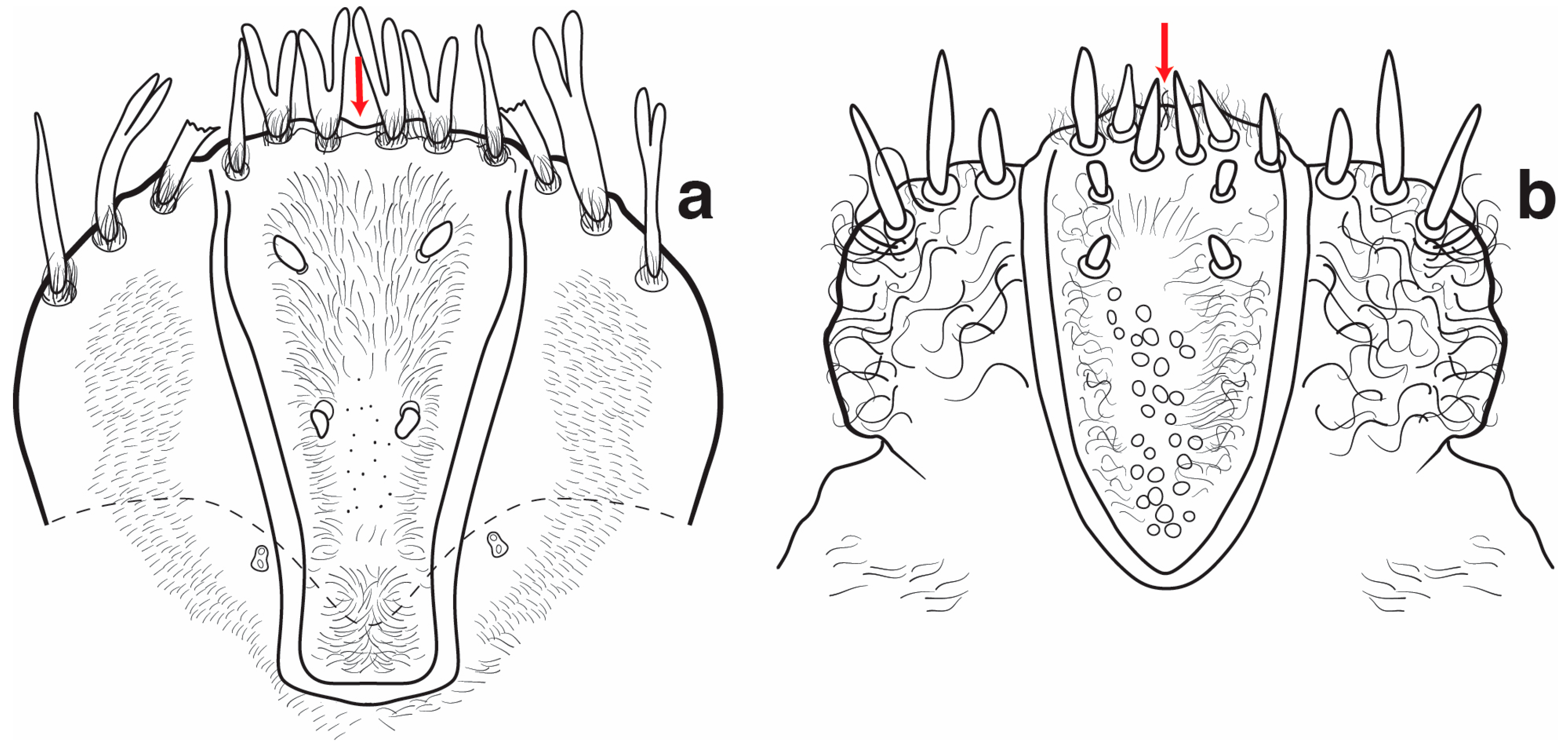
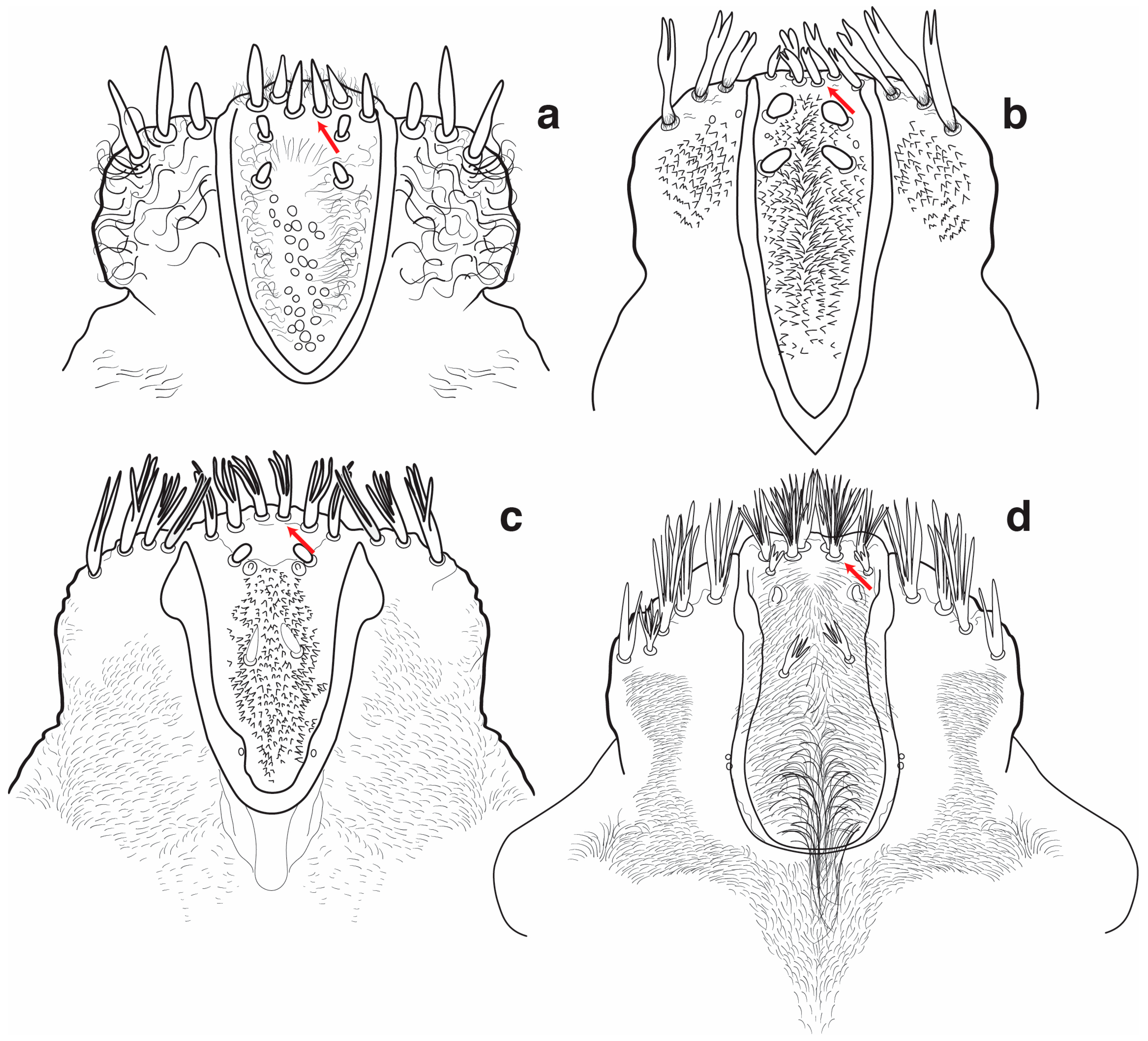
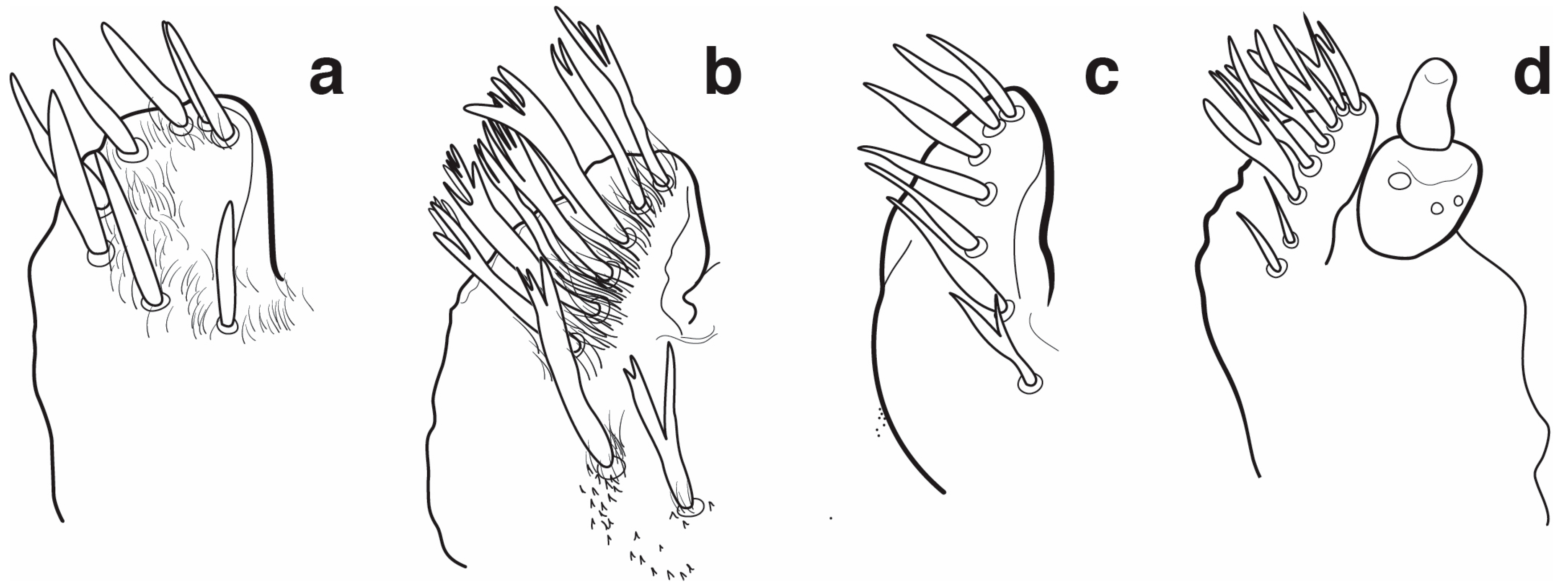
- EntireCactophagus, Cyrtotrachelus, Diathetes, Diocalandra, Dryophthorus, Eugnoristus, Mesocordylus (probably), Metamasius*, Myocalandra, Nassophasis, Nephius (=Anius), Paramasius Phacecorynes, Polytus, Poteriophorus, Rhabdoscelus, Rhodobaenus, Rhynchophorus, Scyphophorus, Sipalinus, Sitophilus, Sphenophorus, Stenommatus, Temnoschoita*, Trigonotarsus Trochorhopalus, Tryphetus, Yuccaborus
- a.
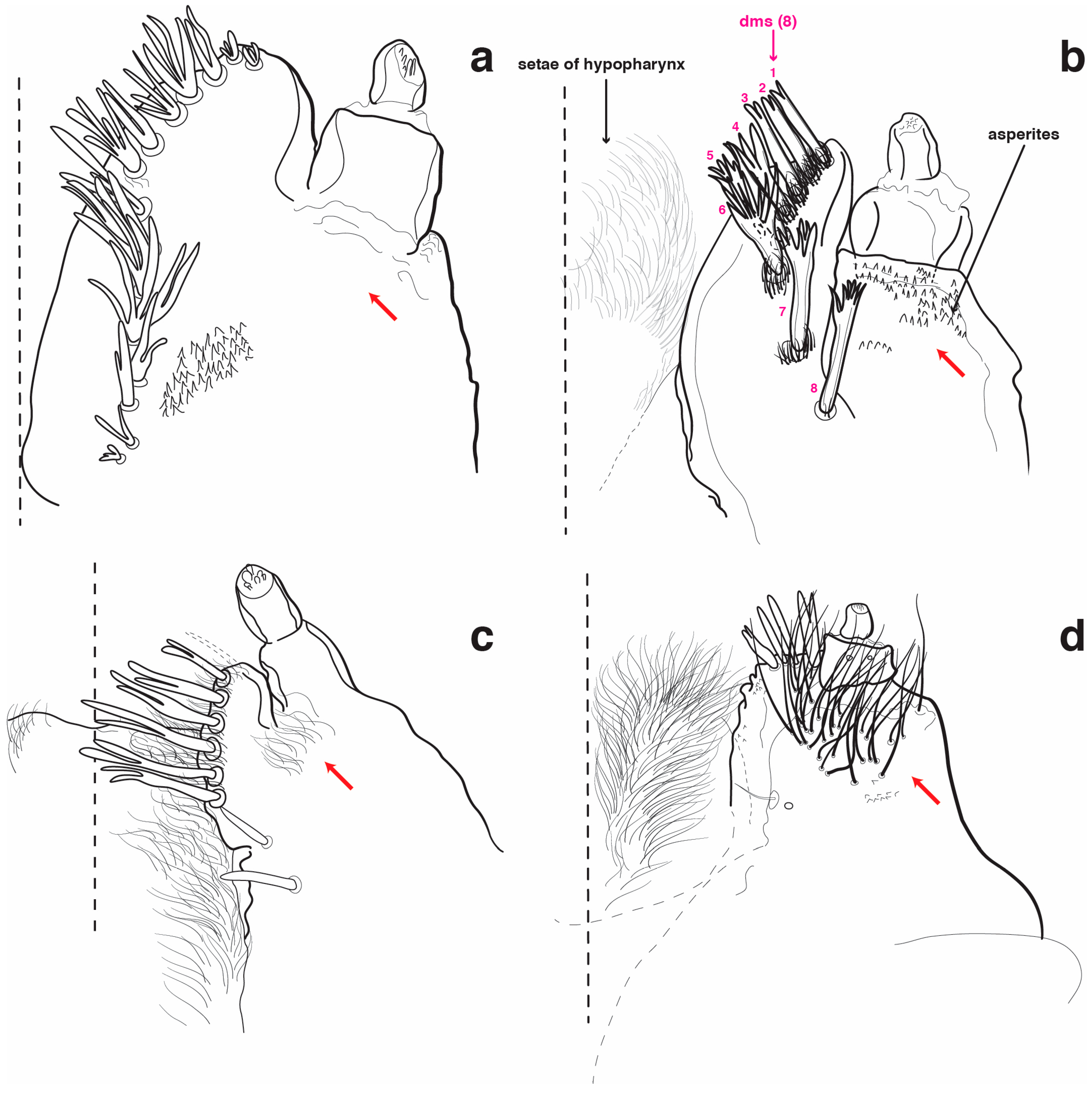
- Branched (at least 1)Cosmopolites, Eucalandra, Foveolus, Metamasius hemipterus*, Odoiporus, Temnoschoita*Not included: Dryophthoroides, Dynamis, Rhinostomus, Sparganobasis (broken), Xerodermus
- a.
- AbsentCosmopolites, Dryophthorus, Nassophasis#, Sitophilus*, Sphenophorus#*, Stenommatus
- b/c.
- Single medially/submediallyCactophagus (Right), Diocalandra (Medially), Eucalandra (Left)#*, Eugnoristus (L), Foveolus (L), Mesocordylus (probably) (M), Metamasius (M), Myocalandra (M), Nephius (=Anius)#, Paramasius (R/L), Phacecorynes (R), Polytus (M), Poteriophorus (R), Rhabdoscelus (R), Rhodobaenus (R), Sitophilus oryzae*(Medial/L), Sparganobasis (L), Temnoschoita (R), Trochorhopalus (M, slight R), Tryphetus (M)
- d.
- Two submediallyCyrtotrachelus, Diathetes, Eucalandra#*, Odoiporus, Rhynchophorus, Scyphophorus, Sipalinus, Sphenophorus* maidis, Trigonotarsus, YuccaborusNot included: Dryophthoroides, Xerodermus
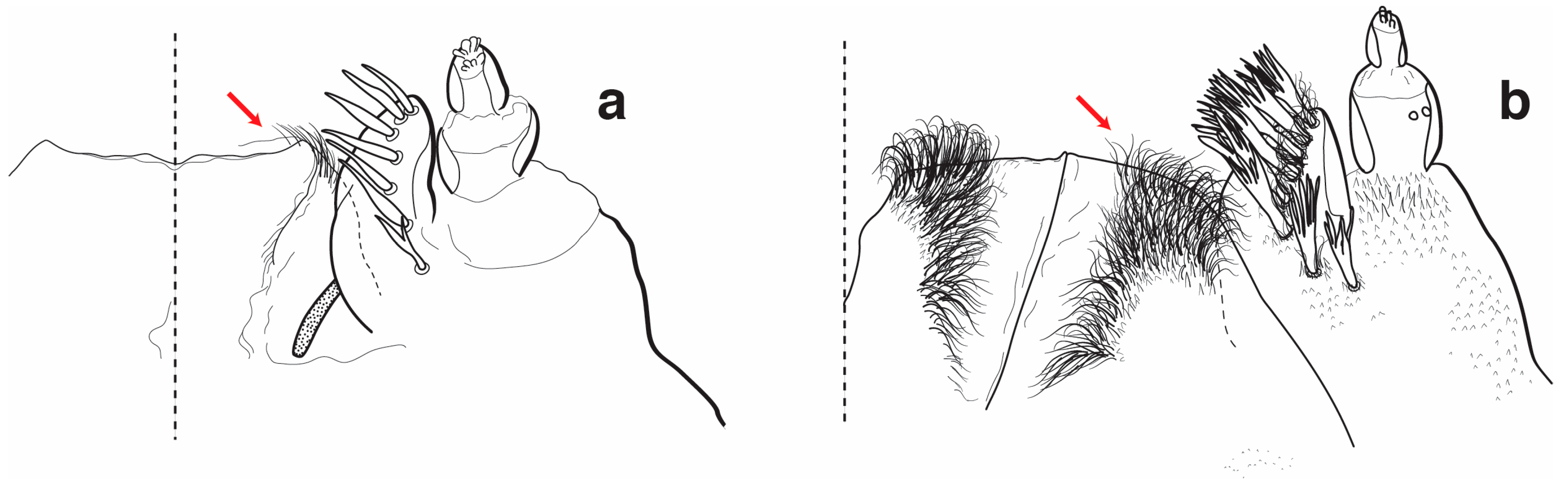
- a.
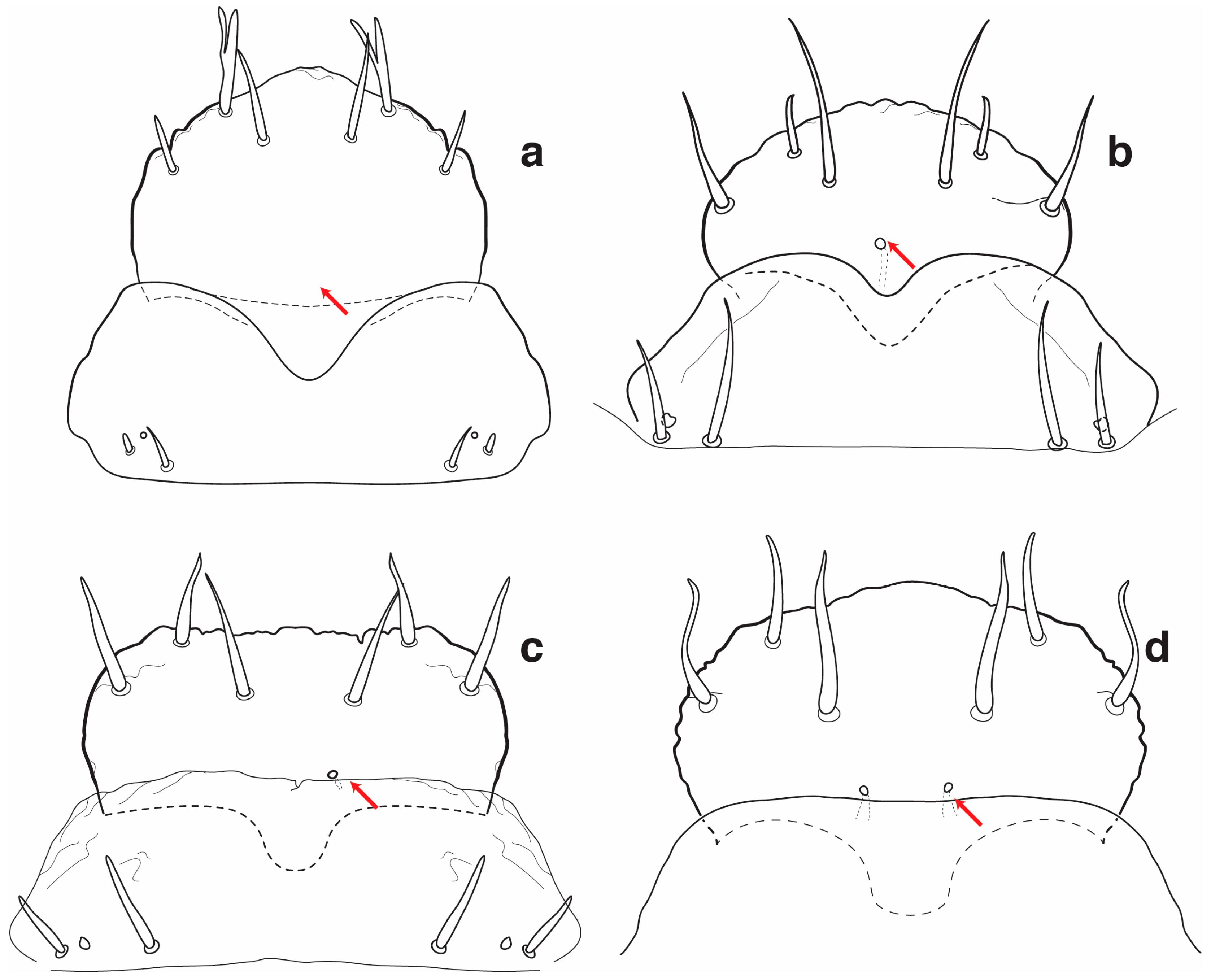
- Sub-rectangular, margin evenly rounded or moderately to weakly produced mediallyCactophagus, Cyrtotrachelus, Diathetes, Diocalandra, Dryophthoroides [12], Dryophthorus, Dynamis [13], Eucalandra, Foveolus, Mesocordylus (probably), Myocalandra, Nassophasis, Nephius (=Anius), Odoiporus, Paramasius, Phacecorynes, Poteriophorus, Rhabdoscelus#*, Rhinostomus, Rhynchophorus, Scyphophorus, Sipalinus, Sitophilus, Sparganobasis, Sphenophorus, Stenommatus, Trigonotarsus (medially emarginated), Trochorhopalus, Tryphetus, Xerodermus* ([11], p. 41) “Labrum strongly transverse, anterior margin trilobed, posterior margin extended medially.”), Yuccaborus
- b.
- Sub-rectangular, margin truncateEugnoristus, Metamasius, Rhabdoscelus#*, Rhodobaenus, Temnoschoita
- c.
- Sub-quadrate, markedly produced mediallyCosmopolites, Polytus
- a.
- AbsentDiocalandra, Dryophthoroides [12], Dryophthorus, Myocalandra, Polytus, Sitophilus, Stenommatus, Tryphetus
- b.
- PresentCactophagus, Cosmopolites, Cyrtotrachelus (present basolaterally), Diathetes, Eucalandra, Eugnoristus, Foveolus, Mesocordylus (probably) (present basolaterally), Metamasius, Nassophasis, Nephius (=Anius), Odoiporus, Paramasius, Phacecorynes, Poteriophorus, Rhabdoscelus, Rhinostomus, Rhodobaenus, Rhynchophorus, Scyphophorus, Sipalinus, Sparganobasis, Sphenophorus, Temnoschoita, Trigonotarsus, Trochorhopalus, YuccaborusNot included: Dynamis, Xerodermus
- a.
- Setae absentDiocalandra, Dryophthoroides [12], Dryophthorus, Myocalandra, Polytus, Sitophilus, Stenommatus, Tryphetus
- b.
- Not modified (straight, tapering)Cosmopolites*, Cyrtotrachelus, Diathetes, Eucalandra, Mesocordylus (probably), Metamasius, Rhinostomus, Sipalinus, Sphenophorus*, Trigonotarsus, Yuccaborus* (on one side)
- c.
- TwistedNephius (=Anius)
- d.
- Curved mesallyFoveolus* (anteriorly), Paramasius, Trochorhopalus (with rounded asperites medially)
- e.
- Asperites throughoutEugnoristus, Poteriophorus, Rhabdoscelus
- f.
- Asprites distally or medially, setose proximally (and laterally)Cactophagus, Cosmopolites*, Foveolus*, Nassophasis, Odoiporus, Phacecorynes, Rhodobaenus, Rhynchophorus, Scyphophorus, Sparganobasis, Sphenophorus*, Temnoschoita, Yuccaborus*Not included: Dynamis, Xerodermus
- a.
- Setae absentDiocalandra, Dryophthoroides [12], Dryophthorus, Myocalandra, Polytus, Sitophilus, Stenommatus, Tryphetus
- b.
- 1/3–1/4 distal length of labral rodsEucalandra, Eugnoristus, Rhabdoscelus
- c/d.
- Variously patterned, entire length or between 1/2–2/3 distal length of labral rodsCactophagus, Cosmopolites, Foveolus, Metamasius, Nassophasis, Nephius (=Anius), Odoiporus, Paramasius, Phacecorynes, Poteriophorus, Rhinostomus, Rhodobaenus, Rhynchophorus, Sparganobasis, Sphenophorus, Temnoschoita, Trochorhopalus
- e.
- Throughout area 2/3 or less proximal length of labral rodsCyrtotrachelus, Diathetes, Mesocordylus (probably), Scyphophorus, Sipalinus, Trigonotarsus#, YuccaborusNot included: Dynamis, Xerodermus
- a.
- Setae absentDiocalandra, Dryophthoroides [12], Dryophthorus, Myocalandra, Polytus, Sitophilus, Stenommatus, Temnoschoita, Tryphetus
- b.
- Not reaching lateral margin of labrumCactophagus, Cyrtotrachelus, Eucalandra, Eugnoristus, Foveolus, Mesocordylus (probably), Metamasius, Paramasius, Poteriophorus, Rhabdoscelus Rhodobaenus, Rhynchophorus, Sphenophorus, Trochorhopalus, Yuccaborus
- c.
- Reaching lateral margin of labrumCosmopolites, Diathetes, Nassophasis, Nephius (=Anius), Odoiporus, Phacecorynes, Rhinostomus, Scyphophorus, Sipalinus (minimally), Sparganobasis, TrigonotarsusNot included: Dynamis, Xerodermus
- a.
- AbsentSitophilus, Tryphetus
- b.
- Present over labral rodsEucalandra
- c.
- Present mediallyCactophagus, Cosmopolites, Cyrtotrachelus, Diathetes, Diocalandra, Dryophthoroides [12], Dryophthorus, Eugnoristus, Foveolus, Mesocordylus (probably), Metamasius, Myocalandra, Nassophasis, Nephius (=Anius), Odoiporus, Paramasius, Phacecorynes, Polytus, Poteriophorus, Rhabdoscelus, Rhinostomus, Rhodobaenus, Rhynchophorus, Scyphophorus, Sipalinus, Sparganobasis, Sphenophorus, Stenommatus, Temnoschoita, Trigonotarsus, Trochorhopalus, YuccaborusNot included: Dynamis, Xerodermus
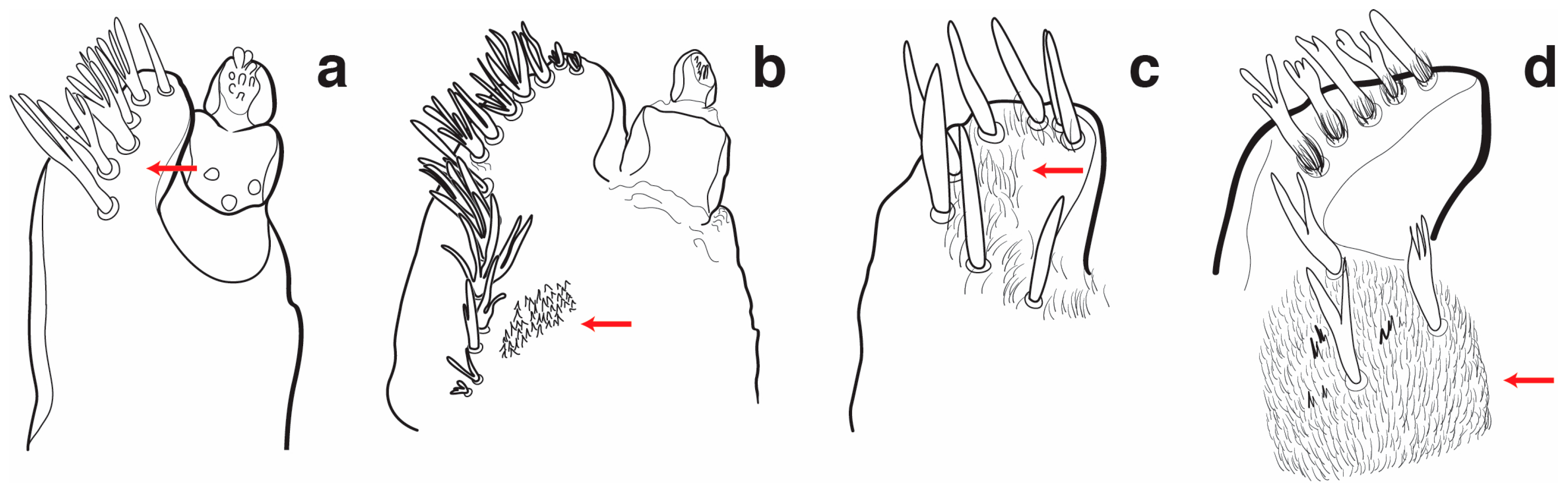
- a.
- Asperites absentSitophilus, Tryphetus
- b.
- Setae onlyCosmopolites*, Cyrtotrachelus, Sphenophorus
- c.
- Asperites onlyCactophagus, Cosmopolites*, Diathetes, Diocalandra, Dryophthorus, Eugnoristus, Mesocordylus (probably), Myocalandra, Odoiporus, Paramasius, Phacecorynes, Poteriophorus, Rhinostomus, Rhodobaenus, Sipalinus, Sparganobasis, Stenommatus*, Trochorhopalus (possibly a few setae)
- d.
- Setae and asperitesEucalandra, Foveolus, Metamasius, Nassophasis, Nephius (=Anius) (rounded asperites), Polytus, Rhabdoscelus, Rhynchophorus, Scyphophorus, Stenommatus*, Temnoschoita, Trigonotarsus, YuccaborusNot included: Dynamis, Dryophthoroides, Xerodermus (([11], p. 41) “…between the posteriorly conjoined rods is a pair of short setae and numerous skin points.”) (maybe “a”)
- a.
- Asperites absent or on labral rodsEucalandra, Sitophilus, Tryphetus
- b.
- Forming a well defined elongate, mesal glabrous areaFoveolus*, Metamasius, Nassophasis, Rhinostomus, Rhodobaenus, Sphenophorus*
- c.
- Forming a well defined subrectangular, mesal glabrous areaFoveolus* (could be interpreted as “b”), Paramasius, Temnoschoita
- d.
- Glabrous mesal area, but loosely defined by asperitesCyrtotrachelus, Diocalandra, Myocalandra, Nephius (=Anius), Phacecorynes, Rhynchophorus, Sipalinus, Sphenophorus*, Stenommatus
- e.
- Without mesal glabrous area (between asperites)Cactophagus, Cosmopolites, Diathetes, Dryophthoroides [12], Dryophthorus, Eugnoristus, Mesocordylus (probably), Odoiporus, Polytus, Poteriophorus, Rhabdoscelus, Scyphophorus, Sparganobasis, Trigonotarsus, Trochorhopalus, YuccaborusNot included: Dynamis, Xerodermus
- a.
- 2 on each sideSitophilus, Tryphetus
- b.
- 3 on each sideCactophagus, Cosmopolites, Diathetes, Diocalandra, Dryophthoroides [12], Dryophthorus, Eucalandra, Eugnoristus, F7veolus, Mesocordylus (probably), Metamasius, Myocalandra, Nassophasis, Nephius (=Anius), Odoiporus, Paramasius, Phacecorynes, Polytus, Poteriophorus, Rhabdoscelus, Rhodobaenus, Scyphophorus, Sipalinus* (on one side, but probably unusual), Sparganobasis, Sphenophorus, Stenommatus, Temnoschoita, Trigonotarsus, Trochorhopalus, Xerodermus [11]
- c.
- 4 on each sideSipalinus*, Yuccaborus*
- d.
- 5 on each sideYuccaborus*
- e.
- 10–11 on each side
- f.
- At least 14 on each sideCyrtotrachelus
- a.
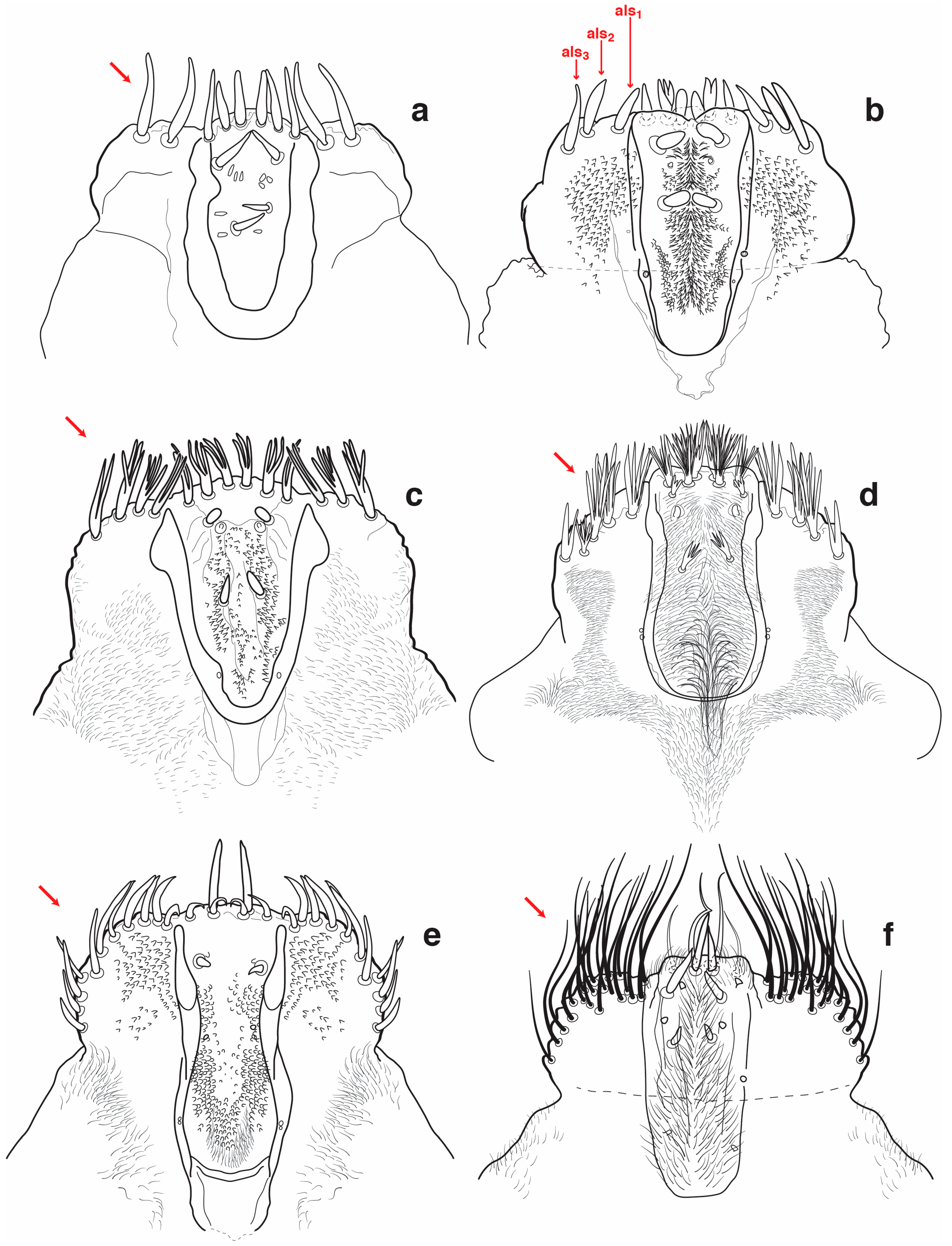
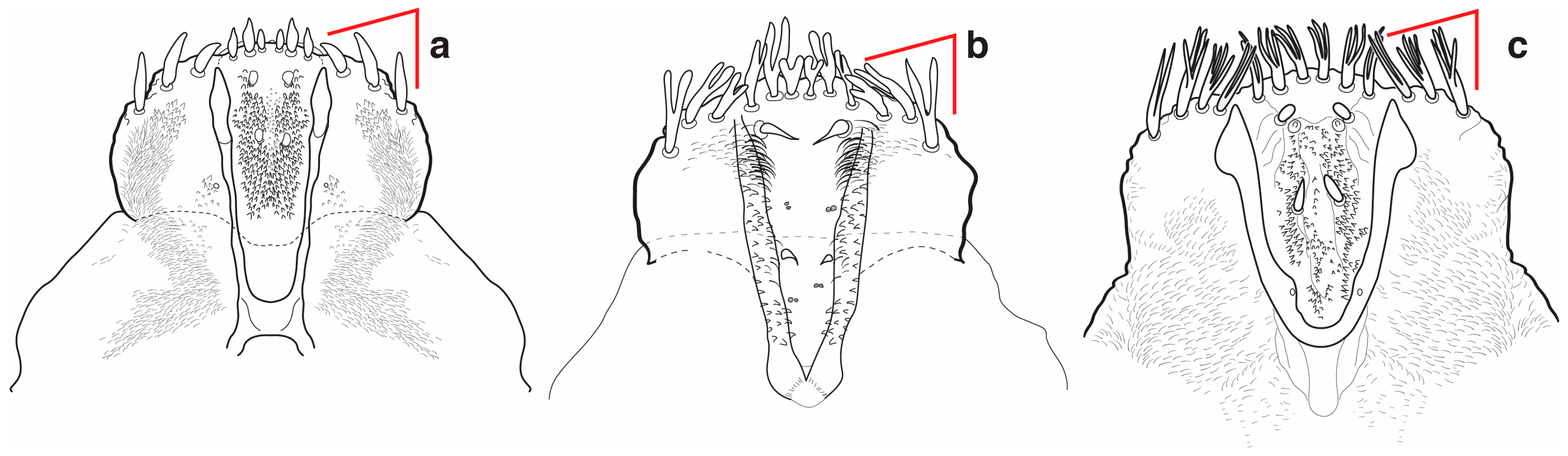
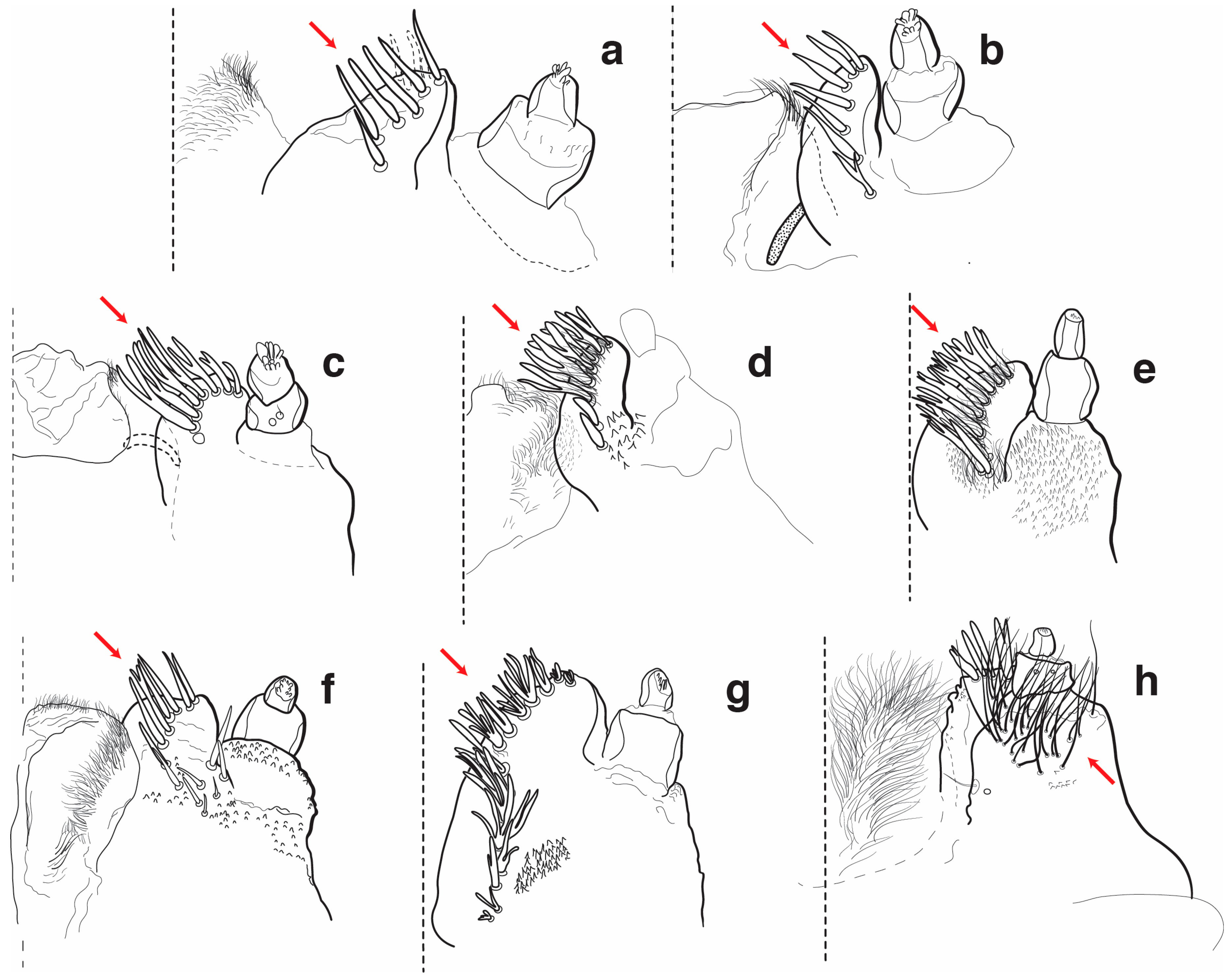
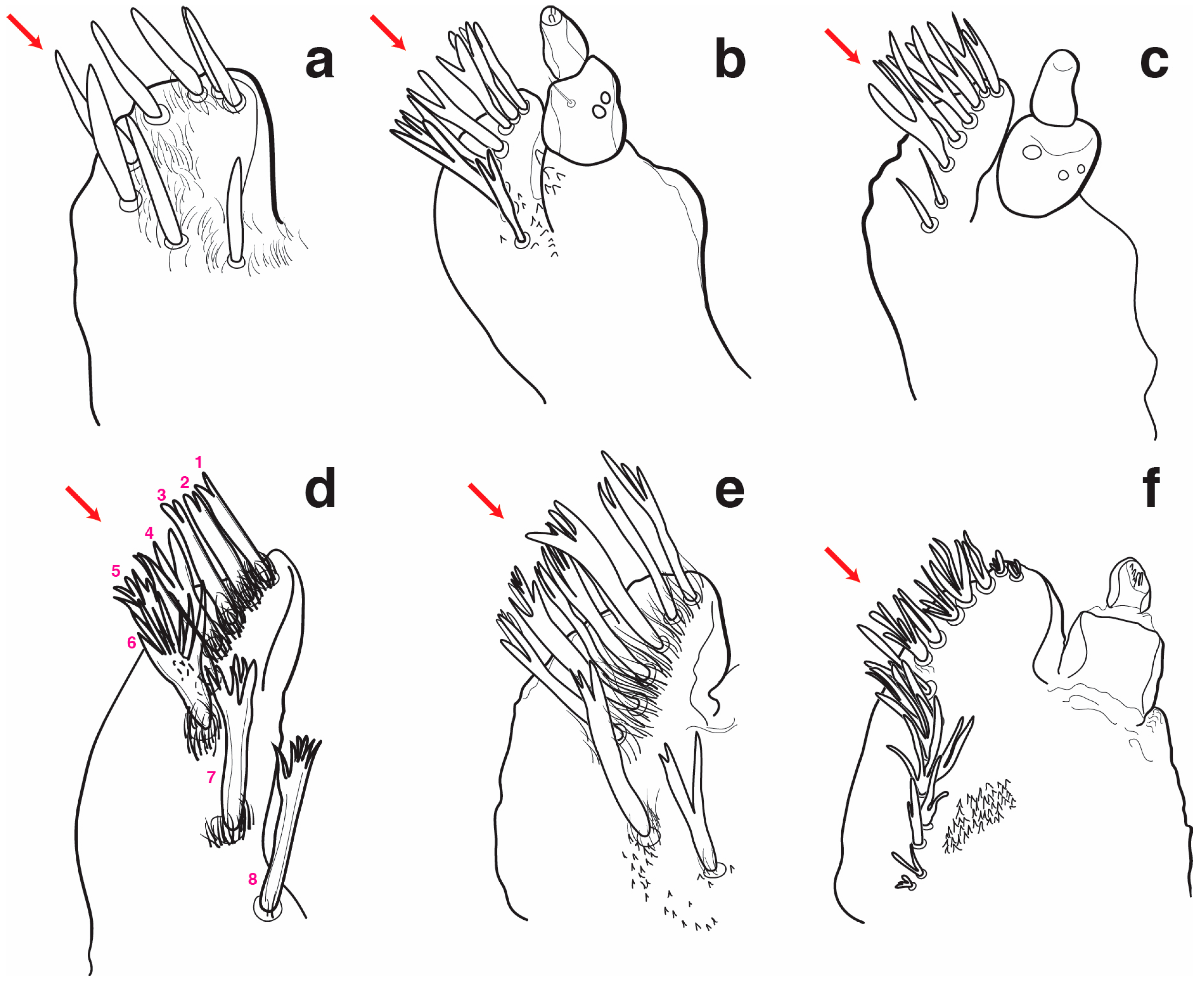
- Tapering to apexCactophagus, Cyrtotrachelus, Diathetes, Diocalandra, Dryophthoroides [12], Dryophthorus, Mesocordylus (probably), Metamasius, Myocalandra, Nassophasis, Nephius (=Anius), Paramasius, Phacecorynes, Polytus, Poteriophorus, Rhabdoscelus, Rhodobaenus, Rhynchophorus, Scyphophorus (sometimes subapically expanded before tapering), Sitophilus, Sphenophorus*, Stenommatus, Temnoschoita, Trigonotarsus, Trochorhopalus, Tryphetus, Xerodermus [11]
- b.
- BifurcateCosmopolites, Eucalandra, Eugnoristus, Foveolus (als1 bifurcate, als2 trifurcate), Odoiporus, Sphenophorus*
- c.
- Deeply trifurcate, multifurcate (tufted)Rhinostomus, Sipalinus, YuccaborusNot included: Dynamis, Sparganobasis (broken/ equally weathered?)
- a.
- Entire
- a.
- BifurcateCosmopolites*, Eucalandra, Eugnoristus, Metamasius, Nassophasis, Paramasius, Poteriophorus*, Rhabdoscelus, Scyphophorus*, Sphenophorus*, Temnoschoita, Trochorhopalus
- c.
- Trifurcate (largely)Cosmopolites*, Foveolus* (could be interpreted as “c”), Odoiporus, Poteriophorus*, Scyphophorus*, Sipalinus
- d.
- Multifurcate, tuftedFoveolus*, Rhinostomus, YuccaborusNot included: Dynamis, Sparganobasis (broken/weathered all equally?)
- a.
- EntireCactophagus, Cosmopolites*, Cyrtotrachelus, Diathetes, Diocalandra, Dryophthoroides [12], Dryophthorus, Mesocordylus (probably), Myocalandra, Nassophasis, Nephius (=Anius), Paramasius, Phacecorynes, Polytus, Poteriophorus, Rhabdoscelus, Rhodobaenus, Rhynchophorus, Scyphophorus, Sitophilus, Sphenophorus, Stenommatus, Trigonotarsus (but could be broken), Trochorhopalus, Tryphetus, Xerodermus [11]
- b.
- BifurcateCosmopolites*, Eucalandra, Eugnoristus, Foveolus, Metamasius, Odoiporus, Sipalinus, Temnoschoita
- c.
- Tufted (deeply furcate)Rhinostomus, YuccaborusNot included: Dynamis, Sparganobasis (broken/weathered all equally?)
- a.
- Sub-equalCactophagus, Diocalandra, Dryophthoroides [12], Dryophthorus, Eucalandra, Eugnoristus*, Foveolus, Mesocordylus (probably), Myocalandra, Nassophasis, Nephius (=Anius), Odoiporus, Paramasius, Polytus, Poteriophorus, Rhabdoscelus, Rhinostomus, Scyphophorus*, Sipalinus, Sitophilus, Sphenophorus, Stenommatus#, Trochorhopalus, Tryphetus, Yuccaborus
- b.
- ams1 approximately twice as long as ams2Cyrtotrachelus, Diathetes, Eugnoristus*, Phacecorynes, Rhynchophorus, Scyphophorus*
- c.
- ams1 approximately 1/3 longer than ams2Cosmopolites, Metamasius, Rhodobaenus, TemnoschoitaNot included: Sparganobasis (broken/weathered), Trigonotarsus (broken/weathered; maybe b/c), Xerodermus
- a.
- mes3 anterad on margin between 2 ams pairs; linear (this interpretation gives the appearance of 6 ams)Cactophagus, Eucalandra, Foveolus, Metamasius, Myocalandra, Nassophasis, Paramasius, Phacecorynes, Rhabdoscelus, Rhodobaenus, Sipalinus, Sitophilus, Sphenophorus, Temnoschoita, Trigonotarsus, Trochorhopalus, Tryphetus
- b.
- mes3 proximal and almost directly in front of ams1; not linear
- c.
- mes3 proximal and almost directly in front of ams2; not linearRhinostomus
- a.
- AbsentCactophagus, Cosmopolites, Diathetes, Diocalandra, Dryophthoroides [12], Dryophthorus, Eucalandra, Eugnoristus, Foveolus, Mesocordylus (probably), Metamasius*, Myocalandra, Nassophasis, Odoiporus, Phacecorynes, Polytus, Poteriophorus, Rhabdoscelus, Rhinostomus, Rhodobaenus, Rhynchophorus, Scyphophorus, Sipalinus, Sitophilus, Sparganobasis, Sphenophorus pontederiae*, Stenommatus, Temnoschoita, Trigonotarsus, Trochorhopalus, Tryphetus, Yuccaborus
- b.
- PresentCyrtotrachelus, Metamasius*, Nephius (=Anius), Paramasius, Sphenophorus*Not included: Dynamis, Xerodermus
- a.
- AbsentCactophagus, Diathetes, Diocalandra, Dryophthoroides [12], Dryophthorus, Eucalandra, Eugnoristus, Foveolus, Mesocordylus (probably), Metamasius, Myocalandra, Nephius (=Anius), Odoiporus, Phacecorynes, Polytus, Poteriophorus, Rhabdoscelus, Rhinostomus, Rhodobaenus, Rhynchophorus, Scyphophorus, Sipalinus, Sitophilus, Sparganobasis, Sphenophorus maidis*, Stenommatus, Temnoschoita, Trigonotarsus, Trochorhopalus, Tryphetus, Yuccaborus
- b.
- PresentCosmopolites, Cyrtotrachelus, Nassophasis, Paramasius, Sphenophorus pontederiae*Not included: Dynamis, Xerodermus
- a.
- EntireCactophagus, Cosmopolites, Cyrtotrachelus, Diathetes, Diocalandra, Dryophthorus, Mesocordylus (probably), Metamasius, Myocalandra, Nephius (=Anius), Paramasius, Phacecorynes, Polytus, Poteriophorus, Rhabdoscelus, Rhodobaenus, Rhynchophorus, Scyphophorus, Sitophilus, Sphenophorus*, Stenommatus, Trochorhopalus, Tryphetus, Xerodermus [11]
- b.
- BifurcateEucalandra, Eugnoristus, Foveolus, Nassophasis, Sphenophorus*, Temnoschoita
- c.
- TrifurcateOdoiporus, Sipalinus
- d.
- TuftedRhinostomus, YuccaborusNot included: Dynamis, Sparganobasis (broken/weathered all equally?), Trigonotarsus (broken, weathered, maybe “a”)
- a.
- Present, unmodifiedCactophagus, Cosmopolites, Cyrtotrachelus, Diathetes, Diocalandra, Dryophthoroides [12], Dryophthorus, Eucalandra, Eugnoristus, Mesocordylus (probably), Metamasius, Myocalandra, Nassophasis, Nephius (=Anius), Odoiporus, Paramasius, Phacecorynes, Polytus, Poteriophorus, Rhabdoscelus, Rhinostomus, Rhodobaenus, Rhynchophorus*, Scyphophorus, Sipalinus (very lightly sclerotized), Sitophilus, Sparganobasis, Sphenophorus, Stenommatus, Temnoschoita, Trigonotarsus, Trochorhopalus, Tryphetus, Xerodermus [11]
- b.
- Present, minute (approximately 1/4 size of mes2)Odoiporus, Rhynchophorus*
- c.
- Trifurcate (tufted)Foveolus (shallow), YuccaborusNot included: Dynamis
3.1.6. Mandibles (Orientation of Mandibles on a Slide Preparation May Obscure Some of the Characters)
- a.
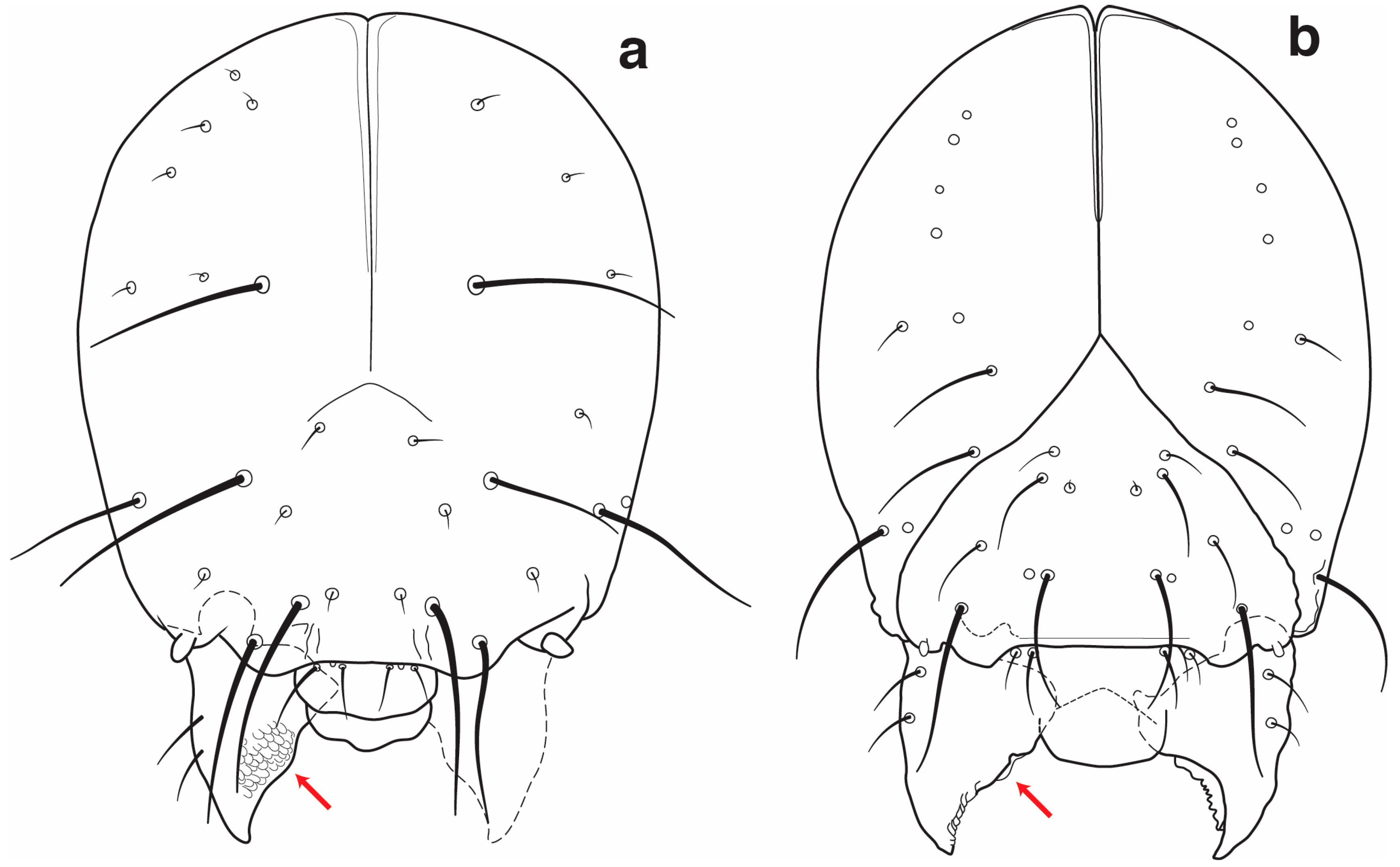
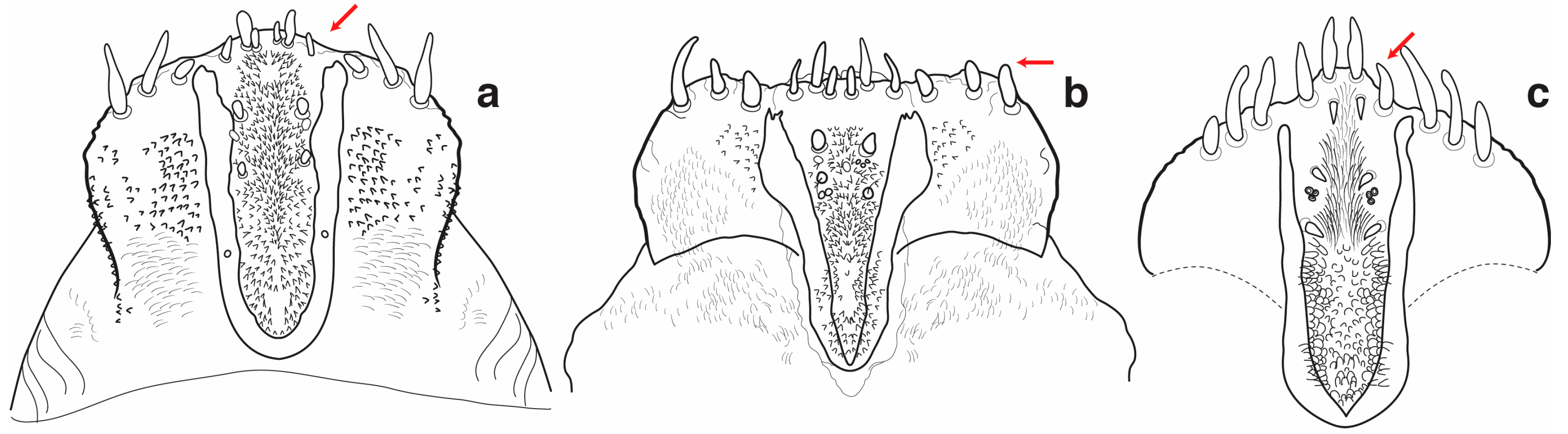
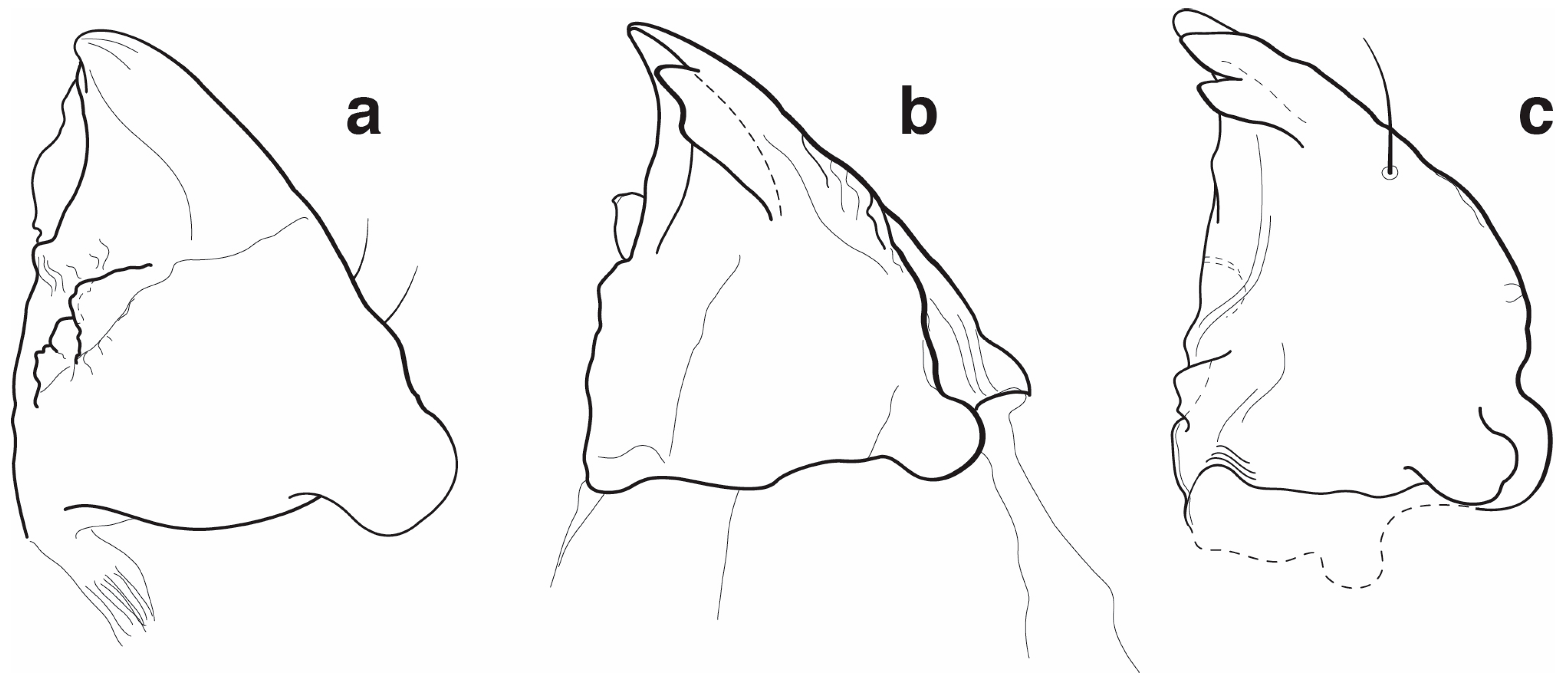
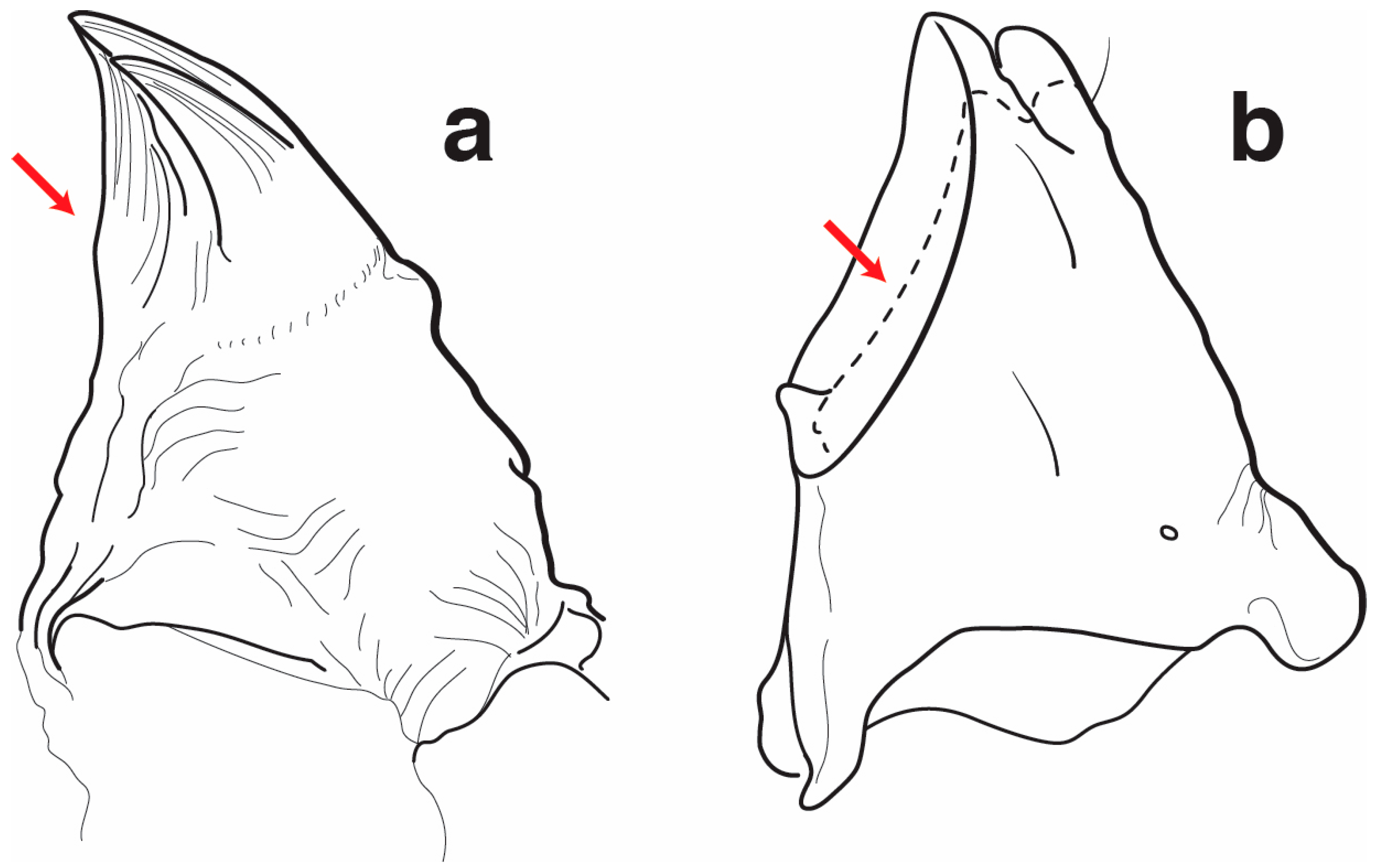
- SingleCactophagus, Eucalandra, Eugnoristus, Nephius (=Anius), Poteriophorus, Rhabdoscelus, Scyphophorus, Sipalinus#, Sitophilus granarius, Sitophilus linearis, Sparganobasis (with sub-apical lobe), Sphenophorus, Trigonotarsus, Yuccaborus
- b.
- Bidentate
- c.
- TridentatePolytusNot included: Dryophthorus, Metamasius, Rhinostomus
- a.
- AbsentCactophagus, Cyrtotrachelus, Dryophthorus, Eucalandra, Myocalandra, Nassophasis, Nephius (=Anius), Poteriophorus, Rhynchophorus, Scyphophorus, Sitophilus granarius, Sitophilus linearis, Sparganobasis, Sphenophorus, Temnoschoita, Trigonotarsus, Trochorhopalus, Yuccaborus
- b.
- PresentCosmopolites, Diathetes (apparently doble), Diocalandra, Eugnoristus, Foveolus, Mesocordylus#, Odoiporus, Paramasius, Phacecorynes, Polytus, Rhabdoscelus, Rhodobaenus, StenommatusNot included: Dryophthoroides, Dynamis, Metamasius, Sipalinus, Rhinostomus, Xerodermus
- a.
- AbsentCactophagus, Cyrtotrachelus, Diathetes, Diocalandra, Dryophthorus, Eucalandra, Eugnoristus, Mesocordylus (probably), Metamasius, Myocalandra, Nassophasis, Nephius (=Anius), Paramasius, Phacecorynes, Poteriophorus, Rhabdoscelus, Rhodobaenus, Rhynchophorus, Scyphophorus, Sipalinus, Sitophilus, Sparganobasis, Sphenophorus, Stenommatus, Temnoschoita, Trigonotarsus, Trochorhopalus, Tryphetus, Yuccaborus
- b.
- PresentCosmopolites, Foveolus, Odoiporus, PolytusNot included: Dryophthoroides, Dynamis, Rhinostomus, Xerodermus
- a.
- AbsentCactophagus, Cosmopolites, Cyrtotrachelus, Diathetes, Diocalandra, Eucalandra, Eugnoristus, Foveolus, Mesocordylus (probably), Metamasius, Myocalandra, Nassophasis, Nephius (=Anius), Odoiporus, Paramasius, Phacecorynes, Polytus, Poteriophorus, Rhabdoscelus, Rhodobaenus, Rhynchophorus, Scyphophorus, Sipalinus, Sitophilus*, Sparganobasis, Sphenophorus, Stenommatus, Temnoschoita, Trigonotarsus, Trochorhopalus, Tryphetus
- b.
- PresentDryophthorus, Sitophilus* granarius, Yuccaborus (basally, reduced)Not included: Dryophthoroides, Dynamis, Rhinostomus, Xerodermus
3.1.7. Hypopharynx
- a.
- Reduced setationDiocalandra*, Dryophthorus, Eucalandra#, Eugnoristus#, Myocalandra, Sitophilus#, Stenommatus, Tryphetus#
- b.
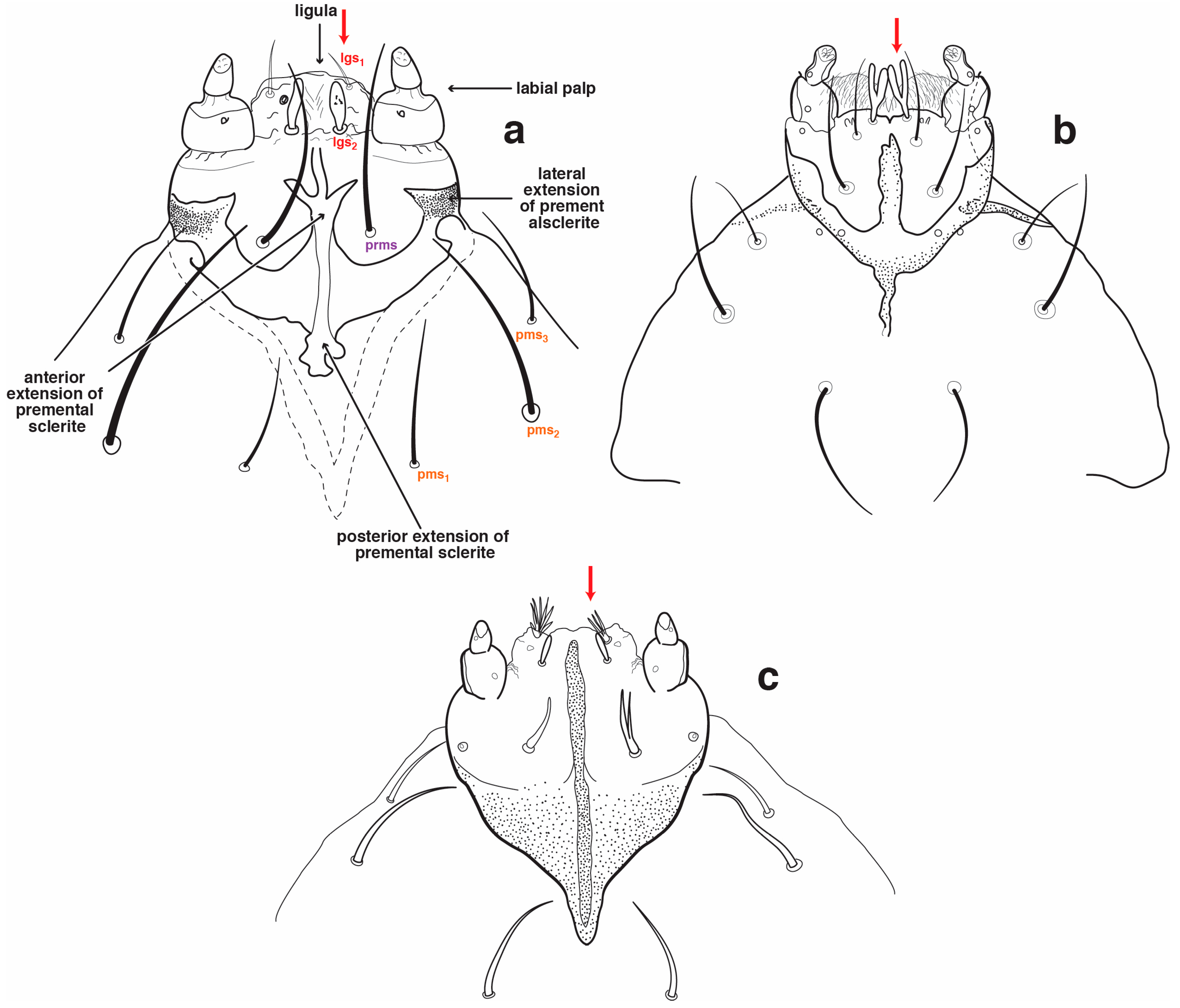
- PubescentCactophagus, Cosmopolites, Cyrtotrachelus, Diathetes, Diocalandra*, Foveolus, Mesocordylus (probably), Metamasius, Nassophasis, Nephius (=Anius), Odoiporus, Paramasius, Phacecorynes, Polytus, Poteriophorus, Rhabdoscelus, Rhodobaenus, Rhynchophorus, Scyphophorus, Sipalinus, Sparganobasis, Sphenophorus, Temnoschoita, Trigonotarsus, Trochorhopalus, YuccaborusNot included: Dryophthoroides, Rhinostomus, Xerodermus
- a.
- Laterad, medially glabrousCyrtotrachelus, Diocalandra, Dryophthorus, Mesocordylus (probably), Myocalandra, Nassophasis, Nephius (=Anius)*, Phacecorynes, Rhodobaenus, Sitophilus, Sphenophorus*, Stenommatus, Tryphetus
- b.
- Laterad with scattered medial setaeCosmopolites, Foveolus, Nephius (=Anius)*, Polytus
- c.
- Covering anterior margin not extending beyond length of malaEugnoristus#, Temnoschoita
- d.
- Covering anterior margin and extending posterad beyond mala, usually in a narrow pubescent lateral strip resulting in a glabrous medial areaCactophagus, Diathetes, Eucalandra, Metamasius, Odoiporus, Paramasius, Poteriophorus, Rhabdoscelus, Rhynchophorus, Scyphophorus, Sipalinus, Sparganobasis#, Sphenophorus*, Trigonotarsus, Trochorhopalus, YuccaborusNot included: Dryophthoroides, Dynamis, Rhinostomus, Xerodermus
3.1.8. Maxilla
- a.
- Digitate (anterior margin rounded)Cactophagus, Cyrtotrachelus, Diathetes, Diocalandra, Dryophthoroides [12], Dryophthorus, Eucalandra, Mesocordylus (probably), Myocalandra, Nassophasis, Nephius (=Anius), Odoiporus, Paramasius, Phacecorynes, Poteriophorus, Rhabdoscelus, Scyphophorus, Sparganobasis, Sphenophorus* (but could be interpreted as “b” by some), Temnoschoita, Trochorhopalus, Tryphetus
- b.
- Subquadrate (anterior margin angled but distinctly truncate)Cosmopolites, Eugnoristus, Metamasius, Polytus, Rhodobaenus, Sipalinus, Sitophilus, Sphenophorus* (but could be interpreted as “a” by some), Yuccaborus
- c.
- Quadrate (anterior margin truncate)Foveolus, Rhynchophorus, Stenommatus, TrigonotarsusNot included: Xerodermus, Rhinostomus
- a.
- None discernableCyrtotrachelus, Dryophthoroides [12], Dryophthorus, Mesocordylus (probably), Myocalandra, Rhabdoscelus, Sitophilus, Stenommatus
- b.
- Present but not between dmsDiocalandra, Nassophasis, Phacecorynes, Rhodobaenus *(may be misinterpreted as “c”), Rhynchophorus, Sipalinus, Trochorhopalus, Tryphetus
- c.
- Present at base of and between dmsCactophagus, Cosmopolites (asperites mostly), Diathetes (dms 3–8), Eucalandra, Eugnoristus, Foveolus (dms 2–8), Metamasius, Nephius (=Anius), Odoiporus (copious amounts), Paramasius (dms 1–8), Polytus, Poteriophorus, Rhodobaenus* (but setae not asperites), Scyphophorus, Sparganobasis (only at base of dms 2–8), Sphenophorus, Temnoschoita, Trigonotarsus, Yuccaborus
- d.
- Present between dms 4–8 and as a distinct rounded area of microsetae (dms 1–3)TrigonotarsusNot included: Rhinostomus, Xerodermus
- a.
- None discernableDryophthoroides [12], Dryophthorus, Foveolus (but asperites at base of mala), Metamasius, Myocalandra, Phacecorynes, Polytus, Rhabdoscelus, Sipalinus, Sitophilus, Sphenophorus*, Stenommatus, Tryphetus
- b.
- Asperites presentCactophagus, Cosmopolites, Diathetes, Diocalandra, Eucalandra, Eugnoristus, Mesocordylus (probably) (serrate), Nassophasis, Odoiporus, Paramasius, Poteriophorus, Rhodobaenus (very fine), Rhynchophorus, Scyphophorus, Sparganobasis, Sphenophorus* (very fine), Temnoschoita, Trigonotarsus, Trochorhopalus, Yuccaborus
- c.
- Elongate and thin setae presentNephius (=Anius)
- d.
- Elongate and stout setae presentCyrtotrachelusNot included: Dynamis, Rhinostomus, Xerodermus
- a.
- Regularly aligned in single row (dms 7,8 may sometimes be more lateral, but always in a single file)Cactophagus (dms 7,8 laterad), Cosmopolites, Diathetes, Diocalandra, Dryophthoroides [12], Dryophthorus, Eucalandra (dms 7,8 somewhat distant from dms 3–8), Eugnoristus, Foveolus (dms 7,8 somewhat distant from dms 1–6), Mesocordylus (probably), Metamasius (dms 7,8 somewhat distant from dms 3–8), Myocalandra, Nassophasis (dms 7,8 somewhat distant from dms 1–6), Nephius (=Anius), Odoiporus, Paramasius (dms 7,8 somewhat distant from dms 1–6), Phacecorynes, Polytus, Poteriophorus (dms 7,8 somewhat distant from dms 1–6), Rhabodscelus (dms 7,8 somewhat distant from dms 1–6), Rhodobaenus (dms 7,8 somewhat distant from dms 1–6), Scyphophorus (dms 7,8 somewhat distant from dms 1–6), Sipalinus, Sitophilus oryzae#(some Sitophilus may have dms irregularly distributed), Sparganobasis, Sphenophorus (dms 7,8 somewhat distant from dms 1–6), Stenommatus, Temnoschoita (dms 7,8 somewhat distant from dms 1–6), Trochorhopalus, Tryphetus, Xerodermus [11], Yuccaborus
- b.
- Regularly distributed medially, proximally somewhat clumpedCyrtotrachelus, Rhynchophorus, Trigonotarsus#Not included: Dynamis, Rhinostomus
- a.
- Less than five (5)Sitophilus (but unclear)
- b.
- Six (6)
- c.
- Seven (7)Myocalandra
- d.
- Seven (7) (with a small pore)Stenommatus
- e.
- Eight (8)Cactophagus, Cosmopolites, Diathetes, Diocalandra, Eucalandra, Eugnoristus*, Foveolus, Mesocordylus (probably), Metamasius, Nassophasis, Nephius (=Anius), Paramasius, Phacecorynes, Polytus, Poteriophorus, Rhabdoscelus, Rhodobaenus, Scyphophorus, Sparganobasis, Sphenophorus, Temnoschoita, Trigonotarsus, Trochorhopalus, Tryphetus#*
- f.
- Ten (10)Odoiporus (10–11), Yuccaborus
- g.
- Fourteen (14)Rhynchophorus
- h.
- Fifteen (15)Sipalinus
- i.
- More than 30CyrtotrachelusNot included: Dynamis, Rhinostomus
- a.
- EntireCactophagus, Cyrtotrachelus (possibly some distally may be superficially branched), Phacecorynes, Rhodobaenus, Rhynchophorus (occasional bifurcate seta), Sitophilus, Tryphetus
- b.
- BranchingCosmopolites, Diathetes, Diocalandra, Dryophthoroides [12], Dryophthorus, Eucalandra, Eugnoristus, Foveolus, Mesocordylus (probably), Metamasius, Myocalandra, Nassophasis, Nephius (=Anius), Odoiporus, Paramasius, Polytus, Poteriophorus, Rhabdoscelus, Scyphophorus, Sipalinus, Sparganobasis, Sphenophorus, Stenommatus, Temnoschoita, Trigonotarsus, Trochorhopalus, Xerodermus [11], Yuccaborus (tufted)Not included: Dynamis, Rhinostomus
- a.
- Entire, not branchingCactophagus, Cyrtotrachelus (possibly some distally may be superficially branched), Phacecorynes, Rhodobaenus, Rhynchophorus (occasional bifurcate seta), Sitophilus, Tryphetus
- b.
- All dms equally branchingCosmopolites, Diocalandra, Eugnoristus, Foveolus, Nassophasis, Odoiporus, Paramasius*, Polytus, Scyphophorus, Sipalinus, Temnoschoita, Yuccaborus
- c.
- Branching dms distally decreasingDiathetes (dms 3–8 branching), Dryophthoroides [12], Dryophthorus, Mesocordylus (probably), Myocalandra, Poteriophorus, Rhabdoscelus, Stenommatus, Trigonotarsus
- d.
- Branching dms distally increasedEucalandra, Metamasius, Nephius (=Anius), Paramasius*, Sparganobasis (dms 8 bifurcate, others trifurcate?), Sphenophorus, TrochorhopalusNot included: Dynamis, Rhinostomus, Xerodermus
- a.
- Not branchingCactophagus, Cyrtotrachelus (distal setae may be superficially branched), Phacecorynes, Rhodobaenus, Rhynchophorus (occasional bifurcate seta), Sitophilus, Tryphetus
- b.
- All bifurcateCosmopolites, Diocalandra, Eugnoristus, Paramasius*, Polytus, Sparganobasis
- c.
- Some dms entire, others bifurcateDiathetes [dms 1–2 entire, dms 3–8 bifurcate (shallow)], Dryophthorus (dms 2–6 bifurcate, dms 1 entire), Eucalandra (dms 1–6 bifurcate, dms 7, dms 8 entire), Mesocordylus (probably) (dms 1–5 entire, dms 6–8 bifurcate), Metamasius (dms 1–6 bifurcate, dms 7, dms 8 entire; sometimes dms 7 or 8 may be bifurcate), Myocalandra (dms 1–6 entire, dms 7 bifurcate), Nephius (=Anius) (dms 1–6 bifurcate, dms 7, dms 8 entire), Paramasius* (dms 1–7 bifurcate, dms 8 enitre), Sphenophorus (dms 1–6 bifurcate, dms 7, dms 8 entire), Stenommatus (dms 1 entire, dms 2–7 bifurcate), Trochorhopalus (dms 1–6 bifurcate, dms 7, dms 8 entire)
- d.
- Some dms bifurcate, others multifurcateDryophthoroides#* (([12], p. 253) “…row of about six fissile setae and one or two simple setae.”) [12], Poteriophorus (dms 1–3 bifurcate, dms 4–8 tufted, shallow and multi-furcate), Rhabdoscelus (dms 1–2, 8 bifurcate, dms 3–7 multifurcate), Scyphophorus [dms 1–6 bifurcate, dms 7, 8 tufted (deeply and multi-furcate)], Trigonotarsus (dms 1–5 bifurcate, dms 6–8 multifurcate)
- e.
- All tufted (shallow and multi-furcate)
- f.
- All tufted (deeply and multi-furcate)Sipalinus, YuccaborusNot included: Dynamis, Rhinostomus, Xerodermus ([11], (p. 41) “…mala with several branched setae, six of them in a longitudinal row not extending far from apex.”)
- a.
- UnbranchedCactopahgus, Cosmopolites, Cyrtotrachelus, Diathetes, Diocalandra, Dryophthorus, Eucalandra, Mesocordylus (probably), Myocalandra, Nephius (=Anius), Paramasius, Phacecorynes, Rhodobaenus, Rhynchophorus, Scyphophorus, Sitophilus, Sparganobasis Sphenophorus, Stenommatus, Tryphetus
- b.
- One (1) branched, remainder unbranchedPolytus, Rhabdoscelus, Trigonotarsus#
- c.
- Two (2) branchedFoveolus#*, Eugnoristus, Metamasius, Sipalinus, Trochorhopalus
- d.
- More than two branchedFoveolus#*, Nassophasis, Odoiporus (3), Poteriophorus, Temnoschoita, Yuccaborus (at least 3)Not included: Dryophthoroides, Dynamis, Rhinostomus, Xerodermus
- a.
- AbsentCactopahgus, Diathetes, Diocalandra, Dryophthorus, Eugnoristus, Foveolus#*, Metamasius, Myocalandra, Nassophasis, Nephius (=Anius), Odoiporus, Paramasius, Phacecorynes, Poteriophorus, Rhabdoscelus, Rhodobaenus, Rhynchophorus, Scyphophorus, Sipalinus, Sphenophorus, Stenommatus, Temnoschoita, Trigonotarsus (apparently very small one present, but unclear), Trochorhopalus, Tryphetus, Yuccaborus
- b.
- PresentCosmopolites, Cyrtotrachelus, Eucalandra, Foveolus#*, Mesocordylus (probably), Polytus, Sitophilus, Sparganobasis (bilobed vms3?)Not included: Dryophthoroides, Dynamis, Rhinostomus, Xerodermus
3.1.9. Labium
- a.
- AbsentCactopahgus, Cosmopolites, Cyrtotrachelus, Diathetes, Eucalandra, Mesocordylus (probably), Nassophasis, Odoiporus, Phacecorynes, Poteriophorus, Rhabdoscelus, Rhodobaenus, Rhynchophorus, Scyphophorus, Sipalinus, Sitophilus, Sparganobasis, Trigonotarsus, Tryphetus, Yuccaborus
- b.
- PresentDiocalandra, Dryophthorus (small amounts of setae), Eugnoristus, Foveolus, Metamasius, Myocalandra, Nephius (=Anius), Paramasius, Polytus, Sphenophorus, Stenommatus (reduced), Temnoschoita, Trochorhopalus (reduced), Xerodermus [11]Not included: Dryophthoroides, Dynamis, Rhinostomus
- a.
- EntireCactopahgus, Cyrtotrachelus, Diathetes, Diocalandra, Dryophthorus, Eugnoristus, Foveolus, Mesocordylus (probably), Metamasius, Myocalandra, Nassophasis, Nephius (=Anius), Paramasius, Poteriophorus, Phacecorynes, Polytus, Rhabdoscelus, Rhodobaenus, Rhynchophorus, Scyphophorus, Sitophilus, Sparganobasis (broken/weathered), Sphenophorus, Stenommatus, Temnoschoita, Trigonotarsus, Trochorhopalus, Tryphetus, Xerodermus [11]
- b.
- BranchedCosmopolites, Eucalandra, Odoiporus
- c.
- TuftedYuccaborusNot included: Dryophthoroides, Dynamis, Rhinostomus, Sipalinus
- a.
- LinearDryophthorus, Mesocordylus (probably), Stenommatus
- b.
- Not linearCactophagus, Cosmopolites, Cyrtotrachelus, Diathetes, Diocalandra, Eucalandra, Eugnoristus, Foveolus, Metamasius, Myocalandra, Nassophasis, Nephius (=Anius), Odoiporus, Paramasius, Phacecorynes, Polytus, Poteriophorus, Rhabdoscelus, Rhodobaenus, Rhynchophorus, Scyphophorus, Sipalinus, Sitophilus, Sparganobasis, Sphenophorus, Temnoschoita, Trigonotarsus, Trochorhopalus, Tryphetus, YuccaborusNot included: Dryophthoroides, Dynamis, Rhinostomus, Xerodermus
- a.
- Absent/reducedDryophthorus, Stenommatus
- b.
- Present, prominentCactophagus, Cosmopolites, Cyrtotrachelus, Diathetes, Diocalandra, Dryophthoroides [12], Eucalandra, Eugnoristus, Foveolus, Mesocordylus (probably), Metamasius, Myocalandra, Nassophasis, Nephius (=Anius), Odoiporus, Paramasius, Phacecorynes, Polytus, Poteriophorus, Rhabdoscelus, Rhodobaenus, Rhynchophorus, Scyphophorus, Sipalinus, Sitophilus, Sparganobasis, Sphenophorus, Temnoschoita, Trigonotarsus, Trochorhopalus, Tryphetus, Xerodermus [11], Yuccaborus
- a.
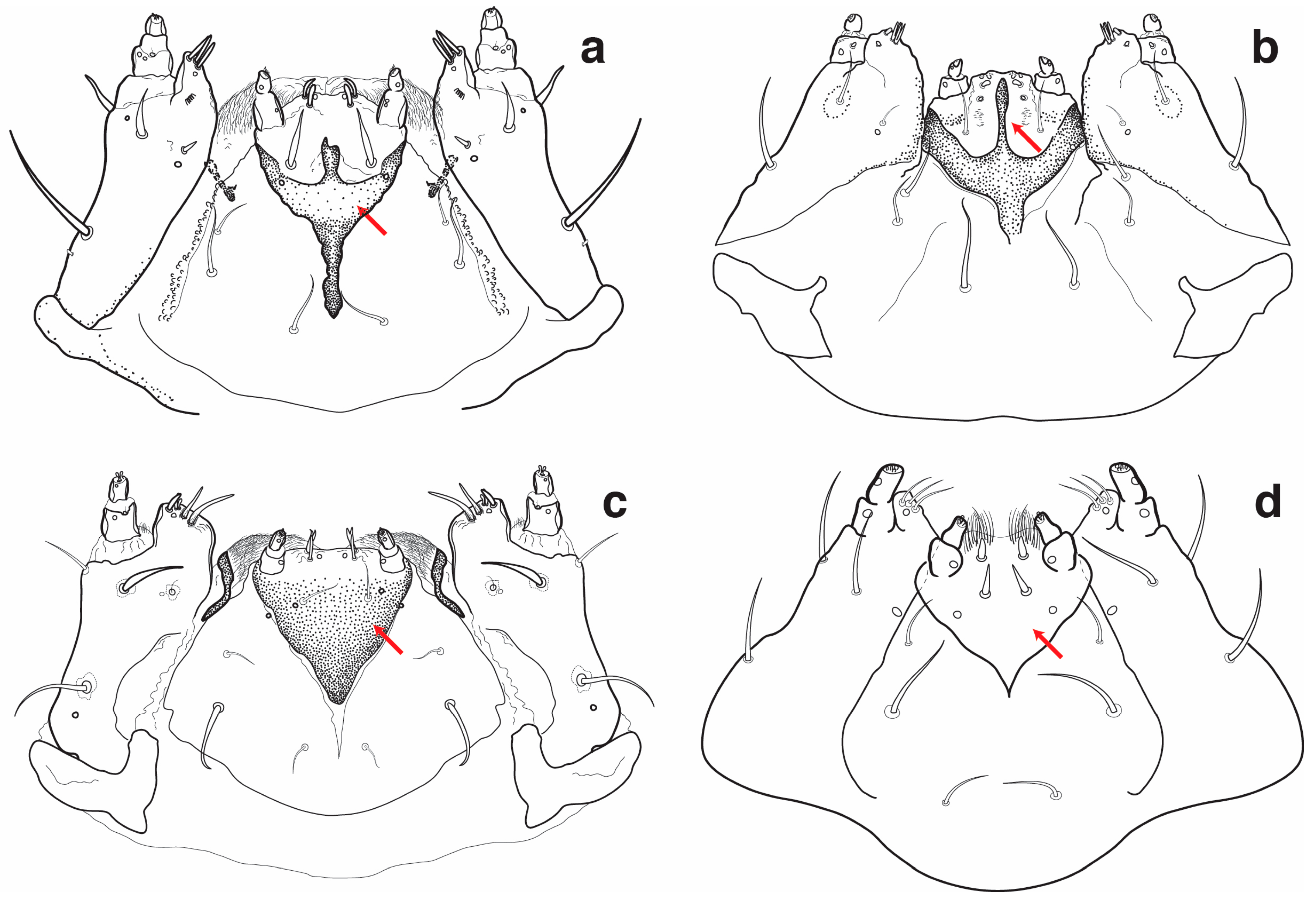
- TridentCactophagus, Cyrtotrachelus, Diocalandra, Dryophthorus, Dryophthoroides# [12], Eucalandra, Eugnoristus (anteriorly reduced), Foveolus, Mesocordylus (probably), Metamasius, Myocalandra, Nassophasis, Paramasius, Phacecorynes, Polytus*, Poteriophorus, Rhabdoscelus, Rhynchophorus, Scyphophorus, Sitophilus, Sparganobasis, Sphenophorus, Stenommatus, Temnoschoita, Trigonotarsus#*, Trochorhopalus, Tryphetus, Xerodermus [11]
- b.
- Trident, with prominent, narrow, elongate anterior extension (almost reaching apex of ligula)Sipalinus, Trigonotarsus#*, Yuccaborus
- c.
- TriangularCosmopolites, Polytus*, Rhodobaenus
- d.
- EffacedDiathetes, Nephius (=Anius), OdoiporusNot included: Dynamis, Rhinostomus
4. Discussion
Funding
Acknowledgments
Conflicts of Interest
References
- Oberprieler, R.G.; Marvaldi, A.E.; Anderson, R.S. Weevils, weevils, weevils everywhere. Zootaxa 2007, 1668, 491–520. [Google Scholar] [CrossRef]
- Anderson, R.S.; Marvaldi, A.E. 3.7.3 Dryophthorinae Schoenherr, 1825. In Handbook of Zoology. Arthropoda: Insecta: Coleoptera; Leschen, R.A.B., Beutel, R.G., Eds.; De Gruyter: Berlin, Germany; München, Germany; Boston, MA, USA, 2014; pp. 477–483. [Google Scholar]
- Alonso-Zarazaga, M.A.; Lyal, C.H.C. A World Catalogue of Families and Genera of Curculionoidea (Insecta: Coleoptera) (Excepting Scolytidae and Platypodidae); Entomopraxis: Barcelona, Spain, 1999. [Google Scholar]
- Kuschel, G. A phylogenetic classification of Curculionoidea to families and subfamilies. Mem. Entomol. Soc. Wash. 1995, 14, 5–33. [Google Scholar]
- Thompson, R.T. Observations on the morphology and classification of weevils (Coleoptera, Curculionoidea) with a key to major groups. J. Nat. Hist. 1992, 26, 835–891. [Google Scholar] [CrossRef]
- Marvaldi, A.E.; Morrone, J.J. Phylogenetic systematics of weevils (Coleoptera: Curculionoidea): A reappraisal based on larval and adult morphology. Insect Syst. Evol. 2000, 31, 43–58. [Google Scholar] [CrossRef]
- McKenna, D.D.; Sequeira, A.S.; Marvaldi, A.E.; Farrell, B.D. Temporal lags and overlap in the diversification of weevils and flowering plants. Proc. Natl. Acad. Sci. USA 2009, 106, 7083–7088. [Google Scholar] [CrossRef] [PubMed]
- Chamorro, M.L.; Huang, C.L. First description of the Immature Stages of Poteriophorus Schoenherr: The larva, pupa and biology of P. uhlemanni (Curculionidae: Dryophthorinae) discovered through Dawu Traditional Ecological Knowledge. Coleopt. Bull. 2019. [Google Scholar]
- Anderson, W.H. Larvae of Some Genera of Calendrinae (=Rhynchophorinae) and Stromboscerinae (Coleoptera: Curculionidae). Ann. Entomol. Soc. Am. 1948, 41, 413–437. [Google Scholar] [CrossRef]
- May, B.M. An Introduction to the Immature Stages of Australian Curculionoidea. In Australian Weevils; Csiro Publishing: Melbourne, Australia, 1994; Volume II, pp. 365–728. [Google Scholar]
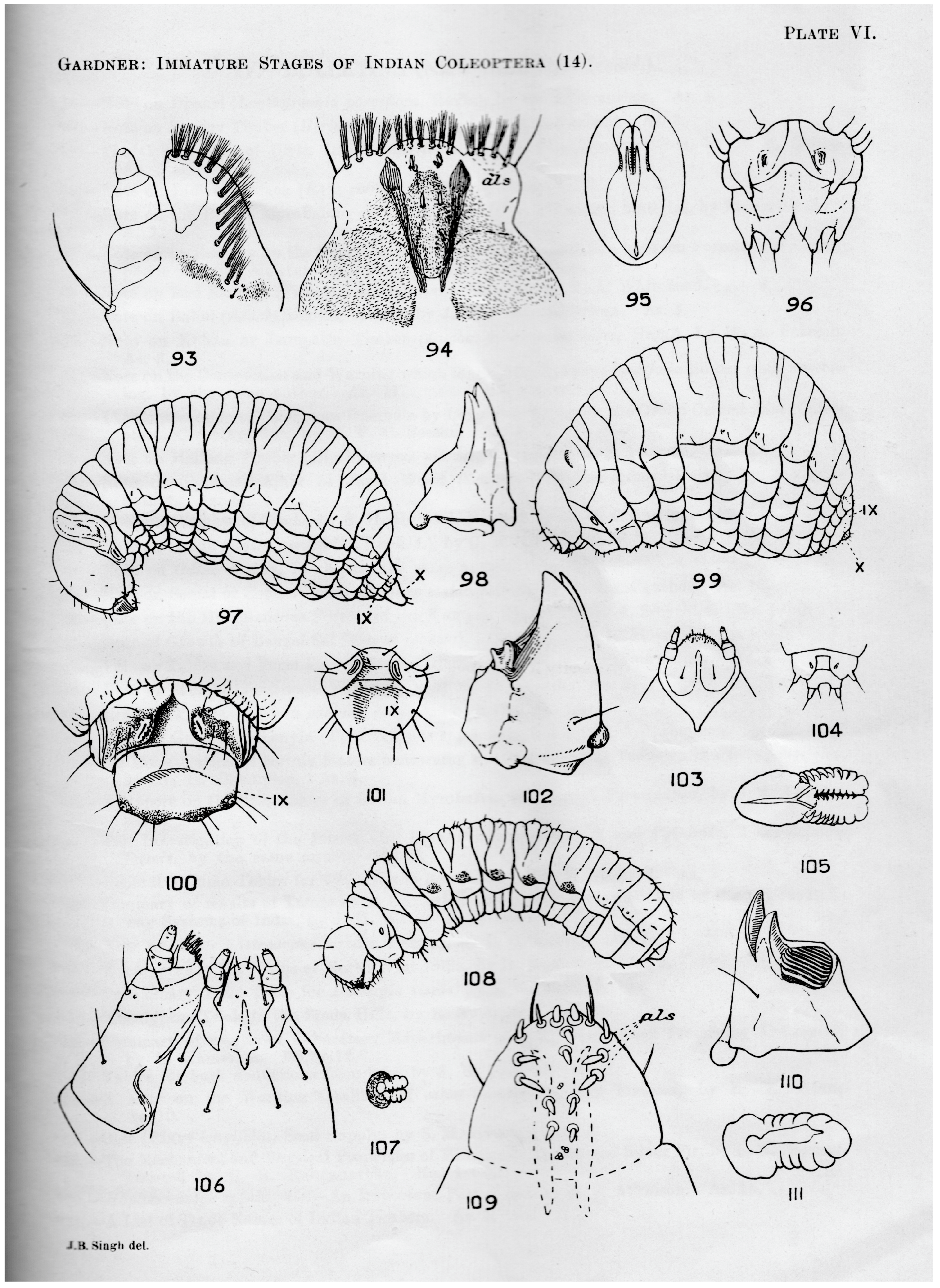
- Gardner, C.M. Immature stages of Indian Coleoptera (14) (Curculionidae). Indian For. Rec. (Entomol. Ser.) 1934, 20, 1–48, Plates I–VI. [Google Scholar]
- Gardner, J.C.M. Immature stages of Indian Coleoptera (24, Curculionidae contd.). Indian For. Rec. (New Ser.) Entomol. 1938, 3, 227–260, Plates I–V. [Google Scholar]
- Wattanapongsiri, A. A Revision of the Genera Rhynchophorus and Dynamis (Coleoptera: Curculionidae). Ph.D. Thesis, Oregon State University, Corvallis, OR, USA, 1966; p. 418. [Google Scholar]
- Chamorro, M.L.; Volkovitsh, M.G.; Poland, T.M.; Haack, R.A.; Lingafelter, S.W. Preimaginal Stages of the Emerald Ash Borer, Agrilus planipennis Fairmaire (Coleoptera: Buprestidae): An Invasive Pest on Ash Trees (Fraxinus). PLoS ONE 2012, 7, e33185. [Google Scholar] [CrossRef] [PubMed]
- May, B.M. Larvae of Curculionoidea (Insecta: Coleoptera): A systematic overview. Fauna N. Z. 1993, 28, 226p. [Google Scholar]
- Oberprieler, R.G.; Anderson, R.S.; Marvaldi, A.E. 3 Curculionoidea Latreille, 1802: Introduction, Phylogeny. In Handbook of Zoology. Arthropoda: Insecta: Coleoptera; Leschen, R.A.B., Beutel, R.G., Eds.; De Gruyter: Berlin, Germany; München, Germany; Boston, MA, USA, 2016; pp. 285–300. [Google Scholar]
- Chamorro, M.L.; Persson, J.; Torres-Santana, C.W.; Keularts, J.; Scheffer, S.J.; Lewis, M.L. Molecular and Morphological Tools to Distinguish Scyphophorus acupunctatus Gyllenhal, 1838 (Curculionidae: Dryophthorinae): A New Weevil Pest of the Endangered Century Plant, Agave eggersiana from St. Croix, U.S. Virgin Islands. Proc. Entomol. Soc. Wash. 2016, 118, 218–243. [Google Scholar] [CrossRef]
- Jonhnson, N.F. Future taxonomy today: New tools applied to accelerate the taxonomic process. In Systema Naturae 250: The Linnaean Ark; Polaszek, A., Ed.; CRC Press Taylor & Francis Group: London, UK, 2010; pp. 137–147. [Google Scholar]
- Holloway, B.A. Anthribidae (Insecta: Coleoptera). Fauna N. Z. 1982, 3, 272p. [Google Scholar]
- Marshall, C.J. Two new species of rain beetle (Coleoptera: Pleocomidae: Pleocoma LeConte, 1856) in the Pacific Northwest of the United States of America. Zootaxa 2018, 4471, 387–395. [Google Scholar] [CrossRef] [PubMed]
- Zimmerman, E. Australian Weevils. Volume III. Nanophyidae, Rhynchophoridae, Erirhinidae, Curculionidae: Amycterinae, Literature Consulted; CSIRO Publications: Melbourne, Australia, 1993; 854p. [Google Scholar]
- Grebennikov, V.V. Dryophthorinae weevils (Coleoptera: Curculionidae) of the forest floor in Southeast Asia: Illustrated overview of nominal Stromboscerini genera. Zootaxa 2018, 4418, 1–15. [Google Scholar] [CrossRef] [PubMed]
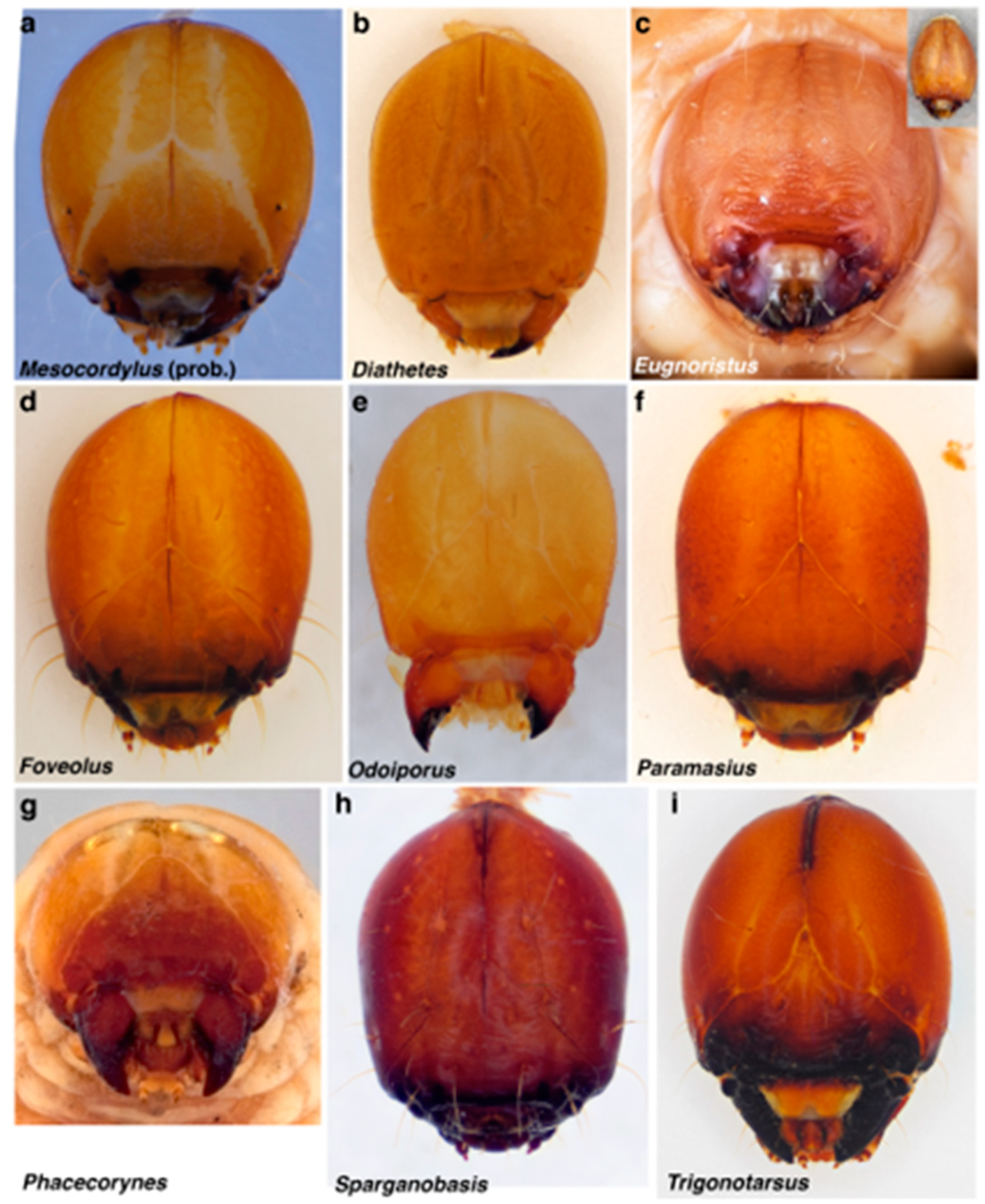
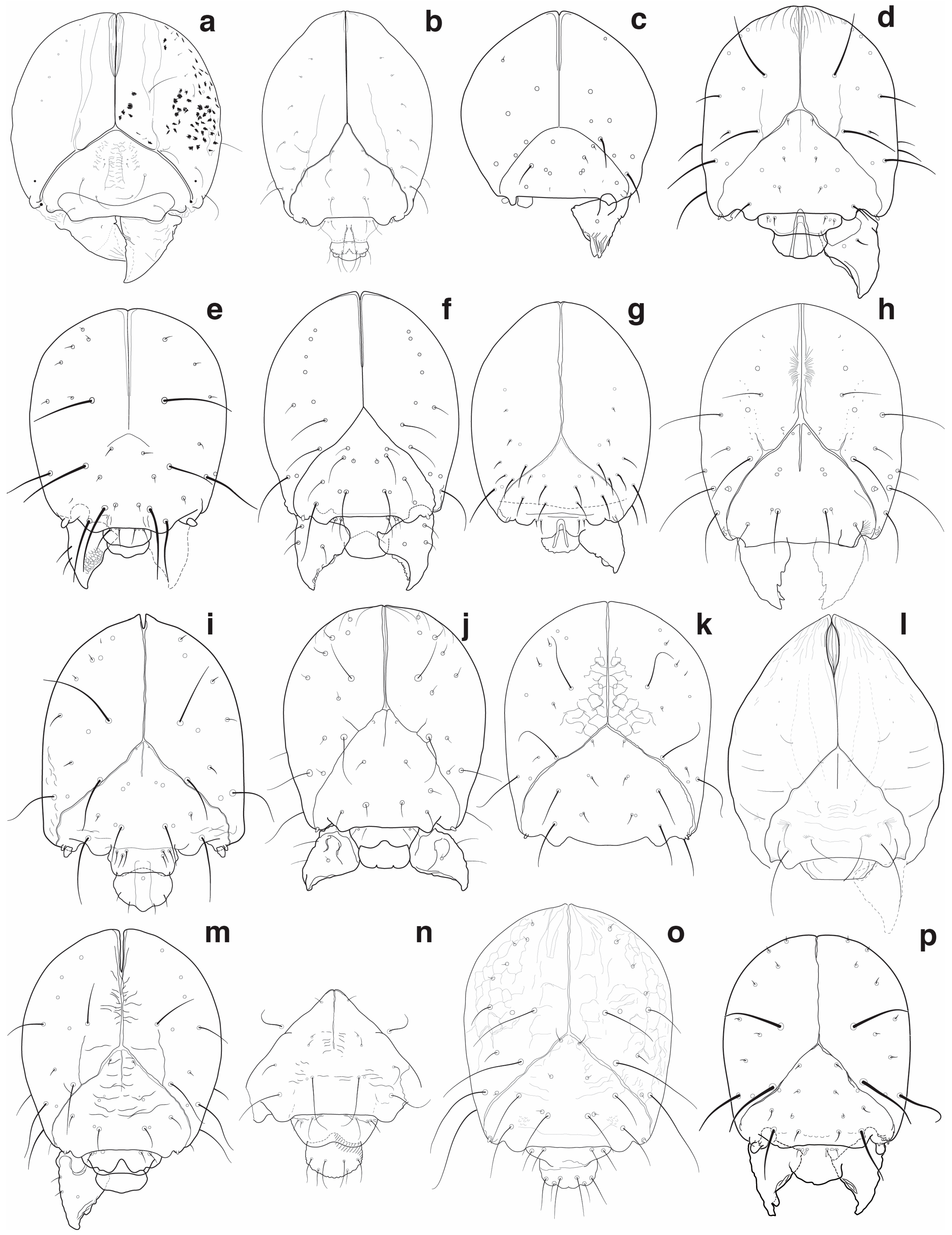
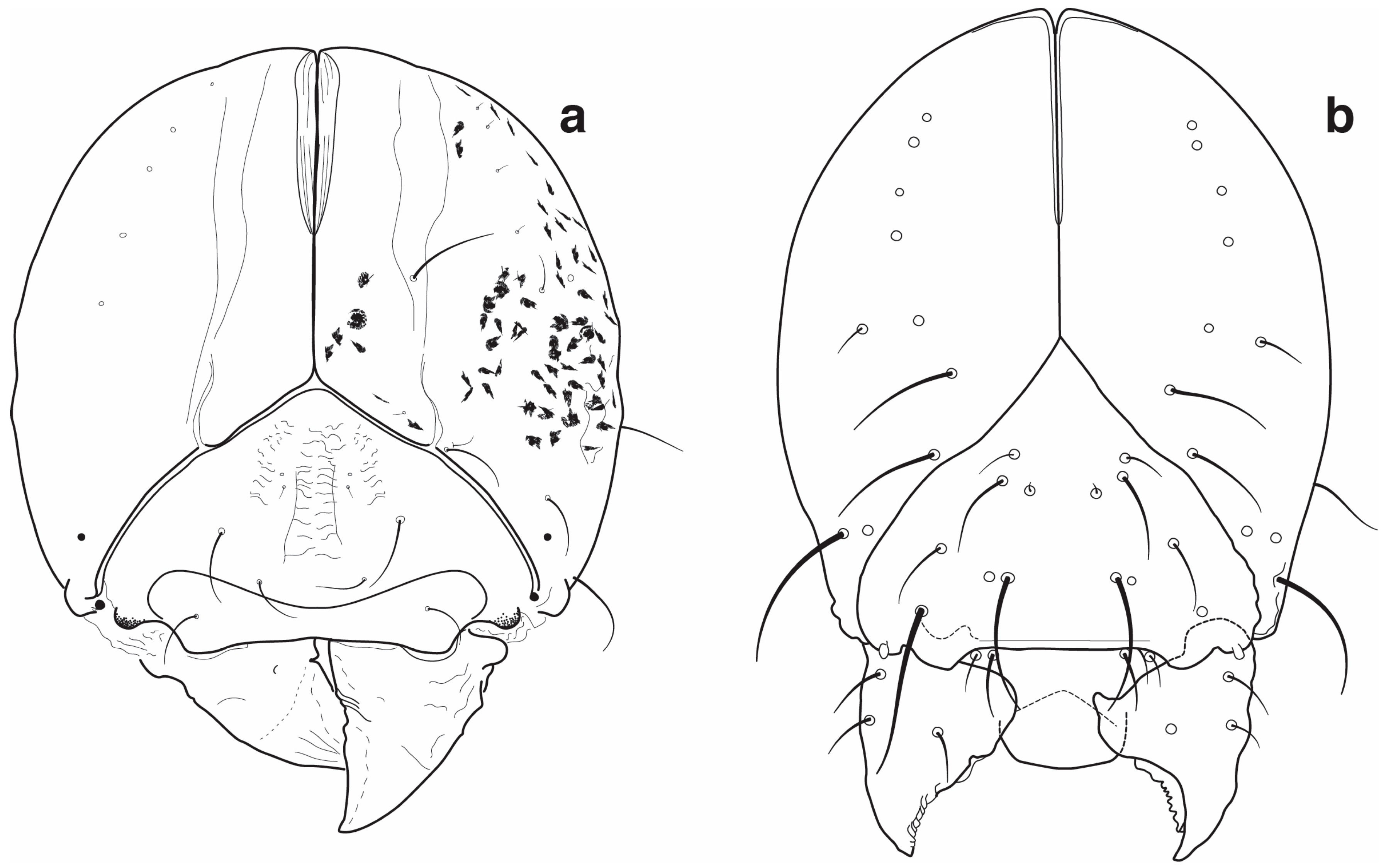
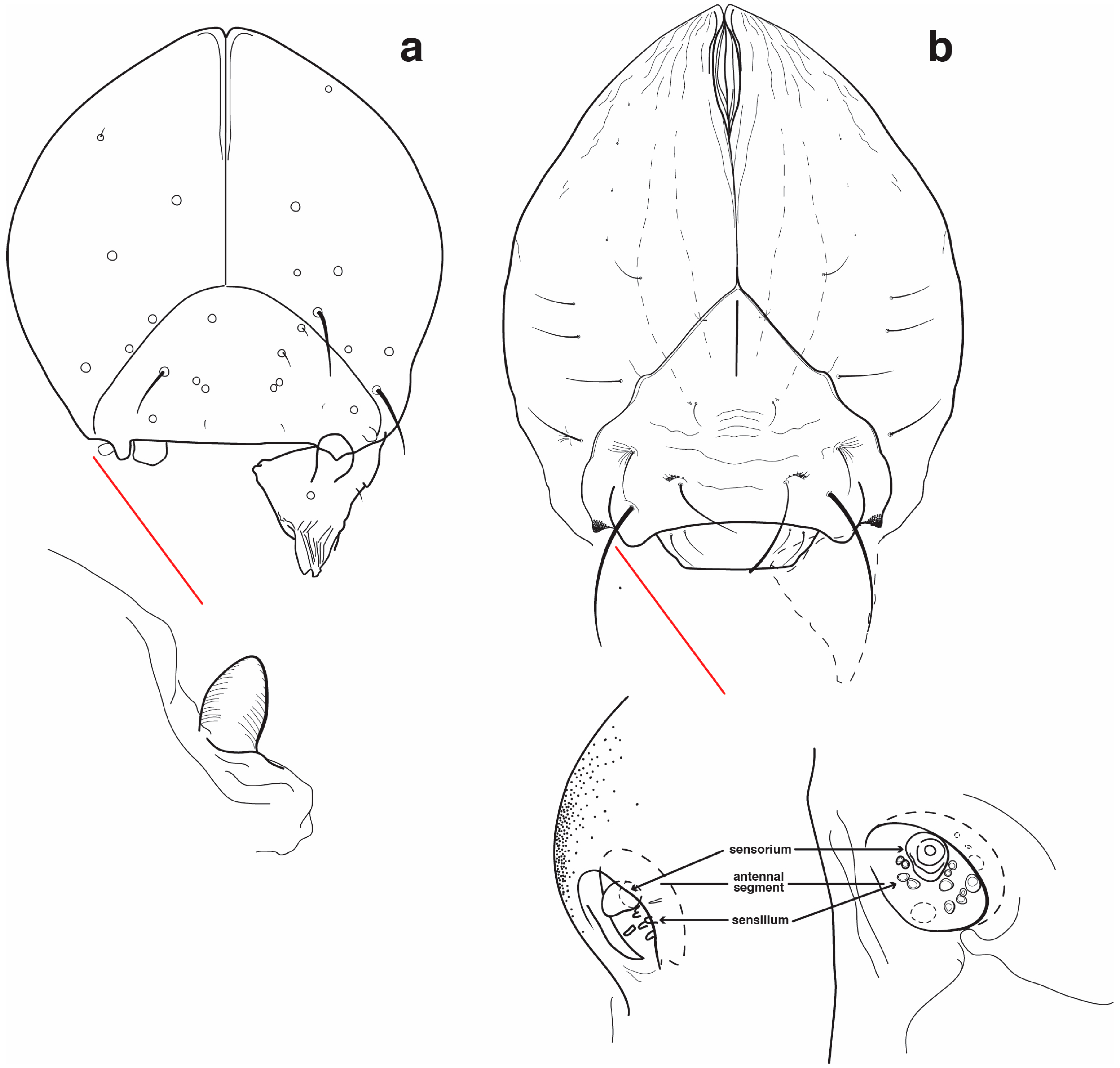







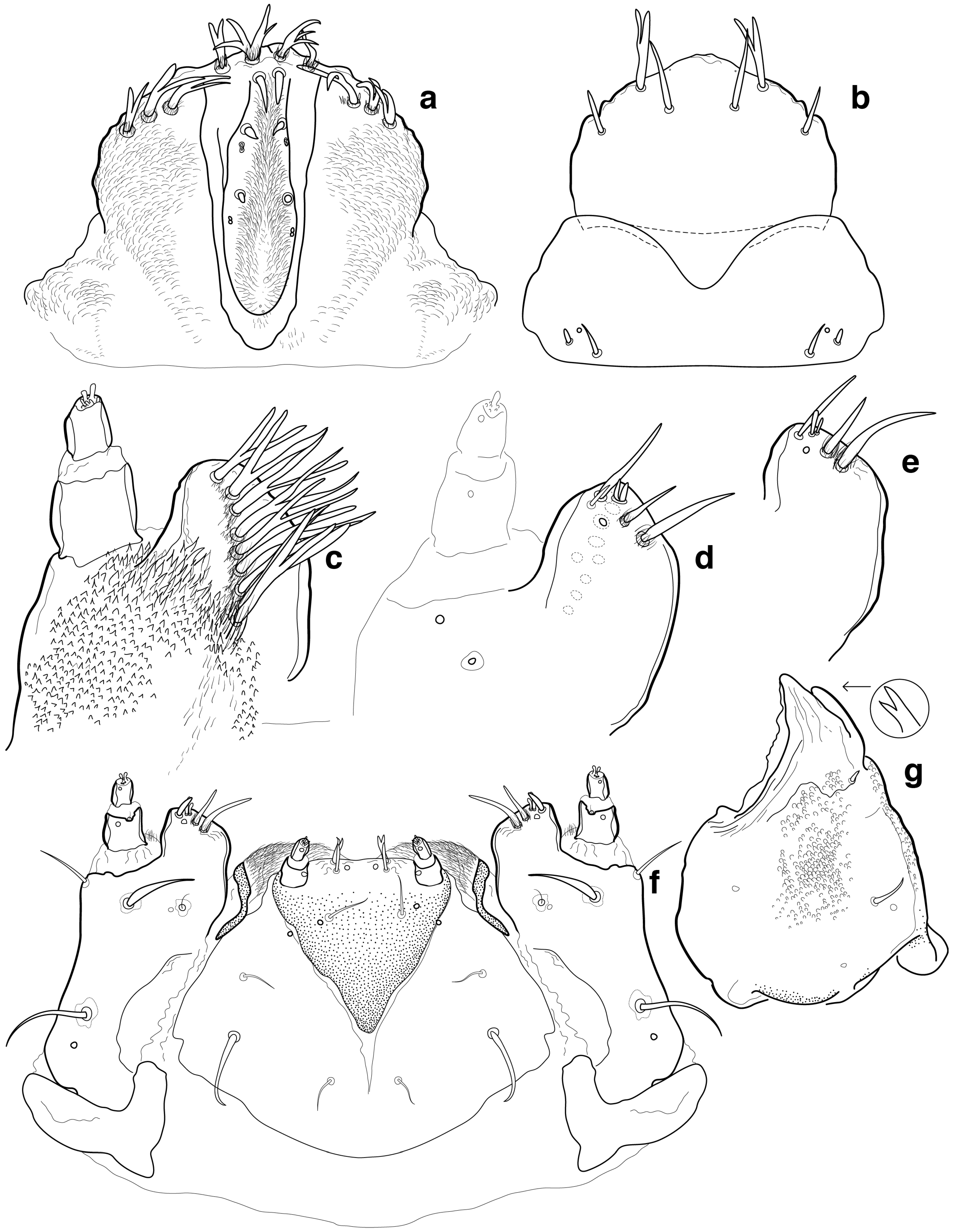
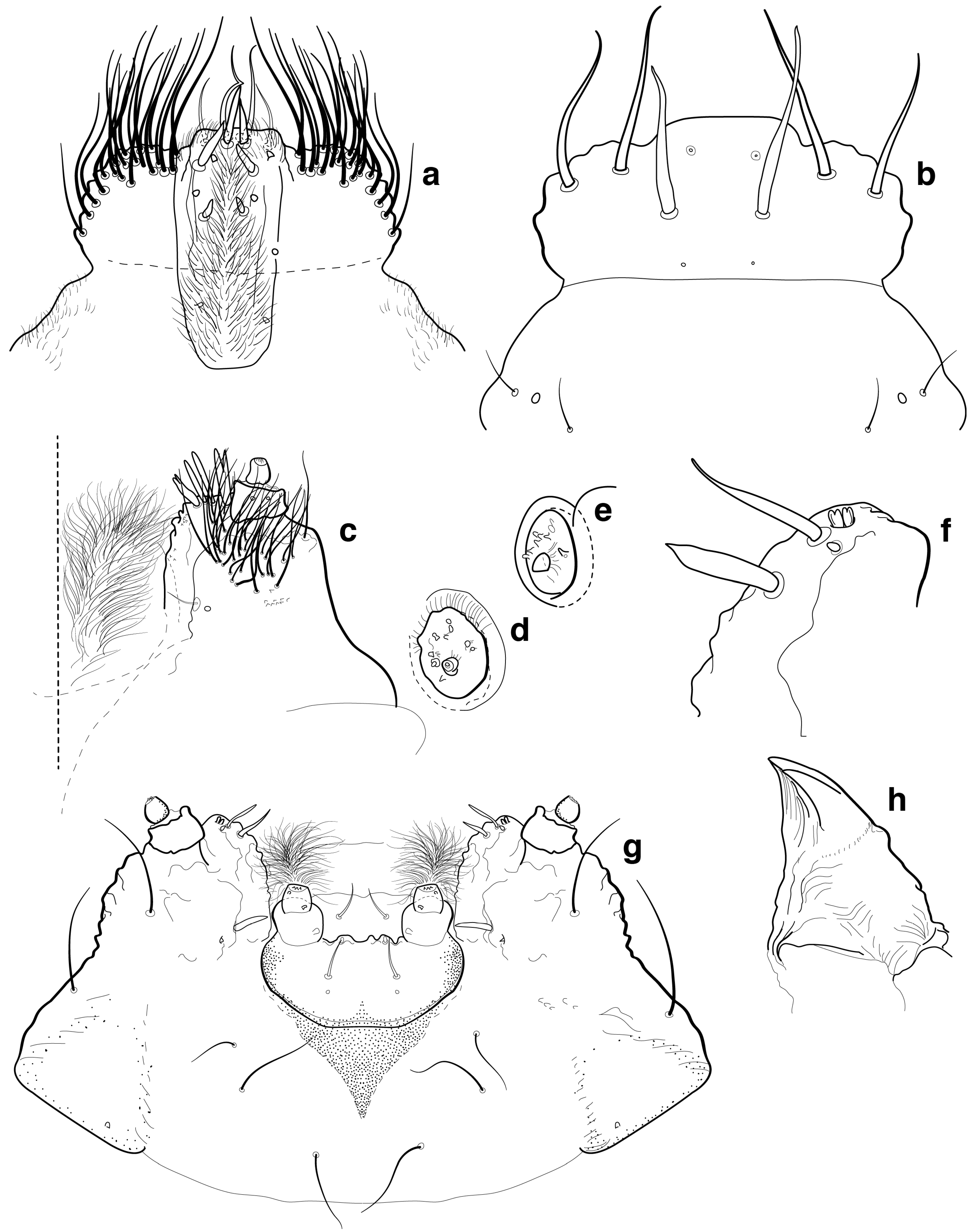
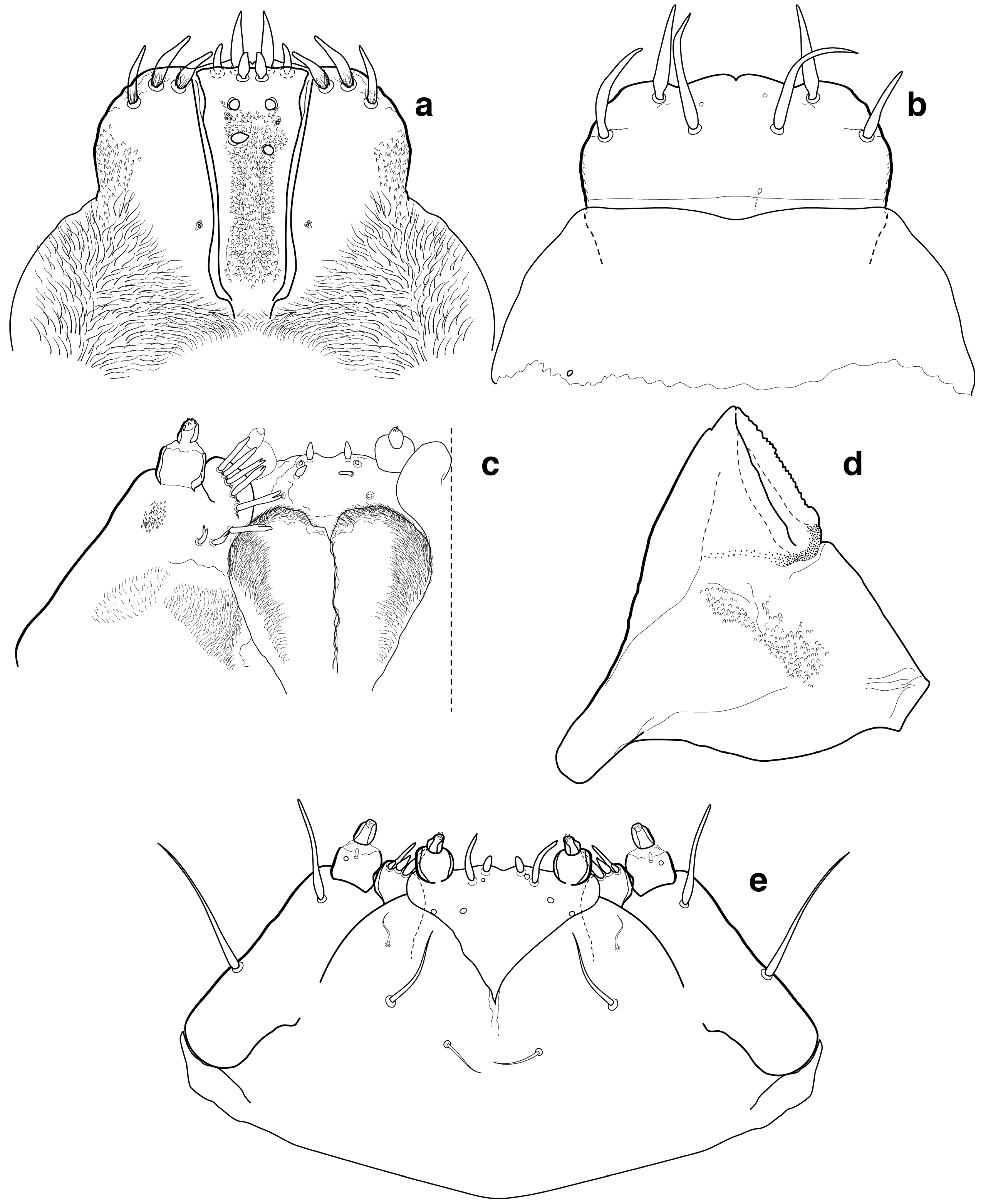
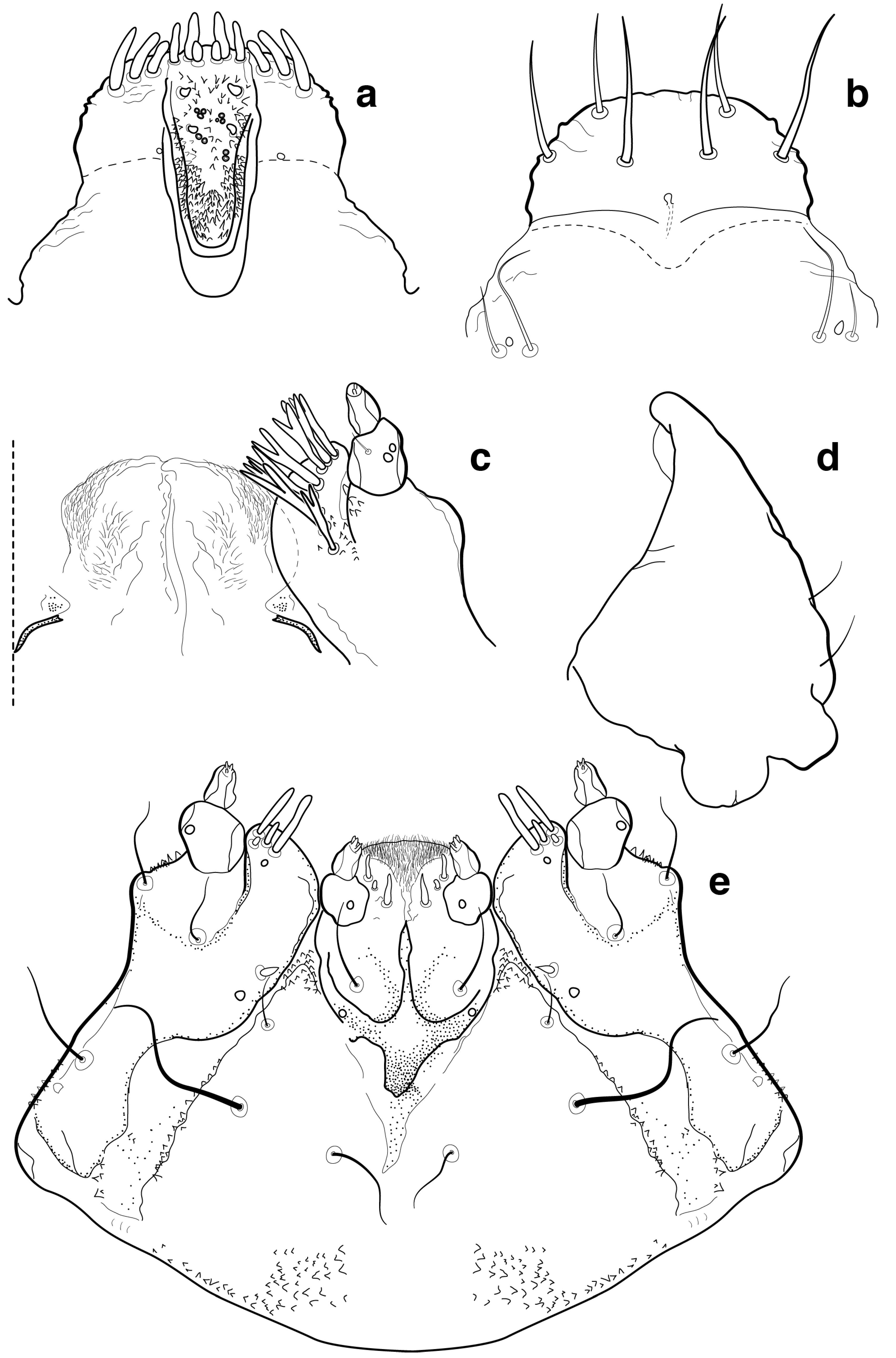
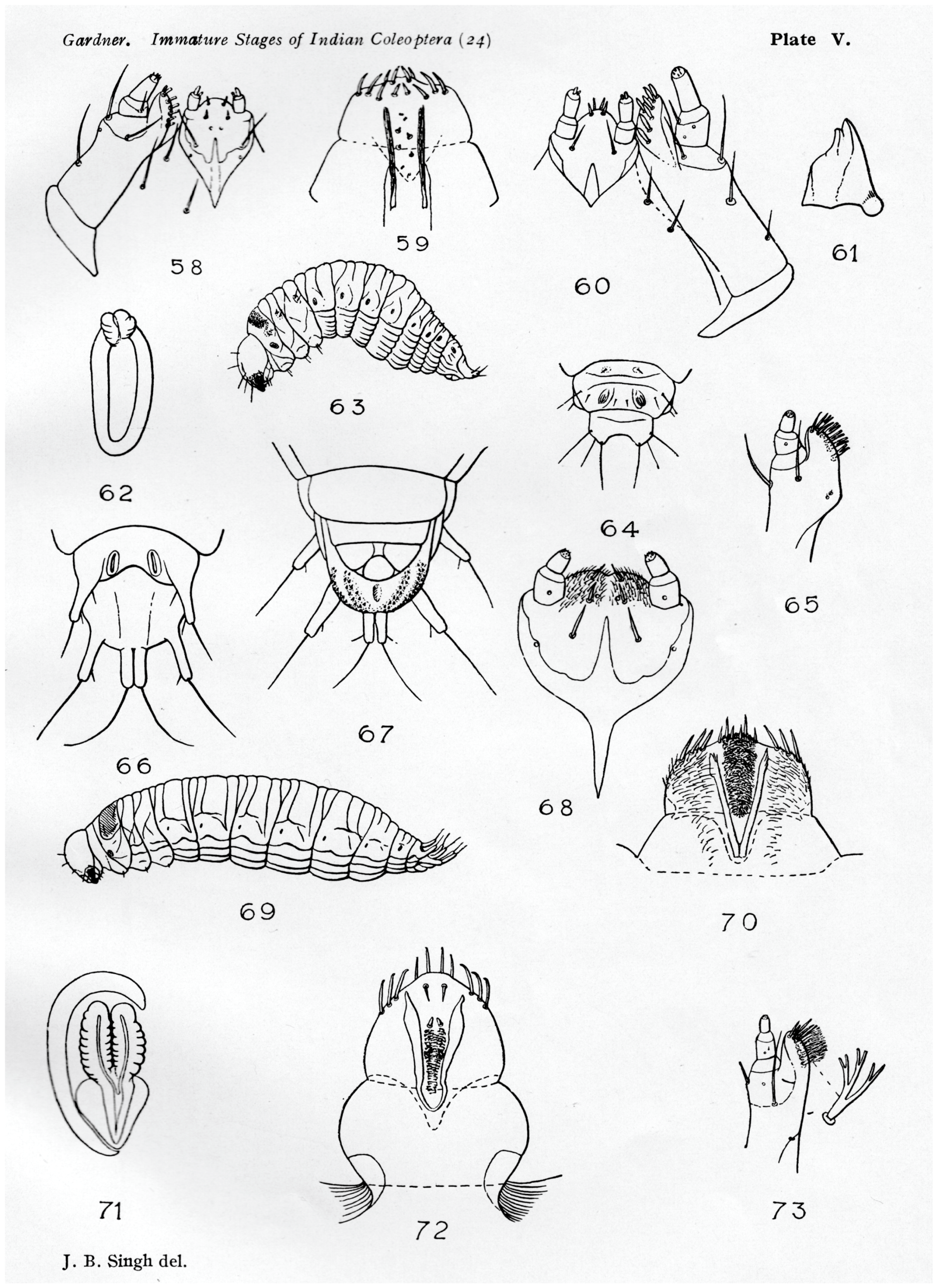
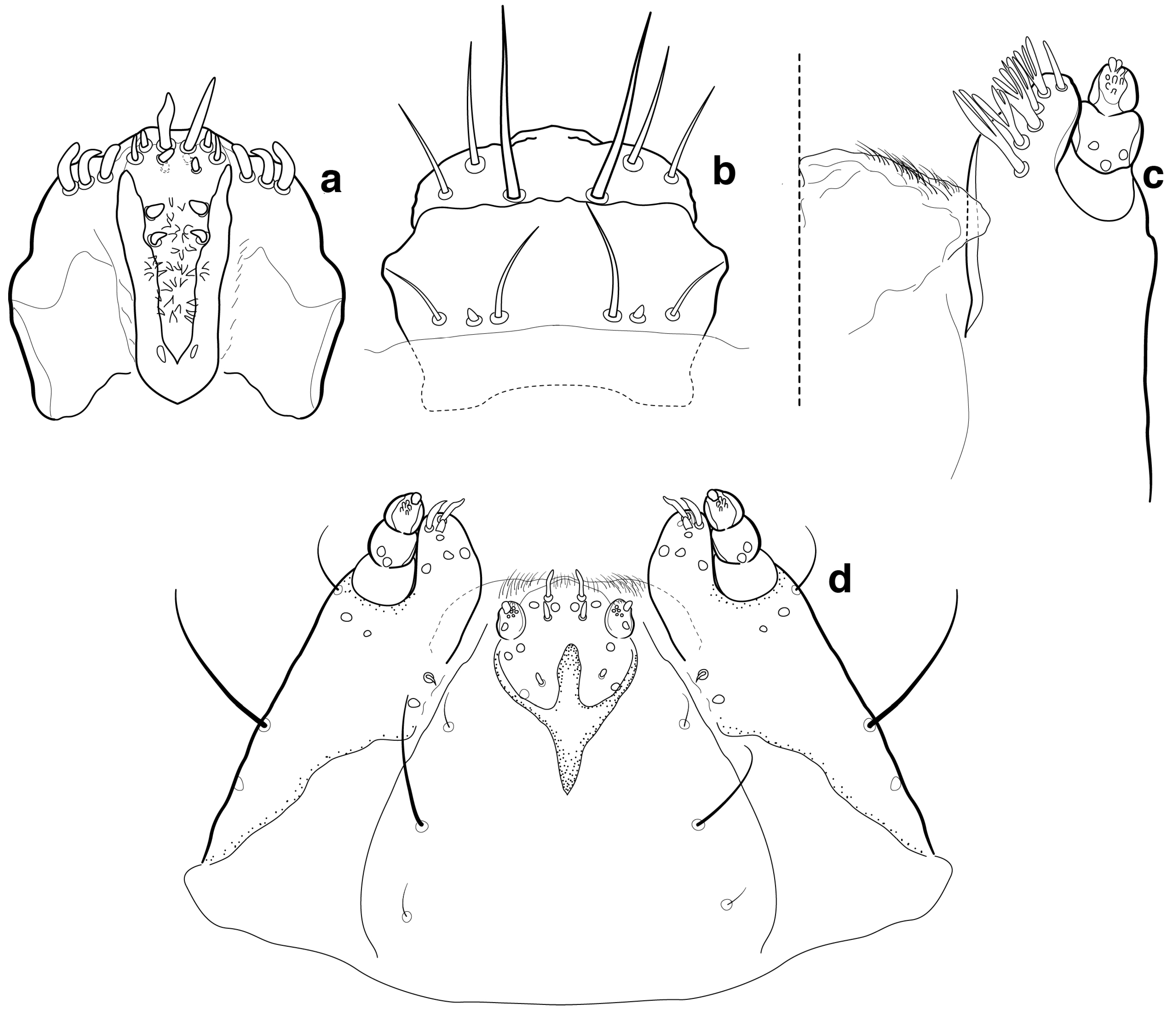
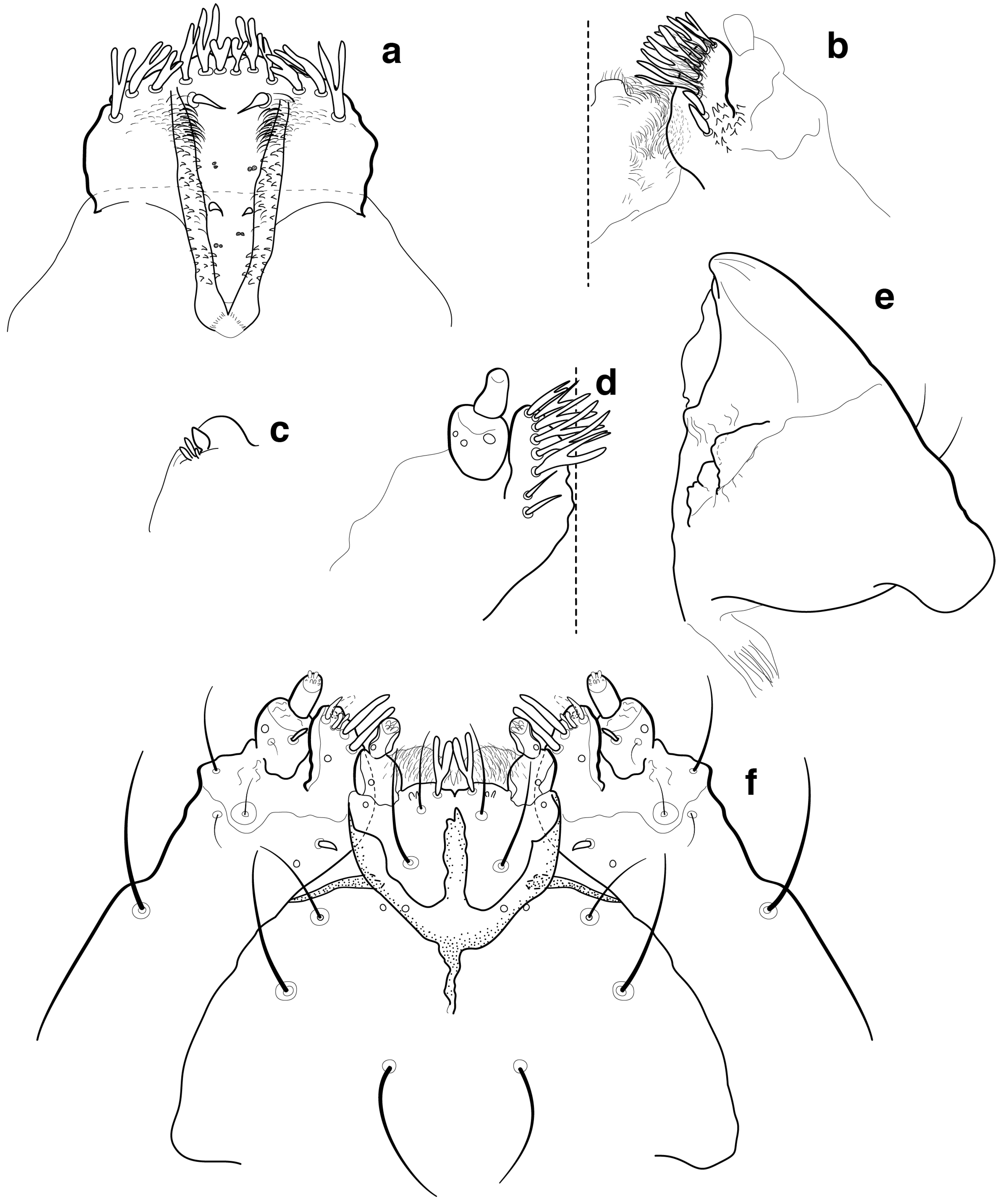
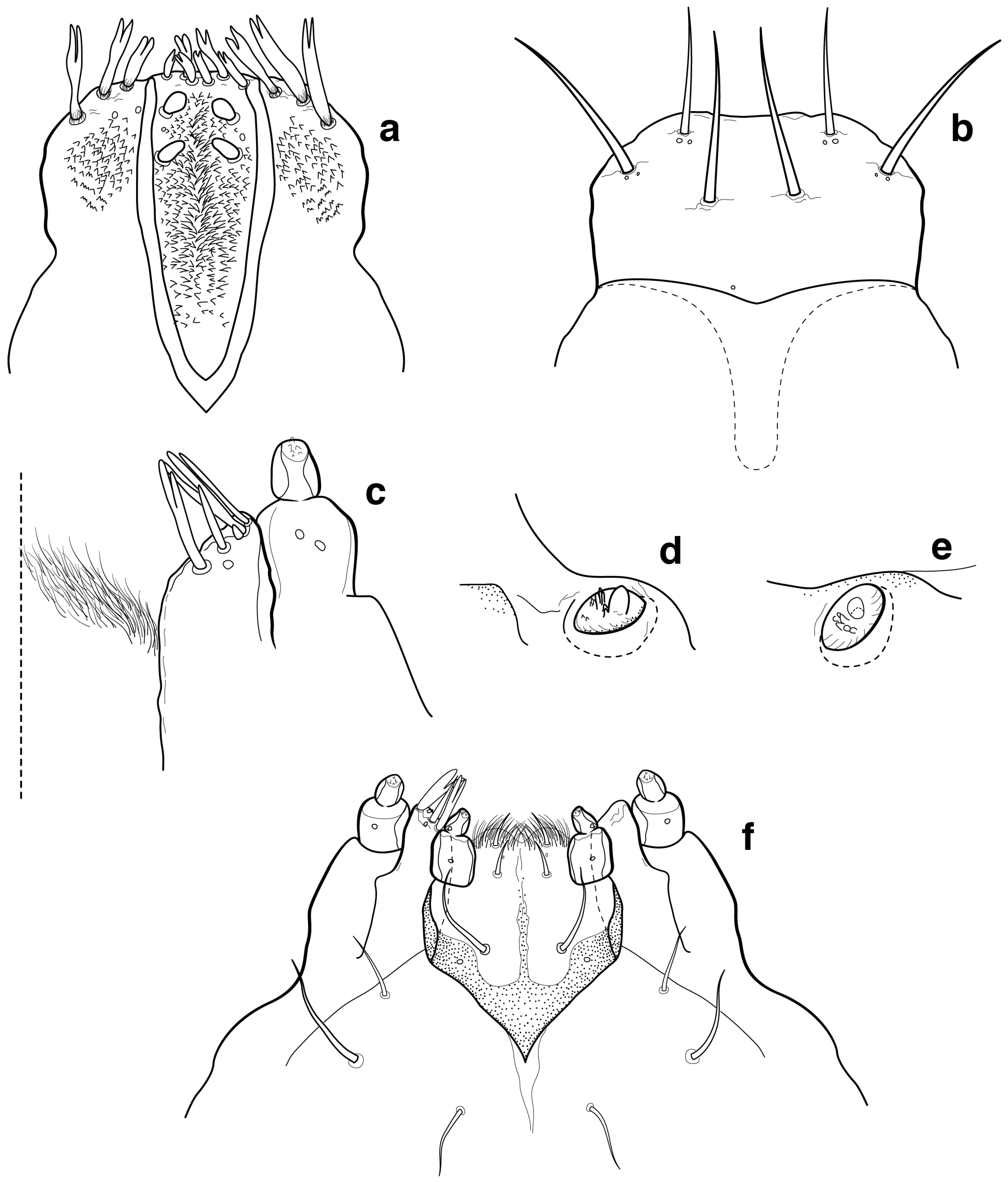
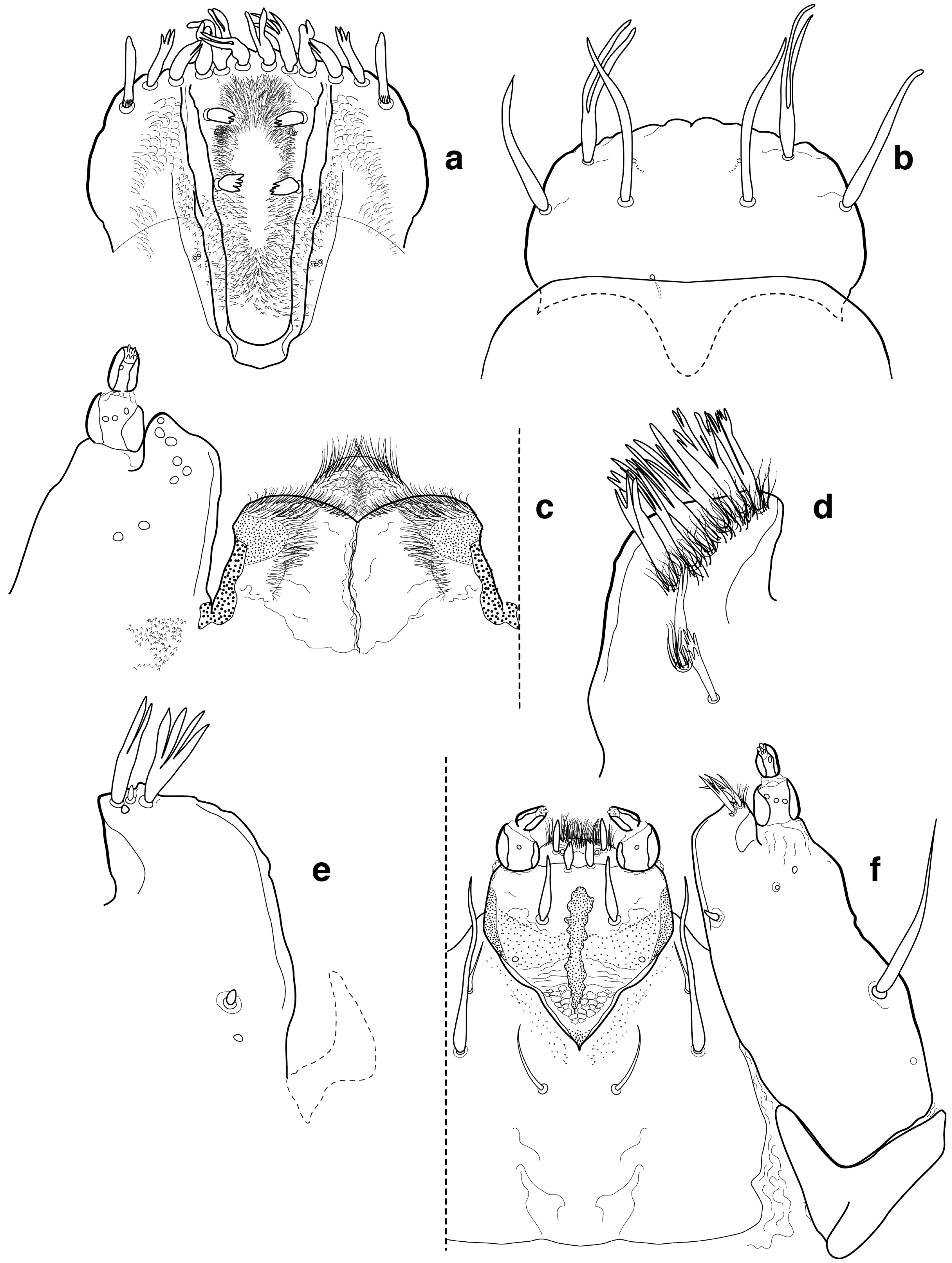
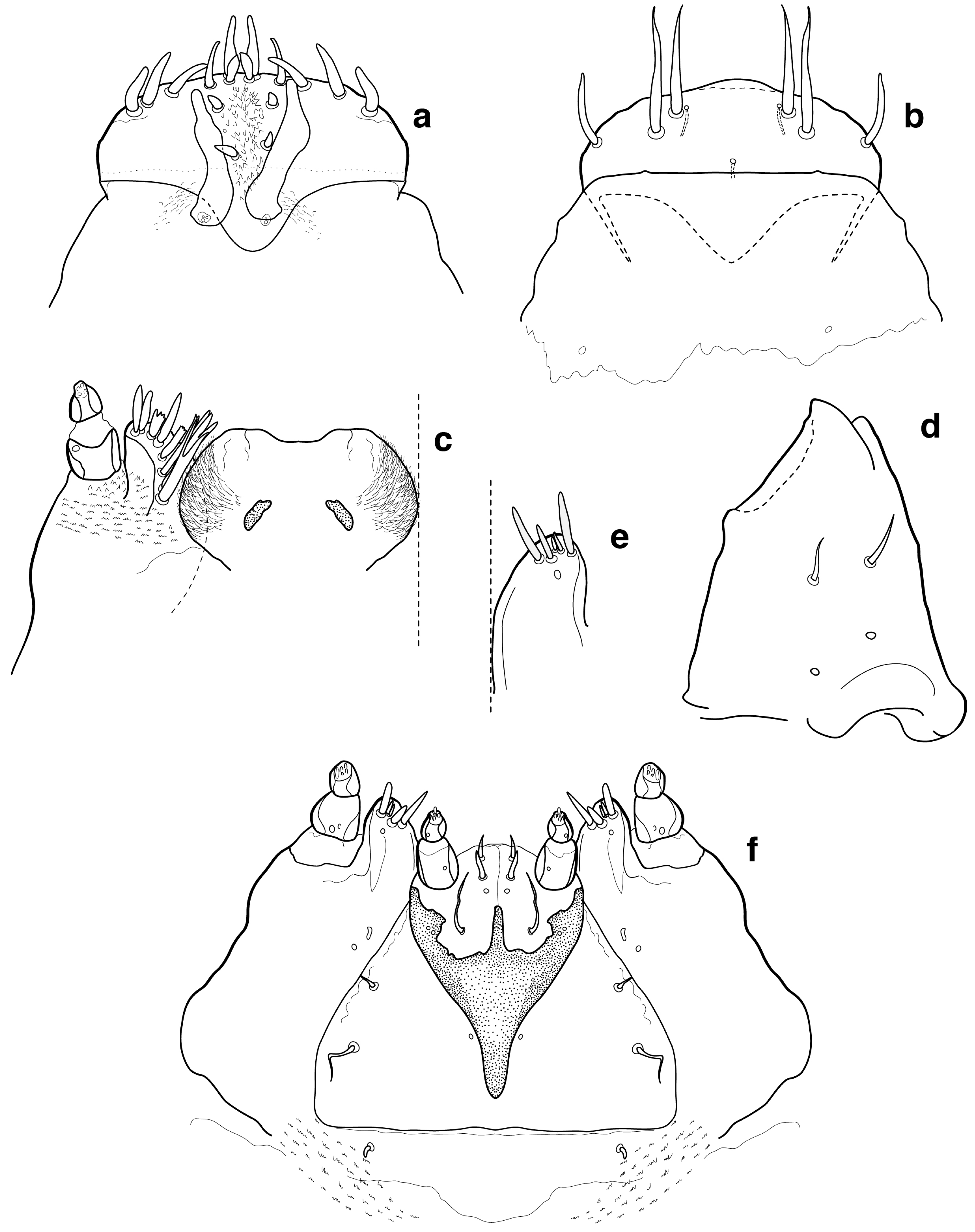
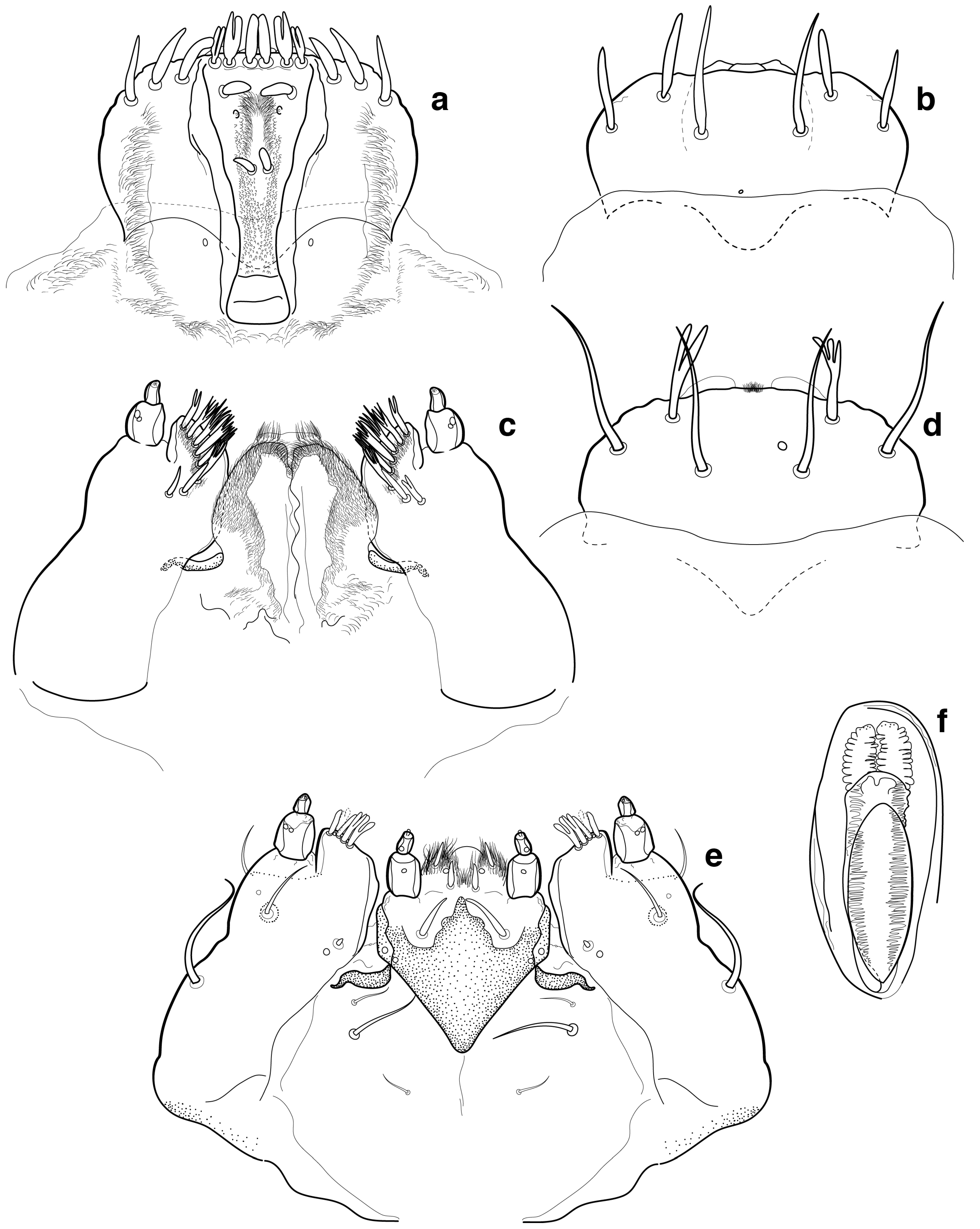
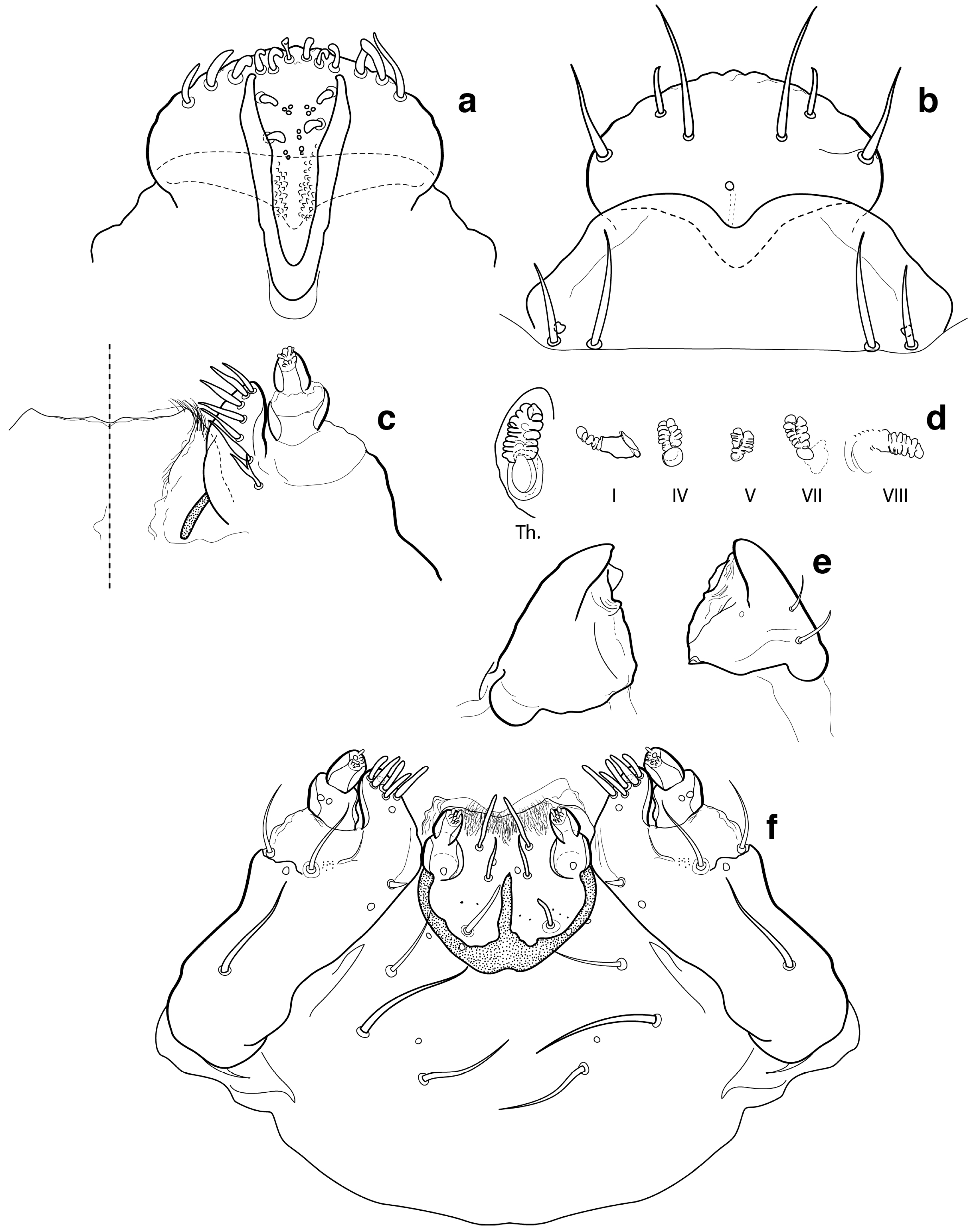
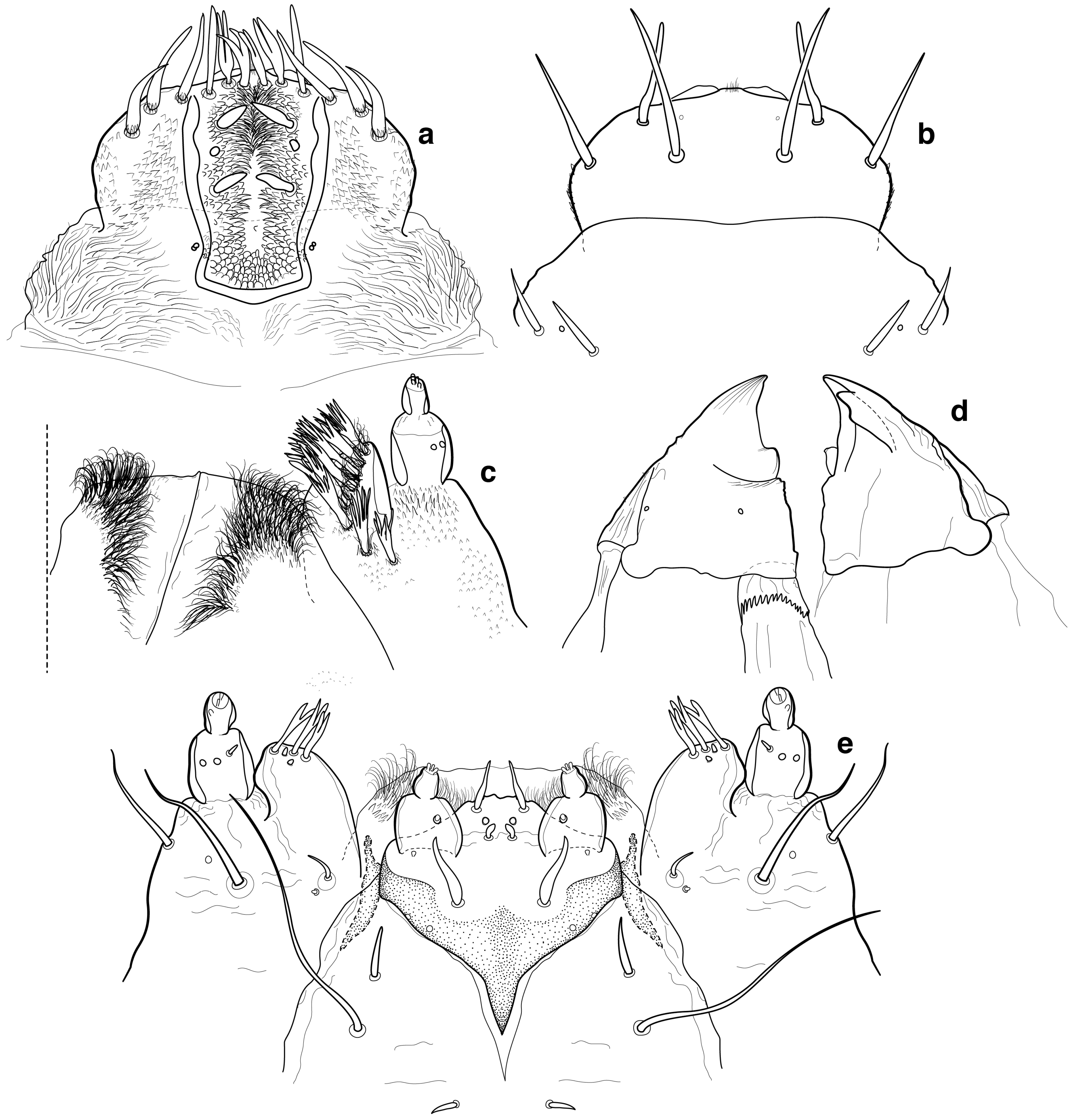
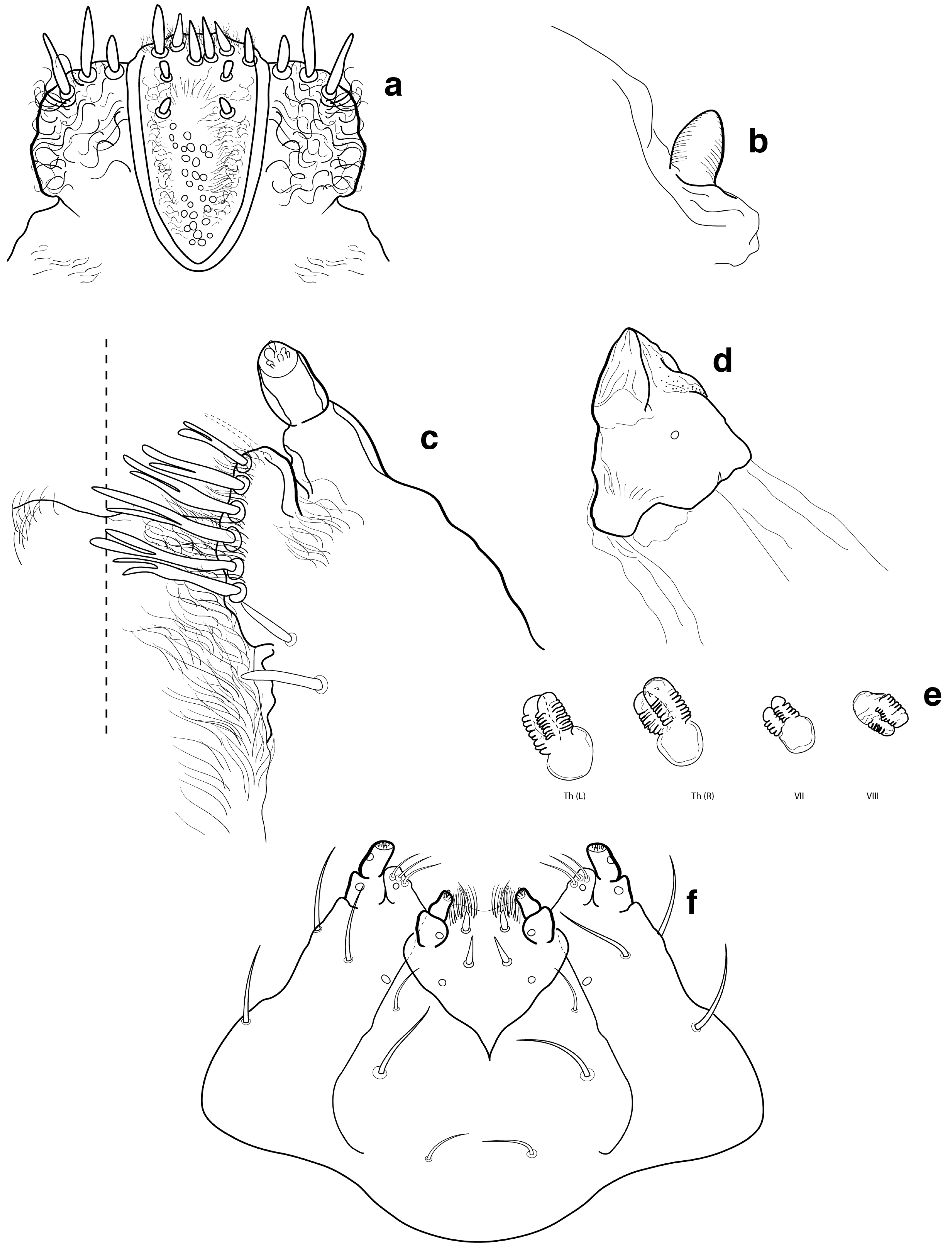
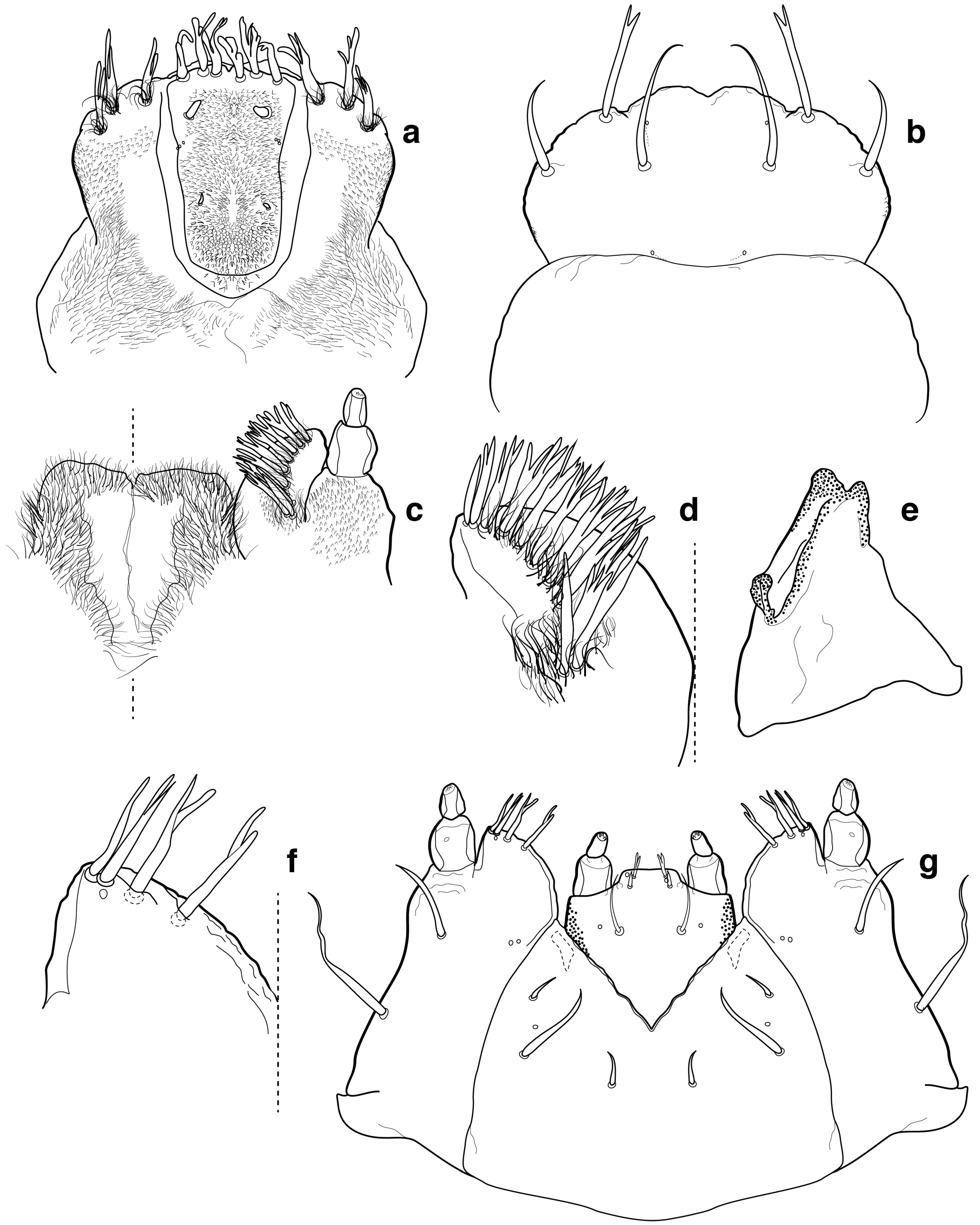
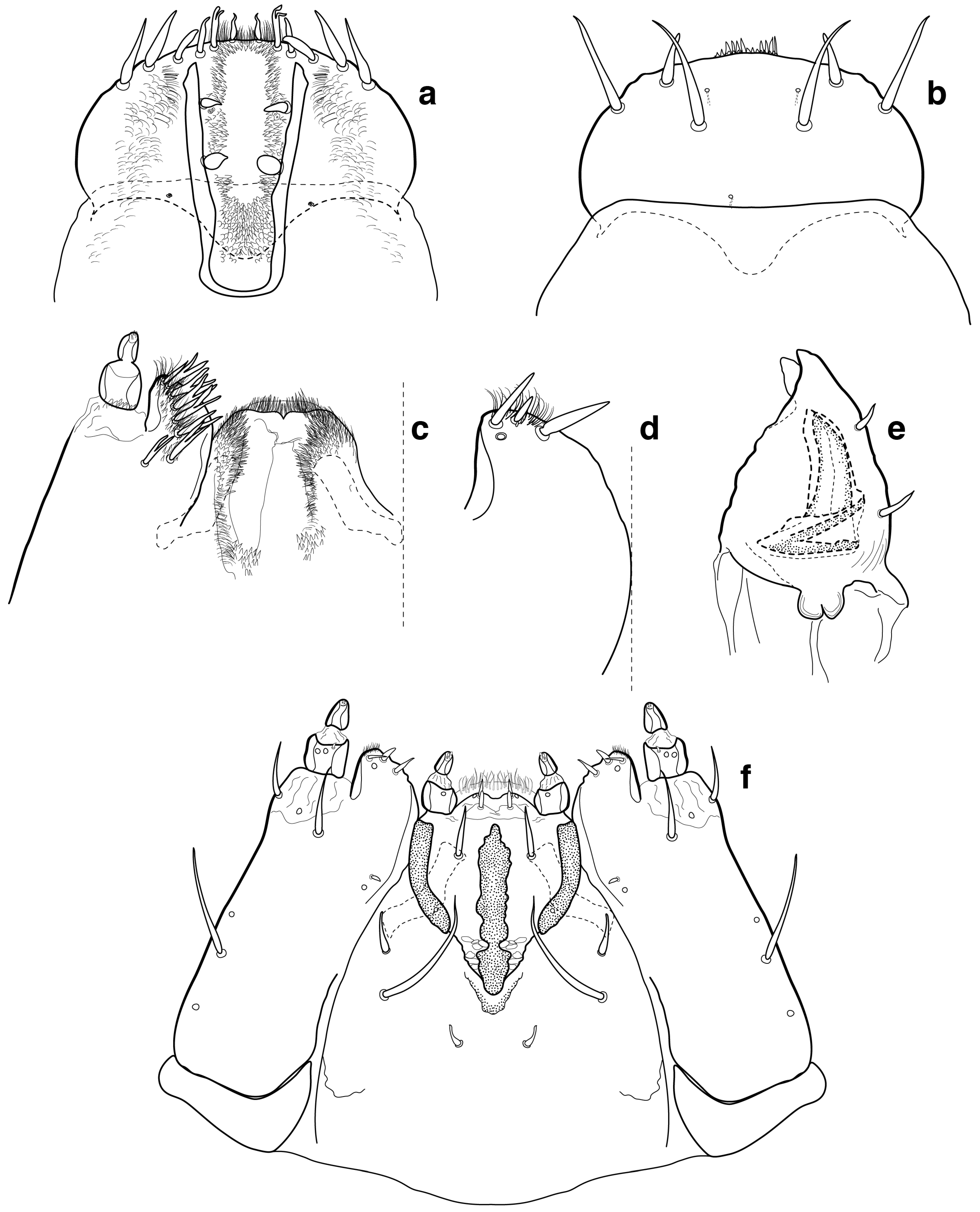
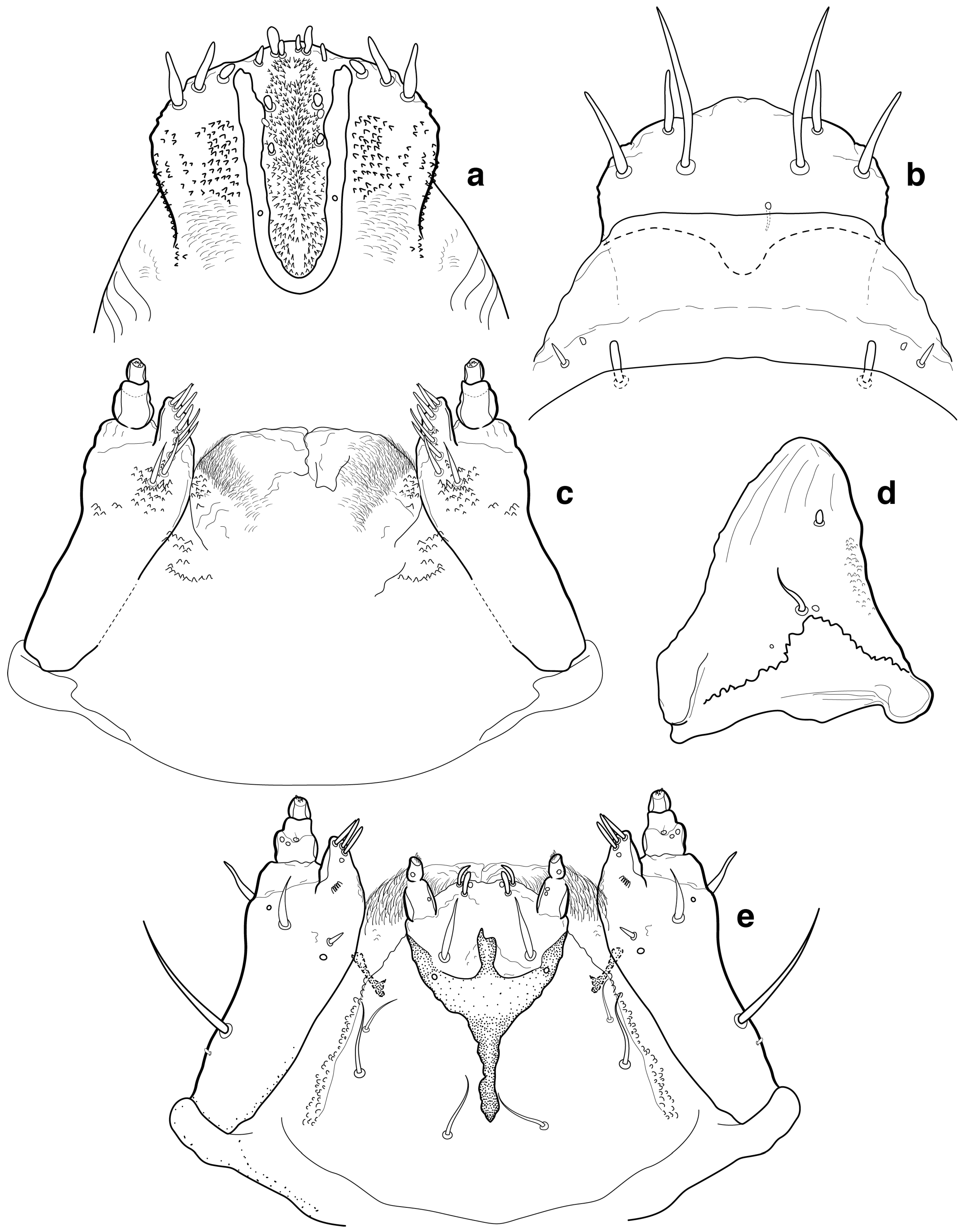
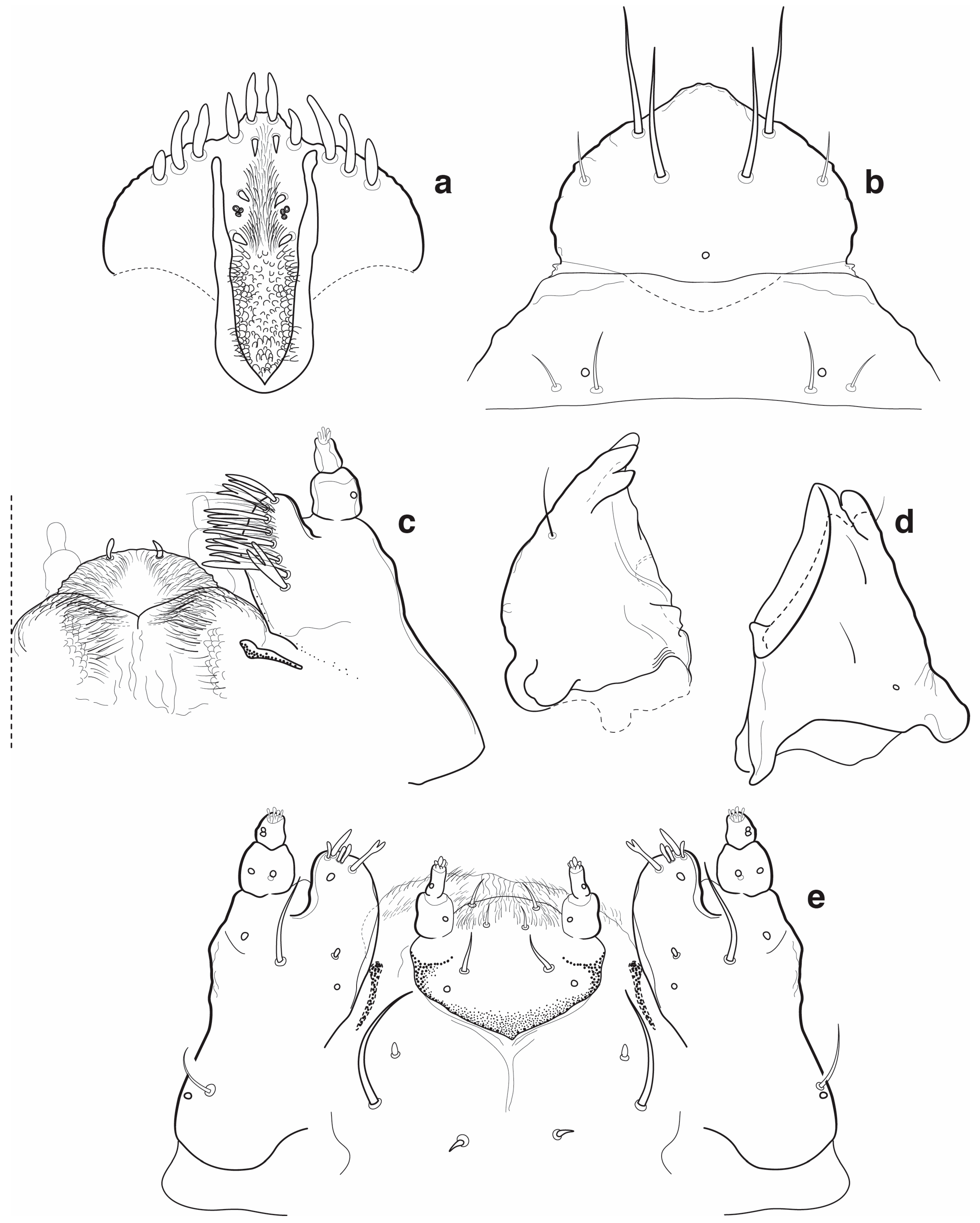
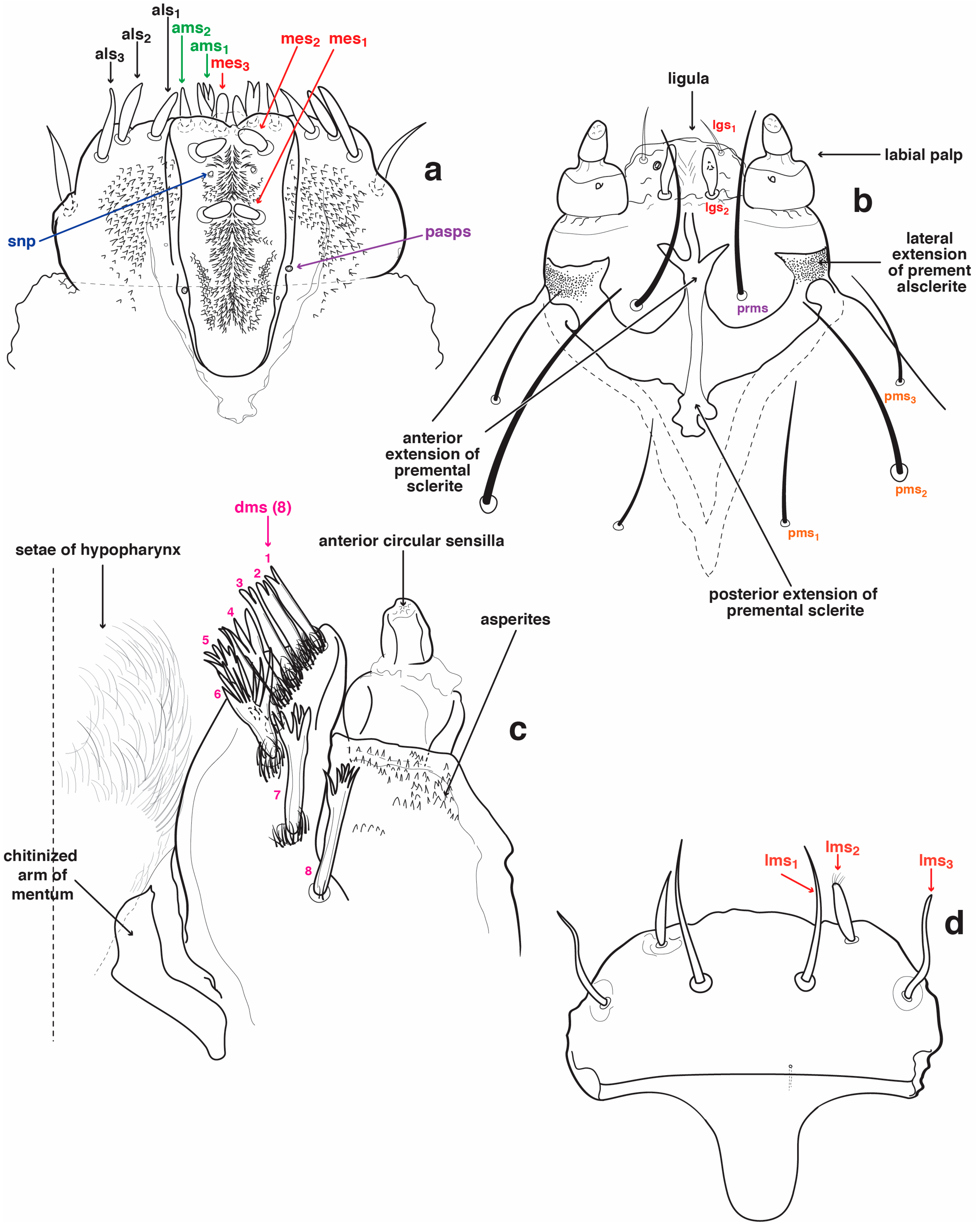
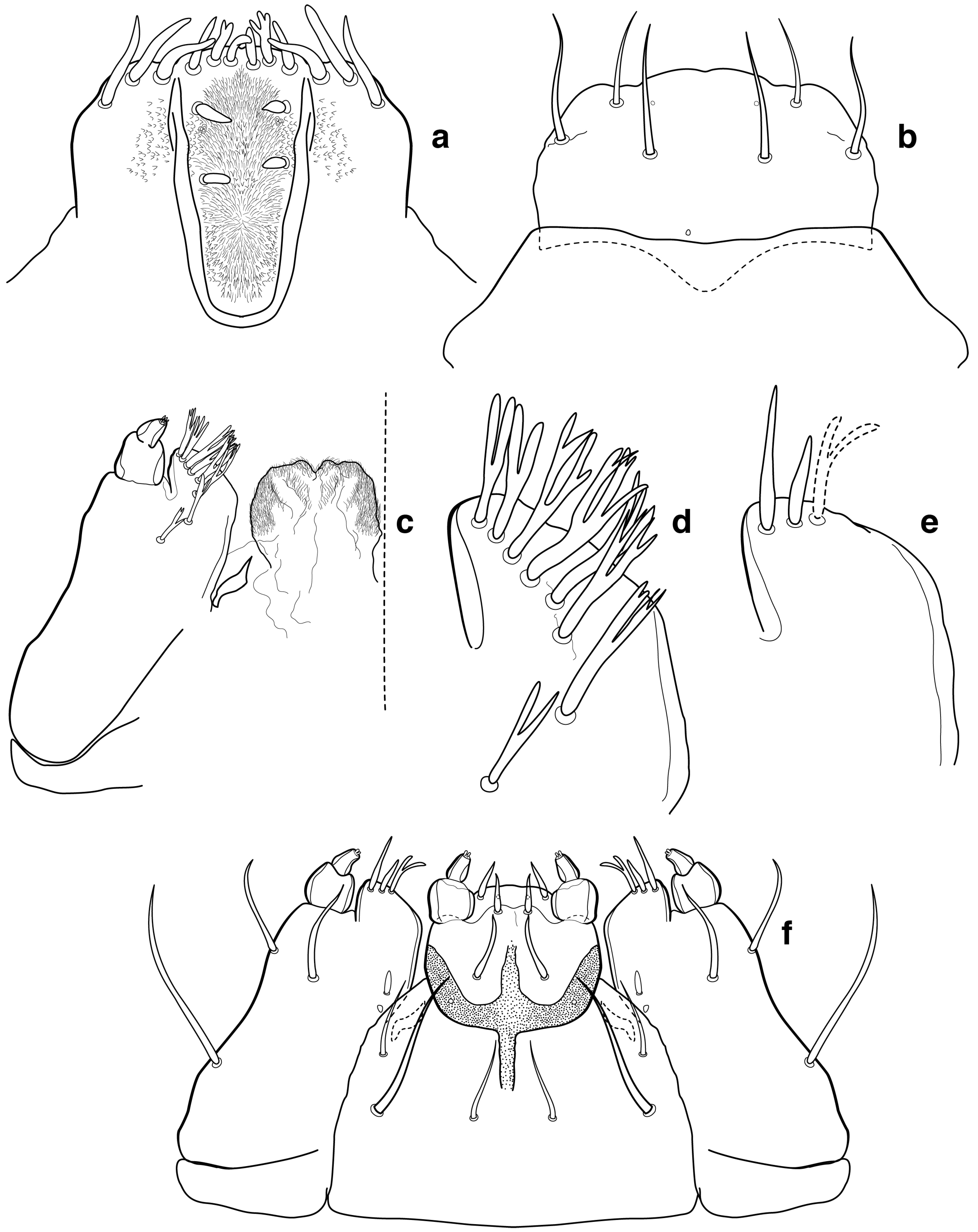
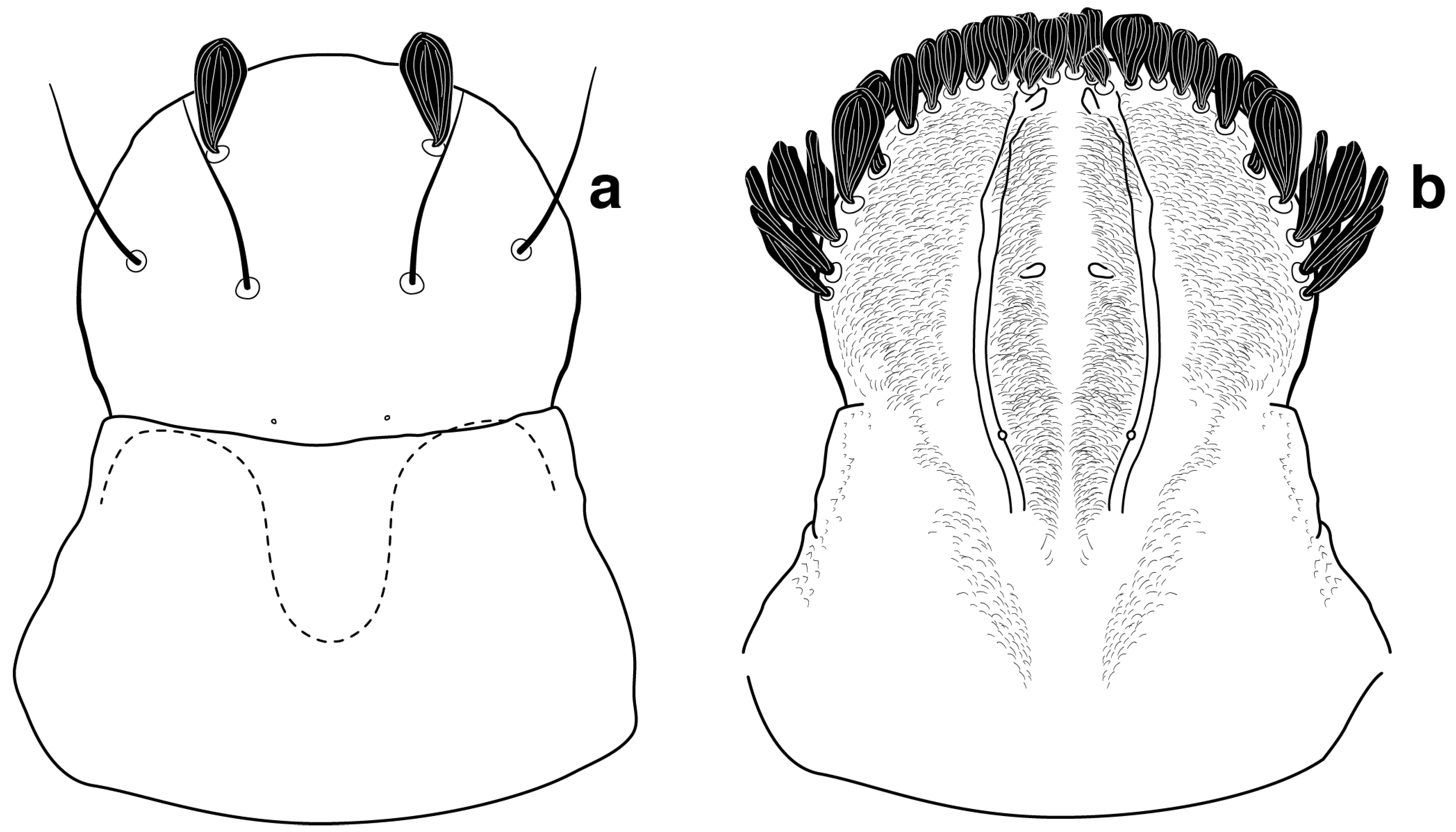
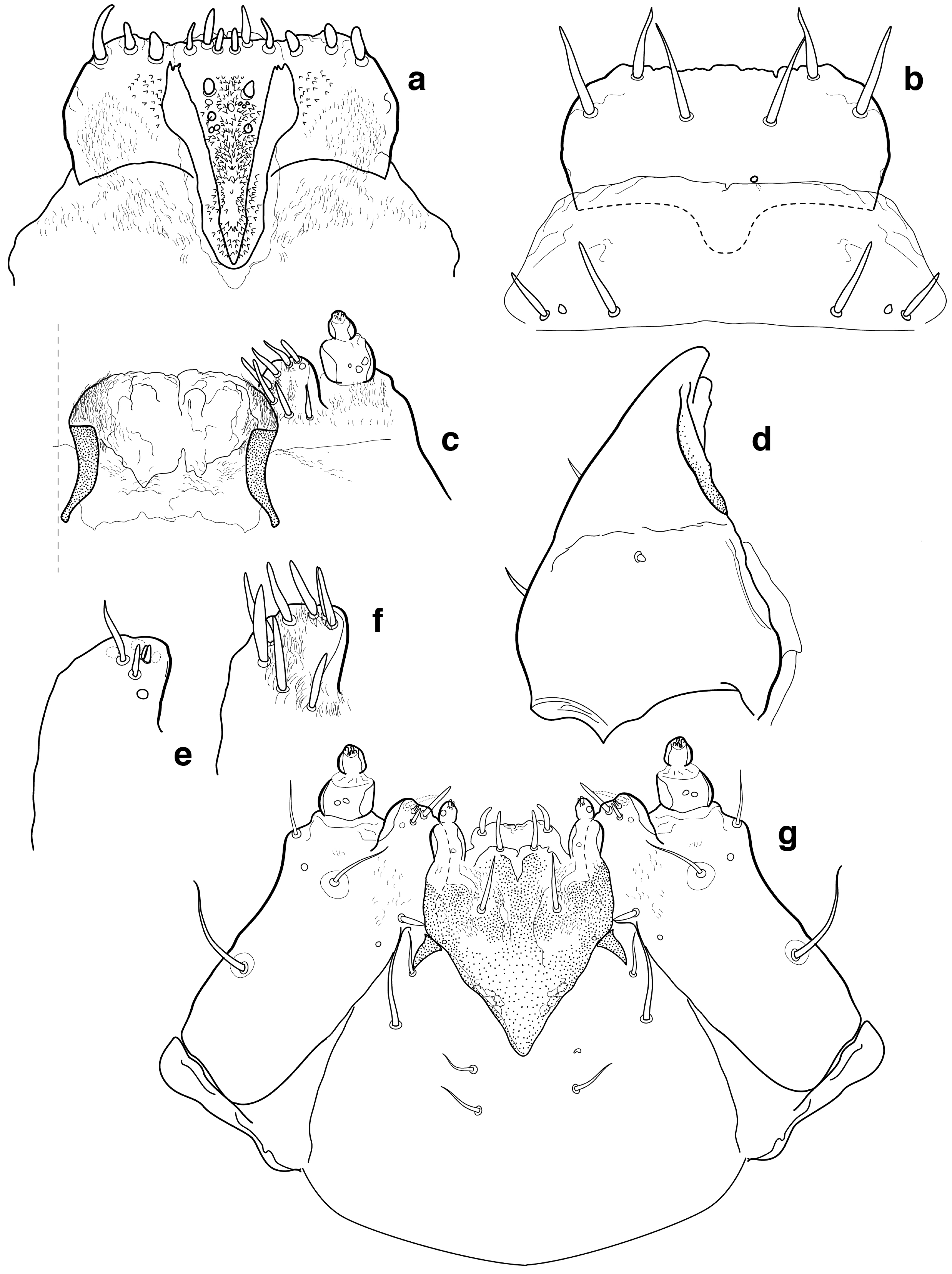
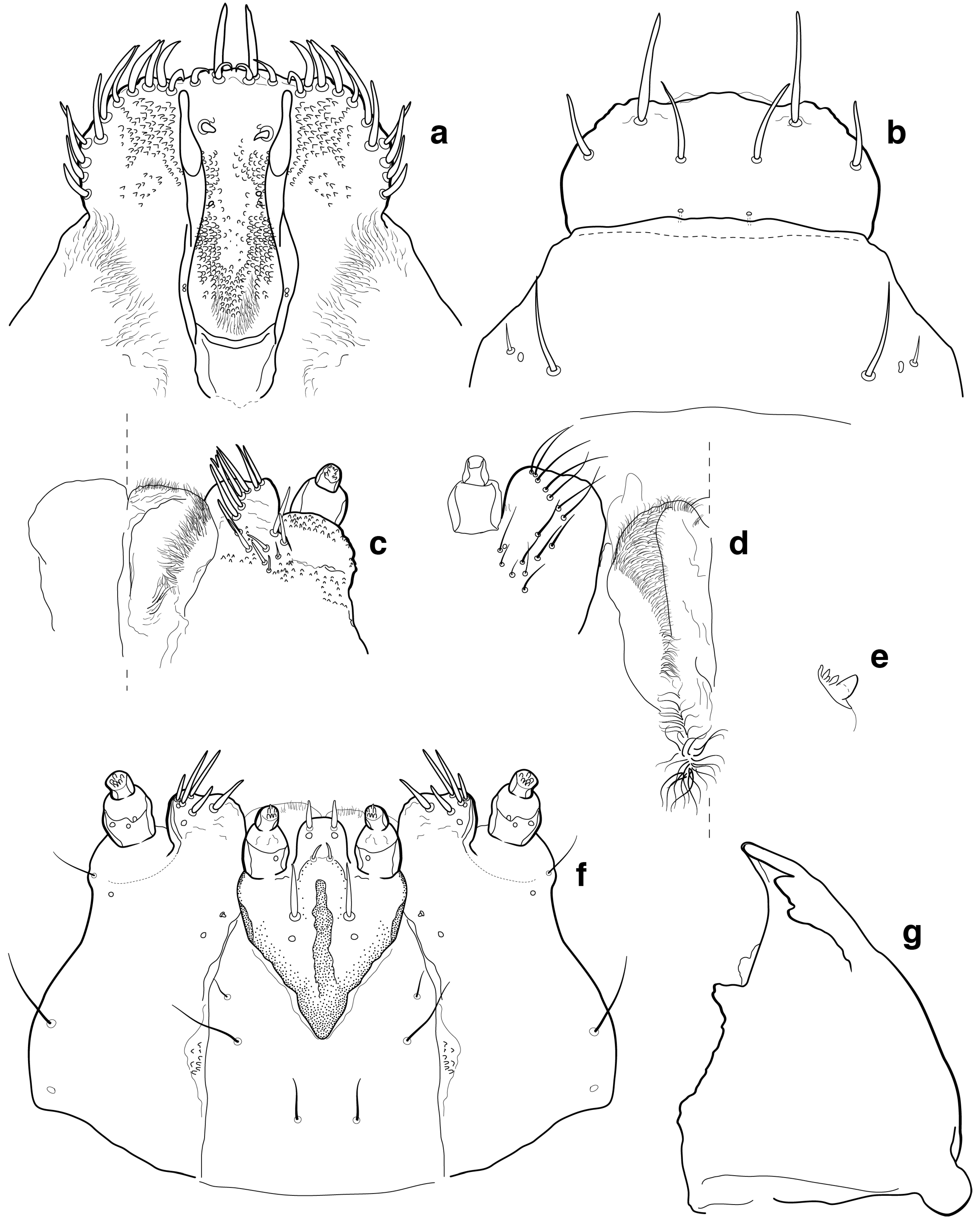
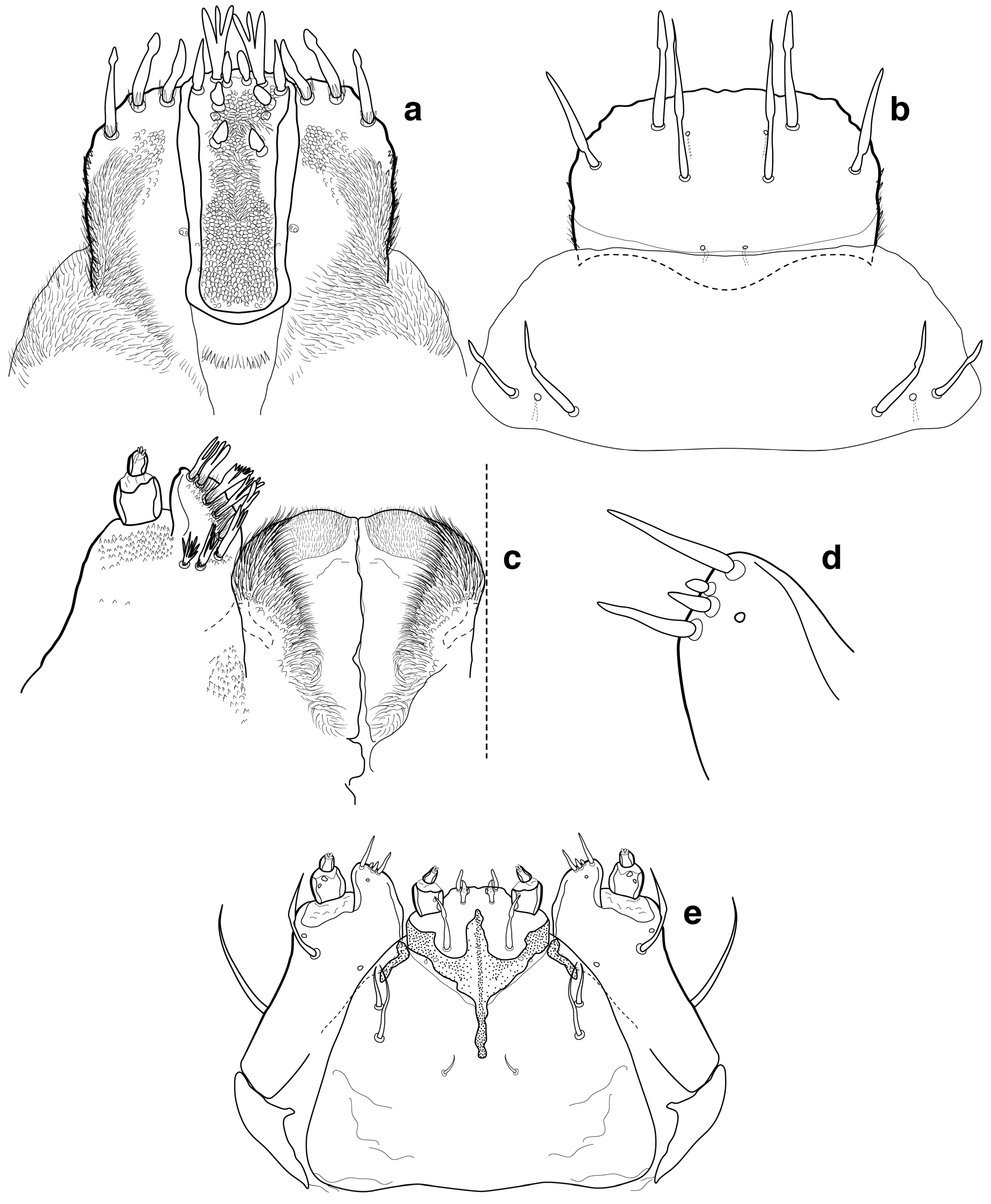
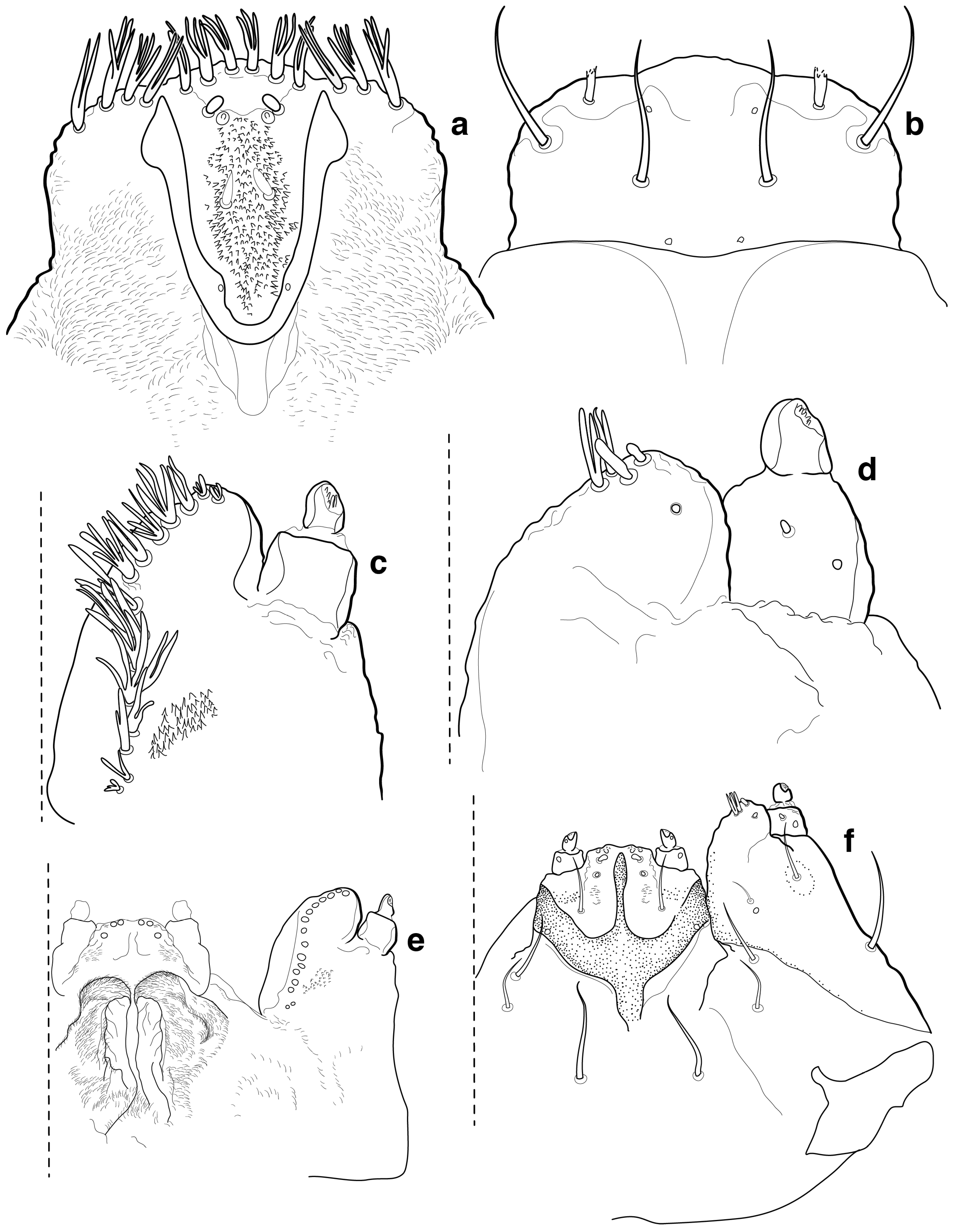
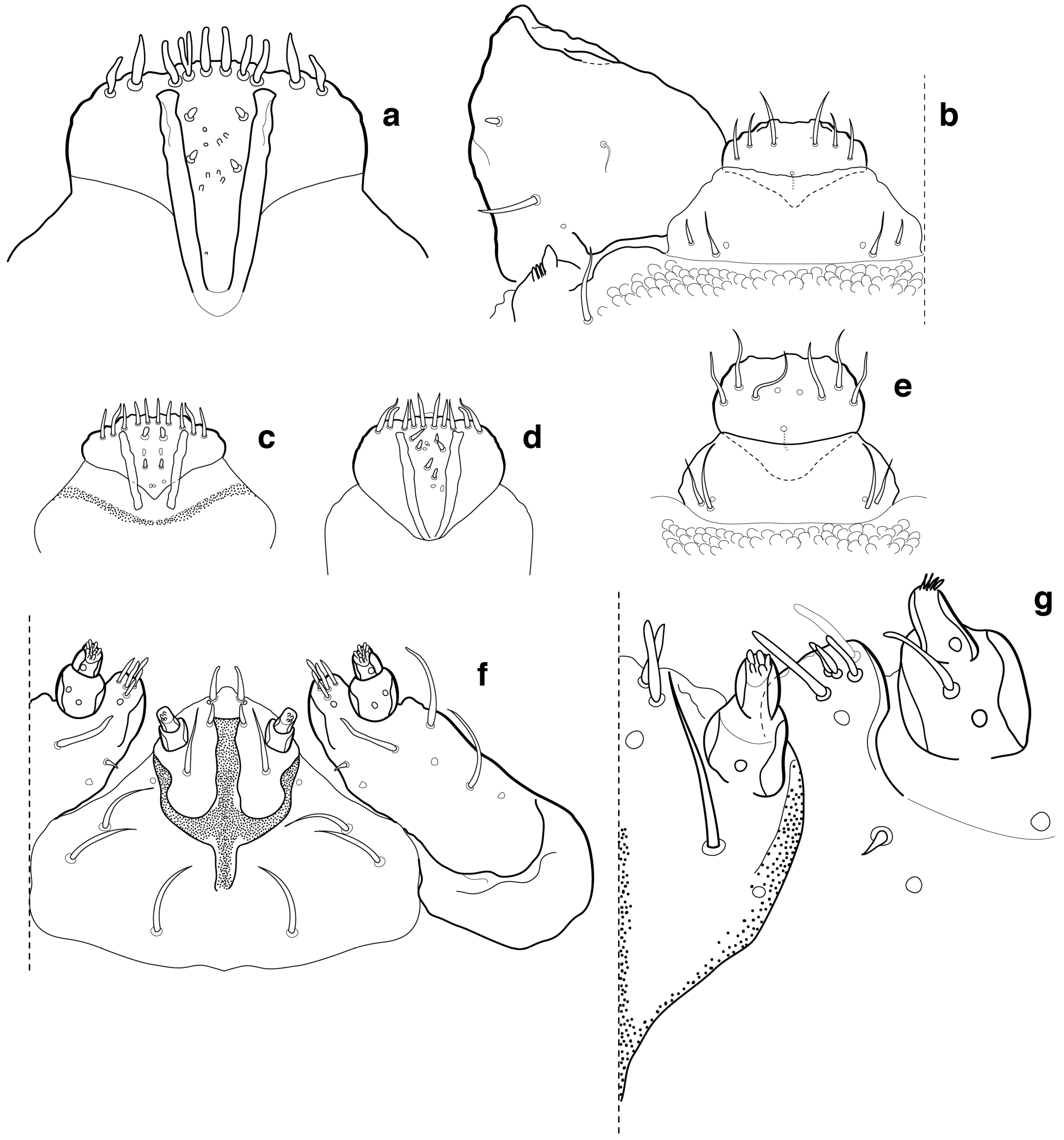
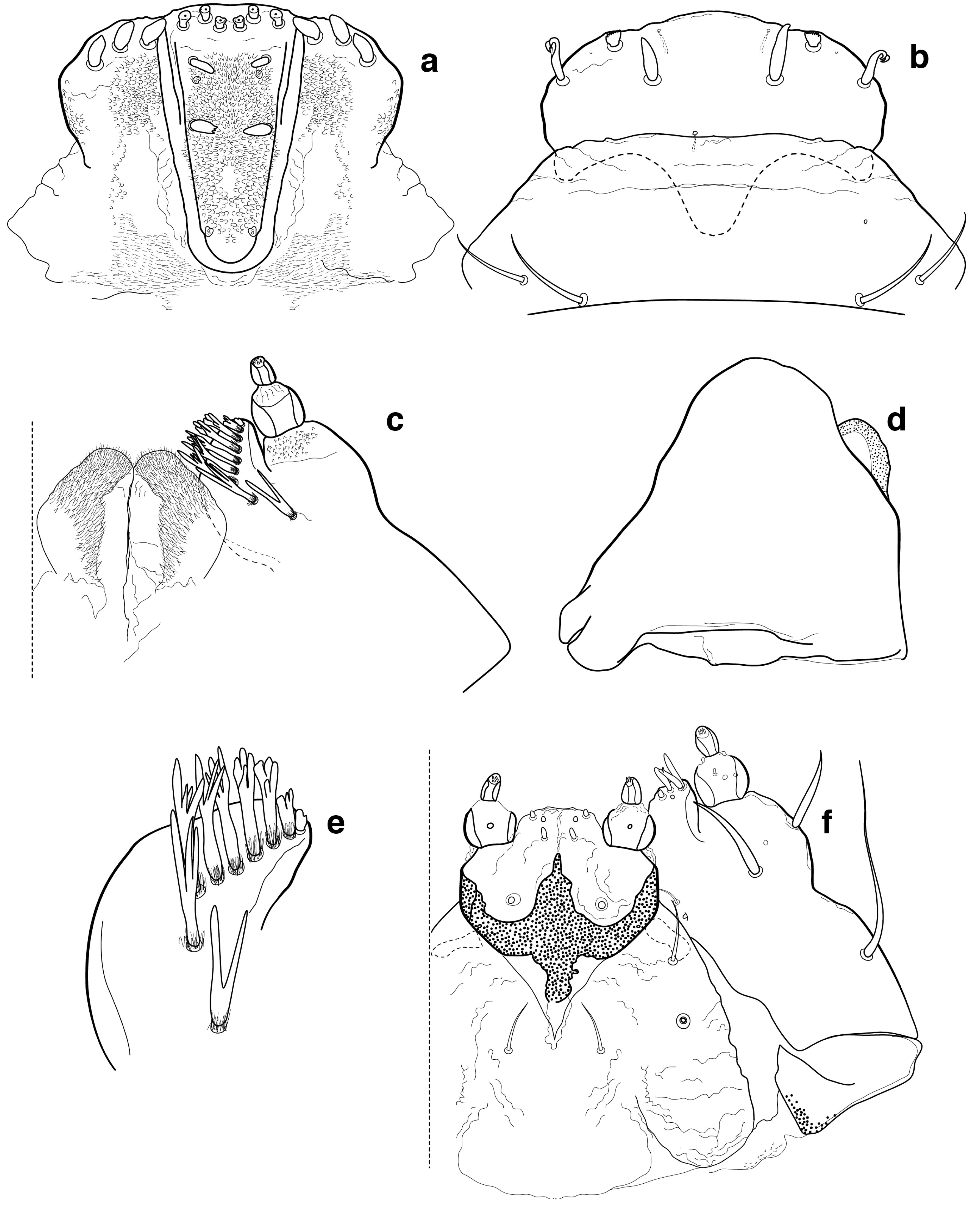
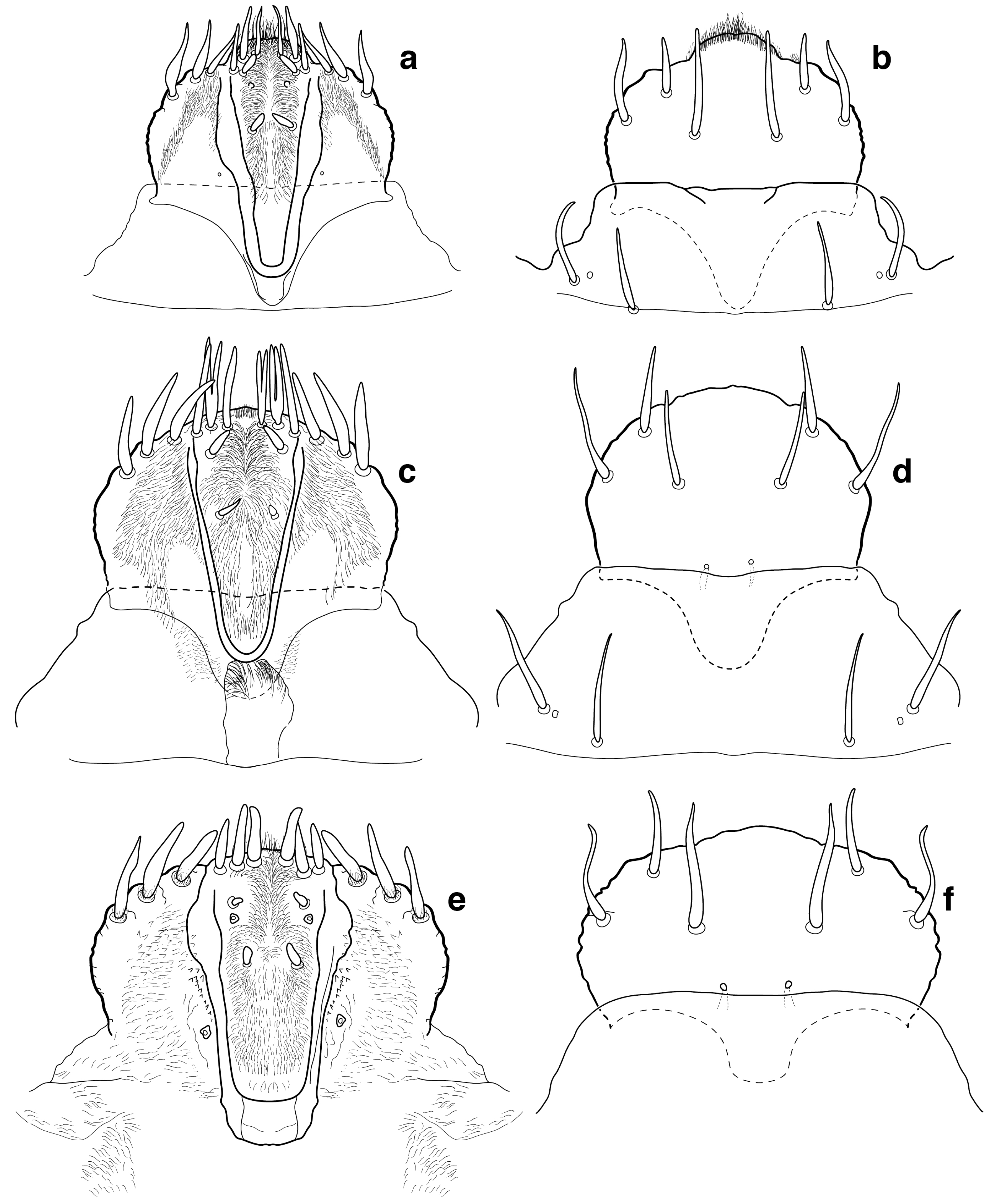
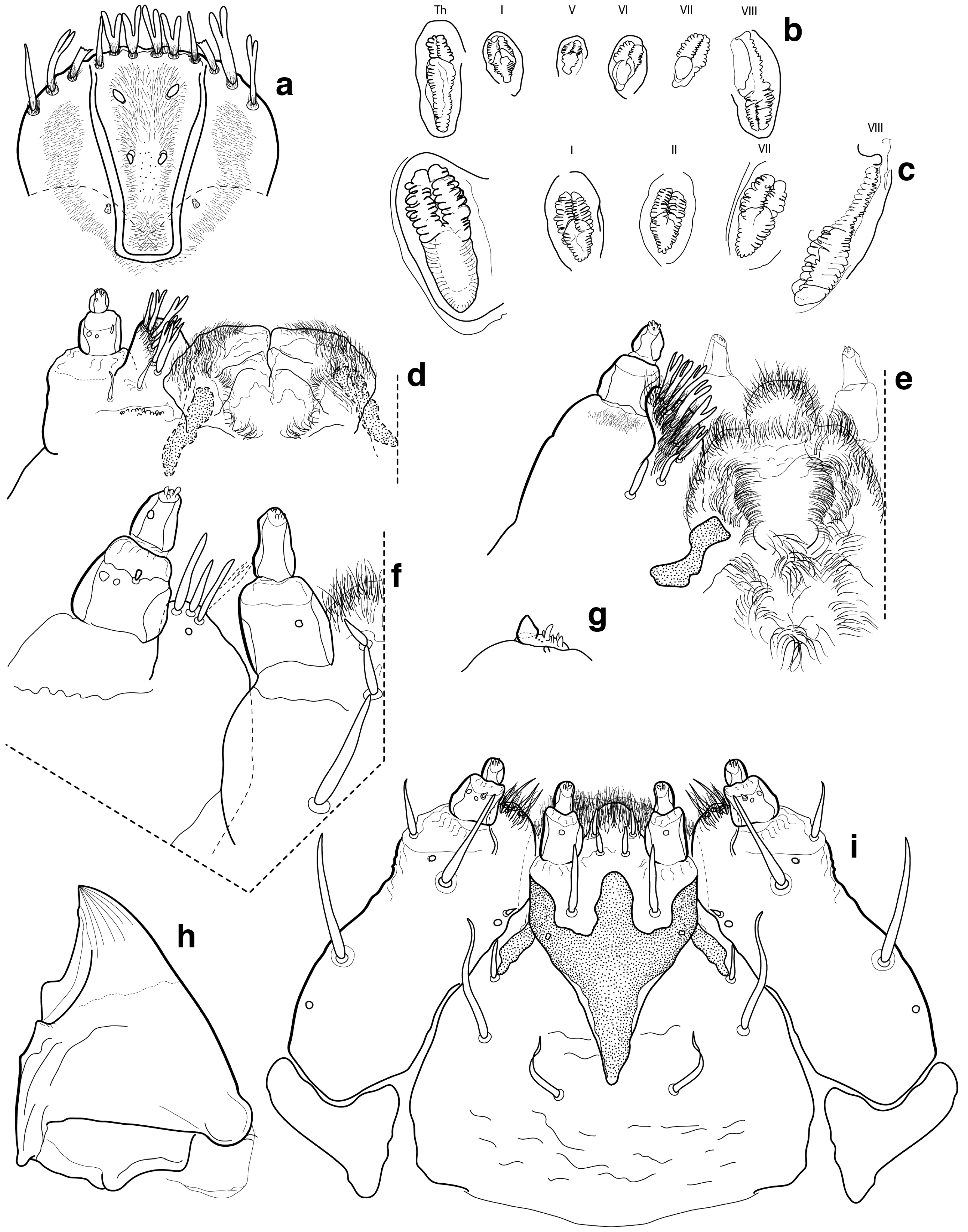
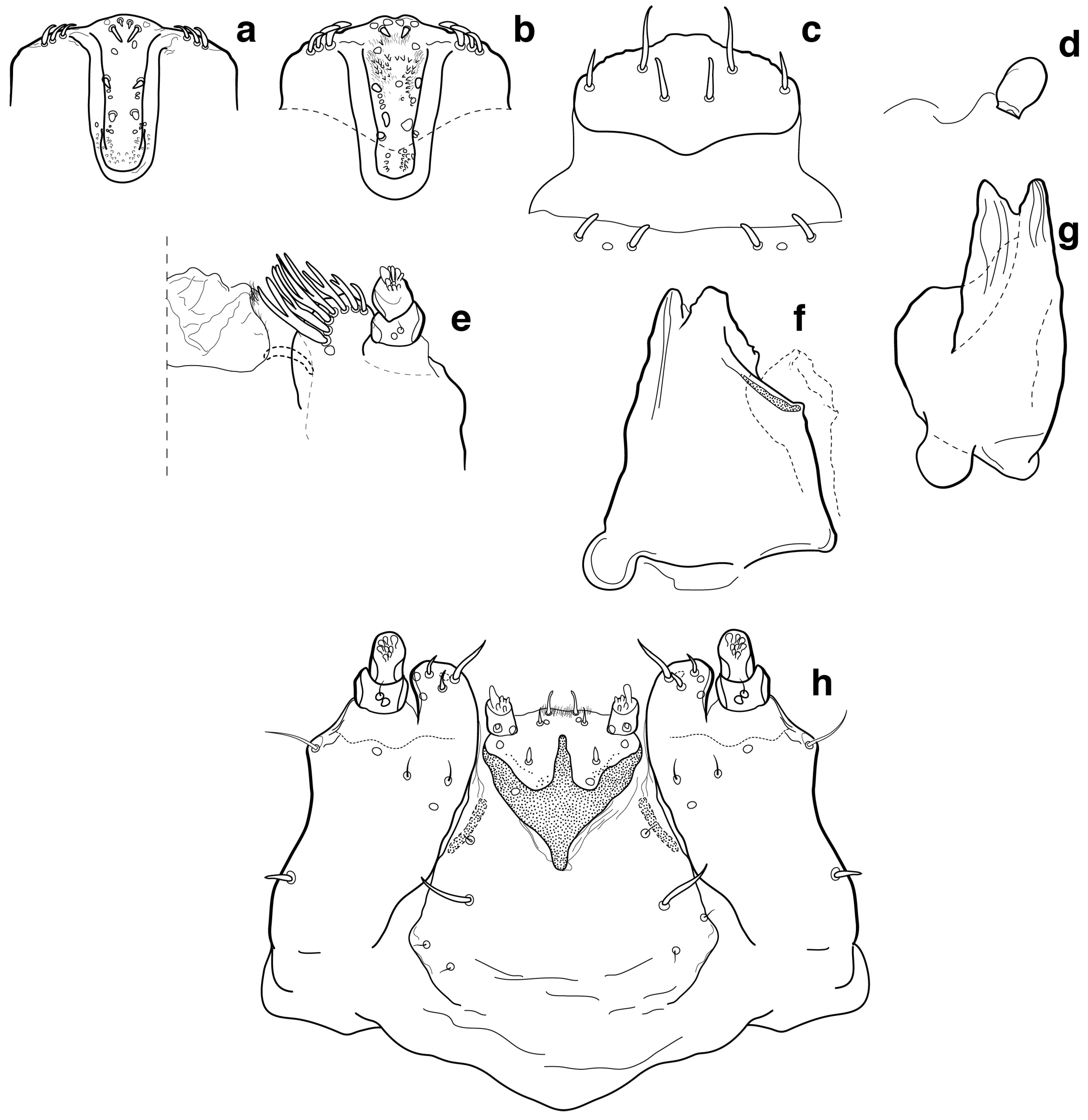
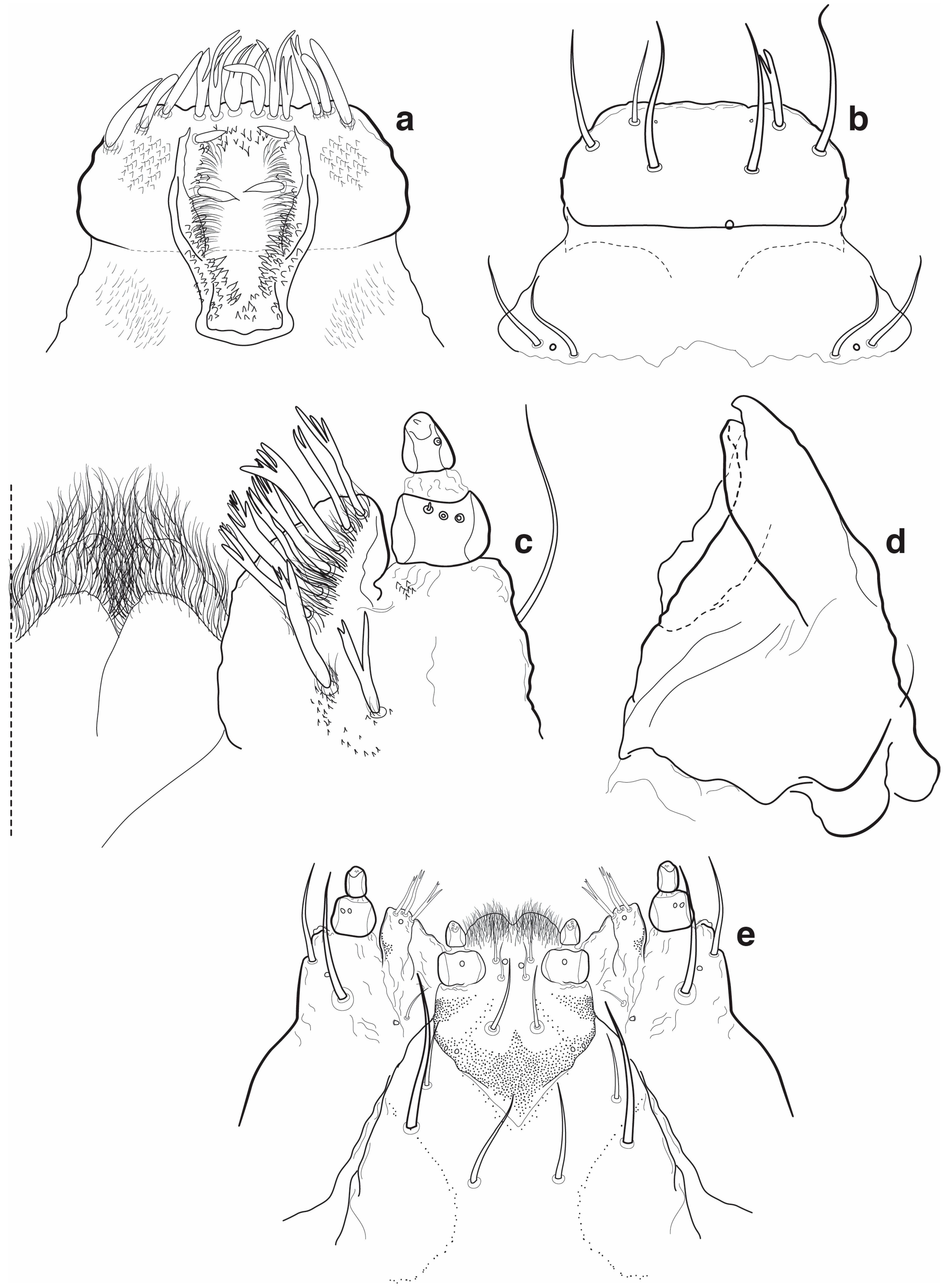
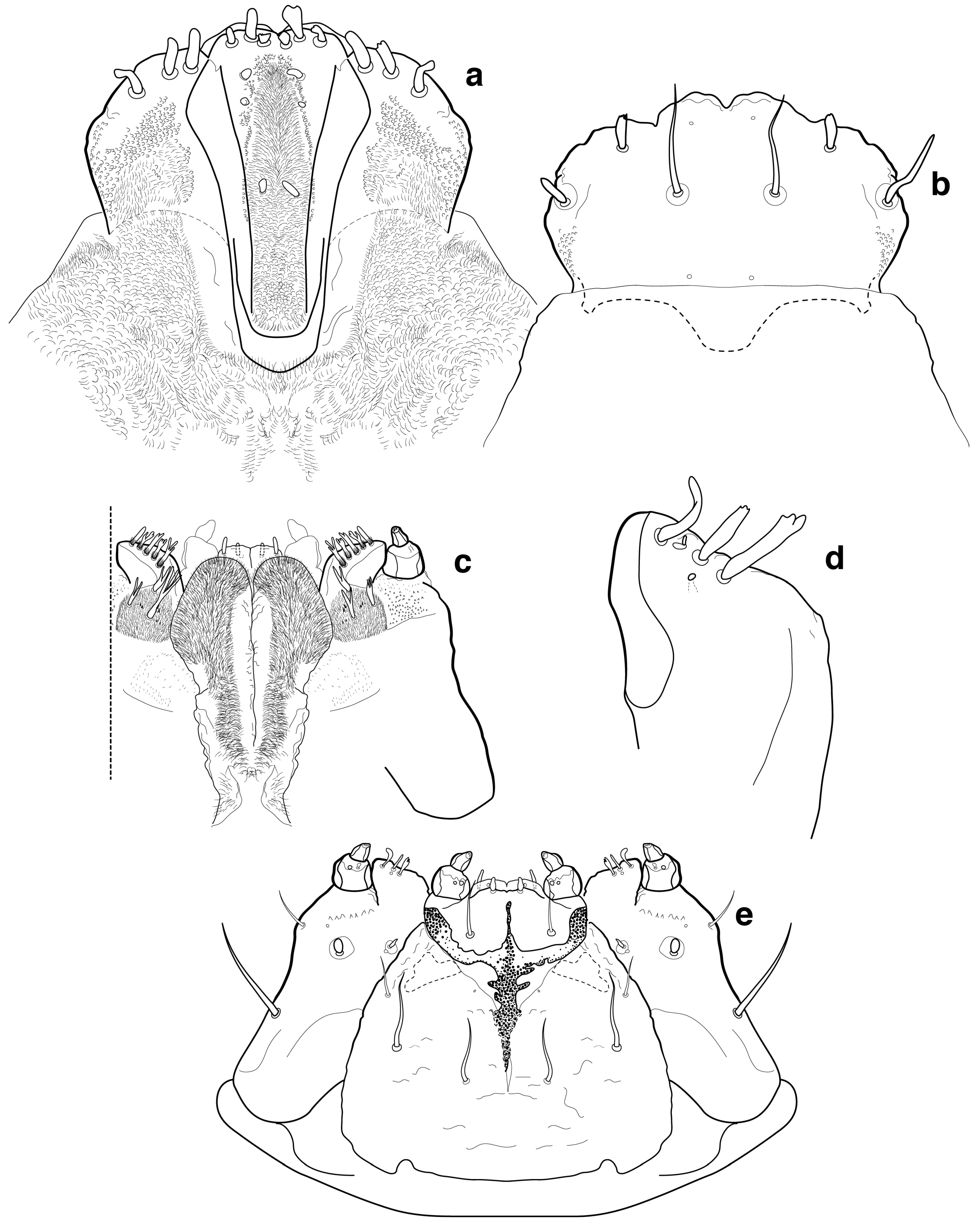
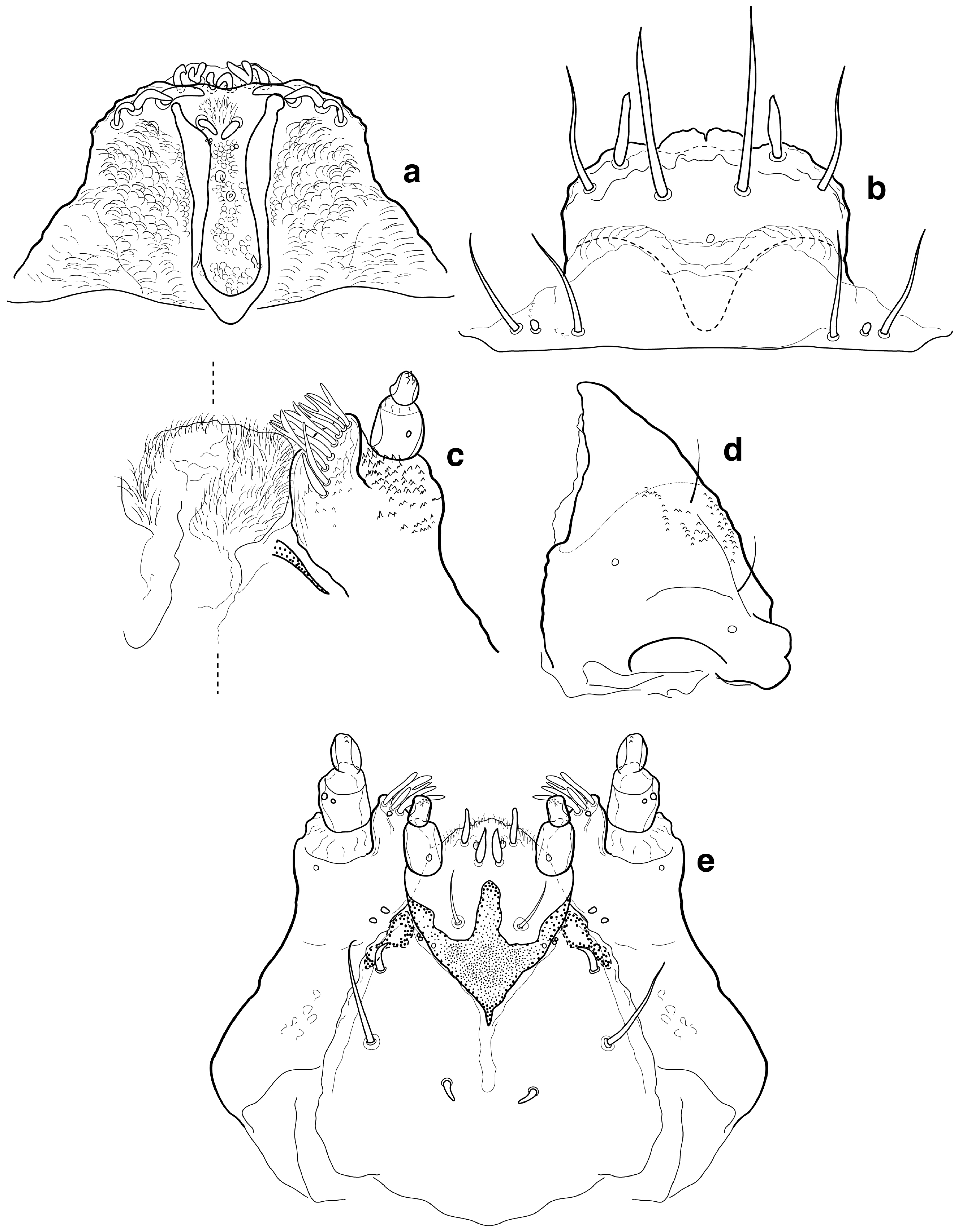
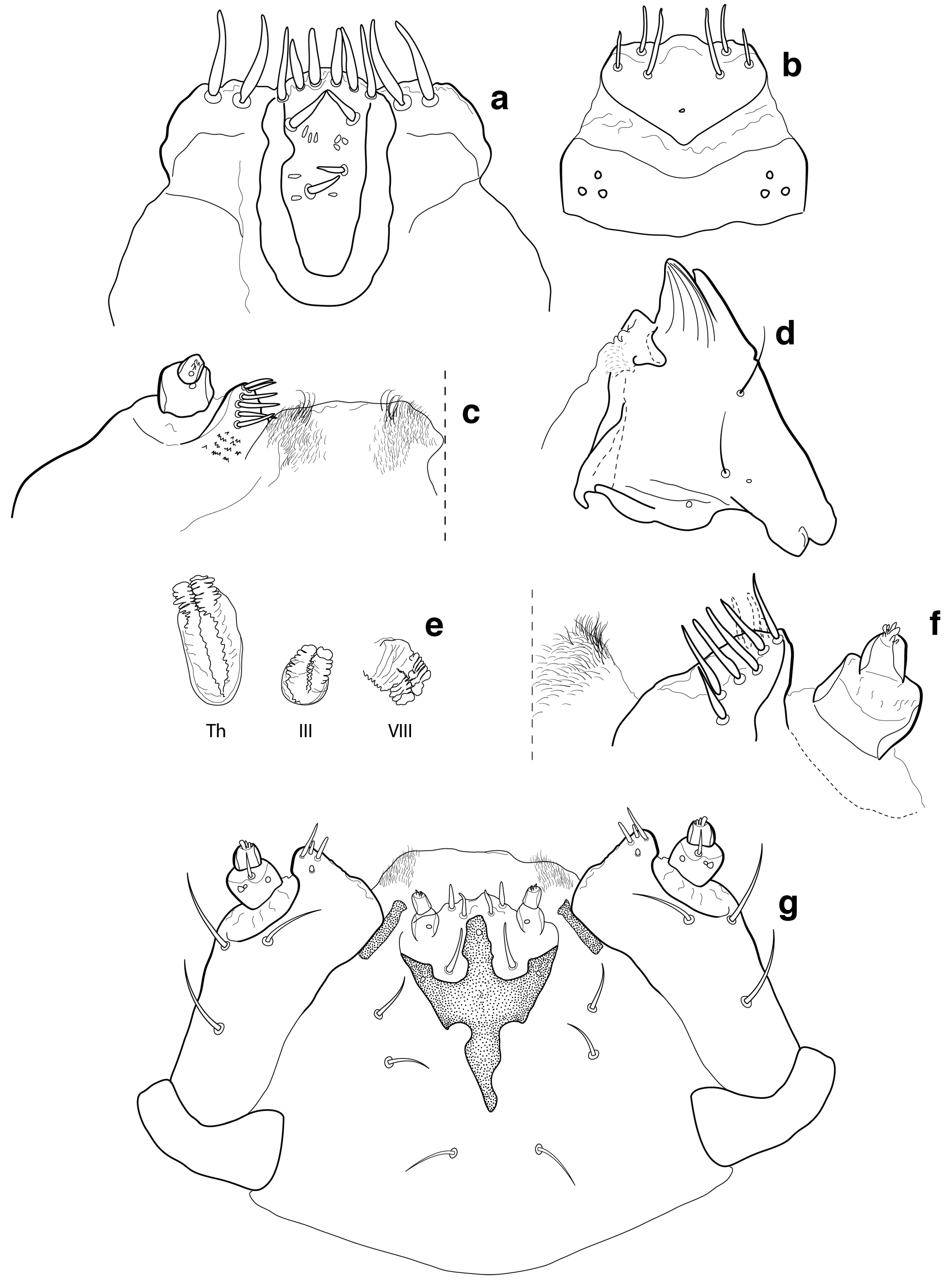
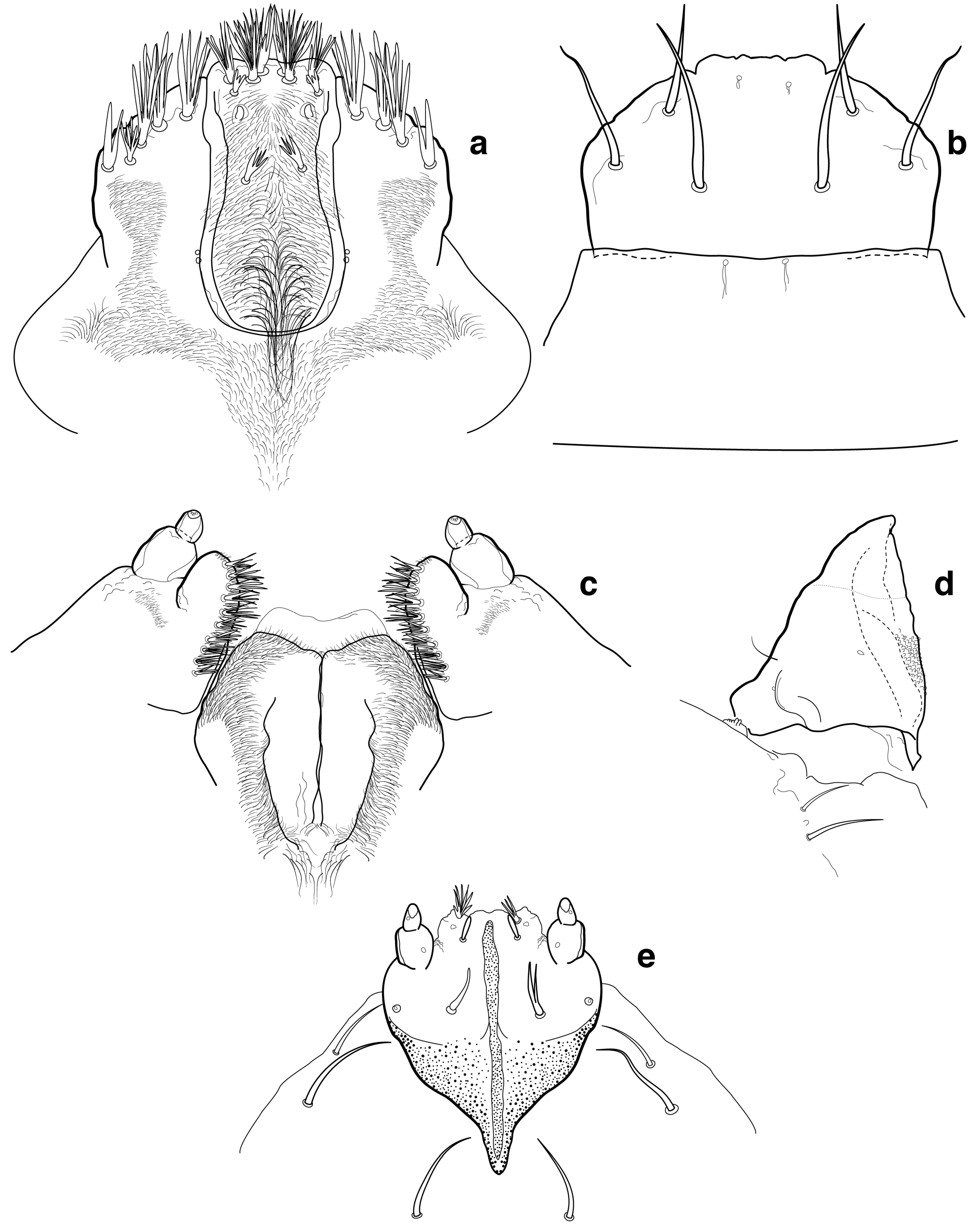
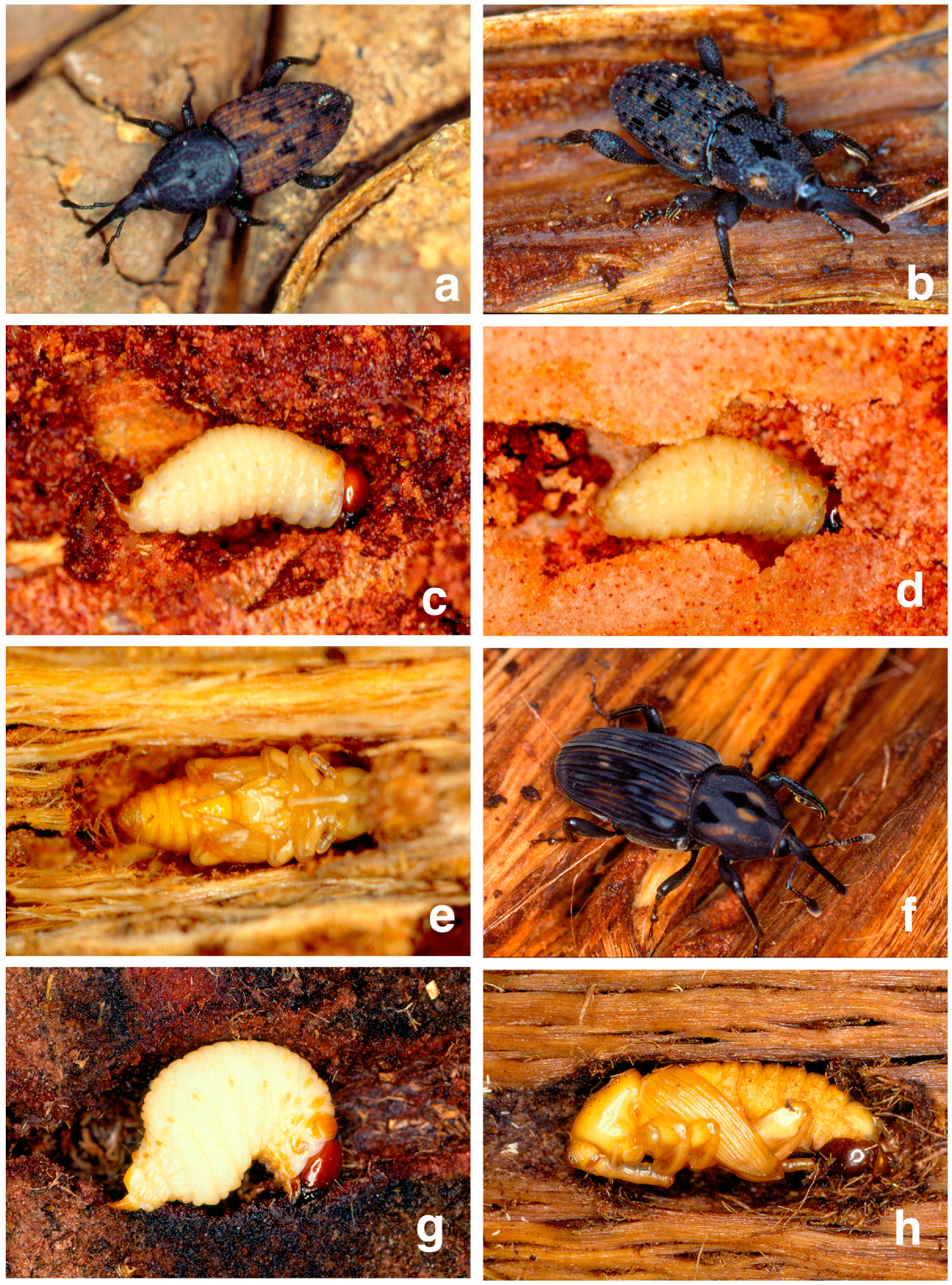
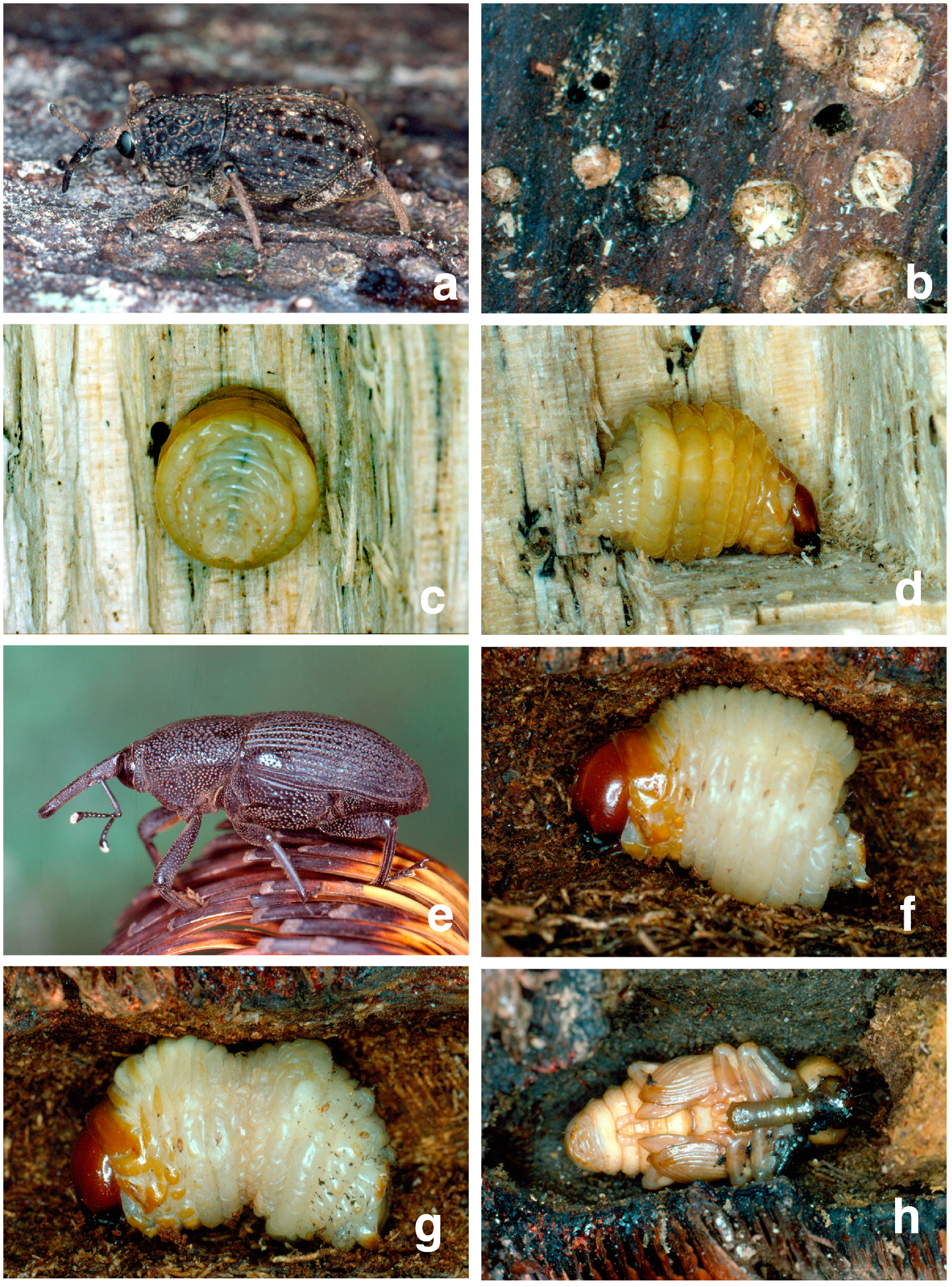

| Dryophthorinae | Tribe | Subtribe | Figure | Genus (Described) | Genus (Previously Undescribed) | Region | Depository/Source |
| Orthognathini | Rhinostomina | 77 | Rhinostomus Rafinesque | Circumtropical | USNM | ||
| 92 | Yuccaborus LeConte | New World | USNM | ||||
| Orthognathina | 3, 6, 66 | Mesocordylus Lacordaire | Neotropical | USNM | |||
| 4, 81, 94 | Sipalinus Marshall | Oriental | NTNU, USNM | ||||
| Rhynchophorini | Rhynchophorina | 4, 7, 58 | Cyrtotrachelus Schoenherr | Oriental | USNM | ||
| Dynamis Chevrolat | Neotropical | [13] | |||||
| 7, 11, 79 | Rhynchophorus Herbst | Circumtropical | USNM | ||||
| Polytina | 7, 74 | Polytus Faust | Cosmopolitan | USNM | |||
| Sphenophorina | 56 | Cactophagus LeConte | New World | USNM | |||
| 3, 7, 11, 57 | Cosmopolites Chevrolat | Cosmopolitan | USNM | ||||
| 4, 6, 59 | Diathetes Pascoe | Australasian | ANIC | ||||
| 1, 7, 63 | Eucalandra Faust | Neotropical | USNM | ||||
| 3, 6, 65 | Foveolus Vaurie | Neotropical | MZSP | ||||
| 3, 11, 67 | Metamasius Horn | New World | USNM | ||||
| 3, 7, 69 | Nassophasis Waterhouse | Oriental | BMNH, USNM | ||||
| 3, 6, 71 | Odoiporus Chevrolat | Oriental | USNM | ||||
| 3, 6, 72 | Paramasius Kuschel | Neotropical | INPA | ||||
| 2, 6, 11, 73, 93 | Phacecorynes Schoenherr | Afrotropical | USNM | ||||
| 4, 7, 75 | Poteriophorus Schoenherr | Oriental | USNM, NTNU | ||||
| Prodioctes Pascoe | Oriental | N/A | |||||
| 76 | Rhabdoscelus Marshall | Oriental | USNM | ||||
| 7, 11, 78 | Rhodobaenus LeConte | New World | USNM | ||||
| 2, 80 | Scyphophorus Schoenherr | New World | USNM | ||||
| 4, 6, 83 | Sparganobasis Marshall | Australasian | ANIC | ||||
| 2, 7, 84, 85 | Sphenophorus Schoenherr | Nearctic/Holarctic | USNM | ||||
| 2, 87 | Temnoschoita Chevrolat | Afrotropical | BMNH, USNM | ||||
| 4, 6, 88, 94 | Trigonotarsus Guerin-Meneville | Australasian | ANIC | ||||
| 3, 7, 11, 89 | Trochorhopalus Kirsch | Afrotropical | USNM | ||||
| Litosomina | 3, 6, 64 | Eugnoristus Schoenherr | Afrotropical | BMNH | |||
| 1, 82 | Sitophilus Schoenherr | Cosmopolitan | USNM | ||||
| 1, 90 | Tryphetus Faust | Oriental | USNM | ||||
| Diocalandrina | 1, 7, 60 | Diocalandra Faust | Oriental | USNM | |||
| 7, 68 | Myocalandra Faust | Oriental | USNM | ||||
| Dryophthorini | 7, 62 | Dryophthorus Germar | Circumtropical | USNM | |||
| 1, 11, 86 | Stenommatus Wollaston | New World | USNM | ||||
| Stromboscerini | 61 | Dryophthoroides Roelofs | Oriental | [12] | |||
| 1, 7, 70 | Nephius (=Anius) Pascoe | Oriental | BMNH | ||||
| 91 | Xerodermus Lacordaire | Oriental | [11,12] |
| Figure | USNMENT Code | Species | Determiner | Host | Location | Depository |
|---|---|---|---|---|---|---|
| 56 | USNMENT01448507 | Cactophagus validus (LeConte) | R.T. Cotton | Leng 335 | USNM | |
| 56 | USNMENT01119907 | Cactophagus validus (LeConte) | D.M.Anderson | California, Garden Grove, A.C. Davis | USNM | |
| 56 | USNMENT01119908 | Cactophagus validus (LeConte) | R.T. Cotton | Leng 335 | USNM | |
| 57 | USNMENT01448170 | Cosmopolites sordidus (Germar) | D.M.Anderson | in banana stalk | Puerto Rico, Bayamon, 11.vi.1943, San Juan #8597, 43 9200 | USNM |
| 57 | USNMENT01119912 | Cosmopolites sordidus (Germar) | D.M.Anderson | in trunks-banana | Florida, Forth Myers, 15.ii.’44, 44 2934 | USNM |
| 58 | USNMENT01119896 | Cyrtotrachelus thompsoni Alonso-Zarazaga & Lyal | Mr. Lee | Bamboo | Taiwan: E120.63108, N23.84535, 26.viii.2015 | USNM |
| 59 | USNMENT01160268 | Diathetes morio Pascoe | R. Oberprieler | Pandanus | Australia: 16°04′07″S, 145°27′49″E, QLD, Daintree NP, Pilgrim Sands, 19.Feb. 1998, R. Oberprieler, RO507 | ANIC |
| 60 | USNMENT01448168 | Diocalandra taitensis (Guerin-Meneville) | DMAnderson | petiole of coconut | USA: HI, Honolulu, 2-20-29, O.H.S. | USNM |
| 62 | USNMENT01448160 | Dryophthorus americanus Bedel | DMAnderson | in rotting pine | USA: MD, near Plummers Island, 25.vii.1913, Schwarz & Barber | USNM |
| 62 | USNMENT01448161 | Dryophthorus americanus Bedel | DMAnderson | Old, rotten chestnut | USA: VA, Vienna, 19.iii.1942, J.C. Bridwell | USNM |
| 63 | USNMENT01448167 | Eucalandra setulosa (Gyllenhal) | D.M.Anderson | in stem, solid bamboo | Venezuela, Yaracuy, 23.x.’43, McClure, #24 | USNM |
| 64 | USNMENT01070971 | Eugnoristus braueri Kolbe | N/A | attacking coconut | Seychelles, 19 | BMNH |
| 65 | USNMENT01160269 | Foveolus c.f. maculatus O’Brien | de Madeiros | Euterpe oleracea | Brazil:1-1.497, -48.461, CU069 Pará, Belem, Ilha do Combu, 29.v.2012, B. de Madeiros | MZSP |
| 66 | USNMENT01448502 | Mesocordylus (Prob.) sp. (larva & pupa) | Chamorro | Ex: Papyrus | Costa Rica: Port intercepted, 25.ii.2017 | USNM |
| 67 | USNMENT01448165 | Metamasius (ritchiei Marshall?) | R.T. Cotton | from pineapple plants | Panama, Canal Zone, Summit | USNM |
| 67 | USNMENT01448166 | Metamasius hemipterus (Linnaeus) | R.T. Cotton | Leng 335 | USNM | |
| 67 | USNMENT01448164 | Metamasius ritchiei Marshall | R.T. Cotton | Jamaica | USNM | |
| 67 | USNMENT01448162 | Metamasius ritchiei Marshall | D.M.Anderson | Pineapple | Jamaica, nr. Kingston, Sept. 16, 1917, A.H. Ritchie colr., A-500 | USNM |
| 67 | USNMENT01119914 | Metamasius ritchiei Marshall | D.M.Anderson | Pineapple | Jamaica, nr. Kingston, Sept. 16, 1917, A.H. Ritchie colr., A-500 | USNM |
| 67 | USNMENT01119913 | Metamasius ritchiei Marshall | R.T. Cotton | in pineapple | Leng 335, Jamaica, W.I. | USNM |
| 67 | USNMENT01448163 | Metamasius ritchiei Marshall | R.T. Cotton | in pineapple | Leng 335, Jamaica, W.I. | USNM |
| 68 | USNMENT01448173 | Myocalandra sp. | W.H. Anderson | dried bamboo sticks | Japan, 28.i.1941, 41 1683 | USNM |
| 68 | USNMENT01448172 | Myocalandra sp. | W.H. Anderson | dried bamboo sticks | Japan, 28.i.1941, 41 1683 | USNM |
| 69 | USNMENT01070977 | Nassophasis sp. | N/A | Calanthe cardioglossa | Vietnam: intercepted Miami CBP; 6/16/2003, #246766 | USNM |
| 70 | USNMENT01070967 | Nephius (=Anius) pauperatus (Pascoe) | N/A | Bark Alaeocarpus | INDIA: Samsing, Kalimpong Bengels, N.G. Chatterjee +Mite, x.1933; BMNH 1949-505, T.2194J.77(S.E. 1631) | BMNH |
| 71 | USNMENT01160265 | Odoiporus longicollis (Linnaeus) | M.L. Chamorro | In Musa | Taiwan, Sun Moon Lake, 23.vii.2015 | USNM |
| 72 | USNMENT01160257 | Paramasius cristulatus Vannin | B. de Madeiros | Clusia c.f. nemorosa fruit | Brazil: Amazonas, Manaus, Reserva Duche, -2.93024, -59.97397, 20.v.2012, F. Cabral | INPA |
| 73 | USNMENT01448191 | Phacecorynes zamiae (Gyllenhal) | D.M.Anderson | Encephalartos caffra | Africa, Port Elizabeth, 21.v.36, EQA 36291 | USNM |
| 74 | USNMENT01448169 | Polytus mellerborgii (Boheman) | DMAnderson | banana corm | USA: HI, Honolulu, 3-27-35, O.H.Swezey | USNM |
| 75 | USNMENT01119878 | Poteriophorus uhlemanni (Schultze) | Chamorro | Taiwan, Lanyu | USNM | |
| 75 | USNMENT01070986 | Poteriophorus uhlemanni (Schultze) | Chamorro | Taiwan, Lanyu | USNM | |
| 75 | USNMENT01070985 | Poteriophorus uhlemanni (Schultze) | Chamorro | Taiwan, Lanyu | USNM | |
| 76 | USNMENT01448505 | Rhabdoscelus obscurus (Boisduval)? | R.T. Cotton | Tahiti | USNM | |
| 77 | USNMENT01448185 | Rhinostomus barbirostris (Fabricius) | W.H. Anderson | Brazil, sent by G. Bondar, rec’d 16.x.1942 | USNM | |
| 78 | USNMENT01448193 | Rhodobaenus tredecimpunctatus (Illiger) | D.M. Anderson | Stems of Eupatotium | Aug. 5, 1917. Hopk. U.S. Forest insect colln. | USNM |
| 78 | USNMENT01448194 | Rhodobaenus tredecimpunctatus (Illiger) | D.M. Anderson | Stems of Eupatotium | Aug. 5, 1917. Hopk. U.S. Forest insect colln. | USNM |
| 78 | USNMENT01448184 | Rhynchophorus cruentatus (Fab.) | R.T. Cotton | Leng 335 | USNM | |
| 79 | USNMENT01448183 | Rhynchophorus palmarum (L.) (Prob.) | W.H. Anderson | in pineapple fruit | Mexico, Loma Bonita, Oaxaca 17.vi.’47, El Paso #49108, 47 8789 | USNM |
| 80 | USNMENT01075012 | Scyphophorus acupunctatus Gyllenhal | Mex: Magdalena, Sonora | USNM | ||
| 80 | USNMENT01075013 | Scyphophorus acupunctatus Gyllenhal | R.T. Cotton | Arizona Leng 335 | USNM | |
| 80 | USNMENT01075007 | Scyphophorus acupunctatus Gyllenhal | M.L. Chamorro | Arizona, Fort Grant, Hobbard #869 | USNM | |
| 80 | USNMENT01075013 | Scyphophorus acupunctatus Gyllenhal | R.T. Cotton | Arizona Leng 335 | USNM | |
| 80 | USNMENT01119877 | Scyphophorus yuccae Horn | R.T. Cotton | Arizona Leng 335 | USNM | |
| 80 | USNMENT01448506 | Scyphophorus yuccae Horn | D.M. Anderson | California, Arrowhead, Apr. ’93, U.S.D.A. No. 4083 | USNM | |
| 81 | USNMENT01070976 | Sipalinus gigas (Fabricius) | D.M. Anderson | “Acrylic sheets” | Japan:intercepted 04/23/75, USDA 75-7265, New York, NY CBP | USNM |
| 82 | USNMENT01160334 | Sitophilus granarius (Linnaeus) | D.M. Anderson | Valonea nuts | Greece, 23.vi.1937, NY 72028 | USNM |
| 82 | USNMENT01160255 | Sitophilus linearis (Herbst) | D.M. Anderson | Tamarind bean pods | Trinidad, 22.iii.1942, 42 3894 | USNM |
| 82 | USNMENT01448500 | Sitophilus oryzae (Linnaeus) | D.M. Anderson | In Chestnut | Italy?, 31.i.1944, 44 2571 | USNM |
| 83 | USNMENT01160266 | Sparganobasis subcruciata Marshall | R. Oberprieler | Oil palm plantation | Papua New Guinea, 8°51′14S, 147°41′43E,28.IX.2010, C.F. DEWHURST | ANIC |
| 84, 85 | USNMENT01119910 | Sphenophorus [Calendra] sp. | In Tule, in roots | Louisiana, Morse, 23.viii.1943, Spec. Surv. #1581, 43 13469 | USNM | |
| 84, 85 | USNMENT01448181 | Sphenophorus aequalis Gyllenhal | R.T. Cotton | Leng 336, Texas, R.T. Cotton | USNM | |
| 84, 85 | USNMENT01119911 | Sphenophorus cariosa (Olivier) | D.M. Anderson | Cyperus exaltatus | Texas, Pierce, Dec. 3, 1907, J.D. Mitchell | USNM |
| 84, 85 | USNMENT01448182 | Sphenophorus discolor (Mannerheim) | R.T. Cotton | Leng 336, R.T. Cotton | USNM | |
| 84, 85 | USNMENT01448179 | Sphenophorus maidis Chittenden | D.M. Anderson | USA. South Carolina., Lee Co., Meredith, O.L. Cartwright, 1928 | USNM | |
| 84, 85 | USNMENT01119906 | Sphenophorus maidis Chittenden | D.M. Anderson | in corn | USA., South Carolina, U.S.D.A. 2809, Box 13/13 | USNM |
| 84, 85 | USNMENT01448180 | Sphenophorus pertinax (Olivier) | R.T. Cotton | Leng 336, R.T. Cotton | USNM | |
| 84, 85 | USNMENT01448177 | Sphenophorus pontederiae Chittenden | D.M. Anderson | in rootstocks Pontederia cordata | Massachusetts, Stoughton, aug. 1924, D.H. Blake collr. | USNM |
| 84, 85 | USNMENT01119909 | Sphenophorus pontederiae Chittenden | D.M. Anderson | in rootstocks Pontederia cordata | Massachusetts, Stoughton, aug. 1924, D.H. Blake collr. | USNM |
| 84, 85 | USNMENT01448178 | Sphenophorus pontederiae Chittenden | R.T. Cotton | Leng 336 | USNM | |
| 86 | USNMENT01448176 | Stenommatus musae Marshall | Anderson/Swezey | ex. Banana corm | USA, Honolulu, 27.iii.1935, O.H. Swezey | USNM |
| 86 | USNMENT01448175 | Stenommatus musae Marshall | Anderson/Swezey | ex. Banana corm | USA, Honolulu, 27.iii.1935, O.H. Swezey | USNM |
| 86 | USNMENT01448174 | Stenommatus musae Marshall | Anderson/Swezey | ex. Banana corm | USA, Honolulu, 27.iii.1935, O.H. Swezey | USNM |
| 87 | USNMENT00677022 | Temnoschoita sp. | D.M. Anderson | Coconut palm stems | Togo, intercepted New York, NY CBP, 05/21/80 #013366 | USNM |
| 88 | USNMENT01160267 | Trigonotarsus calandroides Guérin-Méneville | R. Oberprieler | Xanthorrhoea stump | Australia: ACT, Uriarra Rd. 7.vii.1976, D.P. Crane | ANIC |
| 89 | USNMENT01448190 | Trochorhopalus strangulatus Gyllenhal | D.M. Anderson | in sugar cane | Victorias, Occ. Negras, Nov. 10, 1929, Pierce coll., # CC.80 | USNM |
| 89 | USNMENT01448120 | Trochorhopalus strangulatus Gyllenhal | D.M. Anderson | in sugar cane | Victorias, Occ. Negras, Nov. 10, 1929, Pierce coll., # CC.80 | USNM |
| 89 | USNMENT01448192 | Trochorhopalus strangulatus Gyllenhal | D.M. Anderson | in sugar cane | Victorias, Occ. Negras, Nov. 10, 1929, Pierce coll., # CC.80 | USNM |
| 90 | USNMENT01119895 | Tryphetus incarnatus Gyllenhal | M.L. Chamorro | Fabaceae seed | Thailand, intercepted in Los Angeles CBP, 3.xi.2015 | USNM |
| 92 | USNMENT01448501 | Yuccaborus lentiginosus Casey | D.M. Anderson | USA, Texas, Yucca Ridge, 10 mi N.E. Brownsvile, 4.vi.1904, H.S. Barber | USNM |
This article is published under the terms of the free Open Government Licence, which permits unrestricted use, distribution and reproduction in any medium, provided the original author and source are credited. See http://www.nationalarchives.gov.uk/doc/open-government-licence/open-government-licence.htm.
Share and Cite
Chamorro, M.L. An Illustrated Synoptic Key and Comparative Morphology of the Larvae of Dryophthorinae (Coleoptera, Curculionidae) Genera with Emphasis on the Mouthparts. Diversity 2019, 11, 4. https://doi.org/10.3390/d11010004
Chamorro ML. An Illustrated Synoptic Key and Comparative Morphology of the Larvae of Dryophthorinae (Coleoptera, Curculionidae) Genera with Emphasis on the Mouthparts. Diversity. 2019; 11(1):4. https://doi.org/10.3390/d11010004
Chicago/Turabian StyleChamorro, M. Lourdes. 2019. "An Illustrated Synoptic Key and Comparative Morphology of the Larvae of Dryophthorinae (Coleoptera, Curculionidae) Genera with Emphasis on the Mouthparts" Diversity 11, no. 1: 4. https://doi.org/10.3390/d11010004
APA StyleChamorro, M. L. (2019). An Illustrated Synoptic Key and Comparative Morphology of the Larvae of Dryophthorinae (Coleoptera, Curculionidae) Genera with Emphasis on the Mouthparts. Diversity, 11(1), 4. https://doi.org/10.3390/d11010004