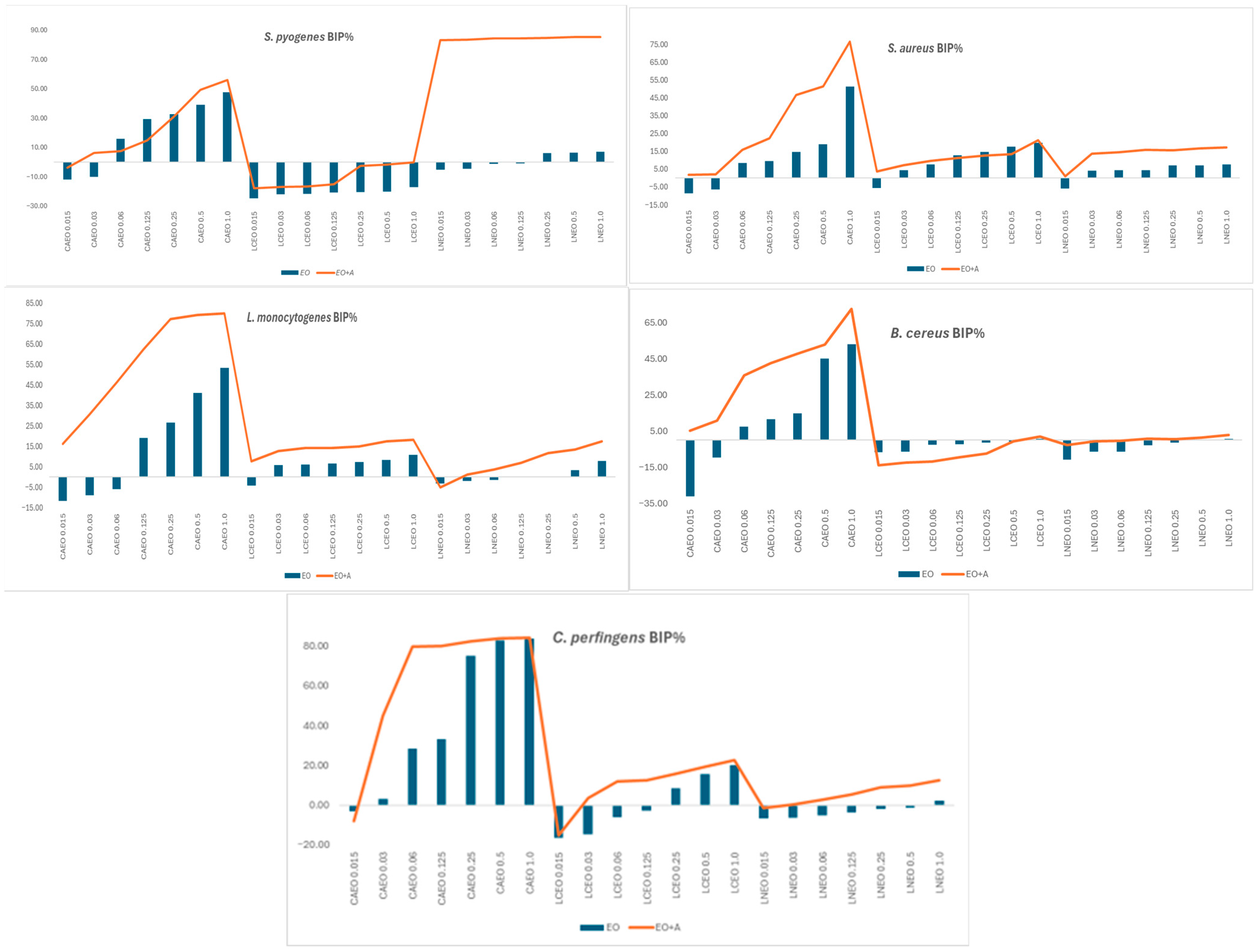
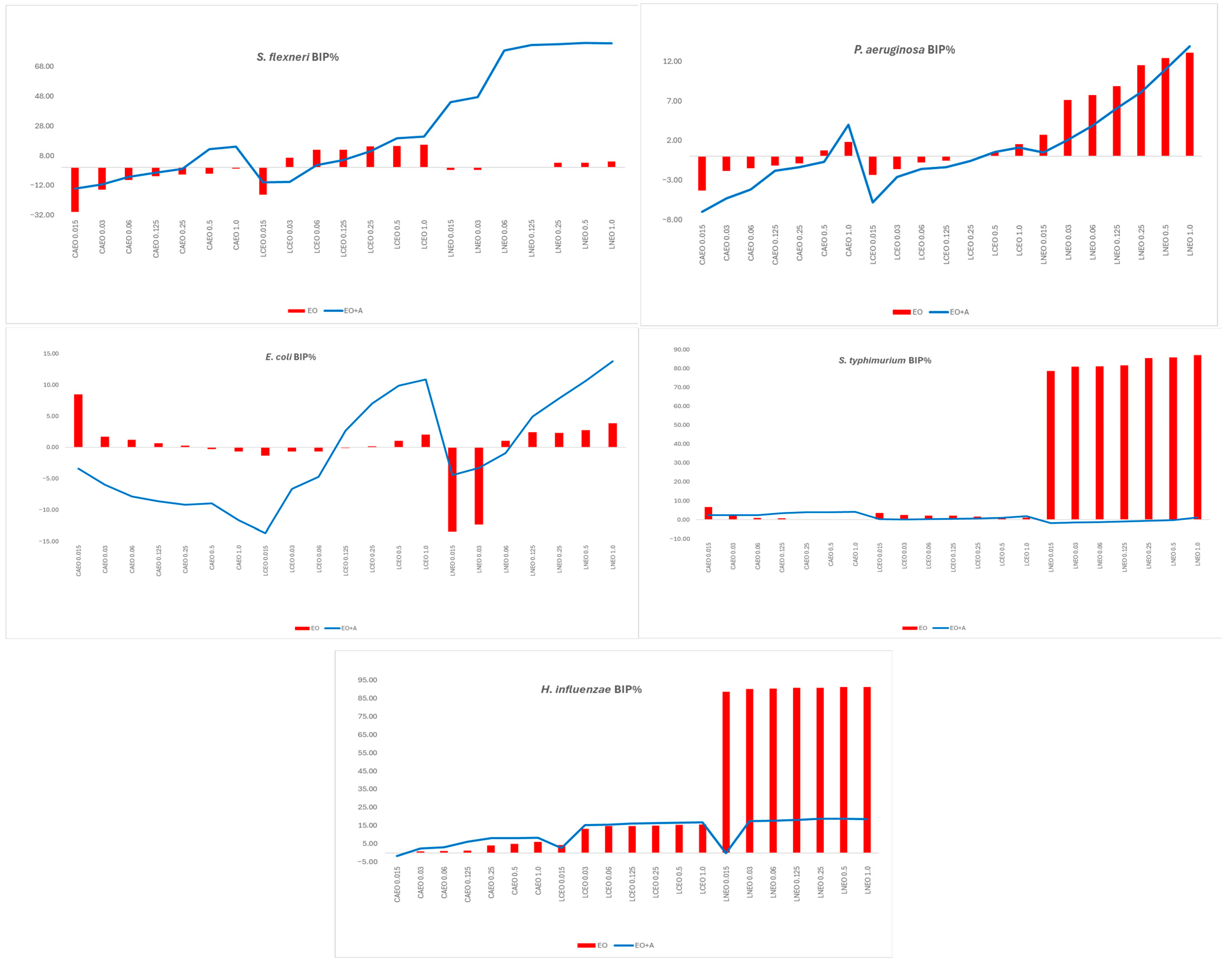
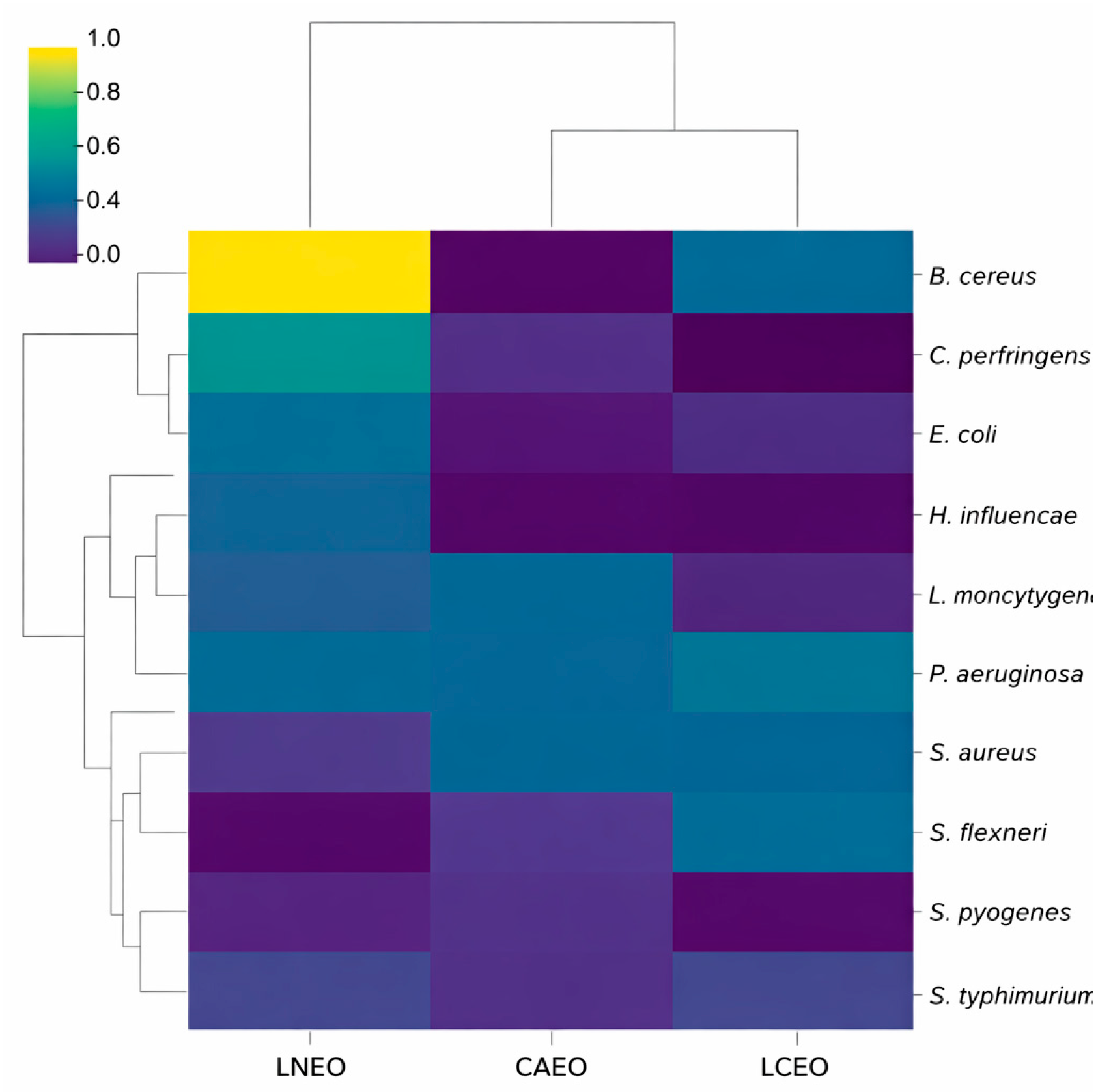
Chemical Profiling, Ampicillin Interaction Patterns, and Exploratory Molecular Docking of Lauraceae Essential Oils

 , , ,
, , ,  , , ,
, , , 
Abstract
1. Introduction
2. Results
2.1. GC/MS Analysis Results
2.2. Antimicrobial Efficacy
2.3. Molecular Docking Analysis
3. Discussion
4. Materials and Methods
4.1. Chemicals
4.2. Determination of Chemical Profile by GC-MS Analysis
4.3. Antimicrobial Activity
4.4. Evaluation of Ampicillin Potentiation by EOs Using MIC-Based Interaction Analysis and Sub-MIC Growth Inhibition
4.5. Molecular Docking
4.6. Statistical Analysis
5. Conclusions
Supplementary Materials
Author Contributions
Funding
Institutional Review Board Statement
Informed Consent Statement
Data Availability Statement
Acknowledgments
Conflicts of Interest
References
- Farias, K.S.; Alves, F.M.; Santos-Zanuncio, V.S.; De Sousa, P.T., Jr.; Silva, D.B.; Carollo, C.A. Global Distribution of the Chemical Constituents and Antibacterial Activity of Essential Oils in Lauraceae Family: A Review. South. Afr. J. Bot. 2023, 155, 214–222. [Google Scholar] [CrossRef]
- D’Aquila, P.; Sena, G.; Crudo, M.; Passarino, G.; Bellizzi, D. Effect of Essential Oils of Apiaceae, Lamiaceae, Lauraceae, Myrtaceae, and Rutaceae Family Plants on Growth, Biofilm Formation, and Quorum Sensing in Chromobacterium violaceum, Pseudomonas aeruginosa, and Enterococcus faecalis. Microorganisms 2023, 11, 1150. [Google Scholar] [CrossRef]
- Da Silva, J.K.R.; Da Trindade, R.C.S.; Maia, J.G.S.; Setzer, W.N. Chemical Composition, Antioxidant, and Antimicrobial Activities of Essential Oils of Endlicheria arenosa (Lauraceae) from the Amazon. Nat. Prod. Commun. 2016, 11, 1934578X1601100537. [Google Scholar] [CrossRef]
- Damasceno, C.S.B.; Fabri Higaki, N.T.; Dias, J.D.F.G.; Miguel, M.D.; Miguel, O.G. Chemical Composition and Biological Activities of Essential Oils in the Family Lauraceae: A Systematic Review of the Literature. Planta Med. 2019, 85, 1054–1072. [Google Scholar] [CrossRef] [PubMed]
- Xavier, J.K.A.M.; Alves, N.S.F.; Setzer, W.N.; Da Silva, J.K.R. Chemical Diversity and Biological Activities of Essential Oils from Licaria, Nectrandra and Ocotea Species (Lauraceae) with Occurrence in Brazilian Biomes. Biomolecules 2020, 10, 869. [Google Scholar] [CrossRef] [PubMed]
- Lucca, L.G.; Romão, P.R.T.; Vignoli-Silva, M.; Da Veiga-Junior, V.F.; Koester, L.S. In Vivo Acute Anti-Inflammatory Activity of Essential Oils: A Review. Mini-Rev. Med. Chem. 2022, 22, 1495–1515. [Google Scholar] [CrossRef]
- Wu, F.; Chen, Y.; Gao, M.; Li, W.; Zhao, Y.; Wang, Y. An Updated Review on Essential Oils from Lauraceae Plants: Chemical Composition and Genetic Characteristics of Biosynthesis. Int. J. Mol. Sci. 2025, 26, 5690. [Google Scholar] [CrossRef]
- Cheng, Y.; Fu, Y.; Gu, D.; Huang, Y.; Lu, Y.; Liu, Y.; Li, X.; Yao, X.; Zhang, X.; Jian, W.; et al. Seasonal Variation in Chemical Composition and Antioxidant and Antibacterial Activity of Essential Oil from Cinnamomum cassia Leaves. Plants 2024, 14, 81. [Google Scholar] [CrossRef]
- Floareș Oarga, D.; Berbecea, A.; Obiștioiu, D.; Hulea, A.; Hotea, I.; Buzna, C.; Sabo, L.A.; Panda, A.O.; Radulov, I. Nutritional Profile and Antioxidant Properties of Hemp (Cannabis sativa L.) Seed from Romania. Appl. Sci. 2025, 15, 2178. [Google Scholar] [CrossRef]
- Tafa Regassa, B.; Tosisa, W.; Eshetu, D.; Beyene, D.; Abdeta, A.; Aseffa Negeri, A.; Shiferaw Teklu, D.; Tasew, G.; Tulu, B.; Awoke, T. Antimicrobial Resistance Profiles of Bacterial Isolates from Clinical Specimens Referred to Ethiopian Public Health Institute: Analysis of 5-Year Data. BMC Infect. Dis. 2023, 23, 798, Correction in BMC Infect. Dis. 2024, 24, 40. [Google Scholar] [CrossRef]
- Pulingam, T.; Parumasivam, T.; Gazzali, A.M.; Sulaiman, A.M.; Chee, J.Y.; Lakshmanan, M.; Chin, C.F.; Sudesh, K. Antimicrobial Resistance: Prevalence, Economic Burden, Mechanisms of Resistance and Strategies to Overcome. Eur. J. Pharm. Sci. 2022, 170, 106103. [Google Scholar] [CrossRef]
- Manh Ha, N.; The Son, N. The Genus Cryptocarya: A Review on Phytochemistry and Pharmacological Activities. Chem. Biodivers. 2023, 20, e202201102. [Google Scholar] [CrossRef]
- Parham, S.; Kharazi, A.Z.; Bakhsheshi-Rad, H.R.; Nur, H.; Ismail, A.F.; Sharif, S.; RamaKrishna, S.; Berto, F. Antioxidant, Antimicrobial and Antiviral Properties of Herbal Materials. Antioxidants 2020, 9, 1309. [Google Scholar] [CrossRef]
- Sargazifar, Z.; Borabadi, R.; Mottaghipisheh, I.; Tazik, Z.; Shakeri, A.; Asili, J.; Sahebkar, A. Cryptocarya Genus: Phytochemistry, Traditional Uses, and Pharmacological Properties. Curr. Tradit. Med. 2025, 11, e260224227415. [Google Scholar] [CrossRef]
- Sreepian, P.M.; Popruk, S.; Rattanasinganchan, P.; Sreepian, A. Comprehensive Investigation of Litsea cubeba Antibacterial and Antifungal Activities across Solid, Liquid, and Vapor Phases against Key Human Pathogens. Narra J. 2025, 5, e1685. [Google Scholar] [CrossRef]
- Caputo, L.; Nazzaro, F.; Souza, L.; Aliberti, L.; De Martino, L.; Fratianni, F.; Coppola, R.; De Feo, V. Laurus nobilis: Composition of Essential Oil and Its Biological Activities. Molecules 2017, 22, 930. [Google Scholar] [CrossRef]
- Fidan, H.; Stefanova, G.; Kostova, I.; Stankov, S.; Damyanova, S.; Stoyanova, A.; Zheljazkov, V.D. Chemical Composition and Antimicrobial Activity of Laurus nobilis L. Essential Oils from Bulgaria. Molecules 2019, 24, 804. [Google Scholar] [CrossRef]
- Bojović, D.; Šoškić, M.; Žugić, A.; Milenković, M.T.; Ljumović, I.; Tadić, V.M. Chemical Analysis and Antimicrobial Potential Assessment of Wild Laurel from the National Park Skadar Lake, Montenegro. Appl. Sci. 2025, 15, 6741. [Google Scholar] [CrossRef]
- Wang, H.; Li, Y.; Li, Z.; Ma, R.; Bai, X.; Zhan, X.; Luo, K.; Su, R.; Li, X.; Xia, X.; et al. Inhibition of Cronobacter sakazakii by Litsea cubeba Essential Oil and the Antibacterial Mechanism. Foods 2022, 11, 3900. [Google Scholar] [CrossRef] [PubMed]
- Hu, W.; Li, C.; Dai, J.; Cui, H.; Lin, L. Antibacterial Activity and Mechanism of Litsea cubeba Essential Oil against Methicillin-Resistant Staphylococcus aureus (MRSA). Ind. Crops Prod. 2019, 130, 34–41. [Google Scholar] [CrossRef]
- Chen, J.; Zhang, J.; Zhu, L.; Qian, C.; Tian, H.; Zhao, Z.; Jin, L.; Yang, D. Antibacterial Activity of the Essential Oil from Litsea cubeba Against Cutibacterium acnes and the Investigations of Its Potential Mechanism by Gas Chromatography-Mass Spectrometry Metabolomics. Front. Microbiol. 2022, 13, 823845. [Google Scholar] [CrossRef] [PubMed]
- Hung, T.T.; Trang, P.T.; Viet, H.; Lan, N.T.M.; Ngan, L.T.M.; Hieu, T.T. In Vitro Antimicrobial Activity of Hydrosol from Litsea cubeba (Lour.) Pers. against Helicobacter pylori and Candida albicans. Biomed. Res. Ther. 2020, 7, 3819–3828. [Google Scholar] [CrossRef]
- Mei, C.; Wang, X.; Chen, Y.; Wang, Y.; Yao, F.; Li, Z.; Gu, Q.; Song, D. Antibacterial Activity and Mechanism of Litsea cubeba Essential Oil against Food Contamination by Escherichia coli and Salmonella enterica. J. Food Saf. 2020, 40, e12809. [Google Scholar] [CrossRef]
- Ebani, V.V.; Nardoni, S.; Bertelloni, F.; Tosi, G.; Massi, P.; Pistelli, L.; Mancianti, F. In Vitro Antimicrobial Activity of Essential Oils against Salmonella enterica Serotypes Enteritidis and Typhimurium Strains Isolated from Poultry. Molecules 2019, 24, 900. [Google Scholar] [CrossRef]
- Bai, X.; Chen, T.; Liu, X.; Liu, Z.; Ma, R.; Su, R.; Li, X.; Lü, X.; Xia, X.; Shi, C. Antibacterial Activity and Possible Mechanism of Litsea Cubeba Essential Oil Against Shigella sonnei and Its Application in Lettuce. Foodborne Pathog. Dis. 2023, 20, 138–148. [Google Scholar] [CrossRef]
- Wang, C.; Chen, X.; Liu, M.; Tang, X.; Li, Y.; Zhan, Y.; Hao, Z. Antibacterial Activity and Mechanism of Litsea cubeba Essential Oil Against Salmonella Typhimurium. Plants 2025, 14, 1343. [Google Scholar] [CrossRef]
- Siriken, B.; Yavuz, C.; Guler, A. Antibacterial Activity of Laurus nobilis: A Review of Literature. Med. Sci. Discov. 2018, 374–379. [Google Scholar] [CrossRef]
- Khwaza, V.; Aderibigbe, B.A. Antibacterial Activity of Selected Essential Oil Components and Their Derivatives: A Review. Antibiotics 2025, 14, 68. [Google Scholar] [CrossRef] [PubMed]
- Ilić, Z.S.; Stanojević, L.; Milenković, L.; Šunić, L.; Milenković, A.; Stanojević, J.; Cvetković, D. Chemical Profiling of Essential Oils from Main Culinary Plants—Bay (Laurus nobilis L.) and Rosemary (Rosmarinus officinalis L.) from Montenegro. Horticulturae 2024, 10, 1249. [Google Scholar] [CrossRef]
- Yang, K.; Wang, C.F.; You, C.X.; Geng, Z.F.; Sun, R.Q.; Guo, S.S.; Du, S.S.; Liu, Z.L.; Deng, Z.W. Bioactivity of Essential Oil of Litsea cubeba from China and Its Main Compounds against Two Stored Product Insects. J. Asia-Pac. Entomol. 2014, 17, 459–466. [Google Scholar] [CrossRef]
- Wang, H.; Yang, Z.; Ying, G.; Yang, M.; Nian, Y.; Wei, F.; Kong, W. Antifungal Evaluation of Plant Essential Oils and Their Major Components against Toxigenic Fungi. Ind. Crops Prod. 2018, 120, 180–186. [Google Scholar] [CrossRef]
- Pante, G.C.; Castro, J.C.; Lini, R.S.; Romoli, J.C.Z.; Almeida, R.T.R.D.; Garcia, F.P.; Nakamura, C.V.; Pilau, E.J.; Abreu Filho, B.A.D.; Machinski, M. Litsea cubeba Essential Oil: Chemical Profile, Antioxidant Activity, Cytotoxicity, Effect against Fusarium Verticillioides and Fumonisins Production. J. Environ. Sci. Health Part. B 2021, 56, 387–395. [Google Scholar] [CrossRef]
- Nguyen, H.V.; Meile, J.-C.; Lebrun, M.; Caruso, D.; Chu-Ky, S.; Sarter, S. Litsea cubeba Leaf Essential Oil from Vietnam: Chemical Diversity and Its Impacts on Antibacterial Activity. Lett. Appl. Microbiol. 2018, 66, 207–214. [Google Scholar] [CrossRef]
- Gogoi, R.; Loying, R.; Sarma, N.; Munda, S.; Kumar Pandey, S.; Lal, M. A Comparative Study on Antioxidant, Anti-Inflammatory, Genotoxicity, Anti-Microbial Activities and Chemical Composition of Fruit and Leaf Essential Oils of Litsea cubeba Pers from North-East India. Ind. Crops Prod. 2018, 125, 131–139. [Google Scholar] [CrossRef]
- Andrianoelisoa, H.S.; Menut, C.; Ramanoelina, P.; Raobelison, F.; De Chatelperron, P.C.; Danthu, P. Chemical Composition of Essential Oils from Bark and Leaves of Individual Trees of Ravensara aromatica Sonnerat. J. Essent. Oil Res. 2010, 22, 66–70. [Google Scholar] [CrossRef]
- Yılmaz, B.; Deniz, İ. The Effects of Cultivation Area Altitude Variation on the Composition of Essential Oil of Laurus nobilis l Grown in Eastern Western Central Karadeniz Region. Int. J. Second. Metab. 2017, 187–195. [Google Scholar] [CrossRef]
- Ozcan, M.; Chalchat, J.-C. Effect of Different Locations on the Chemical Composition of Essential Oils of Laurel (Laurus nobilis L.) Leaves Growing Wild in Turkey. J. Med. Food 2005, 8, 408–411. [Google Scholar] [CrossRef] [PubMed]
- Fan, G.; Ning, X.; Chen, S.; Zhong, L.; Guo, C.; Yang, Y.; Liu, J.; Tang, M.; Liao, G.; Wang, X.; et al. Differences in Fruit Yields and Essential Oil Contents and Composition among Natural Provenances of Litsea cubeba in China and Their Relationships with Main Habitat Factors. Ind. Crops Prod. 2023, 194, 116285. [Google Scholar] [CrossRef]
- Si, L.; Chen, Y.; Han, X.; Zhan, Z.; Tian, S.; Cui, Q.; Wang, Y. Chemical Composition of Essential Oils of Litsea cubeba Harvested from Its Distribution Areas in China. Molecules 2012, 17, 7057–7066. [Google Scholar] [CrossRef]
- Fantasma, F.; Samukha, V.; Aliberti, M.; Colarusso, E.; Chini, M.G.; Saviano, G.; De Felice, V.; Lauro, G.; Casapullo, A.; Bifulco, G.; et al. Essential Oils of Laurus nobilis L.: From Chemical Analysis to In Silico Investigation of Anti-Inflammatory Activity by Soluble Epoxide Hydrolase (sEH) Inhibition. Foods 2024, 13, 2282. [Google Scholar] [CrossRef]
- Stefanova, G.; Girova, T.; Gochev, V.; Stoyanova, M.; Petkova, Z.; Stoyanova, A.; Zheljazkov, V.D. Comparative Study on the Chemical Composition of Laurel (Laurus nobilis L.) Leaves from Greece and Georgia and the Antibacterial Activity of Their Essential Oil. Heliyon 2020, 6, e05491. [Google Scholar] [CrossRef]
- Mkaddem Guedri, M.; Romdhane, M.; Lebrihi, A.; Mathieu, F.; Bouajila, J. Chemical Composition and Antimicrobial and Antioxidant Activities of Tunisian, France and Austrian Laurus nobilis (Lauraceae) Essential Oils. Not. Bot. Horti Agrobot. Cluj-Napoca 2020, 48, 1929–1940. [Google Scholar] [CrossRef]
- Amssayef, A.; Soulaimani, B.; Qabouche, A.; Abbad, A.; Eddouks, M. Antihyperlipidemic Effect and GC-MS Analysis of Phytoconstituents from Laurus nobilis Essential Oil in Rat. Nat. Prod. Res. 2025, 39, 3512–3518. [Google Scholar] [CrossRef]
- Mssillou, I.; Agour, A.; El Ghouizi, A.; Hamamouch, N.; Lyoussi, B.; Derwich, E. Chemical Composition, Antioxidant Activity, and Antifungal Effects of Essential Oil from Laurus nobilis L. Flowers Growing in Morocco. J. Food Qual. 2020, 2020, 8819311. [Google Scholar] [CrossRef]
- Aglagane, A.; Laghzaoui, E.-M.; Soulaimani, B.; Er-Rguibi, O.; Abbad, A.; Mouden, E.H.E.; Aourir, M. Acaricidal Activity of Mentha suaveolens Subsp. Timija, Chenopodium ambrosioides, and Laurus nobilis Essential Oils, and Their Synergistic Combinations against the Ectoparasitic Bee Mite, Varroa destructor (Acari: Varroidae). J. Apic. Res. 2022, 61, 9–18. [Google Scholar] [CrossRef]
- Chung, J.-D.; Chang, C.L.; Kung, F.-X.; Guo, J.-Y.; Huang, Y.-P.; Wang, H.-L.; Pai, H.-H. The Essential Oils of Litsea cubeba (Lour.) Pers. Fruit Extracted from Different Temperature Ranges Exhibit Distinct Chemical Compositions and Biologic Activities. Nat. Prod. Commun. 2025, 20, 1934578X251322270. [Google Scholar] [CrossRef]
- Jîjie, A.-R.; Iliescu, D.; Sbârcea, L.; Boru, C.; Pătrașcu, D.; Iftode, O.A.; Minda, I.-D.; Avram, Ș.; Trandafirescu, C.-M.; Dehelean, C.A.; et al. A Deep Dive into the Botanical and Medicinal Heritage of Taxus. Plants 2025, 14, 1439. [Google Scholar] [CrossRef] [PubMed]
- Romanu, R.; Liga, S.; Tripon, M.R.; Huiban, F.; Iliescu, D.; Dehelean, C.A.; Camelia, T. Chelidonium majus L.: A Current Perspective on Isoquinoline Alkaloids, Emerging Phytochemicals, Alkaloid Biosynthesis, and Biological Activities. Plants 2025, 14, 2627. [Google Scholar] [CrossRef] [PubMed]
- Liu, M.; Hu, Y.; Ding, H.; Chen, Z.; Liu, L.; Xue, Q. Synergistic Antibacterial Effects of Non-Volatile and Volatile Antibacterial Substances from Litsea cubeba Fruit and Their Application in Pork Preservation. LWT—Food Sci. Technol. 2025, 231, 118343. [Google Scholar] [CrossRef]
- Lavanya, P.; Ramaiah, S.; Anbarasu, A. A Molecular Docking and Dynamics Study to Screen Potent Anti-Staphylococcal Compounds Against Ceftaroline Resistant MRSA. J. Cell. Biochem. 2016, 117, 542–548. [Google Scholar] [CrossRef]
- Kumar, K.M.; Anitha, P.; Sivasakthi, V.; Bag, S.; Lavanya, P.; Anbarasu, A.; Ramaiah, S. In Silico Study on Penicillin Derivatives and Cephalosporins for Upper Respiratory Tract Bacterial Pathogens. 3 Biotech 2014, 4, 241–251. [Google Scholar] [CrossRef]
- Aati, H.Y.; Perveen, S.; Aati, S.; Orfali, R.; Alqahtani, J.H.; Al-Taweel, A.M.; Wanner, J.; Aati, A.Y. Headspace Solid-Phase Microextraction Method for Extracting Volatile Constituents from the Different Parts of Saudi Anethum graveolens L. and Their Antimicrobial Activity. Heliyon 2022, 8, e09051. [Google Scholar] [CrossRef]
- Mosavi, H.; Alizadeh, A. Phytochemical Constituents and Antimicrobial Activity of Allium eriophyllum Var. Eriophyllum Iran. Nat. Prod. Res. 2019, 33, 3148–3152. [Google Scholar] [CrossRef]
- Babushok, V.I.; Linstrom, P.J.; Zenkevich, I.G. Retention Indices for Frequently Reported Compounds of Plant Essential Oils. J. Phys. Chem. Ref. Data 2011, 40, 043101. [Google Scholar] [CrossRef]
- Mołdoch, J.; Agacka-Mołdoch, M.; Jóźwiak, G.; Wojtunik-Kulesza, K. Biological Activity of Monoterpene-Based Scaffolds: A Natural Toolbox for Drug Discovery. Molecules 2025, 30, 1480. [Google Scholar] [CrossRef]
- Zielińska-Błajet, M.; Feder-Kubis, J. Monoterpenes and Their Derivatives—Recent Development in Biological and Medical Applications. Int. J. Mol. Sci. 2020, 21, 7078. [Google Scholar] [CrossRef]
- Potocka, W.; Assy, Z.; Bikker, F.J.; Laine, M.L. Current and Potential Applications of Monoterpenes and Their Derivatives in Oral Health Care. Molecules 2023, 28, 7178. [Google Scholar] [CrossRef] [PubMed]
- Andrianjafinandrasana, S.N.; Andrianoelisoa, H.S.; Jeanson, M.L.; Ratsimiala Ramonta, I.; Danthu, P. Allelopathic Effects of Volatile Compounds of Essential Oil from Ravensara Aromatica Sonnerat Chemotypes. Allelopath. J. 2013, 31, 333–344. [Google Scholar]
- Pries, R.; Jeschke, S.; Leichtle, A.; Bruchhage, K.-L. Modes of Action of 1,8-Cineol in Infections and Inflammation. Metabolites 2023, 13, 751. [Google Scholar] [CrossRef] [PubMed]
- Ayllón-Gutiérrez, R.; López-Maldonado, E.A.; Macías-Alonso, M.; González Marrero, J.; Díaz-Rubio, L.; Córdova-Guerrero, I. Evaluation of the Stability of a 1,8-Cineole Nanoemulsion and Its Fumigant Toxicity Effect against the Pests Tetranychus urticae, Rhopalosiphum maidis and Bemisia tabaci. Insects 2023, 14, 663. [Google Scholar] [CrossRef]
- Hoch, C.C.; Petry, J.; Griesbaum, L.; Weiser, T.; Werner, K.; Ploch, M.; Verschoor, A.; Multhoff, G.; Bashiri Dezfouli, A.; Wollenberg, B. 1,8-Cineole (Eucalyptol): A Versatile Phytochemical with Therapeutic Applications across Multiple Diseases. Biomed. Pharmacother. 2023, 167, 115467. [Google Scholar] [CrossRef] [PubMed]
- Solon, I.G.; Santos, W.S.; Branco, L.G.S. Citral as an Anti-Inflammatory Agent: Mechanisms, Therapeutic Potential, and Perspectives. Pharmacol. Res. Nat. Prod. 2025, 7, 100253. [Google Scholar] [CrossRef]
- Sharma, S.; Habib, S.; Sahu, D.; Gupta, J. Chemical Properties and Therapeutic Potential of Citral, a Monoterpene Isolated from Lemongrass. Med. Chem. 2020, 17, 2–12. [Google Scholar] [CrossRef] [PubMed]
- Vieira, A.J.; Beserra, F.P.; Souza, M.C.; Totti, B.M.; Rozza, A.L. Limonene: Aroma of Innovation in Health and Disease. Chem. Biol. Interact. 2018, 283, 97–106. [Google Scholar] [CrossRef]
- Zheng, X.; Declercq, A.M.; Vanrompay, D.; Feyaerts, A.F.; Van Dijck, P.; Bossier, P. In Vitro and in Vivo Characterization of Citral and Limonene Combinations against Vibrio campbellii in Brine Shrimp. Aquaculture 2024, 593, 741343. [Google Scholar] [CrossRef]
- Gutiérrez-Pacheco, M.M.; Torres-Moreno, H.; Flores-Lopez, M.L.; Velázquez Guadarrama, N.; Ayala-Zavala, J.F.; Ortega-Ramírez, L.A.; López-Romero, J.C. Mechanisms and Applications of Citral’s Antimicrobial Properties in Food Preservation and Pharmaceuticals Formulations. Antibiotics 2023, 12, 1608. [Google Scholar] [CrossRef]
- Han, Y.; Sun, Z.; Chen, W. Antimicrobial Susceptibility and Antibacterial Mechanism of Limonene against Listeria monocytogenes. Molecules 2019, 25, 33. [Google Scholar] [CrossRef]
- Gupta, A.; Jeyakumar, E.; Lawrence, R. Journey of Limonene as an Antimicrobial Agent. J. Pure Appl. Microbiol. 2021, 15, 1094–1110. [Google Scholar] [CrossRef]
- Gupta, A.; Jeyakumar, E.; Lawrence, R. Strategic Approach of Multifaceted Antibacterial Mechanism of Limonene Traced in Escherichia coli. Sci. Rep. 2021, 11, 13816. [Google Scholar] [CrossRef] [PubMed]
- Schürmann, M.; Oppel, F.; Gottschalk, M.; Büker, B.; Jantos, C.A.; Knabbe, C.; Hütten, A.; Kaltschmidt, B.; Kaltschmidt, C.; Sudhoff, H. The Therapeutic Effect of 1,8-Cineol on Pathogenic Bacteria Species Present in Chronic Rhinosinusitis. Front. Microbiol. 2019, 10, 2325. [Google Scholar] [CrossRef]
- Mączka, W.; Duda-Madej, A.; Górny, A.; Grabarczyk, M.; Wińska, K. Can Eucalyptol Replace Antibiotics? Molecules 2021, 26, 4933. [Google Scholar] [CrossRef]
- Dörr, T.; Moynihan, P.J.; Mayer, C. Editorial: Bacterial Cell Wall Structure and Dynamics. Front. Microbiol. 2019, 10, 2051. [Google Scholar] [CrossRef] [PubMed]
- Chen, Q.; Lin, X.; Zhang, J.; Liu, S.; Zou, Z.; Chun, J. Chemical Compositions and Antibacterial Activities of Litsea cubeba Essential Oil and Its Distillates Prepared by Vacuum Fractional Distillation and Molecular Distillation. J. Agric. Food Chem. 2025, acs.jafc.4c11955. [Google Scholar] [CrossRef]
- Sima, L.; Tirziu, R.; Iliescu, D.; Blidisel, A.; Hut, F.; Streian, C. Spontaneous Rupture of Gastroduodenal Artery Aneurysm. Chirurgia 2010, 105, 717–720. [Google Scholar] [PubMed]
- Da Silveira, S.M.; Luciano, F.B.; Fronza, N.; Cunha, A.; Scheuermann, G.N.; Vieira, C.R.W. Chemical Composition and Antibacterial Activity of Laurus nobilis Essential Oil towards Foodborne Pathogens and Its Application in Fresh Tuscan Sausage Stored at 7 °C. LWT—Food Sci. Technol. 2014, 59, 86–93. [Google Scholar] [CrossRef]
- Nafis, A.; Kasrati, A.; Jamali, C.A.; Custódio, L.; Vitalini, S.; Iriti, M.; Hassani, L. A Comparative Study of the in Vitro Antimicrobial and Synergistic Effect of Essential Oils from Laurus nobilis L. and Prunus armeniaca L. from Morocco with Antimicrobial Drugs: New Approach for Health Promoting Products. Antibiotics 2020, 9, 140. [Google Scholar] [CrossRef]
- Sena, G.; De Rose, E.; Crudo, M.; Filippelli, G.; Passarino, G.; Bellizzi, D.; D’Aquila, P. Essential Oils from Southern Italian Aromatic Plants Synergize with Antibiotics against Escherichia coli, Pseudomonas aeruginosa and Enterococcus faecalis Cell Growth and Biofilm Formation. Antibiotics 2024, 13, 605. [Google Scholar] [CrossRef]
- Li, A.; Shi, C.; Qian, S.; Wang, Z.; Zhao, S.; Liu, Y.; Xue, Z. Evaluation of Antibiotic Combination of Litsea cubeba Essential Oil on Vibrio parahaemolyticus Inhibition Mechanism and Anti-Biofilm Ability. Microb. Pathog. 2022, 168, 105574. [Google Scholar] [CrossRef]
- Haikarainen, T.; Tsou, C.-C.; Wu, J.-J.; Papageorgiou, A.C. Crystal Structures of Streptococcus pyogenes Dpr Reveal a Dodecameric Iron-Binding Protein with a Ferroxidase Site. JBIC J. Biol. Inorg. Chem. 2010, 15, 183–194. [Google Scholar] [CrossRef]
- Eakin, A.E.; Green, O.; Hales, N.; Walkup, G.K.; Bist, S.; Singh, A.; Mullen, G.; Bryant, J.; Embrey, K.; Gao, N.; et al. Pyrrolamide DNA Gyrase Inhibitors: Fragment-Based Nuclear Magnetic Resonance Screening to Identify Antibacterial Agents. Antimicrob. Agents Chemother. 2012, 56, 1240–1246. [Google Scholar] [CrossRef]
- Xu, T.; Liu, L.; Hou, S.; Xu, J.; Yang, B.; Wang, Y.; Liu, J. Crystal Structure of a Mono- and Diacylglycerol Lipase from Malassezia Globosa Reveals a Novel Lid Conformation and Insights into the Substrate Specificity. J. Struct. Biol. 2012, 178, 363–369. [Google Scholar] [CrossRef] [PubMed]
- Hargrove, T.Y.; Friggeri, L.; Wawrzak, Z.; Qi, A.; Hoekstra, W.J.; Schotzinger, R.J.; York, J.D.; Guengerich, F.P.; Lepesheva, G.I. Structural Analyses of Candida albicans Sterol 14α-Demethylase Complexed with Azole Drugs Address the Molecular Basis of Azole-Mediated Inhibition of Fungal Sterol Biosynthesis. J. Biol. Chem. 2017, 292, 6728–6743. [Google Scholar] [CrossRef] [PubMed]
- Shah, M.; Taylor, V.L.; Bona, D.; Tsao, Y.; Stanley, S.Y.; Pimentel-Elardo, S.M.; McCallum, M.; Bondy-Denomy, J.; Howell, P.L.; Nodwell, J.R.; et al. A Phage-Encoded Anti-Activator Inhibits Quorum Sensing in Pseudomonas aeruginosa. Mol. Cell 2021, 81, 571–583.e6. [Google Scholar] [CrossRef] [PubMed]
- Takashima, M.; Watanabe, I.; Miyanaga, A.; Eguchi, T. Substrate Specificity of Chondroitinase ABC I Based on Analyses of Biochemical Reactions and Crystal Structures in Complex with Disaccharides. Glycobiology 2021, 31, 1571–1581. [Google Scholar] [CrossRef]
- Sana, S.S.; Gangadhar, L.; Sofi, M.A.; Sudarshan, K.; Oh, T.H. Chitosan as a Wall Biomaterial for the Encapsulation of Essential Oils: A Comprehensive Review of Pharmaceutical Breakthroughs and Future Directions. Int. J. Biol. Macromol. 2025, 332, 148551. [Google Scholar] [CrossRef]
- Floares, D.; Obistioiu, D.; Hulea, A.; Suleiman, M.A.; Popescu, I.; Berbecea, A.; Samfira, I.; Radulov, I. Antimicrobial and Antioxidant Properties of Sambucus nigra L. (Elderflower) Oil: A Molecular Docking and Biochemical Study. Agronomy 2025, 15, 310. [Google Scholar] [CrossRef]
- Bălașoiu, R.A.C.; Obistioiu, D.; Hulea, A.; Suleiman, M.A.; Popescu, I.; Floares, D.; Imbrea, I.M.; Neacșu, A.-G.; Șmuleac, L.; Pașcalău, R.; et al. Analysing the Antibacterial Synergistic Interactions of Romanian Lavender Essential Oils via Gas Chromatography–Mass Spectrometry: In Vitro and In Silico Approaches. Plants 2024, 13, 2136. [Google Scholar] [CrossRef]
- Imbrea, I.M.; Osiceanu, M.; Hulea, A.; Suleiman, M.A.; Popescu, I.; Floares, D.; Onisan, E.; Neacșu, A.-G.; Popescu, C.A.; Hulea, C.; et al. Chemical and Biological Properties of Different Romanian Populations of Hyssopus Officinalis Correlated via Molecular Docking. Plants 2024, 13, 3259. [Google Scholar] [CrossRef]
- Floares, D.; Obistioiu, D.; Hulea, A.; Suleiman, M.A.; Popescu, I.; Buzna, C.; Berbecea, A.; Alexa, E.; Dehelean, C.; Radulov, I. Chemical Profile, Bioactive Constituents and In Vitro Growth Stimulation Properties of Cold-Pressed Hemp Seed Oils from Romanian Varieties: In Vitro and In Silico Evaluation. Plants 2025, 14, 3465. [Google Scholar] [CrossRef]
- Clinical and Laboratory Standards Institute Methods for Dilution Antimicrobial Susceptibility Test for Bacteria That Grow Aerobically: Approved Standard, 8th ed.; Clinical and Laboratory Standards Institute: Wayne, PA, USA, 2009.
- Sun, S. Emerging Antibiotic Resistance by Various Novel Proteins/Enzymes. Eur. J. Clin. Microbiol. Infect. Dis. 2025, 44, 1551–1566. [Google Scholar] [CrossRef]
- Lötsch, J.; Kringel, D.; Ultsch, A. Revisiting Fold-Change Calculation: Preference for Median or Geometric Mean over Arithmetic Mean-Based Methods. Biomedicines 2024, 12, 1639. [Google Scholar] [CrossRef] [PubMed]
- Available online: https://pubchem.ncbi.nlm.nih.gov/ (accessed on 18 May 2025).
- Available online: www.rcsb.org (accessed on 24 August 2025).



| Compound Class | Identified Compounds | LRIc * | LRIr * [54] | CAEO | LCEO | LNEO |
|---|---|---|---|---|---|---|
| Conc. % | Conc. % | Conc. % | ||||
| Monoterpene Hydrocarbons | α-Pinene | 930 | 936 | 10.41 | 1.93 | 2.95 |
| Camphene | 950 | 952 | 0.54 | 1.33 | ||
| β-Pinene | 970 | 977 | 7.88 | 1.39 | 2.8 | |
| Sabinene | 978 | 981 | 1.75 | 4.67 | ||
| β-Myrcene | 990 | 994 | 1.73 | 0.88 | 6.07 | |
| 3-Carene | 1020 | 1012 | 0.2 | |||
| α-Phellandrene | 1025 | 1029 | 0.82 | 1.71 | ||
| Limonene | 1031 | 1030 | 9.09 | 19.19 | 30.68 | |
| β-Ocimene Z | 1040 | 1038 | 1.53 | |||
| 1,3,8-p-Menthatriene | 1045 | 1048 | 1.61 | |||
| β-Ocimene E | 1051 | 1048 | 1.18 | 5.73 | ||
| Total | 34.61 | 25.69 | 56.14 | |||
| Oxygenated Monoterpenes | Eucalyptol | 1035 | 1032 | 52.09 | 1.73 | 28.4 |
| Camphor | 1045 | 1043 | 9.08 | |||
| β-Linalool | 1100 | 1099 | 2.28 | 1.85 | 0.92 | |
| Myrcenol | 1110 | 1113 | 2.27 | 1.6 | ||
| trans-3-Caren-2-ol | 1131 | 1133 | 2.66 | |||
| Verbenol | 1146 | 1144 | 0.9 | |||
| β-Citronellal | 1158 | 1154 | 3.15 | |||
| 4-Terpineol | 1164 | 1165 | 3.3 | |||
| β-Citral | 1215 | 1220 | 0.55 | 42.98 | ||
| Bornyl acetate | 1286 | 1284 | 0.5 | |||
| Total | 60.49 | 68.42 | 43.16 | |||
| Sesquiterpene Hydrocarbons | Caryophyllene | 1408 | 1406 | 1.57 | ||
| α-Caryophyllene | 1420 | 1422 | 0.41 | |||
| β-Elemene | 1438 | 1436 | 0.14 | |||
| β-Farnesene | 1445 | 1446 | 1.13 | |||
| α-Farnesene | 1455 | 1456 | 0.7 | |||
| Germacrene B | 1538 | 1535 | 0.11 | |||
| Total | 1.13 | 2.23 | 0.70 | |||
| Oxygenated Sesquiterpenes | Caryophyllene oxide | 1580 | 1571 | 0.2 | ||
| Alloaromadendrene oxide | 1644 | 1649 | 0.15 | |||
| Total | 0.36 | |||||
| Acyclic Alkynes And Alcohols | 1,3,6-Heptatriene, 5-methyl- | 1055 | 1050 | 1.18 | ||
| 1,9-Decadiyne | 1258 | 1262 | 0.64 | |||
| 3-Nonyn-2-ol | 1590 | 1586 | 0.24 | |||
| 3-Buten-2-ol, 2,3-dimethyl | 1690 | 1685 | 0.18 | |||
| Total | 2.05 | 0.18 | ||||
| Cyclic aldehydes and unsaturated cyclic compounds | 5-Hepten-2-one, 6-methyl | 1333 | 1336 | 1.86 | ||
| 2,4,6-Trimethyl-3-cyclohexene-1-carboxaldehyde | 1398 | 1400 | 1.28 | |||
| Total | 3.14 | |||||
| Aromatic Compounds (Phenylpropenes and Ethers) | Estragole | 1380 | 1384 | 0.53 | ||
| Eugenol methyl ether | 1560 | 1555 | 1.18 | |||
| Total | 1.71 |
| S/No | Ligands | Binding Energy (Kcal/Mol) | Amino Acids Involved in the Interaction | ||||||||||
|---|---|---|---|---|---|---|---|---|---|---|---|---|---|
| 2WLA | 3U2D | 3UUE | 5TZ1 | 6V7X | 7EIP | 2WLA | 3U2D | 3UUE | 5TZ1 | 6V7X | 7EIP | ||
| 1 | α-Pinene (CID: 6654) | −4.7 | −5.0 | −4.7 | −6.1 | −6.7 | −5.2 | NIR | Ile B: 86 | Trp A: 229, Val A: 233, Phe A: 276 | Phe A: 233 | NIR | NIR |
| 2 | β-Pinene (CID: 14896) | −4.6 | −4.9 | −4.6 | −5.9 | −6.6 | −5.3 | NIR | NIR | Trp A: 229, Val A: 233, Phe A: 276 | Trp B: 54, Ile A: 55, Ala A: 62 | NIR | NIR |
| 3 | Limonene (CID: 22311) | −4.9 | −5.5 | −5.2 | −6.6 | −7.6 | −5.1 | Ala A: 106, Arg A: 120 | Ile B: 51, Ile B: 86, Leu B: 103, Ile B: 175 | Trp A: 248, Tyr A: 250 | Leu A: 87, Leu A: 88, Lys A: 90, Phe A: 233, Phe A: 380, Tyr A: 401 | Leu B: 36, Tyr B: 56, Tyr B: 64, Trp B: 88 | Phe A: 240, Leu A: 422, Lys A: 465, Leu A: 469 |
| 4 | Ocimene (CID: 5281553) | −4.4 | −5.5 | −4.7 | −5.8 | −6.6 | −5.1 | Val A: 13, Lys A: 29, Ala A: 30, Leu A: 83 | Ile B: 51, Ile B: 86, Leu B: 103, Ile B: 175 | Leu A: 110, Trp A: 229, Val A: 233, Phe A: 276 | Lys A: 90, Met A: 92, Phe A: 233, His A: 377, Phe A: 380, Tyr A: 401 | Tyr B: 64, Val B: 76, Trp B: 88, Phe B: 101, Ala B: 105, Leu B: 110, Ala B: 127 | Leu A: 293, Val A: 334, Leu A: 342 |
| 5 | β-Myrcene (CID: 31253) | −4.3 | −5.2 | −4.5 | −5.9 | −5.8 | −4.9 | Val A: 49, Ala A: 106, Lys A: 112, His A: 117, Arg A: 120 | Ile B: 51, Val B: 79, Ile B: 86, Ile B: 175 | Leu A: 110, Trp A: 229, Val A: 233, Phe A: 276 | Ala A: 117, Pro A: 230, Phe A: 233, His A: 377, Phe A: 380, Tyr A: 401 | Leu B: 36, Leu B: 40, Tyr B: 47, Tyr B: 64, Val B: 76, Leu B: 125, Ala B: 127 | Val A: 334, Leu A: 342 |
| 6 | Eucalyptol (CID: 2758) | −4.7 | −4.9 | −4.5 | −5.8 | −6.5 | −5.0 | NIR | NIR | NIR | Trp B: 54 | NIR | NIR |
| 7 | Camphor (CID: 2537) | −4.3 | −4.7 | −4.4 | −6.2 | −6.8 | −4.8 | NIR | NIR | NIR | Trp B: 54 | NIR | NIR |
| 8 | Copaene (CID: 12303902) | −5.7 | −6.5 | −5.6 | −8.0 | −6.5 | −6.3 | Tyr A: 10, Ala A: 11 | Ile B: 86 | Trp A: 116, Leu A: 238 | Phe B: 52, Trp B: 54, Ala A: 62 | Leu A: 10, Leu C: 10, Leu A: 53, Ala A: 56, Leu A: 57, | Ala A:292, Leu A: 342 |
| 9 | α-Bergamotene (CID: 86608) | −4.6 | −6.8 | −5.1 | −7.7 | −8.0 | −6.1 | Leu A: 103, Tyr A: 127 | Ile B: 51, Ile B: 86, Ile B: 175 | Trp A: 229, Val A: 233, Phe A: 276 | Leu A: 87, Ala A: 117, Pro A: 230, Phe A: 233, Phe A: 380, Tyr A: 401 | Leu B: 36, Ile B: 52, Tyr B: 56, Trp B: 60, Tyr B: 64, Ala B: 70, Val B: 76, Phe B: 101, Ala B: 127 | Ala A: 292, Leu A: 293, Val A: 334, Leu A: 342 |
| 10 | Caryophyllene (CID: 5281515) | −5.7 | −5.9 | −5.8 | −7.6 | −7.2 | −5.9 | NIR | NIR | Trp A: 229, Val A: 233 | NIR | NIR | NIR |
| 11 | α-Caryophyllene (CID: 5281520) | −5.4 | −6.1 | −6.1 | −7.7 | −6.4 | −5.8 | NIR | NIR | NIR | Trp B: 54, Ala A: 62 | Trp C: 45 | NIR |
| 12 | Germacrene D (CID: 5317570) | −5.8 | −7.1 | −6.2 | −7.9 | −6.7 | −6.3 | Ala A: 106, Ala A:119, Arg A: 120 | Ile B: 86 | Tyr A: 250 | Trp B: 54, Ala A: 62 | Phe C: 19 | Phe A: 240 |
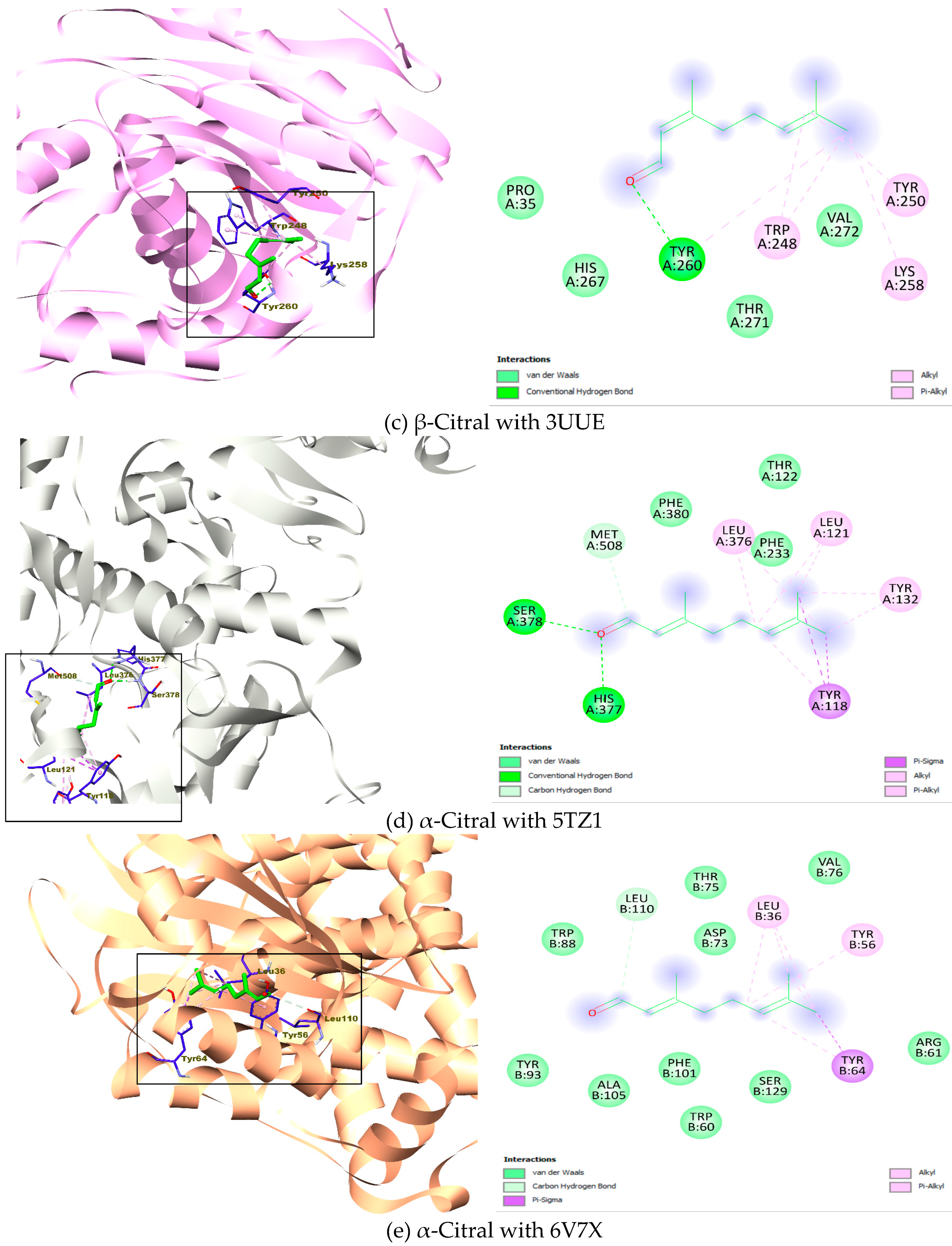
| 13 | α-Citral (CID: 638011) | −4.6 | −5.4 | −4.8 | −6.2 | −6.6 | −4.9 | Val A: 13, Ala A: 30, Ala A: 89 | Ile A: 51, Ile A: 86, Ile A: 175 | Val A: 266, Leu A: 270 | Tyr A: 118, Leu A: 121, Tyr A: 132, Leu A: 376, His A: 377. Ser A: 378, Met A: 508 | Leu B: 36, Tyr B: 56, Tyr B: 64, Leu B: 110 | Ala A: 278, Leu A: 286, Arg A: 306, Leu A: 342 |
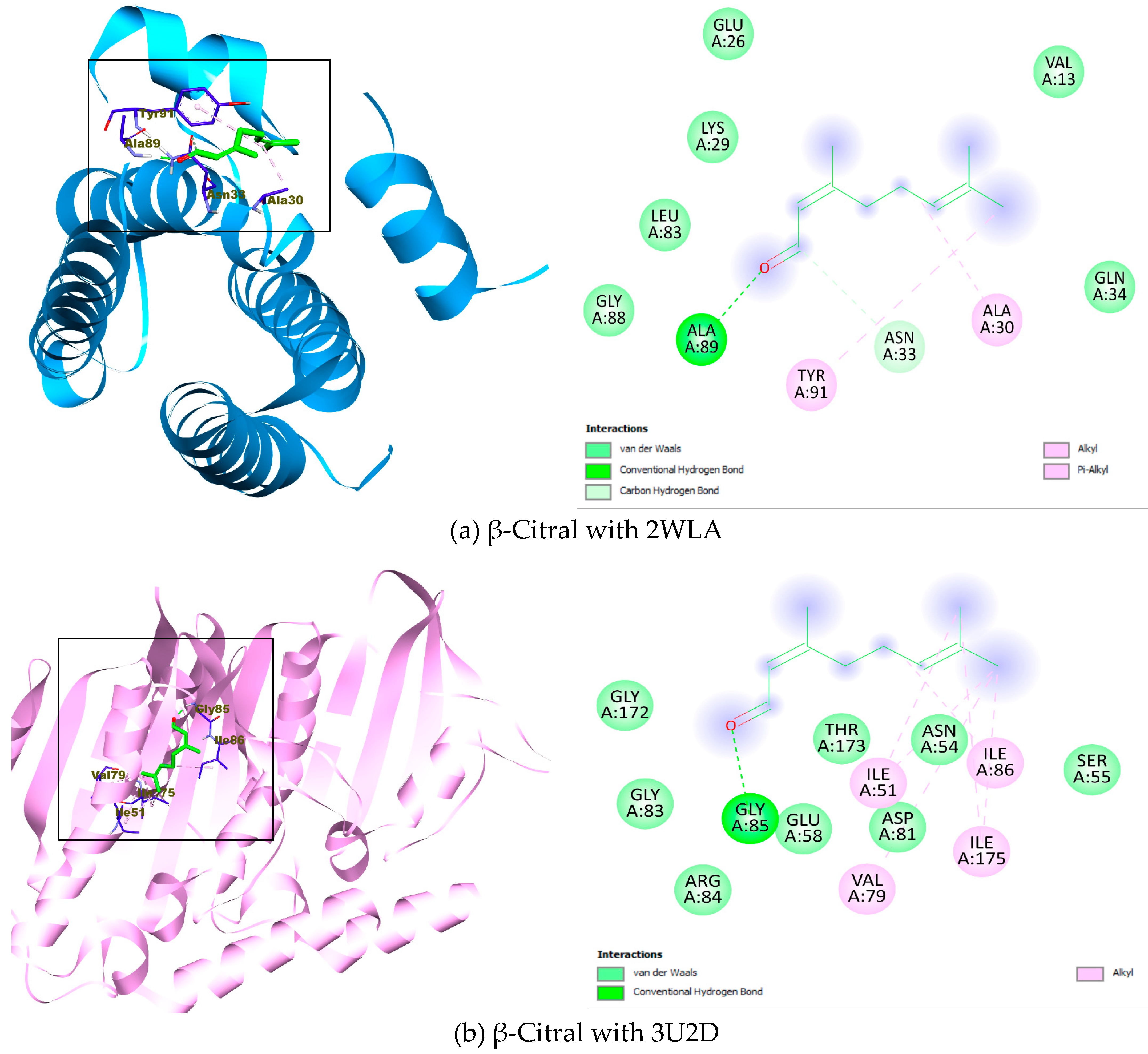
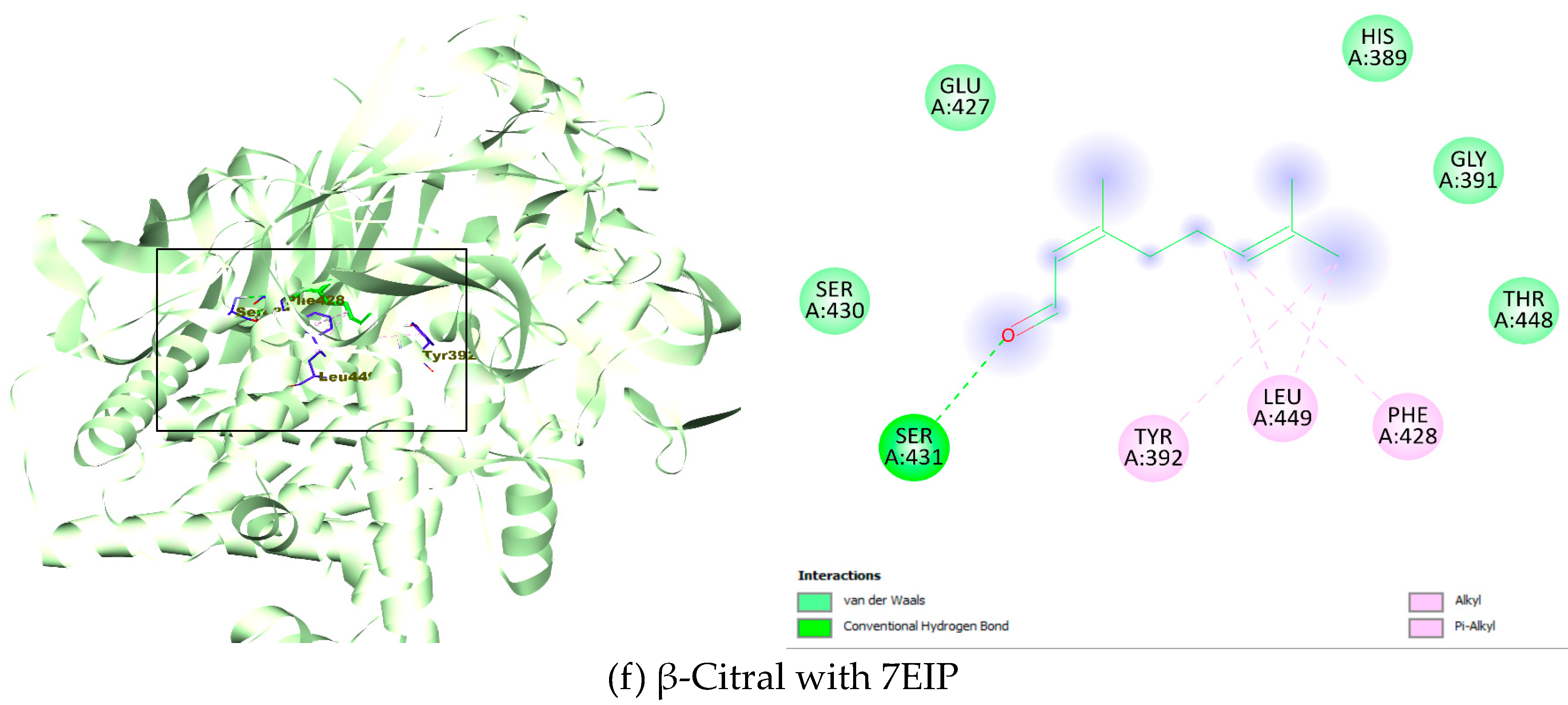
| 14 | β-Citral (CID: 643779) | −4.5 | −5.7 | −4.4 | −5.3 | −6.1 | −5.2 | Ala A: 30, Asn A: 33, Ala A: 89, Tyr A: 91 | Ile A: 51, Val A: 79, Gly A: 85, Ile A: 86, Ile A: 175 | Trp A: 248, Tyr A: 250, Lys A: 258, Tyr A: 260 | Ile B: 197, Phe B: 213, Ala B:218, Tyr B: 221 | Leu B: 36, Leu B: 40, Tyr B: 47, Ile B: 52, Tyr B: 64, Ala B: 70, Val B: 76 | Tyr A: 392, Phe A: 428, Ser A: 431, Leu A: 449 |
Disclaimer/Publisher’s Note: The statements, opinions and data contained in all publications are solely those of the individual author(s) and contributor(s) and not of MDPI and/or the editor(s). MDPI and/or the editor(s) disclaim responsibility for any injury to people or property resulting from any ideas, methods, instructions or products referred to in the content. |
© 2026 by the authors. Licensee MDPI, Basel, Switzerland. This article is an open access article distributed under the terms and conditions of the Creative Commons Attribution (CC BY) license.
Share and Cite
Hulea, A.; Imbrea, F.; Floares, D.; Popescu, I.; Suleiman, M.A.; Hulea, C.; Imbrea, I.M.; Neacșu, A.-G.; Horablaga, M.; Popescu, C.A.; et al. Chemical Profiling, Ampicillin Interaction Patterns, and Exploratory Molecular Docking of Lauraceae Essential Oils. Int. J. Mol. Sci. 2026, 27, 1447. https://doi.org/10.3390/ijms27031447
Hulea A, Imbrea F, Floares D, Popescu I, Suleiman MA, Hulea C, Imbrea IM, Neacșu A-G, Horablaga M, Popescu CA, et al. Chemical Profiling, Ampicillin Interaction Patterns, and Exploratory Molecular Docking of Lauraceae Essential Oils. International Journal of Molecular Sciences. 2026; 27(3):1447. https://doi.org/10.3390/ijms27031447
Chicago/Turabian StyleHulea, Anca, Florin Imbrea, Doris Floares (Oarga), Iuliana Popescu, Mukhtar Adeiza Suleiman, Calin Hulea, Ilinca Merima Imbrea, Alina-Georgeta Neacșu, Marinel Horablaga, Cosmin Alin Popescu, and et al. 2026. "Chemical Profiling, Ampicillin Interaction Patterns, and Exploratory Molecular Docking of Lauraceae Essential Oils" International Journal of Molecular Sciences 27, no. 3: 1447. https://doi.org/10.3390/ijms27031447
APA StyleHulea, A., Imbrea, F., Floares, D., Popescu, I., Suleiman, M. A., Hulea, C., Imbrea, I. M., Neacșu, A.-G., Horablaga, M., Popescu, C. A., & Obistioiu, D. (2026). Chemical Profiling, Ampicillin Interaction Patterns, and Exploratory Molecular Docking of Lauraceae Essential Oils. International Journal of Molecular Sciences, 27(3), 1447. https://doi.org/10.3390/ijms27031447