The Emerging Role of Endothelial Ion Channels in the Control of Human Microcirculation

 ,
, 
 , , , ,
  and
and 
Abstract
1. Introduction
2. Endothelial Ion Channels and Vasomotor Control in Animal Studies and Cultured Endothelial Cells
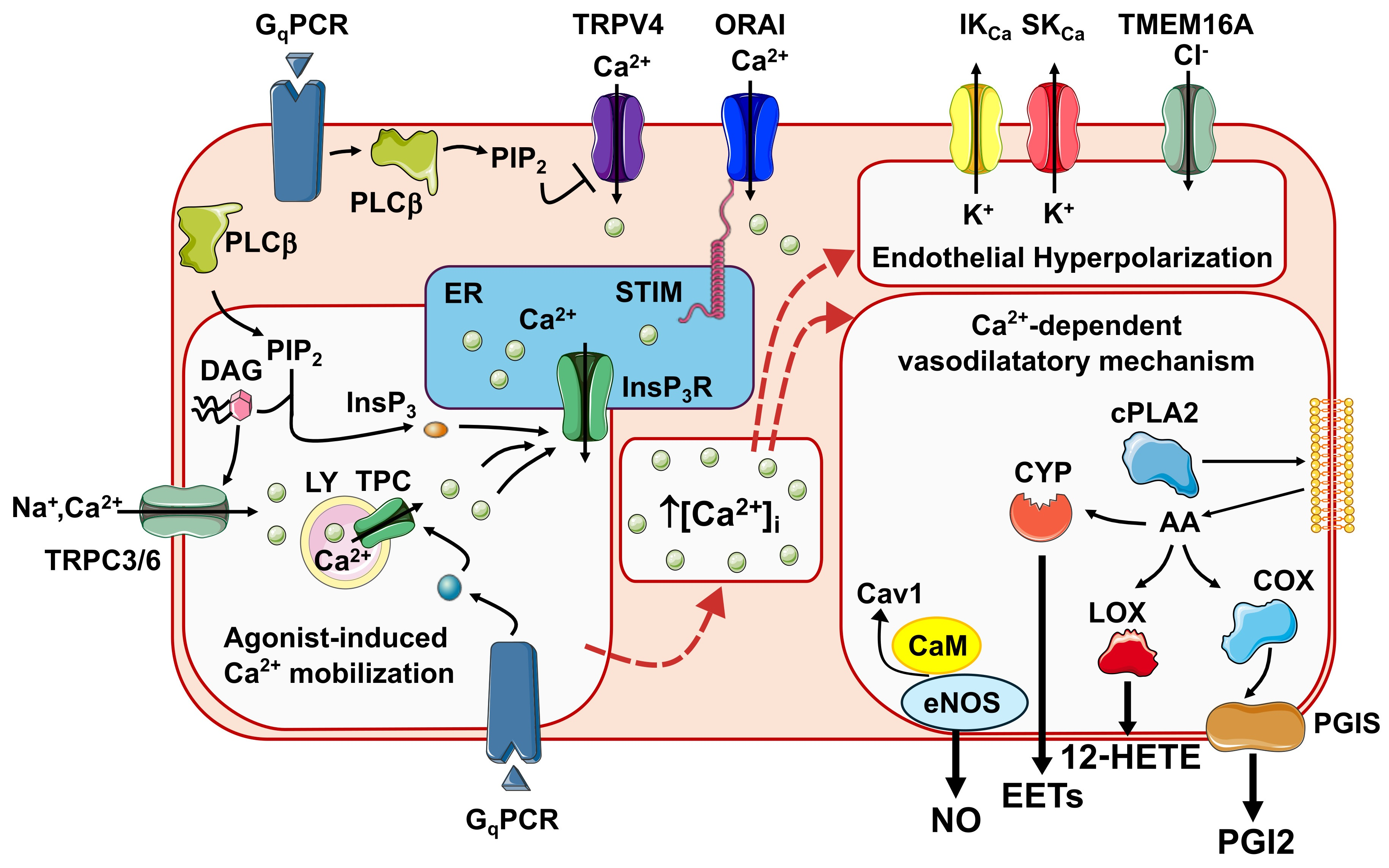
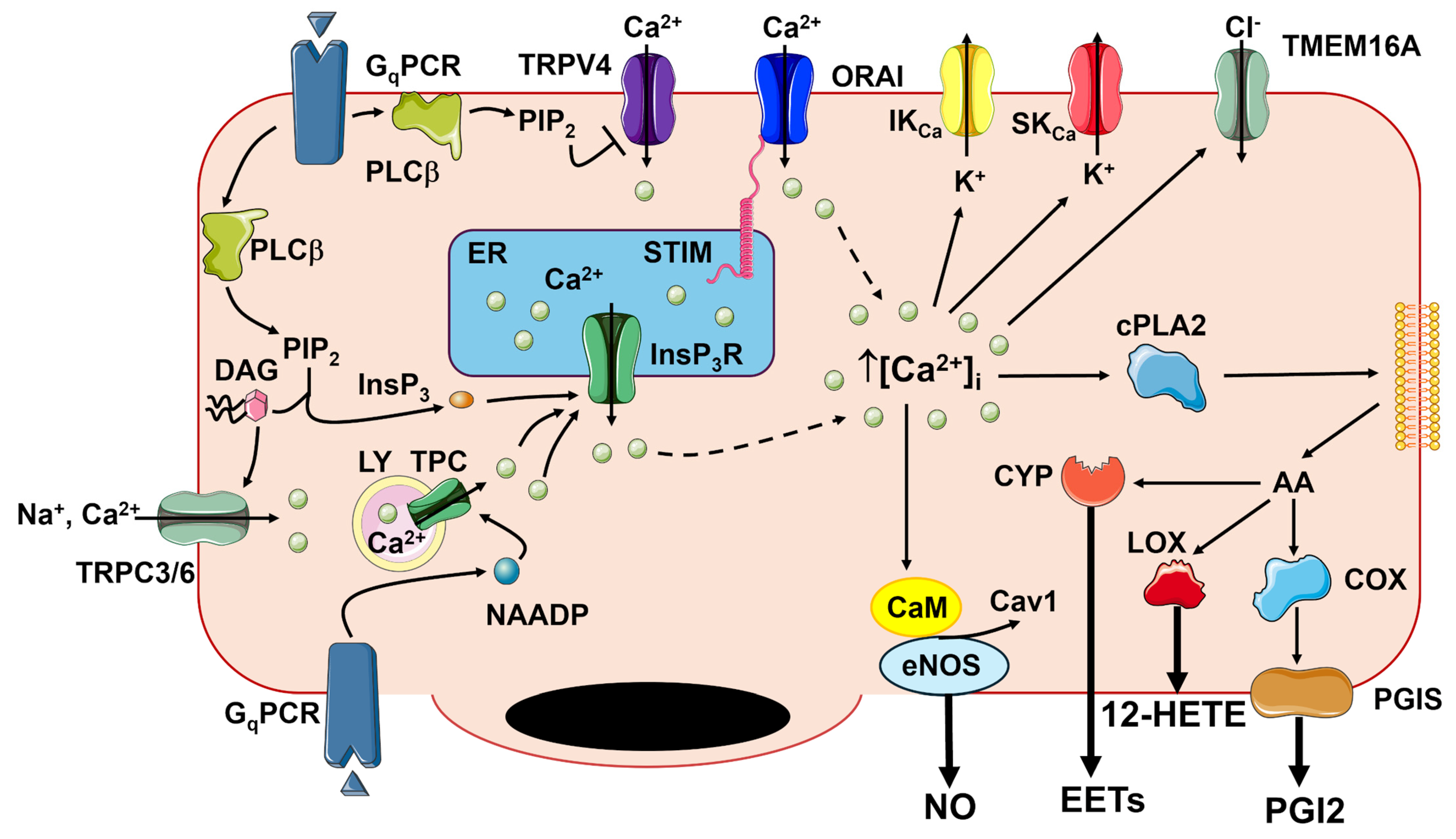
2.1. An Increase in [Ca2+]i Is Critical for Initiating Endothelium-Dependent Vasorelaxation
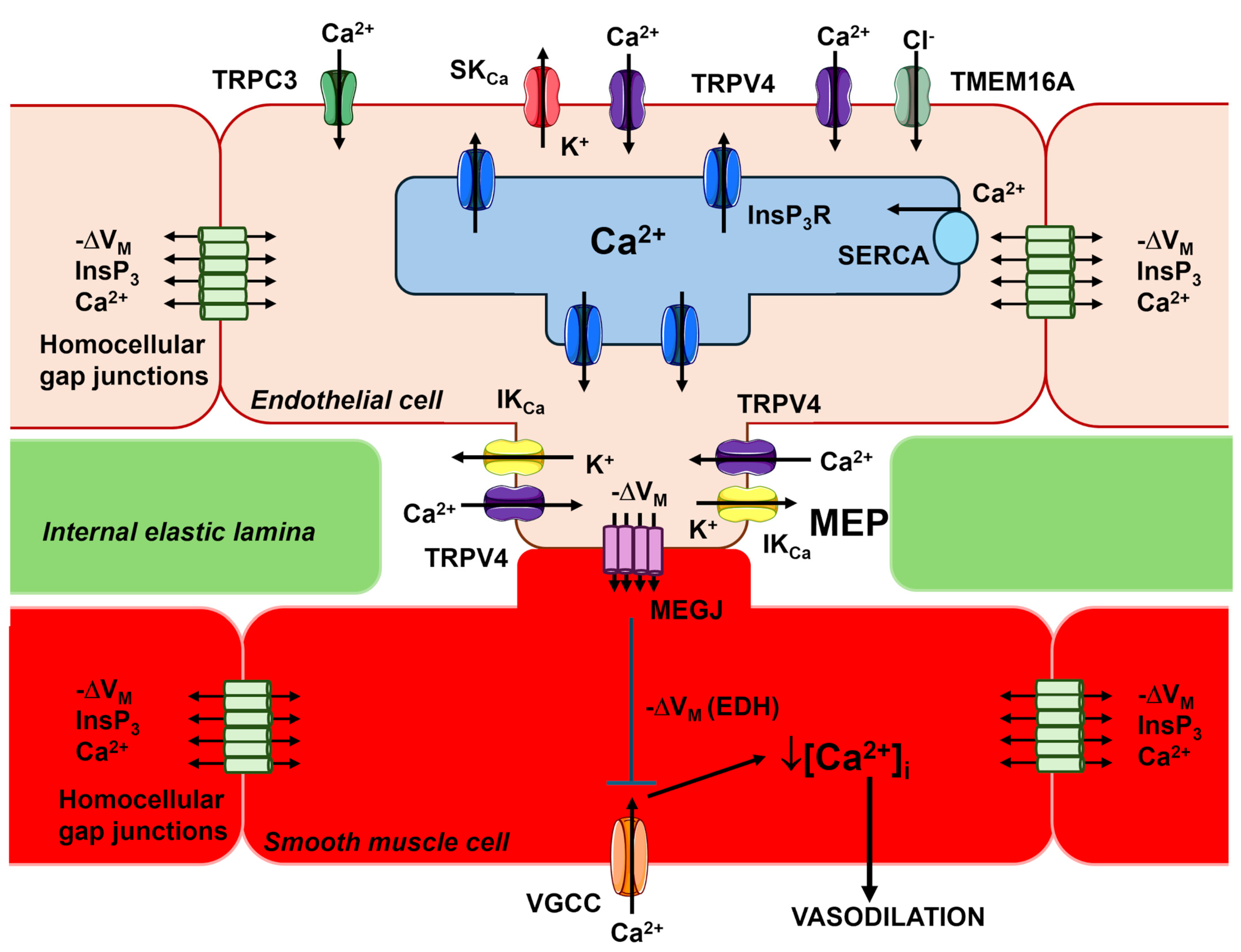
2.2. Endothelium-Dependent Hyperpolarization (EDH)
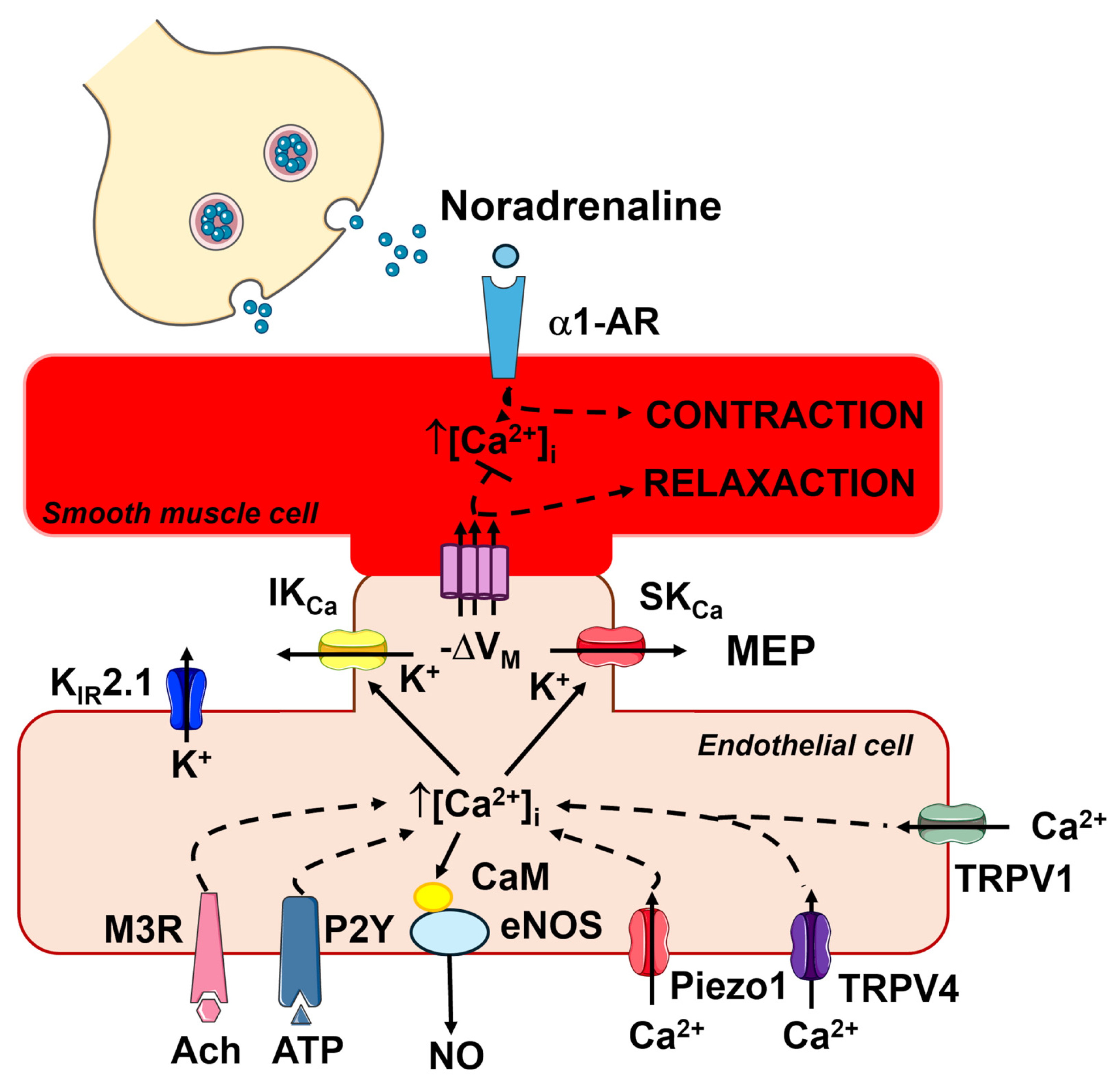
2.3. The Interplay Among Endothelial Ca2+ Signals, SKCa/IKCa Channels and eNOS
2.4. TRP Channels: Focus on TRPV1 and TRPV4
2.5. Piezo1 Channels
3. The Role of Endothelial Ion Channels in the Control of Human Microcirculation
3.1. Cutaneous Microcirculation
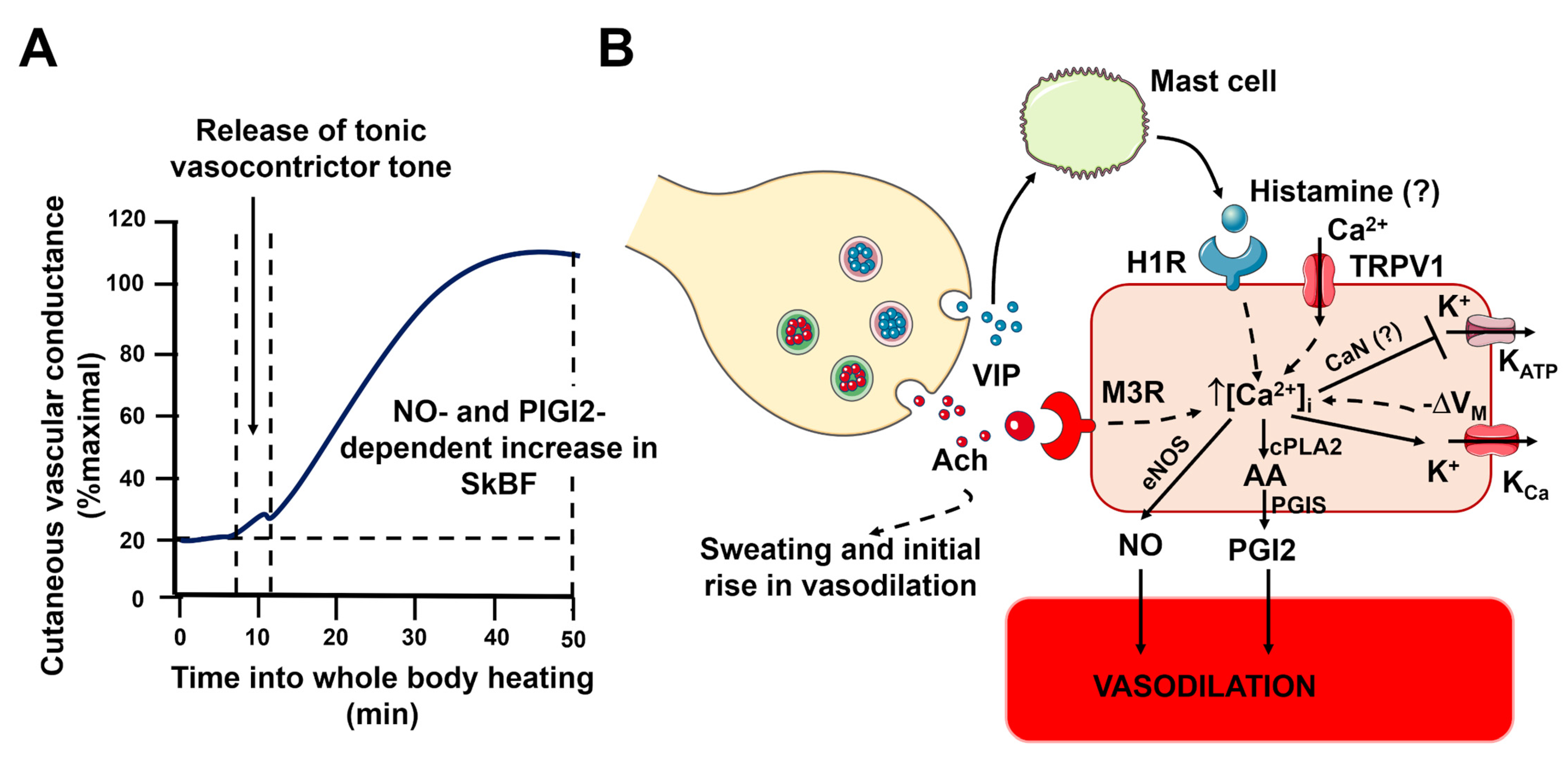
3.1.1. Whole Body Heat Stress
3.1.2. The Role of Endothelial-Derived NO in CAVD: Acetylcholine and Histamine
3.1.3. The Role of EDH in CAVD
3.1.4. The Role of Endothelial TRP Channels in CAVD: Evidence for TRPV1 Involvement
3.1.5. The Role of Endothelial Ion Channels in Vasodilation to Local Heating
3.1.6. The Putative Role of Endothelial Ion Channels in Post-Occlusion Reactive Hyperemia (PORH)

| Ion Channel | Physiological Mechanism | Vasorelaxing Signaling Pathway | Role | References |
|---|---|---|---|---|
| SKCa/IKCa channels | CAVD | Controls the release of a NO-independent mechanism | Likely | [200] |
| SKCa/IKCa channels | Local heating | EDH | Yes | [235] |
| SKCa/IKCa channels | PORH | EDH | Likely | [243] |
| KIR2.1 channels | CAVD | EDH | Unknown | |
| KATP channels | CAVD | EDH | Unknown | |
| KATP channels | Local heating | EDH | No evident role | |
| KATP channels | PORH | EDH | Yes | [243] |
| TRPV1 | CAVD | NO release | [214] | |
| TRPV1 | Local heating | NO release EDH | [233,234] [235] | |
| TRPV3 | CAVD | No evident role | [150,221,222] | |
| TRPV4 | CAVD | No role | [228] | |
| TRPV4 | Local heating | No evident role | ||
| TRPA1 | CAVD | Unclear endothelial localization | Yes | [230] |
3.2. Skeletal Muscle Blood Flow
3.2.1. Endothelium-Derived NO Is Unlikely to Be the Primary Mediator of Functional Sympatholysis but Supports the Matched Phase of Exercise Hyperemia
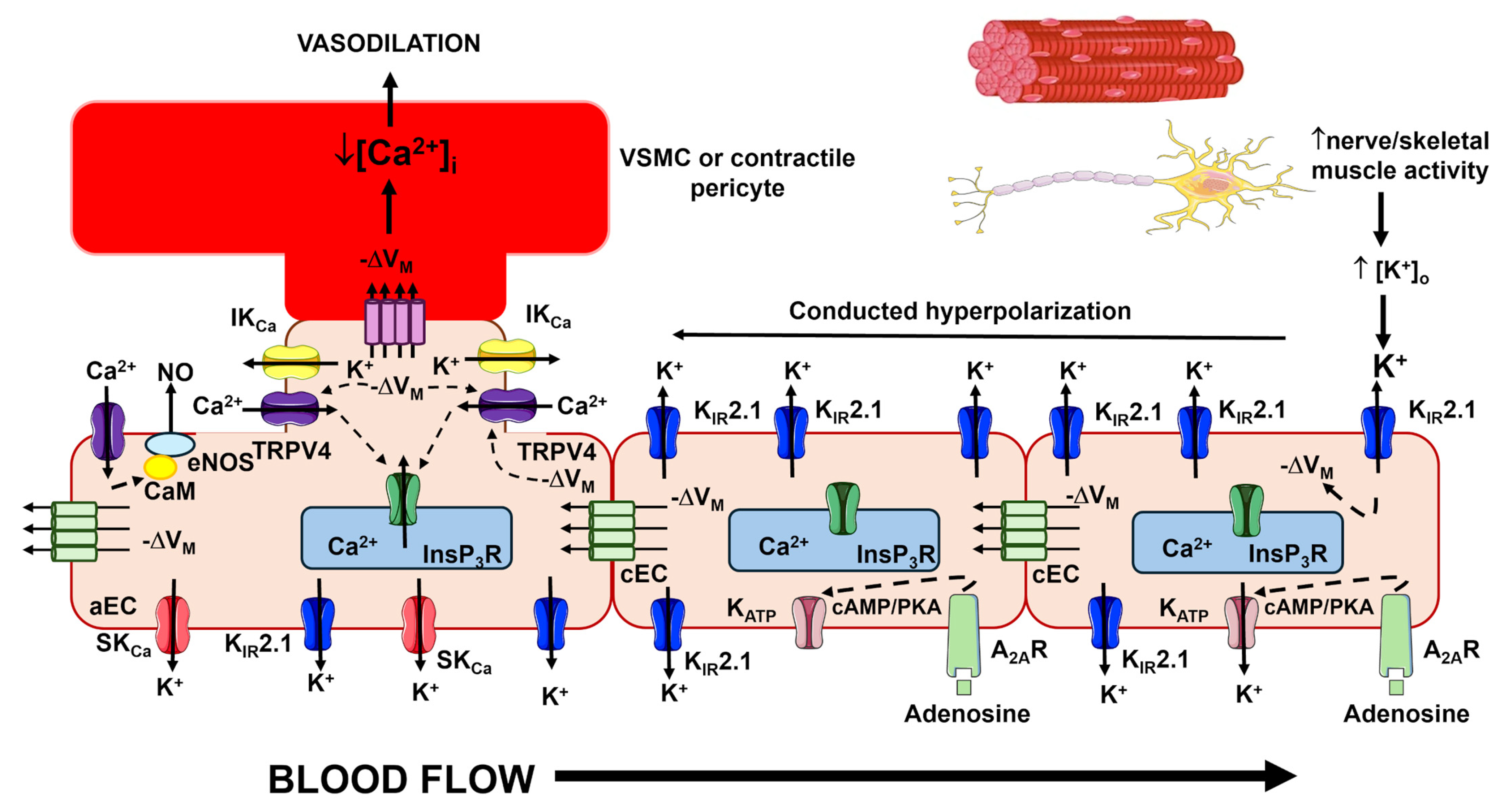
3.2.2. The Role of EDH and KIR Channels in Functional Sympatholysis and Exercise Hyperemia
| Ion Channel | Physiological Mechanism | Vasorelaxing Signaling Pathway | Role | References |
|---|---|---|---|---|
| SKCa/IKCa channels | Functional sympatholysis | EDH | Likely | [284,289,290] |
| SKCa/IKCa channels | Exercise hyperemia | EDH | Likely | [281] |
| KIR2.1 channels | Exercise hyperemia | EDH | Yes | [277,278,279,280] |
| TRPV1 | Exercise hyperemia | NO release | Likely | |
| TRPV4 | Exercise hyperemia | NO release | Likely | [267] |
| Piezo1 | Exercise hyperemia | NO release | Likely |

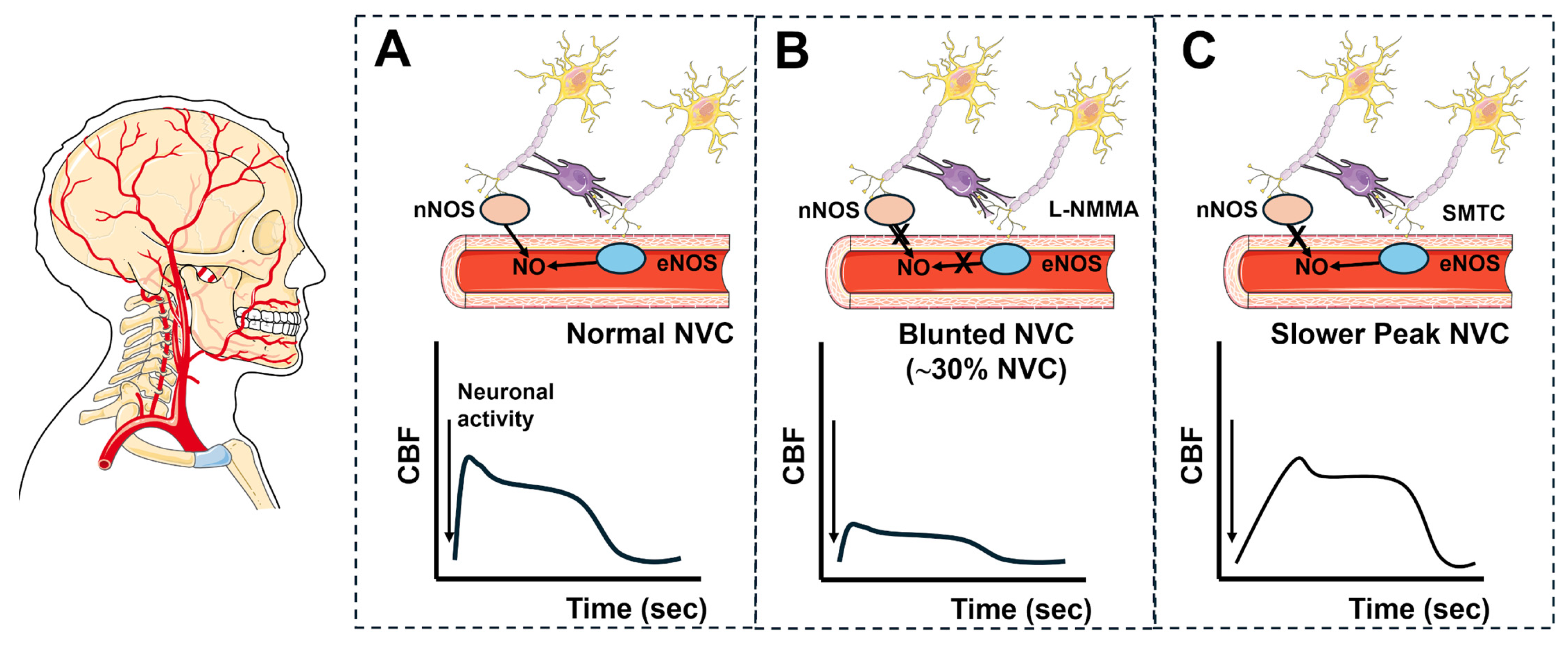
3.3. Cerebral Blood Flow (CBF)
3.4. Exploring the Role of Human Endothelial Ion Channels in Ex Vivo Studies
| Ion Channel | Vascular Bed | Vasorelaxing Signaling Pathway | Role | References |
|---|---|---|---|---|
| SKCa/IKCa channels | Coronary microcirculation | EDH | Yes | [314,315,316] |
| SKCa/IKCa channels | Adipose microcirculation | EDH | Yes | [331,333,334] |
| KIR2.1 channels | Coronary microcirculation | EDH | Yes | [61] |
| KIR2.1 channels | Adipose microcirculation | EDH | Yes | [338] |
| KATP channels | Coronary microcirculation | EDH | Yes | [61] |
| TRPV4 channels | Adipose and coronary microcirculations | EDH | Yes | [331] |
3.5. Human In Vivo Evidence, Interindividual Variability, and Translational Limitations
4. Future Research Directions
5. Conclusions
Author Contributions
Funding
Institutional Review Board Statement
Informed Consent Statement
Data Availability Statement
Conflicts of Interest
References
- Jackson, W.F. Endothelial Ion Channels and Cell-Cell Communication in the Microcirculation. Front. Physiol. 2022, 13, 805149. [Google Scholar] [CrossRef] [Scilit]
- Khaddaj Mallat, R.; Mathew John, C.; Kendrick, D.J.; Braun, A.P. The vascular endothelium: A regulator of arterial tone and interface for the immune system. Crit. Rev. Clin. Lab. Sci. 2017, 54, 458–470. [Google Scholar] [CrossRef] [Scilit] [PubMed]
- Moccia, F.; Brunetti, V.; Soda, T.; Berra-Romani, R.; Scarpellino, G. Cracking the Endothelial Calcium (Ca2+) Code: A Matter of Timing and Spacing. Int. J. Mol. Sci. 2023, 24, 16765. [Google Scholar] [CrossRef] [Scilit] [PubMed]
- Mironova, G.Y.; Kowalewska, P.M.; El-Lakany, M.; Tran, C.H.T.; Sancho, M.; Zechariah, A.; Jackson, W.F.; Welsh, D.G. The conducted vasomotor response and the principles of electrical communication in resistance arteries. Physiol. Rev. 2024, 104, 33–84. [Google Scholar] [CrossRef] [Scilit] [PubMed]
- Longden, T.A.; Zhao, G.; Hariharan, A.; Lederer, W.J. Pericytes and the Control of Blood Flow in Brain and Heart. Annu. Rev. Physiol. 2023, 85, 137–164. [Google Scholar] [CrossRef] [Scilit]
- Jackson, W.F. Calcium-Dependent Ion Channels and the Regulation of Arteriolar Myogenic Tone. Front. Physiol. 2021, 12, 770450. [Google Scholar] [CrossRef] [Scilit]
- Ottolini, M.; Sonkusare, S.K. The Calcium Signaling Mechanisms in Arterial Smooth Muscle and Endothelial Cells. Compr. Physiol. 2021, 11, 1831–1869. [Google Scholar] [CrossRef] [Scilit]
- McCarron, J.G.; Wilson, C.; Heathcote, H.R.; Zhang, X.; Buckley, C.; Lee, M.D. Heterogeneity and emergent behaviour in the vascular endothelium. Curr. Opin. Pharmacol. 2019, 45, 23–32. [Google Scholar] [CrossRef] [Scilit]
- Sancho, M.; Klug, N.R.; Mughal, A.; Koide, M.; Huerta de la Cruz, S.; Heppner, T.J.; Bonev, A.D.; Hill-Eubanks, D.; Nelson, M.T. Adenosine signaling activates ATP-sensitive K+ channels in endothelial cells and pericytes in CNS capillaries. Sci. Signal 2022, 15, eabl5405. [Google Scholar] [CrossRef] [Scilit]
- Lim, X.R.; Abd-Alhaseeb, M.M.; Ippolito, M.; Koide, M.; Senatore, A.J.; Plante, C.; Hariharan, A.; Weir, N.; Longden, T.A.; Laprade, K.A.; et al. Endothelial Piezo1 channel mediates mechano-feedback control of brain blood flow. Nat. Commun. 2024, 15, 8686. [Google Scholar] [CrossRef] [Scilit]
- Negri, S.; Faris, P.; Soda, T.; Moccia, F. Endothelial signaling at the core of neurovascular coupling: The emerging role of endothelial inward-rectifier K+ (Kir2.1) channels and N-methyl-d-aspartate receptors in the regulation of cerebral blood flow. Int. J. Biochem. Cell Biol. 2021, 135, 105983. [Google Scholar] [CrossRef] [Scilit]
- Murphy, T.V.; Sandow, S.L. Agonist-evoked endothelial Ca2+ signalling microdomains. Curr. Opin. Pharmacol. 2019, 45, 8–15. [Google Scholar] [CrossRef] [Scilit]
- Lemmey, H.A.L.; Garland, C.J.; Dora, K.A. Intrinsic regulation of microvascular tone by myoendothelial feedback circuits. Curr. Top. Membr. 2020, 85, 327–355. [Google Scholar] [CrossRef] [Scilit]
- Lee, M.D.; Wilson, C.; Saunter, C.D.; Kennedy, C.; Girkin, J.M.; McCarron, J.G. Spatially structured cell populations process multiple sensory signals in parallel in intact vascular endothelium. Sci. Signal 2018, 11, eaar4411. [Google Scholar] [CrossRef] [Scilit]
- Lee, M.D.; Buckley, C.; Zhang, X.; Louhivuori, L.; Uhlen, P.; Wilson, C.; McCarron, J.G. Small-world connectivity dictates collective endothelial cell signaling. Proc. Natl. Acad. Sci. USA 2022, 119, e2118927119. [Google Scholar] [CrossRef] [Scilit]
- Zhang, X.; Lee, M.D.; Buckley, C.; Hollenberg, M.D.; Wilson, C.; McCarron, J.G. Endothelial PAR2 activation evokes resistance artery relaxation. J. Cell. Physiol. 2023, 238, 776–789. [Google Scholar] [CrossRef] [Scilit]
- Berra-Romani, R.; Guzman-Silva, A.; Vargaz-Guadarrama, A.; Flores-Alonso, J.C.; Alonso-Romero, J.; Trevino, S.; Sanchez-Gomez, J.; Coyotl-Santiago, N.; Garcia-Carrasco, M.; Moccia, F. Type 2 Diabetes Alters Intracellular Ca2+ Handling in Native Endothelium of Excised Rat Aorta. Int. J. Mol. Sci. 2019, 21, 250. [Google Scholar] [CrossRef] [Scilit]
- Berra-Romani, R.; Faris, P.; Pellavio, G.; Orgiu, M.; Negri, S.; Forcaia, G.; Var-Gaz-Guadarrama, V.; Garcia-Carrasco, M.; Botta, L.; Sancini, G.; et al. Histamine induces intracellular Ca2+ oscillations and nitric oxide release in endothelial cells from brain microvascular circulation. J. Cell. Physiol. 2020, 235, 1515–1530. [Google Scholar] [CrossRef] [Scilit]
- Moccia, F.; Brunetti, V.; Perna, A.; Guerra, G.; Soda, T.; Berra-Romani, R. The Molecular Heterogeneity of Store-Operated Ca2+ Entry in Vascular Endothelial Cells: The Different roles of Orai1 and TRPC1/TRPC4 Channels in the Transition from Ca2+-Selective to Non-Selective Cation Currents. Int. J. Mol. Sci. 2023, 24, 3259. [Google Scholar] [CrossRef] [Scilit]
- Soda, T.; Brunetti, V.; De Sarro, G.; Biella, G.; Moccia, F.; Berra-Romani, R.; Scarpellino, G. Transient Receptor Potential Ankyrin 1 (TRPA1) Mediates Hydrogen Sulfide-induced Ca2+ Entry and Nitric Oxide Production in Human Cerebrovascular Endothelium. Curr. Neuropharmacol. 2025, 23, 1119–1133. [Google Scholar] [CrossRef] [Scilit]
- Soda, T.; Brunetti, V.; Berra-Romani, R.; Moccia, F. The Emerging Role of N-Methyl-D-Aspartate (NMDA) Receptors in the Cardiovascular System: Physiological Implications, Pathological Consequences, and Therapeutic Perspectives. Int. J. Mol. Sci. 2023, 24, 3914. [Google Scholar] [CrossRef] [Scilit]
- Brunetti, V.; Soda, T.; Berra-Romani, R.; De Sarro, G.; Guerra, G.; Scarpellino, G.; Moccia, F. Two Signaling Modes Are Better than One: Flux-Independent Signaling by Ionotropic Glutamate Receptors Is Coming of Age. Biomedicines 2024, 12, 880. [Google Scholar] [CrossRef] [Scilit]
- Brailoiu, G.C.; Gurzu, B.; Gao, X.; Parkesh, R.; Aley, P.K.; Trifa, D.I.; Galione, A.; Dun, N.J.; Madesh, M.; Patel, S.; et al. Acidic NAADP-sensitive calcium stores in the endothelium: Agonist-specific recruitment and role in regulating blood pressure. J. Biol. Chem. 2010, 285, 37133–37137. [Google Scholar] [CrossRef] [Scilit]
- Brailoiu, E.; Shipsky, M.M.; Yan, G.; Abood, M.E.; Brailoiu, G.C. Mechanisms of modulation of brain microvascular endothelial cells function by thrombin. Brain Res. 2017, 1657, 167–175. [Google Scholar] [CrossRef] [Scilit]
- Brailoiu, E.; Barlow, C.L.; Ramirez, S.H.; Abood, M.E.; Brailoiu, G.C. Effects of Platelet-Activating Factor on Brain Microvascular Endothelial Cells. Neuroscience 2018, 377, 105–113. [Google Scholar] [CrossRef] [Scilit]
- Zuccolo, E.; Kheder, D.A.; Lim, D.; Perna, A.; Nezza, F.D.; Botta, L.; Scarpellino, G.; Negri, S.; Martinotti, S.; Soda, T.; et al. Glutamate triggers intracellular Ca2+ oscillations and nitric oxide release by inducing NAADP- and InsP3 -dependent Ca2+ release in mouse brain endothelial cells. J. Cell. Physiol. 2019, 234, 3538–3554. [Google Scholar] [CrossRef] [Scilit]
- Moccia, F.; Zuccolo, E.; Di Nezza, F.; Pellavio, G.; Faris, P.S.; Negri, S.; De Luca, A.; Laforenza, U.; Ambrosone, L.; Rosti, V.; et al. Nicotinic acid adenine dinucleotide phosphate activates two-pore channel TPC1 to mediate lysosomal Ca2+ release in endothelial colony-forming cells. J. Cell. Physiol. 2021, 236, 688–705. [Google Scholar] [CrossRef] [Scilit]
- Brunetti, V.; Berra-Romani, R.; Conca, F.; Soda, T.; Biella, G.R.; Gerbino, A.; Moccia, F.; Scarpellino, G. Lysosomal TRPML1 triggers global Ca2+ signals and nitric oxide release in human cerebrovascular endothelial cells. Front. Physiol. 2024, 15, 1426783. [Google Scholar] [CrossRef] [Scilit]
- Spinelli, A.M.; Trebak, M. Orai channel-mediated Ca2+ signals in vascular and airway smooth muscle. Am. J. Physiol. Cell Physiol. 2016, 310, C402–C413. [Google Scholar] [CrossRef] [Scilit]
- Emrich, S.M.; Yoast, R.E.; Trebak, M. Physiological Functions of CRAC Channels. Annu. Rev. Physiol. 2021, 84, 355–379. [Google Scholar] [CrossRef] [Scilit]
- Abdelnaby, A.E.; Trebak, M. Store-Operated Ca2+ Entry in Fibrosis and Tissue Remodeling. Contact 2024, 7, 25152564241291374. [Google Scholar] [CrossRef] [Scilit]
- Abdullaev, I.F.; Bisaillon, J.M.; Potier, M.; Gonzalez, J.C.; Motiani, R.K.; Trebak, M. Stim1 and Orai1 mediate CRAC currents and store-operated calcium entry important for endothelial cell proliferation. Circ. Res. 2008, 103, 1289–1299. [Google Scholar] [CrossRef] [Scilit] [PubMed]
- Li, J.; Cubbon, R.M.; Wilson, L.A.; Amer, M.S.; McKeown, L.; Hou, B.; Majeed, Y.; Tumova, S.; Seymour, V.A.L.; Taylor, H.; et al. Orai1 and CRAC channel dependence of VEGF-activated Ca2+ entry and endothelial tube formation. Circ. Res. 2011, 108, 1190–1198. [Google Scholar] [CrossRef] [Scilit] [PubMed]
- Dai, C.; Khalil, R.A. Calcium Signaling Dynamics in Vascular Cells and Their Dysregulation in Vascular Disease. Biomolecules 2025, 15, 892. [Google Scholar] [CrossRef] [Scilit] [PubMed]
- Negri, S.; Faris, P.; Moccia, F. Endolysosomal Ca2+ signaling in cardiovascular health and disease. Int. Rev. Cell Mol. Biol. 2021, 363, 203–269. [Google Scholar] [CrossRef] [Scilit]
- Negri, S.; Sanford, M.; Shi, H.; Tarantini, S. The role of endothelial TRP channels in age-related vascular cognitive impairment and dementia. Front. Aging Neurosci. 2023, 15, 1149820. [Google Scholar] [CrossRef] [Scilit]
- Pourova, J.; Dias, P.; Pour, M.; Mladenka, P. The machinery of healthy vasodilatation: An overview. Pflugers Arch. 2025, 477, 1135–1162, Correction in Pflugers Arch. 2025, 477, 1225. [Google Scholar] [CrossRef] [Scilit]
- Moccia, F.; Bonetti, E.; Dragoni, S.; Fontana, J.; Lodola, F.; Romani, R.B.; Laforenza, U.; Rosti, V.; Tanzi, F. Hematopoietic progenitor and stem cells circulate by surfing on intracellular Ca2+ waves: A novel target for cell-based therapy and anti-cancer treatment? Curr. Signal Transduct. Ther. 2012, 7, 161–176. [Google Scholar] [CrossRef] [Scilit]
- Mancardi, D.; Pla, A.F.; Moccia, F.; Tanzi, F.; Munaron, L. Old and new gasotransmitters in the cardiovascular system: Focus on the role of nitric oxide and hydrogen sulfide in endothelial cells and cardiomyocytes. Curr. Pharm. Biotechnol. 2011, 12, 1406–1415. [Google Scholar] [CrossRef] [Scilit]
- Mata-Daboin, A.; Garrud, T.A.C.; Fernandez-Pena, C.; Peixoto-Neves, D.; Leo, M.D.; Bernardelli, A.K.; Singh, P.; Malik, K.U.; Jaggar, J.H. Vasodilators activate the anion channel TMEM16A in endothelial cells to reduce blood pressure. Sci. Signal 2023, 16, eadh9399. [Google Scholar] [CrossRef] [Scilit]
- Guse, A.H. Enzymology of Ca2+-Mobilizing Second Messengers Derived from NAD: From NAD Glycohydrolases to (Dual) NADPH Oxidases. Cells 2023, 12, 675. [Google Scholar] [CrossRef] [Scilit] [PubMed]
- Ledoux, J.; Taylor, M.S.; Bonev, A.D.; Hannah, R.M.; Solodushko, V.; Shui, B.; Tallini, Y.; Kotlikoff, M.I.; Nelson, M.T. Functional architecture of inositol 1,4,5-trisphosphate signaling in restricted spaces of myoendothelial projections. Proc. Natl. Acad. Sci. USA 2008, 105, 9627–9632. [Google Scholar] [CrossRef] [Scilit] [PubMed]
- Behringer, E.J.; Segal, S.S. Membrane potential governs calcium influx into microvascular endothelium: Integral role for muscarinic receptor activation. J. Physiol. 2015, 593, 4531–4548. [Google Scholar] [CrossRef] [Scilit] [PubMed]
- Jackson, W.F. Boosting the signal: Endothelial inward rectifier K+ channels. Microcirculation 2017, 24, e12319. [Google Scholar] [CrossRef] [Scilit]
- Thakore, P.; Alvarado, M.G.; Ali, S.; Mughal, A.; Pires, P.W.; Yamasaki, E.; Pritchard, H.A.; Isakson, B.E.; Tran, C.H.T.; Earley, S. Brain endothelial cell TRPA1 channels initiate neurovascular coupling. eLife 2021, 10, e63040. [Google Scholar] [CrossRef] [Scilit]
- Garland, C.J.; Dora, K.A. Endothelium-Dependent Hyperpolarization: The Evolution of Myoendothelial Microdomains. J. Cardiovasc. Pharmacol. 2021, 78, S3–S12. [Google Scholar] [CrossRef] [Scilit]
- Qian, X.; Francis, M.; Kohler, R.; Solodushko, V.; Lin, M.; Taylor, M.S. Positive feedback regulation of agonist-stimulated endothelial Ca2+ dynamics by KCa3.1 channels in mouse mesenteric arteries. Arterioscler. Thromb. Vasc. Biol. 2014, 34, 127–135. [Google Scholar] [CrossRef] [Scilit]
- Zhang, D.X.; Mendoza, S.A.; Bubolz, A.H.; Mizuno, A.; Ge, Z.D.; Li, R.; Warltier, D.C.; Suzuki, M.; Gutterman, D.D. Transient receptor potential vanilloid type 4-deficient mice exhibit impaired endothelium-dependent relaxation induced by acetylcholine in vitro and in vivo. Hypertension 2009, 53, 532–538. [Google Scholar] [CrossRef] [Scilit]
- Garland, C.J.; Dora, K.A. EDH: Endothelium-dependent hyperpolarization and microvascular signalling. Acta Physiol. 2017, 219, 152–161. [Google Scholar] [CrossRef] [Scilit]
- Kovacs-Oller, T.; Ivanova, E.; Bianchimano, P.; Sagdullaev, B.T. The pericyte connectome: Spatial precision of neurovascular coupling is driven by selective connectivity maps of pericytes and endothelial cells and is disrupted in diabetes. Cell Discov. 2020, 6, 39. [Google Scholar] [CrossRef] [Scilit]
- Yeon, S.I.; Kim, J.Y.; Yeon, D.S.; Abramowitz, J.; Birnbaumer, L.; Muallem, S.; Lee, Y.H. Transient receptor potential canonical type 3 channels control the vascular contractility of mouse mesenteric arteries. PLoS ONE 2014, 9, e110413. [Google Scholar] [CrossRef] [Scilit]
- Dora, K.A.; Gallagher, N.T.; McNeish, A.; Garland, C.J. Modulation of endothelial cell KCa3.1 channels during endothelium-derived hyperpolarizing factor signaling in mesenteric resistance arteries. Circ. Res. 2008, 102, 1247–1255. [Google Scholar] [CrossRef] [Scilit]
- Sandow, S.L.; Neylon, C.B.; Chen, M.X.; Garland, C.J. Spatial separation of endothelial small- and intermediate-conductance calcium-activated potassium channels (KCa) and connexins: Possible relationship to vasodilator function? J. Anat. 2006, 209, 689–698. [Google Scholar] [CrossRef] [Scilit] [PubMed]
- Senadheera, S.; Kim, Y.; Grayson, T.H.; Toemoe, S.; Kochukov, M.Y.; Abramowitz, J.; Housley, G.D.; Bertrand, R.L.; Chadha, P.S.; Bertrand, P.P.; et al. Transient receptor potential canonical type 3 channels facilitate endothelium-derived hyperpolarization-mediated resistance artery vasodilator activity. Cardiovasc. Res. 2012, 95, 439–447. [Google Scholar] [CrossRef] [Scilit] [PubMed]
- Kochukov, M.Y.; Balasubramanian, A.; Abramowitz, J.; Birnbaumer, L.; Marrelli, S.P. Activation of endothelial transient receptor potential C3 channel is required for small conductance calcium-activated potassium channel activation and sustained endothelial hyperpolarization and vasodilation of cerebral artery. J. Am. Heart Assoc. 2014, 3, e000913. [Google Scholar] [CrossRef] [Scilit] [PubMed]
- Longden, T.A.; Nelson, M.T. Vascular inward rectifier K+ channels as external K+ sensors in the control of cerebral blood flow. Microcirculation 2015, 22, 183–196. [Google Scholar] [CrossRef] [Scilit]
- Longden, T.A.; Dabertrand, F.; Koide, M.; Gonzales, A.L.; Tykocki, N.R.; Brayden, J.E.; Hill-Eubanks, D.; Nelson, M.T. Capillary K+-sensing initiates retrograde hyperpolarization to increase local cerebral blood flow. Nat. Neurosci. 2017, 20, 717–726. [Google Scholar] [CrossRef] [Scilit]
- Zhao, G.; Joca, H.C.; Nelson, M.T.; Lederer, W.J. ATP- and voltage-dependent electro-metabolic signaling regulates blood flow in heart. Proc. Natl. Acad. Sci. USA 2020, 117, 7461–7470. [Google Scholar] [CrossRef] [Scilit]
- Sonkusare, S.K.; Dalsgaard, T.; Bonev, A.D.; Nelson, M.T. Inward rectifier potassium (Kir2.1) channels as end-stage boosters of endothelium-dependent vasodilators. J. Physiol. 2016, 594, 3271–3285. [Google Scholar] [CrossRef] [Scilit]
- Moshkforoush, A.; Ashenagar, B.; Harraz, O.F.; Dabertrand, F.; Longden, T.A.; Nelson, M.T.; Tsoukias, N.M. The capillary Kir channel as sensor and amplifier of neuronal signals: Modeling insights on K+-mediated neurovascular communication. Proc. Natl. Acad. Sci. USA 2020, 117, 16626–16637. [Google Scholar] [CrossRef] [Scilit]
- Dora, K.A.; Lin, J.; Borysova, L.; Beleznai, T.; Taggart, M.; Ascione, R.; Garland, C. Signaling and structures underpinning conducted vasodilation in human and porcine intramyocardial coronary arteries. Front. Cardiovasc. Med. 2022, 9, 980628. [Google Scholar] [CrossRef] [Scilit] [PubMed]
- Knot, H.J.; Zimmermann, P.A.; Nelson, M.T. Extracellular K+-induced hyperpolarizations and dilatations of rat coronary and cerebral arteries involve inward rectifier K+ channels. J. Physiol. 1996, 492, 419–430. [Google Scholar] [CrossRef] [Scilit] [PubMed]
- Kowalewska, P.M.; Milkovich, S.L.; Goldman, D.; Sandow, S.L.; Ellis, C.G.; Welsh, D.G. Capillary oxygen regulates demand-supply coupling by triggering connexin40-mediated conduction: Rethinking the metabolic hypothesis. Proc. Natl. Acad. Sci. USA 2024, 121, e2303119121. [Google Scholar] [CrossRef] [Scilit] [PubMed]
- Aziz, Q.; Li, Y.; Tinker, A. Endothelial biology and ATP-sensitive potassium channels. Channels 2018, 12, 45–46. [Google Scholar] [CrossRef] [Scilit]
- Foster, M.N.; Coetzee, W.A. KATP Channels in the Cardiovascular System. Physiol. Rev. 2016, 96, 177–252. [Google Scholar] [CrossRef] [Scilit]
- Katnik, C.; Adams, D.J. Characterization of ATP-sensitive potassium channels in freshly dissociated rabbit aortic endothelial cells. Am. J. Physiol. 1997, 272, H2507–H2511. [Google Scholar] [CrossRef] [Scilit]
- Katnik, C.; Adams, D.J. An ATP-sensitive potassium conductance in rabbit arterial endothelial cells. J. Physiol. 1995, 485, 595–606. [Google Scholar] [CrossRef] [Scilit]
- Longden, T.A.; Mughal, A.; Hennig, G.W.; Harraz, O.F.; Shui, B.; Lee, F.K.; Lee, J.C.; Reining, S.; Kotlikoff, M.I.; Konig, G.M.; et al. Local IP3 receptor-mediated Ca2+ signals compound to direct blood flow in brain capillaries. Sci. Adv. 2021, 7, eabh0101. [Google Scholar] [CrossRef] [Scilit]
- Mughal, A.; Hennig, G.W.; Heppner, T.; Tsoukias, N.M.; Hill-Eubanks, D.; Nelson, M.T. Electrocalcium coupling in brain capillaries: Rapidly traveling electrical signals ignite local calcium signals. Proc. Natl. Acad. Sci. USA 2024, 121, e2415047121. [Google Scholar] [CrossRef] [Scilit]
- Socha, M.J.; Behringer, E.J.; Segal, S.S. Calcium and electrical signalling along endothelium of the resistance vasculature. Basic Clin. Pharmacol. Toxicol. 2012, 110, 80–86. [Google Scholar] [CrossRef] [Scilit]
- Behringer, E.J.; Segal, S.S. Impact of Aging on Calcium Signaling and Membrane Potential in Endothelium of Resistance Arteries: A Role for Mitochondria. J. Gerontol. A Biol. Sci. Med. Sci. 2017, 72, 1627–1637. [Google Scholar] [CrossRef] [Scilit]
- Navedo, M.F.; Nieves-Cintron, M.; Santana, L.F. Electrifying the brain capillary Ca2+ signal. Proc. Natl. Acad. Sci. USA 2025, 122, e2425994122. [Google Scholar] [CrossRef] [Scilit]
- Feletou, M.; Kohler, R.; Vanhoutte, P.M. Endothelium-derived vasoactive factors and hypertension: Possible roles in pathogenesis and as treatment targets. Curr. Hypertens. Rep. 2010, 12, 267–275. [Google Scholar] [CrossRef] [Scilit]
- Jackson, W.F.; Boerman, E.M.; Lange, E.J.; Lundback, S.S.; Cohen, K.D. Smooth muscle alpha1D-adrenoceptors mediate phenylephrine-induced vasoconstriction and increases in endothelial cell Ca2+ in hamster cremaster arterioles. Br. J. Pharmacol. 2008, 155, 514–524. [Google Scholar] [CrossRef] [Scilit] [PubMed]
- Nausch, L.W.; Bonev, A.D.; Heppner, T.J.; Tallini, Y.; Kotlikoff, M.I.; Nelson, M.T. Sympathetic nerve stimulation induces local endothelial Ca2+ signals to oppose vasoconstriction of mouse mesenteric arteries. Am. J. Physiol. Heart Circ. Physiol. 2012, 302, H594–H602. [Google Scholar] [CrossRef] [Scilit] [PubMed]
- Garland, C.J.; Bagher, P.; Powell, C.; Ye, X.; Lemmey, H.A.L.; Borysova, L.; Dora, K.A. Voltage-dependent Ca2+ entry into smooth muscle during contraction promotes endothelium-mediated feedback vasodilation in arterioles. Sci. Signal 2017, 10, eaal3806. [Google Scholar] [CrossRef] [Scilit] [PubMed]
- Tallini, Y.N.; Brekke, J.F.; Shui, B.; Doran, R.; Hwang, S.M.; Nakai, J.; Salama, G.; Segal, S.S.; Kotlikoff, M.I. Propagated endothelial Ca2+ waves and arteriolar dilation in vivo: Measurements in Cx40BAC GCaMP2 transgenic mice. Circ. Res. 2007, 101, 1300–1309. [Google Scholar] [CrossRef] [Scilit]
- Francis, M.; Waldrup, J.R.; Qian, X.; Solodushko, V.; Meriwether, J.; Taylor, M.S. Functional Tuning of Intrinsic Endothelial Ca2+ Dynamics in Swine Coronary Arteries. Circ. Res. 2016, 118, 1078–1090. [Google Scholar] [CrossRef] [Scilit]
- Bagher, P.; Davis, M.J.; Segal, S.S. Visualizing calcium responses to acetylcholine convection along endothelium of arteriolar networks in Cx40BAC-GCaMP2 transgenic mice. Am. J. Physiol. Heart Circ. Physiol. 2011, 301, H794–H802. [Google Scholar] [CrossRef] [Scilit]
- Buckley, C.; Zhang, X.; Lee, M.D.; Wilson, C.; McCarron, J.G. Inside-Out IP3-Mediated G Protein-Coupled Receptor Activation Drives Intercellular Ca2+ Signaling in the Vascular Endothelium. FASEB J. 2025, 39, e70818. [Google Scholar] [CrossRef] [Scilit]
- Buckley, C.; Lee, M.D.; Zhang, X.; Wilson, C.; McCarron, J.G. Signalling switches maintain intercellular communication in the vascular endothelium. Br. J. Pharmacol. 2024, 181, 2810–2832. [Google Scholar] [CrossRef] [Scilit] [PubMed]
- Sera, T.; Komine, S.; Arai, M.; Sunaga, Y.; Yokota, H.; Kudo, S. Three-dimensional model of intracellular and intercellular Ca2+ waves propagation in endothelial cells. Biochem. Biophys. Res. Commun. 2018, 505, 781–786. [Google Scholar] [CrossRef] [Scilit] [PubMed]
- Boittin, F.X.; Alonso, F.; Le Gal, L.; Allagnat, F.; Beny, J.L.; Haefliger, J.A. Connexins and M3 muscarinic receptors contribute to heterogeneous Ca2+ signaling in mouse aortic endothelium. Cell Physiol. Biochem. 2013, 31, 166–178. [Google Scholar] [CrossRef] [Scilit] [PubMed]
- Domenighetti, A.A.; Beny, J.L.; Chabaud, F.; Frieden, M. An intercellular regenerative calcium wave in porcine coronary artery endothelial cells in primary culture. J. Physiol. 1998, 513, 103–116. [Google Scholar] [CrossRef] [Scilit]
- Berra-Romani, R.; Raqeeb, A.; Torres-Jácome, J.; Guzman-Silva, A.; Guerra, G.; Tanzi, F.; Moccia, F. The mechanism of injury-induced intracellular calcium concentration oscillations in the endothelium of excised rat aorta. J. Vasc. Res. 2012, 49, 65–76. [Google Scholar] [CrossRef] [Scilit]
- Zhang, L.; Rong, S.; Dong, H. Functional heterogeneity of endothelium-dependent vasorelaxation in different order branches of mesenteric artery in female/male mice. Microvasc. Res. 2025, 158, 104777. [Google Scholar] [CrossRef] [Scilit]
- Zhang, L.Y.; Chen, X.Y.; Dong, H.; Xu, F. Cyclopiazonic Acid-Induced Ca2+ Store Depletion Initiates Endothelium-Dependent Hyperpolarization-Mediated Vasorelaxation of Mesenteric Arteries in Healthy and Colitis Mice. Front. Physiol. 2021, 12, 639857. [Google Scholar] [CrossRef] [Scilit]
- Blatter, L.A. Tissue Specificity: SOCE: Implications for Ca2+ Handling in Endothelial Cells. In Store-Operated Ca2+ Entry (SOCE) Pathways; Advances in Experimental Medicine and Biology; Springer: Cham, Switzerland, 2017; Volume 993, pp. 343–361. [Google Scholar] [CrossRef] [Scilit]
- Romito, O.; Trebak, M. Endothelial CRAC Channels. Cold Spring Harb. Perspect. Biol. 2025, a041777. [Google Scholar] [CrossRef] [Scilit]
- Wang, S.; Chennupati, R.; Kaur, H.; Iring, A.; Wettschureck, N.; Offermanns, S. Endothelial cation channel PIEZO1 controls blood pressure by mediating flow-induced ATP release. J. Clin. Investig. 2016, 126, 4527–4536. [Google Scholar] [CrossRef] [Scilit]
- Hong, S.G.; Ashby, J.W.; Kennelly, J.P.; Wu, M.; Steel, M.; Chattopadhyay, E.; Foreman, R.; Tontonoz, P.; Tarling, E.J.; Turowski, P.; et al. Mechanosensitive membrane domains regulate calcium entry in arterial endothelial cells to protect against inflammation. J. Clin. Investig. 2024, 134, e175057. [Google Scholar] [CrossRef] [Scilit]
- Zuccolo, E.; Lim, D.; Kheder, D.A.; Perna, A.; Catarsi, P.; Botta, L.; Rosti, V.; Riboni, L.; Sancini, G.; Tanzi, F.; et al. Acetylcholine induces intracellular Ca2+ oscillations and nitric oxide release in mouse brain endothelial cells. Cell Calcium 2017, 66, 33–47. [Google Scholar] [CrossRef] [Scilit] [PubMed]
- Chow, B.W.; Nunez, V.; Kaplan, L.; Granger, A.J.; Bistrong, K.; Zucker, H.L.; Kumar, P.; Sabatini, B.L.; Gu, C. Caveolae in CNS arterioles mediate neurovascular coupling. Nature 2020, 579, 106–110. [Google Scholar] [CrossRef] [Scilit] [PubMed]
- Billaud, M.; Lohman, A.W.; Johnstone, S.R.; Biwer, L.A.; Mutchler, S.; Isakson, B.E. Regulation of cellular communication by signaling microdomains in the blood vessel wall. Pharmacol. Rev. 2014, 66, 513–569. [Google Scholar] [CrossRef] [Scilit] [PubMed]
- Barbee, K.A.; Parikh, J.B.; Liu, Y.; Buerk, D.G.; Jaron, D. Effect of spatial heterogeneity and colocalization of eNOS and capacitative calcium entry channels on shear stress-induced NO production by endothelial cells: A modeling approach. Cell Mol. Bioeng. 2018, 11, 143–155. [Google Scholar] [CrossRef] [Scilit]
- Murata, T.; Lin, M.I.; Stan, R.V.; Bauer, P.M.; Yu, J.; Sessa, W.C. Genetic evidence supporting caveolae microdomain regulation of calcium entry in endothelial cells. J. Biol. Chem. 2007, 282, 16631–16643. [Google Scholar] [CrossRef] [Scilit]
- Hong, D.; Jaron, D.; Buerk, D.G.; Barbee, K.A. Transport-dependent calcium signaling in spatially segregated cellular caveolar domains. Am. J. Physiol. Cell Physiol. 2008, 294, C856–C866. [Google Scholar] [CrossRef] [Scilit]
- Burboa, P.C.; Gaete, P.S.; Shu, P.; Araujo, P.A.; Beuve, A.V.; Duran, W.N.; Contreras, J.E.; Lillo, M.A. Endothelial TRPV4-Cx43 signalling complex regulates vasomotor tone in resistance arteries. J. Physiol. 2025, 603, 4345–4366. [Google Scholar] [CrossRef] [Scilit]
- Shamsaldeen, Y.A.; Lione, L.A.; Benham, C.D. Dysregulation of TRPV4, eNOS and caveolin-1 contribute to endothelial dysfunction in the streptozotocin rat model of diabetes. Eur. J. Pharmacol. 2020, 888, 173441. [Google Scholar] [CrossRef] [Scilit]
- Ottolini, M.; Daneva, Z.; Chen, Y.L.; Cope, E.L.; Kasetti, R.B.; Zode, G.S.; Sonkusare, S.K. Mechanisms underlying selective coupling of endothelial Ca2+ signals with eNOS vs. IK/SK channels in systemic and pulmonary arteries. J. Physiol. 2020, 598, 3577–3596. [Google Scholar] [CrossRef] [Scilit]
- Albarran-Juarez, J.; Iring, A.; Wang, S.; Joseph, S.; Grimm, M.; Strilic, B.; Wettschureck, N.; Althoff, T.F.; Offermanns, S. Piezo1 and Gq/G11 promote endothelial inflammation depending on flow pattern and integrin activation. J. Exp. Med. 2018, 215, 2655–2672. [Google Scholar] [CrossRef] [Scilit]
- Berra-Romani, R.; Avelino-Cruz, J.E.; Raqeeb, A.; Della Corte, A.; Cinelli, M.; Montagnani, S.; Guerra, G.; Moccia, F.; Tanzi, F. Ca2+-dependent nitric oxide release in the injured endothelium of excised rat aorta: A promising mechanism applying in vascular prosthetic devices in aging patients. BMC Surg. 2013, 13, S40. [Google Scholar] [CrossRef] [Scilit]
- Cui, C.; Wu, C.; Shu, P.; Liu, T.; Li, H.; Beuve, A. Soluble guanylyl cyclase mediates noncanonical nitric oxide signaling by nitrosothiol transfer under oxidative stress. Redox Biol. 2022, 55, 102425. [Google Scholar] [CrossRef] [Scilit] [PubMed]
- Younis, W.; Burboa, P.C.; Sadeghian, T.; Kuzdowicz, V.; Cui, C.; Shu, P.; Qin, Y.; Xie, L.H.; Lillo, M.A.; Beuve, A. Soluble guanylyl cyclase, the NO receptor, drives vasorelaxation via endothelial S-nitrosation. Proc. Natl. Acad. Sci. USA 2025, 122, e2519105122. [Google Scholar] [CrossRef] [Scilit] [PubMed]
- Barrera, N.P.; Marquez, M.; Munoz-Uribe, M.; Figueroa, X.F. Acetylcholine activates a regenerative vasodilator mechanism that is sensitive to nitric oxide production. Front. Physiol. 2025, 16, 1569167. [Google Scholar] [CrossRef] [Scilit] [PubMed]
- Dedkova, E.N.; Blatter, L.A. Nitric oxide inhibits capacitative Ca2+ entry and enhances endoplasmic reticulum Ca2+ uptake in bovine vascular endothelial cells. J. Physiol. 2002, 539, 77–91. [Google Scholar] [CrossRef] [Scilit]
- Himmel, N.J.; Cox, D.N. Transient receptor potential channels: Current perspectives on evolution, structure, function and nomenclature. Proc. Biol. Sci. 2020, 287, 20201309. [Google Scholar] [CrossRef] [Scilit]
- Samanta, A.; Hughes, T.E.T.; Moiseenkova-Bell, V.Y. Transient Receptor Potential (TRP) Channels. Subcell. Biochem. 2018, 87, 141–165. [Google Scholar] [CrossRef] [Scilit]
- Zhang, M.; Ma, Y.; Ye, X.; Zhang, N.; Pan, L.; Wang, B. TRP (transient receptor potential) ion channel family: Structures, biological functions and therapeutic interventions for diseases. Signal Transduct. Target. Ther. 2023, 8, 261. [Google Scholar] [CrossRef] [Scilit]
- Bacsa, B.; Tiapko, O.; Stockner, T.; Groschner, K. Mechanisms and significance of Ca2+ entry through TRPC channels. Curr. Opin. Physiol. 2020, 17, 25–33. [Google Scholar] [CrossRef] [Scilit]
- Heathcote, H.R.; Lee, M.D.; Zhang, X.; Saunter, C.D.; Wilson, C.; McCarron, J.G. Endothelial TRPV4 channels modulate vascular tone by Ca2+-induced Ca2+ release at inositol 1,4,5-trisphosphate receptors. Br. J. Pharmacol. 2019, 176, 3297–3317. [Google Scholar] [CrossRef] [Scilit]
- Negri, S.; Faris, P.; Tullii, G.; Vismara, M.; Pellegata, A.F.; Lodola, F.; Guidetti, G.; Rosti, V.; Antognazza, M.R.; Moccia, F. Conjugated polymers mediate intracellular Ca2+ signals in circulating endothelial colony forming cells through the reactive oxygen species-dependent activation of Transient Receptor Potential Vanilloid 1 (TRPV1). Cell Calcium 2022, 101, 102502. [Google Scholar] [CrossRef] [Scilit] [PubMed]
- Dragoni, S.; Reforgiato, M.; Zuccolo, E.; Poletto, V.; Lodola, F.; Ruffinatti, F.A.; Bonetti, E.; Guerra, G.; Barosi, G.; Rosti, V.; et al. Dysregulation of VEGF-induced proangiogenic Ca2+ oscillations in primary myelofibrosis-derived endothelial colony-forming cells. Exp. Hematol. 2015, 43, 1019–1030.e3. [Google Scholar] [CrossRef] [Scilit] [PubMed]
- Thakore, P.; Earley, S. Transient Receptor Potential Channels and Endothelial Cell Calcium Signaling. Compr. Physiol. 2019, 9, 1249–1277. [Google Scholar] [CrossRef] [Scilit] [PubMed]
- Ottolini, M.; Hong, K.; Sonkusare, S.K. Calcium signals that determine vascular resistance. WIREs Syst. Biol. Med. 2019, 11, e1448. [Google Scholar] [CrossRef] [Scilit]
- Negri, S.; Faris, P.; Berra-Romani, R.; Guerra, G.; Moccia, F. Endothelial Transient Receptor Potential Channels and Vascular Remodeling: Extracellular Ca2+ Entry for Angiogenesis, Arteriogenesis and Vasculogenesis. Front. Physiol. 2019, 10, 1618. [Google Scholar] [CrossRef] [Scilit]
- Negri, S.; Faris, P.; Rosti, V.; Antognazza, M.R.; Lodola, F.; Moccia, F. Endothelial TRPV1 as an Emerging Molecular Target to Promote Therapeutic Angiogenesis. Cells 2020, 9, 1341. [Google Scholar] [CrossRef] [Scilit]
- Lim, X.R.; Harraz, O.F. Mechanosensing by Vascular Endothelium. Annu. Rev. Physiol. 2024, 86, 71–97. [Google Scholar] [CrossRef] [Scilit]
- Geng, L.; Zhang, C.; He, C.; Zhang, K.; Kan, H.; Mao, A.; Ma, X. Physiological levels of fluid shear stress modulate vascular function through TRPV4 sparklets. Acta Biochim. Biophys. Sin. 2022, 54, 1268–1277. [Google Scholar] [CrossRef] [Scilit]
- Dragoni, S.; Moccia, F.; Bootman, M.D. The Roles of Transient Receptor Potential (TRP) Channels Underlying Aberrant Calcium Signaling in Blood-Retinal Barrier Dysfunction. Cold Spring Harb. Perspect. Biol. 2025, 17, a041763. [Google Scholar] [CrossRef] [Scilit]
- Moccia, F.; Dragoni, S. The Calcium Signalling Profile of the Inner Blood-Retinal Barrier in Diabetic Retinopathy. Cells 2025, 14, 856. [Google Scholar] [CrossRef] [Scilit]
- Sonkusare, S.K.; Bonev, A.D.; Ledoux, J.; Liedtke, W.; Kotlikoff, M.I.; Heppner, T.J.; Hill-Eubanks, D.C.; Nelson, M.T. Elementary Ca2+ signals through endothelial TRPV4 channels regulate vascular function. Science 2012, 336, 597–601. [Google Scholar] [CrossRef] [Scilit] [PubMed]
- Chen, Y.L.; Sonkusare, S.K. Endothelial TRPV4 channels and vasodilator reactivity. Curr. Top. Membr. 2020, 85, 89–117. [Google Scholar] [CrossRef] [Scilit] [PubMed]
- Harraz, O.F.; Longden, T.A.; Hill-Eubanks, D.; Nelson, M.T. PIP2 depletion promotes TRPV4 channel activity in mouse brain capillary endothelial cells. eLife 2018, 7, e38689. [Google Scholar] [CrossRef] [Scilit] [PubMed]
- Chen, M.; Li, X. Role of TRPV4 channel in vasodilation and neovascularization. Microcirculation 2021, 28, e12703. [Google Scholar] [CrossRef] [Scilit]
- Bagher, P.; Beleznai, T.; Kansui, Y.; Mitchell, R.; Garland, C.J.; Dora, K.A. Low intravascular pressure activates endothelial cell TRPV4 channels, local Ca2+ events, and IKCa channels, reducing arteriolar tone. Proc. Natl. Acad. Sci. USA 2012, 109, 18174–18179. [Google Scholar] [CrossRef] [Scilit]
- Dragoni, S.; Guerra, G.; Fiorio Pla, A.; Bertoni, G.; Rappa, A.; Poletto, V.; Bottino, C.; Aronica, A.; Lodola, F.; Cinelli, M.P.; et al. A functional Transient Receptor Potential Vanilloid 4 (TRPV4) channel is expressed in human endothelial progenitor cells. J. Cell. Physiol. 2015, 230, 95–104. [Google Scholar] [CrossRef] [Scilit]
- Zuccolo, E.; Dragoni, S.; Poletto, V.; Catarsi, P.; Guido, D.; Rappa, A.; Reforgiato, M.; Lodola, F.; Lim, D.; Rosti, V.; et al. Arachidonic acid-evoked Ca2+ signals promote nitric oxide release and proliferation in human endothelial colony forming cells. Vasc. Pharmacol. 2016, 87, 159–171. [Google Scholar] [CrossRef] [Scilit]
- Willette, R.N.; Bao, W.; Nerurkar, S.; Yue, T.L.; Doe, C.P.; Stankus, G.; Turner, G.H.; Ju, H.; Thomas, H.; Fishman, C.E.; et al. Systemic activation of the transient receptor potential vanilloid subtype 4 channel causes endothelial failure and circulatory collapse: Part 2. J. Pharmacol. Exp. Ther. 2008, 326, 443–452, Erratum in J. Pharmacol. Exp. Ther. 2011, 338, 408–409.. [Google Scholar] [CrossRef] [Scilit]
- Hong, K.; Cope, E.L.; DeLalio, L.J.; Marziano, C.; Isakson, B.E.; Sonkusare, S.K. TRPV4 (Transient Receptor Potential Vanilloid 4) Channel-Dependent Negative Feedback Mechanism Regulates Gq Protein-Coupled Receptor-Induced Vasoconstriction. Arterioscler. Thromb. Vasc. Biol. 2018, 38, 542–554. [Google Scholar] [CrossRef] [Scilit]
- Straub, A.C.; Lohman, A.W.; Billaud, M.; Johnstone, S.R.; Dwyer, S.T.; Lee, M.Y.; Bortz, P.S.; Best, A.K.; Columbus, L.; Gaston, B.; et al. Endothelial cell expression of haemoglobin alpha regulates nitric oxide signalling. Nature 2012, 491, 473–477. [Google Scholar] [CrossRef] [Scilit]
- Shu, X.; Ruddiman, C.A.; Keller, T.C.S.; Keller, A.S.; Yang, Y.; Good, M.E.; Best, A.K.; Columbus, L.; Isakson, B.E. Heterocellular Contact Can Dictate Arterial Function. Circ. Res. 2019, 124, 1473–1481. [Google Scholar] [CrossRef] [Scilit] [PubMed]
- Gladkikh, I.N.; Sintsova, O.V.; Leychenko, E.V.; Kozlov, S.A. TRPV1 Ion Channel: Structural Features, Activity Modulators, and Therapeutic Potential. Biochemistry 2021, 86, S50–S70. [Google Scholar] [CrossRef] [Scilit] [PubMed]
- Bevan, S.; Quallo, T.; Andersson, D.A. Trpv1. Handb. Exp. Pharmacol. 2014, 222, 207–245. [Google Scholar] [CrossRef] [Scilit] [PubMed]
- Negri, S.; Faris, P.; Moccia, F. Reactive Oxygen Species and Endothelial Ca2+ Signaling: Brothers in Arms or Partners in Crime? Int. J. Mol. Sci. 2021, 22, 9821. [Google Scholar] [CrossRef] [Scilit]
- Lo, Y.C.; Hsiao, H.C.; Wu, D.C.; Lin, R.J.; Liang, J.C.; Yeh, J.L.; Chen, I.J. A novel capsaicin derivative VOA induced relaxation in rat mesenteric and aortic arteries: Involvement of CGRP, NO, cGMP, and endothelium-dependent activities. J. Cardiovasc. Pharmacol. 2003, 42, 511–520. [Google Scholar] [CrossRef] [Scilit]
- Yang, D.; Luo, Z.; Ma, S.; Wong, W.T.; Ma, L.; Zhong, J.; He, H.; Zhao, Z.; Cao, T.; Yan, Z.; et al. Activation of TRPV1 by dietary capsaicin improves endothelium-dependent vasorelaxation and prevents hypertension. Cell Metab. 2010, 12, 130–141. [Google Scholar] [CrossRef] [Scilit]
- Torres-Narvaez, J.C.; Mondragon Ldel, V.; Varela Lopez, E.; Perez-Torres, I.; Diaz Juarez, J.A.; Suarez, J.; Hernandez, G.P. Role of the transient receptor potential vanilloid type 1 receptor and stretch-activated ion channels in nitric oxide release from endothelial cells of the aorta and heart in rats. Exp. Clin. Cardiol. 2012, 17, 89–94. [Google Scholar]
- Guarini, G.; Ohanyan, V.A.; Kmetz, J.G.; DelloStritto, D.J.; Thoppil, R.J.; Thodeti, C.K.; Meszaros, J.G.; Damron, D.S.; Bratz, I.N. Disruption of TRPV1-mediated coupling of coronary blood flow to cardiac metabolism in diabetic mice: Role of nitric oxide and BK channels. Am. J. Physiol. Heart Circ. Physiol. 2012, 303, H216–H223. [Google Scholar] [CrossRef] [Scilit]
- Chen, L.; Kassmann, M.; Sendeski, M.; Tsvetkov, D.; Marko, L.; Michalick, L.; Riehle, M.; Liedtke, W.B.; Kuebler, W.M.; Harteneck, C.; et al. Functional transient receptor potential vanilloid 1 and transient receptor potential vanilloid 4 channels along different segments of the renal vasculature. Acta Physiol. 2015, 213, 481–491. [Google Scholar] [CrossRef] [Scilit]
- Ives, S.J.; Park, S.Y.; Kwon, O.S.; Gifford, J.R.; Andtbacka, R.H.I.; Hyngstrom, J.R.; Richardson, R.S. TRPV1 channels in human skeletal muscle feed arteries: Implications for vascular function. Exp. Physiol. 2017, 102, 1245–1258. [Google Scholar] [CrossRef] [Scilit]
- Earley, S.; Santana, L.F.; Lederer, W.J. The physiological sensor channels TRP and piezo: Nobel Prize in Physiology or Medicine 2021. Physiol. Rev. 2022, 102, 1153–1158. [Google Scholar] [CrossRef] [Scilit] [PubMed]
- Xiao, R.; Liu, J.; Xu, X.Z.S. Mechanosensitive GPCRs and ion channels in shear stress sensing. Curr. Opin. Cell Biol. 2023, 84, 102216. [Google Scholar] [CrossRef] [Scilit] [PubMed]
- Iring, A.; Jin, Y.J.; Albarran-Juarez, J.; Siragusa, M.; Wang, S.; Dancs, P.T.; Nakayama, A.; Tonack, S.; Chen, M.; Kunne, C.; et al. Shear stress-induced endothelial adrenomedullin signaling regulates vascular tone and blood pressure. J. Clin. Investig. 2019, 129, 2775–2791. [Google Scholar] [CrossRef] [Scilit] [PubMed]
- Rong, S.; Zhang, L.; Wang, J.; Dong, H. Regulatory role of Piezo1 channel in endothelium-dependent hyperpolarization-mediated vasorelaxation of small resistance vessels and its anti-inflammatory action. Life Sci. 2024, 336, 122326. [Google Scholar] [CrossRef] [Scilit]
- Rode, B.; Shi, J.; Endesh, N.; Drinkhill, M.J.; Webster, P.J.; Lotteau, S.J.; Bailey, M.A.; Yuldasheva, N.Y.; Ludlow, M.J.; Cubbon, R.M.; et al. Piezo1 channels sense whole body physical activity to reset cardiovascular homeostasis and enhance performance. Nat. Commun. 2017, 8, 350. [Google Scholar] [CrossRef] [Scilit]
- Aksu, U.; Yavuz-Aksu, B.; Goswami, N. Microcirculation: Current Perspective in Diagnostics, Imaging, and Clinical Applications. J. Clin. Med. 2024, 13, 6762. [Google Scholar] [CrossRef] [Scilit]
- Gutterman, D.D.; Chabowski, D.S.; Kadlec, A.O.; Durand, M.J.; Freed, J.K.; Ait-Aissa, K.; Beyer, A.M. The Human Microcirculation: Regulation of Flow and Beyond. Circ. Res. 2016, 118, 157–172. [Google Scholar] [CrossRef] [Scilit]
- Cracowski, J.L.; Roustit, M. Current Methods to Assess Human Cutaneous Blood Flow: An Updated Focus on Laser-Based-Techniques. Microcirculation 2016, 23, 337–344. [Google Scholar] [CrossRef] [Scilit]
- Cracowski, J.L.; Roustit, M. Human Skin Microcirculation. Compr. Physiol. 2020, 10, 1105–1154. [Google Scholar] [CrossRef] [Scilit]
- Roustit, M.; Cracowski, J.L. Assessment of endothelial and neurovascular function in human skin microcirculation. Trends Pharmacol. Sci. 2013, 34, 373–384. [Google Scholar] [CrossRef] [Scilit]
- Francisco, M.A.; Minson, C.T. Cutaneous active vasodilation as a heat loss thermoeffector. Handb. Clin. Neurol. 2018, 156, 193–209. [Google Scholar] [CrossRef] [Scilit] [PubMed]
- Holowatz, L.A.; Thompson-Torgerson, C.S.; Kenney, W.L. The human cutaneous circulation as a model of generalized microvascular function. J. Appl. Physiol. 2008, 105, 370–372. [Google Scholar] [CrossRef] [Scilit] [PubMed]
- Johnson, J.M.; Minson, C.T.; Kellogg, D.L., Jr. Cutaneous vasodilator and vasoconstrictor mechanisms in temperature regulation. Compr. Physiol. 2014, 4, 33–89. [Google Scholar] [CrossRef] [Scilit] [PubMed]
- Charkoudian, N. Skin blood flow in adult human thermoregulation: How it works, when it does not, and why. Mayo Clin. Proc. 2003, 78, 603–612. [Google Scholar] [CrossRef] [Scilit]
- Wong, B.J.; Hollowed, C.G. Current concepts of active vasodilation in human skin. Temperature 2017, 4, 41–59. [Google Scholar] [CrossRef] [Scilit]
- Kellogg, D.L., Jr.; Pergola, P.E.; Piest, K.L.; Kosiba, W.A.; Crandall, C.G.; Grossmann, M.; Johnson, J.M. Cutaneous active vasodilation in humans is mediated by cholinergic nerve cotransmission. Circ. Res. 1995, 77, 1222–1228. [Google Scholar] [CrossRef] [Scilit]
- Stewart, J.M.; Taneja, I.; Goligorsky, M.S.; Medow, M.S. Noninvasive measure of microvascular nitric oxide function in humans using very low-frequency cutaneous laser Doppler flow spectra. Microcirculation 2007, 14, 169–180. [Google Scholar] [CrossRef] [Scilit]
- Wilkins, B.W.; Holowatz, L.A.; Wong, B.J.; Minson, C.T. Nitric oxide is not permissive for cutaneous active vasodilatation in humans. J. Physiol. 2003, 548, 963–969. [Google Scholar] [CrossRef]
- Kellogg, D.L., Jr.; Zhao, J.L.; Coey, U.; Green, J.V. Acetylcholine-induced vasodilation is mediated by nitric oxide and prostaglandins in human skin. J. Appl. Physiol. 2005, 98, 629–632. [Google Scholar] [CrossRef] [Scilit]
- Shibasaki, M.; Wilson, T.E.; Cui, J.; Crandall, C.G. Acetylcholine released from cholinergic nerves contributes to cutaneous vasodilation during heat stress. J. Appl. Physiol. 2002, 93, 1947–1951. [Google Scholar] [CrossRef] [Scilit]
- Kellogg, D.L., Jr.; Hodges, G.J.; Orozco, C.R.; Phillips, T.M.; Zhao, J.L.; Johnson, J.M. Cholinergic mechanisms of cutaneous active vasodilation during heat stress in cystic fibrosis. J. Appl. Physiol. 2007, 103, 963–968. [Google Scholar] [CrossRef] [Scilit] [PubMed]
- Grossmann, M.; Jamieson, M.J.; Kellogg, D.L., Jr.; Kosiba, W.A.; Pergola, P.E.; Crandall, C.G.; Shepherd, A.M. The effect of iontophoresis on the cutaneous vasculature: Evidence for current-induced hyperemia. Microvasc. Res. 1995, 50, 444–452. [Google Scholar] [CrossRef] [Scilit] [PubMed]
- Kellogg, D.L., Jr.; Zhao, J.L.; Friel, C.; Roman, L.J. Nitric oxide concentration increases in the cutaneous interstitial space during heat stress in humans. J. Appl. Physiol. 2003, 94, 1971–1977. [Google Scholar] [CrossRef] [Scilit] [PubMed]
- Dolejsi, E.; Janouskova, A.; Jakubik, J. Muscarinic Receptors in Cardioprotection and Vascular Tone Regulation. Physiol. Res. 2024, 73, S389–S400. [Google Scholar] [CrossRef] [Scilit]
- Radu, B.M.; Osculati, A.M.M.; Suku, E.; Banciu, A.; Tsenov, G.; Merigo, F.; Di Chio, M.; Banciu, D.D.; Tognoli, C.; Kacer, P.; et al. All muscarinic acetylcholine receptors (M1-M5) are expressed in murine brain microvascular endothelium. Sci. Rep. 2017, 7, 5083. [Google Scholar] [CrossRef] [Scilit]
- Wilson, C.; Saunter, C.D.; Girkin, J.M.; McCarron, J.G. Clusters of specialized detector cells provide sensitive and high fidelity receptor signaling in the intact endothelium. FASEB J. 2016, 30, 2000–2013. [Google Scholar] [CrossRef] [Scilit]
- Fan, X.; Cyganek, L.; Nitschke, K.; Uhlig, S.; Nuhn, P.; Bieback, K.; Duerschmied, D.; El-Battrawy, I.; Zhou, X.; Akin, I. Functional Characterization of Human Induced Pluripotent Stem Cell-Derived Endothelial Cells. Int. J. Mol. Sci. 2022, 23, 8507. [Google Scholar] [CrossRef] [Scilit]
- Kurzen, H.; Wessler, I.; Kirkpatrick, C.J.; Kawashima, K.; Grando, S.A. The non-neuronal cholinergic system of human skin. Horm. Metab. Res. 2007, 39, 125–135. [Google Scholar] [CrossRef] [Scilit]
- Moccia, F.; Frost, C.; Berra-Romani, R.; Tanzi, F.; Adams, D.J. Expression and function of neuronal nicotinic ACh receptors in rat microvascular endothelial cells. Am. J. Physiol. Heart Circ. Physiol. 2004, 286, H486–H491. [Google Scholar] [CrossRef] [Scilit]
- Qu, H.Q.; Kao, C.; Hakonarson, H. Implications of the non-neuronal cholinergic system for therapeutic interventions of inflammatory skin diseases. Exp. Dermatol. 2024, 33, e15181. [Google Scholar] [CrossRef] [Scilit]
- Hagforsen, E.; Edvinsson, M.; Nordlind, K.; Michaelsson, G. Expression of nicotinic receptors in the skin of patients with palmoplantar pustulosis. Br. J. Dermatol. 2002, 146, 383–391. [Google Scholar] [CrossRef] [Scilit]
- Moccia, F.; Berra-Romani, R.; Tanzi, F. Update on vascular endothelial Ca2+ signalling: A tale of ion channels, pumps and transporters. World J. Biol. Chem. 2012, 3, 127–158. [Google Scholar] [CrossRef] [Scilit]
- Fujii, N.; Amano, T.; Kenny, G.P.; Honda, Y.; Kondo, N.; Nishiyasu, T. Nicotinic receptors modulate skin perfusion during normothermia, and have a limited role in skin vasodilatation and sweating during hyperthermia. Exp. Physiol. 2019, 104, 1808–1818. [Google Scholar] [CrossRef] [Scilit] [PubMed]
- Fujii, N.; Louie, J.C.; McNeely, B.D.; Amano, T.; Nishiyasu, T.; Kenny, G.P. Mechanisms of nicotine-induced cutaneous vasodilation and sweating in young adults: Roles for KCa, KATP, and KV channels, nitric oxide, and prostanoids. Appl. Physiol. Nutr. Metab. 2017, 42, 470–478. [Google Scholar] [CrossRef] [Scilit] [PubMed]
- Fujii, N.; Meade, R.D.; McNeely, B.D.; Nishiyasu, T.; Sigal, R.J.; Kenny, G.P. Type 2 diabetes specifically attenuates purinergic skin vasodilatation without affecting muscarinic and nicotinic skin vasodilatation and sweating. Exp. Physiol. 2018, 103, 212–221. [Google Scholar] [CrossRef] [Scilit] [PubMed]
- Fujii, N.; McGarr, G.W.; Sigal, R.J.; Boulay, P.; Nishiyasu, T.; Kenny, G.P. Ageing augments nicotinic and adenosine triphosphate-induced, but not muscarinic, cutaneous vasodilatation in women. Exp. Physiol. 2019, 104, 1801–1807. [Google Scholar] [CrossRef] [Scilit]
- Wong, B.J.; Wilkins, B.W.; Minson, C.T. H1 but not H2 histamine receptor activation contributes to the rise in skin blood flow during whole body heating in humans. J. Physiol. 2004, 560, 941–948. [Google Scholar] [CrossRef] [Scilit]
- Wilkins, B.W.; Chung, L.H.; Tublitz, N.J.; Wong, B.J.; Minson, C.T. Mechanisms of vasoactive intestinal peptide-mediated vasodilation in human skin. J. Appl. Physiol. 2004, 97, 1291–1298. [Google Scholar] [CrossRef] [Scilit]
- Sheng, J.Z.; Braun, A.P. Small- and intermediate-conductance Ca2+-activated K+ channels directly control agonist-evoked nitric oxide synthesis in human vascular endothelial cells. Am. J. Physiol. Cell Physiol. 2007, 293, C458–C467. [Google Scholar] [CrossRef] [Scilit]
- Lantoine, F.; Iouzalen, L.; Devynck, M.A.; Millanvoye-Van Brussel, E.; David-Dufilho, M. Nitric oxide production in human endothelial cells stimulated by histamine requires Ca2+ influx. Biochem. J. 1998, 330, 695–699. [Google Scholar] [CrossRef] [Scilit]
- Lin, S.; Fagan, K.A.; Li, K.X.; Shaul, P.W.; Cooper, D.M.; Rodman, D.M. Sustained endothelial nitric-oxide synthase activation requires capacitative Ca2+ entry. J. Biol. Chem. 2000, 275, 17979–17985. [Google Scholar] [CrossRef] [Scilit] [PubMed]
- Zuccolo, E.; Laforenza, U.; Negri, S.; Botta, L.; Berra-Romani, R.; Faris, P.; Scarpellino, G.; Forcaia, G.; Pellavio, G.; Sancini, G.; et al. Muscarinic M5 receptors trigger acetylcholine-induced Ca2+ signals and nitric oxide release in human brain microvascular endothelial cells. J. Cell. Physiol. 2019, 234, 4540–4562. [Google Scholar] [CrossRef] [Scilit] [PubMed]
- Wong, B.J.; Minson, C.T. Neurokinin-1 receptor desensitization attenuates cutaneous active vasodilatation in humans. J. Physiol. 2006, 577, 1043–1051. [Google Scholar] [CrossRef] [Scilit] [PubMed]
- Sharma, N.R.; Davis, M.J. Substance P-induced calcium entry in endothelial cells is secondary to depletion of intracellular stores. Am. J. Physiol. 1995, 268, H962–H973. [Google Scholar] [CrossRef] [Scilit]
- Leroux, A.; Roque, M.; Casas, E.; Leng, J.; Guibert, C.; L’Azou, B.; Oliveira, H.; Amedee, J.; Paiva Dos Santos, B. The effect of CGRP and SP and the cell signaling dialogue between sensory neurons and endothelial cells. Biol. Res. 2024, 57, 65. [Google Scholar] [CrossRef] [Scilit]
- Quinlan, K.L.; Naik, S.M.; Cannon, G.; Armstrong, C.A.; Bunnett, N.W.; Ansel, J.C.; Caughman, S.W. Substance P activates coincident NF-AT- and NF-κB-dependent adhesion molecule gene expression in microvascular endothelial cells through intracellular calcium mobilization. J. Immunol. 1999, 163, 5656–5665. [Google Scholar] [CrossRef] [Scilit]
- Wong, B.J.; Tublitz, N.J.; Minson, C.T. Neurokinin-1 receptor desensitization to consecutive microdialysis infusions of substance P in human skin. J. Physiol. 2005, 568, 1047–1056. [Google Scholar] [CrossRef] [Scilit]
- Sharma, N.R.; Davis, M.J. Mechanism of substance P-induced hyperpolarization of porcine coronary artery endothelial cells. Am. J. Physiol. 1994, 266, H156–H164. [Google Scholar] [CrossRef] [Scilit]
- Burnham, M.P.; Bychkov, R.; Feletou, M.; Richards, G.R.; Vanhoutte, P.M.; Weston, A.H.; Edwards, G. Characterization of an apamin-sensitive small-conductance Ca2+-activated K+ channel in porcine coronary artery endothelium: Relevance to EDHF. Br. J. Pharmacol. 2002, 135, 1133–1143. [Google Scholar] [CrossRef] [Scilit]
- Sollini, M.; Frieden, M.; Beny, J.L. Charybdotoxin-sensitive small conductance KCa channel activated by bradykinin and substance P in endothelial cells. Br. J. Pharmacol. 2002, 136, 1201–1209. [Google Scholar] [CrossRef] [Scilit]
- Lenaeus, M.J.; Vamvouka, M.; Focia, P.J.; Gross, A. Structural basis of TEA blockade in a model potassium channel. Nat. Struct. Mol. Biol. 2005, 12, 454–459. [Google Scholar] [CrossRef] [Scilit] [PubMed]
- Fan, J.; Walsh, K.B. Mechanical stimulation regulates voltage-gated potassium currents in cardiac microvascular endothelial cells. Circ. Res. 1999, 84, 451–457. [Google Scholar] [CrossRef] [Scilit] [PubMed]
- Ye, G.; Guan, H.; Karush, J.; Wang, F.; Xu, X.; Mao, H.; Huang, X.; Yang, X.; Peng, P.; Ba, Y.; et al. Effects of Ca2+-activated potassium and inward rectifier potassium channel on the differentiation of endothelial progenitor cells from human peripheral blood. Mol. Biol. Rep. 2014, 41, 3413–3423. [Google Scholar] [CrossRef] [Scilit]
- Alexander, S.P.H.; Mathie, A.A.; Peters, J.A.; Veale, E.L.; Striessnig, J.; Kelly, E.; Armstrong, J.F.; Faccenda, E.; Harding, S.D.; Davies, J.A.; et al. The Concise Guide to PHARMACOLOGY 2023/24: Ion channels. Br. J. Pharmacol. 2023, 180, S145–S222. [Google Scholar] [CrossRef] [Scilit]
- Longden, T.A.; Hill-Eubanks, D.C.; Nelson, M.T. Ion channel networks in the control of cerebral blood flow. J. Cereb. Blood Flow. Metab. 2016, 36, 492–512. [Google Scholar] [CrossRef] [Scilit]
- Chen, W.L.; Huang, X.Q.; Zhao, L.Y.; Li, J.; Chen, J.W.; Xiao, Y.; Huang, Y.Y.; Liu, J.; Wang, G.L.; Guan, Y.Y. Involvement of Kv1.5 protein in oxidative vascular endothelial cell injury. PLoS ONE 2012, 7, e49758. [Google Scholar] [CrossRef] [Scilit]
- Brown, B.M.; Shim, H.; Christophersen, P.; Wulff, H. Pharmacology of Small- and Intermediate-Conductance Calcium-Activated Potassium Channels. Annu. Rev. Pharmacol. Toxicol. 2020, 60, 219–240. [Google Scholar] [CrossRef] [Scilit]
- Nam, Y.W.; Downey, M.; Rahman, M.A.; Cui, M.; Zhang, M. Channelopathy of small- and intermediate-conductance Ca2+-activated K+ channels. Acta Pharmacol. Sin. 2023, 44, 259–267. [Google Scholar] [CrossRef] [Scilit]
- Brunt, V.E.; Fujii, N.; Minson, C.T. No independent, but an interactive, role of calcium-activated potassium channels in human cutaneous active vasodilation. J. Appl. Physiol. 2013, 115, 1290–1296. [Google Scholar] [CrossRef] [Scilit]
- Soda, T.; Negri, S.; Scarpellino, G.; Berra-Romani, R.; De Sarro, G.; Moccia, F.; Brunetti, V. An automated planar patch-clamp approach to measure the membrane potential and resting membrane currents in a human cerebrovascular endothelial cell line. J. Neurosci. Methods 2024, 410, 110248. [Google Scholar] [CrossRef] [Scilit]
- McKnight, T.R.; Curry, F.E. Mechanisms of heterogeneous endothelial cytoplasmic calcium increases in venular microvessels. Microcirculation 2002, 9, 537–550. [Google Scholar] [CrossRef]
- Orie, N.N.; Thomas, A.M.; Perrino, B.A.; Tinker, A.; Clapp, L.H. Ca2+/calcineurin regulation of cloned vascular K ATP channels: Crosstalk with the protein kinase A pathway. Br. J. Pharmacol. 2009, 157, 554–564. [Google Scholar] [CrossRef] [Scilit] [PubMed]
- Wilson, A.J.; Jabr, R.I.; Clapp, L.H. Calcium modulation of vascular smooth muscle ATP-sensitive K+ channels: Role of protein phosphatase-2B. Circ. Res. 2000, 87, 1019–1025. [Google Scholar] [CrossRef] [Scilit] [PubMed]
- Grgic, I.; Eichler, I.; Heinau, P.; Si, H.; Brakemeier, S.; Hoyer, J.; Kohler, R. Selective blockade of the intermediate-conductance Ca2+-activated K+ channel suppresses proliferation of microvascular and macrovascular endothelial cells and angiogenesis in vivo. Arterioscler. Thromb. Vasc. Biol. 2005, 25, 704–709. [Google Scholar] [CrossRef] [Scilit]
- Nichols, C.G. Personalized Therapeutics for KATP-Dependent Pathologies. Annu. Rev. Pharmacol. Toxicol. 2023, 63, 541–563. [Google Scholar] [CrossRef] [Scilit]
- Ibrahimi, K.; Vermeersch, S.; Frederiks, P.; Geldhof, V.; Draulans, C.; Buntinx, L.; Lesaffre, E.; MaassenVanDenBrink, A.; de Hoon, J. The influence of migraine and female hormones on capsaicin-induced dermal blood flow. Cephalalgia 2017, 37, 1164–1172. [Google Scholar] [CrossRef] [Scilit]
- Botonis, P.G.; Miliotis, P.G.; Kounalakis, S.N.; Koskolou, M.D.; Geladas, N.D. Thermoregulatory and cardiovasculareffects of capsaicin application on human skin during dynamic exercise to temperate and warm conditions. Physiol. Rep. 2019, 7, e14325. [Google Scholar] [CrossRef] [Scilit]
- Favero, G.; Giano, M.; Franco, C.; Pinto, D.; van Noorden, C.J.F.; Rinaldi, F.; Rezzani, R. Relation Between Reactive Oxygen Species Production and Transient Receptor Potential Vanilloid1 Expression in Human Skin During Aging. J. Histochem. Cytochem. 2024, 72, 157–171. [Google Scholar] [CrossRef] [Scilit]
- Fujii, N.; Kenny, G.P.; Amano, T.; Honda, Y.; Kondo, N.; Nishiyasu, T. Evidence for TRPV4 channel induced skin vasodilatation through NOS, COX, and KCa channel mechanisms with no effect on sweat rate in humans. Eur. J. Pharmacol. 2019, 858, 172462. [Google Scholar] [CrossRef] [Scilit]
- McGarr, G.W.; King, K.E.; Cassan, C.J.M.; Janetos, K.T.; Fujii, N.; Kenny, G.P. Involvement of nitric oxide synthase and reactive oxygen species in TRPA1-mediated cutaneous vasodilation in young and older adults. Microvasc. Res. 2023, 145, 104443. [Google Scholar] [CrossRef] [Scilit]
- Kataoka, Y.; Kenny, G.P.; Nishiyasu, T.; Amano, T.; Mundel, T.; Zheng, H.; Lei, T.H.; Watanabe, K.; Fujii, N. TRPA1 Channel Activation with Cinnamaldehyde Induces Cutaneous Vasodilation Through NOS, but Not COX and KCa Channel, Mechanisms in Humans. J. Cardiovasc. Pharmacol. 2022, 79, 375–382. [Google Scholar] [CrossRef] [Scilit] [PubMed]
- Charkoudian, N.; Fromy, B.; Saumet, J.L. Reflex control of the cutaneous circulation after acute and chronic local capsaicin. J. Appl. Physiol. 2001, 90, 1860–1864. [Google Scholar] [CrossRef] [Scilit] [PubMed]
- Wong, B.J.; Fieger, S.M. Transient receptor potential vanilloid type 1 channels contribute to reflex cutaneous vasodilation in humans. J. Appl. Physiol. 2012, 112, 2037–2042. [Google Scholar] [CrossRef] [Scilit]
- Stander, S.; Moormann, C.; Schumacher, M.; Buddenkotte, J.; Artuc, M.; Shpacovitch, V.; Brzoska, T.; Lippert, U.; Henz, B.M.; Luger, T.A.; et al. Expression of vanilloid receptor subtype 1 in cutaneous sensory nerve fibers, mast cells, and epithelial cells of appendage structures. Exp. Dermatol. 2004, 13, 129–139. [Google Scholar] [CrossRef] [Scilit]
- Hidalgo, M.; Railef, B.; Rodriguez, V.; Navarro, C.; Rubio, V.; Meneses-Pacheco, J.; Soto-Alarcon, S.; Kreindl, C.; Anazco, C.; Zuniga, L.; et al. The antioxidant property of CAPE depends on TRPV1 channel activation in microvascular endothelial cells. Redox Biol. 2025, 80, 103507. [Google Scholar] [CrossRef] [Scilit]
- Tominaga, M.; Iwata, M. TRPV1 and thermosensitivity. J. Physiol. Sci. 2025, 75, 100009. [Google Scholar] [CrossRef] [Scilit]
- Xu, H.; Ramsey, I.S.; Kotecha, S.A.; Moran, M.M.; Chong, J.A.; Lawson, D.; Ge, P.; Lilly, J.; Silos-Santiago, I.; Xie, Y.; et al. TRPV3 is a calcium-permeable temperature-sensitive cation channel. Nature 2002, 418, 181–186. [Google Scholar] [CrossRef] [Scilit]
- Pires, P.W.; Sullivan, M.N.; Pritchard, H.A.; Robinson, J.J.; Earley, S. Unitary TRPV3 channel Ca2+ influx events elicit endothelium-dependent dilation of cerebral parenchymal arterioles. Am. J. Physiol. Heart Circ. Physiol. 2015, 309, H2031–H2041. [Google Scholar] [CrossRef] [Scilit]
- Lei, J.; Tominaga, M. TRPV3 in skin thermosensation and temperature responses. J. Physiol. Sci. 2025, 75, 100005. [Google Scholar] [CrossRef] [Scilit]
- Fromy, B.; Josset-Lamaugarny, A.; Aimond, G.; Pagnon-Minot, A.; Marics, I.; Tattersall, G.J.; Moqrich, A.; Sigaudo-Roussel, D. Disruption of TRPV3 Impairs Heat-Evoked Vasodilation and Thermoregulation: A Critical Role of CGRP. J. Investig. Dermatol. 2018, 138, 688–696. [Google Scholar] [CrossRef] [Scilit]
- Gifford, J.R.; Heal, C.; Bridges, J.; Goldthorpe, S.; Mack, G.W. Changes in dermal interstitial ATP levels during local heating of human skin. J. Physiol. 2012, 590, 6403–6411. [Google Scholar] [CrossRef] [Scilit] [PubMed]
- Watanabe, H.; Vriens, J.; Suh, S.H.; Benham, C.D.; Droogmans, G.; Nilius, B. Heat-evoked activation of TRPV4 channels in a HEK293 cell expression system and in native mouse aorta endothelial cells. J. Biol. Chem. 2002, 277, 47044–47051. [Google Scholar] [CrossRef] [Scilit] [PubMed]
- Shibasaki, K. TRPV4 activation by core body temperature has multimodal functions in the central nervous system. J. Physiol. Sci. 2024, 74, 55. [Google Scholar] [CrossRef] [Scilit] [PubMed]
- Fiorio Pla, A.; Ong, H.L.; Cheng, K.T.; Brossa, A.; Bussolati, B.; Lockwich, T.; Paria, B.; Munaron, L.; Ambudkar, I.S. TRPV4 mediates tumor-derived endothelial cell migration via arachidonic acid-activated actin remodeling. Oncogene 2012, 31, 200–212. [Google Scholar] [CrossRef] [Scilit]
- Lisec, B.; Bozic, T.; Santek, I.; Markelc, B.; Vrecl, M.; Frangez, R.; Cemazar, M. Characterization of two distinct immortalized endothelial cell lines, EA.hy926 and HMEC-1, for in vitro studies: Exploring the impact of calcium electroporation, Ca2+ signaling and transcriptomic profiles. Cell Commun. Signal 2024, 22, 118. [Google Scholar] [CrossRef] [Scilit]
- Fiorio Pla, A.; Genova, T.; Pupo, E.; Tomatis, C.; Genazzani, A.; Zaninetti, R.; Munaron, L. Multiple roles of protein kinase a in arachidonic acid-mediated Ca2+ entry and tumor-derived human endothelial cell migration. Mol. Cancer Res. 2010, 8, 1466–1476. [Google Scholar] [CrossRef] [Scilit]
- Fujii, N.; Kenny, G.P.; McGarr, G.W.; Amano, T.; Honda, Y.; Kondo, N.; Nishiyasu, T. TRPV4 channel blockade does not modulate skin vasodilation and sweating during hyperthermia or cutaneous postocclusive reactive and thermal hyperemia. Am. J. Physiol. Regul. Integr. Comp. Physiol. 2021, 320, R563–R573. [Google Scholar] [CrossRef] [Scilit]
- Moparthi, L.; Kichko, T.I.; Eberhardt, M.; Hogestatt, E.D.; Kjellbom, P.; Johanson, U.; Reeh, P.W.; Leffler, A.; Filipovic, M.R.; Zygmunt, P.M. Human TRPA1 is a heat sensor displaying intrinsic U-shaped thermosensitivity. Sci. Rep. 2016, 6, 28763. [Google Scholar] [CrossRef] [Scilit]
- Hattori, R.; Kajiki, M.; Fujimoto, T.; Amano, T.; Kenny, G.P.; Watanabe, K.; Nishiyasu, T.; Fujii, N. TRPA1 channels modulate cutaneous vasodilation during exercise in the heat in young adults when NOS is inhibited. Am. J. Physiol. Regul. Integr. Comp. Physiol. 2025, 328, R319–R328. [Google Scholar] [CrossRef] [Scilit]
- Heber, S.; Gold-Binder, M.; Ciotu, C.I.; Witek, M.; Ninidze, N.; Kress, H.G.; Fischer, M.J.M. A Human TRPA1-Specific Pain Model. J. Neurosci. 2019, 39, 3845–3855. [Google Scholar] [CrossRef] [Scilit]
- Atoyan, R.; Shander, D.; Botchkareva, N.V. Non-neuronal expression of transient receptor potential type A1 (TRPA1) in human skin. J. Investig. Dermatol. 2009, 129, 2312–2315. [Google Scholar] [CrossRef] [Scilit]
- Minson, C.T.; Berry, L.T.; Joyner, M.J. Nitric oxide and neurally mediated regulation of skin blood flow during local heating. J. Appl. Physiol. 2001, 91, 1619–1626. [Google Scholar] [CrossRef] [Scilit] [PubMed]
- Wong, B.J.; Fieger, S.M. Transient receptor potential vanilloid type-1 (TRPV-1) channels contribute to cutaneous thermal hyperaemia in humans. J. Physiol. 2010, 588, 4317–4326. [Google Scholar] [CrossRef] [Scilit] [PubMed]
- Brunt, V.E.; Minson, C.T. KCa channels and epoxyeicosatrienoic acids: Major contributors to thermal hyperaemia in human skin. J. Physiol. 2012, 590, 3523–3534. [Google Scholar] [CrossRef] [Scilit] [PubMed]
- Goedicke-Fritz, S.; Kaistha, A.; Kacik, M.; Markert, S.; Hofmeister, A.; Busch, C.; Banfer, S.; Jacob, R.; Grgic, I.; Hoyer, J. Evidence for functional and dynamic microcompartmentation of Cav-1/TRPV4/KCa in caveolae of endothelial cells. Eur. J. Cell Biol. 2015, 94, 391–400. [Google Scholar] [CrossRef] [Scilit]
- Filosa, J.A.; Yao, X.; Rath, G. TRPV4 and the regulation of vascular tone. J. Cardiovasc. Pharmacol. 2013, 61, 113–119. [Google Scholar] [CrossRef] [Scilit]
- Zheng, X.; Zinkevich, N.S.; Gebremedhin, D.; Gauthier, K.M.; Nishijima, Y.; Fang, J.; Wilcox, D.A.; Campbell, W.B.; Gutterman, D.D.; Zhang, D.X. Arachidonic acid-induced dilation in human coronary arterioles: Convergence of signaling mechanisms on endothelial TRPV4-mediated Ca2+ entry. J. Am. Heart Assoc. 2013, 2, e000080. [Google Scholar] [CrossRef] [Scilit]
- Fieger, S.M.; Wong, B.J. Adenosine receptor inhibition with theophylline attenuates the skin blood flow response to local heating in humans. Exp. Physiol. 2010, 95, 946–954. [Google Scholar] [CrossRef] [Scilit]
- Cracowski, J.L.; Lorenzo, S.; Minson, C.T. Effects of local anaesthesia on subdermal needle insertion pain and subsequent tests of microvascular function in human. Eur. J. Pharmacol. 2007, 559, 150–154. [Google Scholar] [CrossRef] [Scilit]
- Larkin, S.W.; Williams, T.J. Evidence for sensory nerve involvement in cutaneous reactive hyperemia in humans. Circ. Res. 1993, 73, 147–154. [Google Scholar] [CrossRef] [Scilit]
- Lorenzo, S.; Minson, C.T. Human cutaneous reactive hyperaemia: Role of BKCa channels and sensory nerves. J. Physiol. 2007, 585, 295–303. [Google Scholar] [CrossRef] [Scilit]
- Fujii, N.; McGarr, G.W.; Ichinose, M.; Nishiyasu, T.; Kenny, G.P. Tetraethylammonium, glibenclamide, and 4-aminopyridine modulate post-occlusive reactive hyperemia in non-glabrous human skin with no roles of NOS and COX. Microcirculation 2020, 27, e12586. [Google Scholar] [CrossRef] [Scilit]
- Moccia, F.; Villa, A.; Tanzi, F. Flow-activated Na+ and K+ Current in cardiac microvascular endothelial cells. J. Mol. Cell Cardiol. 2000, 32, 1589–1593. [Google Scholar] [CrossRef] [Scilit] [PubMed]
- Harraz, O.F.; Klug, N.R.; Senatore, A.J.; Hill-Eubanks, D.C.; Nelson, M.T. Piezo1 Is a Mechanosensor Channel in Central Nervous System Capillaries. Circ. Res. 2022, 130, 1531–1546. [Google Scholar] [CrossRef] [Scilit] [PubMed]
- Kohler, R.; Hoyer, J. Role of TRPV4 in the Mechanotransduction of Shear Stress in Endothelial Cells. In TRP Ion Channel Function in Sensory Transduction and Cellular Signaling Cascades; Liedtke, W.B., Heller, S., Eds.; CRC Press/Taylor & Francis: Boca Raton, FL, USA, 2007. [Google Scholar]
- Mendoza, S.A.; Fang, J.; Gutterman, D.D.; Wilcox, D.A.; Bubolz, A.H.; Li, R.; Suzuki, M.; Zhang, D.X. TRPV4-mediated endothelial Ca2+ influx and vasodilation in response to shear stress. Am. J. Physiol. Heart Circ. Physiol. 2010, 298, H466–H476. [Google Scholar] [CrossRef] [Scilit] [PubMed]
- Garcia-Mesa, Y.; Cabo, R.; Gonzalez-Gay, M.; Garcia-Piqueras, J.; Vina, E.; Martinez, I.; Cobo, T.; Garcia-Suarez, O. Relationship of PIEZO1 and PIEZO2 vascular expression with diabetic neuropathy. Front. Physiol. 2023, 14, 1243966. [Google Scholar] [CrossRef] [Scilit]
- Cracowski, J.L.; Gaillard-Bigot, F.; Cracowski, C.; Sors, C.; Roustit, M.; Millet, C. Involvement of cytochrome epoxygenase metabolites in cutaneous postocclusive hyperemia in humans. J. Appl. Physiol. 2013, 114, 245–251. [Google Scholar] [CrossRef] [Scilit]
- Loot, A.E.; Popp, R.; Fisslthaler, B.; Vriens, J.; Nilius, B.; Fleming, I. Role of cytochrome P450-dependent transient receptor potential V4 activation in flow-induced vasodilatation. Cardiovasc. Res. 2008, 80, 445–452. [Google Scholar] [CrossRef] [Scilit]
- Behringer, E.J.; Segal, S.S. Spreading the signal for vasodilatation: Implications for skeletal muscle blood flow control and the effects of ageing. J. Physiol. 2012, 590, 6277–6284. [Google Scholar] [CrossRef] [Scilit]
- Murrant, C.L.; Sarelius, I.H. Local control of blood flow during active hyperaemia: What kinds of integration are important? J. Physiol. 2015, 593, 4699–4711. [Google Scholar] [CrossRef] [Scilit]
- Barclay, J.K.; Murrant, C.L.; Woodley, N.E.; Reading, S.A. Potential interactions among vascular and muscular functional compartments during active hyperemia. Can. J. Appl. Physiol. 2003, 28, 737–753. [Google Scholar] [CrossRef] [Scilit] [PubMed]
- Behringer, E.J.; Segal, S.S. Tuning electrical conduction along endothelial tubes of resistance arteries through Ca2+-activated K+ channels. Circ. Res. 2012, 110, 1311–1321. [Google Scholar] [CrossRef] [Scilit] [PubMed]
- Hong, K.S.; Kim, K. Skeletal muscle contraction-induced vasodilation in the microcirculation. J. Exerc. Rehabil. 2017, 13, 502–507. [Google Scholar] [CrossRef] [Scilit] [PubMed]
- Hearon, C.M., Jr.; Dinenno, F.A. Regulation of skeletal muscle blood flow during exercise in ageing humans. J. Physiol. 2016, 594, 2261–2273. [Google Scholar] [CrossRef] [Scilit]
- Joyner, M.J.; Casey, D.P. Regulation of increased blood flow (hyperemia) to muscles during exercise: A hierarchy of competing physiological needs. Physiol. Rev. 2015, 95, 549–601. [Google Scholar] [CrossRef] [Scilit]
- Nigro, E.; Sangiorgio, D.; Scudiero, O.; Monaco, M.L.; Polito, R.; Villone, G.; Daniele, A. Gene molecular analysis and Adiponectin expression in professional Water Polo players. Cytokine 2016, 81, 88–93. [Google Scholar] [CrossRef] [Scilit]
- Dyke, C.K.; Dietz, N.M.; Lennon, R.L.; Warner, D.O.; Joyner, M.J. Forearm blood flow responses to handgripping after local neuromuscular blockade. J. Appl. Physiol. 1998, 84, 754–758. [Google Scholar] [CrossRef] [Scilit]
- Brock, R.W.; Tschakovsky, M.E.; Shoemaker, J.K.; Halliwill, J.R.; Joyner, M.J.; Hughson, R.L. Effects of acetylcholine and nitric oxide on forearm blood flow at rest and after a single muscle contraction. J. Appl. Physiol. 1998, 85, 2249–2254. [Google Scholar] [CrossRef] [Scilit]
- Crecelius, A.R.; Kirby, B.S.; Hearon, C.M., Jr.; Luckasen, G.J.; Larson, D.G.; Dinenno, F.A. Contracting human skeletal muscle maintains the ability to blunt α1-adrenergic vasoconstriction during KIR channel and Na+/K+-ATPase inhibition. J. Physiol. 2015, 593, 2735–2751. [Google Scholar] [CrossRef] [Scilit]
- Dinenno, F.A.; Joyner, M.J. Blunted sympathetic vasoconstriction in contracting skeletal muscle of healthy humans: Is nitric oxide obligatory? J. Physiol. 2003, 553, 281–292. [Google Scholar] [CrossRef] [Scilit]
- Rosenmeier, J.B.; Fritzlar, S.J.; Dinenno, F.A.; Joyner, M.J. Exogenous NO administration and alpha-adrenergic vasoconstriction in human limbs. J. Appl. Physiol. 2003, 95, 2370–2374. [Google Scholar] [CrossRef] [Scilit] [PubMed]
- Wray, D.W.; Witman, M.A.; Ives, S.J.; McDaniel, J.; Fjeldstad, A.S.; Trinity, J.D.; Conklin, J.D.; Supiano, M.A.; Richardson, R.S. Progressive handgrip exercise: Evidence of nitric oxide-dependent vasodilation and blood flow regulation in humans. Am. J. Physiol. Heart Circ. Physiol. 2011, 300, H1101–H1107. [Google Scholar] [CrossRef] [Scilit] [PubMed]
- Schrage, W.G.; Joyner, M.J.; Dinenno, F.A. Local inhibition of nitric oxide and prostaglandins independently reduces forearm exercise hyperaemia in humans. J. Physiol. 2004, 557, 599–611. [Google Scholar] [CrossRef] [Scilit] [PubMed]
- Bartoli, F.; Debant, M.; Chuntharpursat-Bon, E.; Evans, E.L.; Musialowski, K.E.; Parsonage, G.; Morley, L.C.; Futers, T.S.; Sukumar, P.; Bowen, T.S.; et al. Endothelial Piezo1 sustains muscle capillary density and contributes to physical activity. J. Clin. Investig. 2022, 132, e141775. [Google Scholar] [CrossRef] [Scilit]
- Koller, A.; Laughlin, M.H.; Cenko, E.; de Wit, C.; Toth, K.; Bugiardini, R.; Trifunovits, D.; Vavlukis, M.; Manfrini, O.; Lelbach, A.; et al. Functional and structural adaptations of the coronary macro- and microvasculature to regular aerobic exercise by activation of physiological, cellular, and molecular mechanisms: ESC Working Group on Coronary Pathophysiology and Microcirculation position paper. Cardiovasc. Res. 2022, 118, 357–371. [Google Scholar] [CrossRef] [Scilit]
- Crecelius, A.R.; Kirby, B.S.; Dinenno, F.A. Intravascular ATP and the regulation of blood flow and oxygen delivery in humans. Exerc. Sport. Sci. Rev. 2015, 43, 5–13. [Google Scholar] [CrossRef] [Scilit]
- Langan, S.P.; Casa, D.J.; Kwon, O.S. Thermosensitivity of the Microvasculature: Molecular and physiological mechanisms in skeletal muscle—A narrative review. J. Therm. Biol. 2025, 134, 104331. [Google Scholar] [CrossRef] [Scilit]
- Li, L.F.; Xiang, C.; Qin, K.R. Modeling of TRPV4-C1-mediated calcium signaling in vascular endothelial cells induced by fluid shear stress and ATP. Biomech. Model. Mechanobiol. 2015, 14, 979–993. [Google Scholar] [CrossRef] [Scilit]
- Kuppusamy, M.; Ta, H.Q.; Davenport, H.N.; Bazaz, A.; Kulshrestha, A.; Daneva, Z.; Chen, Y.L.; Carrott, P.W.; Laubach, V.E.; Sonkusare, S.K. Purinergic P2Y2 receptor-induced activation of endothelial TRPV4 channels mediates lung ischemia-reperfusion injury. Sci. Signal 2023, 16, eadg1553. [Google Scholar] [CrossRef] [Scilit]
- Wang, Y.; Cui, L.; Xu, H.; Liu, S.; Zhu, F.; Yan, F.; Shen, S.; Zhu, M. TRPV1 agonism inhibits endothelial cell inflammation via activation of eNOS/NO pathway. Atherosclerosis 2017, 260, 13–19. [Google Scholar] [CrossRef] [Scilit]
- Gifford, J.R.; Ives, S.J.; Park, S.Y.; Andtbacka, R.H.; Hyngstrom, J.R.; Mueller, M.T.; Treiman, G.S.; Ward, C.; Trinity, J.D.; Richardson, R.S. α1- and α2-adrenergic responsiveness in human skeletal muscle feed arteries: The role of TRPV ion channels in heat-induced sympatholysis. Am. J. Physiol. Heart Circ. Physiol. 2014, 307, H1288–H1297. [Google Scholar] [CrossRef] [Scilit] [PubMed]
- Suresh, K.; Servinsky, L.; Reyes, J.; Baksh, S.; Undem, C.; Caterina, M.; Pearse, D.B.; Shimoda, L.A. Hydrogen peroxide-induced calcium influx in lung microvascular endothelial cells involves TRPV4. Am. J. Physiol. Lung Cell Mol. Physiol. 2015, 309, L1467–L1477. [Google Scholar] [CrossRef] [Scilit] [PubMed]
- White, J.P.; Cibelli, M.; Urban, L.; Nilius, B.; McGeown, J.G.; Nagy, I. TRPV4: Molecular Conductor of a Diverse Orchestra. Physiol. Rev. 2016, 96, 911–973. [Google Scholar] [CrossRef] [Scilit] [PubMed]
- Hearon, C.M., Jr.; Dinenno, F.A. Escape, lysis, and feedback: Endothelial modulation of sympathetic vasoconstriction. Curr. Opin. Pharmacol. 2019, 45, 81–86. [Google Scholar] [CrossRef] [Scilit]
- Crecelius, A.R.; Kirby, B.S.; Luckasen, G.J.; Larson, D.G.; Dinenno, F.A. Mechanisms of rapid vasodilation after a brief contraction in human skeletal muscle. Am. J. Physiol. Heart Circ. Physiol. 2013, 305, H29–H40. [Google Scholar] [CrossRef] [Scilit]
- Crecelius, A.R.; Luckasen, G.J.; Larson, D.G.; Dinenno, F.A. KIR channel activation contributes to onset and steady-state exercise hyperemia in humans. Am. J. Physiol. Heart Circ. Physiol. 2014, 307, H782–H791. [Google Scholar] [CrossRef] [Scilit]
- Racine, M.L.; Crecelius, A.R.; Luckasen, G.J.; Larson, D.G.; Dinenno, F.A. Inhibition of Na+/K+-ATPase and KIR channels abolishes hypoxic hyperaemia in resting but not contracting skeletal muscle of humans. J. Physiol. 2018, 596, 3371–3389. [Google Scholar] [CrossRef] [Scilit]
- Terwoord, J.D.; Hearon, C.M., Jr.; Racine, M.L.; Ketelhut, N.B.; Luckasen, G.J.; Richards, J.C.; Dinenno, F.A. KIR channel activation links local vasodilatation with muscle fibre recruitment during exercise in humans. J. Physiol. 2020, 598, 2621–2636. [Google Scholar] [CrossRef] [Scilit]
- Hearon, C.M., Jr.; Richards, J.C.; Racine, M.L.; Luckasen, G.J.; Larson, D.G.; Dinenno, F.A. Amplification of endothelium-dependent vasodilatation in contracting human skeletal muscle: Role of KIR channels. J. Physiol. 2019, 597, 1321–1335. [Google Scholar] [CrossRef] [Scilit]
- Hakim, M.A.; Buchholz, J.N.; Behringer, E.J. Electrical dynamics of isolated cerebral and skeletal muscle endothelial tubes: Differential roles of G-protein-coupled receptors and K+ channels. Pharmacol. Res. Perspect. 2018, 6, e00391. [Google Scholar] [CrossRef] [Scilit]
- Ackland, G.L.; Hosford, P.S.; Del Arroyo, A.G.; Korsak, A.; Machhada, A.; Pickard, J.; De La Torre, G.G.G.; Stuckey, D.J.; Tinker, A.; Tobin, A.B.; et al. Physiological Significance of Endothelial M3 Muscarinic Receptors During Exercise. Circ. Res. 2025, 137, 702–704. [Google Scholar] [CrossRef] [Scilit] [PubMed]
- Hearon, C.M., Jr.; Richards, J.C.; Racine, M.L.; Luckasen, G.J.; Larson, D.G.; Joyner, M.J.; Dinenno, F.A. Sympatholytic effect of intravascular ATP is independent of nitric oxide, prostaglandins, Na+/K+-ATPase and KIR channels in humans. J. Physiol. 2017, 595, 5175–5190. [Google Scholar] [CrossRef] [Scilit] [PubMed]
- Crecelius, A.R.; Kirby, B.S.; Luckasen, G.J.; Larson, D.G.; Dinenno, F.A. ATP-mediated vasodilatation occurs via activation of inwardly rectifying potassium channels in humans. J. Physiol. 2012, 590, 5349–5359. [Google Scholar] [CrossRef] [Scilit] [PubMed]
- Belcik, J.T.; Davidson, B.P.; Xie, A.; Wu, M.D.; Yadava, M.; Qi, Y.; Liang, S.; Chon, C.R.; Ammi, A.Y.; Field, J.; et al. Augmentation of Muscle Blood Flow by Ultrasound Cavitation Is Mediated by ATP and Purinergic Signaling. Circulation 2017, 135, 1240–1252. [Google Scholar] [CrossRef] [Scilit]
- Winter, P.; Dora, K.A. Spreading dilatation to luminal perfusion of ATP and UTP in rat isolated small mesenteric arteries. J. Physiol. 2007, 582, 335–347. [Google Scholar] [CrossRef] [Scilit]
- Liu, Y.; Sellke, E.W.; Feng, J.; Clements, R.T.; Sodha, N.R.; Khabbaz, K.R.; Senthilnathan, V.; Alper, S.L.; Sellke, F.W. Calcium-activated potassium channels contribute to human skeletal muscle microvascular endothelial dysfunction related to cardiopulmonary bypass. Surgery 2008, 144, 239–244. [Google Scholar] [CrossRef] [Scilit]
- Hearon, C.M., Jr.; Kirby, B.S.; Luckasen, G.J.; Larson, D.G.; Dinenno, F.A. Endothelium-dependent vasodilatory signalling modulates α1-adrenergic vasoconstriction in contracting skeletal muscle of humans. J. Physiol. 2016, 594, 7435–7453. [Google Scholar] [CrossRef] [Scilit]
- Hearon, C.M., Jr.; Richards, J.C.; Racine, M.L.; Luckasen, G.J.; Larson, D.G.; Dinenno, F.A. Augmentation of endothelium-dependent vasodilatory signalling improves functional sympatholysis in contracting muscle of older adults. J. Physiol. 2020, 598, 2323–2336. [Google Scholar] [CrossRef] [Scilit]
- Tran, C.H.; Taylor, M.S.; Plane, F.; Nagaraja, S.; Tsoukias, N.M.; Solodushko, V.; Vigmond, E.J.; Furstenhaupt, T.; Brigdan, M.; Welsh, D.G. Endothelial Ca2+ wavelets and the induction of myoendothelial feedback. Am. J. Physiol. Cell Physiol. 2012, 302, C1226–C1242. [Google Scholar] [CrossRef] [Scilit]
- Kerr, P.M.; Wei, R.; Tam, R.; Sandow, S.L.; Murphy, T.V.; Ondrusova, K.; Lunn, S.E.; Tran, C.H.T.; Welsh, D.G.; Plane, F. Activation of endothelial IKCa channels underlies NO-dependent myoendothelial feedback. Vasc. Pharmacol. 2015, 74, 130–138. [Google Scholar] [CrossRef] [Scilit]
- Looft-Wilson, R.C.; Todd, S.E.; Araj, C.A.; Mutchler, S.M.; Goodell, C.A. Alpha1-adrenergic-mediated eNOS phosphorylation in intact arteries. Vasc. Pharmacol. 2013, 58, 112–117. [Google Scholar] [CrossRef] [Scilit] [PubMed]
- Iadecola, C. The Neurovascular Unit Coming of Age: A Journey through Neurovascular Coupling in Health and Disease. Neuron 2017, 96, 17–42. [Google Scholar] [CrossRef] [Scilit] [PubMed]
- Carter, K.J.; Ward, A.T.; Kellawan, J.M.; Eldridge, M.W.; Al-Subu, A.; Walker, B.J.; Lee, J.W.; Wieben, O.; Schrage, W.G. Nitric oxide synthase inhibition in healthy adults reduces regional and total cerebral macrovascular blood flow and microvascular perfusion. J. Physiol. 2021, 599, 4973–4989. [Google Scholar] [CrossRef] [Scilit] [PubMed]
- Scarpellino, G.; Brunetti, V.; Berra-Romani, R.; De Sarro, G.; Guerra, G.; Soda, T.; Moccia, F. The Unexpected Role of the Endothelial Nitric Oxide Synthase at the Neurovascular Unit: Beyond the Regulation of Cerebral Blood Flow. Int. J. Mol. Sci. 2024, 25, 9071. [Google Scholar] [CrossRef] [Scilit]
- Rocha, M.P.; Caldwell, H.G.; Gliemann, L. How do we kNOw the individual contribution of eNOS and nNOS for cerebral blood flow regulation? J. Physiol. 2022, 600, 3–4. [Google Scholar] [CrossRef] [Scilit]
- Hoiland, R.L.; Caldwell, H.G.; Howe, C.A.; Nowak-Fluck, D.; Stacey, B.S.; Bailey, D.M.; Paton, J.F.R.; Green, D.J.; Sekhon, M.S.; Macleod, D.B.; et al. Nitric oxide is fundamental to neurovascular coupling in humans. J. Physiol. 2020, 598, 4927–4939. [Google Scholar] [CrossRef] [Scilit]
- O’Gallagher, K.; Rosentreter, R.E.; Elaine Soriano, J.; Roomi, A.; Saleem, S.; Lam, T.; Roy, R.; Gordon, G.R.; Raj, S.R.; Chowienczyk, P.J.; et al. The Effect of a Neuronal Nitric Oxide Synthase Inhibitor on Neurovascular Regulation in Humans. Circ. Res. 2022, 131, 952–961. [Google Scholar] [CrossRef] [Scilit]
- O’Gallagher, K.; Puledda, F.; O’Daly, O.; Ryan, M.; Dancy, L.; Chowienczyk, P.J.; Zelaya, F.; Goadsby, P.J.; Shah, A.M. Neuronal nitric oxide synthase regulates regional brain perfusion in healthy humans. Cardiovasc. Res. 2022, 118, 1321–1329. [Google Scholar] [CrossRef] [Scilit]
- Lourenco, C.F.; Santos, R.M.; Barbosa, R.M.; Cadenas, E.; Radi, R.; Laranjinha, J. Neurovascular coupling in hippocampus is mediated via diffusion by neuronal-derived nitric oxide. Free Radic. Biol. Med. 2014, 73, 421–429. [Google Scholar] [CrossRef] [Scilit]
- Mapelli, L.; Gagliano, G.; Soda, T.; Laforenza, U.; Moccia, F.; D’Angelo, E.U. Granular Layer Neurons Control Cerebellar Neurovascular Coupling Through an NMDA Receptor/NO-Dependent System. J. Neurosci. 2017, 37, 1340–1351. [Google Scholar] [CrossRef] [Scilit]
- Faraci, F.M. Neurovascular coupling: Sending this signal here, hope you pick it up loud and clear. J. Physiol. 2020, 598, 4745–4746. [Google Scholar] [CrossRef] [Scilit]
- McNamara, T.C.; Keen, J.T.; Simmons, G.H.; Alexander, L.M.; Wong, B.J. Endothelial nitric oxide synthase mediates the nitric oxide component of reflex cutaneous vasodilatation during dynamic exercise in humans. J. Physiol. 2014, 592, 5317–5326. [Google Scholar] [CrossRef] [Scilit]
- Jiang, Z.; Li, C.; Arrick, D.M.; Yang, S.; Baluna, A.E.; Sun, H. Role of nitric oxide synthases in early blood-brain barrier disruption following transient focal cerebral ischemia. PLoS ONE 2014, 9, e93134. [Google Scholar] [CrossRef] [Scilit]
- LeMaistre, J.L.; Sanders, S.A.; Stobart, M.J.; Lu, L.; Knox, J.D.; Anderson, H.D.; Anderson, C.M. Coactivation of NMDA receptors by glutamate and D-serine induces dilation of isolated middle cerebral arteries. J. Cereb. Blood Flow. Metab. 2012, 32, 537–547. [Google Scholar] [CrossRef] [Scilit] [PubMed]
- Hogan-Cann, A.D.; Lu, P.; Anderson, C.M. Endothelial NMDA receptors mediate activity-dependent brain hemodynamic responses in mice. Proc. Natl. Acad. Sci. USA 2019, 116, 10229–10231. [Google Scholar] [CrossRef] [Scilit] [PubMed]
- Peters, E.C.; Gee, M.T.; Pawlowski, L.N.; Kath, A.M.; Polk, F.D.; Vance, C.J.; Sacoman, J.L.; Pires, P.W. Amyloid-beta disrupts unitary calcium entry through endothelial NMDA receptors in mouse cerebral arteries. J. Cereb. Blood Flow. Metab. 2021, 42, 145–161. [Google Scholar] [CrossRef] [Scilit] [PubMed]
- Soda, T.; Pasqua, T.; De Sarro, G.; Moccia, F. Cognitive Impairment and Synaptic Dysfunction in Cardiovascular Disorders: The New Frontiers of the Heart-Brain Axis. Biomedicines 2024, 12, 2387. [Google Scholar] [CrossRef] [Scilit]
- Negri, S.; Faris, P.; Pellavio, G.; Botta, L.; Orgiu, M.; Forcaia, G.; Sancini, G.; Laforenza, U.; Moccia, F. Group 1 metabotropic glutamate receptors trigger glutamate-induced intracellular Ca2+ signals and nitric oxide release in human brain microvascular endothelial cells. Cell Mol. Life Sci. 2020, 77, 2235–2253. [Google Scholar] [CrossRef] [Scilit]
- Negri, S.; Faris, P.; Maniezzi, C.; Pellavio, G.; Spaiardi, P.; Botta, L.; Laforenza, U.; Biella, G.; Moccia, D.F. NMDA receptors elicit flux-independent intracellular Ca2+ signals via metabotropic glutamate receptors and flux-dependent nitric oxide release in human brain microvascular endothelial cells. Cell Calcium 2021, 99, 102454. [Google Scholar] [CrossRef] [Scilit]
- Moccia, F.; Negri, S.; Faris, P.; Angelone, T. Targeting endothelial ion signalling to rescue cerebral blood flow in cerebral disorders. Vasc. Pharmacol. 2022, 145, 106997. [Google Scholar] [CrossRef] [Scilit]
- Berra-Romani, R.; Brunetti, V.; Pellavio, G.; Soda, T.; Laforenza, U.; Scarpellino, G.; Moccia, F. Allyl Isothiocianate Induces Ca2+ Signals and Nitric Oxide Release by Inducing Reactive Oxygen Species Production in the Human Cerebrovascular Endothelial Cell Line hCMEC/D3. Cells 2023, 12, 1732. [Google Scholar] [CrossRef] [Scilit]
- Feng, J.; Liu, Y.; Clements, R.T.; Sodha, N.R.; Khabbaz, K.R.; Senthilnathan, V.; Nishimura, K.K.; Alper, S.L.; Sellke, F.W. Calcium-activated potassium channels contribute to human coronary microvascular dysfunction after cardioplegic arrest. Circulation 2008, 118, S46–S51. [Google Scholar] [CrossRef] [Scilit] [PubMed]
- Liu, Y.; Cole, V.; Lawandy, I.; Ehsan, A.; Sellke, F.W.; Feng, J. Decreased coronary arteriolar response to KCa channel opener after cardioplegic arrest in diabetic patients. Mol. Cell Biochem. 2018, 445, 187–194. [Google Scholar] [CrossRef] [Scilit] [PubMed]
- Levi-Rosenzvig, R.; Beyer, A.M.; Hockenberry, J.; Ben-Shushan, R.S.; Chuyun, D.; Atiya, S.; Tamir, S.; Gutterman, D.D.; Szuchman-Sapir, A. 5,6-δ-DHTL, a stable metabolite of arachidonic acid, is a potential EDHF that mediates microvascular dilation. Free Radic. Biol. Med. 2017, 103, 87–94. [Google Scholar] [CrossRef] [Scilit] [PubMed]
- Xing, H.; Sabe, S.A.; Shi, G.; Harris, D.D.; Liu, Y.; Sellke, F.W.; Feng, J. Role of Protein Kinase C in Metabolic Regulation of Coronary Endothelial Small Conductance Calcium-Activated Potassium Channels. J. Am. Heart Assoc. 2024, 13, e031028. [Google Scholar] [CrossRef] [Scilit]
- Liu, Y.; Xie, A.; Singh, A.K.; Ehsan, A.; Choudhary, G.; Dudley, S.; Sellke, F.W.; Feng, J. Inactivation of Endothelial Small/Intermediate Conductance of Calcium-Activated Potassium Channels Contributes to Coronary Arteriolar Dysfunction in Diabetic Patients. J. Am. Heart Assoc. 2015, 4, e002062. [Google Scholar] [CrossRef] [Scilit]
- Liu, Y.; Kabakov, A.Y.; Xie, A.; Shi, G.; Singh, A.K.; Sodha, N.R.; Ehsan, A.; Usheva, A.; Agbortoko, V.; Koren, G.; et al. Metabolic regulation of endothelial SK channels and human coronary microvascular function. Int. J. Cardiol. 2020, 312, 1–9. [Google Scholar] [CrossRef] [Scilit]
- Mathew John, C.; Khaddaj Mallat, R.; George, G.; Kim, T.; Mishra, R.C.; Braun, A.P. Pharmacologic targeting of endothelial Ca2+-activated K+ channels: A strategy to improve cardiovascular function. Channels 2018, 12, 126–136. [Google Scholar] [CrossRef] [Scilit]
- Zhang, Z.; Shi, G.; Liu, Y.; Xing, H.; Kabakov, A.Y.; Zhao, A.S.; Agbortoko, V.; Kim, J.; Singh, A.K.; Koren, G.; et al. Coronary endothelial dysfunction prevented by small-conductance calcium-activated potassium channel activator in mice and patients with diabetes. J. Thorac. Cardiovasc. Surg. 2020, 160, e263–e280. [Google Scholar] [CrossRef] [Scilit]
- Farouque, H.M.; Worthley, S.G.; Meredith, I.T.; Skyrme-Jones, R.A.; Zhang, M.J. Effect of ATP-sensitive potassium channel inhibition on resting coronary vascular responses in humans. Circ. Res. 2002, 90, 231–236. [Google Scholar] [CrossRef] [Scilit]
- Goodwill, A.G.; Dick, G.M.; Kiel, A.M.; Tune, J.D. Regulation of Coronary Blood Flow. Compr. Physiol. 2017, 7, 321–382. [Google Scholar] [CrossRef] [Scilit] [PubMed]
- Sytha, S.P.; Self, T.S.; Heaps, C.L. K+ channels in the coronary microvasculature of the ischemic heart. Curr. Top. Membr. 2022, 90, 141–166. [Google Scholar] [CrossRef] [Scilit] [PubMed]
- Severino, P.; D’Amato, A.; Pucci, M.; Infusino, F.; Birtolo, L.I.; Mariani, M.V.; Lavalle, C.; Maestrini, V.; Mancone, M.; Fedele, F. Ischemic Heart Disease and Heart Failure: Role of Coronary Ion Channels. Int. J. Mol. Sci. 2020, 21, 3167. [Google Scholar] [CrossRef] [Scilit] [PubMed]
- Severino, P.; D’Amato, A.; Mancone, M.; Palazzuoli, A.; Mariani, M.V.; Prosperi, S.; Myftari, V.; Lavalle, C.; Forleo, G.B.; Birtolo, L.I.; et al. Protection against Ischemic Heart Disease: A Joint Role for eNOS and the KATP Channel. Int. J. Mol. Sci. 2023, 24, 7927. [Google Scholar] [CrossRef] [Scilit]
- Severino, P.; D’Amato, A.; Netti, L.; Pucci, M.; Mariani, M.V.; Cimino, S.; Birtolo, L.I.; Infusino, F.; De Orchi, P.; Palmirotta, R.; et al. Susceptibility to ischaemic heart disease: Focusing on genetic variants for ATP-sensitive potassium channel beyond traditional risk factors. Eur. J. Prev. Cardiol. 2021, 28, 1495–1500. [Google Scholar] [CrossRef] [Scilit]
- Kannenkeril, D.; Bosch, A.; Kolwelter, J.; Jung, S.; Striepe, K.; Ott, C.; Delles, C.; Schmieder, R.E. Dependency of flow-mediated vasodilatation from basal nitric oxide activity. Clin. Physiol. Funct. Imaging 2021, 41, 310–316. [Google Scholar] [CrossRef] [Scilit]
- Thijssen, D.H.J.; Bruno, R.M.; van Mil, A.; Holder, S.M.; Faita, F.; Greyling, A.; Zock, P.L.; Taddei, S.; Deanfield, J.E.; Luscher, T.; et al. Expert consensus and evidence-based recommendations for the assessment of flow-mediated dilation in humans. Eur. Heart J. 2019, 40, 2534–2547. [Google Scholar] [CrossRef] [Scilit]
- Green, D.J.; Jones, H.; Thijssen, D.; Cable, N.T.; Atkinson, G. Flow-mediated dilation and cardiovascular event prediction: Does nitric oxide matter? Hypertension 2011, 57, 363–369. [Google Scholar] [CrossRef] [Scilit]
- Xie, Y.; Nishijima, Y.; Zinkevich, N.S.; Korishettar, A.; Fang, J.; Mathison, A.J.; Zimmermann, M.T.; Wilcox, D.A.; Gutterman, D.D.; Shen, Y.; et al. NADPH oxidase 4 contributes to TRPV4-mediated endothelium-dependent vasodilation in human arterioles by regulating protein phosphorylation of TRPV4 channels. Basic. Res. Cardiol. 2022, 117, 24. [Google Scholar] [CrossRef] [Scilit]
- McGrane, A.; Murray, M.; Bartoli, F.; Giannoudi, M.; Conning-Rowland, M.; Stewart, L.; Levelt, E.; Cubbon, R.M.; Dall’Armellina, E.; Griffin, K.J.; et al. PIEZO Force Sensors and the Heart. Cold Spring Harb. Perspect. Biol. 2025, a041806. [Google Scholar] [CrossRef] [Scilit]
- Drachuk, K.; Nishijima, Y.; Parthasarathy, A.; Xie, Y.; Nagavally, S.; Dawson, A.; Gutterman, D.D.; Zhang, D.X. The role of NO, H2O2, and non-NO/H2O2 mechanisms in acetylcholine (ACh)-induced dilation of human arterioles in the absence and presence of coronary artery disease. Basic. Res. Cardiol. 2025, 120, 1091–1108. [Google Scholar] [CrossRef] [Scilit] [PubMed]
- Grizelj, I.; Cavka, A.; Bian, J.T.; Szczurek, M.; Robinson, A.; Shinde, S.; Nguyen, V.; Braunschweig, C.; Wang, E.; Drenjancevic, I.; et al. Reduced flow-and acetylcholine-induced dilations in visceral compared to subcutaneous adipose arterioles in human morbid obesity. Microcirculation 2015, 22, 44–53. [Google Scholar] [CrossRef] [Scilit] [PubMed]
- Suresh, K.; Servinsky, L.; Jiang, H.; Bigham, Z.; Yun, X.; Kliment, C.; Huetsch, J.; Damarla, M.; Shimoda, L.A. Reactive oxygen species induced Ca2+ influx via TRPV4 and microvascular endothelial dysfunction in the SU5416/hypoxia model of pulmonary arterial hypertension. Am. J. Physiol. Lung Cell Mol. Physiol. 2018, 314, L893–L907. [Google Scholar] [CrossRef] [Scilit] [PubMed]
- Zinkevich, N.S.; Gutterman, D.D. ROS-induced ROS release in vascular biology: Redox-redox signaling. Am. J. Physiol. Heart Circ. Physiol. 2011, 301, H647–H653. [Google Scholar] [CrossRef] [Scilit]
- Wilson, C.; Lee, M.D.; McCarron, J.G. Acetylcholine released by endothelial cells facilitates flow-mediated dilatation. J. Physiol. 2016, 594, 7267–7307. [Google Scholar] [CrossRef] [Scilit]
- Do Couto, N.F.; Fancher, I.; Granados, S.T.; Cavalcante-Silva, J.; Beverley, K.M.; Ahn, S.J.; Hwang, C.L.; Phillips, S.A.; Levitan, I. Impairment of microvascular endothelial Kir2.1 channels contributes to endothelial dysfunction in human hypertension. Am. J. Physiol. Heart Circ. Physiol. 2024, 327, H1004–H1015. [Google Scholar] [CrossRef] [Scilit]
- Phillips, S.A.; Hatoum, O.A.; Gutterman, D.D. The mechanism of flow-induced dilation in human adipose arterioles involves hydrogen peroxide during CAD. Am. J. Physiol. Heart Circ. Physiol. 2007, 292, H93–H100. [Google Scholar] [CrossRef] [Scilit]
- Guerraty, M.; Bhargava, A.; Senarathna, J.; Mendelson, A.A.; Pathak, A.P. Advances in translational imaging of the microcirculation. Microcirculation 2021, 28, e12683. [Google Scholar] [CrossRef] [Scilit]
- SenthilKumar, G.; Gutierrez-Huerta, C.A.; Freed, J.K.; Beyer, A.M.; Fancher, I.S.; LeBlanc, A.J. New developments in translational microcirculatory research. Am. J. Physiol. Heart Circ. Physiol. 2022, 323, H1167–H1175. [Google Scholar] [CrossRef] [Scilit]
- Marzoog, B.A. Tree of life: Endothelial cell in norm and disease, the good guy is a partner in crime! Anat. Cell Biol. 2023, 56, 166–178. [Google Scholar] [CrossRef] [Scilit]
- Halpern, W.; Kelley, M. In vitro methodology for resistance arteries. Blood Vessels 1991, 28, 245–251. [Google Scholar] [CrossRef] [Scilit]
- Palii, S.M.; Voytovych, A.; Muzyka, N.; Chantada, N.; Saez, P.J.; Alvarez, E.; Shevchuk, O. Vessel-on-a-Chip to Study Vascular Endothelial Inflammation. Curr. Protoc. 2025, 5, e70281. [Google Scholar] [CrossRef] [Scilit] [PubMed]
- Ghosh, S.; Shukla, P.C.; Das, S. The endothelium at the crossroads of multi-organ pathology: Insights from organ-on-chip models. Vasc. Pharmacol. 2025, 161, 107551. [Google Scholar] [CrossRef] [Scilit] [PubMed]
- Williams, A.E.; Dunaway, L.S.; Juskiewicz, Z.J.; Schug, W.J.; Cortese-Krott, M.M.; Koval, M.; Isakson, B.E. Impact of Endothelial Diversity and Dysfunction on Cardiovascular Disease. Compr. Physiol. 2025, 15, e70064. [Google Scholar] [CrossRef] [Scilit] [PubMed]
- Burboa, P.C.; Kuzdowicz, V.; Ordenes, S.; Sanchez, H.A.; Lillo, M.A. Transcriptional and electrical identity in endothelial cells is orchestrated by intercellular coupling. Front. Physiol. 2025, 16, 1662268. [Google Scholar] [CrossRef] [Scilit]
- Suzuki, Y.; Giles, W.R.; Zamponi, G.W.; Kondo, R.; Imaizumi, Y.; Yamamura, H. Ca2+ signaling in vascular smooth muscle and endothelial cells in blood vessel remodeling: A review. Inflamm. Regen. 2024, 44, 50. [Google Scholar] [CrossRef] [Scilit]
- Dalal, P.J.; Muller, W.A.; Sullivan, D.P. Endothelial Cell Calcium Signaling during Barrier Function and Inflammation. Am. J. Pathol. 2020, 190, 535–542. [Google Scholar] [CrossRef] [Scilit]
- Feletou, M. Calcium-activated potassium channels and endothelial dysfunction: Therapeutic options? Br. J. Pharmacol. 2009, 156, 545–562. [Google Scholar] [CrossRef] [Scilit]
- Goto, K.; Kitazono, T. Endothelium-Dependent Hyperpolarization (EDH) in Diabetes: Mechanistic Insights and Therapeutic Implications. Int. J. Mol. Sci. 2019, 20, 3737. [Google Scholar] [CrossRef] [Scilit]
- Moccia, F.; Negri, S.; Faris, P.; Berra-Romani, R. Targeting the endothelial Ca2+ toolkit to rescue endothelial dysfunction in obesity associated-hypertension. Curr. Med. Chem. 2019, 27, 240–257. [Google Scholar] [CrossRef] [Scilit]
- Harraz, O.F.; Hashad, A.M. Brain Capillary Ion Channels: Physiology and Channelopathies. Physiology 2026, 41, 88–100. [Google Scholar] [CrossRef] [Scilit]
- Scorza, S.; Brunetti, V.; Scarpellino, G.; Certini, M.; Gerbino, A.; Moccia, F. Targeting the Ca2+ signaling toolkit as an alternative strategy to mitigate SARS-CoV-2-induced cardiovascular adverse events. Vasc. Pharmacol. 2025, 158, 107458. [Google Scholar] [CrossRef] [Scilit]
- Vera, O.D.; Mishra, R.C.; Khaddaj-Mallat, R.; Hamm, L.; Almarzouq, B.; Chen, Y.X.; Belke, D.D.; Singh, L.; Wulff, H.; Braun, A.P. Administration of the KCa channel activator SKA-31 improves endothelial function in the aorta of atherosclerosis-prone mice. Front. Pharmacol. 2025, 16, 1545050. [Google Scholar] [CrossRef] [Scilit]
- Mishra, R.C.; Khaddaj Mallat, R.; John, C.M.; Belke, D.D.; Hamm, L.; Singh, L.; Kim, T.; George, G.; Chen, Y.X.; Wulff, H.; et al. Administration of the KCa channel activator SKA-31 improves long-term endothelial function, blood pressure regulation and cardiac performance in rats with type 2 diabetes. Metabolism 2026, 174, 156410. [Google Scholar] [CrossRef] [Scilit]
- John, C.M.; Khaddaj Mallat, R.; Mishra, R.C.; George, G.; Singh, V.; Turnbull, J.D.; Umeshappa, C.S.; Kendrick, D.J.; Kim, T.; Fauzi, F.M.; et al. SKA-31, an activator of Ca2+-activated K+ channels, improves cardiovascular function in aging. Pharmacol. Res. 2020, 151, 104539. [Google Scholar] [CrossRef] [Scilit] [PubMed]
- Mughal, A.; Harraz, O.F.; Gonzales, A.L.; Hill-Eubanks, D.; Nelson, M.T. PIP2 Improves Cerebral Blood Flow in a Mouse Model of Alzheimer’s Disease. Function 2021, 2, zqab010. [Google Scholar] [CrossRef] [Scilit] [PubMed]
- Dabertrand, F.; Harraz, O.F.; Koide, M.; Longden, T.A.; Rosehart, A.C.; Hill-Eubanks, D.C.; Joutel, A.; Nelson, M.T. PIP2 corrects cerebral blood flow deficits in small vessel disease by rescuing capillary Kir2.1 activity. Proc. Natl. Acad. Sci. USA 2021, 118, e2025998118. [Google Scholar] [CrossRef] [Scilit] [PubMed]
- Thakore, P.; Yamasaki, E.; Ali, S.; Sanchez Solano, A.; Labelle-Dumais, C.; Gao, X.; Chaumeil, M.M.; Gould, D.B.; Earley, S. PI3K block restores age-dependent neurovascular coupling defects associated with cerebral small vessel disease. Proc. Natl. Acad. Sci. USA 2023, 120, e2306479120. [Google Scholar] [CrossRef] [Scilit]
- Li, H.; Wen, X.; Ren, Y.; Fan, Z.; Zhang, J.; He, G.; Fu, L. Targeting PI3K family with small-molecule inhibitors in cancer therapy: Current clinical status and future directions. Mol. Cancer 2024, 23, 164. [Google Scholar] [CrossRef] [Scilit]
- Kobialka, P.; Graupera, M. Revisiting PI3-kinase signalling in angiogenesis. Vasc. Biol. 2019, 1, H125–H134. [Google Scholar] [CrossRef] [Scilit]
- Zheng, Y.Y.; Hua, C.; Lin, X.X. PI3K/AKT/mTOR axis in vascular malformations: From molecular insights to targeted clinical trials. Orphanet J. Rare Dis. 2025, 20, 624. [Google Scholar] [CrossRef] [Scilit]
- Szallasi, A. The Vanilloid (Capsaicin) Receptor TRPV1 in Blood Pressure Regulation: A Novel Therapeutic Target in Hypertension? Int. J. Mol. Sci. 2023, 24, 8769. [Google Scholar] [CrossRef] [Scilit]
- Seebohm, G.; Schreiber, J.A. Beyond Hot and Spicy: TRPV Channels and their Pharmacological Modulation. Cell Physiol. Biochem. 2021, 55, 108–130. [Google Scholar] [CrossRef] [Scilit] [PubMed]
- Rahman, M.M.; Jo, Y.Y.; Kim, Y.H.; Park, C.K. Current insights and therapeutic strategies for targeting TRPV1 in neuropathic pain management. Life Sci. 2024, 355, 122954. [Google Scholar] [CrossRef] [Scilit] [PubMed]
- Lodola, F.; Rosti, V.; Tullii, G.; Desii, A.; Tapella, L.; Catarsi, P.; Lim, D.; Moccia, F.; Antognazza, M.R. Conjugated polymers optically regulate the fate of endothelial colony-forming cells. Sci. Adv. 2019, 5, eaav4620. [Google Scholar] [CrossRef] [Scilit] [PubMed]
- Tullii, G.; Gutierrez-Fernandez, E.; Ronchi, C.; Bellacanzone, C.; Bondi, L.; Criado-Gonzalez, M.; Lagonegro, P.; Moccia, F.; Cramer, T.; Mecerreyes, D.; et al. Bimodal modulation of in vitro angiogenesis with photoactive polymer nanoparticles. Nanoscale 2023, 15, 18716–18726. [Google Scholar] [CrossRef] [Scilit]
- Moccia, F.; Antognazza, M.R.; Lodola, F. Towards Novel Geneless Approaches for Therapeutic Angiogenesis. Front. Physiol. 2020, 11, 616189. [Google Scholar] [CrossRef] [Scilit]
- Moccia, F.; Negri, S.; Faris, P.; Ronchi, C.; Lodola, F. Optical excitation of organic semiconductors as a highly selective strategy to induce vascular regeneration and tissue repair. Vasc. Pharmacol. 2022, 144, 106998. [Google Scholar] [CrossRef] [Scilit]
- Liu, L.; Guo, M.; Lv, X.; Wang, Z.; Yang, J.; Li, Y.; Yu, F.; Wen, X.; Feng, L.; Zhou, T. Role of Transient Receptor Potential Vanilloid 4 in Vascular Function. Front. Mol. Biosci. 2021, 8, 677661. [Google Scholar] [CrossRef] [Scilit]
- Mao, A.; Zhang, P.; Zhang, K.; Kan, H.; He, D.; Han, X.; Wang, Z.; Tang, C.; Ma, X. Endothelial TRPV4-eNOS coupling as a vital therapy target for treatment of hypertension. Br. J. Pharmacol. 2021, 179, 2297–2312. [Google Scholar] [CrossRef] [Scilit]
- Zhu, Y.; Wen, L.; Wang, S.; Zhang, K.; Cui, Y.; Zhang, C.; Feng, L.; Yu, F.; Chen, Y.; Wang, R.; et al. Omega-3 fatty acids improve flow-induced vasodilation by enhancing TRPV4 in arteries from diet-induced obese mice. Cardiovasc. Res. 2021, 117, 2450–2458. [Google Scholar] [CrossRef] [Scilit]
- Moccia, F.; Berra-Romani, R.; Rosti, V. Manipulating Intracellular Ca2+ Signals to Stimulate Therapeutic Angiogenesis in Cardiovascular Disorders. Curr. Pharm. Biotechnol. 2018, 19, 686–699. [Google Scholar] [CrossRef] [Scilit]
- Kinsella, J.A.; Debant, M.; Parsonage, G.; Morley, L.C.; Bajarwan, M.; Revill, C.; Foster, R.; Beech, D.J. Pharmacology of PIEZO1 channels. Br. J. Pharmacol. 2024, 181, 4714–4732. [Google Scholar] [CrossRef] [Scilit]
- Tabrizi, Z.; Lim, X.R.; Chakraborty, S.; Harraz, O.F.; Bracko, O. Systemic Piezo1 activation improves cerebrovascular function in Alzheimer’s disease. Alzheimers Dement. 2025, 21, e71016. [Google Scholar] [CrossRef] [Scilit]


Disclaimer/Publisher’s Note: The statements, opinions and data contained in all publications are solely those of the individual author(s) and contributor(s) and not of MDPI and/or the editor(s). MDPI and/or the editor(s) disclaim responsibility for any injury to people or property resulting from any ideas, methods, instructions or products referred to in the content. |
© 2026 by the authors. Licensee MDPI, Basel, Switzerland. This article is an open access article distributed under the terms and conditions of the Creative Commons Attribution (CC BY) license.
Share and Cite
Moccia, F.; Brunetti, V.; Berra-Romani, R.; Villone, G.; Raimo, G.; Soda, T.; Scarpellino, G.; Guerra, G. The Emerging Role of Endothelial Ion Channels in the Control of Human Microcirculation. Int. J. Mol. Sci. 2026, 27, 1421. https://doi.org/10.3390/ijms27031421
Moccia F, Brunetti V, Berra-Romani R, Villone G, Raimo G, Soda T, Scarpellino G, Guerra G. The Emerging Role of Endothelial Ion Channels in the Control of Human Microcirculation. International Journal of Molecular Sciences. 2026; 27(3):1421. https://doi.org/10.3390/ijms27031421
Chicago/Turabian StyleMoccia, Francesco, Valentina Brunetti, Roberto Berra-Romani, Giovanni Villone, Gennaro Raimo, Teresa Soda, Giorgia Scarpellino, and Germano Guerra. 2026. "The Emerging Role of Endothelial Ion Channels in the Control of Human Microcirculation" International Journal of Molecular Sciences 27, no. 3: 1421. https://doi.org/10.3390/ijms27031421
APA StyleMoccia, F., Brunetti, V., Berra-Romani, R., Villone, G., Raimo, G., Soda, T., Scarpellino, G., & Guerra, G. (2026). The Emerging Role of Endothelial Ion Channels in the Control of Human Microcirculation. International Journal of Molecular Sciences, 27(3), 1421. https://doi.org/10.3390/ijms27031421