Bridging Molecular and Bulk Nonlinearities: Kerr Effect Phenomena in Transparent Ceramic Systems


Abstract
1. Introduction
2. Molecular Mechanisms of Magneto- and Electro-Optical Effects
2.1. Magneto-Optical Faraday Effect
- linear polarization E ‖ B corresponds to -polarized transitions, satisfying the selection rule ,
- linear polarization E ⊥ B corresponds to -polarized light, which is a superposition of left () and right () polarized components, with selection rules ,
- right-circular polarization (): ,
- left-circular polarization (): .
2.2. Kerr Effects
2.2.1. Mathematical Principles of Magneto-Optical Kerr Effect
- is the base (possibly complex) dielectric constant of the material, arising from the collective electronic polarizability of the molecules,
- represents the magneto-optical contribution, which is generally small and may be complex in absorbing materials. Microscopically, reflects the spin–orbit coupling of electrons and their Zeeman splitting in the internal magnetic field, leading to a difference in response to left- and right-circularly polarized light.
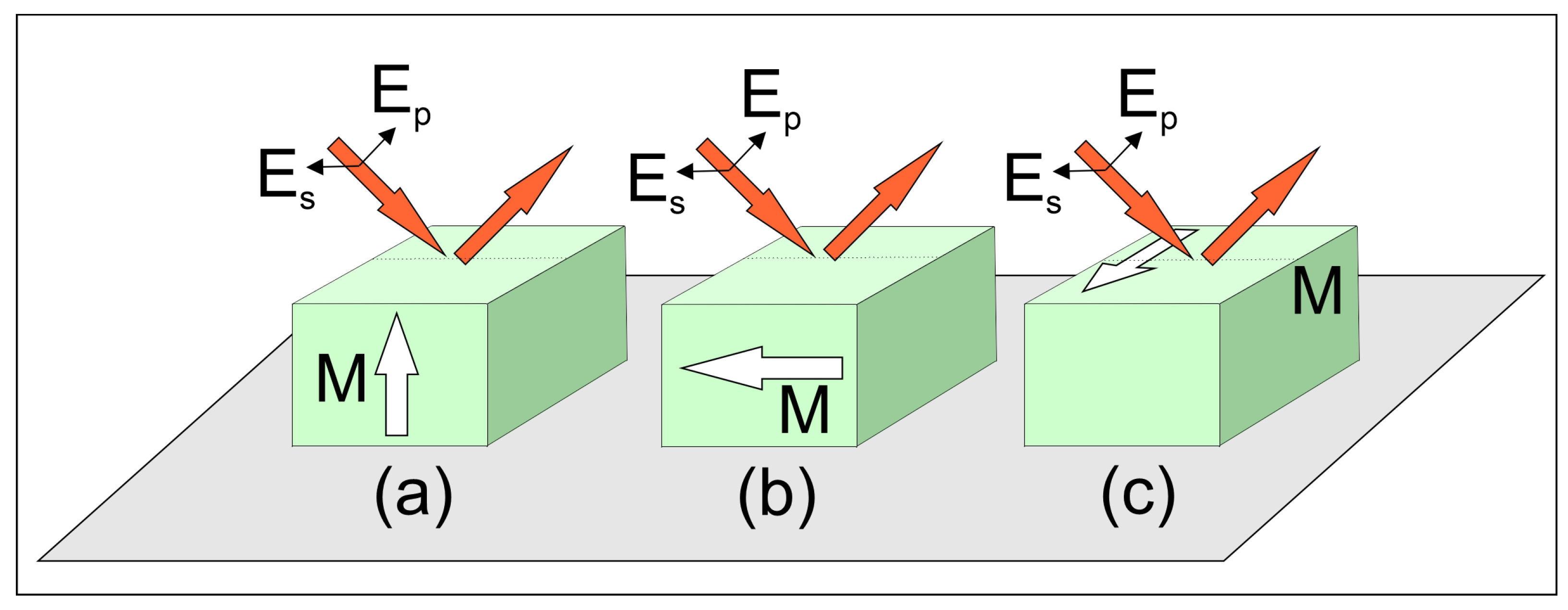
2.2.2. Primary and Secondary Magneto Optic Kerr Effects
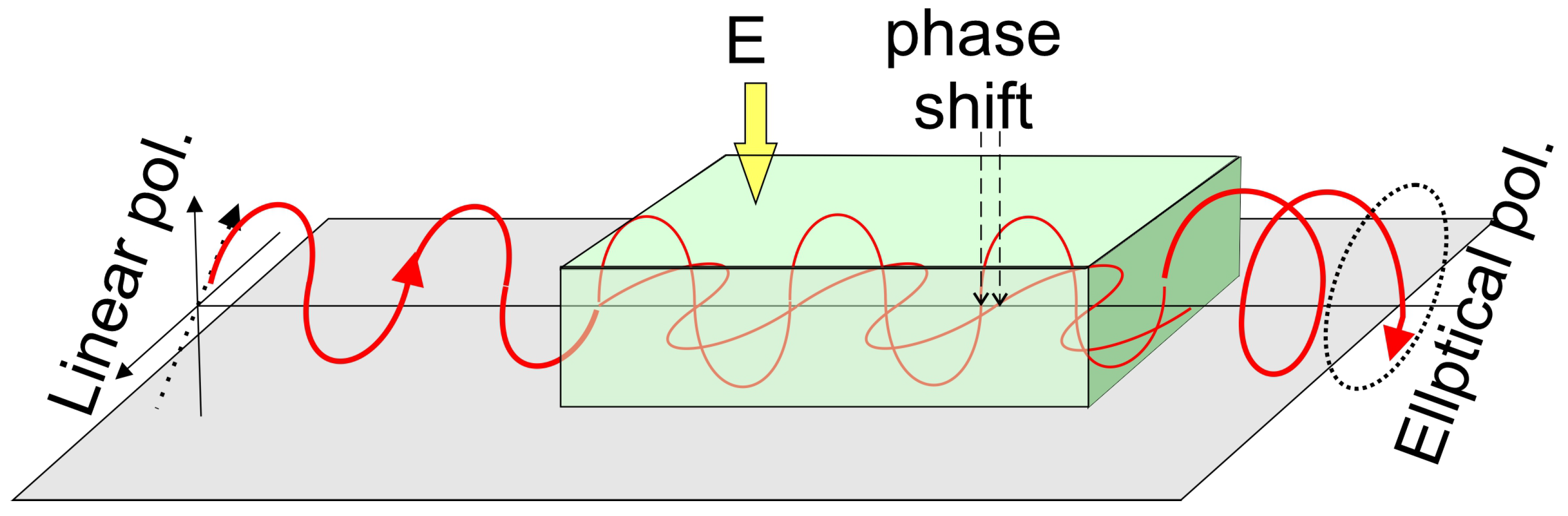
2.2.3. Mathematical Principles of Electro-Optical Kerr Effect
- rmk are the electro-optic (Pockels) coefficients. They form a matrix obtained by contracting the third-rank tensor rijk, which relates the change of the dielectric impermeability tensor to the applied electric field.
- Ek are the components of the external electric field vector, where k = 1, 2, 3 correspond to the Cartesian components Ex, Ey, Ez.
- When the crystal cannot deform, the electro-optic effect observed in such a constrained crystal is called the primary electro-optic effect.
- In contrast, in a free crystal, the electric field induces mechanical deformations due to the inverse piezoelectric effect. These deformations lead to changes in the refractive indices via the elasto-optic effect. The electro-optic effect observed in this case is referred to as the secondary electro-optic effect.
2.2.4. Primary and Secondary EO Kerr Effects
- Primary Kerr effect occurs in non-deformable (clamped) crystals.
- Secondary Kerr effect arises in deformable (free) crystals, where electrostriction and the inverse piezoelectric effect lead to strain-induced birefringence.
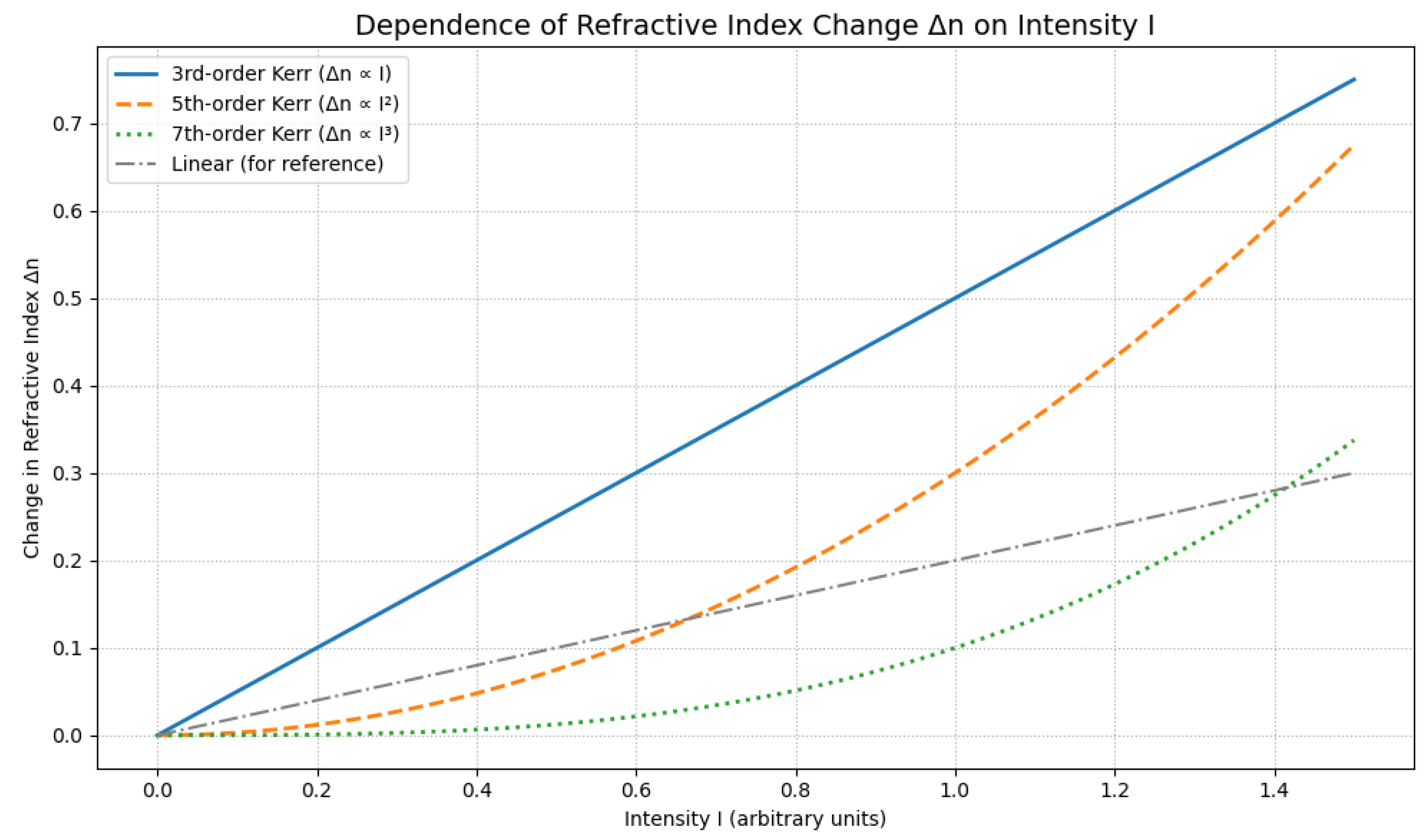
2.2.5. Nonlinear Optical Response
3. Measurement Methods of Kerr Effects
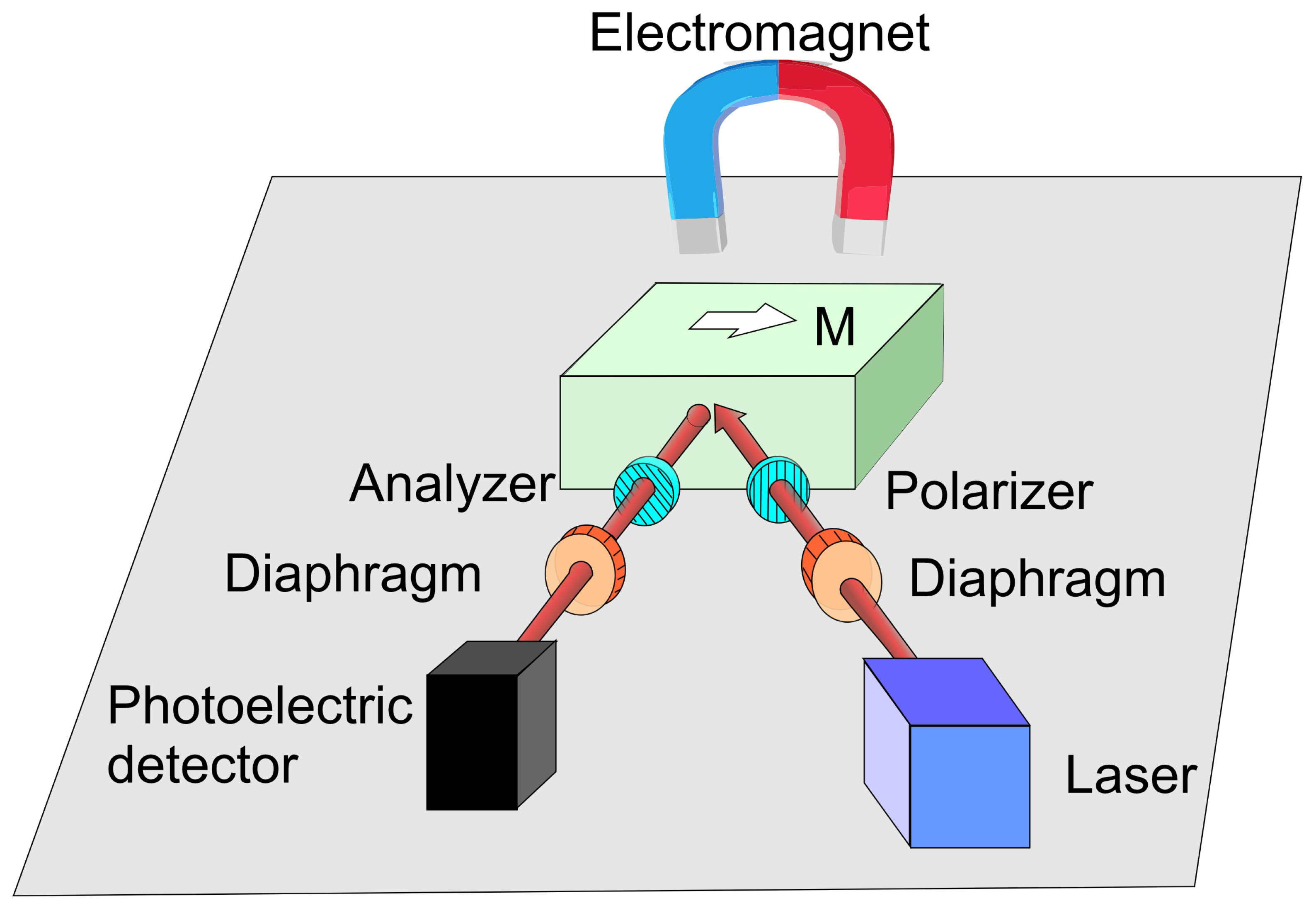
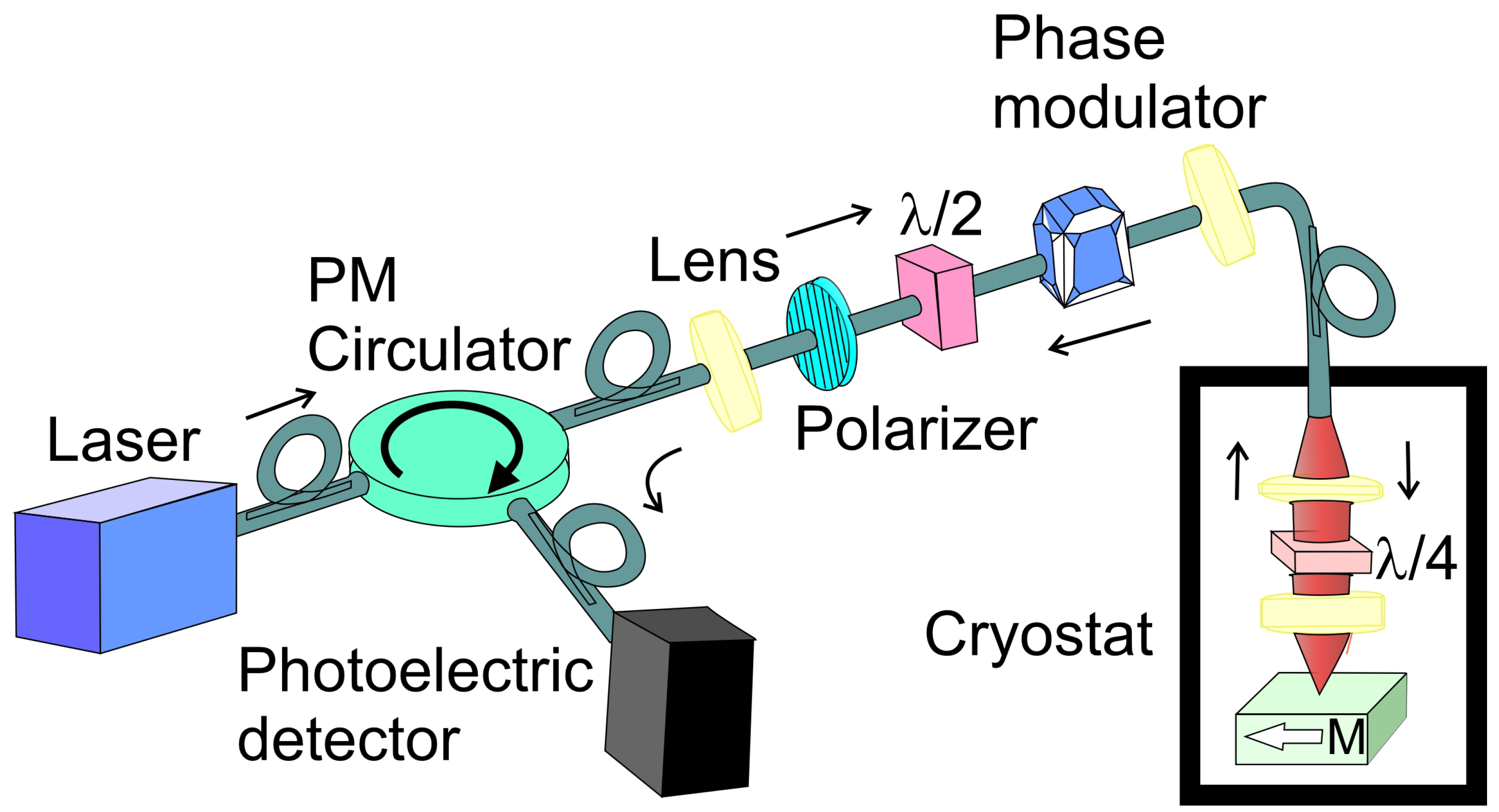
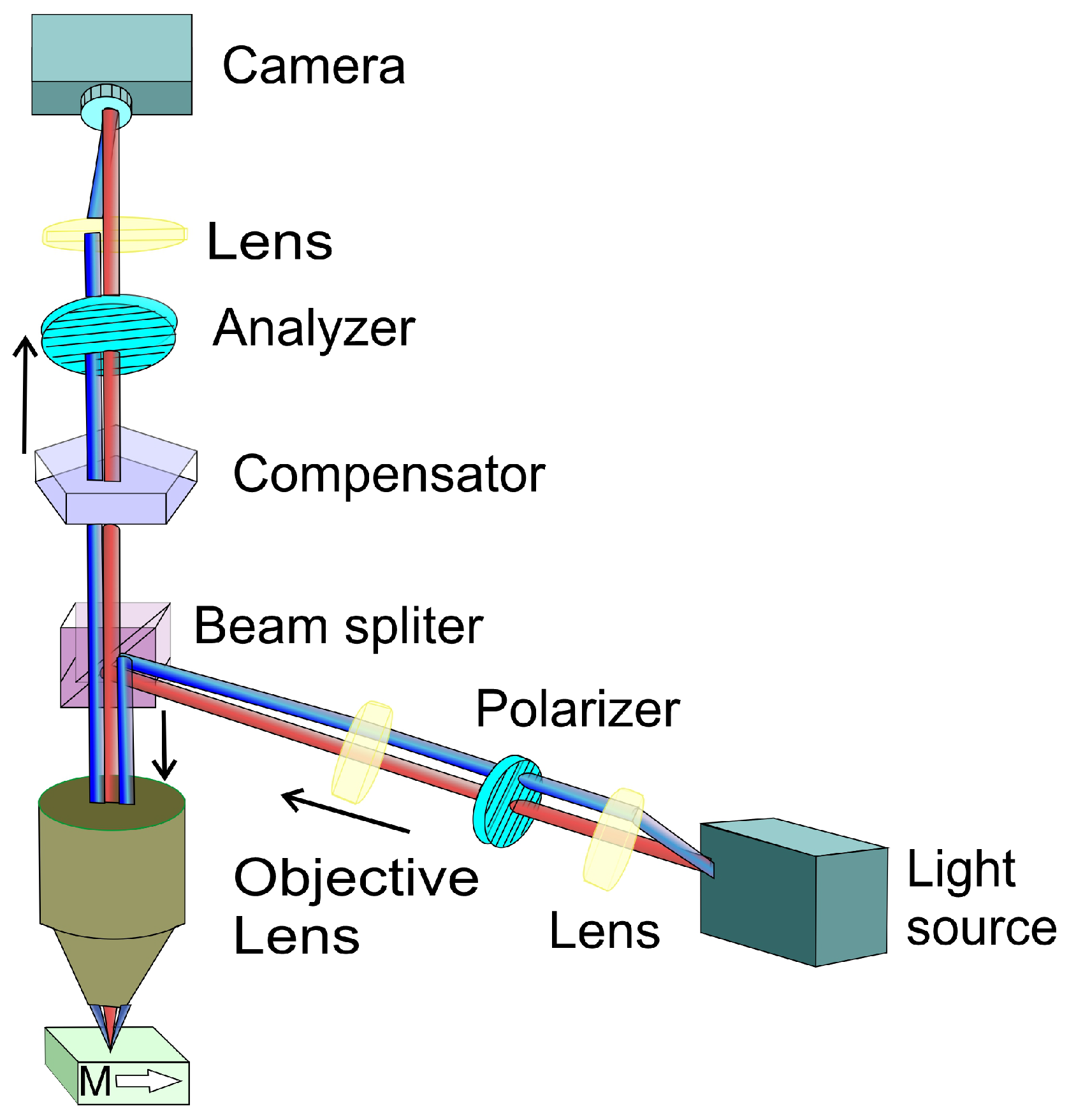
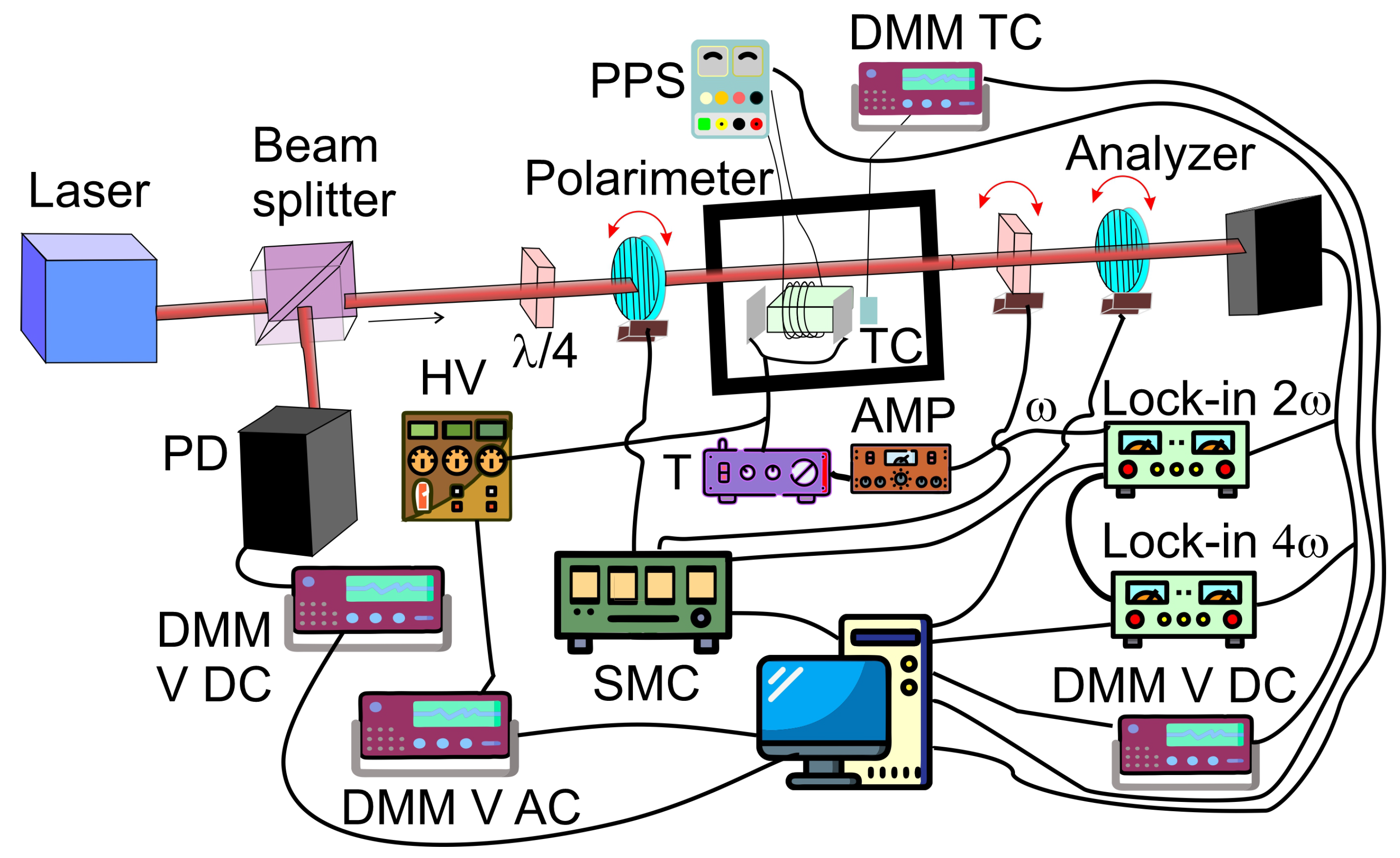
3.1. Experimental Setups for Magneto-Optical Kerr Effect
3.2. Electro-Optical Kerr Effect
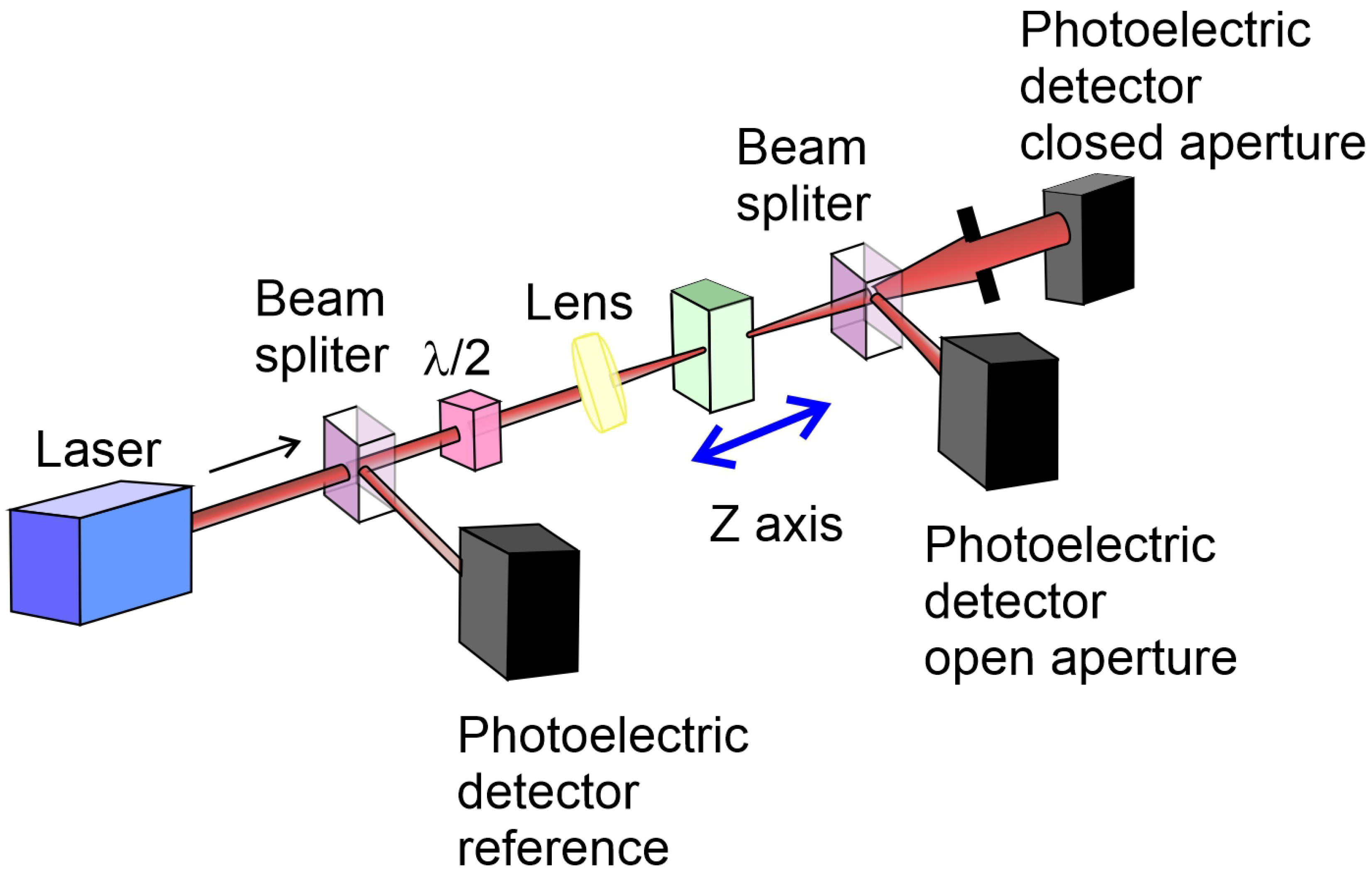
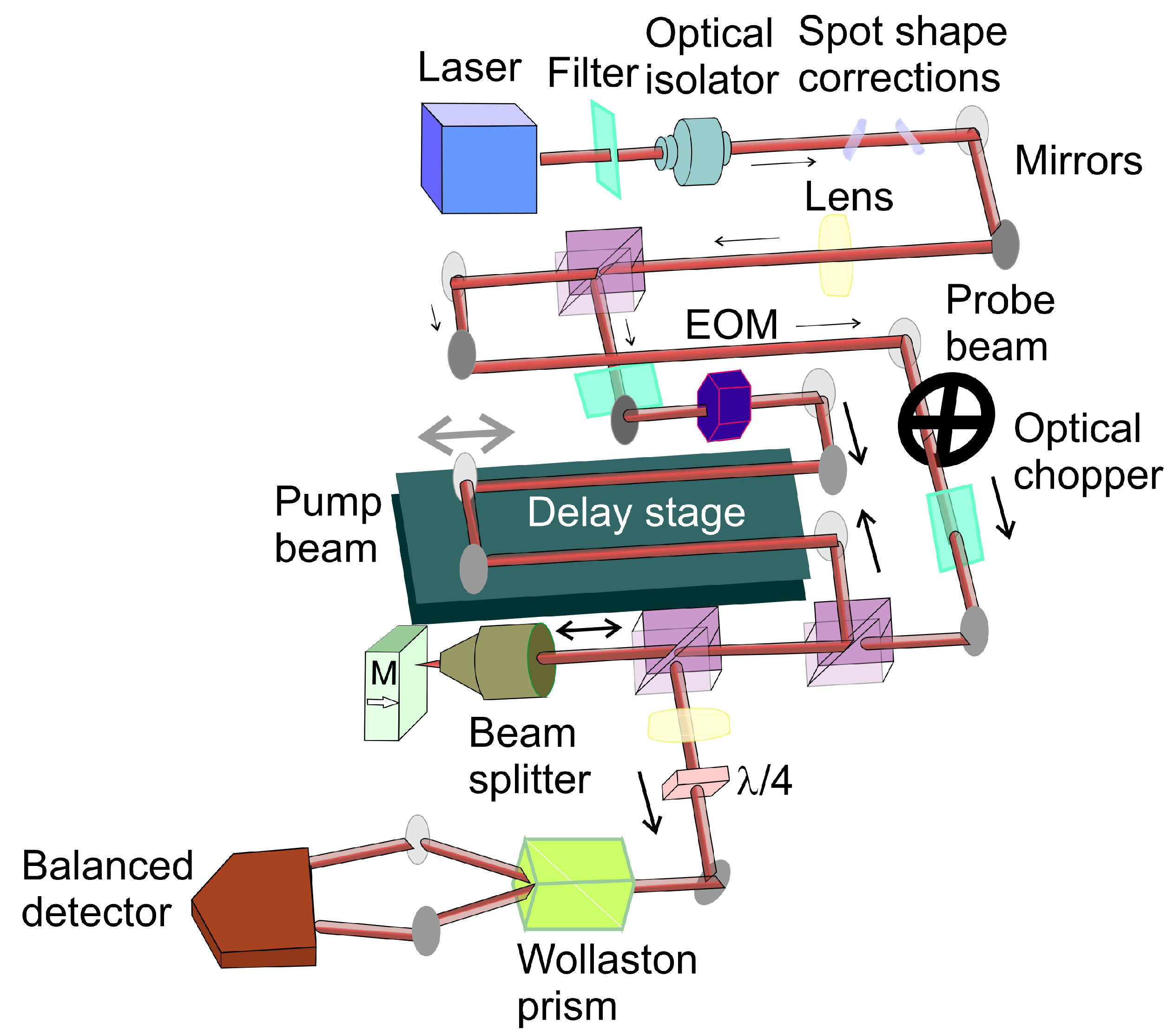
3.3. Optical Kerr Effect
4. Kerr Effect in Ceramics
4.1. Cubic Materials
4.1.1. Spinels
“It is very interesting that a somewhat complicated composition should be associated with such complete crystalline symmetry.”
4.1.2. Garnets
4.1.3. Sesquioxides
4.1.4. Fluorides
4.1.5. Sulfides and Selenides
4.1.6. Perovskites
4.2. Non-Cubic Anisotropic Materials
4.2.1. Hexagonal and Rhombohedral Materials
4.2.2. Tetragonal and Monoclinic Materials
4.3. Magneto-Optical Kerr Effect in Materials
4.4. Electro-Optical Kerr Effect in Materials
4.5. Other Effects
4.6. Applications of Kerr Effects
5. The Future and Challenges of Kerr Effect Applications
Author Contributions
Funding
Data Availability Statement
Conflicts of Interest
Abbreviations
| ALON | commercial name of aluminum oxynitride |
| MOKE | magneto-optical Kerr effect |
| EOKE | electro-optical Kerr effect |
| PKE | polar Kerr effect |
| TRS | time-reversal symmetry |
| RCP | right-circularly polarized |
| LCP | left-circularly polarized |
| DC | direct current |
| AC | alternating current |
| PMT | photomultiplier tube |
| QWP | quarter-wave plate |
| HWP | half-wave plate |
| EOM | electro-optic modulator |
| PEEM | photoemission electron microscope |
| NPCF | nonlinear photonic-crystal fiber |
| CCD | charge-coupled device |
References
- Barag, D. Mesopotamian Glass Vessels of the Second Millennium B.C. Notes on the Origin of the Core Technique. J. Glass Stud. 1962, 4, 9–27. [Google Scholar]
- Kaufman, M. The First Century of Plastics; Plastics Institute: London, UK, 1963; p. 130. [Google Scholar]
- Ye, N.; Wang, J.Y.; Boughton, R.I.; Hong, M.C. Functional Crystals. In Modern Inorganic Synthetic Chemistry, 2nd ed.; Elsevier: Amsterdam, The Netherlands, 2017; pp. 575–611. [Google Scholar]
- Johnson, R.; Biswas, P.; Ramavath, P.; Kumar, R.S.; Padmanabham, G. Transparent Polycrystalline Ceramics: An Overview. Trans. Indian Ceram. Soc. 2012, 71, 73–85. [Google Scholar] [CrossRef] [Scilit]
- Tsabit, A.M.; Yoon, D.H. Review on transparent polycrystalline ceramics. J. Korean Ceram. Soc. 2022, 59, 1–24. [Google Scholar] [CrossRef] [Scilit]
- Ming, W.; Jiang, Z.; Luo, G.; Xu, Y.; He, W.; Xie, Z.; Shen, D.; Li, L. Progress in Transparent Nano-Ceramics and Their Potential Applications. Nanomaterials 2022, 12, 1491. [Google Scholar] [CrossRef] [Scilit] [PubMed]
- Innocenzi, P. Sol-gel processing for advanced ceramics, a perspective. Open Ceram. 2023, 16, 100477. [Google Scholar] [CrossRef] [Scilit]
- Schabikowski, M.; Laskowska, M.; Pastukh, O.; Swiec, P.; Pawlik, K.; Pawlik, P.; Karczmarska, A.; Kac, M.; Zielinski, P.M.; Laskowski, L. Yttrium iron garnet single-crystal particles—A simple and effective synthesis. Nano Express 2024, 5, 035022. [Google Scholar] [CrossRef] [Scilit]
- Din, G.M.U.; Faheem, M.; Asif, M.; Khan, M.A.; Ramay, S.M.; Riaz, S.; Atiq, S. Efficient magnetoelectric coupling and electro-optic Kerr effect in BiFeO3-based tri-phasic composites for ultra-fast pulsating gadgets. Mater. Chem. Phys. 2025, 346, 131410. [Google Scholar] [CrossRef] [Scilit]
- Wang, S.; Zhang, J.; Luo, D.; Gu, F.; Tang, D.; Dong, Z.; Tan, G.; Que, W.; Zhang, T.; Li, S.; et al. Transparent ceramics: Processing, materials and applications. Prog. Solid State Chem. 2013, 41, 20–54. [Google Scholar] [CrossRef] [Scilit]
- Guillon, O.; Gonzalez-Julian, J.; Dargatz, B.; Kessel, T.; Schierning, G.; Räthel, J.; Herrmann, M. Field-Assisted Sintering Technology/Spark Plasma Sintering: Mechanisms, Materials, and Technology Developments. Adv. Eng. Mater. 2014, 16, 830–849. [Google Scholar] [CrossRef] [Scilit]
- Sakajio, M.; Beilin, V.; Mann-Lahav, M.; Zamir, S.; Shter, G.E.; Grader, G.S. Highly Transparent Polycrystalline MgO via Spark Plasma Sintering. ACS Appl. Mater. Interfaces 2022, 14, 52108–52116. [Google Scholar] [CrossRef] [Scilit]
- Dvilis, E.S.; Khasanov, O.L.; Deulina, D.E.; Stepanov, S.A.; Shevchenko, I.N.; Huang, F.; Valiev, D.T.; Tolkachev, O.S.; Ilela, A.E.; Paigin, V.D. Transparent Ceramics Fabricated via Spark Plasma Sintering–Magnesium Aluminate Spinel with Increased Aspect Ratio. Rev. Adv. Chem. 2024, 14, 243–251. [Google Scholar] [CrossRef] [Scilit]
- Dehghani, P.; Salman Seyed Afghahi, S.; Soleimani, F. Hot Isostatic Pressing (HIP) in Advanced Ceramics Production. In Materials Science: Advanced Ceramic Materials—Emerging Technologies; IntechOpen: London, UK, 2025; pp. 143–159. [Google Scholar] [CrossRef] [Scilit]
- Sabzi, M.; Mousavi Anijdan, S.; Shamsodin, M.; Farzam, M.; Hojjati-Najafabadi, A.; Feng, P.; Park, N.; Lee, U. A Review on Sustainable Manufacturing of Ceramic-Based Thin Films by Chemical Vapor Deposition (CVD): Reactions Kinetics and the Deposition Mechanisms. Coatings 2023, 13, 188. [Google Scholar] [CrossRef] [Scilit]
- Baptista, A.; Silva, F.; Porteiro, J.; Míguez, J.; Pinto, G. Sputtering Physical Vapour Deposition (PVD) Coatings: A Critical Review on Process Improvement and Market Trend Demands. Coatings 2018, 8, 402. [Google Scholar] [CrossRef] [Scilit]
- Liu, H.; Zhang, H.; Lei, C.; Yuan, C. Influence of the sputtering pressure on the properties of transparent conducting zirconium-doped zinc oxide films prepared by RF magnetron sputtering. J. Semicond. 2009, 30, 023001. [Google Scholar] [CrossRef] [Scilit]
- Lu, H.C.; Jou, J.C.; Chu, C.L. Influence of RF magnetron sputtering conditions on the properties of transparent conductive gallium-doped magnesium zinc oxide thin films. Surf. Coat. Technol. 2013, 231, 539–542. [Google Scholar] [CrossRef] [Scilit]
- Noikaew, B.; Wangmooklang, L.; Niyomsoan, S.; Larpkiattaworn, S. Preparation of transparent alumina thin films deposited by RF magnetron sputtering. J. Met. Mater. Miner. 2021, 31, 96–103. [Google Scholar] [CrossRef] [Scilit]
- Kim, K.J.; Lee, H.S.; Lee, M.H.; Lee, S.H. Comparative magneto-optical investigation of d–d charge–transfer transitions in Fe3O4, CoFe2O4, and NiFe2O4. J. Appl. Phys. 2002, 91, 9974–9977. [Google Scholar] [CrossRef] [Scilit]
- Kruk, A.; Mrózek, M. The measurement of Faraday effect of translucent material in the entire visible spectrum. Measurement 2020, 162, 107912. [Google Scholar] [CrossRef] [Scilit]
- Vojna, D.; Slezák, O.; Lucianetti, A.; Mocek, T. Verdet Constant of Magneto-Active Materials Developed for High-Power Faraday Devices. Appl. Sci. 2019, 9, 3160. [Google Scholar] [CrossRef] [Scilit]
- Ying, K.; Niu, Y.; Chen, D.; Cai, H.; Qu, R.; Gong, S. Realization of cavity linewidth narrowing via interacting dark resonances in a tripod-type electromagnetically induced transparency system. J. Opt. Soc. Am. B 2014, 31, 144–148. [Google Scholar] [CrossRef] [Scilit]
- Pershan, P.S.; van der Ziel, J.P.; Malmstrom, L.D. Theoretical Discussion of the Inverse Faraday Effect, Raman Scattering, and Related Phenomena. Phys. Rev. 1966, 143, 574–583. [Google Scholar] [CrossRef] [Scilit]
- Banerjee, S.; Kumar, U.; Lin, S.Z. Inverse Faraday effect in Mott insulators. Phys. Rev. B 2022, 105, L180414. [Google Scholar] [CrossRef] [Scilit]
- van der Ziel, J.P.; Pershan, P.S.; Malmstrom, L.D. Optically-Induced Magnetization Resulting from the Inverse Faraday Effect. Phys. Rev. Lett. 1965, 15, 190–193. [Google Scholar] [CrossRef] [Scilit]
- González-Alcalde, A.K.; Shi, X.; Ortiz, V.H.; Feng, J.; Wilson, R.B.; Vuong, L.T. Enhanced inverse Faraday effect and time-dependent thermo-transmission in gold nanodisks. Nanophotonics 2024, 13, 1993–2002. [Google Scholar] [CrossRef] [Scilit]
- Mou, Y.; Yang, X.; Gallas, B.; Mivelle, M. A Reversed Inverse Faraday Effect. Adv. Mater. Technol. 2023, 8, 2300770. [Google Scholar] [CrossRef] [Scilit]
- Cameron, A.R.; Fenwick, K.L.; Cheng, S.W.L.; Schwarz, S.; MacLellan, B.; Bustard, P.J.; England, D.; Sussman, B.; Resch, K.J. Ultrafast measurement of energy-time entanglement with an optical Kerr shutter. Phys. Rev. A 2023, 108, L041503. [Google Scholar] [CrossRef] [Scilit]
- Purwar, H.; Idlahcen, S.; Rozé, C.; Sedarsky, D.; Blaisot, J.B. Collinear, two-color optical Kerr effect shutter for ultrafast time-resolved imaging. Opt. Express 2014, 22, 15778–15790. [Google Scholar] [CrossRef] [Scilit]
- Ji, X.; Ahlborn, H.; Space, B.; Moore, P.B.; Zhou, Y.; Constantine, S.; Ziegler, L.D. A combined instantaneous normal mode and time correlation function description of the optical Kerr effect and Raman spectroscopy of liquid CS2. J. Chem. Phys. 2000, 112, 4186–4192. [Google Scholar] [CrossRef] [Scilit]
- Boehmke Amoruso, A.; Boto, R.A.; Elliot, E.; de Nijs, B.; Esteban, R.; Földes, T.; Aguilar-Galindo, F.; Rosta, E.; Aizpurua, J.; Baumberg, J.J. Uncovering low-frequency vibrations in surface-enhanced Raman of organic molecules. Nat. Commun. 2024, 15, 6733. [Google Scholar] [CrossRef] [Scilit]
- Kleist, E.M.; Ruggiero, M.T. Advances in Low-Frequency Vibrational Spectroscopy and Applications in Crystal Engineering. Cryst. Growth Des. 2022, 22, 939–953. [Google Scholar] [CrossRef] [Scilit]
- Trebino, R. Frequency-Resolved Optical Gating: The Measurement of Ultrashort Laser Pulses; Springer: Berlin/Heidelberg, Germany, 2002. [Google Scholar] [CrossRef] [Scilit]
- Agrawal, G.P. Nonlinear Fiber Optics, 6th ed.; Academic Press, Inc.: Cambridge, MA, USA, 2019. [Google Scholar]
- Haus, H.A. Mode-locking of lasers. IEEE J. Sel. Top. Quantum Electron. 2000, 6, 1173–1185. [Google Scholar] [CrossRef] [Scilit]
- Peltier, J.; Zhang, W.; Virot, L.; Lafforgue, C.; Deniel, L.; Marris-Morini, D.; Aubin, G.; Amar, F.; Tran, D.; Yan, X.; et al. High-speed silicon photonic electro-optic Kerr modulation. Photon. Res. 2024, 12, 51–60. [Google Scholar] [CrossRef] [Scilit]
- Mazur, P.; Postma, B.J. On the molecular theory of the kerr effect. Physica 1959, 25, 251–267. [Google Scholar] [CrossRef] [Scilit]
- Buckingham, A.D.; Pople, J.A. Theoretical Studies of the Kerr Effect I: Deviations from a Linear Polarization Law. Proc. Phys. Soc. Sect. A 1955, 68, 905, Correction in Proc. Phys. Soc. A 1955, 68, 1091.. [Google Scholar] [CrossRef] [Scilit]
- Chang, T.Y. Kerr Effect in Atoms and Molecules. J. Chem. Phys. 1972, 56, 1745–1751. [Google Scholar] [CrossRef] [Scilit]
- Zhang, M.; Xiao, W.; Zhang, C.; Zhang, L. Terahertz Kerr Effect of Liquids. Sensors 2022, 22, 9424. [Google Scholar] [CrossRef] [Scilit]
- Ahn, J.; Xu, S.Y.; Vishwanath, A. Theory of optical axion electrodynamics and application to the Kerr effect in topological antiferromagnets. Nat. Commun. 2022, 13, 7615. [Google Scholar] [CrossRef] [Scilit]
- Zhu, W.Q.; Shan, W.Y. Theoretical studies of magneto-optical Kerr and Faraday effects in two-dimensional second-order topological insulators. Sci. Rep. 2023, 13, 12599. [Google Scholar] [CrossRef] [Scilit]
- Arora, A.; Ghosh, S.; Sugunakar, V. A mirror based polar magneto-optical Kerr effect spectroscopy arrangement. Rev. Sci. Instrum. 2011, 82, 123903. [Google Scholar] [CrossRef] [Scilit]
- Postava, K.; Hrabovsky, D.; Pistora, J.; Fert, A.R.; Visnovsky, S.; Yamaguchi, T. Anisotropy of quadratic magneto-optic effects in reflection. J. Appl. Phys. 2002, 91, 7293–7295. [Google Scholar] [CrossRef] [Scilit]
- Bland, J.A.C.; Heinrich, B. Ultrathin Magnetic Structures I; Springer: Berlin, Germany, 1994. [Google Scholar] [CrossRef] [Scilit]
- Hicken, R.J.; Hughes, N.D.; Moore, J.R.; Schmool, D.S.; Wilks, R.; Wu, J. Magneto-optical studies of magnetism on pico and femtosecond time scales (invited). J. Magn. Magn. Mater. 2002, 242–245, 559–564. [Google Scholar] [CrossRef] [Scilit]
- Farle, M. Ferromagnetic resonance of ultrathin metallic layers. Rep. Prog. Phys. 1998, 61, 755–826. [Google Scholar] [CrossRef] [Scilit]
- Zvezdin, A.K.; Kubrakov, N.F. Nonlinear magneto-optical Kerr effects. J. Exp. Theor. Phys. 1999, 89, 77–85. [Google Scholar] [CrossRef] [Scilit]
- Osgood, R.M., III; Bader, S.D.; Clemens, B.M.; White, R.L.; Matsuyama, H. Second-order magneto-optic effects in anisotropic thin films. J. Magn. Magn. Mater. 1998, 182, 297–323. [Google Scholar] [CrossRef] [Scilit]
- Stöhr, J.; Siegmann, H.C. Magnetism: From Fundamentals to Nanoscale Dynamics; Springer: Berlin, Germany, 2006. [Google Scholar] [CrossRef] [Scilit]
- Hamrle, J.; Blomeier, S.; Gaier, O.; Hillebrands, B.; Schneider, H.; Jakob, G.; Postava, K.; Felser, C. Huge quadratic magneto-optical Kerr effect and magnetization reversal in the Co2FeSi Heusler compound. J. Phys. D Appl. Phys. 2007, 40, 1563–1569. [Google Scholar] [CrossRef] [Scilit]
- Liang, J.H.; Xiao, X.; Li, J.X.; Zhu, B.C.; Zhu, J.; Bao, H.; Zhou, L.; Wu, Y.Z. Quantitative study of the quadratic magneto-optical Kerr effects in Fe films. Opt. Express 2015, 23, 11357–11366. [Google Scholar] [CrossRef] [Scilit]
- Hanus, J. Effect of the Molecular Interaction Between Anisotropic Molecules on the Optical Kerr Effect. Field-Induced Phase Transition. Phys. Rev. 1969, 178, 420–428. [Google Scholar] [CrossRef] [Scilit]
- Kerr, J. LIV. A new relation between electricity and light: Dielectrified media birefringent (Second paper). Lond. Edinb. Dublin Philos. Mag. J. Sci. 1875, 50, 446–458. [Google Scholar] [CrossRef] [Scilit]
- Luo, H.; Wang, Z.; He, Y.; Song, Y. Enhanced Magneto-Optical Kerr Effects in Micron Array Thin Films with Organic–Inorganic Interfaces. Coatings 2025, 15, 30. [Google Scholar] [CrossRef] [Scilit]
- Song, T.; Sun, Q.C.; Anderson, E.; Wang, C.; Qian, J.; Taniguchi, T.; Watanabe, K.; McGuire, M.A.; Stöhr, R.; Xiao, D.; et al. Direct visualization of magnetic domains and moiré magnetism in twisted 2D magnets. Science 2021, 374, 1140–1144. [Google Scholar] [CrossRef] [Scilit]
- Ma, Z.; Zhu, W.; Lin, G.; Liu, Y.; Jin, F.; Yang, Y.; Wu, T.; Luo, X.; Sun, Y.; Chen, J.; et al. Micro-MOKE with optical interference in the study of 2D Cr2Ge2Te6 nanoflake based magnetic heterostructures. AIP Adv. 2019, 9, 125116. [Google Scholar] [CrossRef] [Scilit]
- Huang, B.; Clark, G.; Navarro-Moratalla, E.; Klein, D.R.; Cheng, R.; Seyler, K.L.; Zhong, D.; Schmidgall, E.; McGuire, M.A.; Cobden, D.H.; et al. Layer-dependent ferromagnetism in a van der Waals crystal down to the monolayer limit. Nature 2017, 546, 270–273. [Google Scholar] [CrossRef] [Scilit] [PubMed]
- Gong, C.; Li, L.; Li, Z.; Ji, H.; Stern, A.; Xia, Y.; Cao, T.; Bao, W.; Wang, C.; Wang, Y.; et al. Discovery of intrinsic ferromagnetism in two-dimensional van der Waals crystals. Nature 2017, 546, 265–269. [Google Scholar] [CrossRef] [Scilit] [PubMed]
- Farle, M.; Lewis, W.A.; Baberschke, K. Detailed analysis of the in situ magneto-optic Kerr signal of gadolinium films near the Curie temperature. Appl. Phys. Lett. 1993, 62, 2728–2730. [Google Scholar] [CrossRef] [Scilit]
- Llacsahuanga Allcca, A.E.; Idzuchi, H.; Pan, X.C.; Tanigaki, K.; Chen, Y.P. Modified magnetism in heterostructures of Cr2Ge2Te6 and oxides. AIP Adv. 2023, 13, 015031. [Google Scholar] [CrossRef] [Scilit]
- Fei, Z.; Huang, B.; Malinowski, P.; Wang, W.; Song, T.; Sanchez, J.; Yao, W.; Xiao, D.; Zhu, X.; May, A.F.; et al. Two-dimensional itinerant ferromagnetism in atomically thin Fe3GeTe2. Nat. Mater. 2018, 17, 778–782. [Google Scholar] [CrossRef] [Scilit]
- Gupta, V.; Cham, T.M.; Stiehl, G.M.; Bose, A.; Mittelstaedt, J.A.; Kang, K.; Jiang, S.; Mak, K.F.; Shan, J.; Buhrman, R.A.; et al. Manipulation of the van der Waals Magnet Cr2Ge2Te6 by Spin–Orbit Torques. Nano Lett. 2020, 20, 7482–7488. [Google Scholar] [CrossRef] [Scilit]
- Wang, Z.; Zhang, T.; Ding, M.; Dong, B.; Li, Y.; Chen, M.; Li, X.; Huang, J.; Wang, H.; Zhao, X.; et al. Electric-field control of magnetism in a few-layered van der Waals ferromagnetic semiconductor. Nat. Nanotechnol. 2018, 13, 554–559. [Google Scholar] [CrossRef] [Scilit]
- Jin, C.; Tao, Z.; Kang, K.; Watanabe, K.; Taniguchi, T.; Mak, K.F.; Shan, J. Imaging and control of critical fluctuations in two-dimensional magnets. Nat. Mater. 2020, 19, 1290–1294. [Google Scholar] [CrossRef] [Scilit]
- Purbawati, A.; Coraux, J.; Vogel, J.; Hadj-Azzem, A.; Wu, N.; Bendiab, N.; Jegouso, D.; Renard, J.; Marty, L.; Bouchiat, V.; et al. In-Plane Magnetic Domains and Néel-like Domain Walls in Thin Flakes of the Room Temperature CrTe2 Van der Waals Ferromagnet. ACS Appl. Mater. Interfaces 2020, 12, 30702–30710. [Google Scholar] [CrossRef] [Scilit]
- Hendriks, F.; Guimarães, M.H.D. Enhancing magneto-optic effects in two-dimensional magnets by thin-film interference. AIP Adv. 2021, 11, 035132. [Google Scholar] [CrossRef] [Scilit]
- Wu, Y.; Francisco, B.; Chen, Z.; Wang, W.; Zhang, Y.; Wan, C.; Han, X.; Chi, H.; Hou, Y.; Lodesani, A.; et al. A van der Waals interface hosting two groups of magnetic skyrmions. Adv. Mater. 2022, 34, 2110583. [Google Scholar] [CrossRef] [Scilit] [PubMed]
- Wu, Y.; Zhang, S.; Zhang, J.; Wang, W.; Zhu, Y.L.; Hu, J.; Yin, G.; Wong, K.; Fang, C.; Wan, C.; et al. Néel-type skyrmion in WTe2/Fe3GeTe2 van der Waals heterostructure. Nat. Commun. 2020, 11, 3860. [Google Scholar] [CrossRef] [Scilit] [PubMed]
- Ostwal, V.; Shen, T.; Appenzeller, J. Efficient spin-orbit torque switching of the semiconducting van der Waals ferromagnet Cr2Ge2Te6. Adv. Mater. 2020, 32, 1906021. [Google Scholar] [CrossRef] [Scilit]
- Chen, J.; Wang, L.; Zhang, M.; Zhou, L.; Zhang, R.; Jin, L.; Wang, X.; Qin, H.; Qiu, Y.; Mei, J.; et al. Evidence for magnetic skyrmions at the interface of Ferromagnet/Topological-insulator heterostructures. Nano Lett. 2019, 19, 6144–6151. [Google Scholar] [CrossRef] [Scilit]
- Martín Valderrama, C.; Quintana, M.; Tokunaga, K.; Urbina, Y.; Kurokawa, Y.; Vavassori, P.; Yuasa, H.; Berger, A. Observation of excess polar magneto-optical Kerr effect signals in asymmetric Co/Tb-multilayers. Appl. Phys. Lett. 2025, 127, 142404. [Google Scholar] [CrossRef] [Scilit]
- Das, D.; Ghosh, S. Polar magneto-optical Kerr effect spectroscopy with a microscope arrangement for studies on 2D materials. Rev. Sci. Instrum. 2024, 95, 083904. [Google Scholar] [CrossRef] [Scilit]
- Hayek, J.N.; Herreño-Fierro, C.A.; Patiño, E.J. Enhancement of the transversal magnetic optic Kerr effect: Lock-in vs. hysteresis method. Rev. Sci. Instrum. 2016, 87, 103113. [Google Scholar] [CrossRef] [Scilit]
- Poborska, J.; Dąbrówka, D.; Chwirot, M.; Ledzion, R.; Izdebski, M.; Kucharczyk, W. Frequency Dependence of the Kerr Constant in Nynas Nytro 3000 Oil Determined by the Polarimetric Method. Sci. Bull. Lodz Univ. Technol. Phys. 2018, 39. [Google Scholar] [CrossRef]
- Izdebski, M.; Ledzion, R. Kerr constant measurement technique for liquids exhibiting orientational ordering of molecules. Optik 2017, 140, 812–822. [Google Scholar] [CrossRef] [Scilit]
- Izdebski, M. Precise Measurements of the Quadratic Electro-Optic Effect in KH2PO4 Crystals Using a Sénarmont-Type System. Materials 2021, 14, 5435. [Google Scholar] [CrossRef] [Scilit] [PubMed]
- Lin, S.Y.; Liao, Y.K.; Wu, C.B. Magneto optical Kerr effect measurement with pulsed magnetic field. Chin. J. Phys. 2017, 55, 698–702. [Google Scholar] [CrossRef] [Scilit]
- Chen, X.; Qian, X.; Meng, K.; Zhao, J.; Ji, Y. The measurement of magneto-optical Kerr effect of ultrathin films in a pulsed magnetic field. Measurement 2013, 46, 52–56. [Google Scholar] [CrossRef] [Scilit]
- Schoenes, J. Electronic structure of uranium monochalcogenides and uranium monopnictides. Phys. Rep. 1980, 66, 187–212. [Google Scholar] [CrossRef] [Scilit]
- Sato, K. Measurement of Magneto-Optical Kerr Effect Using Piezo-Birefringent Modulator. Jpn. J. Appl. Phys. 1981, 20, 2403. [Google Scholar] [CrossRef] [Scilit]
- Talik, W.; Mrózek, M.; Wojciechowski, A.; Dzierżęga, K. Impact of nitrogen-vacancy color centers on the optical Kerr effect in diamond: A femtosecond Z-scan study. Opt. Express 2025, 33, 13748–13757. [Google Scholar] [CrossRef] [Scilit]
- Shin, Y.; Kim, J.W. Magneto-optical Kerr effect measurement in ultrafast Sagnac interferometry using the Jones matrix approach. Opt. Lett. 2021, 46, 3364–3367. [Google Scholar] [CrossRef] [Scilit]
- Ma, J.; Gu, F.; Xu, Y.; Le, J.; Zeng, F.; Wu, Y.; Tian, C. Improving the sensitivity of DC magneto-optical Kerr effect measurement to 10−7 rad/. Chin. Opt. Lett. 2022, 20, 111201. [Google Scholar] [CrossRef] [Scilit]
- Xia, J.; Beyersdorf, P.T.; Fejer, M.M.; Kapitulnik, A. Modified Sagnac interferometer for high-sensitivity magneto-optic measurements at cryogenic temperatures. Appl. Phys. Lett. 2006, 89, 062508. [Google Scholar] [CrossRef] [Scilit]
- Karimeddiny, S.; Cham, T.M.J.; Smedley, O.; Ralph, D.C.; Luo, Y.K. Sagnac interferometry for high-sensitivity optical measurements of spin-orbit torque. Sci. Adv. 2023, 9, eadi9039. [Google Scholar] [CrossRef] [Scilit]
- Xia, J.; Maeno, Y.; Beyersdorf, P.T.; Fejer, M.M.; Kapitulnik, A. High Resolution Polar Kerr Effect Measurements of Sr2RuO4: Evidence for Broken Time-Reversal Symmetry in the Superconducting State. Phys. Rev. Lett. 2006, 97, 167002. [Google Scholar] [CrossRef] [Scilit]
- Schemm, E.R.; Gannon, W.J.; Wishne, C.M.; Halperin, W.P.; Kapitulnik, A. Observation of broken time-reversal symmetry in the heavy-fermion superconductor UPt3. Science 2014, 345, 190–193. [Google Scholar] [CrossRef] [Scilit] [PubMed]
- Ikeda, A.; Nakamura, S.; Yamane, S.; Noda, K.; Ikeda, A.; Yonezawa, S. Magneto-optical Kerr-effect measurements under pulsed magnetic fields over 40 T using a compact sample fixture. arXiv 2025, arXiv:2509.07383. [Google Scholar] [CrossRef] [Scilit]
- Oblak, E.; Riego, P.; Garcia-Manso, A.; Martínez-de Guerenu, A.; Arizti, F.; Artetxe, I.; Berger, A. Ultrasensitive transverse magneto-optical Kerr effect measurements using an effective ellipsometric detection scheme. J. Phys. D Appl. Phys. 2020, 53, 205001. [Google Scholar] [CrossRef] [Scilit]
- Jasperson, S.N.; Schnatterly, S.E. An Improved Method for High Reflectivity Ellipsometry Based on a New Polarization Modulation Technique. Rev. Sci. Instrum. 1969, 40, 761–767. [Google Scholar] [CrossRef] [Scilit]
- Badoz, J.; Billardon, M.; Canit, J.C.; Russel, M.F. Sensitive devices to determine the state and degree of polarization of a light beam using a birefringence modulator. J. Opt. 1977, 8, 373. [Google Scholar] [CrossRef] [Scilit]
- Nederpel, P.Q.J.; Martens, J.W.D. Magneto-optical ellipsometer. Rev. Sci. Instrum. 1985, 56, 687–690. [Google Scholar] [CrossRef] [Scilit]
- Berger, A.; Pang, A.; Hopster, H. Magnetic reorientation transition in epitaxial Gd-films. J. Magn. Magn. Mater. 1994, 137, L1–L5. [Google Scholar] [CrossRef] [Scilit]
- Qiu, Z.Q.; Bader, S.D. Surface magneto-optic Kerr effect. Rev. Sci. Instrum. 2000, 71, 1243–1255. [Google Scholar] [CrossRef] [Scilit]
- Oblak, E.; Riego, P.; Fallarino, L.; Martínez-de Guerenu, A.; Arizti, F.; Berger, A. Ultrasensitive transverse magneto-optical Kerr effect measurements by means of effective polarization change detection. J. Phys. D Appl. Phys. 2017, 50, 23LT01. [Google Scholar] [CrossRef] [Scilit]
- Osgood, R.M.; Riggs, K.T.; Johnson, A.E.; Mattson, J.E.; Sowers, C.H.; Bader, S.D. Magneto-optic constants of hcp and fcc Co films. Phys. Rev. B 1997, 56, 2627–2634. [Google Scholar] [CrossRef] [Scilit]
- Orzechowski, K.; Sierakowski, M.W.; Sala-Tefelska, M.; Woliński, T.R.; Strzeżysz, O.; Kula, P. Investigation of Kerr effect in a blue phase liquid crystal using wedge-cell technique. Photonics Lett. Pol. 2017, 9, 54–56. [Google Scholar] [CrossRef] [Scilit]
- Kliger, D.S.; Lewis, J.W.; Randall, C.E. Polarized Light in Optics and Spectroscopy; Academic Press, Inc.: Cambridge, MA, USA, 1990. [Google Scholar] [CrossRef] [Scilit]
- Zeng, K.; Wu, Y.; Wu, X.; Xiao, D. Polarization-modulation-based orientation metrology of optically levitated rotating birefringent particles. Phys. Rev. Res. 2024, 6, 013160. [Google Scholar] [CrossRef] [Scilit]
- Guan, M.; Wang, M.; Zhanghao, K.; Zhang, X.; Li, M.; Liu, W.; Niu, J.; Yang, X.; Chen, L.; Jing, Z.; et al. Polarization modulation with optical lock-in detection reveals universal fluorescence anisotropy of subcellular structures in live cells. Light. Sci. Appl. 2022, 11, 4. [Google Scholar] [CrossRef] [Scilit]
- Gucciardi, P.G.; Micheletto, R.; Kawakami, Y.; Allegrini, M. Polarization-Modulation Techniques in Near-Field Optical Microscopy for Imaging of Polarization Anisotropy in Photonic Nanostructures. In Applied Scanning Probe Methods II: Scanning Probe Microscopy Techniques; Bhushan, B., Fuchs, H., Eds.; Springer: Berlin/Heidelberg, Germany, 2006; pp. 321–360. [Google Scholar] [CrossRef] [Scilit]
- Ebisu, A.; Aoto, T.; Takatani, T. Polarization-modulated optical homodyne for time-of-flight imaging with standard CMOS sensors. Sensors 2025, 25, 1886. [Google Scholar] [CrossRef] [Scilit]
- You, C.Y.; Shin, S.C. Effects of polarizer and analyzer imperfections in a magneto-optical Kerr spectrometer. J. Opt. Soc. Am. B 2000, 17, 910–913. [Google Scholar] [CrossRef] [Scilit]
- Bader, S. Smoke. J. Magn. Magn. Mater. 1991, 100, 440–454. [Google Scholar] [CrossRef] [Scilit]
- Bader, S.D.; Moog, E.R. Magneto-Optical Studies of Novel Epitaxial Films. J. Magn. Soc. Jpn. 1987, 11, 7–12. [Google Scholar] [CrossRef] [Scilit]
- Bader, S.; Moog, E.; Grünberg, P. Magnetic hysteresis of epitaxially-deposited iron in the monolayer range: A Kerr effect experiment in surface magnetism. J. Magn. Magn. Mater. 1986, 53, L295–L298. [Google Scholar] [CrossRef] [Scilit]
- Vinai, G.; Motti, F.; Petrov, A.Y.; Polewczyk, V.; Bonanni, V.; Edla, R.; Gobaut, B.; Fujii, J.; Suran, F.; Benedetti, D.; et al. An integrated ultra-high vacuum apparatus for growth and in situ characterization of complex materials. Rev. Sci. Instrum. 2020, 91, 085109. [Google Scholar] [CrossRef] [Scilit]
- Genuzio, F.; Giela, T.; Lucian, M.; Menteş, T.O.; Brondin, C.A.; Cautero, G.; Mazalski, P.; Bonetti, S.; Korecki, J.; Locatelli, A. A UHV MOKE magnetometer complementing XMCD-PEEM at the Elettra Synchrotron. J. Synchrotron Radiat. 2021, 28, 995–1005. [Google Scholar] [CrossRef] [Scilit] [PubMed]
- Peterka, D.; Enders, A.; Haas, G.; Kern, K. Combined Kerr microscope and magnetic force microscope for variable temperature ultrahigh vacuum investigations. Rev. Sci. Instrum. 2003, 74, 2744–2748. [Google Scholar] [CrossRef] [Scilit]
- Usov, V.; Murphy, S.; Seravalli, L.; Shvets, I. Developments in surface magneto-optical Kerr effect setup for ultrahigh vacuum analysis of magnetic ultrathin films. Rev. Sci. Instrum. 2005, 76, 046102. [Google Scholar] [CrossRef] [Scilit]
- Farle, M.; Berghaus, A.; Li, Y.; Baberschke, K. Hard axis magnetization of ultrathin Ni(111)/W(110) in UHV a new set-up for SMOKE. J. Magn. Magn. Mater. 1991, 93, 215–219. [Google Scholar] [CrossRef] [Scilit]
- Niinuma, Y.; Saisyu, Y.; Hirahara, T.; Hobara, R.; Hasegawa, S.; Mizuno, H.; Nagamura, T. Development of an UHV-SMOKE System Using Permanent Magnets. e-J. Surf. Sci. Nanotechnol. 2010, 8, 298–302. [Google Scholar] [CrossRef] [Scilit]
- Zhang, W.; Li, J.; Ding, X.; Pernod, P.; Tiercelin, N.; Song, Y. Tunable Magneto-Optical Kerr Effects of Nanoporous Thin Films. Sci. Rep. 2017, 7, 2888. [Google Scholar] [CrossRef] [Scilit]
- Tillmanns, A.; Oertker, S.; Beschoten, B.; Güntherodt, G.; Leighton, C.; Schuller, I.K.; Nogués, J. Magneto-optical study of magnetization reversal asymmetry in exchange bias. Appl. Phys. Lett. 2006, 89, 202512. [Google Scholar] [CrossRef] [Scilit]
- Blachowicz, T.; Malczyk, M.; Ehrmann, A.; Wortmann, M. Exchange bias in Fe/FeF2 and Fe/MnF2 model systems. AIP Adv. 2024, 14, 070703. [Google Scholar] [CrossRef] [Scilit]
- Tetzlaff, H.; Wortmann, M.; Ehrmann, A. Magneto-Optical Investigation of Surface Magnetization in Comparison with Bulk Magnetization. Phys. Sci. Forum 2024, 10, 9. [Google Scholar] [CrossRef] [Scilit]
- Huang, D.; Lattery, D.; Wang, X. Materials Engineering Enabled by Time-Resolved Magneto-Optical Kerr Effect for Spintronic Applications. ACS Appl. Electron. Mater. 2021, 3, 119–127. [Google Scholar] [CrossRef] [Scilit]
- Lattery, D.M.; Zhu, J.; Huang, D.; Wang, X. Ultrafast Thermal and Magnetic Characterization of Materials Enabled by the Time-Resolved Magneto-Optical Kerr Effect. In Nanoscale Energy Transport; 2053-2563; IOP Publishing: Beijing, China, 2020; pp. 9-1–9-30. [Google Scholar] [CrossRef] [Scilit]
- Cheng, H.; Zhang, B.; Xu, Y.; Lu, S.; Yao, Y.; Xiao, R.; Cao, K.; Liu, Y.; Wang, Z.; Xu, R.; et al. Mo-based Perpendicularly Magnetized Thin Films with Low Damping for Fast and Low-Power Consumption Magnetic Memory. Sci. China Phys. Mech. Astron. 2022, 65, 287511. [Google Scholar] [CrossRef] [Scilit]
- Zhu, J.; Fan, X.; Zhang, K.; Zhou, J.; Tang, D. Thermoelectric performance of SnTe nano-films depending on thickness, doping concentration and temperature. Mater. Res. Lett. 2024, 12, 140–147. [Google Scholar] [CrossRef] [Scilit]
- Yakovlev, D.R.; Bayer, M. Coherent Spin Dynamics of Carriers. In Spin Physics in Semiconductors; Dyakonov, M.I., Ed.; Springer International Publishing AG: Berlin/Heidelberg, Germany, 2017; pp. 155–206. [Google Scholar] [CrossRef] [Scilit]
- Wiewiór, P.; Radzewicz, C. Dynamics of molecular liquids studied by femtosecond optical Kerr effect. Opt. Appl. 2000, 30, 103–120. [Google Scholar]
- Kim, K.Y.; Kim, J.W.; Choi, H.C.; Teichert, A.; You, C.Y.; Park, S.; Shin, S.C.; Lee, J.S. Long-range interlayer-coupled magnetization reversal mediated by the antiferromagnetic layer in Py/FeMn/CoFe trilayers. Phys. Rev. B 2011, 84, 144410. [Google Scholar] [CrossRef] [Scilit]
- Righini, R. Ultrafast Optical Kerr Effect in Liquids and Solids. Science 1993, 262, 1386–1390. [Google Scholar] [CrossRef] [Scilit]
- Fedulova, E.; Trubetskov, M.; Amotchkina, T.; Fritsch, K.; Baum, P.; Pronin, O.; Pervak, V. Kerr effect in multilayer dielectric coatings. Opt. Express 2016, 24, 21802–21817. [Google Scholar] [CrossRef] [Scilit]
- Mero, M.; Sabbah, A.J.; Zeller, J.; Rudolph, W. Femtosecond dynamics of dielectric films in the pre-ablation regime. Appl. Phys. A 2005, 81, 317–324. [Google Scholar] [CrossRef] [Scilit]
- Vardeny, Z.; Tauc, J. Picosecond coherence coupling in the pump and probe technique. Opt. Commun. 1981, 39, 396–400. [Google Scholar] [CrossRef] [Scilit]
- Palfrey, S.L.; Heinz, T.F. Coherent interactions in pump–probe absorption measurements: The effect of phase gratings. J. Opt. Soc. Am. B 1985, 2, 674–679. [Google Scholar] [CrossRef] [Scilit]
- Lejeune, N.; Fourneau, E.; Barrera, A.; Morris, O.; Leonard, O.; Arregi, J.A.; Navau, C.; Uhlíř, V.; Bending, S.; Palau, A.; et al. Dimensional crossover of microscopic magnetic metasurfaces for magnetic field amplification. APL Mater. 2024, 12, 071126. [Google Scholar] [CrossRef] [Scilit]
- Jovičević-Klug, M.; Jovičević-Klug, P.; McCord, J.; Podgornik, B. Investigation of microstructural attributes of steel surfaces through magneto-optical Kerr effect. J. Mater. Res. Technol. 2021, 11, 1245–1259. [Google Scholar] [CrossRef] [Scilit]
- Dodd, S.; Gudino, N.; Zadorozhnii, O.; Staňo, M.; Hajduček, J.; Arregi, J.A.; Morris, H.D.; Uhlíř, V.; Barbic, M.; Koretsky, A.P. Field switching of microfabricated metamagnetic FeRh MRI contrast agents. Sci. Rep. 2025, 15, 2779. [Google Scholar] [CrossRef] [Scilit] [PubMed]
- Savoini, M.; Ciccacci, F.; Duò, L.; Finazzi, M. Apparatus for vectorial Kerr confocal microscopy. Rev. Sci. Instrum. 2011, 82, 023709. [Google Scholar] [CrossRef] [Scilit] [PubMed]
- Cheong, S.W.; Fiebig, M.; Wu, W.; Chapon, L.; Kiryukhin, V. Seeing is believing: Visualization of antiferromagnetic domains. npj Quantum Mater. 2020, 5, 3. [Google Scholar] [CrossRef] [Scilit]
- Kim, D.; Oh, Y.W.; Kim, J.U.; Lee, S.; Baucour, A.; Shin, J.; Kim, K.J.; Park, B.G.; Seo, M.K. Extreme anti-reflection enhanced magneto-optic Kerr effect microscopy. Nat. Commun. 2020, 11, 5937. [Google Scholar] [CrossRef] [Scilit]
- Cheskis, D. Magneto-Optical Tools to Study Effects in Dirac and Weyl Semimetals. Symmetry 2020, 12, 1412. [Google Scholar] [CrossRef] [Scilit]
- Bhowmick, T.K.; De, A.; Lake, R.K. High figure of merit magneto-optics from interfacial skyrmions on topological insulators. Phys. Rev. B 2018, 98, 024424, Erratum in Phys. Rev. B 2020, 101, 209902.. [Google Scholar] [CrossRef] [Scilit]
- Galluzzi, A.; Buchkov, K.; Blagoev, B.S.; Paskaleva, A.; Avramova, I.; Mehandhziev, V.; Tzvetkov, P.; Terziyska, P.; Kovacheva, D.; Polichetti, M. Strong Magneto-Optical Kerr Effects in Ni-Doped ZnO Nanolaminate Structures Obtained by Atomic Layer Deposition. Materials 2023, 16, 6547. [Google Scholar] [CrossRef] [Scilit]
- Mehrnia, M.; Trimble, J.; Berezovsky, J. Three-dimensional frequency- and phase-multiplexed magneto-optical microscopy. Opt. Express 2019, 27, 33942–33953. [Google Scholar] [CrossRef] [Scilit]
- Soldatov, I.V.; Schäfer, R. Advanced MOKE magnetometry in wide-field Kerr-microscopy. J. Appl. Phys. 2017, 122, 153906. [Google Scholar] [CrossRef] [Scilit]
- Kondo, R.; Yoshimura, K.; Hachisu, Y.; Hyeon-Gu, J.; Fujii, M.; Ihori, H.; Otake, Y.; Umemoto, T.; Tsurimoto, T. Measurement of AC electric field in transformer oil using Kerr effect. In Proceedings of the 2017 International Symposium on Electrical Insulating Materials (ISEIM), Toyohashi, Japan, 1–15 September 2017; Volume 1, pp. 255–258. [Google Scholar] [CrossRef] [Scilit]
- Huang, M.; You, W.; Wu, Y.; Zhang, L.; Li, Y.; Gao, C.; Qi, B. PEA–Kerr Combined Measurement Method for Space Charge and Electric Field Distribution of Oil–Paper Composite Insulation. IEEE Trans. Instrum. Meas. 2023, 72, 1–12. [Google Scholar] [CrossRef] [Scilit]
- Qi, B.; Zhao, X.; Li, C.; Wu, H. Transient electric field characteristics in oil-pressboard composite insulation under voltage polarity reversal. IEEE Trans. Dielectr. Electr. Insul. 2015, 22, 2148–2155. [Google Scholar] [CrossRef] [Scilit]
- Gao, C.; Zhao, X.; Zhang, S.; Wang, K.; Qi, B.; Li, C. Influencing factors and uncertainty analysis for Kerr electro-optic effect based electric field measurements in transformer oil under impulse voltage. Meas. Sci. Technol. 2024, 35, 045202. [Google Scholar] [CrossRef] [Scilit]
- Feng, T.; Rustige, P.; Raabe, N.; Steinmeyer, G. Electro-optic Kerr effect measurement based on carrier-envelope phase demodulation. In Proceedings of the 2017 Conference on Lasers and Electro-Optics Europe & European Quantum Electronics Conference (CLEO/Europe-EQEC), Munich, Germany, 25–29 June 2017; p. 1. [Google Scholar] [CrossRef] [Scilit]
- Horák, M.; Mach, P. Study of thermal ageing of polypropylene film capacitors. In Proceedings of the 2015 IEEE 21st International Symposium for Design and Technology in Electronic Packaging (SIITME), Brasov, Romania, 22–25 October 2015; pp. 57–60. [Google Scholar] [CrossRef] [Scilit]
- Xing, Z.; Ge, H.; Zeng, F.; Guo, S.; Gao, C. Kerr Electro-Optic Effect-Based Methodology for Measuring and Analyzing Electric Field Distribution in Oil-Immersed Capacitors. Energies 2024, 17, 3139. [Google Scholar] [CrossRef] [Scilit]
- Ledzion, R.; Izdebski, M.; Rambo, A. Measuring the Electro-Optical Kerr Effect Against the Background of Electro-Absorption Modulation in Liquids. Materials 2024, 17, 5346. [Google Scholar] [CrossRef] [Scilit]
- Wang, K.; Xie, Z.; Ji, J.; Song, Y.; Zhang, B.; Wang, Z. Novel Optical Kerr Switching Photonic Device Based on Nonlinear Carbon Material. Micromachines 2023, 14, 2216. [Google Scholar] [CrossRef] [Scilit]
- Yu, P.Y.; Cardona, M. Fundamentals of Semiconductors: Physics and Materials Properties, 4th ed.; Springer: Berlin/Heidelberg, Germany, 2010. [Google Scholar] [CrossRef] [Scilit]
- Fox, M. Optical Properties of Solids, 2nd ed.; Oxford University Press: Oxford, UK, 2010. [Google Scholar]
- Cotton, F.A.; Wilkinson, G.; Murillo, C.A.; Bochmann, M. Advanced Inorganic Chemistry, 6th ed.; Wiley: New York, NY, USA, 1999. [Google Scholar]
- Burns, R. Mineralogical Applications of Crystal Field Theory, 2nd ed.; Cambridge University Press: Cambridge, UK, 1993. [Google Scholar] [CrossRef] [Scilit]
- Stoneham, A.M. Theory of Defects in Solids; Oxford University Press: Oxford, UK, 2001. [Google Scholar] [CrossRef] [Scilit]
- Kittel, C. Introduction to Solid State Physics, 8th ed.; Wiley: Hoboken, NJ, USA, 2004. [Google Scholar]
- Bragg, W. XXX. The structure of the spinel group of crystals. Lond. Edinb. Dublin Philos. Mag. J. Sci. 1915, 30, 305–315. [Google Scholar] [CrossRef] [Scilit]
- Sickafus, K.E.; Wills, J.M.; Grimes, N.W. Structure of Spinel. J. Am. Ceram. Soc. 1999, 82, 3279–3292. [Google Scholar] [CrossRef] [Scilit]
- Krell, A.; Klimke, J.; Hutzler, T. Advanced spinel and sub-μm Al2O3 for transparent armour applications. J. Eur. Ceram. Soc. 2009, 29, 275–281. [Google Scholar] [CrossRef] [Scilit]
- Corbin, N.D. Aluminum oxynitride spinel: A review. J. Eur. Ceram. Soc. 1989, 5, 143–154. [Google Scholar] [CrossRef] [Scilit]
- Ronda, C. Luminescent garnets: A tutorial overview. Opt. Mater. 2025, 162, 116879. [Google Scholar] [CrossRef] [Scilit]
- Palashov, O.V.; Starobor, A.V.; Perevezentsev, E.A.; Snetkov, I.L.; Mironov, E.A.; Yakovlev, A.I.; Balabanov, S.S.; Permin, D.A.; Belyaev, A.V. Thermo-Optical Studies of Laser Ceramics. Materials 2021, 14, 3944. [Google Scholar] [CrossRef] [Scilit] [PubMed]
- Xia, Z.; Meijerink, A. Ce3+-Doped garnet phosphors: Composition modification, luminescence properties and applications. Chem. Soc. Rev. 2017, 46, 275–299. [Google Scholar] [CrossRef] [Scilit] [PubMed]
- Wollesen, L.; Douissard, P.A.; Pauwels, K.; Baillard, A.; Loiko, P.; Brasse, G.; Mathieu, J.; Simeth, S.J.; Kratz, M.; Dujardin, C.; et al. Microstructured growth by liquid phase epitaxy of scintillating Gd3Ga5O12 (GGG) doped with Eu3+. J. Alloys Compd. 2025, 1010, 177267. [Google Scholar] [CrossRef] [Scilit]
- Chaika, M.; Balabanov, S.; Permin, D. Optical spectra and gain properties of Er3+:Lu2O3 ceramics for eye-safe 1.5-μm lasers. Opt. Mater. 2021, 112, 110785. [Google Scholar] [CrossRef] [Scilit]
- Chaika, M.; Balabanov, S.; Permin, D. Spectral characteristics of “mixed” sesquioxide Yb:(Gd,Lu)2O3 transparent ceramics. Opt. Mater. X 2022, 13, 100123. [Google Scholar] [CrossRef] [Scilit]
- Li, X.; Hu, C.; Liu, Q.; Hreniak, D.; Li, J. Fluoride transparent ceramics for solid-state lasers: A review. J. Adv. Ceram. 2024, 13, 1891–1918. [Google Scholar] [CrossRef] [Scilit]
- Beeks, K.; Sikorsky, T.; Schaden, F.; Pressler, M.; Schneider, F.; Koch, B.N.; Pronebner, T.; Werban, D.; Hosseini, N.; Kazakov, G.; et al. Optical transmission enhancement of ionic crystals via superionic fluoride transfer: Growing VUV-transparent radioactive crystals. Phys. Rev. B 2024, 109, 094111. [Google Scholar] [CrossRef] [Scilit]
- Cappellini, G.; Furthmüller, J.; Bechstedt, F.; Botti, S. Electronic and Optical Properties of Alkaline Earth Metal Fluoride Crystals with the Inclusion of Many-Body Effects: A Comparative Study on Rutile MgF2 and Cubic SrF2. Symmetry 2023, 15, 539. [Google Scholar] [CrossRef] [Scilit]
- Ahn, H.Y.; Choi, W.J.; Lee, S.Y.; Ju, B.K.; Cho, S.H. Mechanochemical synthesis of ZnS for fabrication of transparent ceramics. Res. Chem. Intermed. 2018, 44, 4721–4731. [Google Scholar] [CrossRef] [Scilit]
- Yu, S.; Carloni, D.; Wu, Y. Microstructure development and optical properties of Fe:ZnSe transparent ceramics sintered by spark plasma sintering. J. Am. Ceram. Soc. 2020, 103, 4159–4166. [Google Scholar] [CrossRef] [Scilit]
- Qi, H.; Zhang, X.; Jiang, M.; Wang, Q.; Li, D. Optical Constants of Zinc Selenide in Visible and Infrared Spectral Ranges. J. Appl. Spectrosc. 2017, 84, 679–682. [Google Scholar] [CrossRef] [Scilit]
- Reim, W.; Schoenes, J.; Hulliger, F.; Vogt, O. Giant Kerr rotation and electronic structure of CeSbxTe1−x. J. Magn. Magn. Mater. 1986, 54, 1401–1402. [Google Scholar] [CrossRef] [Scilit]
- Pittini, R.; Schoenes, J.; Vogt, O.; Wachter, P. Discovery of 90 degree magneto-optical polar Kerr rotation in CeSb. Phys. Rev. Lett. 1996, 77, 944. [Google Scholar] [CrossRef] [Scilit] [PubMed]
- Kocsis, V.; Bordács, S.; Deisenhofer, J.; Kiss, L.F.; Ohgushi, K.; Kaneko, Y.; Tokura, Y.; Kézsmárki, I. Strong magneto-optical effects in ACr2O4 (A = Fe, Co) spinel oxides generated by tetrahedrally coordinated transition metal ions. Phys. Rev. B 2018, 97, 125140. [Google Scholar] [CrossRef] [Scilit]
- Hossain, A.; Sarker, M.; Khan, M.; Rahman, M. Spin effect on electronic, magnetic and optical properties of spinel CoFe2O4: A DFT study. Mater. Sci. Eng. B 2020, 253, 114496. [Google Scholar] [CrossRef] [Scilit]
- Himcinschi, C.; Vrejoiu, I.; Salvan, G.; Fronk, M.; Talkenberger, A.; Zahn, D.R.; Rafaja, D.; Kortus, J. Optical and magneto-optical study of nickel and cobalt ferrite epitaxial thin films and submicron structures. J. Appl. Phys. 2013, 113, 084101. [Google Scholar] [CrossRef] [Scilit]
- Peeters, W.L.; Martens, J.W.D. Magneto-optical effects of aluminum and ferrous substituted cobalt ferrite. J. Appl. Phys. 1982, 53, 8178–8180. [Google Scholar] [CrossRef] [Scilit]
- Veis, M.; Antos, R.; Visnovsky, S.; Kulkarni, P.D.; Venkataramani, N.; Prasad, S.; Mistrik, J.; Krishnan, R. Complete Permittivity Tensor in Sputtered CuFe2O4 Thin Films at Photon Energies between 2 and 5 eV. Materials 2013, 6, 4096–4108. [Google Scholar] [CrossRef] [Scilit]
- Lišková-Jakubisová, E.; Višňovský, Š.; Široký, P.; Hrabovský, D.; Pištora, J.; Sahoo, S.C.; Prasad, S.; Venkataramani, N.; Bohra, M.; Krishnan, R. Nanocrystalline zinc ferrite films studied by magneto-optical spectroscopy. J. Appl. Phys. 2015, 117, 17B726. [Google Scholar] [CrossRef] [Scilit]
- Zhou, B.; Zhang, Y.W.; Liao, C.S.; Yan, C.H.; Chen, L.Y.; Wang, S.Y. Rare-earth-mediated magnetism and magneto-optical Kerr effects in nanocrystalline CoFeMn0.9RE0.1O4 thin films. J. Magn. Magn. Mater. 2004, 280, 327–333. [Google Scholar] [CrossRef] [Scilit]
- Avazpour, L.; Toroghinejad, M.; Shokrollahi, H. Enhanced magneto-optical Kerr effect in rare earth substituted nanostructured cobalt ferrite thin film prepared by sol–gel method. Appl. Surf. Sci. 2016, 387, 869–874. [Google Scholar] [CrossRef] [Scilit]
- Sukhorukov, Y.P.; Bebenin, N.; Telegin, A.; Nosov, A. Magnetooptical properties of ferro-and ferrimagnetic spinels. Phys. Met. Metallogr. 2018, 119, 1167–1174. [Google Scholar] [CrossRef] [Scilit]
- Kehlberger, A.; Richter, K.; Onbasli, M.C.; Jakob, G.; Kim, D.H.; Goto, T.; Ross, C.A.; Götz, G.; Reiss, G.; Kuschel, T.; et al. Enhanced Magneto-optic Kerr Effect and Magnetic Properties of CeY2Fe5O12 Epitaxial Thin Films. Phys. Rev. Appl. 2015, 4, 014008. [Google Scholar] [CrossRef] [Scilit]
- Onbasli, M.C.; Beran, L.; Zahradník, M.; Kučera, M.; Antoš, R.; Mistrík, J.; Dionne, G.F.; Veis, M.; Ross, C.A. Optical and magneto-optical behavior of Cerium Yttrium Iron Garnet thin films at wavelengths of 200–1770 nm. Sci. Rep. 2016, 6, 23640. [Google Scholar] [CrossRef] [Scilit]
- Syouji, A.; Higuchi, H.; Tominaga, H. Magneto-optical property of Ce-substituted YIG films fabricated by metal–organic deposition method. J. Magn. Magn. Mater. 2022, 563, 169918. [Google Scholar] [CrossRef] [Scilit]
- Fakhrul, T.; Tazlaru, S.; Beran, L.; Zhang, Y.; Veis, M.; Ross, C.A. Magneto-Optical Bi:YIG Films with High Figure of Merit for Nonreciprocal Photonics. Adv. Opt. Mater. 2019, 7, 1900056. [Google Scholar] [CrossRef] [Scilit]
- Sposito, A.; Gregory, S.A.; de Groot, P.A.J.; Eason, R.W. Combinatorial pulsed laser deposition of doped yttrium iron garnet films on yttrium aluminium garnet. J. Appl. Phys. 2014, 115, 053102. [Google Scholar] [CrossRef] [Scilit]
- Fang, Y.; Shen, H.; Ma, Y.; Liao, S.; Xia, S.; Tian, T.; Zhou, D.; Ma, Y.; Xu, J. Growth, optical dispersion and magnetic behavior of Dy3+ doped yttrium iron garnet crystals. J. Rare Earths 2024, 42, 1110–1117. [Google Scholar] [CrossRef] [Scilit]
- Scheffler, D.; Steuer, O.; Zhou, S.; Siegl, L.; Goennenwein, S.T.B.; Lammel, M. Aluminium substituted yttrium iron garnet thin films with reduced Curie temperature. Phys. Rev. Mater. 2023, 7, 094405. [Google Scholar] [CrossRef] [Scilit]
- Šimša, Z. Optical and magnetooptical properties of Co-doped YIG films. Czechoslov. J. Phys. B 1984, 34, 78–87. [Google Scholar] [CrossRef] [Scilit]
- Komuro, E.; Namikawa, T.; Yamazaki, Y. Magnetic and magneto-optical properties of Mn substituted Bi-YIG sputtered films. J. Magn. Soc. Jpn. 1991, 15, 285–288. [Google Scholar] [CrossRef] [Scilit] [PubMed]
- Leycuras, C.; Le Gall, H.; Guillot, M.; Marchand, A. Magnetization and Faraday rotation of praseodymium-gallium substituted yttrium iron garnets. J. Appl. Phys. 1984, 55, 2158–2160. [Google Scholar] [CrossRef] [Scilit]
- Gizhevskiĭ, B.A.; Sukhorukov, Y.P.; Gan’shina, E.A.; Loshkareva, N.N.; Telegin, A.V.; Lobachevskaya, N.I.; Gaviko, V.S.; Pilyugin, V.P. Optical and magneto-optical properties of nanostructured yttrium iron garnet. Phys. Solid State 2009, 51, 1836–1842. [Google Scholar] [CrossRef] [Scilit]
- Tomita, S.; Kato, T.; Tsunashima, S.; Iwata, S.; Fujii, M.; Hayashi, S. Magneto-optical Kerr effects of yttrium-iron garnet thin films incorporating gold nanoparticles. Phys. Rev. Lett. 2006, 96, 167402, Erratum in Phys. Rev. Lett. 2007, 99, 039901. [Google Scholar] [CrossRef] [Scilit]
- Murzina, T.V.; Nikulin, A.A.; Aktsipetrov, O.A.; Ostrander, J.W.; Mamedov, A.A.; Kotov, N.A.; Devillers, M.A.C.; Roark, J. Nonlinear magneto-optical Kerr effect in hyper-Rayleigh scattering from layer-by-layer assembled films of yttrium iron garnet nanoparticles. Appl. Phys. Lett. 2001, 79, 1309–1311. [Google Scholar] [CrossRef] [Scilit]
- Dolgova, T.V.; Fedyanin, A.A.; Aktsipetrov, O.A.; Nishimura, K.; Uchida, H.; Inoue, M. Nonlinear magneto-optical Kerr effect in garnet magnetophotonic crystals. J. Appl. Phys. 2004, 95, 7330–7332. [Google Scholar] [CrossRef] [Scilit]
- Cai, M.Q.; Tan, X.; Yang, G.W.; Wen, L.Q.; Wang, L.L.; Hu, W.Y.; Wang, Y.G. Giant Magneto-Optical Kerr Effects in Ferromagnetic Perovskite BiNiO3 with Half-Metallic State. J. Phys. Chem. C 2008, 112, 16638–16642. [Google Scholar] [CrossRef] [Scilit]
- Fan, F.R.; Wu, H.; Nabok, D.; Hu, S.; Ren, W.; Draxl, C.; Stroppa, A. Electric-Magneto-Optical Kerr Effect in a Hybrid Organic-Inorganic Perovskite. J. Am. Chem. Soc. 2017, 139, 12883–12886. [Google Scholar] [CrossRef] [Scilit]
- Lu, H.S.; Guo, G.Y. Anomalous ferromagnetism and magneto-optical Kerr effect in semiconducting double perovskite Ba2NiOsO6 and its (111) (Ba2NiOsO6)/(BaTiO3)10 superlattice. Phys. Rev. B 2019, 100, 054443. [Google Scholar] [CrossRef] [Scilit]
- Zu, N.; Zhang, Q.; Hao, J.; Zhang, M.; Li, J.; Liu, X.; Li, R. First-principles study on giant magneto-optical Kerr effect in double perovskites Sr2BB’O6 (B = Cr, Mo, B’ = W, Re, Os). J. Solid State Chem. 2022, 312, 123274. [Google Scholar] [CrossRef] [Scilit]
- Melnikov, A.A.; Anikeeva, V.E.; Semenova, O.I.; Chekalin, S.V. Terahertz Kerr effect in a methylammonium lead bromide perovskite crystal. Phys. Rev. B 2022, 105, 174304. [Google Scholar] [CrossRef] [Scilit]
- Yamaguchi, S.; Okimoto, Y.; Ishibashi, K.; Tokura, Y. Magneto-optical Kerr effects in perovskite-type transition-metal oxides: La1−xSrxMnO3 and La1−xSrxCoO3. Phys. Rev. B 1998, 58, 6862. [Google Scholar] [CrossRef] [Scilit]
- Fleischer, K.; Thiyagarajah, N.; Lau, Y.C.; Betto, D.; Borisov, K.; Smith, C.C.; Shvets, I.V.; Coey, J.M.D.; Rode, K. Magneto-optic Kerr effect in a spin-polarized zero-moment ferrimagnet. Phys. Rev. B 2018, 98, 134445. [Google Scholar] [CrossRef] [Scilit]
- Hasanirokh, K.; Naifar, A. Kerr effect in (1+2)-dimensional graphene wormhole with axial magnetic field. J. Magn. Magn. Mater. 2025, 632, 173518. [Google Scholar] [CrossRef] [Scilit]
- Li, G.; Ruan, W.; Zeng, J.; Zeng, H.; Zheng, L.; Kamzina, L.; Kopylov, Y.; Kravchenko, V. The effect of domain structures on the transparency of PMN–PT Transparent Ceramics. Opt. Mater. 2013, 35, 722–726. [Google Scholar] [CrossRef] [Scilit]
- Haertling, G.; Land, C. Hot-Pressed (Pb,La)(Zr,Ti)O3 Ferroelectric Ceramics for Electrooptic Applications. J. Am. Ceram. Soc. 1971, 54, 1–11. [Google Scholar] [CrossRef] [Scilit]
- Ion, V.; Teodorescu, V.; Birjega, R.; Dinescu, M.; Mitterbauer, C.; Alexandrou, I.; Ghitiu, I.; Craciun, F.; Scarisoreanu, N.D. Lead-Free Perovskite Thin Films with Tailored Pockels-Kerr Effects for Photonics. ACS Appl. Mater. Interfaces 2023, 15, 38039–38048. [Google Scholar] [CrossRef] [Scilit]
- Salman, M.U.; Waqas, U.; Quader, A.; Ramay, S.M.; Ur Rehman, M.O.; Atiq, S. Concurrent existence of magneto-electric coupling and electro-optic Kerr effect in perovskite-based ternary composites for energy reservoirs. J. Alloys Compd. 2024, 976, 173217. [Google Scholar] [CrossRef] [Scilit]
- Huber, L.; Wang, F.; Joshi, P.P.; Cherasse, M.; Frenzel, M.; Nest, L.; Wolf, M.; Zhu, X.; Maehrlein, S.F. 2D Optical- and THz-Kerr Effect in Lead Halide Perovskites. In Proceedings of the 2021 46th International Conference on Infrared, Millimeter and Terahertz Waves (IRMMW-THz), Chengdu, China, 29 August–3 September 2021. [Google Scholar] [CrossRef] [Scilit]
- Maehrlein, S.F.; Joshi, P.P.; Huber, L.; Wang, F.; Cherasse, M.; Liu, Y.; Juraschek, D.M.; Mosconi, E.; Meggiolaro, D.; De Angelis, F.; et al. Decoding ultrafast polarization responses in lead halide perovskites by the two-dimensional optical Kerr effect. Proc. Natl. Acad. Sci. USA 2021, 118, e2022268118. [Google Scholar] [CrossRef] [Scilit]
- Ignatowicz, K.; Linhart, W.M.; Rybak, M.; Antonatos, N.; Wu, B.; Luxa, J.; Serafińczuk, J.; Peter, M.; Sofer, Z.; Kudrawiec, R. Electronic, optical and structural properties of MnPS3: Advanced spectroscopy and theoretical investigation. J. Mater. Chem. C 2025, 13, 9194–9203. [Google Scholar] [CrossRef] [Scilit]
- Cheng, L.; Formisano, F.; Grishunin, K.A.; Gorelov, S.D.; van Loosdrecht, P.H.M.; Yan, J.; Luo, X.; Sheng, Z.; Mashkovich, E.A. Nonlinear terahertz Kerr effect in quasi-2D MnPS3. Opt. Lett. 2022, 47, 4052–4055. [Google Scholar] [CrossRef] [Scilit]
- Liu, Y.; Wang, W.; Wang, Q.; Xue, Y.; Chen, J.; Wang, D.; Xu, B.; Xu, J.; Xu, X.; Su, L. Diode-pumped Kerr-lens mode-locked disorder middle entropy Yb:CaSrBaF6 single crystal femtosecond laser. Opt. Laser Technol. 2025, 192, 113858. [Google Scholar] [CrossRef] [Scilit]
- Lacerda, L.H.d.S.; de Lazaro, S.R. Magneto-optical coupling and Kerr effect in PbNiO3, PbCrO3, and PbMnO3 multiferroics: An excited-states approach. J. Magn. Magn. Mater. 2020, 514, 167176. [Google Scholar] [CrossRef] [Scilit]
- Mineev, V.P. Broken time-reversal symmetry in the superconducting state of Sr2RuO4. Phys. Rev. B 2007, 76, 212501. [Google Scholar] [CrossRef] [Scilit]
- Feng, W.; Hanke, J.-P.; Zhou, X.; Guo, G.-Y.; Blügel, S.; Mokrousov, Y.; Yao, Y. Topological magneto-optical effects and their quantization in noncoplanar antiferromagnets. Nat. Commun. 2020, 11, 118. [Google Scholar] [CrossRef] [Scilit]
- Bairagi, K.; Bellec, A.; Repain, V.; Chacon, C.; Girard, Y.; Garreau, Y.; Lagoute, J.; Rousset, S.; Breitwieser, R.; Hu, Y.-C.; et al. Tuning the Magnetic Anisotropy at a Molecule-Metal Interface. Phys. Rev. Lett. 2015, 114, 247203. [Google Scholar] [CrossRef] [Scilit]
- Schlick, M.C.; Kapernaum, N.; Neidhardt, M.M.; Wöhrle, T.; Stöckl, Y.; Laschat, S.; Giesselmann, F. Large Electro-Optic Kerr Effect in Ionic Liquid Crystals: Connecting Features of Liquid Crystals and Polyelectrolytes. ChemPhysChem 2018, 19, 2305–2312. [Google Scholar] [CrossRef] [Scilit]
- Gaeta, A.L.; Lipson, M.; Kippenberg, T.J. Photonic-Chip-Based Frequency Combs. Nat. Photonics 2019, 13, 158–169. [Google Scholar] [CrossRef] [Scilit]
- Hisakado, Y.; Kikuchi, H.; Nagamura, T.; Kajiyama, T. Large Electro-optic Kerr Effect in Polymer-Stabilized Liquid-Crystalline Blue Phases. Adv. Mater. 2005, 17, 96–98. [Google Scholar] [CrossRef] [Scilit]
- Sadigh, M.K.; Naziri, P.; Ranjkesh, A.; Zakerhamidi, M.S. Improving the nonlinear electro-optical responses of doped nematic liquid crystals with chiral dopants. Opt. Mater. 2023, 135, 113352. [Google Scholar] [CrossRef] [Scilit]
- Yevchenko, T.; Dardas, D.; Bielejewska, N.; Brańka, A.C. Electro-Optic Kerr Response in Optically Isotropic Liquid Crystal Phases. Materials 2024, 17, 4926. [Google Scholar] [CrossRef] [Scilit] [PubMed]
- Xu, Y.; Huang, Z.; Zhang, Z.; Ding, B.; Li, P.; Liu, J.; Hao, Y.; Dai, L.; Zhang, H.; Zhu, C.; et al. An Electro-Optical Kerr Device Based on 2D Boron Nitride Liquid Crystals for Solar-Blind Communications. Adv. Mater. 2024, 36, 2307330. [Google Scholar] [CrossRef] [Scilit] [PubMed]
- Huang, Z.; Zhang, Z.; Zhang, R.; Ding, B.; Yang, L.; Wu, K.; Xu, Y.; Zhong, G.; Ren, C.; Liu, J.; et al. An inorganic liquid crystalline dispersion with 2D ferroelectric moieties. Natl. Sci. Rev. 2024, 11, nwae108. [Google Scholar] [CrossRef] [Scilit]
- Song, Y.; Hu, Y.; Lončar, M.; Yang, K. Hybrid Kerr-electro-optic frequency combs on thin-film lithium niobate. Light Sci. Appl. 2025, 14, 270. [Google Scholar] [CrossRef] [Scilit]
- Zhang, H.; Chang, B.; Li, Z.; Liang, Y.P.; Qin, C.Y.; Wang, C.; Xia, H.D.; Tan, T.; Yao, B.C. Coherent optical frequency combs: From principles to applications. J. Electron. Sci. Technol. 2022, 20, 100157. [Google Scholar] [CrossRef] [Scilit]
- Wang, Y.; Liu, T.; Liu, J.; Li, C.; Chen, Z.; Bo, S. Organic electro-optic polymer materials and organic-based hybrid electro-optic modulators. J. Semicond. 2022, 43, 101301. [Google Scholar] [CrossRef] [Scilit]
- Xu, J.; Peng, Y.; Qian, S.; Jiang, L. Microstructured All-Optical Switching Based on Two-Dimensional Material. Coatings 2023, 13, 876. [Google Scholar] [CrossRef] [Scilit]
- Joshi, S.; Srivastava, S.; Sharma, S.; Saxena, S.; Agarwal, S.; Tripathi, S.; Pandey, K.K.; Manohar, R. Tunable SWCNT-doped nematic liquid crystals for high-efficiency photonic devices toward quantum and neuromorphic technologies. J. Mol. Liq. 2025, 438, 128695. [Google Scholar] [CrossRef] [Scilit]





| Feature | Kerr Effect—1st Order | Kerr Effect—2nd Order | Kerr Effect—3rd Order (Optical Kerr) | Higher-Order Kerr Effect (HOKE) |
|---|---|---|---|---|
| Type of Field | Static electric or magnetic field | Light + external electric field | High-intensity light (laser) | Ultra-high intensity light |
| Change () | (EOKE), (MOKE linear) | (EOKE), possible weak nonlinear MOKE | (EOKE), some nonlinear MOKE reported | (mainly EOKE) |
| Order of nonlinearity | Classical quadratic (EOKE), linear or weakly nonlinear (MOKE) | 2nd order (mainly EOKE) | 3rd order (mainly EOKE), some nonlinear MOKE | 5th, 7th, … (mainly EOKE) |
| Susceptibility | Mixed or (EOKE), linear magneto-optic tensor (MOKE) | (EOKE), some second harmonic magneto-optic effects (MOKE) | (EOKE), nonlinear magneto-optic responses possible | (mainly EOKE) |
| Material requirements | Isotropic dielectric (EOKE), ferromagnetic metals or multilayers (MOKE) | Non-centrosymmetric crystals (EOKE) | Any material (glass, liquids) (EOKE) | Any material, extreme conditions (EOKE) |
| Light intensity | No (EOKE static), No or low (MOKE) | Yes (EOKE), low or moderate (MOKE nonlinear) | Yes (intense, EOKE), some nonlinear MOKE effects require high intensity | Yes (ultra-intense, mainly EOKE) |
| Physical effect | Electrically induced birefringence (EOKE), magnetization-induced polarization rotation (MOKE) | Electro-optic mixing, SHG (EOKE), magneto-optic SHG possible (MOKE) | Self-focusing, SPM, solitons (EOKE), nonlinear magneto-optic dynamics reported | Spectral broadening, nonlinear phase shifts (mainly EOKE) |
| Applications | Kerr cells, electro-optic modulators (EOKE), magneto-optic sensors (MOKE) | Frequency doubling, Pockels effect (EOKE), magneto-optic SHG imaging (MOKE) | Nonlinear optics, supercontinuum generation (EOKE), ultrafast magnetization dynamics (MOKE) | High-field physics, attosecond science (mainly EOKE) |
| Compound | Type | Transparency Range | MOKE | EOKE | Ref. |
|---|---|---|---|---|---|
| CeSb, CsSbxTe1−x | rock-salt | – | >14°, up to | – | [173,174] |
| FeCr2O4 | spinel | – | strong (qualitative) | – | [175] |
| CoCr2O4 | spinel | ∼0.78 eV (1.55 m) | ≈12° | – | [175] |
| CoFe2O4 | spinel | – | large (DFT) | – | [176] |
| NiFe2O4 | spinel | – | ∼3× lower than CoFe2O4 | – | [177] |
| CoFe2−xAlxO4 | spinel | 0.6–5.5 eV | composition dependent | – | [178] |
| CoxFe3−xO4 | spinel | 0.6–5.5 eV | composition dependent | – | [178] |
| CuFe2O4 | spinel | – | up to | – | [179] |
| ZnFe2O4 | spinel | – | up to | – | [180] |
| MgFe2O4 | spinel | – | ≈1.5° | – | [180] |
| Li0.5Fe2.5O4 | spinel | – | ≈2.4° | – | [180] |
| CoFeMnO4 (RE-doped) | spinel | – | – | [181] | |
| CoxRE(1−x)Fe2O4 | spinel | – | – | [182] | |
| Hg(1−x)CdxCr2Se4 | spinel | IR | – | [183] | |
| Y3Fe5O12 (YIG) | garnet | visible–NIR | enhanced by doping | – | [184] |
| Ce:YIG, RE:YIG, YIG | garnet | 406–635 nm | to increase | – | [184,185,186,187,188,189,190,191,192,193] |
| Nanostructured YIG | garnet | visible; add. bands at 2–3 m | reduced vs. single crystal | – | [194] |
| Au–YIG | garnet composite | visible | sign reversal | – | [195] |
| YIG nanoparticles | garnet | – | nonlinear MOKE | – | [196] |
| Bi0.1Y2.5Fe5Ox | garnet | visible | – (nonlinear) | – | [197] |
| BiNiO3 | perovskite | ∼1.87 eV | up to (theory) | – | [198] |
| Ba2NiOsO6 | double perovskite | – | up to 6° | – | [200] |
| Sr2CrWO6 | double perovskite | IR–visible | up to | – | [201] |
| CH3NH3PbBr3 | perovskite | THz | – | transient Kerr | [202] |
| La1−xSrxMnO3 | perovskite | – | up to ° | – | [203] |
| Mn2RuxGa | Heusler-like | – | ≈0.1° | – | [204] |
| Graphene wormhole | 2D carbon | – | tunable (theory) | – | [205] |
| Pb(Zr,Ti)O3 (PZT) | perovskite | transparent | – | EO Kerr | [206,207] |
| (Ba,Ca)(Ti,Zr)O3 (BCTZ) | perovskite | – | – | strong (Pockels + Kerr) | [208] |
| BaTiO3 | perovskite | – | – | EO Kerr (composite) | [209] |
| 0.1 BiFeO3 + 0.7 BaTiO3 + 0.2 NdMnO3 | perovskite composite | – | – | EO Kerr (modeled) | [209] |
| 0.1 BiFeO3 + 0.7 BaTiO3 + 0.2 DyMnO3 | perovskite composite | – | – | EO Kerr (modeled) | [209] |
| 0.1 BiFeO3 + 0.7 BaTiO3 + 0.2 Nd0.5Dy0.5MnO3 | perovskite composite | – | – | EO Kerr (linear corr.) | [209] |
| 0.9[BiFeO3 + xPbZr0.58Ti0.42O3] + 0.1 CoFe2O4 | perovskite/spinel composite | – | – | EO Kerr | [9] |
| CsPbBr3 | perovskite | – | – | ultrafast Kerr | [210,211] |
| MnPS3 | layered vdW | THz (VIS) | – | cm2/W | [212,213] |
| Yb:CaSrBaF6 | fluoride crystal | ∼1057 nm | Kerr-lens | – | [214] |
| PbNiO3 | perovskite | – | optical + MO Kerr | – | [215] |
| PbCrO3 | perovskite | – | optical + MO Kerr | – | [215] |
| PbMnO3 | perovskite | – | optical + MO Kerr | – | [215] |
| Sr2RuO4 | layered perovskite | – | polar Kerr (TRS) | – | [216] |
Disclaimer/Publisher’s Note: The statements, opinions and data contained in all publications are solely those of the individual author(s) and contributor(s) and not of MDPI and/or the editor(s). MDPI and/or the editor(s) disclaim responsibility for any injury to people or property resulting from any ideas, methods, instructions or products referred to in the content. |
© 2026 by the authors. Licensee MDPI, Basel, Switzerland. This article is an open access article distributed under the terms and conditions of the Creative Commons Attribution (CC BY) license.
Share and Cite
Kruk, A.; Schabikowski, M. Bridging Molecular and Bulk Nonlinearities: Kerr Effect Phenomena in Transparent Ceramic Systems. Int. J. Mol. Sci. 2026, 27, 1352. https://doi.org/10.3390/ijms27031352
Kruk A, Schabikowski M. Bridging Molecular and Bulk Nonlinearities: Kerr Effect Phenomena in Transparent Ceramic Systems. International Journal of Molecular Sciences. 2026; 27(3):1352. https://doi.org/10.3390/ijms27031352
Chicago/Turabian StyleKruk, Andrzej, and Mateusz Schabikowski. 2026. "Bridging Molecular and Bulk Nonlinearities: Kerr Effect Phenomena in Transparent Ceramic Systems" International Journal of Molecular Sciences 27, no. 3: 1352. https://doi.org/10.3390/ijms27031352
APA StyleKruk, A., & Schabikowski, M. (2026). Bridging Molecular and Bulk Nonlinearities: Kerr Effect Phenomena in Transparent Ceramic Systems. International Journal of Molecular Sciences, 27(3), 1352. https://doi.org/10.3390/ijms27031352