Anticancer Activity of Schiff Base Metal Complexes Against MCF-7 Breast Cancer Cell Line



Abstract
1. Introduction
2. Materials and Methods
3. Results
3.1. Metal Complexes with Schiff Bases Derived from Salicylaldehyde
3.2. Examples of Metal Complexes with Sulfur-Containing Schiff Bases
3.3. Metal Complexes with Other Types of Schiff Bases
4. Conclusions
Author Contributions
Funding
Institutional Review Board Statement
Informed Consent Statement
Data Availability Statement
Conflicts of Interest
Abbreviations
| bpy | 2,2′-Bipyridine |
| BSA | Bovine Serum Albumin |
| Cl8HQ | 5-chloro-8-quinolinol |
| ctDNA | circulating tumor DNA |
| dppm | 1,1′-bis(diphenylphosphino)methane |
| DEAsal | 4(N,N)-diethylaminosalicylaldehyde |
| DFT | Density Functional Theory |
| DPPH | 2,2-diphenylo-1-picrylhydrazyl |
| etsc | ethylthiosemicarbazone |
| FDA | Food and Drug Administration |
| 8HQ | 8-hydroxyquinoline |
| IC50 | IC50 is defined as the concentration of a drug required for 50% inhibition of a biological or biochemical function |
| LDH | Lactate dehydrogenase |
| mtsc | methylthiosemicarbazone |
| MTT | colorimetric assay for assessing cell metabolic activity |
| phen | 1,10-phenanthroline |
| ptsc | phenylthiosemicarbazone |
| py | pyridine |
| ROS | Reactive Oxygen Species |
| sal | salicylaldehyde |
| SI | Selectivity index |
| SRB | sulfate-reducing bacteria |
| tsc | thiosemicarbazone |
| WHO | World Health Organization |
References
- Breast Cancer. Available online: https://www.who.int/news-room/fact-sheets/detail/breast-cancer (accessed on 6 November 2025).[Green Version]
- Done, S. (Ed.) Breast Cancer—Recent Advances in Biology, Imaging and Therapeutics; IntechOpen: Rijeka, Croatia, 2011; pp. 1–440. ISBN 978-953-307-730-7. [Google Scholar] [CrossRef]
- Soule, H.D.; Vazquez, J.; Long, A.; Albert, S.; Brennan, M. A Human Cell Line from a Pleural Effusion Derived from a Breast Carcinoma. J. Natl. Cancer Inst. 1973, 51, 1409–1416. [Google Scholar] [CrossRef]
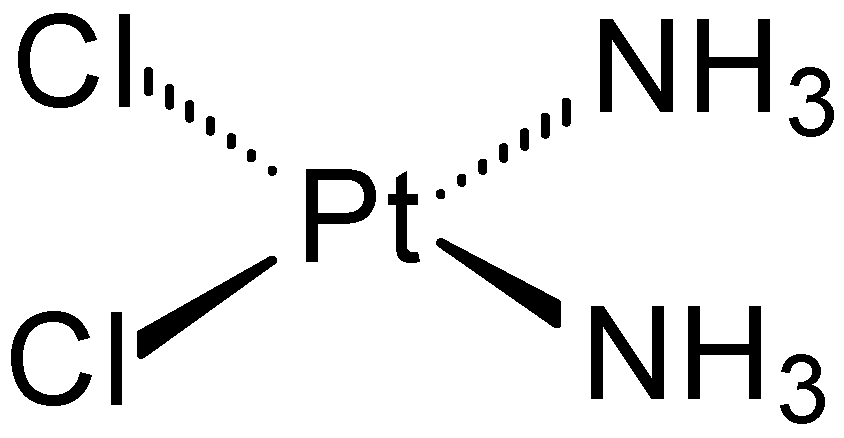
- Kauffman, G.B.; Pentimalli, R.; Doldi, S.; Hall, M.D.; Peyrone, M. Discoverer of Cisplatin. Platin. Met. Rev. 2010, 54, 250–256. [Google Scholar] [CrossRef]
- Rosenberg, B.; Vancamp, L.; Trosko, J.E.; Mansour, V.H. Platinum Compounds: A New Class of Potent Antitumour Agents. Nature 1969, 222, 385–386. [Google Scholar] [CrossRef]
- Pangarkar, K. Development of cisplatin as an anti-cancer drug. GSC Adv. Res. Rev. 2025, 23, 005–011. [Google Scholar] [CrossRef]
- Johnstone, T.C.; Park, G.Y.; Lippard, S.J. Understanding and Improving Platinum Anticancer Drugs—Phenanthriplatin. Anticancer Res. 2014, 34, 471–476. [Google Scholar]
- Galanski, M.S.; Jakupec, M.A.; Keppler, B.K. Update of the Preclinical Situation of Anticancer Platinum Complexes: Novel Design Strategies and Innovative Analytical Approaches. Curr. Med. Chem. 2005, 12, 2075–2094, Erratum in Curr. Med. Chem. 2023, 30, 4167. [Google Scholar] [CrossRef]
- Ndagi, U.; Mhlongo, N.; Soliman, M.E. Metal Complexes in Cancer Therapy—An Update from Drug Design Perspective. Drug Des. Dev. Ther. 2017, 11, 599–616. [Google Scholar] [CrossRef]
- Nath, P.; Datta, A.; Adhikari, S. Recent Advances of Metal-Based Anticancer Agents and Their In Vivo Potential Against Various Types of Malignancies. In Handbook of Animal Models and its Uses in Cancer Research; Springer: Singapore, 2022; pp. 1–28. ISBN 978-981-19-1282-5. [Google Scholar]
- Bhattacharjee, T.; Adhikari, S.; Bhattacharjee, S.; Debnath, S.; Das, A.; Daniliuc, C.G.; Thirumoorthy, K.; Malayaperumal, S.; Banerjee, A.; Pathak, S.; et al. Exploring Dithiolate-Amine Binary Ligand Systems for the Supramolecular Assemblies of Ni(II) Coordination Compounds: Crystal Structures, Theoretical Studies, Cytotoxicity Studies, and Molecular Docking Studies. Inorg. Chim. Acta 2022, 543, 121157. [Google Scholar] [CrossRef]
- Yu, M.; Zhang, Y.; Fang, M.; Jehan, S.; Zhou, W. Current Advances of Nanomedicines Delivering Arsenic Trioxide for Enhanced Tumor Therapy. Pharmaceutics 2022, 14, 743. [Google Scholar] [CrossRef]
- Varol, M.; Koparal, A.T.; Benkli, K.; Bostancioglu, R.B. Anti-Lung Cancer and Anti-Angiogenic Activities of New Designed Boronated Phenylalanine Metal Complexes. Curr. Drug Deliv. 2018, 15, 1417–1425. [Google Scholar] [CrossRef]
- Raczuk, E.; Dmochowska, B.; Samaszko-Fiertek, J.; Madaj, J. Different Schiff Bases—Structure, Importance and Classification. Molecules 2022, 27, 787. [Google Scholar] [CrossRef]
- Santini, C.; Pellei, M.; Gandin, V.; Porchia, M.; Tisato, F.; Marzano, C. Advances in Copper Complexes as Anticancer Agents. Chem. Rev. 2013, 114, 815–862. [Google Scholar] [CrossRef]
- Levina, A.; Crans, D.C.; Lay, P.A. Advantageous Reactivity of Unstable Metal Complexes: Potential Applications of Metal-Based Anticancer Drugs for Intratumoral Injections. Pharmaceutics 2022, 14, 790. [Google Scholar] [CrossRef]
- Matela, G. Schiff Bases and Complexes: A Review on Anti-Cancer Activity. Anti-Cancer Agents Med. Chem. 2020, 20, 1908–1917. [Google Scholar] [CrossRef]
- Sathiyanarayanan, V.; Prasath, P.V.; Sekhar, P.C.; Ravichandran, K.; Easwaramoorthy, D.; Mohammad, F.; Al-Lohedan, H.A.; Oh, W.C.; Sagadevan, S. Docking and in Vitro Molecular Biology Studies of P-Anisidine-Appended 1-Hydroxy-2-Acetonapthanone Schiff Base Lanthanum(III) Complexes. RSC Adv. 2020, 10, 16457–16472. [Google Scholar] [CrossRef]
- Singh, N.K.; Kumbhar, A.A.; Pokharel, Y.R.; Yadav, P.N. Anticancer Potency of Copper(II) Complexes of Thiosemicarbazones. J. Inorg. Biochem. 2020, 210, 111134. [Google Scholar] [CrossRef]
- Tadele, K.T.; Tsega, T.W. Schiff Bases and Their Metal Complexes as Potential Anticancer Candidates: A Review of Recent Works. Anti-Cancer Agents Med. Chem. 2019, 19, 1786–1795. [Google Scholar] [CrossRef]
- Malik, M.A.; Dar, O.A.; Gull, P.; Wani, M.Y.; Hashmi, A.A. Heterocyclic Schiff Base Transition Metal Complexes in Antimicrobial and Anticancer Chemotherapy. Med. Chem. Commun. 2018, 9, 409–436. [Google Scholar] [CrossRef]
- Deo, K.M.; Pages, B.J.; Ang, D.L.; Gordon, C.P.; Aldrich-Wright, J.R. Transition Metal Intercalators as Anticancer Agents—Recent Advances. Int. J. Mol. Sci. 2016, 17, 1818. [Google Scholar] [CrossRef]
- Zafar, W.; Sumrra, S.H.; Chohan, Z.H. A Review: Pharmacological Aspects of Metal Based 1,2,4-Triazole Derived Schiff Bases. Eur. J. Med. Chem. 2021, 222, 113602. [Google Scholar] [CrossRef]
- Jiang, M.; Yan, Q.; Fu, Y.; Meng, L.; Gai, S.; Pan, X.; Qin, Y.; Jiang, C. Development of Cu(II) 4-Hydroxybenzoylhydrazone Complexes That Induce Mitochondrial DNA Damage and Mitochondria-Mediated Apoptosis in Liver Cancer. J. Inorg. Biochem. 2024, 256, 112550. [Google Scholar] [CrossRef]
- Masood, S.; Jamshaid, M.; Zafar, M.N.; Mughal, E.U.; Ashfaq, M.; Tahir, M.N. ONO-Pincer Zn(II) & Cd(II) Complexes: Synthesis, Structural Characterization, Hirshfeld Surface Analysis and CTDNA Interactions. J. Mol. Struct. 2024, 1295, 136571. [Google Scholar] [CrossRef]
- Cao, Q.; Li, Y.; Freisinger, E.; Qin, P.Z.; Sigel, R.K.O.; Mao, Z.-W. G-Quadruplex DNA Targeted Metal Complexes Acting as Potential Anticancer Drugs. Inorg. Chem. Front. 2017, 4, 10–32. [Google Scholar] [CrossRef]
- Podolski-Renić, A.; Čipak Gašparović, A.; Valente, A.; López, Ó.; Bormio Nunes, J.H.; Kowol, C.R.; Heffeter, P.; Filipović, N.R. Schiff Bases and Their Metal Complexes to Target and Overcome (Multidrug) Resistance in Cancer. Eur. J. Med. Chem. 2024, 270, 116363. [Google Scholar] [CrossRef]
- Abu-Dief, A.M.; Mohamed, I.M.A. A Review on Versatile Applications of Transition Metal Complexes Incorporating Schiff Bases. Beni-Suef Univ. J. Basic Appl. Sci. 2015, 4, 119–133. [Google Scholar] [CrossRef]
- More, M.S.; Joshi, P.G.; Mishra, Y.K.; Khanna, P.K. Metal Complexes Driven from Schiff Bases and Semicarbazones for Biomedical and Allied Applications: A Review. Mater. Today Chem. 2019, 14, 100195. [Google Scholar] [CrossRef]
- Prakash, A.; Adhikari, D. Application of Schiff Bases and Their Metal Complexes-A Review. Int. J. ChemTech Res. 2011, 3, 1891–1896. [Google Scholar]
- Boulechfar, C.; Ferkous, H.; Delimi, A.; Djedouani, A.; Kahlouche, A.; Boublia, A.; Darwish, A.S.; Lemaoui, T.; Verma, R.; Benguerba, Y. Schiff Bases and Their Metal Complexes: A Review on the History, Synthesis, and Applications. Inorg. Chem. Commun. 2023, 150, 110451. [Google Scholar] [CrossRef]
- Uddin, M.N.; Ahmed, S.S.; Alam, S.M.R. REVIEW: Biomedical Applications of Schiff Base Metal Complexes. J. Coord. Chem. 2020, 73, 3109–3149. [Google Scholar] [CrossRef]
- Juyal, V.K.; Pathak, A.; Panwar, M.; Thakuri, S.C.; Prakash, O.; Agrwal, A.; Nand, V. Schiff Base Metal Complexes as a Versatile Catalyst: A Review. J. Organomet. Chem. 2023, 999, 122825. [Google Scholar] [CrossRef]
- Ebosie, N.P.; Ogwuegbu, M.O.C.; Onyedika, G.O.; Onwumere, F.C. Biological and Analytical Applications of Schiff Base Metal Complexes Derived from Salicylidene-4-Aminoantipyrine and Its Derivatives: A Review. J. Iran. Chem. Soc. 2021, 18, 3145–3175. [Google Scholar] [CrossRef]
- Berhanu, A.L.; Gaurav; Mohiuddin, I.; Malik, A.K.; Aulakh, J.S.; Kumar, V.; Kim, K.-H. A Review of the Applications of Schiff Bases as Optical Chemical Sensors. TrAC Trends Anal. Chem. 2019, 116, 74–91. [Google Scholar] [CrossRef]
- Sandhu, Q.-U.-A.; Pervaiz, M.; Majid, A.; Younas, U.; Saeed, Z.; Ashraf, A.; Khan, R.R.M.; Ullah, S.; Ali, F.; Jelani, S. Review: Schiff Base Metal Complexes as Anti-Inflammatory Agents. J. Coord. Chem. 2023, 76, 1094–1118. [Google Scholar] [CrossRef]
- Sonawane, H.R.; Vibhute, B.T.; Aghav, B.D.; Deore, J.V.; Patil, S.K. Versatile Applications of Transition Metal Incorporating Quinoline Schiff Base Metal Complexes: An Overview. Eur. J. Med. Chem. 2023, 258, 115549. [Google Scholar] [CrossRef]
- Kalaiarasi, G.; Dharani, S.; Rajkumar, S.R.J.; Lynch, V.M.; Prabhakaran, R. Binuclear Ni(II) Complexes Containing ONS Donor Schiff Base Ligands: Preparation, Spectral Characterization, X-Ray Crystallography and Biological Exploration. J. Inorg. Biochem. 2020, 211, 111176. [Google Scholar] [CrossRef]
- Aazam, E.S.; Majrashi, M.A. Novel Schiff Base Derived from Amino Pyrene: Synthesis, Characterization, Crystal Structure Determination, and Anticancer Applications of the Ligand and Its Metal Complexes. Molecules 2023, 28, 7352. [Google Scholar] [CrossRef]
- Paliwal, K.; Swain, A.; Mishra, D.P.; Antharjanam, P.K.S.; Kumar, M. A Novel Copper(II) Complex with a Salicylidene Carbohydrazide Ligand That Promotes Oxidative Stress and Apoptosis in Triple Negative Breast Cancer Cells. Dalton Trans. 2024, 53, 17702–17720. [Google Scholar] [CrossRef]
- Paul, A.; Singh, P.; Kuznetsov, M.L.; Karmakar, A.; da Silva, M.F.C.G.; Koch, B.; Pombeiro, A.J.L. Influence of Anchoring Moieties on New Benzimidazole-Based Schiff Base Copper(II) Complexes towards Estrogen Dependent Breast Cancer Cells. Dalton Trans. 2021, 50, 3701–3716. [Google Scholar] [CrossRef]
- Kavitha, R.; Reddy, C.V.R.; Sireesha, B. Synthesis, Spectroscopic and Biological Activity Evaluation of Ni(II), Cu(II) and Zn(II) Complexes of Schiff Base Derived from Pyridoxal and 4-Fluorobenzohydrazide. Nucleosides Nucleotides Nucleic Acids 2021, 40, 845–866. [Google Scholar] [CrossRef]
- Priya, J.; Madheswari, D. Biomolecular Docking Interactions, Cytotoxicity and Antioxidant Property Evaluations with Novel Mn(II), Ni(II), Cd(II) and Pb(II) Schiff Base Ligand Complexes: Synthesis and Characterization. J. Biosci. 2022, 47, 29. [Google Scholar] [CrossRef]
- Ferretti, V.; Matos, C.P.; Canelas, C.; Pessoa, J.C.; Tomaz, A.I.; Starosta, R.; Correia, I.; León, I.E. New Ternary Fe(III)-8-Hydroxyquinoline–Reduced Schiff Base Complexes as Selective Anticancer Drug Candidates. J. Inorg. Biochem. 2022, 236, 111961. [Google Scholar] [CrossRef]
- Noureldeen, A.F.H.; Aziz, S.W.; Shouman, S.A.; Mohamed, M.M.; Attia, Y.M.; Ramadan, R.M.; Elhady, M.M. Molecular Design, Spectroscopic, DFT, Pharmacological, and Molecular Docking Studies of Novel Ruthenium(III)–Schiff Base Complex: An Inhibitor of Progression in HepG2 Cells. Int. J. Environ. Res. Public. Health 2022, 19, 13624. [Google Scholar] [CrossRef]
- Sasikumar, G.; Subramani, A.; Tamilarasan, R.; Rajesh, P.; Sasikumar, P.; Albukhaty, S.; Mohammed, M.K.A.; Karthikeyan, S.; Al-aqbi, Z.T.; Al-Doghachi, F.A.J.; et al. Catalytic, Theoretical, and Biological Investigations of Ternary Metal (II) Complexes Derived from L-Valine-Based Schiff Bases and Heterocyclic Bases. Molecules 2023, 28, 2931. [Google Scholar] [CrossRef]
- Abdel-Rahman, L.H.; Abdelghani, A.A.; AlObaid, A.A.; El-ezz, D.A.; Warad, I.; Shehata, M.R.; Abdalla, E.M. Novel Bromo and Methoxy Substituted Schiff Base Complexes of Mn(II), Fe(III), and Cr(III) for Anticancer, Antimicrobial, Docking, and ADMET Studies. Sci. Rep. 2023, 13, 3199. [Google Scholar] [CrossRef]
- Ghasemi, L.; Esfahani, M.H.; Sahebi, U.; Divsalar, A.; Abbasi, A.; Behzad, M. Experimental and Molecular Docking Investigation of Anticancer Activity of New Mixed-Ligand Schiff Base Complexes against Human Colorectal (HCT116), Lung (A549) and Breast (MCF7) Carcinoma Cell Lines. J. Mol. Struct. 2023, 1294, 136568. [Google Scholar] [CrossRef]
- Gültekin, B.; Özbağcı, D.I.; Aydın, İ.; Aydın, R.; Arı, F.; Zorlu, Y. New Copper(II) Complexes Containing Tryptophan Based Schiff Bases as Promising Antiproliferative Agents on Breast Cancer Cells. J. Mol. Struct. 2024, 1301, 137273. [Google Scholar] [CrossRef]
- Mahadevi, P.; Sumathi, S.; Mehta, A. Ternary Schiff Base Metal (II) Complexes with N,N,N′,N′-Tetramethylethylenediamine: Influence of Secondary Chelates on Antimicrobial, Scavenging Activity, DNA Interaction and Cytotoxicity. Polyhedron 2024, 255, 116951. [Google Scholar] [CrossRef]
- Behzad, M.; Ghasemi, L.; Hossieni, S.B.; Esfahani, M.H.; Divsalar, A.; Kučeráková, M.; Dusek, M. Cu(II) Complexes with Unsymmetrical N3O-Type Schiff Base Ligands: Synthesis, Crystal Structures, in Vitro Antiproliferative Studies against the Human Breast (MCF-7), Colon (HCT-116) and Lung (A549) Cancer Cell Lines, and Molecular Docking Studies. Inorg. Chem. Commun. 2025, 177, 114367. [Google Scholar] [CrossRef]
- Devraye, S.; Jadhav, S.; Zangade, S. Preparation, Structure Elucidation, Free Radical Scavenging, in-Vitro Antimicrobial and Cytotoxic Proficiency of Isoniazid Incorporated Tridentate Co(II), Ni(II), Cu(II) and Zn(II) Schiff Base-Metal Complexes. Results Chem. 2025, 16, 102407. [Google Scholar] [CrossRef]
- Mansour, M.S.A.; Abdelkarim, A.T.; El-Sherif, A.A.; Mahmoud, W.H. Metal Complexes Featuring a Quinazoline Schiff Base Ligand and Glycine: Synthesis, Characterization, DFT and Molecular Docking Analyses Revealing Their Potent Antibacterial, Anti-Helicobacter Pylori, and Anti-COVID-19 Activities. BMC Chem. 2024, 18, 150. [Google Scholar] [CrossRef]
- Asran, A.M.; Khalid Aldhalmi, A.; Nassar Ali Musa, E.; Fayek, A.A.; Mansour, M.S.A.; El-Sherif, A.A. Tridentate N-Donor Schiff Base Metal Complexes: Synthesis, Characterization, Computational Studies, and Assessment of Biomedical Applications in Cancer Therapy, Helicobacter Pylori Eradication, and COVID-19 Treatment. Inorg. Chem. Commun. 2025, 171, 113371. [Google Scholar] [CrossRef]
- Oliveira, D.H.; Aquino, T.B.; Nascimento, J.E.R.; Perin, G.; Jacob, R.G.; Alves, D. Direct Synthesis of 4-Organylselanylpyrazoles by Copper-Catalyzed One-Pot Cyclocondensation and C–H Bond Selenylation Reactions. Adv. Synth. Catal. 2015, 357, 4041–4049. [Google Scholar] [CrossRef]
- Pinheiro, A.C.; Busatto, F.F.; Schaefer, B.T.; Tomasini, P.P.; Nunes, I.J.; Machado, T.D.S.; Cargnelutti, R.; de Aquino, T.F.B.; Ferreira, K.D.Q.; Casaril, A.M.; et al. Synthesis, Characterization, Antioxidant Potential, and Cytotoxicity Screening of New Cu(II) Complexes with 4-(Arylchalcogenyl)-1H-Pyrazoles Ligands. J. Inorg. Biochem. 2022, 237, 112013. [Google Scholar] [CrossRef] [PubMed]
- Elsamra, R.M.I.; Masoud, M.S.; Ramadan, A.M. Designing Metal Chelates of Halogenated Sulfonamide Schiff Bases as Potent Nonplatinum Anticancer Drugs Using Spectroscopic, Molecular Docking and Biological Studies. Sci. Rep. 2022, 12, 20192. [Google Scholar] [CrossRef]
- Gopichand, K.; Mahipal, V.; Nageswara Rao, N.; Majeed Ganai, A.; Venkateswar Rao, P. Co(II), Ni(II), Cu(II), and Zn(II) Complexes with Benzothiazole Schiff Base Ligand: Preparation, Spectral Characterization, DNA Binding, and In Vitro Cytotoxic Activities. Results Chem. 2023, 5, 100868. [Google Scholar] [CrossRef]
- Samy, F.; Omar, F.M. Synthesis, Characterization, Antitumor Activity, Molecular Modeling and Docking of New Ligand, (2,5-Pyrrole)-Bis(5,6-Diphenyl-[1,2,4]-Triazin-3-Yl)Hydrazone and Its Complexes. J. Mol. Struct. 2020, 1222, 128910. [Google Scholar] [CrossRef]
- Lima, F.C.; Só, Y.A.O.; Gargano, R.; de Oliveira, D.M.; Gatto, C.C. Structural, Theoretical and Biological Activity of Mono and Binuclear Nickel(II) Complexes with Symmetrical and Asymmetrical 4,6-Diacetylresorcinol-Dithiocarbazate Ligands. J. Inorg. Biochem. 2021, 224, 111559. [Google Scholar] [CrossRef]
- Cavalcante, C.d.Q.O.; da Mota, T.H.A.; de Oliveira, D.M.; Nascimento, É.C.M.; Martins, J.B.L.; Pittella-Silva, F.; Gatto, C.C. Dithiocarbazate Ligands and Their Ni(II) Complexes with Potential Biological Activity: Structural, Antitumor and Molecular Docking Study. Front. Mol. Biosci. 2023, 10, 1146820. [Google Scholar] [CrossRef]
- Priya Gogoi, H.; Singh, A.; Barman, P.; Choudhury, D. A New Potential ONO Schiff-Base Ligand and Its Cu(II), Zn(II) and Cd(II) Complexes: Synthesis, Structural Elucidation, Theoretical and Bioactivity Studies. Inorg. Chem. Commun. 2022, 146, 110153. [Google Scholar] [CrossRef]
- Break, M.K.B.; Fung, T.Y.; Koh, M.Z.; Ho, W.Y.; Tahir, M.I.M.; Elfar, O.A.; Syed, R.U.; Khojali, W.M.A.; Alluhaibi, T.M.; Huwaimel, B.; et al. Synthesis, Crystal Structure, Antibacterial and In Vitro Anticancer Activity of Novel Macroacyclic Schiff Bases and Their Cu (II) Complexes Derived from S-Methyl and S-Benzyl Dithiocarbazate. Molecules 2023, 28, 5009. [Google Scholar] [CrossRef]
- Khoo, T.-J.; bin Break, M.K.; Crouse, K.A.; Tahir, M.I.M.; Ali, A.M.; Cowley, A.R.; Watkin, D.J.; Tarafder, M.T.H. Synthesis, Characterization and Biological Activity of Two Schiff Base Ligands and Their Nickel(II), Copper(II), Zinc(II) and Cadmium(II) Complexes Derived from S-4-Picolyldithiocarbazate and X-Ray Crystal Structure of Cadmium(II) Complex Derived from Pyridine-2-Carboxaldehyde. Inorg. Chim. Acta 2014, 413, 68–76. [Google Scholar] [CrossRef]
- Miglioli, F.; de Franco, M.; Bartoli, J.; Scaccaglia, M.; Pelosi, G.; Marzano, C.; Rogolino, D.; Gandin, V.; Carcelli, M. Anticancer Activity of New Water-Soluble Sulfonated Thiosemicarbazone Copper(II) Complexes Targeting Disulfide Isomerase. Eur. J. Med. Chem. 2024, 276, 116697. [Google Scholar] [CrossRef] [PubMed]
- Jansson, P.J.; Kalinowski, D.S.; Lane, D.J.R.; Kovacevic, Z.; Seebacher, N.A.; Fouani, L.; Sahni, S.; Merlot, A.M.; Richardson, D.R. The Renaissance of Polypharmacology in the Development of Anti-Cancer Therapeutics: Inhibition of the “Triad of Death” in Cancer by Di-2-Pyridylketone Thiosemicarbazones. Pharmacol. Res. 2015, 100, 255–260. [Google Scholar] [CrossRef]
- Yu, Y.; Kalinowski, D.S.; Kovacevic, Z.; Siafakas, A.R.; Jansson, P.J.; Stefani, C.; Lovejoy, D.B.; Sharpe, P.C.; Bernhardt, P.V.; Richardson, D.R. Thiosemicarbazones from the Old to New: Iron Chelators That Are More Than Just Ribonucleotide Reductase Inhibitors. J. Med. Chem. 2009, 52, 5271–5294. [Google Scholar] [CrossRef]
- Nayab, S.; Jan, K.; Kim, S.-H.; Kim, S.-H.; Shams, D.F.; Son, Y.; Yoon, M.; Lee, H. Insight into the Inhibitory Potential of Metal Complexes Supported by (E)-2-Morpholino-N-(Thiophen-2-Ylmethylene)Ethanamine: Synthesis, Structural Properties, Biological Evaluation and Docking Studies. Dalton Trans. 2024, 53, 11295–11309. [Google Scholar] [CrossRef]
- Sumi, M.; Nevaditha, N.T.; Sindhu Kumari, B. Synthesis, Structural Evaluation, Antioxidant, DNA Cleavage, Anticancer Activities and Molecular Docking Study of Metal Complexes of 2-Amino Thiophene Derivative. J. Mol. Struct. 2023, 1272, 134091. [Google Scholar] [CrossRef]
- Tweedy, B.G. Plant Extracts with Metal Ions as Potential Antimicrobial Agents. Phytopathology 1964, 55, 910–914. [Google Scholar]
- Machado, R.A.D.S.; Siqueira, R.P.; da Silva, F.C.; Matos, A.C.P.d.; Borges, D.S.; Rocha, G.G.; Souza, T.C.P.d.; Souza, R.A.C.; Oliveira, C.R.d.; Ferreira, A.G.; et al. A New Heteroleptic Zn(II) Complex with Schiff Bases Sensitizes Triple-Negative Breast Cancer Cells to Doxorubicin and Paclitaxel. Pharmaceutics 2024, 16, 1610. [Google Scholar] [CrossRef]
- Alghabban, H.M.; Nass, N.M.; Alaeq, R.A.; Alghabban, D.M.; Alrahimi, J.; Jambi, R.J.; Abd El-Karim, A.T.; Mansour, M.S.A.; Fayek, A.A.; El-Sherif, A.A. Synthesis, Characterization, DFT Analysis, and Molecular Docking Studies of Carbothioamide Schiff Base-Phenanthroline Ternary Metal Complexes: Multi-Targeted Therapeutic Agents against Leukemia, and Biomedical Application. Med. Oncol. 2025, 42, 336. [Google Scholar] [CrossRef]
- Richa; Kumar, V.; Kataria, R. Phenanthroline and Schiff Base Associated Cu(II)-Coordinated Compounds Containing N, O as Donor Atoms for Potent Anticancer Activity. J. Inorg. Biochem. 2024, 251, 112440. [Google Scholar] [CrossRef]
- Kinthada, P.M.M.S.; Prabhakar, L.D.; Venkata Reddy, D. Synthesis and Characterization of Complexes of (4-Methoxybenzaldehyde)-4-Phenyl-3-Thiosemicarbazone. Inorg. Chim. Acta 1988, 141, 179–183. [Google Scholar] [CrossRef]
- İlkimen, H.; Yenikaya, C.; Sarı, M.; Bülbül, M.; Aslan, M.; Süzen, Y. Synthesis and Characterization of Some Metal Complexes of a Proton Transfer Salt, and Their Inhibition Studies on Carbonic Anhydrase Isozymes and the Evaluation of the Results by Statistical Analysis. J. Enzym. Inhib. Med. Chem. 2014, 29, 695–701. [Google Scholar] [CrossRef] [PubMed]
- Michael, S.; Jeyaraman, P.; Jancy, J.V.; Muniyandi, V.; Raman, N. Exploring the Enzyme Inhibitor Potential and Therapeutic Applications of Transition Metal Complexes of Methoxy-Schiff Base via Triangular Investigation. Int. J. Biol. Macromol. 2025, 306, 141760. [Google Scholar] [CrossRef] [PubMed]
- Mahdy, A.; Zahra, J.A.; Haddadin, R.N.; Al-Hiari, Y.; Kasabri, V. Multi-Biological Activity Evaluation of Sn(П), Zn(П) and Fe(П) Complexes Based on Thiocarbohydrazide Schiff Bases: Synthesis, Spectroscopic Investigations and Fluorescence Studies. Sci. Rep. 2025, 15, 31757. [Google Scholar] [CrossRef] [PubMed]
- Lugasi, S.O. New Synthetic Pathways for Thiocarbohydrazide and Salicylaldehyde Azine Compounds. Asian J. Chem. Sci. 2017, 3, 1–8. [Google Scholar] [CrossRef]
- Nwosu-Obieogu, K.; Kalu, U.C. In Situ Epoxidation of Sesame Seed Oil for Synthesis of a Bio-Based Resin. Eur. J. Sustain. DEV 2020, 4, em0121. [Google Scholar] [CrossRef]
- Dasgupta, S.; Kar, K.; Barua, A.; Ghosh, D.; Kabi, B.; Dewan, K.; Chandra, A. A Significantly Non-Toxic Novel Cobalt(III) Schiff Base Complex Induces Apoptosis via G2-M Cell Cycle Arrest in Human Breast Cancer Cell Line MCF-7. Life Sci. 2022, 308, 120963. [Google Scholar] [CrossRef]
- Mijatović, A.; Gligorijević, N.; Ćoćić, D.; Spasić, S.; Lolić, A.; Aranđelović, S.; Nikolić, M.; Baošić, R. In Vitro and in Silico Study of the Biological Activity of Tetradentate Schiff Base Copper(II) Complexes with Ethylenediamine-Bridge. J. Inorg. Biochem. 2023, 244, 112224. [Google Scholar] [CrossRef]
- Mahmood, K.; Akhter, Z.; Perveen, F.; Aisha; Bibi, M.; Ismail, H.; Tabassum, N.; Yousuf, S.; Ashraf, A.R.; Qayyum, M.A. Synthesis, DNA Binding and Biological Evaluation of Benzimidazole Schiff Base Ligands and Their Metal(Ii) Complexes. RSC Adv. 2023, 13, 11982–11999. [Google Scholar] [CrossRef]
- Feizpour, S.; Hosseini-Yazdi, S.A.; Safarzadeh, E.; Baradaran, B.; Dusek, M.; Poupon, M. A Novel Water-Soluble Thiosemicarbazone Schiff Base Ligand and Its Complexes as Potential Anticancer Agents and Cellular Fluorescence Imaging. J. Biol. Inorg. Chem. 2023, 28, 457–472. [Google Scholar] [CrossRef]
- Mirzaahmadi, A.; Hosseini-Yazdi, S.A.; Safarzadeh, E.; Baradaran, B.; Samolova, E.; Dusek, M. New Series of Water-Soluble Thiosemicarbazones and Their Copper(II) Complexes as Potentially Promising Anticancer Compounds. J. Mol. Liq. 2019, 293, 111412. [Google Scholar] [CrossRef]
- Neamțu, M.; Macaev, F.; Boldescu, V.; Hodoroaba, V.-D.; Nădejde, C.; Schneider, R.J.; Paul, A.; Ababei, G.; Panne, U. Removal of Pollutants by the New Fenton-like Highly Active Catalysts Containing an Imidazolium Salt and a Schiff Base. Appl. Catal. B Environ. 2016, 183, 335–342. [Google Scholar] [CrossRef]
- Mamta; Chaudhary, A. Novel Tetraaza Macrocyclic Schiff Base Complexes of Bivalent Zinc: Microwave-Assisted Green Synthesis, Spectroscopic Characterization, Density Functional Theory Calculations, Molecular Docking Studies, in Vitro Antimicrobial and Anticancer Activities. Biometals 2024, 37, 1431–1456. [Google Scholar] [CrossRef] [PubMed]
- Mamta; Pinki; Chaudhary, A. Synthesis, Spectroscopic Elucidation, Density Functional Theory Calculation, and Molecular Docking Studies of a Novel Series of Tetradentate Macrocyclic Schiff Base Ligands and Their Zn(II) Complexes and Investigations of Their Antimicrobial, Anti-Inflammatory, and Anticancer Activities. Appl. Organomet. Chem. 2024, 38, e7330. [Google Scholar] [CrossRef]
- Mamta; Chaudhary, A. Synthesis, DFT Calculation, Molecular Docking Studies and Biological Evaluation of a Novel Series of Schiff Base Tetradentate Macrocyclic Ligands and Their Zn(II) Complexes as Antimicrobial, Anti-Inflammatory and Anticancer Agents. Res. Chem. Intermed. 2023, 49, 4671–4712. [Google Scholar] [CrossRef]
- Mamta; Chaudhary, A. Synthesis, Spectroscopic Characterization, in Vitro Antimicrobial Activity, Antioxidant Study and Theoretical Approaches towards DNA Gyrase, DHFR Enzyme, NADPH Enzyme of N8-Tetraoxomacrocyclic Complexes of Zn(II). J. Mol. Struct. 2024, 1295, 136743. [Google Scholar] [CrossRef]
- Manjare, S.B.; Mahadik, R.K.; Manval, K.S.; More, P.P.; Dalvi, S.S. Microwave-Assisted Rapid and Green Synthesis of Schiff Bases Using Cashew Shell Extract as a Natural Acid Catalyst. ACS Omega 2023, 8, 473–479. [Google Scholar] [CrossRef]
- Kumar, A.; Kuang, Y.; Liang, Z.; Sun, X. Microwave Chemistry, Recent Advancements, and Eco-Friendly Microwave-Assisted Synthesis of Nanoarchitectures and Their Applications: A Review. Mater. Today Nano 2020, 11, 100076. [Google Scholar] [CrossRef]
- Zinman, P.S.; Welsh, A.; Omondi, R.O.; Khan, S.; Prince, S.; Nordlander, E.; Smith, G.S. Aminoquinoline-Based Re(I) Tricarbonyl Complexes: Insights into Their Antiproliferative Activity and Mechanisms of Action. Eur. J. Med. Chem. 2024, 266, 116094. [Google Scholar] [CrossRef]
- Maurya, S.S.; Bahuguna, A.; Khan, S.I.; Kumar, D.; Kholiya, R.; Rawat, D.S. N-Substituted Aminoquinoline-Pyrimidine Hybrids: Synthesis, in vitro Antimalarial Activity Evaluation and Docking Studies. Eur. J. Med. Chem. 2019, 162, 277–289. [Google Scholar] [CrossRef]
- Musonda, C.C.; Gut, J.; Rosenthal, P.J.; Yardley, V.; Carvalho de Souza, R.C.; Chibale, K. Application of Multicomponent Reactions to Antimalarial Drug Discovery. Part 2: New Antiplasmodial and Antitrypanosomal 4-Aminoquinoline γ- and δ-Lactams via a ‘Catch and Release’ Protocol. Bioorg. Med. Chem. 2006, 14, 5605–5615. [Google Scholar] [CrossRef] [PubMed]
- Côrte-Real, L.; Sergi, B.; Yildirim, B.; Colucas, R.; Starosta, R.; Fontrodona, X.; Romero, I.; André, V.; Acilan, C.; Correia, I. Enhanced Selectivity towards Melanoma Cells with Zinc(II)-Schiff Bases Containing Imidazole Derivatives. Dalton Trans. 2024, 53, 9416–9432. [Google Scholar] [CrossRef]
- Faheem, S.M.; Osman, H.M.; El-Tabl, A.S.; Abd-El Wahed, M.M.; Younes, S.M. New Nano-Complexes Targeting Protein 3S7S in Breast Cancer and Protein 4OO6 in Liver Cancer Investigated in Cell Line. Sci. Rep. 2024, 14, 16891. [Google Scholar] [CrossRef]
- Derafa, W.; Moustafa, B.S.; Mohamed, G.G.; Taha, R.H.; Farhana, A. Design and Synthesis of a Novel Isoleucine-Derived Schiff Base Ligand: Structural Characterization, Molecular Docking, and in Vitro Biological Activity Evaluation. Int. J. Health Sci. 2024, 18, 31–47. [Google Scholar]
- Yun, J.Y.; Kim, A.; Hwang, S.M.; Yun, D.; Lee, H.; Kim, K.-T.; Kim, C. A Novel Benzimidazole-Based Fluorescence Probe for Detecting Zinc Ion in Aqueous Solution and Zebrafish. Bull. Chem. Soc. Jpn. 2019, 92, 961–966. [Google Scholar] [CrossRef]
- Yarkandi, N.H.; El-Ghamry, H.A.; Gaber, M. Synthesis, Spectroscopic and DNA Binding Ability of CoII, NiII, CuII and ZnII Complexes of Schiff Base Ligand (E)-1-(((1H-Benzo[d]Imidazol-2-Yl)Methylimino)Methyl)Naphthalen-2-Ol. X-Ray Crystal Structure Determination of Cobalt (II) Complex. Mater. Sci. Eng. C 2017, 75, 1059–1067. [Google Scholar] [CrossRef]
- Ferreira, W.V.; Ráice, F.R.; da Silva, A.F.; Nunes, I.J.; Cervo, R.; Cargnelutti, R.; Saffi, J.; Milani, J.L.S.; Casagrande, O.d.L.; Pinheiro, A.C. Synthesis, Characterization, Electronic Properties, and Cytotoxic Activities on Cancer Cells Line of Novel Cu(II) Complexes with Benzimidazole-Schiff Base Tridentate Ligand. J. Mol. Struct. 2025, 1327, 141239. [Google Scholar] [CrossRef]
- Ibrahim, S.S.; Al-darwesh, M.Y.; Arkawazi, S.W.; Babakr, K.A.; Qader, I.N. Synthesis, Characterization, Antioxidant, Antibacterial Activity, and Molecular Docking Studies of Zn (II) and Cu (II) Complexes Nanoparticles. J. Mol. Struct. 2025, 1326, 141120. [Google Scholar] [CrossRef]







| Comp. | Ligand | Metal Ion | IC50 MCF-7 | Other Tested Cell Lines | Other Tests | Ref. |
|---|---|---|---|---|---|---|
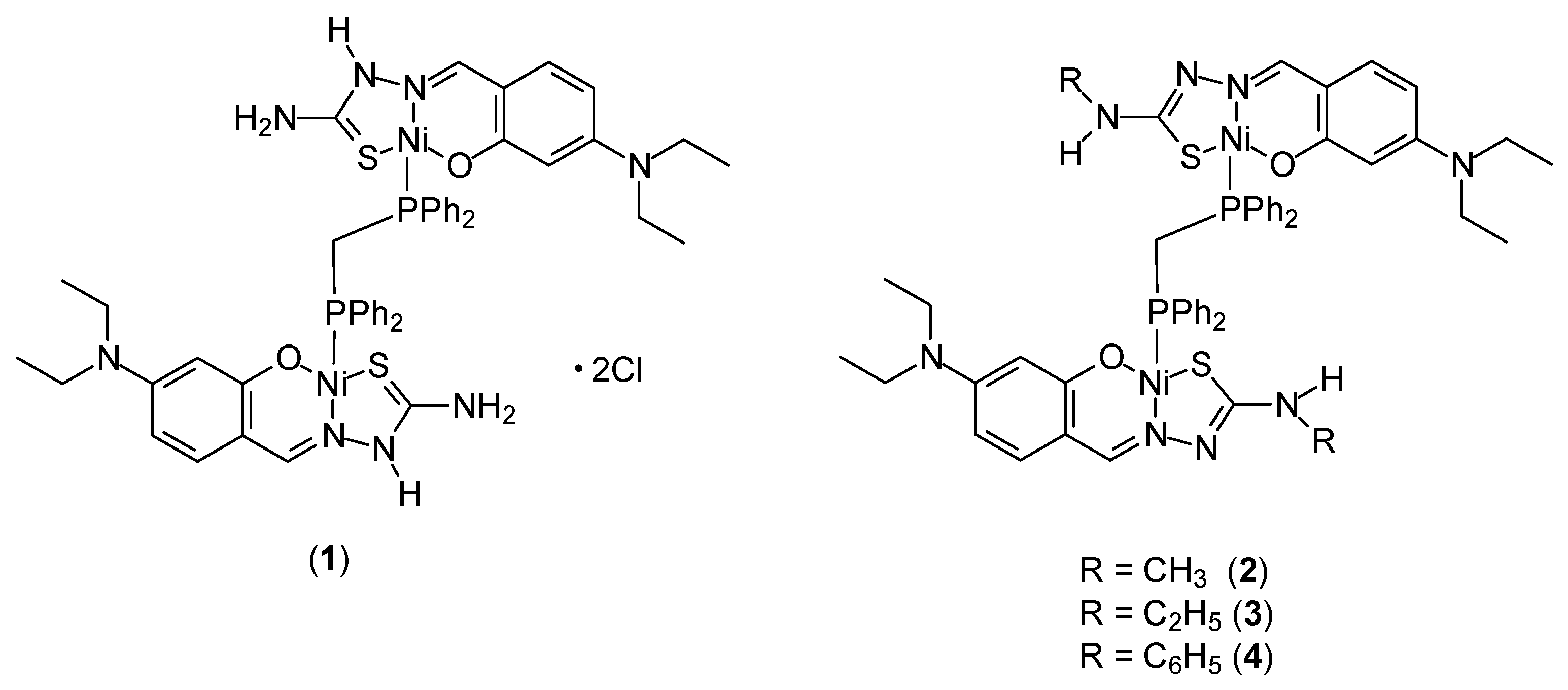
| 1 | 4(N,N)-diethylaminosalicylaldehyde-4(N)-thiosemicarbazone [H2-DEAsal-tsc] | Ni(II) | 5.37 ± 0.21 μM | A549 HeLa | ctDNA, BSA | [38] |
| 2 | 4(N,N)-diethylaminosalicylaldehyde-4(N)-methylthiosemicarbazone [H2-DEAsal-mtsc] | 4.91 ± 0.18 μM | ||||
| 3 | 4(N,N)-diethylaminosalicylaldehyde-4(N)-ethylthiosemicarbazone [H2-DEAsal-etsc] | 4.66 ± 0.22 μM | ||||
| 4 | 4(N,N)diethylaminosalicylaldehyde-4(N)-phenylthiosemicarbazone [H2-DEAsal-ptsc] | 5.69 ± 0.17 μM | ||||
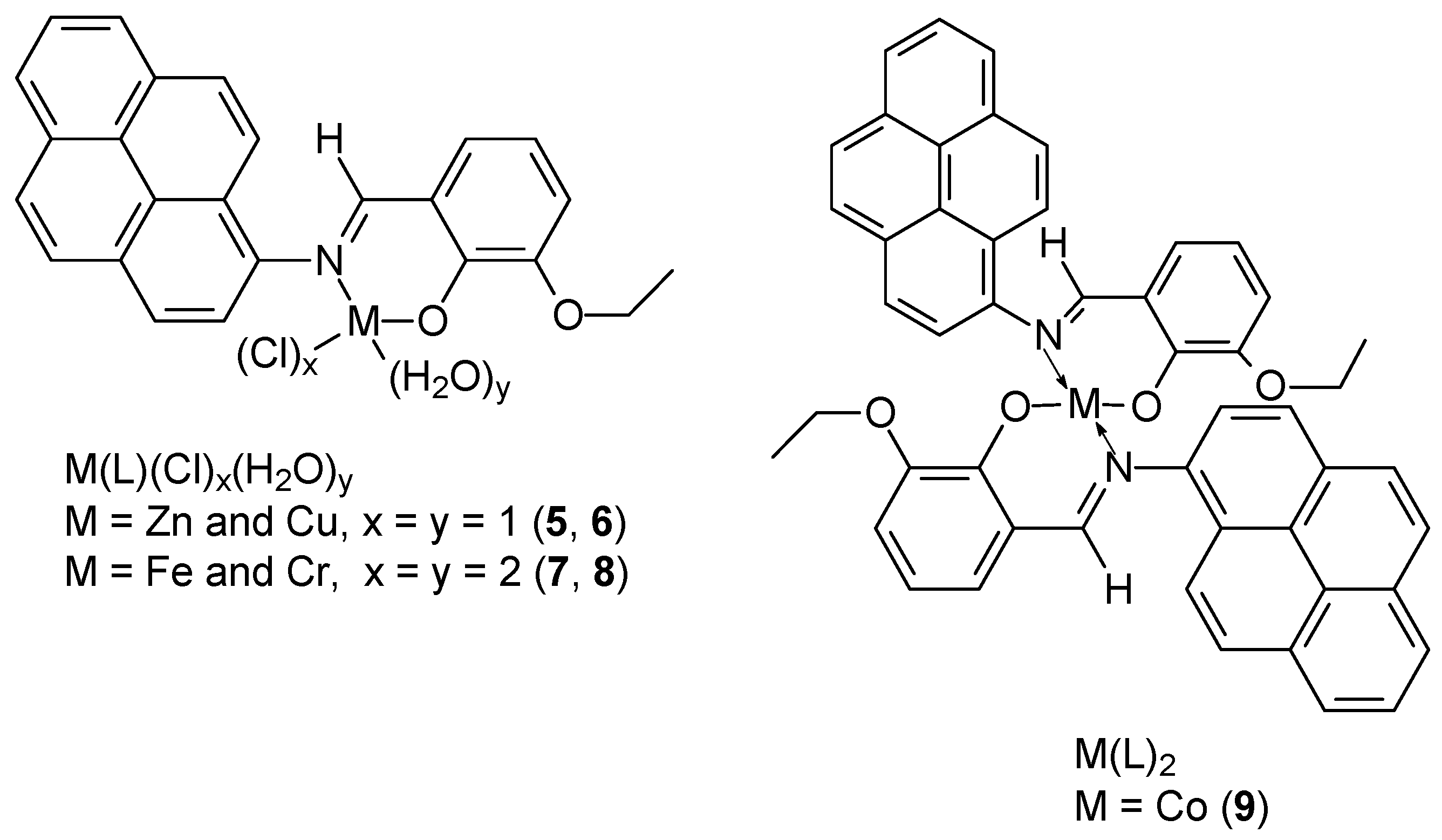
| 5 | ((E)-2-ethoxy-6((pyren-1-ylimino)methyl)phenol) | Zn(II) | 12.742 ± 0.73 μg/mL | [39] | ||
| 6 | Cu(II) | 5.661 ± 0.33 μg/mL | ||||
| 7 | Fe(III) | 58.708 ± 3.37 μg/mL | ||||
| 8 | Cr(III) | 16.895 ± 0.98 μg/mL | ||||
| 9 | Co(II) | 21.141 ± 1.21 μg/mL | ||||
| 10 | salicylidene carbohydrazide | Cu(II) | 2.22 ± 0.08 μM | MDA-MB-231 | ctDNA, ROS, MTT | [40] |
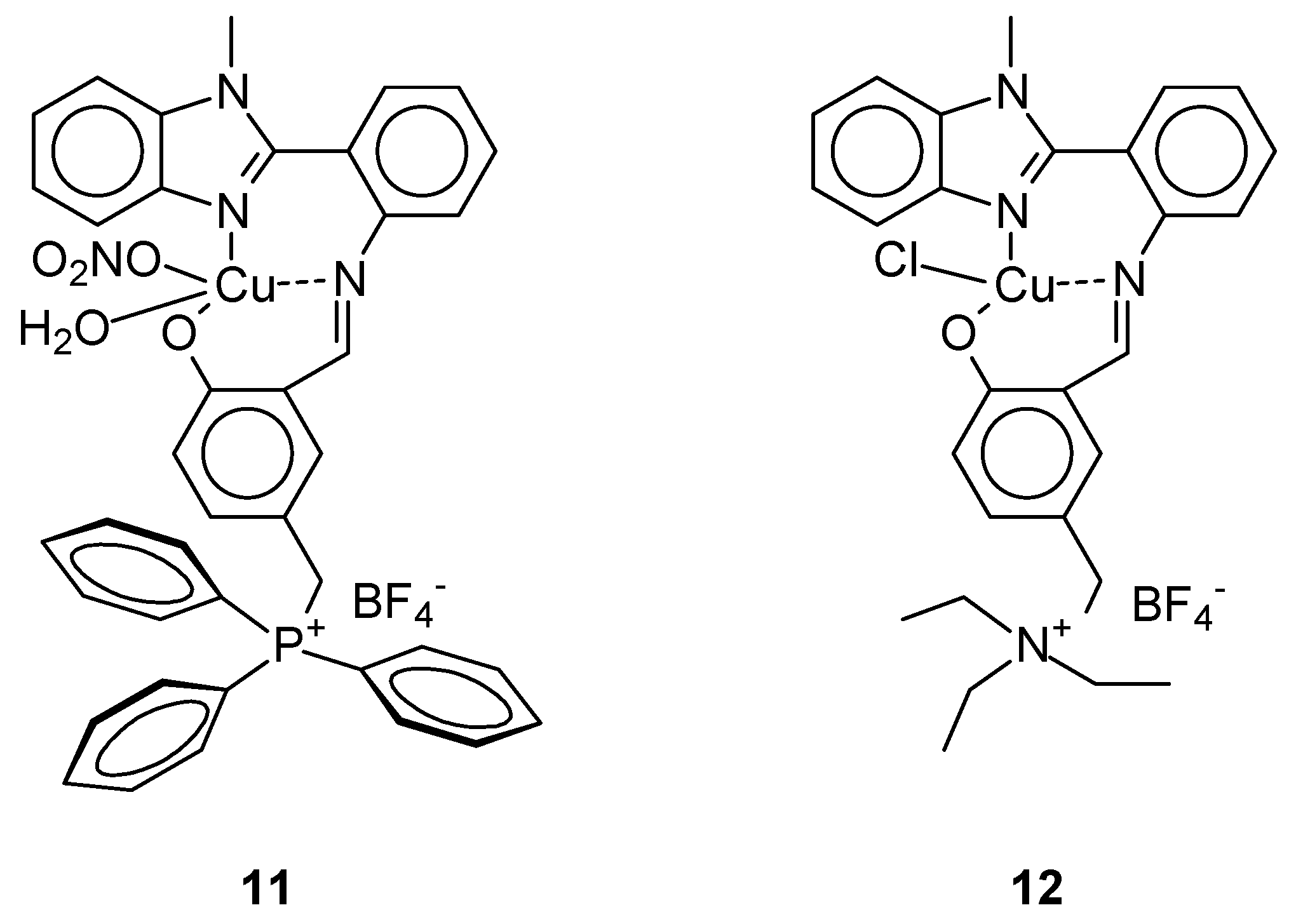
| 11 | 2-(1-methyl-1H-benzo[d]imidazol-2-yl)aniline with (3-formyl-4-hydroxybenzyl)triphenylphosphonium chloride | Cu(II) | 25.00 ± 1.17 μM | A-549 HeLa | ctDNA, ROS, AO/EB, MTT | [41] |
| 12 | 2-(1-methyl-1H-benzo[d]imidazol-2-yl)aniline with N,N-diethyl-N-(3-formyl-4-hydroxybenzyl)ethanaminium chloride | 80.12 ± 0.016 μM | HaCaT | Molecular docking with DNA | ||
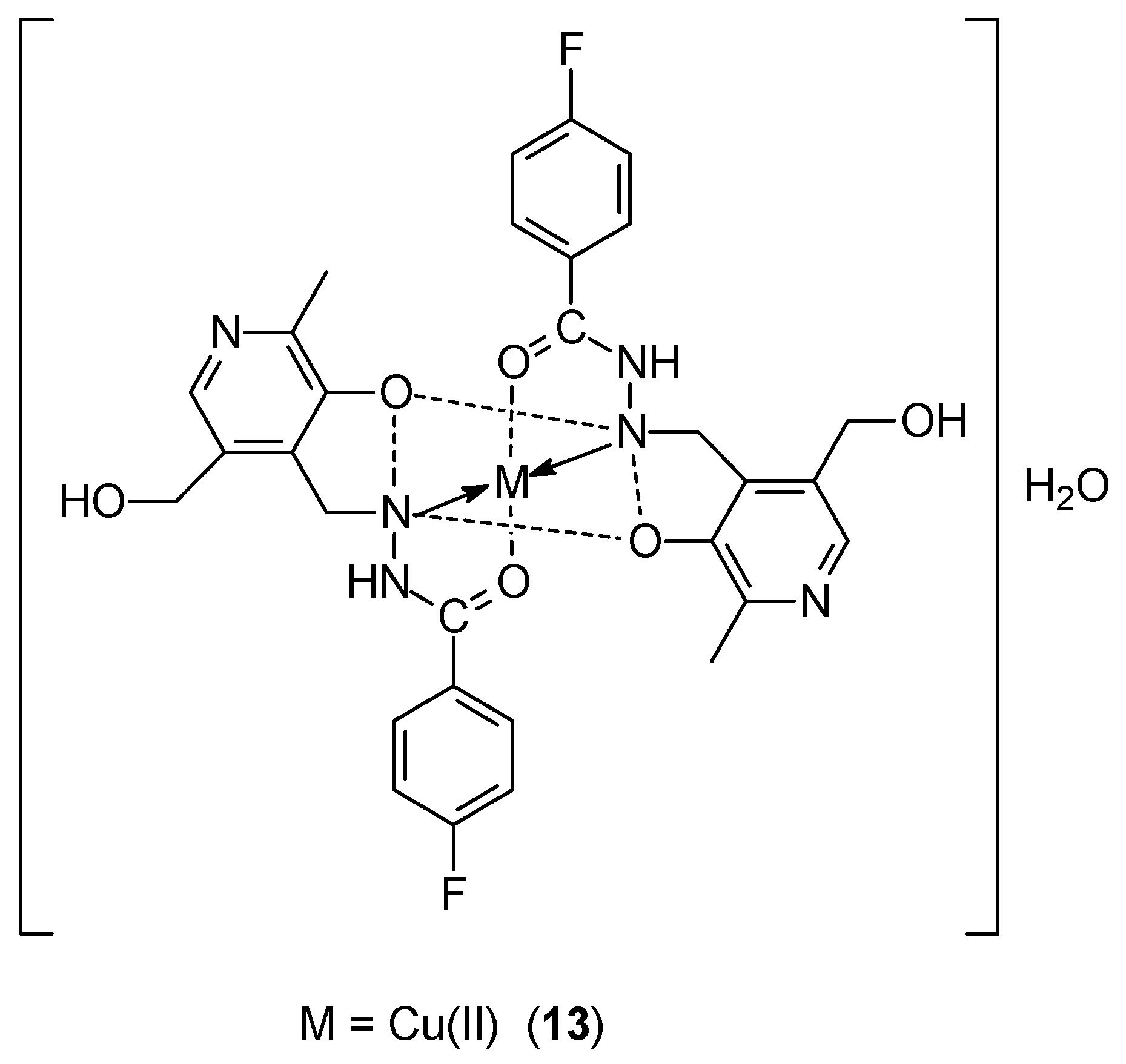
| 13 | 4-fluoro-N-((3-hydroxy-5-(hydroxymethyl)-2-methylpyridin-4-yl)methylene)benzohydrazide (PLFBH) | Cu(II) | 15.30 ± 0.55 μM | HelLa A549 | ctDNA | [42] |
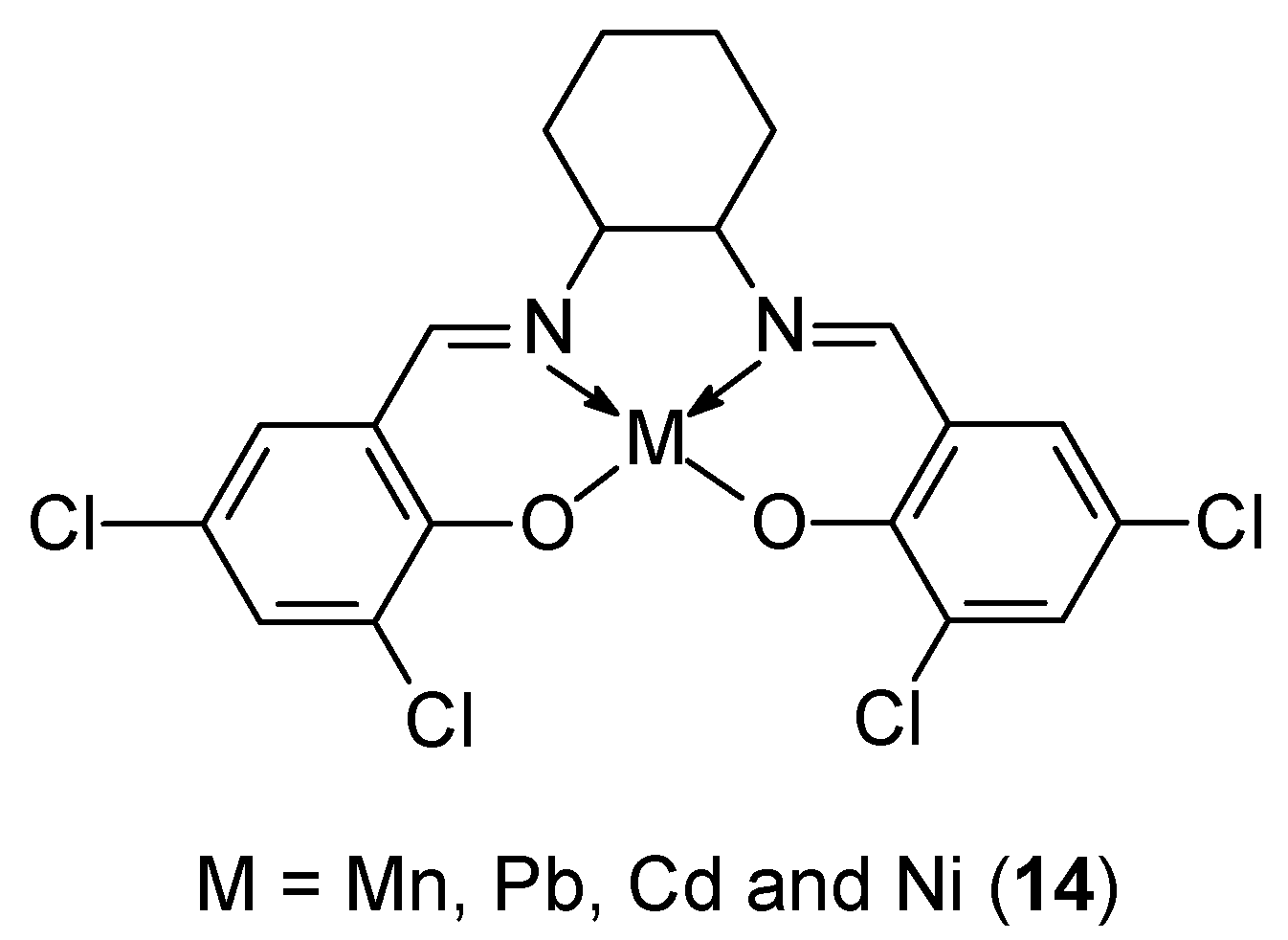
| 14 | 3,5-dichlorosalicylaldehyde and trans-1,2-diaminocyclohexane | Ni(II) | 108.1 µg/mL | DPPH Docking with BSA Docking DNA, MTT test PAINS | [43] | |
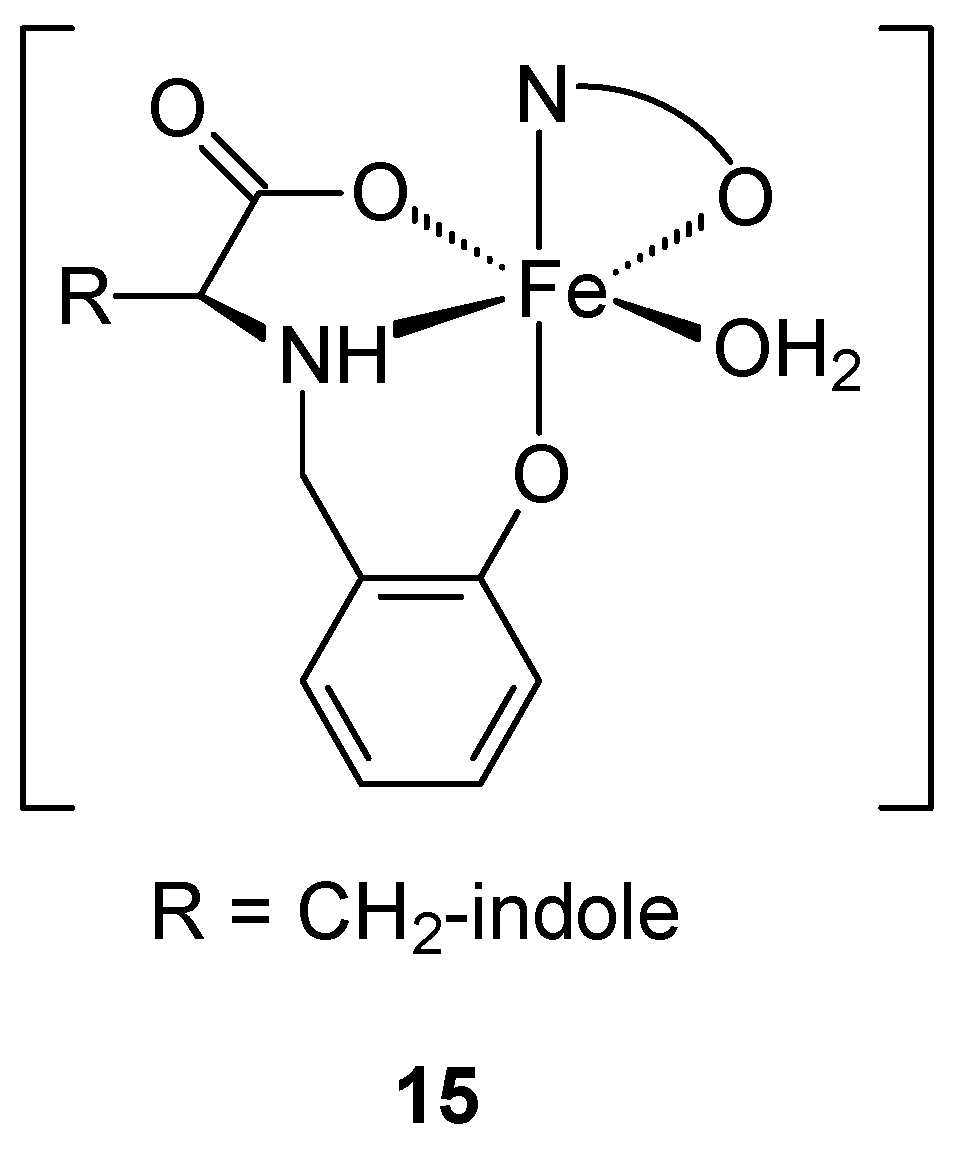
| 15 | N-salicylyl-L-tryptophan sodium salt | Fe(III) | 4.3 ± 0.2 μM | MG-63 HT-29 L929 | BSA, ctDNA, MTT test ROS | [44] |
| 16 | 10.7 ± 2.5 μM | |||||
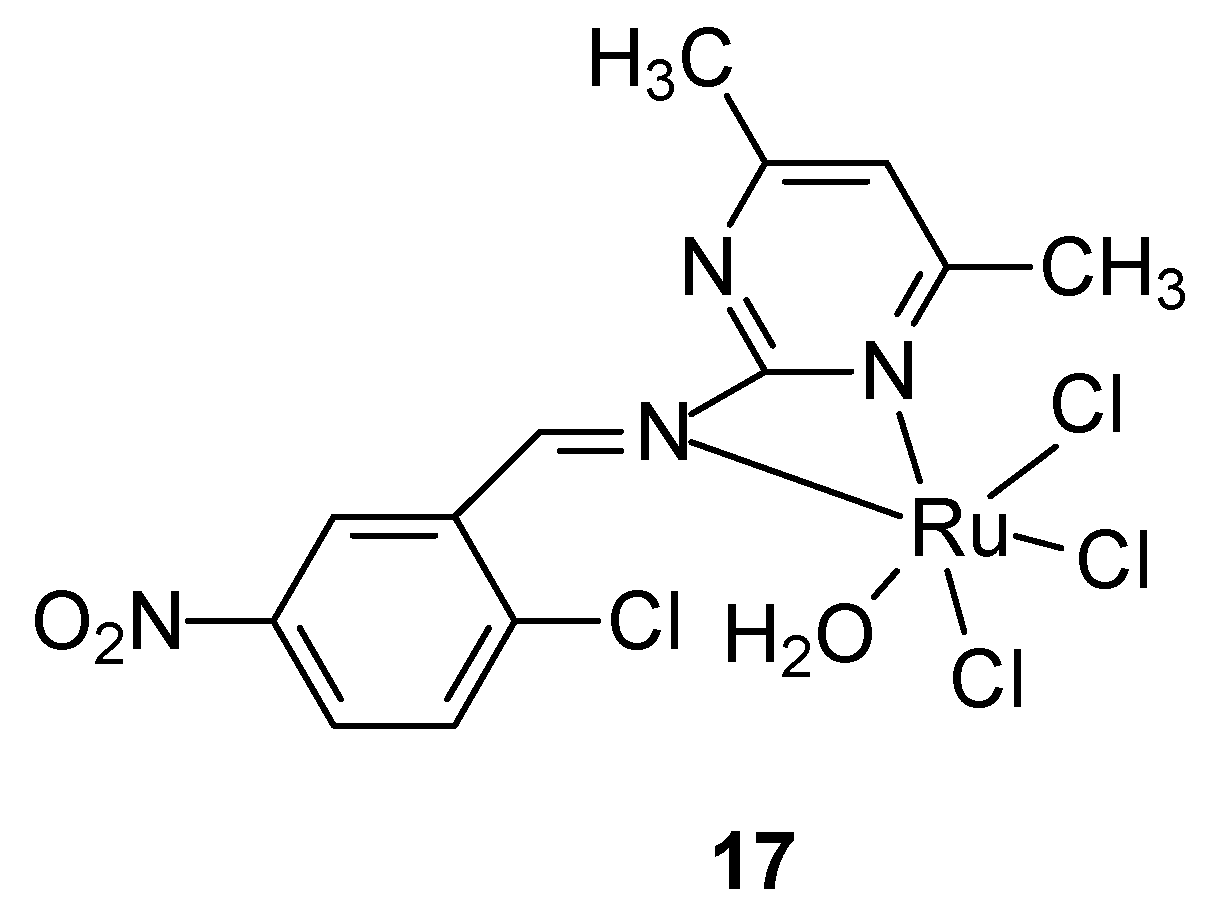
| 17 | 2-Chloro-5-Nitrophenyl-(4,6-Dimethylpyrimidinyl)methanimine Schiff Base | Ru(III) | 46.7 µM | T47D HCT116 HepG2 | Annexin V/Propidium Iodide Staining for Apoptosis Assessment Expression Levels of Caspase 3, VEGF-A, mTOR, NF-kB, and SND1 by RT-PCR | [45] |
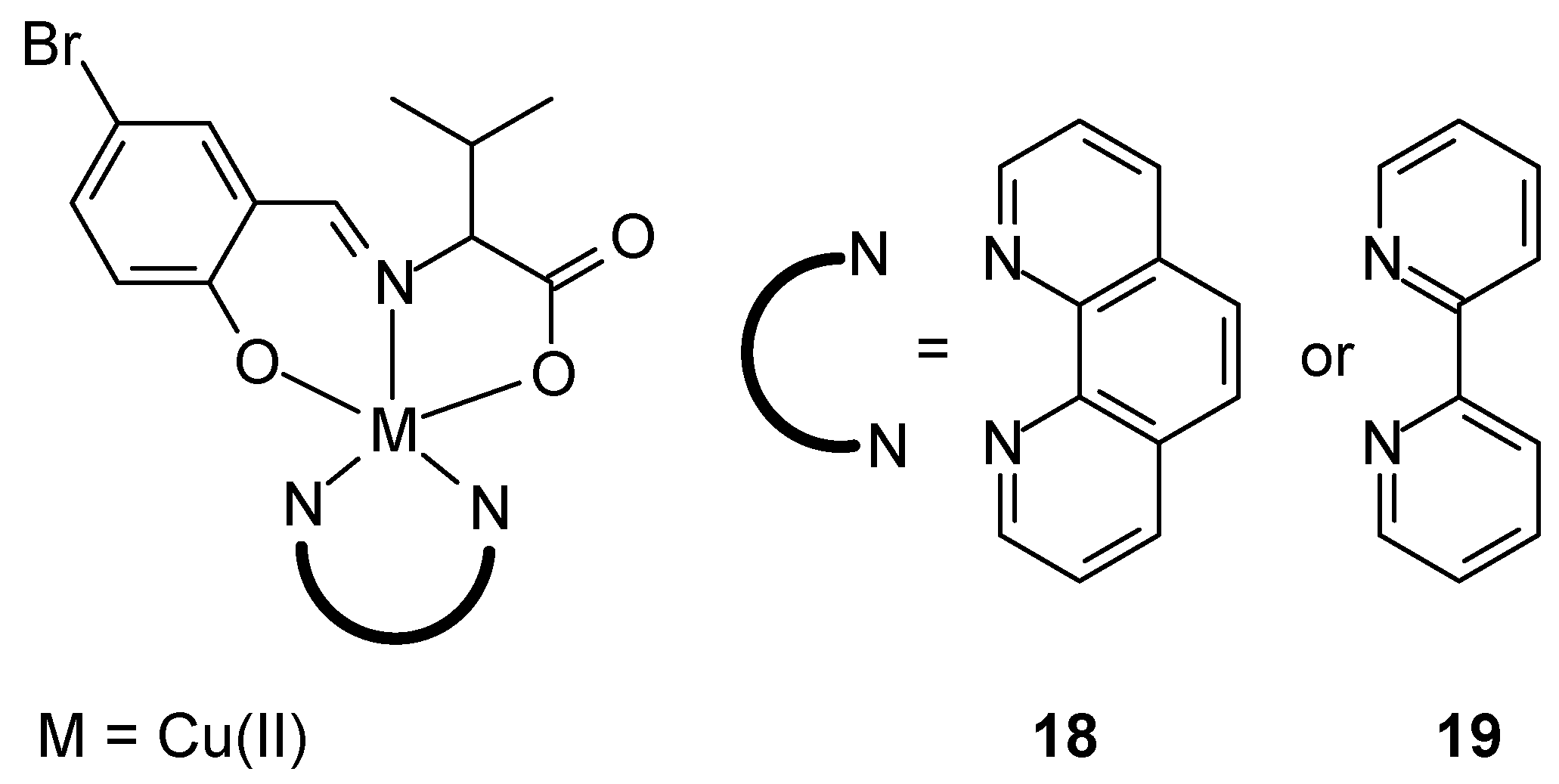
| 18 | potassium(E)-2-((5-bromo-2-hydroxybenzylidene)amino) 3-methylbutanoate | Cu(II) | 17.13 ± 0.74 μM | A549 HeLa | MTT test DPPH | [46] |
| 19 | 33.18 ± 1.14 μM | |||||
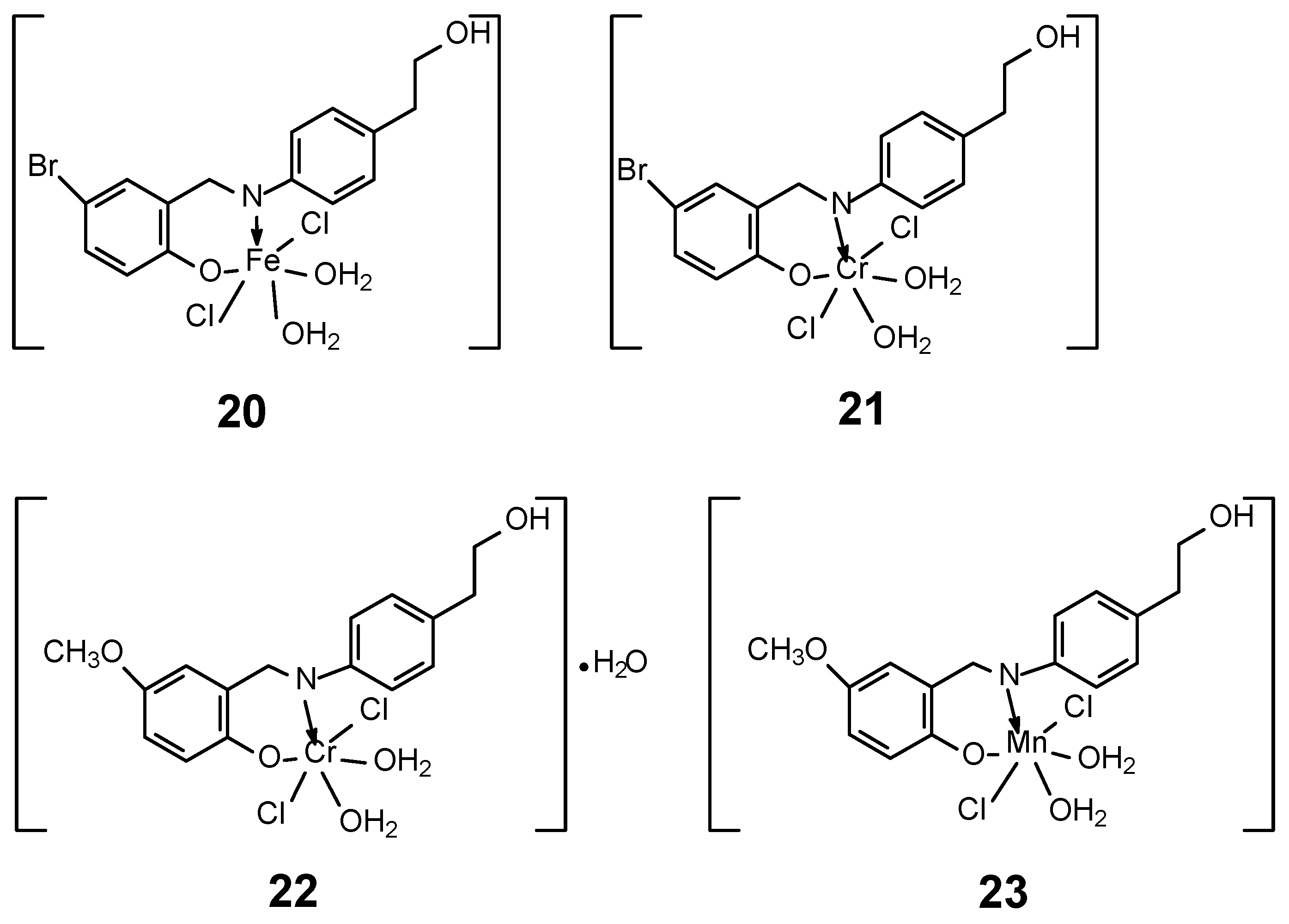
| 20 | 4-bromo-2-[(E)-{[4-(2-hydroxyethyl)phenyl]imino}methyl]phenol | Fe(III) | 60.00 µg/µL | HepG2 | SAR ctDNA ROS | [47] |
| 21 | Cr(III) | 37.00 µg/µL | ||||
| 22 | 2-[(E)-{[4-(2-hydroxyethyl)phenyl]imino}methyl]-4-methoxy phenol | Cr(III) | 37.00 µg/µL | |||
| 23 | Mn(II) | 3.00 µg/µL | ||||
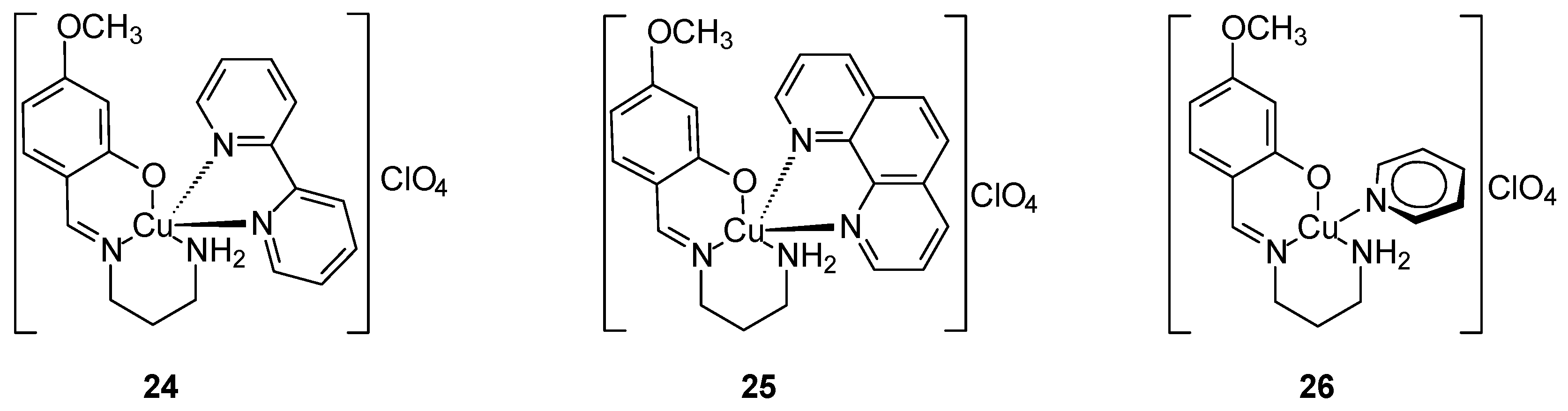
| 4 | 1,3-propanediamine with 2-hydroxy-4-methoxybenzaldehyde | Cu(II) | 15.87 µM | HCT116 A549 | Molecular docking | [48] |
| 25 | 4.97 µM | |||||
| 26 | 21.75 µM | |||||
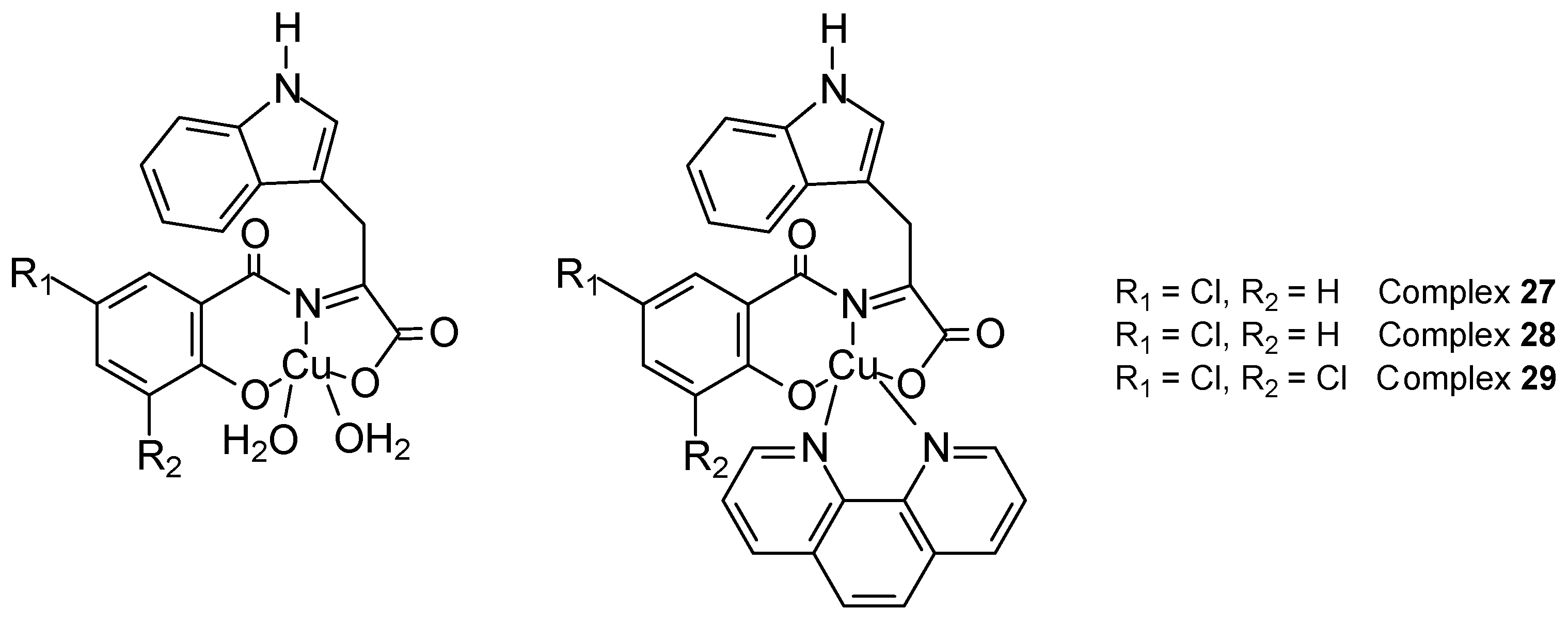
| 27 | Condensation L-tryptophan with 5-chlorosalicyladehyde | Cu(II) | MDA-MB 231 MCF-10A | ctDNA, BSA, ROS, SRB test | [49] | |
| 28 | 4.31 ± 1.1 µM | |||||
| 29 | Condensation L-tryptophan with 3,5-chlorosalicyladehyde | 2.38 ± 0.3 µM | ||||
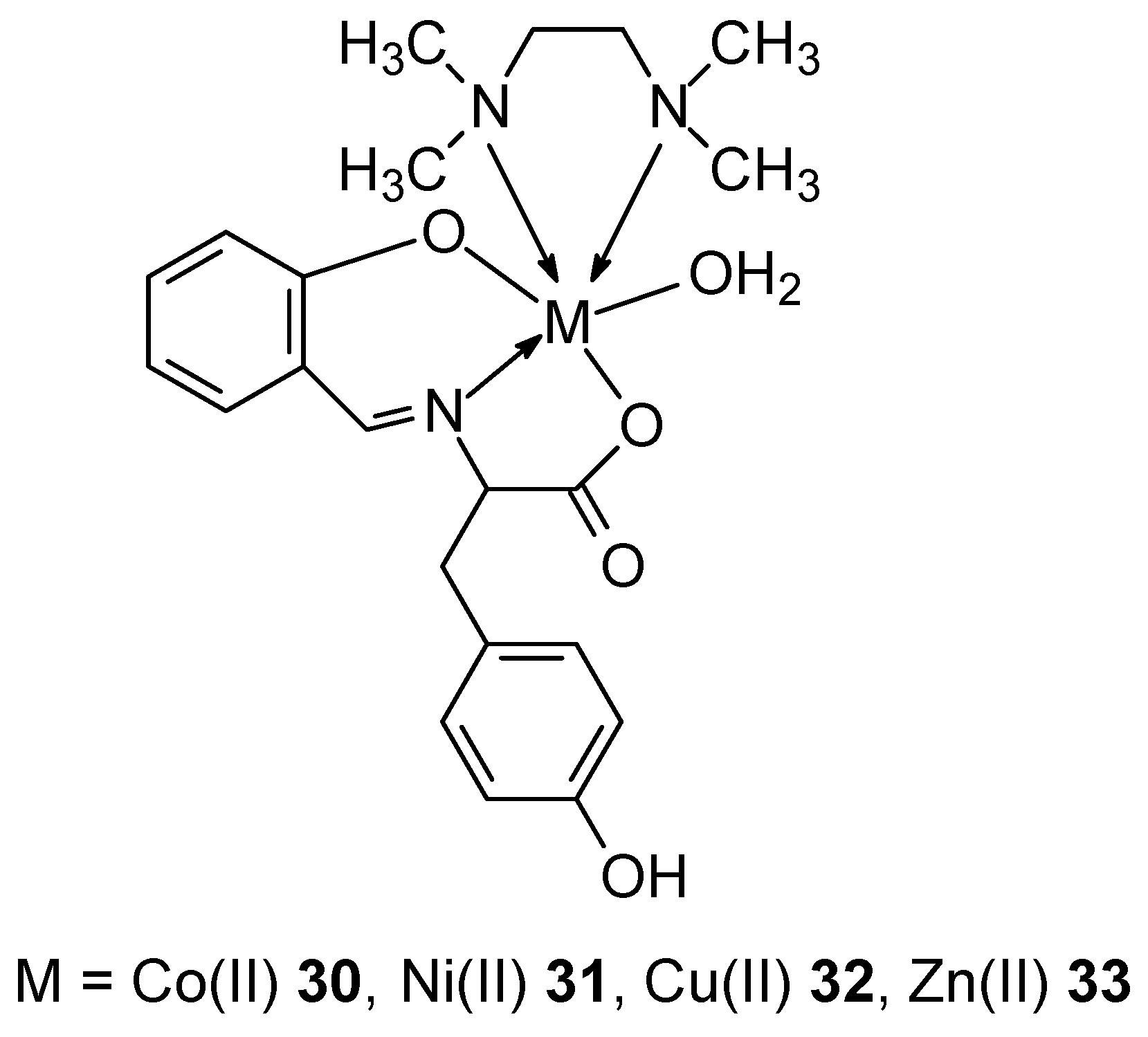
| 30 | Ligand as Schiff bases—derivative of reaction L-tyrosine and salicylaldehyde | Co(II) | 8.8 µg/mL | ctDNA DPPH radical scavenging activity | [50] | |
| 31 | Ni(II) | 2.8 µg/mL | ||||
| 32 | Zn(II) | 2.5 µg/mL | ||||
| 33 | Cu(II) | 4.2 µg/mL | ||||
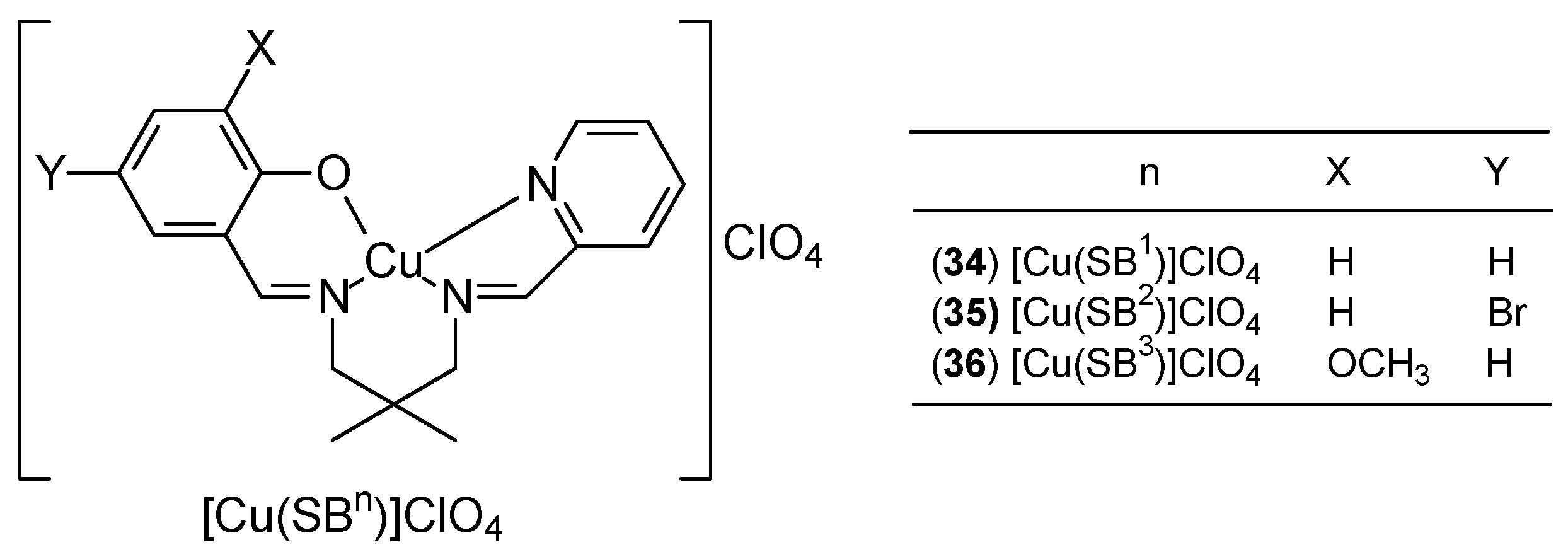
| 34 | Condensation of 2,2-dimethyl-1,3-propanediamine with salicylaldehyde | Cu(II) | 90 μM | HCT-116 A549 | Molecular docking with DNA | [51] |
| 35 | Condensation of 2,2-dimethyl-1,3-propanediamine with 5-bromosalicylaldehyde | 147.4 μM | ||||
| 36 | Condensation of 2,2-dimethyl-1,3-propanediamine with 3-methoxysalicylaldehyde | 21.7 μM | ||||
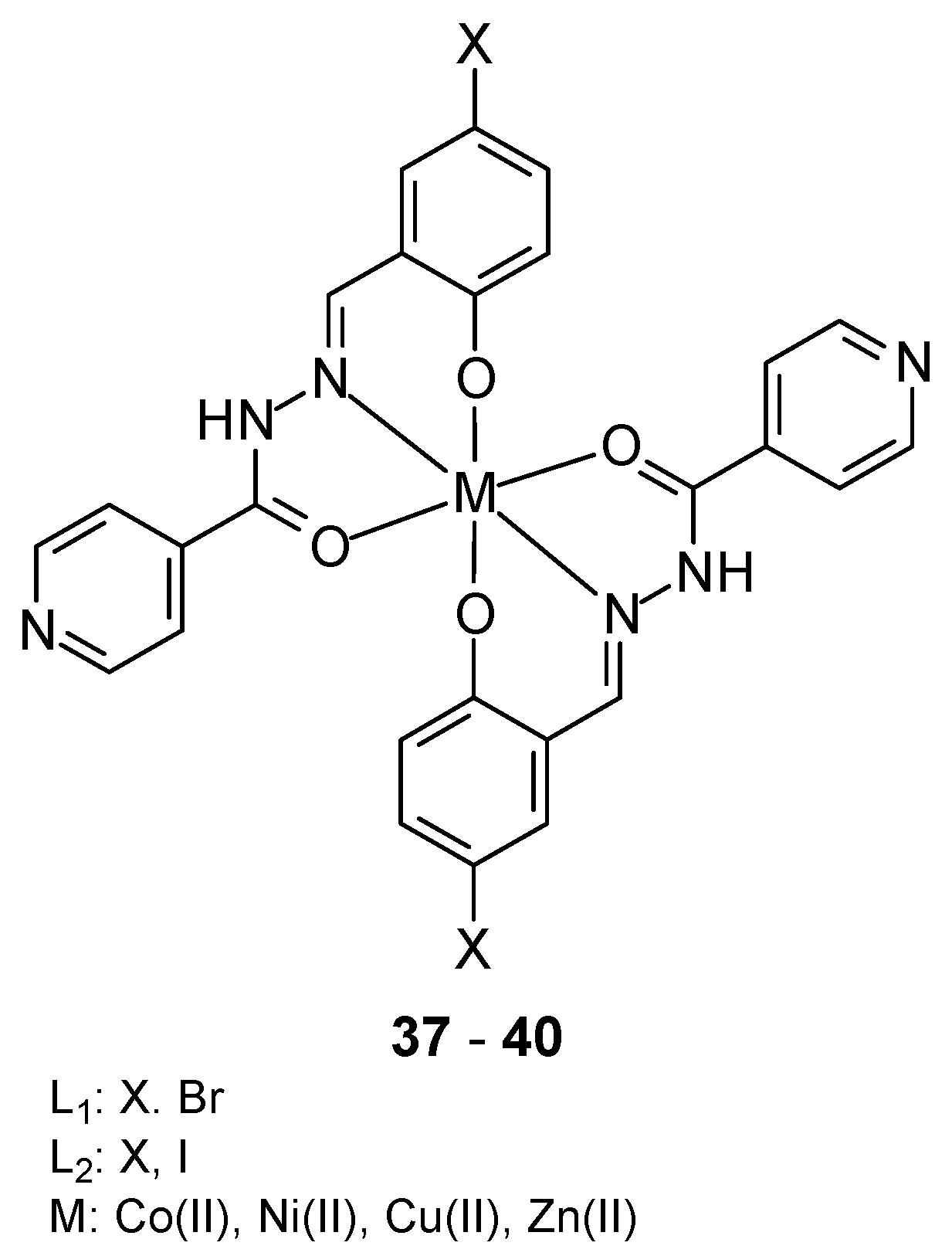
| 37 | (E)-N′-(5-bromo-2-hydroxybenzylidene)isonicotinohydrazide | Co(II) | 7.26 μg/mL | DPPH radical scavenging activity Antioxidant activity | [52] | |
| 38 | Ni(II) | 70.93 μg/mL | ||||
| 39 | Cu(II) | 128.32 μg/mL | ||||
| 40 | Zn(II) | 2.73 μg/mL |
| Comp. | Ligand | Metal Ion | IC50 MCF-7 | Other Tested Cell Lines | Other Tests | Ref. |
|---|---|---|---|---|---|---|
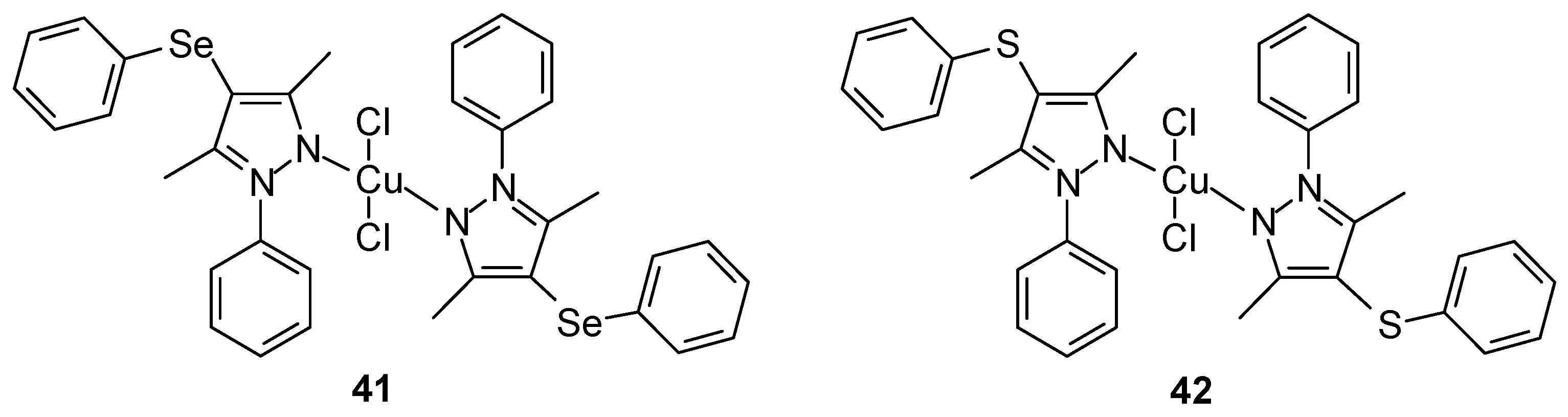
| 41 | [3,5-dimethyl-1-phenyl-4-(phenylselanyl)-1H-pyrazole] | Cu(II) | 44 ± 11 (SI = 1.4) μM | V79 MRC-5 U2OS HepG2 | DPPH | [53] |
| 42 | [3,5-dimethyl-1-phenyl-4-(phenylsulfur)-1H-pyrazole] | 59 ± 2 μM | ||||
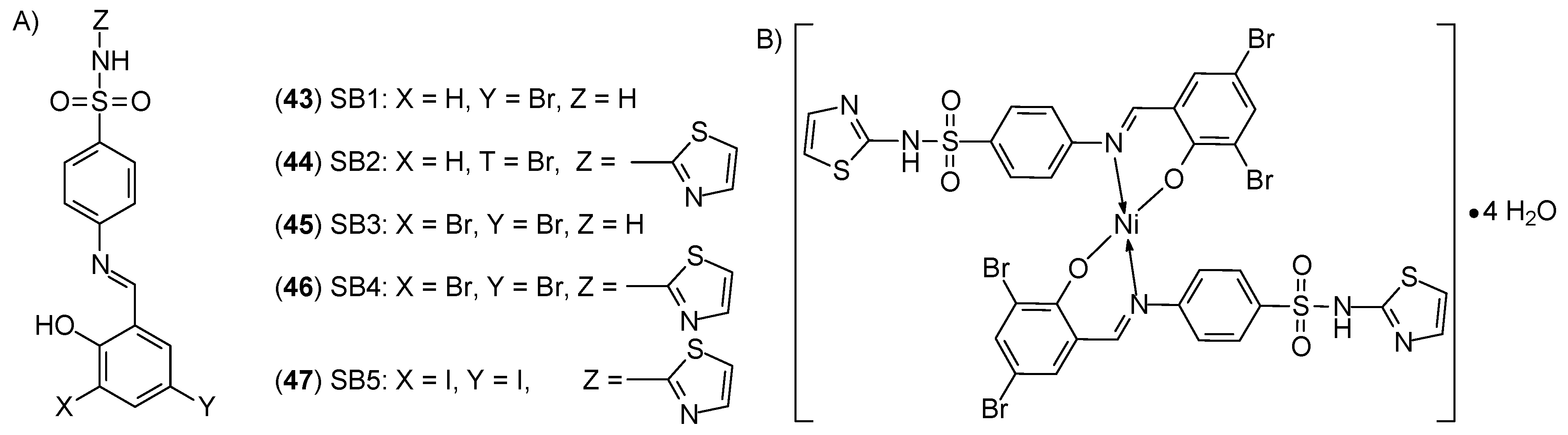
| 43 | 4-((5-Bromo-2-hydroxybenzylidene)amino)-benzenesulfonamide | Ni(II) | - | OEC | [55] | |
| 44 | 4-((5-Bromo-2-hydroxybenzylidene)amino)-N-(1,3-thiazol-2-yl)benzenesulfonamide | 11.2 ± 0.9 μM | ||||
| 45 | 4-((3,5-Dibromo-2-hydroxybenzylidene)amino)-benzenesulfonamide | - | ||||
| 46 | 4-((3,5-Dibromo-2-hydroxybenzylidene)amino)-N-(1,3-thiazol-2-yl)benzenesulfonamide | 4.33 ± 0.5 μM | ||||
| 47 | 4-((3,5-Diiodo-2-hydroxybenzylidene)amino)-N-(1,3-thiazol-2-yl)benzenesulfonamide | >100 μM | ||||
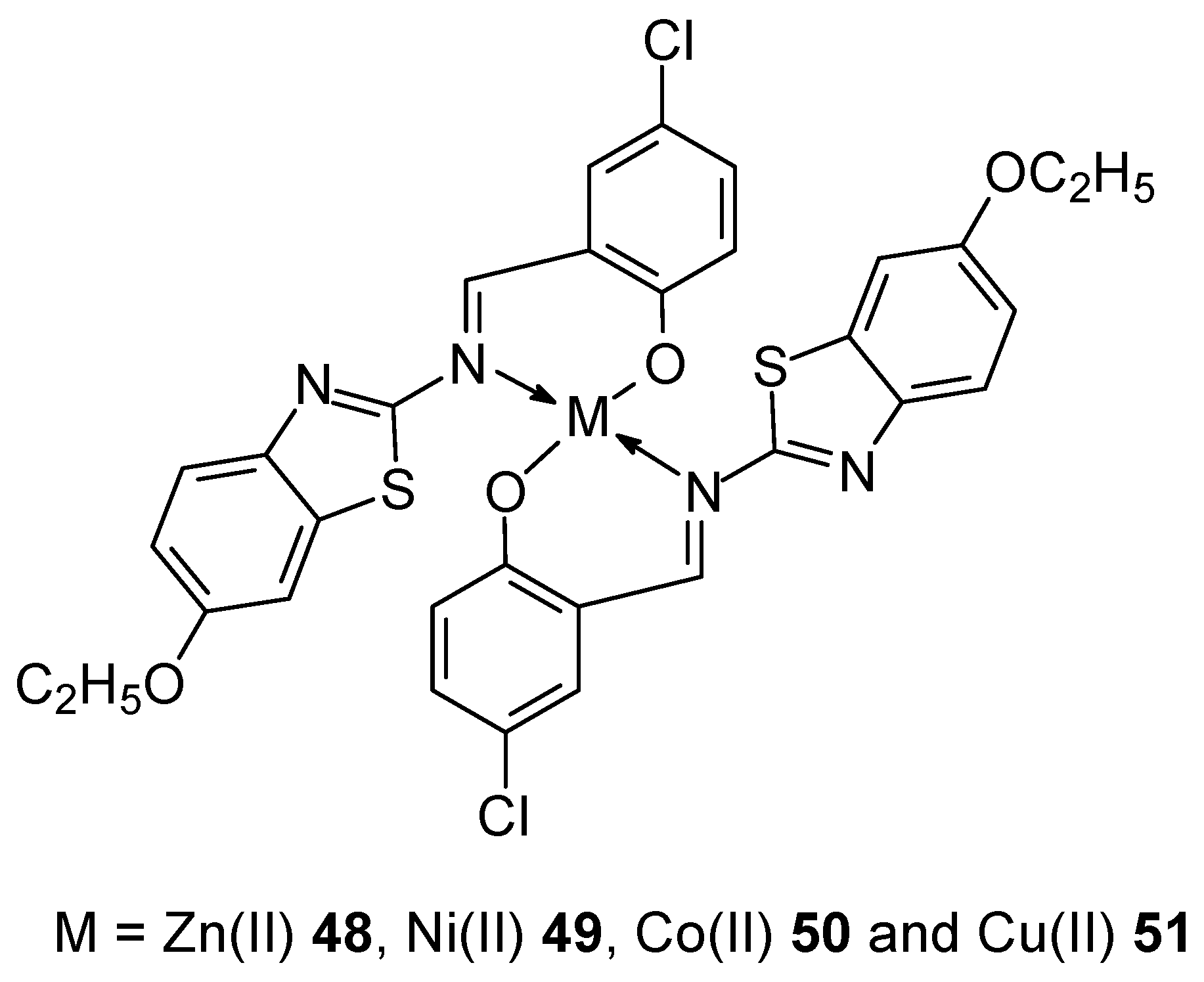
| 48 | 2-((E)-(6-Ethoxybenzo[d]thiazol-2-ylimino)methyl)-4-chlorophenol | Zn(II) | 37.67 μM | HeLa | ctDNA, Inhibition of RS formation, Antioxidant activity | [56] |
| 49 | Ni(II) | 51.32 μM | ||||
| 50 | Co(II) | 58.41 μM | ||||
| 51 | Cu(II) | 67.59 μM | ||||
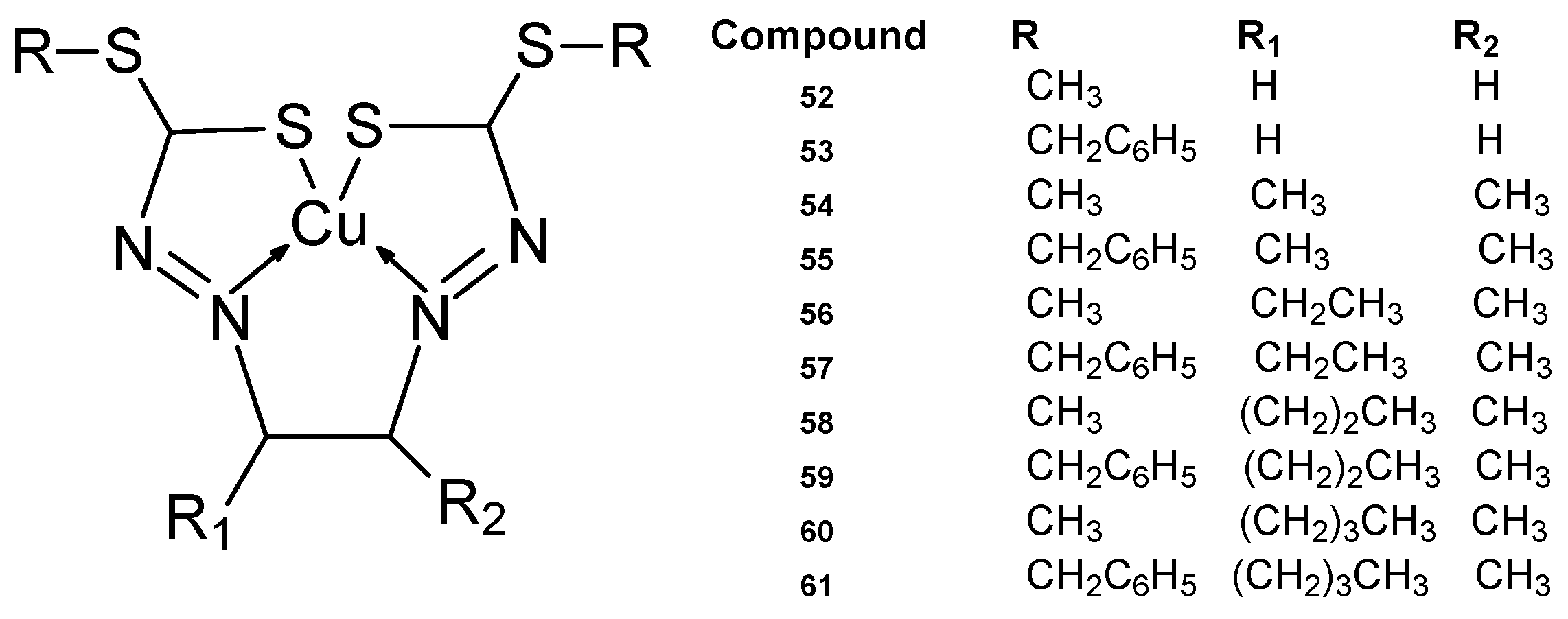
| 52 | SMDTC-glyoxal | Cu(II) | 1.7 ± 0.1 µM | MDA-MB-231 | [57] | |
| 53 | SBDTC–glyoxal | >50 µM | ||||
| 54 | SMDTC–Butanedione | 46 ± 1.0 µM | ||||
| 55 | SBDTC–Butanedione | 11 ± 1.9 µM | ||||
| 56 | SMDTC–Pentadione | 14 ± 2.1 µM | ||||
| 57 | SBDTC–Pentadione | >50 µM | ||||
| 58 | SMDTC–Hexadione | 45 ± 2.3 µM | ||||
| 59 | SBDTC–Hexadione | 7.3 ± 2.8 µM | ||||
| 60 | SMDTC–Heptadione | 20 ± 1.5 µM | ||||
| 61 | SBDTC–Heptadione | >50 µM | ||||
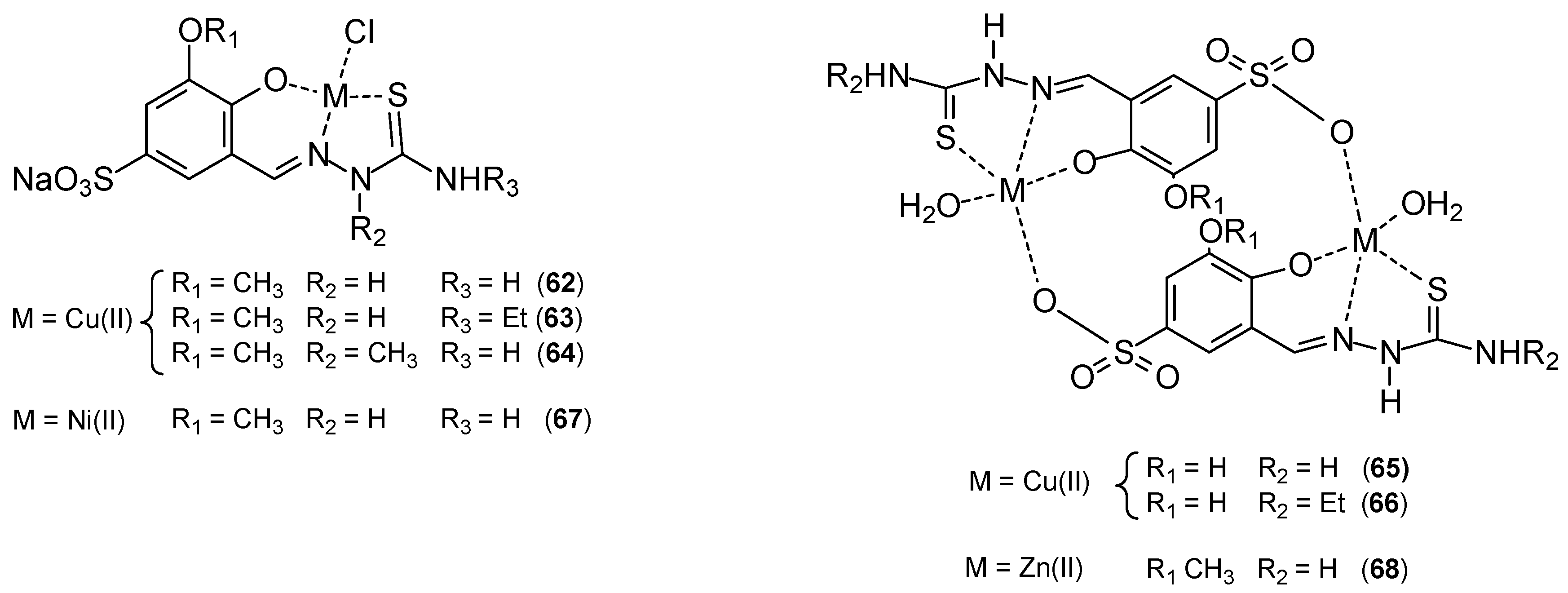
| 62 | Sodium 2-hydroxy-3-methoxy-5-sulfonate-benzaldehyde-3-thiosemicarbazone | Cu(II) | 4.1 ± 1.0 μM | HCT-15 LoVo HEK293 2008 MDA-MB-231 A431 PSN-1 | [62] | |
| 63 | Sodium 2-hydroxy-3-methoxy-5-sulfonate-benzaldehyde-4-ethyl-3-thiosemicarbazone | 8.3 ± 0.2 μM | ||||
| 64 | Sodium 2-hydroxy-3-methoxy-5-sulfonate-benzaldehyde-3-methyl-thiosemicarbazone | 8.9 ± 0.4 μM | ||||
| 65 | Sodium 2,3-dihydroxy -5-sulfonate-benzaldehyde-3-thiosemicarbazone | 1.3 ± 0.4 μM | ||||
| 66 | Sodium 2,3-dihydroxy-3-methoxy-5-sulfonate-benzaldehyde-4-ethyl-3-thiosemicarbazone | 1.7 ± 1.0 μM | ||||
| 67 | Sodium 2-hydroxy-3-methoxy-5-sulfonate-benzaldehyde-3-thiosemicarbazone | Ni(II) | >100 μM | |||
| 68 | Sodium 2-hydroxy-3-methoxy-5-sulfonate-benzaldehyde-3-thiosemicarbazone | Zn(II) | >100 μM | |||
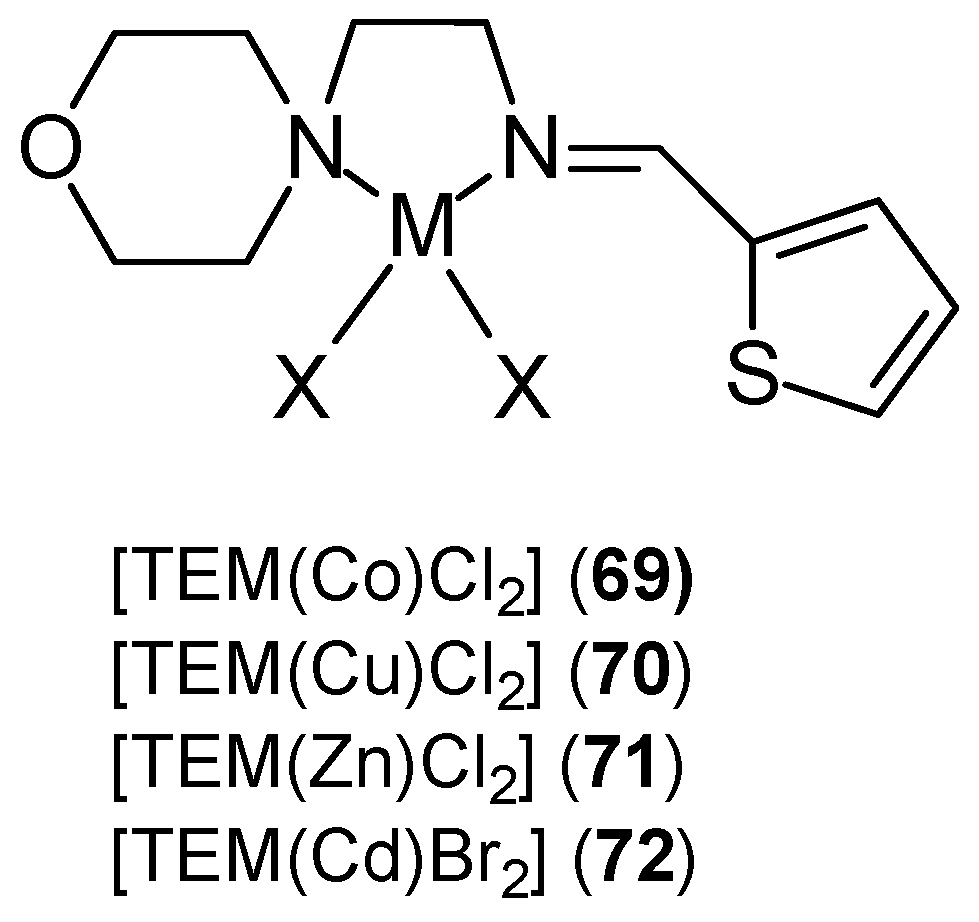
| 69 | (E)-2-morpholino-N-(thiophen-2-ylmethylene)ethanamine | Co(II) | 4.0 ± 1.06 μM | [68] | ||
| 70 | Cu(II) | 5.9 ± 0.23 μM | ||||
| 71 | Zn(II) | 3.3 ± 0.01 μM | ||||
| 72 | Cd(II) | 4.0 ± 1.06 μM | ||||
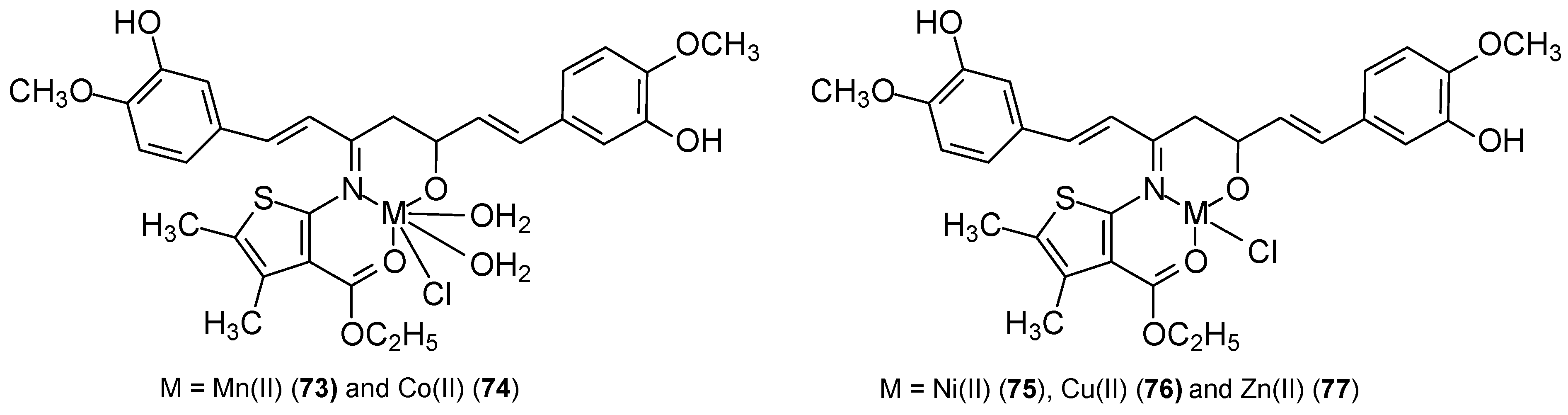
| 73 | curcumin and synthesized 2-amino-3-carboxyethyl-4,5-dimethylthiophene | Mn(II) | <10 μg/mL | K-562 | DPPH, Antioxidant activity | [69] |
| 74 | Co(II) | <10 μg/mL | ||||
| 75 | Ni(II) | <10 μg/mL | ||||
| 76 | Cu(II) | >80 μg/mL | ||||
| 77 | Zn(II) | <10 μg/mL | ||||
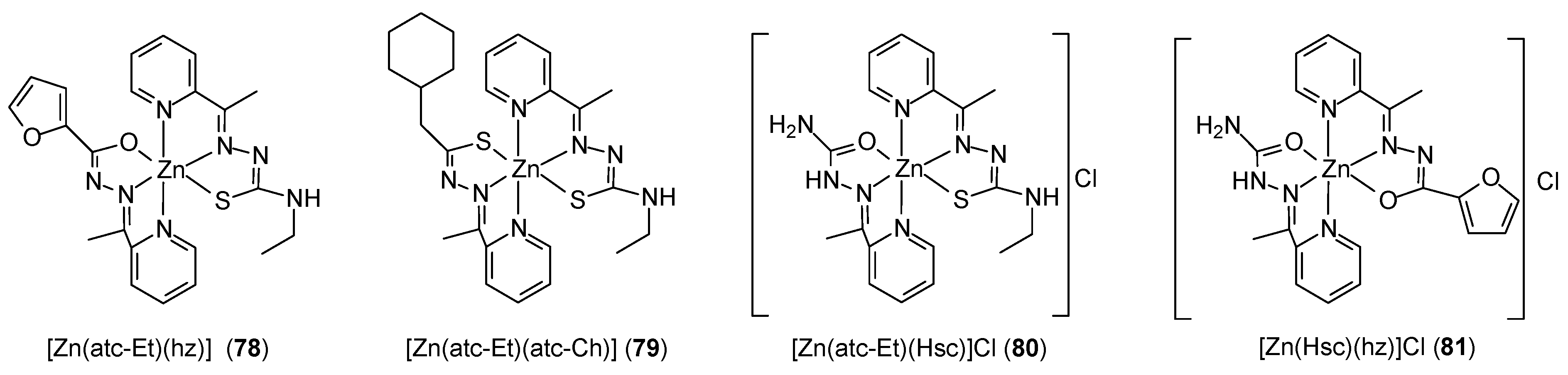
| 78 | Hatc-Ch: 2-Acetylpyridine-4-cyclohexyl-3-thiosemicarbazone | Zn(II) | 9.43 µM | MDA-MB-453 MDA-MB-231 MCF10A HUVEC HFF MCF10A HUVEC HFF | [71] | |
| 79 | Hatc-Et: 2-Acetylpyridine-4-ethyl-3-thiosemicarbazone | 18.49 µM | ||||
| 80 | Hsc: 2-Acetylpyridine-semicarbazone | 19.34 µM | ||||
| 81 | Hhz: 2-Acetylpyridine-furanoylhidrazone | 10.41 µM | ||||
| 82 | (Z)-2-((E)-1-(2-(4-chlorophenyl)hydrazinylidene)propan-2-ylidene)-N-phenylhydrazine-1-carbothioamide | Fe(III) | 20 µg/mL | [72] | ||
| 83 | Co(II) | 23 µg/mL | ||||
| 84 | Cu(II) | 10.5 µg/mL | ||||
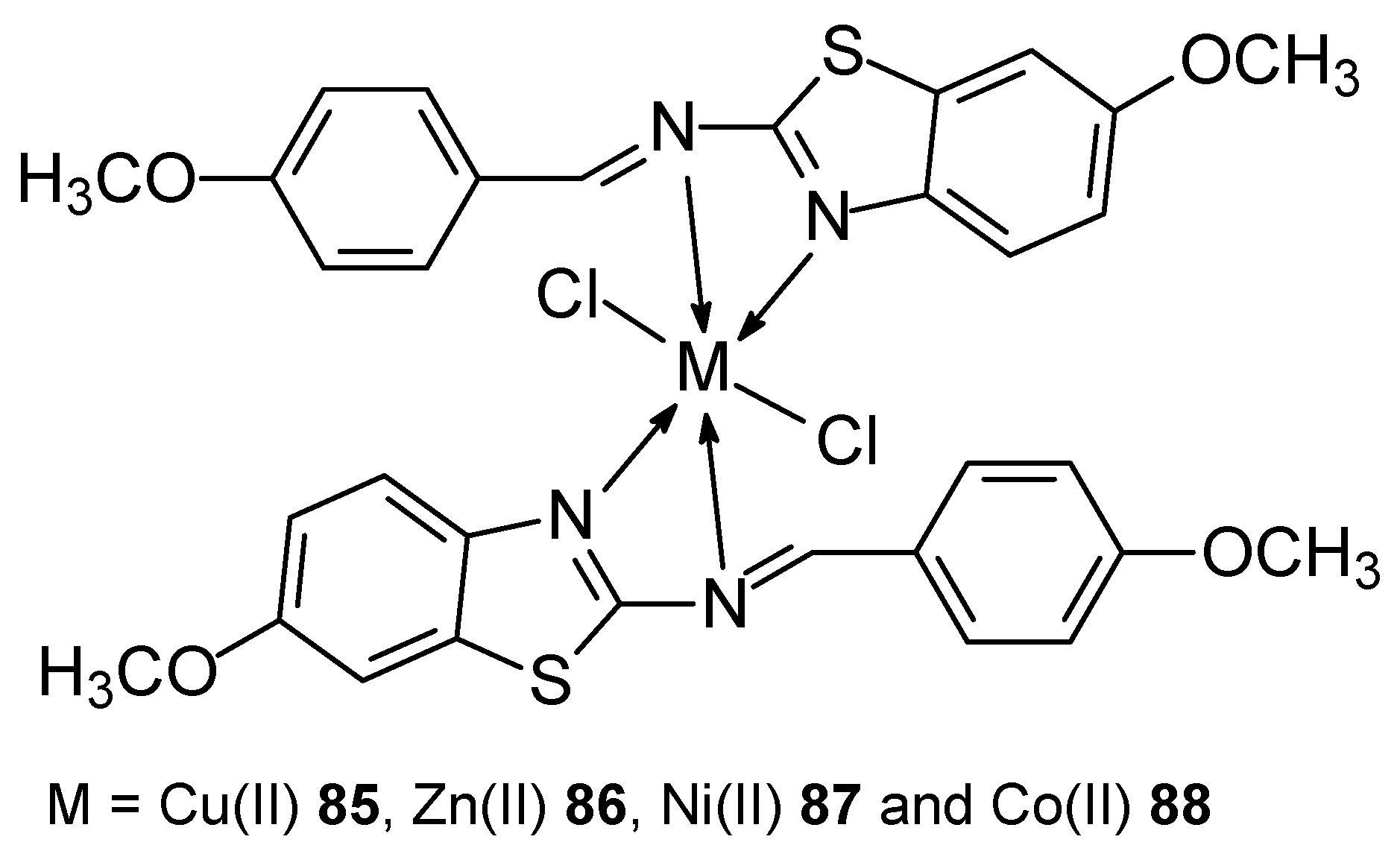
| 85 | (E)-7-methoxy-N-(4-methoxybenzylidene)benzo[d]-thiazol-2-amine | Cu(II) | 12 ± 0.03 (μg ± SD) | Hela Hep2 HepG2 | Antioxidant activity by DPPH method, DFT calculation, Molecular docking | [76] |
| 86 | Zn(II) | 24 ± 0.15 (μg ± SD) | ||||
| 87 | Ni(II) | 37 ± 0.05 (μg ± SD) | ||||
| 88 | Co(II) | 43 ± 0.06 (μg ± SD) | ||||
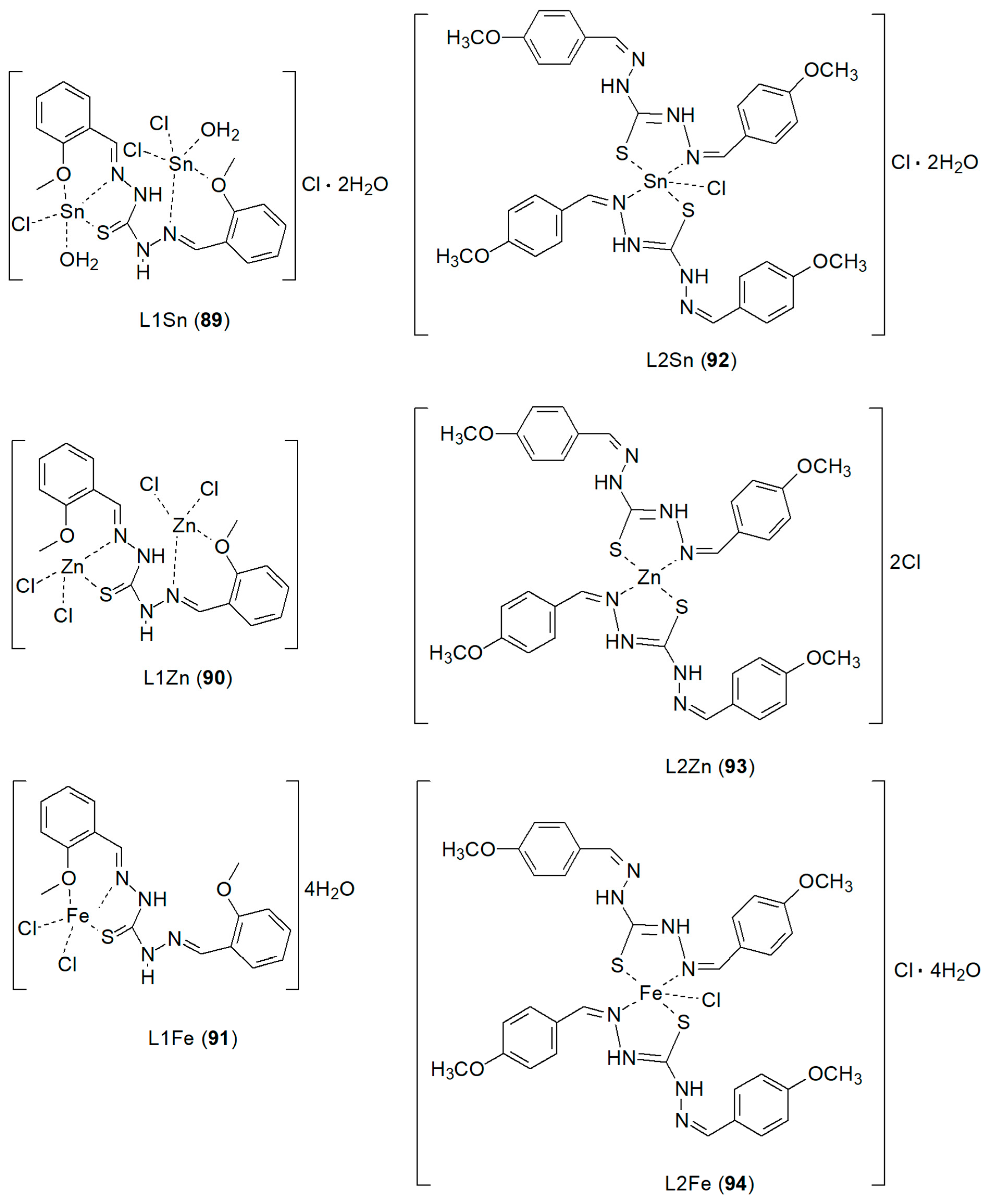
| 89 | 1,5-bis(2-methoxyanisaldehyde)thiocarbohydrazine | Sn(II) | 263.50 ± 38.89 µM | A549 HeLa U87 T47D MDA-MB-231 MDA-MB-453 BT-549 PANC1 HT-29 HCT116 SW480 SW620 CACO2 RAW | SRB, DPPH | [77] |
| 90 | Zn(II) | 47.69 ± 3.32 µM | ||||
| 91 | Fe(II) | 183.20 ± 6.72 µM | ||||
| 92 | 1,5-bis (4-methoxyanisaldehyde)thiocarbohydrazine | Sn(II) | 434.64 ± 35.44 µM | |||
| 93 | Zn(II) | 157.17 ± 7.74 µM | ||||
| 94 | Fe(II) | 135.06 ± 6.84 µM |
| Comp. | Ligand | Metal Ion | IC50 MCF-7 | Other Tested Cell Lines | Other Tests | Ref. |
|---|---|---|---|---|---|---|
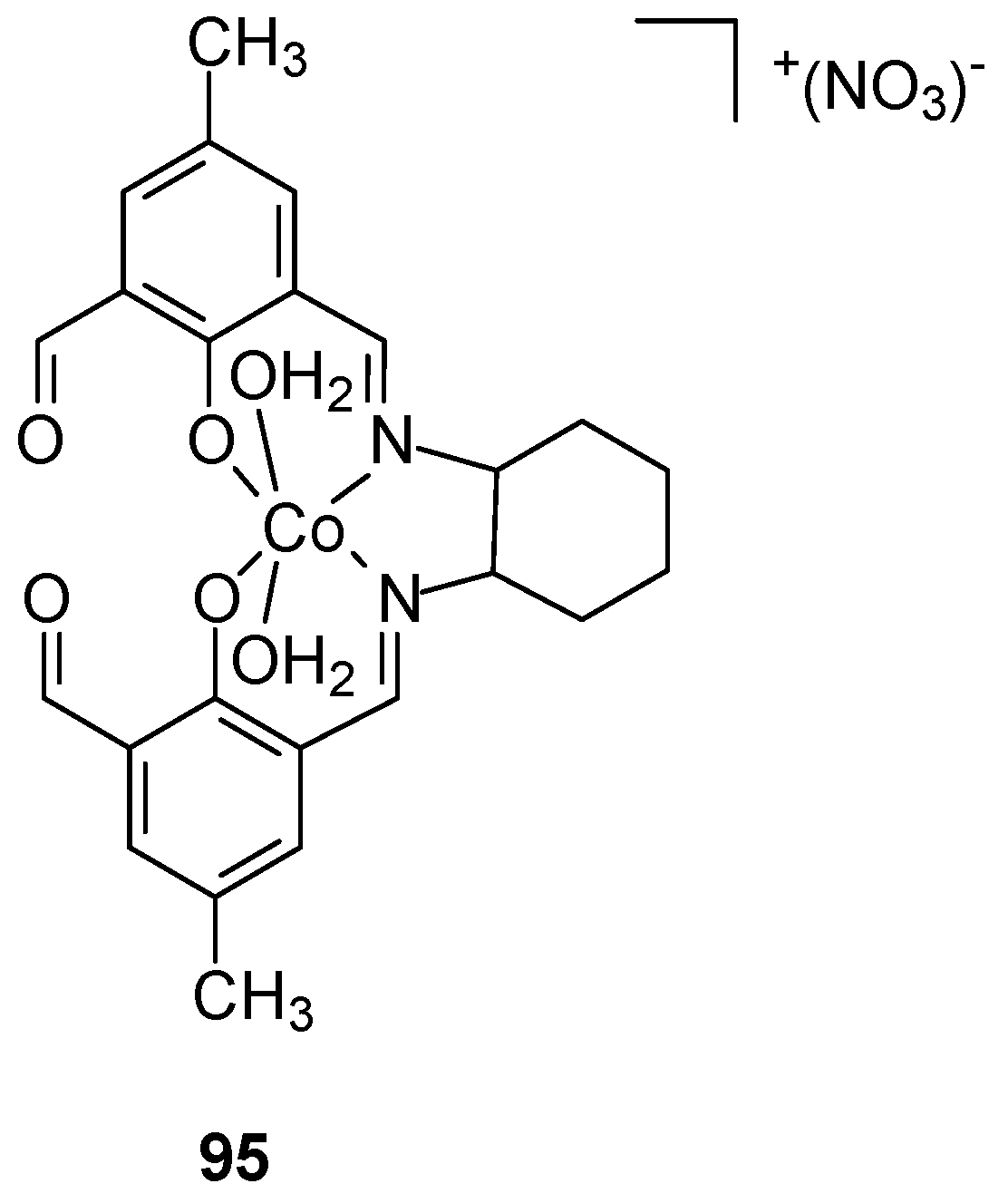
| 95 | Cyclohexane-1,2-diamine, 2,6-diformyl-4-methylphenol | Co(II) | 16.81 ± 1.33 μM | LS-174 MCR-5 | [80] | |
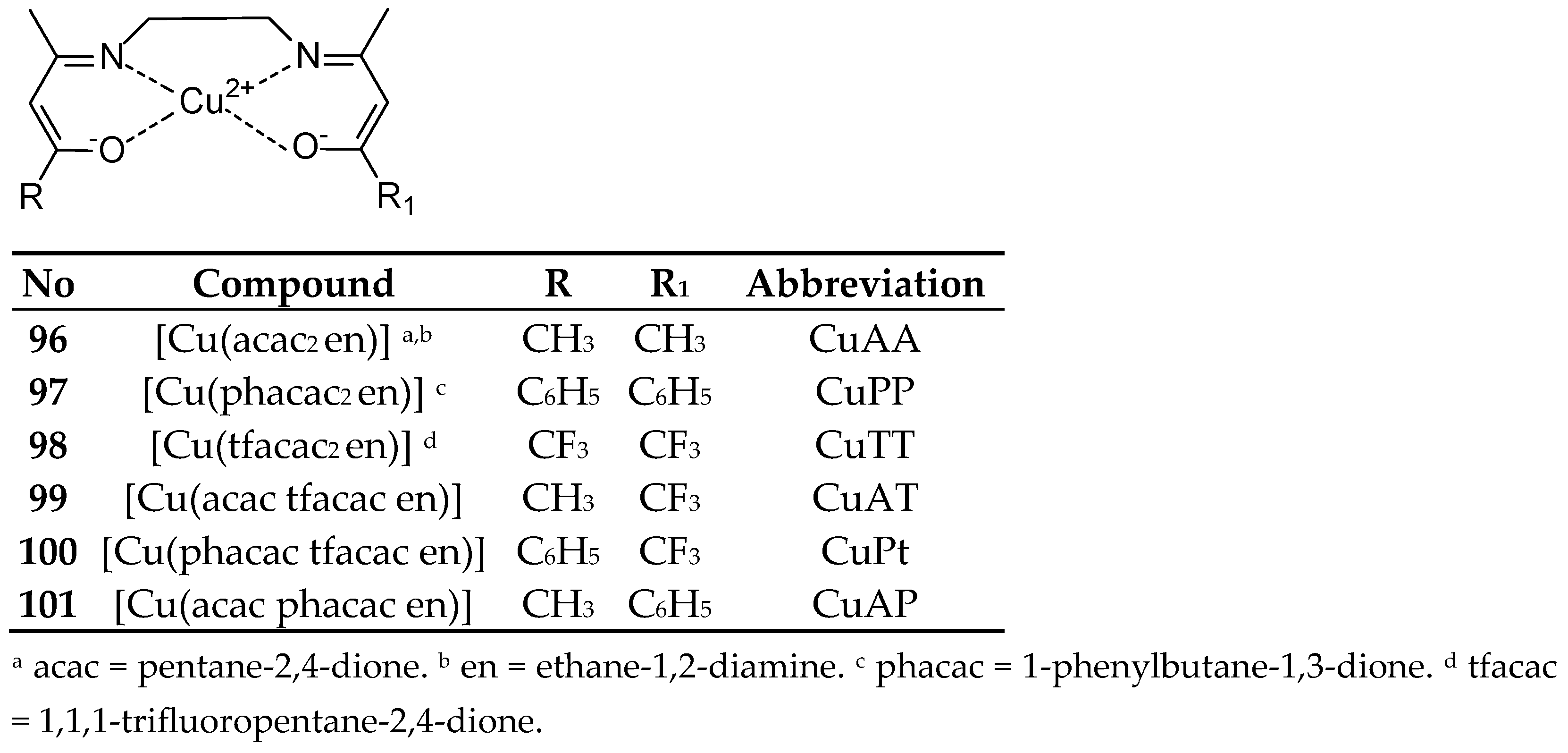
| 96 | [Cu(acac2 en)] | Cu(II) | 17.53 ± 2.83 μM | ROS, Molecular docking interaction with HSA | [81] | |
| 97 | [Cu(phacac2 en)] | |||||
| 98 | [Cu(tfacac2 en)] | 21.29 ± 2.55 μM | ||||
| 99 | [Cu(acac tfacac en)] | |||||
| 100 | [Cu(acac tfacac en)] | 30.02 ± 2.05 μM | ||||
| 101 | [Cu(acac phacac en)] | |||||
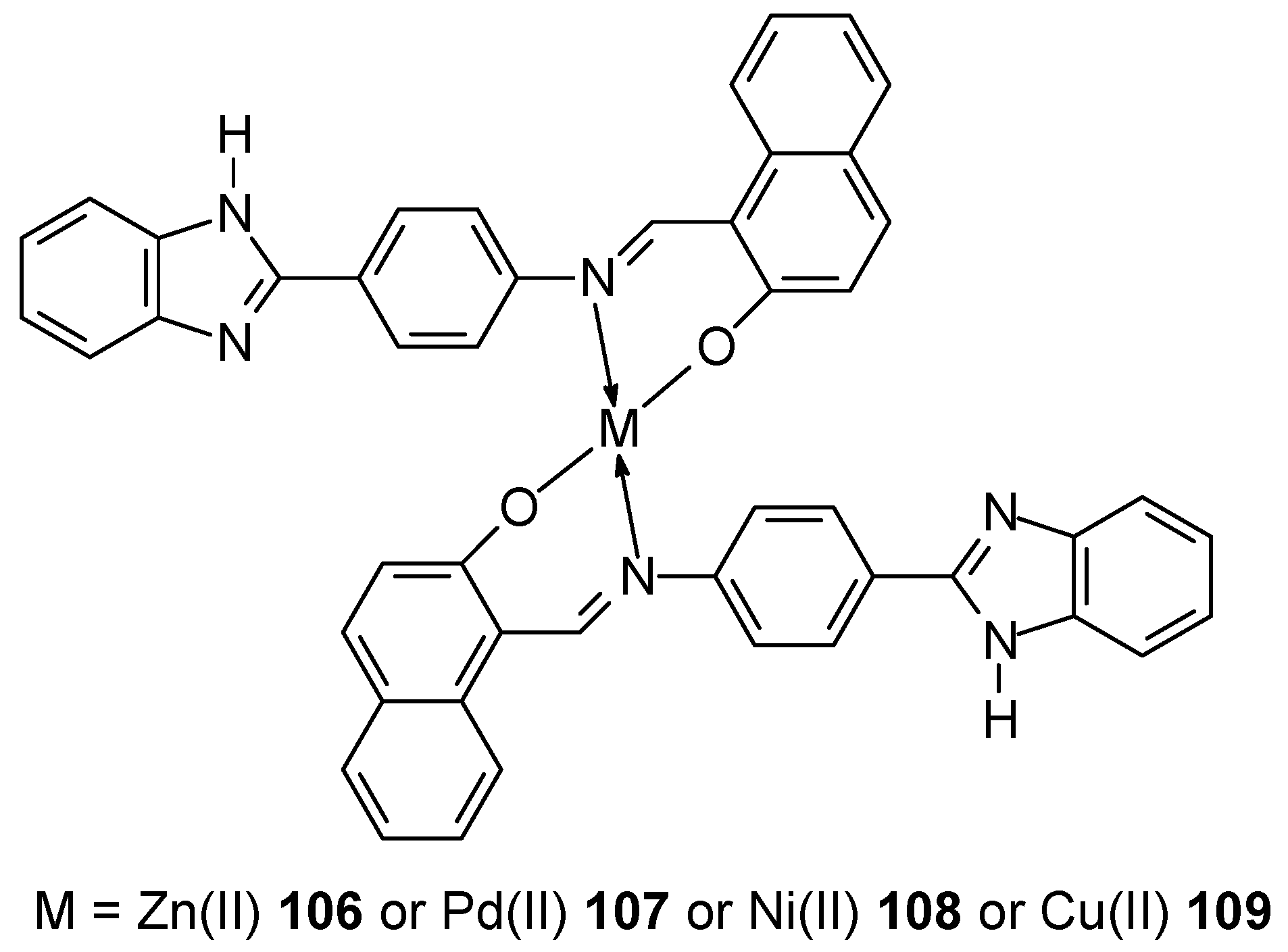
| 102 | (E)-2-((4-(1H-benzo[d]imidazol-2-yl)phenylimino)methyl)-6-bromo-4-chlorophenol (L1) | Cu(II) | Molecular docking | [82] | ||
| 103 | Ni(II) | 1.89 LD50 mg/mL | ||||
| 104 | Pd(II) | |||||
| 105 | Zn(II) | |||||
| 106 | (E)-1-((4-(1H-benzo[d]imidazol-2-yl)phenylimino)methyl)naphthalen-2-ol (L2) | Cu(II) | 0.129 LD50 mg/mL | |||
| 107 | Ni(II) | |||||
| 108 | Pd(II) | 3.09 LD50 mg/mL | ||||
| 109 | Zn(II) | |||||
| 110 | Condensation of aldehyde (3-(3-formyl-4-hydroxybenzyl)-1-methyl-1H-imidazol-3-ium chloride) and 4-(1-naphthyl)-3-thiosemicarbazide | Mn(II) | 257.1 ± 2.90 μM | SW-872 | [83] | |
| 111 | Fe(III) | 193.4 ± 2.57 μM | ||||
| 112 | Ni(II) | 79.14 ± 1.01 μM | ||||
| 113 | Cu(II) | 127.6 ± 5.69 μM | ||||
| 114 | Zn(II) | 206.9 ± 5.61 μM | ||||
| 115 | N4MacL1 | Zn(II) | 10.23 ± 0.41 µM 9.78 ± 0.32 µM 7.40 ± 0.45 µM | A549 HT-29 | [86] | |
| 116 | N4MacL2 | |||||
| 117 | N4MacL3 | |||||
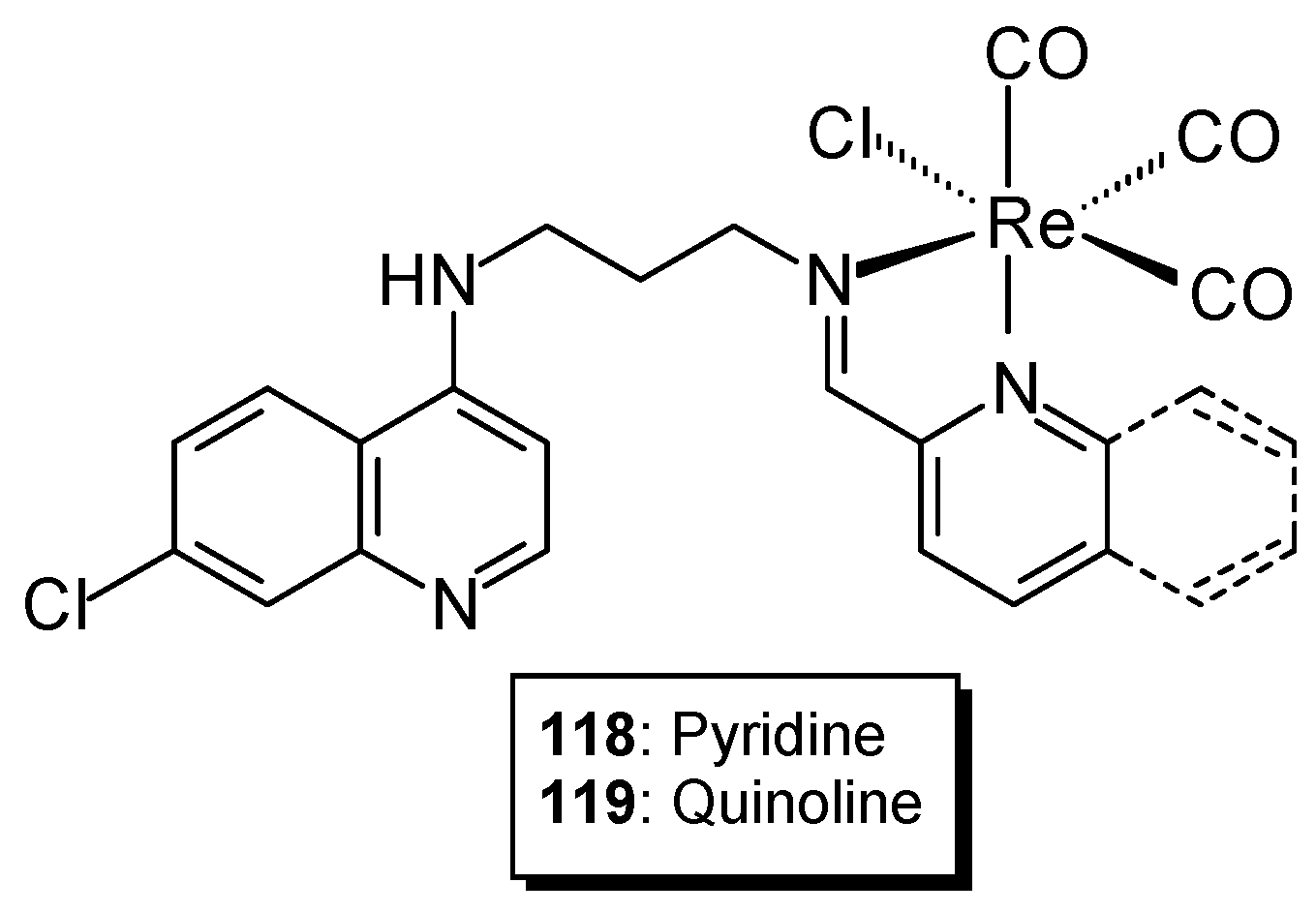
| 118 | N1-(7-chloroquinolin-4-yl)propane-1,3-diamine | Re(I) | 8.55 ± 1.08 μM | MDA-MB-231 FG-0 | Molecular docking | [92] |
| 119 | 7-Chloro-N-(3-((quinolin-2-ylmethylene)amino)propyl)quinolin-4-amine | 6.82 ± 1.03 μM | ||||
| 120 | functionalized at the 2-position with 1-(3-aminopropyl)imidazole (HL1) | Zn(II) | 7.3 ± 2.4 µM | [95] | ||
| 121 | functionalized at the 1-(3-aminopropyl)-2-methyl-1H-imidazole (HL2). | 6.7 ± 1.0 µM | ||||
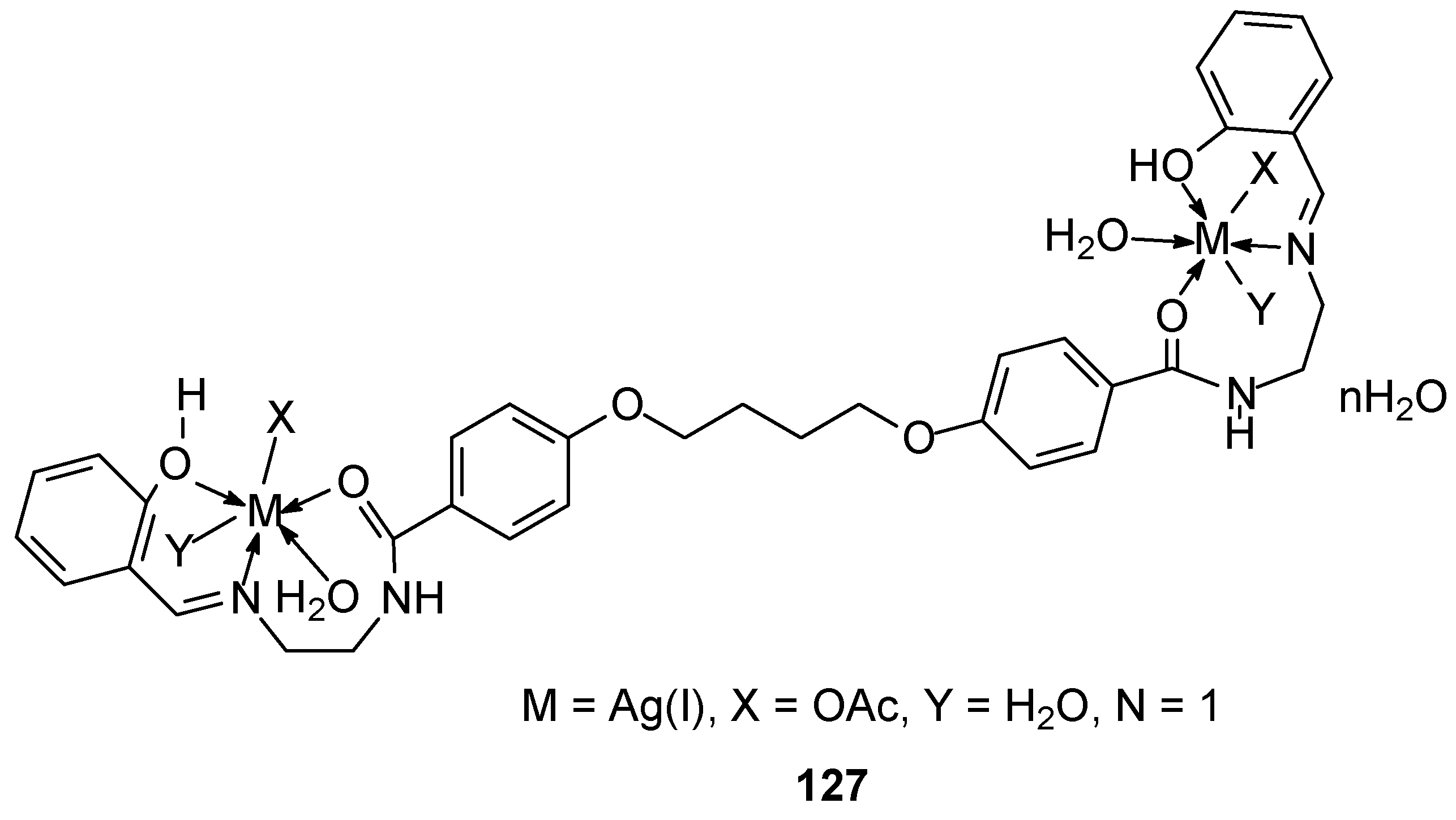
| 122 | combination of two moles of salysaldehyde 4,4′-(butane-1,4-diylbis(oxy))bis(N-(2-aminoethyl) benzamide) | Mn(II) | data on the chart | HepG-2 | Molecular docking | [96] |
| 123 | Ni(II) | |||||
| 124 | Cu(II) | |||||
| 125 | Zn(II) | |||||
| 126 | Hg(II) | |||||
| 127 | Ag(I) | |||||
| 128 | (cyclopenta-2,4-dien-1-yl)(cyclopenta-2,4-dien-1-yl) (1-((8-aminonaphthalen-1-yl)imino)ethyl) | Cr(II) | 19.1 mg/mL | Molecular docking | [97] | |
| 129 | Fe(III) | 13.3 mg/mL | ||||
| 130 | Mn(II) | 15.9 mg/mL | ||||
| 131 | Cu(II) | 12.0 mg/mL | ||||
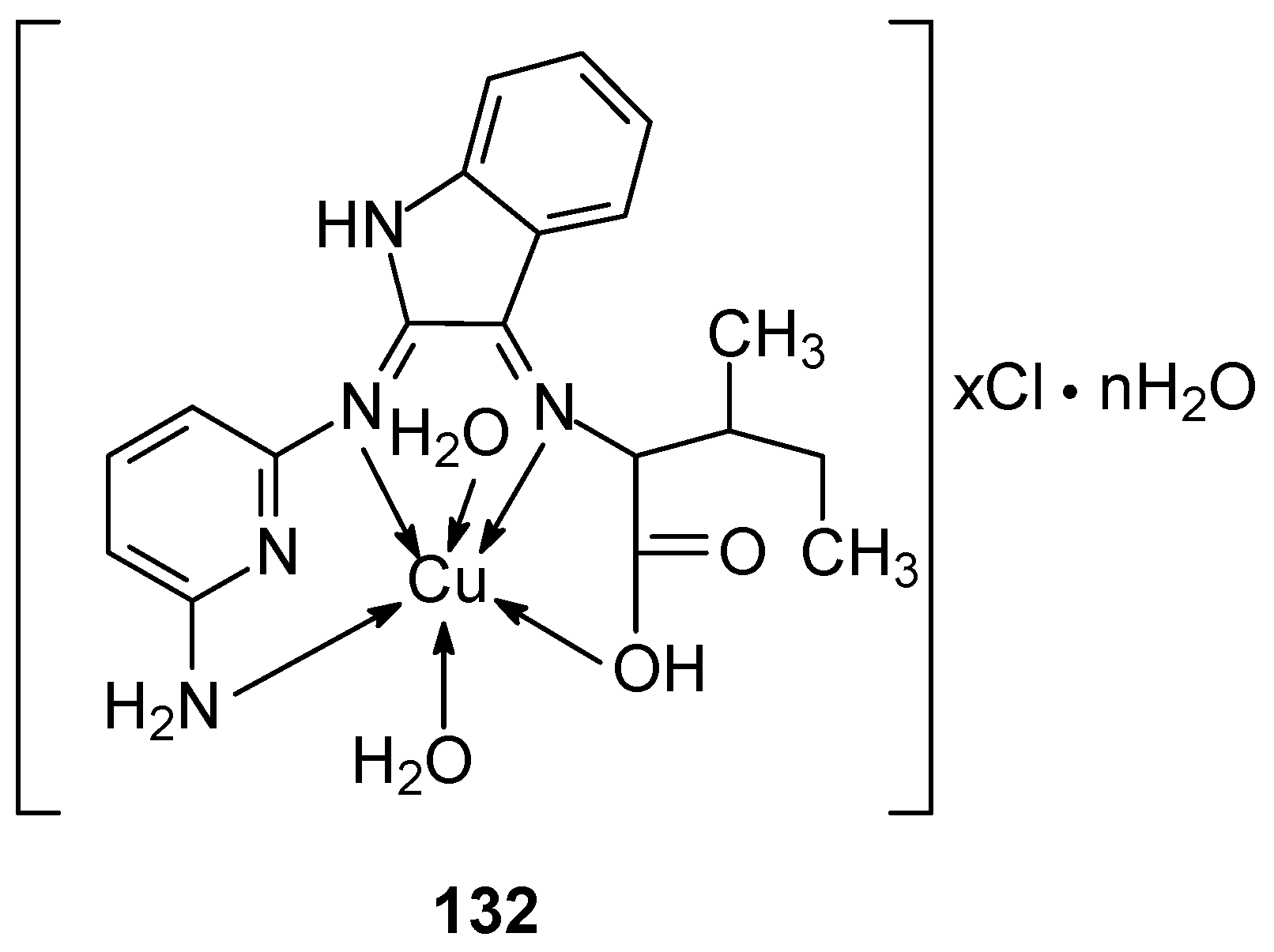
| 132 | Cd(II) | 17.6 mg/mL | ||||
| 133 | Co(II) | 14.7 mg/mL | ||||
| 134 | Zn(II) | 14.0 mg/mL | ||||
| 135 | Ni(II) | 20.3 mg/mL | ||||
| 136 | 1-(1H-benzimidazol-2-yliminomethyl)naphthalen-2-ol | ([Cu(L)(H2O)]ClO4) | 78.1 ± 1.7 µM | [100] | ||
| 137 | [Cu(L)(OAc)] | 63.9 ± 1.8 µM | ||||
| 138 | [Cu(L)(NO3)] | 56.5 ± 1.8 µM | ||||
| 139 | new Schiff base ligands by reacting 3-nitrobenzaldehyde with thiourea | Cu(II) | data on the chart | SW620 A549 | Antioxidant activity | [101] |
| 140 | Zn(II) |
Disclaimer/Publisher’s Note: The statements, opinions and data contained in all publications are solely those of the individual author(s) and contributor(s) and not of MDPI and/or the editor(s). MDPI and/or the editor(s) disclaim responsibility for any injury to people or property resulting from any ideas, methods, instructions or products referred to in the content. |
© 2026 by the authors. Licensee MDPI, Basel, Switzerland. This article is an open access article distributed under the terms and conditions of the Creative Commons Attribution (CC BY) license.
Share and Cite
Samaszko-Fiertek, J.; Dmochowska, B.; Madaj, J. Anticancer Activity of Schiff Base Metal Complexes Against MCF-7 Breast Cancer Cell Line. Int. J. Mol. Sci. 2026, 27, 678. https://doi.org/10.3390/ijms27020678
Samaszko-Fiertek J, Dmochowska B, Madaj J. Anticancer Activity of Schiff Base Metal Complexes Against MCF-7 Breast Cancer Cell Line. International Journal of Molecular Sciences. 2026; 27(2):678. https://doi.org/10.3390/ijms27020678
Chicago/Turabian StyleSamaszko-Fiertek, Justyna, Barbara Dmochowska, and Janusz Madaj. 2026. "Anticancer Activity of Schiff Base Metal Complexes Against MCF-7 Breast Cancer Cell Line" International Journal of Molecular Sciences 27, no. 2: 678. https://doi.org/10.3390/ijms27020678
APA StyleSamaszko-Fiertek, J., Dmochowska, B., & Madaj, J. (2026). Anticancer Activity of Schiff Base Metal Complexes Against MCF-7 Breast Cancer Cell Line. International Journal of Molecular Sciences, 27(2), 678. https://doi.org/10.3390/ijms27020678