Abstract
The recently described genus Candolleomyces (Basidiomycota, Agaricales, Psathyrellaceae) is now recognized as a distinct taxonomic group separate from Psathyrella. Currently, no fully assembled and accurately annotated genomes of Candolleomyces species are available, limiting our understanding of their physiological traits and biotechnological potential. Numerous tools exist for fungal genome assembly and annotation, each using different algorithms, resulting in substantial variation in gene content and distribution within the same genome. In this work, a hybrid assembly and annotation of the genome of strain CMU-8613 were performed using pipelines that combine different assembly and annotation tools. Phylogenetic analysis showed that the analyzed strain CMU-8613 belongs to Candolleomyces candolleanus. The assembled genome size ranged from 46.8 Mb (NECAT + Racon) to 59.3 Mb (Canu + Coprinellus micaceus genome assembly), depending on the assembly and polishing strategy. The analysis identified 15–25 secondary metabolite gene clusters (BGCs), depending on the genome assembly and the tools used for BGC prediction. In strain CMU-8613, CAZyme-encoding genes varied across assemblies: 494 genes were detected in the Flye assembly and 453 in NECAT; in both cases, the AA (Auxiliary Activities) and GH (Glycoside Hydrolases) families were the most represented. The diversity of CAZymes observed among Candolleomyces species suggests differences in their saprophytic capacities. Analysis of the MAT-A/MAT-B loci revealed that C. candolleanus possesses a tetrapolar mating system. This study provides the first annotated genome of C. candolleanus, highlighting its enzymatic potential to degrade plant biomass and its capacity to synthesize diverse secondary metabolites. The combination of assembly and annotation tools employed here offers robust alternative strategies for characterizing non-model fungi or species lacking high-quality reference genomes.
Keywords:
Candolleomyces; genome; hybrid assembly; pipeline performance comparison; BGCs; CAZymes; mating type 1. Introduction
The genus Candolleomyces was recently established by separating it from the polyphyletic genus Psathyrella, based on a robust multilocus phylogenetic analysis and the absence of the characteristic pleurocystidia of Psathyrella sensu stricto [1,2]. Currently, the genus comprises 63 species, of which 68.33% are reported from Asia, 18.33% from Europe, 10% from North America, and only 1.66% from Africa and South America [2]. Species of this genus are saprotrophic and contribute to the decomposition of dead plant material in temperate and tropical forests [3]. This ecological role suggests high biotechnological potential for the degradation of lignin, cellulose, and hemicellulose [4]. Additionally, several antioxidant and antibacterial compounds have been characterized from strains of Psathyrella candolleana, now considered Candolleomyces candolleanus [5]. Chloroform extracts of the basidiocarp inhibit Gram-positive bacteria Staphylococcus epidermidis and Streptococcus pneumoniae, both associated with respiratory infections [6]. Furthermore, the ethyl acetate extract obtained from mycelium and the extracellular filtrate from Czapek–Dox liquid culture medium exhibit antibacterial activity against Staphylococcus aureus and antioxidant properties [7].
To date, most characterized secondary metabolites in P. candolleana (hereafter considered a synonym of C. candolleanus) are diterpenes. Among these, psathyrelloic acid I is a monocyclic compound with antibacterial activity against S. aureus [8]. Subsequently, two tetracyclic diterpenoids, psathyrins A and B, were identified and showed antibacterial activity against S. aureus and Salmonella enterica but not against Pseudomonas aeruginosa [9]. More recently, five guanacastane-type diterpenes (psathyrellins A–E) were isolated; psathyrellins A, B, and C showed antibacterial activity against Escherichia coli, S. aureus, S. enterica, and P. aeruginosa [10]. Importantly, none of these studies includes molecular identification or phylogenetic analysis of the strains used to isolate the compounds, a relevant omission given the recent taxonomic reclassification of the previously mentioned genus.
Despite their ecological relevance and biotechnological potential, genomic information for Candolleomyces species remains scarce. This lack of genomic data extends to other taxa within the Psathyrellaceae family, for which only 17 genomes are currently available in the National Center for Biotechnology Information (NCBI) and the Joint Genome Institute’s MycoCosm database (accessed 11 May 2025), and only three correspond to Candolleomyces species. Recently, the genome of a strain identified as P. candolleana was analyzed, revealing a gene cluster associated with guanacastane diterpene biosynthesis; however, this genome has not been deposited in public repositories [11]. The limited number of high-quality assembled genomes for Candolleomyces restricts comparative genomic analyses aimed at identifying genes of biotechnological interest and exploring evolutionary patterns associated with its saprotrophic lifestyle.
Here, we report the assembly and annotation of the genome of strain CMU-8613, isolated in central Mexico, using a hybrid strategy that combines short Illumina reads with long Oxford Nanopore reads. We also provide alternative assembly and polishing pipelines for cases where no reference genome is available. Finally, we discuss the biological and biotechnological implications of the identified genomic features.
2. Results
2.1. Primary Assembly
The primary assembly is a crucial step in reconstructing the genome of a fungal species. In this study, the tools Canu, Flye, and NECAT were used, which are among the most widely used for fungal genome assembly and are designed to perform initial assembly from long ONT reads. Each tool relies on different algorithmic approaches, producing assemblies with distinct characteristics. To evaluate the primary assemblies generated by these three tools, we compared standard metrics from BUSCO analyses, including gene completeness, N50, contig numbers (a measure of contiguity), and total genome size. Canu and NECAT require an estimated genome size as input. In contrast, Flye no longer needs this information starting from version 2.6, making it well-suited for species lacking a reference genome. Because no reference genome was available for the strain analyzed in this study, the approximate genome size obtained from the initial Flye assembly (~60 Mb) was used as the input size for Canu and NECAT.
The comparative analysis revealed significant differences in the continuity and completeness of the primary assemblies generated by the three strategies. The Flye assembly achieved the highest percentage of complete BUSCOs, indicating better recovery of conserved gene content. Canu produced a similar level of completeness but with a slightly higher duplication rate, suggesting challenges in resolving repetitive or heterozygous regions. Additionally, Canu produced the least contiguous assembly, with an N50 of 95 kb and many contigs, indicating considerable fragmentation. In contrast, NECAT produced the most contiguous assembly, with the highest N50 and the fewest contigs. However, NECAT also exhibited the lowest gene completeness, the highest number of missing BUSCOs, and the smallest total genome size. This reduction in size and completeness likely results from more aggressive collapsing of repetitive regions or sequence loss during error correction and assembly. Overall, the Flye assembly was intermediate in both contiguity and completeness (Table 1).
Table 1.
Comparison of the primary assembly based on BUSCO 1 results, using the main metrics of the three primary assemblies.
The results from the primary assemblies highlight a common trade-off in fungal genome reconstruction: maximizing gene recovery (completeness) often comes at the expense of structural contiguity, and vice versa. If completeness is the primary goal, Flye and Canu are the best tools; however, if contiguity is more critical, NECAT is the better choice. Because both completeness and contiguity are crucial for subsequent polishing and annotation, all three assemblies were included in the downstream steps to improve contiguity without compromising gene completeness.
2.2. Genome Polishing
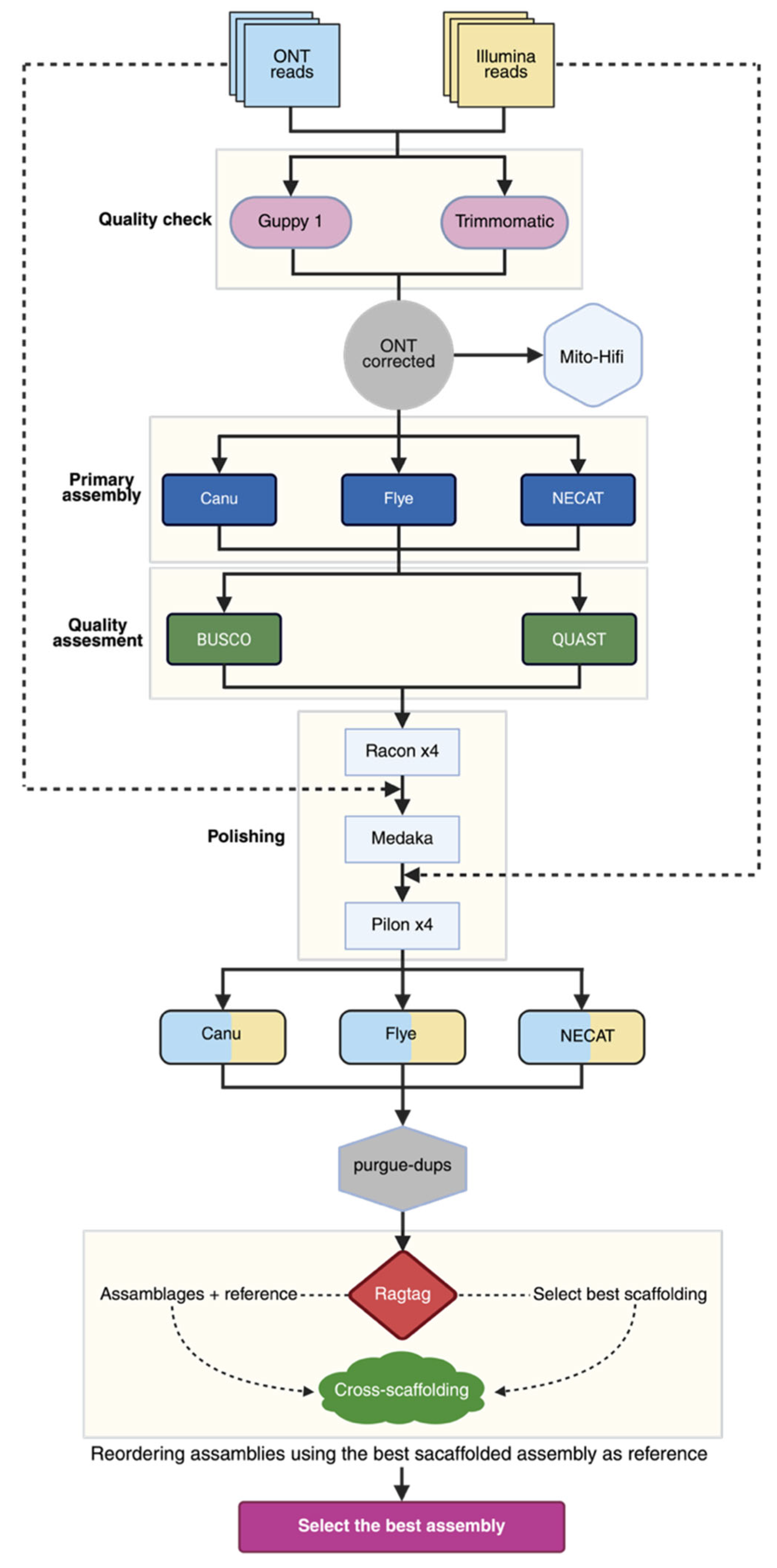
Genome polishing is an essential step for correcting errors in assemblies generated from long-read data, especially those from ONT sequencing, which often contain residual nucleotide-level errors. In this study, we used a strategy that combined individual polishing tools and sequential tool combinations. Four polishing pipelines were applied to the main assemblies, as described below and shown in Figure 1.
Figure 1.
Strategy used for the assembly and polishing of the genome of strain CMU-8613. For details, see the text. Created in BioRender. Vázquez-Marrufo, G. https://BioRender.com/phr8jsz (accesed 24 November 2025).
- Racon: Uses the original long reads to build a consensus based on partial-order graphs (POA) and correct errors;
- Pilon: Uses aligned Illumina short reads for the assembly to correct specific errors (SNPs and small indels) with high accuracy;
- Racon + Medaka (R+M): Combines Racon with Medaka, another long-read polishing tool that uses neural networks and is optimized for ONT data, aiming to improve consensus accuracy;
- Racon + Medaka + Pilon (R+M+P): A hybrid approach where Racon and Medaka are first used to improve the long-read consensus, followed by Pilon with short reads for fine base-level correction.
Racon improved assembly continuity by increasing the N50 and reducing the number of contigs relative to the unpolished assemblies. However, it did not substantially enhance base-level accuracy, as reflected in the BUSCO scores, which were not among the highest and indicate a residual error rate for this method (Table 2). Pilon, in turn, produced a slight improvement in BUSCO completeness for the Flye assembly but had a markedly adverse effect on contiguity, significantly increasing the number of contigs and reducing the N50 value.
Table 2.
Comparison of polishing strategies.
The R+M (Racon + Medaka) combination maintained excellent contiguity while improving BUSCO completeness by reducing the number of missing genes compared with Racon alone. The most balanced approach was the R+M+P strategy, which yielded the highest percentages of complete BUSCOs and the fewest missing BUSCOs—particularly for the NECAT assembly. This combined pipeline also maintained high contiguity, benefiting from Pilon’s base-level corrections without the fragmentation observed when Pilon was applied individually. Although the R+M+P pipeline performed optimally for both initial assemblies, the results differed between them. The Flye assembly consistently achieved higher completeness than NECAT, even after optimal polishing. This indicates that the quality and content of the primary assembly set an upper limit that polishing can refine but not surpass. In other words, decisions made during the primary assembly stage propagate through the entire workflow and fundamentally shape the outcome.
2.3. Framework Using the Genome of Coprinellus Micaceus as an External Reference
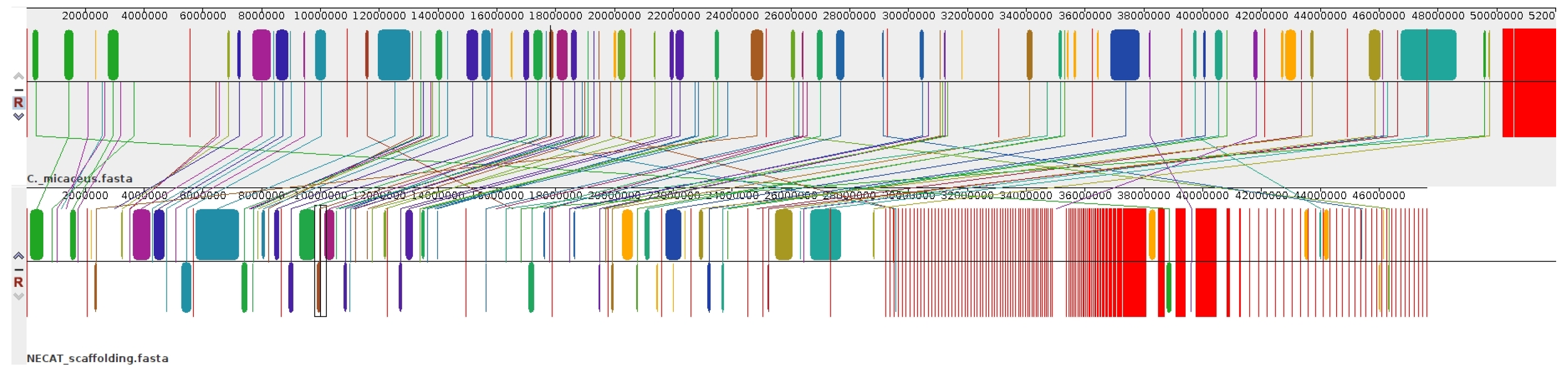
Given the lack of a high-quality reference genome for Candolleomyces or closely related species, we used the available genome of Coprinellus micaceus (GenBank: GCA_951394405.1) as an external reference. This species belongs to the family Psathyrellaceae and is the closest phylogenetic genus with an annotated genome. Although not ideal, this approach can still provide sufficient information to order and orient a portion of the contigs. To validate Coprinellus micaceus as a structural reference, we performed a whole-genome synteny analysis with the CMU-8613 strain of C. candolleanus using Mauve. The alignment revealed extensive conservation of genomic architecture, with large Locally Collinear Blocks (LCBs) shared between the genomes. As shown in Figure 2, scaffolding effectively resolved contig orientation, demonstrating a high degree of macrosynteny. Despite the evolutionary divergence between the two genera, the conserved chromosomal organization supports using C. micaceus as a guide for contig ordering in the CMU-8613 genome.
Figure 2.
Genome-wide synteny between Coprinellus micaceus and the CMU-8613 strain of Candolleomyces candolleanus. The whole-genome alignment, generated with Mauve, shows the reference genome (C. micaceus) on the upper track and the scaffolded NECAT assembly of CMU-8613 on the lower track. Colored blocks represent Locally Collinear Blocks (LCBs), highlighting regions of conserved sequence homology without rearrangements. Connecting lines indicate orthologous regions, demonstrating a high degree of macrosynteny between the two species.
The scaffolding process improved the continuity of all three assemblies by increasing scaffold N50 values relative to contig N50 values and by reducing the total number of scaffolds (Table 3). This improvement can be attributed to the considerable macrosynteny between C. micaceus and CMU-8613 genomes. The NECAT assembly showed the greatest improvement, achieving a scaffold N50 of 1 Mb—substantially higher than that of the Flye and Canu assemblies. This suggests that NECAT’s inherently higher contiguity facilitated ordering relative to the reference. Importantly, BUSCO metrics remained nearly unchanged after scaffolding. The slight increase in total assembly size likely reflects the introduction of ‘N’ characters to represent gaps between contigs within scaffolds. The stability of BUSCO scores confirms that scaffolding reorganized and oriented the existing contigs without substantially altering or recovering core gene content. Despite the enhanced continuity, some limitations remain. NECAT produced the most contiguous assemblies, but also the least complete and smallest. Canu remained the most fragmented at both the contig and scaffold levels, yielding the highest number of scaffolds. Flye retained its high completeness while achieving intermediate continuity.
Table 3.
Quality of the genome assembly of strain CMU-8613 after scaffolding with the reference genome of Coprinellus micaceus (GCA_951394405.1).
2.4. Iterative Scaffolding Using the NECAT Assembly as a Reference
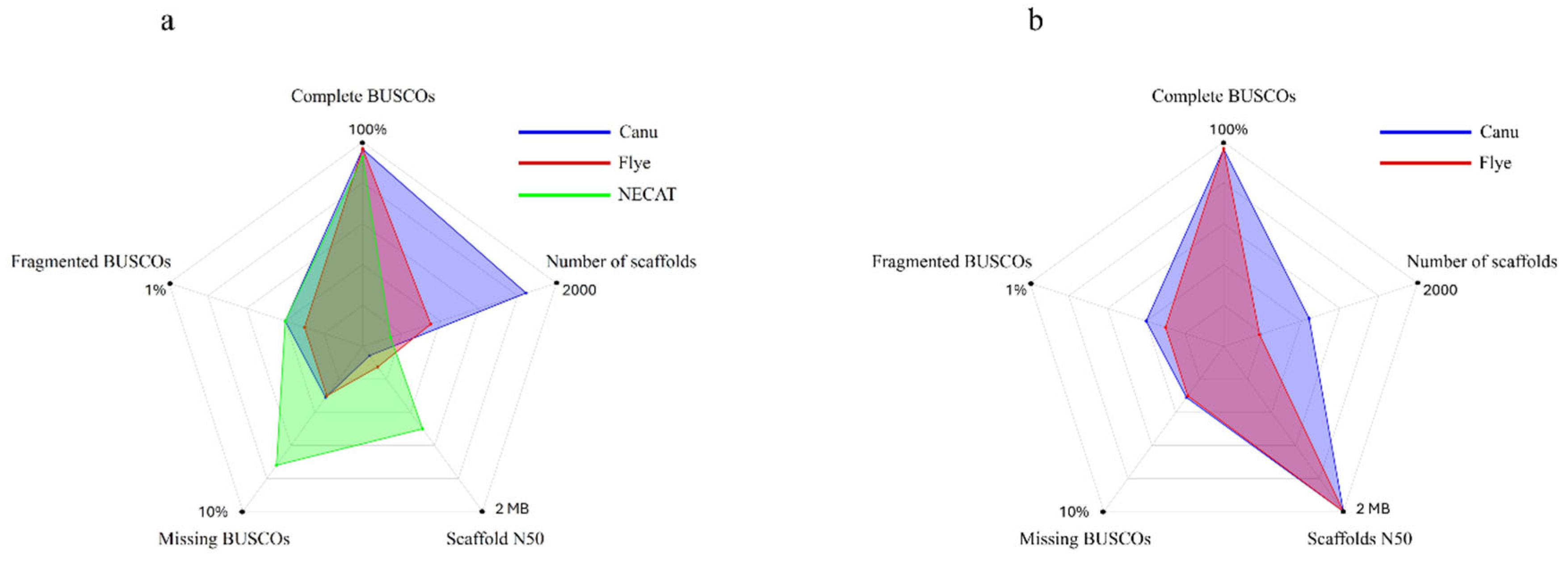
Given the high continuity of NECAT, the greater completeness of Flye and Canu, and the limitations of the external reference—since it is not from the same species or genus—a strategy of iterative scaffolding was implemented. The NECAT assembly, improved in continuity through scaffolding with the C. micaceus genome (Scaffold N50 > 1 Mb), served as a reference to order and orient the primary assemblies of Canu and Flye. The goal of this strategy was to combine the strengths of different assembly approaches to transfer the continuity achieved in the NECAT assembly to the Canu and Flye assemblies, which were more complete but more fragmented. The results are presented in Table 4. The difference between the two orderings is shown in Figure 3.
Table 4.
Assembly quality after scaffolding with the NECAT assembly as a reference.
Figure 3.
Representation of the BUSCO scores in the genome assemblies of the CMU-8613 strain, obtained using: (a) the genome of Coprinellus micaceus (GCA_951394405.1) as a reference and (b) NECAT.
This strategy was effective, as the initial assemblies with Canu and Flye showed a significant increase in contiguity, reaching an N50 of 2 MB for scaffolds, an improvement over the N50 obtained using the external reference C. micaceus (Table 4). The number of scaffolds also decreased drastically, especially in Flye (from 771 contigs to 370) scaffolds.
Again, the BUSCO scores remained stable, indicating that the improvement was structural (Table 4, Figure 3). This result demonstrates the potential of using an internally generated, contiguity-optimized assembly as a scaffold for other assemblies in the same project, prioritizing completeness. This approach can be beneficial for non-model organisms, where high-quality external references are lacking, because it allows leveraging the complementary strengths of different assembly algorithms iteratively.
Among the two assemblies produced by this second scaffolding step, the one generated by Flye proved to be the most promising. It maintained its initial completeness (BUSCO: 96.7%) and now shows excellent continuity (Scaffold N50: 2 MB), with a significantly lower number of scaffolds (370) than the assembly derived from assembly (882 scaffolds), despite sharing the same Scaffold N50 value. Therefore, the Flye and NECAT assemblies were selected, and their quality results are shown in Table 5 for the annotation stage.
Table 5.
Final quality metrics of the polished and sorted assemblies.
2.5. Comparison of Genome Annotation and Functional Analysis
To evaluate the biological impact of the observed differences in the quality of the final assemblies, both genomes were annotated with the Funannotate gene prediction tool, and the results were compared at structural and functional levels. The annotation results reflect differences in the underlying assembly quality (Table 6). The larger, more complete gene assembly, derived from Flye, enabled the prediction of a significantly greater number of genes, suggesting greater integrity of the gene models, likely due to less fragmentation in coding regions or fewer residual frameshift errors in the assembly. Exon, gene, and protein lengths are very similar, indicating that the differences are more related to the number of predicted features rather than individual sizes (Table 6). This strong correlation between assembly quality metrics, particularly BUSCO and size, and the comprehensiveness of the resulting gene annotation reinforces the value of BUSCO as an early predictive indicator of an assembly’s potential for subsequent biological analyses.
Table 6.
Comparison of key annotation statistics.
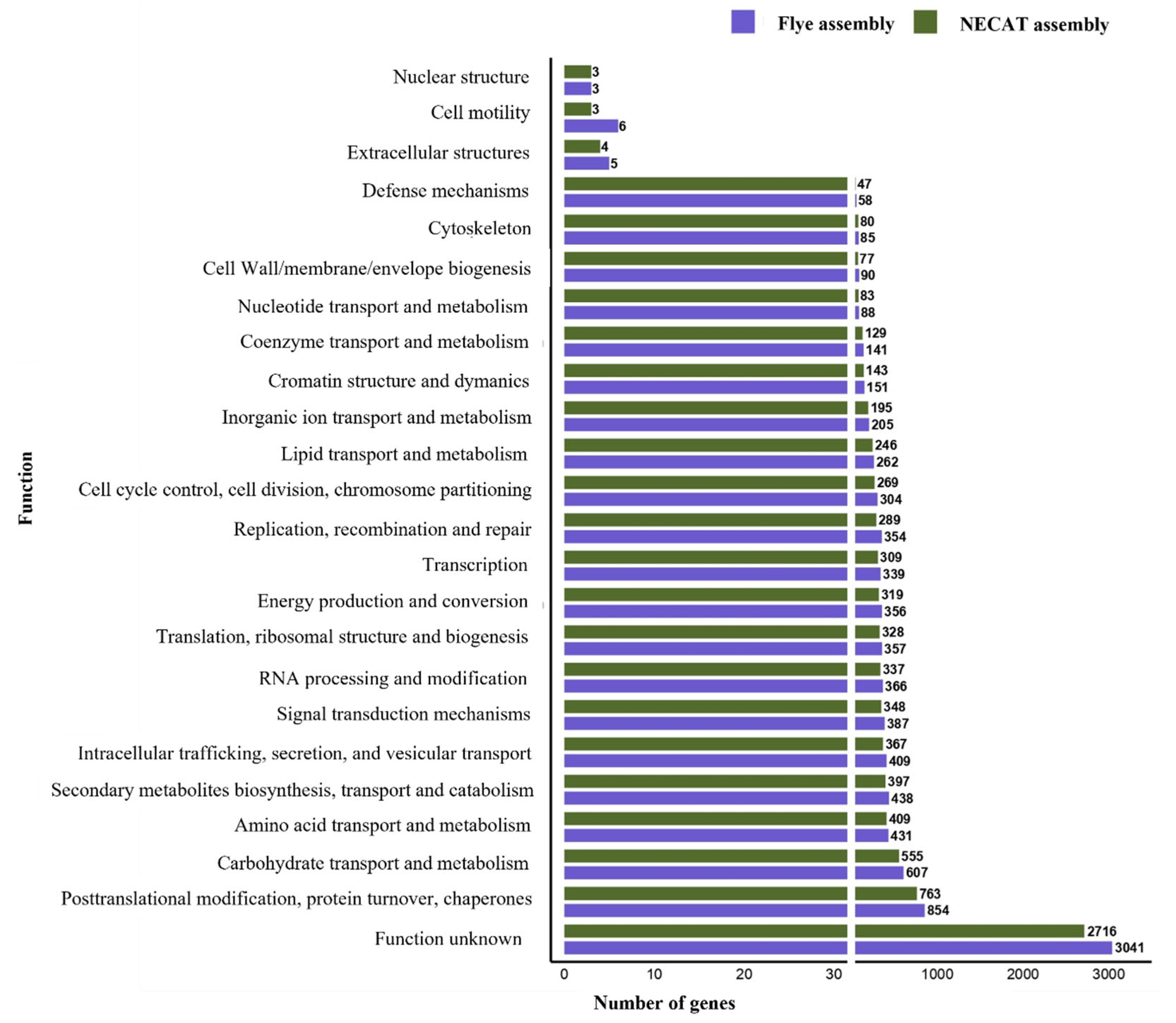
Functional annotation was performed by assigning predicted genes to COG categories and by searching for clusters of secondary metabolite biosynthesis genes (BGCs) using the antiSMASH tool. The COG annotation was consistent with the largest number of predicted genes; the Flye assembly assigned more genes to nearly all COG functional categories than NECAT (Figure 4).
Figure 4.
Number of genes annotated by COG functional categories in the genome of strain CMU-8613, C. candolleanus. The graph shows the number of genes in the genomes assembled with Flye and NECAT, sorted and polished.
2.6. Features of the Mitochondrial Genome
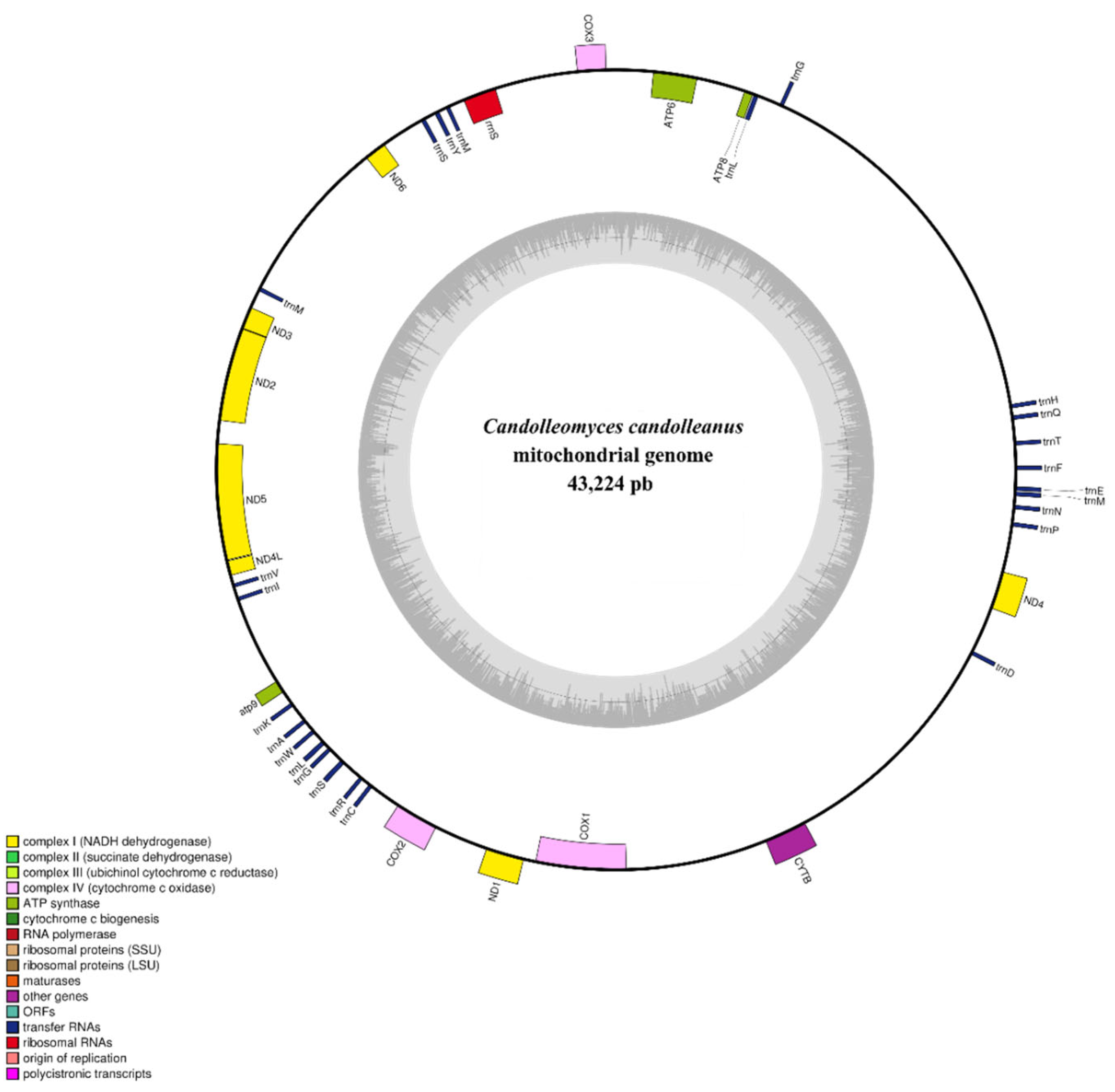
The assembled mitochondrial genome of Candolleomyces candolleanus was approximately 43,224 bp in length (Figure 5). Functional annotation using MitoHiFi revealed that it comprises 40 genes, including 13 protein-coding genes (CDS), two ribosomal genes (rnl and rns), and 25 transfer RNA (tRNA) genes.
Figure 5.
Circular map of the mitochondrial genome of Candolleomyces candolleanus. Blocks of different colors represent genes; those outside the outer ring are on the forward strand, while those inside the outer ring are on the reverse strand. The gray-scale bar chart on the inner ring shows the GC content of the mitochondrial sequences. The inner circle of the GC content chart marks the 50% threshold. The complete mitochondrial genome map was created using OGDraw v1.2 [12].
The coding genes correspond to essential components of the mitochondrial respiratory machinery, including subunits of NADH dehydrogenase complexes (nad1–nad6, nad4L), cytochrome c oxidase (cox1–cox3), cytochrome b (cob), and ATP synthase (atp6, atp8, atp9). The identified tRNAs cover most amino acids, indicating functional and autonomous mitochondrial translation machinery.
2.7. Secondary Metabolite Gene Clusters (BGCs)
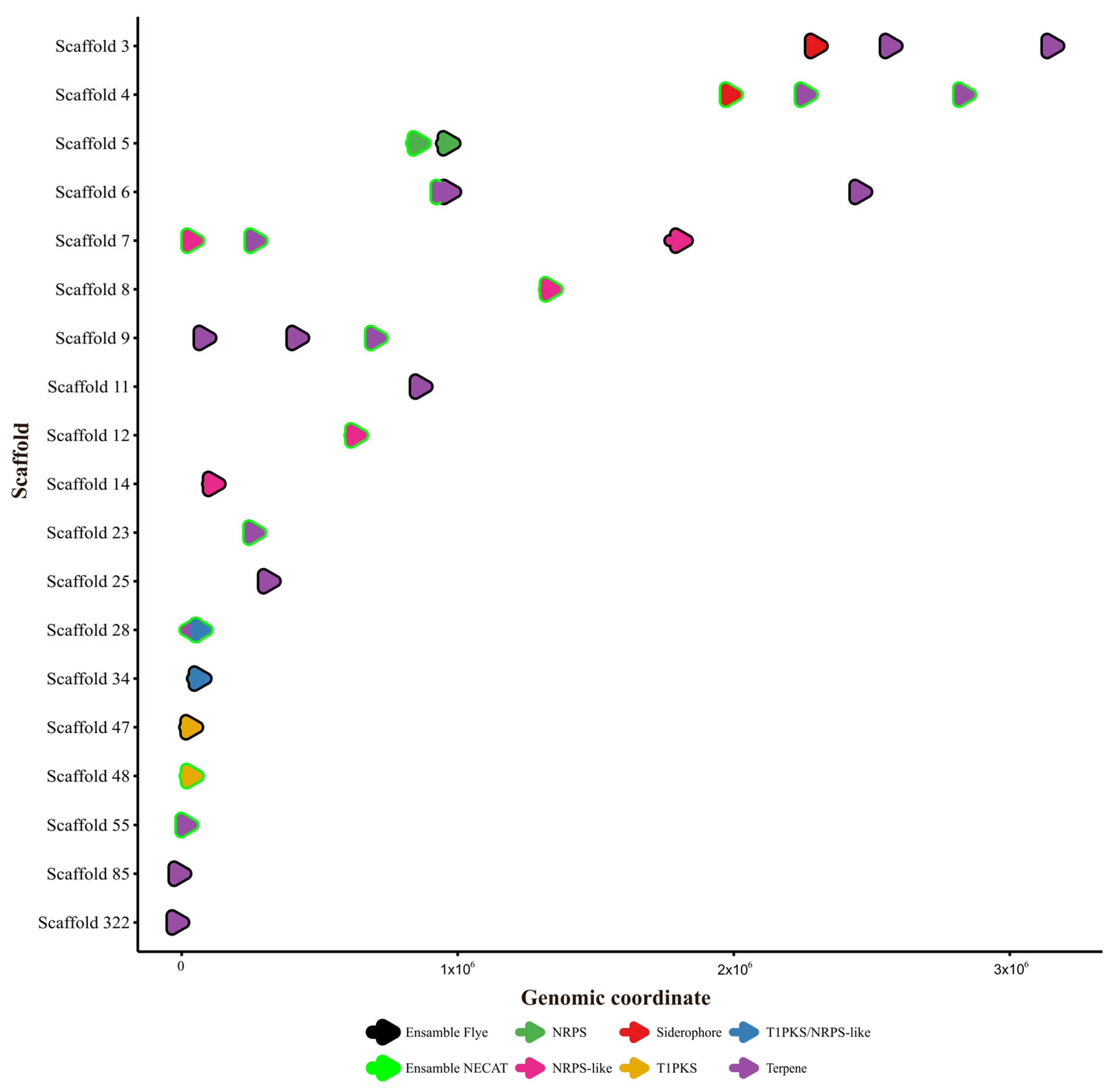
The antiSMASH tool identified a similar number of BGCs in both assemblies: 16 in the Flye assembly and 15 in the NECAT assembly (Table 7). Although the totals were comparable, the BGCs were distributed across different scaffolds and varied in size (number of bases), as shown in the genetic coordinate map in Figure 6. The types of BGCs identified included terpenoid synthases (10 in Flye, 9 in NECAT), non-ribosomal peptide synthetases (NRPS, 3 in both), polyketide synthases (PKS, 1 in both), siderophore synthesis (1 in both), and a hybrid NRPS-T1PKS cluster in both (Table 8). Similarly, the FunBGCex analysis revealed moderate differences in the number and composition of BGCs detected between the assemblies generated with Flye and NECAT.
Table 7.
Comparison of BGC annotation tools.
Figure 6.
Coordinate map of the BGCs characterized in the polished and ordered assemblies of Flye and NECAT. The overlapping colors of the BGCs indicate that both assemblers place them on the same scaffold.
Table 8.
Comparison of the types of BGCs identified using different assembly tools.
In total, the Flye assembly identified 25 BGCs, while NECAT identified 23, suggesting greater recovery of biosynthetic loci in the Flye assembly. However, both assemblies shared a similar biosynthetic profile, including terpene-type clusters (TC), NRPS, PPPS, DMATS, and UbiA, indicating that both methods consistently reconstructed the overall metabolic capacity of the genome.
A comparison of FunBGCex and antiSMASH shows strong agreement on the types of clusters detected, though with differences in sensitivity and boundary definitions. Overall, FunBGCex was more sensitive to partial BGC fragments, while antiSMASH provided a more precise definition of each cluster’s boundaries (Table 7). The assembly generated with Flye stood out in both tools, showing a greater number of BGCs and higher similarity to reference clusters, suggesting that it offers a more complete reconstruction of biosynthetic regions than NECAT (Table 8).
2.8. Number of CAZyme-Encoding Genes
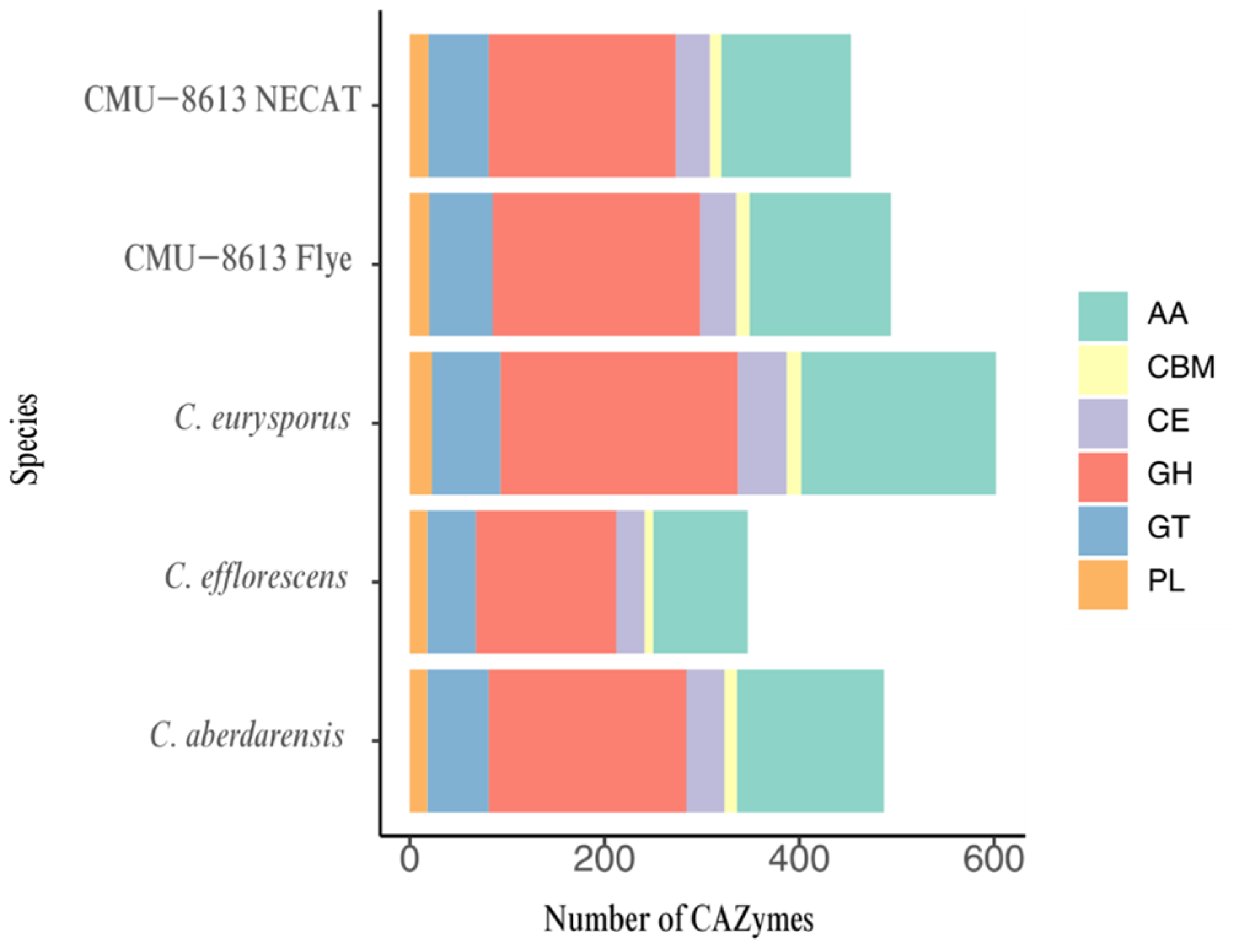
Functional annotation analysis using dbCAN identified multiple CAZyme families in the genomes of the four studied Candolleomyces species (Figure 7). The detected families spanned the main functional groups of the CAZyme classification, including AA (Auxiliary Activities), CBM (Carbohydrate-Binding Modules), GH (Glycoside Hydrolases), GT (Glycosyltransferases), CE (Carbohydrate Esterases), and PL (Polysaccharide Lyases). The AA and GH families were consistently the most abundant across all four species.
Figure 7.
Distribution of CAZyme family genes in Candolleomyces species.
After applying high-confidence filtering, the total number of CAZymes per species varied across the analyzed genomes, with 494 in the Flye assembly and 453 in the NECAT assembly for strain CMU-8613. These results are similar to those of Candolleomyces aberdarensis, which had 487, whereas the assemblies of Candolleomyces efflorescens and Candolleomyces eurysporus showed the most significant differences, with 347 and 602, respectively. This variation in CAZyme gene counts suggests potential functional differences in carbohydrate degradation, modification, or synthesis within the Candolleomyces genus. The species C. eurysporus had the highest number of genes associated with GH and AA, while C. efflorescens had fewer genes related to both enzymatic functions. The numbers of CBM and PL enzymes remain relatively conserved across the compared species (Figure 7). In the specific case of strain CMU-8613, the main difference between the Flye and NECAT assemblies was the location of the GH and AA genes: with the first, 213 and 145 were detected, respectively, whereas with the second, 192 and 133 were detected.
2.9. Type of Mating in the CMU-8613 Strain
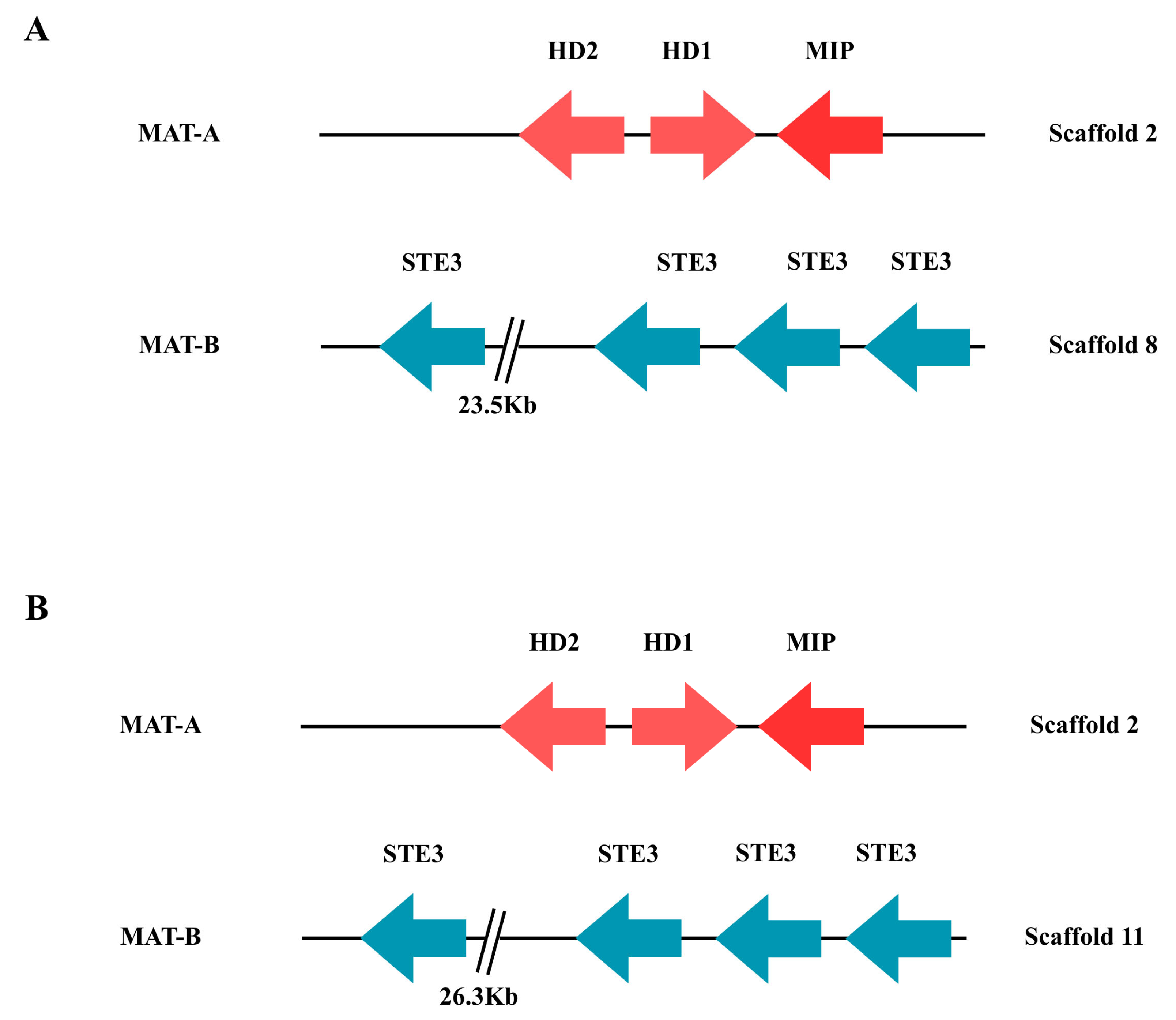
Functional analysis identified the HD1, HD2, and MIP genes associated with the MAT-A locus in C. candolleanus, all located on scaffold 2 in both the Flye and NECAT assemblies (Figure 8). This suggests that both methods correctly assemble the homeodomain-encoding region. In contrast, the genes of the MAT-B locus, corresponding to GPCR-type pheromone receptors, were found in different genomic regions in each assembly: on scaffold 8 in the Flye assembly and on scaffold 11 in the NECAT assembly (Figure 8).
Figure 8.
Distribution of mating genes in the CMU-8613 strain of Candolleomyces candolleanus. Homeodomain protein HD1, homeodomain protein HD2, MIP mitochondrial interpeptidase, and STE pheromone receptor similar to STE3. (A) Flye assembly. (B) NECAT assembly. The numbers below each gene correspond to the locus tag in GenBank files.
No additional homeodomain-associated genes were identified outside scaffold 2, confirming that MAT-A and MAT-B are not physically linked in the analyzed genome. The separation of both loci onto different scaffolds, together with the complete presence of the HD and MIP genes in MAT-A and the pheromone receptors in MAT-B, is consistent with a tetrapolar reproductive system.
2.10. Phylogenetic Analysis
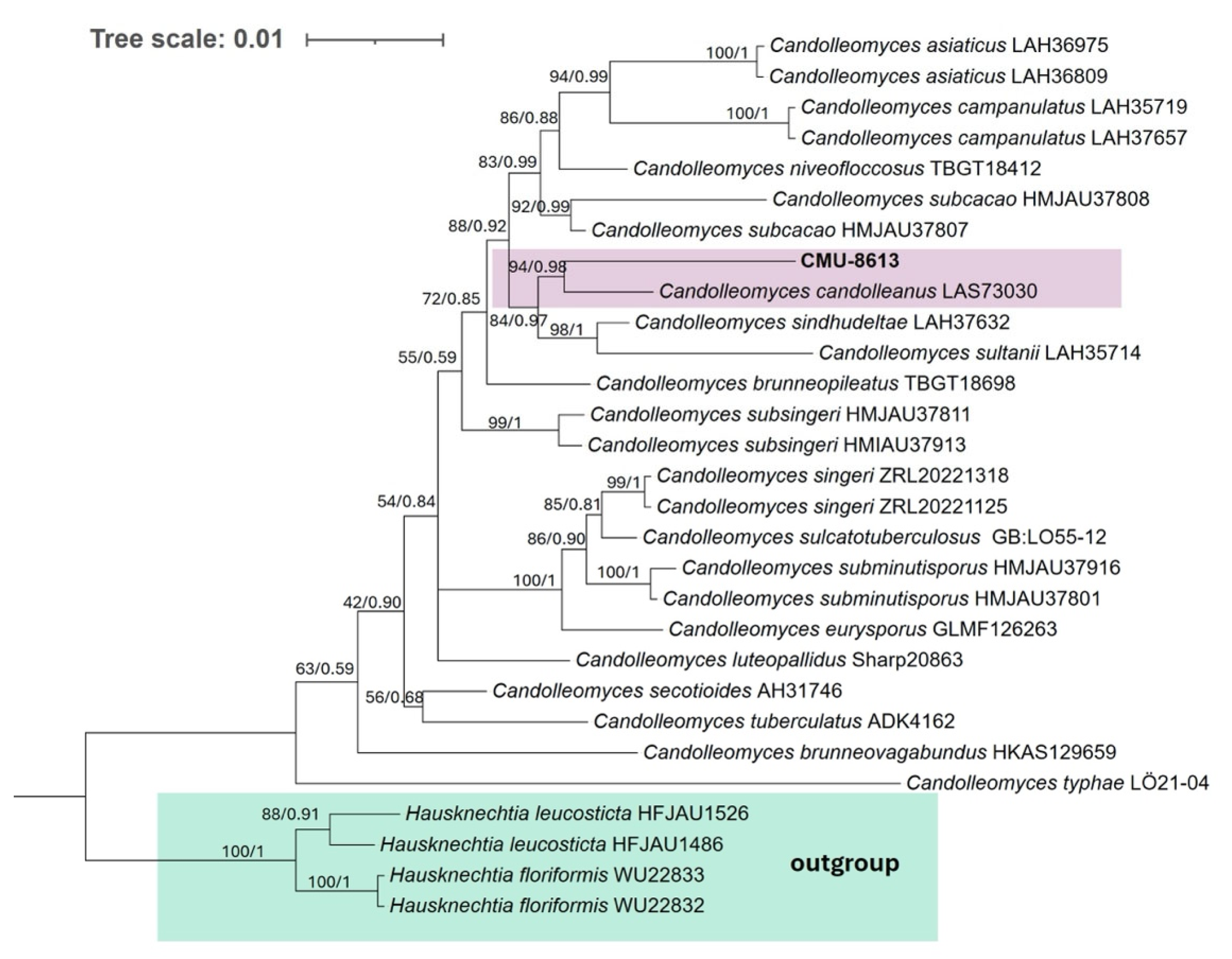
Once the genome assembly was obtained, the ITS region and the LSU gene were used to reconstruct the phylogeny of strain CMU-8613. All species with both sequences available in GenBank were included in the analysis to produce a robust phylogeny. The strain under study clustered with high bootstrap support alongside the type strain Psathyrella candolleana, currently considered C. candolleanus (Figure 9).
Figure 9.
Phylogenetic tree of strain CMU-8613. The clustering pattern was generated using Bayesian inference and the Maximum Likelihood criterion, based on concatenated ITS and LSU sequences. In the ML analysis, TIM2e+G4 (ITS) and TPM3+G4 (LSU) were used. Confidence values from 1000 bootstrap iterations for the ML tree, as well as posterior probability values for the Bayesian phylogeny, are shown at each node (UB/PP). All included species belong to the genus Candolleomyces or its synonym Psathyrella. Two geographic isolates of two species from the genus Hausknechtia were used as an outgroup.
3. Discussion
Species of the genus Candolleomyces possess considerable biotechnological potential due to their production of bioactive secondary metabolites of pharmacological relevance. Basic studies aimed at identifying pharmacological activities show that crude extracts of the vegetative mycelium of Candolleomyces candolleanus (syn. Psathyrella candolleana) exhibit notable antimicrobial and antioxidant properties. This has generated interest in isolating and structurally characterizing the secondary metabolites of C. candolleanus, particularly diterpenoids, which constitute the distinctive chemical signature of this species’ secondary metabolism. However, no annotated genome is currently available in public databases to enable a comprehensive assessment of the biotechnological potential of species within the genus Candolleomyces.
The phylogenetic analysis places strain CMU-8613 in the same terminal clade as C. candolleanus. However, the terminal branch length for each taxon deviates from the pattern observed in most geographic variants of the same species in the phylogenetic tree. For example, in C. asiaticus, C. campanulatus, C. subsingeri, C. singeri, and C. subminutisporus, the two strains representing each species show identical or nearly identical terminal branch lengths (Figure 9). The only geographic variants of the same species that show a difference in terminal branch length similar to that observed in CMU-8613/C. candolleanus are those of the species C. subcacao. This suggests that strain CMU-8613 is related to Candolleomyces candolleanus (syn. Psathyrella candolleana), making this the first publicly available, assembled, and annotated genome of this genus.
A comparative analysis of pipelines for basidiomycete genome assembly reveals a clear trend toward hybrid strategies, increasingly favoring the combination of long and short reads to optimize both structural contiguity and base-level accuracy. Nonetheless, current studies indicate that no universally optimal approach exists for basidiomycete genomes, as technical challenges vary with sample type, heterozygosity level, and sequencing depth [13]. For Clitopilus passeckerianus and Phellinotus piptadeniae, assemblers tailored for noisy long reads, such as Canu and MaSuRCA, have been used, followed by extensive polishing with Pilon using Illumina data [14,15]. These pipelines produced robust assemblies with high BUSCO completeness scores (93.4–93.3%). However, they remained moderately fragmented (N50 < 700 kb), reflecting the limitations of relying on iterative correction procedures without explicit heterozygosity-aware modeling.
Recent assemblies employ advanced strategies to improve structural resolution. For instance, in Ganoderma boninense, integrating Hi-C data via the HiRise pipeline enabled a chromosomal-level assembly (N50 > 4 Mb). In contrast, in Cyathus olla, a comparable level of contiguity was achieved solely through deep Nanopore sequencing coverage and a robust assembly workflow based on NECAT and Purge_haplotigs [16,17]. These findings demonstrate that long-read sequencing, combined with effective haplotypic collapse algorithms, can compensate for and, in some cases, outperform chromosomal proximity data. The use of HiFi reads in Armillaria spp. and Lentinula edodes has become the standard for achieving high accuracy in genome reconstruction [13,18]. In particular, in L. edodes, a landmark fully phased (haplotype-to-haplotype) assembly was generated using hyphae and single-spore-derived material, enabling the reconstruction of an entire diploid genome. However, this approach demands substantial resources and specialized datasets that are not always accessible.
In this context, the pipeline developed in this study for strain CMU-8613 offers a methodologically balanced and comparatively innovative approach. Unlike previous works that rely on a single assembler or on the direct integration of short and long reads, this approach systematically evaluated the performance of three long-read assemblers, Canu, Flye, and NECAT, and assessed their trade-offs between contiguity and gene completeness. The results align with earlier observations indicating that NECAT generates highly contiguous assemblies (N50 > 1 Mb), whereas Flye achieves superior gene representation (BUSCO > 96%). The observed trade-off between NECAT’s high contiguity and Flye’s superior completeness can be attributed to how each algorithm handles the complex genomic features typical of Basidiomycota. Basidiomycete genomes are often characterized by high levels of heterozygosity and a substantial accumulation of repetitive elements, such as transposons [19]. NECAT uses a global alignment approach that effectively bridges repetitive regions by identifying coverage peaks [20], resulting in longer contigs but potentially collapsing closely related paralogs or alleles, which explains the lower gene completeness. Conversely, Flye constructs a repeat graph designed to preserve alternative paths in complex regions [21]. While this strategy is more sensitive to retaining gene content and resolving structural variants common in heterozygous fungi, it can lead to graph breaks at complex repeats, resulting in a more fragmented assembly but with higher gene recovery. Further analysis with the RepeatScout, LTRharvest, and LTR_STRUCT tools [19] will allow us to determine which of the assembly strategies used here better recovers transposable elements of the here annotated genome.
A distinctive aspect of this study is the implementation of a cross-bridging approach, in which the highly contiguous structural assembly produced by NECAT served as a reference to reorganize the more gene-rich contigs generated by Flye. This internal hybrid approach, not reported in most of the reviewed cases, integrated the strengths of both algorithms, yielding an assembly with an optimal balance between contiguity and completeness. Additionally, the sequential application of long-read-specific polishing tools (Racon, Medaka), followed by short-read polishing with Pilon, effectively corrected residual homopolymer-associated errors, substantially enhancing the overall accuracy of the genome assembly. The rationale for performing four iterations was to reach a convergence point where increases in BUSCO completeness scores and reductions in indel errors plateaued, ensuring maximum consensus accuracy without overcorrection. Subsequently, four rounds of short-read polishing with Pilon were conducted to correct residual homopolymers and frameshifts.
The estimated genome size of C. candolleanus ranged from 46.8 Mb (NECAT + Racon) to 59.3 Mb (Canu + scaffolding with the C. micaceus genome), depending on the assembly and polishing strategy. In GenBank, the reported genome sizes for C. eurysporus, C. efflorescens, and C. aberdarensis are 70, 33.6, and 60.6 Mb, respectively (Supplementary Table S1). However, these assemblies remain at the scaffold or contig level (500–2300 contigs), lack annotation, and are highly fragmented, with N50 values of only 57–157 kb. These limitations are primarily attributable to the predominant use of Ion Torrent sequencing and medium to low coverage. Therefore, these genomes are not appropriate comparative references for the annotated genome generated in this study and, for the same reasons, were not used as templates during the assembly of strain CMU-8613. The genome of C. micaceus was selected as the structural reference because it is the taxonomically closest fully annotated genome available at the chromosome level within the family Psathyrellaceae [22]. Previous phylogenomic studies in Agaricales have demonstrated a high degree of macrosynteny and conservation of gene order among closely related genera within the same family [23,24]. Although C. micaceus and C. candolleanus are distinct species, their phylogenetic proximity [1] allows the reference to serve as a reliable guide for orienting contigs without imposing artificial adjacencies, as confirmed by the stability of BUSCO scores after scaffolding process.
Beyond the genomes of Candolleomyces spp., the family Psathyrellaceae in GenBank includes 14 assemblies unevenly distributed across four genera. The most represented genus is Coprinopsis, with five genomes (Supplementary Table S3), followed by Coprinellus, with four (Supplementary Table S4), and by Ephemerocybe and Psathyrella, with two genomes each (Supplementary Tables S5 and S6, respectively). Additionally, a single assembly corresponds to an uncultured Psathyrellaceae taxon (Supplementary Table S6). Most of these genomes are deposited at the scaffold or contig level. Among them, Coprinellus and Coprinopsis, particularly the model strain Coprinopsis cinerea, show the most robust metrics, with N50 values exceeding 3 Mb, fewer contigs, and the use of long-read technologies such as PacBio or Oxford Nanopore. The genome of C. micaceus (GCA_951394405.1) is annotated at the chromosome level and was used as a reference in this study to assemble strain CMU-8613. Its size, 52 Mb, is comparable to the upper range of genome estimates obtained for C. candolleanus, reaching 59.3 Mb in this study.
At a higher taxonomic level, where more high-quality, annotated genomes are available, genome sizes within the order Agaricales range from 22.12 Mb (Amanita inopinata) to 175 Mb (Tricholoma matsutake) [25,26]. This broad variation has been linked to lineage-specific expansions and losses of genes associated with ecological transitions, particularly the diversification of substrate utilization strategies among saprotrophic fungi and shifts from saprotrophy to mycorrhizal lifestyles [23,24]. A more detailed functional analysis of the C. candolleanus genome will help clarify its saprotrophic potential, a lifestyle to which the species has been frequently attributed. High-quality assemblies and annotations from additional species within the family Psathyrellaceae, especially from Candolleomyces and closely related genera, are essential for improving ecological and physiological predictions for this taxonomic group, including assessments of plant biomass degradation capacity and secondary metabolite biosynthesis.
Within Agaricales, mitochondrial genome size varies substantially among species within the same genus and even among isolates of a single species. In commercially important edible members of Agaricales, mitochondrial genome sizes also show considerable variability. For example, species of the genus Pleurotus possess relatively uniform mitochondrial genomes ranging from 60,694 to 73,807 bp [27]. In contrast, Agaricus bisporus and Lentinula edodes have much larger mitochondrial genomes of 135,005 bp and 121,394 bp, respectively. Recent studies have reported mitochondrial genome sizes ranging from 114,236 to 129,263 bp within the family Nidulariaceae [28], as well as an extreme case in Clavaria fumosa (family Clavariaceae), which reaches 256,807 bp [29]. The gene content and structure of the mitochondrial genome of C. candolleanus strain CMU-8613 are consistent with the smaller mitochondrial genomes found within Agaricales, including those of closely related species such as C. micaceus (64,450 bp) [27] and Coprinopsis cinerea (42,448 bp; NW003307477.1) [30]. Expansions in mitochondrial genomes within Agaricales have been associated with repetitive regions and introns [27,28], features that are uncommon in these species, including the CMU-8613 strain.
Genome mining has revolutionized natural product discovery, enabling the identification and characterization of biosynthetic gene clusters (BGCs) that encode diverse secondary metabolites [31,32]. Using this approach, He et al. [11] identified a BGC responsible for the biosynthesis of guanacastane-type diterpenes in P. candolleana. Through heterologous expression, they demonstrated that the diterpene synthase PsaD catalyzes the cyclization of geranylgeranyl diphosphate, while the monooxygenase PsaA (cytochrome P450) mediates successive oxidation steps leading to guanacastane terpenes. The functional genomic analysis presented here highlights the importance of genome assembly, annotation, and BGC prediction tools for identifying and localizing genes involved in secondary metabolite synthesis in fungi. Depending on the combination of tools used, the number of predicted BGCs in C. candolleanus ranges from 15 (NECAT/antiSMASH) to 25 (Fly/FunBGCex), with terpene synthesis (TS) clusters being the most abundant, ranging from 9 to 14 across analyses.
The second major group comprises clusters encoding enzymes involved in the biosynthesis of non-ribosomal peptides and polyketides (NRPS/PKS, including all variants). All prediction tools consistently identified five BGCs. As previously mentioned, no high-quality annotated genome is available for Candolleomyces/Psathyrella that would allow a direct comparison with strain CMU-8613. Within the Psathyrellaceae, however, the genome of Coprinopsis cinerea harbors nine terpene synthesis (TS) BGCs and 5 NRPS/PKS [33]. Overall, the number of BGCs associated with major metabolite classes in CMU-8613 falls within the range reported for other Agaricales, although their distribution varies among species. For example, in Laccaria bicolor, 8 TS and 5 NRPS/PKS are encoded, whereas in Schizophyllum commune, 5 and 10 are encoded, respectively. Edible species of great commercial relevance, Agaricus bisporus (button mushroom) and Pleurotus ostreatus (oyster mushrooms), show the same trend, with 10 and 15 TS BGCs and 8 and 9 NRPS/PKS, respectively [33]. A remarkable exception within Agaricales is the genus Cyathus, whose species harbor between 41 and 209 BGCs; among these, 12–95 correspond to terpene biosynthesis and 18–49 to the NRPS/PKS pathway, depending on the species [34]. Increasing the number of annotated genomes from species within the Psathyrellaceae will help determine whether the relatively low number of BGCs observed in CMU-8613 of the family reflects lineage-specific reductions.
One of the biologically relevant findings in this genome is the identification of a biosynthetic gene cluster on Scaffold 6, annotated as a polyprenyl pyrophosphate synthase (PPPS). Detailed analysis of this cluster reveals the co-occurrence of a geranylgeranyl pyrophosphate synthase (GGPPS) and a cytochrome P450 monooxygenase. This genomic organization aligns with the chemical structure of psathyrellanic acid, a known metabolite of C. candolleanus with antibacterial properties [8,10]. Theoretically, the GGPPS is required to synthesize the 20-carbon precursor (geranylgeranyl diphosphate). At the same time, the cytochrome P450 monooxygenase would catalyze the subsequent oxidation of the terpene skeleton, a structural feature observed in psathyrellanic acid and guanacastane diterpenes [11]. Therefore, we propose this locus on Scaffold 6 as the putative biosynthetic gene cluster for these bioactive compounds, providing a clear target for future heterologous expression studies.
Species in genera within the order Agaricales have more CAZyme-encoding genes than genera in the orders Russulales, Polyporales, and Boletales [24]. The number of CAZyme-encoding genes in species of Candolleomyces, including strain CMU-8613, is consistent with this pattern and exceeds the number of CAZyme genes in Inonotus obliquus, a member of the order Hymenochaetales [29]. The number of CAZymes aligns with the saprophytic lifestyle of most Candolleomyces species [1], indicating that this taxon has strong potential for use in composting processes and biofuel production [35,36].
The localization of the MAT-A and MAT-B genes in the genome of strain CMU-8613 indicates that it has a tetrapolar mating system, a condition common in Agaricales and considered ancestral for mating types [37]. However, intraspecific variation in mating systems has been documented [38]; thus, as additional genomes from this genus become available, it will be possible to more precisely determine the mating strategies that generate genetic diversity within Candolleomyces.
4. Materials and Methods
4.1. Study Strain
The strain CMU-8613 was isolated and studied in 2017 in the state of Michoacán from a soil sample collected in a mixed-vegetation area in the municipality of Tarímbaro, Michoacán [39]. The strain is part of the Michoacan University Culture Collection (CMU) of the Microbial Biotechnology and Conservation Laboratory at the Multidisciplinary Center for Biotechnology Studies of the Faculty of Veterinary Medicine and Animal Science at the Universidad Michoacana de San Nicolás de Hidalgo.
4.2. DNA Extraction
For maintenance of the study strain and collection of biomass for DNA isolation, solid malt extract agar (CEM) medium (BD Difco™, Sparks, MD, USA) was prepared according to the supplier’s specifications and sterilized at 121 °C and 15 lb/in2 for 15 min. Genomic DNA was extracted from actively growing mycelium cultivated on CEM, which was harvested and placed into 2 mL microcentrifuge tubes. DNA extraction was performed using the ZymoBIOMICS™ DNA Miniprep Kit according to the manufacturer’s instructions (https://files.zymoresearch.com/protocols/_d4300t_d4300_d4304_zymobiomics_dna_miniprep_kit.pdf accessed on 5 December 2025).
4.3. Illumina Sequencing
Illumina (San Diego, California, USA) sequencing libraries were prepared using the Illumina DNA preparation kit, which includes PCR and tagmentation, along with custom 10 bp dual-unique indices (UDI), targeting an insert size of 320 bp. Sequencing was performed on the NovaSeq 6000 system, with one or more multiplexed runs on shared flow cells, generating paired-end reads of 2 × 151 bp. Demultiplexing, quality control, and adapter trimming were performed with bcl-convert1 (v4.1.5). After sequencing, raw read quality was evaluated using FastQC v0.11.5 (https://github.com/s-andrews/FastQC accessed on 5 December 2025). Adapter sequences and low-quality bases (Phred score < 20) were trimmed with Trimmomatic (v0.40) [40].
4.4. Oxford Nanopore Sequencing
Sequencing libraries were prepared from genomic DNA using the Oxford Nanopore Technologies (ONT, Oxford, UK) ligation sequencing kit (SQK-NBD114.24, ONT, Oxford, UK) with the NEBNext® (E7180L, New England Biolabs®, Ipswich, MA, United States) supplemental module, following the manufacturer’s specifications. No additional DNA fragmentation or size selection was performed. Nanopore sequencing was performed on an Oxford Nanopore MinION Mk1B sequencer (ONT, Oxford, UK) with R10.4 flow cells. For high-accuracy base calling (SUP), Guppy1 (v6.4.6) was used for demultiplexing and adapter trimming.
4.5. Genome Assembly and Polishing
A hybrid assembly approach was used, consisting of a primary genome assembly with ONT reads using three assemblers: Flye (v2.9.5), Canu (v2.3), and NECAT (v0.0.1) [20,21,41]. The primary assembly was polished with ONT reads using minimap2 (v2.28) [42] and four rounds of Racon + Medaka (V1.5.0/V1.7.2) [43,44]. Short Illumina reads were used for secondary polishing with Pilon (v1.20.1) [45] in four rounds. Duplicate contigs (haplotigs) were removed using purge dups (1.2.6) [46]. The quality and integrity of each assembled genome were evaluated using BUSCO (v5.8.0) (http://busco.ezlab.org/ accessed on 5 December 2025), with the OrthoDB_10 database for Agaricales.
4.6. Genome Arrangement
Two genome assemblies were generated using different polishing strategies. The first assembly used the genome of KDTOL0000127, ToLID gfCopMica1 of Coprinellus micaceus (GenBank ID: GCA_951394405.1), which also belongs to the order Agaricales and the family Psathyrellaceae and is phylogenetically close to the strain under study. Genomes of Candolleomyces available in public databases were excluded due to low assembly quality (Supplementary Table S1). The cross-assembly method was also employed, using the best result from the C. micaceus reference to perform a second assembly, aiming to obtain a high-contiguity, genetically complete assembly. Both assemblies were performed using the RagTag tool (v2.1.0) [47].
To assess the structural consistency and gene order of the ordered genome assembly, a whole-genome alignment was performed between Candolleomyces candolleanus CMU-8613 and the reference genome of Coprinellus micaceus (GCA_951394405.1). The alignment was conducted using Mauve (v2.4.1, snapshot_2015-02-13) [48], employing the Progressive Mauve algorithm with default parameters. Locally Collinear Blocks (LCBs) were identified to visualize conserved homologous regions and evaluate macrosynteny between the two genomes.
4.7. Genome Annotation
Structural and functional annotation of the ordered genomes was performed using the Funannotate tool (v1.8.15) [49], adding the Agaricales model (OrthoDB 10) to the initial training set of C. micaceus species in Augustus for BUSCO alignment. For functional annotation, the Funannotate database 2023-09-28-003158 was used, employing the annotation files from InterProScan (v5.76-107.0) and Eggnog-mapper (v2.1.13), which were previously obtained from the protein sequences of the structural annotation. The annotated files in GenBank format were subsequently analyzed and compared using the antiSMASH (v6.1.1) and FunBGCEx (Fungal Biosynthetic Gene Cluster Extractor) tools (v1.0.1), both specialized in detecting biosynthetic gene clusters (BGCs) involved in secondary metabolism in fungal genomes. [50,51]. This Whole-Genome Shotgun project has been deposited at DDBJ/ENA/GenBank under the accession JBSUFY000000000. The version described in this paper is version JBSUFY010000000. The raw genome sequencing data and the reported assembly are linked to NCBI BioProject PRJNA1370195 and BioSample SAMN53422976 in GenBank.
4.8. Mitochondrial Genome Assembly
The mitochondrial genome assembly was performed using MitoHiFi (v3.2.3) [52], which integrates the MitoFinder module [53] for identifying and annotating mitochondrial sequences. The combined use of both systems enabled the selection of the final mitochondrial contig and ensured the overall quality of the assembly.
4.9. Identification of CAZyme-Encoding Genes
Identification of enzymes associated with carbohydrate metabolism (CAZymes) was performed using the dbCAN3 (v4.1.4) platform (HMM-based Automated Carbohydrate-active enzyme annotation) [54] with the protein FASTA files generated during the Funannotate annotation process and those deposited in NCBI for Candolleomyces species (Supplementary Table S1). Only high-confidence CAZymes were considered, specifically those annotated by two or more methods, in accordance with the official recommendations of the dbCAN consortium.
4.10. Identification of the MAT-A/MAT-B Genes
To identify genes associated with the mating system in the strain CMU-8613 of Candolleomyces candolleanus, functional annotations from Funannotate were used, including Pfam and InterProScan predictions incorporated into the GenBank files of the assembled genome. Genes corresponding to the MAT-A locus were identified by detecting characteristic domains: the homeodomain (HD1 and HD2), with Pfam PF05920, and the mitochondrial intermediate peptidase (MIP), with InterPro IPR045090. For the MAT-B locus, genes associated with GPCR-type pheromone receptors were identified using the following functional identifiers: Pfam PF02076 (fungal pheromone receptor, STE3) and InterPro IPR001499 (G-protein coupled receptor-like). The search was conducted by examining the annotations of each gene in assemblies generated by Flye and NECAT, and by recording the genomic positions and gene orders for each scaffold. The resulting gene organization was graphically represented to evaluate the potential mating system structures.
4.11. BLASTn Search and Phylogenetic Analysis
The ITS region (ITS1-5.8S-ITS2) was amplified by PCR, and the resulting sequence was compared with the internal transcribed spacer (ITS) database of fungi and reference materials from the National Center for Biotechnology Information (NCBI, https://www.ncbi.nlm.nih.gov accessed on 5 December 2025) using the BLASTn (Basic Local Alignment Search Tool) program. The sequence helped associate strain CMU-8613 with the genus Psathyrella and select a phylogenetically close reference genome for assembly and annotation (see Genome Assembly and Annotation section below). After assembling and annotating the genome, the ITS and large ribosomal subunit (LSU) sequences were identified and selected, then used to perform another BLASTn search as described above, selecting those with the highest identity to the sequences of strain CMU-8613 (Supplementary Table S2 [55,56,57,58,59,60,61,62,63,64,65,66,67,68]). A FASTA file was generated for each study sequence set. Sequences from two species of the genus Hausknechtia, a genus closely related to Candolleomyces [1], were also retrieved and used as an outgroup. The FASTA sequences for each gene from the BLASTn search were concatenated and aligned using the MAFFT v.7 server [69]. The best evolutionary model for each sequence and the phylogenetic reconstruction via maximum likelihood (ML) were performed on the IQ-TREE web server [70,71]. The robustness of the internal branches in the resulting phylogeny was assessed with 1000 replicates to obtain ultrafast bootstrap (UFBoot) values for each bifurcation. Phylogenetic analysis using Bayesian criteria was conducted with MrBayes (v3.2) [72], running four Markov Chain Monte Carlo (MCMC) chains, starting from a random tree topology and setting a burn-in of 25%. Posterior probability values for each node were then calculated. The final phylogenetic tree was edited using iTOL [73].
4.12. Operating Environment
All bioinformatic analyses were performed on a Linux-based computational cluster. Unless otherwise stated, all software tools were run with default parameters. To ensure reproducibility, compute jobs for the most resource-intensive steps—primary assembly, iterative polishing, and quality assessment—were configured with 20 CPU threads and 100 GB of RAM.
5. Conclusions
Compared with high-cost pipelines based on Hi-C or PacBio HiFi, the strategy applied to C. candolleanus demonstrates that a high-quality genome assembly can be achieved through an appropriate combination of open-source tools and an iterative experimental design. This finding positions the pipeline used in this study within a competitive methodological framework. The comparison of assembly metrics shows that assembly quality depends not only on sequencing technology but also on the pipeline’s ability to integrate three key elements: (i) effective haplotype resolution and heterozygosity control, (ii) a multi-stage hybrid polishing strategy, and (iii) the use of complementary assembly algorithms. In this regard, the pipeline developed for the genome of C. candolleanus CMU-8613 serves as a reproducible, cost-effective model for assembling genomes of non-model basidiomycetes, providing a robust foundation for high-resolution genomic, evolutionary, and biosynthetic analyses.
The complete genome of the C. candolleanus strain CMU-8613, curated and annotated in this work, enabled robust phylogenetic placement, characterization of its mating system, and elucidation of this species’ biotechnological potential to produce hydrolytic enzymes and secondary metabolites.
Supplementary Materials
The following supporting information can be downloaded at: https://www.mdpi.com/article/10.3390/ijms27010509/s1, Table S1: Statistics on the assembly of Candolleomyces species genomes deposited in GenBank; Table S2: Data of sequences from Candolleomyces and Hausknechtia species retrieved from GenBank used in the phylogenetic analysis; Table S3: Statistics on the assembly of Coprinopsis species genomes deposited in GenBank; Table S4: Statistics on the assembly of Coprinellus species genomes deposited in GenBank; Table S5: Statistics on the assembly of Ephemerocybe species genomes deposited in GenBank; Table S6: Statistics on the assembly of Psathyrella species genomes deposited in GenBank.
Author Contributions
Conceptualization, G.V.-M., M.S.V.-G. and E.M.V.-V.; methodology, E.M.V.-V.; validation, E.M.V.-V.; formal analysis, E.M.V.-V. and G.V.-M.; investigation, E.M.V.-V., M.S.V.-G. and G.V.-M.; resources, G.V.-M. and M.S.V.-G.; data curation, E.M.V.-V.; writing—original draft preparation, E.M.V.-V. and G.V.-M.; writing—review and editing, E.M.V.-V., M.S.V.-G. and G.V.-M.; project administration, M.S.V.-G.; funding acquisition, G.V.-M. and M.S.V.-G. All authors have read and agreed to the published version of the manuscript.
Funding
This research was funded by the CIC-UMSNH 2025 and 2026 Research Programs.
Institutional Review Board Statement
Not applicable.
Informed Consent Statement
Not applicable.
Data Availability Statement
This Whole-Genome Shotgun project has been deposited at DDBJ/ENA/GenBank under the accession JBSUFY000000000. The version described in this paper is version JBSUFY010000000. The raw genome sequencing data and the reported assembly are linked to NCBI BioProject PRJNA1370195 and BioSample SAMN53422976 in GenBank.
Acknowledgments
Thanks are given to SECIHTI for the doctoral scholarship granted to E.M.V.V. (No. 832867).
Conflicts of Interest
The authors declare no conflicts of interest.
Abbreviations
The following abbreviations are used in this manuscript:
| AA | Auxiliary Activities |
| CAZymes | Carbohydrate-Active enzymes |
| CBM | Carbohydrate-Binding Modules |
| CE | Carbohydrate Esterases |
| GH | Glycoside Hydrolases |
| GT | Glycosyl-Transferases |
| PL | Polysaccharide Lyases |
| NCBI | National Center for Biotechnology Information |
| CDS | Protein-coding genes |
| BGC | Biosynthetic Gene Cluster |
| COG | Clusters of Orthologous Genes |
| ITS | Internal transcribed spacer ribosomal region |
| LSU | Gene for the Large Ribosomal Subunit |
References
- Wächter, D.; Melzer, A. Proposal for a subdivision of the family Psathyrellaceae based on a taxon-rich phylogenetic analysis with iterative multigene guide tree. Mycol. Prog. 2020, 19, 1151–1265. [Google Scholar] [CrossRef]
- Li, Q.; Haqnawaz, M.; Niazi, A.R.; Khalid, A.N. Phylogenetic studies on the genus Candolleomyces (Psathyrellaceae, Basidiomycota) occurring in the bed of the Indus River, Punjab, Pakistan, reveal three new species. MycoKeys 2025, 112, 165–182. [Google Scholar] [CrossRef]
- Padamsee, M.; Matheny, P.B.; Dentinger, B.T.M.; McLaughlin, D.J. The mushroom family Psathyrellaceae: Evidence for large-scale polyphyly of the genus Psathyrella. Mol. Phylogenet. Evol. 2008, 46, 415–429. [Google Scholar] [CrossRef] [PubMed]
- Janusz, G.; Pawlik, A.; Sulej, J.; Świderska-Burek, U.; Jarosz-Wilkołazka, A.; Paszczyński, A. Lignin degradation: Microorganisms, enzymes involved, genomes analysis and evolution. FEMS Microbiol. Rev. 2017, 41, 941–962. [Google Scholar] [CrossRef] [PubMed]
- Cicero, I.; Mirabile, G.; Venturella, G. Potential medicinal fungi from freshwater environments as resources of bioactive compounds. J. Fungi 2025, 11, 54. [Google Scholar] [CrossRef]
- Liktor-Busa, E.; Kovács, B.; Urbán, E.; Hohmann, J.; Ványolós, A. Investigation of Hungarian mushrooms for antibacterial activity and synergistic effects with standard antibiotics against resistant bacterial strains. Lett. Appl. Microbiol. 2016, 62, 437–443. [Google Scholar] [CrossRef]
- Pan, Y.; Zheng, W.; Yang, S. Chemical and activity investigation on metabolites produced by an endophytic fungi Psathyrella candolleana from the seed of Ginkgo biloba. Nat. Prod. Res. 2020, 34, 3130–3133. [Google Scholar] [CrossRef]
- Liu, Y.P.; Dai, Q.; Pu, C.J.; Wang, M.; Li, Z.H.; Liu, J.K.; Feng, T. Psathyrellanic acid, a monocyclic diterpenoid from the Basidiomycete Psathyrella candolleana. Nat. Prod. Commun. 2019, 14, 1934578X19850958. [Google Scholar] [CrossRef]
- Liu, Y.P.; Dai, Q.; Wang, W.X.; He, J.; Li, Z.H.; Feng, T.; Liu, J.K. Psathyrins: Antibacterial diterpenoids from Psathyrella candolleana. J. Nat. Prod. 2020, 83, 1725–1729. [Google Scholar] [CrossRef]
- Wu, H.; Yang, H.X.; Li, Z.H.; Feng, T.; Liu, J.K. Psathyrellins A–E, antibacterial guanacastane diterpenoids from mushroom Psathyrella candolleana. Nat. Prod. Bioprospect. 2021, 11, 447–452. [Google Scholar] [CrossRef]
- He, J.; Du, J.X.; Zhao, Q.R.; Liu, Y.P.; Yang, Y.L.; Liu, J.K.; Feng, T. Biochemical and genetic basis of guanacastane diterpene biosynthesis in basidiomycete fungi. Org. Lett. 2023, 25, 5345–5349. [Google Scholar] [CrossRef] [PubMed]
- Lohse, M.; Drechsel, O.; Kahlau, S.; Bock, R. OrganellarGenomeDRAW: A suite of tools for generating physical maps of plastid and mitochondrial genomes and visualizing expression data sets. Nucleic Acids Res. 2013, 41, W575–W581. [Google Scholar] [CrossRef]
- Narh-Mensah, D.L.; Wingfield, B.D.; Coetzee, M.P. A practical approach to genome assembly and annotation of Basidiomycota using the example of Armillaria. BioTechniques 2023, 75, 115–128. [Google Scholar] [CrossRef] [PubMed]
- Schafhauser, T.; Wibberg, D.; Binder, A.; Rückert, C.; Busche, T.; Wohlleben, W.; Kalinowski, J. Genome assembly and genetic traits of the pleuromutilin-producer Clitopilus passeckerianus DSM1602. J. Fungi 2022, 8, 862. [Google Scholar] [CrossRef] [PubMed]
- Ribeiro-Tomé, L.M.; Quintanilha-Peixoto, G.; Costa-Rezende, D.H.; Salvador-Montoya, C.A.; Cardoso, D.; Araújo, D.S.; Góes-Neto, A. Comparative genomics and stable isotope analysis reveal the saprotrophic-pathogenic lifestyle of a neotropical fungus. mBio 2024, 15, e01423-24. [Google Scholar] [CrossRef]
- Utomo, C.; Tanjung, Z.A.; Aditama, R.; Pratomo, A.D.M.; Buana, R.F.N.; Putra, H.S.G.; Liwang, T. Whole-genome sequencing of Ganoderma boninense, the causal agent of basal stem rot disease in oil palm, via combined short- and long-read sequencing. Sci. Rep. 2024, 14, 10520. [Google Scholar] [CrossRef]
- Xie, Y.; Zhong, Y.; Chang, J.; Kwan, H.S. Chromosome-level de novo assembly of Coprinopsis cinerea A43mut B43mut pab1-1# 326 and genetic variant identification of mutants using Nanopore MinION sequencing. Fungal Genet. Biol. 2021, 146, 103485. [Google Scholar]
- Yoshitake, K.; Shirasawa, K.; Kojima, K.K.; Asakawa, S.; Tanaka, N.; Kurokochi, H. Nearly telomere-to-telomere genome assembly of the L. edodes diploid genome. Fungal Genet. Biol. 2025, 179, 104005. [Google Scholar] [CrossRef]
- Castanera, R.; Borgognone, A.; Pisabarro, A.G.; Ramírez, L. Biology, dynamics, and applications of transposable elements in basidiomycete fungi. Appl. Microbiol. Biotechnol. 2017, 101, 1337–1350. [Google Scholar] [CrossRef]
- Chen, Y.; Nie, F.; Xie, S.Q.; Zheng, Y.F.; Dai, Q.; Bray, T.; Xiao, C.L. Efficient assembly of nanopore reads via highly accurate and intact error correction. Nat. Commun. 2021, 12, 60. [Google Scholar] [CrossRef]
- Kolmogorov, M.; Yuan, J.; Lin, Y.; Pevzner, P.A. Assembly of long, error-prone reads using repeat graphs. Nat. Biotechnol. 2019, 37, 540–546. [Google Scholar] [CrossRef]
- Wright, R.; Woof, K. The genome sequence of the glistening inkcap, Coprinellus micaceus Coprinellus; Coprinellus micaceus ((Bull.) Vilgalys, Hopple & Jacq. Johnson, 2001). Wellcome Open Res. 2024, 9, 677. [Google Scholar] [CrossRef]
- Stajich, J.E. Fungal genomes and insights into the evolution of the kingdom. Microbiol. Spectr. 2017, 5, FUNK-0055-2016. [Google Scholar] [CrossRef]
- Ruiz-Dueñas, F.J.; Barrasa, J.M.; Sánchez-García, M.; Camarero, S.; Miyauchi, S.; Serrano, A.; Martínez, A.T. Genomic analysis enlightens Agaricales lifestyle evolution and increasing peroxidase diversity. Mol. Biol. Evol. 2021, 38, 1428–1446. [Google Scholar] [CrossRef]
- Hess, J.; Skrede, I.; Wolfe, B.E.; LaButti, K.; Ohm, R.A.; Grigoriev, I.V.; Pringle, A. Transposable element dynamics among asymbiotic and ectomycorrhizal Amanita fungi. Genome Biol. Evol. 2014, 6, 1564–1578. [Google Scholar] [CrossRef] [PubMed]
- Liang, Y.; Lu, D.; Wang, S.; Zhao, Y.; Gao, S.; Han, R.; Hu, S. Genome assembly and pathway analysis of edible mushroom Agrocybe cylindracea. Genom. Proteom. Bioinform. 2020, 18, 341–351. [Google Scholar] [CrossRef]
- Wang, S.R.; Zhang, J.P.; He, Y.R.; Chang, M.C.; Meng, J.L. Characterization of the complete mitochondrial genome of Coprinellus micaceus, a wild saprobic mushroom in China. Mitochondrial DNA Part B 2021, 6, 1979–1981. [Google Scholar] [CrossRef] [PubMed]
- Li, Z.C.; Xie, T.C.; Feng, X.L.; Wang, Z.X.; Lin, C.; Li, G.M.; Qi, J. The first five mitochondrial genomes for the family Nidulariaceae reveal novel gene rearrangements, intron dynamics, and phylogeny of Agaricales. Int. J. Mol. Sci. 2023, 24, 12599. [Google Scholar] [CrossRef] [PubMed]
- Wang, X.; Wang, Y.; Yao, W.; Shen, J.; Chen, M.; Gao, M.; Liu, N. The 256 kb mitochondrial genome of Clavaria fumosa is the largest among phylum Basidiomycota and is rich in introns and intronic ORFs. IMA Fungus 2020, 11, 26. [Google Scholar] [CrossRef]
- Stajich, J.E.; Wilke, S.K.; Ahrén, D.; Au, C.H.; Birren, B.; Borodovsky, M.; Pukkila, P.J. Insights into evolution of multicellular fungi from the assembled chromosomes of the mushroom Coprinopsis cinerea (Coprinus cinereus). Proc. Natl. Acad. Sci. USA 2010, 107, 11889–11894. [Google Scholar] [CrossRef]
- Schueller, A.; Studt-Reinhold, L.; Strauss, J. How to completely squeeze a fungus—advanced genome mining tools for novel bioactive substances. Pharmaceutics 2022, 14, 1837. [Google Scholar] [CrossRef] [PubMed]
- Chiang, C.Y.; Ohashi, M.; Tang, Y. Deciphering chemical logic of fungal natural product biosynthesis through heterologous expression and genome mining. Nat. Prod. Rep. 2023, 40, 89–127. [Google Scholar] [CrossRef]
- Duan, Y.; Han, H.; Qi, J.; Gao, J.M.; Xu, Z.; Wang, P.; Liu, C. Genome sequencing of Inonotus obliquus reveals insights into candidate genes involved in secondary metabolite biosynthesis. BMC Genom. 2022, 23, 314. [Google Scholar] [CrossRef]
- Xie, X.; Zhao, L.; Song, Y.; Qiao, Y.; Wang, Z.X.; Qi, J. Genome-wide characterization and metabolite profiling of Cyathus olla: Insights into the biosynthesis of medicinal compounds. BMC Genom. 2024, 25, 618. [Google Scholar] [CrossRef] [PubMed]
- Saini, S.; Sharma, K.K. Fungal lignocellulolytic enzymes and lignocellulose: A critical review on their contribution to multiproduct biorefinery and global biofuel research. Int. J. Biol. Macromol. 2021, 193, 2304–2319. [Google Scholar] [CrossRef] [PubMed]
- Chen, M.; Li, Q.; Liu, C.; Meng, E.; Zhang, B. Microbial degradation of lignocellulose for sustainable biomass utilization and future research perspectives. Sustainability 2025, 17, 4223. [Google Scholar] [CrossRef]
- Coelho, M.A.; Bakkeren, G.; Sun, S.; Hood, M.E.; Giraud, T. Fungal sex: The basidiomycota. Microbiol. Spectr. 2017, 5, FUNK-0046-2016. [Google Scholar] [CrossRef]
- Chu, C.; Li, D.; Gu, L.; Yang, S.; Liu, C. Evidence for the existence of mating subtypes within the Schizophyllum commune: Mating behavior and genetic divergence. J. Fungi 2025, 11, 277. [Google Scholar] [CrossRef]
- Mukhtar, I.; Arredondo-Santoyo, M.; Vázquez-Garciduenas, S.; Vázquez-Marrufo, G. Isolation and molecular identification of laccase-producing saprophytic/phytopathogenic mushroom-forming fungi from various ecosystems in Michoacan State, Mexico. Acta Mycol. 2019, 54, 1119. [Google Scholar] [CrossRef]
- Bolger, A.M.; Lohse, M.; Usadel, B. Trimmomatic: A flexible trimmer for Illumina sequence data. Bioinformatics 2014, 30, 2114–2120. [Google Scholar] [CrossRef]
- Koren, S.; Walenz, B.P.; Berlin, K.; Miller, J.R.; Bergman, N.H.; Phillippy, A.M. Canu: Scalable and accurate long-read assembly via adaptive k-mer weighting and repeat separation. Genome Res. 2017, 27, 722–736. [Google Scholar] [CrossRef] [PubMed]
- Li, H. Minimap2: Pairwise alignment for nucleotide sequences. Bioinformatics 2018, 34, 3094–3100. [Google Scholar] [CrossRef]
- Vaser, R.; Sović, I.; Nagarajan, N.; Šikić, M. Fast and accurate de novo genome assembly from long uncorrected reads. Genome Res. 2017, 27, 737–746. [Google Scholar] [CrossRef]
- Medaka. Available online: https://github.com/nanoporetech/medaka (accessed on 11 August 2025).
- Walker, B.J.; Abeel, T.; Shea, T.; Priest, M.; Abouelliel, A.; Sakthikumar, S.; Earl, A.M. Pilon: An integrated tool for comprehensive microbial variant detection and genome assembly improvement. PLoS ONE 2014, 9, e112963. [Google Scholar] [CrossRef] [PubMed]
- Guan, D.; McCarthy, S.A.; Wood, J.; Howe, K.; Wang, Y.; Durbin, R. Identifying and removing haplotypic duplication in primary genome assemblies. Bioinformatics 2020, 36, 2896–2898. [Google Scholar] [CrossRef]
- Alonge, M.; Lebeigle, L.; Kirsche, M.; Jenike, K.; Ou, S.; Aganezov, S.; Soyk, S. Automated assembly scaffolding using RagTag elevates a new tomato system for high-throughput genome editing. Genome Biol. 2022, 23, 258. [Google Scholar] [CrossRef] [PubMed]
- Darling, A.E.; Mau, B.; Perna, N.T. progressiveMauve: Multiple genome alignment with gene gain, loss and rearrangement. PLoS ONE 2010, 5, e11147. [Google Scholar] [CrossRef]
- Funannotate. Available online: https://github.com/nextgenusfs/funannotate (accessed on 30 August 2025).
- Blin, K.; Shaw, S.; Vader, L.; Szenei, J.; Reitz, Z.L.; Augustijn, H.E.; Weber, T. antiSMASH 8.0: Extended gene cluster detection capabilities and analyses of chemistry, enzymology, and regulation. Nucleic Acids Res. 2025, 53, W32–W38. [Google Scholar] [CrossRef]
- Matsuda, Y. Global genome mining in fungi using FunBGCeX. Methods Enzymol. 2025, 717, 99–316. [Google Scholar]
- Uliano-Silva, M.; Ferreira, J.G.R.; Krasheninnikova, K.; Formenti, G.; Abueg, L.; Torrance, J.; McCarthy, S.A. MitoHiFi: A python pipeline for mitochondrial genome assembly from PacBio high fidelity reads. BMC Bioinform. 2023, 24, 288. [Google Scholar] [CrossRef]
- Allio, R.; Schomaker-Bastos, A.; Romiguier, J.; Prosdocimi, F.; Nabholz, B.; Delsuc, F. MitoFinder: Efficient automated large-scale extraction of mitogenomic data in target enrichment phylogenomics. Mol. Ecol. Resour. 2020, 20, 892–905. [Google Scholar] [CrossRef]
- Zheng, J.; Ge, Q.; Yan, Y.; Zhang, X.; Huang, L.; Yin, Y. dbCAN3: Automated carbohydrate-active enzyme and substrate annotation. Nucleic Acids Res. 2023, 51, W115–W121. [Google Scholar] [CrossRef]
- Asif, M.; Izhar, A.; Niazi, A.R.; Khalid, A.N. Candolleomyces asiaticus sp. nov. (Psathyrellaceae, Agaricales), a novel species from Punjab, Pakistan. Eur. J. Taxon. 2022, 826, 176–187. [Google Scholar] [CrossRef]
- Nayana, P.K.; Pradeep, C.K. New species and new record of Candolleomyces (Psathyrellaceae) from India. Botany 2023, 101, 472–484. [Google Scholar] [CrossRef]
- Yang, K.L.; Lin, J.Y.; Li, G.M.; Yang, Z.L. Mushrooms adapted to seawater: Two new species of Candolleomyces (Basidiomycota, Agaricales) from China. J. Fungi 2023, 9, 1204. [Google Scholar] [CrossRef]
- Izhar, A.; Asif, M.; Khan, Z.; Khalid, A.N. Introducing two new members of the genus Candolleomyces (Agaricales) from Punjab, Pakistan. Plant Syst. Evol. 2023, 309, 40. [Google Scholar] [CrossRef]
- Örstadius, L.; Ryberg, M.; Larsson, E. Molecular phylogenetics and taxonomy in Psathyrellaceae (Agaricales) with focus on psathyrelloid species: Introduction of three new genera and 18 new species. Mycol. Prog. 2015, 14, 25. [Google Scholar] [CrossRef]
- Büttner, E.; Karich, A.; Nghi, D.H.; Lange, M.; Liers, C.; Kellner, H.; Hofrichter, M.; Ullrich, R. Candolleomyces eurysporus, a new Psathyrellaceae (Agaricales) species from the tropical Cúc Phương National Park, Vietnam. Austrian J. Mycol. 2020, 28, 79–92. [Google Scholar]
- Moreno, G.; Heykoop, M.; Esqueda, M.; Olariaga, I. Another lineage of secotioid fungi is discovered: Psathyrella secotioides sp. nov. from Mexico. Mycol. Prog. 2015, 14, 34. [Google Scholar] [CrossRef]
- Haqnawaz, M.; Niazi, A.R.; Khalid, A.N. A study on the genus Candolleomyces (Agaricales: Psathyrellaceae) from Punjab, Pakistan. BMC Microbiol. 2023, 23, 181. [Google Scholar] [CrossRef] [PubMed]
- Han, X.X.; Phurbu, D.; Ma, G.F.; Li, Y.Z.; Mei, Y.J.; Liu, D.M.; Cao, B. A taxonomic study of Candolleomyces specimens from China revealed seven new species. J. Fungi 2024, 10, 499. [Google Scholar] [CrossRef] [PubMed]
- Bau, T.; Yan, J.Q. Two new rare species of Candolleomyces with pale spores from China. MycoKeys 2021, 80, 149. [Google Scholar] [CrossRef]
- Yan, J.Q.; Bau, T. The Northeast Chinese species of Psathyrella (Agaricales, Psathyrellaceae). MycoKeys 2018, 33, 85. [Google Scholar] [CrossRef]
- Battistin, E.; Chiarello, O.; Vizzini, A.; Örstadius, L.; Larsson, E. Morphological characterisation and phylogenetic placement of the very rare species Psathyrella sulcatotuberculosa. Sydowia 2014, 66, 171–181. [Google Scholar]
- Larsson, E.; Örstadius, L. Fourteen coprophilous species of Psathyrella identified in the Nordic countries using morphology and nuclear rDNA sequence data. Mycol. Res. 2008, 112, 1165–1185. [Google Scholar] [CrossRef]
- Nie, C.; Wang, S.N.; Tkalčec, Z.; Yan, J.Q.; Hu, Y.; Ge, Y.; Mešić, A. Coprinus leucostictus rediscovered after a century, epitypified, and its generic position in Hausknechtia resolved by multigene phylogenetic analysis of Psathyrellaceae. Diversity 2022, 14, 699. [Google Scholar] [CrossRef]
- Katoh, K.; Rozewicki, J.; Yamada, K.D. MAFFT online service: Multiple sequence alignment, interactive sequence choice and visualization. Brief. Bioinform. 2019, 20, 1160–1166. [Google Scholar] [CrossRef]
- Nguyen, L.T.; Schmidt, H.A.; Von Haeseler, A.; Minh, B.Q. IQ-TREE: A fast and effective stochastic algorithm for estimating maximum-likelihood phylogenies. Mol. Biol. Evol. 2015, 32, 268–274. [Google Scholar] [CrossRef]
- Trifinopoulos, J.; Nguyen, L.T.; von Haeseler, A.; Minh, B.Q. W-IQ-TREE: A fast online phylogenetic tool for maximum likelihood analysis. Nucleic Acids Res. 2016, 44, W232–W235. [Google Scholar] [CrossRef] [PubMed]
- Ronquist, F.; Teslenko, M.; Van Der Mark, P.; Ayres, D.L.; Darling, A.; Höhna, S.; Larget, B.; Liu, L.; Suchard, M.A.; Huelsenbeck, J.P. MrBayes 3.2: Efficient Bayesian phylogenetic inference and model choice across a large model space. Syst. Biol. 2012, 61, 539–542. [Google Scholar] [CrossRef]
- Letunic, I.; Bork, P. Interactive Tree Of Life (iTOL) v5: An online tool for phylogenetic tree display and annotation. Nucleic Acids Res. 2021, 49, W293–W296. [Google Scholar] [CrossRef] [PubMed]
Disclaimer/Publisher’s Note: The statements, opinions and data contained in all publications are solely those of the individual author(s) and contributor(s) and not of MDPI and/or the editor(s). MDPI and/or the editor(s) disclaim responsibility for any injury to people or property resulting from any ideas, methods, instructions or products referred to in the content. |
© 2026 by the authors. Licensee MDPI, Basel, Switzerland. This article is an open access article distributed under the terms and conditions of the Creative Commons Attribution (CC BY) license.