Lineage Plasticity and Histologic Transformation in EGFR-TKI Resistant Lung Cancer


Abstract
1. Introduction
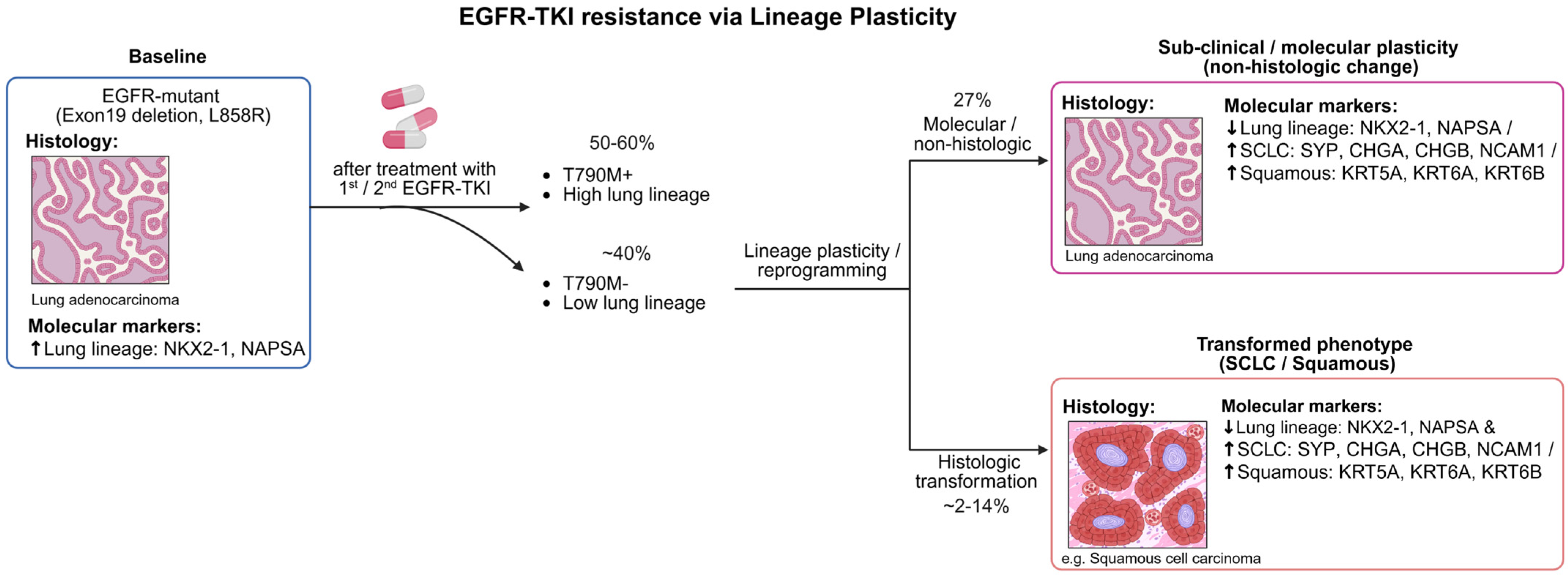
2. Historical Perspective and Prevalence
3. Cell of Origin and Lineage Plasticity
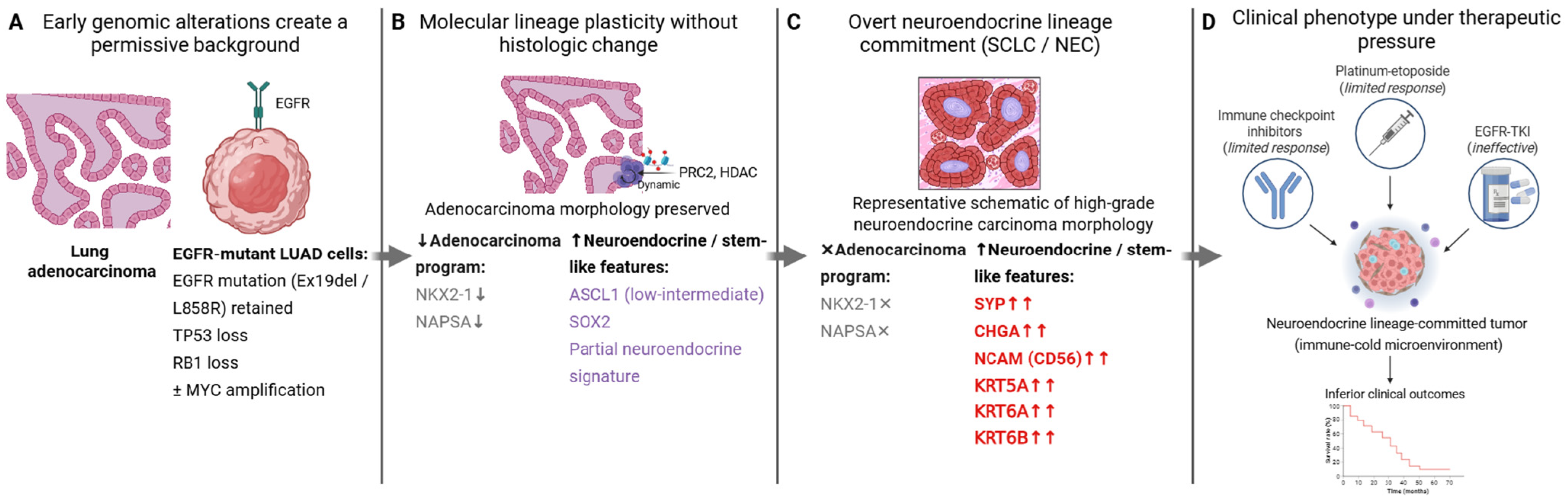
4. Clinical and Pathological Characteristics
5. Challenges in the Detection of Histological Transformation
6. Limitations of Current Treatment for SCLC-Transformed NSCLC
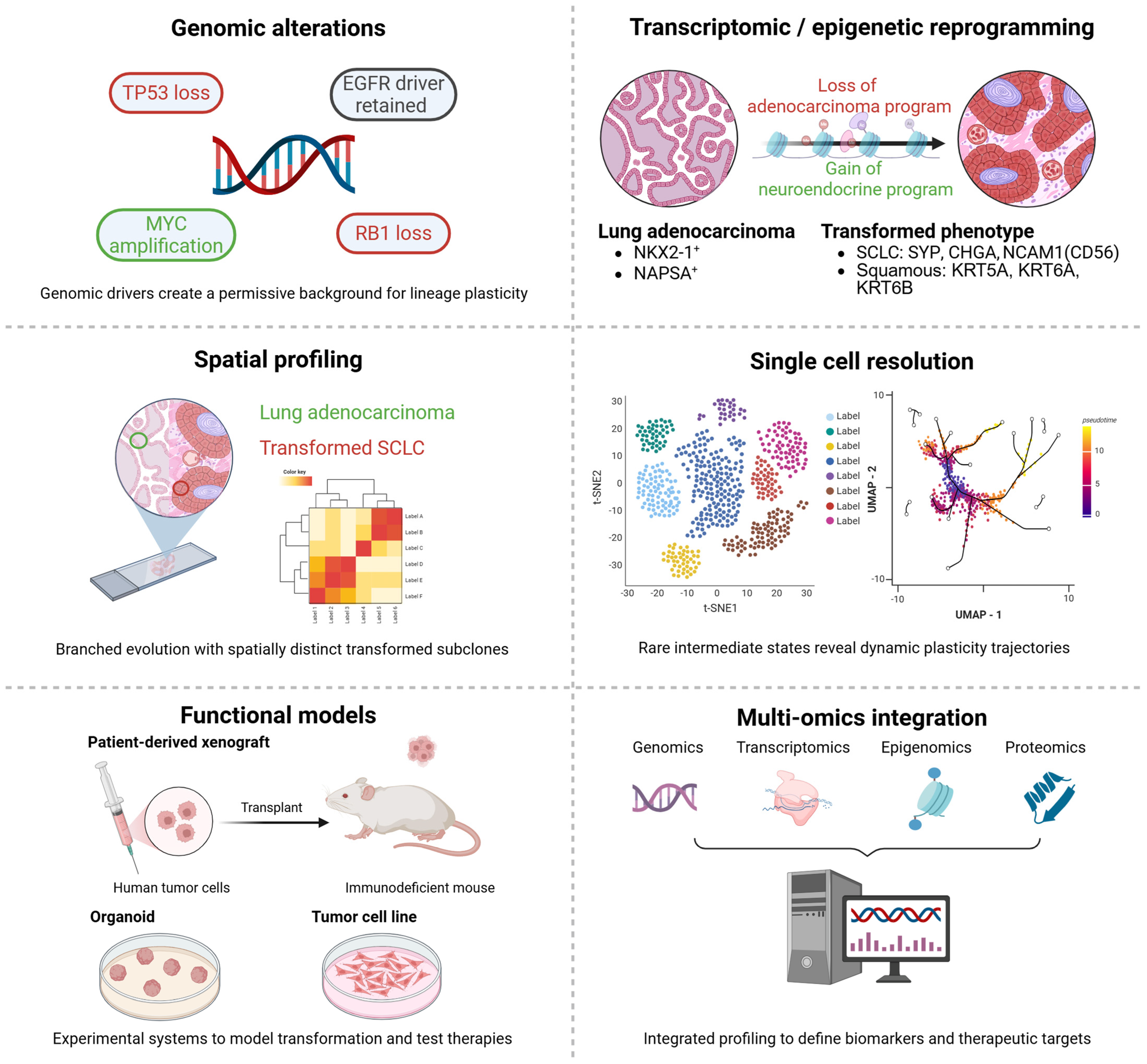
7. The Need for Better Understanding via Available Data
7.1. Genomic
7.2. Transcriptomic and Epigenetic
7.3. Spatial Transcriptomic
7.4. Single Cell Transcriptomic
7.5. Functional Studies
7.6. Multi-Omics Study
8. SCLC Transformation Beyond EGFR-Mutant Disease
9. Conclusions
Author Contributions
Funding
Institutional Review Board Statement
Informed Consent Statement
Data Availability Statement
Conflicts of Interest
References
- Sequist, L.V.; Martins, R.G.; Spigel, D.; Grunberg, S.M.; Spira, A.; Jänne, P.A.; Joshi, V.A.; McCollum, D.; Evans, T.L.; Muzikansky, A.; et al. First-line gefitinib in patients with advanced non-small-cell lung cancer harboring somatic EGFR mutations. J. Clin. Oncol. 2008, 26, 2442–2449, Erratum in J. Clin. Oncol. 2008, 26, 3472. [Google Scholar] [CrossRef] [PubMed]
- Mok, T.S.; Wu, Y.L.; Thongprasert, S.; Yang, C.H.; Chu, D.T.; Saijo, N.; Sunpaweravong, P.; Han, B.; Margono, B.; Ichinose, Y.; et al. Gefitinib or carboplatin-paclitaxel in pulmonary adenocarcinoma. N. Engl. J. Med. 2009, 361, 947–957. [Google Scholar] [CrossRef] [PubMed]
- Zhou, C.; Wu, Y.L.; Chen, G.; Feng, J.; Liu, X.Q.; Wang, C.; Zhang, S.; Wang, J.; Zhou, S.; Ren, S.; et al. Erlotinib versus chemotherapy as first-line treatment for patients with advanced EGFR mutation-positive non-small-cell lung cancer (OPTIMAL, CTONG-0802): A multicentre, open-label, randomised, phase 3 study. Lancet Oncol. 2011, 12, 735–742. [Google Scholar] [CrossRef]
- Park, K.; Tan, E.-H.; O’Byrne, K.; Zhang, L.; Boyer, M.; Mok, T.; Hirsh, V.; Yang, J.C.-H.; Lee, K.H.; Lu, S.; et al. Afatinib versus gefitinib as first-line treatment of patients with EGFR mutation-positive non-small-cell lung cancer (LUX-Lung 7): A phase 2B, open-label, randomised controlled trial. Lancet Oncol. 2016, 17, 577–589. [Google Scholar] [CrossRef] [PubMed]
- Wu, Y.L.; Zhou, C.; Hu, C.P.; Feng, J.; Lu, S.; Huang, Y.; Li, W.; Hou, M.; Shi, J.H.; Lee, K.Y.; et al. Afatinib versus cisplatin plus gemcitabine for first-line treatment of Asian patients with advanced non-small-cell lung cancer harbouring EGFR mutations (LUX-Lung 6): An open-label, randomised phase 3 trial. Lancet Oncol. 2014, 15, 213–222. [Google Scholar] [CrossRef]
- Cheng, Y.; Mok, T.S.; Zhou, X.; Lu, S.; Zhou, Q.; Zhou, J.; Du, Y.; Yu, P.; Liu, X.; Hu, C.; et al. Safety and efficacy of first-line dacomitinib in Asian patients with EGFR mutation-positive non-small cell lung cancer: Results from a randomized, open-label, phase 3 trial (ARCHER 1050). Lung Cancer 2021, 154, 176–185. [Google Scholar] [CrossRef]
- Soria, J.C.; Ohe, Y.; Vansteenkiste, J.; Reungwetwattana, T.; Chewaskulyong, B.; Lee, K.H.; Dechaphunkul, A.; Imamura, F.; Nogami, N.; Kurata, T.; et al. Osimertinib in Untreated EGFR-Mutated Advanced Non-Small-Cell Lung Cancer. N. Engl. J. Med. 2018, 378, 113–125. [Google Scholar] [CrossRef]
- Rosell, R.; Carcereny, E.; Gervais, R.; Vergnenegre, A.; Massuti, B.; Felip, E.; Palmero, R.; Garcia-Gomez, R.; Pallares, C.; Sanchez, J.M.; et al. Erlotinib versus standard chemotherapy as first-line treatment for European patients with advanced EGFR mutation-positive non-small-cell lung cancer (EURTAC): A multicentre, open-label, randomised phase 3 trial. Lancet Oncol. 2012, 13, 239–246. [Google Scholar] [CrossRef]
- Cortot, A.B.; Jänne, P.A. Molecular mechanisms of resistance in epidermal growth factor receptor-mutant lung adenocarcinomas. Eur. Respir. Rev. 2014, 23, 356–366. [Google Scholar] [CrossRef]
- Lee, J.K.; Shin, J.Y.; Kim, S.; Lee, S.; Park, C.; Kim, J.Y.; Koh, Y.; Keam, B.; Min, H.S.; Kim, T.M.; et al. Primary resistance to epidermal growth factor receptor (EGFR) tyrosine kinase inhibitors (TKIs) in patients with non-small-cell lung cancer harboring TKI-sensitive EGFR mutations: An exploratory study. Ann. Oncol. 2013, 24, 2080–2087. [Google Scholar] [CrossRef]
- Kobayashi, K. Primary Resistance to EGFR Tyrosine Kinase Inhibitors (TKIs): Contexts and Comparisons in EGFR-Mutated Lung Cancer. J. Respir. 2023, 3, 223–236. [Google Scholar] [CrossRef]
- Jackman, D.; Pao, W.; Riely, G.J.; Engelman, J.A.; Kris, M.G.; Jänne, P.A.; Lynch, T.; Johnson, B.E.; Miller, V.A. Clinical definition of acquired resistance to epidermal growth factor receptor tyrosine kinase inhibitors in non-small-cell lung cancer. J. Clin. Oncol. 2010, 28, 357–360. [Google Scholar] [CrossRef]
- Campo, M.; Gerber, D.; Gainor, J.F.; Heist, R.S.; Temel, J.S.; Shaw, A.T.; Fidias, P.; Muzikansky, A.; Engelman, J.A.; Sequist, L.V. Acquired Resistance to First-Line Afatinib and the Challenges of Prearranged Progression Biopsies. J. Thorac. Oncol. 2016, 11, 2022–2026. [Google Scholar] [CrossRef]
- Sequist, L.V.; Waltman, B.A.; Dias-Santagata, D.; Digumarthy, S.; Turke, A.B.; Fidias, P.; Bergethon, K.; Shaw, A.T.; Gettinger, S.; Cosper, A.K.; et al. Genotypic and histological evolution of lung cancers acquiring resistance to EGFR inhibitors. Sci. Transl. Med. 2011, 3, 75ra26. [Google Scholar] [CrossRef]
- Yu, H.A.; Arcila, M.E.; Rekhtman, N.; Sima, C.S.; Zakowski, M.F.; Pao, W.; Kris, M.G.; Miller, V.A.; Ladanyi, M.; Riely, G.J. Analysis of tumor specimens at the time of acquired resistance to EGFR-TKI therapy in 155 patients with EGFR-mutant lung cancers. Clin. Cancer Res. 2013, 19, 2240–2247. [Google Scholar] [CrossRef]
- U.S. Food and Drug Administration. FDA Approves Osimertinib for First-Line Treatment of Metastatic NSCLC with Most Common EGFR Mutations. 2018. Available online: https://www.fda.gov/drugs/resources-information-approved-drugs/fda-approves-osimertinib-first-line-treatment-metastatic-nsclc-most-common-egfr-mutations (accessed on 15 November 2025).
- Planchard, D.; Jänne, P.A.; Cheng, Y.; Yang, J.C.-H.; Yanagitani, N.; Kim, S.-W.; Sugawara, S.; Yu, Y.; Fan, Y.; Geater, S.L.; et al. Osimertinib with or without Chemotherapy in EGFR-Mutated Advanced NSCLC. N. Engl. J. Med. 2023, 389, 1935–1948. [Google Scholar] [CrossRef]
- Cho Byoung, C.; Lu, S.; Felip, E.; Spira Alexander, I.; Girard, N.; Lee, J.-S.; Lee, S.-H.; Ostapenko, Y.; Danchaivijitr, P.; Liu, B.; et al. Amivantamab plus Lazertinib in Previously Untreated EGFR-Mutated Advanced NSCLC. N. Engl. J. Med. 2024, 391, 1486–1498. [Google Scholar] [CrossRef]
- Westover, D.; Zugazagoitia, J.; Cho, B.C.; Lovly, C.M.; Paz-Ares, L. Mechanisms of acquired resistance to first- and second-generation EGFR tyrosine kinase inhibitors. Ann. Oncol. 2018, 29, i10–i19. [Google Scholar] [CrossRef]
- Quintanal-Villalonga, Á.; Chan, J.M.; Yu, H.A.; Pe’er, D.; Sawyers, C.L.; Sen, T.; Rudin, C.M. Lineage plasticity in cancer: A shared pathway of therapeutic resistance. Nat. Rev. Clin. Oncol. 2020, 17, 360–371, Correction in Nat. Rev. Clin. Oncol. 2020, 17, 382. [Google Scholar] [CrossRef] [PubMed]
- Thankamony, A.P.; Subbalakshmi, A.R.; Jolly, M.K.; Nair, R. Lineage Plasticity in Cancer: The Tale of a Skin-Walker. Cancers 2021, 13, 3602. [Google Scholar] [CrossRef] [PubMed]
- Aggarwal, R.; Huang, J.; Alumkal, J.J.; Zhang, L.; Feng, F.Y.; Thomas, G.V.; Weinstein, A.S.; Friedl, V.; Zhang, C.; Witte, O.N.; et al. Clinical and Genomic Characterization of Treatment-Emergent Small-Cell Neuroendocrine Prostate Cancer: A Multi-institutional Prospective Study. J. Clin. Oncol. 2018, 36, 2492–2503. [Google Scholar] [CrossRef]
- Izumi, H.; Yamasaki, A.; Ueda, Y.; Sumikawa, T.; Maeta, H.; Nakamoto, S.; Shimizu, E. Squamous Cell Carcinoma Transformation from EGFR-mutated Lung Adenocarcinoma: A Case Report and Literature Review. Clin. Lung Cancer 2018, 19, e63–e66. [Google Scholar] [CrossRef]
- Catania, C.; Liu, S.V.; Garassino, M.; Delmonte, A.; Scotti, V.; Cappuzzo, F.; Genova, C.; Russo, A.; Russano, M.; Bennati, C.; et al. Correlation between treatments and outcomes of patients with EGFR-mutated non-small-cell lung cancer that transitioned into small-cell lung cancer: An international retrospective study. ESMO Open 2025, 10, 105326. [Google Scholar] [CrossRef]
- Huang, Z.P.; Liu, X.J.; Zou, B.X.; Shen, Q.; Liu, Y.; Zhou, T. Ovarian cancer transformation from adenocarcinoma to undifferentiated small cell carcinoma: A case report. Oncol. Lett. 2015, 9, 2230–2232. [Google Scholar] [CrossRef] [PubMed]
- Nagano, H.; Ohyama, S.; Sato, A.; Igarashi, J.; Yamamoto, T.; Kadoya, M.; Kobayashi, M. Histological transformation to signet-ring cell carcinoma in a patient with clinically aggressive poorly differentiated adenocarcinoma of the ascending colon after response to chemotherapy plus cetuximab: A case report. World J. Surg. Oncol. 2023, 21, 172. [Google Scholar] [CrossRef] [PubMed]
- Du, F.; Han, Y.; Hu, X.; Xiao, Y.; Shi, Y.; Sun, J.; Sun, Z.; Yang, Y.; Yu, J.; Zhang, X.; et al. Large cell neuroendocrine carcinoma transformation: A novel acquired drug resistance mechanism in colorectal adenocarcinoma. Cancer Innov. 2023, 2, 159–164. [Google Scholar] [CrossRef]
- Quintanal-Villalonga, A.; Taniguchi, H.; Zhan, Y.A.; Hasan, M.M.; Chavan, S.S.; Meng, F.; Uddin, F.; Manoj, P.; Donoghue, M.T.A.; Won, H.H.; et al. Multiomic Analysis of Lung Tumors Defines Pathways Activated in Neuroendocrine Transformation. Cancer Discov. 2021, 11, 3028–3047. [Google Scholar] [CrossRef]
- Oxnard, G.R.; Arcila, M.E.; Sima, C.S.; Riely, G.J.; Chmielecki, J.; Kris, M.G.; Pao, W.; Ladanyi, M.; Miller, V.A. Acquired resistance to EGFR tyrosine kinase inhibitors in EGFR-mutant lung cancer: Distinct natural history of patients with tumors harboring the T790M mutation. Clin. Cancer Res. 2011, 17, 1616–1622. [Google Scholar] [CrossRef]
- Zakowski, M.F.; Ladanyi, M.; Kris, M.G. EGFR Mutations in Small-Cell Lung Cancers in Patients Who Have Never Smoked. N. Engl. J. Med. 2006, 355, 213–215. [Google Scholar] [CrossRef] [PubMed]
- Marcoux, N.; Gettinger, S.N.; O’Kane, G.; Arbour, K.C.; Neal, J.W.; Husain, H.; Evans, T.L.; Brahmer, J.R.; Muzikansky, A.; Bonomi, P.D.; et al. EGFR-Mutant Adenocarcinomas That Transform to Small-Cell Lung Cancer and Other Neuroendocrine Carcinomas: Clinical Outcomes. J. Clin. Oncol. 2019, 37, 278–285. [Google Scholar] [CrossRef]
- Jukna, A.; Montanari, G.; Mengoli, M.C.; Cavazza, A.; Covi, M.; Barbieri, F.; Bertolini, F.; Rossi, G. Squamous Cell Carcinoma “Transformation” Concurrent with Secondary T790M Mutation in Resistant EGFR-Mutated Adenocarcinomas. J. Thorac. Oncol. 2016, 11, e49–e51. [Google Scholar] [CrossRef]
- Shinohara, S.; Ichiki, Y.; Fukuichi, Y.; Honda, Y.; Kanayama, M.; Taira, A.; Nabe, Y.; Kuwata, T.; Takenaka, M.; Oka, S.; et al. Squamous cell carcinoma transformation from adenocarcinoma as an acquired resistance after the EGFR TKI therapy in (EGFR-mutated) non-small cell lung cancer. J. Thorac. Dis. 2018, 10, E526–E531. [Google Scholar] [CrossRef]
- Xi, Y.-Z.; Xie, L.; Tan, X.-W.; Zeng, S.-L. Transformation of adenocarcinoma to squamous cell carcinoma as a source of EGFR-TKI resistance: A case report and literature review. Front. Oncol. 2022, 12, 942084. [Google Scholar] [CrossRef]
- Morinaga, R.; Okamoto, I.; Furuta, K.; Kawano, Y.; Sekijima, M.; Dote, K.; Satou, T.; Nishio, K.; Fukuoka, M.; Nakagawa, K. Sequential occurrence of non-small cell and small cell lung cancer with the same EGFR mutation. Lung Cancer 2007, 58, 411–413. [Google Scholar] [CrossRef]
- Fujita, K.; Kim, Y.H.; Yoshizawa, A.; Mio, T.; Mishima, M. Concomitant T790M mutation and small-cell lung cancer transformation after acquired resistance to epidermal growth factor receptor-tyrosine kinase inhibitor. Respirol. Case Rep. 2017, 5, e00206. [Google Scholar] [CrossRef] [PubMed]
- Fujimoto, D.; Akamatsu, H.; Morimoto, T.; Wakuda, K.; Sato, Y.; Kawa, Y.; Yokoyama, T.; Tamiya, M.; Hiraoka, R.; Shingu, N.; et al. Histologic transformation of epidermal growth factor receptor-mutated lung cancer. Eur. J. Cancer 2022, 166, 41–50. [Google Scholar] [CrossRef]
- Chua, K.P.; Teng, Y.H.F.; Tan, A.C.; Takano, A.; Alvarez, J.J.S.; Nahar, R.; Rohatgi, N.; Lai, G.G.Y.; Aung, Z.W.; Yeong, J.P.S.; et al. Integrative Profiling of T790M-Negative EGFR-Mutated NSCLC Reveals Pervasive Lineage Transition and Therapeutic Opportunities. Clin. Cancer Res. 2021, 27, 5939–5950. [Google Scholar] [CrossRef] [PubMed]
- Niederst, M.J.; Sequist, L.V.; Poirier, J.T.; Mermel, C.H.; Lockerman, E.L.; Garcia, A.R.; Katayama, R.; Costa, C.; Ross, K.N.; Moran, T.; et al. RB loss in resistant EGFR mutant lung adenocarcinomas that transform to small-cell lung cancer. Nat. Commun. 2015, 6, 6377. [Google Scholar] [CrossRef] [PubMed]
- Lee, J.-K.; Lee, J.; Kim, S.; Kim, S.; Youk, J.; Park, S.; An, Y.; Keam, B.; Kim, D.-W.; Heo, D.S.; et al. Clonal History and Genetic Predictors of Transformation Into Small-Cell Carcinomas From Lung Adenocarcinomas. J. Clin. Oncol. 2017, 35, 3065–3074. [Google Scholar] [CrossRef]
- Zhang, S.L.; Zhang, C.Y.; Chen, Y.Q.; Li, Y.F.; Xie, Z.; Zhang, X.C.; Zhou, Q.; Zhong, W.Z.; Huang, J.; Sun, H.; et al. Expression of EGFR-mutant proteins and genomic evolution in EGFR-mutant transformed small cell lung cancer. J. Thorac. Dis. 2023, 15, 4620–4635. [Google Scholar] [CrossRef]
- Oh, S.; Koh, J.; Kim, T.M.; Kim, S.; Youk, J.; Kim, M.; Keam, B.; Jeon, Y.K.; Ku, J.L.; Kim, D.W.; et al. Transcriptomic Heterogeneity of EGFR-Mutant Non-Small Cell Lung Cancer Evolution Toward Small-Cell Lung Cancer. Clin. Cancer Res. 2024, 30, 4729–4742. [Google Scholar] [CrossRef]
- Ding, X.; Shi, M.-x.; Liu, D.; Cao, J.-x.; Zhang, K.-x.; Zhang, R.-d.; Zhang, L.-p.; Ai, K.-x.; Su, B.; Zhang, J. Transformation to small cell lung cancer is irrespective of EGFR and accelerated by SMAD4-mediated ASCL1 transcription independently of RB1 in non-small cell lung cancer. Cell Commun. Signal. 2024, 22, 45. [Google Scholar] [CrossRef]
- Gardner, E.E.; Earlie, E.M.; Li, K.; Thomas, J.; Hubisz, M.J.; Stein, B.D.; Zhang, C.; Cantley, L.C.; Laughney, A.M.; Varmus, H. Lineage-specific intolerance to oncogenic drivers restricts histological transformation. Science 2024, 383, eadj1415. [Google Scholar] [CrossRef]
- El Zarif, T.; Meador, C.B.; Qiu, X.; Seo, J.H.; Davidsohn, M.P.; Savignano, H.; Lakshminarayanan, G.; McClure, H.M.; Canniff, J.; Fortunato, B.; et al. Detecting Small Cell Transformation in Patients with Advanced EGFR Mutant Lung Adenocarcinoma through Epigenomic cfDNA Profiling. Clin. Cancer Res. 2024, 30, 3798–3811. [Google Scholar] [CrossRef]
- Offin, M.; Chan, J.M.; Tenet, M.; Rizvi, H.A.; Shen, R.; Riely, G.J.; Rekhtman, N.; Daneshbod, Y.; Quintanal-Villalonga, A.; Penson, A.; et al. Concurrent RB1 and TP53 Alterations Define a Subset of EGFR-Mutant Lung Cancers at risk for Histologic Transformation and Inferior Clinical Outcomes. J. Thorac. Oncol. 2019, 14, 1784–1793. [Google Scholar] [CrossRef] [PubMed]
- Oser, M.G.; Niederst, M.J.; Sequist, L.V.; Engelman, J.A. Transformation from non-small-cell lung cancer to small-cell lung cancer: Molecular drivers and cells of origin. Lancet Oncol. 2015, 16, e165–e172. [Google Scholar] [CrossRef] [PubMed]
- Sutherland, K.D.; Proost, N.; Brouns, I.; Adriaensen, D.; Song, J.Y.; Berns, A. Cell of origin of small cell lung cancer: Inactivation of Trp53 and Rb1 in distinct cell types of adult mouse lung. Cancer Cell 2011, 19, 754–764. [Google Scholar] [CrossRef]
- Miettinen, P.J.; Berger, J.E.; Meneses, J.; Phung, Y.; Pedersen, R.A.; Werb, Z.; Derynck, R. Epithelial immaturity and multiorgan failure in mice lacking epidermal growth factor receptor. Nature 1995, 376, 337–341. [Google Scholar] [CrossRef]
- Miettinen, P.J.; Warburton, D.; Bu, D.; Zhao, J.S.; Berger, J.E.; Minoo, P.; Koivisto, T.; Allen, L.; Dobbs, L.; Werb, Z.; et al. Impaired lung branching morphogenesis in the absence of functional EGF receptor. Dev. Biol. 1997, 186, 224–236. [Google Scholar] [CrossRef] [PubMed]
- Ramalingam, S.S.; Cheng, Y.; Zhou, C.; Ohe, Y.; Imamura, F.; Cho, B.C.; Lin, M.C.; Majem, M.; Shah, R.; Rukazenkov, Y.; et al. Mechanisms of acquired resistance to first-line osimertinib: Preliminary data from the phase III FLAURA study. Ann. Oncol. 2018, 29, viii740. [Google Scholar] [CrossRef]
- Oxnard, G.R.; Hu, Y.; Mileham, K.F.; Husain, H.; Costa, D.B.; Tracy, P.; Feeney, N.; Sholl, L.M.; Dahlberg, S.E.; Redig, A.J.; et al. Assessment of Resistance Mechanisms and Clinical Implications in Patients with EGFR T790M-Positive Lung Cancer and Acquired Resistance to Osimertinib. JAMA Oncol. 2018, 4, 1527–1534. [Google Scholar] [CrossRef] [PubMed]
- Schoenfeld, A.J.; Chan, J.M.; Kubota, D.; Sato, H.; Rizvi, H.; Daneshbod, Y.; Chang, J.C.; Paik, P.K.; Offin, M.; Arcila, M.E.; et al. Tumor Analyses Reveal Squamous Transformation and Off-Target Alterations As Early Resistance Mechanisms to First-line Osimertinib in EGFR-Mutant Lung Cancer. Clin. Cancer Res. 2020, 26, 2654–2663. [Google Scholar] [CrossRef]
- Hiatt, J.B.; Doebley, A.L.; Arnold, H.U.; Adil, M.; Sandborg, H.; Persse, T.W.; Ko, M.; Wu, F.; Quintanal Villalonga, A.; Santana-Davila, R.; et al. Molecular phenotyping of small cell lung cancer using targeted cfDNA profiling of transcriptional regulatory regions. Sci. Adv. 2024, 10, eadk2082. [Google Scholar] [CrossRef]
- Nishikawa, S.; Tambo, Y.; Ninomiya, H.; Oguri, T.; Kawashima, Y.; Takano, N.; Kitazono, S.; Ohyanagi, F.; Horiike, A.; Yanagitani, N.; et al. A case treated with nivolumab after small cell lung cancer transformation of mutant EGFR non-small cell lung cancer. Ann. Oncol. 2016, 27, 2300–2301. [Google Scholar] [CrossRef]
- Tokaca, N.; Wotherspoon, A.; Nicholson, A.G.; Fotiadis, N.; Thompson, L.; Popat, S. Lack of response to nivolumab in a patient with EGFR-mutant non-small cell lung cancer adenocarcinoma sub-type transformed to small cell lung cancer. Lung Cancer 2017, 111, 65–68. [Google Scholar] [CrossRef]
- Ren, Z.; Shang, S.; Chen, D. Recent advances in immunotherapy for small cell lung cancer. Curr. Opin. Oncol. 2025, 37, 17–26. [Google Scholar] [CrossRef]
- Yang, C.; Xuan, T.; Gong, Q.; Dai, X.; Wang, C.; Zhang, R.; Zhao, W.; Wang, J.; Yue, W.; Li, J. Efficacy and safety of novel immune checkpoint inhibitor-based combinations versus chemotherapy as first-line treatment for patients with extensive-stage small cell lung cancer: A network meta-analysis. Thorac. Cancer 2024, 15, 1246–1262. [Google Scholar] [CrossRef]
- Liao, Y.T.; Sun, R.L.; Huang, H.C.; Shen, C.I.; Tseng, Y.H.; Luo, Y.H.; Chen, Y.M.; Chiang, C.L. First-line immune checkpoint inhibitors plus chemotherapy in Taiwanese patients with extensive-stage small-cell lung cancer. J. Chin. Med. Assoc. 2025, 88, 624–631. [Google Scholar] [CrossRef]
- Gray, J.E.; Heist, R.S.; Starodub, A.N.; Camidge, D.R.; Kio, E.A.; Masters, G.A.; Purcell, W.T.; Guarino, M.J.; Misleh, J.; Schneider, C.J.; et al. Therapy of Small Cell Lung Cancer (SCLC) with a Topoisomerase-I-inhibiting Antibody-Drug Conjugate (ADC) Targeting Trop-2, Sacituzumab Govitecan. Clin. Cancer Res. 2017, 23, 5711–5719. [Google Scholar] [CrossRef] [PubMed]
- Dowlati, A.; Chiang, A.C.; Cervantes, A.; Babu, S.; Hamilton, E.; Wong, S.F.; Tazbirkova, A.; Sullivan, I.G.; van Marcke, C.; Italiano, A.; et al. Phase 2 Open-Label Study of Sacituzumab Govitecan as Second-Line Therapy in Patients With Extensive-Stage SCLC: Results From TROPiCS-03. J. Thorac. Oncol. 2025, 20, 799–808. [Google Scholar] [CrossRef] [PubMed]
- Ma, Y.; Yang, Y.; Huang, Y.; Fang, W.; Xue, J.; Meng, X.; Fan, Y.; Fu, S.; Wu, L.; Zheng, Y.; et al. A B7H3-targeting antibody–drug conjugate in advanced solid tumors: A phase 1/1b trial. Nat. Med. 2025, 31, 1949–1957. [Google Scholar] [CrossRef] [PubMed]
- Saalfeld, F.C.; Möller, J.; Christopoulos, P.; Wenzel, C.; Rasokat, A.; Wang, X.A.; Vathiotis, I.; König, D.; Illini, O.; Grohé, C.; et al. Small cell transformation in EGFR-mutated non-small cell lung cancer: DLL3 expression and efficacy of immune checkpoint inhibitors or tyrosine kinase inhibitors combined with chemotherapy. Eur. J. Cancer 2024, 213, 115065. [Google Scholar] [CrossRef]
- Cooper, A.J.; Herzberg, B.; Parma, M.; Wang, K.; Alder, L.; Weber, U.M.; Patil, T.; Joshi, U.; Puri, S.; Saqi, A.; et al. Multi-Institution Analysis of Tarlatamab for the Treatment of EGFR-Mutant Transformed Small Cell Lung Cancer. JCO Precis. Oncol. 2025, 9, e2500538. [Google Scholar] [CrossRef]
- Coe, B.P.; Thu, K.L.; Aviel-Ronen, S.; Vucic, E.A.; Gazdar, A.F.; Lam, S.; Tsao, M.S.; Lam, W.L. Genomic deregulation of the E2F/Rb pathway leads to activation of the oncogene EZH2 in small cell lung cancer. PLoS ONE 2013, 8, e71670. [Google Scholar] [CrossRef] [PubMed]
- Poirier, J.T.; Gardner, E.E.; Connis, N.; Moreira, A.L.; de Stanchina, E.; Hann, C.L.; Rudin, C.M. DNA methylation in small cell lung cancer defines distinct disease subtypes and correlates with high expression of EZH2. Oncogene 2015, 34, 5869–5878. [Google Scholar] [CrossRef]
- Zhang, L.; Zhang, Y.; Wang, C.; Yang, Y.; Ni, Y.; Wang, Z.; Song, T.; Yao, M.; Liu, Z.; Chao, N.; et al. Integrated single-cell RNA sequencing analysis reveals distinct cellular and transcriptional modules associated with survival in lung cancer. Signal Transduct. Target. Ther. 2022, 7, 9. [Google Scholar] [CrossRef]
- Fujita, S.; Masago, K.; Katakami, N.; Yatabe, Y. Transformation to SCLC after Treatment with the ALK Inhibitor Alectinib. J. Thorac. Oncol. 2016, 11, e67–e72. [Google Scholar] [CrossRef]
- Bar, J.; Ofek, E.; Barshack, I.; Gottfried, T.; Zadok, O.; Kamer, I.; Urban, D.; Perelman, M.; Onn, A. Transformation to small cell lung cancer as a mechanism of resistance to immunotherapy in non-small cell lung cancer. Lung Cancer 2019, 138, 109–115. [Google Scholar] [CrossRef]
- Balla, A.; Khan, F.; Hampel, K.J.; Aisner, D.L.; Sidiropoulos, N. Small-cell transformation of ALK-rearranged non-small-cell adenocarcinoma of the lung. Cold Spring Harb. Mol. Case Stud. 2018, 4, a002394. [Google Scholar] [CrossRef]
- Lin, J.J.; Langenbucher, A.; Gupta, P.; Yoda, S.; Fetter, I.J.; Rooney, M.; Do, A.; Kem, M.; Chang, K.P.; Oh, A.Y.; et al. Small cell transformation of ROS1 fusion-positive lung cancer resistant to ROS1 inhibition. npj Precis. Oncol. 2020, 4, 21. [Google Scholar] [CrossRef] [PubMed]
- Miyamoto, S.; Ikushima, S.; Ono, R.; Awano, N.; Kondo, K.; Furuhata, Y.; Fukumoto, K.; Kumasaka, T. Transformation to small-cell lung cancer as a mechanism of acquired resistance to crizotinib and alectinib. Jpn. J. Clin. Oncol. 2016, 46, 170–173. [Google Scholar] [CrossRef]
- Takegawa, N.; Hayashi, H.; Iizuka, N.; Takahama, T.; Ueda, H.; Tanaka, K.; Takeda, M.; Nakagawa, K. Transformation of ALK rearrangement-positive adenocarcinoma to small-cell lung cancer in association with acquired resistance to alectinib. Ann. Oncol. 2016, 27, 953–955. [Google Scholar] [CrossRef]
- Levacq, D.; D’Haene, N.; de Wind, R.; Remmelink, M.; Berghmans, T. Histological transformation of ALK rearranged adenocarcinoma into small cell lung cancer: A new mechanism of resistance to ALK inhibitors. Lung Cancer 2016, 102, 38–41. [Google Scholar] [CrossRef]
- Zhu, Y.C.; Liao, X.H.; Wang, W.X.; Xu, C.W.; Zhuang, W.; Zhong, L.H.; Du, K.Q.; Chen, Y.P.; Chen, G.; Fang, M.Y. Patients harboring ALK rearrangement adenocarcinoma after acquired resistance to crizotinib and transformation to small-cell lung cancer: A case report. Onco Targets Ther. 2017, 10, 3187–3192. [Google Scholar] [CrossRef]
- Cha, Y.J.; Cho, B.C.; Kim, H.R.; Lee, H.J.; Shim, H.S. A Case of ALK-Rearranged Adenocarcinoma with Small Cell Carcinoma-Like Transformation and Resistance to Crizotinib. J. Thorac. Oncol. 2016, 11, e55–e58. [Google Scholar] [CrossRef]
- Ou, S.I.; Lee, T.K.; Young, L.; Fernandez-Rocha, M.Y.; Pavlick, D.; Schrock, A.B.; Zhu, V.W.; Milliken, J.; Ali, S.M.; Gitlitz, B.J. Dual occurrence of ALK G1202R solvent front mutation and small cell lung cancer transformation as resistance mechanisms to second generation ALK inhibitors without prior exposure to crizotinib. Pitfall of solely relying on liquid re-biopsy? Lung Cancer 2017, 106, 110–114. [Google Scholar] [CrossRef] [PubMed]
- Ambrosini, P.; Miliziano, D.; Liberti, G.D.; Lorenzini, D.; Marchesi, S.; Bassetti, A.; Tamborini, E.; Leporati, R.; Beninato, T.; Mazzeo, L.; et al. Histologic Transformation of ALK-Rearranged Lung Adenocarcinomas to High-Grade LCNEC: Clinical and Molecular Description of Three Cases. Clin. Lung Cancer 2025, 26, e11–e17. [Google Scholar] [CrossRef] [PubMed]
- Xia, G.; Huang, J.; Ni, J.; Song, M.; Zhang, J.; Hofman, P.; Christopoulos, P.; Grenda, A.; Huang, M. Transformation of ALK-positive NSCLC to SCLC after alectinib resistance and response to combined atezolizumab: A case report. Transl. Lung Cancer Res. 2023, 12, 637–646. [Google Scholar] [CrossRef] [PubMed]



| Study | Species | Sample Type | Molecular Data Type * | Paired Samples | Sample Size/ Prevalence |
|---|---|---|---|---|---|
| Sequist et al. (2011) [14] | Human | FFPE tumor tissue | DNA | Yes | 5/37 (14%) |
| Yu et al. (2013) [15] | Human | Fresh-frozen or FFPE tumor tissue | DNA, Protein | Yes | 4/155 (3%) |
| Niederst et al. (2015) [39] | Human/Mouse | OCT-embedded frozen tumor tissue | DNA, RNA, Protein | Yes | 11 |
| Lee et al. (2017) [40] | Human | Fresh-frozen or FFPE tumor tissue | DNA, Protein | Yes | 21 |
| Quintanal-Villalonga et al. (2021) [28] | Human | Fresh-frozen tumor tissue | DNA, RNA, Protein | Yes | 3 |
| Chua et al. (2021) [38] | Human | Fresh-frozen tumor tissue | DNA, RNA | No | 1/59 (1.7%) |
| Marcoux et al. (2021) [31] | Human | Tumor tissue (unspecified) | DNA | No | 58 |
| Zhang et al. (2023) [41] | Human | FFPE tumor tissue | DNA, Protein | Yes | 7 (DNA), 11 (Protein) |
| Oh et al. (2024) [42] | Human | FFPE tumor tissue | RNA, Protein | Yes | 10 |
| Ding et al. (2024) [43] | Human | FFPE tumor tissue | DNA, RNA, Protein | Yes | EGFR wildtype: 11/113 (9.7%) EGFR-mutant: 13/230 (5.7%) |
| Gardner et al. (2024) [44] | Mouse | FFPE mouse lung tissue | DNA, RNA, Protein | No | N/A (mouse model) |
| El Zarif et al. (2024) [45] | Human/Mouse | Patient plasma, fresh-frozen tumor tissue, and PDX samples | DNA, RNA | No | 4 |
| Offin et al. (2019) [46] | Human | Tumor tissue (unspecified) | DNA | No | 7/39 (18%) |
| Fujimoto et al. (2022) [37] | Human | Tumor tissue (unspecified) | DNA | No | 74/2624 (2.8%) |
Disclaimer/Publisher’s Note: The statements, opinions and data contained in all publications are solely those of the individual author(s) and contributor(s) and not of MDPI and/or the editor(s). MDPI and/or the editor(s) disclaim responsibility for any injury to people or property resulting from any ideas, methods, instructions or products referred to in the content. |
© 2025 by the authors. Licensee MDPI, Basel, Switzerland. This article is an open access article distributed under the terms and conditions of the Creative Commons Attribution (CC BY) license.
Share and Cite
Lau, L.Y.E.; Skanderup, A.J.; Tan, A.C. Lineage Plasticity and Histologic Transformation in EGFR-TKI Resistant Lung Cancer. Int. J. Mol. Sci. 2026, 27, 445. https://doi.org/10.3390/ijms27010445
Lau LYE, Skanderup AJ, Tan AC. Lineage Plasticity and Histologic Transformation in EGFR-TKI Resistant Lung Cancer. International Journal of Molecular Sciences. 2026; 27(1):445. https://doi.org/10.3390/ijms27010445
Chicago/Turabian StyleLau, Li Yieng Eunice, Anders Jacobsen Skanderup, and Aaron C. Tan. 2026. "Lineage Plasticity and Histologic Transformation in EGFR-TKI Resistant Lung Cancer" International Journal of Molecular Sciences 27, no. 1: 445. https://doi.org/10.3390/ijms27010445
APA StyleLau, L. Y. E., Skanderup, A. J., & Tan, A. C. (2026). Lineage Plasticity and Histologic Transformation in EGFR-TKI Resistant Lung Cancer. International Journal of Molecular Sciences, 27(1), 445. https://doi.org/10.3390/ijms27010445