


Abstract
Auxin plays a crucial role in plant growth and development via concentration gradient regulation, with auxin response factors (ARFs) as key transcription factors in its signalling pathway. However, comprehensive identification and characterisation of ARF genes in Salicaceae remain limited. This study performed a genome-wide analysis of ARF genes in three Salicaceae species (Populus euphratica Oliv., Populus pruinosa, and Salix sinopurpurea), aiming to clarify their physicochemical properties, evolutionary relationships, and functional relevance. A total of 34 ARF genes were identified in each species, all being nucleus-localised hydrophilic unstable proteins clustered into six phylogenetic subgroups. Their promoters contain numerous cis-acting elements responsive to light, phytohormones, and stresses. Transcriptome and qRT-PCR data showed significant up-regulation of PeARF18 in ovate/broad-ovate leaves of P. euphratica compared to linear/lanceolate leaves. This study provides preliminary insights into the characterisation and potential role of the Salicaceae ARF gene family, laying a foundation for further functional exploration of PeARF18 in P. euphratica leaf shape development.
1. Introduction
Indole-3-acetic acid (IAA), as the main type of auxin, plays a crucial role in plant growth and development in response to cellular and environmental signals [1,2]. Most of these auxin functions are achieved through the regulation of gene expression by auxin response factor (ARF) proteins, which translate IAA signals into gene expression with the help of AUX/IAA proteins [3]. Most ARF proteins usually consist of three conserved structural domains [4]: (1) the N-terminal B3-type DNA-binding domain (DBD), which is responsible for binding to auxin response elements (AREs); (2) a variable middle region, which serves as an activating structural domain or repressor structural domain and determines whether the ARF protein is an activator or repressor [5,6]; and (3) the C terminal dimerisation domain (CTD), which is responsible for protein–protein interactions such as homodimerisation of ARF proteins or heterodimerisation of ARF with AUX/IAA proteins [7]. Notably, some ARF proteins contain only some of these three conserved structural domains. For example, ARF3, ARF13, and ARF17 in Arabidopsis [8] lack a CTD, and ARF23 only consists of a truncated DBD.
With the increasing number of plant genomes being sequenced, the ARF gene family has been studied at the genome-wide level in various plant species, including Oryza sativa L. [9], Citrus sinensis [10], and Populus trichocarpa [11]. These previous studies have shown that the structure of the proteins encoded by ARF varies considerably within or between families in different species. For example, only one ARF with a truncated DBD was found in citrus compared with Arabidopsis thaliana [12], whereas a large number of ARFs lacking CTDs were found in rice, maize [13], banana [14], and alfalfa [15]. Thus, the ARF gene families in different plant species show great diversity and abundance, most of which need to be further studied and characterised for enhanced understanding.
Substantial evidence indicates that the ARF gene participates in multiple auxin-dependent developmental processes in plants [14,16]. For example, AtARF2, AtARF3, AtARF4, and AtARF5 are essential for the development of female and male gametophytes, respectively [17]. AtARF8 regulates stamen elongation and lignification of the inner wall of the anther chamber [18], whereas AtARF3 plays a unique role in early flower development [19]. AtARF7 and AtARF19 are essential for auxin-mediated plant development through the regulation of a set of unique and partially overlapping target genes [12]. Notably, ARF genes also play a crucial role in auxin-mediated leaf development, which primarily encompasses the growth of leaf blades and the formation and differentiation of leaf primordia within the stem apical meristem (SAM). AtARF3 and AtARF4 affect leaf polarity development in A. thaliana [20,21], and AtARF10 and AtARF16 are involved in the regulation of Arabidopsis leaf growth and development [22]. OsARF19 is strongly expressed in leaf nodes and involved in BR regulation of rice leaf angle [23]. The expression levels of many ARF genes are altered under various abiotic stresses such as drought [24,25] and salt stress [26,27,28]. Additionally, various transcription factors, miRNAs, and growth factors are also essential for this process of auxin-mediated leaf development [29,30]. These studies provide fundamental information for the subsequent characterisation of the function of ARF genes in response to cellular signalling and environmental stresses during plant growth and development.
P.euphratica is the only naturally occurring tree species in the desert regions of northwest China [31,32]. ARFs have been identified in P. euphratica, and 34 members of PeARFs have been identified [33]. Populus pruinose and Salix sinopurpurea are both drought-tolerant species within the Salicaceae family [34,35]. These studies indicate that numerous auxin response factors (ARFs) influence leaf traits in plants, whilst in P. euphratica, the auxin signalling pathway involving ARFs has been found to be associated with heterophyllous leaves [36]. Previous research indicates that, although ARF genes have been identified across multiple species and functional research has progressively deepened, the size of the ARF family significantly varies between species, and its spatiotemporal expression patterns are complex. Belonging to the drought-tolerant Salicaceae family, compared to the lanceolate leaves of Salix sinopurpurea and the hairy broad leaves of Populus pruinose, P. euphratica possesses four distinct leaf shapes. Why P. euphratica has heteromorphic leaves compared with other Salicaceae species, how ARFs evolved, and how ARFs affect the leaf shape of P. euphratica have not been studied.
In this study, we employed bioinformatics approaches to identify and characterise the ARF gene family comprising Populus euphratica, Populus pruinose, and Salix sinopurpurea at the genome-wide level. Comparisons among the three species reveal differences of this family between P. euphratica and those of the other two Salicaceae species, including motif presence, conserved domains, the number and distribution of cis-acting elements, and the proportion of various types of protein secondary structures. Further analysis of subcellular localisation and expression profile of PeARF18 was performed in four kinds of heteromorphic leaves in P. euphratica. This study not only contributes to a comprehensive understanding of the biological properties of the PeARF family and the potential role of PeARF18 in the development of P. euphratica heteromorphic leaves for the first time but also provides new gene resources for further conservation and utilisation of the desert tree.
2. Results
2.1. Identification of ARF Family Members and Prediction of Physicochemical Properties in Three Salicaceae Species
A total of 102 ARFs were identified in the genomes of three Salicaceae species: 34 genes in Populus euphratica Oliv., 34 genes in Populus pruinose, and 34 genes in Salix sinopurpurea, respectively. Predictive analysis of the physicochemical properties of ARF family members from the three species revealed (Table S1) that the length of PeARF proteins ranged from 395 amino acids (PeuTF06G00760.1) to 1149 amino acids (PeuTF06G01378.1). The molecular weights ranged from 43.85 kDa (PeuTF106G00760.1) to 128.29 kDa (PeuTF06G01378.1), and the pI values of the PeARF proteins ranged from 5.35 (PeuTF05G02165.1) to 9.07 (PeuTF106G00760.1). The lengths of the PpARF proteins ranged from 481 amino acids (PprTF03G1385.1) to 1149 amino acids (PeuTF03G1199.1). The molecular weights ranged from 54.58 kDa (PprTF03G1385.1) to 125.92 kDa (PeuTF03G1199.1), and the pI values of the PpARF proteins ranged from 5.36 (PprTF05G1918.1) to 8.85 (PprTF04G1680.1). The length of the SpuARF proteins ranged from 592 amino acids (SpuTF05G133500.1) to 1136 amino acids (SpuTF06G114200.1). The molecular weight ranged from 65.48 kDa (SpuTF05G133500.1) to 127.19 kDa (SpuTF06G114200.1), and the pI values of the SpuARF proteins ranged from 5.2 (SpuTF05G189800.1) to 8.41 (SpuTF16G085100.1). The PeARFs had the greatest differences in the number of amino acids, molecular weight, and isoelectric point amongst the studied Salicaceae species. A total of 102 members of the ARF protein members had negative mean coefficients of hydrophobicity, indicating that the majority of the ARF family are hydrophilic proteins. In addition, subcellular localisation prediction showed that all predicted locations of ARFs were within the nucleus (Table S1), indicating that all members of the ARF family functioned in the nucleus.
2.2. Systematic Evolutionary Analysis of the Multi-Species ARF Gene Family
With Arabidopsis thaliana as the outgroup, the phylogenetic tree of ARF genes in the three Salicaceae plants was inferred (Figure 1). The analysis confirmed the classification of ARF proteins into six subgroups, denoted as groups 1–6. Specifically, group 1 contained 26 ARFs (three AtARFs, seven PeARFs, eight PpARFs, and eight SpuARFs), group 2 contained 20 ARFs (three AtARFs, six PeARFs, six PpARFs, and five SpuARFs), group 3 contained 20 ARFs (two AtARFs, six PeARFs, six PpARFs, and six SpuARFs), group 4 contained 12 ARFs (two AtARFs, four PeARFs, three PpARFs, and three SpuARFs), group 5 contained eight ARFs (eight AtARFs), and group 6 contained 39 ARFs (five AtARFs, 11 PeARFs, 11 PpARFs, and 12 SpuARFs). The number of AtARFs in groups 1–6 significantly differed from that of the Salicaceae family ARFs, and the ARF gene family of Salicaceae plants had significant expansion in comparison with that of Arabidopsis thaliana. However, no significant expansion was found in comparison amongst Salicaceae plants. Meanwhile, AtARFs underwent aggregation in group 5.
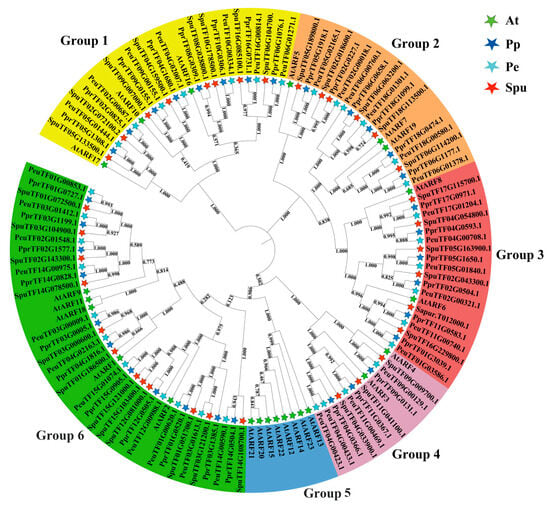
Figure 1.
Neighbour-joining (NJ) tree of ARF gene family members in four species. Differently coloured arcs indicated various subgroups. Five-pointed stars of different colours represent different species. The full names of species are as follows: Pe = P. euphratica, At = A. thaliana, Pp = P. pruinosa, Spu = Salix sinopurpurea.
2.3. Analysis of Conserved Motifs and Conserved Structural Domains of ARF Family Members in Three Salicaceae Species
In the identification of motifs by MEME analysis, 10 motifs (motif 1–motif 10) were identified for the ARF gene family, and the motif module analysis showed that not all ARF members contain these conserved motifs, suggesting that different ARFs may have different regulatory functions (Figure 2). Motifs 1, 2, 3, and 5 constitute the B3 structural domain, and motifs 8, 9, and 10 constitute the auxin-responsive structural domain. Conserved domain analysis showed that all ARF gene family proteins, except PeuTF03G01613.1 without motif 1, have B3 and auxin-responsive domains, and some ARFs have AUX-IAA superfamily domains, which mediate the normal degradation of AUX-IAA and maintain the stability of auxin signalling; multiple sequence alignments also corroborate this finding (Figure S1). By contrast, the extra cond-enzymes-superfamily structural domains in PprTF01G0727.1 and PprTF03G1199.1 and the extra PRK12757 superfamily kinase-associated structural domains in SpuTF18G113500.1 may be the result of adaptation to the environment. Moreover, PeuTF04G02163.1 and PeuTF03G00009.1 have a small-fragment B3 structural domain, and both of them were missing motif 7, which may have been fragment-deficient in evolution and affect the function of PeuTF04G02163.1 and PeuTF03G00009.1.
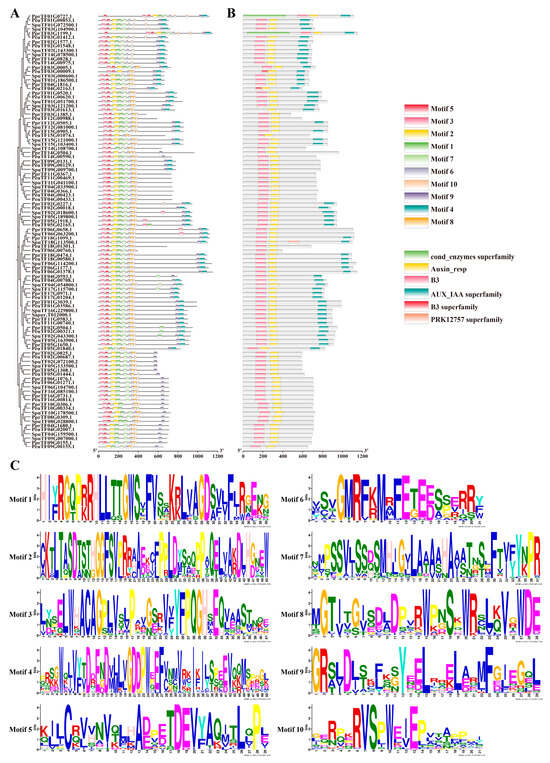
Figure 2.
Conserved motifs and conserved structure analysis of ARF genes. (A) Evolutionary relationship and conserved motif. (B) The distribution of conserved structural domains of PeARF genes. (C) Conserved motif analysis of PeARF proteins.
2.4. Prediction of Cis-Acting Elements of ARF Family Members in Three Salicaceae Species
The promoter sequence of the 2000 bp region upstream of the initial codon in ARF was explored to analyse the biological processes in which ARF family members are involved (Figure 3). The results revealed different distributions of cis-acting elements amongst family members, mainly divided into four major categories: plant growth and development-related elements, hormone response elements, light response elements, and stress response elements. Amongst them, stress-responsive cis-acting elements were mainly involved in defence stress (such as the wound element), drought stress response (such as the AREB element), and hypoxia and low-temperature responses. Phytohormone response elements were mainly the salicylic acid response element (such as the TCA element), the gibberellin response element (such as P-box and TATC-box), the methyl jasmonate response element (such as CGTCA-motif and TGACG-motif), the abscisic acid response element, and the AREs (such as the TGA-element and auxin element). Light-responsive elements were the most abundant, followed by hormone-responsive elements. These cis-acting elements were involved in developmental growth, cellular processes, hormone-mediated regulation, and various biotic and abiotic-mediated stresses in plants.
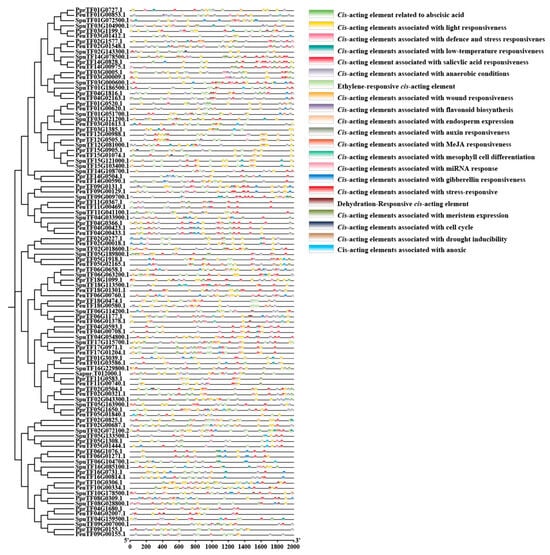
Figure 3.
Putative cis-acting regulatory elements in the promoters of ARF genes. The cis-acting elements were analysed in the 2000 bp upstream promoter regions of corresponding ARF genes using the PlantCARE database. The rectangles of different colours represent distinct cis-acting elements.
2.5. Chromosomal Localisation of the ARF Gene Family in Three Salicaceae Species
The location of the 102 ARF genes in the genome was investigated to study the chromosomal localisation of ARFs in three Salicaceae species. Analysis of chromosomal location showed that PeARFs were distributed on 15 of the 19 chromosomes of P. euphratica, with the highest number of PeARFs on Chr04 with five PeARF members, followed by Chr02 with four PeARF members. No PeARFs were found on Chr07, Chr08, Chr13, and Chr19. PpARFs were distributed on 16 of the 19 chromosomes of Populus pruinosa, with Chr02 having the highest number of PpARFs with four PpARF members, followed by Chr01, Chr03, Chr04, Chr05, and Chr06 with three PpARF members. No distribution of PpARFs was found in Chr19. SpuARFs were distributed on 16 of the 19 chromosomes of Salix sinopurpurea, amongst which Chr02 had the highest number of SpuARFs, with four SpuARF members, followed by Chr01, Chr03, Chr04, Chr05, and Chr06 with three SpuARF members. No distribution of SpuARFs was noted on Chr19. The ARF family members were unevenly distributed on all chromosomes. This uneven distribution on chromosomes suggests that each chromosome contributed differently to the evolution of the ARF family. The chromosomal distributions of SpuARFs and PpARFs were very similar (Figure 4 and Figure S2).
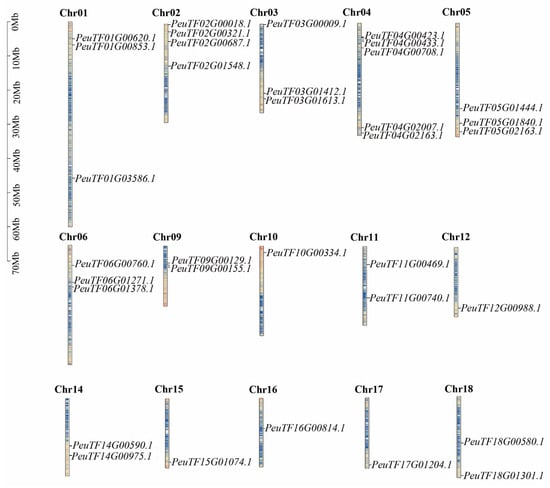
Figure 4.
Analysis of chromosomal localisation of PeARFs. Blue indicates low gene density, while red indicates high gene density on the chromosome.
2.6. Analysis of Covariance in the ARF Family in Three Salicaceae Species
The covariance of ARF between Populus euphratica and two other Salicaceae species (P. pruinosa and Salix sinopurpurea) and A. thaliana was compared to further explore the potential evolutionary process of PeARF in P. euphratica (Figure 5). The results showed 82, 90, and 20 ARF covariance pairs between P. euphratica and P. pruinosa, S. sinopurpurea, and A. thaliana, respectively, suggesting that the covariance of ARF within the Salicaceae species is more conserved than that amongst P. euphratica, P. pruinosa, and A. thaliana (Table S2). By contrast, A. thaliana and P. euphratica had only 20 colinear pairs, suggesting that the ARFs in Salicaceae species have undergone gene family expansion during evolution.
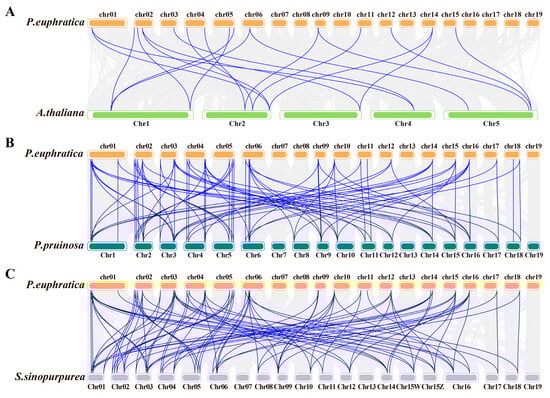
Figure 5.
Collinearity analysis indicates that P. europratica shares collinearity with three other species: (A) A. thaliana, (B) P. pruinose, and (C) S. sinopurpurea. The grey lines in the background indicate collinearity groups within the P. europratica and other plant genomes, while the blue lines highlight collinear ARF pairs.
2.7. Predicted Protein Secondary Structures of ARFs from Three Salicaceae Species
The secondary structures of ARF proteins were predicted (Figure 6 and Figure S3); results show that ARF proteins contained four secondary structures: α-helix, β-turn, extended strand, and random curl. The proportion of the secondary structures of ARF proteins is basically as follows: random curl > α-helix > extended strand > β-turn. α-Helix and random curl are the major conformations of ARF proteins. The average percentages of the protein secondary structures of PeARF family members were 14.48% α-helix, 2.31% β-turn, 72.07% random curl, and 11.51% extended strand. The average percentages of the protein secondary structures of PpARF family members were 14.93% α-helix, 2.44% β-turn, 71.42% random curl, and 11.21% extended strand. The average percentages of the protein secondary structure of SpuARF family members were 15.18% α-helix, 2.36% β-turn, 71.46% random curl, and 11.01% extended strand (Table S3). The PeARF family members had the largest percentage of extended strand and random curl and the smallest percentage of α-helix and β-turn. The SpuARF family members had the largest percentage of α-helix and β-turn and the smallest percentage of extended strand. Such differences may influence ARFs to perform functions differently within different species.
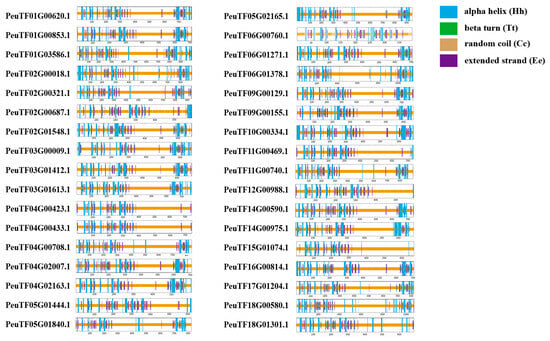
Figure 6.
Secondary structure prediction of PeARF proteins. Hh (alpha helix), Tt (beta turn), Cc (random coil), and Ee (extended strand) are shown with different colours.
2.8. Expression Patterns of PeARFs in Populus euphratica Heterophyllous Leaves
The transcript levels of PeARFs across four leaf morphologies in P. euphratica were analysed to investigate the potential role of PeARFs in the development of heteromorphic leaves in P. euphratica. The expression data for PeARF gene family members were extracted across these four leaf morphologies and visualised using TBtools. The expression patterns were primarily categorised into two types: up-regulation and down-regulation in ovate (Ov) and broadly ovate leaves (Bo) (Figure 7A). Multiple PeARFs were previously identified through multi-omics integration analysis and molecular regulatory network analysis. qRT-PCR further validated the PeARF expression results, which were consistent with the results of transcriptomic analysis. The correlation coefficients between transcriptomic data and qRT-PCR data are as follows: (PeuTF14G00975.1: r = 0.999, PeuTF15G01074.1: r = 0.524, PeuTF01G00853.1: r = 0.941, PeuTF02G00687.1: r = 0.986, PeuTF04G00423.1: r = 0.777, PeuTF18G00580.1: 0.607). qRT-PCR results indicate that the selected genes align with the transcriptome expression pattern, with PeuTF01G00853.1, PeuTF04G00423.1, and PeuTF14G00975.1 exhibiting significantly elevated expression levels in broad leaves (Ov and Bo) and PeuTF02G00687.1 exhibiting significantly reduced expression in broad leaves. Although PeuTF18G00580.1 and PeuTF15G01074.1 showed no significant differences between narrow leaves (Li and La) and broad leaves, their expression levels still demonstrated an increasing and decreasing trend, respectively (Figure 7B). Notably, among them, PeARF18 (PeuTF14G00975.1) exhibited the highest expression in Ov and Bo leaves, compared with the expression level observed in Li and La leaves. Integrating with previous reports on ARFs‘ involvement in leaf morphogenesis, PeARF18 may be involved in regulating the development of P. euphratica heterophyllous leaves.
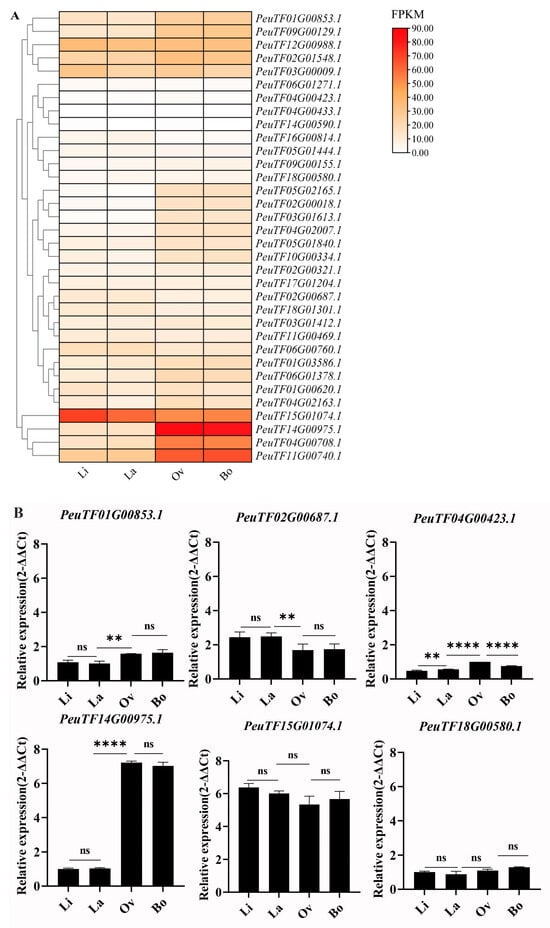
Figure 7.
Expression patterns of PeARFs in heteromorphic leaves. Linear leaves, lanceolate leaves, ovate leaves, and broadly ovate leaves are abbreviated as Li, La, Ov, and Bo, respectively. (A) Expression profiles of PeARFs during leaf development. (B) qRT-PCR data for PeARF expression profiles in heteromorphic leaves. The ‘****’ indicates significant differences of p < 0.0001; the ‘**’ indicates significant differences of p < 0.01; ‘ns’ indicates no significance.
2.9. Subcellular Localisation Analysis of PeARF18
The function of a protein is generally determined by its localisation within the cell. Once mature proteins are localised to specific organelles, they can perform their biological functions. By using transient transformation technology in tobacco, subcellular localisation of PeARF18 was observed under a laser confocal microscope with excitation at 514 nm and detection at 524 nm. The results revealed distinct fluorescence in the cell nuclei, indicating that PeARF18 functions as a transcription factor within the nucleus (Figure 8).
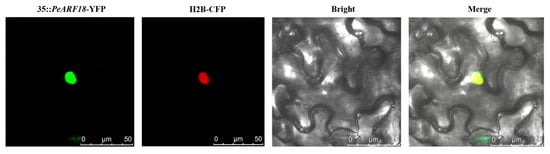
Figure 8.
Nuclear localisation of the 35S::PeARF18-YFP protein in tobacco leaf epidermal cells: fluorescence images of PeARF18 (35S::PeARF18-YFP), nuclear localisation signals (H2B-CFP), and fusion images (35S::PeARF18-YFP/H2B-CFP). Scale bar = 25 µm.
3. Discussion
3.1. Identification of Three Salicaceae ARF Family Members
P. euphratica has evolved a unique heteromorphic leaf system to effectively cope with the arid desert environment. The structural features of the heteromorphic leaves enable P. euphratica to effectively retain water, increase photosynthesis, reduce transpiration, and enhance tolerance to drought stress [37]. Research indicates that ARFs play a crucial role in plant growth and development. The AtARF family was firstly identified with 23 members. The ARF family of common botanical model plants have been identified one after another, and their functions and mechanisms of action have been studied in depth.
Comparative analysis of the ARF family across numerous species revealed homologous relationships amongst ARF members within the same species, and ARF members from different species exhibited a degree of homology. The phylogenetic analysis of apple ARF genes revealed their division into three groups [38]. Subsequent phylogenetic tree analysis and subgroup classification of apple ARF genes, alongside those from Arabidopsis, rice, tomato, maize, and grape, further categorised 148 ARF members into five distinct groups. Fifty ARF genes identified in tobacco formed 22 paralogous gene pairs, with 20 pairs exhibiting highly similar phylogenetic relationships and gene sequences. Based on the phylogenetic tree of barley, maize, rice, and AtARF genes, 96 ARF genes from the four plants were grouped into six clusters (I–VI). The findings in Arabidopsis were similar [39]. The phylogenetic analysis of ARF families from Arabidopsis, P. euphratica, P. pruinosa, and Salix sinopurpurea showed that group 5 was the Arabidopsis genes that underwent clustering, suggesting that they have a specific role in Arabidopsis. By contrast, all other groups underwent gene expansion, which may allow them to more finely differentiate their functions and regulate plant growth and development; this may play a crucial role in shaping the structure and evolution of species genomes.
3.2. The Role of ARFs in Plant Growth and Development and Responses to Abiotic Stress in Three Salicaceae Species
Variations in gene expression levels are largely determined by cis-acting elements within the promoter region of the genes, which provide the essential molecular basis for responding to environmental stimuli. Analysis of cis-acting elements in ARF gene promoters elucidates their potential regulatory responses to abiotic stress and plant growth and development. In the absence of auxin, ARF interacts with AUX/IAA proteins to form a complex, thereby inhibiting ARF’s activation of downstream genes. In the presence of auxin, auxin binds to receptors such as TIR1, promoting the ubiquitination and degradation of AUX/IAA proteins. This releases the inhibition of ARF by AUX/IAA, enabling ARF to activate the expression of downstream auxin-responsive genes. This facilitates auxin signal transduction, thereby regulating plant growth and development processes such as cell enlargement and plant elongation [40]. The analysis of cis-acting elements within the promoter regions revealed that ARFs contained multiple light-responsive elements, hormone-responsive elements, cis-acting elements associated with plant growth and development, and cis-acting elements responding to stress. This finding indicated that ARFs are closely linked to plant growth and development. The variation in the types and numbers of cis-acting elements within ARFs suggests functional differentiation amongst these factors; numerous cis-acting elements within PeARFs are implicated in abiotic stress responses and plant growth and development, such as DRE cis-acting elements [41] and AREB cis-acting elements [42], thereby possibly ensuring the survival of P. euphratica in harsh arid environments.
3.3. Functional Characterisation of PeARF18
The expression patterns of PeARFs are primarily categorised into two groups: those up-regulated and down-regulated in Ov and Bo leaves compared with those in Li and La leaves. Multi-omics integration analysis and molecular regulatory network analysis were applied to identify PeARFs [43]. PeARF18 (PeuTF14G00975.1) exhibited the highest expression in Ov and Bo leaves, with significant expression differences in Li and La. The heteromorphic leaves of P. euphratica are directly linked to its adaptation to arid environments. Given this pattern of expression, PeARF18 may regulate the growth and development of P. euphratica leaves to adapt to arid environments. We also conducted interspecies collinearity analysis, revealing an expansion within the PeARF gene family. For instance, PeARF18 exhibits collinearity with both PeuTF02G01548.1 and AtARF18. However, its expression patterns and levels differ across various leaf morphs of P. euphratica, suggesting that functional shifts may have occurred within the PeARF gene family following this expansion.
4. Materials and Methods
4.1. Identification and Physicochemical Characterisation of ARF Family Members in Three Salicaceae Species
PeARFs were analysed on the basis of the P. euphratica genome [44]. The ARFs for the other two Salicaceae were determined on the basis of the genomic data from P. pruinosa (National Center for Biotechnology Information, Biological Project Accession Number PRJNA863418) and S. sinopurpurea [36]. All genomic data of the three poplars were firstly aligned with the protein sequences of the 23 AtARF genes’ family obtained from NCBI by using Blastp (https://blast.ncbi.nlm.nih.gov/Blast.cgi?PROGRAM=blastp&PAGE_TYPE=BlastSearch&LINK_LOC=blasthome, accessed on 5 December 2023) searches with an e-value of 1.0 × 10⁻¹⁰. In addition, searches were performed using HMMER for possible ARF proteins. Genes with complete CD length-specific ARF-conserved structural domains were then identified by further screening with Pfam batch sequence search (http://pfam.xfam.org/search, accessed on 12 December 2024) and NCBI batch CD-Search (https://www.ncbi.nlm.nih.gov/Structure/cdd/wrpsb.cgi, accessed on 12 December 2023). The candidate ARF genes were subsequently identified in the Salicaceae families by using SMART (http://smart.embl-heidelberg.de/, accessed on 13 December 2024). The isoelectric point of the PeARF proteins and the theoretical molecular weight (Mw) were predicted by ExPASy (https://www.expasy.org/, accessed on 14 December 2024). The subcellular localisation of the ARF families in Salicaceae was predicted by the online website WoLF PSORT (https://wolfpsort.hgc.jp/, accessed on 14 December 2024).
4.2. Phylogenetic Analysis of Multi-Species ARF Gene Family
The structural domains in the ARF protein sequences of P. euphratica, S. sinopurpurea, P. pruinose, and A. thaliana were retrieved using the SMART website. The sequences of ARF structural domains were extracted using the coordinates of the ARF structural domains and merged into a new sequence. The merged protein sequences were then used to construct a phylogenetic tree for the three species. The merged ARF protein sequences of P. euphratica, S. sinopurpurea, P. pruinosa, and A. thaliana were compared using the Clustal method of MEGA-X under default settings [45]. The neighbour-joining (NJ) method was used to infer the evolutionary history. A bootstrap consensus tree inferred from 1000 replicates was used to represent the evolutionary history of the analysed taxa. The percentage of replicate trees clustered by the relevant taxa in the bootstrap test (1000 replicates) is shown next to the branches. Evolutionary distances were calculated using a method on the basis of the Dayhoff matrix and expressed as the number of amino acid substitutions per site. All ambiguous positions were removed for each sequence pair (pairwise deletion option). The phylogenetic trees were landscaped and displayed using the ITOL online website (https://itol.embl.de/, accessed on 5 January 2025).
4.3. Analysis of Gene Structure and Conserved Structural Domains of ARF Family Members in Three Salicaceae Families
The conserved motifs were analysed using MEME (http://meme-suite.org/, accessed on 10 January 2025), with optimal widths ranging from 10 to 150. The number of motifs was set to 10, and the rest were set as defaults. Then, TBtools (v2.097) was used to plot the gene structures and motifs, and the results were analysed.
4.4. Analysis of Cis-Acting Elements of ARF Family Members in Three Salicaceae Plants
A total of 2000 bp sequences upstream of the start codon of the Salicaceae ARF gene family members were entered into the PlantCare website (https://bioinformatics.psb.ugent.be/webtools/plantcare/html/, accessed on 12 March 2025) to predict the cis-elements in the promoters of each gene, which were then visualised using TBtools to analyse the promoter sequences in the ARF family genes of three Salicaceae family plants and predict their functions.
4.5. Multi-Species Covariance and Chromosomal Localisation of Three Salicaceae ARF Families
Homologous pairs of P. euphratica with three other species (P. pruinose, Salix sinopurpurea, and A. thaliana) were screened by BLASTP comparison. Then, common intervals between P. euphratica and these three other species were screened using TBtools software and visualised using visualisation software. Chromosome length information (Fasta Stats), ID and position information of PeARFs genes (GFF3 gene position parse/Text Block Extract and Filter), and gene density information (Gene Density Profile) were extracted from the genome files of the three poplars using TBtools software. Gene Density Profile), and then the TBtools/Gene Location Visualize function was used to visualise the chromosome location.
4.6. Analysis of Expression Patterns
Thirty leaf samples of P. euphratica were collected from the P. euphratica forest in Alar City, Xinjiang Uygur Autonomous Region, China, with the specific location recorded as 40°32′36.90′′ N (latitude) and 81°17′56.52′′ E (longitude). From late July to August, leaves at the Li (linear leaves), La (lanceolate leaves), Ov (ovate leaves), and Bo (broadly ovate leaves) developmental stages of P. euphratica were sampled. Specifically, the third or fourth leaf segments from the base of current-year branches were selected as experimental materials. Upon collection, the samples were immediately stored at −80 °C in a freezer. Three biological replicates were prepared for transcriptome sequencing. Whole-transcriptome mRNA-seq was conducted on an Illumina HiSeq X-Ten platform (Novogene, Beijing, China), following the manufacturer’s standard protocol. Clean reads were mapped to the reference genome using HISAT2 (version 2.0.4) to quantify the expression levels of annotated P. euphratica genes [46]. Gene expression abundance was calculated as fragments per kilobase of transcript per million mapped reads (FPKMs) via StringTie (version 2.2.1) [47].
The heteromorphic foliage was collected from different canopies and stored in an ultra-low-temperature refrigerator at −80 °C after being rapidly frozen with liquid nitrogen. An actin gene was used as the endogenous control. Each reaction was performed in biological triplicates, and the CT values obtained through qRT-PCR were analysed using the 2−∆∆CT method to calculate the relative fold change values.
5. Conclusions
This study provides the first comprehensive identification and analysis of ARF gene families in three species of Salicaceae. Their structure, phylogenetic relationships, cis-acting elements, colinearity, and subcellular localisation were analysed. This gene family may play a role in the hormone regulation of P. euphratica leaf development. RNA sequencing (RNA-seq) combined with quantitative reverse transcription polymerase chain reaction (qRT-PCR) revealed that the transcriptional dynamics of PeARF18 strongly correlate with the developmental process of heteromorphic leaves in P. euphratica. A high expression of PeARF18 in wild-type P. euphratica resulted in increased leaf area, consistent with its high expression in broad leaves and low expression in narrow leaves of P. euphratica. Therefore, PeARF18 may promote the increase in leaf area of P. euphratica. In summary, this study provides a foundation for investigating the ARF gene family in P. euphratica and offers theoretical support on how PeARF18 influences the growth and development of P. euphratica’s heteromorphic leaves. This study focuses on bioinformatics analysis and lacks functional validation through mutant or overexpressing plants; subsequent work will incorporate CRISPR editing technology or gene overexpression in poplars.
Supplementary Materials
The following supporting information can be downloaded at https://www.mdpi.com/article/10.3390/ijms27010335/s1.
Author Contributions
Conceptualisation, P.J. and Z.W.; methodology, T.S., H.J. and J.L.; software, J.L., H.J., T.S., D.M., Q.N., Z.C. and Y.Y.; formal analysis, T.S.; writing—original draft preparation, T.S.; writing—review and editing, T.S., Z.L., P.J. and Z.W. All authors have read and agreed to the published version of the manuscript.
Funding
This research was funded by the Tarim University Postgraduate Research Innovation Programme, grant number TDGR12024006; the National Natural Science Foundation of China, grant numbers 32160355 and 32371838; the Tianshan Top Talents Program, grant number 2024TSYCCX0114; the “Xinjiang Tianchi Doctoral Project”, grant number 525307004; the Natural Science Support Program of XPCC (2024DA034); and the Guidance Program for Science & Technology Projects of XPCC, grant number 2024ZD087.
Institutional Review Board Statement
Not applicable.
Informed Consent Statement
Not applicable.
Data Availability Statement
The RNA-seq data for P. euphratica’s heteromorphic leaves used in this study have been submitted to the National Genomics Data Center (https://ngdc.cncb.ac.cn/) under BioProject accession number PRJCA005959 (accessed on 13 January 2024).
Acknowledgments
We thank all the authors for their contributions to this study.
Conflicts of Interest
The authors declare no conflicts of interest.
References
- Goh, T.; Vobeta, U.; Farcot, E.; Bennett, M.J.; Bishopp, A. Systems biology approaches to understand the role of auxin in root growth and development. Physiol. Plant 2014, 151, 73–82. [Google Scholar] [CrossRef] [PubMed]
- Zhao, Y. Auxin biosynthesis and its role in plant development. Annu. Rev. Plant Biol. 2010, 61, 49–64. [Google Scholar] [CrossRef] [PubMed]
- Zhang, Y.; Yu, J.; Xu, X.; Wang, R.; Liu, Y.; Huang, S.; Wei, H.; Wei, Z. Molecular Mechanisms of Diverse Auxin Responses during Plant Growth and Development. Int. J. Mol. Sci. 2022, 23, 12495. [Google Scholar] [CrossRef] [PubMed]
- Tiwari, S.B.; Hagen, G.; Guilfoyle, T. The roles of auxin response factor domains in auxin-responsive transcription. Plant Cell 2003, 15, 533–543. [Google Scholar] [CrossRef]
- Ulmasov, T.; Hagen, G.; Guilfoyle, T. Dimerization and DNA binding of auxin response factors. Plant J. 1999, 19, 309–319. [Google Scholar] [CrossRef]
- Vernoux, T.; Brunoud, G.; Farcot, E.; Morin, V.; Van den Daele, H.; Legrand, J.; Oliva, M.; Das, P.; Larrieu, A.; Wells, D.; et al. The auxin signaling network translates dynamic input into robust patterning at the shoot apex. Mol. Syst. Biol. 2011, 7, 508. [Google Scholar] [CrossRef]
- Guilfoyle, T.J. The PB1 domain in auxin response factor and Aux/IAA proteins: A versatile protein interaction module in the auxin response. Plant Cell 2015, 27, 33–43. [Google Scholar] [CrossRef]
- Chandler, J.W. Auxin response factors. Plant Cell Environ. 2016, 39, 1014–1028. [Google Scholar] [CrossRef]
- Wang, D.; Pei, K.; Fu, Y.; Sun, Z.; Li, S.; Liu, H.; Tang, K.; Han, B.; Tao, Y. Genome-wide analysis of the auxin response factors (ARF) gene family in rice (Oryza sativa). Gene 2007, 394, 13–24. [Google Scholar] [CrossRef]
- Li, S.B.; OuYang, W.Z.; Hou, X.J.; Xie, L.L.; Hu, C.G.; Zhang, J.Z. Genome-wide identification, isolation and expression analysis of auxin response factor (ARF) gene family in sweet orange (Citrus sinensis). Front. Plant Sci. 2015, 6, 119. [Google Scholar] [CrossRef]
- Kalluri, U.C.; Difazio, S.P.; Brunner, A.M.; Tuskan, G.A. Genome-wide analysis of Aux/IAA and ARF gene families in Populus trichocarpa. BMC Plant Biol. 2007, 7, 59. [Google Scholar] [CrossRef] [PubMed]
- Okushima, Y.; Overvoorde, P.J.; Arima, K.; Alonso, J.M.; Chan, A.; Chang, C.; Ecker, J.R.; Hughes, B.; Lui, A.; Nguyen, D.; et al. Functional genomic analysis of the AUXIN RESPONSE FACTOR gene family members in Arabidopsis thaliana: Unique and overlapping functions of ARF7 and ARF19. Plant Cell 2005, 17, 444–463. [Google Scholar] [CrossRef] [PubMed]
- Liu, Y.; Jiang, H.; Chen, W.; Qian, Y.; Ma, Q.; Cheng, B.; Zhu, S. Genome-wide analysis of the auxin response factor (ARF) gene family in maize (Zea mays). Plant Growth Regul. 2011, 63, 225–234. [Google Scholar] [CrossRef]
- Hu, W.; Zuo, J.; Hou, X.; Yan, Y.; Wei, Y.; Liu, J.; Li, M.; Xu, B.; Jin, Z. The auxin response factor gene family in banana: Genome-wide identification and expression analyses during development, ripening, and abiotic stress. Front. Plant. Sci. 2015, 6, 742. [Google Scholar] [CrossRef]
- Shen, C.; Yue, R.; Sun, T.; Zhang, L.; Xu, L.; Tie, S.; Wang, H.; Yang, Y. Genome-wide identification and expression analysis of auxin response factor gene family in Medicago truncatula. Front. Plant Sci. 2015, 6, 73. [Google Scholar] [CrossRef]
- Santner, A.; Calderon-Villalobos, L.I.; Estelle, M. Plant hormones are versatile chemical regulators of plant growth. Nat. Chem. Biol. 2009, 5, 301–307. [Google Scholar] [CrossRef]
- Liu, Z.; Miao, L.; Huo, R.; Song, X.; Johnson, C.; Kong, L.; Sundaresan, V.; Yu, X. ARF2–ARF4 and ARF5 are Essential for Female and Male Gametophyte Development in Arabidopsis. Plant Cell Physiol. 2018, 59, 179–189. [Google Scholar] [CrossRef]
- Ghelli, R.; Brunetti, P.; Napoli, N.; De Paolis, A.; Cecchetti, V.; Tsuge, T.; Serino, G.; Matsui, M.; Mele, G.; Rinaldi, G.; et al. A Newly Identified Flower-Specific Splice Variant of AUXIN RESPONSE FACTOR8 Regulates Stamen Elongation and Endothecium Lignification in Arabidopsis. Plant Cell 2018, 30, 620–637. [Google Scholar] [CrossRef]
- Zheng, Y.; Zhang, K.; Guo, L.; Liu, X.; Zhang, Z. AUXIN RESPONSE FACTOR3 plays distinct role during early flower development. Plant Signal. Behav. 2018, 13, e1467690. [Google Scholar] [CrossRef]
- Allen, E.; Xie, Z.; Gustafson, A.M.; Carrington, J.C. microRNA-directed phasing during trans-acting siRNA biogenesis in plants. Cell 2005, 121, 207–221. [Google Scholar] [CrossRef]
- Pekker, I.; Alvarez, J.P.; Eshed, Y. Auxin response factors mediate Arabidopsis organ asymmetry via modulation of KANADI activity. Plant Cell 2005, 17, 2899–2910. [Google Scholar] [CrossRef] [PubMed]
- Wang, S.; Tiwari, S.B.; Hagen, G.; Guilfoyle, T.J. AUXIN RESPONSE FACTOR7 restores the expression of auxin-responsive genes in mutant Arabidopsis leaf mesophyll protoplasts. Plant Cell 2005, 17, 1979–1993. [Google Scholar] [CrossRef] [PubMed]
- Zhang, S.; Wang, S.; Xu, Y.; Yu, C.; Shen, C.; Qian, Q.; Geisler, M.; Jiang, D.A.; Qi, Y. The auxin response factor, OsARF19, controls rice leaf angles through positively regulating OsGH3-5 and OsBRI1. Plant Cell Environ. 2015, 38, 638–654. [Google Scholar] [CrossRef] [PubMed]
- Zhou, J.; Wang, X.; Jiao, Y.; Qin, Y.; Liu, X.; He, K.; Chen, C.; Ma, L.; Wang, J.; Xiong, L.; et al. Global genome expression analysis of rice in response to drought and high-salinity stresses in shoot, flag leaf, and panicle. Plant Mol. Biol. 2007, 63, 591–608. [Google Scholar] [CrossRef]
- Bouzroud, S.; Gouiaa, S.; Hu, N.; Bernadac, A.; Mila, I.; Bendaou, N.; Smouni, A.; Bouzayen, M.; Zouine, M. Auxin Response Factors (ARFs) are potential mediators of auxin action in tomato response to biotic and abiotic stress (Solanum lycopersicum). PLoS ONE 2018, 13, e0193517. [Google Scholar] [CrossRef]
- Song, S.; Hao, L.; Zhao, P.; Xu, Y.; Zhong, N.; Zhang, H.; Liu, N. Genome-wide Identification, Expression Profiling and Evolutionary Analysis of Auxin Response Factor Gene Family in Potato (Solanum tuberosum Group Phureja). Sci. Rep. 2019, 9, 1755. [Google Scholar] [CrossRef]
- Su, L.; Xu, M.; Zhang, J.; Wang, Y.; Lei, Y.; Li, Q. Genome-wide identification of auxin response factor (ARF) family in kiwifruit (Actinidia chinensis) and analysis of their inducible involvements in abiotic stresses. Physiol. Mol. Biol. Plants 2021, 27, 1261–1276. [Google Scholar] [CrossRef]
- Jain, M.; Khurana, J.P. Transcript profiling reveals diverse roles of auxin-responsive genes during reproductive development and abiotic stress in rice. FEBS J. 2009, 276, 3148–3162. [Google Scholar] [CrossRef]
- Yan, B.; Li, F.; Ma, Q.; Shen, T.; Jiang, J.; Li, H. The miR156-SPL4/SPL9 module regulates leaf and lateral branch development in Betula platyphylla. Plant Sci. 2024, 338, 111869. [Google Scholar] [CrossRef]
- Damodharan, S.; Corem, S.; Gupta, S.K.; Arazi, T. Tuning of SlARF10A dosage by sly-miR160a is critical for auxin-mediated compound leaf and flower development. Plant J. 2018, 96, 855–868. [Google Scholar] [CrossRef]
- Zhou, C.P.; Gong, L.; Wu, X.; Luo, Y. Nutrient resorption and its influencing factors of typical desert plants in different habitats on the northern margin of the Tarim Basin, China. J. Arid. Land 2023, 15, 858–870. [Google Scholar] [CrossRef]
- Cao, D.; Li, J.; Huang, Z.; Baskin, C.C.; Baskin, J.M.; Hao, P.; Zhou, W.; Li, J. Reproductive characteristics of a Populus euphratica population and prospects for its restoration in China. PLoS ONE 2012, 7, e39121. [Google Scholar] [CrossRef] [PubMed]
- Shi, Y.; Mu, Z.; Meng, X.; Li, X.; Zou, L.; Zhu, X.; Bo, W. Genome-Wide Identification and Analysis of Auxin Response Factor Transcription Factor Gene Family in Populus euphratica. Plants 2025, 14, 1248. [Google Scholar] [CrossRef] [PubMed]
- Sun, J.; Xu, J.; Qiu, C.; Zhai, J.; Zhang, S.; Zhang, X.; Wu, Z.; Li, Z. The chromosome-scale genome and population genomics reveal the adaptative evolution of Populus pruinosa to desertification environment. Hortic Res. 2024, 11, uhae034. [Google Scholar] [CrossRef]
- Köhler, A.; Förster, N.; Zander, M.; Ulrichs, C. Compound-specific responses of phenolic metabolites in the bark of drought-stressed Salix daphnoides and Salix purpurea. Plant Physiol. Biochem. 2020, 155, 311–320. [Google Scholar] [CrossRef] [PubMed]
- Zhou, R.; Macaya-Sanz, D.; Carlson, C.H.; Schmutz, J.; Jenkins, J.W.; Kudrna, D.; Sharma, A.; Sandor, L.; Shu, S.; Barry, K.; et al. A willow sex chromosome reveals convergent evolution of complex palindromic repeats. Genome Biol. 2020, 21, 38. [Google Scholar] [CrossRef]
- Zhai, J.; Zhang, X.; Li, Z.; Han, X.; Zhang, S. Differences in the Functional Traits of Populus pruinosa Leaves in Different Developmental Stages. Plants 2023, 12, 2262. [Google Scholar] [CrossRef]
- Luo, X.C.; Sun, M.H.; Xu, R.R.; Shu, H.R.; Wang, J.W.; Zhang, S.Z. Genomewide identification and expression analysis of the ARF gene family in apple. J. Genet. 2014, 93, 785–797. [Google Scholar] [CrossRef]
- Remington, D.L.; Vision, T.J.; Guilfoyle, T.J.; Reed, J.W. Contrasting modes of diversification in the Aux/IAA and ARF gene families. Plant Physiol. 2004, 135, 1738–1752. [Google Scholar] [CrossRef]
- Laskowski, M. Teaching resources. Model of the TIR1 pathway for auxin-mediated gene expression. Sci. STKE 2006, 2006, tr1. [Google Scholar] [CrossRef]
- Zhou, M.-L.; Ma, J.-T.; Zhao, Y.-M.; Wei, Y.-H.; Tang, Y.-X.; Wu, Y.-M. Improvement of drought and salt tolerance in Arabidopsis and Lotus corniculatus by overexpression of a novel DREB transcription factor from Populus euphratica. Gene 2012, 506, 10–17. [Google Scholar] [CrossRef]
- Abe, H.; Urao, T.; Ito, T.; Seki, M.; Shinozaki, K.; Yamaguchi-Shinozaki, K. Arabidopsis AtMYC2 (bHLH) and AtMYB2 (MYB) function as transcriptional activators in abscisic acid signaling. Plant Cell 2003, 15, 63–78. [Google Scholar] [CrossRef]
- Wu, Z.; Jiang, Z.; Li, Z.; Jiao, P.; Zhai, J.; Liu, S.; Han, X.; Zhang, S.; Sun, J.; Gai, Z.; et al. Multi-omics analysis reveals spatiotemporal regulation and function of heteromorphic leaves in Populus. Plant Physiol. 2023, 192, 188–204. [Google Scholar] [CrossRef]
- Zhang, S.; Wu, Z.; Ma, D.; Zhai, J.; Han, X.; Jiang, Z.; Liu, S.; Xu, J.; Jiao, P.; Li, Z. Chromosome-scale assemblies of the male and female Populus euphratica genomes reveal the molecular basis of sex determination and sexual dimorphism. Commun. Biol. 2022, 5, 1186. [Google Scholar] [CrossRef]
- Kumar, S.; Stecher, G.; Li, M.; Knyaz, C.; Tamura, K. MEGA X: Molecular Evolutionary Genetics Analysis across computing platforms. Mol. Biol. Evol. 2018, 35, 1547–1549. [Google Scholar] [CrossRef]
- Mihaela, P.; Daehwan, K.; Geo, M.; Jeffrey, T.; Steven, S. Transcript-Level Expression Analysis of RNA-Seq Experiments with HISAT, StringTie and Ballgown. Nat. Protoc. 2016, 11, 1650–1667. [Google Scholar] [CrossRef]
- Cheng, Y.; Hong, X.; Zhang, L.; Yang, W.; Zeng, Y.; Hou, Z.; Yang, Z.; Yang, D. Transcriptomic Analysis Provides Insight into the Regulation Mechanism of Silver Ions (Ag+) and Jasmonic Acid Methyl Ester (Meja) on Secondary Metabolism in the Hairy Roots of Salvia miltiorrhiza Bunge (Lamiaceae). Med. Plant Biol. 2023, 2, 3. [Google Scholar] [CrossRef]
Disclaimer/Publisher’s Note: The statements, opinions and data contained in all publications are solely those of the individual author(s) and contributor(s) and not of MDPI and/or the editor(s). MDPI and/or the editor(s) disclaim responsibility for any injury to people or property resulting from any ideas, methods, instructions or products referred to in the content. |
© 2025 by the authors. Licensee MDPI, Basel, Switzerland. This article is an open access article distributed under the terms and conditions of the Creative Commons Attribution (CC BY) license.