Differentially Expressed Genes Associated with the Development of Cervical Cancer
 , , , , , and
Abstract
1. Introduction
2. Results
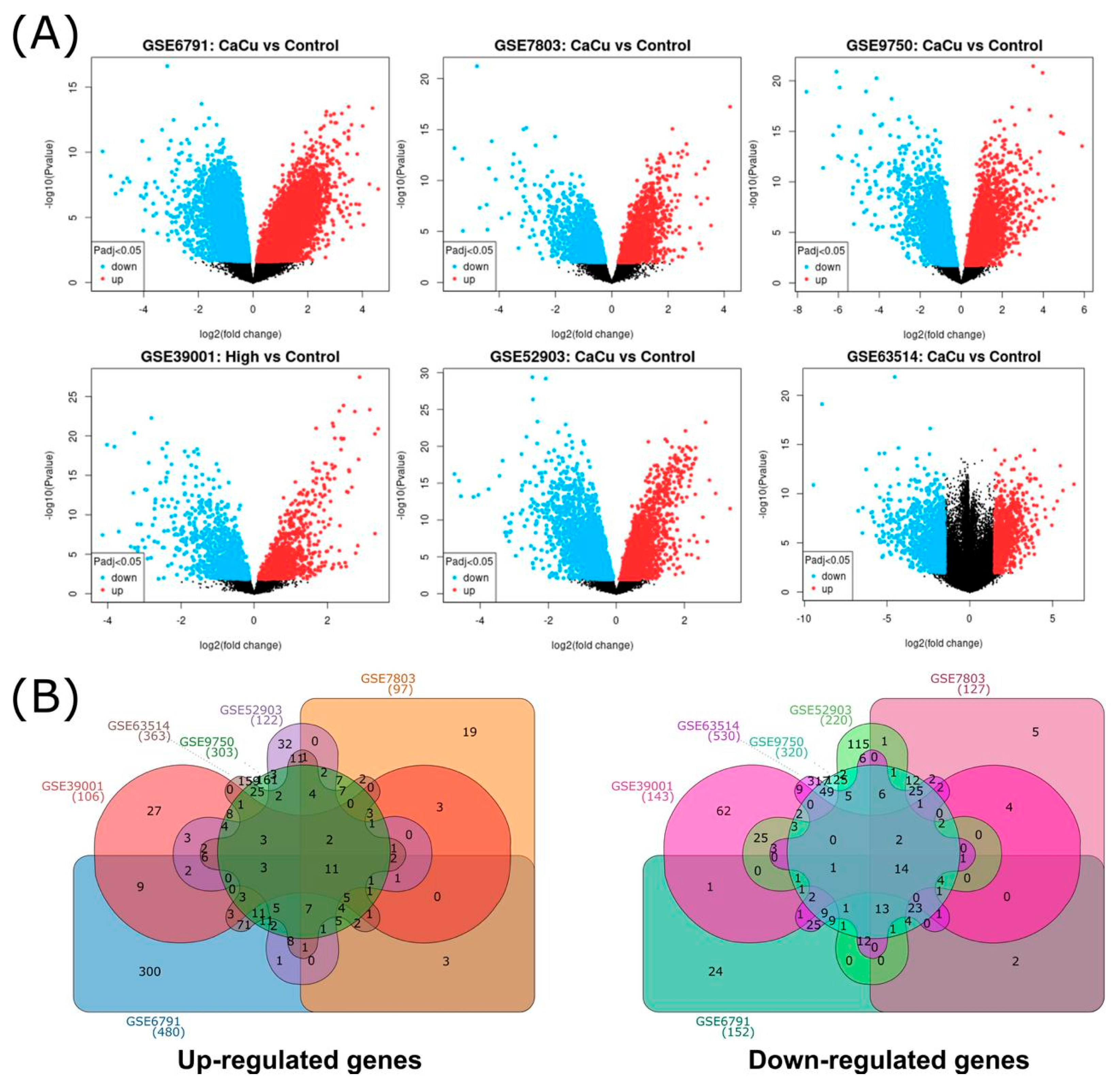
2.1. Microarray Data Information and DEGs Analysis in Cervical Cancer
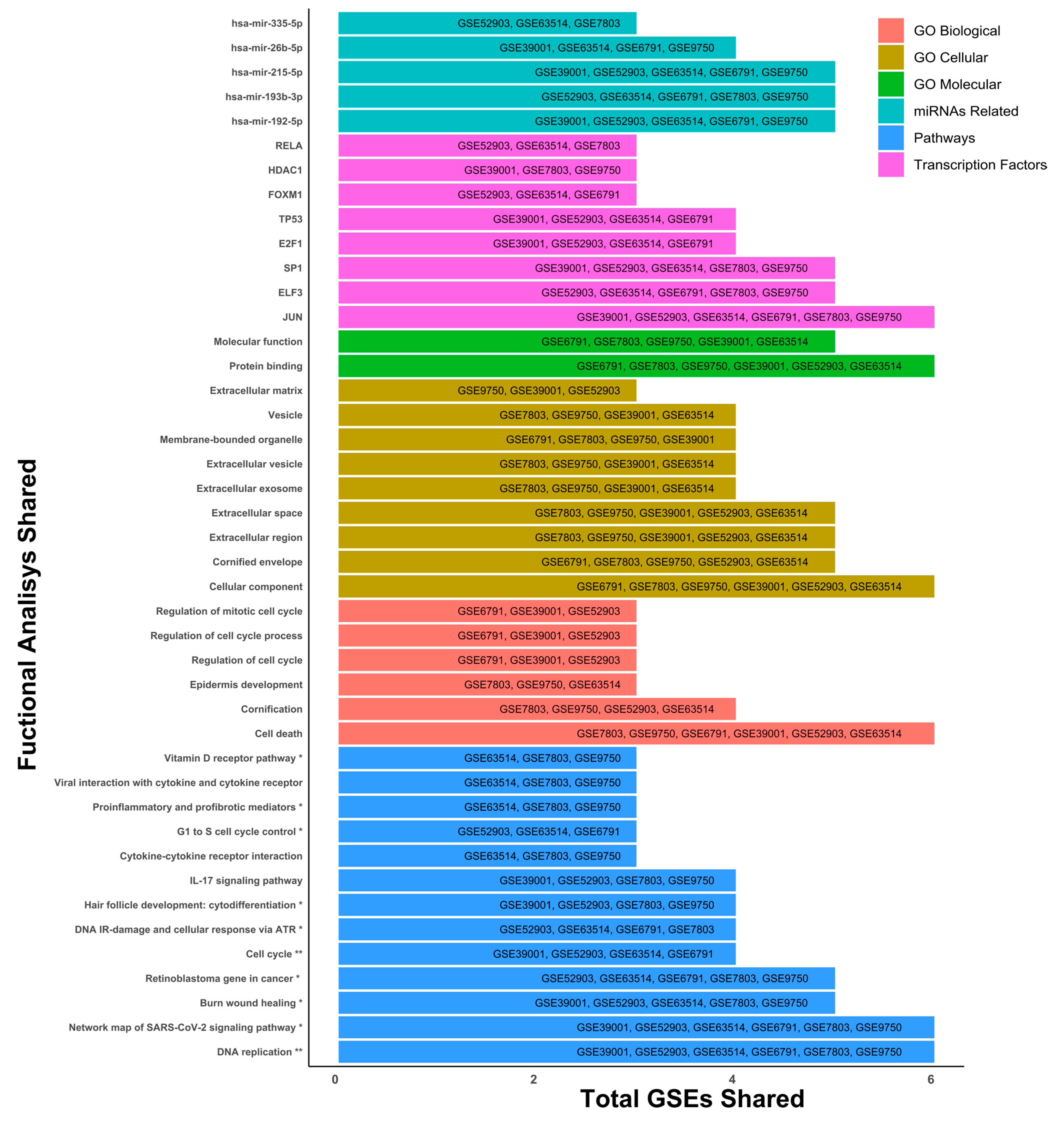
2.2. Gene Ontology (GO) Terms and KEGG Pathway Analysis by GSE
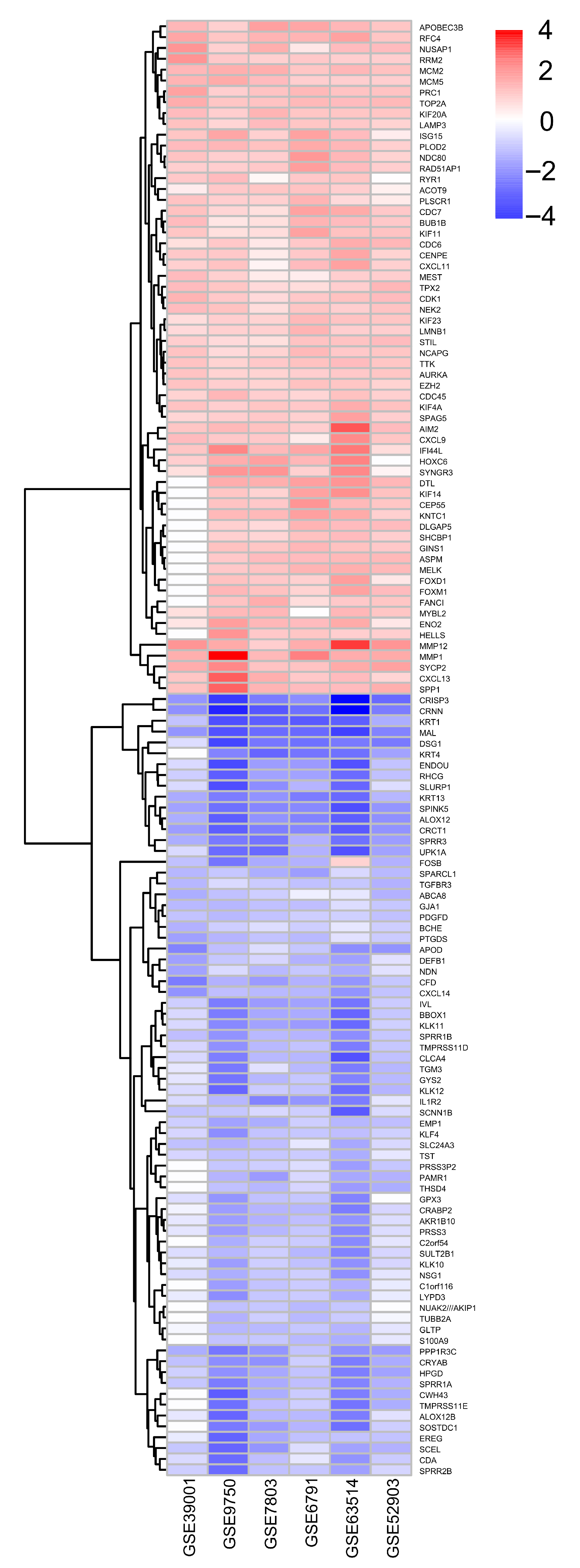
2.3. Microarray Analysis Integration and Common Gene Determination
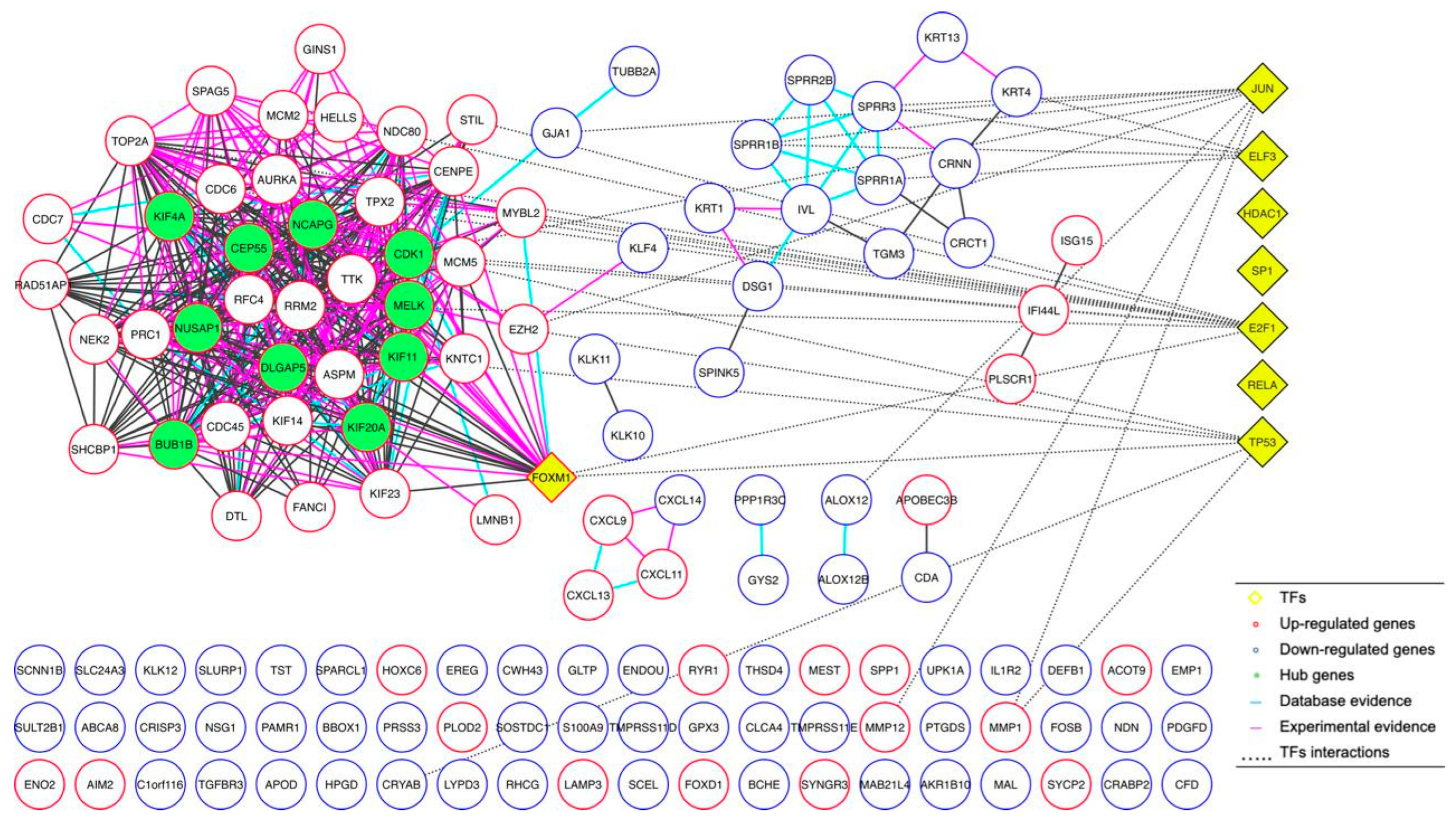
2.4. Protein–Protein Interaction Network Analyses
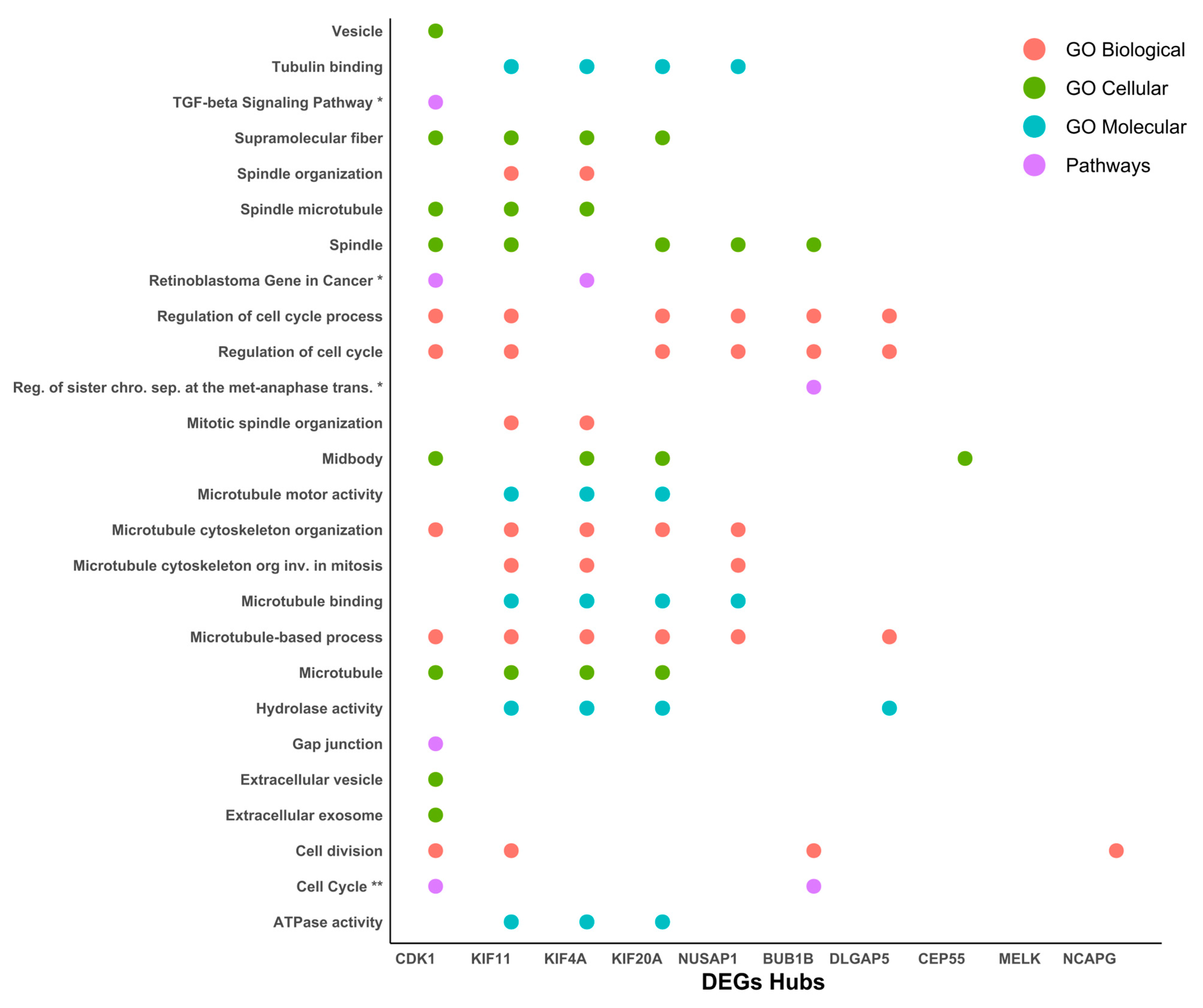
2.5. Functional Enriched Process for Hub Proteins
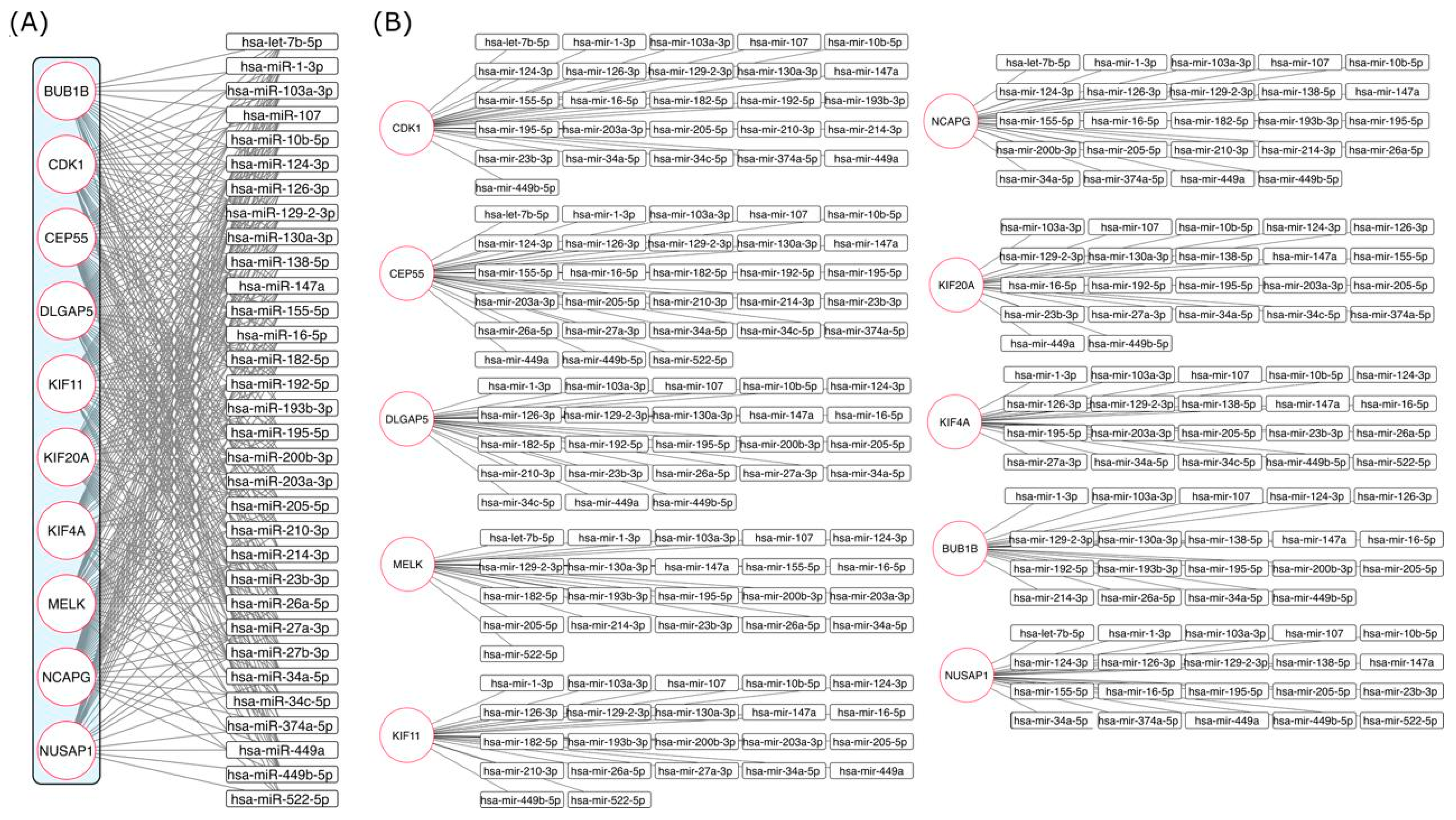
2.6. Hub Proteins and miRNAs Interaction Network Analyses
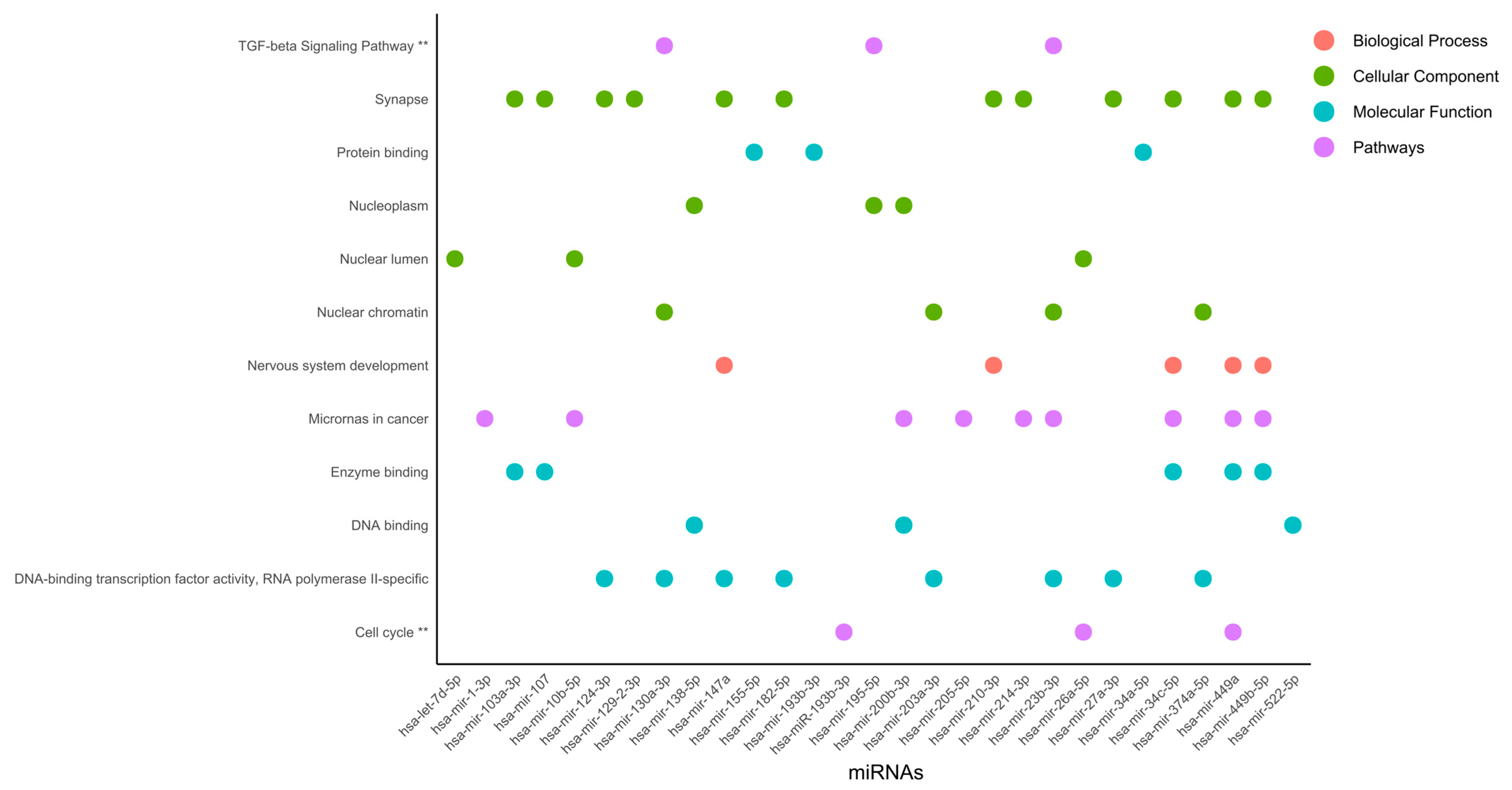
2.7. miRNAs Functional Enriched Processes
3. Discussion
4. Materials and Methods
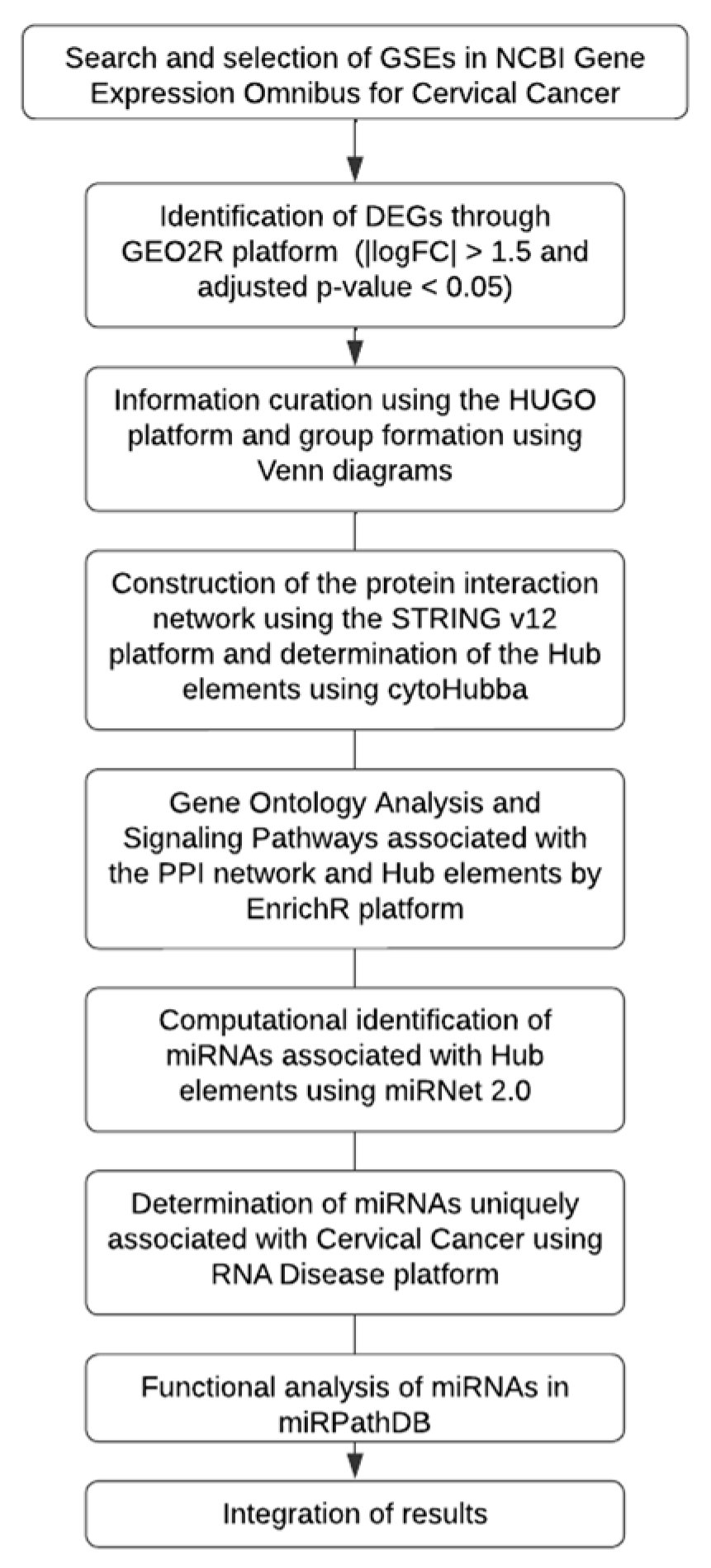
4.1. General Diagram
4.2. Gene Expression Profile Data Collection
4.3. Identification of Differentially Expressed Genes
4.4. PPI Network Construction
4.5. DEG Annotation and Functional Analyses
4.6. Computational Identification of miRNAs Associated with Cervical Cancer
4.7. Functional Analysis of miRNAs in miRPathDB
5. Conclusions
Supplementary Materials
Author Contributions
Funding
Institutional Review Board Statement
Informed Consent Statement
Data Availability Statement
Acknowledgments
Conflicts of Interest
References
- Bray, F.; Laversanne, M.; Sung, H.; Ferlay, J.; Siegel, R.L.; Soerjomataram, I.; Jemal, A. Global cancer statistics 2022: GLOBOCAN estimates of incidence and mortality worldwide for 36 cancers in 185 countries. CA Cancer J. Clin. 2024, 74, 229–263. [Google Scholar] [CrossRef] [PubMed]
- Cohen, P.A.; Jhingran, A.; Oaknin, A.; Denny, L. Cervical cancer. Lancet 2019, 393, 169–182. [Google Scholar] [CrossRef] [PubMed]
- DiMaio, D.; Liao, J.B. Human papillomaviruses and cervical cancer. Adv. Virus Res. 2006, 66, 125–159. [Google Scholar]
- Dyson, N.; Howley, P.M.; Münger, K.; Harlow, E. The human papilloma virus-16 E7 oncoprotein is able to bind to the retinoblastoma gene product. Science 1989, 243, 934–937. [Google Scholar] [CrossRef] [PubMed]
- Chakrabarti, O.; Krishna, S. Molecular interactions of ‘high risk’human papillomaviruses E6 and E7 oncoproteins: Implications for tumour progression. J. Biosci. 2003, 28, 337–348. [Google Scholar] [CrossRef]
- Scheffner, M.; Werness, B.A.; Huibregtse, J.M.; Levine, A.J.; Howley, P.M. The E6 oncoprotein encoded by human papillomavirus types 16 and 18 promotes the degradation of p53. Cell 1990, 63, 1129–1136. [Google Scholar] [CrossRef]
- Granados-Lopez, A.J.; Manzanares-Acuna, E.; Lopez-Hernandez, Y.; Castaneda-Delgado, J.E.; Fraire-Soto, I.; Reyes-Estrada, C.A.; Gutierrez-Hernandez, R.; Lopez, J.A. UVB inhibits proliferation, cell cycle and induces apoptosis via p53, E2F1 and microtubules system in cervical cancer cell lines. Int. J. Mol. Sci. 2021, 22, 5197. [Google Scholar] [CrossRef]
- Hermeking, H. The miR-34 family in cancer and apoptosis. Cell Death Differ. 2010, 17, 193–199. [Google Scholar] [CrossRef]
- Calin, G.A.; Sevignani, C.; Dumitru, C.D.; Hyslop, T.; Noch, E.; Yendamuri, S.; Shimizu, M.; Rattan, S.; Bullrich, F.; Negrini, M. Human microRNA genes are frequently located at fragile sites and genomic regions involved in cancers. Proc. Natl. Acad. Sci. USA 2004, 101, 2999–3004. [Google Scholar] [CrossRef]
- Calin, G.A.; Croce, C.M. MicroRNA signatures in human cancers. Nat. Rev. Cancer 2006, 6, 857–866. [Google Scholar] [CrossRef]
- Hanahan, D.; Weinberg, R.A. Hallmarks of cancer: The next generation. Cell 2011, 144, 646–674. [Google Scholar] [CrossRef]
- Miller, D.M.; Blume, S.; Borst, M.; Gee, J.; Polansky, D.; Ray, R.; Rodu, B.; Shrestha, K.; Snyder, R.; Thomas, S. Oncogenes, malignant transformation, and modern medicine. Am. J. Med. Sci. 1990, 300, 59–69. [Google Scholar] [CrossRef]
- Weinberg, R.A. Tumor suppressor genes. Science 1991, 254, 1138–1146. [Google Scholar] [CrossRef] [PubMed]
- Lim, P.K.; Bliss, S.A.; Patel, S.A.; Taborga, M.; Dave, M.A.; Gregory, L.A.; Greco, S.J.; Bryan, M.; Patel, P.S.; Rameshwar, P. Gap junction–mediated import of microRNA from bone marrow stromal cells can elicit cell cycle quiescence in breast cancer cells. Cancer Res. 2011, 71, 1550–1560. [Google Scholar] [CrossRef] [PubMed]
- Córdova-Rivas, S.; Fraire-Soto, I.; Mercado-Casas Torres, A.; Servín-González, L.S.; Granados-López, A.J.; López-Hernández, Y.; Reyes-Estrada, C.A.; Gutiérrez-Hernández, R.; Castañeda-Delgado, J.E.; Ramírez-Hernández, L. 5p and 3p strands of miR-34 family members have differential effects in cell proliferation, migration, and invasion in cervical cancer cells. Int. J. Mol. Sci. 2019, 20, 545. [Google Scholar] [CrossRef] [PubMed]
- Rechavi, O.; Erlich, Y.; Amram, H.; Flomenblit, L.; Karginov, F.V.; Goldstein, I.; Hannon, G.J.; Kloog, Y. Cell contact-dependent acquisition of cellular and viral nonautonomously encoded small RNAs. Genes Dev. 2009, 23, 1971–1979. [Google Scholar] [CrossRef]
- López, A.J.G.; López, J.A. Multistep model of cervical cancer: Participation of miRNAs and coding genes. Int. J. Mol. Sci. 2014, 15, 15700–15733. [Google Scholar] [CrossRef]
- Bartel, D.P. MicroRNAs: Target recognition and regulatory functions. Cell 2009, 136, 215–233. [Google Scholar] [CrossRef]
- Griffiths-Jones, S.; Saini, H.K.; Van Dongen, S.; Enright, A.J. miRBase: Tools for microRNA genomics. Nucleic Acids Res. 2007, 36, D154–D158. [Google Scholar]
- Baek, D.; Villén, J.; Shin, C.; Camargo, F.D.; Gygi, S.P.; Bartel, D.P. The impact of microRNAs on protein output. Nature 2008, 455, 64–71. [Google Scholar] [CrossRef]
- Grimson, A.; Farh, K.K.-H.; Johnston, W.K.; Garrett-Engele, P.; Lim, L.P.; Bartel, D.P. MicroRNA targeting specificity in mammals: Determinants beyond seed pairing. Mol. Cell 2007, 27, 91–105. [Google Scholar] [CrossRef] [PubMed]
- Selbach, M.; Schwanhäusser, B.; Thierfelder, N.; Fang, Z.; Khanin, R.; Rajewsky, N. Widespread changes in protein synthesis induced by microRNAs. Nature 2008, 455, 58–63. [Google Scholar] [CrossRef] [PubMed]
- Yang, Z.; Chen, S.; Luan, X.; Li, Y.; Liu, M.; Li, X.; Liu, T.; Tang, H. MicroRNA-214 is aberrantly expressed in cervical cancers and inhibits the growth of HeLa cells. IUBMB Life 2009, 61, 1075–1082. [Google Scholar] [CrossRef] [PubMed]
- Wang, X.; Wang, H.-K.; McCoy, J.P.; Banerjee, N.S.; Rader, J.S.; Broker, T.R.; Meyers, C.; Chow, L.T.; Zheng, Z.-M. Oncogenic HPV infection interrupts the expression of tumor-suppressive miR-34a through viral oncoprotein E6. Rna 2009, 15, 637–647. [Google Scholar] [CrossRef]
- Rao, Q.; Zhou, H.; Peng, Y.; Li, J.; Lin, Z. Aberrant microRNA expression in human cervical carcinomas. Med. Oncol. 2012, 29, 1242–1248, Erratum in Med. Oncol. 2012, 29, 1249. [Google Scholar] [CrossRef]
- Wilting, S.; Snijders, P.; Verlaat, W.; Jaspers, A.v.; Van De Wiel, M.; Van Wieringen, W.; Meijer, G.; Kenter, G.; Yi, Y.; Le Sage, C. Altered microRNA expression associated with chromosomal changes contributes to cervical carcinogenesis. Oncogene 2013, 32, 106–116. [Google Scholar] [CrossRef]
- Chauhan, P.; Pramodh, S.; Hussain, A.; Elsori, D.; Lakhanpal, S.; Kumar, R.; Alsaweed, M.; Iqbal, D.; Pandey, P.; Al Othaim, A. Understanding the role of miRNAs in cervical cancer pathogenesis and therapeutic responses. Front. Cell Dev. Biol. 2024, 12, 1397945. [Google Scholar] [CrossRef]
- Doghish, A.S.; Ali, M.A.; Elyan, S.S.; Elrebehy, M.A.; Mohamed, H.H.; Mansour, R.M.; Elgohary, A.; Ghanem, A.; Faraag, A.H.; Abdelmaksoud, N.M. miRNAs role in cervical cancer pathogenesis and targeted therapy: Signaling pathways interplay. Pathol. -Res. Pract. 2023, 244, 154386. [Google Scholar]
- Sprio, A.E.; Carriero, V.; Levra, S.; Botto, C.; Bertolini, F.; Di Stefano, A.; Maniscalco, M.; Ciprandi, G.; Ricciardolo, F.L.M. Clinical characterization of the frequent exacerbator phenotype in asthma. J. Clin. Med. 2020, 9, 2226. [Google Scholar] [CrossRef]
- Sun, H.; Ma, H.; Zhang, H.; Ji, M. Up-regulation of MELK by E2F1 promotes the proliferation in cervical cancer cells. Int. J. Biol. Sci. 2021, 17, 3875. [Google Scholar] [CrossRef]
- Wu, X.; Peng, L.; Zhang, Y.; Chen, S.; Lei, Q.; Li, G.; Zhang, C. Identification of key genes and pathways in cervical cancer by bioinformatics analysis. Int. J. Med. Sci. 2019, 16, 800. [Google Scholar] [CrossRef] [PubMed]
- Farrim, M.I.; Gomes, A.; Milenkovic, D.; Menezes, R. Gene expression analysis reveals diabetes-related gene signatures. Hum. Genom. 2024, 18, 16. [Google Scholar] [CrossRef] [PubMed]
- Qiao, L.; Zheng, J.; Tian, Y.; Zhang, Q.; Wang, X.; Chen, J.J.; Zhang, W. Regulator of chromatin condensation 1 abrogates the G1 cell cycle checkpoint via Cdk1 in human papillomavirus E7-expressing epithelium and cervical cancer cells. Cell Death Dis. 2018, 9, 583. [Google Scholar] [CrossRef] [PubMed]
- Wang, B.; Bao, L.; Li, X.; Sun, G.; Yang, W.; Xie, N.; Lei, L.; Chen, W.; Zhang, H.; Chen, M. Identification and validation of the important role of KIF11 in the development and progression of endometrial cancer. J. Transl. Med. 2025, 23, 48. [Google Scholar] [CrossRef]
- Tang, J.; Pan, H.; Wang, W.; Qi, C.; Gu, C.; Shang, A.; Zhu, J. MiR-495-3p and miR-143-3p co-target CDK1 to inhibit the development of cervical cancer. Clin. Transl. Oncol. 2021, 23, 2323–2334. [Google Scholar] [CrossRef]
- Mogi, K.; Koya, Y.; Yoshihara, M.; Sugiyama, M.; Miki, R.; Miyamoto, E.; Fujimoto, H.; Kitami, K.; Iyoshi, S.; Tano, S. 9-oxo-ODAs suppresses the proliferation of human cervical cancer cells through the inhibition of CDKs and HPV oncoproteins. Sci. Rep. 2023, 13, 19208. [Google Scholar] [CrossRef]
- Zhang, Q.; Zhang, F.; Thakur, K.; Wang, J.; Wang, H.; Hu, F.; Zhang, J.-G.; Wei, Z.-J. Molecular mechanism of anti-cancerous potential of Morin extracted from mulberry in Hela cells. Food Chem. Toxicol. 2018, 112, 466–475. [Google Scholar] [CrossRef]
- Narayan, G.; Bourdon, V.; Chaganti, S.; Arias-Pulido, H.; Nandula, S.V.; Rao, P.H.; Gissmann, L.; Dürst, M.; Schneider, A.; Pothuri, B. Gene dosage alterations revealed by cDNA microarray analysis in cervical cancer: Identification of candidate amplified and overexpressed genes. Genes Chromosomes Cancer 2007, 46, 373–384. [Google Scholar] [CrossRef]
- Cheng, J.; Lu, X.; Wang, J.; Zhang, H.; Duan, P.; Li, C. Interactome analysis of gene expression profiles of cervical cancer reveals dysregulated mitotic gene clusters. Am. J. Transl. Res. 2017, 9, 3048. [Google Scholar]
- Ren, L.; Yang, J.; Meng, X.; Zhang, J.; Zhang, Y. The promotional effect of microRNA-103a-3p in cervical cancer cells by regulating the ubiquitin ligase FBXW7 function. Hum. Cell 2022, 35, 472–485. [Google Scholar]
- Zhou, C.; Li, G.; Zhou, J.; Han, N.; Liu, Z.; Yin, J. miR-107 activates ATR/Chk1 pathway and suppress cervical cancer invasion by targeting MCL1. PLoS ONE 2014, 9, e111860. [Google Scholar] [CrossRef] [PubMed]
- Dong, P.; Xiong, Y.; Hanley, S.J.; Yue, J.; Watari, H. Musashi-2, a novel oncoprotein promoting cervical cancer cell growth and invasion, is negatively regulated by p53-induced miR-143 and miR-107 activation. J. Exp. Clin. Cancer Res. 2017, 36, 150. [Google Scholar] [CrossRef] [PubMed]
- Zhang, Y.; Li, X.; Zhang, J.; Liang, H. Natural killer T cell cytotoxic activity in cervical cancer is facilitated by the LINC00240/microRNA-124-3p/STAT3/MICA axis. Cancer Lett. 2020, 474, 63–73. [Google Scholar] [CrossRef] [PubMed]
- Shen, X.; Zhao, W.; Zhang, Y.; Liang, B. Long non-coding RNA-NEAT1 promotes cell migration and invasion via regulating miR-124/NF-κB pathway in cervical cancer. OncoTargets Ther. 2020, 13, 3265–3276. [Google Scholar] [CrossRef] [PubMed]
- Martinez, I.; Gardiner, A.; Board, K.; Monzon, F.; Edwards, R.; Khan, S. Human papillomavirus type 16 reduces the expression of microRNA-218 in cervical carcinoma cells. Oncogene 2008, 27, 2575–2582. [Google Scholar] [CrossRef]
- Wang, X.; Tang, S.; Le, S.-Y.; Lu, R.; Rader, J.S.; Meyers, C.; Zheng, Z.-M. Aberrant expression of oncogenic and tumor-suppressive microRNAs in cervical cancer is required for cancer cell growth. PLoS ONE 2008, 3, e2557. [Google Scholar] [CrossRef]
- Causin, R.L.; da Silva, L.S.; Evangelista, A.F.; Leal, L.F.; Souza, K.C.; Pessôa-Pereira, D.; Matsushita, G.M.; Reis, R.M.; Fregnani, J.H.; Marques, M.M. MicroRNA biomarkers of high-grade cervical intraepithelial neoplasia in liquid biopsy. BioMed Res. Int. 2021, 2021, 6650966. [Google Scholar] [CrossRef]
- Lee, J.W.; Choi, C.H.; Choi, J.J.; Park, Y.A.; Kim, S.J.; Hwang, S.Y.; Kim, W.Y.; Kim, T.J.; Lee, J.H.; Kim, B.G.; et al. Altered MicroRNA expression in cervical carcinomas. Clin. Cancer Res. 2008, 14, 2535–2542. [Google Scholar] [CrossRef]
- Li, B.; Yang, X.; Wang, D.; Ji, H. MicroRNA-138 inhibits proliferation of cervical cancer cells by targeting c-Met. Eur. Rev. Med. Pharmacol. Sci. 2016, 20, 1109–1114. [Google Scholar]
- Zhou, N.; Fei, D.; Zong, S.; Zhang, M.; Yue, Y. MicroRNA-138 inhibits proliferation, migration and invasion through targeting hTERT in cervical cancer. Oncol. Lett. 2016, 12, 3633–3639. [Google Scholar] [CrossRef]
- Wang, F.; Shan, S.; Huo, Y.; Xie, Z.; Fang, Y.; Qi, Z.; Chen, F.; Li, Y.; Sun, B. MiR-155-5p inhibits PDK1 and promotes autophagy via the mTOR pathway in cervical cancer. Int. J. Biochem. Cell Biol. 2018, 99, 91–99. [Google Scholar] [CrossRef] [PubMed]
- Li, N.; Cui, T.; Guo, W.; Wang, D.; Mao, L. MiR-155-5p accelerates the metastasis of cervical cancer cell via targeting TP53INP1. OncoTargets Ther. 2019, 12, 3181–3196. [Google Scholar] [CrossRef] [PubMed]
- Zhang, S.; Wang, W.; Wu, X.; Liu, W.; Ding, F. miR-16-5p modulates the radiosensitivity of cervical cancer cells via regulating coactivator-associated arginine methyltransferase 1. Pathol. Int. 2020, 70, 12–20. [Google Scholar] [CrossRef] [PubMed]
- Zhao, Z.; Ji, M.; Wang, Q.; He, N.; Li, Y. miR-16-5p/PDK4-mediated metabolic reprogramming is involved in chemoresistance of cervical cancer. Mol. Ther. -Oncolytics 2020, 17, 509–517. [Google Scholar] [CrossRef]
- Xu, J.; Zou, J.; Wu, L.; Lu, W. Transcriptome analysis uncovers the diagnostic value of miR-192-5p/HNF1A-AS1/VIL1 panel in cervical adenocarcinoma. Sci. Rep. 2020, 10, 16584. [Google Scholar] [CrossRef]
- Farzanehpour, M.; Mozhgani, S.-H.; Jalilvand, S.; Faghihloo, E.; Akhavan, S.; Salimi, V.; Azad, T.M. Serum and tissue miRNAs: Potential biomarkers for the diagnosis of cervical cancer. Virol. J. 2019, 16, 116. [Google Scholar] [CrossRef]
- Jimenez-Wences, H.; Martínez-Carrillo, D.N.; Peralta-Zaragoza, O.; Campos-Viguri, G.E.; Hernandez-Sotelo, D.; JIMéNEz-LóPEz, M.A.; Muñoz-Camacho, J.G.; Garzón-Barrientos, V.H.; Illades-Aguiar, B.; Fernandez-Tilapa, G. Methylation and expression of miRNAs in precancerous lesions and cervical cancer with HPV16 infection. Oncol. Rep. 2016, 35, 2297–2305. [Google Scholar] [CrossRef]
- Huang, C.; Liang, J.; Lin, S.; Wang, D.; Xie, Q.; Lin, Z.; Yao, T. N6-methyladenosine associated silencing of miR-193b promotes cervical cancer aggressiveness by targeting CCND1. Front. Oncol. 2021, 11, 666597. [Google Scholar] [CrossRef]
- Liu, X.; Zhou, Y.; Ning, Y.-e.; Gu, H.; Tong, Y.; Wang, N. MiR-195-5p inhibits malignant progression of cervical cancer by targeting YAP1. OncoTargets Ther. 2020, 13, 931–944. [Google Scholar] [CrossRef]
- Wang, Y.; Zhang, Z.; Tao, P.; Reyila, M.; Qi, X.; Yang, J. The Abnormal Expression of miR-205-5p, miR-195-5p, and VEGF-A in Human Cervical Cancer Is Related to the Treatment of Venous Thromboembolism. BioMed Res. Int. 2020, 2020, 3929435. [Google Scholar] [CrossRef]
- Cheng, Y.X.; Zhang, Q.F.; Hong, L.; Pan, F.; Huang, J.L.; Li, B.S.; Hu, M. MicroRNA-200b suppresses cell invasion and metastasis by inhibiting the epithelial-mesenchymal transition in cervical carcinoma. Mol. Med. Rep. 2016, 13, 3155–3160. [Google Scholar] [CrossRef] [PubMed]
- He, L.; Wang, J.; Chang, D.; Lv, D.; Li, H.; Feng, H. Effect of miRNA-200b on the proliferation and apoptosis of cervical cancer cells by targeting RhoA. Open Med. 2020, 15, 1019–1027. [Google Scholar] [CrossRef] [PubMed]
- Nascimento, N.P.G.; Gally, T.B.; Borges, G.F.; Campos, L.C.G.; Kaneto, C.M. Systematic review of circulating MICRORNAS as biomarkers of cervical carcinogenesis. BMC Cancer 2022, 22, 862. [Google Scholar] [CrossRef] [PubMed]
- Xie, H.; Zhao, Y.; Caramuta, S.; Larsson, C.; Lui, W.-O. miR-205 expression promotes cell proliferation and migration of human cervical cancer cells. PLoS ONE 2012, 7, e46990. [Google Scholar] [CrossRef]
- Liu, S.S.; Chan, K.K.; Chu, D.K.; Wei, T.N.; Lau, L.S.; Ngu, S.F.; Chu, M.M.; Tse, K.Y.; Ip, P.P.; Ng, E.K. Oncogenic micro RNA signature for early diagnosis of cervical intraepithelial neoplasia and cancer. Mol. Oncol. 2018, 12, 2009–2022. [Google Scholar] [CrossRef]
- Yu, S.; Zhao, N.; He, M.; Zhang, K.; Bi, X. MiRNA-214 promotes the pyroptosis and inhibits the proliferation of cervical cancer cells via regulating the expression of NLRP3. Cell. Mol. Biol. 2020, 66, 59–64. [Google Scholar] [CrossRef]
- Peng, R.; Cheng, X.; Zhang, Y.; Lu, X.; Hu, Z. miR-214 down-regulates MKK3 and suppresses malignant phenotypes of cervical cancer cells. Gene 2020, 724, 144146, Erratum in Gene 2023, 877, 147538. [Google Scholar] [CrossRef]
- Hu, J.; Sun, Z.; Hu, K.; Tang, M.; Sun, S.; Fang, Y.; Yu, H.; Zhang, Y. Over-expression of Hsa-miR-23b-3p suppresses proliferation, migration, invasion and epithelial-mesenchymal transition of human cervical cancer CasKi cells. Xi Bao Yu Fen Zi Mian Yi Xue Za Zhi = Chin. J. Cell. Mol. Immunol. 2020, 36, 983–989. [Google Scholar]
- Li, M.; Xiao, Y.; Liu, M.; Ning, Q.; Xiang, Z.; Zheng, X.; Tang, S.; Mo, Z. MiR-26a-5p regulates proliferation, apoptosis, migration and invasion via inhibiting hydroxysteroid dehydrogenase like-2 in cervical cancer cell. BMC Cancer 2022, 22, 876. [Google Scholar] [CrossRef]
- Dong, J.; Sui, L.; Wang, Q.; Chen, M.; Sun, H. MicroRNA-26a inhibits cell proliferation and invasion of cervical cancer cells by targeting protein tyrosine phosphatase type IVA 1. Mol. Med. Rep. 2014, 10, 1426–1432. [Google Scholar] [CrossRef]
- Ben, W.; Zhang, G.; Huang, Y.; Sun, Y. MiR-27a-3p regulated the aggressive phenotypes of cervical cancer by targeting FBXW7. Cancer Manag. Res. 2020, 12, 2925–2935. [Google Scholar] [CrossRef] [PubMed]
- Sun, Y.; Yang, X.; Liu, M.; Tang, H. B4GALT3 up-regulation by miR-27a contributes to the oncogenic activity in human cervical cancer cells. Cancer Lett. 2016, 375, 284–292, Erratum in Cancer Lett. 2020, 493, 16–18. [Google Scholar] [CrossRef] [PubMed]
- Veena, M.S.; Raychaudhuri, S.; Basak, S.K.; Venkatesan, N.; Kumar, P.; Biswas, R.; Chakrabarti, R.; Lu, J.; Su, T.; Gallagher-Jones, M. Dysregulation of hsa-miR-34a and hsa-miR-449a leads to overexpression of PACS-1 and loss of DNA damage response (DDR) in cervical cancer. J. Biol. Chem. 2020, 295, 17169–17186. [Google Scholar] [CrossRef] [PubMed]
- Wei, H.; Wang, X.; Niu, X.; Jiao, R.; Li, X.; Wang, S. miR-34c-5p targets Notch1 and suppresses the metastasis and invasion of cervical cancer. Mol. Med. Rep. 2021, 23, 120. [Google Scholar] [CrossRef]
- Sommerova, L.; Anton, M.; Bouchalova, P.; Jasickova, H.; Rak, V.; Jandakova, E.; Selingerova, I.; Bartosik, M.; Vojtesek, B.; Hrstka, R. The role of miR-409-3p in regulation of HPV16/18-E6 mRNA in human cervical high-grade squamous intraepithelial lesions. Antivir. Res. 2019, 163, 185–192. [Google Scholar] [CrossRef]
- Zhang, Y.; Xu, H. LncRNA FAL1 upregulates SOX4 by downregulating miR-449a to promote the migration and invasion of cervical squamous cell carcinoma (CSCC) cells. Reprod. Sci. 2020, 27, 935–939. [Google Scholar] [CrossRef]
- Lan, Y.; Xiao, X.; Luo, Y.; He, Z.; Song, X. FEZF1 is an independent predictive factor for recurrence and promotes cell proliferation and migration in cervical cancer. J. Cancer 2018, 9, 3929. [Google Scholar] [CrossRef]
- Slotta, C.; Schlüter, T.; Ruiz-Perera, L.M.; Kadhim, H.M.; Tertel, T.; Henkel, E.; Hübner, W.; Greiner, J.F.; Huser, T.; Kaltschmidt, B. CRISPR/Cas9-mediated knockout of c-REL in HeLa cells results in profound defects of the cell cycle. PLoS ONE 2017, 12, e0182373. [Google Scholar] [CrossRef]
- Deckmann, K.; Rörsch, F.; Geisslinger, G.; Grösch, S. Dimethylcelecoxib induces an inhibitory complex consisting of HDAC1/NF-κB (p65) RelA leading to transcriptional downregulation of mPGES-1 and EGR1. Cell. Signal. 2012, 24, 460–467. [Google Scholar] [CrossRef]
- Zhou, D.-m.; Liu, J.; Liu, F.; Luo, G.-w.; Li, H.-t.; Zhang, R.; Chen, B.-l.; Hua, W. A novel FoxM1-PSMB4 axis contributes to proliferation and progression of cervical cancer. Biochem. Biophys. Res. Commun. 2020, 521, 746–752. [Google Scholar] [CrossRef]
- Ning, R.; Meng, S.; Wang, L.; Jia, Y.; Tang, F.; Sun, H.; Zhang, Z.; Zhang, C.; Fan, X.; Xiao, B. 6 Circulating miRNAs can be used as Non-invasive Biomarkers for the Detection of Cervical Lesions. J. Cancer 2021, 12, 5106. [Google Scholar] [CrossRef] [PubMed]
- Wittenborn, J.; Weikert, L.; Hangarter, B.; Stickeler, E.; Maurer, J. The use of micro RNA in the early detection of cervical intraepithelial neoplasia. Carcinogenesis 2020, 41, 1781–1789. [Google Scholar] [CrossRef] [PubMed]
- Kori, M.; Yalcin Arga, K. Potential biomarkers and therapeutic targets in cervical cancer: Insights from the meta-analysis of transcriptomics data within network biomedicine perspective. PLoS ONE 2018, 13, e0200717. [Google Scholar] [CrossRef]
- Liang, H.; Zhang, C.; Guan, H.; Liu, J.; Cui, Y. LncRNA DANCR promotes cervical cancer progression by upregulating ROCK1 via sponging miR-335-5p. J. Cell. Physiol. 2019, 234, 7266–7278. [Google Scholar] [CrossRef] [PubMed]
- LEE, Y.M.; LEE, S.; LEE, E.; SHIN, H.; HAHN, H.; CHOI, W.; KIM, W. Human kinesin superfamily member 4 is dominantly localized in the nuclear matrix and is associated with chromosomes during mitosis. Biochem. J. 2001, 360, 549–556. [Google Scholar] [CrossRef]
- Zhang, W.; He, W.; Shi, Y.; Gu, H.; Li, M.; Liu, Z.; Feng, Y.; Zheng, N.; Xie, C.; Zhang, Y. High expression of KIF20A is associated with poor overall survival and tumor progression in early-stage cervical squamous cell carcinoma. PLoS ONE 2016, 11, e0167449. [Google Scholar] [CrossRef]
- Espinosa, A.M.; Alfaro, A.; Roman-Basaure, E.; Guardado-Estrada, M.; Palma, Í.; Serralde, C.; Medina, I.; Juárez, E.; Bermúdez, M.; Márquez, E. Mitosis is a source of potential markers for screening and survival and therapeutic targets in cervical cancer. PLoS ONE 2013, 8, e55975, Correction in PLoS ONE 2013, 8. https://doi.org/10.1371/journal.pone.0055975. [Google Scholar] [CrossRef]
- Zhou, F.; Deng, Z.; Shen, D.; Lu, M.; Li, M.; Yu, J.; Xiao, Y.; Wang, G.; Qian, K.; Ju, L. DLGAP5 triggers proliferation and metastasis of bladder cancer by stabilizing E2F1 via USP11. Oncogene 2024, 43, 594–607. [Google Scholar] [CrossRef]
- Luo, G.; Cheng, H.; Fan, J.; Sun, T. Up-regulation of NCAPG mediated by E2F1 facilitates the progression of osteosarcoma through the Wnt/beta-catenin signaling pathway. Transl. Cancer Res. 2024, 13, 2437–2450. [Google Scholar] [CrossRef]
- Chen, Y.; Yu, Y.; Lv, M.; Shi, Q.; Li, X. E2F1-mediated up-regulation of TOP2A promotes viability, migration, and invasion, and inhibits apoptosis of gastric cancer cells. J. Biosci. 2022, 47, 84. [Google Scholar] [CrossRef]
- Tian, S.; Zhang, L.; Li, Y.; Cao, D.; Quan, S.; Guo, Y.; Yang, X.; Yang, T. Human papillomavirus E7 oncoprotein promotes proliferation and migration through the transcription factor E2F1 in cervical cancer cells. Anti-Cancer Agents Med. Chem. (Former. Curr. Med. Chem. -Anti-Cancer Agents) 2021, 21, 1689–1696. [Google Scholar] [CrossRef]
- Zhang, W.; Liu, Y.; Zhao, N.; Chen, H.; Qiao, L.; Zhao, W.; Chen, J.J. Role of Cdk1 in the p53-independent abrogation of the postmitotic checkpoint by human papillomavirus E6. J. Virol. 2015, 89, 2553–2562. [Google Scholar] [CrossRef] [PubMed]
- Hu, N.; Lin, J.; Gao, J.; Lin, S.; Duan, S. Lovastatin inhibits the proliferation of human cervical cancer hela cells through the regulation of tp53 pathway by mir-92a-1-5p. Pak. J. Pharm. Sci. 2022, 35, 1557–1564. [Google Scholar] [PubMed]
- Abe, Y.; Takeuchi, T.; Kagawa-Miki, L.; Ueda, N.; Shigemoto, K.; Yasukawa, M.; Kito, K. A mitotic kinase TOPK enhances Cdk1/cyclin B1-dependent phosphorylation of PRC1 and promotes cytokinesis. J. Mol. Biol. 2007, 370, 231–245. [Google Scholar] [CrossRef] [PubMed]
- Lin, C.-L.; Ying, T.-H.; Yang, S.-F.; Chiou, H.-L.; Chen, Y.-S.; Kao, S.-H.; Hsieh, Y.-H. MTA2 silencing attenuates the metastatic potential of cervical cancer cells by inhibiting AP1-mediated MMP12 expression via the ASK1/MEK3/p38/YB1 axis. Cell Death Dis. 2021, 12, 451. [Google Scholar] [CrossRef]
- Prusty, B.K.; Das, B.C. Constitutive activation of transcription factor AP-1 in cervical cancer and suppression of human papillomavirus (HPV) transcription and AP-1 activity in HeLa cells by curcumin. Int. J. Cancer 2005, 113, 951–960. [Google Scholar] [CrossRef]
- Liu, C.; Ding, L.; Bai, L.; Chen, X.; Kang, H.; Hou, L.; Wang, J. Folate receptor alpha is associated with cervical carcinogenesis and regulates cervical cancer cells growth by activating ERK1/2/c-Fos/c-Jun. Biochem. Biophys. Res. Commun. 2017, 491, 1083–1091. [Google Scholar] [CrossRef]
- Xie, H.; Lv, S.; Wang, Z.; Yuan, X. E2F transcription factor 1 elevates cyclin D1 expression by suppressing transcription of microRNA-107 to augment progression of glioma. Brain Behav. 2021, 11, e2399. [Google Scholar] [CrossRef]
- Wang, F.; Mao, A.; Tang, J.; Zhang, Q.; Yan, J.; Wang, Y.; Di, C.; Gan, L.; Sun, C.; Zhang, H. microRNA-16-5p enhances radiosensitivity through modulating Cyclin D1/E1–pRb–E2F1 pathway in prostate cancer cells. J. Cell. Physiol. 2019, 234, 13182–13190. [Google Scholar] [CrossRef]
- McCarthy, D.J.; Chen, Y.; Smyth, G.K. Differential expression analysis of multifactor RNA-Seq experiments with respect to biological variation. Nucleic Acids Res. 2012, 40, 4288–4297. [Google Scholar] [CrossRef]
- Benjamini, Y.; Hochberg, Y. Controlling the false discovery rate: A practical and powerful approach to multiple testing. J. R. Stat. Soc. Ser. B 1995, 57, 289–300. [Google Scholar] [CrossRef]
- Lam, F.; Lalansingh, C.M.; Babaran, H.E.; Wang, Z.; Prokopec, S.D.; Fox, N.S.; Boutros, P.C. VennDiagramWeb: A web application for the generation of highly customizable Venn and Euler diagrams. BMC Bioinform. 2016, 17, 401. [Google Scholar] [CrossRef] [PubMed]
- Braschi, B.; Denny, P.; Gray, K.; Jones, T.; Seal, R.; Tweedie, S.; Yates, B.; Bruford, E. Genenames. org: The HGNC and VGNC resources in 2019. Nucleic Acids Res. 2019, 47, D786–D792. [Google Scholar] [CrossRef] [PubMed]
- Timalsina, P.; Charles, K.; Mondal, A.M. STRING PPI score to characterize protein subnetwork biomarkers for human diseases and pathways. In Proceedings of the 2014 IEEE International Conference on Bioinformatics and Bioengineering, Boca Raton, FL, USA, 10–12 November 2014; pp. 251–256. [Google Scholar]
- Chin, C.-H.; Chen, S.-H.; Wu, H.-H.; Ho, C.-W.; Ko, M.-T.; Lin, C.-Y. cytoHubba: Identifying hub objects and sub-networks from complex interactome. BMC Syst. Biol. 2014, 8, S11. [Google Scholar] [CrossRef]
- Shannon, P.; Markiel, A.; Ozier, O.; Baliga, N.S.; Wang, J.T.; Ramage, D.; Amin, N.; Schwikowski, B.; Ideker, T. Cytoscape: A software environment for integrated models of biomolecular interaction networks. Genome Res. 2003, 13, 2498–2504. [Google Scholar] [CrossRef]
- Clarke, D.J.B.; Kuleshov, M.V.; Schilder, B.M.; Torre, D.; Duffy, M.E.; Keenan, A.B.; Lachmann, A.; Feldmann, A.S.; Gundersen, G.W.; Silverstein, M.C. eXpression2Kinases (X2K) Web: Linking expression signatures to upstream cell signaling networks. Nucleic Acids Res. 2018, 46, W171–W179. [Google Scholar] [CrossRef]
- Chen, E.Y.; Tan, C.M.; Kou, Y.; Duan, Q.; Wang, Z.; Meirelles, G.V.; Clark, N.R.; Ma’ayan, A. Enrichr: Interactive and collaborative HTML5 gene list enrichment analysis tool. BMC Bioinform. 2013, 14, 128. [Google Scholar] [CrossRef]
- Chang, L.; Zhou, G.; Soufan, O.; Xia, J. miRNet 2.0: Network-based visual analytics for miRNA functional analysis and systems biology. Nucleic Acids Res. 2020, 48, W244–W251. [Google Scholar] [CrossRef]
- Karagkouni, D.; Paraskevopoulou, M.D.; Chatzopoulos, S.; Vlachos, I.S.; Tastsoglou, S.; Kanellos, I.; Papadimitriou, D.; Kavakiotis, I.; Maniou, S.; Skoufos, G. DIANA-TarBase v8: A decade-long collection of experimentally supported miRNA–gene interactions. Nucleic Acids Res. 2018, 46, D239–D245. [Google Scholar] [CrossRef]
- Hsu, S.-D.; Lin, F.-M.; Wu, W.-Y.; Liang, C.; Huang, W.-C.; Chan, W.-L.; Tsai, W.-T.; Chen, G.-Z.; Lee, C.-J.; Chiu, C.-M. miRTarBase: A database curates experimentally validated microRNA–target interactions. Nucleic Acids Res. 2011, 39, D163–D169. [Google Scholar] [CrossRef]
- Chen, J.; Lin, J.; Hu, Y.; Ye, M.; Yao, L.; Wu, L.; Zhang, W.; Wang, M.; Deng, T.; Guo, F. RNADisease v4. 0: An updated resource of RNA-associated diseases, providing RNA-disease analysis, enrichment and prediction. Nucleic Acids Res. 2023, 51, D1397–D1404. [Google Scholar] [CrossRef]
- Kehl, T.; Kern, F.; Backes, C.; Fehlmann, T.; Stöckel, D.; Meese, E.; Lenhof, H.-P.; Keller, A. miRPathDB 2.0: A novel release of the miRNA Pathway Dictionary Database. Nucleic Acids Res. 2020, 48, D142–D147. [Google Scholar] [CrossRef]



| Microarray (GSE) | Platform | Dominant VPH Type | Dominant Tumor Stage | Dominant FIGO Staging | Cervical Cancer Samples |
|---|---|---|---|---|---|
| GSE39001 | GPL201 | 16 | IB1 | SCC | 43 |
| GSE9750 | GPL96 | 16 | IIB | SCC | 17 |
| GSE7803 | GPL96 | 16 | Not reported | SCC | 21 |
| GSE6791 | GPL570 | 16 | IB | SCC | 28 |
| GSE63514 | GPL570 | 16 | Not reported | SCC | 28 |
| GSE52903 | GPL6244 | Not reported | IB1 | SCC | 55 |
| Datasets (GSE) | Main Differentially Expressed Genes by Expression Trend |
|---|---|
| GSE39001 GSE52903 GSE63514 GSE6791 GSE7803 GSE9750 | KIF4A MCM5 RFC4 PLOD2 MMP12 PRC1 TOP2A MCM2 RAD51AP1 KIF20A AIM2 |
| GSE39001 GSE52903 GSE63514 GSE6791 GSE7803 GSE9750 | CXCL14 KRT1 KRT13 MAL SPINK5 EMP1 CRISP3 ALOX12 CRNN SPRR3 PPP1R3C IVL CFD CRCT1 |
| GSE39001 GSE63514 GSE6791 GSE7803 GSE9750 | CXCL13 NDC80 ISG15 IFI44L HOXC6 |
| GSE39001 GSE52903 GSE6791 GSE7803 GSE9750 | MMP1 |
| GSE39001 GSE52903 GSE63514 GSE7803 GSE9750 | CXCL9 SYCP2 |
| GSE39001 GSE52903 GSE63514 GSE6791 GSE9750 | CDK1 RRM2 NEK2 |
| GSE39001 GSE52903 GSE63514 GSE6791 GSE7803 | APOBEC3B TTK |
| GSE39001 GSE52903 GSE6791 GSE7803 GSE9750 | GJA1 PTGDS SPARCL1 FOSB |
| GSE39001 GSE52903 GSE63514 GSE7803 GSE9750 | CRYAB SCEL |
| GSE39001 GSE52903 GSE63514 GSE6791 GSE9750 | APOD |
| GSE39001 GSE52903 GSE63514 GSE6791 GSE7803 | TGFBR3 |
| GSE52903 GSE63514 GSE6791 GSE7803 GSE9750 | GINS1 KNTC1 MELK ASPM SPAG5 CEP55 DTL |
| GSE52903 GSE63514 GSE6791 GSE7803 GSE9750 | BBOX1 UPK1A ENDOU KLK12 DSG1 HPGD TMPRSS11D RHCG SPRR1A CLCA4 KRT4 GYS2 SPRR1B |
| GSE39001 GSE6791 GSE7803 GSE9750 | PLSCR1 |
| GSE39001 GSE52903 GSE7803 GSE9750 | SPP1 |
| GSE39001 GSE63514 GSE6791 GSE9750 | EZH2 RYR1 CENPE |
| GSE39001 GSE52903 GSE63514 GSE9750 | TPX2 CXCL11 MEST |
| GSE39001 GSE63514 GSE6791 GSE7803 | LAMP3 |
| GSE39001 GSE52903 GSE63514 GSE7803 | NUSAP1 |
| GSE39001 GSE52903 GSE63514 GSE6791 | KIF11 AURKA CDC7 STIL BUB1B NCAPG |
| GSE39001 GSE63514 GSE7803 GSE9750 | SLC24A3 |
| GSE39001 GSE52903 GSE7803 GSE9750 | ABCA8 PDGFD |
| GSE39001 GSE63514 GSE6791 GSE9750 | DEFB1 SCNN1B |
| GSE39001 GSE52903 GSE6791 GSE9750 | BCHE |
| GSE39001 GSE63514 GSE6791 GSE7803 | NDN |
| GSE63514 GSE6791 GSE7803 GSE9750 | SYNGR3 ENO2 ACOT9 FOXD1 |
| GSE52903 GSE6791 GSE7803 GSE9750 | HELLS |
| GSE52903 GSE63514 GSE7803 GSE9750 | FOXM1 MYBL2 FANCI CDC45 |
| GSE52903 GSE63514 GSE6791 GSE9750 | CDC6 KIF14 KIF23 SHCBP1 DLGAP5 |
| GSE63514 GSE6791 GSE7803 GSE9750 | GLTP AKR1B10 SPRR2B KLF4 LYPD3 PRSS3 TUBB2A CRABP2 IL1R2 C2orf54 TST ALOX12B NUAK2///AKIP1 KLK10 SOSTDC1 GPX3 SLURP1 NSG1 KLK11 SULT2B1 C1orf116 S100A9 |
| GSE52903 GSE6791 GSE7803 GSE9750 | EREG |
| GSE52903 GSE63514 GSE7803 GSE9750 | TMPRSS11E CWH43 PRSS3P2 PAMR1 THSD4 CDA |
| GSE52903 GSE63514 GSE6791 GSE9750 | TGM3 |
| GSE52903 GSE63514 GSE6791 GSE7803 | LMNB1 |
| miRNAs | Cervical Cancer | DEGs Targets | Reference |
|---|---|---|---|
| hsa-let-7b-5p | — | NUSAP1, NCAPG, MELK, CEP55, CDK1 | |
| hsa-mir-1-3p | — | BUB1B, CDK1, CEP55, DLGAP5, KIF11, KIF4A, MELK, NCAPG, NUSAP1 | |
| hsa-mir-103a-3p | ↑ | KIF20A, CEP55, CDK1, NUSAP1, DLGAP5, KIF11, NCAPG, BUB1B, KIF4A, MELK | [40] |
| hsa-mir-107 | ↓ | BUB1B, CDK1, CEP55, DLGAP5, KIF11, KIF20A, KIF4A, MELK, NCAPG, NUSAP1 | [41,42] |
| hsa-mir-10b-5p | — | CDK1, CEP55, DLGAP5, KIF11, KIF20A, KIF4A, NCAPG, NUSAP1 | |
| hsa-mir-124-3p | ↓ | BUB1B, CDK1, CEP55, DLGAP5, KIF11, KIF20A, KIF4A, MELK, NCAPG, NUSAP1 | [43,44] |
| hsa-mir-126-3p | ↓ | BUB1B, CDK1, CEP55, DLGAP5, KIF11, KIF20A, KIF4A, NCAPG, NUSAP1 | [45,46] |
| hsa-mir-129-2-3p | — | BUB1B, CDK1, CEP55, DLGAP5, KIF11, KIF20A, KIF4A, MELK, NCAPG, NUSAP1 | |
| hsa-mir-130a-3p | ↑ | BUB1B, CDK1, CEP55, DLGAP5, KIF11, KIF20A, MELK | [47,48] |
| hsa-mir-138-5p | ↓ | BUB1B, KIF20A, KIF4A, NCAPG, NUSAP1 | [49,50] |
| hsa-mir-147a | — | BUB1B, CDK1, CEP55, DLGAP5, KIF11, KIF20A, KIF4A, MELK, NCAPG, NUSAP1 | |
| hsa-mir-155-5p | ↓↑ | CDK1, CEP55, KIF20A, MELK, NCAPG, NUSAP1 | [51,52] |
| hsa-mir-16-5p | ↓ | BUB1B, CDK1, CEP55, DLGAP5, KIF11, KIF20A, KIF4A, MELK, NCAPG, NUSAP1 | [53,54] |
| hsa-mir-182-5p | — | CDK1, CEP55, DLGAP5, KIF11, MELK, NCAPG | |
| hsa-mir-192-5p | ↑ | BUB1B, CDK1, CEP55, DLGAP5, KIF20A | [55,56] |
| hsa-mir-193b-3p | ↓↑ | BUB1B, CDK1, KIF11, MELK, NCAPG | [57,58] |
| hsa-mir-195-5p | ↑↓ | BUB1B, CDK1, CEP55, DLGAP5, KIF11, KIF20A, KIF4A, MELK, NCAPG, NUSAP1 | [59,60] |
| hsa-mir-200b-3p | ↓ | BUB1B, DLGAP5, KIF11, MELK, NCAPG | [61,62] |
| hsa-mir-203a-3p | ↓ | CDK1, CEP55, KIF11, KIF20A, KIF4A, MELK | [63] |
| hsa-mir-205-5p | ↑ | BUB1B, CDK1, CEP55, DLGAP5, KIF11, KIF20A, KIF4A, MELK, NCAPG, NUSAP1 | [60,64] |
| hsa-mir-210-3p | ↑ | CDK1, CEP55, DLGAP5, KIF11, NCAPG | [45,65] |
| hsa-mir-214-3p | ↓ | BUB1B, CDK1, CEP55, MELK, NCAPG | [66,67] |
| hsa-mir-23b-3p | ↓ | CDK1, CEP55, DLGAP5, KIF20A, KIF4A, MELK, NUSAP1 | [68] |
| hsa-mir-26a-5p | ↓ | BUB1B, CEP55, DLGAP5, KIF11, KIF4A, MELK, NCAPG | [69,70] |
| hsa-mir-27a-3p | ↑ | CEP55, DLGAP5, KIF11, KIF20A, KIF4A | [71,72] |
| hsa-mir-34a-5p | ↓ | BUB1B, CDK1, CEP55, DLGAP5, KIF11, KIF20A, KIF4A, MELK, NCAPG, NUSAP1 | [63,73] |
| hsa-mir-34c-5p | ↓ | CDK1, CEP55, DLGAP5, KIF20A, KIF4A | [74,75] |
| hsa-mir-374a-5p | — | CDK1, CEP55, KIF20A, NCAPG, NUSAP1 | |
| hsa-mir-449a | ↑↓ | CDK1, CEP55, DLGAP5, KIF11, KIF20A, NCAPG, NUSAP1 | [73,76] |
| hsa-mir-449b-5p | — | BUB1B, CDK1, CEP55, DLGAP5, KIF11, KIF20A, KIF4A, NCAPG, NUSAP1 | |
| hsa-mir-522-5p | — | CEP55, KIF11, KIF4A, MELK, NUSAP1 |
Disclaimer/Publisher’s Note: The statements, opinions and data contained in all publications are solely those of the individual author(s) and contributor(s) and not of MDPI and/or the editor(s). MDPI and/or the editor(s) disclaim responsibility for any injury to people or property resulting from any ideas, methods, instructions or products referred to in the content. |
© 2025 by the authors. Licensee MDPI, Basel, Switzerland. This article is an open access article distributed under the terms and conditions of the Creative Commons Attribution (CC BY) license.
Share and Cite
Alvarado-Camacho, D.A.; Castillo-Velázquez, R.; Granados-López, A.J.; Hernández-López, H.; López-Hernández, Y.; Gutiérrez-Hernández, R.; Varela-Silva, J.A.; Reyes-Estrada, C.A.; Solorio-Alvarado, C.R.; Sánchez-Rodríguez, S.H.; et al. Differentially Expressed Genes Associated with the Development of Cervical Cancer. Int. J. Mol. Sci. 2026, 27, 258. https://doi.org/10.3390/ijms27010258
Alvarado-Camacho DA, Castillo-Velázquez R, Granados-López AJ, Hernández-López H, López-Hernández Y, Gutiérrez-Hernández R, Varela-Silva JA, Reyes-Estrada CA, Solorio-Alvarado CR, Sánchez-Rodríguez SH, et al. Differentially Expressed Genes Associated with the Development of Cervical Cancer. International Journal of Molecular Sciences. 2026; 27(1):258. https://doi.org/10.3390/ijms27010258
Chicago/Turabian StyleAlvarado-Camacho, Diego Armando, Ricardo Castillo-Velázquez, Angelica Judith Granados-López, Hiram Hernández-López, Yamilé López-Hernández, Rosalinda Gutiérrez-Hernández, José Antonio Varela-Silva, Claudia Araceli Reyes-Estrada, Cesar Rogelio Solorio-Alvarado, Sergio Hugo Sánchez-Rodríguez, and et al. 2026. "Differentially Expressed Genes Associated with the Development of Cervical Cancer" International Journal of Molecular Sciences 27, no. 1: 258. https://doi.org/10.3390/ijms27010258
APA StyleAlvarado-Camacho, D. A., Castillo-Velázquez, R., Granados-López, A. J., Hernández-López, H., López-Hernández, Y., Gutiérrez-Hernández, R., Varela-Silva, J. A., Reyes-Estrada, C. A., Solorio-Alvarado, C. R., Sánchez-Rodríguez, S. H., García-López, D. A., & López, J. A. (2026). Differentially Expressed Genes Associated with the Development of Cervical Cancer. International Journal of Molecular Sciences, 27(1), 258. https://doi.org/10.3390/ijms27010258