Serum Amyloid A (SAA) and Its Interaction with High-Density Lipoprotein Cholesterol (HDL-C): A Comprehensive Review

 , , , and
Abstract
1. Introduction
2. Relevant Sections
2.1. Molecular Mechanisms of the SAA-HDL Interaction
2.1.1. Reverse Cholesterol Transport (RCT) and SAA

| Function | Effect of Interaction | Clinical Implication | Scientific Sources |
|---|---|---|---|
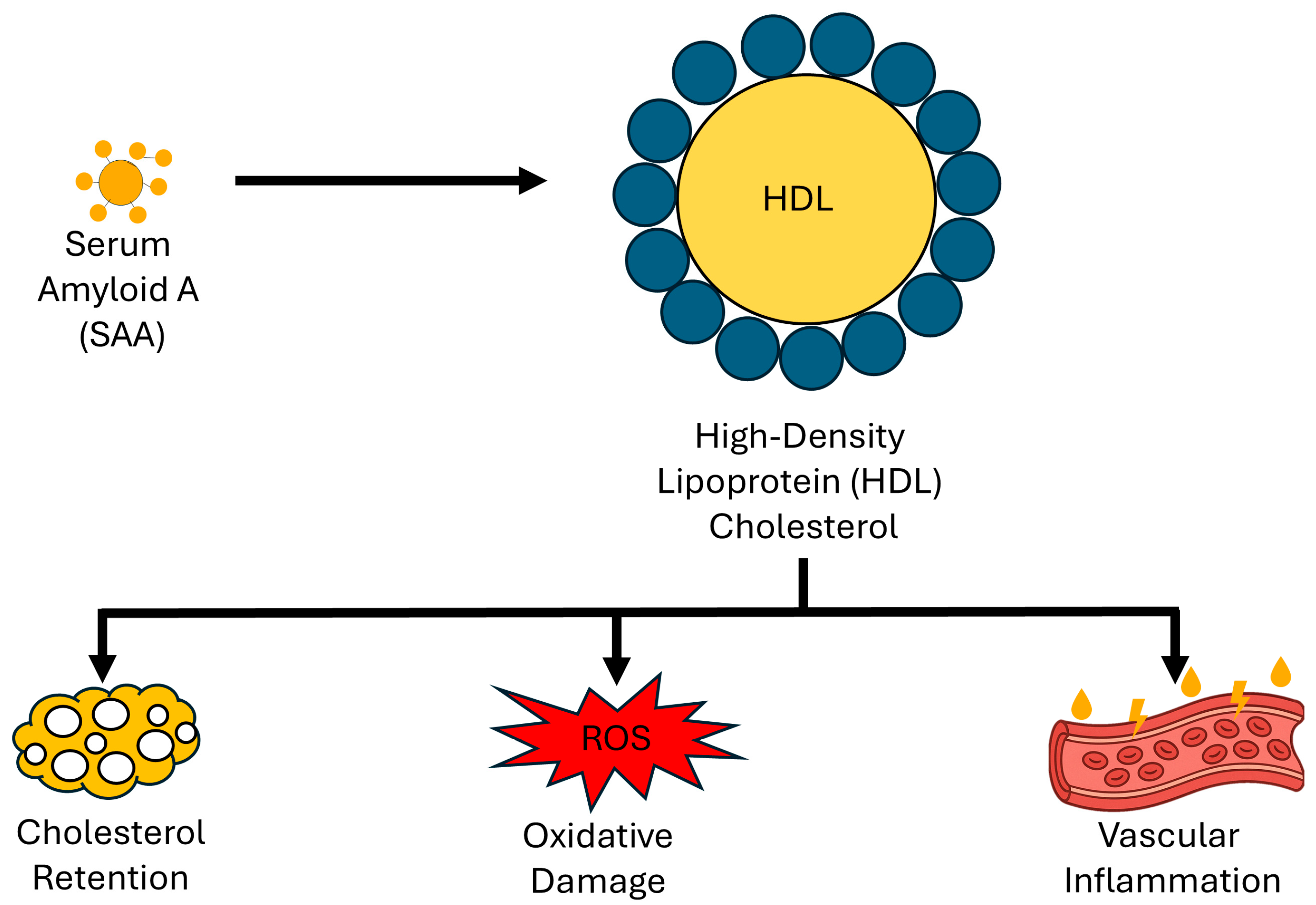
| Reverse Cholesterol Transport | ApoA-I displacement, reduced cellular cholesterol efflux | Foam cell formation, plaque instability | [15,21,22,25] |
| Antioxidant capacity | Decreased ROS neutralisation | Endothelial dysfunction, oxidative stress | [7,14,18,23,24] |
| Anti-inflammatory function | Increased adhesion molecule expression | Vascular inflammation, atherosclerosis | [14,26,27] |
2.1.2. Oxidative Stress and Pro-Inflammatory Shift
| Mechanisms | Effect of SAA on HDL | Outcome | References |
|---|---|---|---|
| Reverse cholesterol transport | ApoA-1 displacement | Foam cell formation, plaque instability | [15,17,29,31,32] |
| Antioxidant function | Reduced ROS neutralisation | Oxidative stress, endothelial dysfunction | [2,6,7,14] |
| Anti-inflammatory function | Increased adhesion molecule expression | Leucocyte recruitment, vascular inflammation | [7,39,42,43,44] |
2.2. Clinical Significance of SAA-Mediated HDL Dysfunction
| Condition | Mechanism of Involvement | Clinical Outcome | Scientific Sources |
|---|---|---|---|
| Coronary artery disease | Plaque instability, oxidative stress | Increased infarction risk | [1,25,50,57] |
| Rheumatoid arthritis | Accelerated atherosclerosis | Higher cardiovascular risk | [1,42,58,59,60] |
| Type 2 diabetes mellitus | Impaired cholesterol transport | Microangiopathy, insulin resistance | [44,45,48] |
| Chronic Kidney Disease | Reduced HDL function | Increased cardiovascular mortality | [20,59,61,62,63] |
2.3. Therapeutic Strategies Targeting SAA-HDL Interactions
2.4. Nutritional Modulation of SAA and HDL Function
2.5. Interplay Between SAA, HDL, and the Innate Immune System
2.6. Future Directions and Research Gaps
3. Conclusions
Author Contributions
Funding
Data Availability Statement
Conflicts of Interest
Abbreviations
| ABCA1 | ATP-binding cassette transporter A1 |
| ABCG1 | ATP-binding cassette transporter G1 |
| ACS | Acute Coronary Syndrome |
| AHA | American Heart Association |
| ApoA-I | Apolipoprotein A-I |
| AUC | Area Under the Curve |
| BMI | Body Mass Index |
| CAD | Coronary Artery Disease |
| CKD | Chronic Kidney Disease |
| CKD-EPI-GFR | Chronic Kidney Disease Epidemiology Collaboration Estimated Glomerular Filtration Rate |
| CRP | C-Reactive Protein |
| CV | Cardiovascular |
| CVD | Cardiovascular Disease |
| DHA | Docosahexaenoic Acid |
| ELISA | Enzyme-Linked Immunosorbent Assay |
| EPA | Eicosapentaenoic Acid |
| ESC/ESH | European Society of Cardiology/European Society of Hypertension |
| HDL-C | High-Density Lipoprotein Cholesterol |
| hsCRP | High-Sensitivity C-Reactive Protein |
| ICAM-1 | Intercellular Adhesion Molecule 1 |
| IL-1β | Interleukin-1 beta |
| IL-6 | Interleukin-6 |
| LDL | Low-Density Lipoprotein |
| LURIC | Ludwigshafen Risk and Cardiovascular Health Study |
| MACE | Major Adverse Cardiovascular Events |
| MI | Myocardial Infarction |
| NT-proBNP | N-terminal pro-B-type Natriuretic Peptide |
| PAD | Peripheral Artery Disease |
| PRISMA | Preferred Reporting Items for Systematic Reviews and Meta-Analyses |
| PUFA | Polyunsaturated Fatty Acids |
| RCT | Reverse Cholesterol Transport |
| ROC | Receiver Operating Characteristic |
| ROS | Reactive Oxygen Species |
| SAA | Serum Amyloid A |
| SCFA | Short-Chain Fatty Acids |
| SD | Standard Deviation |
| SPSS | Statistical Package for the Social Sciences |
| TNF-α | Tumour Necrosis Factor-alpha |
| VCAM-1 | Vascular Cell Adhesion Molecule 1 |
References
- Sorić Hosman, I.; Kos, I.; Lamot, L. Serum Amyloid A in Inflammatory Rheumatic Diseases: A Compendious Review of a Renowned Biomarker. Front. Immunol. 2020, 11, 631299. [Google Scholar] [CrossRef] [PubMed]
- Jayaraman, S.; Haupt, C.; Gursky, O. Paradoxical effects of SAA on lipoprotein oxidation suggest a new antioxidant function for SAA. J. Lipid Res. 2016, 57, 2138–2149. [Google Scholar] [CrossRef]
- Jana, A.K.; Greenwood, A.B.; Hansmann, U.H.E. Small Peptides for Inhibiting Serum Amyloid A Aggregation. ACS Med. Chem. Lett. 2021, 12, 1613–1621. [Google Scholar] [CrossRef] [PubMed]
- Huang, J.; Wang, D.; Huang, L.-H.; Huang, H. Roles of Reconstituted High-Density Lipoprotein Nanoparticles in Cardiovascular Disease: A New Paradigm for Drug Discovery. Int. J. Mol. Sci. 2020, 21, 739. [Google Scholar] [CrossRef] [PubMed]
- Zhen, J.; Li, X.; Yu, H.; Du, B. High-density lipoprotein mimetic nano-therapeutics targeting monocytes and macrophages for improved cardiovascular care: A comprehensive review. J. Nanobiotechnol. 2024, 22, 263. [Google Scholar] [CrossRef]
- Zheng, A.; Widmann, C. The interplay between serum amyloid A and HDLs. Curr. Opin. Lipidol. 2020, 31, 300–301. [Google Scholar] [CrossRef]
- Mohanty, T.; Miličević, K.; Göthert, H.; Tillmann, A.; Padra, M.; Papareddy, P.; Herwald, H. Balancing inflammation: The specific roles of serum amyloid A proteins in sterile and infectious diseases. Front. Immunol. 2025, 16, 1544085. [Google Scholar] [CrossRef]
- Chang, Y.; Liu, Y.; Zou, Y.; Ye, R.D. Recent Advances in Studies of Serum Amyloid A: Implications in Inflammation, Immunity and Tumor Metastasis. Int. J. Mol. Sci. 2025, 26, 987. [Google Scholar] [CrossRef]
- Webb, N.R. High-Density Lipoproteins and Serum Amyloid A (SAA). Curr. Atheroscler. Rep. 2021, 23, 7, Correction in Curr. Atheroscler. Rep. 2022, 24, 73. [Google Scholar] [CrossRef]
- Speer, T.; Zewinger, S. High-density lipoprotein (HDL) and infections: A versatile culprit. Eur. Heart J. 2017, 39, 1191–1193. [Google Scholar] [CrossRef]
- Zewinger, S.; Drechsler, C.; Kleber, M.E.; Dressel, A.; Riffel, J.; Triem, S.; Lehmann, M.; Kopecky, C.; Säemann, M.D.; Lepper, P.M.; et al. Serum amyloid A: High-density lipoproteins interaction and cardiovascular risk. Eur. Heart J. 2015, 36, 3007–3016. [Google Scholar] [CrossRef]
- Thomas, M.J.; Sorci-Thomas, M.G. SAA: A link between cholesterol efflux capacity and inflammation? J. Lipid Res. 2015, 56, 1383–1385. [Google Scholar] [CrossRef] [PubMed]
- Zewinger, S.; Reiser, J.; Jankowski, V.; Alansary, D.; Hahm, E.; Triem, S.; Klug, M.; Schunk, S.J.; Schmit, D.; Kramann, R.; et al. Apolipoprotein C3 induces inflammation and organ damage by activating the alternative inflammasome. Nat. Immunol. 2020, 21, 30–41. [Google Scholar] [CrossRef] [PubMed]
- de Azúa-López, Z.R.; Pezzotti, M.R.; González-Díaz, A.; Meilhac, O.; Ureña, J.; Amaya-Villar, R.; Castellano, A.; Varela-Perez, L.M. HDL Anti-Inflammatory Function Is Impaired and Associated with High SAA1 and Low APOA4 Levels in Aneurysmal Subarachnoid Haemorrhage. J. Cereb. Blood Flow Metab. 2023, 43, 1919–1930. [Google Scholar] [CrossRef]
- Khatana, C.; Saini, N.K.; Chakrabarti, S.; Saini, V.; Sharma, A.; Saini, R.V.; Saini, A.K. Mechanistic Insights into the Oxidised Low-Density Lipoprotein-Induced Atherosclerosis. Oxid. Med. Cell. Longev. 2020, 2020, 5245308. [Google Scholar] [CrossRef] [PubMed]
- Incalza, M.A.; D’Oria, R.; Natalicchio, A.; Perrini, S.; Laviola, L.; Giorgino, F. Oxidative stress and reactive oxygen species in endothelial dysfunction associated with cardiovascular and metabolic diseases. Vasc. Pharmacol. 2018, 100, 1–19. [Google Scholar] [CrossRef]
- Soppert, J.; Lehrke, M.; Marx, N.; Jankowski, J.; Noels, H. Lipoproteins and lipids in cardiovascular disease: From mechanistic insights to therapeutic targeting. Adv. Drug Deliv. Rev. 2020, 159, 4–33. [Google Scholar] [CrossRef]
- Wilson, P.G.; Thompson, J.C.; Shridas, P.; McNamara, P.J.; de Beer, M.C.; de Beer, F.C.; Webb, N.R.; Tannock, L.R. Serum Amyloid A Is an Exchangeable Apolipoprotein. Arterioscler. Thromb. Vasc. Biol. 2018, 38, 1890–1900. [Google Scholar] [CrossRef]
- Kosmas, C.E.; Martinez, I.; Sourlas, A.; Bouza, K.V.; Campos, F.N.; Torres, V.; Montan, P.D.; Guzman, E. High-density lipoprotein (HDL) functionality and its relevance to atherosclerotic cardiovascular disease. Drugs Context 2018, 7, 212525. [Google Scholar] [CrossRef]
- Dullaart, R.P.F.; de Boer, J.F.; Annema, W.; Tietge, U.J.F. The inverse relationship between HDL antioxidant functionality and serum amyloid A is lost in subjects with metabolic syndrome. Obesity 2013, 21, 361–366. [Google Scholar] [CrossRef]
- Zhu, L.; Li, H.; Li, J.; Zhong, Y.; Wu, S.; Yan, M.; Ni, S.; Zhang, K.; Wang, G.; Qu, K.; et al. Biomimetic nanoparticles to enhance the reverse cholesterol transport for selectively inhibiting development into foam cell in atherosclerosis. J. Nanobiotechnol. 2023, 21, 307. [Google Scholar] [CrossRef] [PubMed]
- Gui, Y.; Zheng, H.; Cao, R.Y. Foam Cells in Atherosclerosis: Novel Insights into Its Origins, Consequences, and Molecular Mechanisms. Front. Cardiovasc. Med. 2022, 9, 845942. [Google Scholar] [CrossRef] [PubMed]
- Lin, B.-B.; Lin, M.; Huang, R.; Hong, Y.-K.; Lin, B.-L.; He, X. Dietary and lifestyle factors for primary prevention of nephrolithiasis: A systematic review and meta-analysis. BMC Nephrol. 2020, 21, 267. [Google Scholar] [CrossRef] [PubMed]
- Karavasiloglou, N.; Pestoni, G.; Wanner, M.; Faeh, D.; Rohrmann, S. Healthy lifestyle is inversely associated with mortality in cancer survivors: Results from the Third National Health and Nutrition Examination Survey (NHANES III). PLoS ONE 2019, 14, e0218048. [Google Scholar] [CrossRef]
- Yin, K.; Liao, D.; Tang, C. ATP-binding membrane cassette transporter A1 (ABCA1): A possible link between inflammation and reverse cholesterol transport. Mol. Med. 2010, 16, 438–449. [Google Scholar] [CrossRef]
- Rani, A.; Stadler, J.T.; Marsche, G. HDL-based therapeutics: A promising frontier in combating viral and bacterial infections. Pharmacol. Ther. 2024, 260, 108684. [Google Scholar] [CrossRef]
- Hartigh, L.J.d.; May, K.S.; Zhang, X.-S.; Chait, A.; Blaser, M.J. Serum amyloid A and metabolic disease: Evidence for a critical role in chronic inflammatory conditions. Front. Cardiovasc. Med. 2023, 10, 1197432. [Google Scholar] [CrossRef]
- Wilson, D.P.; Jacobson, T.A.; Jones, P.H.; Koschinsky, M.L.; McNeal, C.J.; Nordestgaard, B.G.; Orringer, C.E. Use of Lipoprotein(a) in clinical practice: A biomarker whose time has come. A scientific statement from the National Lipid Association. J. Clin. Lipidol. 2019, 13, 374–392. [Google Scholar] [CrossRef]
- Snezhkina, A.V.; Kudryavtseva, A.V.; Kardymon, O.; Savvateeva, M.V.; Melnikova, N.V.; Krasnov, G.S.; Dmitriev, A.A. ROS Generation and Antioxidant Defense Systems in Normal and Malignant Cells. Oxid. Med. Cell. Longev. 2019, 2019, 6175804. [Google Scholar] [CrossRef]
- Singh, V.; Kaur, R.; Kumari, P.; Pasricha, C.; Singh, R. ICAM-1 and VCAM-1: Gatekeepers in various inflammatory and cardiovascular disorders. Clin. Chim. Acta 2023, 548, 117487. [Google Scholar] [CrossRef]
- Higashi, Y. Roles of Oxidative Stress and Inflammation in Vascular Endothelial Dysfunction-Related Disease. Antioxidants 2022, 11, 1958. [Google Scholar] [CrossRef] [PubMed]
- Cai, Z.; Cai, L.; Jiang, J.; Chang, K.-S.; van der Westhuyzen, D.R.; Luo, G. Human serum amyloid A protein inhibits hepatitis C virus entry into cells. J. Virol. 2007, 81, 6128–6133. [Google Scholar] [CrossRef] [PubMed]
- Vaisar, T.; Hippe, D.; Neradilek, M.; Pollisar, N.; Chait, A.; O’Brien, K.; Marcovina, S. HDL-associated serum amyloid A (SAA) may be a predictor of cardiovascular risk independent of HDL- or LDL-cholesterol. Atherosclerosis 2017, 263, e218. [Google Scholar] [CrossRef]
- Vaisar, T.; Tang, C.; Babenko, I.; Hutchins, P.; Wimberger, J.; Suffredini, A.F.; Heinecke, J.W. Inflammatory remodeling of the HDL proteome impairs cholesterol efflux capacity. J. Lipid Res. 2015, 56, 1519–1530. [Google Scholar] [CrossRef]
- Sack, G.H. Serum amyloid A—A review. Mol. Med. 2018, 24, 46. [Google Scholar] [CrossRef]
- Xu, X.; Song, Z.; Mao, B.; Xu, G. Apolipoprotein A1-Related Proteins and Reverse Cholesterol Transport in Antiatherosclerosis Therapy: Recent Progress and Future Perspectives. Cardiovasc. Ther. 2022, 2022, 4610834. [Google Scholar] [CrossRef]
- Jakubowski, H. The Molecular Bases of Anti-Oxidative and Anti-Inflammatory Properties of Paraoxonase 1. Antioxidants 2024, 13, 1292. [Google Scholar] [CrossRef]
- Paul, A.; Lydic, T.A.; Hogan, R.; Goo, Y.-H. Cholesterol Acceptors Regulate the Lipidome of Macrophage Foam Cells. Int. J. Mol. Sci. 2019, 20, 3784. [Google Scholar] [CrossRef]
- Schuchardt, M.; Prüfer, N.; Tu, Y.; Herrmann, J.; Hu, X.-P.; Chebli, S.; Dahlke, K.; Zidek, W.; van der Giet, M.; Tölle, M. Dysfunctional high-density lipoprotein activates toll-like receptors via serum amyloid A in vascular smooth muscle cells. Sci. Rep. 2019, 9, 3421. [Google Scholar] [CrossRef]
- Papareddy, P.; Herwald, H. From immune activation to disease progression: Unravelling the complex role of Serum Amyloid A proteins. Cytokine Growth Factor Rev. 2025, 83, 77–84. [Google Scholar] [CrossRef]
- Liu, L.R.; Lin, S.P.; Chen, C.C.; Chen, Y.J.; Tai, C.C.; Chang, S.C.; Juang, R.H.; Tseng, Y.W.; Liu, B.H.; Mersmann, H.J.; et al. Serum amyloid A induces lipolysis by downregulating perilipin through ERK1/2 and PKA signalling pathways. Obesity 2011, 19, 2301–2309. [Google Scholar] [CrossRef] [PubMed]
- Jia, X.; Liu, Z.; Wang, Y.; Li, G.; Bai, X. Serum amyloid A and interleukin -1β facilitate LDL transcytosis across endothelial cells and atherosclerosis via NF-κB/caveolin-1/cavin-1 pathway. Atherosclerosis 2023, 375, 87–97. [Google Scholar] [CrossRef]
- Yano, K.; Ohkawa, R.; Sato, M.; Yoshimoto, A.; Ichimura, N.; Kameda, T.; Kubota, T.; Tozuka, M. Cholesterol Efflux Capacity of Apolipoprotein A-I Varies with the Extent of Differentiation and Foam Cell Formation of THP-1 Cells. J. Lipids 2016, 2016, 9891316. [Google Scholar] [CrossRef] [PubMed]
- Rawshani, A.; Rawshani, A.; Franzén, S.; Sattar, N.; Eliasson, B.; Svensson, A.-M.; Zethelius, B.; Miftaraj, M.; McGuire, D.K.; Rosengren, A.; et al. Risk Factors, Mortality, and Cardiovascular Outcomes in Patients with Type 2 Diabetes. N. Engl. J. Med. 2018, 379, 633–644. [Google Scholar] [CrossRef] [PubMed]
- Liu, T.; Li, M.; Cui, C.; Zhou, J. Association between Serum Amyloid A Levels and Type 2 Diabetes Mellitus: A Systematic Review and Meta-Analysis. Endocrinol. Metab. 2023, 38, 315–327. [Google Scholar] [CrossRef]
- Chang, Q.; Li, Y.; Xue, M.; Yu, C.; He, J.; Duan, X. Serum amyloid A is a potential predictor of prognosis in acute ischemic stroke patients after intravenous thrombolysis. Front. Neurol. 2023, 14, 1219604. [Google Scholar] [CrossRef]
- Zubirán, R.; Neufeld, E.B.; Dasseux, A.; Remaley, A.T.; Sorokin, A.V. Recent Advances in Targeted Management of Inflammation in Atherosclerosis: A Narrative Review. Cardiol. Ther. 2024, 13, 465–491. [Google Scholar] [CrossRef]
- de Lima, J.J.G.; Gowdak, L.H.W.; David-Neto, E.; Bortolotto, L.A. Diabetes, Cardiovascular Disease, and Cardiovascular Risk in Patients with Chronic Kidney Disease. High Blood Press. Cardiovasc. Prev. 2021, 28, 159–165. [Google Scholar] [CrossRef]
- Sugimoto, K.; Murakami, H.; Deguchi, T.; Arimura, A.; Daimon, M.; Suzuki, S.; Shimbo, T.; Yagihashi, S. Cutaneous microangiopathy in patients with type 2 diabetes: Impaired vascular endothelial growth factor expression and its correlation with neuropathy, retinopathy and nephropathy. J. Diabetes Investig. 2019, 10, 1318–1331. [Google Scholar] [CrossRef]
- Waldecker-Gall, S.; Seibert, F.; Bertram, S.; Doevelaar, A.; Braun, J.; Baraliakos, X.; Babel, N.; Waldecker, C.; Scharow, L.; Pagonas, N.; et al. Dysfunctional high-density lipoprotein in chronic inflammatory rheumatic diseases. Ther. Adv. Musculoskelet. Dis. 2023, 15, 1759720X231187191. [Google Scholar] [CrossRef]
- Roth, G.A.; Mensah, G.A.; Johnson, C.O.; Addolorato, G.; Ammirati, E.; Baddour, L.M.; Barengo, N.C.; Beaton, A.Z.; Benjamin, E.J.; Benziger, C.P.; et al. Global Burden of Cardiovascular Diseases and Risk Factors, 1990–2019: Update from the GBD 2019 Study. J. Am. Coll. Cardiol. 2020, 76, 2982–3021, Correction in J. Am. Coll. Cardiol. 2021, 77, 1958–1959. [Google Scholar] [CrossRef] [PubMed]
- Yang, K.; Wang, J.; Xiang, H.; Ding, P.; Wu, T.; Ji, G. LCAT- targeted therapies: Progress, failures and future. Biomed. Pharmacother. 2022, 147, 112677. [Google Scholar] [CrossRef] [PubMed]
- Coetzee, G.A.; Strachan, A.F.; van der Westhuyzen, D.R.; Hoppe, H.C.; Jeenah, M.S.; de Beer, F.C. Serum amyloid A-containing human high density lipoprotein 3. Density, size, and apolipoprotein composition. J. Biol. Chem. 1986, 261, 9644–9651. [Google Scholar] [CrossRef] [PubMed]
- Zhao, Q.; Jiang, Y.; Zhang, M.; Chu, Y.; Ji, B.; Pan, H.; Ban, B. Low-density lipoprotein cholesterol levels are associated with insulin-like growth factor-1 in short-stature children and adolescents: A cross-sectional study. Lipids Health Dis. 2019, 18, 120. [Google Scholar] [CrossRef]
- Andersen, C.J.; Dupree, L.; Murray, K.; Ragonesi, N.; McMullen, K.; Cintrón-Rivera, L.; Doerr, A. Low-Density Lipoproteins, High-Density Lipoproteins (HDL), and HDL-Associated Proteins Differentially Modulate Chronic Myelogenous Leukemia Cell Viability. Lipids 2020, 55, 615–626. [Google Scholar] [CrossRef]
- Woo, J.; Lu, D.; Lewandowski, A.; Xu, H.; Serrano, P.; Healey, M.; Yates, D.P.; Beste, M.T.; Libby, P.; Ridker, P.M.; et al. Effects of IL-1β inhibition on anemia and clonal hematopoiesis in the randomized CANTOS trial. Blood Adv. 2023, 7, 7471–7484. [Google Scholar] [CrossRef]
- Prilepskii, A.Y.; Serov, N.S.; Kladko, D.V.; Vinogradov, V.V. Nanoparticle-Based Approaches towards the Treatment of Atherosclerosis. Pharmaceutics 2020, 12, 1056. [Google Scholar] [CrossRef]
- Holzer, M.; Wolf, P.; Curcic, S.; Birner-Gruenberger, R.; Weger, W.; Inzinger, M.; El-Gamal, D.; Wadsack, C.; Heinemann, Á.; Marsche, G. Psoriasis Alters HDL Composition and Cholesterol Efflux Capacity. J. Lipid Res. 2012, 53, 1618–1624. [Google Scholar] [CrossRef]
- Zewinger, S.; Schumann, T.; Fliser, D.; Speer, T. Innate immunity in CKD-associated vascular diseases. Nephrol. Dial. Transplant. 2015, 31, 1813–1821. [Google Scholar] [CrossRef]
- Millar, C.L.; Duclos, Q.; Blesso, C.N. Effects of Dietary Flavonoids on Reverse Cholesterol Transport, HDL Metabolism, and HDL Function. Adv. Nutr. 2017, 8, 226–239. [Google Scholar] [CrossRef]
- Santana, J.M.; Brown, C.D. High-density lipoprotein carbamylation and dysfunction in vascular disease. Front. Biosci. 2018, 23, 2227–2234. [Google Scholar] [CrossRef] [PubMed]
- Shroff, R.; Speer, T.; Colin, S.; Charakida, M.; Zewinger, S.; Staels, B.; Chinetti-Gbaguidi, G.; Hettrich, I.; Rohrer, L.; O’Neill, F.; et al. HDL in children with CKD promotes endothelial dysfunction and an abnormal vascular phenotype. J. Am. Soc. Nephrol. 2014, 25, 2658–2668. [Google Scholar] [CrossRef] [PubMed]
- Moradi, H.R.; Vaziri, N.D.; Kashyap, M.L.; Said, H.M.; Kalantar-Zadeh, K. Role of HDL Dysfunction in End-Stage Renal Disease: A Double-Edged Sword. J. Ren. Nutr. 2013, 23, 203–206. [Google Scholar] [CrossRef] [PubMed]
- Sato, M.; Ohkawa, R.; Yoshimoto, A.; Yano, K.; Ichimura, N.; Nishimori, M.; Okubo, S.; Yatomi, Y.; Tozuka, M. Effects of serum amyloid A on the structure and antioxidant ability of high-density lipoprotein. Biosci. Rep. 2016, 36, e00369. [Google Scholar] [CrossRef]
- de Beer, M.C.; Webb, N.R.; Wroblewski, J.M.; Noffsinger, V.P.; Rateri, D.L.; Ji, A.; van der Westhuyzen, D.R.; de Beer, F.C. Impact of serum amyloid A on high density lipoprotein composition and levels. J. Lipid Res. 2010, 51, 3117–3125. [Google Scholar] [CrossRef]
- Neelapu, S.S.; Tummala, S.; Kebriaei, P.; Wierda, W.; Gutierrez, C.; Locke, F.L.; Komanduri, K.V.; Lin, Y.; Jain, N.; Daver, N.; et al. Chimeric antigen receptor T-cell therapy—Assessment and management of toxicities. Nat. Rev. Clin. Oncol. 2018, 15, 47–62. [Google Scholar] [CrossRef]
- Lee, D.W.; Gardner, R.; Porter, D.L.; Louis, C.U.; Ahmed, N.; Jensen, M.; Grupp, S.A.; Mackall, C.L. Current concepts in the diagnosis and management of cytokine release syndrome. Blood 2014, 124, 188–195, Erratum in Blood 2015, 128, 1048. Erratum in Blood 2016, 128, 1533. https://doi.org/10.1182/blood-2016-07-730689. [Google Scholar] [CrossRef]
- Yeh, K.-H.; Hsu, L.-A.; Juang, J.-M.J.; Chiang, F.-T.; Teng, M.-S.; Tzeng, I.-S.; Wu, S.; Lin, J.-F.; Ko, Y.-L. Circulating serum amyloid A levels, but not SAA1 variants, predict long-term outcomes in patients with angiographically confirmed coronary artery disease. Tzu Chi Med. J. 2022, 34, 423–433. [Google Scholar] [CrossRef]
- Tanaka, S.; Tymowski, C.d.e.; Tran-Dinh, A.; Meilhac, O.; Lortat-Jacob, B.; Zappella, N.; Jean-Baptiste, S.; Robert, T.; Goletto, T.; Godet, C.; et al. Low HDL-Cholesterol Concentrations in Lung Transplant Candidates Are Strongly Associated With One-Year Mortality After Lung Transplantation. Transpl. Int. 2023, 36, 10841. [Google Scholar] [CrossRef]
- Schmidt, F.; Weschenfelder, J.; Sander, C.; Minkwitz, J.; Thormann, J.; Chittka, T.; Mergl, R.; Kirkby, K.C.; Faßhauer, M.; Stümvoll, M.; et al. Inflammatory Cytokines in General and Central Obesity and Modulating Effects of Physical Activity. Public Libr. Sci. 2015, 10, e0121971. [Google Scholar] [CrossRef]
- Bird, S.; Hawley, J.A. Update on the effects of physical activity on insulin sensitivity in humans. BMJ 2017, 2, e000143. [Google Scholar] [CrossRef] [PubMed]
- Laurant, P.; Riva, C.; Vinet, A. Physical Activity, Inflammatory Cytokines, Endothelial Dysfunction, and Risk of Coronary Artery Diseases in Visceral Obesity. In Nutrition in the Prevention and Treatment of Abdominal Obesity; Elsevier: Amsterdam, The Netherlands, 2014; pp. 217–224. [Google Scholar] [CrossRef]
- Susla, O.; Shin, H.; Jung, Y.S.; Rim, H.; Speer, T.; Owala, F.O.; Razawi, M.; Holy, E.; Ferdinand, B.R.; Danilo, F.; et al. Nutrition, inflammation and oxidative stress—CKD 1-5. Nephrol. Dial. Transplant. 2012, 27, ii405–ii413. [Google Scholar] [CrossRef]
- Asoudeh, F.; Fallah, M.; Aminianfar, A.; Djafarian, K.; Shirzad, N.; Clark, C.C.T.; Larijani, B.; Esmaillzadeh, A. The effect of Mediterranean diet on inflammatory biomarkers and components of metabolic syndrome in adolescent girls. J. Endocrinol. Investig. 2023, 46, 1995–2004, Correction in J. Endocrinol. Investig. 2024, 47, 257. https://doi.org/10.1007/s40618-023-02149-6. [Google Scholar] [CrossRef] [PubMed]
- Jia, Y.; Wang, H.; Fan, W.; Lv, J.; Niu, Q.; Zhu, R.; Zhang, Q. Effects of polyphenol-rich seed foods on lipid and inflammatory markers in patients with coronary heart disease: A systematic review. Front. Nutr. 2024, 11, 1493410. [Google Scholar] [CrossRef]
- Marklund, M.; Wu, J.H.; Imamura, F.; Del Gobbo, L.C.; Fretts, A.; De Goede, J.; Shi, P.; Tintle, N.; Wennberg, M.; Aslibekyan, S.; et al. Biomarkers of Dietary Omega-6 Fatty Acids and Incident Cardiovascular Disease and Mortality. Circulation 2019, 139, 2422–2436. [Google Scholar] [CrossRef]
- Zehr, K.R.; Walker, M. Omega-3 polyunsaturated fatty acids improve endothelial function in humans at risk for atherosclerosis: A review. Prostaglandins Other Lipid Mediat. 2018, 134, 131–140. [Google Scholar] [CrossRef]
- Mirmiran, P.; Teymoori, F.; Asghari, G.; Azizi, F. Dietary Intakes of Branched Chain Amino Acids and the Incidence of Hypertension: A Population-Based Prospective Cohort Study. Arch. Iran. Med. 2019, 22, 182–188. [Google Scholar]
- Ciccone, M.M.; Cortese, F.; Gesualdo, M.; Carbonara, S.; Zito, A.; Ricci, G.; De Pascalis, F.; Scicchitano, P.; Riccioni, G. Dietary Intake of Carotenoids and Their Antioxidant and Anti-Inflammatory Effects in Cardiovascular Care. Mediat. Inflamm. 2013, 2013, 782137. [Google Scholar] [CrossRef]
- Shahidi, F.; de Camargo, A.C. Tocopherols and Tocotrienols in Common and Emerging Dietary Sources: Occurrence, Applications, and Health Benefits. Int. J. Mol. Sci. 2016, 17, 1745. [Google Scholar] [CrossRef]
- Haricharan, S.; Brown, P. TLR4 has a TP53-dependent dual role in regulating breast cancer cell growth. Proc. Natl. Acad. Sci. USA 2015, 112, E3216–E3225. [Google Scholar] [CrossRef]
- Zhang, X.; Chen, J.; Wang, S. Serum Amyloid A Induces a Vascular Smooth Muscle Cell Phenotype Switch through the p38 MAPK Signaling Pathway. BioMed Res. Int. 2017, 2017, 4941379. [Google Scholar] [CrossRef] [PubMed]
- De Beer, F.C.; de Beer, M.; Shridas, P.; Webb, N.R. SAA activates the NLRP3 inflammasome. Atherosclerosis 2018, 275, e2. [Google Scholar] [CrossRef]
- Connolly, M.; Rooney, P.R.; McGarry, T.; Maratha, A.X.; McCormick, J.; Miggin, S.M.; Veale, D.J.; Fearon, U. Acute serum amyloid A is an endogenous TLR2 ligand that mediates inflammatory and angiogenic mechanisms. Ann. Rheum. Dis. 2016, 75, 1392–1398. [Google Scholar] [CrossRef] [PubMed]
- Alfadda, A.A.; Sallam, R.M. Reactive Oxygen Species in Health and Disease. J. Biomed. Biotechnol. 2012, 2012, 936486. [Google Scholar] [CrossRef]
- Cyr, A.R.; Huckaby, L.V.; Shiva, S.; Zuckerbraun, B.S. Nitric Oxide and Endothelial Dysfunction. Crit. Care Clin. 2020, 36, 307–321. [Google Scholar] [CrossRef]
- Trakaki, A.; Marsche, G. Current Understanding of the Immunomodulatory Activities of High-Density Lipoproteins. Biomedicines 2021, 9, 587. [Google Scholar] [CrossRef]
- Riis, J.L.; Ahmadi, H.; Hamilton, K.R.; Hand, T.; Granger, D.A. Best practice recommendations for the measurement and interpretation of salivary proinflammatory cytokines in biobehavioral research. Brain Behav. Immun. 2021, 91, 105–116. [Google Scholar] [CrossRef]
- Schneider, H.J.; Wallaschofski, H.; Völzke, H.; Markus, M.R.P.; Doerr, M.; Felix, S.B.; Nauck, M.; Friedrich, N. Incremental Effects of Endocrine and Metabolic Biomarkers and Abdominal Obesity on Cardiovascular Mortality Prediction. PLoS ONE 2012, 7, e33084. [Google Scholar] [CrossRef]
- Jahangiri, A. High-density lipoprotein and the acute phase response. Curr. Opin. Endocrinol. Diabetes Obes. 2010, 17, 156–160. [Google Scholar] [CrossRef]
- Wu, Z.; Gogonea, V.; Lee, X.; Wagner, M.A.; Li, X.; Huang, Y.; Undurti, A.; May, R.P.; Haertlein, M.; Moulin, M.; et al. Double Superhelix Model of High Density Lipoprotein. J. Biol. Chem. 2009, 284, 36605–36619. [Google Scholar] [CrossRef]
- Zewinger, S.; Speer, T.; Kleber, M.E.; Martin, T.; Marz, W.; Fliser, D.; Ivanov, D.D.; Ivanova, M.D.; Ciocalteu, A.; Radulescu, D.; et al. Lipids and other risk factors. Nephrol. Dial. Transplant. 2013, 28, i48–i49. [Google Scholar] [CrossRef]
- Nazir, S.; Jankowski, V.; Bender, G.; Zewinger, S.; Rye, K.-A.; van der Vorst, E.P.C. Interaction between high-density lipoproteins and inflammation: Function matters more than concentration! Adv. Drug Deliv. Rev. 2020, 159, 94–119. [Google Scholar] [CrossRef]
- Gabay, C.; Kushner, I. Acute-phase proteins and other systemic responses to inflammation. N. Engl. J. Med. 1999, 340, 448–454, Correction in N. Engl. J. Med. 1999, 340, 1376. https://doi.org/10.1056/NEJM199904293401723. [Google Scholar] [CrossRef] [PubMed]
- Artl, A.; Marsche, G.; Lestavel, S.; Sattler, W.; Malle, E. Role of serum amyloid A during metabolism of acute-phase HDL by macrophages. Arterioscler. Thromb. Vasc. Biol. 2000, 20, 763–772. [Google Scholar] [CrossRef] [PubMed]
- Bausserman, L.; Bernier, D.N.; Herbert, P.N. Serum Amyloid a and High Density Lipoproteins During the Acute Phase Response. Eur. J. Clin. Investig. 1988, 18, 619–626. [Google Scholar] [CrossRef] [PubMed]
- Cho, K.-H. The Current Status of Research on High-Density Lipoproteins (HDL): A Paradigm Shift from HDL Quantity to HDL Quality and HDL Functionality. Int. J. Mol. Sci. 2022, 23, 3967. [Google Scholar] [CrossRef]
- Pelagalli, M.; Tomassetti, F.; Sarubbi, S.; Nicolai, E.; Giovannelli, A.; Turis, F.; Illuminati, C.; Morello, M.; Callà, C.; Terrinoni, A.; et al. Evaluation of the performance of a new serum amyloid A chemiluminescence immunoassay. LabMed Discov. 2025, 2, 100090. [Google Scholar] [CrossRef]


Disclaimer/Publisher’s Note: The statements, opinions and data contained in all publications are solely those of the individual author(s) and contributor(s) and not of MDPI and/or the editor(s). MDPI and/or the editor(s) disclaim responsibility for any injury to people or property resulting from any ideas, methods, instructions or products referred to in the content. |
© 2025 by the authors. Licensee MDPI, Basel, Switzerland. This article is an open access article distributed under the terms and conditions of the Creative Commons Attribution (CC BY) license.
Share and Cite
Moissl-Blanke, A.P.; Delgado, G.E.; Krämer, B.K.; Siekmeier, R.; Duerschmied, D.; März, W.; Kleber, M.E. Serum Amyloid A (SAA) and Its Interaction with High-Density Lipoprotein Cholesterol (HDL-C): A Comprehensive Review. Int. J. Mol. Sci. 2026, 27, 241. https://doi.org/10.3390/ijms27010241
Moissl-Blanke AP, Delgado GE, Krämer BK, Siekmeier R, Duerschmied D, März W, Kleber ME. Serum Amyloid A (SAA) and Its Interaction with High-Density Lipoprotein Cholesterol (HDL-C): A Comprehensive Review. International Journal of Molecular Sciences. 2026; 27(1):241. https://doi.org/10.3390/ijms27010241
Chicago/Turabian StyleMoissl-Blanke, Angela P., Graciela E. Delgado, Bernhard K. Krämer, Rüdiger Siekmeier, Daniel Duerschmied, Winfried März, and Marcus E. Kleber. 2026. "Serum Amyloid A (SAA) and Its Interaction with High-Density Lipoprotein Cholesterol (HDL-C): A Comprehensive Review" International Journal of Molecular Sciences 27, no. 1: 241. https://doi.org/10.3390/ijms27010241
APA StyleMoissl-Blanke, A. P., Delgado, G. E., Krämer, B. K., Siekmeier, R., Duerschmied, D., März, W., & Kleber, M. E. (2026). Serum Amyloid A (SAA) and Its Interaction with High-Density Lipoprotein Cholesterol (HDL-C): A Comprehensive Review. International Journal of Molecular Sciences, 27(1), 241. https://doi.org/10.3390/ijms27010241