Hypertrophic Cardiomyopathy Genotype–Phenotype Analysis in Lithuanian Single-Center Cohort

 , ,
, ,
Abstract
1. Introduction
2. Results
3. Discussion
4. Materials and Methods
5. Conclusions
Supplementary Materials
Author Contributions
Funding
Institutional Review Board Statement
Informed Consent Statement
Data Availability Statement
Conflicts of Interest
Abbreviations
| AF | Atrial fibrillation |
| BNP | Brain natriuretic peptide |
| HCM | Hypertrophic cardiomyopathy |
| ICD | Implantable cardioverter defibrillator |
| MWT | Heart maximum wall thickness |
| LVMi | left ventricular mass indexed |
| VF/VT | Ventricular fibrillation/tachycardia |
References
- Lietuvos Gyventojai (2022 m. Leidimas). Available online: https://osp.stat.gov.lt/lietuvos-gyventojai-2022/mirtingumas/gyventoju-mirties-priezastys (accessed on 1 September 2025).
- Causes of Death Statistics. Available online: https://ec.europa.eu/eurostat/statistics-explained/index.php?title=Causes_of_death_statistics (accessed on 1 September 2025).
- Turley, K. Lord Brock—The direct approach. Ann. Thorac. Surg. 1989, 48, 736–737. [Google Scholar] [CrossRef]
- Liew, A.; Vassiliou, V.; Cooper, R.; Raphael, C. Hypertrophic Cardiomyopathy—Past, Present and Future. J. Clin. Med. 2017, 6, 118. [Google Scholar] [CrossRef]
- Arbelo, E.; Protonotarios, A.; Gimeno, J.R.; Arbustini, E.; Barriales-Villa, R.; Basso, C.; Bezzina, C.R.; Biagini, E.; Blom, N.A.; de Boer, R.A.; et al. 2023 ESC Guidelines for the management of cardiomyopathies: Developed by the task force on the management of cardiomyopathies of the European Society of Cardiology (ESC). Eur. Heart J. 2023, 44, 3503–3626. [Google Scholar] [CrossRef] [PubMed]
- Massera, D.; Sherrid, M.V.; Maron, M.S.; Rowin, E.J.; Maron, B.J. How common is hypertrophic cardiomyopathy… really?: Disease prevalence revisited 27 years after CARDIA. Int. J. Cardiol. 2023, 382, 64–67. [Google Scholar] [CrossRef]
- Elliott, P.M.; Anastasakis, A.; Borger, M.A.; Borggrefe, M.; Cecchi, F.; Charron, P.; Hagege, A.A.; Lafont, A.; Limongelli, G.; Mahrholdt, H.; et al. 2014 ESC Guidelines on diagnosis and management of hypertrophic cardiomyopathy. Eur. Heart J. 2014, 35, 2733–2779. [Google Scholar] [CrossRef]
- Butters, A.; Bagnall, R.D.; Ingles, J. Revisiting the Diagnostic Yield of Hypertrophic Cardiomyopathy Genetic Testing. Circ. Genom. Precis. Med. 2020, 13, e002930. [Google Scholar] [CrossRef]
- Dellefave-Castillo, L.M.; Cirino, A.L.; Callis, T.E.; Esplin, E.D.; Garcia, J.; Hatchell, K.E.; Johnson, B.; Morales, A.; Regalado, E.; Rojahn, S.; et al. Assessment of the Diagnostic Yield of Combined Cardiomyopathy and Arrhythmia Genetic Testing. JAMA Cardiol. 2022, 7, 966. [Google Scholar] [CrossRef] [PubMed]
- Hathaway, J.; Heliö, K.; Saarinen, I.; Tallila, J.; Seppälä, E.H.; Tuupanen, S.; Turpeinen, H.; Kangas-Kontio, T.; Schleit, J.; Tommiska, J.; et al. Diagnostic yield of genetic testing in a heterogeneous cohort of 1376 HCM patients. BMC Cardiovasc. Disord. 2021, 21, 126. [Google Scholar] [CrossRef] [PubMed]
- Tudurachi, B.-S.; Zăvoi, A.; Leonte, A.; Țăpoi, L.; Ureche, C.; Bîrgoan, S.G.; Chiuariu, T.; Anghel, L.; Radu, R.; Sascău, R.A.; et al. An Update on MYBPC3 Gene Mutation in Hypertrophic Cardiomyopathy. Int. J. Mol. Sci. 2023, 24, 10510. [Google Scholar] [CrossRef]
- Terauchi, Y.; Kubo, T.; Baba, Y.; Hirota, T.; Tanioka, K.; Yamasaki, N.; Furuno, T.; Kitaoka, H. Gender differences in the clinical features of hypertrophic cardiomyopathy caused by cardiac myosin-binding protein C gene mutations. J. Cardiol. 2015, 65, 423–428. [Google Scholar] [CrossRef]
- Preveden, A.; Golubovic, M.; Bjelobrk, M.; Miljkovic, T.; Ilic, A.; Stojsic, S.; Gajic, D.; Glavaski, M.; Maier, L.S.; Okwose, N.; et al. Gender Related Differences in the Clinical Presentation of Hypertrophic Cardiomyopathy—An Analysis from the SILICOFCM Database. Medicina 2022, 58, 314. [Google Scholar] [CrossRef]
- Rethemiotaki, I. Global prevalence of cardiovascular diseases by gender and age during 2010–2019. Arch. Med. Sci. Atheroscler. Dis. 2023, 8, e196–e205. [Google Scholar] [CrossRef]
- Sá, F.M.; Oliveira, M.; Belo, A.; Correia, J.; Azevedo, O.; Morais, J.; Portuguese Registry of Hypertrophic Cardiomyopathy Investigators. The sex gap in hypertrophic cardiomyopathy. Rev. Esp. Cardiol. 2020, 73, 1018–1025. [Google Scholar] [CrossRef]
- Gelb, B.D.; Tartaglia, M. Noonan Syndrome with Multiple Lentigines; GeneReviews® [Internet]; University of Washington: Seattle, WA, USA, 1993–2025. [Google Scholar]
- Martinelli, S.; Torreri, P.; Tinti, M.; Stella, L.; Bocchinfuso, G.; Flex, E.; Grottesi, A.; Ceccarini, M.; Palleschi, A.; Cesareni, G.; et al. Diverse driving forces underlie the invariant occurrence of the T42A, E139D, I282V and T468M SHP2 amino acid substitutions causing Noonan and LEOPARD syndromes. Hum. Mol. Genet. 2008, 17, 2018–2029. [Google Scholar] [CrossRef]
- Martin, A.R.; Williams, E.; Foulger, R.E.; Leigh, S.; Daugherty, L.C.; Niblock, O.; Leong, I.U.S.; Smith, K.R.; Gerasimenko, O.; Haraldsdottir, E.; et al. PanelApp crowdsources expert knowledge to establish consensus diagnostic gene panels. Nat. Genet. 2019, 51, 1560–1565. [Google Scholar] [CrossRef]
- Lopes, L.R.; Ho, C.Y.; Elliott, P.M. Genetics of hypertrophic cardiomyopathy: Established and emerging implications for clinical practice. Eur. Heart J. 2024, 45, 2727–2734. [Google Scholar] [CrossRef]
- Hernandez, S.G.; Romero, L.d.l.H.; Fernández, A.; Peña-Peña, M.L.; Mora-Ayestaran, N.; Basurte-Elorz, M.T.; Larrañaga-Moreira, J.M.; Reyes, I.C.; Villacorta, E.; Valverde-Gómez, M.; et al. Redefining the Genetic Architecture of Hypertrophic Cardiomyopathy: Role of Intermediate-Effect Variants. Circulation 2025, 152, 1060–1075. [Google Scholar] [CrossRef] [PubMed]
- Helms, A.S.; Thompson, A.D.; Glazier, A.A.; Hafeez, N.; Kabani, S.; Rodriguez, J.; Yob, J.M.; Woolcock, H.; Mazzarotto, F.; Lakdawala, N.K.; et al. Spatial and Functional Distribution of MYBPC3 Pathogenic Variants and Clinical Outcomes in Patients with Hypertrophic Cardiomyopathy. Circ. Genom. Precis. Med. 2020, 13, 396–405. [Google Scholar] [CrossRef]
- Ireland, C.G.; Ho, C.Y. Genetic Testing in Hypertrophic Cardiomyopathy. Am. J. Cardiol. 2024, 212, S4–S13. [Google Scholar] [CrossRef] [PubMed]
- Velicki, L.; Jakovljevic, D.G.; Preveden, A.; Golubovic, M.; Bjelobrk, M.; Ilic, A.; Stojsic, S.; Barlocco, F.; Tafelmeier, M.; Okwose, N.; et al. Genetic determinants of clinical phenotype in hypertrophic cardiomyopathy. BMC Cardiovasc. Disord. 2020, 20, 516. [Google Scholar] [CrossRef]
- Carrier, L.; Bonne, G.; Bahrend, E.; Yu, B.; Richard, P.; Niel, F.; Hainque, B.; Cruaud, C.; Gary, F.; Labeit, S.; et al. Organization and Sequence of Human Cardiac Myosin Binding Protein C Gene (MYBPC3) and Identification of Mutations Predicted to Produce Truncated Proteins in Familial Hypertrophic Cardiomyopathy. Circ. Res. 1997, 80, 427–434. [Google Scholar] [CrossRef]
- Doh, C.Y.; Schmidt, A.V.; Chinthalapudi, K.; Stelzer, J.E. Bringing into focus the central domains C3-C6 of myosin binding protein C. Front. Physiol. 2024, 15, 1370539. [Google Scholar] [CrossRef] [PubMed]
- Howarth, J.W.; Ramisetti, S.; Nolan, K.; Sadayappan, S.; Rosevear, P.R. Structural Insight into Unique Cardiac Myosin-binding Protein-C Motif. J. Biol. Chem. 2012, 287, 8254–8262. [Google Scholar] [CrossRef]
- Méndez, I.; Fernández, A.I.; Espinosa, M.Á.; Cuenca, S.; Lorca, R.; Rodríguez, J.F.; Tamargo, M.; García-Montero, M.; Gómez, C.; Vilches, S.; et al. Founder mutation in myosin-binding protein C with an early onset and a high penetrance in males. Open Heart 2021, 8, e001789. [Google Scholar] [CrossRef]
- Rudziński, T.; Selmaj, K.; Drozdz, J.; Krzemińska-Pakuła, M. Selected mutations in the myosin binding protein C gene in the Polish population of patients with hypertrophic cardiomyopathy. Kardiol. Pol. 2008, 66, 821–825; discussion 826–827. [Google Scholar]
- Azab, B.; Aburizeg, D.; Shaaban, S.T.; Ji, W.; Mustafa, L.; Isbeih, N.J.; Al-Akily, A.S.; Mohammad, H.; Jeffries, L.; Khokha, M.; et al. Unraveling the genetic tapestry of pediatric sarcomeric cardiomyopathies and masquerading phenocopies in Jordan. Sci. Rep. 2024, 14, 15141. [Google Scholar] [CrossRef]
- Liu, X.; Jiang, T.; Piao, C.; Li, X.; Guo, J.; Zheng, S.; Zhang, X.; Cai, T.; Du, J. Screening Mutations of MYBPC3 in 114 Unrelated Patients with Hypertrophic Cardiomyopathy by Targeted Capture and Next-generation Sequencing. Sci. Rep. 2015, 5, 11411. [Google Scholar] [CrossRef]
- Kawana, M.; Spudich, J.A.; Ruppel, K.M. Hypertrophic cardiomyopathy: Mutations to mechanisms to therapies. Front. Physiol. 2022, 13, 975076. [Google Scholar] [CrossRef] [PubMed]
- Fananapazir, L.; Epstein, N.D. Genotype-phenotype correlations in hypertrophic cardiomyopathy. Insights provided by comparisons of kindreds with distinct and identical beta-myosin heavy chain gene mutations. Circulation 1994, 89, 22–32. [Google Scholar] [CrossRef] [PubMed]
- Jansen, M.; de Brouwer, R.; Hassanzada, F.; Schoemaker, A.E.; Schmidt, A.F.; Kooijman-Reumerman, M.D.; Bracun, V.; Slieker, M.G.; Dooijes, D.; Vermeer, A.M.; et al. Penetrance and Prognosis of MYH7 Variant-Associated Cardiomyopathies. JACC Heart Fail. 2024, 12, 134–147. [Google Scholar] [CrossRef]
- Walsh, R.; Mazzarotto, F.; Whiffin, N.; Buchan, R.; Midwinter, W.; Wilk, A.; Li, N.; Felkin, L.; Ingold, N.; Govind, R.; et al. Quantitative approaches to variant classification increase the yield and precision of genetic testing in Mendelian diseases: The case of hypertrophic cardiomyopathy. Genome Med. 2019, 11, 5. [Google Scholar] [CrossRef] [PubMed]
- Richards, S.; Aziz, N.; Bale, S.; Bick, D.; Das, S.; Gastier-Foster, J.; Grody, W.W.; Hegde, M.; Lyon, E.; Spector, E.; et al. Standards and guidelines for the interpretation of sequence variants: A joint consensus recommendation of the American College of Medical Genetics and Genomics and the Association for Molecular Pathology. Genet. Med. 2015, 17, 405–424. [Google Scholar] [CrossRef] [PubMed]
- Andersen, E.F.; Azzariti, D.R.; Babb, L.J.; Berg, J.S.; Biesecker, L.G.; Bly, Z.; Buchanan, A.H.; DiStefano, M.T.; Gong, L.; Harrison, S.M.; et al. The Clinical Genome Resource (ClinGen): Advancing genomic knowledge through global curation. Genet. Med. 2025, 27, 101228. [Google Scholar] [CrossRef] [PubMed]
- Clinical Genome Resource. Available online: https://cspec.genome.network/cspec/ui/svi/ (accessed on 1 September 2025).


| Parameter | All | Genotype Positive | Genotype Negative | p-Value | |
|---|---|---|---|---|---|
| Total, n (%) | 204 | 34 (16.7%) | 17 (83.3%) | ||
| males | 144 | 24 (16.9%) | 118 (83.1%) | ||
| female | 62 | 10 (16.10%) | 52 (83.9) | ||
| Average age at testing | 57.71 ± 13.05 | 49.05 ± 15.12 | 56.39 ± 11.98 | <0.001 | |
| males | 54.74 ± 12.98 | 46.48 ± 15.10 | 56.39 ± 11.90 | 0.003 | |
| female | 63.87 ± 13.04 | 55.23 ± 13.98 | 65.53 ± 12.31 | 0.024 | |
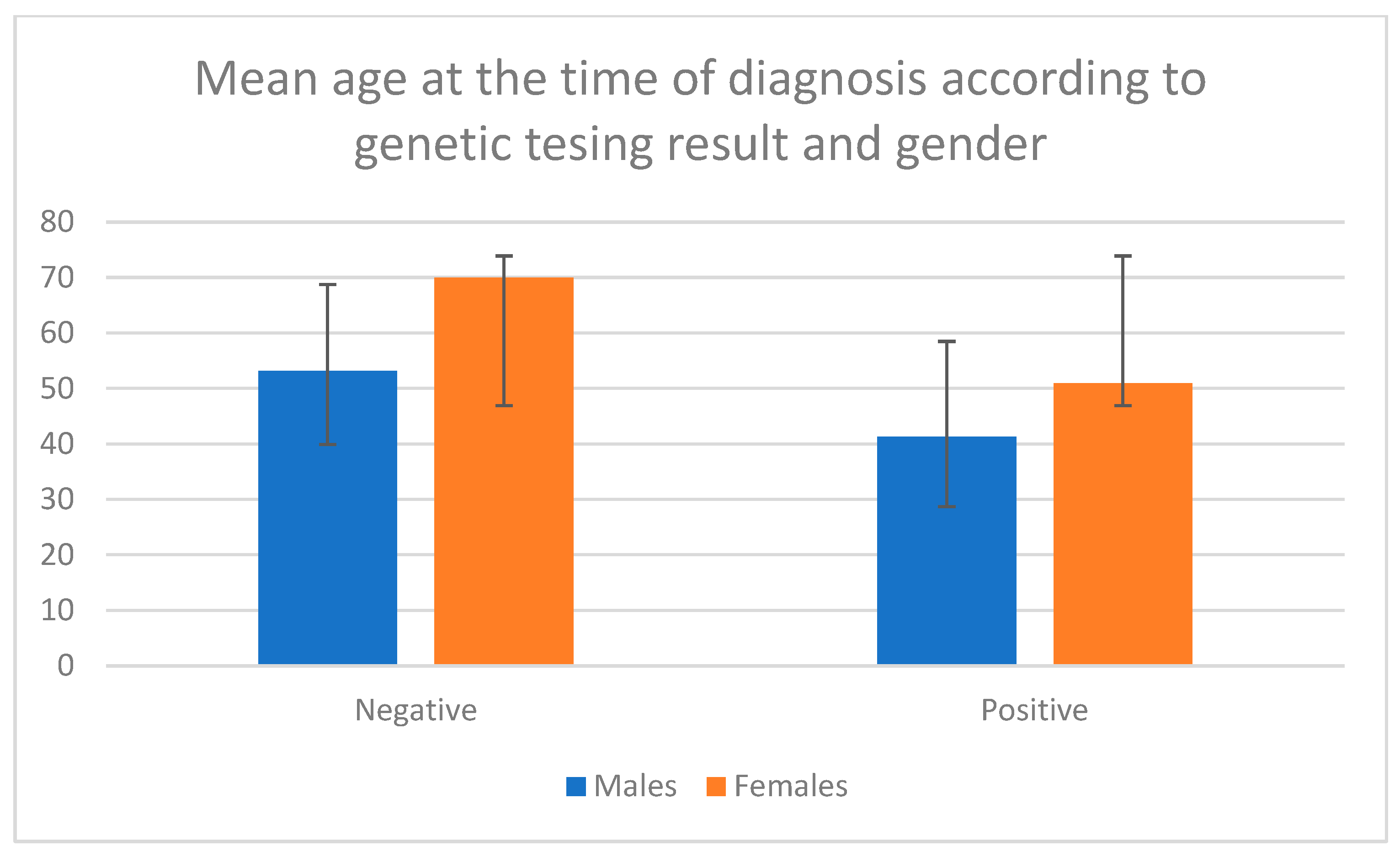
| Average age at diagnosis | 44.15 ± 16.38 | 56.61 ± 13.70 | <0.001 | ||
| males | 41.33 ± 15.55 | 53.81 ± 13.24 | <0.001 | ||
| female | 50.90 ± 17.13 | 62.96 ± 12.66 | 0.032 | ||
| Affected family members (n = 201) | 41 (20.4%) | 9(28.1%) | 32 (18.9%) | 0.237 | |
| Symptoms present at testing (n = 200) | 164 (82%) | 27 (81.8%) | 137 (82%) | 0.976 | |
| MWT (n = 204), mm | 19.00 ± 4.78 | 20.61 ± 5.94 | 18.69 ± 4.47 | 0.053 | |
| LVMi (n = 196), g/m2 | 114.41 ± 36.89 | 106.53 ± 35.42 | 115.84 ± 37.01 | 0.133 | |
| EF (n = 204), % | 63.52 ± 1271 | 63.84 ± 12.63 | 63.46 ± 12.76 | 0.966 | |
| BNP (n = 160), ng/L | 222.16 ± 345.13 | 250.26 ± 304.81 | 216.45 ± 353.53 | 0.139 | |
| Septal reduction performed (n = 203) | 22 (10.7%) | 6 (17.6%) | 16 (9.4%) | 0.62 | |
| ICD (n = 203) | 22(10.8%) | 5 (14.7%) | 17 (10.1%) | 0.426 | |
| Pacemaker | 18 (8.9%) | 3 (8.8%) | 15 (8.9%) | 0.992 | |
| AF (n = 203) | 44 (21.7%) | 6 (17.6%) | 38 (22.5%) | 0.532 | |
| VF/VT (n = 203) | 35 (16.7%) | 8 (23.5%) | 27 (15.4%) | 0.273 |
| Gene | Variant Affect | Age at Diagnosis (Years) | MWT Mean ± SD mm | LVMi Mean ± SD g/m2 |
|---|---|---|---|---|
| MYBPC3 | All variants | 39.59 ± 15.68 | 23.08 ± 6.30 | 115.24 ± 40.54 |
| Truncating | 41.75 ± 16.43 | 21.50 ± 5.47 | 102.08 ± 27.55 | |
| Missense | 37.00 ± 15.17 | 24.98 ± 7.00 | 135.92 ± 50.74 | |
| MYH7 | All variants | 43.10 ± 18.4 | 19.2 ± 6.09 | 93.14 ± 20.69 |
| Gene | Coding Variant | Protein Variant | Variant Effect | Affected Exon | Pathogenicity Classification Criteria | Classification | Novel | Gender | Age at Diagnosis | Family History | Present Symptoms at Time of Testing | Maximum Wall Thickness |
|---|---|---|---|---|---|---|---|---|---|---|---|---|
| MYBPC3 | c.1251del | p.Lys418SerfsTer4 | Frameshift | 15/35 | PVS1vstr, PM2s | LP | Yes | M | 46 | 0 | 1 | 28 |
| MYBPC3 | c.1503C>G | p.Tyr501Ter | Nonsense | 17/35 | PVS1vstr, PM2s | LP | yes | M | 37 | 1 | 1 | 19 |
| MYBPC3 | c.1504C>T | p.Arg502Trp | Missense | 17/35 | PM1m, PS4str, PP1str | P | No | M | 17 | 0 | NA | 16 |
| MYBPC3 | c.1505G>A | p.Arg502Gln | Missense | 17/35 | PM1m, PS4str, PP1s | LP | No | M | 38 | 1 | 1 | 20 |
| MYBPC3 | c.1505G>A | p.Arg502Gln | Missense | 17/35 | PM1m, PS4str, PP1s | LP | No | M | 35 | 1 | 1 | 28 |
| MYBPC3 | c.1505G>A | p.Arg502Gln | Missense | 17/35 | PM1m, PS4str, PP1s | LP | No | F | 44 | 0 | 1 | 29 |
| MYBPC3 | c.1505G>A | p.Arg502Gln | Missense | 17/35 | PM1m, PS4str, PP1s | LP | No | M | 22 | 0 | 1 | 34 |
| MYBPC3 | c.1505G>A | p.Arg502Gln | Missense | 17/35 | PM1m, PS4str, PP1s | LP | No | F | 34 | 0 | 1 | 24 |
| MYBPC3 | c.1505G>A | p.Arg502Gln | Missense | 17/35 | PM1m, PS4str, PP1s | LP | No | M | 53 | 0 | 1 | 27 |
| MYBPC3 | c.1505G>A | p.Arg502Gln | Missense | 17/35 | PM1m, PS4str, PP1s | LP | No | M | 55 | 0 | 1 | 23 |
| MYBPC3 | c.2373dup | p.Trp792fs | Frameshift | 24/35 | PVS1vstr, PS4str | P | No | F | 42 | 0 | 1 | 26 |
| MYBPC3 | c.2610dup | p.Ser871fs | Frameshift | 26/35 | PVS1vstr | LP | yes | M | 35 | 0 | 1 | 33 |
| MYBPC3 | c.2827C>T | p.Arg943Ter | Nonsense | 27/35 | PVS1vstr, PS4m | P | No | M | 72 | NA | 1 | 22 |
| MYBPC3 | c.3064C>T | p.Arg1022Cys | Missense | 29/35 | PP3s | VUS | No | M | 56 | 1 | 1 | 14 |
| MYBPC3 | c.3467dup | p.Pro1157fs | Frameshift | 31/35 | PVS1vstr, PM2s, PS4str | P | Yes | M | 12 | 0 | 0 | 23 |
| MYBPC3 | c.3467dup | p.Pro1157fs | Frameshift | 31/35 | PVS1vstr, PM2s, PS4str | P | Yes | M | 19 | 1 | 0 | 15 |
| MYBPC3 | c.3467dupA | p.Pro1157fs | Frameshift | 31/35 | PVS1vstr, PM2s, PS4str | P | No | M | 39 | 0 | 0 | 22 |
| MYBPC3 | c.3697C>T | p.Gln1233Ter | Nonsense | 33/35 | PVS1vstr, PS4str | P | No | M | 36 | 0 | 1 | 21 |
| MYBPC3 | c.3697C>T | p.Gln1233Ter | Nonsense | 33/35 | PVS1vstr, PS4str | P | No | M | 53 | NA | 1 | 17 |
| MYBPC3 | c.3697C>T | p.Gln1233Ter | Nonsense | 33/35 | PVS1vstr, PS4str | P | No | F | 60 | 0 | 0 | 17 |
| MYBPC3 | c.3697C>T | p.Gln1233Ter | Nonsense | 33/35 | PVS1vstr, PS4str | P | No | M | 50 | 0 | 1 | 15 |
| MYBPC3 | c.3763G>A | p.Ala1255Thr | Missense | 33/35 | PM1m, PP3s, PS4s | VUS | No | F | 16 | 0 | 0 | 35 |
| MYH7 | c.1207C>T | p.Arg403Trp | Missense | 13/40 | PM1m, PP3s, PP1str, PS4str | P | No | M | 31 | 0 | 1 | 24 |
| MYH7 | c.1324C>T | p.Arg442Cys | Missense | 14/40 | PP3s, PM1m, PP1m, PS4str | LP | No | M | 25 | 0 | 1 | 22 |
| MYH7 | c.1548C>A | p.Asp516Glu | Missense | 15/40 | PM2s, PM1m, PP3s | VUS | No | M | 22 | 1 | 0 | 31 |
| MYH7 | c.1988G>A | p.Arg663His | Missense | 18/40 | PP3s, PM1m, PP1str, PS4str | P | No | M | 40 | 0 | 1 | 20 |
| MYH7 | c.1988G>A | p.Arg663His | Missense | 18/40 | PP3s, PM1m, PP1str, PS4str | P | No | F | 67 | 1 | 1 | 20 |
| MYH7 | c.2167C>T | p.Arg723Cys | Missense | 20/40 | PM1m, PS2str, PP1m, PS4m | P | No | F | 80 | 0 | 1 | 17 |
| MYH7 | c.4130C>T | p.Thr1377Met | Missense | 30/40 | PP3s, PM2s, PS4str, PP1str | P | No | F | 43 | 1 | 1 | 9 |
| MYH7 | c.4130C>T | p.Thr1377Met | Missense | 30/40 | PP3s, PM2s, PS4str, PP1str | P | No | M | 46 | 0 | 1 | 20 |
| MYH7 | c.4259G>A | p.Arg1420Gln | Missense | 31/40 | PP3s, PM5s, PS4str | LP | No | M | 57 | 0 | 1 | 15 |
| MYH7 | c.746G>A | p.Arg249Gln | Missense | 9/40 | PM2s, PP3s, PM1m, PS4str, PS3m | P | No | F | 23 | 1 | 0 | 18 |
| MYH7 | c.767G>A | p.Gly256Glu | Missense | 9/40 | PM1m, PP3s, PM2s, PS4str, PP1m | P | No | M | 53 | 0 | 1 | 14 |
| MYH7 | c.958G>A | p.Val320Met | Missense | 11/40 | PP3s, PM1m, PM2s, PS4str | LP | No | F | 51 | 0 | 0 | 22 |
| MYL3 | c.382G>T | p.Gly128Cys | Missense | 4/7 | PM2s, PP3s | VUS | No | F | 29 | 0 | 1 | 16 |
| MYL3 | c.382G>T | p.Gly128Cys | Missense | 4/7 | PM2s, PP3s | VUS | No | M | 44 | 0 | 0 | 18 |
| PTPN11 | c.1402A>C | p.Thr468Pro | Missense | 12/16 | PP2s, PM5m, PM2s, PP3s, PS4m, PS2m, PS3s | P | No | M | 54 | 1 | 1 | 8 |
| PTPN11 | c.1403C>T | p.Thr468Met | Missense | 12/16 | PP2s, PP3s, PS3m, PS4str, PM6m | P | No | M | 67 | 1 | 1 | 18 |
| TNNI3 | c.433C>T | p.Arg145Trp | Missense | 7/8 | PM1m, PP3s, PS3m, PS4str, PP1s | P | No | F | 65 | 0 | 1 | 15 |
Disclaimer/Publisher’s Note: The statements, opinions and data contained in all publications are solely those of the individual author(s) and contributor(s) and not of MDPI and/or the editor(s). MDPI and/or the editor(s) disclaim responsibility for any injury to people or property resulting from any ideas, methods, instructions or products referred to in the content. |
© 2025 by the authors. Licensee MDPI, Basel, Switzerland. This article is an open access article distributed under the terms and conditions of the Creative Commons Attribution (CC BY) license.
Share and Cite
Šukys, M.; Ereminienė, E.; Aleknavičienė, K.; Jonikas, R.; Tamulėnaitė-Stuokė, E.; Ažukaitė, J.; Ugenskienė, R. Hypertrophic Cardiomyopathy Genotype–Phenotype Analysis in Lithuanian Single-Center Cohort. Int. J. Mol. Sci. 2026, 27, 221. https://doi.org/10.3390/ijms27010221
Šukys M, Ereminienė E, Aleknavičienė K, Jonikas R, Tamulėnaitė-Stuokė E, Ažukaitė J, Ugenskienė R. Hypertrophic Cardiomyopathy Genotype–Phenotype Analysis in Lithuanian Single-Center Cohort. International Journal of Molecular Sciences. 2026; 27(1):221. https://doi.org/10.3390/ijms27010221
Chicago/Turabian StyleŠukys, Marius, Eglė Ereminienė, Kristina Aleknavičienė, Rimvydas Jonikas, Eglė Tamulėnaitė-Stuokė, Joana Ažukaitė, and Rasa Ugenskienė. 2026. "Hypertrophic Cardiomyopathy Genotype–Phenotype Analysis in Lithuanian Single-Center Cohort" International Journal of Molecular Sciences 27, no. 1: 221. https://doi.org/10.3390/ijms27010221
APA StyleŠukys, M., Ereminienė, E., Aleknavičienė, K., Jonikas, R., Tamulėnaitė-Stuokė, E., Ažukaitė, J., & Ugenskienė, R. (2026). Hypertrophic Cardiomyopathy Genotype–Phenotype Analysis in Lithuanian Single-Center Cohort. International Journal of Molecular Sciences, 27(1), 221. https://doi.org/10.3390/ijms27010221