Clinical Insights into Mesenchymal Stem Cell Applications for Spinal Cord Injury

 , , ,
, , ,  ,
,  and
and
Abstract
1. Introduction
2. Materials and Methods
3. Results of Clinical Studies
3.1. Design of Clinical Trials
3.2. Safety of MSC Transplantation
3.3. Clinical Efficacy of MSC Transplantation
3.3.1. Timing-Dependent Outcomes
3.3.2. Influence of Injury Severity
3.3.3. Effect of MSC Type
3.3.4. Impact of Transplantation Parameters
4. Quality of Clinical Trials
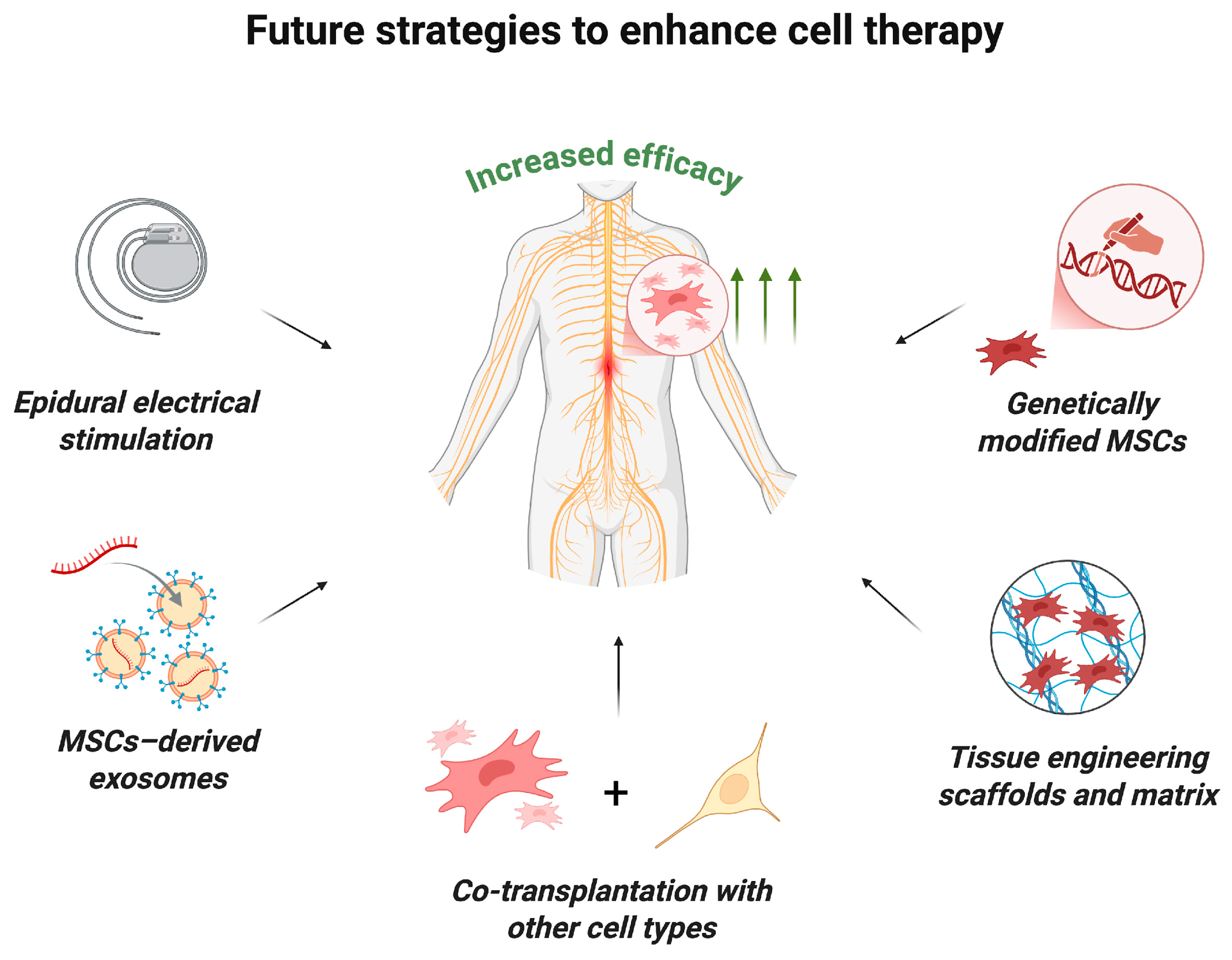
5. Future Prospects
6. Conclusions
Author Contributions
Funding
Institutional Review Board Statement
Informed Consent Statement
Data Availability Statement
Conflicts of Interest
Abbreviations
| MSCs | Mesenchymal stem/stromal cells |
| SCI | Spinal Cord Injury |
| CNS | Central Nervous System |
| ASIA | American Spinal Injury Association |
| AIS | ASIA Impairment Scale |
| NGF | Nerve growth factor |
| GDNF | Glial cell line-derived neurotrophic factor |
| BDNF | Brain-derived neurotrophic factor |
| SCIM III | Spinal Cord Independence Measure III |
| PEDro | Physiotherapy Evidence Database scale |
References
- Ahuja, C.S.; Wilson, J.R.; Nori, S.; Kotter, M.R.N.; Druschel, C.; Curt, A.; Fehlings, M.G. Traumatic Spinal Cord Injury. Nat. Rev. Dis. Primers 2017, 3, 17018. [Google Scholar] [CrossRef]
- Khadour, F.A.; Khadour, Y.A.; Meng, L.; XinLi, C.; Xu, T. Epidemiology Features of Traumatic and Non-Traumatic Spinal Cord Injury in China, Wuhan. Sci. Rep. 2024, 14, 1640. [Google Scholar] [CrossRef]
- Lu, Y.; Shang, Z.; Zhang, W.; Pang, M.; Hu, X.; Dai, Y.; Shen, R.; Wu, Y.; Liu, C.; Luo, T.; et al. Global Incidence and Characteristics of Spinal Cord Injury since 2000–2021: A Systematic Review and Meta-Analysis. BMC Med. 2024, 22, 285. [Google Scholar] [CrossRef]
- Zharikov, Y.; Nagaytseva, A.A.; Nikolenko, V. Spinal Injuries in Compression Fractures of the Spine: Neurological Insufficiency and Rehabilitation of Patients with Neurological Disorders. Med. News North Cauc. 2021, 16. [Google Scholar] [CrossRef]
- Lobzin, S.V.; Mirzaeva, L.M.; Tcinzerling, N.V.; Dulaev, A.K.; Tamaev, T.I.; Tyulikov, K.V. Acute Traumatic Spinal Cord Injury in Saint Petersburg. Epidemiological Data: Incidence Rate, Gender and Age Characteristics. Her. North-West. State Med. Univ. Named II Mechnikov 2019, 11, 27–34. [Google Scholar] [CrossRef]
- Hu, X.; Xu, W.; Ren, Y.; Wang, Z.; He, X.; Huang, R.; Ma, B.; Zhao, J.; Zhu, R.; Cheng, L. Spinal Cord Injury: Molecular Mechanisms and Therapeutic Interventions. Signal Transduct. Target. Ther. 2023, 8, 245. [Google Scholar] [CrossRef] [PubMed]
- Zipser, C.M.; Cragg, J.J.; Guest, J.D.; Fehlings, M.G.; Jutzeler, C.R.; Anderson, A.J.; Curt, A. Cell-Based and Stem-Cell-Based Treatments for Spinal Cord Injury: Evidence from Clinical Trials. Lancet Neurol. 2022, 21, 659–670. [Google Scholar] [CrossRef]
- Fehlings, M.G.; Tetreault, L.A.; Wilson, J.R.; Kwon, B.K.; Burns, A.S.; Martin, A.R.; Hawryluk, G.; Harrop, J.S. A Clinical Practice Guideline for the Management of Acute Spinal Cord Injury: Introduction, Rationale, and Scope. Glob. Spine J. 2017, 7, 84S–94S. [Google Scholar] [CrossRef] [PubMed]
- Diop, M.; Epstein, D. A Systematic Review of the Impact of Spinal Cord Injury on Costs and Health-Related Quality of Life. Pharmacoecon Open 2024, 8, 793–808. [Google Scholar] [CrossRef]
- Shang, Z.; Wang, M.; Zhang, B.; Wang, X.; Wanyan, P. Clinical Translation of Stem Cell Therapy for Spinal Cord Injury Still Premature: Results from a Single-Arm Meta-Analysis Based on 62 Clinical Trials. BMC Med. 2022, 20, 284. [Google Scholar] [CrossRef] [PubMed]
- Ribeiro, B.F.; da Cruz, B.C.; de Sousa, B.M.; Correia, P.D.; David, N.; Rocha, C.; Almeida, R.D.; da Cunha, M.R.; Marques Baptista, A.A.; Vieira, S.I. Cell Therapies for Spinal Cord Injury: A Review of the Clinical Trials and Cell-Type Therapeutic Potential. Brain 2023, 146, 2672–2693, Correction in Brain 2023, 146, e128. [Google Scholar] [CrossRef]
- Montoto-Meijide, R.; Meijide-Faílde, R.; Díaz-Prado, S.M.; Montoto-Marqués, A. Mesenchymal Stem Cell Therapy in Traumatic Spinal Cord Injury: A Systematic Review. Int. J. Mol. Sci. 2023, 24, 11719. [Google Scholar] [CrossRef]
- Xu, X.; Liang, Z.; Lin, Y.; Rao, J.; Lin, F.; Yang, Z.; Wang, R.; Chen, C. Comparing the Efficacy and Safety of Cell Transplantation for Spinal Cord Injury: A Systematic Review and Bayesian Network Meta-Analysis. Front. Cell Neurosci. 2022, 16, 860131. [Google Scholar] [CrossRef] [PubMed]
- Johnson, L.D.V.; Pickard, M.R.; Johnson, W.E.B. The Comparative Effects of Mesenchymal Stem Cell Transplantation Therapy for Spinal Cord Injury in Humans and Animal Models: A Systematic Review and Meta-Analysis. Biology 2021, 10, 230. [Google Scholar] [CrossRef] [PubMed]
- Song, S.; Li, C.; Xiao, Y.; Ye, Z.; Rong, M.; Zeng, J. Beyond Conventional Therapies: MSCs in the Battle against Nerve Injury. Regen. Ther. 2025, 28, 280–291. [Google Scholar] [CrossRef]
- Fan, X.-L.; Zhang, Y.; Li, X.; Fu, Q.-L. Mechanisms Underlying the Protective Effects of Mesenchymal Stem Cell-Based Therapy. Cell. Mol. Life Sci. 2020, 77, 2771–2794. [Google Scholar] [CrossRef] [PubMed]
- Trigo, C.M.; Rodrigues, J.S.; Camões, S.P.; Solá, S.; Miranda, J.P. Mesenchymal Stem Cell Secretome for Regenerative Medicine: Where Do We Stand? J. Adv. Res. 2025, 70, 103–124. [Google Scholar] [CrossRef]
- Xia, Y.; Zhu, J.; Yang, R.; Wang, H.; Li, Y.; Fu, C. Mesenchymal Stem Cells in the Treatment of Spinal Cord Injury: Mechanisms, Current Advances and Future Challenges. Front. Immunol. 2023, 14, 1141601. [Google Scholar] [CrossRef]
- Ragni, E.; Banfi, F.; Barilani, M.; Cherubini, A.; Parazzi, V.; Larghi, P.; Dolo, V.; Bollati, V.; Lazzari, L. Extracellular Vesicle-Shuttled MRNA in Mesenchymal Stem Cell Communication. Stem Cells 2017, 35, 1093–1105. [Google Scholar] [CrossRef]
- Chen, T.S.; Lai, R.C.; Lee, M.M.; Choo, A.B.H.; Lee, C.N.; Lim, S.K. Mesenchymal Stem Cell Secretes Microparticles Enriched in Pre-MicroRNAs. Nucleic Acids Res. 2010, 38, 215–224. [Google Scholar] [CrossRef]
- Liu, J.; Lin, M.; Qiao, F.; Zhang, C. Exosomes Derived from LncRNA TCTN2-Modified Mesenchymal Stem Cells Improve Spinal Cord Injury by MiR-329-3p/IGF1R Axis. J. Mol. Neurosci. 2022, 72, 482–495. [Google Scholar] [CrossRef]
- Wang, X.; Li, W.; Hao, M.; Yang, Y.; Xu, Y. Hypoxia-Treated Umbilical Mesenchymal Stem Cell Alleviates Spinal Cord Ischemia-Reperfusion Injury in SCI by Circular RNA CircOXNAD1/MiR-29a-3p/FOXO3a Axis. Biochem. Biophys. Rep. 2023, 34, 101458. [Google Scholar] [CrossRef]
- Pizzinat, N.; Ong-Meang, V.; Bourgailh-Tortosa, F.; Blanzat, M.; Perquis, L.; Cussac, D.; Parini, A.; Poinsot, V. Extracellular Vesicles of MSCs and Cardiomyoblasts Are Vehicles for Lipid Mediators. Biochimie 2020, 178, 69–80. [Google Scholar] [CrossRef]
- Clos-Sansalvador, M.; Garcia, S.G.; Morón-Font, M.; Williams, C.; Reichardt, N.-C.; Falcón-Pérez, J.M.; Bayes-Genis, A.; Roura, S.; Franquesa, M.; Monguió-Tortajada, M.; et al. N-Glycans in Immortalized Mesenchymal Stromal Cell-Derived Extracellular Vesicles Are Critical for EV–Cell Interaction and Functional Activation of Endothelial Cells. Int. J. Mol. Sci. 2022, 23, 9539. [Google Scholar] [CrossRef]
- Liao, Z.; Tong, B.; Ke, W.; Yang, C.; Wu, X.; Lei, M. Extracellular Vesicles as Carriers for Mitochondria: Biological Functions and Clinical Applications. Mitochondrion 2024, 78, 101935. [Google Scholar] [CrossRef]
- Zorova, L.D.; Kovalchuk, S.I.; Popkov, V.A.; Chernikov, V.P.; Zharikova, A.A.; Khutornenko, A.A.; Zorov, S.D.; Plokhikh, K.S.; Zinovkin, R.A.; Evtushenko, E.A.; et al. Do Extracellular Vesicles Derived from Mesenchymal Stem Cells Contain Functional Mitochondria? Int. J. Mol. Sci. 2022, 23, 7408. [Google Scholar] [CrossRef] [PubMed]
- Wu, T.; Liu, Y.; Wang, S.; Shi, C. MSC-Derived Extracellular Vesicles: Roles and Molecular Mechanisms for Tissue Repair. Int. J. Nanomed. 2025, 20, 7953–7974. [Google Scholar] [CrossRef]
- Patel, J.C.; Shukla, M.; Shukla, M. From Bench to Bedside: Translating Mesenchymal Stem Cell Therapies through Preclinical and Clinical Evidence. Front. Bioeng. Biotechnol. 2025, 13. [Google Scholar] [CrossRef] [PubMed]
- Luchetti, F.; Carloni, S.; Nasoni, M.G.; Reiter, R.J.; Balduini, W. Tunneling Nanotubes and Mesenchymal Stem Cells: New Insights into the Role of Melatonin in Neuronal Recovery. J. Pineal Res. 2022, 73, e12800. [Google Scholar] [CrossRef] [PubMed]
- Babenko, V.; Silachev, D.; Popkov, V.; Zorova, L.; Pevzner, I.; Plotnikov, E.; Sukhikh, G.; Zorov, D. Miro1 Enhances Mitochondria Transfer from Multipotent Mesenchymal Stem Cells (MMSC) to Neural Cells and Improves the Efficacy of Cell Recovery. Molecules 2018, 23, 687. [Google Scholar] [CrossRef]
- Li, Y.; Zhang, D.; Xu, L.; Dong, L.; Zheng, J.; Lin, Y.; Huang, J.; Zhang, Y.; Tao, Y.; Zang, X.; et al. Cell–Cell Contact with Proinflammatory Macrophages Enhances the Immunotherapeutic Effect of Mesenchymal Stem Cells in Two Abortion Models. Cell Mol. Immunol. 2019, 16, 908–920. [Google Scholar] [CrossRef]
- Cselenyák, A.; Pankotai, E.; Horváth, E.M.; Kiss, L.; Lacza, Z. Mesenchymal Stem Cells Rescue Cardiomyoblasts from Cell Death in an in Vitro Ischemia Model via Direct Cell-to-Cell Connections. BMC Cell Biol. 2010, 11, 29. [Google Scholar] [CrossRef]
- Shkap, M.O.; Chudakova, D.A.; Gubsky, I.L.; Kovalchuk, A.M.; Doroshenko, Y.S.; Kibirsky, P.D.; Kirsova, D.P.; Yusubalieva, G.M.; Baklaushev, V.P. Fate of Transplanted Allogeneic Mesenchymal Stromal Cells in the Rat Spinal Cord under Normal Conditions and during the Acute Phase of Spinal Cord Contusion Injury. Bull. Exp. Biol. Med. 2025, 179, 539–549. [Google Scholar] [CrossRef]
- Zeng, C.-W. Multipotent Mesenchymal Stem Cell-Based Therapies for Spinal Cord Injury: Current Progress and Future Prospects. Biology 2023, 12, 653. [Google Scholar] [CrossRef] [PubMed]
- Maher, C.G.; Sherrington, C.; Herbert, R.D.; Moseley, A.M.; Elkins, M. Reliability of the PEDro Scale for Rating Quality of Randomized Controlled Trials. Phys. Ther. 2003, 83, 713–721. [Google Scholar] [CrossRef]
- Pal, R.; Venkataramana, N.K.; Bansal, A.; Balaraju, S.; Jan, M.; Chandra, R.; Dixit, A.; Rauthan, A.; Murgod, U.; Totey, S. Ex Vivo-Expanded Autologous Bone Marrow-Derived Mesenchymal Stromal Cells in Human Spinal Cord Injury/Paraplegia: A Pilot Clinical Study. Cytotherapy 2009, 11, 897–911. [Google Scholar] [CrossRef]
- Park, J.H.; Kim, D.Y.; Sung, I.Y.; Choi, G.H.; Jeon, M.H.; Kim, K.K.; Jeon, S.R. Long-Term Results of Spinal Cord Injury Therapy Using Mesenchymal Stem Cells Derived From Bone Marrow in Humans. Neurosurgery 2012, 70, 1238–1247. [Google Scholar] [CrossRef]
- Bhanot, Y.; Rao, S.; Ghosh, D.; Balaraju, S.; Radhika, C.R.; Satish Kumar, K.V. Autologous Mesenchymal Stem Cells in Chronic Spinal Cord Injury. Br. J. Neurosurg. 2011, 25, 516–522. [Google Scholar] [CrossRef]
- Ra, J.C.; Shin, I.S.; Kim, S.H.; Kang, S.K.; Kang, B.C.; Lee, H.Y.; Kim, Y.J.; Jo, J.Y.; Yoon, E.J.; Choi, H.J.; et al. Safety of Intravenous Infusion of Human Adipose Tissue-Derived Mesenchymal Stem Cells in Animals and Humans. Stem Cells Dev. 2011, 20, 1297–1308. [Google Scholar] [CrossRef] [PubMed]
- Dai, G.; Liu, X.; Zhang, Z.; Yang, Z.; Dai, Y.; Xu, R. Transplantation of Autologous Bone Marrow Mesenchymal Stem Cells in the Treatment of Complete and Chronic Cervical Spinal Cord Injury. Brain Res. 2013, 1533, 73–79. [Google Scholar] [CrossRef] [PubMed]
- Cheng, H.; Liu, X.; Hua, R.; Dai, G.; Wang, X.; Gao, J.; An, Y. Clinical Observation of Umbilical Cord Mesenchymal Stem Cell Transplantation in Treatment for Sequelae of Thoracolumbar Spinal Cord Injury. J. Transl. Med. 2014, 12, 253. [Google Scholar] [CrossRef] [PubMed]
- El-Kheir, W.A.; Gabr, H.; Awad, M.R.; Ghannam, O.; Barakat, Y.; Farghali, H.A.M.A.; El Maadawi, Z.M.; Ewes, I.; Sabaawy, H.E. Autologous Bone Marrow-Derived Cell Therapy Combined with Physical Therapy Induces Functional Improvement in Chronic Spinal Cord Injury Patients. Cell Transpl. 2014, 23, 729–745. [Google Scholar] [CrossRef] [PubMed]
- Mendonça, M.V.P.; Larocca, T.F.; Souza, B.S.D.F.; Villarreal, C.F.; Silva, L.F.M.; Matos, A.C.; Novaes, M.A.; Bahia, C.M.P.; Martinez, A.C.D.O.M.; Kaneto, C.M.; et al. Safety and Neurological Assessments after Autologous Transplantation of Bone Marrow Mesenchymal Stem Cells in Subjects with Chronic Spinal Cord Injury. Stem Cell Res. Ther. 2014, 5, 126. [Google Scholar] [CrossRef] [PubMed]
- Hur, J.W.; Cho, T.H.; Park, D.H.; Lee, J.B.; Park, J.Y.; Chung, Y.G. Intrathecal Transplantation of Autologous Adipose-Derived Mesenchymal Stem Cells for Treating Spinal Cord Injury: A Human Trial. J. Spinal Cord. Med. 2016, 39, 655–664. [Google Scholar] [CrossRef]
- Oh, S.K.; Choi, K.H.; Yoo, J.Y.; Kim, D.Y.; Kim, S.J.; Jeon, S.R. A Phase III Clinical Trial Showing Limited Efficacy of Autologous Mesenchymal Stem Cell Therapy for Spinal Cord Injury. Neurosurgery 2016, 78, 436–447. [Google Scholar] [CrossRef]
- Satti, H.S.; Waheed, A.; Ahmed, P.; Ahmed, K.; Akram, Z.; Aziz, T.; Satti, T.M.; Shahbaz, N.; Khan, M.A.; Malik, S.A. Autologous Mesenchymal Stromal Cell Transplantation for Spinal Cord Injury: A Phase I Pilot Study. Cytotherapy 2016, 18, 518–522. [Google Scholar] [CrossRef]
- Vaquero, J.; Zurita, M.; Rico, M.A.; Bonilla, C.; Aguayo, C.; Montilla, J.; Bustamante, S.; Carballido, J.; Marin, E.; Martinez, F.; et al. An Approach to Personalized Cell Therapy in Chronic Complete Paraplegia: The Puerta de Hierro Phase I/II Clinical Trial. Cytotherapy 2016, 18, 1025–1036. [Google Scholar] [CrossRef]
- Larocca, T.F.; Macêdo, C.T.; de Freitas Souza, B.S.; Andrade-Souza, Y.M.; Villarreal, C.F.; Matos, A.C.; Silva, D.N.; da Silva, K.N.; de Souza, C.L.e.M.; da Silva Paixão, D.; et al. Image-Guided Percutaneous Intralesional Administration of Mesenchymal Stromal Cells in Subjects with Chronic Complete Spinal Cord Injury: A Pilot Study. Cytotherapy 2017, 19, 1189–1196. [Google Scholar] [CrossRef]
- Vaquero, J.; Zurita, M.; Rico, M.A.; Bonilla, C.; Aguayo, C.; Fernández, C.; Tapiador, N.; Sevilla, M.; Morejón, C.; Montilla, J.; et al. Repeated Subarachnoid Administrations of Autologous Mesenchymal Stromal Cells Supported in Autologous Plasma Improve Quality of Life in Patients Suffering Incomplete Spinal Cord Injury. Cytotherapy 2017, 19, 349–359. [Google Scholar] [CrossRef]
- Vaquero, J.; Zurita, M.; Rico, M.A.; Aguayo, C.; Bonilla, C.; Marin, E.; Tapiador, N.; Sevilla, M.; Vazquez, D.; Carballido, J.; et al. Intrathecal Administration of Autologous Mesenchymal Stromal Cells for Spinal Cord Injury: Safety and Efficacy of the 100/3 Guideline. Cytotherapy 2018, 20, 806–819. [Google Scholar] [CrossRef]
- Yang, Y.; Zhang, L.; Sun, W.; Li, W.; Wang, K. Therapeutic Effect of Mesenchymal Stem Cell in Spinal Cord Injury. Int. J. Clin. Exp. Med. 2020, 13, 1979–1986. [Google Scholar]
- Albu, S.; Kumru, H.; Coll, R.; Vives, J.; Vallés, M.; Benito-Penalva, J.; Rodríguez, L.; Codinach, M.; Hernández, J.; Navarro, X.; et al. Clinical Effects of Intrathecal Administration of Expanded Wharton Jelly Mesenchymal Stromal Cells in Patients with Chronic Complete Spinal Cord Injury: A Randomized Controlled Study. Cytotherapy 2021, 23, 146–156. [Google Scholar] [CrossRef]
- Honmou, O.; Yamashita, T.; Morita, T.; Oshigiri, T.; Hirota, R.; Iyama, S.; Kato, J.; Sasaki, Y.; Ishiai, S.; Ito, Y.M.; et al. Intravenous Infusion of Auto Serum-Expanded Autologous Mesenchymal Stem Cells in Spinal Cord Injury Patients: 13 Case Series. Clin. Neurol. Neurosurg. 2021, 203, 106565. [Google Scholar] [CrossRef] [PubMed]
- Yang, Y.; Pang, M.; Du, C.; Liu, Z.Y.; Chen, Z.H.; Wang, N.X.; Zhang, L.M.; Chen, Y.Y.; Mo, J.; Dong, J.W.; et al. Repeated Subarachnoid Administrations of Allogeneic Human Umbilical Cord Mesenchymal Stem Cells for Spinal Cord Injury: A Phase 1/2 Pilot Study. Cytotherapy 2021, 23, 57–64. [Google Scholar] [CrossRef]
- Saini, R.; Pahwa, B.; Agrawal, D.; Singh, P.K.; Gujjar, H.; Mishra, S.; Jagdevan, A.; Misra, M.C. Efficacy and Outcome of Bone Marrow Derived Stem Cells Transplanted via Intramedullary Route in Acute Complete Spinal Cord Injury—A Randomized Placebo Controlled Trial. J. Clin. Neurosci. 2022, 100, 7–14. [Google Scholar] [CrossRef]
- Bydon, M.; Qu, W.; Moinuddin, F.M.; Hunt, C.L.; Garlanger, K.L.; Reeves, R.K.; Windebank, A.J.; Zhao, K.D.; Jarrah, R.; Trammell, B.C.; et al. Intrathecal Delivery of Adipose-Derived Mesenchymal Stem Cells in Traumatic Spinal Cord Injury: Phase I Trial. Nat. Commun. 2024, 15, 2201. [Google Scholar] [CrossRef]
- Awidi, A.; Al Shudifat, A.; El Adwan, N.; Alqudah, M.; Jamali, F.; Nazer, F.; Sroji, H.; Ahmad, H.; Al-Quzaa, N.; Jafar, H. Safety and Potential Efficacy of Expanded Mesenchymal Stromal Cells of Bone Marrow and Umbilical Cord Origins in Patients with Chronic Spinal Cord Injuries: A Phase I/II Study. Cytotherapy 2024, 26, 825–831. [Google Scholar] [CrossRef]
- Koda, M.; Imagama, S.; Nakashima, H.; Ito, S.; Segi, N.; Ouchida, J.; Suda, K.; Harmon Matsumoto, S.; Komatsu, M.; Endo, T.; et al. Safety and Feasibility of Intravenous Administration of a Single Dose of Allogenic-Muse Cells to Treat Human Cervical Traumatic Spinal Cord Injury: A Clinical Trial. Stem Cell Res. Ther. 2024, 15, 259. [Google Scholar] [CrossRef]
- Hirota, R.; Sasaki, M.; Iyama, S.; Kurihara, K.; Fukushi, R.; Obara, H.; Oshigiri, T.; Morita, T.; Nakazaki, M.; Namioka, T.; et al. Intravenous Infusion of Autologous Mesenchymal Stem Cells Expanded in Auto Serum for Chronic Spinal Cord Injury Patients: A Case Series. J. Clin. Med. 2024, 13, 6072. [Google Scholar] [CrossRef] [PubMed]
- Macêdo, C.T.; de Freitas Souza, B.S.; Villarreal, C.F.; Silva, D.N.; da Silva, K.N.; de Souza, C.L.e.M.; da Silva Paixão, D.; da Rocha Bezerra, M.; da Silva Moura Costa, A.O.; Brazão, E.S.; et al. Transplantation of Autologous Mesenchymal Stromal Cells in Complete Cervical Spinal Cord Injury: A Pilot Study. Front. Med. 2024, 11, 1451297. [Google Scholar] [CrossRef]
- Kaplan, N.; Kabatas, S.; Civelek, E.; Savrunlu, E.C.; Akkoc, T.; Boyalı, O.; Öztürk, E.; Can, H.; Genc, A.; Karaöz, E. Multiroute Administration of Wharton’s Jelly Mesenchymal Stem Cells in Chronic Complete Spinal Cord Injury: A Phase I Safety and Feasibility Study. World J. Stem Cells 2025, 17, 101675. [Google Scholar] [CrossRef]
- Park, H.C.; Shim, Y.S.; Ha, Y.; Yoon, S.H.; Park, S.R.; Choi, B.H.; Park, H.S. Treatment of Complete Spinal Cord Injury Patients by Autologous Bone Marrow Cell Transplantation and Administration of Granulocyte-Macrophage Colony Stimulating Factor. Tissue Eng. 2005, 11, 913–922. [Google Scholar] [CrossRef]
- Callera, F. Delivery of Autologous Bone Marrow Precursor Cells into the Spinal Cord Via Lumbar Puncture Technique in Patients with Spinal Cord Injury. Blood 2005, 106, 5204. [Google Scholar] [CrossRef]
- Syková, E.; Homola, A.; Mazanec, R.; Lachmann, H.; Konrádová, Š.L.; Kobylka, P.; Pádr, R.; Neuwirth, J.; Komrska, V.; Vávra, V.; et al. Autologous Bone Marrow Transplantation in Patients with Subacute and Chronic Spinal Cord Injury. Cell Transpl. 2006, 15, 675–687. [Google Scholar] [CrossRef] [PubMed]
- Yoon, S.H.; Shim, Y.S.; Park, Y.H.; Chung, J.K.; Nam, J.H.; Kim, M.O.; Park, H.C.; Park, S.R.; Min, B.-H.; Kim, E.Y.; et al. Complete Spinal Cord Injury Treatment Using Autologous Bone Marrow Cell Transplantation and Bone Marrow Stimulation with Granulocyte Macrophage-Colony Stimulating Factor: Phase I/II Clinical Trial. Stem Cells 2007, 25, 2066–2073. [Google Scholar] [CrossRef]
- Deda, H.; İnci, M.; Kürekçi, A.; Kayıhan, K.; Özgün, E.; Üstünsoy, G.; Kocabay, S. Treatment of Chronic Spinal Cord Injured Patients with Autologous Bone Marrow-Derived Hematopoietic Stem Cell Transplantation: 1-Year Follow-Up. Cytotherapy 2008, 10, 565–574. [Google Scholar] [CrossRef]
- Geffner, L.F.; Santacruz, P.; Izurieta, M.; Flor, L.; Maldonado, B.; Auad, A.H.; Montenegro, X.; Gonzalez, R.; Silva, F. Administration of Autologous Bone Marrow Stem Cells into Spinal Cord Injury Patients via Multiple Routes Is Safe and Improves Their Quality of Life: Comprehensive Case Studies. Cell Transpl. 2008, 17, 1277–1293. [Google Scholar] [CrossRef]
- Jeyaraman, M.; Bingi, S.K.; Muthu, S.; Jeyaraman, N.; Packkyarathinam, R.P.; Ranjan, R.; Sharma, S.; Jha, S.K.; Khanna, M.; Rajendran, S.N.S.; et al. Impact of the Process Variables on the Yield of Mesenchymal Stromal Cells from Bone Marrow Aspirate Concentrate. Bioengineering 2022, 9, 57. [Google Scholar] [CrossRef] [PubMed]
- Alvarez-Viejo, M.; Menendez-Menendez, Y.; Blanco-Gelaz, M.A.; Ferrero-Gutierrez, A.; Fernandez-Rodriguez, M.A.; Gala, J.; Otero-Hernandez, J. Quantifying Mesenchymal Stem Cells in the Mononuclear Cell Fraction of Bone Marrow Samples Obtained for Cell Therapy. Transpl. Proc. 2013, 45, 434–439. [Google Scholar] [CrossRef]
- Rupp, R.; Biering-Sørensen, F.; Burns, S.P.; Graves, D.E.; Guest, J.; Jones, L.; Read, M.S.; Rodriguez, G.M.; Schuld, C.; Tansey, K.E.; et al. International Standards for Neurological Classification of Spinal Cord InjuryRevised 2019. Top. Spinal Cord. Inj. Rehabil. 2021, 27, 1–22. [Google Scholar] [CrossRef]
- Ahuja, C.S.; Nori, S.; Tetreault, L.; Wilson, J.; Kwon, B.; Harrop, J.; Choi, D.; Fehlings, M.G. Traumatic Spinal Cord Injury—Repair and Regeneration. Clin. Neurosurg. 2017, 80, S22–S90. [Google Scholar] [CrossRef]
- Burns, A.S.; Lee, B.S.; Ditunno, J.F.; Tessler, A. Patient Selection for Clinical Trials: The Reliability of the Early Spinal Cord Injury Examination. J. Neurotrauma 2003, 20, 477–482. [Google Scholar] [CrossRef] [PubMed]
- Evaniew, N.; Sharifi, B.; Waheed, Z.; Fallah, N.; Ailon, T.; Dea, N.; Paquette, S.; Charest-Morin, R.; Street, J.; Fisher, C.G.; et al. The Influence of Neurological Examination Timing within Hours after Acute Traumatic Spinal Cord Injuries: An Observational Study. Spinal Cord. 2020, 58, 247–254, Correction in Spinal Cord. 2020, 58, 255. [Google Scholar] [CrossRef]
- Kalia, R.; Agrawal, A. Management of Spinal Injuries in a Patient with Polytrauma. J. Orthop. Traumatol. Rehabil. 2013, 6, 28. [Google Scholar] [CrossRef]
- Ackerman, P.; Morrison, S.A.; McDowell, S.; Vazquez, L. Using the Spinal Cord Independence Measure III to Measure Functional Recovery in a Post-Acute Spinal Cord Injury Program. Spinal Cord 2009, 48, 380–387. [Google Scholar] [CrossRef]
- Frankel, H.L.; Hancock, D.O.; Hyslop, G.; Melzak, J.; Michaelis, L.S.; Ungar, G.H.; Vernon, J.D.S.; Walsh, J.J. The Value of Postural Reduction in the Initial Management of Closed Injuries of the Spine with Paraplegia and Tetraplegia. Spinal Cord. 1969, 7, 179–192. [Google Scholar] [CrossRef]
- Li, C.; Wu, Z.; Zhou, L.; Shao, J.; Hu, X.; Xu, W.; Ren, Y.; Zhu, X.; Ge, W.; Zhang, K.; et al. Temporal and Spatial Cellular and Molecular Pathological Alterations with Single-Cell Resolution in the Adult Spinal Cord after Injury. Signal Transduct. Target. Ther. 2022, 7, 65, Correction in Signal Transduct. Target. Ther. 2022, 7, 154. [Google Scholar] [CrossRef]
- Punjani, N.; Deska-Gauthier, D.; Hachem, L.D.; Abramian, M.; Fehlings, M.G. Neuroplasticity and Regeneration after Spinal Cord Injury. N. Am. Spine Soc. J. (NASSJ) 2023, 15, 100235. [Google Scholar] [CrossRef] [PubMed]
- Rezvan, M.; Meknatkhah, S.; Hassannejad, Z.; Sharif-Alhoseini, M.; Zadegan, S.A.; Shokraneh, F.; Vaccaro, A.R.; Lu, Y.; Rahimi-Movaghar, V. Time-Dependent Microglia and Macrophages Response after Traumatic Spinal Cord Injury in Rat: A Systematic Review. Injury 2020, 51, 2390–2401. [Google Scholar] [CrossRef] [PubMed]
- Badhiwala, J.H.; Wilson, J.R.; Witiw, C.D.; Harrop, J.S.; Vaccaro, A.R.; Aarabi, B.; Grossman, R.G.; Geisler, F.H.; Fehlings, M.G. The Influence of Timing of Surgical Decompression for Acute Spinal Cord Injury: A Pooled Analysis of Individual Patient Data. Lancet Neurol. 2021, 20, 117–126. [Google Scholar] [CrossRef]
- Ahuja, C.S.; Badhiwala, J.H.; Fehlings, M.G. “Time Is Spine”: The Importance of Early Intervention for Traumatic Spinal Cord Injury. Spinal Cord 2020, 58, 1037–1039. [Google Scholar] [CrossRef]
- Shang, Z.; Li, D.; Chen, J.; Wang, R.R.; Wang, M.; Zhang, B.; Wang, X.; Wanyan, P. What Is the Optimal Timing of Transplantation of Neural Stem Cells in Spinal Cord Injury? A Systematic Review and Network Meta-Analysis Based on Animal Studies. Front. Immunol. 2022, 13, 855309. [Google Scholar] [CrossRef]
- Troiani, Z.; Chipman, D.E.; Ryan, T.J.; Haider, M.N.; Kowalski, D.; Hasanspahic, B.; Scott, M.M.; Vallee, E.K.; Lucasti, C. Efficacy of Mesenchymal and Embryonic Stem Cell Therapy for the Treatment of Spinal Cord Injury: A Systematic Review and Meta-Analysis of Human Studies. Glob. Spine J. 2025, 15, 3969–3981. [Google Scholar] [CrossRef] [PubMed]
- Wang, R.; Wang, Y.; Yan, F.; Sun, J.; Zhang, T. Assessment of Mesenchymal Stem Cells for the Treatment of Spinal Cord Injury: A Systematic Review and Network Meta-Analysis. Front. Cell Neurosci. 2025, 19, 1532219. [Google Scholar] [CrossRef]
- Alizadeh, A.; Dyck, S.M.; Karimi-Abdolrezaee, S. Traumatic Spinal Cord Injury: An Overview of Pathophysiology, Models and Acute Injury Mechanisms. Front. Neurol. 2019, 10, 441408. [Google Scholar] [CrossRef]
- Cofano, F.; Boido, M.; Monticelli, M.; Zenga, F.; Ducati, A.; Vercelli, A.; Garbossa, D. Mesenchymal Stem Cells for Spinal Cord Injury: Current Options, Limitations, and Future of Cell Therapy. Int. J. Mol. Sci. 2019, 20, 2698. [Google Scholar] [CrossRef]
- Liu, S.; Zhang, H.; Wang, H.; Huang, J.; Yang, Y.; Li, G.; Yu, K.; Yang, L. A Comparative Study of Different Stem Cell Transplantation for Spinal Cord Injury: A Systematic Review and Network Meta-Analysis. World Neurosurg. 2022, 159, e232–e243. [Google Scholar] [CrossRef]
- Heyman, E.; Olenic, M.; De Vlieghere, E.; De Smet, S.; Devriendt, B.; Thorrez, L.; De Schauwer, C. Donor Age and Breed Determine Mesenchymal Stromal Cell Characteristics. Stem Cell Res. Ther. 2025, 16, 99. [Google Scholar] [CrossRef] [PubMed]
- Ryu, H.-H.; Kang, B.-J.; Park, S.-S.; Kim, Y.; Sung, G.-J.; Woo, H.-M.; Kim, W.H.; Kweon, O.-K. Comparison of Mesenchymal Stem Cells Derived from Fat, Bone Marrow, Wharton’s Jelly, and Umbilical Cord Blood for Treating Spinal Cord Injuries in Dogs. J. Vet. Med. Sci. 2012, 74, 1617–1630. [Google Scholar] [CrossRef] [PubMed]
- Yea, J.-H.; Kim, Y.; Jo, C.H. Comparison of Mesenchymal Stem Cells from Bone Marrow, Umbilical Cord Blood, and Umbilical Cord Tissue in Regeneration of a Full-Thickness Tendon Defect in Vitro and in Vivo. Biochem. Biophys. Rep. 2023, 34, 101486. [Google Scholar] [CrossRef]
- Andrzejewska, A.; Dabrowska, S.; Lukomska, B.; Janowski, M.; Andrzejewska, A.; Dabrowska, S.; Lukomska, B.; Janowski, M. Mesenchymal Stem Cells for Neurological Disorders. Adv. Sci. 2021, 8, 2002944. [Google Scholar] [CrossRef]
- Isaković, J.; Šerer, K.; Barišić, B.; Mitrečić, D. Mesenchymal Stem Cell Therapy for Neurological Disorders: The Light or the Dark Side of the Force? Front. Bioeng. Biotechnol. 2023, 11, 1139359. [Google Scholar] [CrossRef]
- Namestnikova, D.D.; Kovalenko, D.B.; Pokusaeva, I.A.; Chudakova, D.A.; Gubskiy, I.L.; Yarygin, K.N.; Baklaushev, V.P. Mesenchymal Stem Cells in the Treatment of Ischemic Stroke. J. Clin. Pract. 2024, 14, 49–64. [Google Scholar] [CrossRef]
- Jug, M.; Švajger, U.; Lezaić, L.; Sočan, A.; Sever, M.; Zver, S.; Bajrović, F. Homing of Mesenchymal Stem Cells after Acute Traumatic Cervical Spinal Cord Injury—A Case Report. Cytotherapy 2020, 22, S89–S90. [Google Scholar] [CrossRef]
- Sanchez-Diaz, M.; Quiñones-Vico, M.I.; Sanabria de la Torre, R.; Montero-Vílchez, T.; Sierra-Sánchez, A.; Molina-Leyva, A.; Arias-Santiago, S. Biodistribution of Mesenchymal Stromal Cells after Administration in Animal Models and Humans: A Systematic Review. J. Clin. Med. 2021, 10, 2925. [Google Scholar] [CrossRef]
- Krupa, P.; Vackova, I.; Ruzicka, J.; Zaviskova, K.; Dubisova, J.; Koci, Z.; Turnovcova, K.; Urdzikova, L.M.; Kubinova, S.; Rehak, S.; et al. The Effect of Human Mesenchymal Stem Cells Derived from Wharton’s Jelly in Spinal Cord Injury Treatment Is Dose-Dependent and Can Be Facilitated by Repeated Application. Int. J. Mol. Sci. 2018, 19, 1503. [Google Scholar] [CrossRef]
- Yao, S.; He, F.; Cao, Z.; Sun, Z.; Chen, Y.; Zhao, H.; Yu, X.; Wang, X.; Yang, Y.; Rosei, F.; et al. Mesenchymal Stem Cell-Laden Hydrogel Microfibers for Promoting Nerve Fiber Regeneration in Long-Distance Spinal Cord Transection Injury. ACS Biomater. Sci. Eng. 2020, 6, 1165–1175. [Google Scholar] [CrossRef] [PubMed]
- Baklaushev, V.P.; Bogush, V.G.; Kalsin, V.A.; Sovetnikov, N.N.; Samoilova, E.M.; Revkova, V.A.; Sidoruk, K.V.; Konoplyannikov, M.A.; Timashev, P.S.; Kotova, S.L.; et al. Tissue Engineered Neural Constructs Composed of Neural Precursor Cells, Recombinant Spidroin and PRP for Neural Tissue Regeneration. Sci. Rep. 2019, 9, 3161. [Google Scholar] [CrossRef] [PubMed]
- Mutepfa, A.R.; Hardy, J.G.; Adams, C.F. Electroactive Scaffolds to Improve Neural Stem Cell Therapy for Spinal Cord Injury. Front. Med. Technol. 2022, 4, 693438. [Google Scholar] [CrossRef]
- Yousefifard, M.; Maleki, S.N.; Askarian-Amiri, S.; Vaccaro, A.R.; Chapman, J.R.; Fehlings, M.G.; Hosseini, M.; Rahimi-Movaghar, V. A Combination of Mesenchymal Stem Cells and Scaffolds Promotes Motor Functional Recovery in Spinal Cord Injury: A Systematic Review and Meta-Analysis. J. Neurosurg. Spine 2019, 32, 269–284. [Google Scholar] [CrossRef]
- Zhao, Y.; Tang, F.; Xiao, Z.; Han, G.; Wang, N.; Yin, N.; Chen, B.; Jiang, X.; Yun, C.; Han, W.; et al. Clinical Study of Neuroregen Scaffold Combined with Human Mesenchymal Stem Cells for the Repair of Chronic Complete Spinal Cord Injury. Cell Transpl. 2017, 26, 891–900. [Google Scholar] [CrossRef] [PubMed]
- Damasceno, P.K.F.; de Santana, T.A.; Santos, G.C.; Orge, I.D.; Silva, D.N.; Albuquerque, J.F.; Golinelli, G.; Grisendi, G.; Pinelli, M.; Ribeiro dos Santos, R.; et al. Genetic Engineering as a Strategy to Improve the Therapeutic Efficacy of Mesenchymal Stem/Stromal Cells in Regenerative Medicine. Front. Cell Dev. Biol. 2020, 8, 737. [Google Scholar] [CrossRef] [PubMed]
- Gao, T.; Huang, F.; Wang, W.; Xie, Y.; Wang, B. Interleukin-10 Genetically Modified Clinical-Grade Mesenchymal Stromal Cells Markedly Reinforced Functional Recovery after Spinal Cord Injury via Directing Alternative Activation of Macrophages. Cell Mol. Biol. Lett. 2022, 27, 27. [Google Scholar] [CrossRef]
- Yang, W.; Li, Y.; Tang, Y.; Tao, Z.; Yu, M.; Sun, C.; Ye, Y.; Xu, B.; Zhao, X.; Zhang, Y.; et al. Mesenchymal Stem Cells Overexpressing Neuropeptide S Promote the Recovery of Rats with Spinal Cord Injury by Activating the PI3K/AKT/GSK3β Signaling Pathway. Stem Cell Res. Ther. 2025, 16, 100. [Google Scholar] [CrossRef]
- Jiang, Y.; Li, R.; Ban, Y.; Zhang, W.; Kong, N.; Tang, J.; Ma, B.; Shao, Y.; Jin, R.; Sun, L.; et al. EPO Modified MSCs Protects SH-SY5Y Cells against Ischemia/Hypoxia-Induced Apoptosis via REST-Dependent Epigenetic Remodeling. Sci. Rep. 2024, 14, 23252. [Google Scholar] [CrossRef] [PubMed]
- Mou, C.; Xia, Z.; Wang, X.; Dai, X.; Wang, J.; Zhang, C.; Xu, Y. Stem Cell-Derived Exosome Treatment for Acute Spinal Cord Injury: A Systematic Review and Meta-Analysis Based on Preclinical Evidence. Front. Neurol. 2025, 16, 1447414. [Google Scholar] [CrossRef]
- Chen, Y.; Tian, Z.; He, L.; Liu, C.; Wang, N.; Rong, L.; Liu, B. Exosomes Derived from MiR-26a-Modified MSCs Promote Axonal Regeneration via the PTEN/AKT/MTOR Pathway Following Spinal Cord Injury. Stem Cell Res. Ther. 2021, 12, 224. [Google Scholar] [CrossRef]
- Ding, Y.; Chen, Q. MTOR Pathway: A Potential Therapeutic Target for Spinal Cord Injury. Biomed. Pharmacother. 2022, 145, 112430. [Google Scholar] [CrossRef]
- Namestnikova, D.D.; Cherkashova, E.A.; Sukhinich, K.K.; Gubskiy, I.L.; Leonov, G.E.; Gubsky, L.V.; Majouga, A.G.; Yarygin, K.N. Combined Cell Therapy in the Treatment of Neurological Disorders. Biomedicines 2020, 8, 613. [Google Scholar] [CrossRef]
- Oraee-Yazdani, S.; Akhlaghpasand, M.; Golmohammadi, M.; Hafizi, M.; Zomorrod, M.S.; Kabir, N.M.; Oraee-Yazdani, M.; Ashrafi, F.; Zali, A.; Soleimani, M. Combining Cell Therapy with Human Autologous Schwann Cell and Bone Marrow-Derived Mesenchymal Stem Cell in Patients with Subacute Complete Spinal Cord Injury: Safety Considerations and Possible Outcomes. Stem Cell Res. Ther. 2021, 12, 445. [Google Scholar] [CrossRef]
- Kim, J.W.; Kim, J.; Mo, H.; Han, H.; Rim, Y.A.; Ju, J.H. Stepwise Combined Cell Transplantation Using Mesenchymal Stem Cells and Induced Pluripotent Stem Cell-Derived Motor Neuron Progenitor Cells in Spinal Cord Injury. Stem Cell Res. Ther. 2024, 15, 114. [Google Scholar] [CrossRef] [PubMed]
- Kim, J.W.; Kim, J.; Lee, S.M.; Rim, Y.A.; Sung, Y.C.; Nam, Y.; Kim, H.J.; Kim, H.; Jung, S.I.; Lim, J.; et al. Combination of Induced Pluripotent Stem Cell-Derived Motor Neuron Progenitor Cells with Irradiated Brain-Derived Neurotrophic Factor over-Expressing Engineered Mesenchymal Stem Cells Enhanced Restoration of Axonal Regeneration in a Chronic Spinal Cord Injury Rat Model. Stem Cell Res. Ther. 2024, 15, 173. [Google Scholar] [CrossRef] [PubMed]
- Chalif, J.I.; Chavarro, V.S.; Mensah, E.; Johnston, B.; Fields, D.P.; Chalif, E.J.; Chiang, M.; Sutton, O.; Yong, R.; Trumbower, R.; et al. Epidural Spinal Cord Stimulation for Spinal Cord Injury in Humans: A Systematic Review. J. Clin. Med. 2024, 13, 1090. [Google Scholar] [CrossRef] [PubMed]
- Mu, Z.; Qin, J.; Zhou, X.; Wang, K. Synergistic Effects of Human Umbilical Cord Mesenchymal Stem Cells/Neural Stem Cells and Epidural Electrical Stimulation on Spinal Cord Injury Rehabilitation. Sci. Rep. 2024, 14, 26090. [Google Scholar] [CrossRef]



| Study | PEDro Scale | Phase/Control | Number of Patients/Age Range (Years) | Transplantation Route/ MSC Dose/Source | Level of Damage/Time to Start Therapy After Trauma/Follow-Up Period | Results | Transplantation-Related Side Effects |
|---|---|---|---|---|---|---|---|
| Pal, R. et al. [36] 2009 India | 3 | I/non-randomized, uncontrolled | 30/18–55 | Intrathecal single dose/1 × 106 cells/kg/autologous bone marrow MSCs | Cervical, thoracic/Two groups of patients: 1–6 months (Group 1, n = 20) and more than 6 months (Group 2, n = 10)/12 months | Safety and feasibility confirmed. Significant improvement in urodynamic parameters. No improvement in AIS grade was observed. | Not identified |
| Jeon, S.R. et al. [37] 2010 South Korea | 3 | I/non-randomized, uncontrolled | 10/34–61 | Intramedullary/8 × 106 cells/autologous bone marrow MSCs and then intrathecally twice/5 × 107 cells/autologous bone marrow MSCs | Cervical, thoracic/1–108 months/12 months | Safety and feasibility confirmed. Significant improvement in sensitivity and motor function. No improvement in AIS grade was detected. | Not identified |
| Bhanot, Y. et al. [38] 2011 India | 4 | I/non-randomized, uncontrolled | 13/18–60 | Intramedullary once/1–4 × 106 cells/kg/autologous bone marrow MSCs and then intrathecally twice/1–2 × 106 cells/kg/autologous bone marrow MSCs | Cervical, thoracic/3–132 months/12 months | Safety and feasibility confirmed. Improvement in urodynamic parameters (n = 1). Improvement in sensitivity (n = 2). Improvement in AIS grade (n = 1). | Mild side effects associated with surgery |
| Ra, J. et al. [39] 2011 South Korea | 3 | I/non-randomized, uncontrolled | 8/23–54 | Intravenous single dose/4 × 108 cells/autologous MSCs from adipose tissue | Cervical, thoracic/1.07–7.88 years/12 weeks | Safety and feasibility confirmed. Improvement in SCIM scores (n = 1). Improvement in AIS grade (n = 1). | Not identified |
| Dai, G. et al. [40] 2013 China | 7 | I, II/Randomized, single-blinded, controlled study | 40 (20)/22–54 | Intramedullary single dose/2 × 107 cells/autologous bone marrow MSCs | Cervical/18–74 months/6 months | Safety and feasibility confirmed. Significant improvement in sensitivity, motor function, and urodynamic parameters compared to the control group. Improvement in AIS grade (n = 9). | Mild side effects associated with surgery |
| Cheng, H. et al. [41] 2014 China | 6 | II/Randomized, single-blinded, controlled trial | 34 (10)/27–43 | Intramedullary once/4 × 107 cells/allogeneic MSCs from the umbilical cord | Lumbar/12–72 months/6 months | Safety and feasibility confirmed. Significant improvement in motor activity, muscle tone, Barthel index, and urodynamic parameters. No improvement in AIS grade was detected. | Mild side effect associated with surgery (radicular syndrome) |
| El-Kheir, W. et al. [42] 2014 Egypt | 7 | I, II/Randomized, single-blinded, controlled trial | 70 (50)/16–45 | Intrathecal once/2 × 106 cells/kg/autologous bone marrow MSCs | Thoracic (n = 53), Cervical (n = 17)/12–36 months/18 months | Safety and feasibility confirmed. Significant improvement in sensitivity and motor function. Improvement in AIS grade (n = 17). | Not identified |
| Mendonça, M. et al. [43] 2014 Brazil | 5 | I/non-randomized, uncontrolled | 14/18–65 | Intramedullary single dose/5 × 106 cells/cm3 of the volume of the irradiation zone/autologous bone marrow MSCs | Thoracic (n = 13), Lumbar (n = 1)/18–180 months/6 months | Safety and feasibility confirmed. Significant improvement in sensitivity and motor function, urodynamic parameters. Improvement in AIS grade (n = 7). | Mild side effects associated with spinal puncture (pain at the puncture site, 1 case of cerebrospinal fluid leakage) |
| Hur, J. et al. [44] 2016 South Korea | 4 | I/non-randomized, uncontrolled | 14/20–66 | Intrathecal single dose/9 × 107 cells/autologous MSCs from adipose tissue | Cervical (n = 6), Cervicothoracic (n = 1), Thoracic (n = 6), Lumbar (n = 1)/3–28 months/8 months | Safety and feasibility confirmed. Improvement in sensitivity and motor function. No improvement in AIS grade was detected. | Mild side effects not associated with transplantation (urological infection, headache, nausea, vomiting) |
| Oh, S. et al. [45] 2016 South Korea | 3 | III (interim results of phase I/II published)/non-randomized, uncontrolled | 16/18–65 | Intramedullary once and subdurally once/1.6 × 107 and 3.2 × 10⁷ cells/autologous bone marrow MSCs | Cervical/24–181 months/6 months | Safety and feasibility confirmed. Improvement in motor function. No improvement in AIS grade was detected. | Mild side effects (increased sensitivity disorders, muscle rigidity, pain syndrome) |
| Satti, H. et al. [46] 2016 Pakistan | 4 | I/non-randomized, uncontrolled | 9/24–38 | Intrathecally three times/1.2 × 106 cells/kg/autologous bone marrow MSCs | Thoracic/2–55 months/9–27.5 months | Safety and feasibility confirmed. Efficacy not evaluated. | Mild nonspecific side effects (post-puncture headache, paresthesia) |
| Vaquero, J. et al. [47] 2016 Spain | 5 | I/non-randomized, uncontrolled | 12/32–50 | Intramedullary once and intrathecally twice/5–150 × 106 (average 36 × 106) and 30 × 106 cells/autologous bone marrow MSCs | Thoracic/3–26 years/12 months | Safety and feasibility confirmed. Significant improvement in sensitivity and motor function. Improvement in AIS grade (n = 4). | Mild and moderate side effects (associated with surgical intervention) |
| Larocca, T. et al. [48] 2017 Brazil | 4 | I/non-randomized, uncontrolled | 5/36–52 | Intramedullary once/2 × 107 cells/autologous bone marrow MSCs | Thoracic/25–111 months/6 months | Safety and feasibility confirmed. Improvement in superficial sensitivity. Improvement in AIS grade (n = 1). | Not identified |
| Vaquero, J. et al. [49] 2017 Spain | 4 | I/non-randomized, uncontrolled | 10/34–59 | Intrathecally four times/30 × 106 cells/autologous bone marrow MSCs | Cervical (n = 5), Thoracic (n = 2), Lumbar (n = 3)/2.4–34.6 years/12 months | Safety and feasibility confirmed. Significant improvement in sensitivity and motor function, urodynamic parameters, reduction in neuropathic pain. No improvement in AIS grade was detected. | Mild side effects associated with spinal puncture (headache, pain at the injection site). |
| Vaquero, J. et al. [50] 2018 Spain | 5 | II/non-randomized, uncontrolled | 11/28–62 | Intrathecal three times/100 × 106 cells/autologous bone marrow MSCs | Cervical (n = 4), Thoracic (n = 4), Lumbar (n = 3)/13.6 ± 14.79 years/10 months | Safety and feasibility confirmed. Significant improvement in sensitivity and motor function. Improvement in AIS grade (n = 3). | Not identified |
| Yang Yalin, Z. et al. [51] 2020 China | 6 | II/Randomized, controlled study | 68 (34)/27–43 | Intrathecal once/2 × 107 cells/autologous bone marrow MSCs | Cervical (n = 44), Thoracic (n = 24)/15.4–25.9 months/6 months | Safety and feasibility confirmed. Significant improvement in sensitivity and motor function. No improvement in AIS grade was detected. | Mild side effects (back pain, headache, increased body temperature) |
| Albu, S. et al. [52] 2021 Spain | 9 | I, II/Randomized, double-blind, crossover, controlled | 10/25–47 | Intrathecal once/1 × 107 cells/allogeneic MSCs from the umbilical cord | Thoracic/1–5 years/6 months | Safety and feasibility confirmed. Significant improvement in sensitivity. No improvement in AIS grade was detected. | Not identified |
| Honmou, O. et al. [53] 2021 Japan | - | Series of clinical cases | 13/21–66 | Intravenous single dose/0.84–1.6 × 108 cells/autologous bone marrow MSCs | Cervical/43–54 days/6 months | Safety and feasibility confirmed. Improvement in sensitivity and motor function. Improvement in AIS grade (n = 12). | Not identified |
| Yang, Y. et al. [54] 2021 China | 3 | I, II/Non-randomized, uncontrolled | 41/18–65 | Intrathecal four times/1 × 106 cells/kg/allogeneic MSCs from the umbilical cord | Cervical (n = 24), Thoracic (n = 7), Lumbar (n = 10)/More than 2 months/12 months | Safety and feasibility confirmed. Significant improvement in sensitivity and motor function. No data on improvement in AIS grade. | Mild side effects |
| Saini, R. et al. [55] 2022 India | 8 | I, II/Randomized, double-blind, controlled | 27/18–50 | Intramedullary once/2 × 108 cells/autologous bone marrow MSCs | Cervical (n = 2), Lumbar (n = 25)/7–17 days/6 months | Safety and feasibility confirmed. Improvement in bladder sensitivity, postural control, and reduction in spasticity, but no improvement in motor function. Improvement in AIS grade (n = 6). | Mild side effects |
| Bydon, M. et al. [56] 2024 USA | 4 | I/Non-randomized, uncontrolled | 10/18–65 | Intrathecal once/1 × 107 cells/autologous MSCs from adipose tissue | Cervical (n = 6), Thoracic (n = 4)/7–22 months/24 months | Safety and feasibility confirmed. Significant improvement in sensory and motor function. Improvement in AIS grade (n = 7). | Mild side effects |
| Awidi, A. et al. [57] 2024 Jordan | 6 | I, II/Non-randomized, uncontrolled | 20/18–56 | Group A: Intramedullary once/1 × 108 cells/autologous bone marrow MSCs and then intrathecally three times/1 × 108 cells/allogeneic MSCs from the umbilical cord Group B: Intrathecal three times/1 × 108 cells/allogeneic MSCs from umbilical cord | Cervical (n = 7), Thoracic (n = 13)/14–228 months/1–3 years | Safety and feasibility confirmed. Improvement in sensory and motor function in both groups, with more pronounced improvements in Group A. Improvement in AIS grade in both groups (n = 16). | Mild side effects associated with intramedullary administration (local pain, headache, vomiting, fever) |
| Koda, M. et al. [58] 2024 Japan | 3 | I/Non-randomized, uncontrolled | 10/27–67 | Intravenous single dose/15 × 106 cells/allogeneic bone marrow MSCs (Muse line) | Cervical/3 weeks/13 months | Improvement in sensory and motor function. Improvement in Frankel scale (n = 6). | Not identified as related to therapy |
| Hirota, R. et al. [59] 2024 Japan | - | Series of clinical cases | 7/20–52 | Intravenously once/1.00–1.90 × 108 cells/autologous bone marrow MSCs | Cervical/1.3–27 years/6 months | Safety and feasibility confirmed. Significant improvement in sensory and motor function. Improvement in AIS grade (n = 1). | Not identified as related to therapy |
| Macêdo, C.T. et al. [60] 2024 Brazil | 3 | I/Non-randomized, uncontrolled | 6/30–55 | Intramedullary single dose/5 × 107 cells/autologous bone marrow MSCs and then intrathecal single dose/5 × 107 cells/autologous bone marrow MSCs | Cervical/24–192 months/12 months | Safety and feasibility confirmed. Significant improvement in sensory function. No improvement in AIS grade was detected. | Mild side effect associated with surgery |
| Kaplan, N. et al. [61] 2025 Turkey | 3 | I/Non-randomized, uncontrolled | 6/19–39 | Intrathecal + intramuscular + intravenous 4 times over 6 weeks/1 × 106 + 1 × 10⁶ + 1 × 10⁶ cells/allogeneic MSCs from the umbilical cord | Thoracic/6 months–12 years/12 months | Safety and feasibility confirmed. Significant improvement in motor and sensory functions, reduction in spasticity, improvement in pelvic functions. Improvement in AIS grade (n = 6). | Not identified |
Disclaimer/Publisher’s Note: The statements, opinions and data contained in all publications are solely those of the individual author(s) and contributor(s) and not of MDPI and/or the editor(s). MDPI and/or the editor(s) disclaim responsibility for any injury to people or property resulting from any ideas, methods, instructions or products referred to in the content. |
© 2025 by the authors. Licensee MDPI, Basel, Switzerland. This article is an open access article distributed under the terms and conditions of the Creative Commons Attribution (CC BY) license (https://creativecommons.org/licenses/by/4.0/).
Share and Cite
Shkap, M.; Namestnikova, D.; Cherkashova, E.; Chudakova, D.; Biktimirov, A.; Yarygin, K.; Baklaushev, V. Clinical Insights into Mesenchymal Stem Cell Applications for Spinal Cord Injury. Int. J. Mol. Sci. 2025, 26, 12139. https://doi.org/10.3390/ijms262412139
Shkap M, Namestnikova D, Cherkashova E, Chudakova D, Biktimirov A, Yarygin K, Baklaushev V. Clinical Insights into Mesenchymal Stem Cell Applications for Spinal Cord Injury. International Journal of Molecular Sciences. 2025; 26(24):12139. https://doi.org/10.3390/ijms262412139
Chicago/Turabian StyleShkap, Matthew, Daria Namestnikova, Elvira Cherkashova, Daria Chudakova, Arthur Biktimirov, Konstantin Yarygin, and Vladimir Baklaushev. 2025. "Clinical Insights into Mesenchymal Stem Cell Applications for Spinal Cord Injury" International Journal of Molecular Sciences 26, no. 24: 12139. https://doi.org/10.3390/ijms262412139
APA StyleShkap, M., Namestnikova, D., Cherkashova, E., Chudakova, D., Biktimirov, A., Yarygin, K., & Baklaushev, V. (2025). Clinical Insights into Mesenchymal Stem Cell Applications for Spinal Cord Injury. International Journal of Molecular Sciences, 26(24), 12139. https://doi.org/10.3390/ijms262412139