The Therapeutic Potential of Extracellular Vesicles in Psoriasis Treatment: Mechanisms, Applications, and Prospects

 ,
,  , ,
, , 
Abstract
1. Introduction
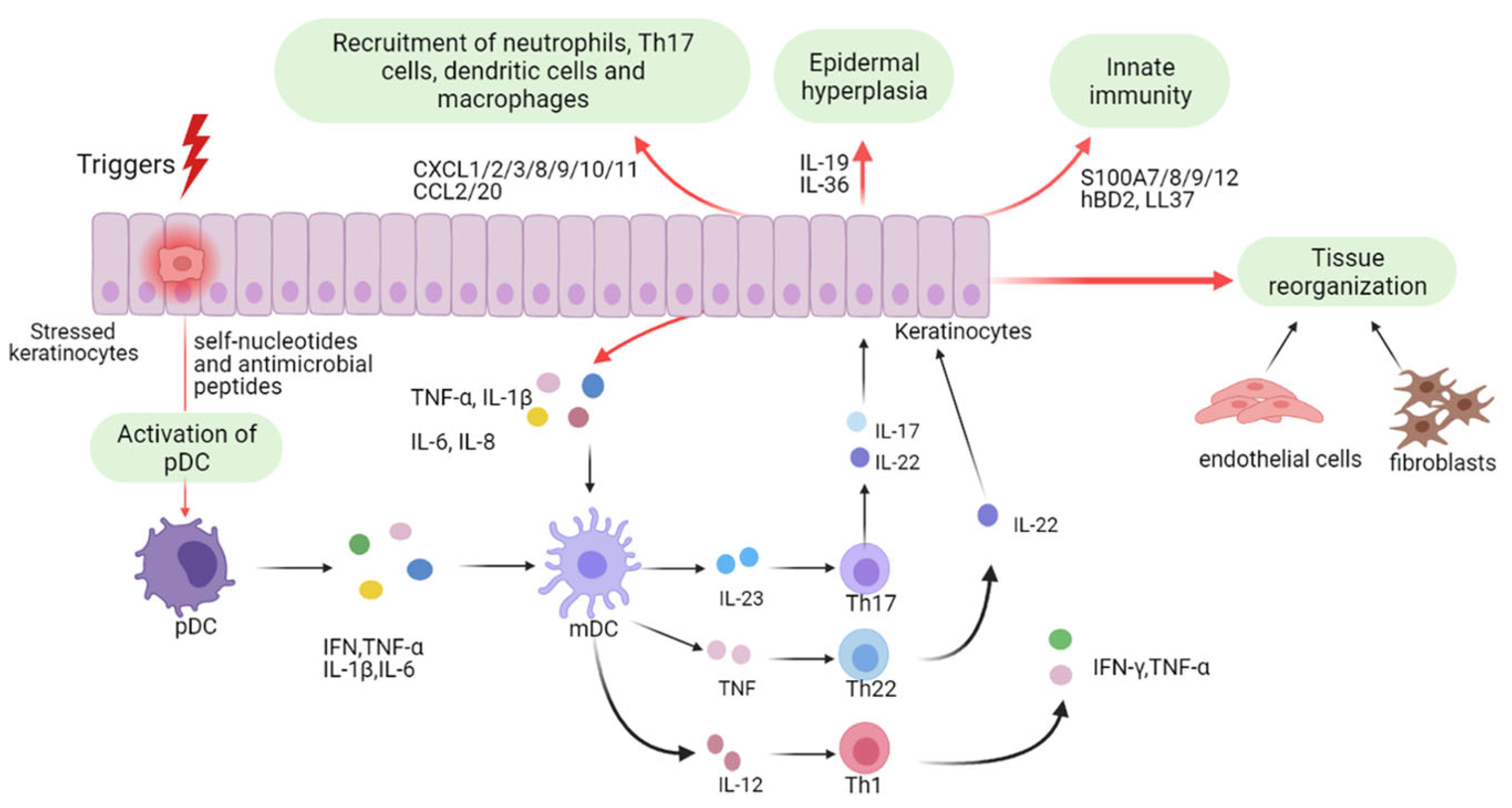
2. Overview of Psoriasis Pathophysiology
3. The Therapeutic Applications of Mesenchymal Stem Cells
4. Mesenchymal Stem Cell-Derived Conditioned Media and Psoriasis Therapy
5. Psoriasis Key Signaling Pathways
5.1. JAK Signaling and Psoriasis
5.2. NF-κB Signaling and Psoriasis
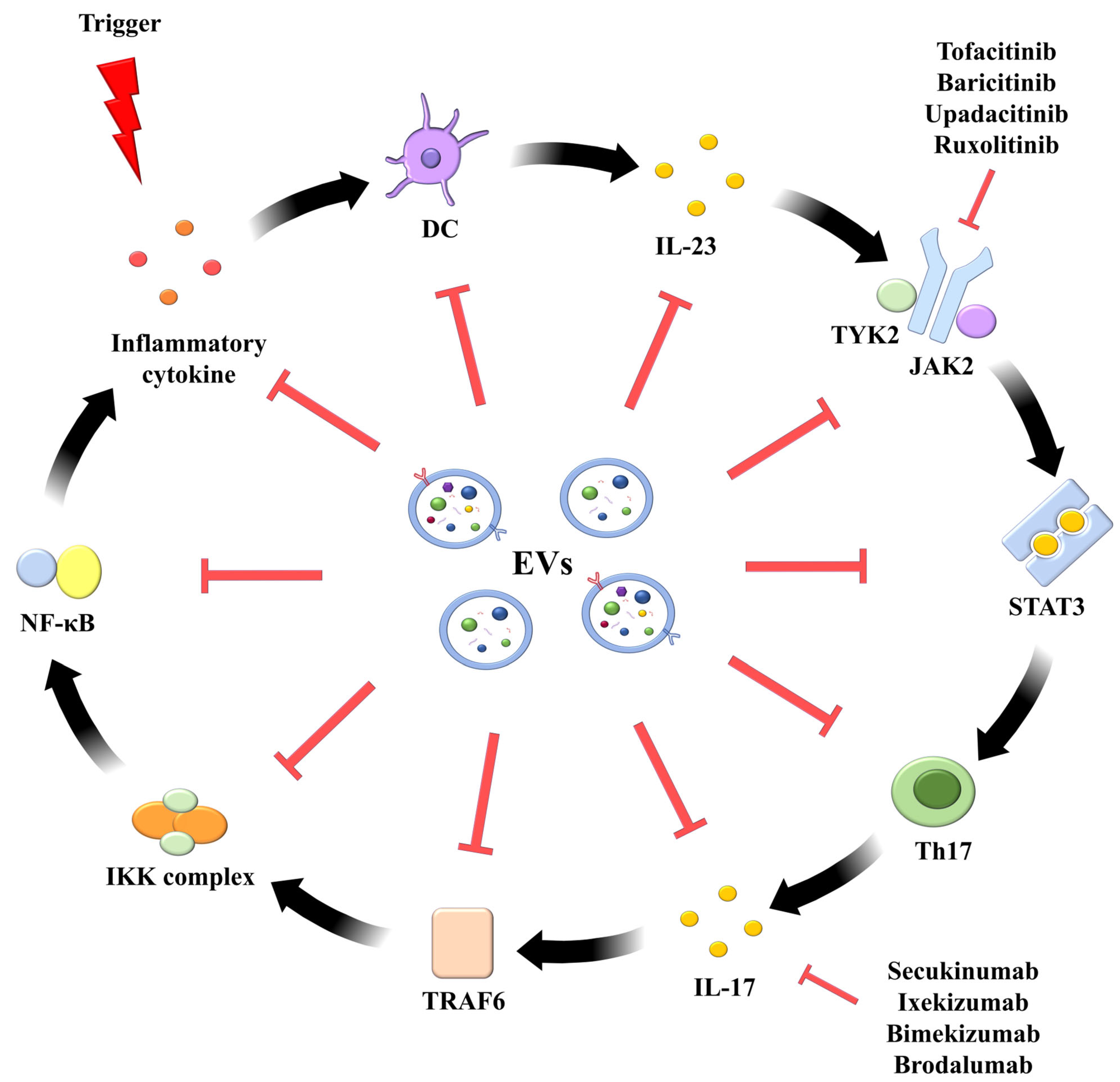
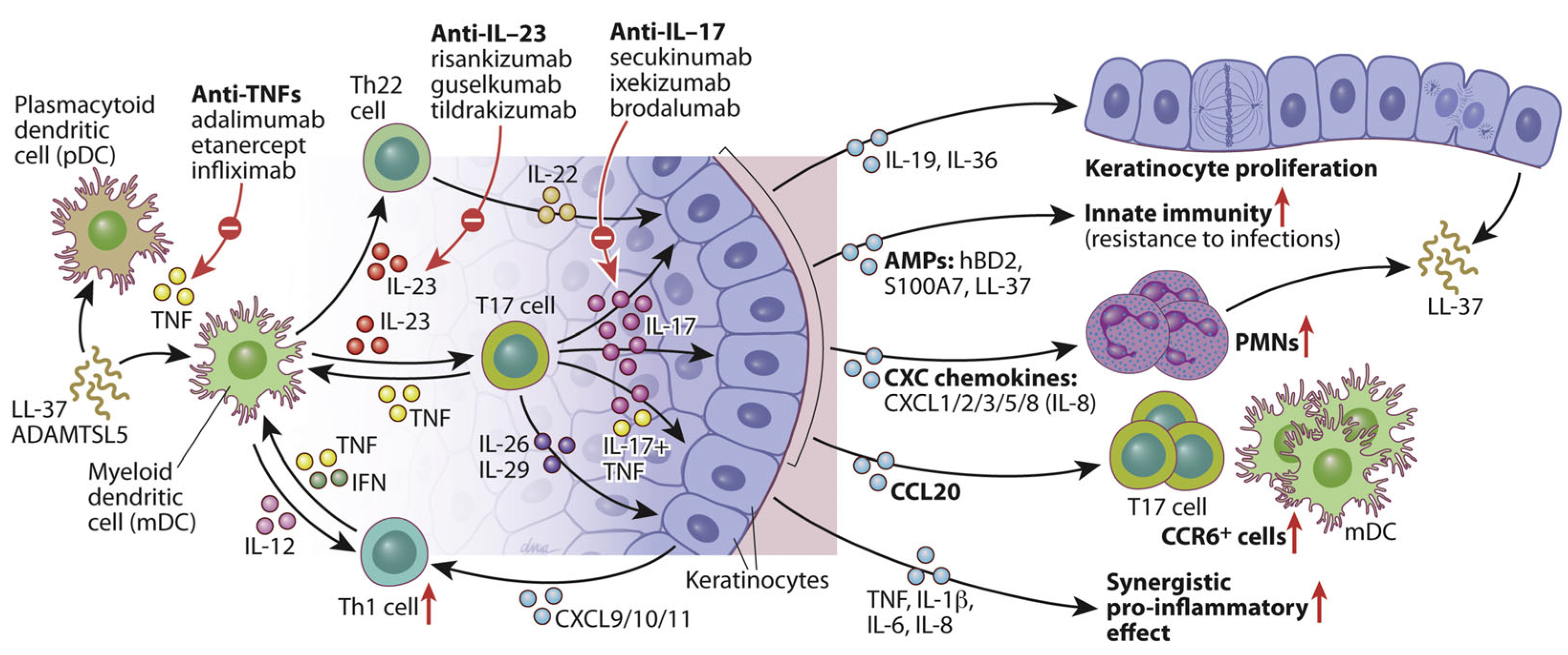
5.3. IL-23/IL-17 Axis–Targeted Therapies
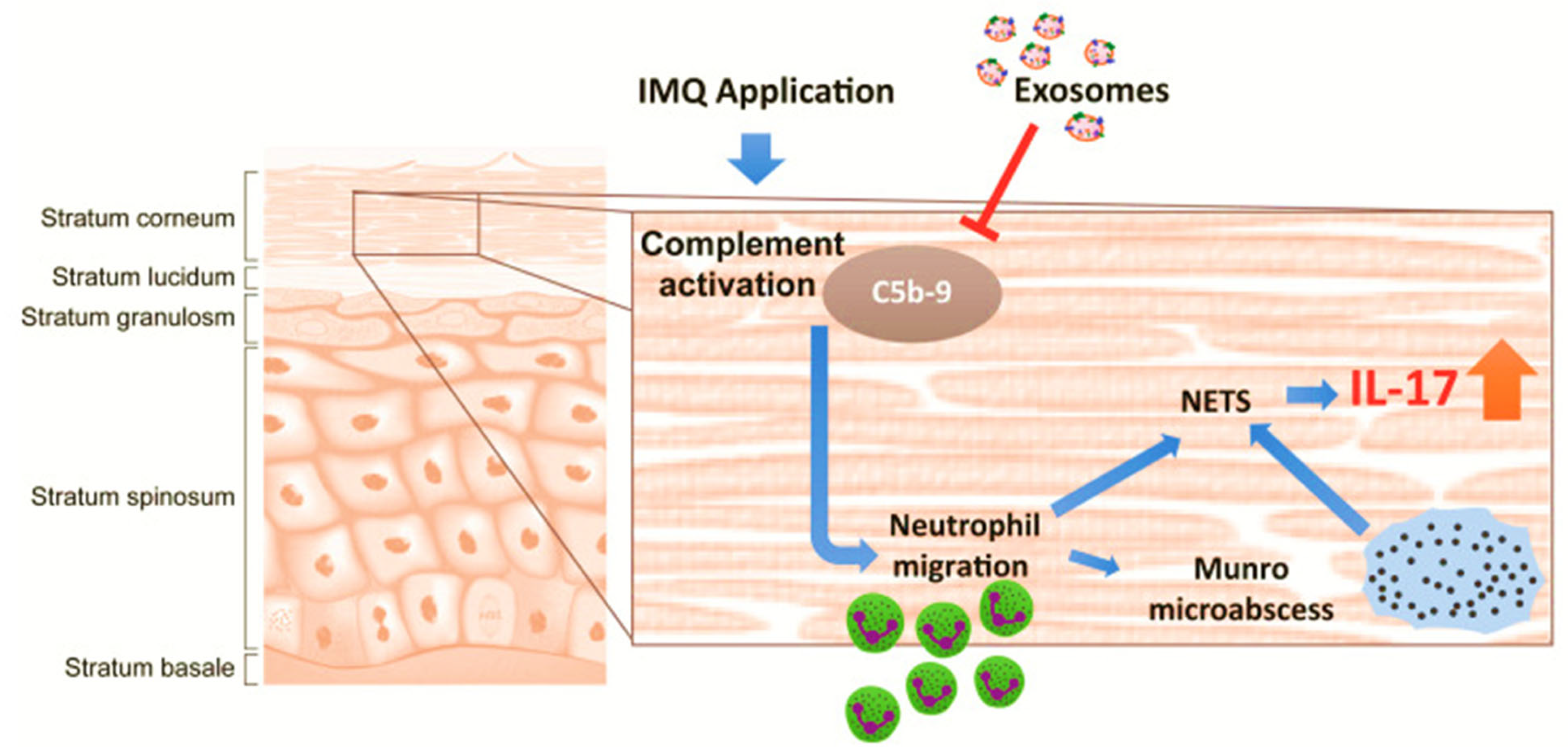
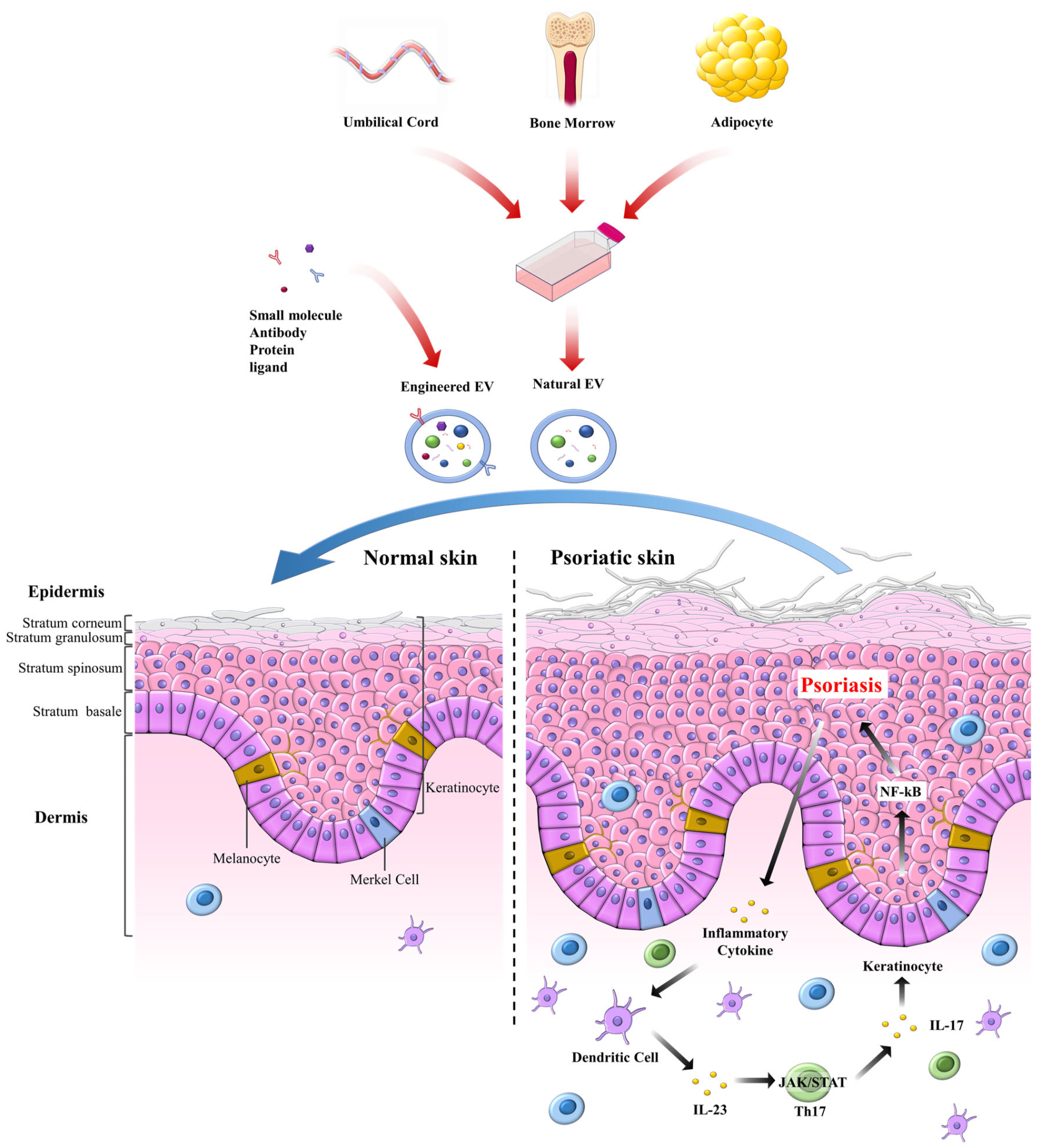
6. Extracellular Vesicles and Psoriasis Therapy
6.1. Stem Cell-EV in Psoriasis Therapy
6.2. Non-Stem Cell-Extracellular Vesicles in Psoriasis Therapy
6.3. Engineered Extracellular Vesicles-Based Psoriasis Therapy
7. Challenges and Future Perspectives
8. Conclusions
Author Contributions
Funding
Data Availability Statement
Conflicts of Interest
Abbreviations
| 2D | two-dimensional |
| 3D | three-dimensional |
| ACE | angiotensin-converting enzyme |
| ACT1 | Act1 adaptor protein |
| ADAMTSL5 | ADAMTS-like protein 5 |
| AD-MSCs | Adipose-Derived Mesenchymal Stem Cells |
| AKT | Protein kinase B |
| AKβBA | acetyl-11-keto-β-boswellic acid |
| ANXA1 | Annexin A1 |
| AP | Affinity-Precipitation |
| ARBs | angiotensin II receptor blockers |
| ASO-210 | anti–miR-210 antisense oligonucleotide |
| Arg1 | arginase-1 |
| Bcl-2 | B-cell lymphoma 2 |
| Bcl-xL | B-cell lymphoma-extra large |
| BSA | Body Surface Area |
| C/EBP | CCAAT/enhancer-binding protein |
| CARD14 | caspase recruitment domain-containing protein 14 |
| CCL2 | C-C motif chemokine ligand 2 |
| CD18hypo | CD18 hypomorphic |
| CD8 | cluster of differentiation 8 |
| cDCs | classical dendritic cells |
| CM | conditioned medium |
| CMC | Chemistry, manufacturing, and controls |
| COX-2 | cyclooxygenase-2 |
| CRAMP | cathelicidin-related antimicrobial peptide |
| CXCL8 | C-X-C motif chemokine ligand 8 |
| DCs | dendritic cells |
| dDCs | Dermal dendritic cells |
| DGs | Density gradients |
| DLQI | Dermatology Life Quality Index |
| ECM | Extracellular Matrix |
| EDAR | ectodysplasin A receptor |
| ERK1/2 | extracellular signal-regulated kinase 1 and 2 |
| ESC-MSCs | embryonic stem cell-derived MSCs |
| EVs | extracellular vesicles |
| EVs-shVDR | Extracellular vesicles derived from vitamin D receptor |
| FC | Filter concentration |
| FOXP3 | Forkhead box P3 |
| GEVs | grapefruit-derived extracellular vesicles-like nanovesicles |
| H3K9 | histone H3 at lysine 9 |
| H-MSCs | healthy donor MSCs |
| HLA | Human Leukocyte Antigen |
| ICAM-1 | Intercellular Adhesion Molecule-1 |
| IDO | indoleamine 2,3-dioxygenase |
| IFNs | interferons |
| IFNγ-sEVs | IFN-γ–stimulated UC-MSCs-EVs |
| IgG1κ | immunoglobulin G1 kappa |
| IKK | IκB kinase |
| IL17RB | interleukin-17 receptor B |
| IL-23 | interleukin-23 |
| IMQ | imiquimod |
| IP | Immuno-Precipitation |
| IκB | inhibitor of κB |
| JAK | Janus kinase |
| KCs | keratinocytes |
| Ly6G+ | Lymphocyte antigen 6G-positive |
| MAPK | mitogen-activated protein kinase |
| MAPP | Multinational Assessment of Psoriasis and Psoriatic Arthritis |
| MCP-1 | Monocyte Chemoattractant Protein-1 |
| mDCs | myeloid dendritic cells |
| MHC | major histocompatibility complex |
| miRNAs | microRNAs |
| MPO | myeloperoxidase |
| MSCs-CM | MSC-derived conditioned medium |
| MSCs | mesenchymal stem cells |
| mTOR | mechanistic target of rapamycin |
| NETs | neutrophil extracellular traps |
| NF-ΚB | Nuclear factor kappa-light-chain-enhancer of activated B cells |
| NK | natural killer |
| NSAIDs | nonsteroidal anti-inflammatory drugs |
| PASI | Psoriasis Area Severity Index |
| PBMCs | peripheral blood mononuclear cells |
| PD-1 | programmed death protein 1 |
| pDCs | plasmacytoid dendritic cells |
| PD-L1 | programmed death-ligand 1 |
| PGE2 | prostaglandin E2 |
| PI3K | Phosphatidylinositol 3-kinase |
| PSORS1 | psoriasis in the susceptibility-1 locus |
| PSSI | Psoriasis Scalp Severity Index |
| ROR | retinoid-related orphan receptor |
| ROS | releasing reactive oxygen species |
| si-AD-MSCs-EVs | Adipose-Derived Mesenchymal Stem Cells (AD-MSCs) s loaded with NF-κB siRNA |
| SEC | Size-exclusion chromatography |
| SNP | Single Nucleotide Polymorphism |
| STAT | signal transducer and activator of transcription |
| Tc17 | cytotoxic t cell 17 |
| TCR | T-cell receptor |
| TFC | tofacitinib |
| TFC-EVs | TFC within KC-derived extracellular vesicles |
| TFF | tangential flow filtration |
| TGF-β | transforming growth factor-beta |
| Th17 | T helper 17 |
| TNF-α | tumor necrosis factor-alpha |
| TRAF6 | TNF receptor-associated factor 6 |
| TSG-6 | factor-stimulated gene-6 |
| TYK2 | Tyrosine kinase 2 |
| UCB-MNC-Evs | umbilical cord blood mononuclear cells |
| UC-MSCs | umbilical cord mesenchymal stem cells |
| UVB | Ultraviolet B |
| VEGF | vascular endothelial growth factor |
| WJ-MSCs | Wharton’s jelly mesenchymal stem cells |
References
- Chen, H.H.; Abed, S.R. Update aetiopathogenesis and treatment of psoriasis: A literature review. J. Dermatol. Res. 2023, 4, 1–13. [Google Scholar] [CrossRef] [Scilit]
- Parisi, R.; Symmons, D.P.; Griffiths, C.E.; Ashcroft, D.M. Global epidemiology of psoriasis: A systematic review of incidence and prevalence. J. Investig. Dermatol. 2013, 133, 377–385. [Google Scholar] [CrossRef] [Scilit]
- Griffiths, C.E.; Armstrong, A.W.; Gudjonsson, J.E.; Barker, J.N. Psoriasis. Lancet 2021, 397, 1301–1315. [Google Scholar] [CrossRef] [Scilit] [PubMed]
- Kimmel, G.W.; Lebwohl, M. Psoriasis: Overview and Diagnosis. In Evidence-Based Psoriasis; Springer International Publishing: Cham, Switzerland, 2018; pp. 1–16. [Google Scholar] [CrossRef] [Scilit]
- Lebwohl, M.G.; Bachelez, H.; Barker, J.; Girolomoni, G.; Kavanaugh, A.; Langley, R.G.; Paul, C.F.; Puig, L.; Reich, K.; van de Kerkhof, P.C. Patient perspectives in the management of psoriasis: Results from the population-based Multinational Assessment of Psoriasis and Psoriatic Arthritis Survey. J. Am. Acad. Dermatol. 2014, 70, 871–881.e1-30. [Google Scholar] [CrossRef] [Scilit] [PubMed]
- Rachakonda, T.D.; Schupp, C.W.; Armstrong, A.W. Psoriasis prevalence among adults in the United States. J. Am. Acad. Dermatol. 2014, 70, 512–516. [Google Scholar] [CrossRef] [Scilit] [PubMed]
- Bechman, K.; Hayes, J.F.; Mathewman, J.; Henderson, A.D.; Adesanya, E.I.; Mansfield, K.E.; Smith, C.H.; Galloway, J.; Langan, S.M. Electronic screening for mental illness in patients with psoriasis. Br. J. Dermatol. 2023, 189, 246–248. [Google Scholar] [CrossRef] [Scilit]
- Hedemann, T.L.; Liu, X.; Kang, C.N.; Husain, M.I. Associations between psoriasis and mental illness: An update for clinicians. Gen. Hosp. Psychiatry 2022, 75, 30–37. [Google Scholar] [CrossRef] [Scilit]
- Craver, A.E.; Chen, G.F.; Fan, R.; Levey, D.F.; Cohen, J.M. Association between psoriasis and obsessive-compulsive disorder: A case-control study in the All of Us research program. Arch. Dermatol. Res. 2024, 316, 280. [Google Scholar] [CrossRef] [Scilit]
- Lee, H.; Lee, J.H.; Lee, S.; Lim, J.S.; Kim, H.J.; Park, J.; Lee, H.; Fond, G.; Boyer, L.; Smith, L. Comorbid health outcomes in patients with schizophrenia: An umbrella review of systematic reviews and meta-analyses. Mol. Psychiatry 2025, 30, 1127–1137. [Google Scholar] [CrossRef] [Scilit]
- Zhao, J.; Li, T.; Wang, J. Association between psoriasis and dementia: A systematic review. Neurologia 2024, 39, 55–62. [Google Scholar] [CrossRef] [Scilit]
- Krueger, G.; Koo, J.; Lebwohl, M.; Menter, A.; Stern, R.S.; Rolstad, T. The impact of psoriasis on quality of life: Results of a 1998 National Psoriasis Foundation patient-membership survey. Arch. Dermatol. 2001, 137, 280–284. [Google Scholar]
- Pariser, D.; Schenkel, B.; Carter, C.; Farahi, K.; Brown, T.M.; Ellis, C.N.; Psoriasis Patient Interview Study Group. A multicenter, non-interventional study to evaluate patient-reported experiences of living with psoriasis. J. Dermatol. Treat. 2016, 27, 19–26. [Google Scholar] [CrossRef] [Scilit]
- Rapp, S.R.; Feldman, S.R.; Exum, M.L.; Fleischer, A.B., Jr.; Reboussin, D.M. Psoriasis causes as much disability as other major medical diseases. J. Am. Acad. Dermatol. 1999, 41, 401–407. [Google Scholar] [CrossRef] [Scilit]
- Ghoreschi, K.; Balato, A.; Enerbäck, C.; Sabat, R. Therapeutics targeting the IL-23 and IL-17 pathway in psoriasis. Lancet 2021, 397, 754–766. [Google Scholar] [CrossRef] [Scilit]
- Bugaut, H.; Aractingi, S. Major role of the IL17/23 axis in psoriasis supports the development of new targeted therapies. Front. Immunol. 2021, 12, 621956. [Google Scholar] [CrossRef] [Scilit] [PubMed]
- Hawkes, J.E.; Yan, B.Y.; Chan, T.C.; Krueger, J.G. Discovery of the IL-23/IL-17 Signaling Pathway and the Treatment of Psoriasis. J. Immunol. 2018, 201, 1605–1613. [Google Scholar] [CrossRef] [Scilit]
- Girolomoni, G.; Strohal, R.; Puig, L.; Bachelez, H.; Barker, J.; Boehncke, W.H.; Prinz, J.C. The role of IL-23 and the IL-23/T(H) 17 immune axis in the pathogenesis and treatment of psoriasis. J. Eur. Acad. Dermatol. Venereol. 2017, 31, 1616–1626. [Google Scholar] [CrossRef] [Scilit] [PubMed]
- Afonina, I.S.; Van Nuffel, E.; Beyaert, R. Immune responses and therapeutic options in psoriasis. Cell Mol. Life Sci. 2021, 78, 2709–2727. [Google Scholar] [CrossRef] [Scilit] [PubMed]
- Liu, T.; Li, S.; Ying, S.; Tang, S.; Ding, Y.; Li, Y.; Qiao, J.; Fang, H. The IL-23/IL-17 pathway in inflammatory skin diseases: From bench to bedside. Front. Immunol. 2020, 11, 594735. [Google Scholar] [CrossRef] [Scilit]
- Tesmer, L.A.; Lundy, S.K.; Sarkar, S.; Fox, D.A. Th17 cells in human disease. Immunol. Rev. 2008, 223, 87–113. [Google Scholar] [CrossRef] [Scilit]
- Jiang, Y.; Tsoi, L.C.; Billi, A.C.; Ward, N.L.; Harms, P.W.; Zeng, C.; Maverakis, E.; Kahlenberg, J.M.; Gudjonsson, J.E. Cytokinocytes: The diverse contribution of keratinocytes to immune responses in skin. JCI Insight 2020, 5, e142067. [Google Scholar] [CrossRef] [Scilit]
- Piipponen, M.; Li, D.; Landén, N.X. The Immune Functions of Keratinocytes in Skin Wound Healing. Int. J. Mol. Sci. 2020, 21, 8790. [Google Scholar] [CrossRef] [Scilit] [PubMed]
- Alunno, A.; Carubbi, F.; Cafaro, G.; Pucci, G.; Battista, F.; Bartoloni, E.; Giacomelli, R.; Schillaci, G.; Gerli, R. Targeting the IL-23/IL-17 axis for the treatment of psoriasis and psoriatic arthritis. Expert. Opin. Biol. Ther. 2015, 15, 1727–1737. [Google Scholar] [CrossRef] [Scilit]
- Rendon, A.; Schäkel, K. Psoriasis Pathogenesis and Treatment. Int. J. Mol. Sci. 2019, 20, 1475. [Google Scholar] [CrossRef] [Scilit] [PubMed]
- Iuliano, M.; Grimaldi, L.; Rosa, P.; Scibetta, S.; Bernardini, N.; Proietti, I.; Tolino, E.; Skroza, N.; Potenza, C.; Mangino, G.; et al. Extracellular vescicles in psoriasis: From pathogenesis to possible roles in therapy. Front. Immunol. 2024, 15, 1360618. [Google Scholar] [CrossRef] [Scilit] [PubMed]
- Born, L.J.; Khachemoune, A. Extracellular vesicles: A comprehensive review of their roles as biomarkers and potential therapeutics in psoriasis and psoriatic arthritis. Clin. Exp. Dermatol. 2022, 48, 310–318. [Google Scholar] [CrossRef] [Scilit]
- Park, Y.J.; Kim, D.C.; Lee, S.-J.; Kim, H.S.; Pak, J.Y.; Kim, J.; Cheong, J.Y.; Lee, E.-S. Keratinocyte-derived circulating microRNAs in extracellular vesicles: A novel biomarker of psoriasis severity and potential therapeutic target. J. Transl. Med. 2024, 22, 235. [Google Scholar] [CrossRef] [Scilit]
- Kumar, M.A.; Baba, S.K.; Sadida, H.Q.; Marzooqi, S.A.; Jerobin, J.; Altemani, F.H.; Algehainy, N.; Alanazi, M.A.; Abou-Samra, A.-B.; Kumar, R. Extracellular vesicles as tools and targets in therapy for diseases. Signal Transduct. Target. Ther. 2024, 9, 27. [Google Scholar] [CrossRef] [Scilit]
- Zaborowski, M.P.; Balaj, L.; Breakefield, X.O.; Lai, C.P. Extracellular Vesicles: Composition, Biological Relevance, and Methods of Study. Bioscience 2015, 65, 783–797. [Google Scholar] [CrossRef] [Scilit]
- Favaro, R.R.; Murrieta-Coxca, J.M.; Gutiérrez-Samudio, R.N.; Morales-Prieto, D.M.; Markert, U.R. Immunomodulatory properties of extracellular vesicles in the dialogue between placental and immune cells. Am. J. Reprod. Immunol. 2021, 85, e13383. [Google Scholar] [CrossRef] [Scilit]
- Mahmoudi, F.; Hanachi, P.; Montaseri, A. Extracellular vesicles of immune cells; immunomodulatory impacts and therapeutic potentials. Clin. Immunol. 2023, 248, 109237. [Google Scholar] [CrossRef] [Scilit] [PubMed]
- Lai, R.C.; Tan, T.T.; Sim, W.K.; Zhang, B.; Lim, S.K. A roadmap from research to clinical testing of mesenchymal stromal cell exosomes in the treatment of psoriasis. Cytotherapy 2023, 25, 815–820. [Google Scholar] [CrossRef] [Scilit]
- Qi, F.; Jin, H. Extracellular vesicles from keratinocytes and other skin-related cells in psoriasis: A review. Exp. Dermatol. 2024, 33, e15001. [Google Scholar] [CrossRef] [Scilit]
- Wang, J.; Yuan, S.; Tu, Y.; Lv, Z.; Cheng, H.; Ding, X. Extracellular vesicles in skin health, diseases, and aging. Interdiscip. Med. 2024, 2, e20240011. [Google Scholar] [CrossRef] [Scilit]
- Wen, X.; Hao, Z.; Yin, H.; Min, J.; Wang, X.; Sun, S.; Ruan, G. Engineered Extracellular Vesicles as a New Class of Nanomedicine. Chem. Bio Eng. 2025, 2, 3–22. [Google Scholar] [CrossRef] [Scilit]
- de Jong, B.; Barros, E.R.; Hoenderop, J.G.J.; Rigalli, J.P. Recent Advances in Extracellular Vesicles as Drug Delivery Systems and Their Potential in Precision Medicine. Pharmaceutics 2020, 12, 1006. [Google Scholar] [CrossRef] [Scilit]
- Song, M.; Lim, K.M.; Song, K.; Kang, G.H.; Kim, S.J.; Lee, Y.; Yu, S.; Jeong, K.H.; Cho, S.G. Efficient Treatment of Psoriasis Using Conditioned Media from Mesenchymal Stem Cell Spheroids Cultured to Produce Transforming Growth Factor-β1-Enriched Small-Sized Extracellular Vesicles. Int. J. Stem Cells 2024, 17, 407–417. [Google Scholar] [CrossRef] [Scilit] [PubMed]
- Wei, J.C.; Shi, L.H.; Huang, J.Y.; Wu, X.F.; Wu, R.; Chiou, J.Y. Epidemiology and Medication Pattern Change of Psoriatic Diseases in Taiwan from 2000 to 2013: A Nationwide, Population-based Cohort Study. J. Rheumatol. 2018, 45, 385–392. [Google Scholar] [CrossRef] [Scilit] [PubMed]
- Raharja, A.; Mahil, S.K.; Barker, J.N. Psoriasis: A brief overview. Clin. Med. 2021, 21, 170–173. [Google Scholar] [CrossRef] [Scilit]
- Armstrong, A.W. Psoriasis. JAMA Dermatol. 2017, 153, 956. [Google Scholar] [CrossRef] [Scilit]
- Guttman-Yassky, E.; Krueger, J.G. Atopic dermatitis and psoriasis: Two different immune diseases or one spectrum? Curr. Opin. Immunol. 2017, 48, 68–73. [Google Scholar] [CrossRef] [Scilit]
- Perera, G.K.; Di Meglio, P.; Nestle, F.O. Psoriasis. Annu. Rev. Pathol. 2012, 7, 385–422. [Google Scholar] [CrossRef] [Scilit]
- Zhang, B.; Yin, Y.; Lai, R.C.; Lim, S.K. Immunotherapeutic potential of extracellular vesicles. Front. Immunol. 2014, 5, 518. [Google Scholar] [CrossRef] [Scilit]
- Mahil, S.K.; Capon, F.; Barker, J.N. Update on psoriasis immunopathogenesis and targeted immunotherapy. Semin. Immunopathol. 2016, 38, 11–27. [Google Scholar] [CrossRef] [Scilit] [PubMed]
- Basavaraj, K.H.; Ashok, N.M.; Rashmi, R.; Praveen, T.K. The role of drugs in the induction and/or exacerbation of psoriasis. Int. J. Dermatol. 2010, 49, 1351–1361. [Google Scholar] [CrossRef] [Scilit] [PubMed]
- Gilleaudeau, P.; Vallat, V.; Carter, D.; Gottlieb, A. Angiotensin-converting enzyme inhibitors as possible exacerbating drugs in psoriasis. J. Am. Acad. Dermatol. 1993, 28, 490–492. [Google Scholar] [CrossRef] [Scilit]
- Marquart-Elbaz, C.; Grosshans, E.; Alt, M.; Lipsker, D. Sartans, angiotensin II receptor antagonists, can induce psoriasis. Br. J. Dermatol. 2002, 147, 617–618. [Google Scholar] [CrossRef] [Scilit] [PubMed]
- Brauchli, Y.; Jick, S.; Curtin, F.; Meier, C. Association between β-blockers, other antihypertensive drugs and psoriasis: Population-based case–control study. Br. J. Dermatol. 2008, 158, 1299–1307. [Google Scholar] [CrossRef] [Scilit]
- Schleicher, S.M. Psoriasis: Pathogenesis, assessment, and therapeutic update. Clin. Podiatr. Med. Surg. 2016, 33, 355–366. [Google Scholar] [CrossRef] [Scilit]
- Kõks, S.; Keermann, M.; Reimann, E.; Prans, E.; Abram, K.; Silm, H.; Kõks, G.; Kingo, K. Psoriasis-specific RNA isoforms identified by RNA-seq analysis of 173,446 transcripts. Front. Med. 2016, 3, 46. [Google Scholar] [CrossRef] [Scilit]
- Song, J.-K.; Yin, S.-Y.; Li, W.; Li, X.-D.; Luo, Y.; Luo, Y.; Xing, M.; Li, B.; Kuai, L. An update on the role of long non-coding RNAs in psoriasis. Chin. Med. J. 2021, 134, 379–389. [Google Scholar] [CrossRef] [Scilit] [PubMed]
- Zhou, Q.; Yu, Q.; Gong, Y.; Liu, Z.; Xu, H.; Wang, Y.; Shi, Y. Construction of a lncRNA-miRNA-mRNA network to determine the regulatory roles of lncRNAs in psoriasis. Exp. Ther. Med. 2019, 18, 4011–4021. [Google Scholar] [CrossRef] [Scilit] [PubMed]
- Gisondi, P.; Fostini, A.C.; Fossà, I.; Girolomoni, G.; Targher, G. Psoriasis and the metabolic syndrome. Clin. Dermatol. 2018, 36, 21–28. [Google Scholar] [CrossRef] [Scilit]
- Billi, A.C.; Gudjonsson, J.E.; Voorhees, J.J. Psoriasis: Past, present, and future. J. Investig. Dermatol. 2019, 139, e133. [Google Scholar] [CrossRef] [Scilit]
- Ogawa, E.; Sato, Y.; Minagawa, A.; Okuyama, R. Pathogenesis of psoriasis and development of treatment. J. Dermatol. 2018, 45, 264–272. [Google Scholar] [CrossRef] [Scilit]
- Jiang, M.; Fang, H.; Shao, S.; Dang, E.; Zhang, J.; Qiao, P.; Yang, A.; Wang, G. Keratinocyte exosomes activate neutrophils and enhance skin inflammation in psoriasis. FASEB J. 2019, 33, 13241–13253. [Google Scholar] [CrossRef] [Scilit]
- Griffiths, C.E.; Barker, J.N. Pathogenesis and clinical features of psoriasis. Lancet 2007, 370, 263–271. [Google Scholar] [CrossRef] [Scilit]
- van de Kerkhof, P.C. Update on retinoid therapy of psoriasis in: An update on the use of retinoids in dermatology. Dermatol. Ther. 2006, 19, 252–263. [Google Scholar] [CrossRef] [Scilit]
- Nair, R.P.; Stuart, P.E.; Nistor, I.; Hiremagalore, R.; Chia, N.V.; Jenisch, S.; Weichenthal, M.; Abecasis, G.R.; Lim, H.W.; Christophers, E. Sequence and haplotype analysis supports HLA-C as the psoriasis susceptibility 1 gene. Am. J. Hum. Genet. 2006, 78, 827–851. [Google Scholar] [CrossRef] [Scilit]
- Tsoi, L.C.; Stuart, P.E.; Tian, C.; Gudjonsson, J.E.; Das, S.; Zawistowski, M.; Ellinghaus, E.; Barker, J.N.; Chandran, V.; Dand, N. Large scale meta-analysis characterizes genetic architecture for common psoriasis associated variants. Nat. Commun. 2017, 8, 15382. [Google Scholar] [CrossRef] [Scilit] [PubMed]
- Elder, J.T.; Bruce, A.T.; Gudjonsson, J.E.; Johnston, A.; Stuart, P.E.; Tejasvi, T.; Voorhees, J.J.; Abecasis, G.R.; Nair, R.P. Molecular dissection of psoriasis: Integrating genetics and biology. J. Investig. Dermatol. 2010, 130, 1213–1226. [Google Scholar] [CrossRef] [Scilit]
- Greb, J.E.; Goldminz, A.M.; Elder, J.T.; Lebwohl, M.G.; Gladman, D.D.; Wu, J.J.; Mehta, N.N.; Finlay, A.Y.; Gottlieb, A.B. Psoriasis. Nat. Rev. Dis. Primers 2016, 2, 16082. [Google Scholar] [CrossRef] [Scilit]
- Lowes, M.A.; Russell, C.B.; Martin, D.A.; Towne, J.E.; Krueger, J.G. The IL-23/T17 pathogenic axis in psoriasis is amplified by keratinocyte responses. Trends Immunol. 2013, 34, 174–181. [Google Scholar] [CrossRef] [Scilit]
- Nestle, F.O.; Kaplan, D.H.; Barker, J. Psoriasis. N. Engl. J. Med. 2009, 361, 496–509. [Google Scholar] [CrossRef] [Scilit] [PubMed]
- Hawkes, J.E.; Chan, T.C.; Krueger, J.G. Psoriasis pathogenesis and the development of novel targeted immune therapies. J. Allergy Clin. Immunol. 2017, 140, 645–653. [Google Scholar] [CrossRef] [Scilit] [PubMed]
- Wang, Z.; Zhou, H.; Zheng, H.; Zhou, X.; Shen, G.; Teng, X.; Liu, X.; Zhang, J.; Wei, X.; Hu, Z.; et al. Autophagy-based unconventional secretion of HMGB1 by keratinocytes plays a pivotal role in psoriatic skin inflammation. Autophagy 2021, 17, 529–552. [Google Scholar] [CrossRef] [Scilit]
- Zhou, X.; Chen, Y.; Cui, L.; Shi, Y.; Guo, C. Advances in the pathogenesis of psoriasis: From keratinocyte perspective. Cell Death Dis. 2022, 13, 81. [Google Scholar] [CrossRef] [Scilit]
- Liu, S.; He, M.; Jiang, J.; Duan, X.; Chai, B.; Zhang, J.; Tao, Q.; Chen, H. Triggers for the onset and recurrence of psoriasis: A review and update. Cell Commun. Signal. 2024, 22, 108. [Google Scholar] [CrossRef] [Scilit]
- Lande, R.; Gilliet, M. Plasmacytoid dendritic cells: Key players in the initiation and regulation of immune responses. Ann. N. Y. Acad. Sci. 2010, 1183, 89–103. [Google Scholar] [CrossRef] [Scilit] [PubMed]
- Kamata, M.; Tada, Y. Dendritic cells and macrophages in the pathogenesis of psoriasis. Front. Immunol. 2022, 13, 941071. [Google Scholar] [CrossRef] [Scilit]
- Bissonnette, R.; Papp, K.; Maari, C.; Yao, Y.; Robbie, G.; White, W.I.; Le, C.; White, B. A randomized, double-blind, placebo-controlled, phase I study of MEDI-545, an anti-interferon-alfa monoclonal antibody, in subjects with chronic psoriasis. J. Am. Acad. Dermatol. 2010, 62, 427–436. [Google Scholar] [CrossRef] [Scilit]
- Chiricozzi, A.; Guttman-Yassky, E.; Suarez-Farinas, M.; Nograles, K.E.; Tian, S.; Cardinale, I.; Chimenti, S.; Krueger, J.G. Integrative responses to IL-17 and TNF-α in human keratinocytes account for key inflammatory pathogenic circuits in psoriasis. J. Investig. Dermatol. 2011, 131, 677–687. [Google Scholar] [CrossRef] [Scilit]
- Lin, A.M.; Rubin, C.J.; Khandpur, R.; Wang, J.Y.; Riblett, M.; Yalavarthi, S.; Villanueva, E.C.; Shah, P.; Kaplan, M.J.; Bruce, A.T. Mast Cells and Neutrophils Release IL-17 through Extracellular Trap Formation in Psoriasis. J. Immunol. 2011, 187, 490–500. [Google Scholar] [CrossRef] [Scilit]
- Kuraitis, D.; Rosenthal, N.; Boh, E.; McBurney, E. Macrophages in dermatology: Pathogenic roles and targeted therapeutics. Arch. Dermatol. Res. 2022, 314, 133–140. [Google Scholar] [CrossRef] [Scilit]
- Hou, Y.; Zhu, L.; Tian, H.; Sun, H.X.; Wang, R.; Zhang, L.; Zhao, Y. IL-23-induced macrophage polarization and its pathological roles in mice with imiquimod-induced psoriasis. Protein Cell 2018, 9, 1027–1038. [Google Scholar] [CrossRef] [Scilit]
- Chen, Y.; Hu, Y.; Zhou, X.; Zhao, Z.; Yu, Q.; Chen, Z.; Wang, Y.; Xu, P.; Yu, Z.; Guo, C.; et al. Human umbilical cord-derived mesenchymal stem cells ameliorate psoriasis-like dermatitis by suppressing IL-17-producing γδ T cells. Cell Tissue Res. 2022, 388, 549–563. [Google Scholar] [CrossRef] [Scilit]
- Langrish, C.L.; McKenzie, B.S.; Wilson, N.J.; de Waal Malefyt, R.; Kastelein, R.A.; Cua, D.J. IL-12 and IL-23: Master regulators of innate and adaptive immunity. Immunol. Rev. 2004, 202, 96–105. [Google Scholar] [CrossRef] [Scilit]
- Wilson, N.J.; Boniface, K.; Chan, J.R.; McKenzie, B.S.; Blumenschein, W.M.; Mattson, J.D.; Basham, B.; Smith, K.; Chen, T.; Morel, F.; et al. Development, cytokine profile and function of human interleukin 17-producing helper T cells. Nat. Immunol. 2007, 8, 950–957. [Google Scholar] [CrossRef] [Scilit] [PubMed]
- Yoshiki, R.; Kabashima, K.; Honda, T.; Nakamizo, S.; Sawada, Y.; Sugita, K.; Yoshioka, H.; Ohmori, S.; Malissen, B.; Tokura, Y.; et al. IL-23 from Langerhans cells is required for the development of imiquimod-induced psoriasis-like dermatitis by induction of IL-17A-producing γδ T cells. J. Investig. Dermatol. 2014, 134, 1912–1921. [Google Scholar] [CrossRef] [Scilit] [PubMed]
- Wohn, C.; Ober-Blobaum, J.L.; Haak, S.; Pantelyushin, S.; Cheong, C.; Zahner, S.P.; Onderwater, S.; Kant, M.; Weighardt, H.; Holzmann, B.; et al. Langerin(neg) conventional dendritic cells produce IL-23 to drive psoriatic plaque formation in mice. Proc. Natl. Acad. Sci. USA 2013, 110, 10723–10728. [Google Scholar] [CrossRef] [Scilit] [PubMed]
- Arnold, I.C.; Mathisen, S.; Schulthess, J.; Danne, C.; Hegazy, A.N.; Powrie, F. CD11c(+) monocyte/macrophages promote chronic Helicobacter hepaticus-induced intestinal inflammation through the production of IL-23. Mucosal Immunol. 2016, 9, 352–363. [Google Scholar] [CrossRef] [Scilit]
- Levin, A.A.; Gottlieb, A.B. Specific targeting of interleukin-23p19 as effective treatment for psoriasis. J. Am. Acad. Dermatol. 2014, 70, 555–561. [Google Scholar] [CrossRef] [Scilit]
- Mathur, A.N.; Chang, H.C.; Zisoulis, D.G.; Stritesky, G.L.; Yu, Q.; O’Malley, J.T.; Kapur, R.; Levy, D.E.; Kansas, G.S.; Kaplan, M.H. Stat3 and Stat4 direct development of IL-17-secreting Th cells. J. Immunol. 2007, 178, 4901–4907. [Google Scholar] [CrossRef] [Scilit] [PubMed]
- Liang, S.C.; Tan, X.Y.; Luxenberg, D.P.; Karim, R.; Dunussi-Joannopoulos, K.; Collins, M.; Fouser, L.A. Interleukin (IL)-22 and IL-17 are coexpressed by Th17 cells and cooperatively enhance expression of antimicrobial peptides. J. Exp. Med. 2006, 203, 2271–2279. [Google Scholar] [CrossRef] [Scilit]
- Chiricozzi, A.; Nograles, K.E.; Johnson-Huang, L.M.; Fuentes-Duculan, J.; Cardinale, I.; Bonifacio, K.M.; Gulati, N.; Mitsui, H.; Guttman-Yassky, E.; Suarez-Farinas, M.; et al. IL-17 induces an expanded range of downstream genes in reconstituted human epidermis model. PLoS ONE 2014, 9, e90284. [Google Scholar] [CrossRef] [Scilit]
- Campanati, A.; Orciani, M.; Sorgentoni, G.; Consales, V.; Mattioli Belmonte, M.; Di Primio, R.; Offidani, A. Indirect co-cultures of healthy mesenchymal stem cells restore the physiological phenotypical profile of psoriatic mesenchymal stem cells. Clin. Exp. Immunol. 2018, 193, 234–240. [Google Scholar] [CrossRef] [Scilit]
- Cheng, L.; Wang, S.; Peng, C.; Zou, X.; Yang, C.; Mei, H.; Li, C.; Su, X.; Xiao, N.; Ouyang, Q.; et al. Human umbilical cord mesenchymal stem cells for psoriasis: A phase 1/2a, single-arm study. Signal Transduct. Target. Ther. 2022, 7, 263. [Google Scholar] [CrossRef] [Scilit] [PubMed]
- Jiang, M.; Fang, H.; Dang, E.; Zhang, J.; Qiao, P.; Yu, C.; Yang, A.; Wang, G. Small Extracellular Vesicles Containing miR-381-3p from Keratinocytes Promote T Helper Type 1 and T Helper Type 17 Polarization in Psoriasis. J. Investig. Dermatol. 2021, 141, 563–574. [Google Scholar] [CrossRef] [Scilit] [PubMed]
- Krueger, J.G. An autoimmune “attack” on melanocytes triggers psoriasis and cellular hyperplasia. J. Exp. Med. 2015, 212, 2186. [Google Scholar] [CrossRef] [Scilit]
- Arakawa, A.; Siewert, K.; Stohr, J.; Besgen, P.; Kim, S.M.; Ruhl, G.; Nickel, J.; Vollmer, S.; Thomas, P.; Krebs, S.; et al. Melanocyte antigen triggers autoimmunity in human psoriasis. J. Exp. Med. 2015, 212, 2203–2212. [Google Scholar] [CrossRef] [Scilit]
- Marino, L.; Castaldi, M.A.; Rosamilio, R.; Ragni, E.; Vitolo, R.; Fulgione, C.; Castaldi, S.G.; Serio, B.; Bianco, R.; Guida, M.; et al. Mesenchymal Stem Cells from the Wharton’s Jelly of the Human Umbilical Cord: Biological Properties and Therapeutic Potential. Int. J. Stem Cells 2019, 12, 218–226. [Google Scholar] [CrossRef] [Scilit]
- Li, L.; Lu, J.; Liu, J.; Wu, J.; Zhang, X.; Meng, Y.; Wu, X.; Tai, Z.; Zhu, Q.; Chen, Z. Immune cells in the epithelial immune microenvironment of psoriasis: Emerging therapeutic targets. Front. Immunol. 2023, 14, 1340677. [Google Scholar] [CrossRef] [Scilit]
- Chen, M.; Peng, J.; Xie, Q.; Xiao, N.; Su, X.; Mei, H.; Lu, Y.; Zhou, J.; Dai, Y.; Wang, S.; et al. Mesenchymal Stem Cells Alleviate Moderate-to-Severe Psoriasis by Reducing the Production of Type I Interferon (IFN-I) by Plasmacytoid Dendritic Cells (pDCs). Stem Cells Int. 2019, 2019, 6961052. [Google Scholar] [CrossRef] [Scilit]
- Iwaszko, M.; Bialy, S.; Bogunia-Kubik, K. Significance of Interleukin (IL)-4 and IL-13 in Inflammatory Arthritis. Cells 2021, 10, 3000. [Google Scholar] [CrossRef] [Scilit]
- Moniaga, C.S.; Tominaga, M.; Takamori, K. The Pathology of Type 2 Inflammation-Associated Itch in Atopic Dermatitis. Diagnostics 2021, 11, 2090. [Google Scholar] [CrossRef] [Scilit]
- Ren, X.; Zhong, W.; Li, W.; Tang, M.; Zhang, K.; Zhou, F.; Shi, X.; Wu, J.; Yu, B.; Huang, C.; et al. Human Umbilical Cord-Derived Mesenchymal Stem Cells Alleviate Psoriasis Through TNF-α/NF-κB/MMP13 Pathway. Inflammation 2023, 46, 987–1001. [Google Scholar] [CrossRef] [Scilit] [PubMed]
- Cuesta-Gomez, N.; Medina-Ruiz, L.; Graham, G.J.; Campbell, J.D.M. IL-6 and TGF-β-Secreting Adoptively-Transferred Murine Mesenchymal Stromal Cells Accelerate Healing of Psoriasis-like Skin Inflammation and Upregulate IL-17A and TGF-β. Int. J. Mol. Sci. 2023, 24, 10132. [Google Scholar] [CrossRef] [Scilit] [PubMed]
- Carey, A.J.; Tan, C.K.; Ulett, G.C. Infection-induced IL-10 and JAK-STAT: A review of the molecular circuitry controlling immune hyperactivity in response to pathogenic microbes. Jak-Stat 2012, 1, 159–167. [Google Scholar] [CrossRef] [Scilit]
- Hovsepian, E.; Penas, F.; Siffo, S.; Mirkin, G.A.; Goren, N.B. IL-10 inhibits the NF-κB and ERK/MAPK-mediated production of pro-inflammatory mediators by up-regulation of SOCS-3 in Trypanosoma cruzi-infected cardiomyocytes. PLoS ONE 2013, 8, e79445. [Google Scholar] [CrossRef] [Scilit]
- Wang, W.; Qu, R.; Wang, X.; Zhang, M.; Zhang, Y.; Chen, C.; Chen, X.; Qiu, C.; Li, J.; Pan, X.; et al. GDF11 Antagonizes Psoriasis-like Skin Inflammation via Suppression of NF-κB Signaling Pathway. Inflammation 2019, 42, 319–330. [Google Scholar] [CrossRef] [Scilit] [PubMed]
- Han, G.; Williams, C.A.; Salter, K.; Garl, P.J.; Li, A.G.; Wang, X.J. A role for TGFβ signaling in the pathogenesis of psoriasis. J. Investig. Dermatol. 2010, 130, 371–377. [Google Scholar] [CrossRef] [Scilit]
- Kwiecinska, P.; Santocki, M.; Skrzeczynska-Moncznik, J.; Sinkevich, I.; Piwowarczyk, K.; Majewski, P.; Grygier, B.; Majchrzak-Gorecka, M.; Czyz, J.; Kolaczkowska, E.; et al. SLPI controls neutrophil migration abilities and impacts neutrophil skin infiltration in experimental psoriasis. Cell. Mol. Life Sci. 2025, 82, 74. [Google Scholar] [CrossRef] [Scilit]
- Lee, Y.S.; Sah, S.K.; Lee, J.H.; Seo, K.W.; Kang, K.S.; Kim, T.Y. Human umbilical cord blood-derived mesenchymal stem cells ameliorate psoriasis-like skin inflammation in mice. Biochem. Biophys. Rep. 2017, 9, 281–288. [Google Scholar] [CrossRef] [Scilit] [PubMed]
- Ding, Y.; Gong, P.; Jiang, J.; Feng, C.; Li, Y.; Su, X.; Bai, X.; Xu, C.; Liu, C.; Yang, J.; et al. Mesenchymal stem/stromal cells primed by inflammatory cytokines alleviate psoriasis-like inflammation via the TSG-6-neutrophil axis. Cell Death Dis. 2022, 13, 996. [Google Scholar] [CrossRef] [Scilit]
- Cataisson, C.; Pearson, A.J.; Tsien, M.Z.; Mascia, F.; Gao, J.L.; Pastore, S.; Yuspa, S.H. CXCR2 ligands and G-CSF mediate PKCα-induced intraepidermal inflammation. J. Clin. Investig. 2006, 116, 2757–2766. [Google Scholar] [CrossRef] [Scilit] [PubMed]
- Lam, F.W.; Burns, A.R.; Smith, C.W.; Rumbaut, R.E. Platelets enhance neutrophil transendothelial migration via P-selectin glycoprotein ligand-1. Am. J. Physiol. Heart Circ. Physiol. 2011, 300, H468–H475. [Google Scholar] [CrossRef] [Scilit]
- Pircher, J.; Czermak, T.; Ehrlich, A.; Eberle, C.; Gaitzsch, E.; Margraf, A.; Grommes, J.; Saha, P.; Titova, A.; Ishikawa-Ankerhold, H.; et al. Cathelicidins prime platelets to mediate arterial thrombosis and tissue inflammation. Nat. Commun. 2018, 9, 1523. [Google Scholar] [CrossRef] [Scilit] [PubMed]
- Chiang, C.C.; Cheng, W.J.; Korinek, M.; Lin, C.Y.; Hwang, T.L. Neutrophils in Psoriasis. Front. Immunol. 2019, 10, 2376. [Google Scholar] [CrossRef] [Scilit]
- Neu, S.D.; Strzepa, A.; Martin, D.; Sorci-Thomas, M.G.; Pritchard, K.A., Jr.; Dittel, B.N. Myeloperoxidase Inhibition Ameliorates Plaque Psoriasis in Mice. Antioxidants 2021, 10, 1338. [Google Scholar] [CrossRef] [Scilit]
- Koch, D.W.; Schnabel, L.V. Mesenchymal stem cell licensing: Enhancing MSC function as a translational approach for the treatment of tendon injury. Am. J. Vet. Res. 2023, 84, 1–8. [Google Scholar] [CrossRef] [Scilit]
- Yao, D.; Ye, S.; He, Z.; Huang, Y.; Deng, J.; Wen, Z.; Chen, X.; Li, H.; Han, Q.; Deng, H.; et al. Adipose-derived mesenchymal stem cells (AD-MSCs) in the treatment for psoriasis: Results of a single-arm pilot trial. Ann. Transl. Med. 2021, 9, 1653. [Google Scholar] [CrossRef] [Scilit]
- Han, Y.; Yang, J.; Fang, J.; Zhou, Y.; Candi, E.; Wang, J.; Hua, D.; Shao, C.; Shi, Y. The secretion profile of mesenchymal stem cells and potential applications in treating human diseases. Signal Transduct. Target. Ther. 2022, 7, 92. [Google Scholar] [CrossRef] [Scilit] [PubMed]
- Chen, L.; Tredget, E.E.; Wu, P.Y.G.; Wu, Y. Correction: Paracrine Factors of Mesenchymal Stem Cells Recruit Macrophages and Endothelial Lineage Cells and Enhance Wound Healing. PLoS ONE 2024, 19, e0302417. [Google Scholar] [CrossRef] [Scilit]
- Pawitan, J.A. Prospect of stem cell conditioned medium in regenerative medicine. BioMed Res. Int. 2014, 2014, 965849. [Google Scholar] [CrossRef] [Scilit]
- Walter, M.N.; Wright, K.T.; Fuller, H.R.; MacNeil, S.; Johnson, W.E.B. Mesenchymal stem cell-conditioned medium accelerates skin wound healing: An in vitro study of fibroblast and keratinocyte scratch assays. Exp. Cell Res. 2010, 316, 1271–1281. [Google Scholar] [CrossRef] [Scilit]
- Shohara, R.; Yamamoto, A.; Takikawa, S.; Iwase, A.; Hibi, H.; Kikkawa, F.; Ueda, M. Mesenchymal stromal cells of human umbilical cord Wharton’s jelly accelerate wound healing by paracrine mechanisms. Cytotherapy 2012, 14, 1171–1181. [Google Scholar] [CrossRef] [Scilit]
- Azzahara, S.Y.; Agustina, R.; Prawitasari, S. Therapeutic Potential of Secretome-Derived Wharton’s Jelly Mesenchymal Stem Cells in Psoriasis Vulgaris: A Case Study. Int. J. Cell Biomed. Sci. 2023, 2, 160–166. [Google Scholar] [CrossRef] [Scilit]
- Seetharaman, R.; Mahmood, A.; Kshatriya, P.; Patel, D.; Srivastava, A. Mesenchymal stem cell conditioned media ameliorate psoriasis vulgaris: A case study. Case Rep. Dermatol. Med. 2019, 2019, 8309103. [Google Scholar] [CrossRef] [Scilit] [PubMed]
- Misra, R.; Rasmussen, J.; Sripadrao, S.; Sudhakar, H.; Gopu, A.; Ahmed, N.; Williams, Y.; Frasier, K. JAK/STAT Pathway in Psoriasis and Psoriatic Arthritis: Insights into Inflammation and Tissue Remodeling. Dermis 2025, 5, 38. [Google Scholar] [CrossRef]
- Xia, L.; Li, H.; Long, L.; Ruan, W.; Ma, J.; Xu, S.; Qiao, D. Research progress on the pathogenesis of psoriasis and its small molecule inhibitors. Arch. Der Pharm. 2025, 358, e2400621. [Google Scholar] [CrossRef] [Scilit] [PubMed]
- Hu, Q.; Bian, Q.; Rong, D.; Wang, L.; Song, J.; Huang, H.-S.; Zeng, J.; Mei, J.; Wang, P.-Y. JAK/STAT pathway: Extracellular signals, diseases, immunity, and therapeutic regimens. Front. Bioeng. Biotechnol. 2023, 11, 1110765. [Google Scholar] [CrossRef] [Scilit]
- Xue, C.; Yao, Q.; Gu, X.; Shi, Q.; Yuan, X.; Chu, Q.; Bao, Z.; Lu, J.; Li, L. Evolving cognition of the JAK-STAT signaling pathway: Autoimmune disorders and cancer. Signal Transduct. Target. Ther. 2023, 8, 204. [Google Scholar] [CrossRef] [Scilit]
- Yang, L.; Fanok, M.H.; Mediero-Munoz, A.; Fogli, L.K.; Corciulo, C.; Abdollahi, S.; Cronstein, B.N.; Scher, J.U.; Koralov, S.B. Augmented Th17 differentiation leads to cutaneous and Synovio-Entheseal inflammation in a novel model of psoriatic arthritis. Arthritis Rheumatol. 2018, 70, 855–867. [Google Scholar] [CrossRef] [Scilit] [PubMed]
- Senra, L.; Stalder, R.; Martinez, D.A.; Chizzolini, C.; Boehncke, W.-H.; Brembilla, N.C. Keratinocyte-derived IL-17E contributes to inflammation in psoriasis. J. Investig. Dermatol. 2016, 136, 1970–1980. [Google Scholar] [CrossRef] [Scilit]
- Lian, P.; Li, L.; Lu, R.; Zhang, B.; Wazir, J.; Gu, C.; Ma, B.; Pu, W.; Cao, W.; Huang, Z. S1PR3-driven positive feedback loop sustains STAT3 activation and keratinocyte hyperproliferation in psoriasis. Cell Death Dis. 2025, 16, 31. [Google Scholar] [CrossRef] [Scilit]
- Shang, L.; Cao, J.; Zhao, S.; Zhang, J.; He, Y. TYK2 in immune responses and treatment of psoriasis. J. Inflamm. Res. 2022, 15, 5373–5385. [Google Scholar] [CrossRef] [Scilit]
- Bonelli, M.; Kerschbaumer, A.; Kastrati, K.; Ghoreschi, K.; Gadina, M.; Heinz, L.X.; Smolen, J.S.; Aletaha, D.; O’Shea, J.; Laurence, A. Selectivity, efficacy and safety of JAKinibs: New evidence for a still evolving story. Ann. Rheum. Dis. 2024, 83, 139–160. [Google Scholar] [CrossRef] [Scilit]
- Lopez, D.V.; Kongsbak-Wismann, M. Role of IL-22 in homeostasis and diseases of the skin. Apmis 2022, 130, 314–322. [Google Scholar] [CrossRef] [Scilit] [PubMed]
- Pajulas, A.; Zhang, J.; Kaplan, M.H. The World according to IL-9. J. Immunol. 2023, 211, 7–14. [Google Scholar] [CrossRef] [Scilit] [PubMed]
- Carmona-Rocha, E.; Rusiñol, L.; Puig, L. New and emerging oral/topical small-molecule treatments for psoriasis. Pharmaceutics 2024, 16, 239. [Google Scholar] [CrossRef] [Scilit]
- Fitch, E.; Harper, E.; Skorcheva, I.; Kurtz, S.E.; Blauvelt, A. Pathophysiology of psoriasis: Recent advances on IL-23 and Th17 cytokines. Curr. Rheumatol. Rep. 2007, 9, 461–467. [Google Scholar] [CrossRef] [Scilit] [PubMed]
- Rizzo, H.L.; Kagami, S.; Phillips, K.G.; Kurtz, S.E.; Jacques, S.L.; Blauvelt, A. IL-23–mediated psoriasis-like epidermal hyperplasia is dependent on IL-17A. J. Immunol. 2011, 186, 1495–1502. [Google Scholar] [CrossRef] [Scilit]
- Zheng, Y.; Danilenko, D.M.; Valdez, P.; Kasman, I.; Eastham-Anderson, J.; Wu, J.; Ouyang, W. Interleukin-22, a TH17 cytokine, mediates IL-23-induced dermal inflammation and acanthosis. Nature 2007, 445, 648–651. [Google Scholar] [CrossRef] [Scilit]
- Liu, T.; Zhang, L.; Joo, D.; Sun, S.C. NF-κB signaling in inflammation. Signal Transduct. Target. Ther. 2017, 2, 17023. [Google Scholar] [CrossRef] [Scilit]
- Karin, M. Nuclear factor-κB in cancer development and progression. Nature 2006, 441, 431–436. [Google Scholar] [CrossRef] [Scilit] [PubMed]
- Oeckinghaus, A.; Ghosh, S. The NF-κB family of transcription factors and its regulation. Cold Spring Harb. Perspect. Biol. 2009, 1, a000034. [Google Scholar] [CrossRef] [Scilit] [PubMed]
- Hu, Y.; Baud, V.; Oga, T.; Kim, K.I.; Yoshida, K.; Karin, M. IKKα controls formation of the epidermis independently of NF-κB. Nature 2001, 410, 710–714. [Google Scholar] [CrossRef] [Scilit] [PubMed]
- Sur, I.; Ulvmar, M.; Toftgard, R. The two-faced NF-κB in the skin. Int. Rev. Immunol. 2008, 27, 205–223. [Google Scholar] [CrossRef] [Scilit]
- Wan, F.; Lenardo, M.J. Specification of DNA binding activity of NF-κB proteins. Cold Spring Harb. Perspect. Biol. 2009, 1, a000067. [Google Scholar] [CrossRef] [Scilit]
- Mitchell, S.; Vargas, J.; Hoffmann, A. Signaling via the NFκB system. Wiley Interdiscip. Rev. Syst. Biol. Med. 2016, 8, 227–241. [Google Scholar] [CrossRef] [Scilit]
- Hayden, M.S.; Ghosh, S. NF-κB, the first quarter-century: Remarkable progress and outstanding questions. Genes Dev. 2012, 26, 203–234. [Google Scholar] [CrossRef] [Scilit] [PubMed]
- Hacker, G.; Weber, A. BH3-only proteins trigger cytochrome c release, but how? Arch. Biochem. Biophys. 2007, 462, 150–155. [Google Scholar] [CrossRef] [Scilit]
- Oh, H.; Ghosh, S. NF-κB: Roles and regulation in different CD4(+) T-cell subsets. Immunol. Rev. 2013, 252, 41–51. [Google Scholar] [CrossRef] [Scilit]
- Liang, Y.; Sarkar, M.K.; Tsoi, L.C.; Gudjonsson, J.E. Psoriasis: A mixed autoimmune and autoinflammatory disease. Curr. Opin. Immunol. 2017, 49, 1–8. [Google Scholar] [CrossRef] [Scilit]
- Lizzul, P.F.; Aphale, A.; Malaviya, R.; Sun, Y.; Masud, S.; Dombrovskiy, V.; Gottlieb, A.B. Differential expression of phosphorylated NF-κB/RelA in normal and psoriatic epidermis and downregulation of NF-κB in response to treatment with etanercept. J. Investig. Dermatol. 2005, 124, 1275–1283. [Google Scholar] [CrossRef] [Scilit]
- Moorchung, N.; Kulaar, J.S.; Chatterjee, M.; Vasudevan, B.; Tripathi, T.; Dutta, V. Role of NF-κB in the pathogenesis of psoriasis elucidated by its staining in skin biopsy specimens. Int. J. Dermatol. 2014, 53, 570–574. [Google Scholar] [CrossRef] [Scilit] [PubMed]
- Langrish, C.L.; Chen, Y.; Blumenschein, W.M.; Mattson, J.; Basham, B.; Sedgwick, J.D.; McClanahan, T.; Kastelein, R.A.; Cua, D.J. IL-23 drives a pathogenic T cell population that induces autoimmune inflammation. J. Exp. Med. 2005, 201, 233–240. [Google Scholar] [CrossRef] [Scilit]
- Goldminz, A.M.; Au, S.C.; Kim, N.; Gottlieb, A.B.; Lizzul, P.F. NF-κB: An essential transcription factor in psoriasis. J. Dermatol. Sci. 2013, 69, 89–94. [Google Scholar] [CrossRef] [Scilit]
- Banno, T.; Gazel, A.; Blumenberg, M. Effects of tumor necrosis factor-α (TNF α) in epidermal keratinocytes revealed using global transcriptional profiling. J. Biol. Chem. 2004, 279, 32633–32642. [Google Scholar] [CrossRef] [Scilit] [PubMed]
- Cho, K.A.; Suh, J.W.; Lee, K.H.; Kang, J.L.; Woo, S.Y. IL-17 and IL-22 enhance skin inflammation by stimulating the secretion of IL-1β by keratinocytes via the ROS-NLRP3-caspase-1 pathway. Int. Immunol. 2012, 24, 147–158. [Google Scholar] [CrossRef] [Scilit]
- Sa, S.M.; Valdez, P.A.; Wu, J.; Jung, K.; Zhong, F.; Hall, L.; Kasman, I.; Winer, J.; Modrusan, Z.; Danilenko, D.M.; et al. The effects of IL-20 subfamily cytokines on reconstituted human epidermis suggest potential roles in cutaneous innate defense and pathogenic adaptive immunity in psoriasis. J. Immunol. 2007, 178, 2229–2240. [Google Scholar] [CrossRef] [Scilit]
- Seitz, C.S.; Lin, Q.; Deng, H.; Khavari, P.A. Alterations in NF-κB function in transgenic epithelial tissue demonstrate a growth inhibitory role for NF-κB. Proc. Natl. Acad. Sci. USA 1998, 95, 2307–2312. [Google Scholar] [CrossRef] [Scilit]
- Pasparakis, M.; Courtois, G.; Hafner, M.; Schmidt-Supprian, M.; Nenci, A.; Toksoy, A.; Krampert, M.; Goebeler, M.; Gillitzer, R.; Israel, A.; et al. TNF-mediated inflammatory skin disease in mice with epidermis-specific deletion of IKK2. Nature 2002, 417, 861–866. [Google Scholar] [CrossRef] [Scilit]
- Sengupta, K.; Kolla, J.N.; Krishnaraju, A.V.; Yalamanchili, N.; Rao, C.V.; Golakoti, T.; Raychaudhuri, S.; Raychaudhuri, S.P. Cellular and molecular mechanisms of anti-inflammatory effect of Aflapin: A novel Boswellia serrata extract. Mol. Cell Biochem. 2011, 354, 189–197. [Google Scholar] [CrossRef] [Scilit] [PubMed]
- Zenz, R.; Eferl, R.; Kenner, L.; Florin, L.; Hummerich, L.; Mehic, D.; Scheuch, H.; Angel, P.; Tschachler, E.; Wagner, E.F. Psoriasis-like skin disease and arthritis caused by inducible epidermal deletion of Jun proteins. Nature 2005, 437, 369–375. [Google Scholar] [CrossRef] [Scilit]
- Li, Q.; Ke, F.; Zhang, W.; Shen, X.; Xu, Q.; Wang, H.; Yu, X.Z.; Leng, Q.; Wang, H. Plasmin plays an essential role in amplification of psoriasiform skin inflammation in mice. PLoS ONE 2011, 6, e16483. [Google Scholar] [CrossRef] [Scilit]
- Zhu, J.; Yamane, H.; Paul, W.E. Differentiation of effector CD4 T cell populations. Annu. Rev. Immunol. 2010, 28, 445–489. [Google Scholar] [CrossRef] [Scilit]
- Ruggiero, A.; Potestio, L.; Martora, F.; Villani, A.; Comune, R.; Megna, M. Bimekizumab treatment in patients with moderate to severe plaque psoriasis: A drug safety evaluation. Expert Opin. Drug Saf. 2023, 22, 355–362. [Google Scholar] [CrossRef] [Scilit] [PubMed]
- Simopoulou, T.; Tsiogkas, S.G.; Zafiriou, E.; Bogdanos, D.P. Secukinumab, ixekizumab, bimekizumab and brodalumab for psoriasis and psoriatic arthritis. Drugs Today 2023, 59, 135–167. [Google Scholar] [CrossRef] [Scilit]
- Deng, Z.; Wang, S.; Wu, C.; Wang, C. IL-17 inhibitor-associated inflammatory bowel disease: A study based on literature and database analysis. Front. Pharmacol. 2023, 14, 1124628. [Google Scholar] [CrossRef] [Scilit] [PubMed]
- Eshwar, V.; Kamath, A.; Shastry, R.; Shenoy, A.K.; Kamath, P. A Review of the Safety of Interleukin-17A Inhibitor Secukinumab. Pharmaceuticals 2022, 15, 1365. [Google Scholar] [CrossRef] [Scilit]
- Huangfu, L.; Li, R.; Huang, Y.; Wang, S. The IL-17 family in diseases: From bench to bedside. Signal Transduct. Target. Ther. 2023, 8, 402. [Google Scholar] [CrossRef] [Scilit] [PubMed]
- Blauvelt, A. Ixekizumab: A new anti-IL-17A monoclonal antibody therapy for moderate-to severe plaque psoriasis. Expert Opin. Biol. Ther. 2016, 16, 255–263. [Google Scholar] [CrossRef] [Scilit]
- Dainichi, T.; Matsumoto, R.; Mostafa, A.; Kabashima, K. Immune Control by TRAF6-Mediated Pathways of Epithelial Cells in the EIME (Epithelial Immune Microenvironment). Front. Immunol. 2019, 10, 1107. [Google Scholar] [CrossRef] [Scilit]
- Wang, J.; Wang, C.; Liu, L.; Hong, S.; Ru, Y.; Sun, X.; Chen, J.; Zhang, M.; Lin, N.; Li, B. Adverse events associated with anti-IL-17 agents for psoriasis and psoriatic arthritis: A systematic scoping review. Front. Immunol. 2023, 14, 993057. [Google Scholar] [CrossRef] [Scilit]
- Li, J.; Gran, B.; Zhang, G.X.; Ventura, E.S.; Siglienti, I.; Rostami, A.; Kamoun, M. Differential expression and regulation of IL-23 and IL-12 subunits and receptors in adult mouse microglia. J. Neurol. Sci. 2003, 215, 95–103. [Google Scholar] [CrossRef] [Scilit]
- Kim, J.; Krueger, J.G. The immunopathogenesis of psoriasis. Dermatol. Clin. 2015, 33, 13–23. [Google Scholar] [CrossRef] [Scilit]
- Korn, T.; Bettelli, E.; Oukka, M.; Kuchroo, V.K. IL-17 and Th17 Cells. Annu. Rev. Immunol. 2009, 27, 485–517. [Google Scholar] [CrossRef] [Scilit] [PubMed]
- Piskin, G.; de Boer, O.J.; van der Loos, C.M.; Teeling, P.; Bos, J.D.; Teunissen, M.B. Overrepresentation of IL-17A and IL-22 producing CD8 T cells in lesional skin suggests their involvement in the pathogenesis of psoriasis. PLoS ONE 2010, 5, e14108. [Google Scholar]
- Kim, J.; Krueger, J.G. Highly effective new treatments for psoriasis target the IL-23/Type 17 T cell autoimmune axis. Annu. Rev. Med. 2017, 68, 255–269. [Google Scholar] [CrossRef] [Scilit] [PubMed]
- Chen, Y.; Liu, H.; He, Y.; Yang, B.; Lu, W.; Dai, Z. Roles for Exosomes in the Pathogenesis, Drug Delivery and Therapy of Psoriasis. Pharmaceutics 2025, 17, 51. [Google Scholar] [CrossRef] [Scilit]
- Zhang, B.; Lai, R.C.; Sim, W.K.; Choo, A.B.H.; Lane, E.B.; Lim, S.K. Topical Application of Mesenchymal Stem Cell Exosomes Alleviates the Imiquimod Induced Psoriasis-Like Inflammation. Int. J. Mol. Sci. 2021, 22, 720. [Google Scholar] [CrossRef] [Scilit]
- Adami, G.; Saag, K.G.; Chapurlat, R.D.; Guañabens, N.; Haugeberg, G.; Lems, W.F.; Matijevic, R.; Peel, N.; Poddubnyy, D.; Geusens, P. Balancing benefits and risks in the era of biologics. Ther. Adv. Musculoskelet. Dis. 2019, 11, 1759720X19883973. [Google Scholar] [CrossRef] [Scilit]
- Zhang, Y.; Yan, J.; Li, Z.; Zheng, J.; Sun, Q. Exosomes derived from human umbilical cord mesenchymal stem cells alleviate psoriasis-like skin inflammation. J. Interferon Cytokine Res. 2022, 42, 8–18. [Google Scholar] [CrossRef] [Scilit]
- Kim, H.R.; Lee, S.Y.; You, G.E.; Kim, H.O.; Park, C.W.; Chung, B.Y. Adipose-derived stem cell exosomes alleviate psoriasis serum exosomes-induced inflammation by regulating autophagy and redox status in keratinocytes. Clin. Cosmet. Investig. Dermatol. 2023, 16, 3699–3711. [Google Scholar] [CrossRef] [Scilit] [PubMed]
- Zhang, W.; Lin, J.; Shi, P.; Su, D.; Cheng, X.; Yi, W.; Yan, J.; Chen, H.; Cheng, F. Small extracellular vesicles derived from MSCs have immunomodulatory effects to enhance delivery of ASO-210 for psoriasis treatment. Front. Cell Dev. Biol. 2022, 10, 842813. [Google Scholar] [CrossRef] [Scilit] [PubMed]
- Sun, C.; Mezzadra, R.; Schumacher, T.N. Regulation and function of the PD-L1 checkpoint. Immunity 2018, 48, 434–452. [Google Scholar] [CrossRef] [Scilit]
- Xu, F.; Fei, Z.; Dai, H.; Xu, J.; Fan, Q.; Shen, S.; Zhang, Y.; Ma, Q.; Chu, J.; Peng, F. Mesenchymal stem cell-derived extracellular vesicles with high PD-L1 expression for autoimmune diseases treatment. Adv. Mater. 2022, 34, 2106265. [Google Scholar] [CrossRef] [Scilit]
- Huang, R.; Jia, B.; Su, D.; Li, M.; Xu, Z.; He, C.; Huang, Y.; Fan, H.; Chen, H.; Cheng, F. Plant exosomes fused with engineered mesenchymal stem cell-derived nanovesicles for synergistic therapy of autoimmune skin disorders. J. Extracell. Vesicles 2023, 12, e12361. [Google Scholar] [CrossRef] [Scilit] [PubMed]
- Meybodi, M.A.M.; Nilforoushzadeh, M.A.; KhandanDezfully, N.; Mansouri, P. The safety and efficacy of adipose tissue-derived exosomes in treating mild to moderate plaque psoriasis: A clinical study. Life Sci. 2024, 353, 122915. [Google Scholar] [CrossRef] [Scilit]
- Rodrigues, S.C.; Cardoso, R.M.; Freire, P.C.; Gomes, C.F.; Duarte, F.V.; Neves, R.P.d.; Simões-Correia, J. Immunomodulatory properties of umbilical cord blood-derived small extracellular vesicles and their therapeutic potential for inflammatory skin disorders. Int. J. Mol. Sci. 2021, 22, 9797. [Google Scholar] [CrossRef] [Scilit] [PubMed]
- Simmons, J.; Gallo, R.L. The Central Roles of Keratinocytes in Coordinating Skin Immunity. J. Investig. Dermatol. 2024, 144, 2377–2398. [Google Scholar] [CrossRef] [Scilit]
- Cai, X.W.; Zhu, R.; Ran, L.; Li, Y.Q.; Huang, K.; Peng, J.; He, W.; Zhou, C.L.; Wang, R.P. A novel non-contact communication between human keratinocytes and T cells: Exosomes derived from keratinocytes support superantigen-induced proliferation of resting T cells. Mol. Med. Rep. 2017, 16, 7032–7038. [Google Scholar] [CrossRef] [Scilit]
- Than, U.T.; Guanzon, D.; Broadbent, J.A.; Leavesley, D.I.; Salomon, C.; Parker, T.J. Differential expression of keratinocyte-derived extracellular vesicle mirnas discriminate exosomes from apoptotic bodies and microvesicles. Front. Endocrinol. 2018, 9, 535. [Google Scholar] [CrossRef] [Scilit]
- Mangino, G.; Iuliano, M.; Carlomagno, S.; Bernardini, N.; Rosa, P.; Chiantore, M.V.; Skroza, N.; Calogero, A.; Potenza, C.; Romeo, G. Interleukin-17A affects extracellular vesicles release and cargo in human keratinocytes. Exp. Dermatol. 2019, 28, 1066–1073. [Google Scholar] [CrossRef] [Scilit] [PubMed]
- Kim, H.R.; Lee, S.Y.; You, G.E.; Park, C.W.; Kim, H.O.; Chung, B.Y. Exosomes released by environmental pollutant-stimulated Keratinocytes/PBMCs can trigger psoriatic inflammation in recipient cells via the AhR signaling pathway. Front. Mol. Biosci. 2023, 10, 1324692. [Google Scholar] [CrossRef] [Scilit]
- Dehghani, P.; Varshosaz, J.; Mirian, M.; Minaiyan, M.; Kazemi, M.; Bodaghi, M. Keratinocyte exosomes for topical delivery of tofacitinib in treatment of psoriasis: An in vitro/in vivo study in animal model of psoriasis. Pharm. Res. 2024, 41, 263–279. [Google Scholar] [CrossRef] [Scilit]
- Kotzerke, K.; Mempel, M.; Aung, T.; Wulf, G.G.; Urlaub, H.; Wenzel, D.; Schön, M.P.; Braun, A. Immunostimulatory activity of murine keratinocyte-derived exosomes. Exp. Dermatol. 2013, 22, 650–655. [Google Scholar] [CrossRef] [Scilit]
- Chavez-Muñoz, C.; Morse, J.; Kilani, R.; Ghahary, A. Primary human keratinocytes externalize stratifin protein via exosomes. J. Cell. Biochem. 2008, 104, 2165–2173. [Google Scholar] [CrossRef] [Scilit] [PubMed]
- Huang, P.; Bi, J.; Owen, G.R.; Chen, W.; Rokka, A.; Koivisto, L.; Heino, J.; Häkkinen, L.; Larjava, H. Keratinocyte microvesicles regulate the expression of multiple genes in dermal fibroblasts. J. Investig. Dermatol. 2015, 135, 3051–3059. [Google Scholar] [CrossRef] [Scilit]
- Jiang, W.; Zhang, T.; Qiu, Y.; Liu, Q.; Chen, X.; Wang, Q.; Min, X.; Ouyang, L.; Jia, S.; Lu, Q. Keratinocyte-to-macrophage communication exacerbate psoriasiform dermatitis via LRG1-enriched extracellular vesicles. Theranostics 2024, 14, 1049. [Google Scholar] [CrossRef] [Scilit]
- Sun, W.; Chen, J.; Li, J.; She, X.; Ma, H.; Wang, S.; Liu, J.; Yuan, Y. Vitamin D receptor-deficient keratinocytes-derived exosomal miR-4505 promotes the macrophage polarization towards the M1 phenotype. PeerJ 2023, 11, e15798. [Google Scholar] [CrossRef] [Scilit]
- Wang, Z.; Qin, Z.; Wang, J.; Xu, X.; Zhang, M.; Liang, Y.; Huang, Y.; Yu, Z.; Gong, Y.; Zhou, L. Engineering extracellular vesicles with macrophage membrane fusion for ameliorating imiquimod-induced psoriatic skin inflammation. J. Dermatol. Treat. 2023, 34, 2220445. [Google Scholar] [CrossRef] [Scilit]
- Kakarla, R.; Hur, J.; Kim, Y.J.; Kim, J.; Chwae, Y.-J. Apoptotic cell-derived exosomes: Messages from dying cells. Exp. Mol. Med. 2020, 52, 1–6. [Google Scholar] [CrossRef] [Scilit]
- Wei, H.; Chen, Q.; Lin, L.; Sha, C.; Li, T.; Liu, Y.; Yin, X.; Xu, Y.; Chen, L.; Gao, W. Regulation of exosome production and cargo sorting. Int. J. Biol. Sci. 2021, 17, 163. [Google Scholar] [CrossRef] [Scilit]
- Kalluri, R.; LeBleu, V.S. The biology, function, and biomedical applications of exosomes. Science 2020, 367, eaau6977. [Google Scholar] [CrossRef] [Scilit] [PubMed]
- Shao, S.; Fang, H.; Li, Q.; Wang, G. Extracellular vesicles in inflammatory skin disorders: From pathophysiology to treatment. Theranostics 2020, 10, 9937. [Google Scholar] [CrossRef] [Scilit] [PubMed]
- Shao, S.; Fang, H.; Zhang, J.; Jiang, M.; Xue, K.; Ma, J.; Zhang, J.; Lei, J.; Zhang, Y.; Li, B. Neutrophil exosomes enhance the skin autoinflammation in generalized pustular psoriasis via activating keratinocytes. FASEB J. 2019, 33, 6813–6828. [Google Scholar] [CrossRef] [Scilit] [PubMed]
- Fang, Y.; Ni, J.; Wang, Y.-S.; Zhao, Y.; Jiang, L.-Q.; Chen, C.; Zhang, R.-D.; Fang, X.; Wang, P.; Pan, H.-F. Exosomes as biomarkers and therapeutic delivery for autoimmune diseases: Opportunities and challenges. Autoimmun. Rev. 2023, 22, 103260. [Google Scholar] [CrossRef] [Scilit]
- Saisyo, A.; Yamaguchi, M.; Kashibe, K.; Ishida, H.; Hirano, Y.; Oka, T.; Tamura, M.; Takasago, M.; Uchida, Y.; Kouda, K. Pharmacoeconomic study of biologics for psoriasis treatment based on real-world drug survival. Dermatol. Ther. 2022, 35, e15375. [Google Scholar] [CrossRef] [Scilit]
- Iannone, L.F.; Bennardo, L.; Palleria, C.; Roberti, R.; De Sarro, C.; Naturale, M.D.; Dastoli, S.; Donato, L.; Manti, A.; Valenti, G. Safety profile of biologic drugs for psoriasis in clinical practice: An Italian prospective pharmacovigilance study. PLoS ONE 2020, 15, e0241575. [Google Scholar] [CrossRef] [Scilit] [PubMed]
- Théry, C.; Witwer, K.W.; Aikawa, E.; Alcaraz, M.J.; Anderson, J.D.; Andriantsitohaina, R.; Antoniou, A.; Arab, T.; Archer, F.; Atkin-Smith, G.K. Minimal information for studies of extracellular vesicles 2018 (MISEV2018): A position statement of the International Society for Extracellular Vesicles and update of the MISEV2014 guidelines. J. Extracell. Vesicles 2018, 7, 1535750. [Google Scholar] [CrossRef] [Scilit]
- Tang, B.; Bi, Y.; Zheng, X.; Yang, Y.; Huang, X.; Yang, K.; Zhong, H.; Han, L.; Lu, C.; Chen, H. The Role of Extracellular Vesicles in the Development and Treatment of Psoriasis: Narrative Review. Pharmaceutics 2024, 16, 1586. [Google Scholar] [CrossRef] [Scilit]
- Paolino, G.; Buratta, S.; Mercuri, S.R.; Pellegrino, R.M.; Urbanelli, L.; Emiliani, C.; Bertuccini, L.; Iosi, F.; Huber, V.; Brianti, P. Lipidic profile changes in exosomes and microvesicles derived from plasma of monoclonal antibody-treated psoriatic patients. Front. Cell Dev. Biol. 2022, 10, 923769. [Google Scholar] [CrossRef] [Scilit]
- Murphy, D.E.; de Jong, O.G.; Brouwer, M.; Wood, M.J.; Lavieu, G.; Schiffelers, R.M.; Vader, P. Extracellular vesicle-based therapeutics: Natural versus engineered targeting and trafficking. Exp. Mol. Med. 2019, 51, 1–12. [Google Scholar] [CrossRef] [Scilit]
- Kennedy, T.L.; Russell, A.J.; Riley, P. Experimental limitations of extracellular vesicle-based therapies for the treatment of myocardial infarction. Trends Cardiovasc. Med. 2021, 31, 405–415. [Google Scholar] [CrossRef] [Scilit]
- Lu, W.; Zhang, J.; Wu, Y.; Sun, W.; Jiang, Z.; Luo, X. Engineered NF-κB siRNA-encapsulating exosomes as a modality for therapy of skin lesions. Front. Immunol. 2023, 14, 1109381. [Google Scholar] [CrossRef] [Scilit] [PubMed]
- Jia, H.; Liu, T.; Yang, Q.; Zheng, H.; Fu, S.; Hong, J.; Zhou, Z.; Huang, Q.; Zhang, Z.; Zhang, H. Tumor-derived PD-L1+ exosomes with natural inflammation tropism for psoriasis-targeted treatment. Bioconjugate Chem. 2023, 34, 809–824. [Google Scholar] [CrossRef] [Scilit] [PubMed]
- Sieminska, I.; Pieniawska, M.; Grzywa, T.M. The immunology of psoriasis—Current concepts in pathogenesis. Clin. Rev. Allergy Immunol. 2024, 66, 164–191. [Google Scholar] [CrossRef] [Scilit]
- Zhou, X.; Tang, B.; Huang, Q.; Yang, S.; Jiang, Y.; Xu, L.; Chen, W.; Shan, G.; Liao, X.; Hou, C. Engineered Mesenchymal Stem Cell-Derived Extracellular Vesicles Scavenge Self-Antigens for Psoriasis Therapy via Modulating Metabolic and Immunological Disorders. Adv. Sci. 2025, 12, 2410067. [Google Scholar] [CrossRef] [Scilit]
- Jiang, X.; Jiang, Z.; Huang, S.; Mao, P.; Zhang, L.; Wang, M.; Ye, J.; Sun, L.; Sun, M.; Lu, R. Ultraviolet B radiation-induced JPH203-loaded keratinocyte extracellular vesicles exert etiological interventions for psoriasis therapy. J. Control. Release 2023, 362, 468–478. [Google Scholar] [CrossRef] [Scilit]
- Gong, Z.; Cheng, C.; Sun, C.; Cheng, X. Harnessing engineered extracellular vesicles for enhanced therapeutic efficacy: Advancements in cancer immunotherapy. J. Exp. Clin. Cancer Res. 2025, 44, 138. [Google Scholar] [CrossRef] [Scilit]
- Cheng, W.; Xu, C.; Su, Y.; Shen, Y.; Yang, Q.; Zhao, Y.; Zhao, Y.; Liu, Y. Engineered Extracellular Vesicles: A potential treatment for regeneration. Iscience 2023, 26, 108282. [Google Scholar] [CrossRef] [Scilit] [PubMed]
- Van Delen, M.; Derdelinckx, J.; Wouters, K.; Nelissen, I.; Cools, N. A systematic review and meta-analysis of clinical trials assessing safety and efficacy of human extracellular vesicle-based therapy. J. Extracell. Vesicles 2024, 13, e12458. [Google Scholar] [CrossRef] [Scilit] [PubMed]
- Thakur, A.; Rai, D. Global requirements for manufacturing and validation of clinical grade extracellular vesicles. J. Liq. Biopsy 2024, 6, 100278. [Google Scholar] [CrossRef] [Scilit] [PubMed]
- Lei, X.; Ring, S.; Jin, S.; Singh, S.; Mahnke, K. Extracellular Vesicles and Their Role in Skin Inflammatory Diseases: From Pathogenesis to Therapy. Int. J. Mol. Sci. 2025, 26, 3827. [Google Scholar] [CrossRef] [Scilit]
- Chandran, N.S.; Bhupendrabhai, M.N.; Tan, T.T.; Zhang, B.; Lim, S.K.; Choo, A.B.H.; Lai, R.C. A phase 1, open-label study to determine safety and tolerability of the topical application of mesenchymal stem/stromal cell (MSC) exosome ointment to treat psoriasis in healthy volunteers. Cytotherapy 2025, 27, 633–641. [Google Scholar] [CrossRef] [Scilit]
- Pariser, D.M.; Bagel, J.; Gelfand, J.M.; Korman, N.J.; Ritchlin, C.T.; Strober, B.E.; Van Voorhees, A.S.; Young, M.; Rittenberg, S.; Lebwohl, M.G. National Psoriasis Foundation clinical consensus on disease severity. Arch. Dermatol. 2007, 143, 239–242. [Google Scholar] [CrossRef] [Scilit]
- Elmets, C.A.; Korman, N.J.; Prater, E.F.; Wong, E.B.; Rupani, R.N.; Kivelevitch, D.; Armstrong, A.W.; Connor, C.; Cordoro, K.M.; Davis, D.M. Joint AAD–NPF Guidelines of care for the management and treatment of psoriasis with topical therapy and alternative medicine modalities for psoriasis severity measures. J. Am. Acad. Dermatol. 2021, 84, 432–470. [Google Scholar] [CrossRef] [Scilit]
- Mrowietz, U.; Kragballe, K.; Reich, K.; Spuls, P.; Griffiths, C.; Nast, A.; Franke, J.; Antoniou, C.; Arenberger, P.; Balieva, F. Definition of treatment goals for moderate to severe psoriasis: A European consensus. Arch. Dermatol. Res. 2011, 303, 1–10. [Google Scholar] [CrossRef] [Scilit]
- Strober, B.; Ryan, C.; van de Kerkhof, P.; van der Walt, J.; Kimball, A.B.; Barker, J.; Blauvelt, A.; Bourcier, M.; Carvalho, A.; Cohen, A. Recategorization of psoriasis severity: Delphi consensus from the International Psoriasis Council. J. Am. Acad. Dermatol. 2020, 82, 117–122. [Google Scholar] [CrossRef] [Scilit] [PubMed]
- Ghani, H.; Podwojniak, A.; Tan, I.J.; Parikh, A.K.; Sanabria, B.; Rao, B. A comparison of the safety and efficacy of tapinarof and roflumilast topical therapies in the management of mild-to-moderate plaque psoriasis. Ski. Res. Technol. 2024, 30, e70041. [Google Scholar] [CrossRef] [Scilit]
- Myers, E.; Kheradmand, S.; Miller, R. An update on narrowband ultraviolet B therapy for the treatment of skin diseases. Cureus 2021, 13, e19182. [Google Scholar] [CrossRef] [Scilit]
- Elsisi, A.E.; Abu-Risha, S.E.-S.; Alkabbani, M.A.; Ramadan, L.A.; Sokar, S.S. Balancing efficacy and hepatotoxicity: A comprehensive review of oral medications in psoriasis management. Naunyn-Schmiedeberg’s Arch. Pharmacol. 2025, 1–30. [Google Scholar] [CrossRef] [Scilit]
- Qu, Q.; Fu, B.; Long, Y.; Liu, Z.Y.; Tian, X.H. Current Strategies for Promoting the Large-scale Production of Exosomes. Curr. Neuropharmacol. 2023, 21, 1964–1979. [Google Scholar] [CrossRef] [Scilit]
- Thippabhotla, S.; Zhong, C.; He, M. 3D cell culture stimulates the secretion of in vivo like extracellular vesicles. Sci. Rep. 2019, 9, 13012. [Google Scholar] [CrossRef] [Scilit] [PubMed]
- Kim, M.; Yun, H.W.; Park, D.Y.; Choi, B.H.; Min, B.H. Three-Dimensional Spheroid Culture Increases Exosome Secretion from Mesenchymal Stem Cells. Tissue Eng. Regen. Med. 2018, 15, 427–436. [Google Scholar] [CrossRef] [Scilit] [PubMed]
- Yu, W.; Li, S.; Guan, X.; Zhang, N.; Xie, X.; Zhang, K.; Bai, Y. Higher yield and enhanced therapeutic effects of exosomes derived from MSCs in hydrogel-assisted 3D culture system for bone regeneration. Biomater. Adv. 2022, 133, 112646. [Google Scholar] [CrossRef] [Scilit]
- Pardos de la Gandara, M.; Borges, V.; Chung, M.; Milheirico, C.; Gomes, J.P.; de Lencastre, H.; Tomasz, A. Genetic Determinants of High-Level Oxacillin Resistance in Methicillin-Resistant Staphylococcus aureus. Antimicrob. Agents Chemother. 2018, 62, 10–e00206-18, Erratum in Antimicrob. Agents Chemother. 2018, 62, e01096-18. doi: 10.1128/AAC.01096-18. [Google Scholar] [CrossRef] [Scilit]
- Cheng, A.; Choi, D.; Lora, M.; Shum-Tim, D.; Rak, J.; Colmegna, I. Human multipotent mesenchymal stromal cells cytokine priming promotes RAB27B-regulated secretion of small extracellular vesicles with immunomodulatory cargo. Stem Cell Res. Ther. 2020, 11, 539. [Google Scholar] [CrossRef] [Scilit]
- Park, S.H.; Lee, D.H.; Kim, S.A. Exosome Secretion and Cellular Signaling Change in a Fabry Disease Cell Model Induced by Gene-silencing. In Vivo 2024, 38, 567–573. [Google Scholar] [CrossRef] [Scilit] [PubMed]
- Salomon, C.; Ryan, J.; Sobrevia, L.; Kobayashi, M.; Ashman, K.; Mitchell, M.; Rice, G.E. Exosomal signaling during hypoxia mediates microvascular endothelial cell migration and vasculogenesis. PLoS ONE 2013, 8, e68451. [Google Scholar] [CrossRef] [Scilit]
- Savina, A.; Furlan, M.; Vidal, M.; Colombo, M.I. Exosome release is regulated by a calcium-dependent mechanism in K562 cells. J. Biol. Chem. 2003, 278, 20083–20090. [Google Scholar] [CrossRef] [Scilit] [PubMed]
- Wang, J.; Bonacquisti, E.E.; Brown, A.D.; Nguyen, J. Boosting the Biogenesis and Secretion of Mesenchymal Stem Cell-Derived Exosomes. Cells 2020, 9, 660. [Google Scholar] [CrossRef] [Scilit]
- Nair, A.; Bu, J.; Rawding, P.A.; Do, S.C.; Li, H.; Hong, S. Cytochalasin B Treatment and Osmotic Pressure Enhance the Production of Extracellular Vesicles (EVs) with Improved Drug Loading Capacity. Nanomaterials 2021, 12, 3. [Google Scholar] [CrossRef] [Scilit]
- Park, S.; Kim, S.; Lim, K.; Shin, Y.; Song, K.; Kang, G.H.; Kim, D.Y.; Shin, H.C.; Cho, S.G. Thermostable Basic Fibroblast Growth Factor Enhances the Production and Activity of Human Wharton’s Jelly Mesenchymal Stem Cell-Derived Extracellular Vesicles. Int. J. Mol. Sci. 2023, 24, 16460. [Google Scholar] [CrossRef] [Scilit]
- Duijvesz, D.; Versluis, C.Y.; van der Fels, C.A.; Vredenbregt-van den Berg, M.S.; Leivo, J.; Peltola, M.T.; Bangma, C.H.; Pettersson, K.S.; Jenster, G. Immuno-based detection of extracellular vesicles in urine as diagnostic marker for prostate cancer. Int. J. Cancer 2015, 137, 2869–2878. [Google Scholar] [CrossRef] [Scilit]
- Woud, W.W.; Hesselink, D.A.; Hoogduijn, M.J.; Baan, C.C.; Boer, K. Direct detection of circulating donor-derived extracellular vesicles in kidney transplant recipients. Sci. Rep. 2022, 12, 21973. [Google Scholar] [CrossRef] [Scilit]
- Dilsiz, N. A comprehensive review on recent advances in exosome isolation and characterization: Toward clinical applications. Transl. Oncol. 2024, 50, 102121. [Google Scholar] [CrossRef] [Scilit]
- Liu, W.Z.; Ma, Z.J.; Kang, X.W. Current status and outlook of advances in exosome isolation. Anal. Bioanal. Chem. 2022, 414, 7123–7141. [Google Scholar] [CrossRef] [Scilit] [PubMed]
- Sidhom, K.; Obi, P.O.; Saleem, A. A Review of Exosomal Isolation Methods: Is Size Exclusion Chromatography the Best Option? Int. J. Mol. Sci. 2020, 21, 6466. [Google Scholar] [CrossRef] [Scilit] [PubMed]
- Kim, T.; Hong, J.W.; Lee, L.P. Efficient methods of isolation and purification of extracellular vesicles. Nano Converg. 2025, 12, 45. [Google Scholar] [CrossRef] [Scilit] [PubMed]
- Ljungstrom, M.; Oltra, E. Methods for Extracellular Vesicle Isolation: Relevance for Encapsulated miRNAs in Disease Diagnosis and Treatment. Genes 2025, 16, 330. [Google Scholar] [CrossRef] [Scilit]
- Welsh, J.A.; Goberdhan, D.C.; O’Driscoll, L.; Buzas, E.I.; Blenkiron, C.; Bussolati, B.; Cai, H.; Di Vizio, D.; Driedonks, T.A.; Erdbrügger, U. Minimal information for studies of extracellular vesicles (MISEV2023): From basic to advanced approaches. J. Extracell. Vesicles 2024, 13, e12404. [Google Scholar] [CrossRef] [Scilit]
- Garcovich, S.; De Simone, C.; Genovese, G.; Berti, E.; Cugno, M.; Marzano, A.V. Paradoxical skin reactions to biologics in patients with rheumatologic disorders. Front. Pharmacol. 2019, 10, 282. [Google Scholar] [CrossRef] [Scilit]
- Al-Janabi, A.; Foulkes, A.; Mason, K.; Smith, C.; Griffiths, C.; Warren, R. Phenotypic switch to eczema in patients receiving biologics for plaque psoriasis: A systematic review. J. Eur. Acad. Dermatol. Venereol. 2020, 34, 1440–1448. [Google Scholar] [CrossRef] [Scilit]
- Al-Janabi, A.; Yiu, Z.Z. Biologics in psoriasis: Updated perspectives on long-term safety and risk management. Psoriasis Targets Ther. 2022, 12, 1–14, Erratum in Psoriasis Targets Ther. 2022, 12, 187–188. [Google Scholar] [CrossRef] [Scilit]
- Lwin, S.; Snowden, J.; Griffiths, C. The promise and challenges of cell therapy for psoriasis. Br. J. Dermatol. 2021, 185, 887–898. [Google Scholar] [CrossRef] [Scilit]
- Carrillo, D.; Edwards, N.; Arancibia-Altamirano, D.; Otárola, F.; Villarroel, C.; Prieto, C.P.; Villamizar-Sarmiento, M.G.; Sauma, D.; Valenzuela, F.; Lattus, J. Efficacy of stem cell secretome loaded in hyaluronate sponge for topical treatment of psoriasis. Bioeng. Transl. Med. 2023, 8, e10443. [Google Scholar] [CrossRef] [Scilit]
- Yang, M.; Wang, L.; Chen, Z.; Hao, W.; You, Q.; Lin, J.; Tang, J.; Zhao, X.; Gao, W.-Q.; Xu, H. Topical administration of the secretome derived from human amniotic epithelial cells ameliorates psoriasis-like skin lesions in mice. Stem Cell Res. Ther. 2022, 13, 393. [Google Scholar] [CrossRef] [Scilit] [PubMed]
- Tieu, A.; Stewart, D.J.; Chwastek, D.; Lansdell, C.; Burger, D.; Lalu, M.M. Biodistribution of mesenchymal stromal cell-derived extracellular vesicles administered during acute lung injury. Stem Cell Res. Ther. 2023, 14, 250. [Google Scholar] [CrossRef] [Scilit]
- Khosravi, A.; Cutler, C.M.; Kelly, M.H.; Chang, R.; Royal, R.E.; Sherry, R.M.; Wodajo, F.M.; Fedarko, N.S.; Collins, M.T. Determination of the elimination half-life of fibroblast growth factor-23. J. Clin. Endocrinol. Metab. 2007, 92, 2374–2377. [Google Scholar] [CrossRef] [Scilit]
- Ha, D.H.; Kim, H.K.; Lee, J.; Kwon, H.H.; Park, G.H.; Yang, S.H.; Jung, J.Y.; Choi, H.; Lee, J.H.; Sung, S.; et al. Mesenchymal Stem/Stromal Cell-Derived Exosomes for Immunomodulatory Therapeutics and Skin Regeneration. Cells 2020, 9, 1157. [Google Scholar] [CrossRef] [Scilit]
- Clua-Ferré, L.; Suau, R.; Vañó-Segarra, I.; Ginés, I.; Serena, C.; Manyé, J. Therapeutic potential of mesenchymal stem cell-derived extracellular vesicles: A focus on inflammatory bowel disease. Clin. Transl. Med. 2024, 14, e70075. [Google Scholar] [CrossRef] [Scilit]
- Guo, J.; Zhang, H.; Lin, W.; Lu, L.; Su, J.; Chen, X. Signaling pathways and targeted therapies for psoriasis. Signal Transduct. Target. Ther. 2023, 8, 437. [Google Scholar] [CrossRef] [Scilit]
- Acevedo-Sánchez, V.; Rodríguez-Hernández, R.M.; Aguilar-Ruíz, S.R.; Torres-Aguilar, H.; Pina-Canseco, S.; Chávez-Olmos, P.; Garrido, E.; Baltiérrez-Hoyos, R.; Romero-Tlalolini, M.A. Keratinocyte-derived extracellular vesicles induce macrophage polarization toward an M1-like phenotype. Biochem. Biophys. Res. Commun. 2025, 758, 151659. [Google Scholar] [CrossRef] [Scilit]
- Martinez-Arroyo, O.; Ortega, A.; Forner, M.J.; Cortes, R. Mesenchymal Stem Cell-Derived Extracellular Vesicles as Non-Coding RNA Therapeutic Vehicles in Autoimmune Diseases. Pharmaceutics 2022, 14, 733. [Google Scholar] [CrossRef] [Scilit]
- Ahn, S.-H.; Ryu, S.-W.; Choi, H.; You, S.; Park, J.; Choi, C. Manufacturing therapeutic exosomes: From bench to industry. Mol. Cells 2022, 45, 284–290. [Google Scholar] [CrossRef] [Scilit] [PubMed]
- Wang, Y.; Xiong, J.; Ouyang, K.; Ling, M.; Luo, J.; Sun, J.; Xi, Q.; Chen, T.; Zhang, Y. Extracellular vesicles: From large-scale production and engineering to clinical applications. J. Tissue Eng. 2025, 16, 20417314251319474. [Google Scholar] [CrossRef] [Scilit] [PubMed]
- Witwer, K.W. Minimal information for studies of extracellular vesicles 2023: Relevance to cell and gene therapies. Cytotherapy 2024, 26, 1119–1121. [Google Scholar] [CrossRef] [Scilit] [PubMed]




| Origin and Characteristics of EVs | Experimental Model | Main Activities and Mechanisms | Ref. |
|---|---|---|---|
| si-AD-MSCs-EVs -EV source cell: AD-MSCs -Cargo: NF-κB siRNA -Isolation method : differential ultracentrifugation -Size/Markers : 30 nm~200 nm (130 nm peak)/CD9, CD63, Alix | -Experimental model : RAW 264.7 cells (In vitro) -Route of administration: Incubation with cell culture medium -Dosage: - | -Inhibition of RAW 264.7 proliferation by 33.3% (p < 0.001) -Decrease in IL-6 by 45% (p < 0.001) -Decrease in TNF-α by 40% (p < 0.001) -Decrease in NF-κB mRNA by 55% (p < 0.001) | [208] |
| -Experimental model : Epithelial cells (In vitro) -Route of administration : Incubation with cell culture medium -Dosage: - | -Decrease in NF-κB mRNA by 60% (p < 0.001) | ||
| -Experimental model: UVB-irradiation–induced skin lesion model in C57BL/6 mice (In vivo) -Route of administration: Topical application -Dosage: 200 μL (1 μg/mL), 3 times per week for 2 weeks. | -Decrease epidermal thickness (-) -Increase in CD206 (-) -Decrease in NF-κB (-) -Decrease in TNF-α by 60–70% (p < 0.001) -Decrease in IL-6 by 70–80% (p < 0.001) -Decrease in p-ERK (-) -Decrease in p-c-Jun (-) | ||
| TFC-EVs -EV source cell: A-431 human epidermoid carcinoma cell line -Cargo: JAK inhibitor, TFC -Isolation method: EXOCIB isolation kit (polymer precipitation method) -Size/Markers: 55.2 ± 12 nm (hydrodynamic diameter)/CD9 | -Experimental model: 5% IMQ induced psoriasis in BALB/c mice (In vivo) -Route of administration: Topical application -Dosage: TFC-EVs 2% in cold cream for 4 days (~0.0349 μg/day (ear), ~0.1046 μg/day (back) [EVs protein]) | -Decrease in epidermal thickness by 46.1% (p < 0.001) -Decrease in PASI 48.7% (p < 0.001) -Decrease in Hyperkeratosis by 73.7% (p < 0.0001) -Decrease in Parakeratosis by 73.7% (p < 0.0001) -Decrease in Acanthosis by 73.7% (p < 0.0001) -Restoration in Tissue collagen by 75% (p < 0.0001) -Decrease in CD3 infiltration by 74.4% (p < 0.0001) | [188] |
| FV@CX5461 -EV source cell: Engineered gingiva-derived mesenchymal stem cells (GMSCs) fused with grapefruit-derived EV-like nanovesicles (GEVs) -Cargo: Encapsulated immunosuppressant CX5461, along with inherent anti-inflammatory/antioxidant lipids, natural metabolites, and miRNAs from GEVs, and CCR6 surface protein for targeting inflammatory sites -Isolation method: GEVs were first loaded with CX5461 via electroporation, then fused with CCR6-overexpressing GMSC-derived nanovesicles (prepared by membrane extrusion) through a 0.22 μm polycarbonate membrane extrusion -Size/Markers: 163.4 nm/Alix, TSG101, CD63, CD81 | Experimental model : LPS-stimulated HaCaT cells (In vitro) -Route of administration : Incubation with cell culture medium -Dosage: 10 μg/mL | Decrease in ROS (-) Decrease in IL-6 by 72.7% (p < 0.001) Decrease in IL-1b by 71.4% (p < 0.001) Decrease in TNF-a by 70% (p < 0.001) | [180] |
| -Experimental model: Human Peripheral Blood Mononuclear Cells (In vitro) -Route of administration: Incubation with cell culture medium -Dosage: 10 μg/mL | -Inhibition of PBMCs proliferation by 21.64% (p < 0.001) | ||
| Experimental model: RAW 264.7 cells (In vitro) -Route of administration: Incubation with cell culture medium -Dosage: 10 μg/mL | -Decrease in ROS (-) -Increase in CD206 by 1885% (p < 0.001) | ||
| -Experimental model: PMA/Ionomycin-stimulated Jurkat cells (In vitro) -Route of administration: Incubation with cell culture medium -Dosage: 10 μg/mL | -Decrease in p-JAK1 by 55.8% (-) -Decrease in p-JAK2 by 69.1 (-) -Decrease in p-STAT3 by 63.3% (-) -Decrease in p-LCK by 53.2% (-) -Decrease in p-AKT by 59.3% (-) -Decrease in p-ZAP70 by 56.1% (-) -Decrease in p-p38 MAPK by 60.2% (-) | ||
| -Experimental model: 5% IMQ induced psoriasis in BALB/c mice (In vivo) -Route of administration: IV administration via the tail vein -Dosage: 20 mg/kg GEVs protein equivalent + 2 mg/kg CX5461 for 3 days | -Decrease epidermal thickness by 82.35% (p < 0.001) -Decrease in IL-17A by 66.7% (p < 0.001) -Decrease IFN-γ by 75% (p < 0.001) -Decrease in CCL20 by 59.09% (p < 0.001) -Decrease in IL-1β by 64.29% (p < 0.001) -Decrease TNF-α by 65.52% (p < 0.001) -Decrease IL-22 by 66.67% (p < 0.001) -Decrease IL-12/23 p40 by 58.33% (p < 0.001) -Decrease in ROS by 75% (p < 0.001) | ||
| Pri@EVs -EV source cell : mouse melanoma cell line B16-F10 -Cargo: pristimerin -Isolation method: differential ultracentrifugation -Size/Markers: 89.56 ± 26.35 nm/TSG101, CD63 | -Experimental model: TNF-α stimulated HaCaT cells (In vitro) -Route of administration: Incubation with cell culture medium -Dosage: 20 μg/mL | -Inhibition of HaCaT proliferation by 33.3% (p < 0.0001) | [209] |
| -Experimental model: IL-2, TGF-β, TNF- α, IL23 with Naïve CD4+ T cell (In vitro) -Route of administration: Incubation with cell culture medium -Dosage: 20 μg/mL | -Decrease in IL-17 by 60% (p < 0.0001) -Decrease in TNF-α by 59.1% (p < 0.001) -Increase in FoxP3 by 150% (p < 0.001) | ||
| -Experimental model: 5% IMQ induced psoriasis in BALB/c mice (In vivo) -Route of administration: subcutaneous administration -Dosage: 5 mg/kg for 2 days | -Decrease in PASI by 70.67% (-) -Decrease in baker score by 73.17% (p < 0.0001) -Decrease in epidermal thickness by 71.42% (p < 0.0001) -Decrease in IL-23 by 56.25% (p < 0.01) -Decrease in IL-6 by 23.8% (p < 0.01) -Decrease in IL12 by 6.02% (p < 0.01) -Decrease in CD3+ T cells infiltration (-) -Decrease in Naïve CD4+ T cell by 65.2% (spleen) (p < 0.0001), 50% (LNs) (p < 0.01) -Decrease in Ly6G+ infiltration by 40% (p < 0.05) -Decrease in CD11c+ infiltration by 64.7% (p < 0.01) -Increase in CD206 by 110.5% (spleen) (p < 0.01, 70% (LNs)130% (p < 0.05) -Decrease in PD-1 by 55.8% (p < 0.0001) -Decrease in skin Ki67 by 50.4% (p < 0.001) -Decrease in skin PCNA by 46.5% (p < 0.0001) -Decrease in skin 4-HNE by 36.8% (p < 0.05) -Decrease in skin ACSL4 by 29.2% (p < 0.01) -Increase in skin GPX4 by 166.7% (n.s.) | ||
| -Experimental model: PMA, IL-4 with THP-1 cells (In vitro) -Route of administration: Incubation with cell culture medium -Dosage: - | -Decrease in CD86 by 42% (p < 0.01) -Decrease in NOS2 by 72% (p < 0.01) -Decrease in IL-6 by 82% (p < 0.01) -Increase in TGB1 by 240% (p < 0.001) | [194] | |
| JAM -EV source cell: EVs were engineered by fusing EVs, isolated from ANXA1-overexpressing Jurkat or EL4 T cells, with M2 macrophage membranes -Cargo : Engineered EVs contained overexpressed ANXA1 protein and M2 macrophage membrane-derived proteins, including scavenger receptors such as CD163 and CD206 -Isolation method: EVs were isolated by ultracentrifugation, followed by co-extrusion with M2 macrophage membrane vesicles for engineering -Size/Markers: 144–169 nm/- | Experimental model : 5% IMQ induced psoriasis in C57BL/6 mice (In vivo) -Route of administration : subcutaneous administration -Dosage: 50 μg (Day 0/2/4/6) | -Normalization of splenic indices by 40–50% (p < 0.01) -Decrease PASI by 70–75% (p < 0.01) -Decrease in CD68 infiltration by 70–75% (p < 0.01) -Increase Arg1 by 150–200% (p < 0.01) -Decrease IL-1β by 70–75% (p < 0.01) -Decrease IL-6 by 70–75% (p < 0.01) -Decrease TNF-α by 70–75% (p < 0.01) -Increase in CD3+ T by 150–200% (p < 0.01) -Decrease IL-17A (-) | |
| -Experimental model: TNF-α, IL-17A induced HaCaT cell (In vitro) -Route of administration: Incubation with cell culture medium -Dosage: 50 μg/mL | -Suppress NF-κB by 78% (p < 0.001) -Suppress Arg1 by 69% (p < 0.001) -Increase in PPP6C by 67% (p < 0.05) -Decrease in S100A8 by 61% (p < 0.001) -Decrease in S100A9 by 67% (p < 0.001) Decrease in CCL20 by 50% (p < 0.001) -Decrease in TNF-α by 47.6% (p < 0.01) -Decrease in IL-1 β by 47.6% (p < 0.01) -Decrease in CAMP by 55.9% (p < 0.001) -Decrease in CEBP/β by 26.7% (n.s.) | [211] | |
| -Experimental model: RNA + polyamine + peptide complex induced BMDCs (In vitro) -Route of administration: Incubation with cell culture medium -Dosage: 50 μg/mL | -Decrease in MHC II by 32.6% (p < 0.001) -Decrease in CD80+CD86+ by 24.2% (p < 0.001) | ||
| -Experimental model: Splenic cells from IMQ-induced psoriasis mice (In vitro) -Route of administration: Incubation with cell culture medium -Dosage: 50 μg/mL | -Decrease in IL-17A+CD4+ T cells by 60.6% (p < 0.05) -Decrease in IFN γ+CD4+ T cells by 54.1% (p < 0.01) | ||
| nor@MSCs-EVs -EV source cell: UC-MSCs -Cargo: nor-NOHA -Isolation method: MSCs-EVs isolation (method unspecified), nor-NOHA loading via electroporation -Size/Markers: 67.7 nm/CD9, TSG101 | -Experimental model: IMQ-induced psoriasis mouse model (In vivo) -Route of administration : IV administration -Dosage: 100 μg (Day 1/3/5) | -Decrease in epidermal thickness by 44.97% (p < 0.001) -Decrease in PASI by 66.67% (p < 0.001) -Decrease in Spleen Index by 25.92% (p < 0.05) -Decrease in Ki67+ by 43.82% (p < 0.001) -Decrease in PUT by 53.57% (epidermis), 53.85% (plasma) (p < 0.001) -Decrease in SPD by 53.8% (epidermis), 57.14 (plasma) (p < 0.001) -Decrease in Arg1 by 45.2% (p < 0.001) -Decrease in CD80+CD86+CD11c+ by 25.71% (skin) (p < 0.05), 48.61% (spleen) (p < 0.001), 61.88% (dLN) (p < 0.001) -Decrease in IFNγ+CD4+ T by 86.67% (skin) (p < 0.001), 43.1% (spleen) (p < 0.01), 50% (dLN) (p < 0.01) -Decrease in IL-17A+ CD4+ T by74.29% (skin) (p < 0.001), 11.1% (spleen) (p < 0.05), 75% (dLN) (p < 0.001) | |
| J@EV -EV source cell: UVB-induced HaCaT cells -Cargo: JPH203, IL-1RA -Isolation method: Differential centrifugation, Freeze-drying -Size/Markers: 150 nm | -Experimental model: IL-6, IL-1β induced HaCaT cells (In vitro) -Route of administration: Incubation with cell culture medium -Dosage: - | -Suppress in p-mTOR/mTOR by 66.6% (p < 0.001) -Suppress in p-NF-κB/NF-κB by 29.7% (p < 0.05) -Suppresses in HaCaT hyperproliferation by 25.5% (p < 0.05) | [212] |
| -Experimental model: 5% IMQ induced psoriasis in BALB/c mice (In vivo) -Route of administration: subcutaneous injection -Dosage: 1.19 × 10¹¹ particles for 5 days | -Decrease in PASI by 59% (-) -Decrease in p-NF-κB (-) -Decrease in IL-17A (-) -Decrease Ki67 (-) -Increase in Splenomegaly by 116.67% (p < 0.005) -Decrease in Th17 by 78.3% (p < 0.005) | ||
PTD2021P EVs ointment -EV source cell: MSCs -Cargo: -Isolation method: Conditioned medium was concentrated using a 100 kDa molecular weight cut-off membrane and subsequently filtered with a 0.22 nm filter. -Size/Markers: 50–200 nm/CD59, CD73, CD81, CD9, Alix | Experimental model : IMQ-induced mouse model (In vivo) -Route of administration : topical application -Dosage : 10× higher than the clinical dose, thrice a day (TID) for 20 days | -Decrease in C5b-9 -Decrease in IL-17 -Decrease in IL-23 | [218] |
| Experimental model : 10 healthy adult volunteers (Clinical activity) -Route of administration : topical application -Dosage: 70 mg MSCs EVs/gram of ointment, thrice a day (TID) for 20 days | -No marked adverse effect -Clinical Safety Laboratory Tests: Mean changes from baseline were minimal (p > 0.05) (e.g., Hematocrit:.44 ± 0.914% (p = 0.85), Glucose: 0.19 ± 1.309 mmol/L (p = 0.45), Alanine transaminase: 0.6 ± 8.85 U/L (p = 0.88)) -Inflammatory Blood Examinations: Mean changes from baseline were minimal (p > 0.05) (e.g., CRP: −0.11 ± 0.409 mg/L (p = 0.87), ESR: −2.0 ± 4.90 mm/h (p = 0.57)) -Vital Signs: Mean changes from baseline were minimal (p > 0.05) (e.g., Heart Rate: 2.3 ± 10.83 beats/min (p = 0.45), Systolic BP−4.3 ± 10.93 mmHg (p = 0.34)) -Local Skin Responses: 0% of subjects reported any local skin responses (mean VAS scores were 0.0 ± 0.00 for all symptoms) | ||
| MSCs-sEVs-PD-L1 -EV source cell: Bone marrow-derived MSCs from C57BL/6 mice. -Cargo: PD-L1 -Isolation method: Differential Ultracentrifugation -Size/Markers: 100 nm/CD63, CD9, CD73 | -Experimental model: LPS-induced bone marrow-derived macrophage (In vitro) -Route of administration: Incubation with cell culture medium -Dosage: - | -Decrease in CD80 by 69.52% (p < 0.001) -Increase in CD 206 by 100% (p < 0.001) -Decrease in IL-1β by 66.67% (p < 0.01) -Decrease in TNF-α by 60% (p < 0.05) -Increase in IL-10 by 100% (p < 0.05) | [179] |
| -Experimental model: LPS-induced Bone Marrow-Derived Dendritic Cells (In vitro) -Route of administration : Incubation with cell culture medium -Dosage: - | -Decrease in CD80 by 62.45% (p < 0.001) -Decrease in CD86 by 52.76% (p < 0.01) | ||
| -Experimental model: Anti-CD3 and anti-CD28 antibody induced-Lymph node cells (In vitro) -Route of administration: Incubation with cell culture medium -Dosage: - | -Decrease in IFN-γ+ of CD4+T by 78.9% (p < 0.001) -Increase in Foxp3+ CD4+T by 516.87% (p < 0.001) -Decrease in Ki-67+CD3+ T by 81.69% (p < 0.001) - Increase in Annexin V+/PI+CD3+ T by 466.46% (p < 0.001) -Decrease in IFN-γ by 62.5% (p < 0.001) -Decrease in IL-2 by 75% (p < 0.01) -Increase in IL-4 by 100% (p < 0.05) | ||
| -Experimental model: 5% IMQ induced psoriasis C57BL/6 mice (In vivo) -Route of administration: IV injection via tail vein -Dosage: −50 μg for 4 days | -Decrease epidermal thickness by 55.5% (p < 0.001) -Decrease in CD45 by 46.6% (p < 0.001) -Decrease in CD3+ T infiltration by 50% (p < 0.001) -Decrease in CD4+ T infiltration by 50% (p < 0.001) Decrease in IFNγ+CD4+ T by 38.6% (p < 0.001) -Decrease in IL-17A+ CD4+ T by 59.2% (p < 0.001) -Increase in Fop3+CD4+ T by 76.5% (p < 0.001) -Decrease IL-17a mRNA by 66.7% (p < 0.001) -Decrease IFN-γ mRNA by 66.7% (p < 0.001) -Increase IL-4 mRNA by 200% (p < 0.001) -Decrease in CD11c+ infiltration by 66.7% (p < 0.001) -Decrease in CD80+CD86+CD11c+ by 61.5% (p < 0.001) -Decrease in F4/80+ infiltration by 75% (p < 0.001) -Decrease in CD80+ F4/80+ by 66.7% (p < 0.001) -Increase in CD206+ F4/80+ by 200% (p < 0.001) -Decrease IL-6 by 68% (p < 0.001) -Decrease TNF-α by 64.2% (p < 0.001) -Decrease IL-1β by 65.3% (p < 0.001) |
Disclaimer/Publisher’s Note: The statements, opinions and data contained in all publications are solely those of the individual author(s) and contributor(s) and not of MDPI and/or the editor(s). MDPI and/or the editor(s) disclaim responsibility for any injury to people or property resulting from any ideas, methods, instructions or products referred to in the content. |
© 2025 by the authors. Licensee MDPI, Basel, Switzerland. This article is an open access article distributed under the terms and conditions of the Creative Commons Attribution (CC BY) license (https://creativecommons.org/licenses/by/4.0/).
Share and Cite
Abdal Dayem, A.; Song, M.; Park, J.; Jeong, K.-H.; Lim, K.M.; Kim, S.; Song, K.; Cho, S.-G. The Therapeutic Potential of Extracellular Vesicles in Psoriasis Treatment: Mechanisms, Applications, and Prospects. Int. J. Mol. Sci. 2025, 26, 10297. https://doi.org/10.3390/ijms262110297
Abdal Dayem A, Song M, Park J, Jeong K-H, Lim KM, Kim S, Song K, Cho S-G. The Therapeutic Potential of Extracellular Vesicles in Psoriasis Treatment: Mechanisms, Applications, and Prospects. International Journal of Molecular Sciences. 2025; 26(21):10297. https://doi.org/10.3390/ijms262110297
Chicago/Turabian StyleAbdal Dayem, Ahmed, Myeongjin Song, Junhyeok Park, Ki-Heon Jeong, Kyung Min Lim, Sejong Kim, Kwonwoo Song, and Ssang-Goo Cho. 2025. "The Therapeutic Potential of Extracellular Vesicles in Psoriasis Treatment: Mechanisms, Applications, and Prospects" International Journal of Molecular Sciences 26, no. 21: 10297. https://doi.org/10.3390/ijms262110297
APA StyleAbdal Dayem, A., Song, M., Park, J., Jeong, K.-H., Lim, K. M., Kim, S., Song, K., & Cho, S.-G. (2025). The Therapeutic Potential of Extracellular Vesicles in Psoriasis Treatment: Mechanisms, Applications, and Prospects. International Journal of Molecular Sciences, 26(21), 10297. https://doi.org/10.3390/ijms262110297