


An Update on SARS-CoV-2 Clinical Trial Results—What We Can Learn for the Next Pandemic

 ,
,  , , and
Abstract
:1. Introduction
2. Directly Acting Antivirals (DAA)
2.1. Protease Inhibitors

| Drug Name | Initial Development Target | Mechanism | Trial Attributes | Clinical Trial Settings | Readout | Reference |
|---|---|---|---|---|---|---|
| Lopinavir/ritonavir | HIV | Protease inhibitor | Prospective | Exploratory randomised controlled trial in patients with mild/moderate COVID-19 (n = 86), in Guangzhou in 2020. | Little benefit for improving the clinical outcome of patients compared to no antiviral control. | [63] |
| Lopinavir/ritonavir | HIV | Protease inhibitor | Prospective | A randomised, controlled, open-label, platform trial in patients with COVID-19, admitted to 176 hospitals (n = 1616) in the United Kingdom in 2020 (RECOVERY trial). | Treatment was not associated with reductions in 28-day mortality, the duration of hospital stays, or the risk of progressing to invasive mechanical ventilation or death. | [56] |
| Lopinavir/ritonavir | HIV | Protease inhibitor | Prospective | A randomised, controlled, open-label trial in hospitalised adult patients (n = 199) with confirmed SARS-CoV-2 infection in Hubei, China in 2020 (Lopinavir Trial for Suppression of SARS-CoV-2 in China/LOTUS China). | No benefit was observed with treatment compared to the standard care. | [64] |
| Lopinavir, ritonavir, ribavirin, and interferon beta-1b combination | HIV | Protease inhibitor | Prospective | A multi-centre, prospective, open-label, randomised, phase 2 trial in adults (n = 127) with COVID-19 at 6 hospitals in Hong Kong in 2020, comparing lopinavir, ritonavir, ribavirin, and interferon beta-1b combination group and lopinavir and ritonavir control group. | The combination group was safe and superior to lopinavir-ritonavir alone in alleviating symptoms and shortening the duration of viral shedding and hospital stay in patients with mild to moderate COVID-19. | [65] |
| Lopinavir (without interferon) | HIV | Protease inhibitor | Prospective | A randomised trial with the intention to treat primary analysis in hospitalised patients with COVID-19. The study was conducted at 405 hospitals in 30 countries (n = 11,330) in 2020 (WHO SOLIDARITY trial). | Little or no effect is marked by no reduction in mortality, initiation of ventilation, or hospitalization duration. | [66] |
| Lopinavir/ritonavir | HIV | Protease inhibitor | Retrospective observational study | A multi-centre study to test the association of risk factors and therapies with in-hospital COVID-19 mortality (n = 3451) in Italy in 2020 (CORIST study). | No change in the death rate after treatment with lopinavir-ritonavir. | [67] |
| Lopinavir/ritonavir | HIV | Protease inhibitor | Prospective | A randomised trial in critically ill patients from different countries (n = 694) in 2020 (REMAP-CAP study). | Worsened outcomes compared to no antiviral therapy. | [68] |
| Lopinavir/ritonavir, lopinavir/ritonavir-interferon (IFN)-β-1a | HIV | Protease inhibitor | Prospective | Multi-centre, open-label, randomised, adaptive, controlled trial in COVID-19 inpatients (n = 603) requiring oxygen and/or ventilatory support, conducted at 30 sites in France and Luxembourg in 2020 (DisCoVeRy trial). | No improvement in clinical status at day 15 or SARS-CoV-2 clearance in respiratory tract specimens compared to the standard care. | [69] |
| Danoprevir with ritonavir booster | HCV | Protease inhibitor | Prospective | An open-label, single-arm study on treatment of naïve and experienced COVID-19 patients (n = 11, China, 2020) for the first time with the rate of composite adverse outcomes as the primary endpoint. | No composite adverse outcomes. | [60] |
| Danoprevir | HCV | Protease inhibitor | Prospective | A comparative study between two treatment groups, danoprevir and lopinavir/ritonavir treatment (n = 33) in Nanchang, China in 2020. | Shorter duration of time to achieve negative nucleic acid testing and hospital stay compared to the lopinavir/ritonavir group. | [62] |
| Darunavir/cobicistat | HIV | Protease inhibitor | Prospective | A single-centre, randomised, and open-label trial in mild patients with PCR-confirmed COVID-19 (n = 30) in Shanghai, China in 2020. | No increase in the proportion of conversion compared to the interferon alpha 2b and standard care control group. | [70] |
| Darunavir/cobicistat | HIV | Protease inhibitor | Retrospective observational study | A multi-centre study aimed at testing the association of risk factors and therapies with in-hospital COVID-19 mortality (n = 3451) in Italy in 2020 (CORIST study). | No benefit was observed with treatment compared to standard care. | [67] |
| Darunavir/ritonavir in combination with hydroxychloroquine | HIV | Protease inhibitor | Prospective | Open-labelled, randomised controlled trial with an intention to treat protocol (n = 113) in Thailand from December 2020 to April 2021. | No virological or clinical benefit was observed. | [71] |
| Darunavir/cobicistat | HIV | Protease inhibitor | Retrospective | Multi-centre observational study in Qatar in 2020 on adult patients (n = 400) hospitalised due to COVID-19. | Less time for clinical improvement compared to treatment with lopinavir-ritonavir. | [72] |
| Nirmatrelvir/ritonavir | SARS-CoV-2/COVID-19 | Protease inhibitor | Prospective | A phase 2–3 double-blind, randomised, controlled multi-centre trial in 21 countries, in symptomatic, unvaccinated, non-hospitalised adults (n = 2246) at high risk for progression to severe COVID-19, conducted in 2021 in 21 countries. | Lower risk of progression to severe COVID-19 compared to the placebo control. | [24] |
| Nirmatrelvir/ritonavir | SARS-CoV-2/COVID-19 | Protease inhibitor | Retrospective | A multi-centre (11 hospitals and 55 clinics in Minnesota, USA), retrospective review of patients evaluated for a diagnosis of COVID-19 (n = 66,007) in 2020–2022. | Prevalent medical contraindications to nirmatrelvir/ritonavir. | [47] |
| Nirmatrelvir/ritonavir | SARS-CoV-2/COVID-19 | Protease inhibitor | Retrospective | An accelerated, randomised, double-blind, placebo-controlled, phase I study, conducted in Japanese cohort in 2021. | Significant decrease in SARS-CoV-2 viral load in patients and prevention of severe disease, hospitalisation, and death. | [73] |
| Nirmatrelvir/ritonavir | SARS-CoV-2/COVID-19 | Protease inhibitor | Prospective | An open-label, multi-centre, randomised controlled trial in hospitalised adult patients (n = 264) with severe COVID-19 comorbidities at 5 hospitals in Shanghai, China in 2022. | No significant reduction in the risk of all-cause mortality on day 28 and the duration of SARS-CoV-2 RNA clearance. | [74] |
| Nirmatrelvir/ritonavir | SARS-CoV-2/COVID-19 | Protease inhibitor | Prospective | An open-label, multi-centre, randomised, controlled, phase 2 adaptive pharmacometrics platform trial in adult patients (n = 383) with early symptomatic COVID-19 in Thailand, Brazil, Pakistan, and Laos in 2022 (PLATCOV study). | Ritonavir-boosted nirmatrelvir accelerated oropharyngeal SARS-CoV-2 viral clearance with a significantly greater effect than molnupiravir. | [44] |
| Ensitrelvir | SARS-CoV-2/COVID-19 | Protease inhibitor | Prospective | A multi-centre, double-blind, phase 2a part of a phase 2/3 study in mild to moderate patients with COVID-19 (n = 69), conducted in Japan from September 2021 to January 2022. | Reduction of SARS-CoV-2 RNA on day 4 and decrease in the median time to the infectious viral clearance compared to placebo. | [52] |
| Ensitrelvir | SARS-CoV-2/COVID-19 | Protease inhibitor | Prospective | A multi-centre, double-blind, phase 2b part of a phase 2/3 study in mild to moderate patients with COVID-19 (n = 341) in Japan and South Korea in 2022. | Favorable antiviral efficacy (as a change from baseline in SARS-CoV-2 titer on day 4) and potential clinical benefit with an acceptable safety profile compared to placebo. | [75] |
| Ensitrelvir | SARS-CoV-2/COVID-19 | Protease inhibitor | Prospective | A multi-centre, randomised, double-blind, placebo-controlled, phase 3 study in mild to moderate patients with COVID-19 (Phase 3 part) in Japan, Korea, Singapore, and Vietnam, started in 2022. | Reduced time to the resolution of 5 symptoms in patients with mild-to-moderate COVID-19 compared to placebo. | [76] |
| Ensitrelvir | SARS-CoV-2/COVID-19 | Protease inhibitor | Prospective | A phase 1, multi-centre, single-arm, open-label study in healthy Japanese adult participants (n = 42) in 2022 to investigate the effect of ensitrelvir on the pharmacokinetics of CYP3A substrates and assess the pharmacokinetics, safety, and tolerability following multiple-dose administration. | Ensitrelvir at the clinical dose was well tolerated with no additional safety signal and can be co-administered with several CYP3A substrates likely to be used in COVID-19 patients. | [77] |
| Favipiravir | Influenza virus | RdRp inhibitor | Prospective | A randomised, open-label trial of early versus late therapy in adolescent and adult patients with COVID-19 (n = 89) at 25 hospitals in Japan in 2020. | No improvement in viral clearance by day 6, although there was a numerical reduction in time to defervescence. | [78] |
| Favipiravir | Influenza virus | RdRp inhibitor | Prospective | An adaptive, multi-centre, open-label, randomised, Phase 2/3 clinical trial compared to the standard of care in hospitalised patients with moderate COVID-19 pneumonia (n = 60) at 6 sites in Russia in 2020. | Rapid antiviral response against SARS-CoV-2 shown by the higher proportion of patients who achieved negative PCR on Day 5 when treated using favipiravir compared to the control group. | [79] |
| Favipiravir | Influenza virus | RdRp inhibitor | Prospective | A randomised, open-label, parallel-arm, multi-centre, phase 3 trial in adults (18–75 years) patients with RT-PCR confirmed COVID-19 and mild-to-moderate symptoms (including asymptomatic) (n = 150) in India in 2020. | No statistically significant result on the primary endpoint of time to RT-PCR negativity. | [80] |
| Favipiravir combined with inhaled interferon beta-1β | Influenza virus | RdRp inhibitor | Prospective | A randomised, open-label controlled trial in adults hospitalised with moderate to severe COVID-19 pneumonia (n = 89) in Oman in 2020. | No difference in clinical outcome compared to the standard arm hydroxychloroquine. | [81] |
| Favipiravir | Influenza virus | RdRp inhibitor | Prospective | A randomised exploratory trial in hospitalised adult patients with COVID-19 (n = 30) in Zhejiang, China in 2020. | No clinical improvement compared to standard care. | [82] |
| Favipiravir | Influenza virus | RdRp inhibitor | Prospective | A phase 2, double-blind, randomised, controlled outpatient trial in asymptomatic or mildly symptomatic adults with a positive SARS-CoV-2 RT-PCR within 72 h of enrolment (n = 149) in California, USA from July 2020 to March 2021. | No clinical benefit shown as no difference in shedding cessation time, and time to symptom resolution, compared to placebo. | [83] |
| Favipiravir | Influenza virus | RdRp inhibitor | Prospective | A phase 2, randomised placebo-controlled phase 2 trial of favipiravir versus matched placebo in individuals infected with COVID-19 and 5 days or less of symptoms (n = 199) in Australia from July 2020 to September 2021. | No improvement in the time to virological cure or clinical outcomes and no evidence of an antiviral effect in early symptomatic COVID-19 infection. | [84] |
| Favipiravir | Influenza virus | RdRp inhibitor | Prospective | A phase 3, multi-centre, open-label, randomised controlled trial of oral favipiravir in adult patients (n = 499) who were newly admitted to hospitals with proven or suspected COVID-19 across 5 sites in the UK, Brazil, and Mexico in 2020–2021 (PIONEER trial). | No significant difference in time to recovery and serious adverse events. | [85] |
| Favipiravir | Influenza virus | RdRp inhibitor | Prospective | A triple-blind, randomised, placebo-controlled trial in mild to moderate adult patients in an outpatient setting (n = 77) in Iran from December 2020 to March 2021. | No reduction in hospitalisation rate. | [86] |
| Remdesivir | EBOV | RdRp inhibitor | Prospective | A double-blind, randomised, placebo-controlled trial in adults who were hospitalised with COVID-19 and had evidence of lower respiratory tract infection (n = 1062) in the United States, Denmark, UK, Greece, Germany, Korea, Mexico, Spain, Japan, and Singapore in 2020 (ACTT-1 study). | A shorter time to recovery was observed in patients treated with remdesivir compared to placebo. | [16] |
| Remdesivir | EBOV | RdRp inhibitor | Prospective | A randomised, open-label, phase 3 trial involving hospitalised patients with severe COVID-19 (n = 397) at 55 hospitals in the United States, Italy, Spain, Germany, Hong Kong, Singapore, South Korea, and Taiwan in 2020. | No significant difference between 5-day and 10-day courses, and no clinical benefit compared to placebo control. | [87] |
| Remdesivir | EBOV | RdRp inhibitor | Prospective | A randomised, open-label trial in hospitalised patients (n = 596) with moderate COVID-19 in the United States, Europe, and Asia in 2020. | No significant clinical status difference at 11 days compared to the standard care. | [88] |
| Remdesivir | EBOV | RdRp inhibitor | Prospective | A randomised, double-blind, placebo-controlled, multi-centre trial in hospitalised adults with severe COVID-19 (n = 237) in Wuhan, Hubei, China in 2020. | No significant difference in time to clinical improvement compared to placebo. | [89] |
| Remdesivir | EBOV | RdRp inhibitor | Prospective | A randomised, multi-centre, open control, in hospitalised adult patients with a diagnosis of COVID-19 (n = 11,330) at 405 hospitals in 30 countries in 2020 (WHO Solidarity trial). | Little or no effect marked by no reduction in mortality before or after day 28, initiation of ventilation, or hospitalization duration. | [66] |
| Remdesivir | EBOV | RdRp inhibitor | Prospective | A randomised, double-blind, placebo-controlled trial involving non-hospitalised patients with COVID-19 who had symptom onset within the previous 7 days and who had at least one risk factor for disease progression (age ≥ 60 years, obesity, or certain coexisting medical conditions) (n = 562), at 64 sites in the United States, Spain, Denmark, and the United Kingdom, September 2020 to April 2021 (PINETREE study). | Remdesivir, given in a 3-day course, showed an acceptable safety profile and resulted in an 87% lower risk of hospitalization or death compared to placebo. | [17] |
| Remdesivir-dexamethasone | EBOV | RdRp inhibitor | Prospective | A controlled non-randomised study in COVID-19 patients requiring supplemental oxygen therapy (n = 151) in Italy in 2021. | Significant reduction in mortality, length of hospitalization, and faster SARS-CoV-2 clearance, compared to dexamethasone alone. | [90] |
| Molnupiravir | VEEV | RdRp inhibitor | Prospective | A phase Ib/IIa, dose-escalating, open-label, randomised, controlled trial in adult outpatients with PCR-confirmed SARS-CoV-2 infection within 5 days of symptom onset (n = 18) in the United Kingdom in 2020. | Molnupiravir is safe and well-tolerated. | [91] |
| Molnupiravir | VEEV | RdRp inhibitor | Prospective | A randomised, controlled trial in patients with mild or moderate COVID-19 (n = 116) in Shenzen, China in March 2022. | Acceleration of SARS-CoV-2 Omicron variant RNA clearance in patients, compared to the standard of care. | [92] |
| Molnupiravir | VEEV | RdRp inhibitor | Prospective | A phase 2a double-blind, placebo-controlled, randomised, multi-centre clinical trial in unvaccinated participants with confirmed SARS-CoV-2 infection and symptom duration of less than 7 days (n = 204) in the United States from June 2020 to January 2021. | Acceleration of viral RNA and infectious virus clearance, compared to placebo control. | [93] |
| Molnupiravir | VEEV | RdRp inhibitor | Prospective | A randomised, double-blind, placebo-controlled, multi-centre phase 3 trial in non-hospitalised adults with mild to moderate COVID-19 (n = 1433) at 107 sites globally in 2020—2022 (MOVe-OUT study). | Reduction of hospitalisation duration and death compared to the placebo control group. | [94] |
| Molnupiravir | VEEV | RdRp inhibitor | Prospective | A phase 3, double-blind, randomised, placebo-controlled trial in non-hospitalised, unvaccinated adults with mild-to-moderate, laboratory-confirmed COVID-19 and at least one risk factor for severe COVID-19 (n = 1433) in 2021, globally (MOVe-OUT study). | Reduction of the risk of hospitalization or death compared to the placebo group. | [22] |
| Molnupiravir | VEEV | RdRp inhibitor | Prospective | A randomised, placebo-controlled, double-blind, phase 2 trial in adult (aged ≥ 18 years) outpatients with PCR-confirmed, mild-to-moderate SARS-CoV-2 infection (n = 180) in the United Kingdom in 2020 (AGILE CST-2 study). | Inconclusive evidence of antiviral activity in vaccinated and unvaccinated patients. | [95] |
| Molnupiravir | VEEV | RdRp inhibitor | Prospective | A multi-centre, open label, multigroup, platform adaptive randomised controlled trial involving 26,411 participants in the community in the United Kingdom from December 2021 to April 2022 (PANORAMIC trial study). | No reduction in the frequency of COVID-19-associated hospitalizations or deaths among high-risk vaccinated adults. | [96] |
| Molnupiravir | VEEV | RdRp inhibitor | Prospective | A phase 3, randomised, placebo-controlled trial in non-hospitalised at-risk adults with mild-to-moderate COVID-19 and immunocompromised status (n = 55) in 2021, globally (MOVe-OUT study). | Increased clearance of infectious virus compared to the placebo control, efficacious in immunocompromised patients. | [97] |
| Azvudine/FNC | HIV | RdRp inhibitor | Prospective | A randomised, open-label, controlled trial comparing azvudine and symptomatic treatment (FNC group, n = 10) to standard antiviral and symptomatic treatment (control group, n = 10) in mild COVID-19 patients in Guangshan, China in 2020. | Shorter duration of the mean times of the first nucleic acid negative conversion. | [98] |
| Azvudine/FNC | HIV | RdRp inhibitor | Retrospective | A single-centre, retrospective cohort study in hospitalised patients (n = 245 for each Azvudine and matched control groups) from December 2022 to January 2023 in Hunan, China. | Substantial clinical benefits in composite disease progression outcome of hospitalised patients with COVID-19 and pre-existing conditions. | [99] |
| Azvudine/FNC | HIV | RdRp inhibitor | Retrospective | A retrospective, real-world clinical study in hospitalised COVID-19 patients comparing azvudine (n = 281) with nirmatrelvir-ritonavir (n = 281) from December 2022 to January 2023 in Hunan, China. | A lower crude incidence rate of composite disease progression outcome compared to the nirmatrelvir-ritonavir group. | [100] |
| Sofosbufir/daclatasvir and ribavirin | HCV | RdRp inhibitor | Prospective | A single-centre randomised controlled trial in adults with moderate COVID-19 (n = 48) in Iran in 2020. | No difference between the experimental group compared to the standard care control. | [101] |
| Sofosbuvir/daclatasvir | HCV | RdRp inhibitor | Prospective | A single-centre, open-label, parallel trial in hospitalised patients (n = 62) with severe COVID-19 in Iran in 2020. | No decrease in mortality compared to the ribavirin control group. | [102] |
| Sofosbuvir/daclatasvir | HCV | RdRp inhibitor | Prospective | An open-label, multi-centre, randomised, controlled clinical trial in adults with moderate or severe COVID-19 (n = 66) in Iran in 2020. | A reduced duration of hospital stay compared to standard care. | [103] |
| Sofosbuvir/ledipasvir | HCV | RdRp inhibitor | Prospective | A single-centre, open-label, randomised clinical trial in patients with mild to moderate COVID-19 (n = 82) in Iran in 2020. | No difference in clinical response, duration of hospital and ICU stay, or 14-day mortality compared to the standard care control. | [104] |
| Sofosbuvir/daclatasvir with hydroxychloroquine | HCV | RdRp inhibitor | Prospective | A randomised, controlled, single-centre clinical trial in outpatients with mild COVID-19 (n = 55) in Iran in 2020. | No clinical symptom alleviation compared to the hydroxychloroquine-only control group. | [105] |
| Sofosbuvir/daclatasvir | HCV | RdRp inhibitor | Prospective | A placebo-controlled, double-blind, randomised clinical trial in adults hospitalised with COVID-19 (n = 1083) at 19 hospitals in Iran in 2020. | No effect on patients’ hospital discharge or survival compared to the placebo control. | [106] |
| Sofosbuvir/ledipasvir | HCV | RdRp inhibitor | Prospective | A single-blinded parallel-randomised controlled trial of patients (n = 250) treated with sofosbuvir/ledipasvir in the intervention group and oseltamivir, hydroxychloroquine, and azithromycin (OCH group) in the control group, conducted in Egypt in 2020. | Reduced time to patients’ recovery and time of hospital stay compared to the control group. | [107] |
2.2. RNA-Dependent RNA Polymerase (RdRp) Inhibitor
2.3. Monoclonal Antibodies
| Drug Name | Initial Development Target | Mechanism | Trial Attributes | Clinical Trial Settings | Readout | Reference(s) |
|---|---|---|---|---|---|---|
| LY-CoV555 | SARS-CoV-2 | Anti-spike RBD neutralising antibody | Prospective | A randomised, placebo-controlled phase 2 trial involving outpatients with recently diagnosed mild or moderate COVID-19 (n = 452) at 41 centers in the United States in Sep 2020 (Blocking Viral Attachment and Cell Entry with SARS-CoV-2 Neutralising Antibodies, BLAZE-1 trial). | The accelerated natural decline in viral load over time in one of three doses, compared to placebo. | [140] |
| LY-CoV555 coadministered with remdesivir | SARS-CoV-2 | Anti-spike RBD neutralising antibody | Prospective | A randomised, placebo-controlled trial in hospitalised patients who had COVID-19 without end-organ failure (n = 314) at 31 sites in the United States, Denmark, and Singapore from August to October 2020 (ACTIV-3/TICO LY-CoV555 study) | No efficacy compared to the placebo group. | [141] |
| Bamlanivimab monotherapy | SARS-CoV-2 | Anti-spike neutralising antibody | Prospective | A randomised, double-blind, sponsor unblinded, placebo-controlled, single ascending dose in hospitalised patients with COVID-19 (n = 26) at 5 sites in the United States from May to June 2020. | Favorable safety profile was demonstrated. | [142] |
| Bamlanivimab monotherapy | SARS-CoV-2 | Anti-spike neutralising antibody | Prospective | A randomised, placebo-controlled phase 2/3 trial in ambulatory patients who tested positive for SARS-CoV-2 infection and had one or more mild to moderate symptoms (n = 613) at 49 centers in the United States from June to October 2020 (BLAZE-1 trial). | No significant difference in viral load reduction. | [143] |
| Bamlanivimab and etesevimab | SARS-CoV-2 | Anti-spike neutralising antibody | Prospective | A randomised, placebo-controlled phase 2/3 trial in ambulatory patients who tested positive for SARS-CoV-2 infection and had one or more mild to moderate symptoms (n = 613) at 49 centers in the United States from June to October 2020 (BLAZE-1 trial). | Statistically significant reduction in SARS-CoV-2 viral load at day 11 compared to placebo control. | [143] |
| Bamlanivimab | SARS-CoV-2 | Anti-spike neutralising antibody | Prospective | A randomised, double-blind, single-dose, phase 3 trial among residents and staff in skilled nursing and assisted living facilities (n = 1175) from August to November 2020 at 74 facilities in the United States. | The reduced incidence of COVID-19 among residents and staff. | [144] |
| Bamlanivimab and etesevimab | SARS-CoV-2 | Anti-spike neutralising antibody | Prospective | A randomised, placebo-controlled phase 3 trial in a cohort of ambulatory patients with mild or moderate COVID-19 who were at high risk for progression to severe disease (n = 769) in the United States in 2021 (BLAZE-1 trial). | Lower incidence of COVID-19-related hospitalization and death and acceleration of the decline in the SARS-CoV-2 viral load, compared to placebo. | [134,145] |
| Bamlanivimab | SARS-CoV-2 | Anti-spike neutralising antibody | Prospective | A multi-centre, randomised, placebo-controlled trial in hospitalised patients with COVID-19 without end-organ failure (n = 314) in the United States from August to October 2020 (ACTIV-3/TICO Bamlanivimab Study). | No firm conclusion was achieved due to the limited sample size and the efficacy and safety of bamlanivimab may differ depending on the status of endogenous neutralising antibody response. | [146] |
| Bamlanivimab | SARS-CoV-2 | Anti-spike neutralising antibody | Prospective | A randomised, placebo-controlled in non-hospitalised adults with early variants of SARS-CoV-2 using 7000 mg (n = 94) and 700 mg (n = 223) dose cohorts from August to November 2020 in the United States. | Evidence of faster reductions in nasopharyngeal SARS-CoV-2 RNA levels but not shorter symptom durations. | [147] |
| Casirivimab and imdevimab (REGEN-COV) | SARS-CoV-2 | Anti-spike RBD antibody | Prospective | A randomised, placebo-controlled trial in persons at high risk for infection because of household exposure to a person with SARS-CoV-2 infection (n = 2475) at 112 sites in the United States, Romania, and Moldova in 2020. | Subcutaneous injection prevented symptomatic COVID-19 and asymptomatic SARS-CoV-2 infection in previously uninfected household contacts of infected persons. Among the participants who became infected a reduced duration of symptomatic disease and high viral load were recorded. | [148] |
| Casirivimab and imdevimab (REGEN-COV) | SARS-CoV-2 | Anti-spike RBD antibody | Prospective | A randomised, placebo-controlled phase 3 trial in outpatients with COVID-19 and risk factors for severe disease (n = 3088) in the United States from September 2020 to January 2021. | The reduced risk of COVID-19-related hospitalization or death from any cause, resolution of symptoms, and reduced SARS-CoV-2 viral load more rapidly than placebo. | [132] |
| Casirivimab and imdevimab (REGN-COV2) | SARS-CoV-2 | Anti-spike RBD antibody | Prospective | A randomised, placebo-controlled phase 1–3 trial in outpatients (n = 275) in the United States from June to August 2020. | Reduction of viral load compared to placebo control. | [149] |
| Casirivimab and imdevimab | SARS-CoV-2 | Anti-spike RBD antibody | Prospective | A multi-centre, randomised, double-blind, placebo-controlled phase 3 trial in close household contacts of SARS-CoV-2-infected people (n = 314) in the United States, Romania, and Moldova in 2020. | The reduced incidence of symptomatic COVID-19 over 28 days. | [150] |
| Casirivimab and imdevimab | SARS-CoV-2 | Anti-spike RBD antibody | Prospective | A randomised, controlled, open-label platform trial involving 9785 patients admitted to hospital with COVID-19 at 127 hospitals in the United Kingdom from September 2020 to May 2021 (RECOVERY study). | The reduced 28-day mortality in patients who were seronegative at baseline but not in those who were seropositive at baseline. | [125] |
| Vilobelimab | Avian influenza (H7N9) | Anti C5a monoclonal antibody that inhibits the complement system activation | Prospective | A randomised, double-blind, placebo-controlled, multi-centre phase 3 trial in adult hospitalised patients who were receiving invasive mechanical ventilation and a confirmed SARS-CoV-2 infection (n = 368) at 46 hospitals in the Netherlands, Germany, France, Belgium, Russia, Brazil, Peru, Mexico, and South Africa from October 2020 to October 2021 (PANAMO study). | Improvement in the survival of invasive mechanically ventilated patients with COVID-19 and a significant decrease in mortality. | [19] |
| Vilobelimab | Avian influenza (H7N9) | Anti C5a monoclonal antibody that inhibits the complement system activation | Prospective | An exploratory, open-label, randomised phase 2 trial in patients with severe COVID-19 pneumonia (n = 17) at 46 hospitals in the Netherlands, Germany, France, Belgium, Russia, Brazil, Peru, Mexico, and South Africa from March to April 2020. | Beneficial effect in COVID-19 patients, shown by the decrease in inflammatory response and hypercoagulability. | [151] |
3. Host-Targeting Antivirals (HTA)
3.1. Inhibitors of Viral Cell Entry
| Drug Name | Initial Development Target | Mechanism | Trial Attributes | Clinical Trial Settings | Readout | Reference |
|---|---|---|---|---|---|---|
| Camostat mesylate | Chronic pancreatitis | Blocks ACE2 and RBD binding (TMPRSS2 inhibitor) | Prospective | A phase 1 study in healthy adult Japanese males in 2020. | Camostat mesylate was safe and tolerated at all dosages | [155] |
| Camostat mesylate | Chronic pancreatitis | Blocks ACE2 and RBD binding (TMPRSS2 inhibitor) | Prospective | An investigator-initiated, double-blind, randomised, placebo-controlled multi-centre trial in patients hospitalised with confirmed SARS-CoV-2 infection (n = 208) at 8 sites in Denmark in 2020. | No benefit on time to clinical improvement, progression to ICU admission or mortality. | [156] |
| Camostat mesylate | Chronic pancreatitis | Blocks ACE2 and RBD binding (TMPRSS2 inhibitor) | Prospective | A randomised, placebo-controlled phase 2 trial in asymptomatic (maximum 5 days) and asymptomatic patients with confirmed COVID-19 infection (n = 96) in Belgium in 2020. | Not effective as an antiviral drug against SARS-CoV-2. | [157] |
| Camostat mesylate | Chronic pancreatitis | Blocks ACE2 and RBD binding (TMPRSS2 inhibitor) | Prospective | A multi-centre, double-blind, randomised, parallel-group, placebo-controlled study in patients with mild to moderate COVID-19 with or without symptoms (n = 155) across 21 institutions in Japan in 2020 (CANDLE study). | No substantial reduction in the time to viral clearance, compared to the placebo. | [158] |
| Camostat monotherapy and favipiravir, camostat, and ciclesonide combination therapy | Chronic pancreatitis | Blocks ACE2 and RBD binding (TMPRSS2 inhibitor) | Prospective | A randomised, open-label, phase 3 study in hospitalised adults with moderate COVID-19 pneumonia (n = 121) in Japan from November 2020 to May 2021. | No significant differences in clinical findings between the groups. | [159] |
| Camostat mesylate | Chronic pancreatitis | Blocks ACE2 and RBD binding (TMPRSS2 inhibitor) | Prospective | A randomised, controlled, open-label, platform trial of adult patients hospitalised with COVID-19 pneumonia to receive either camostat mesylate or lopinavir/ritonavir (n = 121) from April 2020 to May 2021 in Vienna, Austria. | Shorter time to clinical improvement, reduced need for mechanical ventilation or death, and shorter length of stay than the use of lopinavir/ritonavir. | [160] |
| Camostat mesylate | Chronic pancreatitis | Blocks ACE2 and RBD binding (TMPRSS2 inhibitor) | Prospective | A double-blind, randomised, placebo-controlled, phase 2 study in adult patients with mild to moderate COVID-19 (n = 342) in South Korea in 2021. | No clinical benefit in patients with mild to moderate COVID-19. | [161] |
| Umifenovir (brand name arbidol) | Influenza virus | Inhibitor of virus entry | Prospective | Exploratory randomised controlled trial in patients with mild/moderate COVID-19 (n = 105) in Guangzhou, China in 2020. | Little benefit for improving the clinical outcome of patients compared to no antiviral control. | [63] |
| Umifenovir (brand name arbidol) | Influenza virus | Inhibitor of virus entry | Prospective | An open-label, randomised, controlled, single-centre trial where umifenovir was given following hydroxychloroquine compared to a control group where lopinavir/ritonavir was given following hydroxychloroquine. The study involved 100 patients in Iran in 2020. | Clinical and laboratory improvements were reported in the experiment group compared to the control group. | [162] |
| Umifenovir (brand name arbidol) combined with lopinavir | Influenza virus | Inhibitor of virus entry | Retrospective | A retrospective cohort study in adults aged ≥ 18 years with laboratory-confirmed COVID-19 without invasive ventilation (n = 33) in Guangdong, China in 2020. | Umifenovir in combination with lopinavir did not significantly improve clinical condition compared to lopinavir only. | [163] |
| Umifenovir (brand name arbidol) | Influenza virus | Inhibitor of virus entry | Prospective | Single-centre, randomised, open-label clinical trial in moderate-severe hospitalised patients with confirmed SARS-CoV-2 infection (n = 101) in Iran in 2020. | No effect in shortening the duration of viremia in severe patients, no improvement in the prognosis of non-ICU patients, and no reduction in mortality. | [164] |
| Hydroxychloroquine combined with or without azithromycin | Malaria parasite, rheumatoid arthritis, lupus, and porphyria | Inhibitor of virus entry | Prospective | A multi-centre, randomised, open-label, three-group, controlled trial in hospitalised patients with suspected or confirmed COVID-19 (n = 667) at 55 hospitals in Brazil in 2020. | No improvement in clinical status at 15 days as compared with standard care. | [165] |
| Hydroxychloroquine | Malaria parasite, rheumatoid arthritis, lupus, and porphyria | Inhibitor of virus entry | Prospective | A randomised, double-blind, placebo-controlled trial in asymptomatic adults (n = 821) who had household or occupational exposure to someone with confirmed COVID-19 in the United States and Canada in 2020. | No prevention of COVID-19 illness. | [166] |
| Hydroxychloroquine and azithromycin | Malaria parasite, rheumatoid arthritis, lupus, and porphyria | Inhibitor of virus entry | Prospective | A single-arm, open-label, non-randomised clinical trial in hospitalised patients (n = 36) in France in 2020. | Treatment is significantly associated with viral load reduction/disappearance in COVID-19 patients with a reinforced effect from the use of azithromycin. | [167] |
| Hydroxychloroquine | Malaria parasite, rheumatoid arthritis, lupus, and porphyria | Inhibitor of virus entry | Prospective | A randomised, controlled, open-label platform trial in patients hospitalised with COVID-19 (n = 1561) at 176 hospitals in the United Kingdom in 2020 (RECOVERY Collaborative Group study). | No clinical benefit in terms of lowering the incidence of death at 28 days compared to the usual care. | [168] |
| Hydroxychloroquine | Malaria parasite, rheumatoid arthritis, lupus, and porphyria | Inhibitor of virus entry | Prospective | A randomised trial with the intention to treat primary analysis in hospitalised patients with COVID-19 (n = 11,330) at 405 hospitals in 30 countries in 2020 (WHO SOLIDARITY trial). | Little or no effect is marked by no reduction in mortality, initiation of ventilation or hospitalization duration. | [66] |
| Hydroxychloroquine | Malaria parasite, rheumatoid arthritis, lupus, and porphyria | Inhibitor of virus entry | Prospective | A randomised, double-blind, placebo-controlled clinical trial in health care workers (n = 132) in Philadelphia and Pennsylvania, USA in 2020. | No clinical benefit was observed. | [169] |
| Hydroxychloroquine | Malaria parasite, rheumatoid arthritis, lupus, and porphyria | Inhibitor of virus entry | Prospective | An open-label, cluster-randomised trial involving asymptomatic contacts of patients with PCR-confirmed COVID-19 (n = 2314) in Spain in 2020. | No prevention of SARS-CoV-2 infection or symptomatic COVID-19 in healthy persons exposed to a PCR-positive case patient | [170] |
| Hydroxychloroquine | Malaria parasite, rheumatoid arthritis, lupus, and porphyria | Inhibitor of virus entry | Prospective | A randomised trial in critically ill patients (n = 2046) at 99 sites across 8 countries in 2020 (REMAP-CAP study). | Worsened outcomes compared to no antiviral therapy. | [68] |
| Hydroxychloroquine | Malaria parasite, rheumatoid arthritis, lupus, and porphyria | Inhibitor of virus entry | Prospective | A randomised, placebo-controlled trial in community-dwelling participants with confirmed SARS-CoV-2 infection (n = 148) in Alberta in 2020. | No evidence of the reduction of symptom duration or prevention of severe outcomes among outpatients with COVID-19. | [171] |
| Hydroxychloroquine combined with azithromycin | Malaria parasite, rheumatoid arthritis, lupus, and porphyria | Inhibitor of virus entry | Prospective | A randomised, placebo-controlled, double-blind, multi-centre trial in hospitalised patients with confirmed COVID-19 (n = 117) at 6 hospitals in Denmark in 2020 (Pro-PAC COVID study). | No improvement in survival or length of hospitalization in patients with COVID-19. | [172] |
| Hydroxychloroquine | Malaria parasite, rheumatoid arthritis, lupus, and porphyria | Inhibitor of virus entry | Prospective | A double-blind, randomised, placebo-controlled single-centre trial in health care workers caring for severe COVID-19 patients (n = 127) in Mexico in 2020. | No significant benefit compared to a placebo. | [173] |
| Disulfiram | Chronic alcoholism (aldehyde dehydrogenase inhibitor) | Inhibitor of virus entry | Retrospective | An observational study using a large database of clinical records of veterans (n = 944,127) in the United States between 2020 and 2021. | A possible contribution to reducing the incidence and severity of COVID-19. | [174] |
| Fluvoxamine | Antidepressant | FIASMA | Prospective | A double-blind, randomised, fully remote (contactless), placebo-controlled clinical trial in non-hospitalised adults with confirmed COVID-19 (n = 152) in Missouri and Illinois, USA in 2020. | Protective effects and lower likelihood of clinical deterioration compared to placebo on COVID-19 disease progression in outpatients. | [175] |
| Fluvoxamine | Antidepressant | FIASMA | Prospective | A multi-centre placebo-controlled, randomised, adaptive platform trial among high-risk symptomatic adults confirmed positive for SARS-CoV-2 with a known risk factor for progression to severe disease (n = 3323) at 11 clinical sites in Brazil in 2021 (TOGETHER study). | Reduction in risk of hospitalization or retention. | [176] |
| Fluvoxamine | Antidepressant | FIASMA | Prospective | An open-label, prospective cohort trial with matched controls in hospitalised patients with COVID-19 (n = 102) in Zagreb, Croatia in 2021. | Potential positive impact on patient survival. | [177] |
| Ivermectin | Helminth infection | Unknown exact mechanism | Prospective | A double-blind, randomised, placebo-controlled, adaptive platform trial in adult outpatients with early diagnosis of symptomatic SARS-CoV-2 infection (n = 3515) from 12 public health clinics in Brazil in 2020 (TOGETHER study). | No clinical benefit in lowering the incidence of COVID-19 disease progression. | [178] |
| Ivermectin | Helminth infection | Unknown exact mechanism | Prospective | An open-label, randomised, controlled adaptive platform trial in adults with early symptomatic COVID-19 (n = 224) in Thailand from September 2021 to April 2022 (PLATCOV study). | No measurable antiviral activity in early symptomatic COVID-19. | [179] |
| Nitazoxanide | Diarrhea-causing parasite | Inhibitor of viral replication (unknown) | Prospective | A randomised, double-blind, placebo-controlled pilot clinical trial in hospitalised individuals with mild respiratory insufficiency (n = 50) in Brazil in 2020. | Superior clinical and virological outcomes compared to placebo in time for hospital discharge, faster RT-PCR negativity, reduction of inflammatory markers, and reduction of lymphocyte T cells activation markers. | [180] |
| Nitazoxanide | Diarrhea-causing parasite | Inhibitor of viral replication (unknown) | Prospective | A multi-centre, randomised, double-blind, placebo-controlled trial in adult patients with early onset of disease (n = 392) in Brazil in 2020. | No difference in disease symptom resolution compared to the placebo group, although the reduction in viral load was observed. | [181] |
| Nitazoxanide | Diarrhea-causing parasite | Inhibitor of viral replication (unknown) | Prospective | A randomised, multi-centre, double-blind placebo-controlled clinical trial in outpatients with symptoms of mild to moderate COVID-19, enrolled within 72 h of symptom onset (n = 379) in the United States and Puerto Rico between August 2020 and February 2021. | No difference in time to sustained clinical recovery compared to a placebo | [182] |
| Nitazoxanide | Diarrhea-causing parasite | Inhibitor of viral replication (unknown) | Prospective | A phase 2, single centre, randomised. open-label in symptomatic adult outpatients (n = 192) in South Africa between September 2020 and August 2021. | No statistical difference in viral clearance for any drug regimen, compared to the standard of care. | [183] |
3.2. Inhibitor of Viral Glycoprotein Folding
3.3. Host-Targeting Antivirals with Unknown Mechanism
4. Immunomodulatory Drugs
4.1. Corticosteroids
4.2. Host-Targeting Monoclonal Antibodies
| Drug Name | Initial Development Target | Mechanism | Trial Attributes | Clinical Trial Settings | Readout | Reference |
|---|---|---|---|---|---|---|
| Anakinra | Rheumatoid arthritis | IL-1 cytokine inhibitor | Prospective | A prospective, open-label, interventional study in adults hospitalised with severe COVID-19 pneumonia (n = 69) in Oman in 2020. | A significant reduction in inflammatory biomarkers and may confer clinical benefit. | [231] |
| Anakinra | Rheumatoid arthritis | IL-1 cytokine inhibitor | Prospective | A multi-centre, open-label, Bayesian randomised clinical trial in patients with mild to moderate COVID-19 pneumonia (n = 116) in France in 2020 (CORIMUNO-ANA-1 study). | No improved outcomes in patients with mild-to-moderate COVID-19 pneumonia compared to usual care. | [232] |
| Anakinra | Rheumatoid arthritis | IL-1 cytokine inhibitor | Prospective | An open-label trial in patients with COVID-19 (n = 130) in Greece in 2020. | A decreased risk of progression into severe respiratory failure. | [233] |
| Anakinra | Rheumatoid arthritis | IL-1 cytokine inhibitor | Prospective | A prospective, multi-centre, open-label, randomised, controlled trial, in hospitalised patients with COVID-19, hypoxia, and signs of a cytokine release syndrome (n = 342) in Belgium in 2020. | No reduction of the time to clinical improvement. | [234] |
| Anakinra | Rheumatoid arthritis | IL-1 cytokine inhibitor | Prospective | A double-blind, randomised controlled trial in patients with COVID-19 at risk of progressing to respiratory failure (n = 606) in Greece between Dec 2020 and Mar 2021 (SAVE-MORE study). | A decrease in the 28-day mortality and shorter duration of hospital stay. | [235] |
| Anakinra | Rheumatoid arthritis | IL-1 cytokine inhibitor | Prospective | An open-label prospective trial (n = 102) in Greece in 2020 (ESCAPE study). | Favorable responses among critically ill patients with COVID-19 and features of MALS. | [21] |
| Anakinra | Rheumatoid arthritis | IL-1 cytokine inhibitor | Prospective | An open-label, randomised, controlled trial in patients confirmed with COVID-19 (n = 30) in Iran in 2020. | Reduced need for mechanical ventilation and the hospital length of stay. | [236] |
| Anakinra | Rheumatoid arthritis | IL-1 cytokine inhibitor | Prospective | A controlled, open-label trial in adults with COVID-19 requiring oxygen (n = 71) at 20 sites in France in 2020 (ANACONDA study). | No efficacy compared to the standard of care. | [237] |
| Anakinra | Rheumatoid arthritis | IL-1 cytokine inhibitor | Prospective | An open-label, multi-centre, randomised clinical trial in patients with confirmed COVID-19 infection, evidence of respiratory distress, and signs of cytokine release syndrome (n = 80) in Qatar from October 2020 to April 2021. | No significant improvement compared to the standard of care. | [238] |
| Anakinra | Rheumatoid arthritis | IL-1 cytokine inhibitor | Prospective | A multi-centre, randomised, open-label, 2-group, phase 2/3 clinical trial in adult patients with severe COVID-19 pneumonia and hyperinflammation (n = 179) at 12 hospitals in Spain between May 2020 and March 2021 (ANA-COVID-GEAS study). | No reduction in the need for mechanical ventilation or reduction in mortality risk compared with standard of care alone. | [239] |
| Tocilizumab | Rheumatoid arthritis | IL-6 cytokine inhibitor | Prospective | A randomised, controlled, open-label multi-centre trial in COVID-19 (33 patients tocilizumab, 32 patients standard of care) at six hospitals in Anhui and Hubei, China in 2020. | Improvement of hypoxia in the tocilizumab group from day 12. | [32] |
| Tocilizumab | Rheumatoid arthritis | IL-6 cytokine inhibitor | Prospective | A randomised, placebo-controlled, trial in 389 patients hospitalised with COVID-19 pneumonia, randomised to tocilizumab (n = 249) and placebo (n = 128), enrollment from 6 countries in 2020 (EMPACTA). | Reduced likelihood of progression to the composite outcome of mechanical ventilation or death, but no improvement in survival. | [229] |
| Tocilizumab | Rheumatoid arthritis | IL-6 cytokine inhibitor | Prospective | A randomised, double-blind, placebo-controlled, multi-centre trial in 452 patients in Europe and North America, hospitalised with severe COVID-19 pneumonia, randomised to tocilizumab (n = 294) and placebo (n = 144) in 2020 (COVACTA trial). | Tocilizumab did not result in significantly better clinical status or lower mortality than placebo at 28 days. | [240] |
| Tocilizumab plus remdesivir | Rheumatoid arthritis | IL-6 cytokine inhibitor | Prospective | A randomised, double-blind, placebo-controlled, multi-centre trial included patients hospitalised with severe COVID-19 pneumonia requiring supplemental oxygen (REMDACTA trial), with 649 enrolled patients randomised to tocilizumab plus remdesivir (n = 434) and placebo plus remdesivir (n = 215) in Brazil, Russia, Spain, and the United States between June 2020 and March 2021. | Tocilizumab plus remdesivir did not shorten the time to hospital discharge or “ready for discharge” to day 28 compared with placebo plus remdesivir in patients with severe COVID-19 pneumonia. | [241] |
| Tocilizumab | Rheumatoid arthritis | IL-6 cytokine inhibitor | Prospective | A randomised, controlled, open-label, platform trial with 4116 patients in the United Kingdom with severe COVID pneumonia, randomised to tocilizumab and usual care (n = 2022), or usual care alone (n = 2094), enrolled between April 2020 and January 2021 (RECOVERY study). | Improved survival and other clinical outcomes | [30] |
| Tocilizumab and sarilumab | Rheumatoid arthritis | IL-6 cytokine inhibitor | Prospective | An international, multifactorial, adaptive platform trial in critically ill adult patients (n = 895) with COVID-19, randomised to tocilizumab (n = 353), sarilumab (n = 48), and standard care control (n = 402) in 2020 (REMAP-CAP study). | Improved clinical outcomes including 90-day survival of clinically ill patients after treatment with tocilizumab or sarilumab compared to the standard care. | [242] |
| Anakinra, tocilizumab, and siltuximab | Rheumatoid arthritis | IL-1 cytokine inhibitor (anakinra) IL-6 cytokine inhibitor (tocilizumab and siltuximab) | Prospective | A prospective, multi-centre, open-label, randomised, controlled trial in hospitalised patients (n = 342) with COVID-19, hypoxia, and signs of a cytokine release syndrome with a 2 × 2 factorial design to evaluate IL-1 blockade (n = 112) versus no IL-1 blockade (n = 230) and IL-6 blockade (n = 227; 114 for tocilizumab and 113 for siltuximab) versus no IL-6 blockade (n = 115) at 16 hospitals in Belgium in 2020 (COV-AID study). | Drugs targeting IL-1 or IL-6 did not shorten the time to clinical improvement. | [234] |
| Tocilizumab | Rheumatoid arthritis | IL-6 cytokine inhibitor | Prospective | A randomised, double-blind, placebo-controlled, multi-centre trial in patients hospitalised with COVID-19 (n = 452), assessed for efficacy and safety through day 60, in Europe and North America in 2020 (COVACTA study). | No benefit in reducing mortality up to day 60. | [243] |
| Adalimumab | Rheumatoid arthritis, Crohn’s disease | TNF-alpha cytokine inhibitor | Prospective | A randomised controlled trial in patients (n = 68) in Iran in 2020, where both the intervention and control groups received remdesivir, dexamethasone, and supportive care. | No significant difference between the two groups in terms of mortality rate and mechanical ventilation requirement. No effect on the length of hospital and ICU stay duration as well as radiologic changes. | [244] |
| Namilumab or infliximab | Rheumatoid arthritis | TNF-alpha cytokine inhibitor | Prospective | A randomised, multi-centre, multi-arm, multi-stage, parallel-group, open-label, adaptive, phase 2, proof-of-concept trial in hospitalised patients with COVID-19 pneumonia (n = 146) in the United Kingdom between June 2020 and February 2021 (CATALYST study). | Namilumab, but not infliximab, showed proof-of-concept evidence for a reduction in inflammation (measured as c-reactive protein/CRP concentration). | [245] |
| Infliximab | Rheumatoid arthritis | TNF-alpha cytokine inhibitor | Prospective | A randomised, multi-centre, double-masked, placebo-controlled clinical trial in hospitalised adult patients with COVID-19 pneumonia (n = 146) at 85 clinical research sites in the United States and Latin America between October 2020 and December 2021 (ACTIV-1 study). | No significant difference in time to recovery from COVID-19 pneumonia after treatment with abatacept, cenicriviroc, or infliximab, compared to placebo. | [246] |
| Dexamethasone | Arthritis and other inflammatory conditions | Corticosteroids | Prospective | A multi-centre, randomised, open-label, clinical trial in patients with COVID-19 and moderate to severe acute respiratory distress syndrome (n = 299) at 41 intensive care units in Brazil in 2020 (CoDEX study). | Significant increase in the number of ventilator-free days (days alive and free of mechanical ventilation) over 28 days, compared to standard care alone. | [247] |
| Dexamethasone | Arthritis and other inflammatory conditions | Corticosteroids | Prospective | A randomised, controlled, open-label trial (n = 2104) in the United Kingdom in 2020 (RECOVERY study). | Lower 28-day mortality among participants receiving either invasive mechanical ventilation or oxygen alone at randomization but not among those receiving no respiratory support. | [14] |
| Dexamethasone (high versus low dose) | Arthritis and other inflammatory conditions | Corticosteroids | Prospective | A multi-centre, randomised clinical trial in adults with confirmed COVID-19 requiring oxygen or mechanical ventilation (n = 1000) between August 2020 and May 2021 at 26 hospitals in Europe and India (COVID STEROID 2 study). | No statistically significant difference in more days alive without life support at 28 days. | [248] |
| Dexamethasone | Arthritis and other inflammatory conditions | Corticosteroids | Prospective | A multi-centre, placebo-controlled randomised clinical trial in adult patients admitted to the intensive care unit with COVID-19 (n = 546) at 19 sites in France between April 2020 to January 2021 (COVIDICUS study). | No significant improvement in 60-day survival. | [249] |
| Dexamethasone | Arthritis and other inflammatory conditions | Corticosteroids | Prospective | A randomised clinical trial between dexamethasone and methylprednisolone groups in hospitalised patients with COVID-19 (n = 143) in Iran in 2021. | Better effectiveness of dexamethasone compared with methylprednisolone. | [250] |
| Dexamethasone (high versus low dose) | Arthritis and other inflammatory conditions | Corticosteroids | Prospective | A randomised, open-label, controlled trial involving hospitalised patients with confirmed COVID-19 pneumonia needing oxygen therapy (n = 200) in Spain in 2021. | A high dose of dexamethasone reduced clinical worsening within 11 days after randomization, compared with a low dose. | [251] |
| Dexamethasone (high versus low dose) | Arthritis and other inflammatory conditions | Corticosteroids | Prospective | A multi-centre, randomised, open-label, clinical trial in patients with acute respiratory distress syndrome caused by COVID-19 (n = 100) in Argentina between June 2020 and March 2021. | No difference in the number of ventilator-free days between high versus low doses. | [252] |
| Budesonide | Ulcerative colitis | Corticosteroids | Prospective | A multi-centre, open-label, multi-arm, randomised, controlled, adaptive platform trial in outpatients (n = 4700) in the United Kingdom between November 2020 and March 2021 (PRINCIPLE study). | Improved time to recovery. | [227] |
| Budesonide | Ulcerative colitis | Corticosteroids | Prospective | A multi-centre, randomised, open-label trial in hospitalised patients with COVID-19 pneumonia (n = 120) in Spain and Argentina from April 2020 to March 2021 (TACTIC study). | Budesonide reduces the risk of disease progression. | [253] |
| Methylprednisolone versus dexamethasone | Arthritis and other inflammatory conditions | Corticosteroids | Prospective | A triple-blinded randomised controlled trial in hospitalised COVID-19 patients (n = 86) from August to November 2020 in Shiraz, Iran. | Methylprednisolone showed better efficacy than dexamethasone. | [254] |
| Methylprednisolone and dexamethasone | Arthritis and other inflammatory conditions | Corticosteroids | Prospective | A multi-centre, randomised, double-blind, placebo-controlled trial in hospitalised patients with COVID-19 pneumonia (n = 304) at 19 centres in Italy between December 2020 and March 2021. | No benefit in patients with COVID-19 pneumonia. | [255] |
| Baricitinib | Rheumatoid arthritis | Janus kinase inhibitor | Prospective | A multi-centre, phase 3, double-blind, randomised, placebo-controlled trial (n = 1525) at 101 centres across 12 countries in Asia, Europe, North America, and South America, between June 2020 and January 2021 (COV-BARRIER study). | No significant reduction in the frequency of overall disease progression. | [28] |
| Baricitinib plus remdesivir | Rheumatoid arthritis | Janus kinase inhibitor | Prospective | A double-blind, randomised, placebo-controlled trial in hospitalised adults with COVID-19 (n = 1033) at 67 trial sites in 8 countries: the United States, Singapore, South Korea, Mexico, Japan, Spain, the United Kingdom, and Denmark in 2020 (ACTT-2 study). | Combined with remdesivir, baricitinib was beneficial in reducing recovery time and accelerating improvement in clinical status, compared to remdesivir alone or placebo. | [26] |
| Baricitinib | Rheumatoid arthritis | Janus kinase inhibitor | Prospective | A randomised, controlled, open-label, platform trial in patients hospitalised with COVID-19 (n = 8156) in the United Kingdom in 2021 (RECOVERY study). | Reduced mortality in patients compared to standard of care alone. | [256] |
| Baricitinib versus dexamethasone | Rheumatoid arthritis | Janus kinase inhibitor | Prospective | A multi-centre randomised, double-blind, double placebo-controlled trial in hospitalised patients with COVID-19 requiring supplemental oxygen by low-flow, high-flow, or non-invasive ventilation (n = 1010) at 67 trial sites in the United States, South Korea, Mexico, Singapore, and Japan, between December 2020 and April 2021 (ACTT-4 study). | Similar mechanical ventilation-free survival by day 29 between groups, while dexamethasone was associated with significantly more adverse events, treatment-related adverse events, and severe or life-threatening adverse events. | [29] |
| Tofacitinib | Rheumatoid arthritis | Janus kinase inhibitor | Prospective | A randomised, placebo-controlled trial in patients hospitalised with COVID-19 (n = 289) at 15 sites in Brazil in 2020. | Lower risk of death or respiratory failure than placebo through day 28. | [257] |
| Tofacitinib | Rheumatoid arthritis | Janus kinase inhibitor | Prospective | An open-labeled randomised control study in hospitalised adult patients with mild to moderate COVID-19 pneumonia (n = 100) in India in 2020. | Reduction of the overwhelming inflammatory response compared to the standard care alone. | [258] |
4.3. Janus Kinase (JAK) Inhibitors
5. Discussion
Author Contributions
Funding
Conflicts of Interest
Abbreviations
References
- Adamson, C.S.; Chibale, K.; Goss, R.J.M.; Jaspars, M.; Newman, D.J.; Dorrington, R.A. Antiviral Drug Discovery: Preparing for the next Pandemic. Chem. Soc. Rev. 2021, 50, 3647–3655. [Google Scholar] [CrossRef] [PubMed]
- Fung, T.S.; Liu, D.X. Human Coronavirus: Host-Pathogen Interaction. Annu. Rev. Microbiol. 2019, 73, 529–557. [Google Scholar] [CrossRef] [PubMed]
- Hartenian, E.; Nandakumar, D.; Lari, A.; Ly, M.; Tucker, J.M.; Glaunsinger, B.A. The Molecular Virology of Coronaviruses. J. Biol. Chem. 2020, 295, 12910–12934. [Google Scholar] [CrossRef] [PubMed]
- Artika, I.M.; Dewantari, A.K.; Wiyatno, A. Molecular Biology of Coronaviruses: Current Knowledge. Heliyon 2020, 6, e04743. [Google Scholar] [CrossRef] [PubMed]
- Artese, A.; Svicher, V.; Costa, G.; Salpini, R.; Di Maio, V.C.; Alkhatib, M.; Ambrosio, F.A.; Santoro, M.M.; Assaraf, Y.G.; Alcaro, S.; et al. Current Status of Antivirals and Druggable Targets of SARS CoV-2 and Other Human Pathogenic Coronaviruses. Drug Resist. Updat. Rev. Comment. Antimicrob. Anticancer Chemother. 2020, 53, 100721. [Google Scholar] [CrossRef]
- Hu, B.; Guo, H.; Zhou, P.; Shi, Z.-L. Characteristics of SARS-CoV-2 and COVID-19. Nat. Rev. Microbiol. 2021, 19, 141–154. [Google Scholar] [CrossRef]
- Elrashdy, F.; Redwan, E.M.; Uversky, V.N. Why COVID-19 Transmission Is More Efficient and Aggressive Than Viral Transmission in Previous Coronavirus Epidemics? Biomolecules 2020, 10, 1312. [Google Scholar] [CrossRef]
- Harrison, A.G.; Lin, T.; Wang, P. Mechanisms of SARS-CoV-2 Transmission and Pathogenesis. Trends Immunol. 2020, 41, 1100–1115. [Google Scholar] [CrossRef]
- Karim, S.S.A.; Karim, Q.A. Omicron SARS-CoV-2 Variant: A New Chapter in the COVID-19 Pandemic. Lancet Lond. Engl. 2021, 398, 2126–2128. [Google Scholar] [CrossRef]
- Kirby, T. New Variant of SARS-CoV-2 in UK Causes Surge of COVID-19. Lancet Respir. Med. 2021, 9, e20–e21. [Google Scholar] [CrossRef]
- Cevik, M.; Kuppalli, K.; Kindrachuk, J.; Peiris, M. Virology, Transmission, and Pathogenesis of SARS-CoV-2. BMJ 2020, 371, m3862. [Google Scholar] [CrossRef] [PubMed]
- Aoki, F.Y.; Macleod, M.D.; Paggiaro, P.; Carewicz, O.; El Sawy, A.; Wat, C.; Griffiths, M.; Waalberg, E.; Ward, P.; IMPACT Study Group. Early Administration of Oral Oseltamivir Increases the Benefits of Influenza Treatment. J. Antimicrob. Chemother. 2003, 51, 123–129. [Google Scholar] [CrossRef] [PubMed]
- Vegivinti, C.T.R.; Evanson, K.W.; Lyons, H.; Akosman, I.; Barrett, A.; Hardy, N.; Kane, B.; Keesari, P.R.; Pulakurthi, Y.S.; Sheffels, E.; et al. Efficacy of Antiviral Therapies for COVID-19: A Systematic Review of Randomized Controlled Trials. BMC Infect. Dis. 2022, 22, 107. [Google Scholar] [CrossRef] [PubMed]
- RECOVERY Collaborative Group; Horby, P.; Lim, W.S.; Emberson, J.R.; Mafham, M.; Bell, J.L.; Linsell, L.; Staplin, N.; Brightling, C.; Ustianowski, A.; et al. Dexamethasone in Hospitalized Patients with COVID-19. N. Engl. J. Med. 2021, 384, 693–704. [Google Scholar] [CrossRef] [PubMed]
- World Health Organization Therapeutics and COVID-19: Living Guideline. Available online: https://www.who.int/publications/i/item/WHO-2019-nCoV-therapeutics-2023.1 (accessed on 14 November 2023).
- Beigel, J.H.; Tomashek, K.M.; Dodd, L.E.; Mehta, A.K.; Zingman, B.S.; Kalil, A.C.; Hohmann, E.; Chu, H.Y.; Luetkemeyer, A.; Kline, S.; et al. Remdesivir for the Treatment of COVID-19—Final Report. N. Engl. J. Med. 2020, 383, 1813–1826. [Google Scholar] [CrossRef]
- Gottlieb, R.L.; Vaca, C.E.; Paredes, R.; Mera, J.; Webb, B.J.; Perez, G.; Oguchi, G.; Ryan, P.; Nielsen, B.U.; Brown, M.; et al. Early Remdesivir to Prevent Progression to Severe COVID-19 in Outpatients. N. Engl. J. Med. 2022, 386, 305–315. [Google Scholar] [CrossRef]
- Harris, E. FDA Approves Vilobelimab for Emergency Use in Hospitalized Adults. JAMA 2023, 329, 1544. [Google Scholar] [CrossRef]
- Vlaar, A.P.J.; Witzenrath, M.; van Paassen, P.; Heunks, L.M.A.; Mourvillier, B.; de Bruin, S.; Lim, E.H.T.; Brouwer, M.C.; Tuinman, P.R.; Saraiva, J.F.K.; et al. Anti-C5a Antibody (Vilobelimab) Therapy for Critically Ill, Invasively Mechanically Ventilated Patients with COVID-19 (PANAMO): A Multicentre, Double-Blind, Randomised, Placebo-Controlled, Phase 3 Trial. Lancet Respir. Med. 2022, 10, 1137–1146. [Google Scholar] [CrossRef]
- Geng, J.; Wang, F.; Huang, Z.; Chen, X.; Wang, Y. Perspectives on Anti-IL-1 Inhibitors as Potential Therapeutic Interventions for Severe COVID-19. Cytokine 2021, 143, 155544. [Google Scholar] [CrossRef]
- Karakike, E.; Dalekos, G.N.; Koutsodimitropoulos, I.; Saridaki, M.; Pourzitaki, C.; Papathanakos, G.; Kotsaki, A.; Chalvatzis, S.; Dimakopoulou, V.; Vechlidis, N.; et al. ESCAPE: An Open-Label Trial of Personalized Immunotherapy in Critically Lll COVID-19 Patients. J. Innate Immun. 2021, 14, 218–228. [Google Scholar] [CrossRef]
- Jayk Bernal, A.; Gomes da Silva, M.M.; Musungaie, D.B.; Kovalchuk, E.; Gonzalez, A.; Delos Reyes, V.; Martín-Quirós, A.; Caraco, Y.; Williams-Diaz, A.; Brown, M.L.; et al. Molnupiravir for Oral Treatment of COVID-19 in Nonhospitalized Patients. N. Engl. J. Med. 2022, 386, 509–520. [Google Scholar] [CrossRef] [PubMed]
- Lee, C.-C.; Hsieh, C.-C.; Ko, W.-C. Molnupiravir-A Novel Oral Anti-SARS-CoV-2 Agent. Antibiotics 2021, 10, 1294. [Google Scholar] [CrossRef] [PubMed]
- Hammond, J.; Leister-Tebbe, H.; Gardner, A.; Abreu, P.; Bao, W.; Wisemandle, W.; Baniecki, M.; Hendrick, V.M.; Damle, B.; Simón-Campos, A.; et al. Oral Nirmatrelvir for High-Risk, Nonhospitalized Adults with COVID-19. N. Engl. J. Med. 2022, 386, 1397–1408. [Google Scholar] [CrossRef] [PubMed]
- Owen, D.R.; Allerton, C.M.N.; Anderson, A.S.; Aschenbrenner, L.; Avery, M.; Berritt, S.; Boras, B.; Cardin, R.D.; Carlo, A.; Coffman, K.J.; et al. An Oral SARS-CoV-2 Mpro Inhibitor Clinical Candidate for the Treatment of COVID-19. Science 2021, 374, 1586–1593. [Google Scholar] [CrossRef] [PubMed]
- Kalil, A.C.; Patterson, T.F.; Mehta, A.K.; Tomashek, K.M.; Wolfe, C.R.; Ghazaryan, V.; Marconi, V.C.; Ruiz-Palacios, G.M.; Hsieh, L.; Kline, S.; et al. Baricitinib plus Remdesivir for Hospitalized Adults with COVID-19. N. Engl. J. Med. 2021, 384, 795–807. [Google Scholar] [CrossRef] [PubMed]
- Lin, Z.; Niu, J.; Xu, Y.; Qin, L.; Ding, J.; Zhou, L. Clinical Efficacy and Adverse Events of Baricitinib Treatment for Coronavirus Disease-2019 (COVID-19): A Systematic Review and Meta-Analysis. J. Med. Virol. 2021, 94, 1523–1534. [Google Scholar] [CrossRef] [PubMed]
- Marconi, V.C.; Ramanan, A.V.; de Bono, S.; Kartman, C.E.; Krishnan, V.; Liao, R.; Piruzeli, M.L.B.; Goldman, J.D.; Alatorre-Alexander, J.; de Cassia Pellegrini, R.; et al. Efficacy and Safety of Baricitinib for the Treatment of Hospitalised Adults with COVID-19 (COV-BARRIER): A Randomised, Double-Blind, Parallel-Group, Placebo-Controlled Phase 3 Trial. Lancet Respir. Med. 2021, 9, 1407–1418. [Google Scholar] [CrossRef]
- Wolfe, C.R.; Tomashek, K.M.; Patterson, T.F.; Gomez, C.A.; Marconi, V.C.; Jain, M.K.; Yang, O.O.; Paules, C.I.; Palacios, G.M.R.; Grossberg, R.; et al. Baricitinib versus Dexamethasone for Adults Hospitalised with COVID-19 (ACTT-4): A Randomised, Double-Blind, Double Placebo-Controlled Trial. Lancet Respir. Med. 2022, 10, 888–899. [Google Scholar] [CrossRef]
- Abani, O.; Abbas, A.; Abbas, F.; Abbas, M.; Abbasi, S.; Abbass, H.; Abbott, A.; Abdallah, N.; Abdelaziz, A.; Abdelfattah, M.; et al. Tocilizumab in Patients Admitted to Hospital with COVID-19 (RECOVERY): A Randomised, Controlled, Open-Label, Platform Trial. Lancet 2021, 397, 1637–1645. [Google Scholar] [CrossRef]
- Antwi-Amoabeng, D.; Kanji, Z.; Ford, B.; Beutler, B.D.; Riddle, M.S.; Siddiqui, F. Clinical Outcomes in COVID-19 Patients Treated with Tocilizumab: An Individual Patient Data Systematic Review. J. Med. Virol. 2020, 92, 2516–2522. [Google Scholar] [CrossRef]
- Wang, D.; Fu, B.; Peng, Z.; Yang, D.; Han, M.; Li, M.; Yang, Y.; Yang, T.; Sun, L.; Li, W.; et al. Tocilizumab in Patients with Moderate or Severe COVID-19: A Randomized, Controlled, Open-Label, Multicenter Trial. Front. Med. 2021, 15, 486–494. [Google Scholar] [CrossRef] [PubMed]
- Xu, X.; Han, M.; Li, T.; Sun, W.; Wang, D.; Fu, B.; Zhou, Y.; Zheng, X.; Yang, Y.; Li, X.; et al. Effective Treatment of Severe COVID-19 Patients with Tocilizumab. Proc. Natl. Acad. Sci. USA 2020, 117, 10970–10975. [Google Scholar] [CrossRef] [PubMed]
- Food and Drug Administration Emergency Use Authorizations for Drugs and Non-Vaccine Biological Products. Available online: https://www.fda.gov/drugs/emergency-preparedness-drugs/emergency-use-authorizations-drugs-and-non-vaccine-biological-products (accessed on 7 May 2023).
- COVID-19 Treatment Guidelines Panel Coronavirus Disease 2019 (COVID-19) Treatment Guidelines. National Institutes of Health. Available online: https://www.covid19treatmentguidelines.nih.gov/ (accessed on 14 July 2023).
- Groaz, E.; De Clercq, E.; Herdewijn, P. Anno 2021: Which Antivirals for the Coming Decade? Annu. Rep. Med. Chem. 2021, 57, 49–107. [Google Scholar] [CrossRef] [PubMed]
- Teoh, S.L.; Lim, Y.H.; Lai, N.M.; Lee, S.W.H. Directly Acting Antivirals for COVID-19: Where Do We Stand? Front. Microbiol. 2020, 11, 1857. [Google Scholar] [CrossRef] [PubMed]
- Mei, M.; Tan, X. Current Strategies of Antiviral Drug Discovery for COVID-19. Front. Mol. Biosci. 2021, 8, 671263. [Google Scholar] [CrossRef]
- Jonsson, C.B.; Golden, J.E.; Meibohm, B. Time to “Mind the Gap” in Novel Small Molecule Drug Discovery for Direct-Acting Antivirals for SARS-CoV-2. Curr. Opin. Virol. 2021, 50, 1–7. [Google Scholar] [CrossRef]
- Dwek, R.A.; Bell, J.I.; Feldmann, M.; Zitzmann, N. Host-Targeting Oral Antiviral Drugs to Prevent Pandemics. Lancet Lond. Engl. 2022, 399, 1381–1382. [Google Scholar] [CrossRef]
- Robinson, P.C.; Liew, D.F.L.; Tanner, H.L.; Grainger, J.R.; Dwek, R.A.; Reisler, R.B.; Steinman, L.; Feldmann, M.; Ho, L.-P.; Hussell, T.; et al. COVID-19 Therapeutics: Challenges and Directions for the Future. Proc. Natl. Acad. Sci. USA 2022, 119, e2119893119. [Google Scholar] [CrossRef]
- Von Delft, A.; Hall, M.D.; Kwong, A.D.; Purcell, L.A.; Saikatendu, K.S.; Schmitz, U.; Tallarico, J.A.; Lee, A.A. Accelerating Antiviral Drug Discovery: Lessons from COVID-19. Nat. Rev. Drug Discov. 2023, 22, 585–603. [Google Scholar] [CrossRef]
- Boby, M.L.; Fearon, D.; Ferla, M.; Filep, M.; Koekemoer, L.; Robinson, M.C.; The COVID Moonshot Consortium; Chodera, J.D.; Lee, A.A.; London, N.; et al. Open Science Discovery of Potent Noncovalent SARS-CoV-2 Main Protease Inhibitors. Science 2023, 382, eabo7201. [Google Scholar] [CrossRef]
- Schilling, W.H.K.; Jittamala, P.; Watson, J.A.; Boyd, S.; Luvira, V.; Siripoon, T.; Ngamprasertchai, T.; Batty, E.M.; Cruz, C.; Callery, J.J.; et al. Antiviral Efficacy of Molnupiravir versus Ritonavir-Boosted Nirmatrelvir in Patients with Early Symptomatic COVID-19 (PLATCOV): An Open-Label, Phase 2, Randomised, Controlled, Adaptive Trial. Lancet Infect. Dis. 2023, 24, 36–45. [Google Scholar] [CrossRef] [PubMed]
- Heskin, J.; Pallett, S.J.C.; Mughal, N.; Davies, G.W.; Moore, L.S.P.; Rayment, M.; Jones, R. Caution Required with Use of Ritonavir-Boosted PF-07321332 in COVID-19 Management. Lancet Lond. Engl. 2022, 399, 21–22. [Google Scholar] [CrossRef] [PubMed]
- DTB Drug Review. Two New Oral Antivirals for COVID-19: ▼molnupiravir and ▼nirmatrelvir plus Ritonavir. Drug Ther. Bull. 2022, 60, 73. [Google Scholar] [CrossRef] [PubMed]
- Lim, S.; Tignanelli, C.J.; Hoertel, N.; Boulware, D.R.; Usher, M.G. Prevalence of Medical Contraindications to Nirmatrelvir/Ritonavir in a Cohort of Hospitalized and Nonhospitalized Patients with COVID-19. Open Forum Infect. Dis. 2022, 9, ofac389. [Google Scholar] [CrossRef] [PubMed]
- Tuttle, J. Discovery of PF-07817883: A next Generation Oral Protease Inhibitor for the Treatment of COVID-19. Available online: https://acs.digitellinc.com/sessions/584379/view (accessed on 7 September 2023).
- Tyndall, J.D.A. S-217622, a 3CL Protease Inhibitor and Clinical Candidate for SARS-CoV-2. J. Med. Chem. 2022, 65, 6496–6498. [Google Scholar] [CrossRef] [PubMed]
- Unoh, Y.; Uehara, S.; Nakahara, K.; Nobori, H.; Yamatsu, Y.; Yamamoto, S.; Maruyama, Y.; Taoda, Y.; Kasamatsu, K.; Suto, T.; et al. Discovery of S-217622, a Noncovalent Oral SARS-CoV-2 3CL Protease Inhibitor Clinical Candidate for Treating COVID-19. J. Med. Chem. 2022, 65, 6499–6512. [Google Scholar] [CrossRef] [PubMed]
- Sasaki, M.; Tabata, K.; Kishimoto, M.; Itakura, Y.; Kobayashi, H.; Ariizumi, T.; Uemura, K.; Toba, S.; Kusakabe, S.; Maruyama, Y.; et al. S-217622, a SARS-CoV-2 Main Protease Inhibitor, Decreases Viral Load and Ameliorates COVID-19 Severity in Hamsters. Sci. Transl. Med. 2023, 15, eabq4064. [Google Scholar] [CrossRef] [PubMed]
- Mukae, H.; Yotsuyanagi, H.; Ohmagari, N.; Doi, Y.; Imamura, T.; Sonoyama, T.; Fukuhara, T.; Ichihashi, G.; Sanaki, T.; Baba, K.; et al. A Randomized Phase 2/3 Study of Ensitrelvir, a Novel Oral SARS-CoV-2 3C-Like Protease Inhibitor, in Japanese Patients with Mild-to-Moderate COVID-19 or Asymptomatic SARS-CoV-2 Infection: Results of the Phase 2a Part. Antimicrob. Agents Chemother. 2022, 66, e0069722. [Google Scholar] [CrossRef]
- Antonopoulou, I.; Sapountzaki, E.; Rova, U.; Christakopoulos, P. Inhibition of the Main Protease of SARS-CoV-2 (Mpro) by Repurposing/Designing Drug-like Substances and Utilizing Nature’s Toolbox of Bioactive Compounds. Comput. Struct. Biotechnol. J. 2022, 20, 1306–1344. [Google Scholar] [CrossRef]
- Zaidman, D.; Gehrtz, P.; Filep, M.; Fearon, D.; Gabizon, R.; Douangamath, A.; Prilusky, J.; Duberstein, S.; Cohen, G.; Owen, C.D.; et al. An Automatic Pipeline for the Design of Irreversible Derivatives Identifies a Potent SARS-CoV-2 Mpro Inhibitor. Cell Chem. Biol. 2021, 28, 1795–1806. [Google Scholar] [CrossRef]
- Cattaneo, D.; Cattaneo, D.; Gervasoni, C.; Corbellino, M.; Galli, M.; Riva, A.; Gervasoni, C.; Clementi, E.; Clementi, E. Does Lopinavir Really Inhibit SARS-CoV-2? Pharmacol. Res. 2020, 158, 104898. [Google Scholar] [CrossRef] [PubMed]
- Horby, P.W.; Mafham, M.; Bell, J.L.; Linsell, L.; Staplin, N.; Emberson, J.; Palfreeman, A.; Raw, J.; Elmahi, E.; Prudon, B.; et al. Lopinavir–Ritonavir in Patients Admitted to Hospital with COVID-19 (RECOVERY): A Randomised, Controlled, Open-Label, Platform Trial. Lancet 2020, 396, 1345–1352. [Google Scholar] [CrossRef]
- Patel, T.K.; Patel, P.B.; Barvaliya, M.; Saurabh, M.K.; Bhalla, H.L.; Khosla, P.P. Efficacy and Safety of Lopinavir-Ritonavir in COVID-19: A Systematic Review of Randomized Controlled Trials. J. Infect. Public Health 2021, 14, 740–748. [Google Scholar] [CrossRef] [PubMed]
- Tashima, K.; Crofoot, G.; Tomaka, F.L.; Kakuda, T.N.; Brochot, A.; Van de Casteele, T.; Opsomer, M.; Garner, W.; Margot, N.; Custodio, J.M.; et al. Cobicistat-Boosted Darunavir in HIV-1-Infected Adults: Week 48 Results of a Phase IIIb, Open-Label Single-Arm Trial. AIDS Res. Ther. 2014, 11, 39. [Google Scholar] [CrossRef] [PubMed]
- De Meyer, S.; Bojkova, D.; Cinatl, J.; Van Damme, E.; Buyck, C.; Van Loock, M.; Woodfall, B.; Ciesek, S. Lack of Antiviral Activity of Darunavir against SARS-CoV-2. Int. J. Infect. Dis. 2020, 97, 7–10. [Google Scholar] [CrossRef]
- Chen, H.; Zhang, Z.; Wang, L.; Huang, Z.; Gong, F.; Li, X.; Chen, Y.; Wu, J.J. First Clinical Study Using HCV Protease Inhibitor Danoprevir to Treat COVID-19 Patients. Medicine (Baltimore) 2020, 99, e23357. [Google Scholar] [CrossRef]
- Gammeltoft, K.A.; Zhou, Y.; Duarte Hernandez, C.R.; Galli, A.; Offersgaard, A.; Costa, R.; Pham, L.V.; Fahnøe, U.; Feng, S.; Scheel, T.K.H.; et al. Hepatitis C Virus Protease Inhibitors Show Differential Efficacy and Interactions with Remdesivir for Treatment of SARS-CoV-2 In Vitro. Antimicrob. Agents Chemother. 2021, 65, e0268020. [Google Scholar] [CrossRef]
- Zhang, Z.; Wang, S.; Tu, X.; Peng, X.; Huang, Y.; Wang, L.; Ju, W.; Rao, J.; Li, X.; Zhu, D.; et al. A Comparative Study on the Time to Achieve Negative Nucleic Acid Testing and Hospital Stays between Danoprevir and Lopinavir/Ritonavir in the Treatment of Patients with COVID-19. J. Med. Virol. 2020, 92, 2631–2636. [Google Scholar] [CrossRef]
- Li, Y.; Xie, Z.; Lin, W.; Cai, W.; Wen, C.; Guan, Y.; Mo, X.; Wang, J.; Wang, Y.; Peng, P.; et al. Efficacy and Safety of Lopinavir/Ritonavir or Arbidol in Adult Patients with Mild/Moderate COVID-19: An Exploratory Randomized Controlled Trial. Med. N. Y. N 2020, 1, 105–113.e4. [Google Scholar] [CrossRef]
- Cao, B.; Wang, Y.; Wen, D.; Liu, W.; Wang, J.; Fan, G.; Ruan, L.; Song, B.; Cai, Y.; Wei, M.; et al. A Trial of Lopinavir-Ritonavir in Adults Hospitalized with Severe COVID-19. N. Engl. J. Med. 2020, 382, 1787–1799. [Google Scholar] [CrossRef]
- Hung, I.F.-N.; Lung, K.-C.; Tso, E.Y.-K.; Liu, R.; Chung, T.W.-H.; Chu, M.-Y.; Ng, Y.-Y.; Lo, J.; Chan, J.; Tam, A.R.; et al. Triple Combination of Interferon Beta-1b, Lopinavir-Ritonavir, and Ribavirin in the Treatment of Patients Admitted to Hospital with COVID-19: An Open-Label, Randomised, Phase 2 Trial. Lancet Lond. Engl. 2020, 395, 1695–1704. [Google Scholar] [CrossRef] [PubMed]
- WHO Solidarity Trial Consortium; Pan, H.; Peto, R.; Henao-Restrepo, A.-M.; Preziosi, M.-P.; Sathiyamoorthy, V.; Abdool Karim, Q.; Alejandria, M.M.; Hernández García, C.; Kieny, M.-P.; et al. Repurposed Antiviral Drugs for COVID-19—Interim WHO Solidarity Trial Results. N. Engl. J. Med. 2021, 384, 497–511. [Google Scholar] [CrossRef] [PubMed]
- Di Castelnuovo, A.; Costanzo, S.; Antinori, A.; Berselli, N.; Blandi, L.; Bonaccio, M.; Bruno, R.; Cauda, R.; Gialluisi, A.; Guaraldi, G.; et al. Lopinavir/Ritonavir and Darunavir/Cobicistat in Hospitalized COVID-19 Patients: Findings From the Multicenter Italian CORIST Study. Front. Med. 2021, 8, 639970. [Google Scholar] [CrossRef] [PubMed]
- Arabi, Y.M.; Gordon, A.C.; Derde, L.P.G.; Nichol, A.D.; Murthy, S.; Beidh, F.A.; Annane, D.; Swaidan, L.A.; Beane, A.; Beasley, R.; et al. Lopinavir-Ritonavir and Hydroxychloroquine for Critically Ill Patients with COVID-19: REMAP-CAP Randomized Controlled Trial. Intensive Care Med. 2021, 47, 867–886. [Google Scholar] [CrossRef] [PubMed]
- Ader, F.; Peiffer-Smadja, N.; Poissy, J.; Bouscambert-Duchamp, M.; Belhadi, D.; Diallo, A.; Delmas, C.; Saillard, J.; Dechanet, A.; Mercier, N.; et al. An Open-Label Randomized Controlled Trial of the Effect of Lopinavir/Ritonavir, Lopinavir/Ritonavir plus IFN-β-1a and Hydroxychloroquine in Hospitalized Patients with COVID-19. Clin. Microbiol. Infect. 2021, 27, 1826–1837. [Google Scholar] [CrossRef] [PubMed]
- Chen, J.; Xia, L.; Liu, L.; Xu, Q.; Ling, Y.; Huang, D.; Huang, W.; Song, S.; Xu, S.; Shen, Y.; et al. Antiviral Activity and Safety of Darunavir/Cobicistat for the Treatment of COVID-19. Open Forum Infect. Dis. 2020, 7, ofaa241. [Google Scholar] [CrossRef]
- Nimitvilai, S.; Suputtamongkol, Y.; Poolvivatchaikarn, U.; Rassamekulthana, D.; Rongkiettechakorn, N.; Mungaomklang, A.; Assanasaen, S.; Wongsawat, E.; Boonarkart, C.; Sawaengdee, W. A Randomized Controlled Trial of Combined Ivermectin and Zinc Sulfate versus Combined Hydroxychloroquine, Darunavir/Ritonavir, and Zinc Sulfate among Adult Patients with Asymptomatic or Mild Coronavirus-19 Infection. J. Glob. Infect. Dis. 2022, 14, 69–74. [Google Scholar] [CrossRef]
- Elmekaty, E.Z.I.; Alibrahim, R.; Hassanin, R.; Eltaib, S.; Elsayed, A.; Rustom, F.; Mohamed Ibrahim, M.I.; Abu Khattab, M.; Al Soub, H.; Al Maslamani, M.; et al. Darunavir-Cobicistat versus Lopinavir-Ritonavir in the Treatment of COVID-19 Infection (DOLCI): A Multicenter Observational Study. PLoS ONE 2022, 17, e0267884. [Google Scholar] [CrossRef]
- Singh, R.S.P.; Toussi, S.S.; Hackman, F.; Chan, P.L.; Rao, R.; Allen, R.; Van Eyck, L.; Pawlak, S.; Kadar, E.P.; Clark, F.; et al. Innovative Randomized Phase I Study and Dosing Regimen Selection to Accelerate and Inform Pivotal COVID-19 Trial of Nirmatrelvir. Clin. Pharmacol. Ther. 2022, 112, 101–111. [Google Scholar] [CrossRef]
- Liu, J.; Pan, X.; Zhang, S.; Li, M.; Ma, K.; Fan, C.; Lv, Y.; Guan, X.; Yang, Y.; Ye, X.; et al. Efficacy and Safety of Paxlovid in Severe Adult Patients with SARS-Cov-2 Infection: A Multicenter Randomized Controlled Study. Lancet Reg. Health West. Pac. 2023, 33, 100694. [Google Scholar] [CrossRef]
- Mukae, H.; Yotsuyanagi, H.; Ohmagari, N.; Doi, Y.; Sakaguchi, H.; Sonoyama, T.; Ichihashi, G.; Sanaki, T.; Baba, K.; Tsuge, Y.; et al. Efficacy and Safety of Ensitrelvir in Patients with Mild-to-Moderate Coronavirus Disease 2019: The Phase 2b Part of a Randomized, Placebo-Controlled, Phase 2/3 Study. Clin. Infect. Dis. 2023, 76, 1403–1411. [Google Scholar] [CrossRef] [PubMed]
- Yotsuyanagi, H.; Ohmagari, N.; Doi, Y.; Imamura, T.; Sonoyama, T.; Ichihashi, G.; Sanaki, T.; Tsuge, Y.; Uehara, T.; Mukae, H. A Phase 2/3 Study of S-217622 in Participants with SARS-CoV-2 Infection (Phase 3 Part). Medicine 2023, 102, e33024. [Google Scholar] [CrossRef] [PubMed]
- Shimizu, R.; Sonoyama, T.; Fukuhara, T.; Kuwata, A.; Matsuzaki, T.; Matsuo, Y.; Kubota, R. Evaluation of the Drug-Drug Interaction Potential of Ensitrelvir Fumaric Acid with Cytochrome P450 3A Substrates in Healthy Japanese Adults. Clin. Drug Investig. 2023, 43, 335–346. [Google Scholar] [CrossRef] [PubMed]
- Doi, Y.; Hibino, M.; Hase, R.; Yamamoto, M.; Kasamatsu, Y.; Hirose, M.; Mutoh, Y.; Homma, Y.; Terada, M.; Ogawa, T.; et al. A Prospective, Randomized, Open-Label Trial of Early versus Late Favipiravir Therapy in Hospitalized Patients with COVID-19. Antimicrob. Agents Chemother. 2020, 64, e01897-20. [Google Scholar] [CrossRef] [PubMed]
- Ivashchenko, A.A.; Dmitriev, K.A.; Vostokova, N.V.; Azarova, V.N.; Blinow, A.A.; Egorova, A.N.; Gordeev, I.G.; Ilin, A.P.; Karapetian, R.N.; Kravchenko, D.V.; et al. AVIFAVIR for Treatment of Patients with Moderate Coronavirus Disease 2019 (COVID-19): Interim Results of a Phase II/III Multicenter Randomized Clinical Trial. Clin. Infect. Dis. 2021, 73, 531–534. [Google Scholar] [CrossRef] [PubMed]
- Udwadia, Z.F.; Singh, P.; Barkate, H.; Patil, S.; Rangwala, S.; Pendse, A.; Kadam, J.; Wu, W.; Caracta, C.F.; Tandon, M. Efficacy and Safety of Favipiravir, an Oral RNA-Dependent RNA Polymerase Inhibitor, in Mild-to-Moderate COVID-19: A Randomized, Comparative, Open-Label, Multicenter, Phase 3 Clinical Trial. Int. J. Infect. Dis. 2021, 103, 62–71. [Google Scholar] [CrossRef] [PubMed]
- Khamis, F.; Al Naabi, H.; Al Lawati, A.; Ambusaidi, Z.; Al Sharji, M.; Al Barwani, U.; Pandak, N.; Al Balushi, Z.; Al Bahrani, M.; Al Salmi, I.; et al. Randomized Controlled Open Label Trial on the Use of Favipiravir Combined with Inhaled Interferon Beta-1b in Hospitalized Patients with Moderate to Severe COVID-19 Pneumonia. Int. J. Infect. Dis. 2021, 102, 538–543. [Google Scholar] [CrossRef]
- Lou, Y.; Liu, L.; Yao, H.; Hu, X.; Su, J.; Xu, K.; Luo, R.; Yang, X.; He, L.; Lu, X.; et al. Clinical Outcomes and Plasma Concentrations of Baloxavir Marboxil and Favipiravir in COVID-19 Patients: An Exploratory Randomized, Controlled Trial. Eur. J. Pharm. Sci. 2021, 157, 105631. [Google Scholar] [CrossRef]
- Holubar, M.; Subramanian, A.; Purington, N.; Hedlin, H.; Bunning, B.; Walter, K.S.; Bonilla, H.; Boumis, A.; Chen, M.; Clinton, K.; et al. Favipiravir for Treatment of Outpatients with Asymptomatic or Uncomplicated Coronavirus Disease 2019: A Double-Blind, Randomized, Placebo-Controlled, Phase 2 Trial. Clin. Infect. Dis. 2022, 75, 1883–1892. [Google Scholar] [CrossRef]
- McMahon, J.H.; Lau, J.S.Y.; Coldham, A.; Roney, J.; Hagenauer, M.; Price, S.; Bryant, M.; Garlick, J.; Paterson, A.; Lee, S.J.; et al. Favipiravir in Early Symptomatic COVID-19, a Randomised Placebo-Controlled Trial. EClinicalMedicine 2022, 54, 101703. [Google Scholar] [CrossRef]
- Shah, P.L.; Orton, C.M.; Grinsztejn, B.; Donaldson, G.C.; Crabtree Ramírez, B.; Tonkin, J.; Santos, B.R.; Cardoso, S.W.; Ritchie, A.I.; Conway, F.; et al. Favipiravir in Patients Hospitalised with COVID-19 (PIONEER Trial): A Multicentre, Open-Label, Phase 3, Randomised Controlled Trial of Early Intervention versus Standard Care. Lancet Respir. Med. 2023, 11, 415–424. [Google Scholar] [CrossRef] [PubMed]
- Vaezi, A.; Salmasi, M.; Soltaninejad, F.; Salahi, M.; Javanmard, S.H.; Amra, B. Favipiravir in the Treatment of Outpatient COVID-19: A Multicenter, Randomized, Triple-Blind, Placebo-Controlled Clinical Trial. Adv. Respir. Med. 2023, 91, 18–25. [Google Scholar] [CrossRef]
- Goldman, J.D.; Lye, D.C.B.; Hui, D.S.; Marks, K.M.; Bruno, R.; Montejano, R.; Spinner, C.D.; Galli, M.; Ahn, M.-Y.; Nahass, R.G.; et al. Remdesivir for 5 or 10 Days in Patients with Severe COVID-19. N. Engl. J. Med. 2020, 383, 1827–1837. [Google Scholar] [CrossRef] [PubMed]
- Spinner, C.D.; Gottlieb, R.L.; Criner, G.J.; Arribas López, J.R.; Cattelan, A.M.; Soriano Viladomiu, A.; Ogbuagu, O.; Malhotra, P.; Mullane, K.M.; Castagna, A.; et al. Effect of Remdesivir vs Standard Care on Clinical Status at 11 Days in Patients with Moderate COVID-19: A Randomized Clinical Trial. JAMA 2020, 324, 1048–1057. [Google Scholar] [CrossRef] [PubMed]
- Wang, Y.; Zhang, D.; Du, G.; Du, R.; Zhao, J.; Jin, Y.; Fu, S.; Gao, L.; Cheng, Z.; Lu, Q.; et al. Remdesivir in Adults with Severe COVID-19: A Randomised, Double-Blind, Placebo-Controlled, Multicentre Trial. Lancet Lond. Engl. 2020, 395, 1569–1578. [Google Scholar] [CrossRef]
- Marrone, A.; Nevola, R.; Sellitto, A.; Cozzolino, D.; Romano, C.; Cuomo, G.; Aprea, C.; Schwartzbaum, M.X.P.; Ricozzi, C.; Imbriani, S.; et al. Remdesivir Plus Dexamethasone Versus Dexamethasone Alone for the Treatment of Coronavirus Disease 2019 (COVID-19) Patients Requiring Supplemental O2 Therapy: A Prospective Controlled Nonrandomized Study. Clin. Infect. Dis. 2022, 75, e403–e409. [Google Scholar] [CrossRef]
- Khoo, S.H.; Fitzgerald, R.; Fletcher, T.; Ewings, S.; Jaki, T.; Lyon, R.; Downs, N.; Walker, L.; Tansley-Hancock, O.; Greenhalf, W.; et al. Optimal Dose and Safety of Molnupiravir in Patients with Early SARS-CoV-2: A Phase I, Open-Label, Dose-Escalating, Randomized Controlled Study. J. Antimicrob. Chemother. 2021, 76, 3286–3295. [Google Scholar] [CrossRef]
- Zou, R.; Peng, L.; Shu, D.; Zhao, L.; Lan, J.; Tan, G.; Peng, J.; Yang, X.; Liu, M.; Zhang, C.; et al. Antiviral Efficacy and Safety of Molnupiravir Against Omicron Variant Infection: A Randomized Controlled Clinical Trial. Front. Pharmacol. 2022, 13, 939573. [Google Scholar] [CrossRef]
- Fischer, W.A.; Eron, J.J.; Holman, W.; Cohen, M.S.; Fang, L.; Szewczyk, L.J.; Sheahan, T.P.; Baric, R.; Mollan, K.R.; Wolfe, C.R.; et al. A Phase 2a Clinical Trial of Molnupiravir in Patients with COVID-19 Shows Accelerated SARS-CoV-2 RNA Clearance and Elimination of Infectious Virus. Sci. Transl. Med. 2022, 14, eabl7430. [Google Scholar] [CrossRef]
- Johnson, M.G.; Puenpatom, A.; Moncada, P.A.; Burgess, L.; Duke, E.R.; Ohmagari, N.; Wolf, T.; Bassetti, M.; Bhagani, S.; Ghosn, J.; et al. Effect of Molnupiravir on Biomarkers, Respiratory Interventions, and Medical Services in COVID-19: A Randomized, Placebo-Controlled Trial. Ann. Intern. Med. 2022, 175, 1126–1134. [Google Scholar] [CrossRef]
- Khoo, S.H.; FitzGerald, R.; Saunders, G.; Middleton, C.; Ahmad, S.; Edwards, C.J.; Hadjiyiannakis, D.; Walker, L.; Lyon, R.; Shaw, V.; et al. Molnupiravir versus Placebo in Unvaccinated and Vaccinated Patients with Early SARS-CoV-2 Infection in the UK (AGILE CST-2): A Randomised, Placebo-Controlled, Double-Blind, Phase 2 Trial. Lancet Infect. Dis. 2023, 23, 183–195. [Google Scholar] [CrossRef] [PubMed]
- Butler, C.C.; Hobbs, F.D.R.; Gbinigie, O.A.; Rahman, N.M.; Hayward, G.; Richards, D.B.; Dorward, J.; Lowe, D.M.; Standing, J.F.; Breuer, J.; et al. Molnupiravir plus Usual Care versus Usual Care Alone as Early Treatment for Adults with COVID-19 at Increased Risk of Adverse Outcomes (PANORAMIC): An Open-Label, Platform-Adaptive Randomised Controlled Trial. Lancet Lond. Engl. 2023, 401, 281–293. [Google Scholar] [CrossRef] [PubMed]
- Johnson, M.G.; Strizki, J.M.; Brown, M.L.; Wan, H.; Shamsuddin, H.H.; Ramgopal, M.; Florescu, D.F.; Delobel, P.; Khaertynova, I.; Flores, J.F.; et al. Molnupiravir for the Treatment of COVID-19 in Immunocompromised Participants: Efficacy, Safety, and Virology Results from the Phase 3 Randomized, Placebo-Controlled MOVe-OUT Trial. Infection 2023, 51, 1273–1284. [Google Scholar] [CrossRef] [PubMed]
- Ren, Z.; Luo, H.; Yu, Z.; Song, J.; Liang, L.; Wang, L.; Wang, H.; Cui, G.; Liu, Y.; Wang, J.; et al. A Randomized, Open-Label, Controlled Clinical Trial of Azvudine Tablets in the Treatment of Mild and Common COVID-19, A Pilot Study. Adv. Sci. Weinh. Baden-Wurtt. Ger. 2020, 7, 2001435. [Google Scholar] [CrossRef]
- Sun, Y.; Jin, L.; Dian, Y.; Shen, M.; Zeng, F.; Chen, X.; Deng, G. Oral Azvudine for Hospitalised Patients with COVID-19 and Pre-Existing Conditions: A Retrospective Cohort Study. EClinicalMedicine 2023, 59, 101981. [Google Scholar] [CrossRef]
- Deng, G.; Li, D.; Sun, Y.; Jin, L.; Zhou, Q.; Xiao, C.; Wu, Q.; Sun, H.; Dian, Y.; Zeng, F.; et al. Real-World Effectiveness of Azvudine versus Nirmatrelvir-Ritonavir in Hospitalized Patients with COVID-19: A Retrospective Cohort Study. J. Med. Virol. 2023, 95, e28756. [Google Scholar] [CrossRef]
- Abbaspour Kasgari, H.; Moradi, S.; Shabani, A.M.; Babamahmoodi, F.; Davoudi Badabi, A.R.; Davoudi, L.; Alikhani, A.; Hedayatizadeh Omran, A.; Saeedi, M.; Merat, S.; et al. Evaluation of the Efficacy of Sofosbuvir plus Daclatasvir in Combination with Ribavirin for Hospitalized COVID-19 Patients with Moderate Disease Compared with Standard Care: A Single-Centre, Randomized Controlled Trial. J. Antimicrob. Chemother. 2020, 75, 3373–3378. [Google Scholar] [CrossRef]
- Eslami, G.; Mousaviasl, S.; Radmanesh, E.; Jelvay, S.; Bitaraf, S.; Simmons, B.; Wentzel, H.; Hill, A.; Sadeghi, A.; Freeman, J.; et al. The Impact of Sofosbuvir/Daclatasvir or Ribavirin in Patients with Severe COVID-19. J. Antimicrob. Chemother. 2020, 75, 3366–3372. [Google Scholar] [CrossRef]
- Sadeghi, A.; Ali Asgari, A.; Norouzi, A.; Kheiri, Z.; Anushirvani, A.; Montazeri, M.; Hosamirudsai, H.; Afhami, S.; Akbarpour, E.; Aliannejad, R.; et al. Sofosbuvir and Daclatasvir Compared with Standard of Care in the Treatment of Patients Admitted to Hospital with Moderate or Severe Coronavirus Infection (COVID-19): A Randomized Controlled Trial. J. Antimicrob. Chemother. 2020, 75, 3379–3385. [Google Scholar] [CrossRef]
- Khalili, H.; Nourian, A.; Ahmadinejad, Z.; Emadi Kouchak, H.; Jafari, S.; Dehghan Manshadi, S.A.; Rasolinejad, M.; Kebriaeezadeh, A. Efficacy and Safety of Sofosbuvir/Ledipasvir in Treatment of Patients with COVID-19; A Randomized Clinical Trial. Acta Bio-Medica Atenei Parm. 2020, 91, e2020102. [Google Scholar] [CrossRef]
- Roozbeh, F.; Saeedi, M.; Alizadeh-Navaei, R.; Hedayatizadeh-Omran, A.; Merat, S.; Wentzel, H.; Levi, J.; Hill, A.; Shamshirian, A. Sofosbuvir and Daclatasvir for the Treatment of COVID-19 Outpatients: A Double-Blind, Randomized Controlled Trial. J. Antimicrob. Chemother. 2021, 76, 753–757. [Google Scholar] [CrossRef] [PubMed]
- Mobarak, S.; Salasi, M.; Hormati, A.; Khodadadi, J.; Ziaee, M.; Abedi, F.; Ebrahimzadeh, A.; Azarkar, Z.; Mansour-Ghanaei, F.; Joukar, F.; et al. Evaluation of the Effect of Sofosbuvir and Daclatasvir in Hospitalized COVID-19 Patients: A Randomized Double-Blind Clinical Trial (DISCOVER). J. Antimicrob. Chemother. 2022, 77, 758–766. [Google Scholar] [CrossRef] [PubMed]
- Elgohary, M.A.-S.; Hasan, E.M.; Ibrahim, A.A.; Abdelsalam, M.F.A.; Abdel-Rahman, R.Z.; Zaki, A.I.; Elaatar, M.B.; Elnagar, M.T.; Emam, M.E.; Hamada, M.M.; et al. Efficacy of Sofosbuvir plus Ledipasvir in Egyptian Patients with COVID-19 Compared to Standard Treatment: A Randomized Controlled Trial. J. Med. Life 2022, 15, 350–358. [Google Scholar] [CrossRef] [PubMed]
- Cully, M. A Tale of Two Antiviral Targets—And the COVID-19 Drugs That Bind Them. Nat. Rev. Drug Discov. 2021, 21, 3–5. [Google Scholar] [CrossRef] [PubMed]
- Vicenti, I.; Zazzi, M.; Saladini, F. SARS-CoV-2 RNA-Dependent RNA Polymerase as a Therapeutic Target for COVID-19. Expert Opin. Ther. Pat. 2021, 31, 325–337. [Google Scholar] [CrossRef]
- Pruijssers, A.J.; George, A.S.; Schäfer, A.; Leist, S.R.; Gralinksi, L.E.; Dinnon, K.H.; Yount, B.L.; Agostini, M.L.; Stevens, L.J.; Chappell, J.D.; et al. Remdesivir Inhibits SARS-CoV-2 in Human Lung Cells and Chimeric SARS-CoV Expressing the SARS-CoV-2 RNA Polymerase in Mice. Cell Rep. 2020, 32, 107940. [Google Scholar] [CrossRef] [PubMed]
- Wang, M.; Cao, R.; Zhang, L.; Yang, X.; Liu, J.; Xu, M.; Shi, Z.; Hu, Z.; Zhong, W.; Xiao, G. Remdesivir and Chloroquine Effectively Inhibit the Recently Emerged Novel Coronavirus (2019-nCoV) in Vitro. Cell Res. 2020, 30, 269–271. [Google Scholar] [CrossRef]
- Sheahan, T.P.; Sims, A.C.; Zhou, S.; Graham, R.L.; Pruijssers, A.J.; Agostini, M.L.; Leist, S.R.; Schäfer, A.; Dinnon, K.H.; Stevens, L.J.; et al. An Orally Bioavailable Broad-Spectrum Antiviral Inhibits SARS-CoV-2 in Human Airway Epithelial Cell Cultures and Multiple Coronaviruses in Mice. Sci. Transl. Med. 2020, 12, eabb5883. [Google Scholar] [CrossRef]
- Shannon, A.; Selisko, B.; Le, N.-T.-T.; Huchting, J.; Touret, F.; Piorkowski, G.; Fattorini, V.; Ferron, F.; Decroly, E.; Meier, C.; et al. Rapid Incorporation of Favipiravir by the Fast and Permissive Viral RNA Polymerase Complex Results in SARS-CoV-2 Lethal Mutagenesis. Nat. Commun. 2020, 11, 4682. [Google Scholar] [CrossRef]
- Warren, T.K.; Jordan, R.; Lo, M.K.; Ray, A.S.; Mackman, R.L.; Soloveva, V.; Siegel, D.; Perron, M.; Bannister, R.; Hui, H.C.; et al. Therapeutic Efficacy of the Small Molecule GS-5734 against Ebola Virus in Rhesus Monkeys. Nature 2016, 531, 381–385. [Google Scholar] [CrossRef]
- Sheahan, T.P.; Sims, A.C.; Graham, R.L.; Menachery, V.D.; Gralinski, L.E.; Case, J.B.; Leist, S.R.; Pyrc, K.; Feng, J.Y.; Trantcheva, I.; et al. Broad-Spectrum Antiviral GS-5734 Inhibits Both Epidemic and Zoonotic Coronaviruses. Sci. Transl. Med. 2017, 9, eaal3653. [Google Scholar] [CrossRef] [PubMed]
- Food and Drug Administration FDA Approves First Treatment for COVID-19. Available online: https://www.fda.gov/news-events/press-announcements/fda-approves-first-treatment-covid-19 (accessed on 4 July 2023).
- Martinez, D.R.; Moreira, F.R.; Zweigart, M.R.; Gully, K.L.; la Cruz, G.D.; Brown, A.J.; Adams, L.E.; Catanzaro, N.; Yount, B.; Baric, T.J.; et al. Efficacy of the Oral Nucleoside Prodrug GS-5245 (Obeldesivir) against SARS-CoV-2 and Coronaviruses with Pandemic Potential. bioRxiv 2023. [Google Scholar] [CrossRef]
- Gilead Sciences Gilead Sciences Statement on Phase 3 Obeldesivir Clinical Trials in COVID-19: BIRCH Study to Stop Enrollment While OAKTREE Study Nears Full Enrollment. Available online: https://www.gilead.com/news-and-press/company-statements/gilead-sciences-statement-on-phase-3-obeldesivir-clinical-trials-in-covid-19-birch-study-to-stop-enrollment-while-oaktree-study-nears-full-enrollment (accessed on 14 November 2023).
- European Medicines Agency Refusal of the Marketing Authorisation for Lagevrio (Molnupiravir). Available online: https://www.ema.europa.eu/en/documents/smop-initial/questions-answers-refusal-marketing-authorisation-lagevrio-molnupiravir_en.pdf (accessed on 4 July 2023).
- Wang, R.-R.; Yang, Q.-H.; Luo, R.-H.; Peng, Y.-M.; Dai, S.-X.; Zhang, X.-J.; Chen, H.; Cui, X.-Q.; Liu, Y.-J.; Huang, J.-F.; et al. Azvudine, a Novel Nucleoside Reverse Transcriptase Inhibitor Showed Good Drug Combination Features and Better Inhibition on Drug-Resistant Strains than Lamivudine in Vitro. PLoS ONE 2014, 9, e105617. [Google Scholar] [CrossRef] [PubMed]
- Zhang, J.-L.; Li, Y.-H.; Wang, L.-L.; Liu, H.-Q.; Lu, S.-Y.; Liu, Y.; Li, K.; Liu, B.; Li, S.-Y.; Shao, F.-M.; et al. Azvudine Is a Thymus-Homing Anti-SARS-CoV-2 Drug Effective in Treating COVID-19 Patients. Signal Transduct. Target. Ther. 2021, 6, 414. [Google Scholar] [CrossRef] [PubMed]
- Ye, Y. China Approves First Homegrown COVID Antiviral. Nature 2022. [Google Scholar] [CrossRef] [PubMed]
- Yu, B.; Chang, J. The First Chinese Oral Anti-COVID-19 Drug Azvudine Launched. Innov. Camb. Mass 2022, 3, 100321. [Google Scholar] [CrossRef]
- Hwang, Y.-C.; Lu, R.-M.; Su, S.-C.; Chiang, P.-Y.; Ko, S.-H.; Ke, F.-Y.; Liang, K.-H.; Hsieh, T.-Y.; Wu, H.-C. Monoclonal Antibodies for COVID-19 Therapy and SARS-CoV-2 Detection. J. Biomed. Sci. 2022, 29, 1. [Google Scholar] [CrossRef]
- Abani, O.; Abbas, A.; Abbas, F.; Abbas, M.; Abbasi, S.; Abbass, H.; Abbott, A.; Abdallah, N.; Abdelaziz, A.; Abdelfattah, M.; et al. Casirivimab and Imdevimab in Patients Admitted to Hospital with COVID-19 (RECOVERY): A Randomised, Controlled, Open-Label, Platform Trial. Lancet 2022, 399, 665–676. [Google Scholar] [CrossRef]
- Gupta, A.; Gonzalez-Rojas, Y.; Juarez, E.; Crespo Casal, M.; Moya, J.; Falci, D.R.; Sarkis, E.; Solis, J.; Zheng, H.; Scott, N.; et al. Early Treatment for COVID-19 with SARS-CoV-2 Neutralizing Antibody Sotrovimab. N. Engl. J. Med. 2021, 385, 1941–1950. [Google Scholar] [CrossRef]
- Flaxman, A.D.; Issema, R.; Barnabas, R.V.; Ross, J.M. Estimated Health Outcomes and Costs of COVID-19 Prophylaxis with Monoclonal Antibodies Among Unvaccinated Household Contacts in the US. JAMA Netw. Open 2022, 5, e228632. [Google Scholar] [CrossRef]
- Rockett, R.; Basile, K.; Maddocks, S.; Fong, W.; Agius, J.E.; Johnson-Mackinnon, J.; Arnott, A.; Chandra, S.; Gall, M.; Draper, J.; et al. Resistance Mutations in SARS-CoV-2 Delta Variant after Sotrovimab Use. N. Engl. J. Med. 2022, 386, 1477–1479. [Google Scholar] [CrossRef] [PubMed]
- Lim, S.P. Targeting SARS-CoV-2 and Host Cell Receptor Interactions. Antiviral Res. 2022, 210, 105514. [Google Scholar] [CrossRef] [PubMed]
- Ku, Z.; Xie, X.; Hinton, P.R.; Liu, X.; Ye, X.; Muruato, A.E.; Ng, D.C.; Biswas, S.; Zou, J.; Liu, Y.; et al. Nasal Delivery of an IgM Offers Broad Protection from SARS-CoV-2 Variants. Nature 2021, 595, 718–723. [Google Scholar] [CrossRef] [PubMed]
- Jones, B.E.; Brown-Augsburger, P.L.; Corbett, K.S.; Westendorf, K.; Davies, J.; Cujec, T.P.; Wiethoff, C.M.; Blackbourne, J.L.; Heinz, B.A.; Foster, D.; et al. The Neutralizing Antibody, LY-CoV555, Protects against SARS-CoV-2 Infection in Nonhuman Primates. Sci. Transl. Med. 2021, 13, eabf1906. [Google Scholar] [CrossRef] [PubMed]
- Weinreich, D.M.; Sivapalasingam, S.; Norton, T.; Ali, S.; Gao, H.; Bhore, R.; Xiao, J.; Hooper, A.T.; Hamilton, J.D.; Musser, B.J.; et al. REGEN-COV Antibody Combination and Outcomes in Outpatients with COVID-19. N. Engl. J. Med. 2021, 385, e81. [Google Scholar] [CrossRef] [PubMed]
- Destras, G.; Bal, A.; Simon, B.; Lina, B.; Josset, L. Sotrovimab Drives SARS-CoV-2 Omicron Variant Evolution in Immunocompromised Patients. Lancet Microbe 2022, 3, e559. [Google Scholar] [CrossRef]
- Dougan, M.; Nirula, A.; Azizad, M.; Mocherla, B.; Gottlieb, R.L.; Chen, P.; Hebert, C.; Perry, R.; Boscia, J.; Heller, B.; et al. Bamlanivimab plus Etesevimab in Mild or Moderate COVID-19. N. Engl. J. Med. 2021, 385, 1382–1392. [Google Scholar] [CrossRef]
- Weisblum, Y.; Schmidt, F.; Zhang, F.; DaSilva, J.; Poston, D.; Lorenzi, J.C.; Muecksch, F.; Rutkowska, M.; Hoffmann, H.-H.; Michailidis, E.; et al. Escape from Neutralizing Antibodies by SARS-CoV-2 Spike Protein Variants. eLife 2020, 9, e61312. [Google Scholar] [CrossRef]
- Westendorf, K.; Žentelis, S.; Wang, L.; Foster, D.; Vaillancourt, P.; Wiggin, M.; Lovett, E.; van der Lee, R.; Hendle, J.; Pustilnik, A.; et al. LY-CoV1404 (Bebtelovimab) Potently Neutralizes SARS-CoV-2 Variants. Cell Rep. 2022, 39, 110812. [Google Scholar] [CrossRef]
- Dougan, M.; Azizad, M.; Chen, P.; Feldman, B.; Frieman, M.; Igbinadolor, A.; Kumar, P.; Morris, J.; Potts, J.; Baracco, L.; et al. Bebtelovimab, Alone or Together with Bamlanivimab and Etesevimab, as a Broadly Neutralizing Monoclonal Antibody Treatment for Mild to Moderate, Ambulatory COVID-19. MedRxiv 2022. [Google Scholar] [CrossRef]
- Abramowicz, M. Tixagevimab and Cilgavimab (Evusheld) for Pre-Exposure Prophylaxis of COVID-19. JAMA 2022, 327, 384–385. [Google Scholar] [CrossRef]
- Levin, M.J.; Ustianowski, A.; De Wit, S.; Launay, O.; Avila, M.; Templeton, A.; Yuan, Y.; Seegobin, S.; Ellery, A.; Levinson, D.J.; et al. Intramuscular AZD7442 (Tixagevimab–Cilgavimab) for Prevention of COVID-19. N. Engl. J. Med. 2022, 386, 2188–2200. [Google Scholar] [CrossRef] [PubMed]
- Chen, P.; Nirula, A.; Heller, B.; Gottlieb, R.L.; Boscia, J.; Morris, J.; Huhn, G.; Cardona, J.; Mocherla, B.; Stosor, V.; et al. SARS-CoV-2 Neutralizing Antibody LY-CoV555 in Outpatients with COVID-19. N. Engl. J. Med. 2021, 384, 229–237. [Google Scholar] [CrossRef] [PubMed]
- ACTIV-3/TICO LY-CoV555 Study Group; Lundgren, J.D.; Grund, B.; Barkauskas, C.E.; Holland, T.L.; Gottlieb, R.L.; Sandkovsky, U.; Brown, S.M.; Knowlton, K.U.; Self, W.H.; et al. A Neutralizing Monoclonal Antibody for Hospitalized Patients with COVID-19. N. Engl. J. Med. 2021, 384, 905–914. [Google Scholar] [CrossRef] [PubMed]
- Chen, P.; Datta, G.; Grace Li, Y.; Chien, J.; Price, K.; Chigutsa, E.; Brown-Augsburger, P.; Poorbaugh, J.; Fill, J.; Benschop, R.J.; et al. First-in-Human Study of Bamlanivimab in a Randomized Trial of Hospitalized Patients with COVID-19. Clin. Pharmacol. Ther. 2021, 110, 1467–1477. [Google Scholar] [CrossRef] [PubMed]
- Gottlieb, R.L.; Nirula, A.; Chen, P.; Boscia, J.; Heller, B.; Morris, J.; Huhn, G.; Cardona, J.; Mocherla, B.; Stosor, V.; et al. Effect of Bamlanivimab as Monotherapy or in Combination with Etesevimab on Viral Load in Patients with Mild to Moderate COVID-19: A Randomized Clinical Trial. JAMA 2021, 325, 632–644. [Google Scholar] [CrossRef] [PubMed]
- Cohen, M.S.; Nirula, A.; Mulligan, M.J.; Novak, R.M.; Marovich, M.; Yen, C.; Stemer, A.; Mayer, S.M.; Wohl, D.; Brengle, B.; et al. Effect of Bamlanivimab vs Placebo on Incidence of COVID-19 Among Residents and Staff of Skilled Nursing and Assisted Living Facilities: A Randomized Clinical Trial. JAMA 2021, 326, 46–55. [Google Scholar] [CrossRef] [PubMed]
- Dougan, M.; Azizad, M.; Mocherla, B.; Gottlieb, R.L.; Chen, P.; Hebert, C.; Perry, R.; Boscia, J.; Heller, B.; Morris, J.; et al. A Randomized, Placebo-Controlled Clinical Trial of Bamlanivimab and Etesevimab Together in High-Risk Ambulatory Patients with COVID-19 and Validation of the Prognostic Value of Persistently High Viral Load. Clin. Infect. Dis. 2022, 75, e440–e449. [Google Scholar] [CrossRef]
- ACTIV-3/TICO Bamlanivimab Study Group; Lundgren, J.D.; Grund, B.; Barkauskas, C.E.; Holland, T.L.; Gottlieb, R.L.; Sandkovsky, U.; Brown, S.M.; Knowlton, K.U.; Self, W.H.; et al. Responses to a Neutralizing Monoclonal Antibody for Hospitalized Patients with COVID-19 According to Baseline Antibody and Antigen Levels: A Randomized Controlled Trial. Ann. Intern. Med. 2022, 175, 234–243. [Google Scholar] [CrossRef]
- Chew, K.W.; Moser, C.; Daar, E.S.; Wohl, D.A.; Li, J.Z.; Coombs, R.W.; Ritz, J.; Giganti, M.; Javan, A.C.; Li, Y.; et al. Antiviral and Clinical Activity of Bamlanivimab in a Randomized Trial of Non-Hospitalized Adults with COVID-19. Nat. Commun. 2022, 13, 4931. [Google Scholar] [CrossRef]
- O’Brien, M.P.; Forleo-Neto, E.; Musser, B.J.; Isa, F.; Chan, K.-C.; Sarkar, N.; Bar, K.J.; Barnabas, R.V.; Barouch, D.H.; Cohen, M.S.; et al. Subcutaneous REGEN-COV Antibody Combination to Prevent COVID-19. N. Engl. J. Med. 2021, 385, 1184–1195. [Google Scholar] [CrossRef] [PubMed]
- Weinreich, D.M.; Sivapalasingam, S.; Norton, T.; Ali, S.; Gao, H.; Bhore, R.; Musser, B.J.; Soo, Y.; Rofail, D.; Im, J.; et al. REGN-COV2, a Neutralizing Antibody Cocktail, in Outpatients with COVID-19. N. Engl. J. Med. 2021, 384, 238–251. [Google Scholar] [CrossRef] [PubMed]
- O’Brien, M.P.; Forleo-Neto, E.; Sarkar, N.; Isa, F.; Hou, P.; Chan, K.-C.; Musser, B.J.; Bar, K.J.; Barnabas, R.V.; Barouch, D.H.; et al. Effect of Subcutaneous Casirivimab and Imdevimab Antibody Combination vs Placebo on Development of Symptomatic COVID-19 in Early Asymptomatic SARS-CoV-2 Infection: A Randomized Clinical Trial. JAMA 2022, 327, 432–441. [Google Scholar] [CrossRef] [PubMed]
- Lim, E.H.T.; Vlaar, A.P.J.; Bos, L.D.J.; van Vught, L.A.; Boer, A.M.T.; Dujardin, R.W.G.; Habel, M.; Xu, Z.; Brouwer, M.C.; van de Beek, D.; et al. Anti-C5a Antibody Vilobelimab Treatment and the Effect on Biomarkers of Inflammation and Coagulation in Patients with Severe COVID-19: A Substudy of the Phase 2 PANAMO Trial. Respir. Res. 2022, 23, 375. [Google Scholar] [CrossRef] [PubMed]
- Singh, M.; de Wit, E. Antiviral Agents for the Treatment of COVID-19: Progress and Challenges. Cell Rep. Med. 2022, 3, 100549. [Google Scholar] [CrossRef]
- Jackson, C.B.; Farzan, M.; Chen, B.; Choe, H. Mechanisms of SARS-CoV-2 Entry into Cells. Nat. Rev. Mol. Cell Biol. 2022, 23, 3–20. [Google Scholar] [CrossRef] [PubMed]
- Hoffmann, M.; Kleine-Weber, H.; Schroeder, S.; Krüger, N.; Herrler, T.; Erichsen, S.; Schiergens, T.S.; Herrler, G.; Wu, N.-H.; Nitsche, A.; et al. SARS-CoV-2 Cell Entry Depends on ACE2 and TMPRSS2 and Is Blocked by a Clinically Proven Protease Inhibitor. Cell 2020, 181, 271–280.e8. [Google Scholar] [CrossRef]
- Kitagawa, J.; Arai, H.; Iida, H.; Mukai, J.; Furukawa, K.; Ohtsu, S.; Nakade, S.; Hikima, T.; Haranaka, M.; Uemura, N. A Phase I Study of High Dose Camostat Mesylate in Healthy Adults Provides a Rationale to Repurpose the TMPRSS2 Inhibitor for the Treatment of COVID-19. Clin. Transl. Sci. 2021, 14, 1967–1976. [Google Scholar] [CrossRef]
- Gunst, J.D.; Staerke, N.B.; Pahus, M.H.; Kristensen, L.H.; Bodilsen, J.; Lohse, N.; Dalgaard, L.S.; Brønnum, D.; Fröbert, O.; Hønge, B.; et al. Efficacy of the TMPRSS2 Inhibitor Camostat Mesilate in Patients Hospitalized with COVID-19-a Double-Blind Randomized Controlled Trial. EClinicalMedicine 2021, 35, 100849. [Google Scholar] [CrossRef]
- Tobback, E.; Degroote, S.; Buysse, S.; Delesie, L.; Van Dooren, L.; Vanherrewege, S.; Barbezange, C.; Hutse, V.; Romano, M.; Thomas, I.; et al. Efficacy and Safety of Camostat Mesylate in Early COVID-19 Disease in an Ambulatory Setting: A Randomized Placebo-Controlled Phase II Trial. Int. J. Infect. Dis. 2022, 122, 628–635. [Google Scholar] [CrossRef]
- Kinoshita, T.; Shinoda, M.; Nishizaki, Y.; Shiraki, K.; Hirai, Y.; Kichikawa, Y.; Tsushima, K.; Shinkai, M.; Komura, N.; Yoshida, K.; et al. A Multicenter, Double-Blind, Randomized, Parallel-Group, Placebo-Controlled Study to Evaluate the Efficacy and Safety of Camostat Mesilate in Patients with COVID-19 (CANDLE Study). BMC Med. 2022, 20, 342. [Google Scholar] [CrossRef]
- Terada, J.; Fujita, R.; Kawahara, T.; Hirasawa, Y.; Kinoshita, T.; Takeshita, Y.; Isaka, Y.; Kinouchi, T.; Tajima, H.; Tada, Y.; et al. Favipiravir, Camostat, and Ciclesonide Combination Therapy in Patients with Moderate COVID-19 Pneumonia with/without Oxygen Therapy: An Open-Label, Single-Center Phase 3 Randomized Clinical Trial. EClinicalMedicine 2022, 49, 101484. [Google Scholar] [CrossRef] [PubMed]
- Karolyi, M.; Pawelka, E.; Omid, S.; Koenig, F.; Kauer, V.; Rumpf, B.; Hoepler, W.; Kuran, A.; Laferl, H.; Seitz, T.; et al. Camostat Mesylate Versus Lopinavir/Ritonavir in Hospitalized Patients with COVID-19-Results From a Randomized, Controlled, Open Label, Platform Trial (ACOVACT). Front. Pharmacol. 2022, 13, 870493. [Google Scholar] [CrossRef]
- Kim, Y.-S.; Jeon, S.-H.; Kim, J.; Koh, J.H.; Ra, S.W.; Kim, J.W.; Kim, Y.; Kim, C.K.; Shin, Y.C.; Kang, B.D.; et al. A Double-Blind, Randomized, Placebo-Controlled, Phase II Clinical Study To Evaluate the Efficacy and Safety of Camostat Mesylate (DWJ1248) in Adult Patients with Mild to Moderate COVID-19. Antimicrob. Agents Chemother. 2023, 67, e0045222. [Google Scholar] [CrossRef] [PubMed]
- Nojomi, M.; Yassin, Z.; Keyvani, H.; Makiani, M.J.; Roham, M.; Laali, A.; Dehghan, N.; Navaei, M.; Ranjbar, M. Effect of Arbidol (Umifenovir) on COVID-19: A Randomized Controlled Trial. BMC Infect. Dis. 2020, 20, 954. [Google Scholar] [CrossRef]
- Deng, L.; Li, C.; Zeng, Q.; Liu, X.; Li, X.; Zhang, H.; Hong, Z.; Xia, J. Arbidol Combined with LPV/r versus LPV/r Alone against Corona Virus Disease 2019: A Retrospective Cohort Study. J. Infect. 2020, 81, e1–e5. [Google Scholar] [CrossRef]
- Alavi Darazam, I.; Shokouhi, S.; Mardani, M.; Pourhoseingholi, M.A.; Rabiei, M.M.; Hatami, F.; Shabani, M.; Moradi, O.; Gharehbagh, F.J.; Irvani, S.S.N.; et al. Umifenovir in Hospitalized Moderate to Severe COVID-19 Patients: A Randomized Clinical Trial. Int. Immunopharmacol. 2021, 99, 107969. [Google Scholar] [CrossRef]
- Cavalcanti, A.B.; Zampieri, F.G.; Rosa, R.G.; Azevedo, L.C.P.; Veiga, V.C.; Avezum, A.; Damiani, L.P.; Marcadenti, A.; Kawano-Dourado, L.; Lisboa, T.; et al. Hydroxychloroquine with or without Azithromycin in Mild-to-Moderate COVID-19. N. Engl. J. Med. 2020, 383, 2041–2052. [Google Scholar] [CrossRef]
- Boulware, D.R.; Pullen, M.F.; Bangdiwala, A.S.; Pastick, K.A.; Lofgren, S.M.; Okafor, E.C.; Skipper, C.P.; Nascene, A.A.; Nicol, M.R.; Abassi, M.; et al. A Randomized Trial of Hydroxychloroquine as Postexposure Prophylaxis for COVID-19. N. Engl. J. Med. 2020, 383, 517–525. [Google Scholar] [CrossRef]
- Gautret, P.; Lagier, J.-C.; Parola, P.; Hoang, V.T.; Meddeb, L.; Mailhe, M.; Doudier, B.; Courjon, J.; Giordanengo, V.; Vieira, V.E.; et al. Hydroxychloroquine and Azithromycin as a Treatment of COVID-19: Results of an Open-Label Non-Randomized Clinical Trial. Int. J. Antimicrob. Agents 2020, 56, 105949. [Google Scholar] [CrossRef]
- RECOVERY Collaborative Group; Horby, P.; Mafham, M.; Linsell, L.; Bell, J.L.; Staplin, N.; Emberson, J.R.; Wiselka, M.; Ustianowski, A.; Elmahi, E.; et al. Effect of Hydroxychloroquine in Hospitalized Patients with COVID-19. N. Engl. J. Med. 2020, 383, 2030–2040. [Google Scholar] [CrossRef] [PubMed]
- Abella, B.S.; Jolkovsky, E.L.; Biney, B.T.; Uspal, J.E.; Hyman, M.C.; Frank, I.; Hensley, S.E.; Gill, S.; Vogl, D.T.; Maillard, I.; et al. Efficacy and Safety of Hydroxychloroquine vs Placebo for Pre-Exposure SARS-CoV-2 Prophylaxis Among Health Care Workers: A Randomized Clinical Trial. JAMA Intern. Med. 2021, 181, 195–202. [Google Scholar] [CrossRef] [PubMed]
- Mitjà, O.; Corbacho-Monné, M.; Ubals, M.; Alemany, A.; Suñer, C.; Tebé, C.; Tobias, A.; Peñafiel, J.; Ballana, E.; Pérez, C.A.; et al. A Cluster-Randomized Trial of Hydroxychloroquine for Prevention of COVID-19. N. Engl. J. Med. 2021, 384, 417–427. [Google Scholar] [CrossRef] [PubMed]
- Schwartz, I.; Boesen, M.E.; Cerchiaro, G.; Doram, C.; Edwards, B.D.; Ganesh, A.; Greenfield, J.; Jamieson, S.; Karnik, V.; Kenney, C.; et al. Assessing the Efficacy and Safety of Hydroxychloroquine as Outpatient Treatment of COVID-19: A Randomized Controlled Trial. CMAJ Open 2021, 9, E693–E702. [Google Scholar] [CrossRef] [PubMed]
- Sivapalan, P.; Ulrik, C.S.; Lapperre, T.S.; Bojesen, R.D.; Eklöf, J.; Browatzki, A.; Wilcke, J.T.; Gottlieb, V.; Håkansson, K.E.J.; Tidemandsen, C.; et al. Azithromycin and Hydroxychloroquine in Hospitalised Patients with Confirmed COVID-19: A Randomised Double-Blinded Placebo-Controlled Trial. Eur. Respir. J. 2022, 59, 2100752. [Google Scholar] [CrossRef] [PubMed]
- Rojas-Serrano, J.; Portillo-Vásquez, A.M.; Thirion-Romero, I.; Vázquez-Pérez, J.; Mejía-Nepomuceno, F.; Ramírez-Venegas, A.; Pérez-Kawabe, K.M.; Pérez-Padilla, R. Hydroxychloroquine for Prophylaxis of COVID-19 in Health Workers: A Randomized Clinical Trial. PLoS ONE 2022, 17, e0261980. [Google Scholar] [CrossRef] [PubMed]
- Fillmore, N.; Bell, S.; Shen, C.; Nguyen, V.; La, J.; Dubreuil, M.; Strymish, J.; Brophy, M.; Mehta, G.; Wu, H.; et al. Disulfiram Use Is Associated with Lower Risk of COVID-19: A Retrospective Cohort Study. PLoS ONE 2021, 16, e0259061. [Google Scholar] [CrossRef]
- Lenze, E.J.; Mattar, C.; Zorumski, C.F.; Stevens, A.; Schweiger, J.; Nicol, G.E.; Miller, J.P.; Yang, L.; Yingling, M.; Avidan, M.S.; et al. Fluvoxamine vs Placebo and Clinical Deterioration in Outpatients with Symptomatic COVID-19: A Randomized Clinical Trial. JAMA 2020, 324, 2292–2300. [Google Scholar] [CrossRef]
- Reis, G.; Dos Santos Moreira-Silva, E.A.; Silva, D.C.M.; Thabane, L.; Milagres, A.C.; Ferreira, T.S.; Dos Santos, C.V.Q.; de Souza Campos, V.H.; Nogueira, A.M.R.; de Almeida, A.P.F.G.; et al. Effect of Early Treatment with Fluvoxamine on Risk of Emergency Care and Hospitalisation among Patients with COVID-19: The TOGETHER Randomised, Platform Clinical Trial. Lancet Glob. Health 2022, 10, e42–e51. [Google Scholar] [CrossRef]
- Calusic, M.; Marcec, R.; Luksa, L.; Jurkovic, I.; Kovac, N.; Mihaljevic, S.; Likic, R. Safety and Efficacy of Fluvoxamine in COVID-19 ICU Patients: An Open Label, Prospective Cohort Trial with Matched Controls. Br. J. Clin. Pharmacol. 2022, 88, 2065–2073. [Google Scholar] [CrossRef]
- Reis, G.; Silva, E.A.S.M.; Silva, D.C.M.; Thabane, L.; Milagres, A.C.; Ferreira, T.S.; dos Santos, C.V.Q.; Campos, V.H.S.; Nogueira, A.M.R.; de Almeida, A.P.F.G.; et al. Effect of Early Treatment with Ivermectin among Patients with COVID-19. N. Engl. J. Med. 2022, 386, 1721–1731. [Google Scholar] [CrossRef] [PubMed]
- Schilling, W.H.; Jittamala, P.; Watson, J.A.; Ekkapongpisit, M.; Siripoon, T.; Ngamprasertchai, T.; Luvira, V.; Pongwilai, S.; Cruz, C.; Callery, J.J.; et al. Pharmacometrics of High-Dose Ivermectin in Early COVID-19 from an Open Label, Randomized, Controlled Adaptive Platform Trial (PLATCOV). eLife 2023, 12, e83201. [Google Scholar] [CrossRef] [PubMed]
- Blum, V.F.; Cimerman, S.; Hunter, J.R.; Tierno, P.; Lacerda, A.; Soeiro, A.; Cardoso, F.; Bellei, N.C.; Maricato, J.; Mantovani, N.; et al. Nitazoxanide Superiority to Placebo to Treat Moderate COVID-19—A Pilot Prove of Concept Randomized Double-Blind Clinical Trial. eClinicalMedicine 2021, 37, 100981. [Google Scholar] [CrossRef] [PubMed]
- Rocco, P.R.M.; Silva, P.L.; Cruz, F.F.; Melo-Junior, M.A.C.; Tierno, P.F.G.M.M.; Moura, M.A.; Oliveira, L.F.G.D.; Lima, C.C.; Santos, E.A.D.; Junior, W.F.; et al. Early Use of Nitazoxanide in Mild COVID-19 Disease: Randomised, Placebo-Controlled Trial. Eur. Respir. J. 2021, 58, 2003725. [Google Scholar] [CrossRef] [PubMed]
- Rossignol, J.-F.; Bardin, M.C.; Fulgencio, J.; Mogelnicki, D.; Bréchot, C. A Randomized Double-Blind Placebo-Controlled Clinical Trial of Nitazoxanide for Treatment of Mild or Moderate COVID-19. eClinicalMedicine 2022, 45, 101310. [Google Scholar] [CrossRef] [PubMed]
- Chandiwana, N.; Kruger, C.; Johnstone, H.; Chughlay, M.F.; Ju, C.; Kim, B.; Dineka, Y.; Arbe-Barnes, S.; Miller, R.; Owen, A.; et al. Safety and Efficacy of Four Drug Regimens versus Standard-of-Care for the Treatment of Symptomatic Outpatients with COVID-19: A Randomised, Open-Label, Multi-Arm, Phase 2 Clinical Trial. EBioMedicine 2022, 86, 104322. [Google Scholar] [CrossRef] [PubMed]
- Boriskin, Y.S.; Leneva, I.A.; Pécheur, E.-I.; Polyak, S.J. Arbidol: A Broad-Spectrum Antiviral Compound That Blocks Viral Fusion. Curr. Med. Chem. 2008, 15, 997–1005. [Google Scholar] [CrossRef]
- Zeng, L.-Y.; Yang, J.; Liu, S. Investigational Hemagglutinin-Targeted Influenza Virus Inhibitors. Expert Opin. Investig. Drugs 2017, 26, 63–73. [Google Scholar] [CrossRef]
- Burkard, C.; Verheije, M.H.; Wicht, O.; van Kasteren, S.I.; van Kuppeveld, F.J.; Haagmans, B.L.; Pelkmans, L.; Rottier, P.J.M.; Bosch, B.J.; de Haan, C.A.M. Coronavirus Cell Entry Occurs through the Endo-/Lysosomal Pathway in a Proteolysis-Dependent Manner. PLoS Pathog. 2014, 10, e1004502. [Google Scholar] [CrossRef]
- De Wilde, A.H.; Jochmans, D.; Posthuma, C.C.; Zevenhoven-Dobbe, J.C.; van Nieuwkoop, S.; Bestebroer, T.M.; van den Hoogen, B.G.; Neyts, J.; Snijder, E.J. Screening of an FDA-Approved Compound Library Identifies Four Small-Molecule Inhibitors of Middle East Respiratory Syndrome Coronavirus Replication in Cell Culture. Antimicrob. Agents Chemother. 2014, 58, 4875–4884. [Google Scholar] [CrossRef]
- Plaze, M.; Attali, D.; Petit, A.-C.; Blatzer, M.; Simon-Loriere, E.; Vinckier, F.; Cachia, A.; Chrétien, F.; Gaillard, R. Repurposing Chlorpromazine to Treat COVID-19: The reCoVery Study. L’Encephale 2020, 46, 169–172. [Google Scholar] [CrossRef] [PubMed]
- Tamburin, S.; Mantovani, E.; De Bernardis, E.; Zipeto, D.; Lugoboni, F.; Agostoni, C.; Almasio, R.; Avveduti, P.; Baisini, O.; Ballerio, M.; et al. COVID-19 and Related Symptoms in Patients under Disulfiram for Alcohol Use Disorder. Intern. Emerg. Med. 2021, 16, 1729–1731. [Google Scholar] [CrossRef] [PubMed]
- Hoertel, N.; Sánchez-Rico, M.; Gulbins, E.; Kornhuber, J.; Carpinteiro, A.; Abellán, M.; de la Muela, P.; Vernet, R.; Beeker, N.; Neuraz, A.; et al. Association between FIASMA Psychotropic Medications and Reduced Risk of Intubation or Death in Individuals with Psychiatric Disorders Hospitalized for Severe COVID-19: An Observational Multicenter Study. Transl. Psychiatry 2022, 12, 90. [Google Scholar] [CrossRef] [PubMed]
- Carpinteiro, A.; Edwards, M.J.; Hoffmann, M.; Kochs, G.; Gripp, B.; Weigang, S.; Adams, C.; Carpinteiro, E.; Gulbins, A.; Keitsch, S.; et al. Pharmacological Inhibition of Acid Sphingomyelinase Prevents Uptake of SARS-CoV-2 by Epithelial Cells. Cell Rep. Med. 2020, 1, 100142. [Google Scholar] [CrossRef] [PubMed]
- Kornhuber, J.; Tripal, P.; Reichel, M.; Mühle, C.; Rhein, C.; Muehlbacher, M.; Groemer, T.W.; Gulbins, E. Functional Inhibitors of Acid Sphingomyelinase (FIASMAs): A Novel Pharmacological Group of Drugs with Broad Clinical Applications. Cell Physiol. Biochem. Int. J. Exp. Cell Physiol. Biochem. Pharmacol. 2010, 26, 9–20. [Google Scholar] [CrossRef] [PubMed]
- Oskotsky, T.; Maric, I.; Tang, A.; Oskotsky, B.; Wong, R.J.; Aghaeepour, N.; Sirota, M.; Stevenson, D.K. Mortality Risk Among Patients with COVID-19 Prescribed Selective Serotonin Reuptake Inhibitor Antidepressants. JAMA Netw. Open 2021, 4, e2133090. [Google Scholar] [CrossRef] [PubMed]
- Alonzi, D.S.; Scott, K.A.; Dwek, R.A.; Zitzmann, N. Iminosugar Antivirals: The Therapeutic Sweet Spot. Biochem. Soc. Trans. 2017, 45, 571–582. [Google Scholar] [CrossRef]
- Evans DeWald, L.; Starr, C.; Butters, T.; Treston, A.; Warfield, K.L. Iminosugars: A Host-Targeted Approach to Combat Flaviviridae Infections. Antiviral Res. 2020, 184, 104881. [Google Scholar] [CrossRef]
- Warfield, K.L.; Alonzi, D.S.; Hill, J.C.; Caputo, A.T.; Roversi, P.; Kiappes, J.L.; Sheets, N.; Duchars, M.; Dwek, R.A.; Biggins, J.; et al. Targeting Endoplasmic Reticulum α-Glucosidase I with a Single-Dose Iminosugar Treatment Protects against Lethal Influenza and Dengue Virus Infections. J. Med. Chem. 2020, 63, 4205–4214. [Google Scholar] [CrossRef]
- Fowler, P.A.; Haines, A.H.; Taylor, R.J.K.; Chrystal, E.J.T.; Gravestock, M.B. Synthesis and Biological Activity of Acyclic Anlogues of Nojirimycin. J. Chem. Soc. Perkin 1 1994, 2229–2235. [Google Scholar] [CrossRef]
- Wetherill, L.F.; Wasson, C.W.; Swinscoe, G.; Kealy, D.; Foster, R.; Griffin, S.; Macdonald, A. Alkyl-Imino Sugars Inhibit the pro-Oncogenic Ion Channel Function of Human Papillomavirus (HPV) E5. Antiviral Res. 2018, 158, 113–121. [Google Scholar] [CrossRef] [PubMed]
- Miller, J.L.; Tyrrell, B.E.; Zitzmann, N. Mechanisms of Antiviral Activity of Iminosugars Against Dengue Virus. Adv. Exp. Med. Biol. 2018, 1062, 277–301. [Google Scholar] [CrossRef] [PubMed]
- Perera, N.; Brun, J.; Alonzi, D.S.; Tyrrell, B.E.; Miller, J.L.; Zitzmann, N. Antiviral Effects of Deoxynojirimycin (DNJ)-Based Iminosugars in Dengue Virus-Infected Primary Dendritic Cells. Antiviral Res. 2022, 199, 105269. [Google Scholar] [CrossRef] [PubMed]
- Tyrrell, B.E.; Sayce, A.C.; Warfield, K.L.; Miller, J.L.; Zitzmann, N. Iminosugars: Promising Therapeutics for Influenza Infection. Crit. Rev. Microbiol. 2017, 43, 521–545. [Google Scholar] [CrossRef] [PubMed]
- Durantel, D.; Alotte, C.; Zoulim, F. Glucosidase Inhibitors as Antiviral Agents for Hepatitis B and C. Curr. Opin. Investig. Drugs Lond. Engl. 2000 2007, 8, 125–129. [Google Scholar]
- Durantel, D. Celgosivir, an Alpha-Glucosidase I Inhibitor for the Potential Treatment of HCV Infection. Curr. Opin. Investig. Drugs Lond. Engl. 2000 2009, 10, 860–870. [Google Scholar]
- Bhushan, G.; Lim, L.; Bird, I.; Chothe, S.K.; Nissly, R.H.; Kuchipudi, S.V. Iminosugars with Endoplasmic Reticulum α-Glucosidase Inhibitor Activity Inhibit ZIKV Replication and Reverse Cytopathogenicity in Vitro. Front. Microbiol. 2020, 11, 531. [Google Scholar] [CrossRef] [PubMed]
- Warfield, K.L.; Warren, T.K.; Qiu, X.; Wells, J.; Mire, C.E.; Geisbert, J.B.; Stuthman, K.S.; Garza, N.L.; Van Tongeren, S.A.; Shurtleff, A.C.; et al. Assessment of the Potential for Host-Targeted Iminosugars UV-4 and UV-5 Activity against Filovirus Infections In Vitro and In Vivo. Antiviral Res. 2017, 138, 22–31. [Google Scholar] [CrossRef]
- Miller, J.L.; Spiro, S.G.; Dowall, S.D.; Taylor, I.; Rule, A.; Alonzi, D.S.; Sayce, A.C.; Wright, E.; Bentley, E.M.; Thom, R.; et al. Minimal In Vivo Efficacy of Iminosugars in a Lethal Ebola Virus Guinea Pig Model. PLoS ONE 2016, 11, e0167018. [Google Scholar] [CrossRef]
- Clarke, E.C.; Nofchissey, R.A.; Ye, C.; Bradfute, S.B. The Iminosugars Celgosivir, Castanospermine and UV-4 Inhibit SARS-CoV-2 Replication. Glycobiology 2021, 31, 378–384. [Google Scholar] [CrossRef]
- Caly, L.; Druce, J.D.; Catton, M.G.; Jans, D.A.; Wagstaff, K.M. The FDA-Approved Drug Ivermectin Inhibits the Replication of SARS-CoV-2 in Vitro. Antiviral Res. 2020, 178, 104787. [Google Scholar] [CrossRef] [PubMed]
- Naggie, S.; Boulware, D.R.; Lindsell, C.J.; Stewart, T.G.; Gentile, N.; Collins, S.; McCarthy, M.W.; Jayaweera, D.; Castro, M.; Sulkowski, M.; et al. Effect of Ivermectin vs Placebo on Time to Sustained Recovery in Outpatients with Mild to Moderate COVID-19: A Randomized Clinical Trial. JAMA 2022, 328, 1595–1603. [Google Scholar] [CrossRef] [PubMed]
- Naggie, S.; Boulware, D.R.; Lindsell, C.J.; Stewart, T.G.; Slandzicki, A.J.; Lim, S.C.; Cohen, J.; Kavtaradze, D.; Amon, A.P.; Gabriel, A.; et al. Effect of Higher-Dose Ivermectin for 6 Days vs Placebo on Time to Sustained Recovery in Outpatients with COVID-19: A Randomized Clinical Trial. JAMA 2023, 329, 888–897. [Google Scholar] [CrossRef] [PubMed]
- Lim, S.C.L.; Hor, C.P.; Tay, K.H.; Mat Jelani, A.; Tan, W.H.; Ker, H.B.; Chow, T.S.; Zaid, M.; Cheah, W.K.; Lim, H.H.; et al. Efficacy of Ivermectin Treatment on Disease Progression Among Adults with Mild to Moderate COVID-19 and Comorbidities: The I-TECH Randomized Clinical Trial. JAMA Intern. Med. 2022, 182, 426–435. [Google Scholar] [CrossRef]
- Touret, F.; de Lamballerie, X. Of Chloroquine and COVID-19. Antiviral Res. 2020, 177, 104762. [Google Scholar] [CrossRef]
- Gao, J.; Tian, Z.; Yang, X. Breakthrough: Chloroquine Phosphate Has Shown Apparent Efficacy in Treatment of COVID-19 Associated Pneumonia in Clinical Studies. Biosci. Trends 2020, 14, 72–73. [Google Scholar] [CrossRef]
- Ledford, H. Chloroquine Hype Is Derailing the Search for Coronavirus Treatments. Nature 2020, 580, 573. [Google Scholar] [CrossRef]
- Rajasingham, R.; Bangdiwala, A.S.; Nicol, M.R.; Skipper, C.P.; Pastick, K.A.; Axelrod, M.L.; Pullen, M.F.; Nascene, A.A.; Williams, D.A.; Engen, N.W.; et al. Hydroxychloroquine as Pre-Exposure Prophylaxis for Coronavirus Disease 2019 (COVID-19) in Healthcare Workers: A Randomized Trial. Clin. Infect. Dis. 2021, 72, e835–e843. [Google Scholar] [CrossRef]
- Lokhande, A.S.; Devarajan, P.V. A Review on Possible Mechanistic Insights of Nitazoxanide for Repurposing in COVID-19. Eur. J. Pharmacol. 2021, 891, 173748. [Google Scholar] [CrossRef]
- Braga, L.; Ali, H.; Secco, I.; Chiavacci, E.; Neves, G.; Goldhill, D.; Penn, R.; Jimenez-Guardeño, J.M.; Ortega-Prieto, A.M.; Bussani, R.; et al. Drugs That Inhibit TMEM16 Proteins Block SARS-CoV-2 Spike-Induced Syncytia. Nature 2021, 594, 88–93. [Google Scholar] [CrossRef]
- Walker, L.E.; FitzGerald, R.; Saunders, G.; Lyon, R.; Fisher, M.; Martin, K.; Eberhart, I.; Woods, C.; Ewings, S.; Hale, C.; et al. An Open Label, Adaptive, Phase 1 Trial of High-Dose Oral Nitazoxanide in Healthy Volunteers: An Antiviral Candidate for SARS-CoV-2. Clin. Pharmacol. Ther. 2022, 111, 585–594. [Google Scholar] [CrossRef] [PubMed]
- Ferner, R.E.; Aronson, J.K. Chloroquine and Hydroxychloroquine in COVID-19. BMJ 2020, 369, m1432. [Google Scholar] [CrossRef] [PubMed]
- Misra, D.P.; Agarwal, V.; Gasparyan, A.Y.; Zimba, O. Rheumatologists’ Perspective on Coronavirus Disease 19 (COVID-19) and Potential Therapeutic Targets. Clin. Rheumatol. 2020, 39, 2055–2062. [Google Scholar] [CrossRef] [PubMed]
- Zhou, F.; Yu, T.; Du, R.; Fan, G.; Liu, Y.; Liu, Z.; Xiang, J.; Wang, Y.; Song, B.; Gu, X.; et al. Clinical Course and Risk Factors for Mortality of Adult Inpatients with COVID-19 in Wuhan, China: A Retrospective Cohort Study. Lancet Lond. Engl. 2020, 395, 1054–1062. [Google Scholar] [CrossRef] [PubMed]
- Huang, C.; Wang, Y.; Li, X.; Ren, L.; Zhao, J.; Hu, Y.; Zhang, L.; Fan, G.; Xu, J.; Gu, X.; et al. Clinical Features of Patients Infected with 2019 Novel Coronavirus in Wuhan, China. Lancet Lond. Engl. 2020, 395, 497–506. [Google Scholar] [CrossRef]
- Wang, Z.; Yang, B.; Li, Q.; Wen, L.; Zhang, R. Clinical Features of 69 Cases with Coronavirus Disease 2019 in Wuhan, China. Clin. Infect. Dis. 2020, 71, 769–777. [Google Scholar] [CrossRef] [PubMed]
- Burrage, D.R.; Koushesh, S.; Sofat, N. Immunomodulatory Drugs in the Management of SARS-CoV-2. Front. Immunol. 2020, 11, 1844. [Google Scholar] [CrossRef]
- Ramamoorthy, S.; Cidlowski, J.A. Corticosteroids: Mechanisms of Action in Health and Disease. Rheum. Dis. Clin. N. Am. 2016, 42, 15–31. [Google Scholar] [CrossRef]
- Normand, S.-L.T. The RECOVERY Platform. N. Engl. J. Med. 2021, 384, 757–758. [Google Scholar] [CrossRef]
- Yu, L.-M.; Bafadhel, M.; Dorward, J.; Hayward, G.; Saville, B.R.; Gbinigie, O.; Hecke, O.V.; Ogburn, E.; Evans, P.H.; Thomas, N.P.B.; et al. Inhaled Budesonide for COVID-19 in People at High Risk of Complications in the Community in the UK (PRINCIPLE): A Randomised, Controlled, Open-Label, Adaptive Platform Trial. Lancet 2021, 398, 843–855. [Google Scholar] [CrossRef]
- Food and Drug Administration Coronavirus (COVID-19) Update: FDA Authorizes Drug for Treatment of COVID-19. Available online: https://www.fda.gov/news-events/press-announcements/coronavirus-covid-19-update-fda-authorizes-drug-treatment-covid-19#:~:text=Today%2C%20the%20U.S.%20Food%20and,oxygen%2C%20non%2Dinvasive%20or%20invasive (accessed on 25 July 2023).
- Salama, C.; Han, J.; Yau, L.; Reiss, W.G.; Kramer, B.; Neidhart, J.D.; Criner, G.J.; Kaplan-Lewis, E.; Baden, R.; Pandit, L.; et al. Tocilizumab in Patients Hospitalized with COVID-19 Pneumonia. N. Engl. J. Med. 2021, 384, 20–30. [Google Scholar] [CrossRef] [PubMed]
- Langer-Gould, A.; Smith, J.B.; Gonzales, E.G.; Castillo, R.D.; Figueroa, J.G.; Ramanathan, A.; Li, B.H.; Gould, M.K. Early Identification of COVID-19 Cytokine Storm and Treatment with Anakinra or Tocilizumab. Int. J. Infect. Dis. 2020, 99, 291–297. [Google Scholar] [CrossRef] [PubMed]
- Balkhair, A.; Al-Zakwani, I.; Al Busaidi, M.; Al-Khirbash, A.; Al Mubaihsi, S.; BaTaher, H.; Al Aghbari, J.; Al Busaidi, I.; Al Kindi, M.; Baawain, S.; et al. Anakinra in Hospitalized Patients with Severe COVID-19 Pneumonia Requiring Oxygen Therapy: Results of a Prospective, Open-Label, Interventional Study. Int. J. Infect. Dis. 2021, 103, 288–296. [Google Scholar] [CrossRef] [PubMed]
- CORIMUNO-19 Collaborative group Effect of Anakinra versus Usual Care in Adults in Hospital with COVID-19 and Mild-to-Moderate Pneumonia (CORIMUNO-ANA-1): A Randomised Controlled Trial. Lancet Respir. Med. 2021, 9, 295–304. [CrossRef] [PubMed]
- Kyriazopoulou, E.; Panagopoulos, P.; Metallidis, S.; Dalekos, G.N.; Poulakou, G.; Gatselis, N.; Karakike, E.; Saridaki, M.; Loli, G.; Stefos, A.; et al. An Open Label Trial of Anakinra to Prevent Respiratory Failure in COVID-19. eLife 2021, 10, e66125. [Google Scholar] [CrossRef] [PubMed]
- Declercq, J.; Van Damme, K.F.A.; De Leeuw, E.; Maes, B.; Bosteels, C.; Tavernier, S.J.; De Buyser, S.; Colman, R.; Hites, M.; Verschelden, G.; et al. Effect of Anti-Interleukin Drugs in Patients with COVID-19 and Signs of Cytokine Release Syndrome (COV-AID): A Factorial, Randomised, Controlled Trial. Lancet Respir. Med. 2021, 9, 1427–1438. [Google Scholar] [CrossRef] [PubMed]
- Kyriazopoulou, E.; Poulakou, G.; Milionis, H.; Metallidis, S.; Adamis, G.; Tsiakos, K.; Fragkou, A.; Rapti, A.; Damoulari, C.; Fantoni, M.; et al. Early Treatment of COVID-19 with Anakinra Guided by Soluble Urokinase Plasminogen Receptor Plasma Levels: A Double-Blind, Randomized Controlled Phase 3 Trial. Nat. Med. 2021, 27, 1752–1760. [Google Scholar] [CrossRef] [PubMed]
- Kharazmi, A.B.; Moradi, O.; Haghighi, M.; Kouchek, M.; Manafi-Rasi, A.; Raoufi, M.; Shoaei, S.D.; Hadavand, F.; Nabavi, M.; Miri, M.M.; et al. A Randomized Controlled Clinical Trial on Efficacy and Safety of Anakinra in Patients with Severe COVID-19. Immun. Inflamm. Dis. 2022, 10, 201–208. [Google Scholar] [CrossRef]
- Audemard-Verger, A.; Le Gouge, A.; Pestre, V.; Courjon, J.; Langlois, V.; Vareil, M.-O.; Devaux, M.; Bienvenu, B.; Leroy, V.; Goulabchand, R.; et al. Efficacy and Safety of Anakinra in Adults Presenting Deteriorating Respiratory Symptoms from COVID-19: A Randomized Controlled Trial. PLoS ONE 2022, 17, e0269065. [Google Scholar] [CrossRef]
- Elmekaty, E.Z.I.; Maklad, A.; Abouelhassan, R.; Munir, W.; Ibrahim, M.I.M.; Nair, A.; Alibrahim, R.; Iqbal, F.; Al Bishawi, A.; Abdelmajid, A.; et al. Evaluation of Anakinra in the Management of Patients with COVID-19 Infection: A Randomized Clinical Trial. Front. Microbiol. 2023, 14, 1098703. [Google Scholar] [CrossRef]
- Fanlo, P.; Gracia-Tello, B.D.C.; Fonseca Aizpuru, E.; Álvarez-Troncoso, J.; Gonzalez, A.; Prieto-González, S.; Freire, M.; Argibay, A.B.; Pallarés, L.; Todolí, J.A.; et al. Efficacy and Safety of Anakinra Plus Standard of Care for Patients with Severe COVID-19: A Randomized Phase 2/3 Clinical Trial. JAMA Netw. Open 2023, 6, e237243. [Google Scholar] [CrossRef] [PubMed]
- Rosas, I.O.; Bräu, N.; Waters, M.; Go, R.C.; Hunter, B.D.; Bhagani, S.; Skiest, D.; Aziz, M.S.; Cooper, N.; Douglas, I.S.; et al. Tocilizumab in Hospitalized Patients with Severe COVID-19 Pneumonia. N. Engl. J. Med. 2021, 384, 1503–1516. [Google Scholar] [CrossRef] [PubMed]
- Rosas, I.O.; Diaz, G.; Gottlieb, R.L.; Lobo, S.M.; Robinson, P.; Hunter, B.D.; Cavalcante, A.W.; Overcash, J.S.; Hanania, N.A.; Skarbnik, A.; et al. Tocilizumab and Remdesivir in Hospitalized Patients with Severe COVID-19 Pneumonia: A Randomized Clinical Trial. Intensive Care Med. 2021, 47, 1258–1270. [Google Scholar] [CrossRef] [PubMed]
- REMAP-CAP Investigators; Gordon, A.C.; Mouncey, P.R.; Al-Beidh, F.; Rowan, K.M.; Nichol, A.D.; Arabi, Y.M.; Annane, D.; Beane, A.; van Bentum-Puijk, W.; et al. Interleukin-6 Receptor Antagonists in Critically Ill Patients with COVID-19. N. Engl. J. Med. 2021, 384, 1491–1502. [Google Scholar] [CrossRef] [PubMed]
- Rosas, I.O.; Bräu, N.; Waters, M.; Go, R.C.; Malhotra, A.; Hunter, B.D.; Bhagani, S.; Skiest, D.; Savic, S.; Douglas, I.S.; et al. Tocilizumab in Patients Hospitalised with COVID-19 Pneumonia: Efficacy, Safety, Viral Clearance, and Antibody Response from a Randomised Controlled Trial (COVACTA). EClinicalMedicine 2022, 47, 101409. [Google Scholar] [CrossRef] [PubMed]
- Fakharian, A.; Barati, S.; Mirenayat, M.; Rezaei, M.; Haseli, S.; Torkaman, P.; Yousefian, S.; Dastan, A.; Jamaati, H.; Dastan, F. Evaluation of Adalimumab Effects in Managing Severe Cases of COVID-19: A Randomized Controlled Trial. Int. Immunopharmacol. 2021, 99, 107961. [Google Scholar] [CrossRef]
- Fisher, B.A.; Veenith, T.; Slade, D.; Gaskell, C.; Rowland, M.; Whitehouse, T.; Scriven, J.; Parekh, D.; Balasubramaniam, M.S.; Cooke, G.; et al. Namilumab or Infliximab Compared with Standard of Care in Hospitalised Patients with COVID-19 (CATALYST): A Randomised, Multicentre, Multi-Arm, Multistage, Open-Label, Adaptive, Phase 2, Proof-of-Concept Trial. Lancet Respir. Med. 2022, 10, 255–266. [Google Scholar] [CrossRef]
- O’Halloran, J.A.; Ko, E.R.; Anstrom, K.J.; Kedar, E.; McCarthy, M.W.; Panettieri, R.A., Jr.; Maillo, M.; Nunez, P.S.; Lachiewicz, A.M.; Gonzalez, C.; et al. Abatacept, Cenicriviroc, or Infliximab for Treatment of Adults Hospitalized with COVID-19 Pneumonia: A Randomized Clinical Trial. JAMA 2023, 330, 328–339. [Google Scholar] [CrossRef]
- Tomazini, B.M.; Maia, I.S.; Cavalcanti, A.B.; Berwanger, O.; Rosa, R.G.; Veiga, V.C.; Avezum, A.; Lopes, R.D.; Bueno, F.R.; Silva, M.V.A.O.; et al. Effect of Dexamethasone on Days Alive and Ventilator-Free in Patients with Moderate or Severe Acute Respiratory Distress Syndrome and COVID-19: The CoDEX Randomized Clinical Trial. JAMA 2020, 324, 1307–1316. [Google Scholar] [CrossRef]
- COVID STEROID 2 Trial Group; Munch, M.W.; Myatra, S.N.; Vijayaraghavan, B.K.T.; Saseedharan, S.; Benfield, T.; Wahlin, R.R.; Rasmussen, B.S.; Andreasen, A.S.; Poulsen, L.M.; et al. Effect of 12 Mg vs 6 Mg of Dexamethasone on the Number of Days Alive without Life Support in Adults with COVID-19 and Severe Hypoxemia: The COVID STEROID 2 Randomized Trial. JAMA 2021, 326, 1807–1817. [Google Scholar] [CrossRef]
- Bouadma, L.; Mekontso-Dessap, A.; Burdet, C.; Merdji, H.; Poissy, J.; Dupuis, C.; Guitton, C.; Schwebel, C.; Cohen, Y.; Bruel, C.; et al. High-Dose Dexamethasone and Oxygen Support Strategies in Intensive Care Unit Patients with Severe COVID-19 Acute Hypoxemic Respiratory Failure: The COVIDICUS Randomized Clinical Trial. JAMA Intern. Med. 2022, 182, 906–916. [Google Scholar] [CrossRef] [PubMed]
- Dastenae, Z.H.; Bahadori, A.; Dehghani, M.; Asadi-Samani, M.; Izadi, I.; Shahraki, H.R. Comparison of the Effect of Intravenous Dexamethasone and Methylprednisolone on the Treatment of Hospitalized Patients with COVID-19: A Randomized Clinical Trial. Int. J. Infect. Dis. 2022, 122, 659–664. [Google Scholar] [CrossRef] [PubMed]
- Taboada, M.; Rodríguez, N.; Varela, P.M.; Rodríguez, M.T.; Abelleira, R.; González, A.; Casal, A.; Díaz Peromingo, J.A.; Lama, A.; Domínguez, M.J.; et al. Effect of High versus Low Dose of Dexamethasone on Clinical Worsening in Patients Hospitalised with Moderate or Severe COVID-19 Pneumonia: An Open-Label, Randomised Clinical Trial. Eur. Respir. J. 2022, 60, 2102518. [Google Scholar] [CrossRef] [PubMed]
- Maskin, L.P.; Bonelli, I.; Olarte, G.L.; Palizas, F.; Velo, A.E.; Lurbet, M.F.; Lovazzano, P.; Kotsias, S.; Attie, S.; Lopez Saubidet, I.; et al. High- Versus Low-Dose Dexamethasone for the Treatment of COVID-19-Related Acute Respiratory Distress Syndrome: A Multicenter, Randomized Open-Label Clinical Trial. J. Intensive Care Med. 2022, 37, 491–499. [Google Scholar] [CrossRef] [PubMed]
- Agustí, A.; De Stefano, G.; Levi, A.; Muñoz, X.; Romero-Mesones, C.; Sibila, O.; Lopez-Giraldo, A.; Plaza Moral, V.; Curto, E.; Echazarreta, A.L.; et al. Add-on Inhaled Budesonide in the Treatment of Hospitalised Patients with COVID-19: A Randomised Clinical Trial. Eur. Respir. J. 2022, 59, 2103036. [Google Scholar] [CrossRef]
- Ranjbar, K.; Moghadami, M.; Mirahmadizadeh, A.; Fallahi, M.J.; Khaloo, V.; Shahriarirad, R.; Erfani, A.; Khodamoradi, Z.; Gholampoor Saadi, M.H. Methylprednisolone or Dexamethasone, Which One Is Superior Corticosteroid in the Treatment of Hospitalized COVID-19 Patients: A Triple-Blinded Randomized Controlled Trial. BMC Infect. Dis. 2021, 21, 337. [Google Scholar] [CrossRef]
- Salvarani, C.; Massari, M.; Costantini, M.; Merlo, D.F.; Mariani, G.L.; Viale, P.; Nava, S.; Guaraldi, G.; Dolci, G.; Boni, L.; et al. Intravenous Methylprednisolone Pulses in Hospitalised Patients with Severe COVID-19 Pneumonia: A Double-Blind, Randomised, Placebo-Controlled Trial. Eur. Respir. J. 2022, 60, 2200025. [Google Scholar] [CrossRef]
- RECOVERY Collaborative Group Baricitinib in Patients Admitted to Hospital with COVID-19 (RECOVERY): A Randomised, Controlled, Open-Label, Platform Trial and Updated Meta-Analysis. Lancet Lond. Engl. 2022, 400, 359–368. [CrossRef]
- Guimarães, P.O.; Quirk, D.; Furtado, R.H.; Maia, L.N.; Saraiva, J.F.; Antunes, M.O.; Kalil Filho, R.; Junior, V.M.; Soeiro, A.M.; Tognon, A.P.; et al. Tofacitinib in Patients Hospitalized with COVID-19 Pneumonia. N. Engl. J. Med. 2021, 385, 406–415. [Google Scholar] [CrossRef]
- Murugesan, H.; Cs, G.; Nasreen, H.S.; Santhanam, S.; Ravi, S.; Es, S.S. An Evaluation of Efficacy and Safety of Tofacitinib, A JAK Inhibitor in the Management of Hospitalized Patients with Mild to Moderate COVID-19—An Open-Label Randomized Controlled Study. J. Assoc. Physicians India 2022, 69, 11–12. [Google Scholar]
- Feldmann, M.; Maini, R.N.; Woody, J.N.; Holgate, S.T.; Winter, G.; Rowland, M.; Richards, D.; Hussell, T. Trials of Anti-Tumour Necrosis Factor Therapy for COVID-19 Are Urgently Needed. Lancet Lond. Engl. 2020, 395, 1407–1409. [Google Scholar] [CrossRef] [PubMed]
- Mortaz, E.; Tabarsi, P.; Jamaati, H.; Dalil Roofchayee, N.; Dezfuli, N.K.; Hashemian, S.M.; Moniri, A.; Marjani, M.; Malekmohammad, M.; Mansouri, D.; et al. Increased Serum Levels of Soluble TNF-α Receptor Is Associated with ICU Mortality in COVID-19 Patients. Front. Immunol. 2021, 12, 592727. [Google Scholar] [CrossRef] [PubMed]
- Kennedy, N.A.; Goodhand, J.R.; Bewshea, C.; Nice, R.; Chee, D.; Lin, S.; Chanchlani, N.; Butterworth, J.; Cooney, R.; Croft, N.M.; et al. Anti-SARS-CoV-2 Antibody Responses Are Attenuated in Patients with IBD Treated with Infliximab. Gut 2021, 70, 865–875. [Google Scholar] [CrossRef] [PubMed]
- Chanchlani, N.; Lin, S.; Chee, D.; Hamilton, B.; Nice, R.; Zehra, A.; Bewshea, C.; Cipriano, B.; Derikx, L.A.A.P.; Dunlop, A.; et al. Adalimumab and Infliximab Impair SARS-CoV-2 Antibody Responses: Results from a Therapeutic Drug Monitoring Study in 11422 Biologic-Treated Patients. J. Crohns Colitis 2021, 16, jjab153. [Google Scholar] [CrossRef] [PubMed]
- Velez, M.P.; McCarthy, M.W. Infliximab as a Potential Treatment for COVID-19. Expert Rev. Anti Infect. Ther. 2023, 21, 1–5. [Google Scholar] [CrossRef] [PubMed]
- Carvelli, J.; Demaria, O.; Vély, F.; Batista, L.; Benmansour, N.C.; Fares, J.; Carpentier, S.; Thibult, M.-L.; Morel, A.; Remark, R.; et al. Association of COVID-19 Inflammation with Activation of the C5a-C5aR1 Axis. Nature 2020, 588, 146–150. [Google Scholar] [CrossRef] [PubMed]
- Taylor, P.C. Clinical Efficacy of Launched JAK Inhibitors in Rheumatoid Arthritis. Rheumatol. Oxf. Engl. 2019, 58, i17–i26. [Google Scholar] [CrossRef] [PubMed]
- Patoulias, D.; Doumas, M.; Papadopoulos, C.; Karagiannis, A. Janus Kinase Inhibitors and Major COVID-19 Outcomes: Time to Forget the Two Faces of Janus! A Meta-Analysis of Randomized Controlled Trials. Clin. Rheumatol. 2021, 40, 4671–4674. [Google Scholar] [CrossRef]
- Yl, N.; Ck, S.; Jjh, C. Drug Repurposing for COVID-19: Approaches, Challenges and Promising Candidates. Pharmacol. Ther. 2021, 228, 107930. [Google Scholar] [CrossRef]
- Zhou, Y.-W.; Xie, Y.; Tang, L.-S.; Pu, D.; Zhu, Y.-J.; Liu, J.-Y.; Ma, X.-L. Therapeutic Targets and Interventional Strategies in COVID-19: Mechanisms and Clinical Studies. Signal Transduct. Target. Ther. 2021, 6, 317. [Google Scholar] [CrossRef]
- Chen, C.Z.; Xu, M.; Pradhan, M.; Gorshkov, K.; Petersen, J.D.; Straus, M.R.; Zhu, W.; Shinn, P.; Guo, H.; Shen, M.; et al. Identifying SARS-CoV-2 Entry Inhibitors through Drug Repurposing Screens of SARS-S and MERS-S Pseudotyped Particles. ACS Pharmacol. Transl. Sci. 2020, 3, 1165–1175. [Google Scholar] [CrossRef]
- Xu, T.; Zheng, W.; Huang, R. High-Throughput Screening Assays for SARS-CoV-2 Drug Development: Current Status and Future Directions. Drug Discov. Today 2021, 26, 2439–2444. [Google Scholar] [CrossRef] [PubMed]
- Tummino, T.A.; Rezelj, V.V.; Fischer, B.; Fischer, A.; O’Meara, M.J.; Monel, B.; Vallet, T.; White, K.M.; Zhang, Z.; Alon, A.; et al. Drug-Induced Phospholipidosis Confounds Drug Repurposing for SARS-CoV-2. Science 2021, 373, 541–547. [Google Scholar] [CrossRef] [PubMed]
- Bakowski, M.A.; Beutler, N.; Wolff, K.C.; Kirkpatrick, M.G.; Chen, E.; Nguyen, T.-T.H.; Riva, L.; Shaabani, N.; Parren, M.; Ricketts, J.; et al. Drug Repurposing Screens Identify Chemical Entities for the Development of COVID-19 Interventions. Nat. Commun. 2021, 12, 3309. [Google Scholar] [CrossRef]
- Ledford, H. COVID Antiviral Pills: What Scientists Still Want to Know. Nature 2021, 599, 358–359. [Google Scholar] [CrossRef] [PubMed]
- Korber, B.; Fischer, W.M.; Gnanakaran, S.; Yoon, H.; Theiler, J.; Abfalterer, W.; Hengartner, N.; Giorgi, E.E.; Bhattacharya, T.; Foley, B.; et al. Tracking Changes in SARS-CoV-2 Spike: Evidence That D614G Increases Infectivity of the COVID-19 Virus. Cell 2020, 182, 812–827.e19. [Google Scholar] [CrossRef] [PubMed]
- Goldman, J.D.; Wang, K.; Röltgen, K.; Nielsen, S.C.A.; Roach, J.C.; Naccache, S.N.; Yang, F.; Wirz, O.F.; Yost, K.E.; Lee, J.-Y.; et al. Reinfection with SARS-CoV-2 and Waning Humoral Immunity: A Case Report. Vaccines 2022, 11, 5. [Google Scholar] [CrossRef]
- Tut, G.; Lancaster, T.; Krutikov, M.; Sylla, P.; Bone, D.; Spalkova, E.; Bentley, C.; Amin, U.; Jadir, A.; Hulme, S.; et al. Strong Peak Immunogenicity but Rapid Antibody Waning Following Third Vaccine Dose in Older Residents of Care Homes. Nat. Aging 2023, 3, 93–104. [Google Scholar] [CrossRef]
- Gandhi, S.; Klein, J.; Robertson, A.J.; Peña-Hernández, M.A.; Lin, M.J.; Roychoudhury, P.; Lu, P.; Fournier, J.; Ferguson, D.; Mohamed Bakhash, S.A.K.; et al. De Novo Emergence of a Remdesivir Resistance Mutation during Treatment of Persistent SARS-CoV-2 Infection in an Immunocompromised Patient: A Case Report. Nat. Commun. 2022, 13, 1547. [Google Scholar] [CrossRef]
- Yang, S.; Multani, A.; Garrigues, J.M.; Oh, M.S.; Hemarajata, P.; Burleson, T.; Green, N.M.; Oliai, C.; Gaynor, P.T.; Beaird, O.E.; et al. Transient SARS-CoV-2 RNA-Dependent RNA Polymerase Mutations after Remdesivir Treatment for Chronic COVID-19 in Two Transplant Recipients: Case Report and Intra-Host Viral Genomic Investigation. Microorganisms 2023, 11, 2096. [Google Scholar] [CrossRef]
- Ip, J.D.; Chu, A.W.-H.; Chan, W.-M.; Leung, R.C.-Y.; Abdullah, S.M.U.; Sun, Y.; To, K.K.-W. Global Prevalence of SARS-CoV-2 3CL Protease Mutations Associated with Nirmatrelvir or Ensitrelvir Resistance. eBioMedicine 2023, 91, 104559. [Google Scholar] [CrossRef] [PubMed]
- Szemiel, A.M.; Merits, A.; Orton, R.J.; MacLean, O.A.; Pinto, R.M.; Wickenhagen, A.; Lieber, G.; Turnbull, M.L.; Wang, S.; Furnon, W.; et al. In Vitro Selection of Remdesivir Resistance Suggests Evolutionary Predictability of SARS-CoV-2. PLoS Pathog. 2021, 17, e1009929. [Google Scholar] [CrossRef] [PubMed]
- Food and Drug Administration COVID-19: Developing Drugs and Biological Products for Treatment or Prevention Guidance for Industry. Available online: https://www.fda.gov/media/167274/download (accessed on 24 November 2023).
- Watson, J.A.; Kissler, S.M.; Day, N.P.J.; Grad, Y.H.; White, N.J. Characterizing SARS-CoV-2 Viral Clearance Kinetics to Improve the Design of Antiviral Pharmacometric Studies. Antimicrob. Agents Chemother. 2022, 66, e0019222. [Google Scholar] [CrossRef] [PubMed]
- Bekerman, E.; Einav, S. Combating Emerging Viral Threats. Science 2015, 348, 282–283. [Google Scholar] [CrossRef] [PubMed]
- Andersen, P.I.; Ianevski, A.; Lysvand, H.; Vitkauskiene, A.; Oksenych, V.; Bjørås, M.; Telling, K.; Lutsar, I.; Dumpis, U.; Irie, Y.; et al. Discovery and Development of Safe-in-Man Broad-Spectrum Antiviral Agents. Int. J. Infect. Dis. 2020, 93, 268–276. [Google Scholar] [CrossRef]
- Gouglas, D.; Christodoulou, M.; Hatchett, R. The 100 Days Mission—2022 Global Pandemic Preparedness Summit. Emerg. Infect. Dis. 2023, 29, e221142. [Google Scholar] [CrossRef]
- Perehudoff, K.; Hoen, E.T.; Mara, K.; Balasubramaniam, T.; Abbott, F.; Baker, B.; Boulet, P.; Kamal-Yanni, M.; Martin, M.; Tellez, V.M.; et al. A Pandemic Treaty for Equitable Global Access to Medical Countermeasures: Seven Recommendations for Sharing Intellectual Property, Know-How and Technology. BMJ Glob. Health 2022, 7, e009709. [Google Scholar] [CrossRef]
- Gold, E.R. What the COVID-19 Pandemic Revealed about Intellectual Property. Nat. Biotechnol. 2022, 40, 1428–1430. [Google Scholar] [CrossRef]
- Dolgin, E. The Race for Antiviral Drugs to Beat COVID—and the next Pandemic. Nature 2021, 592, 340–343. [Google Scholar] [CrossRef]
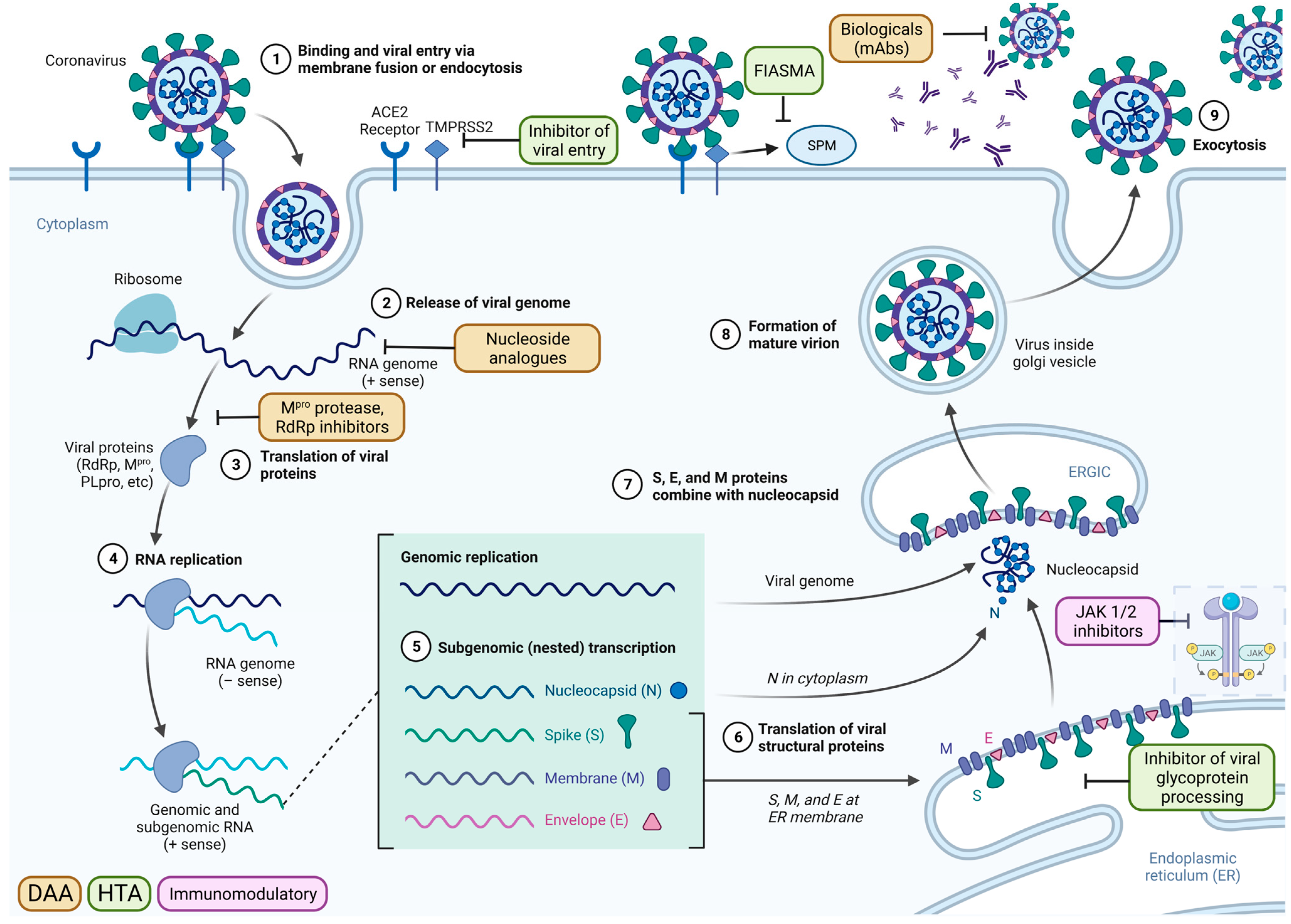
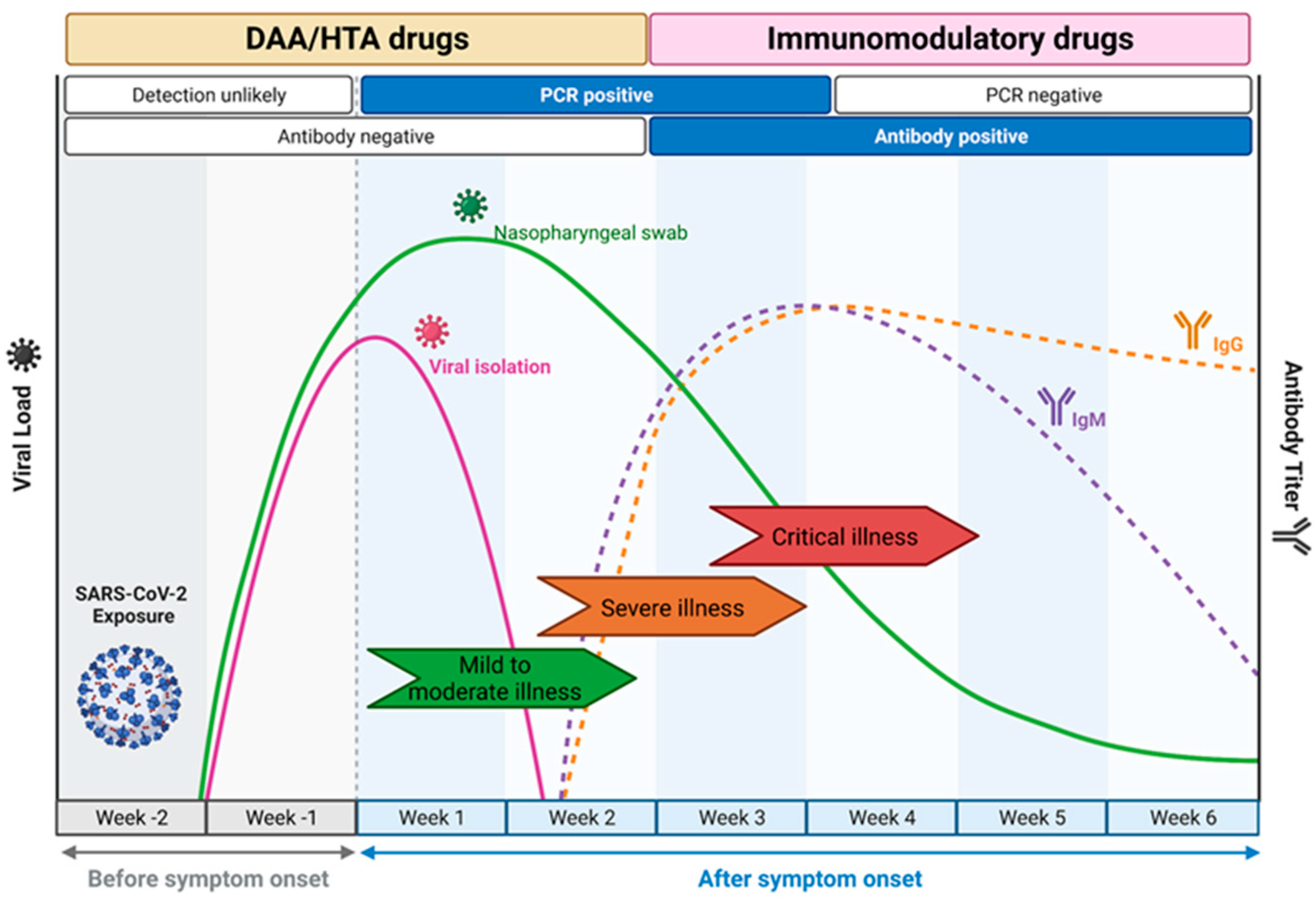
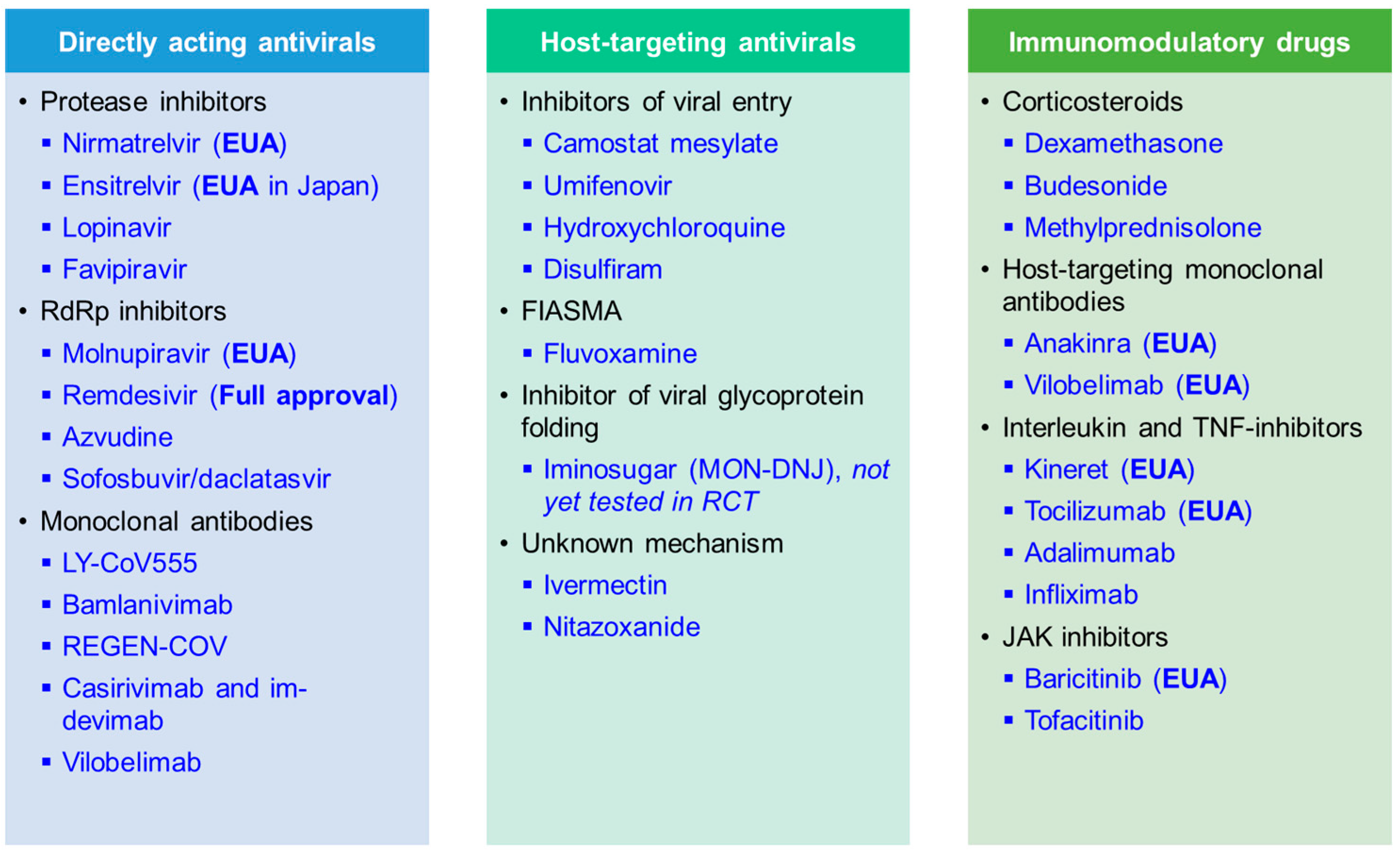
| Virus Strain | Genus | Year of Discovery | Cellular Entry Receptors |
|---|---|---|---|
| HCoV-229E | alphacoronavirus | 1966 | Aminopeptidase N (APN) |
| HCoV-NL63 | alphacoronavirus | 2004 | Angiotensin-converting enzyme 2 (ACE2) |
| HCoV-OC43 | betacoronavirus | 1967 | 9-O-acetylated sialic acid |
| HCoV-HKU1 | betacoronavirus | 2005 | 9-O-acetylated sialic acid |
| SARS-CoV-1 | betacoronavirus | 2003 | ACE2 |
| MERS-CoV | betacoronavirus | 2012 | Dipeptidyl peptidase 4 (DPP4) |
| SARS-CoV-2 | betacoronavirus | 2019 | ACE2 |
| Drug Name | Approval Status | Drug Description | Mechanism of Action | References |
|---|---|---|---|---|
| Remdesivir (brand name Veklury) | Full approval | RdRp inhibitor | DAA | [16,17] |
| Vilobelimab (brand name Gohibic) | EUA | Recombinant chimeric monoclonal IgG4 antibody | Immunomodulatory drug | [18,19] |
| Kineret (brand name Anakinra) | EUA | Interleukin-1 (IL-1) receptor antagonist | Immunomodulatory drugs | [20,21] |
| Molnupiravir (brand name Lagevrio) | EUA | Nucleoside analogue incorporating mutations in the RNA elongation process | DAA, RdRp inhibitor | [22,23] |
| Nirmatrelvir/ritonavir (brand name Paxlovid) | EUA | SARS-CoV-2 main protease (Mpro) inhibitor | DAA, Mpro inhibitor | [24,25] |
| Baricitinib | EUA | JAK 1/2 inhibitor | Immunomodulatory drug | [26,27,28,29] |
| Tocilizumab (brand name Actemra) | EUA | IL-6 inhibitor | Immunomodulatory drug | [30,31,32,33] |
Disclaimer/Publisher’s Note: The statements, opinions and data contained in all publications are solely those of the individual author(s) and contributor(s) and not of MDPI and/or the editor(s). MDPI and/or the editor(s) disclaim responsibility for any injury to people or property resulting from any ideas, methods, instructions or products referred to in the content. |
© 2023 by the authors. Licensee MDPI, Basel, Switzerland. This article is an open access article distributed under the terms and conditions of the Creative Commons Attribution (CC BY) license (https://creativecommons.org/licenses/by/4.0/).
Share and Cite
Arman, B.Y.; Brun, J.; Hill, M.L.; Zitzmann, N.; von Delft, A. An Update on SARS-CoV-2 Clinical Trial Results—What We Can Learn for the Next Pandemic. Int. J. Mol. Sci. 2024, 25, 354. https://doi.org/10.3390/ijms25010354
Arman BY, Brun J, Hill ML, Zitzmann N, von Delft A. An Update on SARS-CoV-2 Clinical Trial Results—What We Can Learn for the Next Pandemic. International Journal of Molecular Sciences. 2024; 25(1):354. https://doi.org/10.3390/ijms25010354
Chicago/Turabian StyleArman, Benediktus Yohan, Juliane Brun, Michelle L. Hill, Nicole Zitzmann, and Annette von Delft. 2024. "An Update on SARS-CoV-2 Clinical Trial Results—What We Can Learn for the Next Pandemic" International Journal of Molecular Sciences 25, no. 1: 354. https://doi.org/10.3390/ijms25010354
APA StyleArman, B. Y., Brun, J., Hill, M. L., Zitzmann, N., & von Delft, A. (2024). An Update on SARS-CoV-2 Clinical Trial Results—What We Can Learn for the Next Pandemic. International Journal of Molecular Sciences, 25(1), 354. https://doi.org/10.3390/ijms25010354

