A New Unified Theory of Trigger Point Formation: Failure of Pre- and Post-Synaptic Feedback Control Mechanisms


Abstract
1. Introduction
2. Trigger Point Physiology
2.1. Electrophysiology
2.2. Sympathetic Nerve Inhibition of TrP EPN
2.3. Biochemical Pathophysiology
2.4. Histopathological Evidence
2.5. Ultrasound Imaging of Trigger Points

| Feature | Description | References | Level of Confidence |
|---|---|---|---|
| Electrophysiology | High frequency, low voltage endplate noise, attenuated by ⍺-adrenergic inhibitors and by botulinum toxin.
| [11,13,21] | High |
| Histopathology | Segmental sarcomere contraction. 1.32 female office workers, 15 myalgic, and 15 no pain. Taut bands were found in all subjects. Sarcomere compression in five non-myaglic and two myalgic subjects on limited tissue saved from a prior study [17]. 1. Canine taut band study, 10 animals, one example identified retrospectively [20]. 2. | [17,20,23,29] | Probable, not proven |
| Microanalytic biochemistry | Acidic (low pH); elevated levels of certain neurotransmitters and cytokines. Study of humans with neck pain. Three controls (three latent TrPs, 3 active TrPs, no neck pain, and no TrP). Significantly elevated levels of the following in the active TrP neck pain group (p < 0.01): protons, BDKN, CGRP, Subs P, TNF-alpha, IL-1 beta, 5-HT, NE. | [14] | Highly likely; needs confirmation from a second laboratory |
| Ultrasound imaging | Nine subjects (seven women), 13 active TrP sites and nine latent TrPs sites. Fourteen normal in trapezius muscles; findings: focal, hypoechoic regions on 2D US and focal regions of reduced vibration amplitude on VSE indicating a localized, stiff nodule. | [16] | High |
| Magnetic Resonance Elastography | Proof of concept pilot trial on two female subjects showed taut bands that are detectable and quantifiable with MRE imaging. The findings in the subjects suggest that the stiffness of the taut bands (9.0+/−0.9 KPa) may be 50% greater than that of the surrounding muscle tissue. | [15] | High |
| Physical examination | Taut band, nodular region of tenderness, reproduction of usual pain; high specificity because a tender nodule on a taut band defines a trigger point. The outcome of the physical examination of trigger points remains controversial. | [4] | Moderate for diagnostic purposes; high specificity, moderate sensitivity |
| Physical examination | Non-wasting weakness of muscle rapidly reversed after trigger point inactivation, highly specific because improvement after release of a trigger point defines a trigger point effect. There are no studies evaluating this response. | [4] | N/A; moderate sensitivity, highly specific |
| History | Onset is often preceded by acute or repetitive muscle overuse. | [4,6] | n/a |
3. Analysis of Elements Related to the New Trigger Point Hypothesis
3.1. The New Trigger Point Hypothesis
3.2. Failure to Control Quantal ACh Release Leading to Endplate Noise
3.3. Sympathetic Nervous System Contribution
3.4. Adenosine Receptor Interaction with Muscarinic Receptors
3.5. Summary of Sympathetic Nervous System Effects
3.6. Brain-Derived Neurotrophic Factor
3.7. Muscle Fatigue
3.8. Ion Channelopathy
3.8.1. Ryanodine Receptor Channelopathy
3.8.2. Malignant Hyperthermia
3.8.3. RyR Mutation or Post-Translational Modification Causing Exercise Intolerance
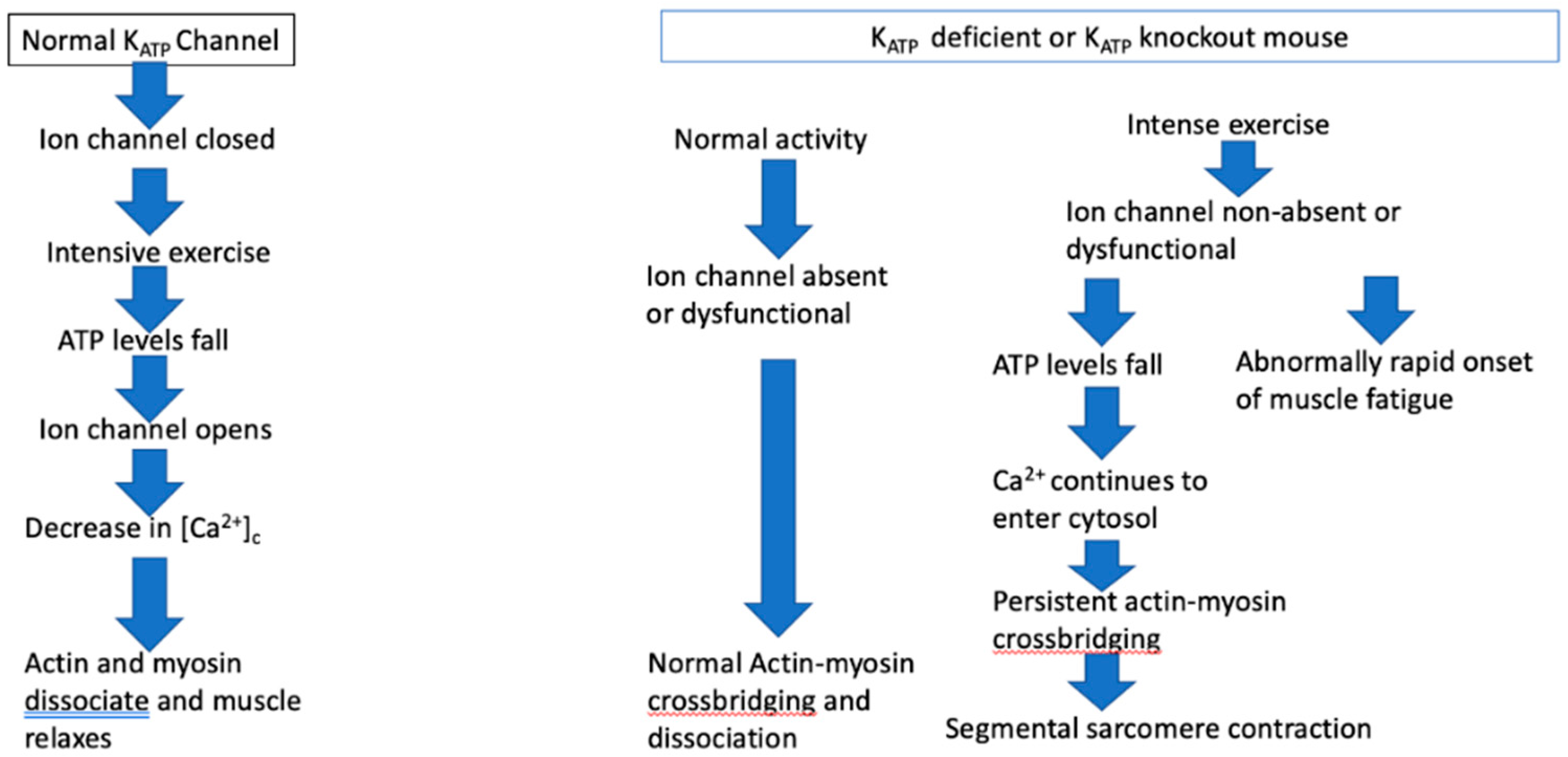
3.8.4. ATP Dependent Channel Mutations and Muscle Function: The KATP Ion Channel (Figure 1)

4. Conclusions
Funding
Institutional Review Board Statement
Informed Consent Statement
Data Availability Statement
Conflicts of Interest
References
- Travel, J.; Rinzler, S. Relief of cardiac pain by local block of somatic trigger areas. Proc. Soc. Exp. Biol. Med. 1946, LXIII, 480–482. [Google Scholar] [CrossRef]
- Quintner, J.L.; Bove, G.M.; Cohen, M.L. A critical evaluation of the trigger point phenomenon. Rheumatology 2015, 54, 392–399. [Google Scholar] [CrossRef]
- Jafri, M.S. Mechanisms of Myofascial Pain. Int. Sch. Res. Not. 2014, 2014, 523924. [Google Scholar] [CrossRef]
- Simons, D.G.; Travell, J.G.; Simons, L. Myofascial Pain and Dysfunction: The Trigger Point Manual, 2nd ed.; Williams and Wilkins: Baltimore, MA, USA, 1999; pp. 69–78. [Google Scholar]
- Gerwin, R.D.; Dommerholt, J.; Shah, J.P. An expansion of Simons’ integrated hypothesis of trigger point formation. Curr. Pain Headache Rep. 2004, 8, 468–475. [Google Scholar] [CrossRef]
- Bron, C.; Dommerholt, J. Etiology of myofascial trigger points. Curr. Pain Headache Rep. 2012, 16, 439–444. [Google Scholar] [CrossRef]
- Glogowsi, G.; Wallraff, J. Ein beitrag zur Klinik und histologie der muskelhärten (myogelosen). Z Orthop. 1951, 80, 237–268. [Google Scholar]
- Miehlke, K.; Schulze, G.; Eger, W. Klinishe und experimentelle untersuchungen zum fibrositissyndrom. Z Rheumaforsch 1960, 19, 310–330. [Google Scholar]
- Reitinger, A.; Radner, H.; Tilscher, H.; Hanna, M.; Windisch, A.; Feigl, W. Morphologische Untersuchung an Trigger-punkten. Man. Med. 1996, 34, 256–262. [Google Scholar]
- Windisch, A.; Reitinger, A.; Traxler, H.; Radner, H.; Neumayer, C.; Feigl, W.; Firbas, W. Morphology and histochemistry of myogelosis. Clin. Anat. 1999, 12, 266–271. [Google Scholar] [CrossRef]
- Hubbard, D.R.; Berkoff, G.M. Myofascial trigger points show spontaneous needle EMG activity. Spine 1993, 18, 1803–1807. [Google Scholar] [CrossRef] [PubMed]
- Simons, D.G.; Hong, C.A.; Simons, L.S. Prevalence of spontaneous electrical activity at trigger spots and control sites in rabbit muscle. J. Musculoske Pain 1995, 3, 35–48. [Google Scholar] [CrossRef]
- Chen, J.T.; Chen, S.M.; Kuan, T.S.; Chung, K.C.; Hong, C.Z. Phentolamine effect on the spontaneous electrical activity of active loci in a myofascial trigger spot of rabbit skeletal muscle. Arch. Phys. Med. Rehabil. 1998, 79, 790–794. [Google Scholar] [CrossRef] [PubMed]
- Shah, J.; Phillips, T.M.; Danoff, J.V.; Gerber, L.H. An in vivo microanalytic technique for measuring the local biochemical milieu of human skeletal muscle. J. Appl. Physiol. 2005, 99, 1977–1984. [Google Scholar] [CrossRef] [PubMed]
- Chen, Q.; Bensamoun, S.; Basford, J.R.; Thompson, J.M.; An, K.N. Identification and quantification of myofascial taut bands with magnetic resonance elastography. Arch Phys. Med. Rehabil. 2007, 88, 1658–1661. [Google Scholar] [PubMed]
- Sikdar, S.; Shah, J.P.; Gebreab, T.; Yen, R.H.; Gillliams, E.; Danoff, J.; Gerber, L.H. Novel applications of ultrasound technology to visualize and characterize myofascial trigger points and surrounding soft tissue. Arch. Phys. Med. Rehabil. 2009, 90, 1829–1838. [Google Scholar] [CrossRef] [PubMed]
- Gerwin, R.D.; Cagnie, B.; Petrovic, M.; Van Dorpe, J.; Calders, P.; De Meulemeester, K. Foci of segmentally contracted sarcomeres in trapezius muscle biopsy specimens in myalgic and nonmyalgic human subjects:preliminary results. Pain Med. 2020, 21, 2348–2356. [Google Scholar] [CrossRef] [PubMed]
- Simons, D.G.; Stolov, W.C. Microscopic features and transient contraction of palpable bands in canine muscle. Am. J. Phys. Med. 1976, 55, 65–88. [Google Scholar] [PubMed]
- Liley, A.W. An investigation of spontaneous activity at the neuromuscular junction of the rat. J. Physiol. 1956, 132, 650–666. [Google Scholar]
- Vyskočil, F.; Malomouzh, A.I.; Nikolsky, E.E. Non-quantal acetylcholine release at the neuromuscular junction. Physiol. Res. 2009, 58, 763–784. [Google Scholar] [CrossRef]
- Kuan, T.S.; Chen, J.T.; Chen, S.M.; Chien, C.H.; Hong, C.Z. Effect of botulinum toxin on endplate noise in myofascial trigger spots of rabbit skeletal muscle. Am. J. Phys. Med. Rehabil. 2002, 81, 512–520. [Google Scholar] [CrossRef]
- Barie, P.S.; Mullins, R.J. Experimental methods in the pathogenesis of limb ischemia. J. Surg. Res. 1988, 44, 284–307. [Google Scholar] [CrossRef] [PubMed]
- Bogacheva, P.; Balezina, O. Delayed increase of acetylcholine quantal size induced by the activity-dependent release of endogenous CGRP but not ATP in neuromuscular junctions. Synapse 2020, 74, e22175. [Google Scholar] [CrossRef] [PubMed]
- Buffelli, M.; Pasino, E.; Cangiano, A. In vivo acetylcholine receptor expression induced by calcitonin generelated peptide in rat soleus muscle. Neuroscience 2001, 104, 561–567. [Google Scholar] [CrossRef] [PubMed]
- Sikdar, S. Personal Communication, 2022.
- Dommerholt, J.; Gerwin, R.D. Contracture knots vs. trigger points. Comment on Ball et al. Ultrasound confirmation of the multiple loci hypothesis of the myofascial trigger point and the diagnostic importance of specificity in the elicitation of the local twitch response. Diagnostics 2022, 12, 2365. [Google Scholar] [CrossRef] [PubMed]
- Zhang, H.; Lü, J.J.; Huang, Q.M.; Liu, L.; Liu, Q.G.; Eric, O.A. Histopathological nature of myofascial trigger points at different stages of recovery from injury in a rat model. Acupunct Med. 2017, 35, 445–451. [Google Scholar] [CrossRef] [PubMed]
- Liu, Q.G.; Huang, Q.M.; Liu, L.; Nguyen, T.T. Structural and functional abnormalities of motor endplates in rat skeletal model of myofascial trigger spots. Neurosci. Lett. 2019, 711, 134417. [Google Scholar] [CrossRef] [PubMed]
- Margalef, R.; Sisquella, M.; Bosque, M.; Romeu, C.; Mayoral, O.; Monterde, S.; Priego, M.; Guerra-Perez, R.; Ortiz, N.; Tomàs, J.; et al. Experimental myofascial trigger point creation in rodents. J. Appl. Physiol. 2019, 126, 160–169. [Google Scholar] [CrossRef] [PubMed]
- Cifelli, C.; Bourassa, F.; Gariépy, L.; Banas, K.; Benkhalti, M.; Renaud, J.M. KATP channel deficiency in mouse flexor digitorum brevis causes fibre damage and impairs Ca2+ release and force development during fatigue in vitro. J. Physiol. 2007, 582 (Pt 2), 843–857. [Google Scholar] [CrossRef]
- Roth, S.M.; Martel, G.F.; Rogers, M.A. Muscle biopsy and muscle fiber hypercontraction:a brief review. Eur. J. Appl. Physiol. 2000, 83, 239–245. [Google Scholar] [CrossRef]
- Thompson, J.L.; Balog, E.M.; Fitts, R.H.; Riley, D.A. Five myofribrillar lesion types in eccentrically challenged, unloaded rat adductor lungus muscle—A test model. Anat. Rec. 1999, 254, 39–52. [Google Scholar] [CrossRef]
- Fridén, J.; Lieber, R.L. Segmental muscle fiber lesions after repetitive eccentric contractions. Cell Tissue Res. 1998, 293, 165–171. [Google Scholar] [CrossRef]
- Matsuura, N.; Kawamata, S.; Ozwaw, J.; Kai, S.; Abiko, S.S. Injury and repair of the soleus muscle after electrical stimulation of the scieatic nerve in the rat. Arch. Histol. Cytol. 2001, 64, 393–400. [Google Scholar] [CrossRef]
- Matsuura, N.; Kawamata, S.; Ozawa, J.; Kai, S.; Sakaima, H.; Abiko, S. Comparison of sarcomere alterations after muscle contraction and tension loading in the rat soleus muscle. Anat. Sci. Int. 2002, 77, 169–174. [Google Scholar] [CrossRef]
- Zhilyakov, N.; Arkhipov, A.; Malomouzh, A.; Samigullin, D. Activation of neuronal nicotinic receptors inhibits acetylcholine release in the neuromuscular junction by increasing Ca2+ flux through Cav1 channels. Intl. J. Mol. Sci. 2021, 22, 9031. [Google Scholar] [CrossRef]
- Weller, B.; Karpati, G.; Carpenter, S. Dystrophin-deficient mdx muscle fibers are preferentially vulnerable to necrosis induced by experimental lengthening contractions. J. Neurol. Sci. 1990, 100, 9–13. [Google Scholar] [CrossRef] [PubMed]
- McArdle, A.; Edwards, R.H.; Jackson, M.J. Effects of contractile activity on muscle damage in the dystrophin-deficient mdx mouse. Clin. Sci. 1991, 80, 367–371. [Google Scholar] [CrossRef] [PubMed]
- Sacco, P.; Jones, D.A.; Dick, J.R.; Vrbová, G. Contractile properties and susceptibility to exercise-induced damage of normal and mdx mouse tibialis anterior muscle. Clin. Sci. 1992, 82, 227–236. [Google Scholar] [CrossRef]
- Petrof, B.J.; Shrager, J.B.; Stedman, H.H.; Kelly, A.M.; Sweeney, H.L. Dystrophin protects the sarcolemma from stresses developed during muscle contraction. Proc. Natl. Acad. Sci. USA 1993, 90, 3710–3714. [Google Scholar] [CrossRef] [PubMed]
- Decrouy, A.; Renaud, J.M.; Davis, H.L.; Lunde, J.A.; Dickson, G.; Jasmin, B.J. Mini-dystrophin gene transfer in mdx4cv diaphragm muscle fibers increases sarcolemmal stability. Gene Ther. 1997, 4, 401–408. [Google Scholar] [CrossRef]
- Cifelli, C.; Boudreault, L.; Gong, B.; Bercier, J.P.; Renaud, J.M. Contractile dysfunctions in ATP-dependent K+ channel-deficient mouse muscle during fatigue involve excessive depolarization and Ca2+ influx through L-type Ca2+ channels. Exp. Physiol. 2008, 93, 1126–1138. [Google Scholar] [CrossRef]
- Tyapkina, O.V.; Malomovzh, A.I.; Nurullin, L.F.; Nikulsky, E.E. Quantal and non-quantal acetylcholine release at neuromuscular junctions of muscles of different types in a model of hypogravity. Dokl. Biol. Sci. 2013, 448, 4–6. [Google Scholar] [CrossRef]
- Nassenstein, C.; Wiegand, S.; Lips, K.J.; Li, G.; Klein, J.; Kummer, W. Cholinergic activation of the murine trachealis muscle via non-vesicular acetylcholine release involving low-affinity choline transporters. Int. Immunopharmacol. 2015, 29, 173–180. [Google Scholar] [CrossRef]
- Wang, X.; McIntosh, J.M.; Rich, M.M. Muscle Nicotinic Acetylcholine Receptors May Mediate Trans-Synaptic Signaling at the Mouse Neuromuscular Junction. J. Neurosci. 2018, 38, 1725–1736. [Google Scholar] [CrossRef] [PubMed]
- Capogrossi, M.S.; Houser, S.R.; Bahinski, A.; Lakattam, E.G. Synchronous occurence of spontaneous localized calcium release from the sarcoplasmic reticulum generates action potentials in rat cardiac ventricular myocytes at normal resting membrane potential. Circ. Res. 1987, 61, 498–503. [Google Scholar] [CrossRef] [PubMed]
- Rodrigues, A.Z.C.; Wang, Z.M.; Messi, M.L.; Delbono, O. Sympathetics regulate neuromuscular Junction Transmission through TRPV1, P/Q- and N-type Ca2+ channels. Mol. Cell Neurosci. 2019, 95, 59–70. [Google Scholar] [CrossRef] [PubMed]
- Rodrigues, A.Z.C.; Messi, M.L.; Wang, Z.M.; Abba, M.C.; Pereyra, A.; Birbrair, A.; Zhang, T.; OMeara, M.; Kwan, P.; Lopez, E.I.; et al. The sympathetic nervous system regulates skeletal muscle motor innervation and acetylcholine receptor stability. Acta Physiol. 2019, 225, e13195. [Google Scholar] [CrossRef]
- Khan, M.M.; Lustrino, D.; Silveira, W.A.; Wild, F.; Straka, T.; Issop, Y.; O’Connor, E.; Cox, D.; Reishci, M.; Marquardt, T.; et al. Sympathetic innervation controls homeostasis of neuromuscular junctions in health and disease. Proc. Natl. Acad. Sci. USA 2016, 113, 746–750. [Google Scholar] [CrossRef]
- Tsentsevisky, A.; Nurullin, L.; Tyapkina, O.; Bukharaeva, E. Sympathomimetics regulate quantal acetylcholine release at neuromuscular junctions through various types of adrenoreceptors. Mol. Cell Neurosci. 2020, 108, 103550. [Google Scholar] [CrossRef]
- Bukharaeva, E.; Khuzakhmetova, V.; Dmitrieva, S.; Tsentsevitsky, A. Adrenoceptors Modulate Cholinergic Synaptic Transmission at the Neuromuscular Junction. Int. J. Mol. Sci. 2021, 22, 4611. [Google Scholar] [CrossRef]
- Santafe, M.M.; Priego, M.; Obis, T.; Garcia, N.; Tomás, M.; Lanuza, M.A.; Tomás, J. Adenosine receptors and muscarinic receptors cooperate in acetylcholine release modulation in the neuromuscular synapse. Eur. J. Neurosci. 2015, 42, 1775. [Google Scholar] [CrossRef]
- Oliveira, L.; Timóteo, M.A.; Correia-de-Sá, P. Modulation by adenosine of both muscarinic M1-faciliation and M2-inhibition of [3H]-acteylcholine release from the rat motor nerve terminal. Eur. J. Neurosci. 2002, 15, 1728–1736. [Google Scholar] [CrossRef] [PubMed]
- Coletti, R. The ischemic model of chronic muscle spasm and pain. Eur. J. Transl. Myol. 2022, 32, 10323. [Google Scholar] [CrossRef] [PubMed]
- Hurtado, E.; Cilleros, V.; Nadal, L.; Simó, A.; Obis, T.; Garcia, N.; Santafé, M.M.; Tomàs, M.; Halievski, K.; Jordan, C.L.; et al. Muscle Contraction Regulates BDNF/TrkB Signaling to Modulate Synaptic Function through Presynaptic cPKCα and cPKCβI. Front. Mol. Neurosci. 2017, 10, 147. [Google Scholar] [CrossRef]
- Mense, S. Algesic agents exciting muscle nociceptors. Exp. Brain Res. 2009, 196, 89–100. [Google Scholar] [CrossRef]
- Ma, J.J.; Mah, T.M.; Wang, L.; Hu, Z. Effect of moxibustion on the expression of microglia and brain-derived neurtophic factor protein in the spinal cord of rats with myofascial pain syndrome. Zhen Ci Yan Jiu 2021, 46, 769–774. (In Chinese) [Google Scholar] [CrossRef]
- Jasim, H. Topical review: Salivary biomarkers in chronic muscle pain. Scand J. Pain 2022, 23, 3–13. [Google Scholar] [CrossRef]
- Watanabe, D.; Wada, M. Fatigue-induced change in T-system excitability and its major cause in rat fast-twitch skeletal muscle in vivo. J. Physiol. 2020, 598, 5195–5211. [Google Scholar] [CrossRef] [PubMed]
- Karatzaferi, C.; de Haan, A.; Ferguson, R.A.; van Mechelen, W.; Sargeant, A. Phosphocreatinine and ATP content in human single muscle fibres before and after maximum dynamic exercise. Pflug. Arch. 2001, 442, 467–474. [Google Scholar] [CrossRef]
- Jensen, R.; Nielsen, J.; Ørtenblad, N. Inhibition of glycogenolysis prolongs action potential repriming period and impairs muscle function in rat skeletal muscle. J. Physiol. 2020, 598, 789–803. [Google Scholar] [CrossRef]
- Renaud, J.M. Studying t-tubular functionality in mechanically skinned fibres to understand the mechanism of muscle fatigue. J. Physiol. 2020, 598, 4999–5000. [Google Scholar] [CrossRef]
- Hildago-Lozano, A.; Fernandez-de-las-Peñas, C.; Calderón-Soto, C.; Domingo-Camera, A.; Madeleine, P.; Arroyo-Morales, M. Elite swimmers with and without unilateral shoulder pain: Mechanical hyperalgesia and active/latent trigger points in neck-shoulder muscles. Scand J. Med. Sci. Sport. 2013, 23, 66–73. [Google Scholar] [CrossRef] [PubMed]
- Ortego-Santiago, R.; González-Aguado, Á.J.; Fernández-de-las-Peñas, C.; Cleland, J.A.; de-la-Llave-Rincón, A.I.; Koblanz, M.D.; Plaza-Manzano, G. Pressure Pain hypersensitivity and referred pain from muscle trigger points in elite male wheelchair basketball players. Braz. J. Phys. Ther. 2020, 24, 333–341. [Google Scholar] [CrossRef] [PubMed]
- Ceballos-Laites, L.; Medrano-de-la-Fuente, R.; Estébanez-De-Miguel, E.; Moreno-Cerviño, J.; Mingo-Goméz, M.T.; Hernando-Garijo, I.; Jiménez-Del-Barrios, S. Effects of dry needling in teres major muscle in elite handball athletes: A randomized controlled trial. J. Clin. Med. 2021, 10, 4260. [Google Scholar] [CrossRef] [PubMed]
- Huang, L.L.; Huang, T.S.; Lin, Y.H.; Huang, C.Y.; Yang, J.L.; Lin, J.J. Effects of upper traapezius myofascial trigger points on scapular kinematics and muscle activation in overhead athletes. J. Hum. Kinet. 2022, 84, 32–42. [Google Scholar] [CrossRef]
- Zhang, T.; Chi, S.; Jiang, F.; Zhao, Q.; Xiao, B. A protein interaction mechanism for suppressing the mechanosensitive Piezo channels. Nat. Commun. 2017, 8, 1797. [Google Scholar] [CrossRef]
- Scala, R.; Maqoud, F.; Zizzo, N.; Passantino, G.; Mele, A.; Camerino, G.M.; McClenaghan, C.; Harter, T.M.; Nichols, C.G.; Tricarico, D. Consequences of SUR2[A478V] Mutation in Skeletal Muscle of Murine Model of Cantu Syndrome. Cells 2021, 10, 1791. [Google Scholar] [CrossRef]
- Riaza, S.; Kraeva, N.; Hopkins, P.M. Malignant hyperthermia in the post-genomics era: New perspectives on an old concept. Anesthesiology 2018, 128, 168–180. [Google Scholar] [CrossRef]
- Beebe, D.; Puram, V.V.; Gajic, S.; Thvagaraian, B.; Belani, K.G. Genetics of malignant hyperthermia: A brief update. J. Anesth. Clin. Pharmacol. 2020, 36, 552–555. [Google Scholar] [CrossRef]
- Kaur, H.; Katyal NYelam, A.; Kumar, K.; Srivastava, H.; Govindaraian, R. Malignant hyperthermia. Mo. Med. 2019, 116, 154–159. [Google Scholar]
- Ogawa, H.; Kurebayashi, N.; Yamazawa, T.; Murayama, T. Regulatory mechanisms of ryanodine receptor/Ca2+ release channel revealed by recent advancements in structural studies. J. Muscle Res. Cell Motil. 2021, 42, 291–304. [Google Scholar] [CrossRef]
- Fitts, R.H. Cellular mechanisms of muscle fatigue. Physiol. Rev. 1994, 74, 49–94. [Google Scholar] [CrossRef] [PubMed]
- Mele, A.; Camerino, G.M.; Calzolaro, S.; Cannone, M.; Conte, D.; Tricarico, D. Dual response of the KATP channels to staurosporine: A novel role of SUR2B, SUR1 and Kir6.2 subunits in the regulation of the atrophy in different skeletal muscle phenotypes. Biochem. Pharmacol. 2014, 91, 266–275. [Google Scholar] [CrossRef] [PubMed]
- Selvin, D.; Renaud, J.M. Changes in myoplasmic Ca2+ during fatigue differ between FDB fibers, between glibenclamide-exposed and Kir6.2-/- fibers and are further modulated by verapamil. Physiol. Rep. 2015, 3, e12303. [Google Scholar] [CrossRef] [PubMed]
- Scott, K.; Benkhalti, M.; Calvert, N.D.; Paquette, M.; Zhen, L.; Harper, M.E.; Al-Dirbashi, O.Y.; Renaud, J.M. KATP channel deficiency in mouse FDB causes an impairment of energy metabolism during fatigue. Am. J. Physiol. Cell Physiol. 2016, 311, C559–C571. [Google Scholar] [CrossRef]
- Kissane, R.W.P.; Egginton, S.; Askew, G.N. Regional variation in the mechanical properties and fibre-type composition of the rat extensor digitorum longus muscle. Exp. Physiol. 2018, 103, 111–124. [Google Scholar] [CrossRef]
Disclaimer/Publisher’s Note: The statements, opinions and data contained in all publications are solely those of the individual author(s) and contributor(s) and not of MDPI and/or the editor(s). MDPI and/or the editor(s) disclaim responsibility for any injury to people or property resulting from any ideas, methods, instructions or products referred to in the content. |
© 2023 by the author. Licensee MDPI, Basel, Switzerland. This article is an open access article distributed under the terms and conditions of the Creative Commons Attribution (CC BY) license (https://creativecommons.org/licenses/by/4.0/).
Share and Cite
Gerwin, R.D. A New Unified Theory of Trigger Point Formation: Failure of Pre- and Post-Synaptic Feedback Control Mechanisms. Int. J. Mol. Sci. 2023, 24, 8142. https://doi.org/10.3390/ijms24098142
Gerwin RD. A New Unified Theory of Trigger Point Formation: Failure of Pre- and Post-Synaptic Feedback Control Mechanisms. International Journal of Molecular Sciences. 2023; 24(9):8142. https://doi.org/10.3390/ijms24098142
Chicago/Turabian StyleGerwin, Robert D. 2023. "A New Unified Theory of Trigger Point Formation: Failure of Pre- and Post-Synaptic Feedback Control Mechanisms" International Journal of Molecular Sciences 24, no. 9: 8142. https://doi.org/10.3390/ijms24098142
APA StyleGerwin, R. D. (2023). A New Unified Theory of Trigger Point Formation: Failure of Pre- and Post-Synaptic Feedback Control Mechanisms. International Journal of Molecular Sciences, 24(9), 8142. https://doi.org/10.3390/ijms24098142