Article

Tear nanoDSF Denaturation Profile Is Predictive of Glaucoma

by
Viktoriia E. Baksheeva
1,2,†,
Veronika V. Tiulina
1,†,
Elena N. Iomdina
3,
Sergey Yu. Petrov
3,
Olga M. Filippova
3,
Nina Yu. Kushnarevich
3,
Elena A. Suleiman
3,
Rémi Eyraud
4,
François Devred
2,
Marina V. Serebryakova
1,
Natalia G. Shebardina
1,
Dmitry V. Chistyakov
1,
Ivan I. Senin
1,
Vladimir A. Mitkevich
5,
Philipp O. Tsvetkov
2,* and
Evgeni Yu. Zernii
1,*
1
Belozersky Institute of Physico-Chemical Biology, Lomonosov Moscow State University, 1-40 Leninskye Gory, 119992 Moscow, Russia
2
Institut Neurophysiopathol, INP, Faculté des Sciences Médicales et Paramédicales, Aix Marseille Univ, CNRS, 13005 Marseille, France
3
Helmholtz National Medical Research Center of Eye Diseases, 105062 Moscow, Russia
4
Université Jean Monnet Saint-Etienne, CNRS, Institut d Optique Graduate School, Laboratoire Hubert Curien UMR 5516, 42023 Saint-Etienne, France
5
Engelhardt Institute of Molecular Biology, Russian Academy of Sciences, 119991 Moscow, Russia
*
Authors to whom correspondence should be addressed.
These authors contributed equally to this work.
Int. J. Mol. Sci. 2023, 24(8), 7132; https://doi.org/10.3390/ijms24087132
Submission received: 17 March 2023 / Revised: 7 April 2023 / Accepted: 8 April 2023 / Published: 12 April 2023
(This article belongs to the Special Issue Molecular Research of Ocular Pathology)

Abstract

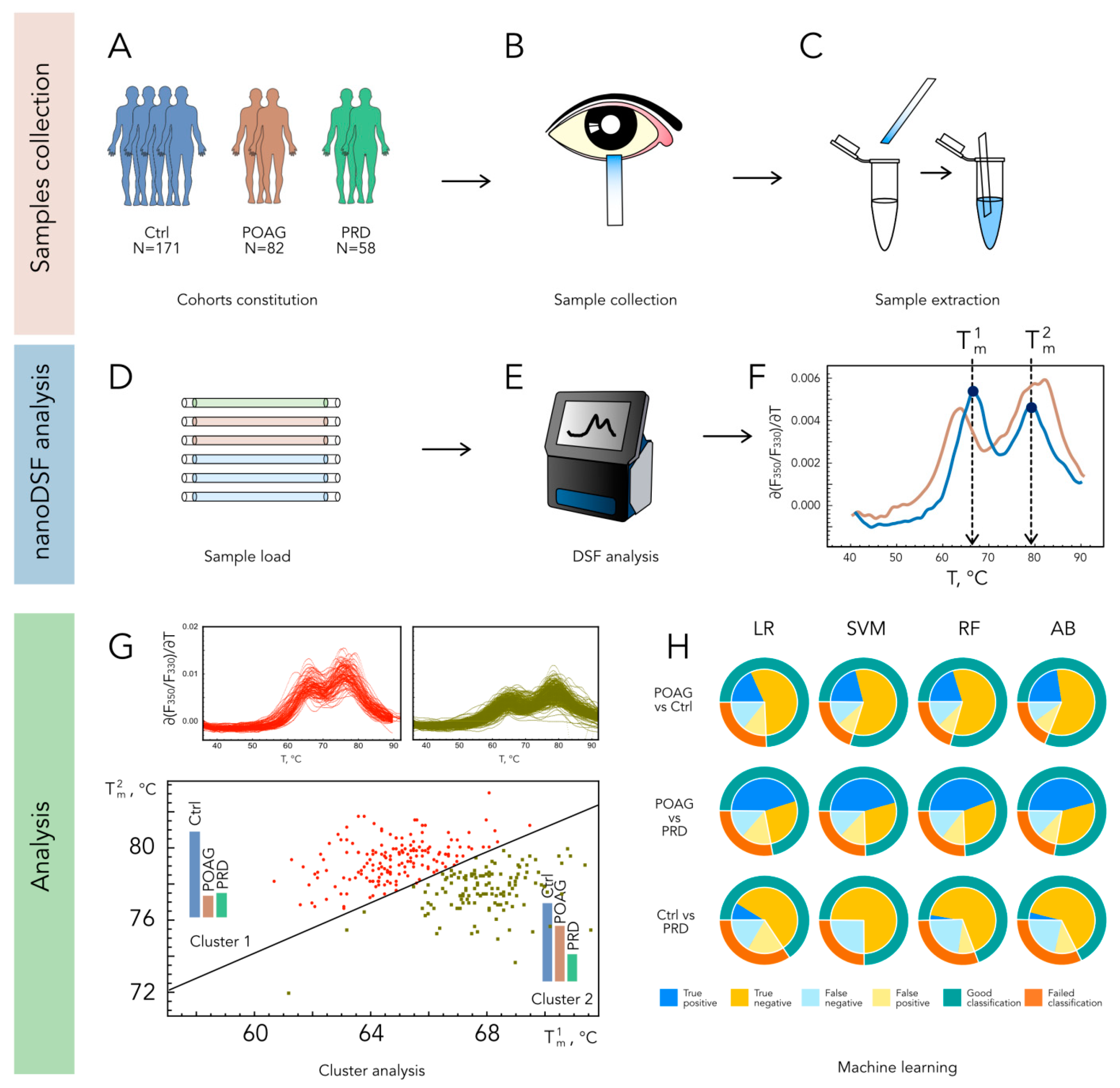
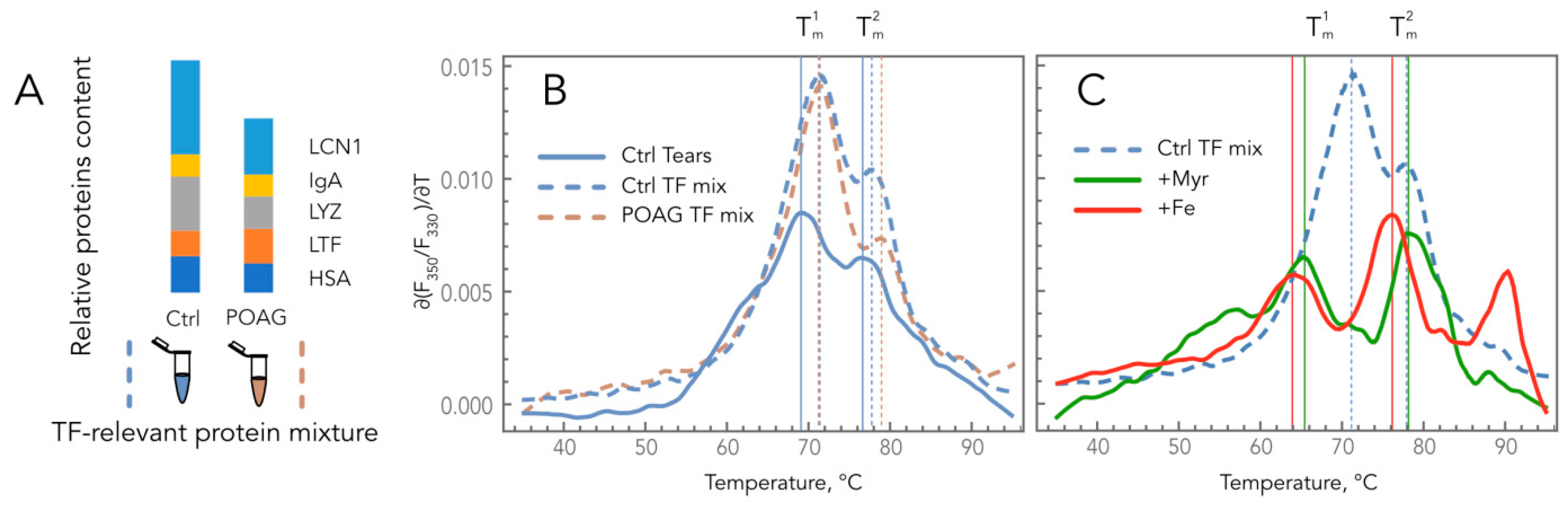
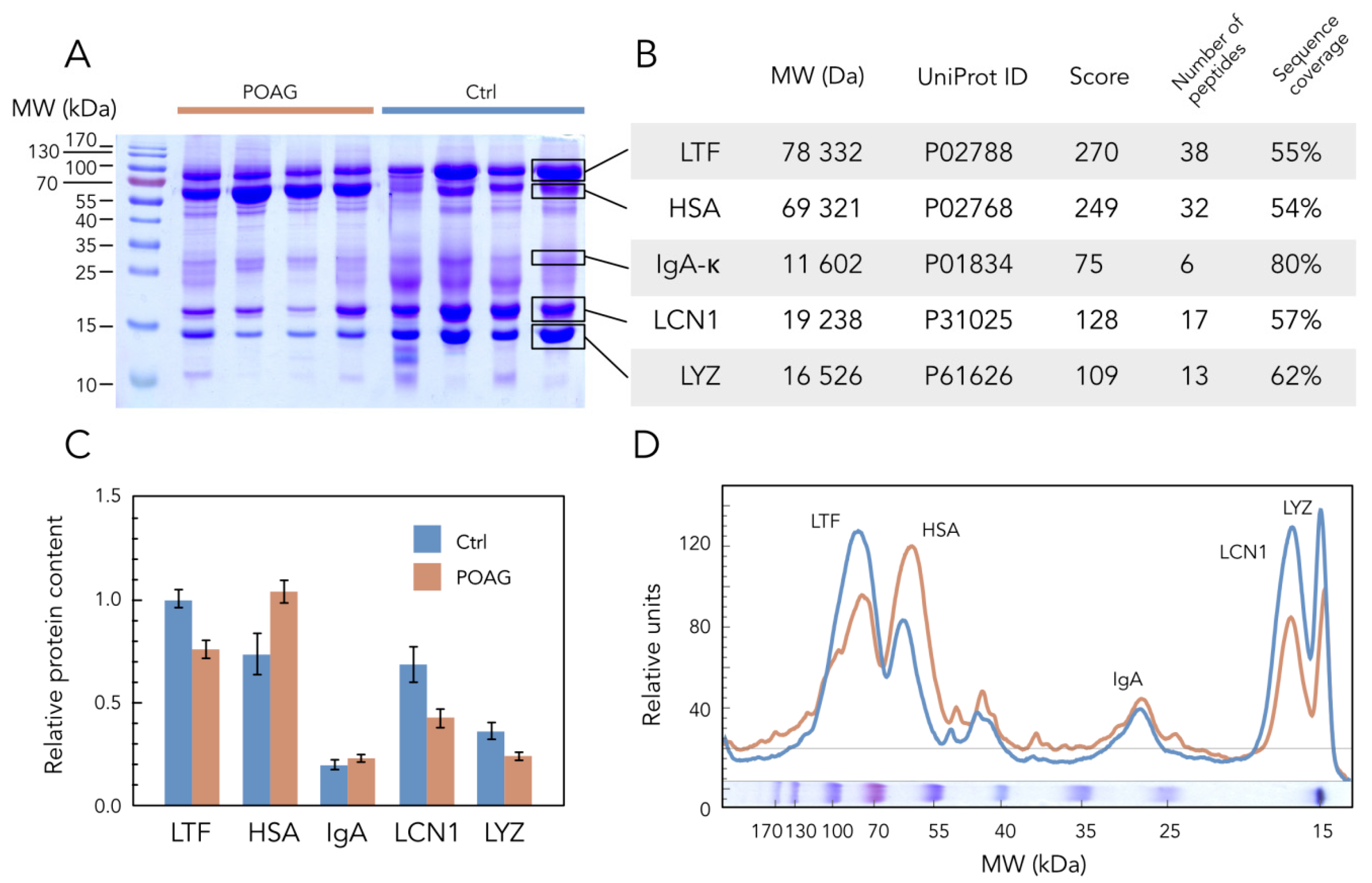
Primary open-angle glaucoma (POAG) is a frequent blindness-causing neurodegenerative disorder characterized by optic nerve and retinal ganglion cell damage most commonly due to a chronic increase in intraocular pressure. The preservation of visual function in patients critically depends on the timeliness of detection and treatment of the disease, which is challenging due to its asymptomatic course at early stages and lack of objective diagnostic approaches. Recent studies revealed that the pathophysiology of glaucoma includes complex metabolomic and proteomic alterations in the eye liquids, including tear fluid (TF). Although TF can be collected by a non-invasive procedure and may serve as a source of the appropriate biomarkers, its multi-omics analysis is technically sophisticated and unsuitable for clinical practice. In this study, we tested a novel concept of glaucoma diagnostics based on the rapid high-performance analysis of the TF proteome by differential scanning fluorimetry (nanoDSF). An examination of the thermal denaturation of TF proteins in a cohort of 311 ophthalmic patients revealed typical profiles, with two peaks exhibiting characteristic shifts in POAG. Clustering of the profiles according to peaks maxima allowed us to identify glaucoma in 70% of cases, while the employment of artificial intelligence (machine learning) algorithms reduced the amount of false-positive diagnoses to 13.5%. The POAG-associated alterations in the core TF proteins included an increase in the concentration of serum albumin, accompanied by a decrease in lysozyme C, lipocalin-1, and lactotransferrin contents. Unexpectedly, these changes were not the only factor affecting the observed denaturation profile shifts, which considerably depended on the presence of low-molecular-weight ligands of tear proteins, such as fatty acids and iron. Overall, we recognized the TF denaturation profile as a novel biomarker of glaucoma, which integrates proteomic, lipidomic, and metallomic alterations in tears, and monitoring of which could be adapted for rapid non-invasive screening of the disease in a clinical setting.
Keywords: biomarker; diagnostic; glaucoma; POAG; tear fluid; tear proteins; lysozyme C; lipocalin-1; IgA; serum albumin; lactotransferrin; fatty acids; iron; thermal denaturation; nanoDSF biomarker; diagnostic; glaucoma; POAG; tear fluid; tear proteins; lysozyme C; lipocalin-1; IgA; serum albumin; lactotransferrin; fatty acids; iron; thermal denaturation; nanoDSF