


Abstract
The carcinogenesis of glial tumors appears complex because of the many genetic and epigenetic phenomena involved. Among these, cellular prion protein (PrPC) is considered a key factor in cell-death resistance and important aspect implicated in tumorigenesis. Autophagy also plays an important role in cell death in various pathological conditions. These two cellular phenomena are related and share the same activation by specific alterations in the cellular microenvironment. Furthermore, there is an interdependence between autophagy and prion activity in glioma tumorigenesis. Glioma is one of the most aggressive known cancers, and the fact that such poorly studied processes as autophagy and PrPC activity are so strongly involved in its carcinogenesis suggests that by better understanding their interaction, more can be understood about its origin and treatment. Few studies in the literature relate these two cellular phenomena, much less try to explain their combined activity and role in glioma carcinogenesis. In this study, we explored the recent findings on the molecular mechanism and regulation pathways of autophagy, examining the role of PrPC in autophagy processes and how they may play a central role in glioma tumorigenesis. Among the many molecular interactions that PrP physiologically performs, it appears that processes shared with autophagy activity are those most implicated in glial tumor carcinogeneses such as activity on MAP kinases, PI3K, and mTOR. This work can be supportive and valuable as a basis for further future studies on this topic.
1. Introduction
Cellular prion protein (PrPC) in its misfolded form is considered the key to the pathogenesis of prion diseases, but in its physiological form is also considered a key factor in cell-death resistance and important aspects implicated in tumorigenesis [1,2,3].
Autophagy also plays an important role in cell death in various pathological and physiological conditions [4]. Autophagy protects cells against death under conditions of starvation and neurodegeneration [5]. These two cellular phenomena are recently considered in a relationship and share the same activation by specific alterations in the cellular microenvironment [6,7,8]. Furthermore, there is an interdependence between autophagy and prion activity in glioma tumorigenesis [9,10]. Because cells in which the prion protein gene (PRNP) was eliminated are more susceptible to apoptotic cell death by serum deprivation and because autophagy is also induced by serum deprivation in various cell lines, it was demonstrated that PrPC is involved in the autophagy pathway [7]. Glioma is one of the most aggressive known cancers [11] of which there is currently no cure [12]. The fact that such poorly studied processes as autophagy and PrPC activity are so strongly involved in its carcinogenesis [13] suggests that by better understanding their interaction, more can be understood about its origin and treatment. Yet few studies exist that relate these two cellular phenomena, much less try to explain their combined activity and role in glioma carcinogenesis. In this study, we address by narrative review the respective roles of PrPC, autophagy, and their combined activities in glioma biology [10]. To clarify the correlation between autophagy and physiologic prion activity, we illustrated the recent findings on the molecular mechanism and regulation pathways of autophagy, exploring and examining the role of PrPC in autophagy processes and how they may play a central role in glioma tumorigenesis. We believe this work can be supportive and valuable as a basis for future studies on this topic.
2. The Role of Prion Protein
PrPC is a cell surface glycoprotein, highly conserved in all mammalian species, encoded by the PRNP gene [11]. PrPC is considered the key in the pathogenesis of prion diseases, in which the fundamental event is it’s misfolding into a protease-insensitive, amyloidogenic isoform (PrPSc). Physiologically PrPC acts as a scaffold protein, assembling signaling platforms on the plasma membrane to elicit several biological processes in various cells type, including stem cells [12].
The prion gene family comprises four genes, PRNP, PRND, SPRN, and PRNT, located within a 55 kb region on the 20p13 locus in humans [13]. Prion diseases are caused by the aberrant processing of the everyday cellular PrPC into a disease-causing isoform, denoted PrPSc, where its accumulation results in neurologic dysfunction [14]. In humans, PrPC is expressed in various peripheral tissues and, to a higher extent, in the central nervous system (CNS) [15]. PrPC is physiologically expressed within the CNS, although its content varies among distinct brain regions, cell types, and neurons with different neurochemical phenotypes [9]. Various functions have been proposed for PrPC, including involvement in cell survival, oxidative stress, immunomodulation, differentiation, metal ion trafficking, cell adhesion, and transmembrane signaling. One of the most significant advances has been recognizing that PrPC leads to resistance to cell death, particularly apoptotic cell death, an essential aspect of tumorigenesis, and the development of resistance to drugs used to treat cancer [14]. The prion cancer research field has progressively expanded in the last few years (Table 1). It has yielded consistent evidence for the involvement of PrPC in cancer cell proliferation, migration, invasion, and cancer stem cell properties [3]. Most recent data have uncovered new facets of the biology of PrPC in cancer, ranging from its control of enzymes involved in immune tolerance to its radio-protective activity by promoting angiogenesis [15]. Although the physiological role of PrPC remains fully established, it is considered a key factor for resistance to cell death, particularly to apoptotic cell death, an essential aspect of both tumorigenesis and the development of resistance to drugs used to treat cancer [14,15].

Table 1.
Table reports some of the most important research-line on the role of PrPC in glioma tumorigenesis.
Still, a single dysfunction or alteration of PrPC cannot justify and support the complex process of carcinogenesis that occurs in brain gliomas. PRNP knockout (KO) experimental models have provided some insights into the physiological function of “prion-like” but did not evidence direct alterations. This factor indicates that other molecules can physiologically compensate the PrPC loss of function [26]. Despite this finding, by analyzing only the activity in cell physiology, it seems that PrPC protects neurons against cell death and oxidative stress, controls copper metabolism, synaptic transmission, and cell adhesion, and seems to be involved in maintaining the cellular cycle to activate the immune response [5]. Interestingly, more recent studies suggested that PrPC plays a role in pluripotency and differentiation of embryonic stem cells, cell proliferation, and differentiation through the direct activation of the Src-family kinase Fyn, at least as far as the CNS effects. Starting from these observations, PrPC has been intriguingly involved in the development of human tumors, including glioblastoma (GB) [20,27], and gastric, breast, prostate, and colorectal carcinomas [28].
The role of PrPC in cell differentiation has initiated a dedicated line of research concerning the relationship with totipotent brain cells, the so-called “Glioblastoma stem cells” (GSCs) from which the primary genetic and subsequently epigenetic errors that result in tumor formation are hypothesized to originate [29]. The concentration of PrPC in GSCs depends on an equilibrium between its biosynthesis and degradation rates, which in turn are controlled by a multitude of processes–from mRNA transcription to co-translational secretion into the endoplasmic reticulum, quality control of folding, glycolipid bonding, and vescicular transport, as well as extracellular shedding [25]. Our literature research shows that the most critical works on this topic mainly concern GB cell cultures (generally used since they exhibit a high growth rate in vitro) in which some molecular cascades are identified concerning heat shock protein 70 (Hsp70) Hsp70, heat shock protein 90 (Hsp90), STI1 and various mechanisms involved in the cellular stress and hypoxia phases. Furthermore, the correlation between PrPC and GSC was demonstrated by demonstrating that the levels of their marker proteins [30], such as Oct4, Nanog, Sox2, and ALDH1A1, significantly increased in cancer tissues [9,31]. It is from these recent findings that a central role of cellular autophagy mechanisms has begun to be hypothesized. The fact that intrigued us most during the literature search was that many of these processes in which PrPC is involved turn out to be in close sharing with the known mechanisms of autophagy.
3. The Role of Autophagy
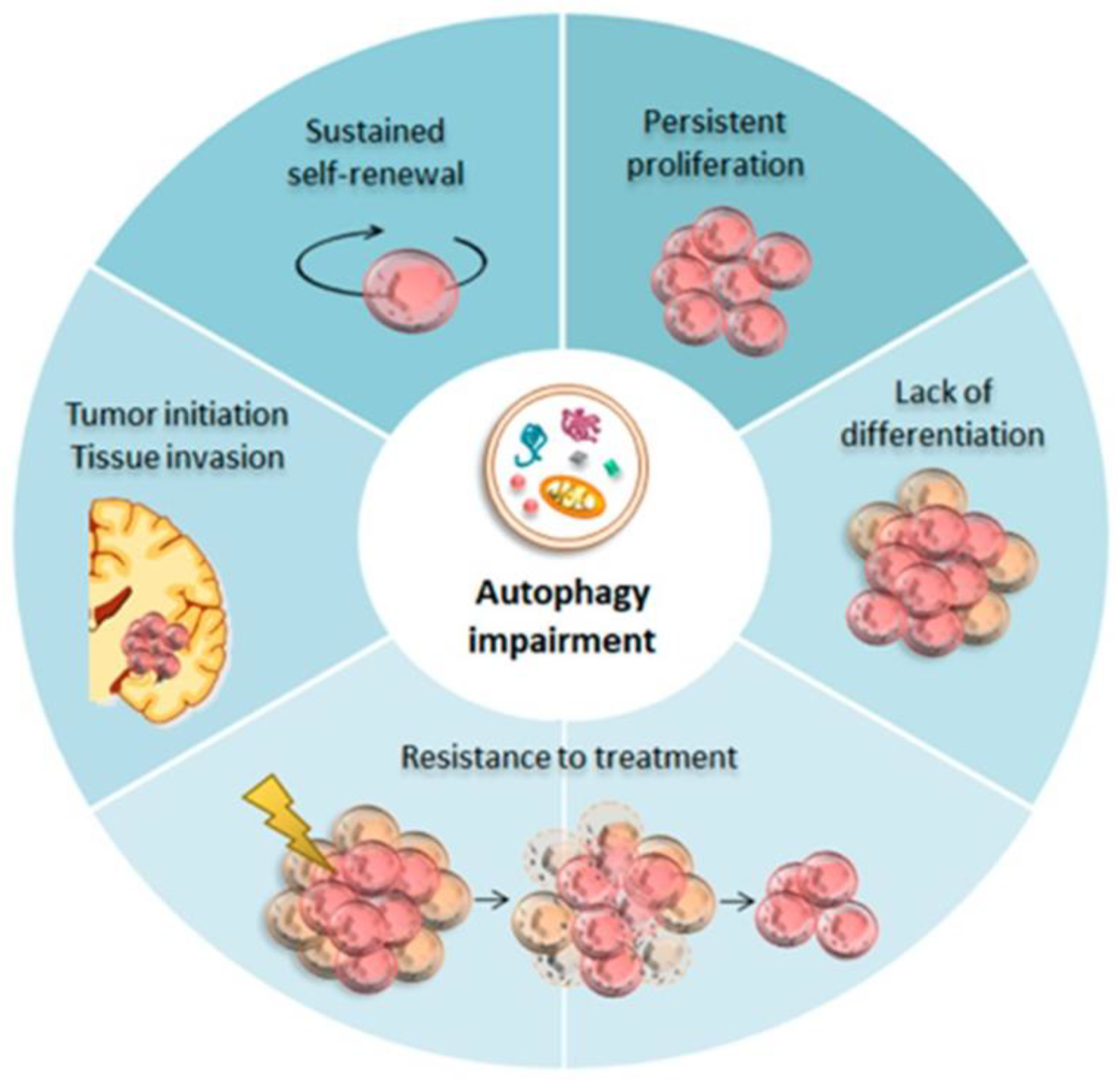
Autophagy, also called programmed cell death II, is a term that defines any intracellular process that results in the degradation of cytosolic ingredients inside lysosomes [31]. Autophagy is a major pathway of degradation of cytoplasmic constituents and cell death by necrosis and apoptosis. It was initially described as a cellular response to nutrient starvation, thus facilitating cell survival via the degradation and recycling of cytoplasmic contents. The typical morphological feature is the formation of many large autophagic vacuoles (AVs). Although its specific role is still controversial, the participation of the lysosomal system in programmed cell death has recently been well accepted [32]. Autophagy plays an important role in cell survival and cell death in various pathological and physiological conditions. The lysosomal system involved in autophagy is especially relevant in remodeling the developing organs and several pathological conditions such as hypoxia, ischemia, inflammation, and exposure to toxic agents [15,33]. By eliminating intracellular damaged organelles and aggregates, autophagy promotes cell surface antigen presentation and cellular senescence, protects against genome instability, and prevents necrosis, offering it an essential role in preventing diseases (Figure 1) such as neurodegeneration, cardiomyopathy, diabetes, liver disease, autoimmune diseases, infections, and cancer [33]. In the CNS, autophagy protects cells against death under conditions of starvation and neurodegeneration but is also an important contributing factor in some types of cell death [5]. The increased number of AVs in neurons is a frequent observation in many neurodegenerative diseases. Indeed, the most recent research involves diseases such as Alzheimer’s syndrome, Parkinson’s syndrome, and the more common forms of frontotemporal dementia. It seems that neuronal autophagy plays a critical role at basal physiological levels in controlling intracellular quality and maintaining nervous system health by removing aggregated proteins. At first, it was believed that neuronal autophagy is relatively inactive, but in recent years genetic research using mouse models emphasized the importance of autophagy in the non-proliferating cells in neurons [34].
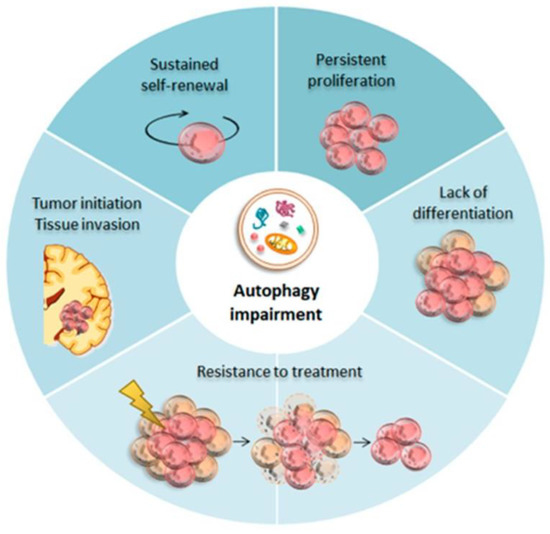
Figure 1.
Autophagy in Glioma Stem Cells (GSCs). Baseline autophagy guarantees neuronal differentiation and homeostasis within the neural stem cells (NSCs) niche during development. Impaired autophagy seems to be crucial for GSCs tumor initiation.
It is important to highlight that in cancer cells, acute amino acid starvation induces three distinct pathways of active autophagy: mTOR inactivation with subsequent activation of chaperone-mediated autophagy (CMA), induction of an immediate selective endosomal microautophagy independent of mTORC1 inactivation and canonical macroautophagy. These autophagic pathways likely work in concert and may partially compensate for each other.
Recently, the concept of the consequences of increased CMA in the CNS, driven by GB cells, as a critical player iFn GB progression has been explored. CMA is a selective autophagy pathway that degrades specific proteins in lysosomes. Proteins are directly recognized one by one by the chaperone Hsp70, although other chaperones can be found in the Hsp70-substrate protein complex. During CMA, the substrate protein binds to Hsp70, and lysosomal-associated membrane protein 2A (LAMP-2A) at the lysosomal membrane to be unfolded, translocated, and degraded within the lysosome with the participation of another chaperone Hsp70, which resides within the lysosome lumen [30,31,32]. CMA activity is highly regulated by cell context and, thereby, the stimuli the cell receives, as these modulate the amount of functional LAMP-2A that is mobilized to the lysosomal membrane [35]. While physiological CMA levels are needed for cell homeostasis and to avoid malignant cell transformation by preventing DNA damage and increasing proteostasis, CMA activity becomes pro-oncogenic when dysregulated [36]. Transformed cells abnormally upregulate CMA activity, which degrades different tumor cell survival- and proliferation-inhibitory proteins. In addition, increased CMA is required to sustain the characteristic Warburg metabolism in tumor cells as it is essential to degrade the majority of glycolytic enzymes and, therefore, to induce anaerobic glycolysis needed for cancer progression [18].
Macroautophagy is a process of lysosomal degradation and recycling of cellular components by sequestering cytosolic regions in de-novo-generated double-membrane vesicles knowns as autophagosomes. This process can be either in bulk or selective. The selectivity is mediated by autophagy receptors that bring cargo to the phagophore, including damaged organelles, intracellular bacterial pathogens, and aggregated proteins.
Under normal conditions, the basal level of autophagy is very low. Therefore, autophagy must be induced through an efficient mechanism to survive stress and adapt to extracellular signals. In mammalian cells under nutrient-rich conditions, autophagy is inhibited by the serine/threonine-protein kinase mTOR (mammalian target of rapamycin). As previously described by our research group [37], GB can be considered at least in the early stages of its carcinogenesis, a biologically dependent pathology with a defect in mTOR activity. mTOR negatively regulates other serine/threonine kinases, Unc-51-like kinase-1 (ULK1) and -2 (ULK2), phosphorylating and inactivating Unc-51-like kinases (ULKs) and autophagy-related gene 13 (Atg13) by binding to the ULKs-Atg13-FIP200 complex. Under nutrient stress conditions, AMP-dependent protein kinase (AMPK) increases autophagy by inhibiting mTOR complex 1 (mTORC1) via phosphorylation. Then, ULK1 and ULK2 are activated and phosphorylate Atg13 and FIP200. The beclin1 complex is recruited and activates the class III PI3K VPS34, stimulating autophagosome nucleation.
Autophagy is also induced by Exchange protein directly activated by cAMP 1 (Epac-1) through a Ca2+/calmodulin-dependent kinase b (CaMKKb)/AMPK signaling pathway. Recently, inositol polyphosphate multikinase (IPMK) has been reported to induce autophagy by regulating AMPK/ULK activation and enhancing autophagy-related transcription-dependent of Sirt-1 activation. In tumor cells, many signaling pathways participate in the regulation of autophagy. Down-regulation of STAT/BCL2/BECLIN-1 and PI3K/Akt/mTOR-mediated signaling pathways can activate macroautophagy. The Ras/Raf/ERK signaling pathway is one of the most frequent pathways that activate tumor macroautophagy. Other important modulators of macroautophagy in GB are Sirt1, that induces autophagic cell death and mitophagy, insulin, p53, p38 mitogen-activated protein kinase (p38-MAPK), five ′ AMPK, phosphatase and tensin homolog deleted from chromosome 10 (PTEN), and reactive oxygen species (ROS)-associated pathways. Furthermore, intracellular calcium signaling seems also an essential regulatory pathway in GB. Recent advances in Hedgehog, NRF2-P62, and PD-L1/PD1 signaling pathways appear to indicate that these might be potential targets to modulate macroautophagy in glioma.
5. Further Studies Needed
In the cellular processes that are shared by autophagy mechanisms and PrPC many in the studies here are only mentioned and not explored in depth with ad-hoc studies. For example, in the Hsp-70 reports there seems to be an important link with STI1 activity, which is recognized as essential in the carcinogenic process of many forms of cancer. In fact, it is recognized that STI1is secreted by a GB cell line and induces proliferation of distinct glioma cell lines; further, the Erk and Akt signaling pathways mediate STI1-induced proliferation.
In addition, treatment with STI1 activated Erk and Akt, indicating the involvement of these signaling pathways in the proliferative effect. Interestingly, treatment with LY294002 induced an increase in the phosphorylation levels of Erk, a finding that suggests the existence of crosstalk between these pathways. STI1 imposes a small and transient Erk activation, leading to increased proliferation. On the other hand, when PI3K was inhibited, STI1- induced activation of Erk was more intense and durable, possibly because, in this situation, Akt did not counterbalance erk pathway activity. This pattern of Erk activation may cause cell cycle arrest. Cells subjected to treatment solely with LY294002 or STI1 showed a similar increase in Erk activation as assayed after a 5-min treatment. However, as opposed to STI1-treated cells, the PI3K inhibitor induced a much more durable Erk activation, which persisted for at least 1 h and was unrelated to an increase in proliferation. Together, these data indicate that parallel activation of both the Erk and Akt pathways are required for the proliferative effects of STI1 and that the intensity and duration of Erk activation may ultimately determine the final impact of STI1 upon proliferation. Further studies are needed to this aspect.
Direct therapy against this glioma is very complicated due to GB’s intrinsic cellular heterogeneity and the potential adverse effects that this intervention might have on peritumoral cells [52,53]. Pharmacological manipulation of CMA might be used as a specific therapy against GB growth. Inhibition of CMA would directly impact GB cells and other tumor-related cell types, such as PCs, which help the tumor spread in the brain. However, specific inhibitors against LAMP-2A or CMA modulators have not been found or demonstrated to work. Gene therapy directed to modulate CMA in PCs specifically should be cautiously considered as an alternative, as physiological CMA in PCs is essential to maintain healthy brain homeostasis.
Tumor cells wickedly manipulate and increase CMA in PCs to benefit from changes in the tumor microenvironment (TME). This can be seen as an opportunity to develop new pharmacological therapies countering this process to treat GB. The development of such treatments might also be helpful in the treatment of other highly vascularized cancer types where peritumoral pericytes (PCs) show a pro-tumoral regulatory role. Generalized CMA blockage in peritumoral brain cells (including PCs and probably other immune cells) should lead to a pro-inflammatory niche capable of preventing tumor progression and promoting anti-tumor immune responses to eliminate GB cells [23]. However, further studies are needed to understand its actual clinical role in the progression of brain gliomas.
6. Conclusions
There are common mechanisms between autophagy and PrPC activity actively involved in the development and progression of tumor pathology, especially in gliomas. It was recently discovered that some human prion peptides induce autophagy flux and autophagic cell death in neuronal cells, and these reported mechanisms could be implicated in glioma tumorigenesis. Further, autophagy inhibitors can reduce prion protein-induced autophagic cell death via AMP pathway. An increased calcineurin activity mediated by prion protein-induced neuronal cell damage provided insight into the fundamental mechanism underlying the AMPK and autophagy flux in gliomas.
Author Contributions
Conceptualization, F.F. and D.A.; methodology, F.B. and C.L.B.; validation, F.F. investigation, C.L.B.; resources, A.F.; data curation, F.F.; writing—original draft preparation, D.A.; writing—review and editing, A.F.; visualization and supervision, A.F.; project administration, F.F. All authors have read and agreed to the published version of the manuscript.
Funding
This work was supported by the Italian Ministry of Health (Current Research 2022).
Institutional Review Board Statement
Not applicable.
Informed Consent Statement
Not applicable.
Data Availability Statement
Not applicable.
Conflicts of Interest
The authors declare no conflict of interest.
References
- Kikuchi, Y.; Kakeya, T.; Sakai, A.; Takatori, K.; Nakamura, N.; Matsuda, H.; Yamazaki, T.; Tanamoto, K.-I.; Sawada, J.-I. Propagation of a protease-resistant form of prion protein in long-term cultured human glioblastoma cell line T98G. J. Gen. Virol. 2004, 85, 3449–3457. [Google Scholar] [CrossRef] [PubMed]
- Kikuchi, Y.; Kakeya, T.; Yamazaki, T.; Takekida, K.; Nakamura, N.; Matsuda, H.; Takatori, K.; Tanimura, A.; Tanamoto, K.-I.; Sawada, J.-I. G1-Dependent Prion Protein Expression in Human Glioblastoma Cell Line T98G. Biol. Pharm. Bull. 2002, 25, 728–733. [Google Scholar] [CrossRef]
- Kim, Y.-C.; Won, S.-Y.; Jeong, B.-H. Identification of Prion Disease-Related Somatic Mutations in the Prion Protein Gene (PRNP) in Cancer Patients. Cells 2020, 9, 1480. [Google Scholar] [CrossRef] [PubMed]
- Levine, B.; Kroemer, G. Autophagy in the Pathogenesis of Disease. Cell 2008, 132, 27–42. [Google Scholar] [CrossRef]
- Moon, J.-H.; Lee, J.-H.; Nazim, U.M.; Lee, Y.-J.; Seol, J.-W.; Eo, S.-K.; Lee, J.-H.; Park, S.-Y. Human prion protein-induced autophagy flux governs neuron cell damage in primary neuron cells. Oncotarget 2016, 7, 29989–30002. [Google Scholar] [CrossRef] [PubMed]
- da Fonseca, A.; Romão, L.; Amaral, R.; Kahn, S.A.; Lobo, D.; Martins, S.; de Souza, J.M.; Moura-Neto, V.; Lima, F. Microglial stress inducible protein 1 promotes proliferation and migration in human glioblastoma cells. Neuroscience 2012, 200, 130–141. [Google Scholar] [CrossRef] [PubMed]
- Kikuchi, Y.; Kakeya, T.; Nakajima, O.; Sakai, A.; Ikeda, K.; Yamaguchi, N.; Yamazaki, T.; Tanamoto, K.-I.; Matsuda, H.; Sawada, J.-I.; et al. Hypoxia induces expression of a GPI-anchorless splice variant of the prion protein. FEBS J. 2008, 275, 2965–2976. [Google Scholar] [CrossRef]
- Seo, J.-S.; Seol, J.-W.; Moon, M.-H.; Jeong, J.-K.; Lee, Y.-J.; Park, S.-Y. Hypoxia protects neuronal cells from human prion protein fragment-induced apoptosis. J. Neurochem. 2010, 112, 715–722. [Google Scholar] [CrossRef]
- Lapointe, S.; Perry, A.; Butowski, A.N. Primary brain tumours in adults. Lancet 2018, 392, 432–446. [Google Scholar] [CrossRef]
- Ryskalin, L.; Busceti, C.L.; Biagioni, F.; Limanaqi, F.; Familiari, P.; Frati, A.; Fornai, F. Prion Protein in Glioblastoma Multiforme. Int. J. Mol. Sci. 2019, 20, 5107. [Google Scholar] [CrossRef]
- Komori, T. Grading of adult diffuse gliomas according to the 2021 WHO Classification of Tumors of the Central Nervous System. Lab. Investig. 2021, 102, 126–133. [Google Scholar] [CrossRef] [PubMed]
- Go, G.; Lee, S.H. The Cellular Prion Protein: A Promising Therapeutic Target for Cancer. Int. J. Mol. Sci. 2020, 21, 9208. [Google Scholar] [CrossRef] [PubMed]
- Gu, C.; Banasavadi-Siddegowda, Y.K.; Joshi, K.; Nakamura, Y.; Kurt, H.; Gupta, S.; Nakano, I. Tumor-Specific Activation of the C-JUN/MELK Pathway Regulates Glioma Stem Cell Growth in a p53-Dependent Manner. Stem Cells 2013, 31, 870–881. [Google Scholar] [CrossRef] [PubMed]
- Mehrpour, M.; Codogno, P. Prion protein: From physiology to cancer biology. Cancer Lett. 2010, 290, 1–23. [Google Scholar] [CrossRef]
- Bromme, H.J.; Holtz, J. Apoptosis in the heart: When and why? Mol. Cell. Biochem. 1996, 163–164, 261–275. [Google Scholar] [CrossRef]
- Comincini, S.; Facoetti, A.; Del Vecchio, I.; Peoc’h, K.; Laplanche, J.L.; Magrassi, L.; Ceroni, M.; Ferretti, L.; Nano, R. Differential expres-sion of the prion-like protein doppel gene (PRND) in astrocytomas: A new molecular marker potentially involved in tumor progression. Anticancer Res. 2004, 24, 1507–1517. [Google Scholar]
- Comincini, S.; Ferrara, V.; Arias, A.; Malovini, A.; Azzalin, A.; Ferretti, L.; Benericetti, E.; Cardarelli, M.; Gerosa, M.; Passarin, M.G.; et al. Diagnostic value of PRND gene expression profiles in astrocytomas: Relationship to tumor grades of malignancy. Oncol. Rep. 2007, 17, 989–996. [Google Scholar] [CrossRef]
- Erlich, R.B.; Kahn, S.A.; Lima, F.R.S.; Muras, A.G.; Martins, R.A.P.; Linden, R.; Chiarini, L.B.; Martins, V.R.; Neto, V.M. STI1 promotes glioma proliferation through MAPK and PI3K pathways. Glia 2007, 55, 1690–1698. [Google Scholar] [CrossRef]
- Sbalchiero, E.; Azzalin, A.; Palumbo, S.; Barbieri, G.; Arias, A.; Simonelli, L.; Ferretti, L.; Comincini, S. Altered cellular distribution and sub-cellular sorting of doppel (Dpl) protein in human astrocytoma cell lines. Cell Oncol. 2008, 30, 337–347. [Google Scholar] [CrossRef]
- Lopes, M.H.; Santos, T.G.; Rodrigues, B.R.; Queiroz-Hazarbassanov, N.; Cunha, I.W.; Wasilewska-Sampaio, A.P.; Costa-Silva, B.; Marchi, A.F.; Bleggi-Torres, L.F.; Sanematsu, I.P.; et al. Disruption of prion protein–HOP engagement impairs glioblastoma growth and cognitive decline and improves overall survival. Oncogene 2014, 34, 3305–3314. [Google Scholar] [CrossRef]
- Santos, T.G.; Lopes, M.H.; Martins, V.R. Targeting prion protein interactions in cancer. Prion 2015, 9, 165–173. [Google Scholar] [CrossRef] [PubMed]
- Corsaro, A.; Bajetto, A.; Thellung, S.; Begani, G.; Villa, V.; Nizzari, M.; Pattarozzi, A.; Solari, A.; Gatti, M.; Pagano, A.; et al. Cellular prion protein controls stem cell-like properties of human glioblastoma tumor-initiating cells. Oncotarget 2016, 7, 38638–38657. [Google Scholar] [CrossRef] [PubMed]
- Iglesia, R.P.; Prado, M.B.; Cruz, L.; Martins, V.R.; Santos, T.G.; Lopes, M.H. Engagement of cellular prion protein with the co-chaperone Hsp70/90 organizing protein regulates the proliferation of glioblastoma stem-like cells. Stem Cell Res. Ther. 2017, 8, 76. [Google Scholar] [CrossRef] [PubMed]
- Yang, X.; Cheng, Z.; Zhang, L.; Wu, G.; Shi, R.; Gao, Z.; Li, C. Prion Protein Family Contributes to Tumorigenesis via Multiple Pathways. Adv. Exp. Med. Biol. 2017, 1018, 207–224. [Google Scholar] [CrossRef] [PubMed]
- Heinzer, D.; Avar, M.; Pease, D.P.; Dhingra, A.; Yin, J.-A.; Schaper, E.; Doğançay, B.; Emmenegger, M.; Spinelli, A.; Maggi, K.; et al. Novel regulators of PrPC biosynthesis revealed by genome-wide RNA interference. PLoS Pathog. 2021, 17, e1010013. [Google Scholar] [CrossRef]
- Mouillet-Richard, S.; Ghazi, A.; Laurent-Puig, P. The Cellular Prion Protein and the Hallmarks of Cancer. Cancers 2021, 13, 5032. [Google Scholar] [CrossRef]
- Saadeh, F.S.; Mahfouz, R.; Assi, H.I. EGFR as a clinical marker in glioblastomas and other gliomas. Int. J. Biol. Mark. 2017, 33, 22–32. [Google Scholar] [CrossRef]
- Atkinson, C.; Kawamata, F.; Liu, C.; Ham, S.; Győrffy, B.; Munn, A.L.; Wei, M.Q.; Möller, A.; Whitehall, V.; Wiegmans, A.P. EGFR and Prion protein promote signaling via FOXO 3a- KLF 5 resulting in clinical resistance to platinum agents in colorectal cancer. Mol. Oncol. 2018, 13, 725–737. [Google Scholar] [CrossRef]
- Armocida, D.; Pesce, A.; Palmieri, M.; D’Andrea, G.; Salvati, M.; Santoro, A.; Frati, A. Periventricular zone in-volvement as a predictor of survival in glioblastoma patients: A single centre cohort-comparison investigation concerning a distinct clinical entity. Interdiscip. Neurosurg. 2021, 25, 101185. [Google Scholar] [CrossRef]
- Paitel, E.; Fahraeus, R.; Checler, F. Cellular Prion Protein Sensitizes Neurons to Apoptotic Stimuli through Mdm2-regulated and p53-dependent Caspase 3-like Activation. J. Biol. Chem. 2003, 278, 10061–10066. [Google Scholar] [CrossRef]
- Cuervo, A.M. Autophagy: In sickness and in health. Trends Cell Biol. 2004, 14, 70–77. [Google Scholar] [CrossRef] [PubMed]
- Cuervo, A.M. Autophagy: Many paths to the same end. Mol. Cell. Biochem. 2004, 263, 55–72. [Google Scholar] [CrossRef] [PubMed]
- Glick, D.; Barth, S.; MacLeod, K.F. Autophagy: Cellular and molecular mechanisms. J. Pathol. 2010, 221, 3–12. [Google Scholar] [CrossRef]
- Cherra, S.J., 3 rd; Chu, C.T. Autophagy in neuroprotection and neurode-generation: A question of balance. Future Neurol. 2008, 3, 309–323. [Google Scholar] [CrossRef] [PubMed]
- Vincent, B.; Sunyach, C.; Orzechowski, H.-D.; George-Hyslop, P.S.; Checler, F. p53-Dependent Transcriptional Control of Cellular Prion by Presenilins. J. Neurosci. 2009, 29, 6752–6760. [Google Scholar] [CrossRef]
- Purow, B.W.; Haque, R.M.; Noel, M.W.; Su, Q.; Burdick, M.J.; Lee, J.; Sundaresan, T.; Pastorino, S.; Park, J.K.; Mikolaenko, I.; et al. Expression of Notch-1 and Its Ligands, Delta-Like-1 and Jagged-1, Is Critical for Glioma Cell Survival and Proliferation. Cancer Res 2005, 65, 2353–2363. [Google Scholar] [CrossRef]
- Wang, Y.; Yu, S.; Huang, D.; Cui, M.; Hu, H.; Zhang, L.; Wang, W.; Parameswaran, N.; Jackson, M.; Osborne, B.; et al. Cellular Prion Protein Mediates Pancreatic Cancer Cell Survival and Invasion through Association with and Enhanced Signaling of Notch1. Am. J. Pathol. 2016, 186, 2945–2956. [Google Scholar] [CrossRef] [PubMed]
- Ryskalin, L.; Gaglione, A.; Limanaqi, F.; Biagioni, F.; Familiari, P.; Frati, A.; Esposito, V.; Fornai, F. The Autophagy Status of Cancer Stem Cells in Gliobastoma Multiforme: From Cancer Promotion to Therapeutic Strategies. Int. J. Mol. Sci. 2019, 20, 3824. [Google Scholar] [CrossRef]
- Silber, B.M.; Gever, J.R.; Rao, S.; Li, Z.; Renslo, A.R.; Widjaja, K.; Wong, C.; Giles, K.; Freyman, Y.; Elepano, M.; et al. Novel compounds lowering the cellular isoform of the human prion protein in cultured human cells. Bioorg. Med. Chem. 2014, 22, 1960–1972. [Google Scholar] [CrossRef] [PubMed]
- Barbieri, G.; Palumbo, S.; Gabrusiewicz, K.; Azzalin, A.; Marchesi, N.; Spedito, A.; Biggiogera, M.; Sbalchiero, E.; Mazzini, G.; Miracco, C.; et al. Silencing of cellular prion protein (PrPC) expression by DNA-antisense oligonucleotides induces autophagy-dependent cell death in glioma cells. Autophagy 2011, 7, 840–853. [Google Scholar] [CrossRef]
- Jeong, J.-K.; Park, S.-Y. Neuroprotective effect of cellular prion protein (PrPC) is related with activation of alpha7 nicotinic acetylcholine receptor (α7nAchR)-mediated autophagy flux. Oncotarget 2015, 6, 24660–24674. [Google Scholar] [CrossRef] [PubMed]
- Jin, Y.; Xiao, W.; Song, T.; Feng, G.; Dai, Z. Expression and Prognostic Significance of p53 in Glioma Patients: A Meta-analysis. Neurochem. Res. 2016, 41, 1723–1731. [Google Scholar] [CrossRef] [PubMed]
- Perez, A.; Huse, J.T. The Evolving Classification of Diffuse Gliomas: World Health Organization Updates for 2021. Curr. Neurol. Neurosci. Rep. 2021, 21, 67. [Google Scholar] [CrossRef]
- Shin, H.-Y.; Oh, J.-M.; Kim, Y.-S. The Functional Role of Prion Protein (PrPC) on Autophagy. Pathogens 2013, 2, 436–445. [Google Scholar] [CrossRef] [PubMed]
- Llorens, F.; Carulla, P.; Villa, A.; Torres, J.M.; Fortes, P.; Ferrer, I.; del Río, J.A. PrPCregulates epidermal growth factor receptor function and cell shape dynamics in Neuro2a cells. J. Neurochem. 2013, 127, 124–138. [Google Scholar] [CrossRef] [PubMed]
- Oh, J.-M.; Shin, H.-Y.; Park, S.-J.; Kim, B.-H.; Choi, J.-K.; Choi, E.-K.; Carp, R.I.; Kim, Y.-S. The involvement of cellular prion protein in the autophagy pathway in neuronal cells. Mol. Cell. Neurosci. 2008, 39, 238–247. [Google Scholar] [CrossRef] [PubMed]
- Hong, J.-M.; Moon, J.-H.; Park, S.-Y. Human prion protein-mediated calcineurin activation induces neuron cell death via AMPK and autophagy pathway. Int. J. Biochem. Cell Biol. 2020, 119, 105680. [Google Scholar] [CrossRef] [PubMed]
- Purow, B.W.; Sundaresan, T.K.; Burdick, M.J.; Kefas, B.A.; Comeau, L.D.; Hawkinson, M.P.; Su, Q.; Kotliarov, Y.; Lee, J.; Zhang, W.; et al. Notch-1 regulates transcription of the epidermal growth factor receptor through p53. Carcinogenesis 2008, 29, 918–925. [Google Scholar] [CrossRef]
- Salinas, M.D.; Valdor, R. Chaperone-Mediated Autophagy in Pericytes: A Key Target for the Development of New Treatments against Glioblastoma Progression. Int. J. Mol. Sci. 2022, 23, 8886. [Google Scholar] [CrossRef]
- Auzmendi-Iriarte, J.; Matheu, A. Impact of Chaperone-Mediated Autophagy in Brain Aging: Neurodegenerative Diseases and Glioblastoma. Front. Aging Neurosci. 2021, 12, 630743. [Google Scholar] [CrossRef]
- Heiseke, A.; Aguib, Y.; Schatzl, H.M. Autophagy, Prion Infection and their Mutual Interactions. Curr. Issues Mol. Biol. 2010, 12, 87–98. [Google Scholar] [CrossRef] [PubMed]
- Ryskalin, L.; Lazzeri, G.; Flaibani, M.; Biagioni, F.; Gambardella, S.; Frati, A.; Fornai, F. mTOR-Dependent Cell Proliferation in the Brain. BioMed Res. Int. 2017, 2017, 7082696. [Google Scholar] [CrossRef] [PubMed]
- Armocida, D.; Pesce, A.; Di Giammarco, F.; Frati, A.; Santoro, A.; Salvati, M. Long Term Survival in Patients Suffering from Glio-blastoma Multiforme: A Single-Center Observational Cohort Study. Diagnostics 2019, 9, 209. [Google Scholar] [CrossRef] [PubMed]
Disclaimer/Publisher’s Note: The statements, opinions and data contained in all publications are solely those of the individual author(s) and contributor(s) and not of MDPI and/or the editor(s). MDPI and/or the editor(s) disclaim responsibility for any injury to people or property resulting from any ideas, methods, instructions or products referred to in the content. |
© 2023 by the authors. Licensee MDPI, Basel, Switzerland. This article is an open access article distributed under the terms and conditions of the Creative Commons Attribution (CC BY) license (https://creativecommons.org/licenses/by/4.0/).