Review

Axonal Organelles as Molecular Platforms for Axon Growth and Regeneration after Injury

1
John van Geest Centre for Brain Repair, Department of Clinical Neurosciences, University of Cambridge, Cambridge CB2 0PY, UK
2
Cambridge Institute for Medical Research, University of Cambridge, Cambridge CB2 0XY, UK
3
Centre for Reconstructive Neuroscience, Institute of Experimental Medicine CAS, 142 20 Prague, Czech Republic
*
Authors to whom correspondence should be addressed.
Current Address: F.M. Kirby Neurobiology Center at Boston Children’s Hospital and Harvard Medical School, Centre for Life Sciences, Boston, MA 02115, USA.
Int. J. Mol. Sci. 2021, 22(4), 1798; https://doi.org/10.3390/ijms22041798
Submission received: 19 January 2021 / Revised: 6 February 2021 / Accepted: 8 February 2021 / Published: 11 February 2021
(This article belongs to the Special Issue Molecular Mechanisms of Neural Circuit Development and Regeneration)

Abstract

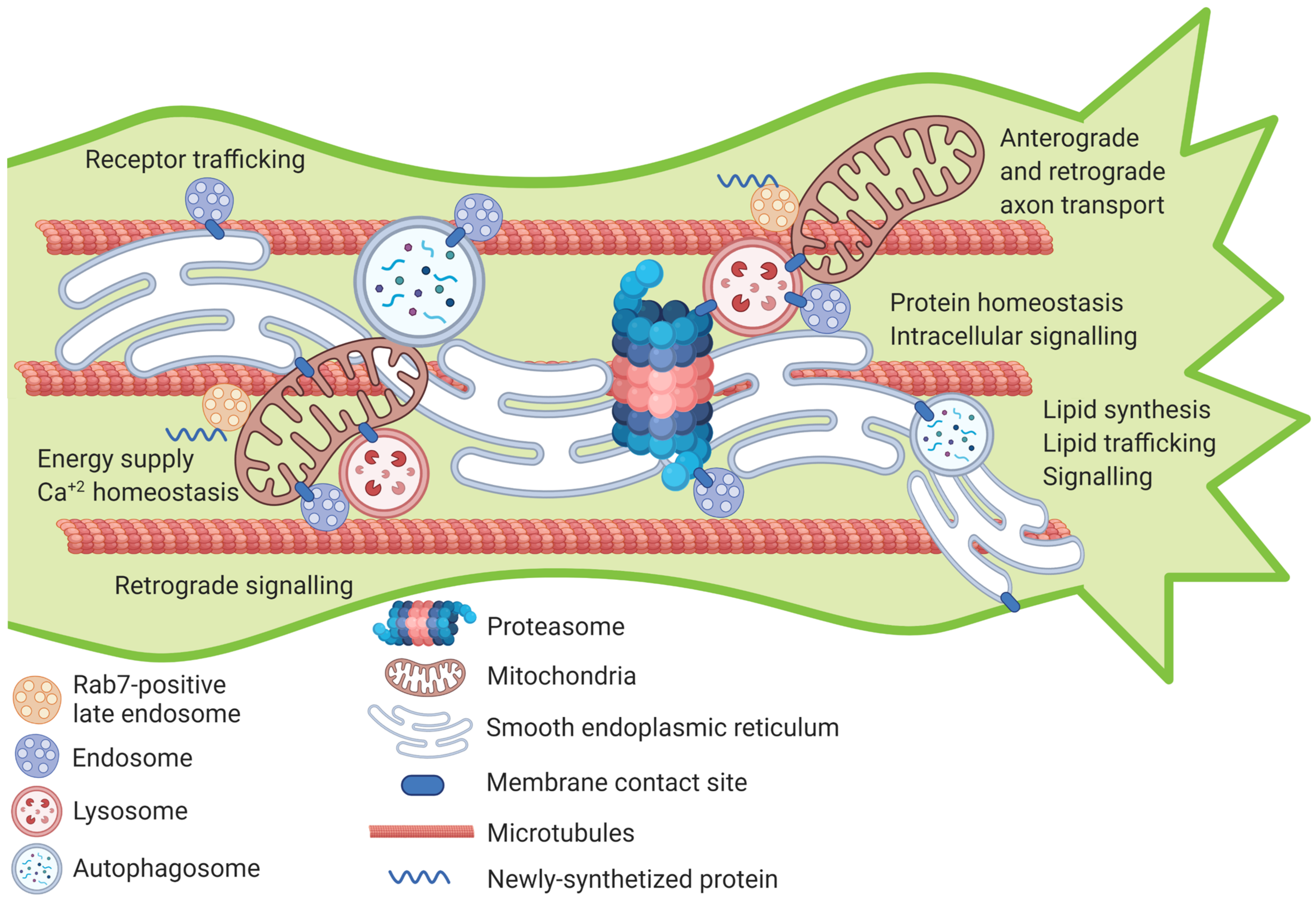
Investigating the molecular mechanisms governing developmental axon growth has been a useful approach for identifying new strategies for boosting axon regeneration after injury, with the goal of treating debilitating conditions such as spinal cord injury and vision loss. The picture emerging is that various axonal organelles are important centers for organizing the molecular mechanisms and machinery required for growth cone development and axon extension, and these have recently been targeted to stimulate robust regeneration in the injured adult central nervous system (CNS). This review summarizes recent literature highlighting a central role for organelles such as recycling endosomes, the endoplasmic reticulum, mitochondria, lysosomes, autophagosomes and the proteasome in developmental axon growth, and describes how these organelles can be targeted to promote axon regeneration after injury to the adult CNS. This review also examines the connections between these organelles in developing and regenerating axons, and finally discusses the molecular mechanisms within the axon that are required for successful axon growth.
Keywords: axon growth; axon regeneration; inter-organelle membrane contact sites; organelles axon growth; axon regeneration; inter-organelle membrane contact sites; organelles