Dioxin and Related Compound Detection: Perspectives for Optical Monitoring

 ,
,  and
and
Abstract
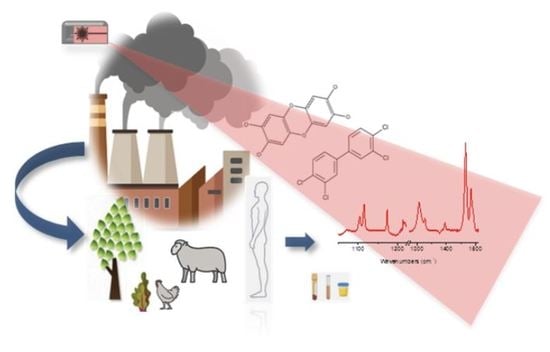
1. Introduction
2. Optical Monitoring of Dioxins and Related Compounds, a Screening of Old and New Mid-IR Light Sources and Techniques
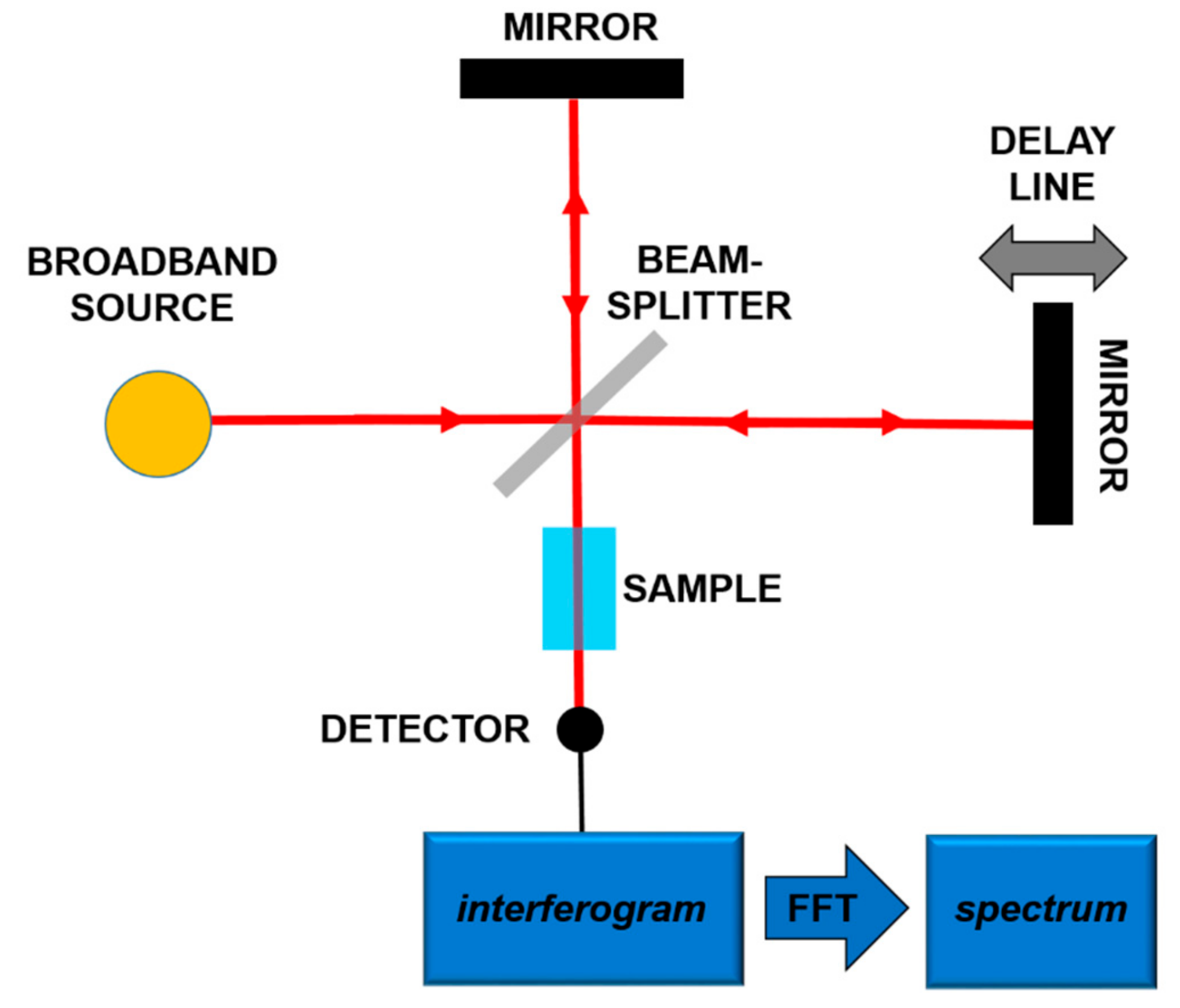
2.1. Wide Wavelength Range Sources
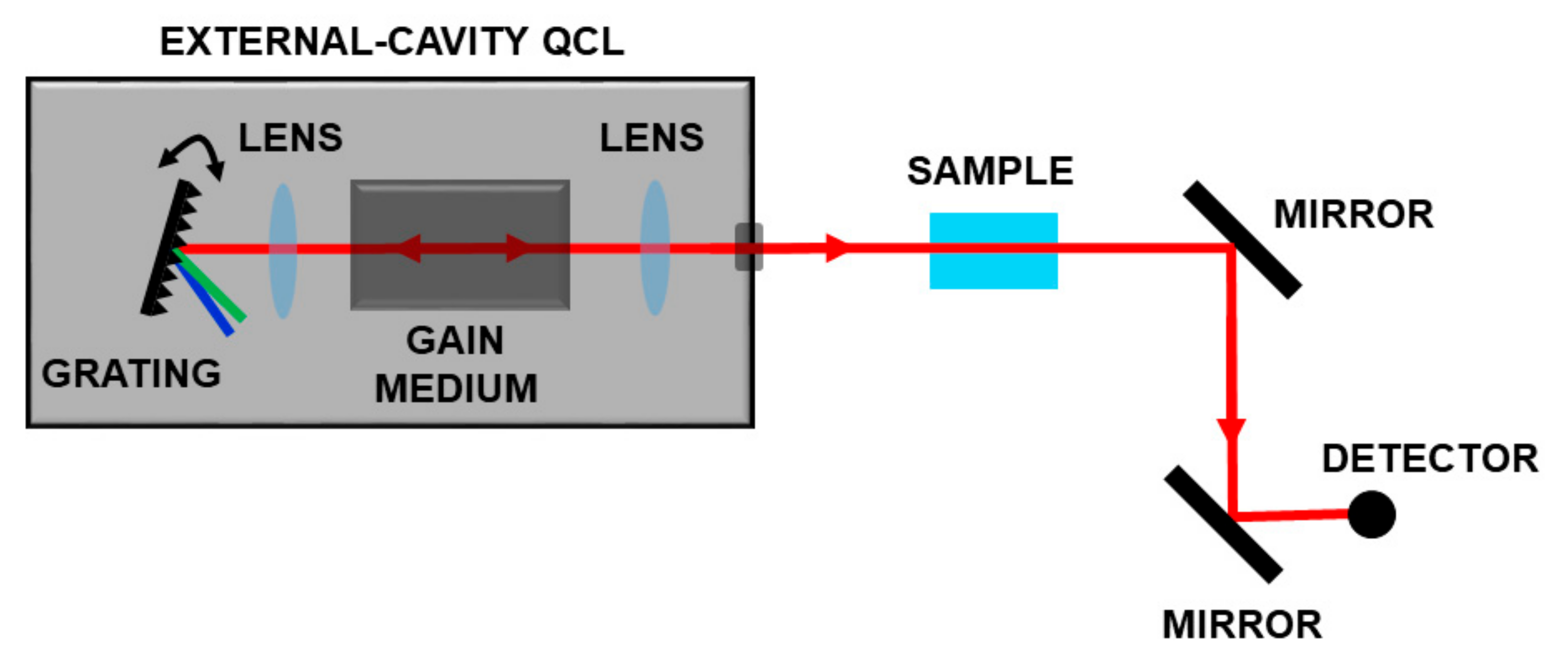
2.2. Narrow Wavelength Range Sources
3. Conclusions and Future Perspectives
Author Contributions
Funding
Conflicts of Interest
References
- Breivik, K.; Alcock, R.; Li, Y.-F.; Bailey, R.E.; Fiedler, H.; Pacyna, J.M. Primary sources of selected POPs: Regional and global scale emission inventories. Environ. Pollut. 2004, 128, 3–16. [Google Scholar] [CrossRef] [Scilit] [PubMed]
- Holt, E.; Weber, R.; Stevenson, G.; Gaus, C. Polychlorinated Dibenzo-p-Dioxins and Dibenzofurans (PCDD/Fs) Impurities in Pesticides: A Neglected Source of Contemporary Relevance. Environ. Sci. Technol. 2010, 44, 5409–5415. [Google Scholar] [CrossRef] [Scilit] [PubMed]
- Zhao, Y.-Y.; Tao, F.-M.; Zeng, E.Y. Theoretical study of the quantitative structure–activity relationships for the toxicity of dibenzo-p-dioxins. Chemosphere 2008, 73, 86–91. [Google Scholar] [CrossRef] [Scilit]
- Hirokawa, S.; Imasaka, T.; Imasaka, T. Chlorine Substitution Pattern, Molecular Electronic Properties, and the Nature of the Ligand−Receptor Interaction: Quantitative Property−Activity Relationships of Polychlorinated Dibenzofurans. Chem. Res. Toxicol. 2005, 18, 232–238. [Google Scholar] [CrossRef] [Scilit] [PubMed]
- Larsson, M.; van den Berg, M.; Brenerová, P.; van Duursen, M.B.M.; van Ede, K.I.; Lohr, C.; Luecke-Johansson, S.; Machala, M.; Neser, S.; Pěnčíková, K.; et al. Consensus Toxicity Factors for Polychlorinated Dibenzo-p-dioxins, Dibenzofurans, and Biphenyls Combining in Silico Models and Extensive in Vitro Screening of AhR-Mediated Effects in Human and Rodent Cells. Chem. Res. Toxicol. 2015, 28, 641–650. [Google Scholar] [CrossRef] [Scilit] [PubMed]
- Mimura, J.; Fujii-Kuriyama, Y. Functional role of AhR in the expression of toxic effects by TCDD. Biochim. Biophys. Acta Gen. Subj. 2003, 1619, 263–268. [Google Scholar] [CrossRef] [Scilit]
- Van den Berg, M.; Birnbaum, L.S.; Denison, M.; de Vito, M.; Farland, W.; Feeley, M.; Fiedler, H.; Hakansson, H.; Hanberg, A.; Haws, L.; et al. The 2005 World Health Organization Re-evaluation of Human and Mammalian Toxic Equivalency Factors for Dioxins and Dioxin-like Compounds. Toxicol. Sci. 2006, 93, 223–241. [Google Scholar] [CrossRef] [Scilit]
- Schug, T.T.; Johnson, A.F.; Birnbaum, L.S.; Colborn, T.; Guillette, J.L.J.; Crews, D.P.; Collins, T.; Soto, A.M.; vom Saal, F.S.; McLachlan, J.A.; et al. Minireview: Endocrine Disruptors: Past Lessons and Future Directions. Mol. Endocrinol. 2016, 30, 833–847. [Google Scholar] [CrossRef] [Scilit]
- Mrema, E.J.; Rubino, F.M.; Brambilla, G.; Moretto, A.; Tsatsakis, A.M.; Colosio, C. Persistent organochlorinated pesticides and mechanisms of their toxicity. Toxicology 2013, 307, 74–88. [Google Scholar] [CrossRef] [Scilit] [PubMed]
- Patrizi, B.; Siciliani de Cumis, M. TCDD Toxicity Mediated by Epigenetic Mechanisms. Int. J. Mol. Sci. 2018, 19, 4101. [Google Scholar] [CrossRef] [Scilit] [PubMed]
- Esser, C.; Rannug, A. The Aryl Hydrocarbon Receptor in Barrier Organ Physiology, Immunology, and Toxicology. Pharmacol. Rev. 2015, 67, 259. [Google Scholar] [CrossRef] [Scilit] [PubMed]
- Pirkle, J.L.; Wolfe, W.H.; Patterson, D.G.; Needham, L.L.; Michalek, J.E.; Miner, J.C.; Peterson, M.R.; Phillips, D.L. Estimates of the half-life of 2,3,7,8-tetrachlorodibenzo-p-dioxin in Vietnam veterans of operation ranch hand. J. Toxicol. Environ. Health 1989, 27, 165–171. [Google Scholar] [CrossRef] [Scilit] [PubMed]
- Wolfe, W.H.; Michalek, J.E.; Miner, J.C.; Pirkle, J.L.; Caudill, S.P.; Patterson, D.G.; Needham, L.L. Determinants of TCDD half-life in veterans of operation ranch hand. J. Toxicol. Environ. Health 1994, 41, 481–488. [Google Scholar] [CrossRef] [Scilit]
- Safe, S. Polychlorinated Biphenyls (PCBs), Dibenzo-p-Dioxins (PCDDs), Dibenzofurans (PCDFs), and Related Compounds: Environmental and Mechanistic Considerations Which Support the Development of Toxic Equivalency Factors (TEFs). Crit. Rev. Toxicol. 1990, 21, 51–88. [Google Scholar] [CrossRef] [Scilit] [PubMed]
- Hennig, B.; Meerarani, P.; Slim, R.; Toborek, M.; Daugherty, A.; Silverstone, A.E.; Robertson, L.W. Proinflammatory Properties of Coplanar PCBs: In Vitro and in Vivo Evidence. Toxicol. Appl. Pharmacol. 2002, 181, 174–183. [Google Scholar] [CrossRef] [Scilit] [PubMed]
- Carpenter, D.O. Polychlorinated biphenyls (PCBs): Routes of exposure and effects on human health. Rev. Environ. Health 2006, 21, 1–23. [Google Scholar] [CrossRef] [Scilit] [PubMed]
- Gullett, B.K.; Oudejans, L.; Tabor, D.; Touati, A.; Ryan, S. Near-Real-Time Combustion Monitoring for PCDD/PCDF Indicators by GC-REMPI-TOFMS. Environ. Sci. Technol. 2012, 46, 923–928. [Google Scholar] [CrossRef] [Scilit]
- De Cumis, M.S.; D’Amato, F.; Viciani, S.; Patrizi, B.; Foggi, P.; Galea, C.L. First quantitative measurements by IR spectroscopy of dioxins and furans by means of broadly tunable quantum cascade lasers. Laser Phys. 2013, 23, 025603. [Google Scholar] [CrossRef] [Scilit]
- Patrizi, B.; de Cumis, M.S.; Viciani, S.; D’Amato, F.; Foggi, P. Characteristic vibrational frequencies of toxic polychlorinated dibenzo-dioxins and -furans. J. Hazard. Mater. 2014, 274, 98–105. [Google Scholar] [CrossRef] [Scilit]
- Deguchi, Y.; Dobashi, S.; Fukuda, N.; Shinoda, K.; Morita, M. Real-Time PCB Monitoring Using Time-of-Flight Mass Spectrometry with Picosecond Laser Ionization. Environ. Sci. Technol. 2003, 37, 4737–4742. [Google Scholar] [CrossRef] [Scilit]
- Wang, Z.Z.; Deguchi, Y.; Yan, J.J.; Liu, J.P. Breakdown Pattern of Hydrocarbons by Laser Breakdown Time-of-flight Mass Spectrometry. Spectrosc. Lett. 2015, 48, 669–676. [Google Scholar] [CrossRef] [Scilit]
- Ncube, S.; Madikizela, L.; Cukrowska, E.; Chimuka, L. Recent advances in the adsorbents for isolation of polycyclic aromatic hydrocarbons (PAHs) from environmental sample solutions. TrAC Trends Anal. Chem. 2018, 99, 101–116. [Google Scholar] [CrossRef] [Scilit]
- Patil, S.S.; Shedbalkar, U.U.; Truskewycz, A.; Chopade, B.A.; Ball, A.S. Nanoparticles for environmental clean-up: A review of potential risks and emerging solutions. Environ. Technol. Innov. 2016, 5, 10–21. [Google Scholar] [CrossRef] [Scilit]
- Carabias-Martínez, R.; Rodríguez-Gonzalo, E.; Revilla-Ruiz, P.; Hernández-Méndez, I. Pressurized liquid extraction in the analysis of food and biological samples. J. Chroma A 2005, 1089, 1–17. [Google Scholar] [CrossRef] [Scilit]
- Focant, J.-F.; Pirard, C.; de Pauw, E. Automated sample preparation-fractionation for the measurement of dioxins and related compounds in biological matrices: A review. Talanta 2004, 63, 1101–1113. [Google Scholar] [CrossRef] [Scilit] [PubMed]
- Dimpe, K.M.; Nomngongo, P.N. Current sample preparation methodologies for analysis of emerging pollutants in different environmental matrices. TrAC. Trends Anal. Chem. 2016, 82, 199–207. [Google Scholar] [CrossRef] [Scilit]
- Hoff, R.B.; Pizzolato, T.M. Combining extraction and purification steps in sample preparation for environmental matrices: A review of matrix solid phase dispersion (MSPD) and pressurized liquid extraction (PLE) applications. TrAC Trends Anal. Chem. 2018, 109, 83–96. [Google Scholar] [CrossRef] [Scilit]
- Zheng, Y.; Cai, D.; Huang, B.; Han, J.; Chen, Q.; Zhang, J.; Zhang, J.; Wang, X.; Shen, H. Simultaneous detection of multiple hydroxylated polychlorinated biphenyls from biological samples using ultra-high-performance liquid chromatography with isotope dilution tandem mass spectrometry. J. Sep. Sci. 2019, 42, 760–768. [Google Scholar] [CrossRef] [Scilit] [PubMed]
- Petrovic, M.; Eljarrat, E.; de Alda, M.J.L.; Barceló, D. Recent advances in the mass spectrometric analysis related to endocrine disrupting compounds in aquatic environmental samples. J. Chromatogr. A 2002, 974, 23–51. [Google Scholar] [CrossRef] [Scilit]
- Lorenzo, M.; Pico, Y. Gas Chromatography and Mass Spectroscopy Techniques for the Detection of Chemical Contaminants and Residues in Foods. In Chemical Contaminants and Residues in Food, 2nd ed.; Schrenk, D., Cartus, A., Eds.; Woodhead Publishing: Sawston, UK, 2017; pp. 15–50. [Google Scholar]
- Pizzini, S.; Piazza, R.; Cozzi, G.; Barbante, C. Simultaneous determination of halogenated contaminants and polycyclic aromatic hydrocarbons: A multi-analyte method applied to filter-feeding edible organisms. Anal. Bioanal. Chem. 2016, 408, 7991–7999. [Google Scholar] [CrossRef] [Scilit]
- Smith, B. Fundamentals of Fourier Transform Infrared Spectroscopy, 2nd ed.; CRC Press: Boca Raton, FL, USA, 2011. [Google Scholar] [CrossRef] [Scilit]
- Wurrey, C.J.; Fairless, B.J.; Kimball, H.E. Gas Chromatographic/Matrix Isolation/Fourier Transform Infrared Spectra of the Laterally Chlorinated Dibenzo-p-Dioxins and Dibenzofurans. Appl. Spectrosc. 1989, 43, 1317–1324. [Google Scholar] [CrossRef] [Scilit]
- Grainger, J.; Gelbaum, L.T. Tetrachlorodibenzo-p-Dioxin Isomer Differentiation by Capillary Gas Chromatography Fourier Transform-Infrared Spectroscopy. Appl. Spectrosc. 1987, 41, 809–820. [Google Scholar] [CrossRef] [Scilit]
- Coddington, I.; Newbury, N.; Swann, W. Dual-comb spectroscopy. Optica 2016, 3, 414–426. [Google Scholar] [CrossRef] [Scilit]
- Hugi, A.; Villares, G.; Blaser, S.; Liu, H.C.; Faist, J. Mid-infrared frequency comb based on a quantum cascade laser. Nature 2012, 492, 229–233. [Google Scholar] [CrossRef] [Scilit]
- Reichert, J.; Holzwarth, R.; Udem, T.; Hänsch, T.W. Measuring the frequency of light with mode-locked lasers. Opt. Commun. 1999, 172, 59–68. [Google Scholar] [CrossRef] [Scilit]
- Giordmaine, J.A.; Miller, R.C. Tunable Coherent Parametric Oscillation in LiNbO3 at Optical Frequencies. Phys. Rev. Lett. 1965, 14, 973–976. [Google Scholar] [CrossRef] [Scilit]
- Faist, J.; Capasso, F.; Sivco, D.L.; Sirtori, C.; Hutchinson, A.L.; Cho, A.Y. Quantum Cascade Laser. Science 1994, 264, 553–556. [Google Scholar] [CrossRef] [Scilit] [PubMed]
- Vurgaftman, I.; Weih, R.; Kamp, M.; Meyer, J.R.; Canedy, C.L.; Kim, C.S.; Kim, M.; Bewley, W.W.; Merritt, C.D.; Abell, J.; et al. Interband cascade lasers. J. Phys. D Appl. Phys. 2015, 48, 123001. [Google Scholar] [CrossRef] [Scilit]
- Vasilyev, S.; Moskalev, I.S.; Smolski, V.O.; Peppers, J.M.; Mirov, M.; Muraviev, A.V.; Zawilski, K.; Schunemann, P.G.; Mirov, S.B.; Vodopyanov, K.L.; et al. Super-octave longwave mid-infrared coherent transients produced by optical rectification of few-cycle 2.5-μm pulses. Optica 2019, 6, 111–114. [Google Scholar] [CrossRef] [Scilit]
- Young, C.; Kim, S.S.; Luzinova, Y.; Weida, M.; Arnone, D.; Takeuchi, E.; Day, T.; Mizaikoff, B. External cavity widely tunable quantum cascade laser based hollow waveguide gas sensors for multianalyte detection. Sens. Actuators B Chem. 2009, 140, 24–28. [Google Scholar] [CrossRef] [Scilit]
- Hodgkinson, J.; Tatam, R.P. Optical gas sensing: A review. Meas. Sci. Technol. 2012, 24, 012004. [Google Scholar] [CrossRef] [Scilit]
- Kosterev, A.; Wysocki, G.; Bakhirkin, Y.; So, S.; Lewicki, R.; Fraser, M.; Tittel, F.; Curl, R.F. Application of quantum cascade lasers to trace gas analysis. Appl. Phys. B 2008, 90, 165–176. [Google Scholar] [CrossRef] [Scilit]
- De Cumis, M.S.; Viciani, S.; Galli, I.; Mazzotti, D.; Sorci, F.; Severi, M.; D’Amato, F. Note: An analyzer for field detection of H2S by using cavity ring-down at 1.57 μm. Rev. Sci. Instrum. 2015, 86, 056108. [Google Scholar] [CrossRef] [Scilit]
- Chiarugi, A.; Viciani, S.; D’Amato, F.; Burton, M. Diode laser-based gas analyser for the simultaneous measurement of CO2 and HF in volcanic plumes. Atmos. Meas. Tech. 2018, 11, 329–339. [Google Scholar] [CrossRef] [Scilit]
- Viciani, S.; Montori, A.; Chiarugi, A.; D’Amato, F. A Portable Quantum Cascade Laser Spectrometer for Atmospheric Measurements of Carbon Monoxide. Sensors 2018, 18, 2380. [Google Scholar] [CrossRef] [Scilit] [PubMed]
- Patrizi, B.; Lapini, A.; di Donato, M.; Marcelli, A.; Lima, M.; Righini, R.; Foggi, P.; Baiocco, P.; Bonamore, A.; Boffi, A. Role of Local Structure and Dynamics of Small Ligand Migration in Proteins: A Study of a Mutated Truncated Hemoprotein from Thermobifida fusca by Time Resolved MIR Spectroscopy. J. Phys. Chem. B 2014, 118, 9209–9217. [Google Scholar] [CrossRef] [Scilit]
- Lapini, A.; di Donato, M.; Patrizi, B.; Marcelli, A.; Lima, M.; Righini, R.; Foggi, P.; Sciamanna, N.; Boffi, A. Carbon Monoxide Recombination Dynamics in Truncated Hemoglobins Studied with Visible-Pump MidIR-Probe Spectroscopy. J. Phys. Chem. B 2012, 116, 8753–8761. [Google Scholar] [CrossRef] [Scilit] [PubMed]
- Hugi, A.; Terazzi, R.; Bonetti, Y.; Wittmann, A.; Fischer, M.; Beck, M.; Faist, J.; Gini, E. External cavity quantum cascade laser tunable from 7.6 to 11.4 μm. Appl. Phys. Lett. 2009, 95, 061103. [Google Scholar] [CrossRef] [Scilit]
- Brandstetter, M.; Lendl, B. Tunable mid-infrared lasers in physical chemosensors towards the detection of physiologically relevant parameters in biofluids. Sens. Actuators B Chem. 2012, 170, 189–195. [Google Scholar] [CrossRef] [Scilit]
- Da Silveira Petruci, J.F.; Fortes, P.R.; Kokoric, V.; Wilk, A.; Raimundo, I.M.; Cardoso, A.A.; Mizaikoff, B. Real-time monitoring of ozone in air using substrate-integrated hollow waveguide mid-infrared sensors. Sci. Rep. 2013, 3, 3174. [Google Scholar] [CrossRef] [Scilit]
- Jouy, P.; Bonetti, Y.; Hans, K.; Gianella, M.; Sigrist, M.; Mangold, M.; Tuzson, B.; Emmenegger, L.; Wägli, P.; Homsy, A.; et al. Multi-Wavelength QCL Based MIR Spectroscopy for Fluids and Gases, CLEO: 2013, San Jose, California, 2013/06/09; Optical Society of America: San Jose, CA, USA, 2013; JM4K.1. [Google Scholar] [CrossRef]
- Lyakh, A.; Barron-Jimenez, R.; Dunayevskiy, I.; Go, R.; Tsvid, E.; Patel, K.C. Progress in Rapidly-Tunable External Cavity Quantum Cascade Lasers with a Frequency-Shifted Feedback. Photonics 2016, 3, 19. [Google Scholar] [CrossRef] [Scilit]
- Maulini, R.; Beck, M.; Faist, J.; Gini, E. Broadband tuning of external cavity bound-to-continuum quantum-cascade lasers. Appl. Phys. Lett. 2004, 84, 1659–1661. [Google Scholar] [CrossRef] [Scilit]
- Strand, C.L.; Ding, Y.; Johnson, S.E.; Hanson, R.K. Measurement of the mid-infrared absorption spectra of ethylene (C2H4) and other molecules at high temperatures and pressures. J. Quant. Spectrosc. Radiat. Transfer 2019, 222, 122–129. [Google Scholar] [CrossRef] [Scilit]
- Brandstetter, M.; Genner, A.; Anic, K.; Lendl, B. Tunable external cavity quantum cascade laser for the simultaneous determination of glucose and lactate in aqueous phase. Analyst 2010, 135, 3260–3265. [Google Scholar] [CrossRef] [Scilit]
- Alcaráz, M.R.; Schwaighofer, A.; Kristament, C.; Ramer, G.; Brandstetter, M.; Goicoechea, H.; Lendl, B. External-Cavity Quantum Cascade Laser Spectroscopy for Mid-IR Transmission Measurements of Proteins in Aqueous Solution. Anal. Chem. 2015, 87, 6980–6987. [Google Scholar] [CrossRef] [Scilit] [PubMed]
- Montalvo, G.; Waegele, M.M.; Shandler, S.; Gai, F.; DeGrado, W.F. Infrared Signature and Folding Dynamics of a Helical β-Peptide. J. Am. Chem. Soc. 2010, 132, 5616–5618. [Google Scholar] [CrossRef] [Scilit] [PubMed]
- Wörle, K.; Seichter, F.; Wilk, A.; Armacost, C.; Day, T.; Godejohann, M.; Wachter, U.; Vogt, J.; Radermacher, P.; Mizaikoff, B. Breath Analysis with Broadly Tunable Quantum Cascade Lasers. Anal. Chem. 2013, 85, 2697–2702. [Google Scholar] [CrossRef] [Scilit]
- Waegele, M.M.; Gai, F. Infrared Study of the Folding Mechanism of a Helical Hairpin: Porcine PYY. Biochemistry 2010, 49, 7659–7664. [Google Scholar] [CrossRef] [Scilit]
- Furstenberg, R.; Kendziora, C.A.; Papantonakis, M.R.; Nguyen, V.; McGill, R.A. Chemical imaging using infrared photothermal microspectroscopy. SPIE 2012, 8374, 837411-1. [Google Scholar] [CrossRef] [Scilit]
- Ravaro, M.; Locatelli, M.; Pugliese, E.; di Leo, I.; de Cumis, M.S.; D’Amato, F.; Poggi, P.; Consolino, L.; Meucci, R.; Ferraro, P.; et al. Mid-infrared digital holography and holographic interferometry with a tunable quantum cascade laser. Opt. Lett. 2014, 39, 4843–4846. [Google Scholar] [CrossRef] [Scilit]
- Pleitez, M.A.; Lieblein, T.; Bauer, A.; Hertzberg, O.; von Lilienfeld-Toal, H.; Mäntele, W. In Vivo Noninvasive Monitoring of Glucose Concentration in Human Epidermis by Mid-Infrared Pulsed Photoacoustic Spectroscopy. Anal. Chem. 2013, 85, 1013–1020. [Google Scholar] [CrossRef] [Scilit]
- Pilling, M.J.; Henderson, A.; Gardner, P. Quantum Cascade Laser Spectral Histopathology: Breast Cancer Diagnostics Using High Throughput Chemical Imaging. Anal. Chem. 2017, 89, 7348–7355. [Google Scholar] [CrossRef] [Scilit] [PubMed]
- Yeh, K.; Schulmerich, M.; Bhargava, R. Mid-infrared microspectroscopic imaging with a quantum cascade laser. SPIE 2013, 8726. [Google Scholar] [CrossRef] [Scilit]
- Adler, F.; Thorpe, M.J.; Cossel, K.C.; Ye, J. Cavity-Enhanced Direct Frequency Comb Spectroscopy: Technology and Applications. Annu. Rev. Anal. Chem. 2010, 3, 175–205. [Google Scholar] [CrossRef] [Scilit]
- Picqué, N.; Hänsch, T.W. Frequency comb spectroscopy. Nat. Photonics 2019, 13, 146–157. [Google Scholar] [CrossRef] [Scilit]
- De Cumis, M.S.; Eramo, R.; Coluccelli, N.; Galzerano, G.; Laporta, P.; Pastor, P.C. Multiplexed direct-frequency-comb Vernier spectroscopy of carbon dioxide 2ν1 + ν3 ro-vibrational combination band. J. Chem. Phys. 2018, 148, 114303. [Google Scholar] [CrossRef] [Scilit] [PubMed]
- Villares, G.; Hugi, A.; Blaser, S.; Faist, J. Dual-comb spectroscopy based on quantum-cascade-laser frequency combs. Nat. Commun. 2014, 5, 5192. [Google Scholar] [CrossRef] [Scilit] [PubMed]
- Bagheri, M.; Frez, C.; Sterczewski, L.A.; Gruidin, I.; Fradet, M.; Vurgaftman, I.; Canedy, C.L.; Bewley, W.W.; Merritt, C.D.; Kim, C.S.; et al. Passively mode-locked interband cascade optical frequency combs. Sci. Rep. 2018, 8, 3322. [Google Scholar] [CrossRef] [Scilit]
- Klocke, J.L.; Mangold, M.; Allmendinger, P.; Hugi, A.; Geiser, M.; Jouy, P.; Faist, J.; Kottke, T. Single-Shot Sub-microsecond Mid-infrared Spectroscopy on Protein Reactions with Quantum Cascade Laser Frequency Combs. Anal. Chem. 2018, 90, 10494–10500. [Google Scholar] [CrossRef] [Scilit]
- Taylor, A.B.; Zijlstra, P. Single-Molecule Plasmon Sensing: Current Status and Future Prospects. ACS Sens. 2017, 2, 1103–1122. [Google Scholar] [CrossRef] [Scilit]
- Giorgini, A.; Avino, S.; Malara, P.; Zullo, R.; De Natale, P.; Mrkvová, K.; Homola, J.; Gagliardi, G. Surface-plasmon optical-heterodyne clock biosensor. Sens. Actuators B Chem. 2018, 273, 336–341. [Google Scholar] [CrossRef] [Scilit]
- Greive, S.J.; Weitzel, S.E.; Goodarzi, J.P.; Main, L.J.; Pasman, Z.; von Hippel, P.H. Monitoring RNA transcription in real time by using surface plasmon resonance. Proc. Natl. Acad. Sci. USA 2008, 105, 3315–3320. [Google Scholar] [CrossRef] [Scilit]
- Bocková, M.; Chadtová Song, X.; Gedeonová, E.; Levová, K.; Kalousová, M.; Zima, T.; Homola, J. Surface plasmon resonance biosensor for detection of pregnancy associated plasma protein A2 in clinical samples. Anal. Bioanal. Chem. 2016, 408, 7265–7269. [Google Scholar] [CrossRef] [Scilit] [PubMed]
- Kabashin, A.V.; Patskovsky, S.; Grigorenko, A.N. Phase and amplitude sensitivities in surface plasmon resonance bio and chemical sensing. Opt. Express 2009, 17, 21191–21204. [Google Scholar] [CrossRef] [Scilit] [PubMed]
- Gangopadhyay, T.K.; Giorgini, A.; Halder, A.; Pal, M.; Paul, M.C.; Avino, S.; Gagliardi, G. Detection of chemicals using a novel fiber-optic sensor element built in fiber loop ring-resonators. Sens. Actuators B Chem. 2015, 206, 327–335. [Google Scholar] [CrossRef] [Scilit]
- Gagliardi, G. Cavity-Enhanced Spectroscopy and Sensing; Springer: Berlin, Germany, 2014. [Google Scholar] [CrossRef] [Scilit]
- Soh, N.; Tokuda, T.; Watanabe, T.; Mishima, K.; Imato, T.; Masadome, T.; Asano, Y.; Okutani, S.; Niwa, O.; Brown, S. A surface plasmon resonance immunosensor for detecting a dioxin precursor using a gold binding polypeptide. Talanta 2003, 60, 733–745. [Google Scholar] [CrossRef] [Scilit]
- Shimomura, M.; Nomura, Y.; Zhang, W.; Sakino, M.; Lee, K.-H.; Ikebukuro, K.; Karube, I. Simple and rapid detection method using surface plasmon resonance for dioxins, polychlorinated biphenylx and atrazine. Anal. Chim. Acta 2001, 434, 223–230. [Google Scholar] [CrossRef] [Scilit]
- Abalde-Cela, S.; Ho, S.; Rodríguez-González, B.; Correa-Duarte, M.A.; Álvarez-Puebla, R.A.; Liz-Marzán, L.M.; Kotov, N.A. Loading of Exponentially Grown LBL Films with Silver Nanoparticles and Their Application to Generalized SERS Detection. Angew. Chem. Int. Ed. 2009, 48, 5326–5329. [Google Scholar] [CrossRef] [Scilit]
- Yang, Y.; Meng, G. Ag dendritic nanostructures for rapid detection of polychlorinated biphenyls based on surface-enhanced Raman scattering effect. J. Appl. Phys. 2010, 107, 044315. [Google Scholar] [CrossRef] [Scilit]
- Bantz, K.C.; Haynes, C.L. Surface-enhanced Raman scattering detection and discrimination of polychlorinated biphenyls. Vib. Spectrosc. 2009, 50, 29–35. [Google Scholar] [CrossRef] [Scilit]
- Zhu, C.; Meng, G.; Huang, Q.; Huang, Z. Vertically aligned Ag nanoplate-assembled film as a sensitive and reproducible SERS substrate for the detection of PCB-77. J. Hazard. Mater. 2012, 211–212, 389–395. [Google Scholar] [CrossRef] [Scilit]
- Fleischmann, M.; Hendra, P.J.; McQuillan, A.J. Raman spectra of pyridine adsorbed at a silver electrode. Chem. Phys. Lett. 1974, 26, 163–166. [Google Scholar] [CrossRef] [Scilit]
- Stiles, P.L.; Dieringer, J.A.; Shah, N.C.; van Duyne, R.P. Surface-Enhanced Raman Spectroscopy. Annu. Rev. Anal. Chem. 2008, 1, 601–626. [Google Scholar] [CrossRef] [Scilit]
- Wang, M.; Meng, G.; Huang, Q.; Li, M.; Li, Z.; Tang, C. Fluorescence detection of trace PCB101 based on PITC immobilized on porous AAO membrane. Analyst 2011, 136, 278–281. [Google Scholar] [CrossRef] [Scilit]
- Li, M.; Meng, G.; Huang, Q.; Yin, Z.; Wu, M.; Zhang, Z.; Kong, M. Prototype of a Porous ZnO SPV-Based Sensor for PCB Detection at Room Temperature under Visible Light Illumination. Langmuir 2010, 26, 13703–13706. [Google Scholar] [CrossRef] [Scilit]
- Tang, J.; Chen, W.; Ju, H. Rapid detection of pesticide residues using a silver nanoparticles coated glass bead as nonplanar substrate for SERS sensing. Sens. Actuators B Chem. 2019, 287, 576–583. [Google Scholar] [CrossRef] [Scilit]
- Schädle, T.; Mizaikoff, B. Mid-Infrared Waveguides: A Perspective. Appl. Spectros. 2016, 70, 1625–1638. [Google Scholar] [CrossRef] [Scilit]
- Chen, Y.; Lin, H.; Hu, J.; Li, M. Heterogeneously Integrated Silicon Photonics for the Mid-Infrared and Spectroscopic Sensing. ACS Nano 2014, 8, 6955–6961. [Google Scholar] [CrossRef] [Scilit] [PubMed]




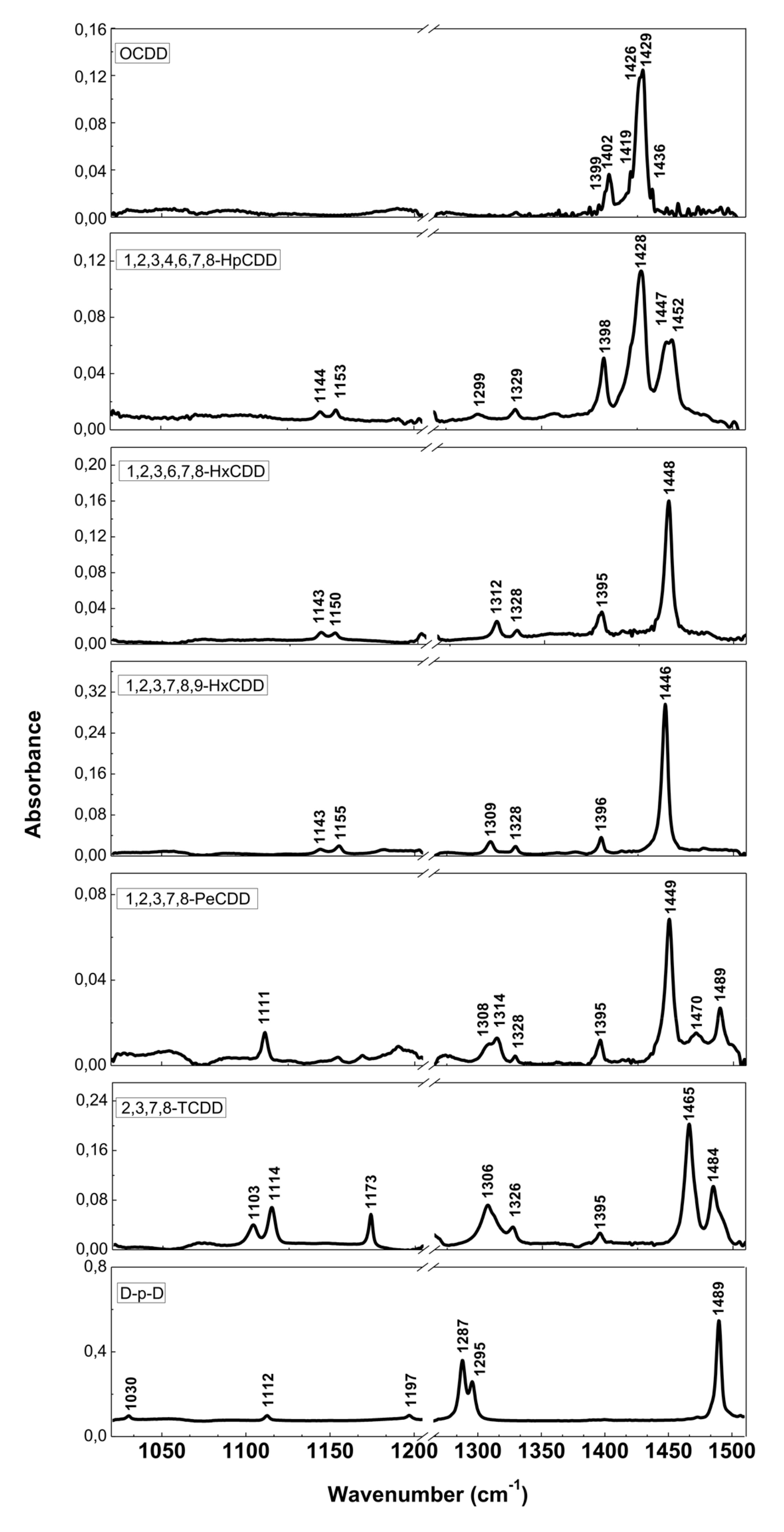
| PCDD Congener | Mode | Frequency Range (1020–1205 and 1265–1510 cm−1) GC/MI/FT-IR [33] | Frequency Range (1020–1205 and 1265–1510 cm−1) Vapor-Phase FT-IR [34] | Frequency Range (1020–1205 and 1265–1510 cm−1) Condensed-Phase FT-IR [19] |
|---|---|---|---|---|
| dibenzo-p-dioxin | C=C aromatic ring skeletal vibrations | 1489 | 1489 | |
| 1390 | ||||
| C-O-C asymmetric stretch | 1295 | |||
| 1290 | 1287 | |||
| C-C-C tri-ring bending | 1197 | |||
| 1117 | ||||
| Ring breathing | 1026 | 1112 | ||
| 1030 | ||||
| 2,3,7,8-TCDD | C=C aromatic ring skeletal vibrations | 1495 | ||
| 1488 | 1489 | 1484 | ||
| 1470 | 1465 | 1465 | ||
| 1391 | 1395 | |||
| C-O-C asymmetric stretch | 1330 | 1321 | 1326 | |
| 1313 | ||||
| 1306 | 1306 | 1306 | ||
| C-C-C tri-ring bending | 1176 | 1173 | 1173 | |
| Ring breathing | 1117 | 1114 | 1114 | |
| 1106 | 1103 | 1103 | ||
| 1,2,3,7,8-PeCDD | C=C aromatic ring skeletal vibrations | 1493 | 1489 | |
| 1475 | 1471 | 1470 | ||
| 1465 | 1447 | 1449 | ||
| 1399 | 1394 | 1395 | ||
| C-O-C asymmetric stretch | 1319 | 1328 | ||
| 1313 | 1311 | 1314 | ||
| 1308 | ||||
| Ring breathing | 1113 | 1108 | 1111 | |
| 1,2,3,7,8,9-HxCDD | C=C aromatic ring skeletal vibrations | 1480 | ||
| 1452 | 1445 | 1446 | ||
| 1400 | 1391 | 1396 | ||
| C-O-C asymmetric stretch | 1333 | 1328 | ||
| 1314 | 1312 | 1309 | ||
| 1308 | ||||
| 1304 | ||||
| C-C-C tri-ring bending | 1155 | |||
| 1147 | 1143 | |||
| 1,2,3,6,7,8-HxCDD | C=C aromatic ring skeletal vibrations | 1481 | ||
| 1455 | 1445 | 1448 | ||
| 1400 | 1392 | 1395 | ||
| C-O-C asymmetric stretch | 1333 | 1328 | ||
| 1318 | 1310 | 1312 | ||
| C-C-C tri-ring bending | 1150 | |||
| 1147 | 1143 | |||
| 1,2,3,4,6,7,8-HpCDD | C=C aromatic ring skeletal vibrations | 1480 | ||
| 1457 | 1451 | 1452 | ||
| 1447 | ||||
| 1434 | 1422 | 1428 | ||
| 1403 | 1392 | 1398 | ||
| C-O-C asymmetric stretch | 1334 | 1329 | ||
| 1297 | 1299 | |||
| C-C-C tri-ring bending | 1148 | 1153 | ||
| 1144 | ||||
| OCDD | C=C aromatic ring skeletal vibrations | 1436 | ||
| 1424 | 1429 | |||
| 1419 | ||||
| 1402 | ||||
| 1399 |
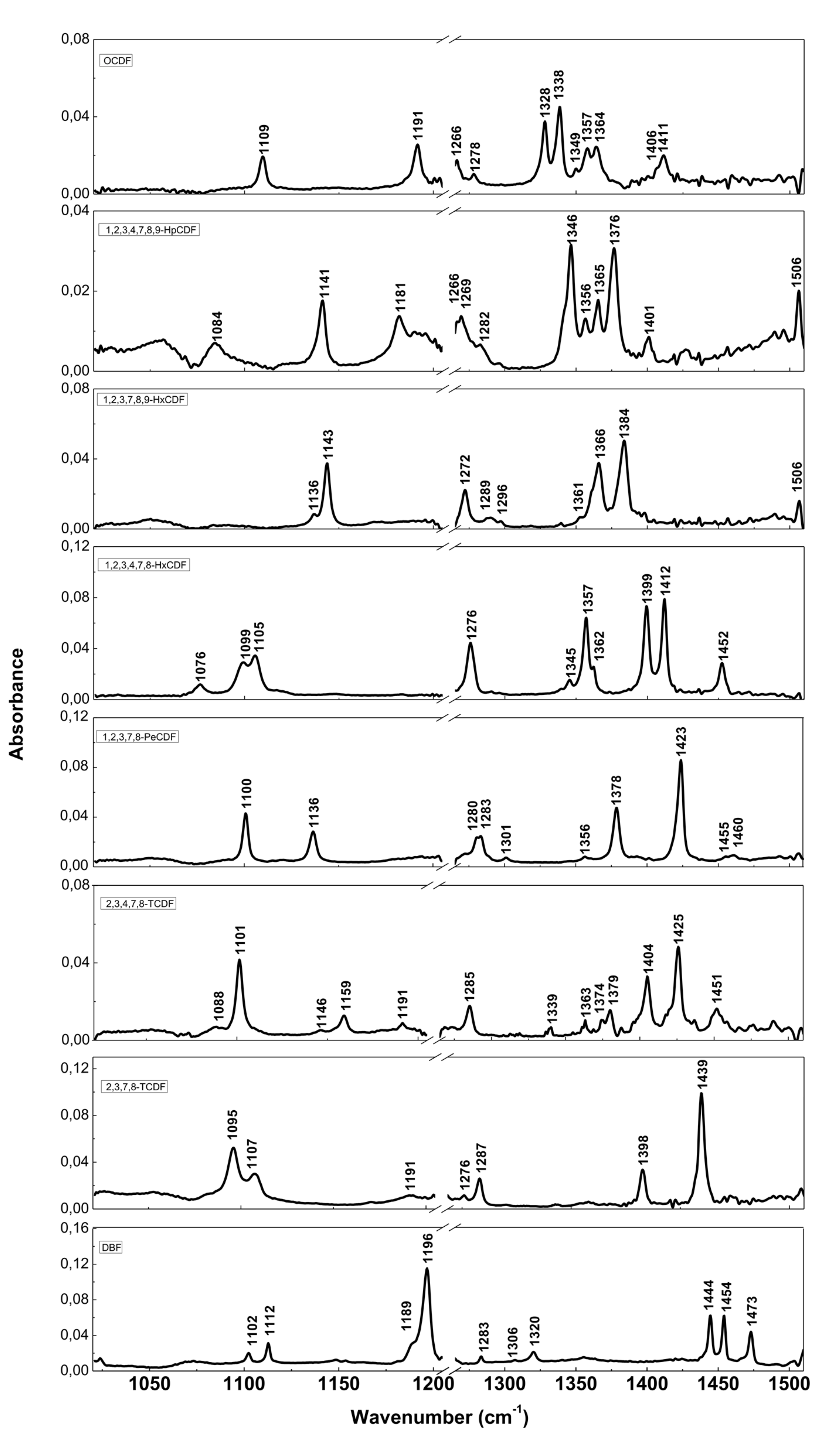
| PCDF Congener | Mode | Frequency Range (1020–1205 and 1265–1510 cm−1) GC/MI/FT-IR [33] | Frequency Range (1020–1205 and 1265–1510 cm−1) Condensed-Phase FT-IR [19] |
|---|---|---|---|
| dibenzofuran | C=C aromatic ring skeletal vibrations | 1473 1465 1454 1444 | |
| C-O-C asymmetric stretch | 1320 1283 | ||
| C-C-C tri-ring bending | 1189 | ||
| 1196 | |||
| Ring breathing | 1112 | ||
| 1102 | |||
| 2,3,7,8-TCDF | C=C aromatic ring skeletal vibrations | 1443 1402 | 1439 1398 |
| C-O-C asymmetric stretch | 1289 | 1287 | |
| C-H in plane deformations | 1276 | ||
| C-C-C tri-ring bending | 1191 | ||
| Ring breathing | 1109 | 1107 | |
| 1099 | 1095 | ||
| 1,2,3,7,8-PeCDF | C=C aromatic ring skeletal vibrations | 1460 1455 1423 | |
| 1427 | 1423 | ||
| C-O-C asymmetric stretch | 1382 1284 | 1356 1301 1283 1280 | |
| C-C-C tri-ring bending | 1138 | 1136 | |
| Ring breathing | 1103 | 1100 | |
| 2,3,4,7,8-PeCDF | C=C aromatic ring skeletal vibrations | 1455 1429 1408 | 1451 1425 1404 |
| C-O-C asymmetric stretch | 1384 1381 1287 | 1379 1374 1363 1285 | |
| 1162 | 1191 1159 | ||
| 1146 | |||
| Ring breathing | 1104 | 1101 | |
| 1088 | |||
| 1,2,3,4,7,8-HxCDF | C=C aromatic ring skeletal vibrations | 1415 | 1452 1412 |
| 1403 | 1399 | ||
| C-O-C asymmetric stretch | 1361 | 1362 1357 1345 | |
| C-H in plane deformations | 1277 | 1276 | |
| Ring breathing | 1108 | 1105 | |
| 1101 | 1099 | ||
| 1076 | |||
| C=C aromatic ring skeletal vibrations | 1506 | ||
| 1,2,3,7,8,9-HxCDF | C-O-C asymmetric stretch | 1387 1369 1361 | 1384 1366 1361 |
| 1294 | 1296 | ||
| 1289 | |||
| C-H in plane deformations | 1273 | 1272 | |
| C-C-C tri-ring bending | 1146 1138 | 1143 1136 | |
| 1,2,3,4,7,8,9-HpCDF | C=C aromatic ring skeletal vibrations | 1405 | 1506 1401 |
| C-O-C asymmetric stretch | 1381 1371 1352 1347 | 1376 1365 1356 1346 1282 | |
| C-H in plane deformations | 1269 | 1269 1266 | |
| C-C-C tri-ring bending | 1182 1142 | 1181 1141 | |
| Ring breathing | 1084 | ||
| OCDF | C=C aromatic ring skeletal vibrations | 1411 1406 | |
| C-O-C asymmetric stretch | 1364 1357 1349 1338 1328 1278 | ||
| C-H in plane | 1266 | ||
| deformations | |||
| C-C-C tri-ring bending | 1191 | ||
| Ring breathing | 1109 |
| Technique | Spectral Range cm−1 | Molecule | Measurement Time | Frequency Accuracy (cm−1) | Optical Power/Wavelength | Cost | Refs |
|---|---|---|---|---|---|---|---|
| FT-IR | 1020–1510 | dioxins and furans | <60 s | 0.9 | <1 µW | Low | [19] |
| ECDL-QCL | 1205–1310 And 1335–1590 | dioxins and furans | 4 min (first range); 14 min (second range) | 0.1 | Tens/hundreds of mW | Medium | [18] |
| Rapid scan QCL | 860–1100 | ethylene, propene, 1-butene, 2-butene, 1,3-butadiene, methanol | down to 3 ms | 0.35 | ≤1 W | High | [56] |
| Dual Comb based IR spectrometer | 1180–1250 | Protein in Halobacterium salinarum | 1 µs | 0.3 * | Typically between 1 µW and 1 mW | High | [72] |
© 2019 by the authors. Licensee MDPI, Basel, Switzerland. This article is an open access article distributed under the terms and conditions of the Creative Commons Attribution (CC BY) license (http://creativecommons.org/licenses/by/4.0/).
Share and Cite
Patrizi, B.; Siciliani de Cumis, M.; Viciani, S.; D’Amato, F. Dioxin and Related Compound Detection: Perspectives for Optical Monitoring. Int. J. Mol. Sci. 2019, 20, 2671. https://doi.org/10.3390/ijms20112671
Patrizi B, Siciliani de Cumis M, Viciani S, D’Amato F. Dioxin and Related Compound Detection: Perspectives for Optical Monitoring. International Journal of Molecular Sciences. 2019; 20(11):2671. https://doi.org/10.3390/ijms20112671
Chicago/Turabian StylePatrizi, Barbara, Mario Siciliani de Cumis, Silvia Viciani, and Francesco D’Amato. 2019. "Dioxin and Related Compound Detection: Perspectives for Optical Monitoring" International Journal of Molecular Sciences 20, no. 11: 2671. https://doi.org/10.3390/ijms20112671
APA StylePatrizi, B., Siciliani de Cumis, M., Viciani, S., & D’Amato, F. (2019). Dioxin and Related Compound Detection: Perspectives for Optical Monitoring. International Journal of Molecular Sciences, 20(11), 2671. https://doi.org/10.3390/ijms20112671