Abstract
AcrAB-TolC is the major multidrug efflux system in Enterobacteriaceae recognizing structurally unrelated molecules including antibiotics, dyes, and detergents. Additionally, in Escherichia coli it mediates resistance to bile salts. In the plant pathogen Erwinia amylovora AcrAB-TolC is required for virulence and phytoalexin resistance. Exchange analysis of AcrAB-TolC was conducted by complementing mutants of both species defective in acrB or tolC with alleles from either species. The acrB and tolC mutants exhibited increased susceptibility profiles for 24 different antibiotics. All mutants were complemented with acrAB or tolC, respectively, regardless of the taxonomic origin of the alleles. Importantly, complementation of E. amylovora mutants with respective E. coli genes restored virulence on apple plants. It was concluded that AcrAB and TolC of both species could interact and that these interactions did not yield in altered functions despite the divergent ecological niches, to which E. coli and E. amylovora have adopted.
1. Introduction
Rising levels of bacterial multidrug resistance are an increasing problem in the treatment of infectious diseases. This phenotype is often associated with the expression of multidrug efflux (MDE) transporters, which export drugs out of the cell. The involved proteins belong to five well-characterized families: the ATP-binding cassette (ABC) family, the major facilitator superfamily (MFS), the resistance-nodulation-cell division (RND) superfamily, the small multidrug resistance (SMR) family, and the multidrug and toxic compound extrusion (MATE) family [1]. Efflux by transporters of the MFS, RND, SMR, and MATE families is driven by proton (or sodium) motive force while ATP hydrolysis drives efflux in ABC transporters [2–5].
RND-type transporters are widespread in Gram negative bacteria. In these efflux pumps, an outer membrane protein of the TolC family co-operates with both, an energized inner membrane translocase typically comprising a proton anti-porter and an adaptor protein located in the periplasmic space, thus forming a tripartite efflux system [2,4]. A remarkable feature of these efflux systems is the wide range of substrates that are recognized by individual pumps [6–7].
Escherichia coli, a member of Enterobacteriaceae, is one of the best and most thoroughly studied bacterial species. Some E. coli strains live as harmless commensals in the human intestines while other strains are pathogenic causing diseases and high mortality in humans [8]. AcrAB-TolC of E. coli is the best characterized RND efflux pump and has emerged as the principal structural and biochemical model system. The anti-porter AcrB and the membrane fusion adaptor AcrA form a translocase unit that interacts with the outer membrane protein TolC thus comprising a contiguous protein complex spanning the bacterial cell envelope and enabling drug efflux [9–10].
AcrAB-TolC mediates resistance towards a wide variety of hydrophobic and amphiphilic compounds including bile salt, detergents, dyes, and antimicrobial agents [10]. Respective alleles of different gram-negative bacteria show a high degree of similarity and their deduced amino acid sequences are homologous [11–12]. The acrAB loci are regulated by members of TetR family of transcriptional repressors named AcrR. The acrR gene is located 141 bp upstream of the acrAB locus and is divergently transcribed [13]. AcrB is of particular interest since it mediates substrate specificity of the tripartite MDE pump towards a wide range of structurally diverse substances [14]. AcrAB recruits the separately expressed outer membrane protein TolC to extrude substrates from the inner membrane or the cytoplasm without any substrate accumulation in the periplasmic space [15].
Homologues of E. coli TolC have been identified in numerous Gram-negative bacteria. Different AcrAB-like transport systems have evolved in E. coli and all share TolC as outer membrane partner [16–18]. The same was found for Klebsiella pneumoniae where AcrAB homologues specifically interact with the TolC-like outer membrane protein KocC, and the respective genes are not co-transcribed [19]. In contrast, in other gram-negative bacteria individual TolC-like channels are often unique for a given RND-type transporter and their genes are consequently co-expressed in the same gene cluster as the RND-type pumps such as in the case of the oprJMN cluster in Pseudomonas aeruginosa [20–21] or the mtrRCDE cluster in Neisseria gonorrhoeae [22]. In bacterial species other than E. coli, the functions attributed to TolC are not linked to a single tolC allele but are distributed among various tolC homologues [23].
Comparative genome analyses revealed high numbers of MDE pumps in soil or plant-associated bacteria [24]. Plants produce an array of diverse secondary metabolites that have antimicrobial activities including preformed so-called phyto-anticipants and phytoalexins, which are synthesized in response to pathogen attack [25–26]. An increasing number of RND-type transporters conferring multidrug resistance in plant-associated bacteria have recently been identified, for examples in Agrobacterium tumefaciens [27], in Pseudomonas syringae [28], in Erwinia chrysanthemi [29], in Bradyrhizobium japonicum [30], in Xanthomonas oryzae [31], and in Ralstonia solanacearum[32].
E. amylovora, a member of Enterobacteriaceae, is the causal agent of fire blight on apple and various other Rosaceae. Burse et al. [33] demonstrated that AcrB played an important role in virulence of E. amylovora and was required for resistance towards diverse plant phytoalexins as well as for successful colonization of the host plant. Recently, mutational analysis showed that TolC is also indispensable for virulence and bacterial in planta multiplication by mediating resistance towards phytoalexins through its exclusive interaction with AcrAB in E. amylovora [34].
Herein, knock-out mutants of E. amylovora and E. coli defective in acrAB or tolC, respectively, were complemented with respective homologous or heterologous alleles in order to investigate whether components of the two systems can be exchanged thereby altering substrate spectra and to determine potential ecological niche-mediated adaptations for both bacterial species.
2. Results and Discussion
2.1. Bioinformatics approach
A BLAST search with the genome sequence of E. amylovora Ea237 ( http://www.sanger.ac.uk/projects/E.amylovora) using the amino acid sequence of AcrB from E. coli K12 strain DH10B (accession number YP-001729367) as query identified six homologous sequences in the genome of Ea237. At the amino acid sequence level, the respective predicted E. amylovora proteins showed the following identities (similarities given in brackets): AcrB with 83% (92%), AcrD with 78% (89%), MdtB with 81% (90%), MdtC with 73% (86%), and two MdtB- and MdtC-like proteins with 63% (79%) and 56% (73%), respectively [35–36].
Additionally, the respective E. amylovora homologues of the E. coli membrane fusion protein AcrA and the transcriptional repressor AcrR showed 73% and 62% identity (83% and 79% similarity), respectively [13,35]. A BLAST search using the amino acid sequence of TolC from E. coli revealed presence of only one TolC homologue in E. amylovora with 77% identity (86% similarity) suggesting a high degree of conservation of genomic arrangements between the two enterobacterial species.
2.2. Susceptibility of E. coli and E. amylovora towards antimicrobial compounds
The susceptibility of the wild types and respective single mutants with deletions in acrB or tolC of E. coli and E. amylovora to a variety of antimicrobial compounds were examined in complex and minimal medium using the determination of minimal inhibitory concentrations (MIC) (Tables 1–4). Double mutants defective in acrB and tolC served as negative controls. Different plant-derived antimicrobial compounds, which were previously reported to be substrates for E. amylovora AcrAB-TolC [33–34], bile salt as a reported substrate for AcrAB-TolC in E. coli [37], and various other antimicrobials were tested. Single deletion of acrB or tolC and simultaneous deletion of acrB and tolC resulted in increased susceptibility of E. coli mutants toward all tested plant-borne antimicrobial compounds. The respective MICs for phloretin, (+)-catechin, naringenin, quercetin, and berberine decreased more than 4-fold, 4-fold, 8-fold, 8-fold, and 16-fold, respectively, in complex medium and about 8-fold in minimal medium except for berberine, for which the MICs were reduced about 64-fold, as compared to E. coli wild type MICs (Tables 1 and 3). Similarly, E. amylovora mutants defective in acrB or tolC and the double mutant exhibited 4-fold, 8-fold, 8-fold, 16-fold, and 32-fold decreased MICs towards (+)-catechin, phloretin, naringenin, quercetin, and berberine, respectively, in both, complex and minimal medium (Tables 2 and 4). Consequently and despite of the fact that E. coli is neither a plant pathogen nor usually exposed to plant-borne chemical defense reactions, AcrAB-TolC of this human-associated bacterium can exclude phytoalexins. This interesting result further substantiated the broad substrate spectrum of this MDE system [14,38] and is in line with the idea that intestinal microbes are constantly challenged by toxic substances derived from plant-borne diet in mammals [39]. Alternatively, our result might indicate a high degree of phylogenetically conserved functionality of the AcrAB-TolC complex among enterobacteriaceae.
Table 1.
Susceptibility of Escherichia coli strains to different compounds in complex medium MHB.
Table 4.
Susceptibility of Erwinia amylovora strains to different compounds in minimal medium AMM2.
Table 3.
Susceptibility of Escherichia coli strains to different compounds in minimal medium AMM2.
Table 2.
Susceptibility of Erwinia amylovora strains to different compounds in complex medium MHB.
The three tested E. amylovora mutants were about 8-fold more sensitive to bile salt as compared to the wild type regardless of the used medium. In contrast, the three E. coli mutants exhibited a 64-fold increased sensitivity to bile salt in both media in comparison to the wild type (Tables 1–4). This result clearly demonstrated that E. amylovora may possess an alternative MDE pump during the detoxification process for bile salts such as demonstrated for EefABC in Enterobacter aerogenes [40]. It remained obscure why the E. coli mutants exhibited higher susceptibilities towards bile salt since one might have assumed a better adaptation of this bacterium to this toxic compound [41].
In contrast to the mutants of E. amylovora, growth medium-dependent susceptibility towards the following group of antimicrobials was observed for the three E. coli mutants: acriflavine, novobiocin, ampicillin, cefoperazone, mitomycin, tetracycline, nalidixic acid, norfloxacin, ciprofloxacin, SDS, ethidium bromide, and crystal violet. For those substances the E. coli wild type was about 5- to 20-fold more resistant as compared to the mutants in complex medium but only 4- to 10-fold more resistant in minimal medium (Tables 1 and 3). E. amylovora mutants were 5- to 40-fold more sensitive to those compounds as compared to their wild type regardless of the used growth medium (Tables 2 and 4). These apparently conflicting results might be rather due to the auxotropic status of E. coli TG1 and its general physiological fitness in minimal medium [42] than due to substrate specificity alterations.
The MICs of the aminoglycosides amikacin and tobramycin for the acrB mutants of E. coli and E. amylovora did not differ from those determined for the wild type strains suggesting that those substances did not act as substrates of AcrB. In contrast, the same substances caused 8-fold and 16-fold increased sensitivities for the tolC mutants and the acrB / tolC double mutants of both species in complex and minimal medium, respectively. It was previously demonstrated that TolC additionally to its function with AcrB could specifically interact with another RND-type transporter of E. coli termed AcrAD in extruding a variety of hydrophilic aminoglycosides from the periplasm and cytoplasm [38,43].
Additive effects in the reduction of MICs due to simultaneous disruption of acrB and tolC regardless of the used species and medium could be observed for erythromycin, rifampin, jasmone, and clotrimazole. The MIC values of the acrB mutants for these compounds were reduced 4- to 10-fold. In contrast, respective MIC values declined in the tolC mutants about 10- to 40-fold. Susceptibilities increased 64- to 200-fold in the acrB / tolC double mutant of E. coli and about 80-fold in the respective E. amylovora double mutant (Tables 1–4), suggesting that outer membrane-bound TolC might interact with additional partners during the extrusion of these compounds. Chollet et al. [44] demonstrated that telithromycin, a ketolide comparable to macrolides, is not a substrate for AcrAB-TolC but it is efficiently recognized by another PAβN-sensitive system pump. Elkins and Mullis [14] showed that the MFS-type tripartite system, EmrAB-TolC, of E. coli has the extraordinary capacity to transport mammalian steroid hormones. This transporter is ‘silent’ under normal laboratory conditions and its contribution to MDE resistance towards steroids and macrolides is masked by the overlapping substrate repertoire of the AcrAB-TolC system [14]. Likewise, MacAB of E. coli is cooperating with TolC in exporting macrolides [45]. The herein observed additive effects in MIC reduction may be related to presence of EmrAB in both, E. coli and E. amylovora. A BLAST search in the genome sequence of E. amylovora 237 revealed presence of an EmrB homolog with 83% identity and 92% similarity but no MacB homologs.
2.3. Allelic exchange analysis of AcrAB-TolC in E. amylovora and E. coli
As expected and in line with our previously published data [33–34], the MIC phenotypes of acrB and tolC single mutants of E. amylovora could be fully restored to wild type levels with clones containing E. amylovora acrAB and tolC, respectively. Without any exceptions, the same results were obtained when respective E. coli mutants were complemented with cloned E. coli acrAB and tolC genes (Tables 1–4). Next, single mutants of E. amylovora were transformed to carry acrAB or tolC, respectively, derived from E. coli and vice versa. Thus it was tested whether or not the individual components of the AcrAB-TolC complex from the two enterobacterial species can interact without interferences. Interestingly, all thus generated transformants showed fully restored wild type MIC phenotypes (Tables 1–4), suggesting that the AcrAB-TolC efflux systems of E. coli and E. amylovora are truly interchangeable despite of the variable ecological niches both organisms occupy. The results furthermore allowed the conclusion that the divergence in micro-ecological adaptation had not led to specialized MDE pumps with respect to AcrAB-TolC but that this system is multifunctional and ancestral. This confirmed an earlier study, in which MDE pumps from Ralstonia solanacearum were used to complement respective E. coli mutants [32]. Our data are also in agreement with those from Tikhonova et al. [46] and Bokma et al. [47], who reported on the functionality of AcrB-MexB hybrid proteins and the directed evolution-based adaptation of E. coli TolC to the MexAB translocase of Pseudomonas aeruginosa. The later authors generated active hybrid pumps by challenging a library of mutated and shuffled TolC variants to adapt to the non-cognate P. aeruginosa MexAB system. The obtained analysis of amino acid substitutions in TolC revealed that adaptation to the heterogenous efflux pump was conferred by substitutions of amino acyl residues located in the lower α-helical barrel in the periplasmic equatorial domain and the entrance coiled coils of TolC [47]. Protein sequence alignment of E. coli TolC versus that of E. amylovora TolC revealed that all the substituted amino acid residues reported by Bokma et al. [47] are conserved in both enterobacterial species (data not shown) thus by further substantiating a tight phylogenetic relatedness of AcrAB-TolC in E. coli and E. amylovora.
Interestingly, any complementation led to MIC wild type level of the species, into which the heterologous alleles were transferred. These results underscore the principle that antibiotics resistance is determined by both, efflux and outer membrane permeability. In this context, it is remarkable that permeability for many of the tested compounds differed between E. amylovora and E. coli.
2.4. In planta virulence assays
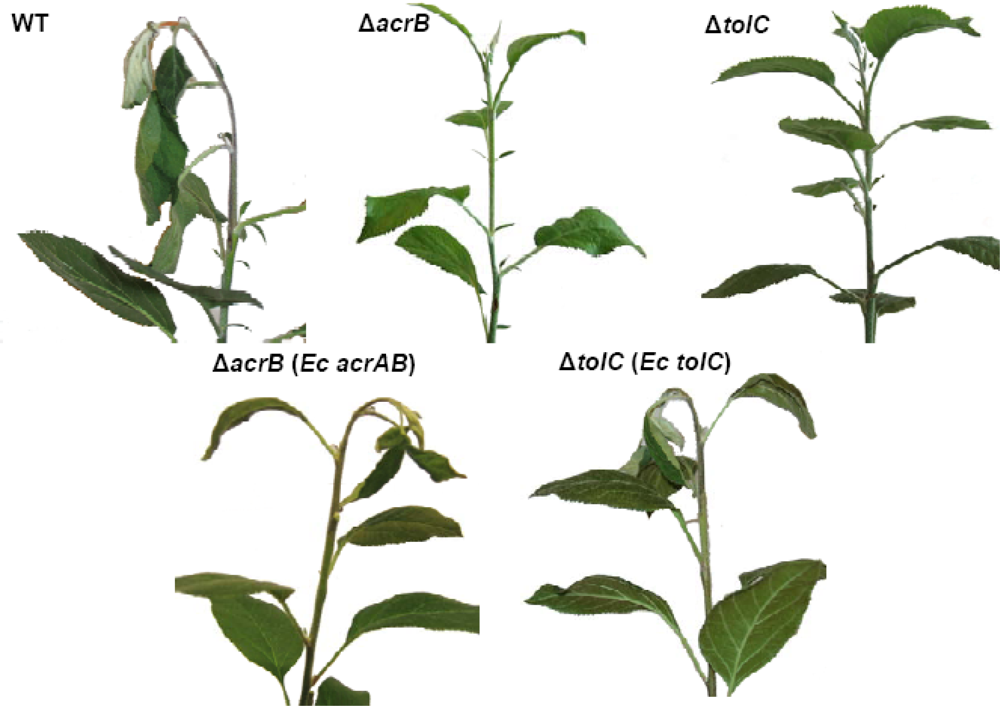
Previously it was demonstrated that E. amylovora mutants with defects in acrB and tolC were not causing fire blight symptoms on apple plants and showed significantly reduced in planta survival [33–34]. These mutants could be complemented by plasmid-borne homogenous alleles. Since heterogenous alleles of acrB and tolC led to wild type MIC values in the respective E. amylovora mutants in vitro, it was tested whether acrB and tolC of E. coli could restore virulence of E. amylovora acrB and tolC single mutants. Respective E. amylovora transformants were inoculated to apple plants using the mutants and the wild type as controls. Plant shoot tips were inoculated with defined numbers of bacterial cells by the so-called prick technique [48], which mimics the natural infection process. Typical fire blight symptoms in form of shepherd’s crook-like bending of the shoot tip after one week post inoculation as well as ooze formation and necrosis after three weeks post inoculation were induced by E. amylovora wild type and the E. amylovora mutants carrying acrB or tolC from E. coli in all 15 plants inoculated per strain without exceptions (Figure 1).
Figure 1.
Pathogenicity assay on apple plants. Shoot tips were inoculated with 5 μL of 1 x 10⁷ CFU/mL bacterial suspensions. Disease symptoms such as the typical ‘shepherd’s crook’ formation and wilting developed on plants inoculated with E. amylovora wild type after one week of inoculation.
In contrast, the non-complemented mutants did not cause any disease symptoms thus confirming their previously reported in planta phenotypes [33–34]. All inoculated plants showed the same lack of symptom development. Interestingly, for the first time these results led to the conclusion that enterobacterial AcrAB-TolC hybrids consisting of mixed components from a plant pathogen and an intestinal species are sufficient to effectively combat plant defense reactions. These results furthermore substantiated our in vitro findings and showed that AcrB and TolC of E. coli and E. amylovora are apparently fully interchangeable. The herein obtained data are in line with recent findings of Krishnamoorthy et al. [49], who reported that the replacement of E. coli AcrB with its close homolog, MexB, from Pseudomonas aeruginosa formed a partially functional MDE system, AcrA-MexB-TolC, in vitro and that certain single amino acid substitutions in AcrA and MexB, respectively, were sufficient to render this MDE hybrid fully functional. The data obtained herein demonstrated that complementation of acrAB or tolC of a plant pathogen by respective alleles derived from E. coli can restore full virulence. In this respect, our results are in advancement towards those of Brown et al. [32], who had demonstrated that MDE components of the plant pathogen R. solanacearum were successfully complementing E. coli mutants in vitro.
3. Experimental
3.1. Bacterial strains, plasmids, and growth conditions
Bacterial strains and plasmids used in this study were listed in Tables 5 and 6. E. coli strains were routinely maintained at 37°C on Luria-Bertani (LB) medium, and E. amylovora strains were cultured at 28 °C on LB medium or asparagine minimal medium 2 (AMM2).
Table 5.
E. coli and E. amylovora strains used in this study.
Table 6.
Plasmids used in this study.
AMM2 has the following composition (per liter of deionized water): fructose, 10 g; l-asparagine, 4 g; Na2HPO4 × 7 H2O, 12.8 g; K2HPO4, 3 g; NaCl, 3 g; MgSO4 × 7 H2O, 0.2 g; nicotinic acid, 0.25 g; thiamine, 200 μg. E. coli DH5α was used as cloning host. Cultures were supplemented with 50 μg/mL ampicillin (Ap), 25 μg/mL chloramphenicol (Cm), 2 μg/mL gentamycin (Gm), and 25 μg/mL kanamycin (Km) when necessary. Bacterial growth was monitored using a spectrophotometer (OD at 600 nm).
3.2. Generation of tolC mutants in E. coli
E. coli tolC-deficient mutants TG1-1 and KAM3-1 were generated by marker exchange mutagenesis as follows. An 1851-bp fragment located in the tolC gene was PCR-amplified from E. coli TG1 using primer pair Ec-tolC-del-Fwd and Ec-tolC-del-Rev (Table 7). The PCR product was cloned into pGEM-T Easy (Promega, Mannheim, Germany) yielding plasmid pNK14. A 597-bp BssHII fragment of pNK14 located in the tolC gene was replaced by a 1246-bp BssHII fragment containing the gentamycin resistance cassette (Gmr) derived from pBBR1MCS-5 [52] yielding the 5515-bp plasmid pNK15. A 2500-bp EcoRI fragment cut from pNK15 was ligated into EcoRI-digested pCAM-MCS [33] yielding the final tolC replacement plasmid pNK16 (6207 bp). E. coli S17-1 λ-pir was used as host for the suicide plasmid. Plasmid pNK16 was transferred via electroporation into electro-competent cells of E. coli TG1 and its acrB mutant KAM3, which subsequently were grown at 37°C for 1 h in SOC broth and plated on LB containing gentamycin. Putative mutants were screened for homologous recombination events by checking their antibiotics resistance. To confirm the altered genotypes, PCR amplification of tolC using primers Ec-tolC-del-Fwd and Ec-tolC-del-Rev (Table 7) was carried out yielding a 2500-bp fragment for the tolC mutants as opposed to the presence of an 1851-bp fragment for the wild type.
Table 7.
Oligonucleotide primers used in this study.
3.3. Complementation of mutants
The plasmid for complementation of the tolC-deficient E. coli was generated as follows: a 2012-bp fragment containing the tolC region was PCR amplified from E. coli TG1 using primer pair Ec-tolC-com-Fwd and Ec-tolC-com-Rev (Table 7). The PCR fragment was cloned into SpeI-SacI-digested pBBR1MCS [52] yielding the E. coli tolC complementation plasmid pNK17 (6719 bp). Plasmid pNK7 [34] was used to complement the tolC mutant of E. amylovora.
The plasmids for complementation of the acrAB- and acrABR-deficient E. coli mutants were generated as follows: 4701-bp and 5596-bp fragments containing the acrAB and acrAB-R regions, respectively, were PCR amplified from E. coli TG1 using the primer pairs Ec-acr-com-Fwd/Ec-acr-com-Rev- and Ec-acr-com-Fwd/Ec-acr-com-Rev+ (Table 7). The PCR fragments were cloned into HindIII-SacI-digested pBBR1MCS [52] yielding the E. coli acrAB complementation plasmid pNK18 (9408 bp) and the E.coli acrAB-R complementation plasmid pNK19 (10303 bp).
The plasmid for complementation of the acrABR-deficient E. amylovora mutant was generated as follows: a 5746-bp fragment containing the acrAB-R region was PCR amplified from E. amylovora 1189 using the primer pair Ea-acr-Com-Fwd+ and Ea-acr-Com-Rev (Table 7). The PCR fragment was cloned into SpeI-SacI digested pBBR1MCS [52] yielding the E. amylovora acrAB-R complementation plasmid pNK20 (10453 bp). Plasmid pNK8 [34] was used to complement the acrB mutant of E. amylovora.
3.4. Drug susceptibility tests
The minimal inhibitory concentrations (MIC) were determined by a twofold dilution assay in Mueller-Hinton broth (MHB) (Becton Dickinson, Heidelberg, Germany) and AMM2, respectively. All tests were done in triplicate following the National Center for Clinical Laboratory Standards recommendations [53]. Chemicals were obtained from Sigma-Aldrich (Taufkirchen, Germany). E. amylovora strains were incubated at 28 °C, and E. coli strains were incubated at 37 °C. The MIC was defined as the lowest concentration of an antibiotic that completely stopped visible cell growth. Bacterial growth was examined by visual and photometric inspection after 24 h of incubation.
3.5. Plant materials and pathogenicity assay on apple
Apple plants (rootstock Malus MM106) were grown in a light chamber at 20 to 25 °C, 60% humidity, with a 12-h photoperiod (15,000 lux). E. amylovora strains were grown on LB agar plates for 48 h, re-suspended in sterile 0.9% NaCl solution, and diluted to a cell density of 1 x 10⁷ CFU/mL for inoculation. Apple plants were inoculated by the prick technique as described previously [48]. Each bacterial strain was inoculated into shoots of five individual plants by placing 5 μL of bacterial suspensions onto each wound on the shoot tip. The experiment was repeated three-fold. Plants were monitored for symptom development daily.
4. Conclusions
The AcrAB-TolC system is widely distributed among Gram-negative bacteria and represents a bacterial defense system not only against antibiotics, but also against numerous structurally unrelated molecules present in different ecological niches, such as bile salt in the intestinal tract and phytoalexins in plants. Herein it was demonstrated that components of the MDE system, AcrAB-TolC, of two different enterobacterial species are interchangeable despite of the significantly diverse ecological niches, in which both species live. On one hand, this might reflect the broad flexibility of this important bacterial antibiotics resistance determinant. On the other hand, these results suggested that habitat-borne divergence of antibiotics exposure did not lead to significant structural modifications of this MDE system during evolution. For the first time, it was demonstrated that respective E. coli genes can restore full virulence to E. amylovora mutants defective in the genes encoding for AcrAB-TolC.
Acknowledgments
This project was partially funded by a stipend from the Deutscher Akademischer Austauschdienst (DAAD).
References and Notes
- Brown, MH; Paulsen, IT; Skurray, RA. The multi-drug efflux protein NorM is a prototype of a new family of transporters. Mol. Microbiol 1999, 31, 394–395. [Google Scholar]
- Alekshun, MN; Levy, SB. Molecular mechanism of antimicrobial multidrug resistance. Cell 2007, 128, 1037–1050. [Google Scholar]
- Moreira, MAS; de Souza, EC; de Moraes, CA. Multidrug efflux system in gram-negative bacteria. Brazil. J. Microbiol 2004, 35, 19–28. [Google Scholar]
- Piddock, LJV. Multidrug resistance efflux pumps-not just for resistance. Nat. Rev. Microbiol 2006, 4, 629–636. [Google Scholar]
- Poole, K. Efflux-mediated resistance to fluoroquinolones in gram-negative bacteria. Antimicrob. Agents Chemother 2000, 44, 2233–2241. [Google Scholar]
- Murakami, S. Multidrug efflux transporter, AcrB-the pumping mechanism. Curr. Opin. Struct. Biol 2008, 18, 459–465. [Google Scholar]
- Nikaido, H; Takatsuka, Y. Mechanisms of RND multidrug efflux pumps. Biochim Biophys Acta 2008. [Google Scholar]
- Welch, RA; Burland, V; Plunkett, G; Redford, P; Roesch, P; Rasko, D; Buckles, EL; Liou, SR; Boutin, A; Hackett, J; Stroud, D; Mayhew, GF; Rose, DJ; Zhou, S; Schwartz, DC; Perna, NT; Mobley, HLT; Donnenberg, MS; Blattner, FR. Extensive mosaic structure revealed by the complete genome sequence of uropathogenic. Escherichia coli. Proc. Nat. Acad. Sci. USA 2002, 99, 17020–17024. [Google Scholar]
- Touze, T; Eswaran, J; Bokma, E; Koronakis, E; Hughes, C; Koronakis, V. Interactions underlying assembly of the Escherichia coli AcrAB-TolC multidrug efflux system. Mol. Microbiol 2004, 53, 697–706. [Google Scholar]
- Zgurskaya, H; Nikaido, H. Multidrug resistance mechanisms: drug efflux across two membranes. Mol. Microbiol 2000, 37, 219–225. [Google Scholar]
- Baucheron, S; Chaslus-Dancla, E; Cloeckaert, A. Role of TolC and parC mutation in high-level fluoroquinolone resistance in Salmonella enterica serotype Typhimurium DT204. J. Antimicrob. Chemother 2004, 53, 657–659. [Google Scholar]
- Baucheron, S; Mouline, C; Praud, K; Chaslus-Dancla, E; Cloeckaert, A. TolC but not AcrB is essential for multidrug-resistance Salmonella enterica serotype Typhimurium colonization of chickes. J. Antimicrob. Chemother 2005, 55, 707–712. [Google Scholar]
- Su, CC; Rutherford, DJ; Yu, EW. Characterization of the multidrug efflux regulator AcrR from Escherichia coli. Biochem. Biophys. Res. Commun 2007, 361, 85–90. [Google Scholar]
- Elkins, CA; Mullis, AB. Substrate competition studies using whole-cell accumulation assays with the major tripartite multidrug efflux pumps of Escherichia coli. Antimicrob. Agents Chemother 2007, 51, 923–929. [Google Scholar]
- Fralick, JA. Evidence that TolC is required for functioning of the Mar/AcrAB efflux pump of Escherichia coli. J. Bacteriol 1996, 178, 5803–5805. [Google Scholar]
- Koronakis, V; Eswaran, J; Hughes, C. Structure and function of TolC: the bacterial exit duct for proteins and drug. Annu. Rev. Biochem 2004, 73, 467–489. [Google Scholar]
- Ramos, JL; Duque, E; Gallegos, MT; Godoy, P; Ramos-González, MI; Rojas, A; Terán, W; Segura, A. Mechanism of solvent tolerance in gram-negative bacteria. Annu. Rev. Microbiol 2002, 56, 743–768. [Google Scholar]
- Sharff, A; Fanutii, C; Shi, J; Calladine, C; Luisi, P. The role of the TolC family in protein transport and multidrug efflux from stereochemical certainty to mechanistic hypothesis. Eur. J. Biochem 2001, 268, 5011–5026. [Google Scholar]
- Li, DW; Onishi, M; Kishino, T; Matsuo, T; Ogawa, W; Kuroda, T; Tsuchiya, T. Properties and expression of a multidrug efflux pump AcrAB-KocC from Klebsiella pneumoniae. Biol. Pharm. Bull 2008, 31, 577–582. [Google Scholar]
- Koehler, T; Michea-Hamzehpour, M; Henze, U; Gotoh, N; Curty, LK; Pechere, JC. Characterization of MexE-MexF-OprN, a positively regulated multi-drug efflux system of Pseudomonas aeruginosa. Mol. Microbiol 1997, 23, 345–354. [Google Scholar]
- Li, XZ; Nikaido, H; Poole, K. Role of MexA-MexB-OprM in antibiotic efflux in Pseudomonas aeruginosa. Antimicrob. Agents Chemother 1995, 39, 1948–1953. [Google Scholar]
- Hagmann, KE; Pan, W; Spratt, BG; Balthazar, JT; Judd, RC; Schafer, WM. Resistance of Neisseria gonorrhoeae to antimicrobial hydrophobic agents is modulated by the mtrRCDE efflux system. Microbiol 1995, 141, 611–622. [Google Scholar]
- Bina, JE; Mekalanos, JJ. Vibrio cholera tolC is required for bile resistance and colonization. Infec. Immun 2001, 69, 4681–4685. [Google Scholar]
- Paulsen, IT. Multidrug efflux pumps and resistance: Regulation and evolution. Curr. Opin. Microbiol 2003, 6, 446–451. [Google Scholar]
- Hammerschmidt, R. Phytoalexins: What we have learned after 60 years? Annu. Rev. Phytopathol 1999, 37, 285–306. [Google Scholar]
- Osbourn, AE. Preformed antimicrobial compounds and plant defense against fungal attack. Plant Cell 1996, 8, 1821–1831. [Google Scholar]
- Palumbo, JD; Kado, CI; Phillips, DA. An isoflavonoid-inducible efflux pump in Agrobacterium tumefaciens is involved in competitive colonization of roots. J. Bacteriol 1998, 180, 3107–3113. [Google Scholar]
- Kang, H; Gross, DC. Characterization of a resistance-nodulation-cell division transporters system associated with the syr-syp genomic island of Pseudomonas syringae pv. syringae. Appl. Environ. Microbiol 2005, 71, 5056–5065. [Google Scholar]
- Valecillos, AM; Palenzuela, PR; López-Solanilla, E. The role of several multidrug resistance systems in Erwinia chrysanthemi pathogenesis. Mol. Plant-Microbe Interact 2006, 19, 607–613. [Google Scholar]
- Krummenacher, P; Narberhaus, F. Two genes encoding a putative multi-drug efflux pump of the RND/MFP family are cotranscribed with an rpoH gene in Bradyrhizobium japonicum. Gene 2000, 241, 247–254. [Google Scholar]
- Goel, AK; Rajagopal, L; Nagesh, N; Sonti, RV. Genetic locus encoding functions involved in biosynthesis and outer membrane localization of xanthomonadin in Xanthomonas oryzae. J. Bacteriol 2002, 184, 3539–3548. [Google Scholar]
- Brown, DG; Swanson, JK; Allen, C. Two host-induced Ralstonia solanacearum genes, acrA and dinF, encode multidrug efflux pumps and contribute to bacterial wilt virulence. Appl. Environ. Microbiol 2007, 73, 2777–2786. [Google Scholar]
- Burse, A; Weingart, H; Ullrich, MS. The phytoalexin-inducible multidrug efflux pump AcrAB contributes virulence in the fire blight pathogen, Erwinia amylovora. Mol. Plant-Microbe Interact 2004, 17, 43–54. [Google Scholar]
- Al-Karablieh, N; Weingart, H; Ullrich, MS. The outer membrane protein TolC is required for phytoalexin resistance and virulence of the fire blight pathogen. Erwinia amylovora Microbial Biotech 2009. [Google Scholar]
- Nishino, K; Yamaguchi, A. Analysis of a complete library of putative drug transporter genes in Escherichia coli. J. Bacteriol 2001, 183, 5803–5812. [Google Scholar]
- Baranova, N; Nikaido, H. The baeSR two-component regulatory system activates transcription of the yegMNOB (mdtABCD) transporter gene cluster in Escherichia coli and increases its resistance to novobiocin and deoxycholate. J. Bacteriol 2002, 184, 4168–4167. [Google Scholar]
- Thanassi, DG; Cheng, LW; Nikaido, H. Active efflux of bile salts by Escherichia coli. J. Bacteriol 1997, 179, 2512–2518. [Google Scholar]
- Elkins, CA; Nikaido, H. Substrate specificity of the RND-type multidrug efflux pumps AcrB and AcrD of Escherichia coli is determined predominately by two large periplasmic loops. J. Bacteriol 2002, 184, 6490–6498. [Google Scholar]
- Diez-Gonzalez, F; Callaway, TR; Kizoulis, MG; Russell, JB. Grain feeding and the dissemination of acid-resistant Escherichia coli from cattle. Science 1998, 281, 1666–1668. [Google Scholar]
- Masi, M; Pagès, JM; Villard, C; Pradel, E. The eefABC multidrug efflux pump operon is repressed by H-NS in Enterobacter aerogenes. J. Bacteriol 2005, 187, 3894–3897. [Google Scholar]
- Gorden, J; Small, PLC. Acid Resistance in Enteric Bacteria. Infect. Immun 1993, 61, 364–367. [Google Scholar]
- Sambrook, J; Russel, DW. Molecular Cloning: A Laboratory Manual; Cold Spring Habor Laboratory Press: New York, USA, 2001. [Google Scholar]
- Aires, JR; Nikaido, H. Aminoglycosides are captured from both periplasmic and cytoplasm by the AcrD multidrug efflux transporter of Escherichia coli. J. Bacteriol 2005, 187, 1923–1929. [Google Scholar]
- Chollet, R; Chevalier, J; Bryskier, A; Pagès, JM. The AcrAB-TolC pump is involved in macrolides resistance but not in telithromycin efflux in Enterobacter aerogenes and Escherichia coli. Antimirob. Agents Chemother 2004, 48, 3621–3624. [Google Scholar]
- Lin, HT; Bavro, VN; Barrera, NP; Frankish, HM; Velamakanni, S; van Veen, HW; Robinson, CV; Borges-Walmsey, MI; Walmsey, AR. MacAB ABC transporter is a dimmer whose ATPase activity and macrolide-binding capacity are regulated by the membrane fusion protein MacA. J. Biol. Chem 2009, 284, 1145–1154. [Google Scholar]
- Tikhonova, EB; Wang, Q; Zgurskaya, HI. Chimeric analysis of the multicomponent multidrug efflux transporters from Gram-negative bacteria. J. Bacteriol 2002, 184, 6499–6507. [Google Scholar]
- Bokma, E; Koronakis, E; Lobedanz, S; Hughes, C; Koronakis, V. Directed evolution of a bacterial efflux pump: Adaptation of the E. coli TolC exit duct to the Pseudomonas MexAB translocase. FEBS Lett 2006, 580, 5339–5343. [Google Scholar]
- May, R; Völksch, B; Kampmann, G. Antagonistic activities of epiphytic bacteria from soybean leaves against Pseudomonas syringae pv. glycinea in vitro and in planta. Microb. Ecol 1997, 34, 118–124. [Google Scholar]
- Krishnamoorthy, G; Tikhonova, EB; Zgurskaya, HI. Fitting periplasmic membrane fusion proteins to inner membrane transporters: Mutations that enable Escherichia coli AcrA to function with Pseudomonas aeruginosa MexB. J. Bacteriol 2008, 190, 691–698. [Google Scholar]
- Wilson, KJ; Sessitsch, A; Corbo, JC; Giller, KE; Akkermans, ADL; Jefferson, RA. Glucuronidase (GUS) transposons for ecological and genetic studies of rhizobia and other Gram-negative bacteria. Microbiology 1995, 141, 1691–1705. [Google Scholar]
- Morita, Y; Kodama, K; Shiota, S; Mine, T; Kataoka, A; Mizushima, T; Tsuchiya, T. NorM, a putative multi-drug efflux protein, of Vibrio parahaemolyticus and its homolog in Escherichia coli. Antimicrob. Agents Chemother 1998, 42, 1778–1782. [Google Scholar]
- Kovach, ME; Elzer, PH; Hill, DS; Robertson, GT; Farris, MA; Roop, RM; Peterson, KM. Four new derivatives of the broad-host-range cloning vector pBBR1MCS, carrying different antibiotic-resistance cassettes. Gene 1995, 166, 175–176. [Google Scholar]
- National Committee for Clinical Laboratory Standards (NCCLS), Methods for Dilution Antimicrobial Susceptibility Tests for Bacteria that Grow Aerobically. Approved Standard - Fifth Edition. NCCLS document 2000, Wayne, Pa, M07-A5.
© 2009 by the authors; licensee Molecular Diversity Preservation International, Basel, Switzerland. This article is an open-access article distributed under the terms and conditions of the Creative Commons Attribution license ( http://creativecommons.org/licenses/by/3.0/).