


Abstract
New organophosphorus insecticides of dialkylsulphoximines derived with activity upon acetylcholinesterase were synthesized. The obtained compounds were characterized by NMR and IR, and anticholinesterase activity and toxicity was measured. A simulation through computer was done in order to establish the relationship between structure and activity.
Introduction
The objective of this work was to synthesise a new family of organophosphorus insecticides with anticholinesterasic activity. It is known that the inhibition of AchE is the principal mode of action for organophosphorus compounds and that this inhibition depends on the electrophilic character of the P atom, strongly influenced by the nature of the attached groups.
Thus, it was of interest to study the toxicity of the synthesized phosphorothionate compounds (LD50) against houseflies (Musca domestica) and to measure the anticholinesterasic activity (I50) for the corresponding phosphates in comparison with a known direct inhibitor such as paraoxon.
A simulation through a computer program was performed in order to establish some correlation between chemical structure and insecticidal activity.
Experimental Methodology
Diethyl phosphorothionate of dipropyl and dibutylsulfoximine and the corresponding phosphates were synthesized from the sulfoximines and diethylphosphorothiochloridate and diethylphosphoro-chloridate according to described methodology (Wieczorkowski et al, 1983 and Licastro S.A. et al, 1986). The crude products were purified by column chromatography and characterized by NMR and IR spectroscopy.
Anticholinesterasic activity was measured for the synthesized phosphates using acethylthiocholine as substrate by the Ellman’s method (Ellman G.L.et al, 1961), bovine erythrocyte AchE and housefly AchE prepared as a crude homogenate of houseflies heads (Licastro S.A.et al, 1982).
Insecticidal activity was determined for the synthesized phosphorothionates using a susceptible strain of Musca domestica by topical application as previously described (Picollo et al, 1976). Mortalities were recorded after 24 h and the data analyzed using a probit analysis program based on Litchfield and Wilcoxon method (1949).
Computational simulation for the obtained sulfoximines was performed using GROMOS 96 software.
Results and Discussion
Phosphorylated dipropyl and dibutyl sulfoximines were obtained according to equation 1, purified and characterized.
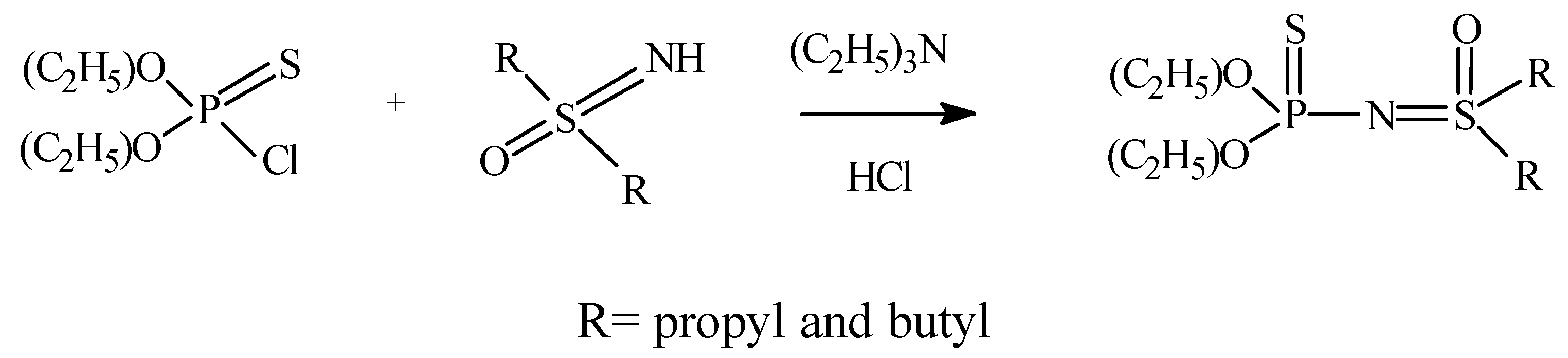
LD50 values were determined on houseflies (Musca domestica) for both phosphorothionates (table 1) showing less toxicity for the dibutyl derivative. Compounds with longer alkyl chain were going to be synthesized to establish some correlation between structure and activity.

Table 1.
Insecticidal activity Musca domestica.
I50 values for housefly AchE and Bovine erythrocytes AchE (Table 2) shows the synthesized compounds were very good inhibitors compared with paraoxon with a significant difference between insect and mammalian enzyme.
Table 2.
Anticholinesterasic activity.
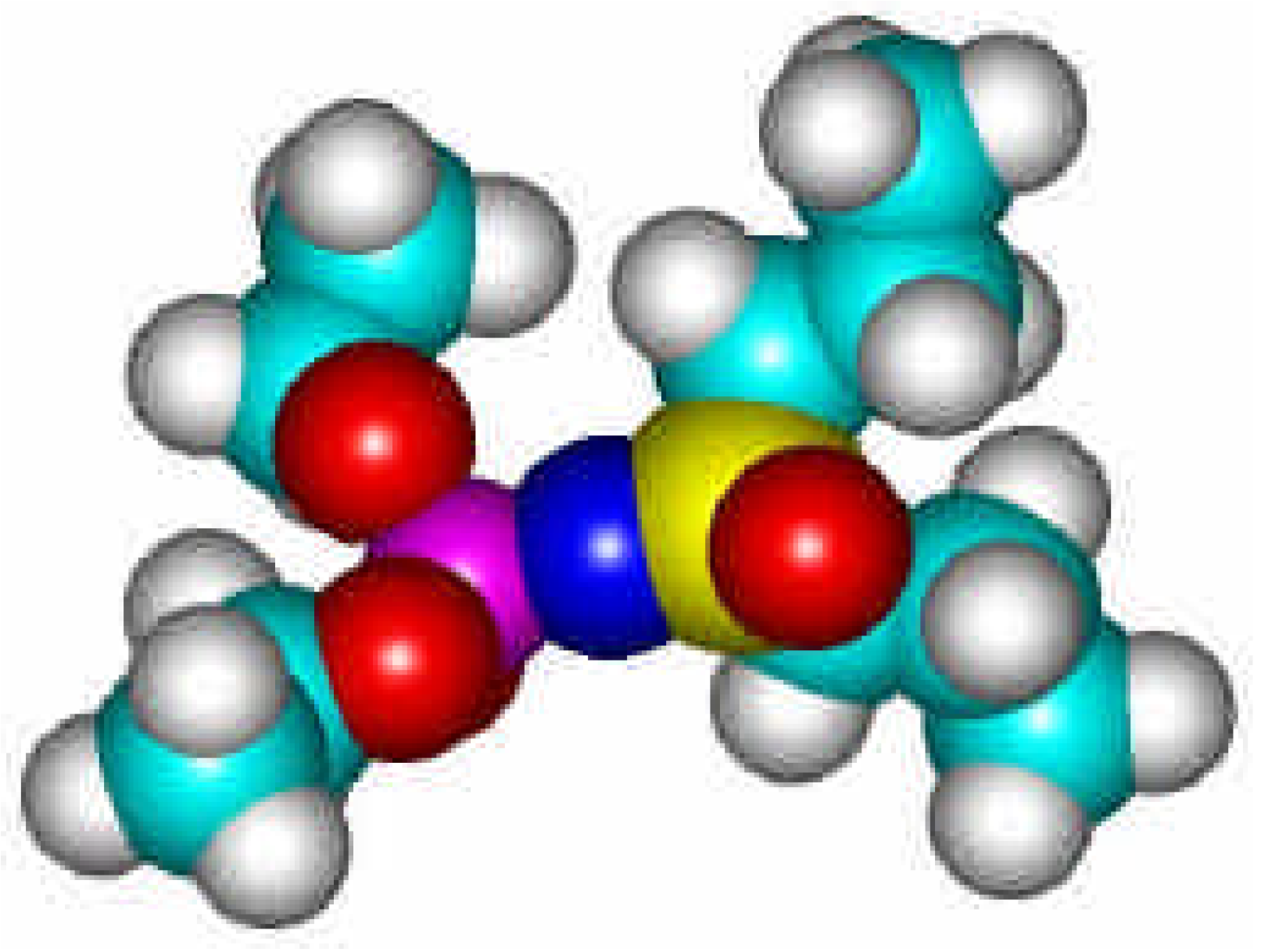
With respect to computational simulation, the synthesized compounds were a similar charge in phosphorus than paraoxon.
References and Notes
- Wieczorkowski, J.; Jakobsen, P.; Treppendahl, S. Synthesis of N-Phosphorylated Dimethylsul-foximides. Acta Chemica Scandinavica 1983, 27. [Google Scholar] [CrossRef]
- Licastro, S.A.; Picollo, M.I.; Wood, E.; Melgar, F.; Zerba, E. Comp. Biochem. Physiol. 1986, 84C(1), 131.
- Licastro, S.A.; Zerba, E.; Wood, E.; Picollo, M.I. Pest. Science 1982, 13, 505.
- Ellman, G.L.; Courtney, K.D.; Andres, J.R.; Featherstone, M. Biochem. Pharmacol. 1961, 7, 88.
- Picollo, M.I.; Wood, E.; Zerba, E.; Licastro, S.A.; Rúveda, M. Acta Biochim. Clin. Latinoameric. 1976, 10, 67.
- Litchfield, J.T.; Wilcoxon, F. J. Pharmacol. Exp. Ther. 1949, 96, 99.