

Kinetics of the Aromatic Nucleophilic Substitution Reaction Between 1-Fluoro-2,4-Dinitrobenzene and Perhydroazepine in Ethyl Acetate + Chloroform Solvent Mixtures

Abstract
Introduction
Experimental
Results and discussion
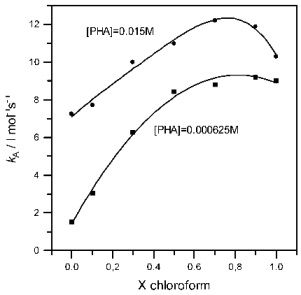
Acknowledgment
References and Notes
- Mancini, P.M.; Terenzani, A.; Adam, C.; Vottero, L.R. J. Phys. Org. Chem. 1999, 12, 713. [PubMed]Mancini, P.M.; Terenzani, A.; Adam, C.; Vottero, L.R. J. Phys. Org. Chem. 1999, 12, 207.
- Mancini, P.M.; Terenzani, A.; Adam, C.; Vottero, L.R. XXII Congreso Argentino de Química, La Plata. 1998. [Google Scholar]
- Mancini, P.M.; Terenzani, A.; Adam, C.; Vottero, L.R. XI Congreso Argentino de Fisicoquímica y I Congreso de Fisicoquímica del Mercosur, Santa Fe, Argentina. 1999. [Google Scholar]
Share and Cite
Mancini, P.M.; Fortunato, G.; Terenzani, A.J. Kinetics of the Aromatic Nucleophilic Substitution Reaction Between 1-Fluoro-2,4-Dinitrobenzene and Perhydroazepine in Ethyl Acetate + Chloroform Solvent Mixtures. Molecules 2000, 5, 578-579. https://doi.org/10.3390/50300578
Mancini PM, Fortunato G, Terenzani AJ. Kinetics of the Aromatic Nucleophilic Substitution Reaction Between 1-Fluoro-2,4-Dinitrobenzene and Perhydroazepine in Ethyl Acetate + Chloroform Solvent Mixtures. Molecules. 2000; 5(3):578-579. https://doi.org/10.3390/50300578
Chicago/Turabian StyleMancini, P. M., G. Fortunato, and A. J. Terenzani. 2000. "Kinetics of the Aromatic Nucleophilic Substitution Reaction Between 1-Fluoro-2,4-Dinitrobenzene and Perhydroazepine in Ethyl Acetate + Chloroform Solvent Mixtures" Molecules 5, no. 3: 578-579. https://doi.org/10.3390/50300578
APA StyleMancini, P. M., Fortunato, G., & Terenzani, A. J. (2000). Kinetics of the Aromatic Nucleophilic Substitution Reaction Between 1-Fluoro-2,4-Dinitrobenzene and Perhydroazepine in Ethyl Acetate + Chloroform Solvent Mixtures. Molecules, 5(3), 578-579. https://doi.org/10.3390/50300578
