


Abstract
The kinetics of the thermal decomposition reaction of cis-6-phenyl-5,6-(2- phenyl-propilydene)-3,3-tetramethylene-1,2,4-trioxacyclohexane (I) was investigated in the temperature range of 100-130°C in selected solvents of different physicochemical properties to evaluate a solvent effect on the reaction.
Introduction
It is interesting to mention that the antimalarial activity of the plant extract Qinghaosu is associated with the presence of the 1,2,4-trioxane ring in molecules of compounds (Artemisinin) found in its composition [1].
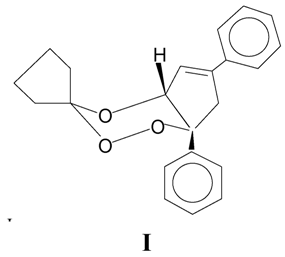
Here, available kinetic data on the thermal decomposition reaction of I in solvents with different physicochemical properties are presented to learn about the solvent effect on its thermolysis.
Experimental
Materials
The trioxane I was prepared by methods described elsewhere [2]. The organic solvents were commercial analytical reagents purified by standard techniques.
Kinetic methods
Glass ampoules half filled with the appropriate I solution were thoroughly degassed under vaccum and immersed in a thermostatic bath at selected temperatures. The remaining concentration of I in the reaction solution was quantitatively determined by RP-HPLC (UV detection). In benzene solvent, kinetic data were obtained by GC analysis (FID detection). The reaction products were identified by GCMS and RP-HPLC.
The first order rate constant values were obtained by least mean squares treatment of the data plotting the values of the [I] vs. time. The activation parameters were calculated according to the Eyring equation [3].
Results and Discussion
Rate measurements on the thermal decomposition of I, up to at least c.a. 60% of I conversion in each solvent, show an evident effect of the solvent in the temperature and initial concentration ranges of 100-130°C and 0.36-1,70 x 10⁻³ M, respectively, (Table 1). The rate constant values increase as the solvent polarity increases.

Table 1.
First-order rate constant values at 120°C in solution.
The temperature effect was evaluated by the Arrhenius equation and the corresponding activation parameters for the O-O bond unimolecular homolysis of I were calculated. The first step of the reaction mechanism is the formation of a biradical which later decomposes.
A stepwise mechanism was confirmed by analysis of the reaction products.
Acknowledgements
This research project was financially supported by CONICET, PROGRAMA LADECOM, Facultad de Ingeniería-SECyT de la UNCPBA y CIC de la Provincia de Buenos Aires.
References and Notes
- (a) Jefford, C. W.; Rossier, J. C.; Boukouvalas, J. J. Chem. Soc., Chem. Commun. 1987, 713. (b) Jefford, C. W.; Rossier, J. C.; Boukouvalas, J. J. Chem. Soc., Chem. Commun 1987, 1593. and references cited therein.
- Jefford, C. W.; Cafferata, L. F. R.; Mateo, C. M. Unpublished.
- Huyberechts, S.; Halleux, A.; Kruys, P. Bull. Soc. Chim. Belg. 1955, 64, 203. [CrossRef]