1. Introduction
Metal carbonyl clusters (MCCs) represent a distinctive class of organometallic compounds defined by the presence of metal–metal bonds and in which carbonyls act not only as simple ligands but also as stabilizing and structure-directing agents [
1,
2], giving rise to compact and highly symmetric structures ranging from simple dimers to large, multi-metal frameworks [
3]. The fluxional behavior of the carbonyl ligands in solution, bridging or terminal, also adds to their dynamic chemistry [
4,
5]. The bonding in MCCs and their correlation with the geometry of their metal skeleton are often described using the Wade–Mingos electron-counting rules [
6] and delocalized molecular orbital models. More specifically, a bilateral correspondence between the geometry of a given MCC and its electron counting has been consistently observed. However, as the cluster nuclearity (number of metals) increases, such correspondence may fail and clusters can exhibit remarkable electronic [
7] and magnetic [
8] features, as well as interesting catalytic properties [
9]. Moreover, when MCCs reach high metal nuclearity (from about twelve metal atoms onwards), they are often referred to as “atomically precise nanoclusters” [
10], because they are identified at a molecular level despite possessing nanometric dimensions. Rhodium, as well as platinum, is among those metals that may form carbonyl species with a nanometric size under suitable conditions [
11,
12,
13], thanks to its high metal–metal and metal–CO bond energy [
14].
On the other hand, low-nuclearity carbonyl species also possess interesting properties; for instance, they often serve as homogeneous catalysts or catalyst precursors for hydroformylation [
15] and hydrogenation [
16] reactions. Moreover, their multi-metal active sites allow cooperative mechanisms resembling those of heterogeneous catalysts, but with the tunability of molecular systems. Among MCCs, rhodium species have been studied for their catalytic abilities [
17] and, for instance, the activity of Rh
4(CO)
12 and Rh
6(CO)
16 has been found comparable to that of mononuclear rhodium complexes in hydroformylation reactions [
18,
19].
Despite their strong coordination with the metal core, under suitable conditions, carbonyl groups can be partially replaced by other ligands [
20], allowing for tuning the MCCs’ properties and enhancing their catalytic properties. In the literature, phosphine-substituted rhodium carbonyl clusters are synthesized from the neutral Rh
6(CO)
16 by partially replacing the carbonyl ligands with either mono- [
21] or diphosphines [
22], yielding species like Rh
6(CO)
10L
6 (L = mono-phosphine ligand), Rh
6(CO)
12L
2 (L = 1,4-bis(diphenylphosphino)butane), and Rh
6(CO)
16−xL
x (L = 1,2-bis(diphenylphosphino)ethane, x = 1, 3). Notably, in the latter clusters, the diphosphine is always coordinated with just one rhodium atom, acting as a monodentate ligand. A key example of a heterogeneous catalyst made of a phosphine-substituted rhodium cluster is reported by Iwatate K. et al. [
23]. They described how Rh
6(CO)
16 could bind a modified polystyrene surface via a simple ligand substitution reaction in which phosphines attached to the polymer replace carbonyls of the cluster. In addition, the catalyst obtained can be recycled and refreshed in a carbon monoxide atmosphere, once used. This kind of recycling is crucial considering that rhodium is a costly transition metal. Carbonyl substitution reactions with phosphine ligands are also reported on Rh
4(CO)
12 [
24,
25]. In general terms, reactions of Rh
4(CO)
12 with P-donor ligands (PR
3, phosphites, etc.), carried out in mild conditions, typically yield heteroleptic clusters of the type Rh
4(CO)
12−xL
x (x = 2–4 are commonly observed), e.g., Rh
4(CO)
10L
2, Rh
4(CO)
9L
3, and Rh
4(CO)
8L
4, with the Rh
4 metal skeleton usually retained.
In the case of diphosphine ligands, while Rh
6(CO)
16−2xL
x (L = 1, 2) clusters are widely known [
26,
27,
28], there is a lack of literature on diphosphine-substituted clusters synthesized from Rh
4(CO)
12, with the exception of Rh
4(CO)
8L
2 (L = bis(diphenylphosphino)methane) [
29]. One possible reason could be that, under certain conditions (especially in the presence of CO, with certain bulky/very nucleophilic phosphines), cluster breakdown can occur and give smaller rhodium species (e.g., dinuclear Rh–Rh bridged compounds) or mixed metal fragments, so substitution does not always preserve the tetranuclear core [
30].
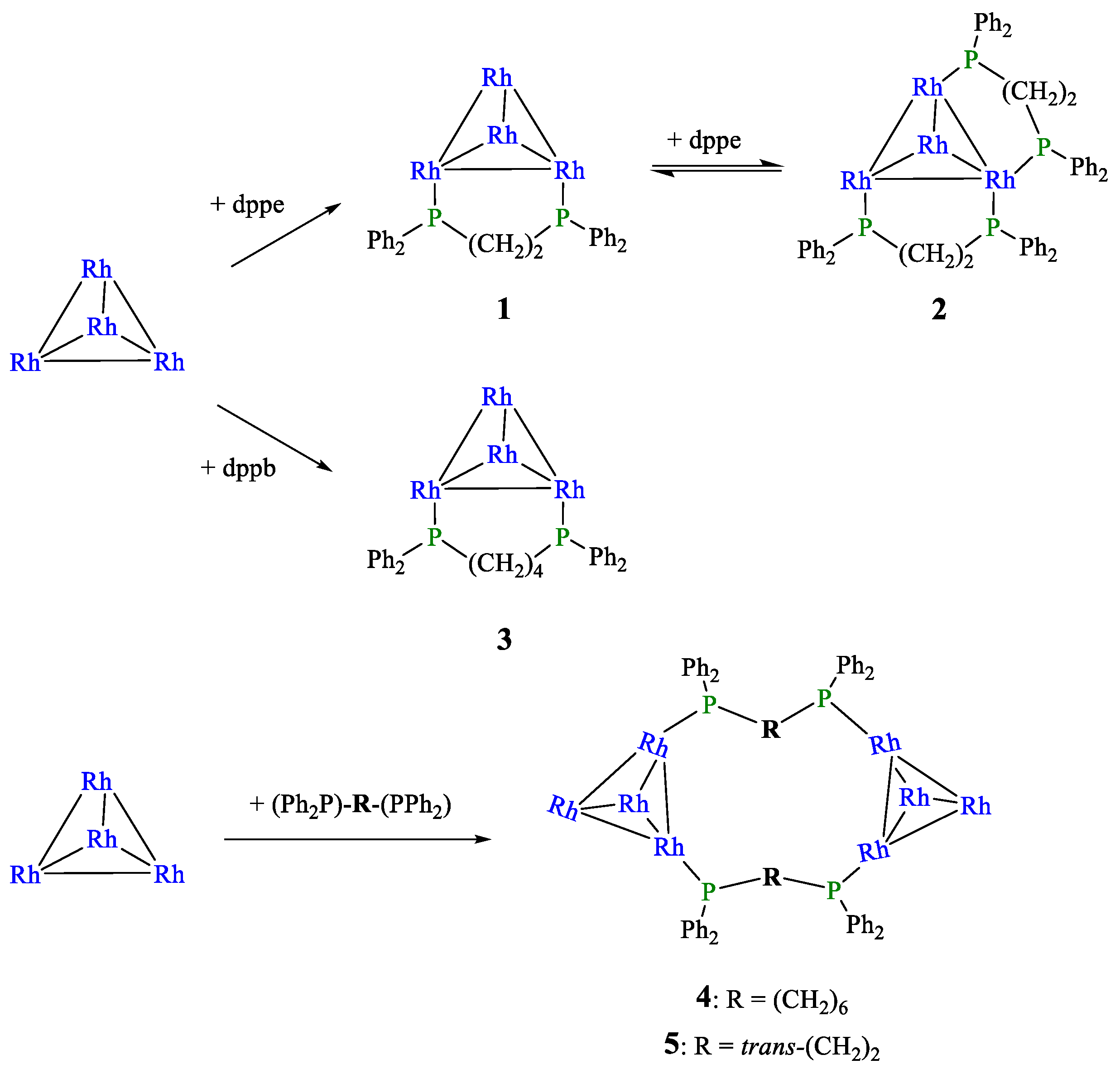
Therefore, we decided to fill this gap and explore the possibility of preparing new heteroleptic carbonyl clusters by reacting Rh4(CO)12 with different diphosphine species. Reactions were carried out under a nitrogen atmosphere, at room temperature, and in homogeneous conditions. We successfully isolated and identified five new species, namely Rh4(CO)10(dppe) (1), its parent bis-substituted derivative Rh4(CO)8(dppe)2 (2), Rh4(CO)10(dppb) (3), and the dimeric {Rh4(CO)10(dpp-hexane)}2 (4) and {Rh4(CO)10(trans-dppe)}2 (5) clusters [dppe = 1,2-bis(diphenylphosphino)ethane; dppb = 1,4-bis(diphenylphosphino)butane; trans-dppe = trans-1,2-bis(diphenylphosphino)ethylene; dpp-hexane = 1,6-bis(diphenylphosphino)hexane]. Every species has been isolated and characterized via single-crystal X-ray diffraction (SC-XRD) and infrared (IR) spectroscopy. To complete their characterization and investigate the behavior of the phosphorus atoms in solution, 31P{1H} NMR studies at variable temperature (VT) were performed on each cluster. The crystal structure of Rh4(CO)10(dppb) evidenced serious disorder issues that prevented the obtainment of good crystallographic data; nevertheless, we still could obtain a structural model perfectly consistent with the NMR analysis.
2. Results and Discussion
The reactivity of Rh
4(CO)
12 with various diphosphines has been investigated at room temperature, under an inert atmosphere and in homogeneous conditions, to have all reactants and products in solution. A nitrogen atmosphere was employed to facilitate the carbonyl substitution and minimize possible cluster fragmentation, as reported in the literature [
21]. The ligands—dppe, dppb, dpp-hexane, and
trans-dppe—were selected to evaluate the influence of distance and geometrical constraints between the phosphorus centers on their coordination ability towards the cluster. Indeed, when reacting Rh
4(CO)
12 with one equivalent of the phosphine ligand, in the case of dppe and dppb, the diphosphine replaced two carbonyls within the same Rh
4(CO)
10 tetrahedron, acting as an intramolecular bidentate ligand and producing monochelated species (compounds
1 and
3 in
Scheme 1). Conversely, in the case of dpp-hexane, which possesses the longer aliphatic carbon chain, the diphosphine linked two different tetrahedra, acting as an intermolecular bidentate ligand, thus forming a dimeric species with a general formula {Rh
4(CO)
10(Ph
2P-R-PPh
2)}
2 (compound
4). The same occurred when
trans-dppe was employed (compound
5). Finally, only in the case of dppe, by adding two equivalents with respect to the starting Rh
4(CO)
12, it was also possible to obtain the corresponding bis-chelated cluster (compound
2).
As a general procedure, the diphosphines were added at room temperature in powder form to a CH
2Cl
2 solution of the pre-formed Rh
4(CO)
12. In the literature [
22,
27], it is reported that the main positive effect achieved by conducting the reactions in heterogeneous conditions in non-polar solvents (such as hexane, benzene, chloroform, etc.) is the separation of the products through precipitation. However, as we discovered in our studies, the reactions are not as fast as when carried out in homogeneous conditions. Moreover, in non-polar solvents, the presence of the precursor after a 24 h reaction is still detectable by IR spectroscopy. Therefore, we carried out all reactions using CH
2Cl
2 as a solvent, which allowed us to solubilize both reactants and products, and we monitored their evolution path via IR spectroscopy. At the end of each reaction, the crude mixture was dried under a vacuum, and the product was extracted with the appropriate solvent and subjected to crystallization, performed by using the double-layer technique. To obtain crystals suitable for structural analysis, the best solvent combinations were selected through trial and error. For compounds
3,
4, and
5, the solid product was extracted in toluene and layered with hexane, while the toluene extraction of
1 was layered with pentane. Better-quality crystals of
5 were obtained by re-dissolving the product in tetrahydrofuran (THF) and layering the solution with hexane. In the case of
2, the solid product was washed with toluene and extracted in THF, and then the solution was combined with hexane.
The IR spectra of products 1, 3, 4, and 5 registered in the CH2Cl2 solution, irrespective of the employed diphosphine ligand, displayed νCO bands in the ranges of 2068–2015 and 1845–1805 cm−1, corresponding to the stretching of terminal and edge-bridging carbonyl groups, respectively. If compared with the νCO values of the starting Rh4(CO)12 cluster (2072, 2043, and 1885 cm−1), these signals are congruent with the displacement of two carbonyl ligands out of the twelve coordinated to the parent compound. In fact, a νCO downshift ongoing from the homoleptic to the heteroleptic cluster is expected owing to the weaker Lewis acidity of the phosphine ligand, which in turn causes stronger overall π back-bonding between the rhodium atoms and the remaining carbonyls. A further decrease of νCO was observed in the unique case of 2, when the second equivalent of dppe was added and two more carbonyl ligands were replaced, signaling the formation of the dichelated species (νCO = 2010–1982 and 1805–1783 cm−1).
In all cases, the reaction yields were rather high, except for compound 2, as a significant amount of the monochelated species 1 was still residual. All the new mono-, dichelated, and dimeric species have been characterized via IR, 31P{1H} NMR spectroscopy, and SC-XRD. In the case of Rh4(CO)10(dppb), the low quality of the crystals prevented us from having a complete and convergent refinement of the structural parameters. Moreover, a heavy disorder issue in the solid state was present. However, we were still able to obtain a satisfactory structural model, which was in complete agreement with the NMR analysis. A further electrospray ionization mass-spectrometry (ESI-MS) characterization was tried for all the species herein reported, but heavy fragmentation was observed in all cases; therefore, no significant results were achieved.
The heteroleptic cluster Rh
4(CO)
10(dppe) (
1) was obtained by adding one equivalent of dppe to a CH
2Cl
2 solution of the Rh
4(CO)
12 precursor. By monitoring the reaction mixture via IR spectroscopy, it was possible to detect a clear downshift of the ν
CO stretching values after a few hours, indicating the substitution of two carbonyl ligands by the diphosphine. The product was extracted in toluene and crystallized by slowly adding a layer of pentane on top of the solution. The molecular structure of
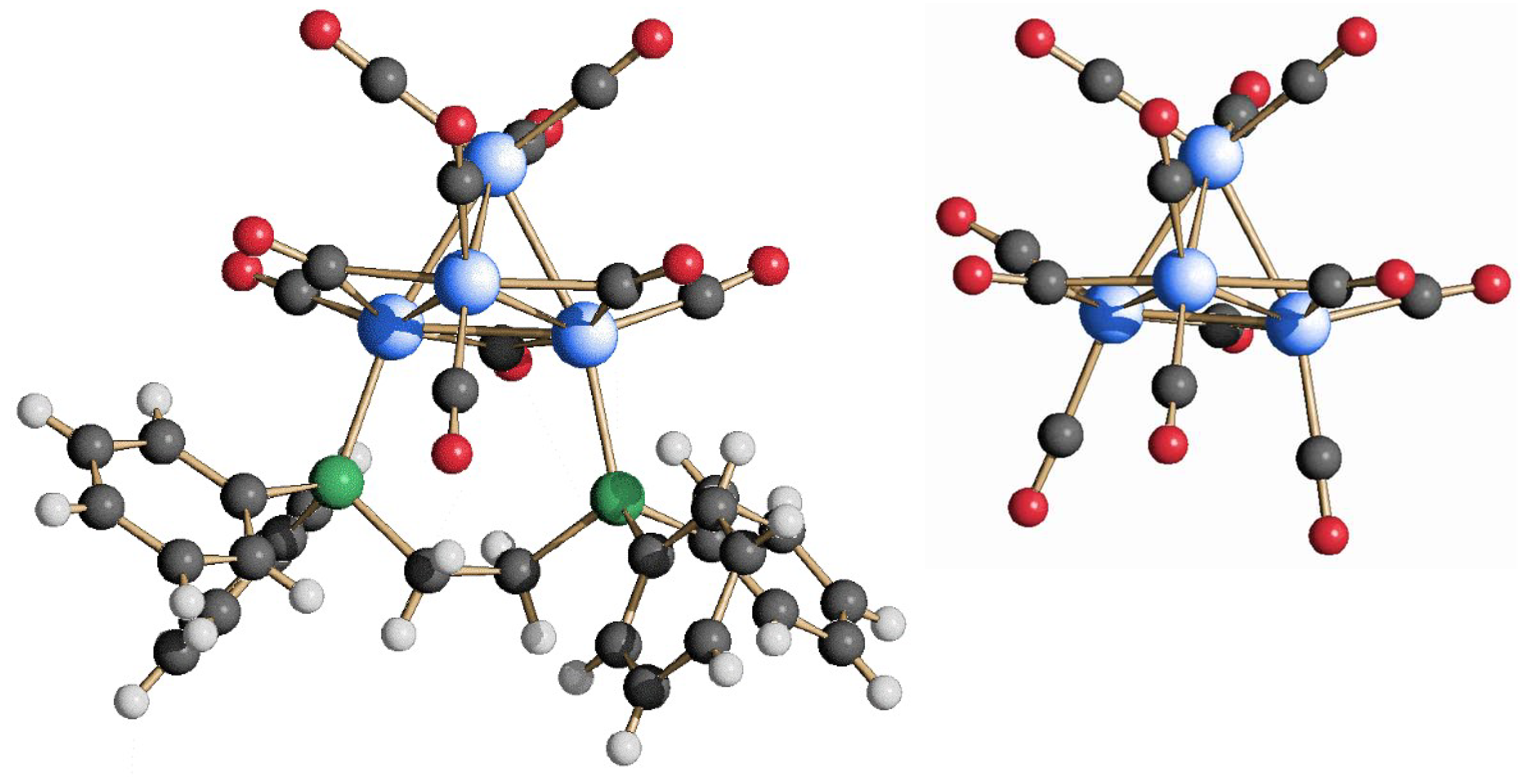
1, illustrated in
Figure 1 (left), retains the original tetrahedral metal core of Rh
4(CO)
12 and its unbalanced carbonyl ligand distribution with respect to the metal centers. More specifically, in Rh
4(CO)
12, one rhodium atom differs from the others, being coordinated to three terminal carbonyl groups, whereas each of the remaining three rhodium atoms bears two terminal- and two edge-bridging carbonyls. As a result, despite the tetrahedral symmetry of the metal framework, the overall structure of Rh
4(CO)
12 (
Figure 1, right) could be seen as a trigonal-based pyramid, the unique rhodium atom being its vertex and the other three representing the base. In compound
1, the same ligand distribution as Rh
4(CO)
12 is retained except for two terminal carbonyl groups coordinated to the triangular base, which have been replaced by the phosphorus atoms of the bidentate dppe ligand.
Despite the uneven ligand distribution of
1, the overall cluster structure actually appears to be fairly symmetrical. As a matter of fact, a mirror plane going through the pyramid vertex and crossing the midpoint of the pyramid base’s edge can be identified, with only the -CH
2CH
2- spacer being the symmetry-disrupting element in the solid state (
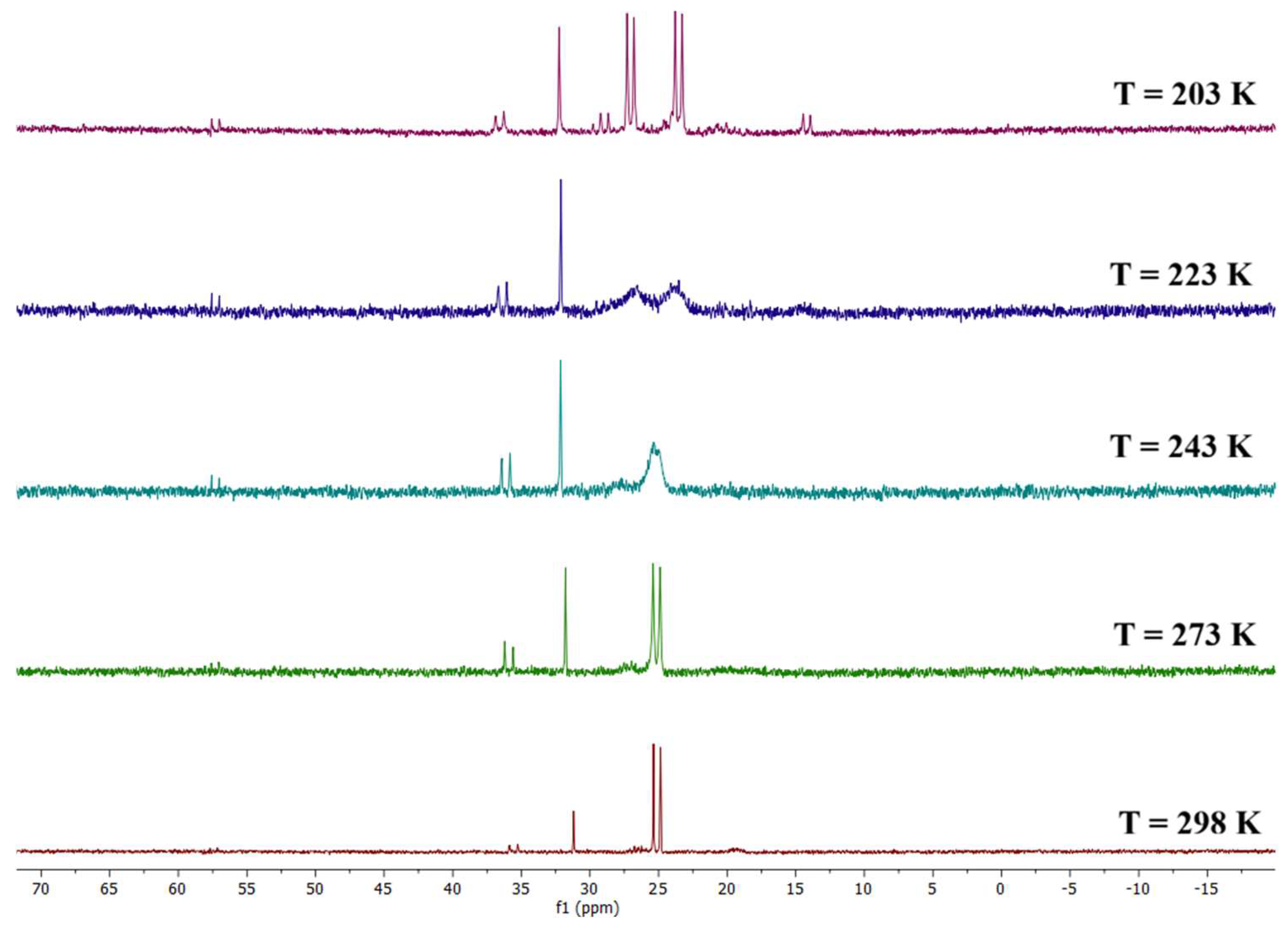
Figure S11, inset). Therefore, it was reasonable to assume that, in solution, the two phosphorus atoms could be chemically equivalent. This hypothesis was confirmed by the VT
31P{
1H} NMR analysis, reported in
Figure 2. In particular, the spectrum recorded at room temperature (
Figure S11) presented only one doublet at δ
P = 25.11 ppm due to the Rh-P coupling (
JRh-P = 124.1 Hz). However, as the temperature decreased, this signal broadened until the two phosphorus atoms coalesced at around T = 243 K; subsequently, their two related separate doublets clearly appeared at T = 203 K (δ: 27.04 (d,
JRh-P = 121.8 Hz), 23.53 (d,
JRh-P = 124.0 Hz) ppm). This phenomenon could be explained by the dynamic temperature-dependent behavior of the -CH
2-CH
2- chain between the phosphorus atoms, which is inhibited at a low temperature, thus breaking the symmetry of the molecule and meaning the phosphorus atoms are no longer chemically equivalent. A similar behavior had been observed for Rh
6(CO)
14(dppe) [
27].
When two equivalents of dppe were added to Rh
4(CO)
12, a further downshift of the ν
CO stretching values with respect to that observed for
1 was registered, indicating the formation of a new, more substituted dichelated product. By layering hexane on the THF extraction, crystals suitable for the SC-XRD analysis were obtained, allowing the identification of the new Rh
4(CO)
8(dppe)
2 (
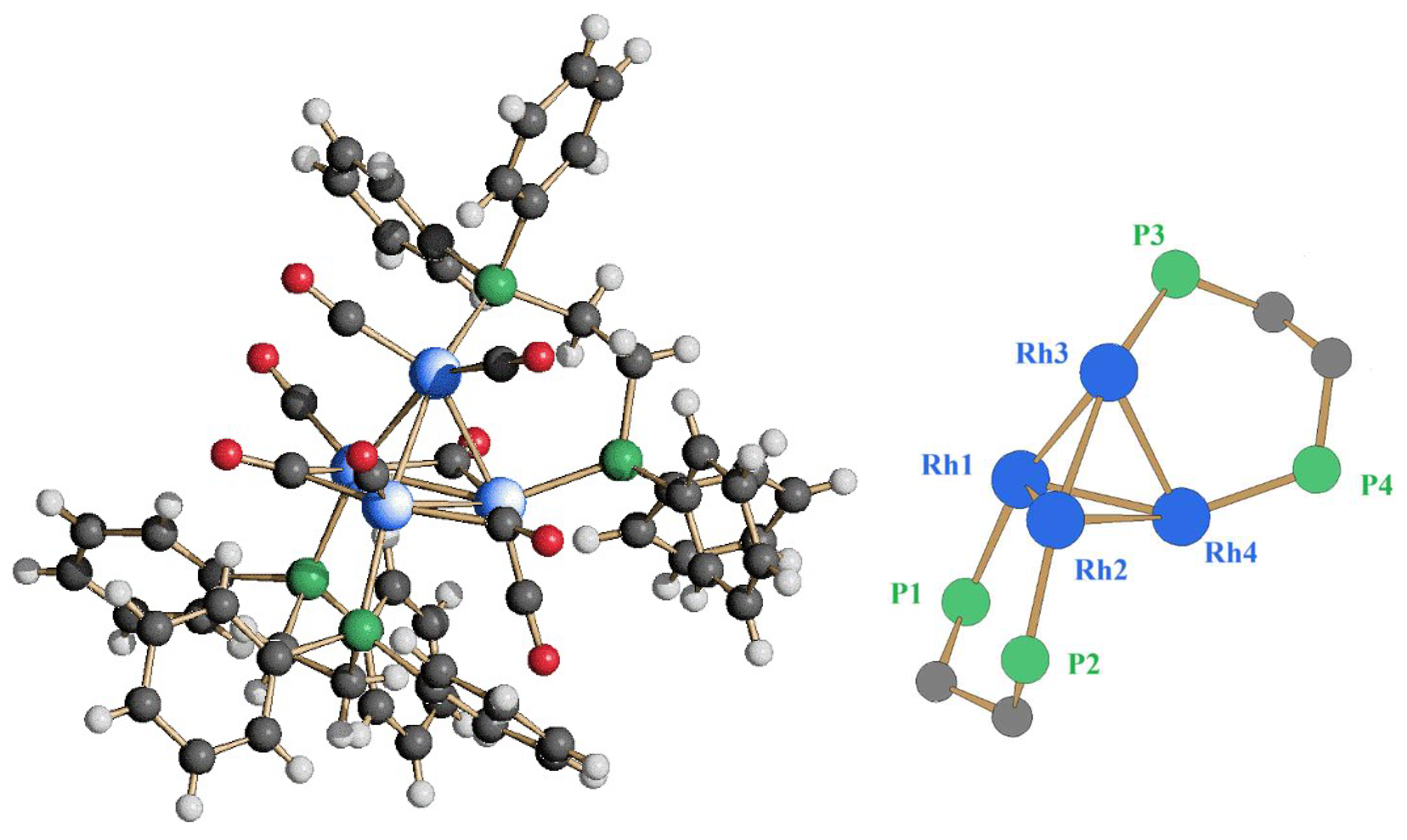
2) cluster. Its molecular structure is reported in
Figure 3. The second diphosphine is coordinated to the two rhodium atoms that were still phosphorus-free in compound
1, acting too as a bidentate ligand. The end result is the replacement of a terminal carbonyl group on each rhodium atom with respect to the initial Rh
4(CO)
12. The residual eight carbonyls are divided into five terminally coordinated, one for each rhodium but with the vertex one bearing two, and three edge-bridging along the base. Unlike
1, no symmetry could be envisaged for cluster
2.
Possibly due to the steric encumbrance of the two diphosphines, the bis-chelated heteroleptic cluster was not as stable as the monochelated one, with
2 having the tendency to go back to
1. The addition of an excess of dppe to shift this equilibrium in favor of
2 resulted in cluster degradation. Conversely, even a third diphosphine substitution was reported to occur through the addition of an excess of dppe ligand to Rh
6(CO)
16, yielding Rh
6(CO)
13(dppe)
3 [
22]; notably, however, the dppe here acted as monodentate ligands even when only one was coordinated to the parent cluster. It is possible to assume that also, in our case, the dppe would behave in the same way, preventing us from obtaining compound
2 in high yields.
Despite the difficulties in isolating cluster
2, we were able to perform a VT
31P{
1H} NMR analysis on a few obtained crystals, which were hand-picked to be sure of handling a pure sample. Judging from the crystal structure, the four phosphorus atoms in
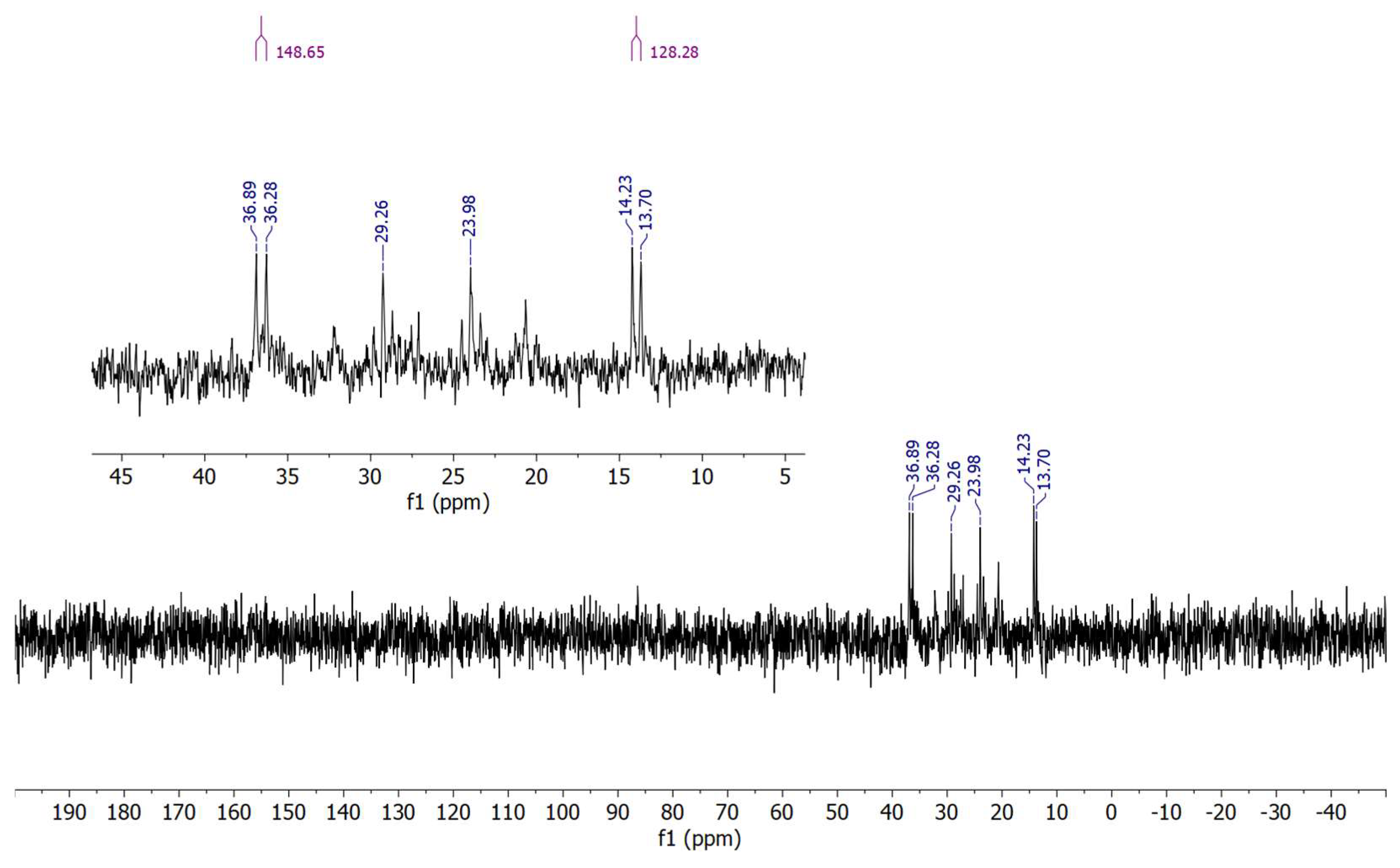
2 are not chemically equivalent, so four separated signals were expected. At room temperature, the spectrum showed intense background noise due to the low concentration of the sample (
Figure S14); moreover, the quality of the spectrum was worsened by the dynamic behavior of the ligands. Then, as the temperature decreased, the dynamic processes slowed down and a clearer spectrum was obtained at T = 193 K (
Figure 4), indeed showing four separated signals, one for each phosphorus atom, thus confirming the initial hypothesis. Nonetheless, the spectrum presented two doublets and two triplets. This finding could be explained by analyzing the relative spatial coordination of the phosphorus atoms, which, albeit different, could be fairly analog in pairs. More specifically, P(2) and P(3) are coordinated in a pseudo-trans position with each other, laying on a nearly straight line together with the Rh(2)-Rh(3) edge. Conversely, P(1) and P(4), separated by the Rh(1)-Rh(4) edge, form a narrower angle with each other. This relative spatial arrangement could highly affect the values of the coupling constant
3JP-P, respectively, making it either of similar magnitude to the
1JRh-P, in which case a triplet would be observed, or neglectable, leading to just a doublet only due to the Rh-P coupling. As a result, P(2) and P(3) gave rise to two triplets (δ: 29.26 (t,
J = 136.1 Hz), 23.98 (t,
J = 128.8 Hz) ppm), while P(1) and P(4) generated two doublets (δ: 35.79 (d,
JRh-P = 149.7 Hz), 13.98 (d,
JRh-P = 126.3 Hz) ppm). The coupling values for
1JRh-P and
3JP-P for atoms P(2) and P(3) could not be distinguished from each other.
Compound
3 was obtained by adding one equivalent of dppb, in powder form, to a CH
2Cl
2 solution of the tetrarhodium carbonyl cluster precursor. At the end of the reaction, signaled by the downshift of the original ν
CO stretching values, the target compound was extracted in toluene, and its crystallization was achieved by layering hexane onto the solution. However, the low quality of the obtained crystals impaired a full disclosure of the crystal structure. Nonetheless, we were able to obtain a satisfactory structural model of Rh
4(CO)
10(dppb) (
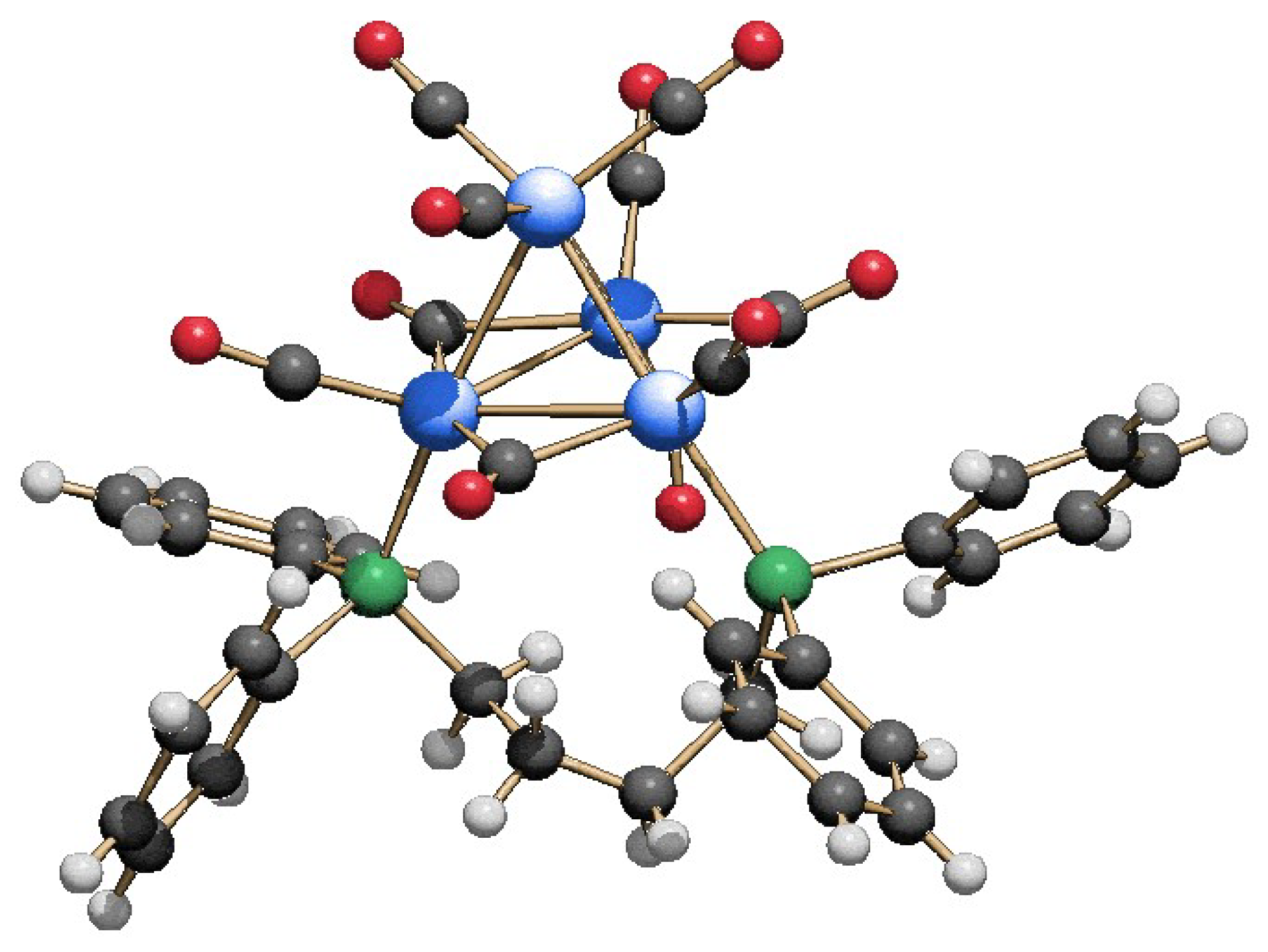
3), which is reported in
Figure 5. In fact, the ligand arrangement exactly parallels that of compound
1, both for the carbonyl and the bidentate phosphine.
To deepen the characterization of
3, a VT
31P{
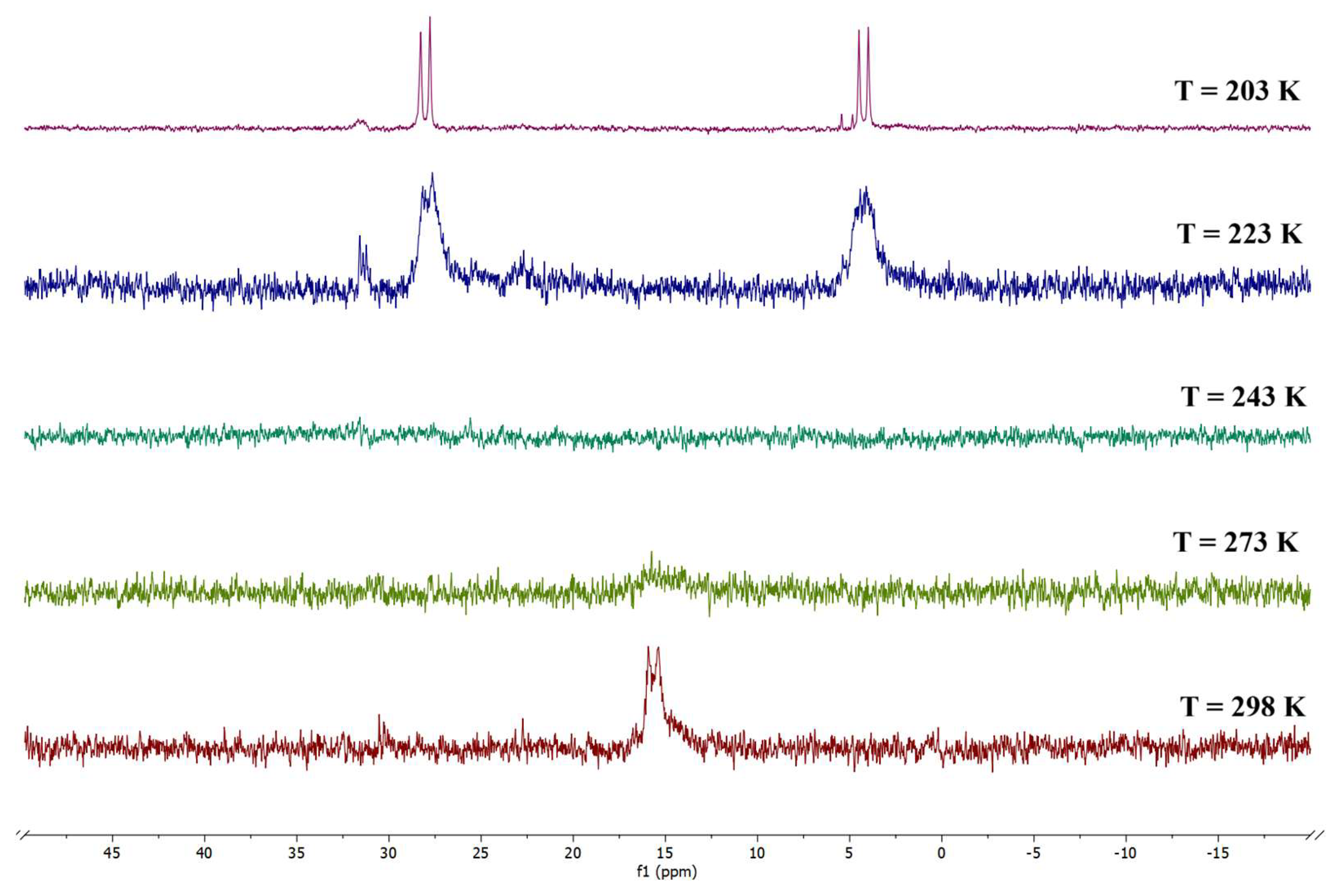
1H} NMR study was carried out. The spectra are reported in
Figure 6. Similarly to what observed for cluster
1, at room temperature, the phosphorus atoms of
3 were found chemically equivalent and they gave one single doublet (δ: 15.66 (d,
JRh-P = 137.1 Hz) ppm). When the temperature decreased, the phosphorus signal coalesced, and no peaks were detectable until T = 223 K, where two clear doublets related to each phosphorus atom appeared (δ: 28.03 (d,
JRh-P = 121.3 Hz), 4.24 (d,
JRh-P = 123.2 Hz) ppm).
We expanded the reactivity of Rh
4(CO)
12 with a diphosphine bearing a longer alkyl carbon chain, namely dpp-hexane, and the results were quite different from those observed with dppe and dppb. More specifically, one equivalent of dpp-hexane was added to a CH
2Cl
2 solution of the Rh
4(CO)
12 cluster precursor, and after a few hours, the IR spectra showed a downshift of the ν
CO stretching frequencies, indicating the replacement of two carbonyl ligands by the phosphorus atoms of the diphosphine. However, the SC-XRD analysis performed on the obtained crystals showed the formation of the dimeric {Rh
4(CO)
10(dpp-hexane)}
2 species (
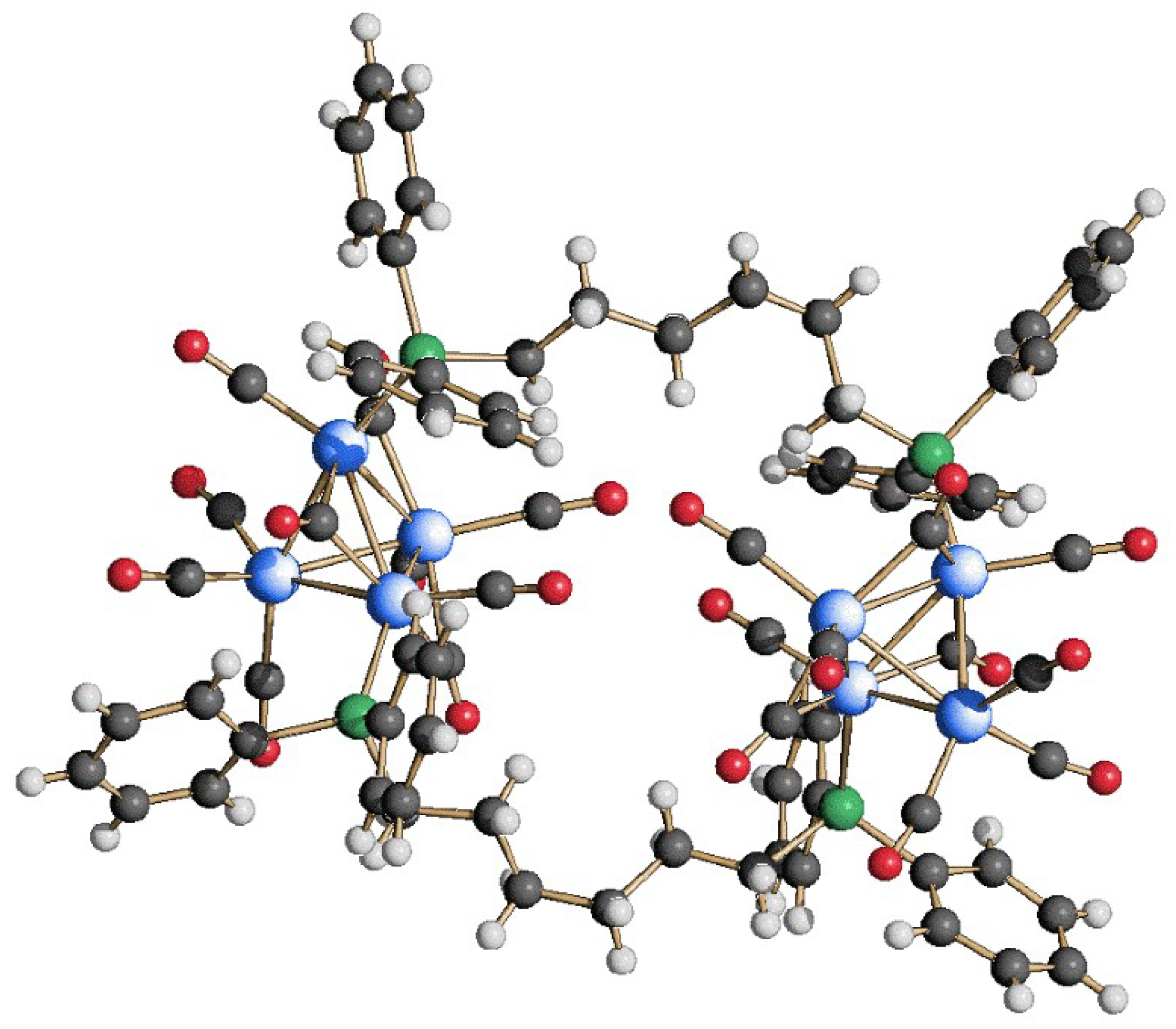
4). Its molecular structure, illustrated in
Figure 7, consists of two Rh
4(CO)
10 tetrahedra linked through two molecules of dpp-hexane. Notably, each diphosphine acts as a monodentate ligand within the same cluster unit, as two rhodium atoms per cluster are coordinated to one phosphorus atom belonging to a different dpp-hexane. The ligand distribution has some similarities with that of compounds
1 and
3. For instance, both metal vertexes have kept their three carbonyl ligands, so the phosphorus atoms are bonded to the triangular base in both cluster units. However, they are pointing away from each other and not in the same direction as in
1 and
3, imparting a low grade of symmetry to the structure in the solid state.
Indeed, at room temperature, the VT
31P{
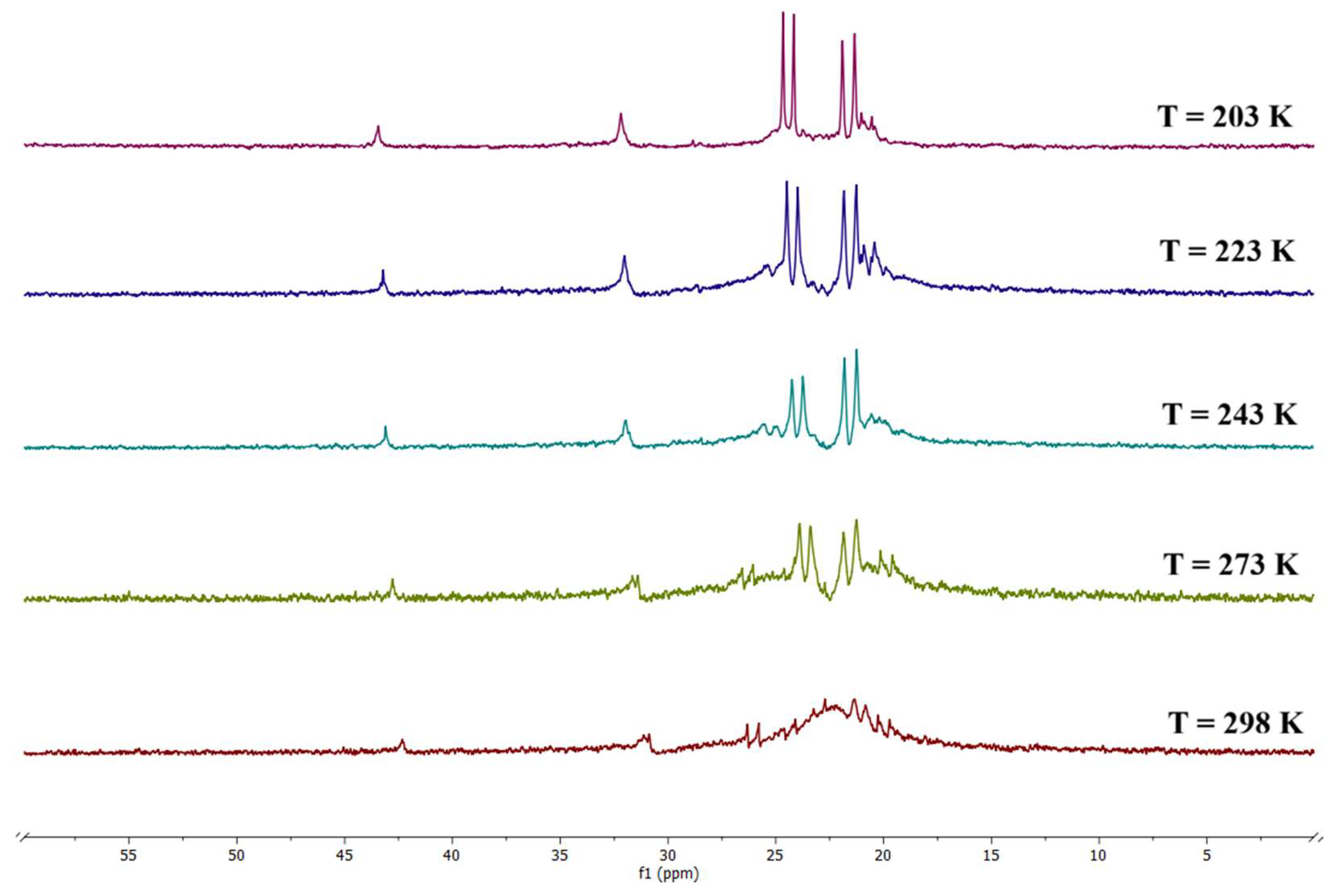
1H} NMR analysis, reported in
Figure 8, showed that the phosphorus atoms are already coalescent. Conversely, at T = 203 K, two doublets appeared (δ: 24.42 (d,
JRh-P = 120.0 Hz), 21.63 (d,
JRh-P = 136.7 Hz) ppm), indicating that the phosphorus atoms belonging to the same diphosphine are chemically equivalent.
A second dimeric species was obtained by reacting Rh
4(CO)
12 with one equivalent of
trans-dppe, in the same previously described experimental conditions. Also in this case, the procedure was rather straightforward, and the reaction directly led to the dimeric {Rh
4(CO)
10(
trans-dppe)}
2 (
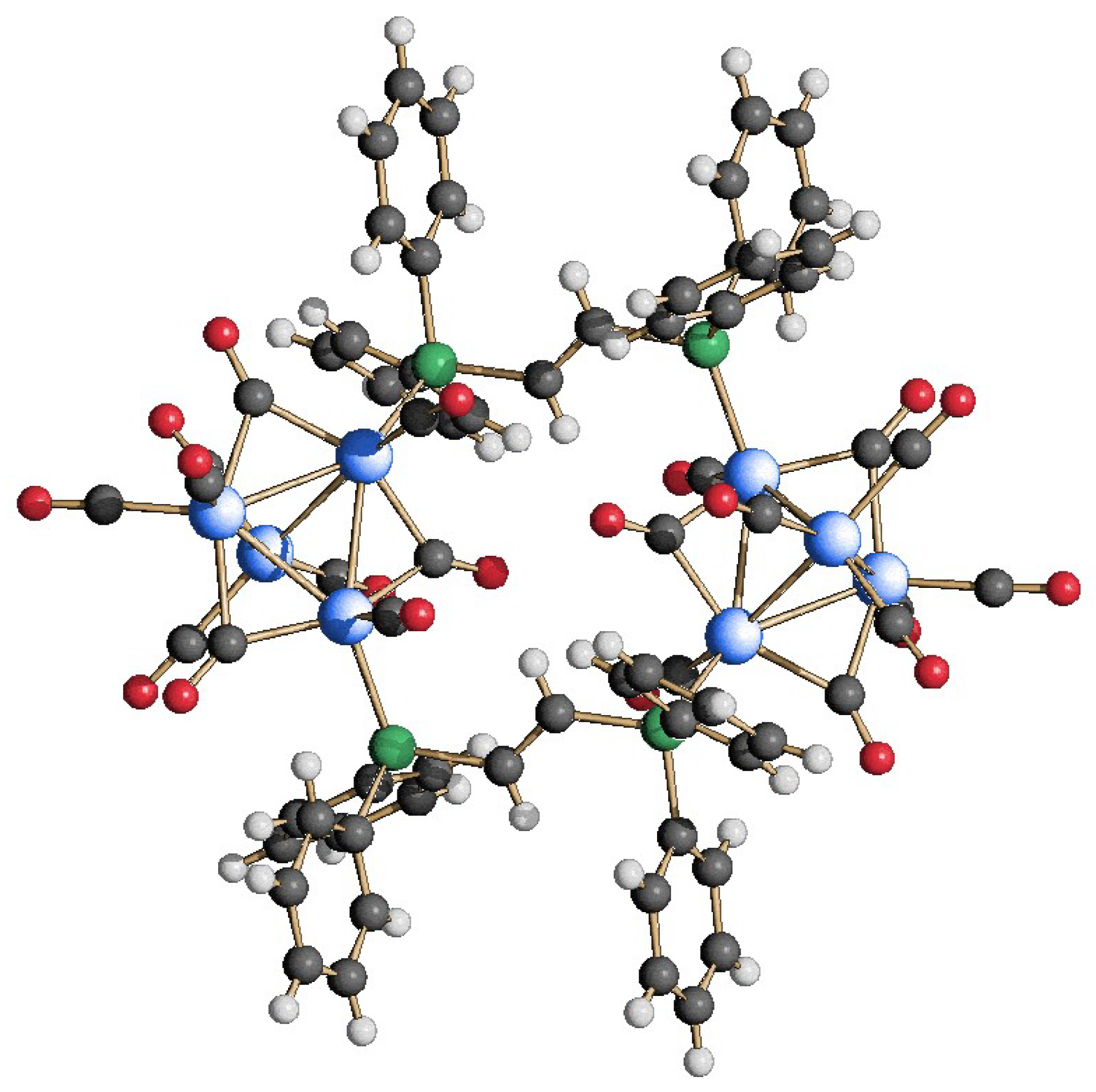
5), which was structurally characterized by SC-XRD analysis. As shown in
Figure 9, the two diphosphines are linking two Rh
4(CO)
10 tetrahedra in the same fashion seen for compound
4, again acting as monodentate ligands within the same cluster unit. The similarity with
4 is also extended to the carbonyl coordination. However, the overall species possesses a center of symmetry, as the crystallographic asymmetric unit is composed of one Rh
4(CO)
10(
trans-dppe) fragment.
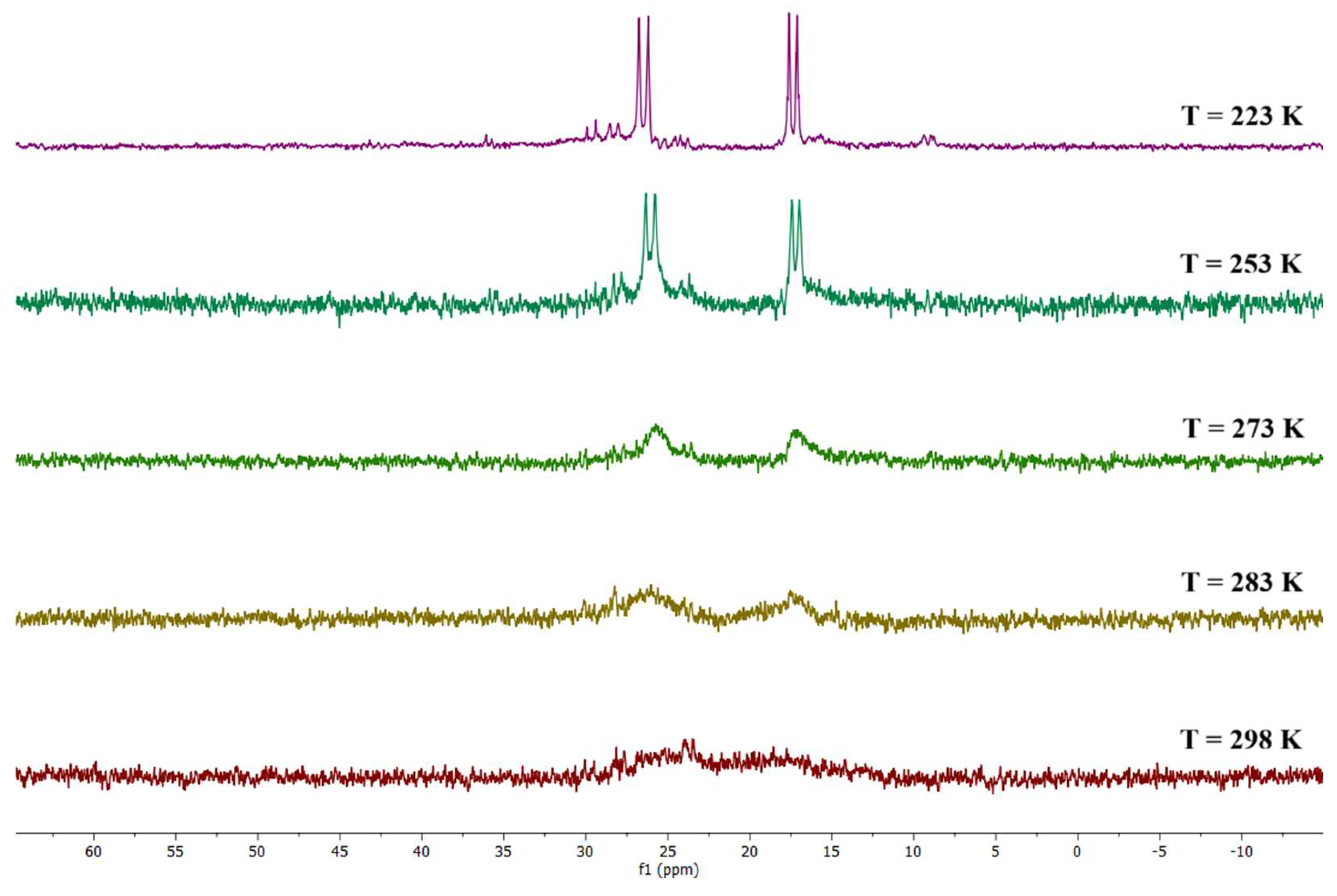
Due to such symmetry, the four phosphorus atoms are chemically equivalent in pairs. In fact, the
31P{
1H} NMR spectrum recorded at T = 223 K showed two doublets (δ: 26.48 (d,
JRh-P = 135.7 Hz), 17.38 (d,
JRh-P = 123.2 Hz) ppm), corresponding to the phosphorus atoms in the same
trans-dppe. Conversely, at room temperature, almost no signals were detectable, due to the coalescence of the phosphorus, which all become chemically equivalent (
Figure 10).
Finally, we exploited the NMR spectra to determine the rate constants of the dynamic process occurring within the bidentate phosphine ligands through line shape simulation at different temperatures. More specifically, by means of the Eyring equation [
31], it was possible to derive the activation energy Ea
‡ and the enthalpy ΔH
‡ of such dynamic processes at the coalescence temperature for compounds
1,
3,
4, and
5. The same analysis was not possible in the case of
2, due to the high background noise present in the recorded
31P{
1H} NMR spectra.
As reported in
Table 1, the monomeric clusters
1 and
3 show similar values in terms of Ea
‡ and ΔH
‡, indicating a comparable energy barrier beyond which the phosphorus atoms become chemically equivalent. The difference between the coalescence temperatures is a consequence of the chemical shift. As a general trend, we can observe that the longer the alkyl chain between the two phosphorus atoms, the lower the Ea
‡ and ΔH
‡. This includes compound
4. Compounds
1 and
3 also present a fairly similar ΔS
‡, making their ΔG
‡ values very close. The comparison between the dimeric species, conversely, reveals that their energy barriers are quite different, with
4 showing lower Ea
‡ and ΔH
‡ values than
5. A possible reason could be due to the more rigid -CH=CH- unit in
trans-dppe compared with the more flexible -C
6H
12- chain in dpp-hexane. Moreover, compound
4 presents the lowest ΔS
‡, possibly due to an associative mechanism in the transition state, thus accounting for the highest ΔG
‡ value.
3. Materials and Methods
All reactions and sample manipulations were carried out at room temperature using standard Schlenk techniques under nitrogen and in dried solvents. All the reagents were commercial products (Aldrich, St. Louis, MO, USA) of the highest purity available and used as received, except for Rh
4(CO)
12, which has been prepared according to the literature [
32]. IR spectra were recorded on a Perkin Elmer Spectrum One interferometer (Shelton, CT, USA) in CaF
2 cells.
31P{
1H} NMR measurements were performed on a Varian Inova 600 MHz instrument (Santa Clara, CA, USA), using an ATB probe. The phosphorus chemical shifts were referenced to external H
3PO
4 (85% in D
2O). Elemental analyses were determined with a Thermo Quest Flash EA 1112NC instrument (Waltham, MA, USA). The diffraction experiments were carried out at room temperature on a Bruker APEX II diffractometer (Billerica, MA, USA) equipped with a PHOTON2 CMOS detector (PHOTONIS, Nemours, France), using Mo–Ka radiation. Data were corrected for Lorentz polarization and absorption effects (empirical absorption correction SADABS version 2.05) [
33]. Structures were solved by direct methods and refined by full-matrix least-squares based on all data using F
2 [
34]. Hydrogen atoms were fixed at calculated positions and refined by a riding model. All non-hydrogen atoms were refined with anisotropic displacement parameters, including disordered atoms. In compound
2 and
4, the SQUEEZE tool [
35] was applied to address a problem of disordered solvent molecules. Anisotropic displacement parameter restraints were applied, when needed, to achieve a better structural model. Structure drawings were made with SCHAKAL99 [
36].
A CH2Cl2 solution containing Rh4(CO)12 (0.180 g, 0.241 mmol) in 15 mL was reacted, under a nitrogen atmosphere, with dppe (0.096 g, 0.241 mmol) added as a powder. The solution was left under vigorous stirring for 6 h. The reaction crude was dried under a vacuum, and it was dissolved in toluene. The solution was layered with pentane, and crystals of Rh4(CO)10(dppe) were obtained (yield: 94.8% based on Rh). The compound is soluble in toluene, THF, and CH2Cl2; it is quite soluble in 2-propanol. The new cluster was characterized via IR spectroscopy, 31P{1H} NMR, and SC-XRD.
Rh4(CO)10(dppe). C36H24O10P2Rh4 (1090.15 g/mol): Calcd. (%): C 39.66, H 2.22; found (%): C 39.75, H 2.32. IR (toluene, 298 K) νCO: 2068(s), 2040(s), 2015(vs), 1997(sh), 1881(w), 1844(m), 1809(m) cm−1. IR (Nujol, 298 K) νCO: 2067(ms), 2031(s), 2004(ms), 2020(ms), 1992(ms), 1985(br), 1867(m), 1836(m), 1799(ms) cm−1. 31P{1H} NMR (CD2Cl2, 298 K) δ: 25.11 (d, JRh-P = 124.1 Hz) ppm. 31P{1H} NMR (CD2Cl2, 203 K) δ: 27.04 (d, JRh-P = 122.3 Hz), 23.53 (d, JRh-P = 123.6 Hz) ppm.
A CH2Cl2 solution containing Rh4(CO)12 (0.240 g, 0.321 mmol) in 15 mL was reacted, under a nitrogen atmosphere, with dppe (0.256 g, 0.642 mmol) added as a powder. The solution was left under vigorous stirring for 24 h. The reaction crude was dried under a vacuum, washed in toluene, and dissolved in THF. The solution was layered with hexane, and crystals of Rh4(CO)8(dppe)2 were obtained (yield: 19.8% based on Rh). The compound is soluble in THF and CH2Cl2. The new cluster was characterized via IR spectroscopy, 31P{1H} NMR, and SC-XRD.
Rh4(CO)8(dppe)2. C60H48O8P4Rh4 (1432.55 g/mol): Calcd. (%) C 50.31, H 3.38; found (%): C 50.42, H 3.43. IR (CH2Cl2, 298 K) νCO: 2010(s), 1982(vs), 1971(sh), 1951(sh). 1805(m), 1783(m) cm−1. IR (Nujol, 298 K) νCO: 2004(s), 1982(vs), 1964(vs), 1945(vs), 1867(m), 1802(m), 1771(s) cm−1. 31P{1H} NMR (CD2Cl2, 193 K) δ: 35.79 (d, JRh-P = 149.7 Hz), 29.26 (t, J = 136.1 Hz), 23.98 (t, J = 128.8 Hz), 13.98 (d, JRh-P = 126.3 Hz) ppm.
A CH2Cl2 solution containing 0.200 g of Rh4(CO)12 (0.268 mmol) in 12 mL was reacted, under a nitrogen atmosphere, with 0.114 g of dppb (0.268 mmol) added as a powder. The solution was left under vigorous stirring for 6 h. The reaction crude was dried in a vacuum and extracted in toluene. The solution was layered with hexane, and crystals of Rh4(CO)10(dppb) C6H14 were obtained (yield: 87.4% based on Rh). The compound is soluble in THF, CH2Cl2, and toluene. The cluster was characterized via IR spectroscopy, 31P{1H} NMR, and SC-XRD.
Rh4(CO)10(dppb)·C6H14. C44H42O10P2Rh4 (1204.35 g/mol): Calcd. (%): C 43.89, H 3.32; found (%): C 44.15, H 3.44. IR (CH2Cl2, 298 K) νCO: 2068(vs), 2039(s), 2014(vs), 1992(sh), 1882(w), 1847(m), 1813(m) cm−1. IR (Nujol, 298 K) νCO: 2062(s), 2032(s), 2018(s), 1986(s), 1880(mw), 1848(m), 1806(m) cm−1. 31P{1H} NMR (CD2Cl2, 298 K) δ: 15.66 (d, JRh-P = 137.1 Hz) ppm. 31P{1H} NMR (CD2Cl2, 203 K) δ: 28.03 (d, JRh-P = 121.3 Hz), 4.24 (d, JRh-P = 123.2 Hz) ppm.
A CH2Cl2 solution containing Rh4(CO)12 (0.120 g, 0.160 mmol) in 15 mL was reacted, under a nitrogen atmosphere, with dpp-hexane (0.037 g, 0.080 mmol) added as a powder. The solution was left under vigorous stirring overnight. The reaction crude was dried under a vacuum and dissolved in toluene (10 mL). The solution was layered with hexane, and crystals of {Rh4(CO)10(dpp-hexane)}2 were obtained (yield: 90.8% based on Rh). The compound is soluble in toluene, THF, and CH2Cl2. The cluster was characterized via IR spectroscopy, 31P{1H} NMR, and X-ray diffractometry.
{Rh4(CO)10(dpp-hexane)}2. C80H64O20P4Rh8 (2292.51 g/mol): Calcd. (%): C 41.91, H 2.81; found (%): C 42.02, H 2.90. IR (CH2Cl2, 298 K) νCO: 2064(s), 2039(vs), 2009(s), 1996(s), 1835(m), 1819(m) cm−1. IR (Nujol, 298 K) νCO: 2084(m), 2053(sh), 2043(s), 2020(ms), 1867(m), 1834(m) cm−1. 31P{1H} NMR (CD2Cl2, 298 K) δ: 22.24 (br) ppm. 31P{1H} NMR (CD2Cl2, 203 K) δ: 24.42 (d, JRh-P = 120.0 Hz), 21.63 (d, JRh-P = 136.7 Hz) ppm.
A CH2Cl2 solution containing Rh4(CO)12 (0.200 g, 0.267 mmol) in 15 mL was reacted, under a nitrogen atmosphere, with trans-dppe (0.106 g, 0.267 mmol) added as a powder. The solution was left under vigorous stirring for six hours; then, the crude reaction was dried under a vacuum. Next, the solution was recovered in THF and layered with hexane to obtain crystals of {Rh4(CO)10(trans-dppe)}2·2THF (yield: 93.3% based on Rh). The compound is soluble in toluene, THF, and CH2Cl2; it is slightly soluble in acetonitrile. The new cluster was characterized via IR spectroscopy, 31P{1H} NMR, and SC-XRD.
{Rh4(CO)10(trans-dppe)}2·2THF. C80H60O22P4Rh8 (2320.48 g/mol): Calcd. (%): C 41.41, H 2.61; found (%): C 41.50, H 2.70. IR (CH2Cl2, 298 K) νCO: 2068(s), 2047(vs), 2017(s), 1842(m), 1804(ms) cm−1. IR (Nujol, 298 K) νCO: 2099(w), 2066(s), 2043(s), 1994(br), 1882(sh), 1837(s), 1791(s) cm−1. 31P{1H} NMR (CD2Cl2, 298 K) δ: 23.50 (br) ppm. 31P{1H} NMR (CD2Cl2, 223 K) δ: 26.48 (d, JRh-P = 135.7 Hz), 17.38 (d, JRh-P = 123.2 Hz) ppm.



 ,
,