3.3. Carbonylation Experiments
3.3.1. Carbonylation of (Difluoromethyl)pentafluorobenzene (1a)
a. Compound
1a (0.324 g, 1.49 mmol) and SbF
5 (0.320 g, 1.48 mmol) (molar ratio 1:1), according to the typical procedure (
Section 3.2a) (2.5 h, r.t.), gave a mixture of compounds
1a,
3a,
9a, and C
6F
5CHO in an 12:64:6:18 molar ratio. The content of a compound with CHF moiety (
19F NMR:
δ −182.2 (dm,
JH,F = 45.5) in the reaction mixture did not exceed 1%.
b. Compound
1a (0.190 g, 0.87 mmol), SbF
5 (0.387 g, 1.79 mmol) (molar ratio 1:2), and C
6F
6 (0.2 mL) according to the typical procedure (
Section 3.2b) (2.5 h, r.t., 20 min in methanol), gave a mixture of compound
3′a and C
6F
5CH(OMe)
2 in a 92:8 molar ratio.
c. Compound
1a (0.504 g, 2.31 mmol) and SbF
5 (2.646 g, 12.22 mmol) (molar ratio 1:5.3), according to the typical procedure (
Section 3.2b) (6 h, r.t., 20 min in methanol), gave a mixture of compound
3′a and C
6F
5CH(OMe)
2 in a 96:4 molar ratio. Silica gel column chromatography (CHCl
3 as the eluent) gave 0.622 g of ester
3′a (yield 90%)
Dimethyl 2-(perfluorophenyl)malonate (3′a). Colorless liquid. IR (film) ν, cm−1: 2960 (CH), 1751 (C=O), 1525, 1508 [FAR (fluorinated aromatic ring)]. 1H NMR (CDCl3): δ 4.94 (s, 1H, CH), 3.79 (s, 6H, CH3). 19F NMR (CDCl3): δ −141.1 (m, 2F, F-ortho), −154.1 (tt, 1F, Jpara,meta = 21, Jpara,ortho = 2, F-para), −162.5 (m, 2F, F-meta). HRMS, m/z: calcd. for C11H7O4F5 298.0259; found 298.0260.
3.3.2. Carbonylation of 5-(Difluoromethyl)nonafluoroindan (1b)
Compound
1b (0.532 g, 1.61 mmol) and SbF
5 (2.076 g, 9.59 mmol) (molar ratio 1:5.9), according to the typical procedure (
Section 3.2b) (3 h 15 min, r.t., 10 min in methanol), gave a mixture of compounds containing ~85% of ester
3′b. Silica gel column chromatography (with CH
2Cl
2 as the eluent) gave 0.503 g of ester
3′b (yield 76%).
Dimethyl 2-(perfluoroindan-5-yl)malonate (3′b). Colorless liquid. IR (film) ν, cm−1: 2962 (CH), 1757 (C=O), 1504 (FAR). 1H NMR (CDCl3): δ 5.06 (s, 1H, CH), 3.82 (s, 6H, CH3). 19F NMR (CDCl3): δ −107.7 (m, 2F, CF2-1 or 3), −108.4 (m, 2F, CF2-1 or 3), −117.0 (dtd, 1F, F-4), −121.9 (dd, 1F, F-6), −130.7 (quintet, 2F, CF2-2), −141.4 (ddt, 1F, F-7); J1,2 = J2,3 = 4, J1,7 = 7, J3,4 = 7.5, J4,6 = 5, J4,7 = 20, J5,6 = 19, J6,7 = 20.5. HRMS, m/z: calcd. for C14H7O4F9 410.0195; found 410.0197.
3.3.3. Carbonylation of 6-(Difluoromethyl)undecafluorotertalin (1c)
a. Compound
1c (0.575 g, 1.51 mmol) and SbF
5 (1.978 g, 9.14 mmol) (molar ratio 1:6), according to the typical procedure (
Section 3.2b) (2 h 15 min, r.t., 10 min in methanol), gave a mixture of compounds containing ~90% of ester
3′c. Silica gel column chromatography (CH
2Cl
2 as the eluent) gave 0.562 g of ester
3′c (yield 81%).
b. Compound
1c (0.467 g, 1.23 mmol) and SbF
5 (0.267 g, 1.23 mmol) (molar ratio 1:1), according to the typical procedure (
Section 3.2b) (45 min, r.t., 10 min in methanol), gave a mixture of compounds containing 55% of starting compound
1c and 30% of ester
3′c. Content of a compound with CHF moiety (
19F NMR:
δ −186.9 (dm,
JH,F = 45.5)) did not exceed 5%.
Dimethyl 2-(perfluorotertalin-6-yl)malonate (3′c). Colorless liquid. IR (film) ν, cm−1: 2962 (CH), 1753 (C=O), 1495, 1482 (FAR). 1H NMR (CDCl3): δ 5.07 (s, 1H, CH), 3.82 (s, 6H, CH3). 19F NMR (CDCl3): δ −106.5 (m, 2F, CF2-1 or 4), −107.2 (m, 2F, CF2-1 or 4), −113.6 (tdd, 1F, F-4), −122.7 (dd, 1F, F-6), −135.4 (m, 2F, CF2-2 or 3), −135.6 (m, 2F, CF2-2 or 3), −138.5 (qd, 1F, F-7); J4,5 = 22, J5,7 = 6, J5,8 = 15, J7,8 = J1,8 = 20.5. HRMS, m/z: calcd. for C15H7O4F11 460.0163; found 460.0167.
3.3.4. Carbonylation of (Dichloromethyl)pentafluorobenzene (2a)
a. Compound
2a (0.467 g, 1.86 mmol) and SbF
5 (0.202 g, 0.93 mmol) (molar ratio 1:0.5) according to the typical procedure (
Section 3.2a) (3 h, r.t.), gave a mixture of compounds
1a,
2a,
6a, and C
6F
5CHO in a 5:44:41:10 molar ratio.
b. Compound
2a (0.524 g, 2.09 mmol), SbF
5 (0.458 g, 2.12 mmol) (molar ratio 1:1), and C
6F
6 (0.3 mL, was added 2.5 h after the start of carbonylation) according to the typical procedure (
Section 3.2a) (3 h, r.t.), gave a mixture of compounds
1a,
2a,
6a, and C
6F
5CHO in an 1:3:89:7 molar ratio. Evaporation of the solvent and sublimation (110 °C, 3 Torr) afforded 0.373 g (yield 69%) of acid
6a.
c. Compound
2a (0.390 g, 1.55 mmol), SbF
5 (0.355 g, 1.55 mmol) (molar ratio 1:1), and C
6F
6 (0.3 mL, was added 2 h after the start of carbonylation) according to the typical procedure (
Section 3.2b) (3 h, r.t., 15 min in methanol), gave a mixture of compounds
1a,
2a,
6′a, C
6F
5CHO, and C
6F
5CH(OMe)
2 in an 1:3:86:3:7 molar ratio. Silica gel column chromatography (CCl
4–CH
2Cl
2 [1:1,
v/
v] as the eluent) gave 0.199 g of ester
6′a (yield 47%), such modest yield is due to the difficulty of separating from other products.
d. Compound
2a (0.498 g, 1.98 mmol), SbF
5 (0.860 g, 3.97 mmol) (molar ratio 1:2), and C
6F
6 (1 mL, was added 1 h after the start of carbonylation) according to the typical procedure (
Section 3.2b) (3 h, r.t., 15 min in methanol), gave a mixture of compounds
1a,
6′a, C
6F
5CHO, and C
6F
5CH(OMe)
2 in an 12:76:2:10 molar ratio.
e. Compound
2a (0.323 g, 1.29 mmol) and SbF
5 (1.134 g, 5.24 mmol) (molar ratio 1:4) according to the typical procedure (
Section 3.2b) (3 h, r.t., 15 min in methanol), gave a mixture of compounds
1a,
2a,
6′a, C
6F
5CHO, and C
6F
5CH(OMe)
2 in a 9:4:35:2:50 molar ratio.
f. Compound
2a (0.305 g, 1.22 mmol) and SbF
5 (1.578 g, 7.29 mmol) (molar ratio 1:6), according to the typical procedure (
Section 3.2b) (4.5 h, r.t., 20 min in methanol), gave a mixture of compounds
1a,
2a,
3′a, C
6F
5CHO, and C
6F
5CH(OMe)
2 in a 2:4:25:9:60 molar ratio.
2-Chloro-2-(perfluorophenyl)acetic acid (6a). White solid; mp 102–103.5 °C (CCl4). IR (KBr) ν, cm−1: 1754 (C=O), 1525, 1512 (FAR). 1H NMR (CDCl3): δ 11.37 (s, 1H, COOH), 5.78 (s, 1H, CHCl). 19F NMR (CDCl3): δ −141.4 (m, 2F, F-ortho), −151.5 (tt, 1F, Jpara,meta = 21, Jpara,ortho = 3, F-para), −161.7 (m, 2F, F-meta). HRMS, m/z: calcd. for C8H2O2Cl1F5 259.9658; found 259.9655. Anal. calcd. for C8H2O2Cl1F5: C, 36.88; H, 0.77; Cl, 13.61; F, 36.46%. Found: C, 36.77; H, 0.93; Cl, 13.31; F, 36.38%.
Methyl 2-chloro-2-(perfluorophenyl)acetate (6′a). Colorless liquid. IR (film) ν, cm−1: 2962 (CH), 1770, 1747 (C=O), 1525, 1510 (FAR). 1H NMR (CDCl3): δ 5.70 (s, 1H, CHCl), 3.82 (s, 3H, CH3). 19F NMR (CDCl3): δ −141.8 (m, 2F, F-ortho), −152.4 (tt, 1F, Jpara,meta = 21, Jpara,ortho = 2.5, F-para), −161.2 (m, 2F, F-meta). HRMS, m/z: calcd. for C9H4O2Cl1F5 273.9815; found 273.9818.
3.3.5. Carbonylation of 1-(Dichloromethyl)-2,3,5,6-tetrafluoro-4-(trifluoromethyl)benzene (2d)
a. Compound
2d (0.377 g, 1.25 mmol) and SbF
5 (0.274 g, 1.27 mmol) (molar ratio 1:1), according to the typical procedure (
Section 3.2a) (1 h 45 min, r.t.), gave a mixture of compounds containing ~70% of acid
6d. After evaporation of Et
2O, the residue was dissolved in CH
2Cl
2 (10 mL) and washed with a saturated aqueous solution of NaHCO
3 (30 mL). The aqueous layer was separated, acidified with HCl (pH < 1), and extracted with Et
2O (3 × 5 mL). Evaporation of the solvent and sublimation (120 °C, 1 Torr) gave 0.254 g of acid
6d (yield 65%).
b. Compound
2d (0.421 g, 1.40 mmol) and SbF
5 (1.758 g, 8.12 mmol) (molar ratio 1:5.8), according to the typical procedure (
Section 3.2b) (3 h 15 min, r.t., 10 min in methanol), gave a mixture of compounds containing ~80% of ester
3′d. Silica gel column chromatography (CH
2Cl
2 as the eluent) gave 0.313 g of ester
3′d (yield 64%).
2-Chloro-2-(2,3,5,6-tetrafluoro-4-(trifluoromethyl)phenyl)acetic acid (6d). White solid; mp 68–69 °C (after sublimation). IR (KBr) ν, cm−1: 1743 (C=O), 1504 (FAR). 1H NMR (CDCl3): δ 8.60 (br.s, 1H, COOH), 5.80 (s, 1H, CHCl). 19F NMR (CDCl3): δ −57.7 (t, 3F, JCF3,F(3) = JCF3,F(5) = 22, CF3), −139.7 (m, 4F, F-2,3,5,6). HRMS, m/z: calcd. for C9H2O2Cl1F7 309.9626; found 309.9621. Anal. calcd. for C9H2O2Cl1F7: C, 34.81; H, 0.65; Cl, 11.42; F, 42.82%. Found: C, 35.08; H, 1.08; Cl, 11.14; F, 42.82%.
Dimethyl 2-(2,3,5,6-tetrafluoro-4-(trifluoromethyl)phenyl)malonate (3′d). Colorless liquid. IR (film) ν, cm−1: 2962 (CH), 1755 (C=O), 1500 (FAR). 1H NMR (CDCl3): δ 5.02 (s, 1H, CH), 3.81 (s, 6H, CH3). 19F NMR (CDCl3): δ −57.5 (t, 3F, JCF3,F(3) = JCF3,F(5) = 21.5, CF3), −139.3 (m, 2F, F-2,6), −141.0 (m, 2F, F-3,5). HRMS, m/z: calcd. for C11H7O4F5 348.0227; found 348.0222.
3.3.6. Carbonylation of (Fluoromethyl)pentafluorobenzene (7a)
a. Compound
7a (0.398 g, 1.99 mmol), SbF
5 (0.218 g, 1.01 mmol) (molar ratio 1:0.5), and C
6F
6 (0.2 mL), according to the typical procedure (
Section 3.2a) (2 h, r.t.), gave a mixture of compounds containing ~15% of acid
9a along with resignification products.
b. Compound
7a (0.300 g, 1.50 mmol), SbF
5 (0.640 g, 2.96 mmol) (molar ratio 1:2), and C
6F
6 (0.2 mL), according to the typical procedure (
Section 3.2a) (45 min, r.t.), gave a mixture of compounds containing ~10% of acid
9a.
c. Compound
7a (0.330 g, 1.65 mmol), SbF
5 (1.369 g, 6.32 mmol) (molar ratio 1:3.8), and C
6F
6 (0.3 mL), according to the typical procedure (
Section 3.2a) (45 min, r.t.), gave a mixture of compounds containing ~75% of acid
9a.
d. Compound
7a (0.504 g, 2.52 mmol), SbF
5 (3.261 g, 15.06 mmol) (molar ratio 1:6), and C
6F
6 (0.4 mL), according to the typical procedure (
Section 3.2a) (45 min, r.t.), gave a mixture of compounds containing ~90–95% of acid
9a. After evaporation of Et
2O, the residue was dissolved in CH
2Cl
2 (10 mL) and washed with a saturated aqueous solution of NaHCO
3 (30 mL). The aqueous layer was separated, acidified with HCl (pH < 1), and extracted with Et
2O (3 × 5 mL). Evaporation of the solvent and sublimation (100 °C, 1 Torr) gave 0.491 g of acid
9a (yield 86%).
3.3.7. Carbonylation of (Chloromethyl)pentafluorobenzene (8a)
a. Compound
8a (0.285 g, 1.32 mmol) and SbF
5 (0.148 g, 0.68 mmol) (molar ratio 1:0.5), according to the typical procedure (
Section 3.2a) (2 h, r.t.), gave a mixture of compounds containing ~10% of acid
9a along with the starting compound (~10%) and resinification products.
b. Compound
8a (0.521 g, 2.41 mmol), SbF
5 (3.145 g, 14.53 mmol) (molar ratio 1:6), and (C
4F
9)
2O (0.3 mL), according to the typical procedure (
Section 3.2a) (45 min, r.t.), gave a mixture of compounds containing ~90–95% of acid
9a. After evaporation of Et
2O, the residue was dissolved in CH
2Cl
2 (10 mL) and washed with a saturated aqueous solution of NaHCO
3 (30 mL). The aqueous layer was separated, acidified with HCl (pH < 1), and extracted with Et
2O (3 × 5 mL). Evaporation of the solvent and sublimation (100 °C, 1 Torr) gave 0.474 g of acid
9a (yield 87%).
3.3.8. Carbonylation of 1-(Fluoromethyl)-2,3,5,6-tetrafluoro-4-(trifluoromethyl)benzene (7d)
Compound
7d (0.491 g, 1.96 mmol), SbF
5 (2.594 g, 11.98 mmol) (molar ratio 1:6.1), and (C
4F
9)
2O (0.2 mL), according to the typical procedure (
Section 3.2a) (1 h, r.t.), gave a complex mixture of compounds containing acid
9d (yield 6%, judging by
19F NMR with an internal standard) and acid
13 (yield 14%,
19F NMR), along with a complex mixture of other products.
3.3.9. Carbonylation of 1-(Chloromethyl)-2,3,5,6-tetrafluoro-4-(trifluoromethyl)benzene (8d)
Compound
8d (0.508 g, 1.91 mmol), SbF
5 (2.454 g, 11.33 mmol) (molar ratio 1:5.9), and (C
4F
9)
2O (0.2 mL), according to the typical procedure (
Section 3.2a) (2.5 h, r.t.), gave a complex mixture of compounds. After evaporation of Et
2O, the residue was dissolved in CH
2Cl
2 (10 mL) and washed with a saturated aqueous solution of NaHCO
3 (30 mL). The resulting organic layer contained (GS-MS) a mixture of dimeric and oligomeric products with M ≥ 448. The aqueous layer was acidified with HCl (pH < 1), and extracted with Et
2O (2 × 5 mL). The extract contain acid
9d (yield 6%,
19F NMR) along with a complex mixture of other products, including acid
13 (yield 4%,
19F NMR).
3.3.10. Carbonylation of 1-(Chloromethyl)-2,4,5,6-tetrafluoro-3-(trifluoromethyl)benzene (8e)
Compound
8e (0.343 g, 1.29 mmol), SbF
5 (1.686 g, 7.79 mmol) (molar ratio 1:6), and (C
4F
9)
2O (0.2 mL), according to the typical procedure (
Section 3.2a) (45 min, r.t.), gave a mixture of compounds
9e and
11 in a 90:10 molar ratio. After evaporation of Et
2O, the residue was dissolved in CH
2Cl
2 (10 mL) and washed with a saturated aqueous solution of NaHCO
3 (30 mL). The aqueous layer was separated, acidified with HCl (pH < 1), and extracted with CH
2Cl
2 (3 × 5 mL). Evaporation of the solvent gave 0.303 g of acid
9e (yield 85%).
(2,4,5,6-Tetrafluoro-3-(trifluoromethyl)phenyl)acetic acid (9e). White solid; mp 75–76 °C (after sublimation). IR (KBr) ν, cm−1: 1726 (C=O), 1510 (FAR). 1H NMR (CDCl3): δ 6.2 (br.s, 1H, COOH), 3.78 (s, 2H, CH2). 19F NMR (CDCl3): δ −57.3 (t, 3F, CF3), −119.1 (qdddt, 1F, F-2), −128.8 (dddm, 1F, F-6), −134.1 (qddd, 1F, F-4), −163.0 (ddd, 1F, F-5); JCF3,F(2) = JCF3,F(4) = 22.5, JF(2),CH2 = 1.5, J2,4 = 3.5, J2,5 = 11.5, J2,6 = 4, J4,5 = 21.5, J4,6 = 10.5, J5,6 = 22. HRMS, m/z: calcd. for C9H3O2F7 276.0016; found 276.0014. Anal. calcd. for C9H3O2F7: C, 39.15; H, 1.10; F, 48.17%. Found: C, 39.70; H, 1.30; F, 48.16%.
3.3.11. Carbonylation of 1-(Chloromethyl)-3,4,5,6-tetrafluoro-2-(trifluoromethyl)benzene (8f)
Compound
8f (0.461 g, 1.73 mmol), SbF
5 (2.214 g, 10.22 mmol) (molar ratio 1:5.9), and (C
4F
9)
2O (0.2 mL), according to the typical procedure (
Section 3.2a) (45 min, r.t.), gave a mixture of compounds
9f,
10, and 4,5,6,7-tetrafluorophthalide in a 92:3:5 molar ratio. After evaporation of Et
2O, the residue was dissolved in CH
2Cl
2 (10 mL) and washed with a saturated aqueous solution of NaHCO
3 (30 mL). The aqueous layer was separated, acidified with HCl (pH < 1), and extracted with CH
2Cl
2 (3 × 5 mL). Evaporation of the solvent gave 0.420 g of acid
9f (yield 88%).
(3,4,5,6-Tetrafluoro-2-(trifluoromethyl)phenyl)acetic acid (9f). White solid; mp 73.5–75 °C (after sublimation). IR (KBr) ν, cm−1: 1726 (C=O), 1529, 1485 (FAR). 1H NMR (acetone-d6): δ 4.2 (br.s, 1H, COOH), 3.96 (s, 2H, CH2). 19F NMR (acetone-d6): δ −54.0 (d, 3F, CF3), −138.1 (ddm, 1F, F-6), −139.0 (qddd, 1F, F-3), −149.7 (ddd, 1F, F-5), −154.9 (ddd, 1F, F-4); JCF3,F(3) = 26, J3,4 = 21, J3,5 = 7.5, J3,6 = 11.5, J4,6 = 4.5, J4,5 = 21, J5,6 = 22. HRMS, m/z: calcd. for C9H3O2F7 276.0016; found 276.0017. Anal. calcd. for C9H3O2F7: C, 39.15; H, 1.10; F, 48.17%. Found: C, 39.56; H, 1.08; F, 48.26%.
3.3.12. Carbonylation of 1-(Chloromethyl)-2,3,5,6-tetrafluoro-4-(perfluoroisopropyl)benzene (8g)
Compound
8g (0.502 g, 1.37 mmol), SbF
5 (1.825 g, 8.43 mmol) (molar ratio 1:6.1), and (C
4F
9)
2O (0.2 mL), according to the typical procedure (
Section 3.2a) (1.5 h, r.t.), gave a complex mixture of compounds containing ~20% of acid
9g. After evaporation of Et
2O, the residue was dissolved in CH
2Cl
2 (10 mL) and washed with a saturated aqueous solution of NaHCO
3 (30 mL). The aqueous layer was separated, acidified with HCl (pH < 1), and extracted with CH
2Cl
2 (3 × 5 mL). Evaporation of the solvent and sublimation (130 °C, 1 Torr) resulted in a mixture (0.110 g) containing ~90% of acid
9g, recrystallization from hexane gave 55 mg (yield 11%) of the pure substance.
(2,3,5,6-Tetrafluoro-4-(perfluoroisopropyl)phenyl)acetic acid (9g). White solid; mp 117–118 °C (hexane). IR (KBr) ν, cm−1: 1716 (C=O), 1493 (FAR). 1H NMR (CDCl3): δ 6.5 (br.s, 1H, COOH), 3.87 (s, 2H, CH2). 19F NMR (CDCl3): δ −76.4 (m, 6F, CF3), −135.6 (br.s, 1F, Ar-F), −138.6 (br.s, 1F, Ar-F), −140.4 (br.s, 1F, Ar-F), −141.4 (br.s, 1F, Ar-F), −179.7 (m, 1F, CF(CF3)2). HRMS, m/z: calcd. for C11H3O2F11 375.9952; found 375.9950.
3.3.13. Carbonylation of (Perfluoro-[1,1′-biphenyl]-4-yl)acetic acid (8h)
Compound
8h (0.498 g, 1.37 mmol), SbF
5 (1.776 g, 8.20 mmol) (molar ratio 1:6), and (C
4F
9)
2O (0.3 mL), according to the typical procedure (
Section 3.2a) (2 h, r.t.), gave a complex mixture of compounds containing ~20% of starting compound
8h and ~5% acid
9h. After evaporation of Et
2O, the residue was dissolved in CH
2Cl
2 (10 mL) and washed with a saturated aqueous solution of NaHCO
3 (30 mL). The aqueous layer was separated, acidified with HCl (pH < 1), and extracted with Et
2O (2 × 5 mL). Evaporation of the solvent, sublimation (180 °C, 1 Torr), and recrystallization from hexane afforded 14 mg of acid
9h (yield 3%).
(Perfluoro-[1,1′-biphenyl]-4-yl)acetic acid (9h). White solid; mp 211–214 °C (after sublimation). IR (KBr) ν, cm−1: 1709 (C=O), 1489, 1417 (FAR). 1H NMR (acetone-d6): δ 3.96 (s, 2H, CH2), 3.3 (br.s, COOH + traces of water). 19F NMR (acetone-d6): δ −138.0 (m, 2F, Ar-F), −139.5 (m, 2F, Ar-F), −141.5 (m, 2F, Ar-F), −151.0 (tt, 1F, F-4′, J4′,3′ = J4′,5′ = 20.5, J4′,2′ = J4′,6′ = 3), −161.4 (m, 2F, F-3′,5′). HRMS, m/z: calcd. for C14H3O2F9 373.9984; found 373.9985.
3.3.14. Carbonylation of (Perfluoro-4-methylphenyl)methanol (14d)
A mixture of alcohol 14d (0.145 g, 0.58 mmol), TfOH (0.263 g, 1.75 mmol), and SbF5 (0.379 g, 1.75 mmol) (molar ratio 1:3:3) was vigorously stirred in a 10 mL round-bottom glass flask (7 h, 60 °C) in a slow flow of CO, then poured into 5% hydrochloric acid (15 mL), extracted three times with 4 mL of a CH2Cl2–Et2O mixture (3:1, v/v), and the extract was dried over MgSO4. The resulting solution contained compounds 9d and 12 in an 88:12 molar ratio. After evaporation of the solvent, the residue was dissolved in CH2Cl2 (10 mL) and washed with a saturated aqueous solution of NaHCO3 (30 mL). The aqueous layer was separated, acidified with HCl (pH < 1), and extracted with CH2Cl2 (3 × 5 mL). Evaporation of the solvent and sublimation (120 °C, 3 Torr) gave 0.104 g of acid 9d (yield 65%).
(2,3,5,6-Tetrafluoro-4-(trifluoromethyl)phenyl)acetic acid (9d). White solid; mp 77–80 °C (after sublimation). IR (KBr) ν, cm−1: 1732 (C=O), 1497 (FAR). 1H NMR (CDCl3): δ 11.67 (br.s, 1H, COOH), 3.87 (s, 2H, CH2). 19F NMR (CDCl3): δ −57.4 (t, 3F, JCF3,F(3) = JCF3,F(5) = 21.5, CF3), −141.2 (m, 2F, F-2,6), −141.6 (m, 2F, F-3,5). HRMS, m/z: calcd. for C9H3O2F7 276.0016; found 276.0013.
3.3.15. Carbonylation of (Perfluoro-3-methylphenyl)methanol (14e)
Compound 14e (0.198 g, 0.80 mmol) and TfOH (0.840 g, 5.60 mmol) (molar ratio 1:7), used similarly to procedure 3.3.14 (6 h, 50 °C, extraction with CH2Cl2), gave a mixture of compounds containing ~95% of acid 9e. An analogous treatment gave 0.165 g of acid 9e (yield 75%).
3.3.16. Carbonylation of (Perfluoro-2-methylphenyl)methanol (14f)
Compound 14f (0.218 g, 0.88 mmol) and TfOH (0.923 g, 6.15 mmol) (molar ratio 1:7), similarly to procedure 3.3.14 (6 h, 75 °C), gave a mixture of compounds containing ~85% of acid 9f in the absence of acid 10 after hydrolysis of the reaction mixture. An analogous treatment gave 0.155 g of acid 9f (yield 64%).
3.3.17. Carbonylation of 1,4-Bis(chloromethyl)-2,3,5,6-tetrafluorobenzene (16a)
Compound
16a (0.174 g, 0.70 mmol), SbF
5 (0.974 g, 4.50 mmol) (molar ratio 1:6.4), and (C
4F
9)
2O (0.1 mL), according to the typical procedure (
Section 3.2b) (2 h, r.t., 20 min in methanol), gave a complex mixture of compounds containing ~15% ester
17′a (yield 12%,
19F NMR).
Dimethyl (2,3,5,6-tetrafluoro-1,3-phenylene)diacetate (17′a) in the reaction mixture. 1H NMR (CDCl3): δ 3.72 (s, 6H, CH3), 3.71 (s, 4H, CH2).19F NMR (CDCl3): δ −144.3 (s, 4F, F-Ar). GC-MS, m/z: calcd. for C12H10O4F4 294; found 294.
3.3.18. Carbonylation of 1,3-Bis(chloromethyl)-2,4,5,6-tetrafluorobenzene (16b)
Compound
16b (0.272 g, 1.10 mmol), SbF
5 (1.555 g, 7.18 mmol) (molar ratio 1:6.5), and (C
4F
9)
2O (0.2 mL), according to the typical procedure (
Section 3.2b) (2 h, r.t., 20 min in methanol), gave a mixture of compounds containing ~65% of ester
17′b. Silica gel column chromatography (CH
2Cl
2 as the eluent) gave 0.143 g of ester
17′b (yield 44%).
Dimethyl (2,4,5,6-tetrafluoro-1,3-phenylene)diacetate (17′b). Colorless liquid. IR (film) ν, cm−1: 2958 (CH), 1747 (C=O), 1496 (FAR). 1H NMR (CDCl3): δ 3.68 (s, 6H, CH3), 3.66 (s, 4H, CH2).19F NMR (CDCl3): δ −123.3 (d, 1F, F-2), −137.8 (d, 2F, F-4,6), −164.0 (td, 1F, F-5); J2,5 = 11.5, J4,5 = J5,6 = 21.5. HRMS, m/z: calcd. for C12H10O4F4 294.0510; found 294.0509.
3.3.19. Carbonylation of 1,2-Bis(chloromethyl)-3,4,5,6-tetrafluorobenzene (16c)
a. Compound
16c (0.287 g, 1.16 mmol), SbF
5 (1.512 g, 6.98 mmol) (molar ratio 1:6), and (C
4F
9)
2O (0.3 mL), according to the typical procedure (
Section 3.2b) (1 h, r.t., 20 min in methanol), gave a mixture of compounds
17′c,
15, and 4,5,6,7-tetrafluorophthalide in an 86:10:4 molar ratio. Silica gel column chromatography (CH
2Cl
2 as the eluent) gave 0.247 g of inseparable mixture of compounds
17′c and
15 in an 89:11 molar ratio.
b. Compound
16c (0.477 g, 1.93 mmol), SbF
5 (2.896 g, 13.38 mmol) (molar ratio 1:6.9), and (C
4F
9)
2O (0.7 mL), according to the typical procedure (
Section 3.2a) (2.5 h, r.t.), gave a mixture of compounds containing ~80% of acid
17c. After evaporation of Et
2O, the residue was dissolved in a saturated aqueous solution of NaHCO
3 (50 mL), acidified with HCl (pH < 1), and extracted with CH
2Cl
2 (3 × 5 mL). The aqueous layer was extracted with Et
2O (3 × 5 mL). Evaporation of the Et
2O extract, sublimation (170 °C, 1 Torr), and recrystallization from CCl
4-acetone resulted in 0.343 g of acid
17c (yield 67%).
Dimethyl (3,4,5,6-tetrafluoro-1,2-phenylene)diacetate (17′c) in the mixture with lactone 15 (17′c:15 = 89:11). Colorless liquid. IR (film) ν, cm−1: 2958 (CH), 1745 (C=O), 1520, 1487 (FAR). 1H NMR (CDCl3): δ 3.69 (s, 4H, CH2), 3.68 (s, 6H, CH3).19F NMR (CDCl3): δ −141.8 (m, 2F, F-3,6), −157.9 (m, 2F, F-4,5). HRMS, m/z: calcd. for C12H10O4F4 294.0510; found 294.0507.
(3,4,5,6-Tetrafluoro-1,2-phenylene)diacetic acid (17c). White solid; mp 196.5–197.5 °C (CCl4-acetone). IR (KBr) ν, cm−1: 1720 (C=O), 1518, 1489 (FAR). 1H NMR (acetone-d6): δ 5.5 (br.s, 2H, COOH), 3.82 (s, 4H, CH2). 19F NMR (acetone-d6): δ −141.2 (m, 2F, F-3,6), −159.1 (m, 2F, F-4,5). HRMS, m/z: calcd. for C10H6O4F4 266.0197; found 266.0193. Anal. calcd for C10H6O4F4: C, 45.13; H, 2.27; F, 28.55%. Found: C, 45.56; H, 2.70; F, 28.45%.
3.3.20. Carbonylation of (Fluoromethylene)bis(pentafluorobenzene) (18)
a. Compound
18 (0.375 g, 1.02 mmol), SbF
5 (0.112 g, 0.51 mmol) (molar ratio 1:0.5), and C
6F
6 (0.5 mL), according to the typical procedure (
Section 3.2a) (6 h, r.t.), gave a mixture of compounds containing 45% of acid
19 along with hydrolysis products of bis(perfluophenyl)methyl cation (alcohol
40 and its ether).
b. Compound
18 (0.349 g, 0.95 mmol), SbF
5 (0.205 g, 0.95 mmol) (molar ratio 1:1), and C
6F
6 (0.5 mL), according to the typical procedure (
Section 3.2a) (4.5 h, r.t.), gave a mixture of compounds containing 50% of acid
20 along with alcohol
40 and its ether. After evaporation of Et
2O, the residue was dissolved in CH
2Cl
2 (10 mL) and washed with a saturated aqueous solution of NaHCO
3 (30 mL). The aqueous layer was separated, acidified with HCl (pH < 1), and extracted with CH
2Cl
2 (3 × 5 mL). Evaporation of the solvent gave 0.164 g of acid
20 (yield 44%).
c. Compound
18 (0.385 g, 1.05 mmol), SbF
5 (0.800 g, 3.70 mmol) (molar ratio 1:6), and C
6F
6 (0.4 mL), according to the typical procedure (
Section 3.2a) (4.5 h, r.t.), gave a mixture of compounds containing 5% of acid
20 along with alcohol
40 and its ether.
d. Compound
18 (0.222 g, 0.61 mmol) and SbF
5 (0.800 g, 3.70 mmol) (molar ratio 1:6), according to the typical procedure (
Section 3.2a) (5.5 h, r.t.), gave a mixture of compounds containing 3% of acid
20 along with alcohol
40 and its ether.
3.3.21. Carbonylation of (Chloromethylene)bis(pentafluorobenzene) (19)
a. Compound
19 (0.383 g, 1.00 mmol) and SbF
5 (0.111 g, 0.51 mmol) (molar ratio 1:0.5), according to the typical procedure (
Section 3.2a) (4.5 h, r.t.), gave a mixture of compounds containing 88% of acid
20 along with perfluorodiphenylmethane (5%), perfluorobenzophenone (2%), alcohol
40, its ether, and the starting compound. After the evaporation of Et
2O, the residue was dissolved in CH
2Cl
2 (10 mL) and washed with a saturated aqueous solution of NaHCO
3 (30 mL). The aqueous layer was separated, acidified with HCl (pH < 1), and extracted with CH
2Cl
2 (3 × 5 mL). Evaporation of the solvent gave 0.335 g of acid
20 (yield 85%).
b. Compound
19 (0.468 g, 1.22 mmol) and SbF
5 (0.262 g, 1.21 mmol) (molar ratio 1:1), according to the typical procedure (
Section 3.2a) (4.5 h, r.t.), gave a mixture of compounds containing 45% of acid
20 along with perfluorodiphenylmethane (2%), perfluorobenzophenone (3%), alcohol
40, its ether and the starting compound.
c. Compound
19 (0.342 g, 0.89 mmol) and SbF
5 (1.167 g, 5.39 mmol) (molar ratio 1:6), according to the typical procedure (
Section 3.2a) (4.5 h, r.t.), gave a mixture of alcohol
40 and its ether with admixture of the starting compound, and the content of acid
20 in the mixture did not exceed 1%.
3.3.22. Carbonylation of Compound (1-Chloro-2,2,2-trifluoroethyl)pentafluorobenzene (23a)
a. Compound
23a (0.528 g, 1.86 mmol) and SbF
5 (0.200 g, 0.92 mmol) (molar ratio 1:0.5), according to the typical procedure (
Section 3.2a) (1 h, r.t.), gave a mixture of compounds
23a and
24a in a 29:71 molar ratio.
b. Compound
23a (0.436 g, 1.53 mmol) and SbF
5 (0.322 g, 1.53 mmol) (molar ratio 1:1), according to the typical procedure (
Section 3.2a) (1 h, r.t.), after evaporation of the solvent and sublimation (120 °C, 3 Torr), afforded 0.416 g of acid
24a (yield 92%) with a 3% admixture of acid
9a.
c. Compound
23a (0.567 g, 2.00 mmol) and SbF
5 (0.428 g, 1.98 mmol) (molar ratio 1:1), according to the typical procedure (
Section 3.2b) (1.5 h, r.t., 15 min in methanol), after washing of the extract with a saturated aqueous solution of NaHCO
3 (30 mL) and evaporation of the solvent gave 0.556 g of ester
24′a (yield 90%).
d. Compound
23a (0.358 g, 1.35 mmol) and SbF
5 (1.758 g, 8.12 mmol) (molar ratio 1:6), according to the typical procedure (
Section 3.2a) (0.5 h, r.t.), after evaporation of the solvent and sublimation (120 °C, 1 Torr), afforded 0.380 g of acid
24a (yield 96%) with a 2% admixture of acid
9a.
e. Compound
23a (0.347 g, 1.22 mmol) and SbF
5 (1.560 g, 7.21 mmol) (molar ratio 1:5.9), according to the typical procedure (
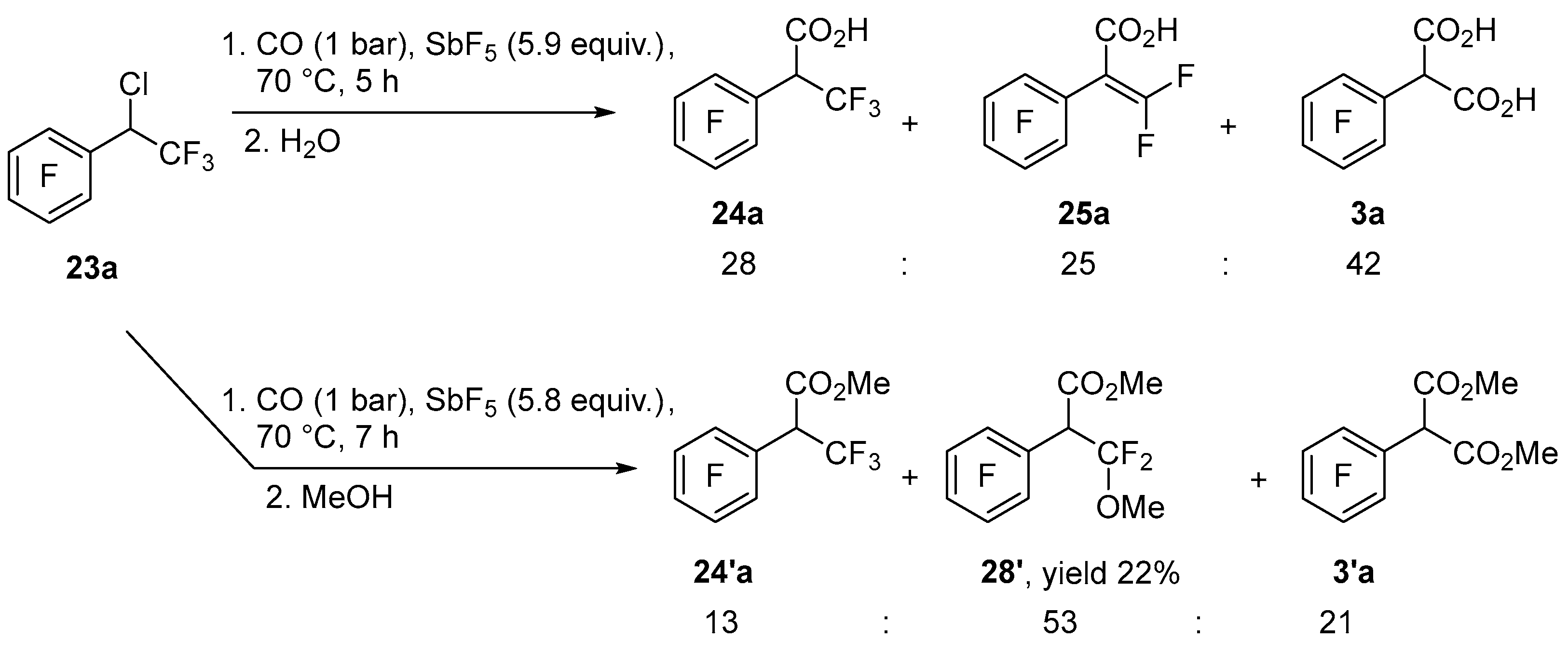
Section 3.2a) (5 h, 70 °C), gave a mixture of compounds
24a,
25a,
3a,
9a in the following molar ratios: 28:25:42:5 (2.5 h after extraction, r.t.); 28:2:38:32 (24 h after extraction, r.t.).
f. Compound
23a (0.362 g, 1.27 mmol) and SbF
5 (1.603 g, 7.40 mmol) (molar ratio 1:5.8), according to the typical procedure (
Section 3.2b) (7 h, 70 °C, 15 min in methanol) gave a mixture of compounds which did not contain acid
25a or its methyl ester. The main products in the mixture were compounds
28′,
3′a,
24′a, and
24a in a 53:21:13:13 molar ratio with total content ~90%. The extract was washed with a saturated aqueous solution of NaHCO
3 (30 mL), and silica gel column chromatography (CCl
4–CH
2Cl
2 [1:1,
v/
v] as the eluent) gave 88 mg of compound
28′ (yield 22%).
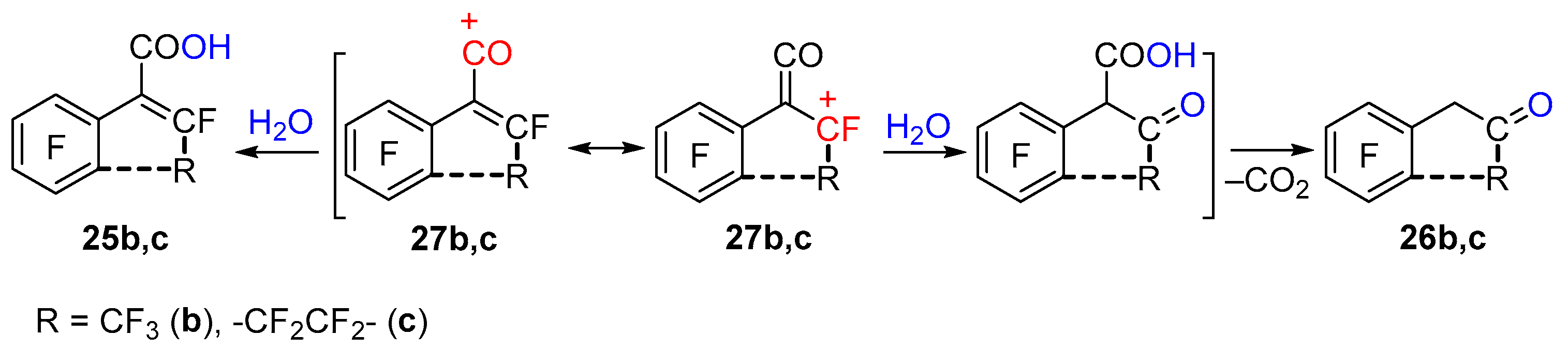
Perfluoro-2-phenylpropenoic acid (25a) was in the mixture with acids 24a, 3a, 9a. 19F NMR (CDCl3): δ −58.4 (dt, 1F, F-3A), −59.1 (dt, 1F, F-3B), −138.5 (m, 2F, F-ortho), −152.3 (tt, 1F, F-para), −162.3 (m, 2F, F-meta); J3Z,3E = 38, J3Z,ortho = 1.5, J3E,ortho = 6, Jpara,meta = 21, Jpara,ortho = 2.5.
Methyl 3,3-difluoro-3-methoxy-2-perfluorophenylpropanoate (28′). Colorless liquid. IR (film) ν, cm−1: 2964 (CH), 1770 (C=O), 1525, 1508 (FAR). 1H NMR (CDCl3): δ 4.56 (t, 1H, JH(2),F(3) = 8, H-2), 3.76 (s, 3H, CO2CH3), 3.57 (s, 3H, CF2OCH3). 19F NMR (CDCl3): δ −77.6 (dq, 1F, FA-3), −78.0 (dq, 1F, FB-3), −140.4 (m, 2F, F-ortho), −153.9 (tt, 1F, F-para), −162.7 (m, 2F, F-meta); J3A,3B = 141, J3,ortho = JH(2),F(3) = 8, Jpara,meta = 21, Jpara,ortho = 2.5. HRMS, m/z: calcd. for C11H7O3F7 320.0278; found 320.0278.
3.3.23. Carbonylation of (1,2,2,3,3,3-Hexafluoropropyl)pentafluorobenzene (22b)
a. Compound
22b (0.376 g, 1.18 mmol) and SbF
5 (0.253 g, 1.17 mmol) (molar ratio 1:1), according to the typical procedure (
Section 3.2a) (0.5 h, r.t.), gave a mixture of compounds
24b,
25b (
E:Z = 55:45), and
26b in an 86:9:5 molar ratio. After evaporation of Et
2O, the residue was dissolved in CH
2Cl
2 (10 mL) and washed with a saturated aqueous solution of NaHCO
3 (30 mL). The resulting solution contained mainly compound
26b. The aqueous layer was separated, acidified with HCl (pH < 1), and extracted with Et
2O (3 × 5 mL). Evaporation of the solvent and sublimation (120 °C, 3 Torr) resulted in a mixture (0.345 g) of acids
24b and
25b in a 90:10 molar ratio.
b. Compound
22b (0.276 g, 0.87 mmol) and SbF
5 (0.388 g, 1.79 mmol) (molar ratio 1:2), according to the typical procedure (
Section 3.2a) (0.5 h, r.t.), gave a mixture of compounds
24b,
25b (
E:Z = 60:40), and
26b in a 90:9:1 molar ratio.
c. Compound
22b (0.210 g, 0.66 mmol) and SbF
5 (0.583 g, 2.69 mmol) (molar ratio 1:4), according to the typical procedure (
Section 3.2a) (0.5 h, r.t.), gave a mixture of compounds
24b and
25b (
E:Z = 60:40) in a 95:5 molar ratio.
d. Compound
22b (0.378 g, 1.19 mmol) and SbF
5 (1.556 g, 7.19 mmol) (molar ratio 1:6), according to the typical procedure (
Section 3.2a) (0.5 h, r.t.), gave a mixture of compounds
24b and
25b (
E:Z = 60:40) in a 95:5 molar ratio. Evaporation of the solvent, sublimation (90 °C, 1 Torr), and recrystallization from hexane resulted in 0.333 g of acid
24b (yield 81%).
e. Compound
22b (0.359 g, 1.13 mmol) and SbF
5 (1.458 g, 6.73 mmol) (molar ratio 1:6), according to the typical procedure (
Section 3.2b) (6 h, 70 °C, 10 min in methanol), gave a mixture of compounds
25′b (
E:Z = 85:15) and
25b (
E:Z = 60:40) in a 80:20 molar ratio with total content ~90%. Methyl ester
24′b was not detected in the mixture. Silica gel column chromatography (CCl
4–CH
2Cl
2 [1:1,
v/
v] as the eluent) gave 0.263 g of compound
25′b (yield 69%).
1,1,1-Trifluoro-3-(perfluorophenyl)propan-2-one (26b) in the mixture.1H NMR (CDCl3): δ 4.10 (s, 2H, CH2). 19F NMR (CDCl3): δ −79.9 (s, 3F, CF3), −143.2 (m, 2F, F-ortho), −153.8 (t, 1F, Jpara,meta = 20.5, F-para), −162.1 (m, 2F, F-meta). GC-MS, m/z: calcd. for C9H2O1F8 278; found 278.
3.3.24. Carbonylation of (1-Chloro-2,2,3,3,3-pentafluoropropyl)pentafluorobenzene (23b) (With Admixture of P-chloroderivative 45, See Procedure 3.4.4e)
a. Compound
23b (0.360 g, 1.08 mmol) and SbF
5 (0.238 g, 1.10 mmol) (molar ratio 1:1), according to the typical procedure (
Section 3.2a) (1 h, r.t.), gave a mixture of compounds
24b,
25b, and
26b in an 89:5:6 molar ratio (with admixtures of the corresponding
p-chloroderivatives).
b. Compound
23b (0.335 g, 1.00 mmol) and SbF
5 (1.295 g, 5.98 mmol) (molar ratio 1:6), according to the typical procedure (
Section 3.2a) (1 h, r.t.), gave a mixture of compounds
24b and
25b (
E:Z = 60:40) in a 95:5 molar ratio (with admixtures of the corresponding
p-chloroderivatives). Similar procedure with a reaction time of 5 h gave a mixture of compounds
24b and
25b (
E:Z = 60:40) in a 91:9 molar ratio.
c. Compound
23b (0.358 g, 1.07 mmol) and SbF
5 (1.390 g, 6.42 mmol) (molar ratio 1:6), according to the typical procedure (
Section 3.2a) (1 h, 70 °C), gave a mixture of compounds
24b,
25b, and
26b in the 36:60:4 molar ratio (with admixtures of the corresponding
p-chloroderivatives). Similar procedure with a reaction time of 5 h gave a mixture of compounds
24a,
25b, and
26b in a 2:92:6 molar ratio.
3.3.25. Carbonylation of 1-Chloro-2,2,3,3,4,4,5,6,7,8-decafluorotetralin (23c) (With Admixture of Isomer 47, See Procedure 3.4.4f)
a. Compound
23c (0.346 g, 1.00 mmol) and SbF
5 (0.212 g, 0.98 mmol) (molar ratio 1:1), according to the typical procedure (
Section 3.2a) (1 h, r.t.), gave a mixture of compounds
24c,
25c, and
26c in an 81:7:12 molar ratio (with 8% of admixtures of the corresponding 6-chloroderivatives). After evaporation of Et
2O, the residue was dissolved in CH
2Cl
2 (10 mL) and washed with a saturated aqueous solution of NaHCO
3 (30 mL). The aqueous layer was separated, acidified with HCl (pH < 1), and extracted with Et
2O (3 × 5 mL). Evaporation of the solvent, sublimation (100 °C, 1 Torr), and recrystallization from hexane resulted in 0.210 g of acid
24c (yield 59%). The product contained 3% of the 6-chloroderivative
48.
b. Compound
23c (0.380 g, 1.10 mmol) and SbF
5 (1.413 g, 6.53 mmol) (molar ratio 1:6), according to the typical procedure (
Section 3.2a) (1 h, r.t.), gave a mixture of compounds
24c and
25c in an 87:13 molar ratio (with 8% admixtures of 6-chloroderivatives
48 and
49), the content of compound
26c in the mixture did not exceed 2%.
c. Compound
23c (0.356 g, 1.03 mmol) and SbF
5 (1.343 g, 6.20 mmol) (molar ratio 1:6), according to the typical procedure (
Section 3.2a) (1 h, 70 °C), gave a mixture of compounds
25c and
26c in a 94:6 molar ratio (with 6% admixtures of the corresponding 6-chloroderivatives). After evaporation of Et
2O, the residue was dissolved in CH
2Cl
2 (10 mL) and washed with a saturated aqueous solution of NaHCO
3 (30 mL). The aqueous layer was separated, acidified with HCl (pH < 1), and extracted with CH
2Cl
2 (3 × 5 mL). Evaporation of the solvent, sublimation (110 °C, 1 Torr), and recrystallization from hexane resulted in 0.234 g of acid
25c (yield 68%), the product contained 3% of 6-chloroderivative
49.
Perfluoro-3,4-dihydronaphthalene-1-carboxylic acid (25c). White solid; mp 102.5–104.5 °C (hexane). IR (KBr) ν, cm−1: 1732 (C=O), 1520, 1497 (FAR). 1H NMR (CDCl3): δ 10.08 (s, 1H, CO2H). 19F NMR (CDCl3): δ −120.0 (tm, 1F, F-3), −120.5 (dm, 2F, F-4), −130.9 (m, 2F, F-3), −133.9 (dddd, 1F, F-8), −136.5 (tdddd, 1F, F-5), −147.0 (tdq, 1F, F-7), −149.2 (dddd, 1F, F-6); J2,3 = 18, J2,5 = 2, J2,6 = 7, J2,7 = 2, J2,8 = 6, J5,6 = 20.5, J5,7 = 9, J5,8 = 11.5, J6,7 = 20, J6,8 = 6, J7,8 = 20. HRMS, m/z: calcd. for C11H1O2F9 335.9829; found 335.9827. Anal. calcd. for C11H1O2F9: C, 39.31; H, 0.30; F, 50.87%. Found: C, 38.83; H, 0.50; F, 50.80%.
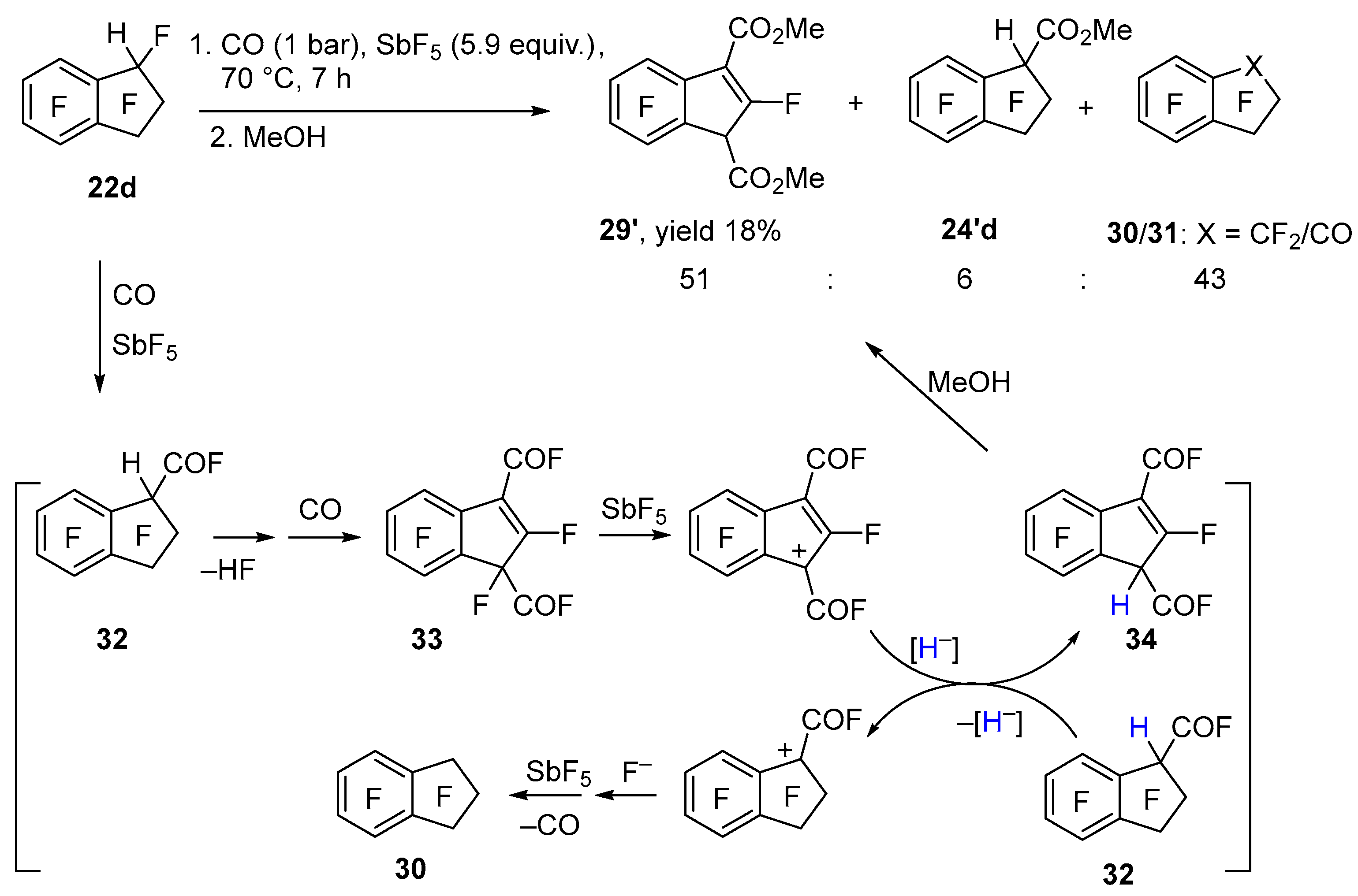
3.3.26. Carbonylation of 1,2,2,3,3,4,5,6,7-Nonafluoroindan (22d)
a. Compound
22d (0.422 g, 1.51 mmol) and SbF
5 (0.314 g, 1.45 mmol) (molar ratio 1:1), according to the typical procedure (
Section 3.2a) (0.5 h, r.t.), gave a mixture of compounds containing ~95% of acid
24d. The content of acid
25d in the mixture did not exceed 2%. Evaporation of the solvent, sublimation (105 °C, 1 Torr), and recrystallization from CCl
4-hexane resulted in 0.411 g of acid
24d (yield 79%).
b. Compound
22d (0.676 g, 2.41 mmol) and SbF
5 (3.083 g, 14.24 mmol) (molar ratio 1:5.9), according to the typical procedure (
Section 3.2b) (7 h, 70 °C, 20 min in methanol), gave a mixture of compounds
24′d,
29′,
30, and
31 in a 6:51:35:8. Silica gel column chromatography (CH
2Cl
2 as the eluent) gave 0.138 g of compounds
29′ (yield 18%).
Dimethyl 2,4,5,6,7-pentafluoro-1H-indene-1,3-dicarboxylate (29′). Colorless liquid. IR (film) ν, cm−1: 2960 (CH), 1741 (C=O), 1512, 1493 (FAR). 1H NMR (CDCl3): δ 4.69 (s, 1H, H-1), 3.90 (s, 3H, CO2CH3-3), 3.79 (s, 3H, CO2CH3-1). 19F NMR (CDCl3): δ −101.7 (dd, 1F, F-2), −139.9 (dddd, 1F, F-4), −142.0 (ddm, 1F, F-7), −154.5 (ddd, 1F, F-5), −157.9 (dddd, 1F, F-6); J2,4 = 5, J2,6 = 14, J4,5 = 20, J4,6 = 2.5, J4,7 = 15, J5,6 = 19, J5,7 = 3.5, J6,7 = 21. HRMS, m/z: calcd. for C13H7O4F5 322.0259; found 322.0256.
3.3.27. Carbonylation of 1-Chloro-2,2,3,3,4,5,6,7-octafluoroindan (23d)
a. Compound
23d (0.422 g, 1.42 mmol) and SbF
5 (0.310 g, 1.43 mmol) (molar ratio 1:1), according to the typical procedure (
Section 3.2a) (1 h, r.t.), gave a mixture of compounds containing 50% of acid
24d and 9% of starting compound
23d along with their derivatives with moieties C=O, CFCl, CCl
2 instead of CF
2 in the benzylic position.
b. Compound
23d (0.358 g, 1.30 mmol) and SbF
5 (1.693 g, 7.82 mmol) (molar ratio 1:6), according to the typical procedure (
Section 3.2a) (0.5 h, r.t.), gave a mixture of compounds containing 50% of acid
24d along with 3-X-2,2,4,5,6,7-hexafluoroindan-1-ones (X = COOH, Cl, F), the content of acid
25d in the mixture did not exceed 2%.
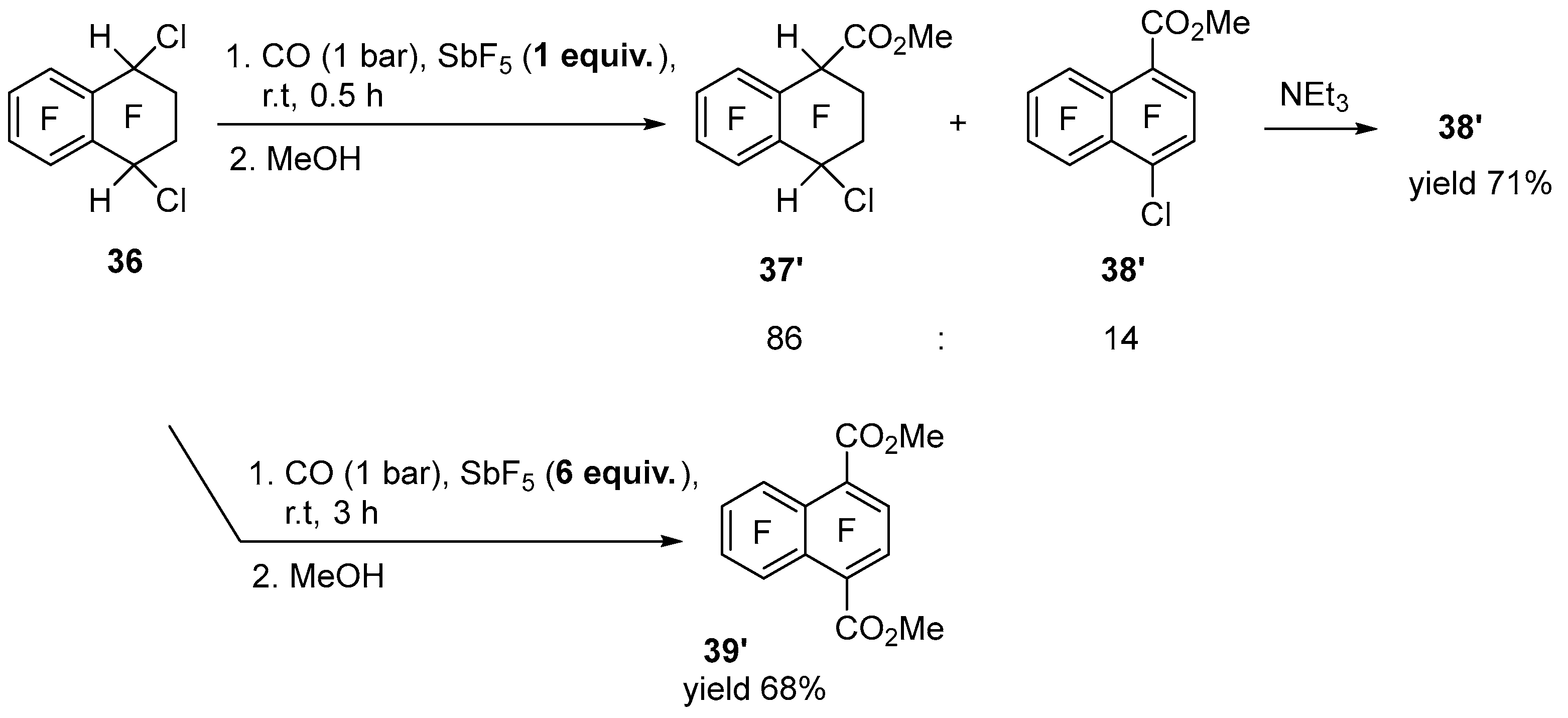
3.3.28. Carbonylation of 1,4-Dichloro-2,2,3,3,5,6,7,8-octafluorotetralin (36) (With Admixtures of Isomeric Compounds, See Procedure 3.4.4h)
a. Compound
36 (0.395 g, 1.14 mmol) and SbF
5 (0.242 g, 1.12 mmol) (molar ratio 1:1), according to the typical procedure (
Section 3.2b) (0.5 h, r.t., 26 h in methanol), gave a mixture of compounds
36,
37′,
38′,
39′, and dimethyl 1,2,2,3,3,5,6,7,8-nonafluorotetralin-1,4-dicarboxylate in a 7:66:10:1:16 molar ratio (with admixtures of the corresponding chloroderivatives). After evaporation of a solvent, the residue was dissolved in a solution of NEt
3 (0.770 g) in dry CH
2Cl
2 (8 mL). The solution was kept at r.t. for 1 h, washed with 5% hydrochloric acid (20 mL), and dried over MgSO
4. The mixture of compounds in the solution contained
38′,
39′, and 1,4-dichlorohexafluoronaphthalene in a 76:17:7 molar ratio. Silica gel column chromatography (CCl
4–CH
2Cl
2 [1:1,
v/
v] as the eluent) gave 0.268 g of compound
38′ (yield 71%). The product contained 9% of the 6- and 7-chloroderivatives.
b. Compound
36 (0.316 g, 0.92 mmol) and SbF
5 (1.200 g, 5.54 mmol) (molar ratio 1:6), according to the typical procedure (
Section 3.2b) (3 h, r.t., 28 h in methanol), gave a mixture of compounds containing (GC-MS) 73% of ester
39′, 9% of its 6-chloroderivative
53′, and 3% of ester
38′. Silica gel column chromatography (CCl
4–CH
2Cl
2 [1:1,
v/
v] as the eluent) gave 0.220 g of compound
39′ (yield 68%), the product contained 8% of the 6-chloroderivative
53′.
Methyl 4-chloro-2,2,3,3,5,6,7,8-octafluorotetralin-1-carboxylate (37′) (isomers A:B = 83:17) in the mixture with other products. Isomer A. 19F NMR (CDCl3): −112.8 (dm, 1F, JA,B = 264, CF2-FA), −116.6 (dm, 1F, JA,B = 263, CF2-FA), −116.8 (dm, 1F, JA,B = 264, CF2-FB), −128.2 (dm, 1F, JA,B = 263, CF2-FB), −136.5 (dddd, 1F, F-8), −138.8 (ddd, 1F, F-5), −151.9 (ddd, 1F, F-7), −153.3 (dddd, 1F, F-6); J5,6 = 20.5, J5,7 = 5.5, J5,8 = 11.5, J6,7 = 20.5, J6,8 = 5, JF(6),H = 2, J7,8 = 20.5, JF(8),H = 1.5.
Isomer B. 19F NMR (CDCl3): −115.5 (dm, 1F, JA,B = 265, CF2-FA), −115.9 ÷ −117.4 (2F, CF2-FA,FB), −127.3 (dm, 1F, JA,B = 265, CF2-FB), −137.2 (ddd, 1F, F-5), −138.7 (dddd, 1F, F-8), −152.1 (ddd, 1F, F-7), −153.2 (ddd, 1F, F-6); J5,6 = 20.5, J5,7 = 6, J5,8 = 11.5, J6,7 = 20.5, J6,8 = 5, J7,8 = 20.5, JF(8),H = 1.5.
Methyl perfluoro-4-chloro-1-naphthoate (38′). White solid; mp 61–62.5 °C (hexane). IR (KBr) ν, cm−1: 2962 (CH), 1749 (C=O), 1527, 1508, 1465, 1450 (FAR). 1H NMR (CDCl3): δ 4.02 (s, 3H, CH3). 19F NMR (CDCl3): δ −129.7 (m, 1F, F-3), −133.4 (m, 1F, F-2), −142.3 (m, 2F, F-5,8), −154.4 (m, 2F, F-6,7). HRMS, m/z: calcd. for C12H3O2Cl1F6 327.9720; found 327.9718.
Dimethyl perfluoro-6-chloronaphthalene-1,4-dicarboxylate (53′) in a mixture with compound 39′ (39′:53′ = 92:8). 1H NMR (CDCl3): δ 4.01 (s, 6H, CH3). 19F NMR (CDCl3): δ −118.7 (ddd, 1F, F-5), −133.4 (dddd, 1F, F-2), −134.9 (dddd, 1F, F-3), −136.5 (ddd, 1F, F-7), −144.0 (dddd, 1F, F-8); J2,3 = 21.5, J2,5 = 4, J2,7 = 2, J2,8 = 6, J3,5 = 5.5, J3,7 = 8.5, J3,8 = 4, J5,8 = 15.5, J7,8 = 18. HRMS, m/z: calcd. for C14H6O2Cl1F5 367.9869; found 367.9865.
3.4. Synthesis of the Starting Compounds
3.4.1. Synthesis of Alcohols 14d–h
a. A mixture of acid 42d (1.460 g, 5.57 mmol), SOCl2 (1.326 g, 11.14 mmol), and 4 drops of DMF was heated (5.5 h, 70–75 °C), the excess of SOCl2 was distilled off, the residue was dissolved in Et2O (6 mL) and added dropwise to a mixture of LiBH4 (0.268 g, 12.29 mmol) and Et2O (6 mL) cooled on ice. The obtained mixture was stirred at r.t. for 15 min, poured into 5% hydrochloric acid (10 mL), the organic layer combined with Et2O extract (10 mL) was washed with a 10% aqueous solution of K2CO3 (30 mL) and dried over MgSO4. Evaporation of the solvent and distillation in vacuum (120 °C, 6 Torr) gave 1.016 g of alcohol 14d (yield 74%).
b. An analogous procedure for acid 42e (2.00 g, 7.63 mmol), SOCl2 (1.817 g, 15.27 mmol), and LiBH4 (0.366 g, 16.79 mmol) afforded 1.600 g of alcohol 14e (yield 85%).
c. An analogous procedure for acid 42f (1.414 g, 5.39 mmol), SOCl2 (1.284 g, 8.59 mmol), and LiBH4 (0.259 g, 11.88 mmol) afforded 0.975 g of alcohol 14f (yield 73%).
d. An analogous procedure for acid 42g (3.440 g, 9.50 mmol), SOCl2 (3.28 g, 27.56 mmol), and LiBH4 (0.470 g, 21.56 mmol) afforded 2.963 g of alcohol 14g (yield 90%).
e. An analogous procedure for acid 42h (3.450 g, 9.50 mmol), SOCl2 (4.92 g, 41.34 mmol), and LiBH4 (0.490 g, 22.48 mmol) with subsequent sublimation (110 °C, 1 Torr) of the product afforded 2.970 g of alcohol 14h (yield 90%).
(Perfluoro-4-methylphenyl)methanol (14d). White solid; mp 41.5–42.5 °C (after distillation). IR (KBr) ν, cm−1: 3330 (OH), 1497 (FAR). 1H NMR (CDCl3): δ 4.85 (s, 2H, CH2), 2.04 (s, 1H, OH). 19F NMR (CDCl3): δ −57.6 (t, 3F, CF3 JCF3,F(3) = JCF3,F(5) = 22), −141.4 (m, 2F, F-3,5), −143.6 (m, 2F, F-2,6). HRMS, m/z: calcd. for C8H3O1F7 248.0067; found 248.0064.
(Perfluoro-3-methylphenyl)methanol (14e). Colorless liquid. IR (film) ν, cm−1: 3338 (OH), 1506 (FAR). 1H NMR (CDCl3): δ 4.75 (s, 2H, CH2), 2.59 (s, 1H, OH). 19F NMR (CDCl3): δ −57.3 (t, 3F, CF3), −121.2 (qdddt, 1F, F-2), −130.9 (dddm, 1F, F-6), −133.5 (qddd, 1F, F-4), −163.0 (ddd, 1F, F-5); JCF3,F(2) = JCF3,F(4) = 22.5, J2,4 = 3, J2,5 = 11.5, J2,6 = 5, J4,5 = 21, J4,6 = 10.5, J5,6 = 21.5, JCH2,F(2) = 2. HRMS, m/z: calcd. For [M-H]+ C8H2O1F7 246.9986; found 246.9985.
(Perfluoro-2-methylphenyl)methanol (14f). Colorless liquid. IR (film) ν, cm−1: 3360 (OH), 1527, 1483 (FAR). 1H NMR (CDCl3): δ 4.80 (s, 2H, CH2), 2.49 (s, 1H, OH). 19F NMR (CDCl3): δ −55.2 (d, 3F, CF3), −138.3 (qddd, 1F, F-3), −140.9 (dddt, 1F, F-6), −149.0 (ddd, 1F, F-5), −153.4 (ddd, 1F, F-5); JCF3,F(3) = 28.5, J3,4 = 20.5, J3,5 = 8, J3,6 = 12, J4,5 = 20, J4,6 = 5, J5,6 = 21.5, JCH2,F(6) = 2. HRMS, m/z: calcd. for C8H3O1F7 248.0067; found 248.0066.
(2,3,5,6-Tetrafluoro-4-(perfluoroisopropyl)phenyl)methanol (14g). Colorless liquid. IR (film) ν, cm−1: 3356 (OH), 1489 (FAR). 1H NMR (CDCl3): δ 4.86 (d, 2H, CH2, JCH2,OH = 6), 2.18 (t, 1H, OH, JCH2,OH = 6). 19F NMR (CDCl3): δ −76.4 (m, 6F, CF3), −135.3 (br.s, 1F, Ar-F), −138.3 (br.s, 1F, Ar-F), −142.6 (br.s, 1F, Ar-F), −143.7 (br.s, 1F, Ar-F), −179.8 (m, 1F, CF(CF3)2). HRMS, m/z: calcd. for C10H3OF11 348.0003; found 347.9999.
(Perfluoro-[1,1′-biphenyl]-4-yl)methanol (14h). White solid; mp 73–74 °C (after sublimation). IR (KBr) ν, cm−1: 3292 (OH), 1535, 1508, 1479 (FAR). 1H NMR (CDCl3): δ 4.89 (s, 2H, CH2), 2.15 (s, 1H, OH). 19F NMR (CDCl3): δ −138.5 (m, 2F, Ar-F), −139.4 (m, 2F, Ar-F), −144.7 (m, 2F, Ar-F), −151.3 (tt, 1F, F-4′, J4′,3′ = J4′,5′ = 21, J4′,2′ = J4′,6′ = 3), −161.7 (m, 2F, F-3′,5′). HRMS, m/z: calcd. for C13H3OF9 346.0035; found 346.0032.
3.4.2. Synthesis of Chloroderivatives 8a,d–g
a. A mixture of alcohol 14a (2.950 g, 14.90 mmol) and SOCl2 (3.608 g, 30.32 mmol) was heated (2 h, 75 °C), the excess of SOCl2 was distilled off, distillation in vacuum (110 °C, 55 Torr) gave 2.940 g of compound 8a (yield 91%).
b. A mixture of alcohol 14d (1.761 g, 5.26 mmol) and SOCl2 (1.640 g, 15.16 mmol) was heated (1.5 h, 75 °C), the excess of SOCl2 was distilled off, and distillation in vacuum (110 °C, 20 Torr) gave 1.633 g of compound 8d (yield 86%).
c. A mixture of alcohol 14e (1.12 g, 4.52 mmol) and SOCl2 (1.148 g, 9.64 mmol) was heated (1.5 h, 75 °C), poured into ice water (10 mL), extracted with CH2Cl2 (2 × 2 mL), and dried over MgSO4. Evaporation of the solvent and distillation in vacuum (115 °C, 30 Torr) gave 1.139 g of compound 8e (yield 94%).
d. A mixture of alcohol 14f (2.488 g, 10.03 mmol) and SOCl2 (6.560 g, 55.13 mmol) was heated (4.5 h, 75 °C), poured into ice water (40 mL), extracted with CH2Cl2 (2 × 4 mL), and dried over MgSO4. Evaporation of the solvent and distillation in vacuum (115 °C, 42 Torr) gave 2.476 g of compound 8f (yield 93%).
e. A mixture of alcohol 14g (1.829 g, 7.10 mmol) and SOCl2 (1.804 g, 15.16 mmol) was heated (1.5 h, 75 °C), the excess of SOCl2 was distilled off, and distillation in vacuum (120 °C, 17 Torr) gave 1.798 g of compound 8g (yield 93%).
1-(Chloromethyl)-2,3,5,6-tetrafluoro-4-(trifluoromethyl)benzene (8d). Colorless liquid. 1H NMR (CDCl3): δ 4.82 (s, CH2). 19F NMR (CDCl3): δ −57.5 (t, 3F, CF3 JCF3,F(3) = JCF3,F(5) = 22), −140.7 (m, 2F, F-3,5), −141.7 (m, 2F, F-2,6). HRMS, m/z: calcd. for C8H2ClF7 265.9728; found 265.9724.
1-(Chloromethyl)-2,4,5,6-tetrafluoro-3-(trifluoromethyl)benzene (8e). Colorless liquid. 1H NMR (CDCl3): δ 4.62 (t, CH2, JCH2,F(2) = JCH2,F(6) = 1.5). 19F NMR (CDCl3): δ −57.3 (td, 3F, CF3), −119.5 (qdddt, 1F, F-2), −129.2 (dddtq, 1F, F-6), −131.9 (qddd, 1F, F-4), −162.2 (td, 1F, F-5); JCF3,F(2) = JCF3,F(4) = 22.5, JCF3,F(6) = 1.5, J2,4 = 2.5, J2,5 = 11.5, J2,6 = 3.5, J4,5 = 21.5, J4,6 = 11.5, J5,6 = 21.5, JCH2,F(2) = JCH2,F(6) = 1.5. HRMS, m/z: calcd. for C8H2ClF7 265.9728; found 265.9732.
1-(Chloromethyl)-3,4,5,6-tetrafluoro-2-(trifluoromethyl)benzene (8f). Colorless liquid. 1H NMR (CDCl3): δ 4.71 (d, CH2, JCH2,F(2) = 2). 19F NMR (CDCl3): δ −55.6 (d, 3F, CF3), −137.6 (qddd, 1F, F-3), −138.7 (dddt, 1F, F-6), −148.5 (ddd, 1F, F-5), −152.0 (ddd, 1F, F-5); JCF3,F(3) = 28, J3,4 = 21, J3,5 = 8, J3,6 = 11.5, J4,5 = 20.5, J4,6 = 5.5, J5,6 = 21.5, JCH2,F(6) = 2. HRMS, m/z: calcd. for C8H2ClF7 265.9728; found 265.9725.
1-(Chloromethyl)-2,3,5,6-tetrafluoro-4-(perfluoroisopropyl)benzene (8g). Colorless liquid. 1H NMR (CDCl3): δ 4.66 (s, CH2). 19F NMR (CDCl3): δ −76.3 (m, 6F, CF3), −134.7 (br.s, 1F, Ar-F), −137.7 (br.s, 1F, Ar-F), −141.8 (br.s, 1F, Ar-F), −142.0 (br.s, 1F, Ar-F), −179.7 (m, 1F, CF(CF3)2). HRMS, m/z: calcd. for C10H2ClF11 365.9664; found 365.9662.
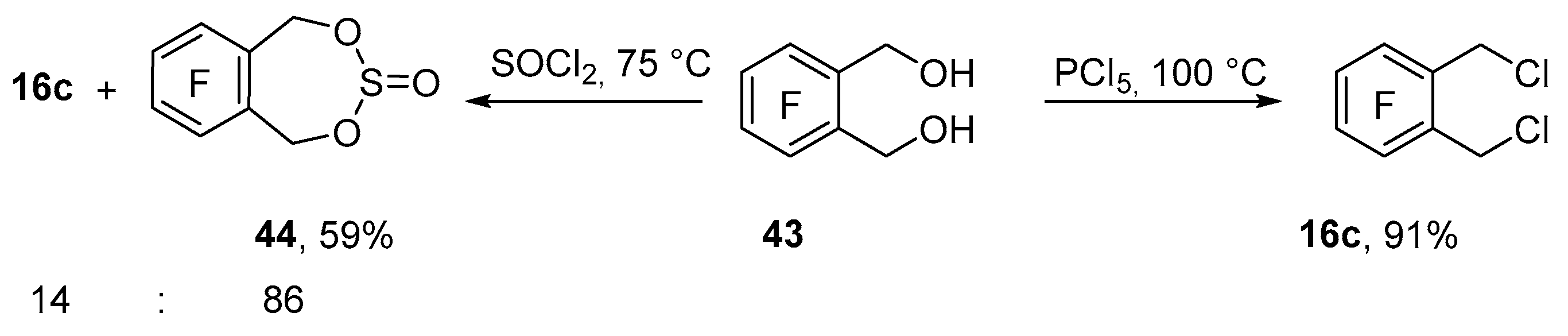
3.4.3. Reaction of (2,3,4,5-Tetrafluoro-6-(hydroxymethyl)phenyl)methanol (43) with SOCl2
A mixture of diol 43 (0.262 g, 1.25 mmol) and SOCl2 (0.820 g, 6.89 mmol) was heated (1 h 40 min, 75 °C), the excess of SOCl2 was distilled off, the resulting mixture contained compounds 44 and 16c in an 86:14 molar ratio. Sublimation (110 °C, 1 Torr) and recrystallization from hexane resulted in 0.189 g of compound 44 (yield 59%).
1,5-Dihydrobenzo[e][1,3,2]dioxathiepine 3-oxide (44). White solid; mp 76–77 °C (hexane). 1H NMR (CDCl3): δ 5.80 (d, 2H, CH2, JA,B = 15), 4.97 (d, 2H, CH2, JA,B = 15). 19F NMR (CDCl3): δ −143.0 (m, 2F, F-3,6), −155.5 (m, 2F, F-4,5). HRMS, m/z: calcd. for C8H4O3F4S 255.9812; found 255.9815. Anal. calcd. for C8H4O3F4S: C, 37.51; H, 1.57; F, 29.67%; S, 12.52%. Found: C, 38.19; H, 2.04; F, 29.88%; S, 12.44%.
3.4.4. Synthesis of Chloroderivatives 8h, 16c, 19, 23a–d, and 36
a. A mixture of alcohol 14h (0.985 g, 2.85 mmol) and PCl5 (0.940 g, 4.51 mmol) was sealed in a glass tube (before the start of the reaction) and heated (3 h, 100 °C), poured into ice water (10 mL), extracted with CH2Cl2 (2 × 5 mL), and dried over MgSO4. Evaporation of the solvent and sublimation (100 °C, 1 Torr) gave 1.011 g of compound 8h (yield 97%).
b. A mixture of diol 43 (2.000 g, 9.52 mmol) and PCl5 (5.237 g, 25.12 mmol) was sealed in a glass tube (before the start of the reaction) and heated (3 h 40 min, 100 °C), poured into ice water (50 mL), extracted with CH2Cl2 (2 × 10 mL), and dried over MgSO4. Evaporation of the solvent and distillation in vacuum (130 °C, 15 Torr) gave 2.136 g of compound 16c (yield 91%).
c. A mixture of alcohol 40 (4.06 g, 11.15 mmol) and PCl5 (2.95 g, 14.15 mmol) was sealed in a glass tube (before the start of the reaction) and heated (3.5 h, 100 °C), poured into ice water (40 mL), extracted with CH2Cl2 (2 × 5 mL), and dried over MgSO4. Evaporation of the solvent gave 4.18 g of compound 19 (yield 98%).
d. A mixture of alcohol 41a (5.96 g, 22.4 mmol) and PCl5 (6.96 g, 33.4 mmol) was sealed in a glass tube (before the start of the reaction) and heated (5.5 h, 100 °C), poured into ice water (50 mL), extracted with CH2Cl2 (2 × 5 mL), and dried over MgSO4. The resulting mixture of products contained ~90% of compound 23a. Evaporation of the solvent and distillation in vacuum (120 °C, 40 Torr) gave 5.40 g of compound 23a (yield 85%).
e. A mixture of alcohol
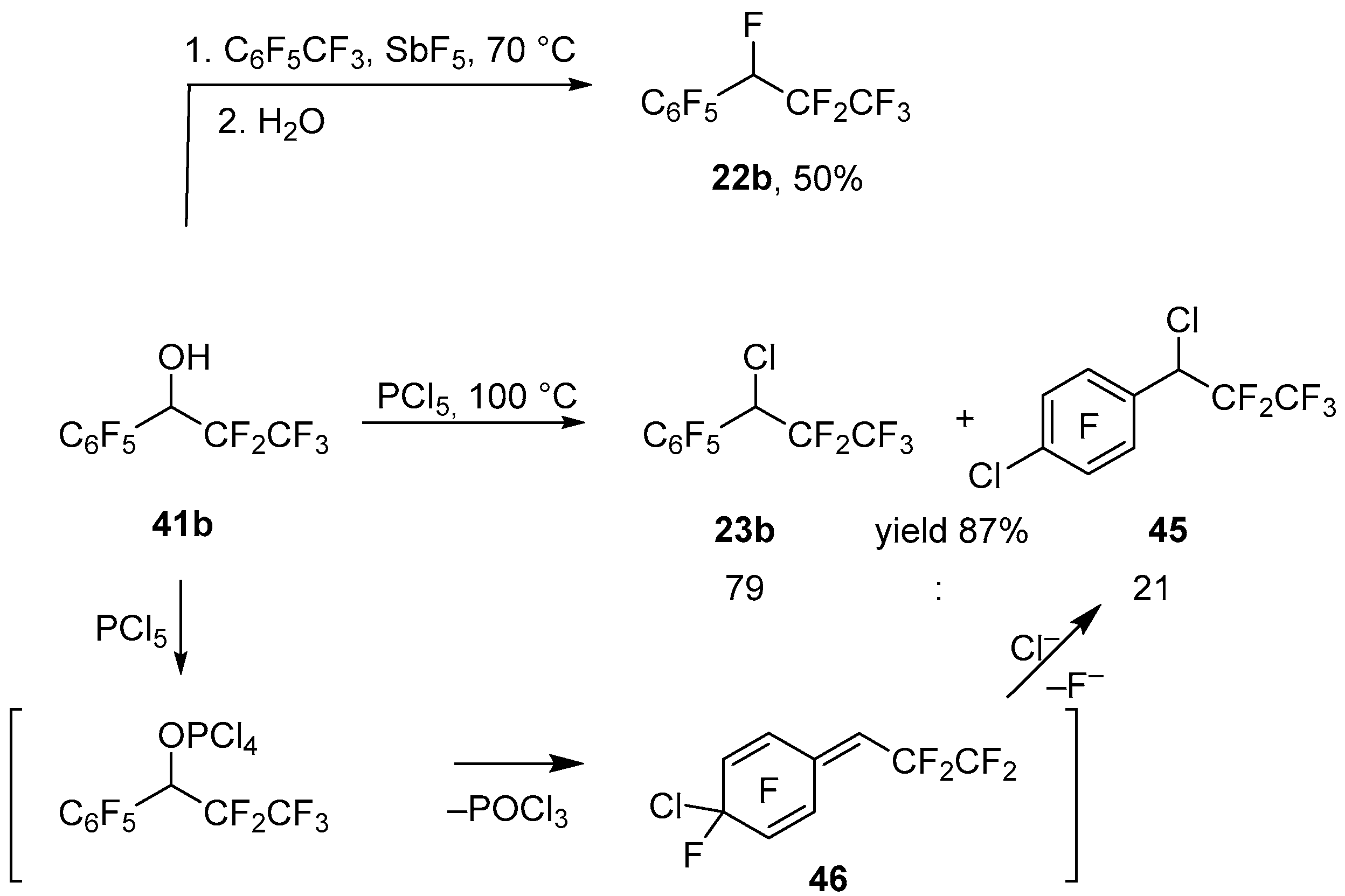
41b (4.14 g, 13.1 mmol) and PCl
5 (4.11 g, 19.7 mmol) was sealed in a glass tube (before the start of the reaction) and heated (10 h, 100 °C), poured into ice water (50 mL), extracted with CH
2Cl
2 (2 × 5 mL), and dried over MgSO
4. The resulting mixture of products contained ~90% of compounds
23b and
45 in a 76:24 molar ratio. Evaporation of the solvent and distillation in vacuum (110 °C, 25–15 Torr) gave 3.83 g (yield 87%) of a mixture of compounds
23b and
45 in a 79:21 molar ratio. This mixture was used in the carbonylation experiments (
Section 3.3.24).
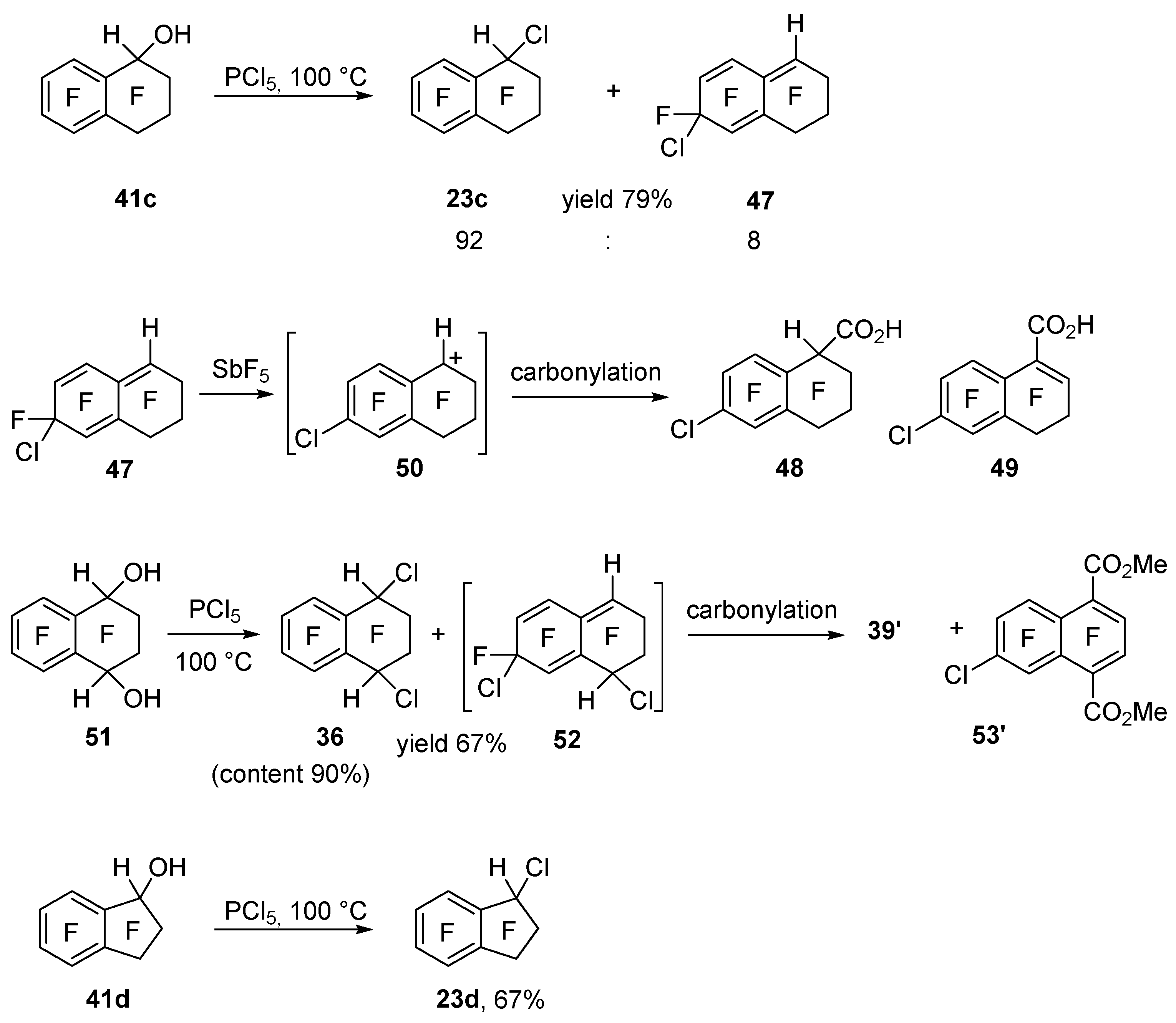
f. A mixture of alcohol
41c (3.00 g, 9.15 mmol) and PCl
5 (2.53 g, 12.13 mmol) was sealed in a glass tube (before the start of the reaction) and heated (5.5 h, 100 °C), poured into ice water (40 mL), extracted with CH
2Cl
2 (2 × 5 mL), and dried over MgSO
4. The resulting mixture of products contained ~90% of compounds
23c and
47 in a 91:9 molar ratio. Steam distillation and subsequent distillation in vacuum (135 °C, 22 Torr) gave 2.51 g (yield 79%) of a mixture of compounds
23c and
47 in a 92:8 molar ratio. The content of a dichloroderivative did not exceed 1% (GC-MS). This mixture was used in the carbonylation experiments (
Section 3.3.25).
g. A mixture of alcohol 41d (6.46 g, 23.2 mmol) and PCl5 (7.33 g, 35.2 mmol) was sealed in a tube (before the start of reaction) and heated (6 h, 100 °C), poured into ice water (100 mL), extracted with CH2Cl2 (2 × 10 mL), and dried over MgSO4. The resulting mixture of products contained ~70% of compounds 23d, along with a number of nonvolatile admixtures containing a tetrafluorosubstituted aromatic ring which were separated by steam distillation. Distillation in vacuum (120 °C, 45 Torr) gave 4.61 g (yield 67%) of compounds 23d.
h. A mixture of alcohol
51 (2.5 g, 8.11 mmol) and PCl
5 (4.30 g, 20.62 mmol) was sealed in a glass tube (before the start of the reaction) and heated (10 h, 100 °C), poured into ice water (40 mL), extracted with CH
2Cl
2 (2 × 5 mL), and dried over MgSO
4. The resulting mixture of products contained ~70% of compounds
36. Steam distillation and subsequent distillation in vacuum (150 °C, 15 Torr) gave 1.88 g (yield 67%) of a mixture containing (NMR
19F, GC-MS) ~90% of compounds
36 (isomers A:B = 64:36) along with isomeric compounds. The content of trichloroderivatives did not exceed 3% (GC-MS). This mixture was used in the carbonylation experiments (
Section 3.3.28).
4-(Chloromethyl)nonafluoro-1,1′-biphenyl (8h). White solid; mp 65.5–66 °C (after sublimation).1H NMR (CDCl3): δ 4.71 (s, CH2). 19F NMR (CDCl3): δ −138.3 (m, 2F, Ar-F), −138.7 (m, 2F, Ar-F), −142.9 (m, 2F, Ar-F), −150.9 (tt, 1F, F-4′, J4′,3′ = J4′,5′ = 21, J4′,2′ = J4′,6′ = 3), −161.5 (m, 2F, F-3′,5′). HRMS, m/z: calcd. for C13H2ClF9 363.9696; found 363.9694.
1,2-Bis(chloromethyl)-3,4,5,6-tetrafluorobenzene (16c). Colorless liquid. 1H NMR (CDCl3): δ 4.73 (s, CH2).19F NMR (CDCl3): δ −141.8 (m, 2F, F-3,6), −154.2 (m, 2F, F-4,5). HRMS, m/z: calcd. for C8H4Cl2F4 245.9621; found 245.9620.
(1-Chloro-2,2,2-trifluoroethyl)pentafluorobenzene (23a). Colorless liquid. 1H NMR (CDCl3): δ 5.50 (qt, 1H, JH,CF3 = 7, JH,F(ortho) = 1, CHCl). 19F NMR (CDCl3): δ −73.8 (td, 3F, JCF3,F(ortho) = 10, JH,CF3 = 7, CF3), ~−138.4 (br.s, 2F, F-ortho), −150.1 (tt, 1F, Jpara,meta = 21, Jpara,ortho = 4, F-para), −160.9 (br.s, 2F, F-meta).
(1-Chloro-2,2,3,3,3-pentafluoropropyl)pentafluorobenzene (23b) in the mixture with compound 45 (23b:45 = 79:21). Colorless liquid. 1H NMR (CDCl3): δ 5.58 (ddt, 1H, JH,F(B) = 13.5, JH,F(A) = 12.5, JH,F(ortho) = 1.5, CHCl). 19F NMR (CDCl3): δ −82.6 (s, 3F, CF3), −118.5 (ddd, 1F, JA,B = 267, JA,ortho = 31.5, JH,F(A) = 12.5, CF2-FA), −119.4 (ddd, 1F, JA,B = 267, JB,ortho = 28.5, JH,F(B) = 13.5, CF2-FB), −133.6 (br.s, 1F, F-ortho), −141.9 (br.s, 1F, F-ortho), −149.7 (tt, 1F, Jpara,meta = 21, Jpara,ortho = 4, F-para), −160.3 (br.s, 1F, F-meta), −161.3 (br.s, 1F, F-meta). HRMS, m/z: calcd. for C9H1Cl1F10 333.9602; found 333.9607.
1-(1-Chloro-2,2,3,3,3-pentafluoropropyl)-4-chloro-2,3,5,6-tetrafluorobenzene (45) in the mixture with compound 23b (23b:45 = 79:21). 1H NMR (CDCl3): δ 5.60 (ddt, 1H, JH,F(B) = 13.5, JH,F(A) = 12.5, JH,F(2) = JH,F(6) = 1.5, CHCl). 19F NMR (CDCl3): δ −82.6 (s, 3F, CF3), −118.4 (ddd, 1F, JA,B = 267, JA,ortho = 31.5, JH,F(A) = 12.5, CF2-FA), −119.3 (ddd, 1F, JA,B = 267, JB,ortho = 28.5, JH,F(B) = 13.5, CF2-FB), −133.6 (br.s, 1F, F-2,6), −139.3 (br.s, 1F, F-3,5), −140.3 (br.s, 1F, F-3,5), −141.7 (br.s, 1F, F-2,6). HRMS, m/z: calcd. for C9H1Cl2F9 349.9306; found 349.9309.
1-Chloro-2,2,3,3,4,4,5,6,7,8-decafluorotetralin (23c) in the mixture with compound 47 (23c:47 = 92:8). Colorless liquid. 1H NMR (CDCl3): δ 5.52 (dt, 1H, J = 10.5, J = 4, H-1). 19F NMR (CDCl3): −97.9 (dm, 1F, JA,B = 291, FA-4), −114.5 (dm, 1F, JA,B = 291, FB-4), −115.4 (dm, 1F, JA,B = 273, FA-2), −123.7 (dm, 1F, JA,B = 273, FA-3), −125.4 (dm, 1F, JA,B = 273, FB-2), −136.2 (dddd, 1F, F-8), −136.6 (ddddd, 1F, F-5), −143.1 (dm, 1F, JA,B = 273, FB-3), −146.2 (dddd, 1F, F-7), −148.6 (ddd, 1F, F-6); J5,A4 = 8.5, J5,B4 = 29.5, J5,6 = 20.5, J5,7 = 8, J5,8 = 12, J6,7 = 20.5, J6,8 = 7, J7,8 = 20.5, J7,A4 = 3, J8,B4 = 2.5. HRMS, m/z: calcd. for C10H1Cl10F9 345.9602; found 345.9600.
7-Chloro-1,1,2,2,3,3,5,6,7,8-decafluoro-1,2,3,7-tetrahydronaphthalene (47) in the mixture with compound 23c (23c:47 = 92:8). 1H NMR (CDCl3): δ 6.54 (m, 1H, H-1). 19F NMR (CDCl3): −107.5 (ddm, 1F, J7,8 = 28.5, J6,7 = 26.5, F-7), −110.2 (br.d, 1F, JA,B ~ 300, FA-1 or 3), −111.8 (br.d, 1F, JA,B ~ 300, FB-1 or 3), −111.8 (td, 1F, J1,8 = 29, J7,8 = 28.5, F-8), −114.4 (br.d, 1F, JA,B ~ 290, FA-1 or 3), −116.8 (br.d, 1F, JA,B ~ 290, FB-1 or 3), −137.7 (br.d, 1F, JA,B ~ 270, FA-2), −139.9 (br.d, 1F, JA,B ~ 270, FB-2), −145.4 (dm, 1F, J6,7 = 26.5, F-6), −150.1 (m, 1F, F-5).
1,4-Dichloro-2,2,3,3,5,6,7,8-octafluorotetralin (36) (isomers A:B = 64:36). Colorless liquid. Isomer A. 1H NMR (CDCl3): δ 5.53 (m, 2H, H-1,4). 19F NMR (CDCl3): −109.6 (dm, 2F, J ~ 280, CF2), −125.8 (dm, 2F, J ~ 280, CF2), −137.3 (m, 2F, F-5,8), −150.6 (m, 2F, F-6,7). Isomer B. 1H NMR (CDCl3): δ 5.45 (m, 2H, H-1,4). 19F NMR (CDCl3): −118.0 (dm, 2F, J ~ 260, CF2), −119.1 (dm, 2F, J ~ 260, CF2), −135.3 (m, 2F, F-5,8), −150.7 (m, 2F, F-6,7). HRMS, m/z: calcd. for C10H1Cl2F8 343.9400; found 343.9403.
3.4.5. Synthesis of Fluoroderivatives 7a,d, and 18
a. A mixture of compound 8a (4.35 g, 20.1 mmol) and CsF (9.00 g, 59.2 mmol) was sealed in a glass tube and heated (10 h, 250–260 °C). Distillation of volatile product gave 3.44 g of compound 7a (yield 86%).
b. A mixture of compound 8d (0.740 g, 2.78 mmol) and CsF (2.220 g, 14.6 mmol) was sealed in a glass tube and heated (9 h, 250–260 °C). Distillation of volatile product gave 0.560 g of compound 7d (yield 81%).
c. A mixture of compound 19 (2.75 g, 7.2 mmol) and CsF (6.39 g, 42.0 mmol) was sealed in a glass tube and heated (17 h, 250–260 °C). Steam distillation gave 1.706 g of compound 18 (yield 65%).
3.4.6. Synthesis of (1,2,2,3,3,3-Hexafluoropropyl)pentafluorobenzene (22b)
Alcohol 41b (3.664 g, 11.59 mmol) was added to a mixture of C6F5CF3 (3.275 g, 13.88 mmol) with SbF5 (2.516 g, 11.62 mmol), the resulting mixture was intensively stirred (4 h, 70 °C), poured into of 5% hydrochloric acid (25 mL), extracted with CH2Cl2 (2 × 10 mL), and dried over MgSO4. The extract contained compounds 22b and pentafluorobenzoate of the starting alcohol (GC-MS, M = 510) in a 90:10 molar ratio, along with C6F5CF3 and C6F5CO2H. It was washed with a saturated aqueous solution of NaHCO3 (60 mL), the solvent was evaporated, and fractional distillation of the residue in a vacuum (100 Torr) gave a fraction (1.828 g, bp 90 °C) containing 98% of compound 22b (yield 50%).
(1,2,2,3,3,3-Hexafluoropropyl)pentafluorobenzene (22b). Colorless liquid. 1H NMR (CDCl3): δ 6.11 (ddd, 1H, JH,F(1) = 43, JH,F(B) = 19, JH,F(A) = 4, CHF). 19F NMR (CDCl3): δ −83.6 (d, 3F, CF3), −124.4 (ddtd, 1F, CF2-FA), −131.1 (ddtd, 1F, CF2-FB), −139.8 (m, 2F, F-ortho), −148.8 (ttd, 1F, F-para), −160.8 (br.s, 2F, F-meta), −206.0 (dddtqd, 1F, F-1); JF(1),H = 43, J1,A = 14.5, J1,B = 15.5, J1,3 = 10, J1,ortho = 13, J1,para = 2, JA,B = 282.5, JF(A),H = 4, JA,ortho = 6.5, JF(B),H = 19, JB,ortho = 17, JH,F(A) = 12.5, JA,B = 267, JH,F(B) = 13.5, Jpara,meta = 21, Jpara,ortho = 4. HRMS, m/z: calcd. for C9H1F11 317.9897; found 317.9893.
3.4.7. Synthesis of Acids 11–13
a. A mixture of acid 9e (0.524 g, 1.90 mmol), CF3CO2H (0.330 g, 2.89 mmol), and SbF5 (1.690 g, 7.81 mmol) (molar ratio 1:1.5:4.1) was stirred at room temperature for 4.5 h, r.t., poured into 5% hydrochloric acid (20 mL), and extracted with Et2O. The resulting solution contained compounds 9e and 11 in an 18:82 molar ratio. After evaporation of Et2O, the residue was dissolved in a saturated aqueous solution of NaHCO3 (50 mL), acidified with HCl (pH < 1), and extracted with CH2Cl2 (2 × 5 mL) to separate the acid 9e. The aqueous layer was extracted with Et2O (3 × 5 mL). Evaporation of the solvent, sublimation (190 °C, 1 Torr), and recrystallization from CCl4-acetone resulted in 0.337 g of acid 11 (yield 70%).
b. Acid 9d (0.559 g, 2.02 mmol), CF3CO2H (0.391 g, 3.42 mmol), and SbF5 (1.956 g, 9.03 mmol) (molar ratio 1:1.7:4.5), similarly to previous procedure, gave a mixture of compounds 9d and 12 in a 15:85 molar ratio. Evaporation of the solvent fractional sublimation (130 °C, 1 Torr), then (210 °C, 1 Torr) and recrystallization of the second fraction from CCl4-acetone gave 0.322 g of acid 12 (yield 63%).
c. In a manner analogous to [
79], 4-methylheptafluorotoluene (0.565 g, 2.44 mmol) was dissolved in SbF
5 (3.175 g, 14.67 mmol), the resulting solution was poured into of 5% hydrochloric acid (30 mL), extracted with CH
2Cl
2 (2 × 10 mL), and dried over MgSO
4. The extract contained compound
13 and the starting compound in a 75:25 molar ratio. Evaporation of the solvent and sublimation (130 °C, 2 Torr) resulted in 0.312 g of acid
13 (yield 61%).
3-Carboxymethyl-2,4,5,6-tetrafluorobenzoic acid (11). White solid; mp 176.5–178 °C (CCl4-acetone). IR (KBr) ν, cm−1: 1705, 1743 (C=O), 1502, 1490, 1431, 1416 (FAR). 1H NMR (acetone-d6): δ 5.9 (br.s, 2H, COOH), 3.81 (s, 2H, CH2). 19F NMR (acetone-d6): δ −117.3 (dddt, 1F, F-2), −131.4 (dddt, 1F, F-4), −134.5 (dd, 1F, F-6), −164.9 (td, 1F, F-5); J2,4 = 4, J2,5 = 11, J2,6 = 1.5, J4,5 = 21, J4,6 = 8, J5,6 = 21, JCH2,F(2) = JCF2,F(4) = 1.5. HRMS, m/z: calcd. for C9H4O4F4 252.0040; found 252.0038. Anal. calcd. for C9H4O4F4: C, 42.88; H, 1.60; F, 30.14%. Found: C, 43.3; H, 2.10; F, 30.26%.
4-Carboxymethyl-2,3,5,6-tetrafluorobenzoic acid (12). White solid; mp 216.5–218 °C (after sublimation). IR (KBr) ν, cm−1: 1714 (C=O), 1495 (FAR). 1H NMR (acetone-d6): δ 5.9 (br.s, 2H, COOH), 3.91 (s, 2H, CH2). 19F NMR (acetone-d6): δ −141.2 (m, 2F), −141.9 (m, 2F). HRMS, m/z: calcd. for C9H4O4F4 252.0040; found 252.0043. Anal. calcd. for C9H4O4F4: C, 42.88; H, 1.60; F, 30.14%. Found: C, 42.76; H, 1.35; F, 30.06%.
2,3,5,6-Tetrafluoro-4-methylbenzoic acid (13). White solid; mp 166–168 °C (after sublimation). IR (KBr) ν, cm−1: 1730 (C=O), 1535, 1508, 1500, 1481 (FAR). 1H NMR (acetone-d6): δ 4.7 (br.s, 1H, COOH), 2.33 (t, 3H, CH3, JCH3,F(3) = JCF3,F(5) = 2). 19F NMR (acetone-d6): δ −141.6 (m, 2F, F-2,6), −142.7 (m, 2F, F-3,5).




 ,
,