Synthesis and In Vitro Evaluation of Anticancer Activity of Fluorophenyl Derivatives of 1,3,4-Thiadiazole Against Estrogen-Dependent Breast Cancer





Abstract
1. Introduction
2. Results and Discussion
2.1. Chemistry
- In the IR spectra of compounds A1–A3 and B1–B3, absorption bands in the range of 697–762 cm−1 were observed, characteristic of the S-C bond present in the heterocyclic 1,3,4-thiadiazole system.
- The 1H NMR spectra showed characteristic chemical shifts for protons N1, N2, and N4, confirming the presence of the thiosemicarbazide scaffold. These protons appeared as three singlet signals in the range of 9.65–10.71 ppm.
- The 1H NMR spectra also confirmed the formation of thiadiazole derivatives. Protons N1, N2, and N4, characteristic of thiosemicarbazides, were absent in the spectra of 1,3,4-thiadiazoles. Instead, a signal corresponding to the N–H proton of the amino group was observed in the range of 9.80–10.10 ppm.
- The 13C NMR spectra showed signals consistent with the proposed structures of the compounds.
- In the 13C NMR spectra of compounds A1–A3 and B1–B3, doublets with coupling constants characteristic of fluorine atoms bonded to carbon were observed. Doublets with coupling constants of 244.0–248.3 Hz were recorded, corresponding to carbons directly attached to fluorine. Additionally, doublets with coupling constants in the range of 21.0–23.8 Hz were observed, typical for carbons located one bond away from the fluorine atom. Doublets with coupling constants of 8.3–8.8 Hz were also detected, corresponding to carbons in the meta position relative to the fluorine substituent, as well as doublets with coupling constants of 2.9–3.1 Hz, characteristic of carbons situated in the para position with respect to the fluorine atom.
- The complete 1H NMR and 13C NMR spectra are provided in the Supplementary Materials.
2.2. Evaluation of the Effects of Tested Compounds on Cell Viability—MTT Assay
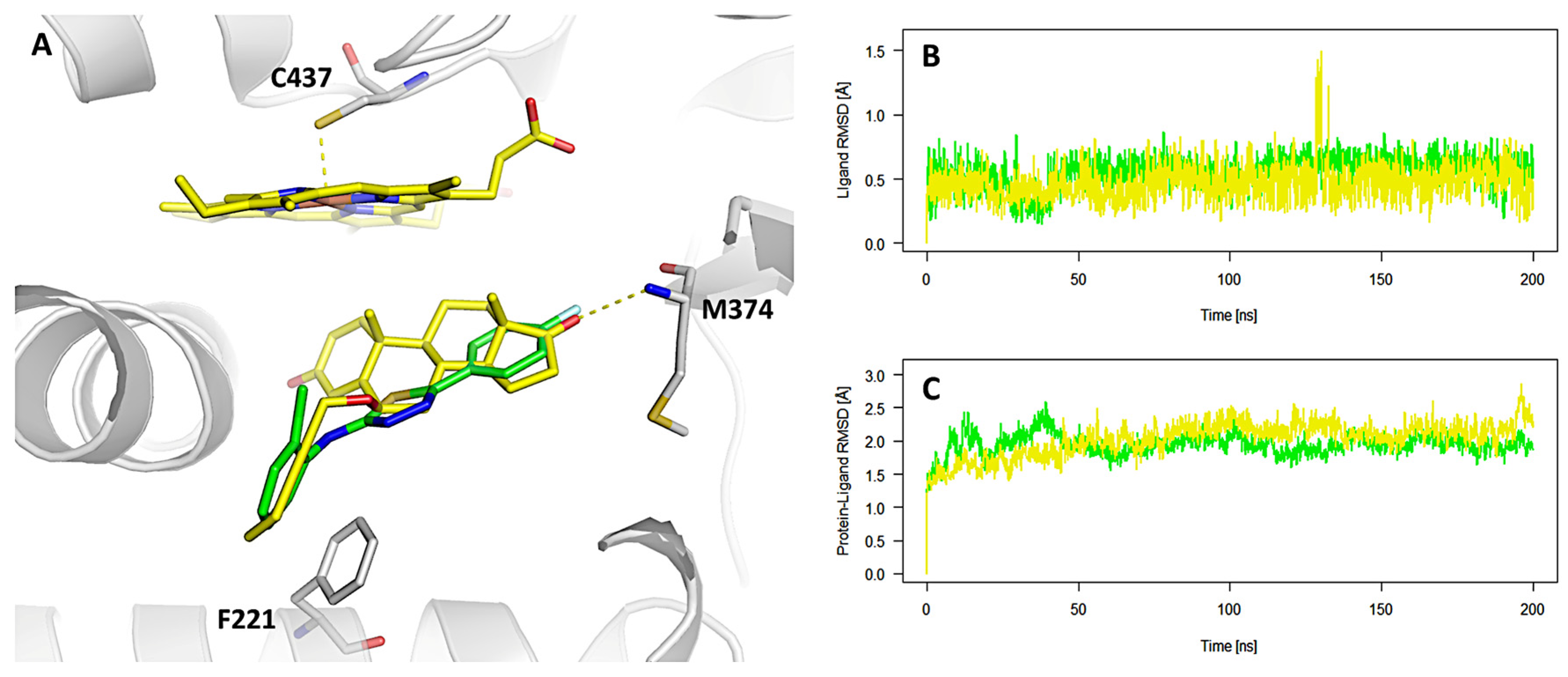
2.3. Molecular Docking Study
3. Materials and Methods
3.1. Chemistry
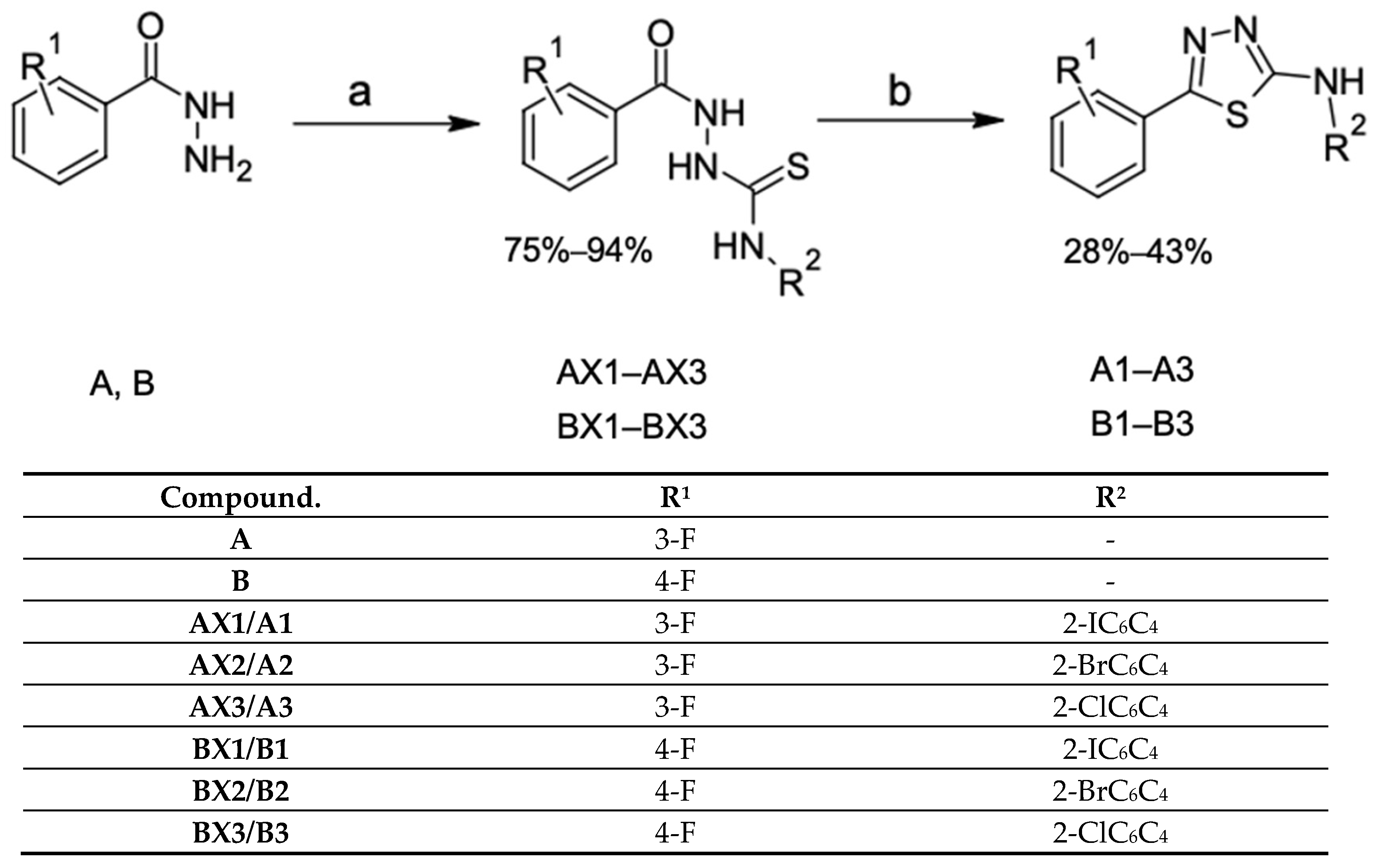
3.1.1. Synthesis of Thiosemicarbazide Derivatives AX1–AX3 and BX1–BX3
- 1-(3-Fluorobenzoyl)-4-(2-iodophenyl)thiosemicarbazide (AX1)
- 4-(2-Bromophenyl)-1-(3-fluorobenzoyl)thiosemicarbazide (AX2)
- 4-(2-Chlorophenyl)-1-(3-fluorobenzoyl)thiosemicarbazide (AX3)
- 1-(4-Fluorobenzoyl)-4-(2-iodophenyl)thiosemicarbazide (BX1)
- 4-(2-Bromophenyl)-1-(4-fluorobenzoyl)thiosemicarbazide (BX2)
- 4-(2-Chlorophenyl)-1-(4-fluorobenzoyl)thiosemicarbazide (BX3) [16]
3.1.2. Synthesis of 1,3,4-Thiadiazole Derivatives A1–A3 and B1–B3
- 5-(3-Fluorophenyl)-2-(2-iodophenylamino)-1,3,4-thiadiazole (A1)
- 2-(2-Bromophenylamino)-5-(3-fluorophenyl)-1,3,4-thiadiazole (A2)
- 2-(2-Chlorophenylamino)-5-(3-fluorophenyl)-1,3,4-thiadiazole (A3)
- 5-(4-Fluorophenyl)-2-(2-iodophenylamino)-1,3,4-thiadiazole (B1)
- 2-(2-Bromophenylamino)-5-(4-fluorophenyl)-1,3,4-thiadiazole (B2)
- 2-(2-Chlorophenylamino)-5-(4-fluorophenyl)-1,3,4-thiadiazole (B3)
3.2. Cell Lines
3.3. MTT Assay
3.4. Statistical Analysis
3.5. Molecular Docking
3.6. Molecular Dynamics Simulations
4. Conclusions
Supplementary Materials
Author Contributions
Funding
Institutional Review Board Statement
Informed Consent Statement
Data Availability Statement
Conflicts of Interest
References
- Kim, J.; Harper, A.; McCormack, V.; Sung, H.; Houssami, N.; Morgan, E.; Mutebi, M.; Garvey, G.; Soerjomataram, I.; Fidler-Benaoudia, M.M. Global Patterns and Trends in Breast Cancer Incidence and Mortality across 185 Countries. Nat. Med. 2025, 31, 1154–1162. [Google Scholar] [CrossRef] [Scilit] [PubMed]
- Chumsri, S.; Howes, T.; Bao, T.; Sabnis, G.; Brodie, A. Aromatase, Aromatase Inhibitors, and Breast Cancer. J. Steroid Biochem. Mol. Biol. 2011, 125, 13–22. [Google Scholar] [CrossRef] [Scilit] [PubMed]
- Ghosh, D.; Griswold, J.; Erman, M.; Pangborn, W. Structural Basis for Androgen Specificity and Oestrogen Synthesis in Human Aromatase. Nature 2009, 457, 219–223. [Google Scholar] [CrossRef] [Scilit] [PubMed]
- Sayyad, N.B.; Sabale, P.M.; Umare, M.D.; Bajaj, K.K. Aromatase Inhibitors: Development and Current Perspectives. Indian. J. Pharm. Educ. Res. 2022, 56, 311–320. [Google Scholar] [CrossRef] [Scilit]
- Janowska, S.; Holota, S.; Lesyk, R.; Wujec, M. Aromatase Inhibitors as a Promising Direction for the Search for New Anticancer Drugs. Molecules 2024, 29, 346. [Google Scholar] [CrossRef] [Scilit] [PubMed]
- Othman, A.A.; Kihel, M.; Amara, S. 1,3,4-Oxadiazole, 1,3,4-Thiadiazole and 1,2,4-Triazole Derivatives as Potential Antibacterial Agents. Arab. J. Chem. 2019, 12, 1660–1675. [Google Scholar] [CrossRef] [Scilit]
- Plech, T.; Kaproń, B.; Paneth, A.; Wujec, M.; Czarnomysy, R.; Bielawska, A.; Bielawski, K.; Trotsko, N.; Kuśmierz, E.; Paneth, P. Search for Human DNA Topoisomerase II Poisons in the Group of 2,5-Disubstituted-1,3,4-Thiadiazoles. J. Enzym. Inhib. Med. Chem. 2015, 30, 1021–1026. [Google Scholar] [CrossRef] [Scilit] [PubMed]
- Karakuş, S.; Başçıl, E.; Tok, F.; Erdoğan, Ö.; Çevik, Ö.; Başoğlu, F. Synthesis, Biological Evaluation and Molecular Docking Studies of Novel 1,3,4-Thiadiazoles as Potential Anticancer Agents and Human Carbonic Anhydrase Inhibitors. Mol. Divers. 2023, 28, 3801–3815. [Google Scholar] [CrossRef] [Scilit] [PubMed]
- Janowska, S.; Khylyuk, D.; Bielawska, A.; Szymanowska, A.; Gornowicz, A.; Bielawski, K.; Noworól, J.; Mandziuk, S.; Wujec, M. New 1,3,4-Thiadiazole Derivatives with Anticancer Activity. Molecules 2022, 27, 1814. [Google Scholar] [CrossRef] [Scilit] [PubMed]
- Li, Y.; Geng, J.; Liu, Y.; Yu, S.; Zhao, G. Thiadiazole-a Promising Structure in Medicinal Chemistry. ChemMedChem 2013, 8, 27–41. [Google Scholar] [CrossRef] [Scilit] [PubMed]
- Indelicato, S.; Bongiorno, D.; Mauro, M.; Cascioferro, S. Recent Developments of 1,3,4-Thiadiazole Compounds as Anticancer Agents. Pharmaceuticals 2025, 18, 580. [Google Scholar] [CrossRef] [Scilit] [PubMed]
- Li, X.Y.; Wang, D.P.; Li, S.; Xue, W.H.; Qian, X.H.; Liu, K.L.; Li, Y.H.; Lin, Q.Q.; Dong, G.; Meng, F.H.; et al. Discovery of N-(1,3,4-Thiadiazol-2-Yl)Benzamide Derivatives Containing a 6,7-Methoxyquinoline Structure as Novel EGFR/HER-2 Dual-Target Inhibitors against Cancer Growth and Angiogenesis. Bioorg. Chem. 2022, 119, 105469. [Google Scholar] [CrossRef] [Scilit] [PubMed]
- Osmaniye, D.; Hıdır, A.; Sağlık, B.N.; Levent, S.; Özkay, Y.; Kaplancıklı, Z.A. Synthesis of New Pyrimidine--Triazole Derivatives and Investigation of Their Anticancer Activities. Chem. Biodivers. 2022, 19, e202200216. [Google Scholar] [CrossRef] [Scilit] [PubMed]
- Holliday, D.L.; Speirs, V. Choosing the Right Cell Line for Breast Cancer Research. Breast Cancer Res. 2011, 13, 215. [Google Scholar] [CrossRef] [Scilit] [PubMed]
- Çetiner, G.; Acar Çevik, U.; Celik, I.; Bostancı, H.E.; Özkay, Y.; Kaplancıklı, Z.A. New Imidazole Derivatives as Aromatase Inhibitor: Design, Synthesis, Biological Activity, Molecular Docking, and Computational ADME-Tox Studies. J. Mol. Struct. 2023, 1278, 134920. [Google Scholar] [CrossRef] [Scilit]
- Azole Derivatives as Wtn Pathway Inhibitors and Their Preparation and Use in the Treatment of Diseases Affected by Wnt Signaling Pathway Over-Activation. PCT/GB2010/001118, 7 June 2010.
- Available online: https://www.aatbio.com/tools/ic50-calculator (accessed on 26 November 2025).
- Berman, H.M. The Protein Data Bank. Nucleic Acids Res. 2000, 28, 235–242. [Google Scholar] [CrossRef] [Scilit] [PubMed]
- Damm, W.; Dajnowicz, S.; Ghoreishi, D.; Yu, Y.; Ganeshan, K.; Madin, O.; Rudshteyn, B.; Hu, R.; Wu, M.; Shang, Y.; et al. OPLS5: Addition of Polarizability and Improved Treatment of Metals. ChemRxiv 2024. [Google Scholar] [CrossRef] [Scilit]
- Friesner, R.A.; Banks, J.L.; Murphy, R.B.; Halgren, T.A.; Klicic, J.J.; Mainz, D.T.; Repasky, M.P.; Knoll, E.H.; Shelley, M.; Perry, J.K.; et al. Glide: A New Approach for Rapid, Accurate Docking and Scoring. 1. Method and Assessment of Docking Accuracy. J. Med. Chem. 2004, 47, 1739–1749. [Google Scholar] [CrossRef] [Scilit] [PubMed]
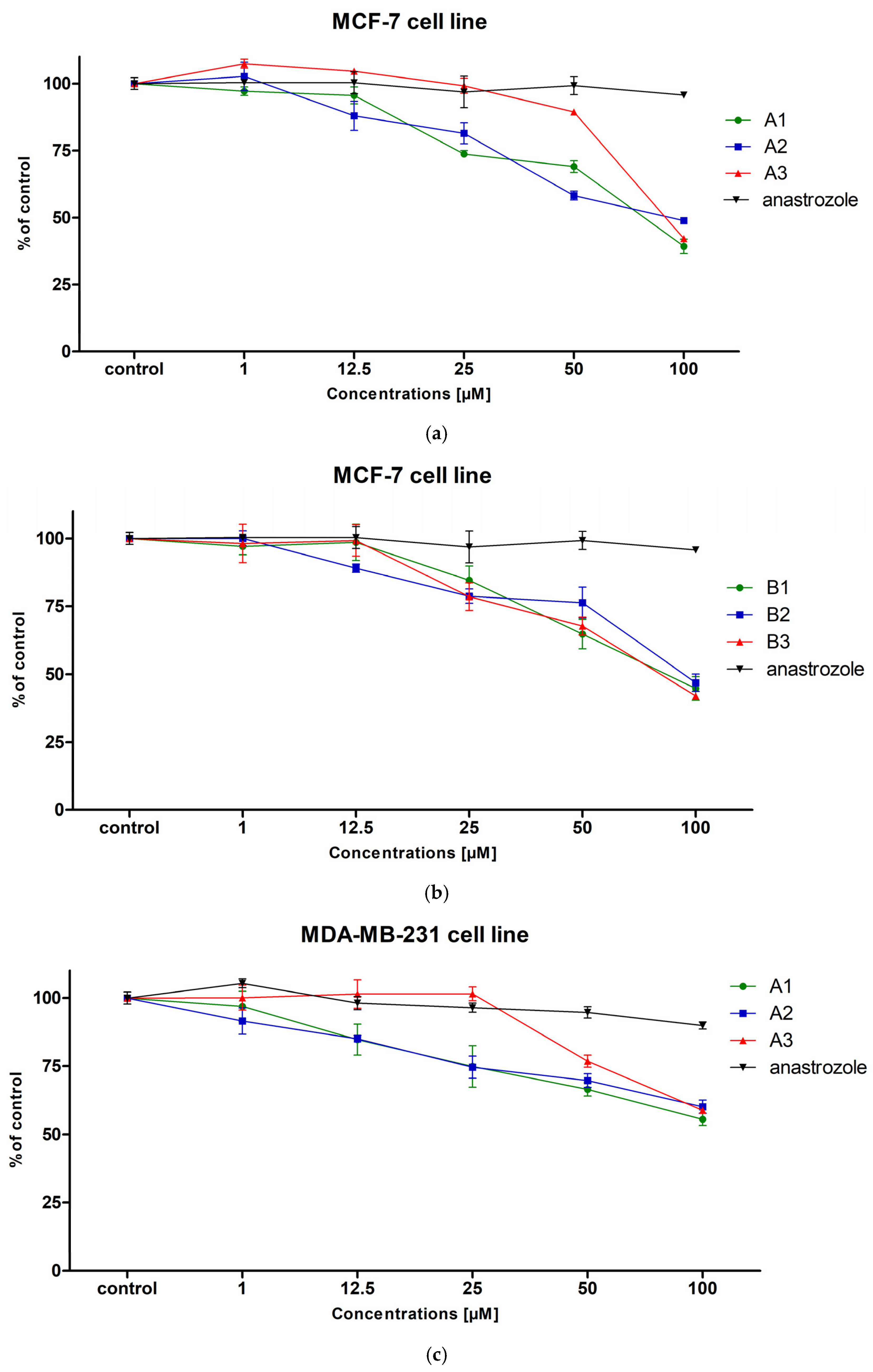


| IC50 [µM] | |||||||
|---|---|---|---|---|---|---|---|
| Cell Line | A1 | A2 | A3 | B1 | B2 | B3 | Anastrozole |
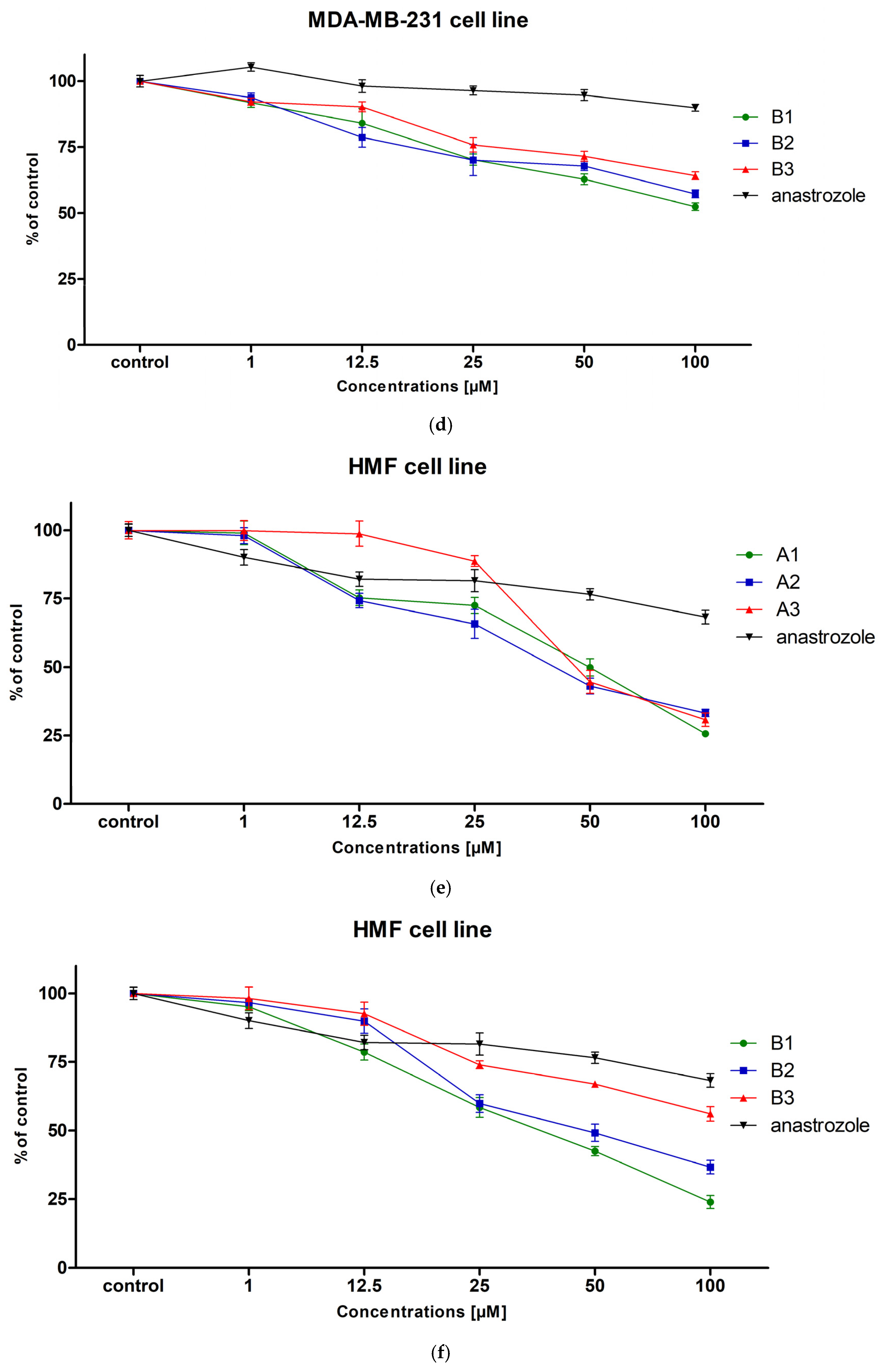
| MDA-MB-231 | >100 | >100 | >100 | >100 | >100 | >100 | >100 |
| MCF-7 | 65.95 | 82.48 | 54.81 | 53.9 | 82.48 | 54.1 | >100 |
| HMF | 51.01 | 41.8 | 36.9 | 45.58 | 41.8 | >100 | >100 |
Disclaimer/Publisher’s Note: The statements, opinions and data contained in all publications are solely those of the individual author(s) and contributor(s) and not of MDPI and/or the editor(s). MDPI and/or the editor(s) disclaim responsibility for any injury to people or property resulting from any ideas, methods, instructions or products referred to in the content. |
© 2025 by the authors. Licensee MDPI, Basel, Switzerland. This article is an open access article distributed under the terms and conditions of the Creative Commons Attribution (CC BY) license (https://creativecommons.org/licenses/by/4.0/).
Share and Cite
Janowska, S.; Makuch-Kocka, A.; Kurczab, R.; Demchuk, O.M.; Wujec, M. Synthesis and In Vitro Evaluation of Anticancer Activity of Fluorophenyl Derivatives of 1,3,4-Thiadiazole Against Estrogen-Dependent Breast Cancer. Molecules 2025, 30, 4744. https://doi.org/10.3390/molecules30244744
Janowska S, Makuch-Kocka A, Kurczab R, Demchuk OM, Wujec M. Synthesis and In Vitro Evaluation of Anticancer Activity of Fluorophenyl Derivatives of 1,3,4-Thiadiazole Against Estrogen-Dependent Breast Cancer. Molecules. 2025; 30(24):4744. https://doi.org/10.3390/molecules30244744
Chicago/Turabian StyleJanowska, Sara, Anna Makuch-Kocka, Rafał Kurczab, Oleg M. Demchuk, and Monika Wujec. 2025. "Synthesis and In Vitro Evaluation of Anticancer Activity of Fluorophenyl Derivatives of 1,3,4-Thiadiazole Against Estrogen-Dependent Breast Cancer" Molecules 30, no. 24: 4744. https://doi.org/10.3390/molecules30244744
APA StyleJanowska, S., Makuch-Kocka, A., Kurczab, R., Demchuk, O. M., & Wujec, M. (2025). Synthesis and In Vitro Evaluation of Anticancer Activity of Fluorophenyl Derivatives of 1,3,4-Thiadiazole Against Estrogen-Dependent Breast Cancer. Molecules, 30(24), 4744. https://doi.org/10.3390/molecules30244744