


Abstract
The PhI(OAc)2-promoted 1,2-transfer reaction between allylic alcohols and thiophenols, conducted in an argon atmosphere, has proven to be effective in producing β-carbonyl sulfides from 1,1-disubstituted allylic alcohols in high yields. This method offers a fast and efficient way to synthesize β-carbonyl sulfides, which are valuable intermediates in organic synthesis. This discussion focuses on the effects of the oxidizer, temperature, and solvent on the reaction. A proposed tentative mechanism for this reaction is also discussed.
1. Introduction
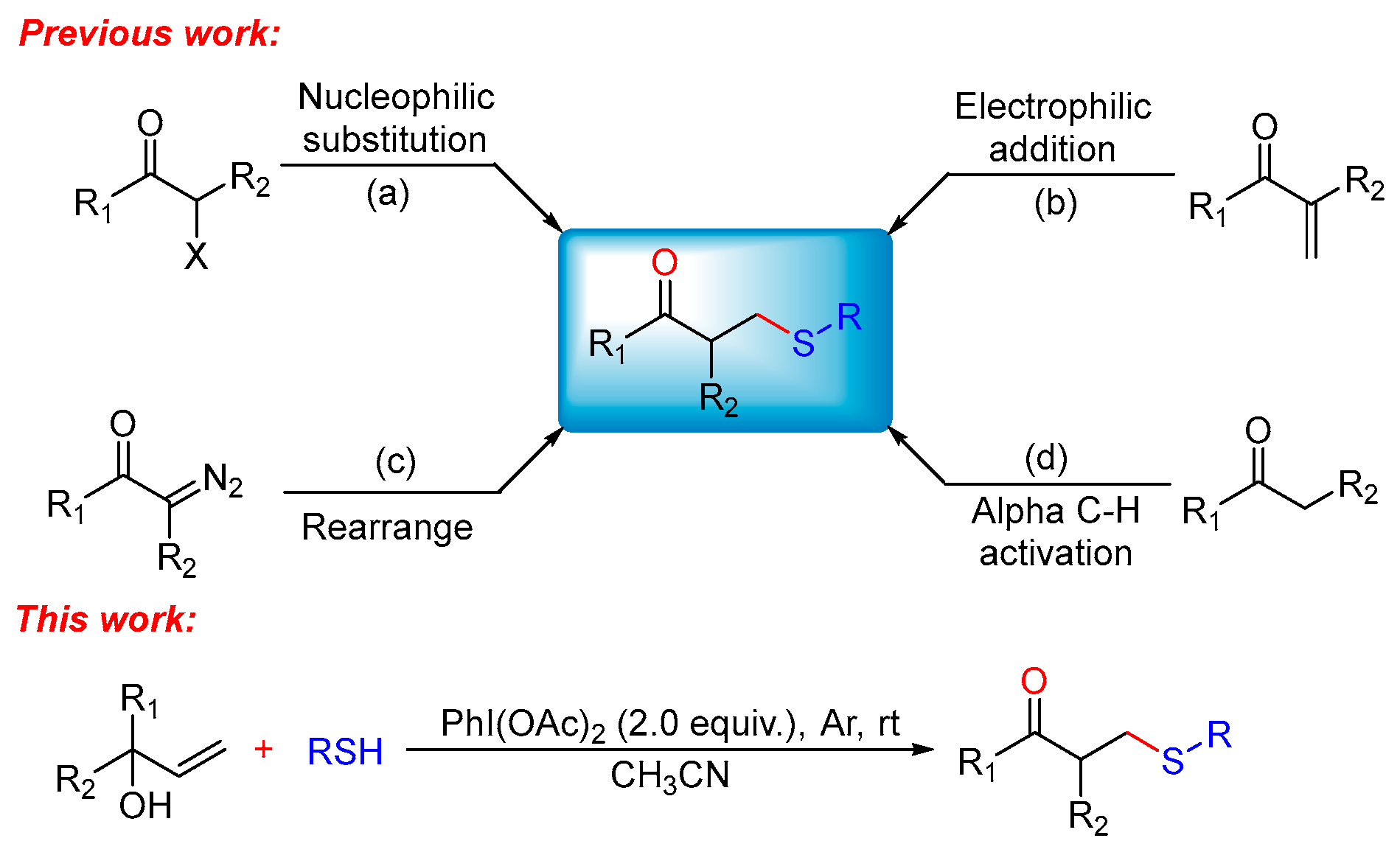
Sulfur-containing structural motifs play a prominent role in the construction of protein [1,2,3,4], pharmaceutical [5,6,7,8,9], biological [10,11,12], and material molecules [13,14,15,16,17,18]. In particular, β-carbonyl sulfides have attracted much interest because not only are they easy building blocks that can be used to obtain organic compounds [19,20,21], but also, they are privileged structural scaffolds extensively present in drugs [22,23,24], beverages [25] and foods [26]. Thus, the construction of β-carbonyl sulfides has drawn more attention. The conventional procedures aimed toward the synthesis of β-carbonyl sulfides include (Scheme 1) (a) nucleophilic substitution [27,28], (b) electrophilic addition [29,30,31,32], (c) rearrangement reaction [33], and (d) alpha C-H activation reaction [34]. Although these approaches to building β-carbonyl sulfides are accessible, the developed methods often have some drawbacks, such as low selectivity, critical reaction conditions, and expensive transition metal catalysts. Thus, the improvement of novel synthetic techniques for the synthesis of specific structures remains a difficult task for organic chemists.
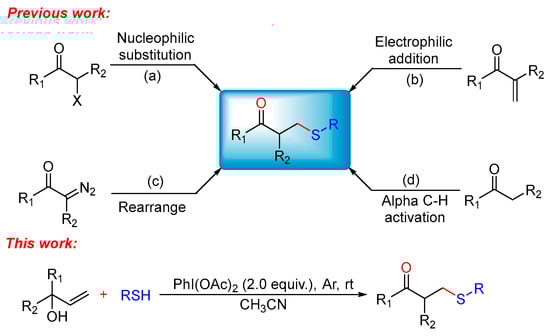
Scheme 1.
Synthesis of β-carbonyl sulfides.
The functionalization of allyl alcohol follows the principle of atom economy, as it does not lead to the loss of atoms during the reaction. Specifically, when 1,1-diaryl allyl alcohol compounds are functionalized, rearrangement often occurs, i.e., an aryl group migrated from position 1 migrating to position 2, resulting in the formation of α-aryl-β-substituted carbonyl compounds. This has attracted increasing attention from organic chemists. Currently, various methods including light, electricity, peroxides, and transition metals can facilitate the smooth progression of the 1,2-aryl migration reaction in 1,1-diaryl allyl alcohols. In 2013, the Tu group developed [35] a copper-catalyzed trifluoromethyl of 1,1-diaryl allylic alcohols via 1,2-aryl migration. In 2014, the Ji group reported [36] the phosphonation of 1, 1-diaryl allylic alcohols via 1,2-aryl migration. In 2018, the Cai group reported [37] a light-catalyzed sulfoxide methyl of 1, 1-diaryl allylic alcohols synthesized via 1,2-aryl migration. In 2019, the Lei group reported [38] the synthesis of β-trifluoromethyl ketone under electrochemical conditions. In 2015, the Han group [39] reported the DTBP-catalyzed alkylation of 1, 1-diaryl allylic alcohols, which involves a 1,2-aryl migration process. Previously, our group reported [40] that K2S2O8 promoted dehydrative cross-coupling between 1,1-disubstituted allylic alcohols and thiophenols/thiols, and allyl sulfides were obtained. Herein, we report a study on the PhI(OAc)2-promoted 1,2-transfer reaction between allylic alcohols and thiophenols, which provided atom-economic and metal catalyst-free conditions for the synthesis of β-carbonyl sulfides.
2. Results
Initially, we chose 1,1-diphenylprop-2-en-1-ol (1a) and 4-methylthiophenol (2a) as the model substrates to optimize the reaction conditions, as shown in Table 1. We found that when the reaction was carried out in the presence of PhI(OAc)2 at room temperature in an argon atmosphere for 24 h in CH3CN, the β-carbonyl sulfide 3aa was obtained in an 89% yield (see Table 1, entry 1). No desired product was detected when the reaction was conducted without an oxidant (Table 1, entry 2). Furthermore, nearly no product was afforded when the other oxidants were employed (Table 1, entries 3–5). Adjusting the amount of PhI(OAc)2 to 1.0 equiv. yielded the desired product 3aa in a yield of 9% (Table 1, entry 6), while using 3.0 equiv. resulted in a 52% yield (Table 1, entry 7). We also evaluated the reaction temperature, finding that deviating from room temperature led to decreased yields (Table 1, entries 8–10). Additionally, we found that CH3CN was the optimal solvent compared to others (Table 1, entries 11–14). Finally, the yield of β-carbonyl sulfide 3aa dropped to 75% when the reaction was performed in an air atmosphere (Table 1, entry 15).

Table 1.
Screening of reaction conditions a.
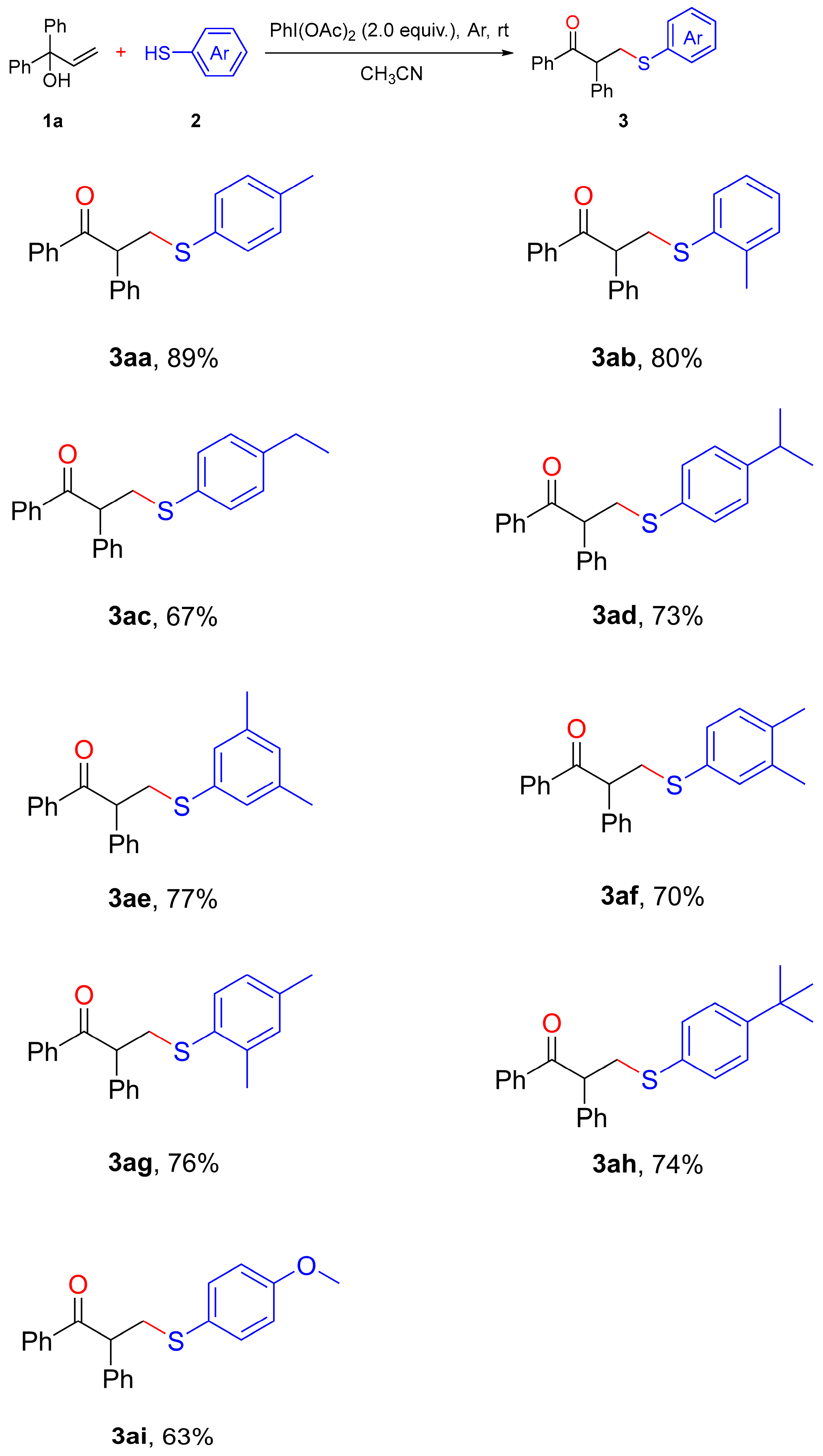
With the above optimal conditions in hand, we investigated the scope for introducing thiophenols to the PhI(OAc)2-promoted 1,2-transfer reaction. As shown in Figure 1, all thiophenol derivatives, 2a–2j, reacted smoothly with 1a to obtain the β-carbonyl sulfides 3aa–3ai in good to excellent yields. First, thiophenols bearing electron-neutral functional groups including methyl, ethyl, isopropyl, and tert-butyl were effectively reacted with 1,1-diphenylprop-2-en-1-ol, yielding corresponding β-carbonyl sulfides in 67–89% yields (Figure 1, 3aa–3ah). Moreover, methoxy-substituted thiophenol can also deliver this desired transformation, giving the corresponding β-carbonyl sulfide in a yield of 73% (3ai).
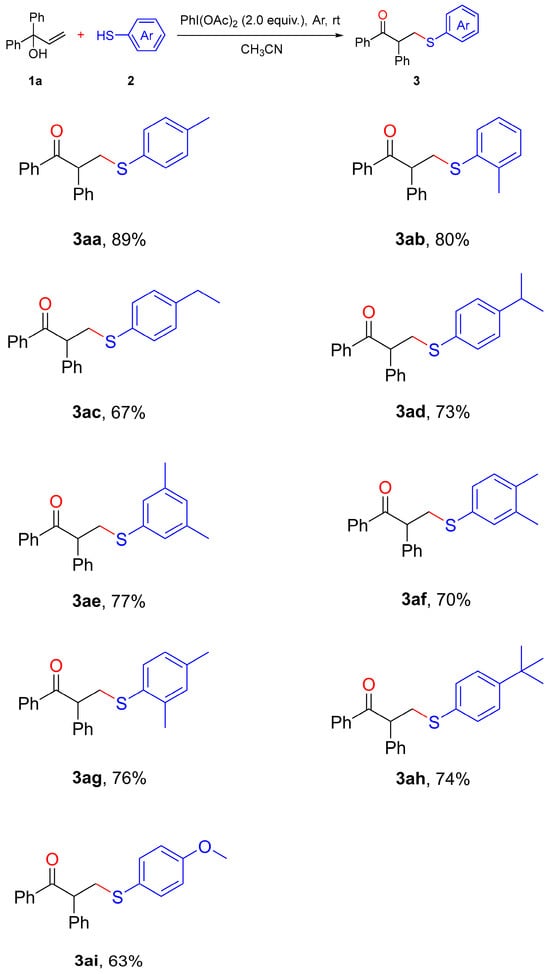
Figure 1.
Substrate scope of the 1,2-transfer reaction of 1,1-diphenylprop-2-en-1-ol with various thiophenols a,b. [a] Reaction conditions: 1a (0.2 mmol); 2a (0.4 mmol); PhI(OAc)2 (2 equiv.); CH3CN (2 mL); rt, 24 h. [b] Isolated yields.
Next, a range of allyl alcohols were capable of participating in the 1,2-transfer reaction with high yields (3ba–3ga, 52–65%) in Figure 2. First, a series of symmetrical diaryl allylic alcohols were investigated. Delightfully, halogen-substituted allylic alcohols were successfully converted into the corresponding β-carbonyl sulfides 3ba–3ca. In addition, allylic alcohols with two varying types of substituents on the phenyl ring were all compatible reaction partners (Figure 2, 3da–3ga and 3da’–3ga’). A variety of allylic alcohols with different electron-withdrawing or electron-donating substituents reacted nicely with 4-methylthiophenol in good yields to obtain β-carbonyl sulfides 3da–3ga and their isomers 3da’–3ga’.
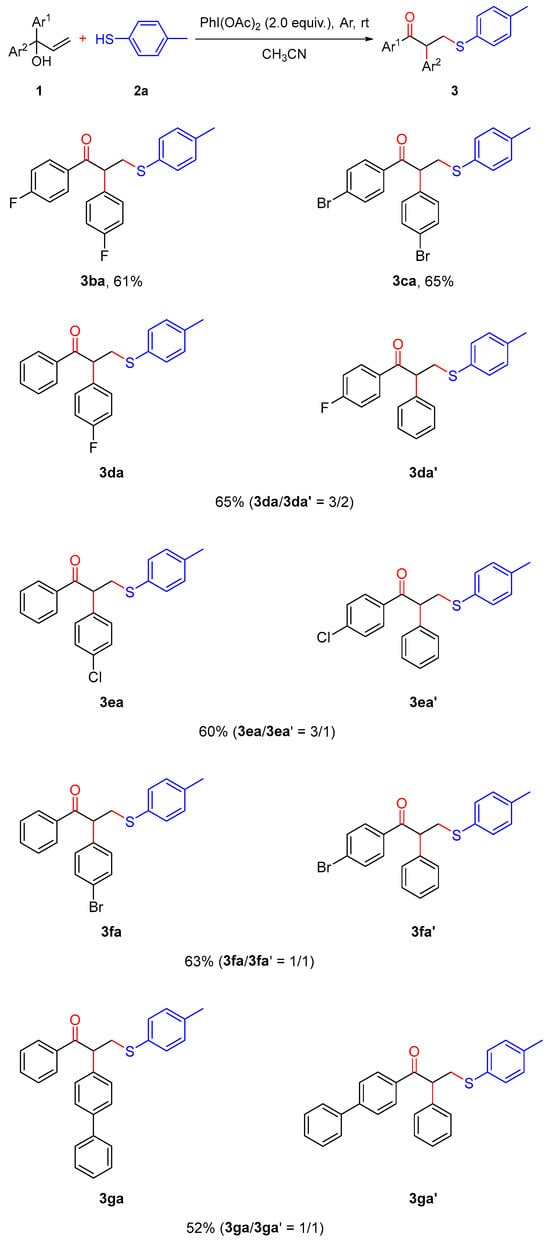
Figure 2.
Scope of the 1,2-transfer reaction of various allyl alcohols with 4-methylthiophenol a,b. [a] Reaction conditions: 1a (0.2 mmol); 2a (0.4 mmol); PhI(OAc)2 (2 equiv.); CH3CN (2 mL); rt, 24 h. [b] Isolated yields.
Moreover, the applicability of the PhI(OAc)2-promoted 1,2-transfer reaction was further demonstrated by a gram-scale reaction (Scheme 2). When the reaction was conducted with a metal-free approach, the expected β-carbonyl sulfide 3aa could be obtained in a high isolated yield (81%).
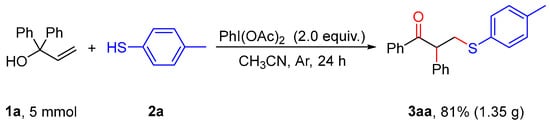
Scheme 2.
Gram-scale synthesis.
To shed light on the mechanism of the 1,2-transfer reaction between 1,1-disubstituted allylic alcohols and thiophenols, a variety of control experiments were performed (Scheme 3). Running the model reaction in the presence of 2.0 equiv. of 2,6-di-tert-butyl-4-methylphenol (BHT) or 1,4-cyclohexadiene did not have much effect on the reaction, and β-carbonyl sulfide 3aa was still the major product. These results indicated that the reaction involves the cationic mechanism pathway rather than the free radical process.
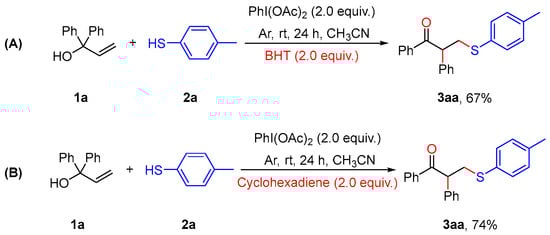
Scheme 3.
Control experiments.
Based on the above experimental results and literature reports [41,42], a tentative mechanism for the PhI(OAc)2-promoted 1,2-transfer reaction is illustrated in Scheme 4. In the first place, PhI(OAc)2 attacks the 1,1-diaryl allyl alcohol double bond to form cation A. Then, the aryl group migrates to form intermediate B, and the acetate ion leaves to form iodide cation C. Finally, thiophenol attacks intermediate C and leaves a molecule of PhI to obtain the target product.
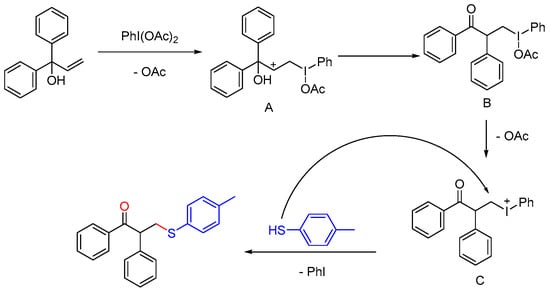
Scheme 4.
Proposed mechanism.
3. Materials and Methods
3.1. General Information
All materials, reagents, and solvents were purchased from commercial suppliers and were used without further purification. Analytical TLC was performed with silica gel GF254 plates, and the products were visualized by UV detection. Flash chromatography was carried out using silica gel 200–300. The 1H NMR (400 or 600 MHz) and 13C NMR (151 MHz) spectra were measured using CDCl3 as solvent (Supplementary Materials Figures S1–S30). All chemical shifts (δ) are reported in ppm and coupling constants (J) in Hz. High-resolution mass spectra (HR-MS) were recorded under electrospray ionization (ESI) conditions.
3.2. General Procedure for the 1,2-Transfer Reaction of 1,1-Diphenylprop-2-en-1-ol with Various Thiophenols
To a dried reaction tube (10 mL) with a magnetic bar, PhI(OAc)2 (0.4 mmol) was added, and the tube was then sealed. The tube was then charged with nitrogen. Then, α,α-diphenyl allylic alcohols (1a, 0.2 mmol), thiophenols (2, 0.4 mmol), and CH3CN (2 mL) were injected into the tube using a syringe. The reaction was performed at room temperature for 24 h. The reaction’s progress was monitored by TLC. After the reactions were completed, the reaction mixture was diluted with water (10 mL) and washed with EA (3 × 10 mL). The combined organic layers were dried over anhydrous Na2SO4 and concentrated under reduced pressure. The products were isolated by silica gel column chromatography (ethyl acetate/petroleum ether = 1:50 to 1:200).
3.3. General Procedure for the 1,2-Transfer Reaction of Various Allyl Alcohols with 4-Methylthiophenol
To a dried reaction tube (10 mL) with a magnetic bar, PhI(OAc)2 (0.4 mmol) was added, and the tube was then sealed. The tube was then charged with nitrogen. Then, α,α-diaryl allylic alcohols (1, 0.2 mmol), 4-methylthiophenol (2a, 0.4 mmol), and CH3CN (2 mL) were injected into the tube using a syringe. The reaction was performed at room temperature for 24 h. The reaction’s progress was monitored by TLC. After the reactions were completed, the reaction mixture was diluted with water (10 mL) and washed with EA (3 × 10 mL). The combined organic layers were dried over anhydrous Na2SO4 and concentrated under reduced pressure. The products were isolated by silica gel column chromatography (ethyl acetate/petroleum ether = 1:100 to 1:200).
3.4. Scale-Up Experiment
To a dried reaction tube (10 mL) with a magnetic bar PhI(OAc)2 (10 mmol) was added, and the tube was then sealed. The tube was then charged with nitrogen. Then, α,α-diaryl allylic alcohols (1a, 5 mmol), 4-methylthiophenol (2a, 10 mmol), and CH3CN (25 mL) were injected into the tube using a syringe. The reaction was performed at room temperature for 24 h. The reaction’s progress was monitored by TLC. After the reactions were completed, the reaction mixture was diluted with water (20 mL) and washed with EA (3 × 20 mL). The combined organic layers were dried over anhydrous Na2SO4 and concentrated under reduce pressure. The product 3aa was isolated by silica gel column chromatography (ethyl acetate/petroleum ether = 1:100).
4. Conclusions
In summary, we have described a PhI(OAc)2-promoted 1,2-transfer reaction between allylic alcohols and thiophenols in high yields. This reaction method represents a powerful tool for synthesizing β-carbonyl sulfides, providing both high yields and rapid reaction times. Additionally, a tentative mechanism has been proposed. Further studies of the detailed reaction mechanism and its application are underway in our laboratory.
Supplementary Materials
The following supporting information can be downloaded at: https://www.mdpi.com/article/10.3390/molecules29133112/s1. General experimental methods; Characterizations of compounds; NMR spectra of the products (Figures S1–S30).
Author Contributions
Conceptualization, G.G. and J.Z.; methodology, G.G. and W.L.; formal analysis, G.G. and W.L.; resources, W.L. and Q.Z.; data curation, Y.W. and A.L.; writing—original draft preparation, G.G.; writing—review and editing, G.G. and Y.W. All authors have read and agreed to the published version of the manuscript.
Funding
This research was funded by the Doctor Funding Project of Longdong University (XYBYZK2224), the Natural Science Foundation of Gansu Province (23JRRM0754), and the Gansu Key Laboratory of Efficient Utilization of Oil and Gas Resources.
Institutional Review Board Statement
Not applicable.
Informed Consent Statement
Not applicable.
Data Availability Statement
The data pertinent to this study are available in the article.
Conflicts of Interest
The authors declare no conflicts of interest.
References
- Wang, N.; Saidhareddy, P.; Jiang, X. Construction of sulfur-containing moieties in the total synthesis of natural products. Nat. Prod. Rep. 2020, 37, 246–275. [Google Scholar] [CrossRef] [PubMed]
- Gómez-Tamayo, J.C.; Cordomí, A.; Olivella, M.; Mayol, E.; Fourmy, D.; Pardo, L. Analysis of the interactions of sulfur-containing amino acids in membrane proteins. Protein Sci. 2016, 25, 1517–1524. [Google Scholar] [CrossRef]
- Abbehausen, C.; Manzano, C.M.; Corbi, P.P.; Farrell, N.P. Effects of coordination mode of 2-mercaptothiazoline on reactivity of Au(I) compounds with thiols and sulfur-containing proteins. J. Inorg. Biochem. 2016, 165, 136–145. [Google Scholar] [CrossRef] [PubMed]
- Ma, Y.; Ma, W.; Hu, D.; Zhang, X.; Yuan, W.; He, X.; Kan, G.; Yu, D. QTL Mapping for Protein and Sulfur-Containing Amino Acid Contents Using a High-Density Bin-Map in Soybean (Glycine max L. Merr.). J. Agric. Food Chem. 2019, 67, 12313–12321. [Google Scholar] [CrossRef]
- Sarver, P.J.; Bissonnette, N.B.; MacMillan, D.W.C. Decatungstate-Catalyzed C(sp3)–H Sulfinylation: Rapid Access to Diverse Organosulfur Functionality. J. Am. Chem. Soc. 2021, 143, 9737–9743. [Google Scholar] [CrossRef] [PubMed]
- Lv, Y.; Cui, H.; Meng, N.; Yue, H.; Wei, W. Recent advances in the application of sulfinic acids for the construction of sulfur-containing compounds. Chin. Chem. Lett. 2022, 33, 97–114. [Google Scholar] [CrossRef]
- Li, Y.; Rizvi, S.A.; Hu, D.; Sun, D.; Gao, A.; Zhou, Y.; Li, J.; Jiang, X. Selective Late-Stage Oxygenation of Sulfides with Ground-State Oxygen by Uranyl Photocatalysis. Angew. Chem. Int. Ed. 2019, 58, 13499–13506. [Google Scholar] [CrossRef] [PubMed]
- Milito, A.; Brancaccio, M.; D’Argenio, G.; Castellano, I. Natural Sulfur-Containing Compounds: An Alternative Therapeutic Strategy against Liver Fibrosis. Cells 2019, 8, 1356. [Google Scholar] [CrossRef]
- Liao, Y.; Wang, M.; Jiang, X. Sulfur-containing peptides: Synthesis and application in the discovery of potential drug candidates. Curr. Opin. Chem. Biol. 2023, 75, 102336. [Google Scholar] [CrossRef]
- Nikitina, L.E.; Pavelyev, R.S.; Startseva, V.A.; Kiselev, S.V.; Galiullina, L.F.; Aganova, O.V.; Timerova, A.F.; Boichuk, S.V.; Azizova, Z.R.; Klochkov, V.V.; et al. Structural details on the interaction of biologically active sulfur-containing monoterpenoids with lipid membranes. J. Mol. Liq. 2020, 301, 112366. [Google Scholar] [CrossRef]
- Xie, J.; Liao, B.; Tang, R.-Y. Functional Application of Sulfur-Containing Spice Compounds. J. Agric. Food Chem. 2020, 68, 12505–12526. [Google Scholar] [CrossRef] [PubMed]
- Fan, Y.; Ma, Z.; Zhang, Y.; Wang, Y.; Ding, Y.; Wang, C.; Cao, S. Sulfur-Containing Compounds from Endophytic Fungi: Sources, Structures and Bioactivities. J. Fungi 2022, 8, 628. [Google Scholar] [CrossRef]
- Han, Y.; Zhang, Y.; Xu, C.; Hsu, C.S. Molecular characterization of sulfur-containing compounds in petroleum. Fuel 2018, 221, 144. [Google Scholar] [CrossRef]
- Zhu, C.; Gutiérrez, O.Y.; Santosa, D.M.; Flake, M.; Weindl, R.; Kutnyakov, I.; Shi, H.; Wang, H. Kinetics of nitrogen-, oxygen- and sulfur-containing compounds hydrotreating during co-processing of bio-crude with petroleum stream. Appl. Catal. B Environ. 2022, 307, 121197. [Google Scholar] [CrossRef]
- Liu, Q.; Fu, Z.; Wang, Z.; Chen, J.; Cai, X. Rapid and selective oxidation of refractory sulfur-containing micropollutants in water using Fe-TAML/H2O2. Appl. Catal. B Environ. 2022, 315, 121535. [Google Scholar] [CrossRef]
- Mazumder, K.; Voit, B.; Banerjee, S. Recent Progress in Sulfur-Containing High Refractive Index Polymers for Optical Applications. ACS Omega 2024, 9, 6253. [Google Scholar] [CrossRef]
- Hu, H.; Zhang, Y.; Hu, Y.; Xia, L.; Li, G. Silver nanoparticles modified sulfur-containing POSS polymer membrane substrate for adsorption and surface-enhanced Raman scattering analysis of chrysoidine in food samples. Talanta 2024, 271, 125653. [Google Scholar] [CrossRef]
- Yue, T.-J.; Ren, W.-M.; Lu, X.-B. Copolymerization Involving Sulfur-Containing Monomers. Chem. Rev. 2023, 123, 14038. [Google Scholar] [CrossRef]
- Lauder, K.; Toscani, A.; Qi, Y.; Lim, J.; Charnock, S.J.; Korah, K.; Castagnolo, D. Photo-biocatalytic One-Pot Cascades for the Enantioselective Synthesis of 1,3-Mercaptoalkanol Volatile Sulfur Compounds. Angew. Chem. Int. Ed. 2018, 57, 5803. [Google Scholar] [CrossRef]
- Ulendeeva, A.D.; Baeva, L.A.; Valiullin, O.R.; Nikitina, T.S.; Arslanova, D.D.; Spirikhin, L.V.; Lyapina, N.K. Synthesis of γ-ketosulfide derivatives from natural mercaptans. Pet. Chem. 2006, 46, 122. [Google Scholar] [CrossRef]
- Trost, B.M. α-Sulfenylated carbonyl compounds in organic synthesis. Chem. Rev. 1978, 78, 363. [Google Scholar] [CrossRef]
- Vargas, R.R.; Bechara, E.J.H.; Marzorati, L.; Wladislaw, B. Asymmetric sulfoxidation of a β-carbonyl sulfide series by chloroperoxidase. Tetrahedron Asymmetry 1999, 10, 3219. [Google Scholar] [CrossRef]
- Li, L.; Li, D.; Luan, Y.; Gu, Q.; Zhu, T. Cytotoxic Metabolites from the Antarctic Psychrophilic Fungus Oidiodendron truncatum. J. Nat. Prod. 2012, 75, 920. [Google Scholar] [CrossRef] [PubMed]
- Park, H.B.; Kim, Y.-J.; Park, J.-S.; Yang, H.O.; Lee, K.R.; Kwon, H.C. Glionitrin B, a Cancer Invasion Inhibitory Diketopiperazine Produced by Microbial Coculture. J. Nat. Prod. 2011, 74, 2309. [Google Scholar] [CrossRef] [PubMed]
- Nörenberg, S.; Kiske, C.; Reichardt, B.; Andelfinger, V.; Pfeiffer, A.; Schmidts, F.; Eisenreich, W.; Engel, K.-H. Analysis and Sensory Evaluation of the Stereoisomers of a Homologous Series (C5–C10) of 4-Mercapto-2-alkanols. J. Agric. Food Chem. 2017, 65, 8913. [Google Scholar] [CrossRef]
- Takoi, K.; Degueil, M.; Shinkaruk, S.; Thibon, C.; Maeda, K.; Ito, K.; Bennetau, B.; Dubourdieu, D.; Tominaga, T. Identification and Characteristics of New Volatile Thiols Derived from the Hop (Humulus luplus L.) Cultivar Nelson Sauvin. J. Agric. Food Chem. 2009, 57, 2493. [Google Scholar] [CrossRef] [PubMed]
- Yadav, J.S.; Reddy, B.V.S.; Baishya, G. Green Protocol for Conjugate Addition of Thiols to α,β-Unsaturated Ketones Using a [Bmim]PF6/H2O System. J. Org. Chem. 2003, 68, 7098. [Google Scholar] [CrossRef]
- Ranu, B.C.; Mandal, T. Water-Promoted Highly Selective Anti-Markovnikov Addition of Thiols to Unactivated Alkenes. Synlett 2007, 2007, 925. [Google Scholar] [CrossRef]
- Wang, Y.; Yin, Y.; Zhang, Q.; Pan, W.; Guo, H.; Pei, K. Bi(OTf)3 catalyzed synthesis of acyclic β-sulfanyl ketones via a tandem Meyer-Schuster rearrangement/conjugate addition reaction. Tetrahedron Lett. 2019, 60, 2030. [Google Scholar] [CrossRef]
- Okragla, E.; Demkowicz, S.; Rachon, J.; Witt, D. A Convenient and Efficient α-Sulfenylation of Carbonyl Compounds. Synthesis 2009, 2009, 1720. [Google Scholar]
- Lin, Y.-M.; Lu, G.-P.; Cai, C.; Yi, W.-B. An odorless thia-Michael addition using Bunte salts as thiol surrogates. RSC Adv. 2015, 5, 27107. [Google Scholar] [CrossRef]
- Kitanosono, T.; Sakai, M.; Ueno, M.; Kobayashi, S. Chiral-Sc catalyzed asymmetric Michael addition/protonation of thiols with enones in water. Org. Biomol. Chem. 2012, 10, 7134. [Google Scholar] [CrossRef] [PubMed]
- Tyagi, V.; Sreenilayam, G.; Bajaj, P.; Tinoco, A.; Fasan, R. Biocatalytic Synthesis of Allylic and Allenyl Sulfides through a Myoglobin-Catalyzed Doyle–Kirmse Reaction. Angew. Chem. Int. Ed. 2016, 55, 13562. [Google Scholar] [CrossRef] [PubMed]
- Yan, G.; Borah, A.J.; Wang, L.; Pan, Z.; Chen, S.; Shen, X.; Wu, X. α-Arylchalcogenation of acetone with diaryl dichalcogenide via metal-free oxidative C(sp3)–H bond functionalization. Tetrahedron Lett. 2015, 56, 4305. [Google Scholar] [CrossRef]
- Chen, Z.-M.; Bai, W.; Wang, S.-H.; Yang, B.-M.; Tu, Y.-Q.; Zhang, F.-M. Copper-catalyzed Tandem trifluoromethylation/Semipinacol rearrangement of allylic alcohols. Angew. Chem. Int. Ed. 2013, 52, 9781–9785. [Google Scholar] [CrossRef] [PubMed]
- Chu, X.-Q.; Zi, Y.; Meng, H.; Xu, X.-P.; Ji, S.-J. Radical phosphinylation of α,α-diaryl allylic alcohols with concomitant 1,2-aryl migration. Chem. Commun. 2014, 50, 7642–7645. [Google Scholar] [CrossRef] [PubMed]
- Lu, M.; Qin, H.; Lin, Z.; Huang, M.; Weng, W.; Cai, S. Visible-Light-Enabled Oxidative Alkylation of Unactivated Alkenes with Dimethyl Sulfoxide through Concomitant 1,2-Aryl Migration. Org. Lett. 2018, 20, 7611–7615. [Google Scholar] [CrossRef] [PubMed]
- Guan, Z.; Wang, H.; Huang, Y.; Wang, Y.; Wang, S.; Lei, A. Electrochemical Oxidative Aryl(alkyl)trifluoromethylation of Allyl Alcohols via 1,2-Migration. Org. Lett. 2019, 21, 4619–4622. [Google Scholar] [CrossRef]
- Zhao, J.; Fang, H.; Song, R.; Zhou, J.; Han, J.; Pan, Y. Metal-free oxidative C(sp3)–H bond functionalization of alkanes and alkylation-initiated radical 1,2-aryl migration in α,α-diaryl allylic alcohols. Chem. Commun. 2015, 51, 599–602. [Google Scholar] [CrossRef]
- Guo, G.; Yuan, Y.; Wan, S.; Cao, X.; Sun, Y.; Huo, C. K2S2O8 promoted dehydrative cross-coupling between α,α-disubstituted allylic alcohols and thiophenols/thiols. Org. Chem. Front. 2021, 8, 2990. [Google Scholar] [CrossRef]
- Yoshimura, A.; Zhdankin, V.V. Advances in Synthetic Applications of Hypervalent Iodine Compounds. Chem. Rev. 2016, 116, 3328. [Google Scholar] [CrossRef] [PubMed]
- Li, X.; Chen, P.; Liu, G. Recent advances in hypervalent iodine(III)-catalyzed functionalization of alkenes. Beilstein J. Org. Chem. 2018, 14, 1813. [Google Scholar] [CrossRef] [PubMed]





Disclaimer/Publisher’s Note: The statements, opinions and data contained in all publications are solely those of the individual author(s) and contributor(s) and not of MDPI and/or the editor(s). MDPI and/or the editor(s) disclaim responsibility for any injury to people or property resulting from any ideas, methods, instructions or products referred to in the content. |
© 2024 by the authors. Licensee MDPI, Basel, Switzerland. This article is an open access article distributed under the terms and conditions of the Creative Commons Attribution (CC BY) license (https://creativecommons.org/licenses/by/4.0/).